
Publisher: Head of Zeus (Ebook – 7 December 2023)
Series: The Tyrant Philosophers – Book Two
Length: 636 pages
My Rating: 5 out 5 stars
The always deeply impressive Adrian Tchaikovsky returns with an exceptional and remarkable piece of fantasy fiction, House of Open Wounds, which presents the reader with a particularly unique and ruthlessly entertaining story, chock full of brilliant characters.
Few fantasy authors have the range and style of Adrian Tchaikovsky, whose distinctive contributions to the science fiction and fantasy fields are quite remarkable. While Tchaikovsky has written several highly regarded series, I have only just scratched the surface of his works, having read a few of his recent reads. This includes his first foray into the Warhammer 40,000 universe, with the captivating standalone read, Day of Ascension, as well as the brilliant and elaborate novella, Ogres. However, my favourite book from Tchaikovsky so far would have to be the outstanding City of Last Chances.
The first book in The Tyrant Philosophers series, City of Last Chances was an outstanding read that I had the pleasure of enjoying earlier this year. Set around a conquered city with several unique magical inclusions, City of Last Chances introduced the reader to a cool new world and told a range of character driven stories about resistance, religion and sacrifice. City of Last Chances got a very easy five-star rating from me, and it honestly was one of the best books and audiobooks I enjoyed in the first half of 2023. I had such a brilliant time with City of Last Chances that when Tchaikovsky announced he was releasing a sequel in the second half of 2023, I was ecstatic. This sequel, House of Open Wounds, continued some of the complex storylines Tchaikovsky started in City of Last Chances, and it was one of my most anticipated books for the second half of the year.
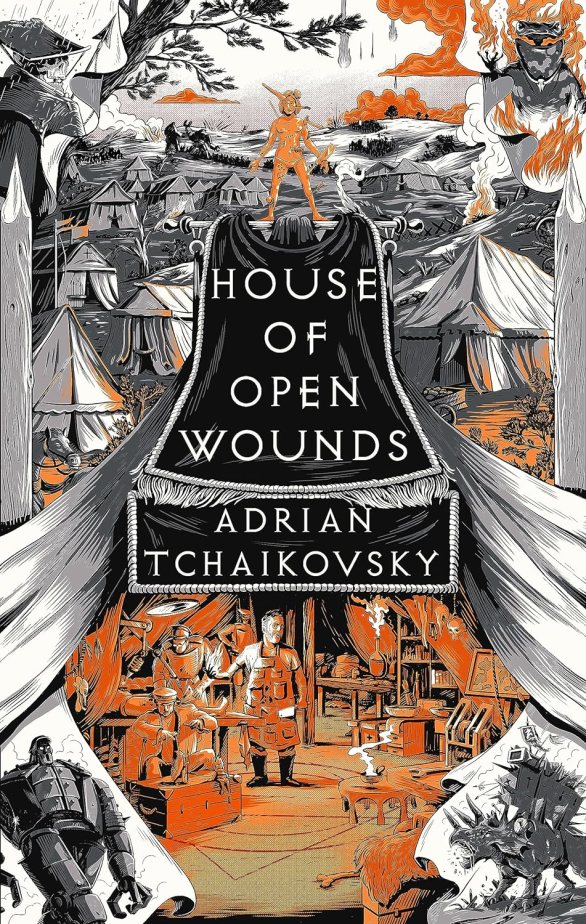
There are few nations more feared or relentless than the ever-expanding Palleseen. A rising empire of zealots who are determined to bring Perfection and Correctness to an imperfect world, the Palleseen have advanced out of their homeland in an unstoppable wave, wiping out all religion and superstition as they go. As cities and kingdoms fall before their military might, their armies leave behind mounds of dead and wounded soldiers who require tending in field hospital tents just behind the frontline.
Into this chaos is thrust the god smuggler Yasnic. A former priest, miracle healer and occasional rebel, whose previous experiences with the Palleseen saw him hanged, attacked and banished from his city, Yasnic has experienced many upheavals throughout his life. Saved from another execution by the army bureaucracy, Yasnic and his box of orphan gods arrive at the frontlines, where he has been assigned to work in an unorthodox medical unit.
Made up of a mixture of former priests, gods, magicians, alchemists, artificers, necromancers and led by a gigantic brute known as the Butcher, the experimental medical unit treats the soldiers no one else can save and recycles the rest into the war effort. Entrusted to save the Palleseen soldiers, but doomed if anyone ever discovers the full extent of their abilities, the surgeons and orderlies of this unit ply their bloody trade as best they can while living as part of an unusual family, but the arrival of Yasnic could change everything.
As Yasnic works to fit into the unit and save lives, his unusual connections to the weakened and hidden gods of the world slowly begin to cause chaos throughout the army. Not only is he aware of the divine forces that secretly hang around the hospital, but his own illegal and crotchety God is determined to bring miracles to the Palleseen, whether that want them or not. As an outbreak of impossible healing and sudden pacifism spreads through the regiment, can Yasnic keep himself and his gods alive, or will the full force of the Palleseen zealots come crashing down upon him?
This was another epic and truly remarkable novel from Tchaikovsky that had me hooked the entire way through. Featuring a dark, bloody and fun story, House of Open Wounds was a particularly distinctive read that told its own captivating story while continuing some of the best elements from City of Last Chances. Funny, thoughtful and moving in equal measures, House of Open Wounds was an incredible and addictive novel that gets another very easy five-star rating.
I was very impressed with the exceptional and moving narrative that Tchaikovsky pulled together for House of Open Wounds, and I was hooked the second I got into it. After the events of City of Last Chances, the reader is thrust into a new part of Tchaikovsky’s fantasy world as you find yourself imbedded in a Palleseen battalion following the members of an unusual but effective military hospital. Like City of Last Chances, House of Open Wounds is strongly character driven, as you follow the personal stories surrounding each of these unusual outsider characters and learn about their complex pasts while watching their lives play out in the present. Much of the plot revolves around returning protagonist Yasnic and his God, who are drafted into the unit, and you get to see his experiences of the other characters, the wars, and the internal Palleseen bureaucracy. Most of the first half of House of Open Wounds is dedicated to exploring the new cast of characters and introducing their unique stories, as they find themselves closely following a bloody and dangerous war. This part of the book is primarily focused on the healing and medical work of the protagonists, as well as diving into their reasons for being there and the unique skills they bring to the surgical table. Apart from that, there isn’t an amazing amount of major plot progression here, except when Yasnic starts to mix things up around the battalion. While this pace is a little slow, this first half of the book was really fun and enjoyable, as you find yourself getting really lost in the characters’ lives, unique struggles, desires, and experiences. It also helps that many of these character details, as well as the mundane events of the hospital, eventually lead to bigger things later in the main plot, and Tchaikovsky does an outstanding amount of set up here.
The plot picks up a lot more in the second half, when the main battalion moves to a different warzone and find themselves involved in a substantial fight that really pushes the medical unit to its limits. The new battles, as well as the intriguing location they find themselves in, move several of the character arcs in some big directions, and you find out more and more about each of the main characters as a result. The constant chaos that surrounds Yasnic also starts to take its toll on the main story, as his strangeness and the double-edged miracles he occasionally brings cause him to make enemies and upset the delicate balance of the Palleseen army. At the same time, the Palleseen war machine starts to alienate the members of the medical unit, who find their talents being stolen to create weapons. Everything leads up to the big finale, where the protagonists attempt to free themselves with an elaborate and ambitious plan. This plan makes great use of all their individual skills and histories, and so many little details and elements from the story are used to bring a fun and creative conclusion to the book. Each of the fascinating character arcs conclude nicely and I loved how Tchaikovsky masterfully brought everything together in a satisfying and entertaining way.
Tchaikovsky utilises his typical excellent and distinctive writing style to convey this elaborate and entertaining narrative to the reader, and I had such a wonderful time seeing it unfold. As with the previous novel in the series, Tchaikovsky relies very heavily on perspective changes to tell a multilayered, character-driven story. Like the previous book, many of the major characters are initially showcased in their own chapter at the beginning, which often leads to additional cast introductions. As the book progresses, the chapters feature perspective changes so you can see more interactions and a wider view of the entire story. I loved the immediate deep background on several of these characters, and while you still often must wait a while to get their full story, you learn enough to like them in the opening parts of the novel. Tchaikovsky makes full use of these characters to tell a fantastic story, and I loved how well he showcases some unique events through their eyes. As with the previous book, House of Open Wounds has a range of tones as Tchaikovsky works hard to produce the right balance of humour, excitement, and moving and powerful character moments. The multiple detailed and confronting scenes of the bloody battlefield hospitals are well balanced out by the fantastic and subtle humour, which often comes from the outrageous situations that occur throughout the book, as well as the various character’s unique outlooks on life. This made for a particularly compelling book as you found yourself moving from comedic scene to a more dramatic or tragic moment with frequent regularity, as you find yourself stuck onboard a well-thought-out emotional roller coaster.
House of Open Wounds proves to be an intriguing and clever follow-up to City of Last Chances, especially as the author deepens the lore surrounding this fantasy world and brings back two fantastic protagonists. Readers of City of Last Chances will have an absolute blast with this book, as you get some interesting follow up to Yasnic’s compelling storyline while also seeing a different side to the antagonistic nation from the first book. This is a somewhat loose follow-up, and you really don’t need to have read City of Last Chances to enjoy House of Open Wounds. In many ways this is a good standalone novel, especially as most of the focus is on a whole new group of protagonists, and even Yasnic is given a new name for much of the book. Tchaikovsky does ensure that some of the key details and plot points from the first book are carried over when needed, although he does leave a bit of context out in places so as not to overwhelm new readers. As such, House of Open Wounds is a very accessible read, although established fans of Tchaikovsky are going to particularly enjoy this, especially if they loved City of Last Chances.
One thing you can always rely on Tchaikovsky to do is to pull together an elaborate and deeply compelling world to set his stories around. This is extremely true in this series as Tchaikovsky has come up with a war-torn landscape filled with magic, gods, demons and a new rising empire. The author did some interesting set up for this world in the previous novel, although the plot there was primarily contained inside a single city. In House of Open Wounds, the reader gets to see a bigger chunk of this world, even though much of the plot takes place either on the battlefield or in the camp behind the lines. Despite this, you get a better idea of the politics, wars and conquests that have taken place in recent history, and you particularly learn more about the Palleseen. The Palleseen are a group of ideological zealots dedicated to bringing their version of perfection to the world, which primarily involves breaking everything down into logic and reason, and doing away with superstitions and beliefs. As such, their goal is to rid the world of gods, deities and other superstitions, usually by conquering the lands and bringing them under the control of their relentless bureaucracy. Most of this book is dedicated to exploring the nature of their war machine, and you really get to see just how corrupt and ambitious some of their members are as a result.
I loved the focus on the military hospital and the war camp for most of the book, especially as seeing the various members of Palleseen camp allows the reader to fully understand the many problems, compromises and cruelties the Palleseen experience on their road to perfection. Tchaikovsky throws in some great critiques of militarisation and empire building throughout the book as you see these perfect Palleseen become racked with pride, ambition and greed to prove themselves and advance up the ranks. Their determination to win means they turn a blind eye to gods and superstitions when it suits them, and that results in the experimental medical unit that serves as the centre of the book. However, while they appear to only want the assembled gods, alchemists, and other strange magics for healing, really they are working to corrupt them into terrible weapons to further their war capability. There are several great storylines that see the Palleseen turning benevolent tools and creatures into highly inventive tools of war, and it serves as a major plot point and motivation for several characters, including a few Palleseen who have enough of their colleague’s lust for power. Combine that with the returning minor gods, who end up having their own impact on several characters, and the reader comes away with a very cynical look at the Palleseen, and empires in general, which both ridicules them and shows just how malevolent and insidious they can be.
The real key that pulls together House of Open Wounds is the huge array of memorable and complex characters that are introduced throughout the course of the plot. Tchaikovsky does a remarkable job of introducing and swiftly building up some truly amazing characters in this novel, and their compelling and often traumatic personal stories become so highly ingrained in the plot as a result. There are so many great protagonists and supporting figures in this novel, and I was personally impressed with how all of them were original characters that were not built up in the prior novel.
The main exception to this rule is Yasnic and his god, both of whom were introduced in City of Last Chances and who are masterfully inserted into this sequel. Yasnic was honestly one of Tchaikovsky’s best characters in City of Last Chances and I was so glad to see more of him here, especially as the author somehow manages to work in even more development after all the defining character moments that shaped him in the prior novel. Since we last saw him, Yasnic has moved on from being the last priest of a forgotten god and has instead become a more generalised religious figure, offering shelter and assistance to fallen and orphaned gods who no longer have any power or believers by carrying them around in a box on his back. After everything he has gone through, including his own crisis of faith, Yasnic now has a different view of the world, although he is still being haunted by his demanding and petty god. Yasnic has some wonderful moments in this book as he tries to fit into his new role while also hanging onto the trappings of his old life. Desperate to save everyone he can, Yasnic finds his views and pacifism really badly damaged by the constant war and the relentless and orderly Palleseen, and he is forced to make some haunting compromises. You really get some very interesting insights into Yasnic’s mind in this book, especially as you see how the aftermath of him abandoning his position as a priest impacted him. You cannot help but feel for the extremely likeable Yasnic at times, as he is thrust into tragic and heartbreaking positions against his will, and his quiet determination and general positivity pluck at your heartstrings. Throw in some great new friends, an unusual but surprisingly wholesome love interest and a series of unfortunate misunderstandings that frustrate even this gentle soul, and Yasnic once again stands out as a particularly awesome and likeable protagonist.
The other side of Yasnic’s character resides in the body of his tiny, stumpy, and petty deity, God, a former major healing god who has lost all his worshippers apart from Yasnic, but still maintains his powerful healing abilities. However, God refuses to heal anyone unless they swear a vow of pacifism, and if they cause harm to someone in any way, it will result in their wounds automatically returning, generally resulting in a sudden death. Thanks to his stubbornness, pride, and his whiny focus on Yasnic’s soul, God was one of the most entertaining characters in City of Last Chances, and I am really glad that Tchaikovsky brought him back for House of Open Wounds. While he is still a judgemental, mischievous and ugly angel on Yasnic’s shoulder in this sequel, you get to learn more about God and why he refuses to help save people. There are some surprisingly emotional scenes where God expresses why he is so bitter and you really get a much better understanding of his angry mind, especially when Yasnic makes the same mistakes, adding to God’s sadness. I also loved how well God played off Yasnic as he proves to be a surprising and entertaining counterpoint to the humble and nice former priest. While most of their dialogue is quite contentious, with God trying to control his increasingly independent former priest, you can see deep down that God cares about Yasnic, and they form quite an interesting and fun duo. Tchaikovsky took God’s character arc in some interesting directions towards the end of House of Open Wounds, and I have a feeling he is going to be a real nuisance to people in the next book.
House of Open Wounds also features quite a fun range of supporting characters, each of whom has their own compelling story to tell. This primarily includes the crazy and unusual group of associated healers and hospital workers that work in the experimental hospital unit, as well as the competitive and dangerous Palleseen officers controlling their destinies. I won’t go into too much detail here, as I could honestly go one for a paragraph about each, but I was really impressed with how well Tchaikovsky set each of them up and explored their histories and stories as the booked continued. There are some brilliant and very well fleshed out character arcs everywhere in House of Open Wounds, and I loved just how compelling a story Tchaikovsky was able to make as a result.
Adrian Tchaikovsky once again shows why he is one of the absolute best authors of complex and intelligent fantasy fiction with this outstanding and epic read. House of Open Wounds is a deeply clever, compelling and moving read that hooks the reader with its unique scenarios, fantastic humour, and memorable characters. I loved every single second I spent reading this novel and I really appreciated the amazing way Tchaikovsky chose to continue the great story started in City of Last Chances. I cannot wait to see what over elaborate fantasy stories Tchaikovsky creates in this universe in the future, and this epic novel is one of the best pieces of fantasy fiction I enjoyed in 2023.
 The Unseen Library
Pingback: Top Ten Tuesday – My Favourite Sequels of 2023 – The Unseen Library
Pingback: Canberra Weekly Column – Recommendations for Christmas – 14 December 2023 – The Unseen Library
Love Tchaikovsky, only problem is he’s so prolific I can’t keep up. These sound really interesting
LikeLiked by 1 person
Yeah, he has at least three books coming out in 2024 that sound really cool. Going to be hard to read them all, and it wouldn’t surprise me if he also releases a third book in this series as well.
LikeLike
Pingback: Waiting on Wednesday – 2024 Adrian Tchaikovsky Science Fiction Novels – The Unseen Library
Pingback: Top Ten Tuesday – My Favourite Books of 2023 – The Unseen Library
Pingback: Top Ten Tuesday –Most Anticipated Fantasy/Science Fiction Books Releasing in the First Half of 2024: – The Unseen Library
Pingback: Top Ten Tuesday – Books on my Autumn 2024 To-Be-Read (TBR) List – The Unseen Library
Pingback: Waiting on Wednesday – Days of Shattered Faith by Adrian Tchaikovsky – The Unseen Library
Pingback: Top Ten Tuesday – Books on my Winter 2024 To-Be-Read (TBR) List – The Unseen Library
Pingback: Top Ten Tuesday – Most Anticipated Books Releasing During the Second Half of 2024 (Fantasy and Science Fiction) – The Unseen Library
Pingback: Quick Review – Alien Clay by Adrian Tchaikovsky – The Unseen Library
Pingback: Top Ten Tuesday – Books on my Summer 2024/25 To-Be-Read (TBR) List – The Unseen Library
Pingback: Service Model by Adrian Tchaikovsky – The Unseen Library
Pingback: WWW Wednesday – 29 January 2025 – The Unseen Library
Pingback: Book Haul – 1 February 2025 – The Unseen Library
Pingback: WWW Wednesday – 5 February 2025 – The Unseen Library
Pingback: Top Ten Tuesday – My Favourite Books From the First Half of 2025 – The Unseen Library
Pingback: Days of Shattered Faith by Adrian Tchaikovsky – The Unseen Library
Pingback: Top Ten Tuesday – Books on my Summer 2025/26 To Be Read (TBR) List – The Unseen Library
Pingback: Book Haul – 6 December 2025 – The Unseen Library
Pingback: Waiting on Wednesday – Pretenders to the Throne of God and Green City Wars by Adrian Tchaikovsky – The Unseen Library
Pingback: Top Ten Tuesday – My Favourite Audiobooks of 2025 – The Unseen Library
Pingback: Top Ten Tuesday – My Favourite Books of 2025 – The Unseen Library
Pingback: Top Ten Tuesday – My Most Anticipated Books Releasing in the First Half of 2026 – The Unseen Library
Pingback: Lives of Bitter Rain by Adrian Tchaikovsky – The Unseen Library