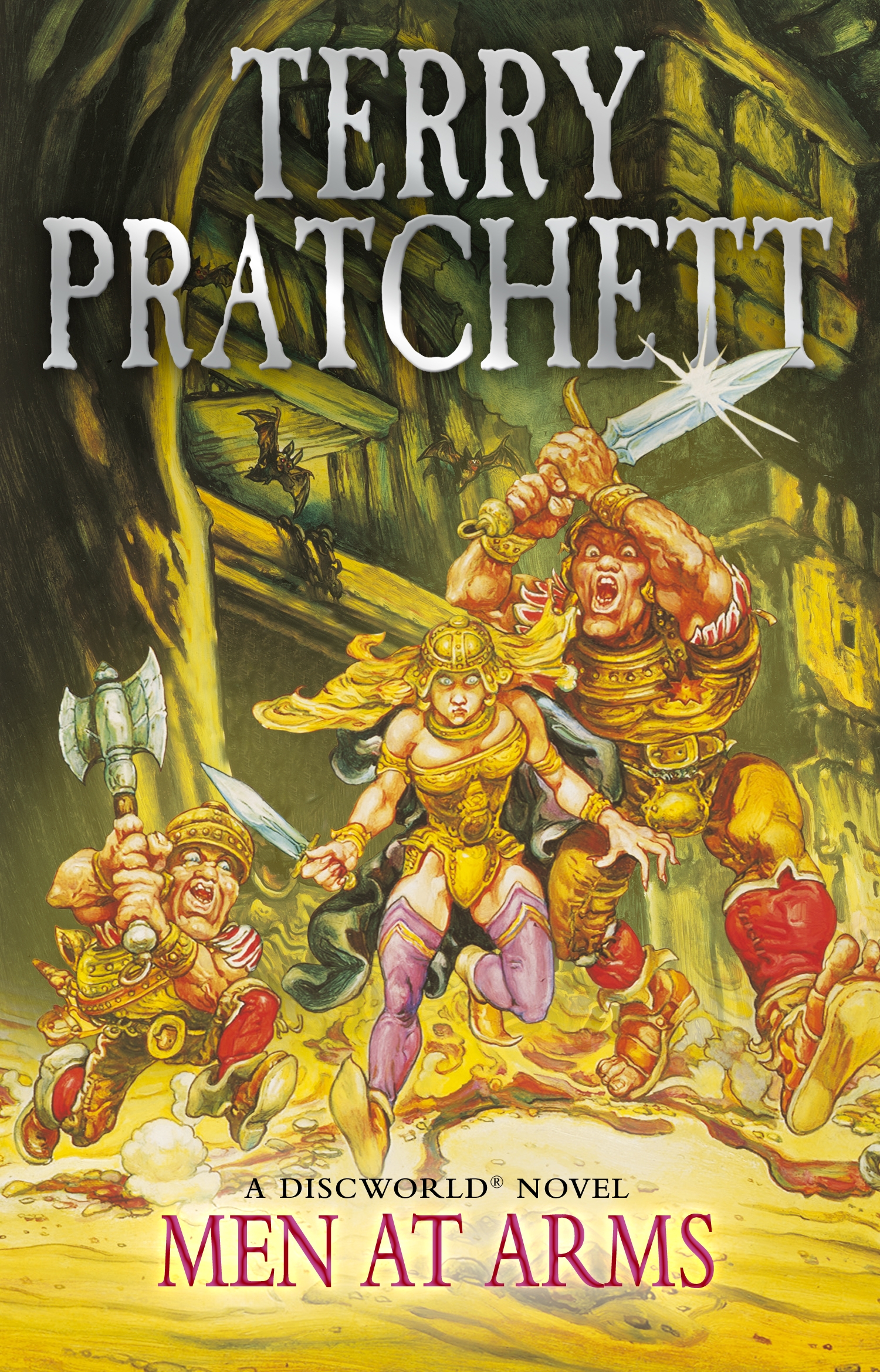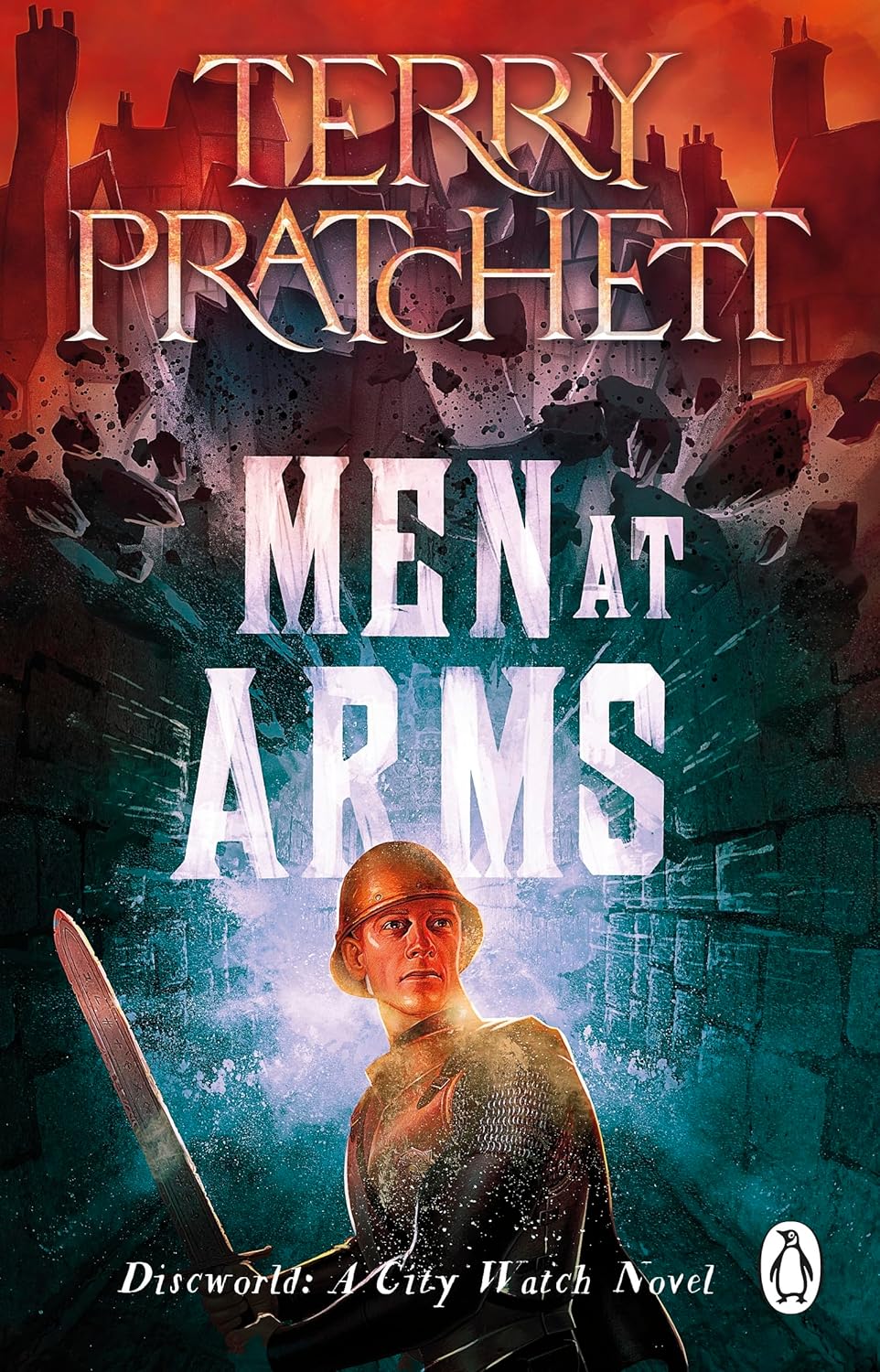
Men at Arms by Terry Pratchett

Publisher: Gollancz/Penguin Random (Audiobook – 1993)

Series: Discworld – Book 15/City Watch – Book Two

Length: 12 hours and 58 minutes

My Rating: 5 out of 5 stars

Amazon

After yet another re-read, the classic fantasy satire novel, Men at Arms remains as one of my favourite Discworld novels by the late, great Terry Pratchett, especially as its new audiobook version breaths fresh life into the always impressive novel.

Readers of this blog will have noticed that I have been on a real Discworld rampage lately, having re-read several books from my absolute favourite fantasy series.  Much of this is due to the recent release of a cool new audiobook version of all the Discworld books, featuring an awesome array of new narrators and vocal talents.  This new format has proven particularly awesome for books like Pyramids, Moving Pictures and Small Gods, and I have been eager to see how some of the books in my favourite Discworld sub-series, the City Watch books, come across with the new narrators.

While I have a lot of love for all the books in Terry Pratchett’s Discworld, my absolute favourites come from the City Watch sub-series.  Following the unlikely members of the Ankh-Morpork City Watch, a rag-tag team of guards generally looked down upon by the entire city, the City Watch books features an exceptional combination of fantasy and crime fiction elements, wrapped up in Pratchett’s usual satirical humour, as the protagonists investigate a series of dastardly crimes in the supernatural Discworld.  The series started perfectly with the awesome novel Guards! Guards!, which I reviewed last year, and Pratchett did an outstanding job following this up with the brilliant sequel, Men at Arms.

After saving the sprawling and eternally crime-ridden city of Ankh-Morpork from a fire-breathing dragon, the men of the Night Watch are still at work protecting the city, even though most of the city wishes they didn’t exist.  Despite their previous escapades, it’s a bad time to be a copper in Ankh-Morpork, with species tension between the dwarfs and the trolls at boiling point, while the powerful guilds disregard the Watch’s non-existent authority.  Worse, the Night Watch has been forced to accept three diversity hires, and must now contend with a mad dwarf, a thick troll and a woman (gasp) amongst their ranks.

Despite this, when an explosion at the Assassin’s Guild literally rocks the city, it falls to Captain Samuel Vimes and his small squad to investigate the heist hidden by the blast, despite the deliberate orders of the city’s tyrannical ruler to stop.  Determined to wrap up the case before his impending marriage and retirement, Vimes is soon forced to contend with a series of unusual, but seemingly linked murders, many of which have been caused by a lethal weapon never seen on the Disc.

With riots on the streets, and assassins and fools dodging their questions, all the members of the watch, including their contentious recruits, will need to work together to solve the murders before the city descends into chaos.  But how will they fare when going up against the most dangerous criminal mind the city has ever seen, one determined to bring back the Ankh-Morpork’s ancient kings, while wielding a dangerous new weapon that could change the entire Disc forever?

Even after many, many re-reads, Men at Arms continues to shine as one of Pratchett’s better books.  Featuring an epic crime fiction narrative, loaded with impressive characters, fantastic humour and great use of Pratchett’s iconic Discworld setting, Men at Arms is a complex, emotionally charged and deeply moving read that I could honestly read 100 times and still not get bored with.  A brilliant novel that unsurprisingly gets an instant five-star rating from me.

Pratchett wrote some exceptional narratives throughout his career, but few stand up to Men at Arms in terms of complexity, cleverness and emotional impact.  Expertly reintroducing the cast of Guards! Guards!, while also bringing in some impressive new support characters, Men at Arms starts off an excellent pace, as Pratchett cleverly examines the changes to the characters, sets up the new case, while also showcasing the motivations of the apparent main antagonist.  From there, it doesn’t take long for a dark series of crimes to take place, with Vimes and his squad investigating despite the apathy of the rest of the city.  Pratchett does a lot of excellent set up in the early part of the book, and the reader soon becomes invested in the investigation, especially as the book begins to follow a series of deaths, some of which were caused by a particularly deadly weapon that modern readers will be all-too familiar with.  Some great character arcs are also introduced here, as the extended cast all hit their own various problems they are forced to overcome, with Vimes dreading his eventual retirement, Carrot feeling the added responsibility, the fun buddy-cop arc between Detritus and Cuddy, and Angua dealing with her own problems.  The author sets up and expands on these arcs throughout the book perfectly, providing additional emotional impact, as well as some interesting side angles on the main storyline.

While the first half of the novel sets everything up perfectly, it is in its second half where Men at Arms truly shines.  Pratchett keeps raising the stakes of the story, with more victims, run-ins with the shadowy antagonist, and the Watch characters attempting to understand the nature of the weapon that has been turned against the city.  The author throws in some interesting wrinkles to the case, which shadow who the true villain is, while other events throw emotional shade across several of the characters.  The various connected character arcs start to come together perfectly as the book continues, and you go into the final stretch with a range of emotions around you.  While ostensibly a comedy, Pratchett chooses to hit the tragedy element of the plot really hard in the lead up to the finale, with some big moments that will leave you speechless.  The big end reveal and confrontation is exceptional, and I loved how well all the storylines and cleverly setup plot points came together.  Everything leads up to a very desperate struggle that helps to define some of the main characters in some very powerful ways.  Pratchett chooses to leave the book on a hopeful note that sets the expanded course for the future City Watch books, while also providing some interesting insights into one of the main characters and his role in the city.  An overall epic narrative that twists, turns and keeps you guessing, while constantly entertaining and emotionally charged.

As with his other books, Pratchett perfectly sets out Men at Arms with impeccable writing, and I loved how this complex novel came about.  Featuring his usual impressive blend of fantasy and humour elements at its base, Men at Arms is both intriguing and quite funny in equal measures, and I love the subtle comedy that runs through it.  Many of these scenarios involve classic fantasy scenarios being seen through the eyes of self-aware characters, allowing the situation to be taken up to an 11, with sarcastic commentary from the witnesses.  This humour is well enhanced by several of its best characters, including a fantastic new buddy cop routine, with members of two separate and historically antagonistic species forced to work together and eventually becoming friends.  Some of the other hilarious moments in the book include unlikely members of the city’s population being conscripted into the Watch, unfunny clowns, unconventional investigation methods, and other subtle humour.  You also have to love the brilliant footnotes that seek to enhance the story and showcase just how ridiculous the Discworld is by providing additional details about the universe and the people within it.  All this results in a brilliant and highly entertaining fantasy read, and that’s before you even get to the great crime fiction elements of the story.

As with Guards! Guards!, Men at Arms stands out from the rest of the Discworld series due to the way that Pratchett provides a complex and compelling crime fiction narrative.  Focused on an explosive heist that eventually results in a series of brutal murders, Men at Arms tries to envision how firearms would disrupt the Discworld.  This allows for quite a captivating crime fiction narrative, which I feel was a much better mystery than Guards! Guards!.  Advancing more into police procedural territory than its predecessor, the mystery of Men at Arms proves to be top rate, with the protagonists going after an already known villain for much of the book.  Much of the early story involves the protagonists trying to unfurl the antagonist’s plan and discover how he committed the crime, which allows for some great scenes as the Watch inexpertly investigate.  Pratchett cleverly twists the fact that think you know who the antagonist is towards the end of the book, and I love how well he switched this key story element, especially as the implied true villain of the story is far more sinister than just evil humans.  I really enjoyed how well Pratchett sets up this mystery in Men at Arms, and even after so many re-reads there are still additional subtle clues and foreshadowing that I’m only just picking up on.  The police procedural elements of the story are also extremely well handled, with a lot of humour focused around three very unlikely recruits joining the already scruffy outsiders who make up the Watch.  All these elements come together extremely perfectly and allow for readers of various genres to come into Men at Arms and have an incredible time.

Due to Pratchett’s excellent writing style, Men at Arms does work quite well as a standalone novel, and new readers can generally enjoy this book without any prior knowledge of the Discworld series, especially once they get caught up in the cool story and amazing humour.  However, I do feel that to get the best experience with Men at Arms, readers really do need to have checked out Guards! Guards! first.  The continuing storylines, history of the city and character arcs all come into play extremely well in Men at Arms, and you get a much more complete experience viewing all City Watch novels in order.  There is also a continuation of some character arcs from the standalone novel, Moving Pictures, especially as a few major characters from there get a recurring role in this new sub-series.  As such, I would say that Men at Arms is a novel more aimed towards Pratchett’s established fans, with those who loved Guards! Guards! guaranteed to enjoy its impressive sequel and the compelling direction Pratchett starts to take the City Watch books in.  It helps that the author continued to explore the crumbling and crime-ridden city that is Ankh-Morpork in this Men at Arms, providing even more details about its governance, mindset and people.  This includes really expanding on the species tension between the dwarfs and trolls and showcasing it as a major plot point while also paralleling real-life racial tensions.  This focus on dwarf and troll conflict becomes a major plot point of the Discworld going forward (especially in the later City Watch books), and its setup here was spectacular.  Combine that with the changes that happen to the Watch at the end of the book, and Men at Arms is an important entry in the wider Discworld context, especially as so many key City Watch storylines start here.

While there are so many amazing writing elements to Men at Arms, few things top the exceptional character work that ensured that this novel was far more than just a funny fantasy novel with crime fiction elements.  Instead, the complex and heartfelt dives into its extensive main cast ensured that Men at Arms was one of the more powerful and emotionally charged entries in the Discworld (a very impressive feat).  The combination of returning protagonists from previous books, as well as a few outstanding new characters, allows for a range of different plot perspectives and personal storylines, and Pratchett effortlessly works to make you invested in all these character arcs before hitting you with intense tragedy and powerful moments.

At the centre of the plot lies main character Captain Samuel Vimes, the cynical veteran leader of the Night Watch, who has finally found happiness and romance in his life.  Now on course to retire and become a man of leisure, Vimes must deal with the horror of becoming the thing he hates most: a rich civilian.  Dealing with it by diving into one last investigation, Vimes finds himself facing everything he hates about his job, including bureaucracy and the whims of powerful people, resulting in some brilliantly chaotic scenes.  While it does seem that Vimes’s role in this story is slightly diminished compared to in other City Watch books, especially in the centre, he is still a major part of the book, and Pratchett writes some excellent storylines around him being the dogged and worn-down investigator pushing against authority and trying to solve one more crime.  The focus on his identity as a copper, the sacrifices he makes for his fellow officers, as well as the horror at having to give up the job are major parts of his character arc, and there are some truly heartbreaking moments when he realises he must give it all up.  This is well balanced with his heartwarming romance with his unlikely partner, Lady Sybil Ramkin, whose well-meaning support and determination help to make Vimes a better person.  However, it is the major sequence when Vimes finally encounters the antagonist which really provides the best look at the character.  Forced to decide between being a good cop or a figure of vengeance (a battle that rears its ugly head for Vimes many times during the series), Vimes truly hits his mental and moral limit as he faces down his adversary, and it is one of the most powerful scenes in the entire Discworld series.

While Vimes is the main character of the City Watch series, the focus of Men at Arms is a little more skewed more towards Corporal Carrot Ironfoundersson, as Pratchett expands on his excellent introduction in Guards! Guards!.  Now firmly a part of Ankh-Morpork society, Carrot has evolved from naïve newcomer to a seasoned police officer who knows literally everyone in the city.  Fully utilising his natural charisma, Carrot proves to be a major force for law and order in the city.  I loved how much Pratchett enhanced Carrot in this sequel, as his personality evolves due to his role and responsibility, and despite still appearing quite naïve and obedient, Carrot showcases some impressive intelligence driving much of the investigation.  I especially appreciated the various scenes where Carrot managed to outfox many of the city’s more dangerous figures who fall for the dumb copper routine.  Despite his new confidence and ability to bring out loyalty in others, Pratchett makes sure to show that Carrot isn’t infallible, and you see some vulnerability at times. Carrot also serves as the moral centre of the book, bringing out the best in the other members of the Watch.  His interactions with Vimes in the final confrontation were very heartfelt, especially as he keeps the man he admires most from doing the wrong thing, while the way he handles the antagonists goes to show that he is truly a good man, who you better pray you never face.  I also think that his talk with Vetinari at the end of the book was one of the best scenes in Men at Arms, especially as he truly surprises the Patrician, while also dancing around the tricky subject of Carrot’s potential position as heir to the throne.  His decision to refuse power and ensure that Vimes will be there instead really helps you keep faith in the good of people, and this was frankly Carrot’s best book.

I also have to highlight the fantastic and fun duo that was the newly instated watchmen, Cuddy and Detritus, the later of whom previously appeared in Moving Pictures.  An unusual dwarf and the thickest of trolls, the two make for a particularly unlikely and chaotic duo, which Pratchett uses to full effect as the book continues.  Thanks to the enmity that exists between their respective species, Cuddy and Detritus spend much of the early part of Men at Arms bickering with each other, including in one scene in the middle of a riot.  However, after being forced to work together, the two form a grudging bond, especially when Cuddy stops seeing Detritus as a dumb troll.  I loved how well Pratchett took the classic odd-couple police partner trope and twisted it around the compelling species-rivalry theme of the book, and the fun dynamic that forms between the new friends is a major highlight of the book.  The various sequences that follow the big scene that defines these two partners are some of the most powerful in the entire Discworld.

Following on the heels of Cuddy and Detritus is Angua, the other new recruit to the Night Watch.  Angua is an interesting figure in the story, mainly because she’s one of the few people able to see how ridiculous the entire Night Watch is.  The subsequent storylines surrounding her potentially doomed romance with Carrot and her desire to keep her status as a werewolf secret from everyone, add some excellent alternate perspectives to the plot, and Pratchett did an outstanding job setting her up as a compelling figure for the rest of the series.  It helped that for this first book she worked as a bit of a double act with the small talking street dog, Gaspode, who also previously appeared in Moving Pictures.  Gaspode proves to be a fantastic wise-cracking counterpoint to Angua, and it was hilarious to watch him mess with the various human characters who refuse to believe he can talk.  Their resulting storylines about investigating the crime as canines, as well as the unlikely dog rebellion brewing within the city, works well with the other character focused arcs, and it was fun to get a little more closure on Gaspode’s story after his previous appearance.

Other great supporting characters in Men at Arms includes the returning members of the City Watch, Sergeant Colon and Corporal Nobbs.  While not as well utilised in this book as the rest of the City Watch series, they still prove to be a fantastic addition to the supporting cast.  Entertaining backers to the various other character-driven storylines, both show interesting depths in this book, whether it’s Colon acting as a put-upon drill sergeant, or Nobby’s use of his quartermaster past to obtain a collection of weapons.  Other members of the city also prove to extremely entertaining, with the tyrannical Lord Vetinari being the highlight.  The way in which Vetinari manipulates Vimes throughout the entire novel, while also understanding the true nature of most of the city’s residents is highly impressive, and I love that he stayed on as a major character after Guards! Guards!.  Throw in a complex arrangement of well-hidden antagonists, including an idea of violence that takes on a familiar form, and the cast of Men at Arms proves quite exceptional.  I really cannot emphasise just how much these carefully written character arcs and complex personal storylines increased the impact and emotional power of this novel, and you will come away loving everything about them.

I doubt anyone will be too surprised that I am about to write several paragraphs about Men at Arms’s epic audiobook formats, which I have long described as the very best way to enjoy Pratchett’s stories.  I honestly love all the Discworld audiobooks and luckily for connoisseurs, there are two outstanding versions of the Men at Arms audiobook that you can check out.

The first of these is the classic edition that was released back in 1996 and which is read by Nigel Planer.  Planer, who is one of my favourite audiobook narrators, lent his voice to most of the early Discworld novels, and is a key reason why I love Discworld books in this audio format.  Planer unsurprisingly does an amazing job with Men at Arms, especially as he perfectly captures Pratchett’s complex humour and intense story arcs with his brilliant narration, with every element of the book coming across in an exceptional and addictive manner.  This includes the brilliant characters, many of whom Planer previously voiced in other Discworld books.  Planner does an amazing job once again diving into these unique characters throughout Men at Arms, and the way he effortlessly portrays each character and shows their full personality and emotional range is just amazing.  He frankly provides the definitive portrayal for all the City Watch characters, and I honestly love the passion he brings to the Men at Arms audiobook. 

While the Nigel Planer audiobook version is always going to be a favourite of mine, I also have come to deeply appreciate the latest Men at Arms audiobook.  Part of a newly released collection of Disworld audiobooks that feature an interesting array of British talents bringing their vocal skills to Pratchett’s classic tales, this new Men at Arms audiobook is very impressive and is just as easy to get lost in at the classic Planer version.  Featuring the amazing cast of Jon Culshaw, Peter Serafinowicz and Bill Nighy, this Men at Arms audiobooks has a runtime just short of 13 hours, which is a few hours longer than Planer version.  However, the excellent array of narrators really makes it worth a listen.

The heart of this new Men at Arms’ audiobook is British radio and television personality Jon Culshaw, who dove into this role in a very impressive manner.  Culshaw really makes the story his own with his take on the novel and the characters, resulting in a very different feel that fans of the original Planer version will really appreciate.  Part of the reason why it was so good was that Culshaw brought back the excellent character voices and tones he previously used in Guards! Guards!, many of which provide great and often gritty new takes on some classic characters.  This includes a much rougher and despair filled Vimes, which fits the darker places Pratchett took the character in Men at Arms, especially when he goes up against the system.  His voice for Carrot captures the same keenness and naiveté that we saw in the previous book, however Culshaw’s vocal work also backed up Carrot’s excellent character development as the protagonist came into his own.  His voices for Lord Vetinari and Nobby Nobbs were also a ton of fun, with the dark and insister tones of Vetinari stealing every scene he is in, while Culshaw’s Nobby voices sounded appropriately similar to David Bradley or Jon Pertwee, which is just hilarious.  Culshaw also did an excellent job with several newly introduced City Watch characters, and I felt he got ever new additional cast members’ voice down perfectly.  My favourite was probably the troll Detritus, as Culshaw worked hard to showcase his massive and rocky troll nature, as well as his serious and slow personality.  This excellent vocal work from Culshaw ensured that the core of this Men at Arms audiobook was extremely impressive, and I really could listen to Culshaw’s take on these epic characters all day long.

As with all books in this new collection of Discworld audiobook’s, Culshaw’s main narration was perfectly backed up by recuring voices of Bill Nighy and Peter Serafinowicz. Both play key parts in this audiobook, with Nighy providing the narration for the footnotes, while Serafinowicz was the voice of Death whenever he appeared. These performances were once again perfect, and I especially loved Nighy’s excellent work with the vital, comedic footnotes.  Nighy really enhances the impact and value of these footnotes with his calm and impressive voices, and I especially loved his take on some of the more entertaining footnotes, including one where he partially sings a bad folk song.  Serafinowicz’s role in Men at Arms is also very fun, as he brings the fan-favourite character of Death to life.  Death has several great appearances in Men at Arms, and hearing Serafinowicz’s excellent voice suddenly appear amongst the general narration really increases the impact of the character.  Both Bill Nighy and Peter Serafinowicz’s inclusions were extremely fun, and I felt that they were combined with Culshaw’s main narration in a very impressive way.  These three brilliant British talents ensured that the new version of Men at Arms was particularly impressive, and while the original audiobook will always remain one of my favourite ways to enjoy Men at Arms, this new version is very much worth a listen and will likely inspire a new generation of Discworld fans.

Well, I think that my above excessive ramblings have probably made the point by now that I deeply enjoyed Men at Arms by Terry Pratchett.  One of the best Discworld and City Watch novels, Men at Arms was a glorious, captivating and moving read that perfectly blended crime fiction, fantasy and satire into one truly addictive and impactful book.  Clever, sharp and loaded with truly exceptional characters, Men at Arms was Pratchett at his very best, and I cannot recommend this book enough, especially on audiobook.  I can think of no higher praise for Men at Arms than to once again state that I will never get bored with this exceptional book, and it inspired me to continue the series and re-listen the next City Watch book, Feet of Clay.

Amazon

A Drop of Corruption by Robert Jackson Bennett

Publisher: Hodderscape (ebook – 8 April 2025)

Series: Shadow of the Leviathan – Book Two

Length: 432 pages

My Rating: 5 out of 5 stars

Amazon

Robert Jackson Bennett continues to shine brightly with the epic second novel in his Shadow of the Leviathan series, A Drop of Corruption, an exceptional and incredible fantasy murder mystery that I could not get enough of.

Robert Jackson Bennett is an awesome author who has produced some impressive fantasy series over the last few years.  Best known for his Divine Cities and Founders trilogies, Bennett has consistently wowed audiences with his elaborate settings, great characters and intricate narratives.  However, even though I knew how good an author Bennett was, I honestly was not prepared for how much I would enjoy his 2024 novel, The Tainted Cup.

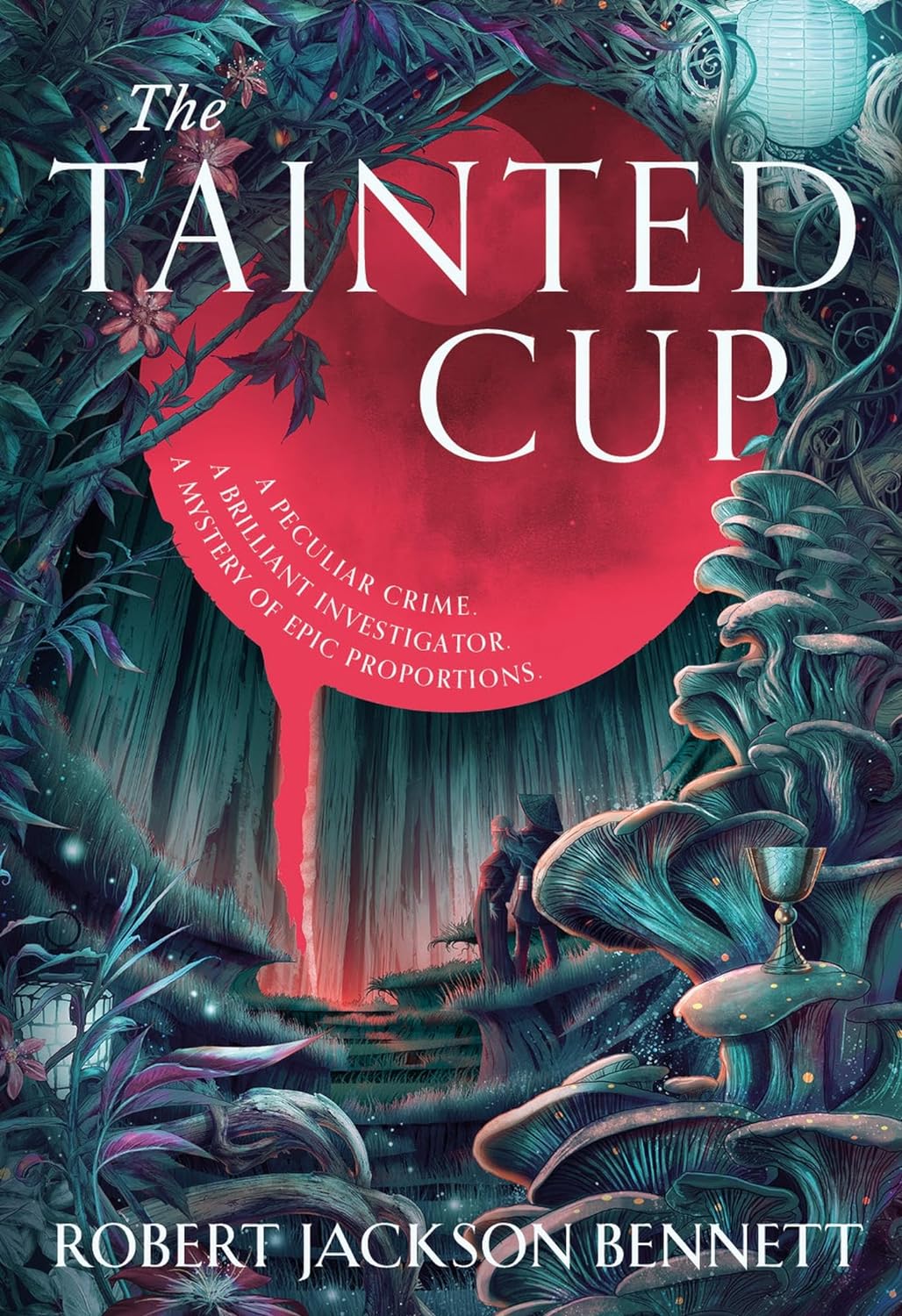
The Tainted Cup was a truly outstanding novel that saw Bennett bring together the fantasy and murder mystery genres into an exceptional and highly addictive fusion.  The first book in the author’s Shadow of the Leviathan series, The Tainted Cup followed the young assistant to an unnaturally gifted investigator as they attempted to solve several murders brought about by magical grass.  Set in a powerful Empire constantly under attack from giant leviathans, The Tainted Cup was a truly epic read, and I loved the elaborate narrative that emerged, as Bennett perfectly set a highly clever mystery amongst the chaotic and highly detailed fantasy setting.  The result was a five-star novel that ended up being one of my favourite books of 2024.  I really cannot emphasise enough just how good The Tainted Cup was, and I think it goes without saying that I was very keen to continue the series after that outstanding first entry.  As such, the second Shadow of the Leviathan novel, A Drop of Corruption, was one of my most anticipated books of this year, and it really did not disappoint.

On the borders of the Empire of Khanum lies the small canton of Yarrowdale, part of an independent kingdom that is reluctantly set to join the Empire.  A dank and impoverished land filled with swamps and waterways, the only thing of importance for the Empire in Yarrowdale is the high-security compound known as the Shroud.  A top-secret lab where the best scientists from the Empire dissect fallen leviathans to harvest the transformative magic found in their blood, the Shroud keeps Yarrowdale on the map and its inclusion in the Empire an inevitability.  However, when an impossible crime takes place within its borders, all eyes within the Empire will be looking towards it.

An important Imperial Treasury officer on assignment to Yarrowdale has gone missing, seemingly disappearing into thin air inside his locked and guarded quarters.  Needing answers, the Empire calls upon its most unlikely hero, the brilliant, and possibly insane, special investigator Ana Dolabra.  Accompanied by her loyal and often exasperated assistant, Dinios Kol, Ana soon invokes her uncanny talent for observations and ability to make unlikely connections to find answers.  But despite quickly working out how the victim disappeared, Ana discerns that the crime was only the first move in a diabolical master plan.

A dangerous and clever killer is stalking Yarrowdale, one with the ability to think ten steps ahead and effortlessly cover their tracks.  Worse, the killer has devious designs on the Shroud and is willing to use the facilities own dark science against it, crippling the Empire’s ability to defend itself.  To save the Empire, Ana and Din will need to discern the killer’s schemes and stop them before it is too late.  But have the pair finally met an opponent even more brilliant that Ana?

Wow, wow, wow, now that was an outstanding book!  Robert Jackson Bennett once again impresses to the extreme as A Drop of Corruption was an incredible read that I honestly could not put down.  Another excellent blend of brilliant mystery and inventive fantasy fiction, A Drop of Corruption was so damn good, and I loved every single second I spent absorbed in its captivating pages.  A very easy five-star read and one of the very best fantasy novels of 2025.

I just loved the story Bennett cooked up for A Drop of Corruption, and frankly I am still thinking about its many elaborate twists, turns and revelations.  Starting off with a good introduction to Yarrowdale, a setting starkly different to the locations from the previous book, the reader is soon brought up to speed about the unusual case within the isolated canton.  Told exclusively from the perspective of assistant investigator Dinios Kol, you soon become emmeshed in finding out how the treasury official disappeared from his guarded room, with his body soon discovered in the nearby waterways.  Thanks to the combination of Kol’s enhanced memory and the unique mind of lead investigator Ana Dolabra, the manner of the victim’s disappearance becomes apparent; however, this only raises more questions and reveals a dangerous killer stalking the canton.

Now I guarantee that at this point of the story you will be extremely hooked, thanks to the compelling mystery that is developing, as well as the intriguing characters, cool new setting and the hints of a very clever killer capable of outthinking the protagonists.  Following some cool moments that indicate just how far the killer is willing to go to achieve their goals, Bennett cleverly ties his mystery into some of the fantastic elements of the setting, including Yarrowdale politics, and the hidden science of the Apothetikal, the branch of the Empire dedicated to the biological alchemy that enhances people.  The author really raises the stakes as the book continues, especially with dangerous bioweapons, essential scientific advances, and ancient political turmoil all impacting the plot.  Bennett keeps the shocks going with several impressive scenes, especially the killer works to alter the destiny of both Yarrowdale and the Empire.

This leads up to the very exciting and fast-paced final third of the book, where all the pieces of the mystery come together.  Despite knowing the identity of their opponent, the protagonists are forced to work overtime to try and catch them as they constantly stay multiple steps ahead of them.  The protagonists are soon forced to take drastic action to get answers, and there are some great scenes as some interesting revelations come to light and various characters are forced to face the consequences of their actions.  After a particularly powerful scene that hints at dark secrets that will likely become a bigger problem later in the series, Bennett masterfully builds up to the final confrontation, where Ana provides her final deductions, and chaos reigns as a result.  This entire conclusion was so damn clever, and it was very satisfying to see Ana bring all the story threads and hidden elements of the mystery together in the climatic revelation scene.   This all results in a thoughtful, moving but overall satisfying end to the book that perfectly wraps everything up, and allows the series to continue.  Readers are guaranteed to come away from A Drop of Corruption very happy, and I know that I am even more eager to continue this series after this exceptional second outing.

As with the first Shadow of the Leviathan novel, A Drop of Corruption was an outstanding and captivating blend of fantasy and murder mystery storytelling elements, as Bennett wraps a particularly impressive investigation narrative around a distinctive fantasy setting.  In many ways an over-the-top fantasy Sherlock Holmes novel, A Drop of Corruption was so damn addictive, with no slow moments as the protagonists follow a deadly trail of a dangerous and unnatural killer.  The mystery itself is just perfect, and I loved how well the author enhanced the elaborate investigation with his own unique fantasy elements, carefully blending them together to create and even more elaborate tale.  Thanks to the constant revelations, carefully hidden clues, sudden outrageous twists and some very entertaining characters, I honestly found myself unable to put this book down, as I couldn’t wait to see what amazing reveal was coming next.  Bennett also successfully balanced the darker tone of the narrative with his own excellent character-driven humour, which ensured some lighter moments amongst the serious investigation and dangerous results.  This humour, which mostly lay around the author’s outrageous detective protagonist, often had me chuckling out loud, while never overpowering the murder mystery or fantasy elements.  Working well as either a standalone novel or a sequel to The Tainted Cup, there is something very fun for everyone in this book, and all fans of either fantasy or crime fiction can have a brilliant time here.

In addition to featuring a cool story with some wonderful blended elements, A Drop of Corruption also served as a great expansion of the outstanding fantasy realm introduced in The Tainted Cup.  I personally loved the overarching setting of the Empire of Khanum, which not only features gigantic, mutated monsters constantly attacking its walls from the sea, but also features a unique magical system of biological grafts originating from leviathan blood that alters people, animals and plants to benefit the Empire.  Many of these unique elements are on full display in A Drop of Corruption, with the focus on new grafts, research into the leviathans, and the existing enhancements of the protagonists all serving as key plot points in the main mystery.  Highlights include dangerous bio-weapons, grafts that turn the antagonist into a particularly dangerous opponent, and an elaborate look inside the research station known as the Shroud.  These unique fantasy elements are well re-introduced and expanded on as the novel continues and allowed for quite a unique crime fiction read as they are cleverly inserted into the plot.

Bennett also uses this book to explore new areas of his fantasy setting, particularly by introducing Yarrowdale, a semi-autonomous nation under the Empire’s influence that has yet to officially join it.  Filled with its own people, politics and history, as well as the influence of the Apothetikal, who have one of their most important bases there, Yarrowdale is a very different place to the previous settings featured in The Tainted Cup, and Bennett paints an elaborate picture of swamps, waterways and disgruntled locals who have their own opinions about joining the Empire.  As with the existing fantasy and setting elements of the book, Bennett expertly introduces and utilises this new setting into his narrative, and it serves as an effective and compelling background to the plot, especially when the case gets even more complicated, and the protagonists are forced to become involved in Yarrowdale politics and its royal family.  These scenes also allow Bennett to engage in a bit of social commentary, especially when it comes to the overall wickedness of kings (or other autocratic rulers), and it was fascinating to read his notes at the end where he expands on some of these points.  I really enjoyed this complex additional world building from Bennett, especially with how well it was utilised in the main story, and every new glimpse of the Empire of Khanum makes me an even bigger fan of this series.

I must also highlight the two awesome main protagonists that helped to make A Drop of Corruption so impressive, as Dinios Kol and Ana Dolabra were a highly entertaining duo.  Featuring an often exasperated but loyal subordinate working for a brilliant and eccentric detective, Bennett once again achieves the iconic detective/sidekick dynamic that fans of Sherlock Holmes will be familiar with.  In this case, Dinios serves the Watson role as the book’s only point of view, which allows him to be the sounding board for the mad detective, in this case Ana, while also being present for all of her deductions.  As such the reader, through Dinios’ eyes and ears, get the full explanation for how Ana reached her conclusion as she brings her assistant up to date.

This method of splitting the load between the detective and the sidekick is a classic for a reason, and I loved seeing the compelling story emerge from Dinios’s perspective, as he was front and centre for all the case’s twists and turns.  He was also a witness to all the crazy behaviour of his boss, and Ana did not disappoint, being her usual disrespectful and slightly unhinged self.  Most of the book’s humour came from Ana’s insane behaviour and the reactions of the other characters seeing it, which, alongside her incredible detective skills, is quickly making her one of my favourite fictional detectives.  I really enjoyed the dynamic that continued in this sequel novel between Dinios and Ana, and you get a great balance of eccentric genius and troubled young apprentice throughout the story.  While this partnership hits some snags in this book, especially as Dinios dreams of a more heroic career while Ana proves to be her usual impossible self, it proves to be a strong centre to the book, especially as certain revelations bring them even closer together.  A truly incredible central pair of protagonists whose entertaining antics I could not get enough of.  Throw in a great selection of supporting characters, including an intelligent and enhanced local assistant who manages to out-sass the protagonist, a multitude of suspicious individuals who have their own secrets around Yarrowdale, and an antagonist who is built up to be an insanely intelligent opponent for the protagonists, and this really ends up being an exceptional, character focused novel with some real emotional heart to it.

Overall, A Drop of Corruption was another exceptional novel from Robert Jackson Bennett, who did a truly outstanding job continuing his Shadow of the Leviathan series.  A Drop of Corruption was so damn good, and I loved every single part of this epic fantasy and crime fiction hybrid.  I honestly cannot recommend this book enough, and it easily one of the top fantasy reads of the year.

Amazon

Guards! Guards! by Terry Pratchett

Publisher: Gollancz/Penguin Audio (Audiobook – 1989)

Series: Discworld – Book 8 / City Watch – Book One

Length: 13 hours and 29 minutes

My Rating: 5 out of 5 stars

Amazon

I recently revisited one of my favourite books in Terry Pratchett’s iconic Discworld series, Guards! Guards!, and I just had to review it to showcase how much fun this series can be.

I have never made any secret of the fact that I love all things Terry Pratchett as the Discworld books were one of the formative series of my youth.  A massively popular series set on a flat world carried through space on the back of a giant turtle and four elephants, the Discworld books present a range of unique fantasy adventures, backed with exceptional comedy and satire.  This series is so much fun, and I honestly love every single Discworld book, having read them all multiple times, usually while laughing myself silly.  Indeed, I am such a big fan of this series that I named my blog after a location in the universe.  Despite my overwhelming love for this series, I haven’t reviewed many Discworld books (the exception being Moving Pictures and The Last Continent).  That changes with my review of the outrageously funny Guards! Guards! which I recently enjoyed while on a road trip.

Guards! Guards! is a particularly entertaining addition to the Discworld series that I have a lot of love for.  Serving as the first book in the City Watch sub-series, Guards! Guards! sees Pratchett blend his typical fantasy and comedy elements with a complex murder mystery.  This book follows the ragtag city watch of this world’s main recurring city, Ankh-Morpork, as they try to solve a series of deaths caused by a monstrous murder weapon.  Due to its brilliant and hilarious story, as well as the fact that it perfectly sets up the rest of the awesome City Watch books, I generally consider Guards! Guards! to be one of my absolute favourite Discworld novels, and I have featured it in various Top Ten Tuesday lists over the years.

On the fantastical and impossible Discworld no place is more dangerous, corrupt or morally unhealthy as the legendary and stinking city of Ankh-Morpork.  The Disc’s largest city, Ankh-Morpork has many terrors haunting its urban depths, where life is cheap and death lurks around every corner.  However, not even the hardest criminals, deadliest wizards or most manipulative politicians are prepared for an ancient and malevolent creature that is about to be unleashed upon the city.

A shadowy secret brotherhood has engineered an elaborate plan to seize power in Ankh-Morpork through use of an unlikely weapon, a dragon.  Summoning a fully formed fire-breathing dragon to cause terror, the brotherhood hopes to use the resulting carnage to bring in their own puppet to control the city.  However, the dragon has its own ideas about what sort of terror it wants to bring down on humanity.

With the rest of the city powerless against the dragon, it falls to the ramshackle Ankh-Morpork Night Watch and its depressed captain, Sam Vimes, to try and stop it.  The only problem is the Watch are the biggest joke in the city, incapable of standing up to normal crime, never mind carnage caused by magical dragon.  But with an unnaturally keen new recruit guilting them into action, and a terrifying dragon fanatic with a crush on Vimes keeping them in line, the Watch is going to try and save the day, even if no-one wants them to.

Guards! Guards! still reigns supreme as one of my top Discworld novels from the always impressive Terry Pratchett.  Featuring a unique plot, loaded with an outstanding mix of mystery, humour and fun fantasy elements, Guards! Guards! brilliantly sets up one of Pratchett’s best sub-series while presenting its own epic and powerful story.  An exceptional read from start to finish, this book gets a very easy five-star rating from me, and I love it so damn much.

The plot of Guards! Guards! is so damn clever and is peak Pratchett in its inventiveness and impressive characters.  Presenting an entertaining and humourous noir murder investigation in a fantasy series, Guards! Guards! has a lot of moving parts to it, including some impressive character-driven story arcs, all of which come together beautifully for a particularly intense and insane story.  Starting off very strong with some great introductions to various key characters, including the young and keen Carrot Ironfoundersson, who journeys to the massive and corrupt city of Ankh-Morpork to join the Night Watch, providing fresh blood, irrepressible honesty and uncontrolled enthusiasm to the small squad of rejects and failures currently staffing it.  Carrot’s arrival corresponds with the start of a bold conspiracy, as a secretive mystic brotherhood plots to dethrone the Patrician and take over the city.  The initial scenes of this book are extremely good, and I love how Pratchett expertly sets up the entire narrative with some hilarious moments, including the opening sequence with the Elucidated Brethren of the Ebon Night, whose petty ideology shows you just what sort of criminal minds we are truly dealing with.

Things go in a chaotic direction as the Night Watch, led by the drunk and depressed Captain Vimes, witness a direct murder by dragon and begin their own investigation into the matter.  Pratchett expertly pivots the story around from its comedic fantasy start into a complex police procedural/noir murder investigation, as the protagonists try to find out why the dragon is terrifying the city and who benefits from the apparent crime.  At the same time, several great character arcs emerge, including a truly nice, if unconventional romance, new friendships, and a fun analysis of dragon mythology.  There is a great twist about halfway through the book as the down-and-out Night Watch witness an interesting change to the classic dragon fantasy tale that sees a unique king take over the city.

The final third of the book is some of Pratchett’s strongest writing, as Vimes identifies the true culprit and must work to undo the damage they caused.  There are some great moments in this last part of the book as Pratchett presents his own unique and hilarious take on classic fantasy tropes, including the famed million-to-one shot, the heroic rescue, and the successful defeat of a dragon.  I felt that the identity of the main villain of the story was very clever, and Pratchett sets it up well with subtle clues, although if you know Pratchett’s thoughts on certain government positions it’s not too surprising.  Still, the final confrontation between the protagonists and this villain is great, and being literal has never been so deadly.  Pratchett leaves Guards! Guards! on a hopeful note, and it’s impossible not to come away with a smile on your face.
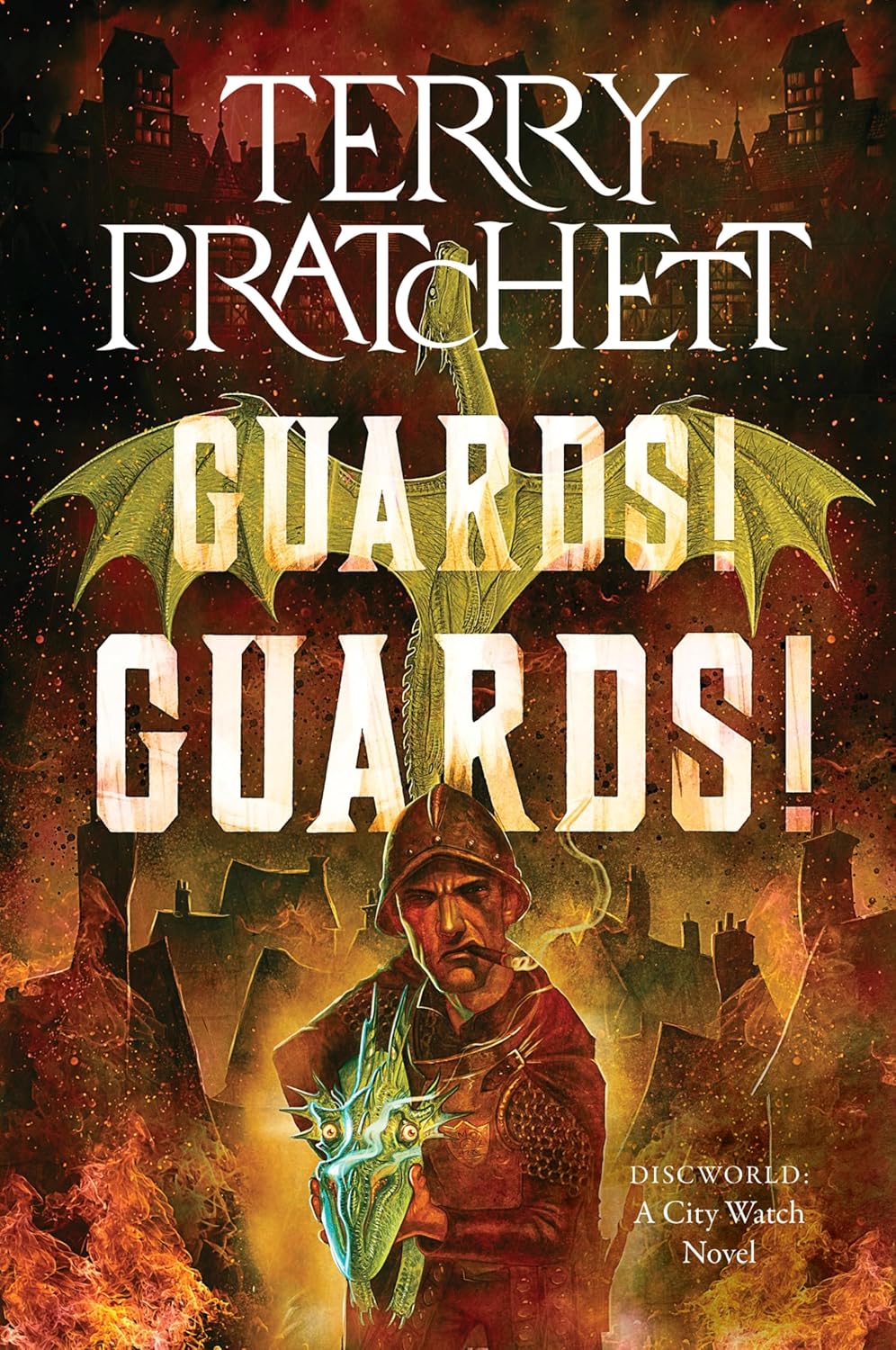
Pratchett was really on-point when it came to writing Guards! Guards! and I loved how perfectly it came together.  As with all books in the Discworld series, Guards! Guards! features an exceptional mixture of fantasy and humour elements, as the unusual and cynical Discworld produces some unusual situations, layered in with a great plot and some fantastically complex characters.  A lot of the humour is derived from classic fantasy scenarios that are taken up to 11 and shown in outrageous manners, accompanied by sarcastic comments from the characters as they witness them.  For example, this book serves as an ode to the guards and watchmen from classic fantasy fiction, and there are some funny scenes when these self-aware guards realise how expendable they are in a fantasy story.  However, Guards! Guards! also features a brilliant third element as Pratchett also features a compelling crime fiction read, accompanied with an addictive murder mystery.

The blend of fantasy and crime fiction elements works incredibly well, and it is highly entertaining to watch a serious investigation consider magic, suddenly appearing dragons, and the unique background setting of Ankh-Morpork.  I also loved how many clever and subtle jokes Pratchett was able to weave in because of these crime fiction inclusions, and he ends up lovingly roasting so many classic tropes from police procedurals and noir detective novels.  Despite having read this book many times, I still laugh like crazy at all the humourous moments in Guards! Guards!, especially as you always discover a new joke or pun you previously missed.  I honestly don’t have time to list all the funny scenes in Guards! Guards!, but favourites include the various meetings of the petty and mostly incompetent Elucidated Brethren, Carrot’s naïve overreactions upon discovering crime in the city, and various musings on how to achieve a perfect, million-to-one chance.  Pratchett once again expertly backs up his humour in Guards! Guards! with a series of entertaining footnotes spread throughout the book, that prove to be nearly as much fun as the main story.  These brilliant footnotes contain additional jokes, sarcastic comments, or interesting expansions of the Discworld universe, and they always bounce off the main story perfectly, providing extra laughs and food for thought where necessary.  I really cannot emphasise just how well this blend of genres worked with Pratchett’s unique and endearing humour, and it proves impossible not to have an exceptional time while reading this book.

As with most Discworld books, Guards! Guards! works exceedingly well as a standalone novel, and I feel that anyone wanting a laugh could easily jump in and follow the story without any issues.  Due to its early position in the shared Discworld universe, you don’t have to know anything about the other entries in the overarching series to jump right in, as Pratchett goes a tad light on some of the more outrageous Discworld elements.  As such, I consider Guards! Guards! to be one of the very best entry novels to new Discworld readers.  It also proves to be a brilliant first book in one of Pratchett’s best sub-series, and so many key details of the subsequent City Watch books are introduced here.  This includes some excellent early looks at the chaotic city of Ankh-Morpork and key recurring characters in the larger universal plot.  Ankh-Morpork is a great background setting for Guards! Guards! and it was the first book completely set within the bounds of the city.  I loved seeing this crazy city in even more detail, and all the fun elements set up here help to make it an epic setting.  As such, this is a great book for any Discworld reader, new or old, and it’s one of my favourites for very good reason.

As with pretty much all of Pratchett’s works, the key things that made Guards! Guards! so impressive were the amazing and unique characters that were featured throughout the plot.  Pratchett had a real knack for producing complex, multi-layered figures who can be both comedic and tragic at the same time, and who you couldn’t help but love.  Guards! Guards! was a particularly good example of this, as Pratchett featured a range of brilliant and entertaining characters who would go on to be become major recurring figures in the Discworld canon.  Indeed, Guards! Guards! is one of the most significant books for new characters, and it is frankly amazing how many exceptional major and iconic figures were introduced here.  Each of these characters were so well written, and you have to love both their specific arcs in this book, as well as how they were expanded on in later works.

The most prominent character in Guards! Guards! is Captain Samuel Vimes.  A cynical and damaged man whose habit of calling out social inequities has seen him assigned to the joke position as head of the Night Watch, which he deals with by drinking vast amounts of alcohol.  A parody of every hard-drinking cop and private eye in classic noir fiction, Vimes starts the book with no prospects and too many dead friends.  Given new purpose when the dragon appears in the city, Vimes turns his innate rebellion to a purpose and tries policing and detecting.  Pratchett does an exceptional job setting up Vimes here in Guards! Guards!, and it is no wonder he goes on to be one of his top protagonists.  Vimes’s depressed investigative method proves quite successful, and it was entertaining to watch Vimes attempt to solve the case while sarcastically calling out his fellow citizens’ base stupidity and selfishness.  Pratchett also sets up an impressive redemption arc around Vimes, which comes about through a combination of trusted colleagues, romance, and a renewed determination to uphold the law.  While he ends the book still irritated with the world, the road forward to Vimes doing bigger and better things is well established, and you really get drawn into his arc as a result.

Another impressive character is naïve and innocent City Watch recruit, Carrot Ironfoundersson.  Due to his complex home situation and a late life revelation that he’s human rather than a dwarf (being six and a half feet tall wasn’t a clue to him), Carrot is sent to Anhk-Morpork with a desire to become a watchman, which he incorrectly believes is a noble calling.  Thanks to his literal personality and highly moral upbringing, Carrot proves to be an anathema to the lawless folks of Anhk-Morpork, as he comes to town bringing justice, enforcing obscure laws, and actually arresting thieves: “change your ways”.  A brilliant parody of ultra-righteous fantasy kings, Carrot serves as an outstanding comic relief for much of the book, especially when it comes to his wholesome interactions with the exceedingly criminal inhabitants of the city.  However, beneath his comedic cover, Carrot is written as a complex figure of change, and his ability to inspire the other characters, either through guilt or determination, leads to some big moments.  Pratchett did an amazing job with Carrot in Guards! Guards!, and it was fascinating to see how he evolves from his initial innocent personality, to a more clever, but still determined, character.

Aside from Vimes and Carrot, the other two watch characters are Sergeant Fred Colon and Corporal Nobby Nobbs, both of whom are excellent and solid comedic characters.  The stereotypical fat sergeant and dodgy corporal, Pratchett has fun setting them up as unassailable fixtures of the Night Watch as they do the jobs nature intended for them, and I love how they play off each other.  While Colon has some hilarious scenes, including his attempt at archery and his various ill-timed run-ins with the dragon, you can tell that Pratchett had a lot more fun writing Nobby.  While not all his over-the-top characteristics from the series are shown in Guards! Guards!, Nobby is still a particularly entertaining figure.  Between his coarse language, petty criminal mindset, and uncharacteristic foppish behaviours, every scene with Nobby is highly amusing, and I love how Pratchett expanded off clever stereotypes about lifetime corporals to create this wayward figure.

Outside the members of the City Watch, there are a fantastic array of figures who help to make Guards! Guards! a particularly enthralling story.  This includes one of the few female characters in the book, Sybil Rankin, a dragon-loving heiress who ends up being Vimes’s unlikely love interest.  Deliberately written as the direct opposite of a noir femme-fatale in both personality and appearance, Sybil is a force of nature, using her accumulated nobility to pull the Night Watch, especially Vimes, into her orbit.  It proves impossible not to like Sybil as you watch her confidently go after Vimes or try to put the dragon to heel, and she ends up being one of the most complicated female characters that Pratchett wrote (which is saying a lot when you think of some of his other great female characters).

The other major character that I want to separately highlight is the Patrician of Ankh-Morpork, Lord Havelock Vetinari.  While he has appeared in previous Discworld novels (notably Sourcery), this is the first book that showcases him as a full character.  Generally depicted as a Machiavellian mastermind and one of the few people capable of controlling the chaotic city, Vetinari has some great early scenes.  However, it’s not until the second half of the book when you realise just how fantastic a character he is.  Deposed by the false king, Vetinari initially appears to be completely powerless in the dungeons, until Vimes is thrown in with him and begins to realise that he is still in control, especially as he’s managed to cultivate a new intelligence network (procured by providing wartime strategy to magical rats), while also getting locked in a dungeon specifically designed to keep him safe.  His subsequent scenes tormenting the book’s real antagonist and talking about the nature of humanity with Vimes really cement him as an impressive figure, and the seeds for his many later inclusions as the Disc’s ultimate political mastermind are well sown here.

While I know I’ve been going on a bit about characters (blame Pratchett for being such a good writer), I just need to highlight a few more figures who have a great role in Guards! Guards!.  This includes the Librarian, one of Pratchett’s most iconic characters, who proves to be just as much fun outside of a wizard focused book, and it was entertaining seeing him interact with a separate group of friends.  You get a great introduction to the character of Cut-My-Own-Throat Dibbler, whose mercantile tendencies are on full display here.  The unusual swamp dragon Errol proves to be an unlikely pet, and his arc about finding love and his true form was particularly heartwarming.  Finally, I must mention the book’s great antagonist, who fully embraces the mad tendencies that his position demands.  While I won’t go into too much detail about who he is, I will say I loved seeing his various internal rants about the world, and the scenes with his incompetent henchmen were so damn funny.  All these characters, plus even more hilarious figures, are instrumental to so much of Guards! Guards! brilliant charm and humour, and after being introduced to them here, it’s impossible not to follow them on their full journey.
I have had the pleasure of reading Guards! Guards! in a couple of different formats over the years, but to my mind the best way to enjoy this book, and indeed any Discworld novel, is on audiobook.  The Discworld audiobooks are something very special, and I find that the unique stories, excellent humour and elaborate characters really come across when read out by a passionate narrator.  With the recent re-release of various Discworld audiobooks, there are now two different unabridged versions of Guards! Guards! fans can enjoy, and I want to highlight them both here.

The first Guards! Guards! audiobook is the original version with the talented Nigel Planer, who narrated 22 of the original 23 Discworld audiobooks.  Guards! Guards! is one of his best performances, and it set the scene nicely for many of his subsequent Discworld audiobooks, especially as he settled on a lot of key character voices and tones here.  While it has been a little while since I’ve listened to Planer’s version of Guards! Guards!, I have enjoyed it so many times it is permanently engrained in my head (I used to grab the tape cassette version out of my local library all the time).  Planer, who does all the voices himself, really captures the essence of Pratchett’s storytelling and excels at expressing the author’s unique humour through his vocal work.  I also felt that his portrayal of many of the key characters was second to none, and he really brought to life all the City Watch protagonists, as well as some other long-running figures, in some impressive ways.  He would revisit many of these voices in multiple subsequent performances, and it is a testament to his skill that the initial tones he came up with here, worked so well in the later books.  I frankly have so much love for Planer’s original take on Guards! Guards!, which definitely still stands the test of time, and his excellent and heartfelt voice work defines many of the City Watch characters for me.

While Nigel Planers original version is perfect, current Discworld fans may be more familiar with the latest audiobook production of Guards! Guards!, which was part of a recent re-recording of all the Discworld books.  These new audiobooks each feature a different famous British performer voicing the main plot, while acclaimed actors Peter Serafinowicz and Bill Nighy have key roles in every single production.  While these have been out for a little while, I only just listened to my first one .  Coming in at a runtime of 13 and a half hours, which is a tad longer than the roughly 10-hour long Planer version, this Guards! Guards! audiobook was extremely fun, and it served as excellent entertainment on a recent road trip.

The new version of the Guards! Guards! audiobook is primarily voiced by British radio and television personality Jon Culshaw.  Culshaw is amazing in the role, and I was deeply impressed with his take on the Guards! Guards! characters.  Each unique character comes across extremely well in Culshaw’s capable hands, and I enjoyed his take on their unique characteristics and eccentric personalities.  He perfectly showcased protagonist Samuel Vimes’s drunken despair and depression, while various other key members of the watch, such as the extremely keen Carrot and the more cautious Colon, are shown extremely well.  I also felt that Culshaw did an incredible job with several complicated figures from the story, such as the infamous watchman Nobby Nobbs, who Culshaw gifts a gruff and weaselly voice that sounded a lot like David Bradley or Jon Pertwee.  His Lord Vetinari is also amazing, and the deep and threatening tones really capture the character’s dangerous nature.  Finally, I felt that his take on the main female character, Sybil Ramkin, was just perfect, and you really got the full blast of her big personality and excessive aristocratic characteristics.  Many of the other side characters were also perfectly portrayed to my mind, and I must highlight the excellent way in which he disguised the voice of the main antagonist during some key secret society scenes.

Culshaw’s primary narration is well backed up by Peter Serafinowicz and Bill Nighy in their respective roles.  Serafinowicz provides the voice of Death whenever he appears in this audiobook, which works out extremely well even with Death’s relatively minor role in Guards! Guards!.  Serafinowicz has an exceptional Death voice, and hearing it suddenly appear throughout Guards! Guards! is so damn epic, especially during one scene where Death is hiding amongst the soon-to-be deceased.  Nighy, on the other hand, narrates the various footnotes.  Nighy was a perfect choice for this, and his calm, consistent tones, echoing Peter Jones’s similar role in The Hitchhiker’s Guide to the Galaxy radio and TV editions really highlighted the subtle comedy of these footnotes.  I felt that all three of these distinctive actors really vibed together in the Guards! Guards! audiobooks, and the switch between them was seamless, allowing for a particularly awesome listen.  Throw in an interesting short afterword about fantasy elements by acclaimed author Ben Aaronovitch, and this proved to be a remarkable and compelling audiobook I could not get enough of.  While Nigel Planer’s original narration of Guards! Guards! is always going to live in my head rent free, I felt that this new version more than lived up to the hype surrounding it, and I really appreciated the unique and powerful performances these new narrators brought to the table.  Frankly both of the audiobook versions comes highly recommended by me, and it is impossible to be dissatisfied by them at all.

Whew, well in case you could guess from this massive review (it got away from me), I love Guards! Guards! and I have some very strong feelings for it.  One of Terry Pratchett’s best Discworld novels, Guards! Guards! is the perfect blend of fantasy, crime fiction and humour that you could ever want, and I always get wrapped up in its elaborate story.  A wildly entertaining and comedic novel from start to finish, Pratchett added so much heart to this book, and you get drawn into the impressive characters and compelling, crime fiction plot.  A brilliant start to the City Watch subseries, Guards! Guards! is so damn good, and I know I will be reading it many more times in my life.  I can think of no better way to emphasise just how amazing Guards! Guards! is than to mention that I used it to introduce the Discworld to my wife, who is now powering through the series on her own.  So do yourself a favour and check this book out now!
Amazon

Waiting on Wednesday – A Drop of Corruption by Robert Jackson Bennett

Welcome to my weekly segment, Waiting on Wednesday, where I look at upcoming books that I am planning to order and review in the next few months and which I think I will really enjoy. In my latest Waiting on Wednesday, I highlight a particularly awesome upcoming fantasy novel with the gripping second entry in the Shadow of the Leviathan series, A Drop of Corruption by Robert Jackson Bennett.

Amazon

Earlier this year I was lucky enough to receive a copy of the captivating novel, The Tainted Cup, by veteran fantasy author Robert Jackson Bennett.  An intriguing fantasy murder mystery set in a realm beset by giant monsters, The Tainted Cup was an outstanding read that saw two unlikely investigators, including an eccentric genius and her grounded assistant, attempt to discover the truth behind a brutal death caused by a tree spontaneously growing from someone’s chest.  Expertly combining a clever crime fiction story with unique fantasy elements and a hilarious set of main protagonists, The Tainted Cup was an outstanding read that got a full five-star rating from me.  Indeed, The Tainted Cup topped the list of my favourite books from the first half of the year and will likely go down as one of the very best fantasy novels of 2024.

Due to how impressive I found The Tainted Cup to be, you can probably appreciate that I am very keen to see how the series continues.  Luckily it looks like I won’t have to wait too long to see what happens next, as the sequel, A Drop of Corruption, is coming out in February 2025.  Set to once again to pit Bennett’s protagonists against an elaborate magical mystery, A Drop of Corruption sounds extremely epic, and I love the cool new story concept being promised for it.

Plot Synopsis:

The brilliant detective Ana Dolabra may have finally met her match in the gripping sequel to The Tainted Cup—from the bestselling author of The Founders Trilogy.

In the canton of Yarrowdale, at the very edge of the Empire’s reach, an impossible crime has occurred. A Treasury officer has disappeared into thin air—abducted from his quarters while the door and windows remained locked from the inside, in a building whose entrances and exits are all under constant guard.

To solve the case, the Empire calls on its most brilliant and mercurial investigator, the great Ana Dolabra. At her side, as always, is her bemused assistant Dinios Kol.

Before long, Ana’s discovered that they’re not investigating a disappearance, but a murder—and that the killing was just the first chess move by an adversary who seems to be able to pass through warded doors like a ghost, and who can predict every one of Ana’s moves as though they can see the future.

Worse still, the killer seems to be targeting the high-security compound known as the Shroud. Here, the Empire’s greatest minds dissect fallen Titans to harness the volatile magic found in their blood. Should it fall, the destruction would be terrible indeed—and the Empire itself will grind to a halt, robbed of the magic that allows its wheels of power to turn.

Din has seen Ana solve impossible cases before. But this time, with the stakes higher than ever and Ana seemingly a step behind their adversary at every turn, he fears that his superior has finally met an enemy she can’t defeat.

This sounds like another particularly outstanding story from Bennett, and I know I am going to have a ton of fun with it.  The mystery premise for A Drop of Corruption is particularly striking, as Bennett produces a high-stakes locked room mystery, where the solution to the crime is likely to be some elaborate form of magic or mutation.  In addition, we have the return of the first book’s excellent, mismatched protagonists, whose unusual partnership will likely result in some fantastic humour, while also presenting the reader with a brilliant investigative method.  I have no doubt that Bennett will turn these elements into another extremely special story, and I look forward to seeing how he resolves the main investigation, and how it ties into the greater mysteries infecting his fantasy setting.

Based on how impressive the first book in the series turned out to be, I am already extremely excited for A Drop of Corruption.  However, the epic plot synopsis above also sounds very cool, and I cannot wait to see what madness and mystery Robert Jackson Bennett unleashes next.  A Drop of Corruption will probably be one of the very best fantasy novels of 2025, and I am so very keen to get my hands on this incredible upcoming book.

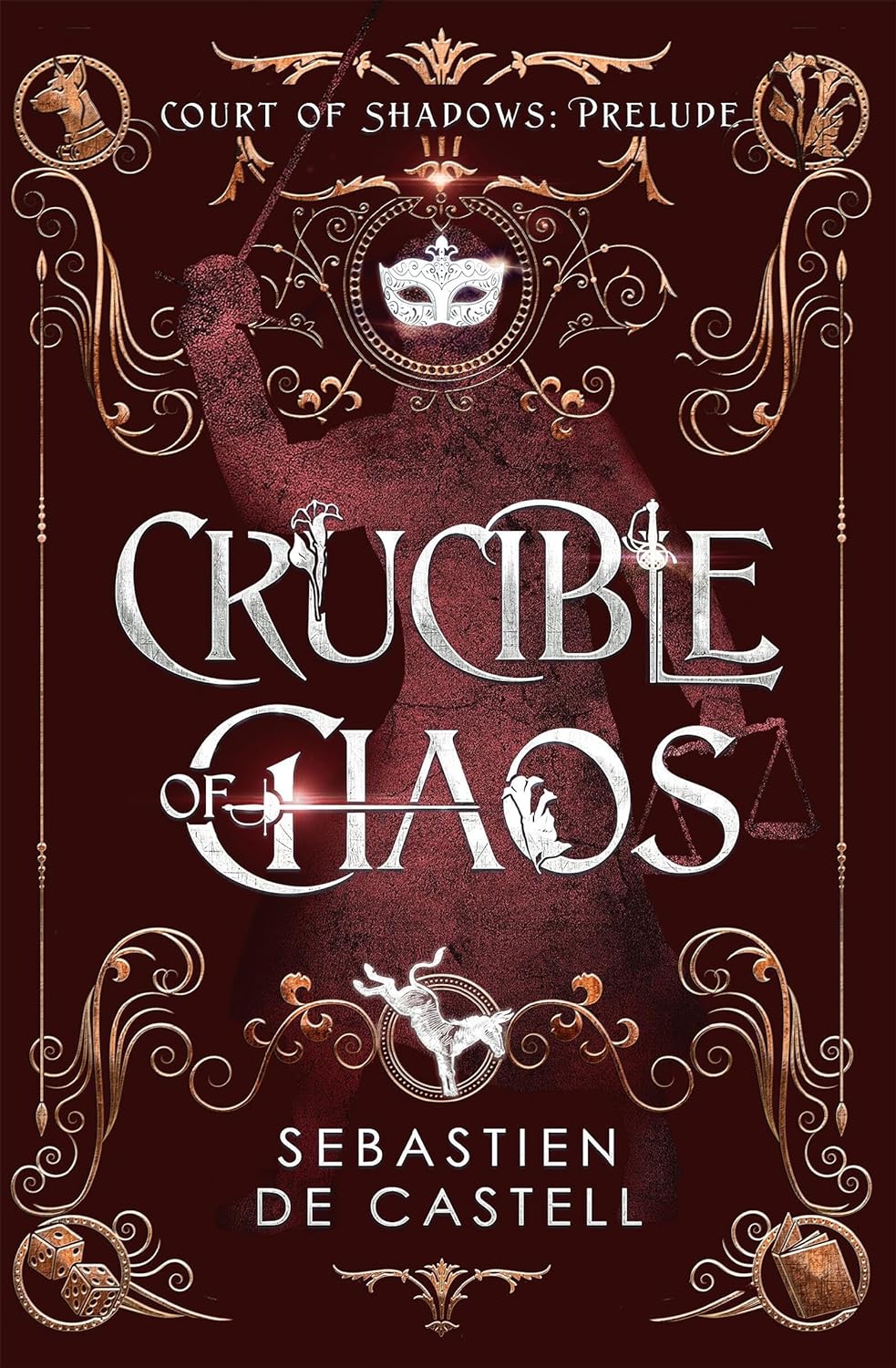
Crucible of Chaos by Sebastien de Castell

Crucible of Chaos Cover

Publisher: Jo Fletcher Books (Audiobook – 7 December 2023)

Series: Court of Shadows – Book 0.5

Length: 12 hours and 32 minutes

My Rating: 5 out of 5 stars

Amazon

In the mood for a witty, intense and highly unusual murder mystery?  Make sure to grab Crucible of Chaos, an outstanding and impressive novel from Sebastien de Castell, which serves as a prelude to his Court of Shadows series.

Earlier this year I was very lucky to receive the first book in Sebastien de Castell’s Court of Shadows series, Play of Shadows.  Set in the author’s Greatcoats universe, Play of Shadows was a truly epic and outstanding read that saw an unlucky actor with unusual gifts attempt to unravel a dark conspiracy inflicting his city.  I deeply enjoyed Play of Shadows, which was one of the best books I have read so far in 2024, and I was intrigued to check out more from de Castell, an author who had previously impressed me with his hilarious standalone novel, The Malevolent Seven.  While de Castell has several great series to his name, the book that caught my eye the most was the late 2023 release, Crucible of Chaos, which apparently served as a prelude to the other Court of Shadows novels.  Curious to see how this prequel would turn out, I grabbed the audiobook version of Crucible of Chaos and started listening to it, and boy was I glad that I did.

Travelling duellist and scholar Estevar Borros is a Greatcoat, one of the king’s legendary sword-fighting magistrates.  However, even amongst the unusual ranks of the Greatcoats, Estevar is peculiar, not just for his girth, but because of skills in deductive reasoning and his obsession with investigating the supernatural.  Known as the King’s Crucible, Estevar has travelled the lands of Tristia, seeking out unusual occurrences and trying to determine whether their cause is natural or supernatural.  However, even this renowned investigator of supernatural is unprepared for the chaos awaiting him in Tristia’s most holy site.

Summoned by his old acquaintance Abbot Venia, Estevar travels to Isola Sombra, an isolated island abbey considered the religious heart of Tristia.  According to Venia’s letter, the monks of the abbey are starting to fracture into factions following the recent murder of the gods, each with their own ideas of who the nation should worship in the future.  A frightened Venia needs Estevar, in his position as a magistrate and an authority on the supernatural, to arbitrate the debate and to help keep the fighting monks in line.

Despite his better judgement, Estevar, already suffering from a wound after a failed duel, agrees to travel to Isola Sombra, but what he finds there will chill him to his very soul.  Arriving amid a brutal storm, Estevar finds that the monks have fallen into madness, and now three factions are at war on the island, desperate to claim it for their own.  Worse, the abbot has been murdered, and evidence of dark magic lingers throughout the abbey.

Determined find a reasonable explanation for the insanity infesting Isola Sombra, Estevar begins his investigation, hoping to find the source of the chaos rippling across the island.  Alone except for a mysterious girl and his trusty mule, a wounded Estevar needs to face off against three very dangerous groups of monks, each of whom have deadly intentions for the interfering Greatcoat.  Worse, there are far more dangerous things awaiting the inhabitants of Isola Sombra, even if Estevar doesn’t believe in them.  Can the justice-loving Estevar stop the insanity of Isola Sombra with his deduction, sword and courtroom etiquette before it’s too late, or has the King’s Crucible finally found a mystery to insane for even him?

Wow, what an amazing and compelling novel.  Crucible of Chaos was another outstanding book from de Castell, and one that really grabbed my attention from the very beginning.  Containing an elaborate story, great writing, amazing characters, and so much more, Crucible of Chaos was a joy to read from start to finish, and one that I have little choice but to give a full five-star rating.

De Castell came up with an impressive novel that sets a classic detective story into The Three Musketeer inspired Greatcoats universe.  Readers are quickly introduced to two of the main characters, Estevar Borros and his trusty steed, as the dejected pair arrive at Isola Sombra to investigate a religious feud enveloping the island and its abbey.  While that is an interesting premise for a story, de Castell raises the stakes by introducing murder, mysterious mysticism, fearful locals, unnatural storms, and three warring factions of monks, which Estevar needs to unravel to get his beloved justice.  What follows is a complex and highly entertaining murder investigation as Estevar, with the help of a mysterious girl, begins to interrogate key members of the remaining monks to find out what they know and how their fighting and the resulting murder came about.  This proves to be quite addictive, and I found myself getting really drawn into this excellent mystery and the unique fantasy elements surrounding it.

The story takes a very interesting turn around halfway through as Estevar gets some dramatic proof that the events on Isola Sombra are more supernatural than he thought they would be.  This leads the protagonist into some dark places as he tries to fully understand everything that is happening, and who is ultimately responsible for the crimes committed.  De Castell cleverly lays out some intriguing revelations, as well as some tragic secrets that are cleverly hinted at by false memory and lies, and I had so much fun following all the breadcrumbs.  Everything leads up to several great confrontations, as Estevar first deals with some political intrigue that ties Crucible of Chaos into the rest of the series, before once again facing the strange powers haunting the island.  There are some inspiring moments here, especially as strange bedfellows fight together against the darkness, before the protagonist initiates a unique trial to reveal the whole truth.  The solution to the mystery is very clever, and I was really impressed with how de Castell pulled the whole thing together.  The conclusion really goes over-the-top as justice meets religion in some dark ways, and you will come away very impressed and satisfied with the dark, yet hopeful, story that emerged.

I love the tone that de Castell set out for Crucible of Chaos, mainly because there are so many elements that he managed to fit into his story.  The blend of mystery, character development, and unique fantasy inclusions from his pre-existing universe is extremely awesome, and I loved how the author managed to create such an elaborate and focused story.  The investigation element of Crucible of Chaos was the book’s true heart, and I have a lot of respect for the complex series of crimes that emerged, especially as de Castell managed to incorporate religious conspiracies, political intrigues and supernatural occurrences into the mystery’s solution.  There are so many moments of desperation, despair, and dark hope contained within this book, and the reader is constantly left feeling either intrigued by the mystery or shocked by the revelations that emerged.  It helped that de Castell’s characters are all so vibrant and entertaining, and there is a captivating humour that runs through the book that proves hard not to enjoy.  This whole novel comes together with a great pace that never lets up, and I honestly could not stop listening to Crucible of Chaos at times, especially when all seemed dire, or the protagonist was on the hunt for justice.

As I mentioned above, I came to Crucible of Chaos after reading Play of Shadow, so I was interested in seeing how it would fit into both the Court of Shadows series and the Greatcoats universe.  While there are obvious connections to both, for the most part Crucible of Chaos is more of a standalone novel than anything else, as the plot is primarily focused on the intense mystery the protagonist finds himself trapped in.  While there are a lot of strong references to previous Greatcoats novels, de Castell does an outstanding job of rehashing these events in a thorough and sensible manner, allowing the readers to get all the necessary context that they need.  Readers also do not need to get this book first to enjoy the next book in the series, Play of Shadows, which was reassuring in hindsight, and I kind of like how independent the two books are from each other.  The only real connection lies in a couple of revelations towards the end of Crucible of Chaos that hint at dark deeds on the horizon and a shadowy hand manipulating events from afar.  As such, Crucible of Chaos is a very accessible book for new readers and serves as a great introduction to the various series associated with it.

I will say that Crucible of Chaos did provide some interesting insights into the nation of Tristia, which serves as the primary setting for the Greatcoats series.  There are substantial examinations of the nation’s history, the backstory from the prior books, and other worldbuilding that de Castell has previously come up with, and I found this to be quite fascinating.  The often fractured and duellist obsessed nation of Tristia is an amazing background for this story, and I enjoyed the multiple discussions about the role of the Greatcoats as magistrates and keepers of the king’s peace, especially as the protagonist is quite passionate about the ideals of justice they represent.  However, a lot of Crucible of Chaos’ focus lies around the religion of the world, as the gods of Tristia become a major aspect of the plot.  Indeed, key events of the original Greatcoats series become vitally important here as the protagonist needs to consider the impact that the previous murder of the gods has had on the current religious institutions.  I really liked the constant contrasts between the philosophies of human justice and religious practice that becomes recurring theme in Crucible of Chaos, and I rather enjoyed seeing both unique elements of this landscape.

While I loved the story and the dive into the Greatcoats universe, the absolute best part of Crucible of Chaos were the exceptional characters that de Castell set his narrative around.  Each of them was complex and endearing in their own fun way, and I really enjoyed the powerful storylines that the author wrote around them.  The most prominent of these is protagonist and point-of-view character Estevar Borros.  A member of the king’s Greatcoats, Estevar was a very distinctive protagonist, mainly because he didn’t fit the typical fantasy protagonist mould that most readers would be familiar with.  A rather girthy and older duellist, Estevar is nonetheless a formidable warrior, often able to overcome younger or more in shape opponents through skill and trickery.  However, for this adventure, Estevar recently lost a duel due to his own arrogance and is forced to investigate the events on Isola Sombra while wounded and exhausted, and with his tools and authority missing.  I deeply appreciated the multiple handicaps that de Castell placed on his protagonist, especially as it enhanced the intensity of the plot, and it was compelling to see Estevar deal not only with his wounds but his own dark temperament, while trying to solve the case.  Despite his disadvantages, Estevar proves to be a capable investigator, and his deductive ability, which results in him being shown as a supernatural obsessed cross between Sherlock Holmes and Porthos.  I deeply enjoyed how determined and curious Estevar was throughout the plot, and he was a fun character to follow as he keeps up a genial and pleasant demeaner for most of the book, with some fun cracks of humour.  However, we do see some great flashes of emotion from Estevar at key moments, especially when he realises just how deranged the crime he is investigating is.  I was a huge fan of Estevar from the opening pages, and he is a protagonist I would love to see again in the future.

Aside from Estevar, de Castell features several other exceptional characters that you have a fantastic time following.  This includes the mysterious young female lead, Caeda, who serves as Estevar’s impromptu assistant during the investigation, determined to help find the truth on the island.  Shown initially as an energetic and enthusiastic figure, Caeda plays well off Estevar, and I liked the entertaining partnership they formed, even if Caeda is keeping secrets, which eventually leads to some tragic revelations.  However, the character you are most likely to fall in love with is Estevar’s mule, Imperious.  Much more than a stubborn mule, Imperious is the bravest, most rambunctious and expressive character in the entire novel, and de Castell has a lot of fun throwing him into the story in entertaining ways.  A dangerous and near unstoppable figure, Imperious stole every scene he was in, and you honestly end up caring for this heroic mule more than any other character in the book.  Throw in a cadre of mad monks, including an obsessive inquisitor, a wannabe general, and a lecherous sorcerer lord, and the cast of Crucible of Chaos proves to be really fun and intriguing to follow.

While I was tempted to grab a physical copy of Crucible of Chaos, I ended up getting the audiobook version instead, which proved to be an epic format to enjoy the book in.  Coming in with a runtime of 12 and a half hours, this was a moderately long audiobook, but it was one I managed to power through in less than a week due to how caught up I got in the story.  I found that the audiobook format really helped me to enjoy the complex narrative that de Castell came up with, and having it read out helped me to appreciate the depictions of the dark abbey and the elaborate mystery that much more.  It helped that Crucible of Chaos was narrated by one of my favourite audiobook narrators, Joe Jameson, whose work I enjoyed so much in the Legacy of the Mercenary Kings audiobooks (The Kingdom of Liars, The Two-Faced Queen and The Voyage of the Forgotten).  Jameson has a great voice for fantasy fiction, and I loved how he brings the elaborate story of Crucible of Chaos to life with his recitation.  The narrator had some great voices for the various characters, and while a few are similar to those he used in other audiobooks his other works, they all expertly fit the character they were assigned to perfectly.  I particularly enjoyed the distinctive and overly accented voice that Jameson gave to the main character, Estevar Borros, which perfectly fit his foreign origins, as well as his personality and physical attributes.  This booming, cheerful, yet penetrating voice, really captured the protagonist, and I could always envision this amazing character whenever Jameson spoke.  This, and other great voices, really helped to turn the Crucible of Chaos audiobook into something really special, and I cannot recommend this format enough to someone interested in this book.

Overall, Crucible of Chaos proved to be a remarkable and highly impressive novel from Sebastien de Castell that I had such an outstanding time reading.  Combining a unique story with great characters and compelling elements from the Greatcoats universe, Crucible of Chaos was a truly epic novel that I could not get enough off.  I look forward to seeing what other intriguing adventures occur in the rest of the Court of Shadows books, and this is swiftly becoming one of my favourite ongoing fantasy series.

Amazon

The Tainted Cup by Robert Jackon Bennett

The Tainted Cup Cover

Publisher: Hodderscape (Trade Paperback – 13 February 2024)

Series: Shadow of the Leviathan – Book One

Length: 420 pages

My Rating: 5 out of 5 stars

Amazon

Acclaimed fantasy author Robert Jackson Bennett kicks off a brilliant new series with the captivating and impressive novel, The Tainted Cup, which sees two unique investigators dive into an enthralling magical murder.

Robert Jackon Bennett is an outstanding author who has been writing since 2010 with his debut novel, Mr. Shivers.  Best known for his iconic The Divine Cities trilogy, as well as the intricate The Founders trilogy (of which I read Foundryside), Bennett has been on a real roll of late, and I have been meaning to read more of his works.  I finally got the chance when I recently received a copy of his latest novel, The Tainted Cup, an intriguing combination of the crime fiction and fantasy genres.  I instantly fell in love with The Tainted Cup’s awesome sounding plot and The Tainted Cup ended up being one of my most anticipated reads of 2024 for very good reason.

In an opulent mansion in the backwater province of Daretana, an unusual case emerges when an important Imperial officer is apparently killed when a tree spontaneously erupted from his body.  Even in the unpredictable Empire of Khanum, which is constantly besieged by Leviathans, giant beings from the ocean whose blood and bodies can mutate the land and create unique contagions, this is a shocking death.

The job of discovering what caused this unusual death falls to Ana Dolabra, an Imperial investigator known both for her staggering intellect and her many oddities.  Able to make connections no-one else can, Ana begins her unique investigation, using her new assistant, Dinios Kol, as her proxy.  Din, an engraver magically altered to possess a perfect memory, acts as his boss’s eyes on the case, and begins to gather all the raw information Ana needs to uncover the full mystery.  The conclusion she makes about the case: murder!

Determining the case to be an unusual and deadly form of magical poisoning, Ana and Din manage to find one of the culprit’s accomplices.  But it quickly becomes apparent that this is only the beginning of their investigation when several engineers responsible for maintaining the great outer walls of the Empire against the Leviathan threat are killed in a similar manner in the next canton.  Determined to discover who is responsible for both the murders and the resulting Leviathan attacks, Ana and Din journey to the wall to find out more.  What they discover is an elaborate conspiracy, one that threatens the entire Empire and could result in the death of everyone to the Leviathans.

The Tainted Cup ended up being an incredible read from Bennett who masterfully blended a complex mystery with unique fantasy elements and amazing characters to tell a gripping and powerful story.  I had such a great time with this book and honestly couldn’t put it down until I worked out every secret and twist that Bennett loaded into this outstanding five-star read.

Bennett comes up with an excellent premise for The Tainted Cup that is essentially a twisty Sherlock Holmes tale of intrigue and conspiracy, set in a cool new fantasy realm besieged by giant monsters.  Told from the perspective of main character Dinios Kol, who works as the eyes of his peculiar master, Ana Dolabra, the eccentric criminal investigator, Bennett quickly and effectively introduces the mystery of a man killed when a tree explodes out of him.  I’ve read a lot of amazing mystery novels over the years, and frankly this must be one of the more unique murder tools I’ve seen, and Bennett uses it to full effect to tell such a great story.  The initial investigation proves to be quite impressive, as Ana manages to quickly solve the murder using the observations provided by Dinios, finding the catspaw responsible for this first crime in a fantastic scene that really highlights to the author what a great investigator this protagonist truly is.

However, this is only the start of the case, as several similar deaths occur in the next town over, killing multiple engineers and damaging the massive walls that protect the Empire.  The resulting chaos results in Dinios and Ana travelling to the nearby garrison town where the engineers were billeted to try and work out who is responsible and why.  The situation swiftly degenerates as the protagonists uncover additional murders, corruption, secrets and lies, as everyone tries to hide who is responsible for the killings.  What results is an elaborate and addictive investigation as Ana sends Dinios on a series of investigative missions to get closer to the truth and uncover the conspiracies infecting the Empire, while the threat of an approaching Leviathan literally looms on the horizon.  I was on the edge of my seat the entire way through the second half of the book, as I desperately waited to see who was responsible and why.  While I saw a couple of the big twists coming, the full picture that emerged was extremely impressive, and I honestly loved every clever reveal and surprise that Bennett loaded into the story.  Not only are the main mystery and the underlying conspiracies behind it solved perfectly, but Bennett sets up the entire trilogy to be something truly special.  I cannot wait to see how this series continues in the future, and I already know it is going to be amazing.

I really loved how Bennett set out The Tainted Cup, especially as his great blend of storytelling elements and genres helped to turn it into a particularly fun and captivating read.  The elaborate and intriguing mystery blended well with the other unique elements of the book, and Bennett did an outstanding job of keeping the pace of The Tainted Cup fast and exciting, layering the story with reveals and hints to keep the reader firmly attached.  There were so many times that I needed to stop reading but just couldn’t as I wanted to see what was going to happen next.  While this book is mostly a little dark and emotionally charged, Bennett also layers the plot with a good amount of humour, mostly tied into the main investigator, which I think really turned The Tainted Cup into something special.  This humour tied in nicely with both the more serious mystery and fantasy elements and helped to cut down the tension in an effective and targeted way.  Throw in some fantastically elaborate action sequences, unique fantasy battles, and vivid descriptions of the world through the eyes of a complex protagonist, and you will come away with a great appreciation for Bennett’s fantastic writing style.

One of the more memorable features of The Tainted Cup was the awesome new fantasy realm that Bennet imagined for the plot, as well as the intriguing and unique magic that infested it.  The plot of the book is completely set within the Empire of Khanum, a walled-off nation completely dedicated to protecting itself from the Leviathan, gigantic, mutated creatures from the seas that are constantly trying to make landfall and destroy everything within.  I also loved how the magical elements of The Tainted Cup revolve around the manipulation of strange plants and biological grafts that enhance the physical and mental abilities of the humans.  A lot of these plant elements are tied into the Leviathan, and it was fascinating to see the impacts it has both on the land and on the people within it.  This is a pretty awesome background for this already fantastic plot, and it reminded me pretty strongly of Attack on Titan or Pacific Rim.  Bennett does an outstanding job working the plot of The Tainted Cup around this cool background, and it was fascinating to try and work out how the protection of the wall and the threats of the Leviathan and other magical concerns plays into the main plot.  There are some unique conspiracies produced as a result, as well as a some very distinctive killers and suspects, and I was really impressed with how Bennett came up with all these new elements and ensured that become so intrinsic to the plot.  The author also makes sure to hint at some future secrets throughout The Tainted Cup, such as the true nature of the Leviathan, which I have no doubt will be revealed in future novels in a big way.

Another awesome element I really need to highlight about The Tainted Cup was the two main protagonists, Dinios Kol and Ana Dolabra.  These two honestly make this entire book, with Dinios serving as the harried subordinate while Ana is the brilliant, if slightly unhinged and blunt, investigative savant.  Bennett expertly captures the classic detective/sidekick dynamic that was made so famous with Sherlock Holmes and Watson, with Dinios serving the Watson role as point of view character and the sounding board for Ana’s observations and solutions to the various murders encountered.  Not only is this very cool in the fantasy context, but Bennett works to make Ana even more outrageous than some of the more recent Sherlock Holmes adaptations, as she is an agoraphobic, disgraced, drug-addicted figure, who mostly goes around wearing a blindfold and terrifying everyone she encounters.  I loved Ana so much, and so much of the humour of the book comes from her unusual behaviour.  Despite these eccentricities, Ana is still shown to be a brilliant investigator, and I think that Bennett masterfully found the balance between genius and madwoman for this protagonist.

I really appreciated how Dinios proves to be the perfect foil for his unusual master, and it was great to see the story unfold through his eyes, especially as he proves to be a keen student and an interesting figure in his own right.  Initially shown to be a little desperate and naive, with secrets of his own, Dinios slowly becomes more confident as the book continues, and I enjoyed seeing him come into his own the more involved with the case he became.  His student/friend relationship with Ana was heartwarming at times, and he also serves as the more responsible member of the team, using rules and commonsense to stop Ana from going too far.  Dinios gets a well-written glow-up as the book continues, thanks to a revelation about his abilities, and while that potentially makes him a little overpowered as a character, I assume that Bennett has some interesting long-term storytelling involved with them that I cannot wait to see.

Thanks to the masterful combination of mystery, unique fantasy elements and amazing characters, The Tainted Cup was an outstanding read that really showcased Robert Jackson Bennett’s ability as an author.  Inventive, entertaining, and emotionally charged, The Tainted Cup is perfect for both fans of fantasy fiction and unique mysteries, and there is so much to fall in love with here.  Easily one of the best books of 2024 so far, The Tainted Cup comes highly recommended, and I cannot wait to see how Bennett follows this amazing read off in the future.

The Tainted Cup Cover

Amazon

Silver Queendom by Dan Koboldt

Silver Queendom Cover

Publisher: Angry Robot (Trade Paperback – 1 November 2022)

Series: Standalone/Book One

Length: 407 pages

My Rating: 4.5 out of 5 stars

Amazon     Book Depository

For some fun fantasy heist goodness, make sure to check out the awesome recent release from Dan Koboldt, Silver Queendom.

I am always on the lookout for very fun sounding books, especially in the fantasy genre, and I was lucky enough to come across a particularly outstanding example of this late last year with Silver Queendom.  The latest novel from intriguing author Dan Koboldt, Silver Queendom had an outstanding plot to it that blended fantasy fiction with a compelling heist storyline.  I cannot emphasise how awesome this plot sounded when I first heard it, and it ended up living up to my expectations as a fantastic and exciting read.

In a disreputable corner of the queendom of Rethalta lies the notorious Red Rooster inn, a place of poor ale and even worse service.  Seen over by grouchy innkeeper Darin, beautiful, if lazy, barmaid Evie and gigantic bouncer Big Tom, the Red Rooster attracts few paying customers.  Luckily, the staff of the Red Rooster have other ways of making money, as they are secretly one of the best team of thieves and con artists in the entire Old Queendom.

However, when their latest job goes bust and the find themselves owing the wrong crime boss a load of money they do not have, Darin and his team are going to have to get inventive if they want to survive.  A chance meeting with a mysterious stranger offers the best possibility of paying off their debt when they are tasked with stealing a cart of the most valuable substance on the continent, imperial dreamwine from the Jewel Empire.  Created through secretive means and capable of mentally transporting the drinker to their version of heaven, dreamwine is worth its weight in gold, and is infinitely more precious.  It is also impossible to steal, as the elite warriors of the Jewel Empire guard it fanatically, ensuring that it always reaches its destination.

With time running out before their debt is called in, the Red Rooster crew have no choice but to take the job and attempt to steal the unstealable.  Teaming up with the inn’s new brewmaster, Kat, Darin begins to work out a master plan that will allow them to steal the wine and get paid.  But between rival gangs, a traitor in their midst, their own nefarious employer, and the horde of angry soldiers from the Jewel Empire hunting them down, survival doesn’t look likely.  However, the Red Rooster crew are the best for a reason, and they are just getting started.

Silver Queendom was an extremely compelling and fast-paced novel that I had an outstanding time reading.  Told from the perspective of four outrageous characters, Silver Queendom takes the audience on an intriguing journey of crime and cons in a cool new fantasy setting.  Starting with an amusing party scene that quickly and efficiently shows off the protagonist’s main character traits, as well as their relevant skills and personalities, you are soon dragged into the story as the characters engage in a series of early cons and schemes while also bonding as a team.  You grow to quickly appreciate the protagonists and the way that the author blends unique fantasy elements with great crime thriller storylines, even before you get to the main heist.  I must admit that I was a tad surprised at how long it took the author to reach the theft of the imperial dreamwine, as I thought that plan would be introduced closer to the start of the book.  Instead, Koboldt eased the reader into this central plot point, taking the time to establish the team, the setting, and some of the other players in the story, which helped to increase the anticipation for the main heist.

The second half of the book is all about the quest for the dreamwine as the protagonists start pulling together their scheme to steal the treasure and get away with it.  Koboldt does a good job laying out just enough of the heist plans in advance to keep the reader intrigued without giving away the whole game.  At the same time, additional obstacles are built up for the protagonists, including disputes within the team, rival players, and even their own duplicitous employers.  Everything comes to a head in the fantastic heist part of the book, which really shows off Koboldt’s flair for writing elaborate sequences of utter chaos.  The way that the heist unfolds is very clever and quite funny, especially as they plan all manner of insane surprises that come together in quite an entertaining way.  While I do think that some of the inevitable double-crosses were a little too predictable and solved in some coincidental fashions, the rest of the plot unfolds in an amazing way, and I loved how most of the problems were solved by the protagonists.  Everyone comes away from the story extremely satisfied and there is even room for Koboldt to expand this book into a larger series, which I really hope he does.  The author did a really good job of blending together the fantasy and heist elements in this book, and the unique story and characters really kept me engaged the entire way through, especially as there is a constant fast pace with a lot of humour attached.  This is an overall awesome and captivating read.

While the crime story itself is a lot of fun, I was also quite impressed with the intriguing new fantasy landscape that Koboldt set out within Silver Queendom.  A classic, if grim and entertaining fantasy world, Silver Queendom takes place on a large continent broken up into four separate realms.  While having the continent’s four realms be broken up into near perfect quarters was a tad lazy, I felt that Koboldt did a good job of effectively conveying key parts of this world to the reader and working the crime focused plot into the new universe.  The author primarily focused on one of these realms in Silver Queendom, Rethalta, where the Red Rooster inn is located, and you get a good idea of its politics and people, especially as the protagonists journey all around it getting into all manner of mischief.  Koboldt also takes the time to explore elements of one of the other realms, the Jewel Empire, mainly as that is the realm the dreamwine is coming from, although certain character perspectives about it indicate the author’s plans to spend more time there in the future.  These intriguing realms serve as a great background for the book and Koboldt further adds to the fantasy fun with some unique magic that was a key part of the plot.  Magic in this universe primarily revolves around silver, which is a much more precious metal than gold as magic users are able to gain great power by manipulating and utilising silver.  This results in several really cool scenes, especially as there are some intriguing magical abilities available that were well featured during the course of the narrative.  All of these elements, and more, were quite fantastic, especially when paired with the brilliant story, and I think there is some real potential for the author to really expand this setting in future books.

Finally, I need to highlight the excellent character work contained within Silver Queendom as Koboldt introduces an excellent cast of protagonists that are very fun to follow around.  As I mentioned above, the story is told from the perspective of the four main characters, each of whom has their own unique personality and history that comes into play throughout Silver Queendom.  Koboldt does a great job of breaking up the story between these main characters, which produces an excellent and compelling mixture of development and personalised plots.  Each of the four protagonists brings something unique to the table, whether it’s Darin Fields’s battle to control his untrained magic or ingrained hatred of the Jewel Empire, Evie Garraway’s family shame, Big Tom’s capacity for violence which is tempered by his likeable personality and occasional lapse in judgement, or maternal character Kat’s introduction to the criminal lifestyle.  Throw in an outstanding supporting group of characters, which includes a humorous witch mentor, an ultra-violent rival gang, a gentile crime lord and a self-serving employer, and you have a pretty exceptional overall cast who really help to make this story just that little more personal and entertaining.

I really enjoyed Silver Queendom by Dan Koboldt and I was very glad that I got a chance to read it before the end of 2022.  Cleverly combining outrageous fantasy elements with an amazing heist storyline and fantastic characters, Silver Queendom is exceedingly entertaining from start to finish and you are guaranteed to have an awesome time reading it.  An excellent and highly recommended read, I hope that Koboldt provides some sequel to Silver Queendom in the future, especially after impressing here.

Amazon     Book Depository

Quick Review – The Justice of Kings by Richard Swan

The Justice of Kings Cover

Publisher: Orbit/Hachette Audio (Audiobook – 22 February 2022)

Series: Empire of the Wolf – Book One

Length: 13 hours and 45 minutes

My Rating: 4.25 out of 5 stars

Amazon     Book Depository

Richard Swan makes his highly acclaimed fantasy debut with the much loved The Justice of Kings, a slick and compelling novel that combines a murder mystery with epic fantasy and political thriller elements in some very impressive ways.

Few authors have gained the respect of the fantasy community as quickly as Richard Swan did this year as he made the jump from science fiction to fantasy in a very big way.  The Justice of Kings is an intriguing and awesome novel that serves as the author’s first entry in his new Empire of the Wolf series.  Following a magical lawman as he investigates a terrible murder while also attempting to keep the political peace in the realm, The Justice of Kings has a lot of great parts to it and it received a lot of kudos as a result.  I read it several months ago and neglected to write a review for it, which I making up for now.  I had a great time getting through The Justice of Kings and it lives up to a lot of the hype surrounding it.

Plot Synopsis:

NO MAN IS ABOVE THE LAW

The Empire of the Wolf simmers with unrest. Rebels, heretics and powerful patricians all challenge the power of the imperial throne.

Only the Order of Justices stands in the way of chaos. Sir Konrad Vonvalt is the most feared Justice of all, upholding the law by way of his sharp mind, arcane powers and skill as a swordsman. In this he is aided by Helena Sedanka, his clerk and protege, orphaned by the wars that forged the empire.

When the pair investigate the murder of a provincial aristocrat, they unearth a conspiracy that stretches to the very top of imperial society. As the stakes rise and become ever more personal, Vonvalt must make a choice: will he abandon the laws he’s sworn to uphold in order to protect the empire?

Introducing an unforgettable protagonist destined to become a fantasy icon, The Justice of Kings is an unmissable debut where action, intrigue and magic collide.


The Justice of Kings
is an excellent book which manages to bring together a lot of different genres for an excellent story.  Told from the perspective of Helena Sedanka, the Justice’s protégé and clerk, the book follows Sir Konrad Vonvalt, a Justice of the Empire who acts as a travelling judge, lawyer, investigator and executioner.  Able to wield unique magic, Vonvalt and his staff arrive in a small provincial city to investigate the murder of a local noblewoman.  As they dive into the case, the Justice and his team discover that this is no simple murder, instead the victim was killed as part of an elaborate conspiracy infecting the town, forcing them to dive into a dark web of blackmail, bribery, religious corruption and assassination to find the killers.  At the same time, Vonvalt finds himself going up against some deadly politics of the realm as a group of religious zealots with an ambitious and ruthless leader attempt to make a play for power in the Empire, specifically choosing to target the Order of Justices.  These two separate concerns come together as the story unfolds, and the characters find themselves in an intense battle to save themselves.

Swan came up with a particularly strong narrative for The Justice of Kings, and I deeply enjoyed the interplay of the different elements.  Not only does it perfectly introduce an outstanding and impressive fantasy series and realm, but it also presents the reader with a complex story of politics, intrigue, war and religious turmoil, overlaying an intense murder investigation.  Swan starts the story off strong, introducing the protagonists, as well as the deliciously evil series antagonist, and the reader is soon quickly enveloped in the main mystery, finding out who is behind the brutal murder.  The investigation embarks at a rapid pace, and it was fascinating to see how the magical protagonist and his cohorts attempt to solve the murder.  At the same time, the protagonists get involved in some of the more urgent politics of the realm as they attempt to bring a group of religious zealots to justice.  Things really intensify in the second half of the book, as the narrator is dragged into a disastrous undercover operation and the culprits of the murder are uncovered, resulting in a cool court trial sequence which gives the book an additional legal thriller edge.  However, solving the case brings everyone further misery as the culprits are connected to the wider antagonists who arrive, seeking their own version of justice.  This leads to a major and brutal confrontation, which really amped up the intensity and ensured you really could not put the book down.  I had a brilliant time getting through this captivating narrative, and Swan really ensures you will come back for the next read, especially following some epic character developments and major confrontations.  I cannot emphasise how amazing this story was, and Swan did a brilliant job of bringing so many different elements together into one exciting story.

I was pretty impressed with the detailed and compelling new fantasy universe that Swan created for this series.  The divided, multi-nation Empire of the Wolf provided rich ground for the many conspiracies and plots that were uncovered in this book and readers are going to have a lot of fun exploring it.  I also really loved the interesting magic elements of the book, especially as it revolves around the Justices.  The idea of magical roaming lawmen bringing justice to the outer reaches of a massive empire is exceedingly cool, and Swan introduces it extremely well in this book.  I also enjoyed the fantastic magical abilities that Swan featured in The Justice of Kings, although they are subtle compared to other fantasy books.  Magic in this universe lies primarily with the Justices and each of them can wield one or two abilities at a time.  Since there are only two Justices featured in this book you only really see a few of these abilities in action, although they are impressive in their own way.  The main ability is The Emperor’s Voice, which is a bit of low-level magical mind control, forcing unsuspecting and weak-minded suspects to the tell the truth and admit their crimes.  This ability is used to great effect throughout the book, and I loved the idea of a magical lawman’s primary power being the ability to force out a truthful confession.  The other major ability was a bit of necromancy that Vonvalt can do which allows him to talk to recently deceased people to gain extra information from them.  The scenes that feature Vonvalt talking to the dead are terrifying and they hint at some darker forces in the universe, which are no doubt going to be featured later in the series.  I felt that these magical abilities and the wider world were perfectly introduced in The Justice of Kings and you really get an idea of how impressive the Justices are, as well as how unstable the Empire is.  I look forward to some more worldbuilding in the future, which will hopefully feature some deep examinations of the Justices, perhaps in a magical school setting.  No matter what, though, Swan really showed off his aptitude for fantasy fiction here and I very much enjoyed his magical inventiveness.

I will admit that I had a bit of a mixed reaction when it came to the characters in The Justice of Kings, which really did impact my overall enjoyment of the story.  This mixed reaction was mainly down to the main character of Helena Sedanka, the book’s narrator and point of view character.  While Helena was an interesting character and her unique perspective on the events as the Justice’s clerk moved the story along, I personally did not connect with her as a character.  No matter how hard I tried, I found a lot of her actions to be annoying and I was constantly groaning at her dialogue and narration.  While I realise that many of her actions were done to highlight the character’s youth and inexperience, I had a hard time enjoying the story when events where focused on her, and my dislike never abated.  Considering that she was the only voice of the book, this naturally affected my overall experience of The Justice of Kings and it was the major hurdle in my enjoyment of the novel.  I am really hoping that Swan will tone down the characteristics of Helena I disliked in the future books, and perhaps I will have a much better time with the next book in the series.

Luckily, the other major character in The Justice of Kings were pretty damn awesome, and I felt that they did a great job offsetting my dislike for Helena.  This character was the Justice, Sir Konrad Vonvalt, who serves as the complex and intense protagonist of the story.  Vonvalt is pretty damn epic from the very start of the book, and even before it (he looks very cool on the cover above).  A tough but fair Justice, Vonvalt is one of the few honest men left in the Empire and his primary concern is his duty and the administration of the law to anyone, no matter their station.  You honestly can’t help but like Vonvalt throughout this book, as his straight forward and honest approach to the situations, as well as his general kindness and deeper fury at injustice, really struck a chord with me.  Unfortunately, after getting you to like him, Swan ensures that Vonvalt goes through a lot of pain, which slowly start to change him, especially when his own naivety about the state of the Empire and his own order comes back to bite him in a big way.  This really wounds Vonvalt, and you really see him change, especially towards the end of the book, where he becomes harsh, bordering on cruel, in his search for justice and revenge.  All of this is extremely hard to watch for the reader, and you have to both hate and love Swan for making Vonvalt such a great character that these events also hurt you.  This change in character is obviously going to be a major part of Vonvalt’s character arc in the future, and I can’t wait to see the more vengeful version of this once noble night. 

I grabbed The Justice of Kings on audiobook, which was a fantastic and fun way of enjoying this intriguing read.  Coming in with a run time of a little under 14 hours, The Justice of Kings audiobook has a descent length to it, although dedicated listeners can easily power through it quickly.  I felt that this format did a great job of enhancing the complex story contained within this book, and you really appreciate some of the compelling details of the new universe when they are read out to you.  I also quite enjoyed the narration of Lucy Paterson, who brings the story to life with her excellent voice.  Paterson gives some amazing voices to all the key figures in the book, especially Helena, and I appreciated her take on all the characters.  As such, this was a pretty awesome format to enjoy The Justice of Kings on and I will definitely be grabbing the next book on audiobook when it comes out.

Overall, The Justice of Kings was a particularly cool and enjoyable book that has rightfully put Richard Swan on the fantasy fiction map.  Swan was deeply impressive with his fantasy debut here and it is hard not to love the amazing blend of mystery, magic, politics and the search for justice that were contained within.  While I did have some dislikes when it came to The Justice of Kings, I felt that this was a wonderful book and I plan to come back to the series in the new year, especially as there is an awesome, potential laden sequel out very soon. 

Amazon     Book Depository

Fool’s Gold by Jon Hollins

9780356507651

Publisher: Orbit (Paperback – 26 July 2016)

Series: The Dragon Lords – Book One

Length: 517 pages

My Rating: 4 out of 5 stars

Amazon     Book Depository

Prepare for all manner of craziness and exceedingly entertaining fun as Jon Hollins presents an amazing book about heists and dragons with Fool’s Gold.

A few months ago, whilst perusing my local book fair, I happened upon a copy of Fool’s Gold by Jon Hollins (a pseudonym for fantasy author Jonathan Wood), which really grabbed my attention.  The first book in Hollins’ The Dragon Lords trilogy, Fool’s Gold had a fantastic plot synopsis which involved heists and dragons.  I was very intrigued by this cool book, which sounded so very fun, so naturally I made sure to grab it.  As a result, it was nice and handy when I was in the mood for a fun fantasy book, and boy was I entertained by this cool read.

In the fantasy land of Avarra, there are many different magical creatures and beings who infest the world and bring all manner of chaos with them.  However, no creature is as dangerous, arrogant, and domineering as the dragons, especially members of the destructive Consortium who have taken over the isolated nation of Kondorra and rule it as overlords.  Employing a private army, the dragons impose massive taxes on the lands surrounding their lairs, driving the people into poverty and forcing many to lose everything.

It is only a matter of time before something gives, and when Willett Fallows loses his farm to greedy dragon who controls his village, he snaps and becomes a fugitive.  On the run, Will finds himself in the most unusual of situations after a chance meeting with four unlikely wanderers in a nearby cave, including a skilled warrior woman, a murderous lizard man, a dragon obsessed academic with explosive magical powers, and his village’s local insane drunkard.  Together the five new companions come up with an ambitious plan to steal all the gold from the local dragon lord and make their escape.

However, when their heist unsurprisingly goes wrong the friends find themselves in a surprising position as the nation’s apparent saviours.  Suddenly worshipped by a massive following, the companions must find a way to escape both the deadly retribution coming their way and their own insane devotees.  But no matter how hard they try, all their plans seem to backfire until they find themselves in the middle of a deadly religious war against the dragons.  Can they pull off one more con to destroy the Consortium, or is everyone about to end up dead in a field of fire?

Fool’s Gold is an exceedingly fun and very entertaining read that I was able to finish off in a few days, especially once I got caught up in its exciting and fast-paced narrative.  Hollins sets everything up very quickly, with the new fantasy world introduced, the dragon’s control of Kondorra established, and all five of the main characters brought together.  While I wasn’t the biggest fan of the extremely coincidental meeting that saw all the protagonists meet up in the first few chapters, the story evolves at a much more appropriate pace from there, with the characters quickly planning their theft of the local dragon’s hoard.  I was a little surprised at how fast the first heist came about, as I figured it would be a long-term plan that would unfold much later in the book.  However, featuring this heist early on really works, as it sets up the rest of the story extremely well while also showcasing early just how crazy and over-the-top this book is going to be.  The chaotic results of the first heist see the protagonists incorrectly declared religious saviours destined to bring down the dragons.  Suddenly leading a ragtag army, the protagonists are forced to engage in several more attempted heists and plots against other dragons and their minions.  While these plans often backfire in very funny ways, the protagonists keep failing upwards and must keep the con going while dealing with a multitude of problems, including deranged followers, immense responsibility, and deep personal issues.  This all leads up to the final confrontation with the dragon Consortium, with the characters unleashing their most ambitious plan yet.  Watching this final plan come together is pretty damn awesome, and the insane battles and crazy results that follow were so damn epic.  I ended up really loving this compelling and very fun story, which Hollins leaves open for some intriguing sequels in the future.

Fool’s Gold is an incredibly fast-paced novel with a great writing style that makes it very easy to power through.  The author has a brilliant and wicked secret of humour that infects his writing, and I found myself chuckling the entire way through, not just because of the jokes but because of the insane scenarios that resulted.  I was also deeply impressed with how well Hollins brought together several genres to create a compelling and hilarious read.  The book initially appears to be a classic fantasy read, as the author quickly and effectively sets up an intriguing new fantasy world at the start of the book, which contains several classic fantasy creatures and elements that are likely going to get expanded on in the sequels.  However, it soon becomes apparent that this isn’t going to be a typical fantasy book, especially as the very modern sense of humour and language that Hollins employs gives it a whole new tint.  I often enjoy when authors feature contemporary language and attitudes in fantasy novels, and I felt that Hollins uses it to great effect in Fool’s Gold, giving the book a distinctive tone.  The author further brings in the brilliant heist elements to the book, which I deeply enjoyed thanks to all the fantastic plans and cons.  It proved to be extremely fun to see all these elaborate and weird heists get planned out and executed in a fantasy universe, and it combines extremely well with the humorous tone and fantasy elements of the book.  I deeply enjoyed how this captivating story came together, and I can’t wait to see how the next books in the series pan out.

I also really liked the cool characters featured in Fool’s Gold, especially as Hollins came up with a very eclectic and damaged group of central figures.  The book primarily revolves around five protagonists, each of whom have multiple chapters told from their perspective and who unite as a team very early in the book.  This includes Willett Fallows, the former farmer who turns to heist planning after the dragon’s greed takes everything from him.  There is also the fantastic pair of Lette and Balur, a female adventurer looking to settle down and her lizard man companion who loves all forms of violence and is determined to fight and kill the biggest opponents he can find, in this case dragons.  There is also Quirk, a former mage turned academic who arrives in Kondorra to study the dragons and finds herself dragged into the group’s plans so she can get a closer look at the dragons and their lairs.  Finally, there is Firkin, a local drunk whose failure years ago to defeat the dragons drove him mad and who finds new life during the new adventures. 

All five characters are pretty crazy in their own way, and I think they made for quite an intriguing and amusing focus for the narrative, especially all the interesting growth Hollins makes use of.  Will’s evolution from a farmer to a master strategist was very well written and I appreciated the compelling examination of how the power he started to wield was potentially corrupting him, especially when he holds the lives of so many in his hands.  The inevitable romance between Will and Lette was handled well throughout the book and it came across as a natural and well-developed relationship.  Balur, the battle-loving lizard man was easily one of the most entertaining characters in the novel, and I loved seeing his mad rages and various attempts to kill the dragons they encounter, especially as it results in an incredibly funny and hilariously brutal final fight at the end of the book.  I was also quite impressed that Hollins was able to keep up Balur’s unique style of speech for much of the story.  Firkin’s rise from unpredictable drunk to unpredictable drunken religious mouthpiece and rabblerouser was exceedingly funny in places, especially as you are never quite sure whether he is actually insane or just messing with everyone.  I did find his continued crazy speech a bit too much at times, although the occasional hints at his deeper intelligence and sanity made up for that.  However, the best character work was probably reserved for Quirk as Hollins really dives back into her history as a child soldier/mage who was gently rehabilitated and taken into the academic lifestyle.  Quirk finds herself reverting to her old destructive magical ways throughout the course of the adventure and she must figure out who she truly wants to be.  I had a great time with all the cool characters in this book, although I do wish that the greedy and arrogant dragons might have gotten a little more development.  Overall, I would say that the characters were some of the best parts of Fool’s Gold and look forward to seeing more of them in the future.

Unsurprisingly, I had a pretty wonderful time with Fool’s Gold and it ended up being as thrilling and compelling as I hoped it would be.  Jon Hollins wrote a wildly entertaining and very funny fantasy heist narrative for Fool’s Gold, which came equipped with some great fantasy elements and a bunch of excellent characters.  I really enjoyed Fool’s Gold and I will have to try to grab the next two books in the Dragon Lords trilogy, especially when I’m in the mood for some crazy, over-the-top adventure and excitement. 

Amazon     Book Depository

Throwback Thursday: Blood Rites by Jim Butcher

Blood Rite Cover

Publisher: Penguin Audio (Audiobook – 3 August 2004)

Series: Dresden Files – Book Six

Length: 13 hours and 5 minutes

My Rating: 5 out of 5 stars

Amazon

Welcome back to my Throwback Thursday series, where I republish old reviews, review books I have read before or review older books I have only just had a chance to read.  For my latest Throwback Thursday I keep diving into the epic Dresden Files urban fantasy series with the impressive sixth book, Blood Rites.

Last week, in my review for the outstanding fifth book in the Dresden Files series, Death Masks, I mentioned how I had also started listening to the next book in the series, Blood Rites.  I honestly had so much fun reading Death Masks last week (as I did with the rest of the Dresden Files series, such as Storm Front, Fool Moon, Grave Peril, Summer Knight, Battle Ground and The Law), that I had to immediately dive into the next book as soon as I could.  The sixth novel in the series, Blood Rites, was another epic novel which had an impressive and captivating plot to it.

Harry Dresden, Chicago’s resident wizard and protector from the paranormal, continues to eke out a deadly living through his chaotic career of odd mystical jobs while also defending the city against the worst monsters lurking in the shadows.  However, his latest job may place him in the most uncomfortable spot yet, on the set of an adult movie, which finds itself under attack from a deadly and relentless curse.

Taking the case as a favour to his vampire friend and suspicious ally Thomas Raith, Dresden goes undercover on set and attempts to discover who is responsible for cursing the movie’s cast and crew, and why.  However, Dresden’s heroics on set make him a target, and he soon finds the curse striking at him, attempting to end his investigation before he can find the magical murderer.  Worse, enemies old and new are bursting out of the shadows, as two separate courts of vampires attempt to strike Dresden down.

As Dresden continues to search for the murderer wielding the curse, he is forced to fend off attacks from the lethal Black Court.  Led by a powerful elder vampire with a serious grudge against Dresden, the Black Court will stop at nothing to destroy him and any of his friends that gets in their way.  However, the greatest threat may reside in the White Court, to which Thomas belongs.  The White Court vampires are manipulative and subtle killers, using their alluring presence to suck the life out of everyone they touch.  Caught between warring members of the White Court family, Dresden must use all his wits to escape their wrath and uncover hidden truths if he is to survive.  But what secret from the past connects Dresden to the White Court and their machinations, and is Dresden really ready for the dark knowledge waiting for him?

Whelp, it seems that it is pretty impossible for Butcher to write a dud novel.  Blood Rites is an exceptional addition to the wider Dresden Files series, and it was another one that I have no choice but to give a full five-star review to.  Featuring an intense and deeply captivating narrative, Blood Rites was an incredible read and I quickly got sucked into its unique story, compelling mysteries and dark, damaged characters.

I just loved the elaborate, dark and powerful narrative that Butcher featured in Blood Rites, as the author comes up with a complex tale that expertly brings together a dark urban fantasy with a thrilling murder mystery storyline.  Like the rest of the Dresden Files books, Blood Rites exclusively follows protagonist and point-of-view character Harry Dresden as he finds himself forced to face off against a series of dangers and threats at the same time.  The most prominent of these includes an investigation into a deadly curse aimed at the female employees of an adult entertainment studio, which sees Dresden go undercover on set to try and save the remaining cast and determine who the killer is.  This also leads him into a confrontation with the White Court of the vampires, especially when his vampire friend, Thomas Raith, requests his help.  At the same time, vampires from the Black Court are after Dresden for his actions in Grave Peril, which forces him to call in some major backup to take them on.  Unfortunately, this also leads him into conflict with his supposed allies, as well as his former mentor, when secrets from the past are revealed.  Dresden is also hit with a whole bundle of personal drama, especially when he discovers unfortunate truths about his long-dead mother, and there is an interesting growth in the relationship between him and several supporting characters.

As a result, there are many plot elements scattered around Blood Rites, which makes for quite an elaborate overall story.  Luckily, Butcher does an excellent job of introducing all these separate narrative threads to the reader, and you swiftly get drawn into all of them.  After a good and necessary bit of setup, the story roars off at a quick and captivating pace, and the reader has a great time jumping from storyline to storyline.  Everything starts to come together near the middle of the book, where you get some excellent action scenes, including a particularly funny death sequence involving a vampire and a frozen turkey, and the fallout of these scenes leads to some great dramatic moments with big personal revelations.  Following this, the story zooms along, and you soon find a partial and problematic solution to the murder case, while the protagonist is also forced to deal with an all-out assault on the Black Court, while also dealing with dark secrets from his allies.  The attack on the Black Court was one of the best sequences in the book, and the surrounding drama results in some major revelations that fans of the series will lap up.  The remaining storylines then come together perfectly for the finale, as Dresden solves the murder and faces off against its overall architect in a brilliant and extended dark sequence.  I loved how this entire narrative unfolded, and some of the concluding notes will leave you wanting to dive into the rest of the series to see what happens next.

To bring Blood Rites’ great story to life, Butcher utilises his typical style and techniques, which I always immensely enjoy.  The entire narrative is paced perfectly, and you quickly get drawn into the various plotlines, especially with their great combination of characters, intriguing plots, fantasy elements, and dramatic moments.  All of this is overlayed with Butcher’s distinctive humour, most of which is expelled through his cocky point-of-view protagonist, and it helps to enhance the overall powerful and entertainment of the book, especially when the protagonist tries to deflect from his many issues with comedy.  The narrative pretty much goes non-stop, and you get bounced through multiple excellent and powerful scenes, all of which are very fun to see.  I loved how the author balanced out action, character growth, universe building and more in each of the sequences, and there is something quite entertaining and fun for all manner of readers.  I wasn’t as keen on Butcher’s continued attempts to spice up the story with more adult themes, such as the adult film set or the lust-inducing White Court vampires, although it was pretty tame compared to some of the scenes in the last book (that bondage scene, yikes!), and Butcher wove some very compelling narratives around all of them that I deeply enjoyed.  I did enjoy how inclusive Butcher made this novel to new readers, and anyone could easily jump into Blood Rites and enjoy it, even if they haven’t read a Dresden Files book before.  However, there is also a lot to appeal to established fans of the series, especially as there are multiple major reveals and secrets featured here, many of which will lead to big story moments down the track.  As such, I deeply appreciated how this story came together, and pretty much everyone will have a great time getting through it.

I really enjoyed some of the cool fantasy elements featured throughout Blood Rites as Butcher seeks to expand on the lore and magic of his unique universe.  There are some great and intriguing fantasy inclusions here, with the obvious focus being on the various Vampire Courts.  The three main factions of Vampires have all been featured in previous books, although most of the focus has been on the Red Court, whom Dresden is at war with.  Blood Rites, however, has a far bigger spotlight on the two of the other courts who have major differences in powers and appearances.  Most of the focus is on the White Court, who are essentially this universe’s version of succubi, extremely beautiful and seductive creatures who feed off the life energy of those who desire them.  The White Court go on to become a major faction in the Dresden Files series, but this is one of the first books that fully explores them in substantial detail.  As such, you quickly get across their unique abilities, strengths, weaknesses and powers throughout this book, and they come across as quite a distinctive group as a result.  You really get to understand their entire society and worldview, as well as seeing some very different members of the factions, and Butcher writes some compelling storylines around them, while also putting in some very vivid depictions of their powers in action.  I loved how sinister and villainous members of the White Court appear at times, and there is something quite insidious about their abilities that creeps out the protagonists and reader.  A truly complex and excellent group that I had a lot of fun exploring.

Almost in direct comparison to the White Court is the Black Court.  The Black Court are a completely different group of living dead, portrayed more like the classic vampires from Bram Stoker’s novel (indeed, the Dracula novel was an elaborate propaganda attack by their enemies).  Shown as ugly, decaying, blood-hungry creatures that are more monsters than their original human forms, the Black Court are a much more obvious threat with much clearer motives.  There are some brutal and powerful scenes featuring the Black Court in this book, and it was really interesting to see Dresden and his allies go up against them with some classic vampire-hunting weapons, albeit with some fun modern twists to them.  I also deeply appreciated the fantastic parallels between the Black Court and the White Court vampires featured in the Blood Rites; whilst they are both extremely dangerous, their diverse methods and powers troubled Dresden in different ways.  These cool vampires, plus some other great new supernatural threats, added a lot to the complexity of the narrative and I loved the excellent detail and lore that Butcher imbued them with.

As usual, one of the highlights of this Dresden Files book is the compelling and impressive characters the story revolves around.  Butcher features an intriguing and fantastic group of characters in this book, with a compelling blend of established supporting characters and several new figures, many of whom will go on to have substantial roles in the rest of the series.  I had a brilliant time with all these characters, especially as Butcher endeavours to write some outstanding and distinctive storylines around them.

As usual, the most prominent character is Harry Dresden, the wizard protagonist and point-of-view character of the series.  Like most of the recent books, Blood Rites is an emotionally damaging book for Dresden.  Not only is he forced to deal with another harrowing case that racks his sanity, but he also finds out some long-buried secrets that prove quite damaging to behold.  In particular, there is a deep dive into his past and his missing family, both of which are hard subjects for him, and he finds himself with some unexpected connections that he has long been missing.  It was truly fascinating to see this long buried and painful part of Dresden’s past explored, and Butcher ensures that the reader gets struck in the feels with some of the powerful scenes that are explored.  Other interactions and reveals see Dresden re-evaluate some of his relationships in this novel, and there were some intriguing and harsh discussions between him and other characters as a result.  I did think that Butcher is over-playing the whole chivalrous-to-a-fault aspect of Dresden, as he continues to be a tad sexist and constantly underestimates woman, usually to his own detriment.  It’s honestly getting a little old, and I hope it gets phased out a bit in future books.  Still, I deeply enjoyed the fantastic development around Dresden in Blood Rites, and it greatly enhanced the narrative.

This book also featured a great appearance from previous supporting characters Karrin Murphy and Thomas Raith, who both play a major role in Blood Rites.  This proved to be quite a pivotal novel for both characters, and I really appreciated the way that Butcher built on their previous appearances and used them to write some impressive and powerful storylines around them.  This proves to be one of the more intriguing looks at Murphy so far in the series, especially as it dives into her complicated family life, and I liked the early hints here about the future relationship between her and Dresden.  Murphy gets dragged far further into Dresden’s magical activities than ever before here, and she is forced to balance her responsibilities as a cop with the necessity of killing monsters, something she has great difficulty with.  An overall badass character, Murphy has some brilliant and action-packed scenes in Blood Rites, and I love how well she serves as a foil to the more ridiculous Dresden.

Thomas, on the other hand, gets quite an intense and deeply personal storyline here as you get the most in-depth look at this elusive and compelling vampire character.  Not only do you get a great look at the rest of his family as the book explores the White Court, but you finally find the reasons why he is always helping Dresden, which leads to some emotional and compelling scenes.  A lot of time is also spent exploring the battle between Thomas’s humanity and the monster within, especially when it comes to feeding on those around him.  This comes to a head when his need to feed and survive hurts someone close to him and he has trouble coming to terms with what he’s done, especially when Dresden harshly confronts him.  Throw in his complicated family and intense daddy issues, and Thomas goes through the emotional wringer in this book, which proves to be very illuminating.  Butcher sets Thomas up as quite a substantial supporting character in this book, and I look forward to seeing more of him in the future.

Aside from these main characters, there is also a great collection of supporting characters who add a lot to the story, and there are some awesome appearances here.  I really enjoyed seeing more of mysterious mercenary Kincaid in this book, especially after his fun appearance in Death Masks.  Kincaid is a badass killer who is hired by Dresden to kill the Black Court, only to end up being a bigger threat to Dresden when the wizard lacks to money to pay him.  Kincaid has some excellent and action-packed scenes, and I was intrigued by his backstory, especially the hints at his dark, dark past.  I also loved the use of Dresden’s mentor, Ebenezar McCoy, an older wizard who raised him and taught him magic.  Butcher writes some amazing scenes around McCoy, especially once Dresden finds out just how many secrets the old man has been keeping from him.  Throw in a batch of great vampire characters (including the sinister Lord Raith and the compelling Lara Raith), some entertaining members of the adult film industry (including the fantastic diva Trixie Vixen), and the first appearance of Mouse, Dresden’s puppy, and you have an amazing cast of characters here that Butcher gleefully and impressively wraps the story around.  Each of these characters is very fun and intriguing in their own way, and I loved the elaborate and moving scenes that they star in.

Naturally I chose to check out Blood Rites on audiobook, which I maintain is the absolute best way to enjoy the Dresden Files books.  The captivating story and excellent characters really fit into this format extremely well, and I find myself absorbing the narrative and the author’s fantastic style a lot better this way.  With a runtime of just over 13 hours, Blood Rites is the noticeably longer than the previous books in the series (they get progressively longer and longer as the series goes, with some later books like Cold Days reaching nearly 19 hours in length).  Despite the increased run time, I still found myself knocking this audiobook off in no time at all, especially once I got stuck into the excellent and powerful story.  I must also highlight the incredible voice work of the always awesome James Marsters, who did another spectacular job narrating this fantastic novel.  At this point in the series, Marsters has really hit his stride when it comes to narrating, and he voices each audiobook with some impressive passion, effortlessly bringing the dark events and complex characters to life and ensuring that everything sticks in the listener’s mind.  All the characters are voiced extremely well, with the highlight again being protagonist Harry Dresden, who Marsters inhabits effortlessly.  He really understands the character’s anguish, pain, and dark humour, and this comes across in his narration perfectly.  Thanks to his epic performance in Blood Rites, and the other Dresden Files audiobooks, Marsters remains one of my favourite audiobook narrators, and I cannot recommend the Blood Rites audiobook enough as a result.

My dive into the early Dresden Files novels continues to be incredibly epic, as I once again fell in love with one of Jim Butcher’s unique reads, Blood Rites.  This fantastic novel has so much going for it, and I had a brilliant time exploring the powerful urban fantasy/crime fiction based narrative.  Featuring a deeply compelling mystery, a ton of intriguing parallel storylines, and some impressive and emotionally charged character development, Blood Rites is another exceptional book that is so much fun to get through.  Honestly, if I didn’t have such a backlog of awesome recent audiobook releases, I would probably be diving into the seventh Dresden Files novel right now, but hopefully I will get a chance later this year.  If you haven’t checked out the Dresden Files books after my previous glowing reviews, then you really need to get your butt into gear and start reading them now!

Amazon