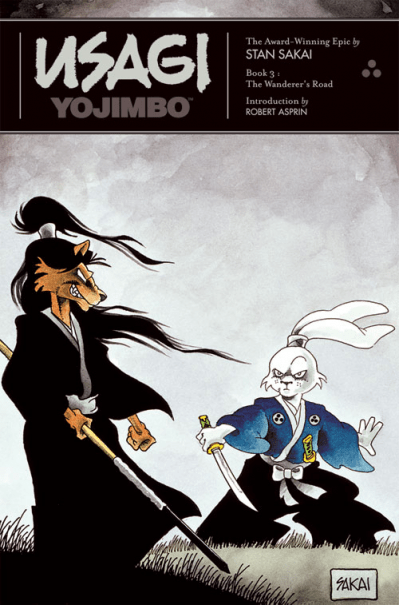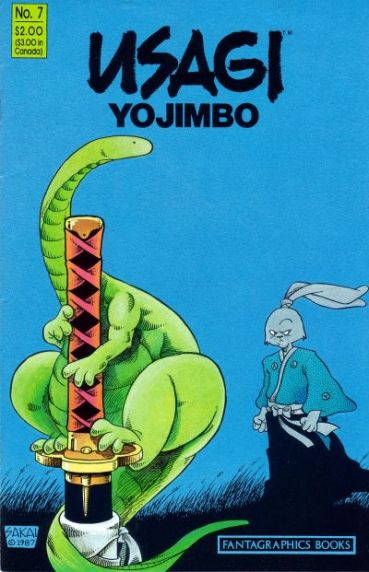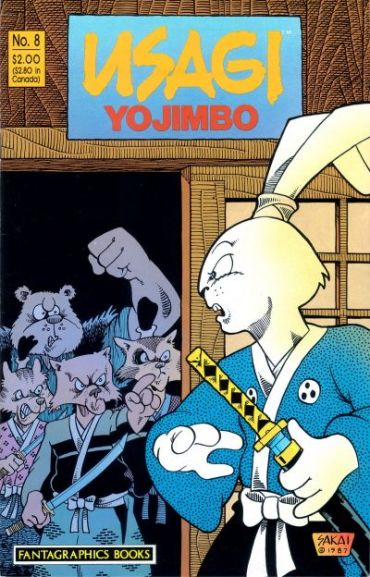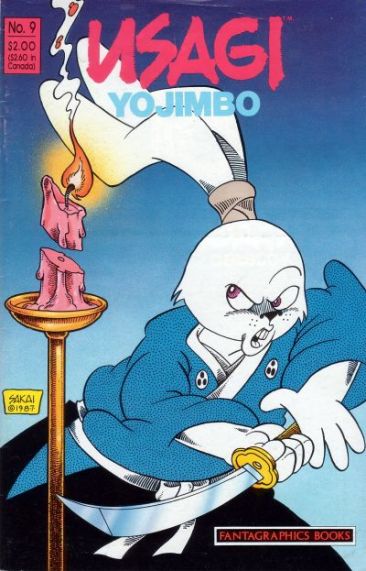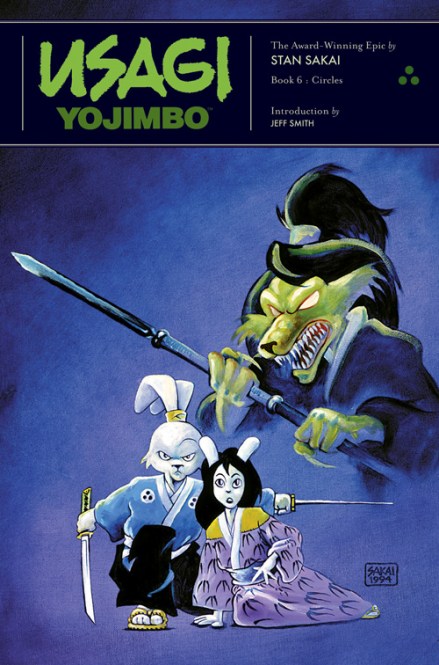
Throwback Thursday: Usagi Yojimbo: Volume 6: Circles by Stan Sakai

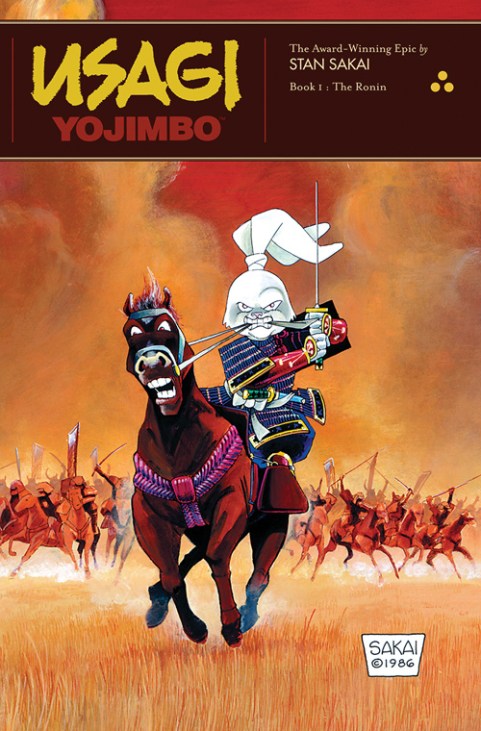
Usagi Yojimbo Circles

Publisher: Fantagraphics Books (Paperback – 1994)

Series: Usagi Yojimbo – Book Six

Length: 164 pages

My Rating: 5 out of 5 stars

Amazon     Book Depository

Reviewed as part of my Throwback Thursday series, where I republish old reviews, review books I have read before or review older books I have only just had a chance to read.

For this latest Throwback Thursday, after reviewing Lone Goat and Kid a couple of weeks ago, I am still in a Usagi Yojimbo mood, so I thought I would check out the sixth volume of this fantastic comic book series, Circles.
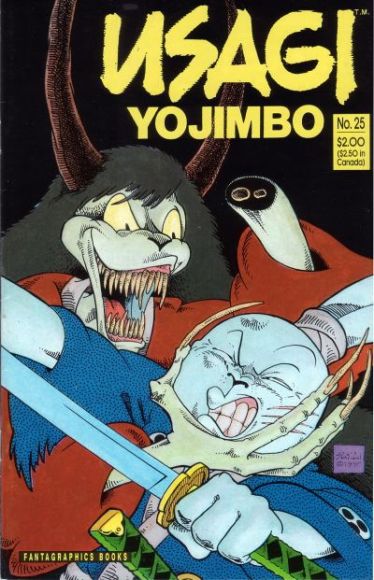
Usagi 25

Circles is another fun and exciting addition to this excellent series which I honestly cannot praise enough (although I have been trying very hard in my last several Throwback Thursday articles). This sixth volume once again presents the reader with several outstanding and inventive stories that chronicle the adventures of the rabbit samurai, Miyamoto Usagi, as he journeys around a unique version of historical Japan. This volume contains five separate stories, derived from issues #25 – 31 of the Fantagraphics Books run on the Usagi Yojimbo series, as well as a short story taken from Critters number #50 (a comic magazine that had some early Usagi Yojimbo appearances). There are some rather amazing stories featured within this volume, and I had an incredible time reading them.

The first story contained within this sixth volume is called The Bridge, which sees Usagi encountering a demon out of Japanese folklore. During a dark a stormy night, Usagi is entering a village from across a bridge when suddenly he lashes out with his sword behind him, convinced something is sneaking up on him. When he finds nothing there, Usagi shrugs it off and enters the nearest inn, only to learn from the villagers that the bridge he just crossed has been possessed by a demon, and Usagi’s back now bears the claw marks of the demon. Awaking next morning, the villagers find a severed monstrous hand on the bridge, which Usagi appeared to have cut off the night before. Taking the hand into the inn, Usagi and villagers wait for a priest to arrive in order to perform an exorcism on the severed limb, but the demon of the bridge has other plans.
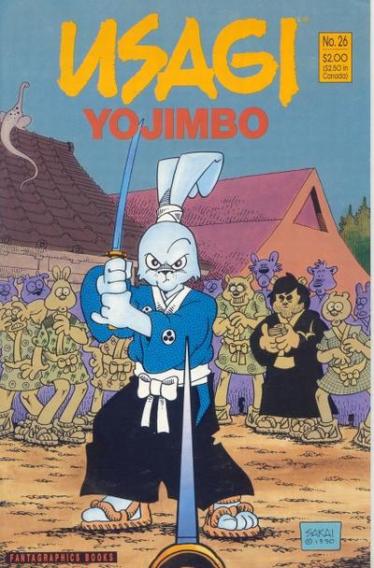
Usagi 26

This was a rather good supernatural story that sees Usagi go up against one of Japan’s many demons and monsters. Several significant elements from this story are taken from the story of the demon of Rashomon Gate, including the severing of the arm and the demon disguising itself as an old woman to recover its severed limb (although unlike the samurai in the legend, Usagi doesn’t fall for it). The demonic antagonist of this story is rather sinister in its drawing style and methods of attack, and it proves to be a dangerous opponent for Usagi. I love the extended fight on the bridge, and I especially enjoyed the way that the whole event ended, providing a side-character in the story their moment of vengeance. Overall, this was a tight, well-written story that was a lot of fun to read.

The next story in this volume is titled The Duel, and, as the name suggests, it features some duels between samurai. Usagi arrives in a village and is challenged to a public duel by the local champion while the watching villagers place bets with a travelling bookmaker, a duel that eventually results in Usagi’s opponent’s death. Completing the duel, Usagi meets and has lunch with a fellow unemployed samurai, Shubo, who subtly takes his measure. It is revealed that Shubo, who is a talented swordsman, is in league with the bookmaker who manipulates the odds of Shubo’s duels in order to make money off the betters. Shubo, who needs the money to provide for his wife and child, believes that he can beat Usagi, and the bookmaker inflates the odds in Usagi’s favour so that they can clean up when Shubo wins. Forcing Usagi into a duel, the two engage in a quick fight to death, with tragic results.
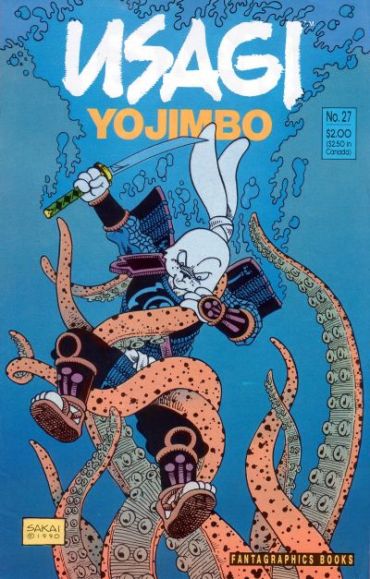
Usagi 27

This was a really clever and captivating single story that Sakai did an incredible job writing. The whole story concept is just brilliant, and Sakai sets it up and executes the plot brilliantly. There are some amazing scenes throughout The Duel, and the story features an excellent mix of comedy and tragedy which work together amazingly to produce a gripping narrative. Usagi, as the reluctant participant of this duel, is pissed at the entire affair, and his outraged reaction to the town people cheering his victory is rather good, especially as the peasants show over-the-top fake remorse in order to get him to go away so they can collect their winnings: “We are lower than the scum at the bottom of a stagnant pool!” While there is some fun and well-deserved karma coming down onto the bookkeeper who overextends himself and tries to escape, nothing quite takes away from the tragedy of Shubo’s wife and young child. The final panel of this story is incredibly heartbreaking, as it shows the wife and child waiting just outside the village for him to return. But as the light in the sky gets darker and darker, you can see the worry start to work its way onto the wife’s face, until she breaks down completely in the final panel, fully realising that her husband is dead. The wife comes across as a massively tragic character in this story, and the major impact that this final page has is a testament to how amazing Sakai’s storytelling and illustrations are.

The third story in the volume is the rather short entry, Yurei, which is the story that appeared in Critters. In this tale, Usagi, who is camping at the edge of a river, awakens to find a Yurei, a ghost, floating before him. The ghost imparts her tragic story to Usagi; she was betrayed and murdered by her husband, and she now seeks justice. Usagi then awakens and finds a woman’s hairpin on the ground next to him. Thinking his encounter with the ghost was just a dream, he travels to a nearby inn and attempts to trade the pin for a meal. What he does not realise is that the innkeeper is the murderous husband from the ghost’s tale, and his discovery of the pin leads to a series of deadly events. This was a good, fast-paced story which tells a compact and intriguing tale. I loved the supernatural elements in this story, and it was interesting to see Usagi portrayed as a tool of fate, who wonders into some ghostly revenge without even realising it. This was a fantastic short entry in this volume and was great to check out.
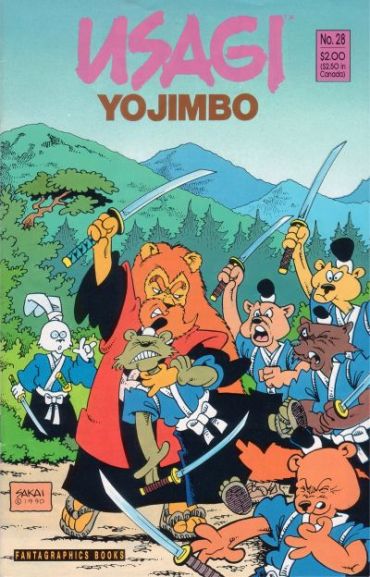
USagi 28

The next entry in Circles is an entertaining and over-the-top tale titled My Lord’s Daughter. In this story, Usagi, who is telling a bedtime tale to children, is shown as the classic hero from Japanese legend, fighting through vast hordes of demons, monsters, and obstacles to rescue a beautiful princess from an Oni. This was a fun take on some of the traditional Japanese heroic legends, and it was cool to see Sakai draw a classic tale with Usagi as the protagonist. Sakai has some obvious fun setting the Usagi hero fearlessly against armies of demons and monsters, and he comes up with some clever fight sequences and scenes in this book, from a brutal duel with an Oni, to an underwater battle between Usagi, a shark and a giant octopus wielding several swords in its tentacles. This is an entertaining and exciting story, and I had a good laugh at the end reference to Sakai’s old comic, Groo the Wanderer.

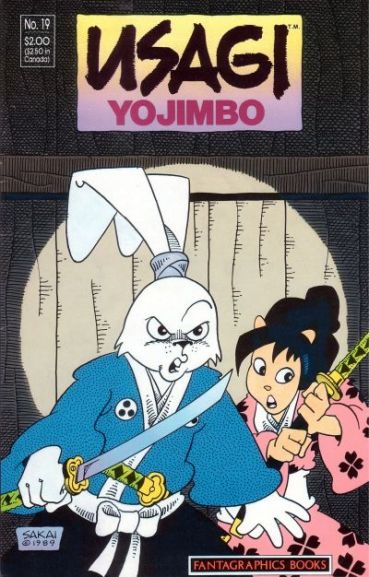
Now let us get to the fifth story of this book, which is kind of the main event of the entire volume. This is a big story, told across four issues, titled Circles. This story follows Usagi as he returns home for the first time since the events of volume one, The Ronin. There are actually a couple of distinctive parts to this story, especially the first issue, which is somewhat separate from the rest of the story (with the exception of some build-up at the end). For this first part, Usagi, on his way back home, decides to stop at his old master’s house to pay his respects to the grave marker of Katsuichi, the man who taught him how to wield a blade. The story then shows a flashback, which serves as a continuation to part of the origin story Usagi told in the second Usagi Yojimbo volume, Samurai, about Usagi’s past. In the flashback, it is shown that Usagi’s master was ambushed and seemingly killed by members of the Dogora Fencing School after Usagi beat their students in a tournament. However, upon arriving at Katsuichi’s old house, he discovers that his master is still alive, having survived the ambush, and has taken on a new student. I liked this revisit of Usagi’s origin story with Katsuichi, although the whole death scene in the flashback comes a little bit out of nowhere. Still, it was interesting to see how much Usagi has matured since he was learning the way of the sword, and it was nice to see the teacher and student reuniting. The flashback sequence is also top quality, and Sakai illustrates up a storm in this one, showing a fierce battle and some intense emotions from Usagi, who goes from a full-on berserker rage as he gets his revenge on his master’s killer to an intense grief in just a few scenes.
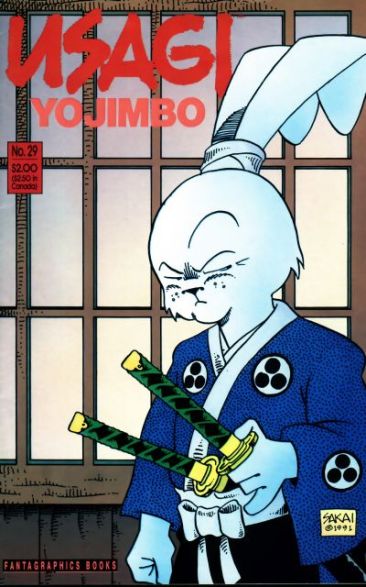
Usagi 29

The story then continues as Usagi journeys back to his village, only to be confronted by his old childhood rival, Kenichi. It turns out that Jotaro, Kenichi’s son with Usagi’s former love, Mariko, has gone missing, and bandits are roaming the area. While Usagi and Kenichi are able to defend their town from a raiding party, the attackers reveal that Jotaro has been kidnapped by the bandits and are holding him hostage. Leading an army of local peasants against the bandit’s hideout, Kenichi and Usagi hope to rescue Jotaro and end the raids that have been plaguing them. However, what they do not realise is that the bandits are being led by the deranged and dangerous former adversary of Usagi, Jei, a mysterious and seemingly unkillable murder with a black blade, who hopes to use Jotaro to get his revenge on Usagi. But even Jei is not the most dangerous thing that lies ahead, as old resentments between Usagi and Kenichi, their shared love for Mariko and certain revelations may tear everything apart.

Wow, I have to say that the final three issues of Circles are just incredible. There is so much to unpack from them, as Sakai brings together a brilliant and powerful story. First of all, it was great to see Jei return as a villain once again. Jei, who was introduced in volume 3, The Wanderer’s Road, is an outstanding antagonist, and his continued feud with Usagi is just brilliant. The two engage in a fantastic and extended duel in this story, and Sakai did a fantastic job showing off each combatant’s skill and martial ability through his drawings. I also love the extensive battle between Kenichi’s peasant army and the bandits, which proved to be rather eye-catching. Not only is there a beautifully drawn sequence in the misty forest before the big battle in which Usagi does a great Jei impersonation to scare a bandit sentry, but Sakai illustrates a massive battle between the two forces. The massive single panel that shows the pitched battle is just impressive, and I love the detailed and entertaining scene that the author produced here.
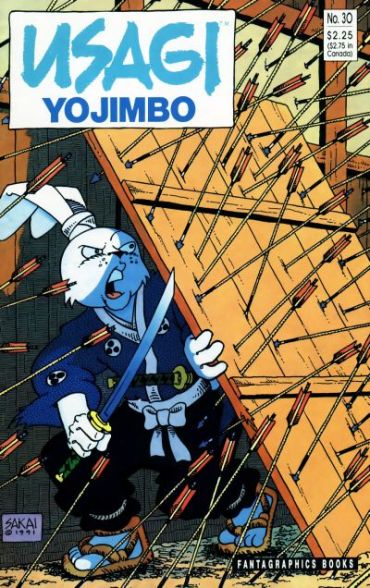
Usagi 30

While all of the above is pretty amazing, what really makes this captivating story is the complex relationship between Usagi, Kenichi and Mariko. There are so many great layers plastered into this relationship. Usagi and Mariko were deeply in love when they were younger, and they still have great feelings for each other. However, Mariko ended up marrying Kenichi, and she is bound by duty, and her child, to him, no matter how she feels about Usagi. Kenichi, on the other hand, has always borne antagonism towards Usagi, which has been compounded over the years by their differences in skill and the fact that Usagi was chosen to serve Lord Mifune and left the village. However, Kenichi’s resentment towards Usagi is even greater, as he knows that Usagi is in love with his wife, and that these feelings are reciprocated by Mariko.

This leads to some outstanding scenes throughout this story, as these three try to come to terms with their complicated emotions. I particularly loved one scene in the middle of the story, where Usagi and Mariko discuss their feelings and reveal that they still both love each other, although Mariko makes it clear that they can never be together. The scene ends when Kenichi interrupts them, and while the look of heartbreak and shame on Mariko’s face is notable, what really gets me is the way that Kenichi’s usual stern/angry look is replaced with one of sad resignation in the last panel once he realises how Mariko still feels about Usagi. Despite this, Kenichi comes across in this story as a surprisingly honourable and well-intentioned character who puts aside his negative feelings for Usagi for the greater good, and it is a fantastic examination of a character who has mostly been antagonistic in the previous volumes. Sakai also drops a massive bombshell at the end of this story, when he reveals that Jotaro is actually Usagi’s son, and that Kenichi has known this and raised him as his own. Because of this, Mariko asks Usagi to leave and not try to settle down in their home village, as she fears it will put a wedge between Jotaro and Kenichi, who she sees as Jotaro’s true father. Usagi regretfully accepts this in another dramatic and captivating scene, although Mariko arranges for Usagi to see Jotaro as he leaves, and Usagi has a heartfelt time with his son, noting the similarities between them, and even suggesting Jotaro seek out Katsuichi as a teacher in later years. All of this is some first-rate storytelling and character development, and cannot praise Sakai enough for this amazing, emotional storyline. This is actually the last book that Kenichi and Mariko appear in (so far), and I think that Sakai did a fantastic job tying their love triangle together. All in all, Circles is easily my favourite story in this entire volume (The Duel comes close), and it is worth grabbing this volume just to check this key story out.

Usagi 31

It should come as no surprise to anyone considering all the praise I elicited above that I am giving this sixth volume of Usagi Yojimbo a full five star rating. This was another incredible comic book that features Sakai’s outstanding blend of powerful stories, memorable characters, intense action, fun references and depictions of traditional Japanese culture and history and some truly impressive artwork. I absolutely loved this volume, and this entire awesome series, comes highly recommended and is an unquestionable must-read.

Amazon     Book Depository

Throwback Thursday: Usagi Yojimbo: Volume 5: Lone Goat and Kid by Stan Sakai

Usagi Yojimbo Lone Goat and Kid Cover

Publisher: Fantagraphics Books (Paperback – January 1992)

Series: Usagi Yojimbo – Book Five

Length: 142 pages

My Rating: 5 out of 5 stars

Amazon

Reviewed as part of my Throwback Thursday series, where I republish old reviews, review books I have read before or review older books I have only just had a chance to read.
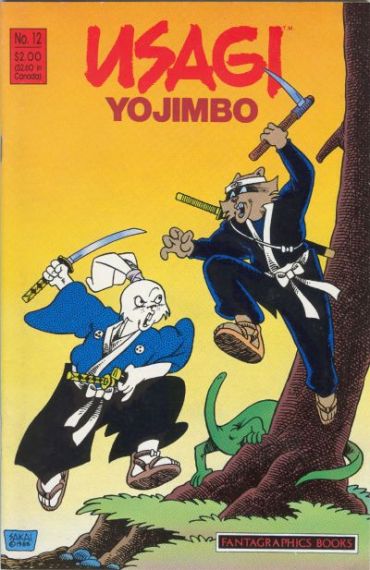
In this latest Throwback Thursday I once again check out another early volume of the excellent Usagi Yojimbo series, which I have been reviewing over the last couple of weeks. For this review, I am looking at the fifth volume, Lone Goat and Kid. Lone Goat and Kid was first released in 1992 by Fantagraphics Books and contains issues #19-24 of the Usagi Yojimbo series.

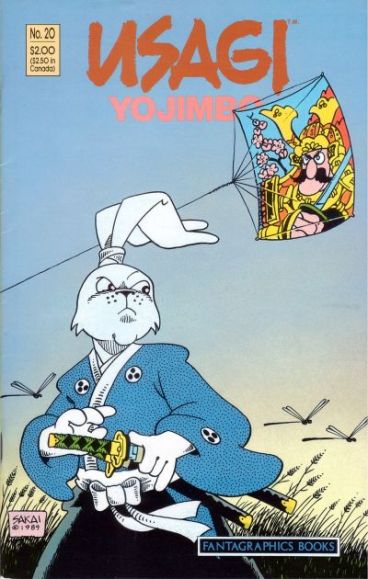
Usagi 19

This fifth volume of Usagi Yojimbo once again sees series protagonist, the rabbit ronin Miyamoto Usagi, traverse a feudal Japanese landscape populated solely with anthropomorphised animals. This volume follows on right after the chaotic events of the fourth volume, The Dragon Bellow Conspiracy, and contains five new stories across six issues. This is an interesting entry in the series, particularly as it is the first volume to barely feature any of the previously introduced recurring characters aside from Usagi (a huge departure from the last volume, which contained a number of recurring characters coming together and teaming up). Instead, Sakai takes the time to introduce a bunch of new characters and scenarios across the volume’s five separate stories. Unsurprisingly, I really liked this fifth volume of Usagi Yojimbo, especially as Sakai manages come up with some fantastic and exceedingly enjoyable tales.

The first story featured within this volume is titled Frost & Fire, and it is a tragic story with undertones of forbidden love and class struggle. In this story, Usagi is hired by the cold and proper widow of a samurai to travel to the place of her husband’s death and retrieve his swords. Upon arriving at the small village where the samurai died, Usagi discovers that the swords are in the possession of the dead man’s lover, a poor peasant girl, who wishes to keep them as a remembrance of the man she loved. Unwilling to take the swords by force, Usagi leaves, but the peasant girl’s greedy brother has other plans for the swords.

This was a rather heartfelt first story for the volume, and it contains some great underlying elements to it. Much of the story revolves around a forbidden romance between a samurai and a peasant girl who wanted to be together but were unable to due to class differences. This was a rather intriguing central element for this story, and you can’t help but feel for the poor peasant girl, especially after meeting the samurai’s harsh and honourable widow in the opening pages. There is also examination of the evils of greed and avarice, as several of the side characters attempt to deceive and murder in order to get a quick payday. Luckily, their greed proves to be their undoing, as karma quickly strikes throughout the course of the story. There are some great scenes in this story, including one sequence where Usagi stares down the peasant girl when she refuses to give up the swords, “You know I can just take them from you”, before ultimately backing down and refusing to force her to give them up. I also liked a scene later in the book where the brother’s greed proves to be his undoing, as not only does Usagi appear behind him at one point like a vengeful spirit, but he is then ironically attacked by his “friends”, who are jealous of the wealth he achieved because of his bad actions, and whose mindset mirrors that of the brother. All of this makes for a great first entry for this volume, and I really enjoyed the amazing and captivating story that Sakai came up with.

Usagi 20

The next story is a rather unique entry called A Kite Story, which I have a particular love for. A Kite Story is actually broken up into four distinctive parts, each of which focuses on a different character participating in a famous kite festival. The first part, called The Kite Maker’s Story, follows a kite maker, Tatsusaburo, in the lead up to the festival. This part of the story contains no dialogue, but instead features a first-person narration from Tatsusaburo that overlays the drawings. This narration explains how he gathers the resources for his kites and the various processes he goes through to craft them together. It particularly focuses on the work he puts into creating an odako, a giant kite that he and a team of handlers hope to fly. The story then jumps to its second distinctive part, called The Gambler’s Tale, which follows the crook Hatsu and his gang of itinerant gamblers as they work the crowds gathering for the kite festival. This part starts off with some first-person narration from Hatsu and explores how he and his gang set up a rigged game of dice. This part ends its narration on the second page, when Usagi arrives on the scene and it becomes purely dialogue driven after that. Usagi, upon noticing the game, gets involved and is able to prove the gamblers are cheating (thanks to some fancy sword work), which sees not only the crooked gamblers run out of town but also those gamblers who were running fair games, and who are none too pleased with how they have been treated. This then moves to the third part of the story, called The Ronin’s Tale, which is nearly entirely dialogue driven, with only a small bit of narration at the front. Usagi deals with some of the players from the first two parts of the book, as he is unfairly blamed by the cheating gamblers in The Gambler’s Tale as the source of all the trouble to the honest gamblers. This sees Usagi have to make a rather quick and unconventional exit from the festival, which quickly breaks down into chaos. The story then concludes with a quick two-page final part, called The Kite Maker’s Tale II, which follows Tatsusaburo again and serves as an epilogue to the whole story.

I really liked A Kite Story, as Sakai did a really good job blending together a couple of distinctive narratives into one fantastic story. I particularly enjoyed the fascinating first part of this story and I always love it when Sakai uses his stories to explore certain unique Japanese cultural elements and industries. For this one, the author presents the reader with an amazing examination of the traditional kite-making process, and I loved seeing the process explained by the titular kite maker. This part of the story blends in surprisingly well with the other sections of A Kite Story, and I was impressed with how Sakai was able to turn these seeming separate and disparate tales into a complete narrative that is both entertaining and informative. Sakai also produces some amazing artwork in this story, from the giant kite to the visually impressive and detailed crowd scenes, and this is easily one of the more innovative stories that Sakai has come up with.

Usagi 21

The third story is the action-packed spectacular, Blood Wings, which Sakai tells over two issues. Late one night, Usagi is wandering along the road when he comes upon a dying peasant. The peasant’s last words are a mysterious warning about whatever killed him, “wings of blood”. Travelling to a nearby village, he finds a settlement living in terror, completely cut off from the outside world. They are being kept prisoner by a new and dangerous group of ninja, the Komori Ninja Clan, killer flying bats. The Komori Ninja were accidently discovered by the villagers as they prepared to ambush a shipment from a nearby goldmine and the ninja are now keeping them prisoner while they execute their attack. Knowing that the ninja will not leave the villagers alive as witnesses after the heist, Usagi attempts to break out and warn the goldmine, and when that fails, he leads the villagers in a spirited defence of their home.

Blood Wings was a fantastic and exciting story that serves as an excellent set piece for the middle of this volume. This third story is an impressive read that not only introduces a notable new group of antagonists, but it also contains some rather good action sequences. The Komori Ninja prove to be a great group of villains, and I really liked the character design that Sakai came up for them, as they fly around with sword blades attached to their wings, cutting through anyone and anything they encounter. The highlight of this story has to be the thrilling action sequences between Usagi and this new foe, who are able to outmatch the protagonist with their unique combat style. This all culminates in an extended battle sequence which sees a swordless Usagi defending the village with a force of farmers. This is probably the fastest-paced story in the volume, and Sakai comes up with an awesome narrative for it. This is also the entry in this volume that is most tied into the overarching Usagi Yojimbo world, as the Komori Ninja are revealed to be working for Lord Hikiji and are seeking to replace the Neko Ninja. This story also contains my favourite joke in the whole volume, as only Saki would have a guard yell out, “Holy flying furball! It’s Bats, man!” as the Komori Ninja descend.

Usagi 22

The fourth story is an elaborate and compelling entry titled The Way of the Samurai. This story sees Usagi intervene when a gang of bandits (including a very cool-looking walrus samurai), attack a messenger, and is directed to seek out the magistrate of the local town. Arriving at the town, Usagi is amazed to discover that the magistrate is a famed former general Oyaneko, whose battles and tactics Usagi idolises. Staying in the general’s house for a night, he learns that Oyaneko was a loyal retainer to the land’s former lord but was cast aside when the lord’s brash young son came to power. Now regulated to the role as a simple administrator and slowly dying of a disease, Oyaneko is discontent with his life, and, after meeting an honourable and skilled Usagi, challenges him to a duel to the death, “The way of the Samurai is found in death”.

This fourth entry in the volume is a moving tale that the author uses to explore the complexity of the samurai code of duty, loyalty and service. I really liked the intricate story that Sakai weaved around the characters of Usagi and Oyaneko, and Oyaneko’s story is particularly tragic and fascinating. This entire story is set up really well, with Usagi encountering Oyankeo, the two gaining a mutual respect for the other, learning about Oyankeo’s past and motivations, before the emotionally charged duel at the end. Sakai did a fantastic job illustrating the stress and emotion surrounding this final duel with his epic drawings, and the end result was really touching. I think this is one of the best written stories in the entire volume, and it becomes quite an emotional ride for the reader in the end.

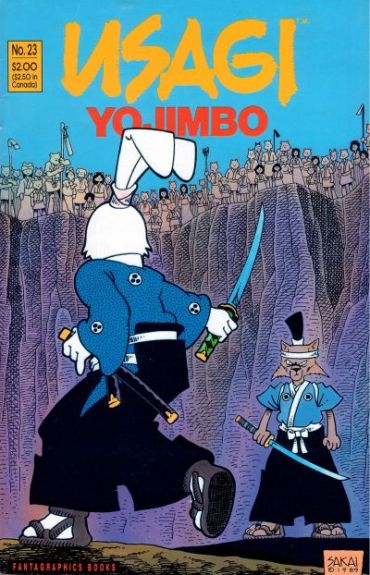
Usagi 23

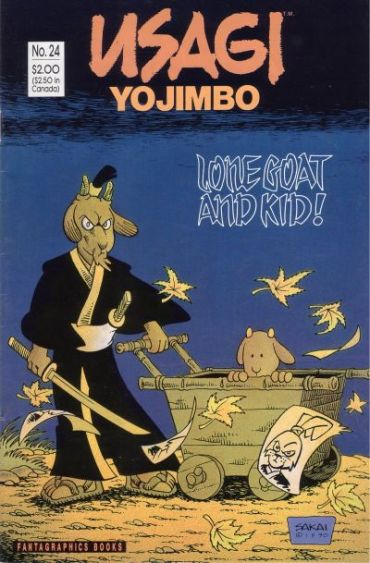
That leaves us with the fifth and final story in this volume, which shares the same name as the overall volume, Lone Goat and Kid. This story focuses on the characters of Yagi and Gorogoro, the titular Lone Goat and Kid. Years ago, Yagi served the same lord as Oyaneko. However, when their old lord died, Yagi was falsely accused of a crime by the new lord’s corrupt advisors and forced out of his service. Yagi and his son Gorogoro now work as Lone Goat and Kid, assassins for hire who many believe now travel the road to hell. The two assassins are also constantly targeted by their former lords’ samurai and bounty hunters sent after them by the corrupt advisors who framed them. As part of their latest attempt to kill Yagi and Gorogoro, these advisors use a proxy to hire the Lone Goat and Kid to assassinate Usagi, who they believe may be able to defeat the infamous assassin. When they meet, Yagi and Usagi engage in a brutal fight to the death, with the corrupt lord’s forces waiting to ambush the winner.

This was another awesome story filled with epic duels, a massive battle sequence, some superb artwork featuring Japan’s exquisite landscape, and a fun narrative packed full of deceit and conspiracy. The titular Lone Goat and Kid are a rather cool adaptation of the iconic Japanese fiction duo, Lone Wolf and Cub. Lone Wolf and Cub was a manga series back in the 1970s that followed a samurai assassin and his child as they travel feudal Japan searching for vengeance. This series has inspired several movies and a television show, and many different pieces of fiction have paid homage to them over the years, from The Mandalorian to Bob’s Burgers. Heck, Rick and Morty literally just did an anime homage to them last week on YouTube. Sakai’s versions of the characters are rather good, and they become fun recurring characters within the Usagi Yojimbo series. I loved how Sakai came up with some fantastic and unique character designs for the two assassins, turning them into goats rather than wolves (which was a nice touch, especially as the name “kid” has that fun double meaning), and providing them with a different backstory. However, there are some excellent similarities, such as the father’s skill with the blade, the desire to take down conspirators who wronged them and the baby carriage the son travels in, equipped with all manner of hidden weapons and blades. The character of Yagi, the Lone Goat, is particularly intense, and is almost demonic in his attitudes and persona, while still maintaining a samurai’s sense of honour. I was also really impressed with the battle sequences that featured in the last half of this story, and I liked how Sakai went from an elaborate one-on-one duel, to a mass fight against multiple opponents. All of this leads to another excellent story in this volume, which I really enjoyed reading.

Usagi 24

This fifth volume of Usagi Yojimbo, Lone Goat and Kid, was another incredible and powerful addition to the series, and I think Stan Sakai did another amazing job with this volume. Featuring five fantastic stories that contained Sakai’s usual complex narratives, iconic artwork and compelling underlying themes, Lone Goat and Kid gets another five-star rating from me, and it is really worth checking out.

Amazon

Throwback Thursday: Usagi Yojimbo: Volume 4: The Dragon Bellow Conspiracy by Stan Sakai

Usagi Yojimbo The Dragon Bellow Conspiracy

Publisher: Fantagraphics Books (Paperback – September 1991)

Series: Usagi Yojimbo – Book Four

Length: 179 pages

My Rating: 5 out of 5 stars

Amazon     Book Depository

Reviewed as part of my Throwback Thursday series, where I republish old reviews, review books I have read before or review older books I have only just had a chance to read.
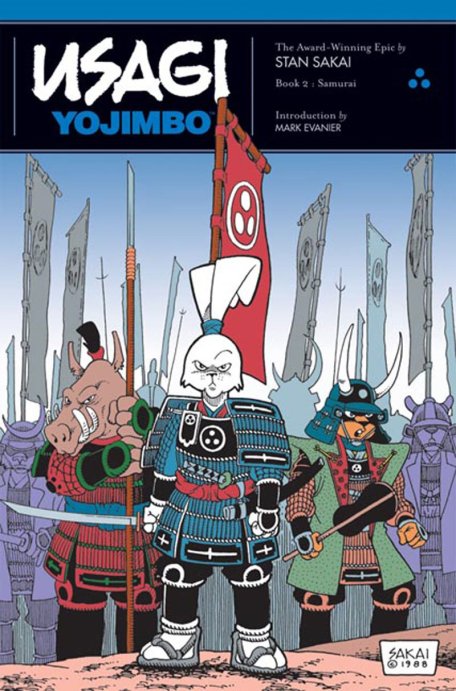
For this slightly belated Throwback Thursday, I continue my trend of the last couple of weeks by checking out another volume of Stan Sakai’s ground-breaking and utterly addictive Usagi Yojimbo series with the fourth volume, The Dragon Bellow Conspiracy. Reviewing all these Usagi Yojimbo books has proven to be a lot of fun, and I am really glad that I have been able to show off my love for this series (make sure to check out my reviews for volumes One, Two and Three). The Dragon Bellow Conspiracy is another excellent early volume in this long-running series, which features a fantastic full-volume-length story.

Usagi 13

A storm is brewing throughout feudal Japan, as war and revolution against the Shogun lie just beyond the horizon. In his fortress, the ambitious and dastardly Lord Tamakuro has been plotting. Despite appearing to be a loyal supporter of the powerful Lord Hikiji, Tamakuro has his own plans to take control of the country and rule as Shogun, utilising an army of ronin armed with teppo, black powder guns imported from the barbarian lands outside of Japan.

However, despite his best attempts at discretion, Lord Tamakuro’s actions have not gone unnoticed. His neighbour, Lord Noriyuki, has sent his trusted advisor and bodyguard, Tomoe, to investigate Tamakuro’s castle, where she discovers the hidden armaments he is planning to use in his upcoming revolution. At the same time, Lord Hikiji, suspicious of Tamakuro’s true loyalties, has sent the notorious Neko Ninja clan to infiltrate his castle. When both Tomoe and the Neko Ninja are discovered, Tamakuro makes ready for war against all his opponents.

Usagi 14

Into this vast conspiracy walks the wandering ronin Miyamoto Usagi. A friend to Lord Noriyuki and Tomoe, Usagi witnesses Tomoe being captured and rushes to Tamakuro’s castle to save her. Despite his best efforts, Usagi finds himself outmatched by the powerful forces Tamakuro has pulled together. His only chance at saving his friend and averting a civil war is to team up with the Neko Ninja, a group he his fought many times in the past. Can Usagi and his new allies succeed, or will Tamakuro’s greed engulf the entire country? And what role will blind swordspig Zato-Ino and the bounty hunter Gennosuke play in the final battle?

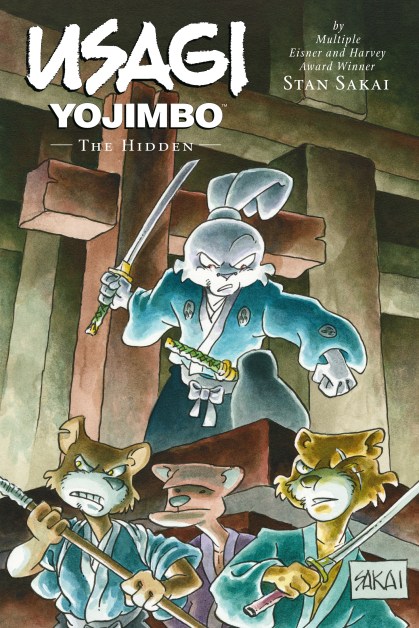
Usagi Yojimbo: Volume 4: The Dragon Bellow Conspiracy is an outstanding and highly enjoyable comic that I have a huge amount of love for. Containing issues #13-18 of the Fantagraphics Books run of the Usagi Yojimbo series, this fourth volume is broken down into seven separate chapters. It is a major early edition in the series, as it contains a massive and wide-reaching story. This is the first storyline that takes up an entire volume (several notable stories do this later, such as the two Grasscutter volumes and the 33rd volume, The Hidden), and it presents the reader with an epic tale of war, friendship, honour, loyalty and uneasy alliances, while featuring a number of the best Usagi Yojimbo characters.

Usagi 15

The entire story contained within this fourth volume is quite spectacular and comes with minimal build-up from the Usagi Yojimbo issues that preceded this volume. Sakai does an amazing job introducing the relevant plot and new key players surrounding this storyline, and then telling a complex and detailed narrative within the confines of this one volume. In addition to the main conspiracy storyline, the story follows several different character-based storylines, all of which come together for one big epic confrontation. I really enjoyed where Sakai took the plot of this volume, and I liked how the story was broken up into several distinctive chunks defined by the respective chapter (the chapter names, which refer to parts of a storm, identify the intensity and importance of each chapter). The entire story is rather self-contained, and I think that the author did a great job wrapping it up and giving it several satisfying conclusions.

Like many of the Usagi Yojimbo issues out there, the true heart of The Dragon Bellow Conspiracy’s story is the outstanding characters, many of whom have appeared in prior issues in the series. Usagi once again accidently finds himself in the midst of a vast conspiracy and must risk everything to save his friend and stop a war. If I am going to be honest, Usagi has one of the weaker arcs in this volume, with several of the side characters getting much more interesting storylines and more development. That being said, parts of Usagi’s story are fairly intriguing, such as when he manages to infiltrate Lord Tamakuro’s castle as a new retainer in order to rescue Tomoe, or his guilt-ridden dream sequence where his regret over his perceived failure manifests itself as a series of ghosts and monsters. Usagi also has the fun job of recruiting reluctant and unusual allies to his cause, such as the Neko Ninja or his old foe Zato-Ino. Indeed, his whole storyline is similar to classic Japanese films such as The Seven Samurai (the inspiration for The Magnificent Seven) or The Hidden Fortress (which served as an inspiration for the first Star Wars movie), as he recruits or forms alliances with various people in order to take down an evil opponent (in a castle, no less, for The Hidden Fortress fans). He also has some rather fantastic interactions with several different characters throughout the volume, and it results in some major developments in his relationships with them.

Usagi 16

While Usagi’s storyline is quite enjoyable, several returning supporting characters also have some substantial and impressive arcs throughout this book, and I really loved the way in which Sakai brings back a number of key characters from earlier issues in the series. The best character in this entire volume is the blind swordspig, Zato-Ino. Both of Ino’s previous storylines have been extremely impressive, so it was great to see him return again for another volume. Ino, who had already found some measure of peace thanks to his new companion, the tokage lizard Spot, finds some major redemption in The Dragon Bellow Conspiracy, and he easily has the most character development. An entire chapter of this volume is dedicated to the eventual fate of Ino, and it was fantastic to see him finally find what he has been desperately searching for, even if he has to lose his only friend along the way. The rhino bounty hunter, Gennosuke, once again proves himself to be a fun and endearing character throughout this volume. Initially involved in a rather humorous hunt for Ino’s bounty, he finds himself working with him to fight Lord Tamakuro’s forces, although he always intends to betray him. However, Ino’s heroic actions end up changing his mind, and he once again reveals his hidden good nature by secretly assisting Ino and selflessly helping him. This is also the volume where Gen loses his horn, with all future versions of him appearing with just a small stump on his nose. His cut-off horn is quite an iconic look for the character, and after seeing him without out for all these years in later volumes, his earlier horned appearance just looks odd.

Recurring female samurai, Tomoe, also has an extremely strong appearance in The Dragon Bellow Conspiracy, as she finds herself captured within Lord Tamakuro’s castle quite early in the volume and is forced to resist his abuses. Tomoe has some great dialogue with Usagi about how her mission and her loyalty to Lord Noriyuki are more important than her own life, and she has to talk Usagi into abandoning her for the greater good. She also has a rather fantastic sequence where she manages to remain hidden in the fortress, right after she rides through various parts of the interior on a horse. I also really liked Shingen, the Neko Ninja chief who Usagi teams up within this volume. Shingen previously appeared in the Volume 3 story, The Shogun’s Gift, where he formed a great rivalry with Usagi. While the two clash in this volume, they eventually reach a level of mutual respect and work together for the greater good. Shingen gains multiple dimensions as a character in this volume, and it was interesting to see his discussion with Usagi about honour, and how even ninja have a code of duty. His story comes to a fantastic close towards the end of the volume, but Sakai really made him one of the standout characters of the volume: “A ninja’s duty in life is death!”

Usagi 17

In addition to the excellent inclusion of several amazing returning characters, The Dragon Bellow Conspiracy also featured a couple of terrific new characters, who really helped bring this story together. The evil Lord Tamakuro was a really good villain for this volume, and Sakai did a fantastic job of showing of his greed, brutality and utter disregard for anything except his own power. Needless to say, he was a rather vile character who the reader cannot help but dislike, making his eventual comeuppance all the sweeter. The best new character in this volume has to be the leader of Tamakuro’s samurai army, Captain Torame. Torame is a loyal and capable warrior, who is forced to serve an evil lord who takes him for granted. He forms a bond with Usagi when the protagonist infiltrates the fortress under the guise of a mercenary ronin, and they have several discussions about bushido, loyalty and the ways in which a samurai must serve his lord. Usagi’s subsequent betrayal in order to rescue Tomoe enrages Torame, who takes it as a personal afront. This leads to a fantastic duel later in the volume, although not before Usagi and Torame have one final discussion, in which Usagi attempts to talk Torame into abandoning Tamakuro. Torame however refuses, as his strict adherence to the samurai code forbids him betraying his lord, even if it is clear he disagrees with Tamakuro’s plans:

“is samurai honour so important?”

“Yes”.

The result of the quick and brutal duel that follows visibly saddens Usagi, who was once again forced to fight a man he respected. This volume also sees the brief introduction of the Neko Ninja Chizu, a major recurring character in later volumes of the series, whose one scene in this book was rather fun.

The Dragon Bellow Conspiracy is an extremely action-packed volume that actually features some of the best action scenes in the entire Usagi Yojimbo series. I absolutely loved all the action sequences in this book, as Sakai did an incredible job illustrating them and bringing the fights to life. The main action set piece of this volume has to be the assault on Lord Tamakuro’s fortress by Usagi, Ino, Gen, Shingen and a force of Neko Ninja armed with explosives, as they attempt to rescue Tomoe and put an end to Tamakuro’s ambitions. This entire extended action sequence is exceedingly impressive, and it was really cool to see all the characters engage in a massive battle throughout a castle complex. I also have to say how incredibly awesome it was to see a force of ninja face off against an army of samurai, predominately armed with European muskets. This made for some incredible fight scenes, all of which I really and truly loved. I also have to highlight a couple of duel sequences that occurred earlier in the volume. The first of this was a great fight between Usagi and Shingen, as the two face off against each other in a quick fight to the death. This duel focuses on the extreme clash of styles between the two, as Usagi had to contend with all manner of traps and ambushes before he got anywhere near this foe. However, this duel pales in comparison to the awesome fight between Ino and Gen that occurred towards the middle of the volume. This two engage in an incredible and beautifully drawn fight that lasted several pages. This fight did a fantastic job showing of their respective skills with the sword, and this fight helps feed into Sakai’s love for classic Japanese films, as this duel was essentially Zatoichi vs Yojimbo. This volume featured some first-rate action, which is really worth checking out.

Usagi 18

In addition to the extremely well-drawn action sequences, Sakai has filled this volume with some truly incredibly examples of his artistic style. This volume features so many impressive and iconic Japanese buildings, landscapes, traditional outfits and other aspects of the country, that the reader can’t help but feel they have been transported back to feudal Japan. I particularly loved the way he included a number of stormy backgrounds throughout this volume. The continued artistic rendering of rain, clouds, mud, wind and storms throughout the entirety of The Dragon Bellow Conspiracy really helped to set the mood of the entire volume, and I loved how the intensity of the storm seemed to match the volume’s story. I really enjoyed how a number of pages were streaked with massive bolts of lightning across cloudy or darkened skies, and several scenes, particularly the duel between Ino and Gen, were majorly enhanced by this artistic inclusion. As usual, this art does an amazing job backing up the volume’s fantastic stories, and I was once again left stunned by Sakai’s obvious and incredible artistic talent.

Usagi Yojimbo: Volume 4: The Dragon Bellow Conspiracy, is another exceptional and captivating comic which I am awarding a full five-star rating. Sakai is a truly incredible writer and artist, and this fourth volume did a fantastic job highlighting his talents for both. Not only does this volume feature some amazing and distinctive drawings, but it also contains an outstanding and enjoyable story backed up by some awesome characters. Sakai did an awesome job bringing together several key recurring characters into a compelling and well-written narrative, which I once again fell in love with. The Dragon Bellow Conspiracy is really worth checking out, and is a must read for fans of the masterpiece that is the Usagi Yojimbo series.

UY_Book_4_HC_cover

Amazon     Book Depository

Top Ten Tuesday – Autumn 2020 TBRs

Top Ten Tuesday is a weekly meme that currently resides at The Artsy Reader Girl and features bloggers sharing lists on various book topics. For this week’s Top Ten Tuesday, participants need to list the top ten books on their Autumn 2020 (or Spring 2020 for those up in the Northern Hemisphere) to be read (TBR) list.

There are a huge number of novels coming out in the next couple of months which I have my eye on. Many of these are very impressive sounding books, and I am extremely excited for several of them. As a result, I was able to come up with a good list of Autumn TBR books, and each of the entries below are some of my most anticipated releases coming out in March, April and May 2020. I have previously addressed several of these books before in my weekly Waiting on Wednesday posts, and there is also likely to be some crossover between this list and some of my previous Top Ten Tuesday lists, such as My Most Anticipated Book Releases for the First Half of 2020 list and my Predicted Five Star Reads list. So let’s get to it and see which books I am most looking forward to reading in the next three months.

Honourable Mentions:


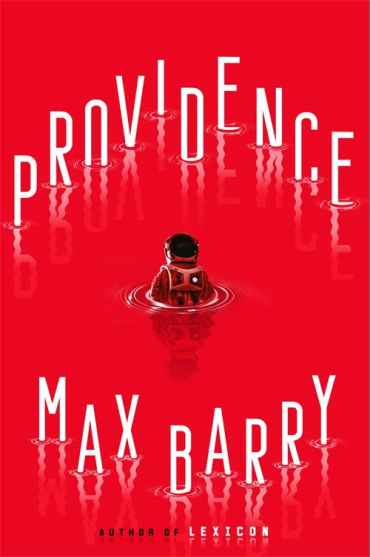
Providence
by Max Barry (31 March 2020)

Providence Cover


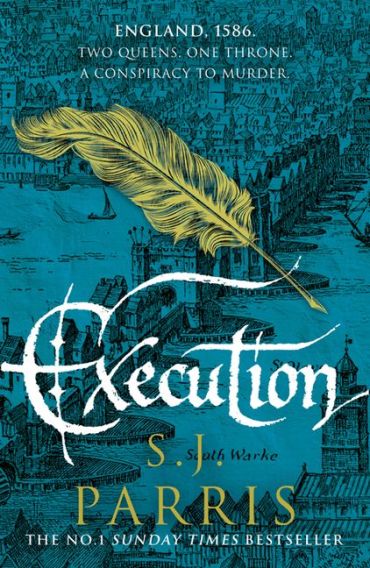
Execution
by S. J. Parris (30 April 2020)

Execution Cover


Lionheart
by Ben Kane (14 May 2020)

Lionheart Cover

Top Ten List (By Release Date):

Cyber Shogun Revolution by Peter Tieryas (3 March 2020)

Cyber Shogun Revolution


The Grove of the Caesars
by Lindsey Davis (2 April 2020)

The Grove of the Caesars Cover


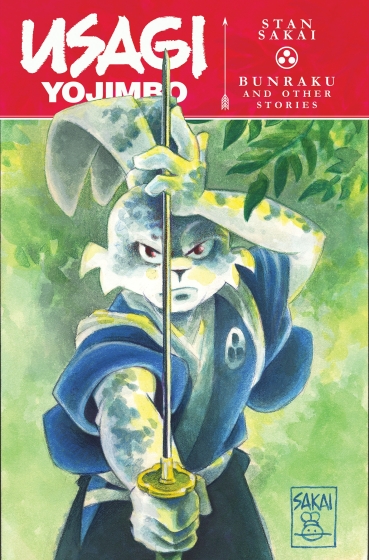
Usagi Yojimbo
: Bunraku and Other Stories by Stan Sakai (21 April 2020)

Usagi Yojimbo Bunraku and Other Stories Cover

There was no way that I wasn’t going to include the new Usagi Yojimbo on this list (especially after I just did Throwback Thursday posts for the first three volumes in the series, The Ronin, Samurai and The Wanderer’s Road). This has been one of my favourite series for years, and I really enjoyed Sakai’s last two entries, Mysteries and The Hidden. This upcoming volume, Bunraku and Other Stories, has a lot of potential and some cool features to it. Not only is it the first volume to be released completely in colour but it sounds like it is going to have some fantastic stories, including one that revisits the very first Usagi Yojimbo comic.

Shorefall by Robert Jackson Bennett (21 April 2020)

Shorefall Cover


Firefly
: The Ghost Machine by James Lovegrove (28 April 2020)

Firefly The Ghost Machine Cover


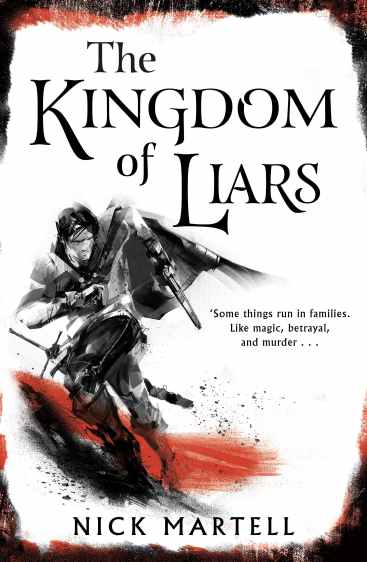
The Kingdom of Liars
by Nick Martell (5 May 2020)

The Kingdom of Liars Cover


The Lion Shield
by Conn Iggulden (14 May 2020)

The Lion Shield Cover

Iggulden is one of the top historical fiction authors in the world today, and he has created some exceptional novels in the past, including his Emperor and War of the Roses series, as well as the 2018 standalone novel The Falcon of Sparta. I have deeply enjoyed Iggulden’s work in the past, and I cannot wait to check out his new novel later this year. The Lion Shield is the first book in a new series that will focus on the Peloponnesian War between Athens and Sparta. This is an extremely fascinating historical conflict that is criminally underutilised in the historical fiction genre. I cannot wait to see what outstanding novels Iggulden weaves around this conflict, and I am sure that The Lion Shield is going to be an impressive first entry in this series.

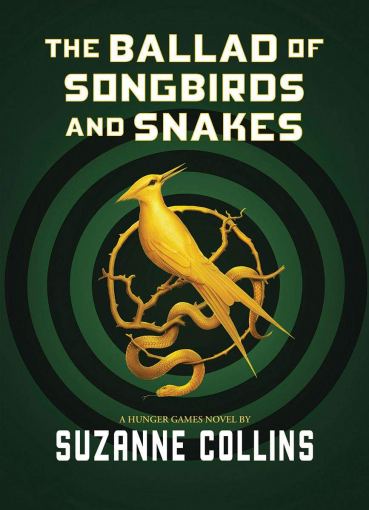
The Ballad of Songbirds and Snakes by Suzanne Collins (19 May 2020)

The Ballad of Songbirds and Snakes Cover


Eagle Station
by Dale Brown (26 May 2020)

Eagle Station Cover


Fair Warning
by Michael Connelly (26 May 2020)

Fair Warning Cover

Michael Connelly is an author that needs very little introduction, having produced some amazing and creative murder mysteries over the years. I have only recently started reading his books, but I loved his last two novels, Dark Sacred Night and The Night Fire (the latter of which was one of the best books I read in 2019, as well as one of my favourite audiobooks of 2019). As a result, I am extremely keen to check out his next novel, Fair Warning, which will be his third Jack McEvoy novel. Fair Warning sounds like it is going to be a thrilling and exciting novel, and I cannot wait to see Connelly’s reporter protagonist go up against a deadly and well-hidden serial killer.

Well that’s my latest top ten list. I am very happy with the final list that I pulled together, especially as this is a great mixture of impressive sounding novels. I think each of the books listed above have incredible potential, and I cannot wait to read each and every one of them. Let me know which of these books interests you the most in the comments below.

Throwback Thursday: Usagi Yojimbo: Volume 3: The Wanderer’s Road by Stan Sakai

Usagi Yojimbo The Wanderer's Road Cover

Publisher: Fantagraphics Books (Paperback – 17 January 1989)

Series: Usagi Yojimbo – Book Three

Length: 146 pages

My Rating: 5 out of 5 stars

Amazon     Book Depository

Reviewed as part of my Throwback Thursday series, where I republish old reviews, review books I have read before or review older books I have only just had a chance to read.
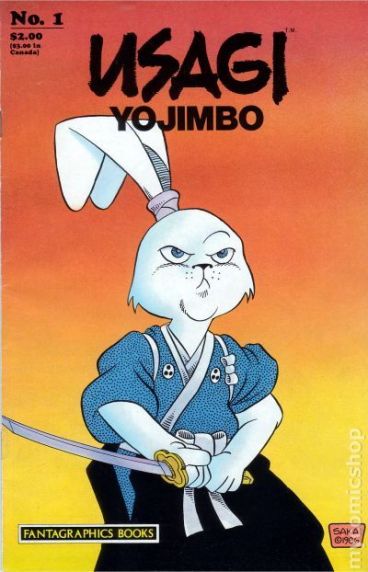
In this week’s Throwback Thursday, I check out the third volume of the outstanding Usagi Yojimbo comic book series, The Wanderer’s Road. I was originally planning to save this one until next week, but I just watched some episodes of the 2003 Teenage Mutant Ninja Turtles animated show today that featured Usagi, and so inspiration struck once again.
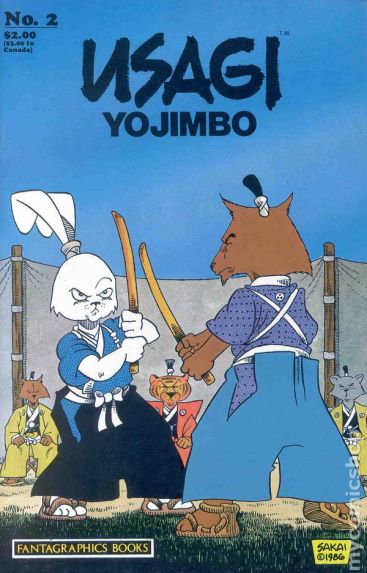
Usagi 7

The third volume of the Usagi Yojimbo series follows on from the events of the second volume, Samurai, and features several standalone adventures as the series’ titular protagonist, Miyamoto Usagi, continues to wander around this alternate version of Feudal Japan. The Wanderer’s Road features six first-rate and deeply enjoyable stories which were originally contained within issues #7 – 12 of the Fantagraphics Books’ Usagi Yojimbo series. It also contains a short bonus story from the Turtle Soup comic project which features a very special guest star.

The first of the stories featured within The Wanderer’s Road is The Tower. This story revolves around a hungry tokage lizard (the dinosaur-like lizards that infest Usagi’s world), who finds himself in a spot of bother and is chased up a tower by an angry shopkeeper, who refuses to let it down. Usagi, arriving upon the scene, decides to intervene, and attempts to rescue the tokage; however, thanks to the vindictive shopkeeper, he finds himself also trapped atop the tower. Attempting to bond with the tokage, who he names Spot, Usagi endures the conditions on the tower, while enraging the shopkeeper even more, until the story comes to a crashing end. The Tower was a fantastic start to this third volume, and it features a rather enjoyable and fun story. While it is perhaps the weakest story in this volume, only by dint of how incredible the other issues featured in The Wanderer’s Road are, it was still an excellent entry in this series, and served as a great introduction to a fun recurring character in Spot. The Tower contains some funny moments, from the way Usagi inadvertently keeps messing with the bullying shopkeeper on the ground, to the tiny turtle with a ninja mask that Sakai hides away in one of the crowd shots. All of this results in a fantastic story which I rather enjoyed.

Usagi 8

For the second story in this volume, A Mother’s Love, we go from a comedy to a tragedy. In this story, Usagi and his new companion Spot befriend an old woman on the road and accompany her back to town. Once in town, it is revealed the that old woman is the mother of a ruthless moneylender whose thugs have been terrorising the populace. After a tense night at the moneylender’s house, the old lady begs Usagi to kill her son, as she cannot bear to see the evil creature that he has turned into. While Usagi refuses her request, he is soon forced into a fight with the moneylender’s men. However, it is revealed that the old woman has manipulated the guards into attacking Usagi so that she can use the distraction to kill her son herself. When Usagi and Spot discover this, the old woman beseeches a stunned Usagi to kill her and finally put her out of her misery. A Mother’s Love is an incredible and heartbreaking story, which puts Usagi in a no-win situation. The last three pages of the books have to be one of the most heartbreaking and tragic sequence in the entire series. The teary old woman sing a lullaby as she cradles her dead son in her arms while a heartbroken and defeated Usagi watches on is extremely sad. The way that the old woman’s lullaby suddenly ends heavily implies that Usagi fulfilled the old woman’s wish and killed her. His final statement, “I do pray the Gods will be merciful…. Mother” as his despondently leaves the moneylender’s house, accompanied by Spot’s mournful cry are a sad way to end this story, but it makes for one heck of a captivating sequence. Other highlights of this book include Usagi’s large-scale fight against an army of bodyguards, the fun inclusion of Spot in several of this fights (little dude is lethal with his tail), and a stare-down scene between Usagi and the moneylender, which highlighted how intimidating Usagi can be when he wants to. All in all, a perfect and compelling story which shows just how amazing Usagi Yojimbo can be.

The next story in this volume, Return of the Blind Swordspig, is another masterpiece from Sakai, which features another outing from one of the best characters from Usagi Yojimbo, Zato-Ino, who was first introduced in The Ronin. This story sees the blind outlaw Zato-Ino travelling the road, still pursued by assassins and bounty hunters. Ambushed in the woods once again, Ino is able to fight off his attackers thanks to a timely warning from Spot, who had briefly walked away from Usagi. While Spot and Ino part ways, Ino soon catches up with Usagi, who cut off Ino’s nose the last time they met (he’s got a wooden nose in this book, it’s a transplant!). Ino follows Usagi to a nearby temple, where he is able to gain an advantage over Usagi in the dark as the two engage in an epic duel. Usagi’s life is spared only by the intervention of Spot, who stands between them, forcing Ino to back down, envious of the friendship Usagi is blessed with. Realising that the two souls have much in common, Usagi sends Spot to accompany Ino on his journey to find peace, and the two wonder off as friends.

Usagi 9

Return of the Blind Swordspig is another fantastic story that shows some complex and powerful character work. Sakai’s portrayal of Ino as a tortured and hate-filled loner is once again tragic and very moving, and it was fantastic to see him finally find a true friend and companion, something he has always desired. The way that Ino changes his travel songs from ballads about walking the roads alone to a melody about how he is grateful to have a companion is telling, and Usagi’s parting utterance of “Have a good life… both of you” matches the audience’s thoughts for these two great supporting characters. While the best thing about Return of Blind Swordspig is the continued examination of Ino’s complex personality and the progression of his character arc, I also really need to highlight the incredible swordfight in the dark between Ino and Usagi. Not only is this amazingly drawn, but the start of the duel where Ino slices the candle in half once again shows off Sakai’s love for classic Japanese movies. Slicing a candle to make a room dark is the trademark move of Zatoichi, the movie character that Ino in based upon, and Sakai backs this up by having Ino say “Now we’re both blind, Usagi” which is very similar to what Zatoichi says in these circumstances. All in all, this is an outstanding entry that really shows of Sakai’s ability to weave a powerful narrative around some exceptional characters.

The fourth story in this volume is Blade of the Gods, which introduces readers to the incredible antagonist Jei. Jei is a skilled and murderous spear-wielding samurai who wanders the land killing those he deems evil in the name of the Gods (spoiler: pretty much everyone is evil in Jei’s eyes). Encountering Usagi one night in a peasant’s hut (it is heavily implied that Jei killed the peasant before Usagi showed up), Jei suddenly declares Usagi to be evil and they engage in a brutal fight to the death both inside and outside the hut. Usagi is only saved by a blast of lighting and is left wondering if Jei was a madman or a true emissary of the gods. This was a compelling and fantastic story, which features one of the best fight sequences in the entire volume. The true highlight of this story is the introduction of Jei, who is easily one of the best characters in the entire Usagi Yojimbo universe. Jei is probably the most dangerous antagonist so far encountered in the Usagi Yojimbo series (Lord Hijiki really hasn’t revealed himself too much yet), and he serves as a wonderful recurring character. Sakai did an excellent job introducing Jei in this story, showing off his motivations, his style and the fact that he is a killer without peer and a fighter on par with Usagi. The character design for this villain is really striking, from his black-bladed spear to his pure white eyes and deranged wolf smile. I also liked the way that the reader is left wondering whether he is actually supernatural in origin or just a crazy person. While this is revealed in later volumes, the mystery of him is an exciting feature for the early Usagi Yojimbo stories that he appears in. I really love the character of Jei, who is actually based on Jason from the Friday the 13th movies (fun fact: when you use the Japanese honorific his name, Jei-san, becomes a pun on Jason), and I think that this was an excellent first appearance for him.

Usagi 10

The next story in The Wanderer’s Road is the fun entry, The Tea Cup. The Tea Cup sees the return of the bounty hunter Gen, who Usagi encounters on the road in the midst of a fight. Gen is escorting a precious tea cup to a tea master and must defend it from assassins who are trying to steal it. Accompanying Gen, Usagi helps him defend the cup with the samurai encountering a number of complications, including a band of killers, two orphaned children and the bad luck that follows Usagi and Gen when they team up. This was easily the funniest story in the entire book, thanks to the inclusion of Gen. Usagi and Gen have a hilarious relationship which is always fun to see, and they play off each other really well. This includes a number of running jokes from the previous Gen stories, the final entry in their game of sticking the other person with the lunch bill (which doesn’t go the way they planned this time) and several other hilarious scenes, including one joke that takes the entire story to come to fruition (he really was slow of mind). In this story, you get to see a bit of Gen’s softer side and the fact that, despite his rough exterior, deep down he is a good and caring person. Sakai also fills this story with a number of fantastic references to the cartoon, Groo the Wanderer, which Sakai previously did the lettering on, including a unique stylised poem at the start of the story, a fun imitation of Groo “Gen does what Gen does best”, and even cameo appearances from Sakai, Sergio Aragonés and the rest of the creative team behind Groo the Wanderer. All of this makes for a hilarious and entertaining tale, which is going to produce quite a few laughs for readers.

Usagi 11

The final full story in this volume is The Shogun’s Gift, which sees Usagi facing off against a Neko Ninja who has stolen a valuable sword from his friends Noriyuki and Tomeo of the Geishu Clan. This turned into quite an action packed and clever game of cat and rabbit (I mean cat and mouse), as Usagi puts on a great dumb samurai act to fool the ninja, Shingen. It was entertaining to watch Usagi continually encountering Shingen, especially as the ninja got more and more enraged each time Usagi appeared and casually poked holes in his story. The Shogun’s Gift ends with a great fight sequence and a rather clever bit of trickery from Usagi, which serves to turn this into a cool and enjoyable tale. I liked the introduction of Shingen, who has a big role in a future volume, and the scene where he is able to conceal the fact that he is hidden in the ceiling even after being stabbed is pretty badass. I also think that this volume did need a story that looked at the larger political picture of this world, including the nefarious plans of Lord Hikiji and the Neko Ninja, and it was good to see some more of that. Overall, this proved to be another phenomenal entry in this volume, and it served as a great concluding main story.

Usagi 12

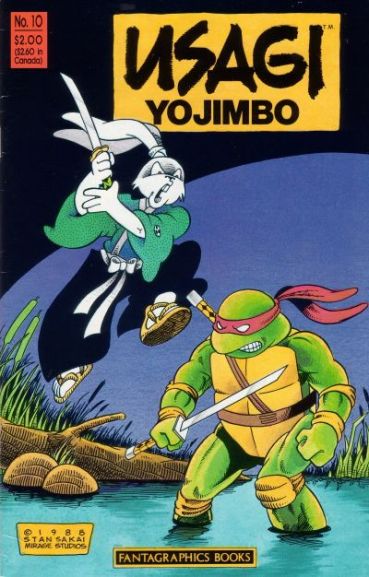
In addition to all the big stories mentioned above, The Wanderer’s Road also contained the short bonus story, Turtle Soup and Rabbit Stew. This short story originally appeared in the Teenage Mutant Ninja Turtle comic project, Turtle Soup, and features the first encounter between Usagi and one of the turtles, in this case Leonardo. In this comical tale, Leonardo suddenly lands in Usagi’s realm and is immediately attacked by a band of ronin, while at the same time just down the road, Usagi is attacked by a group of Neko Ninja, the two fights join into one brawl, where Usagi and Leo are the only survivors. Upon seeing each other, the two assume that the other is part of the band that initially attacked them, and they run at each other to engage in battle, only for Leo to be dragged back to his Earth. This of course doesn’t stop the momentum they built up charging at each other, and it results in chaos and injury on both worlds. This was an exceedingly funny first meeting between these iconic comic characters, and this entire story is boundlessly amusing, even with its shorter size.

As you can see from my passionate descriptions above, each of the stories featured in this volume is an outstanding entry in its own right, and I deeply enjoyed each of them. I honestly cannot tell you which story in this volume was my favourite, as three in particular were quite exceptional. Sakai did a masterful job with each of these stories, and I really enjoyed how they are presented in this volume. I think that The Wanderer’s Road contains an excellent blend of stories, which range from the tragic, the dramatic and the comedic, and each of them contains some amazing examples of Sakai’s trademark artistic skill. I also think that having a volume made up entirely of shorter standalone stories also works really well, especially as Volume 3 falls between two other volumes made up of larger, multi-issue stories. The Wanderer’s Road gets another five-star rating from me, and I look forward to reviewing more Usagi Yojimbo volumes in the near future.

Amazon     Book Depository

Throwback Thursday: Usagi Yojimbo: Volume 2: Samurai

Usagi Yojimbo Samurai Cover

Publisher: Fantagraphics Books (Paperback – 1989)

Series: Usagi Yojimbo – Book Two

Length: 141 pages

My Rating: 5 out of 5 stars

Amazon     Book Depository

After the fun that I had reviewing the first volume of the Usagi Yojimbo series, The Ronin, last week, I decided to follow it up with a review of the second volume in the series, Samurai. Samurai is an impressive second outing from author and artist Stan Sakai, which does an amazing job continuing his epic series after the introductory stories contained within the first volume.

After his adventures in the first volume, the rabbit ronin Miyamoto Usagi has continued on his wandering ways. However, his latest journey quickly turns to violence when he encounters another ronin on the road. Without a word being spoken, both samurai engage in a swift and brutal duel to the death, in which Usagi is the winner. The only witness to the duel is the bounty hunter Gennosuke, who inquires into the origin of the apparent feud between Usagi and his recently deceased opponent. Usagi reveals that the dead samurai was named Gunichi and Usagi had much cause to kill him.

Usagi 1

Regaling Gen with his tale as they travel together, Usagi reveals that the origins of this feud goes all the way back to his childhood and his tutorage under the unusual and skilled sword master Katsuichi. This tale follows Usagi as he becomes a young samurai in the services of his Lord Mifune, where he was comrade to Gunichi, and leads all the way to the fateful battle of Adachigahara Plain and the day that Usagi became a masterless samurai.

Back in the present, Usagi continues his adventures across the land, encountering many different people and unusual creatures. Watch him fight against a kappa, help defend a village of silk merchants against a roving group of bandits and witness his weird meeting with a mysterious and powerful little monster who is going to be a big somebody one day.

Usagi 2

Usagi Yojimbo: Volume 2: Samurai, is an amazing and fantastic volume of the Usagi Yojimbo series, which does an outstanding job continuing the story after the events portrayed in The Ronin. This second volume contains the first six issues of the actual Usagi Yojimbo series, and I really enjoyed the excellent adventures that are contained within these issues. The volume is broken down into four separate stories, the expanded story Samurai, as well as three stories which are significantly shorter. Each of these stories are really entertaining, and they all come together to create an impressive and incredible total volume of comics which I had a fantastic time reading.

The first story in this volume is also titled Samurai, and it is the major story contained within the Samurai volume. Running for 92 pages, this was one of Sakai’s first expanded Usagi Yojimbo stories, and I think it is one of his better ones. Samurai contains a captivating and exciting narrative that not only continues Usagi’s story in the present but which also goes back and explores much of the character’s past. This is shown through a lengthy flashback about Usagi’s childhood, his tutorage under the skilled samurai Katsuichi, his first meeting with Gunichi, their service under Lord Mifune, the events that led to Mifune’s war with the evil Lord Hikiji and the terrible final battle which cost Usagi his lord.

Usagi 3

Sakai comes up with an excellent background for Usagi in this story, and it was great to see how he expanded on some of the ideas and plot points that were featured within the first volume’s early stories. Even after all these years, the flashback contained with Samurai is still the definitive history of the character’s early days, although it has been expanded on several times in future volumes. This background is really intriguing, and I think that Sakai tells an amazing story, showing of Usagi’s unique training, his early triumphs including obtaining his swords, his service with Lord Mifune and then an expanded version of the battle of Adachigahara Plain, which has been briefly shown in the previous book. Woven into this is the tale of Usagi’s friendship with his fellow Mifune retainer, Gunichi, and the fateful day in their relationship that will cause Usagi to kill him the next time they meet. Sakai paces this entire extended story out well, and it turns into quite a complete and intriguing narrative. I like that it also added a lot more depth to the love triangle between Usagi, Mariko and Kenichi, and the scenes where Usagi and Kenichi put aside their differences for the first time for the sake of Mariko is great, and helps show that Kenichi is not a bad guy, he’s just occasionally blinded by his jealousy of Usagi.

I personally really enjoyed the scenes that featured Usagi and his sensei Katsuichi, the reclusive swords master. Their entire arc is really fun, and I love a good training sequence. Katsuichi is your typical wise and eccentric old hermit master who takes the young and eager student with potential under his wing to make him a superior student. Despite coming off as an aloof and hard man, Katsuichi is actually a kindly master who is impressed by Usagi’s determination and spirit (he gives a sly smile at the start of the training period). Katsuichi has some really interesting training techniques, and it is interesting to see how Usagi developed the skills that have kept him alive in the dangerous world he lives in. I loved the menial tasks montage, which is very reminiscent of The Karate Kid. It was also fun to see Usagi get randomly hit with a bamboo stick until he learns to anticipate surprise attacks, and I liked how it helped explain Usagi’s seemingly supernatural ability to sense when he is being watched or in danger. Overall, this proved to be an excellent inclusion to the story, and Katsuichi was easily the best new character introduced in this volume.

Usagi 4

Another major highlight of this first story is the part set in the present, which sees Usagi once again reunited with Gen. Gen was one of the better characters featured in the first volume, so it was really good to see him reintroduced in Samurai, especially as it helps set him up as a major recurring character in the Usagi Yojimbo series. Throughout the story, Usagi and Gen form quite an amusing partnership, with Usagi acting the honourable Zen warrior, while Gen is the unapologetic and uncultured mercenary. The two play off each other extremely well, with their great repartee and jabs at each other, and it is fun to see Usagi come out his shell a lot more around his companion. Gen also proves to be an entertaining audience for Usagi’s story, and it was fun to see his reactions to Usagi’s life tale. This was especially true when Gen started to get really into the story, despite his feigned indifference, and overreacted to several key moments. This entire story ends on a rather heartfelt moment between the two, with Gen indicating he completely understands how Usagi felt when he lost his lord “the saddest day of a samurai’s life is the day he becomes a ronin. Some day I’ll tell you how I became masterless…” and Usagi hinting that he really does see Gen as a friend. I really enjoyed seeing these two characters back together again, and this story definitely serves as a much better basis for their friendship than their backstabbing adventures in the previous volume. I also have to say, the silent dual at the front of the book between Usagi and Gunichi is the tops, and you could not ask for a better start to a story than an unexplained and sudden fight to the death.

The next story featured in this volume is the short, horror-based story, Kappa. Wandering a desolate, swampy area, Usagi comes across a kappa, a Japanese water demon, who demands a toll to cross the marshes. While Usagi is able to pass, he must go back and try to save another traveller from the kappa, resulting in a desperate conflict. This is quite a good story, especially with the ghostly twist contained at the end. I really love that Sakai chooses to explore pieces of Japanese mythology like the kappa, and it was really interesting to see Usagi face off against one. There is also an extremely brutal and impressive fight sequence against the kappa featured within this comic, which was all manner of impressive.

Usagi 5

The third story in Samurai was called Zylla, and featured Usagi finding and befriending a mysterious creature hidden in the bushes, that he names Zylla, when he visits the hot springs. Zylla repays Usagi by saving him from some bandits using his fiery (one could even say atomic) breath and reveals itself as a large newborn bipedal lizard who Usagi speculates may be a god, “Are you a god, Zylla?”. This is a really fun short story in this volume, and it adds a fascinating new element to the world that Usagi Yojimbo is set in. It was also great to see Sakai continue to show off his love for Japanese culture by featuring baby Zylla, and he makes several humorous references to Zylla’s future work, such as how he should visit the big city at some point. All of this makes for an amusing entry in this volume and it had me smiling as I read it.

The final story was Silk Fair, which sees Usagi come to the aid of a silk worker, defending him from bandits. The worker takes him to his village, where Usagi eventually helps defend the village from a large bandit raid, after he deals with the silk works greedy administrator. This was a nice, short entry that showed a typical Usagi Yojimbo storyline of Usagi helping to defend the helpless again bandits. This was one of the first stories where Sakai explored a Japanese craft or industry, and while it does not go into as much detail as some of the later industry based stories (later volumes feature length depictions of things like sword crafting, seaweed farming, kite making and soy sauce production), it was still interesting to see. Silk Fair contained a good mixture of action and humour, and I especially enjoyed seeing the way Usagi managed to mess with the corrupt administrator and his cowardly bodyguard. There was also a rather unique battle sequence where Usagi and the silk workers are able to defeat the bandits with sewing needles and silk streamers. In the end, Silk Fair proved to be a strong and amazing story, and I felt that it was an extremely entertaining way to conclude this volume.

Usagi 6

Like with every volume of the Usagi Yojimbo series, Stan Sakai’s artwork is once again a major and incredible highlight of Samurai. This second volume contains some fantastic examples of Sakai’s artistic talent, and it is clear that by the time he was working on the stories contained within Sakai had settled on his preferred designs for the various characters and landscapes featured, although further refinements did occur later down the track. This new character work is really impressive, and I liked how various new characters appeared, such as the warthog Gunichi and the lion based Katsuichi. I am also continually impressed with the way that Sakai can convey emotion and expression with his drawings, and you are constantly aware of what the various characters are thinking, just from seeing their faces. The various stories contained within Samurai featured some truly amazing and visually stunning landscape backgrounds, as Sakai continued his practice of showing off the beautiful scenery of Japan. Sakai also drew a number of impressive action sequences throughout the book, and he really got the hang of sketching out and showcasing the fast-paced and skilful fights that occurred between samurai. There are some impressive duel sequences throughout this volume, including the quick and sudden fight between Usagi and Gunichi at the start of the first story or the practice duel between Usagi and Kenichi which showed the ferocious fight between the two, which quickly ended with one strong strike from the obviously more skilled Usagi. Sakai also included several larger-scale battle sequences throughout the volume which really are something to behold. I particularly liked the major war sequence that showed the expanded battle of Adachigahara Plain. Sakai did an amazing job presenting the frenetic chaos of war and the explosive action that occurred with his art, and it was certainly a visual highlight of this volume.

Usagi Yojimbo: Volume 2: Samurai was an outstanding addition to the Usagi Yojimbo series, and it is one of my favourite volumes in this entire franchise. Stan Sakai presents a fantastic blend of character backstory, action, adventure, eye-catching art and clever humour in this volume, and the end result is a five-star comic which is really worth checking out. Thanks to the excellent background based main story, Samurai is a key volume in this series, making this book a must read. Samurai gets another five stars from me, and once again I have to strongly recommend this volume, and indeed the whole Usagi Yojimbo series, to anyone looking for an epic and enjoyable new series.

Amazon     Book Depository

Throwback Thursday – Usagi Yojimbo – Vol 1: The Ronin by Stan Sakai

Usagi Yojimbo The Ronin Cover

Publisher: Fantagraphics Books (Paperback – 1987)

Series: Usagi Yojimbo – Book One

Length: 144 pages

My Rating: 5 out of 5 stars

Amazon     Book Depository

Reviewed as part of my Throwback Thursday series, where I republish old reviews, review books I have read before or review older books I have only just had a chance to read.

We are now less than two months until the next amazing volume of Stan Sakai’s long running Usagi Yojimbo comic series, Bunraku and Other Stories, is released, and I am getting excited. This new volume is set to feature several brand new Usagi Yojimbo stories (including an extended story about a haunted puppet drama), but it is apparently also going to feature a look back at the very first Usagi story as part of an 35th anniversary special. For that reason, I thought that this would be an excellent time to go back and review volume one of the Usagi Yojmbo series, The Ronin, to serve as a good base for the upcoming review.

Usagi Yojimbo is a unique comic book series that Stan Sakai started back in 1984. It focuses on the adventures of Miyamoto Usagi, an anthropomorphic rabbit samurai who lives in a version of feudal Japan (early Edo period) completely populated with other anthropomorphic animals. Usagi is a ronin, a masterless samurai, who wanders the land on a warrior’s pilgrimage, helping those he encounters and occasionally working as a yojimbo (bodyguard) for hire. Throughout his journey he encounters all manner of friends and foes, including a number of creatures from Japanese folklore, and finds himself constantly drawn into the political plots of the land. This series is written and drawn in a more western comic/cartoon style rather than the Japanese magna style. However, the Usagi Yojimbo series is strongly inspired by Japanese history and culture, featuring a huge range of accurate depictions of historical events and cultural icons. This series is currently collected in 33 volumes from several different publishers, with each volume containing a number of different issues from the series. These issues are usually standalone adventures, although a number of longer storylines are continued through several issues or volumes.

I have been meaning to go back and review the first volume Usagi Yojimbo for a while now. The Usagi Yojimbo series is easily one of my favourite comic book series of all time, as Stan Sakai has created a truly epic and compelling series. While on paper a series following a rabbit samurai in a version of feudal Japan populated by other anthropomorphic animals does sound a bit ridiculous, these comics are anything but. Through a combination of outstanding storylines, complex characters, intense action, great uses of humour and an intriguing and compelling look at Japanese history and culture, Sakai has created a comic series that is extremely endearing and captivating. I have been a massive fan of this series for years, having started reading it when I was in high school (thank goodness for my surprisingly well-stocked public library) after I first saw the character in the 2003 Teenage Mutant Ninja Turtles animated series. I have previously reviewed the last two volumes of Usagi Yojimbo on my blog already (Volume 32: Mysteries and Volume 33: The Hidden), with Mysteries actually being the very first comic I ever reviewed. Both of these previous volumes received a five-star rating from me, which I have also awarded to this first volume.

Unlike the rest of the collected volumes, The Ronin doesn’t actually contain any issues from the Usagi Yojimbo series. Instead, it contains several earlier Usagi stories which were part of other publications, such as Albedo Anthropomorphics, Critters, Doomsday Squad and Usagi Yojimbo: Summer Special. All of these were collected together for the first time in 1987 into this volume (I have the 2007 reprint), and appear in chronological order. The Ronin contains 10 separate chapters of various lengths, each with their own story. These include:

  • The Goblin of Adachigahara: the very first story to feature Usagi, and the one that the upcoming Bunraku and Other Stories is going to revisit. This initial story features Usagi returning to the area near the battlefield of Adachigahara, where he lost his lord, Mifune, in a battle, forcing him to become a ronin. Seeking shelter in the hut of an old lady, he recounts his story of the battle to his host, including the betrayal of one his lord’s generals which cost them the battle. Later, Usagi battles a flesh-eating goblin, revealed to be not only the treacherous general but also the husband of his elderly host, and manages to defeat him, sparing the old lady who was going to allow him to be eaten. This was an excellent introduction to Usagi, as you got some vital information about his history, his status and his skill as a warrior. You also got a great look at his moral character, as he chooses to spare a woman who would have let him be eaten, and instead instructs her to perform funeral rights on the man who cost him everything.
  • Lone Rabbit and Child: this second story involves Usagi getting involved in the politics of the nation, as he comes to the aid of a young lord, Noriyuki, and his retainer the swordswoman Tomoe Ame. Noriyuki and Tomoe are being hunted by the agents of the evil lord Hikiji, who was also responsible for the death of Usagi’s previous lord years ago (it is later revealed he also killed Usagi’s father). Usagi agrees to escort them to safety, and they must contend with mercenaries, assassins and ninja on their quest. This is an amazing second outing, which expands on the world the series is set in, continues to show off Usagi’s skill, and sets up Hikiji as the main antagonist of the series (even if you see very little of him later on).
  • The Confession: This story follows on directly from the events of Lone Rabbit and Child, and features Usagi in the possession of a vital letter implicating Lord Hikiji in the attempt to kill Noriyuki. Usagi is ambushed by the Neko Ninja, who seek to reclaim the letter, leading to a prolonged and desperate fight in the woods. This proved to be an awesome follow-up to the previous story, which continued to highlight Usagi’s skills in combat and Sakai’s ability to drawn excellent, high-stakes fight scenes. It also showed just how nefarious an opponent Hikiji and his advisor Counsellor Hebi (a big terrifying snake) can be.
  • Bounty Hunter: Usagi is hired as a Yojimbo by the bounty hunter Gennosuke as he attempts to claim his latest bounty, the leaders of a local gang. Engaging the gang in a fight at a temple, Usagi and Gen are an effective team, eventually getting their targets, although their partnership ends on an interesting note. This was an entertaining story that served as a perfect introduction to a great character. Usagi and Gen have amazing chemistry together and Gen is an awesome side character. This is also one of the first stories to feature some more humour in the story, especially in the end, which turns out to fit in well with the overall feel of the series.
  • Horse Thief: Sakai features a lot more humour when Usagi, after interfering in a robbery by a gang of bandits, takes one of the bandit’s horses. He attempts to sell the horse in town, only to discover that it was stolen from the local magistrate, who chases him into the woods. Usagi’s problems only escalate from there, when he and his pursuers run into the bandits, prompting a massive battle in which Usagi is everyone’s enemy. The story has a great ending, steeped in irony which leaves Usagi and the reader laughing hysterically. I loved the author’s use of coincidence and bad fortune in this story, and it was fantastic to watch Usagi go from one bad situation to the next.
  • Village of Fear: This is a bit more of a horror story, as Usagi comes across a village held captive by a fearsome monster. This horror is compounded when it is revealed that the monster is a shapeshifter who has taken the form of one of the villagers. This was a relatively brief story, but it is set up and executed very well, with several great character moments, and there is even time for a quick Gone with the Wind joke.
  • A Quiet Meal: This is another of the more humorous stories in the volume, which features Usagi trying to have a quiet meal in an inn. Unfortunately, a gang of rough gamblers are causing trouble, throwing the other patrons out and trying their luck with Usagi. Usagi quickly shows them the error of the ways with some extremely fancy sword work, which causes them to flee in terror. The most noticeable feature of this entry is the fact that Usagi doesn’t speak once during the entire issue (he’s trying to have a quiet meal), and it’s up to his body language and the other characters to tell the story. This works extremely well and really helps to uplift the overall humour of the story. The way in which he sees off the ruffians is absolutely fantastic, and their absolute fear and disbelief at his skill, “this one’s been filleted”, is just great.
  • Blind Swords-Pig: This is a somewhat sadder and more dramatic story which features Usagi encountering and quickly befriending the blind pig, Zato Ino, who is seeking a peaceful place to settle down. Ino, however, is an extremely skilled warrior and wanted outlaw. Constantly hunted for his bounty, he relies on his sword skills and his ability to ‘see’ with his sense of smell. When Usagi finds out his true identity, the two engage is a fierce duel in which Ino loses his nose, truly becoming blind. This is one of the best stories in the whole of The Ronin, mainly because of the complex character that is Ino. He has a true desire for a peaceful life, but his past ensures that this can never happen, as even friendly characters like Usagi turn against him. This has turned him into a somewhat bitter creature, quick to hate those he meets “and what I hate, I kill!”, and the events of this first story help turn him into something even more angry, especially when it comes to Usagi.
  • Homecoming: This story sees Usagi return to the village of his childhood, but his return is not a peaceful one, as his village is under attack by the Mogura Ninja. Usagi must work with his childhood rival, Kenichi, to save the village; however, there is much enmity between Usagi and Kenichi, mainly because Kenichi married Mariko, the love of Usagi’s life. The two rivals must move past their differences, especially when Kenichi and Mariko’s son, Jotaro, is kidnapped by the Mogura Ninja. This was another exceptional entry in the volume, as it blends together tight action sequences with a deeper dive into Usagi’s past, including his complex and dramatic history with Kenichi and Mariko. The final pages of this issue are just heartbreaking, as it is revealed that Usagi and Mariko both kept the mementos they gave each other as young lovers, and they are both clearly in love with each other, even though they can never be together. I also really liked the Mogura Ninja in this book, especially as moles apparently make effective and deadly ninja.
  • Bounty Hunter II: This final story sees the return of Gen, who once again convinces Usagi to work with him to collect another bounty. Gen of course manages to complicate the job, and his actions backfire on Usagi, resulting in him getting into a major scrape. Despite Usagi’s understandable rage towards Gen, the two are able to part amicably, although Usage gets a small measure of appropriate revenge at the end of the story. I think that Sakai really hit his stride with the Usagi/Gen friendship in this second story, and the two of them play off each other extremely well. I really loved the end of this story, and it definitely got a big laugh out of me.

Overall, I felt that this volume contained a perfect blend of stories, and I really liked how Sakai jumped between action-based stories, to comedies and then to more dramatic tales, which helped produce a range of different emotional reactions. I did appreciate that the different issues also featured a range of different opponents and story basis, allowing the reader to understand that this series is going to focus on everything including banditry, ninja attacks, political intrigue and even the supernatural. I also think that the stories in The Ronin contained the right amount of character background for Usagi, providing enough for the reader to understand his motivations, while not being too overwhelming. This great blend of storylines and character arcs works extremely well together, and it makes for one heck of a complete volume.

The Ronin serves as an excellent introduction to this series, and I would strongly recommend that anyone interested in Usagi Yojimbo start with this volume. The stories within do a wonderful job of setting up the alternate version of historical Japan that this entire series takes place in. I absolutely love the combination of vibrant animal characters with feudal Japanese settings, and it works really well as the backdrop for an action series, especially with the political uncertainty and mass of unemployed samurai that accompanied the early years of shogunate rule. That being said, it is never quite explained why certain animals (horses and small dogs) are non-sentient, or why there are packs of dinosaur-like lizards (tokage) roaming the wilderness, although I kind of like the mystery. This volume also contains fantastic introductions for so many characters who are vital to the series, such as Gen, Tomoe, Mariko and more, and you get great insights into their characters, which are built up with each appearance they make. A lot of key character arcs or storylines start in the stories featured within this volume, and as each volume of Usagi Yojimbo is sequential, readers of the series are best served starting with this first volume. Luckily, The Ronin is a really good first entry in the series, and it is definitely worth checking out.

One of the most charming things about the Usagi Yojimbo series is the way in which Sakai sneaks so many different historical and cultural references into his stories. Most of the characters are either inspired by a real-life historical figure or a fictional character from Japanese or western culture. For example, Usagi himself is based on one of the most famed samurai of all time, Miyamoto Musashi, who is often credited with creating the two-sword fighting technique that Usagi utilises in the series, while Tomoe Ame is based on famed female samurai Tomoe Gozen. Other characters however are based on Japanese movie characters, such as Zato Ino who is a clearly a pig version of Zatoichi, the blind swordsman protagonist of a series of popular Japanese movies and televisions shows. Gen is based on the character that Toshiro Mifune portrayed in samurai films such as Yojimbo (which was later adapted into A Fistful of Dollars), and Usagi’s former lord Mifune gets his name from the actor. Other references include the title of the second story in this volume, Lone Rabbit and Kid which is a references to the manga series Lone Wolf and Cub (Sakai later creates the characters of Lone Goat and Kid as another homage to this series) and the fact that this series is partially named after the Yojimbo film. Two separate stories in this volume also reference Sakai’s previous work on the Groo the Wanderer comic, with Groo even briefly appearing in Lone Rabbit and Kid, sharing a fun stare down with Usagi. I had a great time with all these references (although I admit I had to look up a couple), and some of them are really clever. They add a lot of fun to this series and they are a real treat for readers, especially those already familiar with Japanese history, film or culture.

I am a big fan of Sakai’s art style, and each issue of Usagi Yojimbo is an absolute joy to view. Not only does he produce some outstanding action sequences with his drawings, many of which do an awesome job of depicting the samurai battle style, but he also creates some fantastic characters and breathtaking landscape scenes. Nearly every issue shows some inspiring and beautiful depiction of the Japanese countryside or a historical town, and the sheer amount of detail that he throws into his various scenes is just incredible. It’s also fun to see the various animals that can be turned into samurai, as everything from bulls, rabbits, crocodiles, rhinos, monkeys, pandas, cats and dogs appear in this first volume alone. For this first volume, however, the artwork is understandably a little inconsistent, mainly because Sakai had only just started drawing these characters. The various character designs are a little rough in places, especially if you are familiar with his later work, as Sakai is clearly experimenting with how he wants to depict these characters. A few of the action sequences are also a tad different from the later entries in this series, which can be a little jarring in places, but still really cool. Overall, though, most of the art in this book is pretty incredible, and it is fun seeking Sakai get into his groove with each new story. Sakai does an amazing job conveying emotion, action and intent through his drawings in this volume, and it turns out wonderfully. If I had to pick my favourite bit of art in this entire volume, it would be a scene in A Quiet Meal, where Usagi swings his sword around the head of a ruffian who is bothering him. While it first it appears that Usagi had done nothing, you slowly realise that the flies that Sakai had been subtly drawing around this character’s head before that point, are gone. The facial reactions of the various thugs when they realise what happened to the flies are just hilarious, and I absolutely loved it.

This first volume of the Usagi Yojimbo series, The Ronin, is an amazing and spectacular read, which I have a lot of love for. Not only does it serve as an excellent introduction to the Usagi Yojimbo series, but it contains some captivating storylines, impressive artwork and a heck of a lot of fun. Needless to say, The Ronin gets a full five stars from me, and I cannot recommend this volume and the Usagi Yojimbo series enough. Reading this first volume actually got me re-reading the entire series again, and I have already made it up to volume 17. In my book, all of them are five star reads, and you can probably expect some more reviews of them in some future instalments of Throwback Thursday. Stay tuned to see my review of the next volume of this epic series, which I already know I am going to love.

Amazon     Book Depository

Top Ten Tuesday -My Top Books of 2019

Top Ten Tuesday is a weekly meme that currently resides at The Artsy Reader Girl and features bloggers sharing lists on various book topics. This week’s Top Ten Tuesday will be the final instalment of a series of lists I have been doing over the last couple of weeks which highlighted some of the authors and books I have been most impressed with this year. So far, I have looked at my favourite audiobooks of 2019, favourite debut novels of 2019, my favourite new-to-me authors and my favourite pre-2019 books I read this year. I have covered a pretty interesting range of novels in these lists, but as this is the last Top Ten Tuesday of 2019, it is time to showcase my absolute favourite releases of the year.

I think we can all agree that 2019 has been a pretty amazing year for books, with a huge range of incredible releases coming out across the genres. I have had the great pleasure of reading or listening to so many outstanding books this year, and quite a few of this year’s releases have become instant favourites to me. I have to admit that I somewhat struggled to pull this list together, as there were so many books that deserved to be mentioned. Therefore, because I’m a soft touch, and because the quality of the books I read this year is so impressive, I have decided to expand this list out to 20 entries. These 20 books are my absolute favourites from 2019, and I would strongly recommend each and every one of them to anyone who is interested.

There is a going to be a bit of crossover between the below entries and the other lists I mentioned above, as I have featured some of these books before. In particular, several appeared on my Top Ten Favourite Audiobooks of 2019 list, as I enjoyed a great many of my favourite books this year on audiobook. In addition, I also featured some of these entries on my Top Ten Favourite Books from the First Half of 2019, which I ran back in July. As a result, I may have mentioned a couple of these books several times before on my previous lists, so I have kept the descriptions below a little brief. That being said, I managed to include a few books that haven’t made any of the previous lists for several reasons, and I think that this Top 20 list contains a pretty good range of novels that really showcases the different types of books I chose to read this year. I decided to leave off my usual Honourable Mentions section, as the extra 10 entries kind of make it unnecessary. Here is the list, with my ratings for each book included:

Top Ten List (no particular order):


Starsight by Brandon Sanderson – Five Stars

Starsight Cover 2


Rage
by Jonathan Maberry – Five Stars

Rage Cover


Sixteen Ways to Defend a Walled City
by K. J. Parker – Five Stars

Sixteen Ways to Defend a Walled City Cover


The Night Fire
by Michael Connelly – Five Stars

The Night Fire Cover


The Bone Ships
by R. J. Barker – Five Stars

The Bone Ships Cover


Spaceside
by Michael Mammay – Five Stars

Spaceside Cover


Supernova
by Marissa Meyer – Five Stars

Supernova Cover


Commodus by Simon Turney – Five Stars

Commodus Cover


Red Metal
by Mark Greaney and Hunter Ripley Rawlings – Five Stars

Red Metal Cover 2


War of the Bastards
by Andrew Shvarts – Five Stars

War of the Bastards Cover


Blood & Sugar
by Laura Shepherd-Robinson – Five Stars

Blood & Sugar Cover


Dark Forge
by Miles Cameron – Currently Unrated

Dark Forge Cover

The first entry on this list I haven’t had the chance to write a review for yet. Dark Forge is the sequel to 2018’s Cold Iron, which I quite enjoyed earlier in the year, and this second book is a gripping and exciting read. I am probably going to give this book a full five stars in the future; it’s a fantastic novel to check out.

Tiamat’s Wrath by James S. A. Corey – Five Stars

Tiamat's Wrath Cover


Recursion
by Blake Crouch – Currently Unrated

Recursion Cover

Another really good book that I need to hurry up and write a review for. Recursion is a clever and compelling read that I really enjoyed, and I am planning to rate it five out of five stars.

The Unbound Empire by Melissa Caruso – Five Stars

The Unbound Empire Cover (WoW)


Howling Dark
by Christopher Ruocchio – Five Stars

Howling Dark Cover


Usagi Yojimbo – Vol 33: The Hidden
by Stan Sakai – Five Stars

Usagi Yojimbo The Hidden Cover


A Little Hatred
by Joe Abercrombie – Currently Unrated

A Little Hatred Cover

Another currently unrated novel that I will probably end up giving five stars to. A Little Hatred is actually the book I am currently listening to, so I have not had a chance to write anything about it yet. That being said, I am over two-thirds of the way through it at the moment and it is clearly an outstanding novel which also does a fantastic job of continuing Abercrombie’s entertaining The First Law series.

Thrawn: Treason by Timothy Zahn – 4.5 Stars

Thrawn Treason Cover

I had to include at least one Star Wars book on this list, and Treason is easily my favourite Star Wars book of 2019. I cannot wait for Zahn’s next book, Thrawn Ascendancy: Chaos Rising, which should be pretty epic.

God of Broken Things by Cameron Johnston – 4.75 Stars

god of broken things cover


Well that’s my 20 most-favourite books of 2019. It turned out to be quite a good list in the end, and I am very glad that I was able to highlight so many fantastic books. 2020 is also set to be another excellent year for amazing reads, and I will be examining some of my most anticipated books for the first half of the year next week. In the meantime, let me know what your favourite books of 2019 are in the comments below, and make sure you all have a happy New Years.

Usagi Yojimbo – Vol 33: The Hidden by Stan Sakai

Usagi Yojimbo The Hidden Cover

Publisher: Dark Horse Books (9 July 2019)

Series: Usagi Yojimbo – Volume 33

Length: 200 pages

My Rating: 5 out of stars

Amazon     Book Depository

While there are a number of great books and comics coming out this year, one of the releases that I have been most keenly looking forward to was this year’s volume of Usagi Yojimbo. Usagi Yojimbo by Stan Sakai is a fantastic comic book series that utilises Japanese style, characters and history into an excellent series. This series is one of my favourite bodies of work, and I will move heaven and earth to get each instalment, and I especially loved last year’s volume, Mysteries. I was pretty darn excited to get the 33rd volume, The Hidden, and powered through it the afternoon that I received it.

Usagi 166.jpg

The Hidden continues the story of Miyamoto Usagi, a wandering ronin samurai who lives in a version of medieval Japan populated by anthropomorphic animals. Usagi’s life occurs in the early 17th century, during the Edo era of Japan. This is a pretty interesting time period to set a story, as with the land mostly at formal peace thanks to the rule of the Shogun, many samurai have been forced to roam the land without a master to serve. Usagi, a highly skilled samurai based on the legendary historical warrior Miyamoto Musashi, has been forced to live the ronin lifestyle after the death of his lord. Wandering the roads and seeking employment as a Yojimbo (a bodyguard), Usagi encounters all manner of rogues, bandits and criminals, as well as a number of supernatural foes from Japanese folklore.

The Hidden is made up of issues #166-#172 of the series and is actually one of the rare Usagi Yojimbo volumes to feature just one single adventure rather than multiple interconnected or standalone stories. This volume also continues to pair Usagi with Inspector Ishida for the entire volume. Ishida, who is essentially a Japanese Sherlock Holmes (although based on real-life Honolulu policeman Chang Apana), is a recurring character within the Usagi series who has appeared in multiple volumes, often for just one issue or adventure. However, after teaming up to investigate a murder a couple of volumes ago, Usagi has been living in Ishida’s town and assisting him with his investigations. As a result, Ishida has become a secondary protagonist for the last two volumes, with Mysteries, for example, focusing on the two solving several different crimes.

Usagi 167.jpg

This new volume starts with a brand-new case, when two samurai are pursued into the city and brutally murdered. When Usagi and Ishida discover crucifixes on the dead samurai’s bodies, they quickly realise that both the victims where Kirishitans (Christians). Christianity, which has been bought into the country by European missionaries, has recently been outlawed in Japan by the Shogun, and his agents are hunting down all practitioners. It soon becomes clear that the dead samurai were killed by agents of the Shogun who were attempting to recover a mysterious book of foreign design.

However, in a twist of fate, a petty thief manages to steal the book off the corpse of one of the samurai. This thief is now the most wanted man in the city, as the Shogunate agents and their hired killers attempt to find him and the book at all costs. As Usagi and Ishida work out what has happened, they are determined to bring the killers to justice. Hunting for both the book and the criminal who stole it, Usagi and Ishida, with the help of the masked master-thief Nezumi, manage to locate part of the book, and what they discover could rock the entirety of Japan. As they attempt to come to terms with their discovery, the Shogunate agents determine that the two investigators are a threat and decide to eliminate once and for all.

Usagi 168.jpg

While I may have had to wait a whole year to read this latest volume, it was definitely worth it. Sakai has once again produced an outstanding comic book that I could not have put down for anything. Not only has Sakai written an intriguing and clever story with a great mystery and an informative look at a new aspect of Japanese history, but he tells it through his beautiful Japanese-inspired artwork that really brings the characters and the landscape to life. Together this results in another exceptional piece of work that I absolutely loved.

Usagi 169.jpg

The main story focuses upon Usagi and Ishida’s investigation into the murders of Christian samurai and the hunt for the mysterious book the Shogunate agents are searching for. This was a really interesting story, and I liked how Sakai took the entire volume to really flesh out the investigation. The two characters go on a compelling adventure in this book, running into a number of colourful characters, dodging political restraints, interrogating a number of suspicious characters and getting into several deadly fights. However, what starts out as an intriguing investigation soon turns into a deep and powerful tale of convictions, belief and faith, and the things one must do to preserve all three. This is shown by a number of characters, including Usagi and Ishida, who risk everything to find the truth and more. There is also the amazing character arc of new character Hama, whose heart-rending sacrifice is one of the most memorable parts of this book. There is also a fairly major revelation about one of the other characters towards the end of the volume that actually changes the way you see the story and is guaranteed to make you look back to see the various things you missed the first time. Several recurring Usagi characters are used exceedingly well in this book. The mysterious masked thief Nezumi makes a great return, helping the protagonists with their investigation. It is always cool to see Nezumi in action, and I enjoy seeing the grudging respect build between him and Ishida, despite them living on opposite sides of the law. Everyone’s favourite snitch, Toady, makes another appearance, adding a lot of humour to the story as he attempts to weasel his way into more gold. Overall, this was another well-written and captivating story that was a real pleasure to read.

Usagi 170.jpg

One of my favourite aspects of the Usagi Yojimbo books is that Sakai often uses them to explore some fascinating piece of Japanese history, culture, mythology or industry and present them in a way that his western audience can appreciate. I was really glad that he continued this trend in The Hidden, as this time he takes an intriguing look at the role of early Japanese Christians in 17th century Japan. These Christians, who are the titular hidden ones of this volume, were an outlawed minority, due to Christianity directly contradicting a number of traditional Japanese beliefs and therefore challenging the authority of the Shogun. This latest volume shows this persecution in action, as the city is locked down by agents of the Shogun who are hunting for a valuable Christian item. The reader gets a sense of the illicit and hidden nature of these Christians and the way they were hunted, and Sakai also shows certain unique parts of this hunt, such as the fumi-e (trampling image). The fumi-e was an image of a cross that the Shogun’s enforcers placed on the ground in front of the gates of barricades that were set up at key points of the city. In order to pass through the barricades, pedestrians were forced to stamp on the image, showing their disdain for the Christian religion, and those who refused to step on the image were arrested as Christians. This was a fascinating part of Japanese history that I found incredibly interesting to see in action, and one that Sakai was able to cleverly work into the book’s plot. There were also a few fun scenes which looked at a black-market dealer who sold items which originated outside of Japan. Due to the Shogun isolating the country, these were incredibly valuable items, and I liked seeing what items this dealer considered valuable (the dealer’s European dress also made for a stunning visual as well). All of this was really cool to learn about, and I cannot wait to see what aspects of historical Japan the author explores in his next volume.

Usagi 171.jpg

Sakai’s fantastic artwork is once again one of the major highlights of this volume. Sakai is a particularly skilled artist who always does a fantastic job bringing the beauty and grace of Japan and its culture to life. The artwork on the surrounding landscape is just spectacular, and I always love attention to the historical detail on the buildings and people inhabiting his towns. One of the highlights of The Hidden that I particularly liked was the consecutive prayer gates leading up to a shrine that the characters visit. The visuals on all these gates were just amazing and very distinctive. I also really enjoyed the way that Sakai portrays his battle sequences in his series; he has a real talent for bring multiple high-energy battle scenes to life. I especially like how he manages to convey so much action and intensity in his still frames, and it really shows off some cool aspects of Japanese sword play. This was another beautifully illustrated volume, and the great art goes exceedingly well with the fantastic story Sakai has devised.

Usagi 172.jpg

Volume 33 of Usagi Yojimbo, The Hidden, was another excellent addition to this amazing series. Sakai once again produces a compelling story in his unique comic-book universe which results in a spectacular volume that I know I am going to read again and again in the future. While this was an outstanding Usagi Yojimbo story, I now have the downside of having to wait a whole other year to get my next Usagi fix. Make sure to check back next year when I will no doubt gush about how much I loved volume 34 of this series.

Amazon     Book Depository

WWW Wednesday – 31 July 2019

WWW Wednesday is a weekly meme hosted by Taking on a World of Words, where bloggers share the books that they’ve recently finished, what they are currently reading and what books they are planning to read next. Essentially you have to answer three questions (the Three Ws):

What are you currently reading?
What did you recently finish reading?
What do you think you’ll read next?

So, let’s get to it.

What are you currently reading?

Ghosts and Howling Dark Cover.png

Ghosts of the Past by Tony Park (Trade Paperback)

I am about half way through this book at the moment and I am really enjoying this complex and multi-layered tale from history.  Make sure to check out my review for Park’s previous book, Scent of Fear.

Howling Dark by Christopher Ruocchio (Audiobook)

I am only a few hours into Howling Dark, but already it is shaping up to be a pretty epic piece of science fiction.  I really loved the previous book in the series, Empire of Silence, and have been looking forward to getting Howling Dark for some time.  I did get a physical copy of this book a couple of weeks ago (with my blog mentioned in the acknowledgements!!!), but decided to try out the audiobook version instead, as it was honestly the only way I could read this book any time soon with my current reading schedule.

What did you recently finish reading?


The Lost Ten
by Harry Sidebottom (Hardcover)

The Lost Ten Cover


Star Trek: The Captain’s Oath
by Christopher L. Bennett (Audiobook)

Star Trek - The Captain's Oath Cover


Graveyard Shift in Ghost Town
by Michael Pryor (Trade Paperback)

Graveyard Shift in Ghost Town Cover


Dark Blade
by Steve Feasey (Trade Paperback)

Dark Blade Cover
Usagi Yojimbo: The Hidden by Stan Sakai (Trade Paperback)

Usagi Yojimbo The Hidden Cover.jpg


What do you think you’ll read next?

Collaborator, Blue Rose Cover.png

The Collaborator by Diane Armstrong (Trade Paperback)

The Blue Rose by Kate Forsyth (Trade Paperback)

I am currently planning to pull together a historical fiction column for the Canberra Weekly, featuring the above two novels and Ghosts of the Past.  All three books sound really interesting, and they are all from talented Australian authors.  This column should published in two weeks and I will post it up when it comes out.

That’s it for this week, check back in next Wednesday to see what progress I’ve made on my reading and what books I’ll be looking at next.