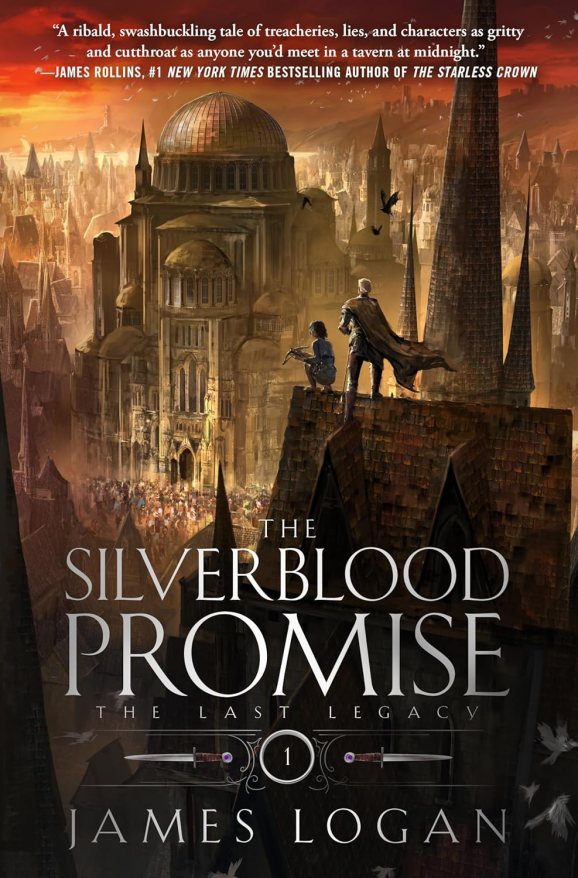
The Silverblood Promise by James Logan

The Silverblood Promise Cover

Publisher: Arcardia (Trade Paperback – 30 April 2024)

Series: The Last Legacy – Book One

Length: 595 pages

My Rating: 4.75 out of 5 stars

Amazon

Promising new author James Logan presents an epic fantasy debut in the form of The Silverblood Promise, the first entry in his planned The Last Legacy series, and one of my most anticipated books of 2024.

Lukan Gardova, the disgraced heir of a noble family, is a man who has lost everything following a duel that ended tragically.  Forced to drop out of his prestigious academy and abandoned by his family, Lukan travels the wild edges of the world, gambling, drinking, and seeking what adventure he can.  Despite his malaise and despair, Lukan is still shaken when he is informed that his estranged father has been murdered by mysterious assassins.

Armed with fresh purpose and a determination to find out who was responsible for his father’s death, Lukan follows the only clue he has, a note his dying father wrote in his own blood.  The names it contains lead him to Saphrona, an old and prosperous city ruled by merchant princes where everything can be bought.  Filled with rogues, scoundrels, thieves, and miscreants, Saphrona seems an unlikely place to find his reclusive, academic father’s killers.

Engaging in an exhaustive search throughout Saphrona, Lukan discovers that the answers he seeks lie with one of the city’s merchant princes.  Unfortunately, they have been condemned to death for the murder of another merchant prince, and if Lukan wants the information they have, he will first have to prove their innocence.  Working with an unlikely group of criminal acquaintances, Lukan follows the few clues surrounding the merchant prince’s unusual murder.  But the further he digs, the more danger he finds himself in.  There is a deadly conspiracy at work in Saphrona, one that seeks to undermine everything the city stands for.  Forced to contend with desperate nobles, deadly criminals, and dangerous forces beyond his comprehension, Lukan fights to keep his promise and find the truth behind his father’s murder.

Wow, now this was an awesome debut from Logan and one that I was really glad I got the chance to read.  The Silverblood Promise has been on my radar for a while, and Logan did not disappoint with its excellent and exciting story, which is loaded with action, intrigue, cool fantasy elements and some great characters.  Entertaining and fast-paced, The Silverblood Promise was an absolute joy to read, and I had an amazing time getting through it.

The Silverblood Promise has a deeply compelling narrative behind it that kept drawing me in with its intrigue, revelations and exciting adventure.  While this is a lengthy novel, I honestly powered through it as it proved very easy to get caught up in the story.  Logan maintains a very fast pace the entire way through The Silverblood Promise, and I enjoyed the mixture of action, character development and unique fantasy inclusions that the reader is treated to.  Starting off with a strong introduction that effectively showcases the protagonist and his current situation, the reader is quickly thrust into the main background city of Saphrona, which proves to be a fantastic setting.  Able to quickly interpret his one clue, the protagonist works with several connected figures to try and contact the person his father sent him after.  What follows is a series of interlocking quests as Lukan must befriend a master forger, mastermind a break-in to a notorious prison, and then discover who set up one of the city’s leaders for murder.  This results in a constant stream of adventures as Lukan jumps from one hurdle to the next, uncovering dark secrets about the city, and making unlikely friends.

The revelations about the true villain of the story occurs about two-thirds of the way through The Silverblood Promise, and while it isn’t too surprising, their methods and motivations are, especially as they reveal some interesting figures to the story.  Forced to go up against some big fish, Lukan is caught up in their power play, which adds a lot of chaos to the narrative, and must desperately come up with a plan to fight back.  The resulting carnage and confrontations are well handled, and I loved the great combinations of intrigue, battles and clever ploys that brought everything together.  All the action within The Silverblood Promise is sharp and well written, and you get drawn into the many confrontations and battles of wits that emerge.  Logan proved very able at hiding hints about the big bad’s schemes throughout much of the plot, and it was fun to see it all come together.  I had such a great time with this impressive story, and I ended up reading the last 300 pages of the book in less than a day, it was that damn good.  The reader comes away both satisfied and wanting more, which is lucky as it is clear Logan has some big plans for the series, with the adventure set to continue.

I felt that Logan came up with an excellent fantasy setting for The Silverblood Promise, and I really enjoyed how he utilised the new world throughout his plot.  Filled with magic, adventurers, complex cities, mysterious interdimensional beings, and powerful artefacts from long-lost advanced races, there is so much for the reader to enjoy here, especially when hints about far greater hidden powers are also included.  While a couple of the fantasy elements in The Silverblood Promise are a little derivative of other fantasy works, I personally didn’t mind, mainly because Logan makes them his own and they fit nicely into the fast and intense narrative of The Silverblood Promise.

While I loved the new fantasy world as a whole, the setting highlight of this book is the city of Saphrona, where most of the plot is set.  Saphrona proves to be a complex and compelling trade city ruled by merchant princes and filled with dangerous commerce, criminal enterprises, alien structures, unlikely monsters, and all manner of political intricacies and plots.  Readers will really enjoy unwinding the various elements of this city and it proved to be fun watching the protagonist explore Saphrona and attempt to find answers and stop a major disaster unfold.  In a way Saphrona becomes a character in its own right as the book progresses, and I really appreciated how effectively Logan introduced the reader to the setting and inserted the story in its survival and underlying politics.  Logan also ensured that readers got a good deal of information about some of the other locations outside of Saphrona, which are likely to become relevant to the plot in future books of the series.  While a of map of the continent or Saphrona would have been appreciated, readers come away with a great sense of the world and will be interested in seeing more stories within it.  Indeed, it looks like Logan plans to set each of The Last Legacy books in a different city of the world, and I for one am very excited to see what other memorable locations Logan will come up with.

I also really need to highlight the fun and memorable characters who were featured throughout The Silverblood Promise.  Logan did a great job pulling together an intriguing and often outrageous cast for his first book, and I loved some of the awesome storylines that emerged.  Most of the focus revolves around protagonist and primary point-of-view character, Lukan Gardova, a former noble turned roguish adventurer who finds himself way over his head in Saphrona.  Lukan is a great central figure for this book, and he brings a lot of emotion to the story due to his disastrous past and determination to find his father’s killer.  I felt that Logan provided just the right amount tragic history for his protagonist to enhance the dramatic tone of the book, and the character’s frustrations at the dangerous tasks he finds himself involved with, as well as his own stubborn need to move forward, were very relatable.  Lukan also provides a fun scoundrel vibe to the plot at times, and it was interesting to see his cynical perspective on events throughout the book.  I liked how Logan set Lukan up as a newcomer to the main setting of Saphrona, as this allowed the reader to see the city fresh through the eyes of someone unfamiliar with it, which enhanced the majesty, strangeness and cruelty of the setting.  As such, I felt that Lukan was an excellent central protagonist, and I look forward to seeing how his story evolves in the future, especially as there are many more secrets around his family that need to be revealed, and other character elements that need to be expanded upon.

Aside from Lukan, The Silverblood Promise features an interesting array of fun figures, the majority of whom are locals to Saphrona.  I loved all the unique characters that emerged, especially as Lukan is forced to deal with killers, scheming nobles, a mysterious forger, a blind beggar with way too much knowledge, an unlikely crime lord and a notorious band of mercenaries that Lukan is forced to alternatively fight or make deals with.  One of the most distinctive characters is an infamous thief who joins the main cast late in the story, but who proves to be a fantastic addition thanks to her skills, kindness and pragmatism.  However, my favourite character would have to be the young street urchin and pickpocket, Flea, who forms an unlikely partnership with Lukan early in the story.  Hired by Lukan to help him around the city, Flea proves to be an invaluable ally, despite her age, and works to keep her benefactor alive against all manner of dangers.  Bold, curious and utterly unflappable, Flea is a highly entertaining figure, especially as she keeps jumping into danger while also proving to be far wiser than Lukan.  Flea and Lukan serve as fun contrasts to each other, and I liked their entertaining banter and the touching bond they form throughout the course of the book.  This fantastic partnership really helped to make The Silverblood Promise that much more special, and all the characters featured within this book were really well written and cleverly featured.

Overall, The Silverblood Promise is an excellent and exciting fantasy novel that had me hooked the entire way through.  Intense, compelling and wildly entertaining, The Silverblood Promise was very awesome, and James Logan did wonders with his debut novel.  I will definitely be grabbing the eventual sequel to The Silverblood Promise when it comes out, and I cannot wait to see how this adventure continues and how Logan develops as an author.

Amazon

Play of Shadows by Sebastien de Castell

Play of Shadows Cover

Publisher: Jo Fletcher Books (Trade Paperback – 26 March 2024)

Series: Court of Shadows – Book One

Length: 482 pages

My Rating: 5 out of 5 stars

Amazon

Prepare yourself for a riveting good time in the impressive and wildly entertaining fantasy novel, Play of Shadows by the always amazing Sebastien de Castell.

Last year I had the very great pleasure of being introduced to Sebastien de Castell when I received a copy of his book The Malevolent Seven.  Set outside his major series, The Malevolent Seven was a wickedly clever and chaotic book that followed seven dangerous mages who suddenly find themselves as humanity’s last hope.  I had a wonderful time with The Malevolent Seven, and it honestly was one of the most entertaining fantasy books I read in 2023.  As such, I was curious to read more from de Castell and I recently got the chance when I received a copy of his new novel, Play of Shadows.  Serving as the first official book in his new Court of Shadows series, Play of Shadows is set within de Castell’s overarching Greatcoats universe, where most of his novels have been set, including his original Greatcoats books, the Spellsinger series and his Argosi series.  While I haven’t had the pleasure of reading any of de Castell’s Greatcoats books before, I loved the awesome sounding story of Play of Shadows, and I decided to check it out, which proved to be a very wise decision.

Damelas Chademantaigne is one of the most unfortunate people in the entire city of Jereste.  The grandson of two legendary Greatcoats, Damelas has always had a strong sense of justice, but he lacked the skills with a sword needed to back it up.  So when he finds himself forced to accept a duel from the Vixen, the most feared duellist in the entire city, to save his ailing grandfather, his chances of surviving the night seem impossible.  However, a fleeing Damelas finds sanctuary in the most unlikely of places: the Operato Belleza and its resident acting company, the Knights of the Curtain.

Now part of the illustrious company, Damelas finds himself protected by the city’s laws regarding actors and begins to eek a living as a minor player.  However, his temporary haven soon becomes a deadly trap when one night he spontaneously manifests the spirt of the city’s greatest historical villain, Corbier, the Red-Eyed Raven.  Identified as a newly emerged Veristor, an actor who can literally bring the past to life during a play, Damelas begins to constantly hear Corbier’s voice in his head and finds himself exploring the notorious rogue’s life each time he appears on stage.  Forced to continue by the machinations of Jereste’s new duke, Damelas begins to tell the untold true history of Corbier, and it soon becomes apparent that he was far from the unrepentant monster everyone believed him to be.

As the play continues, Damelas gains the attention of the entire city, who become enthralled with finding out the truth.  However, not everyone wants the past to come out, and soon Damelas finds out just how dangerous the theatre can be as he is targeted by the city’s nobles, a militant band of bravos, and the Vixen seeking her pound of flesh.  Diving deeper into Corbier’s mind, Damelas beings to uncover a deadly conspiracy that threatens the entire realm.  But can a mere actor, even one personifying a legendary fighter, survive the onslaught of villains on his tail?  It’s going to take all of Damelas’s courage and skills as an actor, as well as the help of an eccentric collection of fellow players to make it to final curtain.

Wow, now this was an outstanding and epic book that I could just not put down.  I was unprepared for how impressive Play of Shadows would be as de Castell unleashes a brilliant and complex read, loaded with intrigue, adventure, and a ton of theatrical humour.  Entertaining and enthralling in equal measures, this was an incredible read and one that gets a full five-star review from me.

Play of Shadows is an epic book full of big personalities, big stakes, and an elaborate story of intrigue, adventure, and self-discovery.  Set in the Three Musketeer’s inspired realm of the Greatcoats books, Play of Shadows initially seems set to feature the same focus on duels, bravos and rogues, as the rest of the series as the protagonist is forced to flee a fight from the infamous duellist, the Vixen, which sets him on course for his destiny.  However, the first scene of Play of Shadows, in which Damelas escapes his pursuers by tricking his way into becoming an actor, changes expectations and perfectly sets the scene for the rest of the exciting, compelling, and wildly entertaining novel.  I love how de Castell set a fantasy novel around the theatre , and having the protagonist be an actor rather than a master swordfighter is a great touch, especially for a Greatcoats book.  Indeed, much of the book is set out like a play, which proves to be a clever guideline for the plot, while also allowing in the author’s fantastic humour about actors, the theatre, and the protagonist’s unlikely situation.

From there the story evolves into a compelling direction, as Damelas finds himself at the centre of the all the intrigue infecting the city, especially once he starts to manifest the great historical villain Corbier, the Red-Eyed Raven, as part of a legendary magical gift.  This allows him to showcase the true events surrounding the past, which differ very greatly from the established history of the city.  Due to the deep secrets hidden amongst the true history, the protagonist finds himself the target of many interested parties and becomes a tool in the battle between shadowy forces.  The plot of Play of Shadows then begins to revolve around the three separate acts of the resulting play that tells the real story of Corbier.  Each of these different acts reveal new secrets about the past that impact the present, and prove to be excellent centres for the plot, especially as each performance becomes increasingly deadly for Damelas and his fellow players, and there intense, action-packed, tragic moments occurring after each of them.

Between each of these acts of the play, Damelas is forced to interact with a variety of deadly and over-the-top figures, each of whom have a different motive to help or to kill the protagonist.  The author also uses this time to provide new insights into both the historical and present-day conspiracies being uncovered as Damelas and his friends attempt to discover the true secrets of the city.  De Castell does a really good job of building up the stakes in each of these intermissions, and there are some amazing set-pieces loaded here, from high-intensity duels, larger-scale battles between unlikely foes, and a raft of political intrigue and personal issues.  Everything leads up to Play of Shadow’s massive climax, where the final act of the play unfolds, and all the secrets are revealed.  There are some excellent twists and turns here, and while a couple of reveals are a little overly foreshadowed, the overall picture that is exposed is quite interesting and ensures that the rest of the trilogy is going to be very interesting.  The big climax fight is so over-the-top bonkers, as all manner of magic, betrayals, personal vendettas, duels, and even an outrageous monologue, are used to resolve the issue.  The reader comes away intensely satisfied, amused, and very curious about the future of the series.

Play of Shadows was a fast-paced, exciting, and continuously amusing book that was so much fun to get through, while also maintaining a darker edge that struck readers with tragedy and intense moments when they least expected it.  This set-up of the book around the various acts of the play worked extremely well, and I loved how de Castell kept bringing the book back to the importance of the arts, even in the swordcraft-focused nation of the Greatcoats series.  The magic of performance, both literal and figurative, is a major part of the book’s setting, which I thought was a clever choice from de Castell that made Play of Shadows really stand out.  Much of the book’s humour is derived from the outrageous members of the acting troupe and their takes on the dramatic events overtaking their city.  This comedic feature of the book was so much fun, and some of the best scenes involved the actors attempting to pivot the scenes around the protagonist’s unlikely visions.  Other highlights include impromptu moments that made the actors great heroes in real life, or a sudden, extremely risqué monologue that manages to keep an approaching army at bay.  This overarching action and entertaining theatre focus is well-balanced by a high level of intrigue and a dash of mystery, due to the elaborate conspiracies that seem to be infesting the city.  De Castell does an exceptional job of contrasting these intriguing elements throughout Play of Shadows, and I really got drawn into its story as a result.

As I mentioned above, Play of Shadows falls within de Castell’s wider Greatcoats universe, which I personally don’t have any experience with.  I must admit that I was initially a little wary of reading Play of Shadows, not only because I had no pre-knowledge of the other Greatcoats books, but because de Castell also released another Court of Shadows book last year with Crucible of Chaos, which serves as book zero in the series (Play of Shadows is the first official novel).  However, my fears proved to be for naught as Play of Shadows stands on its own and easily welcomes new readers in.  While there are references to the wider Greatcoats universe, having no pre-knowledge of this doesn’t impact a reader’s enjoyment or understanding of this book, and anything that does is naturally explained.  Even the inclusion of a couple of characters from the previous series towards the end of the story was well handled, and the reader can easily follow what is happening while getting a good idea about who the characters are.  The same is true for the apparent prequel, Crucible of Chaos, and people can easily start the Court of Shadows series here, rather than with book zero.  While I am sure that established Greatcoats fans would probably get a little more out of these references than I was, this is a very good book for those readers who want to experience de Castell’s style or wider universe for the first time.  As such, I would recommend Play of Shadows to all fantasy fans, and you really don’t need to do any other reading first.  I am really looking forward to seeing how the Court of Shadows series continues, and I may also go back and read some of the other Greatcoats’ books, mainly because I am really enjoying de Castell’s writing and unique stories.  I must try and read Crucible of Chaos before anything else though, and I will be interested in seeing how it unfolds and connects with this current book.

One of the great highlights of Play of Shadows is the excellent cast of characters featured throughout the book, all of whom add so much to the fantastic plot of the book.  Naturally, most of the focus goes towards central protagonist and point-of-view character Damelas Chademantaigne, whose unexpected exploits in the theatre lead to so much drama.  Damelas is a great entertaining fantasy protagonist, with a complex past, an often-irreverent take on current events that leads to a good chunk of the book’s excellent humour, and a desire to change the world, even if it wants to kill him.  De Castell works in some amazing character development for Damelas, as he attempts to escape his pragmatic past that saw him run from a duel, to become the unlikely hero of his city.  Watching him gain the skills and courage he needs thanks to the murderous spirit in his mind is just great, and de Castell does a wonderful job of highlighting his abilities as a Veristor.  The tight line between controlling his gift and insanity is quite thin, and I loved the various sequences where he tried to showcase the past on stage, only for it to go in unexpected directions.  Damelas goes through a lot in Play of Shadows, especially as he witnesses the many tragic consequences of his search for the truth, and I felt that de Castell perfectly showcases his doubts, fears and anger at how he is being manipulated.  This was some incredible character work and I look forward to seeing how de Castell features Damelas in the future books now that he has found his purpose.

The rest of the cast of Play of Shadows are also quite impressive, and I love the huge array of outrageous and memorable figures that de Castell expertly dropped into the story.  The historical ghost, Corbier the Red-Eyed Raven, was a brilliant ethereal figure in Damelas’s head, and the author has a lot of fun contrasting the instinctive and expert killer that is Corbier, with the inexperienced and pragmatic Damelas.  In addition, Damelas’s acting companions, the Knights of the Curtain, also prove to be exceptional figures, and you really grow to care for this outrageous and eclectic group of actors.  Every Knight brings something fun to the table, although my favourite had to be Damelas’s best friend, Beretto, the gentle giant, who steals every scene he’s in with his jokes, insights, and desire to ship Damelas with dangerous killers.  However, props also need to go to head actor Abastrini and director Shoville, both of whom rise above expectations and show they have heart and the true passion of an actor.  I also had a lot of fun with the Vixen, the ruthless duellist who serves as one of the best villains in the book.  Her vengeful pursuit of Damelas is a major part of the book, and the various encounters they have, especially once Damelas gains the skills and courage to fight back, are very awesome.  Throw in a beautiful assassin, a sarcastic musician who doubles as a secret agent, a duke with a complex past, and Damelas’s grandfather, a legendary retired Greatcoat who has some brilliant scenes, including one amazing sequence that shows why you don’t mess with old fighters, and the cast of Play of Shadows is something truly special.  I had so much fun witnessing the battles and hijinks of this amazing group of characters, and I cannot wait to follow their future adventures in the rest of the series.

Overall, Play of Shadows was a particularly impressive novel from Sebastien de Castell that has made me very keen to read the rest of his books.  Loaded with action, intrigue, humour, and an entertaining ode to the magic of the theatre, Play of Shadows was a remarkable and highly fun fantasy novel that I could not get enough of.  Easily one of the best books I have so far read in 2024, Play of Shadows comes highly recommended, and I cannot wait to see how this outstanding series continues.  You will not be disappointed by this book!

Amazon

The Maleficent Seven by Cameron Johnston

The Maleficent Seven Cover 2

Publisher: Angry Robot (Trade Paperback – 10 August 2021)

Series: Standalone

Length: 416 pages

My Rating: 5 out of 5 stars

Amazon

One of the fastest rising authors of dark fantasy fiction, Cameron Johnston, returns with his most entertaining book yet, the outstanding and epic novel, The Maleficent Seven.

Cameron Johnston is a great author who I was lucky to come across a few years ago with his debut novel, The Traitor God.  Bought on a whim because it sounded cool, The Traitor God ended up being one of my favourite fantasy books of the year thanks to its excellent revenge storyline.  The Traitor God was such an epic read and I ended up grabbing the intriguing sequel the following year, God of Broken ThingsGod of Broken Things (one of my favourite books of 2019) proved to be an outstanding sequel, and it ensured that I would be keeping an eye out for more of Johnston’s work.  This included his 2021 novel, The Maleficent Seven, which had an awesome plot behind it.  I honestly have been meaning to read The Maleficent Seven for ages but could never fit it into my schedule.  That was until last year, when I managed to power through the entire book in a single plane ride.  The Maleficent Seven ended up being a pretty darn exceptional novel that I wish I read a hell of a lot sooner.

It is a dangerous time in the lands of Essoran, as the Lucent Empire, a nation of apparent holiness and light, continuously expands, sweeping away all opposition and either burning or converting the survivors to their faith.  Despite their apparent benevolence, the Lucent Empire has a dark side dedicated to destroying all magic, heretics, and anything it deems evil through fire, blood and death.  The final stage of their invasion is set, but to proceed they first need to cross through the mountain road, which exits at the small town of Tarnbrooke.  All looks lost for the inhabitants of Tarnbrooke, who are likely to burn in the Lucent Empire’s light, until an unlikely figure appears to lead them.

Forty years ago, the dread demonologist Black Herron led a black horde of bloodthirsty soldiers, dark creatures and monsters on a deadly campaign that rocked all Essoran.  Total conquest of the realm looked certain, until she suddenly disappeared the eve of the final battle.  Without the will of their leader to hold them together, the army fell to infighting allowing their enemies to prevail.  No one knew what happened to Black Herron, until she reappears in Tarnbrooke, having lived there in disguises for decades.

Determined to stop the Lucent Empire and their fanatical leader no matter what, Black Herron takes over the town and prepares it for siege.  But even a being as powerful as Black Herron is unable to stop an entire divinely infused army by herself.  Instead, Herron seeks to bring together the six deadly captains of her army, whose skills and ferocity helped her to nearly conquer the world.  Together, this assortment of dangerous beings, including a vampire, a necromancer, an orc chieftain, a war god, a pirate queen and a deranged alchemist, might stand a chance against the coming storm.  But first they need to learn to work together once more, especially as each of them have a very different reasons to fight with Black Herron again.

The Maleficent Seven is a powerful, captivating and fantastically over-the-top novel that showcases Cameron Johnston’s impressive writing skill and ability to bring together great characters with dark fantasy settings.

Now, as you can probably guess from the name, The Maleficent Seven is a dark fantasy take on classic films like The Magnificent Seven and its predecessor, Seven Samurai.  Johnston sets the scenario perfectly, first introducing protagonist Black Herron and her previous evil horde, which disbands in the starting chapter.  From there, we get a time skip and are introduced to the book’s antagonists in the form of the Lucent Empire, their divinely empowered inquisitors and their leader, the Falcon Prince.  Their initial actions are enough to paint them as dangerous religious zealots who use their divine light and apparent holiness as a shield for their dark ambitions.  Their quest leads them on the road to Tarnbrooke, where the elderly Black Herron waits for them, having decided to make a stand and bring together her six former captains.

The first half of the book is dedicated to recruiting the six captains, who have scattered across the world.  All evil or deadly figures, none of them particularly wants to fight another war, but each are drawn back for different reasons, including family, pride, revenge and more.  Johnston does a good job of breaking up the recruitment process throughout the early chapters, and each of the revealed captains turn out to be crazier than the last, enhancing your anticipation for how they are going to act in the coming battles.  At the same time, you get to know the Lucent Empire, as they send agents against the captains, trying to eliminate the danger they pose.  Johnston lays down some very solid groundwork in this first half of the book, and you quickly get drawn to each of the seven main characters for various reasons.  There are a great range of character arcs spread out amongst these unlikely protagonists, and while a couple of them are purposely irredeemable, the rest prove to be surprisingly likeable and complex.  Johnston also takes the time to build up the antagonist, showcasing just how sinister they truly are, while also providing some slightly predictable revelations about their leader.

The second half of the book is dedicated to the battle for Tarnbrooke, which after seeing how crazy the first half of The Maleficent Seven is, you know is going to be good.  There is some good additional setup once the captains arrive in town, with the building of siegeworks, the training of the townsfolk, and other unusual preparations, all of which is reminiscent of the films the book is an homage to.  Johnston also builds up some additional character interactions that I really enjoyed, as certain townsfolk become connected to different saviours and there is some good follow-up regarding the protagonist’s prior adventures.  The resulting siege is everything you could hope for and more.  I am a huge fan of sieges in fiction (check out my previous list on the subject) and The Maleficent Seven is a particularly good example of an epic siege, especially as Johnston goes very over-the-top when it comes to the different weapons and methods the defenders employ.  Everything from vampiric conversion, exploding pigs and drugged townspeople are used to hold the line against the enemy in several brilliant and brutal fight sequences, while a major sea battle simultaneously occurs, featuring, amongst other combatants, a giant kraken.  All the fighting is fierce, desperate, and pretty damn bleak, while the characters each go through their own intriguing and powerful journeys.  I honestly was enthralled once the main fighting started, and Johnston really did not let up until the end.

The final sequence of the main fight turns into an impressive and extremely horrific brawl for survival as the protagonists fight against increasingly desperate odds.  There are also several betrayals as certain telegraphed plots from the evil protagonists come to fruition, and everyone fights to survive and come out on top.  You will be a bit unprepared for who lives and who dies during the final few chapters as Johnston loads up some fantastic twists and cool revelations that constantly leave you guessing.  Even when you’re sure you know who is going to survive, Johnston swiftly changes everything around with a few hilariously ironic reveals, as well as some more tragic deaths.  I liked how Johnston imbued the story with a certain level of hope towards the end, even if that was somewhat overshadowed by the carnage surrounding it.  There were also some darker moments in the conclusion, as certain characters realise just how damned they truly are.  Throw in a final great twist that really tied together a hidden motivation from the very start, and Johnston ends The Maleficent Seven on the perfect note for the reader.

Johnston did a remarkable job with this awesome book, and I loved how dark, powerful, and compelling The Maleficent Seven turned out to be.  Thanks to the unique array of characters, insane fight sequences and entertaining twists, The Maleficent Seven will prove really appealing to a wide array of readers, especially as Johnston got the right balance of action, tragedy, and humour throughout the entire read.  I especially loved how well the author flipped the established concept of heroes defending a town from villains on its head with the inclusion of seven fantasy supervillains leading the charge against a holy army.  The clever reveal that the apparently good warriors are far more sinister than the literal monsters is so well handled, and it was impressive to see a classic idea so well refreshed.  Throw in some excellent world building, an interesting collection of fantasy creatures and the sheer overwhelming chaos of a desperate siege, and there is something in The Maleficent Seven for all fantasy fans.

Something I really loved about The Maleficent Seven was the cool collection of characters who made up the key cast.  All the titular seven are very well represented throughout the book, and it proves very hard not to fall in love with each crazy member of the team; thanks to the narrative split, you get some intriguing insights into their motivations, actions, and history.

Of these characters, my favourite was probably Tiarnach, the fading war god who has fallen on hard times.  Thanks to the death of all his followers and his inability to fight against the Lucent Empire, Tiarnach starts the book off as a broken, drunken figure with barely any power left.  Joining Black Herron’s cause to get revenge and some form of redemption, Tiarnach becomes the defenders’ nominal drill instructor, trying to whip the townsfolk into a fighting force.  The connection Tiarnach forms with the townsfolk, his journey towards redemption, and the fact that he is one of the few characters without ulterior motivations, ensures that readers are drawn towards him.  He easily has one of the best, most tragic character arcs in the entire book, and I really enjoyed how Johnston utilised him.  The same can also be said for the legendary orc warrior, Amogg.  Amogg leaves her responsibilities behind to sate her desire for battle and alleviate her restlessness.  Thanks to her blunt and entertaining personality, Amogg was another character the reader connects to.  However, Johnston ensured that she became a true favourite when she begins to turn the women of Tarnsdale into an effective fighting force against their will.  Watching her empower and lead a band of fighting women into battle was very impressive, and her storyline was heartwarming and bleak in equal measures.

The other five characters each have their moment to shine.  The vampire, Lorimer Felle, was a suave and brutal figure whose inability to die, connection to his one loyal servant, and desire for destruction left a major impression.  Verena, the pirate queen, was also really good, although she kind of gets overshadowed by the other characters.  Jerak the alchemist was the most unhinged, and I loved how he ended up becoming more of a danger to his friends than his enemies thanks to his gruesome experiments.  Maeven, the necromancer, has one of the more complex story arcs in the book as she blurs the line between ambition, revenge and a desire for family.  While she fights alongside the others, her own need for vengeance and power leads her down a dark path, especially with her connections to the Lucent Empire’s leader.  Maeven’s entire story goes in some very dark directions, and I appreciated the dark note Johnston left it on.  Finally, the leader of the group, Black Herron, has a very interesting storyline that runs the gambit from dark queen to unlikely hero.  Johnston does a great job showcasing her rise and fall throughout the story, and the question of why she chose to abandon her conquest and her army is a fantastic part of the book.  All these protagonists are outstanding in their own way, and I loved how Johnston was able to weave together some compelling, entertaining, and occasionally sad storylines around such wonderfully outrageous figures.

Look, with a story this awesome there was no way I wasn’t going to love The Maleficent Seven, and I think my lengthy review above proves this point extremely well.  Cameron Johnston was on fire when he wrote his third full-length novel, and The Maleficent Seven proved to be a particularly intense, clever and impressive read.  Bringing together entertaining characters with insane violence amid a classic story scenario, The Maleficent Seven proved near impossible to put down and I loved every second I spent reading it.  A highly recommended read for all fans of dark fantasy, I cannot wait to see how Johnston’s next book (coming out later this year) turns out.

Amazon

Peace Talks by Jim Butcher

Peace Talks Cover

Publisher: Penguin Audio (Audiobook – 14 July 2020)

Series: Dresden Files – Book 16

Length: 12 hours and 52 minutes

My Rating: 5 out 5 stars

Amazon

After nearly four fantastic years, I have officially come full circle with the epic Dresden Files series as I check out the final book I needed to read with the entertaining and compelling entry, Peace Talks.

Back in 2020, I had the very great pleasure of discovering Jim Butcher’s iconic Dresden Files urban fantasy series.  A powerful, action-packed, and intense read, Battle Ground was one of my favourite books and audiobooks of 2020, even though I started with the 17th entry in the series.  I had so much fun with Battle Ground that I instantly went back and listened to the first Dresden Files novel, Storm Front, which cemented my love for the series.  Since then, I have been slowly working my way through the entire Dresden Files audiobook collection, loving every second of it.  There are so many exceptional entries in this amazing series, with some of my favourites including Fool Moon, Dead Beat, Small Favour, Changes, Ghost Story, and Skin Game, just to name a few.  There was frankly not a single book in this series I didn’t love, and I had such a wonderful time with each of them.  I have been on the final stretch of this series for the last couple of months, which ended when I got through the intriguing Peace Talks.

Harry Dresden, professional wizard, White Knight, and supernatural defender of Chicago is adjusting to many of the changes in his life, including a new romance and his duties as a father.  However, things always have a way of becoming even more complicated for Dresden as the sins of his past and his twisted loyalties come back to haunt him, especially when an important gathering of supernatural entities is set to take place in his city.

Ever since Dresden destroyed the Red Court of vampires, the Fomor, an ancient and long hidden kingdom, have been making a play for power.  Their dark exploits have led them into conflict with many supernatural nations, and after years of skirmishes, the Fomor are finally ready to talk peace with the larger supernatural world in Chicago.  Assigned to summit as security for the White Council of wizards, as well as a liaison between the wizards and the Winter Court of Queen Mab, Dresden has his hands full, especially as he expects all hell to break loose.

As the various delegations descend upon Chicago, Dresden is proved right when his vampire half-brother, Thomas Raith, instigates a diplomatic incident that could lead to his death.  Forced to work with Thomas’ sister, Lara Raith, Dresden works to free his brother without starting a war.  But his actions soon draw the ire of several people close to him, especially as his loyalty to the White Council are in doubt.  Worse, an ancient evil has arrived in Chicago, one determined to destroy all chances of peace and bring about untold disaster.  Can Dresden save his brother while preparing for a force capable of destroying everything he has sworn to protect?

Peace Talks is a compelling addition to the long-running Dresden Files series that takes readers on an interesting ride in the lead up to the next big adventure.  Filled with great character moments, intriguing revelations, and some cool world-building, this was a solid addition to the series that I absolutely powered through.

Butcher comes up with a good story for Peace Talks that not only sets up some interesting plot points for later, but also tells its own unique narrative that is hard to put down.  To fully enjoy Peace Talks, you must appreciate that it is primarily a prelude for Butcher’s other 2020 release, Battle Ground, and as such a lot of story elements from it don’t get any real payoff until the second book.  As I’d already read Battle Ground before getting to Peace Talks, I could see where a lot of the hints, character arcs and storylines were going, so I think that gave me a bit more appreciation for what Butcher was doing here.

The story itself is an excellent character-driven narrative that contains a lot of great elements I really appreciated.  Starting off by showcasing the new normal for Dresden as a parent and partner, the story quickly moves along to the introduction of the summit, which brings several recurring characters back into the mix.  As various troubles begin to build on the horizon, the story introduces its major hurdle as Thomas apparently attempts to assassinate the leader of a supernatural nation.  Convinced of his innocence, Dresden reluctantly works with Thomas’ sister Lara to try to free him, resulting in a prison break sequence during a busy event.  Dresden’s determination to save his secret brother even at the risk of war begins to alienate several of his allies, including his grandfather, eventually resulting in an epic confrontation that was the highpoint of the book.  At the same time, the peace conference proves to be an intriguing addition to the plot, as you get to see some compelling interactions from multiple supporting characters, including many who haven’t been in the same book before.  The conclusion of the summit comes rather fast and shockingly, with the major antagonist for the next book arriving and making their intentions clear, and you come away greatly anticipating the chaos to come in Battle Ground.

I loved how Peace Talks came together as Butcher brings his usual charm, sharp writing and entertaining wit to the table in a big way.  Peace Talks features the trademark blend of mystery, adventure, character development, fantasy elements and snarky humour that I deeply enjoy about all the Dresden Files books, and it’s hard not to get caught up in the story.  There is a great focus on intrigue, politics and personal perception in this book, and I liked how a lot of the threats were more subtle and in the realm of future consequences rather than direct action.  Butcher also focused on setting up for the next book, and much of Peace Talks is geared towards providing context and character introductions for the coming war in Battle Ground.  While in some ways this reliance on setting things up for the next book made the events of Peace Talks seem a little less important, it was an overall strong book, and a great entry to the wider Dresden Files series.  While I do think that people should be really starting the series earlier than the 16th entry, new readers could slot themselves into the Dresden Files series here as Butcher continues his accessible style, minus a few references to some short stories.  Peace Talks also features some clever and subtle clues to major twists and big events in Battle Ground which you don’t fully appreciate until you read the following book.  I honestly came away from Peace Talks with an even greater appreciate for Butcher’s long-term writing skills, as well as his ability to expertly telegraph some major events.

I did feel that certain elements of Peace Talks did feel a bit rushed, especially when it came to the big bad who was revealed at the end of the peace summit.  Having already read Battle Ground, I was expecting more buildup for the villain Ethniu in Peace Talks, especially as she hasn’t been mentioned at all in any of the preceding 15 books.  However, she kind of just shows up, kicks ass for a few seconds, and then leaves, making her threats for the next book.  You don’t even get any history for her aside from the fact that she’s a long-dormant Titan who is annoyed at the world.  In hindsight, this is a little weak, and some explanation about who she is, how she took over the Fomor, or her history with the other magical leaders would have been good.  Butcher also failed to really set up any connection between her and Dresden before their fights in Battle Ground, which I think you needed.  This and other rushed bits of character interaction towards the end of Peace Talks weakened the overall story of both books, and it was clear that Butcher was keen to finish Peace Talks off and get into the major war sequences of the sequel.

As with most Dresden Files entries, Peace Talks excelled in the character department, which was a major highlight of the book.  Peace Talks features a huge cast of characters, most of whom are being reintroduced from previous novels so Butcher can feature them in Battle Ground.  As such, Peace Talks is loaded with some compelling interactions and character moments, especially as the protagonist must deal with a range of friends, family and foes who he hasn’t seen in years.

Naturally, most of the character work revolves around protagonist and point of view character Harry Dresden.  Dresden is such a fun character to follow, mainly because of his immaturity, sense of humour, and the lack of fear and respect he holds for powerful beings.  However, while deep down Dresden is still the same loveable rogue we’ve been following for years, he has been experiencing some major changes in his life that have had some intriguing impacts on his personality.  Peace Talks sees him dealing with a lot of these major life events in various ways, and it was interesting to see how much Dresden and his situation has changed since the start of the series.  Much of the book revolves around his changing relationships with certain people, including his new romance with Karrin Murphey, which finally came official in the previous book Skin Game.  This romance is one of the nicest parts of the whole book, and the two characters are just perfect for each other, which twists certain future emotional knives a little deeper.  It was also sweet to see Dresden as a father, even with their complicated relationship and the trauma surrounding them.

However, I think the most dramatic character relationship that was featured in Peace Talks involved Dresden and his mentor/recently revealed grandfather Ebenezar McCoy.  The two of them have been rocky for years, but their emotions finally spilled over in Peace Talks, especially when it came to Dresden’s relationship with Thomas and his plans to raise his daughter.  The anger between the two bubbles over throughout the course of Peace Talks, mainly because Dresden is forced to hide the true reasons for helping Thomas due to McCoy’s hatred of vampires.  The eventual and inevitable confrontation is very brutal as the two are unable to come to common ground and both think they are in the right.  The big fight between them is one of the best scenes in the book, and it simultaneously showed how powerful McCoy truly is while also highlighting how much more skilled Dresden has gotten over the years.  The eventual result is very heartbreaking, showcasing the fact that no one can hurt you more than family, while also containing a fun bit of sneakiness from Dresden.  It will be interesting to see where this relationship goes in the future, but it’s clear this family has some major issue to work out.

In addition, it was also particularly interesting to see Lara Wraith, leader of the White Court and Thomas’s half-sister become such a prominent character again in Peace Talks.  Butcher spent a good chunk of Peace Talks reintroducing Lara as a major character who is going to be a big part of the series going forward.  While this does result in the usual overly sexualised shenanigans that have accompanied Lara since her introduction in the infamous adult-film focused Blood Rites, Lara mostly proves to be a compelling and complex character.  Indeed, there were some moving examinations of her relationship with Thomas that showed just how much she cared for him.  While the differing goals and expectations for Thomas result in some conflict between Dresden and Lara, they prove to be an effective team, with a bit of hostility buried beneath them.  Considering these two are going to be forced to spend a lot of time together in the future, I liked how Butcher built up their relationship here, and it will be interesting to see how it develops in the future.  Overall, I felt the characters featured in Peace Talks were handled really well, and I loved the unique and powerful interactions that emerged.

As with the entire Dresden Files series, I ended up listening to Peace Talks on audiobook, and frankly there is no better way to enjoy one of these epic novels.  Coming in with a runtime just shy of 13 hours, this was slightly shorter Dresden Files book, especially when compared to the other later books in the series.  This shorter runtime allowed me to power through Peace Talks in no time at all, especially as I was once again wrapped up in the silky tones of narrator James Marsters.  Marsters, who is one of my favourite audiobook narrators, primarily due to his work in this series, is so damn good, and I love how effective he is at telling Butcher’s story.  Marsters honestly gets the tone of each scene perfectly and the way he inhabits each of the featured characters is just amazing.  I once again must highlight how well he portrays protagonist Harry Dresden in this book, and you can really sense the character’s conflicted emotions.  Due to the large cast associated with Peace Talks, Butcher needs fill in quite a few roles, including a ton of recurring figures from previous novels.  I felt that he did a great job voicing all of them, and it was fun to see him dust off a few voices that we haven’t seen in a few books.  Everything came together perfectly with Masters narration in Peace Talks, and this was another epic Dresden Files audiobook that I just loved listening to.

Jim Butcher provides another powerful and intriguing addition to the Dresden Files series here in Peace Talks.  Simultaneously setting up the events for the sequel Battle Ground while also telling a powerful, character-driven tale of betrayal and family trouble, Peace Talks was a great read that proves hard to put down, especially for established fans of the series.  A highly recommended book that leads to bigger things.

Amazon

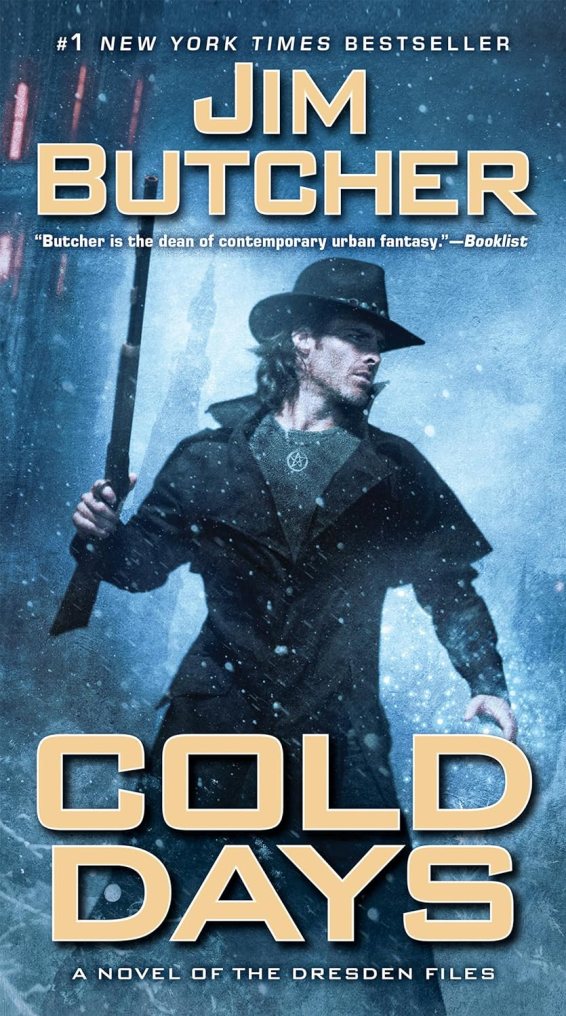
Skin Game by Jim Butcher

Skin Game Cover

Publisher: Penguin Audio (Audiobook – 27 May 2014)

Series: Dresden Files – Book 15

Length: 15 hours and 49 minutes

My Rating: 5 out of 5 stars

Amazon

I was once again in the mood for a guaranteed hit, so I looked no further than Jim Butcher’s exceptional Dresden Files series, with the 15th book Skin Game.

As readers of this blog will know, for the last couple of years I have been having a wonderful time getting through Jim Butcher’s iconic Dresden Files series.  One of the most well-known and impressive urban fantasy series, the Dresden Files follow the titular wizard, Harry Dresden, as he investigates magical crimes and protects Chicago from supernatural threats.  This series is so damn cool, and I have loved the unique combination of mystery, great characters, and intensive world building as Butcher pulls together a brilliant, modern fantasy universe.  I honestly have loved every single book in the Dresden Files series, although I feel that the last few additions I have read, including Changes, Ghost Story and Cold Days are Butcher at his finest, especially as he really built in some elaborate and original stories.  As such, I had no reservations about checking out the 15th book in the series, Skin Game, especially as it had a pretty damn awesome plot behind it.

Harry Dresden, Chicago’s sole practicing wizard and the new anointed Winter Knight, is in trouble.  Trapped on his island in the middle of Lake Michigan with a magical parasite in his head, Dresden has only days left to live.  Salvation soon appears when his boss, Queen Mab, arrives on the island, offering to save him.  However, nothing from Mab is ever free, and the conditions for her help might prove even more lethal.

To pay off an old debt, Mab has loaned out Dresden to one of his most hated and dangerous foes, the fallen angel Nicodemus Archleone.  To further his dark goals, Nicodemus is planning to break into the personal vault of the Greek god Hades to loot several valuable artefacts.  However, Nicodemus can’t do it alone and he hires a group of rogues, thieves and specialists, as well as Dresden, to pull off the job.  If they succeed, they will all come away insanely rich, but if they fail, their souls be trapped forever in the underworld.

As the job proceeds, it quickly becomes apparent that Nicodemus has no intention of letting any of his heist crew live, especially Dresden and his allies.  To survive, Dresden needs to work out how to both counter the many obstacles between them and the treasure they seek, while also finding a way to stop Nicodemus without breaking the agreements that bind the two together.  Can Dresden outsmart one of the most treacherous and deceptive beings in all creation while keeping everyone alive?  Let the games begin!

Wow, what an awesome book.  I am constantly impressed with how Butcher continues to produce outstanding and epic reads throughout this series, and nearly every Dresden Files book is better than the last.  Skin Game was a pretty great example of this, as Butcher produces one of his most entertaining stories yet with so many twists, betrayals and fantastic revelations.

I cannot emphasise enough just how cool the plot of Skin Game is, especially as Butcher comes up with a particularly clever and exciting heist storyline that the narrative is centred around.  After effectively following through from the events of the prior novel, the reader is soon thrust into the new scenario, which sees Dresden forced to work for his old enemy Nicodemus.  This leads to a classic heist scenario, with Dresden meeting Nicodemus’s unique crew, gathering up new members, and pulling together the resources need to break into the vault, even if the target is a much more supernatural than usual.  Butcher also adds in the fantastic dynamic between Dresden and Nicodemus as they plot against each other.  Both knows that the other is planning to betray them at some point, however they are forced to play by the rules in public to preserve the magical bargain between Nicodemus and Mab.  This leads to a great series of betrayals, manipulations and confrontations, as Dresden walks a thin line while trying to stop Nicodemus.  At the same time, several great recurring characters are brought back, which results in some powerful and personal character-driven storylines that I really got invested in.

There are so many great story elements ongoing through the bulk of Skin Game’s narrative, that by the time you get to the main event, the heist, you are extremely hooked.  The heist in question is everything you would hope it to be, as Dresden and his erstwhile crew of rogues, engage in some daring exploits to achieve their goals.  They are some brilliant set pieces, intriguing revelations, and several brutal twists, including one heartbreaking moment surrounding the main antagonist.  Everything leads up to the inevitable betrayal which sees Dresden and Nicodemus finally face off after dancing around each other all book.  I loved some of the scenes that followed, especially as there is a particularly great twist shown through a well-placed flashback that changes your entire perspective of the earlier story.  A subsequent sequence also presents some of the most emotionally charged moments of Skin Game, especially when it comes to one of my favourite supporting characters.  Everything gets wrapped up nicely by the end, and I loved some of the final revelations in the book, especially when you finally understand who was running the true game and why.

Butcher applies his usual excellent writing skills to Skin Game, and I love how effectively he tells this latest powerful and entertaining story; since it is once again told solely from the perspective of the protagonist, you are treated to Dresden’s typically amusing take on the events occurring around him.  This proves to be quite funny at times, although Butcher adds in a good level of drama and highly personal character development which I think balances out the book and ensures Skin Game can hit you at multiple emotional levels.  I love how Butcher experimented a bit with elements of Skin Game’s writing, especially with how he worked in some very clever, and well planned out twists and revelations, which I felt was one of the strongest points of the novel.  Butcher also really amps up the unique action, intrigue and adventure of the story, and I was constantly engrossed with how the story was going.  The depictions of the underworld and its defences were very striking, and I loved some of the unique scenarios Dresden found himself in.   This entire story come across extremely well with the writing, and I enjoyed every second I spent listening to it.

One of the things I have enjoyed getting through the Dresden Files series is how accessible Butcher makes each novel, as any entry in the series can be read somewhat independently from the others.  However, the deeper you get into the Dresden Files, the more the new book references elements from previous novels, while also building on existing storylines and character arcs.  Skin Game is a great example of this, as new readers can come in and have a wonderful time reading it, especially as Butcher does a good job explaining all the key plot points new readers might be unfamiliar with.  However, established fans of the series will get a lot more out of this book, as Butcher continues or concludes several amazing storylines here.  In particular, there are a lot of references to the last two books that featured Nicodemus as an antagonist, Death Masks and Small Favour, as Dresden continues his deadly fight against his old foe, while remembering all the previous battles that have occurred.  Several great character arcs also come full circle in Skin Game, which proves to be quite moving, especially to those readers who have laboured through the rest of the series and are already quite attached to the main cast.  As such, I probably would recommend reading the rest of the series before trying out Skin Game, mainly because you are in for a much more impactful time if you do so.  However, for those who want a fun and moving fantasy heist novel, you can easily dive into Skin Game and have an outstanding time witnessing all the betrayal, lies and deceit.

As always, one of the best elements of this Dresden Files novel was the exceptional character work.  Butcher always excels at creating complex and powerful character arcs that showcase the many different layers of each excellent protagonist and villain, and Skin Game is no exception.  Indeed, Skin Game was one of the best character-focused books Butcher has released, as it features an interesting cast and some deep and intense character arcs that showcase just how much many of the protagonists have changed.

Naturally, most of the focus of Skin Game revolves around protagonist and point-of-view character, Harry Dresden.  The wizard defender of Chicago, Dresden has gone through a hell of a lot in the last few books, which starts to catch up to him in Skin Game.  While he is still his usual flippant and disrespectful self, you can really see the cracks forming in Dresden’s psyche, especially as he balances the many responsibilities and traumas afflicting him.  Not only is his personality being altered by his decision to become the Winter Knight, but he is dealing with so much guilt for some of his recent actions.  This has made Dresden start to doubt himself, and he has trouble at times seeing whether he is still the same good guy he was at the start of the series, especially when some of his friends start to lose faith in him.  However, thanks to the help of those closest to him, Dresden regains a bit of himself as Skin Game continues, although the dark battles along the way once again take their toll on him.  Butcher works in some extremely powerful and emotional scenes around Dresden in Skin Game, especially as he finally gets closure with some other characters, including his daughter (the scene where they finally talk nearly had me in tears).  While Butcher really did amp up the heavy emotion around Dresden here, you still get a healthy dose of the protagonist’s distinctive with and humour, especially when it comes to the outrageous events, he finds himself in.  The unique situation where Dresden is forced to work with one his enemies prove a rich ground for the protagonist’s humour to come out.  It also allowed the reader to see how much smarter and more mature Dresden has become after fighting against all comers for over a decade.  I really loved how Dresden was able to anticipate many of the coming betrayals and pull together a particularly effective counter that shook up everything.  Butcher does such a great job writing Dresden, and it has been extremely fun to see this character once again grow.

Aside from Dresden, Skin Game featured an excellent collection of recurring characters from the previous books, each of whom had their own unique and powerful character arc that Butcher expertly continued with.  This includes Karrin Murphy, the former cop, who Dresden recruits as his muscle for the job.  Murphy is always one of the best characters in a Dresden Files novel, and Skin Game was a great example of this, as she once again serves as Dresden’s unwavering backup and conscience.  Skin Game proves to be a major novel for Murphy, especially as they finally resolved the romantic tension between Dresden and Murphy that had been building since the first book, Storm Front.  I really appreciate how well Butcher kept up the will-they/won’t-they atmosphere of these two characters for so long, and it was great to finally get some closure on that, even if I know I’m going to get my heart broken in Battle GroundSkin Game also saw the return of one of Butcher’s best characters, Michael Carpenter, the former Knight of the Cross who has been out of action for several books.  Michael gets back into the fray for this novel, and it was so good to finally see him return to his old ways.  The ultimate good-guy character, Michael is always a reassuring presence in any Dresden Files novel, and the interactions he has with Dresden are some of the most moving in the entire book, especially as he provides Dresden insights and emotional support like no one else can.

While I love Murphy and Michael, probably my favourite supporting character in the book is Waldo Butters.  The nerdy and kind medical examiner has been getting a real glow-up as the series continues, and you finally see how serious he has become by the events of Skin Game, especially after having to hold down the fort during Dresden’s enforced absence.  The events of the last few years have really changed Butters, and some of the interactions he has with Dresden are surprisingly intense, especially as Butters no longer trusts the main character.  Butcher had a lot of fun turning Butters into a magical superhero in Skin Game, and I loved some of the unique magical inventions that Butters uses to face off against forces way outside his weight class.  There is also the major turning point for Butters at the end of the book, where he shows just how noble he truly is, and the universe rewards him in a big way.  In many ways, Butter is the true MVP of Skin Game, and his future storyline looks very bright, especially as Butcher could easily do a whole spinoff series focused solely on him.

Of course, no Dresden Files book would be complete without a great villain, and Skin Game has one of the very best with the return of Nicodemus.  A fallen angel possessing an ancient, evil human, Nicodemus is a particularly suave and dapper figure, who always makes a huge impact when he appears.  Nicodemus falls into the role of heist leader extremely well, and I loved the fun dynamic that emerges between him and Dresden, especially as they both hate each other and known that betrayal is imminent on both fronts.  Some of the confrontations he has with the protagonists are pretty brutal, and you get to see just how dangerous he can be as a villain.  While Nicodemus is mostly his usual calm self for most of the book, certain big events push him over the edge, especially as he makes some big sacrifices.  It was both satisfying and a little heartbreaking to see him so damaged as a result, especially when the truth about the events are fully revealed.  I cannot wait to see Nicodemus return in some future books, especially as he is going to be even more dangerous and desperate.  Throw in a truly entertaining and dangerous group of fellow heisters, old enemies, Dresden’s loveable dog, Mouse, and a fantastic Greek god who proves surprisingly similar to the protagonist, and you have an incredible group of characters who help turn Skin Game into something truly special.

Unsurprisingly, I chose to listen to Skin Game on audiobook, which is frankly the best way to enjoy a Dresden Files book.  Coming in with a runtime of just under 16 hours, Skin Game was a decently long audiobook, although I was able to power through it very quickly, especially after getting caught up in Butcher’s impressive story.  As always, the audiobook format really enhances Skin Game’s presentation, and the novel’s humour, intense action and great characters really come through when read out.  Most of this is due to one of my favourite narrators, actor James Marsters, who has lent his voice to all the books in the series.  Marsters is so damn entertaining as a narrator, and I love how well he inhabits the various characters featured in the book, especially the protagonist.  Each character is given a very fitting voice, whether it be the dapper voice of Nicodemus, the calm tones of Michael Carpenter, or the hilariously British voice of Binder (which always reminds me of Spike).  Not only are these voices entertaining, but Marsters does such a good job of conveying emotion and feeling through his characters, including through the protagonist’s deep narration.  This was such a great way to enjoy Skin Game, and I cannot recommend the audiobook format of this book enough.

Overall, Skin Game proved to be an exceptional and highly addictive addition to Jim Butcher’s always impressive Dresden Files series.  Loaded with an outstanding heist story, amazing characters, and tons of sacrifice and betrayal, Skin Game was a particularly strong Dresden Files book and one I cannot recommend enough.  An incredible read that gets a very easy five-star rating from me.

Amazon

The Tainted Cup by Robert Jackon Bennett

The Tainted Cup Cover

Publisher: Hodderscape (Trade Paperback – 13 February 2024)

Series: Shadow of the Leviathan – Book One

Length: 420 pages

My Rating: 5 out of 5 stars

Amazon

Acclaimed fantasy author Robert Jackson Bennett kicks off a brilliant new series with the captivating and impressive novel, The Tainted Cup, which sees two unique investigators dive into an enthralling magical murder.

Robert Jackon Bennett is an outstanding author who has been writing since 2010 with his debut novel, Mr. Shivers.  Best known for his iconic The Divine Cities trilogy, as well as the intricate The Founders trilogy (of which I read Foundryside), Bennett has been on a real roll of late, and I have been meaning to read more of his works.  I finally got the chance when I recently received a copy of his latest novel, The Tainted Cup, an intriguing combination of the crime fiction and fantasy genres.  I instantly fell in love with The Tainted Cup’s awesome sounding plot and The Tainted Cup ended up being one of my most anticipated reads of 2024 for very good reason.

In an opulent mansion in the backwater province of Daretana, an unusual case emerges when an important Imperial officer is apparently killed when a tree spontaneously erupted from his body.  Even in the unpredictable Empire of Khanum, which is constantly besieged by Leviathans, giant beings from the ocean whose blood and bodies can mutate the land and create unique contagions, this is a shocking death.

The job of discovering what caused this unusual death falls to Ana Dolabra, an Imperial investigator known both for her staggering intellect and her many oddities.  Able to make connections no-one else can, Ana begins her unique investigation, using her new assistant, Dinios Kol, as her proxy.  Din, an engraver magically altered to possess a perfect memory, acts as his boss’s eyes on the case, and begins to gather all the raw information Ana needs to uncover the full mystery.  The conclusion she makes about the case: murder!

Determining the case to be an unusual and deadly form of magical poisoning, Ana and Din manage to find one of the culprit’s accomplices.  But it quickly becomes apparent that this is only the beginning of their investigation when several engineers responsible for maintaining the great outer walls of the Empire against the Leviathan threat are killed in a similar manner in the next canton.  Determined to discover who is responsible for both the murders and the resulting Leviathan attacks, Ana and Din journey to the wall to find out more.  What they discover is an elaborate conspiracy, one that threatens the entire Empire and could result in the death of everyone to the Leviathans.

The Tainted Cup ended up being an incredible read from Bennett who masterfully blended a complex mystery with unique fantasy elements and amazing characters to tell a gripping and powerful story.  I had such a great time with this book and honestly couldn’t put it down until I worked out every secret and twist that Bennett loaded into this outstanding five-star read.

Bennett comes up with an excellent premise for The Tainted Cup that is essentially a twisty Sherlock Holmes tale of intrigue and conspiracy, set in a cool new fantasy realm besieged by giant monsters.  Told from the perspective of main character Dinios Kol, who works as the eyes of his peculiar master, Ana Dolabra, the eccentric criminal investigator, Bennett quickly and effectively introduces the mystery of a man killed when a tree explodes out of him.  I’ve read a lot of amazing mystery novels over the years, and frankly this must be one of the more unique murder tools I’ve seen, and Bennett uses it to full effect to tell such a great story.  The initial investigation proves to be quite impressive, as Ana manages to quickly solve the murder using the observations provided by Dinios, finding the catspaw responsible for this first crime in a fantastic scene that really highlights to the author what a great investigator this protagonist truly is.

However, this is only the start of the case, as several similar deaths occur in the next town over, killing multiple engineers and damaging the massive walls that protect the Empire.  The resulting chaos results in Dinios and Ana travelling to the nearby garrison town where the engineers were billeted to try and work out who is responsible and why.  The situation swiftly degenerates as the protagonists uncover additional murders, corruption, secrets and lies, as everyone tries to hide who is responsible for the killings.  What results is an elaborate and addictive investigation as Ana sends Dinios on a series of investigative missions to get closer to the truth and uncover the conspiracies infecting the Empire, while the threat of an approaching Leviathan literally looms on the horizon.  I was on the edge of my seat the entire way through the second half of the book, as I desperately waited to see who was responsible and why.  While I saw a couple of the big twists coming, the full picture that emerged was extremely impressive, and I honestly loved every clever reveal and surprise that Bennett loaded into the story.  Not only are the main mystery and the underlying conspiracies behind it solved perfectly, but Bennett sets up the entire trilogy to be something truly special.  I cannot wait to see how this series continues in the future, and I already know it is going to be amazing.

I really loved how Bennett set out The Tainted Cup, especially as his great blend of storytelling elements and genres helped to turn it into a particularly fun and captivating read.  The elaborate and intriguing mystery blended well with the other unique elements of the book, and Bennett did an outstanding job of keeping the pace of The Tainted Cup fast and exciting, layering the story with reveals and hints to keep the reader firmly attached.  There were so many times that I needed to stop reading but just couldn’t as I wanted to see what was going to happen next.  While this book is mostly a little dark and emotionally charged, Bennett also layers the plot with a good amount of humour, mostly tied into the main investigator, which I think really turned The Tainted Cup into something special.  This humour tied in nicely with both the more serious mystery and fantasy elements and helped to cut down the tension in an effective and targeted way.  Throw in some fantastically elaborate action sequences, unique fantasy battles, and vivid descriptions of the world through the eyes of a complex protagonist, and you will come away with a great appreciation for Bennett’s fantastic writing style.

One of the more memorable features of The Tainted Cup was the awesome new fantasy realm that Bennet imagined for the plot, as well as the intriguing and unique magic that infested it.  The plot of the book is completely set within the Empire of Khanum, a walled-off nation completely dedicated to protecting itself from the Leviathan, gigantic, mutated creatures from the seas that are constantly trying to make landfall and destroy everything within.  I also loved how the magical elements of The Tainted Cup revolve around the manipulation of strange plants and biological grafts that enhance the physical and mental abilities of the humans.  A lot of these plant elements are tied into the Leviathan, and it was fascinating to see the impacts it has both on the land and on the people within it.  This is a pretty awesome background for this already fantastic plot, and it reminded me pretty strongly of Attack on Titan or Pacific Rim.  Bennett does an outstanding job working the plot of The Tainted Cup around this cool background, and it was fascinating to try and work out how the protection of the wall and the threats of the Leviathan and other magical concerns plays into the main plot.  There are some unique conspiracies produced as a result, as well as a some very distinctive killers and suspects, and I was really impressed with how Bennett came up with all these new elements and ensured that become so intrinsic to the plot.  The author also makes sure to hint at some future secrets throughout The Tainted Cup, such as the true nature of the Leviathan, which I have no doubt will be revealed in future novels in a big way.

Another awesome element I really need to highlight about The Tainted Cup was the two main protagonists, Dinios Kol and Ana Dolabra.  These two honestly make this entire book, with Dinios serving as the harried subordinate while Ana is the brilliant, if slightly unhinged and blunt, investigative savant.  Bennett expertly captures the classic detective/sidekick dynamic that was made so famous with Sherlock Holmes and Watson, with Dinios serving the Watson role as point of view character and the sounding board for Ana’s observations and solutions to the various murders encountered.  Not only is this very cool in the fantasy context, but Bennett works to make Ana even more outrageous than some of the more recent Sherlock Holmes adaptations, as she is an agoraphobic, disgraced, drug-addicted figure, who mostly goes around wearing a blindfold and terrifying everyone she encounters.  I loved Ana so much, and so much of the humour of the book comes from her unusual behaviour.  Despite these eccentricities, Ana is still shown to be a brilliant investigator, and I think that Bennett masterfully found the balance between genius and madwoman for this protagonist.

I really appreciated how Dinios proves to be the perfect foil for his unusual master, and it was great to see the story unfold through his eyes, especially as he proves to be a keen student and an interesting figure in his own right.  Initially shown to be a little desperate and naive, with secrets of his own, Dinios slowly becomes more confident as the book continues, and I enjoyed seeing him come into his own the more involved with the case he became.  His student/friend relationship with Ana was heartwarming at times, and he also serves as the more responsible member of the team, using rules and commonsense to stop Ana from going too far.  Dinios gets a well-written glow-up as the book continues, thanks to a revelation about his abilities, and while that potentially makes him a little overpowered as a character, I assume that Bennett has some interesting long-term storytelling involved with them that I cannot wait to see.

Thanks to the masterful combination of mystery, unique fantasy elements and amazing characters, The Tainted Cup was an outstanding read that really showcased Robert Jackson Bennett’s ability as an author.  Inventive, entertaining, and emotionally charged, The Tainted Cup is perfect for both fans of fantasy fiction and unique mysteries, and there is so much to fall in love with here.  Easily one of the best books of 2024 so far, The Tainted Cup comes highly recommended, and I cannot wait to see how Bennett follows this amazing read off in the future.

The Tainted Cup Cover

Amazon

Throwback Thursday – Cold Days by Jim Butcher

Cold Days Cover

Publisher: Penguin Audio (Audiobook – 27 November 2012)

Series: Dresden Files – Book 14

Length: 18 hours and 47 minutes

My Rating: 5 out of 5 stars

Amazon

Welcome back to my Throwback Thursday series, where I republish old reviews, review books I have read before or review older books I have only just had a chance to read.  For this week’s Throwback Thursday, I check out yet another exceptional entry in Jim Butcher’s outstanding Dresden Files urban fantasy series with Cold Days.

Readers of this blog will know that I have been having an incredible time getting through the epic Dresden Files series by Jim Butcher.  An iconic urban fantasy series, the Dresden Files follows maverick wizard Harry Dresden as he defends the city of Chicago from all manner of supernatural threats.  This series is so impressive, and I have been steadily making my way through out it since 2020.  My previous burst of reading saw me get through four of these amazing books in a row, including Small Favor, Turn Coat, Changes and Ghost Story, and while that momentarily sated my interest in this series, I am still very keen to continue, and I’m hoping to finish it off this year.  I’m already off to a good start as I just knocked off the 14th book in the series, Cold Days, which proved to be another gripping and clever read.

Despite his best efforts, professional wizard Harry Dresden is once again alive, and his troubles are only just beginning.  Forced into a Faustian deal to gain the power he needed to save his daughter, Dresden, now finds himself indebted to Mab, Queen of Air and Darkness and ruler of the Winter Court of the Faerie.  While he’d hoped his murder would get him out of this dark responsibility, Mab had other plans and now Dresden finds himself dragged back to life as the Winter Knight, Mab’s personal champion and hitman.

Determined not to fall under the alluring sway of his new position and power, Dresden finds himself once again thrust into the middle of a conflict outside of his abilities when Mab sets him on his first mission, killing her own immortal daughter.  Grappling with such an impossible task, Dresden returns to his beloved Chicago, only to find even more trouble awaiting him there.  Demonreach, the mystical island in the middle of Lake Michigan that Dresden bound himself to, is under magical siege, and it if falls, billions will die.

With only 24 hours to complete both his allotted assassination and save Demonreach, Dresden soon finds himself under attack from all manner of foes, including manipulative faeries, dangerous beings originating from outside of reality, and former friends with new agendas.  To survive, Dresden will need to reconnect with his old allies and work with them to prevent a dark cataclysm.  But faced with impossible choices and hidden enemies, Dresden soon finds himself unsure who to trust.  Worse, his new powers are working to change him into something primal and dark.  Can Harry defeat both his foes and his own inner darkness before it is too late?

I doubt anyone is going to be surprised to find out that I loved Cold Days.  Butcher did a wonderful job continuing his exceptional series, especially as he presents the reader with a complex and intriguing new adventure, loaded with mystery, sacrifice and surprises.  A gripping read from start to finish, Cold Days gets another easy five-star rating from me, and I had an amazing time getting through it.

At this point in the series, Butcher had been on a real roll, and the last two books, Changes and Ghost Story, had exceptional stories that dramatically shifted the status quo for the protagonist.  This trend continued in Cold Days as Butcher simultaneously reintroduced Dresden back to the world after his death, showed his first adventure as the Winter Knight, and provided some massive detail about the major antagonist that his been hinted about since the start of the series.  I honestly was hooked on Cold Days the second I started it, especially as it begins with a particularly entertaining training montage, before dumping the protagonist right into the midst of complex Winter Court politics.  From there, Dresden is given an impossible task, and his attempts to understand his new mission reveal additional obstacles, including the danger posed by Demonreach.  This swiftly morphs into a classic Dresden Files novel, with the protagonist attempting to solve several concurrent mysteries, while entertaining antagonists try to take him off the board.  A lot of the story involves the always fascinating and manipulative Faeries, and I liked how well Butcher expanded the lore surrounding them.  Naturally, this means that the protagonist must deal with politics, intrigue, and so many betrayals, as he finds himself in the middle of their deadly games.

Once Dresden fully understands the stakes of his new mission, he is forced to make some big decisions, especially as the true antagonists of this book are obscured and hidden.  Everything leads up to a massive and extended final confrontation, which was pretty damn awesome to see, especially as Dresden leads some interesting forces to war and finds himself going up against some big players.  There are some brilliant and well-setup twists at the end of Cold Days that really highlight just how manipulative a certain character is, as well as how good Butcher is at planning ahead with his writing, and the status-quo of the series changes once again.  This entire story was so damn entertaining, clever and moving, and I just flew through it.

As always, I love the excellent first-person style that Butcher utilises to tell his Dresden Files stories, and Cold Days came across in a fun and entertaining way.  Told exclusively from the perspective of protagonist Harry Dresden, you are given a front row seat to the chaotic events of the book as they occur, and I always love the fantastic blend of mystery, action, humour and character moments that result from this.  Cold Days was a particularly good example of this, and it featured an amazing pace, loaded with major set pieces and powerful interactions between the protagonist and other characters.  The action scenes were particularly fun, and I loved how well Butcher was able to enhance the battles with the continuously expanding lore surrounding his excellent series.  Everything about this book was a lot of fun, and this ended up being an impressive entry in the wilder Dresden Files series.

One of the things I particularly enjoyed about Cold Days was the intriguing and impressive ways that Butcher provides some massive expansions to his universe.  Cold Days features some major revelations which completely shift the entire perspective of the Dresden Files, especially as you get some reveals about who the true antagonists of previous books were.  The protagonist’s place in this universe is greatly enhanced, as not only does he get some major power boosts but the true responsibilities of certain posts he took on are revealed.  As such, the stakes of Cold Days and the future books in the series are now higher than ever, which I personally enjoyed.  These changes were an outstanding natural progression of story elements from the previous 13 novels, and it was great to get some payoffs to some of the clever hints Butcher has been lacing into the series since book one.  Because of this, I would strongly recommend that readers go back and read the series from the start rather than beginning with Cold Days, as you will get so much more out of it.  At the very least, I think you need to read the previous two novels, Changes and Ghost Story first, as some of the major story elements and character arcs from there are concluded or continued here.  However, if you decide to start reading the series here at Cold Days, you should still be able to follow along, especially as Butcher always ensures that key elements and characters are always succinctly and effectively reintroduced.

I must really highlight the excellent character work featured in Cold Days, as Butcher does an outstanding job featuring a huge cast of fascinating figures, each of whom plays an important role in the complex plot.  Naturally most of this focus revolves around the point of view protagonist, Harry Dresden, who has been going through a real emotional and personal roller coaster in the last few books.  Not only did he recently find out he had a daughter who was hidden from him, but he was forced to accept a deal with Mab to save her, which he then tried to get out of by dying.  Fully resurrected by the start of Cold Days, Dresden is forced to deal with the consequences of his choices.  It was interesting to see the usually moral and independent Dresden under the control of a historically malevolent figure like Mab, and his attempts to understand her motivations and his place in this new regime are a huge part of the plot.  At the same time, his new powers are slowly changing him, and he is constantly forced to fight back against various primal urges.  This results in some very interesting personal moments, especially as Dresden is finally properly reunited with his friends and family.  I loved how emotional and powerful parts of this book get, especially as Dresden comes to terms with some of the darker moments and thoughts that have plagued him over the last few adventures.  As such, this is an important entry in Dresden’s personal story, and I look forward to seeing what other develops occur in the future.  Of course, while this book does get emotional and moving at times, Dresden was still mostly the same funny and disrespectful figure he always was, and much of Cold Days’ humour was derived from him making fun of and picking fights with people way outside his weight class.  I have so much love for most of Dresden’s character traits, even when being turned slowly evil, and Cold Days is so much more entertaining with him as the narrator.

In addition to Dresden, Cold Days featured a great batch of returning figures, each of whose storylines are also expanded on once Dresden returns.  I loved some of the interactions that occurred in Cold Days, especially as we once again got to see the fun sibling relationship Dresden has with his brother, Thomas, and there was finally some movement on the long-simmering romance between Dresden and Karin Murphy.  It was great to also see more of recurring characters Butters, Bob the skull and Dresden’s dog, Mouse, who are all quite entertaining in their own way.  However, I think the most interesting character development occurred around Dresden’s apprentice, Molly Carpenter.  Like Dresden, Molly has gone through a ton of trauma in the last few books, and it was great to see her mostly on her feet in this novel.  Of course, as Butcher is a cruel author, we had to know it wouldn’t last, and some very significant changes occur to Molly in the big conclusion.  Butcher did a great job setting the scene for these changes, and it will be interesting to see how much her personality changes in the next few books.  I still don’t love the constant hints about a potential romance between Dresden and Molly that were featured here; if they ever get together in a future book, it will be gross.

Aside from these familiar figures, Butcher also loads Cold Days up with nearly every Faerie character and figure he had, including several sinister new antagonists.  The Dresden Files books featuring the Faerie Courts and characters can often be quite entertaining and I think Butcher did a really good job of showcasing the intricate figures who make up these courts in Cold Days. Mab was a fantastic, dark and sinister figure for much of the book as Dresden’s new master, and I enjoyed how she cast a big shadow over much of the plot.  While mostly shown to be villainous, Butcher did attempt to humanise her in places, and it was great to finally get some more depth around her.  The rest of Faeries all had their own unique purpose in the story, and you are never quite certain whose side they are on, especially when more revelations come through as part of this book.  All the characters in Cold Days were very impressive and well-written, and I really appreciated how their complex character arcs helped to enhance an already powerful story.

As usual, I ended up enjoying Cold Days on audiobook, which is honestly just the best way to enjoy a Dresden Files novel.  Coming in with a run time of just under 19 hours, Cold Days was one of the longest Dresden Files audiobooks, but I still managed to power through it in one fantastic week.  Butcher’s outstanding storytelling is always deeply enhanced by this format, and you really get the full experience of the action, unique fantasy elements and cool characters through it.  Of course, the epic voice work from long-running narrator James Marsters is a huge factor in this.  Marsters always moves the story along perfectly, and it is hard not to get caught up in the plot when he dives into the cool features and narrative.  I still really love all the unique and enthusiastic voices he brings to the table, and all the characters, be they new or established, came across perfectly here.  I always deeply appreciate how well Marsters can dive into protagonist and point of view character Harry Dresden, and his narration once again pulled out all this character’s pain, inner turmoil, and relentless cheek.  Marsters also has a lot of fun with the various monsters, faeries and other ethereal figures featured throughout Cold Days, and he always ensures these mysterious creatures come across as something inhuman or terrifying.  This great voicework really turns the Cold Days audiobook into something deeply addictive and fun, and I really cannot recommend this format enough.

Look, there was no way I wasn’t going to enjoy Cold Days, as frankly the entirety of the Dresden Files series has been pretty damn impressive.  However, I felt that Jim Butcher did a really good job with this 14th book, as Cold Days features a compelling and emotionally charged narrative that expertly continues some of the most impressive storylines from the last few entries.  Loaded with action, compelling lore expansion, and Butcher’s distinctive humour, Cold Days was an exceptional book that I cannot recommend enough.  I love this series so much and I cannot wait to finish it off this year.

Amazon

Murtagh by Christopher Paolini

Murtagh Cover

Publisher: Penguin (Audiobook – 7 November 2023)

Series: The Inheritance Cycle – Book Five

Length: 24 hours and 32 minutes

My Rating: 4.5 out of 5 stars

Amazon

Bestselling author Christopher Paolini returns to the iconic world of Alagaësia with Murtagh, a powerful novel that continues his original series while focusing on a complex and damaged protagonist.

I am very excited about this review as it offers me the first chance to review a recently released Paolini fantasy novel.  I am a massive fan of Christopher Paolini, having read every single novel he has written in his impressive career, including the science fiction Fractalverse series (To Sleep in a Sea of Stars and Fractal Noise).  However, the series that most readers will associate him with are the Inheritance Cycle novels.

The Inheritance Cycle is an awesome young adult fantasy series that follows a young man who bonds with a dragon to take down an evil tyrant.  A particularly iconic series, the original Inheritance Cycle consists of Eragon, Eldest, Brisingr and Inheritance, and it told a complex, well-established and exciting tale that saw the protagonist, Eragon, rise to great heights and eventually defeat the big bad.  I was gifted the Inheritance Cycle novels when I was growing up and it became a favourite fantasy series that I read multiple times.  While I tend to view it with a more critical eye these days, I still love it and its powerful adventure.  Due to how much I enjoy this series, I have been eagerly awaiting a sequel for years, and I was so damn excited when I found out that Paolini was releasing a follow-up book.  Murtagh was one of my most anticipated reads for 2023, especially when I saw that it was going to follow one of the best characters from the original series.

A year has passed since the war to free Alagaësia ended and the evil king Galbatorix was killed at the hands of the Dragon Rider Eragon and his companions.  Peace now reigns across the land as the people look to rebuild.  But there are two beings in Alagaësia who will never find peace: Eragon’s half-brother, Murtagh, and his dragon, Thorn.  Already reviled for being the son of the traitorous Dragon Rider, Morzan, Murtagh is hated by every race in Alagaësia for the involuntary role he played in Galbatorix’s evils.  Finally freed from Galbatorix’s iron control, Murtagh and Thorn travel the outskirts of the land, trying to find a semblance of harmony that has been lacking their entire lives.

However, the troubles of the world are always lurking, and the pair soon discover that not everything is as peaceful as it seems.  Following warnings and whispers from an ancient dragon spirit, Murtagh and Thorn become aware of a dark conspiracy building in the land, as unusual rumours of brittle ground, the scent of brimstone and mysterious beings reach their ears.

Determined to stop a new evil rising and wreaking havoc, the exiled rider and dragon begin their own investigation and soon uncover the source of this evil: a mysterious cult whose influence stretches across all the races and nations of Alagaësia.  Due to their surprising power and ability to manipulate the world, Murtagh and Thorn might be the only people capable of stopping them, and they set out to investigate.  However, they are unprepared for the dangerous witch at the centre of this cult, as well as the deadly power she represents.  Can Murtagh and Thorn defeat this evil before it is too late, or will they once again find themselves enthralled to a dangerous power beyond their comprehension?

Christopher Paolini returns with another outstanding book that takes the reader on an exciting and emotionally rich adventure which also cleverly expands his already elaborate setting.  While I am sure my review might be partially influenced by nostalgia, I found Murtagh to be an exceptional read that brings back all the things I loved about the original novels while also showcasing Paolini’s increased ability as an author.

For this new book, Paolini goes backs to basics and creates a classic epic fantasy around one of his most damaged and compelling characters.  Starting off a year after the climatic events of Inheritance, Murtagh follows the titular protagonist and his dragon as they try to unwrap a mysterious warning given to them in the last book.  This warning and an obsession with redeeming themselves leads Murtagh and Thorn to investigate troubling rumours and encounter a group of dangerous warriors and infiltrators utilising powerful magic.  This forces Murtagh into a search for knowledge while once again traversing areas of Alagaësia where he is the most wanted.  There are some intriguing moments as Murtagh embarks on a series of side quests that will allow him to achieve his goal, including infiltrating a city, killing a giant fish, encountering old “friends” and uncovering corruption at the heart of a regiment of city guard.  While I will admit that parts of this novel get a little slow in places, Paolini does a great job of reintroducing key elements of lore, building up a new growing threat and showcasing the main character elements of the protagonists, including their trauma, the bond between rider and dragon, and their unfairly given outcast status.

The second half of the book is extremely strong as Murtagh and Thorn come face to face with their new enemy, the witch Bachel and her unusual followers.  Paolini writes this entire half of the book extremely well, as Murtagh attempts to at first subtly uncover what Bachel is plotting and what power she controls.  Naturally things go wrong and this leads to a pretty dark and traumatic part of the story where Murtagh is at his lowest point.  This part of the book is painful to read, especially as you have really grown to care for the protagonist, but it is so damn well-written and emotionally charged.  Everything leads up perfectly to a much needed and exceptionally presented climax, where Murtagh manages to fight back and the resulting carnage is very therapeutic after all the dark scenes the reader has been forced to experience.  The big confrontation was very epic and really tied into the author’s excellent characterisation of the protagonists, allowing for some impressive moments.  The conclusion is both hopeful and worrying as a new big-bad looms on the horizon, and there are still many secrets left to unwrap.

I really liked how Murtagh came together as Paolini presents a powerful, character-driven read that really tries to capture the heart and feel of a classic epic.  Murtagh really had all the best elements of Paolini’s first book, with a lone character and his dragon navigating through a complex world, searching for a big bad on the horizon.  I loved these story elements, including the loosely connected quests, the elaborate and dark interactions in the second half of the book, as well as the general menace implied by the world’s new hidden threat.  This story is so damn good and served as an interesting continuation of the original Inheritance Cycle novels, adding to the overall plot of the series, while also allowing the new protagonist to strike out on his own and encounter the world on his terms.  Paolini really hits the right balance of elements in Murtagh, with a great focus on character work blending nicely with the complex story and great focus on expanding Alagaësia.  While this series is usually marketed as young adult fantasy fiction, I honestly would consider Murtagh to be more of an adult book due to its elaborate story, big world, and complex older characters.  Despite that, younger readers can still really sink their teeth into Murtagh as an early fantasy experience, and Paolini really hits the right balance of violence and other themes that ensures Murtagh is very palatable to a range of readers.

As I have made clear a few times already, Murtagh is a sequel to Paolini’s Inheritance Cycle series, where quite a lot of plot, character histories and elements about the world of Alagaësia were introduced.  Due to it being a direct sequel, a large amount of this detail was essential for Murtagh, which does put newer readers at a disadvantage.  I think Paolini did a good job of reintroducing these relevant story elements where needed, so new readers can dive into this book without too many issues.  However, the re-establishment of these elements does take a little time, so there might be some occasional blind spots for these newer readers, especially towards the beginning of the book.  As such, established Inheritance Cycle fans will get a lot more out of Murtagh than new readers, and there are tons of incidental references and callbacks that will make a lot more sense as a result.  I was just so glad to finally get a new Inheritance Cycle book, especially one with such an elaborate and well-written story that connects to the original books in some creative and meaningful ways.

One thing I have always particularly loved about Paolini’s works is the insane amount of effort and detail he puts into developing his elaborate fantasy world.  He did an outstanding job of this in the Inheritance Cycle, and the resulting world was filled with a fantastic history, some classic fantasy elements, and a complex evil empire ruled over by an all-controlling madman.  I had an outstanding time exploring Alagaësia when I was younger, and so one of the things I was most excited about with Murtagh was seeing how much this fantasy world has changed in the aftermath of the protagonist’s victory.  Paolini delivers this in spades, showcasing some intriguing changes as the nations rebuild, the other races once again integrate with humanity, and the compelling legends of Eragon’s victory over Galbatorix are built up, even if Murtagh’s role in that victory are largely forgotten.  Many of the well-established rules of magic and Dragon Riders are brought back for this sequel, and Paolini makes sure to reintroduce them effectively for new readers.

It was quite interesting to see Murtagh’s less-knowledgeable take on much of this fantasy lore, especially as that cleverly tied it with his more brutal tutoring in magic than Eragon had in the original series.  Indeed, Murtagh’s insights into many elements of this world are very different to those of the previous protagonists, and this helped to make a lot of the novel a lot more grounded and approachable.  While it was great to see these familiar elements again, I also liked the new fantasy features of Alagaësia that Paolini came up with for Murtagh.  While I won’t give too much away here, the new big bad of the series is very intimidating, and I loved how well Paolini set them up.  The author is subtle with this introduction, and its gradual reveal really increases its threat level, as it seems potentially even more dangerous than Galbatorix.  I look forward to seeing how Paolini expands on this, and I was so impressed with how much additional world building was featured in Murtagh.

A major highlight of this book had to be the compelling character arcs that formed the basis of the book.  Murtagh is extremely character driven, perhaps even more so than the other Inheritance Cycle novels, and Paolini writes an exceptional story around his characters.  Naturally most of this focus revolves around the titular character of Murtagh, who is the only point of view character in the novel.  I was happy that Paolini decided to focus an entire novel on Murtagh, as he was such a great character in the original trilogy whose perspective you never got to experience.  The son of a monstrous traitor who served Galbatorix, Murtagh eventually rebelled and tried to escape his fate, only to be captured again after meeting Eragon in the first book.  Forced to serve Galbatorix against his will, thanks to the torture levelled against his newly hatched dragon, Murtagh ended up being the secondary antagonist of the series, especially once it was revealed he was Eragon’s half-brother.  Murtagh was eventually able to free himself from Galbatorix’s control at the climactic battle however, despite the role he played in killing the big-bad, he is still very much reviled by the people due to the atrocities and murders he was forced to commit.

As such, the plot of Murtagh is essentially what happens if a somewhat redeemed Darth Vader (there are a lot of parallels between the two characters), was wondering the land trying to atone for the evils he caused and reflecting on all the mistakes in his life.  I loved that we got to see this unique and compelling character focus, and it proves to be a very intense and powerful central storyline, especially as Murtagh is forced to relive a lot of the pivotal moments of his plot from the original novels, in addition to some previously unseen backstory.  You really get to experience Murtagh’s regrets, despair and self-loathing, and Paolini does a great job of focusing on that, while also introducing some additional growth as Murtagh comes to terms with who he is.  Paolini writes a fantastic redemption arc in this novel, and Murtagh really grows into a character you can care for.  Naturally, Paolini rewards you for caring by showing some extended scenes of Murtagh suffering in some major ways, and some of these sequences, especially in the second half, pull at the heartstrings.  The author expertly ties this suffering into Murtagh’s journey of self-discovery, and the scenes where he overcomes major adversity again proves to be some of the most powerful in the entire book.  I also appreciated how Paolini portrayed him in a very different way to Eragon, as he is more angry, impatient, and less-well trained in many of the arts of magic.  The author portrays these differing character elements in an extremely impressive way, and the character history surrounding the protagonist really explains why Murtagh is so separate from his fellow Dagon Rider and half-brother.  I honestly was so impressed with how Murtagh was showcased in this book and he ended being a pretty exceptional character.

Due to their mental connection, Murtagh’s dragon Thorn is also a major character in the novel, and he proves to be an excellent alternative protagonist as a result.  Thorn proves to be a fun and over-protective companion to Murtagh, especially with their joint history of abuse, and Paolini always does a great job of showcasing the soul bond that exists between a dragon and rider.  In many ways, Thorn is very similar to Saphira from the original Inheritance Cycle novels, being proud, predatory and occasionally playful (very much like a cat).  However, unlike Saphira, Thorn has gone through a substantial amount of trauma thanks to the machinations of Galbatorix, who used magic to age him quickly and tortured him the entire way to make him even more vicious.  It was fascinating to see a psychologically traumatised dragon , especially as certain things set him off, and watching him try to mentally heal alongside his human is a very heartwarming part of the novel.  While he does suffer at times alongside Murtagh, he also gets to cut loose at the end in a particularly cathartic, if destructive, sequence, which was really great.

Murtagh also features an interesting array of new supporting characters, who ensure some interesting interactions with the two protagonists.  There is a noticeable lack of major characters from the original Inheritance Cycle novels, which I thought was a very clever move as it helped this novel to stand on its own.  I did think that one or two good characters from the previous novel, such as Angela, might have fit into this storyline well, but I’ll settle for seeing them later, especially after how successful their absence worked here.  As such, the supporting cast of Murtagh are all new characters, and Paolini did an outstanding job of introducing them and working them into the plot.  While many of these characters did not appear in the story for a long period, namely because of the protagonist’s transitory narrative, several characters did stand out.

I loved the Urgal shaman Uvek Windtalker who Murtagh encounters in the second half of the novel, whose interaction with the protagonist leads to some powerful scenes.  However, the true standout character in Murtagh had to be the main antagonist, Bachel.  A powerful which and apparent profit, Bachel is a mysterious and aloof figure, who proves to be quite sinister.  You end up getting quite a good look at just how malicious, arrogant and dangerous Bachel and her minions can be as the book continues, and Paolini does a remarkable job of building her up as someone to really despise.  This ensures that you are really pumped up for the big confrontations with her at the end of the novel, and I liked just how effective the author was able to make her.  These characters and more really help to push the narrative of Murtagh in some awesome directions, and I liked the more unique figures that were featured in this latest entry in the Inheritance Cycle.

While I did receive a paperback copy of Murtagh, I ended up listening to the audiobook version instead.  This is mainly because the last few times I enjoyed the Inheritance Cycle I chose to listen to the audiobook format, and I wanted some continuity from that since they brought back Gerard Doyle, the narrator from the original Inheritance Cycle, to voice this latest entry.  Doyle does an amazing job of narrating Murtagh, and I felt that he really enhanced the impact and enjoyment I had of the story.  Not only has he got a great basic tone that helps move the plot and lore heavy parts of the book along at a good pace, but he also has some excellent takes on the character voices.  His powerful voice for the titular character really hits all the right notes, and I love the range of emotion he can bring to this figure.  He brings back the classic ‘dragon’ voice for Thorn that featured in the other Inheritance Cycle books, and I loved the somewhat bestial nature to it, as well as the ethereal nature of a mental communication.  The rest of the intriguing cast is also well captured by Doyle, and he especially makes the main antagonist pretty sinister at times.  This outstanding voice work really drew me into the Murtagh, and I easily absorbed a lot more of the intense detail and lore in this format.  Coming in at 24 hours and 32 minutes, this is a pretty long audiobook (it would rank 15th on my current Longest Audiobook I’ve Listened To list), but it really worth a listen, especially if you enjoyed the original Inheritance Cycle novels in this format.

I think the multi-page ramblings above make it clear that I had an excellent time with Murtagh.  Christopher Paolini did an outstanding job of continuing his iconic Inheritance Cycle series, and I loved the compelling direction he is taking this story.  I also love how much Paolini appears to have improved as a writer, especially when it comes to complex character work, and I cannot wait to see what the next stage in Murtagh and Thorn’s journey is.  Murtagh is very-much worth the read, especially if you grew up reading the Inheritance Cycle books like I did.

Amazon

Throwback Thursday – Changes by Jim Butcher

Changes Cover

Publisher: Penguin Audio (Audiobook – 15 April 2010)

Series: Dresden Files – Book 12

Length: 15 hours and 26 minutes

My Rating: 5 out of 5 stars

Amazon

As promised in the previous posts for Small Favour and Turn Coat, this Throwback Thursday is a four-way special as I look at another epic entry in the exciting and fun Dresden Files series by Jim Butcher.  This review looks at the 12th entry in the series, Changes, which is one of the most intense and compelling books that Butcher has so far produced.

It is Harry Dresden’s darkest hour.  For years, Dresden has been Chicago’s only defence against the various mystical and monstrous threats that seek to destroy it.  His crusade to keep Chicago safe resulted in a deadly war between the White Council of wizards and the vampires of the Red Court, with Dresden firmly in the centre of the battle.  After years of fighting, the Red Court look set to launch their final killing blow, aimed directly at a weak spot Dresden was unaware he even had: his daughter.

Kept from him by his former lover, Susan Rodriguez, Dresden is shocked to discover that he has a child and that she has been kidnapped by a vengeful vampire noble.  Determined to get his daughter back no matter the cost, a reckless Dresden begins a new battle against the Red Court.  However, with the White Council unwilling to back him, Dresden has few options available to him as he is relentlessly hunted by agents of the Red King.

Injured, tired and desperate, Dresden will need all his most powerful allies to survive, but even the full might of Dresden’s most loyal friends isn’t enough to overwhelm the forces in front of them.  To succeed, Dresden may be forced to compromise everything he has ever believed in, especially if it brings him the tools and power he needs to save his daughter.  But the price demanded may be far more terrible than anything he could imagine.

Well damn, now this must be one of the most intense and powerful entries in this already outstanding series.  Butcher outdid himself with Changes as he wraps up several brilliant storylines while also taking his protagonist to the very edge in the worst ways possible.

Butcher provides a very powerful start to Changes, which places Harry in a dark position as he finds out that he has a daughter and that she has been kidnapped by Red Court vampires.  This expertly follows on from several long-running storylines around Dresden’s war with the Red Court (including those started Grave Peril and Death Masks), and it was really interesting to see an emotionally untethered Dresden trying to come to terms with having a child and the evils being done to them.  The first half of Changes is highly compelling, especially as Dresden faces attacks and obstacles he hasn’t seen before, with his office building getting blown up and increased interest from law enforcement in the city.  There are several great set pieces here, and Butcher quickly builds up the many threats surrounding Dresden as well as unprecedented stakes.

However, Butcher really saves the best for the second half of the book, as Dresden finds himself going down some dark roads to save his child.  After a particularly heartbreaking moment in the centre of the book, the weakened Dresden is forced to make a Faustian deal in one of Changes most powerful scenes.  However, this proves to be only the beginning as Dresden leads all his allies to the big final battle, which was something particularly impressive.  There are several outstanding fight sequences, including a magical pitched battle with everyone involved, and the ending sequence of the entire event is pretty dark.  There are losses, tragedies and massive changes featured here, and you really are left blown away by just how epic and brutal Butcher made everything.  However, that is only the beginning as, after a series of revelations and sacrifices, Butcher chooses to end Changes on a massive cliffhanger, one that is guaranteed to shock every Dresden Files fan and force them to dive right into the next book.

Changes is definitely one of the most impressive and expansive entries in the entire Dresden Files series, and it had me hooked the entire way through.  Thanks to the massive battles, intense and extremely epic action scenes, and the game-changing and emotionally charged moments where the protagonist is forced to make all the hard decisions, it honestly proves very hard to put Changes down and I loved how well Butcher wrapped up several long-running storylines while setting up key elements for some of the later novels.  This is one of the darker books in the Dresden Files series, although Butcher still manages to maintain a good amount of inherent humour and investigative focus.  I felt that the typical Dresden humour blended well with the more desperate and brutal parts of the book, especially as it helps to underline just how grim Changes becomes in places.  Unlike some of the previous books in the series, I would not recommend Changes as a place to start reading the Dresden Files books.  While Butcher provides his usual excellent recap of prior events throughout the book, there are way too many ongoing storylines and complex character moments featured here that you won’t get the full effect of unless you understand the full history of the protagonist and all he’s overcome.  This was honestly one of the better books in the entire series, especially with how much Butcher raised the stakes, and I love just how well the entire story came together.

Out of all the Dresden Files novels Changes has some of the best character moments in the entire series, mainly because of just how big events turned out to be.  Dresden, despite his attempts to keep his usual defiant humour intact, is emotionally wrecked time and time again in this book following the revelation that he has a daughter he didn’t know about.  Enraged, desperate and determined to not leave her alone like he was as a child, Dresden is forced into some very dark places to save her, and the resulting scenes where he sells his soul are very heartbreaking and emotionally charged.  A lot of these compromises come after he has been physically chopped away at throughout the book, and you can really understand why he is forced to make these decisions and just how much they cost him spiritually and morally to do so.  As such, Dresden spends a good chunk of this book unsure of whether he is making the right decisions, but he remains determined to do so all the same and would even go further if needed.  Despite this, Dresden still has the support of his friends, and it was great to see how they kept him grounded and certain that he was on the right path.  I particularly enjoyed the fun Lord of the Rings analogy that was revealed to him by his friends to show how they see him (he’s more of a Sam than a Gandalf), and Dresden’s concern that he might instead be a different, less heroic character from the series hits you right in the feels.  I may never forgive Butcher for how brutally and effectively he tugged at my heartstrings in Changes when it came to Dresden and this is probably one of the most substantial novels in the entire series when it comes to his character development.

Aside from Dresden, Changes features a great range of supporting characters, many of whom return to help the protagonist in his hour of need.  A lot of focus went into Susan Rodriguez, Dresden’s former lover and the secret mother of his child, who has struggled with her vampiric corruption since the third book.  While there is a certain amount of resentment towards her for her actions, you can completely understand why Susan might try to keep her daughter away from both herself and Dresden, which is honestly heartbreaking.  Butcher does a great job of featuring Susan again here after a lengthy absence, and I felt that he wrapped up her storyline and the relationship she had with Dresden really well.  Several other characters get a great showing in Changes, with Murphy becoming a literal Holy Knight for one particularly glorious sequence and Dresden’s apprentice Molly really showcasing her skills and her emotional vulnerability.  I also must mention one of my favourite characters, Dresden’s dog, Mouse, who continues to be one of the best figures in the series, especially here where he reveals more of his supernatural potential and his actual intelligence.  The scene where you can hear him talking is just hilarious, especially as Mouse has a very different view about his relationship with his human.  These characters and more really help to turn Changes into one of the most emotionally charged books in the entire Dresden Files series, and I loved seeing each and every one of them.

As has been the recurring theme with the Dresden Files, I checked out Changes on audiobook, which was another epic listen.  Narrator James Marsters can do no wrong with this audiobook, and with a runtime of 15.5 hours, you will find yourself quite engrossed with this elaborate tale.  Thanks to Marsters’s exceptional narration, I absolutely powered through this audiobook, and I loved the sheer emotion and power he brought to the production.  The epic set pieces were particularly cool in this audiobook, and I loved how well the climatic battles came across in this format.  As a result, Changes is definitely best enjoyed as an audiobook and I cannot recommend this format enough.

Unsurprisingly, Changes also gets a five-star rating from me and it was honestly one of the most impressive Dresden Files novels that Butcher has written.  The powerful character work and brutal story had me hooked the entire way through, and it honestly has some of the most significant moments in the entire series.  In fact it was so good that it instantly made me start listening to yet another Dresden Files novel, Ghost Story (that cliffhanger at the end left me no choice), which I am also reviewing today.  This is an exceptional read that once again shows why Butcher is such an incredible author.

Amazon

Throwback Thursday – Turn Coat by Jim Butcher

Turn Coat Cover

Publisher: Penguin Audio (Audiobook – 7 April 2009)

Series: Dresden Files – Book 11

Length: 14 hours and 36 minutes

My Rating: 5 out of 5 stars

Amazon

It’s a Dresden Files multi-feature today! In addition to reviewing Small Favour, I also check out the 11th book in the series, Turn Coat.

As I mentioned in my other post tonight, I have been in a real Dresden Files mood recently.  Thanks to how much fun I had with Small Favour, I immediately started listening to the 11th entry in the series, Turn Coat, which was another excellent novel.  I managed to finish off Turn Coat in a couple of days, and it proved to be another amazing entry in the series, tying up several long-running storylines while diving into some of the unique relationships surrounding the protagonist.

Throughout his entire magical career, professional wizard Harry Dresden has been feared and despised by the White Council of Wizard after killing his crazed mentor with magic.  Despite his crime being in self-defence, Dresden was watched and harassed for most of his life by a Warden of the White Council tasked with slicing his head off if he showed any dark magical inclinations.  The man who so relentlessly watched him was the implacable Warden Morgan, who still suspects Dresden of dark magic to this day.  So when Morgan shows up wounded at Dresden’s apartment asking for help, Dresden is reluctant to provide it.

Morgan has been accused of betraying the White Council and murdering one of its most senior members.  Despite the long history of hatred, Dresden agrees to help him, fully aware that Morgan is incapable of committing the acts he is accused of.  But by sheltering Morgan, Dresden has made himself a target of the White Council, and the only way to survive is to identify the real murderer before Morgan is discovered.

Digging into the case, Dresden soon uncovers an insidious conspiracy that threatens the fragile stability of the White Council and the world of magic it governs.  Forced to face off against friends, mercenaries, rogue vampires and one of the most dangerous mystical creatures in existence, a skinwalker, Dresden finds himself walking a razor’s edge.  If he succeeds, he could start a civil war within the White Council, but if he fails, he will be executed alongside Morgan.  With danger all around, can Dresden survive both his enemies and his own complicated feelings for Morgan?

This was a very interesting and compelling entry in the Dresden Files series, and I had quite a bit of fun with it.  Unlike the preceding novel, Small Favour, Turn Coat has a bit of a slower pace to it, and there is more of a focus on conspiracy, mystery and character growth rather than full on action.  The story has a very strong start, especially as Butcher brings back one of the more complex supporting characters: Morgan.  A lot of the story revolves around the contentious history between Dresden and Morgan, and the powerful tension between them makes for some excellent moments in the story.  I liked the central premise of Dresden attempting to uncover a conspiracy at the heart of the White Council and it follows up several key storylines from the rest of the series.  The shadowy plot that emerges is very intriguing, and the mixture of players, as well as a particularly terrifying antagonist, really ensures that the story is highly compelling the entire way through.  Everything leads up to the big fight sequence at the end of the book quite nicely and it was fun to see the unusual array of Dresden’s allies face off against a dangerous and deadly force.  The following big reveal of who the real antagonist of the story is was also very well set up and quite clever, although I was able to figure out the culprit some time in advance.  Still, this really didn’t detract from the impact of the reveal and the subsequent tragic events really hit the reader hard.  Butcher ends Turn Coat on a troubled and tragic note, with more questions than answers, and I quite enjoyed the darker, less hopeful tone that emerged as a result.

Butcher applied his typical writing style to Turn Coat, which I greatly appreciated, especially as it makes jumping from book to book in the series easy when I’m in the mood for something familiar to escape into.  Thanks to Butcher’s great continued use of the first-person perspective, you get a complex and intense story in Turn Coat, especially as much of the narrative focussed on Dresden’s hunt for the traitor and his other personal issues.  The protagonist’s usual glib outlook on life helped to provide much of the book’s humour, which melded well with the compelling fantasy and investigation elements of the book.  Butcher made Turn Coat particularly dark in places, and the haunting depictions of certain creatures and the inherent tragedy of much of the plot helped Turn Coat really stand out.  I personally enjoyed how well Butcher expanded the lore surrounding the White Council and the subsequent magical politics and backstabbing that emerged was a fascinating inclusion.  As with most of the Dresden Files books, Turn Coat can be read as a standalone novel or a starting point to the larger series, although much of the enjoyment of this 11th book relies on the continuation of key storylines and character arcs from the previous novels.  However, Butcher does an outstanding job of rehashing key events and characters were needed, so it is very easy to follow along if you start here.

I once again need to highlight some of the amazing characters featured in Turn Coat, each of whom expertly enhance the overall story.  Obviously, Dresden gets most of focus in Turn Coat and he proves to be as entertaining and enraging as usual.  Dresden has quite a lot of emotional baggage to unpack here, especially when it comes to his past with Morgan, and their hostility and inability to agree on the White Council and the laws of magic makes for some excellent scenes.  That being said, it is clear that Dresden has grown a lot as a person and a mentor by this point in the series, and his ability to plan ahead and outthink his opponents is quite impressive.  Thanks to how the story unfolds, the intriguing and harsh character Morgan got quite a lot of focus and I was really glad to see more of him here in Turn Coat.  Morgan has only had a few appearances in the series and is usually treated as a secondary antagonist thanks to his hostile attitude towards Dresden.  Butcher spends much of Turn Coat unpacking Morgan’s personality, and you finally get to understand why he’s so strict and concerned about dark wizardry.  The scenes featuring both Dresden and Morgan are some of the best in the book, and I deeply appreciated how Butcher was able to both expand upon and wrap up their turbulent relationship here.

Aside from Dresden and Morgan, Turn Coat also features an outstanding and compelling supporting cast, each of whom adds a lot to the overall story.  Recurring characters Molly Carpenter and Thomas Raith each get a great focus in Turn Coat for different reasons, with Molly trying to deal with the inherent prejudice of the White Council against her and Dresden, while Thomas is tortured for a good part of the book and reverts to his baser instincts.  Dresden’s current love interest, Anastasia Luccio, also has a great outing in Turn Coat, and certain elements of her emotional state prove quite vital to the story in some clever and quite tragic ways.  Dresden’s giant dog, Mouse, who is always a scene stealer, has some fantastic moments in Turn Coat, especially when he proves to be the only intelligent adult in the room when it comes to Molly, Morgan and Luccio.  There are also some great scenes featuring small pixie Toot-Toot and wizard elder Listens-to-Wind, who are very entertaining and fun in their own ways.  Finally, I really need to highlight one of the more sinister figures of the book, the skinwalker (also known as a Naagloshii), a Native American spirit who bursts into the scene by driving Dresden insane with fear.  Butcher did an amazing job building them up as a mega shapeshifting threat quite early in the story, and their powerful abilities and dark nature really comes across throughout the entire story.  These characters and more each added so much to the story and I had an amazing time seeing all of them get even further developed by this talented author.

As with Small Favour and the other Dresden Files books I have enjoyed over the years, I chose to grab the audiobook version of Turn Coat, which is just the best way to enjoy this amazing novel.  Thanks to the narration of the always talented James Marsters, Turn Coat was a real joy to listen to, and I love how well Marsters dives into the various characters.  His fun takes on many of the figures, especially protagonist Harry Dresden, are just perfect, and you must appreciate how well he knows all of the cast at this point.  Marsters does a lot of fantastic voices in Turn Coat, although I particularly enjoyed the voice he used for new character Binder, who sounds an awful lot like a certain blonde vampire from Buffy the Vampire Slayer.  I absolutely powered through this outstanding audiobook, and despite its 14 and a half hour run time, I managed to listen to it in an enjoyable two days.  Easily to best way to enjoy a Dresden Files novel, you will not be disappointed by the Turn Coat audiobook.

As you can no doubt tell from the gushy review about, I had a lot of fun with Turn Coat, and it was an outstanding addition to one of the very best fantasy series out there.  Slick, emotionally rich and building on some amazing long-running storylines, Turn Coat had so much going for it that I honestly could not put it down.  Heck, thanks to how awesome both Turn Coat and Small Favour was, I listened to yet another Dresden Files book, Changes, which I am also featuring today.  This is such an epic series, and Turn Coat is another five-star read that I cannot recommend enough.

Amazon