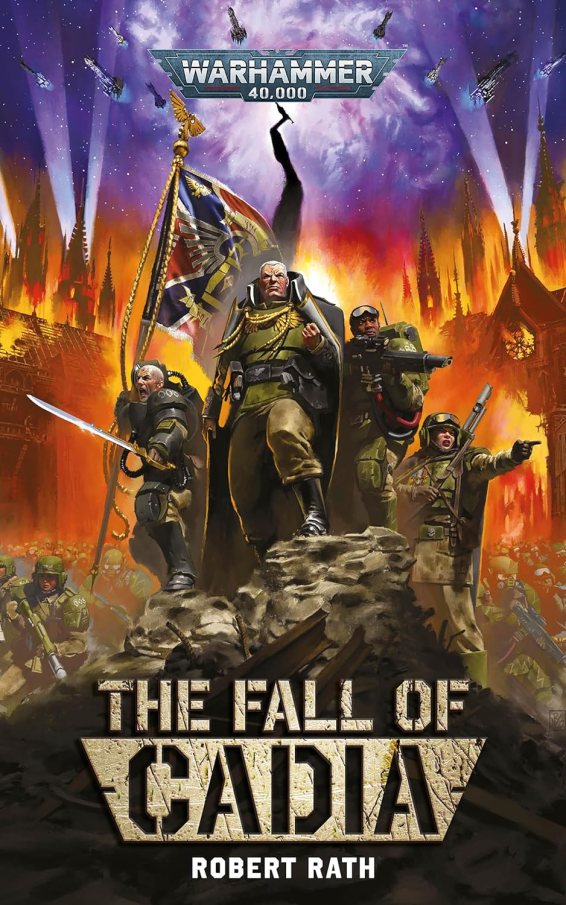
Warhammer 40,000: The Fall of Cadia by Robert Rath

Warhammer 40,000 - The Fall of Cadia Cover

Publisher: Black Library (Audiobook – 5 August 2023)

Series: Warhammer 40,000

Length: 19 hours and 42 minutes

My Rating: 5 out of 5 stars

Amazon

Cadia Stands!  I ended 2023 on a very high note with one of the best Warhammer 40,000 novels of the year that follows one of the biggest events in the franchise’s recent lore, The Fall of Cadia by Robert Rath.

There were several amazing Warhammer 40,000 novels released in 2023, with some of my favourites including The Lion: Son of the Forest and Warboss by Mike Brooks, The King of the Spoil by Jonathan D. Beer and Cypher: Lord of the Fallen by John French, just to name a few.  However, in terms of sheer scale, epic battles, and larger-than-life characters, my favourite will have to be The Fall of Cadia.  As the name suggests, The Fall of Cadia follows the final battle for the planet of Cadia at the end of the 13th Black Crusade, which was a major campaign in the Warhammer 40,000 tabletop game.  The original 13th Black Crusade campaign happened back in 2003, with the official result being something of a draw.  However, in 2017, Games Workshop retconned the campaign to result in a much more substantial Chaos victory, which ended up having substantial impacts on the wider lore of the franchise, effectively reshaping the entire Warhammer 40,000 universe.

This change ended up being a pretty significant event, and Games Workshop provided some major write-ups about it that summarised the events and their explosive aftermath.  Indeed, the lore events initiated in this event have already been featured in several novels, and most of the current Warhammer 40,000 fiction examines the consequences of this campaign.  However, there has yet to be a novel solely dedicated to trying to capture the entirety of the action at the end, until now with The Fall of Cadia by Robert Rath.  Rath was a great choice of author to write this book as he is a truly amazing author of Warhammer 40,000 fiction.  His previous novels, Assassinorum: Kingmaker (one of my favourite books and audiobooks of 2022) and The Infinite and the Divine, have both been exceptional five-star reads, telling elaborate, character-driven stories that cleverly capture complex aspects of Warhammer 40,000 lore and turn them into impressive and addictive reads.  As such, he was the perfect choice to write The Fall of Cadia and he succeeded in creating a deeply moving and epic novel that perfectly brought the chaotic events that ended this infamous war to life.

In the far future of the 41st Millenium, few battlefields are more significant or more soaked in blood than that of Cadia.  A fortress world for the Imperium of Man, Cadia stands in the shadow of the Eye of Terror, a blazing rift that serves as a gateway into the Warp and the realm of the Chaos gods.  For any substantial invasion by the forces of Chaos into the Imperium to be successful, Cadia needs to be taken and destroyed, and for that task the Chaos Gods have chosen the Warmaster of the Black Legion, Abaddon the Despoiler.  Abaddon is a legendary warrior of hatred and spite who alone is capable of welding together the unruly and contentious forces of Chaos.  Over the millennia, Abaddon has launched 12 Black Crusades against Cadia, leading an unholy alliance of monsters, daemons, cultists and traitor Space Marines to battle.  However, each time Cadia has held, at great cost to the desperate Imperial defenders.  But now, as the forces of Chaos appear stronger than ever before, a 13th Black Crusade has been declared, one that looks set to destroy Cadia forever.

The Fall of Cadia starts well into the 13th Black Crusade, as, after weeks of heavy fighting, the forces of Cadia and humanity once again appear victorious, with the armies of Chaos retreating on all fronts.  However, despite the apparent victory over the heretics and the dark gods of Chaos, Lord Castellan Ursarkar Creed is uneasy, believing that the victory was too easy.  As the celebrations continue, Creed is soon proved right, as the Eye of Terror disgorges a new enemy force unmatched in size and deadly potential since the legendary Horus Heresy.

At its head flies a dread Blackstone Fortress, an alien superweapon capable of intense destruction and now crewed personally by Abaddon.  Faced with this threat, Creed attempts to bring together the various elements of humanities defenders, including legendary Space Marines, virtuous Sisters of Battle, the inhuman soldiers of the Adeptus Mechanicus, and the outmatched by steely rank-and-file troops of Cadia, determined to save their home.

As the final invasion of Cadia begins, Creed organises the defence the best he can to hold back the oncoming horde on land, in the sky, in space, and even far behind Cadian lines in their seemingly safe cities.  If Creed has any hope of succeeding, he will need to bring together the scattered armies of the Imperium on Cadia into a single cohesive force, but not all of the defenders are fighting for the same goals.  Even if these armies come together, can the legendary Creed hold off the fury of Abaddon and his dark gods?  Cadia’s last stand has begun, but who will be left alive at its end?

Robert Rath continues to showcase just how varied and impressive his talent for writing Warhammer 40,000 fiction is as he captures the incredible events of the last siege of Cadia.  The Fall of Cadia is epic in every way possible, as it presents the reader with a great coverage of these key lore events and the characters involved.  Elaborate, intense, and featuring so much damn carnage and war, The Fall of Cadia is an incredibly addictive read that got a very easy five-star rating from me.

I think it is important to point out that Robert Rath had a difficult task ahead of him when he was chosen to novelise the events surrounding the end of the 13th Black Crusade.  A lot of detailed lore has been written around this event, not only in the various guides, rulebooks and other material associated with the tabletop game but also in several years worth of novels and extended fiction that focused on the aftermath of the war.  Any novelisation about these events ran the risk of being a stale retelling of events that all Warhammer 40,000 fans already know about.  However, Rath rose to the challenge and presented a powerful, intense and memorable depiction of the events that really drags the readers in while showing just how incredible and epic a piece of Warhammer fiction can be.

To tell the events of The Fall of Cadia, Rath elected to cover everything in a massive, multilayered, character-driven narrative, told from every perspective imaginable.  Starting towards the final days of the battle, when Abaddon unleashes his true invasion of Cadia, the reader is soon engrossed a range of different storylines that cover many different angles of the battle.  Not only do we get to see the overall strategy of both sides but the reader is also thrust into personal wars and fights across the theatre.  So many amazing moments are covered, including a desperate last stand in the mountains, battles in the sky and space, Chaos infiltration in the cities, criminal enterprises, even internal dissension amongst the Chaos command.  These scenes are usually shown through the eyes of a complex characters, whose desperate fight for Cadia helps to define them and presents the reader with some impressive and captivating character arcs.  All these varied conflicts are expertly portrayed by Rath, who does a wonderful job capturing the intensity, brutality and lack of humanity involved in warfare, as his characters suffer on every battlefield imaginable.  The sheer epic and destructive nature of these conflicts really come across in Rath’s writing style, and I honestly visualised many of the scenes being described in cinematic detail in my head.

The first half of the book primarily focuses on these various scattered storylines, and it was a lot of fun to see the different theatres of war, especially as you start to get attached to the major characters.  All the battles featured are pretty awesome and intense in their own way, and I really have to emphasise just how skilled Rath is at bringing all the different elaborate bits of combat to life.  The complex story pieces start to come together in the second half, especially as each of the characters find themselves drawn to the same battlefields.  I really appreciated how the storylines tied together, and there are some brilliant moments featured here.  I also felt that the multiple deus ex machina moments towards the conclusion of a big battle sequence that Rath needed to include because they were part of the lore was handled about as well as they could be.  Rath did some good set-up for the most important of them earlier in the plot, and I liked how in many instances he tried to examine it from the perspective of the common soldier looking for miracles, so it often did not seem too ridiculous.

Everything leads up to the big final battle in the last third of the novel, and despite knowing how it was going to end, I still was extremely invested in the plot and eager to see how everything came about.  A lot of this was because I deeply enjoyed the compelling character arcs of the newer protagonists, but I was also very interested in seeing how Rath envisioned some of the more essential events.  The author really did not disappoint, as these epic and groundbreaking moments were expertly showcased to the reader in a powerful and captivating way.  The big deaths were pretty shocking and hurtful, especially if you did not know they were coming, and the major conflicts were so damn epic in their scope and impact.  The final devastating blows of the war really hit hard, especially as the climatic events featured some deeply personal moments alongside the mass devastation, which made everything that much more powerful.  I really loved how everything came together, and the poetic conclusion that highlighted the final fights of the surviving protagonists is going to stay with me for some time.  I am so damn impressed with how much passion and emotion that Rath was able to stick into this massive war story, and I honestly loved every single second spent reading The Fall of Cadia.

In addition to the amazing story, I really need to highlight the impressive array of characters featured throughout The Fall of Cadia.  Rath did a wonderful job of presenting the massive events of this book through a range of intriguing character perspectives on every side of the conflict, and there is a fantastic combination of new characters and established Warhammer 40,000 figures.  The author really tried to cover The Fall of Cadia’s narrative from every single angle he possibly could, and the resulting combination of generals, common soldiers, legendary warriors, ancient traitors and other interested onlookers, helped to make this Warhammer 40,000 story even more powerful and layered.  This includes several Chaos characters, whose tainted perspectives allow for a compelling view of both sides of the conflict.  The Fall of Cadia’s character arcs are mostly self-contained for the majority of the book, with their focus usually on that particular figure or theatre of the war.  However, there are some clever and moving interactions between the characters as the novel continues, and it is testament to Rath’s writing style and ability to create a massive web of overlaying character storylines that these interactions fit together so well into a cohesive and powerful narrative.  Rath really dove into the complex lives and personalities of every character he featured, even those that died quite quickly, and the resulting character arcs really added to the emotional impact of The Fall of Cadia.  You become heavily invested in these characters as a result, and waiting to see who survives the war is an important part of experiencing this novel.

So many big personalities were expertly featured throughout The Fall of Cadia and every reader is going to come away with their own favourites.  The better character arcs I personally loved included that of Major Marda Hellsker, who is forced to lead a desperate last stand for much of the book and grows into the leadership position thrust upon her.  Captain Hanna Keztral’s exploits in the sky also make for great reading, especially as she desperately tries to gain respect whilst flying an unarmed aircraft.  You also have to love the storylines surrounding Salvar Ghent, Cadia’s premier gangster, as he tries to exploit the war to his advantage before finding himself thrust into a much more prominent role.  I particularly loved how well Ghent interacted with some of the major figures in the book, and his entire storyline was one of the most entertaining.  The insatiable Necron collector Trazyn the Infinite was also a great inclusion in the plot, and Rath clearly had fun bringing back this hilarious character after featuring him so heavily in The Infinite and the Divine, and I got a good laugh at several of his pivotal scenes and petty moments.

However, the best characters in The Fall of Cadia had to be the opposing leaders of the war, Lord Castellan Ursarkar Creed and Abaddon the Despoiler.  Both are major figures in Warhammer 40,000 lore and Rath ensured that they were done justice in this novel.  Creed is shown to be a rough but brilliant commander, capable of inspiring an entire world while also suffering from the stresses of constantly being on the losing side.  I particularly enjoyed the subsequent inclusion of Colour Sergeant Jarran Kell alongside Creed as his long-suffering aide and best friend, and the two make for a very powerful character combination for many of the scenes shown from the defenders’ perspective.  Abaddon on the other hand is presented as the absolute beast that he is, and his obsessive desire to destroy Cadia is palpable.  I deeply appreciated that Rath showcased Abaddon as the ultimate villain in this universe, and his appearances were always exceedingly impactful.  Many of Abaddon’s appearances were cleverly shown through the eyes of his loyal servant, Dravura Morkath, whose rose-tinted opinions of her master barely covered the restrained evil within this figure.  I quite enjoyed Dravura as a character, especially as she has the most intriguing insights into the Chaos ranks, and the resolution of her storyline with Abaddon might be one of the most heartbreaking in the entire book.  These characters, and so much more, were such a brilliant part of The Fall of Cadia, and they helped turn what could have been a simple retelling of the lore into a particularly powerful and moving novel.

As with most Warhammer 40,000 novels, I feel that The Fall of Cadia is going to appeal to those fans of the franchise who already have a grip on the basics of the lore and main characters and can fully appreciate just how massive an event this book was.  Due to the material the book is based on, there were a lot of crazy events and characters featured here, some of which would be obscure even to casual fans of the game.  While Rath does an outstanding job of explaining and exploring the most important of these elements, some readers might occasionally be confused at what is going on or how certain characters came into being.  Still, I feel that most new readers can still have an exceptional time with this book, especially as the epic battles, impressive characters, and heartfelt military focused story, is so damn good.  The Fall of Cadia might even be a great gateway novel for those people trying to get into Warhammer 40,000 fiction, and it sure as hell encouraged me to read more Warhammer fiction.

One of the other things that I really appreciated about The Fall of Cadia was the way that Rath tried to paint a more nuanced picture of the planet of Cadia itself.  Cadia is usually portrayed as a bastion of military prowess and resistance without some of the issues other planets in the Imperium had, so it was quite interesting to see Rath’s different take on the subject, showing Cadia to be a planet with hidden issues and dissent.  In particular, Rath examines the problematic social structure of Cadia, where the active military are notably prioritized and those people who could not fight or be assigned other roles were considered a second-class citizen.  I loved how well Rath examined and focused on the issues surrounding this unique military class system, and it became a surprising key part of the book.  Indeed, the motivations of several characters are highly tied into these issues, with many seeking to prove themselves after being considered lesser for their contributions.  It also serves as an intriguing motivation for several antagonistic figures, and I loved just how well Rath was able to weave the structure of a planet into these intriguing character traits.  This, and more, really showcased Rath’s inventiveness and appreciation for the little details of the Warhammer 40,000 universe, and it is one of the reasons why I really enjoy his novels.

As with most Warhammer 40,000 novels, I chose to enjoy The Fall of Cadia on audiobook, which proved to be a very smart decision on my behalf as it was one of my favourite audiobooks of the year.  Coming in with a runtime of just under 20 hours, The Fall of Cadia is a bit longer than your typical Warhammer 40,000 audiobook, which reflects the massive story Rath came up with for this epic read.  I really loved how well this audiobook format brought the epic nature of this narrative to life and the many battles, wars, and unique characters felt even more impressive when read out.  I enjoyed the narration of Mark Elstob, who has previously lent his voice to other great Warhammer audiobooks, including Kal Jerico: Sinner’s Bounty by Josh Reynolds.  Elstob’s narration of The Fall of Cadia is extremely good, and I loved how passionately he presented every big event and piece of action.  I really enjoyed some of the great voices he came up with for the cast of The Fall of Cadia, and every larger-than-life character was gifted a fitting tone that perfectly captured their personalities and intensity.  His voices for the opposing leaders of the battle, Abaddon the Despoiler and Ursarkar Creed, are amazing examples of this, and you really get awesome impressions of both character’s opposing determination and charisma in some outstanding sequences.  I really cannot emphasise just how incredible this audiobook version of The Fall of Cadia is and it is definitely the best way to enjoy this world-shattering story.

Overall, The Fall of Cadia is a pretty exceptional piece of Warhammer 40,000 fiction that did such an impressive job of capturing this intriguing event from the game’s substantial lore.  Robert Rath is such an impressive author, and I am really glad he had the opportunity to cut loose and present this massive inclusion to the Warhammer 40,000 franchise.  The Fall of Cadia is easily one of my favourite books of 2023, and I loved how Rath told such an epic war tale in such a powerful and memorable way.  I honestly hope they make a movie based around this book in the future, because it would be so damn spectacular.  A highly recommended read that no Warhammer 40,000 fan should be without.
Amazon

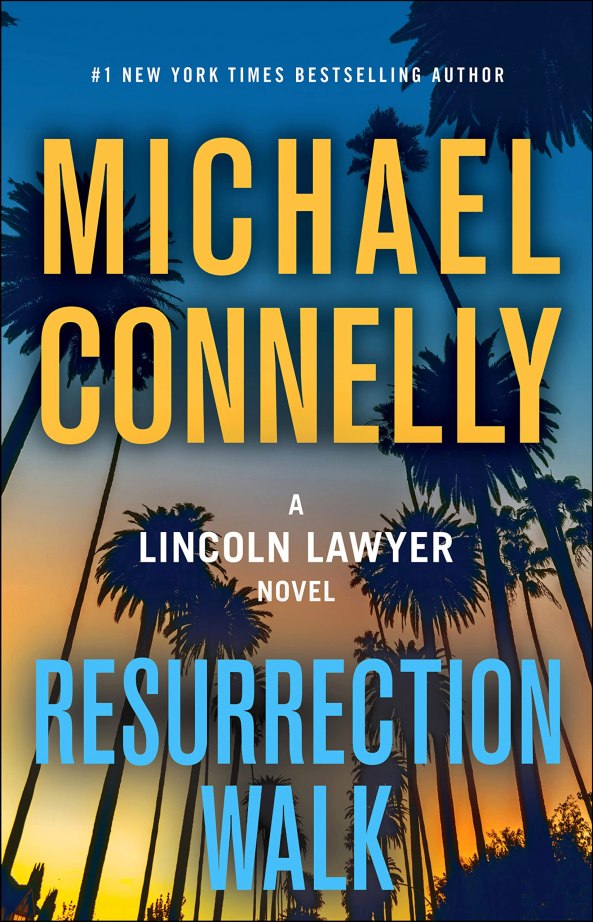
Resurrection Walk by Michael Connelly

Resurrection Walk Cover

Publisher: Allen & Unwin Australia (Trade Paperback – 31 October 2023)

Series: Mickey Haller/Lincoln Lawyer – Book Seven

Length: 407 pages

My Rating 5 out of 5 stars

Amazon

Acclaimed crime fiction author Michael Connelly returns with another outstanding and captivating read, Resurrection Walk, a clever and impressive legal thriller featuring two of Connelly’s best characters.

Gosh it has been a very good few years for fans of crime fiction author Michael Connelly.  Not only have we got two fantastic television adaptations currently going, but Connelly has been producing several great books across his multiple subseries.  Most of these books were part of his Ballard and Bosch series, with excellent novels like Dark Sacred Night, The Night Fire (one of my favourite books and audiobooks of 2019), The Dark Hours (one of my favourite books of 2021) and Desert Star (one of my favourite books of 2022), and he has also released a cool book from his fantastic Jack McEvoy series with Fair Warning (one of my favourite books of 2020).  Each of these novels has been excellent in its own way, but for the best Connelly fun nothing beats a Mickey Haller novel.

The Mickey Haller series, also known as the Lincoln Lawyer books, follow Mickey Haller, an infamous and effective defence attorney in L.A who got his nickname, “the Lincoln Lawyer” by working out of a Lincoln town car.  Known for intricate cases, elaborate court scenes and fantastic legal shenanigans, the Mickey Haller books are always a ton of fun and I love both the books and its current television adaption.  Connelly’s last Mickey Haller book came out in 2020 with The Law of Innocence, and I was very happy to find out that he was releasing a new one this year with Resurrection WalkResurrection Walk was one of my most anticipated books of 2023, especially as it featured a great plot and fantastic team-up between Haller and Connelly’s best-known protagonist, Harry Bosch.

Following a successful case that freed an innocent man from prison, defence attorney Mickey Haller has gotten a taste for hopeless cases and is now working on helping those unfairly convicted of crimes they didn’t commit.  Hiring his half-brother, retired detective Harry Bosch to vet the various requests for help being sent to him, Haller hopes that he can do a little good alongside his usual controversial legal practice.  However, the first case that Bosch picks might be the most dangerous.

Several years ago, Lucinda Sanz was accused of killing her sheriff’s deputy ex-husband in front of her house, a crime she always claimed she was innocent of.  Reading through her case, Bosch is convinced that there is far more to the murder than the files indicate, especially when he discovers evidence that the victim was part of a notorious police gang.  Convincing Haller to take on Lucinda’s case, the pair begin to investigate further and begin the process of having her conviction appealed.

However, proving Lucinda’s innocence is no easy task, especially with substantial evidence proclaiming her guilt, a police force closing ranks against them, and no new witnesses willing to come forward.  Worse, there are many people who don’t want Lucinda’s case re-opened, and soon Bosch and Haller find themselves being threatened on all fronts.  With determined legal opponents facing them in the court and dangerous foes waiting for them at home, can even the Haller-Bosch dream team uncover the truth and save their client?

Connelly does it again with an outstanding and deeply addictive read that had me hooked from the very beginning.  Expertly bringing together two of his best characters into an intense and clever legal thriller, Resurrection Walk is an amazing book, and it was probably one of my favourite Connelly reads from the last few years.

Resurrection Walk has a brilliant story around it that sees the characters of Haller and Bosch teaming up to try and get an innocent woman out of prison.  While billed as a Lincoln Lawyer novel, the plot of Resurrection Walk is split between Bosch and Haller, with both characters working on the case from their own unique perspectives.  Connelly dives into the fantastic story of Resurrection Walk quickly, effectively setting up the primary case, while also including some intriguing minor side cases and the compelling personal issues of the two protagonists.  While a couple of the side cases and adventures at the start of the book do seem a little unnecessary in the context of the main plot, I quite enjoyed them, and Connelly does tie a couple of them back into the story in some compelling ways.

The main plot itself is extremely fun as it cleverly builds on Haller and Bosch’s existing character arcs, while also presenting the reader with a unique case.  Haller and Bosch working to free a woman who pled no contest to a murder charge was always going to be a recipe for success, and Connelly turns it into gold with his writing.  The author breaks the story perfectly down the middle between Haller and Bosch, and the combination of an intriguing investigation arc and Haller’s entertaining legal manoeuvrings was a ton of fun.  There were also some intriguing thriller elements as the two protagonists are targeted by parties interested in stopping their investigation, which really ensures the reader gets more invested in the story.  The start of the book deals with the initial investigations into their client’s claims and coming up with a game plan for a potential appeal.  This proved to be a fascinating and vital part of the book as it expertly introduced a lot of the salient points to the reader while also quickly indicating that there are a ton of anomalies at play.

I really liked that Connelly took his time getting to the trial, and it helped to set up anticipation for the legal shenanigans to come.  The trial in question takes up most of the second half of the novel, and it proved to be the best part of the entire novel as it brings together a lot of the story threads that Connelly previously set up.  By the time you get to it, the reader is pretty invested in Lucinda Sanz’s story of innocence, and you want to see her triumph over the system that oppressed her.  It also helped that Connelly was presenting a unique legal case in this book as Haller goes federal and sues the State of California with a habeas petition to try and overturn his client’s decision to plead out a murder they were framed for.  This results in a very different game plan for Haller, and the resulting trial goes in some very interesting directions.  Connelly really keeps the reader on their feet during the trial, and there is a blazing back and forth between Haller and his opposition, especially when both start playing some dirty tricks.  Both sides have victories and defeats, and I liked how Connelly kept the reader in constant suspense, as you were never certain which way the case was going to go.  Haller of course puts in his typical over-the-top and unconventional legal strategies, which throws the case in some interesting directions and leaves the reader very entertained at times.  It was especially fun when some of them backfire on him, and the reminder that the protagonist isn’t legally invulnerable was a great part of the plot.

Everything leads up to a big conclusion which wraps up the plot in an interesting way.  While I liked elements of the finale, I did think that Connelly got there a little suddenly, and it kind of messed up the overall flow of the book.  I also wasn’t the biggest fan of the fact that the major event that sealed the deal occurred outside of the courtroom, and I honestly would have preferred some form of elaborate legal tactic to save the day.  Still, there are some great moments at the end, especially when Haller uses a few more tricks to make things go his way, minus some funny legal repercussions, but it was a generally satisfying ending that I deeply enjoyed.

Connelly did a wonderful job writing Resurrection Walk, and I loved how well he set out the story.  I deeply appreciated how there was some real authenticity in the various legal elements of this book, from the unique trial, the boundless prep-work, and the other vital work involved in the process.  Connelly also broaches some interesting concepts during the trial, including AI generated crime scene renderings, which was fascinating, even if it didn’t always go the way you hoped it would.  This book has a wonderful pace to it, especially during the intense and moving trial sequences, and I loved how invested I got in events, including those associated with the main case, and the personal lives of the two dynamic protagonists.  Connelly has a lot of experience of inserting his main protagonist, Harry Bosch, into other protagonists’ stories, and I think that he was a strong inclusion in Resurrection Walk as an equal protagonist to tell an outstanding story.  There is an equal balance of storylines and actions between the two, and I deeply appreciated the different tenses that the author uses depending on who the perspective character is, especially as the first-person perspective is perfect for Haller and his ego, while the third-person perspective fits Bosch’s quieter personality better.  This, and other elements, ensured Resurrection Walk’s narrative really popped, and Connelly amazing writing helped to turn this into an amazing read.

I mentioned how well the author switched between these two well-established protagonists, but Resurrection Walk also had some awesome character dynamics and arcs that added to the overall impact of the plot.  Both Haller and Bosch have been going through some intriguing ongoing storylines for several of their last appearances, and it was great to see some resolution or continuation of it here.  Haller, for example, has been trying to come to terms with what he wants to do as a lawyer as he has been having a certain amount of dissatisfaction with being a defence attorney for the city’s scum.  Bosch, on the other hand, has been slowly (ever so slowly) dying of cancer for the last few books, and his work with Haller in Resurrection Walk is due to Haller getting him on his insurance.  However, this raises even more issues for Bosch, as he, a former cop, is now working for a defence attorney, and he finds himself on the other end of the law process as a result.  This results in some intriguing and tense interactions between the two protagonists, especially as these brothers have different interpretations of the law, and it was really fascinating to see them come at the same case from very different angles.  Tension, inner drama, and other personal concerns added some excellent emotional weight to Resurrection Walk’s plot, and I really enjoyed seeing these protagonists in action, especially as there is a certain amount of respect gained between them as the case proceeds.  The author handles both characters extremely well in Resurrection Walk, and while I am a little dissatisfied that Connelly seems to be backing away from Bosch being on death’s door (an experimental treatment is making him better), both of Connelly’s amazing and iconic protagonist have an amazing time in this book and their collaboration was pure gold.

Michael Connelly once again produces one of the best crime fiction books of the year with the exciting legal thriller Resurrection Walk.  This is a captivating and powerful novel that combines a fascinating and intense legal case with two fan favourite characters to produce an exceptional and awesome read.   I powered through Resurrection Walk in no time at all, and it ended up getting an easy five-star rating from me.  One of my favourite books of the year, I cannot recommend the clever, moving, and highly addictive Resurrection Walk enough.

Amazon

The Armour of Light by Ken Follett

The Armour of Light Cover

Publisher: Macmillan (Hardcover – 26 September 2023)

Series: Kingsbridge – Book Four

Length: 737 pages

My Rating: 5 out of 5 stars

Amazon

Acclaimed author Ken Follett returns with another exceptional addition to his iconic Kingsbridge historical fiction series with the fantastic and captivating The Armour of Light.

Out of all the authors who dive into the complex and impressive genre of historical fiction, few are as well-known or epic as Ken Follett, who has been dominating the genre for years with his massive and epic thrillers.  I have only really had the chance to explore Follett’s historical fiction books, with his Century trilogy being a particular favourite of mine (one of my favourite trilogies of all time).  However, Follett’s most iconic work is his Kingsbridge series, which has long gained mass recognition and accolades

The Kingsbridge books are a series of massive, epic novels that chronicle the complex lives of the residence of the town of Kingsbridge in historical England.  Each book follows the lives of several intriguing characters as they attempt to survive the various challenges and turmoil of the age, often coming into conflict with each other in some elaborate and extended ways.  The series started in 1989 with The Pillars of Earth, which is probably Follett’s most successful novel.  Set over the course of 50 years in the 12th century, The Pillars of Earth showcased a range of personal, political, economic and social issues that the characters spent their lives overcoming in different ways, often loaded with dramatic or historical significance.  An exceptionally epic book, The Pillars of the Earth is very highly regarded and was turned into a compelling TV miniseries with an awesome cast.

Follett has since followed up his original novel several times throughout his career, with each of the Kingsbridge books set in a different period of the town’s history.  For example, the 2007 release World Without End (which was also adapted into a miniseries), is set in the 14th century around the start of the Hundred Year’s War.  The 2017 novel, A Column of Fire, was another compelling sequel that mirrored the life and reign of Queen Elizabeth I and featured a compelling plot involving Catholic spies and religious conflict.  The fourth book was the 2020 novel, The Evening and the Morning (one of my favourite books of 2020), which served as a prequel to the rest of the series and showed the founding of Kingsbridge in the early years of Viking infested 11th century.  All four of these books have been exceptionally good, and I love following a whole new group of characters while exploring the unique aspects and conflicts of their historical era.  Due to how much love I have for this amazing series, I was pretty damn excited when I found out that Follet had a new Kingsbridge novel coming out in late the 2023 with The Armour of Light.  Set during the early years of the English Industrial Revolution, The Armour of Light sounded so damn good, and it was one of my most anticipated books of 2023 as a result.

England, 1792.  As Napoleon Bonaparte begins his rise to power in France, the people of England look on in fear and curiosity at the changes wracking their neighbour.  As the march towards progress continues throughout England, many people find their way of life changing faster than they can adapt.  Nowhere is this felt more keenly that the town of Kingsbridge.  A major hub of England’s cloth industry, Kingsbridge has been transformed by the rampant industrialisation and modernisation of ancient textile processes.  Now the cloth workers of Kingsbridge are forced to work in crowded factories, pushing out vast amounts of material in often unsafe conditions.  But with each new advance and new dangerous machine, the number of workers needers diminishes, and soon many in Kingsbridge find themselves out of work and thrust into poverty.

As the march towards war with France continues, many inhabitants of Kingsbridge will find themselves thrust into a conflict between the rich and the poor of England.  Spinner Sal Clitheroe tries to make an honest living, but her stubborn determination to get justice continues to put her into conflict with the town’s rich and elite.  Wool merchant Amon Barrowfield attempts to salvage his family’s business, only to find tough rivals on every front.  Weaver David Shoveller attempts to run a fair business, but an ill-advised love affair could ruin everything, while Sal’s son Kit finds himself obsessed with the new machines manipulating the wool.  These figures personal struggles will define the struggle of their generation, as the fight for freedom and enlightenment coincides with a much bigger war.

Ken Follett has another fascinating and impressive character-driven read with The Armour of Light that once again follows several complex figures as they live their lives in historical England.  Clever, powerful and chock full of historical detail, The Armour of Light was an outstanding addition to the Kingsbridge series and just had to give it a full five-star review.

Much like the other books in the Kingsbridge series, The Armour of Light follows a group of intriguing characters as they navigate life during a turbulent period of England’s history and attempt to change their destiny and the destiny of the people they love.  Set between 1772 and 1824 (although most of the main story ends in 1815), you get an intriguing examination of each of these characters as they overcome all manner of adversity, oppression, war and more.  The scope of The Armour of Light’s story is pretty damn epic as Follett really lays on the challenges and tragedies for his characters to endure and overcome.  There is intrigue, politics, imprisonment, business rivalries, unexpected deaths, conscription, unrequited loved and much more as many of the protagonists find themselves going up against the system and often coming off second best.  You really grow attached to these characters as you follow them throughout the decades and see many of them grow up, find their callings, fall in love, and more, only to often see them then at their worst as they encounter setbacks they can’t overcome.  While most of the story deals with the industrial changes the characters are trying to get used to, the plot does also tie into the Napoleonic War.  Naturally, pretty much all the characters find themselves over in Belgium in 1815, so everyone is involved at Waterloo to some degree or another.  This proves to be an impressive end to the story, and it was fascinating to see where all the various characters ended up, especially after experiencing the deadliest of battles.  I had an outstanding time getting through this elaborate story, which honestly had me hooked the entire time.  Despite The Armour of Light’s near 750-page length, I managed to power through it in a matter of days, its story was that damn interesting.

As I mentioned, The Armour of Light is part of the Kingsbridge series and serves as a sequel to all four previous novels.  However, due to compartmentalised nature of the book’s plot and the focus on completely new characters, readers do not need a prior knowledge of the rest of the Kingsbridge books to enjoy The Armour of Light.  The novel is very accessible, and due to the substantial gap between it and A Column of Fire, readers should really consider this a standalone novel that any historical fiction fan can easily enjoy.  However, long-term fans of Follett and the Kingsbridge series will no doubt appreciate seeing how the setting of Kingsbridge has evolved over the years, especially in the face of industrial revolution, which changed the nature of the textiles industry that has always been central to the series’ plots.  There are also a bunch of clever references and connections to the previous novels, although if you don’t pick these up it in no way ruins your flow or enjoyment of the story.  As such, The Armour of Light is a book most readers and historical fiction fans will be able to enjoy, while also serving as an intriguing continuation to the Kingsbridge series.

One of the main reasons why I enjoy the Kingsbridge books so much is because Follett excels at showcasing fascinating historical periods and working his characters into unique situations based on the events of the period.  The Armour of Light is an incredibly good example of this as it examines the impact of the early Industrial Revolution on a textile town like Kingsbridge.  Follett really dives into the intricacies of the mechanised weaving process that would have taken place in factories like this, and the various issues they caused.  As the book progresses, the characters are introduced to new machines more efficient than the last, which causes more of the characters and inhabitants of Kingsbridge to lose work.  This leads to discontent amongst the working classes, many of whom are trying to raise themselves up through any means possible, and the rich factory owners and the other elites try to hold them down using various legal and political angles.  As such, the story captures interesting aspects about the English legal system and the controversial politics at the time, especially as parliament was so against unionisation and other actions after seeing the revolution in France.  I quite enjoyed the discussions that occurred surrounding the French Revolution and Napoleon at various points of the book, and it was fascinating to see the various classes reactions to these events, such as fear from the wealthy, and interest from the poor.  Other intriguing historical elements were also examined throughout the book, such as the growing rivalry between the Church of England and the Methodist faith, and I had a wonderful time seeing them all introduced into the plot.  Follett did a remarkable job working so many of these historical details into The Armour of Light’s story, and it helped to make this a fantastic and fascinating read I couldn’t put down.

Finally, I need to highlight the great characters featured throughout the plot.  Follett came up with an intriguing collection of figures to follow in The Armour of Light, and each of them goes through some compelling trials and tribulations.  I really enjoyed the range of different characters featured within the novel, although most of them were tied into the wool trade to some degree to really hammer home the novel’s main point about change and industrial revolutions.  Follett came up with some very interesting personal stories for each of these characters, and their powerful journeys through life, love and loss, was the true heart of the book.  This includes Sal Clitheroe, the heart and soul of the book, Amon Barrowfield, the always hopeful young merchant, and David Shoveller, a mostly noble figure who works to help those he can.  I also loved the striking Alderman Joseph Hornbeam, who served as the book’s main villain.  The wealthiest man in Kingsbridge, Hornbeam is determined to expand his empire no matter who he must crush to do so.  As such, he comes into conflict with many of the protagonists, and his actions are usually the crux for much of the book’s plot.  I really enjoyed Hornbeam as an antagonist, and Follett weaves some interesting storylines around him, including a hidden backstory, and a redeeming examination of his love of family.  Pretty much all the characters in The Armour of Light were extremely well written, although I thought it was a bit odd that every major female character either committed adultery or lusted after another man while married.  I’m not sure if that was commentary on women’s lack of choice back in the 18th and 19th centuries or some particularly interesting choices from Follett, but it was weird that it happened at least four times.

Ken Follett did an outstanding job continuing his amazing Kingsbridge series with the wonderful book, The Armour of Light.  A compelling and historically rich novel, The Armour of Light was another great read and I had such a fantastic time getting through it.  I have so much love for the Kingsbridge series, and I cannot wait to see what period Follett decides to explore next.  Highly recommended.

Amazon

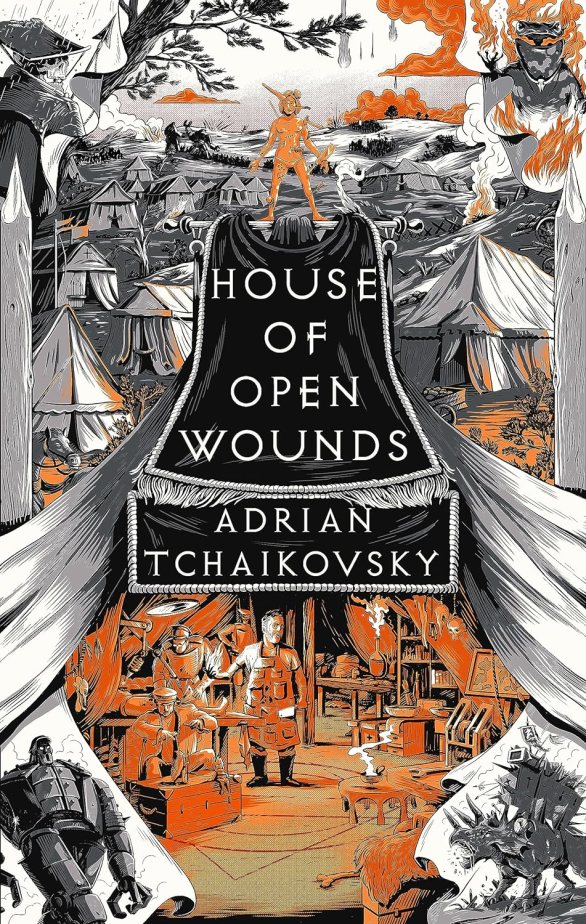
House of Open Wounds by Adrian Tchaikovsky

House of Open Wounds Cover

Publisher: Head of Zeus (Ebook – 7 December 2023)

Series: The Tyrant Philosophers – Book Two

Length: 636 pages

My Rating: 5 out 5 stars

Amazon

The always deeply impressive Adrian Tchaikovsky returns with an exceptional and remarkable piece of fantasy fiction, House of Open Wounds, which presents the reader with a particularly unique and ruthlessly entertaining story, chock full of brilliant characters.

Few fantasy authors have the range and style of Adrian Tchaikovsky, whose distinctive contributions to the science fiction and fantasy fields are quite remarkable.  While Tchaikovsky has written several highly regarded series, I have only just scratched the surface of his works, having read a few of his recent reads.  This includes his first foray into the Warhammer 40,000 universe, with the captivating standalone read, Day of Ascension, as well as the brilliant and elaborate novella, Ogres.  However, my favourite book from Tchaikovsky so far would have to be the outstanding City of Last Chances.

The first book in The Tyrant Philosophers series, City of Last Chances was an outstanding read that I had the pleasure of enjoying earlier this year.  Set around a conquered city with several unique magical inclusions, City of Last Chances introduced the reader to a cool new world and told a range of character driven stories about resistance, religion and sacrifice.  City of Last Chances got a very easy five-star rating from me, and it honestly was one of the best books and audiobooks I enjoyed in the first half of 2023.  I had such a brilliant time with City of Last Chances that when Tchaikovsky announced he was releasing a sequel in the second half of 2023, I was ecstatic.  This sequel, House of Open Wounds, continued some of the complex storylines Tchaikovsky started in City of Last Chances, and it was one of my most anticipated books for the second half of the year.

There are few nations more feared or relentless than the ever-expanding Palleseen.  A rising empire of zealots who are determined to bring Perfection and Correctness to an imperfect world, the Palleseen have advanced out of their homeland in an unstoppable wave, wiping out all religion and superstition as they go.  As cities and kingdoms fall before their military might, their armies leave behind mounds of dead and wounded soldiers who require tending in field hospital tents just behind the frontline.

Into this chaos is thrust the god smuggler Yasnic.  A former priest, miracle healer and occasional rebel, whose previous experiences with the Palleseen saw him hanged, attacked and banished from his city, Yasnic has experienced many upheavals throughout his life.  Saved from another execution by the army bureaucracy, Yasnic and his box of orphan gods arrive at the frontlines, where he has been assigned to work in an unorthodox medical unit.

Made up of a mixture of former priests, gods, magicians, alchemists, artificers, necromancers and led by a gigantic brute known as the Butcher, the experimental medical unit treats the soldiers no one else can save and recycles the rest into the war effort.  Entrusted to save the Palleseen soldiers, but doomed if anyone ever discovers the full extent of their abilities, the surgeons and orderlies of this unit ply their bloody trade as best they can while living as part of an unusual family, but the arrival of Yasnic could change everything.

As Yasnic works to fit into the unit and save lives, his unusual connections to the weakened and hidden gods of the world slowly begin to cause chaos throughout the army.  Not only is he aware of the divine forces that secretly hang around the hospital, but his own illegal and crotchety God is determined to bring miracles to the Palleseen, whether that want them or not.  As an outbreak of impossible healing and sudden pacifism spreads through the regiment, can Yasnic keep himself and his gods alive, or will the full force of the Palleseen zealots come crashing down upon him?

This was another epic and truly remarkable novel from Tchaikovsky that had me hooked the entire way through.  Featuring a dark, bloody and fun story, House of Open Wounds was a particularly distinctive read that told its own captivating story while continuing some of the best elements from City of Last Chances.  Funny, thoughtful and moving in equal measures, House of Open Wounds was an incredible and addictive novel that gets another very easy five-star rating.

I was very impressed with the exceptional and moving narrative that Tchaikovsky pulled together for House of Open Wounds, and I was hooked the second I got into it.  After the events of City of Last Chances, the reader is thrust into a new part of Tchaikovsky’s fantasy world as you find yourself imbedded in a Palleseen battalion following the members of an unusual but effective military hospital.  Like City of Last Chances, House of Open Wounds is strongly character driven, as you follow the personal stories surrounding each of these unusual outsider characters and learn about their complex pasts while watching their lives play out in the present.  Much of the plot revolves around returning protagonist Yasnic and his God, who are drafted into the unit, and you get to see his experiences of the other characters, the wars, and the internal Palleseen bureaucracy.  Most of the first half of House of Open Wounds is dedicated to exploring the new cast of characters and introducing their unique stories, as they find themselves closely following a bloody and dangerous war.  This part of the book is primarily focused on the healing and medical work of the protagonists, as well as diving into their reasons for being there and the unique skills they bring to the surgical table.  Apart from that, there isn’t an amazing amount of major plot progression here, except when Yasnic starts to mix things up around the battalion.  While this pace is a little slow, this first half of the book was really fun and enjoyable, as you find yourself getting really lost in the characters’ lives, unique struggles, desires, and experiences.  It also helps that many of these character details, as well as the mundane events of the hospital, eventually lead to bigger things later in the main plot, and Tchaikovsky does an outstanding amount of set up here.

The plot picks up a lot more in the second half, when the main battalion moves to a different warzone and find themselves involved in a substantial fight that really pushes the medical unit to its limits.  The new battles, as well as the intriguing location they find themselves in, move several of the character arcs in some big directions, and you find out more and more about each of the main characters as a result.  The constant chaos that surrounds Yasnic also starts to take its toll on the main story, as his strangeness and the double-edged miracles he occasionally brings cause him to make enemies and upset the delicate balance of the Palleseen army.  At the same time, the Palleseen war machine starts to alienate the members of the medical unit, who find their talents being stolen to create weapons.  Everything leads up to the big finale, where the protagonists attempt to free themselves with an elaborate and ambitious plan.  This plan makes great use of all their individual skills and histories, and so many little details and elements from the story are used to bring a fun and creative conclusion to the book.  Each of the fascinating character arcs conclude nicely and I loved how Tchaikovsky masterfully brought everything together in a satisfying and entertaining way.

Tchaikovsky utilises his typical excellent and distinctive writing style to convey this elaborate and entertaining narrative to the reader, and I had such a wonderful time seeing it unfold.  As with the previous novel in the series, Tchaikovsky relies very heavily on perspective changes to tell a multilayered, character-driven story.  Like the previous book, many of the major characters are initially showcased in their own chapter at the beginning, which often leads to additional cast introductions.  As the book progresses, the chapters feature perspective changes so you can see more interactions and a wider view of the entire story.  I loved the immediate deep background on several of these characters, and while you still often must wait a while to get their full story, you learn enough to like them in the opening parts of the novel.  Tchaikovsky makes full use of these characters to tell a fantastic story, and I loved how well he showcases some unique events through their eyes.  As with the previous book, House of Open Wounds has a range of tones as Tchaikovsky works hard to produce the right balance of humour, excitement, and moving and powerful character moments.  The multiple detailed and confronting scenes of the bloody battlefield hospitals are well balanced out by the fantastic and subtle humour, which often comes from the outrageous situations that occur throughout the book, as well as the various character’s unique outlooks on life.  This made for a particularly compelling book as you found yourself moving from comedic scene to a more dramatic or tragic moment with frequent regularity, as you find yourself stuck onboard a well-thought-out emotional roller coaster.

House of Open Wounds proves to be an intriguing and clever follow-up to City of Last Chances, especially as the author deepens the lore surrounding this fantasy world and brings back two fantastic protagonists.  Readers of City of Last Chances will have an absolute blast with this book, as you get some interesting follow up to Yasnic’s compelling storyline while also seeing a different side to the antagonistic nation from the first book.  This is a somewhat loose follow-up, and you really don’t need to have read City of Last Chances to enjoy House of Open Wounds.  In many ways this is a good standalone novel, especially as most of the focus is on a whole new group of protagonists, and even Yasnic is given a new name for much of the book.  Tchaikovsky does ensure that some of the key details and plot points from the first book are carried over when needed, although he does leave a bit of context out in places so as not to overwhelm new readers.  As such, House of Open Wounds is a very accessible read, although established fans of Tchaikovsky are going to particularly enjoy this, especially if they loved City of Last Chances.

One thing you can always rely on Tchaikovsky to do is to pull together an elaborate and deeply compelling world to set his stories around.  This is extremely true in this series as Tchaikovsky has come up with a war-torn landscape filled with magic, gods, demons and a new rising empire.  The author did some interesting set up for this world in the previous novel, although the plot there was primarily contained inside a single city.  In House of Open Wounds, the reader gets to see a bigger chunk of this world, even though much of the plot takes place either on the battlefield or in the camp behind the lines.  Despite this, you get a better idea of the politics, wars and conquests that have taken place in recent history, and you particularly learn more about the Palleseen.  The Palleseen are a group of ideological zealots dedicated to bringing their version of perfection to the world, which primarily involves breaking everything down into logic and reason, and doing away with superstitions and beliefs.  As such, their goal is to rid the world of gods, deities and other superstitions, usually by conquering the lands and bringing them under the control of their relentless bureaucracy.  Most of this book is dedicated to exploring the nature of their war machine, and you really get to see just how corrupt and ambitious some of their members are as a result.

I loved the focus on the military hospital and the war camp for most of the book, especially as seeing the various members of Palleseen camp allows the reader to fully understand the many problems, compromises and cruelties the Palleseen experience on their road to perfection.  Tchaikovsky throws in some great critiques of militarisation and empire building throughout the book as you see these perfect Palleseen become racked with pride, ambition and greed to prove themselves and advance up the ranks.  Their determination to win means they turn a blind eye to gods and superstitions when it suits them, and that results in the experimental medical unit that serves as the centre of the book.  However, while they appear to only want the assembled gods, alchemists, and other strange magics for healing, really they are working to corrupt them into terrible weapons to further their war capability.  There are several great storylines that see the Palleseen turning benevolent tools and creatures into highly inventive tools of war, and it serves as a major plot point and motivation for several characters, including a few Palleseen who have enough of their colleague’s lust for power.  Combine that with the returning minor gods, who end up having their own impact on several characters, and the reader comes away with a very cynical look at the Palleseen, and empires in general, which both ridicules them and shows just how malevolent and insidious they can be.

The real key that pulls together House of Open Wounds is the huge array of memorable and complex characters that are introduced throughout the course of the plot.  Tchaikovsky does a remarkable job of introducing and swiftly building up some truly amazing characters in this novel, and their compelling and often traumatic personal stories become so highly ingrained in the plot as a result.  There are so many great protagonists and supporting figures in this novel, and I was personally impressed with how all of them were original characters that were not built up in the prior novel.

The main exception to this rule is Yasnic and his god, both of whom were introduced in City of Last Chances and who are masterfully inserted into this sequel.  Yasnic was honestly one of Tchaikovsky’s best characters in City of Last Chances and I was so glad to see more of him here, especially as the author somehow manages to work in even more development after all the defining character moments that shaped him in the prior novel.  Since we last saw him, Yasnic has moved on from being the last priest of a forgotten god and has instead become a more generalised religious figure, offering shelter and assistance to fallen and orphaned gods who no longer have any power or believers by carrying them around in a box on his back.  After everything he has gone through, including his own crisis of faith, Yasnic now has a different view of the world, although he is still being haunted by his demanding and petty god.  Yasnic has some wonderful moments in this book as he tries to fit into his new role while also hanging onto the trappings of his old life.  Desperate to save everyone he can, Yasnic finds his views and pacifism really badly damaged by the constant war and the relentless and orderly Palleseen, and he is forced to make some haunting compromises.  You really get some very interesting insights into Yasnic’s mind in this book, especially as you see how the aftermath of him abandoning his position as a priest impacted him.  You cannot help but feel for the extremely likeable Yasnic at times, as he is thrust into tragic and heartbreaking positions against his will, and his quiet determination and general positivity pluck at your heartstrings.  Throw in some great new friends, an unusual but surprisingly wholesome love interest and a series of unfortunate misunderstandings that frustrate even this gentle soul, and Yasnic once again stands out as a particularly awesome and likeable protagonist.

The other side of Yasnic’s character resides in the body of his tiny, stumpy, and petty deity, God, a former major healing god who has lost all his worshippers apart from Yasnic, but still maintains his powerful healing abilities.  However, God refuses to heal anyone unless they swear a vow of pacifism, and if they cause harm to someone in any way, it will result in their wounds automatically returning, generally resulting in a sudden death.  Thanks to his stubbornness, pride, and his whiny focus on Yasnic’s soul, God was one of the most entertaining characters in City of Last Chances, and I am really glad that Tchaikovsky brought him back for House of Open Wounds.  While he is still a judgemental, mischievous and ugly angel on Yasnic’s shoulder in this sequel, you get to learn more about God and why he refuses to help save people.  There are some surprisingly emotional scenes where God expresses why he is so bitter and you really get a much better understanding of his angry mind, especially when Yasnic makes the same mistakes, adding to God’s sadness.  I also loved how well God played off Yasnic as he proves to be a surprising and entertaining counterpoint to the humble and nice former priest.  While most of their dialogue is quite contentious, with God trying to control his increasingly independent former priest, you can see deep down that God cares about Yasnic, and they form quite an interesting and fun duo.  Tchaikovsky took God’s character arc in some interesting directions towards the end of House of Open Wounds, and I have a feeling he is going to be a real nuisance to people in the next book.

House of Open Wounds also features quite a fun range of supporting characters, each of whom has their own compelling story to tell.  This primarily includes the crazy and unusual group of associated healers and hospital workers that work in the experimental hospital unit, as well as the competitive and dangerous Palleseen officers controlling their destinies.  I won’t go into too much detail here, as I could honestly go one for a paragraph about each, but I was really impressed with how well Tchaikovsky set each of them up and explored their histories and stories as the booked continued.  There are some brilliant and very well fleshed out character arcs everywhere in House of Open Wounds, and I loved just how compelling a story Tchaikovsky was able to make as a result.

Adrian Tchaikovsky once again shows why he is one of the absolute best authors of complex and intelligent fantasy fiction with this outstanding and epic read.  House of Open Wounds is a deeply clever, compelling and moving read that hooks the reader with its unique scenarios, fantastic humour, and memorable characters.  I loved every single second I spent reading this novel and I really appreciated the amazing way Tchaikovsky chose to continue the great story started in City of Last Chances.  I cannot wait to see what over elaborate fantasy stories Tchaikovsky creates in this universe in the future, and this epic novel is one of the best pieces of fantasy fiction I enjoyed in 2023.

Amazon

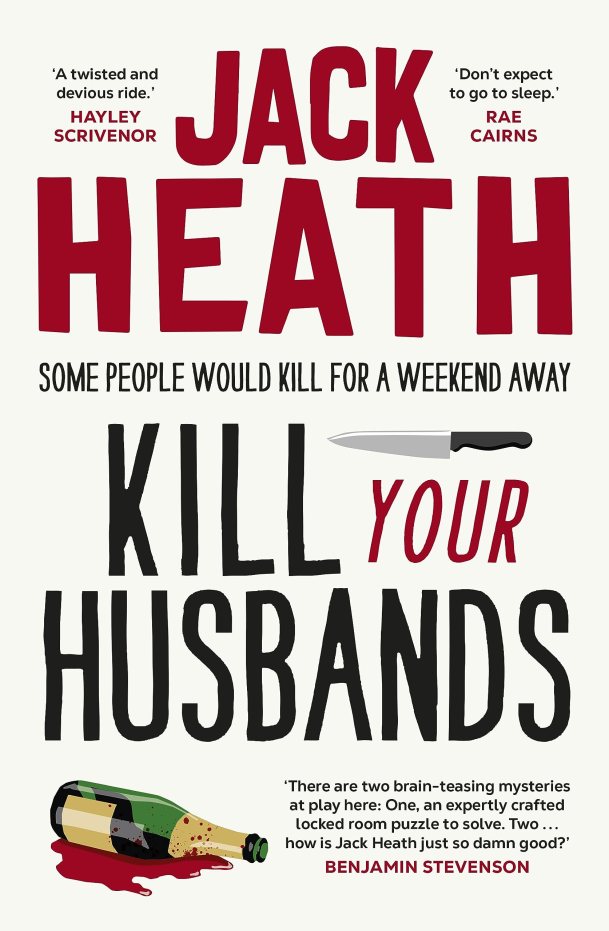
Kill Your Husbands by Jack Heath

Kill Your Husbands Cover

Publisher: Allen & Unwin Australia (Trade Paperback – 28 November 2023)

Series: Kill Your Brother – Book Two

Length: 384 pages

My Rating: 4.75 out of 5 stars

Amazon

One of my favourite Australian authors, the scarily good Jack Heath, returns with another twisted and brilliant thriller, Kill Your Husbands.

Easily one of the best Australian thriller authors at the moment has to be the always impressive Jack Heath.  Hailing from my hometown of Canberra, Heath has written a compelling range of epic thrillers over the years, all of which have been fun and captivating in their own way.  I am a major fan of his Timothy Blake series (check out my reviews for Hideout and Headcase), which follows the gruesome adventures of a murder-solving cannibal.  Heath has also produced several other great standalone or Australian series, including his 2021 novel, Kill Your Brother.  An intense and shocking thriller that forced a highly damaged protagonist to choose between killing her guilty brother or dying herself, Kill Your Brother was one of the best pieces of Australian fiction in 2021 and I had such a great time reading it.  As such, when I saw that Heath had a new Australian thriller coming out this year, I was very excited, especially when I found out it was a sequel to Kill Your Brother.  This new book, Kill Your Husbands, had a wicked plot synopsis, and I fell in love with it the moment I read it.  One of my most anticipated books for the second half of 2023, Kill Your Husbands was a shocking read that I had so much fun with.

It was supposed to be a relaxing weekend away for three couples, longtime friends since school the six overworked and stressed adults decide to escape their taxing lives for a weekend up in the mountains.  With no internet or cell reception, their getaway was supposed to be a quiet time of drinking and bushwalking.  However, after the topic of partner-swapping is raised on the first night, the entire mood of the weekend shifts.  What starts as a joke soon turns into an elaborate plan to ensure anonymity between partners, with the lights turned off and the men choosing a bedroom at random.  No one will know who they’ve been with, and no one will ever be certain if they slept with anyone other than their spouse.

However, when the lights come back on, one of the participants is missing.  A search soon reveals their body outside, clearly the victim of a violent attack.  With no cell reception and the keys to the cars missing, the remaining five people quickly become suspicious of the other survivors.  As the weekend continues and more people begin to disappear and die, old wounds, festering grudges and decaying relationships come to the fore, turning husbands against wives and friend against friend.

Two weeks later, Senior Constable Kiara Lui returns to the murder scene with her girlfriend, Elise.  Having interviewed the survivors, Kiara is certain at least one of them is lying and the killer is within her grasp.  Kiara knows that the answers lie within the house, but with strange occurrences occurring around the property, one person still missing, and her own girlfriend’s strange behaviour starting to concern her, can Kiara break through all the lies and secrets and find the truth before the killer strikes again?

This was another excellent and thrilling read from Heath, who pulls together another insane, yet highly clever, mystery that you really cannot put down.  Making full use of Heath’s outrageous plot, Kill Your Husbands is a dark and twisty novel that I had so much fun reading and which is easily one of the best pieces of Australian fiction I have read all year.

I loved the unique, memorable and very twisted central idea that Heath came up with for Kill Your Husbands, as murderous partner swapping is honestly it was one of the more amusing and outrageous plot focuses I have seen.  Starting off with a quick introduction sequence, the reader is soon enthralled in split focus narrative throughout Kill Your Husbands as half the chapters recount the weekend of the murders and the events leading up to the killings, while the rest of the chapters are set after the murders and focus on Senior Constable Kiara Lui, a supporting character from Kill Your Brother, as she attempts to solve the crime.  This proves to be a very clever and impressive way to showcase the plot, and I loved the simultaneous look at the investigation, the weekend in question, and all the key events that led up to the crime.  Both separate storylines are very interesting and compelling in their own way, especially as they paint two different pictures of the chaotic events in question.  Thanks to Heath using first names during the chapters set in the past and only referring to surnames when it comes to the later investigation, you don’t get any spoilers about what is going to happen during the weekend.  As such, it isn’t until the end of the book that you are completely certain about who dies and who survives, and this allows you to remain on the edge of your seat as your watch the chaotic events unfold.

Heath paces out both arcs of the story extremely well, and they work well together to tell an intriguing and powerful story.  The scenes set in the past tell a powerful and character-driven tale, with flashbacks to prior interactions, details about their turbulent relationships, and a great range of petty slights that ensure everyone had a motive for killing the rest of the group.  Heath ensures that the characters are all stewing in this during the early chapters in the mountain before the partner swapping scene occurs.  The author sets this up perfectly, with the subterfuge, secret plans, and hidden desires all coming into their choices, and the resulting chaos sufficiently messing with them.  As such, all of them are primed to be the killer when the first victim emerges, and the subsequent environment of fear, suspicion and hatred make for some outstanding scenes, especially when all their secrets come to light.

At the same time, the reader gets a fantastic look at the ongoing investigation being undertaken by Kiara as she tries to get to grips with the case.  There are some great scenes here, especially as Kiara independently uncovers the secrets of the three married couples, which works into the other timeline extremely well.  There are some fun moments in this part of the investigation, especially when Kiara and Elise make the interesting decision to book out the murder house for a holiday so they can try and find some answers, while also dealing with their own intense personal issues.  While there are some excellent moments in this part of the book, the investigation angle of Kill Your Husbands is the weaker half of the novel, mostly because it lacks the juicy details the lead up to all the murders.  I also didn’t think that Heath needed to shoehorn in the characters from Kill Your Brother into the plot, as fresh new police protagonists would have also been just as effective.  Still this second half of the book was very fascinating, and the clues revealed within give you some great hints about who the killer is and how they got away with it.

The eventual solution for Kill Your Husbands is exceedingly clever, and I really liked how all the key events of the book played out.  The climax of the murderous weekend is pretty damn shocking in its entirety, and I loved just how well Heath managed to keep secret who survived and who died right until the end.  The killer’s motivations and the events that drove them to it are well set out, and the scenes where they commit their crimes really drive home just how dangerous they are.  Certain other reveals towards the end of the book, especially when Kiara gets close to the truth, reveal just how clever this entire story is, and I loved how certain innocuous mentions or clues are well utilised later in the story.  The entire solution of the book, as well as the final confrontation between Kiara and the killer are just perfect, and you will come away from Kill Your Husbands extremely satisfied after travelling through such a captivating, unique and brilliant mystery.

This elaborate story and murder mystery wouldn’t be possible without the great characters featured in Kill Your Husbands.  I particularly loved the six friends who journeyed to the cabin and who end up being pulled into the deadly partner swapping/murder plot.  Heath does a wonderful job of effectively introducing them and you get drawn into their complex lives, filled with emotional damage and occasionally petty problems.  While you do feel sorry for some of the characters, most of them are somewhat despicable and unlikeable to a degree, which ensures that are highly interesting and fun in the context of the main murder.  I loved how many personal issues and secrets came out as the story progressed, and you really get invested in seeing who the killer is, possibly more than finding out who survived.  I loved how fun and interesting these main characters where and Heath did such a great job featuring him in this crazy story.

The other major characters are Senior Constable Kiara Lui and her girlfriend, Elise, who serve as the main figures in the investigation arc of the book.  As I mentioned about, Kiara and Elise both appeared in Kill Your Brother, with Elise serving as the main character of that novel.  However, Elise takes more of a backseat here with Kiara stepping up and leading the investigation.  While I don’t think Kill Your Husbands really needed some of the drama and ongoing trauma surrounding these characters, I did enjoy seeing them still together after the events of Kill Your Brother, and I liked how Heath moved Kiara more to the fore in this book.  Kiara was a badass investigator, and it was great to see her try to prove herself while also still concerned about her clearly traumatised girlfriend.  For her part, Elise is still trying to prove herself after her controversial past the helpless position she found herself in during the events of Kill Your Brother.  As such, she takes some big risks and acts very recklessly in this book, often to the detriment of Kiara’s investigation or emotions.  This extra layer of emotional charge ensured that Kill Your Husbands’ plot was a little more convoluted and intense, and I did enjoy seeing these two characters again.  That being said, you don’t need to have read Kill Your Brother to full appreciate these characters in this sequel, and you can get the full range of emotions from reading Kill Your Husbands as a standalone read.  I honestly came away from Kill Your Husbands very impressed with how Heath introduced and utilised his characters and they were such a distinctive and fun group of figures who were perfect to get wrapped up in a murder.

Overall, Kill Your Husbands was another outstanding and compelling novel from Jack Heath, who continues to show why he is the master of crazy Australian crime fiction.  Heath had a lot of fun with his outrageous plot and the way he worked his excellent and damaged characters into this complex murder mystery was very impressive.  A captivating and dark read from start to finish, Kill Your Husbands is one of the most memorable and intense Australian thrillers of 2023 and Heath is a must-read author for anyone looking for some truly shocking and mental crime fiction.

Amazon

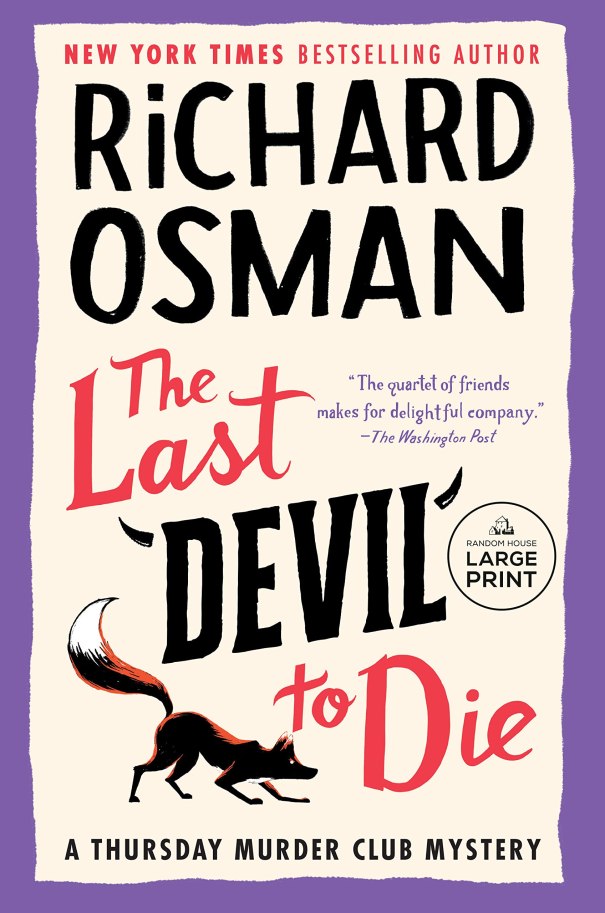
The Last Devil to Die by Richard Osman

The Last Devil to Die Cover

Publisher: Penguin Audio (Audiobook – 12 September 2023)

Series: Thursday Murder Club – Book Four

Length: 10 hours and 50 minutes

My Rating: 5 out of 5 stars

Amazon

The exceedingly talented and amazing Richard Osman returns with another exceptional entry in his acclaimed Thursday Murder Club series, with the entertaining and emotionally rich The Last Devil to Die.

Over the last few years I have been blown away by the incredible Thursday Murder Club novels, the debut series of British television personality Richard Osman.  This amazing series follows four residents of a retirement village who solve murders as the Thursday Murder Club.  Featuring a perfect blend of gripping mystery, brilliant and likeable characters, a fantastic sense of humour and a certain amount of tragedy, the series has been a real joy to read.  This includes The Thursday Murder Club (one of my favourite books, debuts and audiobooks of 2020), The Man Who Died Twice (one of my favourite books and audiobooks of 2021), and The Bullet That Missed (one of my favourite books and audiobooks of 2022), each of which got full five-star reviews from me.  As such, I have been eagerly awaiting the fourth book in this series, and The Last Devil to Die was one of my most anticipated books for 2023.  Unsurprisingly, Osman did not disappoint and presented another compelling and highly addictive read that I absolutely adored.

Elizabeth, Joyce, Ibrahim and Ron are the Thursday Murder Club, four bored and bright retirees living at Coopers Chase retirement village, spend their spare time keeping busy with an unusual hobby, solving murders.  Already responsible for bringing several crooks to justice, the club hope to enjoy a nice Christmas without any deaths.  However, murderers are rarely so considerate, and the four friends soon find themselves involved in a complex case that hits close to home.

Antiques dealer Kuldesh Sharma, an acquaintance of the group and an old friend of Elizabeth’s husband, Stephen, has been found shot dead on a dark country lane, apparently the victim of a professional hit.  Determined to get justice for their friend, the club and their associates jump into action and begin their usual unconventional investigation.  Their prying soon uncovers connections between Kuldesh and a local gang of drug importers who were using Kuldesh’s shop as cover for one of their deals.

It quickly becomes apparent that Kuldesh’s death is related to a box of heroin that was in his possession and which has since gone missing.  To find Kuldesh’s killer, the members of the club will need to discover where the heroin is hidden, as well as why Kuldesh decided to steal it.  Their investigation will take them into the dark world of drug dealers, art forgers and stolen antiquities, and force them up against several different groups of criminals each searching for the same prize.  Can the Thursday Murder Club once again solve the case before the murderer escapes, especially when an even greater tragedy waits on the horizon?

This honestly might be one of the very best books I have read all year.  Osman, who I have extremely impressed with in recent years, did a remarkable job with this fourth entry in the series, producing another superb and emotionally charged novel with a clever mystery around it.  Thanks to some high-intensity inclusions and some brilliant character work, The Last Devil to Die is easily one of the strongest entries in this entire exceptional series, and I was hooked the entire way through.  This latest book gets an easy five-star rating from me, and I doubt I will ever forgive Osman for everything I was forced to feel while getting through it.

The Last Devil to Die has an outstanding story behind it, and I was once again deeply impressed by how Osman effortlessly combines an elaborate mystery with intriguing character driven storylines.  The book starts with Kuldesh Sharma, who appeared in the prior novel, getting murdered apparently over a missing box of heroin.  This quickly sets off the new investigation, and the protagonists and their continuously growing group of associates utilise their usual unorthodox methods to get a good picture of events and pull together a group of unusual suspects.  Of course, it doesn’t take long for the case to go in some very interesting directions, especially with extra murders and a segue into the world of antiquities forgeries.  I really got caught up in the intriguing mystery, especially as there are some great complexities, an array of fun professional villains, and some highly entertaining encounters, including a remarkably fun lunchtime meeting with all the suspects.  At the same time, I was also there for the characters, as Osman dove into their unique lives and provided some fantastic development.  However, one major piece of character development proved to be the most compelling part of the entire book and really knocks you for six with a major event around two-thirds of the way through.  This bit of development has been building for the entire series, but when tragedy finally hits you are not ready and it strikes you very hard in the feels.  I honestly was near tears at parts of the book, it was that damn sad, and Osman works to ensure that every major character is affected in a noticeable and gloomy way.

Following this major event, Osman moves towards solving the various murders featured within the book.  This last part of The Last Devil to Die is noticeably more subdued, which was honestly very fitting and completely understandable.  Despite this darker tone, the reader is still very invested in the plot, especially as a solution to the mystery promises to bring some much-needed emotional relief.  Osman delivers this in spades, and there are several clever and thoughtful solutions chucked in as a result.  While I saw a few reveals coming, the way the characters solved the compelling case was impressive and quite brilliant.  Several subtle and well-placed clues were masterfully exploited, and the way that Osman hid them in plain sight is exceedingly clever.  The solutions to the other killings were great as well, especially as they tied into a fun longer-running storyline around a secondary character, and I loved how many of the villains got an appropriate reward for their deeds.  The conclusion of the plot is very well handled, and the reader comes away from The Last Devil to Die both highly satisfied and very sad, much like the protagonists.  This was such a brilliant and moving narrative, and Osman does a wonderful job of fitting in his mystery while wrapping up several long-running narrative threads.

Just as he has with the previous novels in the Thursday Murder Club series, Osman backs up his excellent story with some top-notch writing that drags you in with its tone, subtly and entertainment.  The Last Devil to Die features Osman’s typical exquisite blend of mystery, humour and character development, which is expertly featured in every scene.  While the main mystery is great, watching the brilliant characters grow as they solve it in the most entertaining way is so much fun, and you will be glued to the book as you go.  The comedic charm of a Thursday Murder Club novel is very subtle and undeniably British, but it constantly flows into every scene, with the restrained and often topical jokes and observations of the characters working well with the other story elements.  This includes a large amount of sombre and darker moments, as many of the characters experience a certain amount of tragedy, especially related to the woes of getting older.  Osman honestly turns the heartbreak up to 11 in certain parts of The Last Devil to Die, and readers are in for some powerful emotional blows in this novel, which works both in the context of this single novel but the series as a whole, as it cleverly builds on prior events from the earlier books.  Due to this, I would strongly recommend that readers start the series back at the first book, rather than diving into The Last Devil to Die first, as it will allow you to get the full emotional impact.  However, Osman does ensure that The Last Devil to Die is open enough for new readers to experience, and they honestly will not be spared from the feels either.  Osman does such a good job wrapping together the hurt with the humour, and the emotional combination really strengthens both the character arcs and the mystery elements of this outstanding read.

While the story, mystery and humour are all outstanding parts of The Last Devil to Die, without a doubt the high point of any Thursday Murder Club novel are the characters.  Osman has an incredible knack for producing compelling, delightful, and impressive characters who you cannot help but fall in love with.  Thanks to his split between different perspective characters (which includes a change in writing style for Joyce’s journal entries), you get to see so many different angles of this mystery, and I loved the amazing personal arcs that emerged as well.  Osman does a great job of balancing the narrative between the many characters featured in the novel, including the recurring protagonists from the previous books and several new intriguing figures.  These characters form the emotional heart of The Last Devil to Die and Osman really amps up the feelings, tragedy and love for this latest book to produce an exceptional and memorable read.

At the centre of the story are the members of the titular Thursday Murder Club: Elizabeth, Joyce, Ibrahim and Ron, four cheeky and brilliant retirees who pass their time solving murders.  Osman has done such a good job setting these characters up as a group throughout the previous books, and they each have a well-defined role in the group, with Elizabeth the hard-nosed former spy serving as leader, Joyce the loving grandmother figure who is a lot more devious and strong then people realise, Ron the tough larrikin who is starting to come to terms with his feelings, and Ibrahim the sensitive soul who can connect with everyone.  These fantastic characters prove to be the usual dedicated and brilliant investigators, and it is always fun to see them utilise their unique skills and their old age to solve their crime.  Much of the book’s humour is derived from them leveraging their advanced years and apparent helplessness to trick or manipulate the younger suspects, and I always enjoy their direct and hilarious take on crime solving.  However, while there is a certain humorous element around these characters in The Last Devil to Die, certain significant events throw them into an emotional tailspin and watching them become unstuck and devastated really hits the reader hard.

Elizabeth in particular is hit the hardest and this is honestly the most significant novel for her, especially as the great tragedy she has been expecting for the entire series finally comes to pass, and your heart hurts at seeing such a strong character broken down so much.  Joyce proves to be the emotional rock the novel, stepping up when the others are down and trying to keep the investigation going.  I loved seeing Joyce the leadership role, and watching her come out of her shell proves to be quite heartwarming in light of other tragedies.  Ron probably gets the least amount of focus in The Last Devil to Die, but he still has his moment to shine throughout this book.  Not only does he have one of the funniest scenes when he has to pretend to be traumatised at discovering a body, but his chaotic romantic relationship raises some fun questions about when Christmas gifts should be opened.  I also deeply enjoyed Ibrahim’s character focus, not only because of his warmth and insights, but because of his unusual friendship with imprisoned criminal Connie Johnson and his fantastic patter with Ron.  Osman also finally reveals some secrets about Ibrahim’s past that have been hinted at in previous books, and I loved the extra layer of understanding about Ibrahim that results.  Each of these main characters are so well featured and their emotional struggles prove to be such an important part of the plot and help to turn The Last Devil to Die into in a very powerful and moving novel.

In addition to the main cast, Osman’s ever expanding collection of supporting characters were very well featured in The Last Devil to Die, and while they are primarily there to assist the main characters with their investigation, the author always takes the time to develop some intriguing and heartfelt storylines around them.  This includes the duo of DCI Chris Hudson and PC Donna De Freitas, who find themselves once again competing against their retiree friends to solve the case, despite their futile attempts to keep them out of trouble.  While many of their scenes are played for laughs, especially as they get exasperated trying to stop the club members, they add in a good official police presence and move the story along in some interesting ways.  There is also a continued focus on their personal lives, especially as they have both found true happiness thanks to the events of the prior books.  Cocaine queen and jailbird Connie Johnson proves to be another great recurring figure here, especially as much of her story deals with her simultaneously manipulations of Ibrahim and her attempts at rehabilitations.  Her scenes opposite the team’s psychiatrist are pretty hilarious, and it’s going to be fun to see how her storyline continues.  The always dependable Bogdan is also a fantastic presence in The Last Devil to Die, and I loved how he proves to be both a supportive partner to Donna and a reliable assistant in Elizabeth’s attempts to undermine the police.  Bogdan is also hit emotionally hard in this book and you really have to feel for this wonderfully written character who has the body of a thug and a heart of pure gold.  Throw in several great new antagonists, an unpopular elite police officer and several entertaining new residents at Coopers Chase, and this proves to be an amazing book when it comes to supporting characters.

However, the character I need to talk about the most is Elizabeth’s academic husband, Stephen, who honestly has been one of the strongest and saddest figures in the entire series due to his growing dementia.  A caring and intelligent figure, despite his ailment and his wife’s attempts to hide him from the world, Stephen is such an impressive character you honestly cannot help but fall in love with.  It is always so tragic to see Stephen slowly lose his mind while Elizabeth’s heart breaks next to him, and I really appreciate how well Osman portrays the complexities of dementia when it comes to this figure.  Despite that, he proves to be an essential part of the plot, and his insights into his friend have some major impacts on the case, even if you do not realise it at the time.  Osman also makes sure to enhance the misery around Stephen again in this book, especially as he finally becomes aware of his condition in one of his lucid periods, and the resulting scenes are so damn moving and emotional as a result.  Everything about Stephen in The Last Devil to Die, from his continued warmth, his love for Elizabeth even when he doesn’t know who she is, his sad friendship with a local fox, and his journeys back inside the past of his mind, is handled perfectly and powerfully, and he honestly steals every moment he is in.  Stephen steals the show in his own way in The Last Devil to Die, but honestly every character in this book is pretty exceptional, and you will find yourself falling in love with them again, even if it breaks your heart.

Due to my previous experiences with this series, I chose to check out The Last Devil to Die on audiobook, rather than reading the physical copy I received.  Coming in with a runtime of just under 11 hours, this is a relatively quick audiobook to get through, especially once you get caught up in the story, which you definitely will.  I find that the audiobook format is pretty damn good at getting so many elements of Osman’s story across, including the characters, the powerful emotions and the fun humour, and you really will have a hard time turning off this audiobook of as a result.  It also definitely helps that they keep getting such awesome narrators in to read these books.  The first two entries in the series were narrated by Lesley Manville, who did such a great job bringing the characters to life, especially Joyce.  Unfortunately, Lesley left after narrating the first two books, which I was initially sad about.  However, they did a really good job of replacing her in the third audiobook with acclaimed actress Fiona Shaw, who also returns for The Last Devil to Die.

Now I was already a fan of Fiona Shaw before her work here, and I think she was honestly the best possible replacement they could have gotten for Lesley Manville.  Utilising her trademark Scottish accent, Shaw hits the story with a soft and gentle voice that perfectly fits the more relaxed tone of these murder mystery novels.  These gentler tones are excellent at conveying the unique humour and emotions of the Thursday Murder Club books, and I really got enveloped by the powerful story as a result.  Shaw also does an outstanding job voicing each of the brilliant characters featured within this book and I have a lot of love for the vocal choices she makes here.  Now, while there is a little difference between Shaw’s performances and the previous audiobooks with Manville (Manville is a natural Joyce, while Shaw more of an Elizabeth), Shaw really keeps the magic from the first two books going.  She does a great job of matching many of the key voices Manville originally used, while also adding her own flairs to make the characters her own.  I really loved how effortlessly Shaw slipped into the various members of the cast, and this honestly helps you fall in love with all the characters and the story as a whole.  This entire audiobook honestly comes up pretty perfectly, and there is even a fantastic and cosy chat at the end between Osman and Shaw discussing the series.  As such, I would strongly recommend the audiobook version of The Last Devil to Die to anyone interested in checking out this novel, and it is easily the best way to enjoy this fantastic series.  One of the best audiobooks of 2023!

Look, I could go on about how good The Last Devil to Die is, but the bottom line is that this was an exceptional read and one of the best entries in the already great Thursday Murder Club series.  Richard Osman did a wonderful job of producing an elaborate and compelling book that featured both an amazing mystery, and some outstanding character work.  Funny and tragic in equal measures, and with some of the most emotionally charged scenes of 2023, The Last Devil to Die was an incredible book from start to finish and I cannot recommend it enough.  This fantastic book is going to top all my end-of-year best of lists and I cannot wait to see what Osman releases next.

Amazon

Cave 13 by Jonathan Maberry

Cave 13 Cover

Publisher: Macmillan Audio (Audiobook – 29 August 2023)

Series: Rogue Team International/Joe Ledger – Book 3/13

Length: 19 hours and 5 minutes

My Rating: 5 out of 5 stars

Amazon

One of my favourite twisted authors returns with an outstanding new entry in one of his best series with Cave 13 by Jonathan Maberry.

It has already been a massive year for fans of thriller/horror author Jonathan Maberry, who previously released the exhilarating and intense dark fantasy novel Son of the Poison Rose.  The awesome sequel to Kagen the Damned (one of my favourite novels and audiobooks of 2022), Son of the Poison Rose was one of my favourite books and audiobooks from the first half of the year, and if that had been the only Maberry novel I’d received in 2023 I would have been content.  However, Maberry chose to spoil us by providing us with another epic Joe Ledger novel, which is so damn amazing.

The Joe Ledger novels are an amazing science fiction thriller series that follows titular protagonist Joe Ledger as he attempts to stop a series of insane world-ending threats initiated by compelling group of villains.  The initial Joe Ledger series featured 10 epic books with some outrageous and addictive stories around them, including Patient Zero, The Dragon Factory, Code Zero, Predator One and Deep Silence, just to name a few.  Maberry followed up these novels with a new Joe Ledger focused series, the Rogue Team International books.  This series has so far featured Rage (one of my favourite books and audiobooks of 2019) and Relentless (one of my favourite books and audiobooks of 2021), both of which were pretty exceptional in their own ways.  As such, I have been quite excited to see a new Rogue Team International book and Cave 13 was one of my most anticipated books for 2023 as a result.

To many, Jason Aydelotte, better known to the world as Mr. Miracle, is a smiling and beatific public figure celebrated for his archaeological endeavours and his vast antiquities business.  However, beneath the smiles, Mr. Miracle is a far more ruthless and sinister operator.  Smart, determined and ambitious, Aydelotte has entered the world of international arms dealing and is willing to sell his advanced weapons to anyone who will buy them, including ISIS, and his latest product might be the scariest thing ever created.

Thanks to discoveries made in a hidden ancient Egyptian tomb, Aydelotte’s team has developed a powerful new bioweapon that drives its victims insane with a mere breath.  Its effect is terrifying and its potential for destruction in the wrong hands is immeasurable.  With the world going insane and chaos rising in the Middle East, the only people who might be able to stop such a potent weapon are Joe Ledger and the highly specialised agents of the independent intelligence agency, Rogue Team International.

However, the release of a deadly bioweapon soon proves to be the least of Ledger’s problems in the Middle East.  Far more dangerous materials were recovered from the tomb, including bizarre books of magic dating back to the time of Moses.  At the same time, greater secrets have been pillaged from a hidden cave containing even more Dead Sea Scrolls, some of which could alter the very fabric of the universe.  With threats piling up all around them, and enemies on all sides engaging in their own dangerous plots, can Ledger survive both the carnage and his own fractured mind to save the day, or will a new ruthless opponent destroy everything?

Cave 13 was another outstanding and captivating Joe Ledger adventure from Maberry that sets his troubled protagonist against another brilliantly elaborate world-ending plot.  Slick, intense and loaded with complex characters, Cave 13 was an amazing read that gets an easy five-star rating from me, especially in its audiobook format.

Maberry produced another unique and compelling story for Cave 13 that is once again perfectly told in his unique writing style.  Utilising a vast number of shorter chapters, Maberry quickly starts the story off, reintroducing the protagonist and his team, while also setting up the compelling antagonists and their complex evil plan.  A series of well-placed and absolutely fascinating interludes throughout the book provide greater context to the events that are about to unfold, and you get to see the entire genesis of the antagonist and their plans, which adds a lot to the overall story.  Maberry artfully blends this together with the main storyline that sees Ledger and his team investigate several unique occurrences, including conflicts in the Middle East, increases in unique weapon trafficking, the recovery of the Dead Sea Scrolls, as well as mysterious events that could only have been done by certain biblical magic (“you’re playing with the big boys now”).  The intriguing blend of science, mysticism, faith and mystery gives Cave 13 a particularly fun edge, and I really liked the intriguing set-up surrounding the antagonist’s plot and its full potential for destruction. At the same time, the author also dives back into the complexity surrounding his protagonist’s damaged psyche, and how this new case might affect it.

While I loved all the set-up in the first third or so of the novel, it does ensure that the initial plot is a tad slower.  This changes once Ledger and his team arrive in Israel and find themselves under attack in a particularly brutal action sequence right off the bat.  Maberry’s action scenes are always extremely awesome, and you have to love the attention and detail he puts into making them as intense as possible.  This cool action sequence is well balanced at this point by some further background, as well as a compelling sequence of events surrounding recurring side-character Toys, who finds themselves at a different side of the conflict following an undercover operation gone wrong.  This part of the story, especially the twist about the antagonist’s true plan, really increases the stakes and intensity of the story, and Maberry has a lot of fun creating some intense visual horrors for the readers, especially when it comes to a series of twisted and brutal hallucinations.

The final third of Cave 13 is probably the strongest part of the book, and I honestly was hooked the entire way through, desperately trying to get to the end.  All the great set-up, intriguing interludes, and multitudes of well-established characters comes together for the big confrontation at the end as the antagonist’s plan goes full circle and Ledger and his team once again find themselves in hell.  Things get so damn dark, desperate and freaky at this point in the book, and you are left completely worried about all your favourite characters as Maberry doesn’t have the best track record of keeping likeable cast members alive.  There are some brutal scenes here, as well as a ton of tragedy, and the reader is left on the edge of their seat right until the very end.  While I came away from parts of this book a bit shellshocked, I was overall very happy with the conclusion, which was dark, had a good twist around the villain, raised a lot of questions about the protagonists, and left you with a little ray of hope that will no doubt get snuffed out in the future.  An overall pretty epic story that really came to life in Maberry’s hands, especially thanks to his unique set out and brilliant ability to write an action sequence.

Cave 13 ended up being quite an interesting Joe Ledger novel, especially as it presents a great story and the first original villain of the Rogue Team International era, while also cleverly diving into the prior events of the series and utilising them to enhance the characters and narrative.  I really enjoyed the step away from the villains of Rage and Relentless for this one book, although I also appreciated how well the author examined the aftermath of these novels and the dark things they’ve done to the protagonist.  Like most of the Joe Ledger books, Cave 13 can be read as a standalone novel, and Maberry does a good job of recapping all the relevant prior events and characters to ensure that new readers can fully understand and appreciate everything going on.  However, established fans of Maberry are going to get the most out of Cave 13, and there are a ton of unique hints or suggestions about what is to come.  I found it particularly interesting that Maberry chose to include multiple scenes in Cave 13 that were clearly intended to set up certain events for future entries.  While these scenes are a tad disjointed from the main story, I won’t lie and say it didn’t make me excited for the next book in the series, especially when it comes to those hints about certain villains returning.  I was a little less impressed that several storylines or mysterious events from Cave 13 were deliberately left unanswered by Maberry, but I guess I’ll just have to wait and see what happens with them in the next exciting Joe Ledger novel.

As with all Maberry’s work, one of the main highlights of Cave 13 was the excellent and complex characters.  Maberry features a pretty massive cast in this novel, including a range of recurring figures from the previous novels, as well as several intriguing new figures who I really enjoyed.  As usual, Maberry does a remarkable job of showcasing all his characters, diving into the compelling histories and minds, and showcasing just how crazy or morally dubious they are (you have to be in order to survive in this universe).

Naturally, the most prominent character is protagonist Joe Ledger, who has been the leading figure and main point-of-view character in this series since the beginning.  An unstoppable action man and natural leader, Ledger is always a fun character to follow, especially as Maberry installs an overwhelming level of snark and disrespect in his personality, ensuring that every scene he’s in is full of quips, jokes and very funny observations about the crazy things he encounters.  While this alone makes him a great character, and the source of much of Cave 13’s humour, Maberry ensures that Ledger is one of his most complex protagonists ever due to the sheer amount of trauma the character experiences.  Ledger has gone through so much damage, darkness, loss and despair during the course of the series, and Maberry spends a substantial part of the protagonist’s chapters diving into this, showcasing just how emotionally and mentally battered Ledger is.  While I always love how effectively Maberry showcases the building trauma surrounding his character, it is even more poignant and important in Cave 13, as this is Ledger’s first adventure since the events of Relentless, where Ledger was taken over by a murderous personification of his own inner darkness and went on a deadly revenge trip.  Some of the most emotionally powerful parts of the book revolve around Ledger and his friends coming to terms with his terrible actions in the last book, and it is clear that Ledger has been extremely changed by the events of the prior book.  Naturally, Maberry decides to twist the knife even further in Cave 13 by subjecting Ledger to a series of traumatising visions and hallucinations thanks to the book’s big bioweapon.  This drives Ledger even further over the edge, and there are some fascinating and highly revealing scenes that give you further insights into just how cracked this protagonist is and the dangers lurking just beneath his mental surface.  Honestly one of the best and most compelling action protagonists out there, I really love how Maberry showcases Ledger in this gripping novel.

In addition to Ledger, Cave 13 features a range of other compelling characters who get their moment to shine.  My favourite would have to be the always mysterious Mr Church, the head of the secretive Rogue Team International.  A highly elusive and deadly figure whose origins and full capabilities are only hinted at; Church is easily one of the best characters featured in the entire series.  Maberry makes exceptional use of Church in Cave 13, and there are so many more tantalising hints about who or what this character might be.  This actually proves to be one of the most substantial Church novels in the entire series, and Maberry goes out of his way to not only show that this seemingly unstoppable figure is actually vulnerable, and is in some ways just as much of a bastard as the book’s villains.  There are several amazing and highly powerful monologues from Church in Cave 13 that give you some fascinating insights into his mind, especially when it comes to Ledger and the constant war that he and Church are fighting, and I loved getting an idea of just how ruthless this figure can be.  Several of these monologues are delivered to another awesome figure in Cave 13, the team’s psychiatrist, Rudy Sanchez, a notoriously calm figure who finally loses his cool in this novel after Ledger goes back into the field, straining their relationship.  I loved seeing Rudy particularly passionate and angry in Cave 13, especially when he stands up to Church, and Maberry’s portrayal of his concern really helps to highlight just how much damage was done to Ledger in the previous book.

Another major figure from Cave 13 that I need to highlight is the intriguing figure of Alexander “Toys” Chismer.  A former villain turned repentant ally, Maberry set Toys on a redemptive arc several novels ago, and it has been really paying off as Toys has turned into a fascinating figure trying to atone for his past.  His impressive long-running storyline is extremely well featured in Cave 13, and indeed he is one of the major protagonists, leading his own team and experiencing some substantial additional trauma.  Toys honestly has one of the darkest and most impressive character arcs in the entire novel, and the scenes he shared with Ledger are particularly moving and play into their complex antagonist history perfectly.  The various recurring members of Rogue Team International are well featured again in Cave 13, and it was fascinating to see how some of their character arcs have developed over the course of 13 novels.  My favourite fuzzy assassin, Ledger’s dog, Ghost, was of course awesome in this book, and I always loved just how in touch with his human’s emotions Ghost is.  There was even an intriguing extended cameo from F. Paul Wilson’s iconic protagonist, Repairman Jack, who Maberry utilises extremely well in Cave 13’s story, simultaneously working them into the plot while also diving into the Repairman’s unique life in his own series.

Finally, I must highlight some of the villains in this book.  Maberry always excels in creating complex and insane antagonists for each of his novels, and Cave 13 is no exception, as you are introduced to several intriguing villains who are set to unleash chaos upon the world.  I won’t give away too much about them and their plans here, but I will say that Maberry did an exceptional job of introducing them and diving into their various quirks, plans and desires, in some cases humanising them.  This actually helps to make them even more sinister as you start to understand and appreciate some of their actions, even if they are reprehensible.  I deeply enjoyed the complex examinations of each of Cave 13’s main villains, especially as the various interludes showcase their intriguing histories as well as the genesis of their current plans and schemes, allowing you to fully appreciate everything about them.  These villains, as well as a couple of seemingly returning antagonists hidden in the shadows, ensure that Cave 13’s stakes are always extremely high, and I loved how well the various complex character arcs mixed together to create an outstanding and powerful read.

As with every Jonathan Maberry novel I have so far had the pleasure of enjoy, I chose to check out Cave 13 on audiobook, which is the only way to enjoy one of Maberry’s epic tales.  Not only does the author’s awesome writing style and action sequences really come across well in the audiobook format, but the exceptional narration of acclaimed voice actor Ray Porter, who narrates all of Maberry’s projects, is so damn awesome.  Porter has such a brilliant handle on Maberry’s great characters, and it is always fun to hear the familiar voices of the main cast come out of Porter’s mouth again.  I particular love Porter’s take on main character Joe Ledger, as Porter always manages to capture the key parts of his personality, including the humour, mental instability and the pure rage contained within.  This, and other excellent performances, really helps to turn Cave 13 into an amazing listen, and I had such a brilliant time getting through it, and its 19-hour runtime just flew by.  Indeed, it really helped to ensure an extended road trip in an uncomfortable van was actually pretty tolerable, so kudos for that.  Easily one of the better audiobooks of 2023 so far, I cannot recommend this format enough to anyone wanting to check this epic novel out.

Unsurprisingly, I had fun with the latest Rogue Team International novel by Jonathan Maberry and it is always so damn epic to get another Joe Ledger adventure.  Cave 13 was a particularly awesome and intense entry in the series that expertly brings together an elaborate narrative, evil villains, exceptional action and complex character in an impressive overall read.  Fun, exciting and oh so darkly addictive, Cave 13 was a powerful and gripping novel that I cannot recommend enough, especially for established fans of Ledger’s amazing books.

Amazon

Throwback Thursday – Changes by Jim Butcher

Changes Cover

Publisher: Penguin Audio (Audiobook – 15 April 2010)

Series: Dresden Files – Book 12

Length: 15 hours and 26 minutes

My Rating: 5 out of 5 stars

Amazon

As promised in the previous posts for Small Favour and Turn Coat, this Throwback Thursday is a four-way special as I look at another epic entry in the exciting and fun Dresden Files series by Jim Butcher.  This review looks at the 12th entry in the series, Changes, which is one of the most intense and compelling books that Butcher has so far produced.

It is Harry Dresden’s darkest hour.  For years, Dresden has been Chicago’s only defence against the various mystical and monstrous threats that seek to destroy it.  His crusade to keep Chicago safe resulted in a deadly war between the White Council of wizards and the vampires of the Red Court, with Dresden firmly in the centre of the battle.  After years of fighting, the Red Court look set to launch their final killing blow, aimed directly at a weak spot Dresden was unaware he even had: his daughter.

Kept from him by his former lover, Susan Rodriguez, Dresden is shocked to discover that he has a child and that she has been kidnapped by a vengeful vampire noble.  Determined to get his daughter back no matter the cost, a reckless Dresden begins a new battle against the Red Court.  However, with the White Council unwilling to back him, Dresden has few options available to him as he is relentlessly hunted by agents of the Red King.

Injured, tired and desperate, Dresden will need all his most powerful allies to survive, but even the full might of Dresden’s most loyal friends isn’t enough to overwhelm the forces in front of them.  To succeed, Dresden may be forced to compromise everything he has ever believed in, especially if it brings him the tools and power he needs to save his daughter.  But the price demanded may be far more terrible than anything he could imagine.

Well damn, now this must be one of the most intense and powerful entries in this already outstanding series.  Butcher outdid himself with Changes as he wraps up several brilliant storylines while also taking his protagonist to the very edge in the worst ways possible.

Butcher provides a very powerful start to Changes, which places Harry in a dark position as he finds out that he has a daughter and that she has been kidnapped by Red Court vampires.  This expertly follows on from several long-running storylines around Dresden’s war with the Red Court (including those started Grave Peril and Death Masks), and it was really interesting to see an emotionally untethered Dresden trying to come to terms with having a child and the evils being done to them.  The first half of Changes is highly compelling, especially as Dresden faces attacks and obstacles he hasn’t seen before, with his office building getting blown up and increased interest from law enforcement in the city.  There are several great set pieces here, and Butcher quickly builds up the many threats surrounding Dresden as well as unprecedented stakes.

However, Butcher really saves the best for the second half of the book, as Dresden finds himself going down some dark roads to save his child.  After a particularly heartbreaking moment in the centre of the book, the weakened Dresden is forced to make a Faustian deal in one of Changes most powerful scenes.  However, this proves to be only the beginning as Dresden leads all his allies to the big final battle, which was something particularly impressive.  There are several outstanding fight sequences, including a magical pitched battle with everyone involved, and the ending sequence of the entire event is pretty dark.  There are losses, tragedies and massive changes featured here, and you really are left blown away by just how epic and brutal Butcher made everything.  However, that is only the beginning as, after a series of revelations and sacrifices, Butcher chooses to end Changes on a massive cliffhanger, one that is guaranteed to shock every Dresden Files fan and force them to dive right into the next book.

Changes is definitely one of the most impressive and expansive entries in the entire Dresden Files series, and it had me hooked the entire way through.  Thanks to the massive battles, intense and extremely epic action scenes, and the game-changing and emotionally charged moments where the protagonist is forced to make all the hard decisions, it honestly proves very hard to put Changes down and I loved how well Butcher wrapped up several long-running storylines while setting up key elements for some of the later novels.  This is one of the darker books in the Dresden Files series, although Butcher still manages to maintain a good amount of inherent humour and investigative focus.  I felt that the typical Dresden humour blended well with the more desperate and brutal parts of the book, especially as it helps to underline just how grim Changes becomes in places.  Unlike some of the previous books in the series, I would not recommend Changes as a place to start reading the Dresden Files books.  While Butcher provides his usual excellent recap of prior events throughout the book, there are way too many ongoing storylines and complex character moments featured here that you won’t get the full effect of unless you understand the full history of the protagonist and all he’s overcome.  This was honestly one of the better books in the entire series, especially with how much Butcher raised the stakes, and I love just how well the entire story came together.

Out of all the Dresden Files novels Changes has some of the best character moments in the entire series, mainly because of just how big events turned out to be.  Dresden, despite his attempts to keep his usual defiant humour intact, is emotionally wrecked time and time again in this book following the revelation that he has a daughter he didn’t know about.  Enraged, desperate and determined to not leave her alone like he was as a child, Dresden is forced into some very dark places to save her, and the resulting scenes where he sells his soul are very heartbreaking and emotionally charged.  A lot of these compromises come after he has been physically chopped away at throughout the book, and you can really understand why he is forced to make these decisions and just how much they cost him spiritually and morally to do so.  As such, Dresden spends a good chunk of this book unsure of whether he is making the right decisions, but he remains determined to do so all the same and would even go further if needed.  Despite this, Dresden still has the support of his friends, and it was great to see how they kept him grounded and certain that he was on the right path.  I particularly enjoyed the fun Lord of the Rings analogy that was revealed to him by his friends to show how they see him (he’s more of a Sam than a Gandalf), and Dresden’s concern that he might instead be a different, less heroic character from the series hits you right in the feels.  I may never forgive Butcher for how brutally and effectively he tugged at my heartstrings in Changes when it came to Dresden and this is probably one of the most substantial novels in the entire series when it comes to his character development.

Aside from Dresden, Changes features a great range of supporting characters, many of whom return to help the protagonist in his hour of need.  A lot of focus went into Susan Rodriguez, Dresden’s former lover and the secret mother of his child, who has struggled with her vampiric corruption since the third book.  While there is a certain amount of resentment towards her for her actions, you can completely understand why Susan might try to keep her daughter away from both herself and Dresden, which is honestly heartbreaking.  Butcher does a great job of featuring Susan again here after a lengthy absence, and I felt that he wrapped up her storyline and the relationship she had with Dresden really well.  Several other characters get a great showing in Changes, with Murphy becoming a literal Holy Knight for one particularly glorious sequence and Dresden’s apprentice Molly really showcasing her skills and her emotional vulnerability.  I also must mention one of my favourite characters, Dresden’s dog, Mouse, who continues to be one of the best figures in the series, especially here where he reveals more of his supernatural potential and his actual intelligence.  The scene where you can hear him talking is just hilarious, especially as Mouse has a very different view about his relationship with his human.  These characters and more really help to turn Changes into one of the most emotionally charged books in the entire Dresden Files series, and I loved seeing each and every one of them.

As has been the recurring theme with the Dresden Files, I checked out Changes on audiobook, which was another epic listen.  Narrator James Marsters can do no wrong with this audiobook, and with a runtime of 15.5 hours, you will find yourself quite engrossed with this elaborate tale.  Thanks to Marsters’s exceptional narration, I absolutely powered through this audiobook, and I loved the sheer emotion and power he brought to the production.  The epic set pieces were particularly cool in this audiobook, and I loved how well the climatic battles came across in this format.  As a result, Changes is definitely best enjoyed as an audiobook and I cannot recommend this format enough.

Unsurprisingly, Changes also gets a five-star rating from me and it was honestly one of the most impressive Dresden Files novels that Butcher has written.  The powerful character work and brutal story had me hooked the entire way through, and it honestly has some of the most significant moments in the entire series.  In fact it was so good that it instantly made me start listening to yet another Dresden Files novel, Ghost Story (that cliffhanger at the end left me no choice), which I am also reviewing today.  This is an exceptional read that once again shows why Butcher is such an incredible author.

Amazon

Throwback Thursday – Small Favour by Jim Butcher

Small Favour Cover

Publisher: Penguin Audio (Audiobook – 1 April 2008)

Series: Dresden Files – Book Ten

Length: 13 hours and 49 minutes

My Rating: 5 out of 5 stars

Amazon

Welcome back to my Throwback Thursday series, where I republish old reviews, review books I have read before or review older books I have only just had a chance to read. In a very special Throwback Thursday, I present reviews for four books in the legendary Dresden Files urban fantasy series by Jim Butcher starting with the 10th book in the series, Small Favour.

Over the last few years, I have been having an absolute blast getting through the outstanding and highly addictive Dresden Files urban fantasy series by Jim Butcher.  Following a maverick wizard as he investigates supernatural crimes in Chicago while also facing all manner of dark threats, the Dresden Files books are some of the best urban fantasy novels out there and I have had such a great time reading the rest of the series.  All the other Dresden Files novels I have read, including Storm Front, Fool Moon, Grave Peril, Summer Knight, Death Masks, Blood Rites, Dead Beat, Proven Guilty, White Knight, Battle Ground and The Law have gotten a full five-star rating from me and I have been very eager to continue this great long-running series.  As such, when I was travelling around and needed an audiobook I could listen to extremely easily, there was no better choice than the next Dresden Files book, Small Favour, which really did not disappoint.

Harry Dresden, Chicago’s only professional wizard and protector against the supernatural, has been enjoying a period of rare peace and productivity in his chaotic life.  But nothing ever lasts forever, and soon Dresden finds himself thrust into a dark battle between dangerous old enemies with the fate of the world at stake.

Thanks to a debt from his reckless youth, Dresden owes three favours to Queen Mab, manipulative monarch of the Winter Court of the fae, who seeks to turn Dresden into her greatest weapon.  Her latest favour sees Dresden drawn into a surprising conflict surrounding his old rival, Chicago crime boss John Marcone.  Marcone has been kidnapped by another deadly foe of Dresden’s, the Denarians, fallen angels who are determined to turn Marcone into a new host for one of their brethren.

Strongarmed by Mab, Dresden reluctantly agrees to help save Marcone from his fate and begins a new search for his foe throughout Chicago.  However, his acceptance not only forces him up against the Denarians and their twisted leader, Nicodemus, but also puts him in the sights of Mab’s rival, the Queen of the Summer Court, who sends her deadliest servants to kill him.  Caught between two unstoppable mystical forces can Dresden and his allies survive their deadliest battle yet, especially when Nicodemus’s full destructive plot is unleashed?

Unsurprisingly I loved Small Favour, which is easily one of the better Dresden File books in this already excellent series.  Combining a fast-paced story with elaborate world building, amazing action sequences and great characters, Small Favours masterfully builds on so many of the previous books and proves to be a highly addictive read that gets another five-star rating from me.

Butcher came up with an extremely amazing story for this 10th entry in the series, and I deeply enjoyed the elaborate and complex narrative that emerged.  Once again told solely through the troubled eyes of protagonist Harry Dresden, Small Favour sees the protagonist immediately under attack again as he is dragged into a deadly series of confrontations.  Thanks to a long-running story arc surrounding his relationship with the Winter Court, Dresden is forced to save his least favourite person in the world while also contending with the deadly Summer Court and his old enemies the Denarians.  Butcher does a great job of setting up this compelling scenario, and the early action scenes where Dresden faces down gun-wielding fairies really gets you caught up in the excitement.  Thanks to the inclusion of several excellent supporting characters, as well as some of Butcher’s best antagonists, the story moves along at a cracking pace, and there are two excellent, elaborate and bloody set pieces near the centre that really caught my attention, including a dark supernatural brawl at a train station, and a parley turned war at an aquarian, both of which are very well set out and which consistently raise the stakes again and again.

After the big twist in the middle of the book, where the antagonist’s full plot is revealed, the last third of Small Favour has a desperate and dark feel to it as Dresden and his allies attempt to save the day, while also dealing with darker concerns surrounding the protagonist.  There are several interesting reveals here, as well as good closure to several long-running storylines surrounding the attempted corruption of Dresden.  Everything leads up perfectly to the big final confrontation where Dresden and his allies face off against all manner of foes in his usual flippant and creative way.  There are some great moments here, including tragedies, sacrifices, intriguing confrontations, tricks, and Dresden finally getting his own against a superior foe.  I was one the edge of my seat the entire way through this massive confrontation and it was everything I hoped it would be and more.  The reader comes away from this part of the book very satisfied, if a little traumatised by certain heartbreaking moments, and Butcher really pulls together a great ending for Small Favour.

One of the things that I really like about the Dresden Files books is that Butcher has an effective and distinctive style that will be instantly recognisable to anyone reading one of his novels.  This style, which focuses on the first-person perspective of the protagonist, really brings out the best of the story and you are always guaranteed a great blend of action, adventure, comedy, mystery and impressive character moments while Butcher constantly builds up his extended universe around the story.  Small Favour is a great example of this as Butcher pulls out all the stops to make his excellent story even more enjoyable.  The action is fast-paced and powerful, the world according to Harry Dresden is both dark and hopeful, and the humour is continuous and hilarious as the main character constantly seeks to make light of all the terrible things he encounters.  I particularly enjoyed how well several of the major action pieces came together (the dark scene in the subway station is just amazing), and I loved the undercurrent of suspicion and dread that surrounded many of the scenes and this book can get quite bleak at times.  I also need to highlight a very clever bit of writing that Butcher worked into the story where certain typical elements of Dresden’s usual magical practice are missing, hinting at some darker elements behind his actions.  These writing elements and more really help to turn Small Favour into an excellent read and I had such a great time getting through it.

Like most of the books in the Dresden Files series, Small Favour can easily be read as a standalone read and Butcher does a great job recapping key events from the prior novels that are necessary to the main story.  However, the further you get into the series the more certain characters and storylines keep recurring, so dedicated fans of the series are probably going to get the most out of reading this novel.  Small Favour also proves to be an intriguing overall novel in the wider series, especially as Butcher introduces some key story elements and settings, as well as masterfully expanding on several characters from the previous novels.  There is a certain sense of a bigger evil starting to stir here (something that is explored a lot more in the next couple of books) and there are some very cool developments here as a result.  However, this is one of the easier books to start the Dresden Files series on then some others later in the series, although I will always recommend starting at the beginning to get the full impact of Butcher’s masterful work.

One of the true highlights of the Dresden Files series has to be the excellent characters featured within it.  Butcher builds up a complex and powerful cast in each novel, including several recurring characters, and it is always a real joy to see how they develop and grow with each book.  Of course, most of the focus is on the wise-cracking wizard protagonist and narrator Harry Dresden, who is such a fantastic character to focus on.  Witty, loyal, highly perceptive and utterly disrespectful of every evil creature he encounters, Dresden is an outstanding protagonist to set this series around, especially as Butcher always effectively dives into his deeper psyche.  Despite his comedic and irreverent exterior, which is responsible for most of the book’s humour, Dresden is a deeply troubled and damaged figure, having been forced to deal with so much pain and suffering throughout the series, all of which leaves a mark on him.  Small Favour really dives into his past trauma, especially when it comes to looking at certain dark influences that he only recently threw off, and Butcher manages to put some real unease around Dresden motivations and actions as a result.  I also liked seeing the continued growth of Dresden’s magical abilities, and the fun story around Dresden being forced to save one of his rivals is quite entertaining at times.  This works wonderfully along Butcher’s typical excellent portrayal of Dresden to tell a brilliant character-driven story ,and I really enjoyed some of the complex development that occurred around the protagonist as a result.

In addition to Dresden, Butcher did an excellent job utilising an extended cast of supporting characters and villains in Small Favour, and I really enjoyed how the author was able to weave them into his elaborate tale.  Many of Butcher’s best recurring characters make an appearance here, although I think the best in this book was Michael Carpenter, the calm and redemptive Knight of the Cross who serves as a voice of reason to Dresden’s more reactive desires.  Butcher has made great use of Michael in several of the previous novels, although this is probably one of his best, especially as he is forced to deal with both Dresden’s erratic behaviour and the return of his mortal enemies.  This leads nicely into the main antagonists of the story, Nicodemus and the Denarians, who are some of the more insidious foes in the series.  The Denarians have had one major appearance in the past and Butcher nicely expands on them here in Small Favour, diving into their motivations, introducing new members, and showcasing just how sinister, manipulative and destructive they can be.  The physical, mental and moral threat they represent to both the protagonists and the world are really well built up, and I loved the complex plan that Butcher attributed to them.  Throw in the assassins of the Summer Court, the Gruffs (based on the Three Billy Goats Gruff), who get bigger and more deadly with each appearance, and this was an excellent group of characters who really enhanced and already great story.

As with all the other Dresden Files books I have enjoyed so far, I chose to listen to Small Favour on audiobook.  This once again proved to be an outstanding choice, as the audiobooks are so damn good.  This is primarily because of narrator James Marsters, who is perfect for this series.  Marsters, who is one of my favourite audiobook narrators at the moment, does such a great job when reading these books out, and I love how enthusiastically he dives into the story and the characters.  Each of the figures in Small Favour is given a perfectly fitting voice, and I have so much love for how well he encapsulates protagonist Harry Dresden and his unique personality.  Marsters clearly has a lot of fun narrating these amazing books, and it proves near impossible to stop listening to his work as he narrates this cool series.  Coming in at just under 14 hours, this was an easy audiobook to get through quickly, and I cannot recommend this format enough to anyone interested in checking it out.

Jim Butcher does it again as his 10th Dresden Files book, Small Favour, proves to be another epic read.  Featuring a clever and compelling plot, loaded with emotion, action and complex characters, Small Favour was an addictive read from start to finish which I really could not stop enjoying.  I can think of no higher praise for this book than to say that the second I finished Small Favour, I immediately dove into the next book in the series, Turn Coat, because I wanted more Dresden Files goodness, and I ended up continuing and reading four Dresden Files books in a row.

Amazon

Holly by Stephen King

Holly Cover

Publisher: Hodder & Stoughton/Scribner (Audiobook – 5 September 2023)

Series: Holly Gibney

Length: 15 hours and 24 minutes

My Rating: 5 out of 5 stars

Amazon

The master of thrills and chills, Stephen King, returns with his latest exceptional read, the powerful and gruesome thriller Holly, an outstanding and utterly gripping read that brings back an amazing original protagonist.

Fans of this blog will be aware that I have been in a bit of a Stephen King mood recently, especially being quite a latecomer to his books.  I have had a wonderful time reading some of his latest works, including Later, Billy Summers and Fairy Tale, each of which has been great in its own way.  I have also been keeping a firm eye out for any upcoming books from King, and I was highly intrigued when I saw that he was releasing Holly in the second half of 2023.

Holly, which was one of my most anticipated books of the year, serves as a continuation of the adventures of protagonist Holly Gibney.  Holly Gibney, who first appeared in Mr Mercedes, is a unique and damaged figure who ended serving a vital supporting role in all three Bill Hodges books, as well as the horror-filled thriller, The Outsider (both of which have been adapted into awesome television series).  Holly is the first full novel where this quirky figure will be the main protagonist (although there was the novella, If It Bleeds), and I was very intrigued to see how that turned out.  I even went back and read Mr Mercedes for the first time so I would have a better idea of the character and their fascinating story.

It is the height of the 2021 COVID pandemic, and Holly Gibney is reeling from the sudden death of her domineering and stubborn mother.  Initially planning to take some time off, Holly finds herself drawn to a new case when distraught mother Penny Dahl calls the Finders Keepers detective agency hoping to get help in finding her missing daughter, Bonnie.  With her partner, Pete, out of commission with COVID, Holly decides to take on the case by herself, especially when Penny’s desperation breaks through to her.

Diving into the case to distract herself from her deep personal concerns, Holly begins to uncover all the details surrounding Bonnie’s sudden disappearance.  But the further she digs, the more sinister the case becomes, especially when it becomes apparent that more than one person has disappeared in the same residential area.  To uncover the truth, Holly will need to find out more about these other disappearances.

However, Holly is unaware of a deadly threat watching her from the suburban shadows.  Professors Rodney and Emily Harris are octogenarians living an easy life as semi-retired academics.  But this old married couple is keeping a dark and unimaginable secret in their basement, one that will shake Holly to her very core.  Can Holly find out what really happened to Bonnie and the other missing persons before the clever and patient professors make their move?

Wow, just wow!  This was such an exceptional and powerful read, and it is one of the best books I have ever read from Stephen King.  Featuring an exciting, emotionally charged and highly gruesome story that will leave you breathless and horrified, Holly had me hooked from the second I started it and it refused to let me go even after I finished it.  Intense, clever, and oh so beautifully disturbing, Holly gets an easy five-star review from me for so many delicious reasons.

Holly has an epic and addictive narrative that grabs the reader’s attention right off the bat, especially as you are immediately introduced to the horrifying schemes of the antagonists.  This great introduction perfectly leads into the main story, which focuses on the protagonist’s investigation into the disappearance of a missing girl.  This is very much a character driven plot, as the protagonist simultaneously deals with her troubled history and roiling emotions following the death of her mother.  King features a range of intriguing character perspectives throughout the course of Holly, showcasing different angles to the case and introducing several additional personal stories.  Thanks to these intriguing perspectives, especially those surrounding Holly herself, the investigative storyline rolls along at a fast and exciting pace, and Holly quickly begins to realise something nefarious did happen to her client’s daughter, as well as other people in the same area.  King backs up these revelations with great flashback chapters that showcase the actual sinister deeds of the antagonists, while also giving you some fascinating insights into who they are and what drives them to commit these insanities.

The resulting story continues at a fast and compelling clip, as you get further drawn into both Holly’s case and the intriguing history of the Harrises and the people whose lives they impact.  King writes a very tight and captivating investigative storyline around the protagonist, and I liked how Holly methodically finds connections and identifies new victims through a series of fun character interviews.  Thanks to the flashback sequences, the reader already knows what the Harrises have done and what Holly is going to find as her investigation continues, which gave the protagonist’s scenes more of an edge as you wait for her to uncover the full horrors awaiting her.  As this unfolds, you are also gifted to several compelling and emotionally charged scenes around Holly, as well as several other great supporting figures, as they go about their damaged and complex lives.  This includes a large sub-story thread around returning character Barbara Robinson, whose foray into the literary world proves quite powerful and personal, while also revealing several major clues in the case.  These multiple character-driven storylines are pretty fascinating and captivating in their own way, and they pull together perfectly into one cohesive and bloody narrative that you can’t prove away from.

While the first two thirds of Holly are extremely cool and addictive, the third act is where everything comes together, and boy is it glorious.  King came up with an excellent and very impressive conclusion that keeps you irresistibility hooked up to the end.  Several lingering questions, such as the fates of characters, are cleverly and gruesomely answered in the leadup to Holly pulling the clues together.  At the same time, the author also revolves several key character arcs and storylines, which set up these various figures for the big confrontations, for better or for worse.  I love how King maneuverers all the characters around through chance, tragedy and mistakes so that there is the maximum risk for his protagonists, and you are seriously left wondering who is going to survive and how the entire story will unfold.  The climatic scenes are pretty damn memorable, as King brings everything together in a brutal way that only he could envision.  The shock, the emotional damage and the horrors that are revealed are extremely powerful and cool, and you will come away from Holly disturbed and satisfied in equal measure.

While I already had a great deal of respect for King’s writing ability before reading this book, I have to say that I was even more deeply impressed with how he pulled Holly together.  This fantastic book was the perfect blend of mystery, suspense and character-driven narrative, and there was frankly not a single second that I did not enjoy.  The way that the author told his complex narrative is outstanding, and I loved how the perspective switches between the various intriguing characters, as well as featuring flashback chapters that range from heartfelt to highly sinister.  The constant changes in focus helped to create a very compelling and elaborate read, and showcasing all the key characters ensures that the reader gets a much more complete and powerful narrative, especially during the main investigative storyline.  While I liked the protagonist’s narrative, some of the best scenes were those that focused on the antagonists and their sinister secrets in the basement.  The Harrises’ scenes are pure and exquisite horror that had me shuddering and shivering the entire way through, especially when you find out exactly what they are doing and why.  I cannot fully express how gruesome King made this part of the book, and I could not stop reacting at his horrifying descriptions at times; it was that damn dreadful.  Combine that with the highly personal and relatable character arcs, and this ended up being an exceptional read that you will have a hard time putting down.

While Holly is part of a larger series of books and stories that feature the main character of Holly Gibney in some way, King makes sure to cover all the relevant details from these previous works where needed, and this can be read as a standalone novel.  Both I and my wife (who hasn’t read any of the books, but did watch the Mr Mercedes television series), were able to follow every point of this book without any issue, although established King readers will probably have fun seeing the story continue from these previous reads.  As such, Holly is an easy and compelling read to check out, even if you are unfamiliar with King’s work, and you are guaranteed to have fun with it.

I cannot talk about Holly without discussing the outstanding and beautifully written characters that help to turn this amazing novel into such a classic and exceptional read.  King has always excelled at wrapping his elaborate narratives around powerful and distinctive protagonists and villains, and Holly is a brilliant example of this.  The heart of the tale lies in the motivations and actions of Holly’s excellent cast, and the simultaneous examination of their lives and the case is so very addictive.

The most prominent of these characters is titular protagonist Holly Gibney, who returns this time as the main character of her own book.  Holly is such a fascinating and complex figure to focus a story around, and while much of her development occurred in previous novels, King still has a lot to work with here.  Already somewhat emotionally damaged and immature, especially after a lifetime of anxiety and manipulation, Holly has only come out of her shell in recent years thanks to the help of her friends and her new career as a private investigator.  However, the death of her mother brings up a whole new bag of issues, especially as it uncovers additional layers of manipulation that Holly had previously been unaware of.  Most of Holly’s scenes see her try to deal with continual feelings of guilt, betrayal and regret that results from these revelations, while the words of her mother continue to play in her head, influencing her decisions.  While this pain and uncertainty is a big part of Holly’s personality, King expertly balances this with some more positive character aspects, including her expert investigation skills, the emotional strength she draws from her friends, and her unyielding determination to find the truth.  King really did a great job of reintroducing and utilising Holly here, and I felt that she served as an excellent central protagonist of her own novel.  I did think that King really didn’t write Holly as a woman in her mid-50s, as she felt a lot younger than she should have, but a lot of this is due to how emotionally immature the character is due to her hard life.  Honestly, her unique insights, thoughts and relationships are extremely refreshing and so much fun, and I would read so many more novels that have Holly Gibney as the main protagonist.

While Holly is a great protagonist, this book would be nothing without the fantastic figures of Rodney and Emily Harris, who might be some of the best villains that King has ever written (which is saying something).  The Harrises are quickly shown to be anything but the harmless retired academics they present to the world, especially when readers are treated to a view of their basement.  I don’t want to give too much away here, because you really need to read King’s excellent buildup to fully experience the horror around them, but they are gloriously and exceptionally sinister.  Part of this is because their age belies how dangerous and malicious they truly are, with other characters constantly underestimating them, and watching these frail figures commit acts of utter evil is very shocking.  Other elements of their sinister nature are derived from the initial secrecy surrounding their motivations as well as the uncertainty around whether their actions are normal human evil or something more unnatural.  King does such a good job of diving into the mind of these characters throughout the course of Holly, and you really get some powerful and captivating insights into who they are and why they are committing their crimes.  The author works in a complex layer of fear, regret, love and insanity underneath their actions, you can kind of empathise with their desires and understand why they are doing what they are doing.  However, these brief flashes of empathy only ensure that the reader is even more repulsed by their actions, especially when you also get the points of view from their victims.  Honestly, I could go on, but I think I will just leave it here and say that Rodney and Emily Harris are exceptional villains, and you won’t be the same after visiting their basement.

Aside from the complex protagonist and the amazing villains, Holly is also loaded with a great cast of supporting characters, each of whom have their own moments to shine.  Many of these are returning figures from the previous Bill Hodges books, such as Jerome and Barbara Robinson, Holly’s friends and emotional support.  Both Jerome and Barbara have had a lot of growth in the previous novels, and it was great to see their stories continue in Holly.  Barbara in particular has a fascinating and moving character arc in this novel, as her horrifying experiences from the previous books inspire her to write haunting poetry.  This proves to be an intriguing and moving side storyline for part of the book, which, while it does have certain implications for the main investigation, also expands on Barbara’s creativity and highlights the joy that writing and creativity in all forms can bring to a person.  Barbara’s mentor, elderly poet Oliva Kingsbury, also proves to be a wonderful additional to the cast, and her canny insights and elaborate experiences add some great depth to parts of the novel.  I also need to highlight the poor unfortunates who serve as the victims of this story.  While many of them are only briefly featured throughout Holly, King ensures that each of them is effectively and emotionally highlighted.  While each of them is primarily shown at their very worst, you really get a sense of who they are, and the inherent tragedy of their lives and what is being done to them, will stick with you.  All these characters and more are so perfectly written by King, and their unique journeys and powerful emotions, help to drive Holly’s narrative in some outstanding directions.

King also injects an interesting level of social commentary into Holly by strongly featuring some of the key events of the last couple of years into this story.  Holly is King’s first novel set during COVID times, and he really tries to showcase how life was changed during this period.  The characters are constantly talking about masks, vaccines, and the impact of the pandemic on their lives.  While this is somewhat repetitive and traumatic for people trying to put that behind them, I felt that it was a perfect reenactment of how life was a few years ago.  The characters encounter all manner of different mindsets and opinions about the pandemic and other key events during this time, which will be instantly recognisable to readers, and I liked seeing the protagonists react to it, especially when it plays into their own personal experiences.  While King mostly speaks through his protagonists, there is a certain level of social commentary, and you can feel that King has some strong opinions about recent events.  While this commentary might not be for everyone, I really appreciated it and I felt that it gave the story some more realism, especially when the author sticks his narrative right in the middle of recent major events.

While I did get a physical copy of Holly, I decided to check out the audiobook version instead, because I had a road trip that this was the perfect accompaniment for, and also because they got the perfect narrator in Justine Lupe, who plays the character of Holly Gibney in the Mr Mercedes television series.  I love it when audiobooks get fun and appropriate narrators with connections to related media, and Justine Lupe was easily one of the best examples of this.  Not only does she perfectly capture Holly’s spirit, emotions and personality due to her experiences with Mr Mercedes, but she also does an amazing job narrating the rest of the story and bringing the other characters to life.  Lupe really dives into all the members of this brilliant cast in a great way, and I love how each of them is gifted a distinctive and fitting voice, such as how she made the Harrises sound both innocent and sinister at the same time.  I was really impressed with Holly’s perfect choice in casting, and I loved the continuation on from the existing portrayal of the titular protagonist.  Coming in at around 15 and a half hours, the Holly audiobook has a decent length to it, but once you start listening to it, you really can’t stop.  As such, I would strongly recommend this audiobook to anyone interested in checking out Holly in all its gory glory, especially if you also enjoyed the Mr Mercedes television series.

I could go on about Holly, but the point is that this latest Stephen King novel is pretty damn exceptional.  Perfectly blending established characters and an elaborate new narrative with some gruesome and intense elements, Holly had me hooked from the first scene thanks to its brilliant storytelling.  Dark, shocking and deeply personal, there is so much to love about Holly, and it was one of the strongest King stories that I have had the pleasure of reading.  I honestly cannot recommend this book enough, both to new readers and established King fans, and Holly is easily one of the best books of 2023.

Amazon