Originally published in the Canberra Weekly on 28 September 2023.
Make sure to also check out my extended reviews for He Who Drowned the World, The Last True Templar and Traitors Gate.
Expert reviews of the latest and the best in Fantasy, Historical Fiction, Science Fiction and Crime Fiction from an Australian reviewer.

Originally published in the Canberra Weekly on 28 September 2023.
Make sure to also check out my extended reviews for He Who Drowned the World, The Last True Templar and Traitors Gate.
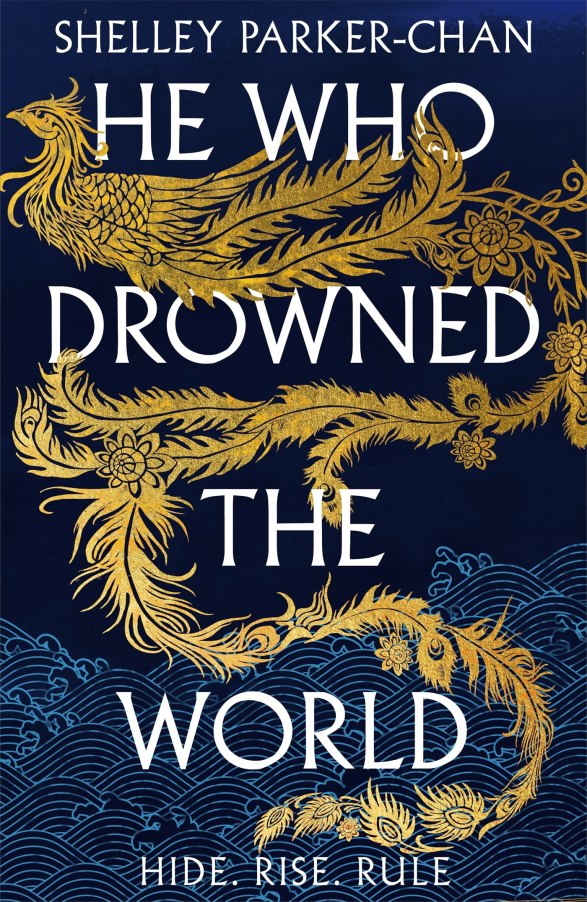
Publisher: Mantle (Trade Paperback – 29 August 2023)
Series: The Radiant Emperor – Book Two
Length: 487 pages
My Rating: 4.5 out of 5 stars
Rising Australian author Shelley Parker-Chan returns with the second part of her Radiant Emperor duology, He Who Drowned the World, an impressive and complex historical fantasy set in 14th century China. He Who Drowned the World is the exciting sequel to the author’s first novel, She Who Became the Sun, which provided a compelling spin on a legendary Chinese Emperor by imagining them as a female who takes on her dead brother’s identity to achieve greatness. She Who Became the Sun was a pretty awesome read, loaded with intriguing imagery, excellent characters, and a unique story. I deeply enjoyed reading it when it first came out and it ended up being one of my favourite debuts and pieces of Australian fiction in 2021. I was very excited to get a copy of He Who Drowned the World, especially as Parker-Chan does an excellent job of fishing off her epic story in a big and compelling way.
Plot Synopsis:
How much would you give to win the world?
Zhu Yuanzhang, the Radiant King, is riding high after her victory that tore southern China from its Mongol masters. Now she burns with a new desire: to seize the throne and crown herself emperor.
But Zhu isn’t the only one with imperial ambitions. Her neighbour in the south, the courtesan Madam Zhang, wants the throne for her husband – and she’s strong enough to wipe Zhu off the map. To stay in the game, Zhu will have to gamble everything on a risky alliance with an old enemy: the talented but unstable eunuch general Ouyang, who has already sacrificed everything for a chance at revenge on his father’s killer, the Great Khan.
Unbeknownst to the southerners, a new contender is even closer to the throne. The scorned scholar Wang Baoxiang has maneuvered his way into the capital, and his lethal court games threaten to bring the empire to its knees. For Baoxiang also desires revenge: to become the most degenerate Great Khan in history – and in so doing, make a mockery of every value his Mongol warrior family loved more than him.
All the contenders are determined to do whatever it takes to win. But when desire is the size of the world, the price could be too much for even the most ruthless heart to bear . . .
He Who Drowned the World proved to be a unique and captivating novel that continued to follow former monk turned general Zhu Yuanzhang as she attempts to free China from the Great Khan, outwit her rivals, and take the throne as Emperor. Parker-Chan dives right into this scenario as the book starts, and you are soon enthralled by the complex, multilayered story that emerges. Thanks to the power shift from the first book, the battle for control of China turns into a fight for dominance with four armies in the field, while the shadowy Wang Baoxiang manipulates events in his favour from the shadows at the capital. The events are shown from the various unique perspectives of the four main characters, each of whom is trying to survive and win the throne by their own methods. I love the blend of storylines that evolved here, whether it is the main protagonist’s plan to seize her destiny no matter what, Ouyang’s destructive quest for revenge, Madam Zhang’s attempt to manipulate all the men in her life to gain power, or Wang Baoxiang’s careful and lustful politicking. All these character arcs are deeply fun in their own right, although I must admit I found Wang Baoxiang’s storylines to be the most fascinating, mainly because he was so deliciously devious and swiftly rose up as a brilliant villain.
As the book continues, the reader is treated to some amazing story points, including Ouyang being forced to work with Zhu, who keeps winning with inventive tactics; Madam Zhang’s plots failing her left and right; and Wang Baoxiang’s malevolent rise to power, taking down everyone he gets close to. Each of these characters gets their moment to shine, and I loved some of the interactions that emerged, especially when the characters begin to meet each other. Zhu and Ouyang in particular play off each other perfectly, with Ouyang’s sheer anger finding no purchase with Zhu’s more Zen outlook on life, which only infuriates Ouyang more. I really loved the part of the book that focused on the complex alliance between these two characters, and its dramatic end also works extremely well, especially as it leads to that haunting scene where Ouyang encounters his destiny only for it to destroy him.
The entire book moves at an outstanding pace, and the compelling detail, unique world-building, and fascinating characters continue to build as the novel reaches its zenith. The final fate of Ouyang really was a major highlight of He Who Drowned the World, and the rest of the plot that follows had me hooked to the end. The last part of the book was a little more subtle than I was expecting, but it still featured some great moments as Zhu, who is not as benevolent as you would think, sacrifices much to try and achieve victory. The taut emotions, devastating betrayals, and determined attempts for revenge really help this conclusion stand out, and I was enthralled the entire way through. Parker-Chan ends everything on a somewhat hopeful note, which was nice after how dark the rest of the book was, and the reader will come away from He Who Drowned the World satisfied, if a little emotionally raw and shaken.
I really must comment on the fantastic and unique setting that Parker-Chan utilised for this duology. The overarching setting of 14th century China is pretty awesome in itself as the author worked hard to capture the unique cultural aspects of the period, such as the control by the Mongolian dynasty, while also presenting all the chaos and war that emerged when Zhu attempted to claim the throne. However, things get even more interesting as the author works in some subtle but significant fantasy elements that really make these books standout. These elements are all tied into a person’s right to rule as those with the will, ability and destiny are gifted with a literal Mandate of Heaven, which allows them to call forth an aurora of light and fire to show their divine right to rule. Several key characters in the series are gifted by the mandate, and the way they use it, whether to install fear, show their divinity, or utilise it for even darker purposes, is pretty damn fascinating. The other major fantasy element revolves around ghosts that only a few characters can see, which end up being an interesting part of the plot. The protagonist’s ability to see and occasionally manipulate these ghosts adds a certain edge to their story, especially as it serves as a representation of their deeper guilt, regret or determination, and I felt it was a fitting character element. The manipulation of ghosts also results in some dark scenes, especially when one of the antagonists does some horrible things to get a supernatural advantage. This interesting blend of historical and fantasy elements really helped to give the world of these duology a fantastic and unique tinge, and I really enjoyed seeing the elaborate war story Parker-Chan set out in it.
I also enjoyed how nearly all the major characters in this book had some compelling gender and orientation feature to them, which helped to define their character and take them to some interesting places. This includes the main protagonist taking over a male identity and entering a unique relationship with their wife, while General Ouyang deals with the shame of being a eunuch, although that doesn’t stop him from being the biggest badass in the book. These elements were really well handled by the author, who featured them in a thoughtful and tasteful manner, and it was interesting to see how this defined them. Parker-Chan really dove into the emotional, cultural and spiritual nature of these factors, especially in their historical context. I particularly enjoyed how all these characters tended to rise up above the shame or taboo nature surrounding this character element, and indeed many of them used it to their advantage. I really enjoyed seeing how well Parker-Chan utilised these elements in the plot and it made for some great representation.
I really enjoyed this distinctive and fascinating novel from Shelley Parker-Chan who produced a remarkable conclusion to her impressive debut duology. He Who Drowned the World was a powerful, intense and complex read that really showcased the horrors of war, ambition and self-delusion. Featuring a moving and devastating narrative, loaded with great characters and a unique take on Chinese history, He Who Drowned the World is an exceptional read and a worthy sequel to Parker-Chan’s first book.
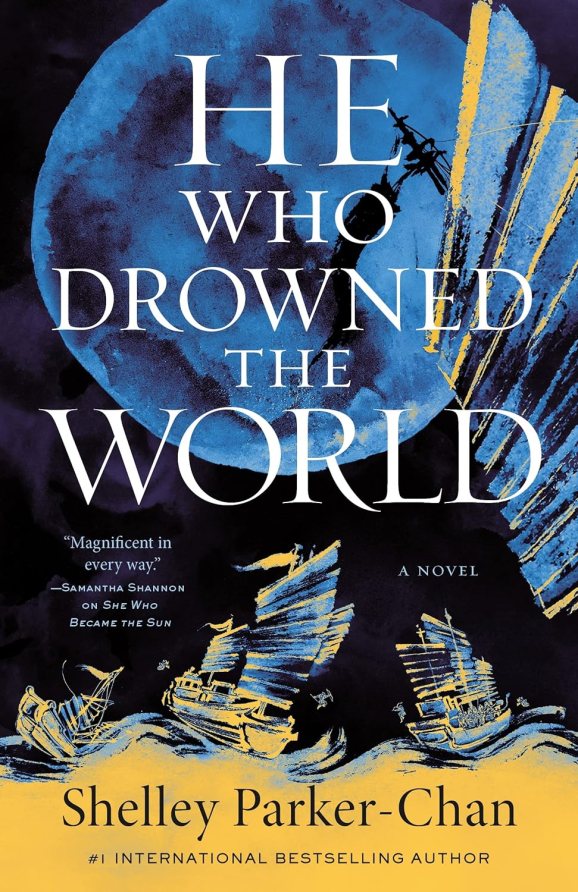
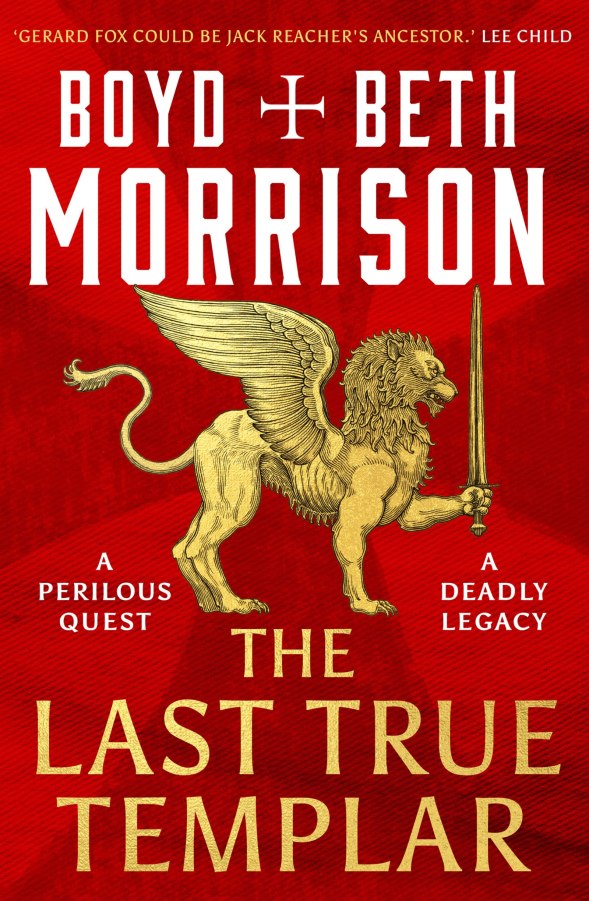
Publisher: Head of Zeus (ebook – 14 September 2023)
Series: Tales of the Lawless Land – Book Two
Length: 492 pages
My Rating: 4.5
The impressive sibling team of Boyd and Beth Morrison return with an epic and compelling sequel to their first impressive novel, The Last True Templar.
Last year I had the very great pleasure of reading the first book written by the pair of thriller author Boyd Morrison and historian Beth Morrison, The Lawless Land. Following an excommunicated knight and a noblewoman as they try to keep a sacred relic out of the hands of a corrupt cardinal, The Lawless Land was an outstanding read that blended fascinating historical detail with an intense thriller storyline. The Lawless Land ended up being one of my favourite books of 2022 and I have been eagerly anticipating a sequel for ages. This second book in their Tales of the Lawless Land series, The Last True Templar, sets the awesome protagonists on a compelling new adventure, an elaborate treasure hunt through medieval Italy.
Italy, 1351. After their first exciting adventure together, exiled English knight Gerard Fox and his determined companion, Willa, have decided to embark on a journey throughout a Europe still recovering from the ravishes of war and plague. Determined to get married, the two seek a way to escape their complex pasts and move on to a future free of violence and persecution. However, fate has something far more adventurous planned for them.
Arriving in a small village between Florence and Siena, Fox and Willa suddenly find themselves witnesses to a deadly ambush. A band of skilled, masked bandits are targeting Luciana Corosi, the wife of a prominent Sienna businessman, determined to kill her and steal the payment she carries for a lucrative deal. Intervening, Fox and Willa manage to save Luciana’s life, before escorting her home. However, it soon becomes apparent that not everything is as it seems, especially as Luciana’s scheming husband, Riccardo Corosi, is behind the attempts of Luciana’s life.
Escaping from Riccardo’s clutches with Luciana, Fox and Willa soon find themselves embroiled in a complex scheme that reaches all the way back to the fallen Knights Templar. Years ago, Luciana’s father helped the Templars hide their vast treasure from the Church before being betrayed by Riccardo. Determined to save her family’s legacy and finally expose her treacherous husband, Luciana recruits Fox and Willa to her cause and requests their help in solving a series of clues leading to the treasure. But with Riccardo and his men hot on their trail, can Fox and Willa find the legendary treasures of the Knights Templar, or have they finally met their match?
The Last True Templar was an interesting and enjoyable follow-up that captures the heart of the original book while changing some key story aspects and the background setting. The result is a fantastic and exciting read that I had a wonderful time reading and which I managed to power through in a very short amount of time.
The plot of The Last True Templar is pretty damn cool as it places the author’s established protagonists into a whole new crazy medieval thriller scenario, this time involving the warring Corosi’s and their respective legacies. Fox and Willa’s inadvertent entry into the plot is well handled and nicely ties into their current wanderings, and their continued presence in events feels pretty natural, especially as they are both trying to help a friend and achieve their own personal goal of getting married. The authors do an effective job at building up and injecting the intriguing characters and real-life history that led up the events of the book early on and the story, and you soon get swept up in the resulting treasure hunt that is rich in Templar lore. The story is masterfully told from a range of different perspectives, including the antagonists, which allows for some compelling insights into everyone’s respective motivations, histories and plots. Several chapters are also set in the past, either to strengthen the history surrounding the missing Templar treasure or provide backstory and added drama for the characters.
The main story of The Last True Templar turns into an exciting, clever, and action-packed romp, as the authors set out some major thriller antics within a historical setting. Just like with The Lawless Land, the initial thriller aspect of this story involves the protagonists attempting to stay one step ahead of the villains while learning about the dark history that surrounds their motivation. However, the characters also get involved in an elaborate historical treasure hunt which sees them decode a series of historical clues to find the location of the treasure. A storyline involving riddles and the hunt for ancient treasures is classic thriller fare, and I really enjoyed seeing medieval protagonists undertake this, especially as it takes them across 14th century Italy. The authors come up with a fantastic and elaborate series of mysteries, riddles and clues for this aspect of the story, and I loved the constant and desperate roaming through various well-described cities as they attempt to puzzle together dated references and hints.
The authors’ use of multiple perspectives really helps to enhance the race aspect of the story, as you get to see key events through multiple eyes, including the scheming and double-crossing antagonists. I loved seeing all the different moves each character made in The Last True Templar, and you are constantly on your feet as both groups get closer to the treasure while working to outsmart or outplay their opponents. There are also some amazing set pieces scattered throughout this novel, including an elaborate horse race through the streets of a city, several skirmishes, and even ship-to-ship boarding action. Everything leads up to an exciting and intense conclusion as both sides fight for the potential treasure, and all the compelling story elements come full circle. All the characters get a compelling conclusion to their storyline, whether they want to or not, and the book ends on a satisfactory note that leaves the series open for further entries.
I loved the fantastic historical detail that was contained in The Last True Templar as the authors really immersed readers in the period. The impressive depictions of the various Italian locations and cites was well done, and I could honestly see the settings in my mind’s eye as the protagonists visited them. Much of the background setting and character attitudes and actions, whether it be in battle, business, or exploration, had some noticeable historical accuracy, and I loved the elaborate descriptions that accompanied the narrative. I particularly enjoyed the author’s depiction of a historical Palio di Siena, which the protagonist was forced to participate in, and it honestly was one of the high points of the story. However, the best historical detail in The Last True Templar is reserved for the examination of the Knights Templar and the hunt for their treasure. The authors do an excellent job of exploring the legacy of the Templars, and I found it fascinating to see characters talk about them only a few decades after their fall. This examination of the Templars adds a great deal to the narrative, as not only is it strongly tied to several of the new character’s backstories, but it also proves to be very relevant to the various riddles the characters need to unravel. Each of the riddles is tied into a specific location or has some relevance to the Templars, and it was awesome seeing the characters work out and trying to solve them. There were even some very clever instances where the relevant landmarks referenced in the clues were no longer there or current, even after only a few decades, which added some intriguing difficulties into the larger treasure hunt. All these details, and more, were extremely interesting to me, and I had a wonderful time with how well the authors incorporated them into the plot.
I had a lot of fun with the characters in The Last True Templar, especially as we got to see more of Gerard Fox and Willa, both of whom were so well set up in the preceding novel. An excommunicated knight likely to be charged with heresy for not repenting for his unfairly given punishment and a brave, independent and highly capable former servant, Fox and Willa make for an intriguing pair, and I love the idea of an entire series dedicated to them wandering around helping people. The authors do an excellent job of reintroducing them in this sequel, and I really enjoyed how they were worked into this exciting story. Since both of their backgrounds were thoroughly explored in The Lawless Land, you don’t get a lot of extra history for them in this sequel. Instead, there is an intriguing storyline regarding their adventures in Europe and the struggles they have faced on the road together as a couple. Their main issue involves their desire to get married, however, due to Fox’s excommunicated status, something he takes seriously despite the unfairness surrounding the entire situation, they are unable to find a church or priest likely to approve the ceremony. This leads to some real strain on their relationship, and I liked how the authors dived into such compelling historical concerns for their character arc. Despite this, the two remain a strong duo with a fantastic blend of talents, and it was a real pleasure to see their second adventure together.
The rest of the character focus is completely reserved for all the new characters involved in The Last True Templar. In particular, you spend a lot of time with Luciana Corosi, an Italian matron who has been betrayed and manipulated by her evil husband. A smart businesswoman with a painful history, Luciana proves to be an excellent addition to the main cast, and she plays off Fox and Willa extremely well as they work together. I loved the intriguing history surrounding Luciana, especially all the betrayals she has experienced in her life, and it was great to see her finally try and reclaim her life and her destiny. While Luciana is great, this book is would be nothing without a fantastic villain, and this role is well filled by Luciana’s husband, Riccardo Corosi. A scheming former Templar who betrayed his order and Luciana’s father and turned his ill-gotten gains into a thriving business which he uses to control his city, Riccardo is a despicable antagonist you have a very easy time hating. The authors show much of the story from Riccardo’s perspective, so you get some great insights into his various schemes, and you quickly realise just how irredeemable he truly is. Partnered with a surprisingly loyal, if murderous, English knight, and a scheming female associate who plots against everyone, Riccardo is a great foil to the main cast, and I loved the various betrayals he brings to the table, even when it comes to his own followers. This proved to be quite a fun and compelling cast of characters and I loved seeing their fantastic story unfold.
Overall, The Last True Templar was an outstanding read and I loved seeing more adventures from the team of Boyd and Beth Morrison. This second Tales of the Lawless Land novel was very exciting and I loved the great new characters, intriguing historical detail, and compelling thriller centric plot. An impressive sequel from start to finish, I deeply enjoyed The Last True Templar and I hope we get more books from these amazing authors in the future.
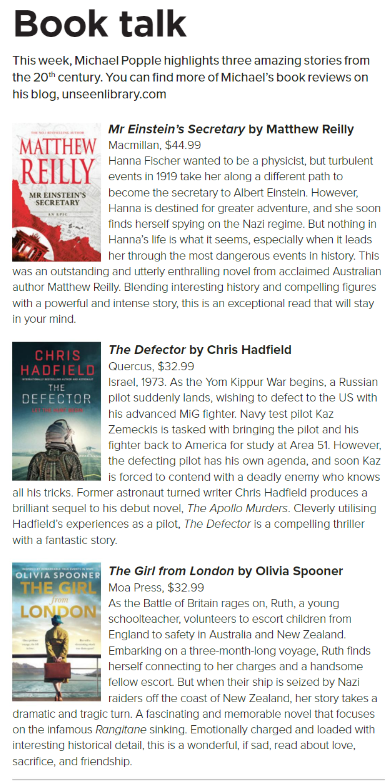
Originally published in the Canberra Weekly on 16 November 2023.
A copy of this column also appeared on the Canberra Weekly website.
Make sure to also check out my extended reviews for Mr Einstein’s Secretary, The Defector and The Girl From London.
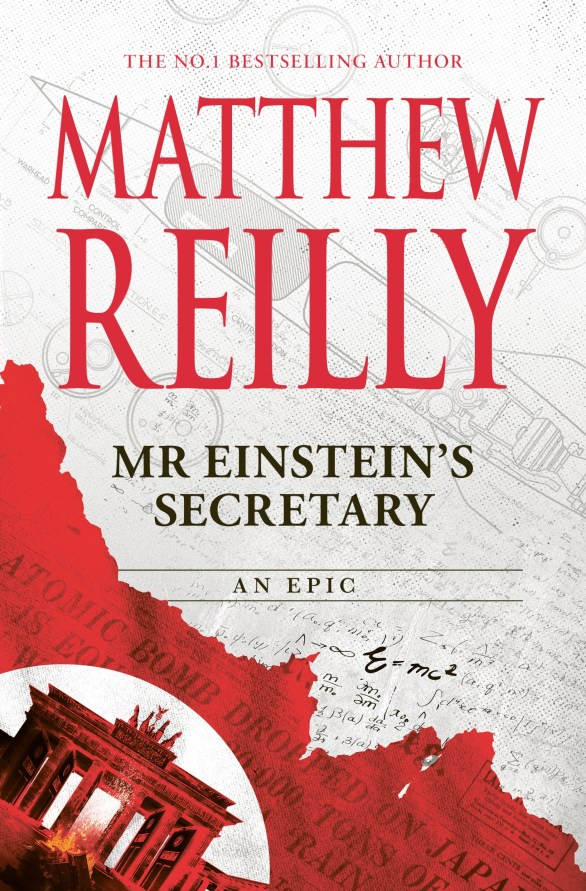
Publisher: Macmillan Australia (Trade Paperback – 17 October 2023)
Series: Standalone
Length: 464 pages
My Rating: 5 out of 5 Stars
Acclaimed Australian author Matthew Reilly presents one of the most entertaining, moving and brilliant historical fiction reads of 2023 with his compelling and well-written novel, Mr Einstein’s Secretary.
Matthew Reilly is a highly creative Australian author who has been wowing audiences for years with his elaborate and inventive thrillers and science fiction novels. Known for his Shane Schofield and Jack West Jr series, as well as several impressive standalone reads, Reilly has produced an intriguing array of fiction throughout his career, much of which revolves around ancient secrets and action-seeking protagonists. I have personally only had the pleasure of reading one of Reilly’s novels so far, the intriguing 2019 release, The Secret Runners of New York, which saw a group of teenagers travel back and forth between the modern city and a future dystopia. I really enjoyed this cool book and I have been meaning to read more of Reilly’s works. As such, when I got a copy of Reilly’s first foray into historical fiction, a favourite genre of mine, with Mr Einstein’s Secretary, I had to check it out, and boy was I glad that I did.
Born at the start of the 20th century in Berlin to an American mother and a German father, Hanna Fischer is a curious young woman whose greatest wish in life is to study physics like her mother and her neighbour the great Albert Einstein. However, when her peaceful existence is violently turned upside down in 1919, Hanna has no choice but to flee to America and make a new life for herself in New York.
Forced to give up her dreams of studying physics, Hanna makes the fateful choice to enrol in a prestigious school for secretaries. Her decision will place her in the orbit of some of the most interesting people in the city, including business tycoons, socialites, gangsters and one determined Treasury agent, as she works to find a way to return home. But as the years go by, it soon becomes apparent that the Germany she left behind is no longer her home, especially when Hanna returns to Einstein’s orbit as his secretary.
Trapped in Germany when the Nazis come to power, Hanna is recruited as an American spy and soon finds herself serving as secretary to several high-ranking Nazis. Caught between dangerous men, lethal intelligence operatives and her own conflicted loyalties, Hanna attempts to uncover the terrible truths of the Nazi regime without her own secrets coming out. But not everything in Hanna’s life is as it seems, and one dangerous part of her past will always come back to haunt her.
Mr Einstein’s Secretary was a fascinating and compelling read that had me hooked very early thanks to its unique style, focus on various gripping parts of early 20th century history, and fantastic characters. Loaded with some fascinating detail, a ton of action and a wonderful life story, I honestly couldn’t put this book down at times and I managed to power through the entire second half of the book in a single afternoon. Due to its clever writing and brilliant story, I just had to give Mr Einstein’s Secretary a full five-star rating, and this is honestly one of the best historical fiction novels of 2023.
Reilly tells a very unique story in Mr Einstein’s Secretary that primarily focuses on protagonist Hanna Fischer and her experiences living through some of the most turbulent parts of history. Reilly really piqued my interest early on when the first-perspective narrative opens on the protagonist’s funeral, with the reader apparently seeing it through her ghost’s eyes. While having the narrator’s funeral upfront can sometimes be problematic, I think it worked out well for this book, especially as Reilly introduces a few key characters for the reader to keep an eye out for, before jumping into three key scenes from the protagonist’s life. These scenes are three separate interrogations that the protagonist experienced during her intriguing career, each one undertaken by a different regime, including the American police, the Nazis, and the Soviets. All of these interrogations are key reference points in the main story, and you are immediately intrigued to see the chain of events that leads the protagonist to each of them, as well as how she managed to get out of the deadly situations each time.
After this excellent introduction, the story begins in earnest with a more traditional chronological approach. Starting with her childhood in Berlin where she lived next to Albert Einstein, Hanna’s story quickly fills with tragedy and adversity, especially as the early clouds of fascism and the consequences of World War I cause her to lose everything and force her to flee to America, where she is enrolled in a secretary school. This early part of the book is well set out, introduced several key characters, and really showcased some of the defining early moments for the protagonist that would serve her well in the future, as well as exploring the impacts that chance and simple choices can have on a person. The next section of the novel set in New York is initially a bit slower, but it soon picks up, especially when the Prohibition Era kicks in. Reilly has an excellent way of portraying someone’s personal story in the most interesting way, and I loved seeing Hanna’s life in America, especially when it combined early corporate America with gangster lifestyle and the burgeoning physics scene. There is a compelling sojourn back to Germany for Hanna that results in nothing but heartbreak, especially when her twin is involved, and I really enjoyed the protagonist’s encounters with a New York gangster during this time, especially as it showcases just how practical and cold Hanna can be when necessary. This part of the book ends when it reaches the events of the first interrogation, and the protagonist becomes a more permanent secretary to Einstein.
From there, the plot of Mr Einstein’s Secretary moves at a much quicker pace, especially when Hanna gets dragged into the events surrounding the rise of the Nazi regime. Trapped in Germany after Hitler’s rise to power, Hanna is recruited to spy on the Nazis and becomes the secretary to key members of the party. Thanks to this, Hanna has an excellent view of the full evils of the Nazis and becomes involved in several espionage missions against them and the Soviets. This part of the book combines spy thriller moments with compelling and dark historical detail, and you really get caught up in Hanna’s life as an operative, especially when it goes side by side with some of the major moments of the Nazi regime. I was absolutely powering through this part of the book it was so darn fascinating, especially as Hanna had to also deal with personal issues and her growing revulsion about what she was witnessing. Reilly keeps the plot moving quickly in the final third of the book, and there are some truly intense scenes leading up to the fall of Berlin, especially when Hanna is forced to make some hard choices and faces the ultimate betrayal. I loved some of the shocking moments and twists that emerged in this last section of the novel, especially as it places the protagonist in some major trouble, and the resulting scenes have you constantly on the edge of your seat. Everything ends on a pretty comfortable and satisfying note, and I felt that Reilly resolved his story in an excellent if crowd-pleasing way. An overall outstanding, gripping and electrifying story from start to finish.
While this impressive story is pretty strong and exciting in its own right, what really elevates Mr Einstein’s Secretary is the author’s clever and distinctive writing style. I loved how Reilly set up the entire story as the memories of a shadowy figure watching their own funeral, especially as events unfolding before them reminds the protagonist of some of the most traumatic memories of her life. The initial focus on the three defining interrogation sequences produces an extra strong start for the novel, and the fascinating foreshadowing that resulted really heightened the reader’s anticipation for the rest of the story. While the story does transfer to a more traditional biographical novel after these scenes, Reilly breaks this up masterfully by having the narrator suddenly remember other similar events of her life, and then having this scene unfold. For example, when the character visits a certain location as a child, Reilly will then insert a quick paragraph showing the same location at a different part of her life. This switch between time periods proves to be a fascinating and powerful way of expressing the character’s linked memories, and it also adds in some interesting additional foreshadowing and some fascinating contrasts. Reilly does a wonderful job of highlighting what part of the character’s life these memories are from by changing the font type around, and I loved how multilayered the novel got as a result. An additional font choice towards the end of the book also highlights a shocking and dark change in narrative focus, as a similar figure starts to tell the story in their own twisted way. These unique writing elements really helped to turn Mr Einstein’s Secretary into quite a distinctive read, and I deeply appreciated Reilly’s desire to experiment and tell a historical story his own way.
Aside from Reilly’s intriguing narration and style choices, I also think that Mr Einstein’s Secretary had an excellent balance of action, intensity, drama and romance to appeal to a wide audience of readers. The author does a remarkable job of developing his protagonist while simultaneously exploring so many fascinating historical events and moments, especially in New York and Germany. So many key historical events in the lead-up to and eventual outbreak of World War II are covered in excellent detail, and Reilly does an outstanding job of working his protagonist into these events and making her a witness and participant. I loved Reilly’s depictions of 1920s New York, which served as a grand backdrop for much of the early narrative, and the author takes the time to showcases several key periods of the decade, from the early roaring twenties with the economic boom, the prohibition era, and the eventual Wall Street crash. There are also some fascinating, if necessarily dark, depictions of the rise of the Nazi regime in Germany, which Reilly captures perfectly, especially through the eyes of his protagonist who has her own issues with the Nazis due to her family and her association with Einstein. There is even an intriguing discussion about historical physics, with the protagonist having a fantastic inside track, and watching her spy on the German attempts at nuclear technology is an intriguing part of the book, especially after seeing Oppenheimer earlier this year. Reilly utilises all these historical events extremely well, and his use of them allows for some great support characters, especially as there is a combination of fun original characters and multiple real life historical figures. I had such a brilliant time with the historical focus of Mr Einstein’s Secretary, and it proved to be a powerful, exciting and well-balanced read.
Matthew Reilly does it again with his first major foray in historical fiction. Mr Einstein’s Secretary is a powerful and captivating tale of life, love and loss in the run up to World War II and I loved every second spent with Reilly’s compelling protagonist. Featuring a brilliant and unique style from the author that deeply enhances an already fascinating narrative, Mr Einstein’s Secretary was a treat from start to finish, and I cannot recommend it enough.

Publisher: Quercus (Trade Paperback – 10 October 2023)
Series: The Apollo Murders – Book Two
Length: 369 pages
My Rating: 4.5 out of 5 stars
Former astronaut turned thriller author Chris Hadfield returns with his second excellent novel, the intriguing and clever historical read, The Defector.
Back in 2021, I was lucky enough to receive a copy of superstar astronaut Chris Hadfield’s cool and much-hyped debut novel, The Apollo Murders. Set during the Cold War, The Apollo Murders depicted an alternate history adventure where a fictional Apollo flight mission to the moon suffered all manner of calamity, including murder, treachery, and unexpected Russian hitchhikers. Thanks to Hadfield’s knowledge of history and spaceflight, this turned out to be quite the gripping read, and The Apollo Murders ended up being one of my top debuts for 2021. As such, I have been eager to see how Hadfield planned to follow up his first book, and I was quite excited when I saw that his second novel was a sequel to The Apollo Murders. This book, The Defector, was an excellent and compelling thriller which I had a brilliant time getting through.
Israel, 1973. On the eve of the Yom Kippur War, a Soviet test pilot makes the bold decision to fake a crash in his state-of-the-art MiG fighter and secretly land in Israel. Claiming that he wants to defect to the United States, the pilot, known by his codename, Grief, and his plane are traded to the Americans, who desperately want to know the secrets of the MiG and how it achieves such impressive altitude.
Having witnessed Grief’s defection while on holiday in Israel, NASA flight controller and former Navy test pilot Kaz Zemeckis is quickly drafted in to take carriage of the captured MiG and to work with Grief to fully understand the plane’s limitations and capabilities. Their unlikely partnership eventually takes them to the most secure and secret location in the United States, Area 51, where Grief looks set to provide all the information the Americans have ever wanted about the MiG. However, not everything is as it seems, and it soon becomes apparent that Grief has his own reasons for wanting to defect to the United States. Can Kaz get to truth before it is too late, or has he let a wolf right into the heart of America’s most secret air base?
This ended up being an excellent and exciting novel from Hadfield that successfully follows up his original debut and provides a cool and intense new story that proves very hard to put down. Hadfield tells a pretty tight and compelling story in The Defector that starts strong with the mysterious Grief defecting right in the middle of the Yom Kippur War. This initial excitement morphs into an intense and gripping game of cat and mouse, as Kaz attempts to utilised Grief’s knowledge and keep his defection secret from the Soviets, while the Russian pilot works to initiate his own plans.
This continues for much of the book, and I thought this ended up being a much more focused and well-structured thriller narrative than we previously saw from Hadfield in The Apollo Murders. The focus on espionage and military secrets was a great centre for the plot, and Hadfield did a good job on also utilising some intriguing characters, especially Kaz and the mysterious Grief. The inclusion of a couple of fictional supporting characters from The Apollo Murders, namely a cosmonaut and a major Soviet antagonist, was also quite interesting, although as they were mainly there to set up a future entry in the series it did disrupt the narrative flow a little. Everything leads up to the big conclusion, which Hadfield set up nicely throughout the course of the story. While I do think that Hadfield might have considered utilising a twist to change the antagonist around, it was still really fun to see the full plan unfold, as well as the real reasons behind the defection. Watching the manipulation and the resulting violence unfold was very impressive, and it led to a satisfying, if slightly predictable, final showdown with the protagonist that ended everything on a high note.
I really enjoyed how well The Defector came together, especially as Hadfield reused all his best writing elements from The Apollo Murders, while also strongly utilising his own personal experiences and knowledge as a test pilot. The constant switching between perspective characters, as well as several interludes and flashback sequences, helped to produce a complex, multilayered storyline, and I liked seeing the various players in the plot attempt to work out what everyone else is doing. It also allowed Hadfield to hide some good hints about the antagonist’s true motivations and feelings, which came out perfectly at the end of the book. There was also some great character growth around the protagonist Kaz, especially as Hadfield successfully built on his personality and relationships from the first book, and it is clear that the author has some future adventures planned for him.
However, the real strength of The Defector lies in Hadfield’s encyclopaedic knowledge of military airplanes, Cold War espionage history and spaceflight, which was masterfully inserted into the plot. Much of the plot revolves around the desire for both sides of the Cold War to get a better understanding of their opponent’s aircraft capability, and Hadfield expertly examines the history and mechanics around this. The discussions about aircraft, fighter capabilities and more, are all quite fascinating, and Hadfield does a wonderful job of exploring them in a highly detailed way that readers unfamiliar with aircraft can easily understand. His experience also allows for some highly realistic and intense aerial combat sequences, and I really enjoyed the elaborate scenes that resulted, especially the cool conclusion. This grasp of aircraft, the history surrounding their development, and the espionage involved, are well worked into the plot of The Defector, and I loved how much it increased the authenticity of the book, making it so much better.
Overall, The Defector was an outstanding second novel from Hadfield that I had a wonderful time reading. Containing a clever and well-paced spy thriller narrative loaded with intriguing details about aircraft and the cold war, The Defector had me hooked from its first awesome scene, and I managed to power through this book in no time at all. Compelling and action packed, The Defector was an outstanding follow-up to The Apollo Murders and I cannot wait to see what Hadfield writes next.

Top Ten Tuesday is a weekly meme that currently resides at The Artsy Reader Girl and features bloggers sharing lists on various book topics. The official topic for this week’s Top Ten Tuesday was a Thanksgiving themed list that required participants to list the reasons why they are thankful for books. While this is an interesting topic, I decided against contributing to it, instead I’m skipping ahead to next week’s topic to free up December for my usual end-of-year lists. As such, my topic for this week involves listing my favourite books set in a specific setting of my choosing, whether that be a country, state, outer space or something else. This open-ended list left me with quite a few opportunities for potential topics, but I decided to go back to my historical fiction roots and instead focus on books set in the Roman Empire.
I have mentioned before that when I started reviewing books I focussed completely on historical fiction, which was a favourite genre of mine. While I have expanded my horizons to other genres since then, historical fiction still has a very special place in my heart, and I always like to highlight it on this blog when I get a chance. As such, I thought I would give this latest list a historical fiction theme and look at books set in the most popular historical fiction setting, the ancient Roman Empire.
Due to the rich history, intriguing people, multiple wars, and iconic nature of ancient Rome, so many historical fiction novels and series are set during this period. While most of these books are military fiction, there are a ton other stories that can be told during this period, especially as there are so many detailed records about the various Roman Emperors and their reigns. I have a great deal of love for the Roman Empire in fiction and nearly every major historical fiction author has written a Roman series at some point in their career. As such, I can think of no better setting to focus this list on than the Roman Empire and its many different battles, plots and unique figures.
To feature on this list, a book needed to be set in some period of Roman history, whether it be the rise of city, the early wars, the height of Empire or its eventual decline. I decided to allow whole series to be featured as a single entry on this list as this honestly saves me having to choose my favourite novel from some particularly long series. While I had quite a few good options to feature here, I was eventually able to whittle my list down to ten books/series, with a few honourable mentions thrown in as well. Each of the below entries are very much worth checking out if you want some fiction set in the Roman Empire, so let us see what made the cut.
The Return by Harry Sidebottom

A dark and gritty standalone novel set shortly after the Roman conquest of Greece, which sees a traumatised former soldier return home only to find himself a suspect in a series of brutal murders.
Hannibal/The Forgotten Legion series by Ben Kane

Ben Kane has written several great Roman series over the years, and while I have one on the main list, I had to also highlight two of his other series here, including his awesome depiction Hannibal’s battles with Rome in Hannibal and the gripping read about Roman soldiers trapped in the East with The Forgotten Legion.
The Siege by Nick Brown

The fun first book in Brown’s Agent of Rome series that sees a young intelligence agent lead the defence of an isolated fort and its disparate soldiers. High recommended.
Eagles of the Empire series by Simon Scarrow

This list has to start with one of my all-time favourite historical fiction series, the Eagles of the Empire books by Simon Scarrow. Probably the gold standard of Roman historical fiction, the Eagles of the Empire is a great long-running series that really drew me into the genre when I started reading it years ago. Currently made up of 21 novels (with the 22nd due to drop any day now), the Eagles of the Empire books follow two Roman officers who bounce from deadly warzone to warzone, trying to survive. Filled with elaborate battles, great characters, and a cool focus on some of Rome’s most memorable campaigns, the Eagles of the Empire books are so much fun and I cannot recommend them enough (check out my reviews for The Blood of Rome, Traitors of Rome, The Emperor’s Exile, The Honour of Rome and Death to the Emperor).
Flavia Albia series by Lindsey Davis

While most Roman series focus on wars and historical figures, one of the best is a fun murder mystery series with the Flavia Albia books by Lindsey Davis. A sequel to Davis’ original Falco novels (a series I still need to check out), the Flavia Albia books follow a skilled investigator as she tries to solve a series of elaborate crimes and murders while also balancing her hectic personal life. I have so much love for this series, especially as Davis always seems to get the perfect blend of humour, mystery, and dark intensity into her fantastic narratives. Some of my favourites in the series include Pandora’s Boy, The Grove of the Caesars (one of my favourite books of 2020), and Desperate Undertaking (one of my favourite books of 2022), and Davis is at her best when she creates particularly elaborate murders and large comedic set pieces. A must-read series for all fans of Roman historical fiction, especially those looking for something other than wars and politics.
Vespasian series by Robert Fabbri

Many Roman historical fiction authors choose to centre their books around great figures of history, but few of biographic novels are as entertaining or bold as the Vespasian series by Robert Fabbri. Focussing on the life of future Roman Emperor Vespasian, Fabbri works to combines the official record of Vespasian’s life with additional adventures that place the character in the middle of the most significant events of the era. Thanks to Fabbri’s choice to bring every salacious and insane bit of history from the period to life, you get to see the outrageous emperors who preceded Vespasian in all the bloody glory as the protagonist tries to survive the tumultuous wars and politics leading to his ascension. Deeply entertaining, compelling, and highly shocking, the Vespasian series (check out my reviews for Rome’s Sacred Flame and Emperor of Rome), are well worth checking out.
Eagles of Rome series by Ben Kane

As I mentioned above, there are several great Roman historical series written by Ben Kane, but my personal favourite is the Eagles of Rome series. Set around the infamous massacre of three Roman legions in the Teutoburg Forest, the first book, Eagles at War, perfectly covers the massacre, while the sequels, Hunting the Eagle and Eagles in the Storm shows the attempts by the Roman characters to get revenge years later. Eagles at War really sets the tone for this excellent and dark series and I loved this fantastic and brutal portrayal of such an infamous event.
Warrior of Rome series by Harry Sidebottom

One of my absolute favourite Roman historical series is the amazing Warrior of Rome books by Harry Sidebottom. One of the first series I ever had the pleasure of reviewing, the Warrior of Rome novels follow the intriguing character of Ballista, a German hostage turned Roman nobleman who serves as a general and siege expert in the army. The first book, Fire in the East, saw Ballista take command of a doomed city in one of my favourite siege books, while the sequels show his attempts to save his friend the emperor from threats outside and within with some amazing reads. This series has remained very fresh and fun over the years, especially the last three novels which have featured an intriguing range of storylines, often laced with compelling thriller elements, such as the 24-inspired The Last Hour, the intense survival novel The Burning Road, and the behind-enemy-lines novel, Falling Sky. I have a lot of love for this outstanding series and Sidebottom continuously shows himself to be one of the very best authors of Roman historical fiction.

A fascinating and addictive read that followed one of the most intriguing Roman Emperors, the infamous and beloved Commodus. Turney does a wonderful job of showcasing this complex figure in all his glory, strength and insanity, and you really get a feel for both his nobility and his struggles. One of the most moving and compelling Roman fiction novels I have had the pleasure of reading, this is an outstanding book.
Empire series by Anthony Riches

Another Roman historical series I got into years ago is the Empire series by Anthony Riches, which is a classic and impressive collection of books that dive into the comradery of a dedicated regiment. Starting with Wounds of Honour, this series primarily follows a political fugitive fighting in the legions under an assumed name in several deadly conflicts. I deeply enjoyed the first several books in the series, and I recently got back into it when I read the fun novel River of Gold. An awesome and exciting series that proves very easy to read whenever I want a new historical adventure.
The Throne of Caesar by Steven Saylor

Another excellent Roman detective series is the Roma Sub Rosa books by Steven Saylor which follow the long running character Gordianus the Finder. I have only had the pleasure of reading one of Saylor’s Roma Sub Rosa books, The Throne of Caesar, but I really loved it. Set just before the Ides of March, The Throne of Caesar sees Gordianus investigate the conspiracy against Julius Caesar in a clever narrative that gets even more intense the closer the protagonist gets to the assassination. A brilliant read that I am really glad I got the chance to check out.
The Sword of Attila by Michael Curtis Ford

Another great standalone Roman fiction book I had to highlight on this list was the invigorating and compelling read, The Sword of Attila by Michael Curtis Ford. The Sword of Attila is a gripping novel that focussed on two figures from history, Attila the Hun and the Roman general who beat him, Flavius Aetius. Set towards the end of the Roman Empire, The Sword of the Attila did an excellent job of examining the lives of both fascinating historical figures and the connections they shared. One of the better character-driven Roman historical fiction novels I have had the pleasure of reading, I deeply enjoyed learning about both these intriguing legends.
Emperor series by Conn Iggulden

The final series I want to feature on this list is one of the best with the Emperor series by iconic historical fiction author Conn Iggulden. An awesome retelling of the entire life of Julius Caesar, Iggulden imagines all the triumphs and tragedies of this illustrious leader and portrays them in a captivating and intelligent way for the reader. A deeply impressive series that proves very hard to put down, the Emperor books are some of the best Roman historical fiction novels out there and are a must read for fans of the genre.
Well that’s my latest list. As you can see, there are a range of awesome and compelling novels and series set in the Roman Empire that are very much worth checking out. I am such a huge fun of this setting and all the above books and series come highly recommended. Let me know in the comments below what your favourite books set in ancient Rome are, as well as some of your favourite settings.
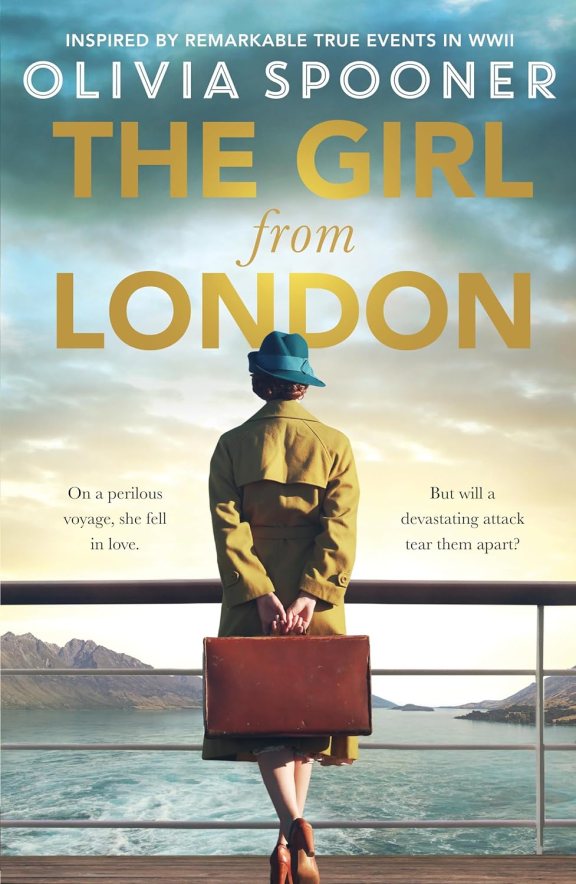
Publisher: Moa Press (Trade Paperback – 14 November 2023)
Series: Standalone
Length: 314 pages
My Rating: 4.25 out of 5 stars
Fantastic New Zealand author Olivia Spooner presents her first dive into historical fiction, with the intriguing and clever historical drama, The Girl Form London, an outstanding read that proved quite fascinating.
Plot Synopsis:
London, 1940. Ruth, a young schoolteacher, volunteers as an escort helping to evacuate children from war-torn England to Australia and New Zealand. Her three-month voyage is fraught – their passage is perilous, and the children anxious and homesick. Nine-year-old Fergus is more troubled than most and Ruth forms an unexpected bond with the boy.
It’s not just Fergus who captures Ruth’s attention. Bobby, a fellow volunteer who initially infuriates Ruth with his laidback charm, somehow gets under her skin and throws her ordered life into chaos.
Tragedy strikes on their return voyage, when the Rangitane is attacked by German raiders. As the ship goes down, the surviving passengers are taken as prisoners of war aboard the German vessel. To the rest of the world, they are missing, presumed dead.
New Zealand 2005. Hazel boards a plane to London, eager to explore Europe. Sitting next to her is a man named Joe. On her lap is a treasured book from her grandfather, Fergus. A book that will finally reveal Ruth’s story.
A captivating, heart-wrenching story of love, loss, and the resilience of the human spirit that will stay with you long after you turn the final page.
This was an outstanding novel from Spooner that took the reader on an enchanting and tragic adventure during some very distinctive moments from World War II. Spooner chose to tell The Girl From London’s narrative through the somewhat overused medium of a young person in modern times learning about the struggles their older relatives went through during the war. However, I rather enjoyed Spooner’s take on this writing trope by having her modern characters getting invested in a novel that covers the adventure of Hazel’s grandfather and the people that were important to him as a child. This not only allowed the author to dive back into the unique story generated in the past but also allowed for a quite good and heartfelt romance story to occur in the present as Hazel and Joe have a meet-cute which develops naturally into a compelling, complex relationship.
While this modern storyline was interesting, I much preferred the storyline set in the past surrounding Ruth’s journey from England to Australian and New Zealand and then the tragic events aboard the Rangitane. That entire journey away from England was pretty darn fascinating, and I loved the captivating details of how the children were being transported to safety, the inherent tragedy of their journey, and the complicated figures who volunteered to help escort them to a new life. Spooner covers the historical aspects of their journey extremely well and the first half of their story is quite powerful and lovely, especially as she takes the time to explore the various characters, their developing relationships, and their complex motivations for being on the ship.
The Girl From London takes a fascinating turn once the main characters start the second part of their journey aboard the Rangitane. The historical events covering the sinking of this ship off the coast of New Zealand during the war is absolutely amazing, and despite a love for history and a good knowledge of World War II history, I had personally never heard of the Rangitane before. As such I was really enthralled by this real-life tale, and Spooner told it magnificently, examining the taking of the ship in detail and showcasing all the remarkable events that followed. While these events in themselves are fascinating, Spooner makes them even more compelling by tying her great characters into this historical event. By this point of the book, you’ve come to care for the characters, so having them involved in this tragedy really raises the stakes for the reader, especially as you know something bad has to happen to Ruth at some point. This entire part of the book was pretty remarkable, and I really got caught up in how everything unfolded.
I think that Spooner did a pretty good job of bringing the two separate storylines together in an effective and enjoyable way. As I mentioned above, I liked Spooner’s version of the relative finding out their grandparent’s story here, and the constant breaks in the World War II storyline to explore Hazel and Joe’s burgeoning relationship gave the story a distinctive flavour. Honestly having her grandfather’s story not become Hazel’s entire identity was quite refreshing compared to other historical dramas I’ve read and I liked the mixture of storylines that emerged. Still, it was good to get some closure on the main storyline surrounding Ruth, and I liked the emotionally powerful way that Spooner chose to have her story be told. The ending is both tragic and heartwarming in all the right ways and this ended up being quite an excellent read.
Overall, The Girl From London is a wonderful and compelling historical drama that I had a fantastic time reading. Olivia Spooner produced a compelling and emotionally charged narrative, that examines romance, sacrifice and the power of choices across the generations, while also diving into a fascinating historical event. This ended up being an amazing book and Spooner definitely showcased her ability as an author in her first foray into historical fiction.
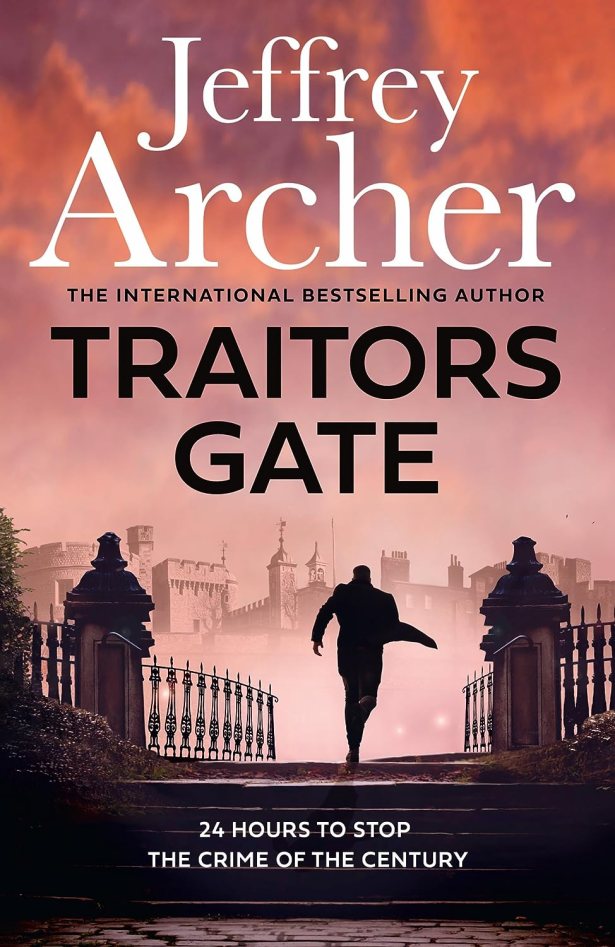
Publisher: Harper Collins (ebook – 26 September 2023)
Series: William Warwick – Book Six
Length: 384 pages
My Rating: 4.5 out of 5 stars
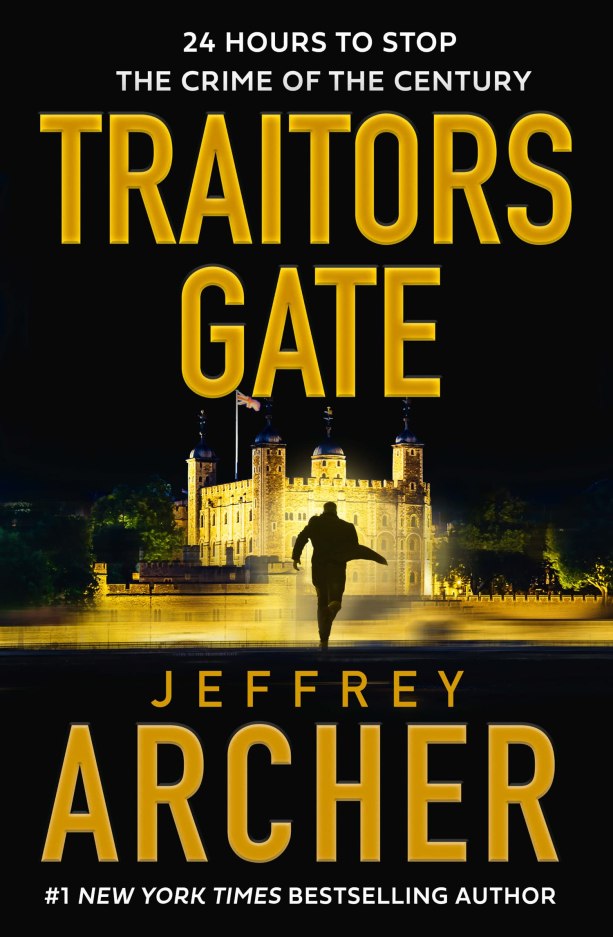
Bestselling author Jeffrey Archer returns with another exciting addition to his fun and compelling William Warwick series with Traitors Gate.
Jeffrey Archer is a well-known and interesting British figure: a former politician, a convicted criminal, a life peer and member of the House of Lords. However, these days Archer is best known as a bestselling author, having written a large catalogue of novels that usually contain a historical or thriller element to them. Some of his works include the Kane and Abel series, his well-known Clifton Chronicles and a range of standalone books like Heads You Win. I particularly enjoy the William Warwick series, which is a fun and entertaining collection of historical thrillers.
The William Warwick novels, which originated within the fiction universe of the Clifton Chronicles series, follows the life and career of titular protagonist William Warrick, an idealistic London police officer who rises through the ranks while solving a series of dastardly crimes. This series, which is defined by its character-driven plots, new criminal focuses for each novel, and the protagonist’s bitter rivalry with a notorious crook, are always very entertaining and feature some compelling stories. I personally really enjoyed the first three books in the series, Nothing Ventured, Hidden in Plain Sight, and Turn a Blind Eye, although I unfortunately missed the next two books in the series. Luckily, I was able to grab a copy of the upcoming sixth William Warwick book, Traitors Gate, which honestly might be one of the best entries in the series.
London, 1996. There is nothing more sacred nor valuable in the entire realm than the crown Jewels of England. Kept secure within the Tower of London, the jewels are only brought out once a year for the Queen to attend the State Opening of Parliament. Providing security for the transfer between the Tower and the palace is one of the most important jobs done by the Metropolitan Police, and this vital duty is now overseen by Chief Superintendent William Warwick and his crack team. Thanks to all the elaborate precautions around the transfer, the jewels are considered unstealable, but there is one audacious crook who is about to prove them wrong.
For years, William has sought to bring down notorious criminal mastermind Miles Faulkner, a gentleman thief and deadly rogue who has brought nothing but misery to William’s friends and family. But despite the best effort of William and the men under his command, Faulkner has always managed to elude justice as he continues to hatch his despicable plots and thefts.
However, Faulkner also has a vengeful streak, and when William manages to finally get one over on his rival by recovering a stolen artwork, Faulkner decides it is time to get his final retribution against William and everyone close to him. Pulling together a team of rogues and villains, Faulkner sets in place his boldest plan yet: steal the Crown Jewels and ruin the career of William and the other police involved in its protection. Can William stop this plan before everything he loves is destroyed, or has Faulkner finally won their decades-long game of cat and mouse?
Archer continues to impress with his latest William Warwick book, which honestly had me hooked the entire way through. An intriguing continuation of his fun ongoing series, Traitors Gate was a great character-driven thriller that was fun from start to finish.
Traitors Gate has a great story to it that expertly combines existing storylines from the series with an excellent and wildly entertaining new plot. Once again focusing on protagonist William Warwick and fantastic antagonist Miles Faulkner, Archer sets up a great story that takes their rivalry to a new level. The author does an outstanding job of setting this up, with the early parts of the novel recapping key events from the previous William Warwick novels whilst highlighting the protagonist’s current role in protecting the Crown Jewels. The first half of Traitors Gate follows some intriguing story threads focused on several key existing characters that eventually lead to William getting one over on Faulkner in their long-running feud. This first half of this book is very entertaining, especially as the rivalry between the protagonist and antagonist is so damn fun, and you really get drawn into the unique and continuing character stories.
The second half of the book really amps up a notch as Faulkner initiates a series of elaborate and daring revenge plots against those who wronged him, while also setting up his master heist. These various storylines, which include a con job and a fantastically fun court sequence, work together well to tell an excellent overall story, and they play into the build-up for the big conclusion extremely well. However, the crown jewel (pun intended) of the plot has to be the great heist scene, which was so damn tense and exciting. Archer sets the entire thing up perfectly, and by constantly switching back and forth between various characters on both sides, you get quite the intense and captivating sequence. This entire heist is a ton of fun from conception to implementation and leads to a compelling final part of the novel which sees the characters all desperately trying to come out on top. The various elements of this, from the fun characters involved, the multiple elaborate steps the antagonists take, and the ticking clock the protagonists need to beat, are designed to keep the reader on their toes, and I had such a fun time seeing everything unfold. The entire story honestly comes together extremely well, and frankly this was one of the more impressive and addictive stories that Archer has come up with yet.
Archer pulled this excellent story together in his typical style that focuses on the characters and makes great use of quick jumps between various perspectives. I loved the multiple fantastic storylines that emerge as a result, and the author does a great job of balancing the various elements and character arcs. Archer also proves very apt at building suspense and laying down the ground work for the key sequences for his story where the real magic happens. Watching some of the more impressive scenes, such as the excellent entertaining court sequences (which are generally the highlight of all the William Warwick books) and the brilliant heist, are so much fun, and you really appreciate the planning and build-up he puts into it. The author also makes excellent use of the 1990s London setting for the majority of the plot, and I have really enjoyed how the William Warwick books have moved from the 80s to the 90s, incorporating real-life events as they go. The 1996 election plays a key role in the plot of Traitors Gate, and I loved the historical colour that Archer added to the plot, including a great in-story presentation about Colonel Blood and his own infamous Crown Jewel heist. I also really need to highlight the way that Archer makes each of his novels inclusive and open so that new readers can easily dive into Traitors Gate. Thanks to some quick and effective recaps and reintroductions, new readers can start the series at Traitors Gate without any issues, and indeed even after missing the last two books in the series, I was able to dive in without any pause at all. This book comes together so well and I had a great time reading it.
I really need to highlight the fantastic and outrageous characters the plot of Traitors Gate follows. Throughout the course of six William Warwick books, Archer has built up quite an intriguing cast of characters to follow, and he does an excellent job of breaking up the story between them. There is a notable divide between the protagonists and the antagonists throughout the course of Traitors Gate, and watching the cast play off each other with their moves and countermoves is exceedingly fun. Each of the protagonists, especially the police characters, are very righteous in their dealings (William goes by the nickname “Choir Boy”, for example), although they aren’t averse to breaking the rules if it gets them justice, which makes for some great scenes. However, it’s the baddies are the ones who really make the book extremely entertaining.
Archer has done such a great job building up main antagonist Miles Faulkner throughout the course of the series, and the elaborate and spiteful rivalry he forms with William and his friends drives so much of the plot. Faulkner honestly steals every scene he is in with his elaborate schemes, villainous persona, and sheer petty hate of the protagonists, and I have so much fun following throughout the book. I also have a lot of fun with secondary antagonist Booth Watson QC, Faulkner’s lawyer, who seems to act for every criminal and villain in the William Warwick series. A morally corrupt lawyer who specialises in every devious legal trick you can think of, Watson is nearly as bad as Faulkner, and he proves to be such a delightful thorn in the protagonist’s side. Watching him legally manipulate and pontificate is so much fun, especially when he faces off against William’s straightlaced and proper father, Sir Julian Warwick, who he brings out the worst in. These two characters are at their best when they face off against each other in the courtroom, and it so damn entertaining to see them get childish and outraged in the middle of a trail. These characters, and more, add so much enjoyment to Traitors Gate and I look forward to seeing the epic rivalry between William and Faulkner continue in the future.
Jeffery Archer has produced a fantastic and awesome new addition to his always entertaining William Warwick series with Traitors Gate. Featuring a fun and inventive narrative that makes great use of the bitter rivalries of Archer’s well-established cast, Traitors Gate is a highly addictive and exciting novel that has some outstanding moments to it. Slick, hilarious and always compelling, Traitors Gate is an amazing novel that is well worth checking out.
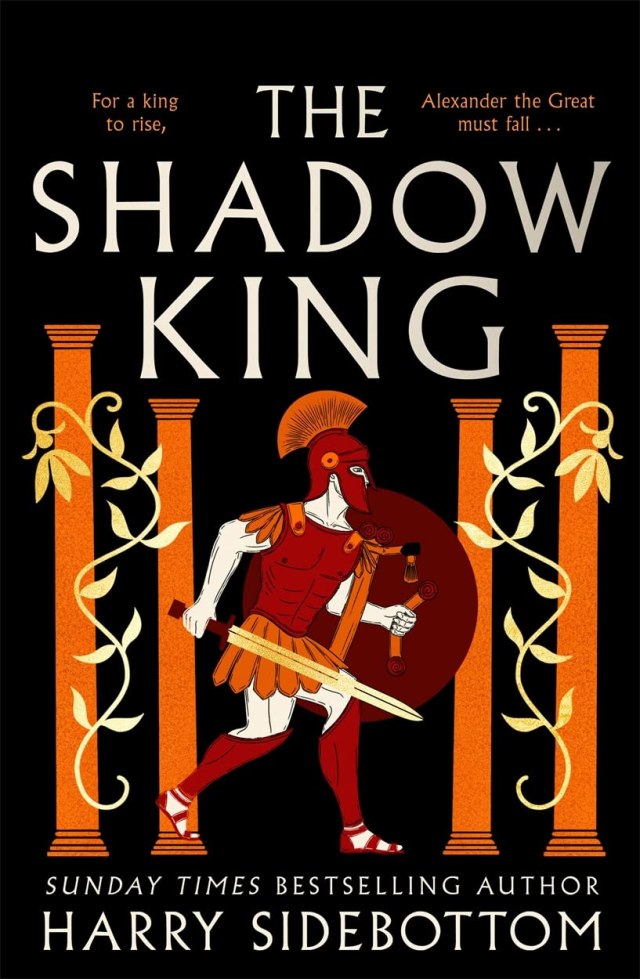
Welcome to my weekly segment, Waiting on Wednesday, where I look at upcoming books that I am planning to order and review in the next few months and which I think I will really enjoy. I run this segment in conjunction with the Can’t-Wait Wednesday meme that is currently running at Wishful Endings. Stay tuned to see reviews of these books when I get a copy of them. For this latest Waiting on Wednesday, I look at an excellent upcoming historical fiction read with The Shadow King by Harry Sidebottom.
One of my favourite historical fiction authors writing now is the always impressive and compelling Harry Sidebottom, who has been producing great reads pretty much the entire time I’ve been a reviewer. An expert in ancient history, Sidebottom has written several great series and standalone novels, primarily set in ancient Rome. This includes his exceptional Warrior of Rome books, as well as the detailed Throne of the Caesars series, each of which take a unique look at different parts of Roman history and military fiction. I have deeply enjoyed many of Sidebottom’s outstanding Roman historical fiction novels, and I have reviews for The Last Hour, Falling Sky, The Lost Ten, The Return and The Burning Roads currently on my blog.
Due to how much fun I have had with Sidebottom’s previous historical fiction novels I always keep a close eye on his upcoming books, and I was very excited to see that he has a new novel coming out later this year. This book, which is set for release in November, is The Shadow King, which will see Sidebottom take on a whole new historical period with an interesting look at Alexander the Great and the Macedonians.
Plot Synopsis:
Alexander of Macedon was just twenty years old in 334BC when he set out with a small army to challenge Persia, the largest and most powerful empire in the world. The Macedonians marched East into the unknown, won battles against overwhelming odds, stormed impregnable fortresses. In the deserts and mountains between the Aegean and India they conquered nature itself. Yet disaster was never more than a sword stroke away. Alexander`s companions were riven with murderous rivalries, their loyalty contingent. The threat of treason, inspired by ambition and Persian gold, or by honour and principle, was ever present.
Alexander: The Shadow King tells this epic story from a new and unique angle through the eyes of another Alexander, a prince of the Macedonian royal house of Lyncestis. The Lyncestian was Alexander the Great`s general and friend. But he was torn between that friendship and the duty to avenge his murdered brothers, and between adherence to the ways of his ancestors and the new world of empire. The Lyncestian was never safe. Others – Persians and Greeks, as well as Macedonians – saw him as a rival for the throne. For six years of conspiracy and battle, as the Macedonian army fought its way East, his life hung by a thread.
Alexander of Lyncestis was The Shadow King.
This new upcoming book from Sidebottom sounds amazing and I am very excited to see how the author handles this different historical period in The Shadow King. The rise of Alexander the Great is always a fascinating subject to explore and it sounds like Sidebottom is going to provide an intriguing alternate perspective by looking through the eyes of Alexander of Lyncestis. I look forward to seeing Sidebottom’s take on these historical events in The Shadow King and this will probably end up being on the strongest and most enjoyable historical fiction novels of 2023.
 The Unseen Library