Throwback Thursday – Usagi Yojimbo – Vol 1: The Ronin by Stan Sakai

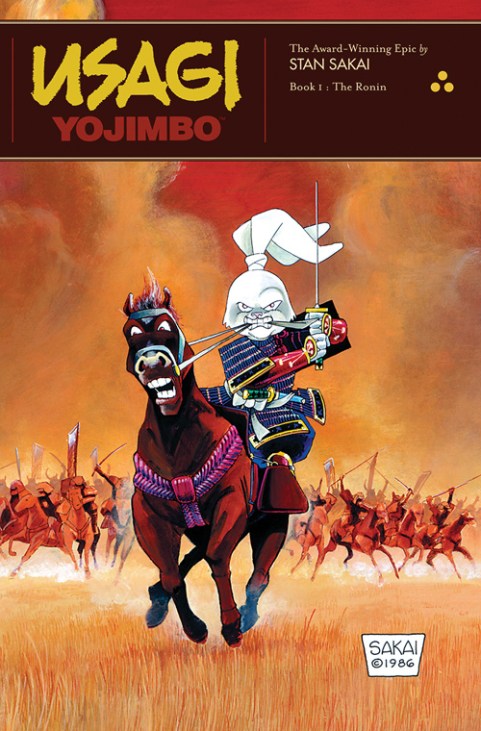
Usagi Yojimbo The Ronin Cover

Publisher: Fantagraphics Books (Paperback – 1987)

Series: Usagi Yojimbo – Book One

Length: 144 pages

My Rating: 5 out of 5 stars

Amazon     Book Depository

Reviewed as part of my Throwback Thursday series, where I republish old reviews, review books I have read before or review older books I have only just had a chance to read.

We are now less than two months until the next amazing volume of Stan Sakai’s long running Usagi Yojimbo comic series, Bunraku and Other Stories, is released, and I am getting excited. This new volume is set to feature several brand new Usagi Yojimbo stories (including an extended story about a haunted puppet drama), but it is apparently also going to feature a look back at the very first Usagi story as part of an 35th anniversary special. For that reason, I thought that this would be an excellent time to go back and review volume one of the Usagi Yojmbo series, The Ronin, to serve as a good base for the upcoming review.

Usagi Yojimbo is a unique comic book series that Stan Sakai started back in 1984. It focuses on the adventures of Miyamoto Usagi, an anthropomorphic rabbit samurai who lives in a version of feudal Japan (early Edo period) completely populated with other anthropomorphic animals. Usagi is a ronin, a masterless samurai, who wanders the land on a warrior’s pilgrimage, helping those he encounters and occasionally working as a yojimbo (bodyguard) for hire. Throughout his journey he encounters all manner of friends and foes, including a number of creatures from Japanese folklore, and finds himself constantly drawn into the political plots of the land. This series is written and drawn in a more western comic/cartoon style rather than the Japanese magna style. However, the Usagi Yojimbo series is strongly inspired by Japanese history and culture, featuring a huge range of accurate depictions of historical events and cultural icons. This series is currently collected in 33 volumes from several different publishers, with each volume containing a number of different issues from the series. These issues are usually standalone adventures, although a number of longer storylines are continued through several issues or volumes.

I have been meaning to go back and review the first volume Usagi Yojimbo for a while now. The Usagi Yojimbo series is easily one of my favourite comic book series of all time, as Stan Sakai has created a truly epic and compelling series. While on paper a series following a rabbit samurai in a version of feudal Japan populated by other anthropomorphic animals does sound a bit ridiculous, these comics are anything but. Through a combination of outstanding storylines, complex characters, intense action, great uses of humour and an intriguing and compelling look at Japanese history and culture, Sakai has created a comic series that is extremely endearing and captivating. I have been a massive fan of this series for years, having started reading it when I was in high school (thank goodness for my surprisingly well-stocked public library) after I first saw the character in the 2003 Teenage Mutant Ninja Turtles animated series. I have previously reviewed the last two volumes of Usagi Yojimbo on my blog already (Volume 32: Mysteries and Volume 33: The Hidden), with Mysteries actually being the very first comic I ever reviewed. Both of these previous volumes received a five-star rating from me, which I have also awarded to this first volume.

Unlike the rest of the collected volumes, The Ronin doesn’t actually contain any issues from the Usagi Yojimbo series. Instead, it contains several earlier Usagi stories which were part of other publications, such as Albedo Anthropomorphics, Critters, Doomsday Squad and Usagi Yojimbo: Summer Special. All of these were collected together for the first time in 1987 into this volume (I have the 2007 reprint), and appear in chronological order. The Ronin contains 10 separate chapters of various lengths, each with their own story. These include:

  • The Goblin of Adachigahara: the very first story to feature Usagi, and the one that the upcoming Bunraku and Other Stories is going to revisit. This initial story features Usagi returning to the area near the battlefield of Adachigahara, where he lost his lord, Mifune, in a battle, forcing him to become a ronin. Seeking shelter in the hut of an old lady, he recounts his story of the battle to his host, including the betrayal of one his lord’s generals which cost them the battle. Later, Usagi battles a flesh-eating goblin, revealed to be not only the treacherous general but also the husband of his elderly host, and manages to defeat him, sparing the old lady who was going to allow him to be eaten. This was an excellent introduction to Usagi, as you got some vital information about his history, his status and his skill as a warrior. You also got a great look at his moral character, as he chooses to spare a woman who would have let him be eaten, and instead instructs her to perform funeral rights on the man who cost him everything.
  • Lone Rabbit and Child: this second story involves Usagi getting involved in the politics of the nation, as he comes to the aid of a young lord, Noriyuki, and his retainer the swordswoman Tomoe Ame. Noriyuki and Tomoe are being hunted by the agents of the evil lord Hikiji, who was also responsible for the death of Usagi’s previous lord years ago (it is later revealed he also killed Usagi’s father). Usagi agrees to escort them to safety, and they must contend with mercenaries, assassins and ninja on their quest. This is an amazing second outing, which expands on the world the series is set in, continues to show off Usagi’s skill, and sets up Hikiji as the main antagonist of the series (even if you see very little of him later on).
  • The Confession: This story follows on directly from the events of Lone Rabbit and Child, and features Usagi in the possession of a vital letter implicating Lord Hikiji in the attempt to kill Noriyuki. Usagi is ambushed by the Neko Ninja, who seek to reclaim the letter, leading to a prolonged and desperate fight in the woods. This proved to be an awesome follow-up to the previous story, which continued to highlight Usagi’s skills in combat and Sakai’s ability to drawn excellent, high-stakes fight scenes. It also showed just how nefarious an opponent Hikiji and his advisor Counsellor Hebi (a big terrifying snake) can be.
  • Bounty Hunter: Usagi is hired as a Yojimbo by the bounty hunter Gennosuke as he attempts to claim his latest bounty, the leaders of a local gang. Engaging the gang in a fight at a temple, Usagi and Gen are an effective team, eventually getting their targets, although their partnership ends on an interesting note. This was an entertaining story that served as a perfect introduction to a great character. Usagi and Gen have amazing chemistry together and Gen is an awesome side character. This is also one of the first stories to feature some more humour in the story, especially in the end, which turns out to fit in well with the overall feel of the series.
  • Horse Thief: Sakai features a lot more humour when Usagi, after interfering in a robbery by a gang of bandits, takes one of the bandit’s horses. He attempts to sell the horse in town, only to discover that it was stolen from the local magistrate, who chases him into the woods. Usagi’s problems only escalate from there, when he and his pursuers run into the bandits, prompting a massive battle in which Usagi is everyone’s enemy. The story has a great ending, steeped in irony which leaves Usagi and the reader laughing hysterically. I loved the author’s use of coincidence and bad fortune in this story, and it was fantastic to watch Usagi go from one bad situation to the next.
  • Village of Fear: This is a bit more of a horror story, as Usagi comes across a village held captive by a fearsome monster. This horror is compounded when it is revealed that the monster is a shapeshifter who has taken the form of one of the villagers. This was a relatively brief story, but it is set up and executed very well, with several great character moments, and there is even time for a quick Gone with the Wind joke.
  • A Quiet Meal: This is another of the more humorous stories in the volume, which features Usagi trying to have a quiet meal in an inn. Unfortunately, a gang of rough gamblers are causing trouble, throwing the other patrons out and trying their luck with Usagi. Usagi quickly shows them the error of the ways with some extremely fancy sword work, which causes them to flee in terror. The most noticeable feature of this entry is the fact that Usagi doesn’t speak once during the entire issue (he’s trying to have a quiet meal), and it’s up to his body language and the other characters to tell the story. This works extremely well and really helps to uplift the overall humour of the story. The way in which he sees off the ruffians is absolutely fantastic, and their absolute fear and disbelief at his skill, “this one’s been filleted”, is just great.
  • Blind Swords-Pig: This is a somewhat sadder and more dramatic story which features Usagi encountering and quickly befriending the blind pig, Zato Ino, who is seeking a peaceful place to settle down. Ino, however, is an extremely skilled warrior and wanted outlaw. Constantly hunted for his bounty, he relies on his sword skills and his ability to ‘see’ with his sense of smell. When Usagi finds out his true identity, the two engage is a fierce duel in which Ino loses his nose, truly becoming blind. This is one of the best stories in the whole of The Ronin, mainly because of the complex character that is Ino. He has a true desire for a peaceful life, but his past ensures that this can never happen, as even friendly characters like Usagi turn against him. This has turned him into a somewhat bitter creature, quick to hate those he meets “and what I hate, I kill!”, and the events of this first story help turn him into something even more angry, especially when it comes to Usagi.
  • Homecoming: This story sees Usagi return to the village of his childhood, but his return is not a peaceful one, as his village is under attack by the Mogura Ninja. Usagi must work with his childhood rival, Kenichi, to save the village; however, there is much enmity between Usagi and Kenichi, mainly because Kenichi married Mariko, the love of Usagi’s life. The two rivals must move past their differences, especially when Kenichi and Mariko’s son, Jotaro, is kidnapped by the Mogura Ninja. This was another exceptional entry in the volume, as it blends together tight action sequences with a deeper dive into Usagi’s past, including his complex and dramatic history with Kenichi and Mariko. The final pages of this issue are just heartbreaking, as it is revealed that Usagi and Mariko both kept the mementos they gave each other as young lovers, and they are both clearly in love with each other, even though they can never be together. I also really liked the Mogura Ninja in this book, especially as moles apparently make effective and deadly ninja.
  • Bounty Hunter II: This final story sees the return of Gen, who once again convinces Usagi to work with him to collect another bounty. Gen of course manages to complicate the job, and his actions backfire on Usagi, resulting in him getting into a major scrape. Despite Usagi’s understandable rage towards Gen, the two are able to part amicably, although Usage gets a small measure of appropriate revenge at the end of the story. I think that Sakai really hit his stride with the Usagi/Gen friendship in this second story, and the two of them play off each other extremely well. I really loved the end of this story, and it definitely got a big laugh out of me.

Overall, I felt that this volume contained a perfect blend of stories, and I really liked how Sakai jumped between action-based stories, to comedies and then to more dramatic tales, which helped produce a range of different emotional reactions. I did appreciate that the different issues also featured a range of different opponents and story basis, allowing the reader to understand that this series is going to focus on everything including banditry, ninja attacks, political intrigue and even the supernatural. I also think that the stories in The Ronin contained the right amount of character background for Usagi, providing enough for the reader to understand his motivations, while not being too overwhelming. This great blend of storylines and character arcs works extremely well together, and it makes for one heck of a complete volume.

The Ronin serves as an excellent introduction to this series, and I would strongly recommend that anyone interested in Usagi Yojimbo start with this volume. The stories within do a wonderful job of setting up the alternate version of historical Japan that this entire series takes place in. I absolutely love the combination of vibrant animal characters with feudal Japanese settings, and it works really well as the backdrop for an action series, especially with the political uncertainty and mass of unemployed samurai that accompanied the early years of shogunate rule. That being said, it is never quite explained why certain animals (horses and small dogs) are non-sentient, or why there are packs of dinosaur-like lizards (tokage) roaming the wilderness, although I kind of like the mystery. This volume also contains fantastic introductions for so many characters who are vital to the series, such as Gen, Tomoe, Mariko and more, and you get great insights into their characters, which are built up with each appearance they make. A lot of key character arcs or storylines start in the stories featured within this volume, and as each volume of Usagi Yojimbo is sequential, readers of the series are best served starting with this first volume. Luckily, The Ronin is a really good first entry in the series, and it is definitely worth checking out.

One of the most charming things about the Usagi Yojimbo series is the way in which Sakai sneaks so many different historical and cultural references into his stories. Most of the characters are either inspired by a real-life historical figure or a fictional character from Japanese or western culture. For example, Usagi himself is based on one of the most famed samurai of all time, Miyamoto Musashi, who is often credited with creating the two-sword fighting technique that Usagi utilises in the series, while Tomoe Ame is based on famed female samurai Tomoe Gozen. Other characters however are based on Japanese movie characters, such as Zato Ino who is a clearly a pig version of Zatoichi, the blind swordsman protagonist of a series of popular Japanese movies and televisions shows. Gen is based on the character that Toshiro Mifune portrayed in samurai films such as Yojimbo (which was later adapted into A Fistful of Dollars), and Usagi’s former lord Mifune gets his name from the actor. Other references include the title of the second story in this volume, Lone Rabbit and Kid which is a references to the manga series Lone Wolf and Cub (Sakai later creates the characters of Lone Goat and Kid as another homage to this series) and the fact that this series is partially named after the Yojimbo film. Two separate stories in this volume also reference Sakai’s previous work on the Groo the Wanderer comic, with Groo even briefly appearing in Lone Rabbit and Kid, sharing a fun stare down with Usagi. I had a great time with all these references (although I admit I had to look up a couple), and some of them are really clever. They add a lot of fun to this series and they are a real treat for readers, especially those already familiar with Japanese history, film or culture.

I am a big fan of Sakai’s art style, and each issue of Usagi Yojimbo is an absolute joy to view. Not only does he produce some outstanding action sequences with his drawings, many of which do an awesome job of depicting the samurai battle style, but he also creates some fantastic characters and breathtaking landscape scenes. Nearly every issue shows some inspiring and beautiful depiction of the Japanese countryside or a historical town, and the sheer amount of detail that he throws into his various scenes is just incredible. It’s also fun to see the various animals that can be turned into samurai, as everything from bulls, rabbits, crocodiles, rhinos, monkeys, pandas, cats and dogs appear in this first volume alone. For this first volume, however, the artwork is understandably a little inconsistent, mainly because Sakai had only just started drawing these characters. The various character designs are a little rough in places, especially if you are familiar with his later work, as Sakai is clearly experimenting with how he wants to depict these characters. A few of the action sequences are also a tad different from the later entries in this series, which can be a little jarring in places, but still really cool. Overall, though, most of the art in this book is pretty incredible, and it is fun seeking Sakai get into his groove with each new story. Sakai does an amazing job conveying emotion, action and intent through his drawings in this volume, and it turns out wonderfully. If I had to pick my favourite bit of art in this entire volume, it would be a scene in A Quiet Meal, where Usagi swings his sword around the head of a ruffian who is bothering him. While it first it appears that Usagi had done nothing, you slowly realise that the flies that Sakai had been subtly drawing around this character’s head before that point, are gone. The facial reactions of the various thugs when they realise what happened to the flies are just hilarious, and I absolutely loved it.

This first volume of the Usagi Yojimbo series, The Ronin, is an amazing and spectacular read, which I have a lot of love for. Not only does it serve as an excellent introduction to the Usagi Yojimbo series, but it contains some captivating storylines, impressive artwork and a heck of a lot of fun. Needless to say, The Ronin gets a full five stars from me, and I cannot recommend this volume and the Usagi Yojimbo series enough. Reading this first volume actually got me re-reading the entire series again, and I have already made it up to volume 17. In my book, all of them are five star reads, and you can probably expect some more reviews of them in some future instalments of Throwback Thursday. Stay tuned to see my review of the next volume of this epic series, which I already know I am going to love.
Amazon     Book Depository

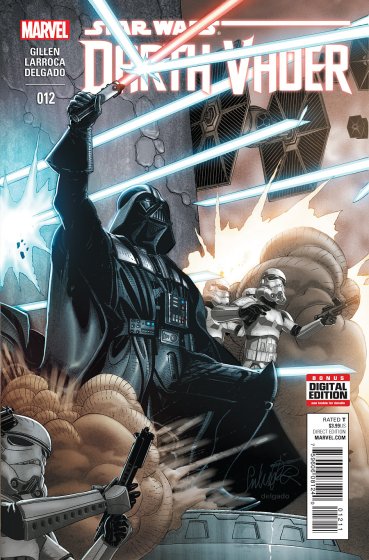
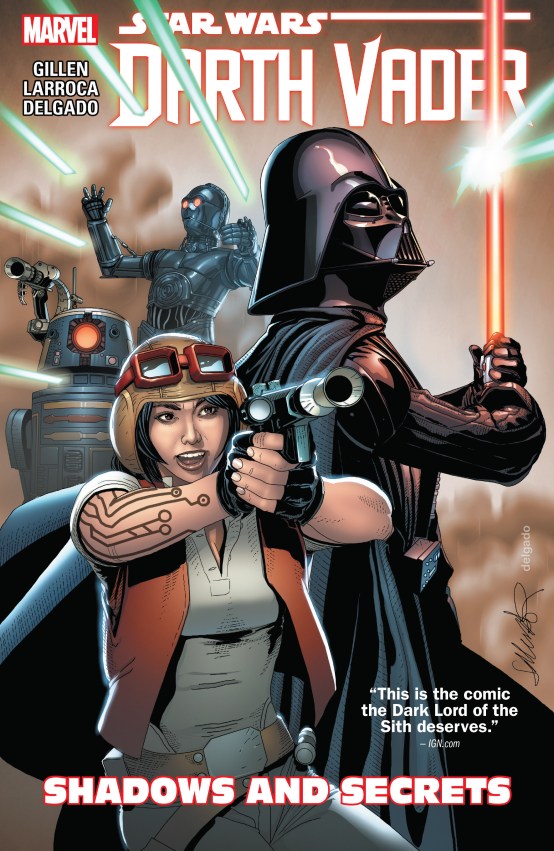
Throwback Thursday – Star Wars: Darth Vader (2015): Volume 2 – Shadows and Secrets

Darth Vader - Shadows and Secrets

Publisher: Marvel Comics

Writer: Kieron Gillen

Artist: Salvador Larroca

Colourist: Edgar Delgado

Publication Date: 5 January 2016

Length: 136 pages

My Rating: 5 out of 5 stars

Amazon

Reviewed as part of my Throwback Thursday series, where I republish old reviews, review books I have read before or review older books I have only just had a chance to read.

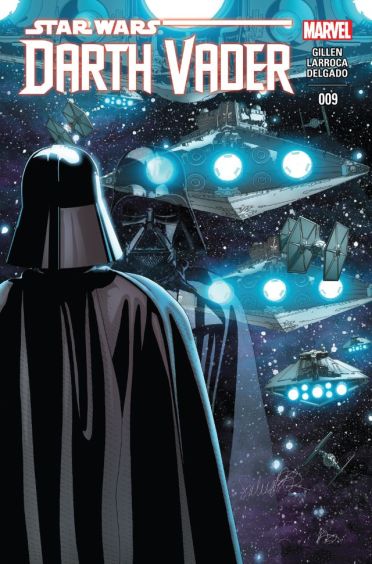
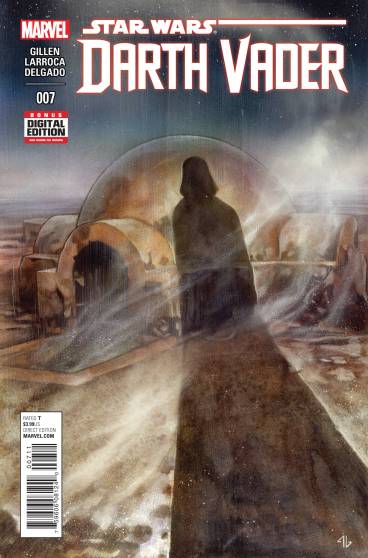
Darth Vader (2015) 7

For my latest Throwback Thursday, I take a look at the second volume of the 2015 Darth Vader series, Shadows and Secrets. This is a superb and fantastic addition to a series which I honestly consider to be one the best overall pieces of Star Wars fiction out there, as it continues to explore the complex character that is Darth Vader.

Following the events of the first volume of this series, Vader, Darth Vader now knows that the mysterious Rebel pilot who destroyed the Death Star is actually his son, Luke Skywalker, and that the Emperor has been lying to him for years. This revelation, combined with the fact that the Emperor is forcing him to compete for his favour with the scientific creations of the cybernetic genius Cylo, has crystallised Vader’s rage, and he is now determined to overthrow the Emperor and rule the Empire with his son. To that end, he has commanded his new agents, the rogue archaeologist Doctor Aphra and her two murderous droids, Triple Zero and BT-1, to gather the resources needed to pursue his agendas.

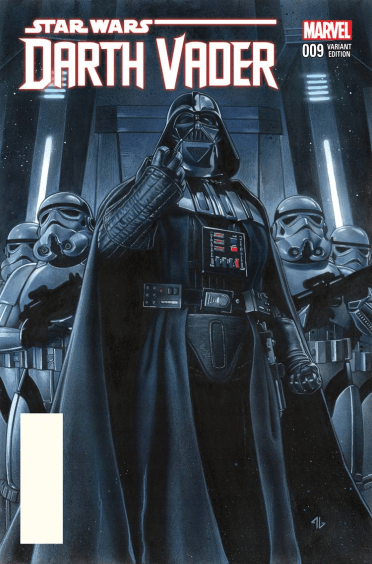
Darth Vader (2015) 9

Whilst Aphra and her criminal contacts do their work for him, Vader must appear to obey the commands of his new superior officer, Grand General Tagge. His latest mission from Tagge requires him to find out who stole a massive consignment of credits that the Empire recently seized from crime lords in the Outer Rim. There is just one problem: Aphra and a small group of bounty hunters stole the credits on his behalf. Vader attempts to cover up his involvement in the crime and lead the investigation away from Aphra. However, the arrival of his new aide, the brilliant Inspector Thanoth, may prove troublesome, as Thanoth’s investigation leads him in all the right directions.

However, despite the importance of Vader’s plans within the Empire, his main concern is the search for his son. Needing to locate and corrupt Luke before the Emperor finds out who he is, he tasks Aphra with not only finding his son’s location but to also find and silence the one person who knew that Luke was actually born. As Vader does all he can to keep Thanoth from finding Aphra and incriminating himself, he finds himself walking a fine line between victory and destruction. With new rivals and both the Empire and the Rebellions seemingly against him, can even Darth Vader get what he wants?

Darth Vader (2015) 9 alternate

Well this was another fantastic bit of Star Wars fiction! The first thing that I do have to admit is that Shadows and Secrets is probably my least favourite volume in the entire 2015 Darth Vader series. However, this is only because every other volume in this series is just so incredible that this one suffers a little in comparison. That being said, I absolutely loved this second volume as it contains an excellent story, some great moments, fantastic characters and some impressive artwork. Containing issues #7-12 of the Darth Vader series, Gillen and Larroca have done an incredible job with this second volume, and I still consider it to be a five-star read.

One of the best things about Shadows and Secrets is Gillen’s outstanding story, which continues some of the tantalising threads from the first volume while also introducing some great new elements. Gillen sets out a clever, well-paced story that is filled with all manner of action, adventure and intrigue, as Vader begins his duplicitous actions within the Empire, attempting to amass the resources he needs for his projects without drawing the suspicion of either his rivals in the Imperial hierarchy or his new superior. Most of the story contained within this volume is fairly self-contained, featuring a fantastic heist sequence and the subsequent fallout from this event. This fallout mostly revolves around Vader’s investigation into his own heist, which he attempts to cover up from his new aide, Inspector Thanoth. Thanoth is a genius detective of Sherlockian talents who was quickly able to get to the truth of the matter and find the culprit of the heist, despite Vader’s vest efforts. I really enjoyed this whole investigation element to the book, especially as it was fun watching Vader routinely sabotage his own investigation, often by killing any and all potential witnesses, only to have Thanoth easily breeze through these obstacles. Thanoth turned out to be an excellent new addition to this series, and I really enjoyed the intriguing partnership he formed with Vader, especially as he plays a dangerous game by continuously hinting that he knows Vader is behind the theft. This turned out to be quite an amazing and enjoyable storyline, and I really appreciated Gillen’s perfect blend of humour and serious storylines throughout the volume.

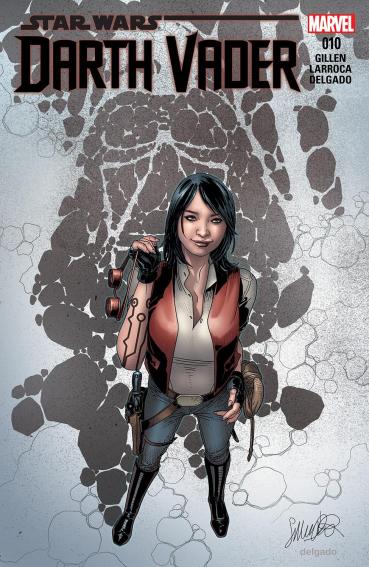
Darth Vader (2015) 10

I also loved the continued focus on Vader’s obsessive hunt for Luke Skywalker, which has taken on a new edge now that he knows he is his son. While he was already searching for him in the first volume, now that he realises who he really is, Vader decides to protect his identity and the find out the whole truth behind his birth. This is shown in the first part of Issue #7, in which Vader and Aphra visit both the Lars Homestead and Ben Kenobi’s hovel on Tatooine, where he tries to gleam some knowledge from both houses about his son, before setting off a molecular bomb to erase all useful forensic evidence. Shortly after this, Vader than sets Aphra a task of finding and interrogating a former mortician from Naboo who prepared Padme Amidala’s body for her funeral, including setting up a hologram to make it appear that she was still pregnant. This tuned out to be an outstanding sequence, as the mortician, who has a huge amount of personal loyalty towards Amidala, at first refuses to provide any information about his work, before being tortured and confirming the existence of a child. While this admission is a betrayal of his beloved Queen that clearly costs the former mortician a lot, he is able to do one last act of service for her by not revealing any details about the second child, Leia. I thought that this scene was amazing, and I liked how it helped explain how Vader was aware of Luke’s existence and status as his child, but not that he also had a daughter. I also appreciated Gillen’s focus on the loyalty the inhabitants of Naboo had to Amidala, even in death, which was even able to move the cynical Aphra. Her subsequent mention to Vader of how Amidala must have really been something was a nice touch, as Vader’s subdued and hidden reaction hints at his continuing deep feelings towards his long-dead wife. I really liked this focus on the search for Luke, as not only does it makes sense in the context of the movies, but it also showcases the lengths Vader was willing to go to find and protect his son, and it leads to the best sequence in the entire volume.

I personally really enjoyed how the creative team continued to show off Vader as a dangerous and vicious powerhouse in this volume. While it does not contain the same level of carnage that he unleashed in the first volume of the 2015 Star Wars comic book series, Shadows and Secrets contains several amazing scenes depicting his destructive abilities and personality. Whether he is stuffing a crime lord into the mouth of his own exotic beast and then easily killing the distracted monster, or whether he is taking down and entire squadron of Rebel space fighters one at a time by throwing his lightsaber at them, he is shown to be pretty impressive.

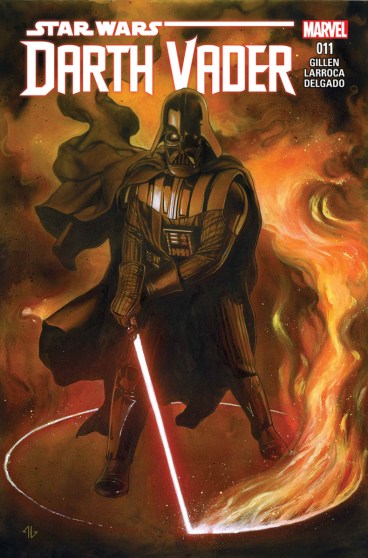
Darth Vader (2015) 11

Just like in the first volume, Doctor Aphra continues to shine as the series’s main supporting character, and her entire character arc within Shadows and Secrets is very intriguing. Throughout this volume, Aphra ends up undertaking several missions for Vader, such as trying to find the location of Luke Skywalker, and has become one of his main confidants. This puts her in a terrible position, as Vader is likely to kill her to protect his secrets, especially when Thanoth gets close to capturing her. Watching the various ways that this ultimate opportunist attempts to survive against the odds, including by brazenly withholding information from Vader in order to stop him killing her, is pretty impressive, and it makes for some great reading. Shadows and Secrets also contains one of the first deeper looks at Aphra’s internal character. During the sequence I mentioned above with the mortician, she gives a lengthy monologue about the death of her mother and how it has affected her. This was a heavy scene, and while she tries to play it off as not being very important, you can see that it has impacted her, turning her into a much more cynical and self-reliant person who has no room for idealism or blind belief. The significance of this scene is also quite crucial when you consider that much of what she said is later shown in the Doctor Aphra spinoff series and ends up becoming a defining part of her character. I also like how the noticeable changes that the creative team have inserted into Aphra’s personality when she deals with Vader. For most of the volume, Aphra comes across as an ultraconfident being who is able to manipulate and control bounty hunters, murderers and crime lords with ease. However, whenever Vader appears, there is a noticeable change in her bearing and personality, which isn’t too surprising as Aphra knows Vader is going to kill her one day.

I also have to point out how much fun the two murder droids Triple Zero and BT-1 continued to be in this novel. Essentially perverted versions of C-3PO and R2-D2, Triple Zero and BT-1 are remorseless killers who delight in murdering or torturing all organic life. These two add an insane element of humour to the entire series, and they have a number of great moments in Shadows and Secrets. Watching the two of them delight in all sorts of murder and mayhem is all sorts of fun, and you’ve got to love the weird and friendly relationship the two of them have formed with each other.

Darth Vader (2015) 12

One of the best highlights of this second volume is the amazing artwork. The artistic team, helmed by Salvador Larroca, did another fantastic job bringing the amazing story contained within Shadows and Secrets to life on the page. There are so many vibrant and imaginative panels in this volume, and the volume’s artistic team produce some amazing pieces of art that showcase the wider Star Wars universe. One of the things that continues to impressive me about this series is the way that the artistic team are able to convey so much emotion from the faceless main protagonist. Despite only ever seeing Vader’s expressionless and iconic mask, I found that I was constantly able to glean the true emotions that Vader was surely feeling at the time when I looked at him, ranging from cold menace, surprise, frustration to deeper emotions, such as sadness when Amidala is mentioned. There are some truly amazingly drawn scenes throughout this entire volume, although there are two that I would bring particular attention to. The first is the very first scene in Issue #7, which shows Vader standing out the front of the Lars Homestead, staring at Tatooine’s twin suns as they set. I absolutely loved how this drawing matched the iconic scene from A New Hope where Luke stared off in the same position, and I really appreciated the symmetry. The other piece of art that really stood out to me was a quick sequence that appeared a little later in the volume within Issue #8. In this scene, Aphra has just confidently dealt with one of the bounty hunters in her employ and is looking off in the distance speaking to someone. As she talks, Vader slowly materialises out the shadows behind her, responding to her comments. Despite the fact that Aphra’s expression does not change at all there is a notable shift in the tone of the panel when Vader appears, and you cannot help but feel the threat and menace that he exudes. This was some impressive artwork, which helped to really increase how much I loved this comic.

The second volume of the 2015 Darth Vader series, Shadows and Secrets, is a first-rate comic book that once again shows off how impressive Star Wars comics can really be. Gillen and Larroca did an incredible job following up the first volume of this epic series and I really enjoyed the complex and fun story that this second volume contained, especially when it was backed up by great characters and exceptional artwork. This is a superb addition to the series that is really worth checking out.

Amazon

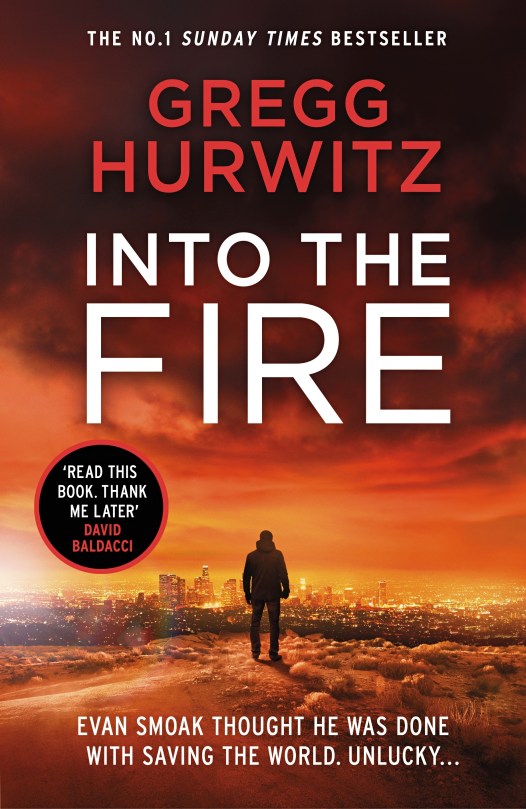
Into the Fire by Gregg Hurwitz

Into the Fire

Publisher: Michael Joseph/Brilliance Audio (Audiobook – 28 January 2020)

Series: Orphan X – Book Five

Length: 12 hours

My Rating: 5 out of 5 stars

Amazon     Book Depository

From the mind of bestselling thriller author Gregg Hurwitz comes an outstanding and captivating adventure novel, Into the Fire, the latest book in his amazing Orphan X series.

Evan Smoak is Orphan X, a former orphan child who was taken in by a secret covert government and trained from a young age to become the most skilled assassin and special operator in the world. Orphan X served his country for years before finally having enough and leaving, pursued by the people who ordered his creation. Resettling to Los Angeles, Evan forged a new identity for himself as The Nowhere Man, a vigilante dedicated to helping those in desperate need who have no one else to turn to.

After killing his greatest enemy, the United States President, Evan has had enough of violence and is determined to retire and live a quiet life. But before he leaves everything behind, Evan has decided to help one more person as The Nowhere Man, as one final act of redemption. Enter Max Merriweather, a poor construction worker in LA. Two months earlier his cousin Grant, a successful forensic accountant, entrusted Max with an envelope and instructions to take it to a reporter if anything happened to him. Now Grant is dead, an armed thug is ransacking Max’s apartment and the reporter he was told to contact has been murdered. With nowhere else left to turn, Max calls The Nowhere Man.

Taking on Max’s case, Evan dives into LA’s criminal underbelly in order to locate the people hunting Max. Easily finding the thugs responsible for Grant’s death, Evan manages to eliminate them quickly; however, it turns out that they are just the tip of an iceberg stretching throughout the entirety of LA. Grant was on the verge of uncovering a massive conspiracy, and his evidence could put away a lot of dangerous people who are now determined to kill Max to keep him quiet. Determined to keep Max safe, Evan soon finds himself embroiled in one of the most challenging and complicated missions of his life, as behind every corner a new adversary lies, each one more powerful and connected than the last. Can even this legendary assassin and vigilante win with the odds so severely stacked against him?

Gregg Hurwitz is a veteran thriller author who has been producing compelling and exciting novels since his 1999 debut, The Tower. Since then he has written over 20 novels, including his Tim Rackley series, The Rains Brothers books and several standalone novels. He has also contributed to several DC and Marvel comic book series, such as Batman: The Dark Knight and The Punisher, and he also does a bit of screenwriting, having written several episodes of the 2009 remake of V. Hurwitz’s main body of work at the moment is his Orphan X series, which started in 2016 with the novel Orphan X. Into the Fire is the fifth book in the Orphan X series and follows on shortly after the events of the fourth book, Out of the Dark. I actually got into Hurwitz’s works last year when I read Out of the Dark due its cool story premise of a former secret agent attempting to kill the President. After I enjoyed this fun action thriller last year, I was definitely keen to check out more of Hurwitz’s work and I have been looking forward to Into the Fire for a little while now.

Now, I have to admit that while I was interested in checking out Into the Fire, I was a little worried that Hurwitz was going to have a hard time topping his previous novel and its outrageous central plot point. However, Into the Fire turned out to be an outstanding read which I ended up enjoying more than Out of the Dark. Hurwitz has produced an incredible thriller that is filled with intense action, clever plot developments and an excellent character-driven central story. All of these amazing elements combine together perfectly into a novel which can easily be read as either a continuation of the series or as a compelling standalone novel.

One of the best parts of this novel is the well-written and captivating central thriller storyline which sees the protagonist attempt to take down a criminal conspiracy in the heart of LA. What starts out as a relatively simple mission to take down a small-time criminal organisation quickly morphs into a massive task, as each time Evan thinks he has succeeded, a larger and more dangerous adversary appears behind the people he has just taken out. There are so many twists and turns in this novel, you honestly don’t know when or where it is going to end, and the story goes in some very fun and clever directions. I really enjoyed how the author layered his story with seemingly innocuous comments and discussion that later morphed into major plot payoffs later down the line in the book, and I was actually surprised about a few of the reveals that occurred.

I really liked the overarching plot idea of an elite secret agent going after everyday criminals with his full range of tradecraft, advanced weapons and training, especially as it resulted in some amazing sequences throughout the book. The protagonist comes up with some truly unique, clever and at times brutal ways to take down some of his opponents, which were fun to check out. I know I will never look at a plastic drinking straw the same way again. My personal favourite part of the book are several chapters where the protagonist breaks into a prison to deal with one of his targets. The various ways that he infiltrated the prison, pulled off his mission and then escaped was not only clever but also very entertaining, and I loved every single second of it. I also really liked how Hurwitz introduced a handicap for his protagonist throughout this book in the form of a severe concussion obtained early on in the story. The author did an excellent job portraying the symptoms of a concussion, and it was interesting to watch the protagonist struggle to complete his tasks with blurred vision or a massive headache. The concussion angle was a great way to amp the risk surrounding the protagonist’s actions, as it actually put many of his opponents on an equal footing with this former elite special agent and was a fantastic inclusion to the story. Overall, this turned out to be an extremely well-written and deeply exciting thriller storyline, which proves to be quite addictive and captivating.

I was also quite impressed by the way that Hurwitz spent time examining and developing the central characters of this book. In particular, there is a fascinating focus on the complex character of Evan Smoak, who is the main protagonist of this series. Hurwitz has always done an amazing job of portraying Evan as a man very much haunted by his past lives, both as an abandoned child and as an assassin who was trained to kill since the age of 12. Both of these parts of his life still drive him, and his whole persona as The Nowhere Man is a form of redemption for him, as he attempts to not only atone for the lives he took as Orphan X but to also help those who feel as powerless as he did when he was a young child. Hurwitz continues to utilise this characterisation in Into the Fire, although this time it is further complicated by his plans to retire after this one final mission. This whole retirement angle is a major concern for Evan, as he spends a good part of the book weighing up the good he does as The Nowhere Man against all the personal benefits of attempting to live a normal life. This makes for a lot of internal conflict, which forces the author to once again dive into Evan’s motivations for being a vigilante, which adds a great dramatic edge to the entire story.

This consideration about having a more normal life is also explored in the way that the trained loner Evan starting to learn more about human interaction and relationships in this book. Part of this takes place in the way that he interacts with Joey, the teenage hacker and former Orphan trainee he saved and took under his wing. Evan has inadvertently taken on the role of a father figure to Joey, and it was great to see him continue to act protective towards her and see their unique relationship grow. There is also the rather amusing and awkward interactions that he has with the residence of his building. Despite not wanting to have much to do with them, he actually goes out of his way to protect them, and he is actually shown to care quite deeply when one of them is hurt. Finally, there is the complex relationship he has with Mia, the single mother and ADA in his building who he has feelings for but has driven away with his acts of vigilantism. All of these interactions help Evan develop more as a character and recover a little more of his lost humanity, and I really enjoyed the way that Hurwitz explored such a complex and damaged protagonist.

While most of the book’s focus is on Evan, Hurwitz also dives into the life of Evan’s latest client, Max Merriweather. Max, who serves as a significant point-of-view character, is a down-on-his-luck individual who is dragged into the events of this book by his more successful cousin. Throughout the course of Into the Fire, you get to learn about the past of Max, showing how, due to events outside of his control, he has always been seen as the family screw-up, something he has struggled to escape due to his corresponding low self-confidence. You also get to see the history of his tragic marriage, and how doing the right thing cost him everything. I really liked the way that Hurwitz took the time to explore the life of this new client, especially as it develops him into a much more sympathetic character that reader becomes invested in over the course of the book. I also liked the relationship he slowly built up with Evan, as each of them were able to provide some help in solving the deeper emotional or personal issues that were affecting the other. This excellent character was an outstanding and distinctive part of the book, and I am definitely keen to see what excellent characters are introduced in the next Orphan X book, especially after the intriguing reveal at the end of Into the Fire.

I ended up enjoying the audiobook format of Into the Fire, which was narrated by Scott Brick. This audiobook runs for a substantial 12 hours in length, but I got through it rather quickly, as I got really drawn in by the cool and compelling story. I personally found that this was an excellent way to consume this fantastic book, and I had a great time listening to the story. Brick is an excellent audiobook narrator who has a lot of experience bringing thriller novels to life. I previously enjoyed his narration of The Malta Exchange by Steve Berry, and I am currently listening to his narration of the sequel, The Warsaw Protocol. Brick did a wonderful job bringing the characters in Into the Fire to life, and I felt that he utilised perfect voices for each of them. As a result, I would strongly recommend the audiobook format of Into the Fire, as it is an amazing way to enjoy this book.

Into the Fire by Gregg Hurwitz is an incredible read that comes highly recommended. This latest book in the fantastic Orphan X series is an outstanding piece of thriller fiction, which sets its complex characters down an action-packed road of intrigue and twists to produce a five-star read. Hurwitz has really outdone himself with Into the Fire, which turned out to be one hell of a book. I cannot wait to see where Hurwitz takes the Orphan X series next, but I will definitely be grabbing a copy of his next book when it comes out.

Amazon     Book Depository

A Little Hatred by Joe Abercrombie

A Little Hatred Cover

Publisher: Orion (Audiobook – 17 September 2019)

Series: Age of Madness Trilogy – Book One

Length: 20 hours and 20 minutes

My Rating: 5 out of 5 stars

Amazon

One of the very best authors of dark fantasy fiction, Joe Abercrombie, returns to his epic First Law series with A Little Hatred, an outstanding and deeply entertaining read that serves as an excellent start to a whole new trilogy.

28 years after the failed Gurkish invasion of the Union and Jezal dan Luthar’s sudden rise to the throne, the world is much changed. Industry has come to the Union, with vast factories, production lines and businesses now defining the Union’s various cities at the expense of the nation’s farmers, labourers and working classes. In this time of change, a whole new generation is ready to make its mark in the world, but the rivalries, hatreds, manipulations and disappointments of those who have come before are hard things to overcome.

In the North, war once again rocks the lands, as the forces of Stour Nightfall invade the Dogman’s Protectorate, forcing the armies of Angland to come to their aid. Young lord Leo dan Brock is desperate to seek honour and glory on the battlefield; however, his forces are too small to defeat the vast Northern hordes. Requiring help from the Union, Leo is hopeful that a relief force led by Crown Prince Orso may help to turn the tide of battle, but the Crown Prince is a man known to constantly disappoint all who pin their hopes on him. However, the arrival of the mysterious Rikke, daughter of the Dogman, may provide him with a all the help he needs, especially with her ability to see through the Long Eye. Back in the Union, Savine dan Glokta, daughter of the feared Arch Lector Glokta, is making a name for herself as a ruthless businesswoman. Dominating the world of business and industry, Savine believes that she is untouchable, but dissent amongst the working classes are about to show her how wrong she is.

As both the North and the Union find themselves on the dawn of a whole new era, chaos will absorb all before it. While this new generation attempts to find their place, they soon begin to realise what the previous generation found out the hard way that they are not the ones in charge of their destiny, and there is nothing a little hatred cannot ruin.

Joe Abercrombie is a highly acclaimed author who has produced some truly amazing pieces of dark fantasy fiction over the years. While he has written other books, such as the Shattered Sea trilogy, he is probably best known for his First Law series. The First Law series is currently made up of seven books (including A Little Hatred), which detail bloodshed, politics and manipulation in a dark fantasy world. This series started with The First Law trilogy, which debuted in 2006 with The Blade Itself and ended in 2008 with Last Argument of Kings. The First Law trilogy followed the adventures of several complex and amazing characters as they fought to not only stop the Gurkish invasion of The Union but also the end a war in the North. Abercrombie would eventually follow this original trilogy with three standalone novels, which were set after the events of The First Law trilogy. These three books, 2009’s Best Served Cold, 2011’s The Heroes and 2012’s Red Country, each had various degrees of connection to the original trilogy, and in many cases showed what happened to some of the major characters from the first three books. These standalone novels were eventually collected together into the loose Great Leveller trilogy. I absolutely loved the original First Law trilogy, and it remains amongst one of my favourite fantasy series of all times. I do need to check out all of the Great Leveller books at some point, although I have no doubt the will all prove to be first-rate reads.

A Little Hatred is Abercrombie’s first entry in the First Law series since 2012, and it is set 28 years after the events of the original trilogy and 15 years after the events of Red Country. A Little Hatred is also the first book in a new connected trilogy that Abercrombie is producing, The Age of Madness trilogy, with the next two books in this trilogy to be released in September 2020 and September 2021. I have been looking forward to reading A Little Hatred for a while now, mainly because of how much I enjoyed the original The First Law trilogy, and I was very happy to not be disappointed with this new book. A Little Hatred was an incredible and captivating read which I powered through in short order. Not only does this book get a full five stars from me, but I even listed it as one of my favourite novels from 2019 when I was only about halfway through it.

For his latest book, Abercrombie utilises the same writing style that proved to be so successful in the previous First Law books. Readers are once again in for a dark, gruesome and very adult story that follows seven main point-of-view characters as they experience the events unfolding throughout the book. While each of the seven main characters has their own unique arcs, their various stories combine throughout the course of the novel to produce a deeply compelling overall narrative. I really like all the places the story went in this book, and it turned into an excellent blend of war, political intrigue, violent social revolution and intense interaction between a number of amazing characters. Abercrombie does not hold back any punches in this story, and there are a number of intense and excessively violent fight and torture scenes in this book, and there is plenty to keep action fans satisfied. At the same time, the author also installs a fun sense of humour throughout the book, which usually relates to the personalities of the various characters who are telling the story. All of this adds up to an absolutely amazing story and you are guaranteed to get quickly get drawn into A Little Hatred’s plot.

I thought that the author’s use of multiple character perspectives was an extremely effective storytelling method, especially as the seven point-of-view characters followed in this book often find themselves on different sides in the various featured conflicts. This allows the reader to see all the relevant angles to the political, social and military conflicts that are shown in the story, whilst also advancing the book’s various character arcs. These multiple character perspectives also allow the reader to see multiple viewpoints of the same events. This is especially effective during a couple of the larger battle sequences or during a particular duel scene, where you get to see the thoughts, fears and plans of the various participants and spectators, allowing for richer and more elaborate scenes. There are also a bunch of brief scenes which are told from the perspective of several minor characters, which are used, for example, to show off the extreme chaos surrounding the takeover of a city by members of the working class. I also really liked how Abercrombie used these different character viewpoints to imbue the story with some intriguing symmetry, such as by having two separate characters spending time with their respective parents back to back in order to show the differences and similarities in their relationships. All of this produces an excellent flow to the novel, which I really appreciated, and which helped with the overall enjoyment of the book.

A Little Hatred is an excellent continuation of the previous First Law books, and Abercrombie has come up with a bold new direction for the series. This latest novel is strongly connected to the events of the previous entries in this overarching series and continues a bunch of the storylines established in the prior books. It also continues the adventures of several characters who have previously appeared in the series, showing what has happened to them in the intervening years and how their legacy is being continued. Despite this strong connection to the previous six books in the First Law series, I would say that it is not a major necessity to have read any of the prior books, as the author does a great job of rehashing all the relevant major events while also successfully reintroducing some of the main characters, allowing new readers to enjoy this book. That being said, those readers who are familiar with some of the prior books, especially The First Law trilogy, are going to have a much better understanding of the events and characters that are featured within A Little Hatred, which may also result in a change in how readers view certain characters and events. For example, one of the main characters from the original trilogy makes several appearances throughout the book, interacting with some of the point-of-view characters. As these new characters have no prior experiences dealing with him, they believe he is a fairly harmless and friendly old man, which is how he is then presented to new readers. However, those readers who are familiar with him from the original trilogy know just how dangerous he can be, and his harmless routine actually becomes a little sinister. Readers with knowledge of the events of the original trilogy are also in for a lot more cringe throughout this book, as you know all the shocking details of a certain inappropriate relationship well before it is revealed to one of the characters later in the book.

I thought it was interesting that Abercrombie included such a significant time skip between this book and the original trilogy, but I think that it really paid off and created an excellent new setting. While the North and the conflicts that defined it remained very similar to what was featured in the previous books, the main setting of the Union proved to be very different. Since the last time you saw it, the Union has started to evolve from a more medieval society to an industrial society, with factories and production lines, which in many ways were very reminiscent of the Industrial Revolution in places like England. Of course, these changes result in different types of conflicts, as the lack of traditional jobs combined with the rich ruthlessly taking the agricultural industry away from the peasants results in an interesting bout of extreme class warfare, led by the organisation called the Breakers. These Breakers bear a lot of similarities to the organised instigator of real-life industrial revolts that occurred throughout historical Europe, and it was interesting to see Abercrombie’s take on them, especially as he included an anarchist sub-group, the Burners. I really liked this intriguing focus on class revolution, and it looks like this is going to be one of the major story threads of this new trilogy. I am very curious to see how it all unwinds, and I imagine there is more anarchy, chaos and bloody revolution on the horizon.

While the above elements are all pretty outstanding, the true highlight of the First Law books has always been the complex and damaged protagonists through whose eyes the story is told. Abercrombie has a real knack for creating compelling and memorable characters, which he once again showcases within this book. There are some really enjoyable and complex characters here, and I really liked their various interactions and character arcs. These new point-of-view characters include:

  • Crown Prince Orso – son of King Jezal and notorious wastrel who, despite his outward appearance as a lazy, useless and apathetic drunk, is actually a surprisingly capable and deeply caring individual, who hides his abilities and real feelings, especially as his attempts to be a good person usually have disappointing results.
  • Savine dan Glokta – daughter of Arch Lector Glokta, Savine has capitalised on her business sense and the fear of her father to become a successful investor. As a woman in a man’s world, she is forced to be utterly ruthless like her father, and Savine mostly comes across as heartless until a traumatic experience and revelations about her past almost break her.
  • Rikke – a Northern girl who is the daughter of the Dogman. Rikke is a powerful seer with the ability to see both into both the past and the future, although she has limited control of these powers. Rikke starts the book out as quite an innocent woman, until Stour Nightfall’s invasion hardens her and makes her keener for violence and revenge.
  • Leo dan Brock – a Union lord who is the son of two of the protagonists of The Heroes. Leo is a young man’s man, eager to prove himself in combat, whose abilities have made him a popular hero. However, his impatience and desire for glory ensure calamity on the battlefield, which guilts him to try and learn a new way of command. However, once he tastes glory again, he forgets all the lessons he has learned and the friends who got him there.
  • Vick dan Teufel – a Union Inquisitor serving under Arch Lector Glokta. Despite the fact that Glokta framed her father in the original trilogy and sent her and her entire family to a prison camp, Teufel appears loyal to him and the Union, as she likes being on the winning side. Despite her misgivings about the people she works with and her respect for some of the people she is investigating, she continues her missions and tries not to get close to anyone. Teufel is actually very similar to Glokta in personality, especially as she has the familiar storyline of being forced to investigate a conspiracy that no one wants solved.
  • Gunnar Broad – a former Union soldier who returned home after many years of fighting for his country to find that the local lord has stolen his farm. Attempting to find work in the cities, Broad becomes involved in the events of the Breaker’s revolution. Broad is a killer without peer whose temper, bloodlust and the emotional trauma of war drag him into great acts of violence, even when these actions backfire on him and his family.
  • Jonas Clover – a veteran Northern warrior who finds himself serving as an advisor to the young warlord Stour Nightfall. Clover is easily my favourite character in A Little Hatred, as his sense of humour, penchant for mockery and jaded personality really stand out amongst the more serious and blood thirsty characters he interacts with and he has some of the best lines in the whole book. Clover affects an air of laziness and cowardice and is constantly spouting wisdom and council to the younger warriors, who either don’t listen or openly mock him. Despite his apparently amiable nature, Clover is actually a vicious bastard when he needs to be, and he has a couple of memorable kills throughout the book.

In addition to the above seven new point-of-view characters, there is also a bevy of great side characters which really help move the story along. While I could go on about several of them, I might just stick to Isern-i-Phail and Stour Nightfall. Isern is another older Northern character who serves as Rikke’s mentor and protector. While Isern is generally a hard and practical character she is in many ways crafted in a similar vein to Jonas Clover, gently mocking the younger characters she interacts with and producing some of the most entertaining insults and comments throughout the book. Stour Nightfall, on the other hand, is one of the primary antagonists of the book. The cocky son of Black Calder and the grandson of Bethod, one of the major antagonists of the original trilogy, Stour has a real sense of entitlement and viciousness, brought on by his famous relatives and his skill with the blade. In many ways he is a mirror to Leo dan Brock, as both are determined to seek glory in combat, and both seek to emulate the Bloody Nine, Logen Ninefingers, despite their elder’s warnings about what kind of person their hero really was. While at times Stour was a bit two-dimensional as a character, he changes after a significant event at the end of the book, and his future in the series should prove to be very interesting.

Aside from this new group of protagonists, several of the major characters from the original trilogy make a return in this book, allowing readers to get an idea of what has happened to them since their last appearances. This includes returning former point-of-view characters Jezal dan Luthar, Sand dan Glokta (who might just be the best character Abercrombie ever came up with) and the Dogman, as well as several secondary characters. While all of these characters get a few lines and are presented as major figures in the current world order, most of the focus of A Little Hatred is given over to the newer protagonists, which I think fits in well with the book’s overall focus on change. It was great to see these characters again, and there were even some major developments surrounding one of them. It was also cool to see them interact with the younger generations, especially when they see these new characters making the same mistakes they did at their age. A Little Hatred also features the return of the First of the Magi, Bayaz, who is still pulling all the strings in the world. Despite his grandfatherly appearance, Bayaz is probably the main villain of this entire series, and you just know that he is behind all of the events occurring in this book. I look forward to seeing more of the excellent villain in the future, and I cannot wait to see how and why he is manipulating everyone this time.

Rather than read a physical copy of this book, I ended up listening to the audiobook version, which was narrated by Steven Pacey. The A Little Hatred audiobook runs for 20 hours and 20 minutes, making it a fairly substantial audiobook that would actually come in at number 19 on my longest audiobook list. The audiobook format is an excellent way to enjoy A Little Hatred, as you get a real sense of all the gore and violence as it is narrated to you, as well as a better vision of the impressive, changed world that served as the setting of this book. I was really glad that they continued to utilise Steven Pacey as narrator for this new book as Pacey has narrated all the previous First Law audiobooks. It was really good to once again hear the unique voices that Pacey assigned to the characters from the original trilogy, especially as, to me, they were the defining voices of these original characters. The voices that he came up with for the new characters in this book were also good, and I think that he got the character’s personalities down pretty effectively. As a result, I would strongly recommend the audiobook format of A Little Hatred to anyone interested in checking out this book, and I am planning to listen to the rest of The Age of Madness books.

A Little Hatred by Joe Abercrombie is an outstanding and impressive new addition to his brilliant First Law series. Abercrombie has once again produced a captivating, character-based tale of bloody war and politics, while also adding some intriguing new elements to it. This is an exceptional book, which I had an absolute blast listening to. The Age of Madness is off to an extremely strong start, and I cannot wait to see where Abercrombie takes this amazing series to next.

ALH-Final-600x925

Amazon

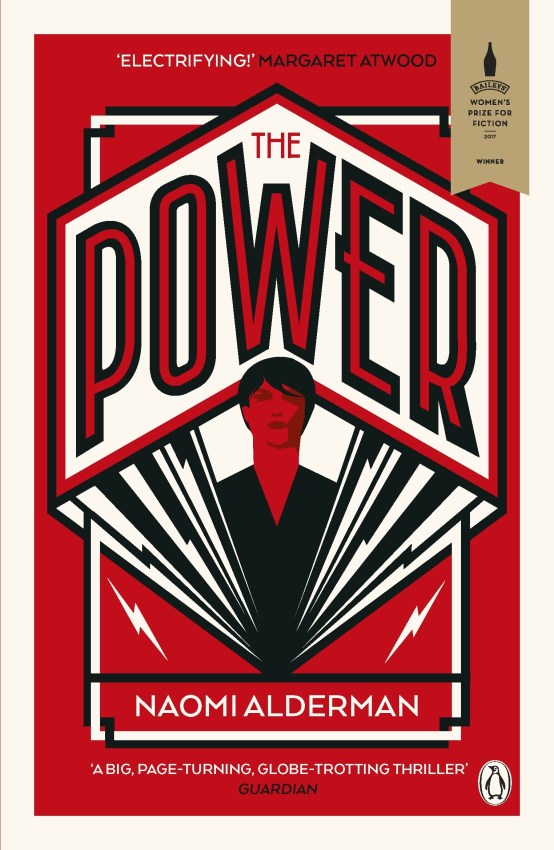
Guest Review – The Power by Naomi Alderman

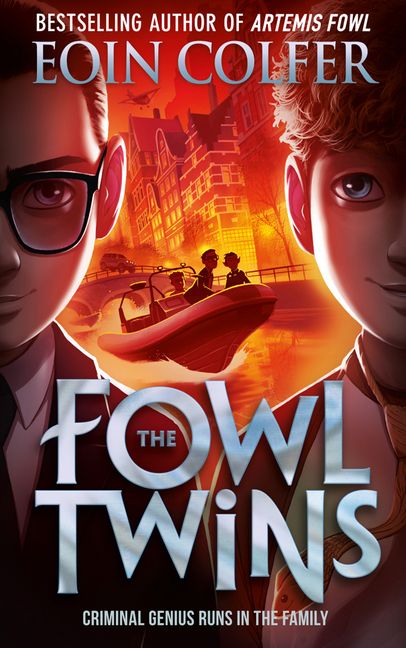
After reviewing some of 2019’s most intriguing reads with Pan’s Labyrinth, The Testaments and The Fowl Twins, my amazing editor/wife Alex (editor is the important part there) attempts to muscle in on my Throwback Thursday territory in her latest Guest Review by checking out The Power by Naomi Alderman.

The Power Cover

Publisher: Penguin (Trade Paperback – 27 October 2016)

Series: Stand Alone/Book One

Length: 341 pages

Rating: 5 out of 5 stars

Amazon

I’m on a mission to conquer my habit of buying more books than I can read. I picked up The Power because I recognised Naomi Alderman’s name from one of my favourite apps, Zombies, Run!, for which she is the lead writer. Zombies, Run! is primarily an exercise app, but its best feature is its compelling and immersive narrative about a community of survivors of a zombie apocalypse. So when I stumbled upon a copy of one of Alderman’s books I was immediately keen to check it out. Unfortunately, my reading of it was interrupted and it has been sadly shelved for the last year and a half. When I resolved to tackle my collection of unread books this year, I knew The Power had to be first on the list.

The Power chronicles a world in which young women develop a biological power to create and manipulate electricity. There are four main threads in the story, following a small collection of key characters on their adventures during the first decade of the change. The first is Roxy Monke, the child of an English gangster, who uses her power with devastating effect to build and control a vast criminal empire. Tunde Edo is a young Nigerian man who discovers a passion for photojournalism when he happens to capture video of an early attack using the power. He travels the world documenting the great upheavals and rebellions that the power inspires. Margot Cleary is an American politician, and through her we see how the change affects government. Allie is a young American runaway with perhaps the greatest control over her power of any woman in the world, which she uses to establish herself as a respected and feared cult leader of women. There is also an extensive cast of excellent side characters, including Margot’s daughter Jocelyn, who struggles as a young woman without a fully developed power, and Tatiana Moskalev, the wife of the president of Moldova.

What I always enjoy most about speculative fiction with several narrators is the way that readers get to experience so much of the world that has been created. This is particularly true in The Power, since each of the characters (especially Tunde) is very well travelled, and as a result we get a glimpse of how the power affects societies all over the world, as well as how the world changes over the 10 years covered in the book. We see the initial scepticism of women spontaneously evolving the power to emit and control electricity. We see the fear set in as it becomes clear how dangerous the power can be, both when it is used as an attack against individuals and when women band together to challenge misogynistic and oppressive regimes and governments. We see how cults and societies develop as the status quo is forever changed and the new power imbalance between men and women becomes firmly established. The events that unfold in Moldova are particularly fascinating. All in all, there’s not a dull moment in the whole book, and though it is at times brutally violent it is always deeply compelling.

I really loved the way the narrative is framed as a dramatisation of historical events, in a fashion similar to that of The Handmaid’s Tale and The Testaments. The book begins and ends with correspondence between Neil, who appears to be a budding historian and author, and Naomi, who is surely his mentor or perhaps his publisher. Neil and Naomi speculate on the accuracy of the story, given that they are removed from these events by several hundred years and have only the archaeological record to guide them. I was also very pleased to find chapters interspersed with illustrations and interpretations of artefacts from the time of the change, such as idols, grave sites and internet forum threads. These elements in particular made the archaeologist in me very happy.

The Power is a fantastic exploration of a world suddenly and dramatically shaken to its core. I’m going to have to check out some more of Naomi Alderman’s work, and I’m only sorry I hadn’t read this one sooner.

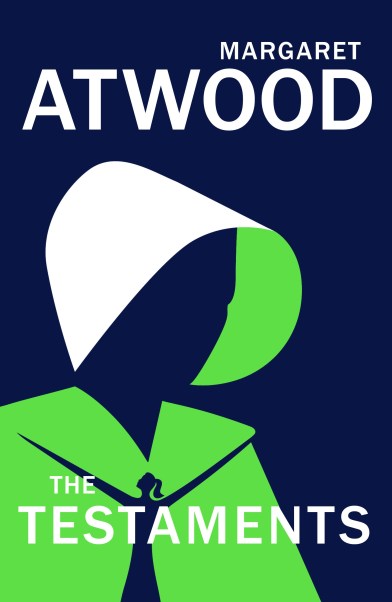
Guest Review: The Testaments by Margaret Atwood

In her latest guest review, the Unseen Library’s editor, Alex, checks out one of the biggest releases of the year, and also sets herself up to do some more reviews for the blog in the future.

The Testaments Cover

Publisher: Chatto & Windus (Hardcover – 10 September 2019)

Series: The Handmaid’s Tale – Book 2

Length: 419 pages

My Rating: 5 out of 5 stars

Amazon

Unlike the Unseen Librarian himself, who seems to have no problem zipping through several books a week, I tend to buy books faster than I read them. I was very pleased, and not at all surprised, to find there’s a phrase for this in Japanese: tsundoku, meaning one who acquires books with every intention of reading them, but who never gets around to it. Well, it’s high time that I try to kick this habit and delve into my shelf of unread books, beginning with The Testaments by Margaret Atwood.

We received a copy of The Testaments way back in September 2019, before the honeymoon hiatus, but unfortunately the large, heavy hardback wouldn’t have fared well in my suitcase, so although I was keen to read it I was forced to leave it behind. Unfortunately several other distractions (including Eoin Colfer’s The Fowl Twins) meant it wasn’t until the post-Christmas calm that I took the time to finish it off, but I am so glad that I did, because this is a first-rate book that didn’t deserve to wait so long for my attention.

The Handmaid’s Tale reported the experiences of Offred, a Handmaid to a powerful Commander in the post-revolutionary United States, the totalitarian Republic of Gilead. The Testaments picks up the story several years later, and features accounts of three women and their own struggles for survival in Gilead. I won’t go into detail about the plot of the book (I’m sure reviewers with better time management skills have beaten me to it), only to say that it was incredibly engaging and suspenseful. Those who enjoyed The Handmaid’s Tale will love to see how the world has changed over the years.

I was absolutely thrilled by all of the world-building in The Testaments. The new regime of Gilead is fascinating, but in The Handmaid’s Tale details are limited to what Offred chooses to share in her narrative, which itself is limited by what Offred knows, given the sheltered and isolated life she is forced to live as a Handmaid. The Testaments, on the other hand, with its multiple narrators, presents a far broader view of life in Gilead. The first narrator is an Aunt, one of the powerful matrons who train the Handmaids and teach the children. In fact, she is none other than Aunt Lydia, the indomitable battleaxe responsible for the indoctrination of Offred who features so prominently in the original book. The second narrator is Agnes Jemima, the daughter of a powerful Commander. Her story is recorded after her liberation from Gilead and provides a fascinating insight into the experiences of a child growing up in the regime. The third narrator is Daisy, a child growing up in Canada. From her we get an outside view of Gilead—how the terrible society is viewed by its near neighbours and how the Mayday resistance seeks to help its people. The three tales are each engaging in their own right, but as they become more and more intertwined the story only gets better.

There are elements of the story that tie into the television adaptation of The Handmaid’s Tale, but literary purists who have not watched the show will enjoy The Testaments just the same. Since it is a sequel, however, I would say that it will be best enjoyed by those who have read The Handmaid’s Tale or seen at least the first season of the show. The Testaments is a book that was 35 years in the making, but it was well worth the wait.

The Bone Ships by R. J. Barker

The Bone Ships Cover

Publisher: Hachette Audio (Audiobook – 24 September 2019)

Series: The Tide Child – Book One

Length: 17 hours and 2 minutes

My Rating: 5 out of 5 stars

Amazon     Book Depository

From one of the brightest new stars in fantasy fiction, R. J. Barker, comes The Bone Ships, a remarkable and extremely captivating new adventure that can be described as Gaunt’s Ghosts meets Moby Dick in an incredibly inventive new fantasy world.

Barker has been making some serious waves in the fantasy genre over the last couple of years, ever since bursting onto the scene in 2017 with his debut novel, Age of Assassins, which started The Wounded Kingdom trilogy. He quickly followed this up in 2018, when he released the second and third books in this trilogy, Blood of Assassins and King of Assassins. I absolutely loved all three books in this trilogy, although I haven’t yet reviewed King of Assassins. Spoiler: it does get five out of five stars from me and recently made my Top Ten pre-2019 Books list.

As a result, I was very excited earlier in the year when I found out that Barker was writing a whole new series. The Bone Ships is the first book in The Tide Child series, and it has been pretty high up on my to-read list for a while, as I have featured it on both my Top Ten Most Anticipated July-December 2019 Releases and my Top Ten Books I Would Like to Read by the End of 2019 lists. I ended up listening to the audiobook version of The Bone Ships, narrated by Jude Owusu, and what I found was an excellent and inventive fantasy read that might just be one of my favourite books of 2019.

For generations the rival nations of the Hundred Isles and the Gaunt Islands have been fighting each other for dominance of the vast oceans that make up their world. In order to fight this bitter conflict, great ships of war were constructed using the bones of the giant sea dragons, the arakeesian, as only these boneships could withstand the rigours of battle and all the horrors the seas contain. However, years of warfare and shipbuilding has taken a terrible toll, as the arakeesian are now all extinct, and both sides’ supplies of dragon bone are nearing their end.

Of all the remaining boneships in the Hundred Isles fleet, none are considered lower than a black ship. Black ships are ships of the dead, where every crewmember aboard has been condemned to die in shame, unless they can redeem themselves through some great act of bravery. However, the crew of the black ship Tide Child have no intention of performing any acts of bravery, and they and their shipwife, Joron Twiner, are content to drink themselves into oblivion—that is, until the arrival of “Lucky” Meas Gillbryn.

Meas is one of the most respected and feared commanders in all the Hundred Isles, but she has recently been disgraced and banished to Tide Child. Quickly taking control of the ship from Joron, Meas works to turn Tide Child and its crew around and make it into an efficient and proud crew of sailors, because they have a dangerous mission to undertake. The first sea dragon in a generation has been spotted, and whichever side hunts it down and claims its bones will gain a distinct advantage in the war. However, Meas has a different plan in mind, and sets out to protect the dragon from all who want it. Facing off against rival ships, raiders, pirates and treachery from within, can the crew of Tide Child survive to become the stuff of legend, or will their death sentence finally be carried out?

Well damn! Now that was a pretty awesome read! This latest offering from Barker was a superb and elaborate tale of redemption, adversity, camaraderie and adventure on the high seas. Not only is it based on an inventive premise and an elaborate new fantasy world but it contains a first-rate and compelling story that I absolutely loved. This is an absolutely fantastic story which is paced out extremely well and, after the necessary introductions, quickly turns into an addictive yarn with a number of clever elements to it. The end result is a powerful and enjoyable tale which is a wonderful self-contained story but which also sets up some intriguing storylines for any future instalments of this new series.

At the heart of The Bone Ships is an excellent story of camaraderie, respect and selfish people coming together to be part of something bigger. The main setting for the book, the boneship Tide Child, is completely crewed by condemned men and women, most of whom have given up on any form of redemption and are more concerned with petty crime and getting drunk. However, when Meas enters the picture, she quickly turns them into an efficient crew and reignites their pride as sailors and soldiers for their nation. This evolves into a really good redemption arc, as the entire crew really starts to come together as a close-knit team and are eventually given a task which could make them all heroes. The vast majority of the crew subsequently rise to the challenge, so much so that their usually hard-as-nails and determined shipwife is at one point willing to sacrifice everything to save them. This is a pretty fun and amazing part of the story, and it helps that Barker spends time introducing a number of key members of the crew and building them up as likeable characters. There are quite a few fantastic and enjoyable characters scattered throughout the story, and their inclusion really helps the reader grow to care about the people on the ship.

The best character relationship in the book can be seen between the two main characters, Joron Twiner and Meas. Joron is book’s point-of-view character and starts the story off as a drunken, apathetic wreck. Upon losing the position of shipwife to Meas, he expects to be placed at the bottom of the ship’s pecking order, but Meas keeps him on as her deckkeeper (first mate), despite her evident low opinion of him. Throughout the course of the book, these two characters grow closer and eventually become something closer to friends, while at the same time they both show considerable growth as characters. Meas spends a lot of time mentoring Joron, and he slowly moves on from his personal despair to become a respected and capable officer on the ship. Moreover, Joron slowly begins to lose the resentment he holds for Meas for taking his position as shipwife, and starts to really respect her, and see why she is a better commander of the ship. At the same time, Joron also starts to better understand what drives Meas, and why she is so determined to succeed in her mission. The two make for a wonderful partnership, and I think that Barker did a particularly fantastic job with the character of Meas, and I loved his portrayal of her as a rough, tough captain with a secret heart of gold.

While all the character elements I mention above are pretty spectacular, to my mind, one of the most striking and enjoyable things about The Bone Ships is the excellent nautical elements that the author was able to work into the story. I have to say that I was very impressed that Barker, whose previous series was set entirely on land, was able to come up with a detailed and exciting story set mostly aboard a ship, especially as he was utilising these elements for the first time in this book. The author installs a huge amount of nautical detail into his story, and the depictions of life and work aboard a ship of war was pretty amazing, so much so that at times, the reader feels like they are actually aboard this ship. I felt that Barker did an amazing job of combining these cool nautical details with the new fantasy elements he introduced in this book to produce a truly unique adventure on the high seas. I also loved all the shipboard action and combat that occurred throughout the course of the book. There were some really elaborate battles set throughout the story, from an attack on the Tide Child from a flotilla of smaller boats, to a wide-ranging battle between opposing groups of larger ships. The utilisation of unique tactics and fantasy elements, such as powerful crossbows, wind magic and the fact that they are fighting above a giant sea dragon, make for some truly thrilling and exciting battle sequences, which were an absolute treat to read. I am so glad that Barker decided to set this story on the open seas, as it made for truly amazing novel.

One of the other things that I liked about The Bone Ships was the excellent new dark fantasy world that Barker created for this new series. Barker has a real talent for this, as seen in The Wounded Kingdom trilogy, and he did it again for this latest book, where the reader is given a fascinating glimpse into a large, ocean dominated world, with all manner of unique fantasy elements in it. This new world is a harsh and deadly place, filled with a huge number of deadly sea beasts that can kill a man in a number of gruesome ways. Into this, Barker also introduces a fun new ship-based culture, complete with a matriarchal society, an intriguing religion and enslaved wind-controlling bird-people. In addition, the two nations that are showcased in this first book are locked in a massive, generations-old conflict, which has completely consumed their societies. I felt that the author did a good job of introducing all the elements of his new world to the reader in a timely and complete manner, and there was never any deficit of knowledge that reduces the reader’s enjoyment of the book. There are so many tiny details that Barker installs in this world, such as the use of paint for good luck, the rarity of metals (island nations, not much room for mines) and the gender bending of ship names and titles (ships are thought of as male, while the captain is called shipwife, no matter their actual gender). All of this, as well as the cool new fantasy elements that Barker comes up with for the story, such as the giant sea-dragons whose bones are used for shipbuilding (what a concept!), make for an exceedingly fascinating background for this fun story.

As I mentioned above, I chose to listen to the audiobook version The Bone Ships, narrated by the talented Jude Owusu. It ran for just over 17 hours in length, which I was able to power through extremely quickly, especially once the story really got going. I have to say that I was really glad that I decided to utilise the audiobook format, as I felt that it helped me visualise all the cool action and excitement that was occurring aboard Tide Child. In addition, I always find that the audiobook format helps me appreciate all the details of a story’s universe, and this was definitely true for The Bone Ships, as I was really able to dive in and fully experience the great new fantasy world in all its glory.

I also have to say how impressed I was with Jude Owusu’s excellent narration of this audiobook. Owusu has a fantastic voice, which I felt really fit into the nautical theme of the entire book. He also comes up with some very distinctive and fitting voices for the various characters that feature within the book, which I felt helped bring out many of these characters personalities. I was particularly impressed with the harsh and commanding voice that he utilised for Meas, and the various sequences where she was barking out orders and threats aboard the ship were a real treat to listen to, as it perfectly encapsulated the shipwife. Other standout characters that Owusu brought to life include Mevans, who the narrator gifted with an exceedingly cheerful voice which fit his personality perfectly, and the mysterious Gullaime, whose narration contained a certain birdy quality to. I also have to commend the real and obvious enthusiasm that Owusu brought to the role. I have always found that enthusiastic narrators can make an audiobook truly come to life, and Owusu was a really good example of this. Not only did his voice contain some noticeable excitement when he narrated the various action sequences throughout the book, but he really got into voicing elements of the story, such as the various shanty-like rhymes that Barker installed throughout the story, or the various nautical response of the crew. The way that he shouted out “Ey” (the sailor’s way of saying yes) multiple times throughout the book was a lot of fun, and I could feel the infectious enthusiasm of the crew while he did this. The sheer passion and vocal skill that Owusu puts into this audiobook is just fantastic, and I cannot recommend this format enough, as it was an amazing way to enjoy this epic book.

The Bone Ships by R. J. Barker is an absolutely outstanding read that I cannot recommend enough. Barker is quickly becoming one of the most impressive new fantasy authors out there, and he honestly gets better with every book he writes. The Bone Ships had so many cool elements to it, and any readers who check it out will be quickly hooked by its captivating story and bold adventure. I cannot wait to see where Barker will take this story next, and I would strongly encourage any reader looking for their next amazing fantasy tale, to check out this great new book. Also, how awesome is the cover for this book!!

Amazon     Book Depository

Guest Review: The Fowl Twins by Eoin Colfer

For this entry, my lovely and talented editor Alex steps out of the shadows once again (after previously reviewing Pan’s Labyrinth) and provides us with a guest review of a book she recently picked up.

The Fowl Twins Cover.jpg

Publisher: Harper Collins (Trade Paperback – 5 November 2019)

Series: The Fowl Twins – Book One

Length: 432 pages

Rating: 5 out of 5 stars

Amazon

The Unseen Library occasionally raises the topic of auto-buy authors, and Eoin Colfer is one of mine. I’m already hyped for Highfire, so you can imagine my excitement when I happened upon a display of The Fowl Twins in a department store the other day. I didn’t even break my stride or pause to read the back cover; as soon as I saw the words “Colfer” and “Fowl” I picked up a copy and had started reading it before I reached the checkout queue. The eight Artemis Fowl books followed the eponymous juvenile criminal mastermind and his many run-ins with the People, the secret civilisation of magical beings living deep underground. The series ran from 2001 to 2012 and was one of my favourites growing up, so I was absolutely thrilled to discover that Colfer is now continuing the saga.

The Fowl Twins picks up the story several years after Artemis Fowl and the Last Guardian, the final book in the original series. Artemis himself gets a rest; this story follows his younger brothers, Myles and Beckett. Myles is undoubtedly cut from the same cloth as Artemis and their father, with a talent for the sciences, an unquenchable thirst for knowledge and a penchant for fashionable suits and cutting insults. Beckett is more interested in active pursuits and making friends with wildlife, but he shares the same cunning and passionate loyalty that Fowls are famous for. The twins were only toddlers in Artemis Fowl and the Last Guardian and have no memory of the People, and it appears that their lives have been relatively quiet since those events. But in the Fowl world quiet never lasts for long, and when a rare troll surfaces on the family estate the twins suddenly find themselves in the midst of a cat-and-mouse game with an LEP specialist, an immortal duke and a knife-wielding nun.

Given that this is the ninth book set in the Fowl universe, the story is built upon a great deal of already-established Fairy lore and, indeed, laws. However, it does not wholly rely on readers having a certain level of assumed knowledge; Colfer ensures that no reader gets left behind. The appropriate backstory and important details are provided where necessary in his usual elegant style so that new readers are informed and old fans aren’t bored by the rehashing of exposition. As an old fan myself, albeit one with an appalling memory, I really appreciated the unobtrusive reminders of previous events in the Fowl canon.

There is of course a lot for fans of the original series to enjoy, including some excellent cameos. I found that many elements of the story mirrored the original Artemis Fowl. Myles and Beckett are around the same age Artemis was in his first Fairy adventure, and it was amazing to see how their different upbringings shaped them. When we first meet Artemis, he is in a desperate pursuit to rescue his father from a Russian mafia and his mother from her rapidly deepening delirium. Myles and Beckett, on the other hand, have enjoyed an upbringing with an intact, stable family and without the inherent danger that comes with being part of an active criminal empire. They are, as a result, far more well adjusted 11-year-olds, and it was so enjoyable to see the bond the boys all share.

Also like Artemis Fowl, The Fowl Twins features at its core a plot to kidnap a Fairy creature for personal gain, but this time the Fowls are innocent. Instead, the baddie is the whimsically named Lord Teddy Bleedham-Drye, who I can’t help but imagine as a scoundrel in the style of Terry-Thomas, whose ruthless quest for immortality leads him to the Fowl estate to tackle a troll. No Fowl story would be complete without the involvement of the LEP, and Specialist Lazuli Heitz finds herself in an uncomfortably similar position to Captain Holly Short, in that her supposedly straightforward surface mission goes immediately haywire as soon as the Fowls get involved. Lazuli is an excellent addition to the main cast of characters, and her talent for quick-thinking and creative problem-solving perfectly complement those of the boys she finds herself teamed up with.

The Fowl Twins is an excellent blend of suspense and action, and Eoin Colfer’s impeccably charming style of omniscient narration means there’s never a dull moment. The story is also incredibly fast-paced, with 400-odd pages covering only a couple of days, and so compelling that I finished reading it in no time. This book is fun for all ages and would make an excellent Christmas gift for a young new reader, a 20-something who loved the original series, or really anyone who enjoys a suspenseful story with a magical element. I can’t wait to see more adventures of Myles, Beckett and Lazuli.

Amazon

Rage by Jonathan Maberry

Rage Cover

Publisher: Macmillan Audio (Audiobook – 5 November 2019)

Series: Rogue Team International – Book One/Joe Ledger – Book 11

Length: 17 hours and 28 minutes

My Rating: 5 out of 5 stars

Amazon     Book Depository

Well damn, now this was an impressive book.   Prepare for all manner of action, excitement and chaos as bestselling author Jonathan Maberry presents an incredible and outstanding start to a new series that features his long-time protagonist, Joe Ledger, with Rage.

The Joe Ledger books were a series of 10 military thriller and science fiction hybrid novels that ran between 2009 and 2018, which focused on a group of military action heroes as they faced off against a number of advanced, mad science threats. Maberry actually concluded the Joe Ledger series last year, but the stories and adventures of the titular character have been continued in the new Rogue Team International series, of which Rage is the very first book (although it could be considered the 11th Joe Ledger book). This sequel series focuses on some new circumstances for the protagonists while still maintaining the heart and soul of the original books.

People who are familiar with my blog will know that I am a massive fan of the Joe Ledger books. Ever since I picked up the 10th and final novel, Deep Silence, last year, I have been really getting into this incredible thriller series and have already gone back and read the first six Joe Ledger books. Each of these books that I have reviewed so far has received a full five out of five stars from me, and it is easily one of my favourite series at the moment. As a result, I have been very keen to get a copy of the first instalment of this sequel series for a while now, and it has been very high on my list of books to read before the end of 2019. However, nothing was able to prepare me for how awesome this book was and for how much I was going to love it.

For years, Joe Ledger was the top field agent for the Department of Military Sciences (DMS), a top-secret United States military organisation tasked with protecting America from the most advanced and devastating weapons that mad science can produce. However, the political situation in America has become untenable, with the DMS no longer able to effectively do their job under the current administration. Seeing no future working for the US government, the head of the DMS, Mr Church, has disbanded the department, and has instead formed a new organisation, Rogue Team International. Independently funded and controlled by no government, Rogue Team International is able to deploy anywhere in the world against the worst sort of threats imaginable.

However, their first major mission has some very high stakes. A mysterious group of terrorists have unleashed a new bioweapon on a small, isolated island off the coast of North Korea. This weapon drives those infected by it into a murderous rage, causing them to attack and kill anyone they see in a brutal fashion. Worse, whoever is behind the attack has gone out of their way to frame the United States and South Korea for the crime, creating a dangerous situation which could see these countries dragged into a devastating war with North Korea and China.

Deployed to the island, Ledger and his team attempt to identify who is behind the attacks and what sort of weapon they have unleashed. It soon becomes clear that they are up against a deadly and powerful organisation, that is determined to cause as much chaos as possible. As a second attack is unleashed in South Korea, Ledger must find a way to stop his opponents before it is too late and the world is engulfed in war. However, their new foes are clever and ruthless and bear a powerful grudge against Ledger and Mr Church. Can Rogue Team International save the day, or will the cost be too high to pay?

Rage is an absolutely incredible and outstanding new novel from Maberry, who has done an incredible job introducing the first book in his Rogue Team International series. Rage contains an amazing story that had me firmly addicted right from the very start. The reader is once again presented with a massive and elaborate villainous plot, as two familiar antagonists and their cohorts unleash a devastating and scientifically unique attack for their own nefarious reasons. We then get to follow our protagonists as they investigate and attempt to counter the attacks and plots that they uncover. The entirety of the book is written in Maberry’s signature style, with the story told from a huge range of different points of view and time periods, resulting in a much richer and complex story that allows the reader to see the thoughts of the protagonists, antagonists and innocent bystanders as the various events of the book take place. There are a huge number of twists and turns as the story progresses, and even though we get some insight into the antagonist’s actions and motivations, the entirety of their elaborate plan is left a mystery for most of the book, allowing for some enthralling suspense to build up. All of this ends in an explosive conclusion which not only features a major fake-out but also a massively significant tragedy that is going to be a huge part of the series going forward. This was a truly epic story, and I cannot wait to see where the author takes his new series next.

Despite Rage being part of the new Rogue Team International series, Maberry continues to utilise a number of his distinctive writing elements that made his Joe Ledger novels such a delight to read. This includes the cool multiple viewpoints I mentioned above, as well as the fantastic use of great action sequences, enjoyable characters and the fascinating antagonists. However, there are some exciting changes in this book that I think existing Joe Ledger readers are going to enjoy. For example, the protagonist is part of a whole new organisation, they have a new base (a very over-the-top secret lair in Greece), a new team name and new call signs for all the protagonists (for example, Ledger has gone from Cowboy to Outlaw), all of which is an interesting change of pace for those familiar with the original series. There is also a lot more of a focus on international politics, with only a small amount of the story taking place in the United States. While I quite liked some of the new directions that Maberry was taking with this new series, many of the story elements in Rage have made it clear that the Rogue Team International books are going to be very strongly associated with the original Joe Ledger series. There are a huge number of call-backs to the previous books, including a lot of discussion about preceding cases and the utilisation of many characters, including some of the major antagonists, who have previously appeared. While you would assume that the employment of all these elements might make Rage hard to get into for readers unfamiliar with the other Joe Ledger novels, this is really not the case. Maberry continues his practice of filling his story with some detailed summaries of the various characters and books, so that readers can understand the significance of all the reference to the previous cases. This means that new readers can easily jump into Rage without any prior knowledge of the other Joe Ledger books, although I can guarantee that most people will be keen to go back and get the full account of what has happened before.

One of the most interesting aspects of the new international focused formula of this book was that it allowed Maberry to examine the current political situation around the Korean Peninsula. There is quite an interesting analysis of both countries throughout the course of the story, and the various issues surrounding them and their differences are actually covered in a series of short chapters, made to resemble a political chat show, with experts voicing their thoughts on both Koreas, and the influence of countries such as China and the United States. Rage’s story features a fascinating look at what the author thinks would happen if a flashpoint event occurred in the region, and who could potentially benefit. I was very intrigued by Maberry’s analysis of the situation, and I liked how he featured several characters from both North and South Korea in his story. The author’s portrayal of the North Korean characters was particularly captivating, as he showed them as mostly good people who were trapped by political circumstances, and who aren’t seeking a war against the rest of the world. All of this examination of the current political situation in Korea made for a fascinating part of the book’s plot, and I am curious to see what area of the world he will explore in the next Rogue Team International book.

One of Maberry’s main strengths as a writer is his ability to create some truly enjoyable and memorable characters to populate his stories with. Perhaps one of the best examples of this is the main protagonist of Rage and its prequel series, Joe Ledger. Ledger is an extremely complex and multilayered action protagonist, who serves as the book’s main character. Thanks to the fact that Ledger narrates all of the chapters told from his point of view (about two thirds of the book; the rest of the chapters are told in the third person), we get a real sense of his character. While he likes to project a cocky, confident and humorous persona to most people he meets, cracking all sorts of jokes to both other characters and the reader, deeper down his is a psychological mess. Due to some past trauma, Ledger has some major issues, and his career as a shooter for the DMS and Rogue Team International has not helped the situation. Ledger’s anger, despair and hopelessness are constantly bubbling towards the surface, adding a fascinating dimension to the character. I have always really liked how Maberry has gone out of his way to show an action protagonist who is actually impacted by the work they do and the lives they have taken, and it makes for a refreshing change of pace. Rage in particular contains some very dark moments for Ledger, and if the conclusion of the book is anything to go by, his character is going to undergo some massive emotional changes in the next few books.

I was also really glad that Maberry continued to utilise so many of the great side characters that have been previously introduced in the Joe Ledger series. Pretty much all of the key DMS characters have moved across into the new book, and I was really glad we could continue to enjoy the fun dynamic that they have established over the course of the previous series. The enigmatic Mr Church continues to remain one of the best spy-master characters I have ever read and is probably one of my favourite people in the Joe Ledger books. While there are no major revelations about his past in this novel (my theory is that he is either an alien or some form of angel), there are some hints to his seemingly superhuman toughness and some of the previous missions he has engaged in. Mr Church also shows off some amazing diplomatic chops in this novel, utilising a network of level-headed members of various countries’ governments to work around blustering and incompetent world leaders. Most of the rest of the supporting characters remain the same, although several of them get some fun moments in this book, such as Bug unexpectedly receiving some fan-girl attention and Doc Holiday’s eccentric personality overwhelming people unfamiliar with her. There are also some great new characters in this book, many of whom appear set to become long-term recurring characters. If I had to make one complaint, it would be that there wasn’t enough of Ghost, Ledger’s attack dog, but I am sure we will see more of him in the future.

In addition to the fantastic protagonists, Maberry has also come up with a couple of conniving and evil antagonists to act as a foil to Joe Ledger and Rogue Team International. The main villains of the book are actually prior antagonists from two of the books in the Joe Ledger series, who have been reutilised to great effect in this new novel. While an exciting original major villain might have worked out well for the first novel in a new series, I think that using some existing antagonists was an excellent choice that really helped create a captivating story. Not only does this help reinforce the connection between the new Rogue Team International series and the Joe Ledger books, but it also allowed for some interesting character and story development. Both of these main two antagonists have been defeated in the past by Joe Ledger and Mr Church, so they each have very deep, personal grudges against them. Their new plan for domination, which is actually very interesting and quite complex, is also filled with elements of revenge, which helps ratchet up the intrigue and adds a whole new element. I loved the various interludes which show how these two bad guys escaped from prison and started their new team-up, and it was really cool to see what happened to them after their respective defeats in the previous books. It was also very interesting to see two antagonists, who previously had nothing to do with each other, had appeared in different novels and had very different motivations for their actions, come together as a cohesive unit with the new goals in mind. This was definitely a great use of two antagonists, and the damage that they caused was very impressive and memorable.

It is impossible to talk about one of the Joe Ledger novels without discussing all the intense action you can expect within. Maberry is a master of writing an electrifying action sequence, and the first book in the Rogue Team International series is absolutely chock full of action, fights and brutal violence. There are so many varied and thrilling battle scenes throughout the book, as the protagonist finds himself fighting in all manner of different situations. Whether the protagonist is engaging in a mass shootout against heavily armed opponents with his team backing him up, fighting by himself against a group of assassins or engaging in knock-out, throwdown fist fight against one of the antagonists, Maberry crafts some excellent and detailed sequences, allowing the reader to appreciate everything that is going on. The standout elements of this book are the victims of the new rage-inducing bioweapon that is this book’s unique science fiction element. Victims under the control of Rage attack anything they see in a frenzy, resulting in some crazy and vicious scenes. This also allows for some unique sequences where the protagonists must find a way to neutralise the victims without killing them, in the hope that they can be cured, all the while trying to avoid getting killed by either the Rage victims or some of the soldiers behind the attacks. All of the action scenes in this book are really impressive to experience, and it is impossible not to get excited as you read through them. However, readers should be warned in advance that the action can get quite brutal in places, and there are numerous examples of gruesome mutilation or torture, which might not be appealing to some people.

One of the main things that I love about the Joe Ledger series are the incredible audiobook versions of the previous novels, all of which feature the outstanding narration of Ray Porter. As I have stated in several of my previous reviews, Porter has some unbelievable vocal talents, and the life he breathes into all the characters in the Joe Ledger audiobooks is just fantastic. In particular, he portrays the voice and personality of the series titular character and protagonist, Joe Ledger, extremely well and he does a remarkable job of conveying all of the characters emotions, charm and humour to the reader. I was so happy when I saw that Porter was going to narrate Rage, and I knew I would have to grab the audiobook format of this book when it came out. I was in no way disappointed with this audiobook, as Porter has once again done a fantastic job of bringing all the characters to life and telling Rage’s amazing story. Porter still has such a fantastic handle on the book’s main character, and his portrayal of the Joe Ledger’s emotions is just superb, especially during some major scenes in the book. With a running time of 17½ hours, Rage is a somewhat substantial read, and dedicated listeners should be able to get through it in a few days. I would strongly recommend the audiobook format of Rage to anyone who wants to read this book, and it still remains my favourite and preferred way to get my Joe Ledger fix.

In Rage, Jonathan Maberry has once again outdone himself producing a wildly entertaining and deeply compelling novel that I absolutely loved. In this first instalment of his new Rogue Team International series, Maberry has brought his fantastic characters from the Joe Ledger books into a whole new era, as the story goes in some great new directions, while maintaining the best parts of the original series. Featuring one hell of a story and a pretty memorable conclusion, Rage is Maberry at his best, and I have no choice but to award it a full five stars. Highly recommended for anyone wanting a high-octane read, Rage is an outstanding book guaranteed to pull you in and leave you an emotional wreck.

Amazon     Book Depository

Throwback Thursday – Star Wars (2015) Volume 1: Skywalker Strikes by Jason Aaron and John Cassaday

Star Wars (2015) Volume 1 Cover.jpg

Publisher: Marvel Comics

Publication Date: 6 October 2015

Length: 160 pages

My Rating: 5 out of 5 stars

Amazon

Reviewed as part of my Throwback Thursday series, where I republish old reviews, review books I have read before or review older books I have only just had a chance to read.

I think it is fair to say that I have been in a real Star Wars mood lately. Maybe it is because of the imminent release of the final movie in the Skywalker Saga, Star Wars: The Rise of Skywalker, or perhaps it is because The Mandalorian is such an awesome TV show. Whatever the reason, I have been reading and reviewing quite a few Star Wars books and comics lately. For example, I am currently listening to Star Wars: Force Collector, I reviewed Tarkin last week and I recently read and reviewed Resistance Reborn and Vader: Dark Vision. As a result, I thought that this week would be a good time to do a Throwback Thursday on the first volume of the 2015 Star Wars comic book series, Skywalker Strikes, which did an outstanding job of introducing an extremely exciting ongoing comic series.

The Star Wars comic book series was started in 2015 and follows the adventures of the protagonists of the original Star Wars trilogy. Set shortly after the events of A New Hope, this series attempts to fill in the three years between the first film and The Empire Strikes Back. The Star Wars comics originally ran concurrently with the Darth Vader (2015) comic series until that series ended, and then proceeded to run alongside the Doctor Aphra comics. The Star Wars series ran for 75 issues and has only recently concluded. A sequel series with the same name is set to begin in early 2020, which will follow the events between The Empire Strikes Back and Return of the Jedi.

Star_Wars_Vol_2_2.jpg

Volume One of Star Wars begins shortly after the destruction of the Death Star. With the Empire in turmoil following the destruction of such a major weapon, Rebel Alliance members Luke Skywalker, Leia Organa, Han Solo, Chewbacca, C-3PO and R2-D2 use the chaos to infiltrate a key Imperial weapons factory. While they are able to destabilise the factory’s reactor core and free its slave labour force, the Rebels are unprepared for the unexpected arrival of Darth Vader.

Attempting to complete their mission while also trying to kill Vader, the Rebels find themselves hopelessly outmatched by the Dark Lord of the Sith, who is determined to capture the Rebel who blew up the Death Star. Not even Luke, with his newly discovered Jedi abilities, is able to stand up to Vader, and the Rebels barely manage to escape with their lives.

Frustrated by his failures against Vader, Luke decides to take a leave of absence from the Rebel Alliance and returns to Tatooine to contemplate his future. Travelling to the house where Obi-Wan Kenobi lived in exile for years, Luke hopes to find something that will guide him. Instead he finds himself walking into a trap, as the bounty hunter Boba Fett is lying in wait. At the same time, Leia talks Han into a scouting mission for the Rebels, but their simple mission soon attracts the wrong sort of attention. Who is the mysterious woman hunting Han, and why is claiming to be his wife?

Star_Wars_3_Marvel.jpg

Skywalker Strikes, which is made up of Issues #1-6 of the Star Wars series, contains an outstanding story, fantastic artwork and some of the most insane Star Wars action sequences that you will ever see. The team of Jason Aaron and John Cassaday, have done an amazing job on this comic, and this first volume does a wonderful job starting off this long-running series. While all the issues in this volume are connected together pretty well, I would say that there is a distinctive break between Issues #1-3 and Issues #4-6. Issues #1-3 focuses solely on the protagonist’s attack on the weapon facility, while the last three issues feature some more independent adventures from some of the series’ various characters, as each of them is searching for something.

The sequence contained within Issues #1-3 is just incredible, and it is easily my favourite part of the entire series. What starts as a fun infiltration of an Imperial facility quickly devolves into utter chaos as Darth Vader enters the mix. What then follows is nearly three whole issues of action, explosions, fantastic first meetings and all manner of destruction as the Rebels desperately attempt to escape the factory. While all the characters involved in this part of the comic are really good, I have to say that Vader steals the show as the indestructible villain. This was actually one of the first pieces of fiction in the new Disney Star Wars canon that shows off how amazing Vader could truly be, and it is pretty darn awesome. Pretty much from the first instance he appears, he shows off the full extent of his powers by throwing stormtroopers in front of a sneak attack from Chewbacca, and then by starting to crush an AT-AT with the force. He then subsequently survives a full-on blast from the AT-AT’s cannons and hacks it to pieces with his lightsaber. He also cuts through a bunch of escaping slaves and shows his intense displeasure to his subordinates in a number of destructive ways, including twisting a stormtrooper’s head 180 degrees with the force (to be fair, he did catch sight of Vader without his helmet) and choking a Star Destroyer captain from an insane distance. I can also not be the only person who cracked up at Vader very quickly destroying an Imperial Officer moments after he said “Lord Vader will have my….” (spoilers, he was going to say head, and Vader really did). All of this destruction and action was essentially pure awesome, and I loved every second of it.

Star_Wars_Vol_2_4.jpg

In addition to all the action in this part of the book, there are also some major moments in Star Wars history that fans of the franchise are really going to enjoy. For the one thing, it actually has the first face-to-face confrontation between Luke and Darth Vader. This scene is handled extremely well. Luke, still believing that Vader is the one responsible for the death of his father, jumps at the chance to get revenge. However, as Luke runs towards Vader’s location full of confidence, he hears the disembodied voice of Obi-Wan Kenobi telling him to run. This is advice that Luke really should have taken; Vader, after berating Luke for his obvious lack of skill with the lightsaber, rather easily disarms him. While getting ready to kill Luke, Vader notices that the lightsaber he has taken off him is the very one he used to wield as Anakin Skywalker, which obviously raises some issues within him. As events at the factory spiral out of control, Luke is able to evade Vader, who starts to grow slightly more impressed by his skills. As Luke makes his escape, Vader realises that he is not only the pilot that destroyed the Death Star but also Kenobi’s last great hope. Still not fully realising the identity of the boy he just encountered, Vader rather vindictively promises to corrupt him to his purposes. All of these events are pretty incredible moments in Star Wars history, and I think that the creative team did an outstanding job introducing them in this new canon. The initial face-to-face showdown between the main protagonist and villain of the original Star Wars trilogy is a pretty significant moment, and I really loved how it was shown. The hints at the hidden history between the two are great, and the initial realisations from Vader that there is more to Luke than he realises are fantastic. I also liked how the creative team showed Luke as having no real skill with the lightsaber or the force. Considering that he only had about an hour of training with Kenobi, it really isn’t that surprising that he has no lightsaber abilities, so this is a pretty clever and realistic inclusion, especially as a good part of the following Star Wars comic series deals with some of the earliest days of his training. While these events are probably not the most significant to occur in this volume (more on that later), they are incredibly intriguing and any fan of the Star Wars franchise is going to love it.

The last three issues of Skywalker Strikes are also very entertaining, though less action-packed, since the creative team has opted instead for storytelling and showing off the state of the Empire and Rebel Alliance. While a despairing Luke sets off to find answers, Han and Leia set off to find potential locations for a new Rebel base, while Vader has a meeting with Jabba the Hut. There are some really interesting aspects to this part of the story, from the growing hopelessness in Luke as he begins to realise how far he is from becoming a Jedi, to Vader’s sudden obsession with capturing Luke, to the growing hints of romance between Han and Leia, disguised at this point as antagonism. However, I would say that it’s the newcomers to the comic series, Boba Fett and Sana Solo, that are some of the best parts of the last three issues of the volume. Fett, who has long been a fan favourite despite his complete underutilisation in the movies, shines as the badass bounty hunter as he scours Tatooine for Luke, eventually finding out all about him through some very violent means. This leads to a pretty fun showdown between Boba and Luke, as Boba ambushes him at Kenobi’s house and easily incapacitates him and R2-D2 with his cool array of weapons and tactics. It is only thanks to Luke’s first close-combat use of the force that he is able to escape, as he successfully blocks a blaster bolt while blinded (a nice homage to the training sequence from A New Hope) and moves an item with his mind. All of this was a pretty entertaining showdown, and I loved seeing Fett in action for once. We also have the mysterious Sana Solo, who has a pretty fantastic takedown of some Rodian thugs with a great piece of technology and a ruthless demeanour. She is later able to track down Han and Leia, absolutely terrifying Han before dropping one of the biggest bombshells of the book: that she is Han’s wife. While this is not explored in any great detail in this volume, it is an excellent introduction for this great character, who goes on to become a fairly major figure in the current Star Wars canon. As a result of all of this, the second half of the volume holds up pretty well to the action-packed first half, and there are plenty of major scenes, including the very big ending.

Star_Wars_Vol_2_5.jpg

While I did really like the second part of this volume, the best way to appreciate it fully is if you understand its connection to the Darth Vader (2015) series of comics. The Darth Vader series was launched right on the heels of the Star Wars comics and it is actually set in the aftermath of the first three issues of this volume. In the first issue of this concurrent comic, it is shown that Vader has actually started going rogue on the Emperor and is making his own deals with Jabba the Hutt, before the formal discussion he has with Jabba in Issue #4 of the Star Wars series. This actually clears up the somewhat cryptic discussion he has with Jabba later in the issue, where they talk about the bounty hunters he has hired, and also shows the point where he actually tasked Boba Fett with finding Luke. While none of this is absolutely vital when it comes to fully understanding the plot of Skywalker Strikes, it is interesting to see that some of the referenced events occurred in another series. However, the main reason why readers should try to understand the connection between this comic and the Darth Vader series is in the epic conclusion both of them share, where Vader learns the last name of the boy he has been hunting. Both Issue #6 of Star Wars and Darth Vader were actually released on the same day, so readers of both series were able to see this scene at the same time. The two scenes are shown in a slightly different light in each series. It is expanded a bit more in the Darth Vader series, as it plays into the feelings of resentment towards the Emperor that have been building in Vader through the series. However, I quite liked the simpler version in Issue #6 of Star Wars, as the slow-boiling rage and anger within Vader is pretty obvious, as he takes a whole page to fully react, cracking the glass on a Star Destroyer and simply whispering, “Skywalker”. As a result of this connection, the Star Wars and Darth Vader series complement each other extremely well, and I would strongly recommend reading both pretty close together. However, no matter which series you read, the sequence showing the moment where Vader realises that his son is still alive and a Jedi is pretty darn epic and really memorable.

It could be argued that splitting this volume into two separate storylines was an interesting choice from the book’s creative team. I imagine that six issues focused on the attack on the Imperial weapons factory would have been pretty epic (just imagine how much more destruction Vader could have wrought). However, I personally think they did the right thing by splitting the story and showcasing the aftermath of this action. This way you not only get the intense action of the first few stories but you also get to see the consequences of the mission, and all the implications this has for the wider Star Wars universe. In addition, there is also quite an intriguing set up for several key moments in the upcoming series as a whole, a whole new fight between Luke and another iconic Star Wars character in Boba Fett, and some amazing connections with a sister series. I really liked how the story of the entire volume came together, and I think it was an outstanding way to start this excellent series.

Star_Wars_Vol_2_6.jpg

I have to say that I was also really impressed with the awesome artwork that was featured in this first volume. The artwork was drawn by John Cassaday, and featured Laura Martin as the colourist. It is pretty amazing the way that Cassaday was able to capture the faces of the core original trilogy cast members with his artwork. Luke, Leia and Han all look really good to my eye in this volume, and the artist has also done some great renditions of other existing characters, such as Vader, Boba Fett and Jabba the Hutt. In addition, I really enjoyed all of the marvellous and exhilarating action sequences that they artistic team portrayed throughout the volume. These action scenes, especially the ones featuring Vader at the start of the book are just incredible, and I really loved seeing all the fantastic and creative violence. In addition to all the action, there are a number of scenes where the artwork helps to enhance the emotions and hidden meaning of a scene, and I will always love the way that they portrayed the closing moments of this volume. This was some first-rate Star Wars comic book art that is really worth checking out.

As you can see from the above review, I really loved this first volume of the Star Wars (2015) comic book series. The amazing creative team behind this first volume did a fantastic job with the first six issues that make up Skywalker Strikes, producing an extraordinary story which is complimented by a connection to another series and some exceptional artwork. This volume is a fantastic introduction to the flagship comic book series of the Star Wars franchise, and it comes highly recommended. No great knowledge of the expanded Star Wars canon is required to enjoy it, and indeed this may prove to be an effective gateway to the greater Star Wars universe. This gets a full five stars from me, and I am so very glad I decided to check out the Star Wars comic book series this year.

Amazon