
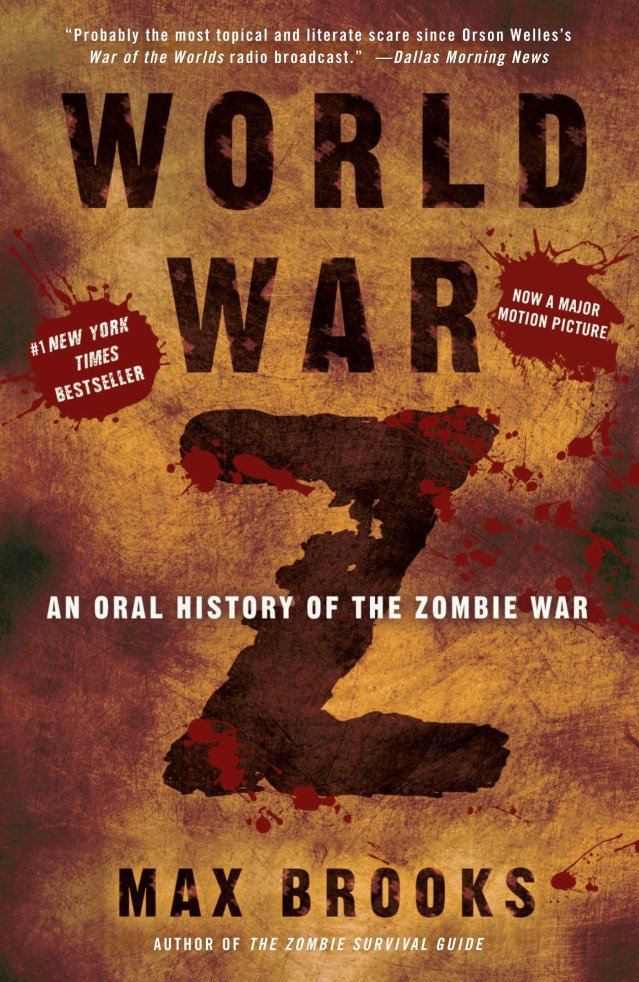
Publisher: Random House Audio (Audiobook – 14 May 2013, originally published 12 September 2006)
Series: Standalone
Length: 12 hours and 9 minutes
My Rating: 5 out of 5 stars
Welcome back to my Throwback Thursday series, where I republish old reviews, review books I have read before or review older books I have only just had a chance to read. For my latest Throwback Thursday review I take a look at the zombie horror classic, World War Z by Max Brooks, a truly epic and outstanding read.
One of the biggest novels that I have been meaning to read for ages was the highly regarded zombie novel, World War Z, also known as World War Z: An Oral History of the Zombie War. Written by Max Brooks as a follow-up to his first book, the non-fictional The Zombie Survival Guide, World War Z is a unique novel that fully examines a zombie apocalypse from multiple perspectives. I had heard some great things about this novel, and I even enjoyed the movie adaptation when it came out (more on that later). Unfortunately, I never got a chance to read it and I kind of figured for a while that it might stay in my to-read pile for a while. However, it moved much higher up my list of books to check out after I read Brooks’s 2020 novel, Devolution, which was one of my favourite novels of 2020 (as well as one of my favourite all-time horror novels). I had also heard a lot of praise for World War Z‘s awesome audiobook edition, so when my wife and I needed some entertainment during a recent cross-country road trip, this was our first choice.
Plot Synopsis:
The Zombie War came unthinkably close to eradicating humanity. Max Brooks, driven by the urgency of preserving the acid-etched first-hand experiences of the survivors from those apocalyptic years, traveled across the United States of America and throughout the world, from decimated cities that once teemed with upwards of thirty million souls to the most remote and inhospitable areas of the planet. He recorded the testimony of men, women, and sometimes children who came face-to-face with the living, or at least the undead, hell of that dreadful time. World War Z is the result. Never before have we had access to a document that so powerfully conveys the depth of fear and horror, and also the ineradicable spirit of resistance, that gripped human society through the plague years.
Ranging from the now infamous village of New Dachang in the United Federation of China, where the epidemiological trail began with the twelve-year-old Patient Zero, to the unnamed northern forests where untold numbers sought a terrible and temporary refuge in the cold, to the United States of Southern Africa, where the Redeker Plan provided hope for humanity at an unspeakable price, to the west-of-the-Rockies redoubt where the North American tide finally started to turn, this invaluable chronicle reflects the full scope and duration of the Zombie War.
Most of all, the book captures with haunting immediacy the human dimension of this epochal event. Facing the often raw and vivid nature of these personal accounts requires a degree of courage on the part of the reader, but the effort is invaluable because, as Mr. Brooks says in his introduction, “By excluding the human factor, aren’t we risking the kind of personal detachment from history that may, heaven forbid, lead us one day to repeat it? And in the end, isn’t the human factor the only true difference between us and the enemy we now refer to as ‘the living dead’?”
Note: Some of the numerical and factual material contained in this edition was previously published under the auspices of the United Nations Postwar Commission.
Holy hell, that was an exceptional book! I loved the powerful and expansive narrative contained within World War Z as Brooks attempts to fully encapsulate the entire experience of a zombie apocalypse in impressive detail. Literally all the good things I heard about this book were true, and I loved his unique and very captivating way of capturing the horrors of this sort of experience, both from the zombies and other humans. An exceptional and impressively inventive read, World War Z gets an easy five-star read from me.
I cannot get over how awesome and distinctive World War Z was as a concept. Rather than a traditional novel, Brook’s masterpiece is written as an epistolary novel, written as in-universe oral history anthology of a zombie apocalypse. The book, which was compiled by this universe’s version of Max Brooks, contained multiple testimonials and interviews, as Brooks seeks out and talks to multiple people who experienced the apocalypse and pulls together their various unique stories. This book contains around 40 individual stories set out across five chapters which look at the various stages of the zombie war, from its origins all the way up to the postwar ‘new normal’.
At this point I need to make a quick note about the version of World War Z that we checked out. There are a couple of different World War Z audiobooks out there, but for our trip we listened to the World War Z: The Complete Edition, which combines two separate audiobook adaptations of the novel, and contains all the stories from the original book. I did look over a paperback edition of World War Z before I started this review, and it looks like our audiobook version covered the full stories well, although I did notice that some of the stories were shortened or missing minor parts. In addition, the audiobook version did not feature any of the paperback’s footnotes, which contained technical details and notes from the author. However, I don’t think I lost out on too much of the plot from some of these missing gaps.
I really fell in love with the various individual stories contained with World War Z as Brooks went out of his way to produce the most unique and moving tales that he could. These are mostly standalone tales, although there are a few interesting crossovers as the book continues, with some character’s mentioning events or supporting figures from other stories in their interviews. However, as you follow the stories within these five chapters (made up of Warnings, Blame, The Great Panic, Turning the Tide, and Good-Byes), you get a full sense of the entire war, and it quickly comes apparent how cleverly Brooks was crafting everything here. I personally deeply enjoyed both the individual shorter tales and the much larger connected story of World War Z, and I was deeply impressed with the excellent writing style behind it. Brooks is a true master of writing deeply personal, character-driven tales of survival, and you swiftly become attached to the various protagonists as they tell their unique stories. The action within is gruesome, fast-paced and deeply terrifying, and there are multiple over-the-top descriptions of zombie and human violence that will stick with you forever. This was easily one of the best zombie novels I have read in terms of storytelling and action, and everything about this tale is so damn compelling.
As I mentioned, there are roughly 40 separate stories contained within this anthology, each of which contains its own unique protagonist, supporting characters, settings and unique circumstances. Naturally, with so many stories you have a bit of a range in terms of storytelling, with some being substantially better than others. However, I felt that Brooks did a very good job of writing each of these stories extremely well, and there were none that particularly dragged the novel down. There is a real mixture of narratives here, with particularly gruesome horror stories mixed in with more human-focused narrative, political plotlines, military thrillers, stories that balance on the edge of science fiction, and everything in between. The spread of these stories works pretty well, with Brooks providing an entertaining mixture of storylines throughout the book so readers aren’t constantly bombarded by tales of horror or tragedy. Instead, there are often fascinating, humorous and humanising stories thrown in amongst the horror. This works to make the entire novel flow at a fantastic pace.
While pretty much all these stories are fun and tell some outstanding tales of the zombie apocalypse, there are a few that stood out to me as being a cut above the rest. I had some early fun with the Stanley MacDonald storyline, which showed an amoral illegal surgeon in Brazil unwittingly transfer a zombie heart into a patient, which led to one of the earliest outbreaks in South America. The Jesika Hendricks plot showed a brilliant, if very dark, take on ordinary citizens trying to flee the zombies only to experience the other dangers of surviving the winter in a desperate community. There are several amazing and cynical storylines, such as the Breckinridge Scott and Grover Carison testimonies that showcase the capitalist opportunism that surrounded the initial outbreaks. I also really liked the South African focused storyline around Paul Redeker, which showed a former Apartheid strategist using his stark and brutal plans to save the country from the undead hordes. I loved the particularly inventive and clever testimony surrounding the character of Arthur Sinclair Junior, which focuses on how America was reorganised after the initial stages of the war, with the country setting its sights towards industry, construction and warfare, which really highlights the author’s impressive insights into the world.
Two other fantastic World War Z storylines set in Japan focus on two unique individuals, one an “otaku” (a computer-obsessed outsider who tried to live entirely online), and a blind “hibakusha” (a person affected by the atomic bombs used in WWII). Both characters were outsiders in Japan before the zombie war, but the zombie invasion changed their entire lives and led to them becoming renowned warriors and survivors against all the odds. These two storylines are extremely compelling, and I loved the way that the author utilised unique subsections of Japanese society and tried to imagine how those sorts of people would survive the zombies. There was also a really intense storyline, told by Admiral Xu Zhicai, that details a Chinese submarine’s attempt to escape the zombies with their families, which turns into a brilliant, powerful and occasionally disturbing tale of survival, loyalty and family. I also must mention the Terry Knox testimony that details the actions aboard the International Space Station and the Darnell Hackworth story that looks at the US army’s canine units that helped scout and herd zombies (yay for mini dachshunds, the real heroes of this book). However, out all the testimonies featured within World War Z, my favourite had to be the ones focussing on soldier Todd Wainio. Todd battled the zombies at multiple stages of the war, and his multiple entries paint a pretty grim picture but are easily some of the best depictions of the horror of the zombies and the challenges faced by the armed forces. His first testimony about the army’s initial inability to combat the zombies is very chilling, and it was fascinating to hear about the changes to his training and equipment as the military adapted to fight this new and strange enemy. I am honestly just scratching the surface of these testimonials here, as pretty much all of them were great in their own way. However, the ones I mentioned here were my personal favourites, and I had a blast listening to them and seeing how they fit into the wider narrative.
For me, one of the main highlights of World War Z was Brooks’s incredible inventiveness and insights when it came to envisioning a potential world-wide zombie apocalypse. Thanks to his amazing range of stories, Brooks showcases a vast global catastrophe that impacts everyone no matter where they are. I loved his depiction of how the apocalypse emerged, and rather than a continuous attack that pretty much destroys everything in a single day, Brooks imagines a gradual catastrophe that is initially ignored and mishandled before it spreads uncontrollably. This is covered in the early chapters of the book with some substantial skill, and you really get to see how and why everything falls apart, with appropriate zombie violence included. While there is an understandable focus on America, I found it fascinating to see how Brooks imagined different countries would deal with this crisis, with different culturally informed strategies, and there are even some compelling references to real-life figures (the Nelson Mandela facsimile reacts in a very different way than you’d expect). The author really dives into all the details of a zombie attack and examines all the pros and cons of various strategies humans could utilise, from fleeing, staying in defensible positions, or fighting back. There are some brilliant testimonies that cover all of them, and Brooks’s dark depictions of unprepared or overconfident humans failing to understand the threats in front of them and paying the price for it are shocking, bleak and captivating. Brooks also comes up with some truly unique and clever problems or impacts of the zombies, many of which are referenced or experienced by multiple characters, including floating zombies, marine zombies, feral children who survived without their parents, looters, civil wars, and even crazed humans pretending to be zombies.
These intriguing insights from Brooks’s imagination are further expanded on in the later chapters of the novel, where the author explores how the world order changed because of the zombie war. Again Brooks dives into multiple countries here, and it was fascinating to witness which countries the author imagines will be destroyed by the zombies and which would thrive. I really enjoyed his examinations of the way that America needed to reorganise itself and its subsequent battleplans, which were perfectly covered by several of the best characters. Seeing countries likes Russia, China, Japan and more change in drastic ways a result of this apocalypse was really cool and compelling, especially as the author covers it in such a reasonable and logical manner. Countries like Cuba and the West Indies thriving due to their isolation was pretty fascinating, and they stood as an interesting contrast to more prominent countries that were disadvantaged or never stood a chance thanks to their socioeconomic issues or unsuitable landscapes. I loved some of the unique issues that some countries experienced, such as the infested Paris catacombs or the mystery around North Korea, and they leave some intriguing afterthoughts as a result. Brooks also cleverly examines other unique impacts that the zombies are having on the world, such as extinctions (goodbye whales), changes in global relations, and long-term problems, and I was deeply fascinated and enthralled by all this impressive thinking. All of this compelling insight and imagination really enhances the stories being told by various characters, especially as they all impact humanity’s potential survival, and I really lost myself in the author’s powerful and impressive vision of a zombie apocalypse.
While World War Z is primarily about survival and the wider impacts of a zombie apocalypse, Brooks also takes the time to cover a few interesting themes. In particular, he uses this novel about zombies to examine humanity. While there is a certain overlying theme about the indomitable human spirit and our ability to triumph no matter the odds, there are some very noticeable depictions of the worst parts of human nature. I found his initial depictions of most people ignoring or ridiculing the slow rising zombie threat to be pretty realistic (keep in mind that this was written 14 years before COVID). There are also some major critiques about corruption and government incompetence in the face of disaster that I also found to be very intriguing and insightful. Many of the early chapters that talked about military attempts to fight back had some interesting parallels to the wars in the Middle East, and I really appreciated the author’s clever critiques of these conflicts through the medium of a zombie war. I felt that Todd’s testimony about the first major battle of the zombie war was a great example of this, as he regales the reader with how politically motivated leadership and incompetence led to a massacre. All of this added a thought-provoking and entertaining edge to many of the storylines in the novel, especially the earlier testimonies, and I felt that Brooks did an amazing job bringing some of his own insights and critiques into his writing.
As I mentioned a few times above, I listened to the extended audiobook adaptation of this novel, which I personally felt was the absolute best way to enjoy this epic read. Running at just over 12 hours in length, we absolutely powered through the World War Z audiobook during our road trip, and it served as an excellent entertainment for a long drive. I often find that having a story read out to you really helps you to absorb everything about the story, and this was particularly true with World War Z. Not only did the narration allow you to focus on all the details of the testimonials, but the horror elements and action felt a lot more intense, especially when you were dragged into some of the more gruesome scenes. I also feel that the audiobook version of World War Z had a better flow than the paperback novel. The testimonials with the audiobook are a lot more separated out, treated as a new chapter each time the narrator changes. This is very different from the paperback version, which throws multiple testimonials in a quick fire manner, with everything crammed together into the five chapters. As such, I really felt the audiobook helped to highlight the uniqueness of each testimonial and you really got to focus on each story a lot more.
However, easily the best thing about the World War Z audiobook was the truly impressive voice cast that were featured within. Brooks, a voice actor himself, recruited a crack team of international actors to fill out his cast, including several A-listers, who give some outstanding and amazing performances. All these actors really dive into their various roles here, conveying the emotion, fear and insights of their protagonists, and their great voice work definitely enhanced the already cool stories of their characters. I deeply enjoyed all their voice work throughout the audiobook, and I know that I enjoyed several testimonies even more because of the talented actors voicing them. This cast is led by Brooks himself, who voices the interviewer, asking all the questions and meeting all the various figures the novel is set around. Brooks does a really good job here, and his calm, collected interviewing style and additional narration helps to set the scene for the entire novel and moves the other character’s stories along at a great pace.
Aside from Brooks, there are a good 40 or so voice actors featured in the World War Z audiobook, and I was pretty impressed with all their performances. Some standout early performances include a brief appearance from Nathan Fillion as Canadian soldier Stanley MacDonald; Paul Sorvino, who gives a very fun performances as the sketchy doctor Fernado Oliveira; and Martin Scorsese, who gives an unrepentant portrayal of corrupt businessman Breckinridge Scott. Other great performances include Kal Penn as Sardar Khan, an Indian soldier who serves an excellent witness to an act of heroism; the late, great David Ogden Stiers, who brings Ukrainian solider Bohdan Taras Kondratiuk to life perfectly as he watches a great act of evil from his government; Common as dog trainer Darnell Hackworth; and Rob Reiner as “The Whacko” a radical politician/former Vice President who shares his strong opinions in a very fun outing. I really need to highlight some intriguing voice performances from Simon Pegg, who does a pretty good Texan accent in the role of Grover Carlson; and Alfred Molina, whose Australian accent was pretty accurate (a rare talent).
The performances of Masi Oka and Frank Kamai really brought to life the two Japanese characters I mentioned above, as does Ric Young for Chinese Admiral Xu Zhicai’s elaborate testimony. I also really need to highlight the brilliant work of Alan Alda in this book as he voices pivotal administrator Arthur Sinclair Junior. Alda, whose voice I have loved since M*A*S*H, perfectly inhabits the role of this intriguing figure, and I loved hearing his narration of how America’s economy was changed. However, out of all the voice actors in World War Z, my favourite was the always impressive and remarkable Mark Hamill, who voiced standout character Todd Wainio. Hamill was one of the main reasons why Todd was such a great character, and I loved his outstanding performance as a former ground soldier recounting all the horror of the front line of the zombie war. There is so much weariness, trauma and cynicism in Hamill’s voice as he narrates Todd’s testimony, and you really feel the character’s resentment and anger. The way that Hamill describes all the gruesome gore and zombie violence was just so great, and his impressive range and tone helped to really enhance the insanity and horror of the moment. These voice actors, and the rest of the impressive cast, are extremely epic here, and they turned this production into something extremely impressive.
A quick final note about the World War Z film. Until I read this book, I really did not appreciate how wildly off-book the film adaptation was. None of the true magic from the original story appears in the film at all, as they turned it into a generic action flick rather than a clever analysis of how a zombie apocalypse would change the world. While I did enjoy the World War Z movie on its own, it is a terrible adaptation, with only small elements from the book appearing in the film. While I can appreciate that this is not the easiest book to turn into a film, they didn’t even try. I really do hope that someone does a proper adaptation of World War Z at some point, as it frankly deserves a lot better than what it got (perhaps a television series with each episode recreating one of the testimonies).
As you can clearly tell from the massive essay above, I deeply enjoyed World War Z by Max Brooks. This was easily one of the best zombie novels I have ever read, and it definitely deserves its epic and highly regarded status. Brooks’s distinctive and brilliant story was just plain amazing and I loved the outstanding combination of smaller testimonies coming together into one connected and thought-provoking tale. The author cleverly examines every single aspect of a potential zombie apocalypse, and you find yourself not only loving the insane horror elements, but the fascinating political and social impacts that come with such an invasion. Best enjoyed in the full audiobook format which features so many impressive voice actors, World War Z comes extremely highly recommended and I cannot hype it up enough!






 The Unseen Library