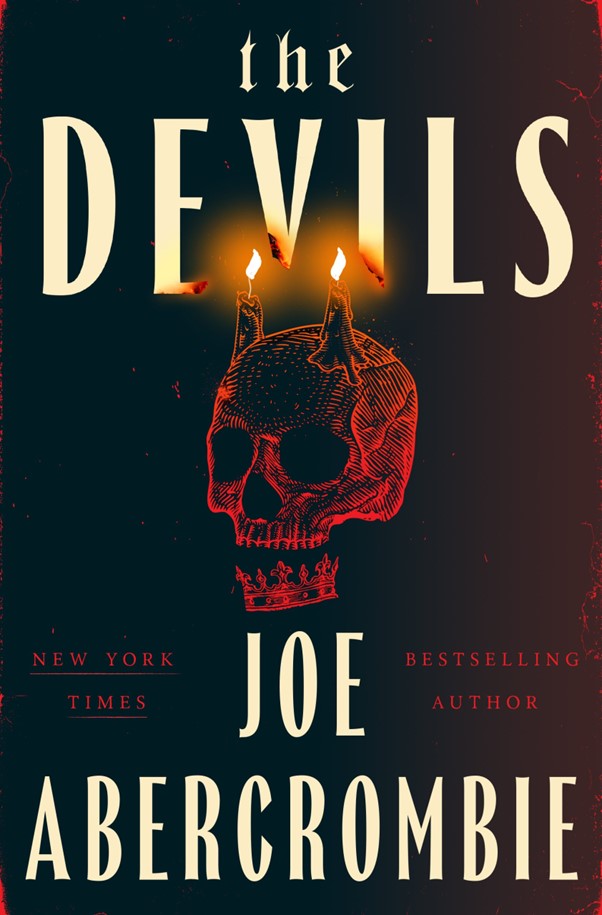
The Devils by Joe Abercrombie

Publisher: Gollancz/Macmillan Audio (Audiobook – 13 May  2025)

Series: The Devils – Book One

Length: 25 hours and 7 minutes

My Rating: 5 out of 5 stars

Amazon

The master of grimdark fantasy fiction presents a bold and over-the-top new story with The Devils, an outstanding, addictive and highly entertaining read that you will not be able to turn away from.

Joe Abercrombie is an impressive and compelling author who has been wowing fantasy fiction authors with his complex reads for nearly 20 years.  While he has written some other cool books, like his Shattered Sea trilogy, Abercrombie is best known for his iconic First Law series of dark fantasy novels, that followed a group of highly damaged people as they tried to survive war, magic and politics in a messed-up fantasy world.  I really enjoyed the original First Law trilogy, and Abercrombie has cleverly expanded it out over the years, including with three standalone novels and his sequel Age of Madness trilogy.  The Age of Madness novels were ones that I particularly enjoyed reading, and A Little Hatred (one of my favourite books of 2019), The Trouble With Peace (one of my favourite books and audiobooks of 2020) and The Wisdom of Crowds (one of my favourite books and audiobooks of 2021), were very highly rated by me, and I could not get enough of this series.

Needless to say, I am a pretty big fan of Abercrombie’s novels, and I have been eagerly awaiting a new book from him since I finished The Wisdom of Crowds.  While I had hoped that we would be getting a new First Law novel, Abercrombie instead decided to present readers with something a little different with his new The Devils series.  Starting off with The Devils, this series is another clever dark fantasy series, set in an alternative, magic filled version of medieval Europe.  One of my most anticipated books of 2025, The Devils sounded so damn good, especially with its crazy plot and intriguing new setting.

The lands of Europe are in dire peril.  Between the constant wars, dangerous monsters, ruinous famines and deadly plagues, the various kingdoms of Europe are in poor condition, barely held together by the fractured church.  However, the real danger lies outside its borders, as the mysterious elves gather their power in the Holy Lands, preparing for another invasion of Europe that will surely lead to the destruction of all humanity.

In response to the growing threat of the elves, the church and its juvenile pope determine that a new ruler needs to be placed upon the Serpent Throne of Troy after its evil sorcerous empress dies.  With all four of the empress’s duplicitous and power-hungry sons unfit for the crown, the church surprisingly finds that their ideal candidate is a lowly street thief from the Holy City called Alex.  A ferrety sneak with no noble bearing or confidence, Alex is shocked to discover that she is really the long-lost Princess Alexia Pyrogennetos of Troy, destined to reunite the churches of Europe by claiming the throne.

Turning the reluctant and terrified Alex into a potential princess is one thing, but getting her to Troy is a far more difficult prospect, especially as her rival contenders to the throne are stalking Europe with their deadly, magically enhanced followers, determined to claim Troy for themselves.  To succeed in marching Alex through the European hellscape and placing her on the Serpent Throne, the church will need far more than prayers and the blessing of saints; they are going to need devils.  Luckily, such devils are close at hand. 

Deep within the Holy City lies the Chapel of Holy Expediency, which binds dangerous heretics and monsters and forces them to seek redemption through holy missions for the pope.  Led by the hapless Brother Diaz, the congregation of the Chapel of Holy Expediency is charged with getting Alex to Troy and placing her on the throne.  But can a terrified monk, an immortal knight, an arrogant necromancer, an invisible elf, a sarcastic vampire, an uncontrollable Viking werewolf and the most experienced woman in Europe succeed in making a street-rat an empress, or will their new mission only bring even more death and destruction to the continent? 

Joe Abercrombie once again shows why he is one of the very best authors of dark fantasy fiction with his captivating and deeply impressive new novel.  The Devils was an ultra-entertaining read that perfectly introduced the author’s intriguing setting and populated it with highly amusing characters and dark deeds.  Exciting, clever and loaded with over-the-top humour, The Devils was an absolute joy to listen to, and I loved every second I spent with it.  One of the most addictive novels of 2025 so far, The Devils gets a very-well deserved five-star rating from me, and readers are guaranteed an extra fun time with this crazy novel.

I absolutely loved the cool and highly entertaining story that Abercrombie came up with for The Devils, which was essentially a fun dark fantasy iteration of The Dirty Dozen/Suicide Squad narrative with some amazing monsters.  Providing a quick introduction to the key characters, the reader soon becomes highly invested in the narrative, as the memorable and very amusing protagonists begin their trek to Troy.  What follows is a classic travelling adventure story with some dark and comedic twists, as the protagonists encounter all manner of foes on the way to their destination, which they are forced to dispatch with ruthless efficiency.  While parts of this story start to become a tad formulaic, especially as the protagonists are intercepted multiple times by one of Princess Alexia’s cousins, with each encounter resulting in a deadly battle for survival against different occult forces, you are generally so entertained by the compelling characters, interesting interactions, and over-the-top action sequences, you don’t even really mind.  Abercrombie works to break up these encounters with some fun side quests, as well as altering the circumstances by having the characters occasionally split up into unlikely pairings, exploring the fun alternate medieval Europe that works as such an effective setting for this book.  This allows for some interesting changes of pace in the main quest narrative, while also allowing for some outrageous character moments as the reader gets to know the protagonists a little better.

Everything nicely leads up to the last third of The Devil, which sees the protagonists arrive at their destination against the odds.  Without going into much detail, things naturally go to hell, and everybody is forced to fight for their lives.  This chaotic series of events isn’t unexpected, as the reader is waiting for the other shoe to drop the entire book, but the who and the how of it makes for great reading.  Some excellent twists come to life here, often revealed in a fun meta way, and, while you see a couple of them coming, the entire ball of surprises and reveals make for quite an exciting end sequence.  These twists are well backed up by some of the grittiest action sequences in the entire book, and you are constantly on your feet waiting to see what happens next.  The entire novel ends on a tragic, if thoughtful note, especially when you’re left to consider who the true monsters of the story are.  An overall impressive narrative, that blends alternate history and classic adventure narrative threads with Abercrombie’s wild imagination to create something exceedingly entertaining and addictive.

The Devils was a very fun and well-written story as Abercrombie provides a very intense and hard-hitting tale, bound together by dark humour, over-the-top sequences, and complex characters.  Abercrombie once again showcases his skill at balancing multiple distinctive perspectives to tell an integrated and ongoing narrative, with the story cleverly bouncing between the viewpoint of several impressive protagonists.  The continued switches between the characters allows for a very elaborate narrative, and the reader is drawn into both the overarching plot and the more personal battles of the protagonists.  I liked how Abercrombie was able to tailor the descriptive narration of each of the perspective chapters to suit the character it was following, and each chapter has a slightly different tone as a result.  However, this is a very dark overall story, as the characters encounter outrageous scenarios of death and destruction, and the resulting carnage allows for some intense moments.  I will say that The Devils did feel a little sillier than some of Abercrombie’s previous novels, although the author uses this extra layer of ridiculous energy to full effect to tell an extremely addictive story.

As you would expect from Abercrombie, the intense action sequences are a highlight of The Devils, with the many brutal sequences coming to life thanks to the author’s great descriptive style.  There was a certain casualness to some of the fights, especially those featuring the plot’s more dangerous killers, and which was enhanced by the clever overall narration of the writing.  I loved how Abercrombie set out all his scenes, with a lot of subtle humour revolving around cynical description of events, especially as the author provides some ironic results and meta commentary.  This more subtle writing of events is counterbalanced by the over-the-top humour of the dialogue, especially when it comes to certain characters.  A lot of the dialogue gets downright filthy at times, with some very adult discussions coming out in outrageous fashion.  While this excessive crass language had the potential to distract from the story, I think that Abercrombie got the right balance, with the ridiculously rude dialogue fitting in well amongst the crazy events of the plot.  While the combination of ugly events, adult humour and cooky carnage isn’t going to be everyone, I think most fantasy fans are going to have a ton of fun with it, especially as it plays into Abercrombie’s grimdark style.  Throw in a clever alternative medieval Europe as the elaborate setting which will delight history buffs with the intricate differences, and The Devils was a very impressive read that perfectly plays the author’s strengths and talent for entertaining and dark fantasy fiction.

Fans of Abercrombie will know that the author specialises at making damaged and captivating characters to set his narratives around, and The Devils is no exception to this.  The author introduces an amazing cast of complex and memorable characters in The Devils, and I love the very impressive storylines that emerge around them.  This includes six separate perspective protagonists, two major supporting characters, and an array of interesting figures throughout Europe who play various roles in the outcome of the plot.  Abercrombie does an excellent job of introducing and utilising this complex cast, with all the major characters getting their chance to shine in some impressive ways.  While some of the characters in The Devils didn’t quite have the complexity of the protagonists from the First Law books, Abercrombie instead amps up the entertainment aspect of these figures, introducing several particularly hilarious, ridiculous and highly relatable monsters, each of whom added a great deal to the overall reading experience.

The first two characters I want to talk about are major perspective protagonists, Brother Diaz and the newly discovered princess, Alex.  Despite neither being members of the titular devils, both have major roles in this book and are shaped by their experiences with the monstrous pawns of the church.  Brother Diaz, a simple monk who is brought in to guide the devils, is initially shown to be a hapless and terrified figure, clearly out of his depth when it comes to the dangerous mission he has been entrusted with.  Abercrombie has a lot of fun showcasing him as a useless social climber at the start of the novel, and he initially has more of a comedic role in the plot.  However, as the story progresses, Diaz starts to gain a little confidence as he continues to survive, and you soon see flashes of the man he could be.  Despite falling to temptation (repeatedly), Diaz ends up being quite a stalwart figure in the book, and I loved some of the scenes where he got to show off his intelligence (including one particularly entertaining legal battle).  The way in which Abercrombie subtly added more and more depth to Diaz’s personality as the story continued was very impressive, and his growth as a character was a highlight of the book.  The author also ensured that Diaz was one of the more relatable characters in The Devils, especially as he continuously makes mistakes, finds himself shaken by his fears and failings, yet continues to try to do the right thing.

Much like Diaz, the other non-devil perspective protagonist, Alex, is also shown to be an imperfect figure who finds themselves thrust into events outside of their control.  Initially shown as a simple thief, Alex, or Princess Alexia Pyrogennetos, is ill prepared for the events before her, and is forced to rise to the occasion when she is declared long-lost royalty.  Mostly shown as the book’s damsel in distress, Alex is generally scared and lacking confidence, especially as she knows she is not the princess everyone wants her to be.  Like Diaz, Abercrombie writes Alex slowly rising to the occasion throughout course of The Devils’ plot, as she learns to fight back and become a leader.  I really liked following Alex’s journey in The Devils, and while the journey to the character finding her self-confidence is a long and bloody affair featuring some good twists, it ended up being a powerful part of the book’s overarching narrative.

Outside of Alex and Diaz, a lot of time is also spent following the other perspective members of The Devils, including Balthazar, Sunny and Vigga, who are a necromancer, an elf and a werewolf respectively.  These three characters are amazing, and I liked how well they played off each other and the rest of the cast with a great mixture of serious and more comedic elements.  For example, Balthazar (or to introduce him properly, Balthazar Sham Ivan Draxi), is a highly arrogant figure who chafes at being captured and controlled by the church.  Much of his story focuses on his many attempts to break the Papal binding compelling him to help Alex, while also dealing with the realisation that he is helpless against those he considers his lesser.  Much of the entertainment around Balthazar is his complete lack of self-awareness or humility, especially within his own mind, and while there are times when it appears that he is going to become a better person, he usually returns to his old personality when he hits a wall.  Sunny the elf, on the other hand, is a far more sensible character, who serves as the team’s shadow thanks to her ability to become invisible.  Despite her nice and helpful personality, Sunny is shown as an alien creature, incapable of understanding the humans who generally hate and fear her.  Imbued with a more subtle humour than her fellow devils, Sunny proves to be quite an interesting figure, especially when you examine her past and her dark experiences with humans.  Probably one of the more likeable and selfless figures in the book, Sunny’s arc adds a lot to the overall story, especially through her unlikely romance angle, and Abercrombie clearly had fun writing the various scenes where she traipses around invisible.

One of the more memorable cast members of The Devils is Vigga, a former Viking raider who was cursed as a werewolf and then captured by the church.  Crass, constantly controlled by her urges, incapable of self-restraint and particularly deadly, even when not a massive wolf, Vigga powers through the entirety of The Devils’ narrative, leaving a major impression whenever she appears.  Featuring some of the more visceral and entertaining perspectives of the book, which includes a combination of hungry sequences from her wolf mind and her more entertaining insights as a human with no impulse control and an inability to focus on anything, Vigga is responsible for a large part of The Devils’ chaotic and outrageous tone, and the book would not be anywhere near as fun without her.  However, as this is Abercrombie, there are quite a few darker moments in Vigga’s story, and you soon become absorbed with her attempts to pull together her fractured mind and control the monster within, especially when she gets close to her travelling companions.  The dark depression that occasionally befalls her because of her uncontrolled actions adds some major drama to certain tragic parts of The Devils’ plot, and Vigga comes away as one of the more sympathetic, if scary, characters in the book.

While the above perspective characters are all particularly impressive, my favourite was the team’s resident knight, Jakob of Thorn.  An old soldier cursed with immortality who has been fighting battles on behalf of the church and God for hundreds of years, Jakob is a tired and haggard figure bound by his many vows.  Suffering from the degradation of his body due to age and the many injuries inflicted on him, Jakob is weariness personified as he attempts to deal with his pain, and the guilt from his long history of death and service to the church.  Readers familiar with the author will know that Abercrombie specialises at writing tired old warriors who are sick of the death and destruction they cause, and Jakob of Thorn is one of his better ones (which is saying a lot).  I loved all of Jakob’s scenes, especially as he doggedly continues to fight despite his pain, often providing some of the book’s best quotes and insights.  Unsurprisingly, Abercrombie makes Jakob suffer a lot in this novel (what else would this sadistic author do with an immortal character?), and you learn a lot about his resolve and psyche as a result, especially as he knows he is the biggest monster of them all.  I really think that Jakob’s grittier and more self-aware perspective chapters helped to balance out the more outrageous character arcs in The Devils, and he was a perfect addition to this outstanding narrative.

The final two major characters I want to highlight are Baron Rikard, an ancient vampire, and Baptiste, a rogue hired to keep the devils in check, who seems to have experience with every profession possible in Europe.  Both these characters are excellent additions to the plot and manage to shine through, despite not being perspective characters.  Indeed, I felt that their role in the book was enhanced by the readers not having direct insights about their motivations or actions, and instead you get to enjoy the mystery surrounding them as you see them through the eyes of the other characters.  Baron Rikard, who serves as a fun, sarcastic figure who only helps when it suits him, proves to be a great inclusion in the plot, especially as his gentlemanly manners and demeaner makes him stand out amongst the other characters.  While a ridiculously charming figure (especially when he starts talking about dumplings), you are initially given the impression that Rikard is another trapped monster keen to escape his binding.  However, Abercrombie nicely turns this assumption on its head as the story continues, and I really enjoyed the character’s revealed motivation, especially as it shades all the character’s actions in a new light.

Baptiste, on the other hand, is a suave and entertaining figure whose impact on the book would be diminished if you got a deeper look at her thoughts, motivations or true history.  I particularly enjoyed how well Baptiste served as a foil to Balthazar, and they had a great back and forth that helped to define them both.  Throw in a range of other impressive supporting characters, including a barrage of outrageous or diabolical antagonists, and the cast of The Devils was something very special.  I cannot emphasise enough just how much fun all these characters were, and their moving and complex arcs and interactions really helped to give some powerful meat to The Devils’ entertaining narrative.  You really come away with some conflicted feelings for many of the protagonists, especially as none of your favourites have a truly happy ending, and it will be interesting to see what happens to the survivors in the future entries of the series.  A special shoutout as well to the fun artwork depicting several of these characters in The Devils paperback, especially as the artist really captures how the author wrote these colourful protagonists.

While I did receive a physical copy of The Devils, I ended up listening to this novel on audiobook, which was a fantastic choice.  Not only did the audiobook version allow for a fuller immersion in Abercrombie’s new fantasy universe and his crazy action sequences, but it also featured the superb voice of actor Steven Pacey.  Pacey, who is one of my favourite audiobook narrators, previously lent his voice to the audiobook versions of Abercrombie First Law novels, and he frankly does a perfect job of capturing the author’s unique tone and style.  Abercrombie’s complex writing, witty dialogue and excessive humour really come to the fore when read out by Pacey, and the narrator’s tone and cadence in The Devils always perfectly matched the intended mood of the scenes, no matter how dark or over-the-top they became.  Pacey also does some very entertaining and highly fitting voices for the key characters of The Devils, and it is amazing how well he captures all these outrageous figures.  All the defining character details, including the timid nature of Brother Diaz, the arrogance of Balthazar, the pain and weariness of Jakob, the wry amusement of Baron Rikard, the unearthly nature of Sunny and the sheer wildness of Vigga are all amazingly highlighted by Pacey’s various voices, and really come to love the characters the way that Pacey reads them out.  Thanks to Pacey’s brilliant acting and evident love for the content, this was an incredible listen, and I really cannot emphasise enough just how effectively he narrated this crazy story.  I flew through the books lengthy, 25-hour runtime due to this brilliant narration and epic narrative, and I honestly don’t believe that anyone but Steven Pacey could make Abercrombie’s amazing novels come to life in the same way.  An exceptional audiobook and one of the best things I have so far listened to in 2025.

With his trademark blend of chaos, fantastic humour and complex characters, Joe Abercrombie presents one of the very best books and audiobooks of 2025 with The Devils.  A unique and very entertaining fantasy adventure novel, The Devils pushed everything to 11 and beyond, ensuring that you couldn’t turn away.  An exceptional read from start to finish, I had so much fun with The Devils and I cannot wait to see how Abercrombie will continue this series in the future.
Amazon

The Last Shield by Cameron Johnston

Publisher: Angry Robot (Ebook – 13 August 2024)

Series: Standalone

Length: 376 pages

My Rating: 5 out of 5 stars

Amazon

One of the rising stars of dark fantasy fiction, Cameron Johnston, returns with an intense, gritty and addictive novel of revenge, desperation and brutal murder, with the brilliant novel, The Last Shield.

One of the more intriguing authors of fantasy fiction I have enjoyed reviewing in recent years is the outstanding Cameron Johnston, who has deeply impressed me with his small but excellent collection of works.  Since his debut book in 2018, The Traitor God, I have grown to enjoy Johnston’s novels, especially as his first book was a brilliant story of dark magical revenge.  Following up with the awesome sequel, God of Broken Things, Johnston cemented himself as an author to watch, and I have yet to be disappointed by him since.  His third novel, The Maleficent Seven, was a fantastically bonkers read that saw a small town become the unwilling recipients of a band of monstrous defenders when a massive army comes to destroy them.  I had an amazing time with The Maleficent Seven, and indeed all of Johnston’s books, which is why I was so eager for his latest novel, The Last Shield.  One of my most anticipated books of 2024, The Last Shield had an epic and cool plot behind it, and I was so very eager to check it out.

In a world of warring realms and dark magic, the ancient forest realm of Sunweald survives by serving as a buffer country between two far mightier nations on either side of its borders.  A realm of tradition and druidical magic, the heart of the nation lies in Sunweald Palace, where the Lord Regent, and the young heir to the throne reside, guarded by Sunweald’s elite warriors, the Shields.  Rough and old, Sunweald Palace is an impenetrable fortress designed protect the nation’s royal family, as well as safeguarding a massive vault of unspeakably powerful magical artefacts.

Despite its peaceful status, Sunweald finds itself beset by a group of vicious brigands, the Wildwood Reivers, who have made a living stealing away magical artefacts and trading them across the border.  Led by a mysterious witch, the Wildwood Reivers have grown bold, even launching an attack on the royal family.  When word reaches the palace of the location of the brigand’s base, the Shields depart to destroy them once and for all.  However, their mission is a devious decoy, as through treachery, dark magic and deceit, the Wildwood Reivers and their allies manage to take over Sunweald Palace.

With the Shields away and traitors holding the wall, the brigands plan to loot the palace’s ancient vaults and steal every magical artefact hidden within.  However, the Wildwood Reivers face one substantial obstacle to their success, Briar, feared, if hobbled, commander of the Shields.  Despite being outnumbered, wounded and near retirement, Briar is determined to perform her duty and reclaim the palace.  Using her knowledge of the palace’s secret tunnels and ancient corridors, Briar sets about dismantling the invaders in brutal fashion.  But battered, alone and loosing strength, can even a legendary Shield like Briar face the overwhelming odds and lethal magic set against her?

Gosh this was a very impressive and exciting read.  Cameron Johnston has a real flair for fantastically over-the-top narratives, and The Last Shield is some of his best work yet.  A complex and compelling tale of revenge and redemption, The Last Shield was a non-stop thrill ride, and I loved the deeply intense story that emerged.  This was a truly outstanding book that gets a full five-star rating from me thanks to how much sheer fun I had reading it.

The narrative that Johnston pulls together for The Last Shield is extremely awesome, and it can best be described as a gender bent, dark fantasy Die Hard, with some amazing fantasy elements.  An excellent standalone story, The Last Shield was a constantly moving book, which drew me in with its clever plot concept and the promised resulting violence.  Part of the reason the story works so well is the initial setup, which introduces the new intriguing world, but more importantly effectively gets you across the central characters and the main setting of Sunweald Palace.  There are some great early character moments here, especially when it comes to the main protagonist, Briar.  The veteran leader of the Shields, Briar is badly wounded in the opening scenes of the book, which kicks off a great arc for her as she attempts to find her purpose after the injury potentially robs her of her position.  Some other key character arcs and storylines are also introduced here, including around the young heir to the throne, whose brush with death drives him closer to the disapproving Briar as a mentor.  Johnston also takes the time to explore the full extent of the conspiracy to takeover Sunweald Palace, and you grow to appreciate just how dastardly the plot is.  As such, you are well prepared for the chaos and carnage to come, and the anticipation Johnston expertly builds up in first part of the book, really enhanced the overall impact of The Last Shield.

As such, the reader is very much ready to go when the villains initiate their plan around a third of the way into The Last Shield.  The resulting takeover is as dark and brutal as you’d expect, and the reader is well prepared to despise the antagonists and root for any sort of victory from the protagonist.  You don’t have to wait long as the despondent Briar quickly finds herself in the ideal position to fight back and begins her bloody and justified one-woman assault on the invaders.  Johnston initiates a series of intense, powerful and increasingly desperate battles, as Briar encounters greater and great hurdles and opponents as she attempts to save the Lord Regent and stop the looting of the castle’s vaults.  The author expertly ramps up the intensity every confrontation, and you really find yourself more and more off the edge of your seat as the story proceeds and Briar becomes increasingly injured.  There are some brilliantly brutal confrontations all the way to the end, and the author throws in some great twists and major final threats.  I honestly loved every second of the epic second half of The Last Shield, and Johnston wrote an amazing, blood-soaked story.

I felt that Johnston did an outstanding job bringing his cool story to life in The Last Shield, and readers are in for a great time if they check this book out.  The excellent blend of dark action, intriguing fantasy, and powerful characters really worked for me, and I felt that Johnston perfectly blended storytelling elements throughout the entire book.  The writing of The Last Shield is crisp, fast-paced, and well planned out, and it proves impossible not to be drawn into the fantastic scenario and intriguing storytelling.  Cameron does an excellent job exploring the new fantasy world that The Last Shield is set in, and you really get drawn into the bronze-age Celtic setting, and the focus on a small kingdom with some intriguing gender roles.  I particularly enjoyed how Jonston managed to emulate the feel of a classic action thriller like Die Hard or Under Siege and blend it with the dark fantasy setting.  The resulting scenes, which forced a nearly retired badass female palace guard to crawl through the secret tunnels of the castle to save the male reagent while disrupting a magical heist, were so damn fun, and it was a fantastic take on a classic film trope.  It helped that Johnston brought his typical, over-the-top mindset to the action sequences in The Last Shield, presenting the readers with an increasing bloody series of fights as the protagonist unleashed her inner fury.  These scenes of carnage and brutality paired perfectly with the complex narrative and character arcs that Johnston built up, and the resulting book was so much fun.

I need to highlight The Last Shield’s awesome characters which were a fantastic part of the book.  I have mentioned the main protagonist, Briar, a few times already, and frankly she was the heart of The Last Shield due to her intense personality and well-written storyline.  Johnston very cleverly set up Briar’s story at the start of the novel, first showing the warrior in her prime, before hobbling her and forcing her to consider retirement before the main plot kicked off.  As such, the version of Briar we see for much of the novel is a desperate, tired and absolutely pissed-off figure, especially when she realises the many betrayals that led up to both this current assault and her previous injury.  I loved how well Johnston set up this character’s revenge arc, and it was so much fun to see Briar finally get her hands on all the people responsible for her misery.  The author really dives into Briar’s mindset and emotions as the book continues, and it proves very, very hard not to root for her, especially when she is driven to her absolute limit.

While most of the focus of The Last Shield is on Briar, there are several other great characters featured throughout the book who also enhance the story.  The most prominent of these is probably the heir to the Sunweald, Ves, who has excellent parallel character growth to Briar.  Initially portrayed as a young fop, Ves grows due to the sacrifices he witnesses in his name and the brash mentorship of Briar, and he ends up proving himself in his own way.  Aside from that, I really need to highlight the excellent group of villains who Briar finds herself up against.  Featuring a band of traitors, brigands, an assassin and a dark witch, the antagonists of The Last Shield play off the stoic Briar extremely well, especially as each of them enrage her in a different way.  Johnston does a fantastic job showcasing the antagonist’s perspective throughout the course of the story, and their early scenes really work to ensure the reader dislikes them.  I personally loved seeing their point of view once they realised that Briar was loose in the castle with them, and the outrageous sequences of fear, anger and regret that followed are incredibly fun.  These characters proved to be a great boon to The Last Shield’s plot, and I deeply enjoyed the fantastic and powerful storylines that Johnston built around them.

Cameron Johnston continues to greatly impress with his fourth novel, The Last Shield.  An exceptional, addictive and gloriously over-the-top dark fantasy novel that takes inspiration from some classic action films, The Last Shield was pure entertainment and excitement, that I could not turn away from.  With great characters, an awesome setting, and so much damn action, there is something for every dark fantasy fan in The Last Shield, and I cannot recommend it enough.  One of my favourite fantasy books of 2024.

Amazon

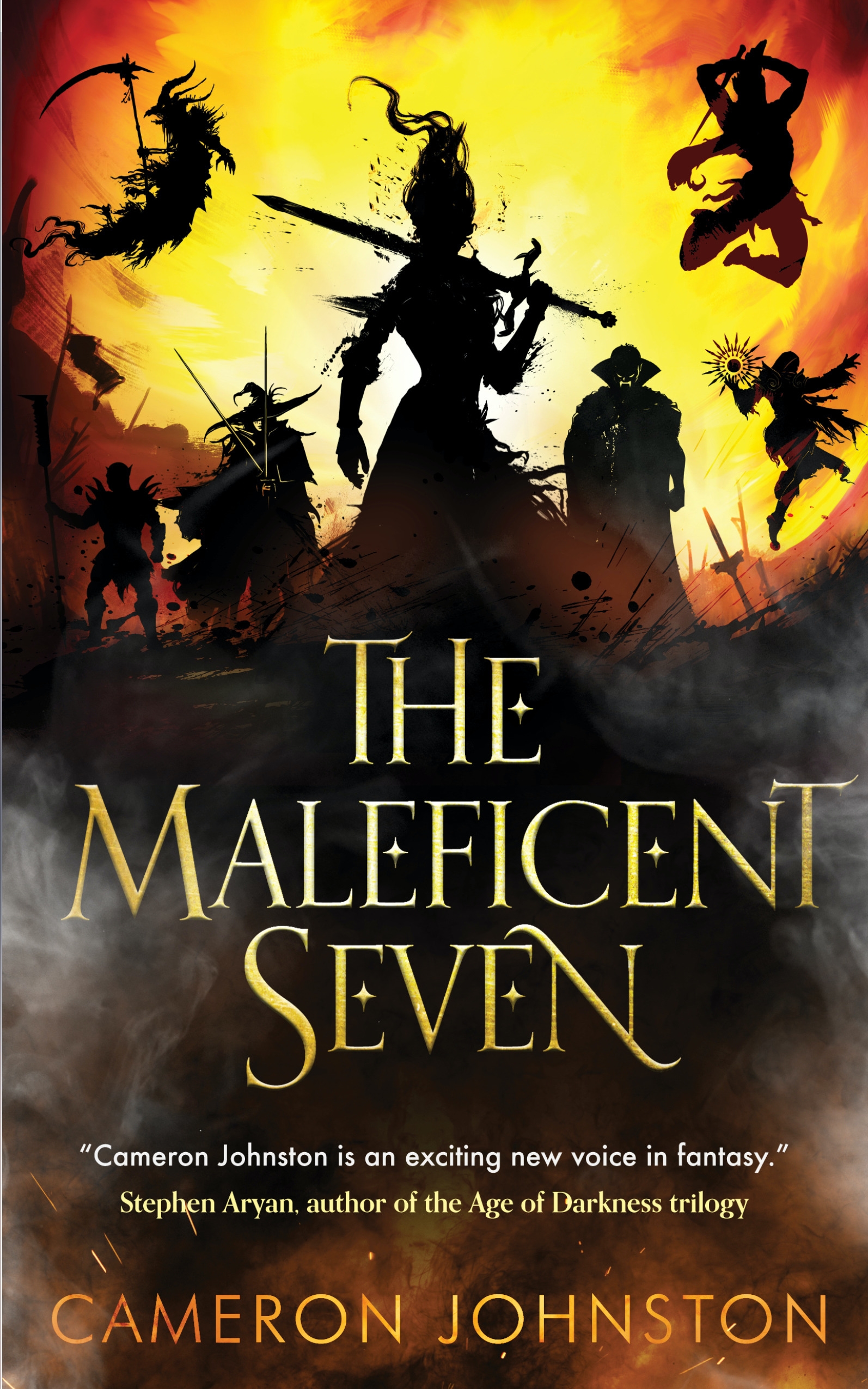
The Maleficent Seven by Cameron Johnston

The Maleficent Seven Cover 2

Publisher: Angry Robot (Trade Paperback – 10 August 2021)

Series: Standalone

Length: 416 pages

My Rating: 5 out of 5 stars

Amazon

One of the fastest rising authors of dark fantasy fiction, Cameron Johnston, returns with his most entertaining book yet, the outstanding and epic novel, The Maleficent Seven.

Cameron Johnston is a great author who I was lucky to come across a few years ago with his debut novel, The Traitor God.  Bought on a whim because it sounded cool, The Traitor God ended up being one of my favourite fantasy books of the year thanks to its excellent revenge storyline.  The Traitor God was such an epic read and I ended up grabbing the intriguing sequel the following year, God of Broken ThingsGod of Broken Things (one of my favourite books of 2019) proved to be an outstanding sequel, and it ensured that I would be keeping an eye out for more of Johnston’s work.  This included his 2021 novel, The Maleficent Seven, which had an awesome plot behind it.  I honestly have been meaning to read The Maleficent Seven for ages but could never fit it into my schedule.  That was until last year, when I managed to power through the entire book in a single plane ride.  The Maleficent Seven ended up being a pretty darn exceptional novel that I wish I read a hell of a lot sooner.

It is a dangerous time in the lands of Essoran, as the Lucent Empire, a nation of apparent holiness and light, continuously expands, sweeping away all opposition and either burning or converting the survivors to their faith.  Despite their apparent benevolence, the Lucent Empire has a dark side dedicated to destroying all magic, heretics, and anything it deems evil through fire, blood and death.  The final stage of their invasion is set, but to proceed they first need to cross through the mountain road, which exits at the small town of Tarnbrooke.  All looks lost for the inhabitants of Tarnbrooke, who are likely to burn in the Lucent Empire’s light, until an unlikely figure appears to lead them.

Forty years ago, the dread demonologist Black Herron led a black horde of bloodthirsty soldiers, dark creatures and monsters on a deadly campaign that rocked all Essoran.  Total conquest of the realm looked certain, until she suddenly disappeared the eve of the final battle.  Without the will of their leader to hold them together, the army fell to infighting allowing their enemies to prevail.  No one knew what happened to Black Herron, until she reappears in Tarnbrooke, having lived there in disguises for decades.

Determined to stop the Lucent Empire and their fanatical leader no matter what, Black Herron takes over the town and prepares it for siege.  But even a being as powerful as Black Herron is unable to stop an entire divinely infused army by herself.  Instead, Herron seeks to bring together the six deadly captains of her army, whose skills and ferocity helped her to nearly conquer the world.  Together, this assortment of dangerous beings, including a vampire, a necromancer, an orc chieftain, a war god, a pirate queen and a deranged alchemist, might stand a chance against the coming storm.  But first they need to learn to work together once more, especially as each of them have a very different reasons to fight with Black Herron again.

The Maleficent Seven is a powerful, captivating and fantastically over-the-top novel that showcases Cameron Johnston’s impressive writing skill and ability to bring together great characters with dark fantasy settings.

Now, as you can probably guess from the name, The Maleficent Seven is a dark fantasy take on classic films like The Magnificent Seven and its predecessor, Seven Samurai.  Johnston sets the scenario perfectly, first introducing protagonist Black Herron and her previous evil horde, which disbands in the starting chapter.  From there, we get a time skip and are introduced to the book’s antagonists in the form of the Lucent Empire, their divinely empowered inquisitors and their leader, the Falcon Prince.  Their initial actions are enough to paint them as dangerous religious zealots who use their divine light and apparent holiness as a shield for their dark ambitions.  Their quest leads them on the road to Tarnbrooke, where the elderly Black Herron waits for them, having decided to make a stand and bring together her six former captains.

The first half of the book is dedicated to recruiting the six captains, who have scattered across the world.  All evil or deadly figures, none of them particularly wants to fight another war, but each are drawn back for different reasons, including family, pride, revenge and more.  Johnston does a good job of breaking up the recruitment process throughout the early chapters, and each of the revealed captains turn out to be crazier than the last, enhancing your anticipation for how they are going to act in the coming battles.  At the same time, you get to know the Lucent Empire, as they send agents against the captains, trying to eliminate the danger they pose.  Johnston lays down some very solid groundwork in this first half of the book, and you quickly get drawn to each of the seven main characters for various reasons.  There are a great range of character arcs spread out amongst these unlikely protagonists, and while a couple of them are purposely irredeemable, the rest prove to be surprisingly likeable and complex.  Johnston also takes the time to build up the antagonist, showcasing just how sinister they truly are, while also providing some slightly predictable revelations about their leader.

The second half of the book is dedicated to the battle for Tarnbrooke, which after seeing how crazy the first half of The Maleficent Seven is, you know is going to be good.  There is some good additional setup once the captains arrive in town, with the building of siegeworks, the training of the townsfolk, and other unusual preparations, all of which is reminiscent of the films the book is an homage to.  Johnston also builds up some additional character interactions that I really enjoyed, as certain townsfolk become connected to different saviours and there is some good follow-up regarding the protagonist’s prior adventures.  The resulting siege is everything you could hope for and more.  I am a huge fan of sieges in fiction (check out my previous list on the subject) and The Maleficent Seven is a particularly good example of an epic siege, especially as Johnston goes very over-the-top when it comes to the different weapons and methods the defenders employ.  Everything from vampiric conversion, exploding pigs and drugged townspeople are used to hold the line against the enemy in several brilliant and brutal fight sequences, while a major sea battle simultaneously occurs, featuring, amongst other combatants, a giant kraken.  All the fighting is fierce, desperate, and pretty damn bleak, while the characters each go through their own intriguing and powerful journeys.  I honestly was enthralled once the main fighting started, and Johnston really did not let up until the end.

The final sequence of the main fight turns into an impressive and extremely horrific brawl for survival as the protagonists fight against increasingly desperate odds.  There are also several betrayals as certain telegraphed plots from the evil protagonists come to fruition, and everyone fights to survive and come out on top.  You will be a bit unprepared for who lives and who dies during the final few chapters as Johnston loads up some fantastic twists and cool revelations that constantly leave you guessing.  Even when you’re sure you know who is going to survive, Johnston swiftly changes everything around with a few hilariously ironic reveals, as well as some more tragic deaths.  I liked how Johnston imbued the story with a certain level of hope towards the end, even if that was somewhat overshadowed by the carnage surrounding it.  There were also some darker moments in the conclusion, as certain characters realise just how damned they truly are.  Throw in a final great twist that really tied together a hidden motivation from the very start, and Johnston ends The Maleficent Seven on the perfect note for the reader.

Johnston did a remarkable job with this awesome book, and I loved how dark, powerful, and compelling The Maleficent Seven turned out to be.  Thanks to the unique array of characters, insane fight sequences and entertaining twists, The Maleficent Seven will prove really appealing to a wide array of readers, especially as Johnston got the right balance of action, tragedy, and humour throughout the entire read.  I especially loved how well the author flipped the established concept of heroes defending a town from villains on its head with the inclusion of seven fantasy supervillains leading the charge against a holy army.  The clever reveal that the apparently good warriors are far more sinister than the literal monsters is so well handled, and it was impressive to see a classic idea so well refreshed.  Throw in some excellent world building, an interesting collection of fantasy creatures and the sheer overwhelming chaos of a desperate siege, and there is something in The Maleficent Seven for all fantasy fans.

Something I really loved about The Maleficent Seven was the cool collection of characters who made up the key cast.  All the titular seven are very well represented throughout the book, and it proves very hard not to fall in love with each crazy member of the team; thanks to the narrative split, you get some intriguing insights into their motivations, actions, and history.

Of these characters, my favourite was probably Tiarnach, the fading war god who has fallen on hard times.  Thanks to the death of all his followers and his inability to fight against the Lucent Empire, Tiarnach starts the book off as a broken, drunken figure with barely any power left.  Joining Black Herron’s cause to get revenge and some form of redemption, Tiarnach becomes the defenders’ nominal drill instructor, trying to whip the townsfolk into a fighting force.  The connection Tiarnach forms with the townsfolk, his journey towards redemption, and the fact that he is one of the few characters without ulterior motivations, ensures that readers are drawn towards him.  He easily has one of the best, most tragic character arcs in the entire book, and I really enjoyed how Johnston utilised him.  The same can also be said for the legendary orc warrior, Amogg.  Amogg leaves her responsibilities behind to sate her desire for battle and alleviate her restlessness.  Thanks to her blunt and entertaining personality, Amogg was another character the reader connects to.  However, Johnston ensured that she became a true favourite when she begins to turn the women of Tarnsdale into an effective fighting force against their will.  Watching her empower and lead a band of fighting women into battle was very impressive, and her storyline was heartwarming and bleak in equal measures.

The other five characters each have their moment to shine.  The vampire, Lorimer Felle, was a suave and brutal figure whose inability to die, connection to his one loyal servant, and desire for destruction left a major impression.  Verena, the pirate queen, was also really good, although she kind of gets overshadowed by the other characters.  Jerak the alchemist was the most unhinged, and I loved how he ended up becoming more of a danger to his friends than his enemies thanks to his gruesome experiments.  Maeven, the necromancer, has one of the more complex story arcs in the book as she blurs the line between ambition, revenge and a desire for family.  While she fights alongside the others, her own need for vengeance and power leads her down a dark path, especially with her connections to the Lucent Empire’s leader.  Maeven’s entire story goes in some very dark directions, and I appreciated the dark note Johnston left it on.  Finally, the leader of the group, Black Herron, has a very interesting storyline that runs the gambit from dark queen to unlikely hero.  Johnston does a great job showcasing her rise and fall throughout the story, and the question of why she chose to abandon her conquest and her army is a fantastic part of the book.  All these protagonists are outstanding in their own way, and I loved how Johnston was able to weave together some compelling, entertaining, and occasionally sad storylines around such wonderfully outrageous figures.

Look, with a story this awesome there was no way I wasn’t going to love The Maleficent Seven, and I think my lengthy review above proves this point extremely well.  Cameron Johnston was on fire when he wrote his third full-length novel, and The Maleficent Seven proved to be a particularly intense, clever and impressive read.  Bringing together entertaining characters with insane violence amid a classic story scenario, The Maleficent Seven proved near impossible to put down and I loved every second I spent reading it.  A highly recommended read for all fans of dark fantasy, I cannot wait to see how Johnston’s next book (coming out later this year) turns out.

Amazon

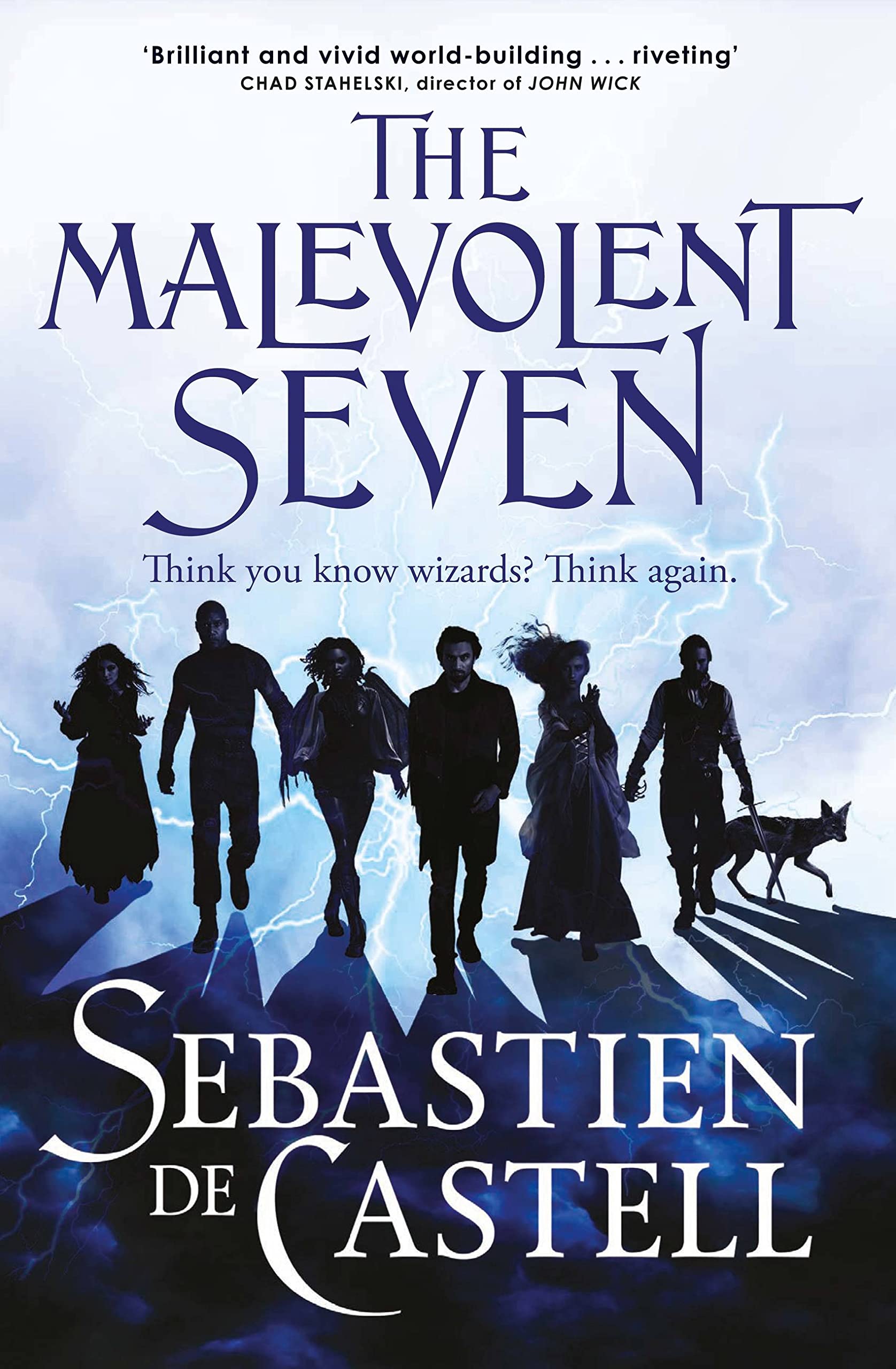
The Malevolent Seven by Sebastien de Castell

The Malevolent Seven Cover

Publisher: Jo Fletcher Books (Trade Paperback – 9 May 2023)

Series: Standalone/Book One

Length: 373 pages

My Rating: 4.5 out of 5 stars

Amazon

Rising fantasy star Sebastien de Castell returns with a bold and highly entertaining new fantasy novel, The Malevolent Seven, that takes several dangerous and dastardly characters on a magical journey of death, deceit and despair which is so much fun to behold.

Magic is power and only the strong can hope to wield it, especially if they can make a profit out of it.  Cade Ombra is a powerful wonderist, a magic user who makes his living as a war mage, selling his services to highest bidder to fight in their wars and kill their enemies, even if his employers are monsters.  Cade has long struggled with the ethics of his job, and when his latest employment ends badly, with Cade framed for murder resulting in a relentless band of holy enforcers hunting him, he knows he needs to find a way out.

Luckily, a lucrative new job is looking for wonderists, and the payment is something he’s always desired, an artefact capable of changing everything about his life.  However, to get paid he needs to do one last very bad thing: kill seven heroic mages attempting to take down a corrupt noble and survive everything that wants to kill him along the way.  Determined to win no matter the cost, Cade and his violent colleague Corrigan set off to claim the reward before any of their rivals can.  But to succeed, they’ll need to recruit five more mages capable of taking down their powerful enemies and who have no moral qualms about killing heroes for money.

So begins a deadly recruitment mission as Cade and Corrigan seek out five mages just as crazy as they are.  But even with a mentally unstable blood mage, a fallen angel, a moral demon knight, a charismatic rat mage and a mysterious jackal, can even this mismatched bad of rogues hope to survive against the seven most deadly magic users on this plane of existence?  However, nothing about this job is as it seems, and Cade and the Malevolent Seven find themselves caught up in a deadly game between gods, demons and monsters, with the fate of the world lying in the balance.

Wow, now this was a very, very fun and addictive novel.  Sebastien de Castell wasn’t an author I was too familiar with before this point, although I had heard good things about The Greatcoats series.  However, I am now going to have to go out of my way to read more of his stuff, especially after reading the epic and entertaining The Malevolent Seven.

The Malevolent Seven was such a great read as de Castell pulls together a dark fantasy reimagining of heroic stories like Seven Samurai and The Magnificent Seven.  The book starts of strong with a great introduction to the main character, Cade Ombra, the rules of magic in this realm, and the author’s very entertaining and outrageous sense of humour.  Expertly and hilariously told from the first-person perspective of Cade, whose observations about the insane events going on around him adds so much value to the story, you soon get a great sense of what to expect from this book and de Castell does not disappoint.  The story initially focuses on Cade and his friend Corrigan’s efforts in a brutal war for a mad ruler, but things go south when their employer is killed, Cade is betrayed by his fellow wonderists, and a band of ruthless religious warriors, the Glorian Justiciars, arrive determined to hunt down Cade for his use of demonic magic.  Forced to take a new job with Corrigan to save his skin and quickly get out of dodge, the two take up the mysterious contract to kill seven heroic mages in exchange for a powerful artefact, and begin a recruitment drive for five additional mages.

I love a good recruitment montage in heist or action fiction, and this one is pretty damn fun as de Castell writes in a particularly eclectic and insane group of mages for the protagonists to recruit.  Naturally nothing goes as plan, as the two are forced to take along a half-insane junior blood mage who Cade feels responsible for.  Their subsequent recruitment attempts land them in all manner of trouble as they rescue a highly chivalrous rat mage, save a mysterious fallen angel from a pleasure ship, journey to hell to recruit a demon knight, and end up in the middle of a wasteland, chased by everyone.  This recruitment period took up more of the plot than I thought it would, but it works really well to tell a great overall narrative.  Each scene introduces the reader to more of the world and it allows a compelling dynamic to grow between the various protagonists, especially as they grow to understand each other crazy tendencies.  De Castell also builds up several intriguing long-running storylines of manipulation and betrayal as it becomes clear that someone is influencing their mission and has set gods and demons against them.  This middle section of the book is a lot of fun, and I loved how de Castell keeps up the same blend of humour, intriguing character development, and insane over-the-top moments, that really draws you in at the start of the novel.

Everything perfectly leads up to the final third of the book, when the protagonists arrive at their destination.  Of course, as can be expected by the theme of this story so far, nothing is what they thought it would be, and instead they find themselves facing off against a mysterious foe with very different motivations to what they expected.  I loved how de Castell turned the plot a little on its head at this point, as the characters find themselves in the unexpected position of being the good guys.  This leads to some amazing scenes in the final third, loaded with magic, chaotic confrontations and more, all of which is a ton of fun to see.  There is some great character growth as several storylines come full circle, as well as a ton of twists and turns.  I loved some of the epic reveals that came across, and while I saw a few coming, de Castell managed to surprise me in places, which I really enjoyed.  The final twists about why the characters were on the job and who really wins were pretty damn epic and it sets the story up nicely for a sequel, which I am definitely going to grab a copy of.  I loved how de Castell really enhanced the drama in this final third of the book, especially as several character relationships or conflicts come to the boil in some explosive and captivating ways.  This combines really well with the continued craziness of the story and the inherent humour of the plot, and you really get drawn into all the fantastic elements of this book.  The Malevolent Seven ended up being an incredible read, and I managed to power through this entire story in a couple of days and had a ton of fun doing so.

I loved the dark and despairing world that served as the cool new setting for The Malevolent Seven and de Castell has a ton of fun showcasing this new fantasy landscape throughout the book.  Loaded with petty tyrants, warring nobles, and wandering wonderists who dish out death to the highest bidder, this land is the perfect backdrop for the crazy and self-serving narrative, and I loved seeing de Castell’s great characters traverse it causing trouble.  While there are some outstanding locations, including a magically blasted wasteland and several deadly battlegrounds, the highlight of this setting is the complex magical system that the author came up with.  This magical system is primarily predicated on wonderists breaching dimensional barriers and utilising magic that they have an infinity for.  This results in several unique rules and abilities that de Castell did an outstanding job of effectively introducing, and I loved how weird some of the abilities were, especially those that played into the novel’s humour.  Some of the more interesting realms require the magical users to interact with the associated denizens, including this world’s equivalent of angels and demons, all of whom have a stake in the mortal realms.  Several of the best scenes in the book require the protagonist to make dark and forbidden deals with his demonic contact, and the manipulation of the various mystical entities from both heaven and hell becomes a key part of the book.  The author makes sure to utilise all these fantastic and lethal abilities to their full extent throughout The Malevolent Seven and the epic, ultra-destructive battles that emerged, as well as the clever combination of talents, resulted in some amazingly, electrifying sequences.  It will be interesting to see what crazy abilities de Castell brings to the table for the sequel, but it’s going to be good.

The final thing I want to highlight about The Malevolent Seven are the excellent and compelling damaged characters featured throughout the plot.  De Castell really went out of his way to make his main seven protagonists as random, broken and insane as possible, and this really works in the context of this brilliant story.  The main protagonist is point-of-view character Cade Ombra, a wonderist with a secret past whose current magical ability comes from deals with a literal demon (nice guy actually).  Because of this and many other mistakes in his life, Cade is pretty alone and damaged when the story starts, and he is constantly trying to balance his survival instincts and desire for power, with his conscience, something that keeps getting him in trouble.  De Castell builds up Cade extremely well throughout The Malevolent Seven and I liked his constant growth as he tries to do the right thing, even though it usually makes life even harder for him.  The author sets Cade up as a reluctant leader and hero, and it was intriguing to see the dynamics that form between him and the rest of the team fate brings together around him.  The rest of the titular Malevolent Seven are all pretty entertaining and uniquely crazy in their own way, and the range of diverse and entertaining personalities makes for a great overall dynamic to the story. My favourite character in the group was the excessively violent Corrigan Blight, whose thunder magic matches his outrageous personality.  Corrigan served as the straight speaking, highly reactive and trigger-happy organiser of the group, who plays off the more reserved Cade perfectly, especially as they form a unique and fragile friendship.  Other highlights include the highly charismatic and surprisingly noble Aradeus, whose rat magic proves to be highly effective if a little weird, and the novice blood mage Galass, whose spunky personality is only matched by her deadly abilities that are slowly driving her insane.  I loved this impressive and very entertaining cast and I cannot wait to see what happens to them next.

I think it is very clear that I loved The Malevolent Seven as Sebastien de Castell’s outrageous and inventive dark fantasy tale was a real joy to behold.  The great blend of fantastic humour, twisty storytelling, brutal magic and over-the-top characters, works exceedingly well and I loved the witty and extremely fun story that emerged.  The Malevolent Seven is a great read and if you are in the mood for a cool and highly compelling fantasy adventure than this is the book for you.

Amazon

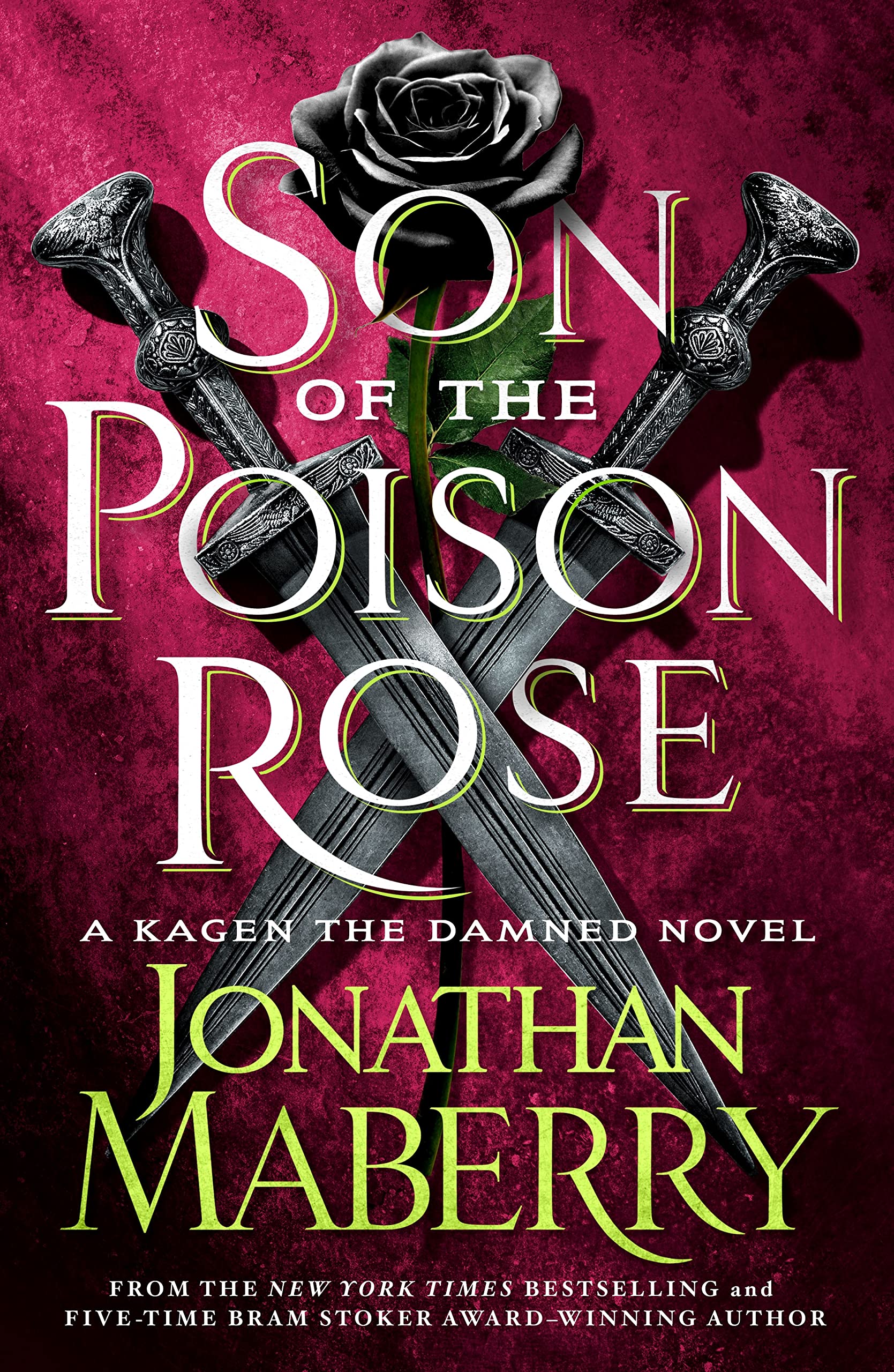
Son of the Poison Rose by Jonathan Maberry

Son of the Poison Rose Cover

Publisher: Macmillan Audio (Audiobook – 10 January 2023)

Series: Kagen the Damned – Book Two

Length: 25 hours and 55 minutes

My Rating: 5 out of 5 stars

Amazon

One of my favourite authors, Jonathan Maberry, returns to his intriguing fantasy world in a big way with the second Kagen the Damned novel, Son of the Poison Rose.

Readers familiar with my blog will know I am a massive Jonathan Maberry fan, and the path to my current obsession with his work is well documented throughout The Unseen Library.  I started off by reading his fantastic 2018 novel, Deep Silence, quite early in my blogging career, and this ended up getting me into the rest of his exceptional Joe Ledger series, including The Dragon Factory, The King of Plagues, Predator One and Dogs of War.  I have also had a great time reading his sequel Rogue Team International series, which featured the epic books Rage (one of my favourite books and audiobooks of 2019) and Relentless (one of my favourite books and audiobooks of 2021), as well as the fun standalone novel Ink (one of my favourite books and audiobooks of 2020).  Needless to say, I have deeply enjoyed his cool books, and this only increased when he made his impact into the fantasy fiction world last year with Kagen the Damned.

Kagen the Damned was an amazing and exceptional dark fantasy novel that took the reader on a wild ride.  Set in a brutal fantasy world of Maberry’s own invention, Kagen the Damned followed the titular character of Kagen Vale, a highly regarded hero and palace guard of the Silver Empire who loses everything in a single night when the armies of the dread nation Hakkia invade with dark magic, led by the powerful and deadly Witch-king.  Forced to watch his parents, his empress, and the royal children he was sworn to protect die terrible deaths, a haunted Kagen flees, only to be further destroyed when he beholds his gods turning their back on him, damming him for his failure.  Now known as The Damned, Kagen travels the world in a daze before finally regaining his senses and launching an attack on the Witch-king at his coronation.  However, this reveals secrets that shock Kagen further and spelling doom for the entire world.  I had an epic time reading Kagen the Damned last year, and it ended up being one of my favourite books and audiobooks of 2022.  Between this and the cool Kagen the Damned novella I Say Your Name in the Dark Nights, I have been eagerly awaiting a second novel and I was very excited when I heard that Son of the Poison Rose was coming out.  Son of the Poison Rose was one of my most anticipated books of 2023 and I finally managed to read it a short while ago and it was everything I hoped it would be and more.

“There is blood on the ground between us!”

Following his failed assassination attempt on the Witch-king of Hakkia, Kagen Vale, better known as Kagen the Damned, is once again the run with his companions, Tuke Brakson and Filia alden-Bok, attempting to find safety and come up with a new strategy of survival and revenge.  While their plan to kill the Witch-king failed, their attack stopped the return of the Hakkian God, Hastur, while also opening up the possibility of war, as the Witch-king’s fellow monarchs see the Hakkians as vulnerable.  However, Kagen also uncovered the terrible secret that the Witch-king is his older brother Herepath, who has turned his back on everything he once believed in to unleash great evil upon the world.

Wandering the wilderness, Kagen, Tuke and Filia attempt to come up with a new way to strike back against the Hakkian forces.  Their journey eventually leads them to the north of the continent, where they attempt to recruit an army of nationless-rogues, mercenaries and fighters to their cause.  But force of arms alone will not be enough to stop the Witch-king, instead Kagen and his allies will need magic.  But with magic long banned within the Silver Empire, only the Hakkians have any real knowledge of the mystic arts.  To that end, Kagen turns to former nun turned spymistress, Mother Frey, who sends Kagen on a deadly mission to a long lost city in a dangerous jungle in the hopes of recovering ancient books of dark magic.

However, the Witch-king is far from idle while Kagen is working against him.  With his army spread thin and the nations of the former Silver Empire all gearing up for war, the future looks grim for the usurper and his advisors.  But with new dark allies arriving every day, called to his side by magic, the Witch-king plans to unleash a magical plague, one that will turn his enemies into a ravenous, unthinking horde.  With such power at the Witch-king’s command, will Kagen’s quest reveal something powerful enough to defeat him?  And even if he does, will Kagen be able to fight his own brother?

Wow, wow, wow, what an epic and exceptional book!  Maberry can really do no wrong when it comes to his writing and this impressive sequel really hammers home what a talented author he is.  Masterfully expanding on the narrative set up in the first book, Son of the Poison Rose contains Maberry’s trademark blend of intensity, awesome action, complex characters, and dark world building that I love so much.  I absolutely powered through this lengthy novel, and it earns Maberry another easy five-star rating from me as I loved every single second I spent with it.

Maberry continues his sprawling and dark narrative in Son of the Poison Rose, as this book takes the reader in some great and captivating new directions.  Taking place in the explosive aftermath of Kagen the Damned, Son of the Poison Rose starts off in a big and action-packed way as Kagen and his allies find themselves being hunted by everything the Witch-king can throw at them.  Maberry quickly establishes his usual practice of featuring a huge number of different perspectives to showcase not only the adventures of the protagonists, but also the actions and schemes of the antagonists and the impacts that their machinations have throughout the world.  The main story of Kagen is pretty epic as it sees the protagonist and his friends struggling through new lands in the search of allies and magic.  While this results in some great scenes for Kagen in the first two thirds of the book, including a great haunted house sequence, his story here feels a little meandering at times without too much progress being made.  However, this is more than made up from the various alternate perspectives and worldbuilding that occurs in the same period.  It is so damn fascinating and entertaining to see the various dark and often horrifying plots of the antagonists come into effect as they plot for war.  These storylines blend spy thriller and dark fantasy elements together really well and you are drawn into these storylines, especially as Maberry takes the opportunity to strengthen the followers of the antagonists in some big ways.  The simultaneous build-up of other complex supporting characters, as well as the many examinations of various corners of Maberry’s new fantasy world adds to the impressive tapestry of the first two thirds of the story, and I was pretty damn hooked during this part of the book.

Maberry ramps up the intensity in the final third of the book as the various intriguing storylines he set up in the start of the novel really come to fruition.  This is headlined by Kagen and his allies travelling into a dangerous jungle nation to find a legendary ancient city where magical texts are hidden.  While I was initially concerned this part of Kagen’s story was going to be rushed, it ended up being very well written and awesome, as they encounter all manner of evils out in the jungle.  This final third of the book was again firmly enhanced by the continued dive back to the antagonists, where you see their evil plot to fill the jungle with zombies and other deadly creatures to kill Kagen and his comrades.  This results in an epic series of battles which keep you on the edge of your seat, as you know Maberry will not hesitate to kill off his characters.  The author chucks in several massive revelations around this part of the book, including finally showing the motivation behind the Witch-king’s actions, and the entire narrative ends on a big note while also expertly setting the stage for even more chaos in the following novel.  This ended up being a particularly epic story and I was firmly hooked the entire way through.

Those who are familiar with Mabbery’s novels will know that the author has a very distinctive style which has worked wonders in his many thriller novels.  Maberry successfully transported this style across to the fantasy genre last year with Kagen the Damned, and I felt it really enhanced his already impressive story.  Naturally he continues it in Son of the Poison Rose and it is still really effective at conveying the vast scope of his tale.  The main basis for his style is the utilisation of a vast number of shorter perspective chapters which showcase events from multiple characters across the narrative.  This results in a vast and complex story that not only allows the reader to see the adventures of the protagonist but also highlight the other players throughout the realm, including the antagonist, his court, the members of the resistance, and even several kings and rulers from unaligned nations who are making plans for war.  Maberry further expands out the plot by including a series of intriguing, often standalone interludes, which showcase smaller, self-contained stories within the wider universe.  These interludes are usually pretty cool, both by themselves and as extensions of the larger story, and I love how inventive and dark Maberry can be at times.  This mass of perspectives really helps to create an extensive and complex plot that has so many different aspects to it.  Seeing the protagonist and antagonist constantly reacting to the actions of each other, as well as other figures in the book, really ups the stakes and intensifies the plot, and I loved how Maberry gave this fantasy novel a strong thriller feel, especially with the continues focuses on politics, espionage and revenge.

Now, one thing about Maberry’s writing style that is not going to appeal to everyone is just how dark and disturbing the author makes the story.  Maberry is a particularly over-the-top writer at times, as he really does not hold back on the gore, violence and depravity, with the characters witnessing or causing all manner of mayhem or gruesome acts.  While this excessive violence and brutality fits the dark fantasy realm that Maberry has created, particularly as it highlights just how evil the antagonist and his legions can be, it is not going to be everyone’s cup of tea.  The torture, abuse and sadism of many scenes can be a bit much at times, and anyone that dislikes that sort of inclusion is probably best served to avoid this series.  However, for those that remain, I will point out that Maberry’s attention to bloody detail does ensure that the action sequences are extremely awesome.  The author has a gift for bringing the brutality and intensity of the battlefield to life in some truly glorious scenes, and you will be enthralled by every swing of the dagger or sword that he writes.  These action scenes are a beautiful, if bloody, highlight of this book, and the overall excessiveness of some of the scenes, especially when focusing on an over-the-top villain really plays into the wider narrative and setting.

I am still in love with the cool new dark fantasy world that Maberry created in Kagen the Damned, especially as the author took his time to populate with evil creatures, Lovecraftian gods and so much damn despair.  His first book served as a brilliant introduction to the various intriguing nations, and I deeply appreciated the intricate depictions of the Hakkian invasion, as well as the subtle and slow reintroduction of magic into this world.  Maberry continues to build up this world in several ways throughout Son of the Poison Rose, which results in some amazing story elements.  The focus on several of the other realms not seen in the first book is pretty interesting, as is the examination of the complex politics of the land as these now independent nations contemplate war with Hakkia after the concluding events of Kagen the Damned.  This builds up several great storylines as these rebelling nations and the Witch-king’s court plot different strategies to win any future wars.  Maberry also has a lot of fun exploring several new lands that were only hinted at in the previous books, and the protagonists soon end up in several unique and deadly landscapes, including cursed snowscapes with mysterious creatures, lethal jungles, and massive ruined cities dedicated to overthrown gods.  All of these locations are expertly introduced and described by Maberry, who uses them to his full advantage to increase tension and ensure that all the inevitable battles have a compelling new edge to them.

Another excellent thing that Maberry continues to do in Son of the Poison Rose is show how magic is slowly returning to the land due to the machinations of the Witch-king.  Thanks to several great chapters and interludes, you get to see the full horror as old magical creatures re-emerge, including the always reliable zombie, which plays very heavily into the plot.  Maberry is no stranger when it comes to zombies, having featured them in several books before (Patient Zero and Code Zero for example) and he uses to them to great effect here, both as political tools for the antagonist, and as rabid obstacles for the protagonists.  Other awesome features include the unstoppable, demonically powered, Razor Knight, which has a great showing at the end of the book, and it will be interesting to see how that, as well as some of the other magic unleashed in Son of the Poison Rose, come into effect in the rest of the series.  I also really appreciated how Maberry kept including a few references to his other series throughout Son of the Poison Rose, which is always a lot of fun for his established fans.  The hints of connection between this world and the settings of other books from Maberry is noticeable and fun without being too mysterious for new readers.  I especially loved the inclusion of a fantastic new villainous character who readers of the Joe Ledger books will be well familiar with under a different name, which I thought was an awesome touch for those who have read his other books.  I deeply enjoyed the impressive world building that Maberry did in Son of the Poison Rose, and I look forward to seeing how else he expands it in the rest of the series.

As always, one of the absolute best parts of Son of the Poison Rose were the exceptional, complex, and well-written characters that Maberry has expertly crafted together.  This includes a great combination of established figures from the first book, as well as a good collection of new characters who add some outstanding original spice to his second book.  Thanks to huge number of perspective chapters, the Kagen the Damned series features a pretty massive cast of damaged or sinister figures that Maberry uses to full effect to tell an elaborate overarching narrative.

Unsurprisingly, most of the focus of the book falls on series titular character, Kagen Vale, better known as Kagen the Damned.  Kagen had an outstanding introduction in the first book, where you see him lose everything, including his gods, in a single night, which drives him to great despair.  While he has managed to mostly recover from this thanks to his friends, he is still haunted by that dark night, especially after learning the truth about who the Witch-king is, as well as the identity of his heirs.  Driven by even further guilt, confusion, and anger towards his brother and his treachery, Kagen continues his impressive and emotionally rich journey in Son of the Poison Rose, and I had an outstanding time along the ride with him.  Maberry writes Kagen in an outstanding way throughout this book, and you really feel his pain and continued anger as he tries to deal with everything that has happened to him.  While he does bear some noticeable similarities to Maberry’s other major protagonist, Joe Ledger, especially when it comes to lethal prowess and severe psychological damage, I think that the author does enough to set Kagen apart, especially as his painful motivating event is a lot more raw and personal, resulting in some emotionally charged sequences.

Aside from Kagen, Maberry sets up a great supporting cast who add a lot to the main storyline while also introducing their own intriguing character moments.  It was great to see the return of Kagen’s main associates, Tuke and Filia, who continue to follow him into hell.  These three characters have great chemistry together and they form an impressive emotional centre to the story, especially as Tuke and Filia serve as Kagen’s conscience and voice of reason.  I also liked the return of Mother Frey, the clever spy mistress who is attempting to control the resistance against the Hakkians.  Her insights into the world and its political players often expands the intrigue of the story and she serves as a compelling figure in the plot.  I did find it interesting that one of the major figures from the first book, Ryssa, barely appeared in this novel after her fantastic storyline in Kagen the Damned.  However, her few appearances seem to hint at some sinister things in the future, and I look forward to seeing what Maberry organises with that.  Some of the more complicated and disturbing scenes of Son of the Poison Rose revolve around the captured Alleyn and Desalyn/Gavran and Foscor, the royal twins who were captured during the invasion, psychologically broken down, and forcibly given new identities.  These two mentally mutilated children spend the entire book trying to retain and regain their memories in some pretty dark scenes and thanks to their affliction, they run the gauntlet from sweet and damaged, to homicidal maniacs.  I felt that Maberry really showcased the twins’ mental state perfectly, and their dark storyline was an excellent addition to the plot.

However, to my mind, some of the best characters in Son of the Poison Rose are the villains, who add an entertaining and impressively sinister edge to the book, while also expanding out the political intrigue aspects of the plot.  These complex antagonists are led by the evil and destructive Witch-king, who was revealed to be Kagen’s long lost brother Herepath.  Empowered by dark magic, vengeance, and a need to keep his true identity hidden, the Witch-king continues his mission to kill Kagen and ensure that and opposition to this power is utterly destroyed.  The Witch-king proves to be a particularly malevolent figure throughout Son of the Poison Rose, even after his motivations are revealed to the reader, and he is the perfect foil to Kagen and his companions.

The Witch-king is backed up by a court of loyal, terrified advisors, each of whom are dedicated to the Witch-king’s plans, while also trying to stay alive and gather their own power.  This includes the fantastic trio of Lord Nespar, Lady Kestral and Jakob Ravensmere, each of whom have their own reasons for serving the Witch-king, and who each suffer for it in different ways, especially Kestral.  Nespar and Ravensmere deeply enhance the political thriller focus of Son of the Poison Rose, as their analysis, plotting and attempts to keep the Hakkians strong on behalf of their master results in some fantastic and powerful moments.  I also must call out the mysterious new evils that join the Witch-king’s side during Son of the Poison Rose, especially as many bring their own form of magic and despair with them.  The highlight of these new characters is the fantastic and devilish Prince of Games, a mysterious figure who comes to the Witch-king’s side to give advice, counsel and chaos.  The Prince of Games really stood out to me, not just because of his portrayal in Son of the Poison Rose but because of the great, universe-spanning implications his appearance has, and I cannot wait to see what havoc he creates throughout this series.  All of the antagonists are pretty great, and they all bring their own horror and darkness to the story, especially as they all do some pretty terrible and gruesome things to stay in power.  Honestly, every character in Son of the Poison Rose is awesome and memorable in their own way, and Maberry once again shows himself to be the master at effectively bringing together a truly complex cast of damaged and misfit figures.

In my opinion, the only way to properly enjoy a Jonathan Maberry novel is to listen to its audiobook, especially if that audiobook is narrated by the legendary Ray Porter.  This has been the case for pretty much every Maberry novel I have had the pleasure of reading, including Son of the Poison Rose, and all these epic audiobooks have been something special.  Not only do Maberry’s elaborate storylines and settings get the gravitas and exposure that they deserve in this format, but Porter’s narration really amps up the dark nature of the narrative and provides perfect depictions of the characters.  Porter, who is easily one of my favourite audiobook narrators, does another exceptional job in Son of the Poison Rose and I absolutely powered through this audiobook thanks to it.  His voice really lends itself to every dark and deadly scenario that Maberry envisions in this novel, and the way that he can convey fear, hatred and pure evil with his voice is just amazing.  His real talent lies in his ability to bring all Maberry’s complex characters to life in a particularly fitting way.  I especially love how he portrays the main protagonist, Kagen Vale, and he really captures every bit of pain, despair and resolve that this battered character contains.  Throw in a series of particularly disturbing voices for all the inhuman and horrifying creatures that the characters encounter, and this is a perfect narration that adds so much to my enjoyment of an already epic book.  With a run time of nearly 26 hours, Son of the Poison Rose is a particularly long audiobook (it would come in at number 14 on my latest Longest Audiobook I Have Ever Listened To list), but it is well worth the time investment especially once you get caught up in the twisted story.  I personally powered through it extremely quickly, as the combination of the amazing writing and impressive narration ensured I was listening to it continuously and loving every damn second of it.  As such, I must once again strongly recommend the audiobook format to anyone wanting to check out Son of the Poison Rose, and you will not be disappointed if you do as this is easily one of the best audiobooks of 2023.

I could go on for ages about Son of the Poison Rose, as Jonathan Maberry has done another exceptional job with this second Kagen the Damned novel.  Featuring an electric and addictive dark fantasy narrative, loaded with carnage, battles, great characters and an elaborate world on the brink of war, Son of the Poison Rose was a joy from start to finish, especially in its audiobook format.  This is easily one of the best fantasy books I have read all year and I cannot wait to see how Maberry continues this epic story in the future.  A masterful second book in one of the best ongoing dark fantasy series!

Amazon

Waiting on Wednesday – Son of the Poison Rose by Jonathan Maberry

Welcome to my weekly segment, Waiting on Wednesday, where I look at upcoming books that I am planning to order and review in the next few months and which I think I will really enjoy.  I run this segment in conjunction with the Can’t-Wait Wednesday meme that is currently running at Wishful Endings.  Stay tuned to see reviews of these books when I get a copy of them.  For my latest Waiting on Wednesday, I look at the dark fantasy book I most excited for in the early days of 2023 with the second Kagen the Damned novel from Jonathan Maberry, Son of the Poison Rose.

Son of the Poison Rose Cover

Amazon     Book Depository

Earlier this year I was very excited to read and review the first fantasy book from one of my favourite authors, Jonathan Maberry.  Maberry is a very talented and impressive author who most people would recognise from his excellent science fiction, thriller, and horror novels.  I have had a brilliant time over the last few years getting through some of Maberry’s exciting, clever, and often exceedingly brutal novels, with pretty much all of them getting five-star ratings from me.  This includes the novels in his incredible Joe Ledger series, such as Patient Zero, The Dragon Factory, Code Zero, Dogs of War and Deep Silence, the fantastic Rogue Team International sequel series, which has so far featured Rage (one of my favourite books and audiobooks of 2019) and Relentless (one of my favourite books and audiobooks of 2021), as well as some standalone reads like Ink (one of my favourite books and audiobooks of 2020).  However, even after enjoying all that I was unprepared for the awesomeness that was Kagen the Damned.

Kagen the Damned was Maberry’s first full foray in the fantasy genre, which turned out to be an exceptional and high octane read.  Set in an elaborate new fantasy realm, the book follows former hero Kagen Vale, who loses everything in a single night when the forces of the Witch-king of Hakkia invade his empire, kill the Empress and butcher the children he was sworn to protect.  Forsaken by his gods and broken inside, Kagen wanders the countryside in a haze, now calling himself Kagen the Damned, before eventually regaining his senses and launching an assault on the Witch-king and the dark powers he commands.  However, while the final battle is partially successful, it reveals several dark secrets that push Kagen even further as he tries to understand the full implications.

I had a remarkable time with Kagen the Damned and it is easily one of the better books I have had the pleasure to read in 2022.  The exceptional blend of powerful narrative, intense action, complex characters, and outstanding world-building was extremely impressive, and I loved every second I spent listening to it.  As such, I am now a pretty major fan of the Kagen the Damned series, and I was very excited to discover that I really don’t have that much longer to wait till I get my next fix of it.

The second entry in the Kagen the Damned series will by Son of the Poison Rose, which is currently set for release in January 2023.  Son of the Poison Rose will continue many of the storylines from the first novel and set the protagonists on a dangerous adventure to try and understand the enemy they are facing.

Plot Synopsis:

Son of the Poison Rose marks the second installment of New York Times bestselling author Jonathan Maberry’s epic, swashbuckling Kagen the Damned series.

The Silver Empire is in ruins. War is in the wind. Kagen and his allies are on the run from the Witch-king. Wild magic is running rampant everywhere. Spies and secret cabals plot from the shadows of golden thrones.

Kagen Vale is the most wanted man in the world, with a death sentence on his head and a reward for him—dead or alive—that would tempt a saint.

The Witch-king has new allies who bring a terrible weapon—a cursed disease that drives people into a murderous rage. If the disease is allowed to spread, the whole of the West will tear itself apart.

In order to build an army of resistance fighters and unearth magical weapons of his own, Kagen and his friends have to survive attacks and storms at sea, brave the haunted wastelands of the snowy north, fight their way across the deadly Cathedral Mountains, and rediscover a lost city filled with cannibal warriors, old ghosts, and monsters from other worlds. Along with his reckless adventurer brothers, Kagen races against time to save more than the old empire… if he fails the world will be drenched in a tsunami of bloodshed and horror.

Son of the Poison Rose weaves politics and espionage, sorcery and swordplay, treachery and heroism as the damned outcast Kagen fights against the forces of ultimate darkness.

Well damn, now this sounds like it is going to be incredibly awesome.  I already knew that I was going to really love Son of the Poison Rose, but some of the details revealed above have made me even more excited, which I didn’t think was possible.  The mentions about a rage disease are pretty interesting, especially as that is something that Maberry has utilised in several of his previous novels, and its frankly terrifying to see every single time.  In addition, you have politics, espionage, battles on the sea, cannibals and so much more, which I am extremely keen in seeing unfold.  The idea of sea battles is particularly intriguing to me, and I am going to love seeing how a Maberry-written sea-battle turns out.

I am also very excited to see what sort of character development or emotional damage occurs amongst the various protagonists in this second book.  Maberry unleashed some deep personal bombs at the end of Kagen the Damned, and these are going to really hit Kagen hard, especially the reveal about who the Witch-king is and the two prisoners he is holding.  Both revelations are going to rattle the already unstable Kagen, and I know that Maberry is going to spend a lot of time breaking Kagen down again.  I am also quite interested in seeing some scenes from the Witch-kings perspective, and I am extremely curious to see what events led him to take up this dark mantle and stage an attack on the Silver Empire.

So, I doubt anyone is too surprised that I am really, really excited for Son of the Poison Rose by Jonathan Maberry.  This book was already one of my most anticipated reads for 2023 even before I started reading Kagen the Damned, just because I love Maberry’s writing that much.  However, the extra plot details revealed about have raised my anticipation levels even higher, and this will probably be one of the first things I read next year.  I have no doubt in my mind whatsoever that Son of the Poison Rose will be one of the best books of 2023 and I cannot wait to see how the epic Kagen the Damned series continues.

Amazon     Book Depository

Throwback Thursday – Warhammer: Van Horstmann by Ben Counter

Van Horstmann Cover

Publisher: Black Library (Paperback – 1 February 2013)

Series: Warhammer Fantasy

Length: 415 pages

My Rating: 4.75 out of 5 stars

Amazon

Welcome back to my Throwback Thursday series, where I republish old reviews, review books I have read before or review older books I have only just had a chance to read.  For my latest Throwback Thursday I review another awesome Warhammer Fantasy novel, the compelling and unique Van Horstmann by Ben Counter.

Another week, another Warhammer tie-in novel that I must review.  I have been really diving into this franchise over the last year; to be fair, there are some incredible books there, including the two 2022 Warhammer 40,000 releases that got a full five-star rating from me, Ghazghkull Thraka: Prophet of the Waaagh! by Nate Crowley and Assassinorum: Kingmaker by Robert Rath.  Some of the best of these books are tie-ins to the now destroyed Warhammer Fantasy universe, including the novel from last week’s Throwback Thursday, Runefang by C. L. Werner.  Well, my current obsession with all things Warhammer continued again as I recently read the awesome Van Horstmann by Ben Counter.  Counter is a well-established author of Warhammer fiction, having made a ton of impressive contributions to the franchise, including his Grey Knights and Soul Drinkers series, as well as his entries in the massive Horus Heresy series.  I was really drawn to Van Horstmann when I picked it up, not only because it has a great cover (love a cover with a dragon on it), but because of its intriguing plot, which sounded extremely awesome.

In the human realm known as the Empire, magic has been feared and mistrusted through most of its history, with practitioners hunted down and burned at the stake.  However, following the Great War against Chaos, the elven mage Teclis was allowed to train various talented humans in the use of magic, establishing the eight Colleges of Magic that train scholars and battle mages to help the armies of the Empire.  Out of all the colleges that were formed, the most revered are the College of Light, whose powerful light magic can be used to push back the darkness of Chaos.

Years after its formation, a young wizard manages to find the College of Light, hidden behind a magical barrier in the Imperial capital, Altdorf.  This wandering wizard, Egrimm van Horstmann, is a talented young mage whose desire for knowledge and skill at manipulating the Wind of Hysh immediately impress his new teachers, and many believe that he will rise high in the order.  However, van Horstmann has a dark secret that burns deep within him, and knowledge, power and ambition aren’t the only reasons for his joining the Light Order.

As van Horstmann rises in the ranks of his order, it soon becomes apparent that he has a diabolical plan.  Working with dangerous forces, including daemons, cursed items and even the Chaos god Tzeentch, van Horstmann begins to manipulate his order, the other colleges, and even the emperor to get what he wants.  But the closer he gets to achieving the goal, the more enemies he makes, and soon factions within the Light Order and the greater Empire begin to move against him.  Can van Horstmann succeed in his mission before his dark purpose is discovered, or will his dastardly designs unleash the great and uncontrollable power hidden at the very heart of the College of Light?

This was an impressive and deeply captivating Warhammer Fantasy novel, and I absolutely loved the elaborate and clever narrative that Counter came up with.  Focusing on an intriguing villainous figure and crafting an addictive story around him that also explores key aspects of the franchise’s lore, Van Horstmann was an outstanding novel, and it was probably the best Warhammer fantasy novel I have read so far.

Counter has come up with an excellent and impressive narrative for Van Horstmann, which, as the name suggests, is completely focused on the character of Egrimm van Horstmann.  For those who don’t know, van Horstmann was a minor special character for the Chaos army in some of the earlier editions of the games, but he didn’t have that much background or lore surrounding him.  I personally knew him due to his name being associated with one of my favourite magical items available to Empire armies in the later editions, Van Horstmann’s Speculum, which is a very fun surprise for an unwary foe (I have fond memories of using Van Horstmann’s Speculum in a game to switch stats between my Master Engineer and my brother’s Manfred von Carstein in a duel.  The look on his face as his ultimate general was suddenly weaker than my minor hero was just hilarious).  However, Counter manages to take the short background summary of the character and uses it as the basis for this novel, expanding on the tale of van Horstmann and showing how and why he infiltrated the Light Order and ended up betraying them, which results in an epic story.

Van Horstmann has a bit of a slow start to it, as Counter takes the time to set up key parts of the story, including an intriguing prelude that examines the first wizards of the Empire and their darkest secret.  From there, the story introduces the main character, van Horstmann, and shows his entry into the Light Order and his start as a student.  The story gets quite interesting after this, especially as you see van Horstmann involved in a demonic exorcism, which quickly highlights just how ruthless and cunning he can be.  The story picks up pace from there as you begin to witness van Horstmann’s inevitable rise to power as the full scope of his desire and despicable nature become fully apparent.  Most of the middle of the book showcases the characters careful and evil manipulations, as he manages to fool everyone and become more and more powerful through deals with daemons and the Chaos gods.  There are some brilliant scenes here as you witness the full scope of his plans, from a great battle scene against the skaven, to organising several duels between the various magical factions, all in the name of gaining power.  Counter really does a good job of showcasing this viewpoint through multiple perspectives, and while much of the focus is on the gloating van Horstmann, you also see how his actions impact several supporting characters, many of whom start to get suspicious.  The entire narrative has a great dark fantasy edge to it, that occasionally borders on horror (especially when the character interacts with some of the daemons and their dark gods), and I found myself really getting drawn into this story once everything had been set up.

This leads up to the epic conclusion that sees van Horstmann’s master plan enter its final phase while his enemies begin to realise his evil nature.  This ended up being an extremely impressive conclusion, and it really becomes apparent just how much stuff Counter had set up in the first two-thirds of the book.  Everything comes together here, as compelling story elements such as van Horstmann’s long-term plans, his troubled past, all his terrible actions while part of the order, the revelations about the foundation of the Light Order, several great secondary character arcs, and the attempted investigation by van Horstmann’s enemies, all pay off.  I really appreciated the brilliant and dark way that these storylines worked out, and there are some great revelations, especially around van Horstmann’s motivations and the full scope of his careful actions.  I loved the deep and very personal reasons behind the events, especially as van Horstmann has some extremely fantastic revenge planned, which was pretty epic to behold.  The entire novel ends on a brilliant note that sets up the character for his future appearances as a special character in the tabletop game, while also stabbing home that van Horstmann isn’t the absolute master manipulator that he thought it was.  This clever conclusion was the perfect ending to this gripping plot about a conniving and dangerously intelligent villain, and it was so much fun to see how everything ended.  These final pages and the outstanding conclusion they contained, definitely increased the overall awesomeness of the entire narrative, and seeing just how well every great twist and turn was set up is incredibly awesome.

This ended up being an excellent addition to the overall Warhammer Fantasy canon, and Counter did a wonderful job of working this elaborate and impressive story into the wider universe.  As I mentioned above, Van Horstmann adapted basic character notes from an older game book, and I felt that Counter expanded on all these details extremely well, working them into the wider history of the Empire.  There are some great explorations of several key factions throughout this novel, particularly the Empire and some of the forces of Chaos, and the reader really gets an impressive view of the iconic setting of Altdorf, where much of the narrative takes place.  However, the most detailed and fascinating part of Counter’s dive into the Warhammer Fantasy world revolves around the exploration of the Colleges of Magic in the Empire.  Without a doubt, Van Horstmann contains some of the best explanations of how human wizards perceive magic that you are every likely to see in a Warhammer novel and Counter spends a ton of time examining this.  While some of the explorations surrounding magic do get a bit overly metaphysical for their own good, they are always pretty compelling to see, and I loved how there is a fun focus on the various different orders of magic, especially Light and Gold magic, as there are some awesome fights between these groups.  However, it is the Light Order that gets the most attention in this novel, as the main character is nominally a member of this group.  There is so much detail put into showcasing the Light Order’s elaborate, hidden headquarters, as well as how their particular brand of magic works, and you come away with a pretty intense understanding of this, which I deeply enjoyed.

Now, due to the sheer level of intriguing detail and Warhammer Fantasy lore contained within this novel, Van Horstmann is a book best enjoyed by those already a fan of the franchise.  Counter dives into some fantastic and occasionally obscure parts of the lore, and established Warhammer fans will really appreciate the clever touches and revelations featured within.  That being said, Counter also spends time ensuring that new readers will be able to follow the narrative rather easily, and a lot of the book’s exposition is spent establishing the history, magical elements, and some of the key factions for new readers.  As such, pretty much anyone who loves a good dark fantasy story can easily enjoy Van Horstmann as a novel, and I am sure that most people will have an excellent time with its very clever and intense narrative.  However, Warhammer fans are going to get the most out of it, and this probably isn’t the best first book for those readers interested in exploring the Warhammer Fantasy universe (the Gotrek and Felix novels, such as Trollslayer, would be my recommendation).  Nevertheless, this is an exceptional Warhammer Fantasy read that will appeal to a wide cadre of readers.

There is some great character work featured in Van Horstmann, which naturally focuses primarily on the titular character.  Counter really gets into the mind of van Horstmann in this book, and while most of the time you only see the supremely confident wizard who delights in manipulating men, wizards and daemons, there is a lot more under the surface.  This includes a tragic backstory that serves as the motivation that drives him to do all the terrible things he wants to do here.  While it would be rather easy to hate this character, especially with his inherent arrogance, I found myself getting drawn into his multiple plots and machinations, and you end up rooting for him just to see how all his plans unfold.  Despite that, it is also quite fun to see misfortune strike him, especially the fun twist at the very end of the book where his overconfidence comes back to bite him in a big way.  I had an outstanding time following van Horstmann in this fantastic novel and he proved to be a very fun central figure in this book.

Due to the massive focus on van Horstmann, Counter doesn’t spend a lot of time building up a lot of the side characters.  Despite that, there are a few interesting supporting characters and storylines that add a fair bit to the narrative and which have some compelling connections to the main plot.  Various members of the Light Order are featured throughout, and I liked the way that Counter portrayed them as mostly being quite full of themselves and unable to consider treachery from within their order.  Watching them get taken down a massive peg by van Horstmann is a little satisfying at times, especially when their fates are well deserved, although there are a few tragedies thrown in at the same time.  Other great characters include the manipulative Skull of Katam, a sentient magical skull who guides van Horstmann for its own reasons, and who served as an untrustworthy accomplice for a good part of the book.  Finally, there is also the interesting character of Witch Hunter Argenos, a rabid religious zealot who hunts agents of dark magic and the Chaos gods.  Argenos serves as a good counterpoint to many of the more magical characters, and his deep drive and desire for religious justice, helps to turn him into an excellent threat to van Horstmann.  These side characters, and more, have some interesting moments in the book, and I liked their excellent contributions that combined with Van Horstmann’s main tale in some fantastic ways.

Containing an addictive, powerful and brilliant story, Van Horstmann by Ben Counter is an incredible and awesome Warhammer Fantasy novel that follows a fantastic villain as he dives deep into the world of magic.  I loved the elaborate and captivating tale of revenge and dark power that Counter came up with here, and readers will swiftly get drawn into this amazing novel.  An excellent in the Warhammer Fantasy canon, Van Horstmann is an exceptional read that comes very highly recommended.

Amazon

The Hunger of the Gods by John Gwynne

The Hunger of the Gods Cover

Publisher: Orbit (Audiobook – 14 April 2022)

Series: The Bloodsworn Saga – Book Two

Length: 22 hours and 57 minutes

My Rating: 5 out of 5 stars

Amazon     Book Depository

Extremely talented dark fantasy John Gwynne returns with one of my most anticipated fantasy novels of 2022, The Hunger of the Gods, the epic second entry in The Bloodsworn Saga.

Last year, the fantasy world was aflame with discussion about a certain novel from acclaimed author John Gwynne, best known for his The Faithful and the Fallen series and its sequel Of Blood and Bone trilogy.  While I wasn’t initially intending to check this book out, the sheer amount of positive feedback and reviews convinced me that I was clearly missing out, so I grabbed a copy and ended up being deeply impressed by the elaborate fantasy saga it contained.  That novel was The Shadow of the Gods, a Norse inspired dark fantasy tale that saw three intriguing protagonists explore a deadly new fantasy world wrecked by the last battle of the dead gods, and filled with monsters, warbands and powered humans tainted by the divine ancestors.  I had an exceptional time with this great book, which really met all my expectations and ended up being one of my favourite books and audiobooks of 2021 (it also topped my favourite new-to-me authors list and best covers of 2021 list, it was just that damn awesome).  I deeply enjoyed the fantastic and elaborate tale this novel contained, and I could not wait to see how it would be continued.  As such, when I received a copy of the sequel, The Hunger of the Gods, which featured another awesome fantasy cover and plot synopsis, I immediately started reading it and was once again thrust into world of gods and heroes.

The dread dragon god, Lik-Rifa the soul-stealer, has been released from her ancient tomb and now all of Vigrid lies in peril.  Determined to unleash a new era of blood, death and conquest upon the lands, Lik-Rifa immediately begins to gather around her horde of Tainted warriors, including her own descendants, the dragon-born, terrible monsters and a cult of followers, all slaved to her will.  Hope looks bleak, especially as the warring human kingdoms remain unaware that Lik-Rifa is free and about to unleash fresh horrors upon them.

Amongst this chaos, the deadly Orka continues her hunt for her stolen son, taken by Lik-Rifa’s followers.  Now revealed as the legendary and infamous warrior, the Skullsplitter, Orka will not rest until she has her son and her vengeance, no matter the obstacles.  While Orka continues her quest, her former warband of secretly Tainted warriors, the Bloodsworn, head south, determined to rescue one of their members, while their newest initiate, Varg, continues his attempts to find vengeance for his sister.  Meanwhile, Elvar is forced to fulfil the blood oath she took to rescue another child from the dragonborn, and needs to convince her now leaderless warband, the Battle-Grim, to follow her.

As these brave warriors each take their own steps to destiny, they will all face dangerous challenges and horrendous odds.  Orka will need to come to grips with the wolf lying deep in her heart as she attempts the impossible: defying a god.  Varg and the Bloodsworn will travel to a distant land to achieve their goals, only to meet tragedy and loss.  Elvar finally attempts to claim the responsibility of leadership that she has always desired.  However, despite all their bravery and skill in arms, none of these heroes are going to be capable of fighting Lik-Rifa directly.  Instead, Elvar and her company will attempt a desperate plan, using forbidden magic to bring a dead god to life and bind it to their will.

Wow oh wow, what an incredible and awesome read.  Gwynne continues to showcase why he is one of the best current authors of fantasy fiction with The Hunger of the Gods, which perfectly continues the impressive Bloodsworn Saga in a big way.  Featuring tons of bloody action, impressive new fantasy elements, complex characters, and a powerful and elaborate narrative that is the very definition of epic, The Hunger of the Gods was another five-star read from Gwynne that is easily one of the better books I have read so far this year.

The Hunger of the Gods has an outstanding and impressive story that instantly grabs the reader’s attention and ensures that they are unable to put the book down until the very last page.  This sequel kicks off right after the epic conclusion of The Shadow of the Gods and quickly follows up on all the big revelations and events that occurred there, especially the release of the giant dragon god, Lik-Rifa, who serves as a suitably sinister and epic main antagonist for the series.  Just like the first book, The Hunger of the Gods’ narrative is told from a series of split storylines, each one focused on a specific point-of-view character.  All three character-specific storylines from The Shadow of the Gods are continued here, following Orka, Varg and Elva.  These existing storylines go in some exciting and interesting directions in The Hunger of the Gods, and I loved how the author expanded on the character’s growth and individual journeys from the first novel, while also keeping some of the existing dynamics and elements.  Gwynne also adds in two new point-of-view characters, as antagonists Gudvarr and Biorr, who were good secondary characters from The Shadow of the Gods, get their own intriguing storylines here.  These new character arcs are impressively entertaining, providing great alternate perspectives to deepen the story, while also working into the existing storylines extremely well.  All five storylines go in some great directions throughout the course of the novel, and there are some absolutely brilliant moments, twists and revelations that occur throughout, especially as many of these storylines started to come together more.  I had an excellent time seeing where everything went, and Gwynne really did a great job taking all these character stories in some appropriate directions.  Every single storyline end on an amazing note and the conclusions are guaranteed to drag readers back for the third Bloodsworn novel.

This second book in The Bloodsworn Saga is written pretty damn perfectly as Gwynne continues his magic to produce an addictive and distinctive read.  The Hunger of the Gods retains the excellent tone introduced in the first novel, ensuring that everything comes across as a Norse adventure story set within a unique, dark fantasy realm.  Everything about this book is handled extremely well, from the exceptional pacing, which ensures that you fly through this massive novel, to the intense and brutal action that is installed in every section of the book, guaranteeing that readers get that much needed adrenalin rush.  Gwynne utilises an interesting writing style here that really emphasises repetition and unique dialogue to help to make the story feel more and more like an epic Norse saga.  Just like the preceding novel in The Bloodsworn Saga, I think that The Hunger of the Gods had just the right blend of action, humour, character growth, world building and darker elements to create an excellent and enticing read.  I also have to say that I was quite impressed with how Gwynne was able to avoid middle book syndrome here, as in many ways The Hunger of the Gods was even better than The Shadow of the Gods.  While the story does slow down in places to help build up certain settings or plot elements, there is always something interesting or compelling going on, and I can honestly say that I was not bored at any point in the book.  You could almost read The Hunger of the Gods by itself with no knowledge of the preceding book and still have a brilliant time with it, especially with the detailed synopsis of the prior novel at the start.

The best thing about how this story is written is the exceptional use of multiple character perspectives.  The story perfectly flits between the five separate characters arcs throughout the novel, with a different character being focused on with each new chapter.  Thanks to the inclusions of two new characters, readers of this sequel get to enjoy a much deeper story here, especially as the new characters are associated with some of the series’ antagonists, providing some fantastic new elements.  I think the additional characters worked really well, as while the existing three protagonists are great, their storylines needed to be spaced out more in this sequel.  All five separate character storylines play off each other perfectly as the novel continues, telling an immense narrative that, while connected, still contains a fair bit of individuality as you follow their specific adventure.

I liked finally being able to see some interactions between the various protagonists and I loved seeing these outstanding and well-written characters finally come together in some intense scenes, allowing the reader to see these distinctive characters viewed through the eyes of the other protagonists.  The author had a great sense of which perspectives needed to featured at certain times, and there were some amazing contrasts as certain exciting storylines were played off each other, especially when you were able to see two sides to certain major battles or events.  In addition, this is one of those rare multi-narrative fantasy novels where it is near impossible to choose a favourite storyline or character to follow.  Each of the five storylines offers the reader something different, from a bloody revenge story, to an intriguing look at the book’s main antagonists, and all of them work extremely well in the context of the wider story.  I will say that Orka’s brilliant quest for her son has some amazing action scenes and powerful character moments, while the camaraderie and excellent larger-scale battles of Varg’s storyline ensured that I was excited to hear from this character.  In addition, Gudvarr provides some great political intrigue from the perspective of a true weasel, which was so very fun to watch.  However, I honestly had a great time with every single character, and there was not a moment that their individual stories did not enhance the overall quality of The Hunger of the Gods.

I really must highlight the incredible dark fantasy setting of The Bloodsworn Saga that is expertly used again in The Hunger of the Gods after Gwynne took the time to set it up in the first novel.  The harsh land of Vigrid, with its warring Jarls, terrifying monsters, long-dead gods, glory-seeking warbands and the feared and exploited Tainted, works so well as a background to this epic story and it really helps to expand the bloody adventures featured within.  I loved how Gwynne uses classic Norse elements like shield walls, longboats, weaponry and mindsets, and I still really love seeing this in a fantasy context, especially when combined or used against the monsters and Tainted characters.  This is further enhanced with the continued use of Norse inspired terms and dialogue throughout the novel, and it helps to give this entire series such a distinctive feel (although I kind of wish that he would stop trying to continually make “thought cage” an alternative to a person’s skull).  While the author spends a bit of time continuing these elements from the first book, The Shadow of the Gods also features some brilliant world building as Gwynne provides intriguing enhancements to the existing gods, land and people, which were already extremely intriguing.  There are also some examinations of the neighbouring nation of Iskidan, which was mentioned a few times in the first book.  Iskidan, which has elements of historical China, the Middle East and the Byzantine Empire in its construction, serves as an intriguing counterpoint to Vigrid, and it was fascinating to learn more about it.  I also loved a couple of cool, if freaky new monsters, that were featured in this book, although the flesh burrowing insect monster and the nightmare inducing tongue eaters, are a bit on the gruesome side (readers who don’t like body modifying monsters are warned to stay away).  All these awesome elements are fitted in the book perfectly, and I loved this continued dive into the dark and gruesome world Gwynne has lovingly created.

While the awesome narrative, clever storytelling and dark fantasy setting are amazing parts of the book, I would be extremely remiss if I didn’t highlight the incredible character work that Gwynne did within The Hunger of the Gods.  Just like the first book in The Bloodsworn Saga, The Hunger of the Gods features an impressive and captivating cast of characters, each of whom are expertly featured and who add some fantastic elements to the overall story.  This is particularly true for the wonderful and memorable characters from whose perspective this epic tale unfolds.  Gwynne did an incredible job introducing these excellent characters in the first book, and it was great to see two previous supporting characters promoted up to the central cast.  All five main characters are exceptional and their unique personalities and goals ensure that every chapter is different from the last which helps to produce an awesome and expansive read.

The first of these characters is Orka, an incredibly dangerous warrior who is hunting for her lost son and vengeance for her murdered husband.  Orka is a brilliant and complex figure who is easily one of the most exciting and enjoyable characters in the entire series.  Due to her single-minded determination and bloodlust, pretty much all Orka’s chapters read like a bloody revenge trip that is essentially a dark fantasy version of Taken.  Gwynne continues this excellent trend with Orka in this second novel and it was great to see this implacable warrior travel across this land, killing everyone who gets in her way as she takes big risks.  However, Gwynne adds in some extra elements to Orka’s tale in The Hunger of the Gods, especially following the revelations made at the end of The Shadow of the Gods that Orka is both Tainted and the former leader of the Bloodsworn, the legendary killer known as the Skullsplitter.  Orka actually comes across as a lot more bestial in this second book, especially after the big massacre she created at the end of The Shadow of the Gods that unleashed her inner monster.  As such, there are more scenes of Orka trying to contain her rage and anger, and there were some fantastic and clever portrayals of her inner beast throughout the book.  We also see some of Orka’s guilt and regret as the novel explores how she left the Bloodsworn and the relationships she sacrificed for the sake of her unborn son.  I also quite enjoyed seeing her as a reluctant leader in this novel as she finds herself in charge of a small team of warriors and monsters.  This enhances her sense of guilt and remembrances of her previous time with the Bloodsworn, and it adds some fun drama and even a mentoring arc as continues her work with her young student, Lif.  Orka’s storyline goes in some great directions throughout The Hunger of the Gods, and you will be enthralled with her tale right up until the last line of this book.

I also had a lot of fun with Varg in this book.  Varg, or as his warband knows him, Varg No-Sense, was probably my favourite character in The Shadow of the Gods and he continues to be an excellent part of this sequel.  While he doesn’t develop as much as some of the other characters in The Hunger of the Gods, Varg still remains an enjoyable figure.  Most of the appeal revolves around his friendship and growing sense of acceptance with his fellow Bloodsworn, and I liked seeing him continue to develop as a warrior and a free person, especially as starts to create some meaningful relationships.  Like Orka, a lot of Varg’s personal storyline deals with his desire for vengeance, as well as his issues controlling his Tainted rage, and I liked seeing how this complemented and contrasted with Orka’s experiences.  This is particularly noticeable when it comes to how he deals with loss, something he is not good at, especially when some good friends fall throughout the story.  As a result, there are some great moments for Varg in this novel, and his chapters are filled with some of the funniest supporting characters and best battle sequences.  I did find it interesting that Varg didn’t have the biggest impact on the overall storyline in this novel, even during his own chapters, but Gwynne is clearly planning some big things for him in the future, which I am really looking forward to.

Elvar, also has a great storyline in The Hunger of the Gods, and I honestly think that out of all the characters, she has the most development in this book.  Due to where her story from The Shadow of the Gods ended up (dragon gods rising and all), I was extremely excited to see more from Elvar in this novel, and it really did not disappoint as she immediately gets into action, resurrecting gods and bending them to her will.  Quite a lot of major plot elements occur through Elvar’s eyes, and she proves to be an excellent focus for all these key storylines.  I liked how Elvar grew up quite a lot in this sequel, especially after the traumatic betrayals of the previous book, and she ends up with a very different mindset throughout this sequel, especially when it comes to leadership and her need for fame.  Watching her grow and take control of the Battle-Grim is a compelling part of this novel, and it was awesome to see her come to terms with her new responsibilities.  It was also great to see how a lot of Elvar’s story comes full circle in this novel, especially when it comes to her personal history and family, and her final chapters in this novel are some of the best in the book.  I am once again extremely keen to see how Elvar’s story continues in the rest of the series, and Gwynne has left her in an incredible spot for the future.

Like I mentioned above, I was really impressed with Gwynne’s decision to start utilising two additional point-of-view characters in The Hunger of the Gods, and it really helped to turn this sequel into a much more detailed and compelling read.  Part of the reason this works so well is that these two additional characters are both complex and excellent characters, and their chapters act as a great continuation of some of the minor storylines from the first book.  The first of these characters is Biorr, former member of the Battle-Grim who was revealed to be a spy planted by Lik-Rifa’s followers and who ended up betraying and killing the Battle-Grim’s leader.  While it would be easy to hate Biorr for his actions, he becomes quite a sympathetic character.  Not only does he spend most of the book feeling intense guilt for his actions, but he also paints a pretty grim picture of his previous life as a slave, showcasing the hardships he and his fellow Tainted have suffered.  As such, you can understand many of his reasons for why he is helping Lik-Rifa, especially as she is promising a new world order for people like him.  Despite this he is still quite conflicted, and he acts as a more moderate antagonist.  This changes towards the end of the book, especially after he meets a certain divine being, and he starts to become a bit colder and more determined to support Lik-Rifa.  Despite being one of the least action-packed storylines in the novel, Biorr’s chapters were an excellent and entertaining part of the novel.  I particularly enjoyed the intriguing alternate views they gave of the main group of antagonists, making them seem more reasonable and complex, and the inclusion of Biorr greatly enhanced the entire narrative for the best.

The other new point-of-view character is Gudvarr, the conceited lordling who hunted Orka in the last book and was a particularly annoying antagonist.  I must admit that I was initially surprised that out of all the great supporting characters, Gudvarr was the one who was upgraded to main cast.  However, it soon became apparent why he was used, as Gwynne had some real fun turning him into one of the entertainingly despicable characters in the entire novel.  Gudvarr is the absolute epitome of arrogance, petty cruelty and cowardice throughout this book, and it is near impossible to have any respect for him, as he lies, brownnoses and attempt anything to gain power and reputation, often with disastrous results.  Gwynne goes out of his way to make him seem as conceited and cowardly as possible throughout the novel, mainly through his inner monologue, where he constantly hides all his insults and most cowardly thoughts to avoid getting into trouble with actual warrior.  He is such a little arseling in this novel, and you can’t help but hate him, especially as he has the devil’s luck and frustratingly manages to wiggle out of every single disaster he finds himself in.  Despite this, or perhaps because of it, I grew to really enjoy Gudvarr’s chapters as everything he did was hilarious in a sneaky and spiteful way, and it is just so damn entertaining to see him get pushed around then overcome more powerful and confident characters.  The Gudvarr chapters also provide some fantastic insight into another group of antagonists, loaded with political intrigue and deceit from one of the main courts of Vigrid.  I had an absolute blast following Gudvarr throughout the novel, and the way that his storyline in this novel comes to an end is just so perfect and really showcases what an absolute cowardly snake he is.  I cannot wait to see him get his eventual just deserts (or maybe he’ll be the only survivor), and he ended up being on of my surprisingly favourites in The Hunger of the Gods.

Aside from these main five characters, The Hunger of the Gods is filled with a massive raft of supporting characters, with a distinctive cast associated with each of the point-of-view storylines.  Gwynne handles these supporting characters beautifully; despite the cast list going on for six pages, you get to know all of them and fully appreciate everything they bring to the story.  Most of these characters support their respective storylines incredibly well and many of the characters either stand on their own as distinctive figures or have some brilliant interactions with the main characters.  Many of my favourites were members of the Bloodsworn band, with the hilarious and witty Svik being the best example of this with his tall tales, love of cheese, and calming attitude towards Varg, while an additional storyline about his connection to Orka adding some intriguing depth to his character.  You really get to enjoy many of the key Bloodsworn members, although this does mean you become way too emotionally strained when they get hurt or killed.  I also really grew to enjoy returning character Lif in this book as he continues to grow as a warrior through Orka’s tutelage.  Watching him develop is a great part of the Orka chapters, and he proves to be an excellent foil to the brutal main character.  I loved the deeper look at many of the series’ main antagonists throughout The Hunger of Gods, especially with the two new character perspectives, and it was great to see a different side to their plans and motivations.  The multiple resurrected or freed god characters proved to be an excellent addition to this second novel, with the main characters brought into their renewed war one way or another.  These gods really changed the entire story, and it was fascinating to see their interactions with the main characters, as well impact they have on everyone’s psyches.  These great characters, and many more, all added a ton to the story, and I loved how their various arcs and storylines came together.  It will be fascinating to see if anybody else becomes a point-of-view protagonists in the future (my money is on Lif), and I can’t wait to see what happens to these brilliant characters in the future.

While I was lucky enough to receive a physical copy of The Hunger of the Gods, I ended up listening to the audiobook version of it instead, which was an extremely awesome experience.  With a runtime of just under 23 hours, this is a pretty lengthy audiobook (the 19th longest audiobook I’ve ever listened to) and requires a substantial investment of time.  However, this is more than worth it as hearing this epic tale read out to you is a brilliant experience.  Not only does it ensure that you become deeply trapped in the elaborate story and are able to absorb all the great detail, but it also fits with the book’s inherit theme of an oral saga.  One of the best features of this audiobook is impressive narrator Colin Mace, a man with a ton experience narrating elaborate fantasy and science fiction audiobooks (such as The Black Hawks by David Wragg).  Mace has a commanding and powerful voice that really fits the theme of this universe and perfectly conveys all the violence, grim settings and powerful elements of the dark fantasy world.  He does a particularly good job with the character voices as well, as every character has a distinctive tone that fits their personality and actions extremely well.  I loved some of the great voices that he comes up with, including deep-voiced warriors, snivelling cowards, strange creatures, ethereal gods and more, and it helped to turn The Hunger of the Gods audiobook into quite an experience.  As such, I would strongly recommend this audiobook format as the way to enjoy The Hunger of the Gods, and I fully intend to check out the rest of this series on audiobook when it comes out.

John Gwynne continues to dominate the fantasy genre with his incredible Bloodsworn Saga.  The amazing second entry, The Hunger of the Gods, is another exceptional read that takes you on a wild and deadly adventure through Gwynne’s impressively put together dark fantasy world.  Containing an epic and powerful story, chock full of action, Norse fantasy elements and impressive characters, The Hunger of the Gods was one of the best reads of 2022 so far and I had an outstanding time reading it.  In some ways The Hunger of the Gods ended up being a better novel than the first entry in the series and is an absolute must read for all fantasy fans.

Amazon     Book Depository

The Wisdom of Crowds by Joe Abercrombie

The Wisdom of Crowds Cover

Publisher: Gollancz (Audiobook – 14 September 2021)

Series: The Age of Madness – Book Three

Length: 23 hours and 36 minutes

My Rating: 5 out of 5 stars

Amazon

One of the best authors of dark fantasy, Joe Abercrombie, returns with the final book in his brilliant Age of Madness trilogy, the thrilling and deeply captivating The Wisdom of Crowds.

Joe Abercrombie is a particularly impressive author whose work I have been really enjoying over the last few years ever since I dove into his iconic First Law trilogy.  This great dark fantasy trilogy followed a group of complex and damaged characters who are thrust into a series of dangerous adventures in a corrupt fantasy world.  The original trilogy was pretty damn perfect, and I loved the outstanding story and universe that Abercrombie came up with.

Following his original books, Abercrombie wrote three standalone novels that continued the universe’s overall story in different ways before introducing his Age of Madness trilogy in 2019.  The Age of Madness trilogy is set around 20 years after the events of the First Law books and follows the children of the original trilogy’s protagonists as they are engulfed in additional chaotic events, including war, revolution, and lots of betrayal.  This trilogy has already featured two outstanding five-star novels, A Little Hatred (one of the best books of 2019) and The Trouble With Peace (one of the best books and audiobooks of 2020).  Due to how awesome the previous novels were, I was deeply excited for The Wisdom of Crowds, and it turned out to be another exceptional read with an impressive story to it.

Following King Orso’s decisive victory over the rebellious young hero Leo dan Brock and his wife, Savine dan Glokta, Orso believes that he has finally gained control of the Union.  However, he is unprepared for the chaos and destruction that is about to befall the kingdom.  The revolution, known as the Great Change, has finally descended upon the Union, with the people rising up and overthrowing the hated nobles.  Led by former Arch Lector Pike, known by the masses as the Weaver, the rebelling Breakers and Burners soon take the capital, Adua, bringing hope and destruction in equal measure.

Imprisoned by the mob, Orso soon discovers that there is nothing lower than a deposed king.  The freed Citizen Leo and Citizeness Savine must adapt and find new ways to manipulate a mob that both loves and hates them.  The newly raised up Chief Inspector Teufel must soon decide where her loyalties lie as she begins to see the insanity of the new rulers, while former soldier Gunnar Broad once again finds himself causing trouble as a key citizen of the new regime.  At the same time, the magically prescient Rikke has taken control of the North, capturing the former King Stour Nightfall.  However, taking the North and keeping it are two very different things, especially as the forces of her family’s old enemy, Black Calder, advance towards her, determined to free Stour.  With enemies around every corner and even her closest allies beginning to doubt her, Rikke must implement a drastic plan and make use of every tool at her disposal, even notorious turncoat Jonas Clover.

As the Great Change starts to devolve into anarchy, the death toll starts to rise and no one is safe, least of all those who have profited in the past.  Soon hard choices will need to be made and only the strongest and most cunning will survive.  The Age of Madness is well and truly here, but who will live and who will die as the fires of anger, resentment and despair burn throughout the land?  No matter who survives, the Union and the North will never be the same again, especially with unseen hands manipulating events from the shadows.

How the hell does Abercrombie do it?  I knew in advance that this was going to be an awesome book, but I was yet again blown away by the author’s clever blend of captivating storylines, outstanding characters, and outstanding dark fantasy settings.  The Wisdom of Crowds served as an excellent conclusion to the Age of Madness trilogy, and I found myself absolutely powering through this amazing novel in no time at all.  This gets another five-star review from me as I had such an incredible time reading it.

Abercrombie has come up with an exceptional narrative for his latest novel, and I deeply enjoyed the captivating and extremely dark story contained within The Wisdom of Crowds.  This novel has an impressive and memorable start to it with the aftermath of the previous novel immediately giving way to the Great Change.  This uprising quickly overcomes the existing government and changes everything, with Orso imprisoned, Savine and Leo freed from captivity and incorrectly hailed as heroes of the people, and characters like Gunnar Broad and Inquisitor Teufel pushed to the fore due to their suffering under the previous regime.  After a great extended revolution sequence, Abercrombie spends a good chunk of the first act of the novel showcasing all the severe changes to the setting of the Union, including the impacts to the protagonists, as well as the nation’s quick decline after the initial glorious revolution.  At the same time, you have the events in the North occurring at the same pace, with Rikke trying to solidify her power in the face of a rising opposition.  Most of the novel’s major storylines are either set up here or transported over from the previous novels, and it moves at a great pace with some fantastic moments.  The novel really heats up in the second act, when a group of extremists take over the Union and Rikke’s war in the North gathers speed.  The storyline set in the Union during this section of the novel is filled will all manner of insanity and terror, and this is probably one of the darkest parts of the entire book.  While there is a noticeable focus on the craziness of a Burner revolution, there is also a lot of character development occurring here, with most of the protagonists starting their last bit of major growth here, with their big plans set up.  This second act is capped off with a massive battle in the North that changes the entire fabric of that setting and provides a great deal of fantasy action and bloodshed to keep the reader satisfied, while also featuring a pretty fun story twist.

All this leads up to an impressive final act which takes up the last third of the novel.  Most of this is set in the Union and showcases the protagonists making their moves.  There are some very good scenes here, with a mixture of big character moments, destructive fights, and a cool trial sequence, which help this part of the book really stand out.  All of this leads to a major change in the plot that occurs with roughly a quarter of the novel left to go.  While there are some great scenes involved with this big shift, I must admit I was a little surprised that the book didn’t end right there, due to the resulting significant change of pace, and I wonder if Abercrombie might have been better off using this final quarter in another novel.  However, the story is still extremely cohesive, especially as it leads up to some major reveals and big character moments that had me gasping with surprise.  I really did not see some of the big twists coming, even though they were really well set up throughout the trilogy (although I really should have known who was behind everything).  The book concludes on an interesting note, with some noticeable tragedy and some outstanding character moments as the surviving protagonists settle into their new roles.  I did think that Abercrombie may have spent too much time setting up events for his next trilogy, with multiple scenes containing open-ended events that will clearly get picked up in later books.  However, to be fair it did get me excited for the next novel like it was supposed to, and I don’t think it took too much away from the overall narrative.  This was such an awesome story, and The Wisdom of Crowds’ character focus had me hooked the entire way through.

Abercrombie has a real talent for writing awesome and complex dark fantasy novels, and I really enjoyed his outstanding and compelling style.  I deeply appreciated his excellent use of multiple character perspectives to tell a rich and vibrant tale, as the story seamlessly flicks between seven major characters throughout the book.  The spread of character perspectives has been an outstanding feature of all the author’s First Law novels, and it is extremely cool to see this complex tale told from various points of view.  Not only does it ensure you get a brilliant, multifaceted exploration of the setting and the progress of the plot, but it really helps the reader get into the mind of the characters and see their personalities, emotions and opinions.  I also really appreciated the two great extended sequences that were told through the eyes of multiple supporting or one-off characters, especially as it captured the chaos and destruction of both revolution and a major battle.  The author has quite a vivid and adult writing style, which works with the realistic characters and complex storylines extremely well.  Not only does this result in some particularly graphic and powerful action sequences, including one amazing and massive pitched battle, but it also works in some distinctive and very adult dialogue.  While some of the language gets a tad over the top at times, it does give the book a very realistic feel and is a lot of fun.  Readers should be warned that this is a pretty dark tale including torture, ultra-violence and a lot of brutal deaths.

I have to say that I was quite impressed with the changes to the major setting of the Union in this novel.  While the other significant setting, the North, remains pretty much the same (its always snow, death and blood there), the Union is majorly impacted quite early on as part of the revolution known as the Great Change, which Abercrombie had been expertly setting up throughout the trilogy.  The Great Change, which was brought on by rioting workers and peasants disenfranchised by the industrial revolution that was such an amazing and distinctive feature of this trilogy, hits the city with most of the nobles, the wealthy, the ruling Closed Council, and the King all arrested.  This initial overthrowing was done pretty perfectly, with several chaotic sequences, and it eventually leads to a whole new era for the nation.  This part of the novel was very clearly inspired by the French Revolution, and I deeply appreciated the way in which the author evoked the iconic imagery of destructive historical events into his fantasy novel.  I loved the initial set-up of the new democratic government that replaced the monarchy, and I had a good chuckle at the character’s glorious ideas of a utopian society with a pompous constitution.  However, the real fun occurs when these high ideals fail miserably and are replaced by a general purge where no-one is safe.  Abercrombie did a really good job here of capturing the terror, uncertainty and horrible human nature that accompanies these sorts of purges, with a series of one-sided trials and brutal executions in front of a cheering crowd.  This chaotic setting serves as an outstanding backdrop to novel’s various storylines, and it was an amazing and dark part of The Wisdom of Crowds that made it really stand out.

As with the rest of Abercrombie’s books set in this connected universe, one of the absolute best things about The Wisdom of Crowds was the exceptional and complex characters.  Just like the previous two novels in the Age of Madness trilogy, the story is primarily shown from the perspective of seven unique and well-established point-of-view characters.  Each of these characters is extremely complex and layered as Abercrombie has been setting up some fantastic storylines around each of them throughout the course of the series.  These characters include:

  • Orso – the son of King Jezal, a point-of-view character from the original trilogy, and current High King of the Union, for whatever that title is worth. Orso is a very fun character who has probably grown the most out of all the characters featured in this series, going from a foppish, unmotivated prince, to a decisive, competent and victorious king in the second novel.  Despite his victory over his rival Leo and his secret half-sister (and former lover) Savine, Orso soon finds himself a prisoner when the Great Change leads to a people’s revolt.  Despite being imprisoned and constantly mocked by everyone, Orso keeps most of the confidence he built up in the previous novels and is a constant figure of comedy, especially with his great sarcastic observations of the events around him.  Abercrombie has done a masterful job with Orso over the last three books, and I really appreciated his growth and humour, making him one of my favourite characters in this trilogy.  Due to this it is pretty hard to see him get taken down and condemned by his people, especially as he is a much better ruler than everyone thinks he is.  I once again found myself really pulling for him in this novel, and I think he was the character I wanted to survive and win the most.
  • Savine dan Brock (formerly dan Glokta) – a formidable businesswoman and adoptive daughter of Arch Lector Glokta (the best character from the original series). Savine has been an awesome character in this trilogy, experiencing some massive highs and significant lows.  After marrying Leo and organising a revolt against her half-brother Orso in the previous novel, Savine starts this novel in chains.  However, once the Great Change occurs, she is quickly freed and must find her place amongst the revolutionaries.  Rightly terrified of being tried for her ruthless business practices, and changed by motherhood, Savine engages in charity works and tries to save herself through generosity.  I quite enjoyed Savine’s storyline in this latest novel and it had some awesome moments.  While I do think she was a bit underutilised in the middle of the book, she eventually emerges in full form and shows everyone why she is the most dangerous person in the Union.  There are some outstanding scenes surrounding her, especially that awesome court sequence, and I quite liked where her story ended up.
  • Leo dan Brock – the former governor of Angland and shining hero of the Union, before he had an arm and leg blown off during his big battle against Orso in the previous book. Leo starts this novel a shell of his former self, full of regret that his recklessness and arrogance caused his injuries and the death of his friends.  However, this regret soon turns to anger and ruthlessness as he uses his hero status to become a key part of the Great Change, attempting to manipulate it for his benefit.  I must admit that Leo was always my least-favourite character in this series, and I liked how the features I disliked about him led to his downfall in the previous book.  Abercrombie perfectly follows this up by making him a much more unlikable character in this novel, and I deeply appreciated the realistic way his personality was twisted and darkened by anger, jealousy and frustration, giving him a new ruthless edge.  Out of the characters in The Wisdom of Crowds, Leo probably goes through the most development in this novel, and it was pretty captivating to see where his new hate and frustrations led him.
  • Rikke – a Northern protagonist and the daughter of the Dogman, Rikke has had a very interesting story arc within this series due to her magical Long Eye, which allows her to see into the future. Rikke was able to outsmart all her opponents in the previous novel, taking the Northern capital and capturing her opponent, Stour Nightfall.  Now Rikke is forced to lead her people against Stour’s father, Black Calder, while also trying to balance the concerns and treachery of her allies.  I have been really impressed with Rikke’s storyline throughout The Age of Madness, and I liked the great transition from scared girl to effective leader.  This book continues to showcase her skills, even if she still appears a bit rash and too clever for her own good.  She ends up being forced to make some hard and heartless decisions, which really highlights just how far she has come.  There are some outstanding movements with Rikke in this novel, and I particularly loved the good twist around her that occurred at the big battle scene (I did see it coming, but it was still a lot of fun).  I also loved the fantastic scene where she confronts Bayaz, the First of the Magi, as it was one of the first times that you see the master manipulator of the series appearing rattled and impotent.  Rikke was a really well set up character and I really appreciated the epic and compelling storylines around her.
  • Vick dan Teufel – a Union inquisitor and protégé of Arch Lector Glokta, Vick is a master spy and investigator. Despite all her skills, Vick was taken by surprise by the revelation that Pike is the Weaver and is forced into supporting the Great Change against her will.  Falling back on her old survivalist mentality to support the winners, Vick is eventually shaken into action by the destruction caused by the Burners and finds herself supporting the losing side.  After being a little underused in the previous novel, Vick has a very strong outing in The Wisdom of Crowds and her character changers are quite essential to the plot.  Like Leo, Vick goes through a fair bit of development in this novel, although her development is a lot more positive as she tries to do what is right rather than what will keep her alive.  Vick also experiences some very crushing moments, and it was fascinating that out of all the characters, she maintained the moral high ground the best.
  • Gunnar Broad – a former Union soldier with a gift for extreme violence, who has been both a Breaker and a servant to Savine as an enforcer and bodyguard. Imprisoned after the last book, Gunnar is freed with Savine and Leo and once again finds himself drawn into the fight, despite his desire to stay out of trouble and get back to his family.  While he once again tries to be a good person at first, he is eventually seduced by the dark appeal of the Burners and truly loses himself, giving into his inner violence and anger.  While he does do some redemptive actions, Gunnar remains a bit of a lost cause, which is pretty tragic to see.  Gunnar proved to be a great character throughout this series, despite a lack of any real development, and I enjoyed his darker scenes and compelling personal insights.
  • Jonas Clover – the cunning and treacherous veteran Northern warrior who, after spending the last two books serving Stour Nightfall, betrayed him at the end of The Trouble with Peace and sided by Rikke. However, he soon finds his loyalty divided between Rikke and Black Calder, with both sides aware of his tendency to turn on the losing side, and he must finally decide who to support.  Due to his very entertaining personality and cynical viewpoint about the world, Clover was my favourite character in the series, and I love all the clever insights and subtle jokes that are characteristic of his scenes.  I really appreciated his mindset of patience, self-restraint and picking your moment, which is mostly unheard of amongst the other Northerners, and which usually sees him through most conflicts.  Despite this, Clover is finally forced to face the music in this novel after his various betrayals come back to bite him.  While he doesn’t always make the best decision, his entertaining and canny attitude ensures that the reader is constantly amused by his antics, and I am really glad that Abercrombie included him in this series.  It will be interesting to see how he is utilised in the future, especially as the author tried to evoke some similarities between his journey and that of original character Logan Ninefingers.

I deeply enjoyed each of these impressive characters, with each one bringing something very memorable and entertaining to the table.  While a couple of these characters were a bit underutilised in previous novels, I think that Abercrombie struck the right balance in The Wisdom of Crowds, with each of them shown in pretty much equal measure.  All seven character arcs are pretty awesome in their own right, but the real strength is the way that they come together to tell the overall story.  It was pretty cool to see multiple character perspectives of the same events, especially as each of these complex characters have very different views on what has happened.  I think that each of the arcs ended extremely well, with each of the characters going in some very interesting and surprising directions.  I was a bit surprised by who was left standing and in control at the end of the novel, and I must admit that I really did not foresee the fates of several of the characters.  Abercrombie sets up each of these events incredibly well, and there were some very fitting endings or transformations here.  It was interesting to see how some of these characters ended up mirroring the cast of the First Law trilogy, which seemed fitting as some were inspired by these prior characters, while others tried to escape becoming them.  I also really appreciated the way that barely any of the primary characters end up being portrayed as good people by the end of it.  While all of them initially tried to do the right thing, even the best of them is forced to make some terrible compromises which shatter their morality and impact their personality.  As a result, the reader is left with little sympathy for some of the surviving characters, and it was once again really amazing to have such morally ambiguous and naturally selfish characters.  It looks like Abercrombie might strongly feature the remaining characters again in his next trilogy, and I cannot wait to see how their various story arcs are continued.

Aside from the seven focal characters above, The Wisdom of Crowds also featured a vast collection of supporting and side characters, each of whom added a ton to the novel.  Most of the supporting characters where previously introduced in the first two novels of this trilogy, as well as a few holdouts from the original trilogy, and there weren’t too many new characters in this final novel.  The author ensures that the reader has a pretty good idea of these characters’ feelings and motivations, and it was fascinating to see the complex and powerful storylines told around several of them.  There are some really good twists around a few characters in particular, and I have to admit that I did not see most of them coming, with Abercrombie doing some masterful writing to set up these reveals throughout the entire trilogy.  Many of these side characters inspired some excellent and moving storylines, although readers should be aware that, as this is the final novel, quite a few of these characters did not survive, and I was particularly cut up by the death of one major supporting character near the end.  It will be very interesting to see what happens to the survivors in the future, and I am especially curious about a couple of key characters from the original trilogy who are set for some major events in Abercrombie’s next outing.

While I did get a physical copy of this book, I ended up listening to the audiobook instead, which proved to be an awesome decision.  The Wisdom of Crowds has a substantial runtime of 23 hours and 36 minutes (it would have placed 17th on my latest longest audiobooks list).  However, despite its length, I was able to power through it in about a week, especially after I got pretty damn hooked on the awesome story.  I found that this format moved the story along at a pretty fast pace, and it was a great way to absorb the fun and compelling details of this dark and epic tale.  It also works extremely well thanks to the outstanding voice work of the incredible Steven Pacey, who is one of my absolute favourite audiobook narrators at the moment.  Pacey, who has narrated all the other books in the First Law and Age of Madness trilogies, does another outstanding job with The Wisdom of Crowds.  Not only does he ensure that every aspect of the narrative comes across in a fun and compelling way; he also ensures that every character is perfectly brought to life.  Pacey brings back all the fun and fitting voices that were featured in Abercrombie’s previous novels, which proved to be a lot of fun, especially as he perfectly captures the unique personalities and characteristics of these fantastic figures.  Pacey makes a lot of effort to portray all the emotion and intensity of the characters, and you really get a sense of the heartbreak and darkness that surrounds all of them, especially by the end of the story.  This results in another incredible audiobook which I had an outstanding time listening to; at one point I managed to listen to it for over five hours straight and was not bored in the slightest.  As a result, I would strongly recommend The Wisdom of Crowds’ audiobook version, and it is easily one of the best audiobooks I have listened to in 2021.

With another incredible and powerful story, filled with outrageous and complex characters, impressive settings and clever twists, Joe Abercrombie brings his latest trilogy to end with the brilliant The Wisdom of Crowds.  This final book in the Age of Madness trilogy was an exceptional read, and I deeply enjoyed the dark and clever places this amazing book went.  An epic and captivating dark fantasy experience, readers are guaranteed to power through The Wisdom of Crowds in no time at all, especially as they become more and more engrossed with the excellent central protagonists.  A must-read for all Abercrombie fans, this was easily one of the best books I have read in 2021 so far and I cannot wait to see what madness and destruction are unleashed in the author’s next awesome series.

The Wisdom of Crowds Cover 2

Amazon

Throwback Thursday – Daemonslayer by William King

Daemonslayer Cover

Publisher: Black Library (Audiobook – October 2000)

Series: Gotrek and Felix – Book Three

Length: 9 hours and 38 minutes

My rating: 4.75 out of 5 stars

Amazon     Book Depository

Welcome back to my Throwback Thursday series, where I republish old reviews, review books I have read before or review older books I have only just had a chance to read.  For this Throwback Thursday, I am doing a bit of a double feature by reviewing two of the outstanding entries from the iconic Warhammer Fantasy franchise’s Gotrek and Felix series by the brilliant William King.  I have just published a review for the second book in the series, Skavenslayer, and, after some rapid audiobook listening, I have also pulled together a review for the third book, Daemonslayer.

After the epic conclusion of the battle of Nuln in Skavenslayer, Dwarf Slayer Gotrek Gurnisson receives a mysterious message and immediately sets out on the road, convinced that this missive may be the key to finding his much desired glorious death.  Accompanied as always by his companion, the former poet turned reluctant adventurer Felix Jaeger, Gotrek marches to the northern parts of the Empire to meet his destiny.

Arriving at their destination, Gotrek and Felix learn that a group of dwarfs are planning an expedition to find the lost dwarf stronghold of Karag Dum, and they want Gotrek to accompany them.  Destroyed in ages past, Karag Dum now lies in the middle of the Chaos Wastes, the most dangerous place in the entire world.  Wracked by the shifting winds of magic, marauding war bands, mutating warpstone and the foul essence of Chaos, no one can cross the Chaos Wastes and survive, and only death, madness or mutation awaits those who try.  However, expedition leader Borek Forkbeard has come up with an ambitious plan to fly over the Chaos Wastes in a giant, experimental airship, designed by an unstable engineer turned Slayer.

Determined to make up for previous failed attempt to reach Karag Dum, Gotrek agrees to accompany the expedition, with an inspired Felix accompanying him.  However, even with all the advantages that the airship provides, this will still be a perilous journey.  Many dangerous things lurk in the Chaos Wastes that will not hesitate to destroy the dwarven company for their dark gods.  At the same time, Gotrek and Felix’s old foe, Grey Seer Thanquol, plots from the shadows, determined to claim the airship for the Skaven cause.  But the very worst dangers will be found at Karag Dum.  A terrible foe lies within, waiting for revenge and determined to destroy all before him.  Can even the legendary Gotrek and Felix stand up to the wrath of a deadly Bloodthirster of Khorne, especially one who appears destined to kill Gotrek and destroy all who stand with him?

I am having so much fun getting through this cool series and I really wish I had checked it out many years ago.  Daemonslayer is another incredible read that continues the fantastic Gotrek and Felix adventures that started in Trollslayer and were continued in Skavenslayer.  William King has come up with a pretty intense story for this third entry in the series, and I loved the change in writing style featured within it.  An exciting and character-driven tale, this was easily the best entry in the series so far, and I deeply enjoyed the time I spent getting through it.

Daemonslayer contains an impressive and intense narrative that proves to be extremely addictive and a lot of fun to read.  Unlike the previous novels in the series, which featured a collection of short stories, Daemonslayer is actually a complete story with one continuous narrative.  This is an interesting change of pace, and one that I think works extremely well, especially as it cut down on some of the repetition that was an issue in Trollslayer and to a lesser extent in Skavenslayer.  King writes a fantastic story that quickly gets into the action and adventure as the protagonists embark on an epic and potentially lethal quest.  While not a collection of short stories, King does break the book up into several distinctive sections, each filled some unique plot points and antagonists.  These sections are pretty linear and flow into each other extremely well, resulting in a very cohesive and entertaining narrative.  Like the rest of the novels in the Gotrek and Felix series, readers do not need a lot of background knowledge about the Warhammer Fantasy world to enjoy this book.  While I would probably suggest reading Skavenslayer first, Daemonslayer can be read as a standalone book, and all readers are generally in for a good time with this novel.

The action and adventure flies pretty fast and thick throughout Daemonslayer, with highlights including a lengthy battle against an army of Skaven towards the start of the novel, exploration in the dark tunnels of Karag Dum and the final epic fight sequence against the hordes of Chaos.  King is particularly skilled at writing exciting and powerful battle sequences, and I loved how he managed to bring the uniqueness of a large-scale Warhammer battle to life.  Part of this is because the author makes great use of multiple character perspectives throughout Daemonslayer, which allows for a richer narrative as you get to see many different angles of the same story.  This works particularly well in the first battle against the Skaven, as you get to see Grey Seer Thanquol controlling his forces, as he desperately tries to kill Gotrek and Felix.  I did think that some of the Thanquol scenes in the second half of the novel were a bit weak, especially as they were more concerned with setting up his appearance in the next novel, Dragonslayer, than influencing the plot of Daemonslayer.  Still, these scenes were great, and you are always guaranteed a laugh when dealing with this ruthless Skaven.  While there is a noticeable focus on action and death, King also works in some fantastic comedy and humour, which makes this book an absolute treat to read.  I also appreciated how dark and emotional several scenes became, especially when the protagonists are faced with the grim realities of certain terrible situation.  All of this is worked into quite an impressive adventure story, which ends up being extremely addictive and enthralling to get through.

I loved the great use of setting throughout Daemonslayer, especially as King features some of the darkest and most dangerous locations in the entire Warhammer Fantasy canon.  The most notable of these is the notorious Chaos Wastes, a dark and dangerous wasteland, completely corrupted by the Chaos gods and filled with all manner of mutants, monsters, beastmen, worshipers of Chaos and Daemons, who gather and fight throughout the wastes.  While the Chaos Wastes are primarily shown from above, King makes sure to produce some gruesome and disturbing depictions of the landscape and its inhabitants, and it proves to be a pretty horrific backdrop for a good part of the story.  I do wish that a little more of the story had been spent on the ground within the Wastes, but it was probably a wise choice to avoid, as the story could easily become bogged down there.  I also really enjoyed the lost dwarf hold of Karag Dum, where the last third of the book takes place.  King was clearly drawing some inspirations from Tolkein’s Mines of Moria when he came up with this location (Moria is also known as Khazad-dûm), with hidden doors, ancient treasures, despoiling opponent, and a giant fiery demon boss.  The scenes set within this hold are pretty claustrophobic, and King makes sure to use the dark location to its full advantage during fight scenes.  You really get a sense of the decay and destruction that has occurred within this setting over the years, and it is pretty easy to feel the despair of the various dwarf characters.  Both these major settings are really impressive, and they prove to be an excellent and fitting backdrop to a very fun and intense story.

A major strength of this book is its characters, as King continues to produce a range of complex and distinctive figures to populate his tales.  This includes protagonists Gotrek and Felix, who find themselves on their most dangerous mission yet.  Felix continues to be used as the novel’s primary point-of-view character, and it is fascinating to see his continued evolution from cowardly fop to dangerous warrior.  Despite his continued caution and reluctance to engage in fights, Felix is now regarded by everyone as a heroic figure, and he accompanies Gotrek on this latest quest with only a minimum of forbearance, despite being given an out by his friend.  King has really hit his groove when it comes to portraying Felix, and the character reigns supreme as a sarcastic, but loyal friend.  I have really grown to like Felix, and readers will become pretty invested in his tale.

After being overlooked a bit in Skavenslayer, Gotrek has a lot more focus on him in Daemonslayer, as he re-visits one of his old failures and reunites with some of his dwarf kin.  For most of the novel, Gotrek is his usual gruff and battle-hardened self, still searching for his doom while managing to kill anything that he comes across.  While this is always a lot of fun, King makes sure to feature some deeper character elements in this novel, by highlighting some of his inner feelings and giving hints at his past.  There are several compelling mentions of Gotrek’s pre-Slayer life in this book, as well as some early hints at the character’s true destiny and the dark fate surrounding him.  King also shows a surprising amount of emotion in the character for this book, and Gotrek has some moving scenes with Felix as he contemplates the mistakes of his past and his many regrets.  I really enjoyed seeing how the character’s friendship with Felix has developed over the course of the last few books, and there is even a scene where Gotrek admits he is apprehensive about journeying to the Chaos Wastes and even lets Felix know he does not have to follow him.  While all this character development is great, King also makes sure to continue to portray Gotrek as an absolute badass in Daemonslayer, as he goes up against a ton of different enemies and opponents.  The various fight scenes with Gotrek are so much fun, although I do worry that King is perhaps making Gotrek a little too overpowered, especially as he manages to defeat a Bloodthirster, literally the most dangerous creature in the entire Warhammer canon (admittedly Felix helps a lot).  I still really love this great character and I cannot wait to see what other crazy adventures he goes on in the future.

Just like his previous books, King loads Daemonslayer up with a great range of supporting characters, and several of the characters introduced in this novel end up becoming major recurring figures in the Gotrek and Felix series.  Probably my favourite was Snorri Nosebiter, a fellow dwarf Slayer, who has had way too many blows to the head.  Snorri proves to be a fun companion to Gotrek and it was interesting to see a character who makes the titular protagonist seem sane in comparison.  There was also a fun character in Varek Varigsson, who is essentially the dwarf version of Felix, except with a range of explosive devices.  In addition, you cannot overlook the dwarf engineer turned Slayer, Malakai Makaisson, and I had a good chuckle when the characters discuss the fates of his previous, unfortunately named ships.  I also really liked that King reused two of his most entertaining characters from the previous novel, the Skavens Grey Seer Thanquol and Lurk Snitchtongue.  Both serve as secondary antagonists in the story, and prove to be excellent comic reliefs, especially as their schemes constantly go against them.  It looks like King has some fun plans for Snitchtonuge in the future, and I liked the fun changes he went through.

As I did for Skavenslayer, I really need to point out the extreme lack of female characters in this book.  Daemonslayer literally had only one named female character, Ulrika Magdova, who naturally falls in love with Felix the first time they lay eyes on each other.  While this is pretty lazy writing on King’s part, at least Ulrika is a much better written character than the females featured in Skavenslayer.  Ulrika is a badass Kislev fighter, who proves to be a dangerous fighter (of course, Felix has to be just a little bit better).  Still, I have a feeling she is going to be a bit of a damsel in distress in some of the future novels, and I hope that King balances it out with some additional female characters in the future.  Overall, there are some great characters featured throughout Daemonslayer and I look forward to seeing the ones who survive in some of the other Gotrek and Felix novels.

I ended up grabbing the audiobook format of Daemonslayer, narrated by Jonathan Keeble.  With a relatively short runtime of 9 hours and 38 minutes, the Daemonslayer audiobook is an easy audiobook to get through, and I managed to finish it off quickly.  The audiobook format proves to be a great way to enjoy this excellent book, especially as it allows the fantastic and chaotic landscape and characters to come to life in all their ghastly glory.  Keeble continues to impress as the narrator of this series, and I love the amazing array of voices he brings to the table.  Daemonslayer really highlights just how varied his voice can be as Keeble produces a substantial number of different accents and vocal tones to capture the rich and unique cast.  This includes Scottish-sounding dwarfs, Russian-esque Kislev lancers, humans with cultured British accents and the mad, loud voice of Snorri Nosebiter.  Keeble also has to voice the various inhuman monsters that the protagonists encounter, from the great Skaven characters, to the monstrous daemons and warriors of Chaos, all of which prove very fitting and amusing.  He also brings an immense amount of passion to his narration that deeply enhances the experience of anyone listening to the book.  The way in which he gets into the various fight sequences is amazing, and you can hear the sheer excitement in his voice as he reads.  This is especially true in the final epic fight scene, and the listener soon finds themselves on the edge of their seat as Keeble works his way up to the conclusion.  This is really an impressive and amazing format to enjoy Daemonslayer in, and I cannot recommend this audiobook enough.

Daemonslayer by William King is an exceptional and amazing entry in the fantastic Gotrek and Felix tie-in series.  This awesome novel contains an epic and intense story, as its two iconic protagonists continue to explore the dark and deadly Warhammer Fantasy world.  Filled with action, adventure, comedy and some dramatic character moments, Daemonslayer is an outstanding novel that comes highly recommended for all Warhammer fans.  I look forward to seeing how the rest of the series turns out and I am really enjoying my current jaunt into the world of Warhammer tie-in fiction.

Daemonslayer 2 Cover

Amazon     Book Depository