Saevus Corax Captures the Castle by K. J. Parker

Saevus Corax Captures the Castle Cover

Publisher: Orbit (Trade Paperback – 21 November 2023)

Series: Corax – Book Two

Length: 321 pages

My Rating: 5 out of 5 stars

Amazon

One of the funniest fantasy authors in the game presents a fantastic second entry in his closely released Corax trilogy with the hilarious and brutally brilliant Saevus Corax Captures the Castle.

In 2023, fantasy author K. J. Parker (a pseudonym of author Tom Holt), had an incredible blast of creativity as he managed to release an entire trilogy within the space of a month with the outstanding Corax series.  Set to follow an infamous battlefield salvager, the titular Saevus Corax, as he finds himself getting dragged into all manner of unusual scenarios, this series sounded so damn fun.  I was particularly intrigued, especially as these books were set in the same universe as his epic The Siege series, which featured Sixteen Ways to Defend a Walled City (one of my favourite books of 2019), How to Rule an Empire and Get Away with It (one of my favourite books of 2020) and A Practical Guide to Conquering the World (one of my favourite books of 2022).

While I managed to get all three of Parker’s Corax books last year, I only had the chance to read the first novel, Saevus Corax Deals with the Dead before 2023 ended.  This first entry in the trilogy was pretty damn incredible, and I loved the wonderful and highly entertaining story it contained, especially as it was masterfully layered with Parker’s trademark humour.  Saevus Corax Deals with the Dead got an easy five-star rating from me, and it ended up being one of my favourite books of 2023.  As such, I really want to get through the other two Corax books as soon as possible so I quickly powered through the second one, Saevus Corax Captures the Castle, last weekend.  Saeuvs Corax Captures the Castle was another outstanding read that I had such I wonderful time with.

Several years after his last outrageous adventure when he was crowned a king against his will, Saevus Corax is back to what he knows best, battlefield salvage.  While it is not the most glamorous work, it provides a living for his large crew of outcasts and rogues, as they tour their world’s many scattered battlefields, rescuing and repurposing everything they can recover from the dead.  However, a nemesis with a personal grudge will send Corax on a dangerous path he might have no escape from.

When several of his men are kidnapped, Corax’s only apparent chance to save them is to capture a delipidated castle in the middle of nowhere.  Utilising his unconventional tactics and knowledge of warfare, Corax begins his impromptu siege, only to discover that his old flame, the beautiful con artist Stauracia, is in charge of the castle’s defence, and she has no intention of losing to Corax again.

But why is Corax’s new unwelcomed employer so determined to capture the castle, and what are they hoping to achieve by using Corax’s motley crew?  The truth has the potential to plunge the whole world into war if Corax can’t keep it under wraps.  However, Corax soon finds himself distracted by revelations from his past, as he finds hope being dangled before his eyes.  Can Corax survive this latest misadventure and the dastardly rivals it brings, or has he finally met his match?

The second Corax book proved to be just as funny, addictive, and inventive as the first awesome entry, and I had such an outstanding time with Saevus Corax Captures the Castle.  Placing his wonderfully witty and world-weary protagonist on the course for more unusual conflict, Saevus Corax Captures the Castle had me fully hooked from the very first word and I just had to give it another full five-star rating.

Parker came up with a pretty clever and memorable narrative for Saevus Corax Capture the Castle, which proved to be a lot of fun to read.  Starting with another entertaining look at one of the group’s salvage jobs, the book soon places Corax’s entire group in a bad situation when members of the salvage band are kidnapped, and the only way to get them back is by capturing a castle.  So begins a battle of wits as Corax pits his innate knowledge of war and human nature against the manipulation of his old foe Stauracia, as they both try and work out why they have been charged with looking after an isolated castle.  This impromptu siege between two groups of people who do not actually want to be there proves to be quite entertaining, and it serves as a fun focus for the first half of the book.  This first half also features several flashbacks into Corax’s past, especially the events that have occurred since Saevus Corax Deals with the Dead, which provides some interesting motivations and looks at the connections between Corax and the book’s main antagonist.

Thanks to some deeply personal manipulations, there is an interesting and dramatic plot change in the second half of Saevus Corax Captures the Castle, as Corax finds himself motivated to journey alone to a forbidden nation.  This change from a siege to an independent journey actually works really well in the context of the story, and it builds on a lot of cleverly hidden elements and clues from the earlier plot.  You are really on the edge of your seat during this second part of the book, especially as Corax is in the direst of scenarios, and I loved seeing him use his understanding of people to get out of trouble.  The ending of this misguided quest proves to be very clever and a little heartbreaking, as Corax finds what he is looking for, but it’s not what he wants.  It does allow him a few bits of knowledge that let him destroy his opponents back home and get the payday, although nothing is every that simple for Corax.  I liked the intriguing tone that Parker left this second book on, especially as like the first book, the protagonist soon realises that he’s happiest when back doing what he does best.

Saevus Corax Captures the Castle features the exact same writing style as the first book in the series, which you tend to notice when you read these books in quick succession.  I personally liked this continuation of style, especially as it is what made me a fan of Parker in the first place, and it results in quite an entertaining story.  Told in a chronicle format from the perspective of main character Saevus Corax, the book is his account of events, filled with his commentary, observations and memories, to tell an intriguing tale.  Corax proves to be a very fun narrator, and his ultra-cynical take on the world has an entertaining influence on the story which is hard not to enjoy.  The resulting mixture of betrayals, manipulations and unconventional warfare really comes together into quite a comprehensive and fun story thanks to this great narration, and I was chuckling the entire way through.

The series continues to utilise the unique world that Parker came up with for both the Corax books and The Siege novels, and the fun references to some of the prior events are quite amusing.  As I mentioned in my review for Saevus Corax Deals with the Dead, this series is in some ways more of an alternate history novel rather than a fantasy book, as it does not feature any magic or unnatural elements.  Instead, we get a world of war, politics, and domineering nations, which acts as a satirical mirror of our own history.  I would still prefer some form of map up front to keep track of where the characters are going and where some of the nations being discussed are in relation to each other, but you can get by without one.  While there are a few mentions of the previous novel in the series, Saevus Corax Captures the Castle is for the most part a standalone novel, and anyone interested in a particularly fun tale can dive in here no problem.  However, I would personally suggest going from the start of the trilogy, if for no other reason than some of the jokes in this sequel are a little funnier after Saevus Corax Deals with the Dead, and you get the full understanding of the unique relationship between Corax and Stauracia.  It also solves one of the main mysteries from the first book, and it would not surprise me if a couple of story elements from this novel are featured in the third and final novel in the series.

As you would expect from a first-person perspective novel like this, most of the focus is on the titular Saevus Corax, whose unique adventures we are following.  Corax is a very typical Parker protagonist, in that he is an intelligent and cynical being who would rather live a simple life doing what he does best, but instead finds himself thrust into complex and dangerous events.  This proves to be a fun character dynamic, and I loved seeing the often-exasperated Corax forced to deal with people trying to outsmart and manipulate him while he is just trying to do the right thing.  Luckily his strong ability to understand how people think and then use that to outplay them often keeps him out of trouble, and it is quite entertaining to see him casually stop a clever enemy plan, just because they are doing exactly what he would.  His distrustful, intense, and often very honest outlook on life really impacts how the reader sees the world he lives in, and you really grow to appreciate his take on events, especially as he knows everyone is out to get him.  However, readers do get to see another side of Corax in this second book, especially as you get to see how his one previous attempt at romance worked out, and the impacts its tragic ending has on him cause him to act out in some big ways.  As such, this is a very intriguing book for this great character, and I had a wonderful time seeing him develop even further.

Aside from Corax, the cast of Saevus Corax Captures the Castle is pretty fun, as Parker comes up with an interesting group of self-centred, occasionally loyal, but mostly treacherous figures to partner up with our favourite rogue.  The most prominent of these is Stauracia, who was both a secondary antagonist of the first novel and the protagonist’s love interest.  Stauracia is a con-artist who has run afoul of Corax and his group before, and who finds herself forced to work both with and against them in this novel.  Smart, manipulative, and utterly lovely, Stauracia is the perfect foil for the more subdued Corax, and they have some amazing chemistry in this book.  I loved the unique relationship that bloomed between them that is often driven more by dislike or mistrust than anything else, but both of them come away a bit better from knowing the other.  Other major characters include the group of unlikely companions that make up Corax’s battlefield scavengers.  Their constant bickering makes for a fun background to many scenes, and I like how they are usually annoyed with Corax’s antics, although they keep following because no-one else could do the job better.  Throw in a great villain, whose prior connections to Corax result in some brutal plots against him, and the cast of Saevus Corax Capture the Castle are extremely entertaining, and I loved seeing the unique narrative that formed around them.

Overall, Saevus Corax Captures the Castle was a highly fun and utterly amazing novel from K. J. Parker that I cannot recommend enough.  Featuring all the humour, entertaining cynicism and clever characters that made the first Corax book so incredible, Saevus Corax Captures the Castle serves as an outstanding sequel that continues the series in an awesome way.  An outstanding and epic read, this was such a great book and I cannot wait to read the final Corax novel as soon as I can.

Amazon

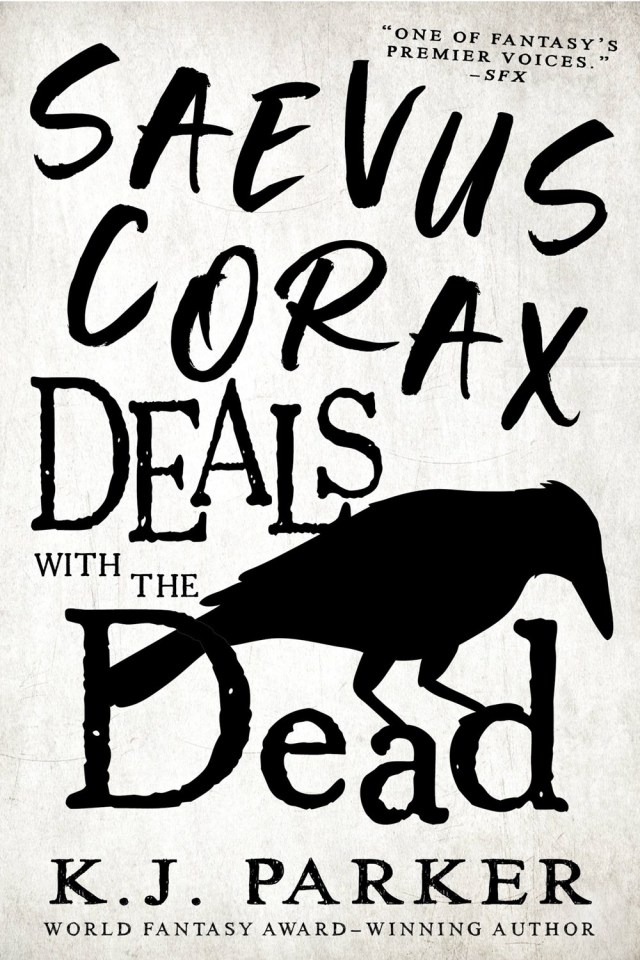
Saevus Corax Deals with the Dead by K. J. Parker

Saevus Corax Deals With the Dead Cover

Publisher: Orbit (Trade Paperback – 10 October 2023)

Series: Corax – Book One

Length: 359 pages

My Rating: 5 out of 5 pages

Amazon

One of the most unique and funny authors of fantasy fiction, K. J. Parker, returns with an outstanding and hilarious read about a likeable protagonist caught up in the middle of so much drama, with Saevus Corax Deals with the Dead.

Few authors have the comedic chops and inventiveness of K. J. Parker, whose work I have been deeply enjoying over the last few years.  A pseudonym of established fantasy author Tom Holt, Parker has written a ton of unique and compelling reads over the years, including some outstanding novels that set outrageous and clever protagonists against the stupidity of their world in some impressive scenarios.  I particularly enjoyed Parker’s recent The Siege series, which saw three very different men take advantage of a major siege in very different ways.  All three Siege books were extremely epic, and they all got five-star ratings from me because of their clever stories, entertaining characters, and fantastic comedy.  This includes Sixteen Ways to Defend a Walled City (one of my favourite books of 2019), How to Rule an Empire and Get Away with It (one of my favourite books of 2020) and A Practical Guide to Conquering the World (one of my favourite books of 2022).

Due to how much I enjoyed Parker’s last series, I was very excited when I found out that he had a fun new trilogy coming out in 2023.  This series, the Corax trilogy, follows Saevus Corax, a professional battlefield looter who runs afoul of multiple groups, nations and people in his quest for survival and the big score.  Parker, who seems to be an unstoppable force when it comes to writing, released all three Corax books in the space of around a month, which is pretty damn impressive.  I have so far had the great pleasure of reading the first of these, Saevus Corax Deals with the Dead, which proved to be an exceptional novel and one of my favourite books of 2023.

Saevus Corax is a man with a twisted and hidden past, who seeks to make a new future for himself by looting the many, many battlefields that scatter his world.  Leading a professional band of scavengers, Corax makes his living by selling recovered and repaired gear from the dead to warring armies desperate or greedy enough to buy from him.  While not the most glamorous work, it’s a job Corax excels at, and it allows him to escape his complicated history.  But the past always has a habit of coming back when you least expect it, especially when there is a great deal of money on the line.

Finishing up a lucrative job, Corax and his men are shocked to discover that they are being accused of committing a brazen heist and now have a price on their heads.  Assuming that he is the true target of this bounty, Corax soon finds himself targeted by the two most powerful banking organisations on the continent.  Forced to flee, Corax finds himself the most wanted man alive, with several nefarious organisations, as well as vengeful members of his own family, placing a massive bounty on his head.  But who is Corax really, and why does everyone want him either alive or dead?

To understand that you’ll need to unwrap Corax’s complex history, and the events that turned him into the most important figure in world politics.  But Corax is sick of being a pawn in everyone else’s game, and he soon starts to make his own moves to ensure his independence.  Will Corax survive, or will his attempts at upsetting the board result in chaos and destruction across the world?

This was an absolutely amazing read from K. J. Parker that placed a very likeable and relatable protagonist into one heck of an elaborate bind.  Filled with a wry humour, outrageous scenarios and constant treachery, Saevus Corax Deals with the Dead was an outstanding read that gets a very easy five-star rating from me.

Saevus Corax Deals with the Dead has a great story that is told in a first-person chronicle format from the perspective of titular protagonist Saevus Corax.  This is the exact way that Parker wrote The Siege trilogy, and indeed this book is set in the same world several hundred years down the line.  This results in a different landscape for the story, with the bulk of the technology, culture, and certain story elements reminiscent of medieval times rather than the previously seen Romanesque setting, and Parker uses this to his full advantage, especially as the protagonist finds himself caught in a battle between this world’s equivalent of the historic banking giants, the Knights Templar and the Knights Hospitaller.  While nominally a fantasy novel, as it is set in a different world, this series often comes across more as an alternate history novel with comedic undertones, which is highly fun.

The author comes up with an awesome tale surrounding this scenario, as the compelling protagonist is thrust into this conflict against his will thanks to certain aspects of his birth.  Corax recounts this entire adventure in detail, as he first attempts to ascertain who is trying to capture him after framing him for a crime, before eventually going on the run.  Despite promising the reader to always tell the truth, Corax proves to be a somewhat unreliable narrator, mainly because he doesn’t have a desire to share his own personal history unless he must.  However, this hidden history comes into play quite a lot, as his past ensures he is immensely important for just being him.

Inevitably betrayed and captured, Corax is sent off to experience his destiny, which results in some substantial carnage as the protagonist attempts to either escape or turn the situation to his advantage.  This leads to several amusing battles, impractical wars, and other major confrontations, as Corax and the other characters lie, backstab and manipulate to try and get what they want.  Watching a highly practical man with a professional understanding of warfare and a capable imagination face off against various foes who constantly underestimate him makes for some great entertainment, and the various twists and turns that emerge are so much fun.  This entire story comes together extremely well, and the sheer number of betrayals, changing loyalties and attempts by people to use the protagonist for their own advantage ensure you’re never certain who’s going to come out on top of every brilliant scene.  The conclusion of Saevus Corax Deals with the Dead’s plot is very clever, and it brings together a lot of the unique world and compelling story elements that have been built up over the course of the story.  The way that the protagonist overturns everything just to maintain his life is so much fun, and the fitting rewards all the characters get is very fun.

I have so much love for how this story comes together, as the protagonist’s recounting of events really works to give you a personal and complex take.  Every moment of the story is told through Saevus Corax’s cynical and distrustful eye, which adds a certain slant to events, and the author does a great job of providing some fun, but detailed, context to the events unfolding.  Much of this book’s excellent humour is lifted from these outrageous situations that the protagonist finds himself in.  The protagonist does a great job of expressing the ridiculousness of many of these moments, as well as the funny ways he manages to oppose them, often by using simple human nature or flaws in various systems to his advantage.  I loved how well Parker introduced his protagonist is this novel, and Corax’s excellent narration of current events, as well as the compelling and often emotionally charged retelling of his personal history, comes together well to tell an impressive story.  I really cannot emphasise enough how well this first-person narration works, and the detailed recounting of events from a grounded, sensible and exasperated figure really makes for a unique tale.

As the first book in this new trilogy, Saevus Corax Deals with the Dead is a self-contained book, and readers don’t need to have read any of Parker’s previous novels to appreciate it.  As a fan of The Siege series, I enjoyed that the Corax books are set in the same world, especially as the author slips in some fun references and allusions to prior events.  However, no prior knowledge of The Siege books is needed, as the protagonist provides all the relevant world history in his narration, with a few fun and ironic points about the unreliability of prior narrators.  Parker does a good job of quickly building and exploring the various nations and powers in this world, especially if they relate to the plot, and I liked some of the fun parallels that exist between some of them and real historical entities.  The interplay of politics, the rivalries between powers, and the simple desire many of these groups have to betray each other is well set out as a result, and this works into the plot of the book very effectively, especially once you begin to understand just who Corax is.  I really enjoyed how all these elements are explored in the plot, although I did on multiple occasions wish that Parker had included some form of map just so I could have kept track of locations and nations.  I honestly had such a great time returning to this amazing world, especially as we got to follow yet another unlikely leader who was able to change the world just by applying their own unique brand of knowledge and an understanding of how fallible humans can be.

Saevus Corax Deals with the Dead was an incredible novel from K. J. Parker that continues to showcase his exceptional and comedic writing style.  Setting a great protagonist down a chaotic road, Saevus Corax Deals with the Dead had an amazing story which Parker showcases in his well-honed and enjoyable style.  Immensely clever and exceedingly funny, Saevus Corax Deals with the Dead comes highly recommended, and I loved every second I spent reading it.  I already have both sequels, Saevus Corax Captures the Castle and Saevus Corax Gets Away with Murder (both with very intriguing titles), and I am hoping to read them as soon as possible as I know I will love them too.

Amazon

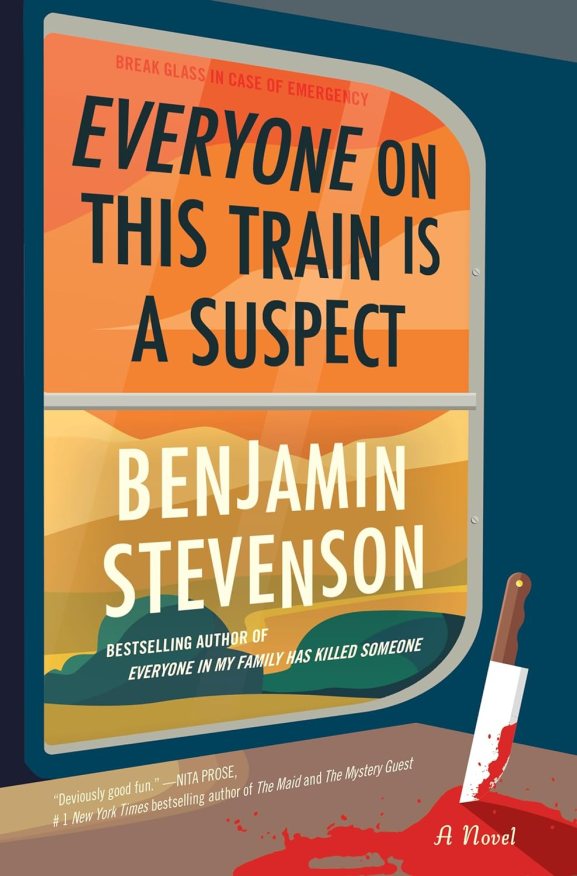
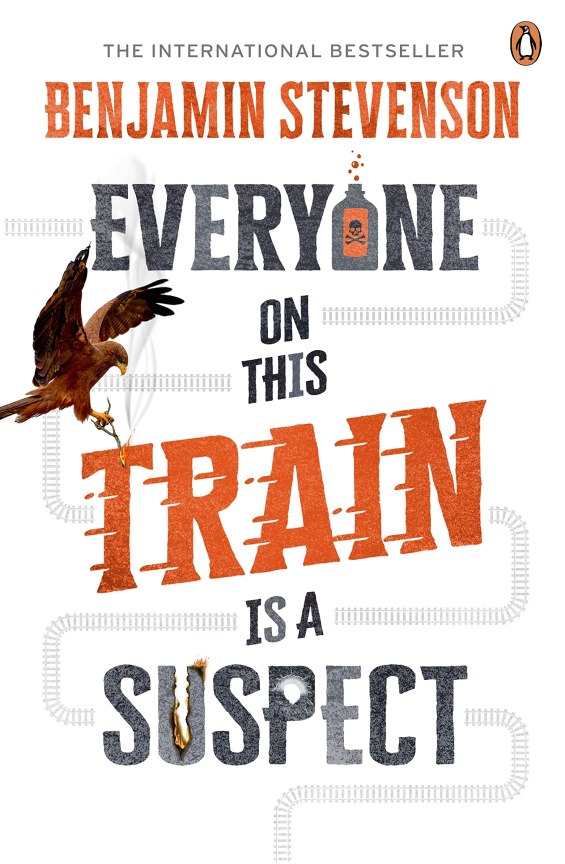
Everyone on this Train is a Suspect by Benjamin Stevenson

Everyone on this Train is a Suspect Cover

Publisher: Michael Joseph (Trade Paperback – 17 October 2023)

Series: Ernest Cunningham – Book Two

Length: 318 pages

My Rating: 4.75 out 5 stars

Amazon

Impressive Australian author Benjamin Stevenson returns with another hilarious and outstanding murder mystery that once again acts as a clever homage to the classics with Everyone on this Train is a Suspect.

Over the last few years, one of the most consistently enjoyable authors of Australian crime fiction has been the remarkably talented Benjamin Stevenson.  Best known prior to his writing career for his comedic work with his brother James, Stevenson adapted well to crime fiction and made his first impression with his debut novel, Greenlight.  Also released as Trust Me When I Lie and She Lies in the Vines, Greenlight was an outstanding read, and Stevenson quickly followed it up with the cool sequel Either Side of Minute.  While both of these books had great murder mystery plots with some unique twists to them, I think Stevenson didn’t truly display his writing ability until his next novel; Everyone in my Family has Killed Someone.

Everyone in my Family has Killed Someone was an exceptional 2022 novel that saw a fictional murder mystery expert try to solve a classic locked room murder that was likely committed by a member of his notorious family, each of whom has killed someone in the past.  Everyone in my Family has Killed Someone was so damn good as not only did it feature a clever case but Stevenson excelled at producing a very funny novel in his unique style that parodied the classics of the genre.  Due to its entertaining and meta storytelling, Everyone in My Family has Killed Someone was such a joy to read and it ended up being one my favourite pieces of Australian fiction in 2022.  As such, I have been eager to see what Stevenson would produce next, and while I was initially a little surprised to see that he would be writing a sequel to Everyone in my Family has Killed Someone, it was something that really excited me.  This sequel, Everyone on this Train is a Suspect, was one of my most anticipated releases for 2023, and I had another outstanding time getting through it.

Plot Synopsis:

6 WRITERS. 5 DETECTIVES. 4 DAYS. 3 WEAPONS. 2 MURDERS. 1 TRAIN…

When the Australian Mystery Writers’ Society invited me to their crime-writing festival aboard the Ghan, the famous train between Darwin and Adelaide, I was hoping for some inspiration for my second book. Fiction, this time: I needed a break from real people killing each other. Obviously, that didn’t pan out.

The program is a who’s who of crime-writing royalty:

the debut writer (me!)
the forensic science writer
the blockbuster writer
the legal thriller writer
the literary writer
the psychological suspense writer.

But when one of us is murdered, six authors quickly turn into five detectives. Together, we should know how to solve a crime.

Or commit one.

How can you find a killer when all the suspects know how to get away with murder?

Stevenson once again presents an outstanding and wildly entertaining Australian crime fiction novel that proves impossible to put down.  Thanks to his impressive story and wonderfully distinctive style for this series, Everyone on this Train is a Suspect was a particularly funny novel that takes some fun shots at classic murder mysteries, modern crime fiction and the publishing world at large.

I absolutely loved the story Stevenson came up with for Everyone on this Train is a Suspect, which essentially traps his returning protagonist, Ernest Cunningham, on the Australian version of the Orient Express with a group of other famous crime fiction authors.  Ernest, who has achieved a certain amount of literary fame writing a true-crime book about the familial murder he solved, is the somewhat ostracised newcomer to the group and is currently suffering from writer’s block.  Hoping to gain inspiration from meeting some of his fellow authors, most of whom are homages to famous crime fiction authors (Ian Rankin and Patricia Cornwell, for example), Ernest instead finds himself caught up in another deadly murder, this time involving suspicious writers, greedy publishers, scheming agents, angry mega-fans and other fun figures from the literary world.  The resulting plot is extremely fun, as an obsessed Ernest attempts to solve the crime, only to encounter additional murders, opposition from his fellow writers, unique interactions, and all manner of ridicule.

This entire story is really well written, as it features all the elements that made Everyone in my Family has Killed Someone great, including a clever mystery, outrageous characters and an irrepressible sense of humour.  Just as with Everyone in my Family has Killed Someone, Everyone on this Train is a Suspect is told in the form of a true-crime book written by the protagonist as he recounts the events that unfolded aboard the train.  I really enjoyed this fun and clever way of writing the story, especially as the character of Ernest has such an amusing and satirical outlook on life and murder mysteries.  The author also believes in challenging the classic ways of writing crime fiction and providing clues to the reader, and as such the book is loaded with a ton of hints from the protagonist about who the killer is and the events to come.  For example, he indicates how many times he is going to mention the killer’s name early on and then keeps a running countdown going throughout the book to narrow down the suspect pool.  In addition, several characters’ fates, actions and other clues are mentioned well in advance, just to heighten anticipation.  While you would imagine that this would spoil much of the plot, I felt it honestly enhanced it, as you eagerly wait to see how these events occur or try to keep track of who is being talked about and in what context.  Stevenson also does not always play it fair with these hints, with a few flagrant mistruths sprinkled through by the protagonist to mislead the reader, although this is all done in good fun.

As such, by the time you get to the second half of Everyone on this Train is a Suspect, you are really invested in the overall mystery that Stevenson has cooked up.  All the various clues, hints and other interesting story details have been cleverly built up and you are eager to see how everything unfolds.  There are a few hilarious set pieces loaded here, including an unnecessary chase sequence, a failed denouement gathering, and some major misunderstandings, all of which add to the chaotic nature of the plot.  This exciting and funny story also makes great use of its iconic background setting of the Ghan, one of Australia’s most famous trains, and Stevenson works in some fantastic personal drama for the protagonist who finds that crime solving and romance do not mix.  The eventual solution to the mystery is just great, as it blends multiple motivations, character histories and various subtle clues in an outstanding way.  Even all the overt clues that the protagonist had been directly feeding the reader come into play, although not always in the way you would expect it to.  This leads to an intense and memorable conclusion, which I thought wrapped things up nicely, especially with that fun twist designed to surprise readers familiar with first-person stories.

As with Everyone in my Family has Killed Someone, this second novel serves as a great homage and parody of classic murder mystery tropes, as the protagonist once again finds himself in a locked-room scenario.  The parallels between this story and Murder on the Orient Express are purposely obvious, and I loved seeing the very self-aware protagonist revel in them as the plot continues.  Stevenson also modernises his references by including homages to more modern mystery and crime fiction sub-genres.  The legal thriller, forensic science, modern detective and psychological suspense genres are all featured here in some ways, as fictional authors of these genres are present as supporting characters, and all their specialties are considered when it comes to solving the crime.  Stevenson works these into the plot perfectly, and it was a great deal of fun to see each of these elements discussed, satirised, and then utilised to a degree.  As such, this proves to be quite a fun book for all manner of crime fiction fans, and the fun references, jokes and hints will greatly appeal to the wider murder mystery audience.

Another awesome aspect of Everyone on this Train is a Suspect that I liked was the exploration of the literary world.  Due to the events of the first book, the protagonist finds himself as a published author, with all the baggage that brings with it.  As such, this sequel is filled with a ton of fun discussions and jokes about being a writer, with Stevenson no doubt utilising his own personal experiences to give it a splash of realism.  Most of these inclusions are done to provide another comedic edge to the story, especially as Ernest has been thrown into the deep end with a group of experienced writers who have no respect for him.  The scenes where they discuss their works while also putting down his less successful book are so damn funny, although I could not help but feel a little self-conscious with some of the comments (I know I use too many adverbs).  Stevenson also really dives into the dark side of writing and publishing, with sketchy agents, dodgy backroom deals, story thefts, and personal compromises all being featured quite heavily in the plot.  These elements make for some great potential motives, but you have to appreciate the heavy level of cynicism that Stevenson is throwing into the mix.  I deeply enjoyed the way that Stevenson explored the minefield of life as a murder mystery writer, as well as other connected literary issues, and it ensured that the protagonist’s storyline about being a new author was simultaneously funny and intriguing.

Benjamin Stevenson continues to impress as one of my favourite authors of crazy Australian crime fiction.  His amazing latest novel, Everyone on this Train is a Suspect, is so damn good, as it combines a clever mystery with Stevenson’s unique style that satirises the entire crime fiction genre.  Loaded with some brilliant homages to all manner of murder mystery, and mixing an intense murder plot with jokes, outrageous characters, and fantastic way to tell the story, Everyone on this Train is a Suspect was a blast of epic fun from start to finish.  A worthy and incredible sequel to Everyone in my Family has Killed Someone, Everyone on this Train is a Suspect is funny, brilliant and occasionally dark, and you are guaranteed to love every second of it.

Everyone on this Train is a Suspect Cover 2

Amazon

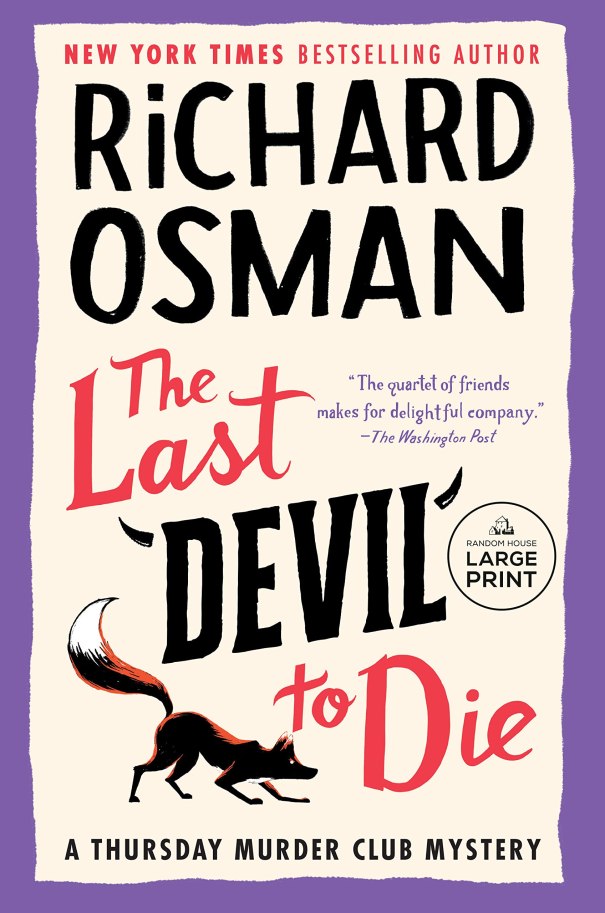
The Last Devil to Die by Richard Osman

The Last Devil to Die Cover

Publisher: Penguin Audio (Audiobook – 12 September 2023)

Series: Thursday Murder Club – Book Four

Length: 10 hours and 50 minutes

My Rating: 5 out of 5 stars

Amazon

The exceedingly talented and amazing Richard Osman returns with another exceptional entry in his acclaimed Thursday Murder Club series, with the entertaining and emotionally rich The Last Devil to Die.

Over the last few years I have been blown away by the incredible Thursday Murder Club novels, the debut series of British television personality Richard Osman.  This amazing series follows four residents of a retirement village who solve murders as the Thursday Murder Club.  Featuring a perfect blend of gripping mystery, brilliant and likeable characters, a fantastic sense of humour and a certain amount of tragedy, the series has been a real joy to read.  This includes The Thursday Murder Club (one of my favourite books, debuts and audiobooks of 2020), The Man Who Died Twice (one of my favourite books and audiobooks of 2021), and The Bullet That Missed (one of my favourite books and audiobooks of 2022), each of which got full five-star reviews from me.  As such, I have been eagerly awaiting the fourth book in this series, and The Last Devil to Die was one of my most anticipated books for 2023.  Unsurprisingly, Osman did not disappoint and presented another compelling and highly addictive read that I absolutely adored.

Elizabeth, Joyce, Ibrahim and Ron are the Thursday Murder Club, four bored and bright retirees living at Coopers Chase retirement village, spend their spare time keeping busy with an unusual hobby, solving murders.  Already responsible for bringing several crooks to justice, the club hope to enjoy a nice Christmas without any deaths.  However, murderers are rarely so considerate, and the four friends soon find themselves involved in a complex case that hits close to home.

Antiques dealer Kuldesh Sharma, an acquaintance of the group and an old friend of Elizabeth’s husband, Stephen, has been found shot dead on a dark country lane, apparently the victim of a professional hit.  Determined to get justice for their friend, the club and their associates jump into action and begin their usual unconventional investigation.  Their prying soon uncovers connections between Kuldesh and a local gang of drug importers who were using Kuldesh’s shop as cover for one of their deals.

It quickly becomes apparent that Kuldesh’s death is related to a box of heroin that was in his possession and which has since gone missing.  To find Kuldesh’s killer, the members of the club will need to discover where the heroin is hidden, as well as why Kuldesh decided to steal it.  Their investigation will take them into the dark world of drug dealers, art forgers and stolen antiquities, and force them up against several different groups of criminals each searching for the same prize.  Can the Thursday Murder Club once again solve the case before the murderer escapes, especially when an even greater tragedy waits on the horizon?

This honestly might be one of the very best books I have read all year.  Osman, who I have extremely impressed with in recent years, did a remarkable job with this fourth entry in the series, producing another superb and emotionally charged novel with a clever mystery around it.  Thanks to some high-intensity inclusions and some brilliant character work, The Last Devil to Die is easily one of the strongest entries in this entire exceptional series, and I was hooked the entire way through.  This latest book gets an easy five-star rating from me, and I doubt I will ever forgive Osman for everything I was forced to feel while getting through it.

The Last Devil to Die has an outstanding story behind it, and I was once again deeply impressed by how Osman effortlessly combines an elaborate mystery with intriguing character driven storylines.  The book starts with Kuldesh Sharma, who appeared in the prior novel, getting murdered apparently over a missing box of heroin.  This quickly sets off the new investigation, and the protagonists and their continuously growing group of associates utilise their usual unorthodox methods to get a good picture of events and pull together a group of unusual suspects.  Of course, it doesn’t take long for the case to go in some very interesting directions, especially with extra murders and a segue into the world of antiquities forgeries.  I really got caught up in the intriguing mystery, especially as there are some great complexities, an array of fun professional villains, and some highly entertaining encounters, including a remarkably fun lunchtime meeting with all the suspects.  At the same time, I was also there for the characters, as Osman dove into their unique lives and provided some fantastic development.  However, one major piece of character development proved to be the most compelling part of the entire book and really knocks you for six with a major event around two-thirds of the way through.  This bit of development has been building for the entire series, but when tragedy finally hits you are not ready and it strikes you very hard in the feels.  I honestly was near tears at parts of the book, it was that damn sad, and Osman works to ensure that every major character is affected in a noticeable and gloomy way.

Following this major event, Osman moves towards solving the various murders featured within the book.  This last part of The Last Devil to Die is noticeably more subdued, which was honestly very fitting and completely understandable.  Despite this darker tone, the reader is still very invested in the plot, especially as a solution to the mystery promises to bring some much-needed emotional relief.  Osman delivers this in spades, and there are several clever and thoughtful solutions chucked in as a result.  While I saw a few reveals coming, the way the characters solved the compelling case was impressive and quite brilliant.  Several subtle and well-placed clues were masterfully exploited, and the way that Osman hid them in plain sight is exceedingly clever.  The solutions to the other killings were great as well, especially as they tied into a fun longer-running storyline around a secondary character, and I loved how many of the villains got an appropriate reward for their deeds.  The conclusion of the plot is very well handled, and the reader comes away from The Last Devil to Die both highly satisfied and very sad, much like the protagonists.  This was such a brilliant and moving narrative, and Osman does a wonderful job of fitting in his mystery while wrapping up several long-running narrative threads.

Just as he has with the previous novels in the Thursday Murder Club series, Osman backs up his excellent story with some top-notch writing that drags you in with its tone, subtly and entertainment.  The Last Devil to Die features Osman’s typical exquisite blend of mystery, humour and character development, which is expertly featured in every scene.  While the main mystery is great, watching the brilliant characters grow as they solve it in the most entertaining way is so much fun, and you will be glued to the book as you go.  The comedic charm of a Thursday Murder Club novel is very subtle and undeniably British, but it constantly flows into every scene, with the restrained and often topical jokes and observations of the characters working well with the other story elements.  This includes a large amount of sombre and darker moments, as many of the characters experience a certain amount of tragedy, especially related to the woes of getting older.  Osman honestly turns the heartbreak up to 11 in certain parts of The Last Devil to Die, and readers are in for some powerful emotional blows in this novel, which works both in the context of this single novel but the series as a whole, as it cleverly builds on prior events from the earlier books.  Due to this, I would strongly recommend that readers start the series back at the first book, rather than diving into The Last Devil to Die first, as it will allow you to get the full emotional impact.  However, Osman does ensure that The Last Devil to Die is open enough for new readers to experience, and they honestly will not be spared from the feels either.  Osman does such a good job wrapping together the hurt with the humour, and the emotional combination really strengthens both the character arcs and the mystery elements of this outstanding read.

While the story, mystery and humour are all outstanding parts of The Last Devil to Die, without a doubt the high point of any Thursday Murder Club novel are the characters.  Osman has an incredible knack for producing compelling, delightful, and impressive characters who you cannot help but fall in love with.  Thanks to his split between different perspective characters (which includes a change in writing style for Joyce’s journal entries), you get to see so many different angles of this mystery, and I loved the amazing personal arcs that emerged as well.  Osman does a great job of balancing the narrative between the many characters featured in the novel, including the recurring protagonists from the previous books and several new intriguing figures.  These characters form the emotional heart of The Last Devil to Die and Osman really amps up the feelings, tragedy and love for this latest book to produce an exceptional and memorable read.

At the centre of the story are the members of the titular Thursday Murder Club: Elizabeth, Joyce, Ibrahim and Ron, four cheeky and brilliant retirees who pass their time solving murders.  Osman has done such a good job setting these characters up as a group throughout the previous books, and they each have a well-defined role in the group, with Elizabeth the hard-nosed former spy serving as leader, Joyce the loving grandmother figure who is a lot more devious and strong then people realise, Ron the tough larrikin who is starting to come to terms with his feelings, and Ibrahim the sensitive soul who can connect with everyone.  These fantastic characters prove to be the usual dedicated and brilliant investigators, and it is always fun to see them utilise their unique skills and their old age to solve their crime.  Much of the book’s humour is derived from them leveraging their advanced years and apparent helplessness to trick or manipulate the younger suspects, and I always enjoy their direct and hilarious take on crime solving.  However, while there is a certain humorous element around these characters in The Last Devil to Die, certain significant events throw them into an emotional tailspin and watching them become unstuck and devastated really hits the reader hard.

Elizabeth in particular is hit the hardest and this is honestly the most significant novel for her, especially as the great tragedy she has been expecting for the entire series finally comes to pass, and your heart hurts at seeing such a strong character broken down so much.  Joyce proves to be the emotional rock the novel, stepping up when the others are down and trying to keep the investigation going.  I loved seeing Joyce the leadership role, and watching her come out of her shell proves to be quite heartwarming in light of other tragedies.  Ron probably gets the least amount of focus in The Last Devil to Die, but he still has his moment to shine throughout this book.  Not only does he have one of the funniest scenes when he has to pretend to be traumatised at discovering a body, but his chaotic romantic relationship raises some fun questions about when Christmas gifts should be opened.  I also deeply enjoyed Ibrahim’s character focus, not only because of his warmth and insights, but because of his unusual friendship with imprisoned criminal Connie Johnson and his fantastic patter with Ron.  Osman also finally reveals some secrets about Ibrahim’s past that have been hinted at in previous books, and I loved the extra layer of understanding about Ibrahim that results.  Each of these main characters are so well featured and their emotional struggles prove to be such an important part of the plot and help to turn The Last Devil to Die into in a very powerful and moving novel.

In addition to the main cast, Osman’s ever expanding collection of supporting characters were very well featured in The Last Devil to Die, and while they are primarily there to assist the main characters with their investigation, the author always takes the time to develop some intriguing and heartfelt storylines around them.  This includes the duo of DCI Chris Hudson and PC Donna De Freitas, who find themselves once again competing against their retiree friends to solve the case, despite their futile attempts to keep them out of trouble.  While many of their scenes are played for laughs, especially as they get exasperated trying to stop the club members, they add in a good official police presence and move the story along in some interesting ways.  There is also a continued focus on their personal lives, especially as they have both found true happiness thanks to the events of the prior books.  Cocaine queen and jailbird Connie Johnson proves to be another great recurring figure here, especially as much of her story deals with her simultaneously manipulations of Ibrahim and her attempts at rehabilitations.  Her scenes opposite the team’s psychiatrist are pretty hilarious, and it’s going to be fun to see how her storyline continues.  The always dependable Bogdan is also a fantastic presence in The Last Devil to Die, and I loved how he proves to be both a supportive partner to Donna and a reliable assistant in Elizabeth’s attempts to undermine the police.  Bogdan is also hit emotionally hard in this book and you really have to feel for this wonderfully written character who has the body of a thug and a heart of pure gold.  Throw in several great new antagonists, an unpopular elite police officer and several entertaining new residents at Coopers Chase, and this proves to be an amazing book when it comes to supporting characters.

However, the character I need to talk about the most is Elizabeth’s academic husband, Stephen, who honestly has been one of the strongest and saddest figures in the entire series due to his growing dementia.  A caring and intelligent figure, despite his ailment and his wife’s attempts to hide him from the world, Stephen is such an impressive character you honestly cannot help but fall in love with.  It is always so tragic to see Stephen slowly lose his mind while Elizabeth’s heart breaks next to him, and I really appreciate how well Osman portrays the complexities of dementia when it comes to this figure.  Despite that, he proves to be an essential part of the plot, and his insights into his friend have some major impacts on the case, even if you do not realise it at the time.  Osman also makes sure to enhance the misery around Stephen again in this book, especially as he finally becomes aware of his condition in one of his lucid periods, and the resulting scenes are so damn moving and emotional as a result.  Everything about Stephen in The Last Devil to Die, from his continued warmth, his love for Elizabeth even when he doesn’t know who she is, his sad friendship with a local fox, and his journeys back inside the past of his mind, is handled perfectly and powerfully, and he honestly steals every moment he is in.  Stephen steals the show in his own way in The Last Devil to Die, but honestly every character in this book is pretty exceptional, and you will find yourself falling in love with them again, even if it breaks your heart.

Due to my previous experiences with this series, I chose to check out The Last Devil to Die on audiobook, rather than reading the physical copy I received.  Coming in with a runtime of just under 11 hours, this is a relatively quick audiobook to get through, especially once you get caught up in the story, which you definitely will.  I find that the audiobook format is pretty damn good at getting so many elements of Osman’s story across, including the characters, the powerful emotions and the fun humour, and you really will have a hard time turning off this audiobook of as a result.  It also definitely helps that they keep getting such awesome narrators in to read these books.  The first two entries in the series were narrated by Lesley Manville, who did such a great job bringing the characters to life, especially Joyce.  Unfortunately, Lesley left after narrating the first two books, which I was initially sad about.  However, they did a really good job of replacing her in the third audiobook with acclaimed actress Fiona Shaw, who also returns for The Last Devil to Die.

Now I was already a fan of Fiona Shaw before her work here, and I think she was honestly the best possible replacement they could have gotten for Lesley Manville.  Utilising her trademark Scottish accent, Shaw hits the story with a soft and gentle voice that perfectly fits the more relaxed tone of these murder mystery novels.  These gentler tones are excellent at conveying the unique humour and emotions of the Thursday Murder Club books, and I really got enveloped by the powerful story as a result.  Shaw also does an outstanding job voicing each of the brilliant characters featured within this book and I have a lot of love for the vocal choices she makes here.  Now, while there is a little difference between Shaw’s performances and the previous audiobooks with Manville (Manville is a natural Joyce, while Shaw more of an Elizabeth), Shaw really keeps the magic from the first two books going.  She does a great job of matching many of the key voices Manville originally used, while also adding her own flairs to make the characters her own.  I really loved how effortlessly Shaw slipped into the various members of the cast, and this honestly helps you fall in love with all the characters and the story as a whole.  This entire audiobook honestly comes up pretty perfectly, and there is even a fantastic and cosy chat at the end between Osman and Shaw discussing the series.  As such, I would strongly recommend the audiobook version of The Last Devil to Die to anyone interested in checking out this novel, and it is easily the best way to enjoy this fantastic series.  One of the best audiobooks of 2023!

Look, I could go on about how good The Last Devil to Die is, but the bottom line is that this was an exceptional read and one of the best entries in the already great Thursday Murder Club series.  Richard Osman did a wonderful job of producing an elaborate and compelling book that featured both an amazing mystery, and some outstanding character work.  Funny and tragic in equal measures, and with some of the most emotionally charged scenes of 2023, The Last Devil to Die was an incredible book from start to finish and I cannot recommend it enough.  This fantastic book is going to top all my end-of-year best of lists and I cannot wait to see what Osman releases next.

Amazon

Waiting on Wednesday – Saevus Corax Deals with the Dead by K. J. Parker

Welcome to my weekly segment, Waiting on Wednesday, where I look at upcoming books that I am planning to order and review in the next few months and which I think I will really enjoy.  I run this segment in conjunction with the Can’t-Wait Wednesday meme that is currently running at Wishful Endings.  Stay tuned to see reviews of these books when I get a copy of them.  For this week’s Waiting on Wednesday, I take a look at an upcoming fantasy novel that I am particularly excited for, the sure to be hilarious novel, Saevus Corax Deals with the Dead by acclaimed author K. J. Parker.

Saevus Corax Deals With the Dead Cover

Amazon

I am always in the mood for a fantasy novel that utilises humour and comedy to enhance the story, and to my mind few current authors manage that as well as exceptional talent K. J. Parker, a pseudonym of author Tom Holt.  Parker/Holt has been delighting authors for over 35 years and his intriguing reads blend his unique sense of humour with some elaborate and well-thought fantasy or historical fiction scenarios.  I have only so far had the pleasure of reading one of his trilogies, but that was more than enough to make me a massive of his.

This series was the very clever and captivating The Siege series, which includes some of the funniest books that I have ever read.  Set around a siege of a massive city, all three books told a unique story of its long and deadly besiegement, that were loosely connected to each other and told from the perspective of a different unreliable narrator.  The first book in the series was the very impressive Sixteen Ways to Defend a Walled City (one of my favourite books of 2019), which saw an amoral engineer take command of the city’s defences and use a mixture of mechanisms and bluffing to keep out the enemy.  This outstanding read was followed up by the extremely funny How to Rule an Empire and Get Away with It (one of my favourite books of 2020).  Set years after the events of the first book, this sequel followed an actor in the still besieged city tasked with impersonating a dead war hero, and who then uses his position to take over everything.  Parker masterfully finished the trilogy off last year with A Practical Guide to Conquering the World (one of my favourite books of 2022).  This outstanding finale saw a scribe and scholar from the city manage to use his unique array of obscure knowledge, as well as a strong understanding of basic human nature, to overthrow a nation and then the entire world in a brilliant sequence of manipulation and cleverness.  I have so much love for this exceptional trilogy, and I really grew to enjoy Parker’s unique sense of subtle humour and the fantastic and entertaining stories he was able to craft using it.

Due to how much I enjoyed The Siege trilogy, I have been keen to see what cool series Parker would right next, and boy does it look like he has something very special planned for us, with his upcoming Corax trilogy.  Starting in a few months’ time with Saevus Corax Deals With the Dead, this intriguing new trilogy looks to follow another complex protagonist as he finds himself stuck in a deadly situation.

Plot Synopsis:

There’s no formal training for battlefield salvage. You just have to pick things up as you go along. Swords, armor, arrows – and the bodies, of course.

Over the years, Saevus Corax has picked up a lot of things. Some of them have made him decent money, others have brought nothing but trouble. But it’s a living, and somebody has to deal with the dead.

Something else that Saevus has buried is his past. Unfortunately, he didn’t quite succeed.

I have to say that I am already really in love with this cool sounding book and I have some very high hopes for Saevus Corax Deals With the Dead.  An adventure novel that follows a battlefield scavenger is going to be very intriguing, and you know that Parker will really dive into the unique elements of this trade, with fun anecdotes looking at the best and worth moments the protagonist has experienced.  Having a compelling protagonist like this at the centre of the novel will ensure that Saevus Corax Deals With the Dead is going to be a very fun read and I look forward to seeing what sort of compelling and entertaining plot the author can come up with to match him.  I have no doubt it is going to be something pretty damn awesome especially when combined with Parker’s brilliant humour and relatable observations about the human condition.

Based on how much I enjoyed Parker’s previous series, there is no way that I am missing this fantastic new trilogy, especially as Saevus Corax Deals With the Dead sounds so damn good.  It also looks like Parker has plans to release all the books in quick succession, as the titles and covers for the rest of the Corax trilogy have already been released.  Both the second book, Saevus Corax Captures the Castle, and the third book, Saevus Corax Gets Away with Murder, already have 2023 release dates, and if that holds true, then hopefully we can read the entire trilogy in the space of a few months.  If this is the case, I am very, very excited, as I have no doubt all three are going to be pretty exceptional.  I look forward to finding out what new craziness and fun Parker has cooked up in his new trilogy, and I fully expect Saevus Corax Deals With the Dead, and possibly its two sequels, to top my best books of the year list for 2023.

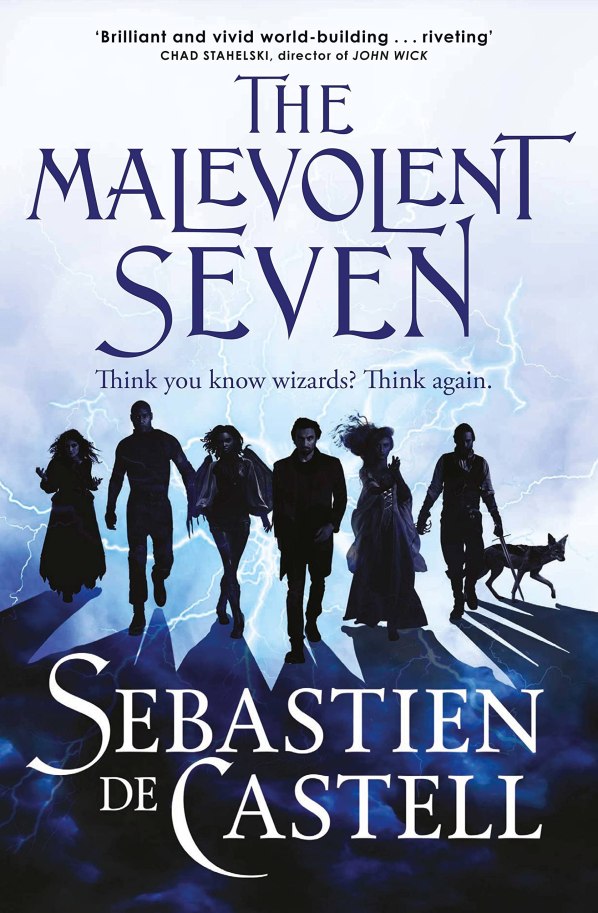
The Malevolent Seven by Sebastien de Castell

The Malevolent Seven Cover

Publisher: Jo Fletcher Books (Trade Paperback – 9 May 2023)

Series: Standalone/Book One

Length: 373 pages

My Rating: 4.5 out of 5 stars

Amazon

Rising fantasy star Sebastien de Castell returns with a bold and highly entertaining new fantasy novel, The Malevolent Seven, that takes several dangerous and dastardly characters on a magical journey of death, deceit and despair which is so much fun to behold.

Magic is power and only the strong can hope to wield it, especially if they can make a profit out of it.  Cade Ombra is a powerful wonderist, a magic user who makes his living as a war mage, selling his services to highest bidder to fight in their wars and kill their enemies, even if his employers are monsters.  Cade has long struggled with the ethics of his job, and when his latest employment ends badly, with Cade framed for murder resulting in a relentless band of holy enforcers hunting him, he knows he needs to find a way out.

Luckily, a lucrative new job is looking for wonderists, and the payment is something he’s always desired, an artefact capable of changing everything about his life.  However, to get paid he needs to do one last very bad thing: kill seven heroic mages attempting to take down a corrupt noble and survive everything that wants to kill him along the way.  Determined to win no matter the cost, Cade and his violent colleague Corrigan set off to claim the reward before any of their rivals can.  But to succeed, they’ll need to recruit five more mages capable of taking down their powerful enemies and who have no moral qualms about killing heroes for money.

So begins a deadly recruitment mission as Cade and Corrigan seek out five mages just as crazy as they are.  But even with a mentally unstable blood mage, a fallen angel, a moral demon knight, a charismatic rat mage and a mysterious jackal, can even this mismatched bad of rogues hope to survive against the seven most deadly magic users on this plane of existence?  However, nothing about this job is as it seems, and Cade and the Malevolent Seven find themselves caught up in a deadly game between gods, demons and monsters, with the fate of the world lying in the balance.

Wow, now this was a very, very fun and addictive novel.  Sebastien de Castell wasn’t an author I was too familiar with before this point, although I had heard good things about The Greatcoats series.  However, I am now going to have to go out of my way to read more of his stuff, especially after reading the epic and entertaining The Malevolent Seven.

The Malevolent Seven was such a great read as de Castell pulls together a dark fantasy reimagining of heroic stories like Seven Samurai and The Magnificent Seven.  The book starts of strong with a great introduction to the main character, Cade Ombra, the rules of magic in this realm, and the author’s very entertaining and outrageous sense of humour.  Expertly and hilariously told from the first-person perspective of Cade, whose observations about the insane events going on around him adds so much value to the story, you soon get a great sense of what to expect from this book and de Castell does not disappoint.  The story initially focuses on Cade and his friend Corrigan’s efforts in a brutal war for a mad ruler, but things go south when their employer is killed, Cade is betrayed by his fellow wonderists, and a band of ruthless religious warriors, the Glorian Justiciars, arrive determined to hunt down Cade for his use of demonic magic.  Forced to take a new job with Corrigan to save his skin and quickly get out of dodge, the two take up the mysterious contract to kill seven heroic mages in exchange for a powerful artefact, and begin a recruitment drive for five additional mages.

I love a good recruitment montage in heist or action fiction, and this one is pretty damn fun as de Castell writes in a particularly eclectic and insane group of mages for the protagonists to recruit.  Naturally nothing goes as plan, as the two are forced to take along a half-insane junior blood mage who Cade feels responsible for.  Their subsequent recruitment attempts land them in all manner of trouble as they rescue a highly chivalrous rat mage, save a mysterious fallen angel from a pleasure ship, journey to hell to recruit a demon knight, and end up in the middle of a wasteland, chased by everyone.  This recruitment period took up more of the plot than I thought it would, but it works really well to tell a great overall narrative.  Each scene introduces the reader to more of the world and it allows a compelling dynamic to grow between the various protagonists, especially as they grow to understand each other crazy tendencies.  De Castell also builds up several intriguing long-running storylines of manipulation and betrayal as it becomes clear that someone is influencing their mission and has set gods and demons against them.  This middle section of the book is a lot of fun, and I loved how de Castell keeps up the same blend of humour, intriguing character development, and insane over-the-top moments, that really draws you in at the start of the novel.

Everything perfectly leads up to the final third of the book, when the protagonists arrive at their destination.  Of course, as can be expected by the theme of this story so far, nothing is what they thought it would be, and instead they find themselves facing off against a mysterious foe with very different motivations to what they expected.  I loved how de Castell turned the plot a little on its head at this point, as the characters find themselves in the unexpected position of being the good guys.  This leads to some amazing scenes in the final third, loaded with magic, chaotic confrontations and more, all of which is a ton of fun to see.  There is some great character growth as several storylines come full circle, as well as a ton of twists and turns.  I loved some of the epic reveals that came across, and while I saw a few coming, de Castell managed to surprise me in places, which I really enjoyed.  The final twists about why the characters were on the job and who really wins were pretty damn epic and it sets the story up nicely for a sequel, which I am definitely going to grab a copy of.  I loved how de Castell really enhanced the drama in this final third of the book, especially as several character relationships or conflicts come to the boil in some explosive and captivating ways.  This combines really well with the continued craziness of the story and the inherent humour of the plot, and you really get drawn into all the fantastic elements of this book.  The Malevolent Seven ended up being an incredible read, and I managed to power through this entire story in a couple of days and had a ton of fun doing so.

I loved the dark and despairing world that served as the cool new setting for The Malevolent Seven and de Castell has a ton of fun showcasing this new fantasy landscape throughout the book.  Loaded with petty tyrants, warring nobles, and wandering wonderists who dish out death to the highest bidder, this land is the perfect backdrop for the crazy and self-serving narrative, and I loved seeing de Castell’s great characters traverse it causing trouble.  While there are some outstanding locations, including a magically blasted wasteland and several deadly battlegrounds, the highlight of this setting is the complex magical system that the author came up with.  This magical system is primarily predicated on wonderists breaching dimensional barriers and utilising magic that they have an infinity for.  This results in several unique rules and abilities that de Castell did an outstanding job of effectively introducing, and I loved how weird some of the abilities were, especially those that played into the novel’s humour.  Some of the more interesting realms require the magical users to interact with the associated denizens, including this world’s equivalent of angels and demons, all of whom have a stake in the mortal realms.  Several of the best scenes in the book require the protagonist to make dark and forbidden deals with his demonic contact, and the manipulation of the various mystical entities from both heaven and hell becomes a key part of the book.  The author makes sure to utilise all these fantastic and lethal abilities to their full extent throughout The Malevolent Seven and the epic, ultra-destructive battles that emerged, as well as the clever combination of talents, resulted in some amazingly, electrifying sequences.  It will be interesting to see what crazy abilities de Castell brings to the table for the sequel, but it’s going to be good.

The final thing I want to highlight about The Malevolent Seven are the excellent and compelling damaged characters featured throughout the plot.  De Castell really went out of his way to make his main seven protagonists as random, broken and insane as possible, and this really works in the context of this brilliant story.  The main protagonist is point-of-view character Cade Ombra, a wonderist with a secret past whose current magical ability comes from deals with a literal demon (nice guy actually).  Because of this and many other mistakes in his life, Cade is pretty alone and damaged when the story starts, and he is constantly trying to balance his survival instincts and desire for power, with his conscience, something that keeps getting him in trouble.  De Castell builds up Cade extremely well throughout The Malevolent Seven and I liked his constant growth as he tries to do the right thing, even though it usually makes life even harder for him.  The author sets Cade up as a reluctant leader and hero, and it was intriguing to see the dynamics that form between him and the rest of the team fate brings together around him.  The rest of the titular Malevolent Seven are all pretty entertaining and uniquely crazy in their own way, and the range of diverse and entertaining personalities makes for a great overall dynamic to the story. My favourite character in the group was the excessively violent Corrigan Blight, whose thunder magic matches his outrageous personality.  Corrigan served as the straight speaking, highly reactive and trigger-happy organiser of the group, who plays off the more reserved Cade perfectly, especially as they form a unique and fragile friendship.  Other highlights include the highly charismatic and surprisingly noble Aradeus, whose rat magic proves to be highly effective if a little weird, and the novice blood mage Galass, whose spunky personality is only matched by her deadly abilities that are slowly driving her insane.  I loved this impressive and very entertaining cast and I cannot wait to see what happens to them next.

I think it is very clear that I loved The Malevolent Seven as Sebastien de Castell’s outrageous and inventive dark fantasy tale was a real joy to behold.  The great blend of fantastic humour, twisty storytelling, brutal magic and over-the-top characters, works exceedingly well and I loved the witty and extremely fun story that emerged.  The Malevolent Seven is a great read and if you are in the mood for a cool and highly compelling fantasy adventure than this is the book for you.

Amazon

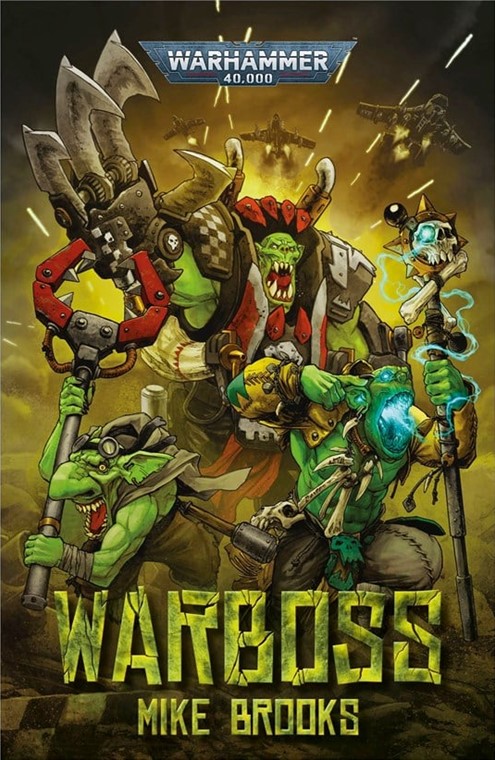
Warhammer 40,000: Warboss by Mike Brooks

Warhammer 40,000 - Warboss Cover

Publisher: Black Library (Audiobook – 25 March 2023)

Series: Warhammer 40,000

Length: 8 hours and 48 minutes

My Rating: 4.5 out of 5 stars

Amazon

Prepare for the ultimate battle for control as several feuding ork bosses fight to become the new leader of the Waaagh! in this amazing and highly entertaining Warhammer 40,000 novel, Warboss by Mike Brooks.

2023 has been a big Warhammer 40,000 fiction year for me as I have been having an absolute blast reading all manner of cool novels from across the franchise (make sure to check out my recently released list about my favourite Warhammer 40,000 novels).  However, while I have read a ton of Warhammer books this year, I have not had the opportunity to read any 2023 Warhammer releases.  Well, I am on my way to rectify that by looking at the recently released Warboss by awesome author Mike Brooks, who also wrote the 2022 novel Huron Blackheart: Master of the Maelstrom.  Brooks did an outstanding job with this fantastic new book, and I had so much damn fun with Warboss and its highly entertaining and hilarious story.

In the far future of the 41st millennium, there are few things are more destructive or unstoppable than an ork warband on a rampage.  One of the most effective bands currently killing its way through the galaxy is that of Warboss Gazrot Goresnappa whose Waaagh! has conquered the once mighty human fortress world of Aranua.  After several decisive and bloody victories, the Waaagh! celebrates in front of the planet’s remaining bastion, the massive Davidia Hive.  All it will take is one final assault to totally defeat the humans on Aranua so Warboss Goresnappa can strip their resources and lead his boyz to bigger and better fights out in the stars.

However, before Goresnappa can achieve his great victory, an unfortunate accident sees him very, very dead under the giant decapitated head of a Gargant war machine.  With their leader squashed, the Waaagh! now has an opening for Warboss, and several ambitious orks from across the no-longer united clans step forward to fight for the job.  However, before the usual brawl for leadership can begin, a prophecy from the clan’s resident weirdboy, Old Morgrub, reveals that the ork gods have something very special in store for the Waaagh! and its next leader.  A mysterious gate lies underneath the human city that could transport the Waaagh! to fights anywhere in the galaxy, and whichever boss finds it first will be the new Warboss.

Forced to obey the words of the gods, the bosses engage in their own elaborate plans to breach the Hive City and claim the gate.  But which boss can triumph over the others?  Will it be the brutal Goff Big Boss Mag Dedfist, the suicidally fast Speedboss of the Evil Sunz, Zagnob Thundaskuzz, the sneaky and cunning leader of the Blood Axes, Da Genrul, or could it even be the leader of the grot uprising, the self-proclaimed prophet of Gork and Mork, Snaggi Littetoof?  All four believe that they are the only ones capable of leading the Waaagh! and they will fight tooth and nail to become Warboss.  But to succeed they’ll need to not only overcome all their rivals but the human defenders of the Hive City and an Aeldari army waiting in the depths to defend their gate.  May the best ork win!

Oh dear, oh dear, what a damn funny book.  Honestly, any Warhammer 40,000 novel that focuses on the orks is bound to be comedy gold, but Warboss is one of the better ones I have had the pleasure of reading.  Author Mike Brooks does a wonderful job of telling a tight and amazingly fun story that perfectly showcases the orks in all their green skinned glory.  I had so much fun with this book and I managed to power through Warboss in very short order.

This proved to be a pretty fast-paced and impressive story, and it’s one that I was able to have a blast listening to as it unfolded.  Primarily focusing on the various ork characters that are part of Waaagh! Goresnappa, Warboss starts off with a sudden game changer for the protagonists as the infamous Warboss Goresnappa is killed off in hilarious fashion thanks to a group of argumentative grots and the falling head of a massive war machine.  This leads several of the remaining ork bosses throwing their hats into the ring to become the Warboss, and all hell follows as a result.  Tasked with finding a hidden Aeldari gate under the human city, each of the ork bosses implements their own plans to get into the city first, whether that be through blowing down the walls, infiltrating from below, or driving around the city at high speeds, hoping for the best.  Brooks breaks the story up around the main three contenders nicely, and you soon get a good idea of their different, but very orkish strategies.  However, the story is made even more enjoyable thanks to some of the alternate perspectives that emerge.  This includes the ambitious grot Snaggi Littletoof who, after accidently killing Warboss Goresnappa, attempts his own grot uprising and tries to find the gate to gain his cause legitimacy.  Several human characters are also shown, often to add some interesting contrast to the orks, and it is fun to see their attempted counterattacks, which often leads to disaster.  This makes for an excellent first two-thirds of the book and Brooks does a great job of showcasing both the protagonists and the ork nation as a whole while also setting up a very entertaining story.

Unsurprisingly, the orks make it into the city and everyone starts arriving at the gate at the same time, often in comedic or unexpected ways.  This leads to a very fast-paced final third as everyone starts fighting everyone else to become Warboss, facing off against humans, Aeldari, and every rival faction of the Waaagh!.  Brooks showcases this final big battle in some excellent ways, and you get really drawn into the crazy carnage that follows thanks to the well-written and exciting action scenes.  The use of multiple perspectives was pretty useful here, and I liked how the author showed the same massive battle again and again, each time from the point of view of another character.  This added more detail to the brawl each time, as well as some amusing alternate opinions of events from some very different characters.  Brooks throws in some excellent twists and turns here and you are never quite certain who is going to come out on top in the battle for supremacy.  The eventual fate of every major character is pretty fantastic and really fits the storylines that have been building up throughout the book.  I personally came away from Warboss extremely satisfied and I loved all the cool developments and totally insane moments that occurred.  Overall, this was a very impressive standalone Warhammer 40,000 narrative and it is very hard not come away loving this story thanks to the awesome humour and all the fantastic, over-the-top interactions that occurred.

All fans of Warhammer fiction know that ork focused novels are some of the funniest novels out there, due to the way that they focus on the over-the-top antics of this beloved faction.  Some good examples of previous Warhammer books that strongly featured orks include Ghazghkull Thraka: Prophet of the Waaagh! by Nate Crowley (one of my favourite books of 2022) and Catachan Devil by Justin Woolley, and I think that Warboss is up there with these fantastic reads.  This outstanding book really dove into the humour as you watched the crude and eternally underestimated orks battle it out amongst each other and the other factions, often coming up with insane and funny solutions to all the deadly problems they encounter.  There honestly wasn’t a single chapter where I wasn’t laughing at some of the crazy stuff that just occurred, and Brooks had a real talent for writing from the ork perspective.  There was some great consistency in the way that the ork characters acted and thought throughout Warboss and every chapter focussed on them saw the characters using similar lingo, slang and descriptions of the other races in the Warhammer 40,000 universe.  As such, you get a great appreciation for the ork mindset and it was great to see the ork perspective on all the book’s over-the-top moments.

One of the things that I felt set Warboss aside from some other Warhammer 40,000 novels featuring orks is that Brooks didn’t fall into the trap of portraying them simply as funny simpletons.  Instead, Brooks shows that the orks are quite smart and complex in their way, it just that their culture, in comparison to humans or Aeldari, has more of a focus on violence and straightforwardness than the other races in the galaxy.  This is backed up by scene after scene of the orks utilising their skills, technology and cunning to win various encounters against seemingly smarter or more organised opponents, and it is always quite fun to see the orks looking down on their opponents for making mistakes that they wouldn’t do.  While this love of extreme violence is mostly played for fun, Brook’s also tries to show the darker side of it, as the orks are pretty damn brutal in how they deal with the humans and Aeldari they encountered.  I loved the great contrast between the ork and human characters that Brooks added into Warboss, as the humans were always so arrogant and condescending towards the orks’ intelligence, even when they were beating them.  This complete lack of understanding by most of the human characters really enhanced the various ork chapters, especially those that showed the orks managing to understand and outthink their human opponents, and I really appreciated this fantastic deeper dive into ork mindset and society.  I did think that Brooks might have made the orks slightly too overpowered in Warboss, as they manage to take on quite a few major enemies with relative ease, but this always added some fun to the story and it was interesting to see the full potential of the orks.

This deep dive into the orks is further cemented thanks to the several outstanding character arcs that Brooks set up throughout Warboss, particularly around the four main characters fighting for control of the Waaagh! in their own way.  The three ork characters Mag Dedfist, Zagnob Thundaskuzz and Genrul Uzbrag (Da Genrul), are in some ways quite similar, in that they have several similar racial tendencies towards violence or leadership.  However, each of them represents a different clan, and so they have different battle tendencies which really helps to highlight the different factions within ork society.  Mag Dedfist is a Goff, and so he relies more on classic violence and explosions to achieve his goals in the most direct ways possible.  Zagnob is an Evil Sun boss who has dedicated himself to the Kult of Speed and believes in riding the fastest vehicle he can find right towards the enemy.  The most entertaining of these is probably Da Genrul, a member of the Blood Axe clan who admire human martial ability and utilise their own take on tactics, discipline and stealth to achieve their goals, often outsmarting the humans they are aping.

I was also a big fan of the character of Snaggi Littletoof, a grot with ideas of grandeur who attempts to start a grot uprising against their cruel ork masters.  The grots (also known as gretchins, essentially goblins from classic fantasy), smaller cousins of the orks who are used as slave labour and cannon fodder, aren’t particularly well featured in most Warhammer 40,000 fiction, so I had fun with a whole character arc around them in Warboss.  Snaggi and his band of rebellious grots (Da GrotWaaagh!), are a very entertaining inclusion, and I liked the revolutionary storyline that Brooks set around them that provided both humour and an interesting look at typical grot life.  It was so much fun to see Snaggi inspiring his followers to go against their nature and rebel, especially as the orks had no idea what they heck they were doing.  Thanks to Brook’s use of Mag, Zagnob, Da Genrul and Snaggi, you get a great understanding of each of their specific faction and the author did a particularly good job of featuring each of them equally.  Indeed, thanks to the appearance of several different ork characters in a supporting role, you get a pretty good idea of nearly every major ork clan, faction and designation, and even those readers completely unfamiliar with orks can come away from this book knowing most of the key things you need to know about them.

These ork and grot protagonists are well backed up by several entertainingly arrogant human characters who honestly make the orks seem reasonable and likeable in comparison.  The best is easily Captain Armenisu Varrow, who is held prisoner by Da Genrul as his pet and tactical advisor.  Varrow goes through so much hell in this book, but is so deliciously haughty while he does so that you really can’t feel sorry for him.  Despite his ironclad belief in his own intelligence, Varrow is outsmarted time and time again, and it is just great to see him cower his way through events while still thinking he is the smart one.  His story arc is very entertaining and I loved how very dark it gets, especially at the end.  The rest of the humans are also great in their own ways, even if they are only featured for a short amount of time, and their ongoing false remarks about the abilities of the orks in the face of the carnage they are laying down always made me chuckle.  An overall great group of characters who help to turn this amazing story into something truly special.

I checked out Warboss on audiobook, which honestly is becoming my go-to format for all things Warhammer.  This proved to be another excellent decision as the Warboss audiobook was a ball of absolute fun that I had a brilliant time listening to.  Coming in with a runtime of under nine hours, this is a pretty easy audiobook to power through quickly and I managed it in a few, hilarious sessions.  The outstanding, comedy laden story really works well in the audiobook format and so many of the great jokes come across that much better when you listen to them.  It definitely helped that they brought in established Warhammer narrator Harry Myers to voice this book as he did a spectacular job here.  I have deeply enjoyed Myers in several recent Warhammer audiobooks, including The Wraithbone Phoenix by Alec Worley (one of my favourite audiobooks of 2022) and Day of Ascension by Adrian Tchaikovsky, and he has another amazing performance in Warboss.  His voice is just perfect for all the alien characters featured within this novel, and the various gruff tones of the orks and high-pitched squeals of the grots are very spot on.  In addition, several of the human characters are shown in all their arrogant finery throughout the audiobook and you really appreciate just how stupid they are through this medium.  Each character is expertly showcased to the reader through Myers’ voice, and I loved every line he read out as a result.  I also deeply enjoyed how well his narration worked to convey all the fantastic jokes loaded throughout the production, including that hilarious bit involving the ork characters failing to know the chapter numbers.  This was a such a great audiobook to listen to and I cannot recommend this format enough for Warboss as you are guaranteed to have an exceptional time listening to it.

Mike Brooks continues to impress me as an outstanding author of Warhammer fiction with his amazing novel Warboss.  A comedy heavy novel that perfectly showcases the always fun orks, Warboss is pure entertainment from start to finish that both established fans of the franchise and new readers can easily enjoy.  Brooks has a clear appreciation for this faction which really shines through in his storytelling, and I loved his great take on everything orkish.  One of the funniest and enjoyable releases of 2023 so far, this is essential reading for all interest in hilarious Warhammer fiction, and I am very glad I checked it out.

Amazon

Guest Review – Welcome to Night Vale and It Devours! by Joseph Frink and Jeffrey Cranor

This week as part of my Throwback Thursday articles I let my eternally awesome editor/wife, Alex, reveal what weirdness she has been reading lately with a guest review of two very fun, if odd, books.  Fans of this blog may remember that Alex has previously provided some insightful guest reviews for The Power (soon to be a television series), The Testaments, The Fowl Twins, Pan’s Labyrinth and the latest audiobook versions of The Lord of the Rings trilogy.  For this latest guest review, Alex dives into the audiobook versions of the tie-in novels associated with the Welcome to Night Vale podcast, written by Joseph Frink and Jeffrey Cranor.  Now, I have to admit that despite Alex’s love of Welcome to Night Vale, I honestly do not know much about it, and I was intrigued to see what stories these books featured.  If her review of the first two books are anything to go by, I am missing out on some crazy, crazy things by not listening to this podcast.

Welcome to Nightvale Cover

Alex’s Rating: 4 out of 5 stars

Amazon

Welcome to Night Vale is a long-running sci-fi podcast that publishes new episodes twice a month. Joseph Fink and Jeffrey Cranor have been writing the show together for just over 10 years now, and have so far published three books in the canon. I recently found myself in need of some audio entertainment to accompany some long drives, and I decided the soothing baritone of Cecil Baldwin was just the thing I needed, so I started with the first two books, Welcome to Night Vale and It Devours!

Regular listeners of the Welcome to Night Vale podcast will know exactly what to expect from these books. New fans will need to strap in for some weirdness, ranging from the merely strange, like invisible pie and the Glow Cloud (ALL HAIL), to the truly terrifying, like throat spiders and librarians. Time doesn’t work in Night Vale. Angels are real, but it is illegal to acknowledge them (and certainly don’t lend them any spare change when they ask for it). Mountains are real, but not everyone believes in them. There is a faceless old woman who secretly lives in your home, but she’s not usually violent. The best advice I can give is to simply accept everything the narrative tells you, as any law-abiding Night Vale citizen would do.

The Welcome to Night Vale book chiefly follows the adventures of three such Night Vale citizens. Josh Crayton is able to change his form at will, sometimes appearing as an insect or a sentient patch of haze, sometimes sporting huge antlers or the legs of an octopus. Like all teenagers, he’s just trying to learn how to feel comfortable in his body and figure out who he is—and who his father is. His mother, Diane Crayton, is just trying to protect and connect with her son; it’s not easy being a mother in a town so strange and dangerous. But she also finds herself transfixed by the mystery of a newcomer to town, a strange man in a tan jacket, whose name and face you forget as soon as you look away. The man in the tan jacket has also caught the attention of Jackie Fierro, the pawn shop owner, who has been 19 years old for as long as she or anyone can remember—decades or perhaps even centuries. When things are strange enough even for Night Vale locals to take note, you know that very strange things indeed are afoot.

It Devours! introduces Nilanjana, a scientist who is investigating a series of terrible, massive sinkholes which have started appearing all over town. Nilanjana is a newcomer to Night Vale, and unsurprisingly she hasn’t found it easy to join the community. The other major character, Darryl, is a member of the Joyous Congregation of the Smiling God, a cult-like religion mostly made up of expats from the nearby town of Desert Bluffs. This pair encapsulate the themes of belonging that are so prevalent in this book—the need to belong to a community, even one as strange as Night Vale or as sinister as the Joyous Congregation—as well as the friction between science and religion.

I found that the real treat of these books is that they give you an insight into the internal lives of Night Vale citizens. Since the podcast is almost exclusively presented from the perspective of journalist and community radio host Cecil, a sometimes unreliable narrator, the audience gets only second-hand knowledge of other characters. But since the books take on a more traditional, omniscient style of storytelling, we are treated to a much fuller view of the day-to-day lives and struggles of the people living in this strange town. As such, they very much operate as a character study (especially Welcome to Night Vale, since its protagonists are all pre-existing characters) but there’s also plenty of action to keep the stories moving.

It Devours Cover

Alex’s Rating: 4 out of 5 stars

Amazon

Fink and Cranor take care to liberally sprinkle in cameos and references to delight podcast listeners whilst also giving new readers (and those of us who haven’t caught up on the podcast in a while) enough information to go on. At one point in Welcome to Night Vale Carlos the scientist makes an offhand comment about his extensive experience of other worlds, but that he doesn’t like to talk about it. New fans can enjoy this throwaway line as yet another deadpan non-sequitur, but regular listeners will know this refers to a long-running, heartbreaking arc in which Carlos spent a year trapped and isolated in a desert otherworld. It can be hard to tell which elements are simply weird worldbuilding and which are important clues that will assist the characters in their investigations, so the books are full of surprises. The books are also very suspenseful, with the characters facing some kind of peril—physical or psychological—on a regular basis. At one point while listening on a drive, I sat in the carpark for an extra 10 minutes after reaching my destination just to make sure Jackie and Diane made it out of the library alive.

On a similar note, another upshot of the novel format is that the payoff comes much quicker than podcast listeners may be accustomed to. With episodes only released every few weeks, it’s not unusual to have to wait months or even years for some elements to reach a resolution. Here we get a much tighter narrative that arises and resolves itself in a few hundred pages. I would say that It Devours! is the far stronger of the two books, as Fink and Cranor seem to have gotten a better handle on adapting their usual style to the novel format.

Of course the only appropriate narrator for these audiobooks is Cecil Baldwin, who in the podcast portrays Cecil Palmer, the presenter of the community radio show which is the format of most episodes. The books are written in a more traditional novel format but still with the usual Night Vale cadence; when I read the paperback editions when they were first published, I found myself “hearing” Cecil’s voice as I read, so it was a real treat to listen to the audiobooks properly. I also appreciated the use of Disparition’s eerie background music during the chapter interludes, making them feel like they’d been lifted right out of an episode of the podcast.

Overall I really enjoyed the first two Night Vale books, especially It Devours!, but I definitely had the advantage of a fair bit of familiarity with the Night Vale world already. I’m now especially looking forward to finally catching up on the third book, The Faceless Old Woman Who Secretly Lives In Your Home, narrated by my childhood idol Mara Wilson.

Throwback Thursday – For the Emperor by Sandy Mitchell

Warhammer 40,000 - For the Emperor Cover

Publisher: Black Library (Audiobook – 23 December 2003)

Series: Ciaphas Cain – Book One

Length: 8 hours and 57 minutes

My Rating: 4.75

Amazon

I’ve already put up one Throwback Thursday post today, for the cool Warhammer 40,000 novel, Kingsblade by Andy Clark, but the fun doesn’t end there as I am also going back to 2003 and reviewing the hilarious and deviously clever novel, For the Emperor by Sandy Mitchell, which is easily one of the funniest Warhammer books I have ever read.

Anyone who has paid the slightest bit of attention to my recent review habits would probably have noticed that I am quickly and doggedly powering through a ton of the top books in the Warhammer 40,000 range of fiction.  Not only did I recently finish off the epic Eisenhorn trilogy by Dan Abnett (featuring Xenos, Malleus and Hereticus), but I have also checked out several cool standalone novels, including Grim Repast by Marc Collins, Deus Encarmine by James Swallow and Sepulturum by Nick Kyme.  All these books are exceedingly impressive examples of Warhammer 40,000 fiction that featured their own unique elements, such as galaxy spanning conspiracies, intense horror elements, or a futurist homage to classic, gritty cop stories.  However, the one thing that they all tended to lack was a substantial and notable sense of comedy.  That is where my next entry comes in as I have finally had a chance to explore the first book in the iconic Ciaphas Cain series by Sandy Mitchell (a pseudonym for author Alex Stewart), For the Emperor, which had me laughing like crazy.

In the millennia when the forces of humanity fought to maintain the Imperium of Man, many heroes have risen from amongst the ranks of the Imperial Guard, gloriously leading mankind’s armies against the traitors, the heretics and the xenos.  Of these, few are spoken of with as much reverence and respect as the famed Commissar Ciaphas Cain, a living legend of duty, honour and courage.  Known throughout the Imperium for his daring exploits that have seen him survive the harshest of battlefields and continually lead his forces to victory, Commissar Cain is considered by many to be one of the greatest heroes of the age.

However, everything everyone knows about Cain is a lie.  In reality, he is a conniving coward who only seeks to avoid the horrors of the battlefield by any means necessary, in order to survive and make it to retirement.  Blessed with remarkable survival instincts, Cain has managed to stay alive against impossible odds many times, which has led many to believe he is a true hero capable of anything.  However, Cain’s ill-earned fame and reputation is a double-edged sword, as he is constantly chosen to journey to the worst battlefields in the Imperium, where his bad luck ensures he is in the thick of the fighting.

His latest mission sees him assigned to a newly formed Imperial Guard regiment suffering from horrific infighting and a lack of discipline.  Determined to install unity and respect amongst his new regiment, primarily so they don’t shoot him in the back, Cain is confident that he has found a relatively safe assignment.  However, his bad luck once again sees him in the thick of it, as his regiment is transferred to the backwater planet Gravalax, where a delicate situation is unfolding.  The inhabitants of Gravalax are attempting to defect to the alien Tau, who come with a message of peace and the Greater Good.  Not wishing to face the Tau and their superior technology, Cain works hard to avoid an upcoming war and ensure diplomacy will prevail.

However, after the Tau ambassador is assassinated and tensions are enflamed across the planet, Cain begins to suspect that there is more in play than he previously expected.  A shadowy conspiracy is hoping to start a war between the Tau and Imperium on Gravalax, and Cain is right in the middle of their plot.  To survive and avoid yet another war, Cain needs to work with a beautiful inquisitor to find out who is behind the attempted carnage before it is too late.  But his investigation reveals a far more dangerous enemy than expected, one that is determined to destroy all before it, starting with the terrified Cain.

Wow, oh wow, now that was a pretty damn fun book.  I had heard many times before how awesome and entertaining the Ciaphas Cain books were, and For the Emperor really did not disappoint.  Featuring a compelling story loaded with clever, dark humour, For the Emperor is a very easy book to fall in love with, and I ended up coming away really impressed with Sandy Mitchell’s amazing writing and comedic ability.

For the Emperor’s narrative itself is pretty interesting as it follows Cain through one of his most notable adventures.  Told in a chronicle perspective from Cain’s own memoirs (which may or may not be the most reliable source of information), you get to see the true Commissar Cain as he finds himself thrust into another adventure.  After a quick and very intriguing introduction, with notes from Cain’s associate, Inquisitor Amberly Vail, the story initially details Cain’s attempt to unify and control the Valhallan 296th-301st composite Imperial Guard regiment (eventually the Valhallan 597th).  These initial chapters showcase many aspects of the compelling protagonist, his deep cunning and determination to avoid damage, while also taking the time to introduce several of the major supporting characters.  The story changes after a few chapters as Cain and his new regiment arrive on Gravalax, where Cain must contend with the Tau, who are influencing parts of the local population.  Unlike most Warhammer 40,000 novels, the story doesn’t revolve around a war between the Imperial Guard and the Tau; indeed the focus on the plot is avoiding the conflict as two rival races attempt to find a diplomatic solution.  Unfortunately, some hidden force is attempting to start a war between the Tau and the humans, and Cain soon finds himself trying to maintain the peace, primarily for his own benefit.  After several intriguing and entertaining side missions, the plot eventually sees Cain and the new Inquisitor Vail lead a small, expendable force into the lair of their true enemy.  While I won’t go into detail about who they face, it results in a series of gruesome and deadly battles, where Cain’s survival skills are really put to the test.  Mitchell features a ton of action, intrigue, and odd-couple team-ups for this final major sequence, and you are really drawn into the intense storytelling, with even Cain’s sense of humour failing to cut through the brutal nature of the conflict.  Everything ends on a compelling, if slightly dark note, and you come away from the story pretty damn satisfied and ready for another intriguing adventure from this hilarious protagonist.

I really liked the fun way Mitchell wrote For the Emperor, as everything is set out to enhance the inherent comedy of the book.  While there is a ton of impressive action, adventure and intrigue, at their core all the Ciaphas Cain books are very light-hearted and add a more humorous spin to the grim Warhammer universe.  Indeed, I was getting some major Blackadder vibes from For the Emperor, as much of the plot sees the supposedly noble protagonist attempting to weasel his way out of actually getting into a fight.  Pretty much every interaction or thought in this book had me chuckling in some way, and I appreciated some of the clever jokes or references that Mitchell scattered throughout.  I also deeply enjoyed the cool chronicle format of the story, as Cain’s antics are made even funnier when you see it from his eyes.  At the same time, Mitchell includes a ton of extra notes and excerpts from other in-universe texts that not only provide intriguing context, but also add to the humour, especially as the intentionally over-the-top opinions and bad writing highlights just how crazy other members of the Warhammer 40,000 universe are.  There are also a series of notes, footnotes and quotes from supporting character Inquisitor Vail sprinkled throughout the plot to provide some additional insights, often in a humorous way.  I always deeply enjoy the use of a good footnote in fiction, especially due to my love of Terry Pratchett’s novels, and I felt that Mitchell utilised them perfectly throughout For the Emperor.  Not only do they provide additional information, but Vail’s footnotes often directly contradict Cain’s opinions and descriptions of events, and ensure a much more complex and complete overall story.

While the focus is often on the humour, Mitchell also does write a pretty compelling military thriller as the main story, which ties well into the wider Warhammer universe.  The focus on the intense conspiracy and the outbreaks of rebellion and war fit into the more humorous feel of the book extremely well, and you get quite an impressive story as a result.  There are also some rather dark moments scattered throughout the novel as well, and they provide a rather interesting contrast to the more comedic elements.  Having the character deal with some heavy moments, like being forced to kill an innocent man, provides some great balance to the story, and despite the lighter tone, you are always reminded just how grim the overlying universe truly is.

I deeply enjoyed Mitchell’s unique take on the Warhammer universe that was featured in For the Emperor, especially thanks to who is telling the story.  Most of the Warhammer 40,000 books you experience either follow a bold warrior or a common soldier, many of whom see the universe through lens of duty or ignorance.  However, the Ciaphas Cain books provide a much more down-to-earth view as the cynical Cain sees events as they truly are and he knows deep down just how deadly the universe and his own comrades are.  I really liked this alternate view of the franchise from a protagonist and it, and the inherent humour of the story, help to make this book really stand out from some other novels.  At the same time, Mitchell adds in some compelling and fascinating insights to the Tau, and other factions to the story, which really help to expand out the universe and ensure that there is plenty there for all Warhammer readers.  The examination of a more diplomatic route from the usually xenophobic Imperium of Man was also pretty damn fascinating, and it really helps to showcase how pragmatic some of Mitchell’s characters are.  This lighter tone, as well as the fun references to some other classic Warhammer 40,000 novels, ensures that all fans of the franchise are going to have an amazing time with this book, and I personally found it to be a welcome change of pace between a few heavier Warhammer novels I have recently read.  For the Emperor would also serve as a pretty good entry point into the Warhammer 40,000 universe, especially as you get a good idea of how crazy everything is, while also getting to have a laugh at it.  As such, this is an extremely good Warhammer novel, and I now fully understand why the Ciaphas Cain books are so beloved by the fandom.

I can’t mention For the Emperor without discussing the awesome and extremely entertaining collection of characters that Mitchell successfully introduces here.  For the Emperor features a substantial and compelling cast, each of whom brings something special to the story and helps to either enhance the humour or the more serious aspects of the book in their own special way.

The most important of these characters is of course Commissar Ciaphas Cain, through whose memoirs we see most of the plot unfold.  A legendary hero of the Imperium, Cain is one of the more unique figures in Warhammer 40,000 fiction, mainly because he doesn’t deserve his inflated reputation.  While he acts the great hero and everyone is in awe of his reputation, in reality he is a craven figure who is actively trying to avoid the universe’s various wars and stay alive.  Thanks to his narration throughout the book, you see him constantly manipulating the situation to his advantage.  Literally every single action he takes is done to benefit him and him alone, with an appropriate explanation or excuse to keep people from getting suspicious.  Even his more heroic actions in the book (stopping a riot, defending the Tau ambassadors, visiting the enemy stronghold) are only done because they serve him in some way or when he can’t get out of doing it without dying or losing his ill-gained fame.  I absolutely loved this unique character feature, as not only is it hilarious to see how he manages to weasel out or manipulate situations but it ensures that he is the complete opposite of the usual gruff and ultra-serious Commissar characters that are such a big part of franchise (Gaunt and Yarrick, for example).

While it would be easy to dislike such a selfish character, you really grow to enjoy Cain and his hilarious and cynical viewpoint of the universe, which is the source of much of the book’s comedy.  It also helps that nearly every one of his actions backfires on him in some way, as his attempts to stay out of the fighting usually see him put into an even worse situation.  His intriguing narration through his journals (which have been seized and classified for political reasons), adds to the comedic and emotional impact of the story, especially as you get to see him weigh his actions with the benefit of hindsight (although he is usually unrepentant).  Of course, Cain is also the textbook definition of an unreliable narrator, and you have to wonder at the truth of his words sometimes.  I did like how Mitchell tried to show that despite his desire to avoid combat, Cain is actually a pretty capable warrior and commander, and that he wouldn’t be as effective a leader if he weren’t trying to keep up his lies.  There are also some flashes of humanity and deeper emotions scattered throughout the book, and you can see that there is a good person in there somewhere, even if it is buried far beneath his instincts for self-preservation.  Honestly, Cain might be my most favourite Warhammer character since Kal Jerico, and I had such a fun time seeing his antics in For the Emperor.

Aside from Cain, I really need to highlight Inquisitor Amberly Vail, who finds herself investigating the same conspiracy Cain gets wrapped up in.  Vail is a very fun character in this book as she not only presents the fictional version of For the Emperor to the reader, but she has a big role in the actual plot.  Vail serves as Cain’s love interest, but she also is the only person in the book who sees right through Cain and knows what he truly is.  Watching her manipulate the seasoned conman is quite cathartic, and the two make an effective and interesting team throughout the book.  However, I felt that Vail’s best contribution to the novel comes in the form of her notes and footnotes throughout the account, especially as they constantly call out Cain for his actions and keep his narration mostly honest by filling in some crucial gaps.  It as also very fun to see the various different versions of Vail that appear throughout the book, as you see both how she presents herself to the reader, and the slightly altered version of her that Cain sees.  This really makes her stand out as a central character in this series and her funny notes and corrections deeply enhanced the already entertaining plot.

Another major character I need to mention is Cain’s aide-de-camp, Jurgen, the Baldrick to Cain’s Blackadder.  A stooped, smelly and scruffy being, Mitchell has made Jurgen as Baldrick-like as possible (including a scene in which he comes up with a cunning plan), and I loved every damn second of it.  Firmly believing that Cain truly is the hero he claims to be, Jurgen faithfully serves Cain, and it is a lot of fun to see the two play off each other, especially as Jurgen is honestly the most honest and likeable character in the entire book.  The rest of the cast, which include schemers, professional soldiers, and various Tau, also have their moments, and I really liked how they were portrayed in the book.  However, they all share one particularly defining feature: they all believe Cain is a hero and are led around by his manipulations.  Watching these generally smart people fall for Cain’s lies is a great part of the book’s plot, and I had so much fun seeing them act the fool in this one specific way.  Overall, though, For the Emperor has some outstanding characters to it, and it will be fun to see how they are utilised in the other Ciaphas Cain books.

Like most Warhammer novels I have the pleasure of enjoying, I chose to listen to For the Emperor’s audiobook format, which I maintain is one of the best ways to enjoy Warhammer 40,000 fiction.  All the best narrative and stylistic elements of For the Emperor comes through at an even higher quality when you listen to them, and you really find yourself getting drawn into the complex story while also laughing at the fun characters.  I felt that the production value behind For the Emperor was particularly impressive, as the audiobook features three separate narrators in experienced voice actors Stephen Perring, Penelope Rawlins and Emma Gregory.  Perring, who I enjoyed last year in the audiobook for Engines of Empire by R. S. Ford, serves as the primary narrator for most of the book as he voices all the characters and action in the chapters of For the Emperor told from Cain’s perspective.  Perring is an extremely awesome narrator and the range of epic voices he creates for the main cast are very impressive and really capture their personalities and unique physical characteristics.  I loved the cynical, tired and falsely noble voice that Perring utilises for the main character of Cain, and you have to mention the slimy and fun voicework for the character of Jurgen as it makes him sound even more like Baldrick.  Perring also narrates a couple of the in-text extracts (those written by a male author), and he ensures that they sound even more pompous and filled with misinformation, than you would get from a simple reading.

While Perring is the main narrator, the other two featured actors have amazing performances in For the Emperor’s audiobook which really add to the overall production.  Penelope Rawlins voices the character of Inquisitor Vail during the parts of the novel she writes, mainly her notes on the events going on and the various footnotes featured throughout the plot.  Rawlins’s take on Vail is slightly different to that of Perring, and you get a stronger sense of her intelligence and power through Rawlins voice, which I felt helps to emphasise that Cain’s perspective might not be the most reliable.  The change in narrator also ensures that the various notes from Vail really pop out in comparison to the main story so you always know when Vail is speaking to correct Cain’s memory of events.  The way that the footnotes are read out exactly where they fall in the text also works extremely well, and it ensures that Cain’s misinformation never gets a chance to sit properly.  The final voice actor, Emma Gregory, also provides a few interesting sections to the audiobook, particularly as she narrates one of the recurring in-universe texts that is quoted, written by an older version of one of the supporting characters (Guardswoman Sulla, who gets promoted to a general in the future). Gregory captures the pride and arrogance of Sulla, as well as her devotion to Cain, perfectly, and I felt that this additional performance was a great part of the production.  All this incredible voice work, as well as the amazing story that it brings to life, ensures that For the Emperor’s audiobook is particularly awesome and really worth listening to.  With a runtime of just under 9 hours, this is a really easy audiobook to get through, and I powered through it in only a couple of days, mainly because of how much fun I was having, and I cannot recommend this format enough.

Look, I think it is clear to see that I loved For the Emperor and had a fantastic time reading this awesome book.  Sandy Mitchell did something pretty special with this first entry in the epic Ciaphas Cain series, and I am now a massive fan of this series and the titular character.  Loaded with so much clever humour, fantastic Warhammer elements, and a strong and surprisingly intense narrative, For the Emperor is pretty much perfect, and there is so much for people to enjoy.  As a result, this book is particularly highly recommended, and I fully intend to get more Ciaphas Cain fun and manipulations in the future.

Amazon

The Bullet That Missed by Richard Osman

The Bullet That Missed Cover

Publisher: Viking/Penguin Audio (Audiobook – 15 September 2022)

Series: Thursday Murder Club – Book Three

Length: 11 hours and 17 minutes

My Rating: 5 out of 5 stars

Amazon

Murder, comedy and the most badass team of investigators you are every likely to read about come together perfectly in the new Thursday Murder Club novel, The Bullet That Missed by Richard Osman.

Over the last three years, some of the most impressive and outright entertaining murder mystery novels have been part of the Thursday Murder Club series by British television personality Richard Osman.  Set in a luxury retirement village in the English countryside, the Thursday Murder Club books follow the adventures of four outrageous pensioners who spend their free time solving cold cases.  However, their lives get even more complicated when several murders occur around their village, and they endeavour to find out who committed them.  The series started with The Thursday Murder Club in 2020, which had an outstanding blend of mystery, great characters and humour, all of which came together in a perfect and deeply addictive read.  The Thursday Murder Club ended up being one of my favourite books, audiobooks and debuts of 2020, and I cannot rave about it enough.  Osman followed this first book up last year with The Man Who Died Twice, an excellent sequel that presents the reader with another great mystery, while also exploring the characters even further.  I had another amazing time with The Man Who Died Twice, and it also ended up being one of the best things I read all year, making my top books and audiobooks of 2021 lists.  Needless to say after the first two epic books, I have been very excited for the third Thursday Murder Club novel, and The Bullet That Missed has been one of my most anticipated reads for 2022 for a while now. 

After their last exciting adventure, Elizabeth, Joyce, Ibrahim and Ron, are continuing to solve murders in their spare time.  Their latest case sees them dive into an infamous cold case in which a young, highflying television reporter was murdered just before breaking a story on a major crime ring, with her body never recovered from the ocean.  Teaming up with the reporter’s famous presenter colleague, the Thursday Murder Club eagerly begin their investigation, hoping to shed light on her murder while having fun with their new high-profile friends.

However, it soon becomes apparent that the people behind the reporter’s death might still be active and are attempting to cover their tracks.  Their only witness in the case is found dead in her prisoner cell shortly after the club attempts to question her, and even the notorious crime lord many believe responsible for killing their original victim is afraid to talk.

Not ones to be deterred, the club continues their investigation and soon long-hidden secrets from the past come spilling out.  However, as they close on the killer, a completely different threat emerges from Elizabeth’s past.  A mysterious new nemesis wants Elizabeth to return to her assassin roots and kill an old contact from her spy days, if she does not, everyone close to her will die.  Forced to choose between her friends and her conscience, Elizabeth needs to find a way to defuse the situation before someone gets hurt.  But is this new encounter just the thing the Thursday Murder Club needs to solve their latest crime before the murderer strikes again?

Well damn, what another brilliant and impressive read.  Richard Osman went all out for his third book and I honestly think that The Bullet That Missed is some of his best work yet, possibly even eclipsing the original The Thursday Murder Club.  Bringing together an elaborate and deeply enjoyable mystery storyline with some brilliant characters, outstanding humour, and a heck of a lot of great twists, I was instantly addicted to this latest book from Osman and couldn’t wait to find out how everything ended.  An extremely captivating read, The Bullet That Missed gets a very emphatic five-star rating from me, and I had an incredible time reading it.

I loved, loved, loved the exceptional story that Osman came up with for The Bullet That Missed, especially as Osman provided a perfect blend of mystery, character growth and genuine human moments that the reader can’t help but eat up.  Starting off shortly after the events of the last book, The Bullet That Missed sees the Thursday Murder Club using their usual charm and manipulative practices to investigate another cold case, gaining insight through the victims’ old colleagues, while also dragging in their usual friends and police colleagues.  They soon find themselves in the middle of a cracking mystery and use their connections and well-earned insights to examine the various clues and persons of interests associated with the case.  At the same time, Elizabeth is quite literally dragged into a dark place by a mysterious new figure who knows about her past and who forces her to choose between killing an old colleague from her spy days or watching Joyce and the rest of her friends die.  This side plot adds quite a bit to the overall story, especially the introduction of several awesome new characters, and I really enjoyed how Osman tied it into the main mystery. 

Combined with the various scenes that show the day-to-day lives of the many characters in the book, as well as some genuinely heartbreaking moments of love and loss, this proves to be one heck of a story that I was particularly rivetted to.  I loved the unique investigation that resulted from the mystery, and the characters have so many clever and hilarious ways of getting to the truth.  Osman throws in an appropriate number of red herrings and suspects, which serves to effectively muddy the water and keep the readers in suspense as they try to work out which of the many suspicious characters might have had a hand in the killings.  I was able to pick out the main villain a fair bit in advance, although the journey to getting there and the eventual reveal was really good, and I loved every single second of it.  I also didn’t see a bunch of the final twists coming, and you really appreciate all the cleverly hidden hints and clues that Osman seeded throughout the book.  I came away from The Bullet That Missed exceedingly satisfied with how the story unfolded, and I really cannot emphasise just how amazing and awesome the plot was.

On top of this, Osman has an awesome writing style that I feel really enhances the elaborate and powerful narrative of The Bullet That Missed.  I particularly enjoyed how the author made great use of multiple character perspectives throughout the book to tell the elaborate narrative.  While the focus is generally on the four members of the Thursday Murder Club, the perspectives of all the other characters in the book are shown several times throughout the story.  Not only does this allow you to get multiple intriguing views of the main mystery and the club’s actions, including from the book’s many suspects, but it also ensures that the reader gets closer to all these characters by learning their motivations, feelings, and personal histories.  This makes for a much more compelling narrative, especially as you grow attached to the new characters quickly, while also getting to experience the powerful human developments impacting the main cast.  Osman does a great job of keep the pace pretty consistent and enjoyable throughout the entirety of The Bullet That Missed, and you are constantly exposed to intriguing mystery developments, deeper emotional moments from the characters, or a ton of entertaining humour which can’t help but make you chuckle.  This keeps up throughout the entire book, although it does pick up at several points, especially when the club are making some big moves, and it always works out well. 

While one of the best things about The Bullet That Missed is the compelling mystery, a discussion of this book really would not be complete without mentioning the fantastic humour loaded into it.  Osman is undeniably a very funny man, and he puts his excellent comedic skills to great use in this series, and particularly in The Bullet That Missed, with nearly every page containing some subtle, fun, comedic elements that I absolutely loved.  A large amount of this humour revolves around the various ways in which the older characters of the book manage to outwit and manipulate the younger people they come across, whether it be by acting senile, or forcing them to accommodate them out of politeness.  At the same time, the main characters’ very diverse and highly amusing viewpoints of the world around them, especially involving modern society or pop culture, are extremely funny, and it is entertaining to see an older perspective on this crazy modern world.  Osman fits in quite a huge number of references to British culture throughout the course of the book, and I had a lot of fun hearing all the clever references to iconic shows and products that the character’s mention throughout the book, especially as they often talk about them in a very clever way.  Throw in some fantastic coincidences, a lot of jokes about turning old, several hilarious self-referential jabs about the trouble with writing crime novels, and the perfect banter that occurs between the four main protagonists and their exasperated cohorts, and The Bullet That Missed was an exceedingly funny read that is guaranteed to keep you wildly amused with its various antics.

As always, one of the strongest parts of this latest Thursday Murder Club novel is the characters.  Osman has created an amazing group of protagonists for this series, and he continues to build on them with each book, showcasing their strengths, personalities, and inherent vulnerabilities, as the find themselves in dangerous and unique situations.  Most of the focus is again on the four members of the Thursday Murder Club who, by this third book, are really quite well established, and the reader is already very attached.  Osman keeps up the wonderful interpersonal dynamic that was such an impressive feature of the first two books, and it continued to work extremely well in The Bullet That Missed, with several great new developments added in.  Elizabeth and Joyce are once again set up as the book’s main characters, with a huge chunk of the book dedicated to them.  Elizabeth, the former spy, proves to be an excellent manipulator, and it is always fun to see her talk about her days as a trained assassin, especially when her past comes back to haunt her.  Joyce, on the other hand, is a legitimate sweetheart, and she really is the heart and soul of the book.  I love how Osman changes the perspective in all her chapters to reflect her journalling the events of the story, and she provides some of the best descriptions of the events going on in the book.  It is also very fun to see her in action as, despite appearing to be a harmless, sweet old lady, she is a tough as nails and can be just as manipulative as Elizabeth when she needs to be (the scene in which she meets the Viking was perfect). 

Ron and Ibrahim are also used to great effect in The Bullet That Missed and both have some impressive outings in this book.  I loved the many scenes featuring Ron, especially as he really stands out from the rest of the crowd by being a blue-collar rabble rouser who holds on to the old-school tough guy mentality.  A lot of Ron’s story in The Bullet That Missed revolves around the other characters breaking through his tough exterior, especially as he has a new love interest in this book who gets him to open up in several amusing ways.  I also loved the sense of vulnerability that surrounds Ron when he starts to realise that a lot of the men of his generation are starting to go and he suddenly doesn’t have as many people to connect with anymore, which gets used to great effect when he manages to get information by playing snooker with an old criminal with a similar mindset to him.  The final main character is Ibrahim, who is honestly one of the nicest, most genuine characters you are ever likely to meet in fiction.  Ibrahim gets an outstanding showing in this book, and it was really a relief to see him recovered after the terrible beating he received in The Man Who Died Twice.  I loved how he was able to use his psychology skills in this book, and he even spent time working with the woman responsible for his beating, which results in some excellent scenes.  All four of these main characters continued to impress me in this latest book and I cannot wait to see how their next adventure unfolds.

Aside from these major characters, The Bullet That Missed also contains a substantial supporting cast of entertaining characters who Osman uses to great effect throughout the course of the narrative.  These characters include a combination of some entertaining new figures, as well as many returning characters who made such an impact in the previous novels.  Many of these returning characters have been built up in a big way in the previous books, and it was great to see a lot of their character development continue, especially as they are generally better off after having met the Thursday Murder Club.  I really loved that the three main supporting characters from the first novel, DCI Chris Hudson, PC Donna De Freitas and Bogdan, each come into The Bullet That Missed with some positive storylines surrounding them, and the new romance between Donna and Bogdan was so damn nice. 

All the new characters in The Bullet That Missed were also very entertaining: an older makeup artist who takes a liking to Ron, a gigantic Scandinavian crime lord known only as the Viking, an eccentric local TV news host, and the local Chief Constable who also moonlights as a less-than-successful mystery writer.  These great characters added a lot of flavour to the narrative, and it was fascinating to see how many were worked into the plot, especially as Osman was setting several of them up for returning appearances.  I particularly loved the retired KGB officer turned criminal finance advisor, Viktor Illyich, who is an old contact of Elizabeth and who finds himself being hunted.  He was a brilliant and entertaining addition to the plot, especially with his great methods of manipulation.  You have to love that amazing scene where he applies his techniques to a young Virgin Media representative. 

However, the best recurring character has to be Elizabeth’s husband, Stephen, who has been a bit of a tragic figure throughout the series due to his dementia, which Elizabeth tries to hide from the world.  Stephen is perhaps the best character Osman has written, as the author provides a deep and extremely powerful view of the impacts dementia has on the sufferer and those closest to them.  Watching Stephen slowly lose himself while Elizabeth suffers beside him has provided some of the most heartbreaking parts of this series.  Stephen still proves himself to be a brilliant and caring figure, and Osman writes some great scenes for him in the series, especially when he plays chess with Bogdan, and it is always fun when he provides fantastic insights into Elizabeth’s cases.  He was particularly effective in this book, especially after being kidnapped, and his knowledge and surprising criminal contacts allow Elizabeth to outsmart one of their enemies in several amazing scenes.  Of course, these scenes are also loaded with sadness; with every positive step Stephen takes, he also loses a little, and every time he forgets a detail or a person it breaks your heart a little bit more.  Honestly, every character in this book is pretty damn epic, and clearly creating amazing characters is one of Osman’s biggest strengths as a writer.  I look forward to all the amazing character work that is bound to appear in the next Thursday Murder Club, and I am sure that I will fall in love with every single cast member once again.

While I did receive a physical copy of The Bullet That Missed, I chose to instead grab the audiobook version of this novel, as I had such an amazing time listening to the first two books in this format.  As it was, I ended up being surprised and slightly disappointed to discover that Lesley Manville, who narrated the first two Thursday Murder Club books, wasn’t returning for this third entry.  However, my disappointment was exceedingly short lived when I found out that she had been replaced by the amazing Fiona Shaw, who I have loved for years in things like the Harry Potter films, Killing Eve and Andor.  Unsurprisingly, Shaw did an outstanding job narrating The Bullet That Missed, and she masterfully portrayed all the characters in a very fun and entertaining way.  I loved all the great voices she used for this awesome audiobook, and each character got their own distinctive tone that allowed the reader to easily pick up who they were.  Shaw brings a huge range of different accents to the table, and while her Swedish accent was purposely a little silly, it still fit the character extremely well.  However, what really impressed me was the effort that Shaw took in matching the voices of most of the recurring characters with Lesley Manville’s previous take on them.  All the four main members of the cast, as well as supporting characters like Donna and Bogdan, sounded extremely like their appearances in the previous two audiobooks, and while Shaw did do her own take on a couple of figures, I personally deeply appreciated her attempts to keep some continuity with the previous audiobooks.  Shaw also kept the audiobook rolling along at a brisk pace, and the 11 hour and 17 minute runtime passed along in no time whatsoever, especially as you get deeper and deeper into the plot.  Throw in another lovely interview with Richard Osman at the end and I felt that this was an absolutely incredible audiobook, and definitely the best format by which to enjoy The Bullet That Missed.  I will be extremely happy if Shaw chooses to come back for the fourth Thursday Murder Club audiobook next year.

Richard Osman continues to show the world just how much talent he has a murder mystery writer with the third exceptional entry in the amazing Thursday Murder Club series, The Bullet That Missed.  Continuing to follow his brilliant pensioner protagonists as they solve a complex murder in some clever and funny ways, The Bullet That Missed was an incredible addition to the series that is guaranteed to have you hooked from start to finish.  I cannot recommend this book enough, and if you haven’t started reading the Thursday Murder Club books yet, you are really missing out.

Amazon