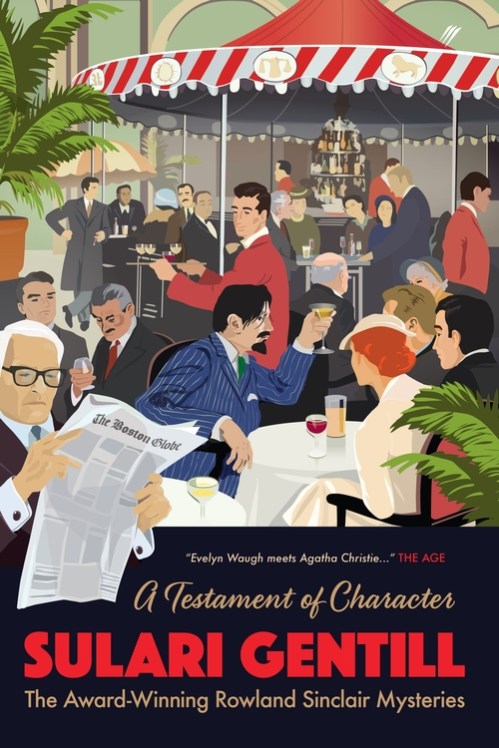
A Testament of Character by Sulari Gentill

A Testament of Character Cover

Publisher: Pantera Press (Trade Paperback – 3 March 2020)

Series: Rowland Sinclair – Book 10

Length: 337 pages

My Rating: 4.5 out of 5 stars

Amazon     Book Depository

Acclaimed Australian author Sulari Gentill returns with the 10th book in her bestselling Rowland Sinclair series, A Testament of Character, an intense and compelling new entry which was a lot of fun to read.

Gentill is an excellent Australian author who has written several amazing books since her 2010 debut. While her main body of work is the Rowland Sinclair series, Gentill has also written The Hero trilogy, a young adult fantasy trilogy based on classic Greek stories, and the standalone novel Crossing the Lines. I am mostly familiar with her Rowland Sinclair books, however, as I have read the last several books in this series, all of which have been extremely enjoyable due to their fantastic blend of history and mystery. The Rowland Sinclair books follow the adventures of the titular Rowland Sinclair, a wealthy left-wing Australian gentleman artist, and his three artistic friends in the 1930s, as they find themselves in the middle of several murder investigations. Each Rowland Sinclair book is a fun and entertaining part of my yearly reading calendar, and I have been looking forward to checking out A Testament of Character for a while now.

In 1935, after the horrors they experienced in Shanghai, Rowland and his bohemian friends Edna, Clyde and Milton are enjoying a leisurely holiday in Singapore before heading back to Australia. However, their travel plans are dramatically changed when Rowland receives tragic news. An old friend of Rowland from his Oxford days, Daniel Cartwright, has died suddenly, and he has appointed Rowland as the executor of his vast estate.

Detouring from Australia to Cartwright’s home city of Boston, Rowland and his companions arrive for the funeral and find themselves in the midst of controversy and familiar conflict. Not only was Cartwright estranged from the rest of his family, especially his brothers, who disapproved of his lifestyle choice, but it turns out he was murdered, and the police have yet to find any suspects. Even more mysteriously, Cartwright had only just written every member of his family out of the will, leaving all his money to an unknown man everyone claims does not exist.

Determined to carry out the last wishes of his dear friend, Rowland attempts to find the man who apparently meant so much to him. However, his investigation quickly turns sour, as he runs into numerous people who do not want Cartwright’s will to come to pass. Forced to scour Boston, New York and other parts of post-Depression America for leads, the four friends encounter all manner of dangerous and eccentric characters as they pursue their quest. However, none of them are prepared for the terrible truth they encounter, especially now that Cartwright’s killer has them in their sights.

A Testament of Character is an exciting and compelling novel that proves to be a fantastic new addition to the Rowland Sinclair series. Gentill has done an amazing job coming up with another captivating story that not only features an exciting and gripping mystery but which takes an intriguing look at America in the 1930s. This story contains the series’s usual blend of fun, intrigue and action, as the four exceedingly liberal protagonists get into all manner of trouble across conservative America. There are some rather impressive and at times dark scenes throughout this book, and Gentill has also included some major character developments that will appeal to long-term readers of this series. The end result is an exceedingly enjoyable and thrilling story of love, adventure and revenge which proved extremely hard to put down.

At the heart of this book lies a clever mystery storyline that revolves around the murder of the protagonist’s friend and the identity of the mysterious beneficiary of the will. Gentill crafts an excellent multi-layered mystery, with a number of surprising twists, turns and false leads on the way to the exciting conclusion. While I was able to guess a little bit in advance who the main perpetrator turned out to be, all the revelations that came out in the final confrontation were really impressive and helped wrap up the entire mystery storyline extremely well. I also thought that Gentill came up with a very compelling and memorable motivation for the various crimes featured within the book. Some of these reveals were a bit dark and shocking, but they did make for some very dramatic and captivating sequences throughout the book. Overall, I thought that this was one of the strongest mysteries to have so far been featured within one of the Rowland Sinclair books, and it served as an amazing centre to this entire fantastic book.

One of the most distinctive features of this whole series is the way that Gentill dives into the history and culture of the period in which the books are set. She has previously done a wonderful job of exploring parts of 1930s Australia, Europe and occupied Shanghai, and in A Testament of Character Gentill’s characters explore post-Depression America. This proves to be an excellent backdrop to the book’s superb story, and I loved the examination of the key cities of Boston and New York, as well as some rural areas of the country. Gentrill provides the reader with a fantastic and at times in-depth look at various parts of the 1930s American culture and society. This is done in two distinct ways, the first of which involves the protagonists exploring America as Australians, providing an outsider’s perspective of the events or places they visit (while constantly getting complemented for speaking such good English!). The second way is through Gentill’s inclusion of historical newspaper clippings at the front of every chapter. The use of these newspaper clippings is another recurring trait of the Rowland Sinclair series, and I have always enjoyed the way in which the articles relate to some cultural or historical aspect of the chapter the clipping fronts. Through the use of these methods, the author paints an intriguing picture about America during this period, which I think worked extremely well as a background to the main mystery plot. This is especially true as some of the motives and elements of the mystery revolve around the social attitudes and cultural expectations of the time, which the reader will need to have a bit of an understanding about. I have to say that I was glad that as part of this examination of historical America, Gentill also had a look at public opinion around the Nazis and fascists in the lead up to World War II, as this has been one of the more interesting story threads to follow throughout the series.

Another distinctive aspect of the Rowland Sinclair series is the way that Gentill writes a number of historical figures into the story, either as cameos or in major roles. The best previous example of this is easily the author’s inclusion of Eric Campbell and The New Guard (an ultra-right-wing Australian organisation in the 1930s) as recurring antagonists in some of the books, as these real-life historical figures are great foils to the progressive protagonists. Gentill continues to do this in A Testament of Characters, making great use of several iconic American historical figures to flesh out the story and create several memorable inclusions. Several of these historical figures have pretty major roles in the plot, including Joseph Kennedy, F. Scott Fitzgerald and his wife and fellow author, Zelda Fitzgerald. There are also some fun cameos from several other notable people, including Errol Flynn, a young JFK, Marion Davies, Randolph Hearst and Orson Welles, as well as several other characters who were in Boston or New York during the 1930s. There are also a ton of references to other unique figures in America during this time, including the Parker Brothers Company (Monopoly was released in 1935, and the protagonists of course end up playing a game), as well as a unique goat competition that was held in Central Park, of which Gentill of course names the winner. This is an extremely fun and amusing part of A Testament of Character, and I always enjoy seeing Gentill’s protagonists run into these real-life historical figures, especially as the author does a fantastic job examining and showcasing their personalities and motivations. I love how Gentill effortlessly works these people into the plot, and the reader is always left wondering who is going to appear next.

A Testament of Character is a superb and exciting new addition to the outstanding Rowland Sinclair series that is really worth checking out. Sulari Gentill has once again produced a fantastic mystery storyline that strongly benefits from the author’s clever dive back into 1930’s history. This results in a powerful and exhilarating novel which makes amazing use of its fun, distinctive inclusions and intriguing characters. I cannot wait to see what misadventures Rowland Sinclair and his friends get up to in their next book, and this is a truly wonderful Australian series with a real unique flair to it.

Amazon     Book Depository

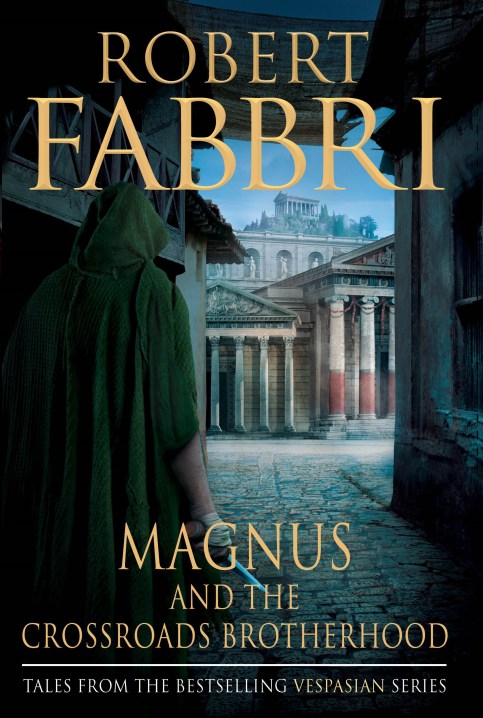
Magnus and the Crossroads Brotherhood by Robert Fabbri

Magnus and the Crossroads Brotherhood Cover

Publisher: Corvus (Hardcover – 3 December 2019)

Series: Crossroads Brotherhood – Collected Edition

Length: 369 pages

My Rating: 4.5 stars out of 5 stars

Amazon     Book Depository

From the mind of one of the most entertaining authors of historical fiction, Robert Fabbri, comes Magnus and the Crossroads Brotherhood, a superb collection of fun and exciting short stories set in the same universe as Fabbri’s bestselling Vespasian series.

Over the last couple of years, Fabbri’s Vespasian series has been one of my absolute favourite historical fiction series out there, so much so that Fabbri is now one of those authors whose works I will automatically buy, no questions asked. The Vespasian books, which ran between 2011 and 2019, examined the life story of the titular character, Vespasian, and showed the events that eventually led to him becoming emperor of Rome. Fabbri utilised a mixture of historical facts and a number of fictionalised potential adventures to tell an entertaining story which also mixed in some of the wildest and most over-the-top recorded tales of ancient Rome and its Emperors. This series featured a huge cast of figures from Roman history and it also made use of several fictional characters of Fabbri’s own design to move the story along. While the books featured several great fictional characters, the most significant of these was Magnus.

Marcus Salvius Magnus, mostly referred to as Magnus in the series, was Vespasian’s best friend, confidant and fixer throughout the series and was at his side for most of the wild adventures Vespasian found himself on. Magnus was the leader of the South Quirinal Crossroads Brotherhood, one of the major criminal gangs in ancient Rome, but he also worked for his patron, Vespasian’s uncle, Gaius Vespasius Pollo, and helped him and his nephews rise politically. Magnus appeared in all nine Vespasian books and was a major part of the series. Fabbri evidently enjoyed featuring him in his stories as he was also used as the protagonist of the Crossroads Brotherhood series of novellas, which featured six separate novellas released between 2011 and 2018.

Magnus and the Crossroads Brotherhood is the first full collection of the six Crossroads Brotherhood novellas, which follow the adventures of Magnus and his brethren as they navigate the dangerous criminal underbelly of ancient Rome. Set out in chronological order across several points in the Vespasian series (which was set over the course of 40-plus years), these various short stories each feature a different criminal enterprise, including fixing a chariot race, manipulating an arms dealer, and property speculation, all whilst trying to stay on top of the city’s rival criminal organisations and surviving the crazy whims of Rome’s rulers.

This was a fun and exciting book that I really enjoyed, and I am exceptionally glad that I was able to read all these great novellas inside a single book. Fabbri has produced some truly entertaining tales which not only tie in with and close up some gaps in the Vespasian series but also provide a much more in-depth look at one of the series’ more amusing characters and the criminal undertakings he was getting up to in ancient Rome.

The featured novellas were a lot of fun to read, and I really liked the clever and fast-paced stories contained within them. Fabbri did an exceptional job of using the short story format to introduce and conclude a compelling tale as this book features some absolute rippers, each of which is around 60 pages long. The author has come up with some very intriguing scenarios for each of these short stories, all of which follow Magnus as he embarks on a new scheme or implements elaborate and at times brutal plans to gain power and wealth and address some form of threat to his criminal organisation. The sheer variety of criminal enterprises that Fabbri came up with is very impressive, and I enjoyed seeing how the author imagined Roman politics and crime would have intersected. I also liked how some of the crimes that the protagonists engaged in had a more modern flair to them, such as engaging in the lucrative opium trade. Out of all of these short stories, I think my favourite was the second one featured in this book, The Racing Factions. The Racing Factions followed Magnus as he attempted to fix a chariot race, to not only make himself and his associates a lot of money but also get revenge on a crooked bookie who foolishly tried to cheat Magnus out of his winnings. This story was filled with all manner of double-crosses, plotting, manipulations and intrigue, as Magnus put all the pieces into place for his revenge, resulting in a chaotic and entertaining story that can be quickly read in a short period of time. While The Racing Factions was my favourite short story, there were honestly no weak links in this book, and I loved every novella that was included, especially as I was able to easily read their entire stories in a single session each.

While each of the novellas can easily be enjoyed as standalone stories, there are some real benefits to reading all of them within this collected edition. The main advantage is that the reader gets to see each of the stories progress in chronological order over the course of many years. This allows us to see how Magnus slowly evolves over the years, becoming more devious as he ages, and it is interesting to see what happens to the various side characters in the novellas. While some of Magnus’s companions age with their leader and seem ready to retire with him, you also get to see the rise of Magnus’s successor, Tigran. Tigran is introduced in the first novel as a street urchin, and he rises up the ranks each story, eventually becoming a viable contender for Magnus’s throne. The slowly building tension between Magnus and the ambitious Tigran is quite intriguing, and it makes for a really fun confrontation in the final book. I also liked how having all the novellas in one place allowed Fabbri to showcase the continued street war between the South Quirinal Crossroads Brotherhood and their rivals the West Viminal Brethren. The West Viminal Brethren make several plays for Magnus’s interests throughout the course of the books, and many of the criminal plans featured where Magnus’s destructive retaliation, which caused some real trouble for the West Viminal Brethren and their leader.

While the character of Vespasian only briefly appears in a couple of stories within Magnus and the Crossroads Brotherhood, this book has some major connections to the Vespasian series. While each of these novellas has their own self-contained adventures, one of the main reasons they were written was to help fill in the gaps between the various Vespasian books. As a result, some of the novellas provide background on how Vespasian or his brother came to be in some key position of power or unique place at the start of certain books within the series. There were also some examinations of how Magnus was able to readily come up with key ideas that were later used in the main books, such as how he came up with a certain inventive murder technique that was necessary to eventually eliminate one of Vespasian’s opponents. These novellas also helped explain the reasons why Magnus was often away from Rome in the company of Vespasian rather than staying in the city running his criminal brotherhood. Through short introductions that appear in front of each novella featured in this book, Fabbri explains the context of each of these and details what gaps he was trying to fill. This of course means that Magnus and the Crossroads Brotherhood is going to hold a lot more appeal to those readers who are already familiar with the Vespasian series, especially as they will have a much better appreciation for each of these novella’s backgrounds. That being said, no knowledge of any of the Vespasian books is really required to enjoy the fun stories contained within this collected edition, and Magnus and the Crossroads Brotherhood would actually be a fantastic introduction to Fabbri’s excellent historical fiction series.

I quite enjoyed the intriguing snapshots of ancient Rome that Fabbri included in each of the novellas. There are some truly fascinating aspects of Roman life explored in this book, from the popularity of the chariot races for all levels of society, the various forms of law enforcement patrolling the streets, the role criminal organisations may have played and many other cool historical elements. I personally really liked how most of the stories were centred on some form of ancient Roman festival or celebration. There are some obscure and weird festivals occurring here, from one celebration that sees organised mobs from the various neighbourhoods fight over the head of a sacrificed horse, to another festival where the Rome’s dogs are brutally punished for failing to stop an ancient invasion of the city. These prove to be distinctive and interesting backdrops for several of the stories, especially as the protagonist uses several elements of these celebrations in his schemes, in often entertaining ways. As a result, this is a great read for fans of ancient Roman fiction, and I guarantee you will find some intriguing and entertaining portrays of Roman culture and society in this book.

Magnus and the Crossroads Brotherhood is a fantastic new addition from the amazing Robert Fabbri, which proved to be an exceedingly entertaining book. I really loved being able to read all of these excellent novellas in one place and I deeply enjoyed every one of their exciting and captivating stories. This is a perfect companion piece to Fabbri’s outstanding Vespasian series, and there is quite a lot to love about this collection of fun novellas. Compelling pieces of fiction like this is one of the main reasons why Fabbri is one of my favourite historical fiction authors at the moment, and I cannot wait to get my hands on his upcoming book, To the Strongest.

Amazon     Book Depository

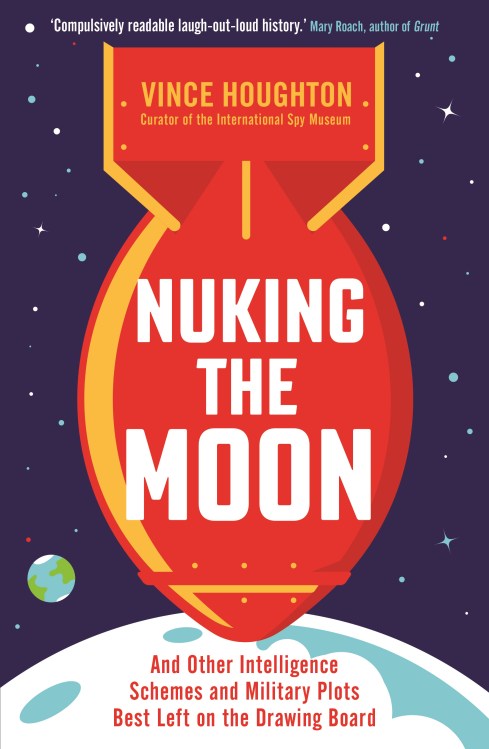
Nuking the Moon by Vince Houghton

Nuking the Moon Cover

Publisher: Profile Books (Trade Paperback – 3 December 2019)

Series: Stand alone/Book One

Length: 296 pages

My Rating: 4.5 stars out of 5

Amazon     Book Depository

Have you ever been curious about the craziest top secret plans the world’s top militaries and intelligence agencies ever came up with? Well, wonder no longer as Vince Houghton, curator of the International Spy Museum, presents Nuking the Moon: And Other Intelligence Schemes and Military Plots Best Left on the Drawing Board, a hilarious collection of some of the most over-the-top, insane or ahead-of-their-time military and intelligence ideas that were ever thought up.

Before we start getting too far into this review, I feel I need to point out that this is actually the first review of a non-fiction book that I have ever featured on this blog. Over the last few years, I have not really read any non-fiction books, mainly because I suffered an overload of them at university. However, the moment I received Nuking the Moon, I knew that really needed to read it. That says a lot about how interesting the content was to me, as it takes a lot for me to actually sit down and read a non-fiction book cover to cover. However, I have always enjoyed reading about some of the weirdest moments in human history, especially as in many cases reality can be so much weirder than fiction. Nuking the Moon certainly sounded like it would be right up my alley, and I am so glad I decided to try it as this book proved to be an amazingly entertaining read with some truly outrageous historical accounts that were a lot of fun to learn about.

In Nuking the Moon, Houghton has written a detailed account about the history of 21 different projects, operations or schemes that were implemented, attempted or researched to some degree by a government, military, intelligence agency or private company. Each of these different projects and operations have their own chapter within this book, which is then broadly broken up into four separate sections, Adventures in the Animal Kingdom, Astonishing Operations, Truly Extraordinary Technology and “Fun” with Nuclear Weapons. The vast majority of these planned operations originated in America and the United Kingdom, and pretty much all of them were researched during the course of either World War II or the Cold War, when bold ideas were encouraged.

The first thing you need to know about Nuking the Moon is that it contains a fantastic and unique range of different historical projects and plans examined within it. There are some really entertaining and intriguing stories from history contained within this book, and while I was vaguely familiar with a few of them, the vast majority were actually completely unknown to me. This speaks not only to the obscure or hidden nature of many of these projects but also to the research ability and knowledge base of the author, which guarantees that the reader is bound to find out something new in this book. There are some truly interesting stories within this book, including the titular plan to nuke the moon, scientists implanting listening devices into trained cats, chickens being housed inside nuclear landmines to keep the electronics from freezing, misinformation campaigns about death rays, satellites containing sun guns, research into creating tidal waves with explosives, ill-advised attempts to disperse cyclones with nuclear bombs and so much more. I found all of these topics to be deeply fascinating and I think many readers will be amazed at some of things that these people came up with.

While I really enjoyed nearly every unique plan contained within this book, there were a few that really stood out for me and ended up being my favourite entries. This includes a particularly fun research project by the Allies into the viability of creating massive battleships out of ice, which I think Houghton did a really good job explaining. Not only is this chapter deeply intriguing, especially as this wild idea apparently had a huge amount of support from the American and English governments, but the author paints a great picture about the work and historical personalities involved. I particularly enjoyed the stories about how Lord Mountbatten, the head of the project, thought that the best way to show off the viability of his project to interested dignitaries was to repeatedly shoot the proposed construction material with a range of different guns.

I was also a big fan of the five separate chapters that detailed some extraordinary plans to utilise animals as weapons or intelligence assets. Two of these entries in particular were deeply fascinating and I really enjoyed learning about them. The first of these was a plan to turn bats into lethal weapons by loading them up with explosives. The reasoning behind this plan is quite dubious, and what is amazing is that it actually made it to testing, with particularly disastrous results. The mental picture that Houghton is able to conjure up while describing these tests is extremely hilarious, and it was an extremely entertaining entry for the front part of the book. The second animal-related project that was a personal highlight was another plan by the Allies to paint foxes with luminous paint and set them lose in front of an army invading Japan. The idea was that the Japanese, whose culture features many stories about foxes being a form of supernatural trickster, would be terrified by the sight of the glowing foxes and flee in terror before the Americans. This is probably one of the stories that Houghton is most scornful of, and it was really entertaining to see him tear into the inherent racism behind this plan. I also particularly liked hearing about the various setbacks involved with plan, as well as the chain of events that led to a horde of luminous foxes being released in the middle of New York. The three above chapters were easily the highpoint of the book for me, and I reckon a lot of people would enjoy learning more about the amazing plans they contained.

Now, while a lot of the various chapters in this book were absolutely fantastic to read, Nuking the Moon did have a couple of parts to it that did slightly reduce my overall enjoyment of the book. For example, I personally found the Astonishing Operations section of the book to be a little less interesting than the other major parts of the book. Sitting between the chapters that dealt with animals and weird technology, the Astonishing Operations were nowhere near as “astonishing” as some of the other parts of the book. Don’t get me wrong, some of these chapters were pretty interesting, and I did enjoy reading about the various operations, but they seemed to pale in comparison after the truly over-the-top tales told in the other parts of the book. That being said, some of these stories dragged a little, and I also thought that a couple were a bit unnecessary in their inclusion.

I felt that Houghton did an excellent job of fully exploring the various projects and operations that are featured within this book. Each of the chapters within Nuking the Moon contains quite a bit of detail about the history of the entire plan, including who came up with it, who approved it and the various people who were involved (it is actually quite amazing some of the major historical figures who had a hand in these intriguing projects). He then details the entire design process and testing phases of these projects, examining the results, including the surprising successes and disastrous failures that occurred, and then finally looking at why it was cancelled or suspended. There are some interesting historical examinations involved with each chapter, as Houghton attempts to look over all the relevant details associated with the plans or projects. I particularly liked that he examined the historical context around these proposed ideas, and actually tries to explain why the various creators thought that something this unusual or dangerous was actually necessary. I also appreciated that he looked at the impacts or future implications of some of the projects, as well as some of the connections that they have to modern technology. Overall, I think that the author did an incredible job exploring the various topics contained within this book, and I really enjoyed learning about the full extent of these projects and about how far they actually progressed.

I was also a big fan of the sarcastic and humorous writing style that Houghton utilised for most of the book. I really enjoyed this light-hearted and comedic tone, and it was definitely the perfect way to explore such outrageous and eccentric ideas and concepts. Houghton made sure to fill each chapter with a ton of funny jokes and observations, as well as some clever takedowns of parts of, or the entirety of, the plans being discussed, and I had some great laughs as I worked my way through Nuking the Moon. That being said, I do think that the author did get a bit off-topic at times, which had a slight negative impact on the flow of the book. While he does take a sarcastic approach to these ideas, Houghton is not as critical as he could have been; instead in some of the chapters he actually tries to see the concept from its creator’s point of view and explain why they thought it was a good idea. He also makes sure to highlight in the introduction that even though the projects contained within this book may seem ridiculous, if that had actually succeeded, we would consider them to be works of absolute genius. I like this slightly fairer examination of some of these entries, and it was definitely better than reading a book completely filled with negatively.

Nuking the Moon by Vince Houghton is a fun and fascinating non-fiction book that did a wonderful job of capturing, exploring and satirising some of the weirdest attempted plans and operations from the military and intelligence worlds. This is an exceedingly entertaining read which I think will appeal to a wide range of readers, and I would definitely recommend it. I actually hope that Houghton thinks about doing another book detailing some of the other crazy plans, projects and operations (because let’s face it, there are bound to be some other pretty unbelievable and true stories out there), as I for one would really be interested in see what other amazingly bad ideas people have come up with.

Amazon     Book Depository

The Night Fire by Michael Connelly

The Night Fire Cover

Publisher: Hachette Audio (Audiobook – 22 October 2019)

Series: Ballard and Bosch – Book 2

Length: 10 hours and 4 minutes

My Rating: 5 out of 5 stars

Amazon

One of the masters of modern crime fiction, Michael Connelly, returns with another book in his bestselling interconnected crime universe. In The Night Fire, Connelly once again brings together the outstanding team of Ballard and Bosch for another exceptional murder mystery.

Back when he was a rookie detective, Harry Bosch was mentored by one of the LAPD’s best homicide detectives, John Jack Thompson, who helped stoke his internal fires of justice to ensure that no case ever goes unsolved. Now, years later, Thompson is dead, and at his funeral, the now retired Bosch is given a gift from his widow: a murder book for an unsolved crime. The case revolved around the murder of a young man in a gang-controlled alley nearly 30 years before, and it appeared that Thompson secretly took the book when he retired from the force. What was Thompson’s connection to the case, why was this one murder so important to him and why did he keep the murder book a secret for so long?

Determined to get answers, but already committed to helping his lawyer half-brother Mickey Haller defend his client in a tricky murder case, Bosch takes the book to Detective Renée Ballard for help. Ballard, Hollywood Division’s resident detective on the night shift (known as the Late Show), and Bosch have recently formed an unofficial partnership in order to work on some of Bosch’s old, unsolved cases. Identifying several inconsistencies in the cold case, Ballard decides to start digging deeper, while also investigating a suspicious death by fire that occurred on her beat.

Together Bosch and Ballard are an effective investigative team, and it does not take them long to identify a potential killer. However, the more they dig, the more they begin to realise that Thompson might not have taken the murder book to solve the murder, but to ensure that nobody ever tried to investigate it. Can these two detectives get to the truth, and what happens when their various investigations put them in the line of fire of some very dangerous people?

The Night Fire is the latest book in Connelly’s shared crime universe, which features the various adventures and investigations of several of his iconic protagonists. This new novel is a fantastic piece of crime fiction that once again combines together two of Michael Connelly’s most intriguing characters, Bosch and Ballard, after their outstanding first team-up in 2018’s Dark Sacred Night. This is the 22nd book featuring Bosch, Connelly’s original and most utilised protagonist, while Ballard has so far appeared in two prior novels. This book also briefly sees the return of Mickey Haller, another one of Connelly’s protagonists, who has appeared in several legal thrillers within the universe such as The Lincoln Lawyer (which was adapted into a film of the same name).

Just like in Dark Sacred Night, the plot of the book is shown from both Bosch’s and Ballard’s perspectives, as each of them gets a number of separate point-of-view chapters (about half each) to tell their respective stories. While there is a lot of crossover between the two characters, especially when they are working together on their joint cold case, both of them do their own independent investigations and have several chapters where they deal with their various personal issues without the other character being present. However, they also both appear in a number of chapters together, allowing the reader to not only get an interior view of the character but to see each of them through the other’s eyes.

One of the main things that I love about the Michael Connelly books I have read are the multiple cases that the protagonists investigate simultaneously, many of which may or may not be connected in some way. In The Night Fire for example, the story features one cold case that brings Ballard and Bosch together at the start of the book and which they work together on, while both characters have separate cases to work on. Bosch becomes involved in the legal defence of one of Mickey Haller’s clients who is on trial for murder, and this then evolves into the hunt for the murderer of a judge. Ballard on the other hand does most of the investigative work on the cold case, mainly because she is the one with access to the LAPD’s resources. At the same time, she is also investigating several other crimes that come across her desk during her night shifts at Hollywood Division. These include a homeless man who was burnt alive in their tent, the apparent suicide of a young girl and the discovery of a truckload of illegal immigrants. While some of these cases do not go anywhere or are investigated by a different part of the LAPD, Ballard does find herself fully investigating several different cases and getting some rather interesting results. I really enjoyed this cool combination of varied cases and examples of police work, especially as it combines together a decades-old murder with several recent crimes. There are some really complex and compelling mysteries involved with these cases, and I found myself getting drawn into each of them, as they all featured some clever police work and an intriguing bunch of potential suspects. The cold case in particular was great, as the reader not only needed to figure out who the killer was but also why Bosch’s mentor was so concerned with the murder. While it was a little disappointing not to get some follow-through on a couple of Ballard’s cases, I thought that all of these mysteries come together into an excellent overall narrative that does an outstanding job keeping the reader’s attention. I also loved how two of the cases eventually come together in an unexpected way, resulting in an explosive conclusion, while the results of another murder investigation had a very emotional impact on one of the protagonists.

In addition to the great mysteries and fictional examples of police work, one of The Night Fire’s biggest strengths is its two protagonists, Ballard and Bosch. Both of these protagonists are excellent characters with strong backstories, and I really enjoyed how the two of them played off each other. In this novel, both Ballard and Bosch are outsiders to the LAPD. Ballard has been banished to the night shift for reporting a sexual assault by a superior officer, and now has serious trust issues when it comes to many of her male counterparts. Bosch on the other hand, after a long career with the police, is now retired, and thanks to some of his actions that forced him out the LAPD, many of the police no longer see him as one of them, a point reinforced when Bosch helps Mickey Haller free a murder suspect. This outsider viewpoint makes the team-up between both of them a lot more interesting, as both characters are still learning to trust the other, even after the success of their first case. I really liked how the relationship between the two of them grew throughout this book, and their different viewpoints and experiences turn them into an effective duo. Both characters go through some big moments in this book, including some medical issues with Bosch, Ballard standing up to her attacker and the various emotional impacts of the case, and it was great to see how they helped each other out. This is definitely a team-up I want to see again in the future, and I really hope that Connelly continues more of these adventures with Ballard and Bosch.

Just as I did with Michael Connelly’s previous book, Dark Sacred Night, I ended up listening to the audiobook version of The Night Fire. This audiobook runs for just over 10 hours, and features the vocal talents of Titus Welliver and Christine Lakin. I quite enjoyed the audiobook version of The Night Fire, as not only did it allow me to power through this book is short order (I think it only took me three days to finish it off) but its use of two separate narrators was done really well. Throughout the course of the book, Welliver is the voice of Bosch (which is a good fit as Welliver actually plays this character in the Bosch television show), while Lakin is the voice of Ballard, and they each narrate the chapters for their respective characters, including most of the dialogue. Welliver and Lakin are exceptional vocal talents, who did an outstanding job of bringing Bosch and Ballard to life. Both of these narrators really get to grips with the characters and are able to capture a lot of their various nuances in their performances.

Another great thing about this audiobook was the amazing way they utilised the two separate narrators. I really liked how the book was split between them, and it ensured that both sets of chapters had a great distinctive feel throughout the book, and the reader was never left in doubt who was narrating the chapter. The only exception to this is any dialogue the other point-of-view character has in that chapter, as that character’s narrator will then speak instead. This means for example, while Welliver is the primary narrator during Bosch’s chapters, whenever Ballard speaks during these chapters you get Lakin’s voice. While it was a tad disconcerting at times to suddenly hear the other narrator’s voice in the middle of a lot of dialogue in the primary vocal talent’s chapter, it did save the reader from getting confused by having to listen to two different versions of the protagonist’s voices. Overall, I would strongly recommend the audiobook version of The Night Fire to anyone interested in checking out this book, and I know that I will be utilising this format again in the future for Connelly’s next book.

In his latest crime fiction masterpiece, Michael Connelly once again knocks it out of the park with this fantastic new addition to his connected crime universe. The Night Fire is an exceptional murder mystery that makes excellent use of its two main protagonists to tell a rich and exciting narrative, filled with a number of intriguing investigations and cases. This is probably my favourite Michael Connelly book that I have read so far, and it gets a full five stars from me. A fantastic new entry from the king of crime fiction, this is a must read for all fans of the genre.

Amazon

The Lost Ten by Harry Sidebottom

The Lost Ten Cover

Publisher: Zaffre (Hardcover – 18 April 2019)

Series: Standalone

Length: 351 pages

My Rating: 4.5 out of 5 stars

Amazon

One of my favourite authors, Harry Sidebottom, returns with another excellent piece of Roman historical fiction, The Lost Ten.

Sidebottom is a particularly skilled historical fiction author who has written some amazing novels in the last 10 years, all of which have focused on the Roman Empire in the turbulent 3rd century AD. His works have included his excellent Warrior of Rome series, which features one of the first books I ever reviewed, King of Kings, and his well-researched Throne of the Caesars series. Sidebottom also wrote a fantastic historical fiction/thriller hybrid last year, The Last Hour, a truly awesome book that featured the protagonist of his Warrior of Rome series. The author has continued his intriguing experiment of combining historical fiction with other thriller sub-genres in his latest book, The Lost Ten, which I have been looking forward to for a while.

Rome, 265 AD. Junior Roman officer Marcus Aelius Valens is instructed to join a small squad of soldiers on a daring raid into Persia. Their objective is to infiltrate the country and make their way to the dreaded Castle of Silence, an impregnable prison high up in the mountains. Once there, they are to free young Prince Sasan, the King of Persia’s disgraced nephew, and bring him back to Rome.

Journeying to the Roman border, Valens joins up with an eclectic group of soldiers recruited from the frumentarii, Rome’s infamous secret agents. An outsider amongst these hard-bitten soldiers, Valens suddenly finds himself in command when an ambush kills their commanding officer. Aware of the consequences of abandoning their mission, Valens leads his troops onwards to Persia.

However, the closer they get to the Castle of Silence, the more misfortune seems to befall the small unit. As his soldiers die one at a time, Valens begins to believe that there is a traitor among them who does not wish for their mission to succeed. Can Valens unmask the saboteur before it is too late, or will the squad die trying to achieve their impossible mission?

This was another spectacular read from Sidebottom, who has once again done a fantastic job bringing modern thriller vibes to an ancient Roman historical setting. The Lost Ten is a fast-paced action adventure, with a clever plot hook and an excellent band of new characters that I had a lot of fun reading and which lived up to my high expectations for this novel.

While his Warrior of Rome books always had a bit of a thriller feel to them, as Ballista was usually hunting down some form of traitor or spy, Sidebottom has recently started to push the envelope even further by combining together Roman historical fiction with a variety of different thriller sub-genres. His previous novel, The Last Hour, was essentially 24 set in ancient Rome, and his next novel is apparently going to emulate a Scandi noir novel in the hills of Calabria. In The Lost Ten, Sidebottom utilises a special forces thriller storyline which sees Roman troops attempt an impossible infiltration deep into enemy territory. As a result, this novel reads a lot like an episode of Seal Team or The Unit if the team had to infiltrate antique Persia. In order to complete their objective, the team has to arrive at the border incognito, set up a cover story as traders, and then pass into Persian territory, fooling the locals and military as they near their goal. Once there, they have to find a way into the impenetrable fortress and then get their hostage out of Persia alive while being pursued by a massive army. This results in an extremely exciting and action-packed novel that was an absolute blast to read. I loved seeing all these classic spy scenarios play out in this classic Persian setting, and the special forces storylines work exceedingly well with the historical fiction background. Sidebottom has really hit onto a winning formula by mashing these genres together, and I am very excited to see how his next book turns out.

One of the aspects of The Lost Ten that I really enjoyed was the great characters who made up the Roman unit heading into Persia. Sidebottom has written a great group of protagonists with some rather interesting character traits and individual stories. The main character, Valens, who serves as the principle point-of-view character, has an intriguing arc that sees him go from being a naïve and disheartened young solider, to canny veteran troop leader throughout the course of the book. The rest of the Ten are a fantastic mixture of distinctive and rough killers who really don’t want to be going along on this mission. These troops help give the story a real Dirty Dozen vibe which I quite enjoyed, and it was also fantastic to see the group come together as they faced adversity.

In addition, it is revealed early on in the book that one of the squad characters is a traitor who is actively working to sabotage the mission. However, the identity of this double agent is not revealed until much later in the story. Instead, several chapters are shown from the perspective of the traitor, showing what actions he is taking to betray the team, such as killing the original commander or organising ambushes from bandits. As more and more misfortunes befall the group, Valens becomes suspicious and starts trying to identify the saboteur in the ranks, resulting in a wonderful storyline that plays into the thriller aspect of the book exceedingly well. Sidebottom does a clever job of hiding the identity of the traitor for the majority of the story, and the reader is fed a series of clues to slowly work out who it is. The reader is also shown the hidden character’s motivations for betraying the others, and the political and personal realities that are driving him. All of this comes to a fantastic conclusion, and this was an excellent part of the story that Sidebottom handles exceedingly well.

Sidebottom once again makes great use of the 3rd century Roman setting that has been a defining feature of all his previous novels. The Lost Ten is set in the same universe as all of Sidebottom’s other books and occurs in the same year as The Last Hour. There are actually several mentions of Sidebottom’s recurring protagonist, Ballista, and it sounds like he is getting into trouble campaigning in Gaul. The author does an amazing job showcasing the rough lands that lie between the Roman Empire and Persia and all the difficulties that would have occurred travelling to the Persian Empire. As the protagonists enter Persia, the readers get an interesting look at the landscape and Persian customs, many of which seem strange to the Romans and result in much contemplation and discussion. Sidebottom shows off several interesting areas of Persia, and it is clear that he has done his research into this location. The author also heads back to the familiar setting of ancient Rome, allowing the reader to get a good sense of the political situation in 265 AD. Sidebottom also examines the role of the frumentarii, Rome’s secret police/agents, who have appeared in several of his novels before. The various actions of this organisation are really intriguing, and it was cool to see modern spy tactics at work in this historical setting. There were some absolutely fascinating historical inclusions in this book that I had a lot of fun reading, and they proved to be an excellent backdrop to The Lost Ten’s thrilling storylines.

The Lost Ten is an outstanding book from Sidebottom that shows why he is one of the most captivating authors of Roman historical fiction in the world today. The author’s decision to combine a contemporary special forces thriller storyline with a well-researched historical setting payed dividends and resulted in a compelling and exciting read.   As a result, this book comes highly recommended and is a must-read for those people looking for an exciting historical thriller. I am looking forward to Sidebottom’s next book and cannot wait to see what he produces next.

Amazon

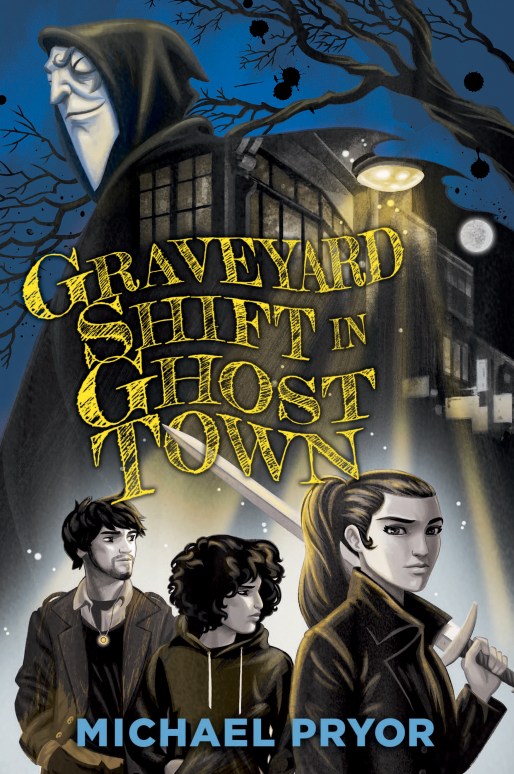
Graveyard Shift in Ghost Town by Michael Pryor

Graveyard Shift in Ghost Town Cover

Publisher: Allen & Unwin (Trade Paperback – 1 July 2019)

Series: Ghost Town – Book 2

Length: 307 pages

My Rating: 4 out of 5 stars

Amazon     Book Depository

Acclaimed Australian author Michael Pryor revisits his Ghost Town young adult series with another entertaining and intriguing story, Graveyard Shift in Ghost Town.

Anton Marin is having an extremely odd gap year. As a member of an infamous outcast ghost-hunting family, Anton can see the ghosts that linger in our world, and he has recently taken up the family business. Working with his new partner, the English badass Rani Cross, Anton works to protect the people of Melbourne from the more dangerous types of ghosts while also ensuring that all the wandering spirits they encounter are helped on to the next world. However, even with Rani’s help, ghost hunting in Melbourne has recently gotten even more difficult as the city finds itself in the midst of a genuine ghost plague. A massive infestation of the most dangerous types of ghosts imaginable is wreaking havoc across the city, and even usually benign or harmless spirits are starting to attack people.

Anton and Rani’s problems are about to get even worse; a deadly cult of Trespassers, humans who use magic to control ghosts for their own ends, is in town and determined to capture anyone with ghost sight for use in their rituals. As Anton and Rani find themselves with a target on their back, Anton must deal with the return of his long-lost aunt Tanja. While Anton is overjoyed to have a member of his family back, he quickly realises that not everything with his aunt is as it seems. What secrets is Tanja hiding and what is her connection to the leader of this group of Trespassers? As secrets and occult dangers arise within Melbourne, the fate of the world hangs in the balance.

Michael Pryor is one of Australian’s most notable authors of young adult fiction, having written a number of fantasy and science fiction novels for a younger audience. Some of his most notable series include The Law of Magic, The Extraordinaries and his six entries in the long-running The Quentaris Chronicles. Graveyard Shift in Ghost Town is the second book in Pryor’s latest series, Ghost Town, and follows on from his 2017 release, Gap Year in Ghost Town. I initially thought that Graveyard Shift in Ghost Town was my first experience reading Pryor’s work, but I actually remember reading some of the books in The Doorways trilogy back when I was kid. While this was something like 20 years ago (and now I feel old), I do know that I greatly enjoyed these books and their clever concept, so I was excited to check it out.

Graveyard Shift in Ghost Town is an interesting and engaging piece of young adult fantasy with a number of cool features. Pryor has done a fantastic job combining a unique concept of ghost hunting with a group of enjoyable characters and grounded the story in the author’s home city of Melbourne. This results in a great piece of fiction that will do a wonderful job of enthralling a whole new generation of young Australian readers. For those readers who are only just coming onto this series, knowledge of the previous book is not a necessity to enjoy this sequel, as the author does a good job of re-introducing the characters, plot details and adventures that were featured in Gap Year in Ghost Town.

One of the most enjoyable aspects of this series is the overarching concept of a world haunted by real and potentially malevolent ghosts, and the adventures of the few individuals who can actually see them. Pryor has populated his story with all manner of different types of ghosts, each with their own specific characteristics, strengths and appearances. Readers will get to see the various ghosts that the protagonists go after, including the Lingers, Moaners, Thugs, Weepers and a new breed of zombie ghosts, just to name a few. All of these ghosts are really cool, and I enjoyed how this book started going into a little more detail about the origins of ghosts and the malevolent forces behind them. I also liked how the story also pivoted towards a more human antagonist in the form of the Trespassers, and it was intriguing to see how a group of people utilising the ghosts for nefarious purposes. It was interesting to see the protagonist’s ghost hunting techniques in action, and it results in some intense action sequences, especially when they have to fight ghosts and the Trespassers at the same time. This is an inventive and clever concept that helps make this series stand out from some of the other young adult fantasy books out there.

Another great distinguishing feature about this book is the author’s inclusion of a contemporary Melbourne setting. I love fantasy stories that utilise modern settings, and Pryor did an exceptional job bringing the city of Melbourne to life. The characters visit all manner of key landmarks in the city throughout the course of the story, and I really liked seeing locations I have visited featuring fights between ghost hunters and spirits. Pryor also uses the opportunity to showcase some of his favourite restaurants and cafes and it was nice to see an author insert elements of a city they clearly love into their story.

In addition to its intriguing concept and excellent setting, I was also impressed with the complex characters in Graveyard Shift in Ghost Town. The main protagonist is Anton, the funny and slightly odd heir to an exiled ghost hunting family with their own unique techniques for dispersing ghosts. Anton serves as the narrator and point-of-view character for the story, and he offers a fun and introspective narration to the book, while the revelations about certain family secrets offer up some interesting drama. The other main protagonist, Rani, is an extremely skilled sword-wielding badass who is a former member of an established ghost-hunting order from England and is an excellent female character for this series. Anton and Rani form a great team in this book, as the two of them find their groove as a partnership and work well against the threats they face. The character of Bec is an interesting third member of this partnership, as not only is she Anton’s oldest friend, who plays a cute game where they try to guess quotes from famous figures, but she is also Rani’s girlfriend, who they share an apartment and cat with. Bec really brings the team together, and there are some interesting examinations of the dynamics between the three of them, as each of them feels like they are the outsider in the group. There are also a few cool new additions to the series in this book, including a couple of Scottish ghost hunters, their ghost-hunting dog and a good antagonist in the form of the leader of the new cult of Trespassers.

Graveyard Shift in Ghost Town is an excellent piece of young adult fiction that is appropriate for a wide range of different ages and tastes. While there are a few dark scenes, such as a somewhat gruesome torture sequence, the vast majority of the book is appropriate for young teens and perhaps particularly mature young readers. I thought the author’s inclusion of a positive lesbian relationship between Rani and Bec was a really good feature for the young adult audience, and it was that was portrayed extremely well. I am also sure that young Australian readers, especially those living in Melbourne, will love to see these fantasy variations of locations they are familiar with, and it will hopefully invigorate their imagination.

Michael Pryor has done an amazing job following up Gap Year in Ghost Town, as he presents another compelling and enjoyable paranormal young adult adventure. With inventive ghosts, scary antagonists, great characters and a fantastic Australian setting, Pryor has once again shown why he is one of the leading authors of young adult fiction in Australia. Graveyard Shift in Ghost Town is definitely worth checking out, and it has a lot of features that should prove appealing to the younger teen audience.

Amazon     Book Depository

DEV1AT3 by Jay Kristoff

DEV1AT3 Cover.jpg

Publisher: Allen & Unwin (Trade Paperback – 17 June 2019)

Series: LIFEL1K3 – Book 2

Length: 423 pages

My Rating: 4.5 out of 5 stars

Amazon     Book Depository

From one of the most prolific young adult fiction authors, Jay Kristoff, comes the follow up to his electrifying 2018 smash-hit LIFEL1K3, DEV1AT3.

Over the last few years, Australian author Jay Kristoff has been one of the leading contributors to young adult fiction, writing several bestselling series. His works include The Lotus War series, the highly regarded The Nevernight Chronicles, and The Illuminae Files, which he co-wrote with fellow Australian Amie Kaufman. DEV1AT3 is actually the second of three Kristoff books being released this year, as he has already released the first book in his second collaborative series with Kaufman, Aurora Rising. Darkdawn, the third and final book in The Nevernight Chronicles, is set to be released in early September.

People who keep an eye on my blog may have noticed that I did a short review of DEV1AT3 a few weeks ago in a Canberra Weekly column. I have been meaning to write up an extended review of the book for a while now, as it was quite an enjoyable book with a lot of cool features. DEV1AT3 follows on from the incredibly popular first book, LIFEL1K3. The LIFEL1K3 series follows the adventures of four young friends in the dangerous post-apocalyptic remains of America, now controlled by rival mega-companies and gangs of religious fanatics.

DEV1AT3 is set in the immediate aftermath of the dramatic conclusion of LIFEL1K3, when the protagonist of the first book, Eve, found out the terrible truth of her origin: she is secretly a lifelike, an android who can ignore the Three Laws of Robotics. Worse, she is actually a replica of Ana Monrova, the daughter of the creator of the lifelikes, Nicholas Monrova, whose creations rebelled against him and killed his entire family. With the realisation that everything she has ever known is a lie, Eve begins to plot with the murderous Gabriel and the other lifelikes to find the comatose body of Ana. While Eve simply wants to kill the woman whose life she is imitating; the other lifelikes will use Ana’s body to unlock Monrova’s secrets in order to start a robot revolution.

Out in the post-apocalyptic wastelands surrounding Babel, Eve’s friends, Lemon Fresh, Ezekiel and Cricket, have seen better days. Not only were each of them forced to abandon Eve for different reasons but they must all face their individual consequence of the events that occurred within Babel. When unexpected events force them to separate, each of these friends find themselves in a whole world of trouble.

Lemon Fresh’s status as a deviate, a genetic mutant with the ability to manipulate electricity, has always landed her in trouble, but now she finds herself the ultimate pawn in a war between two of the major corporations that rule the land. Kidnapped by an agent of BioMaas Incorporated, Lemon eventually finds herself falling in with a band of fellow deviate teenagers, each with their own unique abilities, and whose leader, the Major, may hold the secrets to her past.

At the same time, the logika Cricket is stolen and sold to the Brotherhood, a group of religious fanatics determined to destroy every android, deviate and genetically modified being they can find. As the Brotherhood edges closer to a war with the Major’s deviates, Cricket is forced to fight as a robot gladiator while learning the dark secrets at the heart of the cult. Meanwhile, Ezekiel, the one lifelike with any love for humanity, teams up with an old enemy in order to track down Lemon Fresh and Cricket. However, when Ezekiel’s mission leads him into the path of Eve and his other lifelike brothers and sisters, he attempts to find a way to stop their destructive crusade and save his beloved Ana.

This was a fantastic piece of young adult fiction that does a wonderful job of following up the first book in the series. Kristoff tells an exciting story which not only continues the plot lines of the first book but which also takes the characters in some intriguing new directions. However, despite some differences in plot focus, the book continues to feature the cool allusions to other works of fiction that made the first book such a treat to read, and it continues to explore aspects of this intriguing post-apocalyptic setting. Readers who did not get the chance to read the first book, LIFEL1K3, last year will easily be able to start by reading DEV1AT3. Not only is the story quite accessible but it also starts off with an extremely detailed summary of the events and characters from the first book, which allows anyone to fully catch up with where the plot is.

One of the most interesting changes between this book and LIFEL1K3 is that the protagonist of the first book, Eve, is instead cast as an antagonist, and we end up seeing very little of the book’s plot from her point of view. Instead, the plot of DEV1AT3 is mostly split between the three perspectives of Lemon Fresh, Cricket and Ezekiel, who each have their own unique storylines. Each of these storylines is noticeably different, with all three of them making use of some unique features to help create an intriguing and emotionally strong story. The reader gets a real feel for all three of these point-of-view characters throughout the course of their individual plots, and several intriguing new side-characters are introduced. These separate storylines come together to form one amazing overall narrative, which ends with an amazing cliff-hanger for each of the main characters that will ensure readers will have to check out the final book in this series when it comes out.

One of the most intriguing aspects of the LIFEL1K3 series is that each of the books is marketed as a crazy mash-up of several different works of fiction. For example, the first book in the series had a real Alita Battle Angel crossed with Mad Max and Blade Runner vibe to it. Many of the references to the plots of various other media titles that were started in the first book are continued in DEV1AT3. For example, the whole Mad Max vibe of life in the wasteland is actually really enhanced in this book, as the vast majority of the story is spent out in the nuclear wastes and smaller outposts that make up the ruins of America, with a number of crazy car chases in souped-up doomsday vehicles featured throughout. We also get a deeper look at the whole Bladerunner aspect of the story, as Eve comes to terms with actually being a lifelike and attempts to get revenge for her creation.

In this second book, Kristoff’s plot also makes allusions to several other pieces of fiction in the three various storylines. For example, Lemon Fresh’s storyline is an interesting post-apocalyptic take on the X-Men, with the super-powered teen finding kinship with a group of similarly gifted individuals in a world that hates and fears them. The new deviates introduced in this storyline have a pretty cool range of powers, have all been attacked because of their abilities and even have a wise old mentor character in the Major. The various twists associated with this storyline are really clever, and it was interesting to see more deviates aside from Lemon. Ezekiel also has a great storyline within DEV1AT3. While much of his story is still tied up with his feelings for Eve, the lifelike copy of the woman he loves, and all the Bladerunner-esque emotions and thoughts he and his lifelike family experienced in the first book, Kristoff adds a fun new element to his storyline in this book. For much of his storyline, Ezekiel actually teams up with Preacher, the cyborg bounty hunter who was an antagonist of the first book. This is a very fun team-up, and it harkens back to a lot of classic odd-couple crime movies, with the two having a very rocky relationship that kind of improves as the story goes along.

I personally liked Cricket’s storyline the most. Cricket is a logika, a sentient robot who must obey the Three Laws of Robotics. Cricket, who was previously a small assistant robot, had his personality transferred into a massive combat robot in the last book. However, he is kidnapped by members of the Brotherhood, the insidious religious group fighting against Lemon Fresh’s new deviate brethren. Cricket, who has to obey all the orders given to him by the Brotherhood due to the Three Laws of Robotics, is forced to fight in a series of gladiatorial combats. This storyline gives the reader the best insight into the ranks of the Brotherhood, and Cricket uncovers certain secrets while working for them. With the whole Three Laws aspect, this storyline is obviously very reminiscent of the science fiction classic I, Robot; however, Kristoff comes up with some humorous takes on the Three Laws. Thanks to the assistance of the snarky logika Solomon (who I found to be one of the funniest characters in DEV1AT3), Cricket starts to learn how to utilise the loopholes in people’s statements, so he has a degree of freedom and he also makes use of a simple solution to counteract one of the laws, which was pretty funny. All of these references to these established pieces of fiction are great, and I really liked how the author adapted them to fit his compelling young adult story. I especially enjoyed seeing some complex science fiction ideas, such as Isaac Asimov’s Three Laws of Robotics, explained to a younger audience, with some cool tweaks to make a more entertaining and modern story.

In addition to fun story and clever references to other works, one of the most interesting things about the LIFEL1K3 series is the cool post-apocalyptic setting that the author has come up with. The nuclear ruins of America always makes for an intriguing setting for a story, and I really enjoyed the cool combination that Kristoff makes in this series with savage nuclear wasteland and high-tech cities. The sheer amount of creativity that Kristoff utilises for the setting is really impressive, as this book alone features wars between rival corporations, desert-dwelling religious nuts, mutants, rebelling androids, bandits and mutated monsters. All of these are utilised extremely well in the story, and I look forward to seeing what other cool aspects of this broken world become apparent in the next instalment of this series.

DEV1AT3 is another wild ride from Jay Kristoff that I had a lot of fun reading. Featuring an excellent story that makes great use of references to some classic pieces of science fiction and fantasy, DEV1AT3 is a fantastic read that refuses to slow down for everything. This is a highly recommended read for the older young adult market, and it will also appeal to older readers. I am extremely curious to see where Kristoff takes this story next and look forward to another electrifying adventure in this mad-cap world.

Amazon     Book Depository

Aurora Rising by Amie Kaufman and Jay Kristoff

Aurora Rising Cover

Publisher: Allen & Unwin (Trade Paperback – 6 May 2019)

Series: Aurora Cycle – Book 1

Length: 470 pages

My Rating: 5 out of 5 stars

Amazon

The superstar team of Australian young adult fiction authors Amie Kaufman and Jay Kristoff comes together once more to create an outstanding, heartfelt and deeply entertaining new novel that may prove to be one of the best young adult books of 2019.

Kaufman and Kristoff are two of the biggest and most creative authors currently writing young adult fiction.  Kaufman is probably best known for her work with Meagan Spooner, where they have co-authored the Starbound trilogy and Unearthed series of books, the second book of which, Undying, was released earlier this year.  She is also in the process of writing her own Elementals series, with the second book, Scorch Dragons, released a month ago.  Kristoff first came into prominence with The Lotus War series, which debuted in 2012.  Since then he has also written The Nevernight Chronicle, the final book of which is set to be released in September, while his latest book, Lifel1k3, was one of the most talked about young adult releases of 2018.  Kristoff’s sequel to Lifel1k3, Dev1at3, is set to be released in a month, and he is currently working on an epic fantasy series, Empire of the Vampire, with the eponymous first book set to be released in September next year.

Kaufman and Kristoff have previously collaborated on the bestselling and award winning The Illuminae Files, a space opera epistolary series made up of three books which ran between 2015 and 2018.  Their latest collaboration, Aurora Rising, is another epic piece of young adult science fiction and is the first book in their planned Aurora Cycle series, which is currently set to feature another two books, released in 2020 and 2021.

Aurora Rising is set in the year 2380 and follows a spacefaring team of young adventurers as they attempt to save the galaxy.  In the future, humans have expanded out deep into the Milky Way, with fast intergalactic travel made possible through the Fold, dangerous space found on the other side of literal folds in the universe.  The Aurora Legion are an independent peacekeeping force made up of humans and several friendly alien races.  In order to complete their various humanitarian, exploration and peacekeeping missions, the Aurora Legion sends teams of young legionnaires, who can better withstand the rigors of the Fold, into the field.  Each team is made up of six highly trained and skilled individuals, who together can solve any problem they encounter.

Tyler Jones is the star graduating cadet of the Aurora Academy, who, thanks to his dedication and ability, will be given first pick of his fellow graduating cadets to form an elite team.  However, when an unscheduled joyride forces him to perform a risky rescue in the Fold, he misses the cadet draft, leaving him with a team of the cadets none of the other graduating squad leaders wanted.  These include (the descriptions were copied from the blurb due to accuracy):

  • His sister, Scarlet – A cocky diplomat with a blackbelt in sarcasm;
  • His best friend, Cat – A tomboy pilot who’s totally not into her squad leader, in case you were wondering;
  • Zila – a sociopath scientist with a fondness for shooting her bunkmates;
  • Finian – a smart-ass tech-whiz with the galaxy’s biggest chip on his shoulder;
  • Kal – an alien warrior with anger management issues.

Forced to make the most of his bad luck, Tyler leads his team on a routine mission that quickly turns hairy when a hostile force of aliens seek to destroy them.  However, genocidal aliens are the least of their problems, when they discover that the girl Tyler saved in the Fold, Aurora O’Malley, has stowed away on their ship.  Aurora, the only survivor of a colony ship long thought lost, is 200 years out of time and desperate to figure out what happened to her colony and the family she left behind.  The squad discovers that she is far more significant than they could ever imagine when she displays strange abilities and impossible knowledge of both the past and future.  When shadowy government agents attempt to arrest Aurora, the squad are forced to go rogue to solve the mystery and end up in a race to save the galaxy.

Aurora Rising is a spectacular read, as these skilled authors take the reader through an intense young adult science fiction adventure in an intriguing new universe.  The book’s story as a whole is an outstanding mixture of intense action, enjoyable science fiction elements and excellent character work, all wrapped up with clever storytelling that is both compelling and humorous.  There are a number of great scenes and epic moments throughout this book that really highlight this book’s unique style and the writer’s ability to tell a story.  For example, I personally liked an extended sequence that followed the protagonists as they embarked on an elaborate and seemingly impossible heist on a massive space station ruled by a vicious crime lord.  The overall result is a near perfect read that I had an absolute blast checking out.  This is an amazing piece of young adult fiction, with enough action and relatable characters to appeal to all manner of potential teen readers.  Older science fiction readers will also have a great time with this book, especially as it sets up a captivating and ambitious new trilogy that will appeal to a huge and diverse audience.

This book is told from the first-person perspectives of the book’s seven protagonists, which includes Aurora and all six members of Tyler’s squad, each of whom gets a series of chapters throughout the book to tell the story.  Kaufman and Kristoff make good use of the chapters each of the characters narrate and the reader gets a good idea of each character’s individual personality, as well as important snippets into their individual backstory.  The authors also try to differentiate these chapters out a bit for some of the characters.  For example, Zila’s chapters are rather short, blunt and analytical in nature, matching her personality, while Scarlet’s chapters feature her listing off the humorous pros and cons of her ex-boyfriends, figuring out which ones to stay in contact with.  I really enjoyed how the authors told the story through these seven separate narrators, as not only did it bring me closer to the characters but it allowed the authors to showcase various perspectives of some of the more impressive sequences and events, allowing for a fuller and more intense story.

Aurora Rising features an outstanding complement of main characters, as each member of the squad, including Aurora, are looked at in some detail.  I was very impressed with how the authors where able to create such expansive and intriguing backstories for all seven main characters, as each of them has their own issues or concerns.  For example, Tyler and Scarlett are living in the shadow of their dead father’s heroics and trying to make him proud, Cat is deeply in love with Tyler and is having a hard time keeping her feelings in check, and Zila struggles with her disconnection with other people brought on by her tragic past.  Other examples include the team’s two alien members: Finian, who to hides his feelings of abandonment behind his brilliance and snark; and Kal, who is torn between guilt about what his race’s warrior caste, of which he is a member, has done to his home planet and his surprising feelings for one of the other members of his squad.  Aurora is perhaps one of the most complex characters, waking after 200 years to find that everything and everyone she knew is dead and parts of her past have been hidden for nefarious reasons.  Add into that her discovery of uncontrollable mental abilities and the feeling that something mysterious is guiding her and she has a lot to worry about.  One of the best things about this book is that whilst all seven characters are fairly complex individually, the book’s true strength revolves around the fact that when these characters come together they are an extremely dysfunctional crew.  The crew starts off as a rebellious and overly sarcastic mess unable to work together effectively, even with their individual abilities and strengths.  However, as the book continues, they do learn to cooperate to a degree, and the reader is made to really care for them, both individually and as a whole.  I loved how these character relationships expanded and strengthened throughout the book, and I had a lot of fun with this humorous and entertaining group of people.

I really enjoyed the universe that Kaufman and Kristoff crafted to fit around this enjoyable and intriguing story.  Visions of humanity’s future can always be a bit hit or miss, but I thought that the science fiction setting that the authors utilise in this book, which sees humanity expanding and interacting with other races while dark secrets and wars build up in the background, to be a fun and well-thought-out setting.  The characters visit an interesting and inventive number of locations through the book, all of which really add to Aurora Rising’s adventure and action.

I liked the author’s concept of the Aurora Legion, an intergalactic peacekeeping organisation that sends teenage operatives into action due to science fiction reasons.  One of the things I quite enjoyed about this was how these teams were designed to have six members whose joint abilities and specialities would allow them to anticipate and overcome any problem.  As a result the teams are made up of:

  • Alphas – leaders
  • Faces – diplomats
  • Aces – pilots
  • Gearheads – mechanics/inventors/technicians
  • Tanks – combat specialists
  • Brains – science officers/medics

This team breakdown proved to be quite an interesting concept, even if they do sound like party roles in a MMORPG (tank, healer, DPS etc).  I liked this idea and the various characters slid into the roles quite effectively.

I also had a lot of fun with the universe-expanding insertions that Kaufman and Kristoff placed before a number of the book’s chapters.  These insertions are written as information pages being read by Aurora on her uniglass, an AI tablet called Magellan, who has a playful sense of humour and who also provides some amusing commentary within the story.  These information pages provide the reader extra information about the universe, including about the Aurora Legions, the roles of the squads’ various members, the history of the universe, alien species, locations the protagonists visit and other relevant inclusions.  While each of these pages contains universe factual information, Magellan adds humorous twists to each of these pages which are very entertaining and really fit into the easy going and entertaining mood of most of the book.  However, these information pages do change and get more serious in the darker parts of the book, which also helps prepare the reader for the shift in mood.  I loved these inclusions, not only appreciating the inventive universe building they allowed, but also the fun take on the classic idea of in-universe media inclusions.

Aurora Rising is an absolutely fantastic book that blasts off with action, humour and amazing characters to create a deeply compelling and relentlessly entertaining story.  Australian authors Kaufman and Kristoff are an outstanding writing duo, and their latest collaboration is an amazing piece of young adult fiction that brilliantly establishes their new trilogy and ensures that future instalments of the Aurora Cycle will be some of the most sought after young adult books for 2020 and 2021.  Aurora Rising comes highly recommended from me, and it is one of my favourite new young adult books of 2019 so far.

Amazon

Nemesis by Rory Clements

Nemesis Cover.jpg

Publisher: Zaffre (Trade Paperback Format – Australia – 3 March 2019)

Series: Tom Wilde – Book 3

Length: 317 pages

My Rating: 4 out of 5 stars

Amazon     Book Depository

Historical thriller and murder mystery author Rory Clements returns with the third book in his electrifying and clever Tom Wilde series, Nemesis.

August 1939.  War is on the horizon, and while most of the world is preparing for the next great conflict, Cambridge Professor Tom Wilde is enjoying a holiday in France with his partner, Lydia.  That is, until a mysterious man alerts him to the fact that one of his former students, an idealistic young man by the name Marcus Marfield, is currently being held in an internment camp on the France-Spain border after his involvement in the Spanish Civil War.  When Wilde finds Marfield at the camp he moves quickly to secure his release, and they flee the country just as the Germans begin their invasion of Poland.

Back in England, the country moves to a war footing, as the Allies attempt to persuade America to join them against the Nazis.  While many Americans oppose joining the war, the sinking of the passenger ship the SS Athenia may be the spark that brings them into the war.  With the Nazis attempting to convince the world that Churchill orchestrated the sinking of the Athenia to galvanise American support against Germany, Wilde and his companions return to Cambridge.

Once back in the city, Wilde begins to notice a change come over Marfield.  At first attributing it to his shell shock following his battles in Spain, a series of mysterious deaths around Cambridge all seem to link to the recently returned Marfield.  These events are tied to a deadly conspiracy to keep America out of the war for good.  A spy ring is active in Cambridge, and Wilde must find a way to uncover it before it is too late.  Can Wilde once again avert disaster, and what role does Marfield play in this conspiracy?

After the excellent first two books in his Tom Wilde series, Corpus and Nucleus, Clements continues the adventure of his series’ titular character, Tom Wilde, as he investigates a series of Nazi espionage activities around Cambridge in the lead-up to World War II.  I have quite enjoyed this series in the past and was looking forward to continuing the story in Nemesis.  The latest book is a thrilling story that takes place just at the outset of the war and utilises the several historical events and figures to turn this into quite an intriguing tale.

Nemesis is a really good historical thriller which combines a great spy story with the historical context of early World War II.  The previous books in the Tom Wilde series have all contained compelling and complex mysteries with huge implications for England and the allies, and Nemesis is no different.  Clements has crafted together an excellent mystery that has massive, worldwide implications, and I really enjoyed unravelling the mystery, especially as the author presents all sorts of doublecrosses, twists, cover-ups and mysterious deaths to confuse the reader away from the main goal of the antagonists.  The antagonists’ master plan is quite out there, and it is one of those plots that would have had massive historical implications.  I quite like the role that new character Marcus Marfield played in this plot, as the protagonists and the reader are constantly trying to work out what his secrets are and what kind of person he truly is.  Overall, I found the thriller and mystery elements of this book to be quite clever and captivating, and readers will enjoy uncovering the full extent of the antagonist’s overall plot.

One of the most interesting parts of the Tom Wilde series so far was its setting during the chaotic pre-World War II period.  In Nemesis, Clements sets his story right at the start of the war and immediately shows all the panic and preparation that followed this declaration of war.  Clements did a fantastic job portraying the low-key sense of dread and paranoia that the inhabitants of England would have felt in the build-up to the war in the previous books in the series, and in Nemesis these feelings are realistically amplified now that the war has begun.  The author has quite a good grasp on a number of historical events and feelings during this period, and I quite liked seeing the Cambridge viewpoint of the war.  The Cambridge setting has always been a fantastic highlight of this series, but it was quite intriguing to see the author incorporate all the various changes to the city that occurred as a result of the war into his novel.  Clements dives deep into the Cambridge lifestyle when it comes to the war, whether it involves the removal of the rare books from the colleges, the preservation of the stained glass windows, the roles that the professors were being assigned in the war effort or even the many Communist professors throwing away their party membership cards when it became clear that the Soviets were supporting the Nazis.

Clements also ties his story in quite closely with one of the more interesting early events of World War II: the sinking of the passenger liner the SS Athenia as it sailed across the Atlantic.  I was deeply fascinated not only with the depictions of this event, but the discussions and conspiracy theories that resulted from it.  This was especially true when it came to the examination about the sinking of the ship being used to bring the United States into the war.  The likelihood of America joining in the war became a major part of the story, and it was interesting to see what the European characters thought about America’s reluctance to enter the war, especially as one of the protagonists is an American character, and one of the chief architects of America’s isolationist policy, Joe Kennedy, was the United States Ambassador to England at the time.  I thought that the historical elements that Clements explored were a real highlight of this book, and readers will enjoy his literary examination of these events.

While the main focus of the book’s story is a conspiracy and the start of the war, Clements does take his time to continue to develop a number of the characters introduced in the previous books.  For example, Wilde continues to deepen his relationship with his romantic partner, Lydia, and I quite liked the role that Lydia played in investigating the case alongside Wilde.  There is also a significant focus on Wilde’s American friend Jim Vanderberg and his family, especially as Vanderberg’s family are passengers aboard the Athenia.  Phillip Eaton, the British spy who was hit by a car in the last book of the series makes a return in Nemesis, and the reader gets to see his struggles to recover from his horrific injuries while still working as an intelligence officer.  A number of intriguing new characters are introduced in this book and it will be interesting to see what role they and the existing characters will play in any future entries in this series.

In the latest book of his enjoyable Tom Wilde series, Nemesis, Rory Clements once again delivers a captivating historical thriller that brings the reader into the early days of World War II.  Featuring an incredible overarching mystery and some detailed examinations of intriguing historical events and settings, Nemesis is a deeply interesting book that is well worth checking out.  I am very curious to see where Clements takes the series next, and I look forward to seeing what impact Thomas Wilde will have on the rest of World War II.

Amazon     Book Depository

Flight Risk by Michael McGuire

flight risk cover

Publisher: Allen & Unwin

Publication Date – 7 January 2019

Amazon     Book Depository

From Australian thriller author Michael McGuire comes a fast-paced story of death and mysterious disappearances in the skies which takes the reader on a high-octane thrill ride.

Every day, thousands of planes fly across our skies, transporting huge numbers of people and goods from one end of the world to the other.  Many countries’ economies depend on the successful flights, and people have placed their trust in these machines to carry us.  So when a plane mysteriously disappears without a trace off the coast of Australia, it sends shockwaves throughout the entire system.

Ted Anderson is a disgraced former pilot who has found work as an investigator in a top-secret Australian government intelligence agency.  Sent by his bosses to find the missing plane, Ted travels to Indonesia to investigate the pilots.  But as he uncovers strange clues in one pilot’s apartment, another plane disappears, and then a third.  Like the first plane, no trace of these other missing aircrafts or their passengers can be found, and no organisation is claiming responsibility for the disappearances.

As the world descends into chaos and most people refuse to fly any more, a sudden need to escape from a squad of Indonesian police sees Ted forced onto a CIA plane to New York.  While waiting for a flight home to Australia in a nearly deserted JFK airport, Ted observes a suspicious pilot about to leave on a trip to the Ukraine.  With all his instincts screaming that this pilot’s plane will be the next one to disappear, Ted makes an insane choice and gets on the plane.

This is the second book from McGuire, following his 2017 political thriller debut, Never a True Word.  This sounded liked an exciting thriller from a relatively new Australian author, and I was eager to see how McGuire would present an Australian espionage edge to this sort of story.

Following several high-profile disappearances or crashing of airplanes in recent years, the potential dangers of air travel have been made obvious to most people; therefore it was a bold choice by the author to focus a story around this.  A lot of the suspense in this novel is based on the realistic dread that the characters within the story must be feeling as they contemplate the disappearances occurring.  The sequence where the protagonist finds himself waiting in a plane that is potentially about to disappear is particularly harrowing, and the reader is able to feel the protagonist’s apprehension and worry.  The results of these missing planes are also pretty gruesome in places, which adds to this storyline’s intense nature.  I felt that McGuire did a fantastic job of crafting a fairly interesting mystery thriller out of this story premise.  The eventual reveal of who or what is behind it is pretty intriguing and sets up some potential follow-up novels that will be worth checking out.

One of the main things you can say about this book is that it is extremely fast paced, which allows the reader to read through it rather quickly.  There is barely a quiet moment, as the protagonist jumps from one situation to the next, attempting to uncover who or what is behind the disappearing airplanes.  I rather liked this fast-paced approach to the story, as it fitted with the intense story content and reflected how quick and intense real-life intelligence agencies would jump into investigating events such as the disappearing planes featured within Flight Risk.  This book is not as action-packed as you would expect from a thriller novel, but the author is still able to convey an exciting and compelling tale that keeps the reader on their toes.  In addition, there is an extremely electrifying sequence in the air which serves as the book’s set piece.  These inclusions mean that Flight Risk is very easy to read, which provides the reader with vast amounts of fun and some significant thrills in the right places.

One of the things that I really enjoyed about Flight Risk was the portrayal of how an Australian intelligence organisation would react to a devastating event such as those examined within this book.  It was pretty cool seeing an Australian intelligence agent being at the centre of this world-wide event, and I enjoyed getting a look into his viewpoint about intelligence gathering.  I thought it was intriguing to see McGuire’s depiction of the differences between Australia’s intelligence assets and other countries, such as America.  For example, the Australian protagonist gets an iPad and some fake IDs as his gear, while his American counterpart gets a whole team and a military jet to investigate the disappearing planes.  I enjoyed this realistic and noticeable difference between the American and Australian agents and their resources, and thought it added a unique element to the book.  I also thought that the author’s examination of the world-wide implications of multiple disappearing planes was very clever and I liked the author’s look at the economic and social aspects of such an event.

Overall, I found Flight Risk to be an exciting new novel from Australian author Michael McGuire and I enjoyed the fast-paced action, enjoyable thriller elements and an intriguing new examination of Australia’s spy agencies and their place in the world’s intelligence communities.  I did find the overall lack of any significant female characters a bit concerning, but I enjoyed the book’s story and thought this was a great piece of Australian thriller fiction.

My Rating:

Four stars

Amazon     Book Depository