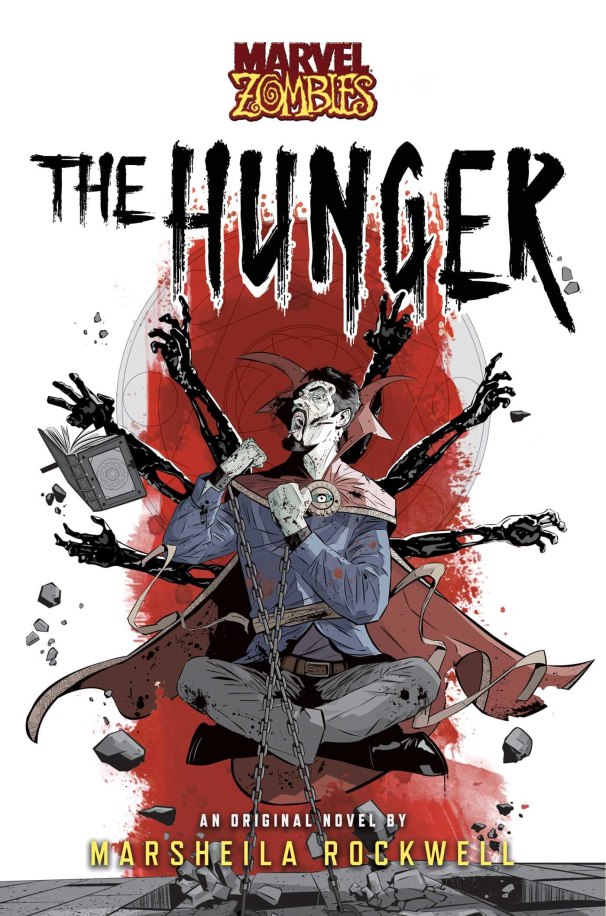
The Hunger by Marsheila Rockwell

The Hunger Cover

Publisher: Aconyte Books (ebook – 3 October 2023)

Series: Marvel Zombies

Length: 249 pages

My Rating: 4.5 out 5 stars

Amazon

Prepare to dive into a wacky, time travelling, zombie filled Marvel novel with Marsheila Rockwell’s fantastic tie-in book, The Hunger.

After having a lot of fun reading the awesome Marvel Comics tie-in novel The Tyrant Skies by David Annandale earlier this year, I thought it would be an excellent idea to dive into another amazing Marvel book, especially one with a great plot like The Hunger.  Written by intriguing fantasy and science fiction author, Marsheila Rockwell, whose previous foray in Marvel fiction produced the magic Sisters of Sorcery novel, The Hunger is an awesome upcoming book that I was very happy to get an early copy of thanks to Netgalley.  Set around the iconic Marvel Zombies concept, The Hunger was a pretty epic read that I had an outstanding time with.

When a mysterious object falls to Earth, landing in New York city, it unleashes a wave of evil and despair as the world’s greatest heroes are turned into ravenous zombies determined to feast on all living flesh.  As the zombified superheroes begin to spread out across the planet, turning or eating everything before them, only Doctor Strange can briefly retain his sanity to try and find a way to avert disaster, but despite his best efforts, his overwhelming hunger threatens all around him.

With no alternative, Doctor Strange is forced to turn to one of the few magic users left unaffected by the zombie outbreak, the librarian of the Sanctum Sanctorum, Zelma Stanton, who reluctantly takes up the burden and imprisons her zombified mentor.  Despite her lack of experience, Zelma has access to all the magical knowledge and ancient artefacts in Doctor Strange’s Sanctum Sanctorum, and she hopes to find some answer to the deadly chaos consuming her planet.  But Zelma soon realises that even all the books in the Sanctum aren’t enough; if she wants to succeed, she’s going to need help.

Pulling together a ragtag team of survivors, including Runaway witch Nico Minoru, monster hunter Elsa Bloodstone and the living embodiment of insanity, Deadpool, Zelma hopes that together they can find a solution.  But their plan to trap the zombies in a time loop backfires on them, thanks to antics of Deadpool, unsurprisingly.  Now with time fracturing all around them, an evil magic threat unleashed, and the zombie horde still determined to eat everything, Zelma and her strange team need to find a way to reverse the damaged they caused while still saving the world.  But is this group of survivors truly capable of stopping the flesh-eating nightmares waiting for them?

That was an insanely fun book about zombies and time travel shenanigans that I desperately needed, and I am sure glad that I decided to check this novel out.  The Hunger was a very entertaining book that I ended up knocking out in a few hours because of how easy and fantastic it was to read.  Rockwell came up with a very impressive story that quickly grabbed my attention and took me along a wild journey loaded with so many awesome moments.  Starting off with a great new introduction to an alternate Marvel Zombies event, where Doctor Strange and pretty much every other hero gets brutally turned into zombies, the story gets bleak very quickly and rarely lightens up after that.  The resulting narrative focuses on the intriguing figure of Zelma Stanton, a supporting character in one of the recent Doctor Strange comics, and it proves to be very interesting as you follow a young, inexperienced magician as she tries to survive in a very dangerous world.  The resulting story has a lot of great features to it as Zelma finds her courage, gathers a unique group of allies, and then finds herself getting thrown into all manner of chaos as her actions produce more zombie mayhem and every time travel issues you could think of.  The second half of The Hunger is pure, unadulterated bedlam, and I frankly loved every second of it, as Rockwell comes up with some outrageous and exciting scenarios that never really slow down.  Bringing together some well set-up storylines in some excellent ways, you honestly will find it hard to put down The Hunger once you get rolling with it, and I found the entire story to be exceedingly entertaining, especially as Rockwell wove together some complex scenes that saw the characters journey through all manner of unique points the Marvel Universe timeline.  This story was a riot from start to finish, especially the fantastic extended time travel sequences, and you will come away from this book very satisfied and honestly wanting more.

Rockwell has a great writing style that I felt really lent itself to the emotionally charged and intense story that came together in The Hunger.  Primarily told from the perspective of two young female magic users, The Hunger is a strong, character-driven tale that showcases how people grow under adversity, while also treating the reader to a brilliant amount of action, carnage and Marvel comics lore.  Rockwell really leans into the Marvel Zombies background of her story to provide some gruesome and graphic moments, which I felt helped set The Hunger apart from some of the other Marvel tie-in books.  While there is a lot of humour attached to the book, mainly thanks to the inclusion of a particular merc-with-a-mouth, The Hunger gets very deep and serious at times, and I loved the impactful dive into the traumas affecting the protagonists.  I loved the fast pace that Rockwell sets for The Hunger’s story, and frankly there was not a single moment of this book where I wanted to stop, as I just wanted to see what was going to happen next.  I did think some of the early sequences of the book felt a little simplistic in their writing, which almost threw me off.  However, Rockwell found her stride as the book continued, and I loved some of the elaborate sequences that emerged, especially those that feature multiple figures, time elements and obscure bits of Marvel lore.  Some of The Hunger’s twists were very well set up in the earlier stages of the book, and I loved how well things came together in the end, especially as Rockwell made such great use of the time travel elements to tell a very entertaining story.

The Hunger serves as a rather interesting addition to the wider Marvel lore that exists as Rockwell makes fine use of several existing storylines, concepts and characters, to create a pretty fun read.  Set in a version of the main Marvel universe that is suddenly impacted by a Marvel Zombies event, The Hunger has a ton of curious and distinctive elements to it that established fans of the comics will deeply enjoy.  Not only are there a ton of different characters present, often in zombie form, but Rockwell goes out of her way to feature or reference multiple storylines from the comics.  This includes a great mixture of more recent comics and some classic storylines, both of which work extremely well in the context of the story and its time travel elements.  I felt that Rockwell did a very good job of cleverly introducing and then utilising these different storylines throughout the course of the comics, and the resulting crazy plot encounters and big moments were pretty damn awesome.  Each of the main characters also makes sure to remember or mention many key story arcs from their history, many of which have a compelling impact on the current storyline or mental state.  The author clearly has an appreciation for the various storylines and obscure characters that she featured and I loved how random and compelling the later scenes got.  While Rockwell does go to some diverse areas of the Marvel universe and history, all of these elements and characters are explored in excellent detail so that anyone with some basic knowledge of Marvel comics can easily enjoy what is going on.  I personally loved all the cool references that emerged, as well the excellent reimagining of the Marvel Zombies storyline which helped turn The Hunger into a pretty awesome tie-in novel.

As with her previous Marvel tie-in novel, Sisters of Sorcery, Rockwell chose to focus The Hunger on three intriguing and somewhat underused female characters from the Marvel canon, Zelma Stanton, Nico Minoru, and Elsa Bloodstone.  All three characters are already epic, but it was great to see them forming a team here in The Hunger, especially when faced with an insane, world-ending threat.  Of these three characters, Zelma is probably the one I knew the least about, mainly because I’ve never read any of the Doctor Strange comics she is in, but she soon proved to be the invaluable heart of this entire novel.  Rockwell did a remarkable job of introducing and utilising Zelma as a character, even to a reader like me that has had no experience with her.  You are swiftly brought up to speed on who Zelma is and why she is involved, and soon you follow this overwhelmed magical character as she is thrust into events beyond her comprehension.  I loved the overarching narrative of this character finding her confidence and ability in this ultimate post-apocalyptic setting, and it was great to see her become the hero that Doctor Strange believed her to be.  Watching her use her unique intelligence and experiences to survive and attempt to stop all the chaos is quite compelling, and you really grow to appreciate Zelma, especially as she has very relatable doubts and concerns.  Zelma is the emotional heart of this entire book and I felt that Rockwell was very wise to use her as a central character, especially with how exceptionally she is portrayed.

In addition to Zelma, I really enjoyed the fantastic use of Nico Minoru and Elsa Bloodstone in The Hunger who served as impressive joint protagonists.  I particularly loved seeing Nico Minoru here in The Hunger, mainly because I’m such a big fan of Runaways, and Rockwell featured her in an excellent way.  Focusing on her at a key part of her character development from the comics, this already jaded and wary Nico arrives on the scene after seeing her entire adopted family turned to zombies and is swiftly forced into another harrowing adventure with a new group of strangers.  I really enjoyed exploring Nico’s fears, concerns and complex history throughout The Hunger, and she served as a great secondary point-of-view character for the plot.  These female characters are further enhanced by monster hunter extraordinaire Elsa Bloodstone, who is well suited for this sort of dark, monstrous tale.  The foul-mouthed, highly confident figure is a great addition to the focal cast of the novel, especially as her loud personality plays off the more reserved Zelma and Nico for a good chunk of the novel.  While initially shown to be mostly carefree, there are some compelling darker feelings under the surface, especially related to the start of the zombie apocalypse, and I felt that Elsa was a brilliant and great addition to the plot.

The final major character in the book really needs no introduction as Rockwell features Deadpool as the much need comic relief.  Brought into the story for very unique reasons, Deadpool is his usual blend of irrelevant humour, catchy one-liners, and all-round killing machine that works well with the female protagonists to save the day.  His constant jokes, weird comments and fourth wall breaks deeply add to the enjoyment I had of the book, even with its darker story content.  So many of the best plot moments in The Hunger revolve around Deadpool’s antics, and he really is an unsurpassed character to include in a crazy book like this.  His interactions with the other protagonists are also a lot of fun, with an intriguing blend of comedic conversations, crazed resentment, and even a grudging respect for his fellow survivors.  Throw in a ton of zombified superheroes, an overpowered magical witch from history, a fun new mount for Deadpool, and some intriguing figures from the dawn of the Marvel canon, and The Hunger has an outstanding cast that are a lot of fun to follow, especially during their darker and emotionally charged moments.

The Hunger really lived up to all its great potential and I had an epic time getting through this insane and highly exciting read.  Marsheila Rockwell produced one hell of a story here that made great use of the Marvel Zombies theme and featured a bonkers story with fantastic time travel elements, complex characters, and a ton of compelling references to the wider Marvel canon.  I honestly had such an incredible time with The Hunger and readers are guaranteed to get caught up in its cool story just like me.  Highly recommended, for all Marvel fans, you will have fun with this book.
Amazon

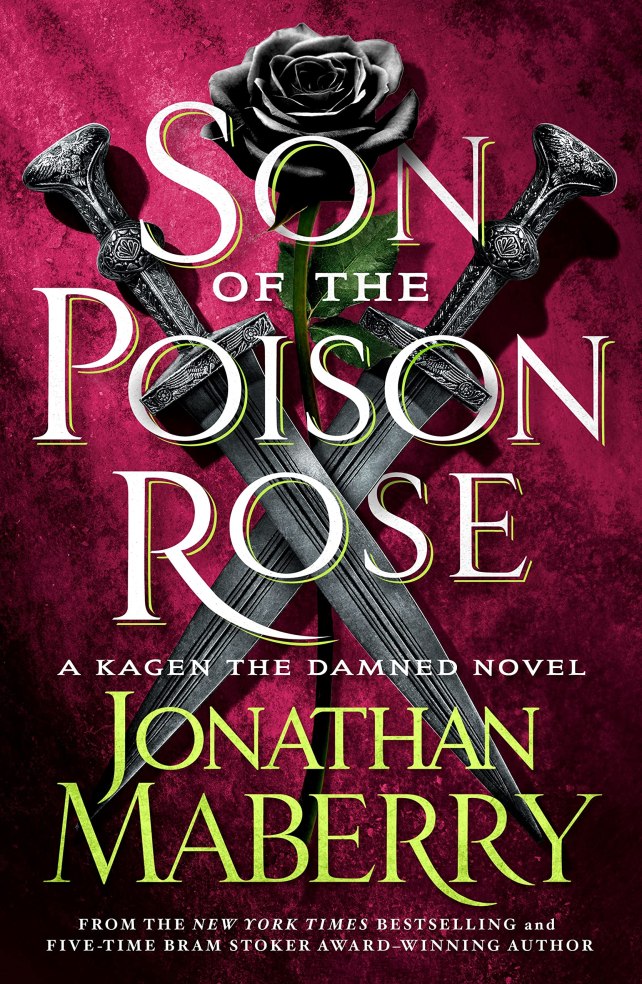
Son of the Poison Rose by Jonathan Maberry

Son of the Poison Rose Cover

Publisher: Macmillan Audio (Audiobook – 10 January 2023)

Series: Kagen the Damned – Book Two

Length: 25 hours and 55 minutes

My Rating: 5 out of 5 stars

Amazon

One of my favourite authors, Jonathan Maberry, returns to his intriguing fantasy world in a big way with the second Kagen the Damned novel, Son of the Poison Rose.

Readers familiar with my blog will know I am a massive Jonathan Maberry fan, and the path to my current obsession with his work is well documented throughout The Unseen Library.  I started off by reading his fantastic 2018 novel, Deep Silence, quite early in my blogging career, and this ended up getting me into the rest of his exceptional Joe Ledger series, including The Dragon Factory, The King of Plagues, Predator One and Dogs of War.  I have also had a great time reading his sequel Rogue Team International series, which featured the epic books Rage (one of my favourite books and audiobooks of 2019) and Relentless (one of my favourite books and audiobooks of 2021), as well as the fun standalone novel Ink (one of my favourite books and audiobooks of 2020).  Needless to say, I have deeply enjoyed his cool books, and this only increased when he made his impact into the fantasy fiction world last year with Kagen the Damned.

Kagen the Damned was an amazing and exceptional dark fantasy novel that took the reader on a wild ride.  Set in a brutal fantasy world of Maberry’s own invention, Kagen the Damned followed the titular character of Kagen Vale, a highly regarded hero and palace guard of the Silver Empire who loses everything in a single night when the armies of the dread nation Hakkia invade with dark magic, led by the powerful and deadly Witch-king.  Forced to watch his parents, his empress, and the royal children he was sworn to protect die terrible deaths, a haunted Kagen flees, only to be further destroyed when he beholds his gods turning their back on him, damming him for his failure.  Now known as The Damned, Kagen travels the world in a daze before finally regaining his senses and launching an attack on the Witch-king at his coronation.  However, this reveals secrets that shock Kagen further and spelling doom for the entire world.  I had an epic time reading Kagen the Damned last year, and it ended up being one of my favourite books and audiobooks of 2022.  Between this and the cool Kagen the Damned novella I Say Your Name in the Dark Nights, I have been eagerly awaiting a second novel and I was very excited when I heard that Son of the Poison Rose was coming out.  Son of the Poison Rose was one of my most anticipated books of 2023 and I finally managed to read it a short while ago and it was everything I hoped it would be and more.

“There is blood on the ground between us!”

Following his failed assassination attempt on the Witch-king of Hakkia, Kagen Vale, better known as Kagen the Damned, is once again the run with his companions, Tuke Brakson and Filia alden-Bok, attempting to find safety and come up with a new strategy of survival and revenge.  While their plan to kill the Witch-king failed, their attack stopped the return of the Hakkian God, Hastur, while also opening up the possibility of war, as the Witch-king’s fellow monarchs see the Hakkians as vulnerable.  However, Kagen also uncovered the terrible secret that the Witch-king is his older brother Herepath, who has turned his back on everything he once believed in to unleash great evil upon the world.

Wandering the wilderness, Kagen, Tuke and Filia attempt to come up with a new way to strike back against the Hakkian forces.  Their journey eventually leads them to the north of the continent, where they attempt to recruit an army of nationless-rogues, mercenaries and fighters to their cause.  But force of arms alone will not be enough to stop the Witch-king, instead Kagen and his allies will need magic.  But with magic long banned within the Silver Empire, only the Hakkians have any real knowledge of the mystic arts.  To that end, Kagen turns to former nun turned spymistress, Mother Frey, who sends Kagen on a deadly mission to a long lost city in a dangerous jungle in the hopes of recovering ancient books of dark magic.

However, the Witch-king is far from idle while Kagen is working against him.  With his army spread thin and the nations of the former Silver Empire all gearing up for war, the future looks grim for the usurper and his advisors.  But with new dark allies arriving every day, called to his side by magic, the Witch-king plans to unleash a magical plague, one that will turn his enemies into a ravenous, unthinking horde.  With such power at the Witch-king’s command, will Kagen’s quest reveal something powerful enough to defeat him?  And even if he does, will Kagen be able to fight his own brother?

Wow, wow, wow, what an epic and exceptional book!  Maberry can really do no wrong when it comes to his writing and this impressive sequel really hammers home what a talented author he is.  Masterfully expanding on the narrative set up in the first book, Son of the Poison Rose contains Maberry’s trademark blend of intensity, awesome action, complex characters, and dark world building that I love so much.  I absolutely powered through this lengthy novel, and it earns Maberry another easy five-star rating from me as I loved every single second I spent with it.

Maberry continues his sprawling and dark narrative in Son of the Poison Rose, as this book takes the reader in some great and captivating new directions.  Taking place in the explosive aftermath of Kagen the Damned, Son of the Poison Rose starts off in a big and action-packed way as Kagen and his allies find themselves being hunted by everything the Witch-king can throw at them.  Maberry quickly establishes his usual practice of featuring a huge number of different perspectives to showcase not only the adventures of the protagonists, but also the actions and schemes of the antagonists and the impacts that their machinations have throughout the world.  The main story of Kagen is pretty epic as it sees the protagonist and his friends struggling through new lands in the search of allies and magic.  While this results in some great scenes for Kagen in the first two thirds of the book, including a great haunted house sequence, his story here feels a little meandering at times without too much progress being made.  However, this is more than made up from the various alternate perspectives and worldbuilding that occurs in the same period.  It is so damn fascinating and entertaining to see the various dark and often horrifying plots of the antagonists come into effect as they plot for war.  These storylines blend spy thriller and dark fantasy elements together really well and you are drawn into these storylines, especially as Maberry takes the opportunity to strengthen the followers of the antagonists in some big ways.  The simultaneous build-up of other complex supporting characters, as well as the many examinations of various corners of Maberry’s new fantasy world adds to the impressive tapestry of the first two thirds of the story, and I was pretty damn hooked during this part of the book.

Maberry ramps up the intensity in the final third of the book as the various intriguing storylines he set up in the start of the novel really come to fruition.  This is headlined by Kagen and his allies travelling into a dangerous jungle nation to find a legendary ancient city where magical texts are hidden.  While I was initially concerned this part of Kagen’s story was going to be rushed, it ended up being very well written and awesome, as they encounter all manner of evils out in the jungle.  This final third of the book was again firmly enhanced by the continued dive back to the antagonists, where you see their evil plot to fill the jungle with zombies and other deadly creatures to kill Kagen and his comrades.  This results in an epic series of battles which keep you on the edge of your seat, as you know Maberry will not hesitate to kill off his characters.  The author chucks in several massive revelations around this part of the book, including finally showing the motivation behind the Witch-king’s actions, and the entire narrative ends on a big note while also expertly setting the stage for even more chaos in the following novel.  This ended up being a particularly epic story and I was firmly hooked the entire way through.

Those who are familiar with Mabbery’s novels will know that the author has a very distinctive style which has worked wonders in his many thriller novels.  Maberry successfully transported this style across to the fantasy genre last year with Kagen the Damned, and I felt it really enhanced his already impressive story.  Naturally he continues it in Son of the Poison Rose and it is still really effective at conveying the vast scope of his tale.  The main basis for his style is the utilisation of a vast number of shorter perspective chapters which showcase events from multiple characters across the narrative.  This results in a vast and complex story that not only allows the reader to see the adventures of the protagonist but also highlight the other players throughout the realm, including the antagonist, his court, the members of the resistance, and even several kings and rulers from unaligned nations who are making plans for war.  Maberry further expands out the plot by including a series of intriguing, often standalone interludes, which showcase smaller, self-contained stories within the wider universe.  These interludes are usually pretty cool, both by themselves and as extensions of the larger story, and I love how inventive and dark Maberry can be at times.  This mass of perspectives really helps to create an extensive and complex plot that has so many different aspects to it.  Seeing the protagonist and antagonist constantly reacting to the actions of each other, as well as other figures in the book, really ups the stakes and intensifies the plot, and I loved how Maberry gave this fantasy novel a strong thriller feel, especially with the continues focuses on politics, espionage and revenge.

Now, one thing about Maberry’s writing style that is not going to appeal to everyone is just how dark and disturbing the author makes the story.  Maberry is a particularly over-the-top writer at times, as he really does not hold back on the gore, violence and depravity, with the characters witnessing or causing all manner of mayhem or gruesome acts.  While this excessive violence and brutality fits the dark fantasy realm that Maberry has created, particularly as it highlights just how evil the antagonist and his legions can be, it is not going to be everyone’s cup of tea.  The torture, abuse and sadism of many scenes can be a bit much at times, and anyone that dislikes that sort of inclusion is probably best served to avoid this series.  However, for those that remain, I will point out that Maberry’s attention to bloody detail does ensure that the action sequences are extremely awesome.  The author has a gift for bringing the brutality and intensity of the battlefield to life in some truly glorious scenes, and you will be enthralled by every swing of the dagger or sword that he writes.  These action scenes are a beautiful, if bloody, highlight of this book, and the overall excessiveness of some of the scenes, especially when focusing on an over-the-top villain really plays into the wider narrative and setting.

I am still in love with the cool new dark fantasy world that Maberry created in Kagen the Damned, especially as the author took his time to populate with evil creatures, Lovecraftian gods and so much damn despair.  His first book served as a brilliant introduction to the various intriguing nations, and I deeply appreciated the intricate depictions of the Hakkian invasion, as well as the subtle and slow reintroduction of magic into this world.  Maberry continues to build up this world in several ways throughout Son of the Poison Rose, which results in some amazing story elements.  The focus on several of the other realms not seen in the first book is pretty interesting, as is the examination of the complex politics of the land as these now independent nations contemplate war with Hakkia after the concluding events of Kagen the Damned.  This builds up several great storylines as these rebelling nations and the Witch-king’s court plot different strategies to win any future wars.  Maberry also has a lot of fun exploring several new lands that were only hinted at in the previous books, and the protagonists soon end up in several unique and deadly landscapes, including cursed snowscapes with mysterious creatures, lethal jungles, and massive ruined cities dedicated to overthrown gods.  All of these locations are expertly introduced and described by Maberry, who uses them to his full advantage to increase tension and ensure that all the inevitable battles have a compelling new edge to them.

Another excellent thing that Maberry continues to do in Son of the Poison Rose is show how magic is slowly returning to the land due to the machinations of the Witch-king.  Thanks to several great chapters and interludes, you get to see the full horror as old magical creatures re-emerge, including the always reliable zombie, which plays very heavily into the plot.  Maberry is no stranger when it comes to zombies, having featured them in several books before (Patient Zero and Code Zero for example) and he uses to them to great effect here, both as political tools for the antagonist, and as rabid obstacles for the protagonists.  Other awesome features include the unstoppable, demonically powered, Razor Knight, which has a great showing at the end of the book, and it will be interesting to see how that, as well as some of the other magic unleashed in Son of the Poison Rose, come into effect in the rest of the series.  I also really appreciated how Maberry kept including a few references to his other series throughout Son of the Poison Rose, which is always a lot of fun for his established fans.  The hints of connection between this world and the settings of other books from Maberry is noticeable and fun without being too mysterious for new readers.  I especially loved the inclusion of a fantastic new villainous character who readers of the Joe Ledger books will be well familiar with under a different name, which I thought was an awesome touch for those who have read his other books.  I deeply enjoyed the impressive world building that Maberry did in Son of the Poison Rose, and I look forward to seeing how else he expands it in the rest of the series.

As always, one of the absolute best parts of Son of the Poison Rose were the exceptional, complex, and well-written characters that Maberry has expertly crafted together.  This includes a great combination of established figures from the first book, as well as a good collection of new characters who add some outstanding original spice to his second book.  Thanks to huge number of perspective chapters, the Kagen the Damned series features a pretty massive cast of damaged or sinister figures that Maberry uses to full effect to tell an elaborate overarching narrative.

Unsurprisingly, most of the focus of the book falls on series titular character, Kagen Vale, better known as Kagen the Damned.  Kagen had an outstanding introduction in the first book, where you see him lose everything, including his gods, in a single night, which drives him to great despair.  While he has managed to mostly recover from this thanks to his friends, he is still haunted by that dark night, especially after learning the truth about who the Witch-king is, as well as the identity of his heirs.  Driven by even further guilt, confusion, and anger towards his brother and his treachery, Kagen continues his impressive and emotionally rich journey in Son of the Poison Rose, and I had an outstanding time along the ride with him.  Maberry writes Kagen in an outstanding way throughout this book, and you really feel his pain and continued anger as he tries to deal with everything that has happened to him.  While he does bear some noticeable similarities to Maberry’s other major protagonist, Joe Ledger, especially when it comes to lethal prowess and severe psychological damage, I think that the author does enough to set Kagen apart, especially as his painful motivating event is a lot more raw and personal, resulting in some emotionally charged sequences.

Aside from Kagen, Maberry sets up a great supporting cast who add a lot to the main storyline while also introducing their own intriguing character moments.  It was great to see the return of Kagen’s main associates, Tuke and Filia, who continue to follow him into hell.  These three characters have great chemistry together and they form an impressive emotional centre to the story, especially as Tuke and Filia serve as Kagen’s conscience and voice of reason.  I also liked the return of Mother Frey, the clever spy mistress who is attempting to control the resistance against the Hakkians.  Her insights into the world and its political players often expands the intrigue of the story and she serves as a compelling figure in the plot.  I did find it interesting that one of the major figures from the first book, Ryssa, barely appeared in this novel after her fantastic storyline in Kagen the Damned.  However, her few appearances seem to hint at some sinister things in the future, and I look forward to seeing what Maberry organises with that.  Some of the more complicated and disturbing scenes of Son of the Poison Rose revolve around the captured Alleyn and Desalyn/Gavran and Foscor, the royal twins who were captured during the invasion, psychologically broken down, and forcibly given new identities.  These two mentally mutilated children spend the entire book trying to retain and regain their memories in some pretty dark scenes and thanks to their affliction, they run the gauntlet from sweet and damaged, to homicidal maniacs.  I felt that Maberry really showcased the twins’ mental state perfectly, and their dark storyline was an excellent addition to the plot.

However, to my mind, some of the best characters in Son of the Poison Rose are the villains, who add an entertaining and impressively sinister edge to the book, while also expanding out the political intrigue aspects of the plot.  These complex antagonists are led by the evil and destructive Witch-king, who was revealed to be Kagen’s long lost brother Herepath.  Empowered by dark magic, vengeance, and a need to keep his true identity hidden, the Witch-king continues his mission to kill Kagen and ensure that and opposition to this power is utterly destroyed.  The Witch-king proves to be a particularly malevolent figure throughout Son of the Poison Rose, even after his motivations are revealed to the reader, and he is the perfect foil to Kagen and his companions.

The Witch-king is backed up by a court of loyal, terrified advisors, each of whom are dedicated to the Witch-king’s plans, while also trying to stay alive and gather their own power.  This includes the fantastic trio of Lord Nespar, Lady Kestral and Jakob Ravensmere, each of whom have their own reasons for serving the Witch-king, and who each suffer for it in different ways, especially Kestral.  Nespar and Ravensmere deeply enhance the political thriller focus of Son of the Poison Rose, as their analysis, plotting and attempts to keep the Hakkians strong on behalf of their master results in some fantastic and powerful moments.  I also must call out the mysterious new evils that join the Witch-king’s side during Son of the Poison Rose, especially as many bring their own form of magic and despair with them.  The highlight of these new characters is the fantastic and devilish Prince of Games, a mysterious figure who comes to the Witch-king’s side to give advice, counsel and chaos.  The Prince of Games really stood out to me, not just because of his portrayal in Son of the Poison Rose but because of the great, universe-spanning implications his appearance has, and I cannot wait to see what havoc he creates throughout this series.  All of the antagonists are pretty great, and they all bring their own horror and darkness to the story, especially as they all do some pretty terrible and gruesome things to stay in power.  Honestly, every character in Son of the Poison Rose is awesome and memorable in their own way, and Maberry once again shows himself to be the master at effectively bringing together a truly complex cast of damaged and misfit figures.

In my opinion, the only way to properly enjoy a Jonathan Maberry novel is to listen to its audiobook, especially if that audiobook is narrated by the legendary Ray Porter.  This has been the case for pretty much every Maberry novel I have had the pleasure of reading, including Son of the Poison Rose, and all these epic audiobooks have been something special.  Not only do Maberry’s elaborate storylines and settings get the gravitas and exposure that they deserve in this format, but Porter’s narration really amps up the dark nature of the narrative and provides perfect depictions of the characters.  Porter, who is easily one of my favourite audiobook narrators, does another exceptional job in Son of the Poison Rose and I absolutely powered through this audiobook thanks to it.  His voice really lends itself to every dark and deadly scenario that Maberry envisions in this novel, and the way that he can convey fear, hatred and pure evil with his voice is just amazing.  His real talent lies in his ability to bring all Maberry’s complex characters to life in a particularly fitting way.  I especially love how he portrays the main protagonist, Kagen Vale, and he really captures every bit of pain, despair and resolve that this battered character contains.  Throw in a series of particularly disturbing voices for all the inhuman and horrifying creatures that the characters encounter, and this is a perfect narration that adds so much to my enjoyment of an already epic book.  With a run time of nearly 26 hours, Son of the Poison Rose is a particularly long audiobook (it would come in at number 14 on my latest Longest Audiobook I Have Ever Listened To list), but it is well worth the time investment especially once you get caught up in the twisted story.  I personally powered through it extremely quickly, as the combination of the amazing writing and impressive narration ensured I was listening to it continuously and loving every damn second of it.  As such, I must once again strongly recommend the audiobook format to anyone wanting to check out Son of the Poison Rose, and you will not be disappointed if you do as this is easily one of the best audiobooks of 2023.

I could go on for ages about Son of the Poison Rose, as Jonathan Maberry has done another exceptional job with this second Kagen the Damned novel.  Featuring an electric and addictive dark fantasy narrative, loaded with carnage, battles, great characters and an elaborate world on the brink of war, Son of the Poison Rose was a joy from start to finish, especially in its audiobook format.  This is easily one of the best fantasy books I have read all year and I cannot wait to see how Maberry continues this epic story in the future.  A masterful second book in one of the best ongoing dark fantasy series!

Amazon

Warhammer 40,000: Sepulturum by Nick Kyme

Warhammer 40,000 Sepulturum Cover

Publisher: Black Library (Audiobook – 3 March 2020)

Series: Warhammer Horror

Length: 7 hours and 9 minutes

My Rating: 4.25 out of 5 stars

Amazon

My obsession with Warhammer continues as I check out the grisly Warhammer Horror book, Sepulturum by Nick Kyme.

Over the last couple of years, I have had a lot of fun diving down into the epic Warhammer 40,000 universe.  This universe features so many epic and unique stories and characters, and I love all the fantastic tales that can be told across the genres.  One sub-genre of Warhammer fiction I’ve only had a little experience with so far is the Warhammer Horror books which, as the name suggest, blend gruesome horror elements with the already grim Warhammer universe.  I have so far enjoyed one Warhammer Horror book, the creepy and clever The Bookkeeper’s Skull by Justin Hill, which was brilliantly written and showcased.  I have been meaning to check out some other horror related Warhammer books, and when I saw that there was a zombie-centric Warhammer book, I knew it was something I would have to read.  This book is Sepulturum, a compelling read written by new-to-me author Nick Kyme.  Kyme is a veteran Warhammer writer, and I’ve got a couple of his other books sitting on my shelf already waiting for my attention.  However, my first experience of him was through Sepulturum, which proved to be a really fun and interesting adventure.

Something dark and deadly, something which hungers for blood and flesh, is stirring in the low-hive of Blackgheist.  The only person who can stop it is Inquisitor Morgravia Sanctus of the Ordo Sepulturum, whose investigation in Blackgheist revealed a terrible presence.  However, before she could act, something happened that destroyed her memories and left her scarred, broken and hunted.  Now with only one acolyte left, Morgravia attempts to find a psyker capable of restoring her mind to let her figure out what is chasing her and what their plans are.

Meeting with a broker from the criminal underworld, Morgravia believes that she has finally found the solution to her problems.  However, before she can proceed, a terrible attack is launched across Blackgheist which no one is prepared for.  The people of the hive have been turned into something violent, no-longer alive, and desperate to devour everything they come across.  These creatures are soon swarming across Blackgheist, destroying all before them and leading to untold chaos and destruction.

Soon, only small bands of survivors are left who hope to escape from the horrors surrounding them.  But as Morgravia leads one such group to safety, she soon discovers that not everything is as it seems.  Other deadly monsters are hunting throughout Blackgheist, while deranged cultists take the opportunity to seize power for themselves.  The truth behind the terrible events unfolding lies only within Morgravia’s mind, but is she truly prepared for the horrific secrets that are about to be unleashed?

Sepulturum was a fantastic and dark read that proved to be an outstanding addition to the Warhammer Horror range.  Kyme has produced a fast-paced and gruesome zombie story in an amazing novel that combines a clever story with some excellent horror elements.  The story itself is a fun zombie narrative as several characters attempt to survive a sudden onslaught of deranged and hungry former humans overrunning the city.  The story primarily focuses on the damaged Inquisitor Morgravia and a couple of her companions as they attempt to escape the horrors unleashed upon them and find its cause, although a second storyline revolves around a normal labourer, Cristo, as he tries to get his daughter to safety.  Both groups first encounter the zombie creatures in some pretty horrifying situations that leave them badly shaken and alone, and they are forced to navigate through the rest of the chaos in a daze.  Their subsequent attempts to evade the zombie creatures lead them further into danger, especially as there are other dark forces out in the city that provide additional awesome complications and conflicts, and there are betrayals, insanities and the feeling that the zombies are only a small part of the larger picture.  Everything leads up to some pretty disturbing final sequences that are loaded with brutal twists and major confrontations, especially as nobody is who they seem, and there is high need of some bloody self-sacrifice.  Readers will come away pretty satisfied with how the story ends, with horror fans no doubt liking the high body count, and the potential hint of a continuation in the future.

I loved how Kyme set out the story in Sepulturum, and it proves to be an outstanding read about survival and desperation in a Warhammer city.  The main setting for Sepulturum is already pretty gritty and unsavoury before the zombies, but everything only gets worse as the story unfolds.  The slow reveal of the zombie creatures is handled well, and I loved the slow-burn panic that sweeps the city.  The blend of character perspectives works well throughout the story, and while Morgravia and Cristo prove to be the main narrators, several other supporting cast members, often in Morgravia’s party, give an excellent alternative edge to the narrative while adding some fun moments to it.  Cristo’s separate storyline also works well in concert with the main narrative surrounding Morgravia and her survivors, and it was interesting to see their two stories play out simultaneously without the groups ever meeting.  Kyme has a lot of fun setting out some excellent elements of the story, and I particularly loved the attention to detail when it came to some of the fight scenes and the horror creatures the protagonists have to deal with.  There are also several great twists and reveals towards the end of the book, and while some are well foreshadowed, there is also one genuine surprise that I thought was pretty damn brilliant.  I did think the big conclusion ended up being a little to over-the-top metaphysical for its own good, but it was most a good ending with a fun last-minute inclusion from a whole other faction.  This ended up being a pretty good self-contained, standalone read within the wider Warhammer 40,000 universe, and not too much pre-knowledge of the Warhammer universe is needed to fully appreciate it, especially with the zombies there.  However, fans of the franchise will have the best time with it, and I felt this was a great inclusion into the wider Warhammer universe.

Naturally the real highlight of Sepulturum is the zombies, and it is always fun to see how Warhammer stories turn out when combined with genres like horror, especially as this universe already has some terrifying and shocking elements to it.  The zombies in Sepulturum are interesting inclusions to the story, especially as Kyme does a good job of brutally introducing them and then unleashing them upon a wider world.  While some members of the Warhammer 40,000 universe do have some concepts of what a zombie is, the vast majority do not, so the inherent panic and horror at what the creatures are is pretty crazy, and you have to love the reactions of the people who don’t know what they are dealing with.  All the zombie scenes are pretty ferocious, and the unstoppable horde coming at you is always pretty freaky to deal with.  I did quite like how the zombies themselves weren’t exactly what you thought they were from a Warhammer 40,000 lore perspective, and their presence heralds another threat, with some creepy alternate creatures.

In addition, Kyme also enhances other dark elements of the Warhammer 40,000 universe and uses that to increase the horror feel of the book.  The author affects a brooding and repressive tone across the entire book, and all the characters are caught up in intense feelings of despair and horror at what they are experiencing and the creatures they are encountering.  Kyme also introduces some gruesome body modification elements that work well with the zombies to create a terrifying read.  Body horror, including some of the more shocking elements around servitors, argumentation and other body modifications, is always close to the surface of any Warhammer story, but it was particularly bad here, especially as some characters are dissected or have elements contained within their bodies that Kyme showcases in distressing detail.  A lot of the horror is also derived from the craziness within people’s minds, as many of the characters break down in different ways after the initial zombie attack.  Watching characters go insane in various ways, whether through suicidal thoughts or with bloody religious fervour, really adds to the overall horror elements of the book, and I felt that Kyme had the right balance between outer and inner horror throughout this book.  The combination of the darker tone, zombies and other cool horror elements, really fits into the Warhammer universe well and I enjoyed the dark tale that Kyme told around it.

As is my usual practice, I ended up listening to Sepulturum on audiobook rather than seeking out a physical copy.  As always, it proved to be pretty epic.  I always love how well the audiobook format works to enhance the fantastic stories in the Warhammer universe.  This was especially good with Sepulturum, as the audiobook version helped to bring out some darker elements of the story and make Sepulturum feel even spookier.  Narrated by veteran audiobook narrator Antonia Beamish, who has worked on several Warhammer Horror books previously, the audiobook ensured that the darker tone and desperation of the characters really came through.  You really get a sense of the characters’ panic and despair through Beamish’s great narration, and I deeply appreciated how gruesome and ghastly all the horror details sounded when she described them.  The additional voices she used for several of the characters were pretty good as well, and you end up getting a good sense of each character’s personality, especially during the terrible encounters they go through.  Beamish’s voice work really helps to bring this entire audiobook together, and this ended up being an outstanding way to enjoy Sepulturum.  With a run time of just over seven hours, you can power through this audiobook quickly, and I deeply enjoyed listening to this gory book in this format.

The Warhammer universe offers further treasures as Nick Kyme has some zombie fun in Sepulturum.  A fantastic addition to the Warhammer Horror subseries, Sepulturum takes some great characters on a particularly dark and shocking adventure loaded with all manner of horror.  It’s an excellent and exciting read for fans of both Warhammer and horror fiction.  I deeply enjoyed this book and can’t wait to try out more awesome Warhammer Horror in the future.

Amazon

Throwback Thursday: World War Z by Max Brooks

World War Z Cover

Publisher: Random House Audio (Audiobook – 14 May 2013, originally published 12 September 2006)

Series: Standalone

Length: 12 hours and 9 minutes

My Rating: 5 out of 5 stars

Amazon

Welcome back to my Throwback Thursday series, where I republish old reviews, review books I have read before or review older books I have only just had a chance to read.  For my latest Throwback Thursday review I take a look at the zombie horror classic, World War Z by Max Brooks, a truly epic and outstanding read.

One of the biggest novels that I have been meaning to read for ages was the highly regarded zombie novel, World War Z, also known as World War Z: An Oral History of the Zombie War.  Written by Max Brooks as a follow-up to his first book, the non-fictional The Zombie Survival Guide, World War Z is a unique novel that fully examines a zombie apocalypse from multiple perspectives.  I had heard some great things about this novel, and I even enjoyed the movie adaptation when it came out (more on that later).  Unfortunately, I never got a chance to read it and I kind of figured for a while that it might stay in my to-read pile for a while.  However, it moved much higher up my list of books to check out after I read Brooks’s 2020 novel, Devolution, which was one of my favourite novels of 2020 (as well as one of my favourite all-time horror novels).  I had also heard a lot of praise for World War Z‘s awesome audiobook edition, so when my wife and I needed some entertainment during a recent cross-country road trip, this was our first choice.

Plot Synopsis:

The Zombie War came unthinkably close to eradicating humanity. Max Brooks, driven by the urgency of preserving the acid-etched first-hand experiences of the survivors from those apocalyptic years, traveled across the United States of America and throughout the world, from decimated cities that once teemed with upwards of thirty million souls to the most remote and inhospitable areas of the planet. He recorded the testimony of men, women, and sometimes children who came face-to-face with the living, or at least the undead, hell of that dreadful time. World War Z is the result. Never before have we had access to a document that so powerfully conveys the depth of fear and horror, and also the ineradicable spirit of resistance, that gripped human society through the plague years.

Ranging from the now infamous village of New Dachang in the United Federation of China, where the epidemiological trail began with the twelve-year-old Patient Zero, to the unnamed northern forests where untold numbers sought a terrible and temporary refuge in the cold, to the United States of Southern Africa, where the Redeker Plan provided hope for humanity at an unspeakable price, to the west-of-the-Rockies redoubt where the North American tide finally started to turn, this invaluable chronicle reflects the full scope and duration of the Zombie War.

Most of all, the book captures with haunting immediacy the human dimension of this epochal event. Facing the often raw and vivid nature of these personal accounts requires a degree of courage on the part of the reader, but the effort is invaluable because, as Mr. Brooks says in his introduction, “By excluding the human factor, aren’t we risking the kind of personal detachment from history that may, heaven forbid, lead us one day to repeat it? And in the end, isn’t the human factor the only true difference between us and the enemy we now refer to as ‘the living dead’?”

Note: Some of the numerical and factual material contained in this edition was previously published under the auspices of the United Nations Postwar Commission.

Holy hell, that was an exceptional book!  I loved the powerful and expansive narrative contained within World War Z as Brooks attempts to fully encapsulate the entire experience of a zombie apocalypse in impressive detail.  Literally all the good things I heard about this book were true, and I loved his unique and very captivating way of capturing the horrors of this sort of experience, both from the zombies and other humans.  An exceptional and impressively inventive read, World War Z gets an easy five-star read from me.

I cannot get over how awesome and distinctive World War Z was as a concept.  Rather than a traditional novel, Brook’s masterpiece is written as an epistolary novel, written as in-universe oral history anthology of a zombie apocalypse.  The book, which was compiled by this universe’s version of Max Brooks, contained multiple testimonials and interviews, as Brooks seeks out and talks to multiple people who experienced the apocalypse and pulls together their various unique stories.  This book contains around 40 individual stories set out across five chapters which look at the various stages of the zombie war, from its origins all the way up to the postwar ‘new normal’.

At this point I need to make a quick note about the version of World War Z that we checked out.  There are a couple of different World War Z audiobooks out there, but for our trip we listened to the World War Z: The Complete Edition, which combines two separate audiobook adaptations of the novel, and contains all the stories from the original book.  I did look over a paperback edition of World War Z before I started this review, and it looks like our audiobook version covered the full stories well, although I did notice that some of the stories were shortened or missing minor parts.  In addition, the audiobook version did not feature any of the paperback’s footnotes, which contained technical details and notes from the author.  However, I don’t think I lost out on too much of the plot from some of these missing gaps.

I really fell in love with the various individual stories contained with World War Z as Brooks went out of his way to produce the most unique and moving tales that he could.  These are mostly standalone tales, although there are a few interesting crossovers as the book continues, with some character’s mentioning events or supporting figures from other stories in their interviews.  However, as you follow the stories within these five chapters (made up of Warnings, Blame, The Great Panic, Turning the Tide, and Good-Byes), you get a full sense of the entire war, and it quickly comes apparent how cleverly Brooks was crafting everything here.  I personally deeply enjoyed both the individual shorter tales and the much larger connected story of World War Z, and I was deeply impressed with the excellent writing style behind it.  Brooks is a true master of writing deeply personal, character-driven tales of survival, and you swiftly become attached to the various protagonists as they tell their unique stories.  The action within is gruesome, fast-paced and deeply terrifying, and there are multiple over-the-top descriptions of zombie and human violence that will stick with you forever.  This was easily one of the best zombie novels I have read in terms of storytelling and action, and everything about this tale is so damn compelling.

As I mentioned, there are roughly 40 separate stories contained within this anthology, each of which contains its own unique protagonist, supporting characters, settings and unique circumstances.  Naturally, with so many stories you have a bit of a range in terms of storytelling, with some being substantially better than others.  However, I felt that Brooks did a very good job of writing each of these stories extremely well, and there were none that particularly dragged the novel down.  There is a real mixture of narratives here, with particularly gruesome horror stories mixed in with more human-focused narrative, political plotlines, military thrillers, stories that balance on the edge of science fiction, and everything in between.  The spread of these stories works pretty well, with Brooks providing an entertaining mixture of storylines throughout the book so readers aren’t constantly bombarded by tales of horror or tragedy.  Instead, there are often fascinating, humorous and humanising stories thrown in amongst the horror.  This works to make the entire novel flow at a fantastic pace.

While pretty much all these stories are fun and tell some outstanding tales of the zombie apocalypse, there are a few that stood out to me as being a cut above the rest.  I had some early fun with the Stanley MacDonald storyline, which showed an amoral illegal surgeon in Brazil unwittingly transfer a zombie heart into a patient, which led to one of the earliest outbreaks in South America.  The Jesika Hendricks plot showed a brilliant, if very dark, take on ordinary citizens trying to flee the zombies only to experience the other dangers of surviving the winter in a desperate community.  There are several amazing and cynical storylines, such as the Breckinridge Scott and Grover Carison testimonies that showcase the capitalist opportunism that surrounded the initial outbreaks.  I also really liked the South African focused storyline around Paul Redeker, which showed a former Apartheid strategist using his stark and brutal plans to save the country from the undead hordes.  I loved the particularly inventive and clever testimony surrounding the character of Arthur Sinclair Junior, which focuses on how America was reorganised after the initial stages of the war, with the country setting its sights towards industry, construction and warfare, which really highlights the author’s impressive insights into the world.

Two other fantastic World War Z storylines set in Japan focus on two unique individuals, one an “otaku” (a computer-obsessed outsider who tried to live entirely online), and a blind “hibakusha” (a person affected by the atomic bombs used in WWII).  Both characters were outsiders in Japan before the zombie war, but the zombie invasion changed their entire lives and led to them becoming renowned warriors and survivors against all the odds.  These two storylines are extremely compelling, and I loved the way that the author utilised unique subsections of Japanese society and tried to imagine how those sorts of people would survive the zombies.  There was also a really intense storyline, told by Admiral Xu Zhicai, that details a Chinese submarine’s attempt to escape the zombies with their families, which turns into a brilliant, powerful and occasionally disturbing tale of survival, loyalty and family.  I also must mention the Terry Knox testimony that details the actions aboard the International Space Station and the Darnell Hackworth story that looks at the US army’s canine units that helped scout and herd zombies (yay for mini dachshunds, the real heroes of this book).  However, out all the testimonies featured within World War Z, my favourite had to be the ones focussing on soldier Todd Wainio.  Todd battled the zombies at multiple stages of the war, and his multiple entries paint a pretty grim picture but are easily some of the best depictions of the horror of the zombies and the challenges faced by the armed forces.  His first testimony about the army’s initial inability to combat the zombies is very chilling, and it was fascinating to hear about the changes to his training and equipment as the military adapted to fight this new and strange enemy.  I am honestly just scratching the surface of these testimonials here, as pretty much all of them were great in their own way.  However, the ones I mentioned here were my personal favourites, and I had a blast listening to them and seeing how they fit into the wider narrative.

For me, one of the main highlights of World War Z was Brooks’s incredible inventiveness and insights when it came to envisioning a potential world-wide zombie apocalypse.  Thanks to his amazing range of stories, Brooks showcases a vast global catastrophe that impacts everyone no matter where they are.  I loved his depiction of how the apocalypse emerged, and rather than a continuous attack that pretty much destroys everything in a single day, Brooks imagines a gradual catastrophe that is initially ignored and mishandled before it spreads uncontrollably.  This is covered in the early chapters of the book with some substantial skill, and you really get to see how and why everything falls apart, with appropriate zombie violence included.  While there is an understandable focus on America, I found it fascinating to see how Brooks imagined different countries would deal with this crisis, with different culturally informed strategies, and there are even some compelling references to real-life figures (the Nelson Mandela facsimile reacts in a very different way than you’d expect).  The author really dives into all the details of a zombie attack and examines all the pros and cons of various strategies humans could utilise, from fleeing, staying in defensible positions, or fighting back.  There are some brilliant testimonies that cover all of them, and Brooks’s dark depictions of unprepared or overconfident humans failing to understand the threats in front of them and paying the price for it are shocking, bleak and captivating.  Brooks also comes up with some truly unique and clever problems or impacts of the zombies, many of which are referenced or experienced by multiple characters, including floating zombies, marine zombies, feral children who survived without their parents, looters, civil wars, and even crazed humans pretending to be zombies.

These intriguing insights from Brooks’s imagination are further expanded on in the later chapters of the novel, where the author explores how the world order changed because of the zombie war.  Again Brooks dives into multiple countries here, and it was fascinating to witness which countries the author imagines will be destroyed by the zombies and which would thrive.  I really enjoyed his examinations of the way that America needed to reorganise itself and its subsequent battleplans, which were perfectly covered by several of the best characters.  Seeing countries likes Russia, China, Japan and more change in drastic ways a result of this apocalypse was really cool and compelling, especially as the author covers it in such a reasonable and logical manner.  Countries like Cuba and the West Indies thriving due to their isolation was pretty fascinating, and they stood as an interesting contrast to more prominent countries that were disadvantaged or never stood a chance thanks to their socioeconomic issues or unsuitable landscapes.  I loved some of the unique issues that some countries experienced, such as the infested Paris catacombs or the mystery around North Korea, and they leave some intriguing afterthoughts as a result.  Brooks also cleverly examines other unique impacts that the zombies are having on the world, such as extinctions (goodbye whales), changes in global relations, and long-term problems, and I was deeply fascinated and enthralled by all this impressive thinking.  All of this compelling insight and imagination really enhances the stories being told by various characters, especially as they all impact humanity’s potential survival, and I really lost myself in the author’s powerful and impressive vision of a zombie apocalypse.

While World War Z is primarily about survival and the wider impacts of a zombie apocalypse, Brooks also takes the time to cover a few interesting themes.  In particular, he uses this novel about zombies to examine humanity.  While there is a certain overlying theme about the indomitable human spirit and our ability to triumph no matter the odds, there are some very noticeable depictions of the worst parts of human nature.  I found his initial depictions of most people ignoring or ridiculing the slow rising zombie threat to be pretty realistic (keep in mind that this was written 14 years before COVID).  There are also some major critiques about corruption and government incompetence in the face of disaster that I also found to be very intriguing and insightful.  Many of the early chapters that talked about military attempts to fight back had some interesting parallels to the wars in the Middle East, and I really appreciated the author’s clever critiques of these conflicts through the medium of a zombie war.  I felt that Todd’s testimony about the first major battle of the zombie war was a great example of this, as he regales the reader with how politically motivated leadership and incompetence led to a massacre.  All of this added a thought-provoking and entertaining edge to many of the storylines in the novel, especially the earlier testimonies, and I felt that Brooks did an amazing job bringing some of his own insights and critiques into his writing.

As I mentioned a few times above, I listened to the extended audiobook adaptation of this novel, which I personally felt was the absolute best way to enjoy this epic read.  Running at just over 12 hours in length, we absolutely powered through the World War Z audiobook during our road trip, and it served as an excellent entertainment for a long drive.  I often find that having a story read out to you really helps you to absorb everything about the story, and this was particularly true with World War Z.  Not only did the narration allow you to focus on all the details of the testimonials, but the horror elements and action felt a lot more intense, especially when you were dragged into some of the more gruesome scenes.  I also feel that the audiobook version of World War Z had a better flow than the paperback novel.  The testimonials with the audiobook are a lot more separated out, treated as a new chapter each time the narrator changes.  This is very different from the paperback version, which throws multiple testimonials in a quick fire manner, with everything crammed together into the five chapters.  As such, I really felt the audiobook helped to highlight the uniqueness of each testimonial and you really got to focus on each story a lot more.

However, easily the best thing about the World War Z audiobook was the truly impressive voice cast that were featured within.  Brooks, a voice actor himself, recruited a crack team of international actors to fill out his cast, including several A-listers, who give some outstanding and amazing performances.  All these actors really dive into their various roles here, conveying the emotion, fear and insights of their protagonists, and their great voice work definitely enhanced the already cool stories of their characters.  I deeply enjoyed all their voice work throughout the audiobook, and I know that I enjoyed several testimonies even more because of the talented actors voicing them.  This cast is led by Brooks himself, who voices the interviewer, asking all the questions and meeting all the various figures the novel is set around.  Brooks does a really good job here, and his calm, collected interviewing style and additional narration helps to set the scene for the entire novel and moves the other character’s stories along at a great pace.

Aside from Brooks, there are a good 40 or so voice actors featured in the World War Z audiobook, and I was pretty impressed with all their performances.  Some standout early performances include a brief appearance from Nathan Fillion as Canadian soldier Stanley MacDonald; Paul Sorvino, who gives a very fun performances as the sketchy doctor Fernado Oliveira; and Martin Scorsese, who gives an unrepentant portrayal of corrupt businessman Breckinridge Scott.  Other great performances include Kal Penn as Sardar Khan, an Indian soldier who serves an excellent witness to an act of heroism; the late, great David Ogden Stiers, who brings Ukrainian solider Bohdan Taras Kondratiuk to life perfectly as he watches a great act of evil from his government; Common as dog trainer Darnell Hackworth; and Rob Reiner as “The Whacko” a radical politician/former Vice President who shares his strong opinions in a very fun outing.  I really need to highlight some intriguing voice performances from Simon Pegg, who does a pretty good Texan accent in the role of Grover Carlson; and Alfred Molina, whose Australian accent was pretty accurate (a rare talent).

The performances of Masi Oka and Frank Kamai really brought to life the two Japanese characters I mentioned above, as does Ric Young for Chinese Admiral Xu Zhicai’s elaborate testimony.  I also really need to highlight the brilliant work of Alan Alda in this book as he voices pivotal administrator Arthur Sinclair Junior.  Alda, whose voice I have loved since M*A*S*H, perfectly inhabits the role of this intriguing figure, and I loved hearing his narration of how America’s economy was changed.  However, out of all the voice actors in World War Z, my favourite was the always impressive and remarkable Mark Hamill, who voiced standout character Todd Wainio.  Hamill was one of the main reasons why Todd was such a great character, and I loved his outstanding performance as a former ground soldier recounting all the horror of the front line of the zombie war.  There is so much weariness, trauma and cynicism in Hamill’s voice as he narrates Todd’s testimony, and you really feel the character’s resentment and anger.  The way that Hamill describes all the gruesome gore and zombie violence was just so great, and his impressive range and tone helped to really enhance the insanity and horror of the moment.  These voice actors, and the rest of the impressive cast, are extremely epic here, and they turned this production into something extremely impressive.

A quick final note about the World War Z film.  Until I read this book, I really did not appreciate how wildly off-book the film adaptation was.  None of the true magic from the original story appears in the film at all, as they turned it into a generic action flick rather than a clever analysis of how a zombie apocalypse would change the world.  While I did enjoy the World War Z movie on its own, it is a terrible adaptation, with only small elements from the book appearing in the film.  While I can appreciate that this is not the easiest book to turn into a film, they didn’t even try.  I really do hope that someone does a proper adaptation of World War Z at some point, as it frankly deserves a lot better than what it got (perhaps a television series with each episode recreating one of the testimonies).

As you can clearly tell from the massive essay above, I deeply enjoyed World War Z by Max Brooks.  This was easily one of the best zombie novels I have ever read, and it definitely deserves its epic and highly regarded status.  Brooks’s distinctive and brilliant story was just plain amazing and I loved the outstanding combination of smaller testimonies coming together into one connected and thought-provoking tale.  The author cleverly examines every single aspect of a potential zombie apocalypse, and you find yourself not only loving the insane horror elements, but the fascinating political and social impacts that come with such an invasion.  Best enjoyed in the full audiobook format which features so many impressive voice actors, World War Z comes extremely highly recommended and I cannot hype it up enough!

World War Z Cover 2

Amazon

Throwback Thursday – Star Wars: Death Troopers by Joe Schreiber

Death Troopers Cover.jpg

Publisher: Random House Audio (Audiobook Edition 13 October 2009)

Series: Star Wars Legends

Length: 6 hours 42 minutes

My Rating: 4.25 out of 5 stars

Amazon

Reviewed as part of my Throwback Thursday series, where I republish old reviews, review books I have read before or review older books I have only just had a chance to read.

In this week’s Throwback Thursday, I look at an entertaining blend of horror and Star Wars with Death Troopers, a book from the Star Wars Legends collection which I listened to in its audiobook format.

Death Troopers is set a short time before the events of Star Wars: Episode IV – A New Hope.  The Imperial prison barge Purge is the temporary home of the galaxy’s worst criminals, rebels and murderers.  Carrying over 500 prisoners, as well as guards, stormtroopers and other personnel, the ship is a floating hive of scum and villainy, where the guards are just as bad as the inmates.  En route to a permanent prison facility, the engines fail, stranding the Purge in an uninhabited area of space.  Rescue appears to be weeks away, unless the crew can fix the engines.  The discovery of an apparently deserted Star Destroyer offers hope to the Purge’s crew, but the ghost ship contains a dark secret.

A boarding party sent to scavenge parts for the Purge inadvertently brings back something lethal: a virus that spreads incredibly fast and soon infects everyone aboard the ship.  Within hours, only a few survivors are left alive: the ship’s compassionate doctor, the sadistic captain of the guards, two young teenage brothers and a certain pair of smugglers.  However, these survivors soon discover that the sudden and bloody death of everyone on the ship is the least of their problems.  Shortly after dying the bodies of the Purge’s crew and passengers violently reanimate.  These creatures are driven, unstoppable and have a hunger for the flesh of the living.  As the survivors attempt to flee the Purge, they soon find that the Star Destroyer above is not as abandoned as they had believed.  The dead have risen, and their greatest desire is to infect the entire Star Wars universe.

Zombies!  In a Star Wars book!  How can I possibly resist that?  No seriously, tell me how it is even possible not to check out a book with that sort of premise.

Death Troopers is a 2009 release from horror, thriller and tie-in novel author Joe Schreiber, who wrote several fun-sounding books between 2006 and 2015.  These novels include two additional Star Wars novels, all of which fall in the Star Wars Legends line of novels.  Indeed, his third Star Wars novel, 2014’s Maul: Lockdown, was actually the last novel released in the Star Wars Legends series of books.  His other Star Wars novel, 2011’s Red Harvest, is a prequel to Death Trooper, and is set in the Old Republic, thousands of years before the events of Death Troopers.

The Star Wars Legends series of books is the current incarnation of the old Star Wars expanded universe, which, in addition to the six Star Wars movies that George Lucas produced, included all the books, comics, video games and television series that were endorsed by Lucasfilm.  All of these entries were considered canon, so at one point there were actually proper zombies in the Star Wars canon.  While the original expanded universe did have a dedicated fan base, it did not survive the Disney buyout of Lucasfilm intact.  In order to allow for the new movies, Disney declared that, with the exception of the films and The Clone Wars television show, everything created before 25 April 2014 would no longer be considered canon.  However, rather than disavow all of these previous Star Wars media items, Disney rebranded this original expanded universe as the Star Wars Legends collection and kept it as a deep pool of ideas and characters for any future writers of the franchise.

It’s no secret that I am a bit of a Star Wars fan, having reviewed several tie-in books and comics in the last year.  While my current interest mostly lies within Disney’s expanded universe, I did grow up with a number of books and games in what is now the Star Wars Legends range.  Star Wars books and comics are going to form a significant part of my upcoming Throwback Thursday entries, but I had not intended to dive back into the Star Wars Legends range until I had gotten through all the books in the Disney expanded universe, as I wanted to stick with what is currently canon.  However, I happened to come across the cover and plot synopsis for Death Troopers the other day, and the moment I saw it I knew that I had to read it.  I immediately grabbed an audiobook copy, narrated by Sean Kenin, and started listening to it.

While I loved the plot synopsis, I was worried that Death Troopers was going to be a Star Wars novel first that featured some light zombie elements and minimal gore.  However, what I was not expecting was an extremely terrifying and well-written zombie novel that makes full use of its Star Wars setting to create a dark, gruesome and somewhat scary story.  I was very impressed with Schrieber’s ability to craft an amazing zombie novel.  His creations are pretty darn terrifying, especially as the author paints some detailed and horrifying descriptions to go along with his story.  The introduction of the zombies is done perfectly, in my opinion, as Schreiber goes for a slow burn approach.  Following the introduction of the virus, the book’s survivors slowly explore the ship, searching for a way to escape.  The author slowly builds up the tension by having things move around out of the characters’ sight, the bodies slowly disappear, bloody handprints appear in places and the characters hear all sorts of noises.  The characters of course have no idea what is happening, and blame their imagination or paranoia, but the reader knows full well what is happening.  Even when the first zombie is actually seen, panic and realisation still does not immediately set in for the rest of the characters, much to the reader’s frustration.  It is not until well after halfway through Death Troopers that the zombies are revealed in all their horror, and from there the pace of the book picks up, as the characters must find a way to quickly get away from the creatures hunting them.  This slow introduction of the zombies was a fantastic part of the book and represents some outstanding horror writing from Schreiber.

Despite this being a Star Wars novel, Schreiber does not dial back on the blood, gore or horror, and there are quite a few dark scenes throughout the book.  I was on the edge of my seat for quite a lot of it and felt that this was a great piece of horror fiction.  There are quite a few dark scenes, such as cannibalism, jaunts in rooms full of body parts and some fairly gross surgical scenes, all of which Schreiber describes in shocking detail.  I did find the story to be a bit predictable in places, and it was pretty easy to predict which of the characters would live or die.  There were also quite a few unanswered questions (what the hell was the lung room for?), although they may be answered in the prequel book Schreiber wrote a couple of years later.  I also thought that the way Schreiber ended the plot line about the zombies attempting to escape the Star Destroyer and infect the rest of the universe was a bit of an anti-climax, but overall this was a pretty fun story that I quite enjoyed.

I felt that Schreiber was quite clever in his use of the Star Wars elements throughout Death Troopers.  It is quite obvious that Schreiber is a fan of the franchise and he has a wonderful understanding of the history, technology and characters that have appeared in other Star Wars works.  As a result, he is able to craft an excellent Star Wars setting for this story that presents the reader a good idea of how this book appears in relation to the rest of the franchise.  However, what I really liked was how Schreiber did not overuse the Star Wars elements, and the reader’s focus was never taken away from the zombie part of the book.  I also felt that several of the Star Wars elements really helped to enhance the horror aspects of the book.  Having the familiar turn into something different can often be quite scary for people, and to see the often-ridiculed Imperial Stormtrooper turned into a ravenous, mutilated zombie was quite something.  The inclusion of fan favourite characters Han Solo and Chewbacca was also a nice touch.  Not only do you have some familiar characters for the readers to enjoy but you also raise the stakes of the story when both of these beloved characters come close to being eaten by zombies.

Another benefit of combining Star Wars and zombie fiction is that for once characters are completely justified in not knowing what a zombie is.  There are quite a few other major zombie movies or television shows set in fictional worlds that are supposed to mirror ours, and yet the protagonists have no idea what zombies are, despite how much they are used in fiction.  This always frustrates me, and while it was a minor thing, I was very happy to read a book where the character’s lack of understanding about zombies is completely understandable.  Overall, I really liked how the author presented the Star Wars elements within the book, and I was impressed by the way he used it to make the zombie elements even scarier.

If you are tempted to check this book out, I would highly recommend that you listen to the book in its audiobook format.  At just over six and a half hours, this did not take me a long time to get through, but I was absolutely amazed at how much the audiobook format enhanced the story.  This is mainly down to the fantastic sound effects that were scattered throughout the story.  The producers of this book did a superb job inserting a range of zombie sound effects throughout the background of the book’s narration.  This includes sounds such as screams, disturbing eating sounds, moans and other assorted sounds of horror, with the continued screams being particularly off-putting.  None of these sounds overwhelm or totally distract from the narration, but I found hearing them when the narrator describes a horror scene really enhanced the tension and dread I experienced.  I also thought that the disconnected, whispered and screamed echoes of the chapter names was a very nice touch and it really added to the overall atmosphere of the book. In addition to these horror based sound effects, there are quite a few classic Star Wars sound effects for the reader to enjoy and get nostalgic about, including some of the classic music from the movies.

Sean Kenin’s narration was also extremely well done, as the narrator was able to create a series of fun and distinctive voices.  I thought that Kenin’s Han Solo was very convincing, and it sounded a lot like the movie version of the character.  I also found that having this horror story narrated to me helped bring me into the centre of the action and really experience the horror and dread that was present there.  The narration of the descriptions can be a bit disturbing at times, and I would recommend not eating during one or two scenes; trust me on that.  As a result, I would highly recommend that people wanting to check out Death Troopers should definitely use the audiobook version of it, as in my opinion it does an amazing job enhancing this already fun story.

I am happy to say that I was not disappointed by this entertaining combination of zombie literature and the iconic Star Wars universe.  This was a pretty dark story, which also includes some familiar elements from a franchise that I truly love.  Because of this I had an outstanding time reading Death Troopers and felt that it was a great example of both a zombie novel and a piece of Star Wars fiction.  In my mind the book itself is four stars out of five, but I had so much fun with its audiobook format that I am raising it up to four and a quarter stars.  An overall fantastic and unique read, Death Troopers is really worth checking out for fans of either zombies or Star Wars and is perfect for those who love both.  I am very curious to check out Schreiber’s other Star Wars books in the future, as both of them sound like a lot of fun.

Amazon

Throwback Thursday: Patient Zero by Jonathan Maberry

Patient Zero Cover.jpg

Publishers: St. Martin’s Griffin

                       Blackstone Audiobooks

Publication Date – 3 March 2009

Amazon     Book Depository

Reviewed as part of my Throwback Thursday series, where I republish old reviews, review books I have read before or review older books I have only just had a chance to read.

A couple of weeks ago I listened to and reviewed the latest book in Jonathan Maberry’s Joe Ledger series, Deep Silence, and found myself hooked on the insane, mad science based thriller adventure.  After enjoying Deep Silence and giving it a five-star review, I started checking out some of the previous books in the Joe Ledger series that I had not had a chance to read before, and found myself enjoying the plot concepts of the other books in the series.  The moment I finished listening to Deep Silence, I immediately jumped back to the first book in the series, Patient Zero, to review as part of my Throwback Thursday series.

When Baltimore detective Joe Ledger is assigned to a joint terrorism taskforce, he thinks it is an opportunity to fight back against the people responsible for 9/11.  What he was not expecting was to have a crazed man try to bite him on his first raid with the taskforce after discovering a warehouse filled with terrorists.  His elation about a job well done is destroyed when he encounters one of the terrorists again later that week.  There is just one problem: Ledger knows that he killed him during the first raid.  Someone has created a terrifying bio-weapon that can turn ordinary people into zombies, and worse, they have supplied this virus to a destructive terrorist organisation that plans to release it within the United States.

As the full extent of the horror being unleashed against them is revealed, Ledger finds himself recruited into a newly created covert organisation that was set up to handle extraordinary threats such as this.  Known as the Department of Military Sciences (DMS), this organisation wields the latest technology and the country’s brightest scientists under the command of the mysterious Mr Church.  As a member of the DMS, Ledger leads an elite team of combat specialists in the field in an attempt to contain any attempts to unleash the virus on the population and to destroy those who have already been infected.  As Ledger’s investigation progresses, he uncovers an elaborate conspiracy that will have devastating impacts for all of humanity.  But with the fate of the world in the balance, it soon becomes clear that there is a traitor within the DMS who has no qualms about unleashing a zombie apocalypse.

I have to admit that after absolutely loving Deep Silence, I had very high expectations when I started reading Patient Zero.  Luckily I was not disappointed and found that Patient Zero had a fantastic action based storyline that makes good use of its mad science elements to create an intense and very enjoyable novel that sets up all the elements for this future series.  I also chose to check out the first book in this series in its audiobook format, which, at just under 15 hours, is a great way to enjoy this high-octane story.

Hands down, the best thing about this novel has to be the zombies and the way that Maberry has created a compelling and intricate thriller story around this classic horror story concept.  The thriller aspect of this is really clever.  Rather than being the central antagonists themselves, the zombies are a tool being utilised in a wide-reaching conspiracy that the protagonists have to unravel in order to figure out the origins and endgames of the book’s true antagonists.  These thriller elements are quite detailed, and Maberry utilises a number of chapters told from the antagonists’ point of view to add some depth to the conspiracy and showcase the extent of their plot, as well the problems these groups have.  The protagonists also have to deal with potential traitors in their ranks, advanced science that they do not understand and a surprisingly organised, devious and well-equipped terrorist organisation.  All of this is an extremely captivating thriller storyline, and I love how Maberry has managed to utilise the book’s zombie element to help flesh this out.

Maberry has also created a unique and intriguing zombie origin for this book that is based on potential real-life science.  The zombies in this book are the result of a disease rather than a supernatural calamity.  They have been created by some advanced science and extreme mutations of existing diseases and viruses, such as prion diseases.  As a result, Maberry and his characters spend a lot of time examining the potential science behind this zombie virus, which pulls the reader in as they consider how close something this crazy could be to a reality.  I was really struck by the way that Maberry tried to show the horror that these creatures would inflict on the people who encounter them, and the sheer terror that they inflect on normal humans.  The point-of-view protagonists spend significant time explaining how terrifying and emotionally damaging it is to have to encounter and fight these infected people, as well as how guilty they feel about having to kill them.  There are quite a few parts of the book where the characters discuss how damaging these events are to them, and it really adds some emotional gravitas to this story.  Maberry is a prominent author of zombie fiction, so it is no surprise that he is able to create quite a number of awesome and terrifying scenes featuring the zombies as they attack and kill all around them.  There are also some interesting zombie deviations that appear and offer some unique elements to the story.  Overall this is an incredible and memorable addition to this story and one that will really appeal to fans of zombies and the horror genre.

Action is a major part of the Joe Ledger series, as the protagonist leads an elite special forces unit against all these elite scientific threats.  As a result, there are a huge number of action sequences throughout this novel and the reader is constantly left with a racing pulse.  There are so many great fast-paced elements throughout Patient Zero for action junkies to enjoy.  Maberry is always great at describing special forces tactics in his stories, and I enjoyed seeing them used against the unique threats in this book.  There are a number of excellent firefights throughout the story, and the author has a great mind to examining the psychology of a gun battle.  Maberry’s love of martial arts and close-combat fighting once again shines through in Patient Zero, as his protagonist is an expert fighter who has innumerable hand-to-hand fights with a number of different opponents.  While the above actions scenes are all extremely awesome, the best scenes have to revolve around the desperate fight between these elite soldiers and the horde of zombies that they encounter.  These scenes are really fantastic and watching the special forces characters fight tooth and nail against a horde of zombies becomes a captivating and powerful part of this book.  There are quite a few crazy action scenes throughout Patient Zero for the reader to look out for and which are defiantly a highlight of the book.  I personally found that listening to these scenes in the audiobook format really brought me into the centre of the action, and it was an excellent way to enjoy this element.

Patient Zero is an excellent introduction to the Joe Ledger series and contains a number of elements that will continue into the rest of the series.  I came to this book having first read the 10th and latest book in the series, Deep Silence.  As a result, I was really intrigued to see what characters were introduced in the first book and which ones do not appear in the final book of the series.  There are some interesting differences between Patient Zero and Deep Silence that I found quite fascinating.  For example, the opponents and technology in this first book are a lot more realistic, as Maberry has yet to start utilising the Lovecraft-inspired aliens which feature in some of the later Joe Ledger novels.  The head of the DMS, the mysterious Mr Church, also comes across as a much colder character in this first book, as well as someone who is more comfortable with civilian deaths and sacrifice if it results in the survival of the rest of the world.  That being said, there are some familiar elements.  Ledger is still an incredibly sarcastic and funny protagonist, and the author tries to highlight a huge range of varied viewpoints to show the whole range of the plot the DMS is trying to unravel.  Patient Zero serves as a great introduction to the DMS, and I really enjoyed seeing the early days of this organisation.  I also love how everyone is quite confused about what this organisation is and the mystery around Mr Church, who appears to have an incredible amount of influence and power in Washington.  For example, at one point he actually tells the president of the United States that he is wasting his time and hangs up on him in, an action an incredulous Ledger describes as “bitch-slapping the president”.

Patient Zero is an incredible first novel in Jonathan Maberry’s incredible Joe Ledger series and one that serves as a fantastic introduction for readers unfamiliar with this series.  Featuring all sorts of mad science, impressive action sequences, a five-star thriller storyline and a ton of amazing zombies, this is an outstanding novel and one that proves very hard to put down.  After loving this book, as well as the latest book in this series, Deep Silence, I am now fully determined to read the rest of the books in the Joe Ledger series.  Fully expect to see a review for The Dragon Factory very soon; I have no doubt that I will really enjoy that book as well.

My Rating:

Five Stars

Amazon     Book Depository

Nights of the Living Dead edited by George A. Romero and Jonathan Maberry

Nights of the Living Dead Cover

Publisher: Duckworth

Australian Publication Date – 1 December 2017

World Publication Date – 11 July 2017

Amazon     Book Depository

In 1968, the late, great, George A. Romero created one of the most iconic films in horror movie history, Night of the Living DeadNight of the Living Dead has had many lasting impacts in the world of film, but one of the most significant things it did was to firmly enforce the terror of the zombie into the public consciousness and set the rules for all future zombie works.

Since that day, zombies have dominated people’s minds and pop culture in all its forms.  From movies to television and comic books, zombie stories infest modern fiction.  The introduction of zombies has also influenced the world of literature, with many prominent authors producing some incredible and varied works of zombie fiction.  From World War Z to Warm Bodies, these bestsellers have enthralled the world, with many serving as inspiration for other mediums.

One significant piece of zombie literature published in 1989 was Book of the Dead, edited by John Skipp and Craig Spector.  Book of the Dead was an anthology of short stories based on the zombie apocalypse premise introduced in Night of the Living Dead.  With a foreword by Romero himself and bringing together original stories from a large number of prominent horror authors, including Stephen King, this iconic book is considered one of the first pieces of zombie literature.  It produced two follow up anthologies, Still Dead and Mondo Zombie.

Now, the concept of a zombie anthology book has again been resurrected in Nights of the Living Dead, edited by George A. Romero and Jonathan Maberry.

Nights of the Living Dead contains 20 new and unique stories from a distinguished group of authors.  Each of these stories is set in a world forever changed by a zombie apocalypse and shows the horror through the eyes of a range of different survivors enduring a number of different scenarios.  Police, doctors, murderers, white supremacists, scientists and showmen all examine different sides of the classic zombie apocalypse.  Many of the stories are set in more contemporary times, exploring how people in 2017 would react to this phenomenon while also allowing some commentary of current social issues.

Fans of the original movie may also be interested in several stories set during the events of the film.  The connection that some of these stories have to Night of the Living Dead is somewhat minor, with the stories merely being set in the same year, thus allowing the reader to assume they are set during the same outbreak.  Other stories have a far more significant connection to the events of the movie.  John Russo’s story is a direct sequel to the movie and follows some of the posse that played a significant part in the end of the film.  Another story, by Isaac Marion, is told from the perspective of a minor character in the film, Karen Cooper, and features her dramatic and eventually violent interactions with other characters in the movie.

Perhaps one of the best features of Nights of the Living Dead is the sheer talent that has been gathered together to write this book.  Numbered among the contributors are some of the most influential writers of zombie fiction, including both of the Night of the Living Dead’s original screenwriters, Romero and Russo.  The other writers include multiple Bram Stroker Award winners, such as editor Jonathan Maberry, whose contribution to zombie culture includes working on the Marvel Zombies series.  Many of the authors have their own zombie fiction novels and series, including Isaac Marion, writer of Warm Bodies, Briane Keene, author of The Rising, and Mira Grant, author of the Newsflesh series.  The list of contributors also includes people who have worked on zombie comics and television shows, including one of the writers and co-creators of Z-Nation, Craig Engler.

The various contributions to the anthology allow the reader to enjoy a range of zombie stories which may appeal to different people.  Personal favourites include David Wellington’s short story set around the International Space Station and Mira Grant’s emotional tale set in a zoo.  Other great stories includes Craig Engler’s tale of vigilante justice in a world of zombies and a new original contribution by George A. Romero, which also takes the time to examine racism in more modern times.  Readers may also be interested in the forewords from Romero and Maberry, which examine their experiences with the movie and how it has influenced zombie culture for the last 50 years.

Nights of the Living Dead is an exciting anthology series that presents the reader with 20 new and unique stories from some of the leading minds in zombie fiction.  With a range of different and exciting stories of the zombie apocalypse, many with ties to the original movie, this is a must-read book for all fans of zombie fiction and the man who inspired it all.

My Rating:

Four stars

Amazon     Book Depository