Star Wars: Thrawn: Treason by Timothy Zahn

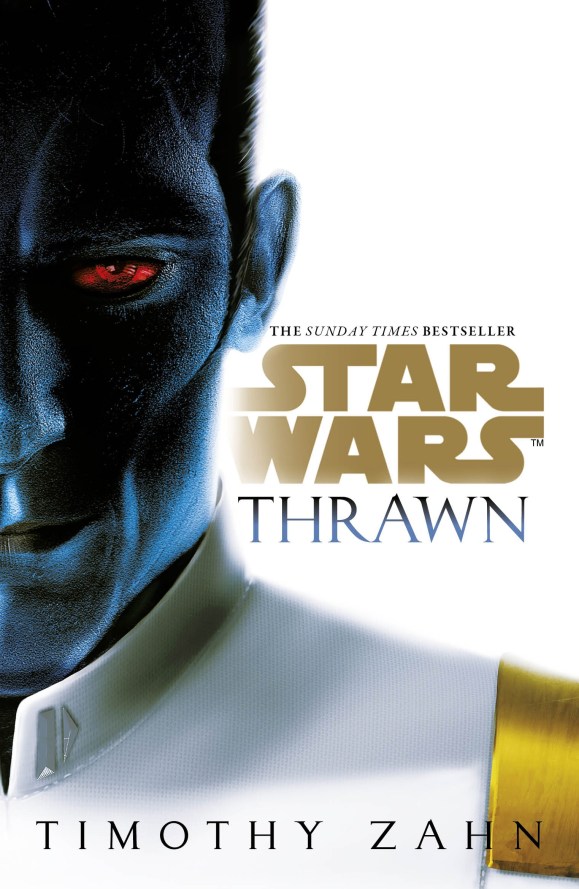
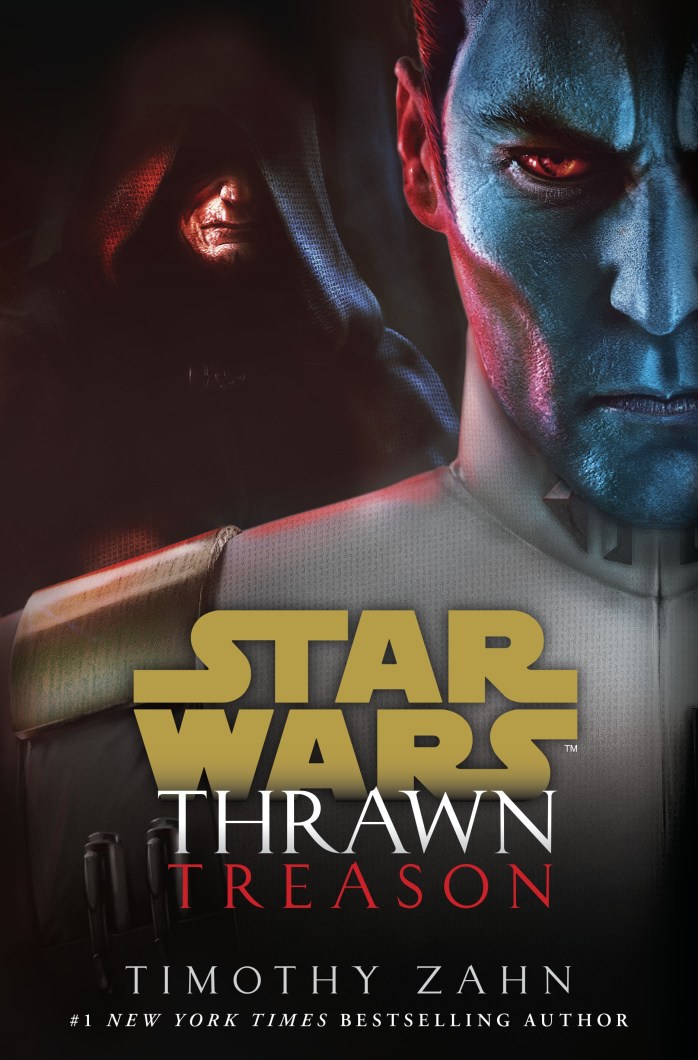
Thrawn Treason Cover

Publisher: Century (Trade Paperback – 25 July 2019)

Series: Thrawn – Book 3

Length: 333 pages

My Rating: 4.5 out of 5 stars

Amazon

The master of Star Wars extended universe novels, Timothy Zahn, returns with a third incredible book in his outstanding Thrawn series, Treason, which features the final adventure of his most iconic protagonist, Grand Admiral Thrawn, before his last appearance in Star Wars: Rebels.

While the new Disney Star Wars extended universe has produced some truly exceptional entries in the last couple years, the Thrawn series of books has been a real bright spot amongst them. Grand Admiral Thrawn was the antagonist of Zahn’s original Thrawn trilogy back in the 1990s, and quickly became a fan favourite character among the Star Wars fandom. After Thrawn was introduced into the new Star Wars canon as the primary antagonist of Star Wars Rebels in seasons 3 and 4, Zahn was brought back to write a series of novels that provided an updated history for this character.

The Thrawn series has so far consisted of two books, Thrawn and Alliances. In Thrawn, we are introduced to Mitth’raw’nuruodo, or Thrawn, a member of the Chiss Ascendancy, a race of aliens from outside the known galaxy, who was marooned within Imperial Space. Thanks to a secret connection to Anakin Skywalker and a clear demonstration of his tactical ability, the Emperor takes Thrawn into his service and employs him as an officer in the Imperial Navy. Accompanied by a young officer, Eli Vanto, who serves as his translator, aide and student, Thrawn rises through the ranks all the way to Grand Admiral by defeating a series of rebel and pirate forces. Towards the end of the book, it is revealed that Thrawn is still in service to the Chiss Ascendancy, and his loyalty to the Empire may be conditional on the Empire not threatening his people. In addition, he has sent Vanto to the Chiss, as he believes that his tactical abilities, honed under Thrawn’s tutorage, may be of benefit to their forces. Alliances, which is set after the events of the third season of Star Wars Rebels, reveals the history between Thrawn and Anakin Skywalker, and has Thrawn work with Darth Vader to investigate mysterious events in the Unknown Regions. There the reader is introduced to the Grysk, a dangerous alien species living in the Unknown Regions who are making aggressive moves against both the Empire and the Chiss Ascendancy. Together, Thrawn and Vader are able to foil the Grysk’s immediate plans, although they remain a dangerous force.

I really enjoyed both of the previous books in the Thrawn series. Thrawn is probably the best expanded Star Wars book I have had the pleasure to read so far, while Alliances did a great job continuing the series and featured a fantastic team-up between two of my favourite Star Wars characters. I personally enjoyed the first book a lot more than the second, although this may be because I did read the series out of order, starting with Alliances and then going back to Thrawn. I have been looking forward to the third book in the series for a while now. Not only did I look at it for one of my Waiting on Wednesday articles, but it also featured on my recent Top Ten Most Anticipated July-December 2019 Releases list.

In Treason, which is set in the midst of the fourth season of Star Wars Rebels, Thrawn is forced to postpone his campaign against the Rebels on Lothal when Grand Moth Tarkin informs him that funding for his Tie Defender Program is at risk of being reappropriated by Director Krennic’s secret program, Stardust. Placed in the middle of a political battle between Tarkin and Krennic, Thrawn must ensure the security of Stardust’s supply chains in order to retain his funding. What at first appears to be a routine mission against a dangerous form of alien space vermin quickly reveals that the supply lines are actually being targeted pirates who have knowledge about the materials being sent to Project Stardust.

The subsequent arrival of a Chiss ship with his former protégé Eli Vanto serving aboard raises further problems, when they reveal that a force of Grysk ships are active deep within Imperial Space. Now Thrawn must not only find out what the Grysk’s mission is but also foil a large-scale conspiracy from within the Empire. As Thrawn engages his opponents in space, the real danger comes when his loyalty to the Empire is called into question. Can Thrawn continue to serve both the Emperor and the Chiss Ascendancy, or will the Emperor finally tire of his treason?

Treason was another outstanding outing from Zahn, who once again produces an addictive and clever entry in the Star Wars expanded universe that does an exceptional job showing off his iconic protagonist. Treason was a real pleasure to read, and I found myself unable to put it down at times, as I was so engrossed by the excellent story and the fantastic examples of action in the Star Wars universe. The end result was amazing book which wraps up Thrawn’s current storyline and ties it into his appearances in the wider Star Wars universe.

Just like the previous books in the series, my favourite aspect of Treason is the focus on the titular character of Thrawn. Thrawn is one of the most tactically minded and analytical individuals in the entire Star Wars universe and is an unsurpassed military genius, able to defeat superior forces with his tactics and intelligence. Zahn has always done a spectacular job of portraying a character like this in his books, and Treason is no exception. Throughout the course of the book, Thrawn comes up with a series of tactical plans and deductions to confound his opponents and defeat their forces totally. The sheer range of different strategies and plans he comes up with are pretty ingenious, as are the ways that he is able to deduce how his opponents think, such as by analysing their artwork or their body language and movements. This results in some pretty amazing sequences throughout the book and included one extremely epic conclusion that sees Thrawn defeat a massively superior force without even being on the command deck of his ship. Instead, he leaves step-by-step instructions with his subordinate to perfectly counter and defeat his opponents. Honestly, I wish I could elaborate more because it was such an epic sequence, but that would require revealing some pretty big spoilers. I really love the focus on Thrawn and hope we get to see some more of his adventures and battles again in the future.

Despite the focus on Thrawn, much of the story is told from the perspective of some of his colleagues and subordinates, although many of these scenes also feature Thrawn’s observations on the other character’s body language and intentions. The use of all these point-of-view characters actually works really well, as it allows the reader to see Thrawn’s various tactical moves through the eyes of a normal character, thus requiring Thrawn or one of his protégés to explain in detail how he was able to come up with his actions, kind of like how Watson was used in the Sherlock Holmes novels. The characters of Eli Vanto and Commodore Faro have both served this purpose in the previous two books in the series, and it was good to see them both at it again in Treason. However, both have pretty major story arcs within this book, and it was interesting to see how their characters have evolved since first meeting Thrawn. This book also features several Chiss characters, such as Admiral Ar’alani, and it was intriguing to see their view on Thrawn’s actions and his role within the Empire. Zahn has also included a new character, Assistant Director Ronan, who has a major point-of-view role within the book. Ronan is a fairly annoying character most of the time, due to his arrogance and blind worship of his superior, Director Krennic. However, he does offer some pretty cool insights into Thrawn and the other character’s actions, and it was fun to see his respect for Thrawn reluctantly grow through the course of the book. These alternate point-of-view characters also allowed for some enjoyable speculation about Thrawn’s actual loyalties, and whether he currently serves the Emperor or the Chiss, and I felt that using all these side characters really added a whole lot to the overall story.

Like all of the other books in the Thrawn series, Zahn includes a huge number of action-packed sequences that are very exciting to read. Due to the focus on characters in the Imperial Navy, the vast majority of these battles are set within space and feature battles between the various spacecraft of the Star Wars universe. These space battle sequences are written extremely well, and they allow the reader to get an excellent idea of the cool fights that are occurring on the pages. Many of these sequences are enhanced by the various protagonists’ reliance on advanced tactics and stratagems, and as a result you get a much more complex and entertaining fight than some of the other space battles that occur in other examples of Star Wars fiction. I really enjoyed all the cool battles in this book, and the ones featured in Treason are a real highlight of the entire series.

Honestly, Treason is probably best explored by hardcore Star Wars fans. Not only does it deal with some quite obscure characters and aspects of the Star Wars universe but it is also the third book in a series with strong connections to Star Wars Rebels. I would therefore strongly recommend that readers check out the first two books in the Thrawn series first, as this will give them a more solid base to the story within Treason and provide them with some useful background into the Star Wars universe. However, for those readers who do not have any prior experience of the Thrawn books or some of the storylines explored in Star Wars Rebels, this is still an extremely accessible book, and Zahn does a good job of exploring key events of the previous stories featuring the character of Thrawn. I think that all readers, even those who only have knowledge of the franchise’s films, will also enjoy the deep dive into Star Wars lore that is featured within this book.

The entire Thrawn series so far has explored a number of aspects of the Empire before the events of the first Star Wars film, A New Hope, which I have found to be exceedingly fascinating. This is continued in Treason, where the author continues to examine the running of the Imperial Navy and also looks at the creation of the Death Star, namely the supply lines heading out to the construction zone. This book also features an intriguing look at the rivalries and politics that existed at the highest echelons of the Imperial power structure. In particular, Thrawn finds himself in the middle of the conflict between Grand Moth Tarkin and Director Krenic, which was shown in the Rogue One film. This was a particularly intriguing part of the book, and it is always interesting to see Thrawn engaged in political activities, as it very much outside his wheelhouse, although the results of this political battle were extremely fun. Treason also features more details on the species that inhabit the mysterious Unknown Regions of space, in particular the Chiss Ascendancy and the Grysk. Neither has been explored too much in the current canon, and Thrawn has been the only Chiss featured so far. All these explorations of the Star Wars lore are a really interesting part of the book that I loved reading and found extremely fascinating.

Treason is set in the fourth season of the Star Wars Rebels television show. In particular, the start of the book mirrors a scene in the 10th episode, Jedi Knight, and ends with the set–up of the final two episodes of the series. Unfortunately, this probably means that Treason will be the last Thrawn book for a little while as Star Wars Rebels ended (spoilers! although it’s been over a year since the finale) with Thrawn and the protagonist of Rebels, Ezra Bridger, being transported off into an unknown area of space. While the end of the episode hinted that Ezra was still alive (and therefore Thrawn would be as well), it may be some time before we find out his eventual fate. While there are no current plans for a continuation or sequel to Star Wars Rebels, I could see them trying to do something after the release of the seventh season of the related The Clone Wars show. Zahn has also stated that he is planning to write some additional Thrawn novels, although these are tied up until the ninth Star Wars film, The Rise of Skywalker, is finalised. Whether these Thrawn books will be tied into any future animated versions of Thrawn or be set before the end of Star Wars Rebels remains to be seen, although I personally would love to see what happens to Thrawn and some of the other supporting characters from these series.

Treason by Timothy Zahn is another exceptional entry in the Thrawn series, which once again explores one of the best characters in the Star Wars universe. Thrawn is a fantastic character, and Zahn does an exceptional job showing off his tactical prowess through a series of intense and complex battles in space. I really loved seeing how this part of Thrawn’s adventure unfolded, and Zahn has really produced a compelling story that proved exceedingly hard to stop reading. A first-rate Star Wars tie-in novel, Treason is really worth checking out. I honestly can’t think of any character I would love to see more of in the future than Grand Admiral Thrawn.
Amazon

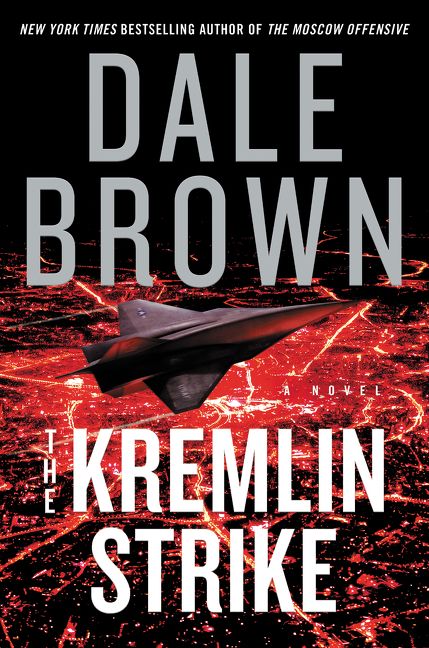
The Kremlin Strike by Dale Brown – Audiobook Review

The Kremlin Strike Cover

Publisher: HarperAudio (7 May 2019)

Series: Patrick McLanahan series – Book 23

Length: 13 hours and 18 minutes

My Rating: 4.5 out of 5 stars

Amazon     Book Depository

Bestselling author Dale Brown, perhaps one of the best current writers of military thrillers in the world today, returns with another exciting instalment of his Patrick McLanahan series, which takes America’s battle with Russia up into high orbit.

Following the recent defeat of his deadly combat robots in Texas, Russian President Geenadiy Gryzlov is desperate to strike back against the hated Americans. However, he no longer faces the inept US administration he enjoyed over the last couple of years. Instead, his failed attack on America has resulted in the election of a strong new president, John Dalton Farrell. With Farrell once again backing the innovative and resourceful private companies of former US President Kevin Martindale and former general Patrick McLanahan, Sky Masters and Scion Aviation International, America’s future looks bright. One of Farrell’s first priorities is the immediate resumption of America’s research into space flight and defence, resulting in Iron Wolf Squadron members Brad McLanahan and Nadia Roz being recruited by Sky Masters to head up their revamped space initiative.

However, the Americans are not the only ones with an eye to space. Knowing that Russia’s future world dominance depends on controlling the stars, Gryzlov has ordered the construction of a high-tech space station, Mars 1. Armed with devastating plasma weapons capable of shooting down every US satellite orbiting the planet as well as missile launchers that can rain down fire anywhere on the world, Mars 1 is an absolute game changer that will ensure Gryzlov finally achieves victory over the United States.

America’s only hope once again rests in the hands of the men of Sky Masters and Scion. As the Scion operatives attempt to determine a weakness in Mars 1’s defences, Sky Masters have created a number of advanced space planes and weapons that will allow Brad and Nadia to take the fight to the Russians in space. Will this new equipment be enough, or will Russia’s grip on high orbit propel them to a final, devastating victory?

Brown has been one of the best and most prolific authors of military fiction for over 30 years, having written 29 military thrillers in this period, as well as co-writing 18 books in the Dreamland series with Jim DeFelice. I only recently got into Brown’s books last year, when I read his 2018 release, The Moscow Offensive. After being drawn in by the promise of advanced military robots fighting it out in the American heartland, I fell in love with the awesome plot, intense action and analyses of real-world political strife, and as a result, The Kremlin Strike was one of the military thrillers I was looking forward to the most this year. The Kremlin Strike is the 23rd book in Brown’s Patrick McLanahan series, which follows the titular character and his allies as they attempt to keep America safe from a series of high-tech military threats. This book could also be considered to be sixth book in the Brad McLanahan series, as the overarching plot of the series started to focus more on Patrick’s son, Brad, in Tiger’s Claw, especially after Patrick McLanahan’s supposed death.

I absolutely loved the central concept of The Kremlin Strike, which looks at the potential of Earth’s high orbit to host the next major military conflicts that we see. This is not a new focus for Brown, as some of his previous books in this series, including Executive Intent and Starfire, have looked at the potential of space-born weapons. Before the story even starts, Brown makes it clear that he believes the United States needs to focus more on the possibility of a future war in space, and even includes some real-world news excerpts that look at recent advances in military technology that can be used to fight battles in space or destroy satellites orbiting the planet.

Based on this, Brown is able to come up with an incredibly intriguing military thriller that looks at the battles that could occur in the near future. I found it absolutely fascinating to see the author’s theories about how space warfare could be conducted, and the tactical advantages of having control of Earth’s orbit. While some of the technology in featured in the story, such as the Cybernetic Infantry Devices, are probably more advanced than what Russia or America can currently use (probably), Brown does examine a number of weapons and vehicles that are currently being tested in space. The various laser weapons, plasma launchers (OK, these are slightly less likely), missiles and other cool weapons or technology used in the battle in space make for some interesting reading. There were also some intriguing looks at the various limitations or downsides of the space technologies featured in this book, such as energy issues, fuel consumption or the gravitational backlash some weapons may experience. I especially liked how Brown was able to capture a more accurate view of space combat, with invisible laser beams rather than the colourful blasts you see in most science fiction movies.

All of the focus on combat in space is a superb basis for a story, and Brown backs that up with some first-rate storytelling to make this an outstanding read. The Kremlin Strike was an excellent blend of action, advanced technology and spy fiction that also has some intriguing mirrors to current world politics. The author tells the story from a range of different character perspectives, allowing for a widespread story that works incredibly well. I especially liked seeing the opposing views of the protagonists and antagonists, as it allowed the reader to see multiple sides of the overall conflict. For example, the reader gets to see the Russians plan their moves, and then you get to see the American countermoves. This view of the different sides of the conflict also works because neither the Americans nor the Russians have a solid idea of what the other side is planning. The reader is the only person who knows what is going on in both camps, and it is really fun to see the opponents slowly work out each other’s tactics during the course of the narrative, and then panic when they realise what their enemy is planning.

In addition to the combat in space, Brown also displays his detailed knowledge of modern warfare and military throughout the course of The Kremlin Strike. There are a huge number of scenes where modern military technology, techniques, strategies or standard operating procedures are featured, all topped off with a good helping of military terminology and acronyms. Brown utilises all of these extremely well, and there is nothing too overwhelming for readers who have a low understanding of the relevant jargon. All the action in this book is written incredibly well, and it was just plain thrilling to see some of the battles in the sky or in space take place. There were also some cool espionage sequences thrown in throughout the story as well, emphasising the benefit of human intelligence in current conflicts. All of these various aspects come together into a wonderful military thriller narrative, which proved extremely hard to stop listening to.

Another part of The Kremlin Strike that I enjoyed was the use of the fantastic prime antagonist, Russian President Geenadiy Gryzlov. Gryzlov has been a key villain in the last few books of the Patrick McLanahan series, and his angry, vindictive nature and his sheer inability to admit his own mistake makes him an amazingly easy character to dislike. I always find that a great antagonist can add so much to a story, and this is especially true in this book, where you can’t help but root for the protagonists and enjoy when the antagonist’s plots come to naught. You also cannot help but feel sorry at times for Gryzlov’s subordinates, who are forced to obey his wild orders, despite knowing that they will be punished when they fail. I really enjoyed a fun story development that occurs around this character in The Kremlin Strike, which I thought that Brown planned out very well, and which was one of my favourite highlights of this book.

While I absolutely loved The Kremlin Strike, the author has included a few right-wing political issues that might not be appealing to every reader. Right at the start of the book, Brown is very supportive about recent decision by the current US administration to form a specific armed force for space warfare, and this book examines the necessity of such a force. In addition, if you read between the lines a little, the US president in The Kremlin Strike, Farrell, could be a partial stand in for the current real-life United States president, while the previous incompetent president, Stacy Anne Barbeau, could be seen to represent this president’s real-life opponent at the 2016 election. Farrell is a political outsider, disliked by the media, whose tough talk and determination to cut through the bureaucracy of Washington (drain the swamp, if you will), won the support of the American people. The book’s apparent support of the current US president and some of his controversial decisions may be off-putting to some readers, although I do not believe that it harmed the entertainment value of the story. I personally found it interesting that in this scenario Brown once again painted Russia as America’s greatest enemy, which is something the current US president appears extremely reluctant to do, although perhaps I am reading into this too much.

I ended up listening to the audiobook version of The Kremlin Strike, which is narrated by William Dufris. The audiobook version of this book runs for a moderate 13 hours and 18 minutes, and I found it to be a great way to enjoy this exciting and detailed military thriller. Having only read Brown’s work before, I felt that having the audiobook book version playing in my ear helped ramp up the action sequences as well as increase the sense of urgency of the events occurring in the book. Dufris is also an excellent narrator, coming up with a huge number of great voices for the various characters that make up the cast of this book. The voices he attributed to these characters were really good and captured their personalities extremely well, such as, for example, the anger, ruthlessness and paranoia exhibited by Gryzlov. Dufris also did a good job with the character accents, continuing utilising a number of Russian accents throughout the book, as well as accents from other Eastern European countries such as Poland. I really enjoyed listening to the audiobook version of The Kremlin Strike and I think I will check out this format for any future books in the Patrick McLanahan series.

In this latest book in his long running Patrick McLanahan series, Dale Brown has once again created a first-class military thriller that is an absolute treat to read. The author’s focus on the future conflicts that may occur in our planet’s orbit were extremely fascinating, and the story created around it was a captivating and electrifying read. Easily accessible to those readers who have not previously had the pleasure of reading the Patrick McLanahan series before, The Kremlin Strike was a deeply enjoyable book, and a must for all fans of both the science fiction and military thriller genres.

Amazon     Book Depository

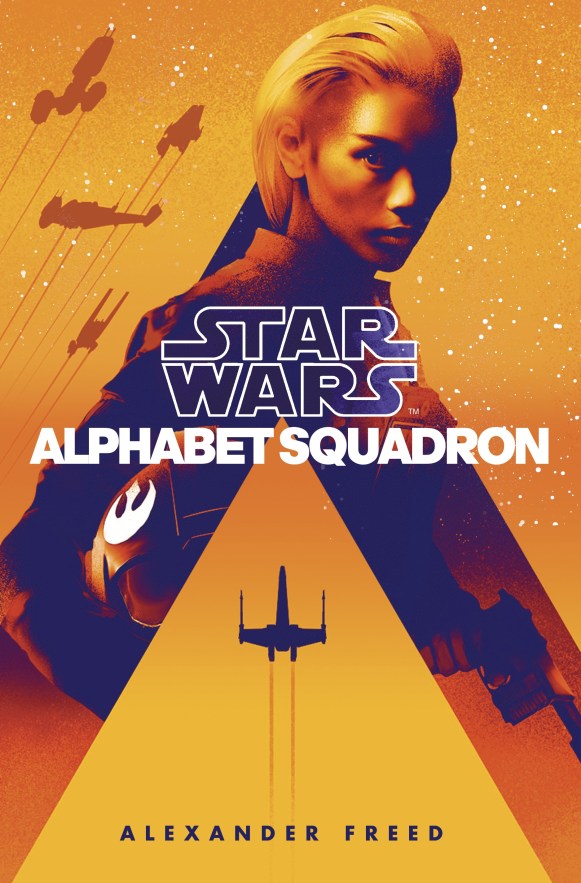
Star Wars: Alphabet Squadron by Alexander Freed

Alphabet Squadron Cover

Publisher: Century (Trade Paperback – 18 June 2019)

Series: Star Wars

Length: 408 pages

My Rating: 4.5 out of 5 stars

Amazon

The Star Wars expanded universe continues to grow as Alexander Freed presents a new and exciting adventure in the Star Wars canon, Alphabet Squadron.

Following the death of the Emperor and the destruction of the second Death Star during the Battle of Endor, the Empire has fragmented. Without the Emperor’s leadership, the various Imperial commanders have devolved into infighting and are faltering in the face of opposition from the united forces of the Rebel Alliance, who have renamed themselves as the New Republic. However, pockets of Imperial power still exist throughout the galaxy, many of which have the destructive potential to fulfil the Emperor’s final order, Operation Cinder, the devastation of as many planets as possible.

Yrica Quell is a former Imperial TIE fighter pilot who deserted in the face of the Emperor’s final order. Living in exile with other Imperial deserters, Quell is recruited by Caern Adan from New Republic Intelligence to hunt down the remnants of the 204th Imperial Fighter Wing, Quell’s old unit. Known as Shadow Wing, the 204th, under the command of Colonel Nuress, has taken command of the planet of Pandem Nai, and is using it as a base to launch raids against New Republic targets.

In order to find and defeat Shadow Wing, Quell and Adan bring together a group of talented pilots who have experienced loss at the hands of the 204th pilots. Flying an assortment of starfighters and given the name of Alphabet Squadron, these pilots must learn to work together if they wish to have a chance against Shadow Wing. As Alphabet Squadron launches under the command of New Republic General Hera Syndulla, they must face not only some of the most skilled pilots in the galaxy but also some dangerous secrets from Quell’s volatile past.

Those readers who have followed my blog for a while will know that I have been really getting into the new Star Wars expanded universe in the last year. Alphabet Squadron has been high on my to-read list for a while now, and I had high hopes that this book would represent the start of an intriguing new series within the overarching Star Wars franchise. I have to say that I was in no way disappointed. Freed, who has written several Star Wars novels in the past, creates an intriguing new addition to the franchise which was a real pleasure to read.

Alphabet Squadron is set shortly after the events of the third original Star Wars film, Return of the Jedi, and focuses on the chaotic aftermath of the Rebels’ victory at Endor. In addition to that, Alphabet Squadron also crosses over with Marvel Comics’ latest Star Wars comic, TIE Fighter, which follows the exploits of the elite TIE fighter flight known as Shadow Wing. The trade paperback version of Alphabet Squadron even contains the first few pages of TIE Fighter Issue #1 in the centre of the book. The artwork in it actually looks pretty cool, and I think I will pick up a collected edition of it in the future.

This latest addition to the Star Wars universe contains an entertaining and at times emotional story that not only expands on the Star Wars universe, but which also features examinations of the horrors of war, the emotional toil of combat and characters attempting to find their place in a new reality. Alphabet Squadron is split among a huge range of perspectives, including of protagonists and antagonists, which really works to tell a complex and multifaceted story. In addition to this fantastic original story, Alphabet Squadron also features exciting starfighter combat, a new and at times darker perspective on the franchise lore and some excellent character work. There is also a lot of potential for the story to continue into additional books in the series, which I think would be good.

One of the big focuses of this book is the starfighter combat between the protagonists flying as Alphabet Squadron and the antagonists flying as Shadow Wing. The space combat in this book flies thick and fast, and there are a number of high-energy and action-packed sequences as the various starfighters engage in all sorts of combat. There are some great space fight sequences in this book, such as the protagonist fleeing from her old squadron or the continuous attacks of Shadow Wing against a New Republic cruiser and its fighter escort over a sustained period of time. Freed also does an exceptional job using multiple character perspectives to show various sides of the battle, which really helps to make these action sequences even more impressive. This all leads up to a massive final battle sequence that has some pretty epic moments and a whole lot of destruction.

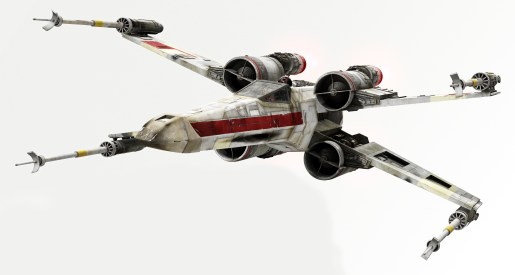
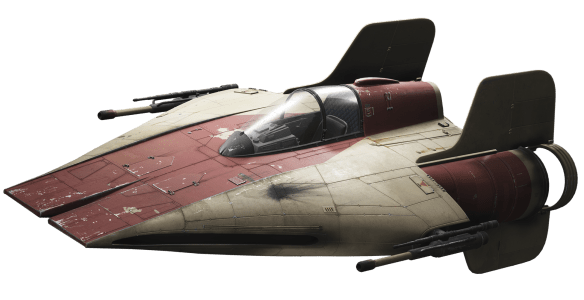
One of the aspects of the focus on the starfighters that was particularly intriguing was the makeup of the titular Alphabet Squadron. Alphabet Squadron was so named because each of its five members fly a different Rebel Alliance fighter, each of which has been featured in the various movies. These include: (add photos)

Yrica Quell – X-wing. X-wings are the iconic fighter seen in most of the movies and serve as the main fighter of the Rebel fleets.

Xwing-SWB.jpg

Nath Tensent – Y-wing. Y-wings were seen in all three of the original movies and are the Rebel Alliance’s bombers.

Y Wing.png

Wyl Lark – A-wing. A-wings have appeared in a couple of the movies and television shows and were the fastest ships in the Rebel Fleet.

A-wing_DICE.png

Chass na Chadic – B-wing. One of the more usual ships in the Rebel arsenal, these are slower ships with a huge amount of firepower.

BWingsKillISD2-ST.jpg

Kairos – U-wing. The Rebel Alliances troop transports. A couple of them first appeared in Rogue One and have been a feature of the Rebel Fleet ever since.

U-wing-SW_Battlefront.png

Having all five different ships in one squadron was a really cool concept that I really liked. Not only did it give a cool name for both the book and the squadron, but it showcased the various pros and cons of the various Rebel starfighters. Having a group made up of one of each of these ships makes for some intriguing problems, as well as giving the protagonist some unique advantages. The various tactics these mixed ships can employ in battle are really interesting, and it was a great concept that Freed did a good job exploring. The focus on starship combat was a real highlight of this book, as it allowed for some extremely exciting and enjoyable scenes that really set this book apart from some other Star Wars novels.

Alphabet Squadron is an interesting new addition to the overarching Star Wars canon that ties into the movies and other additions to the expanded universe and also helps set up a new series of books. One of the main things I enjoyed about the book was that the story was set in a fascinating part of Star Wars history, immediately following the events of Return of the Jedi. During this period the Rebel Alliance is achieving victory after victory while the Empire fragmented. I found this examination of the aftermath of the original film trilogy to be extremely enjoyable, especially as the ending of Return of the Jedi always seemed to imply that the Rebels won completely and the Empire was no longer a threat. Alphabet Squadron instead shows it as a far darker period, filled with mass desertions from the Imperial Army, uncertainty and lawlessness throughout the galaxy and the devastating results of Operation Cinder. Freed does and amazing job examining this period, for example, I really liked how he highlighted the sense of victory coming of the Rebel Alliance characters and the hints of desperation and despair that the Imperial characters were feeling. Freed also does a good job examining the general feeling of weariness that both sides are feeling by this point in the extended war.

This book ties into a bunch of entries in the current Star Wars expanded universe. It is going to run side by side with the TIE Fighter comic book series, and it has links to the Star Wars: Battlefront II video game and the Star Wars Rebels television show. The whole concept of Operation Cinder was first introduced in Star Wars: Battlefront II, as the protagonists were trying to stop it. Alphabet Squadron shows more of this intriguing piece of Star Wars lore, as the main character Quell was there when Operation Cinder was undertaken at one of the planets, becoming a key motivation for her. Having not played the Battlefront games, I thought this was an incredibly interesting and dark inclusion to the overarching Star Wars story, and I really enjoyed how Freed explored it. I was particularly intrigued by the inclusion of the Sentinel droids, scary red droids that project the Emperor’s face on a screen and which were sent out after his death to deliver his final order. Not only are these droids a cool and sinister inclusion from the Battlefront game, but I find anything that could potentially explain the Emperor’s presence in the upcoming film, The Rise of Skywalker, to be extremely fascinating.

As I stated in the Waiting on Wednesday I did for this book, one of the things I was excited for was the presence of Hera Syndulla. Hera was one of the main characters in the Star Wars Rebels television show, serving as the group’s pilot and the leader of a Rebel fighter squadron. Since the end of Star Wars Rebels, Hera has had a number of small appearances in other pieces of Star Wars media, including the Star Wars comic book series and cameo mentions in the Rogue One movie. Hera was a good supporting character in this book, serving as the New Republic General overseeing Alphabet Squadron’s missions and as a confidant for several of the main characters. Fans of Rebels will love seeing more of Hera in this book, and I know I was happy to get another snapshot of this character’s history. I was slightly disappointed there were no mentions of the other surviving characters from the show, but there were probably restrictions on what the author was allowed to say about them in case of contradictions with a future show.

For this book, Freed drew together a great bunch of central characters to serve as the heart of the story and as the book’s various narrators. Each of Alphabet Squadron’s members has their own intriguing story to tell, including Yrica Quell, Alphabet Squadron’s leader. Quell is a former Imperial TIE pilot who is still haunted by the events surrounding her defection and the guilt of participating in Operation Cinder. Thanks to her status as a former Imperial, Quell is a bit of an outsider in the New Republic forces but is determined to stay and fly for them. However, her connection to Shadow Wing and certain secrets she is hiding become a major part of her character and a really intriguing central focus for this book. Quell was a good central protagonist for this book with a really cool story arc about her past and her attempts to find redemption. I also liked seeing her thoughts on the pros and cons of the various Rebel starfighters compared to the TIE Fighters she was used to flying, which really helped with the book’s focus on starfighter combat.

Alphabet Squadron also includes Nath Tensent, who acts like a bit of a rogue operator, with his own objectives and cons to run. He is recruited into Alphabet Squadron because Shadow Wing killed his entire squadron and he wants revenge. There are also Wyl Lark and Chass na Chadic, the surviving members of two squads of fighters devastated by Shadow Wing earlier in the book. Both of these characters are impacted by the recent losses of their previous squads, which affects how they act within this book. They are also somewhat antagonistic towards each other due to the guilt and anger they feel over being the sole survivors of their group. Both Wyl and Chass have their own fun personalities and unique quirks, including Chass’s love of music while she flies. The final member of the squadron is Kairos, a mysterious alien of indeterminate species who is covered in bandages. Kairos’s lack of past or connection to Shadow Wing are an intriguing anomaly within this book that I hope is explored in future books.

As an overall group, Alphabet Squadron is an intriguing bunch of characters who the reader finds themselves getting rather attached to. Each of them has their own emotional or personal damage, and it is great watching them try to redeem themselves by flying as part of this mismatched group, and each of them has a certain Rebel spirit to them. I really liked how Freed spent time looking at their various motivations for joining the Rebel Alliance in the first place, especially as they each have some interesting stories about the oppression of the Empire or inspiration from certain characters. The Squadron also has a certain everyman or outsider status to them, and I found it pretty interesting to hear their various opinions or takes on the events that happened in the movies or about Luke Skywalker’s Jedi abilities.

Freed has also included a few great characters from outside of Alphabet Squadron. For example, there is Caern Adan, the New Republic intelligence agent who recruits Quell at the start of the book. Despite being a member of the New Republic, Adan is something of an antagonistic in this book, as his obsession with finding and neutralising Shadow Wing drives him to control and manipulate members of Alphabet Squadron. Adan is accompanied by IT-O, a repurposed Imperial torture droid, who acts as a therapist for Alphabet Squadron and who provides Adan with psychological analyses of the various members of the squadron. Freed also seeks to tell the story from the perspective of the Imperials by including Colonel Nuress as a point-of-view character. Nuress, who is a character in the TIE Fighter comic book series, offers an interesting counter viewpoint into the fall of the Empire, especially as she views the Empire as more of a stabilising force than a destructive one. Her desire to rebuild the Empire and serve the will of the deceased Emperor is rather intriguing to read, and I liked how the author has included a character from the comic. While they were never specifically named, I assume that the group of highly skilled TIE fighter pilots that the protagonists faced off against where the main cast of the TIE Fighter comics, and I look forward to seeing them in any future books in this series.

Alphabet Squadron is an outstanding piece of Star Wars fiction that was an absolute blast to read. Not only has Freed created a compelling story filled with electrifying starfighter action and a great array of characters, but he has made some truly intriguing additions to the Star Wars canon. Like all pieces of the Star Wars expanded universe, Alphabet Squadron will be most enjoyed by fans of the franchise. However, I would say that readers who are not familiar with Star Wars fiction will find a lot to love in this book, and no real prior knowledge of other expanded universe entries is required to follow the exciting story. This is another amazing addition to the Star Wars canon that comes highly recommended. I am looking forward to seeing if Freed will continue the storylines he started here in any future books and I hope that Alphabet Squadron flies again.

Amazon

God of Broken Things by Cameron Johnston

god of broken things cover

Publisher: Angry Robot (Paperback – 11 June 2019)

Series: Age of Tyranny – Book 2

Length: 312 pages

My Rating: 4.75 out of 5 stars

Amazon

Those readers looking for the next entertaining grimdark fantasy adventure to sink their teeth into need look no further than God of Broken Things, the electrifying second book in Cameron Johnston’s Age of Tyranny.

It has only been a few short months since the devastating attack by the Skallgrim raiders on the city of Setharis, which severely weakened the city. Despite repulsing the Skallgrim and their monstrous hordes, Setharis is still in incredible danger. The Skallgrim forces are massing to launch another attack on Setharis, and the Skallgrim’s masters, the parasitic alien lifeforms known as the Scarrabus, are determined to enslave the entire city to their will. Setharis’s salvation once again rests in the hands of its most hated son, Edrin Walker.

Edrin is powerful magus whose rare abilities allow him to crack open and control the minds of all those around him. His breed of magus, known as tyrants, are feared throughout the world due to their propensity to lose control and use their magic to rule whole civilisations. Despite his role in saving the city from the Skallgrim, Edrin is still distrusted by both the common people and his fellow magus of the Arcanum. However, his skills may be the only thing that can win the war against the Skallgrim and the Scarrabus.

A massive force of Skallgrim are advancing over the mountain passes of the Clanholds, hoping to launch a fresh assault on Setharis. Against his will, Edrin is forced to lead a small army to reinforce the tribes of the Clanholds against the Skallgrim army. Accompanied by a small personal bodyguard of killers and thieves, Edrin leads his forces into the mountains, where far more dangerous things than the Skallgrim and their monsters lurk. Spirits, demons, gods and his own deadly past all lie in wait for Edrin, whose powers have been altered following his battle with a treacherous god. Can Edrin and his forces hold back the Skallgrim, or will he succumb to one of the many horrors in the mountains? And what happens when the tyrant comes out to play?

Johnston is a talented author whose debut novel, The Traitor God, really impressed me last year thanks to its awesome story and enjoyable main character. As a result, I was extremely keen to get a copy of the sequel, God of Broken Things, this year and was very happy when I received it a few weeks ago. God of Broken Things turned out to be a fantastic follow-up to the first book and I had an incredible time reading it. Not only does Johnston present another wildly entertaining story for the reader to enjoy, but he also does a fantastic job of expanding his dark fantasy world and exploring the complex mind of his main character.

I really liked where Johnston took the story in this book. While The Traitor God’s story of a hunt for answers in the dark fantasy city was cool, I really liked seeing the main character go to war in God of Broken Things. The whole storyline of Edrin leading an army up into the Clanholds, a dangerous mountainous environment filled with all manner of horrors and dangers was really cool, especially as he kept encountering worse situations and more terrifying opponents. This resulted in some epic moments and massive battles, and Johnston also took the opportunity to explore the history of several of the different races mentioned within the first books, including the Scarrabus, the Ogarim and some more mystical creatures like spirts and demons. This expansion of the Age of Tyranny universe was quite intriguing, and I wonder if there will be more exploration of the world and the various mentioned multiverses in future books. I also liked the deeper look that the author took into his protagonist’s past, showing some of the activities that occurred during the years he was exiled from Setharis. I loved the various twists and epic moments that Johnston sprinkled throughout the book’s plot, and there was never a dull moment in the entire story. I especially enjoyed how the final battle in God of Broken Things ended, especially as the author included a clever red herring in the book’s formatting to throw the reader off. Overall, this was an incredible story, and Johnston did an amazing job trapping me within this entertaining narrative.

One of the best parts of this book was the author’s continued focus on the protagonist, Edrin Walker, who serves as the book’s narrator and point-of-view character. Edrin was already a fairly complex character in The Traitor God, where he was portrayed as a powerful exiled magus hated, distrusted and ostracised by everyone due to the specific nature of his magical gift. Because of the way he is treated he acts hostile and uncaring to the world, while still participating in the odd act of heroism and compassion. This is continued in the second book, where Edrin continues to battle with his natural instincts and irritation while trying to do the right thing, especially for the few people who actually like or respect him. I really liked the way that the author continued to show Edrin exploring his moral side in this book as, against his better judgement, he actually attempts to help people and keep Setharis safe. The various sacrifices that he subsequently makes for the greater good are very much against the grain of his original character, and it is interesting to see this side of Edrin grow.

Due to the way he is treated, Edrin is an incredibly jaded character, and the author utilises this in a number of clever ways. Not only does this ensure that Edrin is the most likeable character in the book, mostly because he stands in sharp contrast to all the other magus characters, who are elitist snobs, but it also makes him a really entertaining narrator. The character’s sarcastic and mocking manner permeates the entire way he tells the story, resulting in some great reactions and a very amusing overall story.

Edrin continues to get into all sorts of entertaining misadventures in God of Broken Things, and it is hard not to love the unorthodox way he deals with things. Not only does he lead a bodyguard of deranged killers into battle but he rarely ever takes things seriously, no matter who he is dealing with. I love the disrespect and mockery that the character shows when encountering anyone in authority, be it friend or foe, magus or human, god or monster, and I laughed out loud at the way he got his revenge on one of Setharis’s gods in this book. It was also great to see the character apply his particular brand of bastardry to the battlefield, coming up with all manner of unconventional traps and attacks for the forces that are up against him. I particularly loved the cool way he took down the main antagonist of this book, and it really reflected both his cunning and his growth as a character.

The main character’s mind-bending magic continues to be a really cool part of this series, especially as his abilities become even more powerful in God of Broken Things. Johnston’s portrayals of the way that Edrin’s powers to break into and manipulate the minds of all those around him is done extremely well and it results in a number of epic scenes. I never realised how many creative ways someone could magically manipulate a person’s mind until seeing some of the scenes in this book, as Johnston comes up with some very inventive ways to utilises his protagonist’s magic. I especially loved seeing Edrin using these powers in the middle of the battle, as there are some awesome ways he disadvantages his enemies and helps his allies. However, the author also explores the consequences of the tyrant powers, as Edrin continuously runs the risk of taking things too far and grossly abusing his powers. Several examinations of the character’s guilt over some of the mental actions he commits become a compelling part of the story, and the character’s mental magic is a great part of the book.

Those readers who are looking for an explosive amount of fantasy action are in for a real treat with this book. Johnston makes sure to include a ton of battles and fight sequences in God of Broken Things, as the ragtag defenders of the Clanholds face off against a massive horde of Skallgrim, Scarrabus, demons and monsters. All of these fight scenes are incredibly brutal as Johnston depicts some amazing battles throughout this book. Most of these scenes are enhanced through the use of magic, and the sheer destructive power of the various characters’ magical abilities is pretty impressive. The various demons and monsters the protagonist finds himself up against in this book are pretty gruesome and offer up some pretty great battle scenes as a result. Overall, the action in God of Broken Things is quite superb, and fans of bloody fantasy fights will not be disappointed.

Cameron Johnston’s second outing, God of Broken Things, is an amazing piece of grimdark fantasy fiction that proved to be just as much fun as his debut novel, The Traitor God. I had an incredible time reading God of Broken Things as the excellent combination of story, magical action and character work kept me trapped until the very last page. Readers are guaranteed to love this outstanding dark fantasy read, and I strongly recommend this book to anyone looking for a fun and powerful adventure. The ending of the book makes it a little unclear if Johnston will continue the Age of Tyranny series, but I will be keeping a close eye out for any future books from this rising star in the grimdark fantasy genre.

Amazon

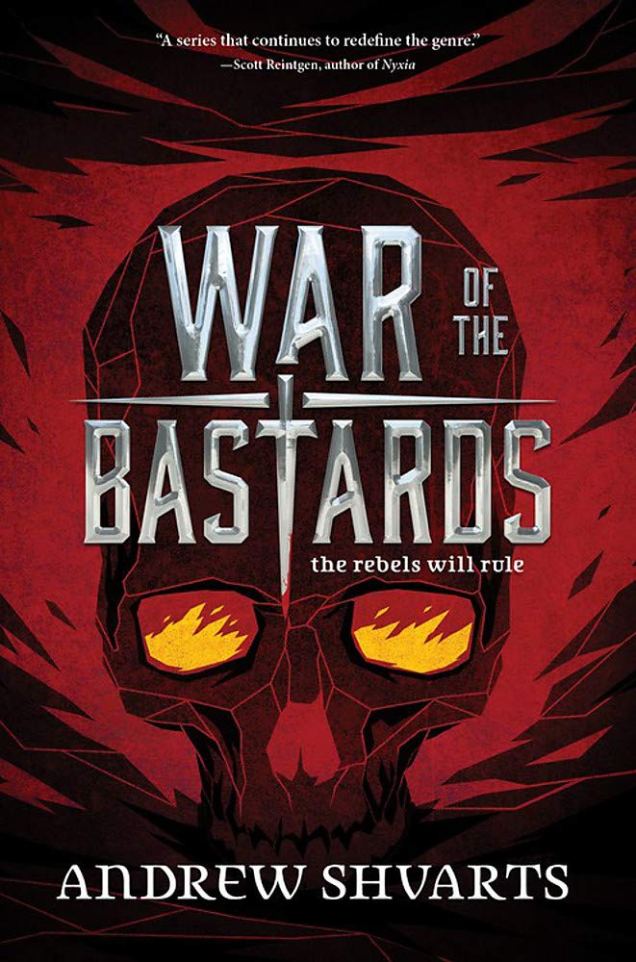
War of the Bastards by Andrew Shvarts

War of the Bastards Cover 2

Publisher: Hyperion (Hardcover – 4 June 2019)

Series: Royal Bastards trilogy – Book 3/Final

Length: 392 pages

My Rating: 5 out of 5 stars

Amazon     Book Depository

War, rebellion, magic and one hell of kickass story! Shvarts brings the outstanding Royal Bastards trilogy to an end with War of the Bastards, the relentlessly entertaining conclusion that rounds out the series with an epic bang. The Royal Bastards trilogy is the debut work of author Andrew Shvarts, who has produced an incredible young adult fantasy series that has been an absolute delight to read over the last three years. Set in the fantasy nation of Noveris, the series follows the adventures of its protagonist, Tilla, and her friends as they try to navigate the treachery and war that has engulfed their nation.

I had an absolute blast reading the second book in the trilogy, City of Bastards, last year. Not only did the book feature a compelling story style and an amazingly captivating plot, but it ended with an outstanding cliff hanger with the protagonist failing to stop the antagonist’s sinister plot, which results in the entire royal family being killed off and the enemy gaining control of the throne. This was such an epic ending, especially because the massacre of the entire royal family was just so unexpected (I really was expecting a last-minute rescue from the protagonists), and I have been extremely curious to see how this story ended for quite a while.

It has been a year since the destructive events that changed Noveris forever. After orchestrating the explosion that decimated the royal court of Noveris, killing the King and Queen and most of Noveris’s nobles, Lord Elric Kent has assumed the throne. With a huge number of powerful bloodmages under the command of his ruthless Inquisitor, Miles Hampstedt, Kent’s rule over Noveris looks to be nearly absolute. However, many are still fighting back against the despotic new rule, including Kent’s bastard daughter, Tilla.

Tilla is a member of the resistance group known as the Unbroken, which fights to return Tilla’s friend, the rightful Queen, Lyriana Volaris, back to the throne. With the help of her lover, Zell, and Lyriana’s cousin, Ellarion, Tilla and the Unbroken are engaged in a brutal guerrilla war against the new regime. However, the situation looks dire and victory near impossible to achieve, until a mission to rescue a major source of rebel intelligence reveals that their informant was none other than King Kent himself. Kent’s rule has been usurped by Miles, whose absolute control over the bloodmages has allowed him to take over Noveris without anyone noticing. While attempting to deal with the implications of capturing Tilla’s father, the Unbroken also free Syan Syee, a young woman from the Red Wastes with mysterious magical powers, who brings an urgent message to the people of Noveris. Syan warns of a coming apocalypse and believes that defeating Miles is the key to stopping it. Needing new allies, Tilla, Lyriana, Zell, Ellarion, Kent and Syan journey to the Red Wastes, hoping to recruit Syan’s people to their cause. However, what they discover in the Red Wastes will change everything. With this new knowledge, can Tilla and her friends save Noveris, or will Miles’s lust for power and control tear their world apart?

Before I started reading this book, I honestly thought that Shvarts was going to have an extremely hard time matching the awesomeness of City of Bastards. However, I am pleased to report that War of the Bastards is an incredible and massively compelling read that I enjoyed just as much as the second book in the series. While it may lack the shocking cliff hanger ending of City of Bastards, War of the Bastards has an excellent fast-paced story that proves extremely hard to put down once you start.

I really loved the story contained within War of the Bastards and felt that it was an amazing conclusion to the trilogy. The tale of an epic battle to free a kingdom is a classic, but the author has put some fantastic modern twists on it, and his entertaining writing style and dedication to bringing out huge moments, really turns this into something special. Shvarts has included a number of cool twists and turns throughout this book, and I really liked where the story went at times. There was also a slight turn away from fantasy towards another genre about two-thirds through the story that proved to be a bit surprising, but I found it to be an interesting addition to the story. Without giving too much away, I was very satisfied with the clever way that the antagonist was taken down at the end of the book, and it was a nice call-back to earlier events in the series. I really enjoyed how this story turned out, and it was an outstanding conclusion to the epic tale that had been told throughout the Royal Bastards trilogy.

In the previous books in the series, the author tended to only set the story in one general setting, such as the West for the first book and the Lightspire for the second book. In War of the Bastards, Shvarts continues to expand on his fantasy world, but this time he takes his characters to several new locations that had been alluded to in the other books. The story starts in the Heartlands and focuses on the characters fighting their guerrilla war there. This land has been transformed by the oppression of Kent and Miles, and it was intriguing to see how bad things had gotten under their rule. The protagonists also journey through the Southlands and the Red Wastes, both of which are pretty fascinating and distinctive locales. The Red Wastes was definitely the most unique location, ravaged by terrifying magical storms and featuring interesting new civilisation. Overall, these new locations are pretty cool, and readers will enjoy exploring more of this great fantasy world.

One of the major strengths of Shvarts’s previous books has been the excellent character work. Each of the major characters has gone through tremendous growth through the course of the first two books, and this growth has continued through the course of War of the Bastards. Tilla has gone from being two different types of social outcast (a bastard in the first book and a traitor’s daughter in the second) to a respected rebel warrior fighting the good fight. However, despite knowing she is fighting for what is right, Tilla is not natural killer and has to constantly deal with the guilt of her actions, keeping a running mental count of all those she has killed. She also has to finally come to terms with her strained relationship with her father once he joins them on their quest. Due to her status as a bastard, her father has always kept a certain distance with her. Now, with him joining their band, Tilla is forced to have several emotional confrontations with him over the terrible things he has done in previous books and how he treated her in the past. This results in some dramatic moments within the book, and the exploration of their relationship makes for great reading. Tilla still serves as the book’s narrator and point-of-view character, and it is through her eyes that we see the story unfold. This is extremely fortunate, as her sassy and sarcastic outlook on the events occurring around her leads to a lot of the book’s humour. All in all, I have always found Tilla to be a pretty awesome main character, and it was great to see how her story ended.

In addition to Tilla, the other three main characters from the previous Royal Bastards books all get great character arcs within this book. Lyriana spends this book as the Queen in exile of her people and is burdened with the responsibility of being a figurehead. However, she rises to the challenge and proves herself to be powerful badass and war leader thanks to her epic magical abilities. This was a massive change in her character from the second book, where she was devastated with loss and trauma, and it was great to see her at her full potential. Readers will also like the new relationship she finds herself in, and it was nice to see her finally get some emotional happiness. I would say that Zell is character least utilised in this book, but we do get to witness him trying to come to terms with guilt from the previous book thanks to the inadvertent role he had in facilitating the massacre. The character most impacted by the events of the previous book is Ellarion, Lyriana’s cousin and the most powerful magician in the lands. He lost his hands at the end of City of Bastards when defending his friends from the massive explosion and must now learn how to live without them and, more importantly, the magic they allowed him to perform. Shvarts did an amazing job portraying Ellarion’s despair at his situation and the longing he has for his lost magical arts. Some interesting things happen to him in this book and he has a major moment that readers will absolutely love.

Two new characters join the main characters in this book: Syan from the Red Wastes and Tilla’s father, Lord Kent. Syan is a pretty cool lesbian character who has some significant secrets in her past. Shvarts does a great job telling her entire story within this one book, and I found her to be quite an enjoyable character. Lord Kent was another fantastic addition to the main group of protagonists. While he has appeared in both of the previous books in the trilogy, we have never really gotten his side of the story before. In addition to all the drama surrounding his relationship with Tilla, we also get to see his motivations for his actions, as well as the regret for what he has brought about. I really liked the inclusion of Kent in War of the Bastards and thought it was a clever touch from Shvarts because of all the extra emotional complexities and drama he brings to the story.

I should quickly mention the main antagonist of this book, Miles. Miles has always been a pretty unlikeable character, especially after betraying the group in the first book due to his jealousy over Tilla choosing Zell. Shvarts really makes him even more despicable in War of the Bastards by showing him as the facilitator of all the worst things that have been done in Noveris in the last year. Later confrontations with him reveal that he has no remorse and really does not see himself as the bad guy. His continued obsession with Tilla is pretty messed up (cough, harem, cough), but I do like how that was used against him at times. Overall, Miles makes for an excellent series villain, and Shvarts did an amazing job utilising him in this final book.

The author has a very creative mind when it comes to the magic and fantasy elements contained within this series. The magical abilities and rules that govern the lands of Noveris are extremely interesting and have led to some impressive magical destruction and battles in the past. Shvarts continues to do this in the final book, and the exploration of the origins of magic and the devastating consequences of using it are really fascinating. Shvarts came up with some cool and unique new magical abilities in War of the Bastards, especially for the magic utilised by the people of the Red Wastes. The author has been really creative in this final book, and I am sure readers will like some of the ideas he comes up with.

Like the previous books in the series, War of the Bastards is being marketed towards the young adult audience. However, it should only really be read by the older teen audience, as it features a lot of adult content. While it does not have as much sex, drugs and drinking as City of Bastards did, it does feature a heck of a lot more violence, and some of the action scenes are pretty gruesome. This does mean the book is really easy for older readers to enjoy, and I would strongly recommend this to all adult fantasy readers.

While I am sad to see the Royal Bastards series end, War of the Bastards was such an incredible conclusion to the story that it does not seem too devastating. Due to its near perfect blend of electrifying story content, excellent characters and entertaining writing style, I found that it was near impossible to put War of the Bastards down, and I had an amazing time reading it. This is easily a five-star read, and I reckon this is my favourite young adult book of 2019 so far. With his debut trilogy, Andrew Shvarts has shown himself to be an extremely talented author, and I will be eagerly keeping an eye out for his next series.

Amazon     Book Depository

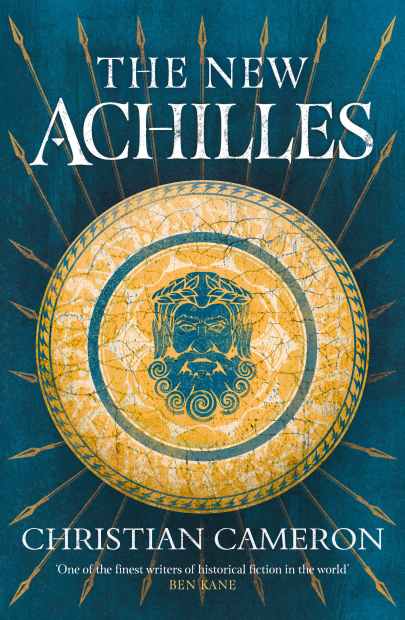
The New Achilles by Christian Cameron

The New Achilles Cover

Publisher: Orion (Hardcover – 18 April 2019)

Series: The Commander series – Book 1

Length: 399 pages

My Rating: 4 out of 5 stars

Amazon     Book Depository

Acclaimed historical fiction author Christian Cameron once again returns to his favourite setting of ancient Greece with his latest novel, The New Achilles.

Greece, 223 BCE. War has come to Greece, as the various Mediterranean powers, including Egypt, Rome and Macedon, engage in a proxy battle on Greek soil. In a sacred sanctuary near the city of Epidauros, Alexanor, a former marine from Rhodes, has spent several years training to become a healer, seeking to escape his violent past. However, war will find Alexanor once again when the Spartans invade the nearby city of Megalopolis, forcing the surviving defenders to bring their wounded to Alexanor’s sanctuary.

Among the wounded is the leader of the men who attempted to fight against the Spartans at Megalopolis, a young man called Philopoemen. After saving his life, Alexanor finds his future tied into that of Philopoemen, who is destined to become one of ancient Greece’s greatest military leaders. Allied with the armies of Macedon against the Spartans and their Egyptian paymasters, Philopoemen proves to be a capable military commander. More importantly, his bravery and skill in battle earn the respect of his fellow Greeks, many of whom consider him to be Achilles reborn.

When prevailing political and military currents require Philopoemen to help with a civil war on Crete, Alexanor travels with him. There they will attempt to take on the powerful city-state of Knossos with an eclectic mix of troops and minimal support from Macedon and the Achaean League. Can Philopoemen and Alexanor succeed, or will the new Achilles fall short of his destiny?

Christian Cameron is a skilled author who has written a number of books throughout his career. While the author is probably best known for his historical fiction work, he has also branched off into fantasy under his pseudonym of Miles Cameron, including his Masters & Mages series, the first book of which, Cold Iron, I previously reviewed here. His latest book, The New Achilles, is the first book in his The Commander series, which will follow the life of the historical figure Philopoemen. This is the third of Cameron’s series which focuses on ancient Greece, with his Tyrant and Long War series both focusing on different periods of ancient Greek history. I have always found that Cameron has a very thorough writing style, and he tends to throw himself into the historical details of his books. This is continued with The New Achilles, as the reader is presented with a very complex tale that may prove a little harder to connect with. However, this book is well worth sticking with, as the author has created an outstanding historical tale that focuses on quite a remarkable character from history.

While The New Achilles does contain some other story elements, at its core it is an intriguing story about the life of Philopoemen. Philopoemen was a skilled general and political leader who was responsible for turning the Achaean League into a viable military power in Greece. He is sometimes known as “the last of the Greeks” (I believe that the next book in this series will be called The Last Greek) due to being one of the last great Greek generals before the Roman era. I have to admit that this was a historical character I had no real experience with, so I was extremely curious to see the author’s vision of his life and deeds. Cameron tackled the story with his usual highly detailed writing style, presenting a comprehensive novelisation of several key events of Philopoemen’s life, his earliest successes and his campaign on Crete. However, there is apparently a large amount of this man’s story left to tell, as he accomplished a great many deeds during his long life. I felt that the author did a fantastic job of capturing the personality of this larger-than-life figure, and I really enjoyed the well-paced story that showed his early rise to prominence.

The story is told from the perspective of the fictional character Alexanor, who, after healing Philopoemen, continues to encounter him and eventually becomes his friend and confidant, accompanying him on several adventures. I liked the use of an outside narrator to tell Philopoemen’s story, and Alexanor is an excellent character in his own right, as he constantly has to balance his duties as a medically trained priest with his desire to help Philopoemen win his battles and his wars. There are issues from his past that he has to deal with, including trauma from a previous war, a lost love and family strife, all of which make for an intriguing character. Another benefit of having a priest as a narrator is that it allows the author to spend time exploring ancient Greek medicine. This was a particularly fascinating element of the book’s story and it was extremely intriguing to see how ancient medicine compares to more modern techniques, and the differences and similarities in knowledge are quite interesting. It also results in some compelling ethical deliberations from the narrator about the dissection of human corpses, which, while strictly forbidden, could result in greater medical knowledge. Overall, I quite enjoyed the author’s use of Alexanor as a narrator, and his focus on his life was an intriguing and enjoyable addition to the story.

This book is set during quite a chaotic period of Mediterranean history, with a huge number of different ancient empires and city-states engaging in various wars and conflicts, many of which have an impact on The New Achilles’s story. Cameron makes sure to examine the various political implications of many of the conflicts occurring around the same time as the events Philopoemen was involved with, and it is quite fascinating to see what effect something like the war between Carthage and Rome could have on the inhabitants of Greece. In addition to the consequences of these distant wars or events, Cameron also looks at the political and national makeup of the various forces arrayed in the conflicts that Philopoemen and Alexanor are involved with. These could get quite complex at times, with a range of alliances, competing city-states and mercenary forces involved or attempting to intervene in a conflict. An example of how complex things could get could be seen in the protagonists extended conflict on Crete, where Philopoemen led a force of Achaean League troops to support one Cretan city state against the on the behest of Macedon. The opposing Cretan city-state was supported by the Ptolemaic dynasty of Egypt, whose Spartan allies joined in and led the fight against Philopoemen. Various other mercenary groups of different nationalities such as the Thracians and the Illyrians were also employed in this conflict and had various roles in the battles and politics. While the sheer number of different historical groups can get a bit overwhelming at times, Cameron does a great job explaining their history and their allegiances, and it is quite fascinating to see the roles they played in various conflicts.

Like many of Cameron’s previous books, the author’s dedication to historical detail and accuracy in The New Achilles is extremely impressive. Each page is full of intriguing elements from history, and it is easy for the reader to find themselves transported to this classical historical landscape. The author not only looks at the military and political aspects of this historical setting; he also examines day-to-day life for the various Greek civilisations. Cameron also makes use of a whole glossary of historical Greek terms and names throughout The New Achilles, all of which gave his story a greater sense of authenticity.

The New Achilles features a huge number of battle scenes and sequences, as the author captures a number of the historical fights Philopoemen was involved with. These battle sequences were extremely exciting, as the author presents some gritty and blood battle scenes. These were quite spectacular, and I loved the realism contained within the story as even the victors find themselves covered in all manner of wounds, and rarely is there a battle where the main characters come out unscathed. This is particularly true for Philopoemen, who tends to suffer injuries in nearly every battle he gets involved with, due to throwing himself into the heart of the fight. I thought this was a clever inclusion from the author, as not only does this reflect some historical accounts of the relevant battles but it is incredibly refreshing to see a hero that does not emerge from a battle unscathed. I quite enjoyed the examination of Greek battle tactics and weaponry, and the battle sequences in this book are fairly spectacular and well worth checking out.

Christian Cameron’s latest book, The New Achilles is a detailed and compelling examination of a truly remarkable, if overlooked, historical figure. The story of Philopoemen’s life proves to be an amazing focus for the plot, and Cameron brings a number of intriguing aspects of the ancient Greek period to life with his trademark detail orientated writing style. This was an incredibly interesting and captivating read, and I am looking forward to seeing how Philopoemen’s life progresses from here in future instalments of The Commander series.

Amazon     Book Depository

Throwback Thursday – Star Wars: Thrawn by Timothy Zahn – Audiobook Review

Thrawn Cover

Publisher: Random House Audio (11 April 2017)

Series: Star Wars

Length: 16 hours and 56 minutes

My Rating: 5 out of 5 stars

Amazon

Reviewed as part of my Throwback Thursday series, where I republish old reviews, review books I have read before or review older books I have only just had a chance to read.

While Disney are currently releasing quite a large number of Star Wars tie-in novels and comics, none of them quite had the history behind them that Thrawn did. Timothy Zahn is probably one of the best authors of Star Wars fiction of all time, having written several books in the previous Star Wars expanded universe (now rebranded as Star Wars Legends) before Lucasfilm was bought out in 2012. Without a doubt, his most iconic contribution to the Star Wars universe was the character of Grand Admiral Thrawn, who was introduced in his 1991 book, Heir the Empire, the first book in Zahn’s original Thrawn trilogy. Grand Admiral Thrawn was the Empire’s greatest tactician and naval commander, who led the war against the protagonists of the original Star Wars trilogy following the events of Return of the Jedi and proved to be an effective major antagonist. Thrawn swiftly became a fan favourite, and Zahn revisited the character several times.

While Thrawn was an amazing character, many assumed that he was unlikely to be seen again after Disney shelved the original expanded universe to allow for their own stories and characters. However, Disney surprised many when they announced that Thrawn would be brought back to their extended universe in the Star Wars Rebels animated show. Thrawn was introduced as the show’s main antagonist for the third and fourth season and he shone as the villain of the show, bringing his tactical abilities and unique view of war to bear against the rebels. Brought to life with the voice work of the extremely talented Lars Mikkelsen, Thrawn is easily one of my favourite things about the show’s last two seasons and was a fantastic addition to the plot.

Disney also decided to include Thrawn in their slowly building collection of Star Wars novels, with a whole new Thrawn trilogy commissioned from Timothy Zahn. Given the unique opportunity to have a second go at introducing one of his most iconic creation, Zahn has so far written two books in this series, Thrawn and Alliances. I read and reviewed Alliances last year, but I unfortunately missed getting a copy of Thrawn when it first came out. With the third and final book, Treason, coming out at the end of July, I decided to finally go back and check out an audiobook copy of Thrawn.

In the Star Wars Legends canon, Thrawn was active for a long period of time, essentially from before the events of Attack of the Clones until several years after the events of Return of the Jedi, with a lengthy service in the Imperial Navy. In this book, however, Zahn has to reintroduce his character in a much earlier and compacted period of Star Wars history, as his character could only have come to prominence between Revenge of the Sith and the third season of Star Wars Rebels in the Disney canon. I was quite keen to see this new version of the character, especially as Zahn gets to once again show how an alien managed to rise to the highest of ranks in the xenophobic Imperial military.

Several years after the fall of the Galactic Republic and the Jedi, the Empire reigns supreme throughout the galaxy and is always looking to expand its control. A routine survey of an unexplored world in Wild Space uncovers a small, ramshackle settlement with items featuring writing in an unknown alien language. As the Imperial survey team investigates, they find themselves under attack from an unseen adversary who manages to inflict heavy causalities with minimal resources. Retreating back to their ship, the Imperials discover that their attacker, a blue-skinned, blue-haired alien, has stowed away on their transport. The alien identifies himself as Mitth’raw’nuruodo, a member of the Chiss Ascendency, a legendary race from the Unknown Regions. The Imperial commander takes Mitth’raw’nuruodo, or Thrawn, to Coruscant to be presented to the Emperor, who he impresses with his tactical ability and his mysterious connection to the Clone War General, Anakin Skywalker.

Taking Thrawn into his service, the Emperor makes him an officer in the Imperial Navy, along with his translator, cadet Eli Vanto. As Thrawn and Vanto are first enrolled in the Imperial Naval Academy and then assigned junior roles on a ship, they face opposition and resentment from other members of Navy. However, thanks to Thrawn’s unparalleled tactical and strategic mind, as well as his ability to understand and predict the actions of his opponents on the battlefield, the two are able to rise in the Imperial hierarchy.

As Thrawn is quickly promoted up the ranks, he starts to become obsessed with the enigmatic Nightswan, a brilliant rogue tactician who has been helping criminals and dissidents defy the Empire across the galaxy. At the same time, Thrawn’s inability to understand the political realities of the Imperial Navy proves to be a major threat. Luckily the politically ambitious Arihnda Pryce is willing to provide help, as long Thrawn assists with her plans to gain political power and become governor of her home planet of Lothal. As rebellion spreads through the galaxy, Thrawn leads the assault to cut it down as he heads towards his promotion as Grand Admiral.

This was a pretty outstanding novel. I absolutely loved Thrawn and it is probably the best canon Star Wars novel in that I have so far had the pleasure of reading. Zahn did an amazing job revamping his iconic character by presenting a fantastic new story that not only harkens back to the author’s original novels but also fits the character perfectly into the Disney timelines. Thrawn is an excellent balance of character work, action, political intrigue and exploration of the Star Wars universe, all of which adds up to an incredible novel that I was nearly unable to stop listening to and which results in an easy five-star rating from me.

The events of this book take place over the course of nine years, between the events of Revenge of the Sith and A New Hope. More specifically, it starts 11 years after Revenge of the Sith, and continues directly at the start of the third season of Star Wars Rebels, approximately two years before A New Hope. Thrawn is split into two separate storylines: one that follows the rise of Thrawn through the Imperial Navy and another that focuses on the machinations of Arihnda Pryce as she becomes governor of Lothal. The Thrawn storyline is mostly told from the perspective of Thrawn’s companion, Eli Vanto, although a few chapters are shown from Thrawn’s perspective alone. While the two storylines start off showing Thrawn and Pryce’s separate rises to power and are not initially connected, once the two characters start working together, their stories mesh together a lot more. While I had a stronger preference for the parts of the book focussing on Thrawn, I did quite enjoy the sections focusing on Pryce, as they had some compelling elements and showed a different side of the Empire. The two separate storylines mesh together quite well, and together they tell a complete and intriguing story that highlights how the characters obtained the relevant positions in the Imperial hierarchy that they had when introduced in Star Wars Rebels.

At the heart of this book is the focus on Thrawn, an absolutely amazing central protagonist, whose escapades and adventures are some of the best parts of the book. Zahn has done an amazing job reinventing Thrawn for this new era of Star Wars history, keeping all the character traits that made him such a hit in the original expanded universe, while fitting his character timeline into a much shorter period. Thrawn is still the same highly intelligent alien with an unmatched tactical mind and an appreciation for the culture and art of the various people he encounters. However, in this universe, he achieves his rank of Grand Admiral in a far shorter period of time. Starting with his rescue on a remote planet after ambushing Imperial forces (the entire scene is a rewrite of Zahn’s 1995 short story, Mist Encounter, although with a few necessary changes), this book shows him joining the Imperial Academy, and then climbing the ranks all the way up to Grand Admiral within a few short years. The entire story of Thrawn’s early career in the Imperial Navy is absolutely fascinating, and I really enjoyed this look at the character’s history, especially as his rapid promotions were due to the multiple intriguing military actions he oversaw. His entire storyline is extremely well paced out, and the reader gets a full story that is incredibly captivating. This was a really clever reimagining of the character’s history, and it is a great story to tell.

Zahn does a great job showcasing Thrawn as an utterly brilliant individual who is clearly smarter than everyone else he encounters. There are some great characteristics to Thrawn, like the way he is able to get into his opponents’ heads and anticipate their actions and intentions. His shear analytic ability is showcased so many times throughout the book, most notably in the way that he analyses the emotions and body language of all the people he encounters. For example, whenever Thrawn is talking with someone, the reader gets a short description of the facial reactions or emotions that the character talking to Thrawn is exhibiting. I’m unsure what this looks like in the hard copy of the book, but in the audiobook version the narrator uses his chilling Thrawn voice rather than his baseline narrator voices. From these short descriptions, the reader gets an idea of what Thrawn thinks the other character is thinking, and it is deeply fascinating to see how this affects Thrawn’s actions. I loved that the author continued to show how Thrawn gains insight into a people’s culture and personalities through their art. Throughout the book, Thrawn is shown appreciating a potential opponent’s art and culture, and then using the conclusions and observations he gleams from the items to alter his strategies or the way that he deals with them. This is a fantastic character trait that I am glad Zahn continued to use in his works.

Probably one of the best things about the character of Thrawn in this book is the inventive and brilliant strategies that he comes up with to defeat his enemies. Throughout the course of the book, Thrawn utilises some deeply inventive plans for both large-scale conflicts and smaller battles, and it is always very entertaining to watch these plans come to fruition. I loved some of the strategies that Thrawn used in this book; whether he is swamping a shielded fortress with artificial tidal waves or using Clone Wars era buzz droids to take out a pirate ship, the end result is just spectacular. In many ways, the Thrawn in this book is a bit like Sherlock Holmes, if Sherlock worked for an evil space empire. His opponent, Nightswan, is essentially Moriarty (a man nearly as smart as Thrawn, who sells his tactical abilities to members of the underworld), and the author uses this to make the battle scenes even more intense, as a brilliant attack from Nightswan is countered by an even more sophisticated move from Thrawn. In addition, Thrawn also has a loyal sidekick in Eli Vanto, who is essentially the Watson to Thrawn’s Sherlock. Not only are there certain similarities between the two within the story, such as the way that Thrawn takes Vanto and train him in his methods, turning Vanto into an extremely competent strategist, but Zahn also uses him in a similar literary way to Watson in the Sherlock Holmes novels. Vanto is used as a proxy for the audience, so when he questions Thrawn on how he came up with his plans or anticipated his opponents, the audience gets a full explanation within the scope of the story. Thrawn was an extremely awesome character in this book, and his presence helps turn this into an outstanding read.

In addition to the character of Thrawn, Zahn also looks at Governor Arihnda Pryce, another major antagonist from Star Wars Rebels. Zahn spends a good amount of time showing Pryce’s past and how she went from a nobody to a powerful planetary governor with major political connections and a history working with Grand Admiral Thrawn. I liked this look at Pryce; her story is pretty compelling and it offers a great look at the political side of the Empire. Pryce is already a pretty despicable character in Star Wars Rebels (she is responsible for the tragic death of one of the main characters), but this book does a masterful job of showing just how evil she is. While it starts off showing her experiencing early hardship and difficulties, she quickly stops being a character you can root for the moment she has any sort of power within her grasp. The way she turns on her friends and her extreme act of self-preservation towards the end of the book are pretty dark, and you cannot help but dislike the character even more after reading her full arc in this book. This was some really good character work, and Zahn does an amazing job showcasing Pryce’s motivations and despicable nature.

If you are a fan of massive and electrifying space battles, there is a lot for you to love in Thrawn. Zahn has packed this book with a huge number of large and impressive battles between Imperial ships and the various pirates and rebels that are encountered throughout the story. There are some really fun ship-to-ship battles throughout this book, and they are absolutely spectacular to watch unfold. Thanks to the brilliant adversary that Thrawn faces for most of the book, the characters face some unique opposition, such as Clone War era ships, like the vulture droids, and an impressive island base with massive guns. These result in some amazing sequences, especially when Thrawn comes up with a surprising strategy to defeat the opposition. I had a lot of fun listening to these battle sequences, and they are a real highlight I feel that many readers will enjoy.

Thrawn takes quite an interesting look at certain parts of the Star Wars universe, and fans of the series will enjoy the author’s canonical deep dive into the Empire at the height of its power. Quite a lot of time is spend showcasing the ins and outs of the Imperial Navy, and readers get a good idea of how it operates and its system of command as the main character rises through the ranks during the course of the book. In addition to the military side of the Empire, the storyline focusing on Governor Pryce highlights how brutal Imperial politics is during this period, as she attempts to gain power and influence. Zahn also includes a number of key characters from Star Wars lore and inserts them into his story. Characters such as Grand Moth Tarkin and Colonel Wullf Yularen (a background Imperial character in A New Hope who was given an expanded role in The Clone Wars animated show) are used quite successfully in this book and offer some interesting insights into additional aspects of the Empire. There are also the obligatory hints at the Death Star (seriously, nearly every piece of Star Wars fiction set in the period has some mention of a “secret Imperial project”) and other elements of the Star Wars movies. I quite enjoyed this intriguing look at the Empire between the events of the first two trilogies, and it helped with the story.

Like most Star Wars tie-in novels, Thrawn is intended more for dedicated fans of the franchise, although I felt that this book would be particularly accessible to those readers with only a basic knowledge of the Star Wars franchise. Zahn does an excellent job explaining key aspects of the Star Wars universe that fans who are only familiar with the movies might not understand, and the book features some really fun and exciting moments. As a result, this might be the perfect book to try if you are interested in exploring the Star Wars expanded universe for the first time, especially if you happened to enjoy Thrawn in Star Wars Rebels. There really is so much in here for dedicated Star Wars fans to enjoy, and those readers who grew up with Zahn’s original Thrawn trilogy will no doubt be extremely curious to see this new version of the character.

Like most of the Throwback Thursday books I review, I chose to listen to the audiobook version of Thrawn rather than read the physical copy. The Thrawn audiobook is narrated by veteran Star Wars audiobook narrator Marc Thompson and runs for 16 hours and 56 minutes. I have mentioned before that listening to a Star Wars audiobook is an intriguing experience, as the productions are filled with all manner sound effects, including a number of iconic sounds from the Star Wars franchise. Thrawn continues this tradition, featuring a huge number of sound effects in pretty much every scene. These sound effects are really effective at creating an ambiance and atmosphere, and the reader gets a whole other experience of the events occurring in the book. This includes a background susurration during parties and large gatherings or the sound of blaster fire during a battle sequence. While I really love how most of these sound effects work, I did have a slight issue with an effect used to alter the voices of a certain alien species. The producers added a high-pitched screeching echo to the voices of the aliens known as the Afe in order to simulate their unique vocal patters as described in the book. However, this sound effect is extremely distracting and unpleasant, and I found it hard to listen to the dialogue of the Afe characters. While these characters were only in the book for a short while, their voices were extremely memorable and it is hard to forget that screeching sound. On the plus side, the audiobook also featured several pieces of John Williams’s epic music from the Star Wars films at key parts of the book, which helped enhance several of the scenes and bring the audience into the story.

In addition to all the sound effects and music, the Thrawn audiobook also featured the vocal talents of narrator Marc Thompson. Thompson is an extremely talented voice actor, and his work in Thrawn was pretty amazing. He has an excellent voice for the character of Thrawn that not only sounds like Lars Mikkelsen from Star Wars Rebels but which also carries all of the character’s intelligence and charm. Thompson comes up with a great voice for Eli Vanto, utilising an accent that screams space yokel and which stands out from the voices of other Imperial characters in this book. I was also quite impressed with how Thompson was able to imitate key characters from the Star Wars universe. For example, Thompson does a great Emperor Palpatine voice and also comes up with passable imitation of Grand Moth Tarkin. I felt that Thompson really got the heart of many of the characters he narrated, whether by showcasing Thrawn’s cool intelligent manner or by replicating the arrogance that comes off many of the book’s Imperial characters. As a result, I would wholeheartedly recommend the audiobook version of Thrawn, as not only do the producers continue to make good use of sound effects and music, but they also use an amazing narrator to bring this story to life.

I had an absolute blast going back and listening to Thrawn for the first time. This is an exception piece of Star Wars fiction and Zahn does an outstanding job bringing his iconic character, Grand Admiral Thrawn, into the new Disney canon. Featuring a ton of amazingly entertaining moments and some excellent character work, Thrawn is an exceedingly fun book that will prove to be extremely appealing to both hardcore Star Wars fans and novice readers. This was a wonderful five-star read, and I cannot wait to see how Zahn wraps up this trilogy.

Amazon

Emperor of Rome by Robert Fabbri

Emperor of Rome Cover

Publisher: Corvus (February 2019)

Series: Vespasian – Book 9

Length: 349 pages

My Rating: 4.5 out of 5 stars

Amazon

After eight years of being one of my favourite yearly highlights of the Roman historical fiction scene, Robert Fabbri brings his bestselling Vespasian series to an end with the ninth and final book, Emperor of Rome.

Rome, 68 AD. Vespasian started his life as the second son of a rich but rural Roman family from the Sabine Hills. Looked down upon by the older Roman families for his family’s humble origins, Vespasian was never expected to obtain any major power in Rome. But after nearly 40 years of political intrigue, unusual adventures and a distinguished military career, Vespasian may actually be in a position to claim the ultimate prize: becoming Emperor of the Roman Empire.

Ever since he first arrived at the city of Rome at the young age of 16, Vespasian has lived under several unhinged or easily manipulated emperors of the Julio-Claudian line, each of whom was worse than the last. The latest of these emperors, the ruthless and insane Nero, has ordered Vespasian to put down a major rebellion in the Roman province of Judaea. However, this appointment is the ultimate no-win situation. If he fails in his task, his family’s prestige and political future are over. But if he succeeds in bringing the rebellion to an end with a successful military campaign, he will incur Nero’s lethal jealousy for obtaining glory that could make him more popular than the Emperor. As Vespasian debates what course of action to take, news from Rome will change everything.

The rebellion of several legions and their noble commanders has forced Nero to commit suicide, and his death results in a massive power vacuum. Vespasian, being in charge of two legions and having allies governing key provinces, is now a major contender for the throne, especially with his brother Sabinus lobbying for him back in Rome. Moreover, for years Vespasian has been gifted with signs and portents of his eventual rise to power, and he wants to claim his destiny. However, Vespasian is not the only person with dreams of imperial power, and several others are marching on Rome. The Year of the Four Emperors has begun, and only one man will be left standing.

Robert Fabbri’s Vespasian series are fun and at times over-the-top novelisations of the life of one of Rome’s most important emperors. The main series is made up of nine books, but there is also a related standalone novel, Arminius: The Limits of Empire, as well as the ebook-only Crossroads series. I have been a huge fan of the series for some time and have read and reviewed several of the books in the series, as well as the Arminius novel, although only my review for the previous Vespasian novel, Rome’s Sacred Flame, is currently featured on my blog. This series really has been a favourite of mine for some time, and I have been looking forward to Emperor of Rome for a few months. Unfortunately, this book does mark the end of the series, as Fabbri brings his epic story to a close and finally brings his chosen Emperor to the throne.

Emperor of Rome is a fantastic new addition to this awesome series. It tackles the chaotic period following the death of Nero, known as the Year of the Four Emperors. I felt that Fabbri did a fantastic job finally showing the ascension of Vespasian to the throne and covering a number of other interesting historical events, many of which would have widespread implications in the future. The overall story is a great blend of action and politics, and it also ends the story of several important characters from the series, as well as the rise of some of the next generation of Roman politicians and rulers.

Emperor of Rome is primarily told from the point of view of its protagonist, Vespasian, as he campaigns in the east of the Roman Empire. This allows for Fabbri to tell a different story to some of the other historical fiction novels that feature the Year of the Four Emperors. Rather than get bogged down in the politics happening in Rome, the focus is instead completely on Vespasian and his companions as they observe the chaotic events occurring in Rome from afar while trying to decide the best time for Vespasian to make his move. I thought that this was a rather clever way to look at the story as it let Fabbri examine the potential political, military and personal implications of each of Vespasian’s actions during this period, especially as early moves on Vespasian’s part might have seen him be overthrown by some other potential candidate for the throne. Emperor of Rome also showcases the early reign of Vespasian to a degree, and it was great to finally see the character gain the throne after nine books.

In addition to the examination of Vespasian’s bid to become emperor, Fabbri also focussed on Vespasian’s campaign in Judea, which is a significant event in Middle Eastern history. For much of the book, the province of Judea (modern Israel/Palestine) and its Jewish population are in revolt against the Romans. Vespasian, and later his son Titus, lead a particularly vicious campaign against the population, killing or enslaving thousands. Fabbri spends quite a lot of time describing the events of this conflict, sometimes known as the First Jewish-Roman War, and mostly relies on the accounts of the Romano-Jewish historian Josephus, who wrote several works on the subject and actually appears as a character in Emperor of Rome, as a basis for this story. Fabbri does an amazing job providing an account of this conflict. A number of key events of this war are covered in this book, including several ridiculous events that apparently actually occurred around the siege of Jotapata. I was greatly intrigued by the author’s novelisation of this conflict, as I had not read too much about it before in other works of historical fiction. The author brings a gritty realism to the conflict and does not hold back on the probable violence, cruelties and dehumanisation of the Jewish people that would have occurred during this war. This was a captivating but essential part of Vespasian’s story, and one that was necessary to explore in order to fully understand the actions required to become Emperor.

Several of the previous books in the Vespasian series have had an enjoyable supernatural edge to them, as the protagonist encountered ancient gods, prophets and sorcerers, as well as some biblical figures from early Christianity. This is continued in Emperor of Rome, mainly in the form of omens and prophecies that Vespasian has received in the previous books that show he is destined to be a great ruler, such as his viewing of a phoenix while on a mission in Africa. In this book, many of these signs come together, encouraging Vespasian to finally make his bid for Emperor. The look at the influence of such omens and prophecies added an intriguing element to the overall story. I also liked how some of the prophecies and predictions of the some of the characters were relevant to larger historical events in the future, such as the spread of Christianity or the current conflict in modern Israel/Palestine. These supernatural elements have always been one of the things that helped distinguish the Vespasian books from other Roman historical fiction series out there, and it was great to see so many of the events from the previous books finally come together here in the final chapter of the book.

Emperor of Rome is an amazing conclusion to this outstanding and entertaining historical fiction series. Fabbri has always had the fantastic ability to turn historical fact into wild and captivating tale filled with action, intrigue and historical excesses, and in this final book he once again takes several intriguing historical events and uses them to craft another excellent story. I will miss reading the Vespasian series each year, but at the same time I am also very excited, as Fabbri’s next series, The Alexander Legacies, is set to be released next year, and it sounds like it will look at some other exciting times in ancient history.

Amazon

Throwback Thursday – Legend by David Gemmell

71IuPaXC5kL.jpg

Publisher: Hachette Audio (22 June 2017) – originally published by Century (April 1984)

Series: Drenai – Book 1

Length: 13 hours and 13 minutes

My Rating: 5 out of 5 stars

Amazon

Reviewed as part of my Throwback Thursday series, where I republish old reviews, review books I have read before or review older books I have only just had a chance to read.

In this week’s Throwback Thursday, I try out a fantasy book that has been on my mind for many years, the 1984 classic fantasy novel, Legend, by the late, great David Gemmell.

Legend was the debut novel from Gemmell, an impressive author who wrote over 30 novels between 1984 and his death in 2006, most of which fell within the fantasy genre. Some of his works included the Rigante, Stones of Power, Jon Shannow and Hawk Queen fantasy series, as well as the Troy and Greek historical fiction series. However, his most famous body of work has to be the Drenai series. Featuring 11 books, the Drenai series were a collection of loosely connected novels set within the same fantasy universe. While the storylines are all linked in some way or another, especially books like the three Waylander novels, the series can pretty much be read in any order, which is kind of what I did.

I actually have a bit of a random history with the Drenai series, as I happened to listen to the 10th book in the series, White Wolf, some years ago. For the life of me I cannot think why I would have grabbed this fantasy book off the shelf. Whatever the reason, the story of White Wolf stuck with me, and I would find myself occasionally remembering details of the plot, while completely forgetting the book’s title or the author’s name. I was eventually able to figure out what book it was thanks to the one clear detail I could remember (the names of the protagonist’s famous swords) and tracked down another audiobook copy of White Wolf to listen to a few years ago. I also really enjoyed White Wolf the second time around and was eager to find out more about the rest of the books in the series.

Out of all of the books in the Drenai series that I looked at, the one that appealed to me the most was the very first one in the series, Legend. Legend tells the story of an epic and desperate siege that sets up the entire Drenai universe and contains the defining story of Gemmell’s most iconic character, Druss the Legend, who also appeared in White Wolf. Many of the story elements of Legend deeply appealed to me, and it also made practical sense to start at the beginning of the series, especially as it serves as a significant point in the series’ chronology. Unfortunately, due to a combination of a lack of time, problems finding a copy of Legend, and a requirement to focus on more recent books, I never got a chance to read Legend or dive deeper into the Drenai series. However, it always remained high on my to-read list, and I am so happy that I finally got a chance to read it.

Legend is the story of the siege of Dros Delnoch, the fortress city that acts as a gateway to the declining Drenai Empire. Dros Delnoch is the greatest fortress in the world. Sitting in the middle of a narrow pass and guarded by six high walls and a great keep, the city should be able to withstand any attack. However, the charismatic Nadir warlord Ulric has forged together a mighty host of 500,000 Nadir tribesmen, which he plans to sweep over the walls of Dros Delnoch.

If the city is able to hold for a few months, a new Drenai army will be able to reinforce the battlements. But with only a small force of 10,000 soldiers within the city, many of them raw recruits, this seems to be an impossible task. However, help soon arrives from the most unlikely of places. Former solider Regnak follows his newfound love to the city, despite his apparent cowardice and dark secrets. A gentleman bandit leads his band of outlaws to man the walls, partly for money and partly to make up for his past sins. The mysterious band of mystical warrior priests, known as The Thirty, also arrives to fulfil their destiny to die in battle. Each group has a role to play in the defence of the city, but only one of the new defenders will give the Nadir pause and raise the defenders’ hopes, the greatest hero of the age, Druss the Legend.

For decades, Druss has fought and defeated every enemy he has come across, but there is one thing even he cannot overcome: time. Now a grizzled veteran of 60 years, Druss has come to the city for one final battle, but first he needs to come to terms with his status as a living legend. Even as an old man Druss is still a dangerous person, and there is a reason that he is known as Deathwalker by the Nadir. As the siege begins, heroes will rise, tragedy will stalk the defenders and a legend will end, but will anything be enough to withstand the Nadir horde?

Well damn, that was a pretty epic book and one that was well worth the wait it took for me to get around to reading this. Legend was an incredible and enthralling read that had me hooked from the very beginning all the way to the very last word. It is a classic piece of fantasy action and adventure. Gemmell loaded his story with some truly compelling and flawed characters to create an outstanding read. Featuring a ton of amazing, pulse pounding action, heartbreaking tragedy and an epic siege, this book was absolutely fantastic, and I am really glad I read it.

Probably the main thing that I liked about the book was Gemmell’s outstanding portrayal of a massive fantasy siege. I have always loved the classic siege storyline, and there is something about a huge army attacking a castle that I cannot turn away from. The siege of Dros Delnoch within Legend is easily one of the best sieges that I have ever read, as Gemmell produces a magnificent battle around the city that lasts nearly the entire book. The whole setup for the siege is pretty insane, with 500,000 Nadir tribesmen (who bear a lot of similarities to the historical Huns) attacking a Drenai (essentially Roman) city with six massive walls. The author does an amazing job properly pacing out this siege throughout the novel, including appropriating enough time to really showcase all the pre-siege activities, including training, preparation of the defences and initial sabotages before the first battle even happens. Once the battle begins, though, it is a non-stop barrage of action as the defenders fight off multiple assaults each day.

Due to the author’s excellent storytelling and character work, the reader becomes extremely invested in the fate of the defenders, and each time a wall falls, or the attackers gain an inch, you are mentally rooting for them to fight back. There are a number of discussions and plans that take place throughout the book, and it is quite fascinating to see the thought and planning that the author put into the defence of his city. I especially liked how the city’s six walls played into the battle, as the defenders’ decisions on how and when to hold these battlements provided some great moments and debates for the reader to appreciate. The siege lasts the entire book and features a huge number of epic fight sequences, all of which will get your adrenaline racing and your heart pounding. I loved every second of the siege that was featured in this book, and I hope to see it brought to life on screen one day (provided they do it right).

In addition to its first-rate siege, Legend also features a large number of complex and well-written characters. The first is Regnak, who turns into one of the book’s main characters. Regnak is a former soldier who is first presented as a coward, looking to flee all personal responsibility, although this is quickly revealed to be a side effect of being a natural ‘baresark’. However, when he meets Virae, the daughter of the Earl of Dros Delnoch, he falls in love and follows her back to the siege. Regnak has a great storyline about finding one’s inner courage and overcoming one’s issues, and while his romance with Virae is a bit weird at times, it does result in some tragic scenes throughout the book. Next you have the members of The Thirty, an order of 30 warrior priests who enter the fight knowing that 29 of their members are going to die. Not only do the priests represent most of the fantasy elements of this book thanks to their physic abilities but their ability to see into the future results in some interesting debates about destiny and fate. Quite a few members of The Thirty are introduced, although most of their story is focused on their youngest member, Serbitar, and his mentor, Abbot Vintar, as Serbitar has the hardest time accepting the future and wants to change it to help the defenders.

Without a doubt, the best character in the entire book is Druss the Legend. Druss is Gemmell’s most iconic character and has appeared in several other books in the Drenai series, all of which occur before the events of Legend. These include The First Chronicles of Druss the Legend, which details the rise of Druss and the events that made him a legend, The Legend of Deathwalker, which features an earlier encounter with Ulric and the Nadir, and White Wolf, where I first encountered the character of Druss. However, Legend is definitely the character’s defining book, as it features the conclusion of his epic life and his final stand.

There is a lot of great character work involved with Druss, and the man is a pretty epic character. He is an older man, many years past his prime, who was faced with a choice: die in glory at Dros Delnoch or decline into obscurity. Choosing to die in battle (mainly to spite Death), Druss arrives in Dros Delnoch ready to fulfil his destiny. Gemmell does an outstanding job portraying Druss as an old and wise warrior who is weakened by age but is still a far more capable warrior than many of the others involved with the siege. While readers will enjoy the action sequences featuring Druss, the main thing about the character is the way that he attempts to come to terms with his status as a living legend whose body can no longer keep up with his myth. Druss knows that his reputation as a man who always wins is one of the main things that keeps the soldiers going, and he is constantly working to inspire the soldiers and show that he is still the super human many of them think he is. However, at the same time he must deal with the tangible impacts of age and must try to overcome them in order to survive and inspire on the battlefield. This examination of a man uncertain about his continuing place in the world and who knows he is going to die very soon is extremely well done, and readers cannot help but fall in love with the character and get very invested in his storyline, even though you know how it is going to end. The Druss that is featured in Legend is probably one of the finest fantasy characters that I have read, and I look forward to reading some additional books featuring him in the future.

The book also features an amazing cast of secondary characters, each of whom adds so much to the story featured within Legend. These characters include:

  • Orrin – the commander of the forces defending Dros Delnoch. Orrin is a nobleman who is inexperienced and ill-suited for command. However, once Druss arrives, he works hard to change his ways and become a worthy leader of his troops. He has an amazing redemption arc and turns into quite a likeable character.
  • Bowman – a forest bandit who Druss convinces to join the defence of the city. Initially pretending he is there for money; it is eventually revealed that he is searching for some sort of redemption as well. Bowman’s sarcastic wit adds some necessary humour to the story and he proves to be quite a likeable character.
  • Gilad and Bregan – two farmers who sign up to the army and find themselves becoming heroes of Dros Delnoch. These two characters allow Gemmell to show the story of the common defender of the city. Together they have quite a surprisingly compelling storyline, and the readers actually get quite invested in their survival.
  • Hogun – one of the few professional soldiers in the city. Hogun serves as a great secondary observer for most of the book, and his growing respect and camaraderie with the other defenders mirrors the reader’s growing attachment to all those people featured within Legend.
  • Ulric – leader of the Nadir horde attacking the city. Ulric is presented as a visionary like Atilla the Hun or Genghis Khan, who has united his people against a common threat and now seeks to create a mighty empire. I quite liked how Ulric, despite being the antagonist, is only partially presented as an evil man. Instead, he sees all the violence he does as necessary and he even grows to respect the defenders of the city, especially Druss. Ulric turns out to be quite a complex and well-written antagonist that reader ends up respecting to a degree.
  • Caessa – a female member of Bowman’s band, who harbours a deep secret. She’s not my favourite character, but her storyline has a few intriguing twists, and it is interesting to see her growing attachment to Druss.

In addition to all the characters mentioned above, there are also a huge bevy of other minor characters from both sides of the conflict whose point of view and feelings are examined throughout the book. Not only does this allow for a number of short and, in some cases, tragic stories for the reader to enjoy; it also increases the scope of the battle. Overall the character work is pretty impressive, and pretty much every character allowed for a richer and more captivating tale to be told. If I had one criticism of Legend’s characters, it would be that the female characters are mostly portrayed as over-emotional, irrational or downright catty in most of their interactions, which makes the book feel a bit socially dated at times.

I ended up listening to an audiobook version of Legend narrated by Sean Barrett. At only 13 hours and 13 minutes, Legend represents a fairly quick listen, especially when you get stuck into the story. I had a fantastic time listening to the audiobook version of this book, and I felt that it really helped me sink into the story and appreciate all the amazing action and drama going on in the city. Barrett has an excellent voice for an older fantasy like Legend, and I really felt he got to the heart of most of the book’s characters. I strongly recommend the audiobook version of Legend, and I will probably check out the other books in the series on audiobook as well.

Legend really did not disappoint, as it easily met every single one of my high expectations. I enjoyed every minute of this exceptional book and it gets an easy five stars for me. I cannot overstate how epic in scale and writing the siege featured in this book was, and all of the characters within this story are just sensational, especially the Legend himself, Druss. I fully intend to check out some additional books in Gemmell’s Drenai series in the future, although there are so many interesting choices that I’m not too sure where to start. Be sure to check out future instalments of Throwback Thursday to see which other Gemmell books I look at.

Amazon

The Unbound Empire by Melissa Caruso

The Unbound Empire Cover (WoW)

Publisher: Orbit (Trade Paperback – 25 April 2019)

Series: Swords and Fire – Book 3

Length: 508 pages

My Rating: 5 out of 5 stars

Amazon

One of the fast-rising authors of fantasy fiction, Melissa Caruso, brings her outstanding debut series to an end with the third book in the Swords and Fire trilogy, The Unbound Empire.

It is always a bittersweet moment when a great book series comes to an end. For the last two years, the Swords and Fire trilogy has been one of my favourite new fantasy series due to its excellent combination of characters, story, intrigue, fantasy elements and world building. I absolutely loved the first book in the series, The Tethered Mage, and I felt that Caruso did an excellent job following this up with The Defiant Heir, which made my Top Ten Reads For 2018 list and my Top Ten Books I Loved with Fewer than 2,000 Ratings on Goodreads list. As a result, I have been eagerly waiting for The Unbound Empire for the last year, and it even featured in my very first Waiting on Wednesday post.

The Swords and Fire series is set on the continent of Eruvia, which is made up of two great nations, the Serene Empire of Raverra and the loosely collected states of Vaskandar. The Serene Empire is the home of our protagonists, and is a land where magic is controlled by the government, led by the Doge and the Council of Nine. All mages who are identified as having enough power are conscripted into the army as a Falcon. Each Falcon is bound to a non-magical handler, a Falconer, who is entrusted to control and protect their Falcon. One such Falconer is Lady Amalia Cornaro, heir to one of the most powerful families in Raverra and future member of the Council of Nine. While the nobility is usually forbidden from becoming Falconers, desperate circumstances forced Amalia to be bound to the powerful and rebellious fire warlock Zaira.

Vaskandar, on the other hand, is a far wilder nation, ruled by the Witch Lords, magicians whose powerful vivomancy literally flows through their land, making them part of everyone and everything in their domain. War is always looming between these two nations, and while Vaskandar as a nation has decided to remain out of the most recent conflict, nothing can stop an individual Witch Lord from attacking. The cruel and ambitious Witch Lord Ruven, the Skinwitch, has long wanted to conquer and rule over The Serene Empire. His most recent ambitions have been stymied by the combined actions of Amalia and Zaira, who managed to stop his plan to unleash a destructive volcano, although it came at great cost to Amalia.

However, Ruven is far from done and is determined to gain new land, either in the Serene Empire or in the domains of the other Witch Lords. Launching a series of attacks against the Empire’s capital, Raverra, as well as several outlying holdings, with a range of horrifying strategies, Ruven is able to cause significant damage. But while he launches his attacks, he is also trying to recruit Amalia to his cause by any means necessary, as her unique heritage gives her the ability to usurp the domains of other Witch Lords. As Amalia and Zaira race to counter Ruven’s actions, Amalia finds herself once again torn between love, duty and friendship, as the responsibilities of her office clash with the friendships she has formed. As Amalia struggles to maintain her humanity in the heat of war, Ruven’s greatest cruelty might be the thing that finally breaks her and leads to the fall of the Serene Empire.

Caruso once again knocks it out of the park with The Unbound Empire, creating a satisfying conclusion to her series that still contains her trademark storytelling ability and character work. The final book in the Swords and Fire trilogy does a great job utilising the previous entries of the series and also attempts to tie up all of the existing loose storylines and plot points. The Unbound Empire is filled with some really emotional storylines, a number of powerful magical action sequences and several surprising plot developments. The end result is another five-star book from Caruso that I powered through in quite a short period.

At the heart of this book lies the series’ main two characters, the narrator and point-of-view character, Amalia, and the fire warlock Zaira. The challenging and evolving relationship between the initially sheltered Falconer and the rebellious and infinitely destructive Falcon has always been a major part of this series. While the two characters have been establishing a better relationship with each book, it was great to see the two of them becoming even closer in this book and helping each other deal with some major issues. I also liked how both characters’ stories come full circle in this book, as Amalia becomes more and more like her mother, while Zaira finally confronts a number of her personal demons and for once starts to consider having a future. The author’s depiction of the doubt and guilt that Amalia is feeling after the events of the last book forced her to kill her cousin added some extra emotional depth to the story, and I liked the inclusion of such a realistic emotional reaction. The character arcs for the two main characters were incredible, and it was great to see how much they had evolved over the course of the trilogy.

Caruso has also developed a number of great side characters for this series, and she continues to expertly utilise them in this final book. The main two side characters of The Unbound Empire were Amalia’s love interests: Captain Marcello of the Serene Empire; and the Witch Lord Kathe, known as the Crow Lord. Throughout the course of the book, Amalia is caught between them; while she loves Marcello, her position makes a relationship impossible, and Kathe presents a more suitable match. Marcello’s storyline in this book is pretty significant, and there are some substantial and emotive changes to his character that really helped make The Unbound Empire extra compelling. I also really liked the deeper dive into Kathe’s personality and backstory, as well as the natural strengthening of the relationship between Amalia and Kathe. Thankfully the book’s love triangle aspect wasn’t too over-the-top or filled with insufferable toxic jealousy, as both the men understand the difficult position Amalia is in. The arc of Zaira’s love interest, Terika, is really sweet, and I liked how she continues to have a positive effect of Zaira’s personality. Other side characters, such as the Amelia’s powerful and unflappable mother; the surprisingly lethal Cornaro servant, Ciardha; and Marcello’s eccentric artificer sister, Istrella, all shine through in this book, and all of them add quite a lot to this book’s story.

No great fantasy story would be complete without a despicable antagonist threatening the heroes, and luckily this book has a truly evil and threatening villain. The Witch Lord Ruven is a powerful Skinwitch, a person with the ability to control and alter other creatures just by touching him. Not only is this power by itself pretty horrifying but Ruven uses it in some fairly novel and evil ways, unleashing all manner of horrors upon the protagonists. I thought that Ruven had some of the best magical powers in the entire series, and his abilities were really fun to see in this book. Caruso also tried to humanise the character in places throughout this book, which was a nice touch and added some new depth to the story, although he does mostly come off as utterly irredeemable. Overall, I feel that Ruven was an excellent villain and his antagonism really helped make this book and the series as a whole.

I have always loved the complex fantasy world and elements that the author came up with for this series. The various forms of magic and resulting rules that form the backbone of this book are very imaginative, and I loved how Caruso was able to utilise them in her story. There are some amazing new versions of the magic and fantasy elements from the previous two books included in The Unbound Empire, as well as some new locations to explore. While the world building is not as intense as the first two books in the trilogy, Caruso still offers some great new elements, and I had a lot of fun seeing these extra expansions to the universe. Hopefully Caruso will come back to this world at some point in the future, as I had a lot of fun there over the course of the series.

The Unbound Empire was another incredible piece of fantasy fiction from author Melissa Caruso that expertly wraps up her debut trilogy. This has got to be one of the best debut fantasy trilogies I have had the pleasure of reading, and it has been a lot of fun absorbing the excellent tales of magic, adventure and intrigue that Caruso has woven over the last two years. I have really loved the Swords and Fire trilogy, and while I am sad to see it go, I am excited to see where Caruso goes next as this author has amazing potential for the future. I highly recommend each and every book in the series and encourage you to get wrapped up in the magic and characters of this series if you have not had a chance to read it.

Amazon