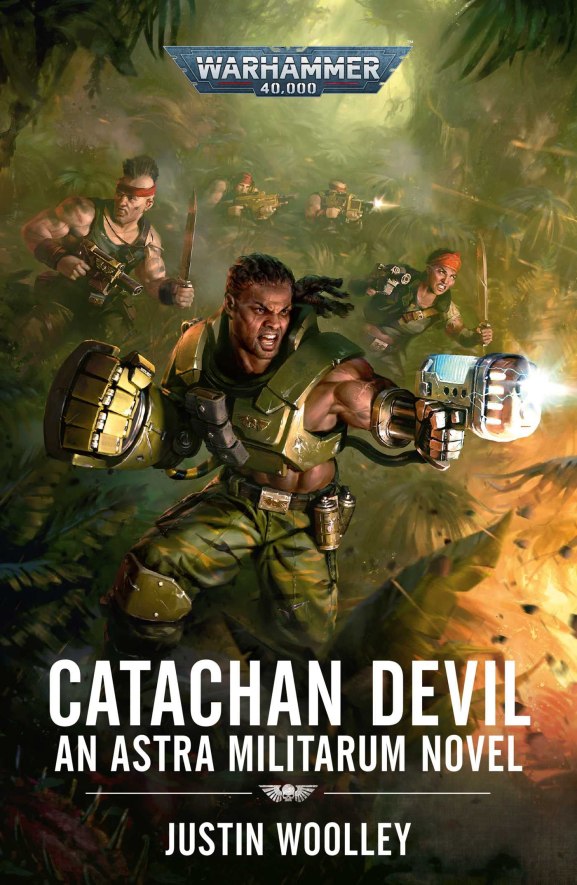
Warhammer 40,000: Catachan Devil by Justin Woolley

Catachan Devil Cover

Publisher: Black Library (Audiobook – 29 March 2022)

Series: Warhammer 40,000/Astra Militarum – Book Two

Length: 9 hours and 14 minutes

My Rating: 4.5 out of 5 stars

Amazon     Book Depository

Another iconic regiment of the Astra Militarum is on full display in the new Warhammer 40,000 novel by talented author Justin Woolley, with the intense and action-packed read Catachan Devil.

2022 is shaping up to be a particularly epic year for Warhammer 40,000 fiction, with a ton of brilliant novels coming out that cover a range of factions and sides of the surprisingly massive and highly compelling extended universe surrounding the famous tabletop games.  Some of the best Warhammer books of the year include Ghazghkull Thraka: Prophet of the Waaagh! by Nate Crowley and Assassinorum: Kingmaker by Robert Rath, which both got five-star ratings from me.  However, I have also been really drawn to the impressive novels that examine the basic human troopers of the Imperium of Man.  These soldiers, members of the Astra Militarum, better known as the Imperial Guard, come from many different planets, and are forged into unique fighters by the harsh conditions of their worlds.  I have had a great time reading some of the recent books about them, such as Steel Tread, Krieg and The Vincula Insurgency, especially as the authors dive deep into the psyches of the regiments and their members to unearth their history, mentality, and their opinions of the deadly wars they are fighting.  As such, I was excited when I saw that there was a cool book coming out that followed the legendary Catachan Jungle Fighters, Catachan Devil by Justin Woolley.

Deep in the 41st century, where war and death surrounds the fragile Imperium of Man, many serve the Imperium as soldiers of the Astra Militarum.  However, not all Imperial Guard are created equal, as Trooper Torvin of the newly formed Skadi Second Infantry is about to find out.  Conscripted to fight in the Emperor’s wars, the poorly trained and terrified Torvin suddenly finds himself on the jungle world of Gondwa VI, expected to go up against the brutal and ever-growing greenskin threat.  However, fate is about to place him in the path of a far more dangerous group of fighters.

The lone survivor of his regiment after their vital outpost is overrun and captured by orks, Torvin is accused of cowardice and faces death by firing squad.  However, he is given a chance at redemption by joining up with the men chosen to retake his fallen outpost, the legendary and lethal men of the Catachan 57th Jungle Fighters.  Led by Colonel Haskell ‘Hell Fist’ Aldalon, the Catachans are masters of stealth and jungle fighting, and the 57th Jungle Fighters have a particular grudge to bear against the orks.

Accompanying a small detachment of Catachan Devils to the fallen fortress, Torvin is in awe of the Catachan’s skill and lethality, while they view him with nothing but disdain.  Forced into the fight, Torvin soon discovers that the Catachans are just as likely to turn on him for his incompetence as they are to kill the orks they are hunting.  If he wants to survive, Torvin will need to forget his standard training and fight his hardest to gain the respect of the Catachans.  However, not even the Catachans are fully prepared for the opponents waiting for them; these orks are aware of their strengths and have taken to emulating their tactics and style.  May the best commandos win!

Woolley’s first full Warhammer 40,000 novel was a real hit, and I loved how Catachan Devil provided the reader with a powerful and deeply exciting science fiction tale that also highlights one of the more distinctive factions from the tabletop game.  Catachan Devil has a brilliant and deeply compelling story to it that I found myself powering through in only a few days.  A standalone Warhammer 40,000 book, Catachan Devil takes the reader into heart of the action quickly by introducing two of the main protagonists in the early goings of the book and showing their arrival on Gondwa VI.  These initial chapters primarily focus on the character of Trooper Torvin and show his initial attempts at being an Imperial Guardsman and his unfortunate first encounter with the orks and their fun point-of-view character.  Following this, you are introduced to the Catachans and their leader, Colonel Aldalon, who are brought in to clean up the mess made by Torvin’s regiment.

While it was a tad surprising not to see any Catachan characters until a third of the way in, I think it worked, as all the previous events set up the main narrative extremely well, while also showcasing the dearth in skill of the human soldiers at that point.  The rest of the book follows at a brilliant pace, taking the various characters on an intense and ultra-exciting adventure.  The rest of the story has a great blend of combat, universe building and character development splattered throughout it, as the three central characters all evolve in different ways as they fight against their own issues and their various opponents.  Woolley takes Catachan Devil’s narrative in some interesting directions, and I enjoyed the examination of the Catachan mission and the work done to build up a worthy set of adversaries.  This all leads up to some brilliant and highly exciting final confrontations between the Catachans and their foes, and I loved the fantastic way that Woolley was able to wrap up the main narrative of this book, as well as the three central character storylines.  Everything comes together extremely well, and readers will come away very satisfied, although if they are anything like me, they will be wanting more, even if that is a tad unreasonable.  While Catachan Devil does work as a standalone narrative, Woolley does leave some options for a sequel open in the future, which I personally would be quite interested to see.  An awesome and highly addictive narrative that was really fun to get through.

I enjoyed the way that Catachan Devil was put together as Woolley wrote it in an enjoyable and captivating way.  While this book is primarily designed to highlight a specific regiment of Imperial Guard, something that Woolley does really well, it still contains a brilliant and extremely fun narrative that can be easily enjoyed by anyone familiar with Warhammer 40,000.  However, Catachan Devil would serve as a rather good introductory novel for new readers of the franchise.  Catachan Devil contains an excellent blend of damaged characters, impressive action sequences and entertaining humour that anyone can have an awesome time with this book, and I personally found myself laughing myself silly at times (there is a fun scene where some orks are trying to lure the Catachans out), while also getting drawn into some powerful character arcs.  The entire book is very well paced out, and I particularly enjoyed how Woolley perfectly utilised three central character perspectives to tell a layered and intriguing tale.  Seeing three very different perspectives of the events occurring in Catachan Devil adds to the humour and complexity of the tale, and the three unique main characters play off each other extremely well to create an outstanding book.  I had such a great time getting through Catachan Devil and it was an exceptional addition to the Warhammer 40,000 canon.

Without a doubt the highlight of this book is the focus on the iconic Imperial Guard regiment, the Catachan Jungle Fighters.  The Catachans are a fan-favourite regiment with a distinctive look strongly based on Green Berets in Vietnam (or more likely around Rambo).  Portrayed as tough, disrespectful, and extremely deadly warriors whose fighting ability is a result of their upbringing on a jungle Death World, the Catachans have long captured the imagination of the Warhammer fandom, and they have some of the coolest models in the game.  Due to their popularity, the Catachans have featured in multiple tie-in novels and comics before, but I felt that Woolley did a particularly good job of examining this iconic faction throughout this book.  Indeed, the author really goes out of his way to showcase just how cool and impressive the Catachans are, and the reader gets an intriguing deep dive into their history, mentality and deadly ability in combat.

I felt that the way Woolley set out Catachan Devils really helped to highlight just how skilled and different they are from typical Imperial Guards.  Woolley ensures that there is a very fun and compelling comparison between the Catachans and the other Imperial Guards by first showing a normal regiment of troopers getting slaughtered by the orks while relying on their standard training.  From there, the Catachans are shown from various perspectives: an insider one from their commander, and two outsider perspectives, including from a poorly trained guardsman, which really helps to highlight the differences between the typical soldiers and these badass Jungle Fighters.  Watching the Catachans’ various ambushes, sneak attacks and brutal close combat fights was pretty amazing, and I loved the way that Woolley worked to highlight the practical aspects of their skills and techniques.  You learn a lot about the Catachans throughout this book, as all the point-of-view characters learn or reminisce about the things that drive them and the full applications of their skills and training.  I definitely came away from Catachan Devil with a new appreciation for this faction, and I loved how well Woolley focused the book on them.

To tell Catachan Devil’s fantastic story, Woolley centred the narrative on three point-of-view characters who each have multiple chapters told from their perspective.  These three characters proved to be a winning narrative combination, and you get a powerful and intriguing story as a result.  While each of them has their own distinctive personal narrative, their stories come together throughout the book, and it proves very entertaining to see their different takes on the same events.  This use of three characters was very effective, especially as you get drawn into their personal stories in some powerful ways.

The first character is Trooper Torvin, a rookie Imperial Guard from the ill-fated and newly formed Skadi Second Infantry.  Torvin, who was drafted into the Imperial Guard against his will, is thrust into the deep end on this book and soon finds himself forced to work with the Catachans, even though his inexperience and lack of any jungle training make him a major liability.  Woolley makes good use of Torvin throughout Catachan Devil, and he is the primary example used to show the differences between the common solider and the Catachans.  There are a ton of great examples scattered throughout the book that showcases the difference between a draftee like Torvin and the Catachans, who are raised from babies to be tough soldiers, from the lack of training, the bad information about opponents, and the way he lugs around a ton of unnecessary gear.  I particularly enjoyed the way in which several exerts from The Imperial Infantryman’s Uplifting Primer, an in-universe propaganda document, are quoted throughout Torvin’s chapters, often with ridiculous and untrue information that leads the character astray.

While much of Torvin’s story arc is used to highlight the Catachans, Woolley also inserts a compelling and emotionally rich narrative around Torvin as you witness his experiences as a newly minted Imperial Guard.  I felt that Woolley did an amazing job capturing the fear and uncertainty that a draftee like Torvin would experience.  The hesitation and reluctance that Torvin goes through feels very realistic, and the subsequent reactions from his superiors, most of whom would kill him if they knew what he was feeling, really got me to care for Torvin early on, and it was a great portrayal of a common man in the insane Warhammer 40,000 universe.  Naturally, Torvin develops as the book continues, especially once he is with the Catachans, and there are several great scenes as he slowly works to emulate his new comrades and gain their respect.  While it is slow going, Torvin eventually finds his courage and comes to terms with the fact that he is going to be an Imperial Guardsman for the rest of his life, and he really develops in a realistic manner.  Woolley did some brilliant character work here in Torvin, and I really appreciated how his character arc turned out.

The second major character in Catachan Devil is Colonel Haskell Aldalon, the Catachan commander known as Hell Fist due to the Power Fist he wields.  Aldalon is a lifelong soldier who has spent his entire life surviving and fighting in jungle warfare.  Portrayed as a gruff and unforgiving figure who fits the mould of the tough, impossibly muscled Catachans extremely well, Aldalon is Torvin’s polar opposite and is an interesting character as a result.  While Aldalon doesn’t change much in the book, he is dealing with some deep emotional issues after a big loss in his unit’s last battle.  He spends most of Catachan Devil keeping his emotions in check, and he ends up making several mistakes and fighting in a very un-Catachan way, just so he can kill some orks.  Aldalon is the most damaged figure in the entire novel, and it proves to be quite moving to witness him come to terms with his grief and despair to regain his old mindset.  I really grew attached to this old soldier as the book progressed and his impressive viewpoint added a lot to the quality of the entire narrative.

It is a little ironic that in a book all about the Catachans, one of my favourite characters is an ork.  Readers will be blown away by the incredible figure of Nogrok Sneakyguts.  Nogrok serves as the book’s primary antagonist and third point of view character and is a rather interesting figure that offers a fantastic alternate perspective on events.  Rather than the ultra-violent orks you typically see in Warhammer fiction, Nogrok is something special as he is a Blood Axe Kommando, an ork who has grown enamoured with human ideas of tactics and battle strategy, and who attempts to emulate these ideas in battle.  In particular, Nogrok has spent time observing the Catachans in combat and starts to use their ideas of infiltration, camouflage and sneaky kills, rather than the standard ork strategy of running towards the enemy screaming “WAAAAAAGH!”  Unfortunately for Nogrok, he is currently under the control of a warboss from another clan who doesn’t believe in tactics and is constantly berating Nogrok for his human ideas and suggestions.  I loved how Nogrok spent the entire book idolising the Catachans, and it was impressive to see an antagonistic perspective on them, especially as Nogrok acted more like a demented fanboy than anything else.  The comparisons between Nogrok’s opinions about the Catachans and his fellow orks are very entertaining, and it was so much fun seeing the long-suffering character trying and failing to talk sense into his stronger boss.  Woolley writes some interesting character development into Nogrok throughout Catachan Devil, and he ends up serving as an outstanding foil to Aldalon, especially as there is some major history between them.  Between all of this, and all the hilarious scenes featuring ork society and the hilarious discussions he becomes involved with, Nogrok’s chapters quickly ended up being a favourite of mine, and I loved how Woolley was able to build up the Catachans from this enemy viewpoint in a very funny way.

Like I have with most of the Warhammer 40,000 novels, I listened to Catachan Devil on audiobook, and I felt that this was the superior format to experience it in.  Catachan Devil ended up being a pretty exciting and fun audiobook experience, and the format works really well to enhance the action sequences and ensure that listeners can quickly power through its enjoyable narrative.  With a run time of over nine hours, this is a relatively easy audiobook to get through, and I managed to polish it off in only a few days.  I was particularly impressed with the narration by Joe Shire, who did a remarkable job with Catachan Devil.  Not only does he bring all the action and excitement to life with his excellent tone, but he also provides some fantastic voices to the various characters featured within.  All the key characters are given distinctive and very fitting voices for their dialogue, and you can really feel the emotion, anguish and bloodlust that the various figures felt.  I especially loved the various ork voices that Shire came up with throughout the book, and he captured the hilarious and vicious nature of these extremely fun characters, ensuring that all their jokes are delivered to the listener perfectly.  I had so much fun listening to Catachan Devil on audiobook and this format comes highly recommended as the best way to enjoy this epic read.

Catachan Devil by Justin Woolley was an impressive and highly entertaining Warhammer 40,000 novel that I had an incredible time reading.  Featuring a fantastic central cast, some awesome humour, compelling action and three outstanding central characters, Catachan Devil really grabbed my attention, and I had a wonderful time getting through it.  A guaranteed fun read that will appeal to both established Warhammer fans and general science fiction readers alike.
Amazon     Book Depository

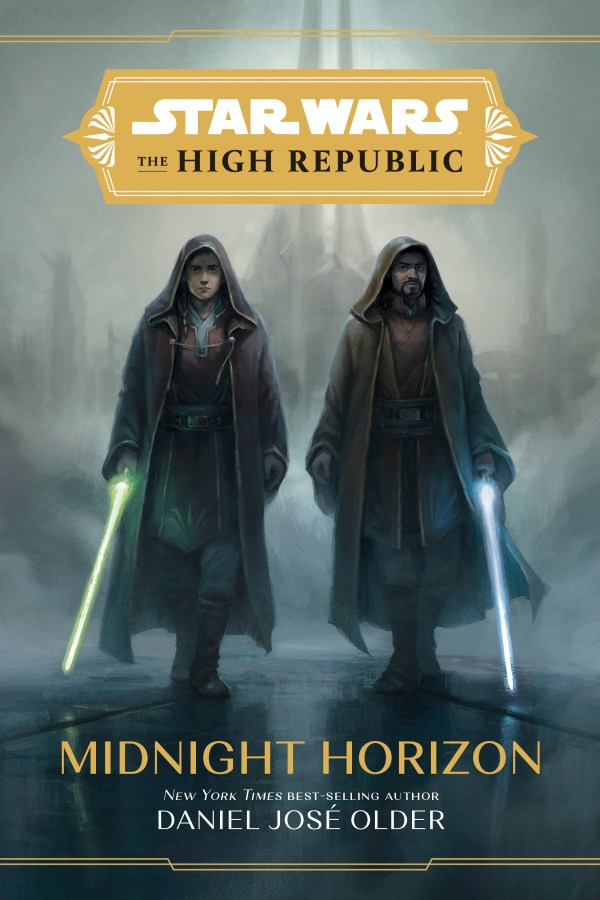
Star Wars: The High Republic: Midnight Horizon by Daniel José Older

Star Wars - Midnight Horizon Cover

Publisher: Disney Lucasfilm Press (Audiobook – 1 February 2022)

Series: Star Wars – The High Republic

Length: 10 hours and 5 minutes

My Rating: 4.75 out of 5 stars

Amazon     Book Depository

The first phase of The High Republic Star Wars novels continues to come to an intriguing end with the phase’s third young adult entry, Midnight Horizon, a deeply exciting and fun novel from the talented Daniel José Older.

Since the start of 2021, fans of Star Wars fiction have been granted a unique treat in the form of The High Republic books, a Star Wars sub-series set hundreds of years before the events of the films.  Set at the height of the Republic, the High Republic era is loaded with dangers for the Jedi, particularly that of the Nihil, dangerous raiders who seek to raid, pillage, and destabilise order, while their mysterious leader attempts a far more ambitious plan: the destruction of the Jedi.  Broken down into three phases, the first phase was pretty epic and set up the entire High Republic premise extremely well.  This phase has featured a great collection, including the three main adult novels, Light of the Jedi, The Rising Storm, The Fallen Star; some intriguing young adult books; the audio drama Tempest Runner; two awesome comic book series; as well as some other media releases.  However, this first phase has come to an end, and I just managed to finish off one of the novels that served as its conclusion with Midnight Horizon.

Midnight Horizon is the third young adult fiction novel set within the first High Republic phase, and it is probably the best.  This book was written by Daniel José Older, who has authored several great Star Wars novels over his career, including Last Shot, which was one of the books that started my recent obsession with Star Wars extended fiction, and who has been one of the key contributors to The High RepublicMidnight Horizon is set around the same time as the last adult book of the phase, The Fallen Star, and continues storylines from some of the previous books, including the other two young adult books Into the Dark and Out of the Shadows, as well as the Star Wars Adventures comic series and the junior novel Race to Crashpoint Tower.

Following the devastating Nihil attack on the Republic Fair, the Nihil raiders are finally on the run from the Jedi of Starlight Beacon.  However, not everything is as it seems, and several mysterious events and attacks are beginning to occur around the galaxy.  One of the more alarming rumours of Nihil activity has been sent from the planet of Corellia, home of the galaxy’s premier shipyards, where a now missing diplomatic bodyguard was attacked by mysterious killers wearing Nihil garb.

Determined to ensure that the chaos of the Nihil does not spread to the core planets of the Republic, the Jedi dispatch the small team of Jedi Masters Cohmac Vitus and Kantam Sy, as well as Padawans Reath Silas and Ram Jomaram, to investigate.  All four Jedi have substantial experience dealing with the Nihil, but each of them is going through their own personal internal battles as they struggle to deal with recent losses.  Nevertheless, the Jedi embark upon their investigation into Corellia and soon find unusual help from young security specialist Crash, the employer and friend of the missing bodyguard.

While Cohmac and Kantam attempt to investigate through official channels, Reath and Ram work with the chaotic Crash and her unusual security specialists to infiltrate Corellia’s high society.  Crash believes that one of her elite clients has knowledge about the Nihil infiltrators and embarks on an ambitious plan to draw them out, setting up Jedi associate Zeen as a famous singer.  However, nobody is prepared for the Nihil’s plans, both on Corellia and at Starlight Beacon, and chaos is about to be unleashed upon the Jedi and all of Corellia.  Can the Jedi stand against their foe when all hope seems lost, or will the Nihil continue to sweep across the entire galaxy?

Midnight Horizon was an exceptional entry in the High Republic series, and I was particularly impressed with the cool and epic story it contained.  Older came up with a brilliant and powerful narrative that combines a fast-paced story with great characters and some interesting High Republic developments.

This entry in the High Republic range had a very distinctive and compelling young adult story that sees all manner of chaos and action befall its protagonists.  Older wrote a very fast-paced, character driven narrative that takes the reader to the world of Corellia.  Drawing in an interesting team of entertaining and chaotic protagonists, all of whom are going through some major issues, Older sets them on a path to a major confrontation, while all of them try to come to terms with their roiling emotions.  The author sets most of the story up extremely well at the start of the book, and the reader soon gets quickly invested in seeing the Jedi investigate the Nihil on Corellia.  The story goes in some very interesting directions as everyone tries to identify the Nihil plot, with the best ones following the two Jedi Padawans as they team up with young bodyguard Crash.  Crash has some elaborate and over-the-top plans that she drags them into, including tricking a rare species eating diva named Crufeela, and this proves to be a lot of fun, while also setting up the final act of the story.  At the same time, Older also throws in some intriguing flashbacks to one of the character’s pasts, as well as showing a few scenes outside of Corellia, all of which adds some greater context to the story as well as adding to the amazing emotional depth of the novel.

Everything comes together brilliantly in the final third of Midnight Horizon, where the Nihil plot on Corellia is revealed, simultaneously occurring at the revelation of the fall of Starlight Beacon (which you knew was coming).  I must admit that until this final third, I kind of found Midnight Horizon to be a bit by the numbers, although undeniably fun, but the way everything came about near the end was pretty awesome, as the characters are thrust into an all-out war.  There are multiple pitched battles, tragic deaths and surprise reveals occurring during this part of the book, and you are constantly hit with big moment after big moment as it continues.  I honestly couldn’t stop at this point in the book, as I desperately wanted to see what happened next, and I was sure that I was seconds away from bursting into either tears or cheers.  My determination to continue really paid off, as Older saved the best revelation for right near the end as there is a really big moment that changes everything and is sure to get every Star Wars fan deeply excited.  Older leaves everything on an exciting and powerful note, and readers will come away feeling deeply moved.  It will definitely keep them highly interested in The High Republic as a whole.

The author really worked to give Midnight Horizon an extremely fast pace, and it is near impossible not to swiftly power through this book as it blurs around you.  Shown from the perspective of all the key protagonists, you get a great sense of all the impressive events occurring throughout the book, while also getting some powerful and intense examinations into their respective heads.  Older presents the reader with an excellent blend of universe building, character work, humour and action throughout Midnight Horizon, and there is a little something for everyone here, guaranteeing that it keeps your constant interest and attention.  I do think that the story as a whole could have benefited from greater development of the book’s villains.  They honestly came a bit out of nowhere towards the end and you really didn’t get an appreciation of who they were (some of it is explored in some of Older’s other works).  I really wish that Older would have shown a few more scenes from the villain’s point of view, highlighting the establishment of their plans a little better, and I felt that really would have increased the impact of the book, but I still had a lot of fun with it.

Midnight Horizon also proved to be a pretty good young adult novel, especially as it shows multiple compelling and well-written teenage characters in dangerous situations, and I loved the powerful exploration of their unique issues, especially the constant uncertainty and doubt about what they are doing.  There are also some major LGBT+ elements scattered throughout this novel, which I thought were done really well, as you get a range of different relationships, orientations, sexualities and fluid genders throughout the book, and I loved seeing this sort of inclusivity in Star Wars.  I also liked the easier flow that Older featured in the novel, which I felt was associated with the younger characters, and it worked quite well to quickly and efficiently tell this book’s fantastic narrative.  While this is a young adult book, there are some great darker themes that all readers will appreciate, and I loved how it developed into a brutal and powerful war at the end.

Midnight Horizon proved to be an interesting entry in the wider High Republic series, as it served as one of the last books in the first phase.  Since it is set alongside The Fallen Star, the readers get a whole other side of this key tragedy in Midnight Horizon, as the established characters all witness the fall of Starlight Beacon and the corresponding changes to the galaxy.  At the same time, it does some interesting exploring of the key planet of Corellia during this period, gives some hints about some events that will appear in the upcoming second High Republic phase, while also setting up some other key moments for the future.  However, the most significant thing that Midnight Horizon does for the High Republic is continue and conclude multiple key storylines and character plot lines that were started in other bits of work, such as the other High Republic young adult books.  It also provides an intriguing sequel to Older’s junior fiction novel, Race to Crashpoint Tower, and actually serves as the conclusion to The High Republic Adventures comic series, also written by Older.  The High Republic Adventures was one of the major comic lines for this phase of the sub-series, and fans of it really need to check this book out as it details the fates of several of its main characters.  I had a great time seeing how some of these storylines continue in Midnight Horizon, and Older did a great job of bringing everything together in this novel, while also making it quite accessible to newer readers who haven’t had a chance to read the comics.  That being said, good knowledge of the preceding High Republic works is probably a good thing to have for this novel, although Older does make sure to give as much background as possible as he goes.

As I have mentioned a few times throughout this review, Midnight Horizon was highly character focused, as the author brings in an interesting collection of main characters to base the story around.  All the major point-of-view characters have been featured in previous pieces of High Republic fiction before (mostly in Older’s work), and the author ensures that they all get detailed and compelling storylines in this novel that not only revisit their complex appearances in previous books, but also brings all their storylines to an intriguing close for this phase.  Older also spend a substantial time diving into the minds of these protagonists, which added some impressive emotional depth to the book, as all the characters experience deep traumas or regrets, especially after fighting the Nihil for so long.  This resulted in quite a moving read, and while I do think that Older might have used a few too-many supporting characters, this ended up being an exceptional character focused novel, and I really appreciated the clever way the author explored his protagonists and showed the events of this book through their eyes.

The best two characters in this book are the two Jedi Padawans, Reath Silas and Ram Jomaram, who serves as Midnight Horizon’s heart and soul.  I was particularly keen to see Reath Silas again, as he has been the constant protagonist of the High Republic young adult books and is a pretty major figure as a result.  Older is the third Star Wars author who has featured Reath as one of their main characters, and I do like how consistent the various authors have been while showcasing his growth and emotional damage.  Reath is going through quite a lot in Midnight Horizon, as he continues to try and balance his duty as a Jedi with the mass trauma he has experience in the last two books, his conflicted emotions, penchant for personal connections, and general uncertainty about what he is doing.  Despite this, he proves to be a steadfast and dependable character, and it is hard not to grow attached to his continued story, especially as he has developed so much from the first book from scholarly shut-in to badass warrior.  Reath’s narrative comes full circle in Midnight Horizon, and fans of this character will really appreciate how Older features him in this book.

I also had a lot of fun with Ram Jomaram, who was such a joy to follow.  Ram is an eccentric and unusual Padawan who first appeared in the concurrently released The Rising Storm and Race to Crashpoint Tower.  A mechanical genius with poor social skills and who is always accompanied by a group of Bonbraks (tiny sentient creatures), Ram brings most of the fun to the book with his antics and complete lack of situational awareness.  While I initially didn’t like Jam (mainly because I found out he was the Jedi who first came up with calling cool things “Wizard”), he really grows on you quickly with is exceedingly perky personality.  It was so much fun to see him in action throughout the book, and he gets into some unusual situations as a result.  Despite mostly being a friendly and cheerful figure, Ram is also going through some major emotions in Midnight Horizon, as he witnessed his home planet get ravaged by the Nihil in The Rising Storm, and he is now very uncertain about the emotions he feels while getting into battle.  This sees Ram form a great friendship with Reath throughout the book, and the two play off each other extremely well, bringing not only some fun humour but an interesting mentor-mentee connection.  Ram ends up showing everyone just how much of a badass he is towards the end of the book, and I honestly had an amazing time getting to know this character.

There is also an interesting focus on the two Jedi Masters, Cohmac Vitus and Kantam Sy.  Both go through some interesting and major moments in Midnight Horizon, and you really get some powerful insights from both.  Cohmac’s story is an intense and intriguing examination of trauma as you see this Master continue to struggle with his history and inability to process emotion.  These issues have been building within Cohmac since his introduction in Into the Dark, and it was fascinating to see them continue to impact him here, especially once he discovers what happened at Starlight Beacon to one of his closest friends.  Kantam Sy is a nonbinary character who has been primarily featured in The High Republic Adventures comic.  You get a much more in-depth look at Kantam in this book, especially as Older spends time developing several flashbacks around him that examine his complex past as one of Yoda’s students.  Kantam’s team-up with Cohmac proves to be an intriguing part of the book’s plot, and it was compelling to see the more balanced Kantam witness Cohmac’s building anger and frustration.

The final two major characters are Zeen and Crash, both of whom have some interesting storylines in this book.  Zeen, a Force-sensitive teen who assists the Jedi, is one of the main characters from The High Republic Adventures comic, and many of her storylines are finished off here a little abruptly although in some interesting ways.  Most of her storyline is focused around her growing romantic relationship with Padawan Lula Talisola, who she has been close with during the series, and the resultant internal conflict as she tries to decide whether to act on it.  There are also some more damaging emotional moments for Zeen as she comes to terms with the actions of her old friend Kamerat and the tragedy of Starlight Beacon.  The other character is Alys Ongwa, better known as Crash, a diplomatic protection officer who specialises in protecting Corellia’s fractious and deadly political elite.  Crash is an interesting character who was first introduced in a one-shot comic written by Older, Crash and the Crew Do What They Do, and it was interesting to see her brought back here.  A skilled bodyguard and leader, Crash is an intense and highly motivated figure who enacts multiple crazy schemes to get what she wants, while also trying to be a good friend and boss.  Crash hits some major crossroads in Midnight Horizon, especially when she is forced to balance her oath as a bodyguard against justice for her friend and the safety of her city, and she is constantly forced to keep her own intense emotions in check.  I found Crash to be one of the most entertaining and enjoyable figures in Midnight Horizon and watching her and her chaotic crew of bodyguards in action is a lot of fun, especially when she plays of all the other protagonists really well, bringing out the recklessness in all of them.  However, Crash is also quite emotionally vulnerable, and it was nice to see her try to become a better friend while also working on her romantic attachments to a beautiful alien singer and lifelong friend.  I had a wonderful time with all these major characters in Midnight Horizon, and Older did a remarkable job highlighting them and ensuring the reader was aware of their many issues.

As with most Star Wars novels I read, I chose to grab a copy of Midnight Horizon’s audiobook format, which was the usual exceptional experience.  Featuring a short run time of just over 10 hours, Midnight Horizon is a quick and fun audiobook to get through, and I loved the various ways this format enhanced the fantastic story.  As usual, Midnight Horizon features all the amazing Star Wars sound effects for lightsabers, blasters and ships, which are used to punctuate the story elements being described and perfectly bring listeners into the moment.  It also made good use of some of the classic Star Wars music, which, even though it was used a little more sparingly in Midnight Horizon, deeply added to the atmosphere of the book and perfectly enhanced the emotional impact of several key scenes.

While the sound effects and music where as cool as always, the thing that really impressed me about the Midnight Horizon audiobook was the great choice of narrator in Todd Haberkorn.  I didn’t realise that Haberkorn was going to narrate this book until I started listening to it, and I was pretty blown away the second I realised that I got to listen to an audiobook read by Natsu himself.  I am a massive fan of Haberkorn’s work as the English voice actor for dubs of awesome anime like Fairy Tail and Full Metal Alchemist Brotherhood, so it was really cool to have him narrate this audiobook.  Not only that, but Haberkorn did an outstanding job bringing the various characters to life in Midnight Horizon and moving the story along at a blistering and fantastic pace.  Haberkorn’s voice perfectly fit the frenetic energy of this story, and I loved the distinctive and very fitting voices he gifted to the novel’s eccentric characters.  He also had a lot of fun voicing some of the unique alien creatures featured in the book, such as the Bonbraks, and he got to do a particularly good Yoda voice as well.  I had an absolute blast listening to Haberkorn narrate this awesome audiobook, and when combined with the great music and impressive sound effects, this was an exceptional way to listen to Midnight Horizon.  I would highly recommend this format as a result, and it probably added a few points to my overall rating because of how impressive it was.

Overall, Midnight Horizon was an excellent High Republic young adult novel that was a real treat to read.  Daniel José Older came up with an outstanding and fun story that was both exciting and powerful as he dives into his various fantastic and damaged protagonists.  Loaded with some awesome moments and epic developments, this was a great addition to the Star Wars canon, and I loved every second I spent listening to it.

Amazon     Book Depository

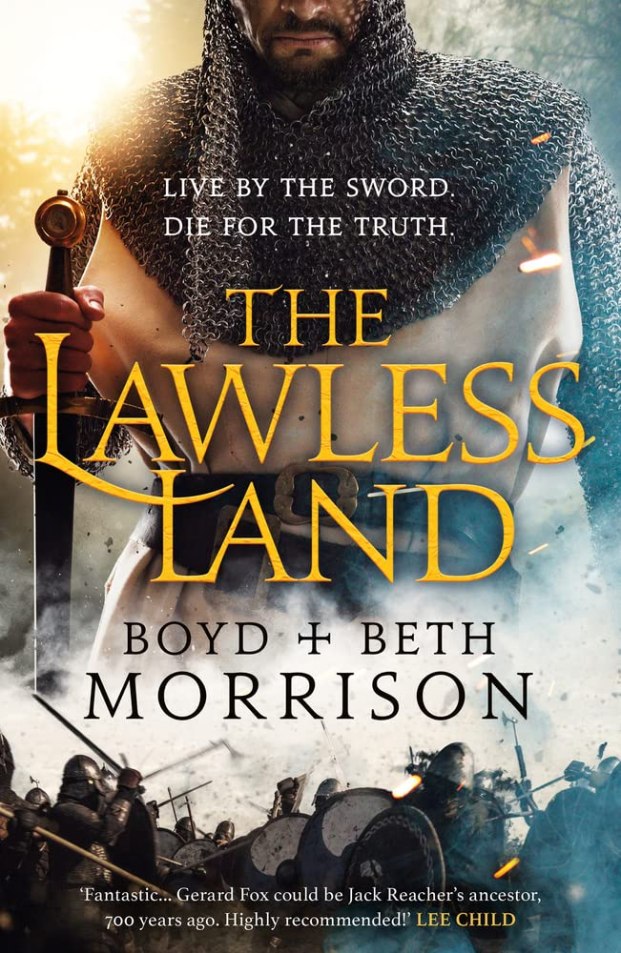
The Lawless Land by Boyd and Beth Morrison

The Lawless Land Cover

Publisher: Head of Zeus (Trade Paperback – 31 May 2022)

Series: Standalone/Book One

Length: 474 pages

My Rating: 5 out of 5 stars

Amazon

Get ready for one of the most thrilling historical adventures of 2022 with the wildly entertaining and deeply captivating medieval fiction novel, The Lawless Land, by the outstanding team of Boyd and Beth Morrison.

Despite my recent focus on other genres, historical fiction in all its forms remains one of my favourite book categories to check out, especially with awesome new novels coming out all the time.  One of the best examples of this is The Lawless Land, which I was lucky enough to receive a copy of a little while ago.  The Lawless Land was a fascinating read that takes some great protagonists on a bold adventure through medieval Europe.  This book was written by Boyd and Beth Morrison, a brother and sister team who have deeply impressed me.  This was a rather interesting combination of writers, as Boyd Morrison is an acclaimed thriller and historical fiction author, and Beth Morrison is the Senior Curator of Manuscripts at the J. Paul Getty Museum and has a PHD in history.  These overachieving siblings really cooked up something special here with their first book, and I loved the outstanding story it contained.

In 1351, Europe is in utter chaos as the Hundred Years’ War rages in France and the Pestilence ravages the countryside, depopulating towns and devastating cities.  These are dark days indeed, and only the desperate and the foolish can be found traversing the roads.  Unfortunately, this includes skilled knight Gerard Fox, whose lands and titles have been taken from him as punishment for a crime against the church, and who is now forced to wander the world by himself, desperate to reclaim his family’s honour.

Journeying towards the castle of Lord Tonbridge, the one man who may be able to prove his innocence, Gerard witnesses a band of armed men waylaying a noblewoman.  Impulsively jumping into action, Gerard saves the women, slaughtering her attackers and forever changing his life.  The young woman, Lady Isabel, is Lord Tonbridge’s betrothed, who has fled from her future husband, taking with her a sacred relic she is sworn to protect.  Forced to abandon his own quest, Gerard agrees to escort Isabel to safety, however, he is unaware of the chaos that is about to be unleashed upon him.

Tonbridge had promised Isabel’s relic to an ambitious Cardinal in Paris, one who is determined to rise to the station of Pope.  Desperate to reclaim the relic and use it to cement his position, the Cardinal and his pawn, Tonbridge, unleash their substantial forces to hunt down Gerard and Isabel.  Fleeing their pursuers, Gerard and Isabel traverse the breadth of England and France to find safe harbour for the relic.  Forced to contend with dangerous foes around every corner, Gerard, Isabel, and their faithful companions will face the worse that medieval Europe has to offer and more.  But worse lies in wait for Gerard, as he bears a dark connection with his pursuers that will ensure they will never stop hunting him.

Wow, now this was a really cool historical fiction novel.  The exceptional writing team behind The Lawless Land have produced an outstanding novel that is extremely exciting, action-packed, and character driven, while also being heavy on the historical detail and accuracy.  This results in an exceptional and epic historical thriller read that I had an absolute blast getting through and which gets a well-deserved five-star rating from me.

The Lawless Land was such a cool read, and I quickly fell in love with its brilliant and exceptional story.  Essentially an adventure thriller set in medieval times, the authors start The Lawless Land off very quickly, showing the protagonist in battle as he saves the damsel in distress, only to end up in even more trouble.  Effectively introducing the key characters early on, you get a real sense of the novels impressive style right at the start, especially with its gritty feel and intense action sequences.  The story soon evolves into a high stakes chase across Europe, as Gerard, Isabel and their companions try to outrace and outwit their opponents to save Isabel’s relic and get revenge for Gerard.  The authors make excellent use of multiple character perspectives here to showcase the chase from both sides, and you get a good look at the various schemes and ploys of the antagonists, as well as the full depths of their villainy.  These amazing and action-packed scenes are expertly interspersed with some flashback chapters that examine the full history and tragedy of the protagonists, especially Gerard, and work to fully establish the enmity between him and the antagonists.  This entire first half of the book is very well written, and the authors’ excellent style will appeal to wide range of readers, not just historical fiction fans, as anyone who enjoys a great adventure or gripping thriller read, can get really engrossed in this excellent story.

This perfectly sets up the second half of this epic novel, which sees the character involved in all manner of carnage and battle as they attempt to win.  I honestly powered through the last 250 pages or so in a day; I was having that much fun reading it.  This second part has everything, including jousting tournaments, prison breaks, desperate chases, elaborate skirmishes, political intrigue, skullduggery and more action than you can shake a stick at.  There is even a full-on judicial duel (think The Last Duel), which was one of the most impressive and gritty fights in the entire book.  There are some intriguing twists, clever reveals, major tragedies, and some outstanding action throughout this entire second half, and it was so much fun to see it all unfold.  I really must highlight the impressive action of The Lawless Land, as all the fights felt particularly realist and very epic, and you can honestly feel every powerful swing and strike of steel on steel.  The authors bring all the established story elements of The Lawless Land together extremely well in the end, and readers will come away satisfied, especially with the fun conclusion and the great ending for the characters.  While this is ostensibly a standalone read, and the authors do wrap up everything really well, there is potential for a sequel at the end, and I for one would not be opposed to seeing more from these characters in the future.

One of the most compelling parts of The Lawless Land was the brilliant dive into the history of medieval Europe.  The writing team clearly did their research when it came to this novel, which is hardly surprising considering the scholarly expertise of one of its authors.  As such, this novel is loaded with impressive and captivating historical detail which isn’t overshadowed by some of the more over-the-top action.  You get a great sense of the how bleak and brutal the continent was at this point in history, with some chilling depictions of plague and pestilence, as well as some intriguing looks at The Hundred Years’ War, including a full flashback chapter to the Battle of Crécy.  The authors spend time exploring a ton of fascinating stuff from this period, including knightly conduct, the power and influence of the church, day to day life for people in cities and the countryside, and so much more.  I particularly loved the scenes set around a tournament in France, where the protagonist engages in a series of jousts.  The sheer amount of detail and realism around these scenes are so very cool, and you can really picture how everything would have looked and felt.  There is also a great examination of medieval manuscripts (again, because of one of the author’s academic focuses), which become a key part of The Lawless Land’s plot, and it was really interesting to examine the significance and process behind them.  All this impressive work around the setting and other historical elements of The Lawless Land really enhanced the overall quality of the book, and I loved how seamlessly it was worked into the epic narrative.

I also must highlight the fantastic characters featured within The Lawless Land, which includes an awesome balance of likeable protagonist and maniacal villains who hunt them.  The story is perfectly split between the two groups, and you get some fun and intense competing views of events throughout the story as a result.  The protagonists are headlined by the awesome character of Gerard Fox, a wandering knight, banished from his family’s lands by the church following a confrontation with one of the antagonists years ago.  Dragged into this conspiracy by accident, Gerard becomes Isabel’s companion and protector, and tries to escort the relic to safety.  A man of action and honour, Gerard is haunted by his past and his many failures, which include watching his brother die in battle, and being tricked into losing everything.  He is also obsessed with discovering the true fate of his mother, and her mysterious disappearance and certain revelations draw him into this conspiracy even further.  A lot of the novel revolves around Gerard’s past, and it was fascinating to see him come to terms with it and try to balance this current quest with his own desires.  Gerard ends up being a pretty awesome protagonist to follow, especially with his martial prowess, unique weaponry, penchant for mischief and trickery (like a certain French fox), and his unbending desire to do the right thing.

Gerard is accompanied by some interesting companions, and the most prominent of these is Lady Isabel.  A noblewoman who was forced into marriage, Isabel seeks to protect her family’s most sacred relic from her betrothed and goes to great length to escape him.  Although she is initially seen as a bit of a damsel in distress, you soon begin to realise that there is a lot more to Isabel than what first appears, as she is an incredibly capable woman with some keen insights and strategies that prove invaluable to her companions.  The authors work some excellent storylines around Isabel in this novel, and you really come to appreciate and enjoy her pluck, courage and intelligence.  There is also a very clever twist about this character revealed in the second half of the book, which was set up extremely well by the authors, including in some flashbacks that both hint at and hide the truth from the reader.  I also should mention the fun supporting characters of Henri and Youssef, two friendly rogues who have substantial history and friendship with Gerard.  Henri and Youssef are excellent additions to the protagonists, and their fun personalities balance well with Gerard and Isabel’s to create a very likeable group of heroes that you become quite attached to, even if that leads to eventual heartbreak for the reader.

I also need to talk about The Lawless Land’s outstanding trio of villains who dog the protagonists’ steps throughout the entire narrative.  This includes the evil Lord Tonbridge, Isabel’s betrothed who she runs away from.  While Tonbridge is mainly hunting them for Isabel’s relic, it also becomes clear that Tonbridge is even more obsessed with righting the perceived slight to his honour and is eager for vengeance.  However, Tonbridge is also partially subservient to villainous French cardinal Molyneux, who has promised him power and a kingship if he succeeds.  Molyneux is particularly despicable, as an ambitious and immoral member of the church who is attempting to become Pope.  Using his influence and the protection of the church for his advantage, Molyneux gains large amount of money and land through unscrupulous means and has some dark history with Gerard’s family, which deeply impacts both his and Gerald’s motivations to confound each other.  The final villain is Molyneux’s vassal and bastard son Basquin, who serves as the protagonist’s main pursuer.  A skilled swordsman and tactician, Basquin is a worthy, if not superior, foe to Gerard, whom he bears a powerful grudge against.  There is some fascinating history behind Basquin that became quite an awesome part of the plot, and it was great to see the intense and captivating confrontations between the two.  The authors take Basquin in some intriguing directions in this book, especially when his own desires clash with that of his abusive father, forcing him to go rogue and enact his own ambitious plan.  All these villains were extremely well written, and it proved highly entertaining to see them go up against Gerard, Isabel and the rest throughout The Lawless Land.  I had such a great time with the characters in this book, and their intense relationships, rivalries and schemes added so much to the power of the novel.

Overall, The Lawless Land was an exceptional and impressive historical fiction read from the great new team of Boyd and Beth Morrison.  These two talented writers came up with something very special with The Lawless Land, and I loved the outstanding and highly addictive narrative contained in this book.  Featuring a ton of epic action, some amazing characters, and some superb historical detail, The Lawless Land was an incredible read that comes very highly recommended by me.

Amazon

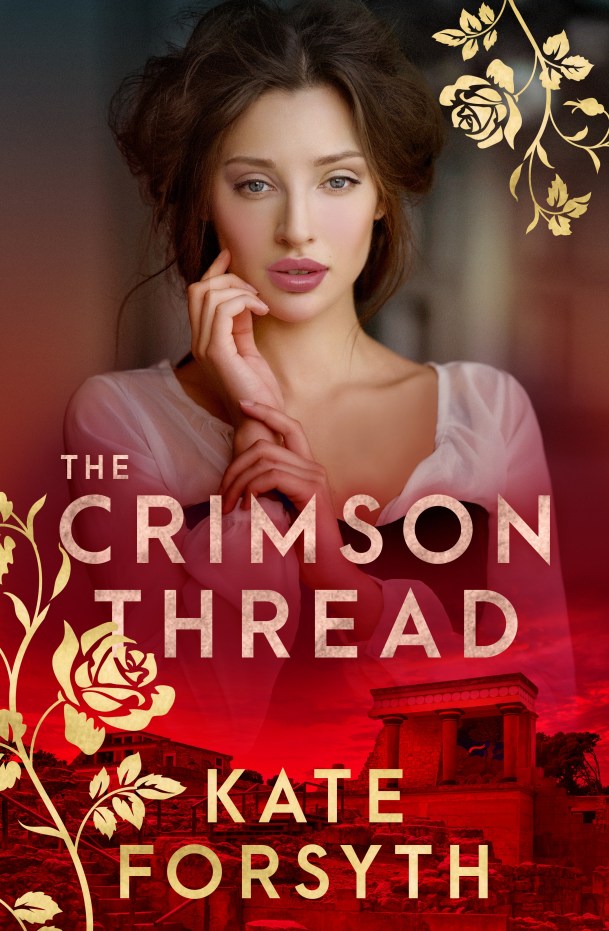
The Crimson Thread by Kate Forsyth

The Crimson Thread Cover

Publisher: Vintage Books Australia (Trade Paperback – 5 July 2022)

Series: Standalone

Length: 360 pages

My Rating: 4.5 out of 5 stars

Amazon     Book Depository

One of Australia’s premier authors presents another compelling and powerful historical drama with The Crimson Thread by Kate Forsyth.

Kate Forsyth is a very talented Australian author whose work I have long been a fan of.  While Forsyth is best known these days for her intense historical dramas, I personally am a big fan of her The Witches of Eileanan series, which I read when I was younger.  The Witches of Eileanan books, which were Forsyth’s debut series, follows a group of powerful magical users in a troubled fantasy realm filled with dragons, mages and monsters, as they attempt to overthrow a dark anti-magic tyrant and save the world from multiple impending threats.  Filled with great characters, impressive magic, a complex setting and some brilliant and occasionally dark storylines, this was a particularly awesome and epic series, and it was among the earliest fantasy books that I ever checked out.  I deeply enjoyed The Witches of Eileanan books and the sequel Rhiannon’s Ride series, and I have been meaning to reread them all for a while.  In the meantime, I decided it would be good to check out one of her more recent works with The Crimson Thread.  This intriguing and captivating historical drama is a lot more consistent with Forsyth’s current writing focus and I was very interested in seeing something from this genre.

By May 1941, the Nazis have conquered Greece and the island of Crete lies before them as the next land to control.  As the island prepares for invasion, young Cretan woman, Alenka, attempts to find some semblance of normality amongst the chaos, but chance meetings with two Australian soldiers stationed on the island will change her life forever.  When the Germans finally invade Crete in a massive and long-running battle, Alenka finds herself stuck in the middle of the fighting and eventually chooses to hide the Australians when the Germans win.

These two soldiers are Jack and Teddy.  Lifelong best friends, the rambunctious Teddy and the shy, scholarly Jack, joined the army together to see the world, only to get caught up in the chaos of the war.  Separated during the retreat to Crete, Jack and Teddy manage to reunite on the island, with both falling for the alluring Alenka upon meeting her.  When the Germans invade and they are trapped behind enemy lines with no hope of escape, both go to ground, seeking out help from Alenka and her allies in Crete’s resistance movement.

As the Germans tighten their hold on the island, Alenka, Jack and Teddy find themselves in constant danger as they attempt to find some way for the Australians to escape.  However, their attempts to evade the Nazis are not their only trouble, as Jack and Teddy’s once close friendship starts to deteriorate through jealously and anger.  Worse, Alenka’s brother, Axel, is a dangerous Nazi collaborator, whose long simmering anger and resentment threatens everything Alenka holds dear.  As Axel searches for a way to destroy his sister and her friends, all will be forced to make some hard choices, both on the battlefield and in love.

This was a deeply moving and highly detailed historical drama from Forsyth that I had a wonderful time reading.  Balancing a captivating historical tale of invasion in a unique World War II setting with a powerful tale of romance, broken friendships and family betrayals, The Crimson Thread is an outstanding novel which really highlights Forsyth’s impressive skill as an author.

The Crimson Thread has an excellent and fast-paced narrative that quickly drags readers in with the wartime action and keeps them there with the subsequent drama and tragedy.  Told from various intriguing perspectives, The Crimson Thread does a great job of quickly introducing you to the key characters and settings before bringing the terror in the form of a sudden and devastating Nazi invasion.  What follows is captivating tale of survival, endurance and resistance, as the three central protagonists attempt to evade and outwit the occupiers while also dealing with their own simmering feelings of love, betrayal and jealousy.  Forsyth weaves together some hauntingly tense and moving scenes throughout this narrative, as you see the characters thrust into all manner of dangerous and tragic circumstances amid the horrors of war.  The entire narrative has an excellent blend of action, high-stakes espionage and deep personal drama that I found myself really drawn to, all of which fits together perfectly with the distinctive setting and period.  The entire narrative takes place over the course of several years, and I deeply appreciate the long-term storylines that Forsyth utilised as you got to see the various characters grow and change throughout the war, often for the worst.  I loved the focus on camaraderie, identity and historical pride that was worked into the story, and all the unique plot points come full circle by the end.  Forsyth ends the entire excellent story of survival and war on a tragic, but hopeful note, and while you may end up with some conflicting feelings about the fates of some of the focal characters, readers are going to come away from The Crimson Thread both moved and satisfied with the story conclusion.

One of the things that I have always appreciated about books set during World War II are the sheer number of unique stories that can be written, as there were so many different battlefields, conflicts and personal dramas that resulted from them.  While I am fairly knowledgeable about history and World War II, I honestly knew very little about the occupation of Crete during the war, nor did I realise that Australian and New Zealand soldiers were stationed there when the Germans invaded.  As such I was pretty in the dark when it came to the historical context of the novel, but Forsyth was well on hand here and spent substantial time exploring the entire Nazi conquest and occupation of Crete during the war.  Everything is covered here, including the initial 11-day battle to take control of the island, the subsequent disorganised evacuation of Allied forces, the harsh occupation of the Cretans, which included several massacres, the resistance movements, and everything else that occurred from first day to the end of the war.  I was particularly intrigued by the role that Australian troops played during this conflict, and Forsyth made sure to really highlight why they were there and the various hurdles they faced during this war, including being trapped behind enemy lines with few options to escape.  All of this is worked into the story in a clever and impressive way, and the various characters find themselves involved in many of the key events, either as witnesses or participants.  You really find yourself getting drawn into the midst of these compelling historical events, and I personally found it incredibly fascinating to see them, especially as Forsyth did some substantial research for this book.

I also really appreciated Forsyth’s dive into the culture, history and iconic landscape of the main setting of Crete.  Most of this book takes place on this beautiful island, and I felt that Forsyth really captured the heart and soul of Crete and its people throughout the story.  There are some compelling dives into the identity and culture of the Cretan people, including the importance of their dress, their customs, their speech, and their defiant nature.  Due to most of this explanation being done to show the undercover Australian citizens how to blend, it proves to be very informative, and readers without much pre-knowledge of Crete come away with a lot of detail and appreciation for its people.  There are also some fun dives into the history of the island, particularly its ancient association with legend of the Minotaur and palace of Knossos.  Due to my background in archaeology, I found this to be extremely interesting, especially as there are also some compelling depictions and discussions about the famous excavations that took place on Crete during this period.  Throw in some breathtaking and highly detailed descriptions of the various environments and settlements on Crete, including its treacherous and massive mountains, which serve as a great setting for some particularly intense scenes, and you get an outstanding appreciation for this island.  All of this is utilised in The Crimson Thread’s story really well, as the characters, like the reader, really get to know the island and how it impacts many of their decisions and actions.

Forsyth also came up with some excellent and distinctive characters for The Crimson Thread, and their unique and emotionally rich storylines are a powerful part of this great book’s story.  This includes Alenka, who finds herself caught between her culture, her troubled family past, and her attraction to the two Australian soldiers she grows close to.  Despite primarily being shown as a strong and clever woman, Alenka goes through some real tragedies and trauma in this book that slowly wear away at her psyche.  I found it fascinating to see her growth throughout the book, as well as her attempts to overcome the various obstacles and indignities that come her way.  Alenka was really well counterbalanced by her brother, Axel, a dark and dangerous youth who serves as the book’s central antagonist.  Initially shown as a youth who grows into a dangerous teenager throughout the narrative, Axel is a complex figure.  A half-Cretan boy who is the result of an extramarital affair with a German archaeologist, Axel has borne the shame of his heritage for most of his life and endured the ridicule and disdain of everyone on the island.  Focusing on his German heritage, Axel becomes obsessed with Hitler and the Nazis and quickly grows to be a valuable collaborator for the occupiers, helping them root out the resistance and hidden Allied soldiers.  While he is an extremely repulsive and evil figure, you fully understand while he idolises the Nazis and tries to join them because of how well Forsyth explored Axel’s motivations and past.  Forsyth writes a very dark storyline around Axel, and it was fascinating to see him corrupted by both his own unfair past and the invading Nazis.

The other two main characters are the Australian soldier protagonists, Jack and Teddy.  Despite being old friends, these two are very much the opposite of the other, with Teddy being a wild, confident and arrogant figure, while Jack is a kind and shy man with a stutter.  While you wouldn’t think that they would be friends, Forsyth does a good job establishing their bond, and you fully understand why they are close to each other.  Both characters are interesting in their own right, and I appreciated how Forsyth highlighted their differences and showed how their relationship eventually broke down over their mutual attraction to Alenka.  Teddy’s slow crawl from causal larrikin to arrogant jerk is subtle, but well formed, and the author shows some compelling, but damning, change in views in his mind throughout The Crimson Thread.  Jack, on the other hand, grows from unconfident scholar to strong-willed fighter, all thanks to his love of Alenka.  I loved how Forsyth showed all his artistic skills and passions, such as poetry, as a strength, and it was pretty fun to see him succeed in the specialised spy school both characters end up in.  This poetry actually had an interesting role in the wider book, and you can see a great example of it at the start of different chapters.  Forsyth really excelled at creating some amazing and captivating character arcs throughout The Crimson Thread, and I had an outstanding time getting close to these figures and experiencing their triumphs and dark pains.

Overall, The Crimson Thread was a wonderful and deeply moving read that ended up being one of the better historical dramas I have read this year.  Kate Forsyth continues to shine as an extremely talented Australian author, and I had fun exploring a book from her current genre of choice.  Featuring some damaged characters, a powerful story and some exquisite dives into Crete and its wartime history, The Crimson Thread is a captivating and clever novel that I had an outstanding time reading.

Amazon     Book Depository

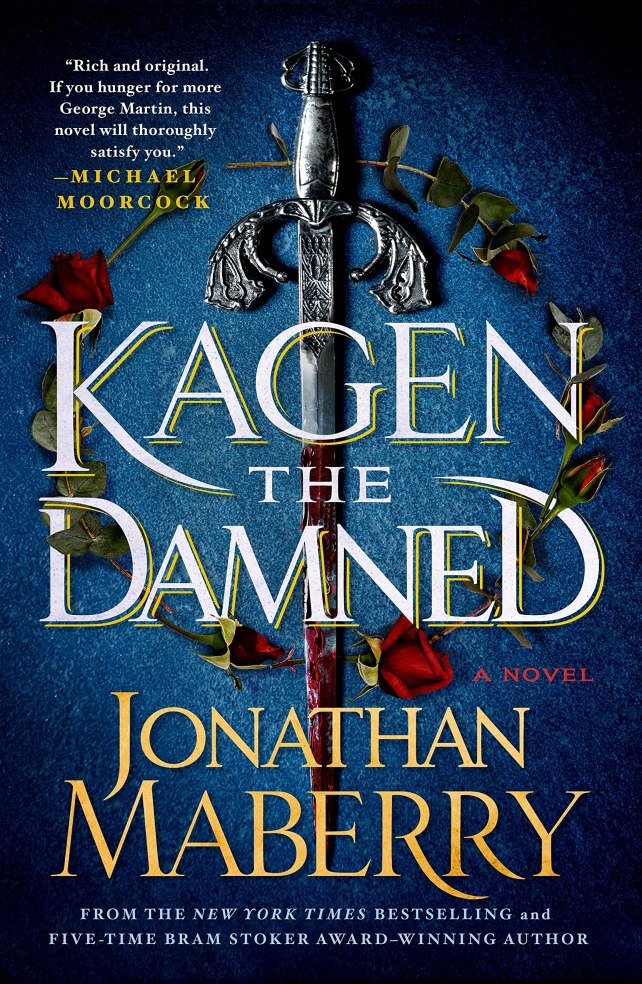
Kagen the Damned by Jonathan Maberry

Kagen the Damned Cover

Publisher: Macmillan Audio (Audiobook – 10 May 2022)

Series: Kagen the Damned – Book One

Length: 20 hours and 53 minutes

My Rating: 5 out of 5 stars

Amazon     Book Depository

One of my favourite unusual thriller writers, the legendary Jonathan Maberry, enters the world of fantasy in a big way with Kagen the Damned, a dark fantasy masterpiece with a brutal heart to it.

I have made no secret of the fact that I am a huge Jonathan Maberry fan.  I got into Maberry’s writings when I chanced upon a copy of his 10th Joe Ledger novel, Deep Silence, a few years ago, which introduced me to both Maberry’s unique writing and his iconic protagonist, the titular Joe Ledger, a badass action hero who saves the world from crazy and dark science creations.  I deeply enjoyed Deep Silence (it was one of my favourite books of 2018) and quickly moved onto his other Joe Ledger books, diving back to the start of the series with Patient Zero, and then working my way through the rest of the awesome entries, such as The Dragon Factory, Code Zero, Predator One and Dogs of War.  I also kept up with his latest releases, including the two entries in the follow-up Rogue Team International series, Rage (one of my favourite books and audiobooks of 2019) and Relentless (one of my favourite books and audiobooks of 2021), and his standalone novel Ink (one of my favourite books and audiobooks of 2020).  I have been very eager to see what awesome novel Maberry releases in 2022, and, luckily for me, that materialised in the form of Kagen the Damned.

Kagen the Damned is an interesting and unique read from Maberry, as it is his debut foray into the fantasy genre.  While many of his other books have had fantasy elements to them (albeit with a horror edge), this is his first pure fantasy fiction novel, as well as the start of his Kagen the Damned series.  Naturally I was rather curious about how Maberry would transition to a new genre, and while I was a tad disappointed that the Rogue Team International series isn’t getting a new entry any time soon, Kagen the Damned ended up pretty high on my most anticipated reads for 2022 list.  After a few weeks of other books getting in the way, I finally got the chance to listen to Kagen the Damned, and it turned out to be quite an impressive novel.

Kagen Vale was once one of the most trusted and revered fighters in the entire Silver Empire.  A scion of the legendary Vale family, who have served the Silver Empire for generations, Kagen was a beloved member of the royal court and so highly regarded that he was entrusted as the guardian of the Seedlings, the Empresses’ children.  That was until the fateful night when, out drinking and whoring, he was drugged and left for dead.  Awakening in a daze, Kagen found himself in the midst of hell as the capital of Silver Empire, Argentium, was besieged by a foe long thought dead, the dread nation of Hakkia, whose dark magic has once again emerged to blot out the world.

Arriving to the palace too late to save anyone, including the Seedlings, Kagen falls into despair at failing his sacred duty and can only watch in horror as the Gods of the Garden, the deities of the Silver Empire, turn their back on him and damning him for all time.  Now with everything and everyone he has ever known lost forever, Kagen the Damned wanders the ruined countryside a broken drunk, dreaming of revenge on the one man responsible for all his ills, the mysterious and feared Witch-king of Hakkia.

However, not everything is as lost as it seems, as shadowy figures across the world being to formulate their plans to repel the Witch-king’s evil.  As two young women embark on a deadly quest to awaken a sleeping, ancient god from beneath the waves, a covenant of resistance attempts to find their own magic to oppose the Witch-king with.  Determining that Kagen may bear the best chance of recovering the tools needed to succeed, they manipulate events to set him on his path to revenge.  However, what price will a doomed man truly pay to get the revenge he so desperately seeks, and will Kagen be ready for the terrible secrets he uncovers along the way?  Only the gods and the damned know for sure!

Well, it is now more apparent than ever that there is no Jonathan Maberry book I will not enjoy to the extreme.  Kagen the Damned is an incredible and very memorable novel from Maberry, who puts the ‘dark’ in dark fantasy, with this barbaric and action-packed journey into hell.  Making use of his trademark style, flair for horror and exceptional character work, Maberry pulls together a deeply addictive and extremely exciting story that I fell in love with very, very quickly.  This was another easy five star read for me, and I loved every single second I spent reading it.

Maberry once again blew me away with an outstanding and high-action narrative, and I quickly got very attached to Kagen the Damned.  This book has an extremely memorable start to it, showing the bloody fall of Argentium from the perspective of Kagen, who awakens from a drunken haze to find a vast army in his supposedly impenetrable city, destroying and killing everything they see.  This was a very compelling and brutal start the novel, and its one that I quite enjoyed, especially as you see just how dangerous the enemies are and the chaos they have unleashed.  Maberry does a great job of setting up multiple key storylines, settings and characters in this early section, and while the focus is primarily on Kagen, you get some interesting insights into other figures that will impact the rest of the book.  The entire first part of the book is very distinctive and really showcases how dark this novel is going to get, especially when it comes to the character of Kagen and the fate of the royal children.  This whole first section ends on a brilliant note, with Kagen left broken and damned, while the once great Silver Empire, which you only saw glimpses of, is destroyed and replaced with a new world order.

Following this epic start, the narrative slows down a little, as Maberry works to set up some alternate storylines and characters, while as taking the time to do some compelling and extended word building.  Set in the direct aftermath of the opening sequence, the story primarily splits into three different streams at this point, with the main one following a despondent Kagen as he traverses the former Silver Empire, lost in grief and drink.  At the same time, two separate storylines tell some great connected narratives, with one following two young women as they journey off into the unknown, while the rest focuses on the Hakkian takeover back in Argentium.  This focus on the Hakkians and their plans, as told by the Witch-king’s advisors, as well as a resistance group, is very awesome, and it was fascinating to see some impressive political intrigue going on behind the scenes as the antagonists work to consolidate power through various methods.  While the rest of the narrative continues in a straight line, the story around Kagen slowly adapts as he meets some new friends and begins his mission of revenge as planned, with some detours.

This leads up to the excellent final part of the book, which I powered through extremely quickly to see how everything ended.  All three major storylines are reaching there climax here, and they start to blend a lot more closely, especially the ones focusing on Kagen and the Hakkians.  Everything leads up to a highly anticipated confrontation that sees Kagen finally face his enemies, and it is just as epic as I was hoping.  There is a ton of action, tragedy, twists and revelations here, as many of the plot elements and storylines come full circle.  I loved the various reveals that happen here, and most have been set up really well throughout the extended course of the narrative.  I really should have seen the identity of the Witch-king coming, but it was the right choice by Maberry, which leaves some big questions open for the future.  Everyone will come away from Kagen the Damned extremely satisfied, as Maberry leaves everyone on a brilliant note, that ensures that readers will definitely come back for more.  This is an outstanding and deeply addictive narrative that is guaranteed to grab your attention early one and refuse to let go.

I really enjoyed how well Kagen the Damned was written, as Maberry brought his unique style to bear to help create an outstanding story.  In many ways, this novel proved to be essentially one of Maberry’s thrillers set in a fantasy universe.  Indeed, there were a lot of similarities in the style, the structure of the chapter, the pacing and even the use of familiar horror elements that I have previously seen and loved in the Joe Ledger books and I think this cool style worked well to tell an intense fantasy narrative.  As such, Kagen the Damned is a swift and well-structured book that pushes the story along at a swift pace, while also taking the time to build up the universe and the multitude of characters.  Maberry utilises a great range of story elements throughout this novel, and the readers are treated with a fantastic blend of action, intrigue, dark, over-the-top moments, horror, despair and humour, as the characters experience all manner of devastating trials and oppositions.

I also have a lot of love for the way that the author sets up the story and showcases the elaborate events that are occurring.  Maberry makes excellent use of a huge number of shorter, focused chapters told from a variety of viewpoints.  These briefer chapters really increase the pace and intensity of the book, and I deeply appreciated how the narrative quickly jumped across the various characters.  The interplay between the three central storylines, which are primarily anchored around Kagen, is extremely good, and I loved seeing the characters react to some of the same events or actions of their fellow cast members.  These storylines are also joined by a series of interludes that show the various impacts that the Hakkian invasion has on the wider world, especially those attuned to magic.  These interludes are usually very fascinating, and they are often used to introduce some minor supporting characters in a fun and unique way.  I loved the complexity that these interludes usually have, and the often self-contained stories are well structured and always feature a distinctive or chilling conclusion.  Maberry uses these interludes cleverly, often inserting them between major or extremely powerful chapters to help relieve tension, or to remind the reader of the wider stakes or events occurring around the main story.  I definitely enjoyed this larger look at the world that Maberry provided through them, and it was an outstanding part of Kagen the Damned’s story.

One of the major highlights of the writing in Kagen the Damned is the intricately described and fast-paced action, which is a major hallmark of Maberry’s writing style.  Maberry has always excelled at writing brutal fight scenes in a way that paints a vivid mental picture for the reader, and this was once again the case for Kagen the Damned.  The many, many action and fight sequences are brought to life in exquisite and bloody detail, and the reader is easily able to imagine every strike and slice as they happen.  This makes the action sequences really pop, and they were a particularly awesome highlight of this great book.  This focus on action and combat was really effective in this fantasy novel, and it was very cool to see Maberry bring his knowledge of combat and the accompanying writing skill to bear on large scale battles between armed and armoured fighters, while magic and gods blow stuff away around them.  There are some really great fight scenes loaded throughout this book, and I loved every skirmish, battle and duel that was featured within it.

While I did really love the action and brutal combat sequences within Kagen the Damned, I probably should add a warning about how dark and gruesome it can get in places.  Maberry’s writing style has always relied on over-the-top violence, cruelty and brutality to a degree, and this was once again the case in Kagen the Damned, which not only featured a ton of killing but also gruesome scenes of torture, corpse desecration and depictions of sexual violence.  While I think that these ultra-violent moments do work to showcase just how dark and savage the new world order is, they are often a bit hard to witness.  I will note that Maberry did take the time to discuss the emotional and social impacts of the various acts of sexual violence in the book, rather than just including them for gratuitous effect.  There are also some great scenes where the protagonist calls out and belittles several characters willing to commit such acts, before delivering his own violent justice, and I think that the author did his best to show have damaging it can be in his own way.  However, readers should probably be aware that these scenes exist, as people might find them to be a bit shocking.

I was also a major fan of the cool new fantasy universe that Maberry cooked up with Kagen the Damned, mainly because it is such a distinctive creation of the author.  Set on a giant continent made up of various nations, this is an impressive and compelling world, filled with a unique history, gods, people and settings.  The author does a great job of swiftly introducing this world and some of the key parts of its history in the early parts of the book, mainly so that readers can be a little more shocked at the early events and full appreciate the destruction and change that the Hakkian nation brings with it.  Maberry is clearly emulating some classic fantasy novels and settings throughout Kagen the Damned, and I loved seeing this bold new world that he has created.  There are some unique and cool elements featured within, and I liked how there are certain shades of grey shown when it comes to the morality and righteousness of the various factions.  Maberry also takes the time to highlight the changes that are coming to the world, thanks to the return of the Hakkian Witch-king, and the slow and steady resurgence of magic and the death of a certain pantheon of gods, are highlighted really well, both in the main story and the interlude chapters.

Perhaps one of the most distinctive features of this new world is the horror elements that Maberry worked into the plot.  I really should not have been surprised at the strong Lovecraftian elements that featured, as the author has used them strongly in some of his previous books.  However, it is even more explicit here in Kagen the Damned, with several notable Elder Gods playing key roles in the plot and even appearing in some epic scenes.  While I am not personally a fan of Lovecraft, I did quite like how Maberry utilised these elements throughout this book, and they gave parts of the book a darker and more eldritch quality that I quite enjoyed.  This, and certain discussions about other worlds and alternate realities, potentially links this series to some of Maberry’s existing works, and it wouldn’t surprise me if there were some form of crossover in the future, although it would have to be handled well.  I had a great time exploring this new fantasy world in Kagen the Damned, and I look forward to seeing what other surprises and dark gods appear in future entries of this series.

I also must highlight the incredible character work featured with Kagen the Damned, as Maberry went all out to create an excellent and unique cast of characters, whom the excellent narrative revolves around.  There are some amazing characters featured within this novel, and the author works hard to feature all of them in some impressive roles.  I had a lot of fun with the huge cast of Kagen the Damned, and there are deep and emotional figures featured here.

The most prominent and intriguing character is the titular Kagen, who takes on the moniker of Kagen the Damned.  Maberry really does a number on his central protagonist early on, as Kagen awakens from a drunken haze to find that everything he cared about and held dear had been lost while he slept.  Despite his best efforts to redeem himself in the battle that follows, he still fails miserably, and manages to escape the conquered capital in a fractured haze.  Broken, dazed and emotionally destroyed, Kagen becomes even more despondent when he sees his gods in the sky turn their back on him due to his failure to maintain his sacred oaths, which convinces him that he is damned.  Naturally, these events leave him severely emotionally damaged, and he spends most of the book trying to come to terms with his failure while also trying to find some way to get revenge on the Witch-king for all he has done.  A large amount of the book is dedicated to Kagen falling into despair, and Maberry presents a realistic depiction of a man who has lost everything and who is barely able to survive, relying heavily on drink and violence to get through his days.  While Kagen is eventually able to throw off much of this despair, it is still lurking within him, and he is often shown living in regret at his failure, even though no one else blames him as much as he does.  Kagen working through these complex feelings of failure results in much of the novels emotional strength, and Kagen serves as a moving and powerful heart for the entire novel.

While I did deeply enjoy this intriguing central character and his rough and emotional journey through this book, it is hard not to notice some similarities between Kagen and another one of Maberry’s protagonists from another series.  Kagen is in many ways a fantasy version of Joe Ledger, with similarities including a propensity for violence, extreme skill with knives (technically short-swords in Kagen’s case), and even a similar sense of humour during some of the lighter moments of the books.  There is also the same high level of mental damage brought on by extreme trauma, with both characters often seeking revenge against the people who wronged them and those they loved.  Despite these similarities, I still really appreciated Kagen as a protagonist, and I felt that some of his additional elements, such as his complex familiar bonds and strong sense of failure, did set him apart in some key ways.  No matter what, Kagen is a pretty awesome character to follow, and I loved seeing him continue to go through all his dark moments to keep going.

Aside from Kagen, there are several other amazing characters featured in this novel, all of whom have some outstanding storylines around them.  Two of the most prominent are Ryssa and Miri, who were in Argentium when the Hakkians invade.  Both junior members of the Silver Empire’s clergy, the two women initially appear to be primarily concerned with surviving the invasion.  However, it soon becomes apparent that Miri, whose knowledge of the gods and creatures of this world are far greater than they should be, has a different agenda.  Taking Ryssa with her on a big journey to a remote island nation, Miri soon engages in a plot to save the world her way.  Ryssa and Miri make up a fun combination that Maberry weaves some interesting storylines around.  While these characters aren’t explored as deeply as Kagen, you still get a great sense of who they are, particularly Ryssa, who is the primary point-of-view character between them.  Their entire storyline is covered in mystery and uncertainty as Ryssa is left in the dark about what is coming her way.  I liked the religious world-building that went into this character storyline, and there are some excellent moments in it loaded with tragedy and despair.  Even with their storyline being mostly separated from the rest of the characters, and it was a little predictable that Maberry would turn them into a lesbian couple, they had a compelling relationship and I felt that they added a lot to the narrative.

I also had a great deal of fun with the primary Hakkian characters featured in Kagen the Damned.  While they are ostensibly the antagonists of the book, Maberry takes the time to really establish the main four characters and presents them as a lot more complex and even sympathetic in places.  The main Hakkian character is their leader, the Witch-king, a character shrouded in mystery for most of the book.  A previously unknown figure, the Witch-king uses his magic to defeat the entire Silver Empire in a night and then spends the rest of the book trying to set himself up as the legitimate ruler of the land while also advancing the position of his brutal god.  I loved the way that Maberry kept the details about the Witch-king’s past and identity hidden for most of the narrative, although there is some great foreshadowing of his identity scattered throughout the novel.  The Witch-king cuts a fantastic and menacing figure for most of the book, and it was intriguing to see him present himself as a fair and loving ruler, while simultaneously exuding an aura of menace and dark magic.  It was pretty hilarious to see him terrify his key advisors for much of the book, and I loved all the hints about his true objectives.  An overall excellent central antagonist, I look forward to getting more details about him and his history in the rest of the series, especially after the revelations at the end of this book.

The other three key Hakkian characters are the Witch-king’s advisors, the chamberlain Lord Nespar, necromancer Lady Kestral, and newcomer Jakob.  Nespar and Kestral are fantastic characters who spend most of the book administrating the Witch-king’s will, running his empire, hunting for Kagen, and setting up the upcoming coronation of the Witch-king to become emperor.  While they are initially shown to be quite dangerous and evil, mainly due to their role in destroying the Silver Empire and Kestral’s disturbing magic, you eventually see that there is a lot more to them.  In particular, you see that they are actually extremely terrified of the Witch-king and are desperately obeying his will in order to survive.  You actually end up feeling a bit sympathetic for the pair of them, even after you see Kestral tear a corpse apart for a ritual, and I enjoyed the intrigue and politics they got involved with to rule the new empire.  The other character is Jakob, a Silver Empire historian who is drafted into the Witch-king service as his minister for propaganda.  Rechristened as Jakob Ravensmere, he becomes fully compliant in the Hakkian takeover and proves to be a very competent advisor and political mind while also working to rewrite history to increase the legitimacy of the Witch-king.  It was extremely fascinating to see Jakob discussing the control given by those who control history and propaganda, and I really enjoyed his role in the new empire.  It was also fun to see his rather quick slide towards the dark side as he fully embraces the Hakkian lifestyle and even starts to develop a taste for a power.  I always love seeing Maberry’s narrative unfold from the antagonist’s point of view, and this worked out extremely well again in Kagen the Damned.

The final characters I need to highlight are some of the excellent supporting cast surrounding Kagen.  Kagen has two excellent companions who work with him throughout the book, Tuke and Filia.  Tuke is a giant professional thief who recruits Kagen for a job that will help an anti-Hakkian resistance movement.  Tuke serves as the comic relief for much of the book, and I loved the outstanding chemistry he had with Kagen.  The two play off each other extremely well, and their excellent camaraderie and humour were pretty fun to see.  Not only does Tuke have some of the best lines (and the funniest curses) in the book, but he also serves as an emotional sounding board to Kagen, helping him get better after all the tragedy he experienced.  Filia is a strong-willed warrior and former associate of Kagen who finds herself dragged into the chaos around the war and Kagen’s wild adventures.  Filia’s no-nonsense attitude and sarcasm are a great counterpart to the other characters in Kagen the Damned, and I especially liked it when it combined with the humour of Kagen and Tuke.  These characters, and more, really enhanced the overall quality of this impressive narrative, and I loved seeing their powerful storylines unfold in some excellent and enjoyable ways.

There was no way that I was going to check out the new Jonathan Maberry novel in any format other than audiobook.  I have had some outstanding experiences with Maberry’s audiobooks over the years, and all of them have been deeply impressive and extremely enjoyable.  This again proved to be the case with Kagen the Damned, as I had an outstanding time having this dark epic read out to me, especially as it really helped me to absorb all the details of the characters and the impressive new universe.  With a runtime of just under 21 hours, this is a pretty lengthy audiobook to get through, but it is well worth the time investment, especially as it delivers the story in such an awesome way.

Easily the best thing about this audiobook is the outstanding narration from the very, very awesome Ray Porter.  Porter, who is one of my favourite audiobook narrators, who has previously narrated Maberry’s books, as well as contributing his voice to other works like The Apollo Murders and The Sandman audio adaptation.  As such, the moment I heard that Porter was also going to narrate Kagen the Damned, I knew that I had to get this audiobook.  Porter has an amazing ability to move the story along, and his voice is perfect for all the intense action, world-building and intrigue Maberry features in his novels.  I love the way that Porter dives into the various characters featured in the books, with every single person getting their own distinctive voice, while Porter also effortlessly emotes all their emotion to the listener.  This includes a very sinister voice that Porter saves for when the villains are talking or some incredibly dark moments are happening, and having him use variations of this voice to highlight just how brutal a moment is being, is always a great experience.  It also works well when the characters start speaking in the languages associated with the Elder Gods, and the resultant ceremonies and spells are quite spooky to hear in Porter’s voice.

Porter also did a particularly good job at inhabiting the voice of Maberry’s central protagonist, Kagen, and you get a real sense of who he is and the intense pain he is feeling throughout the book.  While the voice Porter uses from Kagen is a little like that of Joe Ledger from Maberry’s other audiobooks (a side effect of Porter ensuring that the main protagonist’s voice matches the tone he uses for basic narration), Porter does add a little more of a growl to it here, which helped to a degree.  This was another incredible performance from Porter, and I am so very glad that they got him back to narrate Maberry’s new series.  I cannot emphasise how outstanding the Kagen the Damned audiobook turned out to be (although I did feature it in my recent best audiobooks from the first half of 2022 list before I’d even finished it), and this is the absolute best way to enjoy Kagen the Damned.

Well, after rabbiting on for nearly seven pages, I think it is exceedingly obvious that I loved Kagen the Damned.  Jonathan Maberry’s latest novel was extremely compelling and deeply exciting, and I was really impressive with the author’s jump to the fantasy genre.  Featuring a clever, complex, and action-packed narrative loaded with destruction, thrilling revenge and some great, damaged characters, Kagen the Damned was an outstanding read and its one that I absolutely flew through.  Kagen the Damned is easily one of the top books of 2022 and this is a favourite new series for me.  I am extremely excited to see where the Kagen the Damned series will go in the future, and the next book, Son of the Poison Rose, is out in a few months’ time, and I cannot wait to get my hands on it.

Amazon     Book Depository

Throwback Thursday – Warhammer: Van Horstmann by Ben Counter

Van Horstmann Cover

Publisher: Black Library (Paperback – 1 February 2013)

Series: Warhammer Fantasy

Length: 415 pages

My Rating: 4.75 out of 5 stars

Amazon

Welcome back to my Throwback Thursday series, where I republish old reviews, review books I have read before or review older books I have only just had a chance to read.  For my latest Throwback Thursday I review another awesome Warhammer Fantasy novel, the compelling and unique Van Horstmann by Ben Counter.

Another week, another Warhammer tie-in novel that I must review.  I have been really diving into this franchise over the last year; to be fair, there are some incredible books there, including the two 2022 Warhammer 40,000 releases that got a full five-star rating from me, Ghazghkull Thraka: Prophet of the Waaagh! by Nate Crowley and Assassinorum: Kingmaker by Robert Rath.  Some of the best of these books are tie-ins to the now destroyed Warhammer Fantasy universe, including the novel from last week’s Throwback Thursday, Runefang by C. L. Werner.  Well, my current obsession with all things Warhammer continued again as I recently read the awesome Van Horstmann by Ben Counter.  Counter is a well-established author of Warhammer fiction, having made a ton of impressive contributions to the franchise, including his Grey Knights and Soul Drinkers series, as well as his entries in the massive Horus Heresy series.  I was really drawn to Van Horstmann when I picked it up, not only because it has a great cover (love a cover with a dragon on it), but because of its intriguing plot, which sounded extremely awesome.

In the human realm known as the Empire, magic has been feared and mistrusted through most of its history, with practitioners hunted down and burned at the stake.  However, following the Great War against Chaos, the elven mage Teclis was allowed to train various talented humans in the use of magic, establishing the eight Colleges of Magic that train scholars and battle mages to help the armies of the Empire.  Out of all the colleges that were formed, the most revered are the College of Light, whose powerful light magic can be used to push back the darkness of Chaos.

Years after its formation, a young wizard manages to find the College of Light, hidden behind a magical barrier in the Imperial capital, Altdorf.  This wandering wizard, Egrimm van Horstmann, is a talented young mage whose desire for knowledge and skill at manipulating the Wind of Hysh immediately impress his new teachers, and many believe that he will rise high in the order.  However, van Horstmann has a dark secret that burns deep within him, and knowledge, power and ambition aren’t the only reasons for his joining the Light Order.

As van Horstmann rises in the ranks of his order, it soon becomes apparent that he has a diabolical plan.  Working with dangerous forces, including daemons, cursed items and even the Chaos god Tzeentch, van Horstmann begins to manipulate his order, the other colleges, and even the emperor to get what he wants.  But the closer he gets to achieving the goal, the more enemies he makes, and soon factions within the Light Order and the greater Empire begin to move against him.  Can van Horstmann succeed in his mission before his dark purpose is discovered, or will his dastardly designs unleash the great and uncontrollable power hidden at the very heart of the College of Light?

This was an impressive and deeply captivating Warhammer Fantasy novel, and I absolutely loved the elaborate and clever narrative that Counter came up with.  Focusing on an intriguing villainous figure and crafting an addictive story around him that also explores key aspects of the franchise’s lore, Van Horstmann was an outstanding novel, and it was probably the best Warhammer fantasy novel I have read so far.

Counter has come up with an excellent and impressive narrative for Van Horstmann, which, as the name suggests, is completely focused on the character of Egrimm van Horstmann.  For those who don’t know, van Horstmann was a minor special character for the Chaos army in some of the earlier editions of the games, but he didn’t have that much background or lore surrounding him.  I personally knew him due to his name being associated with one of my favourite magical items available to Empire armies in the later editions, Van Horstmann’s Speculum, which is a very fun surprise for an unwary foe (I have fond memories of using Van Horstmann’s Speculum in a game to switch stats between my Master Engineer and my brother’s Manfred von Carstein in a duel.  The look on his face as his ultimate general was suddenly weaker than my minor hero was just hilarious).  However, Counter manages to take the short background summary of the character and uses it as the basis for this novel, expanding on the tale of van Horstmann and showing how and why he infiltrated the Light Order and ended up betraying them, which results in an epic story.

Van Horstmann has a bit of a slow start to it, as Counter takes the time to set up key parts of the story, including an intriguing prelude that examines the first wizards of the Empire and their darkest secret.  From there, the story introduces the main character, van Horstmann, and shows his entry into the Light Order and his start as a student.  The story gets quite interesting after this, especially as you see van Horstmann involved in a demonic exorcism, which quickly highlights just how ruthless and cunning he can be.  The story picks up pace from there as you begin to witness van Horstmann’s inevitable rise to power as the full scope of his desire and despicable nature become fully apparent.  Most of the middle of the book showcases the characters careful and evil manipulations, as he manages to fool everyone and become more and more powerful through deals with daemons and the Chaos gods.  There are some brilliant scenes here as you witness the full scope of his plans, from a great battle scene against the skaven, to organising several duels between the various magical factions, all in the name of gaining power.  Counter really does a good job of showcasing this viewpoint through multiple perspectives, and while much of the focus is on the gloating van Horstmann, you also see how his actions impact several supporting characters, many of whom start to get suspicious.  The entire narrative has a great dark fantasy edge to it, that occasionally borders on horror (especially when the character interacts with some of the daemons and their dark gods), and I found myself really getting drawn into this story once everything had been set up.

This leads up to the epic conclusion that sees van Horstmann’s master plan enter its final phase while his enemies begin to realise his evil nature.  This ended up being an extremely impressive conclusion, and it really becomes apparent just how much stuff Counter had set up in the first two-thirds of the book.  Everything comes together here, as compelling story elements such as van Horstmann’s long-term plans, his troubled past, all his terrible actions while part of the order, the revelations about the foundation of the Light Order, several great secondary character arcs, and the attempted investigation by van Horstmann’s enemies, all pay off.  I really appreciated the brilliant and dark way that these storylines worked out, and there are some great revelations, especially around van Horstmann’s motivations and the full scope of his careful actions.  I loved the deep and very personal reasons behind the events, especially as van Horstmann has some extremely fantastic revenge planned, which was pretty epic to behold.  The entire novel ends on a brilliant note that sets up the character for his future appearances as a special character in the tabletop game, while also stabbing home that van Horstmann isn’t the absolute master manipulator that he thought it was.  This clever conclusion was the perfect ending to this gripping plot about a conniving and dangerously intelligent villain, and it was so much fun to see how everything ended.  These final pages and the outstanding conclusion they contained, definitely increased the overall awesomeness of the entire narrative, and seeing just how well every great twist and turn was set up is incredibly awesome.

This ended up being an excellent addition to the overall Warhammer Fantasy canon, and Counter did a wonderful job of working this elaborate and impressive story into the wider universe.  As I mentioned above, Van Horstmann adapted basic character notes from an older game book, and I felt that Counter expanded on all these details extremely well, working them into the wider history of the Empire.  There are some great explorations of several key factions throughout this novel, particularly the Empire and some of the forces of Chaos, and the reader really gets an impressive view of the iconic setting of Altdorf, where much of the narrative takes place.  However, the most detailed and fascinating part of Counter’s dive into the Warhammer Fantasy world revolves around the exploration of the Colleges of Magic in the Empire.  Without a doubt, Van Horstmann contains some of the best explanations of how human wizards perceive magic that you are every likely to see in a Warhammer novel and Counter spends a ton of time examining this.  While some of the explorations surrounding magic do get a bit overly metaphysical for their own good, they are always pretty compelling to see, and I loved how there is a fun focus on the various different orders of magic, especially Light and Gold magic, as there are some awesome fights between these groups.  However, it is the Light Order that gets the most attention in this novel, as the main character is nominally a member of this group.  There is so much detail put into showcasing the Light Order’s elaborate, hidden headquarters, as well as how their particular brand of magic works, and you come away with a pretty intense understanding of this, which I deeply enjoyed.

Now, due to the sheer level of intriguing detail and Warhammer Fantasy lore contained within this novel, Van Horstmann is a book best enjoyed by those already a fan of the franchise.  Counter dives into some fantastic and occasionally obscure parts of the lore, and established Warhammer fans will really appreciate the clever touches and revelations featured within.  That being said, Counter also spends time ensuring that new readers will be able to follow the narrative rather easily, and a lot of the book’s exposition is spent establishing the history, magical elements, and some of the key factions for new readers.  As such, pretty much anyone who loves a good dark fantasy story can easily enjoy Van Horstmann as a novel, and I am sure that most people will have an excellent time with its very clever and intense narrative.  However, Warhammer fans are going to get the most out of it, and this probably isn’t the best first book for those readers interested in exploring the Warhammer Fantasy universe (the Gotrek and Felix novels, such as Trollslayer, would be my recommendation).  Nevertheless, this is an exceptional Warhammer Fantasy read that will appeal to a wide cadre of readers.

There is some great character work featured in Van Horstmann, which naturally focuses primarily on the titular character.  Counter really gets into the mind of van Horstmann in this book, and while most of the time you only see the supremely confident wizard who delights in manipulating men, wizards and daemons, there is a lot more under the surface.  This includes a tragic backstory that serves as the motivation that drives him to do all the terrible things he wants to do here.  While it would be rather easy to hate this character, especially with his inherent arrogance, I found myself getting drawn into his multiple plots and machinations, and you end up rooting for him just to see how all his plans unfold.  Despite that, it is also quite fun to see misfortune strike him, especially the fun twist at the very end of the book where his overconfidence comes back to bite him in a big way.  I had an outstanding time following van Horstmann in this fantastic novel and he proved to be a very fun central figure in this book.

Due to the massive focus on van Horstmann, Counter doesn’t spend a lot of time building up a lot of the side characters.  Despite that, there are a few interesting supporting characters and storylines that add a fair bit to the narrative and which have some compelling connections to the main plot.  Various members of the Light Order are featured throughout, and I liked the way that Counter portrayed them as mostly being quite full of themselves and unable to consider treachery from within their order.  Watching them get taken down a massive peg by van Horstmann is a little satisfying at times, especially when their fates are well deserved, although there are a few tragedies thrown in at the same time.  Other great characters include the manipulative Skull of Katam, a sentient magical skull who guides van Horstmann for its own reasons, and who served as an untrustworthy accomplice for a good part of the book.  Finally, there is also the interesting character of Witch Hunter Argenos, a rabid religious zealot who hunts agents of dark magic and the Chaos gods.  Argenos serves as a good counterpoint to many of the more magical characters, and his deep drive and desire for religious justice, helps to turn him into an excellent threat to van Horstmann.  These side characters, and more, have some interesting moments in the book, and I liked their excellent contributions that combined with Van Horstmann’s main tale in some fantastic ways.

Containing an addictive, powerful and brilliant story, Van Horstmann by Ben Counter is an incredible and awesome Warhammer Fantasy novel that follows a fantastic villain as he dives deep into the world of magic.  I loved the elaborate and captivating tale of revenge and dark power that Counter came up with here, and readers will swiftly get drawn into this amazing novel.  An excellent in the Warhammer Fantasy canon, Van Horstmann is an exceptional read that comes very highly recommended.

Amazon

Throwback Thursday – Warhammer: Runefang by C. L. Werner

Runefang Cover

Publisher: Black Library (Paperback – 24 June 2008)

Series: Warhammer Fantasy

Length: 413 pages

My Rating: 4.5 out of 5 stars

Amazon

Welcome back to my Throwback Thursday series, where I republish old reviews, review books I have read before or review older books I have only just had a chance to read.  For this week’s Throwback Thursday I have a look at a classic Warhammer Fantasy adventure novel with the entertaining fantasy thrill ride, Runefang.

I have been reading an awful lot of Warhammer 40,000 novels lately, but deep down my heart will always belong to the Warhammer Fantasy franchise, as that was the game that I played back in the day.  Even though the Warhammer Fantasy game has ended (replaced by The Age of Sigmar), while it was going the Black Library invested a lot of time into creating some excellent novels in this setting, which I have also been enjoy recently.  This includes the awesome Broken Honour and some of the earlier entries in the iconic Gotrek and Felix series (including Trollslayer, Skavenslayer, Daemonslayer, Dragonslayer and Beastslayer).  Even after reading these, I am still in the mood for more fun Warhammer Fantasy adventures and so I just read Runefang by established Warhammer fiction author C. L. Werner.  Werner, whose other writing credits include the Witch Hunter, Thanquol & Boneripper and The Black Plague series, came up with a compelling idea for this novel which I had a lot of fun getting through.

As civil war, discord and political instability rock the human realms of the Empire, a far greater threat marches upon it from the south.  A massive horde of undead creatures has been raised from the grave and is  cutting its way through the heavily populated province of Wissenland.  As the forces of Wissenland gather to fight, they are disheartened to find that these are not the typical shambling herd of undead horrors, but a well-organised, highly disciplined force of relentless fighters with dangerous magic backing them up.  Worse, the leader of this force is a true monster, the wight lord Zahaak, an ancient general of the legendary dark necromancer, Nagash, who has risen from his last defeat to finally achieve the victory he promised centuries before.

After several devastating slaughters, it becomes apparent that the undead force before them is unstoppable and the only way to defeat it is to kill the unkillable undead general.  In desperate need of anything that will save his realm, the Count of Wissenland and his advisors come up with an unlikely plan: recovering the Solland Runefang.  Lost years before when an orc raid destroyed the former province of Solland, the stolen Runefang, one of the legendary 12 swords signifying rulership of the Empire’s provinces, is rumoured to be the only weapon capable of killing Zahaak.

The task of finding the Runefang falls to Baron von Rabwald, who pulls together a small expedition of soldiers, knights and adventurers and leads them to the Runefang’s purported hiding place in the Worlds Edge Mountains.  However, this is no easy quest, and the chances of success are low, especially as the Worlds Edge Mountains are a notorious haunt for monsters, orcs and innumerable other dangers.  Worse, they are not the only group seeking the lost Runefang, and the fell magic of Zahaak is never far behind.  Can the expedition recover the Runefang before it is too late, or will Wissenland fall at the hands of its greatest foe from the past?

This was an outstanding and extremely exciting Warhammer Fantasy novel that I had a wonderful time reading.  C. L. Werner did an excellent job providing readers with an amazing fantasy adventure, and Runefang has a lot of great elements that will appeal to a wide range of readers.

At the heart of Runefang lies a captivating and highly enjoyable fantasy narrative that quickly drags the reader in with its impressive action, enjoyable characters, intriguing examination of the Warhammer world, and exciting adventure narrative.   Starting off with a fantastic introduction that sees the Wissenland army’s first disastrous attack against the undead horde, you are swiftly brought into the middle of the conflict as you witness the aftermath of the defeat, which also introduces several of the main characters.  Following some compelling exposition about the enemy they are facing, the story splits into two parts, with Baron von Rabwald leading most of the supporting cast off to find the lost Runefang, while the rest of the story focuses on the Count of Wissenland’s attempts to delay the undead army to give the adventurers time.  This split works really well, and seeing the disasters unfolding in Wissenland heightens the stakes of the expedition’s adventures and ensures that the reader is even more invested in its outcome.  The expedition storyline encounters multiple obstacles throughout their adventure, including monsters, traps, and orcs and goblins.  They are also forced to deal with a rival force of humans who are also hoping to claim the Runefang, untrustworthy mercenaries, as well as a traitor within their ranks who is helping the enemy.

This all translates into a very good and action-packed adventure, and I loved seeing all the epic events unfold through the eyes of the varied characters.  The story chugs along at a quick and exciting pace, with a good combination of action, dark moments and some fun, if grim, humour that I quite enjoyed.  Werner also ensures readers are in for a wild ride by not being sentimental when it comes to character survivability.  This became really apparent around halfway through Runefang when several key characters, many of whom had been built up in a big way for most of the narrative, were very suddenly killed off, and one of the supporting cast took the reigns as lead protagonist.  While this was a little surprising, I think it worked rather well, and it added to the suspense and drama of the tale, as the new protagonist is forced to make some big choices and deals to keep the quest alive.  Following this, the story keeps advancing at a great pace, with new foes and dangers appearing the closer the protagonists got to their goal.  This leads up to the epic final sequences of the expedition narrative, and it was fantastic to see the surviving protagonists go up against all the villains that had been chasing them in a big, extended confrontation, and Werner kept continuously hitting the reader with twists, surprises and dangers.  The reveal about the traitor in the ranks was pretty good, especially as Werner threw in an excellent red herring character (although by the time it is revealed, there were limited potential characters who it could be).  Everything comes together extremely well, with all the storylines and character arcs reaching their natural end, and I felt that it was an excellent, if rather bittersweet, conclusion.

I have to say that this was a particularly good and accessible entry in the wider Warhammer Fantasy canon, which is very well suited to this sort of immense and powerful story.  While Werner could have just phoned in Runefang with a generic adventure story set in the universe, he does a great dive into the lore.  This novel is set well before the events of most Warhammer Fantasy novels and takes place during the Age of the Three Emperors, where the Empire was split by a raging civil war.  As such, the province of Wissenland is on its own throughout the novel and must also deal with the substantial machinations of its neighbours as it fights to survive, which gives it a great additional edge of intrigue.  The author also spends a great deal of time focusing on the ruined province of Solland and the importance of its lost Runefang.  It was fascinating to see the ruins of Solland in Runefang, as it was still badly scarred by the orc invasion that destroyed it, and the impact of Wissenland’s absorption of it was quite interesting.  I also really appreciated the fantastic portrayal of the notorious Worlds Edge Mountains, the former realm of the dwarfs that is now controlled by orcs, bandits, and monsters.  The author did a really good job showing this to be a desolate and dangerous place, and he really did not disappoint when it came to featuring the variety of cool creatures and threats it contains, forcing the protagonists up against dangerous odds again and again.

Finally, I must highlight the author’s excellent use of the undead army in this book.  Rather than using the armies of the Vampire Counts or the Tomb Kings (which were the two undead factions at the time of Runefang’s release), Werner features a historic army of undead creatures who have risen after their defeat during the early days of the Empire to have their vengeance.  As such, they are a unique force of undead creatures, and I loved seeing them in action, particularly as you get some awesome reactions of terror from the human characters observing them.  Overall, I really loved the cool use of Warhammer Fantasy elements, history and settings in Runefang, and I felt that this was the sort of Warhammer novel that any fantasy fan could pick up and enjoy.

I also need to highlight all the impressive action featured throughout Runefang, and Werner has a clear talent for making fight scenes come to life in a big way.  There are so many battles throughout this book, and each of them is showcased to the reader in exquisite detail.  Whether it be a small skirmish, a one-on-one fight, a brawl against a giant monster, or a large pitched battle between armies, the author ensures that the reader gets the full sense of everything that his happening.  It was extremely cool to see all these fights unfold, and I was able to mentally see every sword swing, desperate charge and epic moment.  I liked how some of these fights emulated the battles from the table-top Warhammer Fantasy game, and you could really envision how they would have looked being played out on the board.  These action scenes combined well with the awesome and exciting story, and I think that they strongly enhanced my enjoyment of Runefang.

The final thing I want to talk about is characters, as Runefang features an excellent and massive cast of distinctive protagonists and villains.  Now, I am not going to go into too much detail about character arcs or development here, as to do so might ruin which key characters are killed off early.  However, I have to say that I was really impressed with the awesome way that Werner introduced each of the major figures in the book.  As such, you quickly grow to like many of the figures in Runefang, especially as Werner goes out of his way to feature a unique and often damaged group of protagonists to fit the story around.  I will say that I deeply enjoyed the Baron’s notorious and scarred champion, Kessler, who has some great moments; the dwarf Skanir, who serves as cantankerous guide; and the fantastic duo of the halfling Theodo Hobshollow and his ogre sidekick, Ghrum, who were an excellent and entertaining comic relief team.  There are also some really good villains in this novel, including the bandits who are also after the Runefang (featuring a brilliantly despicable leader and an entertaining pair of cowards), and an extremely dangerous orc warlord, Uhrghul Skullcracker.  Uhrghul was a particularly fun character, and I liked both his philosophical insights about being an orc leader as well as his effective way of questioning human prisoners (eating my legs in front of me probably would get me to talk).  I did think that the main villain of Runefang Zahaak was a tad underdeveloped, even if he was shown to be an epic badass with major historical cred to his name.  However, this might have been a deliberate choice by Werner to highlight the uncomplicated nature and motivations of the undead compared to the more insidious, evil, or animalistic plots of the humans and orc villains.  I had an amazing time following these characters, just try not to get too attached to any of them.

Filled with fantastic action, a compelling adventure storyline, fun characters and great use of the Warhammer Fantasy setting, Runefang was an outstanding novel from C. L. Werner that I had an amazing time reading.  Werner really went out of his way to create the most impressive and exhilarating fantasy adventure he could, and the result is really worth checking out.  A highly recommended Warhammer fantasy novel that you are guaranteed to have fun with.

Amazon

Warhammer 40,000: Assassinorum: Kingmaker by Robert Rath

Assassinorum Kingmaker Cover

Publisher: Black Library (Audiobook – 2 April 2022)

Series: Warhammer 40,000

Length: 11 hours and 12 minutes

My Rating: 5 out of 5 hours

Amazon     Book Depository

The most lethal assassins in the Warhammer 40,000 universe go face to face with a gigantic foe in the impressive and deeply thrilling Assassinorum: Kingmaker by amazing author Robert Rath.

I know I’ve said this before, but 2022 is turning out to be a fantastic year for Warhammer fiction.  Thanks to my recent obsession with this franchise, I have been deeply enjoying all the new tie-in novels associated with this table-top game, as a bevy of talented authors seek to expand on the already massive lore.  I have already had a lot of fun with books like Steel Tread, The Bookkeeper’s Skull, Day of Ascension, Kreig, Ghazghkull Thraka: Prophet of the Waagh!, Reign and The Vincula Insurgency, but I may have just finished one of the most purely entertaining and awesome new entries, Assassinorum: Kingmaker.  Written by Robert Rath, who previously wrote the intriguing Necron focused book, The Infinite and The Divine, Assassinorum: Kingmaker had a very appealing story that instantly grabbed my attention and which ended up being an outstanding read.

In the 41st millennium, a new generation of war has engulfed the Imperium of Man, as the forces of Chaos press mankind from all sides and the recently resurrected Roboute Guilliman leads his forces on a new crusade.  Enemies attack the Imperium from all corners, often hidden in the shadows, and all the Emperor’s agents must work to find and eliminate them.  The most deadly, effective and feared of these agents are the members of the Officio Assassinorum, elite modified assassins who kill all of the Emperor’s enemies without mercy or fear, and who many believe are merely myth.

When the mechanical warriors of the Knight World of Dominion fail in their duty, the Imperial overlords task Vindicare assassin, Absolom Raithe, to travel to the planet and kill Dominion’s High Monarch, Lucien Yavarius-Khau, and managed the succession of a suitable replacement.  However, this will be no easy kill as the High Monarch has long ago bonded himself to his massive war machine, remaining permanently within its heavily armoured cockpit.  To kill this near-invulnerable king, Raithe is forced to recruit a kill-team with variable talents, featuring the Callidus assassin Sycorax and the Vanus assassin Avaaris Koln.

Infiltrating the planet using returning Knight, Sir Linoleus Rakkan, who has been co-opted into their plans, the assassins arrive to find a world in turmoil.  The planet’s two rival ruling houses are in constant battle with each other, and in the ensuing chaos, anti-Imperial sentiment is high, and the already invincible High Monarch is under heavy guard.  Seeking to infiltrate the court of Dominion, the kill team begin to manoeuvre themselves into position, while manipulating the feuding knights around them.  However, the assassins soon begin to realise that not everything is as it seems, and a dark secret lies at the heart of this noble planet.  Can Raithe’s team achieve their goals, or are they destined to die at the hands of a dangerous foe with malicious plans for the entire Imperium?

Damn! Damn! Damn! What an over-the-top and extremely cool Warhammer 40,000 novel that I deeply, deeply loved.  Robert Rath really went out of his way to make Kingmaker as awesome as possible, and the result is an extremely thrilling, electrifying and epic read, loaded with so many cool elements.  This was honestly one of the best Warhammer novels I have had the pleasure of reading and I have very little choice but to give it a full-five star read.

I really, really loved the cool story in this book, which essentially boiled down to ultra-elite assassins attempting to kill the king of a planet of mecha, which is such an awesome idea.  Despite this being a heavy concept to achieve, Rath managed to achieve it in spades, providing readers a fantastic and clever narrative that instantly grabs your attention.  This book starts off extremely well, introducing the world of Dominion, the unique mission, and the four central characters of the three assassins, and their Knight patsy, and generally setting up all the key elements of Kingmaker to ensure some outstanding moments later.  From there, the story turns into a bit of an espionage thriller, as the three assassins begin their infiltration of the court, impersonating the knight Rakkan, and coming to grips with the unique world they have arrived at.  Rath provides an excellent balance of story elements in this first half of the novel, and the reader gets a fantastic mixture of character development, massive universe building, political intrigue, spy elements and some early mecha-action, all of which is a ton of fun and ensures that the reader is firmly addicted with this novel.

While I deeply enjoyed the excellent story elements contained with this first half of Kingmaker, it’s the second half that made me a major fan of this book, as Rath amps up the action, excitement and thrills in a massive way.  Following a major, action-packed moment around the halfway mark that sees all the characters in their element, the protagonists soon have a new objective.  This leads to several great sequences of entertaining mayhem and death as the protagonists attempt to manipulate local politics to their advantage.  However, the fun doesn’t last much longer, as the book enters its final phase and big conclusion.  While it initially appears that everything is going to plan, you just know it will end badly as there is still a lot of book left to go.  However, you do not appreciate just how bad things have gotten for the protagonists until they are suddenly hit from every direction and hell reigns down all around them.

The story essentially devolves into all-out war for its last quarter, as the protagonists find themselves facing enemies all around, and all four main characters are forced go in some amazing directions at this point as they attempt to stymie the damage before them, with varying degrees of success.  Rath really pulls out all the stops here, and the reader is dragged into non-stop action on every front, from a mass of deadly mecha fights, close combat against abominations in the bowels of an ancient castle, and an intense gun fight against overwhelming numbers.  At the same time, there are a ton of big revelations occurring here as a lot of the storylines Rath has been patiently setting up throughout the rest of Kingmaker finally come to fruition.  I honestly did not notice some of the clues that Rath set out in the earlier stages of the novel, but once you realise what he has done, it really becomes apparent how much detail and planning the author put into the story.  Everything comes together extremely well at the very end, and Rath wraps up most of the storylines perfectly, leaving the reader very, very satisfied, with all their action needs firmly quenched.  However, he also leaves a couple of storylines opened, which could potentially lead to some form of sequel in the future, which I would be very excited for.  An, epic story with so much going for it!

Rath has a great and exciting writing style which I deeply enjoyed and which I found to really enhance the cool story.  The author was able to successfully blend multiple key elements together into a very cohesive narrative which delivered the right combination of action, intrigue, character moments, world building, a little humour and more.  This was a very fast-paced and exciting story, especially during some of the key moments at the centre and towards the end, and there was honestly not a single slow moment that made me even considering turning this book off.  With the use of multiple character perspectives, particularly of the four main characters, the reader is gifted a massive overarching view of the key events occurring throughout the novel, and they are always right in the centre of the story.  I particularly need to highlight the very impressive action sequences, as Rath had a real talent when it came to displaying violence and death, whether it be by the hands of the assassins, or via the multiple Knights featured throughout the book.  There is a wonderful interchange between perspectives during some of the more impressive action sequences, with the reader is shown multiple angles of key events, which really helped to enhance how epic they were.  I was really drawn to one sequence where you see a group of characters “talking” before it flashes over to another character quickly and efficiently killing everyone nearby.  Elements like this really drew me into Kingmaker’s story and were a lot of fun to see in action.

Kingmaker proves to be a very impressive addition to the Warhammer 40,000 canon, especially as Rath ensures that the reader leaves with a healthy amount of knowledge about the universe, and several major factions within it.  Ostensibly a standalone read (although there is room to expand out into an extended series), this is a book that will appeal to a wide range of Warhammer fans, especially as it focuses on two particularly unique and brilliant Imperial sub-factions, the dual use of which clash together perfectly to create an awesome narrative.  As such, a little bit of pre-knowledge about the Warhammer 40,000 universe, its recent history and the various major groups are useful to help you enjoy this story fully.  However, Rath did a great job of explaining a lot of these key universe elements throughout his story, and general science fiction fans should be able to pick up on the context easily enough.  As such, Kingmaker has a pretty broad appeal, and I loved seeing the great ways he expanded and explored some crazy groups.

The first faction that Rath deeply explored in Kingmaker is the Officio Assassinorum, the Imperium’s elite, hidden network of ruthless trained killers, who most people believe are a myth.  Trained, conditioned and modified to become the deadliest killers in the galaxy, the Officio Assassinorum are a pretty badass part of the Warhammer 40,000 universe, and there are only a few novels currently about them.  However, Rath really goes to town exploring them, and as they come together as a Kill Team to take facilitate the plot’s main mission.  Kingmaker features three different types of Imperial assassins from Officio Assassinorum temples, each of whom has their own unique skills, methods and technology.  As such, you are given a great insight into three additional sub-factions, with the Vindicare, Callidus and Vanus temples all featured here.  Rath really does a great job showcasing these different assassins throughout Kingmaker, and you come away with some major insights into how these assassins operate, what their skills are, and how they work or don’t work together.  There is also a deep and intriguing examination of the inner minds of these assassins, and you get a good idea of their opinions on the events unfolding, as well as their general thoughts on being deadly killers in service to the Emperor.  I really enjoyed the unique and compelling team-up of assassins featured in Kingmaker, and their technologically focussed attacks and elaborate methods worked well in contrast to the other major faction in this book, the Imperial Knights.

Imperial Knights are another great human sub-faction from the Warhammer 40,000 game, and one that I really didn’t know too much about before this novel.  However, that changed really quickly as, despite Kingmaker being labelled as an Assassinorum novel, Rath spent just as much time, if not more, examining members of a Knight World.  Knight Worlds in the Warhammer 40,000 universe are unique planets that have evolved into a feudal system equivalent to Earth’s medieval period, with peasants and other servants serving the noble houses who field Knights for war.  I always love seeing the cool range of different societies, cultures and technology levels throughout the Warhammer universe, and the Knight Worlds are especially fun, as they have gone out of their way to stay as a feudal society, rather than become standard Imperial worlds.  The contrast between the spoiled nobility and the poorer peasants in this futuristic context is just great, and I loved seeing so many Medieval elements being altered to fit into a degree of advanced technology, while still retaining a lot of traditional elements (e.g. footmen with laser rifles).  However, rather than riding to battle on a horse, these knights are mounted in the Imperial Knight war machines, massive mecha that, while not as large as the god-sized Titans, are still impressive walking weapons.  Rath has a lot of fun showcasing these Knights throughout Kingmaker, and you end up getting a good look at the unique machines, which are bounded to their pilot, and which contain the spirts of all their previous riders.  The impressive Knight-on-Knight battles throughout the book are extremely good, no matter their context, and I particularly enjoyed the focused look at the war machines’ apparent sentience, as the riders are bombarded with the thoughts and voices of the previous riders.

Dominion also proves to be a great and complex setting for Kingmaker, and I loved all the unique politics and elaborate back stabbings it created.  Featuring two rival houses, Stryder and Rau, as they battle for supremacy, Rath explores its rather elaborate and distinctive rulership and court as the assassin characters search for a weak spot.  Dominion’s status as a somewhat independent planet in the Imperium was also pretty intriguing, and it was fascinating to see members of the planet arguing over whether they should serve themselves or help the Emperor.  An overall deeply impressive examination of the Imperial Knights and their worlds, I deeply enjoyed how well Rath was able to work this faction into his complex narrative and it really highlighted his attention to detail and his love for the lore.

I also need to highlight the great characters featured within Kingmaker as Rath has created an excellent collection of enticing figures whose unique personal stories deeply enhanced the overall tale.  This was a fantastic group of deep and complex characters, and their statuses within this universe ensured that they all had some unique experiences.  Most of Kingmaker’s narrative is spread amongst the three members of the Assassinorum who represent a different Assassinorum Temple, and as such have very different viewpoints on the universe and the best way to operate as killers.  This provides some compelling initial conflict amongst them as they try to work together, something none of them are really good at.  However, they soon start to come together as a team as the novel continues, and they ended up playing off each other’s strengths and personalities to create an excellent, core group of protagonists.

The Assassinorum characters in Kingmaker are headlined by Absolom Raithe, the Vindicare assassin who has been appointed team leader.  An infamous sniper, tactician, and resolute loner, Raithe struggles the most with working as a team, and his initial attempts at leadership aren’t that successful.  The author adds in some additional issues for Raithe as the story continues, especially as he is forced to deal with an injury and taking on roles that are outside his comfort zone, producing some dangerous risks for the team.  However, Raithe ends up growing a lot as a leader as the book continues, while his multiple sniper scenes contain some of the best action in the entire novels.

Apart from Raithe, there is also a lot of focus on Sycorax, a Callidus assassin who specialises in infiltration and whose enhanced abilities allow her to morph her shape.  Due to her role impersonating Rakkan for most of the novel, Sycorax is one of the most significant characters in the book, and she ends up with some thrilling and intrigue laden sequences.  Watching her take on multiple personalities throughout the novel is really cool, and it was captivating to watch her more elaborate methods strongly clash with Raithe’s more direct attempts throughout the book.  Sycorax also provides the reader with some of the best and most intense insights into being an Imperial Knight pilot, as she is required to bond with Rakkan’s Knight Jester for much of the book.  Seeing an outsider character interact with Jester’s mind, which contains the spirits of its previous riders, was extremely fascinating, and you get a good sense of the difficulties and insanities involved with piloting such a machine.  In addition, the experiences and memories she obtained from the link impacted on Sycorax’s psyche and ensure that she gets some fantastic interactions with Rakkan, while also gaining a better understanding of the people and machines she is trying to manipulate.

The final assassin character in Kingmaker is Koln, a Vanus assassin with a skill in technology, data manipulation and analysis.  Even though Koln tended to get the least focus of the assassin characters, I really grew to like this tech-focused assassin, especially after her awesome introduction at the start of the book.  Koln proved to be an excellent third member of the Assassinorum team, balancing out the impulsive Raith and manipulative Sycorax well.  Her ability to kill just by manipulating some data, providing an elaborate forgery, or by hacking into a device was really fun, and I really appreciated the examination of the lesser utilised Vanus assassins.  Koln had some interesting story moments in Kingmaker, particularly towards the end of the novel, and it sounds like the author has some intriguing plans for her in the future.

I also need to highlight the character of Sir Linoleus Rakkan, a noble of Dominion who is co-opted into the plans to kill the high monarch and becomes a member of the assassin team.  At the start of the book, he is introduced as an ambitious pilot attempting to raise his fortunes.  However, after nearly being killed, he becomes a mercenary Freeblade, fighting against the forces of Chaos, before being kidnapped by the assassins.  Initially a depressed prisoner who relies heavily on drink to mask his emotional pain and the issues surrounding his disabled legs, the assassins manage to convince him to help Sycorax impersonate him on Dominion and use his return to gain access to the court.  Due to being a son of both the rival Stryder and Rau houses, Rakkan provides some great insights into both houses and the royal court, as well providing instruction on how to pilot a Knight.  It was a lot of fun to see Rakkan’s reactions to many of the early events of the book, especially as he is forced to watch himself being impersonated, providing information to help them pull off the charade.  While Rath could have left Rakkan as a useful, one-note character, he instead spent a good portion of the novel evolving Rakkan and ensuring that he ended up being a key part of the plot.  Not only does he mature greatly after witnessing some of the key moments of the mission and Sycorax’s impersonation of him, but Rath also dives into his past and the connection he has to his father, a Dominion hero whose glorious death Rakkan continually witnesses due to his connection to Jester, which his father died in.  This obsession with his family and the past eventually leads him to some big revelations in the present, and he ends up having some major and exciting moments in the last half of the novel.  Rakkan ended up being one of the most complex and entertaining characters in Kingmaker, and I really appreciate the excellent way in which the author developed him.

Aside from these four main characters, Kingmaker is loaded with an excellent group of supporting characters, most of whom are members of the Dominion nobility.  As I mentioned above, I had an amazing time seeing the diverse and contentious Knights of Dominion, especially as most of them are engaged in a brutal blood feud between the two ruling families.  Several of these noble characters have some intriguing storylines throughout Kingmaker, with an interesting focus on the members of the Court, the king’s inner circle who are hiding some major and disturbing secrets.  Of the rest of the noble characters, the best is probably Rakkan’s mother, the leader of the Stryder family, Baroness Hawthorn Astair-Rakkan, a domineering and ambitious woman who spends most of the novel trying to manipulate Rakkan for her own gain.  Baroness Hawthorn had some excellent moments throughout the novel, and I especially loved her collection of hounds, each of whom are humorously named after famous Imperial commanders, just to show off her arrogance and disrespect to the Imperial Guards.  Hawthorn’s story arc really changes towards the end of the book, and it will be interesting to see if we get some extra appearances from her in the future.  The other major supporting character of Kingmaker is Gwynne, Rakkan’s loyal Sacristan (Jester’s mechanic, a low-level Tech Priest with some additional cultural restrictions).  Gwynne serves as another ally to the main characters, and her knowledge of the Knights and their inner workings proves invaluable, as does her inquiring mind.  The author weaves some subtle, but important, storylines around Gwynne in Kingmaker, and she ends up serving a key and impressive role.  Overall, this was an excellent collection of characters, and I deeply enjoyed how well Rath used them throughout Kingmaker’s narrative.

Like many of the newer Warhammer novels I have been lucky enough to enjoy, I chose to check out Kingmaker on audiobook, which I found to be an awesome way to enjoy this book.  Coming in with a run time of just over 11 hours, this was a decently long Warhammer novel, but I honestly flew through it in just a few days, especially once I got fully addicted to its impressive story.  The audiobook format really helped me dive into the highly detailed setting and narrative, and I deeply appreciated how much more epic it made the action sequences.  Having the intense and over-the-top fighting between the various mechanical Knights was an outstanding experience, and you got the full impact of every powerful strike.  I also really enjoyed the excellent narration of veteran audiobook voice actor Gareth Armstrong, who has done a ton of other narration for the Warhammer franchise.  Armstrong’s work in Kingmaker was very good, and I loved the great array of voices he features for the various characters, capturing the ethereal and strange nature of the assassin characters and the more robust, proud and arrogant nobles of Dominion.  There was a great contrast between these two groups, and I loved how Armstrong succeeded in making every single character stand out on their own.  An overall exceptional way to enjoy this wonderful Warhammer book, the Kingmaker audiobook is without a doubt the best way to enjoy this novel, and I deeply enjoyed every single second I spent listening to it.

I think it is fair to say that I deeply enjoyed Assassinorum: Kingmaker.  Robert Rath crafted together a brilliant and exceptionally entertaining Warhammer 40,000 novel that was loaded with action, fun and great characters.  Featuring lethal assassins facing down massive Imperial Knights, Kingmaker has a little bit of everything, including political intrigue, impressive use of Warhammer elements, and some fantastic war sequences towards the end.  Easily one of the most impressive and captivating Warhammer novels of 2022, Kingmaker is a must-read for all fans of the franchise, and you are guaranteed to have an incredible time with this epic book.

Amazon     Book Depository

Against All Gods by Miles Cameron

Against all Gods Cover

Publisher: Gollancz (E-book – 23 June 2022)

Series: The Age of Bronze – Book One

Length: 465 pages

My Rating: 5 out of 5 stars

Amazon     Book Depository

The always impressive and inventive Miles Cameron returns with another awesome novel, Against All Gods, a compelling epic with a truly divine story.

There are few authors with more of a diverse catalogue of books than the talented Miles Cameron.  The pseudonym of historical fiction author Christian Cameron (who has also released novels with his father, Kenneth Cameron, under the joint pseudonym Gordon Kent), Cameron has been on a real roll with his fantasy and science fiction novels lately.  Not only did he have great success with his incredible Master and Mages series, which included Cold Iron and Dark Forge (one of my favourite novels and audiobooks of 2019), but he also successful released his first foray into science fiction last year with Artifact Space (one of my favourite books of 2021).  As such, I have been keenly anticipating Cameron’s latest read and I was extremely excited to receive an early copy of his latest fantasy novel, Against All GodsAgainst All Gods is the awesome first entry in his new The Age of Bronze series, which follows a group of desperate mortals as they attempt to overthrow an entire deadly pantheon of gods.

In a damaged world filled with death, despair and injustice, the gods rule with an iron fist.  Secure in their power and glory after destroying or banishing the previous pantheon, the current gods make games of the lives of mortals, controlling them for their own gain and punishing them on a whim.  However, the gods are not as secure as they would hope, and all it will take is one spark to ignite a deadly rebellion against them.

When the daughter of powerful magos and aristocrat, Gamash of Weshwesh, is killed by a malicious god, it sets off a chain of events that will change everything.  Determined to get revenge, Gamash finds himself a willing tool of an older god who exists to stir up chaos and challenge her new masters.  Following the signs laid out before him, Gamash receives weapons that can hurt the corrupt divine beings and embarks on a quest to challenge the gods once and for all.

As Gamash’s quest continues, he is soon joined by an eclectic mixture of mortals, all of whom have their own issues with the current deities and who have been manipulated to fight against them.  Faced with dangers at every turn and soon caught up amid multiple divine conspiracies, these reluctant rebels soon begin to understand the full extent of the danger they find themselves in.  Determined not to be mere pawns in a cosmic game of immortal gods, the rebels will decide to do the impossible: go up against all the gods and win!

Wow, Cameron continues to impress me with his unique and incredible story writing.  Against All Gods is a distinctive and powerful read that takes multiple fantastic characters on an epic adventure through a great new fantasy landscape.  I loved the powerful narrative that Against All Gods contained, and it really did not take me long to become incredible addicted to its twisty and compelling tale.  Complex, utterly enthralling and very fun, Against All Gods was an excellent read and I honestly have no choice but to give it a full five-star rating.

Against All Gods has an outstanding story that I had a wonderfully entertaining time reading.  Essentially a Bronze Age inspired fantasy that sees multiple mortal characters caught up in the multiple machinations of the gods, this is a particularly fun and over-the-top narrative that you cannot help but fall in love with.  Against All Gods’ narrative has an excellent flow to it that individually introduces the substantial main cast and showcases their various pasts and issues they have with the ruling pantheon.  These initially separate storylines come together towards the centre of the book, once all the protagonists are thrust together by their unseen benefactor, and it swiftly evolves into a powerful plot, with the same events beautifully showcased from multiple different narrators.  At the same time, much of the story follows the machinations of the gods as they plot and backstab against each other, while also attempting to counter the actions of the mortal characters.  These scenes set in Heaven are often the most entertaining parts of the book, especially as Cameron produces a ton of twists and facilitates the multiple scheming deities, each of whom has their own plans.  These multiple storylines combine for a massive and awesome conclusion, as the protagonists come face-to-face against the gods in their opening salvo.  There are some truly epic scenes in this final part of the novel, and Cameron ends the book with some fun surprises and reveals that indicate how awesome the rest of The Age of Bronze series is going to be.

I really liked the style of Against All Gods, which is a slight departure from some of Cameron’s previous novels.  Despite the Bronze Age setting, the characters, attitudes and personalities are a bit more modern than some of Cameron’s existing fantasy books, and I think this really fit Against All Gods’ over-the-top narrative extremely well.  This is easily one of Cameron’s more elaborate narratives, and I loved how he started utilising a large range of character perspectives, rather than focusing on a single central protagonist.  Again, this works extremely well for this novel’s plot, and it helps to introduce the various outrageous characters and highlight the completely insane pantheon of gods who are fighting behind the scenes of the main story.  Cameron’s proven ability to craft a complex and highly detailed story is once again on display here, and every scene comes across in a powerful and expansive way, painting a powerful picture.  This works particularly well during the many impressive action sequences, and the reader is really drawn into the intense battles and fights that occur.  The narrative itself has an excellent blend of world building, character development and classic adventure, all of which is bound together by a healthy and entertaining dose of intrigue and deceit.  I was very quickly drawn into the unique story that Cameron was telling here, and I found it very hard to put this book down in places, as I really wanted to see what happened next.

You can’t discuss Against All Gods without mentioning the impressive and highly complex new world that Cameron has come up with.  Cameron has clearly combined two of his literary loves here, producing an intense and dangerous Bronze Age fantasy world clearly inspired by ancient Greece, especially its mythology.  As such, you get some glorious scenes of bronze covered soldiers facing off against each other, elaborate Mediterranean inspired cities, and a ton of awesome depictions of ancient seafaring ships.  However, there are some noticeable differences as this version of the world is ruled over by a corrupt and dangerous pantheon of new gods.  Centuries ago, this pantheon arrived in this world, mostly destroying the previous pantheon, and completely taking over the lands.  Their rule has become an insanely despotic one, where only they and their minions profit, while the people are now forced to worship them and ignore their old gods while powering the petty choices of their new masters.  The subsequent world is a dark and brutal place which serves as an excellent background to the powerful and exciting narrative Cameron has come up with for Against All Gods.  The idea of a Bronze Age society totally dominated by an evil pantheon of invading gods is exceedingly inventive, and Cameron really makes it work, showcasing all the ways that the gods screw over humanity and control them.  There are so many fun details here, with the new hierarchy, the multiple magical eyes that turn the lands into a divine surveillance state, and even the enforced reliance on bronze, as the gods have removed all iron from the world.  Throw in several awesome cultures, some unique creatures (the Dry Ones are pretty awesome), and even a marauding army of murderous savages, and you have a brilliant backdrop to this story that I found to be extremely cool.  I look forward to seeing how this setting evolves in the future and I am sure that Cameron has some more bonkers ideas for it.

One of the other great things about Against All Gods was the impressive and compelling collection of characters that Cameron focuses the story on.  There is a great group of point-of-view figures throughout this novel, and the author generally breaks these up into mortal and divine characters.  Most of the novel focuses on a small band of mortals who are framed as the protagonists of the series, each of whom has their own grudges and reasons to dislike the gods.  I felt that Cameron did an awesome job of presenting all these main characters at the start of Against All Gods, and their extended introductory chapters really allow the reader to get to know them and understand their unique stories and histories.  These characters include Gamash, a powerful magos seeking revenge against the gods after they kill his daughter, and who serves as a tragic figurehead for most of the plot.  He is joined by other impressive characters, like Era, a singer and dancer, whose extreme confidence, impressive sarcasm and tough exterior are at great odds with her warm interior.  Era, who is also an excellently represented lesbian character, serves as a great foil to the rest of the cast.  She really plays off Zos, a Godborn warrior, whose martial prowess and cynical worldview brings him into conflict with the gods, especially after he incurs their wrath.  The major protagonists are well rounded out by Pollon, a former highborn scribe and intellectual, whose cushy life is crushed in a matter of days, which convinces him to go up against the gods.

These four protagonists are backed up by an intriguing and eclectic mixture of supporting characters, each of whom bring something special and fun to the mix.  This includes the crew of the Hakran ship, Untroubled Swan, led by Aanat, another substantial point-of-view figure.  The Hakran are a curious group of characters, serving as one big polygamist family, which makes for some very interesting dynamics in the book.  They are also major pacifists who are manipulated into helping the heroes and who constantly find their wishes and way of life threatened by the actions of their new comrades.  I also had a lot of fun with Daos, a mysterious child adopted by Era, who bears an odd gift that allows him to see the world in different ways, and who helps to guide the protagonists to some interesting directions.  These characters and more (there is a fantastic stuffed bear and donkey combination that works surprisingly well) are a lot of fun to watch, and the constant interactions and intriguing developments help to enhance the plot.  While the plot was a bit bogged down in places with too many characters at once, this was an overall good collection of supporting figures who had some fun storylines between them.

I also really must highlight the fantastic god characters in Against All Gods.  Cameron has gone out of his way to create a truly vicious, conceited and manipulative troop of deities, each of whom is in it for their own benefit or power.  This pantheon is led by the bull-headed thunder god, Enkul-Anu (essentially Zeus), a powerful and stubborn being who conquered the previous gods and installed his kin as the new rulers of this world.  Forced to control a group of idiotic, rebellious or half-insane gods, as well as the always troublesome mortals, Enkul-Anu is an angry and exasperated figure in this novel, constantly at his wits ends with the stupidity and self-serving nature of the other gods.  Even though he’s the brutal main villain, you can’t help but feel a little for Enkul-Anu at times as he must deal with all the issues his followers have created.  He is well matched by an excellent group of other gods, including a fantastically depraved and eternally underestimated god of drunkenness and orgies, Druku; his beauty-obsessed consort, Sypa; his ambitious son and herald, Nisroch; and two troublesome sisters, the Huntress and the Blue Goddess, who constantly seek to destroy him.  All these excellent characters, plus several insane greater gods and their ultra-keen offspring, serve as a brilliant pantheon of villains, and I had so much fun with their manipulative and selfish actions.  The intriguing interactions between these characters are extremely entertaining, and you won’t believe who comes out on top at times.  I can’t wait to see how these gods continue their battles in the future, especially after the results of this book’s crazy conclusion.

With Against All Gods, the first book in his brilliant new fantasy series, Miles Cameron continues to shine as one of the most inventive authors out there.  Featuring an extremely compelling narrative that pits likeable mortal characters against selfish, all-powerful gods in a Bronze Age setting, Against All Gods is a layered and deeply entertaining book that comes highly recommended.  This was a truly awesome read and I look forward to seeing how Cameron continues The Age of Bronze series in the future.  The next book in this series, currently titled Storming Heaven, is set for release in a year’s time, and I personally can’t wait to get my hands on it.

Amazon     Book Depository

Star Wars: Brotherhood by Mike Chen

Star Wars - Brotherhood Cover

Publisher: Penguin Random House Audio (Audiobook – 10 May 2022)

Series: Star Wars

Length: 12 hours and 46 minutes

My Rating: 4.25 out of 5 stars

Amazon     Book Depository

2022 is a great time to be a Star Wars fan as we are currently being bombarded with a string of awesome shows, cool comics, and fantastic novels (a movie also would be nice, but apparently there are issues there).  Fans like me are currently having a great time with the Obi-Wan Kenobi live-action show that has been all manners of fun, especially as it brings Ewan McGregor and Hayden Christensen back to their iconic roles as Obi-Wan Kenobi and Anakin Skywalker.  However, this is not the only recent Star Wars release that focuses on this iconic duo, as author Mike Chen presents Star Wars: Brotherhood.  This is Chen’s first Star Wars novel and follows these two great characters as they embark on a dangerous political adventure right after the events of the film, Attack of the Clones.

It is dark days for the galaxy as the destructive Clone Wars between the Republic and the Separatists have just begun.  As the galaxy splits down the middle and more and more systems join the war on opposing sides, the Jedi begin to take a new role as soldiers, the fragile peace they have long guarded slowly disappearing.

When an explosion devastates the neutral planet of Cato Neimoidia, home of the Trade Federation, the Republic is blamed by Count Dooku and the Separatists.  Desperate to keep Cato Neimoidia from joining the Separatists, the Jedi dispatch Obi-Wan Kenobi to the planet to investigate the explosion and attempt to maintain the peace.  However, Obi-Wan has his work cut out from him as he encounters a hostile planet, blinded by mourning and a long history of prejudice from the Republic.  Worse, not everyone wants him to solve the crime, as Count Dooku’s sinister agent, Asajj Ventress, is also on Cato Neimoidia, attempting to turn the populace against the Republic.

At the same time, Anakin Skywalker has been promoted to the rank of Jedi Knight and works to balance his new responsibilities with his secret marriage.  Despite orders not to intervene on Cato Neimoidia, when Obi-Wan finds himself in himself trouble, Anakin races to help him, dragging along a promising Jedi youngling.  However, with their relationship forever changed by Anakin’s promotion, can the two Jedi brothers still work together as they attempt to grow beyond master and apprentice?

This was a fantastic new addition to the Star Wars canon that fans of the franchise are really going to enjoy.  Containing an interesting character-driven story, Brotherhood was a great first outing from Chen, who successfully explored some of the best characters and settings of the Star Wars universe.

Brotherhood has a rather interesting multi-perspective narrative that I felt was pretty good.  This cool Star Wars novel is set right at the start of the Clone Wars and seeks to not only highlight some early aspects of the conflict but also dive into the minds of the iconic protagonists, Obi-Wan Kenobi and Anakin Skywalker.  The book has a strong start to it, with a devastating bombing going off on a neutral planet that forces Kenobi to investigate by himself.  Arriving on a planet thick with emotion, undue influences and conspiracies, Kenobi finds himself in all manner of danger, while his former apprentice, Anakin, is forced into a far less interesting mission.  Chen does a good job introducing the key elements of this book, and you soon get invested in the protagonists’s storylines, as well as the deeper emotions raging within them and other supporting characters about the bombing and wider events in the galaxy.

While I liked the start of the book, the centre of Brotherhood honestly dragged for me.  Now part of this is because I had to have a break from audiobooks for a few weeks, but even when I started listening to Brotherhood again, I had a hard time making much progress.  The slow investigation and Anakin’s slightly lumbering narrative, combined with the occasionally unnecessary plot around Mil Alibeth, just didn’t hold my attention as much as I had hoped, and it ended up being a bit of slog to get through it.  Luckily, the pace really picks up towards the end as the various storylines start to coalesce into a more compelling and exciting read.  I managed to get through the final third of the novel a heck of a lot quicker, and I was substantially invested in the characters, including a few supporting figures, and the narrative as a result.  Everything comes together pretty well in the end and Chen delivers a mostly satisfying conclusion that hints at the wider threat to come.  An overall entertaining, if slightly staggered narrative, I did have a lot of fun getting through it.

I mostly enjoyed how Brotherhood was written, as Chen did an outstanding job of blending compelling plot elements with deep character development and some fantastic universe-building.  The main story itself features a mixture of investigation, conspiracy and personal conflicts, as Obi-Wan visits a hostile planet impacted by all manner of anger and mistrust.  The author makes excellent use of multiple character perspectives to tell a complete and wide-ranging narrative.  While a good portion of the plot focuses on the main two characters, Chen routinely throws in the perspective of several great supporting figures, including some antagonists, and it was fantastic to get some alternate views on the events occurring.  As I mentioned above, I found the pacing was a bit off in the middle of the novel, and there were certain parts of the story that I had a harder time getting through.  For the most part, though, the book flowed pretty well, and the switch between various characters helped facilitate that.  While this is primarily a character-focused book, I did think that Chen did spend way too much time having his characters over-analyse everything in their heads, as the constant contemplation of their emotions or actions slowed the story down in places.  However, I did think that the author was particularly good at capturing action, with some brilliant and intense scenes featured throughout the book.  The ones that really shined to me where the sequences that showcased the Jedi character’s abilities in battle, as Chen made them come to life in a vibrant and powerful way.  Overall, I thought that this was a mostly well written story, I loved how Chen’s distinctive style helped to enhance the narrative in places.

Brotherhood proves to be a particularly interesting piece of Star Wars fiction as Chen sought to not only expand on the main characters but also explore the wider universe during the early Clone Wars period.  Written mostly as a standalone novel, Brotherhood has a lot of interesting canon elements that established fans of the franchise will deeply enjoy.  The book is closely connected with both the events of the second prequel film, Attack of the Clones, and the following Clone Wars animated series.  It was also apparently written somewhat in sync with another 2022 Star Wars novel, Queen’s Hope by E. K. Johnston, which I haven’t had a chance to read.  However, despite this, most readers familiar with the films should easily be able to jump in and read Brotherhood without any issues as Chen does a great job of explaining all the key characters, concepts and other elements.  There is also a ton of stuff for established fans of the franchise to enjoy as Chen spends a bit of time adding in some interesting elements and some great fan service.

One of the more interesting things featured within this novel is the examination of the early days of the Clone Wars.  This hasn’t been greatly explored in the current canon too much, so it was cool to see the start of the war, with some of the earlier battles, conflicts and issues surrounding this galactic civil war.  Chen spends a bit of time showcasing how the Clone Army was incorporated into the existing Republic structure, as well as the militarisation of the Jedi as they became commanders and generals.  There is also an interesting examination of the rise of extremism during the Clone Wars, as various factions start to cause trouble outside the actions of the main armies.  As a result, Brotherhood serves as an excellent bridging novel between Attack of the Clones and some of the preceding material, and I loved how Chen spent time setting up a few things for the Clones Wars animated series, although the sudden and unexplained appearance of a female clone was a bit odd.  I also had a lot of fun seeing some of Palpatine’s machinations here as he subtly manipulates events to get the Jedi even more involved in the war and more integrated with the clones.  There are also some key moments of the corruption of Anakin that occur here, and it was fascinating to see the moment that Anakin revealed his massacre of the Sand People to his future master.

While I deeply appreciated all the above, the most fascinating bit of Star Wars universe-building in Brotherhood had to revolve around the planet of Cato Neimoidia, the capital of the Trade Federation as Chen really went out of his way to explore this planet and its people, the Neimoidians.  For years the Neimoidians have mostly been seen as the exploitive and evil villains from The Phantom Menace and were never really explored in that much detail.  Chen spends a massive part of the book providing a deeper look at them and it soon becomes quite a compelling part of the novel.  In particular, the Neimoidians and their Trade Federation are shown to be mostly neutral, trying to stay out of the war and disavowing the actions of Nute Gunray and his faction who are supporting the Separatists.  When Obi-Wan arrives at Cato Neimoidia, he is introduced to their rich culture, unique society and a distinctive mindset that relies heavily on calculation and risk-assessment.  However, Obi-Wan soon discovers that there is far more to being a Neimoidian than he ever realised, as the Neimoidians have a long history of being ignored, ridiculed and prejudiced against by the Republic.  This long history of abuse, combined with the bombings on their planet, proves to be a deeply captivating and powerful part of the story.  All these great Star Wars elements add a lot to the narrative of Brotherhood, and I had an outstanding time seeing all the clever new ways that Chen worked to expand and explore this iconic universe.

While the story and Star Wars universe are key parts of this book, Chen spends most of his time working on the characters.  Brotherhood features a great cast of point-of-view protagonists who all have their own deep and unique journey through the book.  However, the focus is on the pairing of Obi-Wan Kenobi and Anakin Skywalker, whose relationship lies at the core of the book.  Both characters are featured very heavily throughout Brotherhood, and you are soon deeply invested in their individual narratives as well as their joint story.  Chen paces out their appearances together very well, and you get to see them act as both a team and independently, although one of the main themes of the book is the examination of how well they work together as a team and how close they are.  The author spends a lot of time exploring the unique relationship this master and apprentice duo have especially now that Anakin has become a full Jedi and they are now equals.  This proves to be a fascinating element to focus on and I loved how powerful the character work around the pair and their relationship was.

On an individual level, Chen spares most of the focus to look at Anakin, who is going through a lot at this point in his life.  Not only is he dealing with the sudden abilities of having to be a Jedi, but he is now secretly married to Padme, is trying to get used to his new robotic hand, and also bearing some anger and guilt at his actions of Tatooine.  This presents many complications for Anakin, and he is constantly battling his emotions, desires and the feelings of disconnection that he feels to the rest of the Jedi.  Chen does a great job of exploring the complex emotions and history surrounding Anakin, and you get a real sense of the inner conflict he feels all the time, especially when it is reflected in other characters.  He does end up coming to grips with many of these issues as the book progresses, although some of them remain, leading to darker events in the future.  The author’s focus on Obi-Wan is a little less intense, although there are still some very interesting elements there.  Most of Obi-Wan’s concerns reflect his current mission as he finds himself dealing with a culture he doesn’t understand and whose emotions he has trouble responding to.  At the same time, Obi-Wan is deeply concerned for Anakin, and his constant worries and examinations of their strained relationship deeply impact him.  I found it fascinating to see Obi-Wan’s observations during this period, especially as he witnesses and chooses to ignore some warning signs around Anakin.  Chen does a good job of trying to establish the more confident and wiser version of Obi-Wan that we see in The Clone Wars and Revenge of the Sith, and I it was very fun to see him negotiating and investigation on Cato Neimoidia.

Aside from these central characters, Brotherhood contains some other great characters whose storylines prove quite fascinating.  The most prominent of these is Jedi youngling Mil Alibeth, whose unique connection to the Force makes her very sensitive to the pain people are feeling, so much so that she spends much of her earliest appearances trying to cut herself off from the Force.  Mil finds an unlikely mentor in Anakin in this novel, and I appreciated the impromptu master-apprentice relationship they formed, especially as it benefits them both.  Two Neimoidian characters, royal guards Ruug Quamom and Ketar Kor, also serve a significant role in the story, although in two different ways.  The younger Ketar, whose family suffered greatly due to Republic prejudice, is extremely hostile to Obi-Wan and becomes a secondary antagonist, driven by his rage, anger and the manipulations of others.  Ruug, on the other hand, is a veteran soldier and commando whose more cynical world view, a result of her long life of violence and black ops missions, allows her to see past her emotions and investigate the bombing properly.  This results in Ruug becoming an ally to Obi-Wan as she tries to find the truth to save her people from more pain.  Ketar and Ruug serve as interesting counterpoints to the Neimoidian emotional spectrum, and their separate impacts on the story are extremely fascinating.  You really grow to like Ruug through the book, especially as she sticks to her principles, while Ketar, despite being an easily manipulated idiot, is one of the more understandable Star Wars antagonists you will encounter in, and his dive towards extremism is both powerful and understandable.

I also loved seeing fan favourite The Clone Wars’ character Asajj Ventress in this book, who serves as Brotherhood’s primary antagonist.  The events of this book represent Ventress’s first canon interactions with Obi-Wan and Anakin, and it was fascinating to see them attempt to work out who or what Ventress is.  Ventress ends up being very slippery and manipulative throughout Brotherhood, and she swiftly outmanoeuvres Obi-Wan by playing to the Neimoidian prejudices and emotions.  I loved seeing this early Ventress appearance, and her conversations with Obi-Wan are really fun, especially as Ventress’s sarcasm, venom and contempt shine through in every sentence, only to be met by Obi-Wan’s politeness.  This ended up being a great first major outing for Ventress, and I really enjoyed seeing how her rivalry with the Jedi began.  The interactions, development and introductions of these great characters serve to really strengthen Brotherhood as a whole and I had a great time seeing Chen’s interpretations about all this amazing figures.

Naturally, I decided to check out the audiobook version of Brotherhood, which turned out to be an excellent decision.  The Brotherhood audiobook was a fun experience that once again makes great use the classic and iconic Star Wars sound effects and music to enhance the story.  At 12 hours and 46 minutes, this is a pretty standard length for a Star Wars audiobook, although it took me a little while to get through it.  I had a lot of fun again with the sound effects which do a great job providing the ambient noise of the story that helps to bring the listener into the story.  In addition, the always awesome Star Wars score is utilised to amazing effect during key parts of the book, and it is really impressive how much John Williams’s epic music can increase the impact of a scene.

In addition to the music and sound effects, the Brotherhood audiobook is greatly enhanced by its excellent narrator, Jonathan Davis.  Davis is one of the best Star Wars narrators out there and his outstanding voice has been well utilised over the years.  I have personally enjoyed Davis works in several fantastic audiobooks such as in Lords of the Sith, Kenobi, Maul: Lockdown, Master & Apprentice, Dooku: Jedi Lost, Doctor Aphra and Tempest Runner, and he is always great value for money.  This was once again true for Brotherhood, as Davis does an outstanding job presenting the complex story to the listener while also bringing the various characters to life.  Davis does a particularly good Obi-Wan Kenobi voice, which really helped here considering the character’s prominence in the plot.  The rest of his voices are also very good, with multiple major and iconic characters come across in distinctive ways that fit how they have been portrayed in other media, particularly Yoda.  In addition, the various new characters introduced in Brotherhood are also gifted fantastic and appropriate voices that allow the listener to distinguish who is talking.  This excellent voice work, alongside the music and sound effects, really helps listeners to enjoy the compelling story and this is easily the best format to enjoy Brotherhood in.

This was another awesome addition to the rapidly expanding canon of the Star Wars universe.  Mike Chen’s Brotherhood had an impressive and compelling narrative that not only explores some intriguing areas of Star Wars lore, but which also perfectly features two of its most iconic protagonists.  A fantastic read that will appeal to anyone currently enjoying the Star Wars universe, Brotherhood is really worth checking out and I look forward to seeing what other awesome novels are added to this brilliant, expanded universe later this year.

Amazon     Book Depository