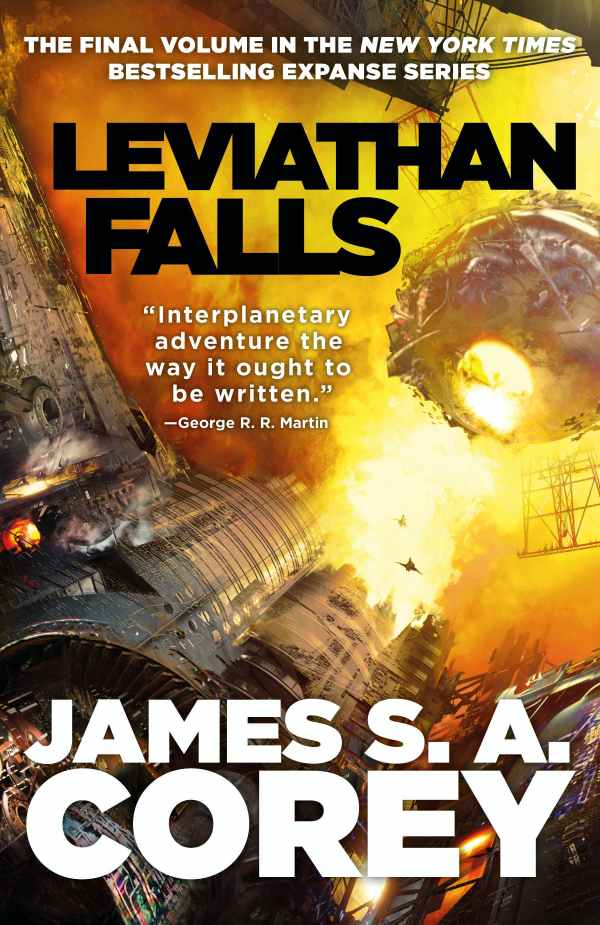
Leviathan Falls by James S. A. Corey

Leviathan Falls Cover

Publisher: Orbit/Recorded Books (Audiobook – 30 November 2021)

Series: The Expanse – Book Nine

Length: 19 hours and 40 minutes

My Rating: 4.5 out of 5 stars

Amazon     Book Depository

For my last review of 2021 I check out the epic and highly anticipated final book in the iconic The Expanse series by James S. A. Corey, Leviathan Falls.

For the last ten years the science fiction genre has been dominated by the impressive and captivating The Expanse series.  Written by James S. A. Corey, the joint pen name of authors Daniel Abraham and Ty Franck, The Expanse series consists of nine awesome novels that navigate the troubles and wars of future humans in both our solar system, and other systems accessed by ancient alien technology.  This has been a pretty amazing series which has moved from wars between Earth, Mars and the Belt, to intergalactic travel and battles between galactic empires and interdimensional aliens.  I have been really enjoying this series lately, and the last two novels, Persepolis Rising and Tiamat’s Wrath were extremely fun, especially as they utilised the conquering Laconian Empire, which forced the protagonists to form a rebel movement known as the underground.

The plot of Leviathan Falls starts a few months after the events of Tiamat’s Wrath, which saw the underground destroy Laconia’s shipyards and free James Holden, captain of the Rocinante, and Teresa Duarte, the daughter of the Laconian high consul.  Now the Rocinante flies throughout the various settled systems attempting to keep the underground alive and bring down the faltering Laconian Empire.  At the same time, unnatural and destructive alien forces, disturbed by the intergalactic technology used to traverse space, are reaching into our universe and attempting to exterminate all human life.

The best hope for humanity may lie in the hands of the Laconian high consul, Winston Duarte, whose alien enhancements have given him unnatural insight into the universe.  However, Winston Duarte is currently missing, having vanished from his room as he attempts to unleash his ambitious master plan.  To find him, the Laconians unleash their ultimate hunter, Colonel Aliana Tanaka, who focuses on the Rocinante, determined to use Teresa as bait.  At the same time, Dr Elvi Okoye leads a desperate scientific mission to uncover the secrets of the ancient aliens whose technology has allowed humanity to expand throughout the universe.  But her progress is dependent on the lives of the mysterious half-alien children in her care, whose ability to connect with the past could save the future.

As the situation in the universe becomes even more desperate, the crew of Rocinante are once again thrust into the midst of the battle for humanity’s survival.  Entering a desperate alliance and faced with near certain extinction, the Rocinante and their allies embark on a final battle for the future.  However, not only are they facing the malevolent forces from outside their universe, but also the radical and altered Winston Duarte, whose plan to save the species comes with an impossible price.  Can Holden and his crew stop him before it is too late, or is the final chapter in humanity’s story?

Leviathan Falls was another intense and impressive science fiction read from Corey, who brings this epic series to an end in a big way.  This ninth and final Expanse novel had a captivating and intense narrative filled with amazing and realistic science fiction elements, complex characters, and a fitting and heartbreaking conclusion that wraps everything up extremely well.  This ended up being a fantastic novel and I was glad I had a chance to see how everything finished up.

There is a great narrative for this book that takes the reader on a powerful and compelling ride as the authors seek to wrap everything up.  Leviathan Falls continues several of the storylines set up in the previous novels, especially Tiamat’s Wrath, and takes them towards their inevitable conclusion.  Told through multiple characters, including several minor figures, this is a slow-burn narrative that methodically sets up the various storylines and explores them to their full extent.  The story gets quite complex in places as the protagonists attempt to survive not only the various battles between the Laconians and the underground but also the malevolent entities attempting to take them down from another universe.  The first half of the story focuses on a cat-and-mouse battle between the protagonists on the Rocinante and the Laconian Colonel Tanaka, while there are some interesting examinations of Elvi’s attempts to understand the threat facing humanity.  These storylines lead up to a big event that sets up the intense and exciting second half of the novel and forces the previously disparate characters to come together and face the major threat.  This results in a massive, extended sequence that forces several characters to make some major decisions, and a moving conclusion that is both devastating and a fitting ending to the franchise.

The team behind The Expanse have a really unique writing style that I think fits the epic scope of their series.  Using an intense amount of description, as well as some colourful analogies, the authors paint a brilliant picture of the events occurring around them that perfectly encapsulates the insanities and complexities of the situation.  The Expanse series is known for its realistic approach to science fiction, and this continues through in Leviathan Falls as the reader gets a real sense of the awesome nature of space flight through the various characters’ eyes.  While some of the science fiction elements are obviously invented solely for the narrative, most of the human technology in this book appears to be quite realistic and well thought out.  I also love the cool take on space travel, communication and fights, with many of the events in space taking hours or days to complete due to distance and light delays.  This is particularly impressive during the battle sequences which rely more on calculations and manoeuvres than fast-paced firepower, and it really added to the intensity of multiple scenes throughout the book.

While I enjoyed the narrative and the way that the authors told the story, Leviathan Falls did drag a little in places.  I honestly think they could have streamlined this into a better novel by taking out, say, 50 to 100 pages, and I personally would have cut all the chapters told from the perspective of Kit Kamal, which have no major impact on the overall story.  I also think that the authors went a tad overboard in places trying to make some of the elements and experiences seem a little cleverer than they needed to be, such as certain long-winded interludes.  While I understand that this is their writing style and it usually works, I felt that it made parts of the book a little unwieldy and unnecessarily complex.  Being the grand finale, it was also a very inaccessible novel for new readers, especially as so much of the plot relies on knowledge of some of the preceding books, particularly Persepolis Rising and Tiamat’s Wrath.  However, the rest of Leviathan Falls story more than compensates for some of the above issues, and this still ended up being an excellent and compelling read.

Fans of this series will no doubt appreciate some of the excellent world building that took place in Leviathan Falls.  The author introduces some interesting and compelling expansions of various elements of lore and technology within this universe, especially when it comes to the two ancient alien races who the protagonists have been encountering throughout the series.  It was rather fascinating to see how certain elements were utilised throughout the plot, and they ended up enhancing the narrative extremely well.  I loved all the use of alien technology, especially as there are some great call-backs to the previous books and the weird molecules and artefacts the protagonists previously encountered.  There was also a good wrap up with the universe that I really appreciated, and it think it ends everything on a compelling and interesting note.

Leviathan Falls features an impressive cast of complex characters, and the multiple perspectives are used to great effect throughout the book to craft a massive and elaborate narrative.  I liked the cool range of characters in this book, especially as it primarily focuses on the well-established cast from the previous novels, as well as one great new antagonist.  The vast array of perspectives proves to be a lot of fun to explore, although I do question the necessity of one or two overutilised point-of-view characters.  I also appreciated some of the development that occurred around the recurring cast of the series.  This included a tangible sense of weariness that multiple characters experienced, especially the series’ long-running protagonists, which helped to reflect how they have aged and evolved over the years, especially in the face of so much adversity.  There are also a couple of interesting inclusions that I quite enjoyed, including one excellent character whose return will come as a pleasant surprise to fans of The Expanse.

There are several extremely awesome characters that I really must highlight in this book, including protagonist James Holden, the captain of the Rocinante and main character of the series.  Holden has gone through a lot throughout The Expanse novels, and it shows in Leviathan Falls.  The character is clearly dealing with some PTSD following his extended imprisonment in the prior novel, and there are some compelling and intense trauma storylines around him.  Holden has a particularly major moment in this novel, and it ended up being an interesting and moving novel for this great central character.  Aside from Holden, you also must love the work put into the surviving crew members of the Rocinante, Naomi Nagata, Amos Burton and Alex Kamal, each of whom have their own interesting storylines and serve as great point-of-view characters.  I particularly enjoyed the increased focus on Naomi now that she’s the head of the underground, and it was still fascinating to see her as a confident and capable leader.  Amos’s storyline was also rather interesting, especially after he died and was resurrected by alien technology in the previous novel.  This gives him some unique perspectives throughout the book, although there were only so many times you can hear about the “unnatural pauses” he now has.

In addition to the Rocinante crew members, several other exceptional characters also really stood out to me.  I continued to enjoy the inclusion of Elvi Okoye, the brilliant scientist who was drafted into the Laconian military force as the leading expert on alien technology.  Elvi offers most of the scientific insight into the events occurring in the novel, and it was interesting to see her experiences as she attempts to understand the ancient alien technology and discover a solution to the mysterious attacks plaguing the various human systems.  I also really appreciated Colonel Aliana Tanaka, a Laconian soldier who is sent to track down the missing Winston Duarte by hounding the Rocinante and trying to take back Teresa Duarte.  Despite being a new character, Tanaka has one of the best arcs in the entire novel, as she is forced to contend with not only the boldness of the protagonists but also her own instabilities and issues.  While she initially appears to be a mostly rage filled attack-dog, the author soon expands on her character and backstory turning her into a very complex and somewhat sympathetic figure.  This is particularly true after a major event results in an unwelcome intrusion in her mind, and her inability to cope makes her even wilder and angrier.  These brilliant characters really helped to enhance Leviathan Fall’s plot and it was an absolute pleasure to see all the great character driven story arcs come to an end.

While I did receive a physical copy of Leviathan Falls, I ended up listening to the audiobook version to fit this book into my reading schedule.  This was a pretty good audiobook, and I had a fantastic time getting through it.  Leviathan Falls has a decent run time of just under 20 hours, which did take me a while to get through, especially in some of the spots where my engagement slipped a little.  Despite the length, this was a fantastic audiobook adaptation and I appreciated the impressive narration from Jefferson Mays, who has previously lent his voice to all the previous The Expanse novels.  Mays’ voice seems to fit the massive and epic format of the series extremely well and I found myself appreciating and following some of the heavy scientific elements, battle sequences and intriguing analogies a bit better with his work.  He also provides some excellent voices to the various characters featured in the series which fit their various personalities and helped to showcase their emotions.  I had an awesome time listening to this latest audiobook and it is an impressive way to check this novel out.

After nine epic novels, The Expanse series by James S. A. Corey finally comes to end with the fantastic Leviathan Falls.  This final book does an excellent job of tying together the various story threads from the previous novels and giving this impressive series the outstanding conclusion it deserves.  Filled with complex characters, a powerful and rich science fiction setting, and an intriguing central storyline, Leviathan Falls was an awesome read.  An amazing and cool conclusive episode, Leviathan Falls is really worth checking out and I loved its compelling and exciting story.

Amazon     Book Depository

Mind Bullet by Jeremy Robinson

Mind Bullet 2

Publisher: Podium Audio (Audiobook – 23 November 2021)

Series: Standalone/Infinite Timeline

Length: 11 hours and 42 minutes

My Rating: 5 out of 5 stars

Amazon     Book Depository

The deliciously twisted mind of bestselling science fiction thriller author Jeremy Robinson returns with another epic and over-the-top adventure, Mind Bullet, a fantastic and captivating read.

Robinson is an outstanding author whose work I first checked out earlier this year.  Known for his Nemesis Saga and Chess Team series, Robinson is currently working on a collection of partially connected standalone novels, all of which are set within the same extended universe and which are leading up to some massive crossover novels.  I was lucky enough to read one of Robinson’s other 2021 releases earlier this year, The Dark, which was a captivating and deeply entertaining read with a bonkers story to it.  I had a wonderful time with The Dark, which got a full five-star rating from me, and it made me an instant fan of this cool writer.  As such, I was extremely intrigued when I saw that he had another novel coming out this year.  This book, Mind Bullet, was another unique and fascinating read from Robinson with a killer plot to it that I just had to pick up and check out.

In the world of high-level international assassination, Jonas is something of a legend.  Raised by two honourable killers, Jonas had set out on his own, taking on the most dangerous and difficult of jobs and succeeding in some extremely flashy ways.  Despite the ostentatious techniques used in some of his kills, Jonas has managed to stay out of the limelight and out of sight from conventional law enforcement due to fact that none of his targets ever shows any signs of violence.  That is because Jonas has a secret: he has telekinesis and can blow a small hole into people’s brains merely by concentrating on them, an unexplained ability he calls Mind Bullet.

However, despite all his success and the accompanying wealth, Jonas is unhappy and depressed.  Alone except for his sarcastic and possibly psychotic AI, Bubbles, Jonas is still grieving the loss of his dead parents, convinced that someone killed them and got away with it.  As his depression and loneliness results in Jonas taking more and more dangerous jobs, Bubbles decides to intervene for his own good.  Playing matchmaker, Bubbles determines that Madee, a local Thai food delivery woman and part-time thief, would be perfect for him.  After an awkward first meeting where Madee attempts to rob him, the two loners start to hit it off.  However, true love is about to get interrupted by the worst kind of gate crasher, the assassin group known as the Shrieking Ninja.

Angered by one of Madee’s burglaries, the Shrieking Ninjas attempt to break into Jonas’s house and kill them both.  Barely escaping from the Shrieking Ninjas’ mysterious and powerful master, Jonas goes on the run with Madee, hoping to find a way to get them off their trail for good.  However, the disastrous and very public encounter at his house has raised unwelcome attention and Jonas is shocked to find that a $10 million bounty has been placed on his head.  A mysterious organisation is determined to capture Jonas by any means necessary, and every elite assassin and hitman in America is willing to collect.  Pursued by a legion of outrageous killers, Jonas, Madee and Bubbles find themselves thrust into the midst of a dark and deadly conspiracy that lies in the heart of Jonas’s past and the secrets behind his lethal abilities.  Can this unusual group survive the onslaught headed their way, or will they be buried by a legion of lethal killers with their own unique abilities?

Wow, just wow, this novel was the absolute definition of fun.  Robinson did another amazing job with Mind Bullet, producing an intense and exciting novel that is wildly addictive and incredibly entertaining.  Featuring a brilliant, fast-paced story, Mind Bullet had me hooked from the very second I started listening to it, and I ended up powering through it in a few short days.  An outstanding and compelling read, this novel also got a five-star rating from me.

Mind Bullet has an awesome and deeply entertaining narrative that is extremely easy to read and even easier to get addicted to.  Robinson starts off strong with an audacious assassination involving an airborne car, an unethical AI, psychic powers and a parachute, which serves as the perfect introduction to Jonas and his assistant, Bubbles.  From there the story quickly evolves, with Jonas meeting the mysterious Madee while being forced to defend her from the outrageous Shrieking Ninjas (that name says it all).  Following that encounter, Jonas and Madee are forced to contend with continued attacks from even more unusual and deadly assassins, each of whom steal the scene they’re in, either by their unique methods or dangerous powers not unlike Jonas’s.  The protagonists are thrust into deadly situation after deadly situation, picking up new friends as progressively more dangerous foes attack with devastating effect.  This amazing and compelling narrative contains the right blend of forward action and intriguing backstory, as the attacks awaken memories from Jonas’s past, which he also seeks to explore.  After a series of interesting reveals after the halfway point of the book, the protagonists are thrust into their most dangerous situation yet when they encounter the book’s big bads, in an epic and twisty confrontation that brings everything together and ensures everything is out on the table.  All this leads up to an explosive conclusion that wraps up the story and the character arcs exceedingly well, while also leaving the door open for appearances in future Robinson books.

This entire story was extremely intense and addictive from the very beginning, and I had an outstanding time getting through it, and loved every single development, explosive encounter, and fantastically weird new character.  Despite its myriad elements, the entire narrative came together extremely well, and the readers are left feeling extremely satisfied, especially as this is a mostly self-contained story.  I felt that Robinson’s use of single first-person perspective to tell the whole story worked extremely well, especially as the point-of-view character was particularly entertaining and enjoyable.  Like most of Robinson’s stories, Mind Bullet’s narrative contained a great combination of humour, action, character growth and sheer insanity, which helps to produce a deeply entertaining and compelling plot that grabs the reader’s attention and holds on tight.  While substantially less dark in tone and character development than Robinson’s prior book, The Dark, Mind Bullet has serious moments which contrast extremely well with the inherent silliness to produce an overall epic read.  I honestly loved every second of this story, and there are some brilliant scenes featured throughout it, from massive and elaborate fight scenes, brutal psychic brawls both in reality and the mental plain, as well as several simpler scenes that deal with the characters and show their growth as people.

It is interesting to note that this book is part of Robinson’s wider Infinite Timeline, a collection of mostly unconnected novels set in the same overarching universe.  Robinson is currently making a play to combine the plots and characters of these standalone novels, and several upcoming novels will feature multiple characters from across the canon.  As such, Mind Bullet contains multiple references to Robinson’s prior works, mainly Tribe and The Dark, which are part of the same loosely connected storyline (the books of which are are going to have their first crossover in 2022’s Khaos).  There is also a surprising appearance from some of the protagonists of Robinson’s other books, which hints at the bigger crossover later in the series in Singularity (this universe’s version of Avengers: Endgame).  While readers can easily enjoy Mind Bullet without any knowledge of Robinson’s prior books, a couple of scenes and references might be a bit weird without context, especially as a few characters are briefly parachuted (or teleported) in.  Still, readers should be able to follow what is going on without too much difficulty, especially as Robinson does provide some explanation or interesting reaction from the protagonist, and hopefully these appearances will encourage them to check out some of the author’s other books.  I personally really enjoyed these inclusions, and it was fun to see how Robinson is getting more and more blatant with the connections between the various novels.  I am really looking forward to seeing how this entire series comes together, and I really need to go back and read some of Robinson’s other books before this happens.

One of the things that Robinson truly excels at as an author is his ability to produce some complex and relatable characters.  This is particularly true in Mind Bullet, which features a fantastic cast of compelling and relatable protagonists and antagonists with intriguing plot threads that the reader will quickly get invested in.

The most prominent character of this novel is the point-of-view protagonist, Jonas, the dangerous assassin with a heart of gold.  In many ways, Jonas was a pretty typical protagonist for Robinson, a confident and fun-loving figure who cracks a ton of jokes and has their own unique style and a liking for obscure pop culture.  I had a lot of fun following the adventure through Jonas’s eyes, especially as his hilarious view of all the outrageous stuff occurring around him and his constant quips kept me in stiches for most of the novel.  Despite this entertaining outer facade, once you dig deeper Jonas proves to be a lot more complex and emotionally damaged.  The character is chronically depressed and bored, especially after the mysterious car crash that killed his parents, and at the start of the book he has a substantial subconscious death wish.  The character evolves for the better as the novel progresses, especially as he starts to make some connections with the various side-characters.  These friendships and deeper relationships really change him for the better, although they also uncover a range of secrets from the past.  I loved the dive into the character’s psychic abilities, especially as he goes through a trial-by-fire against a range of powerful foes, each of whom is deadlier than the last.  It was also cool and intriguing to explore his hidden, traumatic past, which the author does extremely well through several clever flashback sequences.  The eventual reveal of who or what Jonas really is was done very well, and it will be interesting to see how the author expands on that in some of the future books.

My other favourite character in Mind Bullet was probably the sassy and potentially crazy artificial intelligence, Bubbles.  Bubbles, whose origins and capabilities are also unknown, is Jonas’s assistant and best friend, whose personality is growing based on her interactions with Jonas.  Thanks to the unique experiences she has gained living alongside a quipping assassin, Bubbles has developed quite a sarcastic and entertaining personality, and nearly every interaction with Bubbles results in an inappropriate joke or shocking comment which is pretty hilarious.  Like Jonas, Bubbles also develops a bit throughout the novel, and it was fascinating to see the author’s viewpoint about nature vs nurture when it comes to this character’s personality and emotions.  Despite being an AI, Bubbles is quite a caring being, even if she has developed some homicidal tendencies (especially towards ducks), and I appreciated the unique bond she forms first with Jonas, and then with some of the characters in the book.  Bubble’s meddling in Jonas’s life to keep him alive is particularly sweet, even if she tries to cover it with analytics, and it ended up being one of the major character threads of this book.  An outstanding and brilliant AI character who you will fall in love with!

Aside from Jonas and Bubbles, there are some other amazing characters throughout Mind Bullet.  Madee is another sassy and strong-willed female character (most of Robinson’s characters are sassy and sarcastic), whose break-in to Jonas’s house triggers all the events of the book.  Madee is another fun character, and I really loved the entertaining romance that bloomed between her and Jonas, despite their awkward, computer assisted meeting.  Robinson plays it pretty smart with Madee, and I loved some of the great twists surrounding her, even if by the final reveal it is apparent there is more going on with her.  Jonas also bands together with a group of other complex and entertaining characters, most of whom get pulled into his orbit as the world explodes around him.  While I did think the inclusion of several attractive female characters helping Jonas did appear a little harem-like, each of them proves to be a valuable member of the team, and I liked some of the fun character arcs surrounding them.  I also really need to highlight the fun collection of killers that come after the protagonists throughout Mind Bullet, especially as Robinson went out of his way to produce some wild and truly ridiculous figures here, including incompetent Neo Nazis, stereotypical gun-toting Texans, and foul-mouthed murderous nuns.  There are also a group of dangerous psychic killers, each of whom has their own unique history with Jonas, and whose compelling range of powers results in some dramatic action sequences when they try to fight the protagonists.  I had an outstanding time getting to know all these brilliant characters, and the sheer range of captivating figures really helps to make Mind Bullet stand out.

When Mind Bullet came out I absolutely had to grab this book in audiobook format.  This is because Mind Bullet was narrated by the incredibly talented R. C. Bray, who is one of my all-time favourite audiobook narrators (check out his narration of Michael Mammay’s Planetside, Spaceside and Colonyside).  Bray, who has narrated most of Robinson’s works, did another incredible job here, lending his fantastic and powerful voice to this wild and entertaining book.  Bray really gets Robinson’s fantastic protagonists and writing style, and he was soon moving this brilliant novel along and an ultra-fast pace, ensuring that listeners power through its 11 hour and 42 minute runtime in a very short order.  Bray really dives into the characters of the book, and I loved how he brought Jonas to life, ensuring that the reader gets the full sense of his humour, unique worldview and deeper inner struggles.  The rest of the character are also portrayed perfectly as well, especially Bubbles, and I loved the cool and amusing voices that he provides to each of them.  Bray obviously has a lot of fun here with this book, and the fantastic voices he uses for some of the more unique moments and characters are extremely entertaining and memorable.  I especially loved the ultra-serious and dramatic voice that he used for the formal name-drooping introduction of each major character’s names or codenames (which appear in the printed version in massive bold print).  I really appreciated this fun and entertaining take on the audiobook narration, and you will fall in love with Bray’s brilliant voice and entertaining style if you check out the audiobook version of this novel.

Overall, Mind Bullet is another epic and incredible read from the exceptional Jeremy Robinson.  Robinson’s latest book is crazy in all the right ways, and readers will deeply enjoy the wild and unpredictable ride that the characters go on.  Featuring an amazing group of characters, some fantastic humour, and some massive memorable scenes, Mind Bullet is an outstanding novel that I had an awesome time getting through.  Highly recommended to anyone looking for something fun, especially in its audiobook format, you need to check this book out!

Amazon     Book Depository

Throwback Thursday: Green Arrow (2001): Volume 3: The Archer’s Quest by Brad Meltzer, Phil Hester and Ande Parks

Green Arrow Archer's Quest

Publisher: DC Comics (Paperback – 1 September 2004)

Series: Green Arrow Vol. 3 – Volume Three

Writer: Brad Meltzer

Penciller: Phil Hester

Inker: Ande Parks

Colourist: James Sinclair

Letterer: Sean Konot

Length: 175 pages

My Rating: 5 out of 5 stars

Amazon

Welcome back to my Throwback Thursday series, where I republish old reviews, review books I have read before or review older books I have only just had a chance to read.  For this week’s Throwback Thursday I check out an all-time favourite comic of mine, the third volume of the epic 2001 Green Arrow relaunch, The Archer’s Quest.

The late 1990s and early 2000s were an outstanding time for DC Comics, who produced an amazing number of epic and fascinating comic series that combined brilliant storytelling with fantastic artwork.  While there are several great series I enjoy from this period (Teen Titans comes to mind), one of my absolute favourites was the awesome 2001 relaunch of Green Arrow.  Also recorded as Green Arrow Vol. 3, this series resurrected the original Green Arrow, Oliver Queen, some years after his death.  I have an amazing amount of love for this comic; not only was it one of the first series I ever really got into but it still really stands up after all this time.  This is easily one of my all-time favourite comic book series, and the absolute pinnacle of this series was the simple, yet amazingly effective fourth volume, The Archer’s Quest.

While I probably should review some of the proceeding volumes of this series first before talking about The Archer’s Quest (such as the first volume, Quiver by Kevin Smith), I recently re-read this fantastic comic, so it has been on my mind all week.  Containing issues #16-21 of this outstanding series, The Archer’s Quest is a brilliant and captivating comic tale that really gets to grips with the protagonist as he embarks on a journey vital to his identity and history.  Featuring the brilliant writing of bestselling author Brad Meltzer (author of several amazing thriller novels, as well as some impressive DC Comics), and the artistic stylings of Phil Hester and Ande Parks, this is an exceptional comic which gets a five-star rating from me.

Green Arrow - #16

Following his unexpected resurrection after his violent death, Oliver Queen, the Green Arrow, has been returned to Earth, ready to continue the good fight.  However, no man can come back from the grave without a heavy heart, and Oliver Queen has more skeletons in his closet than most of his fellow heroes.  A chance discovery that the villain, Catman, attended his funeral leads Oliver back to his old friend, Shade, the immortal being Green Arrow trusted to round up certain artefacts of Oliver’s superhero career that could reveal his secret identity. 

Discovering that Shade failed to get several of Oliver’s most precious keepsakes, Oliver embarks on a cross-country road-trip to recover them himself.  Accompanied by his former sidekick, Roy Harper, Oliver begins visiting some of the locations most important to himself and his career as a superhero.  From the ruins of the Arrowcave to the Justice League’s orbiting Watchtower and even the Flash Museum in Central City, Oliver and Roy will attempt to find these items from the past in order to safeguard their future.

However, this will be no simple road trip, as the two heroes encounter some unexpected dangers and surprising opposition, including fellow hero the Flash and the angry zombie Solomon Grundy.  Worse, this journey will uncover some dark secrets from the past that Oliver has long hoped to keep quiet.  Can Oliver recover his treasures without his friends and family discovering who he really is, or has the past finally come back to destroy this resurrected hero?

Green Arrow - #17

The Archer’s Quest is a fantastic and powerful Green Arrow comic that takes the protagonist and his former sidekick on a wild and extremely personal adventure.  Before reading this, if you had ever pitched me a comic based around the idea of a recently resurrected superhero going on a road trip, I might have been a little dubious.  Well, it turns out that I would have been dead wrong, as Brad Meltzer produced an intense, captivating and emotionally rich narrative that is not only extremely entertaining but which contains some excellent character work, some brilliant references to the classic Green Arrow comics, and which dives deep into the psyche of a troubled and complex protagonist. 

The narrative of The Archer’s Quest starts extremely strong, with Green Arrow meeting Superman at Oliver Queen’s grave.  This is a fantastic opening scene, especially once Superman hands over a series of photographs of the funeral, and I loved the focus on the harrowing realities following a resurrection.  The sombre mood is broken when Green Arrow notices a stranger in his photo amongst his closest friends.  This leads him to hunt down Catman, which also reveals the hand of Shade and the revelation that certain items from Oliver’s past are still out in the open.  This forces Green Arrow into a road trip, hunting for his artefacts and dealing with friends, enemies and family.  The first chapter packs in some much-needed action, as Green Arrow goes toe-to-toe with Solomon Grundy in an epic and brutal fight, that ends with a surprising, and gruesome, win from the protagonist.  From there, Meltzer and the artists pile up the emotional and the feels by having Oliver encounter several fellow heroes who he has complex relationships with, while also building up the nostalgia factor, with the reveal of classic Green Arrow items, locations and characters.  All this leads to some major moments, from an attempted proposal to a moving and long-awaited conversation between father and son.  However, Meltzer saves the absolute best for last with a startling revelation about the past that shows Oliver’s true character and serves as a powerful end to the entire story.  This was a beautiful, character driven story, and I think Meltzer hit all the right notes.  The pacing is perfect and there is a fantastic blend of action, character development and emotional discovery, which all comes together into one outstanding story.  The Archer’s Quest is addictive and dramatically intense from start to finish, I can read and re-read this comic for years (and I probably will).

Green Arrow - #18

One of the things that I really enjoyed about this amazing comic is the way in which Meltzer and the artists turned it into a homage to the Green Arrow comics.  The creative team spend a substantial amount of time diving back into the history and lore of the character and his comics, working them into the story in very meaningful ways.  So many key aspects of the Green Arrow comics are referenced or alluded to in some way, as the characters journey around some iconic locations, including the Arrowcave, to obtain the artefacts.  Through this dive into the past, the creative team manage to perfectly capture the various eras of Green Arrow, including the classic Golden Age comics, the grittier Silver Age comics, the road trip era with Green Lantern (which this comic really tries to emulate), and The Longbow Hunters period.  This wide range of references makes for a very intriguing and compelling comic, and it helps turn The Archer’s Quest into a must-read for all Green Arrow fans.  I loved the clever range of different artefacts that protagonists are trying to recover, including the diamond-tipped arrow from Green Arrow’s first appearance in Justice League of America, his official invitation to the Justice League, and the truck that he and Green Lantern used in their iconic road trip.  These cool artefacts really help to ramp up the nostalgia while simultaneously including key modern story elements hidden within.  The cool funeral sequence at the start of the comic also allows the creative team to reference and include a vast range of supporting characters and allies from the original comics, with a range of different figures from Oliver’s career appearing to pay their respect.  I deeply appreciated the modern analyses and descriptions of the items, locations, complex relationships, character designs, weaponry (why all the boxing gloves?) and prior adventures included in this comic, and it helps to produce a comprehensive account of these iconic events, while also bringing them up to speed with more modern comic lines.  You can really tell that the creative team behind The Archer’s Quest had a lot of affection for the preceding Green Arrow comics, and this outstanding comic proves to be an amazing and captivating love-letter to the Emerald Archer.

I deeply enjoyed the epic characters that this amazing comic followed, especially as Meltzer uses this story to dive deep into the psyche and relationships of the protagonists, especially Oliver Queen, the titular Green Arrow.  This version of the character is only recently returned from the grave, and this becomes a major part of his identity throughout the comic, driving him to fix some of the mistakes of his past while also ensuring that he never hurts his family again.  Thanks to the entire comic being narrated by Oliver, you get some very intriguing insights into Green Arrow’s mindset during this period, and you really get to know who he is and what his motivations are.  Rather than some of the typical portrayals of him as a liberal, generic arrow slinger, the creative team attempt to show him as a complex veteran hero, still deeply impacted by his resurrection and uncertain about his place in the world.  A lot of The Archer’s Quest’s narrative involves Green Arrow attempting to find pieces of his past that are significant or potentially damaging to him, and as such you get an amazing look into key events of Oliver’s past, as well as his current priorities and concerns.  I really enjoyed the storylines involved with him trying to reconcile or repair relationships with his former friends and allies, as well as an interesting development in his romantic partnership with Black Canary.

Green Arrow - #19

One of the best things about this comic is the way that Meltzer portrays Oliver as a more morally ambiguous figure, willing to make a deal with a supervillain, lie to those closest to him, and initiating undercover actions to protect identities.  There is also some great evidence of the self-destructive tendencies that would be a major defining feature of this series, as well as the complex decisions that affect those closest to him.  As such, he keeps many secrets, even from his former sidekick, such as his main motivation for recovering his old truck is to secure the Green Lantern ring Hal Jordan hid in there years ago.  However, the biggest secret involves the revelation that he always knew that his son, Conner, existed, and that he pretended he did not know who he was when they first met.  This revelation is slowly and cleverly revealed throughout the comic, first with Oliver subtly making the recovery of its hiding place his main priority, and then in the final scenes after he has a heart-to-heart with Conner, when he reveals the secret photo.  The narration during this scene sums up Green Arrow in this series perfectly: “You’re a bastard Oliver Queen.  You knew.  You always knew.  And the worst part is…. it’s still your secret.” and the entire sequence ensures you will never look at this character again in the same way.  I also musty highlight the great inclusion about Green Arrow secretly coming up with plans to protect secret identities if a hero died.  Not only is this vital to the plot of The Archer’s Quest, but it also hints at the great storyline that Meltzer would eventually use in his epic Identity Crisis, which features a proactive team of heroes mind-wiping villains and destroying personalities.  This outstanding and layered portrayal of Green Arrow in this comic is one of the defining characteristics of The Archer’s Quest, and I am blown away with this brilliant character work every time I read this volume.

The other major character of this novel is Roy Harper, his former sidekick (now Arsenal), who Oliver calls in to help him hunt down Catman.  I really enjoyed the inclusion of Roy in this comic, especially as he had been overly featured in this series (he was mostly appearing in Titans).  As such, we had not really gotten a glimpse at the current relationship between former mentor and sidekick, which has always been strained since the infamous heroine incident.  The Archer’s Quest did an amazing job bringing them back together again, and Roy really gets into the swing of the adventure, with the two characters getting back into their adventuring groove.  However, the comic also deals with the inherent mistrust between the two characters, with Roy upset that Oliver trusted Shade more than him to protect his identity after his death.  The two end up working through these issues throughout this comic, and it ended up being a fun and powerful reunion that long-term Green Arrow fans will deeply enjoy.

Green Arrow - #20

Aside from Green Arrow and Roy Harper, this comic also makes great use of several other supporting character who either bring the protagonist back to his past, or help to add some emotional weight to the story.  This includes brilliant inclusions of two fellow superheroes, Kyle Rayner and Wally West, the versions of Green Lantern and the Flash who were active at the time.  Both these younger heroes bear a major legacy that results in some complicated and moving interactions with Oliver.  One of the most important is Kyle Rayner, who has taken over the mantle of Green Lantern following the corruption and eventual death of Green Arrow’s best friend, Hal Jordan.  Since Oliver’s resurrection, their relationship has been strained, with Oliver having trouble accepting him.  This all finally comes to a head with Oliver travels to the Watchtower and encounters the young Lantern, and they have a massive heart-to-heart.  The revelations that Oliver has trouble accepting a new Lantern instead of his best friend, as well as the emotional burden Kyle also bears, especially around his first loss as a superhero (women in refrigerators man, that stuff will mess you up), all comes out, and leads to an amazingly moving scene.

I also loved the great interaction that Oliver had with Wally West outside the Flash Museum, after Wally is warned that Oliver is planning to break into it.  The two characters have a great stare-down, which sees the usually jovial Flash incredibly serious at Oliver’s attempted trespass.  Oliver’s narration about this event is pretty great, especially noting that Wally’s usual short attention span is overridden by his love of Barry Allen’s memory.  These two interactions with Green Lantern and Flash are short but extremely powerful, and it was amazing to see the strain on Oliver at being still alive, while the roles of his friends have been passed on to the next generation.  Despite the serious nature of these scenes, both had an entertaining ending with Oliver managing to outsmart his younger colleagues: “That old, lying son of a b…”.  I also liked the inclusion of Superman at the start of the comic, which was both entertaining, and played into the resurrection storyline perfectly with Superman feeling guilty about not being able to save Oliver when he died, while also being a bit of an expert on coming back to life himself.  I also enjoyed the fantastic conclusion of the Flash arc, especially as the entire break-in was to retrieve a costume-filled ring that the Flash made for Green Arrow years before, and which was a nice nod to the great friendship they used to have.

While this volume of Green Arrow does not have an antagonist per se (except for Solomon Grundy and Oliver’s self-destructive behaviour), it does feature a couple of great supervillains in a supporting role.  The first of these is Shade, the immortal shadow-powered gentleman who, despite being a villain, gained Green Arrow’s trust years ago, and was entrusted by Oliver to fulfil his post-death wishes (always chose an immortal).  Shade is a fantastic inclusion to this comic, especially as his inclusion enhances the implication that Green Arrow is a much more morally grey hero than you would initially believe.  The interactions between Shade, Green Arrow and Roy Harper are really good, and I liked the explanations for why he was unable to fulfil all his duties (I wouldn’t want to annoy Jay Garrick either).  I also really need to highlight the excellent inclusion of Thomas Blake, better known as Catman, in his first appearance in comic form in years.  Catman has always been a bit of a joke character due to his gimmick (which simultaneously rips off Catwoman and Batman at the same time), but in this comic he is shown to be a shell of even his previous ridiculous self, who is looked down on by the entire supervillain community.  Hired by Shade as his agent, Catman is hunted down by Green Arrow after attending his funeral, only to show him as an overweight and unthreatening loser.  This entire comic paints him as quite the pathetic figure and shows the downsides of being a fourth-rate villain who turned on some very powerful people.  While his appearance in this comic was more entertaining than deep, it does beautifully set up his later appearances in such comics as Villains United and Secret Six and serves as his inspiration for becoming the ultra-badass we see there.  These two villains perfectly rounded out the main cast of The Archer’s Quest, and both inclusions were fantastic and intriguing additions to the overall plot.

Green Arrow - #21

This amazing and complex narrative is perfectly backed up by some excellent artwork from the team of Hester and Parks, who really bring this story to life in exquisite detail.  This entire comic is drawn in fantastic detail with some beautiful scenes, fantastic backdrops (including some iconic Green Arrow locations, lovingly brought to life) and entertaining sequences.  This includes some brilliant and powerful action sequences, and the artists pay particular attention to the flight, movement, and destructive potential of the arrows.  I particularly liked the awesome fight scene between Green Arrow and Solomon Grundy, which was filled with some brutal action in the tight confines of the former Arrowcave and featured some great narration from the protagonist.  I loved the character designs featured in the comic, and the classic look of Green Arrow and his companions was great.  The artists do a great job portraying emotion on the face of the characters, especially surrounding Oliver and his multiple examples of anguish and conflict.  I also appreciated the play of emotion on some of the other characters faces, especially Flash when Oliver arrives at the Flash Museum.  Seeing the grim and dark look on Flash’s face as he tries to stop Oliver is really surprising and impactful, and the artists do a fantastic job of showcasing a tense stare-down between the two as the sun starts to rise.  However, in my opinion, the best drawn sequence in the entire comic occurs at the front of the volume, when Oliver contemplates his funeral.  Shown in a series of polaroids, you see the various grieving mourners and it was fantastic to see several obscure figures from Oliver’s past appear to pay their respect.  This beautifully drawn scene is short, but it sets the scene for the rest of the volume extremely well and is an excellent way to start this fantastic comic.  I loved the way the comics in The Archer’s Quest were drawn, and they ensured that the outstanding story reached its full potential.

Overall, I have an insane amount of love for this third volume of this classic Green Arrow series, and it comes highly recommended.  The Archer’s Quest is a brilliant and powerful comic arc that perfectly combines a clever and nostalgic story, with some intense character development and a fun and enjoyable art style.  Meltzer’s narrative in this fantastic Green Arrow comic so damn amazing, and I deeply enjoyed his take of this iconic character.  I deeply enjoyed The Archer’s Quest, and it easily one of my favourite comic volumes of all time.  I am hoping to review the rest of this Green Arrow series in some future Throwback Thursday series, and I look forward to highlighting all the amazing storylines that were contained in this incredible run.

Amazon

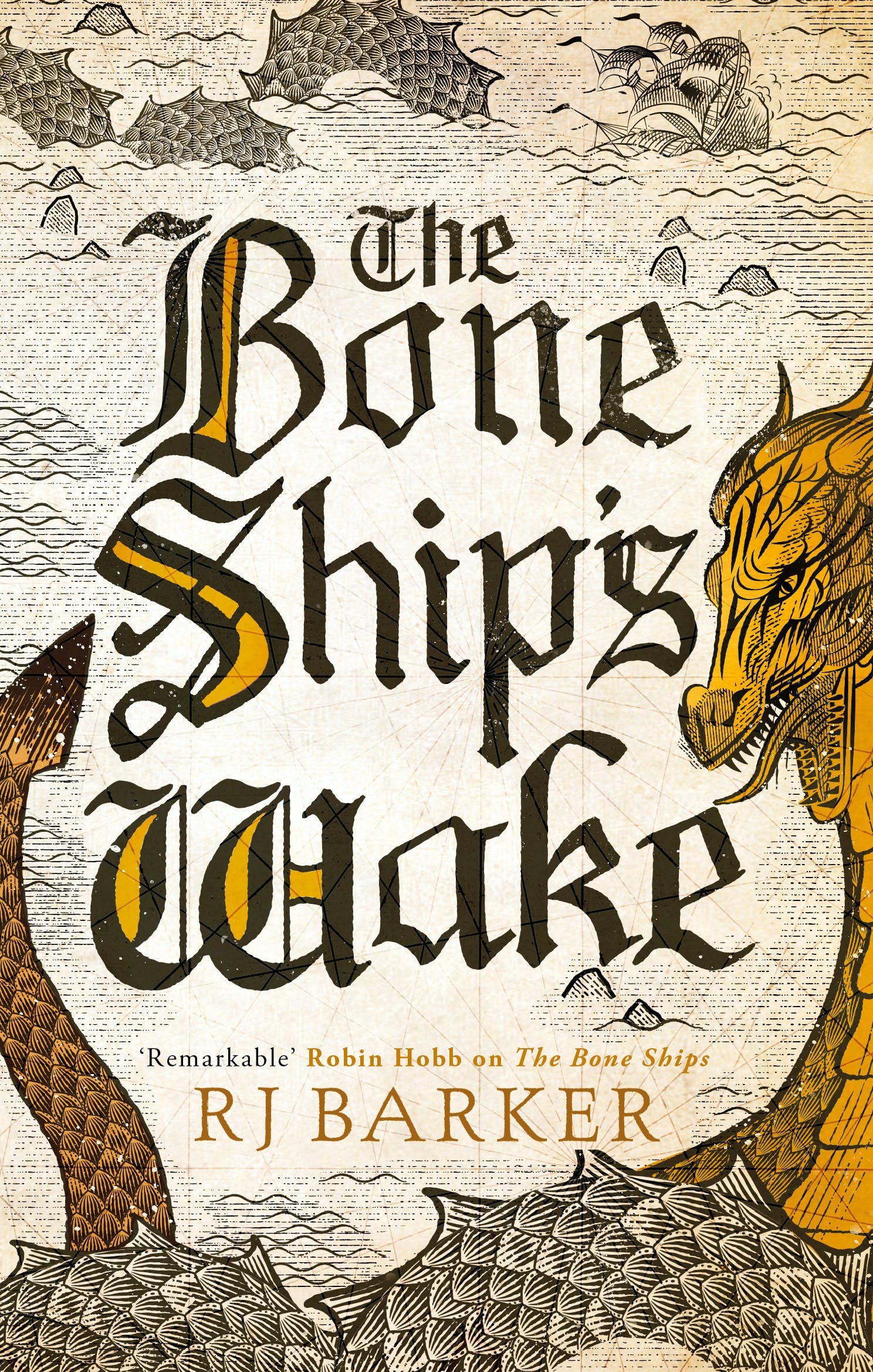
The Bone Ship’s Wake by R. J. Barker

The Bone Ship's Wake Cover

Publisher: Orbit/Hachette Audio (Audiobook – 28 September 2021)

Series: The Tide Child Trilogy – Book Three

Length: 20 hours and 49 minutes

My Rating: 5 out of 5 stars

Amazon     Book Depository

One of the fastest rising fantasy authors in the world today, the brilliant and exceedingly talented R. J. Barker, brings The Tide Child trilogy to an end in epic fashion with the exceptional and powerful The Bone Ship’s Wake, one of the best fantasy reads of 2021.

There have been some really impressive fantasy authors producing great reads over the last few years, but in my opinion none have been as consistently amazing and addictive as R. J. Barker.  Barker burst onto the scene in 2017 with Age of Assassins, the first book in The Wounded Kingdom trilogy, and soon followed it up with two additional outstanding reads, Blood of Assassins and King of Assassins.  While I have a lot of love for this brilliant trilogy, especially the final novel King of Assassins, Barker has since eclipsed it with his second series, The Tide Child trilogy.

The Tide Child trilogy is a grim and powerful series that follows a unique set of characters in an exceptional, character driven, adventure tale.  The Tide Child books are set in a dark fantasy world, primarily made up of deadly oceans and seas which have produced a harsh breed of warring humans.  The inhabitants of this world traverse these oceans in ships made of the harvested bones of sea dragons, known as the keyshans, the creation of which led to the mass extinction of these dragons.  The first novel in this series, The Bone Ships, set the scene for this great series and introduced the primary characters as they set out on an epic quest to hunt the last sea dragon aboard the boneship, Tide Child.  This was an exceptional read that ended up being one of the best books and audiobooks of 2019.  Barker followed this up in 2020 with Call of the Bone Ships, a great sequel that saw the crew of Tide Child engage in a rebellion against the established order.  Call of the Bone Ships ended on a pretty massive cliffhanger that set the scene for an exceptional and stunning conclusion.  As such, the final entry in this trilogy, The Bone Ship’s Wake, was one of my most anticipated reads of 2021, and Barker did not disappoint here, as he produced an epic and captivating read.

It has been a year since the climactic battle that saw the boneship Tide Child and the rebel fleet barely escape the wrath of the Hundred Isles after being forced to abandon shipwife Meas Gilbryn.  In that time, loyal deck keeper Joron Twiner has taken on the mantle of leadership for the rebel black ships and turned them into a fleet of marauding pirates.  Now known by all as the feared Black Pirate, Joron constantly raids the Hundred Isles, determined to weaken its fleet and devastate its defences for an invasion from the rival Gaunt Islands, Joron’s only true priority is to discover the location of his lost commander and rescue her.

After a particularly vicious raid nearly sees the destruction of Tide Child, Joron is only more determined to find the shipwife before the entire fleet is lost.  With time running out for Joron thanks to the insidious keyshan’s rot that is slowly eating away at his body, Joron embarks on an ambitious plan to find and rescue Meas by returning to the most dangerous place in the world, the capital city of the Hundred Isles.

Accompanied by a small crew, Joron hopes to infiltrate the city and force Meas’s location from the ruthless rule of the Hundred Isles, Meas’ estranged mother.  However, all Joron will discover is blood and betrayal, as dangerous forces seek to take control of the oceans for their own nefarious ends.  Worse, Joron must continue to struggle with the dangerous legacy of the magical gullaimes, who believe that he is the Caller, the man who can sing up the keyshans and use them to destroy the world.  Will Joron and his crew succeed against impossible odds, or will the final voyage of the Tide Child result only in the death of everyone and everything Joron loves and cares about?

Well damn, now that was an incredibly awesome book.  I have said time and time again that Barker seems to get better with every book he writes, and I honestly believe that The Bone Ship’s Wake is the very best so far.  The Bone Ship’s Wake has an exceptional narrative filled with emotion, tragedy and powerful action on the high seas, which perfectly wraps up this epic series and provides the reader with an emotional and captivating goodbye.  Easily one of the best books of the year, The Bone Ship’s Wake gets a full five-star rating from me.

This final entry in The Tide Child trilogy has an extremely powerful, character-driven narrative to it, which perfectly continues the epic tales told in the preceding novels while also providing an extremely satisfying and moving conclusion to the entire series.  Told nearly exclusively from the perspective of central protagonist Joron Twiner, The Bone Ship’s Wake starts one year after Call of the Bone Ships, with some major changes occurring to the world and the characters during this period.  Told in three parts, this book has a bit of a slower introduction, which Barker uses to full effect to highlight the situation the characters find themselves in, while also reintroducing all the key elements of the fantasy world.  The first part of the novel is primarily used to show how far Joron has come, placing him in command of a ship as he faces off against his enemies.  This outstanding introduction sets up several key storylines while also featuring a tense and detailed chase out on the seas, with deadly and monstrous consequences.  The second part of the novel follows a desperate Joron, after leaving his ship and most of his crew behind, as he embarks on a dangerous all-or-nothing quest to save his shipwife and bring her back to the fleet.  This second part is loaded with some major dramatic moments, intrigue, treachery, and politics, which does an outstanding job expanding the already captivating storylines, while also serving as a great buffer from the nautical heavy start and end of the novel.  The story goes in some amazing directions here, and Barker throws in some captivating and surprising twists that alter everything you thought about how the story would end.

All this leads up to the conclusion of the novel, which sees the surviving primary characters caught in a desperate situation on the high seas.  After some daring actions and clever plans which have some unfortunate costs, all the characters are perfectly set up for their final places the series’ brilliant storyline.  This last part of the novel is deeply thrilling and powerful, and it honestly proves impossible to put it down as you wait to see how everything comes to an end.  Barker really amps up the desperation and hopelessness during this part of The Bone Ship’s Wake, as the crew of Tide Child and its allies are pressed in some destructive naval actions.  It all leads up to one final gambit, with the lives and the hopes of the survivors held in the balance.  This epic conclusion is extremely dramatic and powerful, with some big sacrifices and major character moments that will leave you breathless and deeply moved.  I thought that this amazing conclusion perfectly wrapped up the entire series, with all the key storylines and character arcs coming to a very satisfying and emotional end.  I loved every single second I spent getting through this exceptional story, and every brilliant turn, clever revelation and powerful character moment is still firmly engrained in my mind.

I really need to highlight Barker’s fantastic writing style, which brings this brilliant story to life.  It has been an absolute pleasure to see Barker grow as an author throughout the last few years, especially as he utilises more and more complex techniques with each passing novel.  The Bone Ship’s Wake is a particularly good example of this, as an amazingly well paced novel that slowly builds momentum as the story requires, with the intensity of the book turning on a dime, from the deep slowness of sailing to the fast pace of an epic nautical battle.  This is often accentuated by the author’s great use of repetition, with key sentences throughout the novel repeated multiple times to build up tension or to highlight the rapidity of duty aboard a ship.  This pacing and repetition almost gives The Bone Ship’s Wake a pulse, and you can feel the rhythmic build towards the high points of a novel.

I was once again deeply impressed by Barker’s incredible ability to produce a nautically focused novel.  Nautical novels require an insane amount of detail and dedication to work, and Barker has done that in spades throughout The Tide Child trilogy.  Thanks to Barker’s ultra-detailed writing style, life aboard the boneships is brought to life for the reader, showcasing every single action of the crew or movement of the ship.  The reader gets an amazing sense of what is happening aboard Tide Child, and you feel that you are aboard the ship itself, watching the crew in action.  This works particularly well during some of the intense, high-concept naval battles, where the actions of multiple ships are followed, ensuring that the reader gets a great idea about what is going on.  Barker also works in a lot of ship details that are unique to the series’ fantasy universe, allowing for a much more distinctive and compelling time at sea.  The combination of traditional nautical elements and fantasy features, such as ships crafted from dragon bone, ultra-powerful bolt throwers, wind calling bird men and the various monsters stalking the deeps is particularly striking and really helps this cool trilogy stand out.  This is honestly one of the best series set on a ship you are ever likely to read, and I am still so impressed with how well Barker was able to feature it in his novels.

I also must highlight the cool, dark fantasy world that Barker has created for this series.  Throughout this trilogy Barker has put an amazing amount of work into crafting this complex and deadly fantasy world, containing hostile oceans with only a few small islands, where the inhabitants are forced to fight on ships made from dragon bone.  I have had an outstanding time exploring this complex and compelling landscape, and I have a lot of love for some of the more unique details, including the enslaved gullaime (bird-like windtalkers), crazy monsters, the gender reversed human society which includes subtle changes like ships being consider male by their crews, and the constant naval warring and raiding such a landscape has created.  Barker does some very interesting expansions in this final entry, resulting in some substantial changes and journeys to new locations within the world.  There are some cool new creatures, including a mist-spewing kraken, as well as some fascinating and intense developments amongst the established creatures, including the gullaimes and the keyshans.  I similarly appreciated the way Barker examined the troubles with his female dominated society, especially as the motivations for some of the antagonists are closely tied into it.  Overall, I had a wonderful time with my last exploration of this unique and dangerous setting, and I cannot wait to see what sort of distinctive setting Barker comes up with next, although I already know it will be pretty incredible.

You cannot talk about any novel in The Tide Child series without praising the outstanding character work that Barker has done.  Each of these novels has done an exceptional job of building up all the major characters, from the central point-of-view perspective, to the various supporting characters found upon the central ship setting.  I have deeply enjoyed seeing each of these characters develop into better and well-rounded figures as this series has progressed, and Barker makes sure to give them an impressive send-off in this final entry.  Pretty much all the key surviving characters get some great moments throughout The Bone Ship’s Wake, and most of their associated storylines come to an end, one way or another.  This naturally results in some intense emotional moments throughout the novel, especially as readers of this series will have become deeply attached to a lot of these characters, and you will not be prepared for how some of these characters go out!

Just like in the previous two novels, the central focus of The Bone Ship’s Wake was on Joron Twiner, the deck keeper (first mate) of Tide Child, who has grown from scared drunkard to experienced officer within the course of the series.  Twiner has gone through an incredible amount during the last two books, and when we first see him again in The Bone Ship’s Wake, he is a very different person.  Joron has since lost a leg and is now infected by the keyshan’s rot, an incurable disease that is slowly eating him alive.  Despite this, he has finally taken on command of his vessel and an extended fleet and fashioning himself a new persona, that of the Black Pirate, a notorious killer of ill-repute.  This is a fascinating change for Joron, and it is absolutely amazing to see how the differences between this character and the one we first saw in The Bone Ships.  While this change is substantial, it has been well built up in the last few books, and it was great to finally see Joron take on the command he was always meant to have.  Despite this, Joron still has some uncertainty dogging his steps that proves great to explore, especially as he is hesitant to risk the lives of those under his command on his missions.  Joron is also forced to deal with the insane prophecy and power hanging over his head, as he is forced to contemplate his ability to summon the sea dragons and potentially end the world.  Throw in his unwillingness to take on the role of his mentor, and the extreme guilt he feels for all the lives he has taken in her name since the conclusion of the last book, and you have a quite a conflicted figure, desperate to do anything to redeem himself.  This makes for some amazing character moments, and I really appreciated the sheer amount of development that went into Twiner in this novel.  A lot of Twiner’s storylines come full circle in this novel, and there are some extremely satisfying moments  between him and the other characters in the novel.  I deeply enjoyed this flawed and uncertain protagonist throughout this series, and Baker ensures that he is given a fitting and powerful ending.

The novel also spends a lot of time examining Tide Child’s shipwife, Meas Gilbryn, also known as Lucky Meas.  When we last saw Meas, she was surrendering herself to the Hundred Isles to give her fleet a chance to escape.  In the year that follows, she has been brutally tortured by her captors, who are attempting to gain all her secrets, especially regarding the sea dragons.  Due to her capture, and the primary focus on Joron, we don’t see that much of Meas for the first half of The Bone Ship’s Wake, and when we finally do, she is very different.  Rather than the always confident captain we are used to, we have a broken and brooding figure, unsure of the correct actions to take and unprepared for how much her legend has spread in the year she has been gone.  This makes for a very interesting counterpoint to the growth in Joron, and it is fascinating to see the slight role reversal that occurs between them.  I loved this exceptional character change that occurred around Meas, and Barker uses it to full effect to create some dramatic and emotionally charged moments.  The author also ensures that several lingering questions about Meas are answered, especially as she finally gets some closure with members of her family, such as her mother.  It was also amazing to see the unique relationship she forged with Joron come full circle, as the man she chose to be her second surpasses her.  The outstanding character work surrounding Meas, especially when it comes to her connection to Joron, added so much to the overall quality of this novel, and it was great to see how Barker altered and explored this character in The Bone Ship’s Wake.

I have to highlight the outstanding storylines surrounding the Gullaime, the ship’s windtalker of legendary power, who is destined to destroy the world alongside Joron.  This humanoid bird creature is always an entertaining figure in the novel, due to their unique appearance and outrageous behaviour and Barker does an exceptional job giving unique avian features to it.  However, like the other characters, the Gullaime goes through some big events in this final novel, especially once certain species detail is revealed, as well as the full scope of its powers and prophesised responsibilities.  Out of the all the characters in this series, the Gullaime is probably the easiest to like, and the end of its story cuts deep to the heart.

I also really appreciated Cwell’s storyline in this novel, especially after all the changes that occurred around her in this series.  Cwell initially started as a secondary antagonist who led a mutiny against Joron in the previous novel.  Despite this, Joron spared her life and kept her as his shadow, a silent bodyguard always watching his back.  This final book really explores the extent of this bond forged between them, as Cwell’s loyalty is tested multiple times throughout the course of the novel.  Barker is such a canny writer when it comes to Cwell, and it was fascinating to see some of her final depths in this book, especially as you honestly have no idea what she is going to do and whether she will end up betraying Joron.  It was also great to see more of Farys, the young woman Joron mentored through the series, and who now finds herself as his second.  Farys has a complex and compelling storyline in this novel, and I really appreciated how much time Barker put into enhancing her role in this final novel.  I also want to give callouts to recurring characters Mevans, Solemn Muffaz and Aelerin the courser, who all have some great moments in this novel, and whose roles each had their own emotional weight.  There is also a certain interesting reveal about one side character, right at the end of the novel that was a little surprising to me, but which I really appreciated, especially as Barker set up some great hints about them as the novel progressed.  Overall, all the side characters in this book are extremely awesome, and I am so deeply impressed with the work that Barker put into them, and the outstanding impacts that had on this already epic and captivating tale.

While I did receive a physical copy of The Bone Ship’s Wake, I ended up enjoying this novel in its audiobook format, not only for scheduling reasons but because I knew that I would have an amazing experience with it.  The Bone Ship’s Wake’s audiobook format has a substantial runtime of just under 21 hours, which does require a substantial time investment to enjoy.  I can guarantee that the time spent is well worth it, as the audiobook format perfectly gets the reader into the flow of the story and the detailed fantasy world of the series, and I found myself really absorbing all the many details Barker places into his writing.  I was also deeply impressed with the narration of Jude Owusu, who really threw himself into voicing the various books in The Tide Child trilogy.  Owusu has a brilliant voice that perfectly fit the epic, marine based tale, and which perfectly translated every single action and move to the listener.  Owusu has an excellent range of voices for the various characters featured throughout the novel, and each character ended up with a distinctive voice that perfectly fit their personality and demeanour.  I particularly enjoyed the weird and hyper-excited voices he utilised for the various gullaime characters, fully highlighting their birdlike characteristics in his voicing.  I felt that the narrator did an amazing job of injecting all the relevant emotion into the tale, and you have no doubt what the characters are feeling as they speak.  This brilliant and powerful voice work really helped to bring this epic tale to life, and I loved every single second of this fantastic audiobook.  This format comes very highly recommend, and it was easily one of the best audiobooks I have had the pleasure of listening to in 2021.

With The Bone Ship’s Wake, the final incredible and epic entry in The Tide Child trilogy, the unstoppable R. J. Barker has once again shown the world he is the future of the fantasy genre.  This outstanding and captivating nautical fantasy novel masterfully wrapped up one of the best trilogies I have ever read, ensuring that the reader will be emotionally blasted by this brilliant and clever tale.  The entire story came together perfectly, and fans of this series will be amazed and moved by the fates of so many well-established characters.  Not only was this Barker’s best book to date, but The Bone Ship’s Wake is also one of the most impressive novels I have enjoyed all year.  An exceptional five-star read that comes very highly recommended, especially in its audiobook format.  Anyone who loves fantasy needs to read this series!

Amazon     Book Depository

The Last Graduate by Naomi Novik

Last Graduate Cover

Publisher: Del Rey (Trade Paperback – 28 September 2021)

Series: Lesson Two of the Scholomance

Length: 388 pages

My Rating: 5 out of 5 stars

Amazon

Prepare to return to the deadliest magical school of all time in The Last Graduate, the epic second lesson of the Scholomance series by bestselling fantasy author Naomi Novik.

Novik is a fantastic author who has produced some excellent fantasy novels throughout her career, including her bestselling Temeraire series (set during a re-imagined Napoleonic War fought with dragons), as well as her standalone reads Uprooted and Spinning Silver.  However, I personally know Novik best from her awesome 2020 book, A Deadly Education, which was one of my favourite books from last yearA Deadly Education had an awesome story that followed Galadriel “El” Higgins, a student in the Scholomance, a lethal magical school filled with all manner of magical monsters known as maleficaria (mals).  This was an outstanding read with a really clever and intense narrative, and I have been really looking forward to seeing how the story continued for a while now.  As a result, I was excited when I found out that the sequel, The Last Graduate, was coming out, and it swiftly became one of my most anticipated reads for 2021.

Following her daring mission to reactivate the school’s defences and kill as many maleficaria as possible, El finally thinks she has a chance to relax and prepare for her gruelling final year at the Scholomance.  Not only must she continue her exhaustive magical studies, but the entire year leads up to a lethal graduation ceremony, where the students must run a gauntlet of mals at the school’s entry hall to escape back into the real world.  Now with allies, friends and even an extremely odd love interest in moody warrior mage Orion Lake, El has a chance of escaping the Scholomance without being forced to rely on her immense affinity for the most destructive spells in existence, which could result in the entire student body being vaporised.

However, the sentient Scholomance appears to have different ideas for El and resolves to make her life as difficult as possible, assigning her impossible classes and isolated study periods.  Worse, it appears that the school is deliberately funnelling as many mals towards El as possible to kill her and steal her magical energy.  Determined to defeat the school and escape, El is forced to make some new alliances to survive the year and make it to graduation.  At the same time, she needs to navigate her unusual relationship with Orion, especially after receiving a mysterious warning from her mother to stay away from him.

The closer El gets to graduation, the harder life becomes, especially after the scope of her magical abilities is revealed to the entire school.  Now targeted by rival factions within the Scholomance and unsure who she can trust, El will need to pull together every terrible power at her command to survive.  However, not everything is what it seems in the Scholomance, and the school has one final lesson to teach El: sometimes there are things far more important than surviving.

Wow, just wow, now that was a damn impressive sequel.  The Last Graduate is an epic and incredible read that proved to be utterly addictive in all the right ways.  I had an absolute blast reading this exceptional fantasy novel and I ended up powering through the last half of the novel in a couple of hours, only to be utterly traumatised by its cliffhanger ending.  It was so much fun getting back into this detailed and compelling setting, and it was great to see the main characters continue to evolve throughout, even if they lead to tragedy and heartbreak.   This was an outstanding read that gets a full five-star rating from me.

This latest book from Novik contains a pretty epic narrative which covers El’s entire final year within the Scholomance.  The story continues immediately after the end of A Deadly Education, and I would strongly recommend reading the first book before attempting The Last Graduate, as the initial Scholomance book contained a lot of interesting detail and character development that is useful to understand.  This second book starts off at a good, restrained pace, mostly settling things down after the fast-paced conclusion of A Deadly Education and allowing the protagonist and point-of-view character, El, to settle back into the rhythms of the school.  The author utilises a very detail-rich brand of storytelling, which helps to produce quite a rich a vibrant novel, even if it did slow down my initial reading speed.  However, the pace picks up significantly once it becomes apparent that things in the school have changed, as El finds herself the only person in the school being attacked by mals.  This troubling situation forces her to turn to her friends and new allies to survive, especially as she is convinced that the school itself is out to get her.  This eventually leads to the reveal that El is an all-powerful force of destruction, which greatly alters the balance of power in the school, as El is caught between the various enclaves who view her as a major weapon both inside the Scholomance and in the national rivalries outside of it.  This results in an immense amount of drama and conflict, as El fights to remain neutral and survive, while also coming to terms with who she is and the terrible magical system she finds herself a part for.

All this drama, fighting and conflict leads up to the big event of the book, the graduation gauntlet, something that the author has been building up since the start of the series.  However, nothing goes as expected with graduation, as everything about it, including the lead-in and the training is very different than in previous years.  The reasons why are finally revealed as part of a very interesting twist which changes everything about how you thought the novel was going to end.  This alteration leads to an excellent conclusion which perfectly works in all the story elements that have set up throughout the course of the two novels.  The final scenes are extremely dramatic, with some big moments and epic displays of magic that will keep you on your toes.  I honestly could not put the book down during this part of the novel as I was desperate to see how everything ended, and then we got to the very last sentence.  Ooh, that last sentence, how much I hate and love you at the same time.  Novik sets up a really massive cliffhanger that was both perfect and enraging at the very same time.  I was literally yelling my shock and frustration at the book (and Novik by extension) as I read and re-read that sentence, as I could not believe that she left it like that.  I mean, mad respect for setting it up and making me care so much for the characters so that I was deeply impacted by it, but at the same time, how dare you make me feel like that.  Naturally, the third and final book in the Scholomance series is now one of my most anticipated reads for 2022 (which is what Novik intended, evil genius that she is), and I am extremely eager to see what happens next.

I deeply appreciate the awesome setting that is the Scholomance.  This sentient magical school is such a dark and wonderful setting, and Novik has built it up perfectly throughout the course of the series.  I absolutely love this brilliantly perverse version of the classical magical school setting, especially as Novik has spent an amazing amount of time establishing it, providing the reader with a ton of detail and anecdotes about the education, living arrangements and many, many, hazards involved with living there.  This detail continues in The Last Graduate, as Novik expands on the school, showing more fantastic elements to it, and even throwing in a few intriguing changes that impact the status-quo of everybody there.  There is so much fun detail here, and I loved the examination of how living in such a dangerous and enclosed building would impact the people living there.  There is one amazing scene where El channels a lot of magic into the school, accidentally restarting a simulation of the outdoors.  The subsequent wave of grief from all the students at seeing the sun again was pretty terrible, and it showed just how damaging this situation is, even though it is saving their lives.  I also really appreciated the interesting new changes that Novik introduced to school, especially as it significantly alters what you think you knew about it.  I also liked how Novik also provided some additional detail of the wider world outside the Scholomance, expanding on some of the details that were already set up in A Deadly Education.  There are several hints about big events occurring outside of the school which will probably come into play in the third novel, and there is also an interesting examination about the rivalries between the various enclaves, magical societies with selective membership and strong political power.  I cannot wait to see what awesome new details and settings that Novik will add into her next book, and I have no doubt it will be really cool to learn about.

Aside from that outstanding story, the epic finale, and the wildly inventive setting, I also must highlight the great characters featured within the novel.  There is an interesting and memorable array of characters featured throughout the Scholomance series, although most of the book focused on protagonist El.  El is a fantastic and intense character, mainly because she holds a mythical level of destructive power, an incredible affinity for combat and death spells, and is also some form of prophesised destroyer, which caused her father’s side of her family to try and kill her (a bold move for pacifists).  This, as well as the fact that her power makes everyone she encounters subconsciously uneasy, turned El into quite a guarded person, and much of the first book focused on her coming out of her shell and finally making friends.  This development continues in The Last Graduate, as El is forced to make even more friends and alliances.  This has a pretty positive impact on her personality, especially as she learns to trust people, and while she still has a mostly prickly disposition, she does mellow out a little more.  There is also a rather interesting major plot point when the full range of her powers becomes apparent to the entire school.  This makes her a target for everyone in the school, with the various enclave students either trying to recruit her or kill her.  This forces El once again into a defensive mode, although she is eventually able to overcome for the greater good of herself and the school.  I deeply appreciated El’s growth as a character in this novel, and it was great to see this wildly unstable and sassy protagonist once again.

The other major character of the book is El’s love interest, Orion Lake.  Orion is another interesting protagonist, as he is a powerful mage with a hero complex who gains his powers from killing mals.  A member of the exclusive and powerful New York enclave, Orion is considered more of an asset than a person by his family, which has resulted in everyone seeing him as either a god or a weapon.  This, combined with his love for fighting monsters, has left Orion a little messed up, and he ends up imprinting on El as she is the first character to treat him like a normal person and call him out for his stupid heroic mindset.  Orion is a very complex and nuanced character, and it has been interesting to see him develop, especially as you only really get to see him through El’s cynical eyes.  While he is a little less utilised in this novel, he still has several interesting challenges, including having substantially less magical energy and power due to him encountering very few mals in his final year.  There is also the rather awkward but sweet romance he has with El.  Both these characters are messed up in their own unique ways, but together they nearly make one emotionally function human.  Their romance is a major part of the book’s plot, and Novik works in some compelling and moving storylines around it.  I felt that all of Orion’s character arc was really well written, and I deeply appreciated the way that Novik cleverly set up some key moments surrounding him.

Aside from El and Orion, The Last Graduate contains a fantastic array of supporting characters in the form of the other Scholomance students.  While Novik did introduce most of these characters up in A Deadly Education, I felt that they got a lot more attention in The Last Graduate, with the author taking the time to explore them a little further.  I quite liked the increased focus on these supporting characters, as there are an interesting array of personalities, powers and allegiances, which helped make the plot more exciting and filled with intrigue.  I particularly enjoyed the various members of El’s alliance, each of whom get a few key moments throughout the book and prove to be quite fun to follow.  I also must highlight El’s new familiar, a mouse called Precious, who gains a sort of sentience throughout the book, and immediately starts trying to sabotage El and Orion’s relationship.  Each of these characters added something fun to the overall tapestry of The Last Graduate’s story, and I look forward to seeing what happens to all of them in the final book.

With The Last Graduate, the amazing Naomi Novik has substantially jumped up my list of favourite authors, even if I am severely annoyed with her about that brilliant, if cruel, cliffhanger.  This excellent second novel in the Scholomance series is one of the best books I have read all year, and it is a highly recommended read.  I had an outstanding time once again exploring this messed-up magical school, and the complex characters and unique storylines helped to create an intense and powerful read.  I honestly cannot wait to read the third and final book in this series, even though I fully expect Novik to do everything in her power to break my heart.  If you have not started reading the Scholomance series, you are missing out big time!

Amazon

The Pariah by Anthony Ryan

The Pariah Cover

Publisher: Orbit (Audiobook – 24 August 2021)

Series: The Covenant of Steel – Book One

Length: 19 hours and 57 minutes

My Rating: 5 out of 5 stars

Amazon

Bestselling fantasy author Anthony Ryan returns with the first book in an epic, brand new series, The Pariah, a massive and captivating tale of one young man destined to alter an entire kingdom.

Anthony Ryan is an impressive and highly regarded fantasy author who has been a leading figure in the fantasy fiction landscape for the last 10 years.  Ryan has already written several compelling series, including the Raven’s Shadow trilogy (succeeded by the Raven’s Blade duology), the Slab City Blues series, the Draconis Memoria trilogy and his Seven Swords series.  All these series sound pretty awesome, and I have been meaning to check out some of Ryan’s works for years, especially his Raven’s Shadow books.  Unfortunately, I never had the opportunity to go back and read any of them, which I really regret.  So when I was lucky enough to receive a copy of The Pariah a couple of weeks ago, I was very interested in checking it out, especially as it serves as the first book in the brand new The Covenant of Steel series, which I thought would be a good way to experience Ryan’s writing style.  I am very glad that I did as The Pariah was an outstanding and powerful fantasy read that I had a wonderful time getting through.

Alwyn is a young outlaw, trained by his band to steal, kill, spy and deceive.  Raised in the massive and forbidding forest known as the Shavine Marches, in the heart of the kingdom of Albermaine, Alwyn serves the notorious Deckin Scarl, a feared and revered bandit king who rules the forests with an iron fist.  Following a deadly civil war, Deckin finds himself with an opportunity to eliminate a recently installed duke and his family and seize his power and lands.  However, before he can enact his ambitious and murderous plan, the bandit horde is betrayed, Deckin is executed and Alwyn is imprisoned, sent to work a lifetime in the labour prison known as the Pit Mines.

Determined to escape the mines and get revenge on the person responsible for the death of everyone he knew and loved, Alwyn finds himself under the sway of an inspirational cleric imprisoned alongside him.  Under her tutelage, Alwyn learns a subtler art and becomes a scribe of great skill.  However, his desire for freedom and revenge is never far from his mind, and he soon leads the inmates of the pit in an ambitious escape attempt, and so sets forth a series of events that will change Albermaine forever

Managing to escape from the prison and find sanctuary, Alwyn learns much and finds himself taking on many guises including that of scribe, scholar, advisor, and thief, as he attempts to find safety, wealth, and revenge.  However, fate never appears to be on Alwyn’s side, and his bad luck eventually forces him to join a military company serving a noble lady who believes herself touched by the gods.  Pledging himself to this company to save his life, Alwyn traverses battlefields and warzones across Albermaine, encountering some of the unusual people who inhabit this chaotic realm.  His adventures will place him at the centre of the formative events of the kingdom and the church, but how will this scribe of bastard birth rise to become one of the most infamous figures of the age?

This was an outstanding novel from Ryan and one that makes me really regret not checking out some of his previous novels earlier.  The Pariah contains an epic and comprehensive fantasy tale that sees a flawed protagonist traverse a compelling and well-established new fantasy realm.  I had an amazing time getting through this impressive novel and it gets a full five-star rating from me.

The Pariah has a really great story that I got pretty damn addicted to.  This latest book from Ryan is told in the chronicle form, as penned by its protagonist, Alwyn Scribe, who recounts his life story, including the early events which are the focus of this book.  Ryan dives right into The Pariah’s narrative extremely quickly, with details of the setting and history weaved in as the tale progresses.  The story has an intriguing start to it, showing Alwyn as the young member of a bandit crew with an ambitious leader.  However, the story goes in some very interesting and devastating directions fast, with a brutal massacre changing the entire status quo for the protagonist and forcing him onto a new path.  The rest of the story follows Alwyn as he becomes mixed up with a series of inspirational leaders, mysterious magic users, and fun side characters, whose plans and beliefs forces the protagonist into great adventure and intrigue.  This leads to some awesome and memorable scenes, including a dangerous prison break, some epic battle sequences, and innumerable mysteries and revelations, several of which are left open for the author to explore in the rest of the series.  This all leads to an intriguing and action-packed conclusion that showcases the protagonist’s growth, while also setting up the future entries in the series pretty well.

I deeply enjoyed the author’s impressive writing style in this novel, especially with the entire novel set out in the form of first-person chronicle.  Due to the cool stories that it can tell, I have a lot of love for the chronicle format, and I felt Ryan did a really good job of utilising it in The Pariah.  The post-examination of Alwyn’s story from his older self provides a unique and compelling view of the events unfolding around him, and I enjoyed the various notes from his older self that hint at future events and hidden secrets.  These discussions of future events help to add a certain amount of anticipation and suspense at various points at the novel, such as the early hints about the ambush at the bandit camp or mentions about future dark meetings with certain characters.  I also found the focus of this book to be quite interesting, especially as a large portion of the novel was more concerned with setting up future storylines, rather than moving the story along at a quicker pace.  This is a very classic epic fantasy move from Ryan, and it quite enjoyed the way in which he took the time to establish the protagonist, the supporting cast, and the settings, with a particular focus on some of the formative events of Alwyn’s life.  While I enjoyed this set-up, it does steal a little excitement and momentum from the narrative, although I think the sheer amount of interesting setting detail and the intriguing potential of several established, long-term storylines more than makes up for it.  All these interesting writing elements helped to turn The Pariah into a very exciting and compelling read, and I really loved the way in which they enhanced the already awesome narrative.

I also quite enjoyed the new setting that Ryan set up for The Covenant of Steel series, which has an interesting medieval European feel to it, equipped with knights, forest-dwelling bandits, and religious crusades.  The entire novel is set within the Western Duchies of Albermaine, a nation riven by civil war, invasion and religious instability.  This proves to be an outstanding and compelling background to the awesome story contained with The Pariah, especially as the protagonist finds himself visiting some of the more unique locations of this setting during major historical events.  I personally enjoyed the cool forest lair portrayed in the start of the novel, mainly because Ryan was trying to emulate a darker version of the Robin Hood tale, but there is also a deadly prison mine and an elaborate cathedral that serve as major settings which I thought were really good.

There is also a great focus on the political and religious makeup of Albermaine, and this results in some fascinating storylines.  I really liked the focus on the martyr-based and corrupt overarching religious organisation that has substantial control of the kingdom, as that forms a driving point of the plot, with the protagonist becoming involved with several unorthodox clergy members, who bring down the wrath of the rest of the church for their actions.  Also, I am kind of curious to see if a prophesied end-of-the world event that multiple characters preach about actually occurs in future novels, especially as it would be a pretty fun story moment if it did.  The protagonist also seems drawn to several people with magical abilities considered heretical by the church, which offers an interesting counterpoint to his other threats, especially as each of these magical characters produce impressive mysteries and potential dark storylines.  I was impressed with how much time the author takes to imbue his setting with a massive amount of detail and after the quick start to the narrative, the reader is given a crash course in the history and politics of the realm.  Despite the level of detail, I think that Ryan spread the world building out to an acceptable degree, and I never felt too overwhelmed with the various explanations and world expansions.  I had a wonderful time traversing Albermaine with the protagonist and I look forward to seeing what additional developments and storylines occur within it in the future novels.

As I mentioned above, the novel is solely told from the perspective of protagonist Alwyn, later known as Alwyn Scribe once he takes up his profession, who is penning the events of his younger life.  Alwyn is an interesting protagonist to follow and thanks to the author’s use of the chronicle style, you really get a sense of the character’s personality, motivations, and intentions as the novel progresses.  Initially starting off as a young thief with immense loyalty to his chief, Alwyn goes through a lot as the novel progresses, forced to make hard decisions and encountering horrors, mistakes and a load of enemies as his tale progresses.  I found Alwyn to be a complex and compelling figure, and I didn’t always like him or his decisions, especially when he was reckless and rash.  However, he does grow as the novel progresses and, while he still has a lot more development to go, I felt that he was a better character at the end of the novel.  I liked the various talents that Alwyn develops throughout the novel, and it was fun to have a more complex and less noble figure, thanks to his past as a thief and conman.  I especially enjoyed his transition into a scribe, which the character soon sees as his primary profession, and it certainly is an interesting and compelling role for a fantasy protagonist.  I liked the way in which the older version of the character tells the story, especially as there are some great reflections about his actions and his personality during that time, and you can often hear the protagonist’s regret over what he did and what is to come.  I cannot wait to see what happens to this character in the future, and I kind of suspect that his tale is not going to come to a very happy end.

Aside from Alwyn, The Pariah is filled with a massive contingent of side and supporting characters who Alwyn meets throughout his adventures.  These characters are featured perfectly throughout the narrative and I loved the unique and compelling ways in which they influenced the overall story.  Ryan invests a lot of time into developing many of these characters, even some who had more minor roles, providing interesting personal histories and personality traits to make them stand out, and I appreciated how complex and compelling their storylines could turn out to be.  I found it interesting that there was a focus on inspiration leaders, with Alwyn falling in with three separate figures in this novel, each of whom commanded his loyalty through different means and whom he became close with in different ways (one is a surrogate father, another a teacher, while the third has a very complicated and constantly evolving relationship with the protagonist).  There were also some interesting antagonists featured throughout the novel, and while a couple died before their time, Ryan made sure to leave some of the better ones alive for the next entry in the series, and I am sure they will have an impact there.  Each of the characters featured in The Pariah added a lot to the plot, and I cannot wait to see what unique figures are featured in Ryan’s next entry.

While I did receive a physical copy of The Pariah, I decided to try out the audiobook format instead.  I am glad that I did as this was an excellent and enjoyable audiobook that was really fun to listen to.  Due to its massive story, The Pariah has a decent run time of just under 20 hours, although I managed to get through it in less than a week as I really got into the amazing story.  The audiobook moved at a great pace, ensuring that there were never any dull or slow moments for the listener to get bogged down in.  I also found that the audiobook format was a great way to absorb the intense amount of world-building, and it also lent itself to some of the exciting fight scenes extremely well.  I was also impressed by the narration of Steven Brand, who brought a wonderful energy to this format.  Brand has an amazing voice and he quickly leapt into the role of the narrator, telling the unique tale of the protagonist’s life and inhabiting the character seamlessly.  I loved the distinctive and well-fitted voices that Brand used throughout The Pariah, and he really helped to turn this format into something special.  As a result, the audiobook version of this book comes highly recommended and I will probably end up listening to the rest of this series in this format.

The Pariah by Anthony Ryan is an epic and deeply compelling piece of fantasy fiction that is really worth reading.  Perfectly setting up Ryan’s intriguing new series, The Pariah was an awesome outing from this talented author, and I loved the brilliant story, complex characters and chaotic setting that was featured throughout it.  I cannot wait to see how this awesome series is going to turn out, and The Covenant of Steel novels look set to be one of the most iconic fantasy series of the next few years.

Amazon

The Man Who Died Twice by Richard Osman

The Man Who Died Twice Cover

Publisher: Viking/Penguin Audio (Audiobook – 14 September 2021)

Series: The Thursday Murder Club – Book Two

Length: 12 hours and 30 minutes

My Rating: 5 out of 5 stars

Amazon

Following on from his epic crime fiction debut last year, writer and television personality Richard Osman presents the second book in his Thursday Murder Club series, The Man Who Died Twice.

Richard Osman is an awesome comedic talent and personality who I have enjoyed for many years on Pointless, Would I Lie to You and other fun British panel shows.  Known for his clever wit and immense height, Osman has a great sense of humour, and I was pretty excited last year when I saw that he had written a crime fiction novel, The Thursday Murder Club, which followed a group of true crime loving retirees who investigated a nearby murder.  While I knew I was likely to have a great time reading The Thursday Murder Club, I was truly blown away and it ended up being one of the best books, audiobooks and debuts I enjoyed in 2020.  Due to this, and the fact that my review for The Thursday Murder Club received a lot of attention this year, I have been really looking forward to reading the sequel for some time and I was very excited when details about The Man Who Died Twice were finally revealed.  This awesome sequel was one of my most anticipated releases for 2021 and it did not disappoint, presenting another clever and impressive character driven mystery.

Welcome back to Coopers Chase, the sprawling aged-care community near the town of Fairhaven, England, where peace and serenity is guaranteed for all its residents, aside from the thrill-seeking members of the Thursday Murder Club, a small group of friends who spend their Thursdays investigating cold cases and gruesome murders.  Made up of the intrepid Elizabeth, Joyce, Ibrahim and Ron, the Thursday Murder club has already had great success solving the murder of the previous owner of Coopers Chase, and they are now looking for their next batch of excitement.

Their wish appears to be granted when former spy Elizabeth receives a letter from a man she thought was dead, her former colleague and ex-husband, Douglas Middlemiss.  Douglas has recently run afoul of a dangerous English mobster and an international criminal cartel after stealing a bag of valuable diamonds and securing them in a secret hiding place.  Reluctantly put into witness protection by MI5, Douglas is keeping a low profile in Coopers Chase while he plans his escape and new life in retirement.  But when an assassin breaks into his flat and tries to kill him, Douglas turns to Elizabeth for help. 

Rallying the Thursday Murder Club to her side, Elizabeth attempts to figure out which of Douglas’s enemies is trying to take him out and who knew he was hiding at Coopers Chase.  But when tragedy strikes and an unknown enemy appears to have made off with the diamonds, everything seems lost.  But this opponent is unprepared for just how relentless the Thursday Murder Club can be, as Elizabeth and her friends put an ambitious plan in place.  However, this time the Thursday Murder Club aren’t just going after a killer; now they are facing down hardened criminals and assassins with a substantially less compunction about killing senior citizens.  Will the Thursday Murder Club once again solve the unsolvable, or will this be their final case?

Wow, this was amazing novel from Osman that I had an outstanding time getting through.  Featuring another epic and captivating mystery set around a fun group of characters, and featuring Osman’s amazing subtle humour, The Man Who Died Twice was an excellent read that I powered through in a few short days, and which gets another five-star rating from me.

The Man Who Died Twice has an impressive and deeply compelling character driven narrative that follows its various protagonists as they attempt to unravel the compelling case of the twice murdered man and the stolen diamonds.  This second entry in the Thursday Murder Club series can easily be enjoyed as a standalone read, although fans of the first book will no doubt have an amazing time seeing how the various characters continue to progress throughout this second book.  Osman beautifully utilises multiple character perspectives to tell several fantastic stories throughout the book, with the protagonists also involved in several personal battles, as well as attempting to bring down a local crime lord and a vicious young thug.  All of these storylines are chock full of mystery, humour, emotion and personal tragedy, as the protagonists work through the issues and challenges in their own unique ways.  The author balances all the storylines perfectly throughout the novel, eventually producing a clever and very entertaining conclusion.  I loved how the entire narrative came together, and there are some very amusing and compelling moments featured throughout.  Thanks to Osman’s ability to provide a great wrap-up to a story, the readers are left feeling incredibly satisfied and happy, especially after every single twist and bit of character development is revealed.  Combine that with Osman’s subtle sense of humour, mostly relating to the more outrageous situations these unlikely heroes casually wander in and out of, as well as some amusing jokes about being out of touch, and the barrage of references to British pop culture, and you have a very entertaining and addictive story that proves near impossible to put down.

I really enjoyed the central mystery of The Man Who Died Twice as the Thursday Murder Club and their associates are drawn into the case of Elizabeth’s ex-husband, a MI5 agent who has stolen a bunch of diamonds from a crime lord and is now avoiding assassins in the Coopers Chase retirement community.  While the initial hunt is for the location of the hidden diamonds, it soon morphs into another murder when a mysterious killer gets too close to the prize.  This is a very interesting and well-crafted mystery, and I loved how Osman moved away from more traditional murder and into the world of espionage and international crime.  To help solve this crime, the Club are forced to work with MI5 agents and soon find themselves investigating an influential criminal middleman with ties to the Mafia, who are hunting for the diamonds.  However, the nature of the crime also suggests an inside job, and the Club are forced to investigate friends and supposed allies to figure out who is responsible.  I had a great time with this mystery, and I loved the clever misdirection and various suspects that Osman featured throughout the plot.  I was able to pick up one of the twists pretty early in, but the full scope of the conspiracy was a lot more complex than I realised, with some additional unexpected reveals that I didn’t see coming.  I deeply enjoyed the elaborate and entertaining final plan utilised by the protagonists to entrap their opponents, especially when it ends in such a comical and amusing manner.  An overall compelling and fantastic mystery, I cannot wait to see what intriguing case appears in the next book.

You can’t talk about a Thursday Murder Club novel without mentioning the outstanding and loveable characters the story is formed around.  The Man Who Died Twice follows an intriguing and eclectic mix of characters as they find themselves caught up in the events of the latest mystery.  Osman spent a great deal of time in the previous novel introducing these fantastic characters and ensuring that the reader would fall in love with them.  This enjoyment for the characters continues in The Man Who Died Twice, as each character continues to evolve, with some excellent new details revealed about them.  Osman really does a good job of utilising each of these character perspectives in the novel, and I really appreciated the way in which the tone subtly changes for each of the characters.

The main characters of this book are the two female members of the Thursday Murder Club, Elizabeth and Joyce, who have some excellent moments in this latest novel.  The first of these is Elizabeth, the former spy and investigator who is now retired and has formed the Club to keep her mind busy.  Elizabeth gets a lot of attention in this novel as the story focuses on her prior relationship with Douglas, which also examines her career in espionage.  Elizabeth is a great protagonist to follow, mainly because she is bold schemer even now as an old woman.  I always have a fun time seeing her manipulating and outsmarting everyone she comes across, especially now that most of the other characters know her game but still can’t help falling into her webs.  While there is a lot of focus on her abilities and unerring talent for danger and deception, you also get a good look at her somewhat tragic personal life.  Not only is she impacted by the return of Douglas, which raises a lot of memories from her past, but she is also still trying to hold onto her current husband, Stephen, who is suffering from dementia.  I really appreciated the complex storylines around Elizabeth, and I appreciated the way in which Osman did an intriguing dive into her past.

Joyce on the other hand is a pleasant and friendly former nurse who was the last member of the gang to join the Club.  Joyce seems like your typical, well-intentioned older lady, and I am sure that many readers will see a lot of parallels between her and their own parents or grandmothers.  However, Joyce is a brilliant thinker who uses her brain and her friendly personality to make everyone like her and then help her out.  Joyce forms a fantastic partnership with Elizabeth, and the two make an effective double team, with Joyce’s more subtle tactics and insights combining well with Elizabeth’s more direct approach.  It is a lot of fun to see Joyce investigating these brutal crimes, especially as she picks up on just as much, if not more, than the experienced spy Elizabeth.  I also really appreciate the way in which Joyce’s chapters are written, with her point-of-view shown in a series of diary entries.  This different storytelling technique helps Joyce stand out as a protagonist, especially as it highlights her entertaining personality, including the revelations and observations she has about modern technology and younger people (I had so many chuckles at her forays on Instagram).

The male members of the Thursday Murder Club are Ibrahim and Ron,  who are a little underutilised compared to Elizabeth and Joyce in this novel, but they both get their intriguing storylines which were really well-written and compelling.  This is particularly true for Ibrahim, the group’s shy intellectual, who is forced to deal with a brutal physical attack from a young criminal at the start of the book, a scene which really hit me hard due to how much I got to know this harmless character during the first book.  This attack leaves Ibrahim scarred mentally as well as physically, and he spends the rest of the novel feeling quite afraid and unwilling to leave Coopers Chase.  Osman does some deep and emotional character work on Ibrahim here, and readers end up getting quite invested in his recovery as well as his intense mental journey.  This attack on Ibrahim is also the primary catalyst for Ron’s storyline, which probably gets the least amount of attention out of all the main characters.  Ron, the former union leader, who always puts on a classic tough-guy persona, is deeply impacted by the attack on his best friend and spends the early part of the book constantly by his side.  However, once it becomes clear that Ibrahim is alright, he then leads the charge against his friend’s attacker, and uses Elizabeth’s contacts to bring the thug to justice.  I felt that Osman hit the right notes with Ron in this book, and I appreciated seeing both his emotional side and his vengeful side, and I loved how they both came from the same place of love.

The final characters I want to mention are the associated members of the Thursday Murder Club, younger characters who have been drawn into the orbit of the compelling senior citizens.  These include police officers Donna and Chris, both of whom had an entertaining introduction to the Club in the previous novel and are now firm friends with them.  Donna and Chris spend most of the book attempting to bring down a Fairhaven crime lord while also dealing with their personal issues.  Chris, who was a bit of a sad-sack character in the first novel, has been revitalised by his blooming relationship with Donna’s mother.  While happy and now health conscious, this results in a lot of soul-searching by Chris, who is unsure how to pursue the romance, especially once his girlfriend is threatened by the criminal they are hunting.  Donna, on the other hand, continues her unlucky hunt for love and purpose in this novel, going from one bad date to another while also being suitably horrified by her boss sleeping with her mother.  While Donna does not get as much focus in this novel as she did in The Thursday Murder Club, she still had some great character moments, and I deeply appreciated that touching scene she had with Ibrahim.  I also need to mention Bogdan, who, after being a major suspect in the first novel, has moved on to a supporting role in this book due to his firm friendship with Elizabeth and her husband.  Simply put, Bogdan is the coolest person in Fairhaven and a true friend, helping Elizabeth with her projects by doing all manner of unusual requests, from looking after Stephen to buying a large amount of cocaine.  He has some really good scenes in this book, and Osman sets him up as quite the bright, mysterious action man with a heart of gold.  Throw in some other well-established and explored side characters in addition to the above and you have an exciting and compelling cast with a great story around them.

One of the key things about this series that I really appreciate is the way in which Osman attempts to champion the aging process and show how capable and interesting older members of the community can be.  The Man Who Died Twice is another great example of this, as it contains multiple amazing examples of older protagonists doing impossible things and manipulating people half their age in some elaborate and entertaining ways.  It was a lot of fun once again seeing these older characters taking charge, and Osman has a very unique and entertaining take on the aging process and the mindset of older people.  However, not everything is about the positives of aging, as the author once again presents some sad and dark elements that added some powerful drama to the narrative.  Throughout the course of the story, there are plenty of discussions about illness, living with regrets, and the growing realisation that death is just around the corner.  There was a particular focus on the vulnerability of the elderly, especially with Ibrahim’s storyline, as it shakes both the victim and all his friends.  There is also a compelling look at Stephen’s battle with dementia, which includes Elizabeth’s attempt to keep him in their apartment despite what may be medically best for him, resulting in some touching and emotional scenes, especially once the double meaning of the novel’s title becomes clear.  I really appreciated the author’s unique and compelling take on the aging process, and it was great to see more of the novel’s fun senior protagonists.

While I was lucky enough to receive a physical copy of The Man Who Died Twice, I decided in the end to listen to the audiobook format of this novel, which was a fantastic choice.  The Man Who Died Twice has a runtime of 12 and a half hours, although the last 40 minutes or so is an interesting interview.  I found myself getting through this audiobook extremely quickly, not just because of the amazing story but because the audiobook has a great pace to it and some excellent narration by actress Lesley Manville.  Manville, who also narrated The Thursday Murder Club, does another wonderful job in this second novel, and it was great to hear her impressive take on this fantastic story.  Manville has come up with some amazing voices for the various characters, with each person getting their own distinctive and fitting voice, with some great continuation from the first book.  Each of the character’s voices work extremely well, and I really appreciated the way in which Manville can ascribe age, emotion, and personality with her vocal work.  I had an outstanding time listening to Manville tell this cool story, and it was made even better by a fun discussion between Osman and Manville at the end of the book.  This nice and unique talk between author and narrator was an outstanding and fitting way to finish of this audiobook, especially as it offers some cool insights into the book you have just been enjoying.  I particularly enjoyed finally getting an explanation about why Osman doesn’t narrate his own novel, and I actually agree with his reasoning for it.  Overall, this was another exceptional audiobook adaptation, and I would strongly recommend this format to anyone and everyone keen to check out The Man Who Died Twice.

With his second entry in the spectacular Thursday Murder Club series, Richard Osman continues to showcase he is just as talented at writing crime fiction as he is at comedy.  The Man Who Died Twice is an outstanding and wildly entertaining read that combines an impressive story with a clever mystery, some complex and likeable characters, and a brilliant sense of humour.  This was a spectacular read and I had an incredible time getting through this fantastic sequel, especially in its amazing audiobook format.  The Man Who Died Twice was one of the best books of 2021 and I cannot wait to see where Osman takes this series next.

Amazon

The Wisdom of Crowds by Joe Abercrombie

The Wisdom of Crowds Cover

Publisher: Gollancz (Audiobook – 14 September 2021)

Series: The Age of Madness – Book Three

Length: 23 hours and 36 minutes

My Rating: 5 out of 5 stars

Amazon

One of the best authors of dark fantasy, Joe Abercrombie, returns with the final book in his brilliant Age of Madness trilogy, the thrilling and deeply captivating The Wisdom of Crowds.

Joe Abercrombie is a particularly impressive author whose work I have been really enjoying over the last few years ever since I dove into his iconic First Law trilogy.  This great dark fantasy trilogy followed a group of complex and damaged characters who are thrust into a series of dangerous adventures in a corrupt fantasy world.  The original trilogy was pretty damn perfect, and I loved the outstanding story and universe that Abercrombie came up with.

Following his original books, Abercrombie wrote three standalone novels that continued the universe’s overall story in different ways before introducing his Age of Madness trilogy in 2019.  The Age of Madness trilogy is set around 20 years after the events of the First Law books and follows the children of the original trilogy’s protagonists as they are engulfed in additional chaotic events, including war, revolution, and lots of betrayal.  This trilogy has already featured two outstanding five-star novels, A Little Hatred (one of the best books of 2019) and The Trouble With Peace (one of the best books and audiobooks of 2020).  Due to how awesome the previous novels were, I was deeply excited for The Wisdom of Crowds, and it turned out to be another exceptional read with an impressive story to it.

Following King Orso’s decisive victory over the rebellious young hero Leo dan Brock and his wife, Savine dan Glokta, Orso believes that he has finally gained control of the Union.  However, he is unprepared for the chaos and destruction that is about to befall the kingdom.  The revolution, known as the Great Change, has finally descended upon the Union, with the people rising up and overthrowing the hated nobles.  Led by former Arch Lector Pike, known by the masses as the Weaver, the rebelling Breakers and Burners soon take the capital, Adua, bringing hope and destruction in equal measure.

Imprisoned by the mob, Orso soon discovers that there is nothing lower than a deposed king.  The freed Citizen Leo and Citizeness Savine must adapt and find new ways to manipulate a mob that both loves and hates them.  The newly raised up Chief Inspector Teufel must soon decide where her loyalties lie as she begins to see the insanity of the new rulers, while former soldier Gunnar Broad once again finds himself causing trouble as a key citizen of the new regime.  At the same time, the magically prescient Rikke has taken control of the North, capturing the former King Stour Nightfall.  However, taking the North and keeping it are two very different things, especially as the forces of her family’s old enemy, Black Calder, advance towards her, determined to free Stour.  With enemies around every corner and even her closest allies beginning to doubt her, Rikke must implement a drastic plan and make use of every tool at her disposal, even notorious turncoat Jonas Clover.

As the Great Change starts to devolve into anarchy, the death toll starts to rise and no one is safe, least of all those who have profited in the past.  Soon hard choices will need to be made and only the strongest and most cunning will survive.  The Age of Madness is well and truly here, but who will live and who will die as the fires of anger, resentment and despair burn throughout the land?  No matter who survives, the Union and the North will never be the same again, especially with unseen hands manipulating events from the shadows.

How the hell does Abercrombie do it?  I knew in advance that this was going to be an awesome book, but I was yet again blown away by the author’s clever blend of captivating storylines, outstanding characters, and outstanding dark fantasy settings.  The Wisdom of Crowds served as an excellent conclusion to the Age of Madness trilogy, and I found myself absolutely powering through this amazing novel in no time at all.  This gets another five-star review from me as I had such an incredible time reading it.

Abercrombie has come up with an exceptional narrative for his latest novel, and I deeply enjoyed the captivating and extremely dark story contained within The Wisdom of Crowds.  This novel has an impressive and memorable start to it with the aftermath of the previous novel immediately giving way to the Great Change.  This uprising quickly overcomes the existing government and changes everything, with Orso imprisoned, Savine and Leo freed from captivity and incorrectly hailed as heroes of the people, and characters like Gunnar Broad and Inquisitor Teufel pushed to the fore due to their suffering under the previous regime.  After a great extended revolution sequence, Abercrombie spends a good chunk of the first act of the novel showcasing all the severe changes to the setting of the Union, including the impacts to the protagonists, as well as the nation’s quick decline after the initial glorious revolution.  At the same time, you have the events in the North occurring at the same pace, with Rikke trying to solidify her power in the face of a rising opposition.  Most of the novel’s major storylines are either set up here or transported over from the previous novels, and it moves at a great pace with some fantastic moments.  The novel really heats up in the second act, when a group of extremists take over the Union and Rikke’s war in the North gathers speed.  The storyline set in the Union during this section of the novel is filled will all manner of insanity and terror, and this is probably one of the darkest parts of the entire book.  While there is a noticeable focus on the craziness of a Burner revolution, there is also a lot of character development occurring here, with most of the protagonists starting their last bit of major growth here, with their big plans set up.  This second act is capped off with a massive battle in the North that changes the entire fabric of that setting and provides a great deal of fantasy action and bloodshed to keep the reader satisfied, while also featuring a pretty fun story twist.

All this leads up to an impressive final act which takes up the last third of the novel.  Most of this is set in the Union and showcases the protagonists making their moves.  There are some very good scenes here, with a mixture of big character moments, destructive fights, and a cool trial sequence, which help this part of the book really stand out.  All of this leads to a major change in the plot that occurs with roughly a quarter of the novel left to go.  While there are some great scenes involved with this big shift, I must admit I was a little surprised that the book didn’t end right there, due to the resulting significant change of pace, and I wonder if Abercrombie might have been better off using this final quarter in another novel.  However, the story is still extremely cohesive, especially as it leads up to some major reveals and big character moments that had me gasping with surprise.  I really did not see some of the big twists coming, even though they were really well set up throughout the trilogy (although I really should have known who was behind everything).  The book concludes on an interesting note, with some noticeable tragedy and some outstanding character moments as the surviving protagonists settle into their new roles.  I did think that Abercrombie may have spent too much time setting up events for his next trilogy, with multiple scenes containing open-ended events that will clearly get picked up in later books.  However, to be fair it did get me excited for the next novel like it was supposed to, and I don’t think it took too much away from the overall narrative.  This was such an awesome story, and The Wisdom of Crowds’ character focus had me hooked the entire way through.

Abercrombie has a real talent for writing awesome and complex dark fantasy novels, and I really enjoyed his outstanding and compelling style.  I deeply appreciated his excellent use of multiple character perspectives to tell a rich and vibrant tale, as the story seamlessly flicks between seven major characters throughout the book.  The spread of character perspectives has been an outstanding feature of all the author’s First Law novels, and it is extremely cool to see this complex tale told from various points of view.  Not only does it ensure you get a brilliant, multifaceted exploration of the setting and the progress of the plot, but it really helps the reader get into the mind of the characters and see their personalities, emotions and opinions.  I also really appreciated the two great extended sequences that were told through the eyes of multiple supporting or one-off characters, especially as it captured the chaos and destruction of both revolution and a major battle.  The author has quite a vivid and adult writing style, which works with the realistic characters and complex storylines extremely well.  Not only does this result in some particularly graphic and powerful action sequences, including one amazing and massive pitched battle, but it also works in some distinctive and very adult dialogue.  While some of the language gets a tad over the top at times, it does give the book a very realistic feel and is a lot of fun.  Readers should be warned that this is a pretty dark tale including torture, ultra-violence and a lot of brutal deaths.

I have to say that I was quite impressed with the changes to the major setting of the Union in this novel.  While the other significant setting, the North, remains pretty much the same (its always snow, death and blood there), the Union is majorly impacted quite early on as part of the revolution known as the Great Change, which Abercrombie had been expertly setting up throughout the trilogy.  The Great Change, which was brought on by rioting workers and peasants disenfranchised by the industrial revolution that was such an amazing and distinctive feature of this trilogy, hits the city with most of the nobles, the wealthy, the ruling Closed Council, and the King all arrested.  This initial overthrowing was done pretty perfectly, with several chaotic sequences, and it eventually leads to a whole new era for the nation.  This part of the novel was very clearly inspired by the French Revolution, and I deeply appreciated the way in which the author evoked the iconic imagery of destructive historical events into his fantasy novel.  I loved the initial set-up of the new democratic government that replaced the monarchy, and I had a good chuckle at the character’s glorious ideas of a utopian society with a pompous constitution.  However, the real fun occurs when these high ideals fail miserably and are replaced by a general purge where no-one is safe.  Abercrombie did a really good job here of capturing the terror, uncertainty and horrible human nature that accompanies these sorts of purges, with a series of one-sided trials and brutal executions in front of a cheering crowd.  This chaotic setting serves as an outstanding backdrop to novel’s various storylines, and it was an amazing and dark part of The Wisdom of Crowds that made it really stand out.

As with the rest of Abercrombie’s books set in this connected universe, one of the absolute best things about The Wisdom of Crowds was the exceptional and complex characters.  Just like the previous two novels in the Age of Madness trilogy, the story is primarily shown from the perspective of seven unique and well-established point-of-view characters.  Each of these characters is extremely complex and layered as Abercrombie has been setting up some fantastic storylines around each of them throughout the course of the series.  These characters include:

  • Orso – the son of King Jezal, a point-of-view character from the original trilogy, and current High King of the Union, for whatever that title is worth. Orso is a very fun character who has probably grown the most out of all the characters featured in this series, going from a foppish, unmotivated prince, to a decisive, competent and victorious king in the second novel.  Despite his victory over his rival Leo and his secret half-sister (and former lover) Savine, Orso soon finds himself a prisoner when the Great Change leads to a people’s revolt.  Despite being imprisoned and constantly mocked by everyone, Orso keeps most of the confidence he built up in the previous novels and is a constant figure of comedy, especially with his great sarcastic observations of the events around him.  Abercrombie has done a masterful job with Orso over the last three books, and I really appreciated his growth and humour, making him one of my favourite characters in this trilogy.  Due to this it is pretty hard to see him get taken down and condemned by his people, especially as he is a much better ruler than everyone thinks he is.  I once again found myself really pulling for him in this novel, and I think he was the character I wanted to survive and win the most.
  • Savine dan Brock (formerly dan Glokta) – a formidable businesswoman and adoptive daughter of Arch Lector Glokta (the best character from the original series). Savine has been an awesome character in this trilogy, experiencing some massive highs and significant lows.  After marrying Leo and organising a revolt against her half-brother Orso in the previous novel, Savine starts this novel in chains.  However, once the Great Change occurs, she is quickly freed and must find her place amongst the revolutionaries.  Rightly terrified of being tried for her ruthless business practices, and changed by motherhood, Savine engages in charity works and tries to save herself through generosity.  I quite enjoyed Savine’s storyline in this latest novel and it had some awesome moments.  While I do think she was a bit underutilised in the middle of the book, she eventually emerges in full form and shows everyone why she is the most dangerous person in the Union.  There are some outstanding scenes surrounding her, especially that awesome court sequence, and I quite liked where her story ended up.
  • Leo dan Brock – the former governor of Angland and shining hero of the Union, before he had an arm and leg blown off during his big battle against Orso in the previous book. Leo starts this novel a shell of his former self, full of regret that his recklessness and arrogance caused his injuries and the death of his friends.  However, this regret soon turns to anger and ruthlessness as he uses his hero status to become a key part of the Great Change, attempting to manipulate it for his benefit.  I must admit that Leo was always my least-favourite character in this series, and I liked how the features I disliked about him led to his downfall in the previous book.  Abercrombie perfectly follows this up by making him a much more unlikable character in this novel, and I deeply appreciated the realistic way his personality was twisted and darkened by anger, jealousy and frustration, giving him a new ruthless edge.  Out of the characters in The Wisdom of Crowds, Leo probably goes through the most development in this novel, and it was pretty captivating to see where his new hate and frustrations led him.
  • Rikke – a Northern protagonist and the daughter of the Dogman, Rikke has had a very interesting story arc within this series due to her magical Long Eye, which allows her to see into the future. Rikke was able to outsmart all her opponents in the previous novel, taking the Northern capital and capturing her opponent, Stour Nightfall.  Now Rikke is forced to lead her people against Stour’s father, Black Calder, while also trying to balance the concerns and treachery of her allies.  I have been really impressed with Rikke’s storyline throughout The Age of Madness, and I liked the great transition from scared girl to effective leader.  This book continues to showcase her skills, even if she still appears a bit rash and too clever for her own good.  She ends up being forced to make some hard and heartless decisions, which really highlights just how far she has come.  There are some outstanding movements with Rikke in this novel, and I particularly loved the good twist around her that occurred at the big battle scene (I did see it coming, but it was still a lot of fun).  I also loved the fantastic scene where she confronts Bayaz, the First of the Magi, as it was one of the first times that you see the master manipulator of the series appearing rattled and impotent.  Rikke was a really well set up character and I really appreciated the epic and compelling storylines around her.
  • Vick dan Teufel – a Union inquisitor and protégé of Arch Lector Glokta, Vick is a master spy and investigator. Despite all her skills, Vick was taken by surprise by the revelation that Pike is the Weaver and is forced into supporting the Great Change against her will.  Falling back on her old survivalist mentality to support the winners, Vick is eventually shaken into action by the destruction caused by the Burners and finds herself supporting the losing side.  After being a little underused in the previous novel, Vick has a very strong outing in The Wisdom of Crowds and her character changers are quite essential to the plot.  Like Leo, Vick goes through a fair bit of development in this novel, although her development is a lot more positive as she tries to do what is right rather than what will keep her alive.  Vick also experiences some very crushing moments, and it was fascinating that out of all the characters, she maintained the moral high ground the best.
  • Gunnar Broad – a former Union soldier with a gift for extreme violence, who has been both a Breaker and a servant to Savine as an enforcer and bodyguard. Imprisoned after the last book, Gunnar is freed with Savine and Leo and once again finds himself drawn into the fight, despite his desire to stay out of trouble and get back to his family.  While he once again tries to be a good person at first, he is eventually seduced by the dark appeal of the Burners and truly loses himself, giving into his inner violence and anger.  While he does do some redemptive actions, Gunnar remains a bit of a lost cause, which is pretty tragic to see.  Gunnar proved to be a great character throughout this series, despite a lack of any real development, and I enjoyed his darker scenes and compelling personal insights.
  • Jonas Clover – the cunning and treacherous veteran Northern warrior who, after spending the last two books serving Stour Nightfall, betrayed him at the end of The Trouble with Peace and sided by Rikke. However, he soon finds his loyalty divided between Rikke and Black Calder, with both sides aware of his tendency to turn on the losing side, and he must finally decide who to support.  Due to his very entertaining personality and cynical viewpoint about the world, Clover was my favourite character in the series, and I love all the clever insights and subtle jokes that are characteristic of his scenes.  I really appreciated his mindset of patience, self-restraint and picking your moment, which is mostly unheard of amongst the other Northerners, and which usually sees him through most conflicts.  Despite this, Clover is finally forced to face the music in this novel after his various betrayals come back to bite him.  While he doesn’t always make the best decision, his entertaining and canny attitude ensures that the reader is constantly amused by his antics, and I am really glad that Abercrombie included him in this series.  It will be interesting to see how he is utilised in the future, especially as the author tried to evoke some similarities between his journey and that of original character Logan Ninefingers.

I deeply enjoyed each of these impressive characters, with each one bringing something very memorable and entertaining to the table.  While a couple of these characters were a bit underutilised in previous novels, I think that Abercrombie struck the right balance in The Wisdom of Crowds, with each of them shown in pretty much equal measure.  All seven character arcs are pretty awesome in their own right, but the real strength is the way that they come together to tell the overall story.  It was pretty cool to see multiple character perspectives of the same events, especially as each of these complex characters have very different views on what has happened.  I think that each of the arcs ended extremely well, with each of the characters going in some very interesting and surprising directions.  I was a bit surprised by who was left standing and in control at the end of the novel, and I must admit that I really did not foresee the fates of several of the characters.  Abercrombie sets up each of these events incredibly well, and there were some very fitting endings or transformations here.  It was interesting to see how some of these characters ended up mirroring the cast of the First Law trilogy, which seemed fitting as some were inspired by these prior characters, while others tried to escape becoming them.  I also really appreciated the way that barely any of the primary characters end up being portrayed as good people by the end of it.  While all of them initially tried to do the right thing, even the best of them is forced to make some terrible compromises which shatter their morality and impact their personality.  As a result, the reader is left with little sympathy for some of the surviving characters, and it was once again really amazing to have such morally ambiguous and naturally selfish characters.  It looks like Abercrombie might strongly feature the remaining characters again in his next trilogy, and I cannot wait to see how their various story arcs are continued.

Aside from the seven focal characters above, The Wisdom of Crowds also featured a vast collection of supporting and side characters, each of whom added a ton to the novel.  Most of the supporting characters where previously introduced in the first two novels of this trilogy, as well as a few holdouts from the original trilogy, and there weren’t too many new characters in this final novel.  The author ensures that the reader has a pretty good idea of these characters’ feelings and motivations, and it was fascinating to see the complex and powerful storylines told around several of them.  There are some really good twists around a few characters in particular, and I have to admit that I did not see most of them coming, with Abercrombie doing some masterful writing to set up these reveals throughout the entire trilogy.  Many of these side characters inspired some excellent and moving storylines, although readers should be aware that, as this is the final novel, quite a few of these characters did not survive, and I was particularly cut up by the death of one major supporting character near the end.  It will be very interesting to see what happens to the survivors in the future, and I am especially curious about a couple of key characters from the original trilogy who are set for some major events in Abercrombie’s next outing.

While I did get a physical copy of this book, I ended up listening to the audiobook instead, which proved to be an awesome decision.  The Wisdom of Crowds has a substantial runtime of 23 hours and 36 minutes (it would have placed 17th on my latest longest audiobooks list).  However, despite its length, I was able to power through it in about a week, especially after I got pretty damn hooked on the awesome story.  I found that this format moved the story along at a pretty fast pace, and it was a great way to absorb the fun and compelling details of this dark and epic tale.  It also works extremely well thanks to the outstanding voice work of the incredible Steven Pacey, who is one of my absolute favourite audiobook narrators at the moment.  Pacey, who has narrated all the other books in the First Law and Age of Madness trilogies, does another outstanding job with The Wisdom of Crowds.  Not only does he ensure that every aspect of the narrative comes across in a fun and compelling way; he also ensures that every character is perfectly brought to life.  Pacey brings back all the fun and fitting voices that were featured in Abercrombie’s previous novels, which proved to be a lot of fun, especially as he perfectly captures the unique personalities and characteristics of these fantastic figures.  Pacey makes a lot of effort to portray all the emotion and intensity of the characters, and you really get a sense of the heartbreak and darkness that surrounds all of them, especially by the end of the story.  This results in another incredible audiobook which I had an outstanding time listening to; at one point I managed to listen to it for over five hours straight and was not bored in the slightest.  As a result, I would strongly recommend The Wisdom of Crowds’ audiobook version, and it is easily one of the best audiobooks I have listened to in 2021.

With another incredible and powerful story, filled with outrageous and complex characters, impressive settings and clever twists, Joe Abercrombie brings his latest trilogy to end with the brilliant The Wisdom of Crowds.  This final book in the Age of Madness trilogy was an exceptional read, and I deeply enjoyed the dark and clever places this amazing book went.  An epic and captivating dark fantasy experience, readers are guaranteed to power through The Wisdom of Crowds in no time at all, especially as they become more and more engrossed with the excellent central protagonists.  A must-read for all Abercrombie fans, this was easily one of the best books I have read in 2021 so far and I cannot wait to see what madness and destruction are unleashed in the author’s next awesome series.

The Wisdom of Crowds Cover 2

Amazon

The Councillor by E. J. Beaton

The Councillor Cover

Publisher: Daw Books (Hardcover – 20 July 2021)

Series: The Councillor – Book One

Length: 442 pages

My Rating: 4.5 out of 5 stars

Amazon     Book Depository

Australian author E. J. Beaton presents an excellent and compelling fantasy debut with The Councillor, an outstanding and impressive read.

Elira is a country still recovering from a fractious war a generation ago spurred on by the tyrannical magic-wielding White Queen.  The heroic Sarelin Brey, known as the Iron Queen, defeated the White Queen and led the subsequent hunt for the elementals, powerful magical users, who were forced into hiding.  Now, Elira once again stands on the brink of ruin when a mysterious assassin manages to kill the Iron Queen, an act that threatens to split and destroy the entire nation.

The queen’s last act before her death was to name her loyal companion, the palace scholar Lysande Prior, Councillor.  As Councillor, it is Lysande’s duty to choose the next ruler of Elira from the four city rulers and to ensure a peaceful transition of power.  As the city rulers arrive at the palace, Lysande is convinced that one of them may have orchestrated the Iron Queen’s murder.  Using her position as Councillor and the upcoming decisions around Elira’s future to her advantage, Lysande begins to investigate each of the city rulers to find who is responsible for her friend’s death.

As the investigation continues, Lysande soon learns much about the city rulers, including the secrets that they harbour.  Forced to balance her investigation with her responsibilities to the people, Lysande begins to revel in the power that she has been granted, even as her problematic addiction to a magical narcotic threatens her self-control.  However, the closer she gets to the truth, the more Lysande begins to understand that there is a dark threat rising, one that could overwhelm Elira for good.  The White Queen is returning, and this time there is no mighty Iron Queen to stop her, only a brilliant scholar with a bright vision for her nation.

The Councillor was an impressive debut fantasy novel from Beaton, who combines some intriguing characters with a powerful fantasy narrative laden with political intrigue, espionage and one character’s personal journey from scholar to ruler.

Beaton utilises a pretty awesome story in The Councillor, and it is one that I quickly became quite addicted to.  Told exclusively from the point-of-view of protagonist Lysande, the novel has a powerful start with one of the major characters killed off, leaving Lysande and the entire nation in chaos, especially as it appears that a notorious magical villain has returned years after her famous defeat.  From there the protagonist attempts to identify the agent responsible for her friend’s death, believing it to be one of the four arriving nobles vying for the throne.  This results in a compelling storyline where Lysande investigates the secrets of the city rulers, while also becoming increasingly involved in the politics of the realm after being unexpectedly placed in a position of power.  As The Councillor progresses, it evolves into a very captivating piece of political intrigue as Lysande and the city rulers tour the country, attempting to rule together, initiate plans to stop the growing influence of the White Queen, while also attempting to achieve their own goals.  There are some great misdirects and red herrings featured throughout this part of the book, as Beaton attempts to disguise who the antagonist is and what the agendas of the various other politicians are.  This all leads up to a big and explosive conclusion where the traitor is revealed and several great storylines come together, resulting in some awesome action and clever political storylines.  While I was able to guess who the traitor was in advance, Beaton did a great job setting them up, and I did find the methods of the antagonist very surprising, especially the fun super-weapon that was hinted at throughout the book.  The final scenes wrap up the entire narrative extremely well and do a great job setting up the next novel in the series.  I look forward to seeing where the narrative goes from here and I think that the series has some amazing potential.

I really enjoyed the cool and memorable fantasy world that Beaton introduced in her first novel, and it serves as a great setting for the awesome story.  The nation of Elira is broken up into several distinctive political and climate zones, based around a city state, resulting in fascinating group of different and proud people.  I loved the fun blend of cultures featured within this nation, especially as it results in some compelling and entertaining cultural and political clashes.  There is a great focus on the history of Elira, especially as it relates to the previous war against the White Queen, with the scholar protagonist attempts to uncover the full truth behind the past to determine the country’s future.  There are also a ton of LGBT+ elements associated with the setting, which I really appreciated and which helped to make the setting even richer.  Add to that several hostile nations surrounding Elira, a rampaging magical queen full of vengeance, and a covert network of independent magical users with their own agenda, and you have a fantastic combination of groups and political ideals, which helps to makes the compelling narrative even more exciting.  This all proves to be pretty damn awesome, especially as Beaton does a wonderful job describing the rich and vibrant countryside of her setting, allowing the reader to have an outstanding time exploring this new nation.  I really enjoyed this captivating setting and I look forward to seeing how the author expands it in her next novel.

Easily the best thing about The Councillor are the complex and intense characters featured throughout the story.  This includes main protagonist Lysande, who is forced to endure quite a lot of growth and betrayal during the story.  Beaton weaves a powerful and intense narrative around Lysande, an orphan who was chosen to become the Iron Queen’s companion and who grew into a brilliant scholar and thinker.  After the queen’s death, Lysande is forced to become both a ruler and politician, and she finds herself excelling in the role, especially as it allows her to use her skills as a scholar and researcher to her advantage.  Due to Lysande being the point-of-view protagonist, Beaton takes a lot of time exploring her personality, feelings, and history, and it does not take long for the reader to become attached to her, especially as she finds herself in a dangerous and complex personal and political situation.  It proved to be extremely compelling to see Lysade take the political stage for the first time, and I loved the way she adapted to the intrigue and deceit, especially once she started to revel in it.  It was pretty cool to see a scholar attempt to take the throne, resulting in a very different hero from what most fantasy fans would expect.  I also enjoyed the way that the author ensured that Lysande is a bit of a flawed protagonist, especially as she is controlled by her addiction to Chimera Scale, a magical narcotic that gives her energy and different insights to the world.  This growing reliance on Chimera Scale impacts her severely throughout the novel, especially as it covers up some deeper secrets about her, which come to fore later in the novel.  An overall exceptional main character, I am very intrigued about where this story will take Lysande next.

Aside from Lysande, The Councillor features a fantastic collection of supporting characters, each of whom add a lot the story.  The main four supporting characters are the city rulers who arrive in court to put their cases for being the next monarch.  Beaton spends a bit of time building up each character, and it proves quite enjoyable learning their flaws, personalities and secrets, especially as any of them could potentially be villainous.  The most prominent of these city rulers is the mysterious and manipulative Luca Fontaine, a dangerous bastard son who became city ruler after killing his family.  Presented as a dark figure with a love of intrigue, espionage and advanced politics, Fontaine has some outstanding back and forth with Lysande, which were extremely enthralling and compelling, and Fontaine swiftly becomes one of the more entertaining and likeable characters in the novel.  I did think that Beaton could have toned down Fontain’s manipulative side just a little, especially as it made him too obvious a suspect for being the traitor, however, I don’t think this had too much of a negative impact on the narrative.  Aside from the city rulers, the book has some interesting focus on Lysande’s advisors and guards, each of whom hep her in their own unique way.  I particularly enjoyed Lysande’s new maid, Litany, especially once her real purpose in the court is revealed.  This great supporting cast proves to be a lot of fun to follow, and I really appreciated the time and detail that the author put into setting them up.

Overall, I found The Councillor to be an outstanding and deeply entertaining fantasy read with a really addictive and compelling narrative.  Australian author E. J. Beaton did an excellent job with her first book, and this is a must read for anyone who loves a fantasy tale laden with clever political intrigue.  A highly recommend fantasy debut, I cannot wait to see where Beaton takes this series next.

Amazon     Book Depository

The Dark by Jeremy Robinson

The Dark Cover

Publisher: Podium Audio (Audiobook – 13 July 2021)

Series: Infinite Timeline

Length: 10 hours and 25 minutes

My Rating: 5 out of 5 stars

Amazon

Prepare for a literal journey into darkness with one of the most unique and insanely entertaining horror novels of 2021, The Dark by Jeremy Robinson.

Jeremy Robinson is a bestselling author of science fiction and horror who has been producing some amazing novels of the last few years.  Since his debut in the early 2000s, Robinson has written a massive number of novels, including several fantastic sounding series, such as his Nemesis Saga, as well as a big collection of compelling standalone novels.  I have been meaning to read some of Robinson’s books for a while, especially as one of his series, the Chess Team novels, are part of a somewhat shared universe with Jonathan Maberry’s Joe Ledger novels.  After seeing several mentions of Chess Team in Maberry’s novels, I got curious and had to have a look at Robinson’s catalogue of work.  I really love the sound of some of Robinson’s books, especially his Chess Team novels, which follow a special forces team at work against mythical threats, and the Nemesis Saga, which presents a new look at the Kaiju genre.  Before diving into these series, I thought it might be good to get an idea of Robinson’s writing style, and so I decided to read his latest standalone novel, The Dark.  I am extremely glad that I decided to check this out, as The Dark ended up being an incredible horror read that I deeply enjoyed.

Miah Gray is a messed up former army soldier, struggling with PTSD and other symptoms after his time in Afghanistan.  Now living with his mother, sister and stepfather in an upscale New Hampshire neighbourhood, Miah spends most of his time being the neighbourhood’s resident weirdo, avoiding his troubles with prescribed cannabis and holding out hopes that his crush, Jen, will notice him.  Managing to convince Jen to get high and watch a meteor shower on his roof one night, Miah thinks that his life is finally turning around.  However, nothing in his wildest dreams could prepare him for what is to come next.

Awakening the next morning, Miah and Jen are shocked to discover that the sun has been blotted out and the entire neighbourhood has been plunged into darkness.  With no communications, limited power, and no working artificial lights, Miah and his family attempt to adjust to the crazy events occurring around them.  All available evidence suggests that an obscure religious doomsday prophecy about three days and three nights of darkness is coming true, with the lore indicating that the only way to survive is to barricade yourself in your home and cover the windows.  Despite the blacked-out sun, Miah is dubious about this being a religious event, until a bright light from the heavens brands his forehead with an old Norse rune and an unholy army of demons invades.

Dark shapes are twisting their way through the neighbourhood, luring people outside and brutally dragging them away to an unknown fate, while even more terrifying figures lurk in the shadow.  Attempting to ride out the storm at home, Miah is forced into action when his parents are taken.  Leading a small group of survivors through the horrors outside, Miah attempts to save who he can while also trying to find a way to rescue those who were taken.  But as Miah and his friends flee through the surrounding demons and devils, a far more dangerous threat is waiting to assail them.  The rune on Miah’s head is starting to change him into something angry and inhuman.  Now forced to resist his own mind, Miah will need to dig deep than ever before if he wants to survive what is coming, even as it drags him straight to the gates of Hell.

Wow, now that was awesome.  When I started this novel, I strongly suspected I was going to love it, especially as it had a fantastic sounding plot, but I was unprepared for how much fun The Dark turned out to be.  Robinson has created an exceptional and dark horror novel that keeps you on the edge of your toes from the very start all the way to the finish.  I had an outstanding time listening to this book and there was no way I could give anything less than a five-star rating.

Robinson has come up with a pretty awesome story for The Dark, and I loved this unique horror tale.  The Dark has a great start to it, and the author manages to do a lot in a very short amount of time, thoroughly introducing the main character, Miah, while also setting up several of the other major supporting characters.  The novel’s big change from normal times to darkness occurs early in the novel, as soon as all groundwork has been established, so the protagonist can run right into the craziness.  It does not take long for events to go sideways, with danger and despair all around as everything goes to hell, literally.  The centre of the novel is extremely entertaining, as the protagonist meets a range of different people hunkering down through the apocalypse and slowly builds up a fun group of survivors.  At the same time, some of the characters, including Miah, are forced to face an inner evil that has been brought on by these dark events.  This internal battle for control and the elements that introduce it are very cleverly established, and it adds a fantastic new edge to the plot, especially as at times it seems like the only point-of-view protagonist is about to irrevocably snap.  All this leads up to an epic conclusion as the protagonist journeys to a very evil place and comes face to face with some startling revelations and immense horrors, as well as some interesting story threads for the future.

I felt that this was an exceptional story, and I deeply enjoyed the outstanding combination of action, horror and comedy that was expertly bundled throughout the novel.  It is rare to find a story that can alternately thrill, traumatise, and entertain in short succession, but The Dark does that in spades.  It was gloriously entertaining and there was honestly not a single moment in this book that failed to keep my attention.  The action sequences are crisp and fantastic, and you get a real sense of the intense violence happening all around the protagonist.  I also really loved the horror feel that this novel had, especially as Robinson is a master of building up tension and suspense.  Readers should be aware that there are a quite a few extremely gory scenes throughout the book, and Robinson does not hold back on the gruesome descriptions.  I liked how the author switched the tone of the novel around two-thirds of the way through, with the horror focus moving away from fear of the unknown to a more extreme and science fiction based narrative.  I did think that the sudden appearance of certain groups in the big finale were a bit coincidental and could have been telegraphed slightly better, but this really did not cut down on my enjoyment of the story, and I was still blown away with the cool action sequences that were featured in this part of the book.  This was a really good standalone horror story, and I was deeply impressed with the exceptional narrative that Robinson featured in this book.

One of the things that I really appreciated about The Dark were the cool monsters and horror elements that Robinson came up with.  The entire concept of the novel revolves around dangerous creatures who come out during an eclipse of the sun that covers the entire setting in darkness, while also wreaking havoc on human technology.  Not only are these monsters pretty freaky and deadly, but Robinson builds up an intriguing mythology around them.  Because the protagonists have no idea what they are facing, the entire phenomenon is attributed to a religious event, especially as there is a coincidental Christian prophecy about three days and three nights of darkness which will purge those who leave their house.  Once the monsters appear, the characters initially identify them as demons, due to their unique look, ability to replicate voices and their dark and disturbing laughter.  I found these attempts by the protagonists to understand what is happening to them to be really fascinating, and it involves some fun looks at mythology and ancient lore.  The character’s understanding of these creatures evolves and changes over time, as there are some new freaky bits of context, and I thought it was pretty cool the way that Robinson was able to adapt these horror elements.  I also must highlight the terrifying setting of Hell, where the protagonists eventually end up.  There are some pretty dark and excessively gruesome aspects to this location, and it was a very fitting location for the big finale.  Overall, I really liked the cool creatures and mythology that Robinson brings to The Dark and it was so much fun to see these monsters tear through a typical suburban neighbourhood.

Easily one of the best things about The Dark were the complex and impressive characters that the narrative was set around.  The most prominent of these was central protagonist and point-of-view character, Miah, a former soldier who returned from the war even more messed up then before.  Initially a bit of a weirdo loner, Miah soon evolves into a more heroic figure, especially as he takes the lead during the demonic invasion, saving several people he comes across and leading the survivors to either safety or battle.  Miah is a very deep protagonist, and I really enjoyed the impressive and powerful examination of his inner trauma and the mental burdens he carries after his time in the army.  Robinson really tries to make Miah as complex as possible, and he even works some of his own personal experiences with trauma into his protagonist’s psyche.  It was great to see him evolve throughout the course of the book, especially once he has the fate of several other people on his hands, and these events help him grow and overcome his previous experiences.  Miah is also an extremely entertaining protagonist to follow, especially as he has a great sense of humour, is constantly high and initially does not take anything seriously, even when all the lights go out.  This combination results in Miah doing some unusual things, including wearing one of his sister’s skirts for the first third of the novel (it’s weird, but it works).  Most of the book’s humour comes from his flippant narration of the weird events occurring around him, and even once stuff gets really serious, he still has plenty of fun jokes or odd observations about what he encounters.  I loved his outrageous outlook on the world, and I ended up really appreciating Robinson’s fantastic choice of protagonist.

Aside from Miah, Robinson also comes up with some other fantastic characters who go through these apocalyptic events with him.  All these characters are set up extremely well when they are introduced, and Robinson does a great job quickly examining their personalities and expanding on them throughout the course of the book.  There are several fun characters featured throughout The Dark, although my favourite two are probably Bree and Emma, two younger girls who end up part of Miah’s group.  Despite their youth, these two characters are extremely capable and quickly adapt to the weird new world that they live in.  This is in part due to them being branded like Miah, which slowly changes their personalities, turning them into something different.  Both characters react to their branding in different ways, with the eight-year-old Bree more swiftly losing her humanity.  It was pretty fun to see this young kid become more and more bloodthirsty as the novel progresses, and there are some great moments where Miah tries to control her.  It looks likes Robinson has some plans for both Miah and Bree in the future (Demon Dog and Laser Chicken for the win), and I look forward to them turning up again.

While I was checking out some of Robinson’s novels, one of the things that stood out to me was that all his novels have been converted to my favourite format, the audiobook, and that a good proportion of these were narrated by R. C. Bray.  Bray is a very talented and entertaining narrator, whose work I have previously enjoyed in some of Michael Mammay’s science fiction novels, Planetside and Colonyside (the latter being one of the better audiobooks I have listened to so far this year).  After seeing Bray’s name attached to The Dark, there was no way that I was not going to grab it on audiobook, which proved to be a very, very smart decision.

The Dark audiobook has a runtime of just under ten and a half hours, although I found myself absolutely powering through it, especially once I got into the story.  I felt that the audiobook format worked extremely well with The Dark’s first-person perspective, and the audiobook was able to progress at a really quick pace.  Bray really shined as a narrator in The Dark, and I loved the way that he presented the horrifying and intense events occurring around the characters.  Bray does an excellent job voicing the various characters in The Dark, and I particularly liked the way that he dove into voicing central protagonist Miah.  While I was initially a little dubious that Bray, who I have only previously heard voicing tough military characters, would manage with a more immature character like Miah, it ended up working really well.  Bray expertly gets inside the head of the main character voicing, and he quickly portrays Miah in all his doped-up, entertaining glory.  I think that Bray had a lot of fun voicing Miah (despite certain comments that the character makes about fancy audiobook narrators), and he did a great job presenting both the goofy side of the character and his more serious nature.  This ability to dive into Miah’s personality really enhanced the character and the overall story and I really enjoyed all the emotion that Bray threw into him.  I also liked some of the other voices that he did for The Dark, with all the characters ending up with some distinctive and fitting voices, even the younger ones.  This excellent voice work really helps to turn The Dark into an outstanding audiobook production, and I would strongly recommend this format to anyone interested in checking out The Dark.  Also, it has bloopers at the end, which were pretty damn fun.

While The Dark is a standalone novel that can be read with no prior knowledge of Robinson’s other works, it does have interesting connections that I need to mention.  There is a big reveal at the end of the book which ties The Dark together with a previous standalone novel that was a released a couple of years ago.  While I have not read this previous novel, it was a fun connection, and, after deeply enjoying The Dark, it got me in the mood to check out some of Robinson’s other books.  I also looked at Robinson’s website after finishing The Dark and there was a very interesting post about this that has made me appreciate this novel a little more.  Apparently The Dark is an entry in a wider joint universe, known as the Infinite Timeline, which already features several novels that Robinson has released in recent years.  The Dark is part of a sub-series within this universe, and it is linked together with the above-mentioned previous novel and an upcoming novel, Mind Bullet.  This sub-series will continue to become even more linked, eventually leading to another novel, Khaos, before it, and two other sub-series, made up of 11 novels in total, will have a big crossover in the 2023 novel, Singularity.  While this does not impact who can check out The Dark, I think it is pretty awesome that Robinson is attempting to create this massive joint universe, and it has really got me intrigued.  I am now extremely tempted to try and check out the rest of the entries in this joint universe before Singularity is released, and it should be a very interesting couple of years if I do.

Overall, The Dark by Jeremy Robinson was an epic and relentlessly exciting horror novel that I had an incredible time reading.  Thanks to its captivating story, complex characters and unique horror elements, The Dark was an outstanding book and it ended up being one of the most entertaining and compelling audiobooks I have enjoyed all year.  A definite must-read for anyone in the mood for a fun and intense horror novel, The Dark comes highly recommended and gets a full five stars from me.  I think I will end up trying some more of Robinson’s novels in the future, especially in their audiobook format, and I cannot wait to see what other crazy adventures and outrageous events he features in his books.

Amazon