Falling Sky by Harry Sidebottom

Falling Sky Cover

Publisher: Zaffre (Trade Paperback – 17 January 2023)

Series: Warrior of Rome – Book Nine

Length: 375 pages

My Rating: 4.5 out of 5 stars

Amazon

One of the best and most compelling authors of Roman historical fiction, Harry Sidebottom, returns with another outstanding entry in his Warrior of Rome series, Falling Sky.

There are many outstanding authors who specialise in historical fiction set in ancient Rome, however, one of my absolute favourites is the always impressive Harry Sidebottom, who has been dominating the genre for most of my reviewing career.  Sidebottom has written some amazing novels over the years, including his Throne of the Caesars trilogy and some excellent standalone novels, like The Lost Ten and The Return.  However, my favourite series is his Warrior of Rome novels, which follow the Roman general Ballista, a former barbarian hostage turned Roman nobleman.  This series is pretty damn epic and was amongst some of the earlies novels I ever reviewed.  His debut novel, Fire in the East, remains one of the best siege novels I have ever had the pleasure of reading, and the rest of the series is also very impressive and inventive.  I have really loved some of his more recent Warrior of Rome books, such as The Last Hour and The Burning Road, and I was very happy to see that Sidebottom was continuing this series with Falling Sky.

AD 265, Gaul.  The usurper Postumus has been declared Emperor by his soldiers and has taken control of key territories west of Rome, including Gaul, Germania, Hispania and Britannia.  Setting up his capital within Gaul, Postumus hopes to maintain control of his new empire and peacefully coexist with Emperor Gallienus.  However, Gallienus wants vengeance for the death of his son at Postumus’s hands and has assembled a massive army to cross the Alps, take back Gaul, and kill his rival.

Amongst the Roman troops gathered to attack Gaul is Ballista, one of Gallienus’s most loyal supporters.  Determined to fight one more battle and then retire to Sicily with his family, Ballista finds himself at the forefront of the fight as one of Gallienus’s most able commanders.  However, Ballista has a far more troubling problem to deal with than battle.  His recent actions in Rome exposed a massive conspiracy to kill Gallienus and install a new Emperor.  While he was able to foil the assassination, the leader of the conspiracy remains at large, and Ballista is convinced that it was the Praetorian Prefect Volusianus, the man charged with keeping Gallienus safe.

With no evidence to support his suspicions, all Ballista can do is watch Volusianus and wait for him to slip up.  However, Volusianus is aware of Ballista’s suspicions and is determined to kill him before his machinations can be revealed.  When Ballista is sent on a dangerous mission deep into enemy territory with a column of cavalry, it represents the perfect opportunity for Volusianus to strike using spies and traitors.  However, the greatest threat to Ballista may come from the turning tides of war, as he and his men soon find themselves trapped far behind enemy lines.  Pursued by the enemy and surrounded by traitors, can even the legendary Ballista survive both the war and his friends in Rome?

This was another brilliant and captivating historical read from Sidebottom that perfectly continues the Warrior or Rome series with another exciting adventure.  Falling Sky is a very thrilling read, and it was one that I was able to finish off quite quickly, especially once I got caught up in its fantastic and fun narrative.

Falling Sky has a very fast-paced narrative that sees the forces of the Emperor Gallienus, including Ballista, return to Gaul (France) to end Postumus’s rebellion and restore the Empire.  The initial chapters set the scene brilliantly, as you get reacquainted with Ballista and his recent adventures, as well as some insights into his suspicions around Volusianus’s role in the recent assassination of the emperor.  Featuring some great early battle sequences in the Alps, you soon get a great idea of the war to come, especially when you also see some events through the eyes of Postumus and his forces.  The centre of the book is dominated by a pivotal major battle sequence with both armies clashing in a brutal series of chapters that really leaves an impression.  It also sets the rest of the story up extremely well, as the still suspicious Ballista is sent out on a dangerous mission he isn’t supposed to come back from.  This cavalry focused plot dominates the second half of the book and features a great blend of action, historical logistics, and espionage as Ballista tries to keep his troops alive, while a traitor in his ranks works to bring him down by any means necessary.  This leads to an excellent final third of the book, when Ballista and his troops are forced to retreat through half of Gaul, while traitors and problems from the protagonist’s past wait for him.  This turns into a fantastic chase sequence between enemy regiments, and I really loved how epic and intense it got in places.  The entire story wraps up really well, and I had a wonderful time getting through this awesome read.

Falling Sky turned out to be a pretty awesome book, and I loved how Sidebottom set his latest novel out.  There was an interesting change of style in Falling Sky from some of his previous novels, as Sidebottom had recently been experimenting with blending different thriller genres with historical settings.  Falling Sky, however, represents a more classic historical fiction war novel, with a focus on battles, major recorded events, and the continued growth in Ballista’s character as he becomes more and more disenchanted with Rome.  While I had a ton of fun with Sidebottom’s previous unique formats, I also enjoyed him returning to the style from the previous Warrior of Rome novels, with a compelling focus on historical war.  The author still does maintain some interesting thriller elements, including the fun espionage moments as Volusianus and the hidden traitors work to take out Ballista.  In addition, the thrilling and extensive flight of Ballista and his forces really ratchets up the tension for the end of the novel and I enjoyed how complex and powerful it became, easily resulting in it some of the best parts of the book.

The author’s use of perspective was also pretty effective, especially in the first half of the novel, which sees different chapters told from the point of view of several different key characters, including Ballista, Volusianus, Postumus and Volusianus’s spy in Ballista’s regiment.  Alternating point-of-view characters really helped to produce a more extensive and compelling plot, and I loved seeing the countermoves of Ballista and Volusianus, while also getting insights into Postumus’s rebellion.  This use of perspective changes towards the end of the novel as there is a much greater focus on Ballista as the primary narrator as he leads his troops in their escape.  I appreciated Sidebottom’s decision to mix things up this late in the novel, and it really helped to emphasise just how desperate and compelling this final section of plot truly was.  While Falling Sky is part of the larger Warrior of Rome series, it can be read as a standalone novel, especially for any fans of fun historical adventure and military fiction.  Sidebottom does an excellent job of quickly recapping necessary information and events from the previous novels throughout Falling Sky, and readers can grasp key connections and details to follow along with the plot.  The events of Falling Sky actually fall between the two previous books in the series, The Last Hour and The Burning Road, which was apparently caused by a change in the publishing schedule.  That does mean that if you have read The Burning Road in advance of this novel, the stakes of Falling Sky’s plot are slightly reduced.  However, I still had a ton of fun with this outstanding novel, and I really enjoyed how Sidebottom wrote the story.

I was also deeply impressed by the historical aspects of Falling Sky, which was one of the book’s strongest features.  Sidebottom has always excelled at exploring fantastic aspects of Roman culture and history, and Falling Sky is a pretty good example of this, especially has he closely examined Emperor Gallienus’s second invasion of Gaul in the second half of the 3rd century.  This period of Roman history doesn’t get a lot of love from other historical fiction authors, and as a result, Sidebottom’s books always feel quite unique, and I always have a great time learning more about this point of Roman history.  Sidebottom really does a good job exploring the origins of the war with Postumus’s Gallic Empire, and it was fascinating to see how this part of the Roman Empire splintered off and managed to hold out against the main Roman army for so long.  This results in some deeply intriguing scenes where politics, loyalties and personal ambitions are heavily featured, and a Roman civil war novel always contains some brilliant battles as the two armies utilise similar strategies.  Falling Sky also has some outstanding depictions of Gaul and the Alps during this period, especially as the protagonist ends up spending much of the book traversing the landscape at high speed.  Not only was it really cool to see historical depictions of so many different parts of modern-day France (the map up front was very useful), but many of these locations served as fantastic backdrops for the vicious battles that emerged.

In addition to cleverly examining the historical backdrop to the narrative, Sidebottom also ensures that his representations of the Roman soldiers and battles were as detailed as possible.  You can clearly tell that Sidebottom has done a ton of research when it comes to the depictions of the various soldiers, and you can practically see how they would have marched or engaged in battle.  The author’s epic battle scenes are particularly cool to read, and the clashes between the two opposing Roman armies are perfectly showcased, allowing you to fully experience the brutality and carnage.  However, the best historical highlight of Falling Sky revolves around the Roman cavalry, which Ballista commanded for much of the book.  Sidebottom spends much of book diving into and detailing as many aspects and experiences of the classic Roman cavalry as he can, including their practices, strategies, and general experiences.  This comes across extremely well in many scenes of Falling Sky, and it was fascinating to see Ballista get to grips with his new cavalry command and turn them into an effective force.  The sheer detail that accompanies the cavalry into every major fight of Falling Sky is very cool and I loved seeing the author’s depictions of how they would have fought and what strategies a commander like Ballista would have utilised in several different scenarios.  I had such an amazing time seeing these historical details and more get translated across into a thrilling action novel, and Sidebottom clearly has so much love for all things Roman.

Harry Sidebottom remains one of my absolute favourite authors of Roman historical fiction, especially when it comes to his Warrior of Rome novels.  Falling Sky is an outstanding new addition to the series, and I loved its clever war focused plot that saw one of Sidebottom’s best characters leading in compelling circumstances.  Loaded with action, espionage, and impressive historical detail, Falling Sky is an amazing book that I had an incredible time reading.  Highly recommended to all fans of the historical fiction genre.
Amazon

Quick Review – The Return by Harry Sidebottom

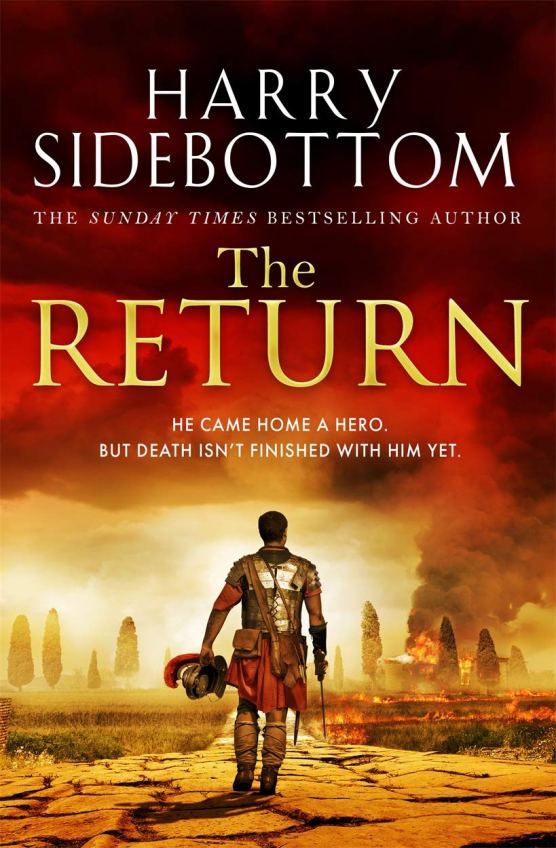
The Return Cover

Publisher: Zaffre (Trade Paperback – 11 June 2020)

Series: Standalone

Length: 307 pages

My Rating: 4.5 out of 5 Stars

Amazon

Bestselling historical fiction author Harry Sidebottom takes you on a dark and compelling adventure into the mind of a haunted Roman soldier as he returns home only to find more death waiting for him with, The Return.

Harry Sidebottom is an impressive author specialising in exciting and detailed Roman historical fiction novels, whose work I have been enjoying for years.  Sidebottom has so far written two amazing series, the Warrior of Rome series, which followed a barbarian turned Roman general, Ballista, as he attempts to survive the machinations and wars of the Empire, and The Throne of the Caesar’s novels that examined some of the more obscure and chaotic Roman Emperors.  In recent years Sidebottom has started experimenting with some compelling standalone novels.  The first of these, The Last Hour, brought back Ballista and set him on a fast-paced adventure through Rome in a manner reminiscent of the television series 24.  His next novel The Lost Ten, featured a group of 10 mis-matched Roman soldiers who are sent on an infiltration mission into enemy territory to break a high value target out of prison.  His third standalone novel was The Return, which came out last year.  I read it a little while ago and failed to provide a timely review for it.  However, as Sidebottom’s latest novel, The Burning Road, has just been released, I thought I would take this opportunity to quickly review The Return so I have a clean slate when I get my hands on a copy of his latest book.

Synopsis:

He came home a hero.
But death isn’t finished with him yet . . .

145BC – CALABRIA, ANCIENT ROME. After years of spilling blood for Rome, Gaius Furius Paullus has returned home to spend his remaining days working quietly on the family farm.

But it seems death has stalked Paullus from the battlefield. Just days after his arrival, bodies start appearing – murdered and mutilated. And as the deaths stack up, and panic spreads, the war hero becomes the prime suspect. After all, Paullus has killed countless enemies on the battlefield – could he have brought his habit home with him?

With the psychological effects of combat clouding every thought, Paullus must use all his soldier’s instincts to hunt the real killer. Because if they are not brought to justice soon, he may become the next victim.

The Return was an intriguing and compelling novel that contains a brilliant and dark historical murder mystery.  Like some of his previous novels, Sidebottom has blended some unique crime fiction/thriller elements with his traditional historical settings and storylines.  As such, The Return reads like an interesting combination of historical fiction and a darker crime novel, specifically Scandi noir.  This results in a clever and compelling character driven narrative that follows a dark and conflicted Roman protagonist who is forced to investigate a series of murders in his grim and forbidding village.  The author does a wonderful job of blending his historical elements with the compelling crime fiction storyline, and the reader is soon treated to a harrowing and exciting murder investigation.  There is some brilliant use of a darker location, including a forbidding forest, as well as a lot of focus on his haunted protagonist, especially through a series of flashbacks.  All this comes together into an excellent narrative, and it was fascinating to see Sidebottom’s damaged protagonist dive head long into danger while trying to solve the murder and prove his own innocence.  While I did think that the solution to the mystery and the culprits behind the murder was a little obvious, this ended up being an excellent and impressive novel.  Sidebottom really takes the readers on a harrowing and enjoyable ride here, and I ended up getting through it in a few short days.

I was deeply impressed with the dark and guilt-ridden protagonist who Sidebottom set this great story around.  Paullus is a recently returned soldier who received much acclaim during Rome’s war with ancient Greece, but he is also haunted by his actions there, particularly around the fates of two of his comrades.  Thanks to his guilt he constantly sees the Furies, the Roman goddesses of vengeance and retribution, who remind him of the wrongs he commits.  To avoid seeing them Paullus dives headfirst into danger, as the threat of death is the only thing that alleviates his guilt.  This helps turns Paullus into a fascinating and deeply complex figure who has some interesting interactions with his own emotions and the people from his pre-war life who don’t understand what he is going through.  Sidebottom utilises a series of flashbacks to showcase Paullus’ military career and you slowly get the entire story of the protagonist’s heroic past, as well as the event that led to his intense guilt and heartache.  While I did think that Sidebottom might have been a tad heavy-handed with the flashbacks (it makes up nearly half the novel), I did really appreciate the sheer amount of work he put into his great protagonist.  The author did an impressive job of simulating the guilt, fear and anger of a war veteran attempting to re-enter society and it was really compelling to see.  I also deeply appreciated the author’s trick of personifying this guilt into visions of the supernatural Furies, especially as it is never fully established whether they are there or just figments of his damaged mind.  The use of Paullus as the central protagonist really enhanced The Return’s excellent story and he was an outstanding investigator for this fantastic murder mystery.

I also really enjoyed the cool historical fiction elements contained within this novel.  The Return takes place in 145BC, which is one of the earliest times that Sidebottom has explored in his historical fiction novels.  I deeply enjoyed the exploration of this time, especially as Sidebottom features more obscure conquests and locations.  The central location of the story, Calabria in Southern Italy, proved to be a fantastic and interesting setting, especially as this region of Italy contained two distinctive social groups, the Roman settlers and the original inhabitants.  Due to their historical support of Hannibal during the Punic Wars which saw them forced to give up their lands, the locals are treated as second-class citizens by the Romans, who use them as slave labour.  This adds some extra drama and intrigue to the story as these local tribes get caught up in the paranoia and despair around the hunt for the murderer.  I also really appreciated Sidebottom’s examination of the Roman invasion of Greece that the protagonist fought in.  This is one of the more obscure conflicts from Roman history and the author provides a detailed account of the causes, battles, and eventual consequences of the conflict.  I deeply enjoyed exploring this period in the flashback chapters, as there were some detailed and powerful battle sequences which featured some distinctive clashes between Greek and Roman military styles.  Throw in some Greek and Roman mythology as a potential cause for the murders or the protagonists’ actions, and you have quite a brilliant historical tale.  These grim and bloody historical elements blended perfect with the darker story that Sidebottom was telling and it was absolutely fascinating to see how they were incorporated into The Return’s compelling, multi-genre style.

Overall, The Return was an epic and complex novel that continued to showcase Harry Sidebottom’s amazing talent as a writer.  This fantastic novel ended up being one of the more unique historical fiction books I have ever read and I deeply enjoyed the cool combination of classic Roman history and darker crime fiction elements, especially when shown through the eyes of an extremely damaged protagonist.  This book comes highly recommended, and I cannot wait to get my hands on Sidebottom’s latest novel, The Burning Road.

Amazon

The Honour of Rome by Simon Scarrow

The Honour of Rome Cover

Publisher: Headline (Trade Paperback – 9 November 2021)

Series: Eagles of the Empire – Book 20

Length: 431 pages

My Rating: 4.5 out of 5 stars

Amazon

One of the best authors of Roman historical fiction, Simon Scarrow, returns with another exceptional adventure back in time with The Honour of Rome.

2021 has been a particularly good year for Simon Scarrow readers, as this acclaimed historical fiction author has released two fantastic novels.  The first of these, Blackout, was a clever historical murder mystery novel set in pre-war Nazi Germany, which contained a fantastic and impressive story.  While I deeply enjoyed Blackout, I was a little more excited for the next awesome entry in Scarrow’s long-running Eagles of the Empire series.  The Eagles of the Empire books follow two officers in the Roman army, Centurion Marco and Prefect Cato, as they fight in multiple battle fields across the Roman Empire.  I have been a major fan of this series for years and have had the pleasure of reading every prior entry in it, while also reviewing some of the latest entries, including The Blood of Rome, Traitors of Rome and The Emperor’s Exile.  As such, I was very excited when I received the latest entry in this series, The Honour of Rome, a couple of days ago, and instantly started reading it.  The Honour of Rome is the 20th novel in this series and takes its great protagonists on another intense adventure.

Britannia, 59 AD.  After retiring from the Roman Legions, former Centurion Marco has travelled back to Britannia 15 years after he helped conquer it.  Now a married man, Marco is hoping for a quiet life, enjoying the fruits of the successful inn in Londinium that he half-owns with his mother.  However, not everything is as calm as he hoped.  There are rumours about the tribes being restless once again, and the streets of Londinium are alive with criminal gangs.

Upon arriving at his mother’s inn, Marco discovers that she is being extorted for protection money by a ruthless gang.  Determined to stop this, Marco attempts to resist the gangsters, only to find himself outmatched and a potential pawn into the middle of a vicious gang war.  At the same time, Marco finds himself drawn into the defence of the colony, especially when one of the local tribes refuses to pay any more taxes.

After a bloody punitive raid with a group of veteran reserve soldiers, Marco returns to Londinium, only to face the consequences for his defiance.  Beaten and bloodied, Marco is unsure how to fight back until his old friend Cato appears.  Cato, who has left Rome without leave to hide Nero’s exiled mistress, is always willing to back Marco up in any sort of fight, and he has an ambitious plan to end the gang problem once and for all.  Will the team of Marco, Cato, and their veteran allies be enough to overcome the city’s vicious gangs, or have these proud war heroes finally met their match?

This was another awesome novel from Scarrow, who has once again produced an exciting and fast-paced historical fiction read that perfectly envisions the landscape of Roman-occupied England.  The Honour of Rome is a great read, and I loved the cool combination of historical and crime fiction elements throughout it.  I ended up reading this book in only a few short days and loved every second of it.

Scarrow has come up with another amazing and entertaining story for this compelling book, which takes his long-running protagonists on another intense and bloody adventure.  One of the things that I have always enjoyed about the Eagles of the Empire series is the range of different subgenres that can be blended with its historical fiction elements.  The Honour of Rome is a great example of this as Scarrow utilises a crime fiction based storyline that blends with the overarching historical elements extremely well.  The protagonist is swiftly drawn into a vicious confrontation with two warring gangs of criminals upon his arrival in Londinium, which proves to be an outstanding basis for the main storyline.  At the same time, he once again becomes involved in the Roman garrison’s ongoing conflicts with the local Britons.  This combination of crime and military elements is very effective throughout the novel, and I liked seeing the conflicts with both gangsters and rebellious natives.  This also allows Scarrow to bring in several solider characters into the main crime-fiction storyline as backup as the story progresses, and it was pretty fun to see a bunch of retired soldiers taking on the antagonists.  The author really sets up everything extremely well in this book, and there isn’t a moment of calm or quiet throughout the entire novel, as the protagonist gets involved in several intense and well-written fights and battle sequences.  I found the last third of the novel to be particularly exciting, especially as the protagonists attempt an ambitious and risky strategy.  This results in the predictable satisfying, if bloody, conclusion, and Scarrow has made sure to set up some cool new storylines that will no doubt be the basis for the next few books.  An enjoyable and action-packed thrill-ride from start to finish, I had a fantastic time reading this latest historical adventure.

One of the more interesting things about The Honour of Rome was the noticeable change in character focus that helped set it apart from the other Eagles of the Empire books, namely that it spent most of the narrative focusing on only one of the series’ protagonists.  This is not too surprising, especially as the previous book in the series, The Emperor’s Exile, focused on Cato to such a degree that I kind of assumed that Scarrow was planning to permanently retire Marco.  However, I’m pleased to say I was wrong about this, as two-thirds of this latest book is exclusively told from Marco’s perspective.  I had a great time following Marco in this novel, and it is always a lot of fun to see the gruff and hard-headed Centurion in action.  There are some great moments surrounding Marco in this novel, from being out of his depth when it comes to combating criminals rather than enemy soldiers, to his great camaraderie with the fellow veterans in the colony.  You also have to love the fun interactions that occur around him as he finds himself stuck between his strong-willed wife and his equally strong-willed mother.  This ended up being a really good Marco novel, and I deeply enjoyed it.  Of course, Cato does show up towards the end of the book, and the novel is soon back to its typical dynamic, with Cato taking tactical lead.  There are also some interesting long-term storylines surrounding Cato, especially as he has fled from Rome with the Emperor’s exiled mistress.  It was great to see this team in action once again, especially as they enact another madcap scheme, and I had another fun time following them.

I also rather enjoyed the cool historical setting featured within this great novel, as the protagonists once again return to Britannia.  Historical Britannia is a well-utilised setting in the Eagles of the Empire books, having been the location of several of the earlier novels, including the first five entries in the series.  It made me a little nostalgic to see this damp and gloomy setting once again, especially as it proves to be just as chaotic and violent as ever.  This book makes full use of its clever move from the more traditional battlefields of Britannia to the city of Londinium, and I loved the inclusion of a crime-ridden, early London, especially as Scarrow tries his best to show it in all its dark and rapidly expanding glory.  I also enjoyed the inclusion of the veterans’ colony that was a major secondary setting for much of the book.  It proved to be fascinating to follow these characters who have chosen to settle in this harsh country and spending time conquering it, and I liked their inclusion in the novel.  It was pretty cool to see these retired soldiers in reserve taking on enemies, both on a proper battlefield and against the criminal element, and I thought it was a fun and compelling inclusion to the story.  I also appreciated that, after several books, we finally get a continuation of the Boudica storylines that were set up in some of the earlier novels.  Scarrow is also clearly setting up Boudica’s rebellion for later in the series, and I cannot wait to see how our protagonists, with their established history with Boudica and her people, will fit into it.

With this awesome 20th entry in his amazing Eagles of the Empire series, Simon Scarrow continues to highlight why he is one of the absolute best authors of historical fiction in the world today.  The Honour of Rome has a brilliant and compelling story that perfectly blends historical and crime fiction elements together into one thrilling tale.  I had a wonderful time reading this great book, and I deeply appreciated the way in which Scarrow continues the adventures of his compelling characters by once again returning them to the familiar setting of occupied Britannia.  The Honour of Rome is another highly recommended historical read, and I cannot wait to see what happens next in this series.

Amazon

The Emperor’s Exile by Simon Scarrow

The Emperor's Exile Cover

Publisher: Headline (Trade Paperback – 10 November 2020)

Series: Eagles of the Empire – Book 19

Length: 434 pages

My Rating: 4.5 out of 5 stars

Amazon

One of the top authors of Roman historical fiction, Simon Scarrow, returns with the latest exciting novel in his Eagles of the Empire series, The Emperor’s Exile.

Rome, 57 A.D.  Following their adventures in Parthia, Legionary veterans Tribune Cato and Centurion Marco return to Rome with the remnants of their Praetorian Cohort.  Thanks to the ever-shifting politics of Rome and the fickleness of Emperor Nero’s court, Cato faces a hostile reception from some of Nero’s advisors, who hold him responsible for the military disasters experienced in the Parthian campaign.  Soon Cato has his command taken away from him, while Marco decides to resign from the Legions in protest, determined to live out his retirement in Britain.

Isolated in Rome, Cato is forced by one of Nero’s advisors to take on a new and dangerous mission.  Nero’s mistress, the beautiful Claudia Acte, has risen too high too quickly, and Nero’s political enemies have manipulated him into sending her into exile.  Travelling with a select group of Praetorian officers and his new advisor, the spy Apollonius, Cato must escort Claudia to the location of her exile, the island province of Sardinia, where he has another mission to accomplish.

Sardinia has long been plagued by tribes of bandits living wild in the centre of the island.  These proud decedents of the original inhabitants of Sardinia have been causing problems in recent months, raiding the local villages and ambushes caravans.  Taking command of Sardinia’s entire garrison, Cato begins to work out a strategy to defeat the locals and regain his position in Rome.  However, this proves harder than originally anticipated as Cato needs to contend with a disorganised military force, a dangerous plague that is beginning to overwhelm the island and a surprisingly competent group of bandits with unparalleled knowledge of the local landscape.  Worse, Cato begins to have dangerous feelings for Claudia, feelings which his enemies will exploit and which could set the entirety of Rome against him.  Can Cato pacify Sardinia before his entire force is decimated, or have his adventures finally come to an end?

This was another fantastic and highly enjoyable historical fiction novel from one of my favourite authors, Simon Scarrow, who has produced an impressive new entry in his long-running Eagles of the Empire series.  The Eagles of the Empire books are easily among the best Roman historical fiction series out there at the moment, and I have had an amazing time reading every single entry in this series, including the last two novels, The Blood of Rome and Traitors of RomeThe Emperor’s Exile is the 19th Eagles of the Empire book and the author has produced another impressive story, featuring great historical elements and some fantastic character work.  I had an awesome time reading this book and it is definitely worth checking out.

The Emperor’s Exile contains an extremely fun and captivating narrative which follows Cato work to defeat a new enemy in a new historical setting.  Scarrow sets up an exciting and fast-paced story for this latest book, with the protagonist forced to deal with all manner of politics, intrigue and various forms of deadly peril in rather quick succession as he is assigned his mission and attempts to complete it.  This naturally results in all manner of impressive action sequences which are a lot of fun to watch unfold, including one particularly good extended siege sequence.  It is not all action, adventure and historical undertakings, however, as the book also has an intriguing focus on its central protagonist, Cato.  Cato, who has been evolving as a character over the last 18 books, continues to develop in The Emperor’s Exile in several dramatic and emotionally rich ways.  Not only does he have to adapt to a major change in his personal circumstances with the retirement of a great friend but he continues to question his role in the Roman army and whether he wants to remain a brutal killer.  Throw in an ill-conceived romance, his continued regrets about his past actions and his disastrous first marriage, as well as a certain major change in his appearance for the future, and this becomes quite a substantial novel for Cato which also opens up some intriguing storylines in the future.  I had a wonderful time reading this book and, once I got wrapped up in the story, I was able to power through the book extremely quickly.

In addition to having a great story, The Emperor’s Exile also serves as a key entry in this impressive, long-running series.  While readers who want to check out this book do not particularly need to have read any of the previous Eagles of the Empire books, mainly because Scarrow does an excellent job of revisiting story aspects and characters from prior novels, those established fans of the series are going to find this book particularly significant and memorable.  This is because one of the main protagonists of this series, Centurion Marco, who has been a major part of all 18 previous novels, retires from the Legions 100 or so pages into the book then subsequently disappears off to Britain, leaving Cato to his own adventure in Sardinia.  Scarrow has been telegraphing Marco’s plans to retire for the last couple of books, and it is a natural consequence of the author realistically aging his characters (15 years have elapsed within the series at this point).  While it was somewhat expected, it was still weird and a bit sad not to have Marco fighting along Cato in this latest adventure, especially as their comradeship is one of the defining aspects of this series.  That being said, Cato has grown a lot over the last 18 books and the natural progression of Cato and Marco’s dynamic as characters did necessitate them splitting off at some point.  It will be interesting to see how Scarrow features Marco in the future, especially if he plans to continue the Eagles of the Empire series for several more books (I personally would love it if he goes all the way into The Year of the Four Emperors, as it would wrap up the Vitellius and Vespasian storylines from the earlier books quite nicely).  Based upon how The Emperor’s Exile ends, it looks like Marco is going to appear in the next book, but it is uncertain whether he will continue on as a central protagonist, become an occasional character or go down in a final blaze of glory.  I personally think that Scarrow is planning to permanently retire Marco as a character soon, potentially replacing him with new character, Apollonius.  Apollonius is the dangerous and insightful spy who Cato teamed up with during the previous novel, and who followed Cato back to Rome in this book.  Apollonius served as Cato’s aide, scout and confident during The Emperor’s Exile in place of Marco, and it looks like he will be a major character in the next book as well.  I quite liked Apollonius as a character and it will be interesting if he ends up as Marco’s replacement, especially as he shares a very different dynamic with Cato than Marco did.  All of this makes The Emperor’s Exile quite an intriguing entry in the overall series and I am extremely curious to see what is going to happen to these amazing protagonists next year in the 20th book in the series.

As always, this novel is chock full of fantastic historical detail and storytelling as the author sets his story in some intriguing parts of Roman history.  Not only does the reader get a great view of Rome under the control of Emperor Nero (whose chaotic rule as described in this novel has some interesting modern parallels) but the main story takes place in the island province of Sardinia, off the Italian coast.  Sardinia is a fascinating province that I personally have never seen used before in Roman historical fiction novels and which proved to be a fantastic setting for most of this book’s story.  Scarrow really dives into the history, culture and geography of the island, explaining how it became a Roman province, examining some of the key towns and ports and highlighting the difference between the locals and the Roman settlers.  There is a particularly compelling focus on the tribes who controlled the centre of the island and it was rather interesting to see how a group of rebellious barbarians managed to survive so close to Italy during this period.  Scarrow also provides the reader with his usual focus on the Roman legions/auxiliaries, providing impressive details and depictions of how the Roman war machine operated and what their usual tactics and strategies are.  All of this really helps to enhance the novel and I had an amazing time exploring Sardinia with the Roman protagonists.

Another intriguing aspect of The Emperor’s Exile was the plague storyline that saw the inhabitants of Sardinia, including Cato and his soldiers, have to contend with a deadly infectious sickness.  This plague added an excellent edge to the storyline, serving as a hindrance to the protagonists and ensuring that they constantly have to change their plans while dealing with their enemy.  Not only does this serve as a clever handicap for the Romans but readers cannot help but make some comparisons to modern day events.  While I could potentially be reading a little too much into this and it is possible that Scarrow always intended to feature a plague in this book, I cannot help but think that this was a deliberate choice by the author.  Either way, it proved to be an extremely fascinating part of the book and it was fun to compare the reactions of these historical characters to the actions of people in the real-world.  While this story inclusion may potentially prove to be a little tiring for readers sick of any mentions of disease, infection and quarantine in their day-to-day lives, I thought it was a great addition to the novel, especially as it raised the dangerous stakes of this exciting novel.

With his latest novel, The Emperor’s Exile, Simon Scarrow continues to show why he is one of the top authors of Roman historical fiction in the world today.  This latest novel serves as a key entry in his amazing Eagles of the Empire series and it takes the reader on an outstanding, action-packed adventure, loaded with some great character moments and some impressive historical settings.  I had a fantastic time reading this book and I cannot wait to see how Scarrow continues this epic series next year.  Luckily, I only have to wait a few more months for my next dose of this author’s work as his World War II crime fiction novel, Blackout, is set for release next March.

Amazon

River of Gold by Anthony Riches

River of Gold Cover

Publisher: Hodder & Stoughton (Hardback – 6 August 2020)

Series: Empire – Book 11

Length: 339 pages

My Rating: 4.25 out of 5 stars

Amazon

From one of the top authors of Roman historical fiction, Anthony Riches, comes River of Gold, the action-packed and epic 11th entry in his bestselling Empire series.

Aegyptus, 187 AD.  Under the command of Tribune Scaurus, decorated Centurion and former fugitive, Marcus Valerius Aquila, serves with several elite veteran officers, each of whom has displeased the Imperial hierarchy in some way.  These Roman soldiers now find themselves part of an informal troubleshooter unit, destined to die if they should ever fail one of their impossible tasks.  The Roman Empire is once again in danger as a mysterious army advances from the south of Africa, killing a major garrison and conquering a key port city at the southernmost border of the empire.  In order to solve this problem, the Emperor’s corrupt advisor sends Centurion Marcus and his comrades on another dangerous mission.

Arriving in Alexandria, Marcus and his comrades discover a rich province riddled with corruption and with a much reduced military presence.  Taking command of the local legion, Scaurus marches what soldiers he can down to the site of the massacre to find a new grim reality waiting for them.  After centuries of peace, the mysterious kingdom of Kush has once again declared war on Rome, determined to claim what is rightfully theirs from the weakened Romans.  In order to stop them, Scaurus leads his force deep into enemy territory to recapture an abandoned fortress and hold it against impossible odds.  Their mission is borderline suicidal and only has a slim chance of success, but if anyone can pull of this impossible task, it is Marcus and his friends.

This was another fun and exciting historical novel from Riches which proved to be a fantastic new entry in his Empire series.  Riches is a prolific and talented author who has been writing since 2009, when he debuted the first Empire novel, Wounds of Honour.  Since then he has gone to write an additional 10 novels in this series, as well as writing his separate series, The Centurions.  I have previously read a few of Riches’s books, including the first three entries in the Empire series when they were released.  While these first three books were extremely enjoyable Roman historical fiction novels, I missed the chance to read a couple of entries in the series and fell too far behind to catch up.  However, I recently got a copy of this latest book and, as I was in the mood for a visit back to ancient Rome, I tried out River of Gold to see how it would turn out.

This proved to be a good decision on my behalf as River of Gold ended up being a fantastic and compelling read.  Riches sets up an excellent character-driven story that sets a group of unique Roman officers against a dangerous new foe.  The author does a good job setting the story up, allowing those readers unfamiliar with the series or the historical era to easily jump in, and then sets the characters toward their goals.  This results in a captivating narrative that has a good blend of action, character development and cool historical features, as the protagonists embark on a madcap plan to win the war.  This leads to a number of awesome battle scenes, including an extended siege sequence which was a lot of fun to read, and the various characters find themselves in sufficient danger throughout.  The story ends a tad suddenly, although Riches does a good job of setting up the overall conclusion to the main storyline.  This story also felt a bit short, and I think it could have benefited from another 50 pages or so, perhaps extending out the siege sequence and adding in some more action and peril there.  However, this was still an overall excellent narrative which I was able to get through in only a few short days.

Riches spends a good part of River of Gold focusing on the various characters he has introduced and developed over the course of his long-running series, and this proves to be an entertaining group of protagonists.  In order to examine these characters Riches utilises a detailed, in-narrative character introduction near the start of the book, in which a newcomer reads off personnel files about each of the recurring characters.  While this was rather forced and inelegant way to introduce the characters and their history, it does the job and allows the readers to get an idea of who these protagonists are and their various quirks.  I found this particularly useful after having skipped several books in the series, and new readers will definitely appreciate the background.  Most of these characters get some intriguing arcs throughout the book.  For example, Marcus is once again the lead character of the novel as he tends to get the most important missions and ends up in the most danger, including a particularly close look at the Kush and their society.  Marcus is a fairly typical Roman historical fiction protagonist who has gone from raw recruit to hardened veteran throughout the course of the series, and it was interesting to see the various developments that have occurred since the last Empire novel I read.  Tribune Scaurus also gets a fair bit of attention as the leader of the Roman force and the mastermind behind their attack.  Scaurus is a good leader character, providing the rest of the characters with backbone and fortitude, and I liked his rather unique command style that relates to the dangerous political situation he finds himself in.  The other major character arc that I liked revolved around Cotta, the group’s veteran centurion and Marcus’s mentor, who reluctantly returns to Aegyptus for the first time after assassinating a Roman general who sought to rebel against the Emperor.  Cotta’s interesting subplot revolved around him reminiscing about his past mistakes while he attempts to hide his identity from the legion they have taken over, as they suffered as a result of his actions.  All of these recurring characters provided a great base for the story and some major moments that occurred will definitely rock readers, especially those long-term fans of the series.

While the recurring characters are good, I really have to highlight some of the new characters that Riches created for this novel, one of whom in particular outshines the rest.  This new character is Demetrius, a Christian who accompanies the army down south as part of his holy mission.  Demetrius is a complex and enjoyable character mainly due to his past as a vicious Christian-hunting Roman soldier.  After a series of brutalities, Demetrius sought redemption by joining the Christian cult, and now he fights against the invaders, believing that this fight is a holy war.  Riches focuses a good amount of the plot on Demetrius, and he proves to be a captivating and central figure, offering words of wisdom and defending his newfound Christian beliefs.  I found the author’s portrayal of this character to be really intriguing and I liked the close relationship he formed with some of the recurring characters, especially Marcus, despite that fact that none of them are Christians.  The other new character I liked was Ptolemy, an Imperial secretary and scribe assigned to the group, who provides them with relevant information and history to assist with their mission.  Ptolemy is essentially a walking piece of exposition, and a large amount of the book’s historical information is revealed thanks to him.  Despite this, he was a rather entertaining character, mainly due to the odd-couple friendship he formed with Dubnus.  The two characters are pretty much opposites in every way and end up bickering on a number of subjects, while also building up a mutual respect for each other.  This fun discourse between the two resulted in some great moments throughout the book and he was an interesting addition to the plot.

In addition to the fun story and great range of characters, Riches also invests a significant amount of time and effort in bringing the historical aspects of this novel to life.  The author has obviously done some serious research on the subject of Roman military history as he does a wonderful job showcasing various elements of the Roman legions and soldiers to life, including gear, unit makeup and tactics.  This also translates incredibly across into the various combat scenes throughout the novel, as you get a real feel for how a Roman solider would have felt in combat, especially at the Centurion level, although Riches mostly focuses on unique fight situations in this book.  The book also contains a number of detailed descriptions of the historical landscapes that the protagonists traverse through, such as Alexandria and the rest of historical Egypt.  This proved to be quite a fascinating inclusion in the story and I always enjoy seeing an author’s depiction of historical settings.  However, the most fascinating part of this novel has to be the inclusion of the ancient African Kingdom of Kush, with whom our protagonists face off against.  The Kushites were a powerful and advanced civilization, who, until recently, have been somewhat overlooked by historians and archaeologists.  Riches does an incredible job working them into his novel and setting them up as a rival kingdom to Rome.  Not only does he feature a number of detailed depictions of their culture and military make up during the events of the book, but he also spends time exploring the history of Kush, including their origins as a civilization, their prior history throughout Aegyptus and their conflicts with the Romans.  This was easily one of the most interesting and compelling elements of River of Gold, and I really appreciated Riches’s inclusion of such a unique historical adversary.  Indeed, all of the historical inclusions in this book are excellent, and I had an amazing time exploring them as the story progressed.

River of Gold by Anthony Riches is a captivating and enjoyable novel that takes the reader on a fascinating and action-packed journey through history.  Riches does an excellent job continuing his bestselling Empire series, and I had a great time getting through his exciting story, loaded with great characters and an impressive historical background.  All of this results in an amazing historical fiction novel that is well worth checking out, whether you are a fan of this long-running series or a general historical fiction fan looking for a fun adventure story.

Amazon

Waiting on Wednesday – The Lost Ten by Harry Sidebottom

Welcome to my weekly segment, Waiting on Wednesday, where I look at upcoming books that I am planning to order and review in the next few months and which I think I will really enjoy.  Stay tuned to see reviews of these books when I get a copy of them.

The Lost Ten Cover.jpg

This week I will be looking at an exciting new historical fiction novel that is coming out in April 2019, The Lost Ten by Harry Sidebottom.  Harry Sidebottom is a well-established historical fiction author whose novels set in the Roman Empire are some of the best in the business.  I have long been a huge fan of Sidebottom.  I have previously mentioned how his second book, King of Kings, was one of the first books I ever reviewed, and I absolutely loved his most recent release, 2018’s The Last Hour.  So I am extremely eager to get my hands on The Lost Ten, which sounds like it will be quite a fantastic read.

Goodreads synopsis:

A desperate rescue attempt deep behind enemy lines . . . this nail-biting adventure has all the hard-edged appeal of the Bravo Two Zero mission.

When Valens, a junior officer in the Roman Army, joins a crack squad of soldiers on a dangerous mission, little does he know what’s in store for him. Tasked with rescuing the young Prince Sasan, who has been imprisoned in the impenetrable Castle of Silence, the troops set out across Mesopotamia and into the mountains south of the Caspian Sea.

Deep in hostile territory, inexperienced Valens finds himself in charge. And as one by one his soldiers die or disappear, he begins to suspect that there is a traitor in their midst, and that the rescue is fast becoming a suicide mission.

Valens must marshal this disparate group of men and earn their respect, before it’s too late…

I love the sound of this plot synopsis, as it implies that Sidebottom will continue his winning formula from The Last Hour, where he combined pulse-pounding thriller elements with his usual detailed and intriguing historical fiction plots.  This worked extremely well with The Last Hour, which was essentially 24 in Rome, and I am excited to see how a high-risk special forces mission will play out in this ancient setting.

I very intrigued by the Castle of Silence that is referenced in the synopsis, which brings a very intense and impenetrable stronghold to mind.  From the other details contained within plot summary, it sounds like the Romans will have to infiltrate the Parthian Empire.  I love the idea of a small force getting into this massive and sprawling empire, and I am very interested to see how the Parthians are able to insert a spy into a crack Roman unit.

Overall, I am extremely excited for this latest book from Harry Sidebottom, who has to be one of my favourite historical fiction authors.  The Lost Ten sounds like it will be a thrilling and action-packed novel, and I really cannot wait for Sidebottom to once again blow my mind with his thriller/historical fiction hybrids.