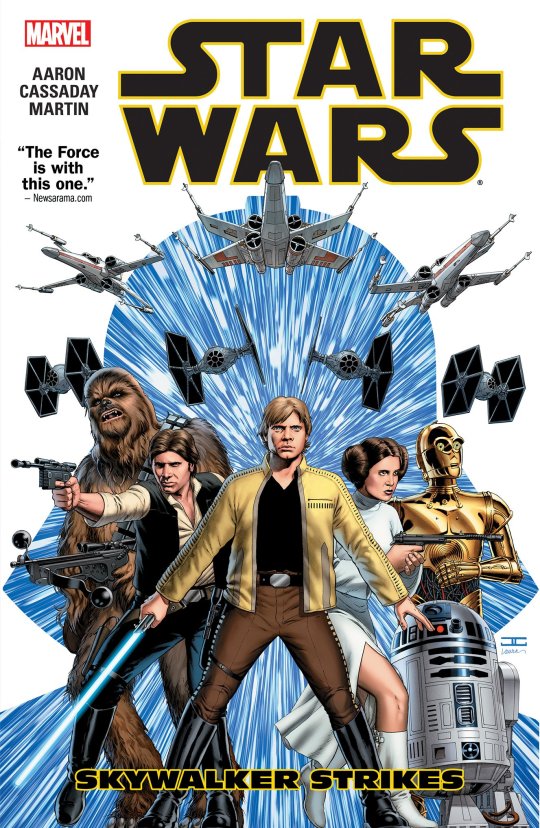
Throwback Thursday – Star Wars (2015) Volume 1: Skywalker Strikes by Jason Aaron and John Cassaday

Star Wars (2015) Volume 1 Cover.jpg

Publisher: Marvel Comics

Publication Date: 6 October 2015

Length: 160 pages

My Rating: 5 out of 5 stars

Amazon

Reviewed as part of my Throwback Thursday series, where I republish old reviews, review books I have read before or review older books I have only just had a chance to read.

I think it is fair to say that I have been in a real Star Wars mood lately. Maybe it is because of the imminent release of the final movie in the Skywalker Saga, Star Wars: The Rise of Skywalker, or perhaps it is because The Mandalorian is such an awesome TV show. Whatever the reason, I have been reading and reviewing quite a few Star Wars books and comics lately. For example, I am currently listening to Star Wars: Force Collector, I reviewed Tarkin last week and I recently read and reviewed Resistance Reborn and Vader: Dark Vision. As a result, I thought that this week would be a good time to do a Throwback Thursday on the first volume of the 2015 Star Wars comic book series, Skywalker Strikes, which did an outstanding job of introducing an extremely exciting ongoing comic series.

The Star Wars comic book series was started in 2015 and follows the adventures of the protagonists of the original Star Wars trilogy. Set shortly after the events of A New Hope, this series attempts to fill in the three years between the first film and The Empire Strikes Back. The Star Wars comics originally ran concurrently with the Darth Vader (2015) comic series until that series ended, and then proceeded to run alongside the Doctor Aphra comics. The Star Wars series ran for 75 issues and has only recently concluded. A sequel series with the same name is set to begin in early 2020, which will follow the events between The Empire Strikes Back and Return of the Jedi.
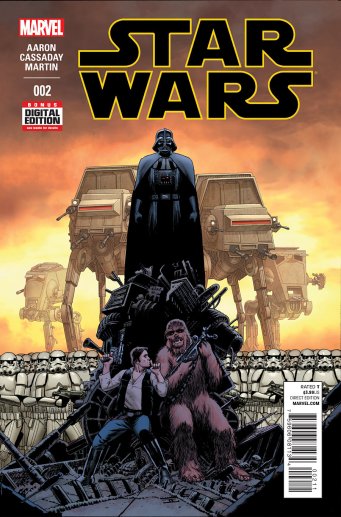
Star_Wars_Vol_2_2.jpg

Volume One of Star Wars begins shortly after the destruction of the Death Star. With the Empire in turmoil following the destruction of such a major weapon, Rebel Alliance members Luke Skywalker, Leia Organa, Han Solo, Chewbacca, C-3PO and R2-D2 use the chaos to infiltrate a key Imperial weapons factory. While they are able to destabilise the factory’s reactor core and free its slave labour force, the Rebels are unprepared for the unexpected arrival of Darth Vader.

Attempting to complete their mission while also trying to kill Vader, the Rebels find themselves hopelessly outmatched by the Dark Lord of the Sith, who is determined to capture the Rebel who blew up the Death Star. Not even Luke, with his newly discovered Jedi abilities, is able to stand up to Vader, and the Rebels barely manage to escape with their lives.

Frustrated by his failures against Vader, Luke decides to take a leave of absence from the Rebel Alliance and returns to Tatooine to contemplate his future. Travelling to the house where Obi-Wan Kenobi lived in exile for years, Luke hopes to find something that will guide him. Instead he finds himself walking into a trap, as the bounty hunter Boba Fett is lying in wait. At the same time, Leia talks Han into a scouting mission for the Rebels, but their simple mission soon attracts the wrong sort of attention. Who is the mysterious woman hunting Han, and why is claiming to be his wife?
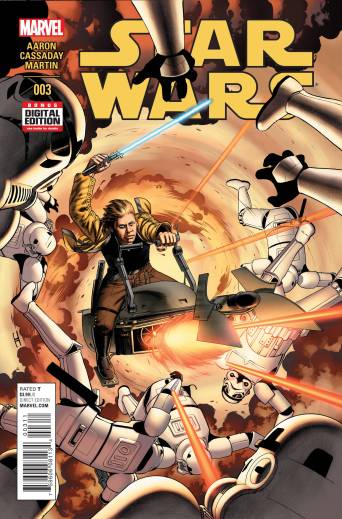
Star_Wars_3_Marvel.jpg

Skywalker Strikes, which is made up of Issues #1-6 of the Star Wars series, contains an outstanding story, fantastic artwork and some of the most insane Star Wars action sequences that you will ever see. The team of Jason Aaron and John Cassaday, have done an amazing job on this comic, and this first volume does a wonderful job starting off this long-running series. While all the issues in this volume are connected together pretty well, I would say that there is a distinctive break between Issues #1-3 and Issues #4-6. Issues #1-3 focuses solely on the protagonist’s attack on the weapon facility, while the last three issues feature some more independent adventures from some of the series’ various characters, as each of them is searching for something.

The sequence contained within Issues #1-3 is just incredible, and it is easily my favourite part of the entire series. What starts as a fun infiltration of an Imperial facility quickly devolves into utter chaos as Darth Vader enters the mix. What then follows is nearly three whole issues of action, explosions, fantastic first meetings and all manner of destruction as the Rebels desperately attempt to escape the factory. While all the characters involved in this part of the comic are really good, I have to say that Vader steals the show as the indestructible villain. This was actually one of the first pieces of fiction in the new Disney Star Wars canon that shows off how amazing Vader could truly be, and it is pretty darn awesome. Pretty much from the first instance he appears, he shows off the full extent of his powers by throwing stormtroopers in front of a sneak attack from Chewbacca, and then by starting to crush an AT-AT with the force. He then subsequently survives a full-on blast from the AT-AT’s cannons and hacks it to pieces with his lightsaber. He also cuts through a bunch of escaping slaves and shows his intense displeasure to his subordinates in a number of destructive ways, including twisting a stormtrooper’s head 180 degrees with the force (to be fair, he did catch sight of Vader without his helmet) and choking a Star Destroyer captain from an insane distance. I can also not be the only person who cracked up at Vader very quickly destroying an Imperial Officer moments after he said “Lord Vader will have my….” (spoilers, he was going to say head, and Vader really did). All of this destruction and action was essentially pure awesome, and I loved every second of it.
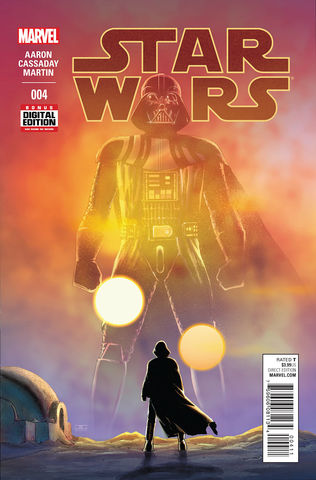
Star_Wars_Vol_2_4.jpg

In addition to all the action in this part of the book, there are also some major moments in Star Wars history that fans of the franchise are really going to enjoy. For the one thing, it actually has the first face-to-face confrontation between Luke and Darth Vader. This scene is handled extremely well. Luke, still believing that Vader is the one responsible for the death of his father, jumps at the chance to get revenge. However, as Luke runs towards Vader’s location full of confidence, he hears the disembodied voice of Obi-Wan Kenobi telling him to run. This is advice that Luke really should have taken; Vader, after berating Luke for his obvious lack of skill with the lightsaber, rather easily disarms him. While getting ready to kill Luke, Vader notices that the lightsaber he has taken off him is the very one he used to wield as Anakin Skywalker, which obviously raises some issues within him. As events at the factory spiral out of control, Luke is able to evade Vader, who starts to grow slightly more impressed by his skills. As Luke makes his escape, Vader realises that he is not only the pilot that destroyed the Death Star but also Kenobi’s last great hope. Still not fully realising the identity of the boy he just encountered, Vader rather vindictively promises to corrupt him to his purposes. All of these events are pretty incredible moments in Star Wars history, and I think that the creative team did an outstanding job introducing them in this new canon. The initial face-to-face showdown between the main protagonist and villain of the original Star Wars trilogy is a pretty significant moment, and I really loved how it was shown. The hints at the hidden history between the two are great, and the initial realisations from Vader that there is more to Luke than he realises are fantastic. I also liked how the creative team showed Luke as having no real skill with the lightsaber or the force. Considering that he only had about an hour of training with Kenobi, it really isn’t that surprising that he has no lightsaber abilities, so this is a pretty clever and realistic inclusion, especially as a good part of the following Star Wars comic series deals with some of the earliest days of his training. While these events are probably not the most significant to occur in this volume (more on that later), they are incredibly intriguing and any fan of the Star Wars franchise is going to love it.

The last three issues of Skywalker Strikes are also very entertaining, though less action-packed, since the creative team has opted instead for storytelling and showing off the state of the Empire and Rebel Alliance. While a despairing Luke sets off to find answers, Han and Leia set off to find potential locations for a new Rebel base, while Vader has a meeting with Jabba the Hut. There are some really interesting aspects to this part of the story, from the growing hopelessness in Luke as he begins to realise how far he is from becoming a Jedi, to Vader’s sudden obsession with capturing Luke, to the growing hints of romance between Han and Leia, disguised at this point as antagonism. However, I would say that it’s the newcomers to the comic series, Boba Fett and Sana Solo, that are some of the best parts of the last three issues of the volume. Fett, who has long been a fan favourite despite his complete underutilisation in the movies, shines as the badass bounty hunter as he scours Tatooine for Luke, eventually finding out all about him through some very violent means. This leads to a pretty fun showdown between Boba and Luke, as Boba ambushes him at Kenobi’s house and easily incapacitates him and R2-D2 with his cool array of weapons and tactics. It is only thanks to Luke’s first close-combat use of the force that he is able to escape, as he successfully blocks a blaster bolt while blinded (a nice homage to the training sequence from A New Hope) and moves an item with his mind. All of this was a pretty entertaining showdown, and I loved seeing Fett in action for once. We also have the mysterious Sana Solo, who has a pretty fantastic takedown of some Rodian thugs with a great piece of technology and a ruthless demeanour. She is later able to track down Han and Leia, absolutely terrifying Han before dropping one of the biggest bombshells of the book: that she is Han’s wife. While this is not explored in any great detail in this volume, it is an excellent introduction for this great character, who goes on to become a fairly major figure in the current Star Wars canon. As a result of all of this, the second half of the volume holds up pretty well to the action-packed first half, and there are plenty of major scenes, including the very big ending.
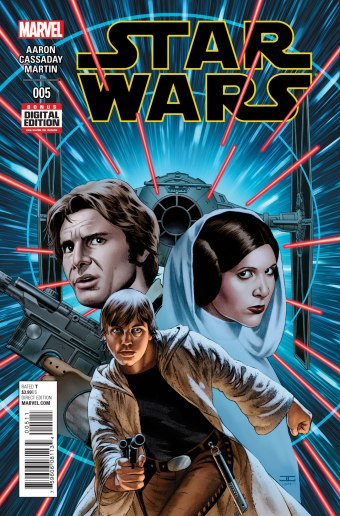
Star_Wars_Vol_2_5.jpg

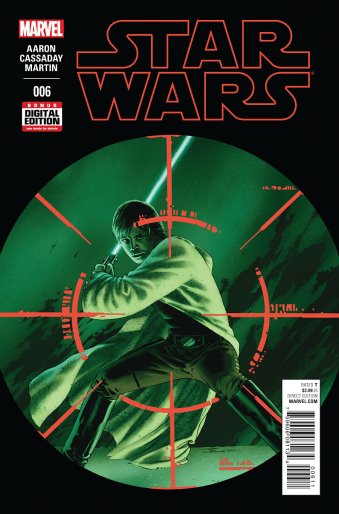
While I did really like the second part of this volume, the best way to appreciate it fully is if you understand its connection to the Darth Vader (2015) series of comics. The Darth Vader series was launched right on the heels of the Star Wars comics and it is actually set in the aftermath of the first three issues of this volume. In the first issue of this concurrent comic, it is shown that Vader has actually started going rogue on the Emperor and is making his own deals with Jabba the Hutt, before the formal discussion he has with Jabba in Issue #4 of the Star Wars series. This actually clears up the somewhat cryptic discussion he has with Jabba later in the issue, where they talk about the bounty hunters he has hired, and also shows the point where he actually tasked Boba Fett with finding Luke. While none of this is absolutely vital when it comes to fully understanding the plot of Skywalker Strikes, it is interesting to see that some of the referenced events occurred in another series. However, the main reason why readers should try to understand the connection between this comic and the Darth Vader series is in the epic conclusion both of them share, where Vader learns the last name of the boy he has been hunting. Both Issue #6 of Star Wars and Darth Vader were actually released on the same day, so readers of both series were able to see this scene at the same time. The two scenes are shown in a slightly different light in each series. It is expanded a bit more in the Darth Vader series, as it plays into the feelings of resentment towards the Emperor that have been building in Vader through the series. However, I quite liked the simpler version in Issue #6 of Star Wars, as the slow-boiling rage and anger within Vader is pretty obvious, as he takes a whole page to fully react, cracking the glass on a Star Destroyer and simply whispering, “Skywalker”. As a result of this connection, the Star Wars and Darth Vader series complement each other extremely well, and I would strongly recommend reading both pretty close together. However, no matter which series you read, the sequence showing the moment where Vader realises that his son is still alive and a Jedi is pretty darn epic and really memorable.

It could be argued that splitting this volume into two separate storylines was an interesting choice from the book’s creative team. I imagine that six issues focused on the attack on the Imperial weapons factory would have been pretty epic (just imagine how much more destruction Vader could have wrought). However, I personally think they did the right thing by splitting the story and showcasing the aftermath of this action. This way you not only get the intense action of the first few stories but you also get to see the consequences of the mission, and all the implications this has for the wider Star Wars universe. In addition, there is also quite an intriguing set up for several key moments in the upcoming series as a whole, a whole new fight between Luke and another iconic Star Wars character in Boba Fett, and some amazing connections with a sister series. I really liked how the story of the entire volume came together, and I think it was an outstanding way to start this excellent series.
Star_Wars_Vol_2_6.jpg

I have to say that I was also really impressed with the awesome artwork that was featured in this first volume. The artwork was drawn by John Cassaday, and featured Laura Martin as the colourist. It is pretty amazing the way that Cassaday was able to capture the faces of the core original trilogy cast members with his artwork. Luke, Leia and Han all look really good to my eye in this volume, and the artist has also done some great renditions of other existing characters, such as Vader, Boba Fett and Jabba the Hutt. In addition, I really enjoyed all of the marvellous and exhilarating action sequences that they artistic team portrayed throughout the volume. These action scenes, especially the ones featuring Vader at the start of the book are just incredible, and I really loved seeing all the fantastic and creative violence. In addition to all the action, there are a number of scenes where the artwork helps to enhance the emotions and hidden meaning of a scene, and I will always love the way that they portrayed the closing moments of this volume. This was some first-rate Star Wars comic book art that is really worth checking out.

As you can see from the above review, I really loved this first volume of the Star Wars (2015) comic book series. The amazing creative team behind this first volume did a fantastic job with the first six issues that make up Skywalker Strikes, producing an extraordinary story which is complimented by a connection to another series and some exceptional artwork. This volume is a fantastic introduction to the flagship comic book series of the Star Wars franchise, and it comes highly recommended. No great knowledge of the expanded Star Wars canon is required to enjoy it, and indeed this may prove to be an effective gateway to the greater Star Wars universe. This gets a full five stars from me, and I am so very glad I decided to check out the Star Wars comic book series this year.
Amazon

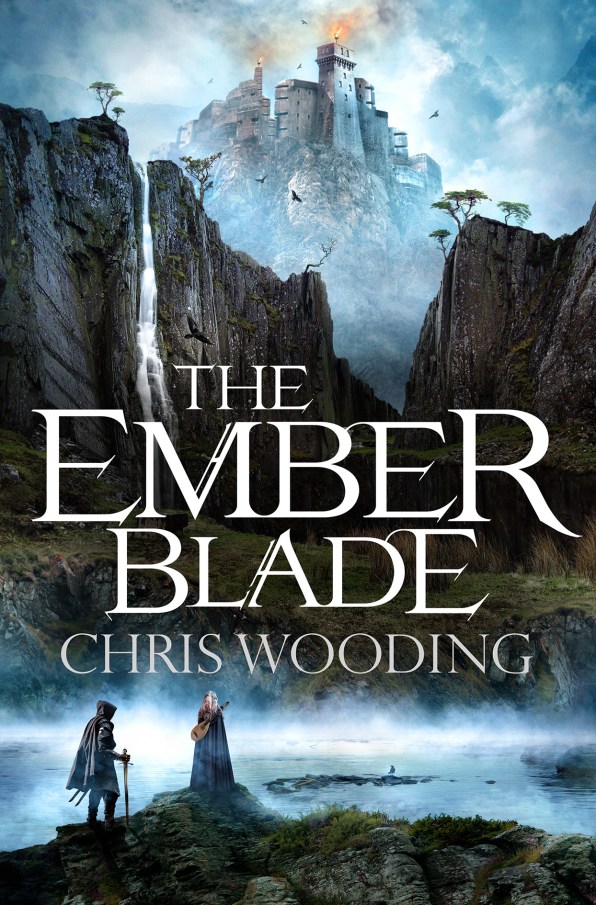
The Ember Blade by Chris Wooding

the ember blade cover

Publisher: Orion (Audiobook – 20 September 2018)

Series: The Darkwater Legacy – Book 1

Length: 30 hours and 40 minutes

My rating: 5 out of 5 stars

Amazon

If you are looking for an elaborate and exciting fantasy epic to really sink your teeth into look no further than The Ember Blade, the impressive first book in Chris Wooding’s The Darkwater Legacy.

The Ember Blade is a massive fantasy book that was released in late 2018 by veteran author Chris Wooding. I somehow completely failed to realise that this book was coming out until I saw it on the shelves of my local bookshop, and while I thought that it had a lot of potential due to the cool sounding plot, I was unfortunately unable to fit it into my reading schedule last year. However, as it was one of the books I most regret not reading in 2018, I decided to listen to the audiobook format of The Ember Blade, narrated by Simon Bubb, a little while ago. I have to say that I was not disappointed; Wooding, who has previously written such books as the Braided Path, Malice and Tales of the Ketty Jay series, has created a bold and inventive new fantasy tale in this book. Featuring a great story, an amazing group of characters and set in a massive and creative fantasy world, this was an exceptional book that I am really glad I listened to it.

A generation ago, the once proud nation of Ossia was invaded by the brutal Krodan Empire, and not even Ossia’s legendary defenders, the Dawnwardens, could stop them. Now the Krodans rule Ossia with an iron fist, installing their own religion and way of life, and treating the Ossians like second-class citizens in their own land. Any acts of dissent are quickly crushed, and those few that fight for Ossian freedom are quickly being rounded up. The only Ossians who flourish are those who accept Krodan rule and attempt to assimilate into their way of life, like Aren, the son of a wealthy Ossian collaborator. Aren has spent his whole life being told that the Krodans saved his country and that their laws, religion and rule are fair and beneficial for everyone. However, he is about to learn the dark side of Krodan rule.

When his farther is suddenly arrested and executed as a traitor, Aren and his best friend Cade are taken to a forsaken Krodan labour camp where they are expected to work until they die. With his hopes and dreams for the future crushed, Aren decides that it is finally time to rebel and engineers an escape from the camp with Cade and another prisoner. Despite all their planning, their escape seems doomed to fail until a mysterious band of fighters intervene at the last minute. However, their salvation is a double-edged sword, as the leader of this group, Garric, is a vengeful figure from Aren’s father’s past, who bears a terrible grudge against his entire family.

Forced to travel with this band, Aren and Cade discover that they are amongst some of the last Ossian rebels in the entire country. As they flee, pursued by a tenacious member of Krodan’s secret police and his three terrifying minions, they are told of Garric’s ambitious plan to break into an impenetrable fortress and steal the Ember Blade, an ancient artefact of Ossian rule that could be used to rally the country to their cause. However, in order to even have a chance to steal the blade, they must overcome treachery, the indifference of a conquered people, and their own personal demons unless they wish to be overwhelmed by the evil forces arrayed against them.

Wooding has come up with a pretty spectacular plot for this book, and I really enjoyed the places that this compelling story went. While the beginning of the book is a little slow, mainly to establish the setting and the friendship between Aren and Cade, it does not take long for the plot to get really exciting, when the two main characters introduced at that point are thrown into a prison camp. The story continues at an excellent and captivating pace from then on in, as the characters get wrapped up with Garric and his band as they attempt to free Ossia from the Krodans. This whole story is pretty fantastic, as it blends together a bunch of different fantasy adventure storylines into one satisfying narrative. For example, throughout the course of the book, you have an exploration of life within a Krodan prison camp, a complex prison break, a pursuit throughout all of Ossia by the Krodans, an exploration of a long-abandoned and magically haunted palace, treachery and plotting throughout the towns and cities of Ossia, all finished off with an elaborate heist and prison break scenario within an impenetrable castle and the dramatic consequences that result from their actions. While you would imagine that having all of these plot aspects within one novel would be a bit too much, I think that Wooding did an excellent job balancing all these intricate storylines together into one outstanding overall narrative. Sufficient time is spent on all of the various parts of the book, which not only ensures that various plot points are well-constructed and impactful but also allows the various character dynamics and relationships to come into effect while also slotting in some world building. All of this leads to an incredible and truly addictive story which I absolutely loved and which also sets up a number of intriguing plot points for future books in this series.

While The Ember Blade’s story is pretty amazing, the real strength of this book is the fantastic group of characters. The author has come up with several outstanding and complex protagonists, each of whom has an elaborate backstory which the reader learns all about through the course of the story, as many of them are utilised as a point-of-view character for a several chapters. There were some truly fantastic and memorable characters throughout this story, and I really enjoyed their various motivations and the way that they interacted with each other. The further you get into the book, the more you find yourself getting wrapped up in each character’s unique personality and finding out what makes them tick, until you actually start to care for them. However, fair warning in advance, some of these characters that you grow to like will not survive until the end of the book, and Wooding goes on a little bit of a killing spree with some of his creations (although I think there is a good chance one or two might come back in a future book).

The Ember Blade features a number of great characters that I could talk about, but for the sake of brevity I might just focus on the most important characters, Aren and Cade. These two Ossian youths are great central protagonists for this story, and they form a pretty fun and emotional duo for most of the book. Aren and Cade are dragged into the events of this book because of their friendship, and the two of them try to stick together, as they end up being the only person each of them has. However, throughout the course of this book, their friendship is tested by a lack of hope, conflict over ideals, love and feelings of betrayal, which makes for some very emotional reading. Both characters are really interesting, and both bring a lot to the story. While Aren is the central protagonist of the series, Cade is the story’s heart and soul, telling all manner of bad jokes and regaling his companions with the old stories of the land. Aside from the periods of time when he is infected with hopelessness or bitterness, Cade mostly remains the same character throughout the course of the book and does not develop too much. Aren, on the other hand, goes through a great deal of character development throughout the book, as he starts to become more disillusioned with the Krodan regime. Due to his upbringing, Aren is slow to realise the evils of the Krodans, even when his father is murdered and he is thrown into a deathcamp. However, several confrontations with Cade, discussions with Garric and actually seeing all the evil that the Krodans perpetrate help convince him of the benefit of rebelling against them and being a hero. This is not a straight progression; instead, the author creates a much more deviated course to greatness for our hero, as he is forced to betray someone he respects, is betrayed in turn by his own countrymen, must overcome his own prejudices and learn to deal with his sense of entitlement and his resentments, all before he become a better person. All of this makes for some great reading, and these two make a fantastic pairing.

Quite a lot of time is also spent on the character of Garric, who probably shares top billing with Aren as the book’s main protagonist. Garric is a freedom fighter whose own country is no longer willing to fight. Obsessed with victory, no matter the cost, Garric has become a very angry and bitter man over the years, especially due to a past interaction with Aren’s father. Despite this past hurt, his code of honour requires him to rescue Aren, and subsequent events force him to spend time with the son of the man he hated the most in the world. We learn a great deal about Garric throughout the course of the book, and despite his outer veneer of hatred and anger, most of which is directed at Aren, he is shown to be a good man and a hero. However, his need for vengeance against the Krodans slowly consumes him throughout the course of the book, and he begins to risk everything, even the lives of the people who trust him, to achieve his goal. I really liked the character of Garric, mainly because he has such an outstanding and well-written character arc in this book, the course of which goes into some dark and destructive directions and was deeply compelling to witness.

There is no way I can review this book without mentioning my favourite character, Grub, since, according to himself, “Grub is the greatest”. Grub is a Skarl, a warrior whose people journey out from an icy wasteland to do mighty deeds in order to have them tattooed on their body. Joining in on Aren and Cade’s escape plan, Grub spends the majority of the book boasting about the deeds that earned him his tattoos and making himself sound like the greatest warrior of all time. Grub is mostly used as a comic relief, and his jokes, outlandish boasts, coarse behaviour, amusing nicknames for the other characters and habit of constantly talking about himself in the third person make him the funniest protagonists in the book. However, like most of Wooding’s characters, Grub’s life is a lot more complicated than you would expect. Grub is not what he appears to be and bears a secret shame that makes him an outcast from his own people. In order to return, Grub must redeem himself by performing the most heroic or cunning of deeds and remains with the protagonists because he believes that participating in their adventures are exactly what he needs, that and he plans to rob them of the Ember Blade. However, as the book progresses, Grub, who has never known friendship or acceptance, begins to bond with several of the protagonists, especially Aren, which could alter his eventual plans.

As you can see from the examples above, Wooding has done an excellent job inserting complex and appealing characters into his story. Favourites I haven’t yet mentioned include a powerful druid and her dog, who provide much of the book’s magical elements; a fearless female hunter with poor social skills, who is a love interest for both Aren and Cade; an intelligent Ossian woman whose ambitions are thwarted by the inherent sexism of the Krodans, and who gets some of the best revenge against a mansplaining ass by beating him in a strategy game; and more. The author even shows a couple of chapters from the point of view of The Ember Blade’s main antagonist, the Krodan secret police commander Klyssen, which humanises him a little and shows why he is so determined to hunt down our protagonists. All of these characters add a large amount to the story, and it was a real pleasure to follow their adventures and learn all about their lives.

In addition to the fantastic roster of characters that the excellent story followed, I have to say that I was also impressed with the bold new fantasy world that Wooding created. Not only is the primary setting of the nation of Ossia a complex and dangerous location that helps create a thrilling and enjoyable read, but the author spends a lot of time expanding out the entire world, furnishing the reader with some fascinating depictions of some of the other cultures and races that live in the world. Thanks to the fact that one of the point-of-view characters is a bit of a storyteller, we get a really good idea of the history of the world, much of which has some sort of bearing on the current story, or could potentially become an interesting part of a future book. In addition, due to the examination of several of the protagonists, we also get a good basis for some of the other nations that are mentioned throughout the story, all of which sound really fascinating. I particularly liked the sound of the Skarl, Grub’s race, and I would definitely love to read a story set in their frozen necropolises. Wooding also introduces some supernatural elements in this book, including some ancient god-like monsters who are likely to be the major opponents of any future books in the series, as well as a cursed, magical castle which our protagonists find themselves trapped in for a substantial part of the book. I also quite enjoyed the potion-based magical system of the druids that was utilised by one of the primary characters, and I will be intrigued to see more of what sort of magic the Krodans have.

While the rest of the world introduced in The Ember Blade has a lot of potential in future books, I did really like the main location of this book, the conquered nation of Ossia. Ossia has been under Krodan rule for around a generation at the point of this story, and the people are becoming more accustomed to their conquered status. This situation bears some very strong similarities to Nazi-occupied France, with the Krodans infecting the country with their rules and ideals over a conquered nation, and utilising collaborators and violent retaliations to rule with an iron fist. Not only are the Krodans depicted in quite a Teutonic way, but it is clear that they are participating in some form of ethnic cleansing, as the entire population of a gypsy facsimile race in their empire has been rounded up and taken to an unknown location. All of this really helps to up the stakes for the protagonists, as they must not only overcome all the Krodans they come across but also contend with being sold out by members of their own nation. This chance of betrayal from fellow Ossians is quite disheartening to many of the characters, and it makes them wonder at times why they are fighting to free these people, when it is quite obvious that many amongst them do not want to be free. In addition to all of this, I have to mention the dreadknights, the strange, dangerous and seemingly indestructible elite soldiers of the Krodan Empire, who have been unleashed to hunt down and kill the protagonists. These dreadknights are terrifying beings whose unrelenting pursuit of your favourite characters (and indeed they bear responsibility for the deaths of some of these characters) really adds a lot of tension to the story. There was something of the Ringwraiths from The Lord of the Rings in their manner and bearing, and there is a lot of mystery surrounding their origins. I am very curious to see if we learn more of these creatures in the rest of the series, and I have a vague feeling that Wooding is going to make them even more horrifying in the future.

As I mentioned above, I ended up listening to the audiobook version of The Ember Blade, which was narrated by Simon Bubb. Considering the physical copy of this book is around 800+ pages, it should come as no surprise that the audiobook format is going to be fairly substantial. It runs for 30 hours and 40 minutes, which actually makes it the eighth-longest audiobook I have ever listened to. As a result, it did take me a pretty long time to get through this book, but once I started getting really into the story, I went out of my way to try and finish it off as quickly as possible. I am actually really glad that I listened to the audiobook version of this book, as I felt that it really helped me absorb the enjoyable story and detailed setting. Bubb had a great, steady narration voice for this book, and his take on the story and the characters really helped to keep my attention glued to the book. As a result, I would strongly recommend the audiobook format of The Ember Blade to those people interested in checking this book out, as you will have a lot of fun listening to it.

The Ember Blade is a modern-day fantasy masterpiece from Chris Wooding, and I am extremely glad that I managed to get a chance to read it this year. Wooding has come up with a detailed and captivating plot which combines exceedingly well with the book’s excellent group of characters and intriguing new fantasy world to create a first-rate story. This was an outstanding read which does a fantastic job introducing The Darkwater Legacy, which, if Wooding continues to write this well, has potential to become a truly great fantasy series. A highly recommended read that gets a full five out of five stars from me, this is essential reading for all fans of the fantasy genre.

Amazon

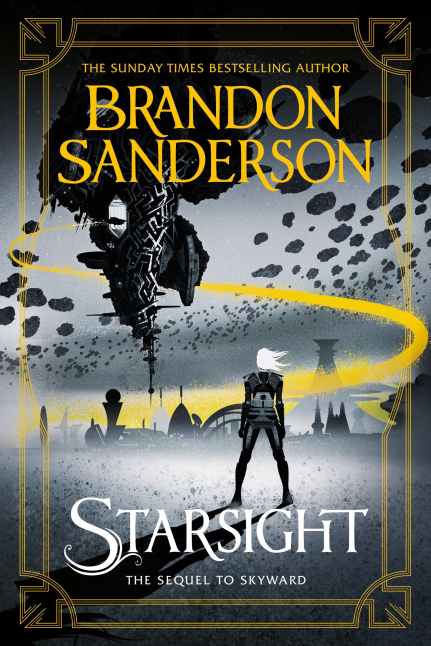
Starsight by Brandon Sanderson

Starsight Cover 2.jpg

Publisher: Gollancz (Trade Paperback – 26 November 2019)

Series: Skyward – Book 2

Length: 461 pages

My Rating: 5 out of 5 stars

Amazon

From one of the best authors of fantasy and science fiction in the world today, Brandon Sanderson, comes Starsight, an outstanding and addictive young adult science fiction read which continues the wildly entertaining adventures of a young starfighter years in the future.

Starsight is the second book in the Skyward series and follows on from the 2018 release of the same name. Skyward was a fantastic young adult science fiction book that told a compelling tale of bravery, determination and camaraderie in humanity’s distant future. Skyward was an amazing read, and it was easily one of my favourite books of 2018. As a result, I have been looking forward to Starsight for a while now, and it was one of my most anticipated releases for the second part of this year.

The Skyward series is set on the planet of Detritus, a desolate world that houses a population of humans in the caverns beneath the surface. The humans on Detritus are the remnants of a once great intergalactic human civilisation that has been destroyed in a war with a superior alien civilisation. Forced into hiding within the planet for hundreds of years, humanity eventually returned to the surface utilising scavenged starfighters to escape and build a military outpost to fight back against the alien ships who continue to harass the planet.

In Skyward, the reader is introduced to Spensa Nightshade, a young woman determined to become a pilot in the Defiant Defence Force (DDF), the military organisation that fights the alien invaders. While talented, Spensa faced opposition to being accepted into the military due to an apparent act of cowardice by her father years before. Despite the odds, Spensa was accepted in the DDF and was trained to become a skilled pilot, fighting in a number of actions against the enemy, while also trying to find out what actually happened to her father. Along the way, Spensa discovered an ancient but advanced human ship that had crash-landed on Detritus. Upon repairing the ship, Spensa discovered it had an AI installed in its computers, which she called M-Bot. After stopping an extremely destructive alien attack with the help of M-Bot, Spensa was compelled to fly through Detritus’s atmosphere, where she made several startling discoveries, the first of which was that Spensa and her family are powerful cytonics, beings with mental powers who are capable of traversing vast distances through space with their ability. The second discovery she made was that the aliens attacking Detritus were not simply mindless aggressors determined to wipe out humanity; instead they are members of an interstellar conglomeration called the Superiority, who are attempting to contain humanity within the planet. The Superiority hold a great fear of humans, who they see as an extremely dangerous and violent species, and Detritus is actually a prison planet/wildlife preserve where humans can live without disrupting the rest of the galaxy. Unfortunately, the actions of the DDF in reclaiming the surface and utilising spaceships have forced the Superiority to reconsider their approach, and they are now working to kill all the humans.

Usually this is the part of the review where I would give a brief plot synopsis of the new book and then go into an analysis of what I liked about it. However, this is going to prove a little hard to do without revealing some spoilers. While I don’t typically avoid talking about plot points that occur around 50-100 pages into book (I don’t particularly consider something happening that early to be a spoiler), I am a little more wary with Starsight. This is mainly because the plot of the book features some immediate substantial changes from the story that appeared in Skyward, none of which are really hinted at in any of the official online plot synopsis or book blurbs. As I am publishing this review a week before Starsight’s official release date, I think it is best that I put up a spoiler alert below, before I start going into the book in any real detail.

For those readers who do not want to risk any spoilers, I will say now that Starsight is an incredible book that I really, really enjoyed. Sanderson tells a wildly entertaining and highly addictive story that features some memorable characters, high-stakes events, some of the best science fiction action I have ever read and a ton of inventive world building. I honestly think that this is one of the best releases of 2019, and it easily gets a full five-star rating from me (if only I could go higher). I would highly recommend this book to anyone interested in an epic science fiction read, and if you loved Skyward, you are going to love this book.

Anyway, if you are not interested in learning any more details about this book’s plot or characters (which I do explore to a substantial degree), I would suggest you stop reading now, as everything below this paragraph has a spoiler alert in effect.

SPOILER ALERT:

Starsight is set a few months after the events of Skyward, and humanity has been busy. Thanks to Spensa and Skyward Flight, as well as the advanced technology contained with M-Bot, the DDF has managed to capture several of the planet’s ancient orbiting defensive platforms, which have allowed them to push the Superiority forces out of Detritus’s obit. However, despite these successes, humanity is still trapped on Detritus, and the eventual Superiority mass retaliation will likely wipe out everyone on the planet. Their only chance at survival is to flee from Detritus and find a new planet to make their home, somewhere the Superiority cannot find them. However, the only way to do this is with some form of hyperdrive, which humanity lacks access to, and Spensa’s cytonic teleportation abilities are too restrictive for mass use.

The crash-landing of an unknown alien spacecraft on Detritus may provide the solution that will ensure humanity’s survival. The pilot of this craft is a member of a non-Superiority species who has been invited for diplomatic reasons to enlist in a new Superiority fighter squadron, and she is able to pass on the cytonic coordinates to the squadron’s base to Spensa. Disguised with M-Bot’s holographic technology, Spensa travels to the Superiority space city, Starsight, in order to infiltrate the Superiority military and find and steal a working hyperdrive.

Joining the new Superiority squadron, Spensa discovers that she and her fellow recruits are being trained to fight the delvers, titanic inter-dimensional beings that dwell in the nowhere, who are capable of devastating planets if they are drawn into our dimension by an over-use of cytonic ability. But as Spensa attempts to complete her mission, she finds herself caught amidst the politics of the various Superiority races, many of whom wish for the complete and utter destruction of her people. Can Spensa navigate the strange new world she finds herself in, or will her actions result in the destruction of all she knows?

As you can see from the above synopsis, Starsight goes in some very interesting and unpredictable directions. I personally loved all of these new story elements, and the idea of Spensa having to infiltrate a mostly unknown alien society was a really clever and intriguing central plot idea that I think worked extremely well. The subsequent narrative is a fantastic blend of different story elements, which includes some great new characters, settings and plot directions, as well as some of the best parts of Skyward. For example, not only do you get to see a whole new take on the excellent space fighter training plot point that made the first book so amazing, but you also get a science fiction spy thriller story filled with all manner of political intrigue. This was a fantastic book to get into, and Sanderson has made sure that the plot is accessible to readers who did not get a chance to check out Skyward last year. However, I would strongly recommend reading Skyward first, not only because it will give you a better idea of the characters and certain plot elements, but because it is such an awesome book in its own right.

One of my favourite things about the first book in the Skyward series was the excellent group of characters that Sanderson focused on, including Spensa, M-Bot and the members of Skyward Flight. Throughout Skyward the reader got to know and care for these characters, and it was actually a little bit distressing when bad things happened to them. Skyward continues to look at several of the characters from the first book, although readers who grew attached to Skyward Flight might be a tad disappointed as Sanderson shifts the focus away from them and introduces the reader to a whole new group of alien characters.

Spensa is still the main point-of-view character for this second book and serves as a fantastic central protagonist. In many ways, Spensa is still the same impatient and reckless pilot that was such to see in the first book. However, it soon becomes obvious that the experiences, relationships and life lessons that she has faced since joining the DDF have tempered her in many ways, especially as she has to deal with the intense responsibility of being her people’s greatest hope for survival. I really enjoyed watching Spensa as she was forced to assimilate into the alien cultures on Starsight, and it was interesting to see how she reacted when she realised not everyone there is as evil as she believed. The opinions and support she gives to her alien friends result in some emotional moments, and it was really heart-warming to see how far she has progressed since the last book.

While Spensa is a great central protagonist, to my mind the best character in the entire book is still her sentient ship, M-Bot. M-Bot is the snarky and hilarious artificial intelligence that Spensa discovered crashed on Detritus, and together they form an efficient and enjoyable team. M-Bot honestly has all the best lines in the book, and nearly every interaction with Spensa results in some excellent jokes or banter. Despite the humour, M-Bot is a pretty complicated character, especially as in this book he is attempting to work out the full limits of his consciousness and code. He is continuously attempting to prove that he is actually alive, and these attempts result in safeguards in his system attempting to shut him down. I really enjoyed the way that Sanderson continues to utilise M-Bot. Even though he is a ship, he is still a fantastic and highly enjoyable character to focus on and we even get a reason for his mushroom obsession in this book.

Spensa’s new flight of Superiority comrades features an eclectic bunch of aliens, each with their own quirks and unique personalities. These include a figment called Vapour, who is essentially a sentient smell that can take control of ships and pilot them. Vapour is the ultimate spy and requires Spensa to be constantly on her toes. There is also the dione draft, Morriumur. Dione are a race of non-violent aliens high up in the Superiority hierarchy, who have a unique breeding system that combines the parents into one new being. This is a process that can take several goes, as the family of the newly bred dione may choose to reform a young dione so that they have an ideal personality. Morriumur is a draft, spending the first few months of their life testing out their personality to see if they are an ideal member of the species. Morriumur, who has slightly more violent tendencies than most of their species, is trying to prove that they belong as a starfighter, but the combined expectations of their family and the inner thoughts that they are not worthy, are a constant hindrance to them as a pilot.

While both of the above characters are pretty cool, and Sanderson spends a good amount of time exploring them, two members of Spensa’s new flight really stood out. The first of these is Brade, a human from another prison world who has been recruited as a cytonic enforcer by one of the book’s central antagonists. Brade, after being taken from her parents as a child, has essentially been brainwashed all her life to consider humans as evil and inferior, and this has a major damaging effect on her psyche. The interactions between her and Spensa throughout the book are quite fascinating, and she proved to be one of the most complex characters in this book. My favourite new character, however, had to be Hesho, who is totally not king of the kitsen. The kitsen are a race of tiny gerbil-like aliens who have recently converted from a monarchy to a democracy in an attempt to become a Superiority race. Hesho leads a group of around 50 kitsen who pilot one heavily armed fighter in Spensa’s squadron like it’s a capital ship. Hesho and the kitsen are really hilarious characters, mainly because Hesho is attempting to convince the Superiority that he is no longer ruling his people as a king, and instead the kitsen have embraced democracy. Unfortunately, despite Hesho insisting he is no longer a monarch in every interaction he has, his people continue to worship him, which kind of undercuts this message. I also found the similarities in the personalities between the kitsen and the Spensa we first encountered in Skyward to be very amusing, as the kitsen attempt to compensate for their size with extreme confidence and boasting like Spensa used to (for example, the first ship we see the kitsen flying is called Big Enough to Kill You).

All of the above characters are great, and I really loved the way that I was once again drawn into their various personalities and histories. It was a bit of a shame not to see too much of the characters I liked so much from the first book (although we do get an idea of what various members of Skyward Flight are up to), but I think the new characters that Sanderson introduced more than made up for it.

In addition to the fantastic character work, one of the other best features of Starsight is the epic and fast-paced action sequences that punctuate much of the book. Just like in Skyward, Sanderson presents a huge number of different scenes where Spensa is fighting or training in a fighter. The sheer amount of detail that goes into these various action sequences is pretty amazing, and I was able to picture all the flying and manoeuvres perfectly. The author comes up with a number of clever new scenarios in this book, including the fancy flying and combat required to fight a delver, or having Spensa fly in the type of craft she has been fighting against for her entire military career. All of the action in this book is first-rate, and I can guarantee that you will get lost in some of the incredible action sequences.

I have always been impressed by the elaborate worlds that Sanderson can create for his stories. Whether it is the vast fantasy world that he came up with for The Stormlight Archive, the supervillain dominated alternate version of Earth that appeared in The Reckoners trilogy, or the fantastic science fiction planet of Detritus that was the main setting for Skyward, Sanderson always delivers complex and intricate settings for his story, complete with huge amounts of backstory. In Starsight, Sanderson once again produces a huge and detailed new setting for his outstanding story. The alien civilisation that is living on Starsight is very impressive, and I love all the different alien races that he has come up with for this story. Many of the aliens have some very complex and fascinating history, a great deal of which featured in the story. I really look forward to seeing how Sanderson expands this universe even further in the final book in the trilogy, and I cannot wait to see what new aliens or civilisations he comes up with.

As you can see from this rather lengthy review, there is a lot to love about this book. Sanderson does an impressive job of combining the intriguing new story direction, the amazing characters, intense action and fascinating new setting into one concise narrative, and the end result is a perfect book. While Starsight is being marketed as a young adult book, and indeed it would prove appropriate for most young readers, it is really a novel that can be enjoyed by any reader of any age. I cannot recommend this book enough, and I am eagerly awaiting the next book in this series (which seems to be 2021 at this point, so far away!).

Amazon

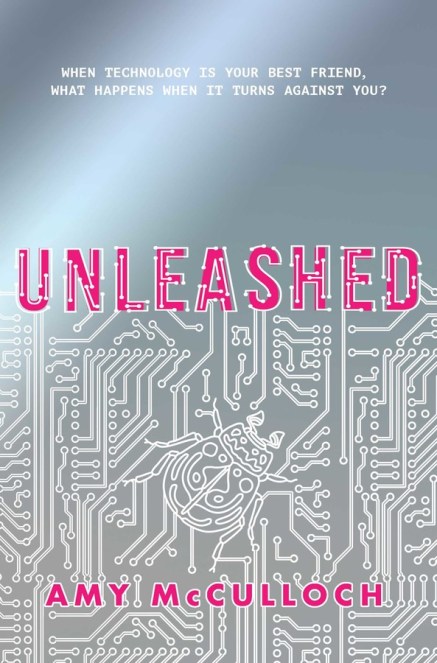
Quick Review – Unleashed by Amy McCulloch

Unleashed Cover

Publisher: Simon & Schuster (ebook format – 22 August 2019)

Series: Jinxed Book 2

Length: 368 pages

My Rating: 4 out of 5 stars

Amazon     Book Depository

From exciting young adult author Amy McCulloch comes Unleashed, the fun sequel to her clever 2018 release, Jinxed.

Jinxed was an intriguing piece of young adult science fiction that I quite enjoyed last year. McCulloch, who also writes under the name Amy Alward, created a fascinating near-future world where the new tech obsession is bakus, the must-have technological companion. Bakus are essentially a combination of all the smart devices and a robotic pet which can take a variety of animal forms depending on their level of complexity, each with a number of different features. The story focuses on the character of Lacey Chu, a teenage baku fanatic who wants to work for Moncha Corp, the company that creates the baku. In order to secure her dream job, she needs to attend the prestigious Profectus Academy, the Moncha Corp sponsored school for all future employees. While it initially appears that she will not be able to attend due to her lack of a suitably advanced baku, Lacey discovers an abandoned and damaged baku of unknown design, called Jinx. After Jinx is repaired, his advanced systems allow her to get admitted into the academy, where she makes friends, learns all about bakus and participates in the school’s baku battles. However, she also becomes drawn into a vast conspiracy around Jinx, as powerful forces within Moncha Corp attempt to find and capture him in order to use his unique technology for their own ends.

I quite enjoyed Jinxed last year, mainly due to its clever world-building and its great, school-based story of intrigue and friendship (I enjoy stories where a person attends a school or academy to learn their universes special talent or skill). As a result, I ended up grabbing an electronic copy of Unleashed just before I went away on a trip, and it proved to be quite a good read during some travel time that I had. Unleashed is set a short time after the events of Jinxed and continues to follow Lacey as she attempts to unravel the conspiracy surrounding her and Jinx.

Goodreads Synopsis:

When Lacey Chu wakes up in a hospital room with no recollection of how she got there, she knows something is up. But with her customizable smart pet, Jinx, missing in action and Moncha, the company behind the invention of the robot pet, up to something seriously sinister, she’s got a lot of figuring out to do. Lacey must use all her engineering skills if she has a chance of stopping Moncha from carrying out their plans. But can she take on the biggest tech company in North America armed with only a level 1 robot beetle … ?

Unleashed was another great young adult science fiction read, which was also a fantastic follow up to Jinxed. There is a lot of excellent stuff in this second book, which pretty much wraps up the two books series and contains an interesting conclusion to the story established in Jinxed. I liked where the story went in this book, and while I was a little disappointed that they did not really spend any more time at the Profectus Academy, nor where there any more baku battles (which honestly was one of my favourite things about the first book), McCulloch compensates for this by increasing the level of intrigue and conspiracy that the main characters find themselves involved in. The overall plot of the main antagonist is surprisingly wide-reaching, sinister and intricate, and I liked seeing how the protagonists investigated and overcame it. There was also a great amount of teen drama and romance throughout the book, and there were some surprising character developments that made for a fantastic addition to the story.

I also really liked how the author continued to expand on her idea of what a world filled with bakus would be like. Throughout the course of this book, McCulloch comes up with a number of cool features to show how the world has adapted to having such technological creatures. These include showing off the various ways that they have revolutionised social media and day-to-day life, and also feature smaller things, such as baku cafes or add-ons to cars that hold and polish and charge your baku as you drive. All the cool expansion that McCulloch did on her amazing central idea in this novel was a lot of fun and I felt that it added a lot to the book.

Overall, I thought that Unleashed was a fantastic follow-up to Jinxed, and I really enjoyed the cool adventure contained within. Featuring a great story, some enjoyable characters and some excellent creative ideas Unleashed is awesome book for all ages that is worth checking out.

The Night Fire by Michael Connelly

The Night Fire Cover

Publisher: Hachette Audio (Audiobook – 22 October 2019)

Series: Ballard and Bosch – Book 2

Length: 10 hours and 4 minutes

My Rating: 5 out of 5 stars

Amazon

One of the masters of modern crime fiction, Michael Connelly, returns with another book in his bestselling interconnected crime universe. In The Night Fire, Connelly once again brings together the outstanding team of Ballard and Bosch for another exceptional murder mystery.

Back when he was a rookie detective, Harry Bosch was mentored by one of the LAPD’s best homicide detectives, John Jack Thompson, who helped stoke his internal fires of justice to ensure that no case ever goes unsolved. Now, years later, Thompson is dead, and at his funeral, the now retired Bosch is given a gift from his widow: a murder book for an unsolved crime. The case revolved around the murder of a young man in a gang-controlled alley nearly 30 years before, and it appeared that Thompson secretly took the book when he retired from the force. What was Thompson’s connection to the case, why was this one murder so important to him and why did he keep the murder book a secret for so long?

Determined to get answers, but already committed to helping his lawyer half-brother Mickey Haller defend his client in a tricky murder case, Bosch takes the book to Detective Renée Ballard for help. Ballard, Hollywood Division’s resident detective on the night shift (known as the Late Show), and Bosch have recently formed an unofficial partnership in order to work on some of Bosch’s old, unsolved cases. Identifying several inconsistencies in the cold case, Ballard decides to start digging deeper, while also investigating a suspicious death by fire that occurred on her beat.

Together Bosch and Ballard are an effective investigative team, and it does not take them long to identify a potential killer. However, the more they dig, the more they begin to realise that Thompson might not have taken the murder book to solve the murder, but to ensure that nobody ever tried to investigate it. Can these two detectives get to the truth, and what happens when their various investigations put them in the line of fire of some very dangerous people?

The Night Fire is the latest book in Connelly’s shared crime universe, which features the various adventures and investigations of several of his iconic protagonists. This new novel is a fantastic piece of crime fiction that once again combines together two of Michael Connelly’s most intriguing characters, Bosch and Ballard, after their outstanding first team-up in 2018’s Dark Sacred Night. This is the 22nd book featuring Bosch, Connelly’s original and most utilised protagonist, while Ballard has so far appeared in two prior novels. This book also briefly sees the return of Mickey Haller, another one of Connelly’s protagonists, who has appeared in several legal thrillers within the universe such as The Lincoln Lawyer (which was adapted into a film of the same name).

Just like in Dark Sacred Night, the plot of the book is shown from both Bosch’s and Ballard’s perspectives, as each of them gets a number of separate point-of-view chapters (about half each) to tell their respective stories. While there is a lot of crossover between the two characters, especially when they are working together on their joint cold case, both of them do their own independent investigations and have several chapters where they deal with their various personal issues without the other character being present. However, they also both appear in a number of chapters together, allowing the reader to not only get an interior view of the character but to see each of them through the other’s eyes.

One of the main things that I love about the Michael Connelly books I have read are the multiple cases that the protagonists investigate simultaneously, many of which may or may not be connected in some way. In The Night Fire for example, the story features one cold case that brings Ballard and Bosch together at the start of the book and which they work together on, while both characters have separate cases to work on. Bosch becomes involved in the legal defence of one of Mickey Haller’s clients who is on trial for murder, and this then evolves into the hunt for the murderer of a judge. Ballard on the other hand does most of the investigative work on the cold case, mainly because she is the one with access to the LAPD’s resources. At the same time, she is also investigating several other crimes that come across her desk during her night shifts at Hollywood Division. These include a homeless man who was burnt alive in their tent, the apparent suicide of a young girl and the discovery of a truckload of illegal immigrants. While some of these cases do not go anywhere or are investigated by a different part of the LAPD, Ballard does find herself fully investigating several different cases and getting some rather interesting results. I really enjoyed this cool combination of varied cases and examples of police work, especially as it combines together a decades-old murder with several recent crimes. There are some really complex and compelling mysteries involved with these cases, and I found myself getting drawn into each of them, as they all featured some clever police work and an intriguing bunch of potential suspects. The cold case in particular was great, as the reader not only needed to figure out who the killer was but also why Bosch’s mentor was so concerned with the murder. While it was a little disappointing not to get some follow-through on a couple of Ballard’s cases, I thought that all of these mysteries come together into an excellent overall narrative that does an outstanding job keeping the reader’s attention. I also loved how two of the cases eventually come together in an unexpected way, resulting in an explosive conclusion, while the results of another murder investigation had a very emotional impact on one of the protagonists.

In addition to the great mysteries and fictional examples of police work, one of The Night Fire’s biggest strengths is its two protagonists, Ballard and Bosch. Both of these protagonists are excellent characters with strong backstories, and I really enjoyed how the two of them played off each other. In this novel, both Ballard and Bosch are outsiders to the LAPD. Ballard has been banished to the night shift for reporting a sexual assault by a superior officer, and now has serious trust issues when it comes to many of her male counterparts. Bosch on the other hand, after a long career with the police, is now retired, and thanks to some of his actions that forced him out the LAPD, many of the police no longer see him as one of them, a point reinforced when Bosch helps Mickey Haller free a murder suspect. This outsider viewpoint makes the team-up between both of them a lot more interesting, as both characters are still learning to trust the other, even after the success of their first case. I really liked how the relationship between the two of them grew throughout this book, and their different viewpoints and experiences turn them into an effective duo. Both characters go through some big moments in this book, including some medical issues with Bosch, Ballard standing up to her attacker and the various emotional impacts of the case, and it was great to see how they helped each other out. This is definitely a team-up I want to see again in the future, and I really hope that Connelly continues more of these adventures with Ballard and Bosch.

Just as I did with Michael Connelly’s previous book, Dark Sacred Night, I ended up listening to the audiobook version of The Night Fire. This audiobook runs for just over 10 hours, and features the vocal talents of Titus Welliver and Christine Lakin. I quite enjoyed the audiobook version of The Night Fire, as not only did it allow me to power through this book is short order (I think it only took me three days to finish it off) but its use of two separate narrators was done really well. Throughout the course of the book, Welliver is the voice of Bosch (which is a good fit as Welliver actually plays this character in the Bosch television show), while Lakin is the voice of Ballard, and they each narrate the chapters for their respective characters, including most of the dialogue. Welliver and Lakin are exceptional vocal talents, who did an outstanding job of bringing Bosch and Ballard to life. Both of these narrators really get to grips with the characters and are able to capture a lot of their various nuances in their performances.

Another great thing about this audiobook was the amazing way they utilised the two separate narrators. I really liked how the book was split between them, and it ensured that both sets of chapters had a great distinctive feel throughout the book, and the reader was never left in doubt who was narrating the chapter. The only exception to this is any dialogue the other point-of-view character has in that chapter, as that character’s narrator will then speak instead. This means for example, while Welliver is the primary narrator during Bosch’s chapters, whenever Ballard speaks during these chapters you get Lakin’s voice. While it was a tad disconcerting at times to suddenly hear the other narrator’s voice in the middle of a lot of dialogue in the primary vocal talent’s chapter, it did save the reader from getting confused by having to listen to two different versions of the protagonist’s voices. Overall, I would strongly recommend the audiobook version of The Night Fire to anyone interested in checking out this book, and I know that I will be utilising this format again in the future for Connelly’s next book.

In his latest crime fiction masterpiece, Michael Connelly once again knocks it out of the park with this fantastic new addition to his connected crime universe. The Night Fire is an exceptional murder mystery that makes excellent use of its two main protagonists to tell a rich and exciting narrative, filled with a number of intriguing investigations and cases. This is probably my favourite Michael Connelly book that I have read so far, and it gets a full five stars from me. A fantastic new entry from the king of crime fiction, this is a must read for all fans of the genre.

Amazon

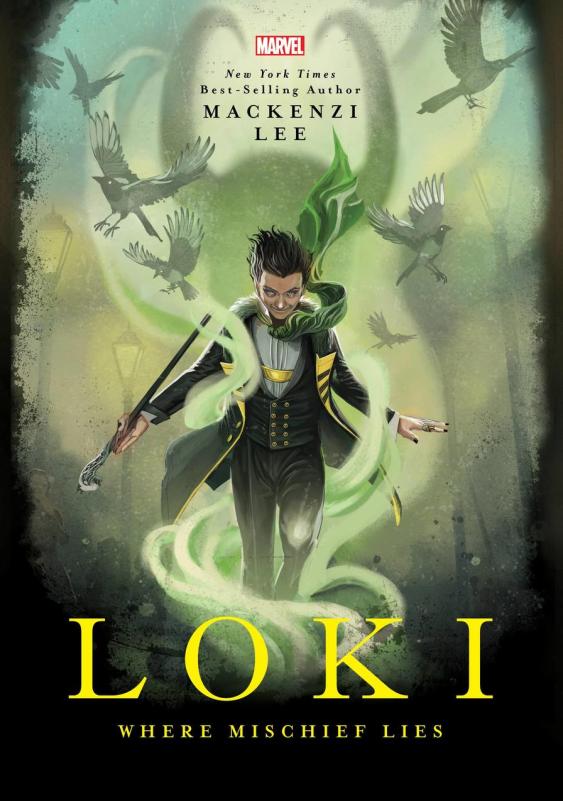
Loki: Where Mischief Lies by Mackenzi Lee

Loki Where Mischief Lies

Publisher: Penguin Random House Audio (3 September 2019)

Series: Standalone/Book One

Length: 9 hours and 10 minutes

My Rating: 4.25 out of 5 stars

Amazon

From acclaimed young adult fiction author Mackenzi Lee comes a fun and clever young adult tie-in novel to the Marvel comic book universe that follows the early life of one of the genre’s best villains, Loki, the Asgardian God of Mischief.

Loki has long been one of the most infamous and complicated villains in the Marvel Universe, whose manipulations and machinations are a constant threat to Asgard, his brother, Thor, and the Avengers. However, years before he started causing chaos in Midgard, he was a young prince of Asgard and the unfavoured son of Odin. Despised and mistrusted by the people of Asgard for his magical abilities, and feared by his father as a prophesied destroyer, Loki’s only confidant is Amora, a powerful sorceress in training.

When Loki and Amora accidently destroy an ancient and valuable magical artefact, Amora is banished to Midgard (Earth), where her magic will eventually fade, and Loki loses the one person who appreciates who he truly is. Determined to prove his father wrong, Loki dedicates himself to becoming a dutiful son, but he continues to find himself overshadowed by his brother’s bravery. When a failed mission once again disappoints Odin, Loki is sent to Midgard in order to investigate a series of murders that have been caused by Asgardian magic.

Arriving in 19th century London, Loki makes contact with a small group of humans who police interdimensional travel, the Sharp Society. Loki, despite his reluctance to help, soon finds himself trying to find the mysterious killer who is turning humans into living corpses. But when he discovers who is responsible for the deaths, he is once again torn between doing the right thing and acting the villain. As his adventure on Midgard continues, Loki soon realises that he needs to decide who he truly is: the good prince of Asgard his family always wanted, or the villain everyone expects him to be.

Loki: Where Mischief Lies is a rather intriguing read that caught my attention some time ago. I am a huge fan of Marvel comics and I will always be interested in checking out any tie-in novels connected to either the comics or the movies. As a result, I made sure to grab a copy of the audiobook version of this book as soon as I could. This turned out to be a fast-paced and enjoyable read that explores the life and times of a young Loki, placing him into a fascinating setting that helped enhance the story. Lee, who is best known for her young adult novels set in the 19th century, including This Monstrous Thing and the Montague Siblings books, created a great Loki story that does a spectacular job diving into the psyche of the character and shaping a fun adventure around it. This is actually the first book in a series of three historical novels that Lee has been contracted to write that will feature Marvel antiheros, and I am really interested in finding out which characters will be in these books.

Where Mischief Lies contains a compelling central storyline that follows the early days of Loki in Asgard and his first foray down to Midgard. Lee starts the story off by introducing a young Loki on Asgard, establishing his character, examining some of his early motivations, inserting a major life-changing event and inserting a magical premonition that will haunt the character throughout the rest of the book. I really enjoyed this introduction to the characters and the plot, and thought that it set up the rest of the story perfectly. The next few parts of the book, which are set after a time jump of a few years, do a good job showing how the character has evolved after the introductory events of the book, and then they manoeuvre him down to London where he has to discover the cause of a series of deaths done using Asgardian magic. The set up to get him down to London, the initial parts of Loki’s adventures on Midgard, his introduction to the Sharp Society and the first encounter with the mysterious bodies are all pretty interesting, and is a great follow-through from the book’s introductions.

I did however struggle with the middle parts of the book, as they felt a little flat and hard to get through. Those readers hoping for a complex mystery into who is leaving the bodies on the streets of London are going to be disappointed, as Loki solves the case quite quickly, and it is literally the most obvious suspect ever. I also wasn’t the biggest fan of the following periods of Loki’s indecision and angst as he tries to deal with the fallout from this revelation. However, the ending of the book more than makes up for it, as Lee wraps it up with an epic conclusion that showcases the full extent of the character’s nature and his eventual future, while also utilising story elements set up earlier in the book. While there were periods in the middle of the book where I was starting to get a little restless, I think overall the story of Where Mischief Lies is really good and its strong ending made it all worthwhile.

Thanks to his appearances in the MCU, Loki is probably one of the most popular and well-known Marvel antiheroes and characters, so any portrayal of him needed to be spot on. Luckily, Lee did an outstanding job with her characterisation of Loki, and the examination of the younger version of this character is probably one of the best things about this book. Lee’s version of young Loki contains all the hints of the growing arrogance, swagger, fashion sense, penchant for mischief and casual disdain for mortals and Asgardians that make him such a fun character in the comics and movies. However, what really makes this an excellent portrayal is the fact that Lee also shows all of Loki’s inherent vulnerability, frustration and anger, which have resulted from a childhood of being seen not only as the lesser son but as something that is dangerous and untrustworthy. This examination of the character’s inner psyche is a fantastic central point of the book, and it is interesting to see the world from Loki’s point of view, especially as you really start to sympathise with him. The story also shows some key moments in Loki’s life, and you get a sense of his motivations and determination to torment those around him. I also think that Lee did a fantastic job of examining the relationship between Loki and Thor. While a lot of their relationship is antagonistic, Thor is shown at times to be the only character who trusts Loki, and it is interesting to see the relationship that might lead to Loki’s eventual redemption. If I were to complain about any aspect of Lee’s portrayal of Loki, it would be that his powers and abilities were a bit inconsistent at times. For example, it was a little weird to see him being physically inconvenienced by a human in one scene, and then a chapter or two later he has the strength to lift two people up at the same time. While this is a relatively minor issue and I imagine that you could explain this away as some form of deception by Loki, I personally found it to be a little jarring.

One of the most intriguing aspects of Lee’s portrayal of Loki is his gender and sexuality. In the build-up to the release of Where Mischief Lies there was a lot of discussion about how this book was going highlight certain LGTB+ elements from the comic books, especially as Lee’s previous books have all contained LGTB+ components. Throughout his comic book history, Loki has been portrayed as both genderfluid and pansexual, and both of these elements of the character are explored within this new book to various degrees. While an interesting part of the character, the genderfluid aspect of Loki is only really shown to a small degree in this book. While Loki does not actually change his gender within Where Mischief Lies (which has occurred in some Marvel comics), when asked “if he prefers men or women”, he does indicate that he has been both. There are also several examples of Loki using his powers of magic to appear as a female character (with various degrees of success), and there are also scenes where he dresses in women’s clothing, usually stolen from Amora, who is amusedly annoyed that they look better on him. While it was not as fully explored as it could have been (and to be fair, it would have been hard to add it in to a novel of this length), it is really cool to see a genderfluid character being introduced into a novel connected to the Marvel Universe.

In addition to this, the pansexual aspect of Loki’s character is on full display throughout the book, as Loki has romantic connections with both male and female characters. Not only does he fall in love with Amora (there is a reason they call her The Enchantress), but a romantic connection also begins to spark between him and a young Sharp Society member, Theo. I really liked the way that Lee handled both of these romances. While the relationship between Loki and Amora ends in flames (which should come as no surprise to Marvel fans), the slowly growing feelings he shares with Theo are quite sweet and contain some rather interesting social commentary. The relationship with Theo is underscored with feelings of identity; due to the social conventions of the 19th century, Theo is unable to be who he really is. This is mirrored by Loki, who has complete freedom of sexuality and gender, but who finds that he is looked down on because of his magic, which he sees as a being major part of his identity. All of this was intensely fascinating, and I really enjoyed seeing this additional complexity explored within the character.

Another aspect of this book that I enjoyed was the various tie-ins it contained to the Marvel’s comics universe. This was a pretty comprehensive origin story for Loki, and quite honestly it could be used as a prequel to both the comics and the Marvel Cinematic Universe. However, given that there is a lot more focus on magic, runes, elves and artefacts, it should probably be more associated with the comics. Lee does a fantastic job bringing Asgard to life, and there are a number of cool references to the various settings and characters of the Thor comics that will appeal to major comic book fans. In addition to this, the author also peppers the story with other Marvel references, especially when the story goes down to Midgard. For example, there are mentions of an industrialist called Stark, talk of a green-skinned female alien and discussion that the Sharpe Society should be renamed as either SHIELD or SWORD. While all these references are rather amusing, I would say that no real prior knowledge of the comics or the movies are really required to enjoy this book, although Marvel fans will probably get more out of it.

Where Mischief Lies is being marketed as a young adult fiction novel, and I believe that this would be a great book for young teen readers, who will love this intriguing look at one of the best Marvel characters. Younger readers should be prepared for the typical amount of comic book level of violence and sex in this book, but there is really nothing that is too explicit for younger readers. I personally think that many teens will appreciate the various LGTB+ elements included in the story, and they will be interested to see this side of the character that has not been included in the movies. Like many young adult tie-in novels, Where Mischief Lies is very accessible to older readers, and I know that many will really like this take on Loki as well, making this a fantastic novel for all ages.

While I really enjoyed the awesome cover of Where Mischief Lies’ hardcover edition, I ended up listening to it on audiobook rather than grabbing a physical copy. The audiobook format of this book is narrated by Oliver Wyman and runs for just over nine hours in length. I think that was a pretty good way to enjoy Where Mischief Lies, as it proved to be a rather easy book to listen to, and I was able to complete it in only a couple of days. Wyman is an enjoyable narrator, and I really like his take on the book’s protagonist and point-of-view character, Loki. He did a fantastic job capturing various aspects of the character’s personality and speech patterns, from his sneering contempt to his frustrations at the way he is treated. This excellent narration really added a lot to my enjoyment of the novel and I would definitely recommend the audiobook format to anyone who is interested in checking this book out.

Loki: Where Mischief Lies by Mackenzi Lee was a fantastic young adult tie-in novel that does a wonderful job of bringing the character of Loki to life. I had a lot of fun listening to this novel, especially as Lee dives deep into the life and mind of Loki, exploring how he became the villain we all love. I was initially planning to give this book a rating of four out of 5 stars; however, considering how much I ended up writing about it, it must be worthy of 4.25 stars instead. I have to say that I was impressed with Lee’s talent for writing novelizations about Marvel antiheroes, and I look forward to her next book in this young adult series.

Amazon

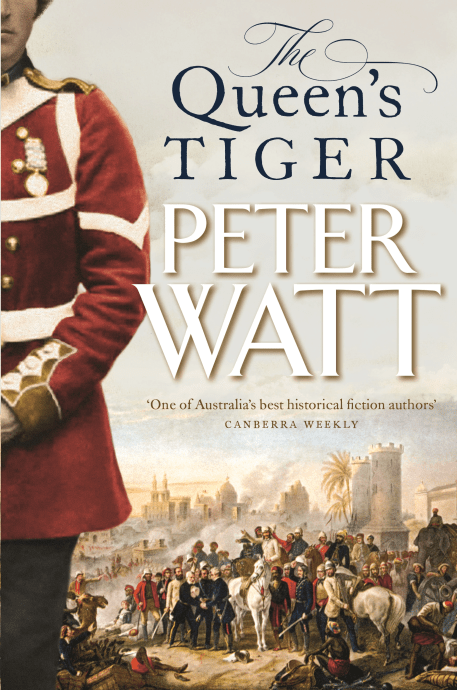
The Queen’s Tiger by Peter Watt

The Queen's Tiger Cover

Publisher: Macmillan (Trade Paperback – 12 November 2019)

Series: The Colonial series – Book 2

Length: 360 pages

My Rating: 4.5 out of 5 stars

Amazon     Book Depository

One of Australia’s best historical fiction writers, Peter Watt, returns with another exciting historical adventure in The Queen’s Tiger, the outstanding sequel to his 2018 release, The Queen’s Colonial.

Following on from the events of The Queen’s Colonial, in 1857, former Australian settler Ian Steele is still living under the guise of Samuel Forbes, a rich English noble who Ian bears an uncanny resemblance to. Ian switched places with Samuel in order to help him meet the required military service he needs to receive a vast inheritance. Serving as a captain in Queen Victoria’s army, Ian has proven himself to be a natural soldier, fighting against the odds dozens of times over against the most vicious enemies of the crown. However, despite the formidable enemies he has faced on the battlefield, Ian has encountered greater dangers far closer to home, as Samuel’s father and his murderous brother Charles are determined that Samuel will never receive his inheritance.

As Ian and his men, including his old friends Sergeant Conan Curry and Corporal Owen Williams, return from fighting the Persian army in Iran, a dangerous threat to the empire is brewing in India. Indian troops under the employ of the British East India Company have begun to mutiny, and the country, caught up in a swell of anti-British nationalism, is beginning to violently rebel against British rule. Among those caught up in the chaos are Samuel’s sister Alice and her husband the surgeon Peter Campbell, whose honeymoon turns into a brutal fight for survival.

Redeployed to India, Ian is once again leading the charge in some of the campaign’s most deadly battles against a determined foe. However, the biggest threat to his survival is happening half a world away back in England, as the real Samuel Forbes returns to London for a personal meeting under the name Ian Steele. When Samuel is spotted and his true identity is suspected, he finds himself hunted throughout England by Charles’s agents, determined to prove that Ian is an imposter. Can Ian and Samuel continue their ruse amidst the tragedy, tribulations and conflicts they encounter, or will the evil forces arrayed against them finally bring them down?

This was another fantastic book from Peter Watt, who has a true knack for producing compelling historical adventures filled with action, intrigue and family drama. The Queen’s Tiger is the second book in Watt’s Colonial series, which follows its protagonists through some of the most dangerous conflicts that the British army found itself involved with during the 19th century. I have to admit that I have been quite keen to check this book out for a little while, and not just because it quotes one of my Canberra Weekly reviews on the cover. The first book in this series, The Queen’s Colonial was an excellent read, and it did a good job following up Watt’s long-running Frontier series of which I was a big fan (make sure to check out my Canberra Weekly reviews for the last two books in this series, While the Moon Burns and From the Stars Above).

The Queen’s Tiger continues the intriguing story from the first book, which saw a simple Australian blacksmith pretend to be an English gentleman in order to serve as an officer in the Queen’s army. This was a compelling start the series, and I am glad that Watt has continued to follow through the fun blend of military action, intrigue and character interactions that have been a signature writing trend of his for some time. The Queen’s Tiger contains a wide-ranging story that covers several characters across a number of continents. This allows the author to showcase a number of different and enjoyable storylines within one book, and as such we can have one section of a book that focuses on the military action and adventure being undertaken by several of the characters in India, and the next section than looks at the sinister plotting of the book’s antagonists, or the desperate attempts of the real Samuel to keep his identity secret in England. In addition to their ongoing adventures, the author also explores the various relationships and romances that the various characters have, painting a rich tapestry of these point-of-view characters’ lives. This is a wonderful combination of storylines, all of which comes together into an excellent and highly enjoyable read.

Just like he did with the Crimean War in The Queen’s Colonial, Watt does a fantastic job bringing an intriguing historical conflict to life in this book, with his focus and examination of the Indian Mutiny of 1857. The book actually follows the entire duration of the Indian Mutiny and showcases most of the key moments of the rebellion that turned into full-scale war for independence. As a result of the way that Watt positioned his characters from the first book, the reader gets to see two separate parts of the mutiny. Alice and Peter’s storyline, which also features the new major character of Scott Campbell, focuses on how the English people who were living in India when the mutiny started would have perceived what was going on, and the desperate battle that the English forces garrisoned in India faced against a mass rebellion of their Indian soldiers. Ian’s storyline, on the other hand, shows the battles that the English relief force faced as they tried to retake the country and rescue the English citizens trapped within. This was an extremely fascinating historical event, and I think that Watt’s portrayal of this conflict was extremely intriguing and compelling. Based on the comments in the historical notes section of this book, it looks like Watt is planning to take his characters through a number of England’s various 19th century military campaigns in the following books, and I look forward to seeing where they end up next.

Needless to say, a book that has such a strong focus on soldiers and the Indian Mutiny is going to be very heavy on the action, as the protagonists fight in several battles across Indian and Iran. There are a significant number of fast-paced sequences throughout this book, from the various battles and skirmishes that occur during the mutiny, to thrilling chase scenes in the backstreets of London. Watt’s grasp of 19th century military combat is quite impressive, and there is a very realistic feel to the huge number of fight sequences that occur throughout the book, as he focuses on the tactics and weaponry of the British infantry man. As a result, there is rarely a dull or quiet moment in this book, and action fans will really appreciate the cool fights occurring throughout the book.

Peter Watt has once again delivered an electrifying and enthralling piece of historical fiction with The Queen’s Tiger. Featuring some amazing depictions of a deadly part of history, as well as a bunch of great characters whose various adventures, deceptions and relationships are particularly intriguing, this is a fantastic piece of Australian fiction that is really worth checking out.

Amazon     Book Depository

Supernova by Marissa Meyer

Supernova Cover

Publisher: Feiwel and Friends (Trade Paperback – 29 October 2019)

Series: Renegades – Book 3

Length: 552 pages

My Rating: 5 out of 5 stars

Amazon     Book Depository

Lies, betrayal, anarchy! Acclaimed author Marissa Meyer brings her epic young adult series, the Renegades trilogy to an end with Supernova, an electrifying and outstanding book that I had an absolute blast reading.

Supernova is the third and final book in Meyer’s Renegades trilogy, which started in 2017 with Renegade and continued last year with the incredible Archenemies. Archenemies had to be one of my favourite young adult books of last year, so I was pretty eager to check out the final book in the series. For those of you unfamiliar with the series, the Renegades books follow the adventures of two teenagers, Nova and Adrian, in an alternate version of Earth where a number of people, known as prodigies, have superpowers. After a period of superpowered destruction and terror known as the Age of Anarchy, the world has entered a time of peace, thanks to the superhero collective known as the Renegades.

Nova is a member of the supervillain group known as Anarchists, the remnants of the followers of the world’s greatest supervillain, Ace Anarchy, who has been living in hiding since the end of the Age of Anarchy, close to death. Nova, or as she is known to the world, Nightmare, is Ace’s niece, and hates the Renegades with a passion, due to the role they played in the death of her parents, and because of the way her friends have been persecuted by the supposed heroes. In order to recover Ace’s helmet, the one item that can restore him to full power, Nova has taken on the persona of Insomnia in order to infiltrate the Renegades as a hero. However, her dedication to the Anarchists and her mission has been shaken thanks to the leader of her patrol team, Adrian.

Since joining the team, Nova has slowly fallen in love with Adrian, a romance complicated by the fact that Adrian is the son of the world’s greatest superhero, Captain Chromium, Ace Anarchy’s arch enemy and the man who Nova hates the most in the world. Adrian also has secrets of his own; while he spends his days as the Renegade Sketch, at night he is secretly the outlaw vigilante superhero known as the Sentinel, who acts outside the rules and codes of the Renegades. He is also pursuing a solo investigation into the murder of his mother, and his primary suspect is Nightmare.

Despite her steadily growing feelings for Adrian, Nova is still determined to take down the Renegades, especially after the announcement of their new secret weapon, the chemical Agent N, which can permanently depower a prodigy. Breaking into Renegade headquarters at the end of Archenemies, Nova was able to successfully recover Ace Anarchy’s helmet; however, her absence allowed Adrian and the rest of their patrol team to accidently find and capture Ace. Now with her uncle captured and awaiting execution and all her lies and deceptions coming apart, Nova must find a way to rescue Ace and bring the Renegades down. However, with new players on the board and old fears resurfacing, can Nova and Adrian survive when anarchy returns to Gatlon City, or will their combined secrets finally overwhelm the two young prodigies?

This was a pretty amazing way to end a trilogy, as Supernova is an excellent and highly addictive read that I powered through in around two days, despite its hefty 552-page length. This final book tells an exciting and compelling story in its own right, and Meyer has done an outstanding job of finishing off her series, producing an epic conclusion that ties together a number of the intriguing storylines that have been running since the first book. Those readers interested in Supernova who have not read the previous books in the series should be able to follow the plot without any issues, but in order to experience the full emotional impact of the various story elements that are concluding, it might be best to at least read Archenemies first. That being said, those readers who choose to read Supernova alone will still be in store for an incredible young adult superhero read that does a wonderful job blending together action, tragic backstory, likeable characters and a very complex and rewarding romance storyline.

One of the most enjoyable things about this series was the cool and unique world of superheros that Meyer has created. The whole background of a world that is slowly rebuilding after an extended period of anarchy is pretty darn fascinating, and it was really interesting seeing the ways that superheros are trying to maintain order in this world. Meyer has done an amazing job filling her world with a variety of memorable prodigy characters, and the sheer number of unique power sets that the author has come up with is truly impressive. All these cool and imaginative powers make for some pretty epic battle scenes when the prodigies end up fighting each other, and Meyer has come up with some thrilling large-scale battle sequences throughout her story. Overall, I found that this superhero filled world to be an excellent and creative setting for this great story, and it is one that I hope Meyer returns to in some of her future works.

Perhaps my favourite aspect of this cool superhero world is the significant amount of time spent examining the morality and motivations of the various superpowered characters. Rather than the classic superhero story where all the heroes are pure and good and all the villains are evil, the morality of the characters in the Renegades series is a lot more complex. For example, the Renegades, despite being the heroes, are willing to do anything to preserve the status quo and ensure that the Age of Anarchy never happens again, including some punishments that seem pretty extreme. They are also so strictly bound to the idea that their organisations and their codes of conduct that a vigilante like Adrian’s Sentinel persona is automatically seen as a villain, despite all the good he does, while the faults of certain Renegades who abuse the system for their own aims are overlooked. The Anarchists and other non-Renegade prodigy groups, on the other hand, despite being villains, can in many ways be seen as victims of the current system, especially as they believe that they are mostly fighting for their own personal freedoms.

This is a rather interesting dichotomy that has been fun to unwind throughout the course of the books, especially through the eyes of the series two point of view characters, Nova and Adrian. Nova, who is both an Anarchist and a Renegade, begins the series believing that the Anarchists are in the right, while the Renegades are corrupt and hypocritical. But throughout the course of the books, as she spends time with the Renegades, she begins to see that many of the heroes, especially the members of her patrol team, are good people who are mostly trying to help, and she finds herself drawn between family loyalties and her new friends. However, the heavy-handed actions of the Renegade Council, especially in this book, ensure that Nova’s loyalty to the Anarchists and her uncle remains intact. Adrian, on the other hand, was born into the Renegades and is a major supporter of them. However, when he begins to adventure as the Sentinel, he begins to see how restrictive and rigid the rules of the Renegades are and he begins to question a number of the Council’s decisions, especially when it comes to Nova. All of this leads the reader to have some very serious doubts about which characters are truly in the right, and this entire moral debate is a really fascinating overarching aspect of the book and the series as a whole.

Like the rest of the books in this series, Supernova is being marketed as a young adult novel. While this is a good book for younger readers, this novel is also easily enjoyed by older readers who will really like this clever and inventive take on the superhero genre. Due to the fact that the book contains a large amount of violence, which includes several deaths and even torture scene, Supernova is probably best left to a teenage audience, and might not be completely appropriate for younger readers.

Marissa Meyer’s Supernova offers the reader an amazing and addictive young adult novel that also serves as an exceedingly satisfying conclusion to the author’s fantastic tale of superheroes and villains. In this third and final book in the outstanding Renegades trilogy, Meyer not only does a sensational job wrapping up her series, but she also produces another exceptional story filled with superpowered action, forbidden love, an inventive alternate Earth and some intriguing discussions about morality. A first-rate read, if you have not experienced Meyer’s Renegades series before you are in for a real treat. I really hope that the author returns to this universe at some point in the future, and I will be keeping a close eye out for Meyer’s next release.

Amazon     Book Depository

Gideon the Ninth by Tamsyn Muir

Gideon the Ninth Cover

Publisher: Tor (Hardcover – 10 September 2019)

Series: The Ninth House – Book One

Length: 448 pages

My Rating: 4.5 out of 5 stars

Amazon     Book Depository

From debuting author Tamsyn Muir comes a very unique and compelling science fiction novel filled with death, comedy and necromancers in space, Gideon the Ninth.

Before I begin reviewing Gideon the Ninth, I have to point out how impressive the design of the hardcover copy I received was. When I previously featured this book in one of my Waiting on Wednesday articles, I mentioned how much I loved the cover art. Indeed, the drawing of the book’s titular redheaded character with her face painted liked a skull surrounded by exploding skeletons is pretty damn cool. The hardcover copy also has some excellent visuals, as the outer rim of all the pages is coloured black, which definitely gives prospective readers a noticeable visual hook, especially when combined with the all-black binding underneath the jacket, emblazoned with gold writing on the spine and a single golden skull on the front. I really liked this fantastic presentation style, and it definitely left an impression on me as I started to read the book.

In the far future, a vast interstellar empire is ruled by necromancers whose control over the various magical disciplines of death make them a powerful force. Eight noble houses serve under the First House of the Emperor, and each of them has just received a message from their ruler. The heirs to each of these houses and their cavaliers, loyal sword-wielding protectors and companions, must attend the Emperor’s planet in order to compete to become the next generation of Lyctor, immortal beings of vast power.

Gideon Nav is an indentured servant to the Ninth House of the Empire, a small and impoverished house that carries a dark reputation. A skilled swordswoman, Gideon wants nothing more than to enlist in the imperial army to leave the dark crypts, the strict occult nuns and the multitude of skeletons that make up the Ninth Planet far behind. However, when her latest escape attempt fails, she finds herself offered an irresistible bargain: act as the Ninth House’s cavalier for the period of the trials and be granted her freedom. There is just one minor problem: Gideon and the heir to the Ninth House, Harrowhark Nonagesimus, an extremely powerful bone witch, absolutely hate each other.

Forced to temporarily put their differences aside, Gideon and Harrow travel to First House, only to discover it is a near ruin, looked after by a few old and mostly unhelpful servants. They soon learn that the secrets to becoming a Lyctor lie hidden within the walls around them, and the representatives of various houses can do whatever they wish to learn them. Trapped on the planet, Gideon and Harrow begin to explore the First House and encounter the heirs and cavaliers of the other houses. As the mismatched pair from the Ninth House start to unravel the various mysteries and challenges before them, a gruesome murder occurs. Something powerful is lurking within the First House, and it has the heirs in its sight. Can Gideon and Harrow work together, or will their own turbulent past and the secrets of their house tear them apart?

Gideon the Ninth is a chaotically clever and massively entertaining first novel from Tamsyn Muir, who has done an excellent job introducing readers to her intriguing new world. Gideon the Ninth is the first book in her The Ninth House series, which already has two planned sequels in the works, with the first of these currently set for release next year. After hearing the awesome plot synopsis for this book earlier in the year, I had picked this as potentially being on the best books for the latter half of 2019. I am glad to see that my instincts were once again correct, as this was an awesome read that gets four and a half stars from me.

Muir has produced an outstanding story for her first novel, as the plot for Gideon the Ninth is an amazing combination of humour, universe building, emotional character moments and a captivating set of mysteries as the protagonists attempt to uncover not only the vast secrets of the First House but the identity of the person or being that is killing them off one by one. The author has stacked this book with all manner of fantastic twists, and there are a number of major and game changing developments that are well paced out amongst the story. There is never a dull spot within the book, as even parts where no substantial plot developments are occurring are filled with excellent humour from the sarcastic narrator with a huge vocabulary of various swear words. There is also a substantial amount of action throughout the course of the book. The various fight scenes blister and explode off the page, especially thanks to the unique magical system that Muir has populated this world with. All of this results in an addictive and electrifying overall story with a very memorable ending.

The real heart of Gideon the Ninth lies in its incredible main characters, Gideon Nav and Harrowhark Nonagesimus, and the complex relationship the two of them have. Gideon is the badass, rebellious, coarse, girl-loving mistress of the blade, who serves as the book’s narrator and only point-of-view character. Gideon is an absolute blast as a main character, as she deals with every situation she comes across with an abundance of disrespect, anger and exaggerated responses, resulting in much of the book’s humour. Harrow, on the other hand, is the dark noble necromancer heir to the Ninth House, whose reserved persona, obsession with necromantic research and abilities, and vindictive nature work to make her initially appear as a polar opposite to Gideon. The relationship between these two main characters is initially extremely adversarial, as both characters declare their absolute hatred for each other, and Harrow seems determined to make Gideon’s life a living hell. As the book progresses, however, Muir really dives into the heart of the relationship between the two characters, revealing a complex history and a twin tale of woe and dark secrets that has defined them for their entire lives. The combined character arc of these two main characters was done extremely well. While you knew from the very start of the book that the two characters would eventually work together, the exact reason why this occurred was handled perfectly, and the final form of this cooperation helps create an epic and tragic conclusion to the entire book. While their relationship is not explicitly romantic (Harrow’s sexuality really is not explored in this book), they do become quite close by the end of the novel, and both characters are written exceedingly well.

In addition to Gideon and Harrow, Muir has also included a range of different characters, representing the heirs and cavaliers of the other major houses in the Empire. This results in an intriguing assortment of side characters who add a lot to the overall story. The author has made sure to invest in substantial backstories for all these additional characters, and this has a number of significant benefits for the story. Not only are the readers now blessed with an abundance of viable and duplicitous suspects for the story’s murder mystery, but each of the various representatives of the houses have their own individual secrets and motives for being at the First House. Learning more about each of these characters is quite fascinating, and a number of them have some pretty amazing character arcs. I particularly enjoyed the storyline of Palamedes Sextus of the Sixth House, who treats his necromancy more as a science than a form of magic. Sextus is the most logical character out of all the people in the book, and he serves as a major driving force of the investigation into the murders. His connection to some of the other characters in the book is a major part of the book, and the ultimate conclusion of his story arc is really cool. Muir has done an incredible job coming up with the book’s various characters, and it is a major part of why this book is so awesome.

It is quite clear that Muir has an amazing imagination, as she has produced a grim and compelling new universe to set this book in. Necromancy and a futuristic science fiction setting make for a fascinating combination, and I really loved her examination of an empire built on worshipping an immortal, necromantic Emperor and the various secrets that come with it. The sheer range of different necromantic magic featured within this book is pretty impressive, especially as each of the Imperial Houses has their own specific form of necromancy, all of which are examined throughout the book. Not only are all these different types of magic really fascinating to examine but it also results in some diverse pieces of magical action, as many of the necromancers unleash their various forms of magic throughout the book, resulting in some fantastic sequences. I do think that the author could have done a slightly better job of explaining some of the unique elements of her universe at the start of the book, as I got a little confused at some points towards the beginning; however, this was quickly chased away by deeper dives into the universe’s lore later in the book. Muir has left open a number of questions and plot directions to explore in future books in the series, and I am really curious to see what happens next.

Gideon the Ninth is a wild and exciting novel that makes use of an intriguing concept, some compelling characters and an excellent story to create an exceedingly entertaining book that was a heck of a lot of fun to read. Featuring laugh-out-loud humour, intense action and major emotional moments, this is an incredible read that is really worth checking out. Muir has hit it out of the park with her debut novel, and I cannot wait for the next book in the series.

Amazon     Book Depository

Graveyard Shift in Ghost Town by Michael Pryor

Graveyard Shift in Ghost Town Cover

Publisher: Allen & Unwin (Trade Paperback – 1 July 2019)

Series: Ghost Town – Book 2

Length: 307 pages

My Rating: 4 out of 5 stars

Amazon     Book Depository

Acclaimed Australian author Michael Pryor revisits his Ghost Town young adult series with another entertaining and intriguing story, Graveyard Shift in Ghost Town.

Anton Marin is having an extremely odd gap year. As a member of an infamous outcast ghost-hunting family, Anton can see the ghosts that linger in our world, and he has recently taken up the family business. Working with his new partner, the English badass Rani Cross, Anton works to protect the people of Melbourne from the more dangerous types of ghosts while also ensuring that all the wandering spirits they encounter are helped on to the next world. However, even with Rani’s help, ghost hunting in Melbourne has recently gotten even more difficult as the city finds itself in the midst of a genuine ghost plague. A massive infestation of the most dangerous types of ghosts imaginable is wreaking havoc across the city, and even usually benign or harmless spirits are starting to attack people.

Anton and Rani’s problems are about to get even worse; a deadly cult of Trespassers, humans who use magic to control ghosts for their own ends, is in town and determined to capture anyone with ghost sight for use in their rituals. As Anton and Rani find themselves with a target on their back, Anton must deal with the return of his long-lost aunt Tanja. While Anton is overjoyed to have a member of his family back, he quickly realises that not everything with his aunt is as it seems. What secrets is Tanja hiding and what is her connection to the leader of this group of Trespassers? As secrets and occult dangers arise within Melbourne, the fate of the world hangs in the balance.

Michael Pryor is one of Australian’s most notable authors of young adult fiction, having written a number of fantasy and science fiction novels for a younger audience. Some of his most notable series include The Law of Magic, The Extraordinaries and his six entries in the long-running The Quentaris Chronicles. Graveyard Shift in Ghost Town is the second book in Pryor’s latest series, Ghost Town, and follows on from his 2017 release, Gap Year in Ghost Town. I initially thought that Graveyard Shift in Ghost Town was my first experience reading Pryor’s work, but I actually remember reading some of the books in The Doorways trilogy back when I was kid. While this was something like 20 years ago (and now I feel old), I do know that I greatly enjoyed these books and their clever concept, so I was excited to check it out.

Graveyard Shift in Ghost Town is an interesting and engaging piece of young adult fantasy with a number of cool features. Pryor has done a fantastic job combining a unique concept of ghost hunting with a group of enjoyable characters and grounded the story in the author’s home city of Melbourne. This results in a great piece of fiction that will do a wonderful job of enthralling a whole new generation of young Australian readers. For those readers who are only just coming onto this series, knowledge of the previous book is not a necessity to enjoy this sequel, as the author does a good job of re-introducing the characters, plot details and adventures that were featured in Gap Year in Ghost Town.

One of the most enjoyable aspects of this series is the overarching concept of a world haunted by real and potentially malevolent ghosts, and the adventures of the few individuals who can actually see them. Pryor has populated his story with all manner of different types of ghosts, each with their own specific characteristics, strengths and appearances. Readers will get to see the various ghosts that the protagonists go after, including the Lingers, Moaners, Thugs, Weepers and a new breed of zombie ghosts, just to name a few. All of these ghosts are really cool, and I enjoyed how this book started going into a little more detail about the origins of ghosts and the malevolent forces behind them. I also liked how the story also pivoted towards a more human antagonist in the form of the Trespassers, and it was intriguing to see how a group of people utilising the ghosts for nefarious purposes. It was interesting to see the protagonist’s ghost hunting techniques in action, and it results in some intense action sequences, especially when they have to fight ghosts and the Trespassers at the same time. This is an inventive and clever concept that helps make this series stand out from some of the other young adult fantasy books out there.

Another great distinguishing feature about this book is the author’s inclusion of a contemporary Melbourne setting. I love fantasy stories that utilise modern settings, and Pryor did an exceptional job bringing the city of Melbourne to life. The characters visit all manner of key landmarks in the city throughout the course of the story, and I really liked seeing locations I have visited featuring fights between ghost hunters and spirits. Pryor also uses the opportunity to showcase some of his favourite restaurants and cafes and it was nice to see an author insert elements of a city they clearly love into their story.

In addition to its intriguing concept and excellent setting, I was also impressed with the complex characters in Graveyard Shift in Ghost Town. The main protagonist is Anton, the funny and slightly odd heir to an exiled ghost hunting family with their own unique techniques for dispersing ghosts. Anton serves as the narrator and point-of-view character for the story, and he offers a fun and introspective narration to the book, while the revelations about certain family secrets offer up some interesting drama. The other main protagonist, Rani, is an extremely skilled sword-wielding badass who is a former member of an established ghost-hunting order from England and is an excellent female character for this series. Anton and Rani form a great team in this book, as the two of them find their groove as a partnership and work well against the threats they face. The character of Bec is an interesting third member of this partnership, as not only is she Anton’s oldest friend, who plays a cute game where they try to guess quotes from famous figures, but she is also Rani’s girlfriend, who they share an apartment and cat with. Bec really brings the team together, and there are some interesting examinations of the dynamics between the three of them, as each of them feels like they are the outsider in the group. There are also a few cool new additions to the series in this book, including a couple of Scottish ghost hunters, their ghost-hunting dog and a good antagonist in the form of the leader of the new cult of Trespassers.

Graveyard Shift in Ghost Town is an excellent piece of young adult fiction that is appropriate for a wide range of different ages and tastes. While there are a few dark scenes, such as a somewhat gruesome torture sequence, the vast majority of the book is appropriate for young teens and perhaps particularly mature young readers. I thought the author’s inclusion of a positive lesbian relationship between Rani and Bec was a really good feature for the young adult audience, and it was that was portrayed extremely well. I am also sure that young Australian readers, especially those living in Melbourne, will love to see these fantasy variations of locations they are familiar with, and it will hopefully invigorate their imagination.

Michael Pryor has done an amazing job following up Gap Year in Ghost Town, as he presents another compelling and enjoyable paranormal young adult adventure. With inventive ghosts, scary antagonists, great characters and a fantastic Australian setting, Pryor has once again shown why he is one of the leading authors of young adult fiction in Australia. Graveyard Shift in Ghost Town is definitely worth checking out, and it has a lot of features that should prove appealing to the younger teen audience.

Amazon     Book Depository