
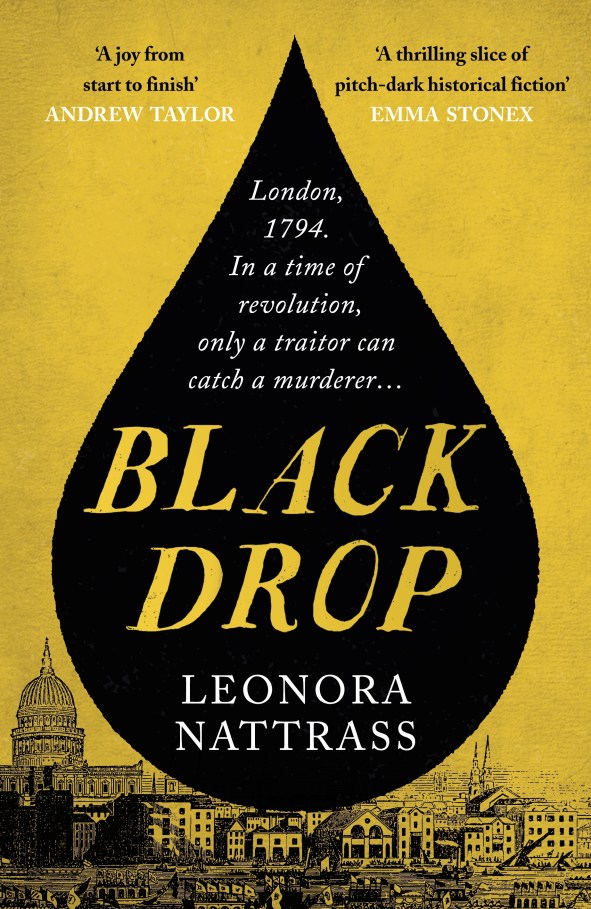
Black Drop by Leonora Nattrass

Black Drop Cover

Publisher: Viper (Trade Paperback – 15 February 2022)

Series: Laurence Jago – Book One

Length: 343 pages

My Rating: 4.25 out of 5 stars

Amazon     Book Depository

Intriguing and talented new author Leonora Nattrass presents a compelling historical thriller debut with Black Drop, a fantastic novel that drags readers into the conspiracies and issues of late 18th century London.

In July of 1794, as the terror of the French Revolution reaches its height and the war on the continent goes poorly for the British army, uncertainty and fear of violent change infect the people of London.  For Laurence Jago, clerk to the Foreign Office, his position is even more uncertain that those around him.  A young man with hidden French heritage, Jago fears the day that his connections to his mother’s nation will be discovered, especially after spending years serving as a spy for sinister French agent Aglantine.

Now believing himself to be free from Aglantine’s employment, Jago is thrust into an untenable situation when vital confidential information about the British army is leaked from his office to the press.  Suspected by his peers of leaking the information and under investigation, Jago fears that all his secrets and former dealings are about to come out.  His problems are only further compounded when he discovers the body of a fellow clerk in his rooms, supposedly dead by suicide.

When the blame for the leak is shifted onto the dead man, Jago is freed of the suspicion against him.  However, Jago knows that the dead clerk was incapable of stealing the letter and believes that he was murdered.  Determined to find out the truth behind the death, Jago finds himself investigating the highest level of the British civil service and their political masters.  Out of his depth and thwarted at every turn, Jago will risk everything to root out the culprit before they strike to disrupt England again.  However, can he succeed without revealing his own dark secrets, or will Jago hang as a traitor instead of the murderer?

Black Drop is an excellent and clever novel that I had a great time reading as Nattrass perfectly combines a compelling spy thriller/murder mystery storyline with intriguing and detailed historical fiction elements.  This resulted in one of the more unique and fantastic debuts of 2022 and I really enjoyed Black Drop’s impressive story.

This awesome debut novel has an excellent story that expertly combines intriguing spy thriller and murder mystery elements with a character driven historical narrative to create a compelling and impressive read.  Set throughout key events of 1794 and told as a chronicle from the perspective of central character, Laurence Jago, Black Drop presents the reader with an intriguing tale of murder, political machinations and the threat of revolution at the heart of the period’s government.  Nattrass sets the scene perfectly at the start, introducing the key characters while also highlighting the feelings of unrest and dissent as the fear and inspiration from the French revolution hits London.  From there, the story starts to unfold in some interesting directions as the protagonist finds himself involved in political and espionage adventures while also investigating the murder of a fellow clerk, which appears to be connected.  At the same time, the slow-paced story utilises some intriguing aspects from the protagonist’s life as he struggles with dark secrets from his past that have potential implications on the current events.

Following this introduction and the initial parts of the narrative, the middle of Black Drop starts to bring in certain key historical events and figures, which results in some fantastic moments and character interactions, especially once an antagonistic figure becomes more prominent.  While the middle of this novel did drag in places, I felt that Nattrass was providing the reader with the right blend of intrigue, mystery, historical detail and character growth to produce a great overall story.  You really get to grips with the protagonist and the key aspects of the setting during this part of the book, especially when Jago hits a major personal downturn earlier than expected, and interesting reveals enhance the reader’s attachment to the mystery.  The story really starts to pick up once it gets to Nattrass’s recreation of the infamous trial surrounding supposed radical and revolutionary Thomas Hardy.  The ridiculous, and mostly accurate depiction of the trial (with certain elements from other trials thrown in for greater effect), proves to be a great high point for the novel, especially as other key parts of the plot are slotted in perfectly around it.  I did feel that the novel started to come undone around the conclusion a little, especially when it came to the big reveal.  While there were a couple of good twists around certain characters, the solution to the main mystery and the intrigue seemed a little weak to me, and I was a little disappointed with how it turned out, especially as you barely get to see anything about the final confrontation.  Still, this did not affect the overall quality of the story too much, especially as the author throws in an excellent wrap-up for the protagonist’s storyline in this novel which has a lot of potential for a sequel.  While much of the story can be a little sluggish and lacking a lot of action, I had a great time getting through Black Drop, and I loved how the excellent interplay of elements came together so well.

One of the most distinctive parts of Black Drop is the sheer amount of fascinating historical detail that was fit into the story.  Nattrass has clearly done her research on the period and the reader is presented with a fantastic and powerful view of London in the late 18th century.  Not only are there some brilliant and vibrant depictions of historical London but the reader gets some fascinating views into the inner workings of the government at the time.  Substantial parts of the book are dedicated to examining the civil service and the political hierarchy of the day, with multiple influential figures featured as supporting characters.  This proves to be a deeply fascinating part of the book, and I loved how Nattrass was able to weave these intriguing details into the thriller plot, becoming a key part of Black Drop’s story.  I also deeply appreciated the way in which Nattrass explores the social and political issues of the day, especially where it relates to the concerns in London about an uprising similar to what happened in France.  As such, you get a full spectrum of personalities from across London, as royalists and loyalists clash with potential radicals who are targeted by the worried government.  This all cumulates in the fantastic court case of Thomas Hardy, a shoemaker accused of radical actions and attempted rebellion.  This historical trial is expertly recreated by Nattrass to include all of its most interesting parts, including several extremely ridiculous elements from history (a blowgun murder conspiracy).  Nattrass also cleverly combines in some elements from related trials that occurred around the same time as the Hardy case for some amusing dramatic effect, and this extended sequence ended up being one of my favourite parts of the novel.  The overall hint of discontent by many members of London’s society, as well as the innate fear of the established institutions, is portrayed beautifully, and you get a great sense of the public issues during this period.  All these impressive historical elements are handled extremely well by Nattrass, and while it did get a tad tedious in places, it was an excellent part of the book that I deeply enjoyed.

To back up her unique historical tale, Nattrass has furnished Black Drop with a compelling array of characters with some complex and compelling character arcs.  This book actually contains a great combination of original characters and historical figures, with many major figures in 18th century British politics and the civil service featured in substantial roles throughout the book.  Not only does this brilliantly enhance the already substantial historical details of Black Drop, but it also results in some fascinating interactions and depictions as the fictional characters, including the point-of-view character, observe them.  Due to the complexity of the story, Black Drop makes use of a pretty large cast of characters, and while a few of them blend together, most come across as pretty distinctive with some interesting and fun character traits.

The best character of Black Drop is the protagonist Laurence Jago, who also serves as the book’s sole point-of-view character.  Jago turns out to be a particularly complex and damaged individual whose emotional attachment to the case and the state of London society provides some intriguing drama and insight into the events of the book.  Already made quite distinctive by his unique green-glass spectacles, Jago proves to be an impressive and captivating figure, especially as he has some major issues.  Secretly half-French, Jago lives a conflicted and fear-filled life, especially with the intense anti-French attitudes sprinkling the city.  This, combined with his foolish youthful dalliance of being a spy for France, ensures that he has a powerful sense of guilt, and is constantly worried about being discovered, especially once other accusations are made against him.  The discovery of a dead friend, combined with his guilt, the pressures of work, and the constant fear of discovery really strain his mind, and while he doggedly tries to find out the truth behind the murder, he starts to crack and nearly blows his cover.  Watching him trying to hide his own secrets while uncovering the lies and machinations of those around him becomes pretty intense, especially as you grow quite attached to this damaged soul.  His mental state further deteriorates once he becomes addicted to Black Drop (an opium concoction), which dulls his worried and troubled mind, while also leaving him lethargic and susceptible to danger.  This proves to be a serious handicap to his abilities, and it is fascinating to see him try to balance all his issues with the hunt for the truth.  All these issues and concerns result in a very conflicted and emotionally drained character, who Nattrass portrays perfectly, and it was very powerful to see Jago’s entire story unfold.

Aside from Jago there is a rich cast of supporting characters, each of whom add to the story in their own distinct way.  I particularly want to focus on two who ended up being the best supporting figures in different ways.  The first of these is William Philpott, a fiction British reporter character, who arrives in England from and extended stay in America and sets up his paper and family residence next to Jago’s lodgings.  An eccentric, rambunctious and slightly uncouth fellow, Philpott stands in stark contrast to the various stuffy characters that make up the majority of the cast, which ensures that the reader is quickly drawn to him.  Not only does he serve as a lighter character in the novel and a firm confidant for the protagonist, but you also get an interesting viewpoint into his changing feelings about the events occurring throughout London.  Philpott starts the novel as a strong, patriotic figure who fully intends to support the government in his paper when it comes to the court cases against the supposed radicals.  However, upon viewing some of the injustices they are committing, such as their harassment of and unfair case against Thomas Hardy, Philpott becomes more sympathetic, supporting the dissenting voices and writing fair accounts of the proceedings.  This interesting middle ground perspective on the historical events of the book proves to be extremely interesting, and I loved how Philpott’s unique storyline unfolded, especially as it results in him throwing some valuable lifelines to the troubled Jago.

The other character of note is real-life historical figure and future British Prime Minister George Canning, who serves a much more antagonistic role in this novel.  Canning, who at this point in the time period was a young MP with connections to the sitting PM, William Pitt, gets embroiled in the case quite early in the novel, thanks to his connection to the dead man and the suspicions surrounding Jago.  Portrayed in Black Drop as an uncaring and malicious man, Canning is a menacing antagonist for much of the novel, constantly butting heads with Jago and complicating his investigation.  I loved the use of this intriguing historical character, especially as Nattrass turns him into a very unlikable figure, who you cannot help but hate.  Not only does Nattrass do a great job of examining some of the historical elements surrounding him at this period of time but she also layers in some fantastic references to future events in his life, such as the infamous duel that he would eventually take part in.  However, his real benefit is the impact he has on the story and the deep rivalry he forms with the protagonist.  Watching these two battle it out in different arenas is very amusing, especially as Jago is constantly outmatched by this influential politician, and I do hope that we see more of Canning in future books in this series.  These great characters, and more, all add a great deal to this intriguing novel, and I really appreciated how fantastic and compelling they turned out to be.

Overall, Black Drop by Leonora Nattrass is an impressive and captivating piece of historical crime fiction that I am really glad I decided to check out.  Making excellent use of some fascinating historical elements, Nattrass did an amazing job of producing a clever and enjoyable spy thriller/murder mystery storyline in 18th century London, which came together very well.  Filled with great historical events and compelling characters, Black Drop was an absolute treat to read, and I look forward to seeing how Nattrass’s next book will turn out, especially as the sequel, Blue Water, is apparently set for release in October this year.
Amazon     Book Depository

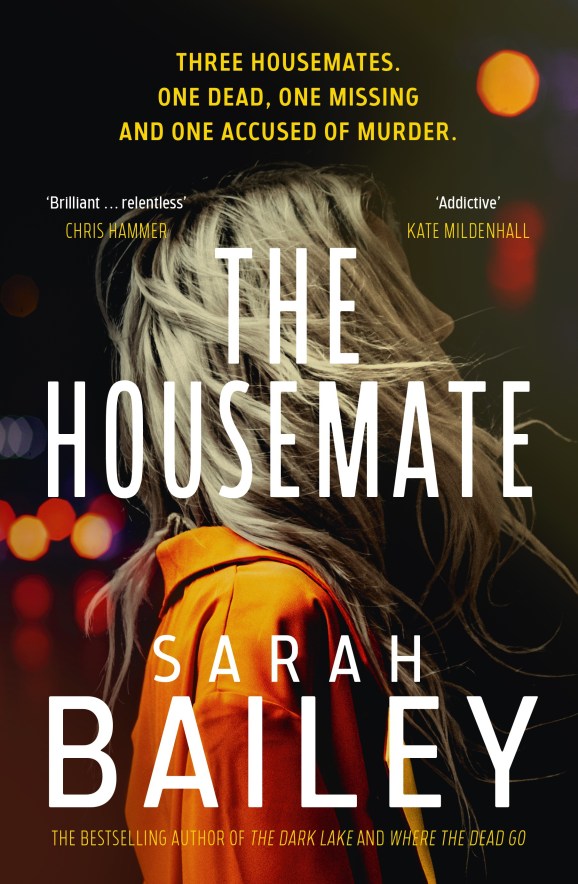
The Housemate by Sarah Bailey

The Housemate Cover

Publisher: Allen & Unwin (Trade Paperback – 31 August 2021)

Series: Standalone

Length: 454 pages

My Rating: 5 out of 5 stars

Amazon     Book Depository

Impressive Australian author Sarah Bailey returns with The Housemate, an outstanding and intense murder mystery that takes a complex protagonist through a dark journey as they attempt to solve an infamous murder.

It was the crime that shocked all of Australia: one night, after a fractious party in the suburbs of Melbourne, three female housemates would become infamous for all the wrong reasons.  In the morning, one of the housemates is found brutally murdered, another is found covered in her blood, while the third goes missing and her body is never found.  Dubbed the Housemate Homicide, the unexplained murder, the mysterious disappearance, and the subsequent controversial court case has baffled and enthralled the country for years.  This includes Olive Groves, a journalist who got her first big break covering the murder and who then became obsessed with cracking the case.

Nine years later, the body of the missing housemate is found in a remote property in the Victorian countryside.  Despite dealing with her own dark personal issues, Olive is assigned to cover the story, and soon finds herself once again dragged into her deepest obsession.  Teamed up with millennial podcaster Cooper Ng, Olive begins to immerse herself in the details of the murder, reigniting her fiery obsession.

As Olive and Cooper work to uncover new details about the case and the three women at the heart of it, they start to make some startling discoveries.  None of the housemates were what they seemed, and all had dark and terrible secrets that have remained hidden for years.  What really happened to these three friends, and what secret was so terrible that they would kill to protect it?  Olive is about to discover that there is a dark conspiracy at work throughout this case, one whose roots may lay far closer to home than she ever imagined, and whose discovery may end up breaking her.

This was an incredible and extremely clever dark murder mystery from Sarah Bailey, who has previously produced some impressive and compelling pieces of Australian fiction.  The Housemate was pretty exceptional read and I quickly found myself getting really caught up in this remarkable and well-written piece of crime fiction.  The author weaved together a dark and compelling tale of betrayal, murder and tainted love, featuring an extremely damaged protagonist and multiple epic twists.

The Housemate has a pretty amazing and memorable murder mystery narrative that follows a reporter as she attempts to uncover the truth behind an infamous cold case.  Bailey does a great job setting up the plot of this book in the early pages, showing the protagonist’s involvement in reporting the initial discovery of the murder, before initiating a time skip nine years in the future.  Once there, the author spends a little time exploring how the protagonist’s life has changed in the intervening years, before swiftly starting the next stage of the mystery, with the discovery of a body out in the Victorian countryside that has connections to the murders.  The rest of the book flows by at a quick pace after this, as the reader gets stuck into the re-opened investigation.  Bailey starts the various twists flying early, and the reader is soon struck with a series of theories, leads, potential suspects and connected side characters, all of which add to the overall tapestry of the mystery, while also serving to keep you guessing about who is responsible for the murder, and that isn’t even mentioning the compelling flashbacks from the surviving housemate.

As the investigation continues, The Housemate’s story continues to get even more complex, as the personal life of the protagonist, Olive, gets dragged into the plot, especially as Olive is in a complex relationship with the widower of the primary police investigator of the original case.  This results in some extremely intense moments as Olive begins to suspect everyone, which has a major impact on her grip on reality.  I deeply appreciated the psychological thriller aspects that were worked in, as the reader starts to really question Olive’s grip on her sanity, and it helped to make the story even darker and more unpredictable.  Everything really kicks off in the final third of the novel, especially after the case becomes even more potentially convoluted and connected to a wider conspiracy.  There were some great reveals in this final third of the novel, and a pretty major and surprising event that really changes everything.  I found myself absolutely glued to this book in the final stages, as I couldn’t wait to see what happened.  While I did think that the author was a little too heavy handed when it came to suggesting that one particular character was the murderer, I thought the eventual reveal of who was behind everything was extremely clever.  The solution to the historic murder was very impressive, especially as some of the elements were set up extremely early in the novel and you didn’t even realise it.  I really loved the impressive way the case was wrapped up, although the end of the final confrontation was a tad too coincidental for my taste.  Still, it was a really great way to finish the novel, and I was well and truly hooked by this awesome and dark tale of murder.

You can’t talk about The Housemate without mentioning the author’s great characters, especially protagonist, Olive Groves (a fun name).  Olive is a complex and damaged woman, who has been obsessed with the novel’s central case ever since she saw the suspected killer and the various family members emerging from the house during the initial media coverage.  Years later, Olive now has a complex life, as she is living with the controlling widower of the cop who was originally investigating the crimes, something she is immensely guilty and conflicted about.  Her already fragile mental state is put at risk when she starts working on the latest developments in the Housemate Homicides case, which reawakens her long-dormant obsession.  This obsession drives her to investigate the case by any means and takes her to some dark spaces as she tries to get into the head of the three housemates and figure out what happened to them.  Olive slowly goes downhill as the novel progresses thanks to a combination of stress, obsession, anger, and multiple personal reasons, such as the actions of her emotionally abusive partner and her own massive guilt for sleeping with him while his wife was still alive.  Olive has a big breakdown towards the end of the novel, especially after a major surprise event, and it was fascinating to see such a dramatic and powerful burst of emotion.  This compelling personal crisis is perfectly worked into the plot of the book, and it really helped to enhance the main murder mystery storyline, especially as you become really concerned for Olive’s mental and physical safety.  I appreciated the way in which Bailey wrapped up Olive’s character arc by the end of the novel, and I cannot emphasise what an impressive bit of character work Bailey did around her.

Aside from Olive, there is a great collection of complex side characters throughout the novel, each of whom play a vital role in the case.  The main one is Cooper Ng, the socially shy tech expert and social media whiz who is assigned to help Olive investigate, with the two required to develop a new podcast for their paper.  Cooper is a fun and energetic figure who stands as the complete opposite to Olive’s gruffer and irritable personality.  Cooper and Olive make for an interesting partnership throughout the book, and it was fun to see them combine their vastly different skills and experiences.  The author also spends a bit of time examining each of the three housemates who were at the centre of the book’s mystery.  It initially appears that all three were bright and optimistic students when the fateful night occurred.  However, as the book progresses you begin to see that they are a lot more complex than that, with all three involved in something dodgy.  Seeing how they were driven to the events that occurred the night of the killing is pretty fascinating, and I really appreciated the dark and intense storyline that Bailey weaved around them.  All these characters, and more, added a lot to the story, and I loved the fantastic and realistic interactions that occurred within.

The final thing that I wanted to highlight about The Housemate was its interesting examination of Australian journalism.  I have always rather liked journalist protagonists in fiction, due to their less formal way of investigating crimes, and this worked very well in the context of The Housemate, with Olive employing some interesting methods to get answers.  The focus on obtaining information for a story rather than attempting to bring someone to justice is very compelling and I loved seeing the protagonists setting up stories and podcasts.  I also quite enjoyed the interesting examination of the evolving form of journalism that was represented by the two main characters, Olive and Cooper.  Olive is the more old-school reporter, who just wants to do good journalism without resorting to popular gimmicks.  Cooper, on the other hand, is the flash new kid, focusing on social media and podcasting, which he sees as the future of journalism.  This fun comparison between reporting styles formed an interesting basis for their partnership, especially as they are brought together to do a podcast on the murders, and I felt that this was a great inclusion to an already exciting and entertaining narrative.

The Housemate by Sarah Bailey was an exceptional and captivating read that I had an outstanding time reading.  Featuring a dark and thrilling mystery storyline, this Australian murder mystery was incredibly addictive, especially once you get caught up in the unique investigation and complex personal life of the protagonist.  I really enjoyed seeing this fantastic story come together, and I was really impressed with how Bailey tied her brilliant mystery together.  Easily one of the best pieces of Australian fiction I have read all year, The Housemate gets a full five-star rating from me and is a very highly recommended read.

Amazon     Book Depository

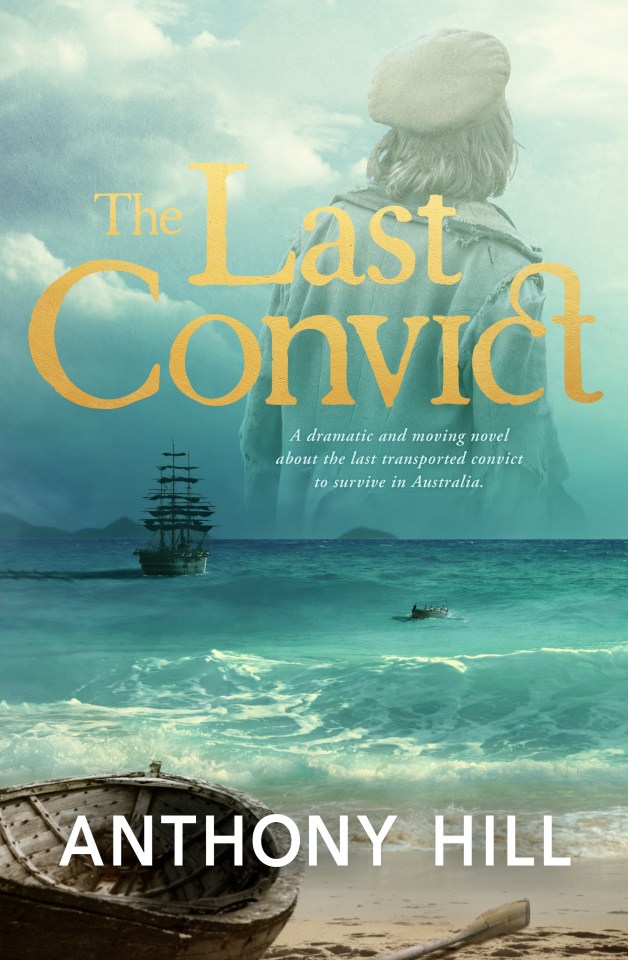
The Last Convict by Anthony Hill

The Last Convict Cover

Publisher: Michael Joseph (Trade Paperback – 2 February 2021)

Series: Standalone

Length: 368 pages

My Rating: 4 out of 5 stars

Amazon

Acclaimed Australian author Anthony Hill once again dives into the unique history of Australia’s colonial past with a fascinating examination of a truly remarkable individual in The Last Convict.

Perth, 1938.  Samuel Speed in an old man living his last days in a dreary public-run home for destitute old men, with no family or friends to take him in.  At 98 years old, Samuel knows that he does not have long to live and is content with his lot in life, but an unexpected opportunity to tell his tale has been given to him.  A local newspaper has requested an interview with him after they discover that he is the last person left alive who was transported as a convict to Australia.

As Samuel begins his interview, he is transported back to his past to a fateful day in Oxford in 1863 when, as a young, starving teenager, he helped set a barley stack alight in the hopes of being arrested to receive food and a warm bed in prison.  However, he is unprepared for the full consequences of his actions when a judge harshly sentences him to seven years hard labour on the other side of the world.  Boarding the transportation ship, Belgravia, everything from his past is taken from him, including his name, and he begins the long, arduous journey to Fremantle Prison in Western Australia.

Forced to endure years of backbreaking labour, isolation and enforced routine on his life, Samuel’s only relief is a newfound love of reading, as he enjoys escapism in several classic novels.  Eventually obtaining his ticket of leave in 1867 and full freedom in 1871, Samuel seeks to forge a new life for himself.  However, as he continues to work hard, he soon begins to understand that even though he is no longer in prison, he is still very much trapped by circumstances outside of his control.  What kind of man will Samuel become, and how deep does a person’s life sentence truly run?

The Last Convict is a fantastic and powerful historical novel from Anthony Hill that provides an impressive examination of an intriguing figure from Australia’s history.  Hill is an intriguing author from my home city of Canberra who has written several historical novels throughout his career, all of which examine unique individuals from Australia’s past, such as his novel Captain Cook’s Apprentice which followed a cabin boy aboard the Endeavour as it made its journey to Australia, or Soldier Boy, which followed Australia’s youngest-known soldier during WWI.  This latest novel from Hill continues this trend as the author takes a look at Samuel Speed, the last known surviving convict transported to Australia from England.

I really enjoyed the excellent narrative that Hill pulled together for his latest novel, and The Last Convict proved to be an exciting and fascinating tale of survival and determination.  Thanks to a trove of intriguing historical information and articles (all of which is either provided or referenced at the end of the novel), Hill provides the reader with a detailed and compelling bibliographic tale of Samuel’s life.  The story is set around a real-life interview that Samuel Speed had with the Mirror in 1938, and The Last Convict showcases both the elderly Speed sitting down for the interview and his visions of the past as he gets wrapped up in his captivating memories.  The resulting tale is a powerful and stirring narrative that combines historical fact, obtained from both the interview and other sources, as well as some dramatisation from the author.  I really enjoyed the clever narrative that resulted and I think that Hill did his historical protagonist justice, painting him as a conflicted and entertaining figure with both regrets and contentment about how his life turned out.  While many of the events that occurred in this novel have a strong historical basis, Hill did make several leaps (which he acknowledges in his notes) throughout the book.  I think that a lot of these literary creations of the character’s life worked well, and I like to think that Samuel was the amiable bibliophile that Hill made him out to be.  I found myself really getting drawn into this epic and captivating tale, especially as the author did a fantastic job portraying a number of fascinating scenes, locations and events from history, and it painted a vivid picture.  I also quite enjoyed the way in which Hill told the story through an excellent combination of flashback sequences and scenes featuring the older Samuel telling his tale to the newspaper.  All of this results in a fantastic and enjoyable narrative and I am really glad that I got the chance to experience this interesting take on the intriguing figure that was Samuel Steel.

One of the things that I loved the most about The Last Convict was the exceptional amount of historical detail that the author chucked into this book.  Hill is a massive history buff who has done an impressive amount of research for this novel, and he goes out of his way to populate this novel with all manner of facts and fascinating depictions of day-to-day life that a person like Samuel Steel would have experienced.  As a result, the reader gets a captivating, comprehensive and authentic-feeling examination of the convict experience in the latter half of the 19th century.  This includes fantastic depictions of how a person would be tried; their incarceration in England, including some of the horrendous bits of hard and painfully repetitive labour they would be required to undertake; all the way up to their transportation across to Western Australia.  The author also dives into the experiences of a convict living in Western Australia in the second half of The Last Convict, and there are some fantastic and intriguing discussions about what a person would have experienced once they arrived in a vast new land.  I found all the discussion about the various tasks, the intricate tickets of leave and day-to-day life of a convict locked up in Freemantle Prison (which is a cool building to visit) to be exquisitely done, and the reader gets an amazingly wide-ranging amount of knowledge on the subject.

Another fun historical aspect of the novel was the range of entertaining historical anecdotes that the character of Samuel Steel told to the reporter during the story regarding major historical figures that Samuel would have had knowledge of.  Not only do these anecdotes help to flesh out the story and help to fit into a couple of minor references featured in the Mirror interview, but they also proved to be a rather intriguing inclusion.  Hill goes into substantial detail recounting tales of several outrageous and famous Western Australian historical figures and their major moments, which included infamous prison escapes and other shenanigans.  I found these parts of the book to be incredibly fascinating, especially as I was unfamiliar with several of the stories that were mentioned, including one mass escape of Irish convicts that nearly started an international incident between the colony of Western Australia and the United States.  These stories added some great context to Samuel’s tale and helped the reader to envision the lives of other convicts or people in power that may have had some influence over the protagonist’s way of life or who he may have gossiped about.  I also quite liked the author’s decision to make Samuel a fan of classic novels, which was added in due to a passing reference to a Mark Twain story that Samuel made during his interview, and because Samuel had an association with the Braille Society, who ended up burying him.  Hill expands on this to paint Samuel as a lover of other novels, especially Dickens, and suggests that he would have started reading whilst a convict looking to pass the time.  Not only is this a rather likeable and relatable character trait, but it allowed the author to explore what sort of literary works a person like Samuel might have been interested in and may have had access to.  I enjoyed the author’s depictions of this classic novels and the protagonist’s potential reaction to them, and it proved to be an intriguing part of the book’s plot.  Overall, I felt that all these cool historical elements really helped to elevate Hill’s story within The Last Convict and readers are in for a fantastic blast of information about colonial Western Australia that is extremely fascinating and interesting.

The Last Convict is another clever and meticulously researched Australian historical fiction novel from Anthony Hill that provides the reader with a powerful and compelling window into the life of an interesting figure from history.  Loaded with Hill’s usual intense levels of fascinating historical detail, I had a lot of fun reading The Last Convict.  I look forward to seeing which Australian historical figure Hill looks at in his next book and I will be grabbing a copy to read.

Amazon

Fair Warning by Michael Connelly

Fair Warning Cover

Publisher: Allen & Unwin (Trade Paperback – 26 May 2020)

Series: Jack McEvoy – Book Three

Length: 404 pages

My Rating: 4.5 out of 5 stars

Amazon

Prepare for another incredible murder mystery from leading crime fiction author, Michael Connelly, as he brings back one of his more intriguing protagonists, reporter Jack McEvoy, for another fantastic novel, Fair Warning.

Following several of his past misadventures, veteran reporter Jack McEvoy is now working for the independent reporting website, Fair Warning, investigating scams and consumer issues. However, McEvoy’s true passion is the murder beat, which he once again finds himself dragged into when LAPD detectives accost him one night, asking him questions about a woman he had a one-night stand with several months ago. The woman has been murdered in a particularly brutal manner, and McEvoy is seen as a key suspect in the case.

Against the wishes of the police and his editor, McEvoy begins to dissect the case on his own, and discovers that several women across the country have died in a similar manner. Investigating each of these deaths, he manages to find a unique connection between the victims that points to a serial killer that has been operating unnoticed for years and who has a disturbing way of finding his next kill.

Determined to hunt down this murderer and bring him to justice, McEvoy recruits his old flame, former FBI agent Rachel Walling, to help his investigation. However, this is no ordinary killer they are hunting. Calling himself the Shrike, their prey is brilliant, meticulous and utterly devoid of any compassion. Can McEvoy and Walling bring him to justice, or have they just painted a target on their back?

Wow, Connelly really knocks it out of the park again with Fair Warning, another excellent and captivating piece of crime fiction. I have been really getting into Connelly’s books over the last couple of years, ever since I read his 2018 release, Dark Sacred Night, which was followed up by one of my favourite books of 2019, The Night Fire. Fair Warning is the 34th book in Connelly’s shared universe of crime fiction (which includes his Harry Bosch and Mickey Haller novels), and it is the third book to feature Jack McEvoy as a protagonist. This latest release proved to be an exceptional read, and I was able to power through it in a short period of time. I loved the fantastic mystery that was featured within it, and Connelly has included several unique features that make it stand out from his main police investigation novels, resulting in an amazing and enjoyable read.

At the heart of this amazing novel lies an impressive and clever murder mystery storyline that proved to be a lot of fun to explore. The book focuses on a hunt for a wicked and terrifying serial killer who has been hunting women across the country and getting away with it. The subsequent investigation into the killer is a compelling and multilayered affair, as the protagonist becomes obsessed with solving the case. The entire mystery storyline is an epic and intriguing affair, and Connelly lays it out in a methodical manner that helps to draw the reader right into the middle of the investigation. I really liked where the investigation goes, and it contains some interesting leads, opposition from law enforcement agencies who do not want a report snooping around and several other unique challenges. Just like with the other Jack McEvoy books, Connelly has come up with a distinctive and driven serial killer for the protagonist to pursue. This killer is a ruthless and intelligent hunter with a terrifying method of eliminating his prey, which he parlays into his disturbing but apt moniker the Shrike. He serves as a worthy antagonist for this excellent mystery, and it proved to be really intriguing to fully investigate and unwind all his actions and intent, although there is still some mystery around this antagonist towards the end of the book. I personally liked the occasional glimpse into the killer’s mind that Connelly provided, as there were a few short chapters told from his perspective, which proved to be rather intriguing. An additional chapter from a third character’s point-of-view also introduced the reader to a couple of witnesses, who, while not directly involved with the killings, had their hands in their case in an interesting but messed up way, which added compelling wrinkles to the entire mystery, and also ensured that the reader had additional villains to wish some comeuppance upon. Overall, this was an excellent and enjoyable murder mystery storyline, and I had an amazing time following it from one end to the next.

Connelly has the rare ability to keep coming up with great and distinctive protagonists for his crime novels, and Jack McEvoy is one of his more intriguing characters. McEvoy is a bit of an autobiographical character for Connelly, as both the author and his creation were crime journalists for the Las Angeles Times. He has been utilised as the main character of two previous novels, The Poet and The Scarecrow, and has also had appearances in some other Connelly books, such as A Darkness More Than Night and The Brass verdict. Long-term fans of Connelly’s writing will enjoy learning about how his life has progressed in the intervening years, and about his current journalistic endeavours. It was great to see him once again involved in a murder investigation, especially another one where he has an emotional attachment to the case, having briefly known the first victim. McEvoy is portrayed as a somewhat reckless and impassioned investigator throughout the book, and he ends up riding some moral lines as he attempts to work out what is more important, the story or catching the killer. It was also great to see the return of Rachel Walling, who has served as the main supporting character and love interest of the previous Jack McEvoy books. McEvoy and Walling’s complex relationship is once again a central piece of this story, and the two of them struggle to work together with their romantic entanglements and complicated past. After all this time the reader cannot help but hope that the two of them will end up together, although there are significant barriers to this happening, such as McEvoy’s suspicious and cynical personality, and their often-opposing viewpoints. Both characters are fantastic additions to the story, and their personal issues serve as pleasant emotional backdrop to the murder mystery angles of the book. I really liked their complicated partnership and it looks like Connelly may have some plans for them in the future.

I was also a big fan of the reporting angle that Fair Warning had. The protagonist is not cop, instead he is a reporter who finds himself involved with the story. As a result, while the protagonist does want to bring the killer to justice, he is also interested in writing the story behind it. This leads to several distinctive differences between this investigation and the more traditional police inquiry, including different ways of obtaining information, being less bound by legal procedures and a different way of dealing with potential witnesses or sources. The book also features several faux journalistic articles (which must have brought Connelly back to his reporting days) that cover key events of the book, and there are some great discussions about the techniques behind writing a newspaper article.

One of the most interesting parts of this reporting element, is the fact that the McEvoy is employed at the reporting website, Fair Warning. Fair Warning is an actual real-life website that provides independent watchdog reporting on consumer issues, which features Connelly as a member of the website’s board of directors. The website’s real-life founder and editor, Myron Levin, appears as a character within the book, and I think that it was a fun inclusion from Connelly that did a great job of showing the current state of journalism in the world today. This is the first Jack McEvoy book written in the era of ‘fake news’, and Connelly spends some time exploring how traditional newspapers are suffering and how the role and status of reporters is changing. This proves to be an intriguing background element to the story, and I am glad that Connelly spent the time raising it within the novel, as well as highlighting the importance of an impartial and observant journalists. Other great parts of the reporting aspect of the book include several fun reporting anecdotes (I really, really hope that the story about one of Levin’s articles distressing a grifter so much that he sued the paper claiming the article caused him rectal bleeding, is true), as well as the examination of other parts of other parts of journalism, such as the emergence of podcasts as a source of media.

Another fantastic element to the story was the author’s examination of the massive industry that has formed around DNA testing for criminal, scientific and personal reasons. Through the course of his investigation, McEvoy discovers that the connection between several of the victims is due to DNA testing. This prompts him to investigate the DNA testing from a consumer watchdog perspective, which allows Connelly to examine a number of potential issues behind the current craze of DNA testing, and he shows it to be an extremely unregulated industry where a lot of unethical actions and behaviours can occur. This proves to be an extremely fascinating part of the book’s plot, especially as Connelly puts forth several different ways that such an industry could be abused for personal or criminal purposes, some of which are rather disturbing in their implications. Connelly did an amazing job exploring the downsides of DNA testing in this book, and it was both extremely fascinating and little scary (it made me glad that I’ve never sent my DNA in for testing, that’s all I’m saying), especially in the way that it was tied into Fair Warning’s mystery.

Michael Connelly has once again showed why he is one of the world’s preeminent authors of crime fiction as he has written another outstanding and highly addictive novel. Fair Warning contains an excellent and captivating story that I could not get enough of. I had an incredible time reading this amazing and clever novel and it comes highly recommended. It has also got me extremely excited for Connelly’s next novel, The Law of Innocence, which comes out later this year.

Amazon