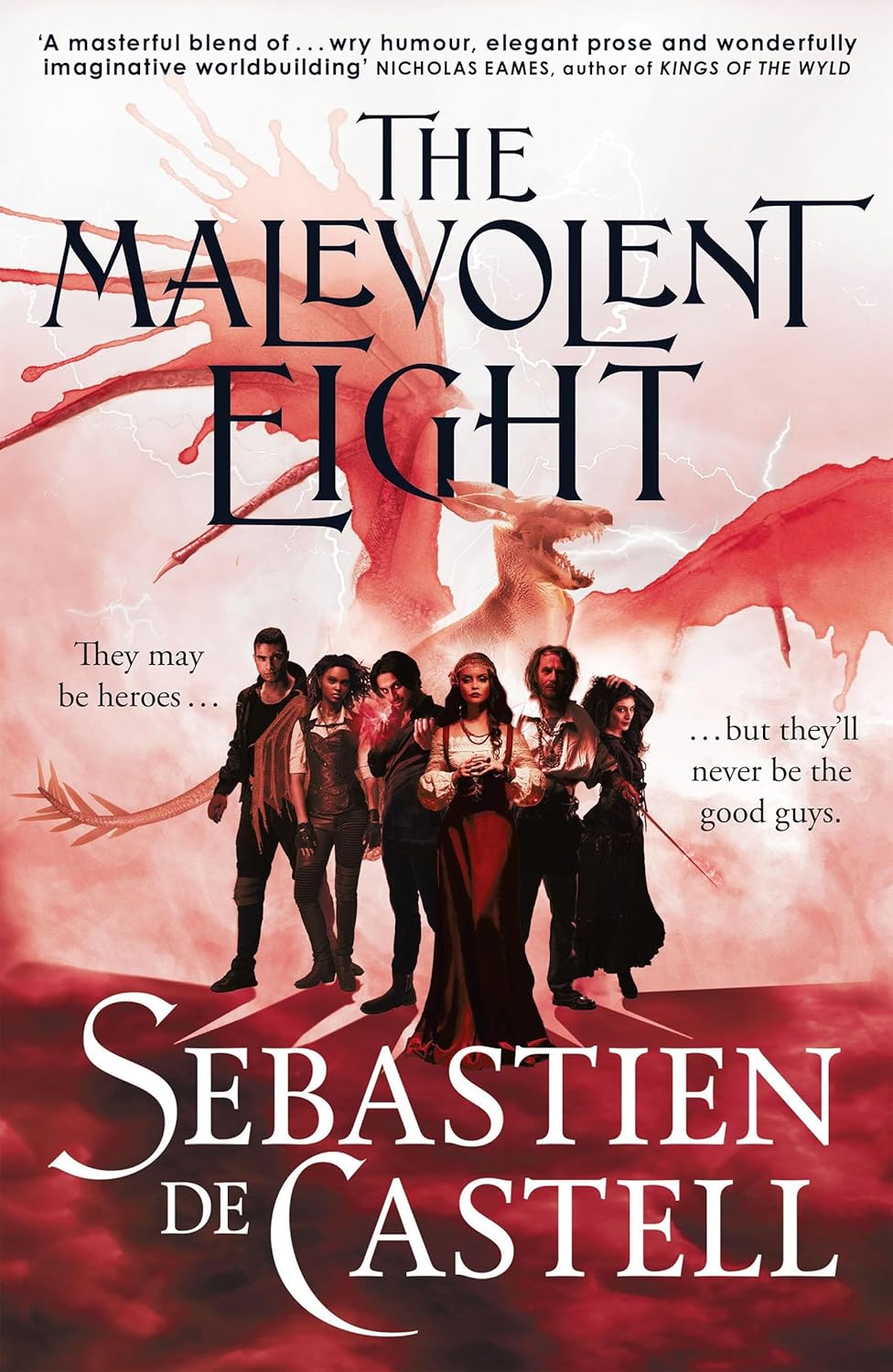
The Malevolent Eight by Sebastien de Castell

Publisher: Acardia (ebook – 27 May 2025)

Series: Malevolent series – Book Two

Length: 397 pages

Rating: 4.75 out of 5 stars

Amazon

The always entertaining Sebastien de Castell unleashes one of the funniest books of 2025 with the dark fantasy novel, The Malevolent Eight, a compelling and impressive sequel that I couldn’t get enough of.

Over the last couple of years, I have really become attached to the amazing Sebastien de Castell, a leading fantasy author with some outstanding stories under his belt.  Known for his impressive and varied stories, including his Greatcoats, Spellslinger and Argosi novels, de Castell has a brilliant imagination, and I love the range of complex settings and narratives he brings to life.  Some of my favourite de Castell books are from his recent The Court of Shadows fantasy murder mystery series, which serves as a sequel to his original Greatcoats books.  These include the witty and entertaining Play of Shadows (one of my favourite books of 2024) and the particularly clever Crucible of Chaos (one of my favourite audiobooks of 2024), both of which were real highlights of my reading calendar last year.  However, for this review I’m going to focus on a far more entertaining series of de Castell’s that I have had a blast with.

This series is the Malevolent collection of books, which contain dark magic, over-the-top characters and ridiculous humour.  Starting back in 2023 with The Malevolent Seven, this series followed seven morally questionable mercenary mages who come together into an unlikely team to defeat a group of dangerous wizard brothers.  However, their attempt to do the right thing spectacularly backfires on them when they are tricked into allowing the hosts of heaven and hell to simultaneously invade, turning their realm into the battleground for their final war.  I ended up having an exceptional time with The Malevolent Seven, and I really got drawn into it’s clever, if outrageous plot.  Naturally I was keen to see how the series continued, and the recently released sequel, The Malevolent Eight, has long been on my to-read list.

After a great betrayal, the mortal realm is in peril as the heavenly Lords Celestine and the dark Lords Devilish have simultaneously invaded, determined to fight their long-anticipated final battle on this unclaimed ground.  As both sides recruit as many additional human soldiers and followers as they can to their cause, the survival of humanity seems to lie in the hands of an unlikely group of rogue magic users.  Unfortunately for everyone involved, humanity’s saviours are the damn fools who caused this calamity in the first place, the insane mages better known as The Malevolent Seven.

At the head of this misfit band is Cade Ombra, a man who has known power and betrayal from both the Celestine and the Devilish and is determined to allow humans to remain free from their dual influences.  Forced to work with the most emotionally unstable group of mages and wonderists in the mortal realm, including a destruction-loving lighting slinger, a fallen angel, a righteous devil trying to serve the Celestine, an uncertain blood mage, a roguish rat admirer and their newest member, a vampiric kangaroo, Cade begins to wage a surprisingly moral war on both the Celestine and the Devish.

However, The Malevolent Seven aren’t the only beings attempting to disrupt the plans of the two invading armies.  Another group of mages, as well as a mysterious woman from Cade’s past with unimaginable power, are also fighting for their own purposes, and looking good while doing so.  Forced to contend against angels, devils, and ambitious mages, Cade will need to outthink all his enemies, while also ensuring that his own chaotic allies don’t make everything even worse.  However, the harder he fights, the more Cade begins to realise that he may have to sacrifice everything, especially when it becomes clear that the origin of the apocalypse lies in his gilded past.

De Castell continues to deeply impress with this brilliant, if somewhat unhinged, novel, as The Malevolent Eight was an exceptional dark fantasy sequel that comes very highly recommended.  Taking all the comedic craziness from the first book and amping it up to eleven, The Malevolent Eight was a perfect follow-up to de Castell’s previous narrative that takes the reader on an exceptional adventure you just won’t be able to look away from.

After having a ton of fun with the awesome first book in the series, I honestly wasn’t too sure what to expect with The Malevolent Eight’s story.  However, not even in my wildest dreams did I imagine just how unhinged, wild and downright insane this sequel’s plot would get as de Castell pumped the narrative all the way up to 11 and beyond.  Starting with a fun and particularly bloody sequence that not only reintroduces the unruly protagonists but also showcases the dark scenario that they find themselves in for this book, the readers are quickly thrust into The Malevolent Eight’s plot, and frankly after the first series of crazy events, you find yourself pretty hooked as the self-proclaimed Malevolent Seven’s attempt to fight both the armies of heaven and hell.  However, as the story progresses, the unconventional heroes soon find that there are far more dangerous beings involved in this war, including a mysterious mage with previously unknown destiny-altering magic.

Determined to find out more about their new opponent, Cade leads The Malevolent Seven to both the Lords Celestine and Devilish to find out what they know and soon begins to understand his unfortunate role in the outbreak of the apocalypse.  After some hilarious interactions with both sets of lords, the protagonists embark on a series of missions, only to encounter betrayals, hidden secrets, the consequences of Cade’s lies, capture, revelations and a surprisingly humorous torture sequence.  This leads up to the big conclusion of the story, as the protagonists find themselves in the middle of a battle against three separate sides trying to claim their world for various purposes, all while manipulative figures work from the sidelines.  This big finale for The Malevolent Eight gets a little overcomplicate and convoluted, especially as we dive into alternate realms and different realities, but the entire thing is highly entertaining to behold.  It finishes off on an interesting conclusion, which has a nice hopeful note to it (especially in comparison to the previous book), while also hinting at some dark events to come.  This is an overall quite entertaining and wild story that really highlights de Castell’s creativity and ability to craft over-the-top narratives.

I deeply enjoyed the wonderful style that de Castell utilised in The Malevolent Eight, as the author pulls together a chaotic and hilarious dark fantasy that hits a lot of over-the-top notes at the same time.  Perfectly told from the single perspective of main character Cade Ombra, The Malevolent Eight is a balls-to-the-wall blast, loaded with insane action, excessive blood, crazy moments and fantastic humour.  De Castell keeps the pace of the story moving pretty fast throughout The Malevolent Eight, and the reader absolutely powers through the fantastic combination of carnage, intrigue, and hidden motivations.  Working well as a sequel to the previous book, The Malevolent Eight cleverly returns to the author’s fun setting, which has been drastically altered due to the rival inter-dimensional armies fighting across it.  Serving as the perfect background to such an entertaining and oddball dark fantasy narrative, de Castell makes perfect use of the changed setting and existing book history to go all out with his narrative.  While a seemingly simple and insane book on the surface, de Castell also adds in some impressive extra depth to the story, including through its complex magic system and the inclusion of several alternate realms that allow or some interesting inclusions from the author’s wider fictional reserves.  There is also a great moral greyness to the entire setting, as even the most noble of people or beings in this setting is generally pretty flawed or evil in their own way, and I frankly loved how cynical things got at times.

While this is a rather dark story, loaded with brutal combat and destructive magic, de Castell keeps the overall tone of The Malevolent Eight pretty light thanks to the excellent use of humour.  This is an insanely funny book, and while there is a certain subtly to some of the comedy contained within, for the most part de Castell utilises over-the-top scenarios (such as a swearing kangaroo), unhinged dialogue (the one swearword said kangaroo can say) and silly over-reactions for his comedy, which frankly fits the overall crazy feel of The Malevolent Eight.  The author gets a consistent amount of humour out of all the crazy antics of his characters, which stays pretty damn funny all the way through and never gets too tiring or overplayed.  Highlights of The Malevolent Eight’s humour for me included a very cleverly written demonic contract that spelled out the terms of a deal with the protagonists with some unique caveats, a particularly entertaining torture sequence where the protagonist causes more discomfort for his torturers than himself, ill-timed relationships with the book’s apparent antagonist, and so many crazy conversations between the seemingly sane point-of-view protagonist and every single person he encounters.  While I’m slightly salty about de Castell’s description of the Australian accent being “halfway between some poncy foreign nobleman and an inebriated fishmonger” (ok fine, it was pretty funny), this was quite a hilarious read, and I honestly laughed out loud multiple times in public as I read through this crazy comedic book.

One of the things I appreciated about The Malevolent Eight is the way in which de Castell made it accessible to all readers, even though who didn’t read the preceding novel.  While those who have checked out The Malevolent Seven are probably going to get the most out of this novel, especially as they can continue the hilarious character arcs from the first book, I feel that new readers can easily jump into The Malevolent Eight without any real context and still follow the story perfectly.  Indeed, I quite enjoyed how well de Castell cleverly and effectively recapped the events of the previous book, especially after a two-year gap between reading The Malevolent Seven and The Malevolent Eight.  Established de Castell fans will probably appreciate the references to the author’s other series, as a new major character in the novel is from the author’s Spellslinger universe and utilises that series’ unique magic to great effect in this novel.  While those readers who have read the Spellslinger books will no doubt find this inclusion really cool, people who are less familiar with this series can still follow The Malevolent Eight’s plot without any issue, especially as the events of the other series don’t really come into play here.  As such, I would recommend The Malevolent Eight to any fantasy readers looking for a dark comedic turn, although for the sake of completeness, try The Malevolent Seven first.

As with The Malevolent Seven, this excellent sequel features a fantastic cast of compelling damaged characters whose unique and often quite outrageous stories helped to ensure The Malevolent Eight was an impressive read.  Cleverly building on the storylines of the previous book, The Malevolent Eight features the immoral characters who make up titular Malevolent Seven attempting to be heroes in this book, often with mixed results.  This includes main protagonist and point-of-view character Cade Ombra, the leader of group and a man with quite a complex past.  Shown in the previous book to be a power hunger survivor with a conscience, The Malevolent Eight really dives into his characterisation even further as you look at his past as an arrogant holy warrior and his eventual fall from grace to work with demons.  His complex past becomes a key part of The Malevolent Eight’s plot, especially as much of the current issues lie in his past mistakes, and it was quite moving to see Cade attempt to make amends, especially as it gets him into even more trouble.  Despite this, Cade is still a massive bastard at times, and his manipulative nature and evil strategic mind are some of his greatest weapons.  Serving as the apparent straight man to a group of crazy friends, Cade sees himself as the sole voice of reason in the entire book, and it was fascinating to see his compelling perspective unwind throughout the book, especially when he faces certain realities about his friends and what he must do for redemption.

The rest of the cast of The Malevolent Eight is pretty crazy in comparison to Cade (at least from his perspective), and it was so much fun to see these outrageous personalities interact with each other.  My favourite supporting character is still the rude and crude Corrigan Blight, a thunder mage who serves as Cade’s unwieldly second.  Despite his outward appearance as an idiot controlled by his element (I mean, he is), Corrigan is a surprisingly deep figure and his ability to act as Cade’s conscious really highlights their great friendship.  The rest of the returning members of The Malevolent Seven, which includes a rat mage, a fallen angel, a holy demon and an uncertain blood mage, are slightly less well featured in this book, although de Castell does dive into their uncharacteristic attempts to be heroes, and their always fun interactions as a group allowed for some amazing moments.  I also must mention the newest member of team, Temper, a giant, swearing, vampiric kangaroo who has joined the team since the events of the first book.  Temper was quite a surprising figure to behold, and de Castell cleverly keeps the kangaroo’s origins somewhat hidden from the reader for much of the plot, allowing you to really enjoy his random presence without thinking too much about it.  This main cast was so much fun, and de Castell tops it off with a new magic user from Cade’s dark past with surprising connections to the Spellslinger universe, Cade’s former demonic benefactor whose intrigue, and paella, is to die for, and a variety of high demon lords and celestial beings whose motivations are never black and white.  These characters, and more, ensure that The Malevolent Eight is an exceptional read from start to finish, and I deeply enjoyed seeing these crazy characters in action.

Sebastien de Castell was in rare form with his impressive new dark fantasy novel, The Malevolent Eight.  A bold sequel that takes all the best elements from the first book and amps them up to a hilarious new height, The Malevolent Eight was an extremely entertaining read, with some brilliant comedic charm that worked well with the damaged characters and very dark fantasy elements.  Outrageous and excessive in all the best ways, The Malevolent Eight was such a great read and I couldn’t get enough of de Castell’s latest ultra-fun offering.  Make sure to also keep an eye out for de Castell’s other 2025 novel, Our Lady of Blades, later this year, which I strongly feel is going to be even more amazing.

Amazon

The Last Hour Between Worlds by Melissa Caruso

Publisher: Orbit (Trade Paperback – 26 November 2024)

Series: The Echo Archives – Book One

Length: 389 pages

My Rating: 4.5 out of 5 stars

Amazon

Take a bold leap through various time loops with one of the more exciting and clever fantasy novels of 2024, The Last Hour Between Worlds by Melissa Caruso.

Melissa Caruso is a very talented author who has been producing brilliant female-led fantasy fiction since her debut in 2017.  Starting with her outstanding Swords and Fire trilogy (The Tethered Mage, The Defiant Heir and The Unbound Empire) and continuing with her sequel Rooks and Ruins trilogy, Caruso made a big impact the first several years of career, and her writing has only gotten stronger since.  As such, I made it a big priority to get my hands on her 2024 novel, The Last Hour Between Worlds, which I had the pleasure of reading at the start of this year.  The first book in the author’s new The Echo Archives series, The Last Hour Between Worlds sets up a cool new fantasy series with a murder mystery twist behind it and some great story ideas.

Plot Synopsis:

A whip-smart adventure fantasy packed with rival guilds, reality-bending magic, and sapphic pining, The Last Hour Between Worlds is the brilliant launch of a new series from David Gemmell Award-nominated author, Melissa Caruso.

Kembral Thorne is spending a few hours away from her newborn, and she’s determined to enjoy herself at this party no matter what. But when the guests start dropping dead, Kem has no choice but to get to work. She is a Hound, after all, and she can’t help picking up the scent of trouble.

She’s not the only one. Her professional and personal nemesis, notorious burglar Rika Nonesuch, is on the prowl. They quickly identify what’s causing the a mysterious grandfather clock that sends them down an Echo every time it chimes. In each strange new layer of reality, time resets and a sinister figure appears to perform a blood-soaked ritual.

As Kem and Rika fall into increasingly macabre versions of their city, they’ll need to rely on their wits—and each other—to unravel the secret of the clock and save their home. 

The Last Hour Between Worlds was a particularly elaborate and compelling read that had me hooked from the start and kept dragging me along, much like its characters were dragged down through death and echoes.  Sharp, intense and featuring a ton of unique world-building, The Last Hour Between Worlds was a bold read that cleverly sets up a great new fantasy series.

I had a brilliant time with The Last Hour Between Worlds, as Caruso features a complex narrative with compelling stakes that proved hard to put down.  Starting off with a good introduction to the protagonist, Kembral Thorne, a nearly retired Hound and expert at travelling through the various arcane Echoes that exists under her city, and several other key characters as they are entertained at a party held by a prominent city politician.  It doesn’t take long for the action to kick off as several dark denizens from the Echoes arrive at the party, determined to kill certain guests and drag the entire gathering down into the reality below.  Dragged along with it, Kembral finds herself stuck in a dark time loop which only she remembers thanks to an interaction with a mysterious grandfather clock.  Forced to watch her friends and colleagues brutally murdered and dropped into a deeper Echo with each variation of the loop, Kembral seeks a way to stop the recurring murders and ensure that everyone comes out alive.

The plot goes in some interesting directions as The Last Hour Between Worlds continues, and it soon becomes apparent that Kembral and the rest of the humans are caught up in a deadly power struggle between the Empyrean, the masters of the Echoes, who are using this event as a key piece in their games.  Forced to team up with the only other person who can remember events, her nemesis and potential love interest, Rika Nonesuch, the two work through various iterations of the time loop, figuring out more clues about the event and trying knock all the competing Empyrean out of the time loop before the final chime of the clock.  This results in an entertaining, exciting and complex storyline, which Caruso sets up extremely well.  The blend of human and magical intrigues that the protagonists are forced to navigate allows for a very compelling story, and I loved all the cool twists that emerge, as well as the deeper personal struggles between Kembral and Rika.  It all leads up to the big conclusion at the final Echo, as the two desperately fight to ensure everyone survives.  I felt that Caruso set up an excellent ending for The Last Hour Between Worlds, especially as this story is wrapped up in a satisfying manner, while also hinting at some more dark adventures to come.

I really enjoyed how cleverly The Last Hour Between Worlds came together.  The slick blend of unique fantasy elements, a cool time-loop mechanism, and the layers of intrigue surrounding events was particularly impressive, and I really got hooked on the story because of how well these elements were utilised.  The time-loop part of the book was especially great, and the way in which Caruso kept reframing the story in each successive Echo ensured that you were constantly on your feet and you never quite knew what was going to happen next.  The underlying setting and magic of The Last Hour Between Worlds was also quite clever, as Caruso envisioned an elaborate array of alternating dimensions and dark creatures that mirror the humans above in twisted ways that the protagonists need to overcome and bargain with.  While I think that some of the elements of the setting could have perhaps been explored in a little more detail before the major events of the plot kicked off, for the most part readers can come in and completely follow what is happening in the plot without any issues.  The resulting action, well-hidden twists, and cool character interactions really enhance The Last Hour Between Worlds’ already compelling narrative, and you won’t be able to turn away from Caruso’s new fantasy adventure.

The final thing I want to talk about were the great characters featured within The Last Hour Between Worlds, with the focus primarily being around the heated pairing of Kembral Thorne and Rika Nonesuch.  A fun case of attracted opposites with lots of history, the law-abiding Kembral and the roguish thief Rika are the perfect foils for each other, and I love their heated interactions.  Despite their initial mistrust, the two soon begin to work together to survive and find their old feelings rekindling.  Caruso nicely slow burns their inevitable romantic attachment, , and they must work through a lot of mistrust, hidden secrets, and their own perceived slights to get there.  The rest of the cast is also interesting and entertaining, and you get quite attached to them as the time loops continue, even though some wind up temporarily dead.  Several are these characters are slated to have bigger roles in the upcoming sequel to The Last Hour Between Worlds, and I cannot wait to see what happens there.  Throw in some excellent dark mystical figures in the Empyrean, who act as either antagonists or shadowy figures on the sidelines, and this was a stacked set of characters that Caruso clearly has some intriguing plans for.

With a slick plot, a great mixture of fantasy adventure of murder mystery hijinks, and some entertaining characters, The Last Hour Between Worlds was an outstanding novel from Melissa Caruso, who continues to showcase why she is one of fantasy fictions most inventive rising stars.  Serving as a great starting point to a new series, The Last Hour Between Worlds comes highly recommended, and I loved its powerful and complex plot.  I honestly cannot wait to see where Caruso takes The Echo Archives series next, although the upcoming sequel, The Last Soul Among Wolves, sounds particularly awesome.

Amazon

A Tide of Black Steel by Anthony Ryan

Publisher: Orbit (Audiobook – 24 September 2024)

Series: Age of Wrath – Book One

Length: 19 hours and 20 minutes

My Rating: 5 out of 5 stars

Amazon

After finally getting something up for We Solve Murders, I continue trying to publish long-overdue reviews for some of the better books of 2024, including the highly captivating fantasy novel A Tide of Black Steel by Anthony Ryan.

Veteran fantasy author Anthony Ryan is an author I have been really learning to enjoy in recent years, especially as I fell in love with his epic The Covenant of Steel series.  Following a young rogue who takes on the mantle of a warrior, spy, strategist and most importantly a scribe throughout his complicated and danger-filled life, The Covenant of Steel novels were an impressive collection of books loaded with great characters, a compelling chronicle style and some brilliant twists.  All three books in the series, including The Pariah (one of my favourite books and audiobooks of 2021), The Martyr (one of my favourite books and audiobooks of 2022), and The Traitor (one of my favourite books and audiobooks of 2023), were instant five-star reads from me, and I had so much fun getting through them.  As such, I was very excited to find out about Ryan’s new novel, A Tide of Black Steel, especially as it serves as a sequel to The Covenant of Steel series.  The first book in the author’s new Age of Wrath series, A Tide of Black Steel sets up a mighty fantasy tale that I had a brilliant time with.

Plot Synopsis:

From the international bestselling author Anthony Ryan comes the spectacular first novel in a new epic new fantasy trilogy inspired by Norse mythology. A new age has dawned. An age of blood and steel. An age of wrath.

The land of Ascarlia, a fabled realm of bloodied steel and epic sagas, has been ruled by the Sister Queens for centuries. No one has dared question their rule. Until now.

Whispers speak of longships of mysterious tattooed warriors, sailing under the banners of a murderous cult of oath-breakers long thought extinct. A tide of black steel that threatens to vanquish all in its path.

Thera of the Blackspear, favoured servant of the Sister Queens, is ordered to uncover the truth. As Thera sails north, her reviled brother, Felnir, sets out on his own adventure. He hopes to find the Vault of the Altvar – the treasure room of the gods – and win the Sister Queens’ favour at his sister’s expense.

Both siblings – along with a brilliant young scribe and a prisoner with a terrifying, primal power – will play a part in the coming storm.

The Age of Wrath has begun.

A Tide of Black Steel was another outstanding novel by Anthony Ryan that provided readers with a cool and layered fantasy adventure.  Cleverly expanding the fantasy universe introduced in The Covenant of Steel books, A Tide of Black Steel brings together several interesting storylines into one exciting read with a very different tone to the author’s previous novels.  Powerful, action-packed, and featuring some interesting twists and turns, A Tide of Black Steel gets a full five-star rating from me, and it was one of my favourite books and audiobooks of 2024.

I really enjoyed how this cool novel turned out, especially as Ryan introduced an ambitious and powerful new narrative that combines bold, seafaring adventures with some complex world-building to create an outstanding read.  Serving as a loosely connected sequel to the author’s The Covenant of Steel books and told through the eyes of four compelling protagonists, the plot of A Tide of Black Steel breaks off into several divergent threads that each have their own charm while also individually exploring a dangerous new enemy threatening the world.  These perspective characters include Ruhlin, a young man who is captured for his mysterious magical abilities and must try to escape from dangerous new masters who want to use his gifts in the fighting ring.  At the same time, Thera of the Blackspear, an agent of the Sister Queens of Ascarlia, investigates a mysterious series of raids against Ascarlia’s borders, travelling to the most isolated islands of the nation.  Finally, Thera’s brother, Felnir, and the young scholar Elvine, are tasked with trying to find an ancient treasure horde and the dark secrets it contains.

Apart from Thera and Felnir’s perspective chapters, which are strongly linked for much of the book, these major storylines are kept mostly separate from each other, allowing for three separate adventures to occur simultaneously.  All these arcs were equally interesting and provided some cool alternate perspective and themes to the book, with Ruhlin’s being a dark coming-of-age plot, Thera’s being a brutal series of battles and investigation, while the combined plot of Felnir and Elvine was a great mixture of exploration, redemption and secrets.  While I was a little more drawn to Felnir and Elvine’s plotlines at times, primarily because of a couple of secretive supporting characters that hinted at a great connection between this book and The Covenant of Steel series, I honestly had a brilliant time with all the storylines, and they combined nicely into one compelling and cohesive overall plot.  All these storylines progress nicely, amping up the stakes and enhancing the adventure until they reach some thrilling conclusions where some big reveals come to pass.  While I saw a few of the twists coming, the impact of these arc conclusions was really impressive, and I came away from A Tide of Black Steel wanting more, especially as there was a cool and brutal cliff-hanger that is going to result in dark moments for the series going forward.

Ryan gave it a real classic adventure feel that worked in the context of the plot.  The author used a very different writing style here compared to The Covenant of Steel novels, as this latest book was a multi-character epic that lacked the chronicle style of the previous trilogy.  While this change in style while remaining the same universe could be potentially jarring, I think it worked quite well, and I enjoyed the complex and entertaining narrative that emerged.  Ryan proved adept at splitting the narrative between various protagonists, and the diverging perspective chapters blended well into a large and compelling story, with only occasional crossovers.  The reveal of key plot points in one perspective arc was well utilised in some of the other protagonist’s chapters, and I really enjoyed the tight, character-driven narrative that emerged.

As I have mentioned a few times, A Tide of Black Steel and the Age of Wrath series it is a part of are a sequel to Ryan’s The Covenant of Steel series, which the author uses to full effect to makes this novel even more enticing and fun.  Set years after the conclusion of The Traitor, A Tide of Black Steel takes place in a new setting, Ascarlia, a neighbouring realm to the lands featured in The Covenant of Steel books and features several characters with interesting connections to figures from the previous trilogy, including that series’ main protagonist.  Ryan has a wonderful time diving into this new setting, which has a distinctive Norse/Viking feel compared to the more traditional medieval Europe vibe of the previous novels.  This allows for an entirely new focus on naval combat, a boat and island focused culture and Norse-inspired military tactics, which really helps to set A Tide of Black Steel apart.  Ryan utilises all these elements to great effect in this new book, and the multiple longship-on-longship battles and clashes at the shield wall were impactful, as well as the well-researched and beautifully written depictions of maritime activity and nautical life.  I deeply enjoyed this expansion of Ryan’s universe, and the focus on a whole new realm within this world really opened the story options and allowed new protagonists and threats to shine.

While A Tide of Black Steel stands on its own extremely well, the events of The Covenant of Steel books are routinely referenced, and there are some very interesting connections between it and this new series.  As such, I feel that A Tide of Black Steel is a book that fans of Ryan’s previous series are going particularly enjoy, especially as they eagerly await any clues or hints about the open story threads from the end of The Covenant of Steel novels.  I know I was constantly curious to see whether some of the characters with more mysterious pasts were going to be revealed as figures we’d previously seen in the other series, and the result of that was pretty good.  I also liked how the use Ascarlia in this book finally provided a good follow-up to a key part of the first The Covenant of Steel novel, The Pariah, and I really enjoyed seeing Ryan expand on these events, including bringing back an antagonist from that book and making them a key supporting character here.  Despite all these references, those readers interested in checking out A Tide of Black Steel without reading The Covenant of Steel novels first are still guaranteed a good time, especially as Ryan provides all the relevant background and refreshes your mind about details relevant to the plot.  Still, for the full emotional attachment and background, I would recommend reading the other trilogy first, especially as they are excellent pieces of fantasy fiction.

I should also take the time to mention the excellent array of characters featured within A Tide of Black Steel, as Ryan introduces four outstanding central protagonists, as well as a great collection of supporting figures.  These characters are used to full effect throughout the course of the plot, and you grow attached to several, especially when you learn their background and motivations.  Each of the four perspective protagonists set an own excellent tone for their chapters, and I frankly enjoyed seeing all their separate adventures and differing mindsets.  Watching all of them overcome adversity, lies and issues from their past was quite impressive, and Ryan sets up some interesting, long-running character arcs that are going to be really interesting to see conclude in the future books.  The supporting cast was also quite impressive, and Ryan introduced a range of fantastic characters who were usually exclusive to a particular protagonist.  I personally enjoyed seeing a couple of Ascarlian-related characters previously featured in The Pariah return here, include Margnus Gruinskard, whose deadly duel in his previous appearance directly led to much of the carnage in the previous trilogy.  A couple of mysterious prisoners who find themselves tied to two of the protagonists also added a great deal of interest to the plot, and it was fascinating to see how they connected into the larger plot of the overall series, as well as their personal connection to a key character of this book.  I deeply enjoyed this fantastic cast, and their complex storylines added so much to the overall plot of A Tide of Black Steel.

While I was lucky enough to receive a copy of the A Tide of Black Steel paperback, I ended up listening to the audiobook version instead, primarily because I previously had such a great time with The Covenant of Steel audiobooks.  This proved to be an outstanding choice, especially as the audiobook version really helped to showcase the extended scope of Ryan’s fantasy world, while also enhancing the cool action sequences.  I personally really appreciated that they brought back narrator Steven Brand for A Tide of Black Steel, especially after he did such an awesome job voicing The Covenant of Steel audiobooks.  Brand really gets Ryan’s writing style, and he once again perfectly voiced all the key elements of the plot through his narration.  His take on the large cast of characters was particularly impressive, and each of the compelling figures featured in the plot was perfectly portrayed, with their complex personalities on full display.  I absolutely sped through A Tide of Black Steel’s nearly 20 hour long run time thanks to both the great story and the excellent narration, and this ended up being a particularly amazing audiobook that I deeply enjoyed.  A highly recommended listen and one of the best ways to experience Ryan’s cool new series.

Overall, A Tide of Black Steel was an outstanding fantasy novel, and one I really should have written something about earlier.  Cleverly expanding Ryan’s previously utilised fantasy world to create a compelling Norse-inspired fantasy adventure loaded with twists and hidden secrets, A Tide of Black Steel was a very worthy follow-up to The Covenant of Steel books and takes the reader on a very wild ride.  Exciting, intense and featuring some impressive characters, A Tide of Black Steel was extremely good, and there is a reason it was one of my favourite books from last year.  I cannot wait to see how Ryan continues the Age of Wrath series this year, and the upcoming sequel, Born of an Iron Storm, already sounds particularly awesome.

Amazon

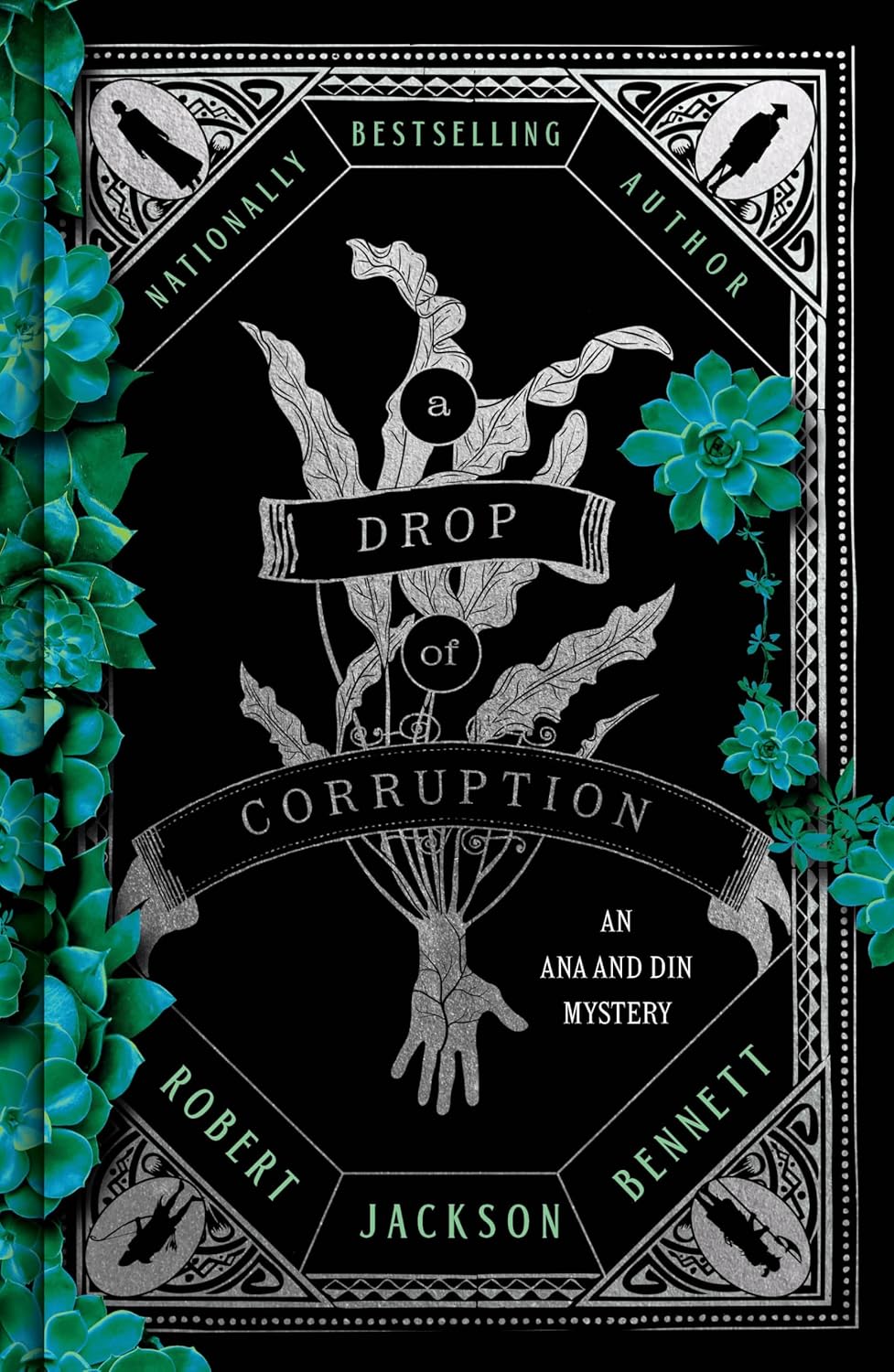
A Drop of Corruption by Robert Jackson Bennett

Publisher: Hodderscape (ebook – 8 April 2025)

Series: Shadow of the Leviathan – Book Two

Length: 432 pages

My Rating: 5 out of 5 stars

Amazon

Robert Jackson Bennett continues to shine brightly with the epic second novel in his Shadow of the Leviathan series, A Drop of Corruption, an exceptional and incredible fantasy murder mystery that I could not get enough of.

Robert Jackson Bennett is an awesome author who has produced some impressive fantasy series over the last few years.  Best known for his Divine Cities and Founders trilogies, Bennett has consistently wowed audiences with his elaborate settings, great characters and intricate narratives.  However, even though I knew how good an author Bennett was, I honestly was not prepared for how much I would enjoy his 2024 novel, The Tainted Cup.

The Tainted Cup was a truly outstanding novel that saw Bennett bring together the fantasy and murder mystery genres into an exceptional and highly addictive fusion.  The first book in the author’s Shadow of the Leviathan series, The Tainted Cup followed the young assistant to an unnaturally gifted investigator as they attempted to solve several murders brought about by magical grass.  Set in a powerful Empire constantly under attack from giant leviathans, The Tainted Cup was a truly epic read, and I loved the elaborate narrative that emerged, as Bennett perfectly set a highly clever mystery amongst the chaotic and highly detailed fantasy setting.  The result was a five-star novel that ended up being one of my favourite books of 2024.  I really cannot emphasise enough just how good The Tainted Cup was, and I think it goes without saying that I was very keen to continue the series after that outstanding first entry.  As such, the second Shadow of the Leviathan novel, A Drop of Corruption, was one of my most anticipated books of this year, and it really did not disappoint.

On the borders of the Empire of Khanum lies the small canton of Yarrowdale, part of an independent kingdom that is reluctantly set to join the Empire.  A dank and impoverished land filled with swamps and waterways, the only thing of importance for the Empire in Yarrowdale is the high-security compound known as the Shroud.  A top-secret lab where the best scientists from the Empire dissect fallen leviathans to harvest the transformative magic found in their blood, the Shroud keeps Yarrowdale on the map and its inclusion in the Empire an inevitability.  However, when an impossible crime takes place within its borders, all eyes within the Empire will be looking towards it.

An important Imperial Treasury officer on assignment to Yarrowdale has gone missing, seemingly disappearing into thin air inside his locked and guarded quarters.  Needing answers, the Empire calls upon its most unlikely hero, the brilliant, and possibly insane, special investigator Ana Dolabra.  Accompanied by her loyal and often exasperated assistant, Dinios Kol, Ana soon invokes her uncanny talent for observations and ability to make unlikely connections to find answers.  But despite quickly working out how the victim disappeared, Ana discerns that the crime was only the first move in a diabolical master plan.

A dangerous and clever killer is stalking Yarrowdale, one with the ability to think ten steps ahead and effortlessly cover their tracks.  Worse, the killer has devious designs on the Shroud and is willing to use the facilities own dark science against it, crippling the Empire’s ability to defend itself.  To save the Empire, Ana and Din will need to discern the killer’s schemes and stop them before it is too late.  But have the pair finally met an opponent even more brilliant that Ana?

Wow, wow, wow, now that was an outstanding book!  Robert Jackson Bennett once again impresses to the extreme as A Drop of Corruption was an incredible read that I honestly could not put down.  Another excellent blend of brilliant mystery and inventive fantasy fiction, A Drop of Corruption was so damn good, and I loved every single second I spent absorbed in its captivating pages.  A very easy five-star read and one of the very best fantasy novels of 2025.

I just loved the story Bennett cooked up for A Drop of Corruption, and frankly I am still thinking about its many elaborate twists, turns and revelations.  Starting off with a good introduction to Yarrowdale, a setting starkly different to the locations from the previous book, the reader is soon brought up to speed about the unusual case within the isolated canton.  Told exclusively from the perspective of assistant investigator Dinios Kol, you soon become emmeshed in finding out how the treasury official disappeared from his guarded room, with his body soon discovered in the nearby waterways.  Thanks to the combination of Kol’s enhanced memory and the unique mind of lead investigator Ana Dolabra, the manner of the victim’s disappearance becomes apparent; however, this only raises more questions and reveals a dangerous killer stalking the canton.

Now I guarantee that at this point of the story you will be extremely hooked, thanks to the compelling mystery that is developing, as well as the intriguing characters, cool new setting and the hints of a very clever killer capable of outthinking the protagonists.  Following some cool moments that indicate just how far the killer is willing to go to achieve their goals, Bennett cleverly ties his mystery into some of the fantastic elements of the setting, including Yarrowdale politics, and the hidden science of the Apothetikal, the branch of the Empire dedicated to the biological alchemy that enhances people.  The author really raises the stakes as the book continues, especially with dangerous bioweapons, essential scientific advances, and ancient political turmoil all impacting the plot.  Bennett keeps the shocks going with several impressive scenes, especially the killer works to alter the destiny of both Yarrowdale and the Empire.

This leads up to the very exciting and fast-paced final third of the book, where all the pieces of the mystery come together.  Despite knowing the identity of their opponent, the protagonists are forced to work overtime to try and catch them as they constantly stay multiple steps ahead of them.  The protagonists are soon forced to take drastic action to get answers, and there are some great scenes as some interesting revelations come to light and various characters are forced to face the consequences of their actions.  After a particularly powerful scene that hints at dark secrets that will likely become a bigger problem later in the series, Bennett masterfully builds up to the final confrontation, where Ana provides her final deductions, and chaos reigns as a result.  This entire conclusion was so damn clever, and it was very satisfying to see Ana bring all the story threads and hidden elements of the mystery together in the climatic revelation scene.   This all results in a thoughtful, moving but overall satisfying end to the book that perfectly wraps everything up, and allows the series to continue.  Readers are guaranteed to come away from A Drop of Corruption very happy, and I know that I am even more eager to continue this series after this exceptional second outing.

As with the first Shadow of the Leviathan novel, A Drop of Corruption was an outstanding and captivating blend of fantasy and murder mystery storytelling elements, as Bennett wraps a particularly impressive investigation narrative around a distinctive fantasy setting.  In many ways an over-the-top fantasy Sherlock Holmes novel, A Drop of Corruption was so damn addictive, with no slow moments as the protagonists follow a deadly trail of a dangerous and unnatural killer.  The mystery itself is just perfect, and I loved how well the author enhanced the elaborate investigation with his own unique fantasy elements, carefully blending them together to create and even more elaborate tale.  Thanks to the constant revelations, carefully hidden clues, sudden outrageous twists and some very entertaining characters, I honestly found myself unable to put this book down, as I couldn’t wait to see what amazing reveal was coming next.  Bennett also successfully balanced the darker tone of the narrative with his own excellent character-driven humour, which ensured some lighter moments amongst the serious investigation and dangerous results.  This humour, which mostly lay around the author’s outrageous detective protagonist, often had me chuckling out loud, while never overpowering the murder mystery or fantasy elements.  Working well as either a standalone novel or a sequel to The Tainted Cup, there is something very fun for everyone in this book, and all fans of either fantasy or crime fiction can have a brilliant time here.

In addition to featuring a cool story with some wonderful blended elements, A Drop of Corruption also served as a great expansion of the outstanding fantasy realm introduced in The Tainted Cup.  I personally loved the overarching setting of the Empire of Khanum, which not only features gigantic, mutated monsters constantly attacking its walls from the sea, but also features a unique magical system of biological grafts originating from leviathan blood that alters people, animals and plants to benefit the Empire.  Many of these unique elements are on full display in A Drop of Corruption, with the focus on new grafts, research into the leviathans, and the existing enhancements of the protagonists all serving as key plot points in the main mystery.  Highlights include dangerous bio-weapons, grafts that turn the antagonist into a particularly dangerous opponent, and an elaborate look inside the research station known as the Shroud.  These unique fantasy elements are well re-introduced and expanded on as the novel continues and allowed for quite a unique crime fiction read as they are cleverly inserted into the plot.

Bennett also uses this book to explore new areas of his fantasy setting, particularly by introducing Yarrowdale, a semi-autonomous nation under the Empire’s influence that has yet to officially join it.  Filled with its own people, politics and history, as well as the influence of the Apothetikal, who have one of their most important bases there, Yarrowdale is a very different place to the previous settings featured in The Tainted Cup, and Bennett paints an elaborate picture of swamps, waterways and disgruntled locals who have their own opinions about joining the Empire.  As with the existing fantasy and setting elements of the book, Bennett expertly introduces and utilises this new setting into his narrative, and it serves as an effective and compelling background to the plot, especially when the case gets even more complicated, and the protagonists are forced to become involved in Yarrowdale politics and its royal family.  These scenes also allow Bennett to engage in a bit of social commentary, especially when it comes to the overall wickedness of kings (or other autocratic rulers), and it was fascinating to read his notes at the end where he expands on some of these points.  I really enjoyed this complex additional world building from Bennett, especially with how well it was utilised in the main story, and every new glimpse of the Empire of Khanum makes me an even bigger fan of this series.

I must also highlight the two awesome main protagonists that helped to make A Drop of Corruption so impressive, as Dinios Kol and Ana Dolabra were a highly entertaining duo.  Featuring an often exasperated but loyal subordinate working for a brilliant and eccentric detective, Bennett once again achieves the iconic detective/sidekick dynamic that fans of Sherlock Holmes will be familiar with.  In this case, Dinios serves the Watson role as the book’s only point of view, which allows him to be the sounding board for the mad detective, in this case Ana, while also being present for all of her deductions.  As such the reader, through Dinios’ eyes and ears, get the full explanation for how Ana reached her conclusion as she brings her assistant up to date.

This method of splitting the load between the detective and the sidekick is a classic for a reason, and I loved seeing the compelling story emerge from Dinios’s perspective, as he was front and centre for all the case’s twists and turns.  He was also a witness to all the crazy behaviour of his boss, and Ana did not disappoint, being her usual disrespectful and slightly unhinged self.  Most of the book’s humour came from Ana’s insane behaviour and the reactions of the other characters seeing it, which, alongside her incredible detective skills, is quickly making her one of my favourite fictional detectives.  I really enjoyed the dynamic that continued in this sequel novel between Dinios and Ana, and you get a great balance of eccentric genius and troubled young apprentice throughout the story.  While this partnership hits some snags in this book, especially as Dinios dreams of a more heroic career while Ana proves to be her usual impossible self, it proves to be a strong centre to the book, especially as certain revelations bring them even closer together.  A truly incredible central pair of protagonists whose entertaining antics I could not get enough of.  Throw in a great selection of supporting characters, including an intelligent and enhanced local assistant who manages to out-sass the protagonist, a multitude of suspicious individuals who have their own secrets around Yarrowdale, and an antagonist who is built up to be an insanely intelligent opponent for the protagonists, and this really ends up being an exceptional, character focused novel with some real emotional heart to it.

Overall, A Drop of Corruption was another exceptional novel from Robert Jackson Bennett, who did a truly outstanding job continuing his Shadow of the Leviathan series.  A Drop of Corruption was so damn good, and I loved every single part of this epic fantasy and crime fiction hybrid.  I honestly cannot recommend this book enough, and it easily one of the top fantasy reads of the year.

Amazon

Four Ruined Realms by Mai Corland

Publisher: Recorded Books/Zaffe (Audiobook – 7 January 2025)

Series: The Broken Blades – Book Two

Length: 13 hours and 31 minutes

My Rating: 4.75 out of 5 stars

Amazon

One of the hottest fantasy sequels of 2025 is the impressive Four Ruined Realms by Mai Corland, that once again follows an entertaining band of killers and self-interested liars as they get drawn into dark events that threaten their entire world.

Last year I had the pleasure of reading the outstanding debut Five Broken Blades by Mai Corland.  The first book in Corland’s Broken Blades trilogy and one of my favourite debuts of 2024, Five Broken Blades was an impressive fantasy novel with some great Korean aesthetics that followed five deadly killers who are recruited to kill the king of Yusan and steal the magical crown that makes him invulnerable.  However, their planned assassination and heist becomes complicated by secrets, treachery and the fact that each member of the group had hidden motivations for being there.  Corland provided a pretty wonderful story for this first book, loaded with betrayals, lies and compelling character-driven perspective chapters, and I loved the great twist at the end that saw the protagonists captured and forced to engage in a new heist.  As such, I have been eagerly awaiting the sequel since last year, especially as I couldn’t wait to see how Four Ruined Realms resolved the awesome cliffhanger Corland left the first book on.

The group known as the Blades are five of the best killers, liars and thieves in the kingdom of Yusan.  Made up of a master spy, a beautiful poison-maiden, a murderous banished prince, a lethal thug and a mysterious thief, the Blades were hired to pull off an impossible task: kill Yusan’s God King Joon and steal his crown.  Each of the killers had a reason for becoming involved with the plot, as well as their own dark secrets that drove them onwards.  However, all of them underestimated Joon’s manipulations and greed, as the entire job was a ploy from the King to bring them together and evaluate their skills.

Captured and forced by bribes and threats to accept a new mission, the Blades now find themselves journeying to the neighbouring nation of Khitan, which has long resisted the armies of Yusan.  Ruled over by Joon’s vengeful sister, Quilimar, Khitan remains free thanks to the power of the Golden Ring of the Dragon Lord, one of five legendary magical treasures gifted to the ruling houses of the rival realms.  Determined to possess all the treasures, Joon gives the Blades one month to steal the ring and return it to him.  If they succeed, they will have everything they desire, but if they fail, then they and everyone they love will be killed.

Arriving in Khitan, the Blades find dangerous enemies all around, an impossible theft before them and their once cohesive group fractured thanks to their uncovered lies.  But even with their conflicting motivations and secrets out in the open, these killers can all agree on one thing: King Joon is their true enemy.  Determined to fight back, the Blades embark on a mission to gain an audience with Quilimar and find a way to use Khitan’s resources to defeat Joon.  However, there is a darker conspiracy at play within the borders of Khitan, and the Blades have once again underestimated the lengths their enemies will go to win.  Worse, each of the band still has secrets, and soon a new set of lies will tear them apart from within.

Four Ruined Realms was another exceptional fantasy novel from Corland that effortlessly drags you in with its fun action, compelling story, doomed romances and outstanding and damaged protagonists.  Perfectly telling a massive, multi-character narrative, Four Ruined Realms was a very worthy sequel to Five Broken Blades that proved very hard to put down.

Corland set forth another complex and emotionally charged narrative in Four Ruined Realms, and I loved how well she continued after the cool cliffhanger ending of the first book.  Taking place right in the aftermath of the betrayals and lies of Five Broken Blades, Four Ruined Realms begins just as the Blades arrive in Khitan and are forced to work together to survive and secure the prize, despite the complete lack of trust and the anger brought about by their revealed secrets.  Corland works a lot of great character development into these early chapters, as the book flits between the protagonists and showcases their respective mindsets.  There is a good blend of early planning, espionage, and personal issues, as the protagonists try to work together, while also maintaining additional secrets that they know will tear the group apart.  The first part of the book features some very fun sequences, especially when the male protagonists depart on an expedition for knowledge, while the girls attend a party that ends in turmoil.  At the same time, there are hints of a bigger conspiracy beneath the surface of the new realm they are in, and Corland provides some interesting clues that perfectly come into play later.

As Four Ruined Realms continues, Corland enhances the book by including more chapters from the perspective of returning protagonist Tiyung.  Tiyung, while a perspective character in Five Broken Blades, only had a relatively minor point-of-view role, so it was interesting to see him as more of an equal protagonist in the sequel.  His storyline of being stuck in a notorious prison back in Yusan proved to be particularly compelling, especially as he gets to interact with two of the book’s best supporting characters.  Tiyung’s storyline blends well with that of the main protagonists, and thanks to the simultaneous timeline, you get to see him react to the events occurring over in Khitan and find out secrets that have potential impacts on how the Blades succeed in their task.

The second half of the book primarily details the Blades’ attempts to learn more about Khitan and find a way to get an audience with its queen.  Their plans to achieve this see them once again split up into dramatic groupings, and you get some interesting adventures and interactions as a result, especially as all the powerful emotions come to the surface.  It also perfectly sets up the final massive sequence of Four Ruined Realms, which really delivered in both action and tragedy.  While I don’t want to spoil too much, readers will come away from this novel pretty heartbroken, and there are some very intense moments going on in the last third of the book.  Combined with a series of final reveals and twists, all of which are nicely foreshadowed by earlier subtle inclusions from the author, you come away from Four Ruined Realms both moved and extra excited to see how the series is going to come to an end.

As with the first book in the series, Corland sets Four Ruined Realms out in a fantastic manner, and I deeply enjoyed how the complex narrative came across.  The use of six separate perspective characters was a major highlight as it allowed for a multi-layered narrative with a focus on character development and interactions.  The author did an outstanding job of balancing the different perspectives, with all the protagonists getting their chance to shine in their respective chapters, and even the increased use of Tiyung didn’t throw this out of whack.  Indeed, Tiyung’s chapters honestly pulled the other perspectives together into a tight and captivating overarching narrative, as the inclusion of an outsider character viewing events from afar increased the complexity of the plot.

The author makes full use of the book’s alternating viewpoints to insert a lot of great story elements into the plot, so there is a little something for everyone here.  The constant intrigue and danger that the protagonists found themselves in was well balanced by the author’s excellent worldbuilding, while the cool action scenes are guaranteed to get anyone’s blood pumping.  There are also multiple romance subplots that none of the protagonists are immune to.  While not a full-on romantasy novel, a good chunk of the book is focused on the complicated relationships that have formed between various protagonists, which will appeal to some readers, especially as the doomed nature of many of these romantic affairs leads to some excellent drama and heightened personal tensions.  While there were a few more romantic subplots than I typically enjoy in a fantasy novel, I felt that Corland got the right equilibrium here, with the focus on relationships and failed love enhanced the main fantasy intrigue elements of the plot rather than distracting from them.

Four Ruined Realms proved to be a very worthy sequel to Five Broken Blades, and I really enjoyed how effectively the author continued her elaborate storylines and continued to build up her great characters.  Corland uses this book to substantially expand the overarching setting of the series, including exploring a second realm and diving into the larger politics of the world.  The primary new setting, Khitan, worked extremely well as a background to the story, especially as its history and inherent intrigue played nicely into the chaotic mission of the protagonists and the plots surrounding it.  While I loved how the narrative continued in this sequel, readers should be warned that Four Ruined Realms isn’t necessary the best place to dive into the Broken Blades books, primarily because it is the second entry in a complex ongoing fantasy series.  While Corland does a great job of recapping the key events of the first book throughout Four Ruined Realms to make it accessible to newcomers, readers should really start at the start of the trilogy as it will give you the full emotional impact, especially when it comes to the character arcs.  Still, there is plenty for everyone to enjoy here, and I feel that Four Ruined Realms was a great book and sequel for readers new or returning.

As with the first book in this trilogy, the element that really ensures Four Ruined Realms stands out was its well-crafted main characters through whose eyes we see the narrative unfold.  Corland brings back all six protagonists from the first novel, made up of Royo, Sora, Euyn, Mikail, Aeri and Tiyung, and features them as equal parts of the plot.  After exploring their tragic backstories in Five Broken Blades, Corland spends this second novel diving into the drama and turmoil caused by the events of the first book, including the reveal of their darkest secrets and hidden motivations.  This brings out a lot of mistrust, antagonism and broken romances, which works to create quite a turbulent and entertaining plot.  I really appreciated how well each of these protagonists came through as a result, and it was fascinating to see their next set of secrets and hidden concerns, especially the deeper you get into their new mission.

Of the six, Royo, Mikail and Tiyung probably had the best arcs in Four Ruined Realms.  Royo continues to be the loveable, tough street thug with a past, and his more straightforward approach to life and honest need for redemption are quite refreshing amongst the rest of the schemers in the group.  Mikail, the dark spy master, proves to be the book’s ultimate badass, and his entertaining persona, complex backstory, and conflicted opinions about his love interest Euyn, ensure that he is one of the better perspectives in Four Ruined Realms, especially as he continues to mislead and lie to everyone.  Tiyung, as I mentioned above, gets much more of a chance to shine in this sequel, and his transformation from spoiled rich kid to starving prisoner ensures you get a better look at his character.  A genuinely good person, Tiyung continues to rise above his family legacy here, and his narrative of prison life and unexpected connections was a true highlight of the book.

The rest of the Four Ruined Realms protagonists also had some excellent moments, and I really appreciated their storylines.  Euyn, the fugitive prince of Yusan, has a troubled time in this sequel, primarily as he has the most paranoia and mistrust after the events of the first book.  This leads to a lot of conflict, and Euyn’s character growth from the first book starts to reverse in places as he seeks fights and alienates his allies.  However, Corland works this conflict into an excellent overarching narrative for Euyn, with its resolution being a key part of the plot.  I also felt that Sora, the beautiful and deadly poison-maiden, had a great arc in this sequel, especially as she loses her confidence and her killing edge, becoming the group’s conscience.  The final protagonist, Aeri, is my least favourite, although she ties the central cast together nicely.  The secret child of the main antagonist Joon and the group’s traitor in the first book, Aeri is the most mistrusted protagonist, despite being in the same boat as the rest of the Blades, and spends much of Four Ruined Realms trying to prove herself again.  While her storyline is really interesting and an essential part of the overall plot, I still didn’t connect with Aeri.  I’m not sure if this is because of how she is written, or because of the narrator assigned to Aeri’s chapters, but I feel that there is a huge disconnect between Aeri and the other protagonists which makes her not quite fit in, especially with her overly manic (and horny) personality.  Still, she does have some great moments in Four Ruined Realms, and it will be very interesting to see where Aeri and her doomed romance ends up.  Throw in an array of excellent supporting figures, including outstanding and ruthless antagonists, and this proves to be an amazing overall cast, whose layered roles and interactions helps to turn Four Ruined Realms into quite an exceptional read.

As with the first book in the series, I chose to listen to the audiobook version of Four Ruined Realms, especially after Five Broken Blades came across so epically on the format.  Unsurprisingly, the sequel was just as impressive on audiobook with Four Ruined Realms also featuring talented narrators, Greg Chun, Zion Jang, Roger Yeh, Donald Chang, Jaine Ye and Sophie Oda, each of whom voiced the chapters of a particular character.  These multiple narrators worked wonders to tell Four Ruined Realms’s elaborate character-driven story, and I loved how each of them inhabited the role of their respective protagonist.  All the narrators really impressed me in Four Ruined Realms and thanks to the even spread of chapters between characters, they all got a chance to shine.  There was a fantastic array of voices featured in each chapter, and we get to hear several differing tones for the same characters throughout the course of the audiobook.  I will admit that the narration for Aeri’s chapters still didn’t quite seem to fit the tone of the rest of the audiobook, but the other chapters more than made up for it, and I really enjoyed some of the elaborate and varied voices that emerged.  Featuring a 13-and-a-half-hour runtime, this was a quicker audiobook to get through than Five Broken Blades, and it ended up being a wonderful way to appreciate Corland’s fantastic story.  As such, this format comes very highly recommended for Four Ruined realms, and I am currently planning to finish this series off on audiobook.

With even more betrayals, secrets and tragedy, Four Ruined Realms was another exceptional novel from Mai Corland, who is really starting to impress me as an author.  An outstanding sequel to Five Broken Blades, Four Ruined Realms perfectly continues the trilogy’s captivating narrative, and you won’t be prepared for all the cool twists, turns and major moments.  A brilliant and moving fantasy novel with some dramatic character moments, Four Ruined Realms was such a good book and I’m so very glad I continued this fantastic series.  I cannot wait to see how this trilogy concludes, and luckily the final book, Three Shattered Souls, is out in July.

Amazon

The Dragon in Winter by Jonathan Maberry

Publisher: Macmillan Audio (Audiobook – 20 August 2024)

Series: Kagen the Damned – Book Three

Length: 20 hours and 57 minutes

My Rating: 5 out of 5 stars

Amazon

The damned rush to their final battle in the epic dark fantasy novel, The Dragon in Winter, which brings an exceptional conclusion to author Jonathan Maberry’s Kagen the Damned series.

As I mentioned in my recent review for the author’s other 2024 release, NecroTek, I am a huge fan of Jonathan Maberry, having really gotten into his elaborate and deliciously gritty thrillers and other pieces of fiction since I started this blog.  While I am most familiar with the author’s long-running Joe Ledger series, one of his more intriguing recent bodies of work has been the Kagen the Damned series.  A dark fantasy fiction series that follows a highly damaged figure who seeks bloody revenge after the dastardly Witch-king uses magic to destroy his kingdom and kill the royal children in his care, the Kagen the Damned books were an incredible pivot into the fantasy fiction genre for Maberry that I deeply enjoyed.  Both of the previous books in the series, Kagen the Damned (one of my favourite books and audiobooks of 2022) and  Son of the Poison Rose (one of my favourite books and audiobooks of 2023) were five-star reads, and I have so much love for this series (which also includes the novella I Say Your Name in the Dark Nights) due to its elaborate storytelling, damaged characters, and intriguing take on the fantasy genre.  Because of how impressive the first two entries in this series are, I have been eagerly awaiting the third and seemingly final book, The Dragon in Winter, for a long time, and it was one of my most anticipated books of 2024.

Nearly a year after the bloody massacre that saw the dread Witch-king of Hakkia conquer the former Silver Empire in a single night, the war to reclaim the throne is finally here.  As the Witch-king continues to plot, planning to ascend to godhood, his enemies have rallied around the unlikely figure of Captain Kagen Vale, better known as Kagen the Damned.

Once the loyal guardian of the Silver Empire’s heirs, Kagen has survived despair, damaging revelations and damnation from his gods to stand against the Witch-king and gain the bloody vengeance he so desperately needs.  Having proven his valour in combat and his ability to face off against the darkest of magic, Kagen has managed to gather a massive army of rebels, outlaws and the soldiers of various allied nations determined to stop the Witch-king for good.  But this army of flesh and blood men will not be enough to stand against the destructive power of the Witch-king alone.

As magic continues to return to the land, Kagen and his allies soon find themselves beset by the Witch-king’s sinister powers and dread allies, as vampires, demons, magic users and other fell creatures emerge, determined to keep the Witch-king on his bloody throne.  To survive, Kagen will need to find magic of his own that will allow him to withstand the Witch-king’s power.  But the more he looks, the darker secrets he unravels, and soon everything he thought he knew about the world will come tumbling down around him.  Worse, an even more dangerous threat is rising in the frozen north, as a tortured dragon calls out in despair and is answered by a being of unimaginable power.  Can Kagen stop the Witch-king before his dark plans come to pass, or will the dread flames of vengeance consume the entire world?

What an outstanding end to one of my favourite new fantasy trilogies!  The Dragon in Winter was another exceptional novel from Jonathan Maberry that serves as a fitting and powerful end to the Kagen the Damned dark fantasy series.  Loaded with insane action, brilliantly damaged characters, and some fantastic storytelling, The Dragon in Winter was an incredible book that perfectly utilises Maberry’s distinctive style.  I had an amazing time listening to this impressive book, and it gets an easy five-star rating from me, especially on audiobook.

Maberry had to achieve a lot with this third Kagen the Damned novel, as not only did readers require a satisfying end to the trilogy, but this book needed a distinctive story much like the previous entries.  I feel that Maberry achieved both these goals, as The Dragon in Winter was a compelling and dark read that provided a great mixture of adventure, war, intrigue and character growth, all while continuing and concluding the storylines from the previous books.  This third novel starts shortly after Son of the Poison Rose and sees Kagen taking on the role of general by leading a small army against the Witch-King’s forces, while the previously established story threads about the various nations building their armies to join the war come to fruition.  Maberry does a great job of resetting the scene in these early chapters, and not only do you get to see the situation from Kagen’s perspective but multiple scenes are shown from the antagonists’ side as they make their preparations to foil the protagonist and his allies.

Much of the middle of the story follows Kagen and his unlikely allies as they prepare for the inevitable final confrontation, attempting to gain additional ways to fight against the Witch-king.  While some of Kagen’s sequences aren’t entirely necessary for the full advancement of the plot (the goblin cave sequence, for example), they are all generally intense and character building, and they all tie in nicely amongst the other storylines about war preparations and the Witch-king unleashing his dark minions upon the world.  A secondary major storyline focuses on the characters of Jheklan and Faulker, Kagen’s brothers, who journey up to the frozen Winterwilds in search of the last dragon.  This storyline proves to be quite an interesting addition to the story, as while the characters are disconnected from the rest of the plot due to distance, their actions have big impacts on the overarching narrative.  This middle part of the story ends with a major confrontation between a memorable supporting character and a dark set of antagonists, which was not only very awesome but helped to set the scene for the rest of the book.

The final third of The Dragon in Winter is all action and excitement as the final battle of the war is unleashed on multiple fronts.  Maberry expertly brings all the various ongoing storylines to the boil, as the protagonists find themselves in mortal peril.  There is a little bit of everything here, including massive war sequences, smaller battles with huge sacrifice and big revelations finally coming to the surface.  The author keeps the tension extremely high during this third act, and you are constantly on the edge of your seat, especially as your favourite characters face doom and destruction at every turn.  I loved the way many of these storylines came together, and while a couple of big moments were easy to see coming (although for me that just increased the anticipation), there were also some reveals I couldn’t have predicted.  This includes the book’s massive twist that turns around much of what you thought you knew for the last two entries in the series.  I felt that this twist was very clever, especially when you consider the subtle hints leading up to it, and I appreciated how it changed the emotional impact of some previous scenes.  Everything leads up to the big final confrontation, which was as bloody and hard-hitting as you would expect.  This confrontation was chaos, carnage and catastrophe, and I felt that it was a fitting end to a dark trilogy that revelled in bloodshed.  While I do feel that the final boss takedown was a tad anticlimactic due to who got the kill, and Maberry reigned in the tragedy far more than I expected, this conclusion was extremely awesome, and I hung on every word right to the very end.  Everything was very nicely wrapped up, although there is potential for Maberry to revisit this series in the future, which could result in some more gripping adventures.

I always love the way that Maberry manages to apply his distinctive writing style to all his novels, no matter the genre, and it always works to create a powerful and exciting read, especially in The Dragon in Winter.  The large number of short chapters allows for a quick pace, and you are constantly jumping from sequence to sequence, eager to see what will happen next.  Maberry also excels at featuring a huge range of alternating perspectives as the book continues, with the point of view jumping around various interesting characters chapter to chapter.  While much of this focuses on the main protagonist, you are often following many of the fascinating and fun supporting characters as they go about their own adventures.  There are also multiple chapters shown from the perspective of the villain or his minions, and I love how the reader are constantly let into the antagonist’s plans, which helps to raise tension as you worry that they are one step ahead.  Throw in several additional perspective chapters from one-off characters, which often help to highlight some of the darker events going on in the wider setting, and this great jump in perspectives allows for a particularly complex and layered narrative that is so fun to navigate.  Of course, the real highlight of any Maberry book is the exceptional action sequences that pump some massive excitement into the plot.  Maberry is extremely talented at envisioning fight scenes of any size or shape, and I found myself constantly enthralled by the many, many battles that were contained in The Dragon in Winter.  This includes deep personal battles, running skirmishing or even a truly massive full-on war sequence with unique participants, all of which come across extremely well thanks to the author’s powerful and descriptive writing that captures every sword thrust or slice of the protagonist’s blades.

The Dragon in Winter continues to exhibit many of the dark fantasy elements that made the first two Kagen the Damned books so awesome to read.  Maberry really dove into the genre with a vengeance in this series, and I love how he pulled together a rich and powerful fantasy world loaded with both unique features and classic fantasy creatures and monsters.  Thanks to the author’s detailed writing and tendency to effectively recap key elements of the series, readers can easily absorb all the key elements of this universe, and it proves to be fascinating to take in, especially as Maberry loads it with secrets, deep history, and hints of other lands yet to be visited.  Of course, as this is Maberry, there is also a strong Lovecraftian vibe to this universe, as many of the elder gods and other associated beings have a place in this realm.  The author does a great job of exploring these classic Lovecraftian creatures throughout the course of the series, and the way they are worked into the main plot of The Dragon in Winter is extremely clever, especially if you have seen examples of them in some of Maberry’s other series.  For readers expecting a typical fantasy read, I should warn that The Dragon in Winter, like the rest of the Kagen the Damned series, gets very dark and brutal at times, and there are a lot of strong references to violence, torture, sexual assault and other troubling features that probably won’t appeal to every reader.  I feel that while Maberry occasionally goes a bit overboard with these darker inclusions, for the most part it helps to create a powerfully grim overarching tone that raises the stakes and ensure you are constantly rooting for the protagonist to succeed and bring a bit of justice to the world.  It also works very well alongside the awesome action sequences, and for those fans of some very bloody fights, including those featuring pure evil fantasy and horror creatures, you are in for an amazing time here.

While the action, setting and clever storytelling is an exceptional part of The Dragon in Winter, I also need to highlight the various impressive characters featured throughout this book.  Due to The Dragon in Winter being the last entry in this trilogy, Maberry spends much of this book finalising key character storylines, allowing for a much more personal entry in the series that will really appeal to those readers who have grow attached the protagonists in the first two books.  As such, this final Kagen the Damned novel features an array of great characters who are so well written and who often feature their own powerful and personal character arcs. 

Like with the rest of the series, much of the book’s character work is focussed on the main protagonist, Kagen Vale, who thanks to the dark deeds he has witnessed has been given the title Kagen the Damned.  A moody and deadly figure, Kagen has gone through so much despair and darkness in this series, and it has been a powerful journey following him this far.  Maberry did an outstanding job continuing Kagen’s story in The Dragon in Winter, and it was great to see how far Kagen has come, especially as he now uses his inner darkness, past trauma, and even the damnation of his gods, to fuel his desire to fight.  While he has overcome many of his past traumas, Kagen does experience new ones in The Dragon in Winter, as he finally understands the full scope of the evils unleashed upon the world, including by his own people.  This allows for some more dramatic sequences from the protagonist, and part of the emotional strength of the story is watching Kagen overcome even these revelations, especially with the help of his friends.  I have really appreciated how well Maberry has written Kagen’s pain and deeper heart throughout the series, and it was fantastic to see some of this pain finally come to an end in this final novel.

Aside from Kagen, the rest of the supporting cast proves to be quite exceptional, and there are many fascinating characters you become attached to as a result.  I personally loved seeing more of Kagen’s two friends and comrades, Tuke and Fillia, who form a hilarious put powerful trio as they fight together against the odds.  Essentially Kagen’s conscience and voice of reason, Tuke and Filia are the perfect supporting characters to the protagonist, and I love how they constantly anticipate Kagen’s behaviour and manipulate events to ensure he does what they want.  However, they also have their own compelling adventures outside of Kagen, especially when they lead the final battle, and you care nearly as much for them (if not more) than you do Kagen by the end of things.  Maberry also invests a lot of time in The Dragon in Winter to the amusing characters of Jheklan and Faulker Vale, Kagen’s brothers and mischievous adventurers.  While they have had minor appearances in the previous novels, Maberry only featured them as major, fleshed out characters in this final book, as they lead their own expedition to the frozen Winterwilds.  While they are relatively new figures, the reader quickly becomes intrigued by their storylines, especially as it is loaded with adventure and a certain comedic charm thanks to the brother’s juvenile nature.  However, while they are often unserious, when the chips are down Jheklan and Faulker get serious quick, and Maberry ensured that they encounter some real tragedy that shows the true heart of these figures.

While there are other great supporting characters I could talk about, including a vengeful widow and a scarily powerful vampire elf, I want to finish by mentioning the various villains, who are some of the best characters in The Dragon in Winter.  This includes the sinister Witch-king and his court, who are constantly plotting to destroy the world and kill Kagen.  The Witch-king is particularly malevolent in this book, and Maberry continues to build on the revelations surrounding him in this final book, providing even more fun context and twists.  I also love the continued focus on the Witch-king’s terrified advisors, Lord Nespar and Jakob Ravensmere, who find themselves way over their heads as they try to serve their lord and their own agendas.  However, the devilishly fun character known as the Prince of Games easily steals every scene he is in, and I loved his constant manipulations and chaotic nature, especially as it brings great fun to the Witch-king’s dark court.  The Prince of Games, who has some interesting links to some of Maberry’s other series, perfectly rounded out this cast of villains, and I really appreciate how much depth and complexity these antagonists, and indeed every character in the Kagen the Damned series, brought to the overall story.

As with all Maberry’s previous books, I chose to check out The Dragon in Winter on audiobook, which is the best format to enjoy the author’s captivating narratives in.  Maberry’s short chapters, elaborate world building, intense action and over-the-top characters really come to life when they are read out loud, especially when it is done by the legendary Ray Porter.  Porter has long perfected the tones to get the most out of Maberry’s writings and his infectious and compelling voice expertly captures the inherent dark nature of Maberry’s writing and helps to send the crazy scenes of carnage straight into the listener’s head.  The narrator knows exactly how to portray Maberry’s great, larger-than-life protagonists and villains, and you can easily imagine each of the figures and their actions as Porter reads them out.  I particularly enjoy how well Porter captures the various emotional states of these characters, and you always hear the despair, anger or fear of each of these figures when they speak.  This especially true for the primary protagonist, Kagen, and I always appreciate how well the narrator showcases his many dark emotions as he goes through the wringer time and time again.  Throw in some truly chilling voices for the various villains and evil monsters that the protagonists encounter, and Porter’s performance was once again exceptional, allowing for quite an awesome audiobook.  With a runtime just short of 21 hours, this is a long audiobook to check out, although you really don’t mind as it becomes hard to stop listening to The Dragon in Winter, especially during the various climatic or intense sequences.  I had such a great time listening to The Dragon in Winter, and this such an amazing format to enjoy this latest Maberry novel on.  Indeed, I loved it so much I listed it as one of my favourite audiobooks of 2024, even before I finished it, so do yourself a favour and check out this novel on audiobook right away.

Thanks to its powerful story, intense action and damaged characters, The Dragon in Winter was another incredible read from Jonathan Maberry that I could not get enough of.  One of the best books of 2024, The Dragon in Winter was an outstanding final entry in the Kagen the Damned series, and I loved every single second I spent reading it.  Highly recommended on all formats, especially those read out by Ray Porter, The Dragon in Winter is so damn good, and it will be interesting to see if Maberry decides to return to the fantasy genre again the future.  In the meantime, we’re only a few months off from Maberry’s next book, Burn to Shine, which will probably be one of the best things I read in 2025.

Amazon

Blood Over Bright Haven by M. L. Wang

Publisher: Del Rey (Trade Paperback – 29 October 2024)

Series: Standalone

Length: 431 pages

My Rating: 5 out of 5 stars

Amazon

One of the biggest rising stars in fantasy fiction, M. L. Wang, effortlessly showcases her amazing talent with the outstanding read, Blood Over Bright Haven.

M. L. Wang is an awesome author who I have been hearing a lot about over the last few years. Debuting back in 2018 with her first book, The Sword of Kaigen, Wang blew away the fantasy crowd with this intriguing debut fantasy novel that featured a compelling Asian inspired setting and theme. While I have yet to have the pleasure of reading The Sword of Kaigen, it is currently high on my to-read list, especially as it has received an exceptional amount of love in fantasy circles.  As such, this has made me very curious about Wang, so when I saw that her new book, Blood Over Bright Haven, was coming out in Australia, I made sure to grab a copy of it.  Wang’s second adult fantasy novel, Blood Over Bright Haven was originally self-published in 2023, although I think I will be counting it as a 2024 release later this year.  I really loved the sound of this cool book from Wang, and boy did Blood Over Bright Haven deliver, as it proved to be an epic and highly impressive read.

In a world full of death, despair and fear, the city of Tiran serves as a gleaming beacon of civilisation and safety.  Protected by a magical dome that keeps out the destructive Blight, a mysterious occurrence that destroys everything it touches, Tiran has managed to survive while the rest of the world withers away.  Many of Tiran’s citizens believe that the dome, and the magic that powers it, are a gift from the city’s forefathers and only they have the right to benefit from it.  However, not everyone is treated the same within Tiran.

Sciona is a talented young mage seeking to become the first women ever admitted to the High Magistry at the University of Magics and Industry.  After studying for 20 years Sciona finally proves herself worthy to become a highmage and is excited to push the field of magic forward with her inventive techniques and unparalleled ambition.  However, despite everything she has achieved, when Sciona arrives at the university, she is treated with scorn and derision by her male colleagues and assigned only a janitor to help her rather than a qualified assistant.

Determined to show everyone what she is capable of, Sciona sets out to pioneer new ways of harnessing magical power that will allow Tiran’s dome to be expanded.  Forced to work with the tools in hand, Sciona decides to train her new assistant, the Kwen janitor Thomil, and soon discovers a bright and focused mind.  A former hunter from the plains who sort sanctuary with the city after seeing his entire tribe torn apart by the Blight, Thomil has lived within the oppressive Tiranish system for ten years, trying to survive the city’s prejudice for the Kwen.

Despite their differences, Sciona and Thomil form a formidable team, especially when Sciona begins using Thomil’s knowledge of the world outside of Tiran to good use.  But their work will uncover a dark secret, one rooted at the heart of Tiran’s history and their ability to harness magic.  Can Sciona and Thomil overcome the shocking truth before them to ensure both their people’s survival, or will everything they know come crashing down?

Well damn, now that was a particularly awesome book!  While I had high hopes for Blood Over Bright Haven, this honestly blew me away as Wang produced a truly inventive and powerful novel loaded with dark twists, complicated characters, and a unique magical system.  I could not stop reading Blood Over Bright Haven once I started as this was such an addictive and memorable read.  As such, I have very little choice but to award Blood Over Bright Haven a well-deserved five-star rating, and this was easily one of the best fantasy books I read in 2024.

Wang brings together an addictive and complex stand-alone fantasy narrative for Blood Over Bright Haven that I am frankly still not over due to its very clever twists and dark turns.  Starting off with a great prequel scene that sets the stage for much of the drama to come, you are soon introduced to main character Sciona as she works to become a highmage in the male-dominated magical trade of the city.  The fantastic entrance exam for the High Magistry was honestly the part of the book that first really grabbed my attention, and I loved how it simultaneously introduced the ambitious protagonist and several key plot points, all while presenting the basics for the novel’s distinctive magical system.  I really cannot emphasise how well these initial scenes set the rest of Blood Over Bright Haven up, and you really plunge into the rest of the story from there.

From there the book quickly evolves into a complex story that is part intriguing magical research story part societal piece, as Sciona tries to overcome the inherent sexism of her colleagues while also working with her new assistant Thomil.  Thomil, a Kwen from outside of the city, provides some further insights into the plight of the refugees in the city, which really amps up the excellent social commentary that the author is making.  Thomil’s introduction also allows Wang to further dive into the complex elements of the book’s magic as Sciona teaches him the basics to make him a better assistant.  You swiftly become attached to this new partnership between the idealistic and academic Sciona and the more pragmatic Thomil, and their combined dive into magical theory and the deeper issues of the city proves fascinating, right up until you hit the book’s big twist about halfway through.  Now, I don’t want to reveal too much about this twist because it is so damn impactful, but I also really want to gush about how clever it is.  I must commend Wang for how effectively she set up elements of this reveal in the first half of the book and I was really impressed with how it made so much sense looking back.  It also completely changes the entire tone and context of much of the previous plot, which is frankly brilliant, and you go into the next part of the book a little traumatised as a result.

Naturally the second half of the book is very dark, as Sciona and Thomil try to move past the terrible secrets they have learned.  This results in multiple brilliant scenes, as Sciona has her eyes full opened to all the secrets and lies around her.  I particularly enjoyed the great sequence where Sciona overcomes the initial trauma of learning the book’s big secret by completely outthinking a doctor (who’s alchemical ‘cures’ is another grim plot inclusion which allusions to the historical medical treatment of women), and her somewhat naïve attempts to rationalise everything going on.  Wang takes the reader into the final third of the book with some major moments as the protagonists go on the offensive and try to show the city the truth, even if they don’t want to see it.  I particularly enjoyed the protagonist’s initial inventive attempt to sway people to her cause, which backfires in some shocking, if predictable ways, and everything is set up nicely for the final big twist, which I had honestly been hoping for most of the book.  Wang wraps everything up brilliantly, and there is a bleak, yet hopeful, conclusion, which I think fit the powerful overarching narrative extremely well.  You honestly come out of finishing Blood Over Bright Haven extremely thoughtful, and I cannot emphasise enough just how complex, compelling and clever this entire story was.

I deeply enjoyed how Wang set out her outstanding story, and I really found myself drawn to her compelling writing style in Blood Over Bright Haven.  A very impressive and though-provoking stand-alone fantasy read, Wang balances a lot of great elements in her writing and sets it out extremely well for the reader to appreciate.  The focus on some complex and highly relatable protagonists, whose perspective of the story allows to fully appreciate the hidden horrors of the plot, works extremely well, and I got so drawn into the various elements of the story as a result.  Wang also proves effective at changing the tone of the book to match the plot, and I appreciated how the feel of the book went from a determined tale of magical research against the odds to something far bleaker.  The background setting of Tiran was also extremely effective at helping to showcase the various social issues and concerns that Wang was strongly alluding to with her writing, and the more you learned about the city, the more you understand the points that the author was making.  Wang also proved very effective at hiding the set-up for her big twists throughout her writing, including in examining history and magical theory, which is something I really appreciated.  All the elaborate elements and reveals are extremely well foreshadowed in the earlier parts of the book, and I really enjoyed how everything came together in this plot.

As I have mentioned quite a few times above, I loved the compelling fantasy elements of the Blood Over Bright Haven, which were extremely inventive and highly memorable.  This includes the magical city of Tiran, which, in addition to providing societal elements for the plot, also had a compelling history tied around magic and religion.  However, the best fantasy elements of Blood Over Bright Haven was the truly unique magical system that so much of the plot was focussed on.  In this case, magic revolves around a spellograph, essentially a magical steam-punk computer/typewriter, that allows its wielder to perform magic by setting out specific tasks and drawing energy from an alternate dimensional plain.  While this sounds a bit clunky, it works extremely well, and Wang does an impressive job of setting it out and explaining it to the reader.  The more you learn about this elaborate system, the more you appreciate Wang’s inventiveness, as she clearly put a lot of thought into the various processes and aspects of her system.  The author furthers this by focusing much of the narrative around the protagonist’s magical research, and the reader finds themselves following all of Wang’s thoughts and complex in-universe theories to their inevitable conclusions.  This outstanding magical system adds so much to the book, especially as so much of story’s darker moments are tied into understanding the full extent of how the citizens of Tiran came by their magic and how they utilise it.  This was easily one of the more inventive new sorcerous concepts that I have seen in fantasy fiction for a while, and I cannot emphasise enough about how impressive I found it.

Finally, I need to highlight the great characters who Wang’s impressive narrative was set around, the brilliant, self-absorbed magical student Sciona and the former hunter turned desperate refugee Thomil.  While on paper they sound like the leads of a rom-com, Wang has some elaborate and deep storylines around them that allow for some massive emotional depth and character growth.  The two characters play off each other extremely well in the first half of the book, being an interesting duo trying to prove to the world what they can do.  Both characters represent the oppressed classes of Tiran, and it was fascinating to see the different ways in which they try to address it, from Sciona trying to prove herself to those who will never respect her, while Thomil learns to knuckle under to survive, despite his pride and deep fury.  While there is a little bit of a romantic edge to them at the start, the big reveal at the centre of the novel and their wildly different, but understandable, reactions to it, drives a big wedge, especially as it forces Sciona to finally fully address the many ills of her society, while Thomil comes to understand just how badly he has been wronged.  I felt that both protagonists had some brilliant changes in their personality in the second half of the book, especially Sciona, who loses everything she previously believes in.  Their subsequent interactions are laced with tension, especially as Sciona still attempts to see good in those around her, while Thomil has a more realistic viewpoint.  Despite this, Thomil still tries to help her, and their final interactions, especially once Sciona finally understands everything, is very heartfelt and moving.  These two protagonists are so well written, and Wang’s ability to dive into their minds and hit them with dark emotional curveballs created some gripping and powerful moments.  Throw in Thomil’s wild, but entertaining niece, and a group of fantastic villains whose entitlement, selfishness, and determination to continue institutionalised oppression (cough, sounds familiar, cough), really make you hate them, and this proved to be an outstanding character-driven book.

M. L. Wang is easily one of my favourite new fantasy authors as Blood Over Bright Haven was so damn good. The epic combination of compelling narrative, extremely inventive fantasy elements, effective social commentary, and great characters made for a particularly impressive read, which sticks in your mind long after you put Blood Over Bright Haven down. I honestly cannot recommend this fantastic book enough, and you are in for an incredible treat if you decide to pick it up.  As for myself, I am planning to check out The Sword of Kaigen in the new year, as I really want to read more awesome fantasy fiction from this brilliant new author.

Amazon

Quick Review – The Heart of the World by Amie Kaufman

Publisher: Allen & Unwin Australia (Trade Paperback – 27 August 2024)

Series: The Isles of the Gods duology – Book Two

Length: 424 pages

My Rating: 4.25 out of 5 stars

Amazon

One of Australia’s leading authors of young adult fiction, Amie Kaufman, presents a cool conclusion to The Isles of the Gods duology with the fun read, The Heart of the World.

Amie Kaufman is an impressive Australian author who has produced multiple entertaining and enjoyable series over the years, mostly in collaboration with other awesome authors.  For example, I best know Kaufman from the intriguing and addictive young adult science fiction trilogy she cowrote with Jay Kristoff, the Aurora Cycle trilogy, which proved to be particularly fun (see my reviews for Aurora Rising, Aurora Burning and Aurora’s End).  Kaufman’s latest body of work has been The Isles of the Gods duology, a great young adult fantasy series that follows several teenage protagonists who find themselves drawn into an ancient war between gods.  This series began last year with the first book, The Isles of the Gods, and has just come to an end with the compelling read, The Heart of the World.

Plot Synopsis:

Magic and sacrifice will collide as lovers and gods, enemies and allies vie for the fate of the world in this heart-pounding sequel to The Isles of the Gods, which Stephanie Garber called deliciously diabolical and full of heart.

When Selly and Leander began their treacherous voyage to the Isles of the Gods, the captain’s daughter and the playboy prince were strangers. But amid talk of war and a deadly attack on their ship, the unthinkable happened.

They fell in love.

Leander’s ritual at the island temple was meant to prevent a war between the gods. Instead, it nearly cost him his life, and drew the goddess Barrica back from exile. Now, as her Messenger, Leander is imbued with her deadly magic, and only Selly’s presence can stop it from consuming him.

But Barrica wasn’t the only immortal roused from sleep. The God of Risk, Macean, was awakened by an enemy all thought dead, and across the sea he’s calling for war.

The fight to save their world will take Selly and Leander from the gilded ballroom of the royal palace to the hallowed halls of an ancient library. Battle lines will be drawn, and bonds will break.

With the wrath of gods and the machinations of power-hungry rulers straining their loyalties, can their love withstand the trials that await them?

The Heart of the World was an exciting and moving book that did an excellent job wrapping up the storylines started in the first book.  Set immediately after the events of The Isles of the Gods, Kaufman presents an intense, character-driven narrative, as the teenage protagonists attempt to deal with the return of gods into their world.  Told from the perspective of five characters, you get some interesting storylines here, including Leander learning to control his power as his god’s Messenger while Selly tries to help him while also learning about the deadly politics of the realm.  Other character storylines of note include the scholar Keegan attempting to determine how to stop the oncoming chaos while also dealing with his many personal issues, the antagonistic Messenger of Macean, Laskia dealing with having power for the first time, and the conflicted Jude trying to determine where he stands in the world.

Kaufman does a great job blending these cool, character-driven storylines together into one compelling and exciting narrative with a very fast pace.  There is an excellent blend of politics, character growth and a deepening of personal relationships, as each of the protagonists react to the changes brought on by the events of the first book.  Things take a more urgent turn halfway through as the warring gods emerge and the characters find themselves desperately caught up trying to stop or control the destructive fight to come.  Featuring a countdown towards inevitable carnage, I liked how Kaufman kept the intensity and stakes of the second half of the book high without showing too much actual conflict and bloodshed, instead relying on compelling character moments thanks to a variety of unique interactions.  The protagonists are forced to overcome the consuming influence of their gods, both of whom want war, as they attempt to save their world, and I felt that the author came up with a well-written and cleverly set up solution to the entire plot.  The book ends on a satisfying and hopeful note, and I really had a fun time getting through this compelling story.

I really liked how The Heart of the World came together, and Kaufman ensures that it is accessible and enjoyable for a range of fantasy fans.  While I would recommend reading The Isles of the Gods first, new readers can probably dive into The Heart of the World straight away without too much prior context, as the author’s descriptive writing style and ability to effectively recap events really helps.  While some of the key fantasy elements from the last book aren’t as comprehensively covered in this sequel, such as spirit magic, Kaufman ensures that all the key features of this universe are well covered.  Indeed, there is a major religious focus throughout The Heart of the World, and it was fascinating to see various characters react to the direct influence and power of the two warring deities.

The resulting story moves at high speeds, and I honestly found myself powering through The Heart of the World every time I picked it up.  It helped that Kaufman made excellent use of quick and sharp perspective changes, and the jump from one short character-focused chapter to the next allowed for some quick plot progression.  As with the prior book in the duology, I felt that The Heart of the World was an excellent fantasy book that would appeal to a lot of readers, not just its intended young adult audience.  In particular, Kaufman sets up a lot of mature and intelligent themes and moments, most of the based around her complex protagonists, which I think will resonate with a teenage audience.  However, older fantasy readers can also enjoy The Heart of the World thanks to Kaufman’s clever writing and intriguing themes.

I also need to quickly highlight the excellent character work contained within The Heart of the World, which I felt helped to turn this sequel into something special.  Kaufman does an outstanding job continuing to explore her five damaged protagonists, and there is some great continuation to the complex character elements set up in the first book.  This includes a compelling look of the romance angle between Leander and Selly, who are forced to deal with major obstacles, including Leander’s sudden uncontrollable power, while Selly is forced out of her comfort zone on the waves and into the deadlier wilderness of court life.  I also loved the storyline of Laskia, who’s experience as her god’s Messenger went in a darker direction, as she struggles with finally having power and the ability to control her destiny after a lifetime of being manipulated by others.  All of the other protagonists have their own unique moments as well, and I really appreciated how all their respective family issues became even more apparent in this second book, as all five of them experience some form of betrayal or disappointment at the hands of their family which they must overcome.  Throw in a particularly entertaining new supporting character in Kiki, a bubbly and unstoppable force of social energy, and the cast of The Heart of the World was particularly strong and resulted in some moving moments.

Overall, The Heart of the World was an amazing new novel from Amie Kaufman that I was glad I checked out.  Providing a great ending to The Isles of the Gods duology, The Heart of the World had a brilliant, character-driven narrative, that is so easy to get lost in.  A fantastic and very fun novel that is worth checking out, especially if you enjoyed Kaufman’s previous work.

Amazon

The Last Shield by Cameron Johnston

Publisher: Angry Robot (Ebook – 13 August 2024)

Series: Standalone

Length: 376 pages

My Rating: 5 out of 5 stars

Amazon

One of the rising stars of dark fantasy fiction, Cameron Johnston, returns with an intense, gritty and addictive novel of revenge, desperation and brutal murder, with the brilliant novel, The Last Shield.

One of the more intriguing authors of fantasy fiction I have enjoyed reviewing in recent years is the outstanding Cameron Johnston, who has deeply impressed me with his small but excellent collection of works.  Since his debut book in 2018, The Traitor God, I have grown to enjoy Johnston’s novels, especially as his first book was a brilliant story of dark magical revenge.  Following up with the awesome sequel, God of Broken Things, Johnston cemented himself as an author to watch, and I have yet to be disappointed by him since.  His third novel, The Maleficent Seven, was a fantastically bonkers read that saw a small town become the unwilling recipients of a band of monstrous defenders when a massive army comes to destroy them.  I had an amazing time with The Maleficent Seven, and indeed all of Johnston’s books, which is why I was so eager for his latest novel, The Last Shield.  One of my most anticipated books of 2024, The Last Shield had an epic and cool plot behind it, and I was so very eager to check it out.

In a world of warring realms and dark magic, the ancient forest realm of Sunweald survives by serving as a buffer country between two far mightier nations on either side of its borders.  A realm of tradition and druidical magic, the heart of the nation lies in Sunweald Palace, where the Lord Regent, and the young heir to the throne reside, guarded by Sunweald’s elite warriors, the Shields.  Rough and old, Sunweald Palace is an impenetrable fortress designed protect the nation’s royal family, as well as safeguarding a massive vault of unspeakably powerful magical artefacts.

Despite its peaceful status, Sunweald finds itself beset by a group of vicious brigands, the Wildwood Reivers, who have made a living stealing away magical artefacts and trading them across the border.  Led by a mysterious witch, the Wildwood Reivers have grown bold, even launching an attack on the royal family.  When word reaches the palace of the location of the brigand’s base, the Shields depart to destroy them once and for all.  However, their mission is a devious decoy, as through treachery, dark magic and deceit, the Wildwood Reivers and their allies manage to take over Sunweald Palace.

With the Shields away and traitors holding the wall, the brigands plan to loot the palace’s ancient vaults and steal every magical artefact hidden within.  However, the Wildwood Reivers face one substantial obstacle to their success, Briar, feared, if hobbled, commander of the Shields.  Despite being outnumbered, wounded and near retirement, Briar is determined to perform her duty and reclaim the palace.  Using her knowledge of the palace’s secret tunnels and ancient corridors, Briar sets about dismantling the invaders in brutal fashion.  But battered, alone and loosing strength, can even a legendary Shield like Briar face the overwhelming odds and lethal magic set against her?

Gosh this was a very impressive and exciting read.  Cameron Johnston has a real flair for fantastically over-the-top narratives, and The Last Shield is some of his best work yet.  A complex and compelling tale of revenge and redemption, The Last Shield was a non-stop thrill ride, and I loved the deeply intense story that emerged.  This was a truly outstanding book that gets a full five-star rating from me thanks to how much sheer fun I had reading it.

The narrative that Johnston pulls together for The Last Shield is extremely awesome, and it can best be described as a gender bent, dark fantasy Die Hard, with some amazing fantasy elements.  An excellent standalone story, The Last Shield was a constantly moving book, which drew me in with its clever plot concept and the promised resulting violence.  Part of the reason the story works so well is the initial setup, which introduces the new intriguing world, but more importantly effectively gets you across the central characters and the main setting of Sunweald Palace.  There are some great early character moments here, especially when it comes to the main protagonist, Briar.  The veteran leader of the Shields, Briar is badly wounded in the opening scenes of the book, which kicks off a great arc for her as she attempts to find her purpose after the injury potentially robs her of her position.  Some other key character arcs and storylines are also introduced here, including around the young heir to the throne, whose brush with death drives him closer to the disapproving Briar as a mentor.  Johnston also takes the time to explore the full extent of the conspiracy to takeover Sunweald Palace, and you grow to appreciate just how dastardly the plot is.  As such, you are well prepared for the chaos and carnage to come, and the anticipation Johnston expertly builds up in first part of the book, really enhanced the overall impact of The Last Shield.

As such, the reader is very much ready to go when the villains initiate their plan around a third of the way into The Last Shield.  The resulting takeover is as dark and brutal as you’d expect, and the reader is well prepared to despise the antagonists and root for any sort of victory from the protagonist.  You don’t have to wait long as the despondent Briar quickly finds herself in the ideal position to fight back and begins her bloody and justified one-woman assault on the invaders.  Johnston initiates a series of intense, powerful and increasingly desperate battles, as Briar encounters greater and great hurdles and opponents as she attempts to save the Lord Regent and stop the looting of the castle’s vaults.  The author expertly ramps up the intensity every confrontation, and you really find yourself more and more off the edge of your seat as the story proceeds and Briar becomes increasingly injured.  There are some brilliantly brutal confrontations all the way to the end, and the author throws in some great twists and major final threats.  I honestly loved every second of the epic second half of The Last Shield, and Johnston wrote an amazing, blood-soaked story.

I felt that Johnston did an outstanding job bringing his cool story to life in The Last Shield, and readers are in for a great time if they check this book out.  The excellent blend of dark action, intriguing fantasy, and powerful characters really worked for me, and I felt that Johnston perfectly blended storytelling elements throughout the entire book.  The writing of The Last Shield is crisp, fast-paced, and well planned out, and it proves impossible not to be drawn into the fantastic scenario and intriguing storytelling.  Cameron does an excellent job exploring the new fantasy world that The Last Shield is set in, and you really get drawn into the bronze-age Celtic setting, and the focus on a small kingdom with some intriguing gender roles.  I particularly enjoyed how Jonston managed to emulate the feel of a classic action thriller like Die Hard or Under Siege and blend it with the dark fantasy setting.  The resulting scenes, which forced a nearly retired badass female palace guard to crawl through the secret tunnels of the castle to save the male reagent while disrupting a magical heist, were so damn fun, and it was a fantastic take on a classic film trope.  It helped that Johnston brought his typical, over-the-top mindset to the action sequences in The Last Shield, presenting the readers with an increasing bloody series of fights as the protagonist unleashed her inner fury.  These scenes of carnage and brutality paired perfectly with the complex narrative and character arcs that Johnston built up, and the resulting book was so much fun.

I need to highlight The Last Shield’s awesome characters which were a fantastic part of the book.  I have mentioned the main protagonist, Briar, a few times already, and frankly she was the heart of The Last Shield due to her intense personality and well-written storyline.  Johnston very cleverly set up Briar’s story at the start of the novel, first showing the warrior in her prime, before hobbling her and forcing her to consider retirement before the main plot kicked off.  As such, the version of Briar we see for much of the novel is a desperate, tired and absolutely pissed-off figure, especially when she realises the many betrayals that led up to both this current assault and her previous injury.  I loved how well Johnston set up this character’s revenge arc, and it was so much fun to see Briar finally get her hands on all the people responsible for her misery.  The author really dives into Briar’s mindset and emotions as the book continues, and it proves very, very hard not to root for her, especially when she is driven to her absolute limit.

While most of the focus of The Last Shield is on Briar, there are several other great characters featured throughout the book who also enhance the story.  The most prominent of these is probably the heir to the Sunweald, Ves, who has excellent parallel character growth to Briar.  Initially portrayed as a young fop, Ves grows due to the sacrifices he witnesses in his name and the brash mentorship of Briar, and he ends up proving himself in his own way.  Aside from that, I really need to highlight the excellent group of villains who Briar finds herself up against.  Featuring a band of traitors, brigands, an assassin and a dark witch, the antagonists of The Last Shield play off the stoic Briar extremely well, especially as each of them enrage her in a different way.  Johnston does a fantastic job showcasing the antagonist’s perspective throughout the course of the story, and their early scenes really work to ensure the reader dislikes them.  I personally loved seeing their point of view once they realised that Briar was loose in the castle with them, and the outrageous sequences of fear, anger and regret that followed are incredibly fun.  These characters proved to be a great boon to The Last Shield’s plot, and I deeply enjoyed the fantastic and powerful storylines that Johnston built around them.

Cameron Johnston continues to greatly impress with his fourth novel, The Last Shield.  An exceptional, addictive and gloriously over-the-top dark fantasy novel that takes inspiration from some classic action films, The Last Shield was pure entertainment and excitement, that I could not turn away from.  With great characters, an awesome setting, and so much damn action, there is something for every dark fantasy fan in The Last Shield, and I cannot recommend it enough.  One of my favourite fantasy books of 2024.

Amazon

A Darkness Returns by Raymond E. Feist.

Publisher: Harper Voyager (ebook – 1 August 2024)

Series: Dragonwar Saga – Book One

Length: 480 pages

My Rating: 4.5 out of 5 Stars

Amazon

Prepare to return to one of the most iconic realms of fantasy as acclaimed author Raymond E. Feist presents the reader with another high fantasy adventure set across multiple worlds with A Darkness Returns.

Raymond E. Feist is one of the most impressive and long-running authors of fantasy fiction in the world today, who has been writing intriguing reads for over 40 years.  Feist is best known for his extensive Riftwar Cycle, a connected series of books that follow a variety of threats and conflicts on several fantasy words created by Feist.  Starting with Magician in 1982, The Riftwar Cycle initially focused on a war between two different fantasy worlds joined together by a magical rift in space, with the realm of Midkemia, which had a more classic European fantasy vibe, being invaded by armies from the Asian inspired world of Kelewan.  Feist would write an interesting array of different storylines as he continued to expand his fantasy series across many years of internal plot, and there ended up being nearly 30 books in the Riftwar Cycle, which ended back in 2013.  I have been a huge fan of this series for years, as it was one of the first fantasy series I ever really got into, thanks to various unique sub-series that moved the history of Midkemia and its associated realms along at an intriguing pace.  Key highlights for me include the associated Empire trilogy, that Feist co-wrote with fellow fantasy author Janny Wurts, and Talon of the Silver Hawk, which was one of the first big fantasy novels I read as a young teenager.

While Feist apparently ended his Riftwar Cycle books some years ago, it turns out that he couldn’t leave his original world alone for too long.  His next trilogy, the Firemane Saga, which started back in 2018 with King of Ashes, initially showed a captivating adventure on the new fantasy world of Garn, following a whole new group of protagonists.  However, as the series continued with Queen of Storms and Master of Furies, it became apparent that the Firemane Saga existed in the same dimension as the Riftwar Cycle, with several characters from Feist’s original novels having cameo appearances.  The final book, Master of Furies, identified a major threat lying dormant beneath Garn, and the novel ends with the protagonists of the Firemane Saga travelling through a rift to Midkemia to learn how to defeat it.  This new novel, A Darkness Returns, is set immediately after the events of Master of Furies and seeks to bring together the worlds of the Riftwar Cycle and the Firemane Saga for one epic adventure, while also introducing Feist’s new The Dragonwar Saga series.  Naturally, as a fan of both prior series and Feist’s writing in general, I was very excited, and A Darkness Returns has been one of my most anticipated books of 2024.

A new darkness is rising, one that could destroy two worlds and everything in them.

After finally defeating the nefarious Pride Lords on their home planet of Garn, Hatushaly, last scion of the Firemane dynasty, has agreed to travel to the world of Midkemia to attempt to learn how to harness his unique magic.  Accompanied by his wife Hava and their trouble-seeking friend Donte, Hatu finds Midkemia to be a strange world, but one filled with boundless opportunity and magic as he begins to study on the peaceful Sorcerer’s Island, under the tutelage of the great magician Magnus, and Magnus’s reincarnated father, Pug.

As the newcomers settle into Midkemia and attempt to find their place in this new world, word quickly reaches them of the trouble they left behind on Garn.  The nefarious Church of One has risen to power and seeks to enslave or destroy everything in front of it.  The only independent nation left is the newly formed kingdom of Marquensas, under the rule of the benevolent King Daylon Dumarch.  There, Hatu’s friend Declan Smith, a master swordsmith and Daylon’s newly discovered brother, has been declared prince and struggles to accept the new responsibilities thrust upon him.

As Declan leads the newly formed Marquensas army against the invading forces of the Church of One, it becomes apparent that there is something far more sinister behind the fanatical soldiers.  A dark presence is guiding them, one the magicians of Midkemia are painfully familiar with: the Dread creatures from the Void.  Having waged several destructive wars to hold back the malign influence of the Void, Magnus and Pug are determined to save Garn as well, and it soon becomes apparent that the only thing that can save it is Hatu’s unique magic.  As Hatu learns to control his powers, he must work with his friends, both new and old, to find a way to hold back the oncoming darkness before both his home, and the other worlds in his dimension, are destroyed for good.

A Darkness Returns sees Feist back in fine form as he combines two of his iconic worlds into one impressive and exciting story.  Following several excellent protagonists across a series of compelling adventures, A Darkness Returns was the classic high fantasy story I had really been craving, and I had such an amazing time with this book.

I deeply enjoyed the story contained with A Darkness Returns, and Feist produced a fantastic read that strongly harkens back to his original stories.  Set shortly after the events of Master of Furies, A Darkness Returns’ plot follows key protagonists from both the more recent Firemane Saga trilogy and Feist’s classic Riftwar Cycle as they complete a series of connected adventures across the worlds of Garn and Midkemia.  Feist focuses on several different character arcs and storylines simultaneously, which presents a rich and complex narrative with a bit of something for everyone.  The main protagonist of the Firemane books, Hatu, finds his story strongly enmeshed with that of key Riftwar Cycle characters Magnus and Pug, who attempt to uncover the secrets of Hatu’s magic as well as the dangers hiding in Garn.  At the same time, we have a more classic fantasy war story back in Garn as Declan and his brothers prepare for battle against the encroaching Church of One, with his arc feature several small-scale battles.  There are also some intriguing storylines around Hava’s attempts to get back to life on the sea, no matter which world she’s on, the ever-unpredictable Nakor, begins to explore certain multi-dimensional areas to quantify the threat coming for both worlds, while Donte goes rogue and starts his own criminal organisation in Midkemia.

I found myself getting really stuck into the various storylines that Feist came up with for A Darkness Returns, and this proved to be a very fun story.  Each character arc went in some interesting directions, and they all proved entertaining in their own way.  I personally found myself getting more drawn towards the parts of the books focusing on Declan and his brothers’ military actions in Garn and Donte’s burgeoning criminal enterprise in Midkemia, which prove to be an excellent contrast to the more magical theory laden storylines of Hatu, Magnus and Pug.  As the book progresses, Feist works to bring the various storylines together, usually done by having the magical characters using rifts to transport between worlds and working with the other relevant protagonists.  I think this helped to create an overall compelling narrative, as the various characters work together to discover the full extent of the threats facing them.

I did feel that A Darkness Return’s narrative did get a little overcomplicated towards the end the book, especially as Feist, through his characters, started diving into all the magical theory and knowledge that the author has been building up for 40 years.  This made parts of the last half of the book a little hard to get through, especially for the more casual reader, as there were a lot of elaborate concepts to digest.  The story also suffers a little from being the first book in a new series, with Feist having to spend a lot of time setting stuff up and revisiting old storylines, and as a result A Darkness Return’s conclusion is a little less epic or memorable than it could have been.  However, those who weather through some of the more problematic aspects of this narrative through it are in for a lot of fun with A Darkness Returns, as Feist produces some outstanding and exciting moments while also setting up a lot of future adventures.  I ended up really enjoying where each of the separate storylines went, and readers are in for a fun mixture of magic, military action, and criminal adventure.  These separated storylines come together extremely well as the book continues, and it proves hard not to get addicted to the overall story.  I think that A Darkness Returns proved to be a strong start to this new series, and I am confident it will only get better from here.

One of the things that might possibly impact a person’s ability to enjoy A Darkness Returns is their prior experiences with reading Feist’s books.  As I mentioned above, A Darkness Returns is heavily related to both the author’s more recent Firemane Saga, and his long-running Riftwar Cycle, which started back in the 1980s.  As a continuation of both series, the plot of A Darkness Returns is heavily enmeshed with the events that occurred in the prior books, and there are constant references back to them.  While Feist does do a pretty good job of recapping these events, especially those featured in the Riftwar Cycle, I could see a reader who is unfamiliar with the past 40 years of Feist fiction getting lost as A Darkness Returns continues.  While dedicated fantasy lovers can probably get away with starting their Feist experience with A Darkness Returns, I would probably recommend reading the Firemane Saga first at a minimum to understand the history around several of the main characters and the world of Garn.  As such, this book might not be for everyone, especially those looking for a new series to start off with.  However, fans who have read a lot of Feist’s work in the past are in for a real treat, as you once again get to visit two of Feist’s epic worlds and see figures from both interact for the first time.  I especially enjoyed the long-awaited return to the world of Midkemia, which was such a vital part of my early fantasy experiences, and it was fascinating to see how it has changed since the previous books.  I appreciated seeing Midkemia through the eyes of the fresh characters from Garn, which ensured some extra recapping that will help returning readers.  It proved quite entertaining to see these newer characters find out all the magical and interdimensional craziness that occurred during the many Riftwar Cycle books, and I deeply enjoyed getting back to Feist’s most iconic setting.

Another great highlight of A Darkness Returns was the large and varied cast of characters that Feist focussed the story around.  Most of these characters were established figures from previous books, and it was great to get a continuation of many of their storylines, especially as Feist left many character arcs open from their last appearances.  It was fun to see many of these characters interact throughout A Darkness Returns, especially as a major feature of this book was figures from separate series coming together for the first time.  This includes the intriguing returning cast of the Firemane Saga, who were a key part of this book.  These younger figures (young in the sense that they are all in their early 20s and because Feist only created them recently), serve in great contrast to the older wizard from the Riftwar Cycle, especially with their more energetic adventures.  My favourite of these characters was either the dependable and brave Declan or the brash wildcard character Donte, both of whom had the best segments in A Darkness Returns.  The primary protagonist of the book, Hatu, while interesting, did have too much of a chosen-one vibe around him, and I think Feist decreases his enjoyability by making him too powerful and all-knowing.  Still, it was great to see all these Firemane Saga characters again, and Feist set up some interesting storylines and interactions around them.

However, the characters that Feist fans are probably most excited to see again where Magnus, Pug and Nakor all of whom are major established figures in the Riftwar Cycle.  All three characters are quite fascinating in their own ways and have long histories in Feists books.  Magnus has long been one of the main wizards of the series, and it was great to see him return here as the elder statesman guiding the various younger characters.  Nakor is an entertaining trickster who is the reincarnation of long-running figure of the same name.  While the details of his reappearance in this series does get a little technical, he was still a lot of fun, and it was great to once again see his more unusual approach to magic.

However, the most interesting figure was the returning Pug.  Pug has been Feist’s main character since the very first Riftwar Cycle book, Magician, with many of the subsequent plots revolving around his magical adventures, and he is probably one of fantasy fiction’s most iconic protagonists.  Pug was killed off in the final Riftwar Cycle novel, although the last scene saw his son, Magnus, finding him resurrected as a young man without any memory of his past life.  However, this reincarnation story element is at an end as with his return in A Darkness Returns, Feist utilises the strange magics of Hatu to bring back Pug’s old personality.  While you could argue that Feist might be better off stepping away from this long-running character, I personally loved seeing Pug again, and it gave me a major nostalgia hit.  Between these great figures and more, I really loved the cast of A Darkness Returns, and it was so much fun to see the figures from both series come together for one massive adventure.  I look forward to seeing how their storylines further advance through the rest of The Dragonwar Saga, and I have no doubt that Feist will provide them with exciting stories and massive tragedy.

I had an amazing time getting through A Darkness Returns, and it was so much fun to have another high fantasy adventure from Raymond E. Feist.  Between the nostalgia, the exciting action, fantastic characters, and the ambitious way in which Feist brought together two of his major series, A Darkness Returns has a lot going for it, and it proves hard not to get caught up in the resulting story.  While there are a few issues that may turn off newer readers, I personally had an outstanding time, and all established Feist fans are guaranteed to love A Darkness Returns.  An overall awesome and impressive read from one of fantasy fiction’s most enduring authors.

Amazon