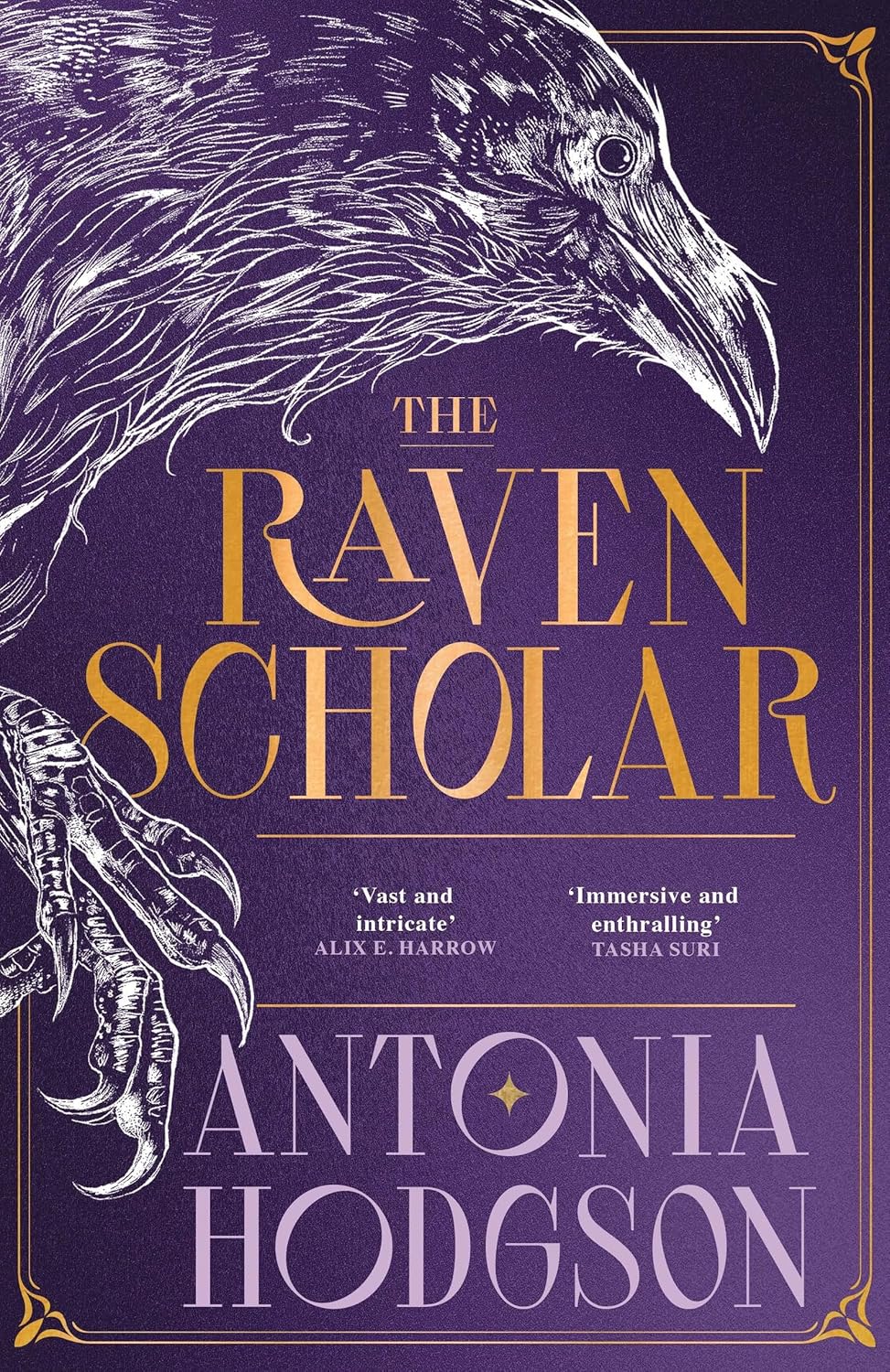
The Raven Scholar by Antonia Hodgson

Publisher: Hodderscape (Trade Paperback – 29 April 2025)

Series: The Eternal Path – Book One

Length: 646 pages

My Rating: 5 out of 5 stars

Amazon

Intriguing author Antonia Hodgson presents one of the best fantasy debuts of 2025 with The Raven Scholar, a powerful and complex novel that hooks you early and refuses to let go all the way to its shocking end.

Earlier this year I was lucky enough to receive a copy of The Raven Scholar, a massive fantasy novel with a very interesting plot idea behind it that will set up the new Eternal Path trilogy.  I had really enjoyed Hodgson’s debut novel, the historical thriller The Devil in the Marshalsea, many years ago, and I really got caught up in The Raven Scholar’s complex and brilliant story.

In the empire of Orrun, a new emperor is crowned every 24 years, with a replacement chosen from acolytes of the eight animal guardians whose blessings have warded and kept the empire in check for generations.  However, the current emperor, Bersun the Brusque, has not had a peaceful reign, marred by an attempted assassination and the subsequent execution of his attacker’s daughter.  His replacement offers a chance at a new era for Orrun, but the sins of the past continue to haunt all involved.

As the next Trials to determine the next emperor begin, seven skilled and revered young challengers emerge for the crown, and it falls to Neema Kraa, the emperor’s brilliant, if unsocial, High Scholar to organise much of the proceedings.  However, the Trials are thrown into chaos when the Raven contender is brutally murdered, and all the evidence points to Neema as the suspect.

Tasked with proving her innocence, Neema is shocked when emperor Bersun decides to make her the new Raven contender.  Suddenly facing six highly skilled rival contenders who have trained their entire lives to compete in the trials, as well as a proxy chosen by the mystical Dragon temple, Neema finds herself fighting for her life in the deadliest contests imaginable.  If she succeeds, she could take the throne, but to do so she must first survive a dark conspiracy infecting the palace, one that threatens all Orrun and could lead to a new age of darkness for the empire.  Nothing is what it seems, and with the animal guardians returning to the world, chaos is about to engulf the trials, changing its contenders forever.

With an exceptional and powerful story that I could just not put down, The Raven Scholar was a particularly amazing fantasy debut that I absolutely could not stop reading.  Clever, twisty, and continuously exciting, Antonia Hodgson really impressed me with The Raven Scholar, and due to how quickly I absorbed its over 600 pages of content, I have no choice but to give it a full five-star rating.

I must admit, going in I didn’t know what to expect from The Raven Scholar, but I ended up being extremely impressed with the elaborate narrative Hodgson pulled together.  Set around a wonderfully expansive fantasy story about a tournament of skill and brains, Hodgson had to do a lot in this book, and I feel that she ended up creating something very special and particularly addictive.  Starting with an intense introduction that provides some key context for the later events of the story, Hodgson pulls a very interesting move of inflicting a dark fate on the protagonist of this initial part of the book before jumping the plot forward several years and presenting a new main perspective character.  The impacts of this introduction are well felt throughout the rest of the book’s plot, and I love the various secrets, hidden hints and impacts these first couple of chapters had.

Hodgson then moves the narrative of The Raven Scholar into the elaborate period of the tournament to determine the new Emperor of Orrun.  Primarily shown from the perspective of High Scholar Neema Kraa, an isolated figure who suddenly finds herself in the middle of proceedings when the initial Raven contender for the throne, an old rival of Neema, is murdered, and Neema is considered a potential suspect.  Attempting to investigate the crime, Neema finds herself placed as the new Raven contender and must try to survive the intense trials to come.  I love a good tournament arc in fiction, and this proved to be an extremely fun one as each of the participants had to complete several different tasks chosen by each of the participating temples, as well as compete in a series of duels between each task.  This allows for an interesting combination of physical and mental assignments, which proved to be very compelling, as you tried to see who would take the throne.

While the tournament is the narrative highlight of The Raven Scholar, it is only one part of the story, as Hodgson creates some very interesting additional arcs throughout the plot.  Namely, Neema finds herself investigating a dark conspiracy within the palace following the murder of her former contender.  The author uses her past crime fiction experience extremely well here, crafting together a very elaborate and intense mystery narrative that the protagonist is constantly dragged into.  It doesn’t take too long for her to realise the scope of the conspiracy before her, as well as who the participants in it are, although there are a lot of hidden secrets and motivations that come out as the story continues.  I really loved all the impressive twists and turns that resulted in this part of the book, and the massive overarching conspiracy blends extremely well with the tournament part of the story, with the revealed antagonists using elements of it to try and take out the Neema and other problematic contenders.  I also really appreciated how so much of the big moments of the plot flowed on from the complex introduction to the story, and Hodgson does an amazing job hiding hints at what is to come throughout the entire book.  Everything leads to the big finale of The Raven Scholar, where all the secrets come out and you are left shocked by what occurs.  I honestly didn’t see every twist coming, and I loved how Hodgson kept subverting expectations about where the plot would be going.  The book ends on a very interesting note, and you will come away very excited to see where the series goes from here, especially as the story can only get more complex and twisted.

The Raven Scholar was a really well written novel, and I must highlight how well Hodgson combined her elaborate fantasy world and it’s defining tournament, with complex characters and excellent intrigue and mystery.  The range of elements in this novel is very impressive, and I liked how well Hodgson brought them together, allowing for quite a well-layered book.  The author’s ability to insert an array of subtle hints and important details throughout the book was also amazing, with a variety of seemingly inconsequential statements, conversations or observations coming back into play at later parts of the story.  Some of these were particularly clever and I really appreciated seeing all these cool elements coming into play as the story continued.  This powerful narrative is further enhanced by the author’s intricate fantasy universe, which makes good use of its zodiac inspired system of animal guardians to create a very compelling tournament background.  The scenes throughout the tournament are a true highlight and I loved the intense action and the high stakes that accompanied them.  Throw in the machinations of several of the animal guardians, as well as the complex past of some of the characters, and there is so much to absorb and appreciate about this elaborate book.

I also really enjoyed the impressive cast of The Raven Scholar, whose unique stories added some excellent additional detail to the plot.  The main protagonist, Neema Kraa, was a great central figure in the book, especially with her complex past, poor social status, and the fact that her current advancement came as a result of her worst actions.  Neema spends much of The Raven Scholar trying to redeem her past mistakes, and her eventual placement in the tournament allows her the chance to prove herself.  You really get invested in Neema’s struggles as the book continues, and I liked how she kept evolving to meet the challenges before her, becoming a major contestant to the throne.  The rest of the contenders are all interesting in their own way, and I appreciated the compelling storylines and history that the author built around them.  This includes the Fox contender, Cain, whose complicated romantic past with Neema becomes one of the more interesting recurring plotlines in the book, while his bold nature and inappropriate sense of humour made him a firm favourite of the reader.  I personally enjoyed how Neema twisted his past a little as the plot continued, ensuring that his arc went in some surprising and dark directions, and you really feel drawn to him, especially when he annoys all the other more serious figures in the book.

Other key characters include the Tiger contender, Ruko Valit, who was a dark figure in the plot, especially as he deals with the treachery that led him to become a favourite in the tournament.  A determined and arrogant figure, Hodgson works a great potential redemption arc around Ruko, while also cleverly hinting at the destructive role he will have in the future.  Ruko’s sister Yana was a key early figure in the novel, and while you don’t get the chance to know her too well, the consequences of the actions taken around her haunt many of the characters to come.  The rest of the cast are also cool, although I will limit myself by highlighting a really sinister hidden antagonist, as well as certain animal guardians who visit the realm and interfere with some of the contenders in dramatic manners.  I personally felt the various aspects of the Raven for example were fun, not only with how part of them influences Neema, but with the narrator role the main body takes on for part of the book, which includes footnotes.  All these figures, as well as the many other compelling figures featured within the plot, help to make The Raven Scholar something very special, and I look forward to seeing how many of the fantastic character arcs Hodgson started here, continue in the future.

Overall, I found The Raven Scholar to be an extremely cool and outstanding book, especially as author Antonia Hodgson weaved together a particularly intricate and captivating narrative.  Loaded with intriguing details, clever twists, amazing characters, and so much excitement, I quickly fell in love with The Raven Scholar, and I could not stop reading it, powering through hundreds of pages at a time.  I honestly cannot recommend this book enough, and I enjoyed The Raven Scholar so much that I had to include it on my recent list of top books from the first half of 2025.  I cannot wait to see how Hodgson continues this series going forward, but I am already certain it is going to be something really awesome and very memorable.

Amazon

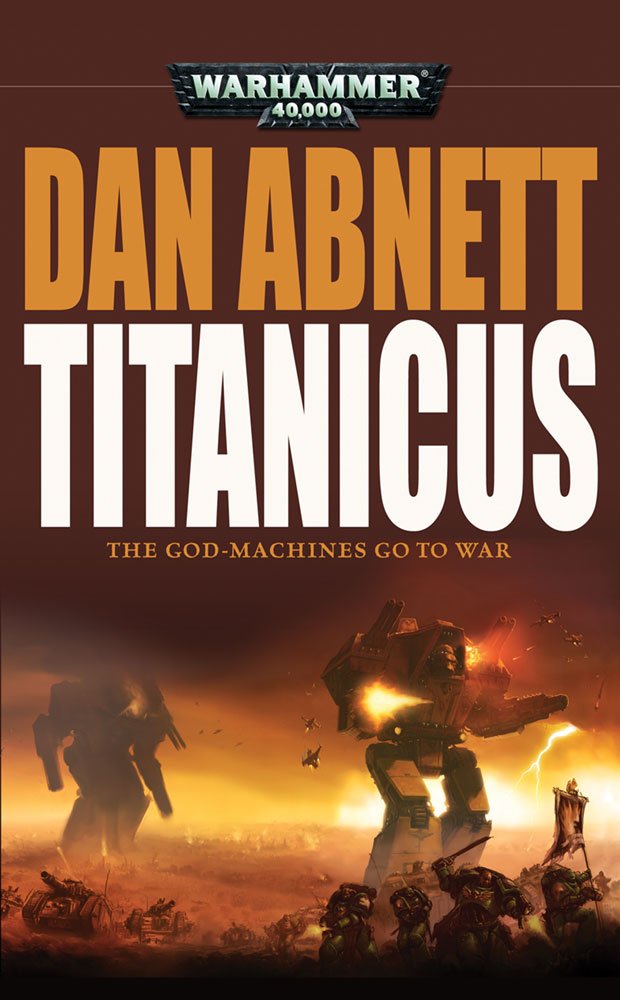
Warhammer 40,000: Titanicus by Dan Abnett

Publisher: Black Library (Audiobook – 1 September 2008)

Series: Warhammer 40,000/Sabbat Worlds Crusade

Length: 13 hours and 38 minutes

My Rating: 5 out of 5 stars

Amazon

The Titans walk to war in this brutal and captivating Warhammer 40,000 novel from the legendary Dan Abnett, Titanicus.

Of the many great Warhammer 40,000 authors out there, few are as impressive as Dan Abnett, who has envisioned an incredible number of awesome battlefields and unique character-focused war stories across the Warhammer universe.  Abnett has written a ton of exceptional and powerful books around the franchise, including several series considered to be the seminal texts of the extended universe.  This includes his brilliant Eisenhorn trilogy (XenosMalleus and Hereticus), and he has multiple entries in my favourite Warhammer 40,000 books list.  However, his best-known series is the Gaunt’s Ghosts books, which I am currently in the middle of reading.

The Gaunt’s Ghosts books are a key series of Warhammer 40,000 fiction that follows the frontline human soldier of this grimdark universe.  Set in an extended multi-planet campaign, known as the Sabbat Worlds Crusade, the Gaunt’s Ghosts books follow a ragged regiment of soldiers as they attempt to survive the dark servants of Chaos coming for them.  I am having an exceptional time reading the Gaunt’s Ghosts series, with books like First and Only, Ghostmaker, Necropolis, Honour Guard, The Guns of Tanith, Straight Silver and Sabbat Martyr, really impressing me with the complex stories and intense action.  While I need to read more of the Gaunt’s Ghosts books, I have taken a quick break to read some of the spin-off novels Abnett wrote around his main series.  Also set around the Sabbat Worlds Crusade, these spin-off novels follow other campaigns in this massive sector spanning war and provide Warhammer fans with a more in-depth view of these battles.  These spin-offs include the exceptional Double Eagle, which I had the great pleasure of reading last year, and which featured so many awesome duels between flyers.  Titanicus was another spectacular book shows a new and highly destructive battlefront of the crusade by focusing on the iconic Titan Legions of the Adeptus Mechanicus.

As war rage across the stars, the forces of Chaos constantly seek a way to disrupt the vital Sabbat World Crusade and destroy the human forces fighting to bring new worlds into the Imperium of Man.  To that end, the archenemy launches an ambitious and devastating surprise assault on the vital forge world of Orestes, whose under-strength defenders find themselves under mass attack from Chaos Titan war engines.  With both the citizens of the Imperium of Man and the forges of the Adeptus Mechanicus under threat, the planet appeals for help and soon finds its prayers answered from the stars in dramatic fashion.

Fresh from their own wars and heading out to join the crusade, the Titans of the Legio Invicta arrive on Orestes, determined to help their Mechanicus brethren.  Finding the forces of Orestes severely outwatched, the Invicta Titans stride to war, causing everything to tremble at the god-machines wrath.  Soon the world is engulfed in an engine war, with both sides wielding enough firepower to crack the planet and the entire population of Orestes caught in the conflict.

But as the war continues, a far more insidious threat arises that could impact far more than just the war on Orestes.  Deep secrets from within Orestes Forge soon begin to spill out, risking a schism between the Imperium of Man and the Adeptus Mechanicus.  With the planet trembling under the battling machines and enemy forces growing by the day, can Legio Invicta overcome the peril growing within their brotherhood before Orestes and the entire galaxy is put to the flame?

Dan Abnett presets another brilliant war story that is epic in every definition of the word.  Successfully presenting the awesome power of the Titans, Titanicus is a deeply compelling and impressive Warhammer 40,000 novel that I honestly could not get enough of.  Intense, exciting and so darn cool, Titanicus gets an easy five-star rating from me, as Abnett once again shows just how talented he is.

Titanicus had a particularly awesome and multi-layered standalone war narrative behind it that hooked me thanks to the author’s nuanced take on the destructive conflicts of the Warhammer 40,000 universe.  Starting off with some dark death to hammer home how grim the situation is, you are soon thrust into the main story as the planet of Orestes comes under attack and the defenders are pushed to the limit.  However, hope soon arrives with the landing of Legio Invicta, who back up Orestes’s existing Titans and defenders with their own engines and troops.  Abnett quickly and effectively sets up multiple character specific storylines as the book progresses that show various alternative viewpoints of the war.  The author works hard to showcase multiple levels of the conflict, from the top commanders all the way to the lowliest of soldiers, and I really enjoyed some of the intriguing storylines that emerged.  This includes desperate tales of survival by following human troops caught behind enemy lines and pursued by mechanical monsters, compelling dives into the minds of the Titan pilots, looks at the various political forces on Orestes, and even some fascinating storylines inside the Adeptus Mechanicus forge.  Abnett did an amazing job highlighting the desperate strife and the complex conflicts these figures endured, and you get a fantastic overarching look at the machine war that proves hard to look away from. 

As the plot of Titanicus continues, the various storylines go in some interesting directions, as you follow each of the characters or groups on their own unique journeys.  Abnett did a really good job of ensuring these unique storylines effectively played off each other as the book continues, and the way characters reacted to events from other plotlines was quite clever and helped to produce a cohesive and intense overarching narrative.  The introduction of a compelling storyline around intrigue and dissent amongst the Adeptus Mechanicus characters provides some extra drama and character conflicts, which added some interesting complexity to the plot, especially as it gave you an alternative group of antagonists which worked well alongside the menacing forces of Chaos, whose perspective you don’t see.  I appreciated how well Abnett set this storyline up in advance, and there are some clever hints to this, and other big events, earlier in the plot.

The final third of Titanicus is particularly impressive and intense, as the author brings together his various storylines extremely well.  I especially enjoyed some of the massive action sequences, while the resolution of the Adeptus Mechanicus storyline was powerful and full of drama as big personalities try to overcome mistrust and dissent.  While I would have liked to have seen the final battle in full, I think Abnett’s effective summary worked pretty well, and I understand that spending another few hours in combat would have watered down the author’s main message.  Each major character’s arc is resolved in a very satisfying manner, and there is an excellent blend of dramatic moments and intense action to keep the reader hooked.  I appreciated how a couple of these conclusions were more depressing, rather than being uniformly happy, which fits both the grimdark nature of Warhammer 40,000 as well as Abnett’s overarching themes that war has no true winners.  This story really came together well, and I deeply enjoyed the complex standalone narrative that Abnett came up with.

This was another insanely well written novel from Abnett, who excels at telling dark, deeply personal war stories from multiple perspectives.  The author provides the perfect balance of excitement, deep intrigue and fantastic character growth in Titanicus, all expertly set within the amazing Warhammer 40,000 universe, and it proves to be such an addictive read.  I personally became engrossed in the various character-driven storylines that emerged throughout the plot, especially the long-running storylines that lasted the entire book.  However, even the more minor character arcs, such as the occasional scene from a normal citizen living in the city to an extended look at the crew of a doomed machine, was hard hitting and Abnett really gets you invested in these personal tales.  As I mentioned above, these often-separate storylines worked extremely well in concert with each other, and Abnett did such a good job pulling them together into a brilliant, overarching narrative. 

Of course, you can’t talk about Titanicus’s writing without going into how incredible the action sequences are.  Abnett crafts together so many deeply intense and powerful battle scenes throughout Titanicus that constantly had the blood pumping as you watched your favourite characters brave the dark gauntlet of battle time and time again.  The author had a lot of fun envisioning war on multiple fronts, and I loved how we got to see infantry fights, tank battles and entertaining skirmishes between various augmented foes as the story continued.  However, easily the most awesome thing about Titanicus is the Titans themselves.  Insanely massive and powerful walking war machines, the Titans steal any scene they are in, and there are so many great reactions as the normal human characters see the Titans fight, especially when the despoiled enemy machines advance on them.  However, it is the sequences shown from the perspective of the Titan pilots themselves that are the best, as you become fully immersed into the battles in the scenes as the machines rain down destruction and depth.  You can honestly feel the insane powerful and destructive ability of the Titans as you move throughout Titanicus, and every single battle involving one of these massive walkers is epic on so many levels. 

As with the rest of Abnett’s books, Titanicus proved to be a particularly strong entry in the Warhammer 40,000 canon.  Serving as a companion piece to the Gaunt’s Ghosts books, Titanicus is a must-read to anyone who has enjoyed Abnett’s main series and the overarching campaign it is a part of.  However, as there are no overlapping characters or major storylines, Titanicus can also be easily read as a standalone novel, and indeed would be a great introduction to Abnett’s writing style and his ability to write awesome war stories.  Titanicus would also be the perfect entry novel to anyone interested in exploring Warhammer 40,000 fiction, especially science fiction readers who love the idea of giant piloted war machines.  The cool action, complex character arcs and fantastic standalone narrative ensures that anyone can really dive into Titanicus and have a brilliant time, and I honestly think this book would appeal to a wide range of different readers.

However, as with most books in the franchise, Titanicus will mostly appeal to those established Warhammer 40,000 fans who will love Abnett’s dive into some unique aspects of the universe.  Naturally, this is primarily going to be around the Titans, who are a very awesome part of the Warhammer 40,000 setting that are often underutilised in fiction due to being too overpowered (or getting badly nerfed when they do appear).  I think Abnett did these war machines perfect justice in Titanicus, and you really come away appreciating every aspect of them, including their raw power, their powerful spirit, and the love the crews have for them.  However, Abnett also dives into the dark side of the machine, and some of the sequences that show the pilots losing their humanity were particularly jarring.  Honestly, I thought Abnett’s portray of the Titans was just brilliant, and I have yet to see another Warhammer author do any better.  Abnett also takes a lot of time to dive into the lore surrounding the Adeptus Mechanics.  While these parts of the book might be slightly confusing for newer readers, established fans will love seeing Abnett explore these machine-worshipping figures, especially as a theological schism becomes a major plot issue.  Other cool lore aspects include examining the uneasy relationship between the Imperium and the Mechanicus on planets they share, the dark side of human life on a planet under siege, and even little fun moments, like a toy maker finally finding success as he makes models of the Titans battling across the world.  All these elements make Titanicus a particularly epic read for fans of the franchise, and I personally loved seeing Abnett’s take on all these cool universe inclusions.

While the writing, story and Warhammer 40,000 elements are all exceptional on their own, what really brings them together and makes Titanicus truly awesome are the multiple cool characters scattered throughout the plot.  Abnett introduces a huge range of fantastic and complex characters in Titanicus who you grow quite attached to as the plot continues.  All the characters, from major figures to minor one-scene characters, are fantastically written and cleverly influence the plot in their own cool ways.  Highlights for me included the desperate crew of a destroyed tank who try to escape on foot, only to find more danger in front of them.  A group of inexperienced conscripts who are completely unprepared for the horrors of war also prove to be really entertaining, and you grow invested in their struggles to survive and the tragedies that await them.  Abnett also examines several intriguing Adeptus Mechanicus figures within the Orestes Forge, whose frustrations, ambitions and struggles for power are far more human than they’d like to believe.  However, the best character arc for me was the one that revolved around the crew of a Legio Invicta’s Titan who are forced to accept an Orestes’ Princeps (the pilot plugged into the Titan’s mind) when their own dies without a successor.  The resulting conflicts between the inexperienced and arrogant outsider pilot and the veteran Legio Invicta crew, which includes the Titan’s moderati (second-in-command), who finds himself under a suspended death sentence, sets the scene perfectly, and you become really intrigued in seeing how the Titan will survive.  Watching these figures come together as a crew is a highlight of Titanicus, although Abnett does an excellent job twisting that around later when internal conflict splits the protagonists.  All these characters, and many more, gave Titanicus some real emotional heft, and I became so damn invested in seeing the final fate of so many of these outstanding protagonists.

I think that it’s kind of a given that I listened to Titanicus on audiobook rather than seeking out a physical copy of the book.  Warhammer audiobooks are so damn good, and frankly there is no better way to enjoy the franchise’s awesome narratives and compelling action.  This is particularly true for Titanicus, as the intricate details and impressive combat sequences really shine through even better when read out.  I especially loved how incredibly epic the various Titan-on-Titan battles came across in this audiobook format, and the fantastic voice of narrator Toby Longworth ensured that you were enrapt by every single second of carnage.  Longworth, who is one of my favourite audiobook narrators, always does an exceptional job bringing Abnett’s amazing stories to life, and he was once again exceptional here in Titanicus.  Longworth captures all the characters in Titanicus perfectly, and you get a real sense of their personalities, emotions and their reactions to the insane events of the book.  This includes the various Adeptus Mechanicus figures, which Longworth voices in all their mechanical glory, and you can just imagine these augmented figures, and indeed all the complex characters of Titanicus, as Longworth describes them.  This makes for such an exceptional experience, and I flew through the audiobook’s near 14-hour long runtime extremely quickly.  There is honestly no other way to enjoy Titanicus than on audiobook, and you are guaranteed to have an amazing time.

Dan Abnett continues to showcase why he is such a highly regarded author of Warhammer fiction with the brilliant and captivating Titanicus.  Perfectly showcasing a war between one of the franchise’s most epic components, the massive Titan war engines, Titanicus was an exceptional read from start to finish and one that I cannot recommend enough.  I had such a great time with Titanicus, and I look forward to reading even more Warhammer 40,000 books from Dan Abnett this year.

Amazon

The Dragon in Winter by Jonathan Maberry

Publisher: Macmillan Audio (Audiobook – 20 August 2024)

Series: Kagen the Damned – Book Three

Length: 20 hours and 57 minutes

My Rating: 5 out of 5 stars

Amazon

The damned rush to their final battle in the epic dark fantasy novel, The Dragon in Winter, which brings an exceptional conclusion to author Jonathan Maberry’s Kagen the Damned series.

As I mentioned in my recent review for the author’s other 2024 release, NecroTek, I am a huge fan of Jonathan Maberry, having really gotten into his elaborate and deliciously gritty thrillers and other pieces of fiction since I started this blog.  While I am most familiar with the author’s long-running Joe Ledger series, one of his more intriguing recent bodies of work has been the Kagen the Damned series.  A dark fantasy fiction series that follows a highly damaged figure who seeks bloody revenge after the dastardly Witch-king uses magic to destroy his kingdom and kill the royal children in his care, the Kagen the Damned books were an incredible pivot into the fantasy fiction genre for Maberry that I deeply enjoyed.  Both of the previous books in the series, Kagen the Damned (one of my favourite books and audiobooks of 2022) and  Son of the Poison Rose (one of my favourite books and audiobooks of 2023) were five-star reads, and I have so much love for this series (which also includes the novella I Say Your Name in the Dark Nights) due to its elaborate storytelling, damaged characters, and intriguing take on the fantasy genre.  Because of how impressive the first two entries in this series are, I have been eagerly awaiting the third and seemingly final book, The Dragon in Winter, for a long time, and it was one of my most anticipated books of 2024.

Nearly a year after the bloody massacre that saw the dread Witch-king of Hakkia conquer the former Silver Empire in a single night, the war to reclaim the throne is finally here.  As the Witch-king continues to plot, planning to ascend to godhood, his enemies have rallied around the unlikely figure of Captain Kagen Vale, better known as Kagen the Damned.

Once the loyal guardian of the Silver Empire’s heirs, Kagen has survived despair, damaging revelations and damnation from his gods to stand against the Witch-king and gain the bloody vengeance he so desperately needs.  Having proven his valour in combat and his ability to face off against the darkest of magic, Kagen has managed to gather a massive army of rebels, outlaws and the soldiers of various allied nations determined to stop the Witch-king for good.  But this army of flesh and blood men will not be enough to stand against the destructive power of the Witch-king alone.

As magic continues to return to the land, Kagen and his allies soon find themselves beset by the Witch-king’s sinister powers and dread allies, as vampires, demons, magic users and other fell creatures emerge, determined to keep the Witch-king on his bloody throne.  To survive, Kagen will need to find magic of his own that will allow him to withstand the Witch-king’s power.  But the more he looks, the darker secrets he unravels, and soon everything he thought he knew about the world will come tumbling down around him.  Worse, an even more dangerous threat is rising in the frozen north, as a tortured dragon calls out in despair and is answered by a being of unimaginable power.  Can Kagen stop the Witch-king before his dark plans come to pass, or will the dread flames of vengeance consume the entire world?

What an outstanding end to one of my favourite new fantasy trilogies!  The Dragon in Winter was another exceptional novel from Jonathan Maberry that serves as a fitting and powerful end to the Kagen the Damned dark fantasy series.  Loaded with insane action, brilliantly damaged characters, and some fantastic storytelling, The Dragon in Winter was an incredible book that perfectly utilises Maberry’s distinctive style.  I had an amazing time listening to this impressive book, and it gets an easy five-star rating from me, especially on audiobook.

Maberry had to achieve a lot with this third Kagen the Damned novel, as not only did readers require a satisfying end to the trilogy, but this book needed a distinctive story much like the previous entries.  I feel that Maberry achieved both these goals, as The Dragon in Winter was a compelling and dark read that provided a great mixture of adventure, war, intrigue and character growth, all while continuing and concluding the storylines from the previous books.  This third novel starts shortly after Son of the Poison Rose and sees Kagen taking on the role of general by leading a small army against the Witch-King’s forces, while the previously established story threads about the various nations building their armies to join the war come to fruition.  Maberry does a great job of resetting the scene in these early chapters, and not only do you get to see the situation from Kagen’s perspective but multiple scenes are shown from the antagonists’ side as they make their preparations to foil the protagonist and his allies.

Much of the middle of the story follows Kagen and his unlikely allies as they prepare for the inevitable final confrontation, attempting to gain additional ways to fight against the Witch-king.  While some of Kagen’s sequences aren’t entirely necessary for the full advancement of the plot (the goblin cave sequence, for example), they are all generally intense and character building, and they all tie in nicely amongst the other storylines about war preparations and the Witch-king unleashing his dark minions upon the world.  A secondary major storyline focuses on the characters of Jheklan and Faulker, Kagen’s brothers, who journey up to the frozen Winterwilds in search of the last dragon.  This storyline proves to be quite an interesting addition to the story, as while the characters are disconnected from the rest of the plot due to distance, their actions have big impacts on the overarching narrative.  This middle part of the story ends with a major confrontation between a memorable supporting character and a dark set of antagonists, which was not only very awesome but helped to set the scene for the rest of the book.

The final third of The Dragon in Winter is all action and excitement as the final battle of the war is unleashed on multiple fronts.  Maberry expertly brings all the various ongoing storylines to the boil, as the protagonists find themselves in mortal peril.  There is a little bit of everything here, including massive war sequences, smaller battles with huge sacrifice and big revelations finally coming to the surface.  The author keeps the tension extremely high during this third act, and you are constantly on the edge of your seat, especially as your favourite characters face doom and destruction at every turn.  I loved the way many of these storylines came together, and while a couple of big moments were easy to see coming (although for me that just increased the anticipation), there were also some reveals I couldn’t have predicted.  This includes the book’s massive twist that turns around much of what you thought you knew for the last two entries in the series.  I felt that this twist was very clever, especially when you consider the subtle hints leading up to it, and I appreciated how it changed the emotional impact of some previous scenes.  Everything leads up to the big final confrontation, which was as bloody and hard-hitting as you would expect.  This confrontation was chaos, carnage and catastrophe, and I felt that it was a fitting end to a dark trilogy that revelled in bloodshed.  While I do feel that the final boss takedown was a tad anticlimactic due to who got the kill, and Maberry reigned in the tragedy far more than I expected, this conclusion was extremely awesome, and I hung on every word right to the very end.  Everything was very nicely wrapped up, although there is potential for Maberry to revisit this series in the future, which could result in some more gripping adventures.

I always love the way that Maberry manages to apply his distinctive writing style to all his novels, no matter the genre, and it always works to create a powerful and exciting read, especially in The Dragon in Winter.  The large number of short chapters allows for a quick pace, and you are constantly jumping from sequence to sequence, eager to see what will happen next.  Maberry also excels at featuring a huge range of alternating perspectives as the book continues, with the point of view jumping around various interesting characters chapter to chapter.  While much of this focuses on the main protagonist, you are often following many of the fascinating and fun supporting characters as they go about their own adventures.  There are also multiple chapters shown from the perspective of the villain or his minions, and I love how the reader are constantly let into the antagonist’s plans, which helps to raise tension as you worry that they are one step ahead.  Throw in several additional perspective chapters from one-off characters, which often help to highlight some of the darker events going on in the wider setting, and this great jump in perspectives allows for a particularly complex and layered narrative that is so fun to navigate.  Of course, the real highlight of any Maberry book is the exceptional action sequences that pump some massive excitement into the plot.  Maberry is extremely talented at envisioning fight scenes of any size or shape, and I found myself constantly enthralled by the many, many battles that were contained in The Dragon in Winter.  This includes deep personal battles, running skirmishing or even a truly massive full-on war sequence with unique participants, all of which come across extremely well thanks to the author’s powerful and descriptive writing that captures every sword thrust or slice of the protagonist’s blades.

The Dragon in Winter continues to exhibit many of the dark fantasy elements that made the first two Kagen the Damned books so awesome to read.  Maberry really dove into the genre with a vengeance in this series, and I love how he pulled together a rich and powerful fantasy world loaded with both unique features and classic fantasy creatures and monsters.  Thanks to the author’s detailed writing and tendency to effectively recap key elements of the series, readers can easily absorb all the key elements of this universe, and it proves to be fascinating to take in, especially as Maberry loads it with secrets, deep history, and hints of other lands yet to be visited.  Of course, as this is Maberry, there is also a strong Lovecraftian vibe to this universe, as many of the elder gods and other associated beings have a place in this realm.  The author does a great job of exploring these classic Lovecraftian creatures throughout the course of the series, and the way they are worked into the main plot of The Dragon in Winter is extremely clever, especially if you have seen examples of them in some of Maberry’s other series.  For readers expecting a typical fantasy read, I should warn that The Dragon in Winter, like the rest of the Kagen the Damned series, gets very dark and brutal at times, and there are a lot of strong references to violence, torture, sexual assault and other troubling features that probably won’t appeal to every reader.  I feel that while Maberry occasionally goes a bit overboard with these darker inclusions, for the most part it helps to create a powerfully grim overarching tone that raises the stakes and ensure you are constantly rooting for the protagonist to succeed and bring a bit of justice to the world.  It also works very well alongside the awesome action sequences, and for those fans of some very bloody fights, including those featuring pure evil fantasy and horror creatures, you are in for an amazing time here.

While the action, setting and clever storytelling is an exceptional part of The Dragon in Winter, I also need to highlight the various impressive characters featured throughout this book.  Due to The Dragon in Winter being the last entry in this trilogy, Maberry spends much of this book finalising key character storylines, allowing for a much more personal entry in the series that will really appeal to those readers who have grow attached the protagonists in the first two books.  As such, this final Kagen the Damned novel features an array of great characters who are so well written and who often feature their own powerful and personal character arcs. 

Like with the rest of the series, much of the book’s character work is focussed on the main protagonist, Kagen Vale, who thanks to the dark deeds he has witnessed has been given the title Kagen the Damned.  A moody and deadly figure, Kagen has gone through so much despair and darkness in this series, and it has been a powerful journey following him this far.  Maberry did an outstanding job continuing Kagen’s story in The Dragon in Winter, and it was great to see how far Kagen has come, especially as he now uses his inner darkness, past trauma, and even the damnation of his gods, to fuel his desire to fight.  While he has overcome many of his past traumas, Kagen does experience new ones in The Dragon in Winter, as he finally understands the full scope of the evils unleashed upon the world, including by his own people.  This allows for some more dramatic sequences from the protagonist, and part of the emotional strength of the story is watching Kagen overcome even these revelations, especially with the help of his friends.  I have really appreciated how well Maberry has written Kagen’s pain and deeper heart throughout the series, and it was fantastic to see some of this pain finally come to an end in this final novel.

Aside from Kagen, the rest of the supporting cast proves to be quite exceptional, and there are many fascinating characters you become attached to as a result.  I personally loved seeing more of Kagen’s two friends and comrades, Tuke and Fillia, who form a hilarious put powerful trio as they fight together against the odds.  Essentially Kagen’s conscience and voice of reason, Tuke and Filia are the perfect supporting characters to the protagonist, and I love how they constantly anticipate Kagen’s behaviour and manipulate events to ensure he does what they want.  However, they also have their own compelling adventures outside of Kagen, especially when they lead the final battle, and you care nearly as much for them (if not more) than you do Kagen by the end of things.  Maberry also invests a lot of time in The Dragon in Winter to the amusing characters of Jheklan and Faulker Vale, Kagen’s brothers and mischievous adventurers.  While they have had minor appearances in the previous novels, Maberry only featured them as major, fleshed out characters in this final book, as they lead their own expedition to the frozen Winterwilds.  While they are relatively new figures, the reader quickly becomes intrigued by their storylines, especially as it is loaded with adventure and a certain comedic charm thanks to the brother’s juvenile nature.  However, while they are often unserious, when the chips are down Jheklan and Faulker get serious quick, and Maberry ensured that they encounter some real tragedy that shows the true heart of these figures.

While there are other great supporting characters I could talk about, including a vengeful widow and a scarily powerful vampire elf, I want to finish by mentioning the various villains, who are some of the best characters in The Dragon in Winter.  This includes the sinister Witch-king and his court, who are constantly plotting to destroy the world and kill Kagen.  The Witch-king is particularly malevolent in this book, and Maberry continues to build on the revelations surrounding him in this final book, providing even more fun context and twists.  I also love the continued focus on the Witch-king’s terrified advisors, Lord Nespar and Jakob Ravensmere, who find themselves way over their heads as they try to serve their lord and their own agendas.  However, the devilishly fun character known as the Prince of Games easily steals every scene he is in, and I loved his constant manipulations and chaotic nature, especially as it brings great fun to the Witch-king’s dark court.  The Prince of Games, who has some interesting links to some of Maberry’s other series, perfectly rounded out this cast of villains, and I really appreciate how much depth and complexity these antagonists, and indeed every character in the Kagen the Damned series, brought to the overall story.

As with all Maberry’s previous books, I chose to check out The Dragon in Winter on audiobook, which is the best format to enjoy the author’s captivating narratives in.  Maberry’s short chapters, elaborate world building, intense action and over-the-top characters really come to life when they are read out loud, especially when it is done by the legendary Ray Porter.  Porter has long perfected the tones to get the most out of Maberry’s writings and his infectious and compelling voice expertly captures the inherent dark nature of Maberry’s writing and helps to send the crazy scenes of carnage straight into the listener’s head.  The narrator knows exactly how to portray Maberry’s great, larger-than-life protagonists and villains, and you can easily imagine each of the figures and their actions as Porter reads them out.  I particularly enjoy how well Porter captures the various emotional states of these characters, and you always hear the despair, anger or fear of each of these figures when they speak.  This especially true for the primary protagonist, Kagen, and I always appreciate how well the narrator showcases his many dark emotions as he goes through the wringer time and time again.  Throw in some truly chilling voices for the various villains and evil monsters that the protagonists encounter, and Porter’s performance was once again exceptional, allowing for quite an awesome audiobook.  With a runtime just short of 21 hours, this is a long audiobook to check out, although you really don’t mind as it becomes hard to stop listening to The Dragon in Winter, especially during the various climatic or intense sequences.  I had such a great time listening to The Dragon in Winter, and this such an amazing format to enjoy this latest Maberry novel on.  Indeed, I loved it so much I listed it as one of my favourite audiobooks of 2024, even before I finished it, so do yourself a favour and check out this novel on audiobook right away.

Thanks to its powerful story, intense action and damaged characters, The Dragon in Winter was another incredible read from Jonathan Maberry that I could not get enough of.  One of the best books of 2024, The Dragon in Winter was an outstanding final entry in the Kagen the Damned series, and I loved every single second I spent reading it.  Highly recommended on all formats, especially those read out by Ray Porter, The Dragon in Winter is so damn good, and it will be interesting to see if Maberry decides to return to the fantasy genre again the future.  In the meantime, we’re only a few months off from Maberry’s next book, Burn to Shine, which will probably be one of the best things I read in 2025.

Amazon

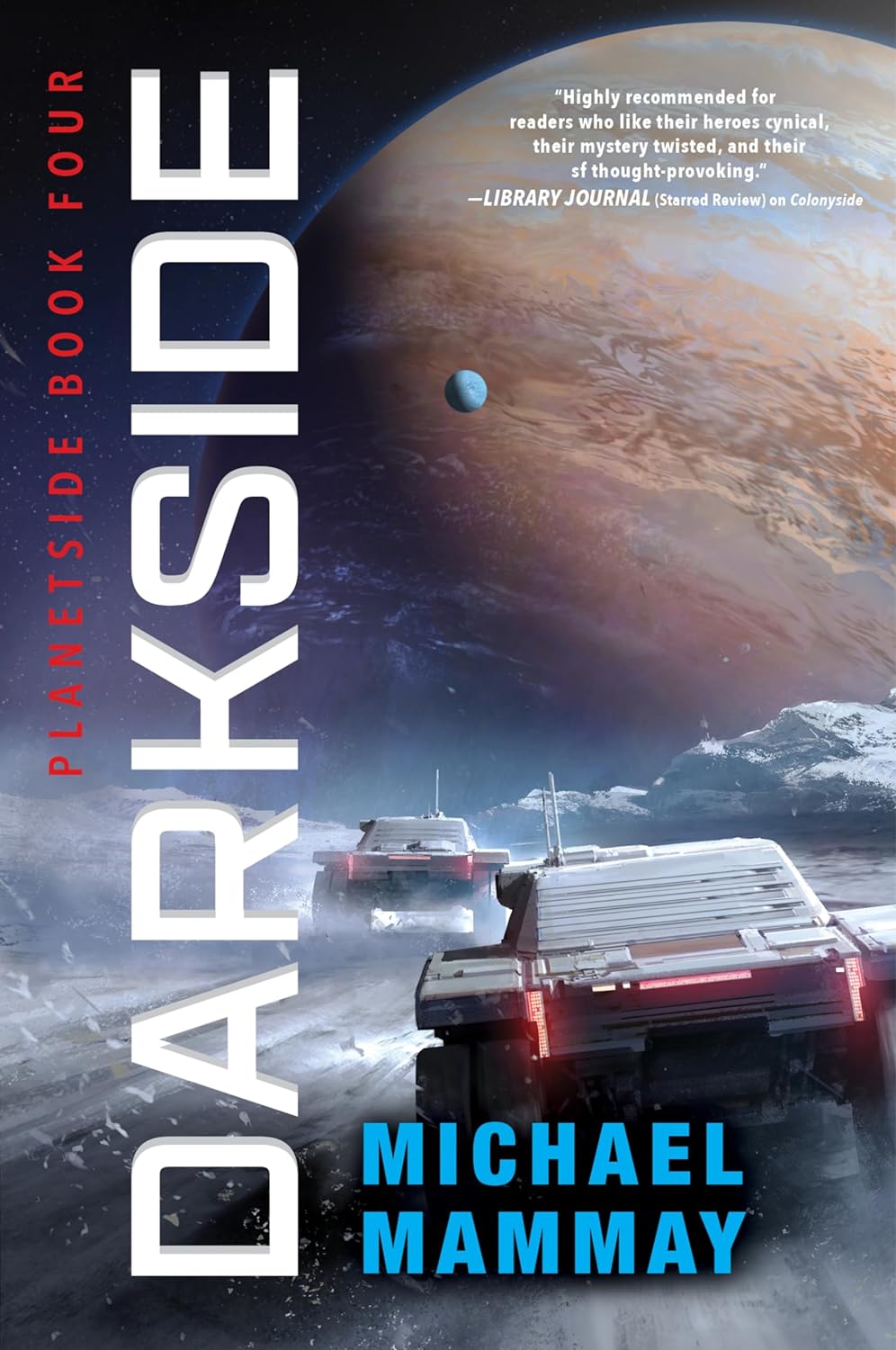
Darkside by Michael Mammay

Publisher: Harper Audio (Audiobook – 24 September 2024)

Series: Planetside – Book Four

Length: eight hours and six minutes

My Rating: 5 out of 5 stars

Amazon

One of my favourite science fiction authors returns with another fantastic and compelling military thriller in space, the highly addictive Darkside by Michael Mammay.

Back in 2018 I had the very great pleasure of reading the debut novel of new author Michael Mammay, Planetside.  An intriguing science fiction thriller that sent a retiring military officer to an alien planet to find a missing soldier, Planetside turned into quite the clever and exciting read, and I really got attached to its complex narrative and maverick protagonist.  Ending on a massive and well-written twist, Planetside was an exceptional read and was one of my favourite books of 2018.  The series continued strong from that point on as Mammary released more cool additions to the Planetside series, each of which pit the protagonist against human corruption and corporate greed in the depths of space with Spaceside (one of my favourite books of 2019) and Colonyside (one of my favourite books and audiobooks of 2021).  I have been curious to see if Mammay was planning to continue this series going forward, and I was nicely surprised earlier this year to find out that there was a fourth book coming out with Darkside.  One of my most anticipated books of 2024, Darkside was an intriguing entry to the series that once again forced the author’s protagonist to deal with old corporate threats on a distinctive new environment.

Colonel Carl Butler, former military officer turned genocidal fall-guy, has had an interesting life since his retirement from the military.  Thanks to the machinations of both the government and powerful corporation, Butler has found himself drawn into multiple conspiracies, and his direct way of dealing with the resulting controversy has made him infamous throughout the galaxy, as well as making him some very dangerous enemies.

Attempting to live out a quiet life on a remote planet, Butler finds his retirement once again disturbed when a young girl tracks him down, requesting his help in finding her missing father.  Finding it hard to say no to the desperate girl, especially when it becomes clear that something truly sinister has befallen her father, Butler reluctantly agrees to help, not realising the trouble he is about to find himself in again.

The missing father, Jorge Ramiro, had been working as the assistant for a famous archaeologist on the isolated moon of Taug.  With no electronic trace of Jorge remaining on the planet, Butler and his team chart a ship to the mining operations of Taug to find him.  However, Butler soon finds his investigation complicated by the fact that he has history with the two consortiums who control mining on Taug, Caliber and Omicron, as both have tried to kill him in the past.  Determined to find the truth no matter what, Butler relentless follows the dwindling trail of clues before him, even when that leads to the dangerous dark side of Taug where secrets lie hidden, and the two corporations are free to act without repercussion.

Michael Mammay presents another outstanding and impressive science fiction thriller that drags the reader in with its elaborate tale of intrigue, secrets, and one determined man seeking to fight the system.  Featuring a great combination of elements and a fantastically fun protagonist, Darkside was a brilliant addition to the Planetside series, and I had such an amazing time with it that it gets a full five-star rating from me.

I felt that Mammay produced another exciting and captivating narrative for his fourth Planetside book that ties in nicely to the rest of the series while providing readers with an excellent and entertaining ride capable of standing on its own feet.  Once again bringing in series protagonist Carl Butler to investigate a mysterious case on a new planet, Darkside features a fantastic tale of mystery, corporate antics and deeper intrigue.  The author does a great job of quickly setting the scene at the start of Darkside before dropping the protagonist right into the action as they attempt to find the missing father on Taug.  Seeking information from both corporations on the moon, Butler initially starts a methodical and low-key investigation.  However, things get tricky when Butler and his team discover evidence of a major coverup, and the protagonist is forced to pit the corporations against each other in his attempts to find the missing person.  This complex first half proves to be an excellent start to the novel, and Mammay ensures that the tension, stakes and mystery rise at an effectively rate, keeping the reader’s attention the entire way through.

Things take a very exciting turn around halfway through Darkside, as Butler’s investigation provoke action from his opponents that results in some extremely dramatic and intense moments.  While I had been enjoying the investigation and intrigue of the first half of the book, it was fun to dive into something much more action packed for the second half, and I really enjoyed the exciting direction that Mammay took the story.  There are some great reveals here, and I love how complicated the various corporate lies and agendas became at times.  Everything leads up to a very intense final set of sequences, as Butler finds his back against the wall and is forced to decide which devil to have in his corner.  There are some great twists here, as well as a cool chapter told from the perspective of one of the series’ major supporting characters, and it leads up to a particularly intense and moving conclusion that perfectly fit the overarching anti-corporate message of the entire series.

Darkside has an excellent and addictive style to it that really draws the reader in.  Told from the perspective of the cynical, but realistic, Colonel Butler, readers are presented an outstanding thriller novel expertly set in a futuristic setting.  Starting off with a mystery of a missing person, the story evolves into a more elaborate game of intrigue as the protagonist attempts to outsmart two rival companies.  Mammay hits the right blend of manipulation, investigation and action throughout Darkside, and readers are presented with a great story that thrills the reader while dragging them further in with the curious mystery.  This story is well set by the moon of Taug, which proves to be an outstanding setting for this intense novel.  Not only does Mammay provide some striking descriptions of this desolate moon, but the isolated nature of it, as well as more scientific elements like gravity and composition, are well utilised in the plot, creating problems and opportunities for the protagonists.  Whilst Darkside is part of a larger series, for the most part it is a standalone novel that new readers can easily dive into, especially as there is an effective summary at the front to fill in some major details about the protagonist and his previous outings.  I think I had a bit more fun having read the previous books first, especially as you appreciate how Butler’s relationship with some of the supporting characters has grown, as well as having a better understanding the protagonist’s adversarial relationship with the corporations on the moon.  Darkside was such a great addition to this series, and I had an exceptional time powering through this novel in record time.

Another major element of Darkside, and indeed the entire Planetside series, that I come to really enjoy, was the outstanding characters who sat at the heart of the story and who add some real emotional depth to the book.  This primarily refers to the protagonist and point-of-view character, Colonel Carl Butler, who is very fun to follow.  A former career soldier trying to enjoy retirement, Butler has been hit by controversy, betrayal and the downside of duty, which has made him infamous and forced him to live on a remote planet.  Despite this, he is still a cheerful figure whose desire to do good forces him into another adventure.  Witty and honourable, Butler has a very eccentric personality that results in most of Darkside’s humour, and you have to laugh at some of his clever thoughts and responses to the dark events around him.  Despite having a seemingly carefree, easy-going attitude, Butler is a canny operator at this point in the series, and it was great to see how he has finally learnt from his previous experiences of dealing with corrupt corporations.  I also really enjoy how Mammay portrays Butler’s thought process in this novel, as you get to see him weighing the options and impacts of his various potential actions, and seeing the steps Butler takes to make his decisions makes him a little more human and relatable to the reader.  As such, you really get caught up in Butler’s latest crusade, and it proves hard not to root for him the entire way, even despite his dark history.

In addition to Butler, Mammay also features a great supporting cast of characters in Darkside, most of whom play off Butler extremely well.  This includes the returning characters of Mac and Ganos, Butler’s bodyguard and computer expert respectively, who once again saddle up to help.  Mammay works these two characters back into the plot quickly and effectively, and it was great to see this team in action again.  Mac and Ganos serve as an entertaining support to Butler, especially as by this point, they have learned to anticipate their boss’s likely course of action.  I really enjoyed seeing the close camaraderie and support these three had together, and it there were some excellent and moving moments as a result.  The rest of the case also worked well around these central characters, with several new members of Butler’s team providing some intriguing plot options.  Throw in the usual collection of local soldiers who work with Butler, and a group of manipulative corporate officers who serve as the antagonists, and the cast of Darkside proves to be a fantastic part of the book, and I loved seeing them all in action.

I ended up enjoying Darkside on audiobook, which has been my preferred way of enjoying the Planetside books, primarily because of the inclusion of R. C. Bray as the narrator.  Bray, who is one of my favourite audiobook narrators, did another exceptional job voicing the characters in Darkside, and I love how well his gruff and rich voice fits Colonel Butler.  Bray’s voice work perfectly captures Butler’s sarcastic, pragmatic and rebellious streak, and you really get caught up in this excellent narrator’s central performance.  In addition to his excellent portrayal of Butler, Bray also brings all the supporting cast to life in fun and effective manner, with each character given their own distinctive voice or accent.  I particularly enjoyed the fun voice he gave to Butler’s right-hand man, Mac, which was handy considering Mac got a lengthy chapter from his perspective that really popped in Bray’s voice.  I honestly don’t think I would have enjoyed Darkside quite as much without having Bray read it out to me, and I have so much love for the paring between Bray and Mammay’s great writing.  Coming in with a runtime of just over eight hours, most people will be able to power through Darkside very quickly, and I honestly found it very hard to stop listening to this audiobook, which comes very highly recommended.

Michael Mammay continues to impress with Darkside, a brilliant addition to his fantastic Planetside series that proves hard to turn away from.  Clever, exciting, and featuring a well-written and intense story, Darkside is one of Mammay’s best Planetside novels yet, and I cannot wait to see how he continues the story in the future, especially as the rascally protagonists keeps making more and more enemies.

Amazon

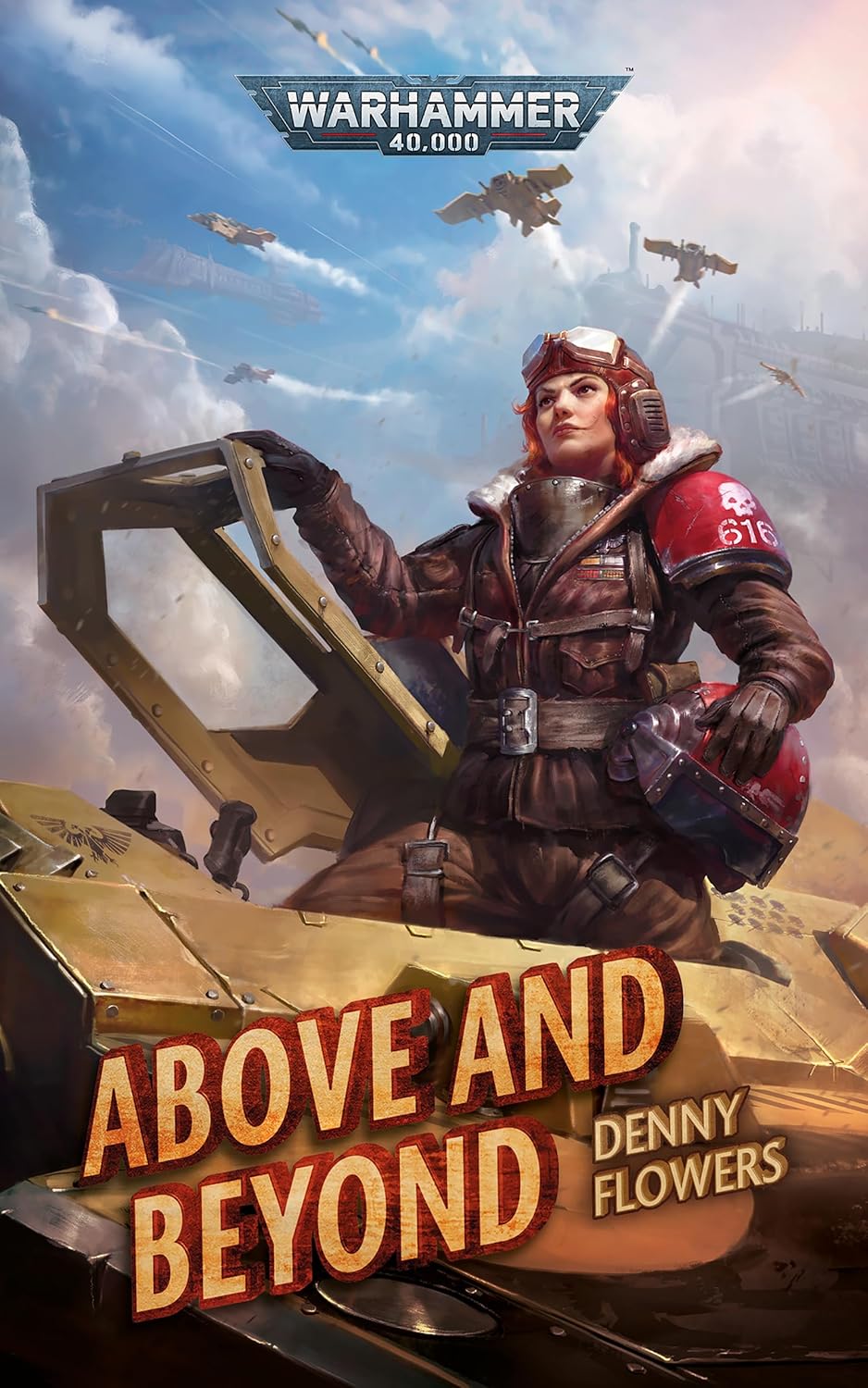
Warhammer 40,000: Above and Beyond by Denny Flowers

Publisher: Black Library (Audiobook – 12 October 2024)

Series: Lucille von Shard series – Book Two

Length: 12 hours and 52 minutes

My Rating: 5 out of 5 stars

Amazon

Denny Flowers presents one of the most ambitious and captivating Warhammer 40,000 novels of 2024, with the brilliant and deliciously cynical read, Above and Beyond.

As a massive fan of all things Warhammer 40,000 fiction, I have been spending awful lot of time diving into all the recently released novels and audiobooks from the franchise (see the ever-expanding Warhammer tab to the right).  As such, I have become quite familiar with the newer authors contributing to this massive expanded grimdark universe, and there are several rising stars that my radar is firmly fixed on.  This includes the very impressive Denny Flowers, who honestly has the potential to become one of the best authors in this franchise.  While he has so far only written three books (including this one), every single new novel from Flowers is a step above the last, and I have really gotten attached to his fantastic imagination and writing style.  His first book, Fire Made Flesh, was an awesome book, and it ended up being one of my favourite debuts of 2021.  However, Fire Made Flesh was quickly overshaded in my mind by the author’s brilliant second book, Outgunned.

Outgunned was an outstanding read that dove into the darker side of the already grim Warhammer 40,000 universe in all the right ways.  Following a propaganda expert as he attempts to create an epic film based around a legendary fighter ace, Outgunned proved to be an excellent read, especially once the protagonist beings to understand just how jaded his chosen subject is.  However, a rampaging ork invasion and elaborate political intrigue on a miserable swamp planet brings events even further to a head, and the protagonists endure a gruelling and desperate battle to survive.  I really loved Outgunned thanks to its unique narrative, and it has had a proud place in my favourite Warhammer 40,000 novel list.  Due to how impressive I found Outgunned to be, I was very excited when I heard that a sequel was out this year and made sure to grab Above and Beyond the first chance I could.

Kile Simlex is a broken man.  Once one of the most successful propagandists in the Imperium of Man, Simlex’s films used to inspire untold millions in the name of the God Emperor, ensuring innumerable new recruits to humanity’s armies.  However, a cursed assignment to the swamp planet of Bacchus showed him the realities of war and innate corruption of the Imperium, while his chosen subject, the eternally cynical fighter ace Lucille von Shard, proved to be both a skilled fighter and a deadly disappointment.

Years later, Simlex is now a shadow of his former self.  Emotionally and physically scarred from his experiences on Bacchus, Simlex’s attempts to show the Imperium’s citizens the real horrors of war ensured that he was dismissed from his lofty position.  Now forced to toil as lowly scribe, Simlex has grown bitter as his footage from Bacchus was used to create a crass and untrue popular film which elevated Flight Command von Shard to the status of legendary hero.  However, Simlex is about to find his chance of redemption when he once again becomes involved with the dangerous von Shard family.

Attempting to live in obscurity, Simlex’s life is turned upside down when Shard’s brother, Commissar Tobia von Shard enters his office.  Commissar von Shard has intercepted a cryptic message sent to Simlex from Shard asking for help, and the commissar is determined to deliver assistance, one way or another.  Forced to accompany the commissar on his journey, Simlex travels to Deighton, a world in open rebellion, to discover a war being fought using propaganda films and heroic shots of Shard in action.  However, the real Shard is a shadow of her former self, worn down by war, guilt and her status as a hero, and determined to push Simlex away.  But with a deadly xenos pilot seeking to destroy her legacy, and a manipulative new propagandist controlling events from on high, Simlex and Shard both need to work together to survive.

Denny Flowers honestly gets better with every single book he writes as Above and Beyond was a particularly impressive and powerful piece of Warhammer 40,000 fiction.  Providing Flower’s own distinctive take on the glorious wars of the Warhammer 40,000 universe, Above and Beyond was a memorable, addictive and emotionally charged novel that had me hooked the entire way through with its complex context and brilliantly damaged characters.  This was such an exceptional read, and I have very little choice but to give it a well-deserved five-star rating.

Above and Beyond has an excellent and exciting narrative that both stands on its own, while also serving as a compelling sequel to Outgunned.  Shown from the perspective of former propagandist Kile Simlex, whose actions following the previous book have resulted in a substantial fall from grace, Above and Beyond sees him forced back into the chaos of war after his former muse, Lucille von Shard, apparently seeks his help.  Forcibly recruited by Shard’s commissar brother, Simlex traves to the planet Deighton, and finds himself caught up in an unusual war, as brutal Imperial soldiers fight against rebelling civilians, while expansive propaganda campaign drives the carnage to new heights.  This first part of the story is very well done, as it catches up the reader quickly to both the events of Outgunned and the subsequent fallout of Simlex’s actions, while also setting up the new storyline.

The rest of Above and Beyond’s story turns out to be exceedingly intense and compelling, as Flowers tells a particularly unique Warhammer 40,000 narrative.  While there is a focus on aerial combat and action, Above and Beyond is mostly a gritty and complex thriller, with the protagonist attempting to uncover various secrets and counter deceitful and dangerous opponents.  This results in an intense character-driven tale as you follow the tired, traumatised, and pessimistic protagonist as he attempts to uncover dark secrets while also coming into deep emotional conflict with Shard.  Flowers takes the narrative in some great directions, especially thanks to a mysterious xenos opponent, some outstanding supporting characters, and a brilliant combination of plot lines.  There are some heartbreaking scenes of tragedy, moments of powerful personal growth, a few very clever twists and a ton of compelling action, all leading up to a fantastic conclusion.  While I won’t go into too much detail here, it was all sufficiently epic, and you find yourself coming out of Above and Beyond extremely satisfied, especially as Flowers continues to develop his major protagonists in some moving and captivating ways.  The author also leaves a few storylines and questions open to explore in some potential future entries, and that is something I am particularly keen for.

Flowers has a unique style for his Lucille von Shard Warhammer 40,000 novels, and it is one that I have really come to appreciate.  Exclusively told from the perspective of main character Kile Simlex, Flowers seeks to show an alternate side to the many wars of the Warhammer 40,000 universe, one that paints the supposedly good Imperium in a harsh and selfish light.  While novels that show the many inequities and issues of the Imperium and the wider Warhammer 40,000 universe are nothing new (indeed it’s an excellent recurring theme), I felt that Flowers took it up to 11 in Above and Beyond, and I loved how superbly and relentless cynical the book got.  Flowers’s dive into the inevitable propaganda side of humanity’s war engine once again proved to be particularly fascinating, and it allowed for some fascinating sequences that highlight human nature and alternate views of the truth.  This focus on propaganda, the impacts of fighting, and the dark secrets of the Imperium, leads to a brilliantly dark, character-driven novel that goes in some excellent directions.  I appreciate how this was more of a down-to-earth, politically charged, military thriller, rather than a full-on action epic, although there still are some great flight combat sequences against shadowy foes.  This compelling and distinctive vein of storylines and themes helped to turn Above and Beyond into one of the more memorable Warhammer books of 2025, and I honestly could not stop listening to it.

I cannot emphasise enough what a clever Warhammer 40,000 novel Above and Beyond was, as Flowers dives right into the corrupt heart of this grimdark universe.  Readers are gifted with a brutally honest look behind the Imperial military curtain, and I loved seeing the protagonist’s continued realisation at just how much corruption and lies there are.  The examination of the role that propaganda plays in keeping the manipulative system in place was also very cool, especially as the book devolves into a war of misinformation and counter-films rather than a typical firefight.  This includes various scenes that show depictions of camera shots or video editing, which were not only fascinating and darkly fun, but helped ensure that Above and Beyond was a particularly distinctive read.  Throw in some intriguing looks at another major faction, whose manipulative influence on several fronts really increase the intensity of the plot, and there is a lot for veteran Warhammer 40,000 fans to sink their teeth into.

As with most Warhammer 40,000 novels, Above and Beyond can be enjoyed as a standalone novel by most readers, as does not take long to get absorbed in its haunting and powerful story.  Flowers does a great job recapping and re-examining key events from Outgunned here, which allows readers to follow the continuing storylines without issue.  Readers also don’t need an abundance of pre-knowledge about the universe to enjoy the story, although I really do appreciate how Flowers captured the gothic and dark feel of the fantastic setting surrounding the entire franchise.  However, to get the most enjoyment out of Above and Beyond, you should check out Outgunned first.  The first book in the series did an excellent job introducing the main protagonists and setting them on a dark adventure that left them damaged and with a new view of the universe around them.  Above and Beyond perfectly examines the aftermath of this first adventure, and the result is extremely moving and a little heartbreaking.  The changes in the characters’ personalities and mentalities from the first book is beautifully done, and so much of Above and Beyond’s plot and impact is focused on how both Simlex and Shard are dealing with their trauma.  Reading Outgunned first helps you appreciate Flower’s clever character writing in Above and Beyond just a little bit more, and I know I got a lot more emotional impact from this sequel because of my experiences with the first Lucille von Shard novel.

So much of Above and Beyond’s impact lies in its exceptional characters, all of whom have brilliant arcs in this book.  The most prominent of these is series protagonist and perspective character, Kile Simlex.  Once a gifted propogandist who made films without thought or question, Simlex is now a bitter shell of his former self.  His revelations about how corrupt the Imperium is and his attempt to show it with a film have led to him losing everything, and his ire has turned towards Shard, who he believes opened his eyes.  Despite being physically and mentally battered, Simlex still has his principles, which he desperately tries to maintain even when faced with danger and the insanity of the von Shards.  I loved seeing Simlex attempting to deal with his trauma throughout Above and Beyond, and it was refreshing for a Warhammer 40,000 series to dive into the consequences of the dark events that the characters witness.  Simlex proved to be a great perspective character, and I liked his insights on the world around him, especially as it is coloured with more cynicism and insight into reality of the Imperium and the wars they fight.  His appreciation for the art of film making, which includes multiple instances of him assessing other people’s propaganda creations, adds an interesting artistic edge to the book, although Flowers often utilises this to get even more cynical.  I also enjoyed the return of the protagonist’s remaining seer-skull, an ancient servo-skull designed for filming and projecting, which offers some intriguing alternate insights into the Simlex’s mind, while also containing a fun hidden twist.  Cleverly continuing the character’s storylines from the first book, while also diving into the trauma surrounding him, I felt that Flower’s writing of Simlex here was particularly good in Above and Beyond and ensured that he was an awesome centre to the entire book.

The other main protagonist of the book is Flight Commander Lucille von Shard, who enters this book as one of the Imperium’s most revered and famous fighter aces.  However, after the events of Outgunned, Shard is a changed woman, broken by her experiences and the various terrible things she has witnessed/participated in.  At the same time, she has been forcibly painted as a renowned hero of the Imperium and now finds herself with the unwanted responsibility of being a figure who inspires others to fight and die.  As such, the Shard Simlex finds in Above and Beyond is a shell of her former self, forced to play along as a propaganda figure without doing any real flying.  Despite this, Shard retains all her trademark arrogance and antagonism, and she plays off Simlex perfectly, especially as both characters blame each other for their current lives.  Flowers did an amazing job turning one of his most confident characters into a shattered being, and Shard’s change in personality in Above and Beyond is both moving and understandable.  While Shard tries to be as unlikable and hostile as possible, there is always a sense of loss and despair around her that ensures you are committed to finding out her story.  Combine that with her still excellent piloting abilities and Shard is such an outstanding alternate protagonist to Simlex, and I really appreciate the intense character work that Flowers puts into her.

Aside from Simlex and Shard, Above and Beyond is loaded up with other complex and intriguing characters, whose intense and unique contributions to the plot are quite impressive.  This includes Flight Sergeant Plient, who previously appeared in Outgunned.  Shard’s loyal mechanic and confidant, and one of Simlex’s only friends, Plient serves as the innocent voice of reason between the two protagonists and is probably the only truly good character in Above and Beyond.  Flowers perfectly reutilised Plient here, and it was fantastic to see how he grounded both the story and the quarrelling main characters.  The easiest character in the book to like, Plient was so damn good, although that should have honestly been a sign of things to come.

I also loved how we got to see more members of the infamous von Shard family.  A mysterious group of siblings who all serve at various levels of the Imperium, the von Shards are all larger-than-life characters who Simlex seem unable to get away from.  This includes the suitably heroic Commissar Tobia von Shard, whose recruitment of Simlex leads to much of the plot.  An ultra-inspiring figure, Commissar von Shard is the complete opposite to his sister in many ways, caring only for duty, honour, and serving the Imperium.  Despite his apparent dogmatic personality, there is a lot of practicality and cunning in the Commissar, which allows him to be even more effective than his office would usually allow.  The other von Shard sibling in this book, Rile von Shard, is a secretive member of the Inquisition, who melded well with his siblings, and I really appreciated the fun, competitive relationships that formed between them.  I did feel that this second von Shard was overshadowed by his unlikely companion, who honestly was one of my favourite figures in the book, although I won’t go into too much detail about him here.  Throw in some truly distinctive Warhammer 40,000 antagonists, including a mysterious xenos pilot was some brilliant monologues and an unhinged master propogandist trying to literally direct the war on Deighton, and Above and Beyond is loaded with exceptional characters, each with their own intriguing and moving arcs.  This is probably Flowers’s best character work yet, and I am so damn keen to see some of these recurring figures again and any future entries to the series.

As with most Warhammer novels, I chose to check out Above and Beyond on audiobook rather than a physical copy.  I personally have so much love for the audiobook format when it comes to Warhammer 40,000 fiction, and the various grimdark elements and over-the-top figures feel so much more enhanced when you have them read out to you.  Above and Beyond was a particularly impressive example of this, as the wonderful audiobook production expertly highlighted all the best bits of this fantastic novel.  I especially enjoyed the return of Phillip Sacramento as narrator, and he did another exceptional job with Above and Beyond.  Sacramento has a very distinctive voice that I felt capture the cynical and complex tone of Above and Beyond perfectly.  His portrayal of Simlex was particularly good, and I loved how he portrayed the protagonist’s emotional range and inbuilt trauma.  I also really enjoyed the voice that Sacramento used for the aeldari characters featured in Above and Beyond, especially for the main antagonist.  Sacramento gave this elusive and ancient character a cruel, arrogant and exceedingly confident voice that honestly reminded me of the Grand Admiral Thrawn from Star Wars.  I felt that this voice perfectly fit the antagonist, and his monologues were so much fun as a result.  With awesome voice work like this, the Above and Beyond audiobook was exceedingly exceptional, and I would strongly recommend it as the best way to enjoy this book, especially as it is so damn easy to power through its near 13-hour runtime.

Denny Flowers continues to showcase why he is one of the best new authors of Warhammer 40,000 fiction with the exceptional novel Above and Beyond.  A highly intelligent and powerful read that expertly builds a moving and exciting story around its damaged protagonists, Above and Beyond is Flowers’s best book yet, and I honestly could not turn away from it.  An addictive read from start to finish, Above and Beyond pulls no punches in showing off the grimdark future of the Warhammer 40,000 universe, and you will fall in love with its brilliant characters and entertaining tone.  One of my top books of the year so far, Above and Beyond comes highly recommended, especially to true fans of Warhammer fiction.

Amazon

Crucible of Chaos by Sebastien de Castell

Crucible of Chaos Cover

Publisher: Jo Fletcher Books (Audiobook – 7 December 2023)

Series: Court of Shadows – Book 0.5

Length: 12 hours and 32 minutes

My Rating: 5 out of 5 stars

Amazon

In the mood for a witty, intense and highly unusual murder mystery?  Make sure to grab Crucible of Chaos, an outstanding and impressive novel from Sebastien de Castell, which serves as a prelude to his Court of Shadows series.

Earlier this year I was very lucky to receive the first book in Sebastien de Castell’s Court of Shadows series, Play of Shadows.  Set in the author’s Greatcoats universe, Play of Shadows was a truly epic and outstanding read that saw an unlucky actor with unusual gifts attempt to unravel a dark conspiracy inflicting his city.  I deeply enjoyed Play of Shadows, which was one of the best books I have read so far in 2024, and I was intrigued to check out more from de Castell, an author who had previously impressed me with his hilarious standalone novel, The Malevolent Seven.  While de Castell has several great series to his name, the book that caught my eye the most was the late 2023 release, Crucible of Chaos, which apparently served as a prelude to the other Court of Shadows novels.  Curious to see how this prequel would turn out, I grabbed the audiobook version of Crucible of Chaos and started listening to it, and boy was I glad that I did.

Travelling duellist and scholar Estevar Borros is a Greatcoat, one of the king’s legendary sword-fighting magistrates.  However, even amongst the unusual ranks of the Greatcoats, Estevar is peculiar, not just for his girth, but because of skills in deductive reasoning and his obsession with investigating the supernatural.  Known as the King’s Crucible, Estevar has travelled the lands of Tristia, seeking out unusual occurrences and trying to determine whether their cause is natural or supernatural.  However, even this renowned investigator of supernatural is unprepared for the chaos awaiting him in Tristia’s most holy site.

Summoned by his old acquaintance Abbot Venia, Estevar travels to Isola Sombra, an isolated island abbey considered the religious heart of Tristia.  According to Venia’s letter, the monks of the abbey are starting to fracture into factions following the recent murder of the gods, each with their own ideas of who the nation should worship in the future.  A frightened Venia needs Estevar, in his position as a magistrate and an authority on the supernatural, to arbitrate the debate and to help keep the fighting monks in line.

Despite his better judgement, Estevar, already suffering from a wound after a failed duel, agrees to travel to Isola Sombra, but what he finds there will chill him to his very soul.  Arriving amid a brutal storm, Estevar finds that the monks have fallen into madness, and now three factions are at war on the island, desperate to claim it for their own.  Worse, the abbot has been murdered, and evidence of dark magic lingers throughout the abbey.

Determined find a reasonable explanation for the insanity infesting Isola Sombra, Estevar begins his investigation, hoping to find the source of the chaos rippling across the island.  Alone except for a mysterious girl and his trusty mule, a wounded Estevar needs to face off against three very dangerous groups of monks, each of whom have deadly intentions for the interfering Greatcoat.  Worse, there are far more dangerous things awaiting the inhabitants of Isola Sombra, even if Estevar doesn’t believe in them.  Can the justice-loving Estevar stop the insanity of Isola Sombra with his deduction, sword and courtroom etiquette before it’s too late, or has the King’s Crucible finally found a mystery to insane for even him?

Wow, what an amazing and compelling novel.  Crucible of Chaos was another outstanding book from de Castell, and one that really grabbed my attention from the very beginning.  Containing an elaborate story, great writing, amazing characters, and so much more, Crucible of Chaos was a joy to read from start to finish, and one that I have little choice but to give a full five-star rating.

De Castell came up with an impressive novel that sets a classic detective story into The Three Musketeer inspired Greatcoats universe.  Readers are quickly introduced to two of the main characters, Estevar Borros and his trusty steed, as the dejected pair arrive at Isola Sombra to investigate a religious feud enveloping the island and its abbey.  While that is an interesting premise for a story, de Castell raises the stakes by introducing murder, mysterious mysticism, fearful locals, unnatural storms, and three warring factions of monks, which Estevar needs to unravel to get his beloved justice.  What follows is a complex and highly entertaining murder investigation as Estevar, with the help of a mysterious girl, begins to interrogate key members of the remaining monks to find out what they know and how their fighting and the resulting murder came about.  This proves to be quite addictive, and I found myself getting really drawn into this excellent mystery and the unique fantasy elements surrounding it.

The story takes a very interesting turn around halfway through as Estevar gets some dramatic proof that the events on Isola Sombra are more supernatural than he thought they would be.  This leads the protagonist into some dark places as he tries to fully understand everything that is happening, and who is ultimately responsible for the crimes committed.  De Castell cleverly lays out some intriguing revelations, as well as some tragic secrets that are cleverly hinted at by false memory and lies, and I had so much fun following all the breadcrumbs.  Everything leads up to several great confrontations, as Estevar first deals with some political intrigue that ties Crucible of Chaos into the rest of the series, before once again facing the strange powers haunting the island.  There are some inspiring moments here, especially as strange bedfellows fight together against the darkness, before the protagonist initiates a unique trial to reveal the whole truth.  The solution to the mystery is very clever, and I was really impressed with how de Castell pulled the whole thing together.  The conclusion really goes over-the-top as justice meets religion in some dark ways, and you will come away very impressed and satisfied with the dark, yet hopeful, story that emerged.

I love the tone that de Castell set out for Crucible of Chaos, mainly because there are so many elements that he managed to fit into his story.  The blend of mystery, character development, and unique fantasy inclusions from his pre-existing universe is extremely awesome, and I loved how the author managed to create such an elaborate and focused story.  The investigation element of Crucible of Chaos was the book’s true heart, and I have a lot of respect for the complex series of crimes that emerged, especially as de Castell managed to incorporate religious conspiracies, political intrigues and supernatural occurrences into the mystery’s solution.  There are so many moments of desperation, despair, and dark hope contained within this book, and the reader is constantly left feeling either intrigued by the mystery or shocked by the revelations that emerged.  It helped that de Castell’s characters are all so vibrant and entertaining, and there is a captivating humour that runs through the book that proves hard not to enjoy.  This whole novel comes together with a great pace that never lets up, and I honestly could not stop listening to Crucible of Chaos at times, especially when all seemed dire, or the protagonist was on the hunt for justice.

As I mentioned above, I came to Crucible of Chaos after reading Play of Shadow, so I was interested in seeing how it would fit into both the Court of Shadows series and the Greatcoats universe.  While there are obvious connections to both, for the most part Crucible of Chaos is more of a standalone novel than anything else, as the plot is primarily focused on the intense mystery the protagonist finds himself trapped in.  While there are a lot of strong references to previous Greatcoats novels, de Castell does an outstanding job of rehashing these events in a thorough and sensible manner, allowing the readers to get all the necessary context that they need.  Readers also do not need to get this book first to enjoy the next book in the series, Play of Shadows, which was reassuring in hindsight, and I kind of like how independent the two books are from each other.  The only real connection lies in a couple of revelations towards the end of Crucible of Chaos that hint at dark deeds on the horizon and a shadowy hand manipulating events from afar.  As such, Crucible of Chaos is a very accessible book for new readers and serves as a great introduction to the various series associated with it.

I will say that Crucible of Chaos did provide some interesting insights into the nation of Tristia, which serves as the primary setting for the Greatcoats series.  There are substantial examinations of the nation’s history, the backstory from the prior books, and other worldbuilding that de Castell has previously come up with, and I found this to be quite fascinating.  The often fractured and duellist obsessed nation of Tristia is an amazing background for this story, and I enjoyed the multiple discussions about the role of the Greatcoats as magistrates and keepers of the king’s peace, especially as the protagonist is quite passionate about the ideals of justice they represent.  However, a lot of Crucible of Chaos’ focus lies around the religion of the world, as the gods of Tristia become a major aspect of the plot.  Indeed, key events of the original Greatcoats series become vitally important here as the protagonist needs to consider the impact that the previous murder of the gods has had on the current religious institutions.  I really liked the constant contrasts between the philosophies of human justice and religious practice that becomes recurring theme in Crucible of Chaos, and I rather enjoyed seeing both unique elements of this landscape.

While I loved the story and the dive into the Greatcoats universe, the absolute best part of Crucible of Chaos were the exceptional characters that de Castell set his narrative around.  Each of them was complex and endearing in their own fun way, and I really enjoyed the powerful storylines that the author wrote around them.  The most prominent of these is protagonist and point-of-view character Estevar Borros.  A member of the king’s Greatcoats, Estevar was a very distinctive protagonist, mainly because he didn’t fit the typical fantasy protagonist mould that most readers would be familiar with.  A rather girthy and older duellist, Estevar is nonetheless a formidable warrior, often able to overcome younger or more in shape opponents through skill and trickery.  However, for this adventure, Estevar recently lost a duel due to his own arrogance and is forced to investigate the events on Isola Sombra while wounded and exhausted, and with his tools and authority missing.  I deeply appreciated the multiple handicaps that de Castell placed on his protagonist, especially as it enhanced the intensity of the plot, and it was compelling to see Estevar deal not only with his wounds but his own dark temperament, while trying to solve the case.  Despite his disadvantages, Estevar proves to be a capable investigator, and his deductive ability, which results in him being shown as a supernatural obsessed cross between Sherlock Holmes and Porthos.  I deeply enjoyed how determined and curious Estevar was throughout the plot, and he was a fun character to follow as he keeps up a genial and pleasant demeaner for most of the book, with some fun cracks of humour.  However, we do see some great flashes of emotion from Estevar at key moments, especially when he realises just how deranged the crime he is investigating is.  I was a huge fan of Estevar from the opening pages, and he is a protagonist I would love to see again in the future.

Aside from Estevar, de Castell features several other exceptional characters that you have a fantastic time following.  This includes the mysterious young female lead, Caeda, who serves as Estevar’s impromptu assistant during the investigation, determined to help find the truth on the island.  Shown initially as an energetic and enthusiastic figure, Caeda plays well off Estevar, and I liked the entertaining partnership they formed, even if Caeda is keeping secrets, which eventually leads to some tragic revelations.  However, the character you are most likely to fall in love with is Estevar’s mule, Imperious.  Much more than a stubborn mule, Imperious is the bravest, most rambunctious and expressive character in the entire novel, and de Castell has a lot of fun throwing him into the story in entertaining ways.  A dangerous and near unstoppable figure, Imperious stole every scene he was in, and you honestly end up caring for this heroic mule more than any other character in the book.  Throw in a cadre of mad monks, including an obsessive inquisitor, a wannabe general, and a lecherous sorcerer lord, and the cast of Crucible of Chaos proves to be really fun and intriguing to follow.

While I was tempted to grab a physical copy of Crucible of Chaos, I ended up getting the audiobook version instead, which proved to be an epic format to enjoy the book in.  Coming in with a runtime of 12 and a half hours, this was a moderately long audiobook, but it was one I managed to power through in less than a week due to how caught up I got in the story.  I found that the audiobook format really helped me to enjoy the complex narrative that de Castell came up with, and having it read out helped me to appreciate the depictions of the dark abbey and the elaborate mystery that much more.  It helped that Crucible of Chaos was narrated by one of my favourite audiobook narrators, Joe Jameson, whose work I enjoyed so much in the Legacy of the Mercenary Kings audiobooks (The Kingdom of Liars, The Two-Faced Queen and The Voyage of the Forgotten).  Jameson has a great voice for fantasy fiction, and I loved how he brings the elaborate story of Crucible of Chaos to life with his recitation.  The narrator had some great voices for the various characters, and while a few are similar to those he used in other audiobooks his other works, they all expertly fit the character they were assigned to perfectly.  I particularly enjoyed the distinctive and overly accented voice that Jameson gave to the main character, Estevar Borros, which perfectly fit his foreign origins, as well as his personality and physical attributes.  This booming, cheerful, yet penetrating voice, really captured the protagonist, and I could always envision this amazing character whenever Jameson spoke.  This, and other great voices, really helped to turn the Crucible of Chaos audiobook into something really special, and I cannot recommend this format enough to someone interested in this book.

Overall, Crucible of Chaos proved to be a remarkable and highly impressive novel from Sebastien de Castell that I had such an outstanding time reading.  Combining a unique story with great characters and compelling elements from the Greatcoats universe, Crucible of Chaos was a truly epic novel that I could not get enough off.  I look forward to seeing what other intriguing adventures occur in the rest of the Court of Shadows books, and this is swiftly becoming one of my favourite ongoing fantasy series.

Amazon

The Shadow Casket by Chris Wooding

The Shadow Casket Cover

Publisher: Gollancz (Audiobook – 16 February 2023)

Series: The Darkwater Legacy – Book Two

Length: 32 hours and 37 minutes

My Rating: 5 out of 5 stars

Amazon

Chris Wooding continues The Darkwater Legacy in a big way with his second awesome and massive entry in this great fantasy series, The Shadow Casket.

I was recently in the mood for more epic fantasy reads, so I finally got around to checking out The Shadow Casket by Chris Wooding, which has been on my to-read list for most of the yearThe Shadow Casket is the sequel to Wooding’s exceptional 2018 novel, The Ember Blade, which I had a ton of fun reading back when it originally came out.  The Ember Blade followed a band of revolutionaries, including two young teens caught up in the carnage, as they fought to free their country from an evil empire that had conquered it a generation before.  Featuring a classic fantasy adventure plot with some awesome real-life overtones and loaded with a ton of great characters, a powerful story, and a fantastic new world, The Ember Blade was such a great read, and it got an easy five-star read from me.  I have been eagerly awaiting a sequel for some time now, and Wooding finally delivered his second Darkwater Legacy book this year with The Shadow Casket, which took the reader on another dark and captivating journey.

It has been three years since the destructive events at Hammerholt, when the ragtag band of revolutionaries, known as the Dawnwardens, managed to steal back the sacred Ember Blade and kill the Krodan Emperor’s son, seemingly lighting the fires of revolution.  However, despite the Dawnwardens’ hope that recovering the Ember Blade would encourage their people to rise in revolt, the powerful Krodan empire still reigns over Ossia, bringing new levels of terror in their occupation.  With revolution still as far away as ever, the Dawnwardens, and the Ember Blade’s champion, young Aren of Shoal Point, are forced to take a risk that could turn the tide of war.

Taking the Ember Blade out of hiding, the Dawnwardens travel to the Reaches in the far north of Osia, where the wild and rebellious clans of the Fell Folk fight amongst themselves.  Hoping to recruit the fractious clans to their cause, the Dawnwardens soon find themselves once again under attack from the Krodans and their deadliest weapons, the malevolent dreadknights.  Forced to flee with new allies and returning friends, the Dawnwardens embark on mission to find out what the Krodans are truly doing in Osia and just how far they are willing to go to maintain order.

Finding their first successes since the events of Hammerholt, the Dawnwardens form a new plan to finally strike back at the Krodans and start the revolution they have long hoped for.  However, no matter how hard they fight, the Dawnwardens constantly find themselves outmatched by the dreadknights and their foul magic.  To survive this insidious threat, the Dawnwardens hope to call upon the ancient magic of a lost artefact, the Shadow Casket, which has the potential to either save them or doom the world.  But with deadly foes facing them at every corner, and traitors within their own ranks, can the heroes succeed, or will their revolution finally be cut down?

Wooding continues his epic series in a big way with The Shadow Casket, producing an exceptional and captivating novel that was quite a treat to read.  Expertly following the existing storylines from the first book while also providing an awesome new adventure, The Shadow Casket was a gripping and powerful novel that I had an absolute blast reading.

I really loved the amazing story that Wooding came up with for The Shadow Casket, which is massive in every sense of the word.  Told from many different perspectives, The Shadow Casket has a very powerful character-driven plot that really gets you involved in the lives of all the protagonists while advancing the compelling main plot.  The transition to three years after the events of The Ember Blade was a very interesting overarching choice for this new book, but it was one that works very well, and I loved the realistic detail that the protagonist’s previous adventures didn’t magically save the day as they had hoped.  Wooding starts events off at a somewhat slow pace, which was definitely necessary as he had to re-establish all the key story elements, while also introducing the new setting of Northern Ossia and the Fell Folk.  This does mean that the initial chapters of the book might drag a little for some readers, especially those who did not read The Ember Blade first, although I appreciated the refresher on all the protagonists after all this time.  This early part of the book also sets up many plot points for the rest of The Shadow Casket, and Wooding did an outstanding job laying down a lot of groundwork here.

Things do speed up quickly after the reintroductions are done, as all hell breaks loose around the protagonists in some amazing scenes.  This early part of the book also brings back Cade and Klyssen, who were seemingly killed off at the end of The Ember Blade.  This honestly isn’t that much of a spoiler as both come back very early in the plot, and frankly it wasn’t too surprising considering the deliberate ambiguity of their “deaths” in the previous book.  Their return sets up some great character-driven plots which are very well explored in the first half of the book and have some major impacts on the overall story.  The protagonists soon find themselves involved in several distinctive character-focused quests, including the liberation of a prison camp, the machinations of a traitor, and an intriguing dive into a magical organisation that was only lightly featured in the first book.  These various storylines blend into one cohesive plot, and I liked the early focus on world building and character growth in the aftermath of the first book.  Wooding works in an interesting blend of intrigue, action, adventure, and even some horror elements, which really enhanced the classic adventure quest vibe he was trying to replicate.  I did have issues with an ungainly love triangle that got a lot of attention in the first half of The Shadow Casket, which sapped my enjoyment in places.  However, the other complex storylines that were occurring simultaneously did make up for this, and it thankfully does not last the entire length of the book.

The second half of The Shadow Casket is where things really picked up, and it features all the awesome story moments that the author had been expertly building up.  This includes a deadly adventure quest to a lethal island, which amped up the intensity of the plot, especially as secrets are revealed and tragedy awaits several characters.  These storylines and more, all lead up to epic final quarter of the novel, where the protagonists have their long-awaited mass confrontation with the enemy.  Wooding really set up everything leading up to this final quarter perfectly, and I was very excited going into it, especially as it featured a massive siege.  While there is a focus on the action in this final part of the book, Wooding also amps up the intrigue, as various parties make their moves to betray or mislead either side of the conflict.  The author plays this plot line about betrayal and intrigue perfectly, and there were times when you honestly didn’t know who was betraying who, which was so much fun to see.  This last quarter honestly has a bit of something for everyone, and I loved the inherent tragedy, the gritty battles, and the awesome resolution to so many different plotlines and character arcs.  I also really enjoyed the multitude of clever twists and reveals that Wooding layered in this part of the book, especially as I did not see several of them coming despite the great setup surrounding them.  The final play of the protagonists was particularly brilliant, and the unique siege tactics were quite inventive.  While I did think a few things were wrapped up a little too easily or positively at the end, this was honestly a very strong conclusion for this second entry, and it sets up many great storylines for the rest of the series.  I really came away from The Shadow Casket feeling very satisfied, and I cannot wait to see how my heart will get broken in the next book.

I felt that Wooding did a rather wonderful job of presenting his elaborate narrative to the reader, and his fantastic style definitely drew me into the story.  While there are a lot of positives to the author’s writing, the main thing that I was mostly grateful for was how easy he set everything up so that I could dive back into this series.  As I mentioned above, it has been over four years since I read The Ember Blade, itself a hefty read, so I was initially worried that I wouldn’t remember all the key details and get a little lost.  However, Wooding expertly led readers, both new and old, into his new book and those well-thought-out and slower paced introductory chapters really filled in all the gaps for me.  As such, there wasn’t a single moment that I was lost about what was going on, which considering how elaborate The Shadow Casket gets, is pretty damn impressive.

While The Shadow Casket is a great continuation of The Ember Blade, it also has a bit of a different tone to it.  The focus on failure, regret and fighting losing battles was quite interesting and reflected the continued failed rebellion nicely.  The book itself also comes across as more of an adventure novel, with the protagonists constantly moving and taking on new quests and journeys, rather than the more heist focused revenge plot of the first book.  This ensured that The Shadow Casket stood out a lot more than I was expecting, and it really didn’t feel like a sequel or a tired middle book.  Wooding has a great sense for pacing, and the fantastic mixture of action, character growth and betrayal and intrigue helped to turn this into quite an impressive read.  I have so much love for the multiple elaborate espionage storylines that emerged, and Wooding ensured that the reader never knew what was coming.  The excellent use of multiple character perspectives really helped with this, and it was compelling and often very moving to see the various internal struggles, history and biases that drove the characters to do what they do.  The clever alternate views of the same events also helped to create a much more expansive and captivating plot, and I think that Wooding did a great job of splitting the story up, ensuring that all the key characters got their time to shine.  There was the occasional rough chapter transition that added a touch of confusion at times, but this was usually pretty harmless, and I found the overall narrative to be very powerful and bound together excellently.  Throw in a ton of brilliant and brutal action sequences, including the extended battle at the end, and The Shadow Casket has so much going for it that you will find it very hard to put down.

One of the things I liked most about The Ember Blade was the elaborate and complex world that the book was set in.  In particular, the focal nation of Ossia was such an interesting main setting, especially as it was occupied by its stronger neighbour, who had ruled it for years.  This portrayal of Ossia had a lot of similarities to occupied France during World War II, especially as the invading Krodans were an obvious stand-in for Nazis/fascism.  This occupied fantasy nation had a certain realism to it that deeply enhanced the story, especially as the characters interacted with collaborators, rebels and locals who believed the Krodans were helping them, all while witnessing examples of Krodan cruelty.  These issues were further compounded by the fact that Ossia was already a rather fractious nation, and their lack of cooperation and unity helped the Krodan conquest years before.  Wooding continued to expand on this examination of occupied Ossia in The Shadow Casket, especially as revolution and uprisings were such an important part of the plot.  I loved the intriguing plot point about how, despite the protagonist’s actions in the first book, most of Ossia was still too cowed or wracked with infighting to join in the rebellion, making the sacrifices in the first book seem pointless.  This ensured that occupied Ossia continued to be a dangerous and compelling setting for much of the story, and Wooding doubled down on the Krodan comparisons to Nazis, especially as the Krodan’s engaged in massive retaliation strikes against the Ossian populace while also rounding up a minority group into concentration camps.  These intriguing details add a lot to the plot, and it was interesting to see how they continued from the first book.

Wooding also worked in quite a lot of world building as he sought to explore new areas within the larger fantasy realm.  This includes several intriguing and deadly new locations, such as a swamp full of dark spirits and the lethal island of Yaga, where ogres and magical slavers reign supreme.  These areas, which serve as cool settings for several key parts of the book, are great to explore, adding in some very distinctive risks, and it served as a compelling expansion of an already great world.  However, the most significant new setting is probably the northern area of Ossia known as the Reaches.  A hilly area populated by warring tribes, this part of Ossia was culturally segregated from the more urbanised southern setting before the Krogans arrived, and now is even more oppressed.  A large chunk of the novel revolves around the complex tribal politics and history of this region as the protagonists attempt to bring them together as allies while also striking back at the forces oppressing them.  Several of the best sequences, including the final battle, are set around here, and I loved the craggy and isolated feel that Wooding gave this setting.  The author also does a wonderful job expanding on some of the fantasy aspects of his series.  While there were quite a number of great and freaky magical and fantasy elements in the first book, The Shadow Casket really dives into this further, showing several different batches of magic.  This includes a fascinating examination of the Ossian druids, whose magical conclave in the first half of the novel serves as a major plot setting.  There is also a fantastic and dark examination of the magic being used by the Krogans to create their more elaborate weapons.  This look at Krogan mysticism is pretty fascinating and serves as a great contrast to their usual anti-magic dogma.  It also leads to some of the darker scenes in the book, including the exploration of a corrupted prison camp, which honestly bordered more on horror than anything else.  There are some fantastic and complex hints at the dangers to come, and I cannot wait to see how dark and compelling Wooding makes his setting in the future.

However, the most impressive and memorable part of The Shadow Casket has to be the outstanding and elaborate character work that Wooding expertly inserted into the story.  The Shadow Casket has an exceptional and memorable cast, which includes a great combination of characters from The Ember Blade, as well as several intriguing new figures.  All the characters are damaged and complex, especially after the events of The Ember Blade, and thanks to the author’s excellent use of alternating perspectives, you get to see into their minds and find out what drives them and what their intentions are.  I deeply appreciated how well the character stories altered and drove the main narrative and Wooding’s excellent character work really gets you invested in everyone’s personal journey.

As with The Ember Blade, the main character of The Shadow Casket is Aren of Shoal Point.  A teenager drafted into the rebellion by circumstances, Aren is trying to live up to his own legend after masterminding the Ember Blade heist and being declared champion.  Now a figurehead leader chafing under the responsibilities and expectations of everyone around him, Aren starts the book with a lot of his usual certainty and confidence gone, especially as the disappointments of the last three years are hanging over him.  Most of his arc involves him trying to decide whether he deserves all the fame and trust people are putting into him, as well as wondering what his destiny is.  I really liked this compelling character arc that Wooding came up with for Aren, especially as it is totally understandable that he would feel these doubts with his complex history.  While Aren probably was a more passive protagonist than some readers were hoping for, I felt his early mindset of following others fit nicely into the uncertainty he felt, and Wooding did a great job of portraying this and his eventual regained confidence.  Aren also proves to be a linchpin character for The Shadow Casket, mainly because so many other character arcs are defined by the relationships that Aren has formed over the years.  While a couple of these relationships do have some flaws in them, the rest are exceedingly emotionally rich and Aren’s connections help the other characters to grow and develop alongside him.  Aren continued to be an outstanding and complex protagonist for this second Darkwater Legacy novel and I look forward to seeing how he develops in the future.

One of the other major characters I need to highlight is Cade, Aren’s childhood friend who was forced into the adventures in the last book before heroically sacrificing himself at the end of The Ember Blade.  Cade returns quite early in The Shadow Casket, having spent three years away from his friends.  However, he is now carrying some dark secrets and a new hidden history that defines most of his actions throughout The Shadow Casket.  Cade had one of the best and most powerful character arcs in the entire novel, which I will not elaborate on too much here to avoid spoilers.  However, it was extremely well written and added some much-needed emotional depth to Cade’s character.  Wooding does an outstanding job of expanding on Cade’s character arc and story from the first book and the examination of the complex relationship between Aren and Cade resulted in some of the most moving moments in the book.

There are several great antagonistic characters in The Shadow Casket, including sinister Krodan officials and several hidden traitors, but my favourite villainous figure has to be the great character Klyssen.  A member of the Krodan secret police, Klyssen was the primary villain of The Ember Blade, and Wooding takes the opportunity to develop him further in some fantastic ways in the sequel.  Not only does he provide an alternative viewpoint to the Krodans but Wooding manages to make Klyssen into a surprisingly sympathetic character in The Shadow Casket.  Thanks to the events of The Ember Blade, Klyssen starts this new book scarred, disgraced, demoted and divorced, and is now at something of a moral and emotional crossroads.  Now driven by personal reasons, Klyssen has a bit of a redemption arc in The Shadow Casket, and it is honestly a sign of just how good Wooding is at writing characters that you actually feel sorry for this previously despicable villain.  Klyssen ends up being one of the more complex and damaged figures in the entirety of this second book, and I loved his more nuanced mindset and desperate motivations, which make his chapters particularly compelling and emotionally charged.  You really begin to feel for Klyssen, even if you don’t want to, and I really appreciated the complex additional development Wooding worked into him for this sequel.

Of course, I cannot talk about characters in The Shadow Casket without mentioning Grub, who honestly might be one of the most entertaining and hilarious figures I have ever had the pleasure to read.  Gruff, crude and inappropriate in every way imaginable, Grub is a slippery and self-obsessed figure who never fails to get a laugh thanks to his jokes, selfish mindset, fun observations on the people around him, and pure disinterest in what is actually happening.  Thanks to this humour, Grub has some of the best chapters in the entire book, and you always know you are in for a good time.  However, Wooding also creates a particularly complex and intriguing story arc around Grub that really resonates with the reader.  Coming from a culture that venerates heroic actions and tales, Grub was exiled from his people after claiming another person’s deeds.  As such, a lot of Grub’s sVVavsdtoryline involves him trying to redeem himself by become a hero, which really does not come naturally to him due to his selfish nature and upbringing.  This honesty proves to be one of the more complex story arcs in the entire book and you really get invested in his attempts to do the right thing.  A lot of this story revolves around his unlikely friendship with Aren, who serves as Grub’s moral compass, and their compelling relationship is one of the most heartwarming parts of the entire book.  I cannot emphasise just how much fun Grub is as a character, and it honestly is impossible not to fall in love with him, especially with the fantastic depth Wooding adds to his story.  While I would read an entire book about Grub, I think that Wooding did a good job not overusing him in The Shadow Casket, and blending in the other characters extremely well.

Other significant characters include Vika, a powerful druid whose connection with the spirits and the gods offers the only hope against the Krodan dreadknights.  Wooding weaves a fantastic narrative around Vika that dives into her unique and desperate personality while also using her as a focus for the more mystical elements of the book.  I quite enjoyed seeing Vika develop into more of a powerful magical user, although the emotional cost associated with it turns her into a bit of an unpredictable figure.  Wooding really laces Vika’s narrative with some powerful tragedy and distinctive moments, and while I felt that the ending of her arc could have been handled a little better, she was still an outstanding and enjoyable protagonist to follow.

I also need to highlight Mira, the team’s strategist and leader of the Dawnwardens, who comes up with elaborate plans and schemes in the name of liberation.  While Mira does not have as many chapters assigned to her as I would have liked, Wooding does a lot with her in a short amount of time, and I liked how dark the character got as the book progressed.  The dour knight Harod also proves to be an excellent protagonist, mainly because so much of his arc is based around his grief after losing the woman he loved in the last book.  Wooding does a good job expanding a bit on the typically emotionally devoid Harod in this book, especially when a fantastic new secondary character is introduced, and his martial focussed chapters have some heavy personal weight to them.  Throw in the team’s hunter, Fen, whose arc mostly survives an unenjoyable love triangle, and several great new characters, including a troubled revolutionary and a mysterious fighter with his own agenda and this proved to be an exceptionally rich novel in terms of outstanding characters.  This fantastic mixture of compelling cast members really helped to turn The Shadow Casket into an extremely powerful read and I cannot wait to see how these characters develop in the rest of the series.

Like with many epic fantasy novels, I chose to check out The Shadow Casket on audiobook, which I found to be an awesome experience.  Elaborate fantasy novels always come across better in the audiobook format for me, especially when there is a ton of detail and world building, and this was once again the case with The Shadow Casket.  Wooding’s deeply impressive setting was so much cooler when it was read out to me, and I definitely absorbed a lot more detail in this format.  It also helped that they brought back narrator Simon Bubb for this second audiobook in the series.  Bubb does such a good job highlighting all the cool action, fantastic detail, and unique features of this series in The Shadow Casket, and I really liked how effortlessly he moved events along.  Bubb also has a very good handle on the massive cast featured with this book, coming up with original and fitting voices and accents for all the characters, and bringing out all their inherent emotion and struggles.  Highlights for me include the amazing characters of Klyssen, Aren and Grub, all of who really shine through in this format in the most entertaining ways, and I cannot emphasise enough how well Bubb captures all these elaborate figures.  Coming in at over 32.5 hours, The Shadow Casket is a hefty audiobook to get through, and it is one of the longest audiobooks I have ever listened to (coming in at number five on the current list).  I did struggle a bit to get through The Shadow Casket quickly due to its length, and there were a few times where I got a bit fatigued and had to take a break for a while.  However, the compelling story kept dragging me back in, and I maintain that The Shadow Casket is very much worth checking out on audiobook, especially as this format gives you the very best experience.  The great voices, fun depiction of detail, and enhanced story absorption more than make up for the length, and The Shadow Casket audiobook comes very highly recommended as a result.

Overall, this is a very impressive book, and if I did not get it across with the massive review above, I really enjoyed The Shadow Casket.  Chris Wooding is really writing something special with his Darkwater Legacy series and The Shadow Casket proved to be an exceptional second entry.  While I did have a couple of issues with length and some character elements, the sheer power and complexity of the story ensures that The Shadow Casket gets a full five-star rating from me and I had such an incredible time getting through this amazing book.  This is easily one of the best fantasy series currently going and I cannot wait to see how it continues, even if I have to wait a while for the third book to appear.  Highly recommended, all fans of epic fantasy need to get into this series.

Amazon

White Night by Jim Butcher

White Night Cover

Publisher: Penguin Audio (Audiobook – 3 April 2007)

Series: Dresden Files – Book Nine

Length: 14 hours and 12 minutes

My Rating: 5 out of 5 stars

Amazon

Welcome back to my Throwback Thursday series, where I republish old reviews, review books I have read before or review older books I have only just had a chance to read.  In my latest Throwback Thursday post, I continue to explore the epic Dresden Files series by Jim Butcher, with the exceptional White Night.

Readers of this blog will have noticed that my last few Throwback Thursday posts have been all about the amazing Dresden Files by Jim Butcher.  One of the most impressive and recognisable urban fantasy series in the world today, the Dresden Files are brilliant novels that follow Harry Dresden, a wizard and magical protector of humanity, as he faces off against all manner of unique supernatural foes and mysteries in modern day Chicago.  This series features so many incredible books, such as Storm Front, Fool Moon, Grave Peril, Summer Knight, Death Masks, Blood Rites and Battle Ground, as well as the novella The Law, all of which are five-star reads.  I have been reading this series on and off since 2020, and I recently got back into it, managing to finish off two more books, Dead Beat and Proven Guilty in recent weeks.  These outstanding novels were also pretty exceptional, and I was in such a Dresden Files mood I ended up also listening to ninth book in the series, White Night, which turned out to be a pretty awesome decision.

Harry Dresden, wizard, private investigator, and now Warden for the White Council, is Chicago’s only defence against a range of supernatural threats lurking around its exterior.  However, due to his growing power, the extended war between the White Council and the Red Court vampires, and his new position as a Warden, a lethal magical law enforcer, the ordinary magical users of Chicago have grown to fear him and no longer consider him one of their own.  As such, Dresden is shocked to discover that several lesser practitioners in the city have either died in apparent suicides or simply disappeared.

Investigating the crimes, he discovers several mysterious messages that hint at a serial killer stalking female magic users in the city, one who seems to be taunting Dresden directly.  Diving into the city’s hidden magical underbelly, Dresden soon finds a group of minor witches living in fear, all of whom are convinced that Dresden has something to do with their comrade’s deaths.  Attempting to gain their trust, Dresden tries to find the truth, only to discover that all the evidence points towards his secret half-brother, the vampire Thomas Raith.

Unwilling to believe that his brother has become a murdering monster, Dresden dives deeper, only to discover a far more sinister plot lying beneath the surface.  The vampires of the White Court are on the hunt, and their malevolent schemes are expanding to capture all of Chicago, including Dresden and his friends, in their web.  Working with a range of allies, including wizards, gangsters and an old flame, can Dresden untangle the web and stop the White Court before every human magic user on the planet becomes the ultimate prey?

Damn, it really is proving impossible for me to have a bad time with one of the Dresden Files books.  The ninth novel in this series by Butcher, White Night, was another incredible addition and one that I absolutely inhaled in only a few short days.  Featuring a brilliant and well-written story loaded with the series’ great characters, White Night is an amazing and captivating read that gets another easy five-star rating from me.

Butcher has come up with a pretty epic story for White Night, and it was one that had me hooked the entire way through.  The narrative starts off in familiar ground for a Dresden Files novel, with Dresden helping the Chicago police with a suspicious death that might have magical implications.  Butcher draws the reader in at first by presenting them with a juicy and compelling case, that of a serial killer stalking minor magical practitioners in Chicago and leaving taunting messages or Dresden to find.  This story gets even more intriguing when it turns out that many witnesses or the victims’ friends consider Dresden to be the main suspect, not only because of circumstantial evidence, but because his damaged reputation.  Despite this, Dresden keeps trying to investigate, only to come across evidence that suggests his half-brother, Thomas, a White Court vampire, might be behind some of the crimes.  He also encounters his first love, Elaine, who has been hired by a local group of witches for protection, and who Dresden teams up with again to solve the case.

I really appreciated the investigative focus for the first third of the book, and it really reminded me of some of the more classic Dresden Files adventures that started the series off.  This initial investigation soon leads the protagonists into a pretty massive confrontation, and I loved how deadly and destructive things got around halfway through.  Butcher also works in a rather good flashback sequence at this point, which lends itself well to explaining the protagonist’s mental state and providing some excellent context to his recent actions.  As the story continues, Butcher starts to layer out and fully explore the major mystery of White Night in some fantastic ways.  Not only is one of the killers exposed after some fun revelations, but a massive, elaborate conspiracy is also revealed that places Dresden and his allies in a major predicament.  This leads up to an extended confrontation sequence in the last third of the book where Butcher really cuts loose and provides the reader with all the action and intense scenes that they can handle.  Not only is their a beautifully written duel sequence that was pretty cool to see, but Butcher than provides a massive battle sequence that had so much going for it.  There are explosions, betrayals, carnage and sacrifices here, and it is an impressive extended sequences that was near impossible to put down, especially as Butcher loads in epic surprise after epic surprise.  The entire sequence comes together perfectly, and I had so much fun with it, especially as it opens up some cool storylines for the future.  It also serves as a great conclusion to the narrative, and I was really impressed at the ongoing storylines that were either wrapped up or strengthen.  Everything comes together really well and it honestly left me wanting even more Dresden Files.

Butcher once again backs up his amazing story with some outstanding writing that always works to drag the reader write into the middle of the plot.  Featuring a great first-person perspective from Dresden that showcases his unique view of events, as well as his own deep personal concerns, Butcher moves White Night along at a swift pace, ensuring that every scene has something deeply interesting or exciting to keep the reader’s attention.  I really appreciated the great blend of elements within White Night, as Butcher cleverly balances action, adventure, humour, character growth and dark moments, which, along with the investigation elements, ensures that there is a little something for everyone in this book.  I particularly enjoyed some of the elaborate and intense major action sequences in White Night, especially that epic one at the end, and it was cool how massive and deadly some of them got.  Just like most of the previous Dresden Files novels, White Night can be read as a standalone urban fantasy adventure, as Butcher makes sure to recap and reference and relevant prior event, character or storyline so new readers can easily follow along and still have fun.  However, as this is a key novel in the series which concludes or continues several long-running storylines and character arcs, White Night is best enjoyed by those who have checked out the earlier Dresden Files books, especially as the emotional elements of some revelations or actions are greatly enhanced by continuous reading.  I always have so much fun with Butcher’s style in this series, and I felt that White Night was particularly well served by the author’s ability to tell an amazing story.

I have a lot of love for the cool fantasy setting that the Dresden Files utilises as the combination of modern-day Chicago and classic fantasy monsters and magic is always makes for an excellent story.  There are so many excellent elements to this fantasy society that Butcher has dreamed up over the years, and at this point in the series the lore and history of magic and its various factions is very well established.  Despite this, Butcher always finds intriguing new elements to dive into each book, which is something I really appreciate.  In White Night, he takes the time to look at the less powerful magic users in this society, the ones that don’t have enough magic to bother the White Council or interact with Dresden.  These somewhat marginalised magic users have created their own societies and communities as a result, and it was really interesting to see Dresden interact with them, especially as, due to his position as a Warden, they all fear what he represents, which is a fun reversal of how Dresden was persecuted at the start of the series.  I really loved seeing magic through the eyes of the little guy, and Butcher works them into the story in a very intriguing way.

The book also features quite a few White Court vampires, who feed on emotion and mental energy rather than blood.  The White Court are always a rather distinctive inclusion in any Dresden Files novel, and of course there is the requisite extremely beautiful women and focus on lust that are a key part of the White Court vampires.  However, several of the other factions of vampires are finally introduced here, those that induce and feed off fear and despair.  This adds a rather darker angle to parts of the book, especially when these abilities are unleashed at full blast, and it was interesting to see how badly it can be weaponised.  The accompanying vampiric schemes and backstabbing plans are also very fun, and Butcher manages to weave several elaborate ruses and plots into the narrative with some effective results.  These fantasy elements, and more, really help to create a distinctive and captivating read, and I cannot get enough of Butcher’s ability to come up with and utilise the inventive elements.

As always, the characters contained within White Night were pretty damn amazing, and I felt that their complex and powerful character arcs added so much value and intensity to the plot.  The focus is once again on protagonist and point-of-view character, Harry Dresden, who finds himself under all manner of immense pressure in White Night, which blows up around him in some big ways.  Not only is he dealing with the dual responsibilities of having an apprentice and being the magical law in Chicago, but he also has some major family issues and a tone of intense mental trauma that has been building up over the last few books.  A lot of this comes to a head in White Night, and Dresden actually comes across as a lot more angry and frustrated than he has in previous novels, especially after experiencing more losses and seeing some dreadful things.  Butcher writes some compelling and complex storylines around Dresden’s many emotional concerns in White Night, and it proves very intriguing and powerful to see him try to work through them, especially as he is in denial about several of the more prominent concerns.  The author does an amazing job exploring Dresden’s inner psyche here, and you come away feeling closer to him as a result.  White Night is actually a pretty significant book for Dresden’s character growth, especially as several long-running storylines about his mental state finish up here, and this ends up being a pretty satisfying read as a result, especially if you like how he was portrayed in the previous few novels.  Despite, or perhaps because of, his many issues, Dresden still brings his typical humour and complete disregard for decorum or his opponents to the table in White Night, and his fun comments and witty observations are responsible for most of the book’s comedy and entertainment.  As such, Dresden remains a pretty impressive and likeable central character, and I cannot wait to see what future adventures and pain he has coming to him in the future.

White Night also features a great supporting cast of friends and antagonists to liven up the plot in some awesome ways.  While most of the focus of the story is on Dresden, you see a lot of these characters and there are some fantastic and complex storylines written around them.  The most prominent of these characters in White Night is probably Dresden’s half-brother Thomas Raith, who has been a major figure for the last few books.  Due to his banishment from his vampire family, Thomas has been somewhat adrift in recent books, and it was clear that he had been keeping secrets from Dresden for various reasons.  Most of his secrets are finally revealed here in White Night and it was interesting to see what resulted.  Some of them are quite intriguing, some are pretty funny, and it was nice to finally get some answers, especially as it helped to strengthen the relationship between the two brothers.  Other great characters in White Night include Dresden’s former lover, Elaine, who has managed to bounce back since her last appearance and is trying to become more like Dresden by helping people; Dresden’s dog, Mouse, who is such a fun supernatural canine character; and the fallen angel in Dresden’s head Lasciel, who has some of the most emotionally powerful scenes in the book.  However, my favourite supporting character in White Night is probably Chicago gangster John Marcone, a mortal crime lord who dips his toes in supernatural affairs and often serves as an antagonist/uneasy ally of Dresden.  Marcone is always very fun in these books, especially as he and Dresden play off each other perfectly, and he is the perfect foil to the hot-headed protagonist.  His appearance in White Night is particularly good, as you get a deeper look at his true character, and realise he isn’t as evil as he appears.  Despite that, he still proves to be rather ruthless and Butcher writes some amazing and compelling scenes around him.  These characters and more add so much to the power and impact of White Night’s story, and I love how captivating and complex Butcher makes them.

I can’t talk about a Dresden Files novel without once again raving about its audiobook format.  I love, love, love the Dresden Files audiobooks, and there is honestly no substitute to listening to these amazing stories, especially when all the audiobooks feature the incredible vocal talents of actor James Marsters.  Marsters, who is one of my favourite audiobook narrators thanks to this series, is so damn talented, and his take on the Dresden Files books is very special.  This proves to be the case again in White Night, as Marsters utilises all his intensity and passion to bring this epic story to life.  His grip on all the major characters in White Night is pretty damn amazing, and I love how he manages to expertly portray all the characters, ensuring that the reader fully understands their personalities, emotions and inner thoughts when Marsters speaks in their voice.  This is particularly true for protagonist Harry Dresden, a character that Marsters has always done an incredible job voicing, and I deeply appreciated how the narrator was able to capture his full emotional turmoil in this fantastic audiobook.  This brilliant narration, as well as the great story it follows, ensures that White Night was another exceptional listen, and I had an outstanding time getting through this audiobook.  Coming in at just over 14 hours, White Night was slightly shorter than some of the other Dresden Files audiobooks out there, but it still takes a little bit to get through it.  However, it is well worth the time investment, and I cannot recommend White Night on audiobook enough.

Just like every Dresden Files novel I have read, White Night is an exceptional and captivating read that I had an absolute blast getting through.  Jim Butcher’s novels always drag me in with their brilliant storytelling, complex scenarios and fantastic characters, and White Night is one of his more intense and exciting inclusions in the series.  A highly recommended read and an outstanding addition to the series.  I will be reading more Dresden Files novels as soon as I can.

Amazon

Son of the Poison Rose by Jonathan Maberry

Son of the Poison Rose Cover

Publisher: Macmillan Audio (Audiobook – 10 January 2023)

Series: Kagen the Damned – Book Two

Length: 25 hours and 55 minutes

My Rating: 5 out of 5 stars

Amazon

One of my favourite authors, Jonathan Maberry, returns to his intriguing fantasy world in a big way with the second Kagen the Damned novel, Son of the Poison Rose.

Readers familiar with my blog will know I am a massive Jonathan Maberry fan, and the path to my current obsession with his work is well documented throughout The Unseen Library.  I started off by reading his fantastic 2018 novel, Deep Silence, quite early in my blogging career, and this ended up getting me into the rest of his exceptional Joe Ledger series, including The Dragon Factory, The King of Plagues, Predator One and Dogs of War.  I have also had a great time reading his sequel Rogue Team International series, which featured the epic books Rage (one of my favourite books and audiobooks of 2019) and Relentless (one of my favourite books and audiobooks of 2021), as well as the fun standalone novel Ink (one of my favourite books and audiobooks of 2020).  Needless to say, I have deeply enjoyed his cool books, and this only increased when he made his impact into the fantasy fiction world last year with Kagen the Damned.

Kagen the Damned was an amazing and exceptional dark fantasy novel that took the reader on a wild ride.  Set in a brutal fantasy world of Maberry’s own invention, Kagen the Damned followed the titular character of Kagen Vale, a highly regarded hero and palace guard of the Silver Empire who loses everything in a single night when the armies of the dread nation Hakkia invade with dark magic, led by the powerful and deadly Witch-king.  Forced to watch his parents, his empress, and the royal children he was sworn to protect die terrible deaths, a haunted Kagen flees, only to be further destroyed when he beholds his gods turning their back on him, damming him for his failure.  Now known as The Damned, Kagen travels the world in a daze before finally regaining his senses and launching an attack on the Witch-king at his coronation.  However, this reveals secrets that shock Kagen further and spelling doom for the entire world.  I had an epic time reading Kagen the Damned last year, and it ended up being one of my favourite books and audiobooks of 2022.  Between this and the cool Kagen the Damned novella I Say Your Name in the Dark Nights, I have been eagerly awaiting a second novel and I was very excited when I heard that Son of the Poison Rose was coming out.  Son of the Poison Rose was one of my most anticipated books of 2023 and I finally managed to read it a short while ago and it was everything I hoped it would be and more.

“There is blood on the ground between us!”

Following his failed assassination attempt on the Witch-king of Hakkia, Kagen Vale, better known as Kagen the Damned, is once again the run with his companions, Tuke Brakson and Filia alden-Bok, attempting to find safety and come up with a new strategy of survival and revenge.  While their plan to kill the Witch-king failed, their attack stopped the return of the Hakkian God, Hastur, while also opening up the possibility of war, as the Witch-king’s fellow monarchs see the Hakkians as vulnerable.  However, Kagen also uncovered the terrible secret that the Witch-king is his older brother Herepath, who has turned his back on everything he once believed in to unleash great evil upon the world.

Wandering the wilderness, Kagen, Tuke and Filia attempt to come up with a new way to strike back against the Hakkian forces.  Their journey eventually leads them to the north of the continent, where they attempt to recruit an army of nationless-rogues, mercenaries and fighters to their cause.  But force of arms alone will not be enough to stop the Witch-king, instead Kagen and his allies will need magic.  But with magic long banned within the Silver Empire, only the Hakkians have any real knowledge of the mystic arts.  To that end, Kagen turns to former nun turned spymistress, Mother Frey, who sends Kagen on a deadly mission to a long lost city in a dangerous jungle in the hopes of recovering ancient books of dark magic.

However, the Witch-king is far from idle while Kagen is working against him.  With his army spread thin and the nations of the former Silver Empire all gearing up for war, the future looks grim for the usurper and his advisors.  But with new dark allies arriving every day, called to his side by magic, the Witch-king plans to unleash a magical plague, one that will turn his enemies into a ravenous, unthinking horde.  With such power at the Witch-king’s command, will Kagen’s quest reveal something powerful enough to defeat him?  And even if he does, will Kagen be able to fight his own brother?

Wow, wow, wow, what an epic and exceptional book!  Maberry can really do no wrong when it comes to his writing and this impressive sequel really hammers home what a talented author he is.  Masterfully expanding on the narrative set up in the first book, Son of the Poison Rose contains Maberry’s trademark blend of intensity, awesome action, complex characters, and dark world building that I love so much.  I absolutely powered through this lengthy novel, and it earns Maberry another easy five-star rating from me as I loved every single second I spent with it.

Maberry continues his sprawling and dark narrative in Son of the Poison Rose, as this book takes the reader in some great and captivating new directions.  Taking place in the explosive aftermath of Kagen the Damned, Son of the Poison Rose starts off in a big and action-packed way as Kagen and his allies find themselves being hunted by everything the Witch-king can throw at them.  Maberry quickly establishes his usual practice of featuring a huge number of different perspectives to showcase not only the adventures of the protagonists, but also the actions and schemes of the antagonists and the impacts that their machinations have throughout the world.  The main story of Kagen is pretty epic as it sees the protagonist and his friends struggling through new lands in the search of allies and magic.  While this results in some great scenes for Kagen in the first two thirds of the book, including a great haunted house sequence, his story here feels a little meandering at times without too much progress being made.  However, this is more than made up from the various alternate perspectives and worldbuilding that occurs in the same period.  It is so damn fascinating and entertaining to see the various dark and often horrifying plots of the antagonists come into effect as they plot for war.  These storylines blend spy thriller and dark fantasy elements together really well and you are drawn into these storylines, especially as Maberry takes the opportunity to strengthen the followers of the antagonists in some big ways.  The simultaneous build-up of other complex supporting characters, as well as the many examinations of various corners of Maberry’s new fantasy world adds to the impressive tapestry of the first two thirds of the story, and I was pretty damn hooked during this part of the book.

Maberry ramps up the intensity in the final third of the book as the various intriguing storylines he set up in the start of the novel really come to fruition.  This is headlined by Kagen and his allies travelling into a dangerous jungle nation to find a legendary ancient city where magical texts are hidden.  While I was initially concerned this part of Kagen’s story was going to be rushed, it ended up being very well written and awesome, as they encounter all manner of evils out in the jungle.  This final third of the book was again firmly enhanced by the continued dive back to the antagonists, where you see their evil plot to fill the jungle with zombies and other deadly creatures to kill Kagen and his comrades.  This results in an epic series of battles which keep you on the edge of your seat, as you know Maberry will not hesitate to kill off his characters.  The author chucks in several massive revelations around this part of the book, including finally showing the motivation behind the Witch-king’s actions, and the entire narrative ends on a big note while also expertly setting the stage for even more chaos in the following novel.  This ended up being a particularly epic story and I was firmly hooked the entire way through.

Those who are familiar with Mabbery’s novels will know that the author has a very distinctive style which has worked wonders in his many thriller novels.  Maberry successfully transported this style across to the fantasy genre last year with Kagen the Damned, and I felt it really enhanced his already impressive story.  Naturally he continues it in Son of the Poison Rose and it is still really effective at conveying the vast scope of his tale.  The main basis for his style is the utilisation of a vast number of shorter perspective chapters which showcase events from multiple characters across the narrative.  This results in a vast and complex story that not only allows the reader to see the adventures of the protagonist but also highlight the other players throughout the realm, including the antagonist, his court, the members of the resistance, and even several kings and rulers from unaligned nations who are making plans for war.  Maberry further expands out the plot by including a series of intriguing, often standalone interludes, which showcase smaller, self-contained stories within the wider universe.  These interludes are usually pretty cool, both by themselves and as extensions of the larger story, and I love how inventive and dark Maberry can be at times.  This mass of perspectives really helps to create an extensive and complex plot that has so many different aspects to it.  Seeing the protagonist and antagonist constantly reacting to the actions of each other, as well as other figures in the book, really ups the stakes and intensifies the plot, and I loved how Maberry gave this fantasy novel a strong thriller feel, especially with the continues focuses on politics, espionage and revenge.

Now, one thing about Maberry’s writing style that is not going to appeal to everyone is just how dark and disturbing the author makes the story.  Maberry is a particularly over-the-top writer at times, as he really does not hold back on the gore, violence and depravity, with the characters witnessing or causing all manner of mayhem or gruesome acts.  While this excessive violence and brutality fits the dark fantasy realm that Maberry has created, particularly as it highlights just how evil the antagonist and his legions can be, it is not going to be everyone’s cup of tea.  The torture, abuse and sadism of many scenes can be a bit much at times, and anyone that dislikes that sort of inclusion is probably best served to avoid this series.  However, for those that remain, I will point out that Maberry’s attention to bloody detail does ensure that the action sequences are extremely awesome.  The author has a gift for bringing the brutality and intensity of the battlefield to life in some truly glorious scenes, and you will be enthralled by every swing of the dagger or sword that he writes.  These action scenes are a beautiful, if bloody, highlight of this book, and the overall excessiveness of some of the scenes, especially when focusing on an over-the-top villain really plays into the wider narrative and setting.

I am still in love with the cool new dark fantasy world that Maberry created in Kagen the Damned, especially as the author took his time to populate with evil creatures, Lovecraftian gods and so much damn despair.  His first book served as a brilliant introduction to the various intriguing nations, and I deeply appreciated the intricate depictions of the Hakkian invasion, as well as the subtle and slow reintroduction of magic into this world.  Maberry continues to build up this world in several ways throughout Son of the Poison Rose, which results in some amazing story elements.  The focus on several of the other realms not seen in the first book is pretty interesting, as is the examination of the complex politics of the land as these now independent nations contemplate war with Hakkia after the concluding events of Kagen the Damned.  This builds up several great storylines as these rebelling nations and the Witch-king’s court plot different strategies to win any future wars.  Maberry also has a lot of fun exploring several new lands that were only hinted at in the previous books, and the protagonists soon end up in several unique and deadly landscapes, including cursed snowscapes with mysterious creatures, lethal jungles, and massive ruined cities dedicated to overthrown gods.  All of these locations are expertly introduced and described by Maberry, who uses them to his full advantage to increase tension and ensure that all the inevitable battles have a compelling new edge to them.

Another excellent thing that Maberry continues to do in Son of the Poison Rose is show how magic is slowly returning to the land due to the machinations of the Witch-king.  Thanks to several great chapters and interludes, you get to see the full horror as old magical creatures re-emerge, including the always reliable zombie, which plays very heavily into the plot.  Maberry is no stranger when it comes to zombies, having featured them in several books before (Patient Zero and Code Zero for example) and he uses to them to great effect here, both as political tools for the antagonist, and as rabid obstacles for the protagonists.  Other awesome features include the unstoppable, demonically powered, Razor Knight, which has a great showing at the end of the book, and it will be interesting to see how that, as well as some of the other magic unleashed in Son of the Poison Rose, come into effect in the rest of the series.  I also really appreciated how Maberry kept including a few references to his other series throughout Son of the Poison Rose, which is always a lot of fun for his established fans.  The hints of connection between this world and the settings of other books from Maberry is noticeable and fun without being too mysterious for new readers.  I especially loved the inclusion of a fantastic new villainous character who readers of the Joe Ledger books will be well familiar with under a different name, which I thought was an awesome touch for those who have read his other books.  I deeply enjoyed the impressive world building that Maberry did in Son of the Poison Rose, and I look forward to seeing how else he expands it in the rest of the series.

As always, one of the absolute best parts of Son of the Poison Rose were the exceptional, complex, and well-written characters that Maberry has expertly crafted together.  This includes a great combination of established figures from the first book, as well as a good collection of new characters who add some outstanding original spice to his second book.  Thanks to huge number of perspective chapters, the Kagen the Damned series features a pretty massive cast of damaged or sinister figures that Maberry uses to full effect to tell an elaborate overarching narrative.

Unsurprisingly, most of the focus of the book falls on series titular character, Kagen Vale, better known as Kagen the Damned.  Kagen had an outstanding introduction in the first book, where you see him lose everything, including his gods, in a single night, which drives him to great despair.  While he has managed to mostly recover from this thanks to his friends, he is still haunted by that dark night, especially after learning the truth about who the Witch-king is, as well as the identity of his heirs.  Driven by even further guilt, confusion, and anger towards his brother and his treachery, Kagen continues his impressive and emotionally rich journey in Son of the Poison Rose, and I had an outstanding time along the ride with him.  Maberry writes Kagen in an outstanding way throughout this book, and you really feel his pain and continued anger as he tries to deal with everything that has happened to him.  While he does bear some noticeable similarities to Maberry’s other major protagonist, Joe Ledger, especially when it comes to lethal prowess and severe psychological damage, I think that the author does enough to set Kagen apart, especially as his painful motivating event is a lot more raw and personal, resulting in some emotionally charged sequences.

Aside from Kagen, Maberry sets up a great supporting cast who add a lot to the main storyline while also introducing their own intriguing character moments.  It was great to see the return of Kagen’s main associates, Tuke and Filia, who continue to follow him into hell.  These three characters have great chemistry together and they form an impressive emotional centre to the story, especially as Tuke and Filia serve as Kagen’s conscience and voice of reason.  I also liked the return of Mother Frey, the clever spy mistress who is attempting to control the resistance against the Hakkians.  Her insights into the world and its political players often expands the intrigue of the story and she serves as a compelling figure in the plot.  I did find it interesting that one of the major figures from the first book, Ryssa, barely appeared in this novel after her fantastic storyline in Kagen the Damned.  However, her few appearances seem to hint at some sinister things in the future, and I look forward to seeing what Maberry organises with that.  Some of the more complicated and disturbing scenes of Son of the Poison Rose revolve around the captured Alleyn and Desalyn/Gavran and Foscor, the royal twins who were captured during the invasion, psychologically broken down, and forcibly given new identities.  These two mentally mutilated children spend the entire book trying to retain and regain their memories in some pretty dark scenes and thanks to their affliction, they run the gauntlet from sweet and damaged, to homicidal maniacs.  I felt that Maberry really showcased the twins’ mental state perfectly, and their dark storyline was an excellent addition to the plot.

However, to my mind, some of the best characters in Son of the Poison Rose are the villains, who add an entertaining and impressively sinister edge to the book, while also expanding out the political intrigue aspects of the plot.  These complex antagonists are led by the evil and destructive Witch-king, who was revealed to be Kagen’s long lost brother Herepath.  Empowered by dark magic, vengeance, and a need to keep his true identity hidden, the Witch-king continues his mission to kill Kagen and ensure that and opposition to this power is utterly destroyed.  The Witch-king proves to be a particularly malevolent figure throughout Son of the Poison Rose, even after his motivations are revealed to the reader, and he is the perfect foil to Kagen and his companions.

The Witch-king is backed up by a court of loyal, terrified advisors, each of whom are dedicated to the Witch-king’s plans, while also trying to stay alive and gather their own power.  This includes the fantastic trio of Lord Nespar, Lady Kestral and Jakob Ravensmere, each of whom have their own reasons for serving the Witch-king, and who each suffer for it in different ways, especially Kestral.  Nespar and Ravensmere deeply enhance the political thriller focus of Son of the Poison Rose, as their analysis, plotting and attempts to keep the Hakkians strong on behalf of their master results in some fantastic and powerful moments.  I also must call out the mysterious new evils that join the Witch-king’s side during Son of the Poison Rose, especially as many bring their own form of magic and despair with them.  The highlight of these new characters is the fantastic and devilish Prince of Games, a mysterious figure who comes to the Witch-king’s side to give advice, counsel and chaos.  The Prince of Games really stood out to me, not just because of his portrayal in Son of the Poison Rose but because of the great, universe-spanning implications his appearance has, and I cannot wait to see what havoc he creates throughout this series.  All of the antagonists are pretty great, and they all bring their own horror and darkness to the story, especially as they all do some pretty terrible and gruesome things to stay in power.  Honestly, every character in Son of the Poison Rose is awesome and memorable in their own way, and Maberry once again shows himself to be the master at effectively bringing together a truly complex cast of damaged and misfit figures.

In my opinion, the only way to properly enjoy a Jonathan Maberry novel is to listen to its audiobook, especially if that audiobook is narrated by the legendary Ray Porter.  This has been the case for pretty much every Maberry novel I have had the pleasure of reading, including Son of the Poison Rose, and all these epic audiobooks have been something special.  Not only do Maberry’s elaborate storylines and settings get the gravitas and exposure that they deserve in this format, but Porter’s narration really amps up the dark nature of the narrative and provides perfect depictions of the characters.  Porter, who is easily one of my favourite audiobook narrators, does another exceptional job in Son of the Poison Rose and I absolutely powered through this audiobook thanks to it.  His voice really lends itself to every dark and deadly scenario that Maberry envisions in this novel, and the way that he can convey fear, hatred and pure evil with his voice is just amazing.  His real talent lies in his ability to bring all Maberry’s complex characters to life in a particularly fitting way.  I especially love how he portrays the main protagonist, Kagen Vale, and he really captures every bit of pain, despair and resolve that this battered character contains.  Throw in a series of particularly disturbing voices for all the inhuman and horrifying creatures that the characters encounter, and this is a perfect narration that adds so much to my enjoyment of an already epic book.  With a run time of nearly 26 hours, Son of the Poison Rose is a particularly long audiobook (it would come in at number 14 on my latest Longest Audiobook I Have Ever Listened To list), but it is well worth the time investment especially once you get caught up in the twisted story.  I personally powered through it extremely quickly, as the combination of the amazing writing and impressive narration ensured I was listening to it continuously and loving every damn second of it.  As such, I must once again strongly recommend the audiobook format to anyone wanting to check out Son of the Poison Rose, and you will not be disappointed if you do as this is easily one of the best audiobooks of 2023.

I could go on for ages about Son of the Poison Rose, as Jonathan Maberry has done another exceptional job with this second Kagen the Damned novel.  Featuring an electric and addictive dark fantasy narrative, loaded with carnage, battles, great characters and an elaborate world on the brink of war, Son of the Poison Rose was a joy from start to finish, especially in its audiobook format.  This is easily one of the best fantasy books I have read all year and I cannot wait to see how Maberry continues this epic story in the future.  A masterful second book in one of the best ongoing dark fantasy series!

Amazon

Quick Review – Warhammer 40,000: Huron Blackheart: Master of the Maelstrom by Mike Brooks

Huron Blackheart Cover

Publisher: Black Library (Audiobook – 7 May 2022)

Series: Warhammer 40,000

Length: 6 hours and 23 minutes

My Rating: 4.25 out of 5 stars

Amazon

I am really in love with the Warhammer 40,000 universe at the moment as they are producing some incredible books.  While many feature huge casts or examine vast conflicts, some of the very best Warhammer 40,000 novels provide greater context and insight into the game’s legendary characters.  These major character driven novels often result in some intriguing and powerful reads, and I love the complex stories that they tell.  One of the more interesting ones recently was the epic Huron Blackheart: Master of the Maelstrom by rising Warhammer 40,000 fiction author Mike Brooks.  This was a great and exciting read from last year, which I unfortunately never got the chance to properly review.  However, as I have just started listening to one of Brooks’s more recent novels, Warboss, I thought it would be beneficial to do a quick review of Huron Blackheart.

Plot Synopsis:

Huron Blackheart is the lord of the Red Corsairs, master of the lawless Maelstrom and its piratical denizens – but oathbreakers and renegades can seldom rely on the loyalty of their followers. With the galaxy thrown into turmoil by the return of Roboute Guilliman, the former Tyrant of Badab faces a renewed Imperium and fresh challengers emerging within his own ranks.

Huron must call on every trick he knows to stay in control – and alive. Yet even a warrior as ferocious and opportunistic as the Blood Reaver must be wary, for although there are many bargains he can strike, all power comes at a price…

Brooks has produced a very awesome and enjoyable read with Huron Blackheart which drags you in with its intense and entertaining story.  As the name suggests, the book primarily focuses on one of the more interesting characters from the wider Warhammer 40,000 canon, Huron Blackheart.  Huron Blackheart is a particularly cool character with a well-established background as a former loyal space marine who turned traitor and become a notorious pirate lord, haunting vast swathes of the Imperium.  Rather than diving into the full history of the character, Brooks instead tells a more contemporary narrative that shows the current actions of Huron Blackheart in the aftermath of the return of Roboute Guilliman.

The story sees Huron planning his next great offensive against the hated Imperium when one of his subordinates suddenly becomes a threat when he arrives with a mighty war prize, a legendary Ultramarines battle cruiser and Roboute Guilliman’s personal flagship, which the canny underling had managed to capture.  Now faced with a potential rival, Huron is further blindsided when several of his underlings ensure that a powerful daemonic relic falls out of his hands, further weakening his hold on his minions.  Forced into a corner, Huron soon finds himself caught between his murderous minions and the dark powers that surround him, and he’ll need to make a deadly decision that could change his existence and the remnants of his soul forever.

This is a pretty enjoyable and compelling overall narrative, and it is always quite a lot of fun to see events unfold from a villain’s perspective.  The author did a good job of balancing out some of the elements of the story, and the reader is treated to a great mix of Chaos politics, intense action, and a focus on the always awesome figure of Huron Blackheart.  Brooks makes good use of a multi-character perspective throughout Huron Blackheart, which is mostly effective in telling the fun and enjoyable narrative.  The main one of course is from Huron itself, which gives you some very interesting views into his mind, but several other characters are also well featured, including a captured Tech Priest who is forcibly recruited into Huron’s ranks at the start of the novel.  She provides a great outsider perspective to the entire story, and, when combined with Huron’s own cynical observances, you get a great view of the book’s events, especially all the backstabbing, politicking and carnage that emerges.  Not every character is given this great treatment however, as several of the supporting cast end up being a bit one-dimensional in places, which make their subsequent perspective shots a bit hard to care about.  Still, Brooks’s great use of perspective does capture the novel’s slightly darker and more bloody tone that some of the other Warhammer 40,000 novels out there as Brooks attempts to capture the villainous edge to every character.  I particularly enjoyed several of the scenes that showed the entire elaborate nature of Huron’s corsair organisation, and it was a lot of fun to see all the different factions, as well as several different groups of Chaos Space Marines, working together for piratical purposes.  I did think that the story itself was a little basic in places, especially when it came to its direction, and several of the twists or reveals were well telegraphed.  Still, I was pretty entertained the entire way through Huron Blackheart, and readers are guaranteed a pretty good time with the story.

Naturally for a book titled Huron Blackheart, a lot of the story is built around the exploration of who Huron is and what role he fills in the galaxy.  I must admit that this was one of those established Warhammer characters that I wasn’t particularly familiar with, so I was quite keen to see how the author would feature them.  Unsurprisingly, Brooks does a good job of setting Huron up as a particularly intense and ghastly central character for the novel, and you soon get a good idea of his motivations and the rage burning within him.  While Brooks was a little light on Huron’s full character history, readers fully understand his hatred, as well as other intriguing aspects of his character, such as his pragmatism, his deep-seated rage, and an actual understanding of the powers he has bound himself to.  I loved seeing the world through Huron’s eyes in parts of the book, especially as you see all his canny and cynical insights into the motivations of his minions and the key players of the Warhammer 40,000 universe.  Watching Huron attempt to manipulate every situation to his advantage is a ton of fun, and he cuts quite a distinctive figure in this book, even when on the losing end of a potential scheme.  Despite some of the setbacks he suffers in this novel, Huron comes away as a particularly strong and intelligent character, and it was fun to follow a Chaos leader that can control so many naturally treacherous beings.  Brooks also does a good job of tying Huron’s story into the wider current canon of the Warhammer 40,000 universe and it was fascinating to see what role Huron envisions his raiders having in the current wars of the galaxy.  There are some great references to other recent books and events, particularly when it comes the events around the captured Ultramarines ships, and I felt that this entire novel slid in nicely into this wider canon.

I ended up listening to Huron Blackheart on audiobook, which is always my preferred medium for Warhammer stories.  The Huron Blackheart audiobook ended up being a pretty awesome listen, especially with the impressive narration of Andrew Wincott.  Wincott captured every dark and bloody setting perfectly with his narration, and you got a real sense of the scale and menace of every scene, especially those focused on Huron himself.  Wincott made sure to also feature some great voices which really showed the full range of crazed figures that made up the supporting cast.  However, the best voice work was saved for Huron Blackheart himself, as Wincott wanted to inject some intensity into him.  Wincott gives him a deep, loud, and croaky voice, that perfectly captures his inhuman nature and helps readers to envision his mutilated flesh.  As such, the Huron Blackheart audiobook is an outstanding way to the enjoy the story, and with a run time of just under six and a half hours, it is one that you can power through pretty quickly.

Overall, Huron Blackheart: Master of the Maelstrom was a great Warhammer 40,000 book and I am glad that I got the chance to listen to it last year.  Mike Brooks had a lot of fun bringing the intriguing central protagonist to life in this new book, and his subsequent story of treachery and survival was interesting and easy to get through.  This was a particularly solid entry in the Warhammer canon, and all established fans of the franchise will have an excellent time with Huron Blackheart, especially in its audiobook format.

Amazon