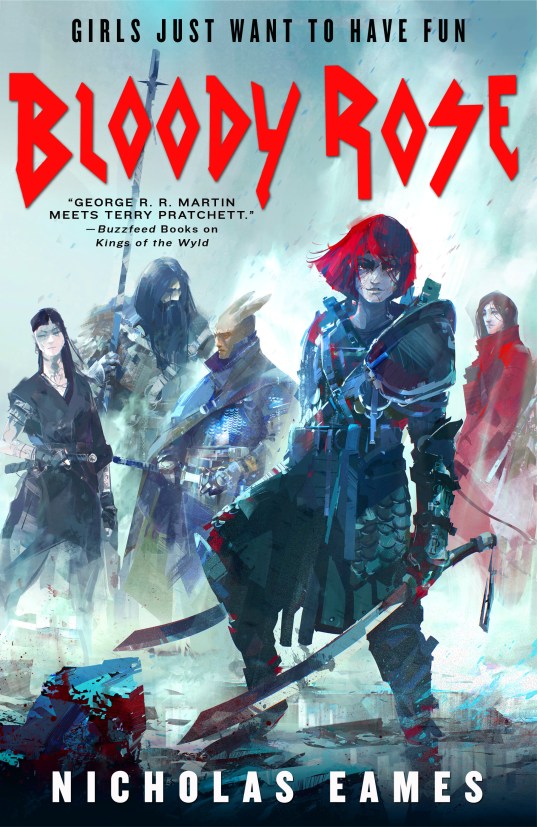
Bloody Rose by Nicholas Eames

Bloody Rose Cover.jpg

Publisher: Orbit

Publication Date – 10 July 2018

Amazon

Sensational fantasy author Nicholas Eames follows up his exceptional debut with the five-star novel Bloody Rose, featuring an epic quest storyline which takes its protagonists through a series of wild adventures in a spectacular and large-scale fantasy landscape.

In the human lands of Grandual, mercenary bands hold a celebrity status among the people.  Originally formed to help protect against the horrors of the world, most bands now spend their days touring from city to city, fighting monsters in arenas in order to gain fame, glory and money.  The most famous of these bands is Fable, led by the notorious Bloody Rose, daughter of the land’s greatest hero, Golden Gabe.  Years after her father led a mercenary army to rescue her from a horde of monsters, Rose has reformed Fable with the druin Freecloud, the shaman Brune, the Inkwitch Cura and their booker, the waggish satyr Roderick.  With a massive chip on her shoulder, Rose is determined to take on the toughest jobs and challenges that she can find.

In the city of Ardburg, Tam Hasford is sick of her job slinging drinks at the local pub to the famous mercenaries passing through.  As the daughter of two mercenaries herself, Tam craves adventure, and when Fable rolls into town looking for a new bard, Tam jumps at the opportunity to travel with Bloody Rose and her band.  Gaining a well-deserved reputation for her singing and an accidental reputation as a fighter, Tam receives the moniker ‘The Bard’ and a crash course in the mercenary lifestyle of drinking, gambling, fighting and good times.

But while Tam is having fun in her new role, there is still work to be done.  A massive monster horde has once again left the wilds and is threatening several human cities.  All of Grandual’s mercenary bands are gathering to meet them, all except Fable.  Rose is leading her band in the opposite direction and appears unconcerned with the potential devastation the monsters could cause.  Has Bloody Rose lost her nerve or does she have a far more dangerous quest in mind?  While Fable’s plan to become legends may prove to be successful, they will have far more destructive consequences than anyone could ever predict.

Bloody Rose is the incredible sequel to Eames’s 2017 debut, Kings of the Wyld, and forms the second book in Eames’s The Band series.  Set several years after the events of the first book, Eames switches up the story, focusing on the adventures of Rose and her band of mercenaries, while telling the narrative through the eyes of new point-of-view character Tam.  While there are many tie-ins with the first book, including several of the main characters, Eames has mostly shifted the focus onto a new generation of characters.

Although Bloody Rose is the second instalment in this series, curious readers can easily start their adventure with this book.  This book’s point-of-view character, Tam, never directly experienced the battles of the first entry in the series, and she ends up having quite a few conversations that describe or dramatise the events of the previous novel.  As a result, new readers who start with Bloody Rose will not experience any confusion and will be able to enjoy this story right off the bat.  That being said, readers who start with this book will probably get a hankering to read Kings of the Wyld due to how amazing Bloody Rose is.

This is a substantial piece of fantasy literature with a powerful story that is guaranteed to draw the reader in from the first page.  The huge scope of this story is just remarkable, as what begins as a simple adventure story transforms into an epic battle for the survival of all life in the world.  Much of this scope is the result of the significant number of secondary characters and antagonists that are introduced throughout the book.  It is a testimony to Eames’s skill as a writer that all these characters don’t overwhelm the story, and the reader finds themselves interested in seeing how each these characters ends up.  The use of a brand new point-of-view character to tell this story is a clever move from Eames as it allows a fresh insight into this world of mercenary bands and monsters, moving on from the old veterans that were the focus of Kings of the Wyld.

The author has infused his narrative with a huge amount of humour, most of it quite adult and over the top in nature.  This humorous tone infects quite a lot of the way that the book is told and makes it a very fun read.  There are some extremely funny scenes through the book, from debates about fake cockatrices, to the antics of a drunken satyr, to discussions about the dietary requirements of minotaurs.  While this humour is a key and overwhelmingly fun part of the story, Eames does get deadly serious in several parts of the book when the protagonists encounter dark days.  These darker scenes are felt particularly hard by the reader, mainly due to the sudden shift away from the lighter tone of the rest of the book.  While there are several examples of this throughout the story, I found that the final scenes of this book were particularly intense and had me absolutely captivated.  This clever combination of the outstanding comedy overtones and the gripping dramatic moments works exceedingly well and turns Bloody Rose’s story into one of the best fantasy narratives I’ve had the pleasure of reading.

In addition to the great use of comedy, drama and story, Eames has also packed this book with a significant amount of action and adventure.  The protagonists of this story essentially fight everyone as they adventure across the land, and participate in all sorts of combat, including arena battles with monsters, fights with titanic creatures, large-scale battles and even a few tavern brawls.  All these action sequences work well with the book’s other elements.  Not only do these battles result in some devastating moments but Eames also includes some comedy in these fight scenes, which can prove to be very entertaining.  Readers should also keep an eye out for the fun and inventive combat tactics used throughout this book, which are not only destructive but creative.  Never has red hair been used in battle so effectively.  With as much conflict and combat as you’ll ever need in a book, this is a perfect read those looking for those looking for their next injection of thrilling action and adventure.

Eames has also created a vast world to be the setting for this story, filled with a huge number of fantasy creatures and massive amount of world building lore.  Having such a large and well-established world is essential for a story of this magnitude.  The protagonists do a substantial amount of travel from one end of Grandual to the other, exploring large cities, small towns, barren wastes, massive battlefields and dangerous forested areas.  The author has also filled this story with every classic fantasy and mythological creature one could think of, as well as a few unique creatures from his own imagination.  All these creatures are a great addition to the story, resulting in some very fun battle sequences throughout the book, especially when their a huge number of these creatures in action.  One of the more intriguing races is the druin, the rabbit-eared humanoids created by Eames which used to rule all the humans and monsters of this fantasy world.  There is some fascinating history around the druin which has some significant impacts on the story, as well as gifting these creatures with some cool abilities that come into play in a variety of great ways.

The author has also spent time developing a fantastic band of main characters for the reader to follow on their adventure.  Using his new narrator, Tam, to full effect, the reader is given an introduction to every member of Fable and learns their history and motivations in significant and interesting detail.  A decent amount of time is spent looking at all of the members of Fable and the reader is given a deep understanding of each of them.  Each member of the band is a fairly unique fighter and character in their own right, but together they form a fun team.  Eames really hammers home how close these band members become throughout the book, and the reader becomes attached to the characters as they grow closer together.  This makes any potential harm or trauma they experience particularly hard for the reader to experience, and really adds to the books emotional depth.

With the follow-up to his epic debut, Eames has once again demonstrated why he is one of the freshest and most exciting new voices in fantasy fiction.  This exceptional story is an action-packed bonanza that sees several compelling characters engage in a heroic quest across an impressive fantasy landscape.  With the perfect blend of comedic adventure, epic fantasy storytelling and some dramatic character moments, Bloody Rose is an exceptional and excellent read that is guaranteed to become your new favourite story.

My Rating:

Five Stars

Amazon

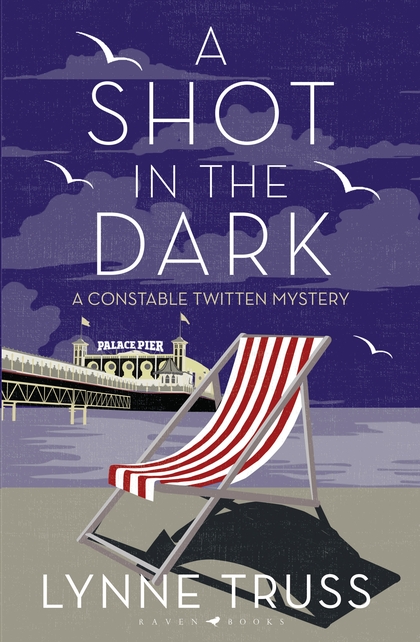
A Shot in the Dark by Lynne Truss

A Shot in the Dark Cover

Publisher: Raven Books

Publication Date – 28 June 2018

Amazon     Book Depository

From Lynne Truss, one of England’s most creative minds, comes A Shot in the Dark, a hilarious take on the historical murder mystery that sets three fantastic and exaggerated police characters against a sinister and surprising criminal mastermind.

Brighton, 1957.  Following a terrible massacre that saw the death of every member of two rival gangs some years before, the city of Brighton is now clear of all crime.  At least, that’s what Inspector Steine believes, and, as he is the famous and inspirational police detective whose actions allowed the eradication of these vicious gangs, that’s what the rest of the Brighton Constabulary believe as well.  Unfortunately for everyone, Inspector Steine is nowhere near as smart as he thinks he is.  Despite all the evidence, he simply refuses to believe the theory of his long suffering ‘bagman’ Sergeant Brunswick that a mysterious third crime boss organised the massacre and is currently running crime in Brighton.

So when the young, keen and exceedingly annoying Constable Twitten arrives in Brighton and starts investigating a series of burglaries, Steine is particularly aggrieved.  Despite Steine’s insistence that Brighton’s criminal element is no more, Twitten seems determined to find criminal activity – and he does.  The opening night of a new controversial play is unfortunately ruined when the opinionated and unpleasant film critic that Twitten is sitting next to is shot in the head.  Finally a crime that even Steine can’t ignore.

Who could have wanted the critic dead?  Is his death due to the multiple plays and productions that his reviews have destroyed?  Or is it perhaps related to a bank robbery that the critic witnessed many years ago, and that Steine failed to solve.  As Twitten and Brunswick start their investigation and Steine provides his own special brand of ‘help’, a second body is found.  As the case continues, Brighton’s newest constable is about to uncover a dark secret about his city and the sinister figure manipulating everything behind the scenes.

Truss is a highly talented writer, author and radio personality who has produced a huge range of different works, including the non-fiction book Eats, Shoots & Leaves: The Zero Tolerance Approach to Punctuation.  Truss has also created several other fictional and non-fictional books, as well as a number of popular radio series.  A Shot in the Dark is Truss’s fifth fiction novel and is the first book in her Constable Twitten Mystery series.

One of the most interesting features of A Shot in the Dark is that it is actually a novelisation of Truss’s popular radio comedy drama series, Inspector Steine, which ran between 2007 and 2013 and starred the inimitable Michael Fenton-Stevens.  This is a great introduction to the franchise that will have a massive amount of appeal both to fans of the radio show and people who are unfamiliar with this great comedy series.  Rather than being a simple write-up of one of the Inspector Steine episodes, A Shot in the Dark is a combination of several different episodes, containing plot elements from various seasons of the show’s run.  In particular, it contains components borrowed from the series one episodes While the Sun Shines, Separate Tales and The Deep Blue Sea, the series two episode The Entertainer, and the series three episode While the Sun Shines.  As a result of this combination, people unfamiliar with this series get to experience several of the radio show’s best stories and plot points in their first outing.  On the other hand, fans of the radio series get a completely new adventure that re-imagines Constable Twitten’s early days at Brighton.  Storylines listeners may be familiar with have been altered in some new and substantial ways to create a fun and excellent combination of some key stories in the series.

In the original Inspector Steine series, Truss created some amazing characters who are not only terrific by themselves but who played off each other extremely well.  The author has done an amazing job transplanting these characters into a completely different format.  The three main characters are Inspector Steine, Constable Twitten and Sergeant Brunswick.  Inspector Steine is your classic self-important senior management figure who thinks they are so much smarter than they actually are.  Steine is extremely self-absorbed and very easily manipulated, but ultimately well meaning, given he is completely convinced that all the crime in Brighton was erased years ago as a result of his brilliant actions.  Twitten, on the other hand, is actually as smart as he thinks and has no trouble letting everyone he meets know it.  His clever investigative work is capable of solving the crime, but his cleverdick attitude ensures that no-one, especially Inspector Steine, will actually listen to him.  Sergeant Brunswick plays straight man to both of his colleagues, and seems to be the middle ground between these two extreme personalities.  However, while he is a competent investigator, he is also easily manipulated, and fails to see that his brilliant plans to go undercover on every case are hampered by the fact that all of Brighton’s criminals already know who his is.  These three are all extreme examples of some of the classic police characters.  In a normal piece of crime fiction, these three characters work well together (think Endeavour for example), but in A Shot in the Dark they bring out the worst in each other and combine together for great comedic value.

While the three police characters are excellently used and a whole lot of fun by themselves, special mention needs to be given to the brilliant antagonist of this story.  Whiles fans of the radio series will not be surprised about their identity, I will try to avoid revealing too much in order not to ruin the surprise for any new readers.  That being said, this character is an excellent villain who is able to manipulate the three police characters in some suitably comedic ways.  The various and often quite unsubtle ways in which this villain manoeuvres the protagonists in A Shot in the Dark is absolutely hilarious, especially when their ridiculous plots actually work.  New readers will have a fantastic time finding out who this character is and how they’ve gotten away with their crimes, while fans of the radio series will love seeing this outstanding antagonist in all their criminal glory once again.

A Shot in the Dark contains a fantastic story that expertly combines a clever murder mystery with hilarious comedy elements.  As mentioned above, due to main characters’ various shortcomings and the devious nature of the villain, this is not your standard criminal investigation.  The protagonists have to deal with some absurd situations as well as various unusual plans to stop them solving the case.  That being said, the police do perform an investigation and the truth of the various crimes are eventually uncovered, although again without the standard solution crime fiction readers would be used to.  The crime elements are compelling and there is a really interesting mystery contained within this book, with some imaginative twists leading up to the conclusion.  In addition, the two murders are connected together in some clever ways, and the overarching conspiracy about Brighton is particularly intriguing.  While the book contains some gripping mystery elements, it is a comedy at heart; there are some really amazing comedy elements, including some great sequences that really cracked me up.  In addition to the shenanigans of the main characters, there are a range of other eccentric characters throughout the book that provide some fun moments of comic relief with their antics.  These elements come together perfectly, and it is incredibly fun watching all attempts at a serious investigation get disrupted in various silly ways.

Truss set the Inspector Steine series within Brighton in the early 1950s.  While this would already be an interesting setting, the author has amped this up by using elements from the classic crime novel and movie, Brighton Rock.  Truss has stated that her series is based on captions at the start of the 1948 movie which declared that Brighton went from a crime hub between the two World Wars to an area completely free of criminals and corruption by the 1950s.  While many people would be somewhat suspicious of such a statement, the Inspector Steine series is based on the idea that a member of the police actually believed this and acted accordingly.  As a result, the whole city has, on the surface, a wholesome family atmosphere.  That makes the crime hiding underneath a lot more fun to see, especially as the criminals really don’t need to do too much to disguise their activities, secure in Steine’s blissful ignorance.  In addition, fans of the crime classic may be interested to know that there are a number of elements from Brighton Rock that play a key part in the story.  As both the book and the movie exist within the Inspector Steine universe, Inspector Steine actually blames the events of this book on Graham Greene, the original author of Brighton Rock (a sentiment shared by Truss).  In addition, various characters within A Shot in the Dark are obsessed with the events of the classic crime book, and many locations from the Brighton Rock book and movie become major plot settings in the story.  In particular, there are several sequences based around one certain murder from the movie that results in some very entertaining scenes.  Overall, this is a great setting for this excellent comedy-mystery hybrid, which also has some fantastic tie-ins to a classic post-war crime novel.

Lynne Truss delivers an extremely fun and very entertaining adaption of her popular Inspector Steine radio series with A Shot in the Dark.  Featuring all of the exceptional characters that were a standout feature of the original series, A Shot in the Dark is an excellent piece of comedy that also contains some intriguing mystery elements and a unique settings with ties to the crime classic Brighton Rock.  This five-star book comes highly recommended and is guaranteed to leave you laughing for hours.  I am already looking forward to the next Constable Twitten Mystery.

My Rating:

Five Stars

Special thanks need to be given to my partner, Alex, who, on top of her usual editorial expertise for my reviews, happens to be a geek for BBC Radio 4 comedies and was able to help me properly analyse A Shot in the Dark without spoiling the identity of Brighton’s greatest criminal mastermind.

Amazon     Book Depository

Early Riser by Jasper Fforde

Early Riser Cover.jpg

Publisher: Hodder & Stoughton

Publication Date – 2 August 2018

Amazon

One of modern literature’s quirkiest writers returns after a six-year hiatus to produce the eccentric and incredibly entertaining new release, Early Risers.

In an alternate version of our Earth, the entire world freezes over each winter, plunging the planet into a deep cold for the entire season.  Humanity has adjusted to this different climate by developing ways to hibernate each winter, sleeping through the long, cold months in specially designed habitations and ensuring that their bodies have enough stored fat to keep them alive.  Only a few weird and unconventional individuals choose to ignore their bodies’ need to sleep, and instead spend winter awake.  One such group are the Winter Consuls, a collection of misfits and rogues responsible for ensuring the safety of the sleeping population, whilst also patrolling against the horrors of the winter world.

In Wales, Charlie Worthing is about to experience his first winter as a new recruit in the Winter Consuls.  His first mission sees him drawn to Sector Twelve, base of the powerful HiberTech company and one of the most disreputable areas of the country, known for its controversial Winter Consuls.  Trapped within this sector, Charlie must contend with all the dangers that winter can hold.  Between the cold, his desire to fall asleep, the stamp-collecting addicted Villains, the mindless and cannibalistic Nightwalkers and the possibly mythical WinterVolk, Charlie is unlikely to survive his first winter.

However, all these threats pale in comparison to the damaging potential of a viral dream being passed around the inhabitants of Sector Twelve.  When Charlie starts to have the same dream, he finds himself thrust into a dangerous conspiracy with world changing consequences.  As Charlie becomes a target, he must work out who in this unforgiving world he can really trust, and who is using him to further their own aims.

Jasper Fforde is an exceptional author who has produced several novels since his 2001 debut, all of which were remarkable and very different from your standard read.  With an unusual style and superb skill, Fforde’s work is reminiscent of some of the novels produced by authors such as Terry Pratchett or Lemony Snicket.  Fforde has created some enjoyable and addictive reads over the years, including Shades of Grey, the Nursery Crime Division books and his exceptional Thursday Next series.  Early Riser is a standalone novel that takes the reader to another unique alternate Earth and presents them with an intriguing and very original story.

Fforde has a pattern of creating unique worlds to act as settings for his entertaining narratives.  These worlds often have elaborate rules and details that make the book’s story very distinctive.  For example, Shades of Grey is set in a world where people can only perceive limited shades of colour and social hierarchy is determined by how many shades and hues a person can identify.  The Thursday Next series is set in an alternate version of Earth where the Crimea War never ended, time travel exists and journeys into the literary world is both possible and heavily policed by characters from famous books.

Fforde continues this trend in Early Riser, creating another detailed alternate Earth setting.  This version of Earth experiences exceedingly cold winters and humanity has to hibernate each year as a result.  This is an absolutely eccentric and inventive concept, and it is fascinating to see how Fforde adapts a new fictional world around it and looks at how humanity has adapted to having to hibernate.  Like several of his other books, the story of Early Riser is set within this world’s version of Wales.  There is a focus on different types of technologies, especially those that help people successfully hibernate, different buildings and new societal norms.  One example of this is the concept that, in this colder world, larger, fatter people are more desirable and socially acceptable as they are more likely to survive their hibernation period, whilst skinny people, or those who choose not to hibernate, are seen as detrimental wastes of space.  Fforde further backs this up by creating an inventive alternate history for the world, including some funny and satirical depictions of an appropriately altered entertainment world.  Many elements of these alternate histories and new social norms are told directly within the story, but Fforde also fleshes out these ideas with a huge range of extra and very humorous details in footnotes and in-universe book excerpts at the start of every chapter.

Fforde has also ensured that Early Riser is particularly memorable by filling his story with a range of interesting and creative characters and threats.  Throughout the book, the protagonist encounters and examines the history, background and lore behind the threats roaming around the winter.  These include the Villains, aristocratic thieves who are the descents of British nobility who act in a stereotypically upper class way and are obsessed with stamp collecting and obtaining domestic servants through force.  There are also Nightwalkers, humans whose minds failed to withstand the hibernation process.  As a result, the Nightwalkers have been reduced to a zombie-like state and are potentially cannibalistic, although their urges can be controlled with comfort food.  Fforde has also included the mysterious WinterVolk, supernatural beings who reside in the winter world and have certain powers and tendencies.  There is particular focus on the Gronk, one of the newer WinterVolk, and the author includes discussions about the Gronk’s formation, its first appearance, its habit of taking the unworthy and only leaving behind their carefully folded clothes in the snow, all while singing Rodgers and Hammerstein hits.  In addition there are a range of wacky side characters throughout the series.  These side characters usually have some sort of zany quirk or a distinctive characteristic that proves to be entertaining for the reader whilst the protagonist often has to play straight man.  The standout example of this has to be the two one-eyed women who are both trying to get the protagonist on their side and who share an interesting connection with each other.  All of these imaginative literary inventions combine into one substantial and unforgettable story that will charm the reader with its quirky and fun nature.

While it is easy to focus on the unusual and humorous inclusions that Fforde has filled Early Riser with, readers will also enjoy the book’s compelling story.  The narrative is very stimulating and enjoyable, as it initially focuses on the protagonist’s introduction to life in the winter world, and then shifts to him attempting to unravel the conspiracy surrounding Sector Twelve.  Like many of the other inclusions within this book, the conspiracy is very complex and a tad strange, but it works well as the focus for a central investigative narrative.  Readers will enjoy the journey to the end of the mystery, and there are a few interesting twists along the way.  Overall, I thought that the inclusions and elements mentioned above worked well with the mystery, and while many of the solutions and suspects are bizarre, the book’s many unique inclusions do not overwhelm the story, but instead enhance it, resulting in a great story.

Jasper Fforde has once again produced a distinctive piece of literature that stands out thanks to its elaborate and original concept, its many fun story details and inclusions, and a solid and gripping central story.  Some readers may find the plot and story elements a bit weird, but this book will easily charm those who get in to Early Riser’s unashamed quirkiness and silly nature.  This is definitely one of the most inventive books of this entire year and a creative and exceptional new read from a fanciful and fantastic author.

My Rating:

Four and a half stars

Amazon

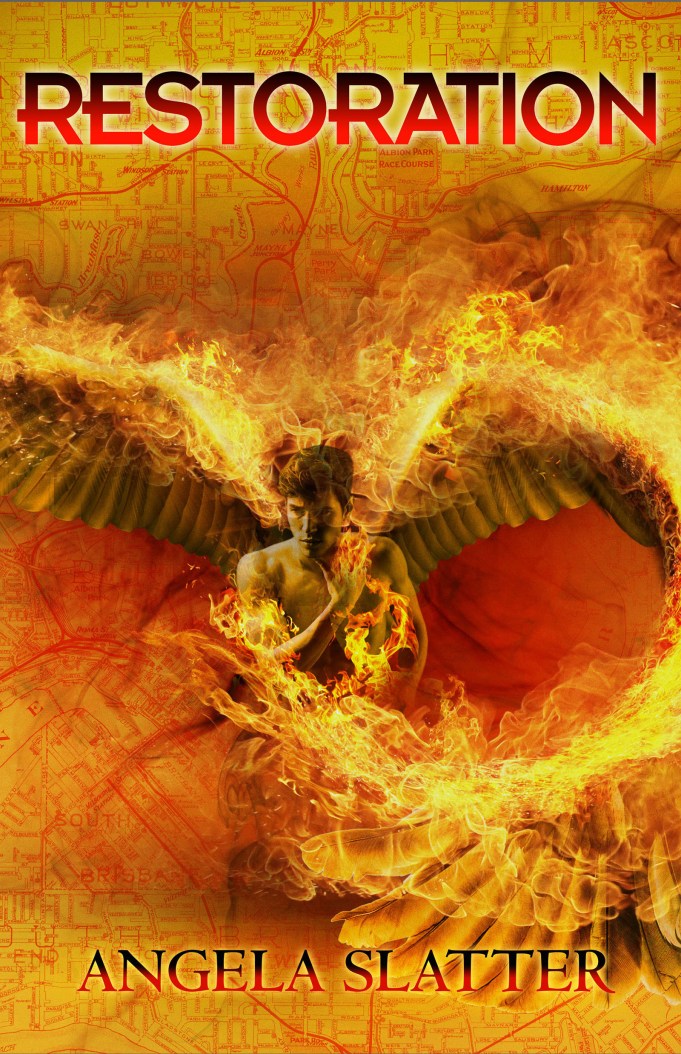
Restoration by Angela Slatter

Restoration Cover

Publisher: Jo Fletcher Books

Publication Date – 9 August 2018

Amazon     Book Depository

One of the very best authors of Australian crime fantasy returns with another outstanding release in her fast-paced and exceedingly entertaining Verity Fassbinder series.

In a world where the magical beings known as the Weyrd remain hidden from the Normal, non-magical population, Verity Fassbinder is a half-Weyrd, half-human agent for Brisbane’s Weyrd Council and is charged with policing the city’s Weyrd population.  However, following an adventure to the underworld, Verity has been forced into the employ of a crazed fallen angel, and must take up his quest to find two secretive artefacts hidden in Brisbane.  In order to protect those she loves from her murderous new employer, Verity has sent her family away and resigned her position with the Weyrd Council.  Saddled with a murderous Kitsune, Joyce, as a driver and spy, Verity must find a way to recover these mysterious two items without giving ultimate power to the creature holding everything she love hostage.

As if her involuntary quest wasn’t hard enough, Verity is also forced to contend with a myriad of other problems from Brisbane’s Weyrd population.  The vengeful sorceress Dusana Nadasy is back in town, determined to kill Verity for the role she played in the death of her family.  The angel Tobit is refusing to take Verity’s calls, Weyrd Council politics is seriously starting to annoy her, literal ghosts from her past are haunting her and her friends the Norns have developed strange new powers.  Finally, her contact in the Brisbane police, Inspector McIntyre, needs her help investigating a series of desecrated corpses of Normal women found around Brisbane whose bodies show the distinctive impact of Weyrd magic.  What Verity does not know is that all of these strange occurrences will play a part in her quest for the fallen angel’s prize and will change her life forever.

Restoration is the third book from Australian author Angela Slatter and represents the third book in her Verity Fassbinder series.  Restoration is an exceptional example of the benefits of combining two genres, and contains incredible fantasy and mystery elements blended together into a powerful final narrative set in modern day Brisbane.

Throughout Restoration, Slatter has surrounded her central storyline with an elaborate series of smaller mysteries and adventures, all of which cleverly tie into the protagonist’s hunt for the artefacts.  Each of the smaller plot lines and investigations is very interesting, and readers will be amazed about how interlocked the story really is.  Those who have read the previous books in the Verity Fassbinder series will also enjoy how Slatter expertly utilises elements and plot lines from the earlier books in the series throughout Restoration.  This is a fun feature, and really shows off how much planning and foreshadowing Slatter included in her first two books, as even minor observations and actions from the earlier books have some big impacts in the latest volume.  Despite this, Restoration is still an excellent book to come into this series with.  The author makes sure all the relevant details of the last two books are fully explained and explored.  As a result, new readers will be able to follow everything that is happening within Restoration, while also being tempted to check out the earlier books in this fabulous series.  Fans will enjoy how the storylines and side quests come together in the end of the book for a big and exciting confrontation sequence that serves as an epic conclusion to the first three books in the Verity Fassbinder series.

In addition to the book’s strong mysteries, the author has also included a range of enticing fantasy elements for the readers to enjoy.  The huge variety of fantasy aspects included within Restoration have been pulled together from a range of different cultural backgrounds.  As a result, the book’s protagonist interacts with creatures that have their origins in Greek, Germanic, Norse and Japanese mythologies and culture, as well as the usual ghosts, magic users and generally powered individuals.  There are also strong components from the Judeo-Christian religion that play a significant part in the story and which tie in well with the other fantasy elements.  The great mystery elements mentioned above work in conjunction with these fantasy features to create an amazing story.  Slatter comes up with some terrific fantasy based motives, plots and suspects for the reader to enjoy, and this helps create an intriguing and entertaining overall narrative.  The protagonist’s hunt for the artefacts, the “grail” and the “tyrant”, leads to a greater insight into this universe’s magical and religious roots, and turn into some intriguing pieces of this universe’s lore.  In addition, the protagonist’s curiosity about her Weyrd ancestors leads to her finding out some fascinating facts about their history, as well as a detailed bit of fictional mythology from Slatter.  This focus on the family she is descended from also hints at these characters being involved in future additions of this series, and will no doubt prove to be excellent antagonists.  Overall, the book’s fantasy elements are highly enjoyable and add sufficient wonder and enhancement to an already outstanding book.

Restoration is mostly set within the Australian city of Brisbane and its local environs.  Slatter, a Brisbane local, has created a detailed and personal depiction of her city and it serves as a fun location for this book’s plot.  People familiar with Brisbane will appreciate the descriptions of city and enjoy the concept of a hidden and chaotic fantasy world lying just below its surface.  Special note should be given about the inclusion of the University of Queensland, Slatter’s alma mater, as a setting within the book, and it is always fascinating to see a location that the author is familiar with and passionate about.

Slatter has continued to use the humour-laden tone of writing that was such a standout of the first two books in the Verity Fassbinder series.  The protagonist is a remarkable character who does not care who she annoys or who gets in her way as she tries to achieve her goals.  This nonconformist attitude and general disregard for the rules for the Weyrd Council has a great way of getting the reader to support her, and as a result she has always been a very likable main character.  The jokes and humour that inhabit the narrative as she encounters a range of strange and dangerous situations help lighten the tone of the dark investigations she is involved with.  Things get serious towards the end, especially when the protagonist’s family gets involved and this helps raise the stakes in the readers mind, although some humour is still involved.  Audiences will love the sass and humorous observations that inhabit this whole book, and it fits in well with the overarching urban fantasy crime narrative that Slatter has cultivated.

Restoration is another superb read from Angela Slatter and an outstanding addition to one of the best fantasy crime series in the world today.  The books in this series are up there with The Dresden Files and the Peter Grant series, and are fantastic examples of this combination of genres.  The third book in this Australian series makes full use of its elaborate mystery, intriguing fantasy elements, exciting Brisbane setting and distinctive humour to create an extraordinary read that comes highly recommended.

My Rating:

Five Stars

Amazon     Book Depository

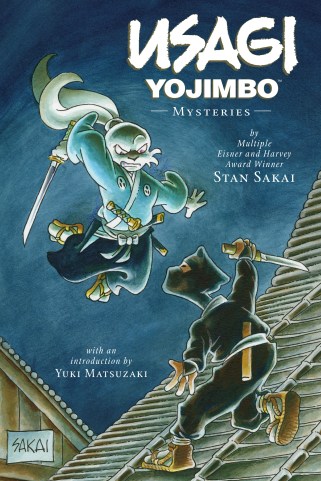
Usagi Yojimbo, Vol 32: Mysteries by Stan Sakai

Usagi Yojimbo Mysteries Cover.jpg

Publisher: Dark Horse Books

Publication Date – 10 July 2018

Amazon     Book Depository

After a year I have finally gotten the new volume of Usagi Yojimbo, one of my favourite long-running comic series.  Now I and other fans of the long-eared samurai can finally enjoy another set of exhilarating adventures in Stan Sakai’s version of feudal Japan.

Usagi Yojimbo is a great series that has been running since 1987, three years after the character was originally created.  In a world inhabited by anthropomorphic animals, the series is set in the early Edo period of Japanese history, during the time of the Shogun and the wandering samurai.  The series was originally supposed to feature human characters and a protagonist based on the famous historical samurai Miyamoto Musashi.  However, the series was changed to feature animals after the artist drew an early version of the hero with rabbit ears and created the series’ titular yojimbo, Miyamoto Usagi.

Usagi Photo 2

The Usagi Yojimbo series follows the adventures of Miyamoto Usagi through feudal Japan.  After the death of his lord, Usagi has become a ronin, a masterless samurai, and has spent the last few years wandering the country seeking employment as a yojimbo, a bodyguard.  Throughout his travels, Usagi finds all sorts of danger and adventures, and is often drawn into a range of conflicts throughout the troubled landscape, facing threats both natural and supernatural in origin.

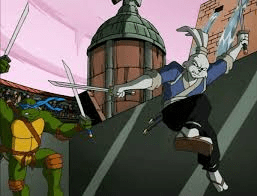
With 32 collected editions over 30 years, as well as the two additional graphic novels and the spin-off series, Space Usagi, Usagi Yojimbo has developed a dedicated fanbase.  Those who have not read this series may be familiar with it due to its frequent crossovers with the Teenage Mutant Ninja Turtles.  Characters from both franchises have crossed over into each other’s respective comic book series several times.  In addition, Usagi has appeared in all three Teenage Mutant Ninja Turtles television shows, often with some side characters.  One of my first exposures to the characters of Usagi Yojimbo was during The Big Brawl arch of the 2003 Teenage Mutant Ninja Turtles series, and I’ve been a fan of the character ever since.

Usagi photo 1.png

Stan Sakai’s series is a hybrid of western graphic novels and Japanese manga.  The style and format of the comics come across as more of a classic western style, but the story content and the series’ art is heavily influenced by Japanese culture and history.  Every issue is filled with incredible depictions of Japanese customs, history, folklore and mythology, and includes realistic and historically accurate illustrations of feudal Japanese weapons, clothes and buildings.  In addition, the dialogue includes a number of Japanese words which are translated in text, and the characters are all named using traditional Japanese naming conventions, with the family name presented before the given name.

Mysteries is the 32nd collected edition of this series, and contains issues #159-#165 of the Usagi Yojimbo series.  These issues see Usagi reunited with his friend Inspector Ishida as they investigate a series of mysteries in Ishida’s jurisdiction.  There are four main stories, including The Hatamoto’s Daughter, Death by Fugu, the two-part series The Body in the Library and the three-part series Mouse TrapMysteries also contains two of the shorter Chibi Usagi stories that Sakai writes with his wife, Julie, which feature cute versions the franchise’s characters.

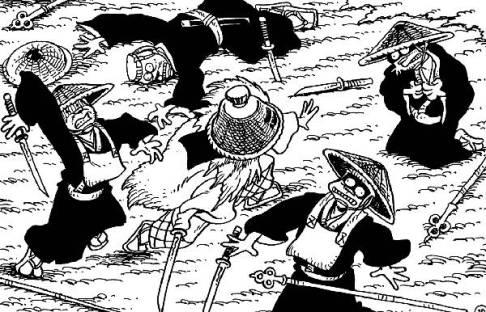
Readers of the latest volume of Usagi Yojimbo are in for another visual treat as Sakai continues to highlight the delicate beauty of the Japanese landscape and fantastic architecture of its towns with his spectacular artwork.  Each of the portrayals of the anthropomorphic characters in their period accurate clothing is amazing, and the reader will be astounded by the author’s desire to make his comic as aesthetically realistic as possible.  However, the real visual highlights of this comic are the action sequences that see the protagonists engage in a series of elaborate sword fights against a variety of opponents.  The artistic styling of these sword fights is both exciting and intricate, which allows the reader to imagine how these battles would occur in real life.  Mysteries contains some great examples of this series’ fantastic art form, and the reader will love the creativity that inhabits every panel of this book.

Usagi Photo 3.jpg

While most Usagi Yojimbo stories are standalone episodes, the separate stories featured within Mysteries share several connections with each other.  All of them are set within the same town and feature the character of Inspector Ishida.  In addition, several of the cases are connected by a shadowy crime boss, although the full nature of this connection isn’t fully known until the final story in the volume.

As you may be able to guess from the title of the volume, all of the main stories featured within Mysteries feature a murder and the following investigation by Inspector Ishida and Usagi.  Inspector Ishida is a high-ranking member of the Shogun’s police and is renowned throughout Japan as one of country’s most effective detectives.  Usagi has teamed up with him before in a number of adventures, including a great story, Murder at the Inn, back in Volume 29, which featured Usagi, Ishida, and Usagi’s frequent companion Gen investigating murders in a locked-down inn.  There are some great stories in the Mysteries volume, especially as Sakai has crafted together some intriguing mysteries in such short entries.  Several of the big mysteries and crime stories are connected into an elaborate overarching narrative that examines the criminal underworld of feudal Japan.  Two of the stories feature some really complex murder mysteries that flit back and forth between a number of suspects and contain motives that are very unique.  The final entry, Mousetrap, is the longest story in the volume and features an excellent tale about a thief getting caught in a middle of a fight to control the area’s organised crime and the sinister figure that has been manipulating the events of the previous stories.

Usagi Photo 5.jpg

Sakai ensures that his examination of feudal Japanese society carries through to each of these stories and their investigative arcs, affecting the characters’ investigations.  For example, only members of a lower caste are allowed to touch the murder victims’ dead bodies, which hinders the protagonists from properly examining the bodies to work out the cause of death.  There is also a fantastic investigation of the role of the inspectors in feudal Japan and how they bear the authority of the Shogun.  It also allows Ishida to show off his fighting skills with the jitte, one of my favourite Japanese weapons.

In addition to the returning Inspector Ishida, this volume of Usagi Yojimbo sees the return of several characters from previous stories.  Our favourite thieving duo of Kitsune and Kiyoko make a return in the middle story, The Body in the Library.  The fox thief Kitsune was first introduced in 1992 and has become one the series’ main recurring characters, adding significant amusement to the stories she appears in through her schemes, humour and continued casual theft of the other characters’ valuables.  Her young companion, Kiyoko, was introduced in a later story and serves as her apprentice in the life of crime while taking up many of her mentor’s bad habits.  Their inclusion in this story adds significant comic relief to an otherwise dark story of murder, and it is always fun to see what this mischievous duo are up to.  The mysterious masked thief Nezumi returns for a second adventure and is a major player in the book’s longest story, Mouse Trap.  Nezumi was introduced in the Volume 20 story After the Rat, and acts as a public Robin Hood character in Inspector Ishida’s town.  He is used to great effect in this new story, being framed for murder in a way reminiscent of his first appearance in the series.  Sakai continues to taunt his audience with the mystery of Nezumi’s identity and motives, and it is great to see this interesting and formidable character interact with Usagi for the first time, especially with their differing definitions of honour.  Readers should also keep an eye out for a certain recurring snitch who has played a similar role in a number of prior Usagi stories, despite the main characters failing to remember how treacherous he is.

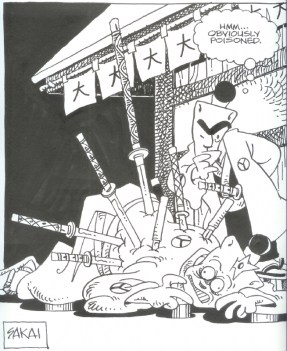
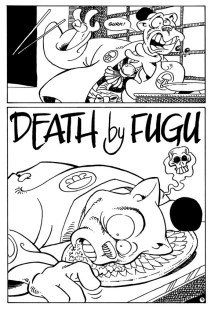
One of the best parts of the Usagi Yojimbo series is the incorporation of intriguing and unique parts of Japanese culture into amazing action based comic issues.  Throughout the series, the author has utilised a number of great Japanese cultural elements in various stories, including giant kites, giant drums, pottery, swordsmithing, tea ceremonies, seaweed farming, games of chance and a huge number of mythological creatures and legends.  These stories often contain descriptions and informative depictions of the cultural activities in question, and the author works them into a fun adventure or creative mystery.  Mysteries contains two of these stories.  The main one, Death by Fugu, focuses on the preparation of fugu, the meat of the poisonous pufferfish.  This story contains an excellent description of what fugu is and the preparation required to eat it.  Death by Fugu is a powerful and tragic tale that prominently uses the art of fugu in its mystery, and definitely one of this volume’s standout stories.  The other entry, The Body in the Library, takes a brief look at the examination and trade of western medicines in Japan.  While this is not examined in as much detail, it is a fascinating to see what impact western medicines could have in feudal Japan and to see it used as a motive for a series of murders.

Usagi Photo 4.jpg

Once again Stan Sakai has produced a powerful and fantastic new volume of his iconic Usagi Yojimbo series.  Fans of this series can look forward to seeing Sakai’s iconic art style and detailed cultural insights that are a love letter to Japan and its fascinating history and society.  Mysteries contains a range of outstanding new stories, and readers will enjoy unwrapping their mysteries with Usagi and the fan favourite Inspector Ishida.  I wish I didn’t have to wait a whole year for the next volume of this amazing series.

My Rating:

Five Stars

Amazon     Book Depository

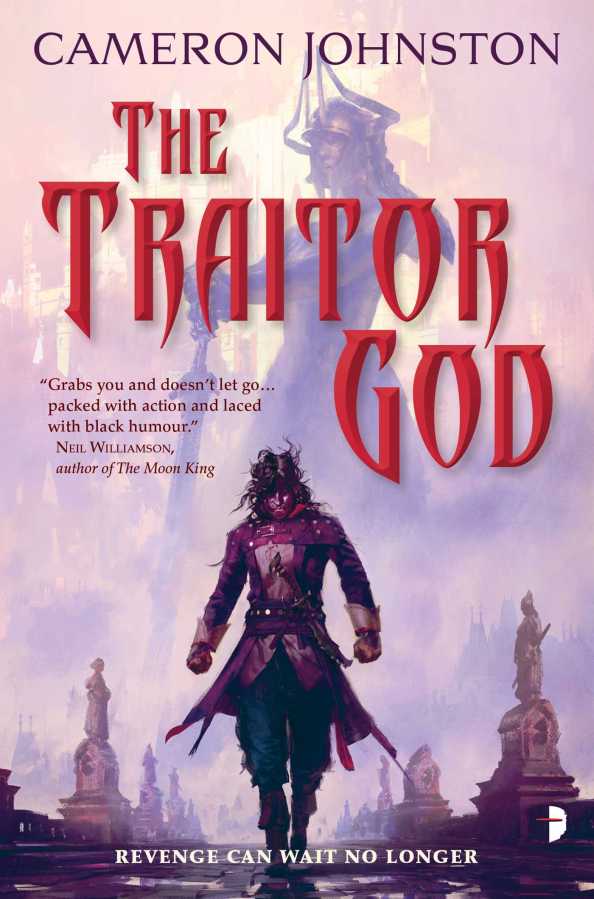
The Traitor God by Cameron Johnston

The Traitor God Cover

Publisher: Angry Robot

Publication date – 5 June 2018

Amazon

Prepare yourself for dark magic and a powerfully inventive adventure in The Traitor God, one of 2018’s best fantasy debuts from exciting new author Cameron Johnston.

Ten years ago, reviled mind-bending magician Edrin Walker fled his home city of Setharis with demons biting at his heels.  On that night, a god died, his mentor disappeared and Edrin’s memories of the events surrounding his exile were erased from his mind.  All Edrin remembers is that he made a deal with somebody extremely powerful.  In exchange for him leaving the city, this mysterious figure guaranteed the safety and long life of his closest friends.

Edrin has spent the last 10 years wandering the wilderness, living day to day and evading the creatures hunting him.  Content with his decision and new life, his exile ends the moment he witnesses the death of his best friend, Lynas.  In one terrible night, Lynas was brutally murdered and skinned alive, and Edrin saw every minute of it through their powerful mental link.  Now, with nothing left to lose, Edrin will return home, his only intention to burn everyone and everything until he finds the person responsible for his friend’s death.

However, returning to Setharis is a dangerous proposition.  Not only is he still being hunted by demons, but the Arcanum, Setharis’s governing body of magicians, will kill him the moment they find out he is still alive.  Beyond caring, Edrin will risk everything to get revenge, and woe betide any man, magician, demon or god who gets in his way.

This is an extraordinary first novel from Johnston, who has produced a stylish and highly addictive sword and sorcery fantasy adventure with a morally corrupt protagonist, a great new fantasy setting and a huge number of magical battle sequences.

The Traitor God contains an impressive dark fantasy action story that effortlessly captures the reader’s imagination and attention and drags them through every page of the book.  What starts as a revenge investigation and rampage turns into a fight for the future of an entire city, as mysterious forces are unleashed.  The story is told solely from the perspective of the protagonist, Edrin, and as a result it has been noticeably infected with his dark humour and well-developed scepticism.  The familiar storyline of a hero returning home and finding that everything has changed works well within The Traitor God.  Readers will enjoy watching the powerful magician manipulate the new generation of criminals and bystanders who are unfamiliar with what he can do.  While the eventual revelation of who is responsible for the murder is a tad predictable, the investigation getting there is amazing, and fans will enjoy seeing the protagonist confront his enemies.  The scope of the villain’s evil plot is quite impressive and results in some massive scenes towards the end of the book.  I really enjoyed the cunningness and ingenuity of the protagonist and had fun watching him come up with clever solutions to the difficult and unique problems he encounters.  There is one amazing scene towards the end of the book when his plan to finish off a powerful antagonist is slowly revealed to the reader.  The reveal of the protagonist’s master plan, which is kept hidden from the reader due to magical plot elements, is done perfectly within this scene, and the audience will enjoy the clever ideas and dark humour used within.

The vast majority of the plot of Johnston’s book is set within the city of Setharis, which is controlled by an army of powerful magicians.  The city is a great setting for this dark fantasy novel as the protagonist is forced to conduct his investigation through its corrupt and crime-ridden streets.  It is clear that Johnston has spent significant time creating Setharis, and Edrin explores vast swathes of it during his adventures.  The exploration of the Arcanum is particularly intriguing, and readers will be shown the noticeable differences between the sanctuary of magicians and the dwellings where the city’s poor live.  Edrin’s observations about the inequalities and corruption of the Arcanum are unique among the book’s magicians.  This allows Johnston to show off the arrogance of the other magicians, which plays into the plot while at the same time endearing Edrin to the reader.  The setting of Setharis is an amazing part of this novel, and readers will look forward to returning to it in Johnston’s future works.

One of the best parts of The Traitor God is the sheer amount of exceptional magical and fantasy elements that have been packed into it by the author.  Edrin has unique magical mind powers that allow him to control people he encounters, and these are surprisingly dark powers for a fantasy protagonist to have.  These powers are intriguing, as they are known and feared throughout Johnston’s fantasy world, and Edrin suffers significant discrimination as a result.  The scenes where Edrin uses his mind-bending abilities are well presented by Johnston, as he successfully endeavours to show the effect Edrin’s power has on the other character’s minds.

The other magicians that feature in The Traitor God also have magical powers that catch the reader’s imagination when they are presented in the book.  The book features magicians with powers to nullify the magic of other magicians, sniffers who can smell and identify magicians from a distance, magicians who use body enhancement magic to become epic soldiers, and one extremely skilled hydromancer.  Johnston has also created some fascinating rules and abilities that affect all of the magicians within the book, including Edrin, and result in some wonderful story elements.  A great example of this revolves around the rule that magic permeates every cell of a magician’s body and leaks out of them into items like their clothing or bedding.  Johnston uses this fact to great effect throughout the story, as his protagonist is constantly forced to find constructive ways to avoid enemies who can detect his magic.  The author has also created memorable descriptions of the way that magicians are forced to access their magical power.  Johnston establishes that magicians within The Traitor God have to be careful about the magic they draw into themselves, lest they burn themselves out or go mad with power.  There are several scenes where Edrin is forced to draw large amounts of magic into himself to face powerful opponents or save the lives of his friends, and the resultant internal battles to retain control and his sanity are a fantastic part of the narrative.

While Johnston goes into incredible detail about the rules and roles of the magicians of Setharis, he has also included some alternative magical users who do not follow the same rules.  The comparison between these two different groups of magic users is quite distinctive, and scenes where they come into conflict with each other are quite destructive and highly enjoyable.  Johnston has made sure to include a number of unique demonic creatures the hunt and harry the protagonist.  These creatures are quite distinctive, and Johnston cleverly ties their hunting ability into his rules about magical scents and detection.  The most memorable magical creature within the book is also the largest, and results in some significant, fast-paced and explosive scenes throughout the book.  Overall, the electrifying and distinctive magical and fantasy elements within The Traitor God are one of the book’s most intriguing characteristics and highlight just how imaginative and creative Johnston is.

There are a tremendous number of action-filled sequences throughout the book as the main character and his allies fight criminals, demons, magicians and gods.  As a result, The Traitor God will appeal to wide range of readers eager to get their latest dose of intense fantasy action.  There are brawls, chases, complex magical duels, fights with monstrous foes, large-scale magical warfare within a city, and even a fight between two gigantic magical constructs.  Various elements that Johnston sets up when describing the city of Setharis or the magical abilities and rules of his magician characters often come into play during these scenes, and the author does a great job of winding his own lore into these fantastic sequences.  Those drawn to magical and fantasy action and battles will find all their needs and more are met within this book.

In his debut book, Cameron Johnston has shown that he is author with an immense and powerful imagination and the ability to skilfully transcribe his ideas into a powerful narrative.  The Traitor God is a fantastic piece of dark fantasy, with some incredibly thrilling action and adventure subplots.  This book is a highly recommended read, and Johnston is an author that fantasy fans will need to keep an eye on.

My Rating:

Four and a half stars

Amazon

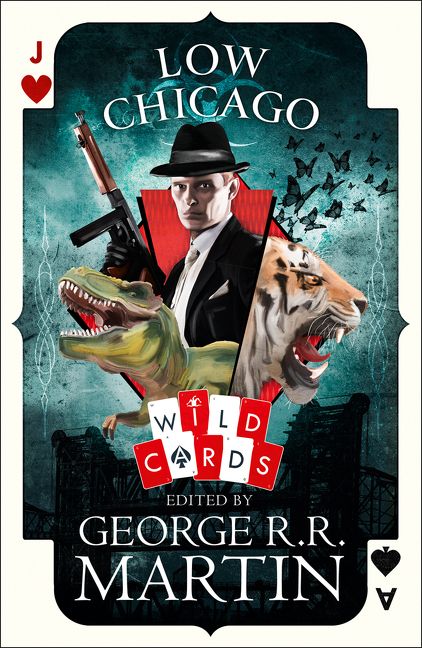
Low Chicago Edited by George R. R. Martin

Low Chicago Cover.jpg

Publisher: Harper Voyager

Publication Date – 12 June 2018

Amazon     Book Depository

From of eight of the world’s leading science fiction and fantasy writers comes the latest addition to the superhero-filled Wild Cards universe, edited by fantasy legend George R. R. Martin.

Wild Cards is one of the more interesting series currently running in the world today due to its distinctive anthology format and the unusual way the series came into existence.  The stories that would eventually form the Wild Cards books were originally written as part of a lengthy Superworld role-playing game campaign that had Martin as gamemaster.  Martin and the other players, all of whom were science fiction writers, created elaborate backstories for the campaign and characters, which were eventually incorporated into the first book in the series, a dark and gritty superhero based anthology also called Wild Cards.  The following entries in the series, despite routinely changing authors, tended to follow the same format as the original book by combining together a series of short stories into a connected narrative.  Low Chicago is the 25th Wild Cards book to be released since the 1987 debut, with two other entries due to be published later in 2018.

The Wild Cards books are set in an alternative universe where an alien virus, known as the Wild Card virus, was released in 1946 above New York City.  This virus affected thousands throughout the planet, killing most of the people it came into contact with and altering the DNA of the survivors.  The vast majority of the infected who remained alive were mutated physically and are now referred to as Jokers.  However, a small percentage gained superhuman abilities and powers and are referred to as Aces.  The stories that followed have been set between 1946 and a time period that usually corresponds to the book’s real world publication date.

In Low Chicago, Martin continues to serve as editor.  The book includes input from two long-running Wild Cards contributors, John J. Miller and Melinda M. Snodgrass, who authored stories in the original Wild Cards.  There is also input from previous contributors Paul Cornell, Marko Kloos, Mary Anne Mohanraj and Kevin Andrew Murphy, as well as newcomers to the series, Saladin Ahmed and Christopher Rowe.

Low Chicago starts in 2017, where a high-stakes poker game has been set up in the city’s famous Palmer House Hotel by a prominent mafia boss.  Each of the seven players has a one million dollar buy-in, and is allowed to bring two attendants including bodyguards.  However, all hell breaks loose when a mysterious assailant targets one of the players, causing the other players and attendants, many of whom are powerful Aces, to unleash their abilities throughout the room.  In the middle of the chaos one of the bodyguards unleashes his own mysterious power and accidently scatters everyone in the room back in time.

Now with history changing outside the hotel, it falls to John Nighthawk and the Sleeper, Croyd Crenson, to travel back to various points of Chicago’s past and find the people trapped there before the present unravels.  But among those who have been sent back are some of the world’s most dangerous criminals, who have decided to change time for their own benefit.  Stuck throughout key points of Chicago’s history, can the time travellers be recovered before the present is permanently altered?

Like many of the books in the franchise, Low Chicago is an anthology featuring several short stories that have been combined together into one overarching and interconnected narrative.  Each of the short stories is unique and features one or more of the characters sent back in time, or inhabitants of the timeline they encounter.  Whilst these short stories all have the same starting plot point, they all have different focuses thanks to that story’s specific characters or time periods.  As a result there are several varied stories, each with their own unique features.  For example, the story Stripes, by Markos Kloos, features a fantastic narrative about the half-human, half-tiger character Khan being trapped in Chicago in 1929 and getting involved in the events surrounding the St. Valentine’s Day Massacre.  Not only is the narrative about an obviously powered individual attempting to influence such an iconic moment in a mob war fun and exciting, but Kloos also includes some significant and heartfelt ethical and emotional decisions that really make you feel for the character of Khan.  At the same time, the story Meathooks on Ice is a complex and emotional story from Saladin Ahmed that focuses on a young and troubled Ace, Meathooks, as he attempts to find redemption and his place in the world back in prehistoric times.

In addition to the overarching time travel plot feature, each of these short stories is also connected together by the characters of John Nighthawk and Croyd Crenson, who could be considered the book’s main protagonists.  Nighthawk and Crenson either appear in the stories themselves or later interact with a story’s central character in order to resolve the specific storyline.  Nighthawk and Crenson are also the main characters of the book’s central storyline, A Long Night at the Palmer House, written by one of the founding authors of Wild Cards, John J. Miller.  This central storyline, told from the viewpoint of John Nighthawk, a character created by Miller in a previous book, is broken up into 11 parts and spread between Low Chicago’s other stories.  The first part of this storyline features the initial poker game and shows the events leading up to the other characters being sent back in time, while the reminder of this storyline focuses on the protagonists’ attempts to find them.  Large portions of this storyline directly tie into Low Chicago’s other short stories, but there are also some sections where they hunt down characters not featured in any of the other short stories.  Miller has included some great scenes in this central storyline, and they get particularly compelling when they encounter the results of the other characters meddling in time and they have to discuss the ethical implications of resetting the timeline.  One particularly outstanding example of this is a sequence that requires the characters to navigate through and fix up a messed up dystopia caused by one of the runaway Aces.

Despite the different authors and the varied content of Low Chicago’s stories, many of the entries complement each other and fit together really well as a result.  Nearly all of the stories contain links to the Wild Cards universe, make full use of Chicago’s rich history, have a comparable dark humour, feature intense action sequences, tell the story in the third person from point of view characters, and have a very similar pace.  There is however, one story that doesn’t follow this trend.  A Bit of a Dinosaur, by Paul Cornell, stands out from the rest of the entries in Low Chicago, as it breaks from third person narration that the other authors utilised, and is instead written in the first person.  Cornell capitalises on this by ramping up the humour in the story and making it a little lighter in tone than the other stories in the book.  The first line of A Bit of a Dinosaur, “I think it’s important to say, immediately, that I am no way responsible for the extinction of the dinosaurs” really sets the tone for this whole short story and it only gets better from there.

One of the most enjoyable parts of Low Chicago is the rich history of the book’s titular city, Chicago.  Throughout all of the short stories, the reader is transported to various periods of Chicago’s history in order to witness several of the most significant events in the city’s past.  These include The Great Chicago Fire of 1871, the Black Sox scandal of 1919, the opening of the first Playboy Club, the St. Valentine’s Day Massacre, the disastrous 1968 Democratic National Convention and the 1893 World’s Columbian Exposition.  All of the authors take significant pains to explore the significance of these events and the impact they had on Chicago and the rest of America.  The reader is given a crash course in the history of these proceedings, and also experiences the author’s interpretation of several key historical figures.  Many of these events occurred before the 1946 release of the Wild Card virus which removed the Wild Cards universe storyline from real world history, and it is fun to watch these events get altered due to the inclusion of several super-powered beings.  It is also extremely fascinating to see the various authors’ interpretations of the historical occurrences that happened after 1946, as they occur in a world where superpowers and mutations are rampant.  As a result, the authors have provided some inventive and captivating alterations that will prove to be highly enjoyable for the reader.

Fans of the Wild Cards universe will also love the deep connections that Low Chicago’s stories have with the rest of the franchise.  In addition to some interesting and complex new characters, Low Chicago features a huge range of characters who originated in the previous Wild Cards books.  There is a deep focus on the history of many of these characters and the readers get to see them placed in a range of unique and compelling situations.  In addition, the authors make full use of the overarching time travel storyline as they visit a range of characters who were killed off in previous books or whose main adventures occurred in storylines set many years before 2017.  Long-time fans of this series will love the inclusion of or nods to these early characters, especially as several have significant roles in the narrative.

Readers unfamiliar with this series may be slightly overwhelmed at the start of the book, but all of the authors contributing to Low Chicago do an amazing job of providing the relevant exposition and explanation for all the characters and the overall history of the Wild Cards universe.  Indeed, Low Chicago might be a perfect book for first time readers of the Wild Cards franchise, as the huge range of characters and the focus on time travel provides the reader with a huge amount of backstory and history that the previous books did not need to contain.

Low Chicago is an outstanding new release that is a sensational and memorable inclusion to one of the best science fiction series currently on the market.  It makes incredible use of its distinctive anthology format and the overarching time travel storyline throughout Chicago’s history that is an inspired and marvellous in its execution.  Low Chicago really stands out from the rest of the books in the Wild Cards franchise and readers will not be disappointed by this latest offering.

My Rating:

Four and a half stars

Amazon     Book Depository

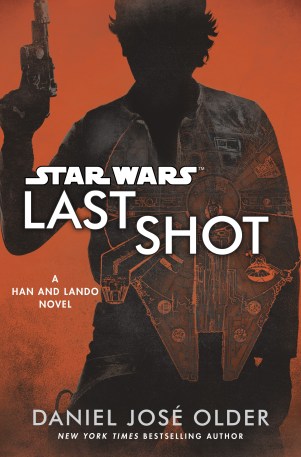
Star Wars: Last Shot by Daniel Jose Older

Last Shot Cover.jpg

Publisher: Century

Australian Publication Date – 30 April 2018

World Publication Date – 17 April 2018

Amazon     Book Depository

Han and Lando return in Last Shot, the latest Star Wars novel, released just ahead of the characters’ upcoming prequel movie, Solo: A Star Wars Story.

The Phylanx Transmitter is one of the most secretive and dangerous weapons in the galaxy.  Built by the psychotic Fyzen Gor, over the years it has been sought by some of the most nefarious people in the galaxy, from criminal gangs to bounty hunters and even the Empire.  Two captains of the Millennium Falcon have gone up against Gor in an attempt to claim the Phylanx Transmitter.  In the early days of his career, the dangerously charismatic Lando Calrissian and his pilot droid, L3-37, encountered a prototype of the transmitter and barely survived.  Years later, a young Han Solo and the Wookiee Chewbacca raced through the criminal underworld to reach the transmitter before it disappeared into the stars.

Since then, the Empire has fallen and the New Republic has taken its place.  Lando has become a successful business owner and the respected administrator of Cloud City, while Han has settled down with Princess Leia and is now trying to be a good father to young Ben Solo.  While Lando and Han both believe they have put their former lives as thieves and smugglers behind them, the past has a way of catching up with everyone.

Having escaped custody, Gor is holding Cloud City hostage and demands that Han and Lando find and reclaim the Phylanx Transmitter.  Forced to fly under the radar, the two scoundrels must find the transmitter and prevent Gor from using it to rain down untold destruction across the galaxy.  In order to succeed, they recruit a brand new team, including a young hotshot pilot, a brilliant Ewok slicer, a woman who may be the love of Lando’s life, and, of course, the best and fluffiest co-pilot around, Chewbacca.  However, even their new team may not be able to withstand Gor and his twisted droid creations.

Last Shot is the latest book from the acclaimed Daniel Jose Older, author of the young adult fantasy sensation Shadowshaper.  This represents his first venture into Star Wars fiction.

Ever since the original Star Wars movies, vast amounts of books, comics, video games and a television series have been created, resulting in a massive extended universe.  Since Disney’s purchase of Lucasfilm in 2012, the vast majority of this extended universe has been expunged, with only the movies and a few products, such as The Clone Wars, now considered canon.  Some elements of the original extended universe have resurfaced over the years, such as fan favourite character Grand Admiral Thrawn, who recently appeared as an antagonist in Rebels and was the subject of last year’s Thrawn by Timothy Zahn.  Last Shot is the latest book in the smaller Star Wars canon extended universe which has been cultivated in the Disney years.  This stand-alone book has been released as a companion piece to the upcoming movie, Solo: A Star Wars Story, and features four of the characters who are going to appear in it.

Last Shot contains a clever combination of four separate storylines set in different points in time throughout the franchise’s history.  The main story is set a couple of years after the events of Return of the Jedi, and features the characters forced to return to their lives of crime.  Two of the side storylines follow the main characters on a separate mission in their past, and these subplots are set on either side of the upcoming Solo movie.  The final storyline is set over a period of years and follows the rise of Fyzen Gor.  Older does a skilful job of switching between the various storylines to reveal certain clues and show the reader the hidden history the two main characters have with the protagonist.

This book will strongly appeal to fans of Star Wars, particularly those who like to dive deeper into the lore and storylines of the extended universe.  However, even dedicated fans may feel a little overwhelmed by the constant references to other elements of canon and the inclusion of nearly every alien race in the galaxy.  Even the addition of The Force Awakens fan favourite character Maz Kanata seems a bit forced and unnecessary.  Despite this, casual fans will easily be able to follow the story and enjoy the funny and action-packed adventure within.

Last Shot sets itself apart from many of the other Star Wars stories by avoiding the Jedi-saturated and force-fixated storylines that define most of the movies and books.  This book doesn’t even feature a single Jedi, but instead focuses on the criminal underworld of the galaxy as the main characters fight, cheat and steal their way to victory.  This is a refreshing story which seems to mirror the crime-orientated plot of the upcoming Solo movie.

In addition to the crime-centric story and the multitude of action-packed scenes, the readers will really enjoy the substantial humour that Older has included within book.  In particular, most readers will appreciate the number of self-deprecating jokes and references towards elements of the Star Wars universe.  For example, one particularly enjoyable sequence involves a Gungan who is annoyed with how his species is perceived by the galaxy thanks to the actions of a certain individual.  Despite there being a 40-year gap between the events of this book and those of The Phantom Menace, some shade is still thrown over the infamous Jar Jar Binks.  Not only does the book come across as more humorous and less serious than other Star Wars stories, the book has also been written in a much more adult way, as there are a number of jokes and allusions that would never get included in the family friendly movies.  As a result, Last Shot is an incredibly entertaining story that stands apart from previous works of Star Wars fiction.

Star Wars: Last Shot is an outrageously fun new novel that will greatly appeal to all fans of the Star Wars franchise.  Filled with innumerable references and jokes about the wider Star Wars universe, readers will love to see Han Solo and Lando Calrissian being the very best scoundrels they can be.  This is amazing and addictive new adventure in a galaxy, far, far away.

My Rating:

Four stars

Amazon     Book Depository

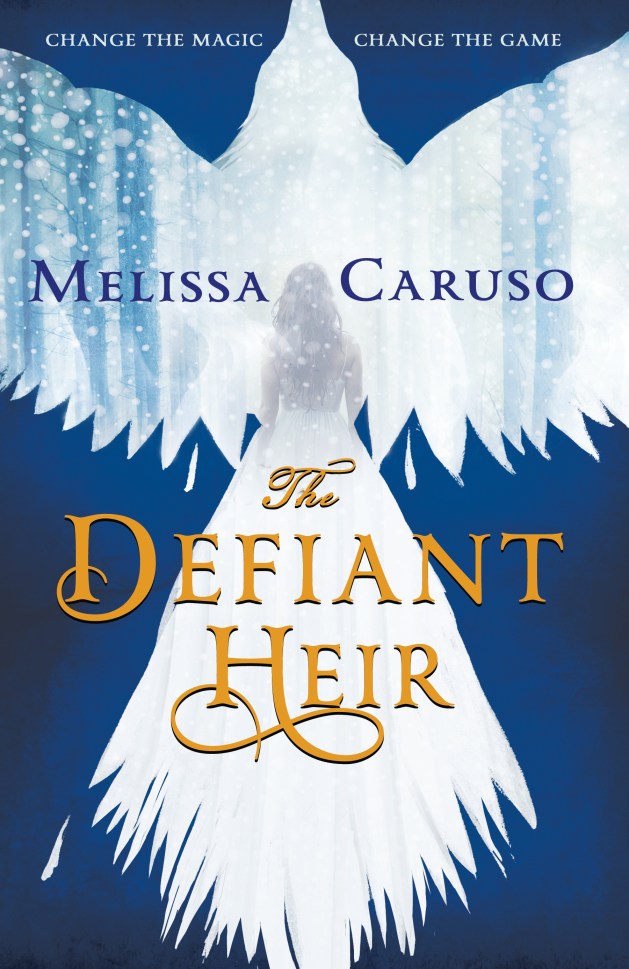
The Defiant Heir by Melissa Caruso

The Defiant Heir Cover.jpg

Publisher: Orbit

Australian Publication Date – 24 April 2018

World Publication Date – 19 April 2018

Amazon

Melissa Caruso follows up her extraordinary debut with another unmissable magical adventure.

On the continent of Eruvia lies the Serene Empire of Raverra.  Ruled by the Doge and the Council of Nine, the Empire’s power comes from its mages, the legendary Falcon Army.  When a mage comes to power in the lands of Raverra, they are conscripted as a Falcon and bound to a Falconer, a non-mage who can choose to unleash or bind their Falcon’s power with a word.

However, the Serene Empire is not the only great power on Eruvia.  To the north lies the mysterious nation of Vaskandar, controlled by a dangerous group of mages known as the Witch Lords.  Each Witch Lord is a powerful vivomancer whose magic grants them control over all living beings, such as animals, plants and even humans.  After years of peace, several of the Witch Lords desire additional territory and are preparing for war against the Serene Empire.  Large forces of soldiers and the Vaskandar’s dreaded chimeras amass on the border while covert attacks are undertaken against the Serene Empire’s most powerful Falcons.  But before the Vaskandar can formally declare war, all seventeen Witch Lords must meet in a conclave to agree to a course of action.

Lady Amalia Cornaro is heir to one of the oldest and most powerful families in all of the Serene Empire.  Formerly a sheltered academic, her life dramatically changed when she was accidently bonded to the rebellious teenage runway Zaira, a rare and destructive fire warlock and the most powerful mage in the Empire.  Despite a turbulent and resentful start to their relationship, Amalia and Zaira have come to a mutual understanding following their adventures in the city of Ardence.

As the tension between the two nations increases, Amalia and Zaira are sent as a military deterrent to the border province of Callamourne, ruled by Amalia’s grandmother.  Despite their presence, it quickly becomes apparent that forces are conspiring to bring the war to pass, especially with spies and assassins targeting Amalia and Zaira directly.  Determined to maintain the peace, Amalia knows that the only way to prevent the war is to infiltrate Vaskandar and attend the conclave on behalf of the Serene Empire.

Entering Vaskandar is a dangerous proposition.  Each Witch Lord has their own territory which they rule absolutely thanks to a mysterious bond to the land that allows them to control all living creatures within their boundaries.  In addition, Amalia already has powerful enemies among the Witch Lords.  The deadly Lady of Thorns holds a grudge against her entire family, and Amalia and Zaiara have experience with the machinations of the Skinwitch Ruven, whose plot could cause great destruction.

Their only hope to influence the conclave may come from the mysterious Crow Lord, who has taken an interest in Amalia.  However, the Crow Lord is playing his own game, and Amalia and Zaira are the perfect pawns.

Melissa Caruso is a relatively new fantasy author whose first book in the Swords and Fire series, The Tethered Mage, was released in late 2017.  The Defiant Heir is a direct sequel to this, and is set a few months after.

The Tethered Mage was one of the surprising hits of last year.  What started out as an intriguing sounding fantasy novel turned into one of the most exciting and memorable debuts of 2017 and proved near impossible to put down.  Caruso maintains this trend of excellent writing in The Defiant Heir, which continues to the provide the same great characters, fantasy adventure, worldbuilding and amazing story writing that made her first book such an irresistible read.

Caruso has chosen to expand her fantasy world in The Defiant Heir by detailing the nation of Vaskandar and focusing on its rulers, the Witch Lords.  While Vaskandar was mentioned and one of nation’s vivomancers, Prince Ruven, was a secondary antagonist, this area of her world wasn’t really explored in the first book.  For this book, Vaskandar is a major location and the protagonists spend a large portion of the story within its boundaries.  As a result, Caruso has produced a significant amount of fascinating lore about this country, especially when it comes to the Witch Lords.  The focus on the Witch Lords is particularly interesting as Caruso has developed complex backstories, powers, plots and motivations for many of them, which adds immensely to the story.  In addition, despite the fact that they all study the same branch of the magic, each of the Witch Lords has their own speciality and their appearance and abilities are different as a result.  This is especially noticeable during the numerous magical duels that occur throughout the book, where these differences allow for a wider variety of magical action.  It is also quite fun when the various Witch Lords use their powers to show off with memorable entrances and appearances during the opening scenes of the conclave.

Readers should also keep an eye out for Caruso’s focus on character development within The Defiant Heir for the two main characters.  Amalia’s growth is the most significant, as circumstances force her to become a more savvy and decisive political player, very much like her mother.  As a result, she is forced to make a number of tough decisions and struggles to maintain her morality in a harsh world where her options are becoming more and more limited.  There is also the growing realisation that her position may not allow her to have the personal life she wants, and this greatly affects her relationship with the dashing Captain Marcello, the main love interest of the first book.  This is a well done bit of character development that will draw the reader in emotionally, especially when it comes to Amalia’s most significant decision in the book.

Zaira’s development is more subtle, as she is not the book’s narrator, and is mostly a continuation of the transformation from inverted loner to team player that started in The Tethered Mage.  However, it is more realistic to see that this growth is a slow process, and her stubbornness is not automatically fixed in the span of one book.  The same could be said about the satisfying but gradual development in the relationship between the main characters.

Melissa Caruso once again shows why she is one of the brightest new stars in the fantasy fiction.  The Defiant Heir is an outstanding continuation of her first series that introduces significant and exiting lore to her already intriguing universe while providing significant development to her main characters.  If you haven’t already discovered the magic of Caruso’s Swords and Fire series, you are in for a serious treat.

My Rating:

Five Stars

Amazon

Pandora’s Boy by Lindsey Davis

Pandora's Boy Cover.jpg

Publisher: Hodder & Stoughton

Publication Date – 5 April 2018

Amazon

Ancient Rome’s premier female detective returns in the latest Flavia Albia mystery from veteran historical crime author Lindsey Davis.

Rome, 89 AD.  Flavia Albia, the daughter of the legendary investigator Falco, is now a proficient private investigator and informant in her own right.  When the ex-wife of her husband, Tiberius, brings a case of family drama to her, Flavia is tempted to refuse, but when Tiberius disappears she needs a distraction.

The case revolves around a teenaged girl found dead in the prosperous Quirinal Hill district of Rome.  The girl, Clodia, was the apparent victim of a poisoned love potion, and her parents and grandparents are blaming each other for her death.  What begins as a simple investigation quickly becomes complicated when the witch accused of supplying the potion turns out to be the sister of the city’s biggest crime boss.  No-one is talking, and everyone in the Quirinal Hill has a secret.

Flavia is forced to seek the truth from a variety of people, including warring grannies, concerned parents, criminal lawyers, secretive slaves, a lettuce salesman with an interesting religious statue and, worst of all, the overprivileged offspring of Rome’s elite.  However, as Flavia’s investigation continues and a friend of hers dies, it soon becomes apparent that a vicious gang war is imminent.  Can Flavia solve the crime without getting caught in the crossfire, especially when she has a terrible history with one of the gangs?

Pandora’s Boy is the sixth book in the Flavia Albia series, which acts as a direct sequel series to Davis’ Marcus Didius Falco series.  Davis is one of the most prolific authors of historical whodunits and has a particular focus on novels set in ancient Rome.  For example, her Marcus Didius Falco series contains 20 books, and she has produced some stand-alone books set in the same period.

Like the previous books in the Flavia Albia series, Pandora’s Boy takes a contemporary look at Roman culture and lifestyles.  The inhabitants of Davis’ books act in a very modern way despite their ancient surroundings, and this results in a very humorous interpretation of the ancient Roman characters.  Davis also uses this book to parody a specific group in modern society: the millennials.  Throughout the story, Flavia is forced to follow, interview and generally endure the victim’s friends, who are the offspring of the city’s rich and powerful.  These friends are exceedingly selfish, have sordid love lives and get into all sorts of mischief.  In other words, they act in a very similar way to how modern day millennials are often perceived and portrayed.  Their appearance is quite jarring in the ancient Roman setting and leads to a lot of the books humour.  In all, it is a fun, quirky addition, and an amusing examination of modern society through very ancient eyes.

The core of the book is the death of a young woman and its investigation by the main character.  This is a well-done mystery that takes many twists and turns to keep the attention of the reader.  Flavia’s investigation is done through interviews, trickery, observations and undercover work, and, like many other parts of the book, is infused with Davis’ trademark humour.  The investigation is wrapped up in a final scene that is a throwback to classic murder mystery dénouements.  All the interested parties are gathered together in one place and the investigator reveals their conclusions, eventually leading to their solution to the crime.  Davis provides a perfect parody of this, infused with her own unique touch.  As a result, there are several jokes about this well-used literary device, including discussions around the necessary prep work and tricks to keep the gathered parties’ concentration of the speaker that will greatly amuse many murder mystery buffs.

One of the more diverting and memorable aspects of the Flavia Albia series is Davis’ tendency to include big action sequences that devolve into near absurdity and provide some of the best laughs in the entire book.  For example, in Davis’ previous book, The Third Nero, the climactic scene was a battle in the heart of Rome that featured, among other things, a war elephant, Parthian cataphracts and one of the most improbable chase sequences in all of fiction.  While nothing will quite top this, Davis has striven to include one such scene in Pandora’s Boy, featuring an interrupted séance, an all-out brawl between legionnaires and Vigiles at a collapsing temple, all of which serves as a backdrop to a fight between two warring grannies.  This is an extremely entertaining scene and definitely a highlight to watch out for.

Another notable feature of the books in the Falco universe is the deeper examination of the Roman criminal justice system.  The investigators in these books often deal with the Vigiles and the Aediles, the ancient Roman equivalent of the police and magistrates, many of whom turn into key characters.  This is a unique feature, as most Roman historical fiction books neglect to focus on these institutions, only mentioning them if in the context of political gain.  Pandora’s Boy includes a detailed look at the Vigiles who patrol the Quirinal Hill district and their investigation into the death and other serious crimes.  Loaded up with a suitable modern twist, the inclusion of these characters is an intriguing addition that highlights an often-neglected side of ancient Roman life.

Pandora’s Boy is a wonderful addition to one of the best ancient crime series currently on the market.  Davis once again creates a fantastic murder mystery and infuses it with outrageous humour and a modernistic take on ancient Roman life.  This is an exceedingly fun and deeply absorbing novel that will appeal to a very wide audience of readers.

My Rating:

Five Stars

Amazon