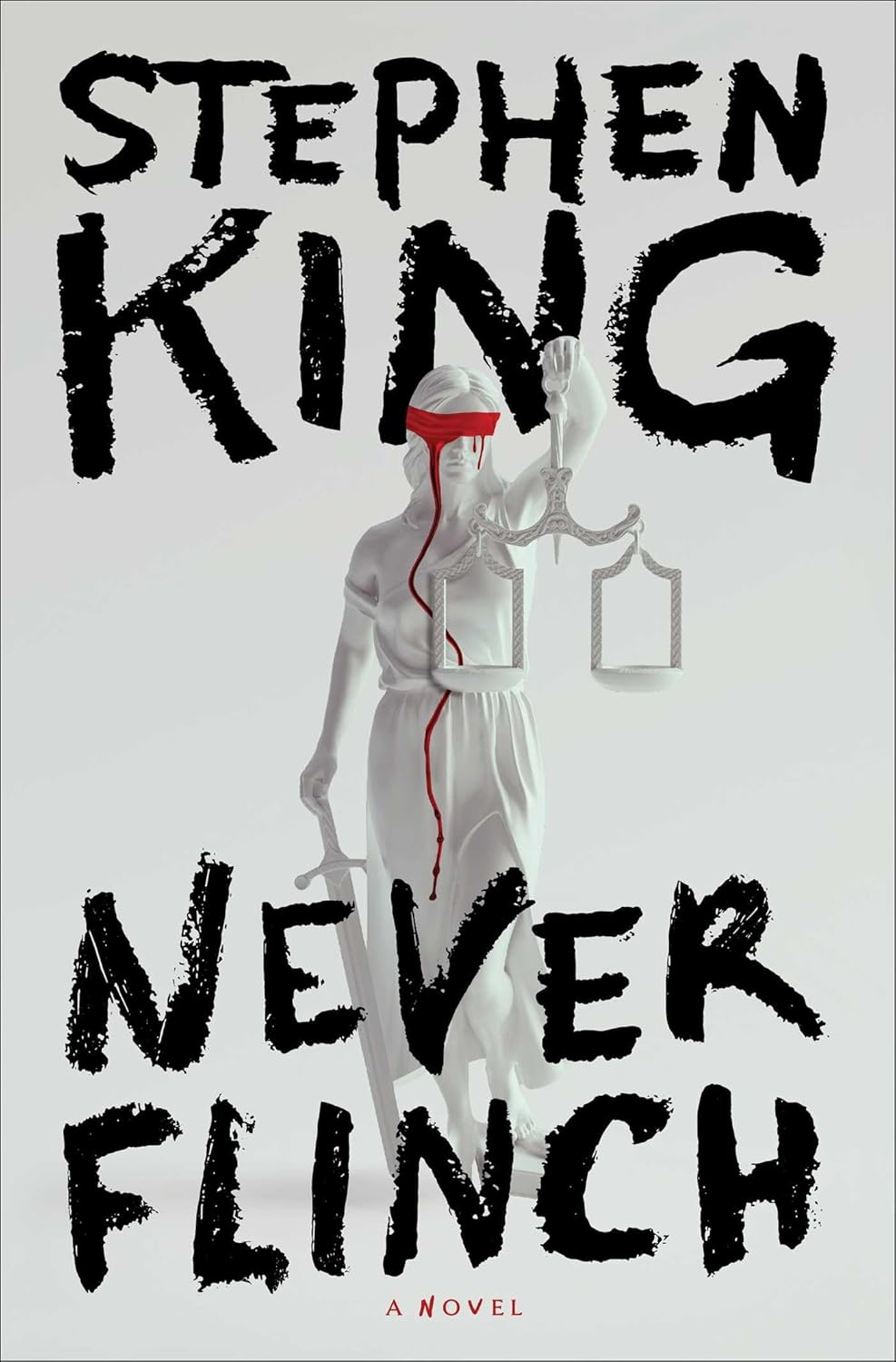
Never Flinch by Stephen King

Publisher: Hodder & Stoughton/Simon & Schuster Audio (Audiobook – 5 September 2023)

Series: Holly Gibney – Book Two

Length: 14 hours and 44 minutes

My Rating: 5 out of 5 stars

Amazon

Legendary author Stephen King continues to dominate the horror and crime fiction genres with his brilliant 2025 release, Never Flinch, a gripping and intense thriller that brings back one of his more unique protagonists and keeps the reader constantly on the edge of their seat.

Ever since I started reviewing a wider range of fiction on my blog, I have been really drawn to the works of iconic author Stephen King.  King is a truly impressive author who has impacted so many levels of world fiction with his brilliant imagination, and I have had such an epic time getting through some of his latest novels.  Highlights for me so far include the fun coming-of-age story Later, the clever fantasy novel Fairy Tale, the gripping and personal thriller Billy Summers (one of my favourite books of 2021), and the impressive short story collection You Like It Darker (one of my favourite books of 2024), just to name a few.

While I have loved some of these impressive and varied reads, some of my favourite recent Stephen King books have been those where King dives into the crime fiction genre, producing some complex and particularly powerful narrative, especially when his mysteries border on horror stories.  The author’s current dive into the crime fiction genre mostly originated with his 2014 novel, Mr Mercedes.  The first book in the author’s Bill Hodges series, Mr Mercedes was a fantastic read that saw a gritty detective attempt to stop a deranged killer haunting his town.  While the Bill Hodges books featured several compelling characters, a true standout was unusual new protagonist, Holly Gibney.  An initially timid and unsocial figure, Holly grew into a competent detective as the Bill Hodges books continued and was a true standout for this clever trilogy.

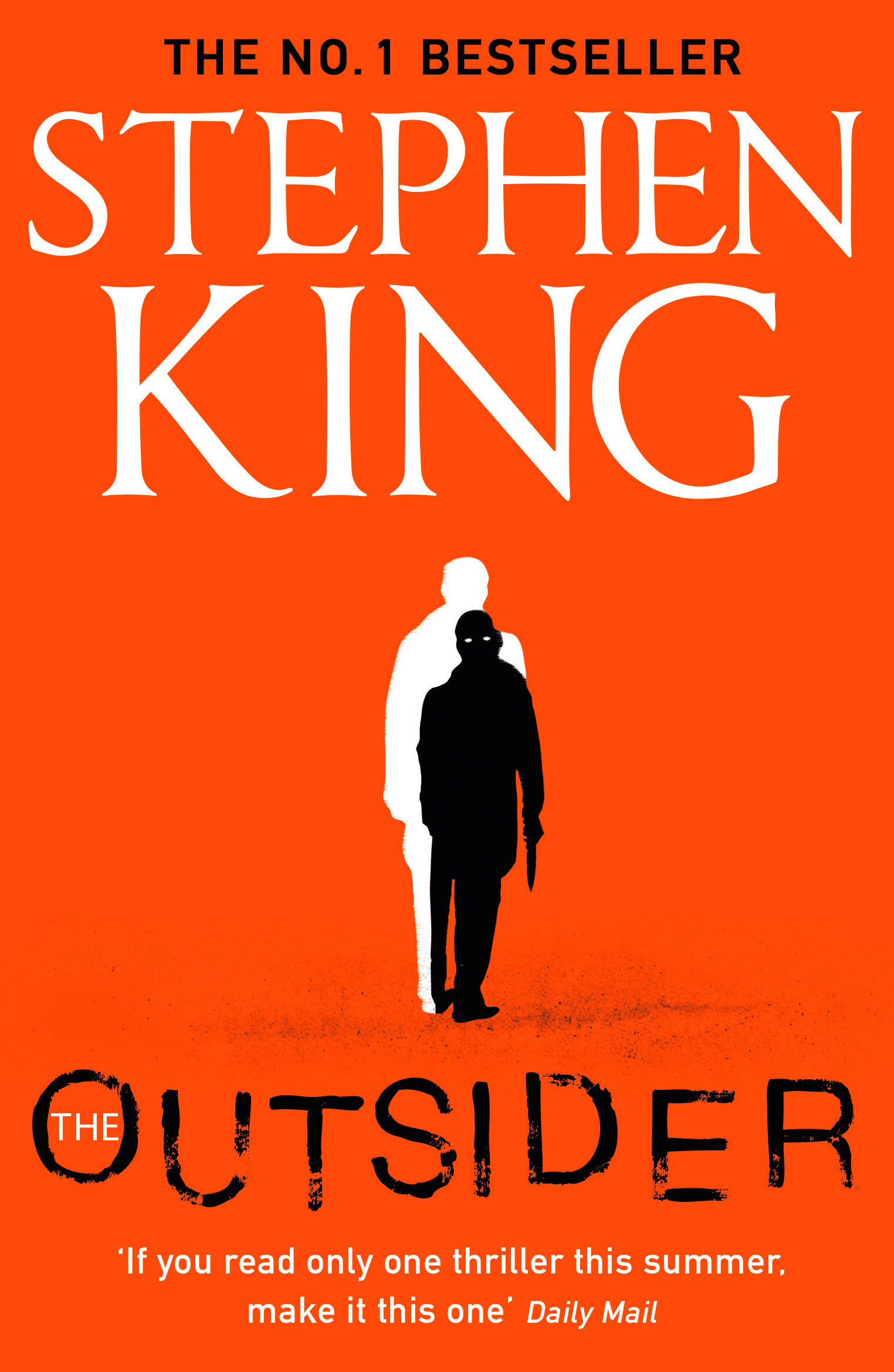
King enjoyed Gibney so much as a character that she was eventually brought back for several additional books.  This included the horror thriller The Outsider (one of my favourite horror novels), where Holly is brought in halfway through the book’s plot to investigate a murder conclusively proven to be committed by a man with a perfect alibi.  The Outsider was an exceptional read, and King soon upgraded Holly to a sole protagonist with his 2023 novel Holly.  Featuring a particularly powerful and deeply shocking story, Holly saw the protagonist take on an unlikely pair of killers with a shocking motivation for committing their crimes.  Holly ended up being one of my favourite books and audiobooks of 2023, and I am still very impressed with where that dark story went.  As such, I have been very keen to read more books from Stephen King since then, and I was particularly thrilled when I found out that the author’s 2025 release was another Holly Gibney novel.  This sequel, Never Flinch, was one of my most anticipated novels of 2025, and I have been meaning to write a review about it for a while now.

Plot Synopsis:

From master storyteller Stephen King comes an extraordinary new novel with intertwining storylines—one about a killer on a diabolical revenge mission, and another about a vigilante targeting a feminist celebrity speaker—featuring the beloved Holly Gibney and a dynamic new cast of characters.

When the Buckeye City Police Department receives a disturbing letter from a person threatening to “kill thirteen innocents and one guilty” in “an act of atonement for the needless death of an innocent man,” Detective Izzy Jaynes has no idea what to think. Are fourteen citizens about to be slaughtered in an unhinged act of retribution? As the investigation unfolds, Izzy realizes that the letter writer is deadly serious, and she turns to her friend Holly Gibney for help.

Meanwhile, controversial and outspoken women’s rights activist Kate McKay is embarking on a multi-state lecture tour, drawing packed venues of both fans and detractors. Someone who vehemently opposes Kate’s message of female empowerment is targeting her and disrupting her events. At first, no one is hurt, but the stalker is growing bolder, and Holly is hired to be Kate’s bodyguard—a challenging task with a headstrong employer and a determined adversary driven by wrath and his belief in his own righteousness.

Featuring a riveting cast of characters both old and new, including world-famous gospel singer Sista Bessie and an unforgettable villain addicted to murder, these twinned narratives converge in a chilling and spectacular conclusion—a feat of storytelling only Stephen King could pull off.

Thrilling, wildly fun, and outrageously engrossing, Never Flinch is one of King’s richest and most propulsive novels.

Honestly, how the heck is King still this damn good?  Never Flinch was another exceptional novel from King, who continues to impress with his elaborate narratives, slick writing and relatable characters.  Featuring a particularly clever crime fiction plot that keeps the readers on their toes to the very end, Never Flinch proved near impossible to put down at times, especially as King keeps amping up the intensity and the danger.  Never Flinch gets a very easy five-star rating from me, and I’m already listed it as one of the top books and audiobooks from the first half of 2025.

King pulls together an awesome and compelling story for Never Flinch, that had me hooked very early on.  Starting off on an interesting note as the reader is introduced the book’s antagonist, who goes by the nickname of Trig, you are soon thrown into his desperate ploy to murder 14 random people in Buckeye City to replicate the jury who put an innocent man in prison.  Serving as a very impressive start to a great story, King soon expands the narrative further by examining the police investigation into these murders, and showing protagonist Holly Gibney’s initial interest in the case.  From there the plot expands even further, as another dangerous killer starts to stalk a women’s rights activist, Kate McKay, and her assistant, and Holly is eventually hired to act as Kate’s bodyguard during the rest of her book tour.  King does an excellent job building up all the details of this second case, while also following the growing murders in Buckeye City, and you are soon absorbed in both cases, especially when you witness all the perspectives involved with the two scenarios, including the book’s various antagonists.  There are also some fun additional personal notes added to plot, as several compelling supporting characters, including recurring Holly Gibney cast members Jerome and Barbara Robinson, the later of whom builds a connection with famous gospel singer Sista Bessie, who is performing in Buckeye City.

The author keeps the pace of Never Flinch going strong and fast as you move into the story, with interesting storylines around Holly, the police, the antagonists, and other supporting characters.  There was a real interesting mixture of storylines once King had everything set up, and I really loved the various compelling character arcs and elements as the plot continued.  While some of the big twists about the antagonists aren’t too surprising and are revealed relatively early in the plot, you are still very drawn into their respective crusades, as well as the protagonists’ attempts to stop them.  Everything comes together nicely in the second half of the book, where both cases, as well as the more personal storylines of Never Flinch, collide violently, and various characters are forced to fight for their lives.  King provides an exceedingly tense final third to Never Flinch, which sees a blow-by-blow coverage of events leading up to a dramatic and bloody final confrontation.  The alternating movements of all the participants in this case, including a deranged killer, several hostages and coerced individuals, as well as the protagonists desperately trying to save the day, produced so much tension, and you really cannot turn away until all the dramatic confrontations come to an end.  I frankly powered through this final part of the book in one extended session, as I was so damn keen to see what happened next, and this ended up being an extremely satisfying ending to a really impressive book.

I really enjoy King’s great writing style when it comes to his captivating crime fiction novels, and he excels at creating tense and ultra-exciting reads, driven by multiple compelling character arcs.  Never Flinch was an excellent example of this, as King produces a brilliant story that quickly grabs the reader’s attention and never slows down.  Featuring slick, quickfire writing and very short chapters and subchapters, the story moves along at a very fast clip, and King effectively sets up the book’s compelling scenarios very effectively.  The great array of alternating character perspectives, as well as several compelling flashbacks, really works to create a layered plot, and I loved the constant switch between the many characters.  Showcasing several antagonist perspectives also helped to really increase tension, especially as you got to see their various plans in action.  This writing style also helped to make Never Flinch feel a lot more accessible to new readers, and while established fans of the author will probably get more out of some of the character developments that occur in the novel, I felt that Never Flinch was a book that any fan of crime fiction could easily get into and have no trouble following at all.

King also experiments with some interesting themes in this novel, which added a lot to Never Flinch’s emotional impact, while also helping to highlight character flaws in the cast.  This includes a very compelling look at addiction in all its forms, with a particular focus on how it drives people.  While this includes a focus on more obvious addictions like drugs and alcohol, other major addictions come to light throughout the book, including Trig’s growing desire to kill, and Kate’s addiction for the spotlight and controversy.  The examination of addiction served as a key part of the book’s plot, especially as it helps to explore some of the character’s motivations, and I felt that King was putting a lot of his own personal experiences into the book.  King also spends a bit of time in Never Flinch examining mentorship, as several junior characters find themselves coming under the wing of older, seemingly wiser, people.  While some of these relationships are quite positive, others, such as Kate and her assistant, come across as a little more toxic at times, especially when the mentor puts their own needs ahead of their student’s safety.  I liked the interesting comparisons in the mentor/mentee relationships that formed throughout Never Flinch, and it was a very compelling addition to the plot.

As with most of King’s books, the true heart of Never Flinch lies in its compelling and often larger-than-life characters, who the author meticulously brings to life.  The focus of this book is once again the quirky and silently talented Holly Gibney, a skilled investigator brought into the case by her own curiosity and a desire to help a prominent women’s rights activist.  Holly serves as a dependable and likeable heart to the entire novel, and it was fascinating to watch her continue to battle her own lack of confidence and lingering social issues.  Her continued growth as both an investigator and a person is an excellent part of this book, and it was great to see the various relationships she continues to cultivate.

These relationships for Holly result in an excellent cast of returning characters, including detective Isabelle ‘Izzy’ James, who has a much bigger role in this novel as the main police character in the story.  Izzy’s official investigation serves as a good counterpart to Holly’s more general queries into the case, and her maverick personality, especially in the face of police politics, added some extra intrigue to Never Flinch.  The other two major returning characters are siblings Jerome and Barbara Robinson, who have served as Holly’s backup and friends since Mr Mercedes.  While Jerome was a great emotional support to Holly and had some key roles in this book, the standout supporting figure was Barbara, whose compelling side-plot about her work with Sista Bessie helped to make Never Flinch a little more hopeful in places, especially as King has been detailing Barbara’s artistic growth in response to the darkest of encounters for the last couple of books.  Of course, as this is a Stephen King novel, this hopefulness often results in greater trauma down the line, as the author must ensure you are constantly worried that bad things are going to happen to the good people in Holly’s life.  Throw in some other compelling supporting characters, including the radiant and soulful Sista Bessie, the bombastic feminist icon Kate McKay, and Corrie Anderson, Kate’s young assistant who finds herself in the firing line alongside her boss despite her best judgement, and there are a lot of interesting figures in Never Flinch who you become quite attached to.

While I love the main cast, another major highlight of Never Flinch is the complex antagonists who King effortlessly works into the plot.  This includes a compelling stalker figure who is hunting after Kate and Corrie for their own religious reasons.  An interesting character whose deeper issues are well exploited, this stalker was an interesting alternate antagonist for Holly in this novel, and I liked how their complex actions added some additional risk to the plot.  However, the best villain was the serial killer stalking Buckeye City, determined to murder 14 people in response to an innocent man dying in jail.  This killer, Trig, was a truly fascinating figure, with some unique motivations and quirks.  King does an excellent job mostly obscuring Trig’s identity for much of the novel, while also showcasing many compelling scenes from his perspective as continues his murderous quest.  The resulting slow-burn loss of Trig’s sanity as he becomes addicted to his dark work was a particularly sinister part of Never Flinch, and King excelled at showcasing this antagonist’s changing motivations and plans.  These outstanding villains served as an impressive counterpart to the main cast, and I felt that Trig was King’s best character in Never Flinch.

While I received copies of Never Flinch on a few different formats, I decided in the end to try out the audiobook version of this novel, especially after having some very good experiences with other Stephen King audiobooks.  This proved to be an outstanding choice, as the Never Flinch audiobook was an exceptional listen, with the layered and complex mystery really transforms into something special when read out.  Coming in with a near 15-hour long runtime, Never Flinch is a decently long audiobook, but it’s one that listeners will generally be able to power through quickly, especially with the compelling, if relatively new narrator Jessie Mueller bringing the story to life.  Now, I must admit that I was initially disappointed that Holly narrator Justine Lupe (who played Holly in the Mr Mercedes television adaptation), was not returning for Never Flinch, however Jessie Mueller quickly showed herself to be an excellent replacement.  Thanks to her outstanding voice work, Mueller quickly made the Never Flinch audiobook her own, and I liked the unique flair and compelling voices she gifted to the extended cast.  Several of these characters had a lot more personality thanks to Mueller’s narration, and I liked how well she voiced some of the distinctive members of the cast.  However, I think Mueller’s best inclusion to this audiobook was her very impressive singing voice, as there a couple of music focused scenes around Sista Bessie and Barbara.  Mueller captured these parts of the book perfectly, and her resulting singing performances were extremely good, and helped to give the audiobook more impact.  As such, Never Flinch was an overall exceptional listen and one of the best audiobooks of the year, and I would strongly recommend it as the best format to enjoy this great new King novel.

Stephen King once again showcases why he the world’s top author with another exceptional and truly gripping novel.  Never Flinch was an incredible read that combines a clever crime fiction narrative with some fantastic characters, to really grab the reader’s attention.  With its epic tension and high stakes, King’s latest novel was so damn addictive, and I really appreciated how clever the story got.  An overall exceptional read, Never Flinch was one of the best books I had the pleasure of reading in 2025, and I cannot wait to see what King writes next.
Amazon

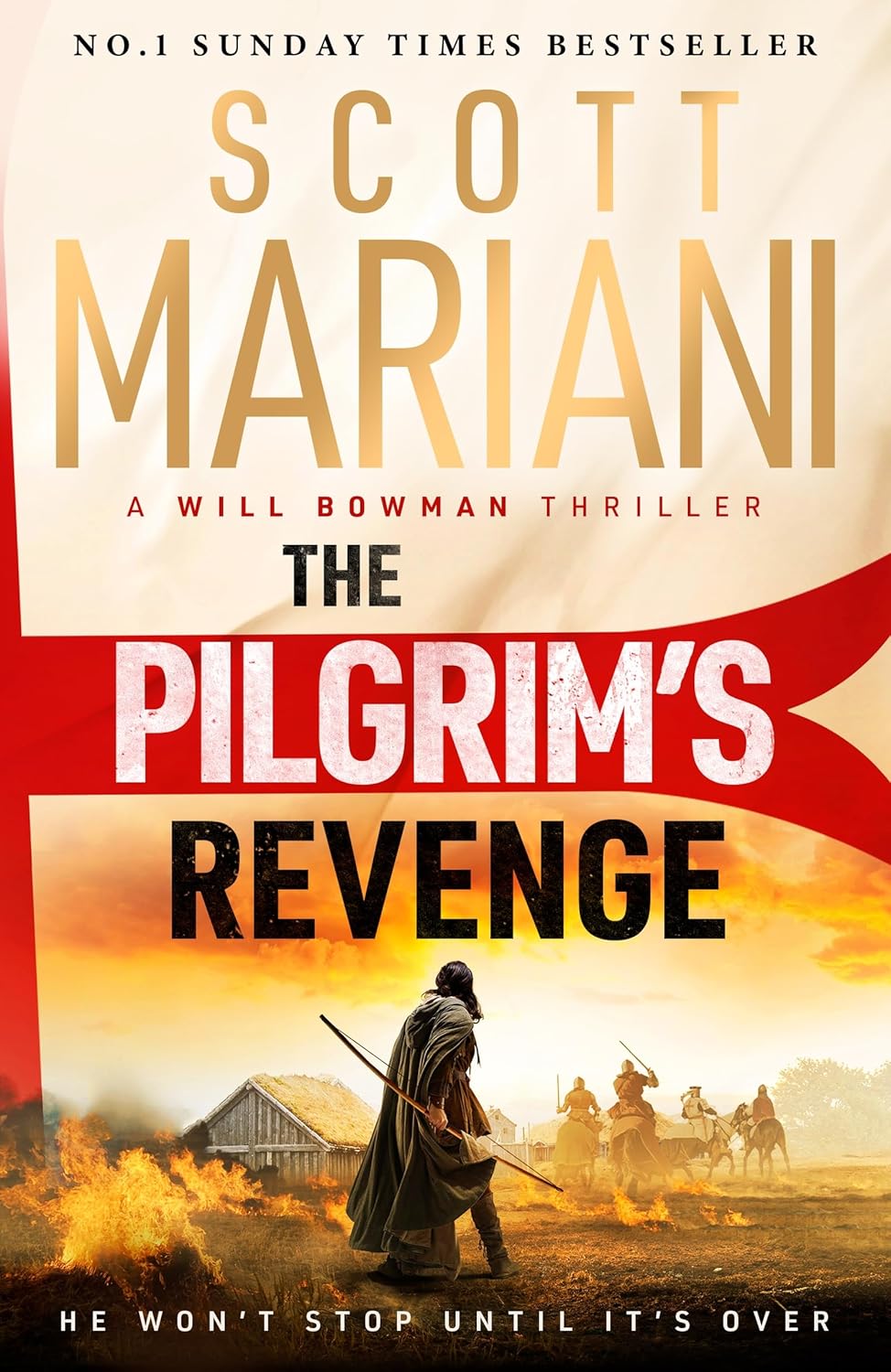
The Pilgrim’s Revenge by Scott Mariani

Publisher: Hodder & Stoughton (Trade Paperback – 26 August 2025)

Series: Will Bowman – Book One

Length: 323 pages

My Rating: 4.5 out of 5 stars

Amazon

Prepare for war in Scott Mariani’s compelling and action-packed historical thriller, The Pilgrim’s Revenge, an awesome read with some real heart to it.

Scott Mariani is a veteran author whose work I have been meaning to check out for a while.  A major thriller author, Mariani is best known for his long-running Ben Hope series which features modern spy fiction narratives with the protagonist unwinding puzzles and conspiracy theories from history.  While I haven’t had the chance to read any of Mariani’s thrillers, his 2025 release, The Pilgrim’s Revenge caught my eye, especially as it is the first time that Mariani has written a full historical fiction novel.  The first book in Mariani’s new Will Bowman series, The Pilgrim’s Revenge was an intense and captivating take on the classic medieval historical fiction adventure, featuring a great revenge twist.

Plot Synopsis:

1190 – Humble layman Will Bowman lives in the countryside with his pregnant wife, when soldiers from Richard Lionheart’s army tear through his home. Will is beaten unconscious, and awakes to find his wife murdered, his farm burnt down, and his life forever changed.

In vengeance, Will infiltrates Richard’s army to find the marauding gang, and finds himself swept along in the march of the Crusades. With the help of new allies and fuelled by his loss, Will crosses Europe with the King’s army.

Can Will avenge his wife? Or will he be swept away by the unstoppable force of Richard’s Crusade?

The Pilgrim’s Revenge was an outstanding and action-packed novel from Mariani, who dives into full historic fiction with great enthusiasm.  Setting the scene quickly, with an introduction to point-of-view protagonist Will Bowman, a minor landowner and skilled hunter, the book soon takes a dark twist when a group of pillaging soldiers kill his pregnant wife, burn his farm and leave Will for dead.  Determined to get revenge, Will takes up his bow and starts following the attackers, determining them to be pilgrims on the way to join Richard the Lionheart’s attack on the Holy Lands.

After a good initial period in England, where Will encounters friendship and additional heartbreak as part of his personal journey, the protagonist soon boards a ship towards the Holy Land.  This middle section of the novel is useful for introducing several great supporting characters and provides some compelling historical context to the events that Will is a part of.  After some exciting sequences at sea, as well as a sudden action-packed siege, the plot takes the protagonist into King Richard’s orbit in Sicily as part of some established historical events.  Mariani also gives Will the first glimpses of his goal, which ends in an exciting and tense series of encounters that add some excellent drama and risk.  Following some surprising developments, Mariani continues to explore the early parts of Richard’s crusade, including his landing in Cyprus, which provides some awesome fight sequences, before setting the protagonist up for the big confrontation of the novel.  While the development of the later part of this story isn’t too surprising, it features some fantastic and exciting moments, and plays into the established historical events really well.  Wrapping up on an excellent, if unexpectedly complete, note, Mariani leaves the story open for more adventures, which we’ll probably see very soon.

I think that the author provided a strong story for The Pilgrim’s Revenge, and this proved to be an excellent piece of historical fiction with a bit of a thriller flair to it.  Loaded with action, intriguing descriptions of the period, as well as some entertaining characters, The Pilgrim’s Revenge was a great historical adventure, which Mariani ensures stands out from the various other novels set in this period thanks to its central character and he’s unique motivations.  I particularly appreciated the author’s use of the third-person perspective through the eyes of protagonist Will Bowman, which really paints a personal and insightful look at the events of the Third Crusade.  Having a simple English farmer, who has relatively little knowledge of the land outside his local community, slowly learn about the lands of the later 12th century as part of his own personal journey, really allowed new readers with less historical knowledge to dive into the events of this book a lot easier.  At the same time, Mariani clearly puts the work in describing the historical elements of the book, whether it’s the details of the crusade, interesting depictions of real-life figures, or even complex depictions of day-to-day life and the social, technological and military element of the time.  Thanks to the exciting, action-packed plot, readers can power through The Pilgrim’s Revenge quickly, but for those who stop to savour the author’s compelling writing, there are some amazing details and compelling character moments to appreciate.

Overall, The Pilgrim’s Revenge was an outstanding and captivating novel, as Scott Mariani sets up an exciting new series.  Featuring an enjoyable, action-laden plot, The Pilgrim’s Revenge was an amazing novel to get through, especially with its compelling depictions of war and life in the 12th century.  A very exciting read, I quickly flew through The Pilgrim’s Revenge and is worth checking out especially if you enjoy intense and detailed historical reads.  I look forward to continuing the Will Bowman series going forward, and I’ve already got a copy of the sequel, The Knight’s Pledge, which I am hoping to read soon.

Amazon

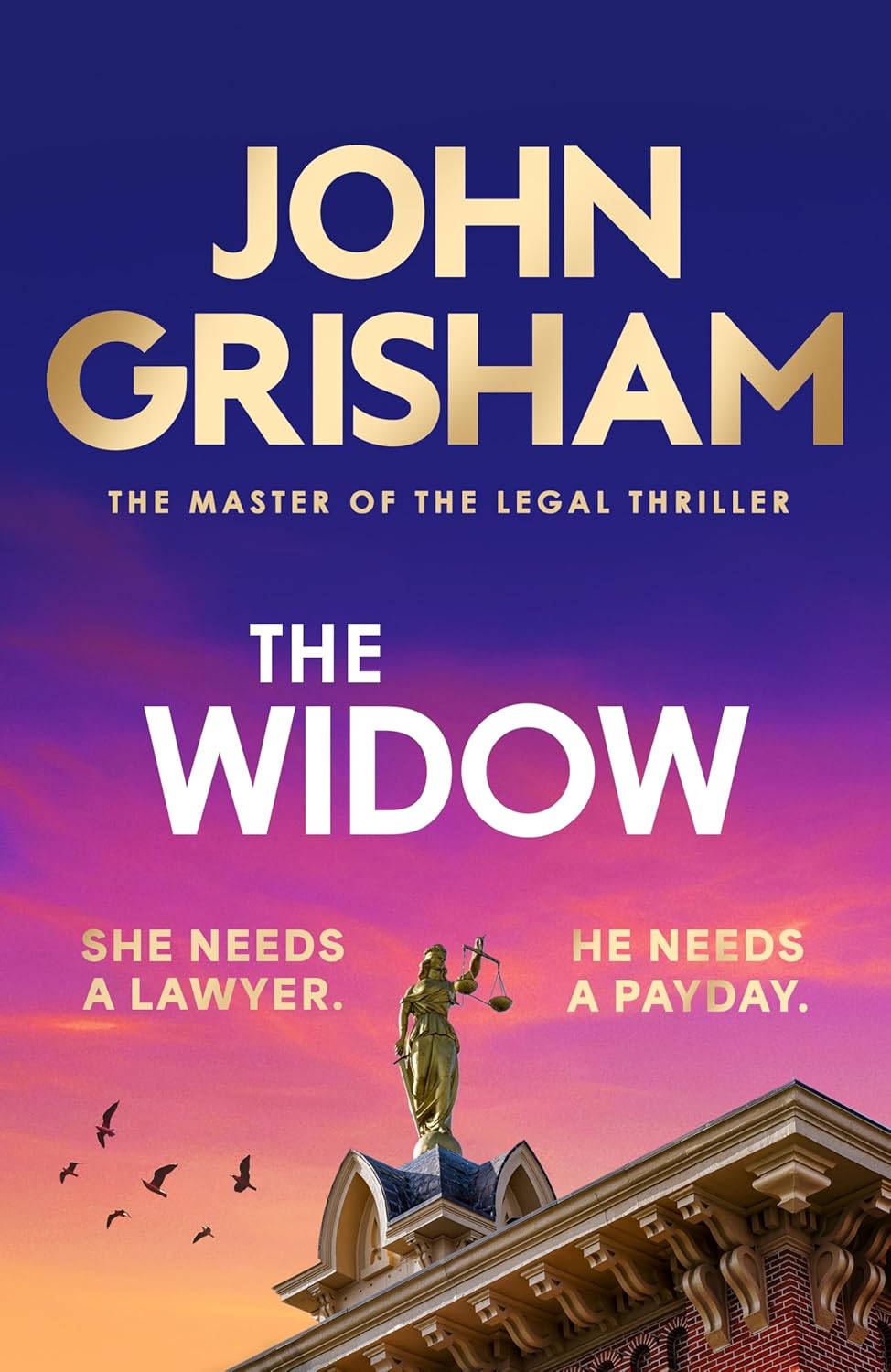
The Widow by John Grisham

Publisher: Hodder & Stoughton (Trade Paperback – 21 October 2025)

Series: Standalone

Length: 404 pages

My Rating: 4.75 out of 5 stars

Amazon

Iconic author John Grisham continues to shine as one of the leading authors of the legal thriller genre with his outstanding new novel, The Widow, a clever, character-driven book that relentlessly drags you in.

Most people will be very familiar with author John Grisham, considering he has been presenting awesome novels filled with complex legal cases since 1989, many of which have been turned into films or television series.  I started reading Grisham in the last few years, having been lucky enough to receive copies of some of his latest novels, including The Judge’s List, The Boys from Biloxi, Sparring Partners, The Exchange and Camino Ghosts.  All these novels proved to be a lot of fun, and I enjoyed the interesting collection of stories and sub-genres that Grisham would explore in these books.  As such, I was very keen to read Grisham’s new novel, The Widow, especially as it had an exciting and compelling plot behind it.

Plot Synopsis:

She needs a lawyer. He needs a payday.

Simon Latch is a small-town lawyer struggling with debt, gambling issues and an impending divorce. But when Eleanor Barnett, an 85-year-old widow, visits his office to secure a new will, it seems his luck has finally changed: she claims she’s sitting on a $20 million fortune and no one else knows about it.

She could be the ticket to his fortune.

Once he’s hooked the richest client of his career, Simon works quietly to keep her wealth under the radar, even from his own assistant. But there are complications: other lawyers are circling his client like vultures.

But when she is hospitalised after a car accident, Eleanor’s story begins to crack. Simon realises that nothing is as it seems. And as events spiral out of control, he finds himself on trial for a crime he swears he didn’t commit: murder.

The Widow was a very interesting and captivating novel from Grisham that combined a distinctive story of a down on his luck protagonist, with a complex mixture of murder and thrilling legal elements.  A very clever read that I had an excellent time getting through, The Widow is Grisham at his best and proved to be a particularly engaging read.

Grisham relies on a well-crafted character-driven narrative for The Widow, which gradually draws the reader in until they are unable to put the book down.  Starting off with a deliberate, slower pace, the early parts of The Widow are primarily focused on introducing and showcasing the life of protagonist Simon Latch, as well as the various people in his orbit.  A lawyer with a stalled career, gambling issues, and a failing marriage, Simon is eager for fresh opportunities, which seems to walk in the door in the form of elderly widow Eleanor Barnett, who requires a new will.  Unable to resist the allure of Eleanor’s reputed fortune, Simon secretly takes her on as a client, hoping to manipulate her into signing a favourable will that he can later abuse for his own financial gain.  Forced to remain in Eleanor’s orbit for his scheme, Simon begins to learn more about his unusual client, who seems to bring trouble down on all around her.  At the same time, Simon keeps making all the wrong decisions in the other areas of his life, which results in him becoming increasingly desperate for a payday.  Grisham does an outstanding job of building up the extensive background of the characters and their motivations in the first half of The Widow, and the elaborate picture of greed, secrets and self-destructive behaviour allows for a very impressive second half of the book.

Deftly amping up the pace in the second half of The Widow, things change quite dramatically when Eleanor passes suddenly, and Simon is free to enact his plan.  However, before he can go through with it, Simon is charged with Eleanor’s murder and soon finds himself a pariah in his own town.  With the evidence stacked against him, the protagonist finds himself embroiled in an elaborate court battle as he tries to prove his innocence.  Expertly building on all the events and interactions in the first half of The Widow, Grisham sets up an impressive and very realistic series of court sequences, all while the Simon’s life falls even further apart around him.  There is a brilliant sense of desperation and despair in this second half of the book, and you really get drawn into the thrilling legal battles, which are laced with beautiful uncertainty, as you are unsure if the protagonist is truly innocent and where the story is going to go next.  I personally was enthralled with this second half of The Widow and powered through it extremely quickly, as I was keen to see how the court case ended and the reveals about who was responsible for Eleanor’s death.

While I loved all the key legal battles, and the extensive court case that takes up a good chunk of the second half of the book, I must admit that I was a little disappointed with how The Widow ended.  This was because the final 50 pages contained a rushed, and slightly unlikely, investigation arc that looks to uncover the truth of how the titular widow died.  While there are some excellent elements to these final pages, the revealed truth about Eleanor’s death comes a little out of nowhere and derailed the careful nature of the rest of the plot.  While there are some hints about who or what was responsible earlier in the book, I think that Grisham erred with this ending, and a different reveal more connected to the main plot would have been better.  Still, it was a mostly satisfying conclusion to book’s overall narrative, and readers will be happy where some of the main cast, especially the protagonist, finish up.

I really enjoyed how Grisham wrote The Widow, as the author effortlessly pulled together a complex story of the legal system told primarily through the eyes of an ethically dubious lawyer.  Featuring elements reminiscent of the author’s other small-town legal thrillers, particularly those set in Clanton, this was an amazing character-focused book.  Grisham does an excellent job of effectively introducing the protagonist, Simon Latch, and viewing his descent from respected lawyer to suspected killer thanks to his own greedy actions.  Thanks to Grisham’s clever examination of all the events of the protagonist’s life, you feel very sympathetic towards Simon, even if he continuously makes things worse for himself.  The somewhat simplistic dishonestly of Simon is well matched by some of the more devious or naturally deceitful characters in The Widow, including the elderly Eleanor Barnett, who suddenly becomes the most important person in Simon’s life.  Old, crotchety and stubborn, Grisham paints a great layer of uncertainty around Eleanor, which ensures the reader is never quite sure whether she is genuinely rich, or pulling some sort of elaborate con on Simon and the other lawyers in his town.  The eventual reveal of this truth is extremely fun, and thanks to the way the two characters are entangled at the end of Eleanor’s life, it helps produce a fantastic murder trial that you can really sink your teeth into.

The resulting criminal defence case was the true highlight of The Widow, and Grisham was in his wheelhouse writing not only the trial but the more mundane legal elements of the protagonist’s practice, which proves to be a key part of the plot.  I deeply appreciated how well the court case played out in the second half of The Widow, which cleverly revisits the events of the first half of the book to examine the protagonist’s guilt.  It soon becomes clear that Grisham did an amazing job hiding a lot of hints and relevant details in the early parts of the plot, and the way these elements come to be used later in was extremely clever.  While I still have my doubts about the novel final reveal, the rest of the book has an excellent flow to it, and I really appreciate how Grisham upped the pace in the second half of the book with a truly gripping court battle.  Throw in an excellent depiction of small-town life and the Virginia legal system, thanks to the portray of fictional town of Braxton and this ended up being a very compelling novel I honestly couldn’t put down.

John Grisham continues to highlight why he is one of the very best writers of legal thriller fiction with The Widow.  A complex and powerful novel, with a compelling protagonist focus, The Widow was a brilliant read, and I loved how wrapped up I got in the book’s outstanding mystery and the various secrets and legal battles surrounding it.  While there are some stumbles towards the conclusion, The Widow was an overall incredible read that is going to appeal to all Grisham fans and those who love a good legal thriller.  I look forward to diving into whatever Grisham writes next.

Amazon

Quick Review – Death on the Tiber by Lindsey Davis

Publisher: Hodder & Stoughton (Trade Paperback – 9 April 2024)

Series: Flavia Albia – Book 12

Length: 380 pages

My Rating: 4.75 out of 5 stars

Amazon

Those in the mood for a clever murder mystery in ancient Rome look no further than the 2024 entry in the long-running Flavia Albia series with Death on the Tiber by Lindsey Davis.

I am a huge fan of historical fiction, and one of my favourite ongoing historical series is the outstanding Flavia Albia books by veteran author Lindsey Davis.  The Flavia Albia books, which are a sequel series to the author’s long-running Falco series, follow a determined private investigator in ancient Rome who takes on a range of complex cases and murder investigations, often encountering many of the city’s over-the-top inhabitants.  I have had an amazing time reading this series over the years, including The Third NeroPandora’s BoyA Capitol DeathThe Grove of the Caesars (one of my favourite books of 2020), A Comedy of TerrorsDesperate Undertakings (one of my favourite books of 2022) and Fatal Legacy.  As such, I try to read every new Flavia Albia book that comes out, and after accidently avoiding it for much of 2024, I recently finished off the 12th book in the series, Death on the Tiber.


Plot Synopsis:

Rome is in chaos. The empire of a mobster chief is falling apart following his death. Rivals, fearsome relatives and associates are taking up position to vie for the spoils.

With hideous murders in the streets of Rome, a lone female traveller arrives with an agenda of her own. But when her corpse is dragged out of the river bearing signs of foul play, Flavia Alba is drawn in, concerned about her fellow Briton’s fate.

Alba’s quest to find the killer becomes deeply personal when she discovers a man at the centre of the plot is an old adversary of hers. Will she be obsessed by revenge? Can she let the past go, or will it consume her?

Death on the Tiber was a great addition to the Flavia Albia series that features its own distinctive crimes, while also cleverly tying into several of the author’s previous Falco and Flavia Albia books. 

The plot of Death on the Tiber is very compelling, as the protagonist, Flavia Albia, finds herself drawn into the investigation of a murdered tourist pulled out of the Tiber.  However, the case becomes personal for Albia when she discovers the victim’s connection to the gangster Florius, an old foe of her fathers, who years before committed unspeakable evils against Albia and who may have finally returned to Rome.  Determined to finally hunt down Florius and make him pay for his crimes, Albia begins her investigation and soon finds herself embroiled in a deadly gang war that could tip the balance of Rome’s underworld.  Forced to compete with a range of interested parties, including her own vengeful father and uncle, the Roman military and several gangsters and their families who Flavia has previously encountered through her work, the protagonist slowly begins to piece together the events that lead to the victim’s death and the connection to her quarry’s current location.

This proved to be a highly personal and complex entry in the series, and one that I felt served as a love letter to the author’s prior works.  A huge range of characters from previous Flavia Albia novels, as well as major figures from the preceding Falco books, are featured throughout Death on the Tiber as the author takes the opportunity to tie together a range of ongoing storylines related to a major antagonist of the Falco books.  This allows for quite a fascinating read, especially for those readers familiar with the previous works, and it was awesome to see Davis bring together a compelling cast of returning figures. 

The plot moves in some interesting directions as the book nears the end, and Davis adds in a range of compelling layers to the case, including disgruntled mobster wives, a big gang war for the control of Rome, and alternating bands of Roman officials seeking to disrupt events.  The conclusion for the book proves to be very emotionally charged, especially as the protagonist comes face to face with her biggest monster and finally gets some closure.  The main mystery of Death on the Tiber is also extremely well written and utilised, and Davis does an excellent job tying in a lot of the novel’s leads and investigative plots into the main hunt for the returning Florius.  While the reveal of the ultimate culprit behind the killing isn’t especially surprising, the way in which Davis addresses their fate is particularly impressive, and it leads to a very fun final moment in the book.  I loved this last little twist, which I honestly think tied the book together very nicely, and it certainly was one of the moments that has stuck with me since finishing Death on the Tiber off.

This ended up being another strong Flavia Albia book as Davis continues to utilise her trademark style in Death on the Tiber.  Focused primarily through the sarcastic and cynical Flavia, Death in the Tiber evolves into a twisty hunt for answers, that brings together mystery, criminal intrigue, and the protagonist’s various personal connections.  Davis has a very compelling way of writing her stories, and her examinations of Rome through the protagonist’s eyes are often light-hearted, sarcastic, and applying modern mentalities to the ancient society.  This results in an impressive read, especially as Davis lays down an exceptional combination mystery and revenge-focussed narrative.  While I really enjoyed how well Davis revisited multiple previous books from both the Falco and Flavia Albia series, it does mean that readers do need a bit of pre-knowledge of these earlier works to fully appreciate Death on the Tiber’s plot.  Davis does provide some much-needed context at times, which will allow some new or forgetful readers to enjoy this book, but I personally think that people should have at least read the last few Flavia Albia books before Death on the Tiber to really get this book.

Despite the series’ general comedic vibe, Death on the Tiber gets very dark at times, especially as the protagonist is forced to revisit her traumatic history.  The author does an excellent job of diving into Flavia’s trauma and pain on the subject, and it was nice for this compelling protagonist to finally get some closure.  Davis nicely balances some of these darker moments by including an extensive cast of eccentric characters, many of whom are continuing their storylines from both the Falco and Flavia Albia series, and there are some very fun moments scattered throughout Death on the Tiber as a result.  This includes a fun competitiveness with Flavia’s father, Falco, a dive into some other important parental figures in her life, as well as her very strong relationship with her supportive and relentless husband.  I personally loved the return of all the various major gangsters Flavia has dealt with over the years, and it was fun to see her try to investigate them after prior experiences.  However, two of Flavia’s female relatives end up stealing the show in Death on the Tiber, especially at the end where they showed an ironic sense of justice.  An overall great extended cast that served to connect this book to the larger series in some outstanding ways.

With Lindsey Davis’s typical impressive writing and a cool plot laden with mystery and criminal intrigue, Death on the Tiber was an amazing entry in one of my favourite historical fiction series.  Entertaining, addictive and very moving, Death on the Tiber had me hooked from the very beginning, and I wish I’d read it sooner.  I look forward to continuing the Flavia Albia series this year, especially as Davis has a cool book coming out in April set around the ruins of Pompei with There Will Be Bodies.

Amazon

King’s Enemy by Ian Ross

Publisher: Hodder & Stoughton (Trade Paperback – 10 September 2024)

Series: De Norton Trilogy – Book Three

Length: 419 pages

My Rating: 5 out of 5 stars

Amazon

Ian Ross brings his exceptional De Norton historical fiction trilogy to an extremely strong end with the excellent and powerful third and final entry, King’s Enemy.

For the last year or so, I have been utterly enthralled with acclaimed historical fiction author Ian Ross’s latest series, the De Norton books.  Following young squire and eventual knight, Adam de Norton, as he finds himself drawn into the 13th century rebellion of Simon de Montford against the crown, the De Norton books are extremely compelling, and I love the blend of action, cool characters, and compelling historical setting.  The first book in the series, Battle Song, was an outstanding read that expertly introduced the protagonist, as well as his unpredictable mentor, and showed how he became involved in the war on de Montford’s side.  Battle Song ended up being one of my favourite books of 2023, and I eagerly dived into the sequel, War Cry, earlier this year.  Set shortly after the events of Battle Song, War Cry worked to show the aftermath of de Montford’s major victory, and the subsequent royalist counter-rebellion, by following the newly knighted de Norton as he finds himself once again called to battle.  War Cry was a very worthy sequel, and I loved how dark and grim it got in places, especially at the end.  War Cry left the reader on a major cliffhanger, and as such I have been eagerly waiting to get my hands on the third and final book, King’s Enemy.  One of my most anticipated books from the second half of 2024, King’s Enemy had an outstanding plot behind it that really got me excited.

England, 1265.  It is two months after the infamous battle of Evesham, where knight Adam de Norton lost everything.  The rebellious Simon de Montford lies dead on the field alongside de Norton’s mentor, Robert de Dunstanville. and the rest of their army, massacred by Prince Edward and his victorious army.  Spared by the prince alongside a few other noble survivors, de Norton remains a prisoner of the crown in the grim castle of Beeston, with all his lands, wealth and honour stripped from him.

However, despite the crushing victory at Evesham, England is far from peaceful, as new rebellions begin against the king.  Determined to take his fate into his own hands, de Norton makes good an escape from Beeston and becomes a fugitive from the crown.  Branded a king’s enemy, a man who can be slain with impunity by those pursuing him, de Norton flees across England, alongside the recently widowed noblewoman Joane de Bohun, contending with royal troops and dangerous outlaws, desperate to find a cause to fight for.  But when the promised new rebel army is swiftly beaten, de Norton and Joane are once again left without options.

Adam and Joane soon find their fates tied to that of the mightiest fortress in England, Kenilworth Castle, when they seek sanctuary there.  The last castle holding out against the crown, Kenilworth is garrisoned by a motley band of rebels and knights, each with their own reasons for being there.  Joining the defenders, Adam finds old friends and enemies within and without the castle walls, as he prepares to endure a lengthy siege.  But as the months pass and the battle becomes more desperate, Adam must decide what is more important, the lives of those he loves or his knightly honour.

King’s Enemy was another outstanding novel from Ross, who brings his de Norton trilogy to brilliant end with this third book.  Once again expertly focusing on a particularly intriguing part of English medieval history, Ross crafts together a powerful and intense narrative that will have you hooked the entire way through.  King’s Enemy is an epic read that gets a full five-star rating from me.

Ross has come up with a fantastic story that I honestly could not turn away from.  Starting shortly after the memorable cliffhanger of the second book in the trilogy, War Cry, King’s Enemy starts off with Adam de Norton in captivity, having lost everything.  Ross does a great job capturing the initial despair of his protagonist before setting him off on a new adventure as he makes his escape from captivity.  This results in a pretty good fugitive arc as Adam and his ill-fated main love interest, the recently widowed Joane de Bohun, attempt to find a new cause so that they may both recover their positions.  This first half of the book is very fun and makes sure to set the scene for the rest of King’s Enemy.  There is plenty of adventure, excitement, and even a surprising nod to classic Robin Hoods mythology, as the two protagonists head towards promised safety and a new army to fight with.  However, as readers of the De Norton books will be aware, things rarely go well from the main character, and Ross adds in a major road-bump for him halfway through the plot that forces him towards his inevitable destiny at Kenilworth Castle.

The rest of King’s Enemy is essentially one big siege sequence, as Adam, Joane, and several surviving supporting characters, take refuge int the castle and attempt to hold off a massive besieging force belonging to the crown.  This proved to be an exciting second half which really pushes the protagonists to the limit.  I’m a huge fan of sieges in fiction, and I thought that this depiction of this infamous British siege was extremely good.  Ross captures so many cool aspects of this siege with his writing, including the desperate defenders, the intense fighting, and the grinding impacts of time as the besiegers attempt to starve out the inhabitants of the castle.  Things get really tense as the book continues, as Adam finds himself caught amid various big personalities, including an unstable fellow knight and other defenders seeking to gain advantage from their plight.  There are some dark and deadly moments here, and Ross keeps the reader on the edge of their seat as Adam tries to determine the best course forward.  Everything ends on an interesting note, as all the existing storylines are wrapped up, many figures, both fictional and historical, meet their fates, and the final chapter in the protagonist’s adventure and complex romantic life is revealed.  I personally felt that Ross ended everything on a very strong note, and those readers who have become quite attached to the series will come away very satisfied.

I felt that Ross once again did a really good job of enhancing his captivating narrative with his great writing, and readers really get stuck into King’s Enemy as a result.  The quick-paced flow of the story and the intense action really help to drag you in and go hand in hand with the great characters and intriguing historical setting.  Ross does an outstanding job of showcasing the hard-hitting combat associated with historical knights, and all the intense action sequences are a joy to read.  I also must once again highlight the cool siege that made up the second half of the book, and fans of fictional fighting will love some of the chaotic sequences that emerge there.  There is also a strong emotional edge to the plot, as many of the main characters are desperate figures struggling in the aftermath of a devastating defeat and trying to find a path forward that balances their survival with their sense of honour.  While King’s Enemy can be read as a standalone novel due to the excellent way Ross summarises some key prior events, readers really should check out the first two entries in the series first.  The continuing character arcs, recurring themes, and excellent conclusion to long-running story elements, help to make King’s Enemy a lot more enjoyable for returning readers rather than interested newbies, and I was very invested in seeing how this story ended due to how much I had connected to the protagonist.  I felt that Ross wrapped up this trilogy extremely well, and if you loved Battle Song and War Cry you will not be disappointed here.

As with the previous De Norton novels, one of the things that most impressed me about King’s Enemy was the intriguing historical events that Ross chose to set his story around.  The 13th century rebellion of Simon de Montford is one of England’s lesser-known civil wars, and I have been deeply enjoying seeing the events of this war unfold through the eyes of the protagonist.  The first book did a wonderful job exploring the events leading up to the rebellion, as well as de Montford’s major victory that turned the whole country on its head, while the second book captured the chaotic instability that followed and the eventual end of the main rebellion.  King’s Enemy continues in this vein by examining what occurred after de Montford’s death and defeat, with the country still unstable despite the crown’s victory.  Ross does an excellent job of ensuring his protagonist is present for many of the key moments of this post-rebellion period, and you really get some good insights into these tumultuous events from the protagonist’s perspective.  There is a great focus on the politics and society at the time, especially as major parts of the plot revolve around how the defeated knights and lords were treated.  Ross also excelled at capturing the many key parts of the siege of Kenilworth Castle in the second part of King’s Enemy.  The longest siege in English history, the battle for Kenilworth is a fascinating inclusion to the story, and I loved how Ross showcased it as the last stand for the desperate rebels.  You really get a sense of the events leading up to, and surrounding the siege, and I loved how well Ross examined the motivations of the various defenders and why they kept fighting.  All this proves to be an excellent background setting to Ross’s main story, and it was fascinating to find out how this entire civil war came to its end.

I also need to once again highlight the great characters that Ross has featured in this series, with some intriguing and moving character-based storylines sitting at the core of the plot.  King’s Enemy is another great example of this as, while many key characters died at the end of the previous novel, it still features a strong cast of complex protagonists and supporting characters, including a mixture of original characters and historical figures.  The most prominent of these is series protagonist and primary point of view character Adam de Norton, a former lowly squire who gained lands and a knighthood for his role in Simon de Montford’s rebellion.  After gaining so much in the previous books, Adam starts King’s Enemy at his lowest, with most of his friends dead and everything he fought for lost.  This places the protagonist in desperate circumstances, and he spends this entire book fighting with his back against the wall, literally and figuratively.  Ross writes some moving storylines around Adam’s conflicted mind, as he is forced to balance his honour and loyalty with getting what he wants.  I loved seeing the continued epic of Adam de Norton in King’s Enemy, as it proved impossible not to become attached to the scrappy and exceedingly honourable figure in the previous books.  This proved to be a great final entry in Adam’s story, and Ross ensures that there is still plenty of suffering and conflict for his protagonist.

Other major characters I need to highlight include Adam’s main love interest, Joane de Bohun.  Joane, a strong-willed survivor determined to survive and regain her lands, proves to be an interesting companion to Adam.  The two share an intense and often contentious relationship, as Joane attempts to balance romantic feelings with her ambitions.  Due to the desperate events of the book, Adam and Joane are finally able to express themselves to each other at times, although their differing goals often lead them into conflict.  There is a real tragic romance angle going on between Adam and Joane in King’s Enemy that worked extremely well, especially with the other story elements, and it added a compelling extra layer to already impressive story.

The final character I really want to highlight was bold younger knight, Henry de Hastings, with whom Adam has many interesting encounters in King’s Enemy.  A captured rebel like Adam, de Hastings seems to follow the protagonist around to all the major encounters of the book, and they become both comrades and rivals as a result.  I really enjoyed how Ross portrayed de Hastings in this book, and you have to love the combination of arrogance, contempt and friendship that he gives towards the protagonist, which ensures that the reader finds him both insufferable and entertaining.  De Hastings’s appearance in the book’s main siege also produces some memorable character changes as the knight becomes obsessed with winning and holding out against the enemy, so much so that he becomes a dangerous threat to the protagonist.  There is a wonderfully written slide into darkness for this side character that I deeply enjoyed, and he ended up being a standout figure in King’s Enemy as a result.  All these characters, and more, helped to turn King’s Enemy into something special, and it was amazing to see where many of these recuring figures ended up.

Overall, I found King’s Enemy to be an exceptional book that served as a brilliant and impressive conclusion to Ian Ross’s De Norton trilogy.  Loaded with intense characters, fascinating history, and outstanding action, King’s Enemy had me hooked the entire way through and provides readers with a powerful end to a great historical series.  A highly recommended read, you won’t be disappointed with this latest offering from Ross.

Amazon

The Outsider by Stephen King

Publisher: Hodder & Stoughton/Simon and Schuster Audio (Audiobook – 22 May 2018)

Series: Standalone/Holly Gibney series

Length: 18 hours and 41 minutes

My Rating: 5 out of 5 stars

Amazon

After years of having it on my to-read list, I finally got around to checking out The Outsider by Stephen King, and boy was it a particularly epic book.

Fans of this blog will know that I have been getting more and more into Stephen King lately, especially as I have been lucky enough to receive copies of his more recent books.  I have so far deeply enjoyed Mr Mercedes, Later, Billy Summers (one of my favourite books of 2021), Fairy Tale, Holly (one of my favourite books and audiobooks of 2023), and You Like it Darker (one of my favourite books from the first half of 2024).  These have all been amazing reads in their own way and I really enjoyed the elaborate stories, dark plots, and complex characters that King comes up with.  However, one of my new favourite King novels with a captivating scenario was the fantastic read The Outsider.

Released back in 2018, The Outsider was an intriguing novel that really caught my attention with its unique concept.  I immediately identified it as a book I wanted to read, but I was unable to fit it into my reading schedule back then, which I deeply regret now.  Despite not reading it when came out, The Outsider remained firmly in mind, especially as it had connections to the Bill Hodges trilogy, which I had also heard good things about.  This need to check out The Outsider was dramatically increased after I read Holly last year and was blown away by the elaborate and exceedingly dark story.  As such, I have been looking for an opportunity to enjoy The Outsider for a while, and a recent road trip gave me all the excuse I needed, and boy was I glad that I did.

It is the worst crime to ever occur in the history of Flint City.  A young boy, Frankie Peterson, has been brutally killed, raped and mutilated, his violated body left on display out in the local park.  The Flint City police, led by detective Ralph Anderson, are determined to find the monster responsible for Frankie Peterson’s death, and they soon zero in on a prime suspect, local sports coach and one of Flint City’s most respected citizens, Terrence Maitland.

With unassailable evidence and numerous witnesses placing him at the scene, the police have a watertight case against Maitland, and Anderson orders the public arrest of the coach in front of his family, friends, and the entire town.  However, despite the DNA, fingerprints, and numerous reliable witnesses indicating that Maitland killed Frankie, Maitland insists that he is innocent and has an airtight alibi for the time of the murder, having been in a major public conference in another city, surrounded by unimpeachable witnesses.

Determined to prove that Maitland committed the murder, Anderson and his colleagues attempt to destroy his alibi.  But the further they dig, the more apparent it becomes that Maitland was nowhere near the scene of the crime, and Anderson begins to believe Maitland’s pleas of innocence.  With lives being destroyed all around him and the citizens of Flint City baying for Maitland’s blood, Anderson is forced to figure out how a man can be in two places at once.  But when the situation takes a dark turn, both Anderson and Maitland’s supporters call in unusual investigator Holly Gibney, whose own experience with impossible cases will take them in the darkest of directions.

Well damn, that was particularly awesome.  I knew I was going to love The Outsider well before I read it, but even I was unprepared for how impressive and captivating this novel proved to be.  Featuring King’s typical elaborate storytelling, powerful characters, and unique insights into the human mind, The Outsider was a complex and sinister read that will have you hooked from the very beginning and which gets a very easy five-star rating from me.

King presents the reader with an incredibly, dark, complex and thoughtful narrative that burrows into your head and refuses to leave.  Starting off strong and proceeding into darker and more horror-lined territory, this complex narrative sucked me in almost instantly thanks to the very impressive initial story concept.  Introducing a particularly gruesome murder, The Outsider starts off in crime fiction/legal thriller territory, as King showcases the details of the initial arrest of Terrence Maitland, while also bringing in a few key characters.  These early chapters are cleverly offset by a series of short inclusions that showcase police interviews and forensic evidence for the main investigation, all of which firmly paints Maitland as the killer.  However, events take an outstanding turn shortly into the book, when Maitland reveals an impossibly airtight alibi that flies in the face of the substantial evidence of the police.  The full extent of this alibi is particularly compelling, especially with King name-dropping one of his peers, and it really turns the entire plot on its head.  The subsequent scenes are extremely intriguing, as the reader sees both sides of the case, and find themselves wondering if Maitland committed the crime, is completely innocent, or whether something far more sinister is going on.  I honestly love every second of this first half of The Outsider, and I cannot emphasise just how exceptional and thought-provoking this complex scenario proved to be.

At around the halfway point, The Outsider features a substantial moment that changes the entire tone and focus of the plot.  While I was initially a little disappointed with this, mainly because I was already loving the direction the story had been going up to that point, it helps turn The Outsider into a more typical King novel, loaded with complex horror elements that reflect dark human nature.  The author also deeply enhances the story’s emotional drama, placing several characters in terrible situations, and amping up the desperate tragedy of the plot.  Thanks to the introduction of recurring King protagonist Holly Gibney, the protagonists start to consider a more unnatural solution to the crime and begin to investigate accordingly.  I quite enjoyed the dive into the darker, supernatural side of the story, and the resulting investigation is quite unique, requiring the grounded protagonists to believe in the unknown.  King ensures that the supernatural investigation elements of the book come across in a compelling and sensible manner, and it was intriguing to see how the character’s reached their conclusions.  The case eventually leads the protagonists on an extended trip to Texas, which ends with a series of showdowns.  King keeps the intensity of the plot going all the way to the very end, and readers will be left guessing about who’s going to survive and how the story will unfold.  The chase for the culprit and the big showdown were a very solid conclusion to the entire narrative, and you will come away extremely satisfied with how The Outsider ended.

I really enjoyed how this book came together, and I personally think that this was one of the stronger King novels I have so far had the pleasure of reading.  A lot of this comes down to the initial clever scenario, which King does an extremely good job of setting up.  The whole idea of someone accused of a crime they are innocent of and have a perfect alibi for really makes you think, and King utilises it to perfection, diving into the thoughts of the police, the alleged perpetrator, and the various family members associated with it.  It helped that King once again returned to his favourite setting of a small American town, and he was able to capture the resulting chaos as rumour and fear spread throughout Flint City.  You can really feel the emotional turmoil of all the people in the town, especially the main characters, and it helped to deeply enhance the impact of every scene, especially when you have no idea whether Maitland committed the crime or not.  The way in which the author starts off as a more traditional crime fiction story also works extremely well and helps to drag the readers into the plot with its mystery.  However, the transition over to horror is particularly effective, and the way in which the darkness infecting the plot goes from that created by ordinary humans to something more supernatural, is an effective and powerful part of the book.  This proved to be a particularly haunting and moving read that will keep you up late at night thinking about how you would react in the exact same scenario.

While most of King’s books prove to be standalone reads, The Outsider is connected to the author’s previous Bill Hodges series due to the inclusion of a major supporting character.  I had heard in advance that readers needed to be familiar with the Bill Hodges books to fully appreciate this book, however, I felt that The Outsider stood on its own merits as a standalone novel.  New readers can easily dive into The Outsider’s excellent story without any issues and will become enthralled in King’s complex mystery and his excellent depictions of human nature.  Established fans of the Bill Hodges books will probably get the most out of The Outsider, especially as it is a continuation of King’s unique look at the crime fiction genre, and the return of a key character offers a lot of opportunities for those who loved his previous trilogy.  However, I would say that this is a book that pretty much all mystery, thriller or horror fans can really enjoy, as there is something for everyone here, although some readers should be warned about how dark and graphic this story can get.

I really need to highlight the outstanding character work that King featured within The Outsider.  This fantastic book featured a rich cast of complex small-town characters who find themselves caught up the twisted darkness of a small child’s murder and the subsequent revelations about who was behind it.  King does such an exceptional job of diving into the various mindscapes of the impacted characters, from the obsessed investigating detective who is taking the case personally, to the distressed wife of the apparent killer, and even the confused accused himself.  The complicated mindscapes of all these characters, and more, are shown in exquisite detail throughout The Outsider, and you really grow attached to their powerful personal tales.

While I don’t want to go into too much specific detail about the book’s primary cast here for spoiler reasons, I will say that the way the various characters deal with events and the many dark twists makes for quite a personal and emotionally charged read, and it was fascinating to watch so many characters try to let go of their conventional thinking and try to see the world in a different light.  I also must highlight the intriguing way in which King enhances his cast in the second half of The Outsider by bringing in investigator Holly Gibney from the Bill Hodges trilogy.  Holly, the slightly unusual but brilliant private eye, proved to be a compelling addition to the plot, and it proved very interesting to see her interact with the established cast, especially as Holly has a much more open mind due to her previous experiences.  Fans of the Bill Hodges books will really love seeing Holly return, and her compelling character development since her original appearance in Mr Mercedes proves to be a great part of the book.  I really cannot emphasise just how impressive the various characters, as well as their complex development, is in The Outsider, and you will have to check it out.  Be warned though, no one comes out of this book unscathed, including the reader when they become attached to these great figures.

As I mentioned above, I managed to enjoy The Outsider while out on a road trip, which meant that I listened to the audiobook version of it.  I have had some great success with Stephen King audiobooks in the past, and The Outsider was another impressive example of how this format can enhance the powerful story within.  Coming in with a substantial runtime of nearly 19 hours, listeners do require a bit of a time investment for The Outsider audiobook, but it is well worth it.  I felt that I got a fantastic sense of the story while listening to it, and I love the intense depictions of the characters, the small-town setting, and the dark deeds being done within.

In addition to the great way it brings to the story to life for the reader, one of the big highlights of The Outsider audiobook was the inclusion of veteran actor Will Patton as the narrator.  Patton, who has lent his voice to several of King’s previous audiobooks, does an outstanding job narrating The Outsider.  His softly spoken and measured voice really fits the dark and sinister story contained within The Outsider, and you get an excellent sense of the personal horror and complex emotions that the events of this book unleash.  Patton also does an outstanding job voicing the eclectic and damaged characters featured within The Outsider.  Patton infected many of these characters with his southern accent, which fit the small-town vibe of The Outsider extremely well, and you can really imagine King’s characters a lot better with Patton’s voice behind them.  Highlights for me include his take on the antagonist of The Outsider’s real voice, as well as an entertaining old lady found down in Texas, who steals all the scenes she’s in, especially with Patton’s exaggerated tones.  However, I did feel that Patton overplayed the awkward nature of Holly Gibney when she entered the plot.  Patton made all of Holly’s dialogue, as well as the description of events in the chapters told from her perspective, very subdued and halting, which messed with the flow of the audiobook.  While I know that he was trying to capture Holly’s ethereal and damaged nature with this narration, it was honestly a bit distracting.  Despite this slight annoyance, this ended up being an awesome way to enjoy The Outsider and I can personally guarantee that it is an incredible accompaniment to a long road-trip.

Overall, The Outsider proved to an outstanding and exceptional book from the always impressive Stephen King that I could not get enough off.  Featuring both an incredible mystery and some brilliant dark horror moments, The Outsider is a particularly gripping and intense read that will live rent free in the dark corners of your brain.  Highly recommended and one of my new favourite Stephen King books.

Amazon

Quick Review – Camino Ghosts by John Grisham

Publisher: Hodder & Stoughton (Trade Paperback – 28 May 2024)

Series: Camino Island – Book Three

Length: 292 pages

My Rating: 4.5 out of 5 stars

Amazon

Iconic thriller author John Grisham returns with another excellent and compelling novel, Camino Ghosts, that takes the reader on an intriguing journey.

Grisham is another author I don’t really need to introduce.  The mastermind behind so many classic best sellers, Grisham has been wowing audiences since the 1980s with fantastic and intricate tales.  I myself have only reading Grisham in the last couple of years, with books like The Judge’s List, The Boys from Biloxi, Sparring Partners and The Exchange, leaving a big impression on me.  As such, I was eager to try out Grisham’s latest novel, Camino Ghosts, especially as it had a great plot premise behind it.  The third book in the author’s Camino Island series, Camino Ghosts was a fascinating book that I got quite attached to.

Plot Synopsis:

Following John Grisham’s international bestsellers, Camino Island and Camino Winds, Camino Ghosts is the story of an island off the Florida coast with a haunted, violent history and an uncertain future.

Dark Isle off the Florida coast is said to be cursed: drownings, disappearances and hauntings have been the fate of intruders. The people who lived there were once enslaved. Now abandoned, it is the target of greedy developers.

Lovely Jackson is the last survivor and claims to be its legal owner. But there is not a shred of evidence to prove that is true.

It’s unlikely that the developers will be deterred by the claims of one old woman. They have millions; Lovely only has Steve Mahon, a pro bono environmental lawyer, and Mercer Mann, a floundering novelist, to fight in her corner.

With the court case looming and the bulldozers waiting to roll in, Steve and Mercer are in a race against time to unearth the truth behind Lovely’s story and save the legacy of the island.

I really liked Camino Ghosts, which proved to be a very entertaining and unique novel that I had such a wonderful getting through.  This was quite an interesting read, and Grisham came up with quite an unusual story that really appealed to me.  Although billed as a thriller or legal thriller, Camino Ghosts honestly felt more like a comfy slice-of-life story to me that occasionally featured some legal thriller elements, as well as an outstanding historical fiction background.

As I mentioned above, Camino Ghosts is part of the Camino Islands series, and is once again primarily set on the fictitious Camino Island, home to an eclectic mixture of people, all bustling along on their island paradise.  The series primarily focuses on recurring characters Mercer Mann, an idealistic novelist, and island bookseller Bruce Cable, new local figure Lovely Jackson, as well as a various other friends and inhabitants who come together as the story demands it.  The latest book is essentially a standalone read with its own self-contained story, although readers can expect the same easy-going atmosphere that Grisham included in the previous Camino Island novels, as well as a few minor references to prior events.

The plot of Camino Ghosts revolves around a historically significant abandoned island that sits just off the main Camino Island, known to the locals as Dark Isle.  The always entertaining Bruce provides Mercer with an interesting, self-published history of Dark Isle, and which Mercer decides to use as inspiration for her next book.  Seeking out the author, Lovely Jackson, the last living inhabitant of the island, Mercer and Bruce soon get involved in Lovely’s battle to save Dark Isle from developers, which results in a lengthy legal battle.  At the same time, the characters learn more and more about the unique history of Dark Isle, which served as a refuge for runaway slaves, and upon which a dark curse still apparently lingers.

This ended up being a sleek and captivating story that really drew me in.  Grisham quickly sets the scene for the narrative, with the returning protagonists becoming aware of the history of Dark Isle before becoming invested in saving it from the property developers who want to destroy it.  The main plot is very character driven, and it combines their actions in trying to document and save the island, with their day-to-day lives and interactions on Camino Island.  There are quite a few interesting and memorable figures who get involved in the resulting case, which includes a mixture of returning figures from the previous books, as well as several great new characters.  The entire story proceeds a fast and compelling pace, and soon you get stuck into the legal proceedings around the ownership of the island.  While Grisham throws in some entertaining legal shenanigans and ploys, for the most part the main story comes across as a nice and comfy read, with a focus on character interactions and human interest.  There is even a pretty fun ongoing discussion about the joys of writing novels/books and the complicated behind the scenes elements of securing publishing and getting paid for your work.

As the main story progresses, Grisham also throws in an entertaining historical fiction aspect to the plot, which I really enjoyed.  Thanks to extracts from Lovely Jackson’s book, you come to learn the history of Dark Isle, and its intriguing role as a haven for escaped slaves, who formed their own community on the island.  Grisham spreads these historical inclusions throughout the plot of Camino Ghosts, and they feature an intriguing array of narrative threads, which honestly are much darker than the main story of the book.  Focusing on slavery, brutality and even some unconventional war down in Florida, the history of Dark Isle proves to be highly fascinating, and I honestly would have loved to see a whole book written about this fictious island.  I really appreciated how these historical elements melded into the main plot of the story, and it gives some context to events happening as well as discussing the apparent curse haunting the island and causing issues for the antagonists.  I felt that the shift in tones between the main plot and this dive into the past contrasted nicely against each other, and it allowed for a much more powerful read, especially as it allows the reader to fully appreciate the importance of saving Dark Isle and the connection Lovely Jackson has to the location.

This combination of story elements comes together into a satisfying and entertaining overarching narrative which honestly proves hard to put down.  Thanks to both the relatable characters and intriguing history, you grow quite invested in the fight to save Dark Isle, and Grisham works in some exciting legal sequences to keep the reader on the edge of their seats.  The story ends on a very satisfying, thoughtful note, and readers come away really engaged with the complex story the author was trying to tell.  I really loved how deep and personal Camino Ghosts felt at times, and I honestly was surprised at how much I enjoyed this more comfortable storytelling from Grisham.  As such, Camino Ghosts is a very highly recommended book that will appeal to a range of readers, especially those looking for a nice, easy to read novel with some unique twists to them.

Amazon

You Like It Darker by Stephen King

You Like It Darker Cover

Publisher: Hodder & Stoughton (Trade Paperback – 21 May 2024)

Series: Standalone/Collection

Length: 484

My Rating: 5 out of 5 stars

Amazon

The master of shocks, thrills and chills, Stephen King, returns with a highly addictive collection of short stories that showcase his awesome writing ability in the epic book, You Like It Darker.

Stephen King is an author who needs very little introduction from me considering he’s been one of the world’s top authors for over 40 years.  Readers of this blog will know that I have come to the Stephen King fandom rather late in life, having only read his more recent releases.  However, the King books I have read were extremely epic, and I absolutely loved the awesome and inventive stories they contained.  This includes the epic thriller Mr Mercedes, the deeply personal tale Later, the fascinating Fairy Tale and the utterly addictive Billy Summers (one of my favourite books of 2021).  My favourite King book was his 2023 novel, Holly, which told a deep and chilling tale that is still stuck in my mind.  Not only was Holly one of the absolute best books and audiobooks of 2023, but it is also one of my very favourite horror books.  Due to this, I have been keeping a very close eye out for more content from this legendary author, including his latest book, You Like It DarkerYou Like It Darker was a short story omnibus book, which feature 12 unique stories from King, each of which have a dark shine to them.

I must admit that when I first heard about You Like It Darker, I wasn’t too sure I was going to read it.  This was primarily because I am not the biggest fan of short stories or novellas, as I prefer reading stories with more meat to them.  However, because it is Stephen King, and there is a certain guaranteed awesomeness associated with any of his works, I decided to give You Like It Darker a try, and boy was that a good decision.  The various stories contained within You Like It Darker was exceptional, and I ended up getting really stuck into everything contained in this impressive book.

The first story featured in this volume is the entertaining Two Talented Bastids.  A somewhat light-hearted start to a book dedicated to dark narratives, Two Talented Bastids tells the story of a famous and skilled author and his best friend, a highly regarded painter, both of whom grew up in a small town (near King’s iconic setting of Castle Rock) and managed to make it big.  Told through the writings of the author’s son, this story recounts the compelling small-town life of these fun figures, before eventually diving into the events that suddenly awakened their talents.

Two Talented Bastids was a very interesting and compelling start to You Like It Darker, which really played to the author’s strengths.  King is known for his ability to craft together tales of small-town life and intricate character backstories, which he does here in excellent detail.  The focus on these two friends who eventually make it big was moving and personal, and I liked the great way this story unfolds from the perspective of the loving, if overshadowed, son.  Because this is King, the story goes in some unusual directions, with an unnatural reason behind the protagonist’s renowned talents.  This twist away from conventional life was fun and surprisingly wholesome, and it was nice to see a good deed get rewarded in a King book.  As such, this was a surprisingly light start for You Like It Darker, but one loaded with humour, fantastic characters, and some great examples of human nature.  I felt that Two Talented Bastids was an excellent appetiser that showcased King’s writing style in advance of the crazier stories to come, and it got me in the mood for more tales about unusual people.

The next two short stories are the intriguing The Fifth Step and Willie the Weirdo.  Both stories are amongst the shortest entries contained within this book, and they prove to be an intriguing follow up to Two Talented Bastids, especially as they bring King’s promised darkness.  The first of these, The Fifth Step, is a short but impactful story that sees an older gentleman encounter a stranger at the local park who wishes to tell his personal confession as part of an addiction program.  This short story concludes with a sharp and memorable ending, and you have to appreciate the way that King effectively sets the scene in just 10 pages before bringing it to a sudden end.  Willie the Weirdo is also very dark, as it shows a strange young boy, the titular Willie, becoming close to his dying grandfather in his final days, hoping to see him die.  This is a bit of a weird story (unsurprisingly), but it’s one that I felt was very strong, as King showcases the strange nature of the two protagonists through a series of ghoulish conversations.  The final moments of Willie the Weirdo really bring the whole story together in a fantastic way, and readers are left to rethink all the previous aspects of the story thanks to a few subtle inclusions.  Both entries are great in their own way, and I liked how they substantially darkened the mood after the lighter starting story.

The fourth story in this book is probably my favourite, the excellent Danny Coughlin’s Bad Dream.  The longest entry in Some Like It Darker, Danny Coughlin’s Bad Dream is a brilliant tale that sees the titular Danny Coughlin, a small-town high school janitor, begin to have vivid dreams about a body at a location he’s never been to.  Hoping to alleviate the dread brought on by his visions, Danny finds and travels to the location from his dreams, only to discover that there really is a body buried there.  His attempts to subtly alert the police only lead to him being becoming the lead suspect and the detectives investigating the murder, especially the zealous Inspector Franklin Jalbert, begins an aggressive campaign against him.

While I enjoyed the preceding stories in this book, Danny Coughlin’s Bad Dream is the entry that made me fall in love with You Like It Darker.  The author works in an intriguing but simple concept of a normal man having a true psychic dream and turned it into a compelling and utterly intense tale of obsession and inner darkness as the protagonist loses everything due to events outside of his control.  The horror of this story is brought about by an excellent combination of circumstances and dark human nature as the protagonist, Danny Coughlin, is completely innocent of the killings and is instead a particularly likeable figure trying to do the right thing in the light of unexplainable events.  However, the stubborn and obsessive Inspector Jalbert, incapable of believing the protagonist’s supernatural explanation, relentlessly hounds Danny, trying to get him to confess to the murder.  His inability to do so, as well as the lack of evidence supporting Danny’s guilt, drive Jalbert, a homage to Inspector Javert from Les Misérables, to worse acts against his suspect, and it was fascinating to see Jalbert’s blind adherence to justice and his own personal issues turn him into a bigger villain than the man he is hunting.

King does such an amazing job with both his main characters in Danny Coughlin’s Bad Dream, and they play off each other perfectly, with the innocent and honourable Danny, trying to fend off the growing instability of Jalbert.  King takes this story in some excellent directions, and I found myself constantly on the edge of my seat waiting to see how everything would unfold.  The resulting conclusion is dark, moving, and sadly inevitable, and you can’t help but feel for both the main characters, even when they do the wrong thing.  Throw in an intriguing look at various forms of faith, as the characters are forced to confront their own feelings about visions and the supernatural, and Danny Coughlin’s Bad Dream proves to be an outstanding read that I could not get enough of.  I really cannot emphasise what a brilliant story this was, and I maintain it was the most impactful and captivating entry in You Like It Darker.

The next story is the interesting Finn, which I must admit was my least favourite, although that might just be because I was unfairly measuring it against the preceding Danny Coughlin’s Bad DreamFinn was a curious tale about a terminally unlucky teenager who finds himself kidnapped in a case of mistaken identity by an unusual team of crooks.  This was a rather fun and fast-paced story that saw an unwitting Finn attempting to survive this latest example of his unusually terrible luck.  I did enjoy this story to a degree, although I honestly am not sure if I was missing a connection to some other work of King, as there were quite a few unanswered questions at the end.  Still, the story unfolds in an interesting way, and King does a great job of introducing his unique take on the protagonist’s life story and the formulative events of his childhood.

Following Finn, King brings the book back on the dark track with the short, but intense, road trip story On Slide Inn Road.  This story sees a dysfunctional family attempt to take a shortcut up the titular road, only to encounter obstacles, both from the landscape, and from other travellers.  I liked the progression from casual family story whose drama was primarily drawn from the actions of the easily aggravated father to a much more serious story including a pair of hijackers.  King’s intriguing take on how three separate generations of one family in the car deal with this sudden threat was quite impactful, and I loved how the family dynamics quickly change as a result.  Another short but effective story that I ended up really enjoying.

King continues with another two quick stories that feature intriguing concepts.  The first, Red Screen, sees a married cop interrogate a murderer who has a wild theory about an alien invasion.  This was a quick story, and a little predictable, but great to read, primarily because the reader could see how it was going to end, and the resulting anticipation increased their enjoyment.  This is followed by the thoughtful story, The Turbulence Expert, which follows a passenger on a bumpy airplane flight.  As the flight progresses, you discover that the nervous, frequent-flying protagonist has a specific reason for being on this plane.  The Turbulence Expert was another cool entry in this book, and I think I enjoyed it more than Red Screen, primarily because King gives it a little more room to breathe.  The interactions between the main passengers of the plane feel quite realistic, and there is a fun balance between the mundane experiences of some passengers, and the more unnatural feelings of the protagonist.  The Turbulence Expert had one of the more compelling scenarios behind it, and I wouldn’t have minded a longer inclusion as a great story could have developed if given more room.

The ninth story in You Like It Darker is the sweet Laurie.  Another relatively short entry, Laurie follows an older widower who finds comfort in a small puppy, the titular Laurie, foisted upon him by a concerned sister.  This was a very moving tale that will appeal to all dog fans, especially as it is very easy to relate to the companionship that the initially reluctant protagonist feels as he becomes more and more attached to his new furry friend.  King does a great job of capturing the many ups and downs of dog ownership in a very short amount of time, and you really feel yourself getting drawn to the initially troubled and lonely protagonist, and his dog.  Of course, because this is a King story, things do have to get dark, and the author honestly does not hold back here with a shocking threat.  This sudden moment of danger really drags the reader in, especially as the previous pages with the protagonist and Laurie made you really care for both, and you worry that King is about to bring some utter tragedy to the two.  As such, Laurie has the distinction of being both the most heartfelt and most stress-inducing story in You Like It Darker, and I really appreciate how many feels King fit into this one short story.

The next story is probably the entry existing fans of King are going to be most interested in, Rattlesnakes.  One of the longer and most intense stories in this book, Rattlesnakes has the interesting distinction of being a sequel to one of King’s more iconic works, Cujo.  Set in 2020, decades after the events of Cujo, Rattlesnakes follows Vic Trenton, the husband/father from the book, who was forced to move on after the death of his son and the resulting trauma of his wife.  Now retired, Vic has moved into a luxury house in Florida owned by his friend and former business partner to wait out COVID.  However, the house sits in a usual area, haunted by the tragic deaths of two young twins years earlier at the hands (or fangs) of the area’s now destroyed rattlesnake population.  Encountering the twin’s still grieving mother, Vic once again begins to feel the pull of the supernatural as the ghosts of the area’s past begin to focus on him.

Rattlesnakes ended up being one of the most intense and powerful entries in the entirety of You Like It Darker, and readers quickly become engrossed in this tale of long-lasting grief and the impacts it has on sanity.  Making good use of COVID times as a background, Rattlesnakes ends up being a twisty and complex tale that combines King’s aptitude for writing haunting horror tales with character-focused internal drama.  Thanks to the unique history he bestows upon the Florida location that the protagonist finds himself trapped in, there is some excellent background to build the narrative around, and I really became engrossed in the resulting haunting tale.  You really grow to understand the various character’s psyches as the story continues, and it proves interesting to determine whether the protagonist is being haunted or is experiencing his own form of grief and trauma.  This proves to be a very gripping horror read, and you come away feeling very thoughtful about the protagonist’s experiences and the potential dark future awaiting him.

In addition to its excellent self-contained narrative, one of the major appeals of Rattlesnakes is that it is a sequel to Cujo.  King provides a very intriguing follow-up to what happened to the parents in Cujo after the death of their child, and it was fascinating to see what followed the dark events more than 40 years after the original book came out.  The author paints a tragic picture of the grief and anger that followed, as well as how both characters moved on in their own separate ways.  I felt this ended up being a rather interesting sequel that will appeal to both hardcore fans of King, as well as those with a more general knowledge of this  iconic book.  The story in Rattlesnakes is not predicated in having read Cujo, and King makes sure to concisely recount the events of the previous book where necessary.  While I am sure those who have enjoyed Cujo previously will get a little more out of this story than those who haven’t, anybody can come into Rattlesnake and appreciate it’s complex and intense story.

The penultimate story of You Like It Darker is the intriguing The Dreamers.  Another relatively short entry in the book, The Dreamers is set in the 1970s and follows a Vietnam veteran turned professional stenographer who accepts a job with a professor performing unusual experiments out in the countryside surrounding Castle Rock.  This narrative quickly forces the protagonist into examining the dark side of dreams as the professor awakens unusual occurrences with his subjects.  This proved to be a pretty intense and complex story that was heavy on the horror, and I was getting some major Lovecraftian vibes from it.  The story gets into some dark places as the unnatural experiments continue, and it was fascinating to see inside the mind of the protagonist as he finds himself still involved despite his best judgement.  The story ends on a sharp and thoughtful note, and I came away quite curious about what was going on.  I do think this is one of the stories that could have benefited from a bit more expansion by King, but it still proved to be a captivating tale that added some essential darkness towards the end of this book.

The final story in this volume was the moving and hopeful story, The Answer Man.  Much like the first story in You Like It Darker, The Answer Man showcases King’s ability to effectively tell a compelling character-driven life story as it focuses on Phil Parker, a young lawyer who is agonising about his dream to move to a small town which he believes will become a major hub in the future.  However, Phil’s life is changed by three encounters with the mysterious Answer Man, a stranger who, in exchange for a small fee, provides Phil with answers to his various questions, while revealing uncomfortable secrets about the future.  These answers deeply impact the protagonist in various ways, both good and bad, and will have ongoing consequences for him and those around him, for decades to come.

I deeply enjoyed The Answer Man, which was a particularly strong entry to end You Like It Darker on.  King once again falls back on his innate ability to tell a compelling life story (which I highlighted in Two Talented Bastids), with the chronicle of Phil’s life proving to be an intriguing, if tragic, story that I really connected with.  The tale of a big city lawyer who moves to small town against the advice/wishes of his family and in-laws, only to face further issues, contentious cases and family tragedy, is interesting on its own, especially in King’s capable hands, but the inclusion of the Answer Man character really enhances everything.  Coming in with great patter, a fun attitude, and some otherworldly abilities, the Answer Man provides true answers to the protagonist’s questions, even if Phil would be better off not knowing them.  I loved seeing the ways that the protagonist’s already remarkable life is further influenced by his interactions with the Answer Man, and it led to some truly powerful and intense scenes.  This honestly was a very clever and thoughtful story, and the whole concept of the mysterious Answer Man was one that really appealed to me.  I think that King could easily do a whole novel around encounters with the Answer Man, and I hope that they might appear again in the future.  Due to the impact of this unlikely figure, The Answer Man story goes in some fantastic directions, with the protagonist experiencing triumph and tragedy in equal measures, but which ends on a hopeful note and the protagonist finding peace.  While not as dark as some of the other entries in this book, I felt that The Answer Man was a perfect end to an outstanding collection of short stories, and one that will leave you very thoughtful.

Overall, I was really impressed with how King brought this entire selection of short stories together in You Like It Darker.  Each of the stories, no matter how short, grabbed my attention, and I really fell in love with the amazing stories contained within.  Most of these entries were truly exceptional, with Danny Coughlin’s Bad Dream, Rattlesnake, Laurie and The Answer Man, being some of my favourites.  These amazing stories raised the quality of the entire volume for me, while the other entries also provided dark moments and compelling ideas that will appeal to all manner of readers.  King did a good job of setting out the stories in You Like It Darker, and each of the entries flowed effortlessly into the next.  Many of these stories complimented each other, and I enjoyed the contrast of having a lighter tale follow a particularly dark entry, and vice versa.  I also felt that You Like It Darker was very open to readers with various levels of experience when it comes to Stephen King.  While established fans will love seeing more unique stories from the author, including an intriguing sequel to Cujo, new readers can also have an amazing time here, especially with the range of narratives and the changing levels of horror, dread, and inner darkness.  I personally had an incredible time with all the distinctive and addictive novellas and short stories contained in this book, and together they ensured that You Like It Darker was one of the best things I read in the first half of 2024.

You Like It Darker Cover 2

Amazon

War Cry by Ian Ross

War Cry Cover

Publisher: Hodder & Stoughton (Trade Paperback – 25 January 2024)

Series: de Norton trilogy – Book Two

Length: 387 pages

My Rating: 4.75 out of 5 stars

Amazon

Ready to dive into an intense and fantastic historical adventure, then look no further than the epic new novel from Ian Ross, War Cry.

Last year I had the very great pleasure of reading the epic novel, Battle Song.  Written by author Ian Ross, who had made a name for himself with his Roman historical fiction, Battle Song was an outstanding and compelling novel that really blew me away.  Set during Simon de Montfort’s rebellion against the English crown, Battle Song followed a rogue knight and his squire, as they attempt to find the best side to fight on.  I had an outstanding time with Battle Song, especially as Ross combined a unique story with intriguing historical background and some great characters.  Battle Song ended up being one of my favourite books of 2023, and I had such a great time getting through it.  As such, I have been eager to see how Ross was going to follow Battle Song up and I recently got my hands on the sequel War Cry.  One of my most anticipated reads for 2024, War Cry proved to be an outstanding book that I quickly powered through.

England, 1265.  Following his decisive victory at the Battle of Lewes, the English lord Simon de Montford is now the de-facto ruler of England.  Holding the king and the crown prince prisoner, de Montford has ambitious plans to increase the power of the nobles while he champions the rights of the common people.  However, de Montford’s control is not absolute, with several powerful lords still loyal to the royal family and desperately seeking to restore their rule.  Worse, many of de Montford’s allies in the initial rebellion have grown wary of his power and ambitions.

As the political climate of England once again changes, the recently knighted Adam de Norton finds himself reclaiming his ancestral lands.  Finally having everything he always longed for, Adam looks to settle down and enjoy the prosperous future set out before him.  But the dual loyalties of England weigh heavily around him, and soon rumours of a new rebellion emerge, dragging Adam back to war.

Returning to the service of de Montford, Adam seeks to prove his worth in battle.  However, despite owing everything to de Montford, Adam begins to wonder if he should truly be fighting this war.  As the war progresses, Adam finds himself pushed to the limit and his loyalties tested, especially when he finds himself on the opposite side of his former mentor and master, Robert de Dunstanville.  Can Adam survive the brutal civil war unfolding around him, or has he chosen the wrong side of the conflict?

This was an awesome book from Ian Ross, who provided an outstanding follow up to his previous epic read.  War Cry had an amazing and powerful story behind it, which honestly had me hooked the entire way through.  I had such a great time with this book, and I ended up powering through it in only a short couple of days.

War Cry featured a powerful, brutal, addictive narrative that expertly ties together a personal story, while also diving into a particularly unique and fascinating period of English history.  This story is told exclusively from the perspective of returning protagonist Adam de Norton, who, after his adventures in the first book, has become a knight with his family estates returned to him.  The initial scenes of War Cry follow Adam as he attempts to restore his lands, while also facing conflict from several intriguing new enemies.  However, he is also soon forced to navigate the new political situation of England.  Despite his desire to stay out of the war, Adam is compelled by honour to return to the side of Simon de Norton as his rivals rise in rebellion against him.

This leads to an intriguing narrative that follows the subsequent campaigns that occurred in the period after de Norton’s rise to power.  Adam finds himself caught up in several key conflicts and events, including the escape of a certain hostage, a quick siege, and a collection of deadly battles across the breadth of the country.  At the same time, Adam is also caught up in several personal dramas, as he tries to reconcile his loyalties to de Norton, his friendship with Robert de Dunstanville, and his forbidden romance with Joane.  Ross did a great job of blending the historical and the personal together, and you get a great simultaneous look at the protagonist’s struggles, while also seeing the events of the war progress around him.  Thanks to the historical record, events get grimmer and grimmer for the protagonist as War Cry continues and you get really invested in seeing how everything unfolds, especially if you aren’t familiar with this particular English civil war.  Everything leads up to another climatic battle, where Adam and many of the supporting characters of the book meet their fates, one way or another.  The book ends on a pretty unique and dark note, and you will come away shocked at the cliffhanger, while also longing for more.

I really enjoyed how War Cry came together, as this epic piece of historical fiction was designed to hit hard and keep you on your toes.  I particularly loved some of the book’s unique historical elements, as Ross continued to explore the Simon de Norton rebellion against the English crown, which was such a major highpoint of Battle Song.  This unique civil war was a brilliant backdrop for the series, and Ross meticulously covers all the key events that followed de Norton’s victory at the Battle of Lewes here in War Cry.  You really get invested in this historical element of the book, especially as Ross expertly showcases some of the deadliest battles and places his protagonist right in the middle of them.  All these fight scenes are extremely well written, and Ross excels at highlighting the chaotic feel of battle, as Adam constantly finds himself amid a brutal melee of battle, especially during the final fight, and one particularly intense sequence on a bridge.  However, War Cry is much more than a rendition of a compelling historical war, it is also a deeply personal tale of love, loyalty, honour, and friendship, as the protagonist attempts to come to terms with his complex life and relationships while caught up in the battles.  As such, there is a little something for everybody in War Cry, and most fans of historical fiction will absolutely love this book.  War Cry was also a very worth sequel to Battle Song, and I cannot emphasise just how well Ross built on his original narrative and provided a gripping continuation in this sequel.

As with Battle Song, War Cry features a compelling combination of characters, including a mixture of fiction and real historical figures caught up in the war.  Ross did a great job of blending the two groups together, and I loved the range of unique knights and lords that emerged and the compelling interactions that followed.  There is a real focus on twisted loyalties and uncertain honour as many of the characters change alliances throughout the book, desperate to be on the winning side.  I did think that Ross might have at times included too many supporting characters, especially when it came to the various knights and lords, as you sometimes get worn down with a flurry of knightly names and titles that proves hard to remember.  However, this is generally a minor issue, especially when most of the character focus is reserved for recurring protagonists from the first book.

I really enjoyed seeing more of protagonist Adam de Norton, who is such a compelling centre for much of the plot.  After witnessing his exploits as a squire in the first book, it was great to finally see Adam as a knight in War Cry, even though that causes him more trouble than he hoped for.  Constantly dragged through battle after battle thanks to his still somewhat naïve sense of duty, Adam finds his loyalties fraying at times as he tries to stay true to who he is.  This proves hard as he is once again going up against the more self-centred views of his mentor, while also harbouring a forbidden love that he knows he cannot act on.  Several other characters also shine throughout War Cry, although my favourite is probably Robert de Dunstanville, Adam’s former mentor and friend.  While we get less of Robert in War Cry than I expected, he still proves to be a fascinating figure, serving as Adam’s dark conscience and trying to get him to do the smart thing rather than the right thing.  The two come to blows at several points throughout War Cry, and it was fascinating to see how their relationship has changed now that Adam has become his own man.  Robert also has some of the more fascinating character arcs.  After finally getting he wanted, he is still unhappy, and his attempts to reverse that cause only heartache for him.  I really enjoyed seeing these characters and more develop even further in War Cry, and there are some surprising fates for several of them that I honestly did not see coming.  It will be interesting to see what happens to the remaining protagonists in the future, and I really hope we get a third book soon as I am very invested in their stories.

Overall, War Cry by Ian Ross was an outstanding piece of historical fiction that I cannot recommend enough.  Expertly continuing Ross’s outstanding 2023 novel, Battle Song, War Cry thrusts the reader into the bloody centre of a fascinating English historical war, while also focusing on some complex and likeable characters.  Loaded with battle, intrigue and relatable protagonists, War Cry proved to be highly addictive, and I had an incredible time getting through it.

Amazon

Quick Review – Deadly Game by Michael Caine

Deadly Game Cover

Publisher: Hodder & Stoughton (Trade Paperback – 28 November 2023)

Series: Standalone/Book One

Length: 327 pages

My Rating: 4 out of 5 stars

Amazon

Legendary actor Sir Michael Caine presents his debut novel, the fun and ultra-exciting thriller, Deadly Game, which follows a maverick cop investigating a case with world-changing implications.

I’m sure I’m not the only person who was surprised when they saw that Michael Caine was releasing a novel in late 2023.  While I absolutely love Michael Caine as an actor, I didn’t realise he had any aspirations as an author, so Deadly Game was easily one of the more interesting releases of last year.  As I am a fan of unusual thrillers, I naturally had to get my hands on a copy of this book, especially as it had an interesting plot behind it.  While I was mainly intrigued by its author, Deadly Game proved to be a wonderful and compelling book that I had a great time reading.

Plot synopsis:

DCI Harry Taylor has no respect for red tape or political reputations – but he’s great at catching criminals.

And all his unorthodox skills will be needed as an extraordinary situation unfolds on his a metal box of radioactive material is found at a dump in Stepney, East London, but before the police can arrive it is stolen in a violent raid.

With security agencies across the world on red alert, it’s Harry and his unconventional team from the Met who must hit the streets in search of a lead. They soon have two wildly different suspects, aristocratic art dealer Julian Smythe in London and oligarch Vladimir Voldrev in Barbados. But the pressure is on. How much time does Harry have, and how many more players will join the action, before the missing uranium is lighting up the sky?

Caine had an interesting story idea for Deadly Game that I think worked quite well.  The mysterious and violently taken radioactive material amps the stakes of the book right off the bat, and it perfectly sets up the story about DCI Harry Taylor’s team being let off the leash to hunt down the material without any oversight or restrictions.  The early goings of this story are a lot of fun, and I liked the build-up of different villains who might be involved in the theft.  The book got particularly fun when Caine introduced the two rival crime lords, Julian Smythe and Vladimir Voldrev, who come in as major suspects to the crime.  Due to their connections, it is likely that at least one has the material or knows where it is, and their extreme hatred for each other means that they are willing to trade stories about their rival to the police.  I loved the fantastic way that Caine portrayed both these over-the-top villains, and their introductory scenes with the protagonist, as well as some of the fun background that went into them, were highly entertaining, especially as they both played off the serious protagonist extremely well.

The second half of Deadly Game is where the fun really begins, as Taylor and his team get close to finding the material, only for their various opponents to get the drop on them in several ways.  There are some great scenes here, and I liked the efficient way in which Taylor and his team deal with the neo-Nazis for example.  However, things take a pretty major turn near the end, and it was a bit surprising just how far Ciane took this part of the story.  I loved the sudden darker tone that resulted, and it made for quite an intense final third of the book.  Everything leads up to the big confrontation with the hidden antagonist of the novel, and I really loved the fun, well-planned out and utterly over-the-top twist that resulted here.  It was somehow simultaneously smart and ridiculous, and I loved everything about it.  The story wraps up quite nicely from there, and there are hints that Caine might have some sequels in the works, which I personally wouldn’t mind, as I had a lot of fun with the outrageous narrative in Deadly Game.

Deadly Game had a quite a unique feel to it that revels in its roughness and over-the-top nature.  Something about how the characters talked and acted felt very cockney, and it honestly reminded me a lot of some of the author’s tough-guy roles in film.  While certain elements of this writing style aren’t going to appeal to everyone, I had a fun with it, and particularly enjoyed the amazing action scenes, the intriguing characters, and the elaborate and fun scenarios that emerged.  While some of the characters, both protagonist and antagonist, are a little silly and weird in places, they still proved to be a fantastic group of people to follow, and the resulting chaos from their actions makes for an excellent story.  The main character’s portrayal as a cop who hates politics and red tape and just wants to get the job done wasn’t amazingly original, but it worked for the story being told, and Caine did try to make him somewhat nuanced.  I think that Caine got the right balance of intrigue, mystery, suspense and action throughout the course of Deadly Game, and I was very interested in finding out who was behind the events and how things unfolded.  There was something cinematic in a lot of the resulting scenes, and it wouldn’t surprise me if Caine had a film adaptation in mind whilst writing it. Indeed, a Guy Ritchie directed version of Deadly Game could be pretty fun, especially if they got Hugh Grant in to play either of rival gangsters.

Overall, I had a great time with Deadly Game, and it proved to be an awesome and interesting debut from the legendary Michael Caine.  While not everyone is going to love this novel, I felt it was really entertaining, and it was great to dive into its outrageous plot, especially with some of the big moments and twists towards the end.  As such, I would recommend this book to anyone looking for something exciting, and if the idea of a thriller written by Michael Caine appeals to you, then you’ll probably enjoy Deadly Game.  It will be interesting to see what happens to this in the future, and I personally wouldn’t mind some sort of adaptation or sequel at some point.

Amazon