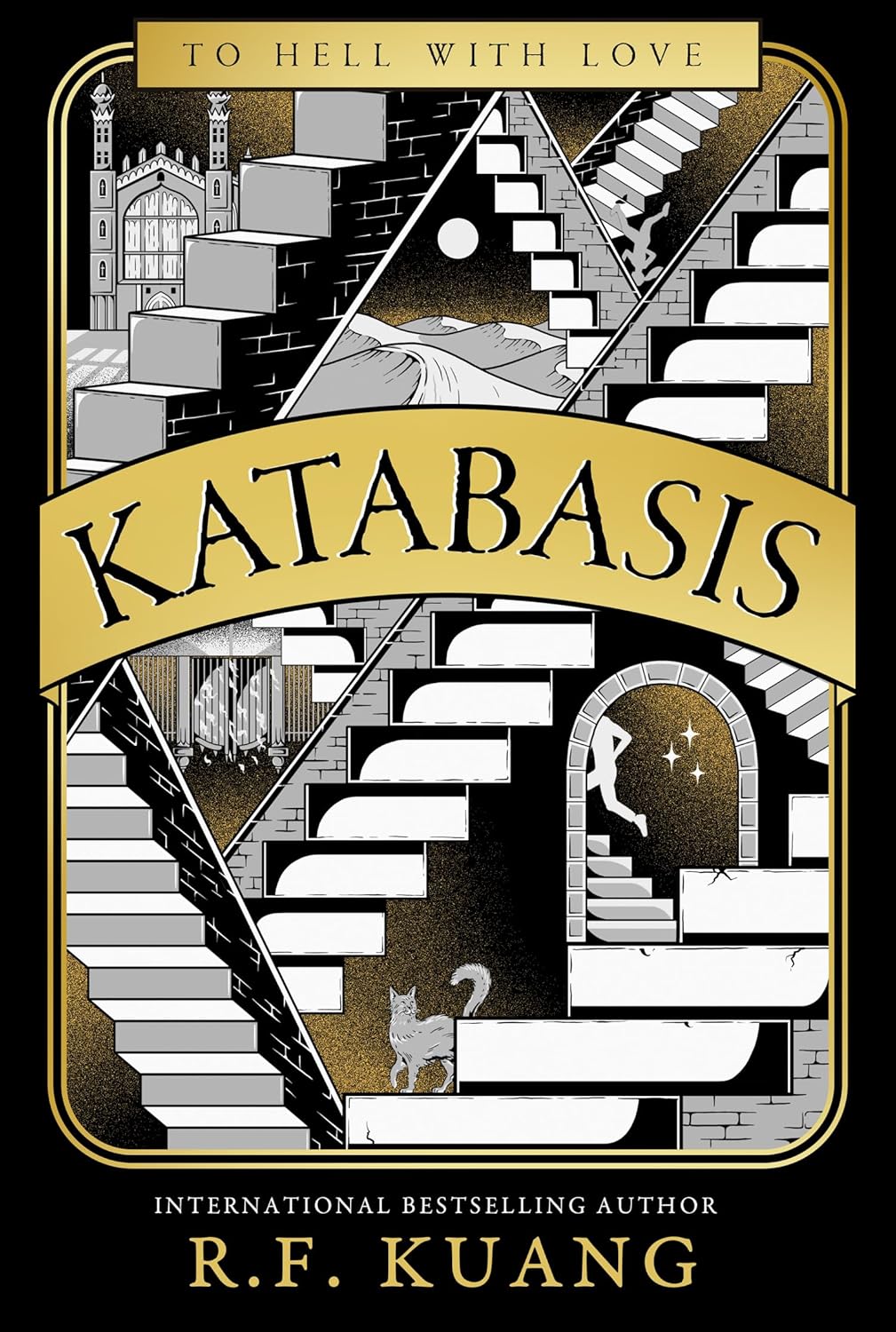
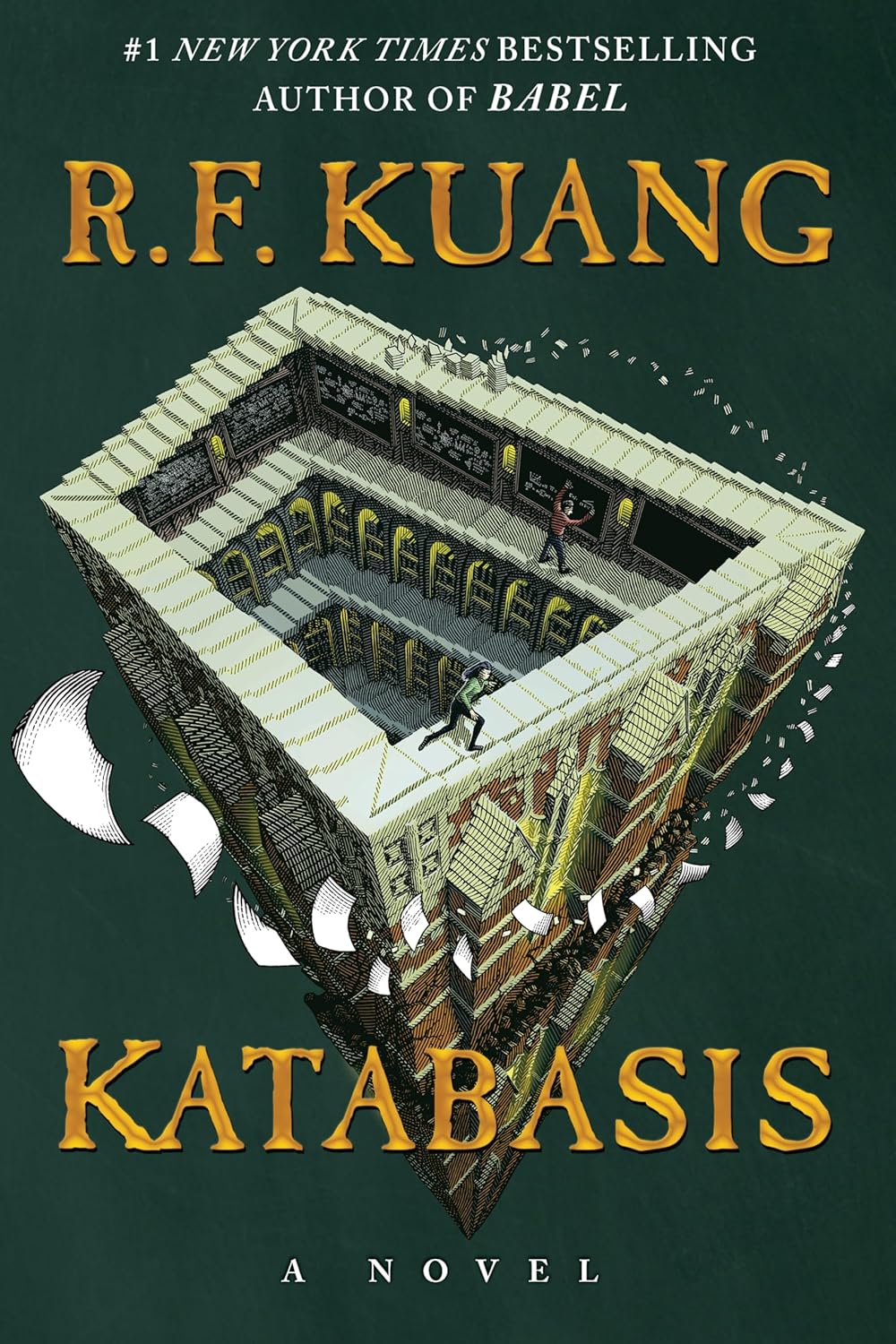
Katabasis by R. F. Kuang

Publisher: Harper Voyager (Trade Paperback – 26 August 2025)

Series: Standalone/Book One

Length: 549 pages

My Rating: 4.5 out of 5 stars

Amazon

Acclaimed author R. F. Kuang produces one of the more distinctive and intelligent fantasy novels of 2025 with her elaborate and compelling Katabasis.

Rebecca Kuang, who mostly goes by R. F. Kuang, is a very interesting author who has been making a big impact on the fantasy scene in recent years.  Known for her elaborate and dark fantasy novels that often feature strong Chinese inspiration, Kuang has written some intriguing novels over the years, including her bestselling Poppy War trilogy, as well as the standalone novels Babel (also released as Babel, or the Necessity of Violence), and her contemporary satirical novel Yellowface.  I have been meaning to read something from Kuang for a while, especially after seeing a lot of love for her works online, so I made sure to seek out a copy of her 2025 release, Katabasis.  An intricate read with some excellent academic twists, Katabasis was a compelling novel with a very unique plot.

Plot Synopsis:

Dante’s Inferno meets Susanna Clarke’s Piranesi in this all-new dark academia fantasy from R. F. Kuang, the #1 New York Times bestselling author of Babel and Yellowface, in which two graduate students must put aside their rivalry and journey to Hell to save their professor’s soul—perhaps at the cost of their own.

Katabasis, noun, Ancient Greek:

The story of a hero’s descent to the underworld

Alice Law has only ever had one goal: to become one of the brightest minds in the field of Magick. She has sacrificed everything to make that a reality: her pride, her health, her love life, and most definitely her sanity. All to work with Professor Jacob Grimes at Cambridge, the greatest magician in the world.

That is, until he dies in a magical accident that could possibly be her fault.

Grimes is now in Hell, and she’s going in after him. Because his recommendation could hold her very future in his now incorporeal hands and even death is not going to stop the pursuit of her dreams….

Nor will the fact that her rival, Peter Murdoch, has come to the very same conclusion.

With nothing but the tales of Orpheus and Dante to guide them, enough chalk to draw the Pentagrams necessary for their spells, and the burning desire to make all the academic trauma mean anything, they set off across Hell to save a man they don’t even like.

But Hell is not like the storybooks say, Magick isn’t always the answer, and there’s something in Alice and Peter’s past that could forge them into the perfect allies…or lead to their doom.

Katabasis was an outstanding novel from Kuang, who presents a highly academic and moving journey into the underworld.  Featuring a very distinctive style, Katabasis was a thoughtful and intricate fantasy read with some outstanding character moments, which really draw you in with its drama and complexity.

Kuang envisions a compelling standalone narrative for Katabasis, which combines an intelligent adventure into the afterlife with some great character-driven story elements.  Following protagonists Alice and Peter as they journey together into Hell to recover the soul of their recently deceased professor, Katabasis has a bit of a slow start to it, primarily due to the highly theoretical nature of this world’s magic system and the various ideas of Hell.  Kuang is forced to explore a lot of this in the early part of the book, but it serves as an excellent basis for the rest of the novel, especially when combined with hints at the troubled relationship between Alice and Peter, as well as their own dark histories.  Once the story gets going in earnest, it proves to be a lot more exciting, especially when exploring the different planes of Hell, and Kuang soon adds in some other dark threats that further imperil the protagonists.

The second half of Katabasis is particularly good, as the protagonists continue their journey down the various levels of Hell, now being hunted by murderous constructs and their sinister masters.  Kuang really amps up the risk factor for this part of the book, and there are some great scenes here, including one that completely changes the trajectory of the narrative.  At the same time, the author fully reveals the traumatic pasts of both protagonists, which really alters the way you see them and their motivations for undertaking this adventure.  Following some dark tragedy and excellent searches for self-discovery amongst the other trapped souls in Hell, the big threat of the story is eventually resolved, and the goal of the protagonists is reached.  Kuang does an excellent job wrapping the book up, with the final decision of the main protagonist serving as a great full-circle moment for the entire proceeding plot.  I quite liked the hopeful note that the author left her fantastic novel on, which I felt was quite fitting and allowed the reader to come away very satisfied and moved.

I felt that Kuang utilised a very distinctive, and personal style for Katabasis, that really helped her to make the classic journey into Hell story her own.  A powerful, character-driven book, Kuang brings together a great adventure narrative that is constantly enhanced by a range of academic elements and the author’s own complex magick system.  There is a substantial dive into both the concept of Hell, and the study of the novel’s archaic magick, and Kuang cleverly dives into the deep detail of both as the book continues.  Fans of Dante’s Inferno and other classic texts about Hell will love the constant references and comparisons that occur throughout the course of the story, and it was fun to see the differences between what the protagonists expect and what they experience.  I felt that this mixture of homages and the author’s own imagination was very impressive, and the author went above and beyond to set up this setting and her magick system, including with several great maps of Hell that appear in the version of the book I got.  I also felt that the author’s compelling dive into the torture that is advanced academia and the various pressures, lies and rivalries that formed was particularly gripping.  Kuang clearly adds a lot of her own experiences with academia, especially in the elite British universities, into the protagonist’s past, and it gave a gritty bit of academic realism to the plot.  It does need to be said that Kuang made her novel a little too complex at times, and there are a few sections which drag as the protagonist’s dive into obscure lore, elaborate equations, or complicated logic.  Still, for the most part Katabasis was a well-written and addictive standalone read, that will really appeal to established fans of the author.

I think that another major highlight of Katabasis was the excellent character work that Kuang featured throughout the plot.  Focused primarily on the main characters of Alice Law and Peter Mudoch, both protagonists are initially portrayed as brilliant and highly ambitious academics whose journey into Hell only seems to enhance their own rivalry.  However, as the book continues, Kuang does a masterful job of diving deeper into their backstories and showcasing more of their pasts to give their current adventure and motivations more meaning.  It turns out that both characters are a lot more damaged than you’d initially realised, due to their own experiences in academia, their interactions with their supervisor, and the crippling rivalry that has formed between them.  The slow reveal of the full extent of their damage, which also includes both characters reevaluating previous information and conclusions they’ve made, is very impressive, and each revelation adds some greater emotional heft to the plot.  Combine that with the gradual evolution and repair of the relationship between Alice and Peter as the book continues, and this was quite a powerful journey for the two protagonists, especially as they experience even more tragedy, betrayal and uncertainty in Hell.

While most of the book is focused on Alice and Peter, I do have to also highlight how well Kuang set up supporting character Professor Jacob Grimes in the Katabasis.  Despite being dead and appearing mostly in flashbacks and the memories of the protagonists, Professor Grimes serves as an influential figure in the plot, primarily for the impact he had on his various students.  Initially shown as a brilliant and supportive academic, the flashbacks shown throughout the course of Katabasis soon reveal a more malicious side to Grimes, which really changes your view of the protagonists’ journey to save him.  Kuang’s slow burn reveal of all of Grimes’s flaws and manipulation was just perfect, and I loved how your perception of this shadowy figure the plot is chasing changes the more honest and open the protagonists become.  The full extent of Grimes’s actions, and his students’ complicated feelings for him, is such a compelling part of the Katabasis’s plot, and I liked how well it’s tied into the larger problems with academia.  I really do appreciate how well Kuang set up Professor Grimes as a dark supporting figure in this book, whose influence has major implications to the story, even if he only actually appears in the present adventure once.  Throw in some other intriguing denizens of Hell, including a twisted family doing their own dark experiments on the dead in brutal fashion, and Kuang really showcased her ability to write complex and damaged characters in Katabasis.

Overall, Katabasis was a highly compelling and deeply intricate fantasy novel that was a distinctive highlight of the 2025 reading year.  I certainly got the full experience of Kuang’s intriguing imagination with this elaborate book, and the resulting story was an interesting take on dark academic fantasy.  Clever, moving and full of some unique features, Katabasis was an outstanding read that is really worth checking out.
Amazon

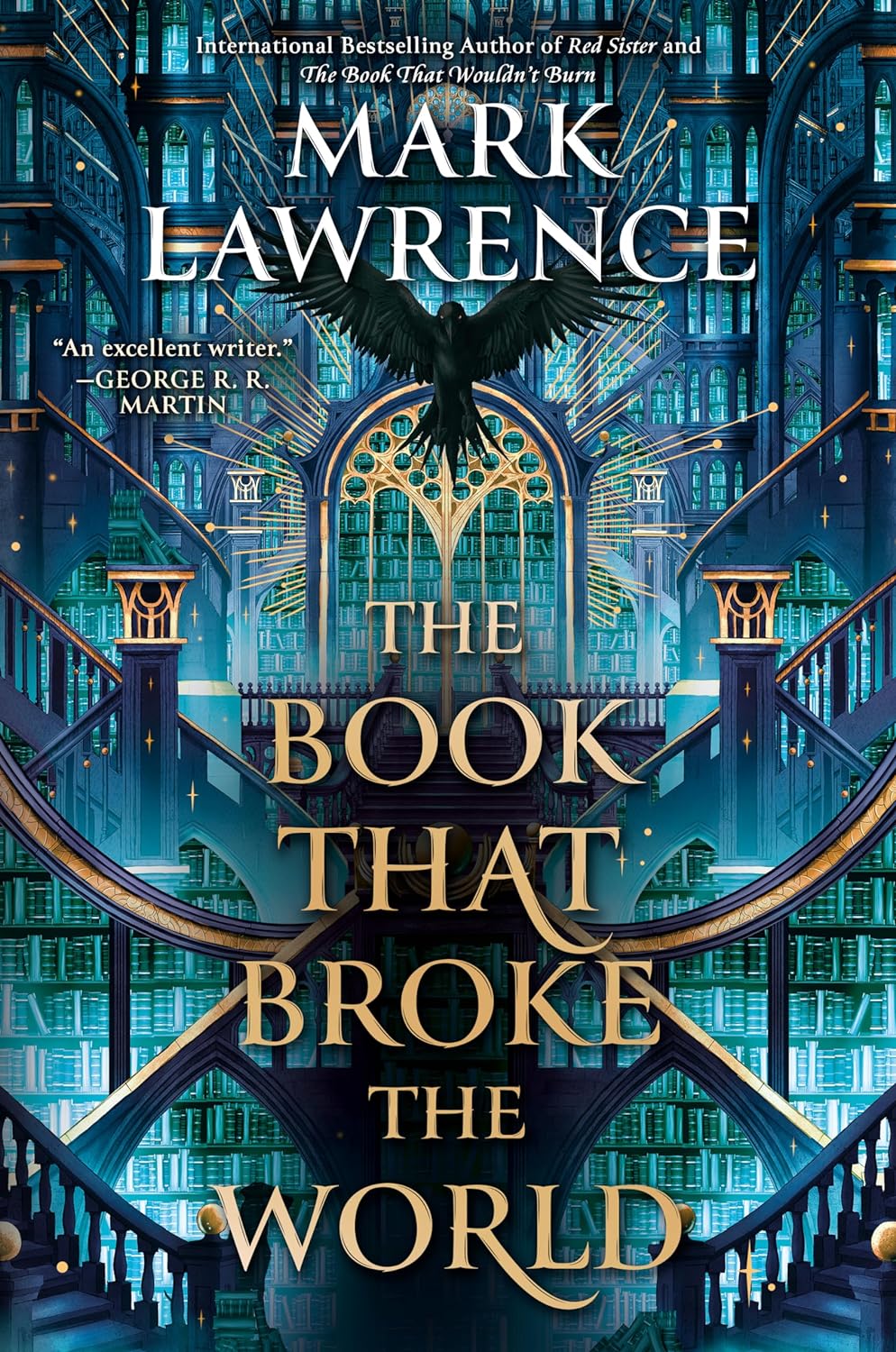
Quick Review – The Book That Broke the World by Mark Lawrence

Publisher: Harper Voyager (Trade Paperback – 9 April 2024)

Series: The Library Trilogy – Book Two

Length: 369 pages

My Rating: 4.5 out of 5 stars

Amazon

The master of elaborate fantasy fiction continues his outstanding and intricate Library trilogy with the captivating novel, The Book That Broke the World.

Mark Lawrence is an exceptional author who has been wowing fantasy and science fiction fans since 2011 with impressive reads that borrow heavily from both genres.  Some of his better-known series include the Broken Empire novels, the Book of the Ancestor trilogy and The Book of the Ice trilogy (which includes The Girl and the Stars and The Girl and the Mountain).  His current body of work, the Library trilogy, might be his most ambitious series yet as he envisions a complex and intense story of hope, discovery and secrets within an impossible library that bends time, reality and the lives of its many alien inhabitants.  The first book in the series, The Book That Wouldn’t Burn, was an epic read that told the story of Evar and Livira, two teenagers brought to the library in very different circumstances, who work to uncover its many mysteries.  This was such a great read, especially as Lawrence loaded in a particularly clever central twist that blew my mind, and The Book That Wouldn’t Burn ended up being one of my favourite books of 2023.  As such, the sequel, The Book That Broke the World, was one of my most anticipated reads for 2024, and it ended being a very interesting second entry in this amazing series.


Plot Synopsis:

We fight for the people we love. We fight for the ideas we want to be true.

Evar and Livira stand side by side and yet far beyond each other’s reach. Evar is forced to flee the library, driven before an implacable foe. Livira, trapped in a ghost world, has to recover her book if she’s to return to her life. While Evar’s journey leads him outside into the vastness of a world he’s never seen, Livira’s destination lies deep inside her own writing, where she must wrestle with her stories in order to reclaim the volume in which they were written.

And all the while, the library quietly weaves thread to thread, bringing the scattered elements of Livira’s old life – friends and foe alike – back together beneath new skies.

Long ago, a lie was told, and with the passing years it has grown and spread, a small push leading to a chain of desperate consequences. Now, as one edifice topples into the next with ever-growing violence, it threatens to break the world. The secret war that defines the library has chosen its champions and set them on the board. The time has come when they must fight for what they believe, or lose everything.

The Library Trilogy is about many things: adventure, discovery, and romance, but it’s also a love letter to books and the places where they live. The focus is on one vast and timeless library, but the love expands to encompass smaller more personal collections, and bookshops of all shades too.


Lawrence had to achieve a lot in this sequel, as he needed provided a compelling follow-up to his previous novel while also advancing the story in a clever and unique manner.  I felt that he succeeded on all fronts, as The Book That Broke the World proved to be just as complex, intense and addictive as the first book in the series.  Set in the immediate aftermath of the shocking events of The Book That Wouldn’t Burn, The Book That Broke the World continues to follow star-crossed lovers Evar and Livira as they to try and find each other despite the insurmountable odds of existing in different times and being born different species who are constantly at war with each other.  This new novel once again sees them parted, primarily due to one of the characters being a ghostly presence in the other protagonists’ time, and they soon end up discovering new periods of history within the library as war, strife and a new dangerous race upset the balance of events.  There is a certain feeling of tragedy and frustration for much of Evar and Livira’s narrative, as the two remain separated from each other, and you really get invested in their story, as well as the lives of their associated supporting characters, especially as the blending of timelines leads to some new interactions.

While it was great to continue to follow the adventure of the same main characters from the first book, the thing that made The Book That Broke the World’s narrative really stand out was the inclusion of new point-of-view protagonists whose additional narrative supported the unique story of Evar and Livira.  The first of these, Arpix, was a major secondary character in The Book That Wouldn’t Burn, and his use as a perspective protagonist here was very effective, especially as it allowed for a more measured view of some of the crazy events occurring throughout the book.  Arpix was a great character in this sequel, and I especially enjoyed seeing him interact with Evar and his family as Lawrence throws him into a delightful romance narrative with a very unlikely but entertaining figure.

However, it was the other additional point-of-view character who really turned The Book That Broke the World into something special, as Lawrence introduced a seemingly new protagonist, Celcha, a slave in the city surrounding the library, who finds herself drawn to its secrets thanks to the machinations of her unusual brother and the ghosts that visit him.  A member of an alien species who came from a different period than Evar and Livira, Celcha has an intriguing narrative within The Book That Broke the World, as she tries to escape the manipulations of other visitors from the library while also trying to learn more about her species.  Celcha’s narrative is at first separated from the rest of the storylines, and it is initially unclear what role it is going to play in the larger plot.  However, the way that Lawrence ends up tying it together with the rest of the plot is very clever, especially as he utilises the uncertainty of when Celcha’s story fits into the overarching timeframe of the narrative to tie up many mysteries from the first book while weaving in a complex new player.  These intriguing, character driven arcs come together extremely well by the end of the story, and you will be amazed at how well Lawrence’s many complex puzzle pieces fit together by the end for an addictive and memorable narrative.

As with most of Lawrence’s writing, The Book That Broke the World is a very complex and lore-heavy book that requires readers to really pay attention to the many, many details loaded into the overall text of the plot.  This results in a very elaborate narrative as Lawrence is constantly working in compelling details about his intriguing universe while also layering down constant hints and plot points that will become relevant later for twists and other reveals.  Readers really get caught up in the majesty of the massive setting of the Library trilogy, and I really appreciated how Lawrence was capable of blending fantasy elements with more science fiction focused occurrences, like advanced technology and time travel.  I also loved how well the author used the various character perspectives to further enhance the scope of the narrative and the setting, and you must appreciate the mystery and scope of his ambitious setting and the elaborate narrative around it, especially when it comes to the many fascinating side characters and protagonists he works in the plot.

While this proves to be a great book to read, it isn’t always the easiest novel to follow, as Lawrence throws in a lot of high-concept moments and plot points that sometimes seem a little too complicated for the narrative’s own good.  Readers are also required to remember a lot of key details from The Book That Wouldn’t Burn to fully appreciate the scope and cleverness of this second entry in the series.  While I was able to recall most of the details of the first book (the recap at the front was quite helpful), I can imagine some readers might have a little more difficulty, especially if there is a big gap between reads in the series.  Despite that, I think it would be possible to jump into the Library series from this second novel, but you really would be better off reading The Book That Wouldn’t Burn first as it allows you to become much more invested in the various compelling character arcs and emotionally laden storylines.

Mark Lawrence continues to showcase his inventive and unique fantasy style with The Book That Broke the World.  Providing readers with a complex and compelling sequel to his first Library novel, The Book That Broke the World continues the intense narrative in some fantastic directions, while constantly working to make the plot even more intricate and powerful.  An outstanding piece of fantasy fiction that will keep you guessing to the end, The Book That Broke the World comes highly recommended, and I look forward to the fast-approaching final entry in the series that is out in a few months’ time.

Amazon

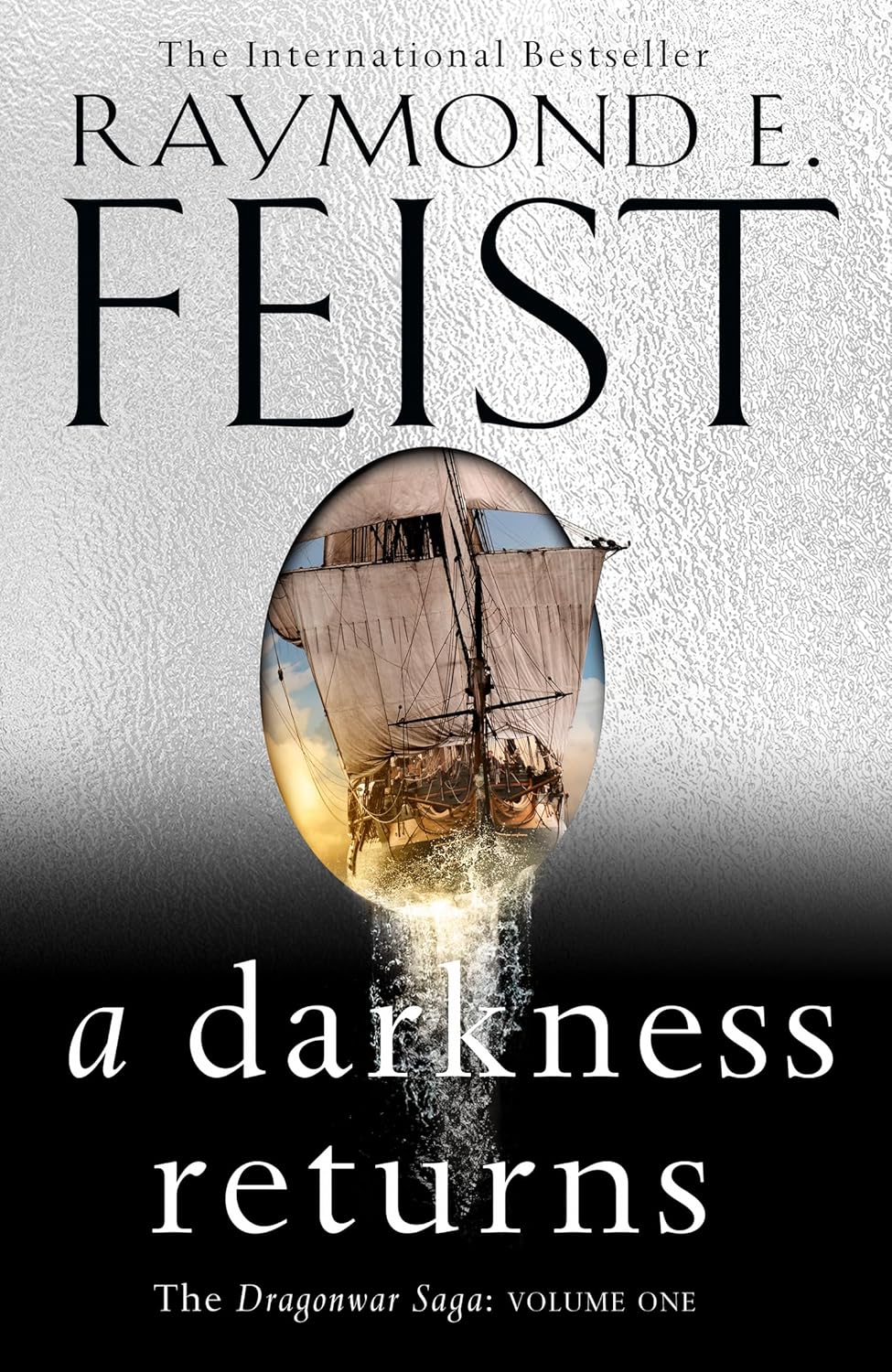
A Darkness Returns by Raymond E. Feist.

Publisher: Harper Voyager (ebook – 1 August 2024)

Series: Dragonwar Saga – Book One

Length: 480 pages

My Rating: 4.5 out of 5 Stars

Amazon

Prepare to return to one of the most iconic realms of fantasy as acclaimed author Raymond E. Feist presents the reader with another high fantasy adventure set across multiple worlds with A Darkness Returns.

Raymond E. Feist is one of the most impressive and long-running authors of fantasy fiction in the world today, who has been writing intriguing reads for over 40 years.  Feist is best known for his extensive Riftwar Cycle, a connected series of books that follow a variety of threats and conflicts on several fantasy words created by Feist.  Starting with Magician in 1982, The Riftwar Cycle initially focused on a war between two different fantasy worlds joined together by a magical rift in space, with the realm of Midkemia, which had a more classic European fantasy vibe, being invaded by armies from the Asian inspired world of Kelewan.  Feist would write an interesting array of different storylines as he continued to expand his fantasy series across many years of internal plot, and there ended up being nearly 30 books in the Riftwar Cycle, which ended back in 2013.  I have been a huge fan of this series for years, as it was one of the first fantasy series I ever really got into, thanks to various unique sub-series that moved the history of Midkemia and its associated realms along at an intriguing pace.  Key highlights for me include the associated Empire trilogy, that Feist co-wrote with fellow fantasy author Janny Wurts, and Talon of the Silver Hawk, which was one of the first big fantasy novels I read as a young teenager.

While Feist apparently ended his Riftwar Cycle books some years ago, it turns out that he couldn’t leave his original world alone for too long.  His next trilogy, the Firemane Saga, which started back in 2018 with King of Ashes, initially showed a captivating adventure on the new fantasy world of Garn, following a whole new group of protagonists.  However, as the series continued with Queen of Storms and Master of Furies, it became apparent that the Firemane Saga existed in the same dimension as the Riftwar Cycle, with several characters from Feist’s original novels having cameo appearances.  The final book, Master of Furies, identified a major threat lying dormant beneath Garn, and the novel ends with the protagonists of the Firemane Saga travelling through a rift to Midkemia to learn how to defeat it.  This new novel, A Darkness Returns, is set immediately after the events of Master of Furies and seeks to bring together the worlds of the Riftwar Cycle and the Firemane Saga for one epic adventure, while also introducing Feist’s new The Dragonwar Saga series.  Naturally, as a fan of both prior series and Feist’s writing in general, I was very excited, and A Darkness Returns has been one of my most anticipated books of 2024.

A new darkness is rising, one that could destroy two worlds and everything in them.

After finally defeating the nefarious Pride Lords on their home planet of Garn, Hatushaly, last scion of the Firemane dynasty, has agreed to travel to the world of Midkemia to attempt to learn how to harness his unique magic.  Accompanied by his wife Hava and their trouble-seeking friend Donte, Hatu finds Midkemia to be a strange world, but one filled with boundless opportunity and magic as he begins to study on the peaceful Sorcerer’s Island, under the tutelage of the great magician Magnus, and Magnus’s reincarnated father, Pug.

As the newcomers settle into Midkemia and attempt to find their place in this new world, word quickly reaches them of the trouble they left behind on Garn.  The nefarious Church of One has risen to power and seeks to enslave or destroy everything in front of it.  The only independent nation left is the newly formed kingdom of Marquensas, under the rule of the benevolent King Daylon Dumarch.  There, Hatu’s friend Declan Smith, a master swordsmith and Daylon’s newly discovered brother, has been declared prince and struggles to accept the new responsibilities thrust upon him.

As Declan leads the newly formed Marquensas army against the invading forces of the Church of One, it becomes apparent that there is something far more sinister behind the fanatical soldiers.  A dark presence is guiding them, one the magicians of Midkemia are painfully familiar with: the Dread creatures from the Void.  Having waged several destructive wars to hold back the malign influence of the Void, Magnus and Pug are determined to save Garn as well, and it soon becomes apparent that the only thing that can save it is Hatu’s unique magic.  As Hatu learns to control his powers, he must work with his friends, both new and old, to find a way to hold back the oncoming darkness before both his home, and the other worlds in his dimension, are destroyed for good.

A Darkness Returns sees Feist back in fine form as he combines two of his iconic worlds into one impressive and exciting story.  Following several excellent protagonists across a series of compelling adventures, A Darkness Returns was the classic high fantasy story I had really been craving, and I had such an amazing time with this book.

I deeply enjoyed the story contained with A Darkness Returns, and Feist produced a fantastic read that strongly harkens back to his original stories.  Set shortly after the events of Master of Furies, A Darkness Returns’ plot follows key protagonists from both the more recent Firemane Saga trilogy and Feist’s classic Riftwar Cycle as they complete a series of connected adventures across the worlds of Garn and Midkemia.  Feist focuses on several different character arcs and storylines simultaneously, which presents a rich and complex narrative with a bit of something for everyone.  The main protagonist of the Firemane books, Hatu, finds his story strongly enmeshed with that of key Riftwar Cycle characters Magnus and Pug, who attempt to uncover the secrets of Hatu’s magic as well as the dangers hiding in Garn.  At the same time, we have a more classic fantasy war story back in Garn as Declan and his brothers prepare for battle against the encroaching Church of One, with his arc feature several small-scale battles.  There are also some intriguing storylines around Hava’s attempts to get back to life on the sea, no matter which world she’s on, the ever-unpredictable Nakor, begins to explore certain multi-dimensional areas to quantify the threat coming for both worlds, while Donte goes rogue and starts his own criminal organisation in Midkemia.

I found myself getting really stuck into the various storylines that Feist came up with for A Darkness Returns, and this proved to be a very fun story.  Each character arc went in some interesting directions, and they all proved entertaining in their own way.  I personally found myself getting more drawn towards the parts of the books focusing on Declan and his brothers’ military actions in Garn and Donte’s burgeoning criminal enterprise in Midkemia, which prove to be an excellent contrast to the more magical theory laden storylines of Hatu, Magnus and Pug.  As the book progresses, Feist works to bring the various storylines together, usually done by having the magical characters using rifts to transport between worlds and working with the other relevant protagonists.  I think this helped to create an overall compelling narrative, as the various characters work together to discover the full extent of the threats facing them.

I did feel that A Darkness Return’s narrative did get a little overcomplicated towards the end the book, especially as Feist, through his characters, started diving into all the magical theory and knowledge that the author has been building up for 40 years.  This made parts of the last half of the book a little hard to get through, especially for the more casual reader, as there were a lot of elaborate concepts to digest.  The story also suffers a little from being the first book in a new series, with Feist having to spend a lot of time setting stuff up and revisiting old storylines, and as a result A Darkness Return’s conclusion is a little less epic or memorable than it could have been.  However, those who weather through some of the more problematic aspects of this narrative through it are in for a lot of fun with A Darkness Returns, as Feist produces some outstanding and exciting moments while also setting up a lot of future adventures.  I ended up really enjoying where each of the separate storylines went, and readers are in for a fun mixture of magic, military action, and criminal adventure.  These separated storylines come together extremely well as the book continues, and it proves hard not to get addicted to the overall story.  I think that A Darkness Returns proved to be a strong start to this new series, and I am confident it will only get better from here.

One of the things that might possibly impact a person’s ability to enjoy A Darkness Returns is their prior experiences with reading Feist’s books.  As I mentioned above, A Darkness Returns is heavily related to both the author’s more recent Firemane Saga, and his long-running Riftwar Cycle, which started back in the 1980s.  As a continuation of both series, the plot of A Darkness Returns is heavily enmeshed with the events that occurred in the prior books, and there are constant references back to them.  While Feist does do a pretty good job of recapping these events, especially those featured in the Riftwar Cycle, I could see a reader who is unfamiliar with the past 40 years of Feist fiction getting lost as A Darkness Returns continues.  While dedicated fantasy lovers can probably get away with starting their Feist experience with A Darkness Returns, I would probably recommend reading the Firemane Saga first at a minimum to understand the history around several of the main characters and the world of Garn.  As such, this book might not be for everyone, especially those looking for a new series to start off with.  However, fans who have read a lot of Feist’s work in the past are in for a real treat, as you once again get to visit two of Feist’s epic worlds and see figures from both interact for the first time.  I especially enjoyed the long-awaited return to the world of Midkemia, which was such a vital part of my early fantasy experiences, and it was fascinating to see how it has changed since the previous books.  I appreciated seeing Midkemia through the eyes of the fresh characters from Garn, which ensured some extra recapping that will help returning readers.  It proved quite entertaining to see these newer characters find out all the magical and interdimensional craziness that occurred during the many Riftwar Cycle books, and I deeply enjoyed getting back to Feist’s most iconic setting.

Another great highlight of A Darkness Returns was the large and varied cast of characters that Feist focussed the story around.  Most of these characters were established figures from previous books, and it was great to get a continuation of many of their storylines, especially as Feist left many character arcs open from their last appearances.  It was fun to see many of these characters interact throughout A Darkness Returns, especially as a major feature of this book was figures from separate series coming together for the first time.  This includes the intriguing returning cast of the Firemane Saga, who were a key part of this book.  These younger figures (young in the sense that they are all in their early 20s and because Feist only created them recently), serve in great contrast to the older wizard from the Riftwar Cycle, especially with their more energetic adventures.  My favourite of these characters was either the dependable and brave Declan or the brash wildcard character Donte, both of whom had the best segments in A Darkness Returns.  The primary protagonist of the book, Hatu, while interesting, did have too much of a chosen-one vibe around him, and I think Feist decreases his enjoyability by making him too powerful and all-knowing.  Still, it was great to see all these Firemane Saga characters again, and Feist set up some interesting storylines and interactions around them.

However, the characters that Feist fans are probably most excited to see again where Magnus, Pug and Nakor all of whom are major established figures in the Riftwar Cycle.  All three characters are quite fascinating in their own ways and have long histories in Feists books.  Magnus has long been one of the main wizards of the series, and it was great to see him return here as the elder statesman guiding the various younger characters.  Nakor is an entertaining trickster who is the reincarnation of long-running figure of the same name.  While the details of his reappearance in this series does get a little technical, he was still a lot of fun, and it was great to once again see his more unusual approach to magic.

However, the most interesting figure was the returning Pug.  Pug has been Feist’s main character since the very first Riftwar Cycle book, Magician, with many of the subsequent plots revolving around his magical adventures, and he is probably one of fantasy fiction’s most iconic protagonists.  Pug was killed off in the final Riftwar Cycle novel, although the last scene saw his son, Magnus, finding him resurrected as a young man without any memory of his past life.  However, this reincarnation story element is at an end as with his return in A Darkness Returns, Feist utilises the strange magics of Hatu to bring back Pug’s old personality.  While you could argue that Feist might be better off stepping away from this long-running character, I personally loved seeing Pug again, and it gave me a major nostalgia hit.  Between these great figures and more, I really loved the cast of A Darkness Returns, and it was so much fun to see the figures from both series come together for one massive adventure.  I look forward to seeing how their storylines further advance through the rest of The Dragonwar Saga, and I have no doubt that Feist will provide them with exciting stories and massive tragedy.

I had an amazing time getting through A Darkness Returns, and it was so much fun to have another high fantasy adventure from Raymond E. Feist.  Between the nostalgia, the exciting action, fantastic characters, and the ambitious way in which Feist brought together two of his major series, A Darkness Returns has a lot going for it, and it proves hard not to get caught up in the resulting story.  While there are a few issues that may turn off newer readers, I personally had an outstanding time, and all established Feist fans are guaranteed to love A Darkness Returns.  An overall awesome and impressive read from one of fantasy fiction’s most enduring authors.

Amazon

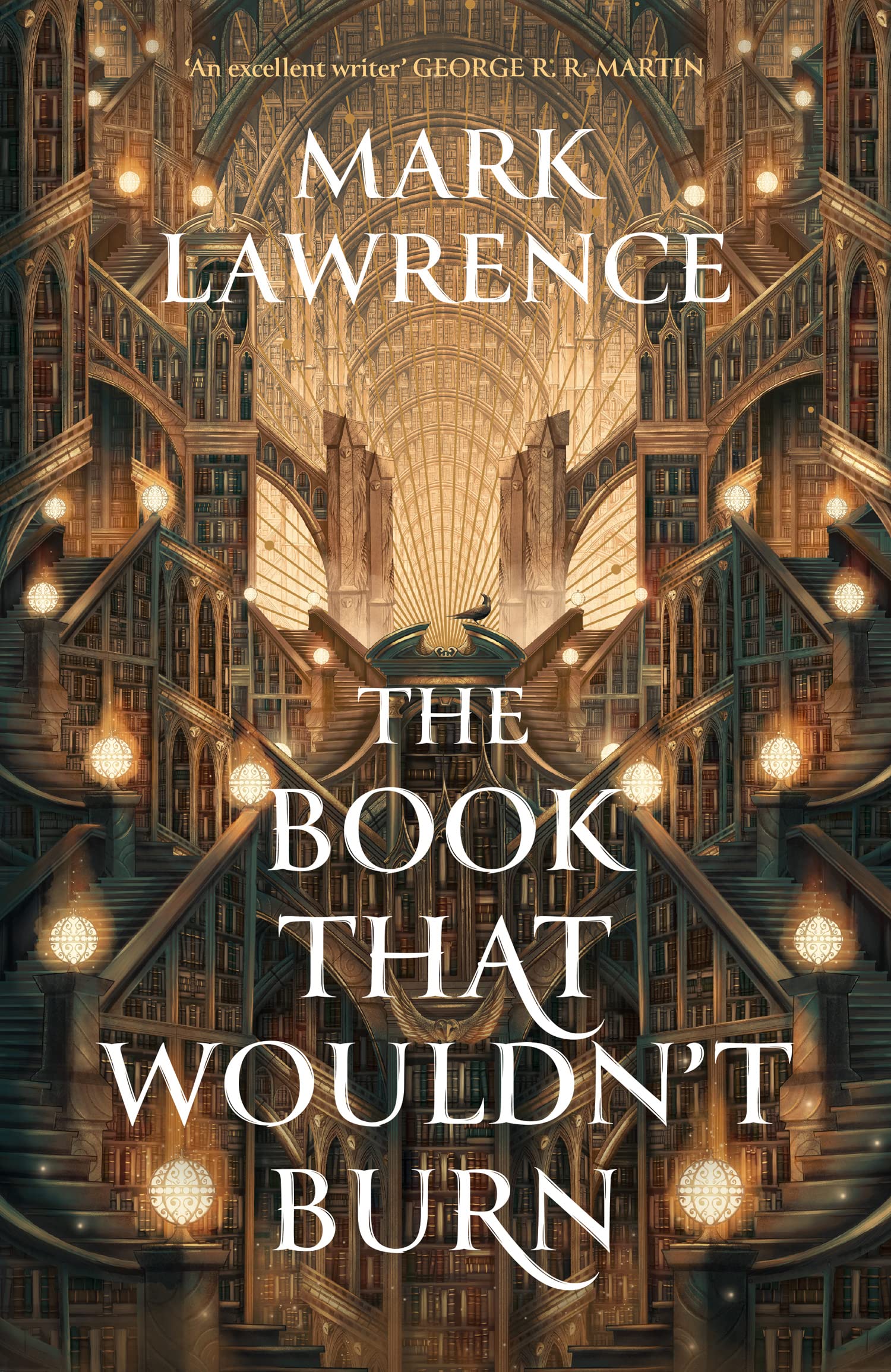
The Book That Wouldn’t Burn by Mark Lawrence

The Book That Wouldn't Burn Cover

Publisher: Harper Voyager (Ebook – 1 May 2023)

Series: The Library trilogy – Book One

Length: 570 pages

My Rating: 5 out of 5 stars

Amazon

One of the world’s inventive and compelling fantasy authors returns with one of his best novels yet, the highly addictive and ambitious novel, The Book That Wouldn’t Burn, which sets off his new The Library trilogy.

Few authors have had the impact on the fantasy genre than Mark Lawrence has in the last few years, as the author has truly impressed readers throughout the world with his unique and captivating novels that routinely blend fantasy and science fiction elements.  His series include The Broken Empire trilogy, The Red Queen’s War series, and The Book of the Ancestor series.  I myself only started reading Lawrence’s work a couple of years ago with his compelling The Book of the Ice series, which followed several powered teens on a grim frozen planet.  I had an outstanding time with this series, which included The Girl and the Stars and The Girl and the Mountains.  While I still have to read the third book, The Girl and the Moon, I really enjoyed these books, and it was a pretty clever series.  As such, I was very keen to check out Lawrence’s new novel, The Book That Wouldn’t Burn, especially as it had a very intriguing plot synopsis behind it.

Throughout the world, there is nothing more important, more significant, nor more permanent than the library.  Built inside a mountain near the great city of Crath, the library contains an impossible number of books fitted within innumerable rooms that no one person can access.  The sheer amount of knowledge contained within the library represents the greatest power in the world, allowing its keepers and the King of Crath to wield great control in the world.  Into this vast and elaborate repository of knowledge and secrets, two young people are about to meet in unusual circumstances.

Livira is a young girl raised in the Dust, the desolate wasteland that surrounds Crath.  Plucky, curious, and incapable of giving up, Livira is a rarity among her people as she seeks to know more about the world outside her home.  But when the alien sabbers destroy her village and kill her people, Livira finds herself lost in the wilderness.  Rescued and brought to Crath, Livira soon becomes certain that her future lies in the library.  Overcoming prejudice and her own humble background, Livira learns to navigate the library and soon begins to find out some of its deeper secrets.  However, the most mysterious of these might be another strange inhabitant of the library, Evar.

Evar and his small family have known nothing but the library their entire lives.  Released after unknown eons frozen as children inside the library’s mysterious Mechanism, Evar and his siblings have grown up in a vast chamber of the library, learning from the books and becoming masters of specialised subjects.  However, Evar has always desired more and has long tried to find a way to leave their book filled prison.  His discovery of a portal within his home soon leads him to a place outside of time where he meets an exploring Livira.  Together, the two attempt to find the true history of the library and the threats it has withstood over the years.  But dark evils haunt the library, and soon the two explorers must find a way to uncover the truth behind the sabbers, their own history, and other deadly threats waiting for them in the future.  Can these two children of the library survive the revelations in front of them, or will the truth tear them apart in ways they can’t even understand?

Well damn, now this was a seriously impressive and epic book.  Lawrence has honestly outdone himself here with this incredible read, and this might be one of the best books he is ever written, which is saying something.  The Book That Wouldn’t Burn features one of the most elaborate settings and narratives you are likely to see in fantasy fiction, and this results in a powerful and moving read that will keep you guessing time and time again.  I had an exceptional time reading The Book That Wouldn’t Burn, and it would be impossible for me to give it anything less than a five-star rating.

The Book That Wouldn’t Burn is told from two separate perspectives, that of Livira and Evar, and covers their very different lives and experiences within the libraries.  These two character-driven storylines are initially kept separate from each other as Lawrence spends a good chunk of the book introducing the protagonists, setting up their unique stories, and bringing together the elaborate setting that the story is based around.  Both of these storylines are very interesting and fun off the bat, with Livira having her life torn apart, only to find purpose in the library, while Evar details his life lived purely within the library.  While both storylines are really good, I initially got drawn into Livira’s the most, especially as her outsider perspective of the library allows you to really appreciate how alien and strange the massive house of books is.  Livira’s storyline advances at an extended clip, covering years of her life as she learns, grows, and fully develops her adventurous personality as she seeks to fully understand the secrets of the library and everything within it.  Evar’s storyline on the other hand is a little more sedate in its pacing, as it is set only along the course of a few days as he tries to finally understand the structure that has kept him prisoner for so many years.

The first half of the book that showcases these two characters’ initial introduction and growth are pretty damn entertaining, and it does a wonderful job of setting the scene for Lawrence’s elaborate story and background location.  However, the story doesn’t find its true strength until the two protagonists meet and their storylines becomes a lot more intertwined.  Due to the impossible physics and requirements of the library, there is a compelling time element to the meetings between the characters, which Lawrence captures masterfully, and which really alters their perspectives of each other.  Once they are able to properly interact, the two characters grow close and spend an interesting chunk of the novel exploring their respective worlds, as well as the history of the library.  Lawrence really lays the world building on thick during these parts of the book, and it serves to bring the two protagonists together, which just ensures the last act of the book is as tragic, moving and devastating as possible.  The author drops some massive bombshell twists around two-thirds of the way through, which completely throws you and makes you rethink everything you have thought about the preceding narrative.  I honestly was pretty damn shocked at this epic and devastating revelation, and while I had already been pretty damn addicted to the story by this point, this was the moment I realised what a masterpiece The Book That Wouldn’t Burn truly was.

The final third of the novel gets even better as certain background elements of Livira’s storyline finally come to fruition and her entire life begins burning around her.  This causes her and many of the supporting characters from her part of the book to end up interacting with the characters from Evar’s storyline, which is a very interesting change of pace from the previous parts of the book.  There are also some frenetic conflicts and some very dark moments as everything you have previously known about the settings, the characters and the history of the library is thrown around in some excellent and compelling ways.  There are several great new twists in this final section of the book, and Lawrence gets very metaphysical with the reveals, relying on his setting’s unique temporal properties to mess with your mind and bring you surprise after surprise.  I really loved just how cool and complicated this novel got towards the end, and Lawrence leaves an awesome and open conclusion for you to enjoy while drawing you in towards the next book in the series.  I came away from this narrative desperately wanting more, especially after being blown away by all the twists within the book, and I cannot wait to see what happens next.

Those who are familiar with Lawrence will know that he is a very impressive and talented author, and I really liked how he developed his story and displayed all its outstanding elements to the reader.  The Book That Wouldn’t Burn is a particularly complex read, loaded with damaged characters, elaborate storylines and an inventive major setting.  Lawrence approaches his latest novel with his usual flair and imagination, expertly showcasing every clever detail of this world to the reader and keeping them enthralled the entire way through.  Due to the complexity of the story, you really need to dive into every single word that Lawrence writes, and it honestly took me a little longer to get through this lengthy novel than I expected, mainly because of how much focus I needed to fully appreciate everything.  That said, it has a very good pace to it and there is never really a dull moment as you are constantly drawn into what is happening or the elaborate depictions of the library.

I felt that the author’s use of two narrators was particularly effective, especially as they give very different views of what is happening around them and the setting they find themselves in.  The extra expansiveness of the separate narration really helps to expand the scale of the book, and it takes some major temporal shifts for the two protagonist’s storylines to align.  Once they do, the two separate character arcs intertwine extremely well, and I loved seeing their interactions through each other’s eyes, as well as the elaborate adventures they find themselves involved with.

Lawrence also was very skilled at setting up some of the book’s big twists, and while many of them surprised me when I read them, looking back you could see the subtle clues leading up to them, and you really appreciate just how clever the author was in the earlier stages of the book.  The initial big twist is probably the best, and you really have to love how careful Lawrence was with some of the dialogue and character descriptions to pull that off.  Some of the subsequent twists are a little less shocking, mainly because you are on guard at that point, but I did like how well some of the reveals based around the protagonist’s journey through time were utilised and hinted at in earlier scenes.  The fact that there are completely different faces to some of the major early figures of the book was very cool, and it was clear that the author had a very impressive plan while writing the early stages of the book.  These excellent writing elements, and more, served to enhance an already captivating story, and I cannot get past how well Lawrence set everything up.

There is no way I can move forward without talking about the elaborate library setting that was such an epic centrepiece of The Book That Wouldn’t Burn.  I love how the author’s ultimate major setting is a library, which is something that all readers can really appreciate.  While we can all imagine a pretty massive or full library, Lawrence amped that imagination up to an 11 in this book, describing a seemingly impossible structure, made up of innumerable rooms filled with massive climbable bookshelves and a seemingly infinite number of books and tomes.  The sheer scale of this setting when described by Lawrence boggles the mind to a degree, and it really is an outstanding setting for this story as it is the perfect place for exploration, adventure, and even habitation.  The library naturally features Lawrence’s trademark blend of fantasy and science fiction elements, and the structure has a transdimensional or alien feel to it, as the protagonists find different mechanisms within the structure, as well as strange and unique ways to travel through it.  This blend of fantasy and science fiction elements worked particularly well, especially as you get to experience an intriguing contrast between ancient advanced technology and endless shelves of paper books.

The more unique elements of the library, including the portals, the robotic guardians, the locked doors, and more, are worked into the plot extremely well, and it was fascinating to see how they impacted the story, especially while the characters attempted to find out their origins.  The time travel aspects of the library proved to be particularly awesome, and I loved how Lawrence used them, and other cool features, to twist the narrative in some powerful and unexpected directions, completely changing everything you thought you knew.  It was also really effective how Lawrence explored the library through two very different sets of eyes, as Livira and Evar see it in different ways based on their respective history and cultures.  These alternate views added even more depth to the epic setting, and you have to love the continued focus on exploration, especially when it resulted in some of the best scenes in the book.  Honestly, I could go on and on for pages about just how impressive this outstanding setting is, so let me just be blunt and say: read The Book That Wouldn’t Burn, as you really won’t be disappointed when it comes to this elaborate library setting and the dark world it inhabits.

The final thing that I really need to highlight are the great characters contained within The Book That Wouldn’t Burn, which Lawrence did an outstanding job pulling together.  There is a rich and compelling cast of characters featured within this novel, and their unique stories and experiences play a big role in how the story develops.  However, most of the character work is saved for the point of view protagonists, Livira and Evar.  Both characters have intriguing and tragic backgrounds brought about by encounters with sabbers, and they have found sanctuary within the library as a result.  However, this is where their storylines differ as Livira seeks out the treasures of the library and works to get deeper within, while Evar looks to escape and find a whole new world to explore. This leads to some very conflicted character moments, and it was fascinating to see how these characters’ intriguing histories influences their understanding of the world and what they want.  Both protagonists are well established and utilized by the author in The Book that Wouldn’t Burn, and their distinctive character arcs give the book a different flavour chapter to chapter as you explore both their lives.

I personally enjoyed Livira a little more as a protagonist, as her adventurous spirit, drive to be the best and sheer pluck were quite entertaining to see, especially as it allowed her to uncover so many cool secrets about the library.  However, you also have to appreciate the darker background and narrative around Evar, a man trapped all his life in the library, and who has known only limited contact and love in his life.  Evar’s entire life has been nothing but uncertainty, abandonment and a certain amount of inadequacy as he has only known a few other people, each of whom are the absolute experts in their fields.  These two protagonists, when they meet, prove to be a powerful and interesting combination, and Lawrence was quite masterful and subtle when it came to weaving their chapters together.  You really appreciate the pain, loss and sacrifices that both protagonists make throughout the book, and the bond they formed together, soon becomes such a key part of the story.  While they do experience some major, mind-blowing setbacks, you grow really attached to both of them, and seeing them continue and dive even deeper into the unknowable heart of the library, makes for powerful reading.

Aside from Livira and Evar, The Book That Wouldn’t Burn features an extensive and compelling cast of supporting characters, whose interaction with the protagonists adds some intriguing elements to the plot, especially as many of them are filled with some great surprises.  Both Livira and Evar’s storylines had some excellent supporting figures whose appearances are primarily limited to their respective narrator’s timeline.  My favourite supporting character in the Livira chapters had to be Malar, a rough and tough solider who becomes Livira’s protector mostly against his will.  His gruff attitude is a fun contrast to Livira’s bright and curious nature, and they have some entertaining scenes together, especially as he grows to care for her, and Lawrence works in some particularly compelling story elements around him in the later part of the book.

Evar’s chapters also feature a great range of supporting characters, and due to the more constricted nature of his story and setting, you get to know them a lot better than some of the cast associated with Livira.  These characters include Evar’s adopted siblings, Starval, Kerrol and Clovis, who were also trapped in the Mechanism as children and grew up with him in the library.  However, unlike Evar, who emerged relatively normal, each of Evar’s siblings were warped by the knowledge of the Mechanism and are now masters of a particular subject, including assassination and espionage, war and psychology.  Each of these siblings is now fairly damaged as a result of their complex upbringings and childhood traumas, and it was fascinating to see their unique mindsets, especially through the eyes of Evar, who holds a special place in each of their hearts.  These characters were all raised by the animatronic constructs, the Assistant and the Soldier, servants of the library who took charge of them, and I liked the fun interactions that resulted from them, especially once Lawrence worked his twisty magic on them.  All of these characters and more are pretty damn interesting, and I loved how complex and emotionally charged their interactions became.

Frankly I could go on and on about this book, but I still do not think I would really be able to fully encapsulate just how much I enjoyed The Book That Wouldn’t Burn.  This complex and clever fantasy novel is a true masterpiece from Mark Lawrence, who utilised all his impressive writing skills and imagination to create a unique and powerful read.  The Book That Wouldn’t Burn’s elaborate narrative and massive library setting really grabbed my attention and I had such an epic time getting through this outstanding novel.  Easily one of the best fantasy books of 2023, you need to check The Book That Wouldn’t Burn out, especially if you are already a fan of Mark Lawrence’s amazing works.

Amazon

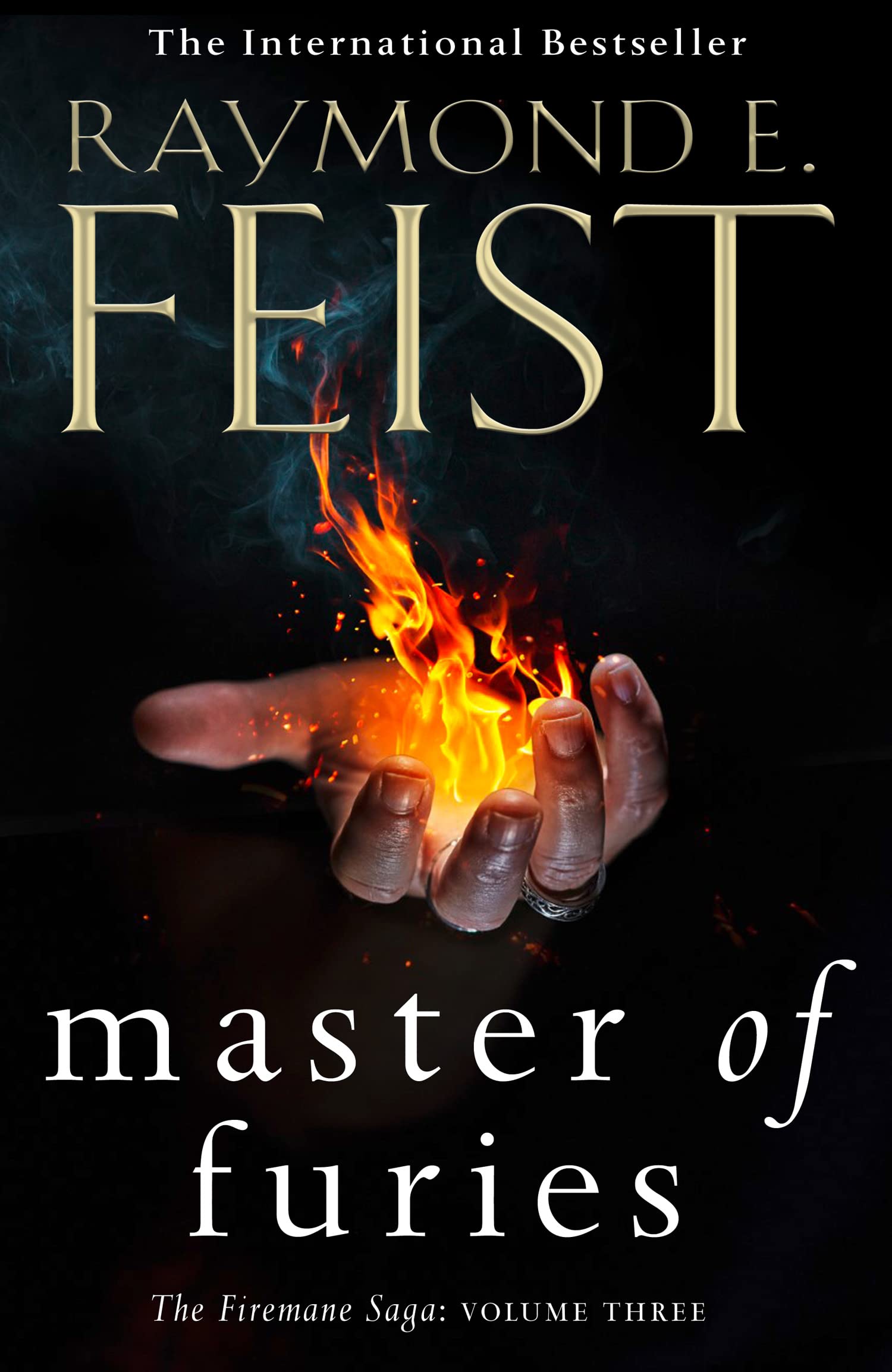
Master of Furies by Raymond E. Feist

Master of Furies Cover

Publisher: Harper Voyager (Hardcover – 5 July 2022)

Series: The Firemane Saga – Book Three

Length: 515 pages

My Rating: 4.5 out of 5 stars

Amazon

One of the leading authors of fantasy fiction, Raymond E. Feist, brings his Firemane Saga to an end in a big way with the impressive and deeply entertaining Master of Furies.

I was recently in the mood for some classic high fantasy awesomeness, and few people do high fantasy better than one of my all-time favourite authors, Raymond E. Feist.  I have been a massive Feist fan for years, ever since I stumbled upon his epic Riftwar Cycle in my youth.  Made up of around 30 connected novels in a massive, multi-world universe, including his epic debut, Magician, and the fantastic Empire trilogy (co-written with Janny Wurts), the Riftwar Cycle contains so many fantastic stories and it remains one of the seminal pieces of fantasy fiction out there.  Feist appeared to finish the Riftwar Cycle off in 2013 and after a break he started working on a different fantasy series, the Firemane Saga.

Set in a new fantasy world, the Firemane Saga followed several great protagonists as they found themselves dragged into a series of conflicts that threaten to tear their continent apart.  This series started in 2018 with King of Ashes, an excellent book that served as a brilliant introduction to the setting, story and characters.  This series was continued in 2020 with Queen of Storms, which continued the various character-based storylines, expanding on some existing elements while also throwing in a ton of new enemies and some surprising changes.  This second novel included a pretty fantastic twist halfway through, as one of the major settings of the series was completely destroyed and various supporting characters were killed off.  I have been eager to see how this series would continue and I was pretty excited when I saw that the third and final book in the series, Master of Furies, was set for release this year (it was one of my most anticipated releases for the first half of the year).  I ended up grabbing this book the day it came out and I swiftly got drawn into its fun and action-packed story.

War and death have come to the Barony of Marquensas after unknown raiders from across the seas arrived and laid waste to everything before them.  Their most savage action saw them destroy the town of Beran’s Hill, which resulted in the death of Gwen, Declan Smith’s beloved wife.  Now determined to get revenge, Declan has become a soldier and allied with Baron Daylon Dumarch, whose family was also killed in the raid.  As the Baron gathers a new army around him, Declan travels to the desolate far south of Tembria to recover rare materials that will allow him to forge the best weapons and armour for them.

At the same time, Hava, former spy for the shadow nation of Coaltachin, has drawn first blood against the mysterious forces attacking her friends.  After capturing the enemy ship, Queen of Storms, Hava has become a notorious pirate captain, raiding ships from across the waves to find out who or what is threatening Marquensas.  Her investigations will eventually lead her to the hidden continent of Nytanny, where a powerful group holds sway of a vast population of warring nations.

As Hava, Declan and Baron Daylon prepare their forces to fight whatever lies within Nytanny, the fate of the world may rest in someone else’s hands.  Hava’s husband, Hatushaly, the last living member of the Ithrace royal family, has finally discovered his legacy as a legendary Firemane.  Under tutelage on the hidden island Sanctuary, Hatushaly works to hone his destructive magical abilities.  But as his powers grow, Hatushaly will find himself thrust into events beyond his control.  A new darkness is rising within his world and Hatushaly will need all the help he can find to stop it.

This was another awesome book from Feist that I felt was a great end to the excellent Firemane Saga.  This third and final book takes the character-driven story in some fantastic directions, and I think that Master of Furies was one of Feist’s better recent novels.

I had an outstanding time getting through Master of Furies’ clever and compelling narrative and I really enjoyed the elaborate and exciting third part of the series.  Now, I must admit that I initially had a bit of a hard time getting back into this book, mainly because it had been two years since Queen of Storms’ release and I had forgotten some of the story details from the preceding novels.  I probably should have done a bit of a reread of the series before starting Master of Furies, and this is one of those cases where interested readers should really check out the first two novels first. Master of Furies immediately dives back into the plot lines from the last book, and while a lot of elements are recapped, it does help to remember how the series has unfolded.

Master of Furies is told from multiple character perspectives as all the protagonists from the first two novels are featured here.  There is a good mixture of different storylines throughout the novel, including the mystical training of Hatushaly, the adventures of Declan in a hostile desert, political intrigues occurring with Marquensas, and Hava’s nautical and espionage activities as she sails from location to location, attempting to find out who they are actually fighting.  All of those storylines are spread out evenly through the book and they played off each other well, coming together into an exciting and expansive narrative.  I particularly liked Declan’s storyline, not only because it was a very good example of a classic fantasy adventure but it also expertly showcased the character’s grief and anger after the events of Queen of Storms.  I liked the balance between action, world-building and character development contained in each chapter, and this book had an amazing flow to it.  The action scenes are particularly well written, and Feist features multiple epic battles and fights that really get the reader’s adrenalin pumping.  The resulting story is very well paced out and there are no slow spots in the story at all.  Each of the separate stories start coming together a lot more towards the centre of Master of Furies as Feist starts to prepare for the big conclusion.

While I was initially worried that Feist was going to rush the conclusion too much (I had some doubts with 150 pages to go, as there seemed to be too much that needed to get wrapped up), this ended up coming together really well.  The established character arcs ended on an awesome (if slightly predictable) note and most of the open storylines are resolved in a satisfying manner.  It was great to see some of the fun characters you have grown to like over the course of the trilogy finally get what they deserve, while others start new adventures that will lead to some interesting storylines in the future.  Feist also works to set up some interesting storylines for the future and it is pretty clear that he has intentions to produce some form of sequel trilogy or series in the future.  An overall strong and exciting story, I absolutely powered through this book and I was extremely entertained and happy the entire way through.

There was some interesting world-building in Master of Furies that I quite enjoyed as Feist sought to expand on his already established new fantasy realm.  Not only did Feist take one of his main characters to the previously unseen harsh deserts at the lower part of the main continent of Tembria, but we also got our first real look at the rival continent of Nytanny, where most of the antagonists originate.  I found both areas to be fascinating and detailed as Feist does a great job of building up both settings in this novel, ensuring that the reader gets an idea of geography, culture and history.  I had a great time exploring both, and the fantastic landscapes of south Tembria were particularly cool, especially as one of the main protagonists spends half the book facing off against every enemy and threat he can find there.  I did think that the focus on Nytanny came too late in the trilogy, as Feist has deliberately kept this continent and its people obscured from the reader and the main characters.  While this did enhance the mystery surrounding their actions, it did mean that their sudden reveal in this book felt a tad forced and you did not care as much about who they were or savoured the eventual counterattack against them by the protagonists.  Likewise, some of the political situations in the rest of Tembria that were featured in the earlier books, such as the impacts of the corrupt Church of the One and the politics of the other kingdoms of Tembria, are somewhat ignored here in favour of focusing on the characters in Marquensas.  While I do not think this took away from the narrative too much, it might have made for a more elaborate and complete universe if more of these missing elements had been explored in more detail (I reckon Feist could have turned this into a four-book series to properly set up this world).  Still, I really enjoyed the rest of the world-building and the change in the settings in this book, particularly surrounding the impacts of the massive raids from Queen of Storms which have devastated not only the Barony of Marquensas but also the various other kingdoms and lands featured in the book.  I really hope that we get to see a lot more of this world in Feist’s future novels as I really want to see how it progresses and changes as it faces more dangers.

For the final thing I wish to discuss about this novel, I think I’m going to have to put a Spoiler Warning into effect as some of the details I’m about to discuss are significant and one of the more surprising things about Master of Furies.

This feature was the intriguing connection that Master of Furies, and by extension the entire Firemane Saga, has with Feist’s established Riftwar Cycle.  I was pleasantly surprised when, seemingly out of nowhere, one of the most entertaining characters from the Riftwar Cycle suddenly appeared in the narrative and started helping Hatushaly learn how to control his magic, revealing that this new world is set in the same joint universe as Feist’s previous series.  While I really should not have been too surprised, (multiple alternate fantasy worlds are a staple of Feist’s writing), I honestly did not see this coming.  In hindsight there were some subtle hints in some of the previous books, but I did not realise to what extent the author intended to bring everything together.  Feist really goes to town on the connections in this third book, and soon several additional Riftwar Cycle characters appear, referring all the existing books.  It soon became very clear at the end of Master of Furies that the author was intending to substantially combine the Firemane Saga with the Riftwar Cycle, especially when an established malevolent presence was discovered on this new world.  The book ends on a very interesting note, with the main characters of this series meeting with two of the biggest characters from the Riftwar Cycle, and it looks like Feist’s next trilogy is going to combine these two universes together in even more substantial ways.

Now, bringing the Firemane Saga into the larger Riftwar Cycle is a bit of a double-edged sword for Feist, although it is one that I personally enjoyed.  I loved the surprise at seeing some of these favourite characters come across each other, and every single new connection or reference brought a thrill for me, Feist nerd that I am.  However, I know that some readers are going to be disappointed, especially as people who were hoping for something new from Feist suddenly got thrown back into the author’s established universe and characters.  This connection also means that those readers unfamiliar with the entire Riftwar Cycle might get a little lost here, especially if they do not fully realise the significance of events or characters.  While Feist does a good job of highlighting who these characters are and why readers should care, I can see some people getting confused about what is going on.  As such, I can understand if some readers are frustrated, but I think it was a great choice by Feist and I loved seeing the author bringing everything together.  If nothing else, this is probably going to inspire me to do a big Feist re-read at some point in the future, especially if all his previous novels are going to come into play in his next series (can I read all the Riftwar Cycle novels before Feist’s next book? I don’t know, but I’m willing to try).

Spoiler Warning End

Raymond E. Feist continues to shine as one of my absolute favourite fantasy authors with the outstanding third and final entry in his awesome Firemane Saga, Master of Furies.  Containing an epic and deeply entertaining narrative that cleverly concludes this fun trilogy, Master of Furies has an excellent blend of story, setting and characters, as well as some cool connections to some of Feist’s more iconic works.  While there were a few issues with how this book came together, I honestly had a fantastic time reading Master of Furies as I was so wrapped up in its outstanding story.  Overall, this book comes highly recommended, especially for those established fans of Feist’s work.

Master of Furies Cover 2

Amazon

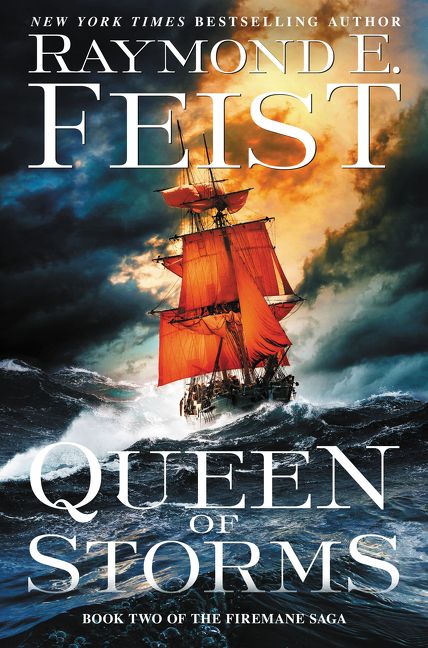
Queen of Storms by Raymond E. Feist

Queen of Storms Cover

Publisher: Harper Voyager (Hardcover – 14 July 2020)

Series: The Firemane Saga – Book Two

Length: 471 pages

My Rating: 4.5 out of 5 stars

Amazon

Legendary fantasy author Raymond E. Feist returns to his new series, The Firemane Saga, with Queen of Storms, an amazing and exciting fantasy novel that takes the reader on some intriguing adventures.

I have long been a fan of Raymond E. Feist and his epic works of fantasy.  His long-running Riftwar Cycle books were amongst some of the first fantasy novels that I ever read and many of them, including the excellent Empire trilogy that he cowrote with Janny Wurts, are still some of my favourite books of all time.  After finalising the Riftwar Cycle back in 2013, Feist released King of Ashes in 2018, which was the first book in The Firemane Saga.  I really enjoyed the fun and compelling new story featured within King of Ashes, and I have been looking forward to seeing how the series continued for a while now.  This second book, Queen of Storms, continues right after the events of King of Ashes and has some intriguing new twists and turns for readers.

In the ancient and magical world of Garn, war is coming to continent of Tembria and its first blow will fall on the trading town of Bernan’s Hill.  Many people call Bernan’s Hill home, but none are more mysterious than the new owners of the town’s inn, Hatushaly and his wife Hava.  Despite their simple outward appearances, Hatu and Hava were born on the secret island of Coaltachin and both serve their continent-spanning criminal and spy network.  A series of mysterious events have been occurring throughout the kingdoms and lands of Tembria, and Hatu and Hava are tasked with observing Bernan’s Hill and reporting anything out of the ordinary.

Having befriended the town’s blacksmith, Declan, Hatu and Hava appear content in their new lives and are they are planning to be officially married during the midsummer festival.  However, even their training and information will not prepare them for the horrors that are about to be visited upon Bernan’s Hill, as a new and mysterious force attacks without warning, plunging the entire continent into war.  Separated from each other, each of these young people embarks on their own adventure.  While Hava attempts to find her lost husband, and Declan sets out to get revenge, Hatu is kidnapped by those who wish him to fulfill his fiery legacy as the secret heir to the kingdom of Ithrace.  His family, the legendary Firemanes, have long been rumoured to contain a spark of magic, and Hatu, as the last remaining Firemane, may hold the key to the survival of magic itself.  As these three young people set out to realise their destinies, they will experience horrors and tragedy as it soon becomes apparent that a whole new threat seeks to destroy all within Tembria.

Queen of Storms was a captivating and fun book which I found myself reading in only a couple of days due to how much I enjoyed it.  Feist has come up with a fantastic and impressive story within this novel, and I liked how it followed a group of excellent characters caught up in the chaos of a mysterious war.  There is all manner of action, adventure, subterfuge, character development and exploration of a new fantasy universe that comes together extremely well into a compelling overall narrative.  Readers should be forewarned that Feist makes some rather bold plot choices throughout this book, with a major event around halfway through the book really altering the course of the story in some interesting and dramatic ways.  I also liked how Queen of Storms served as a great sequel to King of Ashes, and there are a number of amazing reveals and revelations that add to the storylines established in the first book.  For example, the real antagonists of this series are revealed in more detail in this sequel after they were foreshadowed in the previous novel while the reader focused on a different antagonist, who had the potential to be the main villain.  This bait-and-switch came together well in Queen of Storms, and I enjoyed uncovering more about these antagonists and their motives.

Queen of Storms contains a multi-character narrative which follows several key protagonists as they explore this new world from Feist and get involved in the politics and battles of the world.  The majority of the story is told from the perspective of the novel’s three major characters, Hatu, Hava and Declan.  Each of these characters gets some substantial focus throughout the course of this novel, with some interesting storylines.  For the first part of the book their various storylines are very closely intertwined, as all three are based in the town of Bernan’s Hill in various capacities.  However, after the novel’s major event around halfway through, these three characters are separated and each of them embarks on their own exciting and enjoyable adventure.  Hatu’s story is a classic tale of a chosen one finding his destiny, which sees him journey off into the unknown to learn more about his past and his secret abilities.  As Hatu is the most central protagonist, this storyline got a lot of focus, and it was interesting to learn more about his role in the world and about how his life is bonded to the world’s magic.  Declan’s story becomes an interesting one about a young man learning to become a solider to avenge the death of his loved ones.  Declan had some life events occur throughout this book and while it was a little sad to see some of the things he fought for in the first novel go up in smoke, it does serve as a good motivation for his character and it looks like Feist has some interesting plans for him in the future.  Out of the three, I think I ended up enjoying Hava’s storyline the most.  Hava attempts to find out what happened to Hatu and gets captured by slavers.  She ends up using her abilities to free herself and her fellow slaves and becomes a successful ship’s captain, chasing after her husband while also exploring the lands outside the continent of Tembria.  All three of these main character arcs are really enjoyable and together they form a fantastic heart for Queen of Storms, allowing for a rich and powerful narrative.

In addition to these main characters, Feist also utilises several minor point-of-view characters who add in some extra narrative threads to the book.  For example, Donte, Hatu and Hava’s childhood friend who was captured by sea witches in King of Ashes, returns and a small part of the book is dedicated to his attempts to find Hatu and kill him.  You also get several parts of the book told from some of the key players in fight for the continent, such as Baron of Marquensas Daylon Dumarch, the sinister adviser Bernardo Delnocio, as well as a handful of other characters.  Each of these minor point-of-view characters provide their own insights and priorities to the mix and their various storylines and actions add a lot to the narrative and provide some interesting support to the main storylines.  I also liked some of the supporting characters who rounded out the cast of Queen of Storms and several of them proved to be quite enjoyable and likable, even if they have a greater chance of getting killed off.  Overall, Feist continues to write some great characters in this novel, and I look forward to seeing where each of these intriguing protagonists end up next.

The author also did a good job of continuing to expand on the amazing new fantasy world that the series is set in.  While a substantial part of the novel is set around Brenan’s Hill, which was introduced in the prior book, the story eventually starts to examine some other parts of the world.  In particular, several storylines are set around the islands and continents on the other side of the planet, none of which have been explored by any of the point-of-view characters.  These new additions to the story proved to be quite intriguing, especially as the character’s various explorations revealed some shocking truths about the world, as well as some troubling revelations about the series’ main antagonists.  It looks like the next book is set to feature some new areas of the world and should provide some more fascinating expansions down the line, which will no doubt provide some interesting backdrops and settings from the narrative.

While I did really enjoy Queen of Storms, I did find that some of the elements within it might be a little hard to follow if you had not read the first novel in the series.  Feist does do a good job of recapping the major events of the first book throughout the course of the story, but there were a few moments in the story when the significance of certain characters, locations and events were not as highlighted as they could have been, and new readers might get a little lost at this point.  There were even a few points at which I lost track of who a new character was, mainly because of the two-year gap between reading King of Ashes and Queen of Storms.  Still, I was usually able to remember who the character was after some prompting, and it worked out fine.  While this lack of certainty might occasionally impact the flow of the story for new readers, I think they can generally follow without too much difficulty.

Queen of Storms was an outstanding and exciting second entry in this fantastic new series from one of my favourite authors of all time, Raymond E. Feist.  This was an amazing and enjoyable novel, filled with adventure, great characters, and a compelling narrative.  I had an awesome time reading this book and I cannot wait to see how Feist continues The Firemane Saga in the next book.  A must-read for fans of fantasy fiction; this one is really worth checking out.
Queen of Storms Cover 2

Amazon

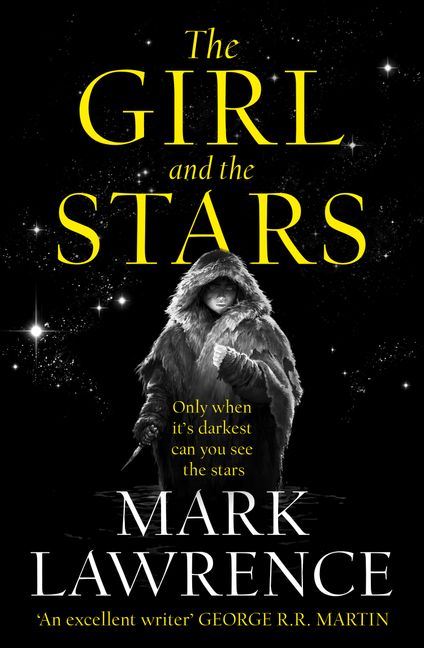
The Girl and the Stars by Mark Lawrence

The Girl and the Stars 2

Publisher: Harper Voyager (Trade Paperback – 20 April 2020)

Series: Book of the Ice – Book One

Length: 473 pages

My Rating: 5 out of 5 stars

Amazon     Book Depository

From the mind of fantasy and science fiction superstar Mark Lawrence comes The Girl and the Stars, a superb and endlessly fascinating novel which takes the reader on an epic adventure in a unique new setting.

Mark Lawrence is a science fiction and fantasy fiction author who burst onto the scene in 2011 with his debut novel, Prince of Thorns. Since then, he has gone from strength to strength, having written several additional books across four intriguing series, all of which have received a lot of attention and praise. Indeed, when some of his latest novels were released (Grey Sister and Holy Sister in particular), you couldn’t escape reviews of his books even if you tried, as every single review site I followed seem to have some commentary about how much they enjoyed them. Despite seeing all this online praise about his work, I have not actually read any of Lawrence’s previous novels. This is not because his books do not interest me; quite the opposite! I actually consider this inadvertent exclusion of his work to be a major hole in my fantasy/science fiction knowledge. However, I just never seem to be able to fit his books into my reading schedule, even after I featured The Broken Empire series on my Top Ten Series I Want to Get Into list. So when I was lucky enough to receive a copy of Lawrence’s new book, The Girl and the Stars, I thought that I would take the opportunity to finally read something from this author, and I ended up getting really sucked into this cool and clever novel.

This book is set on the planet Abeth, a dying world that is slowly being frozen over by vast sheets of ice. Despite the cruel and harsh conditions, several human tribes exist out on the ice, scraping a living and managing to survive. However, there is no tolerance of variation or differences out on the ice, and only those people who are whole and normal are considered capable of living their lives out in the cold. For the rest, there is the Pit of the Missing, a vast and gaping black chasm that burrows deep into the ice and the earth from which no one has ever returned.

Every several years, the various tribes living on the ice gather around the Pit, and their children are inspected by the regulators. If a child is normal, they are returned to their parents and allowed to live their lives, but if a child is shown to be different, either because they are weak or they are in the process of developing unique abilities that may cause them to burn out faster on the ice, they are thrown into the Pit in what is considered a mercy killing.

Yaz has always known that she is weaker and not as resilient as the fellow members of her tribe, but she is able to survive thanks to a source of power only she can access. Prepared to be pushed into the Pit, Yaz is instead chosen by the regulators to be taken to their fortress and trained. However, when the regulator pushes her little brother down into the pit, Yaz does not hesitate before diving in after him.

Against all the odds, Yaz survives and finds herself in a strange and wonderful new world under the ice, illuminated the powerful gems, or stars, that provide heat and light deep beneath the surface. As Yaz explores the vast underground labyrinth, she discovers that the other children thrown into the pit over the years have survived and formed their own society. But as Yas searches for her brother, she soon discovers that life underground is not as the utopia it seems. Many dark and terrible things lurk under the ice, determined to claim the bodies and souls of those people it encounters. But Yaz is different; her power seems to affect the star-like gems surrounding her and may prove to be the tool needed to free those people trapped in the darkness. But Yaz’s potential has been noticed, and soon everyone is fighting to get their hands on her power, which can flip the war being fought beneath the surface. Can Yaz save her brother and escape the darkness of the Pit, or is she doomed to be consumed by the conflict?

The Girl and the Stars is a clever and addictive novel from Lawrence that serves as the first entry in his brand new Book of the Ice series. This latest book is set in the same world as the author’s bestselling Book of the Ancestor series and focuses on a new group of protagonists in a unique and compelling setting. Featuring a unique blend of fantasy and science fiction elements, The Girl and the Stars contains an elaborate and epic narrative. Lawrence once again excels at drawing the reader into his novel with the compelling story of a young woman discovering her powers in a strange world. Told with a deeply detailed writing style which forces the reader to absorb and enjoy every word of this epic book, The Girl and the Stars was an incredible novel, and I had an outstanding time reading it.

At the heart of this intriguing book is a compelling and sophisticated adventure story that sees the protagonist encounter all the dangers that live underneath the ice, whilst finding her own inner strength and resolve. This story, which at times reads a bit like a young adult narrative, turns intense rather quickly, as within the first 25 pages the protagonist has already jumped into the unknown to save her brother. What follows is a non-stop thrill ride which sees Yaz encounter a huge raft of crazy characters and strange horrors underneath the ice. The story continues a brisk and exciting pace, as the protagonist jumps from one situation to the next with intriguing plot developments every couple of pages. There are some big set pieces, plenty of daunting opponents, cunning intrigues and manipulations, fun side characters and a fast-paced storyline, all of which come together to produce a really captivating and exciting read, topped off with a shocking cliffhanger of a conclusion. Lawrence sets up a number of intriguing plot points for the future entries in this series, and I am rather curious to see what happens in the next book, and what adventures the protagonist will find herself on next.

The major highlight of this book has to be the incredibly inventive and intricate settings that Lawrence produced. The Girl and the Stars actually has two really cool settings in which the characters find themselves. The first is the wild ice fields of Abeth, a harsh and unforgiving landscape populated by hardy and practical tribes of humans, who are controlled by a wise and manipulative priesthood. Lawrence does an incredible job of introducing the reader to this setting in the first chapter, making it sound like a fun and intriguing location for the book. However, the second chapter sees the protagonist go into the Pit of the Missing, which takes her to a different world under the ice. This new landscape underneath the pit is far more complex and imaginative than the great ice setting at the start of the novel, filled with a huge collection of different landscapes, from icy caverns, fields of fungi, labyrinthine structures, ancient alien cities and areas of darkness. Into these clever locations, Lawrence installs a number of different groups, factions and monsters, which the protagonist needs to understand or avoid if she is going to survive. The sheer number of features and settings proves to be extremely beneficial to the story, as the reader is left wondering what new obstacle or ally the protagonist is going to meet next. I also rather enjoyed how Lawrence blended together fantasy and science fiction elements throughout the course of the book, with the characters tapping into seemingly magical abilities to survive, and with their major opponents appearing to be demons. However, there is a more scientific explanation to these abilities and antagonists that ties into the origins of the planet and its previous inhabitants. There are also a variety of pure science fiction elements, including mechanical monstrosities, sentient cities and ancient technology. All of these elements, whether they appear more fantasy or science fiction based, prove to be really fascinating, and I quite enjoyed seeing how they played into the book. Overall, this was a really unique and memorable setting, and I loved how the author cleverly wove his compelling story throughout it, allowing it to enhance the narrative with its inventive and distinctive elements.

I have to admit that I was initially a little hesitant when it came to reading The Girl and the Stars, mainly because it was connected to Lawrence’s previous series, which I have not read. From what I have heard, the Book of the Ancestor series contains quite an elaborate narrative and setting, and I was worried that my lack of knowledge about the previous books would impact my understanding of the plot of The Girl and the Stars. However, once I dived into this book’s compelling story my fears proved to be rather unfounded, as I had no trouble following the plot or understanding the unique elements. No prior knowledge of any of Lawrence’s previous books is needed, especially as the story follows a brand new protagonist who has no idea of the events of the Book of the Ancestor’s novels, and who herself needs a crash course in the planet’s history, the varied physiology of the humans who inhibit it and other integral plot elements. As a result, this is an extremely accessible book for readers unfamiliar with Lawrence’s work, and, based on my experiences, I would say that it is a good introduction the author’s writing style and wild imagination

That said, I could tell that The Girl and the Stars is also going to be extremely appealing to fans of the Book of the Ancestor’s series, who will no doubt appreciate the similarities this novel has to Lawrence’s previous work, following a young female protagonist who is new to her power through this unique world. While I did not personally understand the significance of them, this book was obviously chock full of references and world-building knowledge that people who are familiar with the previous books are going to really appreciate and find intriguing. I do have to admit that I was bit uncertain about when The Girl and the Stars occurred in relation to the Book of the Ancestors series, and I really have no idea about whether this book is a prequel, sequel or is running concurrently to the previous books. While this did not impact my enjoyment of The Girl and the Stars in any way whatsoever, I did feel that this is something that Lawrence could have made a little clearer for new readers, especially if there are some connections between this series and the previous books is revealed later in the trilogy. Overall, I would definitely recommend this new entry from Lawrence to any science fiction and fantasy fans, whether they are established readers of the author or new readers looking for something interesting to check out.

I also have to spend a little bit of time highlighting the amazing and eye-catching cover my copy of The Girl and the Stars had (see above). While the alternative cover (see below) was also cool, I really loved the cover that my edition had, which was done by artist Jason Chan. Chan, who has done work for several Lawrence’s previous novels, did a fantastic job with this artwork, producing a cover that is striking and which perfectly reflects the unique setting that the book’s protagonist finds herself in. I absolutely loved it the first time I saw it, and this appreciation only grew once I started reading The Girl and the Stars and fully understood what Chan is portraying. This is an excellent bit of artwork, and it is one of my favourite pieces of cover art I have seen so far this year.

The Girl and the Stars is an exceedingly inventive and exceptionally exciting novel that expertly blends together fantasy and science fiction elements to create a widely entertaining and compelling read. I absolutely loved the unique and imaginative setting that Lawrence came up with for this book, and it proved to be a fantastic background to the novel’s enjoyable story. This was easily one of my favourite books from the first half of 2020, and it has become clear to me that I must read more of Lawrence’s books in the future. Highly recommended.

The Girl and the Stars Cover 2

Amazon     Book Depository

Spaceside by Michael Mammay

Spaceside Cover

Publisher: Harper Voyager (Ebook – 27 August 2019)

Series: Planetside – Book Two

Length: 336 pages

My Rating: 5 out of 5 stars

Amazon

Last year, Michael Mammay debuted an absolutely incredible book, Planetside, the outstanding science fiction thriller that absolutely blew me (and the planet of Cappa) away with its inventiveness, addictive story and explosive conclusion. Now Mammay attempts to follow up this amazing first novel with a second book in his Planetside series, Spaceside.

I mentioned several times already on my blog how much I loved Planetside last year. Mammay’s first book was a spectacular story that blended a science fiction story about an advanced human military occupying an alien planet with an intriguing thriller around a missing soldier. Planetside was easily one of the best books I read in 2018, and I still cannot get past that epic finale to the story.  As a result, when I found out that Mammay was following it up this year with Spaceside, I knew that I would have to read it, and featured it in both a Waiting on Wednesday post and my Top Ten Most Anticipated July-December 2019 Releases list. I was lucky enough to get an advanced electronic copy of Spaceside from Mammay and the publisher, and it did not take me long to dive in and read this book. I had pretty high expectations, considering how good the first entry in the series was.

In Planetside, veteran soldier Colonel Carl Butler is sent to the planet of Cappa to find a young officer who mysteriously disappeared following a mission against an insurgent group of the local aliens, the Cappans. Butler’s mission quickly revealed a massive conspiracy where elements of the occupying human military had been working with the Cappans to genetically modify humans with Cappan DNA, creating a dangerous hybrid species. After uncovering the existence of these hybrids and the full extent of the technology that had been traded to the Cappans, Butler is forced to make the terrible decision to initiate a major missile strike against Cappa to prevent a huge number of Cappans and hybrids from escaping into the wider galaxy. His actions stop the planned exodus and devastate the planet, killing a huge number of Cappans. Butler is subsequently arrested, frozen and sent back home for court martial, with his fate unrevealed in the last book.

Spaceside begins about two years after the events of Planetside, and reveals that Butler is now the most infamous man in the galaxy. While many view him as a hero, others consider him a genocidal monster. Forced out of the army, Butler now has an easy job as Deputy VP of Corporate Security for Varitech Production Company, a high-tech military company on the planet of Talca Four. In theory he helps protect the company against corporate threats, but in reality his job is to impress clients and utilise his substantial military connections for his bosses’ benefits.

As a result, he is surprised one day when he is called into the CEO’s office and given an actual security assignment. A rival tech company, Omicron Technology, has had a breach in their supposedly unhackable computer systems, and Varitech wants to know how it happened and whether their own systems are vulnerable. With no obvious leads and no-one claiming credit for the hack, Butler reaches out to one of his contacts working at the impacted company. However, shortly after their meeting, Butler’s contact is found dead and Butler is now the police’s prime suspect.

Determined once again to find out the truth no matter what, Butler starts to dig around at Omicron and discovers that they were working on a secret project with links to his time on Cappa. When information arrives from the most unlikely of places, Butler is once again drawn into a massive conspiracy that he is not meant to survive. Can he find a way out of this, or will he be forced to redo his greatest mistake?

Wow, just wow. This was another exceptional book from Mammay, who has once again produced a fantastic science fiction thriller hybrid with some amazing moments in it. I absolutely loved this follow-up to Planetside, which not only contains another addictive story with an amazing protagonist but also serves as an excellent sequel to the first book. I powered through Spaceside extremely quickly and loved every minute I spent glued to my screen. This gets another five out of five stars from me, and I reckon that I will once again be placing Mammay’s latest book on my top reads of the year list.

Just like the previous book in the series, Spaceside, is a compelling thriller set in a great science fiction environment and with some intriguing military thriller and science fiction elements thrown into it. However, in this book, the protagonist is no longer an official investigator for the military but a civilian involved in events that appear to be corporate espionage. This results in an intriguing change of pace from the first book that I quite enjoyed. Butler is much more of an outsider in this book, and his methods of investigating the potential crime and attempting to uncover the conspiracy are a lot more clandestine than before. Mammay takes this thriller based storyline to some interesting places and forces the protagonist to make some surprising alliances in order to survive and get to the bottom of the investigation. While the story is more focused on corporations than the army, there is still a strong military element to the book, as Butler is investigating military technology companies. There is also a strong amount of military action towards the end of the book as Butler once again sees combat against an enemy. Mammay writes some strong military action based sequences in his books, and the reader can almost see the detailed and well-written fight scenes. All of this results in an extremely strong main storyline that leaves open the potential for another intriguing entry into this series.

I was really happy that Mammay continued to follow the adventure of his protagonist from Planetside, Carl Butler. Butler, who serves as the story’s narrator and point-of-view character, is a fantastic protagonist who was one of my favourite parts of the first book. Butler is a blunt and honest old character, whose craggy, veteran solider outlook on life infects his narration of events and helps the reader connect with his story. Just like in Planetside, Butler is reluctantly dragged into the events of this book and goes up against a seemingly superior opponent, who thinks that they know how to manipulate the old soldier. However, Butler is a wily operator who is able to turn the situations to his advantage through his rough charm and experience of dealing with people, especially former military personnel, who assist him with his investigation and help keep him alive. I particularly liked the clever way that he was able to manipulate the situation towards the end of the book by playing on certain character’s weaknesses, military training and humanity, and while his final plan did not have the explosiveness of his actions at the conclusion of Planetside, it was still a great scene. I look forward to seeing what sort of trouble Butler gets up to in any future instalments of this series, as he is a truly enjoyable protagonist.

I felt that Spaceside also did a great job following on from the story established in the first book of the series. I really enjoyed seeing how the author followed through with several of the storylines left open at the end of Planetside, as well as how he explored a number of the consequences of the protagonist’s actions. The main way that this was achieved was by showing the reader how Butler’s life changed following his bombing of Cappa. Because the story is told from Butler’s point of view, we get to see how the guilt from his actions and the events that led up to them has affected his psyche. Despite the tough outer shell he shows most people, Butler is struggling with whether he did the right thing and must now deal with being the most infamous person in the galaxy, receiving glares or praise wherever he goes. These events and inner thoughts impact how he reacts to certain events later in the book, and it is a clever and natural progression for the character.

In addition to the focus on Butler, Mammay makes sure to include several characters from the first book so the reader gets to see how their storylines progressed. Not only does this help bring in a previously established sidekick for Butler, as well as a sassy reporter contact who gives him intel and clues, but it also brings back Butler’s old mentor and friend, General Serata, for a tense scene. Serata was the man who sent Butler to Cappa in the previous book, and in many ways he is responsible for the destruction on Cappa as he knew how his old friend would be forced to act in response to what was going on there. It was great seeing these two characters awkwardly try to discuss the events of the previous book and come to terms with Serata’s manipulation of Butler. All of this makes for a gripping follow-up to the first book, and I really enjoyed seeing how the author addressed some of the events from Planetside.

Spaceside is an incredible second outing from Michael Mammay, who has a truly bright future in the science fiction genre. I once again found myself drawn into the excellent story and fantastic central protagonist of this book, as Mammay does an outstanding job crafting together a clever and addictive narrative that does a spectacular job following on from the author’s amazing debut, Planetside. Spaceside gets a full five stars from me, and I am already looking forward to Mammay’s next enjoyable book.

Amazon

Quick Review – Texas Hold ‘Em edited by George R. R. Martin

Texas Hold 'Em Cover

Publisher: Harper Voyager (Trade Paperback – 6 November 2019)

Series: Wild Cards series – Book 27

              American Triad trilogy – Book 3

My Rating: 4 out of 5 stars

Amazon     Book Depository

Texas Hold ’Em is the 27th book in the long-running Wild Cards series, which started in 1987. I read this book late last year but did not get a chance to review it until just now, so I’m just going to do a quick one.

The Wild Cards books make up one of the more interesting book series at the moment. Started by George R. R. Martin and his tabletop game friends (all of whom where fantasy and science fiction writers), this series has since expanded into a massive book franchise that has featured an impressive line-up of authors. There are a huge number of books, and the series is even currently being adapted into a couple of television series on Hulu.

Each of the Wild Cards books is made up of several short, interconnected stories written by a different author, with the entire novel edited together by Martin. Texas Hold ’Em, for example, features the talents of David Anthony Durham, Max Gladstone, Diana Rowland, Caroline Spector, Walton Simons, William F. Wu and the late Victor Milán. Melinda M. Snodgrass, who has contributed to a huge number of the previous Wild Cards books, also assisted in editing this book.

I came into this franchise fairly late and have only read the books which make up the most recent trilogy, The American Triad. I quite enjoyed the first two books in the trilogy, Mississippi Roll and Low Chicago, and was looking forward to the third and final book, Texas Hold ’Em.

Blurb:

In the aftermath of World War II, the Earth’s population was devastated by a terrifying alien virus. Those who survived changed forever. Some, known as jokers, were cursed with bizarre mental and physical mutations; others, granted superhuman abilities, became the lucky few known as aces.

San Antonio, home of the Alamo, is also host to the USA’s top high school jazz competition, and the musicians at Xavier Desmond High are excited to outplay their rivals. But they are also jokers; kids with super abilities and looks that make them stand out. On top of that, well, they are teenagers – prone to mischief, mishaps, and romantic misunderstandings.

Ace Michelle Pond, aka The Amazing Bubbles, thinks that her superhero know-how has prepared her to chaperone the event. But little does she know the true meaning of the saying, ‘Don’t mess with Texas’.

I found Texas Hold ‘Em to be a fun addition to this fantastic series. However, unlike the other two Wild Cards books that I have read, this one seemed to be a bit more like a young adult fiction novel. This is mainly because many of the short stories focus on teenage characters as they encounter the many ups and downs of San Antonio and the jazz competition. The rest of the stories are a pretty interesting mix of mystery, thriller and other action adventure type stories, as the various adult characters encounter a range of situations, mostly associated with protecting or wrangling their young charges. There were some good stories within this book, and fans of the franchise will appreciate the return of several recurring characters who have appeared in some of the previous books.

The stories in this book are told in a different way to the previous Wild Cards books. Rather than having several short stories told to their full extent and then connected by one split short story that overlaps with each of them, Texas Hold ’Em is instead broken up by a period of several days. Each of the days contains multiple parts of the various short stories, featuring the events of that story that happens on that day. This is a much more fragmented way to tell each story, but the chronological consistency is an interesting narrative choice. The combined short stories do make for quite a good overall narrative, although it does seem a little lower stakes than some of the previous books in the series.

One of the most interesting parts of this book is the examination of prejudice and hatred that infects each of the stories. In this universe, many of the humans who were unaffected by the Wild Card virus discriminate against Jokers and Aces; Jokers because of their disfigurations and Aces because they are afraid of them. This appears to be particularly enhanced down in San Antonio, mainly due to the appearance of the Purity Baptist Church, this universe’s version of everyone’s favourite hate group, the Westboro Baptist Church. The various protests and prejudices of the fiction group against those affected by the Wild Card virus do reflect the Westboro Baptist Church, so it was definitely an accurate depiction, and it was cool to see how they would react when confronted with someone with superpowers. That being said, the writers really needed to come up with a better term than “God’s Weenies” to refer to this group, or least stop repeating it to the degree that they did. Many of the characters in the book also encounter other forms of discrimination aside from the protests occurring outside the event, most of which mirrored discrimination real-life minority groups experience every day. This was a pretty good look at discrimination, and I liked how the various authors attempted to examine this problem by putting it in the context of the Wild Cards universe, especially as it led to some curious scenarios and interesting story moments.

Overall, this was a great new addition to the Wild Cards series. If I’m going to be honest, this was probably my least favourite book in the American Triad trilogy, but I still had fun reading it. I am interested to see what the next book in the Wild Cards universe will be like, and I will be curious to see if the show I mentioned above actually comes into being.

Amazon     Book Depository

Planetside by Michael Mammay

Planetside Cover 2

Publishers: Harper Voyager

                        HarperAudio

Publication Date – 31 July 2018

Amazon

Well, that was an unexpectantly awesome book!  I am usually pretty good at predicting how good a book is going to be by its plot synopsis or my prior knowledge of the author.  When I first heard about Planetside I thought it sounded like an interesting concept from first-time author Michael Mammay.  While I had high hopes for the book, I did somewhat assume that it would just be another solid but enjoyable science fiction mystery.  What I was not expecting, however, was one of the best science fiction books of 2018 that easy achieves a five-star rating from me.

Set in the far future of Earth’s expansion, Planetside follows Colonel Carl Butler, a war hero living out a peaceful semi-retirement on a training base.  However, when his old friend General Serata calls him late at night and drags him all the way to headquarters, he obliges for old times’ sake.  Serata needs him to travel to the planet of Cappa, humanity’s current warzone, where members of a resilient and intelligent alien race known as the Cappans are fighting a gruelling insurgency against the humans attempting to exploit their planet.  Once there, he will head up an investigation into the disappearance of a young lieutenant who went missing after being wounded on the planet.  By all accounts, the wounded lieutenant was successfully evacuated from the surface, but the military hospital claims that he never arrived at their facility.  To makes matters worse, the lieutenant is the son of a high councillor, and the disappearance has become a highly publicised affair.  Despite knowing that there is more to the case than Serata is letting on, Butler agrees to find the missing officer.

Arriving at Cappa Base, the space station hovering over the planet, Butler soon finds that his investigation is going to be a lot harder than he anticipated.  All the soldiers he speaks to have the same rehearsed story, the head of the base’s military hospital flat out refuses to cooperate with him, the head of Special Ops is continuously unable to come off-planet to speak to him, and any witnesses or evidence that could point him in the right direction mysteriously disappears.  It is also damn suspicious that any time he takes a step in the right direction, somebody tries to have him killed.  Under pressure to wrap this investigation up, Butler decides to drop down onto the surface of Cappa, but what he finds down there will change everything.  Forced into an increasingly desperate situation, Butler must find the answers he needs before it is too late.

This is the first book from Michael Mammay, but it was more than enough to make me a dedicated fan of this author.  With a sequel already set to be released in 2019, Planetside is an extraordinary introduction to an amazing new series.  I chose to listen to this book in its audiobook format, read by R. C. Bray, and at 8 hours 38 minutes, this is a fairly quick way to enjoy this fantastic book.

Planetside’s story is based around the protagonist’s investigation into a missing human soldier on an alien planet that has been occupied by the human military.  As Butler arrives at the military base the solider was stationed out of, he begins to realise that there is something much more to the case than what was advertised.  Every single person he speaks to is hiding something, he seems only to uncover more lies, and some shadowy figures are actively trying to sabotage his investigation in any way they can.  Despite all these setbacks, the protagonist persists with his investigation throughout the course of the book and slowly begins to uncover the underlying conspiracy that the soldier’s disappearance is just one small part of.  There is so much about this mystery investigation to enjoy, as the author seamlessly combines the mystery and conspiracy part of this story with the science fiction element, creating a unique and captivating overall narrative.  The full scope of this conspiracy is very impressive, and Mammay’s slow burn reveal of the extent and implications of what Butler uncovers is well done to keep the reader in suspense.  I was intensely intrigued by this multilayered conspiracy, and was left constantly guessing at what the potential solution was.

The book is told from the point of view of its protagonist, Colonel Butler, and Mammay has created an excellent central character for this story that the reader is instantly drawn to and cannot help but like.  The author has done a fantastic job conveying the fact that Butler is a straight-shooting, no-bullshit, wily veteran soldier who has had enough of war and is just looking forward to retirement.  He is an amusing and intriguing choice to investigate the book’s intricate and potentially wide-reaching conspiracy, as he powers through the expected political niceties other investigators may have worried about without any concerns for his future or career.  His years of service also ensure that he has impeccable instincts when it comes to the people he is dealing with and is fully aware of when the other characters are bullshitting him, which occurs frequently throughout this book.  I had fun observing this rough and seemingly uncomplicated old-school soldier get to grips with this elaborate conspiracy and blow through all the careful plans of the book’s antagonists.  The colonel also has a sense of humour, something that the other characters encounter to various degrees of frustration, especially the people he is intentionally pissing off.  I also appreciated the self-deprecating and extremely honest reflections about the situation that Butler presents to the reader, as it made me like him even more.

The military aspects of this book are another amazing part of Planetside, as Mammay has perfectly captured elements of the modern day military and transplanted them into this science fiction storyline.  The majority of the story is set within Cappa Base, and the reader is made to feel like they are in a real military base.  The author also seeks to capture the full minutiae of military life throughout the book, and the reader is given insight into what tasks are undertaken on the base, the main characters experience and the respect he commands of the other soldiers in the story.  While most of the focus is on the investigation, there are a couple of action scenes throughout the book, including an extended battle sequence that see’s the protagonist and his allies engage in a protracted firefight with enemy forces on the planet’s surface.  The author’s use of the first-person perspective is perfect for these battle sequences and the reader is dragged right into the middle of these firefights, really experiencing the action through Mammay’s skilled and descriptive writing.  This battle sequences felt very realistic and had some noticeable similarities to real-life skirmishes in modern day battlefields.  The tactics the humans use during these conflicts on Cappa are highly reminiscent of American forces in the Middle East, although the inclusion of more science fiction appropriate weapons and technology allow for some interesting differences.

While the impressive investigation storyline does a fantastic job holding onto the reader’s interest, and the solution to the entire mystery arc is creative and clever, nothing compares to the book’s epic conclusion.  Without going into too much detail, I thought that the way that Mammay ended this book was just incredible, and is one of the main reasons why I am giving this book a five-star rating.  I also loved how, towards the end of the book, the protagonist becomes fully aware of how everything has to end, and at the same time he starts to understand that his oldest friend had sent him on this mission because he knew exactly how Butler would act upon uncovering the full extent of the conspiracy.  The final scene of the book was just perfect as the protagonist reflects on everything that has happened with one of the book’s side characters.  During this scene there is an excellent use of the end of a subtle countdown that has been occurring throughout the entire book, represented by a depleting number of whisky bottles, as well as an appropriate moment of happiness for Butler as he finally gets to have a whisky in a proper glass, which was just perfect.  As mentioned above, Mammay already has a sequel planned, and I am extremely curious to see where the story goes next.

The audiobook version of Planetside is a great way to enjoy this fantastic book, and I had a lot of fun listening to this format.  The audiobook’s narrator, R. C. Bray, manages to capture the gruff and grizzled personality of Butler perfectly, and for most of the book it really sounded like the old colonel was telling you his story.  Bray also does a good job producing distinctive voices for the rest of the characters in book, including several female characters, and the listener is able to distinguish between the various people without too much difficulty.  I also felt that listening to this story really helped bring me into the book’s awesome battle sequences as well as ensuring that I was fully invested in the success of the enjoyable main character.  Overall, I would recommend the audiobook format as an excellent way to enjoy this book, although readers will of course get a lot out of this book if they choose the paperback format.

Michael Mammay’s debut novel, Planetside, is an incredible piece of science fiction and is one of my favourite books of 2018.  Featuring a captivating mystery storyline that places the book’s likeable protagonist in the middle of a massive conspiracy, this book completely grabs the reader’s attention and refuses to let go until its powerful and memorable conclusion.  I cannot recommend this book enough and it is essential reading for all fans of the science fiction genre.  I am very much looking forward to Mammay’s sequel to Planetside, which is already at the top of my must-read list for 2019.

My Rating:

Five Stars

Amazon