Cold Iron by Miles Cameron

Cold Iron Cover 1.jpg

Publisher: Hachette Audio (Audiobook Format – 30 August 2018

Series: Masters & Mages – Book 1

Length: 19 hours, 29 minutes

My Rating: 5 out of 5 stars

Amazon     Book Depository

I recently managed to read one of the books that was featured in my Top Ten Books I Wish I Had Read In 2018 list.  I have to say I was quite impressed with this book, Cold Iron by Miles Cameron, as it is one of last year’s most intriguing fantasy reads.

Miles Cameron is the pseudonym historical fiction author Christian Cameron uses when he writes fantasy novels.  Cameron debuted in 1999 with Rules of Engagement, the first book in the seven-book long Alan Craik thriller series, which he wrote with his father, Kenneth Cameron, under the joint pseudonym of Gordon Kent.  In addition to this joint series, Cameron started writing his own novels in 2003 when he wrote his first historical fiction novel, Washington and Caesar.  Since then, Cameron has written over 15 historical fiction novels, including the multiple books in his Tyrant, Long War and Chivalry series.  In 2013, Cameron branched off again into a new genre, fantasy, with his five-book long Traitor Son Cycle, which he wrote as Miles Cameron.  Cold Iron is the first book in his brand-new fantasy series, called the Masters & Mages series.

I am mostly familiar with Cameron through his historical fiction works, having read and reviewed a couple of books in his Tyrant and Long War series early in my career.  I particularly enjoyed the first book in his Long War series, Killer of Men, which set a young protagonist from Plataea on an adventure across ancient Greece and Persia.  Unfortunately, I failed to get any of Cameron’s books in the intervening years and was completely unaware that he had written any fantasy books.  So when I came across Cold Iron and recognised the author, I was deeply intrigued and thought it would be an interesting book to check out, especially as it had been receiving some great reviews.  After mentioning it in one of my Top Ten lists, I decided to check out the audiobook version of this book a few weeks ago.  I was especially keen to check it out as the second book in the Masters & Mages series, Dark Forge, has recently been released, although it looks like this second book will be released in a number of different formats throughout the year.

Cold Iron follows Aranthur Timos, a young student at The Academy, a prestigious institute of magic, science and other scholarly pursuits that lies at the heart of a mighty empire.  Aranthur, a poor farmer’s son, is not the best student at The Academy, and aside from some slight skill with the sword, nothing sets him apart from any of the other students.  But fate has something special in store for Aranthur.  Travelling back to his family farm for the holidays, Aranthur stops at a small inn.  When bandits attack the owners of the inn, Aranthur steps in to try and help, and in doing so sets a momentous series of events into play.  His actions that night inadvertently place him in the middle of a vast and terrible conspiracy, as he comes to the attention of the inn’s other guests, including a powerful priest, a master swordsman, a young gentleman spy and an enigmatic and dangerous beauty.

After returning to The Academy, the results of Aranthur’s actions at the inn indirectly introduce him to a number of new friends that help him excel at his studies.  But a series of chaotic events are occurring across the lands.  The city surrounding The Academy is in turmoil, as factions and noble houses fight against each other.  Worse, refugees are flooding in from lands to the east, driven out of their homes by a group known as the Disciples, followers of a shadowy figure known as the Master, who seek to return the world to an ancient status quo where only the nobles have access to magic.  Despite being a simple student, Aranthur keeps finding himself in the centre of the momentous events sweeping the city.  Can Aranthur survive all the mysterious events occurring around him, and, if he does, what sort of person will he become?

I absolutely loved this book; it gets a well-deserved five stars from me.  Cold Iron is an extremely clever coming-of-age fantasy story set within an immensely detailed and inventive new world.  I have found with some of Cameron’s previous works, such as the books in his Chivalry series, that the author has a very particular writing style, such as his propensity to include large amounts of detail in his paragraphs and the utilisation of a somewhat more formal dialogue.  This style has always worked well with the author’s historical fiction work, and I felt that this writing style translated across well to this fantasy book.  It was reminiscent of some of the older classical fantasy stories, although with some more modern language.  This results in the book having a much more unique feel to it, which I found to be quite curious and actually helped draw me into the story.

The overall story of Cold Iron is quite an intriguing fantasy read that places its protagonists and point-of-view character in the centre of a worldwide conspiracy.  There are so many elements to this story to enjoy, including an excellent coming-of-age focus.  Throughout the course of the book, the protagonist, Aranthur, grows from a poor and insignificant student to a central figure in the fight for kingdoms and the freedom of magic.  The story is quite clever as it focuses on a character who, rather than being the dreaded “chosen one” fantasy trope, is instead thrust into events by accidentally being in a certain place at a certain time.  I really enjoyed how everything that happens to Aranthur throughout the book is the direct result of the one tavern fight at the start of the book, and he is drawn into the subsequent events or introduced to key characters through sheer coincidence.  The resultant conspiracy is deeply intriguing and ties in really well with Cameron’s excellent fantasy elements.  I am also a sucker for a storyline involving magical schooling or training, so I loved how this story was set within a magical university and focused quite a bit on the protagonist’s training.  All of these elements work together to produce an incredible overall narrative that I really enjoyed listening to.

For this new series, Cameron has come up with a fun and detailed fantasy world.  The Masters & Mages series is set in a sprawling world that features a number of diverse human nations.  Only a small part of this world is explored within this first book, although there are quite a number of references to nations outside of the central settings, and events occurring in these locations impact on the main story.  This world appears to be in a post-medieval point of its history, with early firearms starting to be utilised, although older technologies such as crossbows are still in use.  The setting comes across a bit like Italy or France during a similar time period, but with a magical edge to it that works quite well.  The main setting is a gigantic and rich city of canals and elaborate architecture that hosts The Academy, and this serves as a perfect location for the intriguing, conspiracy-laden fantasy story.  The city is filled with a huge number of factions, refugees and competing noble houses, creating quite a significant amount of internal political strife which plays into the story quite well.  There are also some examinations of some more rural areas within the world, and Cameron does a spectacular job of presenting the more down-to-earth folk that live in these locations.  The locations featured within this book were very well done and I look forward to seeing what new lands are explored in future books.

One of the most interesting things about the setting of the book was how several of the issues and plot points have some interesting parallels with modern issues.  For a bit of context, the world that the Masters & Mages series is set within a world where a historical revolution installed a series of reforms that granted magic and education to the lower classes.  Now even quite poor families have access to basic magic that cleanses water, helps create fires and heal people, resulting in a better class of life for the common people.  At the same time, women are able to attend classes at The Academy and learn magic and other skills.  The book’s antagonists are determined to reverse these reforms and return magic to the rich and the nobles and ensure women have no more power.  This has resulted in a number of invasions and wars that have resulted in a huge number of refugees entering the city and other locations, much to dismay of the city’s rich and powerful.  I found the motivations of the antagonists to be very interesting, and it is easy to see some real-life parallels.  Intolerance towards refugees is a major issue at the moment, and it is deeply fascinating to see this reflected in a work of fantasy fiction.  In addition, the book featured quite a lot of intolerance towards people of certain nationalities, including the protagonist’s nationality.

Highlights of Cold Iron the spectacular action sequences that occur throughout the book.  There are a substantial number of fight scenes throughout the book, featuring magic, firearms, crossbows and swordplay.  All of these action elements are pretty impressive, and I especially love some of the larger sequences, where all the above methods of combat are being utilised by both sides.  For the most part, only some basic magical techniques are used within fights, which while intriguing, do not result in any eye-popping scenes.  However, there is one sequence where two powerful magic users fight in front of the protagonist, and he sees the destructive potential of their respective magic abilities.  Without a doubt, the most amazing action element is the swordplay.  There is quite a focus on swords throughout the book as the protagonist spends a large amount of time learning and training with them before using them in a number of duals and fights.  Cameron’s insane attention to detail and incredible knowledge of sword fighting makes these scenes absolutely incredible and produce some amazing fight sequences that feel extremely realistic.  These sword fight scenes are some of the best parts of this book and I really enjoyed having them narrated to me.

I had a lot of fun with several of the characters in this book.  The main character, Aranthur, is a pretty good protagonist who goes through some substantial character development in this book.  Not only does he grow to appreciate different points of view and increase his abilities as a warrior and scholar but he actually learns from his mistakes, although in some cases, such as when it comes to learning about women, it takes a little too long.  The other characters featured within Cold Iron are an interesting group.  My favourites include Ansu, a noble from another land who brings some amusing cultural differences; Tiy Draco, a gentleman spy with unclear allegiances; and Dahlia, the feisty warrior student who highlights the abilities and determination of the female students in The Academy.  My favourite character, however, had to be Sasan, the sarcastic and fatalistic refugee and drug addict who Aranthur attempts to help.  Sasan has some of the best lines in the entire book, and his exclamations and actions when under the effect of an enhancement spell were really funny.  Each of these characters is a lot of fun, and I will be intrigued to see what future development awaits them.

I listened to Cold Iron’s audiobook format, narrated by Mark Meadows, and I had a good time listening to this book.  Clocking in at around 19 and a half hours, this is a fairly long audiobook; however, I found myself really drawn into the story, so I was able to get through it fairly quickly.  I personally thought that the audiobook format was the best way to enjoy this book due to the huge amount of detail and worldbuilding that went into this story.  I was able to focus on all the details a hell of a lot more by listening to them, and I think this helped me follow the plot with a lot less confusion.  Cold Iron’s action sequences are particularly good when narrated, and I found that the intense and elaborate sword sequences were really enhanced by this format.  Mark Meadows does a fantastic job of narrating Cold Iron and I really appreciated his work in bringing the story to life.  I felt that the voice Meadows used for the narration of Cold Iron was very appropriate, and I liked listening to all the descriptions and actions that Cameron had inserted into his story.  Meadows also came up with a range of unique voices for his various characters, each of which did a great job of conveying the character’s emotions and personality.  Part of the reason why I liked the character of Sasan so much was because of the voice that Meadows created for him and used to exclaim some of his best lines.  Overall, I would strongly recommend that readers interested in checking out Cold Iron should try its audiobook format, and I was quite glad that I did.

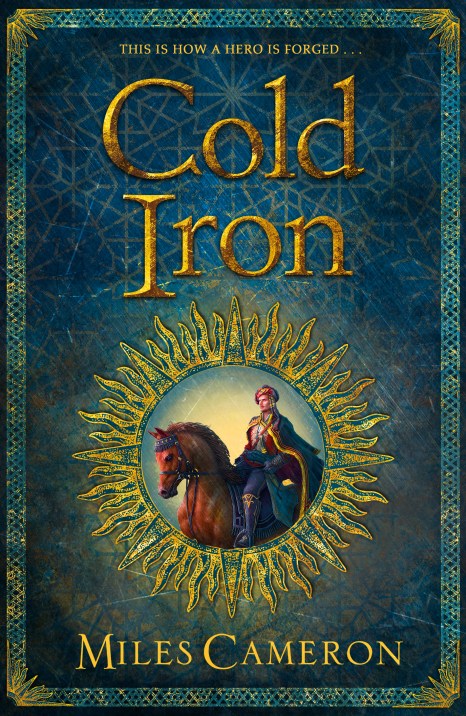
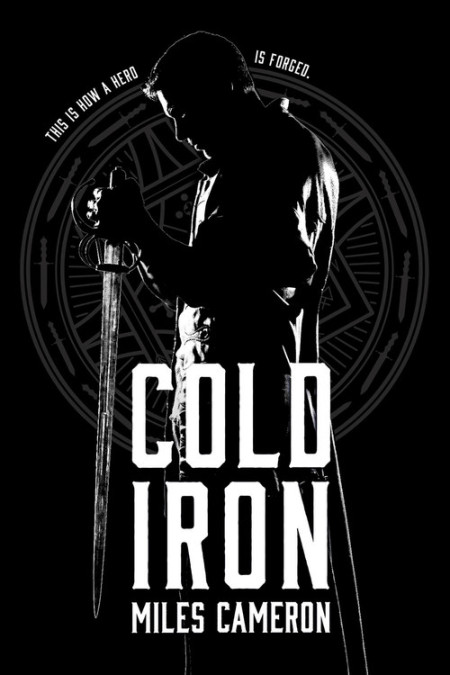
Before I wrap up, I just wanted to make a quick comment on Cold Iron’s cover art.  Cold Iron has two separate covers: the one I have included at the top of this review, and the one I have placed below.  I loved both of these covers individually, and I felt that they contrasted with each other quite nicely.  The first cover is very classy and really exudes an old-school fantasy vibe, which I think represents Cameron’s storytelling style quite well.  However, I did enjoy the more modern look of the second cover, and I really enjoyed the artist’s use of the simple, but effective black and white colour scheme.  Both are very impressive, and I have to say that the artists did a fantastic job with both of them.

I was very impressed by my first foray into Cameron’s fantasy writings.  Cold Iron is an exceptional piece of fantasy fiction and an easy five stars from me.  This book’s story was incredibly well written and contained a very compelling plot filled with wide-reaching conspiracies, magic and excellent characters.  Set in a brilliant new fantasy world, Cold Iron is an excellent start to the Masters & Mages series and sets it up as a fantasy series to watch out for.  Some paperback versions of the second book in the series, Dark Forge, came out a short while ago, and I am tempted to order a copy in.  However, I may wait until September, when the audiobook version is released, as I found this was a great way to enjoy the first book.  Cold Iron is an outstanding read, and I am really glad I went back and checked out this excellent 2018 release.
Cold Iron Cover 2.jpg

Amazon     Book Depository

The Gutter Prayer by Gareth Hanrahan

The Gutter Prayer Cover.jpg

Publisher: Orbit (Paperback Edition – 17 January 2019)

Series: Black Iron Legacy (Book 1)

Length: 512 pages

My Rating: 4.5 out of 5 stars

Amazon     Book Depository

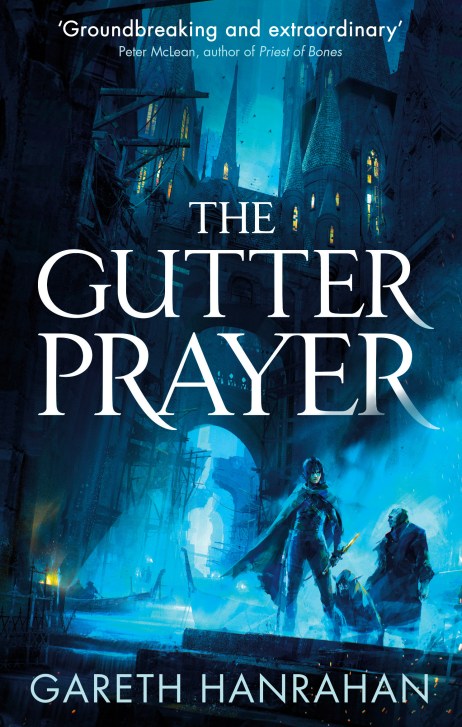
From debuting author Gareth Hanrahan comes the grimdark fantasy book that everyone has been talking about, The Gutter Prayer.  This debut novel has been getting some serious hype from a lot of fantasy reviewers, so I was very happy when I got my copy earlier in the week, as it will give me a chance to check it out for myself.

For thousands of years, the large, sprawling city of Guerdon has survived against all manner of attacks and calamity.  In recent years, the city’s alchemical industry has taken off, producing powerful weapons and twisted creations to sell to Guerdon’s warring neighbours, involved in the destructive Godswar.  But with the rival nation’s eyes on Guerdon, refugees flooding into the city and the city’s various factions fighting for power, the potential for chaos is great.

In the middle of all this, three mismatched young thieves – stranger to the city, Cari; the Stone Man, Spar; and Rat the ghoul – find their lives changed forever.  Hired by the leader of the city’s criminal element, these three thieves attempt to break into an important civic building, only to be nearly killed by a massive explosion and framed for the crime.  Pursued by the Alchemist Guild’s murderous enforcers, the Tallowmen, and the relentless thief-taker, Jere, the three friends attempt to escape their pursuers, but find themselves entangled in a terrible plot to bring destruction to the city.

Ancient creatures are rising from the city’s bloody past, and the city’s old gods are prepared to rise once again.  As Cari, Spar and Rat uncover the full extent of these gods’ power, they must contend with others who seek to use the chaos for their own ends.  With everything on the line, can the three friends find a way to stop the events unfolding, or will their failure result in the destruction of everything they hold dear?

This is Hanrahan’s first fictional book, although the author has written a number of gaming manuals and fantasy guides over the years.  However, with the evident popularity of The Gutter Prayer among the fantasy community, it seems extremely likely that this will not be Hanrahan’s only book.  Indeed, the author already has plans for a sequel, and The Gutter Prayer will form part of this planned Black Iron Legacy series.

I thought that The Gutter Prayer was an ambitious and intriguing new entry to the fantasy genre, and it is definitely worthy of the hype around it.  Hanrahan presents a wide-ranging and dark story of magic, religion and betrayal, and he sets it within an imaginative new fantasy landscape with a ton of unique fantasy elements and creatures.  The story is then based around several great characters, each of whom has their own compelling arc within the narrative.  The result is an excellent and memorable novel that showcases Hanrahan’s creativity and serves as an amazing introduction into a bold new fantasy universe.

This book contained a fantastic and intense story which focused on a variety of different characters and follows their attempts to investigate and forestall the strange events occurring around them.  I really enjoyed this story, although I had a little bit of a hard time getting into it at the start of the book due to mass of story and fantasy elements I was bombarded with.  However, I am extremely glad that I powered past this first part of the book because once I was able to place all the story elements together I appreciated the book’s wild and intricate plot.  One of the main things that I really loved about this book was the inclusion of a significant number of different characters and factions, each with their own motivations and hidden secrets.  As a result, you have no idea who is going to do what next and who is going to betray the protagonists to serve their own needs, creating an unpredictable story.  The narrative is also extremely dark, and readers should be prepared for characters dying or being altered in some way or another.  This is some fantastic storytelling from Hanrahan, and an overall clever narrative.

One of the most talked-about elements of this book is the author’s use of a huge range of unique fantasy elements.  Hanrahan has come up with and expertly utilised a ton of creative, inventive and at times just plain creepy new fantasy elements.  The best example of this has to be the Tallowmen, humans that have been turned into living candles, often as punishment for crimes.  These creatures are strong, lethal and fast, serving as the guards and law enforcers of the Alchemist Guild.  Their terrifying appearance, distinctive abilities and the glow of their candle flames as they hunt down the protagonists are extremely memorable.  Another terrifying inclusion is the Ravellers, servants of the city’s ancient gods who have the ability to unravel people out of existence and take on their appearance.  There are also the ghouls and Stone Men.  Stone Men are humans infected with a disease that slowly turns them into stone, although their condition can be held back by an alchemical compound.  The depictions of their condition are pretty horrific, and there is the interesting double-edged sword of the disease: they become stronger the more their condition progresses, but they also become less able to live normal lives.  The ghouls, humanoid creatures who feast of the dead flesh of humans, are an element that most fantasy fans will be familiar with, but Hanrahan has made some clever alterations to these creatures by expanding on their life cycle and making them a key part of the city’s history.  Another awesome creation is the Crawling Ones, a sentient hive of worms who take a human shape and are powerful magic users.

In addition to the above unique fantasy creatures, The Gutter Prayer also introduces the author’s great new twist on fantasy gods.  The world of the Dark Iron Legacy is filled with a vast pantheon of powerful gods, which forms a critical part of this universe.  Many of the deities outside of the city are engaged in a massive conflict known as the Godswar, where these gods and their followers are involved in battles against each other for supremacy.  While we get a brief look at this in The Gutter Prayer, most of the focus of this book is on the gods of Guerdon.  While a few other religions are mentioned within the city, the main two pantheons are the Kept Gods and the Black Iron Gods.  Both of these different gods are extremely intriguing, and I particularly loved the concept of the Kept Gods, who are chained and whose intake of prayer is controlled by their church to limit their power and control their actions.  The Black Iron Gods are a darker and more ancient pantheon with a great history, a horde of sinister followers and a captivating physical presence.  I also liked this universe’s concept of saints, those humans gifted power by their connection to the gods.  There are a couple of saints featured throughout the book who form an integral part of the plot, powering through the story with a range of different powers and abilities.  Quite frankly, all of these unique fantasy elements are deeply intriguing, and Hanrahan uses all of them perfectly to enhance his outstanding story.  I do hope that the Godswar will be explored in future books, as that sounded like a really fun concept that I would be deeply interested in.

Guerdon is a decent grimdark fantasy city, and it serves as the primary setting for most of the city.  The city’s range of interesting and unique residence allows for a fascinating overall story and makes this a fantastic setting.  I really like how the city is home to a range of competing factions, such as the Alchemists, the Church, the criminal organisation known as the Brotherhood, politicians and the city’s non-human races, each of whom have different plans for the future of the city.  This is a pretty typical dark, crime-ridden fantasy city, but it works really well as a setting for this story.  The author’s deep exploration of the history of his fantasy city served as a useful plot point, and I love how the city’s past came back to haunt it in a number of ways.

I have to say that I was really impressed with Hanrahan’s character work within this book.  The author introduces a number of amazing characters, most of whom get deep and satisfying story arcs.  The main three characters are particularly great.  I really liked Spar, who is not only the son of one of the city’s most famous criminals, but who is also a Stone Man.  It is through this character’s eyes that we get the best view of the living hell of life as a Stone Man, as Spar is forced to deal with all the unpleasant side effects that his condition brings.  At the same time he must deal with his family legacy as he fights to achieve his father’s dream of a more noble Brotherhood while forced to work for its current corrupt leader.  Rat the ghoul is another interesting character.  As a ghoul, he is generally supposed to live under the city, but he likes living above the streets with his friends.  Rat is constantly conflicted between loyalty to his friends and to his race’s ancient promises, as well as dislike for the traditional ghoul lifestyle.  Finally, there is the mysterious young thief, Cari, who holds a dark secret in her past.  Cari is a rebellious young female protagonist who is developing strange new powers.  The exploration of her past and her abilities is a key part of the book and a good basis for a large portion of this plot.  I liked the way that these three characters cared for each other and how their stories remain interconnected even as they have their own unique adventures within the story.

While these three main characters serve as an extremely powerful narrative base for The Gutter Prayer, the author also focuses on a couple of additional point-of-view characters, including the veteran thief-taker, Jere; Cari’s cousin, Eladora; and the saint of the Kept Gods, Arla.  These characters do not get as large a focus as the book’s three main characters, but their parts of the book are quite significant.  Each of them also has a full character arc within the book, and they all develop or change in substantial ways.  Jere is a grizzled private investigator obsessed with taking down the Brotherhood, and his investigations for the first two-thirds of the book provide the reader with some vital plot detail.  I really liked the end to Jere’s character arc, which was both dark and satisfying.  Eladora is a sheltered scholar who gets a rather rude awakening about life throughout the course of this book.  Eladora is not my favourite character, but I did like her gradual transformation from damsel in distress to something more useful.  Finally, there is Arla, who would have to be my favourite side character.  Arla is a saint of the Kept Gods blessed with fiery powers as a result.  Arla is a badass and entertaining character who spends most of the book fighting her opponents with her fiery sword and generally not acting in a way most people would consider saint-like.  I especially love when she utilises her god-empowered voice to command people, as she is usually swearing while doing this.  This comes up in the text in all caps, and you have to imagine it sounds pretty impressive in this book’s audiobook format.  There were a number of other entertaining side or minor characters throughout the book that the author put to good use, and I will enjoy seeing what role they will play in any future books in the series.

Overall, I truly enjoyed The Gutter Prayer and was impressed by Hanrahan’s magnificent debut.  This was an excellent piece of grimdark fantasy which expertly combined some very inventive fantasy elements together with a fantastic story and some excellent characters.  With this first book Hanrahan has shown some incredible talent as a fantasy storyteller whose outstanding imagination is his biggest asset.  This is a highly recommended book which lives up to the substantial hype surrounding it.  I am already extremely keen for any additional books in the Black Iron Legacy, especially as the interview at the end of the book implies that Hanrahan has some brilliant ideas for the rest of the series.

Amazon     Book Depository

Throwback Thursday – Promise of Blood by Brian McClellan

Promise of Blood Cover.jpg

Publishers: Orbit

                        Hachette Audio

Publication Date – 16 April 2013

Amazon

Reviewed as part of my Throwback Thursday series, where I republish old reviews, review books I have read before or review older books I have only just had a chance to read.

One of the saddest realities of being a bibliophile is that no matter how hard you try or how much spare time you have, no one can read every great book that comes out every year.  I am no exception to this rule, as for years I was mainly focused on the historical fiction genre.  While this is a fantastic genre to focus on, it did mean that I missed out on many of the biggest science fiction and fantasy releases for the last several years.  Ever since I expanded my attention to a range of other genres, I have been seeking out and reading a number of different fantasy or science fiction books and series, many of which I have or will review on my blog and on Goodreads.  One of the series that I have heard constantly praised by friends, fantasy fans and other book reviewers is The Powder Mage trilogy by Brian McClellan.  Nearly every fantasy reviewer and their dog has read and said good things about these books and, as a result, The Powder Mage trilogy has long been at the top of my to-read list.  So when I was recently able to fit the first book in the trilogy, Promise of Blood, into my reading schedule, I thought I would try it out and see if it lived up to everyone’s hype.

The Powder Mage trilogy are the debut novels of fantasy author Brian McClellan, and are a flintlock fantasy series, which is a modern fantasy sub-genre that features pre-industrialisation civilisations who utilise flintlock firearms with fantasy elements.  The Powder Mage trilogy started in 2013 with Promise of Blood, which the author followed up with a new book in 2014 and 2015.  Following the success of his initial trilogy, McClellan introduced a second trilogy, the Gods of Blood and Powder trilogy, which is set 10 years after the events of The Powder Mage trilogy.  This second trilogy is still ongoing, with the third and final book set to be released in November of this year.  In addition to these two main trilogies, McClellan has also written a number of novellas and short stories set in the same universe as his main books, which expand on his fantasy world.

McClellan has created a new and captivating fantasy world in order to contain the stories in his two main trilogies.  The Powder Mage trilogy is primarily set in the nation of Adro, one of nine nations that were founded thousands of years ago by the god Kresimir, which are together known as The Nine.  By the start of the first novel, Promise of Blood, the nations of The Nine have reached a level of technology equivalent to Europe’s pre-industrial revolution period, with flintlock firearms in heavy use.  Magic is also common in this world, with the nations of The Nine containing three separate levels of magical ability.  These include the privileged, extremely powerful sorcerers who can wield a range of devastating elemental abilities; the marked, lesser mages with more specific gifts; and the knacked, who have one specific magical talent, like a perfect memory or not needing to sleep.  The privileged of The Nine are generally organised into sorcery cabals, with the most powerful organised into a Royal Cabal loyal to the King of their nation.

Promise of Blood starts with Field Marshal Tamas, the highest-ranked military officer of Adro, leading a bloody coup against his country’s corrupt king and nobility.  During the coup, Tamas and his powder mages, marked whose abilities are powered by gunpowder, assassinate every member of Adro’s Royal Cabal.  However, every member of the Royal Cabal said one thing before they died, “You can’t break Kresimir’s Promise”.  In order to find out the meaning of these mysterious words, Tamas hires former police inspector Adamat to investigate.  While Adamat sets out to uncover meaning behind these mysterious final words, Tamas begins the difficult process bringing order to his country.  However, it soon becomes apparent that staging the coup was the easiest part of his endeavour.

Tamas’s coup provokes a war with the Kez, one of Adro’s rival nations in The Nine, whose previous attempts to control Adro’s king, led to Tamas overthrowing him.  As Tamas deals with assassins, Royalists, deposed nobles and Kez magicians, it soon becomes apparent that someone on Tama’s council has betrayed him.  Brought in by Tamas to investigate who betrayed him, Adamat finds his loyalties tested when mysterious figures target him and his family.  At the same time, Tama’s estranged son, Taniel Two-Shot, embarks on a hunt for a surprisingly powerful member of the Royal Cabal who escaped Tamas’s powder mages.

Both Adamat and Taniel’s missions reveal dark secrets about the formation of their country.  With dark omens in the sky and ancient legends come to life, can Tamas and his forces stop the destruction of Adro, or will the mysterious forces arrayed against them succeed in their mission to summon forth an ancient power?

To be honest, even before I heard about this trilogy from other book lovers and reviewers, I thought the synopsis was pretty cool and the idea of gunpowder-wielding mages was an interesting concept.  I listened to the audiobook format of Promise of Blood, narrated by Christian Rodska, which goes for a lengthy 19 hours.  Now the question is; did this book live up to the hype?  The answer is yes.  I loved this book, I thought it was massively creative, filled with incredible action, had some complex, if mostly male, characters and made use of some excellent fantasy elements.

I really enjoyed the story within this book and I thought it was an amazing combination of intrigue, action and fantasy storytelling.  I liked the idea of starting the book just as a successful coup had taken place and the focus on the immediate aftermath of such a significant event.  The story is essentially broken into three main parts.  About a third of the book is told from Adamat’s point of view and really focuses on the intrigue elements of the story.  Adamat at first investigates “Kresimir’s Promise”, which is a fairly interesting part of the book, as it dives into the history of the country, and quickly reveals that shadowy forces are at play behind the scenes.  This initial investigation only lasts for a short part of the book, before Adamat is drawn into the larger investigation about the traitor in Tamas’s council.  This is a very well done investigation part of the book as the reader is presented with five suspects, each of whom is hiding several secrets and many of which have suspicious employees.  In addition, Adamat has to deal with a mysterious figure who is blackmailing him, and who keeps the identity of his employer secret.  These multiple layers of intrigue and lies ensures that the reader is looking in several different directions and have a much harder time guessing who these antagonists are.

Another third of the book is told from Taniel’s point of view, and follows him as he first hunts down a powerful privileged, and then finds himself stuck in the middle of a large battle for the survival of Adro.  While there are quite a lot of reveals about some of the book’s underlying fantasy elements in this part of the book, the main focus is on the action, as Taniel and his allies fight a number of opponents, and Taniel reveals while he is known as Two-Shot.  There is some interesting character work in this section as Taniel works through his feelings for his father, finds himself having to choose between obeying orders and the life of his best friend, and him coming to terms with his weird relationship with the powerful female character, Ka-poel.

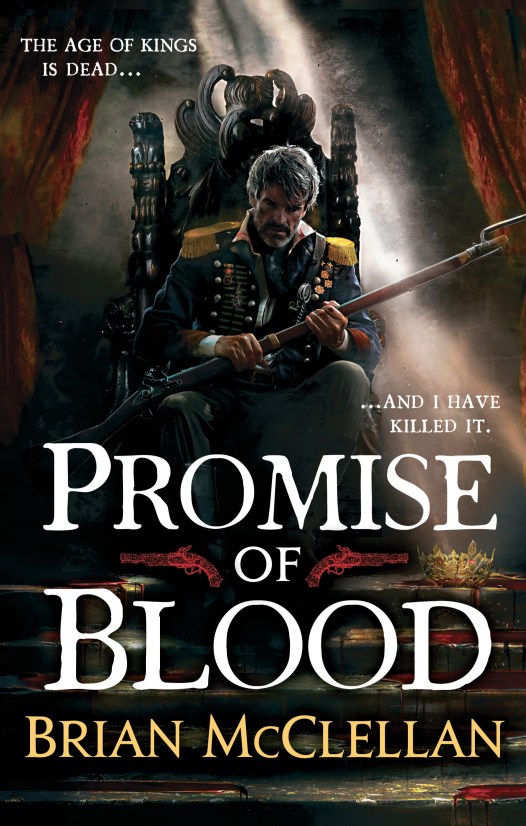
The final main part of the book is told from the point-of-view of Tamas himself, and deals with the fallout from his coup and the multitude of issues he has to deal with in the aftermath.  The parts of the book focusing on Tamas are the most important chapters within Promise of Blood, as they bridge the other two sections of the book due to Taniel and Adamat not really interacting too much during the book.  The Tamas chapters have the best balance of Promise of Bloods’ excellent combination of fantasy elements, intrigue and action.  Throughout these chapters, Tamas is constantly forced to deal with the political infighting and betrayals occurring all around him, while also being targeted by assassination or capture by his various enemies.  Tamas also encounters a number of hints about the true nature of the fantasy events impacting Adro, including from a bizarre chef, and I loved the layers of intrigue that surrounded something most of the characters believed was a myth.  I really liked Tamas as a character, and I found him to be an intriguing combination of a calm, tactical genius and an absolute rage monster.  Despite alienating most of the people around him, especially Taniel, deep down Tamas is a good man who has been forced to make the hard decisions no-one else will.  However, when enraged he is an absolute terror to behold, especially to someone who has crossed his friends or family, and during these scenes of anger he gives several of the best lines, such as the one that appears on the cover:  “The age of kings is dead, and I have killed it”.  He is an absolutely great character and a fantastic focus for this trilogy.

In addition to these three main characters, a small portion of the book is narrated by female character Nila.  Nila’s character really is not explored too much in Promise of Blood, although she is given a good introduction, and I understand she will become a much bigger character in the next books in the trilogy.  On top of the main characters, there are several excellent side characters who really make this book extra awesome.  This includes Tamas’s bodyguard, Olem, a sarcastic and funny man who acts as Tamas’s moral compass for much of the book, and who also has certain ideas about people shooting his dog.  There is also Sousmith, Adamat’s bodyguard, a former boxer who acts as a fun foil to Adamat’s detective character.  While several characters at the Mountain Watch are also enjoyable, you have to love Ka-poel, the mute, witch who serves as Taniel’s spotter.  She has some crazy magic to her, and I have a vague feeling (without knowing anything about the plot of the future books) that she is some sort of young god or something.  I liked the way that Ka-poel was able to express everything, despite being a completely non-verbal character, although the implied romance between her and Taniel was a tad weird, especially as it started the moment he realised she was older than she looked.

The world building in this book is extremely impressive and it serves as an outstanding introduction to the key elements of the series’s universe.  While the other magical and fantasy elements of this book are pretty awesome, I especially loved the powder mages, and their magic is easily the best part of the book.  The powder mages have a unique blend of abilities, all of which are powered by eating or snorting gunpowder.  Consuming the powder gives them focus, enhanced perception, great strength and stamina.  In addition, they have control over gunpowder, igniting at will, and using their abilities to manipulate bullets in flight.  Each of the characters have different abilities on top of that.  Tamas can ricochet bullets around a room; Taniel can fire bullets further than anyone else, as well as firing two bullets at once; while another powder mage, Vlora, can ignite powder from a distance.  These characters in battle are absolutely fantastic, and I love it when these characters, especially Tamas, fully unleash their abilities.  The fight scenes between the powder mages and the privileged were exceptionally amazing, and I loved the contrast between the more traditional fantasy magic of the privileged and McClellan’s more unique powder magic.  That being said, when the privileged unleash their abilities they can be much more destructive, and some of their fights are pretty impressive.

I had a wonderful time listening to the audiobook format of Promise of Blood, and I thought that it was a spectacular way to enjoy this amazing story.  The action sequences, especially when the magic and bullets are flying, really come to life when narrated, and audiobooks always help me absorb complex new fantasy worlds such as the one in this series.  Rodska’s narration is really well done, and I found that he really captured the essence of the characters.  I especially thought he got the gruff and powerful voice of Tamas down perfectly, and it was an extremely realistic personification of the character’s voice.  I really hope that Rodska does the narration for the other books in McClellan’s series, and I would easily recommend the audiobook format of Promise of Blood to anyone interested in this series.

Overall, I really loved Promise of Blood and I found that it lived up to its substantial hype.  It’s easily a five-star novel in my eyes.  I loved this book so much that I am planning to listen to the remaining books in The Powder Mage trilogy as soon as I can, and I will probably also try and listen to the first two books in the Gods of Blood and Powder before the final book comes out in November.  McClellan is a fantasy genius, and anybody who loves action and explosions should invest the time to read this book.

My Rating:

Five Stars

Amazon

The Moscow Offensive by Dale Brown

the moscow offensive cover

Publisher: Corsair

Australian Publication Date – 11 December 2018

World Publication Date – 5 June 2018

Amazon

An intense and exhilarating military thriller filled with advanced military robots duking it out across America, now that sounds like my sort of novel!  Prepare for an explosive technological thriller as Dale Brown, the bestselling author of the Patrick McLanahan series, returns with his latest novel, The Moscow Offensive.

For years, Russia’s ambition to conquer the entire world and defeat the United States has been growing, with its leaders unleashing a series of advanced weapons against the West.  Russia’s dominance was only held in check thanks to the actions of United States pilot Patrick McLanahan, who utilised America’s most innovative technology to counter the Russian attacks.  However, with McLanahan now believed dead, the brilliant and manipulative Russian president, Gennadiy Gryzlov, sets forth a new attack.  Secretly buying a large airfreight company, Gryzlov uses this proxy business to ferry weapons and military personnel into the United States undetected.  Identifying a string of high-value targets, Gryzlov attempts to cripple the United States from within, and strike its citizens with terror.

The only force that might be able to stand up to Gryzlov’s machinations is the legendary Iron Wolf Squadron and their parent private military company, Scion Aviation International.  Formed by McLanahan and former United States President Kevin Martindale, the Iron Wolf Squadron utilises their advanced Cybernetic Infantry Devices (CIDs), twelve-foot-tall piloted combat robots, whose technology and weapons are capable of overpowering conventional military forces.  Currently employed by Poland and its Alliance of Free Nations, the Iron Wolf Squadron is responsible for knocking back several of Russia’s attempted invasions and more ambitious bids for power.  However, their success in Poland has alienated America’s selfish and paranoid president, Stacy Anne Barbeau, who is determined to bring Martindale and Scion down.

Taking advantage of President Barbeau’s incompetence, Gryzlov is able to launch a series of attacks, placing the blame on the Iron Wolf Squadron.  Now targeted by both the Americans and the Russians, a small detachment of Iron Wolf Squadron CIDs, led by Patrick McLanahan’s son Brad, deploy to the United States to counter the Russians and reveal their involvement.  However, the Russians have succeed in reverse-engineering combat robots of their own, and are now fully capable of going toe-to-toe with the Iron Wolf Squadron.

Dale Brown is one of the world’s leading authors of the technological and military thriller genre, having written a huge number of high-octane, electrifying reads since the 1980s.  The Patrick McLanahan series is his main body of work and started in 1987 with his debut novel, Flight of the Old Dog.  This series has mostly focused on the adventures of its titular character, Patrick McLanahan, across a variety of different military situations, inside and outside of the United States armed forces.  These novels have generally been set around the same time as their publication date, meaning that the characters have aged and matured with the series.  As a result, in later years, Patrick McLanahan has taken a back seat from the action, with the role of main series protagonist taken up by his son, Brad McLanahan.  The Moscow Offensive is the 22nd book in the series, and continues with some of the storylines from the previous books in the series.  A 23rd book is already in the works, and The Kremlin Strike is set to come out in early May 2019.

I had not previously read any books in the Patrick McLanahan series before, and while I thought the synopsis sounded pretty awesome, I was not too sure what to expect from it.  After reading it I found The Moscow Offensive to be an incredible novel with some fantastic thriller elements and outstanding action sequences.  The overall story of this book is extremely compelling, and I had a very hard time putting this book down as I really loved this wide-ranging thriller storyline.  I was a little worried about coming into a series 22 books in, but I found that the author did a fantastic job in The Moscow Offensive of introducing the reader to his thriller universe.  Throughout this book, Brown provides the reader with ample descriptions and discussions about the book’s characters, technology specs and the relevant history of the various military organisations, countries and fictional military actions.  As a result, it is really easy for readers unfamiliar with Dale Brown’s work to come into the Patrick McLanahan series with The Moscow Offensive, and at no point while reading it was I lost or confused about any of the book’s plot elements.

The international thriller elements of this book and the utilisation of current world politics were some of my favourite inclusions in The Moscow Offensive.  I liked how the author inserted bits and pieces of real world political and social issues into his writing to create an intriguing and familiar background for the story.  On top of this, he also includes the more outrageous elements from his previous novels, including the Iron Wolf Squadron, whose pilots command high tech robots to stop Russia from invading Poland and other Eastern European countries.  This is a fun mesh of realistic and out-there settings which I found to be an incredible basis for this novel.

The intelligence battle between the United States and Russia has been a firm and dependable element for innumerable thrillers over the years, and Brown constructs a fantastic story around this battle.  The battle is more one sided in The Moscow Offensive, as Brown makes great use of an incompetent United States President character, the use of which has become a much more common element in fiction in recent years (hard to imagine why).  It is utterly fascinating to see the various ways that Brown comes up with to attack America and damage the country’s military infrastructure.  These attacks have a range of different purposes, from outright attacking the US military, to setting the President against the Iron Wolf Squadron.  All of these international and militarist thriller elements are an awesome part of this book, as not only do they help create a great story, but the reader is able to consider the realism of a such a story.

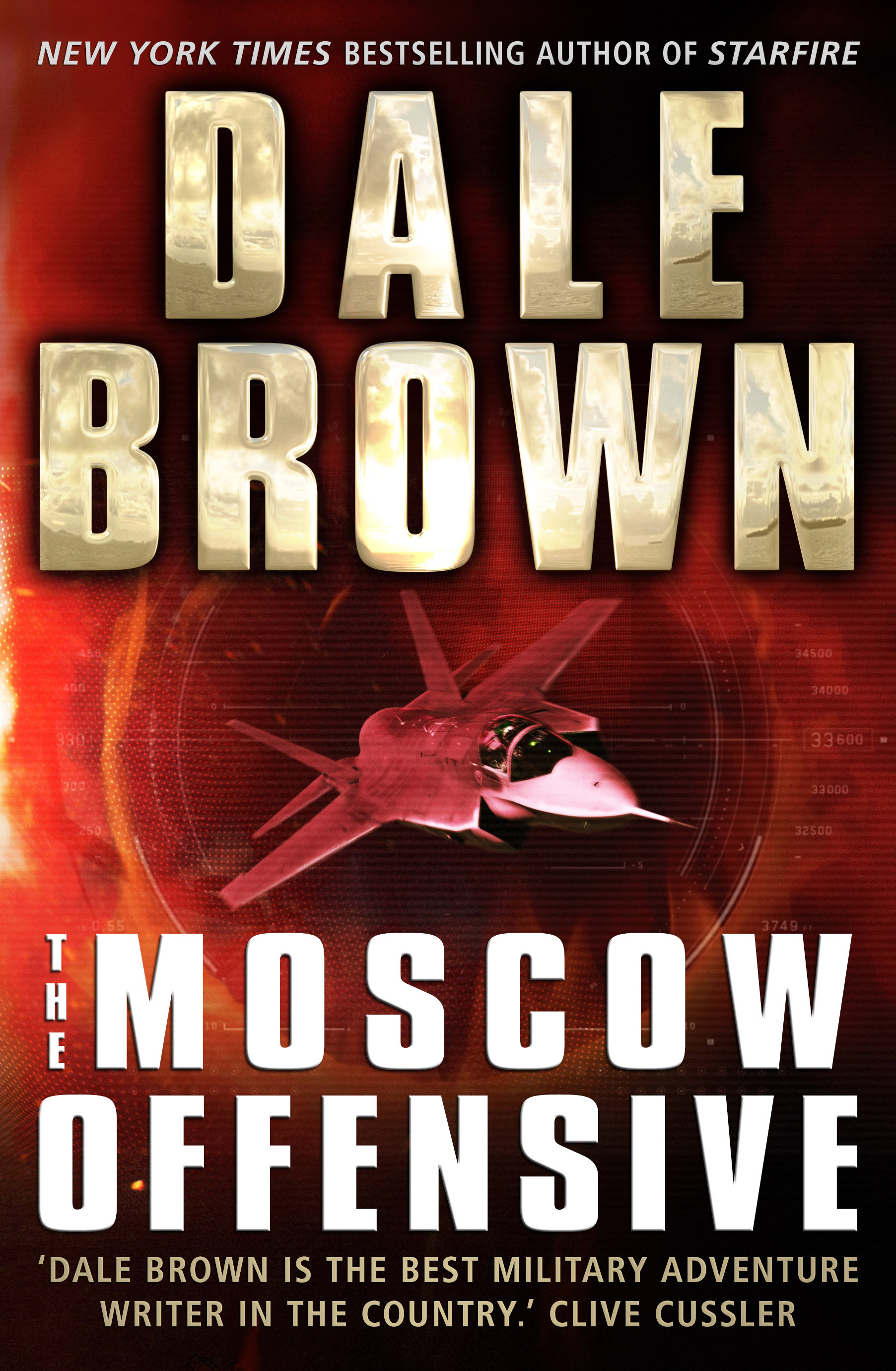
In addition to the cool international thriller elements of this book, I liked the deep look at military technology both real and fictional.  Brown, a former US Air Force aviator, has an excellent understanding of modern military hardware and the people that use them, creating an outstanding militaristic narrative as a result.  The descriptions and analyses of Russian and American weapons, planes and other vehicles are very intriguing and give the book another deep sense of realism.  Of course the most epic inclusions in this book are the CIDs, the large, manned combat robots that the Iron Wolf Squadron have utilised in several of Brown’s previous books to frustrate the Russians in battle.  These machines really amp up this series to new heights, and in The Moscow Offensive, Brown ups the ante by having the Russians develop their own combat robots in response to their defeats against the Iron Wolf Squadron.  This adds a whole new element to the book, as the United States is attacked by these machines and finally has to deal with the devastation they can cause.  Both sides having these machines is incredibly intriguing, as it really allows the author to examine the advantages of these potential machines in a military setting and showcase what sort of damage they could potentially do, even to their creators.  These advanced military elements are a terrific part of The Moscow Offensive, and I was really impressed with how Brown was able to combine it with the book’s other thriller elements to create a captivating read.

The Moscow Offensive contains a faction of Americans fighting a covert war with the Russians, with both sides utilising advanced combat robots.  As a result, this book is packed full of action and there are a number of fantastic high-tech battle sequences.  Without a doubt, the CIDs and their Russian counterparts really are the stars of the book.  These two sets of machines go up against a range of conventional military opponents in some massively destructive and very one-sided scenes.  Brown cleverly saves the combat between the two opposing groups of combat machine until the end of the book, and does a fantastic job at pumping up the hype for their eventual confrontation.  This final climatic battle does not disappoint, as the two sides engage in a brutal and devastating fight that is well worth the wait.

Dale Brown has once again provided the reader with an extremely fun piece of fiction, as he continues his ambitious, clever and entertaining Patrick McLanahan series.  As someone coming into Brown’s fictional universe for the first time, I was blown away by the intense action and outstanding thriller elements contained within this book and it is easily one of my favourite new series.  As a result, I highly recommend The Moscow Offensive to new readers and those existing fans of the series.  This is an excellent choice for anyone looking for some insane action or a truly unique story.

My Rating:

Four and a half stars

Amazon

Shadow Captain by Alastair Reynolds

Shadow Captain Cover.jpg

Publisher: Gollancz

Publication Date – 8 January 2019

Amazon     Book Depository

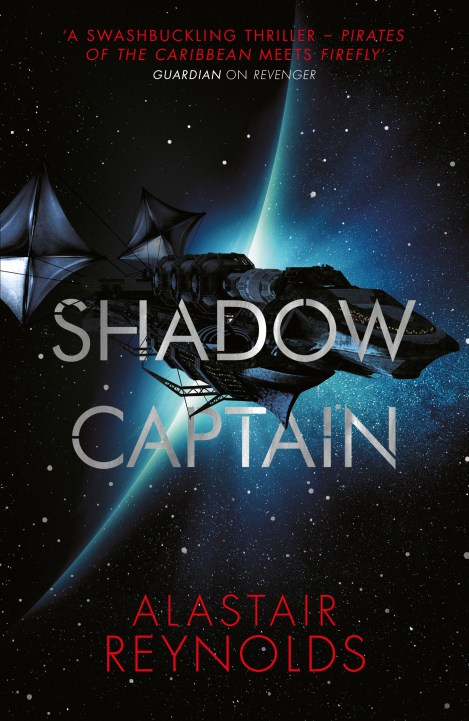
Tens of millions of the years in Earth’s future, during the period known as the Thirteenth Occupation, humanity travels across space in sailed spaceships, with many crews searching for relics and treasures from previous eras of human and alien occupation.  For years, the greatest threat to these ships was the legendary pirate Bosa Sennen, whose deadly black ship, the Nightjammer, ruthlessly hunted down and ambushed hundreds of ships, killing all onboard, before vanishing back into the darkness.  Continuously moving her consciousness from one body to the next, Bosa was able to keep her reign of terror going for years, becoming a near-horrifying myth throughout space.  However, Bosa unexpectedly lost everything when she came up against the Ness sisters, Adrana and Fura, whose courage and daring resulted in them taking Bosa’s ship and her life.

Now the Ness sisters command Bosa’s infamous ship, rechristened as Revenger, and seek to make their own fortunes.  Veering away from the ship’s previous profession of piracy, the Ness sisters and their crew scavenge through old abandoned bases, attempting to find lost treasures or supplies as they slowly establish a new life for themselves.  But the legacy of Bosa Sennen is constantly around them, and not even her death is enough to end her legend.

While Adrana seeks to come to turns with the horrors she witnessed as Bosa’s captive, Fura becomes obsessed with finding Bosa’s hidden cache of treasure from her extended lifetime of piracy.  En route to the planet of Wheel Strizzardy to find a source who may be able to lead them to the pirate trove, Revenger is attacked, forcing the crew to brutally defend themselves.  Arriving at their destination, they find that ships they encountered were hired by a consortium of hundreds of planets who have placed a massive bounty on Bosa Sennen’s head.  What’s more, they do not particularly care if she is already dead, as long as her ship and all aboard are captured and destroyed.  Now, with an armada behind them and the crew of Revenger stuck on the gangster-controlled world of Wheel Strizzardy, the Ness sisters must find a way to escape with the information they need.  But are they prepared for the devastating secrets their search will uncover?

Reynolds is a highly regarded science fiction writer who has been writing since the 1990s.  Throughout his career he has written a slew of short stories, novels and other works of fiction.  His main body of work include the Revelation Space series, The Prefect Dreyfus Emergencies, the Poseidon’s Children series and several standalone novels.  Shadow Captain is the second book in his Revenger series, and follows on from the first book in the series, 2016’s Revenger.

Shadow Captain is an intriguing and enjoyable piece of science fiction that follows a mismatched group of semi-pirates as they navigate their way through space.  Reynolds has created an ambitious new universe for this series, and set an interesting and compelling story in the heart of it.  Unfortunately, I never got a chance to read the first book in the series, Revenger, beforehand, and this somewhat negatively impacted my enjoyment of this book, as I failed to understand several key aspects of the series universe.  Despite this, I ended up really liking this fantastic read and I am looking forward to the next book in the series.

This main reason why my lack of experience with this series impacted how much I enjoyed Shadow Captain is the detailed new science fiction universe that Reynold’s has created.  This universe is pretty impressive, with a number of unique flourishes and a fascinating-sounding history made up of multiple, distinctive eras of widespread human occupation across space.  While this is a really fun feature, I found that Reynolds did a poor job of re-explaining a number of key features of his universe that were introduced in his first book.  Without these explanations I was somewhat lost during a number of important discussions that took place during the early parts of the story.  This was not a massively widespread issue and quite a few important elements were explained to the reader at various points of the book, although Reynolds did delay some explanations longer than necessary.  However, it was a bit frustrating not having an understanding of what some key elements of universe were, or what some slang or terms being discussed by the protagonists in the early parts of the book were, and there are still one or two elements that were mentioned in Shadow Captain that I am not 100 percent certain about.

I also did find the first third of the book was a little slow going, and it took me a while to really get into the story.  This was due to an early combination of not completely knowing what the characters were talking about at certain points, and some slower pacing as the author sets the scene.  While there were some good points to the start of the book, including an great summary of events in Revenger, and some intriguing scenes inside a ‘bauble’, an ancient and abandoned human construction in space, I did find it a little hard to stay interested.  However, I stuck with it and was very glad that I did, as the rest of Shadow Captain was a very entertaining and exciting read.  The last two thirds of the book are an excellent, fast-paced adventure, which features some great battles in space, an intrigue-laced period on the planet of Wheel Strizzardy and a hunt for a hidden trove of treasure.  I really enjoyed the part of the book set on Wheel Strizzardy, as it featured the crew going up against a bunch of ruthless gangsters on a backwater planet.  While there, they have to face off against a cannibalistic crime lord, deal with the secrets of aliens and attempt to outsmart several of the planet’s colourful inhabitants, all the while the bounty hunters chasing after them quickly get closer towards them.  This awesome last two-thirds of the book more than makes up for the slower start to the narrative, and makes Shadow Captain into a very good book overall.

One of the things I liked the most about Shadow Captain was the lingering impacts of events that occurred in the first book, which results in some fantastic character work from Reynolds.  In the first book, Revenger, the primary antagonist, Bosa Sennen, was a fairly impressive villain who perpetrated a number of terrible acts against many of the book’s characters.  Both of the book’s protagonists, the Ness sisters, were impacted in different ways by her actions.  Adrana was kidnapped in Revenger in order to be conditioned to become Bosa’s next host, a process that required her to endure significant torture and physiological abuse.  As a result, throughout Shadow Captain, Adrana must constantly deal with lingering issues impacting her psyche.  She is continuously angry throughout the book, and finds herself constantly holding back new and terrible thoughts that she is convinced are the last lingering aspects of Bosa’s mind and personality that might have been partially imprinted on her.  Fura is also severely impacted by the events of the first book, and has become angry and secretive, with goals she is hiding from her crew and even her own sister.  I liked the reasons behind Fura’s change in personality, as the character was forced to become more ruthless and paranoid in order to get into the mind of her foe, Bosa.  The focus on these characters’ changes in personality is an outstanding addition to the book that results in some significant and intriguing drama throughout the book.  I personally enjoyed seeing a villain’s impact continue so significantly after their death, and it was absolutely fascinating to see the various ways she lived, especially in these different but devasting impacts on the Ness sisters.

In the end, I am going to award Shadow Captain four stars out of five.  While I really enjoyed the book as a whole, the initial problems I experience with the early story and the somewhat ordinary job that Reynolds did re-explaining all of the significant elements of his universe lowered my overall rating.  As a result, I would highly recommend that readers interested in checking out Shadow Captain should probably read Revenger beforehand, as it may increase their overall experience.  There is still an amazing amount to enjoy about Shadow Captain, including an inventive science fiction setting, an entertaining story that ramps up as the book continues and some excellent character work surrounding the actions of the first book’s primary antagonist.  Overall, this is a great piece of science fiction that is well worth checking out, and any future books in the Revenger series will definitely be on my radar.

My Rating:

Four stars

Amazon     Book Depository

The Blood of Rome by Simon Scarrow

the blood of rome cover

Publisher: Headline

Publication Date – 13 November 2018

Amazon

One of the best and most prolific writers of Roman historical fiction, Simon Scarrow, returns with another outstanding adventure of his two Roman protagonists, Cato and Marco.

In AD 55, Nero has recently ascended to the throne, and the Roman Empire prepares itself for war with its great rival, the Parthian Empire, which sits to the east of Rome’s territories.  This recent conflict is centred on the neutral border kingdom of Armenia, which sits between the two great empires.  Years earlier, the brash Iberian prince Rhadamistus conquered Armenia and declared himself king, ruling as a terrible tyrant.  In response, a recent Parthian backed invasion routed Rhadamistus from Armenia and placed a Parthian prince on the throne.  Unwilling to let this strategic territory fall into Parthian hands, Rome sends its greatest general, Corbulo, to the east to reclaim Armenia for Rhadamistus and meet any subsequent hostilities from the Parthians.

The recently promoted Tribune Cato and his long-time companion, Centurion Marco, desperate to escape the deadly politics of Rome, lead the escort for General Corbulo.  When an early opportunity to take Armenia with minimal interference from the Parthians presents itself, the only forces that Corbulo can rely on are Cato and Marco’s elite cohort of Praetorian Guards.  Placed in command of an advance force, Cato must lead a mixed column of Romans and King Rhadamistus’s troops through unknown and hostile terrain towards Armenia’s capital.  Forced to balance his orders against the desires of the unstable Rhadamistus, Cato struggles to maintain the strength of himself and his men.  With traitors and enemies all around them, can Cato and Marco succeed, or will they find themselves killed in a strange land?

Scarrow is one of the leading authors of the historical fiction genre, whose work over the last 18 years is comparable to such established authors of the genre as Bernard Cornwell, Ben Kane or Conn Iggulden.  The Eagles of the Empire series, which started in 2000 with Scarrow’s debut, Under the Eagle, is the author’s most distinctive work, and features some superb description of Roman military action.  In addition to his main series, Scarrow has also written several other great pieces of historical fiction.  He co-wrote the Roman Arena and Invader novella series with T. J. Andrews, which are set in the same universe as the Eagles of the Empire series.  He also wrote the epic Wellington and Napoleon Quartet, also known as the Revolution Quartet, which provided an impressive examination of the opposing lives of Napoleon Bonaparte and the Duke of Wellington.  In addition to his series work, Scarrow has also written two standalone novels, The Sword and the Scimitar, which covers the siege of Malta, and Hearts of Stone, a dramatic novel set in Greece during World War II.  All of Scarrow’s novels are amazing pieces of historical fiction, and are really worth checking out if you are a fan of the genre.

The Blood of Rome is the 17th book in The Eagles of the Empire series, and follows the two protagonists’ return to Rome’s Eastern provinces for the first time since the eighth book in the series, Centurion.  I have always been a massive fan of this series and consider it to be one of the best pieces of Roman military fiction series on the market today.  After reading all of the previous books in The Eagles of the Empire series, I was particularly keen to get a copy of The Blood of Rome and eager to see where the protagonist’s latest adventure would take them.  After powering through it in a day, the result was pretty much what I expected: I loved Scarrow’s latest literary offering.  This latest book contains another fantastic historical fiction story, as the protagonists embark on an exciting campaign into an interesting new historical setting and it was great to see how the characters continue to evolve and progress in their lives.

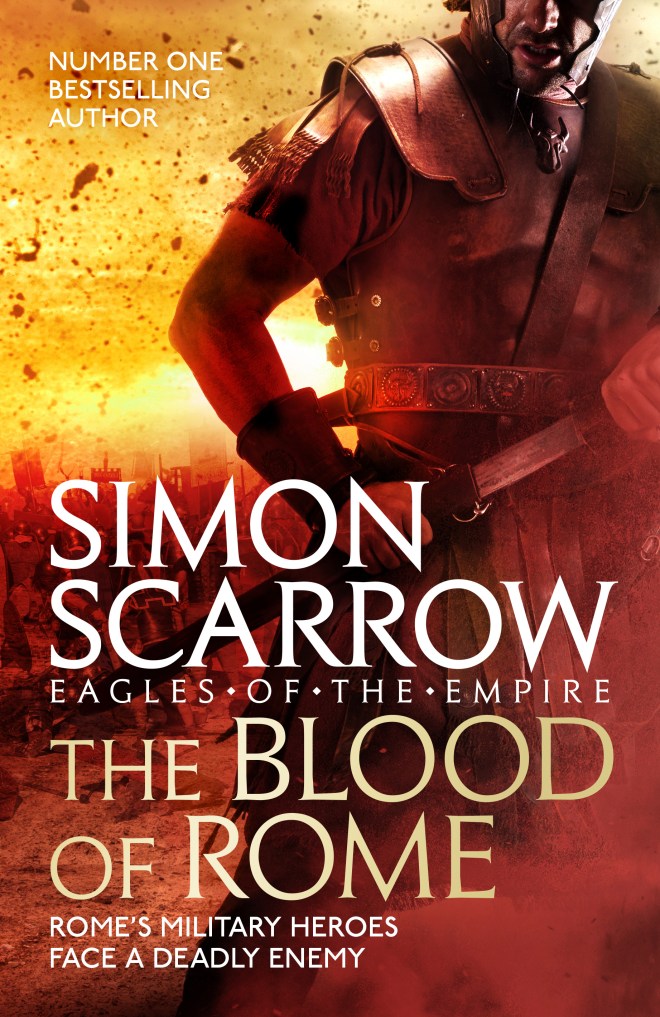
Scarrow’s The Eagles of the Empire series has always boasted some incredible depictions of ancient Roman military combat, with most books containing several battles of varying size used to highlight the strengths and weaknesses of the Roman tactics and techniques.  This is continued in the Blood of Rome, with several battles featured throughout the book.  While most of these battles are small and quick skirmishes that differ from the traditional Roman battle sequences, the Roman soldier’s tactics and training and the effectiveness of their equipment are on full display, creating some amazing scenes.  In addition to the classic Roman legionnaires, which make up the bulk of Cato and Marco’s forces, Scarrow also focuses on the more unusual forces that the Roman’s used in combat, in the form of a cohort of auxiliary slingers, as well as a detachment of Roman siege equipment.  Both of these distinctive units get a good showing throughout the book, and both are fascinating to see in action.  The author also contains an interesting portrayal of Roman soldiers fighting side-by-side with allied troops, and it is intriguing to see the issues and advantages involved with such allies.  Overall, The Blood of Rome is another excellent example of Scarrow’s skill at portraying Roman military action sequences, and is one of the best parts of this book.

This book is also set in an extremely fascinating historical period and focuses on the rivalry between Rome and Parthia.  The continuous conflict between Rome and Parthia has always been a great literary background for many pieces of Roman historical fiction, and Scarrow has already examined it in some of his earlier books.  The conflict within The Blood of Rome continues to explore this legendary rivalry, and is an opening book in what appears to be a sequence of novels that will focus on an expanded war between the two rival nations.  This first book in this sequence looks at a rather minor opening conflict, played out as a proxy war within Armenia, but it contains a great examination of the politics at the time and the differences in battle style and tactics of the two nation’s militaries.  I really enjoyed the examination of the role of border kingdoms and provinces, such as Armenia, stuck in the middle of these two proud and ambitious empires.  The main story of The Blood of Rome, the invasion of Armenia and Rhadamistus’s attempts to claim the throne, are real pieces of history, and it was really interesting to see them utilised in this story.  All of the historical background for this book is incredibly fascinating and I had a great time reading about an amazing period of history.

The character of Rhadamistus was another intriguing addition to the book that added a whole new element to story.  Rhadamistus is a well-known historical tyrant and brutal man of ambition, and Scarrow did a good job showcasing the character’s casual cruelty and arrogance.  He was a pretty despicable character as a result, and watching the protagonists attempt to placate and counter his more ruthless actions added some dramatic twists to the story.  Scarrow examines certain parts of Rhadamistus’s life, and it was very fascinating to see his eventual fate and the role his reign as king had on the rival empires of Rome and Parthia.

I really liked Scarrow’s depiction of one of his main characters, Cato, throughout this novel.  Cato has never had an easy life, having been forced into the army at an early age, but the events of the last few books have been particularly hard on him.  As a result, certain incidents within The Blood of Rome finally push him over the edge, and it was a refreshing change of pace to see one of these usually indomitable characters show some real vulnerability.  This was a very realistic inclusion, and I thought it added some much-needed character growth to Cato.  It also served an essential story element, as his condition resulted in Cato being open to Rhadamistus’s manipulation.  This was a great part of The Blood of Rome that represents some intriguing adaptation within this long-running series.

Simon Scarrow once again produces an epic piece of historical fiction as he continues his outstanding The Eagles of the Empire series.  His long-running protagonists, Cato and Marco, are once again thrust into a fantastic historical military fiction adventure, and there are a ton of great elements for the readers to enjoy.  Another amazing outing from Scarrow, this is a highly recommended read for all fans of the historical fiction genre, as the author continues to produce some of the best Roman military fiction in the business.

My Rating:

Four and a half stars

Amazon

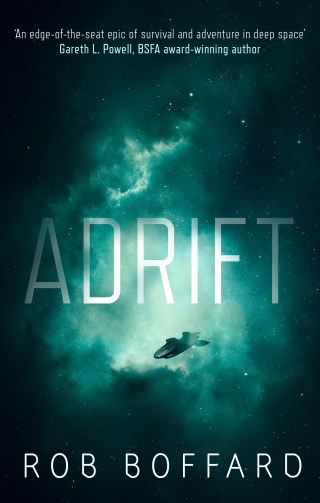
Quick Review – Adrift by Rob Boffard

Adrift Cover

Publishers: Orbit/Audible Studios

Publication Date – 5 June 2018

Amazon     Book Depository

For this review I will be looking at Adrift by Rob Boffard, a book I listened to a few months ago, but which I did not get a chance to review at the time.  With the end of 2018 fast approaching, I decided to do a quick review for this book in order to clear my review schedule for the new year.

Goodreads Synopsis:

In the far reaches of space, a group of tourists board a small vessel for what will be the trip of a lifetime – in more ways than one…

They are embarking on a tour around Sigma Station – a remote mining facility and luxury hotel with stunning views of the Horsehead Nebula.

During the course of the trip, a mysterious ship with devastating advanced technology attacks the Station. Their pilot’s quick evasive action means that the tour group escape with their lives – but as the dust settles, they realize they may be the only survivors . . .

Adrift in outer space, out of contact with civilization, and on a vastly under-equipped ship, these passengers are out of their depth. Their chances of getting home are close to none, and with the threat of another attack looming they must act soon – or risk perishing in the endless void of space.

What initially drew me to this book was the pretty cool-sounding synopsis above.  I had not read anything from author Rob Boffard before, but a story featuring a group of mismatched passengers attempting to survive out in space with only a small, poorly equipped ship sounded like an intriguing read.  After enjoying Adrift, I think I might check out Boffard’s Outer Earth series in the future.

Adrift turned out to be a pretty compelling read, featuring a great story in space.  While the action was a little lighter than your standard science fiction read, this is more than made up for by some powerful drama as the characters deal with the stresses of their situation.  There are also some thrilling intrigue elements as the protagonists attempt to unwrap the difficult situations inside and outside of the ship, as well as one particularly shocking and unexpected moment in the middle of the book.  There were a few good action sequences as well, including several epic flight scenes, and a memorable spaceflight featuring a little old lady.

This book is primarily a character-driven story, as the story mainly focuses on the passengers aboard the tourist ship.  Each of the various characters gets decent coverage in this book, with a particular focus on the three main point-of-view characters and the two secondary point-of-view characters.  After the first few chapters, my initial impression of all the characters in the ship was, ‘What a bunch of losers and arseholes!’  The passengers of the ship are made up of several abrasive characters who initially seemed to overshadow most of the other characters, including two timid main point-of-view characters.  However, as the book is explored further, the background of all of the characters is explored in some detail, and the reader gets an idea of why some of the characters are the way they are.  The events of the story help develop these characters further, and by the end the surviving characters are all much more likeable.  I was impressed by the emotional range that Boffard was able to write, and the various reactions to the situations about the tourist ship came across as quite realistic.

I ended up listening to Adrift in its audiobook format, which was narrated by Katie Scarfe.  The audiobook runs for a little bit over 15 hours, so readers need to invest a bit of time in getting through this book.  I thought that Scarfe did a good job with her narration, coming up with a number of good voices for her distinctive characters, and moving the story along quickly.  Scarfe had a bit of work to do with the primary cast of characters, as not only did she have to do Russian, Irish and British accents, as well as several random accents the ship’s computer system blurted out through the course of the book, but she also had to do a range of ages across both genders, from a young male child to an elderly lady.  Fortunately, Scarfe was able to produce pretty good accents for each of these characters, and it was possible to get an idea of gender and age with the various narrations.  I also thought she did a good job capturing the range of emotion that flowed from her characters, from despair to anger at their situation.  Overall, the audiobook format is a great way to enjoy Adrift, and I would recommend it for those who prefer to listen to their books.

Adrift by Rob Boffard is a clever and fairly captivating read that makes great use of its character-driven storyline.  This was a good standalone novel, and readers will find a lot to enjoy with this intense science fiction read.

My Rating:

Four stars

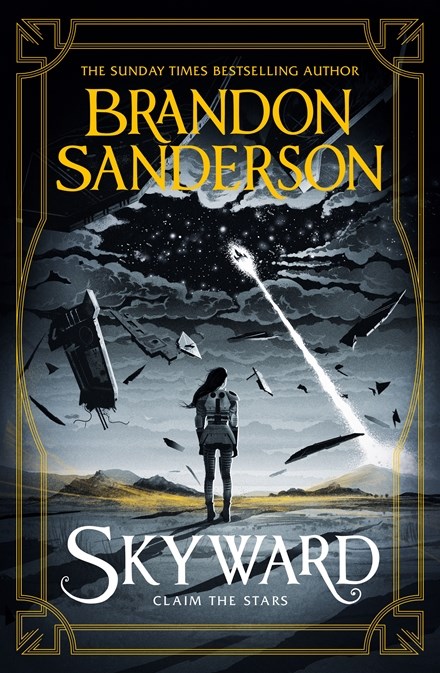
Skyward by Brandon Sanderson

Skyward Cover.jpg

Publishers: Gollancz

                        Audible Studios

Publication Date – 6 November 2018

Amazon

Legendary fantasy and science fiction author Brandon Sanderson once again delivers an incredible five-star read with Skyward, a brilliant young adult science fiction story that follows the journey of an energetic young protagonist at she attempts to claim the stars.

As of right now, I have only had the opportunity to read one of Sanderson’s novels, the epic fantasy book, The Way of Kings, which was easily one of the best fantasy reads of the last decade and which I gave a five-star review here.  After enjoying The Way of Kings I was keen to see how Sanderson’s writing ability translated to the young adult science fiction genre.  I have to say I was in no way disappointed, as Sanderson once again creates an amazing and exciting piece of literature, all set within an incredibly detailed new fictional landscape.  Skyward is the first book in Sanderson’s planned Skyward series, which is to be made up of a total of four books.  The second book in this series, Starsight, has apparently already been written, with a release planned for November 2019, while the third and fourth books, both yet untitled, already have tentative release dates in 2021 and 2022.  Starsight is already on my must-read list for next year, and will appear in my Waiting-on-Wednesday series of blog posts the moment the cover gets released.

Far in the future and on another planet, humanity has been under constant attack for hundreds of years.  A mysterious alien race known as the Krell pursued the human fleet across the stars, forcing it to crash on a desolate planet.  Those humans that survived were forced to flee below the planet’s surface, hiding in caves and only re-emerging when they gained the ability to create space fighters capable of fighting off the alien craft.  Now the Defiance Defence League (DFF) fights a constant war against the Krell, who are determined to wipe out the DFF’s main base and the production facilities beneath it.

Since she was a young girl, Spensa Nightshade has always dreamed of becoming a DDF pilot, the elite defenders of humanity, in order to claim the stars.  However, years ago, her father deserted during the most famous battle in DDF history and was shot down by his comrades.  Having been forced to live for years as a daughter of a coward, Spensa is eager to forge her own heroic destiny, but the DDF will never accept her into their flight program.

But with the war going badly and new pilots needed, Spensa is given a chance to join the DDF, thanks to the actions of her father’s old wingmate.  Joining a class of misfit cadets who dub themselves Skyward Flight, Spensa learns to fly the DDF’s ships against the Krell and quickly shows her determination and skill.  However, her father’s legacy is constantly weighing her down, whether by the sabotage of the DDF or the constant fear that deep down she might also be a coward.  With the Krell attacks getting worse, will Spensa find her place as a pilot, or will a terrible secret from the past come back to haunt her?  And through it all, what role will the ancient spaceship Spensa discovers have on the fate of humanity?

I not only received a physical copy of Skyward from Hachette Australia, but I also listened to a copy of this book in its audiobook format, which is narrated by Sophie Aldred and goes for just a little over 15 hours.  Both versions are pretty cool.  The trade paperback version of this novel contains a couple of great maps at the start of the novel that some readers may find useful when it comes to navigating around the story.  There is also a series of intriguing drawings throughout the book that show off several of the ships, both human and alien, that are featured in the story, all of which are juxtaposed against the main ships that the protagonist and her wingmates train and fight in.  The later parts of the book also contain some fantastic illustrations of flight manoeuvres and abilities, which prove informative when utilised with Skyward’s many aerial flight sequences.  I personally preferred the audiobook format of Skyward to the physical copy, as it allowed me to enjoy the many action-packed aerial scenes a whole lot more.  I also loved the narration by Aldred, who was able to create a number of excellent voices for the book’s various characters.

The reason I am giving Skyward such a high-star review is because it is an incredible piece of young adult science fiction that not only has an amazing story but which also contains several outstanding characters and some of the best ship-to-ship action sequences I have ever seen, all of which is combined with Sanderson’s trademark knack for large-scale world building.

I had a lot of fun with the story contained within this book, as Sanderson sets forth a layered and powerful narrative for the reader to enjoy.  Told primarily from the point of view of the protagonist, Spensa, Skyward contains a fantastic coming-of-age storyline set within a flight academy where the cadets learn how to fly in defence of their planet.  I always love a good school based learning narrative, and Sanderson has created an outstanding version of this, where the main characters spend most of the story learning the theory behind flying, while also engaging in real-life combat situations as they train.  As a result, there are heartbreaking losses, great emotional connections forged, and secrets and hints about the overall story slowly released to the reader, all while the protagonist is forced to contend with the machinations of a biased authoritarian figure who even gets to narrate a few chapters to highlight the reasons for her actions.  Overall this is an addictive and exciting story that will really stick in the reader’s imagination.

Sanderson has once again created a detailed and captivating new world in which to set his new series.  The book is set within a new planet that humans from Earth crashed upon years ago in the past, fleeing from a mysterious alien force.  For years the humans lived a nomadic lifestyle in the caves beneath the planet before finally fighting back using newly fabricated fighter craft.  Sanderson has created a fantastic world to host this story, exploring a society forced to live in caves and eventually creating a military base on the surface.  I love how the author has created a ton of new societal rules and features, as well as a world above and beneath the surface of this alien planet.  There is also some really cool and unique technology that comes into play throughout the book, especially in the many aerial combat sequences.  The aliens are mostly a mystery for the entirety of the novel, although I did really enjoy the reveals about them.  I imagine Skyward’s fictional universe will be expanding out in the future instalments of this series and I am very excited to see where this goes.

Some of the best things about this book are the excellent characters that the author has populated his story with.  Of particular note is the main protagonist and point-of-view character, Spensa, who is a really fun and complex character to see this story through.  Spensa is a great character whose life has always been defined by her father’s legacy.  As a result, she puts on an extremely brave and aggressive front to everyone she meets as she tries to convince people she is not a coward.  Because of this, Spensa is quite an eccentric character, spouting out long expositions about how she will harm her opponents, which is quite amusing at times.  However, as the reader gets further into the book, they find out how vulnerable she truly is, as deep down her father’s actions and legacy have had quite an impact on her.  As she progresses into flight training and becomes more and more like her father, she must content with the trials of war, emotional issues with her friends and loved ones, the DDF’s indoctrination against cowards and the secrets that have been kept from her.  The internal conflict and fear that follows is really well written by Sanderson and forms a captivating emotional centre for this amazing narrative.

Quite a lot of time is spent looking at the other cadets that make up Skyward Flight.  Each member of this flight has a unique personality and is given a callsign to make them more distinctive.  There is a fun camaraderie between these characters, and they form quite a close-knit team.  Sanderson spends significant time building up several of these characters, and Spensa, much like the reader, gets quite attached to them.  As a result, when tragedy hits the team, there are some significant emotional blows that come with it.  I liked how the different friendships and relationships help Spensa grow as a character, as she started out the book a bit of a loner.  These side characters are absolutely fantastic, and add another great emotional feature to Skyward’s story.

While Spensa and Skyward Flight are all great characters, my favourite character in all of Skyward had to be the sentient spaceship, M-Bot.  M-Bot is an advanced spaceship who, for various reasons, is obsessed with mushrooms, spends much of the book cracking bad jokes and forms a close relationship with Spensa, the human who discovers it.  M-Bot has to be one of the funniest and quirkiest characters in the whole book, providing several of the book’s best jokes and funniest lines.  The ship’s relationship with Spensa is really well written, as it attempts to balance its existing command code with its new friendship.  This results in some amazing scenes, and I never thought before this book that I would get emotional about a spaceship.  M-Bot is particularly great in the audiobook version, as Aldred gives the ship an excellent Irish accent that really fits the character’s personality perfectly and makes M-Bot stand out throughout the book.

Easily my favourite thing about Skyward has to be the insane and incredibly well-written aerial combat sequences that fill this book.  All of the battles take place within the planet’s atmosphere among falling debris fields, resulting in some elaborate and exciting dog-fights between the DDF fighters and the Krell.  Quite a number of battles feature throughout Skyward, as the protagonist and her companions attempt to stop the Krell destroying humanity’s only hope of leaving the planet.  The author spends significant time exploring the physiology of these aerial fights, including the various tactics, training and technology utilised by the DDF and the Krell.  In particular, Sanderson has created some unique technology to help create some truly amazing combat sequences, including light-lances, which are energy beams that the DDF fighters use to not only throw Krell fighters around but to also help their ships do precise and elaborate manoeuvre around the falling debris.  I also loved how Spensa and her flight got better as the book progressed, reflecting their training and their ability to work together as a team.  All of these battle scenes are fast paced and incredibly well written, and the reader constantly finds themselves placed into the middle of these epic battle sequences.  I found that the audiobook version of Skyward was particularly effective at bringing me into these combat scenes, and I was often on the edge of my seat as I listened to them.  There are a number of these amazing sequences throughout the book, whether they were real battles or simulations.  Highlights for me have to be a high-speed chase through a giant, ancient factory crashing down to the ground, or the final high-stakes battle that serves as an epic conclusion to the whole story.  These battles are truly an amazing feature of Skyward, and I cannot wait to see what incredible aerial battles feature in the future books of this series.

Skyward is one of my favourite books of 2018 and is definitely one of the best young adult books I have read this year.  Brandon Sanderson once again cements his legacy as one of modern fiction’s best fantasy and science fiction authors, as readers are treated to an epic science fiction read set in a rich and detailed new world.  Featuring some amazing characters and outstanding depictions of aerial combat between humans and aliens, this book comes highly recommended.  I have made no secret about how much I am looking forward to future entries in this series and cannot wait to see where Sanderson takes this story next.

My Rating:

Five Stars

Amazon

Phantom Wheel by Tracy Deebs

Phantom Wheel Cover

Publisher: Little, Brown and Company

Publication Date – 16 October 2018

Amazon     Book Depository

When six genius teen hackers are invited to audition for the CIA in order to receive an exclusive scholarship and job offer, five of them, Issa, Harper, Ezra, Alika and Seth, jump at the opportunity and create the code that is requested of them.  The sixth teen, Owen, walks out of the room, refusing to participate.  Later, when the other five return home they each receive a message for Owen, “You’ve been played.”  Owen has uncovered that the people interviewing them were not from the CIA; instead they work for one of the world’s largest telecommunications companies, Jacento.  Worse, the hackers’ combined code works together to create a virus, known as Phantom Wheel, which is a malicious piece of code that will give Jacento access to everyone’s personal data and unparalleled control of the world.  Determined not to let their creation be unleashed, the six teens band together to break into Jacento and steal back their code.  While they are young, these teens are among the most creative hackers in the world.  But will their combined skill be enough to protect them from a dangerous corporation with everything to lose?

Phantom Wheel is a fun young adult thriller that focuses on the adventures of six teen hackers determined to save the world from their unintentional creation.  This book has a cool style to it, some interesting characters and an intriguing story that features a lot of technological and hacker elements to it.  I only got this book a little while ago and managed to read through it pretty quickly, enjoying its various elements and aspects.

The author of this book, Tracy Deebs, is actually the young adult pseudonym of prolific romance novelist Tracy Wolff.  As Tracy Deebs, the author has created a number of varied young adult titles, including the techno-thriller Doomed; the mermaid based Tempest series; the superhero based The Hero Agenda series, which was cowritten with Tera Lynn Childs; and the teen romance series, Dahlia and Keegan, which started with her 2016 release The Secret Life of a Dream Girl.

When I first heard the premise of Phantom Wheel, I was intrigued and interested to see if the story could live up to the awesome-sounding plot summary, and overall I was fairly satisfied with the end result.  The story is told from the point of view of three of the main teen characters, Issa, Harper and Owen, and focuses on their fast-paced and exciting story of technological espionage and high-stakes hacking.  The plot moves quickly from the protagonist discovering what they had been tricked into doing, to them attempting a complex heist to steal it back.  I loved the heist scene, especially at the start when the protagonists split off into three teams, each with a point-of-view character, in order to obtain security items off three different members of the company at a party, especially as it allowed all the characters to play to their strengths during this sequence.  The sequences following the heist were also particularly good, as the protagonists attempt to escape from a horde of evil corporate security goons and the police by using their hacking skills to crash cars and stop trains.  I have no idea how realistic this is, but it was still fun to read about.  Overall the story is pretty fun, and has a lot of memorable moments.

The style of Phantom Wheel is also really interesting and has some great elements to it.  I personally really enjoyed the inclusion of the several different case study summaries of the protagonists that were scattered throughout the book.  These case studies also included amusing video surveillance files that follow each of the protagonists as they use their hacking skills to either get revenge or justice, or look at the characters having key conversations with each other.  I also liked the various uses of text messages and other electronic communications throughout the entire book, which fits in well with the technology based theme of Phantom Wheel.  The protagonists also speak a large amount of techno-talk and hacker slang throughout the novel, which gives the entire story a whole lot of authenticity.

Deebs has included six interesting and varied protagonists in the novel.  Despite the various first impressions of these characters, each of them has a lot more depth revealed throughout the course of the book, especially as they grow to trust the other members of their little band and open up to them.  Each of the characters has varying degrees of emotional backstory, which explains why they are the people they are and why they have taken to hacking, all of which is revealed throughout the course of the book.  I have to say I was impressed by Deebs’s inclusion of an asexual character in Harper, especially as asexual people are an under-represented group in modern fiction.  This asexual character seemed like a natural fit, and her acceptance by the group with only minimal questions or comments came across as a quite realistic and generally positive.

While I enjoyed the characters, they did at times stretch the plausibility of the book just a tad too much for my liking.  While I am willing to accept that hackers are just as likely to be in shape as other members of society, the actions that these teenagers were able to do, such as evading professional killers, fighting off trained security guards and jumping out of buildings, did seem a little ridiculous to me, and made me slightly question what I was reading.  I also found it interesting that four out of the six main protagonists were all members of rich families and had a huge net worth, one of them was even the daughter of a fictional Secretary of State.  While each of them had issues as a result of their wealthy lifestyle and the poorer characters of Issa and Harper balanced them out a little, even calling them out on their wealth, it did seem a little odd to include so many rich kid characters.  While this could potentially be explained away by the fact that hackers need money to pay for training and equipment, I feel that Deebs could have made one or two of them more middle class.  Still, none of these impacted my enjoyment of the book too severely and are easy to get around.

As a young adult book, Phantom Wheel is a good read for younger to older teens, although adult readers could also have a lot of fun with this.  The technological aspects of the book are quite intriguing and are easy to follow and understand, and will probably spark the interest of technically minded youths.  Readers will be able to relate to some of the characters in the book, and once again I have to point out my respect for Deebs’s great portrayal of an asexual character, as well as other minor LGBT+ elements.  With nothing too over-the-top in this book, it is a perfect read for a wide audience.

Overall, this new techno-thriller from veteran author Tracy Deebs is a fun and exciting novel that most readers will find quite entertaining.  Deebs has created a compelling story, used some great characters and installed some intriguing elements, all of which makes Phantom Wheel quite enjoyable and definitely worth checking out.

My Rating:

Four stars

Amazon     Book Depository

Runaways Volume 2: Best Friends Forever by Rainbow Rowell and Kris Anka

Runaways Volume 2 Cover.jpg

Publisher: Marvel Comics

Publication Date – 30 October 2018

Amazon     Book Depository

Recently reunited and still coming to terms with being a family again, the adventures of Marvel Comics’ favourite group of misfit youths continues in Best Friends Forever, the second volume of young adult author Rainbow Rowell and artist Kris Anika’s run on Runaways.

The Runaways, Chase, Gert, Karolina, Nico, Victor, Molly and Old Lace are finally back together and living in one of their parents’ old hideouts.  While most of the team have grown up since the last time they were all together, this does not mean that they have their lives together.  Each of the Runaways has their issues to deal with, be it Gert’s recent return to life after several years of being dead, Karolina’s relationship problems or Victor’s current existence as a disembodied head.  The only one who appears to have their life even remotely together is the team’s youngest and at times wisest member, Molly, who is enjoying her time in middle school.  But even Molly is having problems, as she is faced with a hard choice and must consider whether she actually wants to grow up.

Runaways_Vol_5_8.jpg

As Molly deliberates over the dilemma presented to her, a barrage of other arrivals impact on the Runaways.  Karolina’s girlfriend, Julie Power of Power Pack fame, is in town, which causes significant drama for Karolina and Nico, while Dr Doom has apparently appeared on their doorstep, determined to find Victor.  Can a team rife with squabbles, drama and internal strife come together to face the problems before them, or will their significant changes be too much to bear?

Runaways is still one of my favourite Marvel series.  After the revamp earlier this year, previously reviewed here, these fantastic characters are still going strong.  In this second volume, Rowell, Atkins and their creative team continue to produce some outstanding and emotional stories that are based more on the relationships between the main characters than the traditional crime-fighting storylines contained within other comics.  While they do go up against a couple of superpowered opponents within this story, none of these antagonists is truly evil, and their motivations and history are a lot more morally ambiguous than some of the previous Runaways stories.  The creative team do a fantastic job of blending highly emotional storylines with a bunch of fun and heart-warming sequences, filled with random and funny elements, such as an errant Doombot.  This all comes together into one fantastic overall story that hits all the right buttons.  This second volume contains issues #7 – #12 of this new run on Runaways.

Runaways_Vol_5_9.jpg

One of the main aspects of this second volume of Runaways is the continued focus on the relationships between the series’ main characters.  Most of these characters are still coming to terms with being back together after all of them attempted to live lives outside of their team.  Quite a bit of Volume 2 involves the characters trying to determine what roles they have within this surrogate family, and the fact that they are not as close as they used to be.  What I liked is the way that Chase, usually the most immature member of the team, attempts to become the father of the group, matching up with the traditional female leader of the team, Nico, as the team’s mother.  This new parental role is highlighted in a funny couple of scenes where Chase and Nico use magic to become Molly’s legal guardians, a shortcut way that “seems totally legit and great”.  A lot of this volume is also focused on the romantic relationships between several of the group’s characters, including the relationship between Gert and Victor and the new romantic feelings between Nico and Carolina.  I thought the lead-in to both these relationships worked out very well and sets up some interesting potential in future volumes.  I am also very curious to see how the friendship between Victor and Chase is going to be impacted as a result of this new relationship in future volumes of this series.  I liked the way that the relationships and romantic considerations that featured between Carolina and Julie and Carolina and Nico were handled very well and with great sensitivity, and showed great representations of LGBT+ relationships.

Runaways_Vol_5_10.jpg

I also appreciated the way that Rowell and Anika continued to focus on the emotional and mental damage that the team’s exploits have had on these characters over their entire comic book history.  In this second volume, there is a significant focus on Victor, who was mentally and physically damaged during his previous appearances in Vision.  Chase and Doombot’s attempts to rebuild Victor during this volume prove to be a particularly vivid trigger for Victor, and leads to some significant emotional moments.  There is also a look at Victor’s fear of vibranium because of its addictive and mind-altering impact on him, which drove him to commit terrible acts in a previous series.  The creative team also take a look at the life of old team member Klara, the young powered girl the team rescued from abuse back in 1907 during a time-travel adventure.  It was previously revealed that Klara had been taken away from the team by the state and is now in a loving household.  A brief section of this volume is dedicated to the team finding her and attempting to bring her back into the fold, but Klara refuses to come back, as she is happy in her new life.  You have to appreciate Klara’s sound reasoning for not wanting to come back to the team, due to the death and multiple problems experienced in the previous adventures.
Runaways_Vol_5_11.jpg

One of the most significant issues that the character’s experiences have had on them is based around their negative opinions of adults.  Most of the truly terrible things in their lives have been the result of the plans of the adults they encounter, and their distrust of most adult characters has been a long-running aspect of the series.  It is interesting to see that this carries through to the new series, even though several of the characters are now actually adults.  This viewpoint is most prevalent in Gert, whose death during one of the previous run of this series means she still shares the beliefs these characters had while they were fugitives.  However, the rest of the team also have a hard time trusting other adults, such as when they assume Klara’s new adopted parents have to be evil, as every adult they have previously dealt with in similar circumstances were also evil or abusive.  This viewpoint has significant plot impacts in this second volume, as Molly, given the opportunity to stay young forever, talks to several of the other Runaways in an attempt to subtly work out their thoughts on growing up.  Most of the characters, including non-team member Julie Powers, talk somewhat negatively about their current lives and regret growing up, which tempts Molly to accept the chance to stay young.  The final message of this storyline strongly implies that growing up isn’t so bad, as even the antagonist, a young girl who has stayed 13 for 50 years, does not always want to be young.  It was also interesting to see Klara try to correct the team when they say that no adults can be trusted; having had a loving family relationship, she no longer believes that.

Runaways_Vol_5_12.jpg

The second volume of this run of Runaways continues to make use of some fun artwork throughout the various issues.  The character designs continue to be fun, and it is interesting to see some new looks and some constantly changing character designs, especially for the trendy Nico.  The art is often used for comedic affect.  Victor has a fun use throughout the book, and it is pretty humorous to see the head floating around in a number of scenes, even in a middle of a fight scene.  I also loved how throughout the course of the volume, he was given more and more advanced mobility upgrades in each scene that he appeared in, each more comedic than the last.  For example, at the start of the volume he is mostly transported in other character’s hand, his own momentum or in a backpack.  However, as the volume continues he is variously attached to a Roomba, a small tracked rover, several helium balloons (so he can get the feeling on flight back again) and eventually a new drone.  All of these are slightly ridiculous and fun, but they do not take away from the emotional nature of several scenes, and I must point out some of the awesome drawings that hint at the issues Nico is having with her magic.

The second volume of this new series of Runaways, Best Friends Forever, is another strong and emotional addition to this new version of this young adult superhero comic.  I really appreciated the creative teams continued focus on the character relationships and the emotional aspects of the characters’ lives.  Best Friends Forever is another fantastic addition to this powerful new run of Runaways, and I am excited to see what happens to this great group of characters next.

My Rating:

Four and a half stars

Amazon     Book Depository