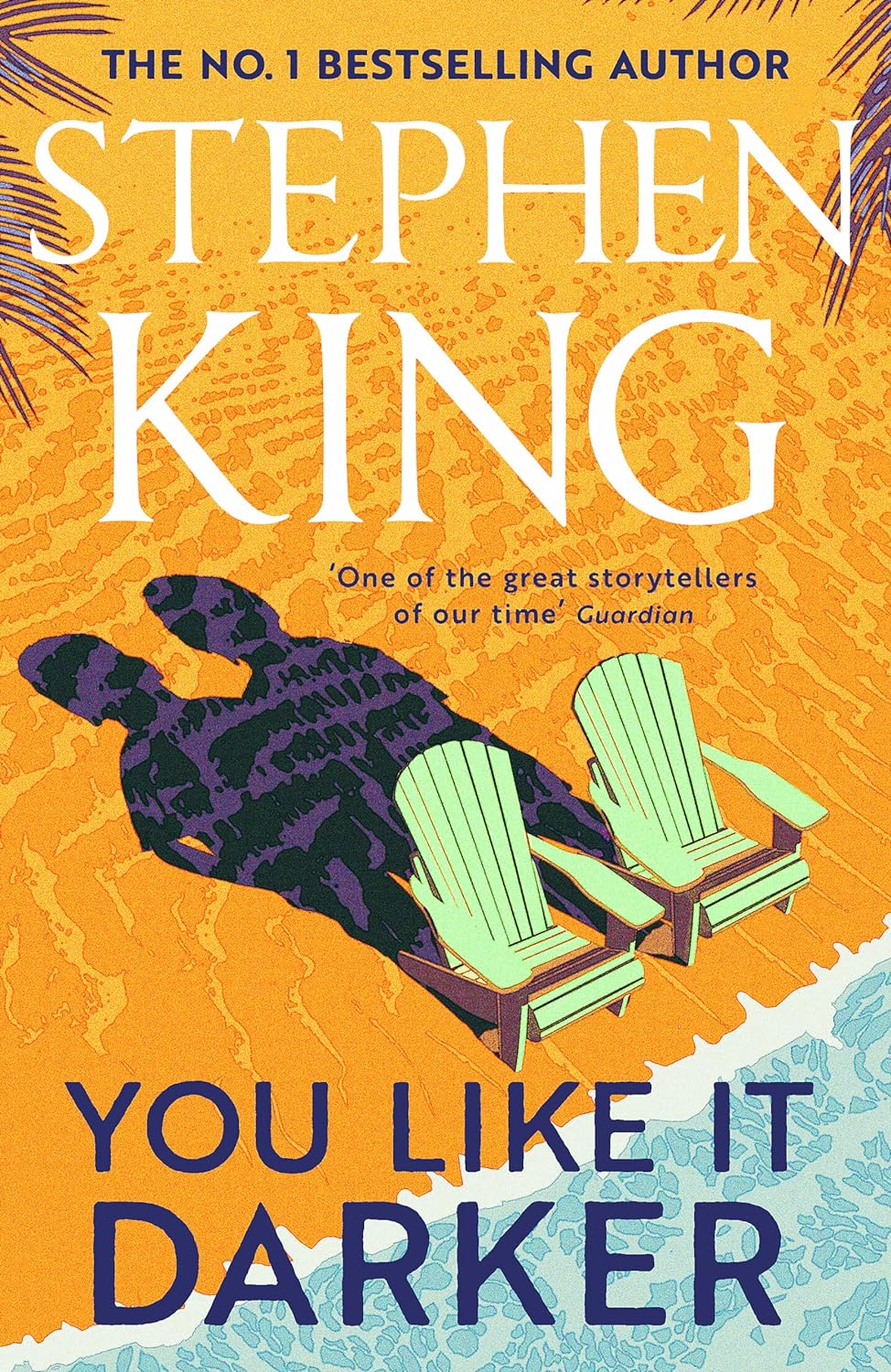
You Like It Darker by Stephen King

You Like It Darker Cover

Publisher: Hodder & Stoughton (Trade Paperback – 21 May 2024)

Series: Standalone/Collection

Length: 484

My Rating: 5 out of 5 stars

Amazon

The master of shocks, thrills and chills, Stephen King, returns with a highly addictive collection of short stories that showcase his awesome writing ability in the epic book, You Like It Darker.

Stephen King is an author who needs very little introduction from me considering he’s been one of the world’s top authors for over 40 years.  Readers of this blog will know that I have come to the Stephen King fandom rather late in life, having only read his more recent releases.  However, the King books I have read were extremely epic, and I absolutely loved the awesome and inventive stories they contained.  This includes the epic thriller Mr Mercedes, the deeply personal tale Later, the fascinating Fairy Tale and the utterly addictive Billy Summers (one of my favourite books of 2021).  My favourite King book was his 2023 novel, Holly, which told a deep and chilling tale that is still stuck in my mind.  Not only was Holly one of the absolute best books and audiobooks of 2023, but it is also one of my very favourite horror books.  Due to this, I have been keeping a very close eye out for more content from this legendary author, including his latest book, You Like It DarkerYou Like It Darker was a short story omnibus book, which feature 12 unique stories from King, each of which have a dark shine to them.

I must admit that when I first heard about You Like It Darker, I wasn’t too sure I was going to read it.  This was primarily because I am not the biggest fan of short stories or novellas, as I prefer reading stories with more meat to them.  However, because it is Stephen King, and there is a certain guaranteed awesomeness associated with any of his works, I decided to give You Like It Darker a try, and boy was that a good decision.  The various stories contained within You Like It Darker was exceptional, and I ended up getting really stuck into everything contained in this impressive book.

The first story featured in this volume is the entertaining Two Talented Bastids.  A somewhat light-hearted start to a book dedicated to dark narratives, Two Talented Bastids tells the story of a famous and skilled author and his best friend, a highly regarded painter, both of whom grew up in a small town (near King’s iconic setting of Castle Rock) and managed to make it big.  Told through the writings of the author’s son, this story recounts the compelling small-town life of these fun figures, before eventually diving into the events that suddenly awakened their talents.

Two Talented Bastids was a very interesting and compelling start to You Like It Darker, which really played to the author’s strengths.  King is known for his ability to craft together tales of small-town life and intricate character backstories, which he does here in excellent detail.  The focus on these two friends who eventually make it big was moving and personal, and I liked the great way this story unfolds from the perspective of the loving, if overshadowed, son.  Because this is King, the story goes in some unusual directions, with an unnatural reason behind the protagonist’s renowned talents.  This twist away from conventional life was fun and surprisingly wholesome, and it was nice to see a good deed get rewarded in a King book.  As such, this was a surprisingly light start for You Like It Darker, but one loaded with humour, fantastic characters, and some great examples of human nature.  I felt that Two Talented Bastids was an excellent appetiser that showcased King’s writing style in advance of the crazier stories to come, and it got me in the mood for more tales about unusual people.

The next two short stories are the intriguing The Fifth Step and Willie the Weirdo.  Both stories are amongst the shortest entries contained within this book, and they prove to be an intriguing follow up to Two Talented Bastids, especially as they bring King’s promised darkness.  The first of these, The Fifth Step, is a short but impactful story that sees an older gentleman encounter a stranger at the local park who wishes to tell his personal confession as part of an addiction program.  This short story concludes with a sharp and memorable ending, and you have to appreciate the way that King effectively sets the scene in just 10 pages before bringing it to a sudden end.  Willie the Weirdo is also very dark, as it shows a strange young boy, the titular Willie, becoming close to his dying grandfather in his final days, hoping to see him die.  This is a bit of a weird story (unsurprisingly), but it’s one that I felt was very strong, as King showcases the strange nature of the two protagonists through a series of ghoulish conversations.  The final moments of Willie the Weirdo really bring the whole story together in a fantastic way, and readers are left to rethink all the previous aspects of the story thanks to a few subtle inclusions.  Both entries are great in their own way, and I liked how they substantially darkened the mood after the lighter starting story.

The fourth story in this book is probably my favourite, the excellent Danny Coughlin’s Bad Dream.  The longest entry in Some Like It Darker, Danny Coughlin’s Bad Dream is a brilliant tale that sees the titular Danny Coughlin, a small-town high school janitor, begin to have vivid dreams about a body at a location he’s never been to.  Hoping to alleviate the dread brought on by his visions, Danny finds and travels to the location from his dreams, only to discover that there really is a body buried there.  His attempts to subtly alert the police only lead to him being becoming the lead suspect and the detectives investigating the murder, especially the zealous Inspector Franklin Jalbert, begins an aggressive campaign against him.

While I enjoyed the preceding stories in this book, Danny Coughlin’s Bad Dream is the entry that made me fall in love with You Like It Darker.  The author works in an intriguing but simple concept of a normal man having a true psychic dream and turned it into a compelling and utterly intense tale of obsession and inner darkness as the protagonist loses everything due to events outside of his control.  The horror of this story is brought about by an excellent combination of circumstances and dark human nature as the protagonist, Danny Coughlin, is completely innocent of the killings and is instead a particularly likeable figure trying to do the right thing in the light of unexplainable events.  However, the stubborn and obsessive Inspector Jalbert, incapable of believing the protagonist’s supernatural explanation, relentlessly hounds Danny, trying to get him to confess to the murder.  His inability to do so, as well as the lack of evidence supporting Danny’s guilt, drive Jalbert, a homage to Inspector Javert from Les Misérables, to worse acts against his suspect, and it was fascinating to see Jalbert’s blind adherence to justice and his own personal issues turn him into a bigger villain than the man he is hunting.

King does such an amazing job with both his main characters in Danny Coughlin’s Bad Dream, and they play off each other perfectly, with the innocent and honourable Danny, trying to fend off the growing instability of Jalbert.  King takes this story in some excellent directions, and I found myself constantly on the edge of my seat waiting to see how everything would unfold.  The resulting conclusion is dark, moving, and sadly inevitable, and you can’t help but feel for both the main characters, even when they do the wrong thing.  Throw in an intriguing look at various forms of faith, as the characters are forced to confront their own feelings about visions and the supernatural, and Danny Coughlin’s Bad Dream proves to be an outstanding read that I could not get enough of.  I really cannot emphasise what a brilliant story this was, and I maintain it was the most impactful and captivating entry in You Like It Darker.

The next story is the interesting Finn, which I must admit was my least favourite, although that might just be because I was unfairly measuring it against the preceding Danny Coughlin’s Bad DreamFinn was a curious tale about a terminally unlucky teenager who finds himself kidnapped in a case of mistaken identity by an unusual team of crooks.  This was a rather fun and fast-paced story that saw an unwitting Finn attempting to survive this latest example of his unusually terrible luck.  I did enjoy this story to a degree, although I honestly am not sure if I was missing a connection to some other work of King, as there were quite a few unanswered questions at the end.  Still, the story unfolds in an interesting way, and King does a great job of introducing his unique take on the protagonist’s life story and the formulative events of his childhood.

Following Finn, King brings the book back on the dark track with the short, but intense, road trip story On Slide Inn Road.  This story sees a dysfunctional family attempt to take a shortcut up the titular road, only to encounter obstacles, both from the landscape, and from other travellers.  I liked the progression from casual family story whose drama was primarily drawn from the actions of the easily aggravated father to a much more serious story including a pair of hijackers.  King’s intriguing take on how three separate generations of one family in the car deal with this sudden threat was quite impactful, and I loved how the family dynamics quickly change as a result.  Another short but effective story that I ended up really enjoying.

King continues with another two quick stories that feature intriguing concepts.  The first, Red Screen, sees a married cop interrogate a murderer who has a wild theory about an alien invasion.  This was a quick story, and a little predictable, but great to read, primarily because the reader could see how it was going to end, and the resulting anticipation increased their enjoyment.  This is followed by the thoughtful story, The Turbulence Expert, which follows a passenger on a bumpy airplane flight.  As the flight progresses, you discover that the nervous, frequent-flying protagonist has a specific reason for being on this plane.  The Turbulence Expert was another cool entry in this book, and I think I enjoyed it more than Red Screen, primarily because King gives it a little more room to breathe.  The interactions between the main passengers of the plane feel quite realistic, and there is a fun balance between the mundane experiences of some passengers, and the more unnatural feelings of the protagonist.  The Turbulence Expert had one of the more compelling scenarios behind it, and I wouldn’t have minded a longer inclusion as a great story could have developed if given more room.

The ninth story in You Like It Darker is the sweet Laurie.  Another relatively short entry, Laurie follows an older widower who finds comfort in a small puppy, the titular Laurie, foisted upon him by a concerned sister.  This was a very moving tale that will appeal to all dog fans, especially as it is very easy to relate to the companionship that the initially reluctant protagonist feels as he becomes more and more attached to his new furry friend.  King does a great job of capturing the many ups and downs of dog ownership in a very short amount of time, and you really feel yourself getting drawn to the initially troubled and lonely protagonist, and his dog.  Of course, because this is a King story, things do have to get dark, and the author honestly does not hold back here with a shocking threat.  This sudden moment of danger really drags the reader in, especially as the previous pages with the protagonist and Laurie made you really care for both, and you worry that King is about to bring some utter tragedy to the two.  As such, Laurie has the distinction of being both the most heartfelt and most stress-inducing story in You Like It Darker, and I really appreciate how many feels King fit into this one short story.

The next story is probably the entry existing fans of King are going to be most interested in, Rattlesnakes.  One of the longer and most intense stories in this book, Rattlesnakes has the interesting distinction of being a sequel to one of King’s more iconic works, Cujo.  Set in 2020, decades after the events of Cujo, Rattlesnakes follows Vic Trenton, the husband/father from the book, who was forced to move on after the death of his son and the resulting trauma of his wife.  Now retired, Vic has moved into a luxury house in Florida owned by his friend and former business partner to wait out COVID.  However, the house sits in a usual area, haunted by the tragic deaths of two young twins years earlier at the hands (or fangs) of the area’s now destroyed rattlesnake population.  Encountering the twin’s still grieving mother, Vic once again begins to feel the pull of the supernatural as the ghosts of the area’s past begin to focus on him.

Rattlesnakes ended up being one of the most intense and powerful entries in the entirety of You Like It Darker, and readers quickly become engrossed in this tale of long-lasting grief and the impacts it has on sanity.  Making good use of COVID times as a background, Rattlesnakes ends up being a twisty and complex tale that combines King’s aptitude for writing haunting horror tales with character-focused internal drama.  Thanks to the unique history he bestows upon the Florida location that the protagonist finds himself trapped in, there is some excellent background to build the narrative around, and I really became engrossed in the resulting haunting tale.  You really grow to understand the various character’s psyches as the story continues, and it proves interesting to determine whether the protagonist is being haunted or is experiencing his own form of grief and trauma.  This proves to be a very gripping horror read, and you come away feeling very thoughtful about the protagonist’s experiences and the potential dark future awaiting him.

In addition to its excellent self-contained narrative, one of the major appeals of Rattlesnakes is that it is a sequel to Cujo.  King provides a very intriguing follow-up to what happened to the parents in Cujo after the death of their child, and it was fascinating to see what followed the dark events more than 40 years after the original book came out.  The author paints a tragic picture of the grief and anger that followed, as well as how both characters moved on in their own separate ways.  I felt this ended up being a rather interesting sequel that will appeal to both hardcore fans of King, as well as those with a more general knowledge of this  iconic book.  The story in Rattlesnakes is not predicated in having read Cujo, and King makes sure to concisely recount the events of the previous book where necessary.  While I am sure those who have enjoyed Cujo previously will get a little more out of this story than those who haven’t, anybody can come into Rattlesnake and appreciate it’s complex and intense story.

The penultimate story of You Like It Darker is the intriguing The Dreamers.  Another relatively short entry in the book, The Dreamers is set in the 1970s and follows a Vietnam veteran turned professional stenographer who accepts a job with a professor performing unusual experiments out in the countryside surrounding Castle Rock.  This narrative quickly forces the protagonist into examining the dark side of dreams as the professor awakens unusual occurrences with his subjects.  This proved to be a pretty intense and complex story that was heavy on the horror, and I was getting some major Lovecraftian vibes from it.  The story gets into some dark places as the unnatural experiments continue, and it was fascinating to see inside the mind of the protagonist as he finds himself still involved despite his best judgement.  The story ends on a sharp and thoughtful note, and I came away quite curious about what was going on.  I do think this is one of the stories that could have benefited from a bit more expansion by King, but it still proved to be a captivating tale that added some essential darkness towards the end of this book.

The final story in this volume was the moving and hopeful story, The Answer Man.  Much like the first story in You Like It Darker, The Answer Man showcases King’s ability to effectively tell a compelling character-driven life story as it focuses on Phil Parker, a young lawyer who is agonising about his dream to move to a small town which he believes will become a major hub in the future.  However, Phil’s life is changed by three encounters with the mysterious Answer Man, a stranger who, in exchange for a small fee, provides Phil with answers to his various questions, while revealing uncomfortable secrets about the future.  These answers deeply impact the protagonist in various ways, both good and bad, and will have ongoing consequences for him and those around him, for decades to come.

I deeply enjoyed The Answer Man, which was a particularly strong entry to end You Like It Darker on.  King once again falls back on his innate ability to tell a compelling life story (which I highlighted in Two Talented Bastids), with the chronicle of Phil’s life proving to be an intriguing, if tragic, story that I really connected with.  The tale of a big city lawyer who moves to small town against the advice/wishes of his family and in-laws, only to face further issues, contentious cases and family tragedy, is interesting on its own, especially in King’s capable hands, but the inclusion of the Answer Man character really enhances everything.  Coming in with great patter, a fun attitude, and some otherworldly abilities, the Answer Man provides true answers to the protagonist’s questions, even if Phil would be better off not knowing them.  I loved seeing the ways that the protagonist’s already remarkable life is further influenced by his interactions with the Answer Man, and it led to some truly powerful and intense scenes.  This honestly was a very clever and thoughtful story, and the whole concept of the mysterious Answer Man was one that really appealed to me.  I think that King could easily do a whole novel around encounters with the Answer Man, and I hope that they might appear again in the future.  Due to the impact of this unlikely figure, The Answer Man story goes in some fantastic directions, with the protagonist experiencing triumph and tragedy in equal measures, but which ends on a hopeful note and the protagonist finding peace.  While not as dark as some of the other entries in this book, I felt that The Answer Man was a perfect end to an outstanding collection of short stories, and one that will leave you very thoughtful.

Overall, I was really impressed with how King brought this entire selection of short stories together in You Like It Darker.  Each of the stories, no matter how short, grabbed my attention, and I really fell in love with the amazing stories contained within.  Most of these entries were truly exceptional, with Danny Coughlin’s Bad Dream, Rattlesnake, Laurie and The Answer Man, being some of my favourites.  These amazing stories raised the quality of the entire volume for me, while the other entries also provided dark moments and compelling ideas that will appeal to all manner of readers.  King did a good job of setting out the stories in You Like It Darker, and each of the entries flowed effortlessly into the next.  Many of these stories complimented each other, and I enjoyed the contrast of having a lighter tale follow a particularly dark entry, and vice versa.  I also felt that You Like It Darker was very open to readers with various levels of experience when it comes to Stephen King.  While established fans will love seeing more unique stories from the author, including an intriguing sequel to Cujo, new readers can also have an amazing time here, especially with the range of narratives and the changing levels of horror, dread, and inner darkness.  I personally had an incredible time with all the distinctive and addictive novellas and short stories contained in this book, and together they ensured that You Like It Darker was one of the best things I read in the first half of 2024.
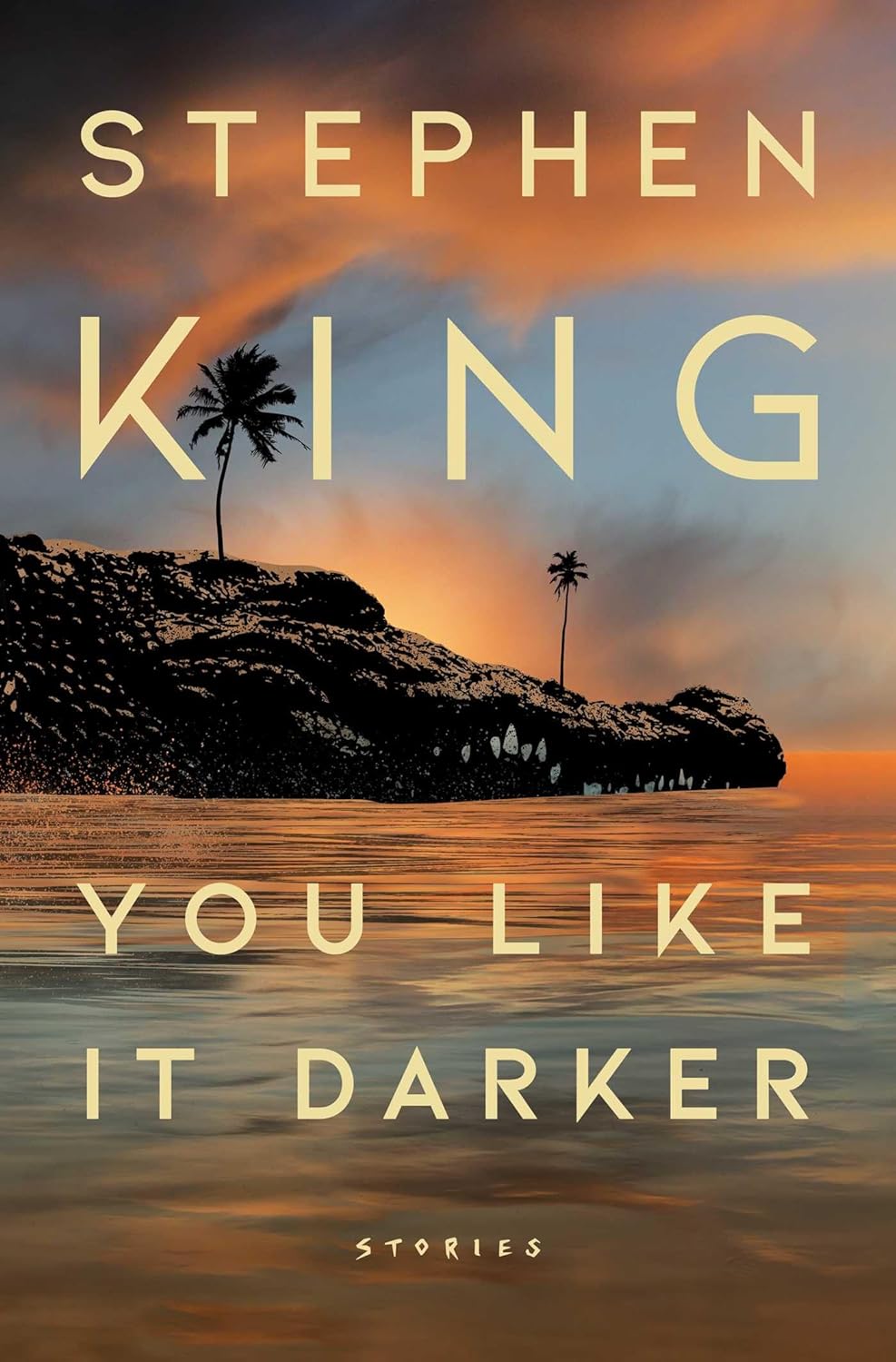
You Like It Darker Cover 2

Amazon

Warhammer 40,000: Straight Silver by Dan Abnett

Straight Silver Cover

Publisher: Black Library (Audiobook – 1 December 2002)

Series: Gaunt’s Ghosts – Book Six

Length: 9 hours and 52 minutes

My Rating: 5 out of 5 stars

Amazon

After having a blast reading and reviewing The Traitor’s Hand, my desire for more things Warhammer 40,000 needed to be sated, so I dove into the exceptional and gritty Gaunt’s Ghost book by Dan Abnett, Straight Silver.

While there are some truly impressive Warhammer 40,000 authors out there, few can match Dan Abnett in terms of quality and impact.  One of the most significant authors of Warhammer fiction, Abnett has produced a great number of books in the franchise over the years, which includes several must-read series for all Warhammer fans.  These include his substantial contributions to the massive Horus Heresy series, as well as the iconic Inquisitor extended series.  The Inquisitor books include his impressive and highly compelling Eisenhorn trilogy, made up of Xenos, Malleus and Hereticus, and which are amongst my favourite literary trilogies.  While I am a huge fan of these novels, probably his most grounded and well-known contribution to the Warhammer 40,000 canon are the Gaunt’s Ghosts novels.

The Gaunt’s Ghosts books are an extended series that follows the members of the Tanith First-and-Only, a weary and battle-hardened regiment of Imperial Guard soldiers.  Led by Colonel-Commissar Ibram Gaunt and known for their stealth abilities and the destruction of their home planet, the Tanith First-and-Only have taken up the name Gaunt’s Ghosts and are fighting in the massive Sabbat World Crusades hoping to find a new planet to call home.  This series emphasises the common human soldier and the gruelling realities of war in the grim Warhammer 40,000 future, and it is one of the most compelling series out there.  I have had an outstanding time with this series and all the books I have read, including First and Only, Ghostmaker, Necropolis, Honour Guard, The Guns of Tanith, and the prequel novel The Vincula Insurgency, have been extremely epic and complex, perfectly blending great characters with intense action.  Despite still having several books to go, the Gaunt’s Ghosts novels are one of my favourite Warhammer 40,000 series for a very good reason and I had no hesitation diving into the next book of the series, Straight Silver, when I needed something fun to read.

As the massive Sabbat World Crusades gain traction against humanity’s enemies, the Imperial forces finally have the capacity to send aid to the long-isolated planet of Aexe Cardinal.  There the loyalist nations of the Aexe Alliances have been locked in a gruelling 40-year war against the Chaos corrupted Shadik Republic.  Amongst the Imperial reinforcements sent to Aexe Cardinal are the veteran Ghosts of the Tanith First-and-Only, who are ready to make a dent in a new foe.

However, upon arriving on Aexe Cardinal, the Ghosts are surprised to find themselves under the command of the Aexe Alliance rather than their own generals.  Forced to serve the whims of their new allies for political reasons, the Ghosts are soon thrust into the archaic way of fighting that have led the war to linger for decades.  Worse, their new commanders refuse to use the Ghosts to their full potential, and the lightly armoured scouts find themselves fighting in bloody trench warfare.

Forced to endure confined conflict in ill-maintained trenches, the Ghosts find death constantly on the horizon as raids, bombardments, gas weaponry, and their own shattered morale begin to take their toll.  To keep his regiment alive and sane, Gaunt volunteers his troops for the most dangerous missions where the Ghost’s scouting skills can be best utilised.  However, the resulting campaigns will test Gaunt and his troops to the utter limit as the relentless forces of Chaos come crashing down upon them.

Straight Silver proved to be an exceptional entry to this amazing Warhammer 40,000 series.  Featuring some powerful and gritty action that took its protagonists to dark places, this sixth entry in the Gaunt’s Ghosts series was so damn good that I managed to power through it in no time at all.

Abnett did a brilliant job coming up with a particularly intense and dark story that plants the protagonists and the reader into the middle of a gritty warzone.  The main story is initially a little basic, with the Ghosts arriving on a new planet and finding themselves caught up in another long-standing war.  However, the book takes an outstanding turn when the Ghosts, who work best as a scout force, are forced into an elaborate trench warfare scenario.  Thanks to the excellent World War I inspired setting, the Ghosts are figuratively thrust back into the past and are forced to fight an old-fashioned type of war with their lasguns going up against firearms, chemical shells, and fixed lines of trenches.  The constant grim trench battles, raids and fights across no man’s land that dominate the first half of this book are very intense, gory, and pointless, and the reader is swiftly drawn into the unusual and dangerous scenario the Ghosts find themselves in.  Abnett masterfully captures so many aspects of this grim scenario, and you have to appreciate how brutal he makes the battles and the terrible conditions the characters find themselves in.

All these initial battles are expertly shown through the eyes of the many recurring characters of the Gaunt’s Ghosts series, and you swiftly begin to feel their despair and the rising tensions within them.  This works well with many of the existing character arcs, as several figures deal with grudges, uncertainty about duty, and growing relationships.  This excellent use of character arcs and perspectives humanises the fight, and you can’t help but get dragged even more into their hopeless situations.  I particularly enjoyed how Abnett deliberately made the antagonists a purely human force, with no named enemy characters serving as the villain.  This helps to reinforce that the true antagonist of the plot is human nature and their ability to wage unforgiving war, as the two opposing armies destroy everything around them.

While Abnett could have kept the characters in the trenches for a while and still had a good book, he chooses to accelerate the plot about halfway through Straight Silver, as the Ghosts are given a chance to prove themselves by going on two deadly missions.  This splits the story, as Gaunt leads half the characters on a series of deadly raids behind enemy lines, while another small group of key characters find themselves away from the fighting as they scout a critical location in the woods.  Naturally both storylines result in deadly chaos for the relevant protagonists, but I loved how they played out.  The storyline with Gaunt was brutal infiltration across no man’s land at its finest, and there are so many shudder-inducing moments as they continuously encounter the horrors of war.  The other storyline is much more a slow burn, as the characters find themselves isolated in the woods and only have themselves to fight with, as the grudges and resentments introduced at the start of the book are refreshed.  While the characters come together when an enemy presents itself, they are still caught up in their raw emotions, and this results in some dark moments.  Both storylines are resolve in an impressive and compelling manner, and the reader will come away enthralled, excited, and a little angry, as one excellent villain gets away with everything again.  You are honestly left wanting more, especially as Abnett throws in some tantalising hints for the future, and the bloody battles and horrors of Straight Silver will stay with you long after you’ve finished.

As with most books in the Gaunt’s Ghosts series, Straight Silver can be read as a mostly standalone read, as many of the key characters and story arcs are expertly reintroduced throughout the course of the book.  While readers will always get more out of Straight Silver if they read the other Gaunt’s Ghosts books first, especially as that will allow them to become more attached to the characters, a new reader can easily pick up Straight Silver and have an outstanding time getting through it.  Straight Silver and the Gaunt’s Ghosts books can also be readily enjoyed by those people with minimal pre-knowledge of the Warhammer 40,000 universe.  The Gaunt’s Ghosts books exist in their own little pocket of the universe, with the story completely focused on their own struggle as soldiers.  As such, this makes these books perfect entry level reads for those wishing to learn more about Warhammer 40,000 fiction, and anyone with a love for science fiction or military fiction is going to love Straight Silver.

I’m always impressed with the amazing range of characters that Abnett fits into each of his Gaunt’s Ghost novels, as the author tries to constantly capture the entire experience of the regiment in a Band of Brothers sort of way.  Unlike his Eisenhorn books, which had one perspective character, the Gaunt’s Ghosts follow many different protagonists, which allows you to see a massive picture of events unfolding.  This works really well, and I loved the huge range of unique perspectives and personalities that emerged, as well as the different views of the fights and internal conflicts.  I did think that Straight Silver might have featured a few too many different perspectives, as Abnett tried to bring some new characters to the fore.  This meant that several of the established cast from the previous book didn’t have a chance to shine here and were often sidelined, while the newer characters didn’t impress as much in their first big appearance.

There were still a ton of great character arcs going on, and even with less time in the spotlight, many of these characters made the most of it.  Main protagonist Colonel-Commissar Ibram Gaunt gets a good showing, especially as he is forced into conflict with his friend, the highly moral Chief Medic Tolin Dorden, and he is forced to balance his responsibilities as a Commissar with the love he holds for his soldiers.  Newly promoted Sergeant Tona Criid proves to be an absolute badass character, and it was great to see her take command and kick butt.  Sergeant Agun Soric has some great scenes as he slowly comes to realise his latent psychic abilities, while the formerly charismatic Gol Kolea is a hard figure to read about, after suffering a head wound in the previous book and losing his intelligence.  However, the best storyline in Straight Silver involves the mad sniper Hlaine Larkin and the nefarious trooper Lijah Cuu (sure as sure).  Thanks to their interactions in the previous book, the slippery murderer Cuu has a major grudge against Larkin and is determined to kill him, just like he did Bragg.  This results in a deadly game of cat and mouse between the two, as Larkin tries to survive both the enemy and Cuu.  Cuu comes away as such a good villain for this book (even more than the enemy), and you can’t help but hate the guy, especially as there is something slick and scary in his every appearance.  These characters, and many more, helped to turn Straight Silver into an exceptional read, and you really get wrapped up in their unique experiences of war.

I doubt anyone who has every read one of my Warhammer reviews will be surprised that I ended up listening to Straight Silver on audiobook.  All Warhammer books are so much better in this format, and the Gaunt’s Ghosts audiobooks are a great example of this, especially with narrator Toby Longworth.  Longworth, who is one of my favourite audiobook narrators, has lent his voice to most of Abnett’s Warhammer audiobooks, and he always does a remarkable job moving the story along and describing the book’s epic battle sequences.  This is extremely evident in Straight Silver, and I very quickly powered through this audiobook because of how good it is.

I especially loved the awesome voices that Longworth came up with for the various characters featured throughout the book, and he goes out of his way to ensure that every figure has their own distinctive and fitting voice.  Many of these voices are carried over from the previous audiobooks, and it was great to get the continuity for each of the recurring characters, so much so that by this point listeners of the other Gaunt’s Ghosts books can figure out who is talking just by hearing their particular tone.  One thing I particularly appreciate is the range of accents that Longworth distributes across the audiobook.  Each group of soldiers, such as the original Tanith troopers, the new Verghastite recruits, and the soldiers of Aexe Cardinal, are given their own distinctive accents, and this cool attention to detail is what makes Longworth such a good narrator.  This was such an epic audiobook; with a runtime of nearly ten hours, most people can power through it, especially when they get caught up in the epic story.

Straight Silver is a particularly epic and impressive addition to the Gaunt’s Ghosts series as Dan Abnett takes his fame regiment down into battle hell.  Loaded with intense moments, a powerful background setting, and multiple engaging character arcs, Straight Silver is an exceptional read, and it is honestly one of the strongest Gaunt’s Ghosts books I have so far read.  An utterly addictive Warhammer 40,000 novel, I can give it no higher honour as a reviewer than to say the moment I finished it, I instantly grabbed the next book in the series, read it, and will be putting up a review for it now.

Amazon

Quick Review – The Holy Terrors by Simon R. Green

The Holy Terrors Cover

Publisher: Severn House (ebook – 6 February 2024)

Series: Standalone

Length: 214 pages

My Rating: 3.5 out of 5 stars

Amazon

Established thriller author Simon R. Green produces a fun and compelling read with The Holy Terrors, a cool book with an interesting plot idea behind it.

Plot Synopsis:

Six people locked in a haunted hall . . . Cameras watching their every move . . . And then someone dies . . . This first in a spine-tingling new paranormal mystery series from New York Times bestselling British fantasy author Simon R. Green will make you doubt your judgement – and believe in ghosts!

Welcome to Spooky Time, the hit TV ghost-hunting show where the horror is scripted . . . and the ratings are declining rapidly. What better way to up the stakes – and boost the viewership – than by locking a select group of Z-list celebrities up for the night in The Most Haunted Hall in England (TM) and live-streaming the ‘terrifying’ results?

Soon Alistair, a newly appointed Bishop, actress Diana, medium Leslie, comedian Toby and celebrity chef Indira are trapped inside Stonehaven town hall, along with June, the host and producer of the show. The group tries to settle in and put on a good show, but then strange things start happening in their hall of horrors.

What is it about this place – and why is the TV crew outside not responding? Are they even on air?

Logical Alistair attempts to keep the group’s fears at bay and rationalise the odd events, but there are things that just can’t be explained within reason . . . Can he stop a cold-blooded would-be killer – even if it’s come from beyond the grave?

This locked-room mystery with a paranormal twist is classic Simon R. Green, featuring his trademark humour and imagination, irresistible characters, and thoroughly entertaining plotting.


The Holy Terrors
was an intriguing book from Simon R. Green that I had a fun time getting through.  Short and very sweet, The Holy Terrors made good use of its compelling plot idea, which saw a bishop, a diva, a comedian, a celebrity chef, a psychic and a TV producer become trapped in a haunted town hall.  While that sounds like the set up to an elaborate joke, it produces a great plot background for an entertaining novel that you can quickly power through.

I loved the author’s idea of simultaneously parodying ghost shows and the reality television crowd, while also presenting the reader with a unique locked-room mystery scenario that might or might not be caused by supernatural forces.  Thanks to these ideas, I think the overall story was pretty good and proved to be quite exciting.  Green sets everything up nicely, and you are quickly drawn into the plot, especially as you know that there is something bad on the horizon.  After a few early scare elements, you are led nicely to the centre of the story, where one of the characters dies and the rest are left scrambling to figure out who or what is trying to kill them.  This proves to be a great backbone for much of the story, and the initial range of characters are fun.

While I enjoyed how the book was set up, I think that it slightly fell apart in the second half.  The story gets a bit silly in places, and it is easy to predict what the subsequent order of death was going to be.  I did enjoy how Green tried to keep the reader guessing about whether this was a horror novel or a murder mystery, especially as there are some great psychic inclusions, apparitions, and other mysterious occurrences.  However, despite the included misdirection, the answer to this question proved to be a bit obvious.  The eventual culprit reveal was predictable, as it was literally the most obvious suspect there, and Green’s method reveal was pretty unsubtle.  Still, the final confrontation was nicely written, and I liked the cool conclusion to the plot.  in the end, The Holy Terrors proves to be quite an easy book to get through quickly, and I manage to finish it off in two sessions.

While Green proved adept at creating a chilling atmosphere and utilising it well in his story, I did have certain issues when it came to the characters.  The author does come up with six interesting main figures for the story, each of which is a celebrity reality star archetype, and there are some fascinating dives into their backstories, especially during an emotional sequence near the climax.  However, for the most part I felt these characters were underdeveloped, and Green could have showcased them a little better.  Certain relationships between some of the characters were a bit forced, and quite a few interactions felt unusual.  I also found some of the dialogue to be a bit stilted and weak in places, and it could have come across as a bit more natural.  These elements let down The Holy Terrors’ promising plot to a degree, although I still managed to have fun getting through it.

Overall, The Holy Terrors was an interesting read from Simon Green that you can have an entertaining time with.  The author’s intriguing scenario does prove quite compelling, and while certain elements of the book were not as strong as I would have hoped, you can easily power through this book in no time at all.  As such, The Holy Terrors is a great book for anyone looking for a quick and efficient novel that tries to blur the line between horror and murder mystery.

Amazon

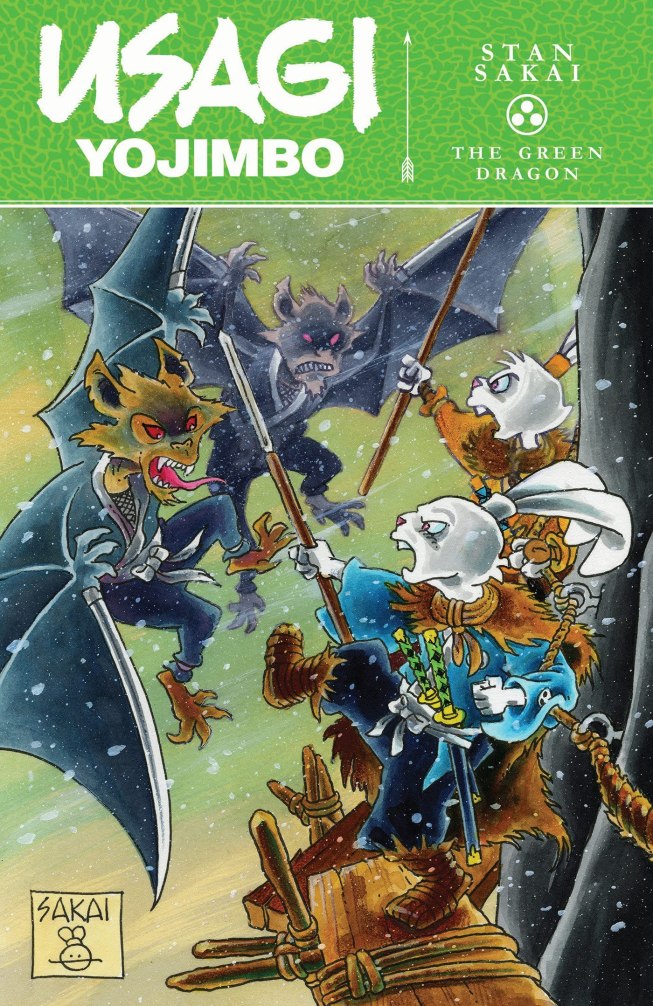
Usagi Yojimbo: Volume 38: The Green Dragon by Stan Sakai

Usagi Yojimbo - Volume 38 - The Green Dragon Cover

Publisher: IDW (Paperback – 18 April 2023)

Series: Usagi Yojimbo – Volume 38

Length: 128 pages

My Rating: 5 out of 5 stars

I once again return to one of my absolute favourite comic book series as Stan Sakai brings out the 38th volume of his iconic Usagi Yojimbo series, The Green Dragon.

Fans of this blog will know that I am a massive fan of the classic Usagi Yojimbo comic series, having had a ton of fun reviewing multiple volumes of it over the years.  Written and drawn by the legendary Stan Sakai, the Usagi Yojimbo comics are set in a version of Feudal Japan inhabited by anthropomorphic animals, and follow a rabbit Ronin, Miyamoto Usagi, as he journeys the countryside fighting monsters, bandits, and other dangerous foes.  These comics are something truly special thanks to their clever stories, great characters, beautiful artwork, and impressive utilisation of Japanese mythology and iconography, and I have so much love for them.

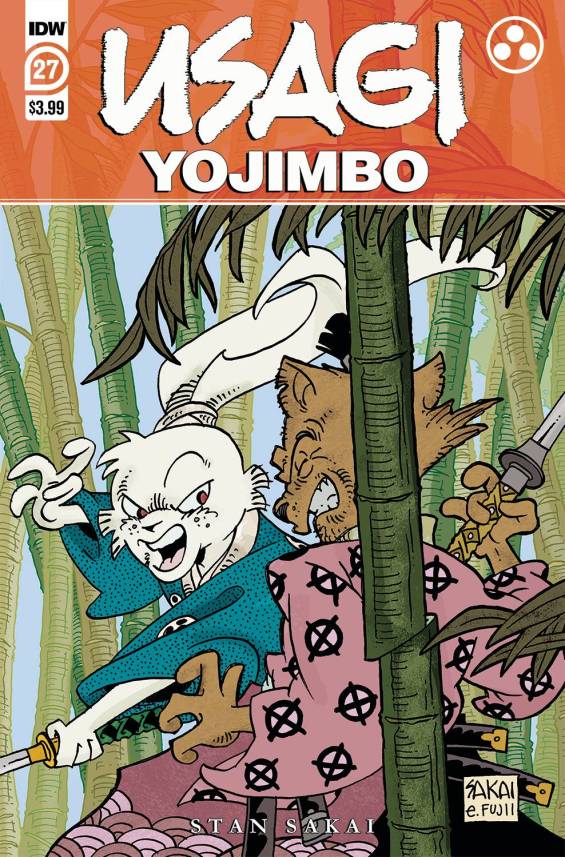
Usagi Yojimbo #27 Cover

For the last couple of years, Usagi Yojimbo has been published by IDW comics, who have done a pretty good job continuing this epic comic, especially as they started the trend of releasing the volumes in colour right off the bat, which has been highly effective and striking.  All the previous IDW volumes, including Bunraku and Other Stories, Homecoming, Tengu War! and Crossroads, have been pretty awesome five-star reads, so I knew that I was going to have a ton of fun with the latest volume, The Green Dragon.  Containing issues #27-31 of the current series, The Green Dragon featured three intriguing new stories, each of which was better than the last.  This was another very strong entry in the series and Sakai did a wonderful job of continuing some storylines from the previous volumes while also making The Green Dragon stand out in some distinctive ways.

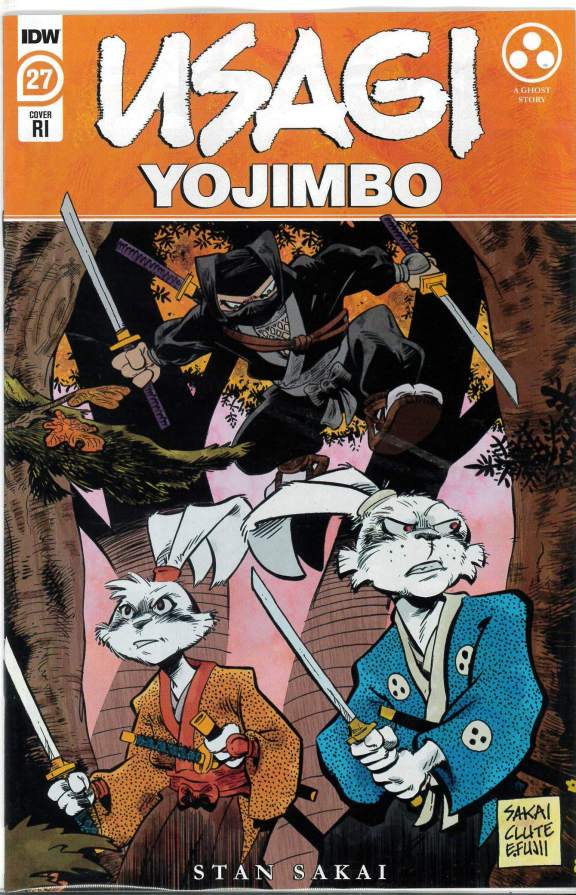
The first story in The Green Dragon is one of the shorter entries, titled A Ghost Story.  This story sees Usagi and his current travelling companion, his cousin Yukichi, travelling through a dark, apparently haunted forest before coming to a shrine at its heart.  The shrine is dedicated to a deceased pregnant maid who was murdered on the orders of her lover and master, and now stands as a place of prayer for women in similar circumstances.  Upon reaching the shrine, Usagi and Yukichi see history start to repeat itself, as another maid praying at the shrine is attacked by a group of bandits intent on murdering her.  Intervening to save her, Usagi and Yukichi attempt to discover who ordered the hit, only to discover a murderous plot with unexpected twists.  Worst, the ghosts of the forest are out in force, and they won’t go until revenge is satisfied.

Usagi Yojimbo #27b Cover

A Ghost Story was a fun story that utilises a few compelling elements that are very familiar to Usagi Yojimbo readers.  The murder plot at its heart is a bit simple, especially when it comes to working out who is orchestrating events, but Sakai tells it in a very compelling manner, especially with the fun action and quick-paced plot.  The parallels between this current murder plot and the story told to them at the beginning was an intriguing story device, especially as it gets twisted around a little, and I loved how Sakai works in supernatural elements to the narrative.  Sakai has made great use of vengeful and tricky ghosts in his stories before, and I felt this one was particularly good, especially as it gave the plot some fitting narrative justice.  It was also quite amusing to see Usagi acting as the wise mentor to Yukichi when it came to matters he is very familiar with, such as ghosts and murder plots, so I had fun with that.  This was an overall strong and entertaining first entry in this volume and it sets up the story extremely well.

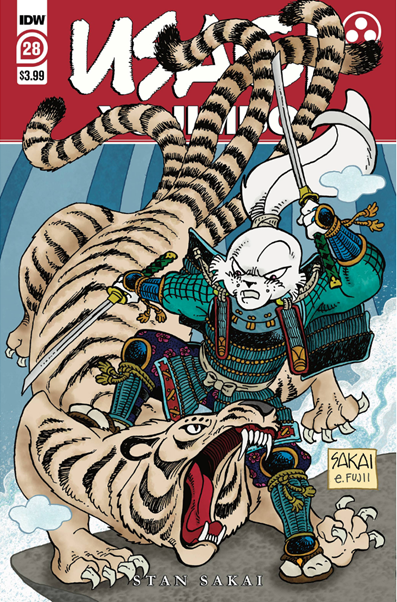
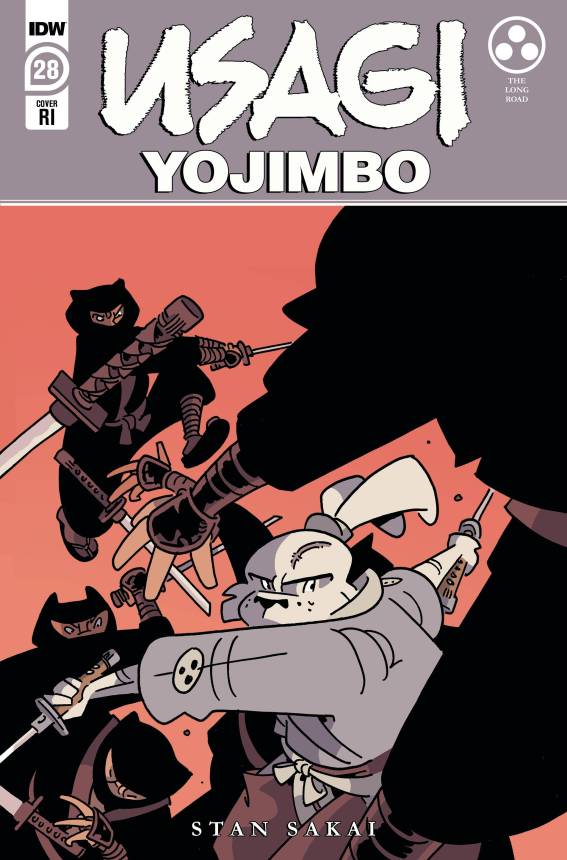
Usagi Yojimbo #28 Cover

The second story in this volume is another single-issue story, The Long Road, which follows a different highly familiar Usagi Yojimbo trend of Usagi intervening in a sudden bandit attack in the woods.  This time, Usagi and Yukichi encounter a merchant and his servant being ambushed by bandits determined to steal a valuable jade figurine.  Managing to scare off the bandits just after they kill the merchant, Usagi and Yukichi agree to escort the servant to the next town and deliver the figurine to its buyer.  However, as they continue their journey, it soon becomes apparent that their new travelling companion is in league with the bandits, and he is leading them into a trap.

Usagi Yojimbo #28b Cover

This was another great Usagi Yojimbo story that has a similar feel to previous entries, although Sakai uses that to his advantage.  Usagi Yojimbo fans have seen a whole lot of Usagi-led escort missions over the years, but The Long Road was a pretty good overall story.  Part of this was because Usagi is very much wising up to treachery that always seems to occur on these missions, and he takes active steps to not only identify the threat but also counter it in a satisfying way.  There is also a lot of entertaining betrayal, especially as the disloyal servant learns a harsh lesson about backstabbing from some experts.  It was also quite entertaining to see the green and unworldly character of Yukichi get a hands-on lesson about being a Yojimbo, especially as Usagi has some fun explaining at the moral issues surrounding it.  Combine that with Sakai’s great art, the well-drawn battle scenes, and the way it leads into the main story of the volume, and The Long Road is an impressive story that has a lot going for it underneath its veneer of a typical Usagi Yojimbo entry.

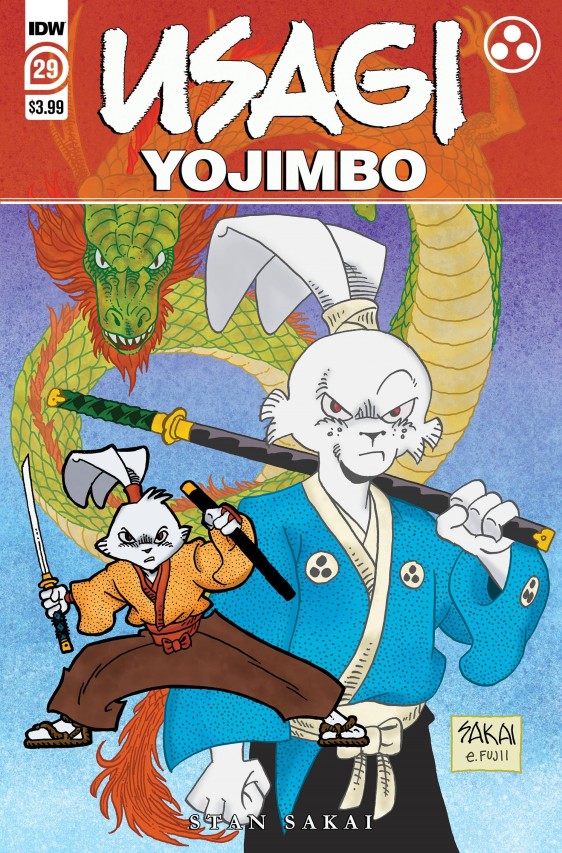
Usagi Yojimbo #29 Cover

The final story in this volume is the main entry, The Secret of the Green Dragon.  A three-issue long story that continues in the immediate aftermath of The Long Road, The Secret of the Green Dragon has much of the volume’s meat and sees Usagi and Yukichi get involved in a deadly battle between rival ninja clans.  The story starts with the samurai continuing their journey to deliver the jade figurine from The Long Road, only to witness a courier going to the same destination being brutally murdered by the flying Komori Ninja.  Usagi and Yukichi soon discover that the Komori Ninja are after something very special being delivered to the town, and naturally that secret package is in their care.  As they attempt to work out why their package is so important, Usagi runs into his old friend Chizu, former head of the Neko Ninja, who reveals that the figurine’s box contains an important missive that will cause issues for the scheming Lord Hikiji.  Hiring Usagi and Yukichi as bodyguards, Chizu leads them on a desperate mission across the countryside to escape the hovering Komori Ninja.  But the Komori Ninja aren’t an easy foe to avoid, and the trio soon find themselves under attack in the snowy landscape.

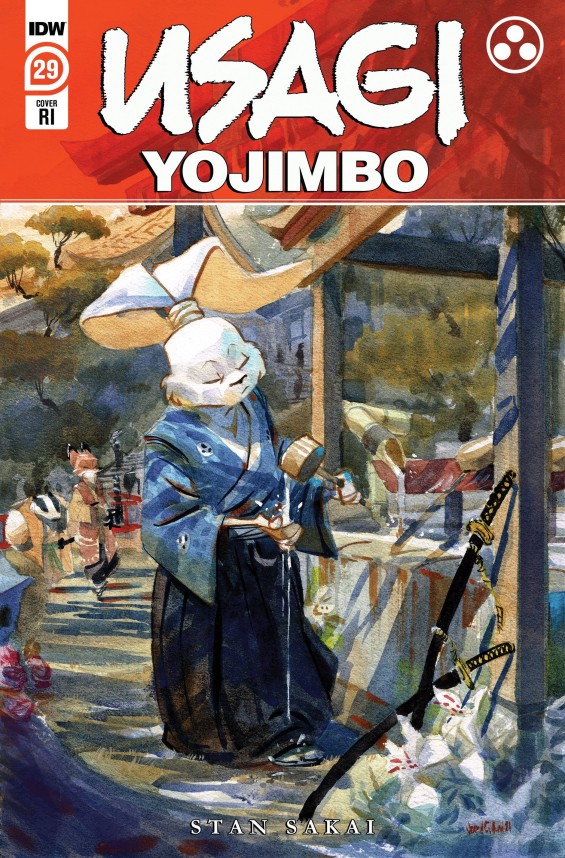
Usagi Yojimbo #29b Cover

The Secret of the Green Dragon is easily the best story in the entire volume as it takes the protagonists on one heck of an adventure.  Storylines with the various ninja clans of Usagi Yojimbo’s Japan are always extremely fun, and The Secret of the Green Dragon is no exception to this as it features the sinister Komori Ninja.  Flying bat ninja with blades attached to their wings, the Komori Ninja are always a fantastic addition to any plot as Sakai sets them up as one of the most unique and deadly foes in the series.  Sakai makes especially great use of them in The Secret of the Green Dragon, and their constant pursuit of the protagonists over the harsh wintery terrain makes for some impressive visuals.  The author loads this story with a ton of action, and there are some amazing set pieces that are extremely well showcased by Sakai’s art style, including desperate chases, powerful air-to-surface combat, and forays across impossible terrain.

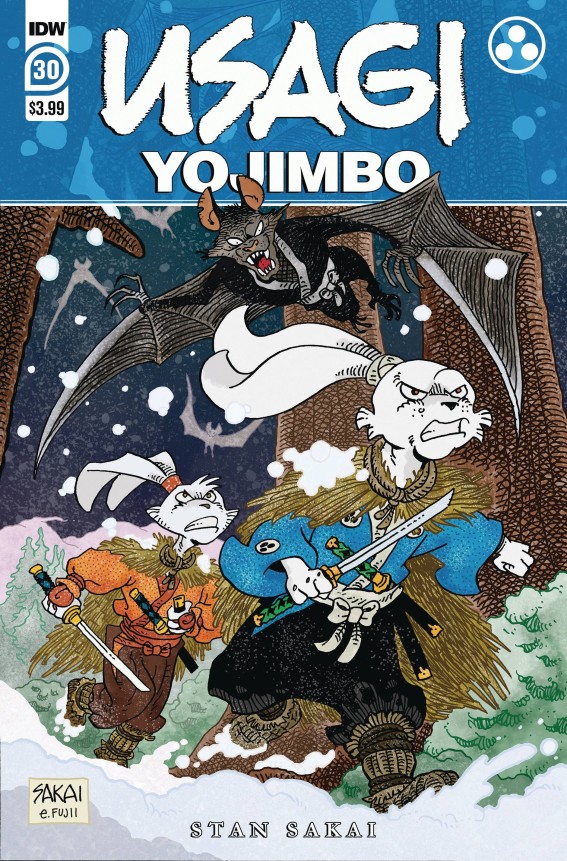
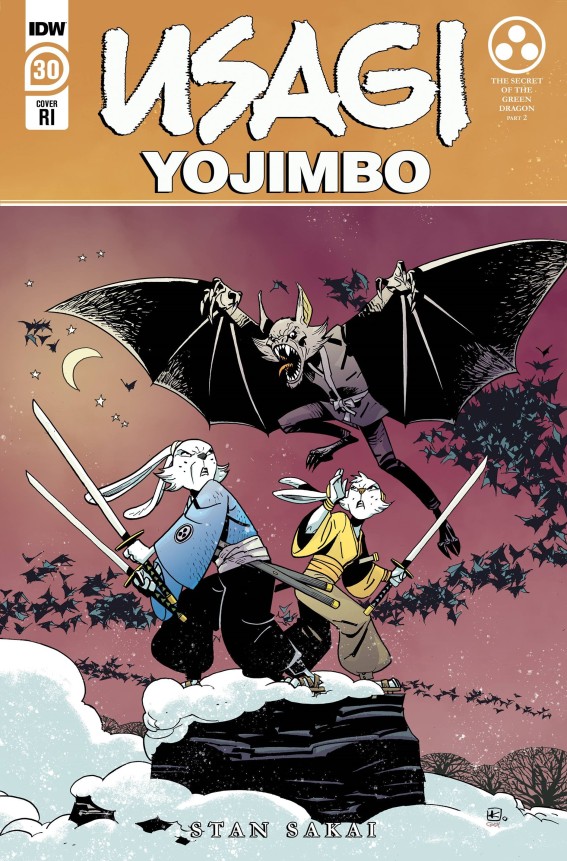
Usagi Yojimbo #30 Cover

There are a lot of fun story elements involved with The Secret of the Green Dragon, especially as it continues a lot of the ongoing plotlines involving the feuding ninja clans and Chizu’s attempts to regain control of the Neko Ninja.  The volumes ongoing storyline about Yukichi getting introduced to the various complicated elements of Usagi’s life as a wander was well set up, and he and Usagi learnt some harsh lessons about trust.  Watching Usagi lose his faith in Chizu after she engages in one deceit too many is pretty striking, and Chizu’s obvious regret later really makes this hit harder, especially as it is just one more tragedy this lonely ninja is forced to experience.  Finishing up with a threatening cameo from the series’ best villain, Jei, this ended up being a very strong story that is likely to have some intriguing repercussions later.

Usagi Yojimbo #30b Cover

I once again really need to highlight the outstanding artwork that is such an important cornerstone of this comic.  Sakai does some amazing drawings in The Green Dragon, and I loved the elaborate sequences that come together as a result.  All three stories are filled with eye-catching shots of beautiful Japanese scenery and towns, which really adds to the ambience of the story.  I particularly enjoyed the snowy landscapes that were such a big part of the third story, The Secret of the Green Dragon, serving as a powerful backdrop to the pursuit and battle-laden plot.  The villains of The Secret of the Green Dragon, the Komori Ninja, are also well showcased in the art style, and I think the full-colour spread helped to give them an added edge.  Their various attack scenes are very distinctive, especially compared to the typical combat sequences between Usagi and other samurai, and Sakai always goes out of his way to make the Komori Ninja a powerful villain with his drawings.  I honestly loved every beautifully drawn panel featured in The Green Dragon, and Sakai is still doing some amazing work after all these years.

Overall, The Green Dragon by Stan Sakai is an epic and fantastic volume in the always impressive Usagi Yojimbo series.  Filled with great art, clever stories, and some amazing, well-established characters, The Green Dragon was another strong outing from Sakai and one that I absorbed the second I got my hands on it.  There is a reason this is my absolute favourite comic series, and I will be reading this until the day it ends.  Highly recommended, especially for long-time fans of the comic, and one that pretty much gets an automatic five-star rating from me.

Quick Review – He Who Drowned the World by Shelley Parker-Chan

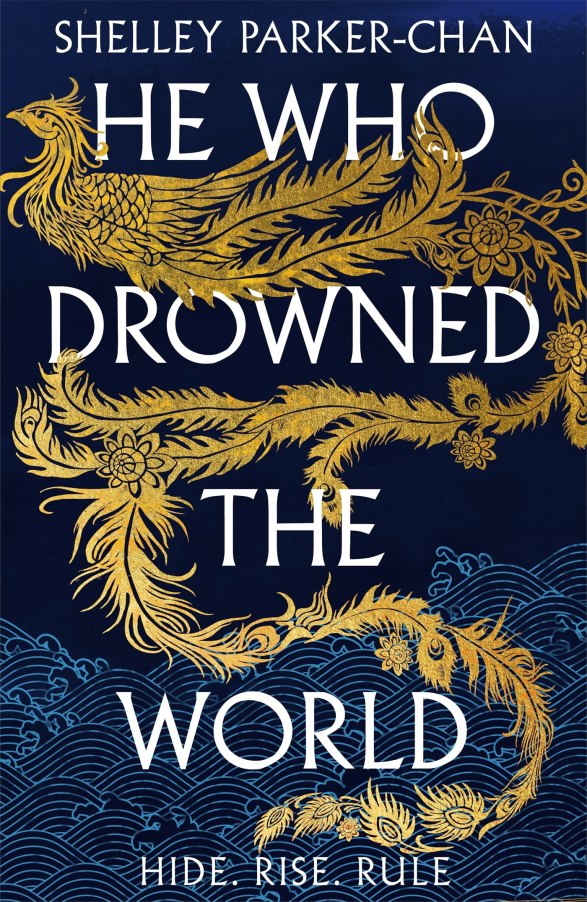
He Who Drowned The World Cover

Publisher: Mantle (Trade Paperback – 29 August 2023)

Series: The Radiant Emperor – Book Two

Length: 487 pages

My Rating: 4.5 out of 5 stars

Amazon

Rising Australian author Shelley Parker-Chan returns with the second part of her Radiant Emperor duology, He Who Drowned the World, an impressive and complex historical fantasy set in 14th century China.  He Who Drowned the World is the exciting sequel to the author’s first novel, She Who Became the Sun, which provided a compelling spin on a legendary Chinese Emperor by imagining them as a female who takes on her dead brother’s identity to achieve greatness.  She Who Became the Sun was a pretty awesome read, loaded with intriguing imagery, excellent characters, and a unique story.  I deeply enjoyed reading it when it first came out and it ended up being one of my favourite debuts and pieces of Australian fiction in 2021.  I was very excited to get a copy of He Who Drowned the World, especially as Parker-Chan does an excellent job of fishing off her epic story in a big and compelling way.

Plot Synopsis:

How much would you give to win the world?

Zhu Yuanzhang, the Radiant King, is riding high after her victory that tore southern China from its Mongol masters. Now she burns with a new desire: to seize the throne and crown herself emperor.

But Zhu isn’t the only one with imperial ambitions. Her neighbour in the south, the courtesan Madam Zhang, wants the throne for her husband – and she’s strong enough to wipe Zhu off the map. To stay in the game, Zhu will have to gamble everything on a risky alliance with an old enemy: the talented but unstable eunuch general Ouyang, who has already sacrificed everything for a chance at revenge on his father’s killer, the Great Khan.

Unbeknownst to the southerners, a new contender is even closer to the throne. The scorned scholar Wang Baoxiang has maneuvered his way into the capital, and his lethal court games threaten to bring the empire to its knees. For Baoxiang also desires revenge: to become the most degenerate Great Khan in history – and in so doing, make a mockery of every value his Mongol warrior family loved more than him.

All the contenders are determined to do whatever it takes to win. But when desire is the size of the world, the price could be too much for even the most ruthless heart to bear . . .


He Who Drowned the World
proved to be a unique and captivating novel that continued to follow former monk turned general Zhu Yuanzhang as she attempts to free China from the Great Khan, outwit her rivals, and take the throne as Emperor.  Parker-Chan dives right into this scenario as the book starts, and you are soon enthralled by the complex, multilayered story that emerges.  Thanks to the power shift from the first book, the battle for control of China turns into a fight for dominance with four armies in the field, while the shadowy Wang Baoxiang manipulates events in his favour from the shadows at the capital.  The events are shown from the various unique perspectives of the four main characters, each of whom is trying to survive and win the throne by their own methods.  I love the blend of storylines that evolved here, whether it is the main protagonist’s plan to seize her destiny no matter what, Ouyang’s destructive quest for revenge, Madam Zhang’s attempt to manipulate all the men in her life to gain power, or Wang Baoxiang’s careful and lustful politicking.  All these character arcs are deeply fun in their own right, although I must admit I found Wang Baoxiang’s storylines to be the most fascinating, mainly because he was so deliciously devious and swiftly rose up as a brilliant villain.

As the book continues, the reader is treated to some amazing story points, including Ouyang being forced to work with Zhu, who keeps winning with inventive tactics; Madam Zhang’s plots failing her left and right; and Wang Baoxiang’s malevolent rise to power, taking down everyone he gets close to.  Each of these characters gets their moment to shine, and I loved some of the interactions that emerged, especially when the characters begin to meet each other.  Zhu and Ouyang in particular play off each other perfectly, with Ouyang’s sheer anger finding no purchase with Zhu’s more Zen outlook on life, which only infuriates Ouyang more.  I really loved the part of the book that focused on the complex alliance between these two characters, and its dramatic end also works extremely well, especially as it leads to that haunting scene where Ouyang encounters his destiny only for it to destroy him.

The entire book moves at an outstanding pace, and the compelling detail, unique world-building, and fascinating characters continue to build as the novel reaches its zenith.  The final fate of Ouyang really was a major highlight of He Who Drowned the World, and the rest of the plot that follows had me hooked to the end.  The last part of the book was a little more subtle than I was expecting, but it still featured some great moments as Zhu, who is not as benevolent as you would think, sacrifices much to try and achieve victory.  The taut emotions, devastating betrayals, and determined attempts for revenge really help this conclusion stand out, and I was enthralled the entire way through.  Parker-Chan ends everything on a somewhat hopeful note, which was nice after how dark the rest of the book was, and the reader will come away from He Who Drowned the World satisfied, if a little emotionally raw and shaken.

I really must comment on the fantastic and unique setting that Parker-Chan utilised for this duology.  The overarching setting of 14th century China is pretty awesome in itself as the author worked hard to capture the unique cultural aspects of the period, such as the control by the Mongolian dynasty, while also presenting all the chaos and war that emerged when Zhu attempted to claim the throne.  However, things get even more interesting as the author works in some subtle but significant fantasy elements that really make these books standout.  These elements are all tied into a person’s right to rule as those with the will, ability and destiny are gifted with a literal Mandate of Heaven, which allows them to call forth an aurora of light and fire to show their divine right to rule.  Several key characters in the series are gifted by the mandate, and the way they use it, whether to install fear, show their divinity, or utilise it for even darker purposes, is pretty damn fascinating.  The other major fantasy element revolves around ghosts that only a few characters can see, which end up being an interesting part of the plot.  The protagonist’s ability to see and occasionally manipulate these ghosts adds a certain edge to their story, especially as it serves as a representation of their deeper guilt, regret or determination, and I felt it was a fitting character element.  The manipulation of ghosts also results in some dark scenes, especially when one of the antagonists does some horrible things to get a supernatural advantage.  This interesting blend of historical and fantasy elements really helped to give the world of these duology a fantastic and unique tinge, and I really enjoyed seeing the elaborate war story Parker-Chan set out in it.

I also enjoyed how nearly all the major characters in this book had some compelling gender and orientation feature to them, which helped to define their character and take them to some interesting places.  This includes the main protagonist taking over a male identity and entering a unique relationship with their wife, while General Ouyang deals with the shame of being a eunuch, although that doesn’t stop him from being the biggest badass in the book.  These elements were really well handled by the author, who featured them in a thoughtful and tasteful manner, and it was interesting to see how this defined them.  Parker-Chan really dove into the emotional, cultural and spiritual nature of these factors, especially in their historical context.  I particularly enjoyed how all these characters tended to rise up above the shame or taboo nature surrounding this character element, and indeed many of them used it to their advantage.  I really enjoyed seeing how well Parker-Chan utilised these elements in the plot and it made for some great representation.

I really enjoyed this distinctive and fascinating novel from Shelley Parker-Chan who produced a remarkable conclusion to her impressive debut duology.  He Who Drowned the World was a powerful, intense and complex read that really showcased the horrors of war, ambition and self-delusion.  Featuring a moving and devastating narrative, loaded with great characters and a unique take on Chinese history, He Who Drowned the World is an exceptional read and a worthy sequel to Parker-Chan’s first book.

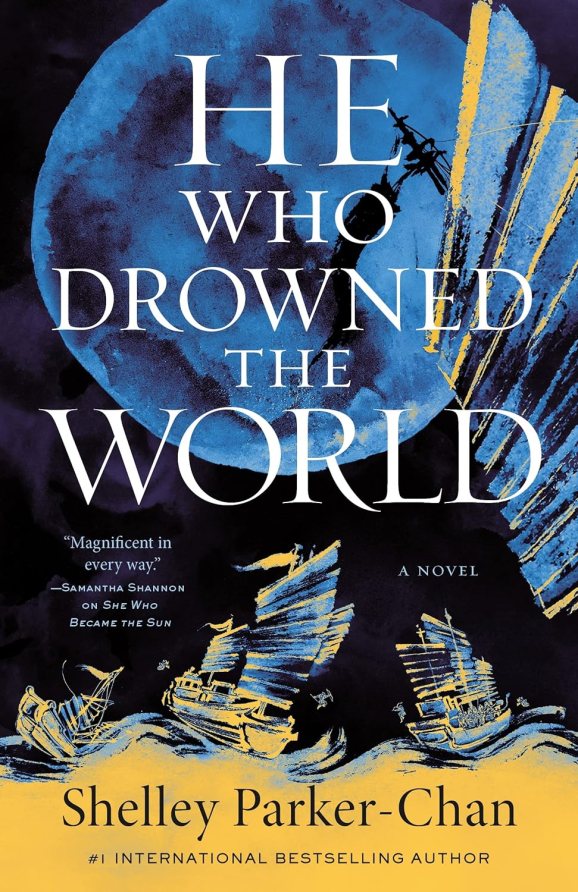
He Who Drowned the World Cover 2

Amazon

Quick Review – How to Sell a Haunted House by Grady Hendrix

How to Sell a Haunted House Cover

Publisher: Titan Books (Trade Paperback – 17 January 2023)

Series: Standalone

Length: 399 pages

My Rating: 4.25 out of 5 stars

Amazon     Book Depository

One of the leading authors of modern horror fiction, Grady Hendrix, returns with another fantastic read, this time taking on the classic haunted house tale and putting his own unique spin on it.

Few horror authors are getting the recognition these days that the intriguing Grady Hendrix is, and for very good reason.  A veteran author and screenwriter, Hendrix has made his name in recent years with his string of fun, horror-based novels, including Horrorstör, We Sold Our Souls and The Southern Book Club’s Guide to Slaying Vampires.  These outstanding novels all combined classic horror concepts with unique and entertaining scenarios that provided the author’s own twist on the subject, resulting in a ton of rave reviews.  I personally became more familiar with Hendrix when I managed to check out his 2021 release, The Final Girl Support Group.  A compelling take on the concept of final girls in horror films, The Final Girl Support Group ended up being an excellent and elaborate homage to the slasher genre that I had a wonderful time reading.  While horror isn’t my favourite genre, I was very curious when I received a copy of Hendrix latest novel, How to Sell a Haunted House and decided to see what new awesome story this inventive author has come up with.

Plot Synopsis:

Your past and your family can haunt you like nothing else… A hilarious and terrifying new novel from the New York Times bestselling author of The Final Girl Support Group.

Every childhood home is haunted, and each of us are possessed by our parents.

When their parents die at the tail end of the coronavirus pandemic, Louise and Mark Joyner are devastated but nothing can prepare them for how bad things are about to get. The two siblings are almost totally estranged, and couldn’t be more different. Now, however, they don’t have a choice but to get along. The virus has passed, and both of them are facing bank accounts ravaged by the economic meltdown. Their one asset? Their childhood home. They need to get it on the market as soon as possible because they need the money. Yet before her parents died they taped newspaper over the mirrors and nailed shut the attic door.

Sometimes we feel like puppets, controlled by our upbringing and our genes. Sometimes we feel like our parents treat us like toys, or playthings, or even dolls. The past can ground us, teach us, and keep us safe. It can also trap us, and bind us, and suffocate the life out of us. As disturbing events stack up in the house, Louise and Mark have to learn that sometimes the only way to break away from the past, sometimes the only way to sell a haunted house, is to burn it all down.


How to Sell a Haunted House
was an interesting and complex book from Hendrix that I had a great time getting through.  Focused on his damaged protagonists and the horrors that they have experienced, both in their house and in their lives, this ended up being a particularly deep and moving novel that will get its hooks into you extremely early and refuse to let go.

I honestly wasn’t too certain what to expect from How to Sell a Haunted House when I started reading it, and the book went in some very interesting and surprising directions.  Told over a series of acts based on the stages of grief, this book is initially told from the perspective of Louise Joyner as she returns home after the sudden death of her parents to try and deal with both the funeral and the fate of her childhood home, only to run straight into the emotional wall that is her slacker brother, Mark.  Both have a lot of baggage, especially when it comes to each other, and their initial hostile encounters perfectly set the scene for the family drama that is to come.  The horror elements of How to Sell a Haunted House are initially a little muted, which allows the tension and threat to gently simmer and rise, as the reader knows stuff is going to break down eventually.  The house in question, with its multitude of puppets (so, so many puppets), boarded up attic, freaky occurrences, and more, lends a layer of threat that really sets the scene for the rest of the book.  Despite this, the start of How to Sell a Haunted House is a little slow and I had a bit of a hard time really getting into it.  However, it is really worth continuing into the meat of the story, as Hendrix has a brilliant story ready for you.

The intriguing drama slowly builds as the book continues, and the reader is introduced to the masses of baggage between Louise and Mark.  This becomes a big part of the book’s plot and soul, and you really get drawn into their very complex relationship which has been influenced by events outside of their control without them even realising.  Other compelling family elements are thrown into the mix at this point as well, and these slowly boil up throughout the book and influence the conclusion in some clever ways.  It doesn’t take long for the major horror elements of the book to fully take over and partially distract the reader away from Louise and Mark’s many personal issues.  The focus of what is causing the chaos in their house is expertly revealed, and the revelation is very freaky, especially when you fully understand what it is and how it has affected the protagonists all these years.  I really loved how Hendrix blended the complex family ties of the protagonists with the disturbing presence in their house, and it results in a particularly impressive, character-driven story.  There are some great early confrontations with this presence which Hendrix showcases extremely well, emphasising the physical, spiritual and emotional danger that comes with each encounter, as well as the hidden revelations that are simultaneously brought to the surface.  There are some fascinating moments set around these encounters, and I loved how there was a constant focus on family throughout, as well as a surprisingly detailed look at the history of puppets (seriously, you will never look at puppets again after this book).

Hendrix brings everything to an excellent and crashing crescendo which left me with a real appreciation for the author’s impressive imagination and writing ability.  There is an excellent false victory for the protagonists, which comes at such a substantial cost that you almost believe it could be the end.  However, the full evil is yet to come, and after a great reveal sequence, you realise just how insidious the force they are facing truly is.  The way that the story wraps up is pretty scary in places, but it is also extremely heartfelt and emotionally impactful, as family history and complex character dynamics come full circle.  I ended up getting really caught up in the story behind How to Sell a Haunted House, even though horror isn’t my preferred genre, and I loved all the emotional storylines and character arcs that were brought together as a result.

This is an overall pretty exceptional read, and I am glad that I took the time to check out Hendrix’s new book.  How to Sell a Haunted House is a must read for all those familiar with Hendrix unique and powerful style, and new readers will have a blast getting caught up in the author’s immense inventiveness.  A strongly recommended read that will stick with me for a very long time.

Amazon     Book Depository

Warhammer 40,000: The Vincula Insurgency by Dan Abnett

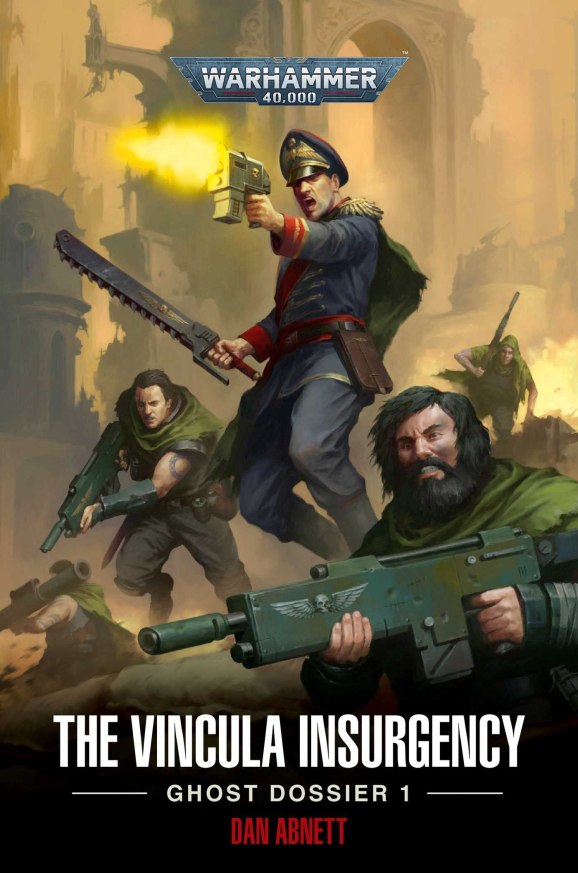
The Vincula Insurgency Cover

Publisher: Black Library (Audiobook – 21 May 2022)

Series: Ghost Dossier – Book One

Length: 6 hours and seven minutes

My Rating: 4.5 out of 5 stars

Amazon     Book Depository

One of the leading authors of Warhammer fiction, Dan Abnett, returns to his iconic Gaunt’s Ghosts franchise in a big way with the compelling military thriller, The Vincula Insurgency.

Few people have excelled at tie-in fiction in the same way that acclaimed author Dan Abnett has over the years.  Not only has he written multiple awesome comics and several original novels but he has contributed tie-in books to several different fandoms, including Doctor Who and Tomb Raider.  However, his most significant work has easily been within the Warhammer extended universe.  Abnett has produced a ton of impressive and compelling Warhammer novels over his career in both the Warhammer 40,000 and Warhammer Fantasy sub-series.  Some of his more notable works include some cool-sounding Warhammer comics, the Tales of Malus Darkblade novels (I’ve got a copy on my shelf waiting to be read), and some major Warhammer 40,000 novels, including multiple entries in the massive The Horus Heresy series, as well as his Eisenhorn, Ravenor and Bequin novels, which together paint one of the most complete pictures of the Imperial Inquisition).  However, I would say that his most notable series is probably the Gaunt’s Ghosts series of novels.

Set in the Warhammer 40,000 universe, the Gaunt’s Ghosts novels are part of the larger Sabbat Worlds crusades arc of fiction (which have come out of this series) following a unique regiment of soldiers, the Tanith First and Only.  The Tanith First and Only, also known as Gaunt’s Ghosts in respect to their commander, Colonel-Commissar Ibram Gaunt, are a highly skilled unit who specialise in stealth and scouting missions.  Their planet, Tanith, was destroyed shortly after their formation, hence the designation First and Only.  The Gaunt’s Ghosts series follows their battles through the Sabbat Worlds as a major part of the crusades.  This series began back in 1999 with the awesome novel, First and Only, and the latest novel, Anarch, (book 15) came out in 2019.  Generally considered one of the most iconic and compelling series in the Warhammer 40,000 universe, I have been meaning to properly read this series for ages, although so far I have only had the chance to check out First and Only.  However, Abnett recently revisited this series with the intriguing The Vincula Insurgency.  The first entry in Ghost Dossier series, which presents never-before-seen stories of the Ghosts, The Vincula Insurgency acts as a prequel to the main series and tells an impressive and fun new tale of the early regiment.

Before the battles that would make them famous throughout the Sabbat Worlds Crusades, the Tanith First and Only, under the command of Colonel-Commissar Ibram Gaunt, are still coming together as a unit.  After fighting a gruelling campaign on the planet of Voltemand, politics has forced the Tanith to remain and take over security for a backwater agricultural province and its capital, Vincula City.  Determined to get off-world and back to the frontlines, Gaunt and his regiment grudgingly prepare for the arrival of a new provincial governor and his administrators.  However, life is about to get very interesting for the Tanith forces.

A highly skilled and deadly insurgency movement has emerged within Vincular City, determined to cripple the Imperial forces within and disrupt their ability to assist the rest of the crusade.  After a series of brutal bombings, Gaunt and his troops attempt to keep the peace within the province.  However, their actions are countered at an impressive rate by the local insurgency elements, who are receiving outside help and training from a dangerous opponent who knows all the Tanith’s tricks.  Can Gaunt and his unit pull together to defeat this deadly foe?  And what happens when they discover that their mysterious opponent is linked to the Ghost’s long-dead planet?

This was another extremely awesome Warhammer novel from Abnett who has produced an intense and clever prequel to his existing Gaunt’s Ghosts novels.  The Vincula Insurgency is a relatively short novel, with a somewhat compressed story.  However, despite this length, Abnett manages to achieve quite a lot.  Not only does it set up plot points for the main series, but it also features a brilliant and very entertaining self-contained narrative that is guaranteed to keep the reader entertained.  Shown from the perspective of several of your favourite Ghosts, the author tells an excellent story that sees the protagonists under attack from a well organised insurgency group.  This results in a very fast-paced narrative that perfectly brings together the science fiction Warhammer 40,000 elements with a military thriller storyline as the Ghosts attempt to overcome the enemy attacking them from all sides.  The action flies thick and fast here, and features some impressively written battle sequences that really drag you into the heart of the fighting.  In addition, the author keeps the tension levels high throughout most of the story, and the feeling that some bad things are about to happen is never far from the reader’s mind.  The multiple character driven storylines come together extremely well within The Vincula Insurgency to create a comprehensive and powerful narrative, and I really appreciated some of the unique story elements that Abnett came up with.  This cool novel ends on an interesting note, and I will be quite intrigued to see what additional new Gaunt’s Ghosts’ stories Abnett has planned.

This was a very interesting addition to the Warhammer canon as Abnett dives back into the earlier days of his established series.  The Vincula Insurgency serves as an excellent prequel to the Gaunt’s Ghosts series, and it was great to see more of the early history surrounding this awesome unit.  Abnett makes sure to load up the book with a ton of references and hints of the events that are to come in the series, which established fans will really appreciate.  However, even those readers who are unfamiliar with the Gaunt’s Ghosts series can have fun here, as Abnett tells a very inclusive narrative that anyone can enjoy, with plenty of exposition about who the Tanith are and what is happening in the Sabbat Worlds Crusades.  Indeed, The Vincula Insurgency serves as a very good introduction to the series’ characters and storylines, and many readers could use this as a jumping point into the main Gaunt’s Ghosts novels.  Abnett also takes this opportunity to do an interesting bit of lore expansion with the Tanith troops.  Due to certain plot points, the characters dive into the Tanith culture and history, which proves to be very fascinating, especially when it may connect to a new enemy.  This also serves as a very good introduction to the wider Warhammer 40,000 canon, especially as it showcases the common trooper’s role in this chaotic universe.  I often say that stories about the common Imperial soldiers result in some of the best Warhammer 40,000 novels (Steel Tread and Krieg for example), and this was extremely true in The Vincula Insurgency.  Abnett really nails the feel of an armed insurgency in the Warhammer 40,000 setting, and the parallels between the battles in this book and in some real-world conflicts are pretty uncanny (think Iraq or Afghanistan with laser rifles).  An overall excellent addition to both the Warhammer and Gaunt’s Ghost canon that is really worth checking out.

I had a lot of fun with the characters in The Vincula Insurgency, especially as Abnett features slightly younger versions of all your favourite original Gaunt’s Ghosts protagonists.  This is a slightly different version of the Ghosts that you have seen before, as they are still coming together as a regiment and aren’t yet a fully cohesive team.  Abnett does a brilliant job featuring multiple key Gaunt’s Ghosts characters in this book, with many getting their own distinctive storylines.  I liked his portrayal of unit leader Colonel-Commissar Ibram Gaunt, who is still relatively new in his command of the regiment.  While he is still incredibly confident, skilled and an absolute badass, it was interesting to see a few differences here, such as his inability to remember the names of the members of his unit.  Other key characters include Colonel Colm Corbec, the regiment’s second in command who is sent on an alternate mission for most of the book where he learns all the joys of interacting with the upper echelons of the Imperial Guard.  Major Elim Rawne, the rebellious member of the unit has a great outing in this book, not only showcasing his established resentment for Gaunt, but also featuring him in an intriguing romance with an Administratum official that deeply impacts him.  Brin Milo, the youngest member of the Tanith, also has a major arc in this book, with the novel focusing on both his uncanny insights, and his rise to become Gaunt’s official aid.  Other characters who get some good showings in this book include Ceglan Varl, Bragg, Tolin Dorden, Oan Mkoll, and more, with all of them getting their moment to shine in this book.  I had a brilliant time seeing earlier versions of these great characters, and Abnett clearly had fun revisiting them and showcasing their older attitudes.

I ended up grabbing The Vincula Insurgency audiobook, which proved to be an excellent adaptation of this book.  With a runtime of just over six hours, listeners can really speed through The Vincula Insurgency audiobook, and the story just flows along, especially with the impressive narration from Toby Longworth.  Longworth, who is one of the more prolific Warhammer narrators, having voiced all the previous Gaunt’s Ghosts novels, is a very talented voice actor who brilliantly brings this compelling story and its great characters to life.  Not only does he address every bit of action and exposition for a powerful and impressive tone, but each of the characters are given their own distinctive and fitting voice throughout the book.  I particularly liked how he gave all the Tanith characters similar accents to denote that they all come from the same planet, and it was a very nice touch, especially as it contrasts well with the various non-Tanith characters, some of whom have other, often strongly European, accents.  This incredible voice work really helped to drag me into this captivating story, and I found myself getting a lot more invested in the characters and the plot as a result.  Easily the best way to enjoy The Vincula Insurgency, this audiobook comes highly recommended.

The always impressive Dan Abnett returns with another awesome addition to his fantastic Gaunt’s Ghosts series with The Vincula Insurgency.  Featuring an outstanding and exciting prequel narrative, The Vincula Insurgency takes an earlier version of the Tanith First and Only on an intense and action-packed adventure in captured enemy territory.  Tense, fast-paced, and loaded with compelling characters, The Vincula Insurgency is an excellent and highly enjoyable Warhammer 40,000 novel that will appeal to wide range of readers.

Amazon     Book Depository

Three Assassins by Kotaro Isaka

Three Assassins Cover

Publisher: Harvill Secker (Trade Paperback – 14 April 2022)

English Translation: Sam Malissa

Series: Standalone

Length: 254 pages

My Rating: 4.5 out of 5 stars

Amazon     Book Depository

Legendary Japanese author Kotaro Isaka brings us another fast-paced, intriguing and unique thriller with the English release of Three Assassins.

Last year I was lucky enough to receive a copy of the first English translation of Kotaro Isaka’s 2010 novel, Maria Bītoru (Maria Beatle), which was released in the Western world as Bullet Train ahead of a movie adaptation of the same name.  I had a lot of fun with this impressive novel which set several distinctive and crazy assassins against each other aboard a speeding bullet train.  Now, with the Bullet Train film only a couple of months away, an English version of another of Isaka’s novels, the 2004 novel Gurasuhoppā (Grasshopper) has just been released.  This novel, translated by Sam Malissa and released under the title Three Assassins, presents another intense and clever thriller read that was incredibly fun to read.

Suzuki is a former schoolteacher who has joined the notorious Tokyo criminal gang, Fräulein, to get revenge for his dead wife by killing the murderous son of the gang’s leader.  However, his revenge mission goes downhill when, moments before his flimsy cover is blown, his target falls onto the road and is run over by a van.  With the shocked gang watching on, Suzuki is sent to chase after someone he sees fleeing the scene, who the gang believes killed the leader’s son.

Convinced the man responsible is the elusive assassin known as the Pusher, Suzuki’s Fräulein contact demands that he reveal the location of the person he followed.  However, Suzuki is uncertain about whether the man is actually responsible or just a random passer-by, especially when he meets the man’s young family.  But with the gang determined for revenge, Suzuki must decide whether to pass on the information or attempt to flee for his life.  Worse, his actions have attracted the attention of other notorious assassins, each of whom have their own reasons for hunting down the Pusher.

The Whale is deadly and forlorn soul who can convince anyone to kill themselves just by talking to them, while Cicada is a talkative and deadly knife expert.  The Whale wants revenge on the Pusher for his part in a prior death, while Cicada is determined to make his own rep by killing this notorious assassin.  Both are determined to find Suzuki and have him lead them to the Pusher by any means necessary.  Can Suzuki survive the barrage of killers, gangsters and monsters being unleased upon him, or will he be forced to compromise his principles and morals to survive?

This was an awesome and exciting novel from Isaka that proved to be extremely fun to read.  Written in Isaka’s distinctive style, and featuring some unique twists, turns and characters, Three Assassins is an entertaining read that I powered through in a day and which is really worth checking out.

Three Assassins has a brilliant fast-paced story to it that readers will swiftly become addicted to.  Written in a distinctive style that emphasises odd character traits and relies heavily on intriguing anecdotes, you are quickly introduced to three captivating point of view characters: Suzuki, the Whale and Cicada.  All three have unique and compelling storylines: Suzuki is thrust into survival mode as he hunts for the elusive Pusher, the Whale is involved in political assassinations before being forced to turn on his employer, while the wildcard Cicada balances his killing desires with frustrations with his overbearing boss.  These storylines soon start to come together when the Whale and Cicada learn about Suzuki’s situation and his apparent connection with the infamous Pusher, and both try to get their hands on Suzuki before the gang does.  However, nothing is as it seems, and all three must battle with their own demons (literally in the case of the Whale), while also trying to outsmart each other and some of the other unique people populating the streets of this version of Tokyo.

All three separate character-driven storylines come together perfectly as the story progresses, and you will love seeing these amazing characters interact as each reaches their own unique destiny.  There are several fantastic and impressive confrontations towards the later part of the book, as well as some great twists, the best of which will leave you reeling and completely change how you viewed the first three quarters of the novel.  While I saw a couple of twists coming, I was pleasantly surprised by several of the reveals, revelations and story turns that occurred, and there are some fantastic moments scattered throughout this book.  I loved how fast-paced Three Assassins turned out to be and there is honestly not a single slow moment to be found as you get through it.  That, combined with its shorter length, will encourage readers to power through it in a very short amount of time, and you will not be disappointed when you see what happens with this entertaining and amusing story.

Like Bullet Train, Three Assassins is a standalone novel that requires no familiarity with any of Isaka’s previous novels to appreciate the clever story or intense action.  It does however have some interesting connections to Bullet Train that fans will really appreciate.  Three Assassins is noticeably written in a similar style to Bullet Train, with a familiar plot focused on multiple unusual Tokyo assassins, as well as certain unique types of characterisations, interactions and writing flow.  These similarities are intentional as the original Japanese version of Three Assassins, Grasshopper came out several years before Maria Beetle.  This means that Three Assassins is actually a precursor to Bullet Train, hence the stylistic similarities.  As such, Three Assassins features a couple of characters who would end up having minor roles in Bullet Train, such as the Pusher, who has a few short point-of-view chapters as the character Morning Glory in Bullet Train, and the assassin duo known as the Hornet.  I have to admit that when I read Bullet Train, I did wonder about why these characters were featured, as some relevant context appeared to be missing.  However, after reading Three Assassins I see that they were there as a reference to this preceding novel and you actually get to understand their role in Bullet Train a little better after reading this book.  I really liked the cool connections this novel had to Bullet Train, and it is really worthwhile checking Three Assassins out alongside it.  While I do think that I preferred Bullet Train a little more than Three Assassins, as its story was stronger and the characters a little more entertaining, Three Assassins really stands on its own and proves to be an excellent read.

Isaka clearly had a lot of fun with the awesome characters contained within Three Assassins, as this book features an eclectic mix of unusual and entertaining figures who make Tokyo’s underworld seem like a weird and deadly place to explore.  This novel is primarily anchored by its three main point-of-view characters, each of whom is a particularly complex and unique being that will quickly drag the reader in with their intriguing stories or antics.  This includes central character Suzuki, the former teacher turned attempted gangster, who is initially involved with this plot for revenge, and who has done some dark things in order to get there.  However, when the target of his revenge is killed and Suzuki seems to find the life of the Pusher and his family in his hands, he starts to have a real crisis of conscience and must determine what he really wants to do.  Watching him attempt to weigh up the lives of the family he encounters versus some hostages Fräulein potentially has is extremely intense and results in some major examinations of his conscience.  Suzuki also serves the role of the unenlightened character for most of the book as he is mostly ignorant of the various assassins and outrageous characters running around out there.  As such, he serves as a good introductory character for many of these unique world elements, and it was very entertaining to see him interact with some of the other characters for the first time without a clue about who or what they are.

The Whale and Cicada are both complex and weird figures for very different reasons.  The Whale is a highly unusual assassin who specialises in arranging deaths to look like suicides.  A large man with an unnatural aura, the Whale is “blessed” with a near supernatural ability to talk people into killing themselves.  This is a pretty unique and cool character trait which Isaka does a wonderful job portraying throughout Three Assassins.  Watching this character slowly and calmly talk various characters into killing themselves results in some naturally dark scenes, but they are a great part of the book and really add something to the distinctive feel of the book.  At the same time, Isaka tries to humanise the Whale to a degree by showing him to be haunted by the ghosts of everyone he has killed.  These ghosts routinely appear before him, airing their grievances with him while also blotting out his ability to see other people or things.  This serves to be an intriguing handicap for this otherwise unstoppable figure, and it proved fascinating to see this merciless killer face some substantial reservations about his work and slowly start to rethink his life and choices.  The Whale easily has some of the most complicated and intriguing scenes in the entire novel and it proves extremely fascinating to see his entire arc unfold.

Cicada, on the other hand, is a somewhat less complex figure who serves as the book’s comic relief.  A skilled knifeman who lacks empathy, Cicada has earned a reputation as a man who can take on the unpleasant jobs and is often hired to kill women and children.  However, Cicada finds himself in a very hostile working relationship with his boss and handler, Iwanishi, who treats him poorly.  This toxic relationship becomes the imperative for Cicada to engage in the hunt for the Pusher, as a form of finding his own independence, although nothing goes to plan.  Cicada is an excellent and enjoyable character, and you will quickly find yourself getting attached to the quick-talking killer, even when he does some terrible things.  The most physically gifted of all the characters, Cicada is often dragged into some of the book’s best fight scenes, and it was exciting to see his knife skills in action.  Thanks to his unique humour and continual banter, Cicada proves to be a great counterpoint to the book’s darker or more emotionally distressed characters like Suzuki and the Whale, and I think that his inclusion really helped to balance out the tone of the book.  All three characters and their chapters play off each other extremely well, and they help to form a captivating and amusing overall story.

Three Assassins was another awesome read from Kotaro Isaka that takes readers on a wild and exciting journey to Japan’s outrageous underworld of assassins.  Filled with quirky characters, surprising turns and intense action, this is a fantastic novel and you will swiftly get addicted to its entertaining and captivating story.  A must read for fans of this legendary Japanese author, especially in advance of the upcoming Bullet Train film, Three Assassins comes highly recommended and is really worth checking out.

Amazon     Book Depository

Throwback Thursday – Trollslayer by William King

Trollslayer Cover 2

Publisher: Games Workshop (Audiobook – August 1999)

Series: Gotrek and Felix – Book One

Length: 9 hours and 55 minutes

My Rating: 4.5 out of 5

Amazon     Book Depository

Welcome back to my Throwback Thursday series, where I republish old reviews, review books I have read before or review older books I have only just had a chance to read.  In this latest Throwback Thursday article, I review a classic Warhammer Fantasy novel, the iconic Trollslayer by William King.

Over the last year or so, I have started to get back into the exciting and captivating extended universe that surrounds the Warhammer tabletop game franchise.  The Warhammer games are a lot of fun to play, but I have always deeply enjoyed the rich and extensive universe that has formed around it.  This is particularly true when it comes to the extensive literary world that has been created, with a huge collection of unique novels added every year.  I personally have barely scratched the surface of this franchise, having only recently read the exciting Space Marine novel Deathwatch: Shadowbreaker, and the fun crime novel Kal Jerico: Sinner’s Bounty.  For this review, however, I veer away from the science fiction based Warhammer 40,000, and instead look at a book in the Warhammer Fantasy universe.

The Warhammer Fantasy universe is set on a fantasy world where various races and factions fight for power, immortality, dark deities, and a general desire for bloodshed (Blood for the Blood God, Skulls for the Skull Throne!) in both large-scale battles and smaller skirmishes.  I love the fantastic and thrilling world of Warhammer Fantasy, especially as I used to play (my preferred factions were the Empire and the Lizardmen).  While there are many great novels set in this universe, the most recognisable and well-established series are the Gotrek and Felix books.

The Gotrek and Felix novels are some excellent dark fantasy books that follow the titular heroes, Gotrek Gurnisson and Felix Jaeger, as they traverse their world, facing every single monster, demon or villain they can find.  Created by William King, this long-running series has also been authored by fellow writers Nathan Long, Josh Reynolds and David Guymer, the last of whom has just released the latest entry, Gitslayer.  I have always heard good things about this series over the years, and I have previously enjoyed some of the short stories featured online or in the White Dwarf magazine.  As a result, when I had the brainwave to expand my knowledge of the Warhammer canon, this is one of the main series I wanted to check out, and to do so properly, I had to start with the original novel, TrollslayerTrollslayer, which was originally released in 1999, is an interesting novel that features seven original Gotrek and Felix short stories, including Geheimnisnacht, which was originally written as a one-off in 1988.  These seven stories have been bundled together into one continuous narrative, which proves to be an excellent and entertaining fantasy adventure.

Trollslayer Cover

Felix Jaeger, the son of a wealthy merchant and student in the Imperial capital Altdorf, used to live a blameless and dull life until he met the deranged Gotrek Gurnisson.  The son of a wealthy merchant and student in the Imperial capital Altdorf, Felix’s life was changed forever when Gotrek saved his life.  Gotrek is a Slayer, a dwarf who, after committing a terrible crime, has sworn to seek out a glorious death in battle, and who now wanders the world to find a foe worthy of killing him.  After a particularly damaging night of drinking, Felix drunkenly swears to follow him on his adventures to compose an epic ballad about Gotrek’s glorious death.

Bound by his oath, Felix now reluctantly accompanies Gotrek wherever he goes.  Their latest adventures will take them far and wide, as they venture throughout the Empire and beyond, travelling to the notorious holdings of the Border Princes, the mountainous realms of the dwarves and even under the halls of the conquered dwarf city of Karak Eight Peaks.  While they experience many unique discoveries and locations, one thing remains the same: enemies lurk around every corner, and Gotrek and Felix are forced to battle against some of the most dangerous creatures in existence, including orcs, goblins, trolls, the undead, mutants, beastman and more.

However, the most dangerous foe they face may be something far more insidious and unknowable.  The fell powers of Chaos are gathering throughout the land, and Gotrek and Felix seem to constantly become wrapped up in their plots and vile missions.  With danger and deadly foes all around, will Gotrek find the glorious death he seeks, and will Felix be able to survive whatever might foe eventually manages to kill his companion?

Wow, that was a cool novel I really should have read years ago.  Trollslayer was a fantastic and exciting novel that does a great job exploring some of the more dangerous settings in the Warhammer Fantasy world with two amazing characters.  Featuring seven dark and compelling short stories, Trollslayer is an outstanding book, and I had an incredibly fun and entertaining time getting through its audiobook format.  Banded together by some journal entries which bring the separate stories together, Trollslayer has a fantastic joint narrative that presents the reader with a collection of epic adventures.

TrollSlayer-john-gravato-Gotrek-and-Felix-1st-edition-cover

The book begins with the original Gotrek and Felix short story, Geheimnisnacht (Night of Secrets).  The two companions are stuck out in the dangerous forests of the Empire during Geheimnisnacht, an auspicious night of the year.  After nearly being run over by a dark carriage on the road, Gotrek and Felix investigate the actions of a dangerous Chaos coven out in the woods, and find more than they bargained for.  This is a rather entertaining and short entry in Trollslayers that serves as a fun introduction to the main protagonists and their quest.  King does a great job setting up both characters and you soon get a fantastic glimpse into their compelling personalities.  The author presents a very dark story within this first tale, as the heroes discover and fight the true horrors of chaos.  An excellent and intense opening story that will get you pumped up for the rest of the book.

The next entry contained within Trollslayer is called Wolf Riders, which sees Gotrek and Felix at the very edge of the Empire with plans to venture to the fallen dwarf stronghold of Karak Eight Peaks.  After encountering a beautiful young woman, Felix convinces Gotrek to join the doomed expedition of a cursed, banished noble family as they journey to the Border Lands to set up their own settlement.  Hired on as guards, the two heroes are forced to protect the caravan against a ravenous Greenskin horde, who are determined to destroy every one of them.  However, the true threat may lie within the convoy, as it soon becomes clear that someone has their own nefarious plans to kill everyone journeying with them.  Wolf Riders is an incredible second entry in the collection of stories, and it is easily one of the best tales in Trollslayer.  Not only does it reinforce the likeability of the two protagonists, but it also contains its own compelling and impressive narrative.  King manages to achieve a lot in Wolf Riders, introducing a cohort of great characters, showing several intense action sequences, and even presenting a clever and malicious mystery.  The entire narrative comes together extremely well, and readers are soon wrapped up in the compelling tale of redemption and bloodshed, which culminates in a tragic and memorable ending that forever changes one protagonist.

The third story is The Dark Beneath the World, which follows on immediately after Wolf RidersThe Dark Beneath the World sees Gotrek, Felix and some new companions journey into the dwarf stronghold of Karak Eight Peaks, which was infamously conquered by greenskins and Skaven in ages past.  Seeking treasure, holy relics and a glorious battle, the adventurers will face untold horrors in the halls beneath the city.  However, nothing will prepare them for the true dangers of Karak Eight Peaks, as the restless dead are stirring in response to a monstrous presence.  This was another great story that really highlights have exciting and action packed one of these stories can be.  I love how King takes his great characters right into the heart of one of the most iconic and dangerous settings in the entire Warhammer canon, and it proves to be an amazing backdrop to this compelling story.  A brutal hack and slash epic with some very intense moments, this is an excellent and fast-paced addition to Trollslayer that was an extremely thrilling read.

From powerful action to great humour, the next entry is the slightly shorter The Mark of Slaanesh.  This story sees Gotrek and Felix return to the Empire, where they encounter some malicious cultists of the Chaos god Slaanesh in a small town.  Unfortunately for Felix, Gotrek is suffering from amnesia after a blow to the head.  Forced to shepherd a docile Slayer through the town’s many dangers, Felix takes drastic action to bring his friend back to his senses.  The Mark of Slaanesh represents a very intriguing change of pace, with more of a focus on humour, as a weary Felix is forced to contend with a pacifist Dwarf Slayer, an eccentric doctor, and comedic mutants.  There are several extremely funny moments in this short story, which helped to turn The Mark of Slaanesh into one of the most entertaining entries in the entire novel.  I particularly appreciate how King was able to craft together such a despicable central antagonist in quite a short period of time, and it was great to see his implied comeuppance towards the end of the story.

King again rapidly switches gears with the next entry in the book, Blood and Darkness, a grim war story set in the darkest forest in the Empire.  This story sees Gotrek and Felix come across a ravished village within the Drakwald Forest, which has been utterly destroyed by beastmen.  Finding a young survivor, Kat, Gotrek and Felix escort her through the woods to the next village.  However, a vengeful and ambitious champion of Chaos is close behind them, with unholy plans for Kat and anyone else she comes across.  Blood and Darkness is another exceptional entry in the series, which is probably my overall favourite Trollslayer story.  Loaded with action, fantastic new characters and a particularly gruesome premise, Blood and Darkness really stands out from some of the other stories in this book, and I was blown away by how dark King made the narrative.  I really loved the story’s complex antagonist, and the entire plot surrounding Kat comes full circle in a great way.  While it is a tad creepy to see just how young Kat is in this story, especially as Felix apparently falls in love with her in a future novel (she gets aged up like 20 years before this happens, but it is still weird), this was an impressive and powerful story that really showed how complex, powerful and mature a Warhammer story can be.

The penultimate story in Trollslayer is The Mutant Master, which again switches pace and has a more humorous tilt to it.  After being attacked on the road by a swarm of mutants, the protagonists arrive at a struggling village and soon discover that the mutants are being controlled by a sorcerer in a nearby tower.  Betrayed by the villagers, Gotrek and Felix find themselves as prisoners and soon must deal with an insidious sorcerer who shares a history with Felix.  This was another great short story that places the protagonists into a uniquely dangerous position.  King includes some excellent humour in this novel, especially in the scene where Felix and the sorcerer have a very entertaining encounter, which proves that everyone, even dark sorcerers, fall to pieces when encountering former classmates.  While much of this story is dedicated to humour, the author fits in a particularly dark moment towards the end of the novel, which pushes one protagonist further than ever.  Another awesome and memorable story, I powered through this one extremely quickly.

The final entry in this book is the intense Ulric’s ChildrenUlric’s Children sees Felix trudging through a snowed-in forest, attempting to escape the cold and the wolves.  When they hear the sounds of a fight up ahead, Felix gets separated from Gotrek, and ends up getting captured by a dangerous group of soldiers.  The soldier’s leaders end up being revealed as cultists of the Chaos god Tzeentch, who are desperate to capture a mysterious family living nearby, who have strange powers and strengths.  Caught up in their conflict, Felix soon finds himself trapped in a manor house with two very different monsters and must try to overcome the powers of Chaos that threaten to consume him.  This was another fantastic story that serves as a great conclusion to the entire novel.  While I think that Ulric’s Children was one of the weaker stories in Trollslayer, it was still a compelling and thrilling tale which readers will enjoy.  I loved the inclusion of werewolves in this novel and it was fun to see Felix attempt to overcome a dangerous foe without Gotrek’s determined backup.  With some intriguing foes and an exciting story, this is a fun and fantastic entry in the book which will leave readers wanting more Gotrek and Felix in the future.

King really has loaded Trollslayer with an amazing range of different stories that highlight the gritty adventures of two memorable and loveable characters.  I had a great time getting through each of the short stories contained within this novel, and I think that the author did a good job combining seven shorter stories together into one cohesive tale.  I love how each of the stories has some impressive action set pieces, and readers are given an in-depth look at the true dangers and darkness that inhabits the Warhammer world.  King has also ensured that each tale contains a compelling blend of humour, dramatic character development and dark fantasy elements, all of which produce an outstanding overall narrative.  It was also very cool to see just how dark and gruesome King could make his narratives, and quite a few elements of this book closely bordered the horror genre.  Since the stories were originally published in instalments, readers are in for some repetition, especially as King rehashes Gotrek and Felix’s origin in every entry, and you also get quick summaries of their prior adventures.  While this and other pieces of repetition (for example, Gotrek runs his finger over his axe blade in every tale) can be a bit annoying at times, I personally thought it was a small price to pay for such an awesome and epic book.

One of the most impressive things about Trollslayer is the complex and distinctive characters.  Naturally, the main characters are series protagonists Gotrek Gurnisson and Felix Jaeger, both of whom prove to be really fantastic and exciting characters.  King has come up with an exceptional pairing in these two characters, and I absolutely love the combination of a doomed dwarf Slayer and a disgraced human with a penchant for poetry.

As the primary narrator of the separate stories in this book, Felix gets a great deal of attention, and you really get to grips with his superb character throughout the book.  I loved the depiction of a former arrogant dandy who finds himself in a situation well over his head, and Felix has a “fun” time facing off against all sorts of monsters in this book.  While most of the novel depicts him as a bit of a coward, Felix does manage to achieve some major heroics and you cannot help but sympathise with the terrible situations he finds himself in.  While the use of multiple short stories does tend to backslide Felix’s character at times (he reverts to a coward at the start of each story), I did enjoy seeing some of the excellent development that occurs around Felix.  Not only does he grow more confident in his own abilities, but he also becomes harder with each adventure, especially as he experiences tragedy and despair around every corner.  It was actually hard to see how some of the more tragic events of the book affected him, but I really appreciated the amazing character work that King worked around him.

The titular Trollslayer, Gotrek Gurnisson, is one of the most beloved figures in Warhammer Fantasy lore, and a magnificent character who I really enjoyed.  Much of Gotrek’s past is shrouded in mystery, and all you really know is that he is a mighty warrior who previously committed some great crime that still haunts him to this day.  Determined to find a glorious death, Gotrek willingly walks into the most dangerous of places, but always survives, much to his displeasure (even doomed dwarves are far too stubborn and proud to simply let an enemy kill them).  King mostly paints Gotrek as a crude, rude and bloodthirsty being, which is a lot of fun to see.  However, there is so much more to Gotrek than killing and fighting, and you see several glimpses of his true inner self in this book, especially when he thinks about the past.  I loved how King keeps Gotrek as a mostly enigmatic figure, mostly by not showing any of the story from his point of view, and the reader is never quite sure what he is thinking or planning.  All of this results in an excellent and memorable protagonist, and I am deeply intrigued to see what sort of adventures he has in the future, as well as any revelations about his past.

Aside from Gotrek and Felix, Trollslayer contains a range of interesting and compelling characters, several of whom act as point-of-view figures at various parts of the book.  King does a really good job of introducing and utilising so many unique figures throughout his various stories, and it is simply amazing how well he can develop and establish his character in such a short amount of time.  Even though you only see some characters for a few pages, you quickly become quite invested in their stories, which is the sign of a really good author.  However, readers are advised not to get too attached to anyone, as most of the side characters will come to a gruesome and tragic end.  Still, these supporting characters are really fun, and I look forward to seeing what unique figures are introduced in future Gotrek and Felix books.

Trollslayer also features the dark and well-established background setting of the Warhammer Fantasy world, with the protagonists adventuring through many iconic locations.  King makes excellent use of this fantastic background throughout his story, and I loved seeing all the cool locations, interesting factions and dangerous monsters contained within the story.  This actually serves as a really good introduction to the Warhammer Fantasy world, and readers unfamiliar with the various aspects of Warhammer will learn a lot here.  King can really craft together some dark and dangerous locations with his writing, and I love how spooking and claustrophobic some of his settings felt, especially the ancient dwarven catacombs and the haunted, monster infested forests.  I also loved the sheer range of different creatures and races featured within Trollslayer, as the author includes as many foes as possible.  It was extremely awesome to see Gotrek and Felix cut their way through various greenskins, monsters, and servants of Chaos, and there is something for all fantasy fans within this book.  I am extremely keen to see what other monsters and races are utilised in the future novels, and I am sure they will be pretty amazing.

I ended up listening to the Trollslayer audiobook format, which was an outstanding way to experience the awesome adventures contained within this book.  With a decent run time of just under 10 hours, I powered through this audiobook in a matter of days, especially once I got caught up in the fantastic depictions of intense action and dark creatures.  I was also really drawn in by the impressive narration of Jonathan Keeble, who has lent his voice to all the Gotrek and Felix audiobooks, as well as several other Warhammer projects and some of my favourite historical fiction novels, such as the Eagle of the Empire series.  Keeble has an epic voice, and the sheer passion that he brings to Trollslayer is immediately obvious, especially during the action scenes, where his excited voice captures the intensity and movement of the fights.  I also felt that Keeble did an exceptional job bringing all of the characters to life in an impressive way.  I particularly loved the gruff voice that he used for Gotrek, which fit the doomed dwarf warrior perfectly, and he also does a really good job voicing the often terrified Felix.  I also found some of the voices that he used for the supporting characters to be really fun and fitting, and I had a lot of love for a couple of the crazed sorcerers/alchemists they encounter, which were quite amusing.  All of this helps to turn the Trollslayer audiobook into an outstanding experience, and I think that this will be the format I check out the future Gotrek and Felix novels out in.  I might also have to consider listening to some historical fiction novels on audiobook in the future, especially as I know that Keeble will do a wonderful job narrating them.

Trollslayer by William King is an exceptional and clever Warhammer Fantasy novel that showcases the exciting and powerful adventures of the iconic Gotrek and Felix.  Serving as the main introduction to these two iconic heroes, Trollslayer contains seven outstanding and wildly entertaining short stories with some fantastic and wacky plots.  Readers who check out Trollslayer are in for a heck of a lot of fun and will swiftly become fans of this great duo and their outrageous adventures.  A highly recommended read, I suddenly have some major plans to check out more Gotrek and Felix novels in the future.

Amazon     Book Depository

Throwback Thursday – Grave Peril by Jim Butcher

Grave Peril Cover

Publisher: Buzzy Multimedia (Audiobook – 1 September 2001)

Series: Dresden Files – Book Three

Length: 11 hours and 55 minutes

My Rating: 5 out of 5 stars

Amazon

Welcome back to my Throwback Thursday series, where I republish old reviews, review books I have read before or review older books I have only just had a chance to read.  In my latest Throwback Thursday article, I continue my dive into the bestselling Dresden Files urban fantasy series by Jim Butcher by looking at the third chilling novel, Grave Peril.

I am really getting into the awesome Dresden Files novels, a major long-running urban fantasy series that follows Harry Dresden, a wizard living in modern-day Chicago, as he investigates supernatural crimes.  Generally considered one of the best urban fantasy series of all time, I started enjoying this series last year when I read the latest novel, Battle Ground.  I absolutely loved Battle Ground (easily one of the best novels and audiobooks of 2020) and I have since decided to go back and check out the earlier entries in the series.  I already enjoyed the very first novel, Storm Front, a couple of months ago, and Fool Moon, which I finished and reviewed last week, was so much fun that I had to immediately go and read another Dresden Files book.  I have just finished off the third entry, Grave Peril, and decided to feature it in this Throwback Thursday article.

Something is stirring in the dark of Chicago and it is bringing all manner of ghosts and spooks with it.  Harry Dresden, professional wizard, is used to facing the supernatural dangers infecting his city, but he has never experienced quite so much chaos as the spirit world has gone crazy.  Powerful ghosts and tortured spirits are popping up all around Chicago, causing the walls between our world and the Nevernever (the spirit world), to weaken and fray.  As Dresden attempts to find out who or what is behind the current upsurge in spiritual activity, he finds himself under attack from a powerful and unseen force that can strike through his nightmares.  Scared, weakened and full of self-doubt, Dresden is near powerless to stop this creature as it begins to target his friends and loved ones.

With a righteous Knight of the Cross at his back and his reporter girlfriend hounding him for a scoop, Dresden looks for the true source of the entity coming after him.  But in order to find the truth, Dresden must place himself in the very heart of Chicago’s supernatural underworld.  With old enemies, bloodthirsty vampires, howling spirits, deadly demons and his twisted fairy godmother coming after him, can Dresden survive this latest attack unscathed, or will his enemies finally succeed in destroying him, mind, body and soul?

Is it even possible for Butcher to write a bad Dresden Files book?  I have yet to see any evidence to suggest this as Grave Peril, the fourth Dresden Files novel I have read and the third book in the series, turned out to be another epic and powerful fantasy read.  Butcher has come up with a fantastic novel in Grave Peril, and I loved the dark and compelling story that sees Dresden face various demons from his past.  Utilising some great new characters and serving as a major entry in the overall series, this was an outstanding read which gets yet another five-star rating from me.

I deeply enjoyed the cool and complex narrative that Butcher came up with for Grave Peril, especially as it takes Dresden and his friends into some sinister and dangerous places.  This book starts quick, with a great extended sequence that sees Dresden and Michael face off against a powerful ghost in the Nevernever.  This amazing opening to the novel is then followed by an intriguing central story which forces Dresden to investigate a new and unusual antagonist, the Nightmare, who is feasting on his dreams and using the power it steals to go after Dresden’s loved ones.  This central story is very intense and compelling, playing to the series’ detective novel inspirations as Butcher sets up a fantastic mystery while also showing a desperate Dresden coming under attack in some unusual ways.  There are some fantastic moments in this part of the book, and I really appreciated the author’s inclusion of multiple supernatural suspects as you try to figure out who is involved and how they are pulling off their plans.  All this leads to the book’s most memorable sequence, a vampire masquerade, which sees Dresden and his closest allies trapped at a ball, surrounded by a dangerous array of enemies and, trying to work out motivations and plans on the fly.  The story is eventually all wrapped up with a dramatic and clever conclusion that is exciting, emotionally rich and a little traumatising to the reader.  I deeply enjoyed Grave Peril’s cool narrative and it honestly did not take me long to get fully engrossed in what was happening.  While this novel is not as action orientated as the previous book, Fool Moon, it has a much darker edge to it with a particular focus on manipulation, emotions and intrigue.  Readers should be warned that some of the scenes can be a bit over-the-top at times (I am pretty sure the protagonist gets raped by a vampire at one point) and are a little hard to read.  However, this is an overall exceptional narrative.

Like most books in the Dresden Files series, Grave Peril can be read as a standalone novel without any knowledge of the previous entries.  Butcher always makes his novels very accessible to new readers, and while there are some references to the character’s previous adventures, most of the relevant details and re-examined and explained throughout this book.  Grave Peril is a fairly major entry in the overall series as Butcher starts to introduce some important storylines, key supporting characters and lasting world-building elements which become quite significant in future novels.  In particular, Butcher introduces lore surrounding vampires, spirits, and fairies, with the protagonist coming into conflict with all three.  Each of these fantasy elements are set up extremely well and have a dark edge that fits into the series’ distinctive tone.  I loved the author’s depiction of the fairy creatures as monstrous and shadowy manipulators, and it was quite cool to see all the lore around vampires.  Grave Peril introduces three major vampire courts, with each court made up a different sub-species of vampire with their own specific powers and weaknesses, from the Dracula-esque Black Court, to the sexually and emotionally powered vampires of the White Court.  Each of these different types of vampires are strongly featured in Grave Peril and are a fantastic part of the story.  The highlight for me was probably the various battles between Dresden and the members of the Red Court, who can be pretty freaky and repulsive, and Butcher sets up an intriguing, long-running storyline with the Red Court here.

It is near impossible to discuss a Dresden Files novel without mentioning the incredible and well-written characters that appear in each book.  Butcher has a real talent for introducing and developing memorable protagonists and antagonists, and Grave Peril is a particularly good example of this.  Not only do several amazing recurring characters reappear in a big way but Butcher also introduces some intriguing new figures who make a big splash.

The key character as always is series protagonist and point of view character, Harry Blackstone Copperfield Dresden, the sarcastic and amusing maverick wizard who is constantly finding himself in trouble.  I always deeply enjoy following Dresden throughout these novels, mainly because he has a wicked sense of humour, an entertaining attitude and an uncanny ability to annoying and enrage everyone he comes across.  Most of Grave Peril’s humour comes from Dresden’s outrageous actions and observations, including his insane decision to arrive at a vampire’s ball dressed in a cheesy Dracula costume (that raised some eyebrows and lengthened some fangs).  Despite this fun and amusing exterior, Dresden is quite a damaged individual, and you really get to see that on full display in Grave Peril.  Dresden goes through some major traumatic events in this novel, several of which nearly break him as he is forced to encounter or do some very dark deeds.  Butcher really takes his protagonist to the edge in this novel, and there are some very intense scenes, including a glimpse of Dresden’s nightmares and deepest fears.  The author also continues to drip-feed hints of his protagonist’s dark past throughout this novel, especially when Dresden comes into conflict with an old enemy/mentor.  All this hurt and trauma is really touching and compelling, and the entire novel features a heartbreaking ending for Dresden, which really hits home, especially after you find yourself connecting with the character.

Aside from Dresden, there is a great collection of supporting and side characters I had a lot of fun seeing in this novel.  The most prominent of them is newly introduced protagonist, Michael Carpenter, Knight of the Cross.  Michael is a modern-day holy crusader, wielding a powerful blessed sword and his own unflappable faith to strike down evil.  Michael is a very intriguing character, and I deeply enjoyed the friendship he forms with Dresden.  Michael is a man of intense faith and goodness, who manages to balance family with his responsibilities as a knight, and this serves as a fantastic counterpart to the more flaky and irresponsible Dresden.  Like Dresden, Michael goes through some major traumas in this novel, several of which shake even his faith and resolve.  However, no matter how dark the situation, Michael manages to pull through and he and Dresden work together well as an enjoyable team with Michael serving as a mentor figure and conscience to Dresden.  I felt that Butcher did a great job introducing Michael in this novel, and I am excited to see how this noble knight develops in future Dresden Files’ entries.

Other great side characters in this novel include Dresden’s girlfriend, feisty reporter Susan Rodriguez.  Susan has not been my favourite character in the past, but she has a great story arc in this novel.  Not only does she attempt to do her own research into the case but she also serves as a major figure of emotional turmoil for Dresden as he struggles to prioritise her over his supernatural work.  While I did get a little annoyed at some of Susan’s decisions in this novel, I enjoyed the compelling story arc Butcher weaves around her, especially as it alters her in a big way.  My favourite haunted skull, Bob, returns once again and has several great scenes throughout Grave Peril.  I love Bob’s funny, if slightly pervy, personality, and all his appearances are very amusing.  There are some great new characters featured in this book as well, including Lea (The Leanansidhe), Michael’s fairy godmother.  Lea, who previously made a dark bargain with a desperate teenage Dresden, spends much of this book manipulating and hunting Dresden, attempting to claim him and his power.  I loved the use of this evil, manipulative and sexy fairy godmother through the novel, and she ended up being a pretty impressive secondary antagonist.  Grave Peril also sees the introduction of Thomas Raith, a White Court vampire who finds himself helping Dresden.  Thomas is a cool addition to the plot, and it was intriguing to see his introduction to the Dresden Files, especially as I know some spoilers about him.  All of these characters were pretty awesome and I had an outstanding time seeing their latest dark adventure unfold.

As I have with the previous entries in this series, I ended up listening to Grave Peril’s awesome audiobook format.  The Dresden Files audiobooks are a thing of beauty and I love how fun and exciting listening to these great books turns out to be.  The Grave Peril audiobook has a decent runtime of just under 12 hours, which is longer than the previous two Dresden Files novels, but readers will be too caught up in the amazing narrative to care.  I managed to power through it in only a few short days, mainly because of the outstanding narration from actor James Marsters.  Marsters, best known for his roles in shows like Buffy the Vampire Slayer, Angel, Smallville and Torchwood, narrates all the Dresden Files books and does an exceptional job bringing each of these novels to life.  I absolutely loved the incredible gravitas and energy he infused in the Grave Peril audiobook.  Marsters really gets into the heart and mind of Dresden, and you get an amazing sense of what the protagonist is thinking and feeling through the narrator’s voice and tone.  I also enjoyed the enthusiasm that Marsters exhibited in several key scenes, as he attempted to highlight certain weird and dangerous story elements.  For example, he does a fantastic enraged and shrieking ghost wail towards the start of the novel that gave me a start, and I loved the dark and dangerous voices he pulls together for some of the more monstrous creatures.  It was also very cool to hear Marsters yell out some of Dresden’s spells in the heat of battle, and it really enhances the excitement of the scene.  All of this and more makes the Grave Peril audiobook the perfect way to enjoy this novel, and I plan to check out the entire Dresden Files in this format.

Grave Peril by Jim Butcher is an exceptional and incredible fantasy novel that serves as an amazing third entry in the bestselling Dresden Files.  Butcher crafted together a dark and compelling character driven narrative for Grave Peril which proved to be extremely addictive and powerful.  I had an outstanding time getting through this novel, and I loved all the clever introductions and memorable sequences the author loaded into the plot.  A highly recommended read, especially as an audiobook, I cannot wait to see what other madness occurs in the rest of this fantastic series.

Amazon