
Welcome to my weekly segment, Waiting on Wednesday, where I look at upcoming books that I am planning to order and review in the next few months and which I think I will really enjoy. Stay tuned to see reviews of these books when I get a copy of them.
Historical fiction and murder mysteries have long been blended together in order to produce some incredible and unique works of fiction over the years. I am a huge fan of this popular genre mashup, and have personally reviewed several of these books over the last year. Examples include one of my top books of the year, Tombland by C. J. Sansom; the incredible murder investigation set during Cromwell’s England in Destroying Angel by S. G. MacLean; and even some more contemporary historical mysteries such as Murder Mile by Lynda La Plante. Each of these books is a lot of fun, and I find that the combination of history and mystery elements usually work together extremely well to create some incredible stories.
Some of the most intriguing examples of historical murder mysteries are set in much more ancient civilisations, such as Greece or Rome, which allow for some much more unique stories. Examples include Steven Saylor’s Roma Sub Rosa series or Australian author Gary Corby’s The Athenian Mysteries, which are a particular favourite of mine. With some extremely interesting releases just around the corner, this week I will be looking at two upcoming murder mystery books set in ancient times that I am extremely eager to get copies of.
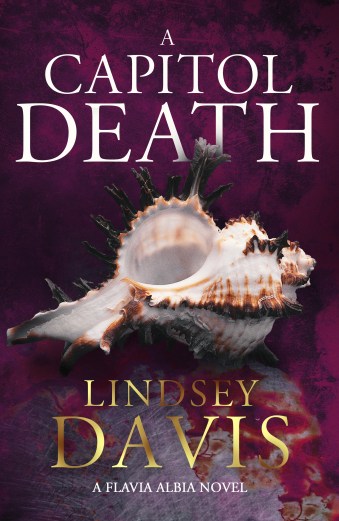
The first of these books is A Capitol Death by Lindsey Davis. Davis has long been the gold standard of ancient historical murder mysteries, with books such as her long-running Marcus Didius Falco series and its follow-up, the Flavia Albia series, both of which contain amazing mysteries set in the heart of ancient Rome. I have been a huge fan of the Flavia Albia series for years, and have read all six previous books in the series. I also reviewed the sixth book in the series, Pandora’s Boy, early last year, awarding it five stars. As a result, I have huge hopes for A Capitol Death, which will be the seventh book in the series, and based on Davis’s previous work I already know I am going to love it.
In Rome, ruled by the erratic Emperor Domitian, Flavia Albia is dragged into the worst sort of investigation—a politically charged murder—in Lindsey Davis’s next historical mystery, A Capitol Death.
A man falls to his death from the Tarpeian Rock, which overlooks the Forum in the Capitoline Hill in Ancient Rome. While it looks like a suicide, one witness swears that she saw it happen and that he was pushed. Normally, this would attract very little official notice but this man happened to be in charge of organizing the Imperial Triumphs demanded by the emperor.
The Emperor Domitian, autocratic and erratic, has decided that he deserves two Triumphs for his so-called military victories. The Triumphs are both controversial and difficult to stage because of the not-so-victorious circumstances that left them without treasure or captives to be paraded through the streets. Normally, the investigation would be under the auspices of her new(ish) husband but, worried about his stamina following a long recovery, private informer Flavia Albia, daughter of Marcus Didius Falco, steps in.
What a mistake that turns out to be. The deceased proves to have been none-too-popular, with far too many others with much to gain from his death. With the date of the Triumphs fast approaching, Flavia Albia must unravel a truly complex case of murder before danger shows up on her own doorstep.
The synopsis for the new book sounds pretty incredible, as the series’ titular investigator, Flavia Albia, steps up to investigate an intriguing new mystery. It sounds like this investigation will dive into some political intrigue surrounding the unpopular Emperor Domitian. Davis has combined mysteries with ancient Roman politics before, such as in the series’ fifth book, The Third Nero, and the end result was pretty spectacular. I am hoping that Davis will continue to provide the reader with her trademark blend of powerful mysteries, amazing historical elements and outrageous humorous moments, and I am looking forward to any big comedy set pieces, such as the incredible climax to The Third Nero or the big brawl sequence in Pandora’s Boy. The story in the previous book also hinted at the return of an old antagonist from the original Falco series, and I am looking forward to seeing if that comes into play within A Capitol Death.
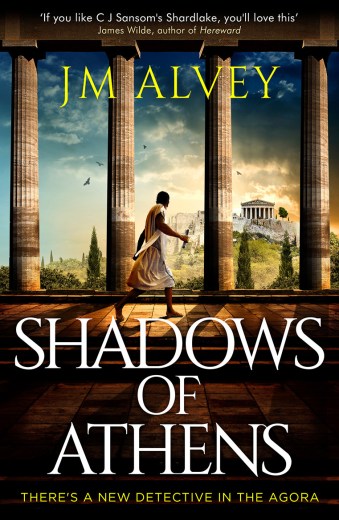
The second book that I am interested in checking out is a new mystery from debuting author J. M. Alvey. This new book, Shadow of Athens, is set to be released in March and will take place in Athens in 443 BC.
443 BC, and, after decades of war with Persia, peace has finally come to Athens. The city is being rebuilt, and commerce and culture are flourishing.
Aspiring playwright Philocles has come home to find a man with his throat cut slumped against his front gate. Is it just a robbery gone wrong? But, if so, why didn’t the thieves take the dead man’s valuables? With the play that could make his name just days away, he must find out who this man is, why he has been murdered – and why the corpse was left in his doorway.
But Philocles soon realises he has been caught up in something far bigger, and there are those who don’t want him looking any further . . .
This sounds like it could be a really cool book read. A murder mystery set in ancient Greece has a lot of potential, and I will be interested to see if Alvey’s book will fully explore the historical complexities of this ancient city while also producing a compelling mystery. I liked that the protagonist of Alvey’s book will be an actual real-life Greek historical figure, in this case, the famous tragic playwright Philocles. Placing real-life historical figures in the middle of fictional murders is always a compelling story choice, and I am really hoping that Alvey will explore this protagonist’s work as a playwright. It also sounds like the investigation within Shadow of Athens might play into Athenian politics and will probably have something to do with the war with Persia, both of which are incredibly appealing to me and will hopefully lead to some great story developments.
In addition to the awesome-sounding premise, I have to say that I really enjoyed the striking cover art that this new book had, and I found that its eye-catching imagery really grabbed my imagination. Shadow of Athens already has some very positive pre-reviews from some notable authors, including one of my favourite historical fiction authors at the moment, Andrew Taylor. As a result of these endorsements, combined with the intriguing plot synopsis, Shadow of Athens is probably the historical fiction debut I am most looking forward to at the moment and I am excited to see how impressive this new author is.
As a result, I think that both of these books have a lot of potential, and could prove to be some of my favourite reads of early 2019.


 The Unseen Library