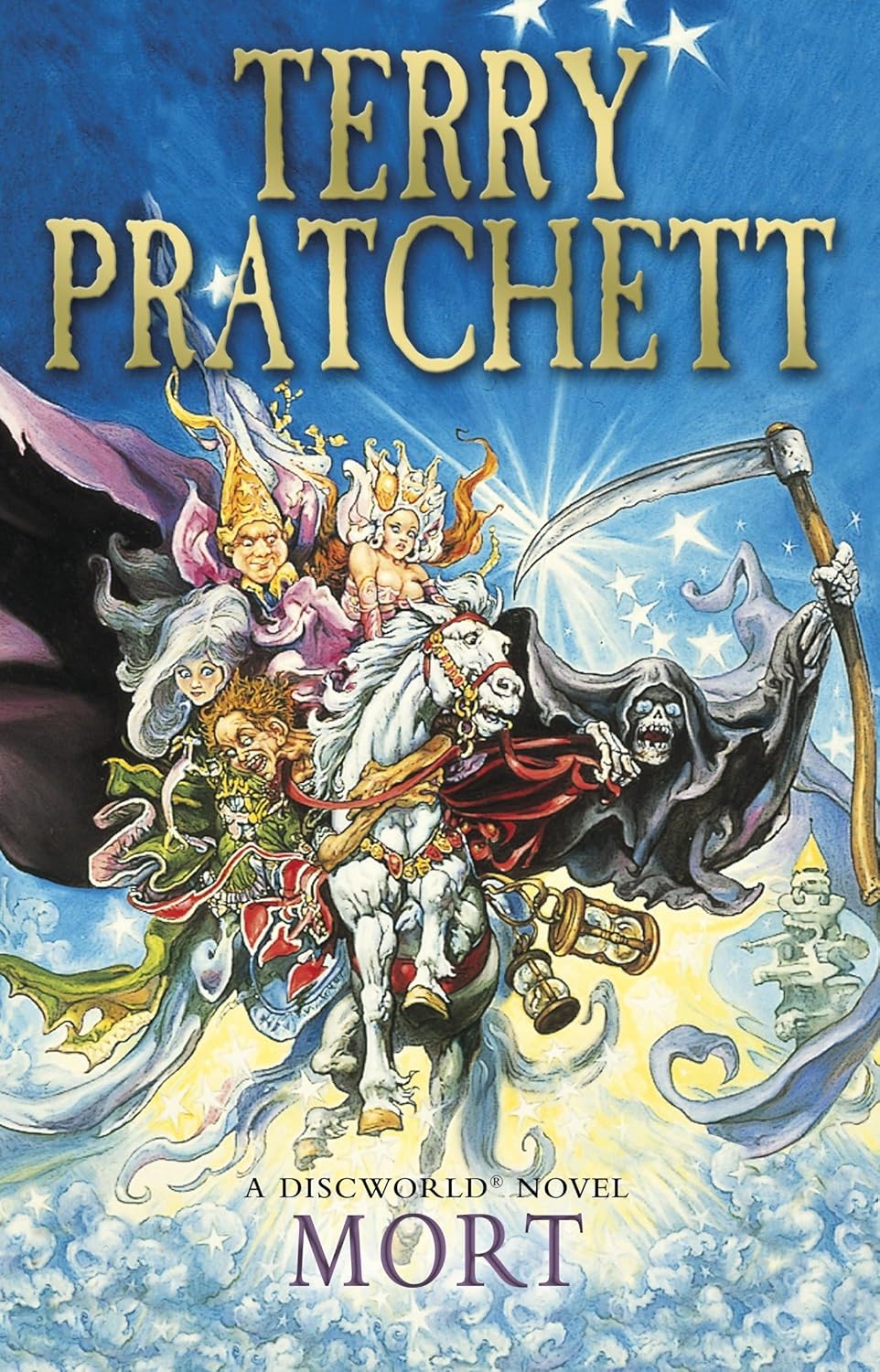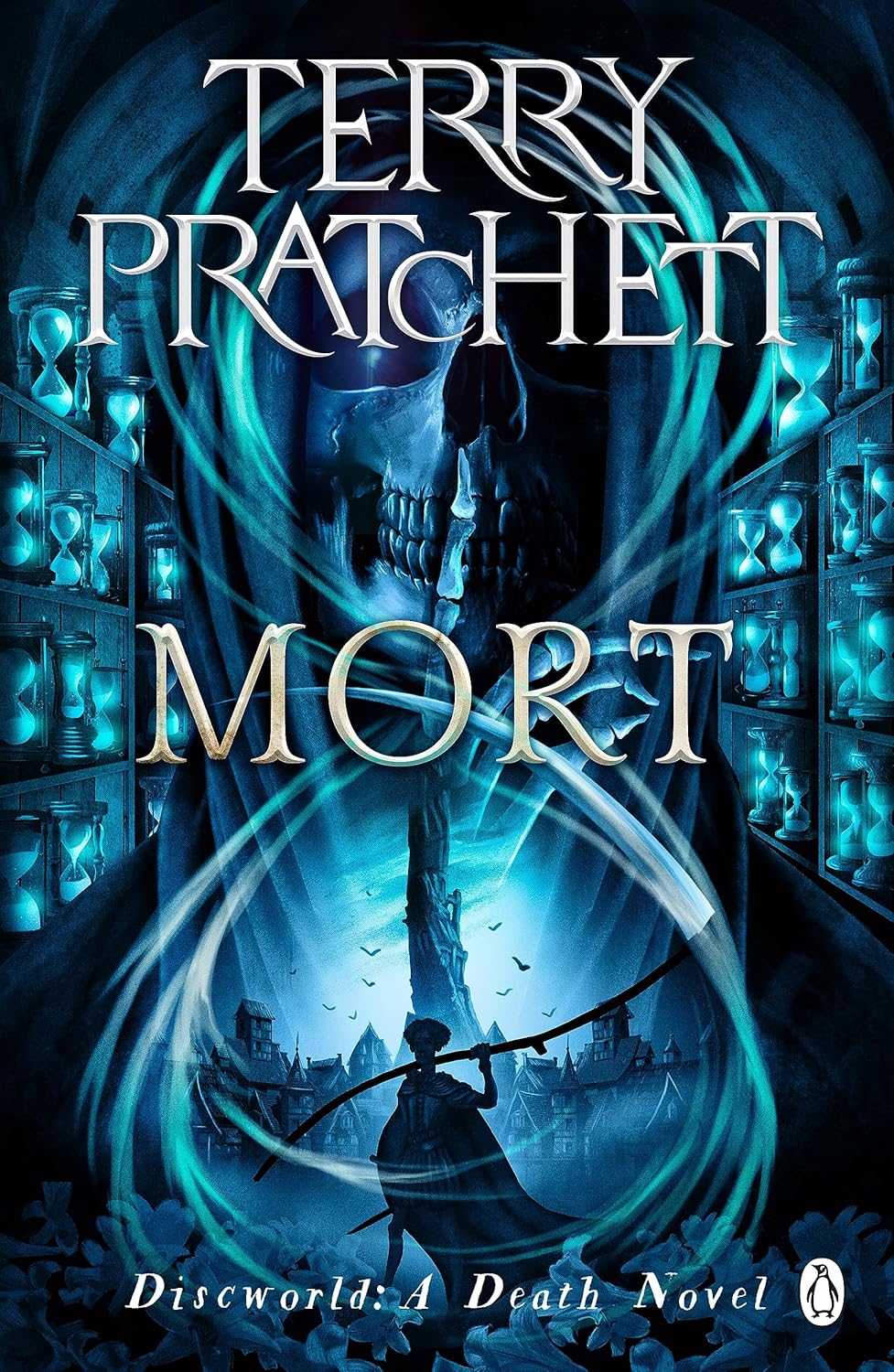
Mort by Terry Pratchett

Publisher: Gollancz/Penguin Audio (Audiobook – 1987)

Series: Discworld – Book Four/Death – Book One

Length: 7 hours and 18 minutes (Planer version)/7 hours and 57 minutes (Clifford version)

My Rating: 5 out of 5 stars

Amazon

My dive into the always outstanding Discworld series by the legendary Terry Pratchett continues with one of the earlier classics, Mort, a clever and highly entertaining novel that still hits hard after all these years.

Readers of this blog will be aware of my obsession for all things Discworld, which I have been a mega fan of for many years.  I have had the very great pleasure of reading all the books in the Discworld series multiple times, and I honestly love everything about them, so much so that I even named this blog after a key setting in the series.  I’ve recently been having one of my periodic re-reads of the series, which has seen me finally review some of my favourite Discworld entries, including Pyramids, Guards! Guards!, Moving Pictures, Small Gods and Men at Arms.  The next entry in the series I decided to reread was the wonderfully compelling Mort.  The fourth book in the series, this is one of the earlier Discworld novels and serves as the first book in the Death sub-series.

They say that death comes for everybody, but on the Discworld that statement couldn’t be more true, as everyone will eventually encounter Death, the black-robed, scythe wielding skeleton who personifies the end of life.  However, not all encounters with Death are the same, as terminally unqualified teenager Mort is about to discover, as instead of taking his life, Death offers Mort a job.

Suddenly saddled with the responsibilities of being the apprentice of Death, Mort finds his life a lot more complicated.  Reaping the souls of the recently departed is one thing, but learning to walk through walls and deal with the unlikely whims of his new master is another, especially as Death seems determined to set Mort up with his adopted daughter Ysabell.  However, the big problems begin when Mort impulsively decides to change fate and save the life of a young princess destined to die.

Forced to find a way to stop the diverging threads of reality while keeping the princess alive, Mort soon discovers that being the Grim Reaper isn’t all it’s cracked up to be.  Worse, with the real Death suddenly discovering the joys of life, Mort’s own humanity is starting to slip away.  Can Mort and a group of unlikely companions save reality, or will he have to face his final judgement at the hands of the universe’s most unyielding employer?

Mort was a particularly impressive Discworld novel from Pratchett, especially as it was probably the book where the author finally found his true writing groove.  Fun, thoughtful and featuring a clever and concise story, Mort was an outstanding read, and I once again powered through in very short order.  As such, Mort gets a very well-deserved five-star rating from me and is a particularly awesome Discworld novel to check out.

I loved the very impressive story that Pratchett came up with for Mort, which takes the concept of Death finding an apprentice and going to the extreme with it.  Starting at an initially slow pace that introduces the key characters of Mort and Death, you soon get invested in Mort’s tale of young man coming into his own in a very unusual field.  Things get interesting quickly when Mort decides to save the life of a young princess destined to die and soon splits reality down the middle.  This leads to a very addictive middle section, as Mort attempts to save the princess while also ensuring reality doesn’t split apart.  At the same time, Death, who finds his time freed up thanks to his assistant, begins to wonder around the world learning about humans and trying to have fun.  The resulting outlandish interactions with Death are a great counterpoint to Mort’s storyline, especially as this results in the apprentice starting to obtain his own powers, often with hilarious results.

Everything cleverly and quickly leads up to the big final third of the novel, where a less-than-human Mort and a scrappy Ysabell attempt to do a disappeared Death’s duty, while also finding a way to save the doomed princess, whose own attempts to stay in reality have been less than successful.  At the same time, fun supporting character Albert, Death’s manservant, returns to his old profession on the Disc and tries to find the original Death, who has found his own unlikely niche in the mortal world.  This final third of Mort is extremely fun, fast-paced and surprisingly impactful, especially as the author keeps raising the stakes for the protagonists, and you are very much unable to stop reading it as you try to see where all the entertaining storylines are going.  However, it’s the inevitable showdown between Death and Mort that really ties everything together perfectly.  Their intense, deeply personal and perfectly showcased duel is amazing, especially as it expertly builds off all the character growth in the novel.  Ending on a hopeful note that sets the tone for a great character going forward, you come away from Mort very happy and with an interesting new outlook on life and its always-grinning counterpart.

I really enjoyed how Mort came together, especially as this is the Discworld novel where Pratchett perfects the style and storytelling methods that make his later novels such a treat to read.  As such, Mort is an early classic in the series, so much so that it is a perfect entry point for new Discworld fans, who get to see a lot of key ideas develop here, while also being introduced to the author’s humour and clever storytelling.  Mort definitely benefited from Pratchett developing a more concise storytelling style here, keeping the narrative a little more focused than the previous novels, and this works as a well-crafted standalone read.  Pratchett also does an outstanding job combining cool fantasy elements with outrageous humour and complex characters, and the result is a very entertaining read that will appeal to a wide range of readers.  Part coming-of-age story, part examination of an extreme mid-life crisis, Mort’s narrative hits a lot of generational notes, and while some of his ideas about splitting reality and the nature of the Discworld are a little complex, Pratchett ensures that readers can completely follow his thought all the way to the fantastic conclusion.

As with all Discworld books, Pratchett imbues Mort with an amazing level of humour, and I loved how intensely funny this novel was at times.  Despite Mort essentially being a novel about mortality and destiny, this is a very light-hearted novel thanks to the entertaining characters and the unusual situations they find themselves in.  There are several different levels of humour contained within Mort, ranging from obvious jokes and over-the-top situations to well-setup references or clever name gags, as well as the subtly funny footnotes that really dive into the absurdity of this flat world that lies atop a giant turtle.  Some of the funniest parts of Mort lie in the usually hardboiled and cynical inhabitants of the Disc suddenly encountering Death in unlikely scenarios.  This becomes particularly prevalent later in the novel when Death leaves the job to Mort and wanders the world looking to understand “fun”, and the various scenes with Death fishing, going to parties, getting drunk, gambling and even searching for a job, are particularly hilarious, especially as everyone else involved in these situations is either deeply unsettled or completely terrified.  Other great jokes involve wizards coming to terms with an apparently animated statue, very long-running bar tabs, fun, if short-lived, political intrigues, unlikely deaths, and the young protagonist upsetting everyone by unwittingly walking through walls.  I laughed myself silly multiple times in Mort, even though I had heard all the jokes many times before, and you are guaranteed to have a lot of fun with this great Discworld entry.

As with all of Pratchett’s novels, Mort features an excellent array of entertaining characters, whose unique arcs add some excellent power to book’s overall narrative.  The cast of Mort was particularly compelling and well-rounded, and I think that Pratchett did a great job of introducing some excellent new figures while also making use of one of the best side-characters in the entire series.  Unsurprisingly, most of the novel’s focus settles on the titular character of Mortimer (Mort), a young teen who unexpectedly finds himself the apprentice of Death.  Shown at the start of the book to be an awkward and unusually thoughtful figure, Mort’s storyline revolves around his attempts to fit in, learn his unlikely trade, and the interesting relationships that form thanks to his new position.  Pratchett works in a very compelling coming-of-age narrative around Mort, especially as he grows into his new role and gains the confidence that comes with finding oneself, while also walking the fine line between morality and duty.  However, there is a definite dark edge to Mort’s storyline towards the end, as Mort starts to lose his humanity and becomes more like Death, and it falls to the rest of the characters to keep him human.  Pratchett did a really good job introducing and building up Mort as a complex young character, and he ended up being one of the author’s better one-shot protagonists.

While much of the book is focused on Mort, the character who constantly steals the show is Death.  The literal personification of death on the Discworld, Death appeared in the first three novels in the series, serving as an ethereal and often entertaining figure on the sidelines who occasionally haunted the author’s original protagonist.  Pratchett cleverly expands on Death in this book, showcasing him as a wise and implacable figure doing his duty in a dispassionate way.  However, his interactions with humans, especially Mort, soon start to change his personality, especially as he becomes curious about life and tires of his eternal station.  This allows him to become a particularly entertaining figure in the second half of the book, as he roams the Disc in unlikely situations, trying to learn how to have fun.  His various ponderings on mortality and human nature result in some hilarious moments, and there are so many fantastic and funny interactions that occur here.  However, it is the final third of the book where you get a real sense of Death’s character; at first, he wistfully tries to embrace life, only to leave that behind when confronted by the actions of Mort.  The anger and sadness that accompany his return to his role and his confrontation with Mort is extremely powerful, and you can’t help but feel for him as he faces an impossible choice, as well as rejection from those he loves.  An overall excellent first deep dive into the character of Death from Pratchett, and you can really see why the author wrote several more books around this character going forward.

Aside from Mort and Death, the rest of the main cast of Mort is quite concise and contains an excellent blend of distinctive and impactful characters.  This includes Death’s adopted daughter, Ysabell, a seemingly spoiled princess and lover of over-the-top romance, who is initially antagonistic to Mort.  Despite her attitude, Ysabell soon turns into quite a likeable and sympathetic character, especially when certain traumas from her unusual life become apparent.  Due to her having some of the more emotionally poignant dialogue and character moments in the book, Ysabell is an excellent part of Mort, and I liked how Pratchett paced her storyline.  The other major resident of Death’s domain featured in this story is Albert, the mysterious servant determined to hide his past from Mort and Ysabell.  Pratchett does an excellent job of setting him up as a bigger figure within the Disc’s history, and his explosive return to form after some entertaining scenes between him and a threatening Mort are a highpoint of the book.  Other major characters include Princess Keli, a young princess who finds her sudden reign made even more difficult due her convoluted existence, and young wizard Igneous Cutwell, who serves as a great foil to the more serious Mort and Keli and becomes an excellent comic relief for the book.  Throw in an array of over-the-top minor Discworld characters whose lives briefly become that much more interesting due to their interactions with either Death or Mort, and Mort has an especially fun cast that Pratchett uses to great effect within this masterful novel.

I must once again highlight the amazing audiobook formats that are my favourite ways of enjoying the Discworld series.  I honestly have so much fun with the Discworld audiobooks, mainly because the format does such an incredible job of showcasing Pratchett’s legendary humour and inventive worldbuilding, and there is frankly no better way to enjoy this cool series.  Like the rest of the series, Mort has two particularly awesome unabridged audiobook versions, both of which come highly recommended by me.  This includes the old-school version narrated by the legendary Nigel Planer, who provided his voice to over half the unabridged Discworld audiobooks.  As with all the Discworld books he narrated, Planer does a remarkable job in this early entry in the series, and I loved the impressive array of voices that he utilised in Mort.  Due to this being the first Death audiobook, Planer had a ton of fun featuring his amazing Death voice, which combines beautifully with some of the other new character tones he had to come up with for this novel.  His great voice work also helped to showcase some of Pratchett’s excellent jokes and key bits of humour, and you really get drawn into the author’s brilliant story and fantastic writing with this classic audiobook release.

Despite my love for the Planer version of Mort, which in some ways is still the definitive audiobook version of this novel, I must also really hype up the new Mort audiobook that was recently released.  Part of the recent rerecording of the Discworld audiobooks I have spruiked in previous reviews, this new version of Mort was extremely awesome, and in some ways it surpasses the old-school version.  Coming in with a runtime of just under eight hours, around half an hour longer than the Planer version, this was a brilliant listen, especially with the impressive combined voice work of Sian Clifford, Peter Serafinowicz and Bill Nighy.

Sian Clifford (of Fleabag fame) did an excellent job as the main narrator for this audiobook, reading out most of the story and the voices of the associated cast.  This results in a swift, well-voiced and deeply compelling version of Mort, and I loved how effectively Clifford brought the story to life and helped to showcase the author’s great humour.  You really get drawn into the cool narrative as Clifford reads it out, and I enjoyed her fresh take on many aspects of the audiobook.  Despite Mort being a rather male character dominated entry in the sub-series, Clifford did an excellent job portraying the cast, and there are some great voices featured here, including of some iconic figures from other sub-series (her Rincewind voice was sufficiently terrified and grovelling).  Clifford clearly has fun when it comes to some of the more outrageous members of the cast, such as Albert, while her take on Princess Keli was excessively regal, and captured both her irritation at the events unfolding around her, while also showcasing her fear and uncertainty.  I must also highlight the voice Clifford provides for the main character, Mort, as the narrator really paints a great picture of a gangly, uncertain teenage boy who starts to come into his own as he gains confidence, and more.  I particularly enjoyed the clever voice changes that Clifford did later in the book, especially when Mort started becoming more like his employer, and the corresponding changes to Death’s voice were just perfect.  This was honestly some amazing voice work from Clifford, and I look forward to listening to her narration of the other Death audiobooks, especially once Susan is brought in as the main character.

While Clifford is amazing, I felt that Peter Serafinowicz clearly stole the show in Mort, playing his character to perfection.  Voicing the recurring character of Death in all the new Discworld audiobooks whenever he appears in the plot, Serafinowicz hits listeners with a deep and final tone that perfectly portrays the Discworld’s Grim Reaper in all his bony glory.  For most of the audiobooks, this is just a fun extra inclusion, as Death only appears in a few hilarious scenes.  But for Mort, this is much more of an involved role, as Death is one of the book’s main characters, and so much of the book’s humour and complex narrative is based around Death interactions with humanity.  As such, Serafinowicz has a ton of fun voice Death through various unusual situations and emotional states, all while keeping up the foreboding Death voice.  The clever and subtle changes to this voice that Serafinowicz makes are extremely impressive, and the humour that results from hearing Death engage in these unlikely scenarios and conversations cannot be overstated.  I also must highlight one brilliant sequence where Serafinowicz hilariously hummed the classic funeral march in his Death voice in response to the text describing Death walking away humming a tune.  Details like that in Serafinowicz’s performance, as well as the increased utilisation of Death in this audiobook, really enhanced the overall impact and humour of Mort, and I loved every second I spent listening to it. 

The final actor featured in this audiobook is the legendary Bill Nighy, who also has a recurring role in all the new Discworld audiobooks.  Nighy has a very important job of narrating all the various footnotes that Pratchett includes in his text, and his gentle voice really brings out the subtle humour hidden in these footnotes.  While Nighy doesn’t get much to do in Mort due to author only featuring a few footnotes in this novel, he still makes an impact, and I’ve really enjoyed how expertly he enhances these clever inclusions.  Honestly, all three of these narrators did an outstanding job in this new version of Mort, and I deeply appreciated how well their compelling performances blended into one impactful listen. As such, Mort is best enjoyed on audiobook, and whether it be the classic Planer version, or the new one with extended cast, you will have a wonderful time listening to it.

As the above rambling pages no doubt prove, I have a lot of love for Mort which was an excellent early Discworld novel from Terry Pratchett.  Featuring some excellent storytelling and fully embracing the clever writing style and comedic charm that made the later Discworld novels so damn awesome, Mort was a brilliant read, and one that proves impossible to put down.  An outstanding novel that really shows how impressive Pratchett could be as an author; Mort comes highly recommended and is guaranteed to be enjoyed by any reader.

Amazon

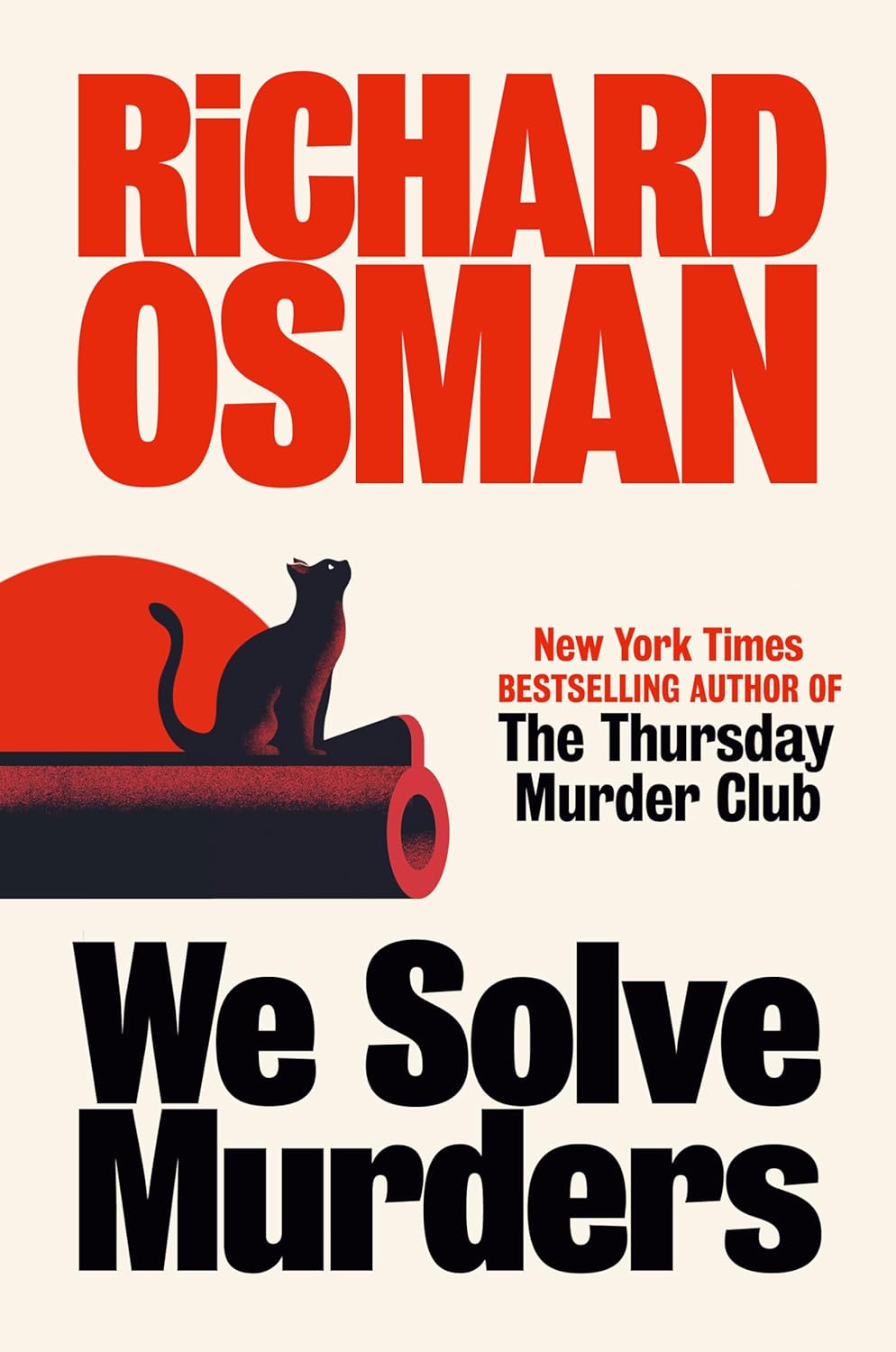
We Solve Murders by Richard Osman

Publisher: Penguin Audio (Audiobook – 17 September 2024)

Series: Standalone/Book One

Length: 10 hours and 33 minutes

My Rating: 5 out of 5 stars

Amazon

One of my favourite authors of crime fiction, hilarious British television personality Richard Osman, continues his run of exceptional books with the 2024 novel, We Solve Murders.

Few authors have made as big an impact on the crime fiction world in recent years than Richard Osman.  Debuting in 2020 with his incredible novel, The Thursday Murder Club, Osman deeply impressed with his first book that cleverly blended a great mystery with likeable characters and a brilliant sense of humour.  A fun novel about four retirees who solve murders from the activity room of their retirement village, The Thursday Murder Club was quite exceptional, and it ended up being one of my favourite books, debuts and audiobooks of 2020.  Osman has done an outstanding job of continuing this series, with the next three books The Man Who Died Twice (one of my favourite books and audiobooks of 2021), The Bullet That Missed (one of my favourite books and audiobooks of 2022) and The Last Devil to Die (one of my favourite books and audiobooks of 2023), all being incredible.  After the powerful conclusion to The Last Devil to Die, Osman decided to take a break from the Thursday Murder Club books and instead dove into a cool standalone read, We Solve Murders.  A fun thriller with some entertaining twists to it, We Solve Murders was an interesting new read from Osman, that I had an exceptional time with last year.  Unfortunately, I’ve been a bit slack at getting a review out for this awesome book, but I’m trying to make an effort to get through it now before we hit the halfway mark of 2025.

Plot Synopsis:

A brand new series. An iconic new detective duo. And a puzzling new murder to solve…

Steve Wheeler is enjoying retired life. He does the odd bit of investigation work, but he prefers his familiar habits and routines: the pub quiz, his favorite bench, his cat waiting for him when he comes home. His days of adventure are over: adrenaline is daughter-in-law Amy’s business now.

Amy Wheeler thinks adrenaline is good for the soul. As a private security officer, she doesn’t stay still long enough for habits or routines. She’s currently on a remote island keeping world-famous author Rosie D’Antonio alive. Which was meant to be an easy job…

Then a dead body, a bag of money, and a killer with their sights on Amy have her sending an SOS to the only person she trusts. A breakneck race around the world begins, but can Amy and Steve stay one step ahead of a lethal enemy?

This was another exceptional book from Osman who really showcased his impressive ability to tell an engaging story with unique protagonist in this brilliant novel.  Sharp, captivating and relentlessly entertaining, We Solve Murders had me hooked the entire way through, and there were times I couldn’t stop listening to it.  A very easy five-star book for me, We Solve Murders was one of my top books and audiobooks of 2024 for a very good reason.

I must admit that before reading We Solve Murders, I wasn’t too certain that Osman was going to have the same success he’d had with the Thursday Murder Club books, especially as he was moving onto new ground and characters.  However, I really shouldn’t have been worried, as Osman crafted together an incredible, captivating and highly personal story that was so damn fun.  Focusing on the interesting father/daughter-in-law combination of Steve and Amy Wheeler, the story starts quickly with Amy getting framed for the death of several clients from her private security company.  With killers after her and unable to trust anyone at her company, Amy has no choice but to go on the run and attempt to solve the case herself, accompanied by her eccentric client, famed author Rosie D’Antonio.  Needing help and faced with a series of strange clues, a massive conspiracy and the ire of a legendary money launderer, Amy seeks the unlikely help of her semi-retired investigator father-in-law, Steve Wheeler, dragging him out of his comfortable life in small-town England and taking him on an international tour of murder and criminality.

The resulting narrative is a highly entertaining series of events, as the protagonists flit around various locations, attempting to uncover the truth behind the killings, while also trying to avoid a dangerous hitman hunting them.  At the same time, an array of excellent supporting characters nip around the edge of the investigation themselves, as they attempt to figure out how Amy is involved and who the master criminal of the case is.  I loved the various outrageous and fun moments that follow on from this, as the protagonists get into all manner of trouble, with Steve and Rosie D’Antonio becoming unlikely heroes at times.  Osman loads up an array of excellent twists throughout the novel, and you are constantly left guessing at who the overall villain of the book, as well as their mole in Amy’s agency, is, and how they are plotting against the protagonists.  It all leads up to a fantastic final sequence in Dubia, where the protagonists come face to face with the villain in a brilliant end to the mystery.  I felt that this entire story wrapped up pretty perfectly, with all the relevant threads Osman introduced coming together into a clever conclusion.  I also really liked the surprising reveal about who the villain of the story is, and it works extremely well in the context of the hidden clues and hints that Osman had expertly featured throughout the rest of the book.  An overall outstanding story that I honestly could not get enough of.

While the story focus of We Solve Murders is different from his previous novels, Osman still deploys the outstanding writing style that made the Thursday Murder Club novels such a hit.  Working well as a standalone novel outside of his main series (although there was a good minor cameo), Osman once again quickly sets up a complex story with many intriguing characters and lets them loose with an amazing blend of mystery, humour and character development.  Adapting to the international thriller genre extremely well and featuring an extended range of cool settings, Osman’s plot in We Solve Murders is very fast paced, while also taking the time to ensure readers are having fun and getting absorbed in both the clever main mystery and the unique story threads surrounding the characters.  I loved all the very subtle and clever setup that Osman features in the early parts of the book, especially as there are some impressive clues to the identity of the various bad guys, and I really need to go back now I know the solution to see these clues in a new light.

While the compelling mystery, surprising twists and dive into international criminality was a great base to We Solve Murders, the element that tied it all together was Osman’s comedic charm.  Featuring the fantastic British-centric humour that Osman is so well known for, We Solve Murders was constantly entertaining, and there are so many fun jokes and references loaded into every page.  While much of this humour is quite restrained and subtle, which allows for a general light-hearted tone amongst the discussions of murder and crime, there are also some more direct comedic moments brought about by outrageous characters, unlikely interactions and the constant subverting of expectations.  Some of my favourite jokes include a high-stakes pub quiz night, the surprising motivations of a hitman, and the main villain’s constant use of ChatGPT to re-write his communications in the style of an English gentleman.  All this ensures that the reader is constantly laughing, allowing them to stay hooked to this captivating and well-written story.

Another major highlight of We Solve Murders was the extremely likeable and compelling characters through whose eyes we see the story unfold.  Osman excels at writing fun and memorable characters, and the ones in We Solve Murders are particularly entertaining.  The two main anchor characters of this book are the fantastic duo of retired investigator Steve Wheeler and his globetrotting elite bodyguard daughter-in-law Amy Wheeler.  A fun and very likeable combination thanks to their close relationship, Steve and Amy start the books as complete opposites, with Steve a unadventurous figure whose only desire is to remain in his small town, while Amy is constantly thrust into action while also managing to keep a successful long-distance relationship with her husband.  I loved how Osman wrote both characters, and it was fascinating to see their alternative takes on how to live life.  Some of the best parts of We Solve Murders’ plot involves Amy trying to pull Steve out his shell by taking him on her adventure, and readers get to see some genuinely nice character development around Steve as a result.  There is also a good focus on Amy learning to rely on those closest to her for help, especially when she finds herself in trouble.

While Amy and Steve are the heart of the book, there are a range of other outrageous and entertaining characters loaded throughout We Solve Murders, each of whom add to the impact and enjoyability of the novel in various ways.  These include multiple residents of Steve’s village, who joyfully aid him in his investigation, a local talent agent with an unusual connection to an international crime ring, the feuding owners of two rival private security companies whose mistrust for each other leads to a lot of intrigue, a diva actor oblivious to the crazy events going on around him, various international criminals who find themselves outmatched by the unlikely team of protagonists, a relentless hitman with his own motivations, and the big bad of the story, who casts a big shadow while staying hidden.  Out of all these characters, my favourite was easily glorious author Rosie D’Antonio, who tags along with the Wheelers on their adventure and becomes a valuable part of their team.  Over-the-top, internationally beloved, and constantly providing juicy titbits about her many adventures, Rosie D’Antonio effortlessly steals every scene she is in with her big personality and unpredictable actions.  I don’t think any character made me laugh as much as Rosie did, and I guarantee We Solve Murders would not have been as good without her.  I really appreciate how well the author utilises all these great characters, splitting the story perfectly between them, and you will come away from this novel completely in love with Osman’s memorable protagonists and their brilliant personalities.

I have mentioned multiple times how much I have enjoyed the Thursday Murder Club novels on audiobook, so I naturally had to check out We Solve Murders in this format as well.  Unsurprisingly, the We Solve Murders audiobook was just as awesome as I had hoped, as the format perfectly showcased Osman’s complex storytelling and outrageous characters.  Part of the reason why the We Solve Murders audiobook worked so well was that they once again got an extremely talented English actress to narrate the book, this case Nicola Walker, who blew it out of the park.  Walker, who is well known for her roles in various UK crime shows, did a remarkable job of narrating Osman’s story, perfectly capturing the crazy thriller tone as well as the author’s fantastic subtle humour, and ensuring that the reader is constantly engaged with the plot of the book.  I really enjoyed how well Walker inhabited all the figures Osman imagined for this brilliant read, no matter how outrageous they were, and she made sure to cleverly showcase their unique personalities and intriguing outlooks on life.  This great voice acting really enhanced the overall epic experience I had with the We Solve Murders audiobook, and this is easily the best way to enjoy this exceptional read.  I honestly cannot recommend this audiobook enough and you will just power through its 10-and-a-half-hour-long runtime.

Richard Osman continues to dominate the crime fiction scene with the outstanding standalone novel, We Solve Murders.  Combining a complex mystery with likeable characters and subtle British humour, We Solve Murders was a fun new direction for Osman, who had his own brilliant take on an international thriller.  A clever and highly entertaining novel, We Solve Murders once again showed off how good Osman is as a writer, and you will be unable to put this book down.  I cannot wait to get my next hit of Osman, and with both a The Thursday Murder Club film adaptation and the fifth Thursday Murder Club novel, The Impossible Fortune, coming out later this year, fans of the author are in for a real treat.

Amazon

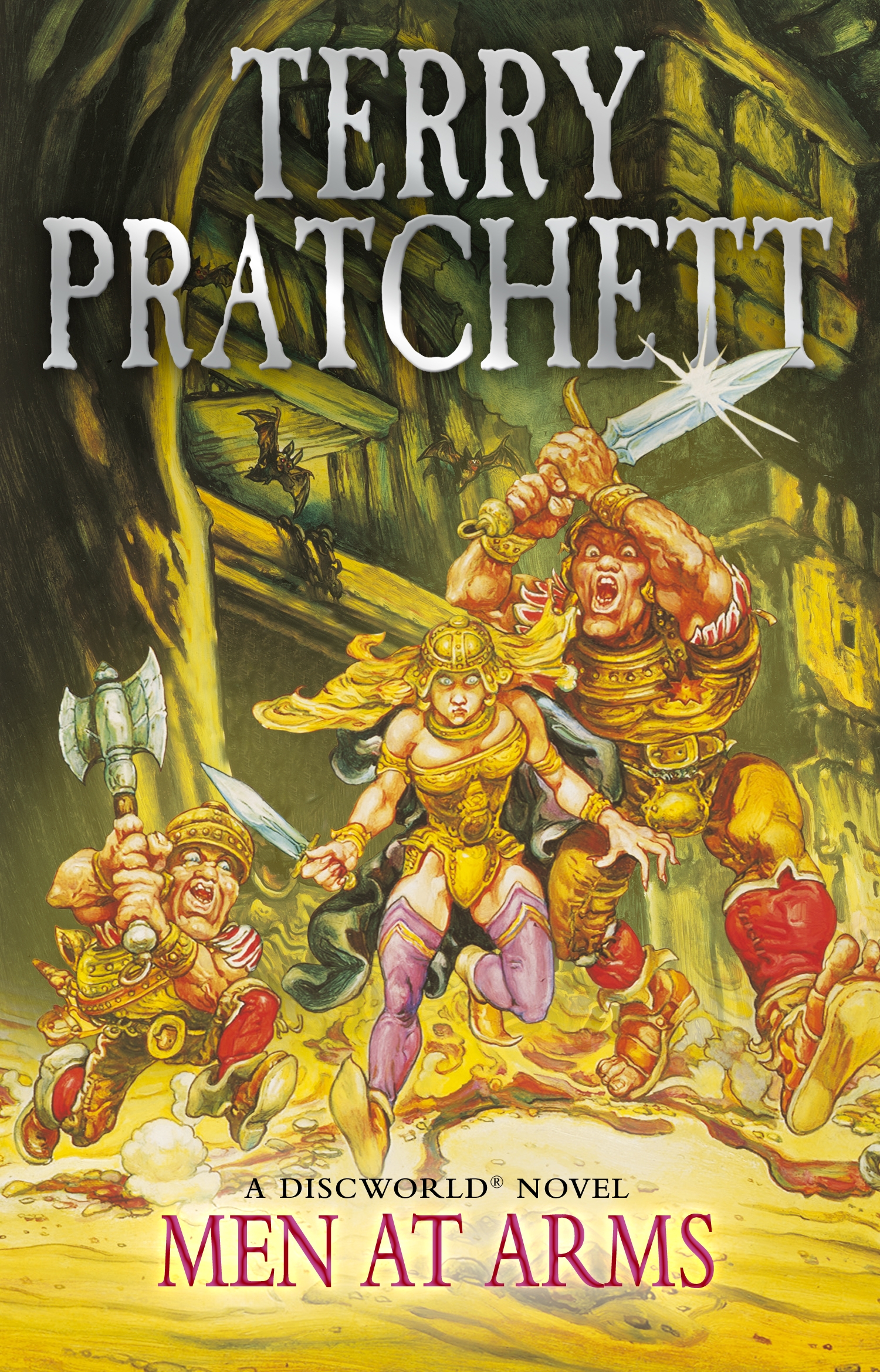
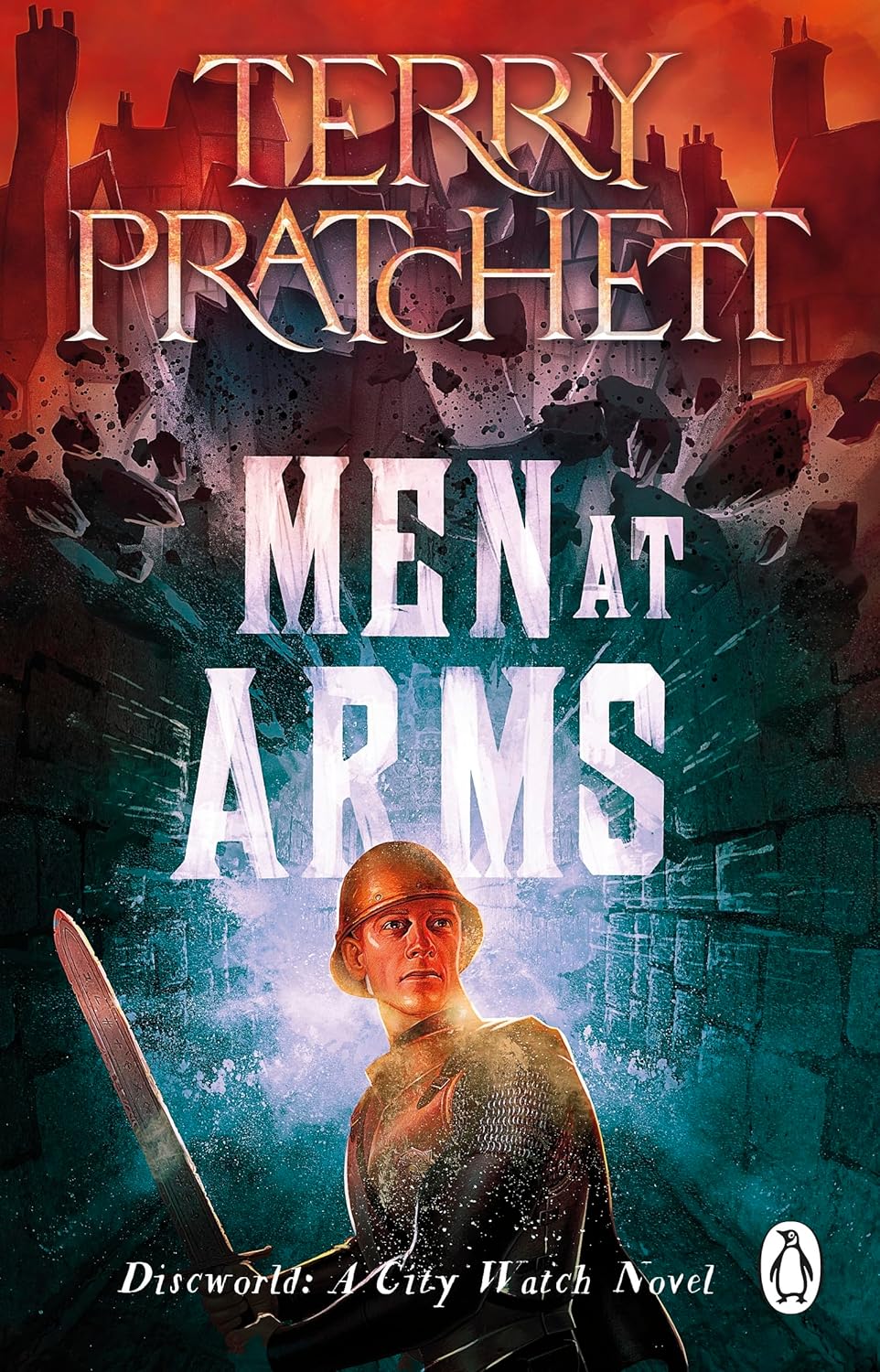
Men at Arms by Terry Pratchett

Publisher: Gollancz/Penguin Random (Audiobook – 1993)

Series: Discworld – Book 15/City Watch – Book Two

Length: 12 hours and 58 minutes

My Rating: 5 out of 5 stars

Amazon

After yet another re-read, the classic fantasy satire novel, Men at Arms remains as one of my favourite Discworld novels by the late, great Terry Pratchett, especially as its new audiobook version breaths fresh life into the always impressive novel.

Readers of this blog will have noticed that I have been on a real Discworld rampage lately, having re-read several books from my absolute favourite fantasy series.  Much of this is due to the recent release of a cool new audiobook version of all the Discworld books, featuring an awesome array of new narrators and vocal talents.  This new format has proven particularly awesome for books like Pyramids, Moving Pictures and Small Gods, and I have been eager to see how some of the books in my favourite Discworld sub-series, the City Watch books, come across with the new narrators.

While I have a lot of love for all the books in Terry Pratchett’s Discworld, my absolute favourites come from the City Watch sub-series.  Following the unlikely members of the Ankh-Morpork City Watch, a rag-tag team of guards generally looked down upon by the entire city, the City Watch books features an exceptional combination of fantasy and crime fiction elements, wrapped up in Pratchett’s usual satirical humour, as the protagonists investigate a series of dastardly crimes in the supernatural Discworld.  The series started perfectly with the awesome novel Guards! Guards!, which I reviewed last year, and Pratchett did an outstanding job following this up with the brilliant sequel, Men at Arms.

After saving the sprawling and eternally crime-ridden city of Ankh-Morpork from a fire-breathing dragon, the men of the Night Watch are still at work protecting the city, even though most of the city wishes they didn’t exist.  Despite their previous escapades, it’s a bad time to be a copper in Ankh-Morpork, with species tension between the dwarfs and the trolls at boiling point, while the powerful guilds disregard the Watch’s non-existent authority.  Worse, the Night Watch has been forced to accept three diversity hires, and must now contend with a mad dwarf, a thick troll and a woman (gasp) amongst their ranks.

Despite this, when an explosion at the Assassin’s Guild literally rocks the city, it falls to Captain Samuel Vimes and his small squad to investigate the heist hidden by the blast, despite the deliberate orders of the city’s tyrannical ruler to stop.  Determined to wrap up the case before his impending marriage and retirement, Vimes is soon forced to contend with a series of unusual, but seemingly linked murders, many of which have been caused by a lethal weapon never seen on the Disc.

With riots on the streets, and assassins and fools dodging their questions, all the members of the watch, including their contentious recruits, will need to work together to solve the murders before the city descends into chaos.  But how will they fare when going up against the most dangerous criminal mind the city has ever seen, one determined to bring back the Ankh-Morpork’s ancient kings, while wielding a dangerous new weapon that could change the entire Disc forever?

Even after many, many re-reads, Men at Arms continues to shine as one of Pratchett’s better books.  Featuring an epic crime fiction narrative, loaded with impressive characters, fantastic humour and great use of Pratchett’s iconic Discworld setting, Men at Arms is a complex, emotionally charged and deeply moving read that I could honestly read 100 times and still not get bored with.  A brilliant novel that unsurprisingly gets an instant five-star rating from me.

Pratchett wrote some exceptional narratives throughout his career, but few stand up to Men at Arms in terms of complexity, cleverness and emotional impact.  Expertly reintroducing the cast of Guards! Guards!, while also bringing in some impressive new support characters, Men at Arms starts off an excellent pace, as Pratchett cleverly examines the changes to the characters, sets up the new case, while also showcasing the motivations of the apparent main antagonist.  From there, it doesn’t take long for a dark series of crimes to take place, with Vimes and his squad investigating despite the apathy of the rest of the city.  Pratchett does a lot of excellent set up in the early part of the book, and the reader soon becomes invested in the investigation, especially as the book begins to follow a series of deaths, some of which were caused by a particularly deadly weapon that modern readers will be all-too familiar with.  Some great character arcs are also introduced here, as the extended cast all hit their own various problems they are forced to overcome, with Vimes dreading his eventual retirement, Carrot feeling the added responsibility, the fun buddy-cop arc between Detritus and Cuddy, and Angua dealing with her own problems.  The author sets up and expands on these arcs throughout the book perfectly, providing additional emotional impact, as well as some interesting side angles on the main storyline.

While the first half of the novel sets everything up perfectly, it is in its second half where Men at Arms truly shines.  Pratchett keeps raising the stakes of the story, with more victims, run-ins with the shadowy antagonist, and the Watch characters attempting to understand the nature of the weapon that has been turned against the city.  The author throws in some interesting wrinkles to the case, which shadow who the true villain is, while other events throw emotional shade across several of the characters.  The various connected character arcs start to come together perfectly as the book continues, and you go into the final stretch with a range of emotions around you.  While ostensibly a comedy, Pratchett chooses to hit the tragedy element of the plot really hard in the lead up to the finale, with some big moments that will leave you speechless.  The big end reveal and confrontation is exceptional, and I loved how well all the storylines and cleverly setup plot points came together.  Everything leads up to a very desperate struggle that helps to define some of the main characters in some very powerful ways.  Pratchett chooses to leave the book on a hopeful note that sets the expanded course for the future City Watch books, while also providing some interesting insights into one of the main characters and his role in the city.  An overall epic narrative that twists, turns and keeps you guessing, while constantly entertaining and emotionally charged.

As with his other books, Pratchett perfectly sets out Men at Arms with impeccable writing, and I loved how this complex novel came about.  Featuring his usual impressive blend of fantasy and humour elements at its base, Men at Arms is both intriguing and quite funny in equal measures, and I love the subtle comedy that runs through it.  Many of these scenarios involve classic fantasy scenarios being seen through the eyes of self-aware characters, allowing the situation to be taken up to an 11, with sarcastic commentary from the witnesses.  This humour is well enhanced by several of its best characters, including a fantastic new buddy cop routine, with members of two separate and historically antagonistic species forced to work together and eventually becoming friends.  Some of the other hilarious moments in the book include unlikely members of the city’s population being conscripted into the Watch, unfunny clowns, unconventional investigation methods, and other subtle humour.  You also have to love the brilliant footnotes that seek to enhance the story and showcase just how ridiculous the Discworld is by providing additional details about the universe and the people within it.  All this results in a brilliant and highly entertaining fantasy read, and that’s before you even get to the great crime fiction elements of the story.

As with Guards! Guards!, Men at Arms stands out from the rest of the Discworld series due to the way that Pratchett provides a complex and compelling crime fiction narrative.  Focused on an explosive heist that eventually results in a series of brutal murders, Men at Arms tries to envision how firearms would disrupt the Discworld.  This allows for quite a captivating crime fiction narrative, which I feel was a much better mystery than Guards! Guards!.  Advancing more into police procedural territory than its predecessor, the mystery of Men at Arms proves to be top rate, with the protagonists going after an already known villain for much of the book.  Much of the early story involves the protagonists trying to unfurl the antagonist’s plan and discover how he committed the crime, which allows for some great scenes as the Watch inexpertly investigate.  Pratchett cleverly twists the fact that think you know who the antagonist is towards the end of the book, and I love how well he switched this key story element, especially as the implied true villain of the story is far more sinister than just evil humans.  I really enjoyed how well Pratchett sets up this mystery in Men at Arms, and even after so many re-reads there are still additional subtle clues and foreshadowing that I’m only just picking up on.  The police procedural elements of the story are also extremely well handled, with a lot of humour focused around three very unlikely recruits joining the already scruffy outsiders who make up the Watch.  All these elements come together extremely perfectly and allow for readers of various genres to come into Men at Arms and have an incredible time.

Due to Pratchett’s excellent writing style, Men at Arms does work quite well as a standalone novel, and new readers can generally enjoy this book without any prior knowledge of the Discworld series, especially once they get caught up in the cool story and amazing humour.  However, I do feel that to get the best experience with Men at Arms, readers really do need to have checked out Guards! Guards! first.  The continuing storylines, history of the city and character arcs all come into play extremely well in Men at Arms, and you get a much more complete experience viewing all City Watch novels in order.  There is also a continuation of some character arcs from the standalone novel, Moving Pictures, especially as a few major characters from there get a recurring role in this new sub-series.  As such, I would say that Men at Arms is a novel more aimed towards Pratchett’s established fans, with those who loved Guards! Guards! guaranteed to enjoy its impressive sequel and the compelling direction Pratchett starts to take the City Watch books in.  It helps that the author continued to explore the crumbling and crime-ridden city that is Ankh-Morpork in this Men at Arms, providing even more details about its governance, mindset and people.  This includes really expanding on the species tension between the dwarfs and trolls and showcasing it as a major plot point while also paralleling real-life racial tensions.  This focus on dwarf and troll conflict becomes a major plot point of the Discworld going forward (especially in the later City Watch books), and its setup here was spectacular.  Combine that with the changes that happen to the Watch at the end of the book, and Men at Arms is an important entry in the wider Discworld context, especially as so many key City Watch storylines start here.

While there are so many amazing writing elements to Men at Arms, few things top the exceptional character work that ensured that this novel was far more than just a funny fantasy novel with crime fiction elements.  Instead, the complex and heartfelt dives into its extensive main cast ensured that Men at Arms was one of the more powerful and emotionally charged entries in the Discworld (a very impressive feat).  The combination of returning protagonists from previous books, as well as a few outstanding new characters, allows for a range of different plot perspectives and personal storylines, and Pratchett effortlessly works to make you invested in all these character arcs before hitting you with intense tragedy and powerful moments.

At the centre of the plot lies main character Captain Samuel Vimes, the cynical veteran leader of the Night Watch, who has finally found happiness and romance in his life.  Now on course to retire and become a man of leisure, Vimes must deal with the horror of becoming the thing he hates most: a rich civilian.  Dealing with it by diving into one last investigation, Vimes finds himself facing everything he hates about his job, including bureaucracy and the whims of powerful people, resulting in some brilliantly chaotic scenes.  While it does seem that Vimes’s role in this story is slightly diminished compared to in other City Watch books, especially in the centre, he is still a major part of the book, and Pratchett writes some excellent storylines around him being the dogged and worn-down investigator pushing against authority and trying to solve one more crime.  The focus on his identity as a copper, the sacrifices he makes for his fellow officers, as well as the horror at having to give up the job are major parts of his character arc, and there are some truly heartbreaking moments when he realises he must give it all up.  This is well balanced with his heartwarming romance with his unlikely partner, Lady Sybil Ramkin, whose well-meaning support and determination help to make Vimes a better person.  However, it is the major sequence when Vimes finally encounters the antagonist which really provides the best look at the character.  Forced to decide between being a good cop or a figure of vengeance (a battle that rears its ugly head for Vimes many times during the series), Vimes truly hits his mental and moral limit as he faces down his adversary, and it is one of the most powerful scenes in the entire Discworld series.

While Vimes is the main character of the City Watch series, the focus of Men at Arms is a little more skewed more towards Corporal Carrot Ironfoundersson, as Pratchett expands on his excellent introduction in Guards! Guards!.  Now firmly a part of Ankh-Morpork society, Carrot has evolved from naïve newcomer to a seasoned police officer who knows literally everyone in the city.  Fully utilising his natural charisma, Carrot proves to be a major force for law and order in the city.  I loved how much Pratchett enhanced Carrot in this sequel, as his personality evolves due to his role and responsibility, and despite still appearing quite naïve and obedient, Carrot showcases some impressive intelligence driving much of the investigation.  I especially appreciated the various scenes where Carrot managed to outfox many of the city’s more dangerous figures who fall for the dumb copper routine.  Despite his new confidence and ability to bring out loyalty in others, Pratchett makes sure to show that Carrot isn’t infallible, and you see some vulnerability at times. Carrot also serves as the moral centre of the book, bringing out the best in the other members of the Watch.  His interactions with Vimes in the final confrontation were very heartfelt, especially as he keeps the man he admires most from doing the wrong thing, while the way he handles the antagonists goes to show that he is truly a good man, who you better pray you never face.  I also think that his talk with Vetinari at the end of the book was one of the best scenes in Men at Arms, especially as he truly surprises the Patrician, while also dancing around the tricky subject of Carrot’s potential position as heir to the throne.  His decision to refuse power and ensure that Vimes will be there instead really helps you keep faith in the good of people, and this was frankly Carrot’s best book.

I also have to highlight the fantastic and fun duo that was the newly instated watchmen, Cuddy and Detritus, the later of whom previously appeared in Moving Pictures.  An unusual dwarf and the thickest of trolls, the two make for a particularly unlikely and chaotic duo, which Pratchett uses to full effect as the book continues.  Thanks to the enmity that exists between their respective species, Cuddy and Detritus spend much of the early part of Men at Arms bickering with each other, including in one scene in the middle of a riot.  However, after being forced to work together, the two form a grudging bond, especially when Cuddy stops seeing Detritus as a dumb troll.  I loved how well Pratchett took the classic odd-couple police partner trope and twisted it around the compelling species-rivalry theme of the book, and the fun dynamic that forms between the new friends is a major highlight of the book.  The various sequences that follow the big scene that defines these two partners are some of the most powerful in the entire Discworld.

Following on the heels of Cuddy and Detritus is Angua, the other new recruit to the Night Watch.  Angua is an interesting figure in the story, mainly because she’s one of the few people able to see how ridiculous the entire Night Watch is.  The subsequent storylines surrounding her potentially doomed romance with Carrot and her desire to keep her status as a werewolf secret from everyone, add some excellent alternate perspectives to the plot, and Pratchett did an outstanding job setting her up as a compelling figure for the rest of the series.  It helped that for this first book she worked as a bit of a double act with the small talking street dog, Gaspode, who also previously appeared in Moving Pictures.  Gaspode proves to be a fantastic wise-cracking counterpoint to Angua, and it was hilarious to watch him mess with the various human characters who refuse to believe he can talk.  Their resulting storylines about investigating the crime as canines, as well as the unlikely dog rebellion brewing within the city, works well with the other character focused arcs, and it was fun to get a little more closure on Gaspode’s story after his previous appearance.

Other great supporting characters in Men at Arms includes the returning members of the City Watch, Sergeant Colon and Corporal Nobbs.  While not as well utilised in this book as the rest of the City Watch series, they still prove to be a fantastic addition to the supporting cast.  Entertaining backers to the various other character-driven storylines, both show interesting depths in this book, whether it’s Colon acting as a put-upon drill sergeant, or Nobby’s use of his quartermaster past to obtain a collection of weapons.  Other members of the city also prove to extremely entertaining, with the tyrannical Lord Vetinari being the highlight.  The way in which Vetinari manipulates Vimes throughout the entire novel, while also understanding the true nature of most of the city’s residents is highly impressive, and I love that he stayed on as a major character after Guards! Guards!.  Throw in a complex arrangement of well-hidden antagonists, including an idea of violence that takes on a familiar form, and the cast of Men at Arms proves quite exceptional.  I really cannot emphasise just how much these carefully written character arcs and complex personal storylines increased the impact and emotional power of this novel, and you will come away loving everything about them.

I doubt anyone will be too surprised that I am about to write several paragraphs about Men at Arms’s epic audiobook formats, which I have long described as the very best way to enjoy Pratchett’s stories.  I honestly love all the Discworld audiobooks and luckily for connoisseurs, there are two outstanding versions of the Men at Arms audiobook that you can check out.

The first of these is the classic edition that was released back in 1996 and which is read by Nigel Planer.  Planer, who is one of my favourite audiobook narrators, lent his voice to most of the early Discworld novels, and is a key reason why I love Discworld books in this audio format.  Planer unsurprisingly does an amazing job with Men at Arms, especially as he perfectly captures Pratchett’s complex humour and intense story arcs with his brilliant narration, with every element of the book coming across in an exceptional and addictive manner.  This includes the brilliant characters, many of whom Planer previously voiced in other Discworld books.  Planner does an amazing job once again diving into these unique characters throughout Men at Arms, and the way he effortlessly portrays each character and shows their full personality and emotional range is just amazing.  He frankly provides the definitive portrayal for all the City Watch characters, and I honestly love the passion he brings to the Men at Arms audiobook. 

While the Nigel Planer audiobook version is always going to be a favourite of mine, I also have come to deeply appreciate the latest Men at Arms audiobook.  Part of a newly released collection of Disworld audiobooks that feature an interesting array of British talents bringing their vocal skills to Pratchett’s classic tales, this new Men at Arms audiobook is very impressive and is just as easy to get lost in at the classic Planer version.  Featuring the amazing cast of Jon Culshaw, Peter Serafinowicz and Bill Nighy, this Men at Arms audiobooks has a runtime just short of 13 hours, which is a few hours longer than Planer version.  However, the excellent array of narrators really makes it worth a listen.

The heart of this new Men at Arms’ audiobook is British radio and television personality Jon Culshaw, who dove into this role in a very impressive manner.  Culshaw really makes the story his own with his take on the novel and the characters, resulting in a very different feel that fans of the original Planer version will really appreciate.  Part of the reason why it was so good was that Culshaw brought back the excellent character voices and tones he previously used in Guards! Guards!, many of which provide great and often gritty new takes on some classic characters.  This includes a much rougher and despair filled Vimes, which fits the darker places Pratchett took the character in Men at Arms, especially when he goes up against the system.  His voice for Carrot captures the same keenness and naiveté that we saw in the previous book, however Culshaw’s vocal work also backed up Carrot’s excellent character development as the protagonist came into his own.  His voices for Lord Vetinari and Nobby Nobbs were also a ton of fun, with the dark and insister tones of Vetinari stealing every scene he is in, while Culshaw’s Nobby voices sounded appropriately similar to David Bradley or Jon Pertwee, which is just hilarious.  Culshaw also did an excellent job with several newly introduced City Watch characters, and I felt he got ever new additional cast members’ voice down perfectly.  My favourite was probably the troll Detritus, as Culshaw worked hard to showcase his massive and rocky troll nature, as well as his serious and slow personality.  This excellent vocal work from Culshaw ensured that the core of this Men at Arms audiobook was extremely impressive, and I really could listen to Culshaw’s take on these epic characters all day long.

As with all books in this new collection of Discworld audiobook’s, Culshaw’s main narration was perfectly backed up by recuring voices of Bill Nighy and Peter Serafinowicz. Both play key parts in this audiobook, with Nighy providing the narration for the footnotes, while Serafinowicz was the voice of Death whenever he appeared. These performances were once again perfect, and I especially loved Nighy’s excellent work with the vital, comedic footnotes.  Nighy really enhances the impact and value of these footnotes with his calm and impressive voices, and I especially loved his take on some of the more entertaining footnotes, including one where he partially sings a bad folk song.  Serafinowicz’s role in Men at Arms is also very fun, as he brings the fan-favourite character of Death to life.  Death has several great appearances in Men at Arms, and hearing Serafinowicz’s excellent voice suddenly appear amongst the general narration really increases the impact of the character.  Both Bill Nighy and Peter Serafinowicz’s inclusions were extremely fun, and I felt that they were combined with Culshaw’s main narration in a very impressive way.  These three brilliant British talents ensured that the new version of Men at Arms was particularly impressive, and while the original audiobook will always remain one of my favourite ways to enjoy Men at Arms, this new version is very much worth a listen and will likely inspire a new generation of Discworld fans.

Well, I think that my above excessive ramblings have probably made the point by now that I deeply enjoyed Men at Arms by Terry Pratchett.  One of the best Discworld and City Watch novels, Men at Arms was a glorious, captivating and moving read that perfectly blended crime fiction, fantasy and satire into one truly addictive and impactful book.  Clever, sharp and loaded with truly exceptional characters, Men at Arms was Pratchett at his very best, and I cannot recommend this book enough, especially on audiobook.  I can think of no higher praise for Men at Arms than to once again state that I will never get bored with this exceptional book, and it inspired me to continue the series and re-listen the next City Watch book, Feet of Clay.

Amazon

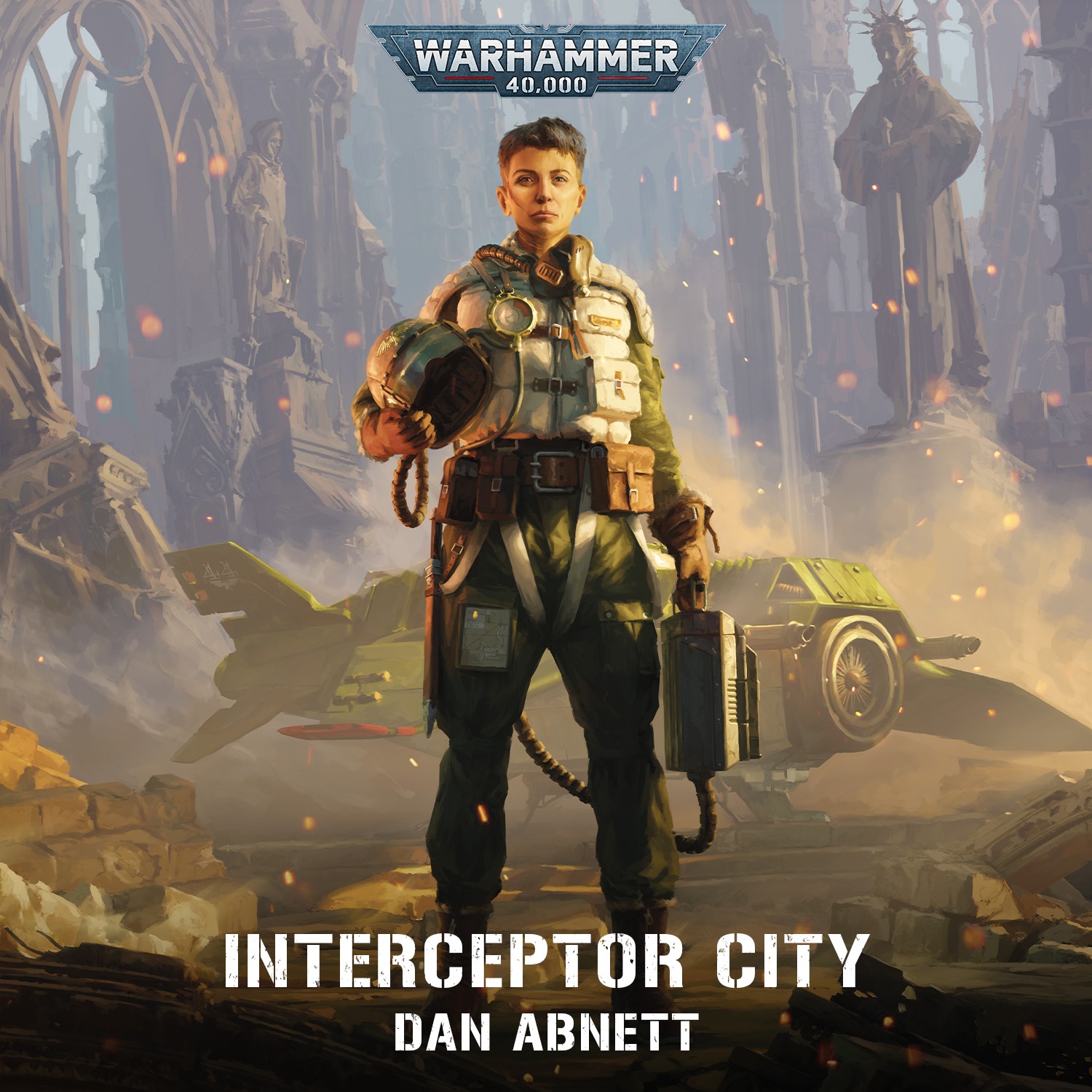
Warhammer 40,000: Interceptor City by Dan Abnett

Publisher: Black Library (Audiobook – 22 February 2025)

Series: Sabbat World Crusades/Warhammer 40,000

Length: 15 hours and 35 minutes

My Rating: 5 out of 5 stars

Amazon

Take to the skies once more as legendary Warhammer 40,000 author Dan Abnett presents another ambitious and rip-roaring novel of dogfights and explosive characters in the incredible novel, Interceptor City.

Dan Abnett is an author who I have mentioned multiple times in this blog, primarily because he is one of the best and most prolific writers of Warhammer fiction.  Abnett’s impressive work is a substantial pillar of the extended Warhammer 40,000 universe, especially with his entries in the Horus Heresy range, as well as his own various unique series, several of which are amongst some of my very favourite pieces of Warhammer 40,000 fiction.  This includes his outstanding Eisenhorn novels (XenosMalleus and Hereticus), his long-running Gaunt’s Ghosts books (First and Only, Ghostmaker, Necropolis, Honour Guard, The Guns of Tanith, Straight Silver and Sabbat Martyr), as well as gripping standalone titles like Titanicus. However, one of his very best books is the exceptional Double Eagle, for which Abnett has just released a sequel.

Double Eagle was an incredible novel first released in 2004 that sought to add a new, unique vantage point to the author’s Sabbat Worlds Crusade, the massive, multi-planet war served as a background the Gaunt’s Ghosts books.  Double Eagle followed members of a regiment of fighter pilots as they sought to control the skies above the Sabbat Worlds.  An intense, beautifully written, character-driven novel, Double Eagle got an easy five-star rating from me thanks to its outstanding and epic dogfights and examples of fighter-on-fighter combat.  Double Eagle was easily one of the best Warhammer books I have ever read, and I was very excited to find out that Abnett was finally releasing a sequel.

The Emperor protects, the Aeronautica remembers!

It has been more than 20 years since the battle to save Enothis and the Sabbat Worlds Crusade continues to rage, with millions of soldiers from the Imperium of Man fighting and dying to claim the planets from the arch-enemies grasp.  For some the crusade seems like a distant event, but for those on the scarred planet of Lysander, war is a daily occurrence, especially as the air forces of Chaos constantly seek to destroy the Imperial defenders with massive bomber flights.  The latest front of this campaign is the ruined hive city of Vesperus, which the enemy is using as cover to launch bombing attacks where the Imperials least expect it.  In response, the fighter pilots of the Aeronautica Imperialis have been ordered to secure the destroyed spires and massive building and turn Vesperus into a city of interceptors.

Into this precarious warzone flies former famed fighter pilot Bree Jagdea.  No longer the heroic ace who led her squadron to victory on Enothis, Jagdea now only pilots cargo haulers, determined to stay out the fighting.  However, an encounter with an old comrade leads her back into danger when she agrees to help the war effort by driving a needed replacement fighter to the Circus 66 squadron, currently serving in the ruins of Vesperus.  Planning to leave immediately after dropping off her precious cargo, Jagdea instead finds herself conscripted to join the ranks of the squadron as they face overwhelming odds against massed opposition from the forces of Chaos.

With no way out of the fight, Jagdea must once again contend against opponents in the sky if she wants survive and escape this new hellish posting.  However, this is not the air combat she is familiar with, instead the fighting in Vesperus is a cramped and deadly affair as their fighter aircraft must fight amongst the devastated and towering buildings of the Hive, where even the slightest error could result in death.  Forced to adapt to the new urban conditions Jagdea attempts to bring out her former skills and talent to survive the enemy all around her.  But with mysterious deaths haunting the squadron and the addictive thrill of danger once again luring her in, can Jagdea once again become a hero, or will she finally face her fate in the sky?

Well damn, now that’s how you do a sequel!  Dan Abnett continues to showcase why he is one of the very best authors of Warhammer fiction with the exceptional Interceptor City.  A particularly intense and captivating read that brings back one of Abnett’s best protagonists, Interceptor City was everything I hoped it would be, and more, as this novel simply blew me away.  One of my new favourite Warhammer 40,000 novels, Interceptor City gets a very easy five-star rating from, and I love the unique direction Abnett took this long-awaited sequel.

I have so much love for the narrative in Interceptor City, especially as Abnett decided to provide something very special for this sequel.  Abnett could have produced another open-skied flying story set right after the events of Double Eagle, and this probably would have been good enough to keep most Warhammer fans happy.  Instead, the author decided to raise the stakes in a big way by producing a deep and intense character-driven novel that brings back and focusses solely on a traumatised and retired version of his previous novel’s protagonist 20 years after the events of the first book, and places them into an impossible combat situation amongst suffocating spires and devastated city blocks to produce some outstanding action.

Told exclusively from the point of view of protagonist Bree Jagdea, Interceptor City went in some very interesting directions that bring the reader quickly into the fray.  Effectively setting up the unique situation on Lysander and Jagdea’s current emotional state, the story soon introduces some of the key supporting characters, before bringing Jagdea to the thick of the fighting in the devastated hive city of Vesperus.  Forced by circumstances to once again fly in combat, Jagdea finds herself in a new craft alongside an insane group of pilots trying to survive against impossible odds.  This results in the powerful main body of the plot as the traumatised Jagdea attempts to survive in an array of lethal fights amongst the massive, destroyed buildings of the Vesperus hive.

Abnett works in some incredible aerial sequences throughout Interceptor City, and you really become absorbed in the elaborate flying duels amongst the ruined buildings.  There is a great character-driven story here as Jagdea remembers her old instincts and slowly adapts to the new flying conditions she is forced to fight in.  At the same time as the brilliant action sequences, Jagdea also gets to know the other eccentric members of her new squadron, and there are some amazing character moments as she tries to understand their desperation, insanity and unique methods, while also trying to improve the survival rate of the less experienced pilots.  The flying scenes get more intense as the plot continues, especially as Jagdea regains her confidence, and you begin to understand more of the squadron’s madnesses.  There are some truly impressive story moments here, including a harrowing survival sequences and multiple complex aerial fights, that are cleverly worked together into one coherent and compelling plot.  Thanks to a great subplot, the later part of the book has a darker edge of mystery that requires to protagonist to try and understand the deeper motivations of the supporting cast.  While the solution of this mystery is somewhat obvious, it proves to be very well set up, and Abnett utilises it to masterfully increase the novel’s tension and stakes.  Interceptor City ends on a dark but fun note, as Abnett bucks against the expected final confrontation and allows the protagonist to end events on her own terms in a very over-the-top fashion.  This proved to be an extremely addictive narrative that really dives into the heart of the protagonist and provides some powerful and action-packed moments.

I loved this amazing Warhammer 40,000 novel, and I felt that Abnett presented it in such an impressive way.  Cleverly settling in as a standalone novel amongst the author’s other Sabbat World Crusade books, Interceptor City features a somewhat different style from Double Eagle, which works to make this sequel stand out on its own.  Rather than the extensive, multiple viewpoints that Double Eagle featured, Interceptor City is told exclusively from the perspective of the damaged protagonist Bree Jagdea.  While this does mean that you don’t get the full-picture war story that made Double Eagle cool, it allowed Abnett to really dive into his impressive protagonist’s story and showcase her personality and emotional state.  This ensured that this sequel was a particularly powerful and complex read, especially as Jagdea is a shadow of her former self after burning out as a pilot and crashing at her peak.  Now back into the cockpit, Jagdea is forced to come to terms with her own fears and doubt, as well as try the legacy of her past actions.  Abnett did an exceptional dive into Jagdea’s mind throughout Interceptor City, and he utilised the sole viewpoint to really explore her fears, hopes and the reasons behind her retirement.  This proved to be quite exceptional, and while readers are advised to read Double Eagle first to see this protagonist at her flying peak, new readers can easily dive into Interceptor City and appreciate its powerful emotional heart.  Throw in an over-the-top cast of eccentric pilots and killers with some additional complex and fascinating stories that the protagonist gets to know and trust, and Interceptor City has an impressive amount of character work that I found really fascinating.  Abnett layers this was a very grimdark tone, which allows the reader to full appreciate the desperate situation the protagonists are, and readers come away with an intense and impressive appreciation for the story.

While the great writing and the impressive focus on the protagonist’s mind ensures Interceptor City had an amazing story, the true highlight of this book is the outstanding depictions of aerial combat.  Abnett somehow managed to exceed his various impressive aerial sequences from Double Eagle in this sequel, and the resulting scenes of fighter-on-fight combat were so damn impressive, especially as the author describes them in exceptional detail.  The change of scenery from open skies to cramped urban flight conditions was extremely smart, and it ensured that Interceptor City’s flight scenes really stood out.  While the protagonist isn’t facing the overwhelming numbers of enemy fighters she encountered in Double Eagle, she is now forced to deal with small groups of skilled pilots amongst the wreckage of Vesperus, flying at impossible speed where even the slightest mistake could lead to death.  This results in some extremely nerve-wracking and claustrophobic sequences, as the protagonist tries to simultaneously fight and survive the dangerous environment she is flying through.  These fight sequences were so damn cool, and I loved how Abnett slowly improved the protagonist’s performance with each flight to reflect her growing confidence and mastery of the new location.  It is honestly impossible to stop reading Interceptor City during any of these sequences, especially the massive high-stakes ones at the end, and I frankly could not believe how Abnett made the dogfights and flying scenes even more epic in this outstanding sequel.

As is my preference with all things Warhammer, I chose to check out Interceptor City on audiobook rather than seeking out a physical copy.  Warhammer audiobooks are so damn good, and I love how well the elaborate and dangerous Warhammer 40,000 setting comes across when it is read out by a skilled narrator.  Abnett’s Warhammer 40,000 novels are a great example of this, as his compelling character and intense, tailored action really comes across on audiobook, especially in the hands of one of my favourite narrators Toby Longworth.  Longworth, who has lent his voice to most of Abnett’s books, really understands the best way to present the author’s fantastic narratives, and I love his cool take on all his Warhammer novels.  This was particularly true with Interceptor City, as Longworth did a masterful job bringing this complex tale to life, moving the main plot along at a quick pace and ensuring the action sequences were as epic as possible.  The passionate way he reads out the complex dogfights is just brilliant, and I found myself getting more and more drawn into these scenes as Longworth effortlessly vocalises every turn of the fighter and every lethal explosion in a tense and powerful manner.  You really got a sense of the protagonist’s desperation and the claustrophobic flying conditions she experienced thanks to this narration, and I was honestly on the edge of my seat for some of these outstanding sequences.  Throw in Longworth’s great array of compelling voices, which perfectly match the character they are assigned to, unique space accents and all, and the full impact of this amazing Warhammer 40,000 novel really comes out in the audiobook format.  Coming in with a run time of 15 and a half hours, Interceptor City is an epic audiobook to get drawn into, and I powered through this format in no time at all.  I actually wished it was a longer audiobook, it was that much fun, and as such I cannot recommend this format enough.

Dan Abnett was once again on fire with this exceptional and impossibly impressive Warhammer 40,000 novel.  A worthy sequel with its own incredible narrative, Interceptor City was a blast from start to finish and I had such a great time getting through this ambitious read.  Powerful, exciting, and loaded with some of the best Warhammer action sequences you are likely to read, Interceptor City comes highly recommended, and this might be one of my new favourite books.  I cannot wait to see what awesome Warhammer 40,000 novel Abnett writes next, and I hope we don’t have to wait another 20 years to see a new aerial adventure from this amazing author.

Amazon

Nobody’s Fool by Harlan Coben

Publisher: Century (Trade Paperback – 25 March 2025)

Series: Detective Sami Kierce – Book Two

Length: 432 pages

My Rating: 5 out of 5 stars

Amazon

One of the best authors of modern crime fiction, Harlan Coben, returns with another exceptional and twisty read, Nobody’s Fool, which hooks you from the beginning and refuses to let you go.

Harlan Coben is an author who needs very little introduction considering he is currently dominating the crime fiction world with his brilliant literary fiction and awesome television adaptations (plus he’s apparently a great murder alibi for Stephen King characters).  I have only read a few examples of Coben’s work so far, although I had an amazing time with the intense novels I checked out.  For example, I Will Find You and Think Twice were very exceptional, and I loved the unique mysteries and scenarios that the author comes up with.  As such, it was an easy decision to check out the latest book from Coben, Nobody’s Fool, especially when I was in the mood for an addictive and twist-laden read.  The sequel to one of Coben’s better known books/television series, Fool Me Once, Nobody’s Fool was an outstanding novel with an impressive plot behind it.

Plot Synopsis:

A year after the devastating events that took place in Fool Me Once, a secret from former Detective Sami Kierce’s college days comes back to haunt him. Present day is hard enough for Kierce, but his past isn’t through with him yet…

Sami Kierce, a young college grad backpacking in Spain with friends, wakes up one morning, covered in blood. There’s a knife in his hand. Beside him, the body of his girlfriend. Anna. Dead. He begins to scream – and then he runs.

Twenty two years later, Kierce, now a private investigator, is a new father who’s working off his debts by teaching wannabe sleuths at a night school in New York City. One evening, he recognizes a familiar face at the back of the classroom. Anna. It’s unmistakably her. But as soon as he makes eye contact with her, she bolts.

For Kierce there is no choice. He knows he must find this woman and solve the impossible mystery that has haunted his every waking moment since that terrible day.

His investigation will bring him face-to-face with his past. Soon he discovers that some secrets should stay buried.

Well damn, now that was an awesome read.  While I was expecting Nobody’s Fool to be an entertaining and complex novel, I wasn’t fully ready for all the fantastic twists and turns that Coben loaded into this cool new book, and I got really sucked in as a result.  Due to how addictive Nobody’s Fool was, I managed to knock it off in a single day, and I had to give it a full five-star rating as a result.

Coben ended up pulling together a spectacular and multi-layered narrative in Nobody’s Fool, which successfully blended complex mysteries with some intense personal moments from the book’s protagonist.  Set a year after the events of Fool Me Once, Nobody’s Fool follows former police detective Sami Kierce, who had a strong supporting role in the previous book.  Now a private detective and part-time criminology lecturer to wannabe crime solvers, Kierce is struggling to make ends meet.  However, he soon becomes obsessed with a new personal case when Anna, a former lover who he believed was dead, suddenly appears at one of his classes before running away.  Determined to uncover what happened all those years before, Kierce soon connects Anna to one of the most infamous kidnapping cases in the country’s history and must attempt to work out who she is and what truly happened to her.  At the same time, the protagonist is also forced to deal with the release of the man who was convicted of murdering Kierce’s former fiancé, especially as the released killer wants Kierce’s help to prove his innocence.

I really enjoyed this compelling narrative, especially as Coben effortlessly combines the protagonist’s personal issues in the aftermath of Fool Me Once, with the current thrilling mysteries.  The main plot around the supposed death of Anna and how it ties into the troubled history of an influential family was just spectacular, and I loved the many impressive twists and intriguing family drama that the protagonist is forced to navigate.  At the same time, the complex storyline around the murder of his former fiancé added a compelling personal edge to the book which hit all the right emotional notes.  Both these separate storylines come together extremely well in Nobody’s Fool’s larger narrative, and Coben balanced them nicely, especially when it comes to a major story moment about two-thirds of the way through that ensures that the entire investigation is thrown out of whack.  This eventually leads to two sperate sets of revelations as Kierce uncovers the truth behind both crimes.  While I felt that the solution to the mystery around the protagonist’s dead fiancé was a little obvious, the main plotline around Anna was extremely clever, and I deeply enjoyed how it was solved.  Coben did an outstanding job layering the hints and clues to this mystery throughout the rest of the book, and it came together in a tragic and powerful end.  An overall great mystery narrative that goes in some captivating and shocking directions, this was such an addictive story and there was a reason I couldn’t stop reading it.

Coben brought Nobody’s Fool together in a particularly impressive way that really allows readers to get to grips with the story and dive into its emotional heart.  Told solely from the perspective of protagonist Sami Kierce, Nobody’s Fool turned into quite a moving character-driven read, as Coben effectively worked the various mysteries with international implications, while also diving into the psyche and emotional turmoil of the protagonist.  The deep character dive into the protagonist was really compelling on several levels, as not only does he have to explore the trauma introduced in this book, but there is a great examination of the fallout from Fool Me Once.  It was captivating to see Kierce deal with the consequences of the previous novel, and the fallout keeps the protagonist desperate and plays into the modern story wonderfully.  At the same time, the author introduces a fun array of cooky supporting characters, who add to the general fun of the story.  My favourite were the members of Kierce’s criminology class, whose entertaining assistance helps to solve the case in an unexpected manner.  Coben expertly brings them into the plot, and there are some fun stories associated with them that I could see the author exploring further in the future.  The various suspects associated with the main case had the most emotional impact on the story, and their complex connections, dark motivations and intense need to find the truth helps to turn Nobody’s Fool into something truly special.  Throw in some quick paced scenes, cool locations (including one I know he came up with at Bouchercon 2024), and some brilliant family moments from all the damaged characters, and this was such an outstanding read.

One thing I feel I must discuss about Nobody’s Fool is how it ties into the preceding novel, Fool Me Once, and whether you can read this second novel as a sequel or as a standalone read.  Now I must admit that I haven’t read Fool Me Once, so I went into this sequel a little blind and I was initially worried that I was going to have a hard time following the plot or fully appreciating the story.  However, I found that for the most part Nobody’s Fool stands on its own, and no real pre-knowledge of Coben’s previous novel was needed.  There is a great focus on the fallout from the first book, especially when it comes to Kierce’s role, but Coben provides the necessary context so you can appreciate this drama without having to read Fool Me Once first.  This does somewhat change around halfway through, when a couple of major characters from Fool Me Once are shoehorned in as potential witnesses for the current case, and new readers might have some problems fully appreciating the personal gravity of Kierce’s meetings with them.  While those fans who have checked out Fool Me Once first will probably get some more emotional impact from these parts of the book, I felt that Coben ensured there was enough background to allow new readers to keep moving forward without any difficulty and have an exceptional time with the author’s killer plot.

Harlan Coben continues to impress with this brilliant new novel that serves as a wonderful sequel to one of his more iconic novels.  Nobody’s Fool had me hooked from the very first page, and I had such an outstanding time fully unwrapping the author’s complex mystery and diving through every fantastic twist.  This book was an absolute pleasure to read, no matter your experience with Coben’s other works, and I hope we see some more from Nobody’s Fool’s protagonist in the future.

Amazon

Usagi Yojimbo: Volume 15: Grasscutter II- Journey to Atsuta Shrine by Stan Sakai

Publisher: Dark Horse Comics (Paperback – 1 February 2002)

Series: Usagi Yojimbo – Volume 15

Length: 184 pages

My Rating: 5 out of 5 stars

Amazon

The classic adventures of Usagi Yojimbo continue as I look back at the 15th brilliant volume, Grasscutter II – Journey to Atsuta Shrine, one of Stan Sakai’s more ambitious and powerful comics, which sees the protagonist and his friends caught up in the tides of fate and history.

Ever since I read the recently released 40th volume of Stan Sakai’s iconic Usagi Yojimbo comic series, The Crow, I have been in a major Usagi Yojimbo mood, so I decided to go back and continue reviewing the older volumes of this classic comic, which follows a rabbit ronin in a version of Feudal Japan populated with anthropomorphised animals.  I reviewed the first 14th volumes during COVID lockdown, and had a lot of fun doing so, especially as Usagi Yojimbo is one of my favourite comic series.  I have been meaning to restart reviewing the older comics for a while, and I’m not going to throw away this sudden surge of creative energy, so this is the perfect time to bring out my review for the 15th volume in the series, Grasscutter II.

Grasscutter II is one of Sakai’s most impressive comics in the series.  Featuring issues #39-45 of the first Dark Horse Comics run on the Usagi Yojimbo series, Grasscutter II serves as the gripping sequel and conclusion to the intense and pivotal story contained in the 12th volume, Grasscutter.  This previous volume saw Usagi and his friends become embroiled in the recovery of the legendary sword Kusanagi and the foiling of a major plot to rebel against the Shogun.  A dark and compelling entry in the series, Grasscutter featured an amazing story with major implications for the Usagi Yojimbo series.  This was such a key volume, and it is interesting to see how Sakai follows it up here, especially as he needed to make Grasscutter II’s story in just as epic, if not more impressive.

Following dark events of magic and death, few people are aware that the legendary Imperial sword Kusanagi has been recovered from the sea.  Forged by the gods and wielded as a symbol of Imperial authority for generations, Kusanagi, or the Grasscutter sword has the potential to reshape the power structure of Japan, as whoever holds it could rally all the country to their cause, bringing war and destruction to a currently peaceful nation. 

Hidden at a small temple, the sword is currently guarded by the honourable samurai Miyamoto Usagi, the irrepressible bounty hunter Gen, and the head priest Sanshobo.  However, the three know that they cannot keep the sword hidden for long, with dangerous foes seeking to uncover its secrets.  The only place that the sword will be truly safe and out of the hands of those who would use it for political gain is the sacred shrine of Atsuta, where a replica of the sword currently rests.

Embarking on a noble quest, Usagi, Gen and Sanshobo hope to sneak the sword to the shrine before anyone knows they have it.  However, the road to safety is long, and it soon becomes apparent that dangerous foes know exactly what they are carrying.  Pursued by two rival ninja clans who will stop at nothing to possess the sword as fuel for their own dark ambitions, Usagi and his comrades will need to fight tooth and nail to survive and keep the sword out of their hands.  But with old friends and new bitter rivals revealing themselves, can even Usagi and his skilled companions avoid the tragedy that stalks them?

Grasscutter II was an epic and captivating classic entry in one of the best ongoing comic series.  Serving as an effective follow up to the bloody events of Grasscutter, Grasscutter II blended together a ton of outstanding action with some great character moments to create a memorable and beautifully drawn addition to the series that gets a very easy five-star rating from me.

This 15th volume of the Usagi Yojimbo series has a very gripping and intense storyline that seeks to combine Japanese history and mythology with the author’s action-packed style.  Starting with a beautifully drawn prologue that gives some interesting historical and mythological context to the sacred shrine of Atsuta, Sakai quickly moves into the main story, with Usagi, Gen and Sanshobo starting their journey to the shrine after being forced to protect the sword in the previous volume, Demon Mask.  At the same time, two rival bands of ninja, the Komori ninja and Neko ninja, discover that the existence of the sword and move quickly to intercept the companions, hoping to claim it for their own conflicting reasons.  The Neko ninja, led by Chizu, who has a complicated history with Usagi, catch up to the protagonists around the same time as the Komori ninja, leading to a wild three-way brawl.  Forced to work together, Chizu joins Usagi and his friends to recover the sword, which raises some interesting conflicts and issues, especially as Chizu has very different plans for the Kusanagi sword.

The second half of Grasscutter II is epic the entire way through, as Sakai continues to feature impressive action, while also allowing several character arcs to develop and conclude in tragic ways.  This includes the companions meeting up with the excellent supporting character Ikeda, who had such a great redemption arc in the previous Grasscutter volume.  Following some initial betrayal from Chizu, Usagi, Gen and Sanshobo follow her and enter battle with the Komori ninja, which ends in a dark moment of honour and loyalty from another interesting supporting figure.  While this initially seems to wrap up the main story, a fun twist ensures that Grasscutter II enters a fantastic concluding arc that sees that protagonists enter one last battle before achieving their goal.  This big battle is one of the most brutal and intense in the entire volume, and results in the book’s final tragic moment, which proves to be a fitting end to one amazing figure.  Loaded with powerful emotion, sacrifice and grief, this ending to Grasscutter II wraps up the entire story perfectly and ensures you are hooked all the way to the final blow.

This was another great volume from Sakai that successfully pushes the overall narrative of the series onwards and results in some intriguing changes to the comics, both in this book and the future.  As with all of Sakai’s work, Grasscutter II features a great combination of action, intrigue, character work and beautiful art that comes together perfectly to create an exceptional comic that is impossible not to finish in one sitting.  There are some truly great moments in Grasscutter II that help to make it stand out amongst Sakai’s other outstanding work, including the cool battle sequences.  The various scenes that feature the protagonists caught between two different schools of ninja were the best, and Sakai had fun showcasing the scary fighting ability of the blade-winged Komori ninja, as well as the established tricks of the Neko ninja.  This fantastic clash of styles allowed for some brilliant sequences, which were so damn epic to see unfold.  While I had a lot of fun with Grasscutter II, I must say that it probably isn’t the best volume of Usagi Yojimbo to start the comic on.  While Sakai does a good job revisiting some of the key plotlines and characters, you probably should read the previous Grasscutter volume to fully appreciate the plot, as well as some of the other earlier volumes to understand some of the character arcs.  Still, this is a very impressive Usagi Yojimbo entry, and a key read for established fans of the series who will have an exceptional time with Grasscutter II.

While fans will probably enjoy Grasscutter II’s exceptional action the most, I personally thought that it was some of the great character work in this volume that helped to make it particularly good.  Thanks to the volume featuring one extended storyline, Sakai takes his time to set up some outstanding character moments that work perfectly alongside the complex narrative and cool artwork.  While Usagi and Gen are their usual fun selves (there opposing views on honour, duty and what is right is always fun), I thought it was several returning supporting characters who really stole the show in Grasscutter II, especially as Sakai wove some great storylines around each of them.  This includes the former samurai turned monk Sanshobo, who has been an excellent recurring figure since his introduction in the series’ 10th volume, The Brink of Life and Death.  Not only does he mesh well with Usagi and Gen, acting as a voice of reason between the two strong-willed characters, but Sakai also brings one of his main character arcs full circle when he encounters his former lord.  Sanshobo has some great moments in Grasscutter II, especially his grief at the end, and I liked how Sakai utilised him as part of the main trio.

Another impressive character in Grasscutter II is Ikeda, who Sakai has built up as a wonderful figure.  Introduced in the moving story, The Patience of the Spider (contained in the 11th volume, Seasons) and expanded on in the first Grasscutter story, Ikeda is a former lord and general who learned to enjoy the quiet life of a peasant after his defeat.  Reunited by chance here with his former retainer Sanshobo, Ikeda proves to be an interesting addition to the cast.  Not only do his insights into the Neko ninja, who he greatly distrusts due to his history with them, result in a key plot point, but he is also once again tempted to achieve power, something he decides against in a great continuation of his storyline.  However, it is in the final sequence where Ikeda’s full character is revealed, where he serves as a willing rearguard to the companions to ensure the Neko ninja don’t get the Grasscutter sword.  His big battle sequence is very well portrayed, especially with how Sakai features his old war wound, and his final scene is one of the most badass inclusions in any Usagi Yojimbo comic.  An extremely well-written and complex character who is used to his full potential in this last appearance.

The final characters I want to mention are the various members of the Neko ninja who appear in this volume, primarily as antagonists.  Long-time opponents of Usagi, the Neko ninja represent the more classic ninja styles in the Usagi Yojimbo universe and prove to be great foils to the protagonist’s samurai style.  This includes their leader, Chizu, who has a long and complicated history with Usagi.  Simultaneously serving as both an alternate protagonist, antagonist and potential love interest to Usagi, Chizu has a lot of storylines in Grasscutter II, which Sakai makes full use of.  Forced to hunt for the Grasscutter sword against her better judgement, Chizu desires nothing more than to throw the sword back into the ocean to keep it out of anyone’s hands, and will betray anyone, including Usagi for that goal.  This results in some intriguing personal issues amongst the protagonists, especially as Usagi tries to see the best in her, while Gen forms an instant, mutual dislike of her.  Chizu’s inner conflicts become a key part of the plot, and her appearance here will have major impacts for her storyline going forward, especially when it comes to her ambitious number two, Kagemaru, who has been angling for power for several volumes now.  Kagemaru proves to be a ruthless alternate antagonist in Grasscutter II, and I liked how well Sakai set him up as both a physical and political threat going forward.  The final Neko ninja character I should mention is Saru, a former member of the clan betrayed by Kagemaru in the previous volume.  Seeking revenge on Chizu, who Saru believes was behind the betrayal, Saru stalks Chizu for much of the volume, resulting in some excellent sequences of ninja-on-ninja violence.  A compelling figure, Saru ends up redeeming herself in a particularly moving sequence and makes an impact despite her relatively short appearance.  These great ninja characters, and indeed the entire case of Grasscutter II, deeply enhanced the impact of the comic’s narrative, and I had an outstanding time seeing their arcs unfold.

As with all the Usagi Yojimbo comics I review, I must highlight the outstanding artwork that is such a brilliant feature of Grasscutter II.  Featuring Sakai’s classic pre-colour style of drawing, Grasscutter II’s art is very visually impactful, and I loved the fantastic black-and-white panels that cleanly show the complex actions and characters.  Every panel is extremely striking, and I love how effectively Sakai showcases everything in such detail, including the actions of his many characters.  I am always impressed with how well Sakai implies movement and activity with his drawings, and you really get the flow the scene from his panels.  I particularly appreciate how well the intense fight sequences come across in Grasscutter II, especially as there are so many scenes of carnage that occur within this volume.  The various battles, which usually involve a range of ninja, are so well drawn, and I loved the complex array of combat that flitters along the pages.  Some of these scenes are quite elaborate, and I loved seeing all the multiple black-clad figures moving around the established cast, especially in some of the bigger fight sequences.

In addition to great fights, Sakai does a great job capturing the emotive nature of his cast with his fantastic drawings of the major characters.  The intense reactions of many of his characters help to make the scene pop, and I love how well Sakai showcases the emotional range that the story elicits.  Highlights include the final face of one badass warrior while the grief of another usually calm figure really hammers home the seriousness of the moment.  All this amazing action and great character drawings is perfectly supported by Sakai’s trademark drawings of the picturesque Japanese landscapes, towns and temples that serve as an amazing backdrop to the main story.  Sakai has some real talent of showcasing Feudal Japan with his artwork, and you can often feel the world through which the characters are trapsing.  I particularly appreciated Sakai’s portrayals of a wild oceans beneath a ragged cliff, which was a setting for several of the volume’s more visually powerful panels.  The harsh waves striking around the combatants was especially impactful, and you could almost feel the wave’s strength as the characters fight at their edge.  Throw in Sakai’s interesting take on a classic Japanese legend at the very start of the volume in the prologue and Grasscutter II’s art comes together in a truly perfect manner, especially as this volume features some of the artist’s most ambitious fight sequences.

Based on my rambling paragraphs above, I think it is safe to say that I had an amazing time reading the 15th Usagi Yojimbo volume, Grasscutter II.  Featuring the exceptional storytelling and artwork of the legendary Stan Sakai, Grasscutter II achieves so much with its ambitious plot, long-term, character driven storytelling, and amazing sequences of combat and chaos.  A brilliant, classic addition to a truly incredible comic series, Grasscutter II comes highly recommend, and I had such a great time getting through it yet again.

Amazon

Usagi Yojimbo: Volume 40: The Crow by Stan Sakai

Publisher: Dark Horse Comics (Paperback – 21 January 2025)

Series: Usagi Yojimbo – Volume 40

Length: 152 pages

My Rating: 5 out of 5 stars

Amazon

Stan Sakai’s iconic Usagi Yojimbo comic series powers through to its 40th volume, with the compelling and action-packed collection, The Crow, which proves to be another intense and impressive read.

Readers of this blog will know that I have a lot of love for the amazing Usagi Yojimbo series by Stan Sakai, which has remained one of my favourite comic series for years.  Following a rabbit ronin in an alternate version of Feudal Japan populated by anthropomorphic animals, the Usagi Yojimbo series combines cool art and great characters with a fantastic Japanese samurai aesthetic to create a particularly awesome comic series.  I love the various elaborate stories and scenarios that Sakai comes up with for the Usagi Yojimbo comics, and it is a real highlight of my reading year to check out the new Usagi Yojimbo volume.

This latest volume, The Crow, is the 40th collected volume of the long-running Usagi Yojimbo comic and contains issues #275 to #279 of the series.  This is the second volume of the current Dark Horse Comics run of Usagi Yojimbo, which started last year with volume 39, Ice and Snow (one of my favourite books of 2024), and continues some of the ongoing storylines from the other recent volumes.  This volume is once again written and drawn by Sakai, with Hi-Fi Colour Design colouring in Sakai’s illustrations.  The Crow was another interesting addition to the series I was really looking forward to, as it follows Usagi and his unlikely companions into deadly danger.

Following their encounter in the mountains with the murderous Jei, Miyamoto Usagi and his cousin, Yamamoto Yukichi, have finally escaped the freezing north of Japan and have journeyed to warmer climes.  However, just because they are out of the ice and snow doesn’t mean they have escaped trouble.

Closing in on the nearest town, Usagi and Yukichi come across a man being attacked by four ruffians.  Interceding in the fight and driving the attackers off, Usagi and Yukichi initially believe that the man they rescued was a merchant being robbed.  However, when they arrive at their destination, they find the place overrun by disreputable bounty hunters on the hunt for a big reward, including Usagi’s old companions Gen and Stray Dog.  Once again conned into paying for lunch, Usagi and Yukichi are shocked to discover that the focus of the bounty hunters’ attention is the person they saved, a dangerous bandit warlord known as Jimmu due to his crow companion.

Despite their intentions to avoid the hunt for Jimmu, the two rabbit ronin find themselves dragged into the fight by the deadly mercenary Inuyoshi, another acquaintance of Usagi who is also seeking Jimmu’s bounty.  Initially forced into conflict with Inuyoshi, Usagi and his friends soon find themselves unlikely allies of Inuyoshi’s bounty hunter band, as they must work together to take down Jimmu and his massive bandit army.  But with skilled warriors on both sides, and no mercy on the horizon, will Usagi and his associates survive unscathed?

The Crow was another exceptional comic from Sakai, who continues his Usagi Yojimbo series with masterful style.  Featuring one major story that pitted the protagonists against an array of deadly warriors, The Crow had me hooked from the very beginning, and I finished the entire volume within an hour of getting my hands on it.  An outstanding comic with great art and some brilliant character arcs, The Crow unsurprisingly gets a full five-star rating from me and was so damn good.

I felt that The Crow had a particularly strong story behind it, as Sakai continues his recent trend of featuring a single multi-issue story in the volume, rather than a series of smaller short stories like in many of his earlier volumes.  This allowed the author to produce a complex, interwoven narrative that features several intriguing character-focused storylines.  Featuring the old classic start, with Usagi and Yukichi rescuing a traveller from assailants, you are drawn into familiar Usagi Yojimbo ground of bandits and bounty hunters, as the rabbit samurai encounter two of Usagi’s oldest companions, the money-focused Gen and Stray Dog.  This allows for some excellent early story tension, as the naïve and highly honourable Yukichi clashes with the morally flexible and cynical bounty hunters, especially when they discover that the traveller Yukichi helped was the notorious bandit chief Jimmu.  Sakai quickly moves the story into its central arc, when Yukichi is kidnapped by returning figure Inuyoshi, who seeks to keep Usagi, Gen and Stray Dog out of his hunt for Jimmu.

This kidnapping arc proved to be quite interesting, especially as the formerly honourable Inuyoshi verbally clashes with Yukichi and is forced to find his honour in the face of betrayals within his own gang of bounty hunters.  I really enjoyed some of the compelling interactions between some of the cast in the central part of the story, and Sakai cleverly works events so that Usagi and his friends can find and rescue Yukichi.  This central part of the story also features some great action sequences, especially a brutal, multi-page ambush by Jimmu who robs a merchant convoy.  The revelation about the true size of Jimmu’s bandit army inevitably results in Usagi’s group teaming up with Inuyoshi to find and defeat Jimmu, which results in a massive battle that takes up most of the final quarter of the volume.  This battle was everything you could hope for, and Sakai is in fine form with his drawings as he portrays the various fights.  The final duels between bounty hunters and Jimmu have some outstanding and memorable moments, and Sakai ensures there is some powerful tragedy that will live with a certain protagonist.  Sakai ensures that all the key character-driven story arcs are well wrapped up, and there are some touching moments that perfectly define some of the major protagonist’s personalities or struggles in this volume, which I felt made The Crow really stand out.  A very impressive overall story from Sakai, that shows just how interesting and intense his writing can be, even when he returns to his well-trodden tales of bandits and bounty hunters.

One of the things that I felt Sakai did particularly well in The Crow was to feature an array of great characters, whose combined arcs come together extremely well in the context of the larger story.  There is an awesome collection of characters in this volume, including old favourites, returning one-shot figures, and some intriguing new characters who proved to be excellent additions to the overall story.  Sakai does an excellent job balancing a number of these character storylines within the course of The Crow’s four issues, and there are some moving and compelling moments as a result.

A lot of the volume focuses on the three longer-term recurring members of the cast, Gen, Stray Dog and Usagi himself, who are the veteran presence in The Crow.  While they are featured quite prominently, Sakai doesn’t provide a massive amount of development for them, as they mostly fall into the same routines as they previously have, with Gen being the money-fixated conman, Stray Dog being the seemingly selfish and unfriendly killer, while Usagi is his usual honourable self.  I did like how Sakai once again painted Usagi more as a mature and world-weary figure, especially when compared to Yukichi, and it was interesting to see how much more realistic he is here than in some of his earlier encounters with Gen and Stray Dog.  Sakai also has fun once again featuring the dichotomy of Stray Dog, whose selfish outer-shell is cleverly balanced by his actual charitable actions, which are used to great effect for a secondary character towards the end of the volume.  Finally, Gen was his usual self, although considering how fun that is, I was happy with the result.

While these three long-running figures were well utilised, I felt that Sakai did his work with two more recent, returning additions to the Usagi Yojimbo universe with Yamamoto Yukichi and the mercenary Inuyoshi.  Yukichi, Usagi’s cousin introduced in volume 36: Tengu War!, has proven to be an interesting traveling companion for the protagonist, especially as he is very similar to a younger Usagi.  His naivety and unbending belief in honour without compromise is on full display in this volume, especially in his first interaction with Gen and Stray Dog, and it is interesting to compare him to the now more flexible Usagi.  Inuyoshi on the other hand is an intriguing figure who was introduced in the story The Sword of Narukami in the series’ 27th volume, A Town Called Hell.  A formerly honourable samurai betrayed by his lord’s heir, Inuyoshi has become a much more deadly and disreputable figure since his last encounter with Usagi.  I really liked how Sakai devolved Inuyoshi since his last appearance, both in his art and personality, as while he still maintains some of his honour, he has become even more ruthless, going so far as to capture Yukichi to keep Usagi and his companions away.  These two characters are in a way antithesis of each other, with one strictly holding onto samurai ideals while the other has abandoned them and is now more interested in money and survival.  The two play off each other extremely well, despite some major fractious moments, and I liked how they both gain something from the experience, with Yukichi getting a lesson in the real world, while Inuyoshi remembers some of his old honour.  Inuyoshi’s appearance here also perfectly wraps up some of the open storylines from The Sword of Narukami, and I appreciated that Sakai finally provided some closure for a one-off tale from several years ago.

Aside from these great major characters, Sakai rounds out the cast of The Crow with some additional fun figures who each add some fantastic elements to the comic.  The volume’s main antagonist, Jimmu, proves to be a ruthless and competent outlaw leader, and I liked how his crow companion gave him a distinctive edge and allowed for some intriguing and well-drawn battle scenes.  The street urchin, Isamu, was a great mischievous figure who reminded me of a young, but brave, version of the recurring Snitch character.  Isamu has some fantastic interactions with some of the main characters, and it wouldn’t surprise me if we see more of him in the future.  Finally, Sakai has fun including a comedic merchant duo who get caught up in one of Jimmu’s raids.  Their entertaining banter during several scenes had me chuckling, especially when their newly discovered brotherhood is ruined by some ill-matched confessions, and they provided an excellent bit of humour amongst the darker story elements.  These great characters all filled their roles perfectly, and I deeply enjoyed how effectively Sakai utilised them in this fantastic narrative.

As with all the Usagi Yojimbo comics, I really need to highlight Sakai’s exceptional artwork featured within The Crow.  Sakai does another remarkable artistic job in this latest volume, and the comics are just gorgeous as he effortlessly brings his elaborate stories and characters to life with his amazing drawings.  All the characters are lovingly drawn, and their resultant actions, especially the cool battle sequences, are so intense and expressive.  I was particularly impressed with Sakai’s portrayal of rival samurai Inuyoshi, who had previously appeared once some years ago.  It was absolutely fascinating to see how Sakai’s drawing style has changed in the intervening years (I had a look at A Town Called Hell after reading The Crow), as Inuyoshi has so much more detail and depth in this appearance.  His scarred and somewhat more deranged appearance perfectly matched his darker personality, and I really think that he looked even more impressive in colour, which has only been a recurring feature since volume 34, Bunraku and Other Stories

These excellent character drawings are only matched by Sakai’s superb landscape drawings, which provide beautiful and powerful pictures of the story’s background setting.  These background drawings, whether they be depictions of historic Japanese towns or of the shaded natural forests, come across extremely well, and you really feel yourself becoming immersed in the setting as a result.  I must once again mention the awesome action scenes scattered throughout The Crow.  Sakai is a master of drawing epic sword clashes in his comic style, and you can feel every thrust and cut that the various samurai characters make.  Highlights for me this time included two massive group battle sequences that each have their own fantastic moments, cool duels against the bandit leader and his bird companion, and a somewhat graphic but very well-drawn decapitation panel which was both epic and gnarly.  This art once again perfectly enhances and compliments Sakai’s outstanding writing, and I love how even after 40 Usagi Yojimbo volumes, Sakai is still producing such masterful and moving pictures.

Stan Sakai continues to impress and wow me with his outstanding Usagi Yojimbo comic series.  This latest volume, The Crow, was another captivating comic, loaded with striking drawings, intense action, and some excellent samurai characters.  I felt that The Crow was a particularly strong entry in this always incredible series, and I am so very glad we were gifted a volume this early in the year.  I am hoping that we will get another volume later in 2025, but until then, do yourself a favour and make sure to check out the first exceptional 40 volumes of one of the best ongoing comic series.

Amazon

Nemesis by Gregg Hurwitz

Publisher: Michael Joseph (Trade Paperback – 18 February 2025)

Series: Orphan X – Book 10

Length: 493 pages

My Rating: 5 out of 5 stars

Amazon

One of my favourite thriller authors, Gregg Hurwitz, returns with a powerful and particularly addictive new entry in his Orphan X series with the emotionally charged and pulse-pounding read, Nemesis.

Gregg Hurwitz is an author I have had a wonderful time enjoying over the last few years, primarily thanks to his exceptional Orphan X books.  Following former government assassin Evan Smoak, formerly known as Orphan X, this compelling thriller series explores Smoak’s vigilante actions as the Nowhere Man, a source of lethal justice for those who can’t get help anywhere else.  I started reading these books several years ago with the amazing fourth entry, Out of the Dark, which saw the protagonist go to war with a corrupt US President, and I have been hooked ever since, grabbing every subsequent entry in the series.  This includes the outstanding novels Into the FireProdigal SonDark HorseThe Last Orphan and Lone Wolf, each of which did an intriguing job of continuing the series while also exploring Hurwitz’s complex protagonist and his unlikely family.  I really enjoyed all these books, and I have been eagerly awaiting the 10th novel, Nemesis, for a while now, especially as it promised to follow on from the intriguing cliff-hanger at the end of Lone Wolf.

No greater friend.  No worse enemy.

Evan Smoak, the Nowhere Man, has spent years taking on impossible vigilante missions, while also keeping his former government owners at bay.  No matter how hard the mission, Smoak always succeeds, in no small part to the group of loyal friends who have his back.  But Evan is about to discover the sad truth that it’s those closest to you that can cause you the most pain.

After foiling a lethal assassin with a penchant for taking out innocent bystanders, Evan is disturbed to discover that the assassin’s weapons were sourced from his trusted comrade and armourer, Tommy Stojack.  Shocked and determined to get answers, an emotionally compromised Evan finds himself unwilling to forgive Tommy for his lapse in moral code, and the two strong-willed warriors soon find themselves at odds.  When Evan’s next attempt to talk sees him ambushed by a flurry of thugs and shooters, he decides that it’s time to go to war, even if that means killing his best friend.

However, Tommy has his own problems to deal with.  Receiving a call for help from the son of an old war buddy, Tommy travels to a dying American town, filled with anger, corruption and racial tension.  Attempting to honour his debts, Tommy finds himself mentoring a group of neglected and angry young men whose uninformed actions have led to tragedy.  However, Tommy’s seemingly simple mission soon turns deadly when Evan arrives in town and takes issue with the actions of those under Tommy’s protection.  Thrown into opposite moral paths and plagued by assassins, local troubles and their own substantial personal issues, Evan and Tommy find themselves in conflict, with everyone around them caught in the crossfire.

Hurwitz continues to shine as one of the premier authors of thriller fiction with this particularly intense and complex entry in his Orphan X series.  Featuring a compelling plot loaded with action and captivating character moments, Nemesis was an addictive read that hits the reader hard and never gives them a chance to recover.  This was probably one of my favourite Orphan X books so far, and thanks to Hurwitz’s brilliant writing, I have very little choice but to give Nemesis a full five-star rating.

I was really impressed with the plot for Nemesis, which honestly went in some compelling directions that I didn’t expect, but which provides great closure and intense character moments, while also loaded up with the series’ trademark action.  Following on from Lone Wolf, Nemesis sees a preoccupied protagonist, Evan Smoak, distracted and distressed by the revelations that his best friend and armourer Tommy Stojack supplied weapons to a deadly assassin who killed multiple innocent people in the previous book.  Forced by his moral code into a confrontation, Evan finds himself in conflict with a stubborn and unapologetic Tommy.  However, what starts as a major disagreement between friends turns into a full-on war, when the two find themselves on different sides of an ethical fence, while also fending off assassins and killers after Tommy.

Hurwitz paced this narrative out extremely well, with a great intro and an early action set piece that worked to showcase the protagonist’s emotional instability.  The initial confrontation between Evan and Tommy sparks up the intensity of the plot, and the reader becomes engaged in seeing how the conflict between them will continue, especially after the second sequence forces Evan to fight for his life.  The author then takes the book in a very interesting direction, as Tommy journeys to a small town in heartland America to help the son of an old comrade and finds himself mentoring a group of young want-to-be militia members who have gotten into trouble.  Hurwitz spends a lot of time focusing on Tommy’s attempts to guide the group and trying to gently resolve the dark things they have done.

While this journey to middle-America initially seemed an odd choice for plot progression, Hurwitz utilises it perfectly to showcase Tommy’s character and the differences in approach and personality between him and Evan.  Conflict inevitably emerges when Evan arrives and attempts to solve matters in a black-and-white manner, forcing Tommy to intervene.  This provides even greater emotional turmoil, and I loved how well the author set it out.  You find yourself getting really drawn into the nuanced situation that emerges, and I loved seeing the alternating methods and personalities of the two protagonists.  After an impressive action sequence where Evan and Tommy come together one time to face off against a scary group of assassins, Hurwitz sets up the book’s final confrontations, which are loaded with some brilliant moments that pushes both main characters to the edge.  I deeply enjoyed how Hurwitz resolved the entire situation, and you are on the edge of your seat the entire time, which results in a particularly addictive read.  I honestly was very satisfied with this book, right up to the final twist, which was impactful and clever, but for which I may never forgive Hurwitz.  This was easily one of Hurwitz’s best narratives, and I really appreciated the complex, character-driven thriller storyline he envisioned for this latest Orphan X book.

Hurwitz did an exceptional job bringing Nemesis’s complex and captivating narrative together, and I honestly feel that this is some of his best writing.  Featuring a fantastic continuation of the ongoing series, Nemesis had the perfect blend of action, intrigue and character-focused drama, which allowed for quite an addictive read.  The various action sequences scattered throughout the book are intense, brutal and very-well put together, and I loved how they showcase the various moods of the protagonist, as we go from his usual smooth sequences to more frenetic fights when he is emotionally compromised.  While these typical thriller elements are a lot of fun, it is the focus on the characters and the intense emotions between them that makes Nemesis particularly impressive.  Hurwitz sometimes struggles with the balance between action and character development, but I felt that this one was perfect, especially as he featured an array of damaged figures, including two former best friends in deep conflict.  While I do think that Nemesis could have gone without another manufactured conflict between Evan and his ward, Joey, for the most part it was exceptional to see the various character interactions and dives into the protagonist’s psyche that emerged.  This blended extremely well with the overarching thriller narrative and the fantastic action of the plot, and resulted in a particularly powerful read that, while more emotionally charged than most thrillers, worked extremely well in the context of this series.  I really appreciated how carefully Hurwitz set out these elements in Nemesis, and there is really something for everyone here including some thought-provoking discussions, awesome action scenes, and some major emotional moments that will hit you hard and really stick with you.

As with most books in the Orphan X series, Nemesis can be read as a standalone novel, as Hurwitz does an excellent job of recapping key events, elements and characters from the previous novels for new readers.  I personally felt that to get the full emotional impact of Nemesis, readers really need to have read some of the previous books in the series first.  Not only does the cause of the key conflict of Nemesis occur in the previous novel, Lone Wolf, but seeing just how close the emotionally shuttered Evan is with Tommy ensures you understand the emotional stakes of Nemesis and how far apart these two former friends have gotten.  However, if you decide to make Nemesis your first entry in the Orphan X series, you’ll still be in for an amazing treat, and I feel that Hurwitz features enough context and recaps to allow any reader to enjoy Nemesis.  This honestly was a very impressive book in the Orphan X series, and it will be very interesting to see where Hurwitz goes with this next.  The author has set up some big emotional hurdles for the next novel, and I look forward to seeing how his protagonist overcomes them.

As I have mentioned a few times above, I felt that Hurwitz’s character work was the element that made Nemesis particularly exceptional.  Not only does Hurwitz cleverly build on a range of existing character storylines and developments from the previous book but he also introduces several compelling one-off characters whose interactions with the main cast make for some impressively powerful moments.  Naturally a lot of the development is reserved for series protagonist Evan Smoak, the former government assassin turned vigilante.  Evan has always been an exceptionally complex character due to his unusual upbringing, lack of emotional awareness and OCD, and many books have dealt with his inability to deal with other people in his life.  Hurwitz does an excellent job revisiting that here in Nemesis as Evan faces another emotional hurdle when he is forced to come into conflict with his one true friend.  The emotional stress this puts him under turns him into a bit more of a deranged and careless creature.  The fantastic emotional range showed by Evan in Nemesis was fascinating, and Hurwitz writes some great story moments around his anger, poor judgement and strict moral code.  Few Orphan X books have pushed the protagonist in more ways than Nemesis, and I honestly felt every emotional bruise that occurred in this book, including the final one that is going to have some major repercussions for the protagonist.

Aside from Evan, the main character of Nemesis was the protagonist’s former friend turned opposing figure, Tommy Stojack.  Tommy, the gruff and cantankerous old soldier, has always been one of the more entertaining characters in the Orphan X books, and it has always been fun to see the unlikely friendship between him and Evan.  Given a much larger role in Nemesis, Tommy serves as a secondary protagonist and major point of view character, which really suits him.  I deeply enjoyed seeing more of Tommy’s perspective, especially as it is starkly different to Evans.  His interactions with many of the supporting characters of Nemesis really help to showcase his personality and mindset, especially when he takes on a stern mentor role for several younger characters.  However, it is the intense and strained relationship with Evan that is the major highlight of this book, as Hurwitz provides a compelling deep dive into their friendship.  Thanks to both characters pride and belief that they are right, the two face off several times in this book, proving that friends really make the worse enemies.  I really appreciate how well Hurwitz used Tommy in Nemesis, and the emotionally charged circumstances that surround his inclusion help to deeply enhance this book.

Aside from Evan and Tommy, there is a very fun and intriguing supporting cast in Nemesis who add to the story in some compelling ways.  Evan’s ward, Joey Morales, is her usual fun, rebel self, and while I think some of her conflicts with Evan are a little unnecessary, I liked her continued coming-of-age storylines, as well as a fun scene she has with Orphan V.  I felt that the highlight of the supporting characters was a small group of rebellious, angry young men who Tommy chooses to look out for.  Although they’re a hard group of characters to initially like, Hurwitz provides some fascinating context to their actions as the story continues.  I really appreciate the intelligent social commentary that Hurwitz featured around these characters, and you end up feeling a little sorry for them, despite what they have done.  Throw in some great villains, including four related assassins who are honestly quite freaky in their appearances, and this was an outstanding cast of characters, whose complex and captivating personal stories and interactions ensure that Nemesis is a particularly powerful read.

The always impressive Gregg Hurwitz continues his Orphan X series in incredible manner with Nemesis.  An exception and memorable entry in this always fun series, Nemesis had a brilliant and emotionally charged narrative behind it, loaded with amazing character moments.  Guaranteed to hook you with its fun action and complex character dynamics, Nemesis was so damn good, and I am still not over all of Hurwitz’s excellent, and brutal, twists.

Amazon

Moving Pictures by Terry Pratchett – Supplementary Audiobook Review

Publisher: Gollancz/Penguin Audio (Audiobook – 1991)

Series: Discworld – Book 10

Length: 9 hours and 54 minutes

My Rating: 5 out of 5 stars

Amazon

Thanks to a recent road trip, I have once again reviewed the exceptional Terry Pratchett novel, Moving Pictures, which is one of my favourite books in late Pratchett’s exceptional Discworld series.  The 10th Discworld book, Moving Pictures was a Pratchett classic that provided a satirical look at the golden age of the film industry when it mysteriously emerges on the chaotic and magic-laden Discworld.

Plot Synopsis:

The alchemists of the Discworld have discovered the magic of the silver screen. But what is the dark secret of Holy Wood hill?

It’s up to Victor Tugelbend (”Can’t sing. Can’t dance. Can handle a sword a little”) and Theda Withel (”I come from a little town you’ve probably never heard of”) to find out…

MOVING PICTURES, THE TENTH DISCWORLD NOVEL IS A GLORIOUSLY FUNNY SAGA SET AGAINST THE BACKGROUND OF A WORLD GONE MAD!

Now, I feel this is a good time to point out that I have already reviewed Moving Pictures on this blog a few years ago.  I provided a pretty detailed examination of Moving Pictures in the review HERE, and lauded it’s many good points, including its compelling plot, its fantastic comedic take on the golden age of film, as well as the impressive way that Pratchett introduced or expanded upon an array of key supporting Discworld characters, many of whom went on to have key roles in other novels in the series.  All these previous points still stand, and I still deeply enjoy Moving Pictures after this new re-read, indeed I picked up on another joke or two that I have missed in previous outings.  As such, I am not going to do a whole new review about this book here, although I do want to quickly spend some time talking the new audiobook version of Moving Pictures.

Fans of this blog will know that I am a massive audiobook lover, and I love checking out compelling series in this format.  The Discworld books are one of my favourite audiobook series, and there have been some awesome versions released over the years.  When I last reviewed Moving Pictures, I talked up the original audiobook narrated by Nigel Planer, who provided his voice to over half the Discworld audiobooks.  The Nigel Planer version of Moving Pictures is the one that I grew up with, and I deeply enjoyed his exceptional take on book, especially as he provided a huge array of incredible voices to the production.  In many ways the Planer version of Moving Pictures is still the best audiobook adaptation out there, but with the recent release of all the Discworld audiobooks with a fresh team of high-profile narrators, I thought I’d give the new version of Moving Pictures a try, especially when engaged on a road trip.

The new Moving Pictures audiobook is part of a recent re-recording of all the Discworld novels, each of which features a famous British performer voicing the main plot, while acclaimed actors Peter Serafinowicz and Bill Nighy have key roles in every single production.  While these have been out for a little while, I have only listened to a couple, including Guards! Guards!, and I have so far been really impressed with how they have turned out.  This new recording of Moving Pictures was a fantastic addition to the series, and I really enjoyed the fresh take on the audiobook production.  Featuring a run time of just under 10 hours, which is slightly shorter than the Nigel Planer version, this proved to be an easy audiobook to power through in a couple of lengthy car-contained sessions.

This latest Moving Pictures audiobook production is primarily narrated by major British actor Jason Isaacs, who does an outstanding job bringing this audiobook to life.  Providing a compelling and different take on the basic narration and some of the characters, Isaacs breaths new life into the production, and I really enjoyed how he presented the book’s entertaining narrative.  Issacs’s basic voice works very well in conjunction with the other narrators working on this production, and I appreciated how smoothly and effectively he moved the plot along.  Isaacs also provides a range of excellent voices to the various characters featured within the audiobook, and I liked some of his interesting takes on Pratchett’s outrageous characters, especially as it casts them in a somewhat different light to how Planer featured them.

The main protagonist, Victor, got a pretty satisfying voice that captured both his intelligence and his role as the straight man of the story perfectly, and I felt that it was a very solid choice by Isaacs.  I also quite liked his takes on some of the more outrageous figures in the book, including the various wizards, who get fantastic crazy old men voices, Detritus the troll, whose voice has a layer of more complexity to it, and Cut-Me-Own-Throat Dibbler, who Isaacs gifts a great greasy film producer voice.  I personally thought that his voice for Gaspode the dog was one of his better choices, especially as he perfectly captured the talking dog’s sarcastic personality and occasionally self-pitying manner.  The corresponding voice of Laddie, a dog of normal intelligence, was fantastic in comparison, and it was one that Isaacs had fun matching the dog’s breading and intentions.  Many of the other voices were also extremely well done, and while I think that Planer might have had a better grasp on a few of the characters, such as Ginger, Isaacs proved to be quite exceptional in his own right and masterfully steered this new production along.

As with all the entries in this new run of Discworld audiobooks, Isaacs’s primary narration was backed up by Peter Serafinowicz and Bill Nighy in their respective roles.  Serafinowicz provides the voice of Death whenever he appears in this audiobook, which works out extremely well even with Death’s relatively limited role in Moving Pictures.  Serafinowicz has an awesome Death voice, and I loved when it appears throughout the audiobook as it blends with Issacs’ voices very well.  Nighy continues to voice all the footnotes in the book, which is a perfect role for Nighy, as his calm, consistent tones bring some fantastic class to the story and proves to be an excellent way to highlight Pratchett’s amusing and clever annotations.  While Nighy doesn’t have too much to do in Moving Pictures as there aren’t too many footnotes, some of his takes were pretty fun, especially when he had to translate an exaggerated troll song.  These three distinctive actors did a great job vibing together in this new Moving Pictures audiobook, and they brought some great life and a unique take on this classic Discworld book.

Overall, I felt that this new version of Moving Pictures was a very worthy adaptation, and the team of Jason Isaacs, Peter Serafinowicz and Bill Nighy worked extremely well together.  While Nigel Planer’s original narration is always going to be the gold standard for me when it comes to Moving Pictures (both due to his talent and my own nostalgia), this new version was also extremely good, and will be a great way for a new generation of Discworld audiobook fans to experience this amazing entry.  As such, I would recommend this version to anyone interested in checking out Moving Pictures, and after the outstanding time I had last week, I can guarantee it is an excellent accompaniment for any descent length road trip you might need to take.

Amazon

Da Red Gobbo Collection by Mike Brooks, Denny Flowers and Rhuairidh James

Publisher: Black Library (Audiobook – 16 November 2024)

Series: Warhammer 40,000

Length: 11 hours and 10 minutes

My Rating: 5 out of 5 stars

Amazon

Prepare for da revolution with this collection of brilliant Warhammer 40,000 stories from three top authors, with Da Red Gobbo Collection.

Gosh this has been a great year for Warhammer 40,000 fiction, and the fun is still continuing as one of the best releases of this year just dropped with Da Red Gobbo Collection, which features five brilliant stories from awesome authors Mike Brooks, Denny Flowers and Rhuairidh James.  Featuring three novellas and two short stories, Da Red Gobbo Collection focuses on the always entertaining ork faction from Warhammer 40,000 fiction, whose brutal, hooligan-inspired mindset always leads to comedic and outrageous reads.

However, rather than your typical ork novel, the stories in this anthology collection are focused on the ork sub-species known as grots, who are the 40K equivalent of the goblins from the Warhammer Fantasy universe.  Small, cunning and cowardly, the grots, also known as gretchin, work as slaves, cannon fodder and scapegoats (scape-grots??) to the bigger orks, generally getting kicked around by their ork masters even if they do the right thing.  However, not all grots are content to live under ork oppression, and some even have the courage to fight back thanks to the legendary figure known as Da Red Gobbo.

Da Red Gobbo is a mysterious figure in the grot mythology, who arises whenever the orks push their smaller cousins too far.  Able to put aside the typical grot amnesty and selfishness, Da Red Gobbo is an icon for revolution and revolt against the orkish oppression.  But who is Da Red Gobbo?  Are they really a legendary figure going from ork warband to ork warband spreading the word of freedom, or can any grot put on the cape, hat and goggles and inspire his fellows?  Whatever the truth may be, Da Red Gobbo is here to bring a crumping, and nobody, be they human, Chaos worshipper or even the mightiest of orks, will underestimate the grots again.

I had a blast with Da Red Gobbo Collection, especially as I was able to enjoy all five stories on audiobook for the first time.  Brooks, Flowers and James have all produced exceptional stories focused on the hilarious figure of the Red Gobbo, and I like their intriguing alternative takes on this unlikely revolutionary and his origin.  Thanks to the inherent humour of the ork faction, this was a particularly entertaining and comedic novel, and I frankly laughed my way through the various stories, especially as the three excellent authors created some particularly inventive reads.

The first story in Da Red Gobbo Collection was Da Gobbo’s Revenge by Mike Brooks, which was one of the longer novellas in the collection.  Brooks is an outstanding author, and I have read quite a few of his Warhammer 40,000 books recently, including The Lion: Son the Forest and Lelith Hesperax: Queen of KnivesDa Gobbo’s Revenge was a particularly entertaining read, which is set parallel to Brook’s previous ork-focused novels, such as Warboss, Brutal Kunnin and Da Big Dakka, which have also featured fun narratives of grot revolution and rebellion.

Da Gobbo’s Revenge is a more compact narrative that follows the unlikely hero, Fingwit.  The leader of small band of grots that follow a crazed ork mek, Fingwit and his comrades find themselves in deep trouble when their boss forces them to participate in a deadly boarding action aboard an Imperial war vessel.  When the mek dies in front of them, Fingwit attempts to lead his fellow grots to complete their boss’s final mission, only to encounter human soldiers, running firefights, and dissent from amongst his fellow grots.  However, it’s the actions of an ork taskmaster that finally drives Fingwit over the edge, and he decides that the only way to survive is to become something legendary.

Da Gobbo’s Revenge is a very entertaining and fast-paced novella that provides an interesting initial look into the grot mindset while throwing them into a frenetic adventure.  Brooks hits this story with the clever and comedic style he has utilised for his other ork-focused books, and you can really appreciate his clear love for this faction, as well as his attention to detail around them.  The only story in this book told exclusively through the eyes of a grot, Da Gobbo’s Revenge fully showcases their sneakiness, their shrewd cunning, and their desire to outdo each other, and the result is hilarious, especially as they manage to outsmart various bigger opponents who completely underestimate them.  This over-the-top adventure, while very fun, takes on a more thoughtful manner towards the end once Fingwit decides to take on the mantle of the Red Gobbo to save his friends.  Seeing the previously self-obsessed Fingwit become more concerned with the fate of his fellow grots helps to hammer home the significance of the Red Gobbo to these lowly creatures, especially as he inspires them to do something truly special and unselfish.  This ending is surprisingly powerful and poignant, especially for an ork/grot focussed Warhammer 40,000 story, and Da Gobbo’s Revenge was a very strong story that serves as the perfect introduction to Da Red Gobbo Collection.

Following hot on the heels of this first excellent entry is the brilliant novella, Da Gobbo’s Demise by Denny Flowers.  Da Gobbo’s Demise was another awesome read that I was particularly keen to check out, mainly because I am a massive fan of Flowers at the moment.  One of the best rising stars of Warhammer 40,000 fiction, Flowers has deeply impressed me with his books Fire Made Flesh, Outgunned, and the outstanding 2024 release Above and BeyondDa Gobbo’s Demise was the first of Flowers’s novellas I have had the pleasure of reading, and I was very excited to check out his take on a non-human character, the result of which was extremely entertaining and fantastically fun.

Da Gobbo’s Demise follows a small herd of grots who find themselves alone and in trouble when their taskmaster, Runtherd Killaskun, is suddenly killed, and they are left without any ork supervision.  This proves particularly problematic for Killaskun’s right-hand grot, Redsnot, as he knows that his fellow grots will be looking to even the score against him for enforcing Killaskun’s orders.  However, the grots soon find themselves in deeper trouble when they are surrounded by a horde of Chaos cultists determined to kill them and take the church they are hiding in.  Determined to survive, Redsnot seeks to take advantage of the situation and be the leader the grots need.  However, his genius plan is ruined by the surprise appearance of Da Red Gobbo, hero of all grot-kind.  But Redsnot isn’t going to be upstaged by anyone, even if the Red Gobbo trying to save his life.  But luckily even legends are susceptible to a knife in the back.

This was another particularly fun and awesome novella that really showcase Flowers’ ability to write a clever, funny and very cynical story that I could not get enough off.  I honestly really enjoyed where Flowers took the story, especially as it ended up being a Home Alone-inspired siege, where the hilariously cruel grots hold off a bunch of incompetent cultists by any means necessary.  The constant bickering and dissent on both sides of the conflict was just great, and there are some very amusing moments as the grots use their natural cunning to outsmart their opponent.  The entire story moves quickly, and I found myself constantly laughing due to the outrageous antics of everyone involved.

Flowers makes Da Gobbo’s Demise’s story even more entertaining and funny through amazing use of multiple character perspectives, as in addition to showing events through Redsnot’s eyes, the author also features the viewpoint of the Chaos cultists besieging them, including a traitor commissar hoping for glory under his new gods.  There are some brilliant contrasts between the bickering grots and the disorganised cultists, especially when it comes to their different leaders.  While the chaos cultists are controlled by fear, and their leader becomes more and more demented the more failure he encounters, the usually contentious grots become surprisingly well organised thanks to the appearance of Da Red Gobbo, who resolves most of their petty arguments and turns them into an effective team.  I especially enjoyed the way in which Da Red Gobbo manages to effectively undermine and outsmart Redsnot at every turn, especially as it leads to yet another compelling bit of character growth for the main protagonist as he learns to fight for something bigger than himself.  The resulting story turns into a wonderfully bloody mess of over-the-top characters and outrageous antics, and I laughed my way through it.  Another outstanding outing from Flowers that perfectly expanded on the opening momentum of Da Gobbo’s Revenge and ensured that readers are firmly enthralled by Da Red Gobbo Collection as this point in the book.

The next entry in Da Red Gobbo Collection is the short story Da Wrong Type of Green, also by Denny Flowers.  A quick and exciting read, Da Wrong Type of Green is a direct prequel to Da Gobbo’s Demise that, shows the events immediately leading up to the novella’s opening scene.  Featuring the exact same style and most of the same characters, Da Wrong Type of Green gives some fun additional context to Da Gobbo’s Demise that I rather enjoyed seeing, especially as I had such a brilliant time with Flower’s longer novella.  I particularly enjoyed seeing the protagonist’s relationship with their former ork leader, Runtherd Killaskun, which really enhanced some of the themes of freedom and revolution that Flowers featured in novella.  While the inclusion of this story does feel a tad unnecessary, especially as you don’t really need to read it to appreciate Da Gobbo’s Demise, it was an interesting story, and one that you can get through very quickly.

Following these two stories by Flowers, readers are then led to the book’s third novella, the amusing and outrageous entry, Da Gobbo Rides Again, by Rhuairidh James.  James, who has previously written several interesting Warhammer 40,000 short stories, honestly produces one of the best entries in Da Red Gobbo Collection, and I was really blown away by his intriguing and original take on the focal character, especially as he examines the revolution and the relationship between orks and grots in a very different manner.

Da Gobbo Rides Again follows the ork painboy Stimma, who arrives back to camp only to discover something strange happening to his warband’s grots.  Rather than being their usual sneaky selves, the grots have all become exceedingly compliant and helpful, completely throwing off the usual anarchic rhythms of the ork encampment.  Ordered by his warboss to fix the problem, Stimma and his grot assistant, Goggulz, try to shake the grots out of their malaise and back to their previous sly and murderous mentality.  They soon determine that the only way to inspire the grots is to give them a Red Gobbo to stir them up.  However, with no Red Gobbo to hand, Stimma decides to create one, but first he needs to understand what the Red Gobbo is and how he comes into being.  But the further he dives into the mysteries of the Red Gobbo, the closer he comes to the truth, and not even an ork as ruthless as Stimma is prepared for what he finds.

This was such a brilliant entry from James, and I loved the elaborate and very memorable story he comes up with.  I love how he decided to tell the story through the eyes of an ork master, rather than another grot, which allows for a unique new perspective in the tale of Da Red Gobbo.  The central story focusing on the dispirited grots was very clever, and James’s concept of compliant grots being more dangerous to the orks than rebellious ones was a fun take.  The resulting story of Stimma’s attempt to create his own Red Gobbo is both hilarious and philosophical in nature, and you must love the ork mentality when it comes to grots and their so-called heroes.  This attempt at science also leads the protagonist to various ork experts, and while this is mostly a novella about grots, the fun and in-depth dive into the oddboyz, those orks with special skills such as meks and weirdboyz, proves to be really amusing and detailed.  I especially loved Jame’s take on the painboyz, the orks’ highly experimental medics, especially as it results in some hilarious discussions about ‘medicine’.

However, the thing that I loved most about Da Gobbo Rides Again is the main twist of the story.  Thanks in part to having read the other novellas first, you can easily see where Stimma’s plan is going to go, even if the orks cannot due to their blind spot when it comes to their smaller cousins.  As such, you get to watch in joy as James openly works to bring this twist to fruition bit by bit, and it is very satisfying when it all comes together.  This fantastic buildup works extremely well amongst the general chaos of the ork camp, while the fun relationship that builds between Stimma and Goggulz makes it even more delicious.  Throw in some very interesting sequences that explore the unusual past of the orks and their relationship to grot-kind, as well as a great scene that brings together Da Gobbo Rides Again with the other novellas in this collection, and this was an impressive entry that I could not get enough of.  I honestly cannot emphasise enough just how amazing Da Gobbo Rides Again was, and I hope we get a full-length novel from James at some point in the future as I know I will deeply enjoy it.

The final entry within Da Red Gobbo Collection is The Instigator.  Also written by James, The Instigator is a prequel to Da Gobbo Rides Again which was originally released in the White Dwarf magazine.  This story tells of the first time a young Stimma encountered a Red Gobbo, when he accompanies an ork raiding party when it attempts to board a spaceship.  However, nothing goes to plan, especially when the orks find an unexpected enemy hidden within the ship, led by an unlikely commander.  This story does a great job of showcasing events that were hinted at within Da Gobbo Rides Again and presenting them in a very different way than Stimma remembers them, especially as events were a little more desperate than he cares to admit.  James amps up the tension in this short but sweet story, which shows just how scary grots can be for orks, while also providing a fantastic opponent for the plot.  The Instigator proves to be a great follow-up for Da Gobbo Rides Again, and I really enjoyed seeing the seeds for Stimma’s later idea around Da Red Gobbo be planted.

This ended up being a very awesome overall collection of Warhammer 40,000 stories, and I love the impressive and relentlessly comedic tales that these excellent authors came up with.  I loved how the three main novellas perfectly complemented each other, building on the work of the preceding stories, while also standing on their own feet.  Brooks, Flowers and James really had fun when it came to these stories, and I love how you get some unique takes on the orks and the grots, although the general ork humour does carry through very well for all of them.  I also deeply enjoyed how each author showcased a different aspect of the Red Gobbo character, and the three separate incarnations of the Red Gobbo you witness paints a fascinating picture of this unique being in the Warhammer canon.  All three authors really outdid themselves in how they brought this figure to life, and their amazing stories were a true joy to read.

Unsurprisingly, I chose to listen to Da Red Gobbo Collection on audiobook, a format which always deeply enhances Warhammer fiction, especially as the crazy characters, unlikely scenarios and dark settings really pop when read out loud.  Warhammer 40,000 audiobooks that feature the orks are always particularly awesome, as the outrageous aliens are so damn entertaining especially when you get a great narrator voicing them.  As such, I was very keen to listen to Da Red Gobbo Collection, especially as it provided the first audiobook adaptations of several existing short stories and novellas, which ensured a whole new way to appreciate these clever tales.  I was also excited because British actor Harry Myers was attached to narrate Da Red Gobbo Collection.  A very talented narrator who has brought some of my favourite Warhammer 40,000 books to life, including The Wraithbone Phoenix and Day of Ascension, Myers has a fantastically entertaining voice that really fits some of the outrageous figures in this universe.  Myers particularly excels at voice ork characters (he previously narrated Warboss and Da Big Dakka by Mike Brooks), and his voice perfectly fits the rough and crude orks in so many entertaining ways.  He also does a great job of capturing the smaller and cowardly grots, and you really get a great sense of their scared, weaselly and backstabbing ways through his narration.  I also loved how each character comes out in this audiobook, and I was very impressed that Myers featured variety with his voice work, providing the various grots different voices, even when he moved on to a new story.  This was such an epic listen, and I really cannot recommend Da Red Gobbo Collection on audiobook enough.  Coming in with a runtime of just over 11 hours, this is a slightly long but very easy audiobook to power through, and there is honestly no better way to enjoy Da Red Gobbo Collection than by listening to it in this format.

Da Red Gobbo Collection was an exceptional Warhammer 40,000 book that I had so much damn fun getting through.  Thanks to the outstanding team of Mike Brooks, Denny Flowers and Rhuairidh James, you are gifted with some very impressive stories that prove to be exceedingly addictive.  Insanely addictive and extremely hilarious, Da Red Gobbo Collection will bring a smile to any Warhammer fan, and even new readers will be able to have an amazing time with it.  As such, I must give this collection a full five-star rating, as each author delivered something very special that came together perfectly.

Amazon