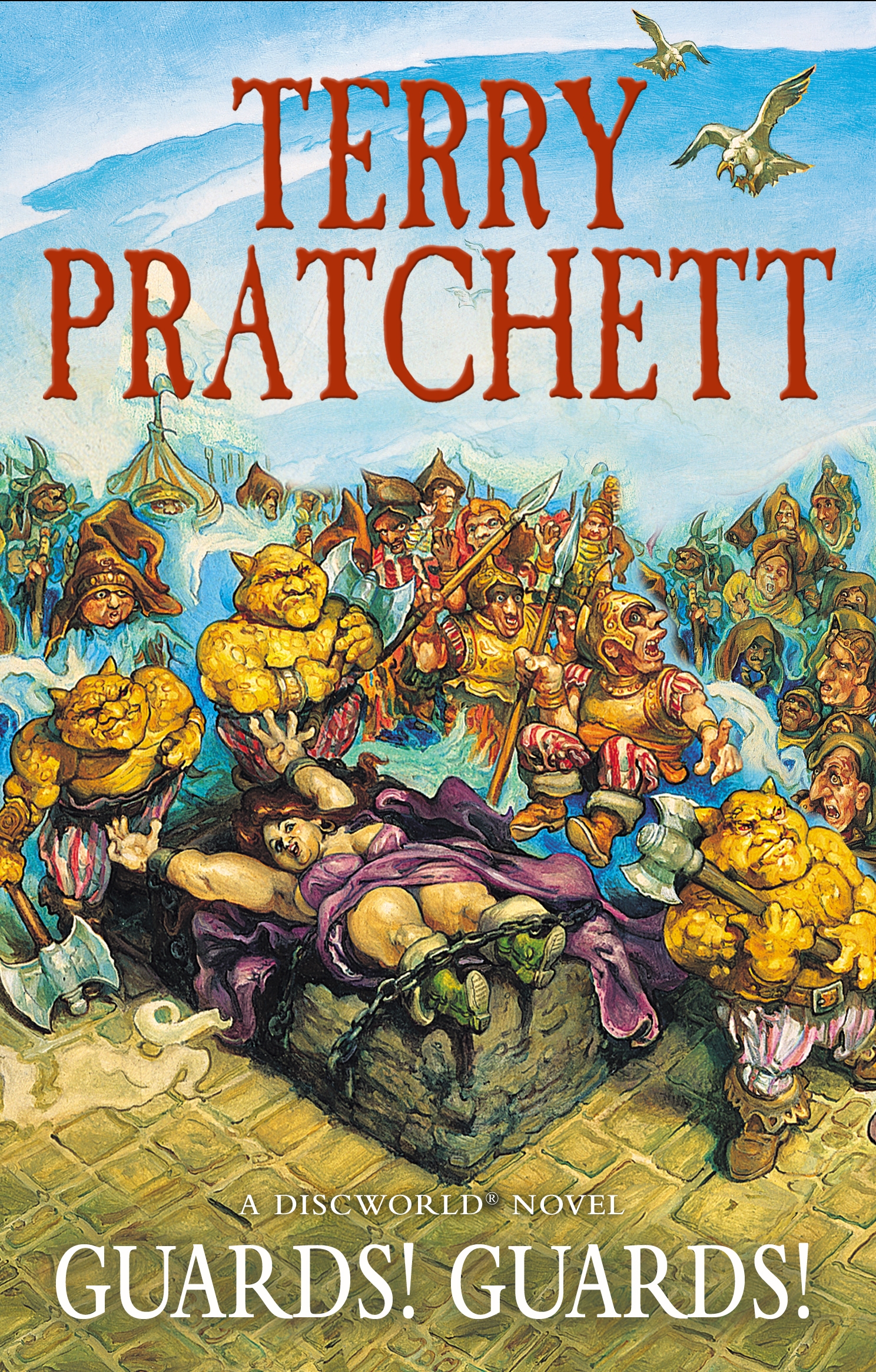
Guards! Guards! by Terry Pratchett

Publisher: Gollancz/Penguin Audio (Audiobook – 1989)

Series: Discworld – Book 8 / City Watch – Book One

Length: 13 hours and 29 minutes

My Rating: 5 out of 5 stars

Amazon

I recently revisited one of my favourite books in Terry Pratchett’s iconic Discworld series, Guards! Guards!, and I just had to review it to showcase how much fun this series can be.

I have never made any secret of the fact that I love all things Terry Pratchett as the Discworld books were one of the formative series of my youth.  A massively popular series set on a flat world carried through space on the back of a giant turtle and four elephants, the Discworld books present a range of unique fantasy adventures, backed with exceptional comedy and satire.  This series is so much fun, and I honestly love every single Discworld book, having read them all multiple times, usually while laughing myself silly.  Indeed, I am such a big fan of this series that I named my blog after a location in the universe.  Despite my overwhelming love for this series, I haven’t reviewed many Discworld books (the exception being Moving Pictures and The Last Continent).  That changes with my review of the outrageously funny Guards! Guards! which I recently enjoyed while on a road trip.

Guards! Guards! is a particularly entertaining addition to the Discworld series that I have a lot of love for.  Serving as the first book in the City Watch sub-series, Guards! Guards! sees Pratchett blend his typical fantasy and comedy elements with a complex murder mystery.  This book follows the ragtag city watch of this world’s main recurring city, Ankh-Morpork, as they try to solve a series of deaths caused by a monstrous murder weapon.  Due to its brilliant and hilarious story, as well as the fact that it perfectly sets up the rest of the awesome City Watch books, I generally consider Guards! Guards! to be one of my absolute favourite Discworld novels, and I have featured it in various Top Ten Tuesday lists over the years.

On the fantastical and impossible Discworld no place is more dangerous, corrupt or morally unhealthy as the legendary and stinking city of Ankh-Morpork.  The Disc’s largest city, Ankh-Morpork has many terrors haunting its urban depths, where life is cheap and death lurks around every corner.  However, not even the hardest criminals, deadliest wizards or most manipulative politicians are prepared for an ancient and malevolent creature that is about to be unleashed upon the city.

A shadowy secret brotherhood has engineered an elaborate plan to seize power in Ankh-Morpork through use of an unlikely weapon, a dragon.  Summoning a fully formed fire-breathing dragon to cause terror, the brotherhood hopes to use the resulting carnage to bring in their own puppet to control the city.  However, the dragon has its own ideas about what sort of terror it wants to bring down on humanity.

With the rest of the city powerless against the dragon, it falls to the ramshackle Ankh-Morpork Night Watch and its depressed captain, Sam Vimes, to try and stop it.  The only problem is the Watch are the biggest joke in the city, incapable of standing up to normal crime, never mind carnage caused by magical dragon.  But with an unnaturally keen new recruit guilting them into action, and a terrifying dragon fanatic with a crush on Vimes keeping them in line, the Watch is going to try and save the day, even if no-one wants them to.

Guards! Guards! still reigns supreme as one of my top Discworld novels from the always impressive Terry Pratchett.  Featuring a unique plot, loaded with an outstanding mix of mystery, humour and fun fantasy elements, Guards! Guards! brilliantly sets up one of Pratchett’s best sub-series while presenting its own epic and powerful story.  An exceptional read from start to finish, this book gets a very easy five-star rating from me, and I love it so damn much.

The plot of Guards! Guards! is so damn clever and is peak Pratchett in its inventiveness and impressive characters.  Presenting an entertaining and humourous noir murder investigation in a fantasy series, Guards! Guards! has a lot of moving parts to it, including some impressive character-driven story arcs, all of which come together beautifully for a particularly intense and insane story.  Starting off very strong with some great introductions to various key characters, including the young and keen Carrot Ironfoundersson, who journeys to the massive and corrupt city of Ankh-Morpork to join the Night Watch, providing fresh blood, irrepressible honesty and uncontrolled enthusiasm to the small squad of rejects and failures currently staffing it.  Carrot’s arrival corresponds with the start of a bold conspiracy, as a secretive mystic brotherhood plots to dethrone the Patrician and take over the city.  The initial scenes of this book are extremely good, and I love how Pratchett expertly sets up the entire narrative with some hilarious moments, including the opening sequence with the Elucidated Brethren of the Ebon Night, whose petty ideology shows you just what sort of criminal minds we are truly dealing with.

Things go in a chaotic direction as the Night Watch, led by the drunk and depressed Captain Vimes, witness a direct murder by dragon and begin their own investigation into the matter.  Pratchett expertly pivots the story around from its comedic fantasy start into a complex police procedural/noir murder investigation, as the protagonists try to find out why the dragon is terrifying the city and who benefits from the apparent crime.  At the same time, several great character arcs emerge, including a truly nice, if unconventional romance, new friendships, and a fun analysis of dragon mythology.  There is a great twist about halfway through the book as the down-and-out Night Watch witness an interesting change to the classic dragon fantasy tale that sees a unique king take over the city.

The final third of the book is some of Pratchett’s strongest writing, as Vimes identifies the true culprit and must work to undo the damage they caused.  There are some great moments in this last part of the book as Pratchett presents his own unique and hilarious take on classic fantasy tropes, including the famed million-to-one shot, the heroic rescue, and the successful defeat of a dragon.  I felt that the identity of the main villain of the story was very clever, and Pratchett sets it up well with subtle clues, although if you know Pratchett’s thoughts on certain government positions it’s not too surprising.  Still, the final confrontation between the protagonists and this villain is great, and being literal has never been so deadly.  Pratchett leaves Guards! Guards! on a hopeful note, and it’s impossible not to come away with a smile on your face.
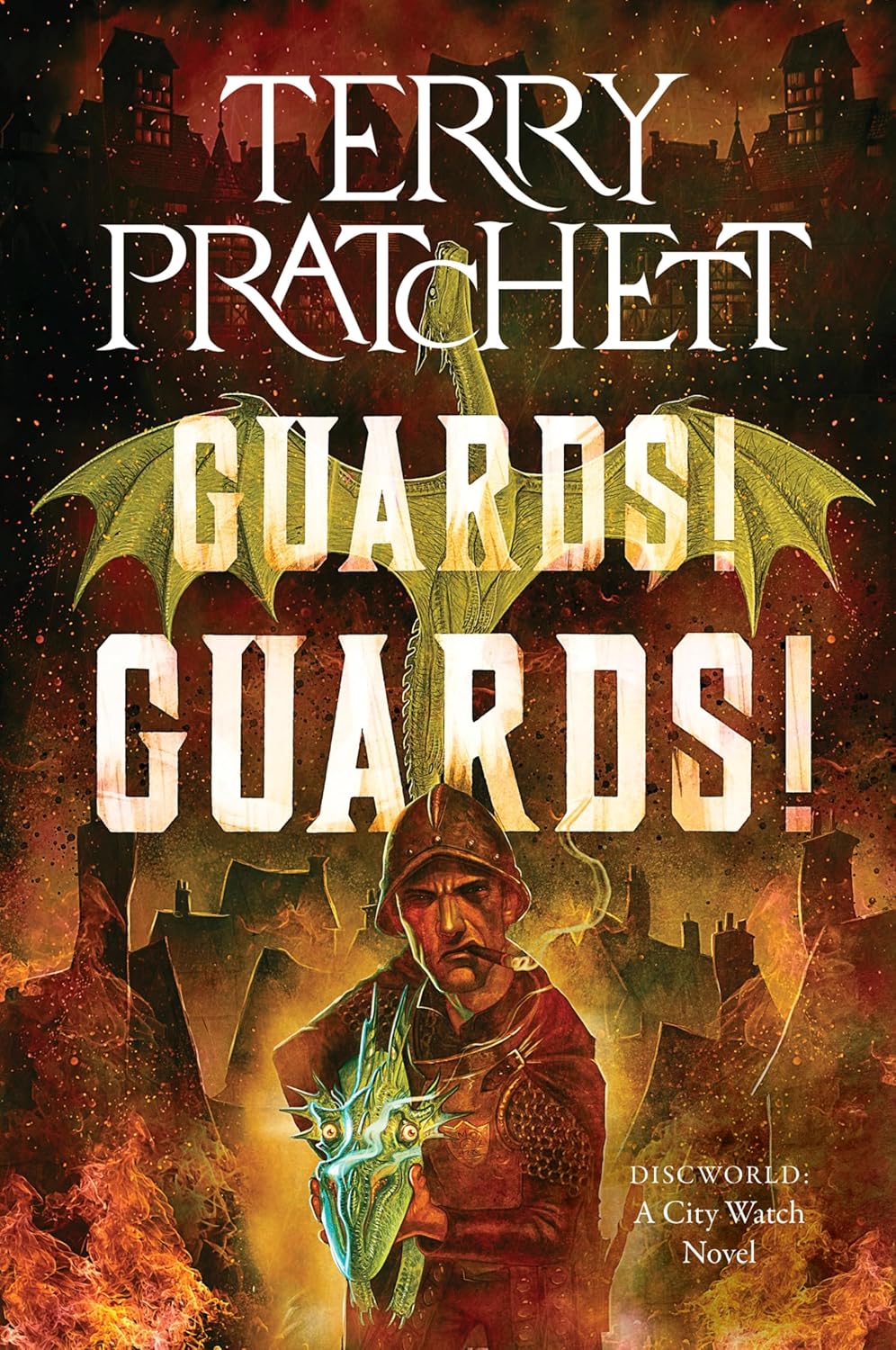
Pratchett was really on-point when it came to writing Guards! Guards! and I loved how perfectly it came together.  As with all books in the Discworld series, Guards! Guards! features an exceptional mixture of fantasy and humour elements, as the unusual and cynical Discworld produces some unusual situations, layered in with a great plot and some fantastically complex characters.  A lot of the humour is derived from classic fantasy scenarios that are taken up to 11 and shown in outrageous manners, accompanied by sarcastic comments from the characters as they witness them.  For example, this book serves as an ode to the guards and watchmen from classic fantasy fiction, and there are some funny scenes when these self-aware guards realise how expendable they are in a fantasy story.  However, Guards! Guards! also features a brilliant third element as Pratchett also features a compelling crime fiction read, accompanied with an addictive murder mystery.

The blend of fantasy and crime fiction elements works incredibly well, and it is highly entertaining to watch a serious investigation consider magic, suddenly appearing dragons, and the unique background setting of Ankh-Morpork.  I also loved how many clever and subtle jokes Pratchett was able to weave in because of these crime fiction inclusions, and he ends up lovingly roasting so many classic tropes from police procedurals and noir detective novels.  Despite having read this book many times, I still laugh like crazy at all the humourous moments in Guards! Guards!, especially as you always discover a new joke or pun you previously missed.  I honestly don’t have time to list all the funny scenes in Guards! Guards!, but favourites include the various meetings of the petty and mostly incompetent Elucidated Brethren, Carrot’s naïve overreactions upon discovering crime in the city, and various musings on how to achieve a perfect, million-to-one chance.  Pratchett once again expertly backs up his humour in Guards! Guards! with a series of entertaining footnotes spread throughout the book, that prove to be nearly as much fun as the main story.  These brilliant footnotes contain additional jokes, sarcastic comments, or interesting expansions of the Discworld universe, and they always bounce off the main story perfectly, providing extra laughs and food for thought where necessary.  I really cannot emphasise just how well this blend of genres worked with Pratchett’s unique and endearing humour, and it proves impossible not to have an exceptional time while reading this book.

As with most Discworld books, Guards! Guards! works exceedingly well as a standalone novel, and I feel that anyone wanting a laugh could easily jump in and follow the story without any issues.  Due to its early position in the shared Discworld universe, you don’t have to know anything about the other entries in the overarching series to jump right in, as Pratchett goes a tad light on some of the more outrageous Discworld elements.  As such, I consider Guards! Guards! to be one of the very best entry novels to new Discworld readers.  It also proves to be a brilliant first book in one of Pratchett’s best sub-series, and so many key details of the subsequent City Watch books are introduced here.  This includes some excellent early looks at the chaotic city of Ankh-Morpork and key recurring characters in the larger universal plot.  Ankh-Morpork is a great background setting for Guards! Guards! and it was the first book completely set within the bounds of the city.  I loved seeing this crazy city in even more detail, and all the fun elements set up here help to make it an epic setting.  As such, this is a great book for any Discworld reader, new or old, and it’s one of my favourites for very good reason.

As with pretty much all of Pratchett’s works, the key things that made Guards! Guards! so impressive were the amazing and unique characters that were featured throughout the plot.  Pratchett had a real knack for producing complex, multi-layered figures who can be both comedic and tragic at the same time, and who you couldn’t help but love.  Guards! Guards! was a particularly good example of this, as Pratchett featured a range of brilliant and entertaining characters who would go on to be become major recurring figures in the Discworld canon.  Indeed, Guards! Guards! is one of the most significant books for new characters, and it is frankly amazing how many exceptional major and iconic figures were introduced here.  Each of these characters were so well written, and you have to love both their specific arcs in this book, as well as how they were expanded on in later works.

The most prominent character in Guards! Guards! is Captain Samuel Vimes.  A cynical and damaged man whose habit of calling out social inequities has seen him assigned to the joke position as head of the Night Watch, which he deals with by drinking vast amounts of alcohol.  A parody of every hard-drinking cop and private eye in classic noir fiction, Vimes starts the book with no prospects and too many dead friends.  Given new purpose when the dragon appears in the city, Vimes turns his innate rebellion to a purpose and tries policing and detecting.  Pratchett does an exceptional job setting up Vimes here in Guards! Guards!, and it is no wonder he goes on to be one of his top protagonists.  Vimes’s depressed investigative method proves quite successful, and it was entertaining to watch Vimes attempt to solve the case while sarcastically calling out his fellow citizens’ base stupidity and selfishness.  Pratchett also sets up an impressive redemption arc around Vimes, which comes about through a combination of trusted colleagues, romance, and a renewed determination to uphold the law.  While he ends the book still irritated with the world, the road forward to Vimes doing bigger and better things is well established, and you really get drawn into his arc as a result.

Another impressive character is naïve and innocent City Watch recruit, Carrot Ironfoundersson.  Due to his complex home situation and a late life revelation that he’s human rather than a dwarf (being six and a half feet tall wasn’t a clue to him), Carrot is sent to Anhk-Morpork with a desire to become a watchman, which he incorrectly believes is a noble calling.  Thanks to his literal personality and highly moral upbringing, Carrot proves to be an anathema to the lawless folks of Anhk-Morpork, as he comes to town bringing justice, enforcing obscure laws, and actually arresting thieves: “change your ways”.  A brilliant parody of ultra-righteous fantasy kings, Carrot serves as an outstanding comic relief for much of the book, especially when it comes to his wholesome interactions with the exceedingly criminal inhabitants of the city.  However, beneath his comedic cover, Carrot is written as a complex figure of change, and his ability to inspire the other characters, either through guilt or determination, leads to some big moments.  Pratchett did an amazing job with Carrot in Guards! Guards!, and it was fascinating to see how he evolves from his initial innocent personality, to a more clever, but still determined, character.

Aside from Vimes and Carrot, the other two watch characters are Sergeant Fred Colon and Corporal Nobby Nobbs, both of whom are excellent and solid comedic characters.  The stereotypical fat sergeant and dodgy corporal, Pratchett has fun setting them up as unassailable fixtures of the Night Watch as they do the jobs nature intended for them, and I love how they play off each other.  While Colon has some hilarious scenes, including his attempt at archery and his various ill-timed run-ins with the dragon, you can tell that Pratchett had a lot more fun writing Nobby.  While not all his over-the-top characteristics from the series are shown in Guards! Guards!, Nobby is still a particularly entertaining figure.  Between his coarse language, petty criminal mindset, and uncharacteristic foppish behaviours, every scene with Nobby is highly amusing, and I love how Pratchett expanded off clever stereotypes about lifetime corporals to create this wayward figure.

Outside the members of the City Watch, there are a fantastic array of figures who help to make Guards! Guards! a particularly enthralling story.  This includes one of the few female characters in the book, Sybil Rankin, a dragon-loving heiress who ends up being Vimes’s unlikely love interest.  Deliberately written as the direct opposite of a noir femme-fatale in both personality and appearance, Sybil is a force of nature, using her accumulated nobility to pull the Night Watch, especially Vimes, into her orbit.  It proves impossible not to like Sybil as you watch her confidently go after Vimes or try to put the dragon to heel, and she ends up being one of the most complicated female characters that Pratchett wrote (which is saying a lot when you think of some of his other great female characters).

The other major character that I want to separately highlight is the Patrician of Ankh-Morpork, Lord Havelock Vetinari.  While he has appeared in previous Discworld novels (notably Sourcery), this is the first book that showcases him as a full character.  Generally depicted as a Machiavellian mastermind and one of the few people capable of controlling the chaotic city, Vetinari has some great early scenes.  However, it’s not until the second half of the book when you realise just how fantastic a character he is.  Deposed by the false king, Vetinari initially appears to be completely powerless in the dungeons, until Vimes is thrown in with him and begins to realise that he is still in control, especially as he’s managed to cultivate a new intelligence network (procured by providing wartime strategy to magical rats), while also getting locked in a dungeon specifically designed to keep him safe.  His subsequent scenes tormenting the book’s real antagonist and talking about the nature of humanity with Vimes really cement him as an impressive figure, and the seeds for his many later inclusions as the Disc’s ultimate political mastermind are well sown here.

While I know I’ve been going on a bit about characters (blame Pratchett for being such a good writer), I just need to highlight a few more figures who have a great role in Guards! Guards!.  This includes the Librarian, one of Pratchett’s most iconic characters, who proves to be just as much fun outside of a wizard focused book, and it was entertaining seeing him interact with a separate group of friends.  You get a great introduction to the character of Cut-My-Own-Throat Dibbler, whose mercantile tendencies are on full display here.  The unusual swamp dragon Errol proves to be an unlikely pet, and his arc about finding love and his true form was particularly heartwarming.  Finally, I must mention the book’s great antagonist, who fully embraces the mad tendencies that his position demands.  While I won’t go into too much detail about who he is, I will say I loved seeing his various internal rants about the world, and the scenes with his incompetent henchmen were so damn funny.  All these characters, plus even more hilarious figures, are instrumental to so much of Guards! Guards! brilliant charm and humour, and after being introduced to them here, it’s impossible not to follow them on their full journey.
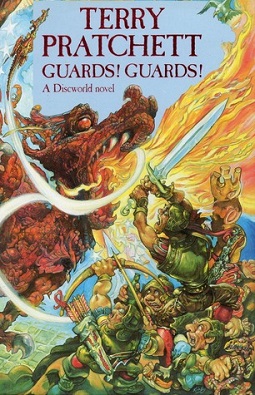
I have had the pleasure of reading Guards! Guards! in a couple of different formats over the years, but to my mind the best way to enjoy this book, and indeed any Discworld novel, is on audiobook.  The Discworld audiobooks are something very special, and I find that the unique stories, excellent humour and elaborate characters really come across when read out by a passionate narrator.  With the recent re-release of various Discworld audiobooks, there are now two different unabridged versions of Guards! Guards! fans can enjoy, and I want to highlight them both here.

The first Guards! Guards! audiobook is the original version with the talented Nigel Planer, who narrated 22 of the original 23 Discworld audiobooks.  Guards! Guards! is one of his best performances, and it set the scene nicely for many of his subsequent Discworld audiobooks, especially as he settled on a lot of key character voices and tones here.  While it has been a little while since I’ve listened to Planer’s version of Guards! Guards!, I have enjoyed it so many times it is permanently engrained in my head (I used to grab the tape cassette version out of my local library all the time).  Planer, who does all the voices himself, really captures the essence of Pratchett’s storytelling and excels at expressing the author’s unique humour through his vocal work.  I also felt that his portrayal of many of the key characters was second to none, and he really brought to life all the City Watch protagonists, as well as some other long-running figures, in some impressive ways.  He would revisit many of these voices in multiple subsequent performances, and it is a testament to his skill that the initial tones he came up with here, worked so well in the later books.  I frankly have so much love for Planer’s original take on Guards! Guards!, which definitely still stands the test of time, and his excellent and heartfelt voice work defines many of the City Watch characters for me.

While Nigel Planers original version is perfect, current Discworld fans may be more familiar with the latest audiobook production of Guards! Guards!, which was part of a recent re-recording of all the Discworld books.  These new audiobooks each feature a different famous British performer voicing the main plot, while acclaimed actors Peter Serafinowicz and Bill Nighy have key roles in every single production.  While these have been out for a little while, I only just listened to my first one .  Coming in at a runtime of 13 and a half hours, which is a tad longer than the roughly 10-hour long Planer version, this Guards! Guards! audiobook was extremely fun, and it served as excellent entertainment on a recent road trip.

The new version of the Guards! Guards! audiobook is primarily voiced by British radio and television personality Jon Culshaw.  Culshaw is amazing in the role, and I was deeply impressed with his take on the Guards! Guards! characters.  Each unique character comes across extremely well in Culshaw’s capable hands, and I enjoyed his take on their unique characteristics and eccentric personalities.  He perfectly showcased protagonist Samuel Vimes’s drunken despair and depression, while various other key members of the watch, such as the extremely keen Carrot and the more cautious Colon, are shown extremely well.  I also felt that Culshaw did an incredible job with several complicated figures from the story, such as the infamous watchman Nobby Nobbs, who Culshaw gifts a gruff and weaselly voice that sounded a lot like David Bradley or Jon Pertwee.  His Lord Vetinari is also amazing, and the deep and threatening tones really capture the character’s dangerous nature.  Finally, I felt that his take on the main female character, Sybil Ramkin, was just perfect, and you really got the full blast of her big personality and excessive aristocratic characteristics.  Many of the other side characters were also perfectly portrayed to my mind, and I must highlight the excellent way in which he disguised the voice of the main antagonist during some key secret society scenes.

Culshaw’s primary narration is well backed up by Peter Serafinowicz and Bill Nighy in their respective roles.  Serafinowicz provides the voice of Death whenever he appears in this audiobook, which works out extremely well even with Death’s relatively minor role in Guards! Guards!.  Serafinowicz has an exceptional Death voice, and hearing it suddenly appear throughout Guards! Guards! is so damn epic, especially during one scene where Death is hiding amongst the soon-to-be deceased.  Nighy, on the other hand, narrates the various footnotes.  Nighy was a perfect choice for this, and his calm, consistent tones, echoing Peter Jones’s similar role in The Hitchhiker’s Guide to the Galaxy radio and TV editions really highlighted the subtle comedy of these footnotes.  I felt that all three of these distinctive actors really vibed together in the Guards! Guards! audiobooks, and the switch between them was seamless, allowing for a particularly awesome listen.  Throw in an interesting short afterword about fantasy elements by acclaimed author Ben Aaronovitch, and this proved to be a remarkable and compelling audiobook I could not get enough of.  While Nigel Planer’s original narration of Guards! Guards! is always going to live in my head rent free, I felt that this new version more than lived up to the hype surrounding it, and I really appreciated the unique and powerful performances these new narrators brought to the table.  Frankly both of the audiobook versions comes highly recommended by me, and it is impossible to be dissatisfied by them at all.

Whew, well in case you could guess from this massive review (it got away from me), I love Guards! Guards! and I have some very strong feelings for it.  One of Terry Pratchett’s best Discworld novels, Guards! Guards! is the perfect blend of fantasy, crime fiction and humour that you could ever want, and I always get wrapped up in its elaborate story.  A wildly entertaining and comedic novel from start to finish, Pratchett added so much heart to this book, and you get drawn into the impressive characters and compelling, crime fiction plot.  A brilliant start to the City Watch subseries, Guards! Guards! is so damn good, and I know I will be reading it many more times in my life.  I can think of no better way to emphasise just how amazing Guards! Guards! is than to mention that I used it to introduce the Discworld to my wife, who is now powering through the series on her own.  So do yourself a favour and check this book out now!
Amazon

The Fury of the Gods by John Gwynne

Publisher: Orbit/Little Brown Audio (Audiobook – 22 October 2024)

Series: The Bloodsworn Saga – Book Three

Length: 19 hours and 30 minutes

My Rating: 5 out of 5 stars

Amazon

John Gwynne brings his awesome Bloodsworn trilogy to a truly epic conclusion with the outstanding novel, The Fury of the Gods.

For the last few years one of the most compelling fantasy series has been the Bloodsworn Saga trilogy from acclaimed fantasy author John Gwynne.  This series is set in a Norse-inspired fantasy world shattered by warring gods and now filled with monsters, voyaging warriors and the human descendants of the gods whose power often see them collared and controlled as thralls.  The series started back in 2021 with the impressive read, The Shadow of the Gods, which introduced the main characters and set them on their quests.  I almost missed The Shadow of the Gods when it came out, but I was glad that I didn’t, as it turned out to be one of my favourite books and audiobooks of 2021.  Gwynne continued the series in a big way the next year with the excellent sequel, The Hunger of the Gods, which expertly continued the series and ended up also being a top book and audiobook of 2022.  Due to how amazing the first two entries in the trilogy proved to be, I have been eager for to the finale of the trilogy for a while, and I was so happy we got one in 2024.  One of my most anticipated books in the second half of 2024, The Fury of the Gods was everything I hoped it would be and more, and I listened to it the very first chance that I got.

The gods have returned, and all must pay the price!

After centuries of imprisonment following the last great war of the gods, the evil and crazed dragon-god Lik-Rifa has been released and now seeks to rule over the land of Vigrid.  With the cunning rat-god Rotta at her side, Lik-Rifa leads a vast army made up of her monstrous children, as well as ambitious mercenaries and Tainted warriors.  Determined to place the entire continent under her dark rule, Lik-Rifa turns her eyes to the stronghold of Snakavik and moves to destroy the last vestige of resistance against her.

However, not all is lost, as some seek to stand against Lik-Rifa.  Elvar, leader of the Battle-Grim, has killed her father and taken control of Snakavik.  Bound by fate and her oaths, Elvar must balance her new responsibilities as ruler while she plans for war against Lik-Rifa, a seemingly impossible task.  However, Elvar has done the impossible before by resurrecting Lik-Rifa’s hated brother, the wolf-god, Ulfrir, and binding him to her will.  Now her most potent weapon and the ultimate bait for Lik-Rifa, Elvar seeks to use Ulfrir to destroy the gods coming for her.  But even a giant wolf-god might not be enough to win the war, and Elvar needs even more allies to help her.

After scouring a bloody path across Vigrid, Orka Skullsplitter has rescued her son, but still seeks vengeance against Lik-Rifa’s forces.  To that end, Orka reunites with her old warband, the Bloodsworn, and sets them to join Elvar’s growing host.  Made up of deadly Tainted warriors, including their latest recruit, Varg No-Sense, the Bloodsworn have many reasons to fight against the dragon-god’s followers.  Together, the Bloodsworn, Battle-Grim and their various allies prepare to face Lik-Rifa’s army in the greatest battle the world has ever known.  But no-one is prepared for the chaos that is about to engulf Vigrid, as greater threats arise to devour all.

Gwynne continues to impress with this third and final Bloodsworn Saga novel.  The Fury of the Gods was another high-octane, character driven, dark fantasy novel, that takes the reader on a powerful adventure.  Loaded with fantastic moments and amazing action, The Fury of the Gods proved to be an outstanding conclusion to the Bloodsworn Saga, and I had such an awesome time getting through it.

The Fury of the Gods featured a spectacular and captivating narrative that starts off strong and refuses to slow down the entire way through.  Taking off immediately after The Hunger of the Gods, Gwynne effectively sets the stage for the oncoming battles as the various character arcs continue at breakneck pace.  Once again telling the story through the eyes of five distinctive protagonists (Orka, Elva, Varg, Biorr and Gudvarr), you get drawn into their intriguing personal tales as they recount the events they observe.  The first half of the book keeps these protagonists mostly separated, and their various storylines continued in similar directions to The Hunger of the Gods.  Orka is still set on her bloody revenge mission and must overcome her imprisonment by the rat-god Rotta.  Varg and the Bloodsworn journey back from their rescue mission in the neighbouring nation of Iskidan, encountering new threats along the way.  Elvar takes up the responsibility of ruling Snakavik after killing her father and finds herself leading the war against Lik-Rifa.  Finally, Biorr and Gudvarr provide intriguing insights into Lik-Rifa’s camp, as both the conflicted Biorr and the snivelling Gudvarr try to survive the rise of dragon-god in their own different ways.

Gwynne does a good amount of set-up in this first half of the book, and it was nice to see the various characters continue to breathe on their own for a bit, while also amping up the dangerous antagonists.  You once again get quickly drawn into each of the protagonists narratives, and I think that it is a testament to Gwynne’s writing that each of these storylines proved to be as entertaining and compelling as the rest.  Unlike other multiple-perspective novels I have read, I honestly loved every single character perspective in The Fury of the Gods, and I was excited to continue each of them.  Indeed, I find it hard to choose a favourite, as they were all fun while offering something a little different.  That being said, Elvar’s chapters moved the plot along the most, and Gwynne did his best character work with her in this book.

Everything leads up to a particularly epic final half, as Gwynne brings together all five point-of-view characters to the same location for the first time in the series.  With the protagonists spread out on each side of the conflict, you get a great view of the massive extended war as the god-led armies fight it out on several fronts, including in a brutal siege.  Gwynne kept the action going thick and fast here, and there are some great encounters and moments as the various characters meet on the battlefield.  Everything leads up to a massive confrontation nearly two-thirds of the way through, and there are some highly dramatic moments here, especially as the first big-death was a little unexpected.  This major fight ends in an interesting way, although details of it are spoiled a little by the awesome cover above.  This leads to some more fantastic moments, including the final battle between both sides.  The author chucks in a few more tragic moments in this final bit of the book, although I must admit that there weren’t a lot of surprises here, with many of the big reveals well telegraphed in advance.  I also thought that the various revenge arcs cluttered up the plot in a predictable manner, and I wish Gwynne had thrown a twist or two in here.  Still, everything ended on an extremely epic note, and readers who enjoyed the previous Bloodsworn Saga books will come away very satisfied and happy with the finalised character arcs.

As with the previous Bloodsworn Saga novels, Gwynne brings a distinctive style to The Fury of the Gods, which I felt greatly enhanced the story.  The blend of compelling Norse-inspired fantasy elements, great character work, and brutal action makes for awesome reading, and Gwynne presents it all in an accessible and enjoyable way.  I loved how the characters’ dialogue and inner thoughts fell in line with the book’s historical inspiration, and while this style might not be for everyone, elements of it, such as the repetition of certain thoughts and phrases, gives it a real saga feel.  As with the previous entries in the series, Gwynne makes excellent use of multiple character perspectives to tell his elaborate narrative, with his five point-of-view characters helming various chapters.  The split between these five characters worked extremely well, and you get some intriguing alternate perspectives of events that blend well as the book continues.  Gwynne makes excellent use of this split during some of the bigger combat scenes, and the use of shorter chapters when things get particularly exciting allows the reader to quickly switch amongst the action.  Talking of action, Gwynne ensures that the combat in The Fury of the Gods is as bloody and well-written as in the previous books, and his brilliant action scenes are so well described and bring you right into the midst of the fighting.

As The Fury of the Gods is the third and final book in an epic fantasy trilogy, it obviously isn’t the most ideal place for readers to dive into the overarching story, and you really should start at the beginning of the series for the full emotional impact.  However, for those who want to start with The Fury of the Gods, Gwynne does make this book somewhat accessible to new readers.  Between the detailed summary of the prior books, glossary of terms, character lists and the callbacks to the previous events during the plot, new readers can follow The Fury of the Gods easily enough and have fun.  This includes enjoying the full impact of the cool fantasy setting of Vigrid that Gwynne has lovingly set up during the three books.  The clever use of Norse-inspired elements really lends itself to the epic revenge driven narrative that Gwynne features, and the mixture of mythological, fantasy and historical elements proved to be a winning combination.  I still love seeing the various warbands using Viking war tactics against dark dangers and massive gods, and Gwynne really went all out making so many traditional Norse elements, such as weaponry, armour, ships and mentality, seem as realistic as possible.  At the same time, the book’s fantasy inclusions, such as the various monsters and Tainted, the human descendants of the gods, add so much to the story, through their vicious nature, intriguing descriptions, and underlying societal issues.  This was an overall pretty awesome setting, that Gwynne uses to full effect to tell his compelling tale.  I hope that Gwynne returns to this world at some point in the future, and it wouldn’t surprise me if some of the younger characters featured here get their own story.

In addition to The Fury of the Gods’ fantastic story and great writing, I also need to talk about the awesome characters.  Throughout the Bloodsworn Saga, Gwynne has put a lot of work into building up his various characters, and by this point in the trilogy you are highly invested in their respective stories.  As such, there aren’t a lot of new figures in this final book, and you generally know what to expect when one of the protagonists’ chapters begins.  However, it still proved awesome to see these figures in action again, and their compelling character arcs and differing personalities deeply increase the impact of the narrative.  Of the main cast, I would say that Elva steals the show the most in The Fury of the Gods.  While she has not always been the most exciting character in the series, this third and final book was where she really shined, primarily because she takes on the role of war leader against Lik-Rifa, and the increased responsibility changes her.  As such, it was outstanding to follow her storyline, and I appreciated seeing how conflicted she got at times, especially when it came to treating the Tainted in her domain.  Due to this, as well as some other badass scenes, Elva was one of the most compelling protagonists in The Fury of the Gods for me, and Gwynne provided an interesting conclusion to her narrative that I felt really worked.

The other four main characters all proved to be brilliant additions to the book, and their perspectives ensured quite an elaborate story.  The dangerous fighters, Orka and Varg, were both solid point-of-view characters in The Fury of the Gods, and I really enjoyed seeing how their respective arcs continued, especially as they were the main avenue to seeing the Bloodsworn warband.  Of all the protagonists, you were most likely to see action with Orka or Varg, and their various bloody sequences were a lot of fun.  That being said, Gwynne went a little light with the character development for these figures in this book, and while they have some moving moments (Orka comes out of her solitude to find people she cares about, while Varg finally cements his place in the Bloodsworn), I felt that Gwynne focused way too much on their respective hunts for revenge, which resulted in some of their stuff getting a little repetitive.

However, Gwynne more than overcomes any minor deficiencies with Orka and Varg through his use of the antagonistic perspective characters Biorr and Gudvarr, both of whom have joined Lik-Rifa’s cause.  Biorr proves to be a complex figure in The Fury of the Gods, and I loved how conflicted he become as his longstanding fanaticism slowly beings to wear away in the face of meeting his gods.  Gwynne did a really great job with Biorr, and his personal journey and attempted redemption made for some powerful moments.  On the other hand, we have the entertaining and despicable Gudvarr, whose chapters I always have fun with.  Gudvarr is an impressively annoying figure who has spent the last two books trying to avoid danger only to find himself getting stuck in progressively worse situations.  However, because he is naturally cowardly, weaselly and vindictive figure, you really don’t feel sorry for him, especially as every bad situation is the result of some failed ploy to gain influence or power.  While Gudvarr is a particularly contemptible figure, it honestly proves impossible not to enjoy his chapters, as they are generally the most amusing in the entire book thanks his snarky inner monologue, the deadly situations he barely escapes from, and the near certainty that he is going to come to a sticky end.  As such, I really enjoyed following Gudvarr and you can’t help but look forward to seeing what dangerous or manipulative situation he finds himself in next.

Finally, I must highlight all the awesome and impressive supporting characters that are featured in The Fury of the Gods.  Gwynne has built up an exceptional and massive cast of characters throughout the series, all of whom add something to book.  I loved seeing the many complex interactions that occurred between all these characters in The Fury of the Gods, and it was fun to see many of them meet for the first time in this final book, especially once all the perspective characters are together.  Highlights include the key members of the Battle-Grim and Bloodsworn warbands, all of whom have gone through so much throughout the trilogy.  Several of the best characters from both bands experience major tragedy in The Fury of the Gods, and it proves hard not the feel for them.  I also need to mention the main antagonists, Lik-Rifa and Rotta, two vengeful gods whose desire for revenge and control move much of the plot along.  I loved seeing the various human and Tainted characters interact with these dark gods, and Gywnne ensured they came across as a massive and dangerous threat.  Two entertaining giant ravens, a fun talking head, and so many other great characters ensured that The Fury of the Gods was a moving and deeply personal read, and I am so glad I got the opportunity to know them during the run of this trilogy.

As with the previous books in the Bloodsworn Saga, I chose to grab The Fury of the Gods on audiobook, which proved to be a particularly awesome way to enjoy this epic read.  Featuring a runtime just under 20 hours, The Fury of the Gods audiobook is a lengthy but highly exciting listening experience, and I found myself powering through this audiobook, namely because the format deeply enhances the intense story and intricate writing.  Narrator Colin Mace, who has lent his voice to the other Bloodsworn Saga books, did another brilliant job with The Fury of the Gods, and his impressive voicework leant some additional impact and gravitas to the book.  Mace perfectly portrays the Norse-inspired fantasy elements of the book, and I really loved how effectively he captured the various hard-nosed characters of the series.  I especially loved Mace’s take on the gigantic gods and other dark creatures haunting the lands, and I felt that the narrator was a key reason why I had so much fun with this audiobook.  Probably one of the best formats to enjoy The Fury of the Gods, listeners will have such an epic time with this audiobook.

With blood, fury and vengeance, the Bloodsworn Saga comes to a brilliant end that I could not get enough of.  The Fury of the Gods was another exceptional read from John Gwynne, and I was so very happy to see how this entire epic narrative concluded.  Loaded with action, excellent fantasy elements, and so many impressive characters, The Fury of the Gods was an outstanding book on its own, as well as an incredible conclusion to one of the most epic fantasy trilogies out there.  One of my favourite fantasy books of 2024, The Fury of the Gods was an excellent read that gets an easy five-star rating from me.

Amazon

The Chaos Agent by Mark Greaney

The Chaos Agent Cover

Publisher: Sphere/Audible (Audiobook – 20 February 2024)

Series: Gray Man – Book 13

Length: 17 hours and 34 minutes

My Rating: 5 out of 5 stars

Amazon

One of the leading authors of the spy thriller genre, Mark Greaney, returns with another epic entry in his iconic Gray Man series, The Chaos Agent.

Readers of this blog will know that I am a massive fan of thriller author Mark Greaney, who has been wowing the world with his elaborate and exciting stories for years.  Ever since I started reading thrillers, Greaney has been a major figure in my yearly reading schedule, with books like Armored and Red Metal (cowritten with Hunter Ripley Rawlings IV), ensuring that he became a must-read author for me.  However, his most iconic body of work is his Gray Man series, which follows legendary former CIA agent and assassin Court Gentry, known as the Gray Man, as he engages in carnage across the world.  This series, which people may be familiar with thanks to the Netflix adaptation, is so damn good, and I really love the elaborate and intense stories that emerge.  This includes the impressive first novel The Gray Man, as well as later books like Mission CriticalOne Minute Out (one of my favourite books and audiobooks of 2020), Relentless (one of my favourite books and audiobooks of 2021) and Sierra Six (one of my favourite books and audiobooks of 2022) and Burner (one of my favourite books and audiobooks of 2023).  Naturally, I grabbed Greaney’s latest novel, The Chaos Agent, the first chance I could, and it proved to be another amazing read.

Across the world, elite scientists are being murdered in a series of elaborate and well-coordinated assassinations.  The killers are well equipped, well prepared, and seem capable of striking across multiple countries.  The only connection between the killings is the area of expertise the victims are known for, as someone is targeting the world’s leading experts in artificial intelligence and robotics.

As the killings continue, it appears that only two major assassins aren’t involved in the plot, the Gray Man, Court Gentry, and his lover Zoya Zakharova.  Hiding out in Central America after their last mission once again forced them to become fugitives, Court and Zoya are seeking the quiet life together after all their years apart.  But an assassin’s work is never done, and soon an old family friend of Zoya’s seeks them out, hoping that they can help identify the individuals behind the attack.  Initially reluctant to get involved, Court and Zoya soon find themselves targeted by association, and must flee an army of dangerous killers and mysterious advanced combat drones.

Forced to find out who is hunting them, Court and Zoya soon discover that the killings are linked to a deadly proposed artificial intelligence weapon that could change everything about modern warfare.  To discover what’s truly going on, the two former agents and their allies need to investigate the one survivor of the ongoing assassinations.  But with their target now protected by an old friend of theirs, Zack Hightower, in an isolated fortress, Court and Zoya will need to use all their connections and luck to find the truth before it’s too late?

The Chaos Agent was another excellent novel from Greaney, who continues to highlight why he is one of the world’s leading spy thriller writers.  This latest Gray Man novel ended up being a lot of fun, especially as Greaney goes a little overboard with the plot, and I deeply enjoyed the resulting adventure.

Greaney came out of the bag with something very exciting in The Chaos Agent, which is mainly down to how over-the-top and crazy the main narrative ended up being.  This story starts off relatively low-key, with a couple of random killings, and an update on the lives of the protagonist, Court Gentry, and his partner Zoya Zakharova.  Naturally, it doesn’t take long for Gentry and Zakharova to get dragged into the action, and this starts an intense fugitive arc for them, as they find themselves being hunted by various killers across central America.  At the same time, the other supporting characters of the book are investigating the worldwide plot around the assassination of various AI experts.  This results in a compelling investigation angle that continues for a large portion of The Chaos Agent, and it was fun to not completely know the identity of the book’s antagonist until towards the end.  This first half of The Chaos Agent definitely got my attention, and the compelling action, intense mystery, and intriguing characters help to draw the reader in.

The second half of The Chaos Agent is where things start to get particularly interesting, as Greaney amps up the story and throws it into overdrive.  In particular, the antagonists get even more crazy, which is well shown in an intense action sequence involving Gentry and Zakharova in contact’s house in Central America.  These additional opponents give The Chaos Agent a real science fiction edge to them, and it was a gloriously over-the-top inclusion that I really loved.  The various character storylines soon come together after that, as all the characters end up in Cuba investigating who is truly behind everything and why.  There are some cool sequences here, including complex and intricate multi-perspective operations as various players manoeuvre around each other to achieve their goals.  This all leads up nicely to the big extended finale, where all hell breaks loose as Greaney sets up a massive firefight with various sides thrown into the mix.  The action here is intense, with the carnage flying thick and fast, and with so many perils coming for the protagonists.  It all ends on a pretty big cliffhanger that will play nicely into the next book in the series, especially as two major supporting characters find their situation drastically changed due to their decisions.

I deeply enjoyed how this cool novel unfolded, and Greaney utilises his trademark writing style to great effect with this excellent story.  The high-intensity action, fast-paced plot, and intriguing overarching storyline came together wonderfully, and it proves very hard not to get drawn into The Chaos Agent as a result.  I particularly love how Greaney so effortlessly jumps between different character perspectives throughout the course of the book, which allows for a more complex and enhanced story.  These quickfire changes in perspective also work extremely well in some of the book’s more intense sequences, especially as seeing the various participants continuously react to other character’s actions, allows for some outstanding scenes.  Good examples of this include a sequence in the Cuban docks where Gentry and a rival assassin move around each other trying to simultaneously protect or kill their target.  These scenes, and more, are true highlights of this book, and I love how well they were able to incorporate the particularly eccentric inclusions that Greaney featured within The Chaos Agent.

As with most of the books in the Gray Man series, The Chaos Agent can easily be read as a standalone novel.  Greaney does a good job of recapping any the relevant key events from the prior novels where needed so new readers can enjoy this book without knowing anything about the rest of the series.  That being said, established Gray Man readers will probably get a little more out of The Chaos Agent, especially when it comes to seeing how the various character relationships unfold.  It also helps that this proved to be a particularly memorable entry in the series.  Not only does Greaney go all out with his very inventive and exciting story, but there is a great combination of story elements there that everyone can enjoy.  The intense action pairs well with a deep dive into modern technology elements, and Greaney pulls together an intriguing mystery about who is behind everything, rather than showing the antagonist from the get-go.  While some of the twists around the true antagonist are a little predictable, Greaney played them out well, and they worked into the massive status quo changes at the end of the book.  I will admit that I did find some of Greaney’s writing, including the dialogue, to be a little robotic at times in The Chaos Agent, which is kind of ironic when you consider the story focus.  The way some parts of the writing or dialogue came together just didn’t feel right to me at times, and that slightly decreased my enjoyment of the book.  Still, the awesome story more than made up for it, and I felt this was an awesome addition to the overall series, especially as the epic ending has got me extremely excited for the next book.

One of the things that I really enjoyed about The Chaos Agent was Greaney’s intriguing look at the future of AI and how it could be utilised in the military and intelligence fields.  Greaney clearly did some research on the subject, and several characters spend significant time lecturing about the potential advantages and dangers of AI weaponry.  I found this to be utterly fascinating, and this ends up being quite a key part of the book, especially once the protagonists find themselves beset by advanced drones and other distinctive weaponry.  As I mentioned above, Greaney uses this AI concept to make The Chaos Agent a little more science fiction than his previous novels.  While I won’t go into too much detail here, as frankly it is best experienced in the context of the story, some of these elements were very outrageous, and it made the story quite fun with some unique action.  While it was very over-the-top, Greaney did paint everything with a film of realism, and I came away from The Chaos Agent with a healthy respect and fear for the potential future of AI in the military, especially as Greaney is probably right and someone will use it to kill the rest of us.

Aside from the complex writing and cool AI elements, The Chaos Agent’s story is also enhanced by a great cast of characters who are cleverly showcased throughout the plot.  This includes protagonist Court Gentry and his partner Zoya Zakharova, who were reunited in the last book.  Gentry and Zakharova form an effective team as the main protagonists of The Chaos Agent, and it was fun to see them in action again.  However, Greaney also adds in an element of dissention, especially as neither really has the ability to trust other people, and they are both concerned about their potential future.  Their combined storyline goes in some interesting directions, and the final twist of the book ensures that their relationship will be a big part of the next entry in the series.  Greaney also brings back fun recurring character Zack Hightower, who worked with Gentry and Zakharova in the past.  Hightower is always great value for money, and he had an interesting run in The Chaos Agent as he’s hired as security for a tech billionaire being targeted.  Hightower ends up being an integral part of the book, and it was great to see him working with Gentry and Zakharova again, especially as his new job leads to some dark moments for him.  Throw in an excellent supporting cast, which includes some recurring faces and some new intriguing antagonists, and this ended up being an excellent book that makes fantastic use of its characters.

I have always found that the best way to enjoy one of the Gray Man novels is to listen to it in its audiobook format, which really enhances the story.  This is once again true for The Chaos Agent, which turned out to be such an epic listen.  The audiobook format, which has a substantial runtime of 17 and a half hours, proved to be a lot of fun, and I deeply appreciated how well it enhanced Greaney’s already fun story and writing style.  The constant movement between perspective characters, especially in the action sequences, comes across really well, and the intense fights feel so much more real and impactful when they are read out.  It helps that The Chaos Agent was once again narrated by Jay Snyder, who has voiced all the other Gray Man novels.  Snyder has a great vocal range that really lends itself to a spy thriller novel like The Chaos Agent, and all the over-the-top tough characters are captured extremely well in this audiobook, with Snyder expertly bringing back recurring voices from the previous Gray Man audiobooks.  The rest of the extended cast also get appropriate and fitting tones, and you can see Snyder is really trying to get the voices to match the characters.  This includes accents, as Snyder tries to capture many of the ethnicities captured within The Chaos Agent’s story, including a pretty good attempt at the New Zealand accent.  As such, I really found myself getting drawn into The Chaos Agent’s story while listening to it, and while Snyder can also be a tad robotic at times, this audiobook format was a pretty exceptional way to enjoy this amazing book.

Overall, The Chaos Agent was another excellent addition to one of the very best spy thriller series currently running.  Mark Greaney always goes all out with his amazing Gray Man novels, and The Chaos Agent is one of his most intense and gripping reads yet.  Clever, compelling, and featuring some particularly fun story features, The Chaos Agent is an excellent read that gets another five-star rating from me.

Amazon

The Gathering by C. J. Tudor

The Gathering Cover

Publisher: Michael Joseph (ebook – 16 April 2024)

Series: Standalone/Book One

Length: 412 pages

My Rating: 5 out of 5 stars

Amazon

Acclaimed author C. J. Tudor continues her excellent run of clever and dark thrillers with the intense, inventive, and gripping horror murder mystery, The Gathering.

C. J. Tudor is a talented and highly inventive author who has been producing some intriguing reads over the last couple of years. Starting with her 2018 debut, The Chalk Man, Tudor has consistently produced some compelling books with clever horror or psychological thriller elements. Her other books include The Hiding Place (also titled The Taking of Annie Thorne), The Other People, The Burning Girls and The Drift.  While Tudor’s intriguing novels have often stood out to me, generally because their unique plots, I unfortunately haven’t had the opportunity to read any of her prior works, which is something I really regret.  However, this has recently changed as I was lucky enough to receive a copy of Tudor’s latest book, The Gathering, an intriguing murder mystery thriller with some distinctive element behind it.

Welcome to the small town of Deadhart, Alaska, home to a small population of living humans and a colony of vampyrs.  Maligned and hunted beings throughout the world, vampyrs in America now have legal protection from unsanctioned killings, as long as they don’t harm any humans.  While members of the Colony attempt to stay away from humans, old hatreds, prejudices and grudges rear their ugly head when a young teenager is found murdered with his throat ripped out and his body drained of blood.

Detective Barbara Atkins, a specialist in vampyr killings and physiology, is sent to Deadhart to determine if a vampyr committed the murder and authorise a cull if the Colony is unwilling to hand over the perpetrator.  Arriving in the small town, Barbara finds the local inhabitants afraid and angry, looking for vengeance for the death of the boy and determined to wipe out the vampyrs for good, especially as this case bears a striking similarity to a previous killing blamed on the Colony 25 years ago.

Beginning her investigation, Barbara soon discovers that there is far more to the case then initially appears.  Much of the evidence has been staged, and no one is willing to tell her the truth about what has really going on in town.  When more deaths occurring throughout Deadhart and the town in uproar, Barbara deputises former Deadhart sheriff Jenson Tucker, whose investigation into the previous killings nearly left him for dead.

As Barbara and Jenson attempt to discover the culprit, it soon becomes clear that someone is attempting to stir up a conflict between the people of Deadhart and their vampyr neighbours.  With both settlements on the warpath, Barbara and Jenson need to dive into Deadhart’s dark history to truly understand the crime before them.  But is the killer a bloodthirsty vampyr, a psychotic human with a taste for chaos, or something far worse?

Tudor absolutely blew me away with this exceptional and highly clever read.  The Gathering was a brilliant book that expertly combined an inventive and well-established concept with a complex murder mystery.  Loaded with intriguing and damaged characters and a dark story of death, revenge and oppression, The Gathering was an extremely awesome book that I could not turn away from.

Thanks to its vampyr focused murder mystery, I knew I was going to really enjoy the plot behind The Gathering well in advance of reading it, and boy was I proven right.  Tudor does a wonderful job quickly and effectively setting the scene, and you are soon introduced to the town of Deadhart, the concept of vampyrs and the particulars of the murder.  What follows is a complex case as protagonist Barbara Atkins is forced to investigate as an outsider, as most of the town is filled with anti-vampyr sentiment.  Further complications are added when Atkins finds a range of dark secrets hidden throughout Deadhart, both in the present and in the past, which have bearing on the modern case.  At the same time, the various residents of Deadhart and the Colony react in different ways to the murder, using it to restart old grudges or bring long-festering hurts to the surface.

The Gathering’s narrative progresses at a fast and compelling pace, and you are soon treated to revelation after revelation, as well as several additional killings.  I loved the combination of a modern-day investigation and dives back into various periods of Deadhart’s history that emerged, especially as clues in the past have huge bearings on the modern story.  Tudor cleverly builds up several simultaneous mysteries and ongoing storylines, and soon the protagonist is not only trying to discover who the killer is but prevent a war between Deadhart and the Colony.  Everything leads up nicely to a pretty epic conclusion, which was well foreshadowed, with some pretty awesome revelations coming to the fore.  I loved how well several compelling character arcs came full circle during this confrontation, and the main antagonist of the plot proved to be quite sinister and well established.  Several other tertiary mysteries are also solved near the end, and Tudor ensures that many storylines are tied off in a satisfying and clever way.  There are some awesome twists at the end, including one surrounding one of the book’s most compelling characters, and this last twist in particular is likely to lead to additional books in the series.  I honestly was the hooked the entire way through this amazing story, and I really appreciate how Tudor brought it together.

I’m a huge sucker for classic for thrillers with distinctive twists to them, and The Gathering was a great example of this.  Tudor managed to pull together a complex murder mystery that not only features an isolated Alaskan town with a dark history and multiple complex and haunted characters, but also contains an elaborate vampiric society and history.  All these elements are used extremely well throughout The Gathering, and I was extremely impressed with how Tudor was able to tie everything so effectively together.  Tudor makes sure to tell multiple character-focused storylines at the same time, which allows for a more multifaceted plot that goes in some very interesting direction.  The split focus on several captivating and distinctive figures works wonders to enhance this, and Tudor uses this to showcase the rising tension in the town, and the various perspectives surrounding it.  There are some great plot lines here, and the way that they interacted and came together was very impressive.  I was particularly impressed by the chapters that kept coming back to an unnamed figure being held prisoner by a mysterious captor.  This storyline was weaved throughout the novel, and I was constantly left guessing about who the figures were and how it would work into the main story.  The reveal surrounding it was not what I was expecting, but I loved how well it set up a major twist at the end.  Other character-focused storylines also proved to be just as compelling, and the way everything came together was very impressive.  I honestly knocked out this book in just over a day, it was that damn good, and I cannot emphasise how cleverly Tudor brought everything together.

One aspect of this book that I really must highlight is just how great a setting Deadhart proved to be as it enhances the plot of The Gathering in so many excellent ways.  The well-written depictions of the frigid Alaskan wilderness and secluding storms allows Tudor to bring together a classic thriller background of an isolated, snowed-in town, where the protagonist is unable to get backup and is forced to rely on unlikely help from the local outsider.  While this always makes for a great story background, Tudor enhances it by building up a dark history around Deadhart and the Colony, that plays so well into the modern storyline.  This unique history of the town was expertly explored by Tudor, and it worked to produce a much more complicated mystery, one dotted with historical grudges and family feuds.  I particularly loved how effectively Tudor explored the growing terror infesting Deadhart as the killings continue, as both the humans and the isolated vampyrs begin to fear what is to come.  This undercurrent of fear and the resulting rage it leads to is almost palpable at times, and you can fully understand how and why the various characters act the way they do.

Another element of The Gathering that really impressed me was how well Tudor set up an alternate world where vampyrs exist.  The whole concept of the vampyrs as biological offshoots with several classic vampiric traits, including blood drinking and an aversion to sunlight, is quickly and effectively established by Tudor, who does a wonderful job of immediately bringing readers into this world.  As the book continues, the reader gets a more in-depth look at the vampyrs, their biology, their psychology, and their history, especially when it comes to their interactions with humans.  This examination of the interaction with humans is particularly key, as Tudor explores the prejudices that emerged, as humans learned to hate the entire species.  Featuring some fantastic parallels between other social rights issues, the relationship between the two species is explored in detail, and then applied to isolated Deadhart.  Watching the prejudices of the town come to light again was a great part of the book, especially as it is well contrasted by looks at the vampyr community.  As the story continues, you soon realise that there are monsters on both sides of the biological line, and figuring out who is crossing this line is a major part of the plot.  Defining vampyrs in both a scientific and social way proved to be very interesting, and I liked the attempts at humanising the figures and making them less of a horror monster.  That being said, there are some dark and scary scenes in The Gathering, especially when the vampyrs get angry.  Overall, the use of vampyrs is in The Gathering was very cleverly, and Tudor really highlighted her writing ability by setting this up so effectively.

The final element of the book I want to highlight is the amazing group of complex and damaged characters featured throughout The Gathering.  Tudor clearly has an aptitude for bringing together a compelling cast, as the reader is treated to a range of different figures, each of whom have their own compelling histories and dark pasts mottled by the troubled relationships between humans and vampyrs.  The most prominent of these is the visiting detective, Barbara Atkins, who is forced to battle mystery, local hatred, and her own unique feelings about vampyrs as she determines whether a cull is required.  Showcased as the calm and reasonable inclusion to the investigation, Barbara finds herself severely tested by the town’s prejudices and mistrust, while trying to find the truth no matter what.  Much of Barbara’s actions are guided by rationality, although there is an intriguing look back into her past, as her own experiences with small towns with vampyr colonies plays a big role in her motivations.  As such, she is an excellent central protagonist, and I loved how well she played the outsider figure coming into town.

In addition to Barbara, The Gathering also features a complex group of locals, each of whom have their own connection to Deadhart’s dark history and the hostile relationship between the town and the Colony.  Standouts include former sheriff Jenson Tucker, whose previous investigation of a vampyr death left him as the town pariah.  Tucker goes through a powerful redemption arc in The Gathering, and he proved to be an able secondary protagonist as he comes to terms with his many secrets.  Other great characters include an ancient vampyr, trapped in the form of a child, whose connection to the dark side of Deadhart becomes a driving force for their revenge.  There is also a mysterious local preacher determined to bring violence to the vampyrs, and who proves to be an intriguing counterpoint to the main protagonist Barbara.  Finally, the various members of an original Deadhart family with a long simmering hatred for all thing vampyr, adds a great amount of drama to the plot, not only because of their connections to the previous killing in town but because their well-established fear of vampyrs leads to much of The Gathering’s conflict.  These characters, and more, are very well written, and their dark attitudes, fearful actions and unique viewpoints add a great deal to this already impressive and emotionally charged novel.

C. J. Tudor deeply impressed me as The Gathering turned out to be one hell of a read. Expertly utilising her inventive and clever alternate world in conjunction with a captivating mystery, Tudor wrote a particularly epic tale in The Gathering, and I had such a lot of fun getting through it. An intense and powerful read, The Gathering is one of the best books I have read so far in 2024 and I cannot recommend it enough.

The Gathering Cover 2

Amazon

The Tainted Cup by Robert Jackon Bennett

The Tainted Cup Cover

Publisher: Hodderscape (Trade Paperback – 13 February 2024)

Series: Shadow of the Leviathan – Book One

Length: 420 pages

My Rating: 5 out of 5 stars

Amazon

Acclaimed fantasy author Robert Jackson Bennett kicks off a brilliant new series with the captivating and impressive novel, The Tainted Cup, which sees two unique investigators dive into an enthralling magical murder.

Robert Jackon Bennett is an outstanding author who has been writing since 2010 with his debut novel, Mr. Shivers.  Best known for his iconic The Divine Cities trilogy, as well as the intricate The Founders trilogy (of which I read Foundryside), Bennett has been on a real roll of late, and I have been meaning to read more of his works.  I finally got the chance when I recently received a copy of his latest novel, The Tainted Cup, an intriguing combination of the crime fiction and fantasy genres.  I instantly fell in love with The Tainted Cup’s awesome sounding plot and The Tainted Cup ended up being one of my most anticipated reads of 2024 for very good reason.

In an opulent mansion in the backwater province of Daretana, an unusual case emerges when an important Imperial officer is apparently killed when a tree spontaneously erupted from his body.  Even in the unpredictable Empire of Khanum, which is constantly besieged by Leviathans, giant beings from the ocean whose blood and bodies can mutate the land and create unique contagions, this is a shocking death.

The job of discovering what caused this unusual death falls to Ana Dolabra, an Imperial investigator known both for her staggering intellect and her many oddities.  Able to make connections no-one else can, Ana begins her unique investigation, using her new assistant, Dinios Kol, as her proxy.  Din, an engraver magically altered to possess a perfect memory, acts as his boss’s eyes on the case, and begins to gather all the raw information Ana needs to uncover the full mystery.  The conclusion she makes about the case: murder!

Determining the case to be an unusual and deadly form of magical poisoning, Ana and Din manage to find one of the culprit’s accomplices.  But it quickly becomes apparent that this is only the beginning of their investigation when several engineers responsible for maintaining the great outer walls of the Empire against the Leviathan threat are killed in a similar manner in the next canton.  Determined to discover who is responsible for both the murders and the resulting Leviathan attacks, Ana and Din journey to the wall to find out more.  What they discover is an elaborate conspiracy, one that threatens the entire Empire and could result in the death of everyone to the Leviathans.

The Tainted Cup ended up being an incredible read from Bennett who masterfully blended a complex mystery with unique fantasy elements and amazing characters to tell a gripping and powerful story.  I had such a great time with this book and honestly couldn’t put it down until I worked out every secret and twist that Bennett loaded into this outstanding five-star read.

Bennett comes up with an excellent premise for The Tainted Cup that is essentially a twisty Sherlock Holmes tale of intrigue and conspiracy, set in a cool new fantasy realm besieged by giant monsters.  Told from the perspective of main character Dinios Kol, who works as the eyes of his peculiar master, Ana Dolabra, the eccentric criminal investigator, Bennett quickly and effectively introduces the mystery of a man killed when a tree explodes out of him.  I’ve read a lot of amazing mystery novels over the years, and frankly this must be one of the more unique murder tools I’ve seen, and Bennett uses it to full effect to tell such a great story.  The initial investigation proves to be quite impressive, as Ana manages to quickly solve the murder using the observations provided by Dinios, finding the catspaw responsible for this first crime in a fantastic scene that really highlights to the author what a great investigator this protagonist truly is.

However, this is only the start of the case, as several similar deaths occur in the next town over, killing multiple engineers and damaging the massive walls that protect the Empire.  The resulting chaos results in Dinios and Ana travelling to the nearby garrison town where the engineers were billeted to try and work out who is responsible and why.  The situation swiftly degenerates as the protagonists uncover additional murders, corruption, secrets and lies, as everyone tries to hide who is responsible for the killings.  What results is an elaborate and addictive investigation as Ana sends Dinios on a series of investigative missions to get closer to the truth and uncover the conspiracies infecting the Empire, while the threat of an approaching Leviathan literally looms on the horizon.  I was on the edge of my seat the entire way through the second half of the book, as I desperately waited to see who was responsible and why.  While I saw a couple of the big twists coming, the full picture that emerged was extremely impressive, and I honestly loved every clever reveal and surprise that Bennett loaded into the story.  Not only are the main mystery and the underlying conspiracies behind it solved perfectly, but Bennett sets up the entire trilogy to be something truly special.  I cannot wait to see how this series continues in the future, and I already know it is going to be amazing.

I really loved how Bennett set out The Tainted Cup, especially as his great blend of storytelling elements and genres helped to turn it into a particularly fun and captivating read.  The elaborate and intriguing mystery blended well with the other unique elements of the book, and Bennett did an outstanding job of keeping the pace of The Tainted Cup fast and exciting, layering the story with reveals and hints to keep the reader firmly attached.  There were so many times that I needed to stop reading but just couldn’t as I wanted to see what was going to happen next.  While this book is mostly a little dark and emotionally charged, Bennett also layers the plot with a good amount of humour, mostly tied into the main investigator, which I think really turned The Tainted Cup into something special.  This humour tied in nicely with both the more serious mystery and fantasy elements and helped to cut down the tension in an effective and targeted way.  Throw in some fantastically elaborate action sequences, unique fantasy battles, and vivid descriptions of the world through the eyes of a complex protagonist, and you will come away with a great appreciation for Bennett’s fantastic writing style.

One of the more memorable features of The Tainted Cup was the awesome new fantasy realm that Bennet imagined for the plot, as well as the intriguing and unique magic that infested it.  The plot of the book is completely set within the Empire of Khanum, a walled-off nation completely dedicated to protecting itself from the Leviathan, gigantic, mutated creatures from the seas that are constantly trying to make landfall and destroy everything within.  I also loved how the magical elements of The Tainted Cup revolve around the manipulation of strange plants and biological grafts that enhance the physical and mental abilities of the humans.  A lot of these plant elements are tied into the Leviathan, and it was fascinating to see the impacts it has both on the land and on the people within it.  This is a pretty awesome background for this already fantastic plot, and it reminded me pretty strongly of Attack on Titan or Pacific Rim.  Bennett does an outstanding job working the plot of The Tainted Cup around this cool background, and it was fascinating to try and work out how the protection of the wall and the threats of the Leviathan and other magical concerns plays into the main plot.  There are some unique conspiracies produced as a result, as well as a some very distinctive killers and suspects, and I was really impressed with how Bennett came up with all these new elements and ensured that become so intrinsic to the plot.  The author also makes sure to hint at some future secrets throughout The Tainted Cup, such as the true nature of the Leviathan, which I have no doubt will be revealed in future novels in a big way.

Another awesome element I really need to highlight about The Tainted Cup was the two main protagonists, Dinios Kol and Ana Dolabra.  These two honestly make this entire book, with Dinios serving as the harried subordinate while Ana is the brilliant, if slightly unhinged and blunt, investigative savant.  Bennett expertly captures the classic detective/sidekick dynamic that was made so famous with Sherlock Holmes and Watson, with Dinios serving the Watson role as point of view character and the sounding board for Ana’s observations and solutions to the various murders encountered.  Not only is this very cool in the fantasy context, but Bennett works to make Ana even more outrageous than some of the more recent Sherlock Holmes adaptations, as she is an agoraphobic, disgraced, drug-addicted figure, who mostly goes around wearing a blindfold and terrifying everyone she encounters.  I loved Ana so much, and so much of the humour of the book comes from her unusual behaviour.  Despite these eccentricities, Ana is still shown to be a brilliant investigator, and I think that Bennett masterfully found the balance between genius and madwoman for this protagonist.

I really appreciated how Dinios proves to be the perfect foil for his unusual master, and it was great to see the story unfold through his eyes, especially as he proves to be a keen student and an interesting figure in his own right.  Initially shown to be a little desperate and naive, with secrets of his own, Dinios slowly becomes more confident as the book continues, and I enjoyed seeing him come into his own the more involved with the case he became.  His student/friend relationship with Ana was heartwarming at times, and he also serves as the more responsible member of the team, using rules and commonsense to stop Ana from going too far.  Dinios gets a well-written glow-up as the book continues, thanks to a revelation about his abilities, and while that potentially makes him a little overpowered as a character, I assume that Bennett has some interesting long-term storytelling involved with them that I cannot wait to see.

Thanks to the masterful combination of mystery, unique fantasy elements and amazing characters, The Tainted Cup was an outstanding read that really showcased Robert Jackson Bennett’s ability as an author.  Inventive, entertaining, and emotionally charged, The Tainted Cup is perfect for both fans of fantasy fiction and unique mysteries, and there is so much to fall in love with here.  Easily one of the best books of 2024 so far, The Tainted Cup comes highly recommended, and I cannot wait to see how Bennett follows this amazing read off in the future.

The Tainted Cup Cover

Amazon

Throwback Thursday – Cold Days by Jim Butcher

Cold Days Cover

Publisher: Penguin Audio (Audiobook – 27 November 2012)

Series: Dresden Files – Book 14

Length: 18 hours and 47 minutes

My Rating: 5 out of 5 stars

Amazon

Welcome back to my Throwback Thursday series, where I republish old reviews, review books I have read before or review older books I have only just had a chance to read.  For this week’s Throwback Thursday, I check out yet another exceptional entry in Jim Butcher’s outstanding Dresden Files urban fantasy series with Cold Days.

Readers of this blog will know that I have been having an incredible time getting through the epic Dresden Files series by Jim Butcher.  An iconic urban fantasy series, the Dresden Files follows maverick wizard Harry Dresden as he defends the city of Chicago from all manner of supernatural threats.  This series is so impressive, and I have been steadily making my way through out it since 2020.  My previous burst of reading saw me get through four of these amazing books in a row, including Small Favor, Turn Coat, Changes and Ghost Story, and while that momentarily sated my interest in this series, I am still very keen to continue, and I’m hoping to finish it off this year.  I’m already off to a good start as I just knocked off the 14th book in the series, Cold Days, which proved to be another gripping and clever read.

Despite his best efforts, professional wizard Harry Dresden is once again alive, and his troubles are only just beginning.  Forced into a Faustian deal to gain the power he needed to save his daughter, Dresden, now finds himself indebted to Mab, Queen of Air and Darkness and ruler of the Winter Court of the Faerie.  While he’d hoped his murder would get him out of this dark responsibility, Mab had other plans and now Dresden finds himself dragged back to life as the Winter Knight, Mab’s personal champion and hitman.

Determined not to fall under the alluring sway of his new position and power, Dresden finds himself once again thrust into the middle of a conflict outside of his abilities when Mab sets him on his first mission, killing her own immortal daughter.  Grappling with such an impossible task, Dresden returns to his beloved Chicago, only to find even more trouble awaiting him there.  Demonreach, the mystical island in the middle of Lake Michigan that Dresden bound himself to, is under magical siege, and it if falls, billions will die.

With only 24 hours to complete both his allotted assassination and save Demonreach, Dresden soon finds himself under attack from all manner of foes, including manipulative faeries, dangerous beings originating from outside of reality, and former friends with new agendas.  To survive, Dresden will need to reconnect with his old allies and work with them to prevent a dark cataclysm.  But faced with impossible choices and hidden enemies, Dresden soon finds himself unsure who to trust.  Worse, his new powers are working to change him into something primal and dark.  Can Harry defeat both his foes and his own inner darkness before it is too late?

I doubt anyone is going to be surprised to find out that I loved Cold Days.  Butcher did a wonderful job continuing his exceptional series, especially as he presents the reader with a complex and intriguing new adventure, loaded with mystery, sacrifice and surprises.  A gripping read from start to finish, Cold Days gets another easy five-star rating from me, and I had an amazing time getting through it.

At this point in the series, Butcher had been on a real roll, and the last two books, Changes and Ghost Story, had exceptional stories that dramatically shifted the status quo for the protagonist.  This trend continued in Cold Days as Butcher simultaneously reintroduced Dresden back to the world after his death, showed his first adventure as the Winter Knight, and provided some massive detail about the major antagonist that his been hinted about since the start of the series.  I honestly was hooked on Cold Days the second I started it, especially as it begins with a particularly entertaining training montage, before dumping the protagonist right into the midst of complex Winter Court politics.  From there, Dresden is given an impossible task, and his attempts to understand his new mission reveal additional obstacles, including the danger posed by Demonreach.  This swiftly morphs into a classic Dresden Files novel, with the protagonist attempting to solve several concurrent mysteries, while entertaining antagonists try to take him off the board.  A lot of the story involves the always fascinating and manipulative Faeries, and I liked how well Butcher expanded the lore surrounding them.  Naturally, this means that the protagonist must deal with politics, intrigue, and so many betrayals, as he finds himself in the middle of their deadly games.

Once Dresden fully understands the stakes of his new mission, he is forced to make some big decisions, especially as the true antagonists of this book are obscured and hidden.  Everything leads up to a massive and extended final confrontation, which was pretty damn awesome to see, especially as Dresden leads some interesting forces to war and finds himself going up against some big players.  There are some brilliant and well-setup twists at the end of Cold Days that really highlight just how manipulative a certain character is, as well as how good Butcher is at planning ahead with his writing, and the status-quo of the series changes once again.  This entire story was so damn entertaining, clever and moving, and I just flew through it.

As always, I love the excellent first-person style that Butcher utilises to tell his Dresden Files stories, and Cold Days came across in a fun and entertaining way.  Told exclusively from the perspective of protagonist Harry Dresden, you are given a front row seat to the chaotic events of the book as they occur, and I always love the fantastic blend of mystery, action, humour and character moments that result from this.  Cold Days was a particularly good example of this, and it featured an amazing pace, loaded with major set pieces and powerful interactions between the protagonist and other characters.  The action scenes were particularly fun, and I loved how well Butcher was able to enhance the battles with the continuously expanding lore surrounding his excellent series.  Everything about this book was a lot of fun, and this ended up being an impressive entry in the wilder Dresden Files series.

One of the things I particularly enjoyed about Cold Days was the intriguing and impressive ways that Butcher provides some massive expansions to his universe.  Cold Days features some major revelations which completely shift the entire perspective of the Dresden Files, especially as you get some reveals about who the true antagonists of previous books were.  The protagonist’s place in this universe is greatly enhanced, as not only does he get some major power boosts but the true responsibilities of certain posts he took on are revealed.  As such, the stakes of Cold Days and the future books in the series are now higher than ever, which I personally enjoyed.  These changes were an outstanding natural progression of story elements from the previous 13 novels, and it was great to get some payoffs to some of the clever hints Butcher has been lacing into the series since book one.  Because of this, I would strongly recommend that readers go back and read the series from the start rather than beginning with Cold Days, as you will get so much more out of it.  At the very least, I think you need to read the previous two novels, Changes and Ghost Story first, as some of the major story elements and character arcs from there are concluded or continued here.  However, if you decide to start reading the series here at Cold Days, you should still be able to follow along, especially as Butcher always ensures that key elements and characters are always succinctly and effectively reintroduced.

I must really highlight the excellent character work featured in Cold Days, as Butcher does an outstanding job featuring a huge cast of fascinating figures, each of whom plays an important role in the complex plot.  Naturally most of this focus revolves around the point of view protagonist, Harry Dresden, who has been going through a real emotional and personal roller coaster in the last few books.  Not only did he recently find out he had a daughter who was hidden from him, but he was forced to accept a deal with Mab to save her, which he then tried to get out of by dying.  Fully resurrected by the start of Cold Days, Dresden is forced to deal with the consequences of his choices.  It was interesting to see the usually moral and independent Dresden under the control of a historically malevolent figure like Mab, and his attempts to understand her motivations and his place in this new regime are a huge part of the plot.  At the same time, his new powers are slowly changing him, and he is constantly forced to fight back against various primal urges.  This results in some very interesting personal moments, especially as Dresden is finally properly reunited with his friends and family.  I loved how emotional and powerful parts of this book get, especially as Dresden comes to terms with some of the darker moments and thoughts that have plagued him over the last few adventures.  As such, this is an important entry in Dresden’s personal story, and I look forward to seeing what other develops occur in the future.  Of course, while this book does get emotional and moving at times, Dresden was still mostly the same funny and disrespectful figure he always was, and much of Cold Days’ humour was derived from him making fun of and picking fights with people way outside his weight class.  I have so much love for most of Dresden’s character traits, even when being turned slowly evil, and Cold Days is so much more entertaining with him as the narrator.

In addition to Dresden, Cold Days featured a great batch of returning figures, each of whose storylines are also expanded on once Dresden returns.  I loved some of the interactions that occurred in Cold Days, especially as we once again got to see the fun sibling relationship Dresden has with his brother, Thomas, and there was finally some movement on the long-simmering romance between Dresden and Karin Murphy.  It was great to also see more of recurring characters Butters, Bob the skull and Dresden’s dog, Mouse, who are all quite entertaining in their own way.  However, I think the most interesting character development occurred around Dresden’s apprentice, Molly Carpenter.  Like Dresden, Molly has gone through a ton of trauma in the last few books, and it was great to see her mostly on her feet in this novel.  Of course, as Butcher is a cruel author, we had to know it wouldn’t last, and some very significant changes occur to Molly in the big conclusion.  Butcher did a great job setting the scene for these changes, and it will be interesting to see how much her personality changes in the next few books.  I still don’t love the constant hints about a potential romance between Dresden and Molly that were featured here; if they ever get together in a future book, it will be gross.

Aside from these familiar figures, Butcher also loads Cold Days up with nearly every Faerie character and figure he had, including several sinister new antagonists.  The Dresden Files books featuring the Faerie Courts and characters can often be quite entertaining and I think Butcher did a really good job of showcasing the intricate figures who make up these courts in Cold Days. Mab was a fantastic, dark and sinister figure for much of the book as Dresden’s new master, and I enjoyed how she cast a big shadow over much of the plot.  While mostly shown to be villainous, Butcher did attempt to humanise her in places, and it was great to finally get some more depth around her.  The rest of Faeries all had their own unique purpose in the story, and you are never quite certain whose side they are on, especially when more revelations come through as part of this book.  All the characters in Cold Days were very impressive and well-written, and I really appreciated how their complex character arcs helped to enhance an already powerful story.

As usual, I ended up enjoying Cold Days on audiobook, which is honestly just the best way to enjoy a Dresden Files novel.  Coming in with a run time of just under 19 hours, Cold Days was one of the longest Dresden Files audiobooks, but I still managed to power through it in one fantastic week.  Butcher’s outstanding storytelling is always deeply enhanced by this format, and you really get the full experience of the action, unique fantasy elements and cool characters through it.  Of course, the epic voice work from long-running narrator James Marsters is a huge factor in this.  Marsters always moves the story along perfectly, and it is hard not to get caught up in the plot when he dives into the cool features and narrative.  I still really love all the unique and enthusiastic voices he brings to the table, and all the characters, be they new or established, came across perfectly here.  I always deeply appreciate how well Marsters can dive into protagonist and point of view character Harry Dresden, and his narration once again pulled out all this character’s pain, inner turmoil, and relentless cheek.  Marsters also has a lot of fun with the various monsters, faeries and other ethereal figures featured throughout Cold Days, and he always ensures these mysterious creatures come across as something inhuman or terrifying.  This great voicework really turns the Cold Days audiobook into something deeply addictive and fun, and I really cannot recommend this format enough.

Look, there was no way I wasn’t going to enjoy Cold Days, as frankly the entirety of the Dresden Files series has been pretty damn impressive.  However, I felt that Jim Butcher did a really good job with this 14th book, as Cold Days features a compelling and emotionally charged narrative that expertly continues some of the most impressive storylines from the last few entries.  Loaded with action, compelling lore expansion, and Butcher’s distinctive humour, Cold Days was an exceptional book that I cannot recommend enough.  I love this series so much and I cannot wait to finish it off this year.

Amazon

Warhammer 40,000: The Fall of Cadia by Robert Rath

Warhammer 40,000 - The Fall of Cadia Cover

Publisher: Black Library (Audiobook – 5 August 2023)

Series: Warhammer 40,000

Length: 19 hours and 42 minutes

My Rating: 5 out of 5 stars

Amazon

Cadia Stands!  I ended 2023 on a very high note with one of the best Warhammer 40,000 novels of the year that follows one of the biggest events in the franchise’s recent lore, The Fall of Cadia by Robert Rath.

There were several amazing Warhammer 40,000 novels released in 2023, with some of my favourites including The Lion: Son of the Forest and Warboss by Mike Brooks, The King of the Spoil by Jonathan D. Beer and Cypher: Lord of the Fallen by John French, just to name a few.  However, in terms of sheer scale, epic battles, and larger-than-life characters, my favourite will have to be The Fall of Cadia.  As the name suggests, The Fall of Cadia follows the final battle for the planet of Cadia at the end of the 13th Black Crusade, which was a major campaign in the Warhammer 40,000 tabletop game.  The original 13th Black Crusade campaign happened back in 2003, with the official result being something of a draw.  However, in 2017, Games Workshop retconned the campaign to result in a much more substantial Chaos victory, which ended up having substantial impacts on the wider lore of the franchise, effectively reshaping the entire Warhammer 40,000 universe.

This change ended up being a pretty significant event, and Games Workshop provided some major write-ups about it that summarised the events and their explosive aftermath.  Indeed, the lore events initiated in this event have already been featured in several novels, and most of the current Warhammer 40,000 fiction examines the consequences of this campaign.  However, there has yet to be a novel solely dedicated to trying to capture the entirety of the action at the end, until now with The Fall of Cadia by Robert Rath.  Rath was a great choice of author to write this book as he is a truly amazing author of Warhammer 40,000 fiction.  His previous novels, Assassinorum: Kingmaker (one of my favourite books and audiobooks of 2022) and The Infinite and the Divine, have both been exceptional five-star reads, telling elaborate, character-driven stories that cleverly capture complex aspects of Warhammer 40,000 lore and turn them into impressive and addictive reads.  As such, he was the perfect choice to write The Fall of Cadia and he succeeded in creating a deeply moving and epic novel that perfectly brought the chaotic events that ended this infamous war to life.

In the far future of the 41st Millenium, few battlefields are more significant or more soaked in blood than that of Cadia.  A fortress world for the Imperium of Man, Cadia stands in the shadow of the Eye of Terror, a blazing rift that serves as a gateway into the Warp and the realm of the Chaos gods.  For any substantial invasion by the forces of Chaos into the Imperium to be successful, Cadia needs to be taken and destroyed, and for that task the Chaos Gods have chosen the Warmaster of the Black Legion, Abaddon the Despoiler.  Abaddon is a legendary warrior of hatred and spite who alone is capable of welding together the unruly and contentious forces of Chaos.  Over the millennia, Abaddon has launched 12 Black Crusades against Cadia, leading an unholy alliance of monsters, daemons, cultists and traitor Space Marines to battle.  However, each time Cadia has held, at great cost to the desperate Imperial defenders.  But now, as the forces of Chaos appear stronger than ever before, a 13th Black Crusade has been declared, one that looks set to destroy Cadia forever.

The Fall of Cadia starts well into the 13th Black Crusade, as, after weeks of heavy fighting, the forces of Cadia and humanity once again appear victorious, with the armies of Chaos retreating on all fronts.  However, despite the apparent victory over the heretics and the dark gods of Chaos, Lord Castellan Ursarkar Creed is uneasy, believing that the victory was too easy.  As the celebrations continue, Creed is soon proved right, as the Eye of Terror disgorges a new enemy force unmatched in size and deadly potential since the legendary Horus Heresy.

At its head flies a dread Blackstone Fortress, an alien superweapon capable of intense destruction and now crewed personally by Abaddon.  Faced with this threat, Creed attempts to bring together the various elements of humanities defenders, including legendary Space Marines, virtuous Sisters of Battle, the inhuman soldiers of the Adeptus Mechanicus, and the outmatched by steely rank-and-file troops of Cadia, determined to save their home.

As the final invasion of Cadia begins, Creed organises the defence the best he can to hold back the oncoming horde on land, in the sky, in space, and even far behind Cadian lines in their seemingly safe cities.  If Creed has any hope of succeeding, he will need to bring together the scattered armies of the Imperium on Cadia into a single cohesive force, but not all of the defenders are fighting for the same goals.  Even if these armies come together, can the legendary Creed hold off the fury of Abaddon and his dark gods?  Cadia’s last stand has begun, but who will be left alive at its end?

Robert Rath continues to showcase just how varied and impressive his talent for writing Warhammer 40,000 fiction is as he captures the incredible events of the last siege of Cadia.  The Fall of Cadia is epic in every way possible, as it presents the reader with a great coverage of these key lore events and the characters involved.  Elaborate, intense, and featuring so much damn carnage and war, The Fall of Cadia is an incredibly addictive read that got a very easy five-star rating from me.

I think it is important to point out that Robert Rath had a difficult task ahead of him when he was chosen to novelise the events surrounding the end of the 13th Black Crusade.  A lot of detailed lore has been written around this event, not only in the various guides, rulebooks and other material associated with the tabletop game but also in several years worth of novels and extended fiction that focused on the aftermath of the war.  Any novelisation about these events ran the risk of being a stale retelling of events that all Warhammer 40,000 fans already know about.  However, Rath rose to the challenge and presented a powerful, intense and memorable depiction of the events that really drags the readers in while showing just how incredible and epic a piece of Warhammer fiction can be.

To tell the events of The Fall of Cadia, Rath elected to cover everything in a massive, multilayered, character-driven narrative, told from every perspective imaginable.  Starting towards the final days of the battle, when Abaddon unleashes his true invasion of Cadia, the reader is soon engrossed a range of different storylines that cover many different angles of the battle.  Not only do we get to see the overall strategy of both sides but the reader is also thrust into personal wars and fights across the theatre.  So many amazing moments are covered, including a desperate last stand in the mountains, battles in the sky and space, Chaos infiltration in the cities, criminal enterprises, even internal dissension amongst the Chaos command.  These scenes are usually shown through the eyes of a complex characters, whose desperate fight for Cadia helps to define them and presents the reader with some impressive and captivating character arcs.  All these varied conflicts are expertly portrayed by Rath, who does a wonderful job capturing the intensity, brutality and lack of humanity involved in warfare, as his characters suffer on every battlefield imaginable.  The sheer epic and destructive nature of these conflicts really come across in Rath’s writing style, and I honestly visualised many of the scenes being described in cinematic detail in my head.

The first half of the book primarily focuses on these various scattered storylines, and it was a lot of fun to see the different theatres of war, especially as you start to get attached to the major characters.  All the battles featured are pretty awesome and intense in their own way, and I really have to emphasise just how skilled Rath is at bringing all the different elaborate bits of combat to life.  The complex story pieces start to come together in the second half, especially as each of the characters find themselves drawn to the same battlefields.  I really appreciated how the storylines tied together, and there are some brilliant moments featured here.  I also felt that the multiple deus ex machina moments towards the conclusion of a big battle sequence that Rath needed to include because they were part of the lore was handled about as well as they could be.  Rath did some good set-up for the most important of them earlier in the plot, and I liked how in many instances he tried to examine it from the perspective of the common soldier looking for miracles, so it often did not seem too ridiculous.

Everything leads up to the big final battle in the last third of the novel, and despite knowing how it was going to end, I still was extremely invested in the plot and eager to see how everything came about.  A lot of this was because I deeply enjoyed the compelling character arcs of the newer protagonists, but I was also very interested in seeing how Rath envisioned some of the more essential events.  The author really did not disappoint, as these epic and groundbreaking moments were expertly showcased to the reader in a powerful and captivating way.  The big deaths were pretty shocking and hurtful, especially if you did not know they were coming, and the major conflicts were so damn epic in their scope and impact.  The final devastating blows of the war really hit hard, especially as the climatic events featured some deeply personal moments alongside the mass devastation, which made everything that much more powerful.  I really loved how everything came together, and the poetic conclusion that highlighted the final fights of the surviving protagonists is going to stay with me for some time.  I am so damn impressed with how much passion and emotion that Rath was able to stick into this massive war story, and I honestly loved every single second spent reading The Fall of Cadia.

In addition to the amazing story, I really need to highlight the impressive array of characters featured throughout The Fall of Cadia.  Rath did a wonderful job of presenting the massive events of this book through a range of intriguing character perspectives on every side of the conflict, and there is a fantastic combination of new characters and established Warhammer 40,000 figures.  The author really tried to cover The Fall of Cadia’s narrative from every single angle he possibly could, and the resulting combination of generals, common soldiers, legendary warriors, ancient traitors and other interested onlookers, helped to make this Warhammer 40,000 story even more powerful and layered.  This includes several Chaos characters, whose tainted perspectives allow for a compelling view of both sides of the conflict.  The Fall of Cadia’s character arcs are mostly self-contained for the majority of the book, with their focus usually on that particular figure or theatre of the war.  However, there are some clever and moving interactions between the characters as the novel continues, and it is testament to Rath’s writing style and ability to create a massive web of overlaying character storylines that these interactions fit together so well into a cohesive and powerful narrative.  Rath really dove into the complex lives and personalities of every character he featured, even those that died quite quickly, and the resulting character arcs really added to the emotional impact of The Fall of Cadia.  You become heavily invested in these characters as a result, and waiting to see who survives the war is an important part of experiencing this novel.

So many big personalities were expertly featured throughout The Fall of Cadia and every reader is going to come away with their own favourites.  The better character arcs I personally loved included that of Major Marda Hellsker, who is forced to lead a desperate last stand for much of the book and grows into the leadership position thrust upon her.  Captain Hanna Keztral’s exploits in the sky also make for great reading, especially as she desperately tries to gain respect whilst flying an unarmed aircraft.  You also have to love the storylines surrounding Salvar Ghent, Cadia’s premier gangster, as he tries to exploit the war to his advantage before finding himself thrust into a much more prominent role.  I particularly loved how well Ghent interacted with some of the major figures in the book, and his entire storyline was one of the most entertaining.  The insatiable Necron collector Trazyn the Infinite was also a great inclusion in the plot, and Rath clearly had fun bringing back this hilarious character after featuring him so heavily in The Infinite and the Divine, and I got a good laugh at several of his pivotal scenes and petty moments.

However, the best characters in The Fall of Cadia had to be the opposing leaders of the war, Lord Castellan Ursarkar Creed and Abaddon the Despoiler.  Both are major figures in Warhammer 40,000 lore and Rath ensured that they were done justice in this novel.  Creed is shown to be a rough but brilliant commander, capable of inspiring an entire world while also suffering from the stresses of constantly being on the losing side.  I particularly enjoyed the subsequent inclusion of Colour Sergeant Jarran Kell alongside Creed as his long-suffering aide and best friend, and the two make for a very powerful character combination for many of the scenes shown from the defenders’ perspective.  Abaddon on the other hand is presented as the absolute beast that he is, and his obsessive desire to destroy Cadia is palpable.  I deeply appreciated that Rath showcased Abaddon as the ultimate villain in this universe, and his appearances were always exceedingly impactful.  Many of Abaddon’s appearances were cleverly shown through the eyes of his loyal servant, Dravura Morkath, whose rose-tinted opinions of her master barely covered the restrained evil within this figure.  I quite enjoyed Dravura as a character, especially as she has the most intriguing insights into the Chaos ranks, and the resolution of her storyline with Abaddon might be one of the most heartbreaking in the entire book.  These characters, and so much more, were such a brilliant part of The Fall of Cadia, and they helped turn what could have been a simple retelling of the lore into a particularly powerful and moving novel.

As with most Warhammer 40,000 novels, I feel that The Fall of Cadia is going to appeal to those fans of the franchise who already have a grip on the basics of the lore and main characters and can fully appreciate just how massive an event this book was.  Due to the material the book is based on, there were a lot of crazy events and characters featured here, some of which would be obscure even to casual fans of the game.  While Rath does an outstanding job of explaining and exploring the most important of these elements, some readers might occasionally be confused at what is going on or how certain characters came into being.  Still, I feel that most new readers can still have an exceptional time with this book, especially as the epic battles, impressive characters, and heartfelt military focused story, is so damn good.  The Fall of Cadia might even be a great gateway novel for those people trying to get into Warhammer 40,000 fiction, and it sure as hell encouraged me to read more Warhammer fiction.

One of the other things that I really appreciated about The Fall of Cadia was the way that Rath tried to paint a more nuanced picture of the planet of Cadia itself.  Cadia is usually portrayed as a bastion of military prowess and resistance without some of the issues other planets in the Imperium had, so it was quite interesting to see Rath’s different take on the subject, showing Cadia to be a planet with hidden issues and dissent.  In particular, Rath examines the problematic social structure of Cadia, where the active military are notably prioritized and those people who could not fight or be assigned other roles were considered a second-class citizen.  I loved how well Rath examined and focused on the issues surrounding this unique military class system, and it became a surprising key part of the book.  Indeed, the motivations of several characters are highly tied into these issues, with many seeking to prove themselves after being considered lesser for their contributions.  It also serves as an intriguing motivation for several antagonistic figures, and I loved just how well Rath was able to weave the structure of a planet into these intriguing character traits.  This, and more, really showcased Rath’s inventiveness and appreciation for the little details of the Warhammer 40,000 universe, and it is one of the reasons why I really enjoy his novels.

As with most Warhammer 40,000 novels, I chose to enjoy The Fall of Cadia on audiobook, which proved to be a very smart decision on my behalf as it was one of my favourite audiobooks of the year.  Coming in with a runtime of just under 20 hours, The Fall of Cadia is a bit longer than your typical Warhammer 40,000 audiobook, which reflects the massive story Rath came up with for this epic read.  I really loved how well this audiobook format brought the epic nature of this narrative to life and the many battles, wars, and unique characters felt even more impressive when read out.  I enjoyed the narration of Mark Elstob, who has previously lent his voice to other great Warhammer audiobooks, including Kal Jerico: Sinner’s Bounty by Josh Reynolds.  Elstob’s narration of The Fall of Cadia is extremely good, and I loved how passionately he presented every big event and piece of action.  I really enjoyed some of the great voices he came up with for the cast of The Fall of Cadia, and every larger-than-life character was gifted a fitting tone that perfectly captured their personalities and intensity.  His voices for the opposing leaders of the battle, Abaddon the Despoiler and Ursarkar Creed, are amazing examples of this, and you really get awesome impressions of both character’s opposing determination and charisma in some outstanding sequences.  I really cannot emphasise just how incredible this audiobook version of The Fall of Cadia is and it is definitely the best way to enjoy this world-shattering story.

Overall, The Fall of Cadia is a pretty exceptional piece of Warhammer 40,000 fiction that did such an impressive job of capturing this intriguing event from the game’s substantial lore.  Robert Rath is such an impressive author, and I am really glad he had the opportunity to cut loose and present this massive inclusion to the Warhammer 40,000 franchise.  The Fall of Cadia is easily one of my favourite books of 2023, and I loved how Rath told such an epic war tale in such a powerful and memorable way.  I honestly hope they make a movie based around this book in the future, because it would be so damn spectacular.  A highly recommended read that no Warhammer 40,000 fan should be without.

Amazon

The Armour of Light by Ken Follett

The Armour of Light Cover

Publisher: Macmillan (Hardcover – 26 September 2023)

Series: Kingsbridge – Book Four

Length: 737 pages

My Rating: 5 out of 5 stars

Amazon

Acclaimed author Ken Follett returns with another exceptional addition to his iconic Kingsbridge historical fiction series with the fantastic and captivating The Armour of Light.

Out of all the authors who dive into the complex and impressive genre of historical fiction, few are as well-known or epic as Ken Follett, who has been dominating the genre for years with his massive and epic thrillers.  I have only really had the chance to explore Follett’s historical fiction books, with his Century trilogy being a particular favourite of mine (one of my favourite trilogies of all time).  However, Follett’s most iconic work is his Kingsbridge series, which has long gained mass recognition and accolades

The Kingsbridge books are a series of massive, epic novels that chronicle the complex lives of the residence of the town of Kingsbridge in historical England.  Each book follows the lives of several intriguing characters as they attempt to survive the various challenges and turmoil of the age, often coming into conflict with each other in some elaborate and extended ways.  The series started in 1989 with The Pillars of Earth, which is probably Follett’s most successful novel.  Set over the course of 50 years in the 12th century, The Pillars of Earth showcased a range of personal, political, economic and social issues that the characters spent their lives overcoming in different ways, often loaded with dramatic or historical significance.  An exceptionally epic book, The Pillars of the Earth is very highly regarded and was turned into a compelling TV miniseries with an awesome cast.

Follett has since followed up his original novel several times throughout his career, with each of the Kingsbridge books set in a different period of the town’s history.  For example, the 2007 release World Without End (which was also adapted into a miniseries), is set in the 14th century around the start of the Hundred Year’s War.  The 2017 novel, A Column of Fire, was another compelling sequel that mirrored the life and reign of Queen Elizabeth I and featured a compelling plot involving Catholic spies and religious conflict.  The fourth book was the 2020 novel, The Evening and the Morning (one of my favourite books of 2020), which served as a prequel to the rest of the series and showed the founding of Kingsbridge in the early years of Viking infested 11th century.  All four of these books have been exceptionally good, and I love following a whole new group of characters while exploring the unique aspects and conflicts of their historical era.  Due to how much love I have for this amazing series, I was pretty damn excited when I found out that Follet had a new Kingsbridge novel coming out in late the 2023 with The Armour of Light.  Set during the early years of the English Industrial Revolution, The Armour of Light sounded so damn good, and it was one of my most anticipated books of 2023 as a result.

England, 1792.  As Napoleon Bonaparte begins his rise to power in France, the people of England look on in fear and curiosity at the changes wracking their neighbour.  As the march towards progress continues throughout England, many people find their way of life changing faster than they can adapt.  Nowhere is this felt more keenly that the town of Kingsbridge.  A major hub of England’s cloth industry, Kingsbridge has been transformed by the rampant industrialisation and modernisation of ancient textile processes.  Now the cloth workers of Kingsbridge are forced to work in crowded factories, pushing out vast amounts of material in often unsafe conditions.  But with each new advance and new dangerous machine, the number of workers needers diminishes, and soon many in Kingsbridge find themselves out of work and thrust into poverty.

As the march towards war with France continues, many inhabitants of Kingsbridge will find themselves thrust into a conflict between the rich and the poor of England.  Spinner Sal Clitheroe tries to make an honest living, but her stubborn determination to get justice continues to put her into conflict with the town’s rich and elite.  Wool merchant Amon Barrowfield attempts to salvage his family’s business, only to find tough rivals on every front.  Weaver David Shoveller attempts to run a fair business, but an ill-advised love affair could ruin everything, while Sal’s son Kit finds himself obsessed with the new machines manipulating the wool.  These figures personal struggles will define the struggle of their generation, as the fight for freedom and enlightenment coincides with a much bigger war.

Ken Follett has another fascinating and impressive character-driven read with The Armour of Light that once again follows several complex figures as they live their lives in historical England.  Clever, powerful and chock full of historical detail, The Armour of Light was an outstanding addition to the Kingsbridge series and just had to give it a full five-star review.

Much like the other books in the Kingsbridge series, The Armour of Light follows a group of intriguing characters as they navigate life during a turbulent period of England’s history and attempt to change their destiny and the destiny of the people they love.  Set between 1772 and 1824 (although most of the main story ends in 1815), you get an intriguing examination of each of these characters as they overcome all manner of adversity, oppression, war and more.  The scope of The Armour of Light’s story is pretty damn epic as Follett really lays on the challenges and tragedies for his characters to endure and overcome.  There is intrigue, politics, imprisonment, business rivalries, unexpected deaths, conscription, unrequited loved and much more as many of the protagonists find themselves going up against the system and often coming off second best.  You really grow attached to these characters as you follow them throughout the decades and see many of them grow up, find their callings, fall in love, and more, only to often see them then at their worst as they encounter setbacks they can’t overcome.  While most of the story deals with the industrial changes the characters are trying to get used to, the plot does also tie into the Napoleonic War.  Naturally, pretty much all the characters find themselves over in Belgium in 1815, so everyone is involved at Waterloo to some degree or another.  This proves to be an impressive end to the story, and it was fascinating to see where all the various characters ended up, especially after experiencing the deadliest of battles.  I had an outstanding time getting through this elaborate story, which honestly had me hooked the entire time.  Despite The Armour of Light’s near 750-page length, I managed to power through it in a matter of days, its story was that damn interesting.

As I mentioned, The Armour of Light is part of the Kingsbridge series and serves as a sequel to all four previous novels.  However, due to compartmentalised nature of the book’s plot and the focus on completely new characters, readers do not need a prior knowledge of the rest of the Kingsbridge books to enjoy The Armour of Light.  The novel is very accessible, and due to the substantial gap between it and A Column of Fire, readers should really consider this a standalone novel that any historical fiction fan can easily enjoy.  However, long-term fans of Follett and the Kingsbridge series will no doubt appreciate seeing how the setting of Kingsbridge has evolved over the years, especially in the face of industrial revolution, which changed the nature of the textiles industry that has always been central to the series’ plots.  There are also a bunch of clever references and connections to the previous novels, although if you don’t pick these up it in no way ruins your flow or enjoyment of the story.  As such, The Armour of Light is a book most readers and historical fiction fans will be able to enjoy, while also serving as an intriguing continuation to the Kingsbridge series.

One of the main reasons why I enjoy the Kingsbridge books so much is because Follett excels at showcasing fascinating historical periods and working his characters into unique situations based on the events of the period.  The Armour of Light is an incredibly good example of this as it examines the impact of the early Industrial Revolution on a textile town like Kingsbridge.  Follett really dives into the intricacies of the mechanised weaving process that would have taken place in factories like this, and the various issues they caused.  As the book progresses, the characters are introduced to new machines more efficient than the last, which causes more of the characters and inhabitants of Kingsbridge to lose work.  This leads to discontent amongst the working classes, many of whom are trying to raise themselves up through any means possible, and the rich factory owners and the other elites try to hold them down using various legal and political angles.  As such, the story captures interesting aspects about the English legal system and the controversial politics at the time, especially as parliament was so against unionisation and other actions after seeing the revolution in France.  I quite enjoyed the discussions that occurred surrounding the French Revolution and Napoleon at various points of the book, and it was fascinating to see the various classes reactions to these events, such as fear from the wealthy, and interest from the poor.  Other intriguing historical elements were also examined throughout the book, such as the growing rivalry between the Church of England and the Methodist faith, and I had a wonderful time seeing them all introduced into the plot.  Follett did a remarkable job working so many of these historical details into The Armour of Light’s story, and it helped to make this a fantastic and fascinating read I couldn’t put down.

Finally, I need to highlight the great characters featured throughout the plot.  Follett came up with an intriguing collection of figures to follow in The Armour of Light, and each of them goes through some compelling trials and tribulations.  I really enjoyed the range of different characters featured within the novel, although most of them were tied into the wool trade to some degree to really hammer home the novel’s main point about change and industrial revolutions.  Follett came up with some very interesting personal stories for each of these characters, and their powerful journeys through life, love and loss, was the true heart of the book.  This includes Sal Clitheroe, the heart and soul of the book, Amon Barrowfield, the always hopeful young merchant, and David Shoveller, a mostly noble figure who works to help those he can.  I also loved the striking Alderman Joseph Hornbeam, who served as the book’s main villain.  The wealthiest man in Kingsbridge, Hornbeam is determined to expand his empire no matter who he must crush to do so.  As such, he comes into conflict with many of the protagonists, and his actions are usually the crux for much of the book’s plot.  I really enjoyed Hornbeam as an antagonist, and Follett weaves some interesting storylines around him, including a hidden backstory, and a redeeming examination of his love of family.  Pretty much all the characters in The Armour of Light were extremely well written, although I thought it was a bit odd that every major female character either committed adultery or lusted after another man while married.  I’m not sure if that was commentary on women’s lack of choice back in the 18th and 19th centuries or some particularly interesting choices from Follett, but it was weird that it happened at least four times.

Ken Follett did an outstanding job continuing his amazing Kingsbridge series with the wonderful book, The Armour of Light.  A compelling and historically rich novel, The Armour of Light was another great read and I had such a fantastic time getting through it.  I have so much love for the Kingsbridge series, and I cannot wait to see what period Follett decides to explore next.  Highly recommended.

Amazon

Usagi Yojimbo: Volume 38: The Green Dragon by Stan Sakai

Usagi Yojimbo - Volume 38 - The Green Dragon Cover

Publisher: IDW (Paperback – 18 April 2023)

Series: Usagi Yojimbo – Volume 38

Length: 128 pages

My Rating: 5 out of 5 stars

I once again return to one of my absolute favourite comic book series as Stan Sakai brings out the 38th volume of his iconic Usagi Yojimbo series, The Green Dragon.

Fans of this blog will know that I am a massive fan of the classic Usagi Yojimbo comic series, having had a ton of fun reviewing multiple volumes of it over the years.  Written and drawn by the legendary Stan Sakai, the Usagi Yojimbo comics are set in a version of Feudal Japan inhabited by anthropomorphic animals, and follow a rabbit Ronin, Miyamoto Usagi, as he journeys the countryside fighting monsters, bandits, and other dangerous foes.  These comics are something truly special thanks to their clever stories, great characters, beautiful artwork, and impressive utilisation of Japanese mythology and iconography, and I have so much love for them.

Usagi Yojimbo #27 Cover

For the last couple of years, Usagi Yojimbo has been published by IDW comics, who have done a pretty good job continuing this epic comic, especially as they started the trend of releasing the volumes in colour right off the bat, which has been highly effective and striking.  All the previous IDW volumes, including Bunraku and Other Stories, Homecoming, Tengu War! and Crossroads, have been pretty awesome five-star reads, so I knew that I was going to have a ton of fun with the latest volume, The Green Dragon.  Containing issues #27-31 of the current series, The Green Dragon featured three intriguing new stories, each of which was better than the last.  This was another very strong entry in the series and Sakai did a wonderful job of continuing some storylines from the previous volumes while also making The Green Dragon stand out in some distinctive ways.

The first story in The Green Dragon is one of the shorter entries, titled A Ghost Story.  This story sees Usagi and his current travelling companion, his cousin Yukichi, travelling through a dark, apparently haunted forest before coming to a shrine at its heart.  The shrine is dedicated to a deceased pregnant maid who was murdered on the orders of her lover and master, and now stands as a place of prayer for women in similar circumstances.  Upon reaching the shrine, Usagi and Yukichi see history start to repeat itself, as another maid praying at the shrine is attacked by a group of bandits intent on murdering her.  Intervening to save her, Usagi and Yukichi attempt to discover who ordered the hit, only to discover a murderous plot with unexpected twists.  Worst, the ghosts of the forest are out in force, and they won’t go until revenge is satisfied.

Usagi Yojimbo #27b Cover

A Ghost Story was a fun story that utilises a few compelling elements that are very familiar to Usagi Yojimbo readers.  The murder plot at its heart is a bit simple, especially when it comes to working out who is orchestrating events, but Sakai tells it in a very compelling manner, especially with the fun action and quick-paced plot.  The parallels between this current murder plot and the story told to them at the beginning was an intriguing story device, especially as it gets twisted around a little, and I loved how Sakai works in supernatural elements to the narrative.  Sakai has made great use of vengeful and tricky ghosts in his stories before, and I felt this one was particularly good, especially as it gave the plot some fitting narrative justice.  It was also quite amusing to see Usagi acting as the wise mentor to Yukichi when it came to matters he is very familiar with, such as ghosts and murder plots, so I had fun with that.  This was an overall strong and entertaining first entry in this volume and it sets up the story extremely well.

Usagi Yojimbo #28 Cover

The second story in this volume is another single-issue story, The Long Road, which follows a different highly familiar Usagi Yojimbo trend of Usagi intervening in a sudden bandit attack in the woods.  This time, Usagi and Yukichi encounter a merchant and his servant being ambushed by bandits determined to steal a valuable jade figurine.  Managing to scare off the bandits just after they kill the merchant, Usagi and Yukichi agree to escort the servant to the next town and deliver the figurine to its buyer.  However, as they continue their journey, it soon becomes apparent that their new travelling companion is in league with the bandits, and he is leading them into a trap.

Usagi Yojimbo #28b Cover

This was another great Usagi Yojimbo story that has a similar feel to previous entries, although Sakai uses that to his advantage.  Usagi Yojimbo fans have seen a whole lot of Usagi-led escort missions over the years, but The Long Road was a pretty good overall story.  Part of this was because Usagi is very much wising up to treachery that always seems to occur on these missions, and he takes active steps to not only identify the threat but also counter it in a satisfying way.  There is also a lot of entertaining betrayal, especially as the disloyal servant learns a harsh lesson about backstabbing from some experts.  It was also quite entertaining to see the green and unworldly character of Yukichi get a hands-on lesson about being a Yojimbo, especially as Usagi has some fun explaining at the moral issues surrounding it.  Combine that with Sakai’s great art, the well-drawn battle scenes, and the way it leads into the main story of the volume, and The Long Road is an impressive story that has a lot going for it underneath its veneer of a typical Usagi Yojimbo entry.

Usagi Yojimbo #29 Cover

The final story in this volume is the main entry, The Secret of the Green Dragon.  A three-issue long story that continues in the immediate aftermath of The Long Road, The Secret of the Green Dragon has much of the volume’s meat and sees Usagi and Yukichi get involved in a deadly battle between rival ninja clans.  The story starts with the samurai continuing their journey to deliver the jade figurine from The Long Road, only to witness a courier going to the same destination being brutally murdered by the flying Komori Ninja.  Usagi and Yukichi soon discover that the Komori Ninja are after something very special being delivered to the town, and naturally that secret package is in their care.  As they attempt to work out why their package is so important, Usagi runs into his old friend Chizu, former head of the Neko Ninja, who reveals that the figurine’s box contains an important missive that will cause issues for the scheming Lord Hikiji.  Hiring Usagi and Yukichi as bodyguards, Chizu leads them on a desperate mission across the countryside to escape the hovering Komori Ninja.  But the Komori Ninja aren’t an easy foe to avoid, and the trio soon find themselves under attack in the snowy landscape.

Usagi Yojimbo #29b Cover

The Secret of the Green Dragon is easily the best story in the entire volume as it takes the protagonists on one heck of an adventure.  Storylines with the various ninja clans of Usagi Yojimbo’s Japan are always extremely fun, and The Secret of the Green Dragon is no exception to this as it features the sinister Komori Ninja.  Flying bat ninja with blades attached to their wings, the Komori Ninja are always a fantastic addition to any plot as Sakai sets them up as one of the most unique and deadly foes in the series.  Sakai makes especially great use of them in The Secret of the Green Dragon, and their constant pursuit of the protagonists over the harsh wintery terrain makes for some impressive visuals.  The author loads this story with a ton of action, and there are some amazing set pieces that are extremely well showcased by Sakai’s art style, including desperate chases, powerful air-to-surface combat, and forays across impossible terrain.

Usagi Yojimbo #30 Cover

There are a lot of fun story elements involved with The Secret of the Green Dragon, especially as it continues a lot of the ongoing plotlines involving the feuding ninja clans and Chizu’s attempts to regain control of the Neko Ninja.  The volumes ongoing storyline about Yukichi getting introduced to the various complicated elements of Usagi’s life as a wander was well set up, and he and Usagi learnt some harsh lessons about trust.  Watching Usagi lose his faith in Chizu after she engages in one deceit too many is pretty striking, and Chizu’s obvious regret later really makes this hit harder, especially as it is just one more tragedy this lonely ninja is forced to experience.  Finishing up with a threatening cameo from the series’ best villain, Jei, this ended up being a very strong story that is likely to have some intriguing repercussions later.

Usagi Yojimbo #30b Cover

I once again really need to highlight the outstanding artwork that is such an important cornerstone of this comic.  Sakai does some amazing drawings in The Green Dragon, and I loved the elaborate sequences that come together as a result.  All three stories are filled with eye-catching shots of beautiful Japanese scenery and towns, which really adds to the ambience of the story.  I particularly enjoyed the snowy landscapes that were such a big part of the third story, The Secret of the Green Dragon, serving as a powerful backdrop to the pursuit and battle-laden plot.  The villains of The Secret of the Green Dragon, the Komori Ninja, are also well showcased in the art style, and I think the full-colour spread helped to give them an added edge.  Their various attack scenes are very distinctive, especially compared to the typical combat sequences between Usagi and other samurai, and Sakai always goes out of his way to make the Komori Ninja a powerful villain with his drawings.  I honestly loved every beautifully drawn panel featured in The Green Dragon, and Sakai is still doing some amazing work after all these years.

Overall, The Green Dragon by Stan Sakai is an epic and fantastic volume in the always impressive Usagi Yojimbo series.  Filled with great art, clever stories, and some amazing, well-established characters, The Green Dragon was another strong outing from Sakai and one that I absorbed the second I got my hands on it.  There is a reason this is my absolute favourite comic series, and I will be reading this until the day it ends.  Highly recommended, especially for long-time fans of the comic, and one that pretty much gets an automatic five-star rating from me.

Saevus Corax Deals with the Dead by K. J. Parker

Saevus Corax Deals With the Dead Cover

Publisher: Orbit (Trade Paperback – 10 October 2023)

Series: Corax – Book One

Length: 359 pages

My Rating: 5 out of 5 pages

Amazon

One of the most unique and funny authors of fantasy fiction, K. J. Parker, returns with an outstanding and hilarious read about a likeable protagonist caught up in the middle of so much drama, with Saevus Corax Deals with the Dead.

Few authors have the comedic chops and inventiveness of K. J. Parker, whose work I have been deeply enjoying over the last few years.  A pseudonym of established fantasy author Tom Holt, Parker has written a ton of unique and compelling reads over the years, including some outstanding novels that set outrageous and clever protagonists against the stupidity of their world in some impressive scenarios.  I particularly enjoyed Parker’s recent The Siege series, which saw three very different men take advantage of a major siege in very different ways.  All three Siege books were extremely epic, and they all got five-star ratings from me because of their clever stories, entertaining characters, and fantastic comedy.  This includes Sixteen Ways to Defend a Walled City (one of my favourite books of 2019), How to Rule an Empire and Get Away with It (one of my favourite books of 2020) and A Practical Guide to Conquering the World (one of my favourite books of 2022).

Due to how much I enjoyed Parker’s last series, I was very excited when I found out that he had a fun new trilogy coming out in 2023.  This series, the Corax trilogy, follows Saevus Corax, a professional battlefield looter who runs afoul of multiple groups, nations and people in his quest for survival and the big score.  Parker, who seems to be an unstoppable force when it comes to writing, released all three Corax books in the space of around a month, which is pretty damn impressive.  I have so far had the great pleasure of reading the first of these, Saevus Corax Deals with the Dead, which proved to be an exceptional novel and one of my favourite books of 2023.

Saevus Corax is a man with a twisted and hidden past, who seeks to make a new future for himself by looting the many, many battlefields that scatter his world.  Leading a professional band of scavengers, Corax makes his living by selling recovered and repaired gear from the dead to warring armies desperate or greedy enough to buy from him.  While not the most glamorous work, it’s a job Corax excels at, and it allows him to escape his complicated history.  But the past always has a habit of coming back when you least expect it, especially when there is a great deal of money on the line.

Finishing up a lucrative job, Corax and his men are shocked to discover that they are being accused of committing a brazen heist and now have a price on their heads.  Assuming that he is the true target of this bounty, Corax soon finds himself targeted by the two most powerful banking organisations on the continent.  Forced to flee, Corax finds himself the most wanted man alive, with several nefarious organisations, as well as vengeful members of his own family, placing a massive bounty on his head.  But who is Corax really, and why does everyone want him either alive or dead?

To understand that you’ll need to unwrap Corax’s complex history, and the events that turned him into the most important figure in world politics.  But Corax is sick of being a pawn in everyone else’s game, and he soon starts to make his own moves to ensure his independence.  Will Corax survive, or will his attempts at upsetting the board result in chaos and destruction across the world?

This was an absolutely amazing read from K. J. Parker that placed a very likeable and relatable protagonist into one heck of an elaborate bind.  Filled with a wry humour, outrageous scenarios and constant treachery, Saevus Corax Deals with the Dead was an outstanding read that gets a very easy five-star rating from me.

Saevus Corax Deals with the Dead has a great story that is told in a first-person chronicle format from the perspective of titular protagonist Saevus Corax.  This is the exact way that Parker wrote The Siege trilogy, and indeed this book is set in the same world several hundred years down the line.  This results in a different landscape for the story, with the bulk of the technology, culture, and certain story elements reminiscent of medieval times rather than the previously seen Romanesque setting, and Parker uses this to his full advantage, especially as the protagonist finds himself caught in a battle between this world’s equivalent of the historic banking giants, the Knights Templar and the Knights Hospitaller.  While nominally a fantasy novel, as it is set in a different world, this series often comes across more as an alternate history novel with comedic undertones, which is highly fun.

The author comes up with an awesome tale surrounding this scenario, as the compelling protagonist is thrust into this conflict against his will thanks to certain aspects of his birth.  Corax recounts this entire adventure in detail, as he first attempts to ascertain who is trying to capture him after framing him for a crime, before eventually going on the run.  Despite promising the reader to always tell the truth, Corax proves to be a somewhat unreliable narrator, mainly because he doesn’t have a desire to share his own personal history unless he must.  However, this hidden history comes into play quite a lot, as his past ensures he is immensely important for just being him.

Inevitably betrayed and captured, Corax is sent off to experience his destiny, which results in some substantial carnage as the protagonist attempts to either escape or turn the situation to his advantage.  This leads to several amusing battles, impractical wars, and other major confrontations, as Corax and the other characters lie, backstab and manipulate to try and get what they want.  Watching a highly practical man with a professional understanding of warfare and a capable imagination face off against various foes who constantly underestimate him makes for some great entertainment, and the various twists and turns that emerge are so much fun.  This entire story comes together extremely well, and the sheer number of betrayals, changing loyalties and attempts by people to use the protagonist for their own advantage ensure you’re never certain who’s going to come out on top of every brilliant scene.  The conclusion of Saevus Corax Deals with the Dead’s plot is very clever, and it brings together a lot of the unique world and compelling story elements that have been built up over the course of the story.  The way that the protagonist overturns everything just to maintain his life is so much fun, and the fitting rewards all the characters get is very fun.

I have so much love for how this story comes together, as the protagonist’s recounting of events really works to give you a personal and complex take.  Every moment of the story is told through Saevus Corax’s cynical and distrustful eye, which adds a certain slant to events, and the author does a great job of providing some fun, but detailed, context to the events unfolding.  Much of this book’s excellent humour is lifted from these outrageous situations that the protagonist finds himself in.  The protagonist does a great job of expressing the ridiculousness of many of these moments, as well as the funny ways he manages to oppose them, often by using simple human nature or flaws in various systems to his advantage.  I loved how well Parker introduced his protagonist is this novel, and Corax’s excellent narration of current events, as well as the compelling and often emotionally charged retelling of his personal history, comes together well to tell an impressive story.  I really cannot emphasise enough how well this first-person narration works, and the detailed recounting of events from a grounded, sensible and exasperated figure really makes for a unique tale.

As the first book in this new trilogy, Saevus Corax Deals with the Dead is a self-contained book, and readers don’t need to have read any of Parker’s previous novels to appreciate it.  As a fan of The Siege series, I enjoyed that the Corax books are set in the same world, especially as the author slips in some fun references and allusions to prior events.  However, no prior knowledge of The Siege books is needed, as the protagonist provides all the relevant world history in his narration, with a few fun and ironic points about the unreliability of prior narrators.  Parker does a good job of quickly building and exploring the various nations and powers in this world, especially if they relate to the plot, and I liked some of the fun parallels that exist between some of them and real historical entities.  The interplay of politics, the rivalries between powers, and the simple desire many of these groups have to betray each other is well set out as a result, and this works into the plot of the book very effectively, especially once you begin to understand just who Corax is.  I really enjoyed how all these elements are explored in the plot, although I did on multiple occasions wish that Parker had included some form of map just so I could have kept track of locations and nations.  I honestly had such a great time returning to this amazing world, especially as we got to follow yet another unlikely leader who was able to change the world just by applying their own unique brand of knowledge and an understanding of how fallible humans can be.

Saevus Corax Deals with the Dead was an incredible novel from K. J. Parker that continues to showcase his exceptional and comedic writing style.  Setting a great protagonist down a chaotic road, Saevus Corax Deals with the Dead had an amazing story which Parker showcases in his well-honed and enjoyable style.  Immensely clever and exceedingly funny, Saevus Corax Deals with the Dead comes highly recommended, and I loved every second I spent reading it.  I already have both sequels, Saevus Corax Captures the Castle and Saevus Corax Gets Away with Murder (both with very intriguing titles), and I am hoping to read them as soon as possible as I know I will love them too.

Amazon