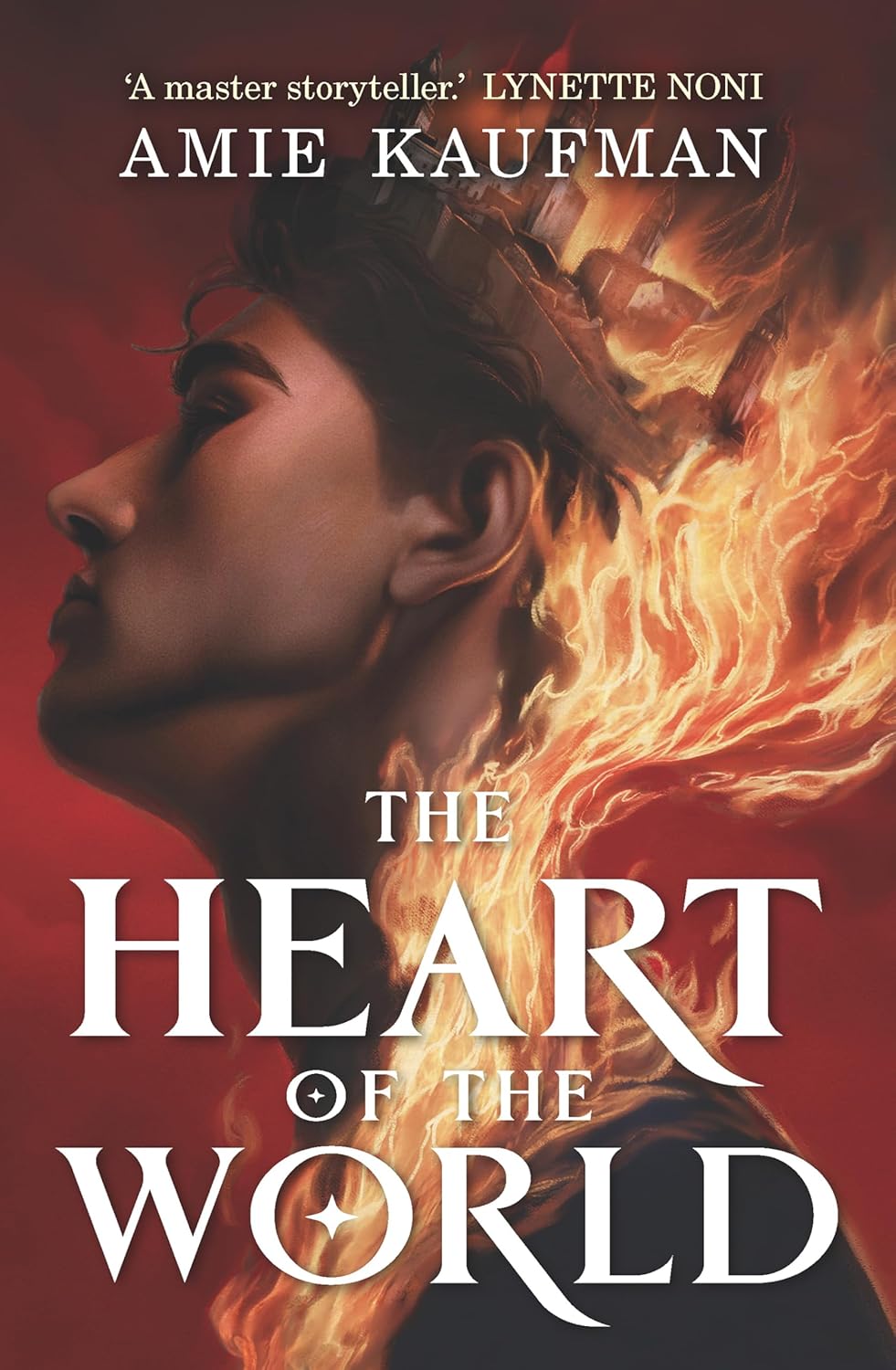
Quick Review – The Heart of the World by Amie Kaufman

Publisher: Allen & Unwin Australia (Trade Paperback – 27 August 2024)

Series: The Isles of the Gods duology – Book Two

Length: 424 pages

My Rating: 4.25 out of 5 stars

Amazon

One of Australia’s leading authors of young adult fiction, Amie Kaufman, presents a cool conclusion to The Isles of the Gods duology with the fun read, The Heart of the World.

Amie Kaufman is an impressive Australian author who has produced multiple entertaining and enjoyable series over the years, mostly in collaboration with other awesome authors.  For example, I best know Kaufman from the intriguing and addictive young adult science fiction trilogy she cowrote with Jay Kristoff, the Aurora Cycle trilogy, which proved to be particularly fun (see my reviews for Aurora Rising, Aurora Burning and Aurora’s End).  Kaufman’s latest body of work has been The Isles of the Gods duology, a great young adult fantasy series that follows several teenage protagonists who find themselves drawn into an ancient war between gods.  This series began last year with the first book, The Isles of the Gods, and has just come to an end with the compelling read, The Heart of the World.

Plot Synopsis:

Magic and sacrifice will collide as lovers and gods, enemies and allies vie for the fate of the world in this heart-pounding sequel to The Isles of the Gods, which Stephanie Garber called deliciously diabolical and full of heart.

When Selly and Leander began their treacherous voyage to the Isles of the Gods, the captain’s daughter and the playboy prince were strangers. But amid talk of war and a deadly attack on their ship, the unthinkable happened.

They fell in love.

Leander’s ritual at the island temple was meant to prevent a war between the gods. Instead, it nearly cost him his life, and drew the goddess Barrica back from exile. Now, as her Messenger, Leander is imbued with her deadly magic, and only Selly’s presence can stop it from consuming him.

But Barrica wasn’t the only immortal roused from sleep. The God of Risk, Macean, was awakened by an enemy all thought dead, and across the sea he’s calling for war.

The fight to save their world will take Selly and Leander from the gilded ballroom of the royal palace to the hallowed halls of an ancient library. Battle lines will be drawn, and bonds will break.

With the wrath of gods and the machinations of power-hungry rulers straining their loyalties, can their love withstand the trials that await them?

The Heart of the World was an exciting and moving book that did an excellent job wrapping up the storylines started in the first book.  Set immediately after the events of The Isles of the Gods, Kaufman presents an intense, character-driven narrative, as the teenage protagonists attempt to deal with the return of gods into their world.  Told from the perspective of five characters, you get some interesting storylines here, including Leander learning to control his power as his god’s Messenger while Selly tries to help him while also learning about the deadly politics of the realm.  Other character storylines of note include the scholar Keegan attempting to determine how to stop the oncoming chaos while also dealing with his many personal issues, the antagonistic Messenger of Macean, Laskia dealing with having power for the first time, and the conflicted Jude trying to determine where he stands in the world.

Kaufman does a great job blending these cool, character-driven storylines together into one compelling and exciting narrative with a very fast pace.  There is an excellent blend of politics, character growth and a deepening of personal relationships, as each of the protagonists react to the changes brought on by the events of the first book.  Things take a more urgent turn halfway through as the warring gods emerge and the characters find themselves desperately caught up trying to stop or control the destructive fight to come.  Featuring a countdown towards inevitable carnage, I liked how Kaufman kept the intensity and stakes of the second half of the book high without showing too much actual conflict and bloodshed, instead relying on compelling character moments thanks to a variety of unique interactions.  The protagonists are forced to overcome the consuming influence of their gods, both of whom want war, as they attempt to save their world, and I felt that the author came up with a well-written and cleverly set up solution to the entire plot.  The book ends on a satisfying and hopeful note, and I really had a fun time getting through this compelling story.

I really liked how The Heart of the World came together, and Kaufman ensures that it is accessible and enjoyable for a range of fantasy fans.  While I would recommend reading The Isles of the Gods first, new readers can probably dive into The Heart of the World straight away without too much prior context, as the author’s descriptive writing style and ability to effectively recap events really helps.  While some of the key fantasy elements from the last book aren’t as comprehensively covered in this sequel, such as spirit magic, Kaufman ensures that all the key features of this universe are well covered.  Indeed, there is a major religious focus throughout The Heart of the World, and it was fascinating to see various characters react to the direct influence and power of the two warring deities.

The resulting story moves at high speeds, and I honestly found myself powering through The Heart of the World every time I picked it up.  It helped that Kaufman made excellent use of quick and sharp perspective changes, and the jump from one short character-focused chapter to the next allowed for some quick plot progression.  As with the prior book in the duology, I felt that The Heart of the World was an excellent fantasy book that would appeal to a lot of readers, not just its intended young adult audience.  In particular, Kaufman sets up a lot of mature and intelligent themes and moments, most of the based around her complex protagonists, which I think will resonate with a teenage audience.  However, older fantasy readers can also enjoy The Heart of the World thanks to Kaufman’s clever writing and intriguing themes.

I also need to quickly highlight the excellent character work contained within The Heart of the World, which I felt helped to turn this sequel into something special.  Kaufman does an outstanding job continuing to explore her five damaged protagonists, and there is some great continuation to the complex character elements set up in the first book.  This includes a compelling look of the romance angle between Leander and Selly, who are forced to deal with major obstacles, including Leander’s sudden uncontrollable power, while Selly is forced out of her comfort zone on the waves and into the deadlier wilderness of court life.  I also loved the storyline of Laskia, who’s experience as her god’s Messenger went in a darker direction, as she struggles with finally having power and the ability to control her destiny after a lifetime of being manipulated by others.  All of the other protagonists have their own unique moments as well, and I really appreciated how all their respective family issues became even more apparent in this second book, as all five of them experience some form of betrayal or disappointment at the hands of their family which they must overcome.  Throw in a particularly entertaining new supporting character in Kiki, a bubbly and unstoppable force of social energy, and the cast of The Heart of the World was particularly strong and resulted in some moving moments.

Overall, The Heart of the World was an amazing new novel from Amie Kaufman that I was glad I checked out.  Providing a great ending to The Isles of the Gods duology, The Heart of the World had a brilliant, character-driven narrative, that is so easy to get lost in.  A fantastic and very fun novel that is worth checking out, especially if you enjoyed Kaufman’s previous work.

Amazon

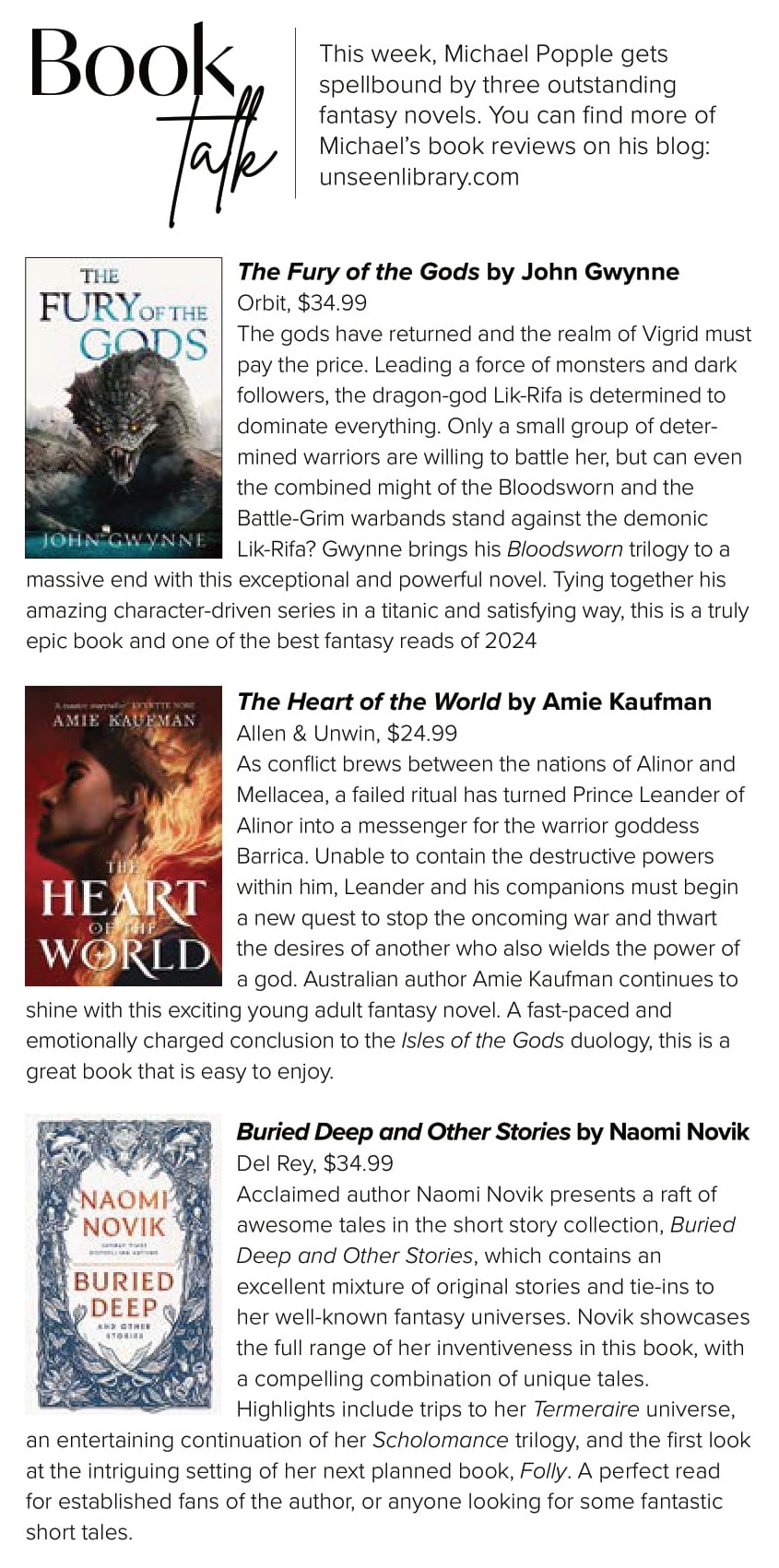
The Fury of the Gods by John Gwynne

Publisher: Orbit/Little Brown Audio (Audiobook – 22 October 2024)

Series: The Bloodsworn Saga – Book Three

Length: 19 hours and 30 minutes

My Rating: 5 out of 5 stars

Amazon

John Gwynne brings his awesome Bloodsworn trilogy to a truly epic conclusion with the outstanding novel, The Fury of the Gods.

For the last few years one of the most compelling fantasy series has been the Bloodsworn Saga trilogy from acclaimed fantasy author John Gwynne.  This series is set in a Norse-inspired fantasy world shattered by warring gods and now filled with monsters, voyaging warriors and the human descendants of the gods whose power often see them collared and controlled as thralls.  The series started back in 2021 with the impressive read, The Shadow of the Gods, which introduced the main characters and set them on their quests.  I almost missed The Shadow of the Gods when it came out, but I was glad that I didn’t, as it turned out to be one of my favourite books and audiobooks of 2021.  Gwynne continued the series in a big way the next year with the excellent sequel, The Hunger of the Gods, which expertly continued the series and ended up also being a top book and audiobook of 2022.  Due to how amazing the first two entries in the trilogy proved to be, I have been eager for to the finale of the trilogy for a while, and I was so happy we got one in 2024.  One of my most anticipated books in the second half of 2024, The Fury of the Gods was everything I hoped it would be and more, and I listened to it the very first chance that I got.

The gods have returned, and all must pay the price!

After centuries of imprisonment following the last great war of the gods, the evil and crazed dragon-god Lik-Rifa has been released and now seeks to rule over the land of Vigrid.  With the cunning rat-god Rotta at her side, Lik-Rifa leads a vast army made up of her monstrous children, as well as ambitious mercenaries and Tainted warriors.  Determined to place the entire continent under her dark rule, Lik-Rifa turns her eyes to the stronghold of Snakavik and moves to destroy the last vestige of resistance against her.

However, not all is lost, as some seek to stand against Lik-Rifa.  Elvar, leader of the Battle-Grim, has killed her father and taken control of Snakavik.  Bound by fate and her oaths, Elvar must balance her new responsibilities as ruler while she plans for war against Lik-Rifa, a seemingly impossible task.  However, Elvar has done the impossible before by resurrecting Lik-Rifa’s hated brother, the wolf-god, Ulfrir, and binding him to her will.  Now her most potent weapon and the ultimate bait for Lik-Rifa, Elvar seeks to use Ulfrir to destroy the gods coming for her.  But even a giant wolf-god might not be enough to win the war, and Elvar needs even more allies to help her.

After scouring a bloody path across Vigrid, Orka Skullsplitter has rescued her son, but still seeks vengeance against Lik-Rifa’s forces.  To that end, Orka reunites with her old warband, the Bloodsworn, and sets them to join Elvar’s growing host.  Made up of deadly Tainted warriors, including their latest recruit, Varg No-Sense, the Bloodsworn have many reasons to fight against the dragon-god’s followers.  Together, the Bloodsworn, Battle-Grim and their various allies prepare to face Lik-Rifa’s army in the greatest battle the world has ever known.  But no-one is prepared for the chaos that is about to engulf Vigrid, as greater threats arise to devour all.

Gwynne continues to impress with this third and final Bloodsworn Saga novel.  The Fury of the Gods was another high-octane, character driven, dark fantasy novel, that takes the reader on a powerful adventure.  Loaded with fantastic moments and amazing action, The Fury of the Gods proved to be an outstanding conclusion to the Bloodsworn Saga, and I had such an awesome time getting through it.

The Fury of the Gods featured a spectacular and captivating narrative that starts off strong and refuses to slow down the entire way through.  Taking off immediately after The Hunger of the Gods, Gwynne effectively sets the stage for the oncoming battles as the various character arcs continue at breakneck pace.  Once again telling the story through the eyes of five distinctive protagonists (Orka, Elva, Varg, Biorr and Gudvarr), you get drawn into their intriguing personal tales as they recount the events they observe.  The first half of the book keeps these protagonists mostly separated, and their various storylines continued in similar directions to The Hunger of the Gods.  Orka is still set on her bloody revenge mission and must overcome her imprisonment by the rat-god Rotta.  Varg and the Bloodsworn journey back from their rescue mission in the neighbouring nation of Iskidan, encountering new threats along the way.  Elvar takes up the responsibility of ruling Snakavik after killing her father and finds herself leading the war against Lik-Rifa.  Finally, Biorr and Gudvarr provide intriguing insights into Lik-Rifa’s camp, as both the conflicted Biorr and the snivelling Gudvarr try to survive the rise of dragon-god in their own different ways.

Gwynne does a good amount of set-up in this first half of the book, and it was nice to see the various characters continue to breathe on their own for a bit, while also amping up the dangerous antagonists.  You once again get quickly drawn into each of the protagonists narratives, and I think that it is a testament to Gwynne’s writing that each of these storylines proved to be as entertaining and compelling as the rest.  Unlike other multiple-perspective novels I have read, I honestly loved every single character perspective in The Fury of the Gods, and I was excited to continue each of them.  Indeed, I find it hard to choose a favourite, as they were all fun while offering something a little different.  That being said, Elvar’s chapters moved the plot along the most, and Gwynne did his best character work with her in this book.

Everything leads up to a particularly epic final half, as Gwynne brings together all five point-of-view characters to the same location for the first time in the series.  With the protagonists spread out on each side of the conflict, you get a great view of the massive extended war as the god-led armies fight it out on several fronts, including in a brutal siege.  Gwynne kept the action going thick and fast here, and there are some great encounters and moments as the various characters meet on the battlefield.  Everything leads up to a massive confrontation nearly two-thirds of the way through, and there are some highly dramatic moments here, especially as the first big-death was a little unexpected.  This major fight ends in an interesting way, although details of it are spoiled a little by the awesome cover above.  This leads to some more fantastic moments, including the final battle between both sides.  The author chucks in a few more tragic moments in this final bit of the book, although I must admit that there weren’t a lot of surprises here, with many of the big reveals well telegraphed in advance.  I also thought that the various revenge arcs cluttered up the plot in a predictable manner, and I wish Gwynne had thrown a twist or two in here.  Still, everything ended on an extremely epic note, and readers who enjoyed the previous Bloodsworn Saga books will come away very satisfied and happy with the finalised character arcs.

As with the previous Bloodsworn Saga novels, Gwynne brings a distinctive style to The Fury of the Gods, which I felt greatly enhanced the story.  The blend of compelling Norse-inspired fantasy elements, great character work, and brutal action makes for awesome reading, and Gwynne presents it all in an accessible and enjoyable way.  I loved how the characters’ dialogue and inner thoughts fell in line with the book’s historical inspiration, and while this style might not be for everyone, elements of it, such as the repetition of certain thoughts and phrases, gives it a real saga feel.  As with the previous entries in the series, Gwynne makes excellent use of multiple character perspectives to tell his elaborate narrative, with his five point-of-view characters helming various chapters.  The split between these five characters worked extremely well, and you get some intriguing alternate perspectives of events that blend well as the book continues.  Gwynne makes excellent use of this split during some of the bigger combat scenes, and the use of shorter chapters when things get particularly exciting allows the reader to quickly switch amongst the action.  Talking of action, Gwynne ensures that the combat in The Fury of the Gods is as bloody and well-written as in the previous books, and his brilliant action scenes are so well described and bring you right into the midst of the fighting.

As The Fury of the Gods is the third and final book in an epic fantasy trilogy, it obviously isn’t the most ideal place for readers to dive into the overarching story, and you really should start at the beginning of the series for the full emotional impact.  However, for those who want to start with The Fury of the Gods, Gwynne does make this book somewhat accessible to new readers.  Between the detailed summary of the prior books, glossary of terms, character lists and the callbacks to the previous events during the plot, new readers can follow The Fury of the Gods easily enough and have fun.  This includes enjoying the full impact of the cool fantasy setting of Vigrid that Gwynne has lovingly set up during the three books.  The clever use of Norse-inspired elements really lends itself to the epic revenge driven narrative that Gwynne features, and the mixture of mythological, fantasy and historical elements proved to be a winning combination.  I still love seeing the various warbands using Viking war tactics against dark dangers and massive gods, and Gwynne really went all out making so many traditional Norse elements, such as weaponry, armour, ships and mentality, seem as realistic as possible.  At the same time, the book’s fantasy inclusions, such as the various monsters and Tainted, the human descendants of the gods, add so much to the story, through their vicious nature, intriguing descriptions, and underlying societal issues.  This was an overall pretty awesome setting, that Gwynne uses to full effect to tell his compelling tale.  I hope that Gwynne returns to this world at some point in the future, and it wouldn’t surprise me if some of the younger characters featured here get their own story.

In addition to The Fury of the Gods’ fantastic story and great writing, I also need to talk about the awesome characters.  Throughout the Bloodsworn Saga, Gwynne has put a lot of work into building up his various characters, and by this point in the trilogy you are highly invested in their respective stories.  As such, there aren’t a lot of new figures in this final book, and you generally know what to expect when one of the protagonists’ chapters begins.  However, it still proved awesome to see these figures in action again, and their compelling character arcs and differing personalities deeply increase the impact of the narrative.  Of the main cast, I would say that Elva steals the show the most in The Fury of the Gods.  While she has not always been the most exciting character in the series, this third and final book was where she really shined, primarily because she takes on the role of war leader against Lik-Rifa, and the increased responsibility changes her.  As such, it was outstanding to follow her storyline, and I appreciated seeing how conflicted she got at times, especially when it came to treating the Tainted in her domain.  Due to this, as well as some other badass scenes, Elva was one of the most compelling protagonists in The Fury of the Gods for me, and Gwynne provided an interesting conclusion to her narrative that I felt really worked.

The other four main characters all proved to be brilliant additions to the book, and their perspectives ensured quite an elaborate story.  The dangerous fighters, Orka and Varg, were both solid point-of-view characters in The Fury of the Gods, and I really enjoyed seeing how their respective arcs continued, especially as they were the main avenue to seeing the Bloodsworn warband.  Of all the protagonists, you were most likely to see action with Orka or Varg, and their various bloody sequences were a lot of fun.  That being said, Gwynne went a little light with the character development for these figures in this book, and while they have some moving moments (Orka comes out of her solitude to find people she cares about, while Varg finally cements his place in the Bloodsworn), I felt that Gwynne focused way too much on their respective hunts for revenge, which resulted in some of their stuff getting a little repetitive.

However, Gwynne more than overcomes any minor deficiencies with Orka and Varg through his use of the antagonistic perspective characters Biorr and Gudvarr, both of whom have joined Lik-Rifa’s cause.  Biorr proves to be a complex figure in The Fury of the Gods, and I loved how conflicted he become as his longstanding fanaticism slowly beings to wear away in the face of meeting his gods.  Gwynne did a really great job with Biorr, and his personal journey and attempted redemption made for some powerful moments.  On the other hand, we have the entertaining and despicable Gudvarr, whose chapters I always have fun with.  Gudvarr is an impressively annoying figure who has spent the last two books trying to avoid danger only to find himself getting stuck in progressively worse situations.  However, because he is naturally cowardly, weaselly and vindictive figure, you really don’t feel sorry for him, especially as every bad situation is the result of some failed ploy to gain influence or power.  While Gudvarr is a particularly contemptible figure, it honestly proves impossible not to enjoy his chapters, as they are generally the most amusing in the entire book thanks his snarky inner monologue, the deadly situations he barely escapes from, and the near certainty that he is going to come to a sticky end.  As such, I really enjoyed following Gudvarr and you can’t help but look forward to seeing what dangerous or manipulative situation he finds himself in next.

Finally, I must highlight all the awesome and impressive supporting characters that are featured in The Fury of the Gods.  Gwynne has built up an exceptional and massive cast of characters throughout the series, all of whom add something to book.  I loved seeing the many complex interactions that occurred between all these characters in The Fury of the Gods, and it was fun to see many of them meet for the first time in this final book, especially once all the perspective characters are together.  Highlights include the key members of the Battle-Grim and Bloodsworn warbands, all of whom have gone through so much throughout the trilogy.  Several of the best characters from both bands experience major tragedy in The Fury of the Gods, and it proves hard not the feel for them.  I also need to mention the main antagonists, Lik-Rifa and Rotta, two vengeful gods whose desire for revenge and control move much of the plot along.  I loved seeing the various human and Tainted characters interact with these dark gods, and Gywnne ensured they came across as a massive and dangerous threat.  Two entertaining giant ravens, a fun talking head, and so many other great characters ensured that The Fury of the Gods was a moving and deeply personal read, and I am so glad I got the opportunity to know them during the run of this trilogy.

As with the previous books in the Bloodsworn Saga, I chose to grab The Fury of the Gods on audiobook, which proved to be a particularly awesome way to enjoy this epic read.  Featuring a runtime just under 20 hours, The Fury of the Gods audiobook is a lengthy but highly exciting listening experience, and I found myself powering through this audiobook, namely because the format deeply enhances the intense story and intricate writing.  Narrator Colin Mace, who has lent his voice to the other Bloodsworn Saga books, did another brilliant job with The Fury of the Gods, and his impressive voicework leant some additional impact and gravitas to the book.  Mace perfectly portrays the Norse-inspired fantasy elements of the book, and I really loved how effectively he captured the various hard-nosed characters of the series.  I especially loved Mace’s take on the gigantic gods and other dark creatures haunting the lands, and I felt that the narrator was a key reason why I had so much fun with this audiobook.  Probably one of the best formats to enjoy The Fury of the Gods, listeners will have such an epic time with this audiobook.

With blood, fury and vengeance, the Bloodsworn Saga comes to a brilliant end that I could not get enough of.  The Fury of the Gods was another exceptional read from John Gwynne, and I was so very happy to see how this entire epic narrative concluded.  Loaded with action, excellent fantasy elements, and so many impressive characters, The Fury of the Gods was an outstanding book on its own, as well as an incredible conclusion to one of the most epic fantasy trilogies out there.  One of my favourite fantasy books of 2024, The Fury of the Gods was an excellent read that gets an easy five-star rating from me.

Amazon

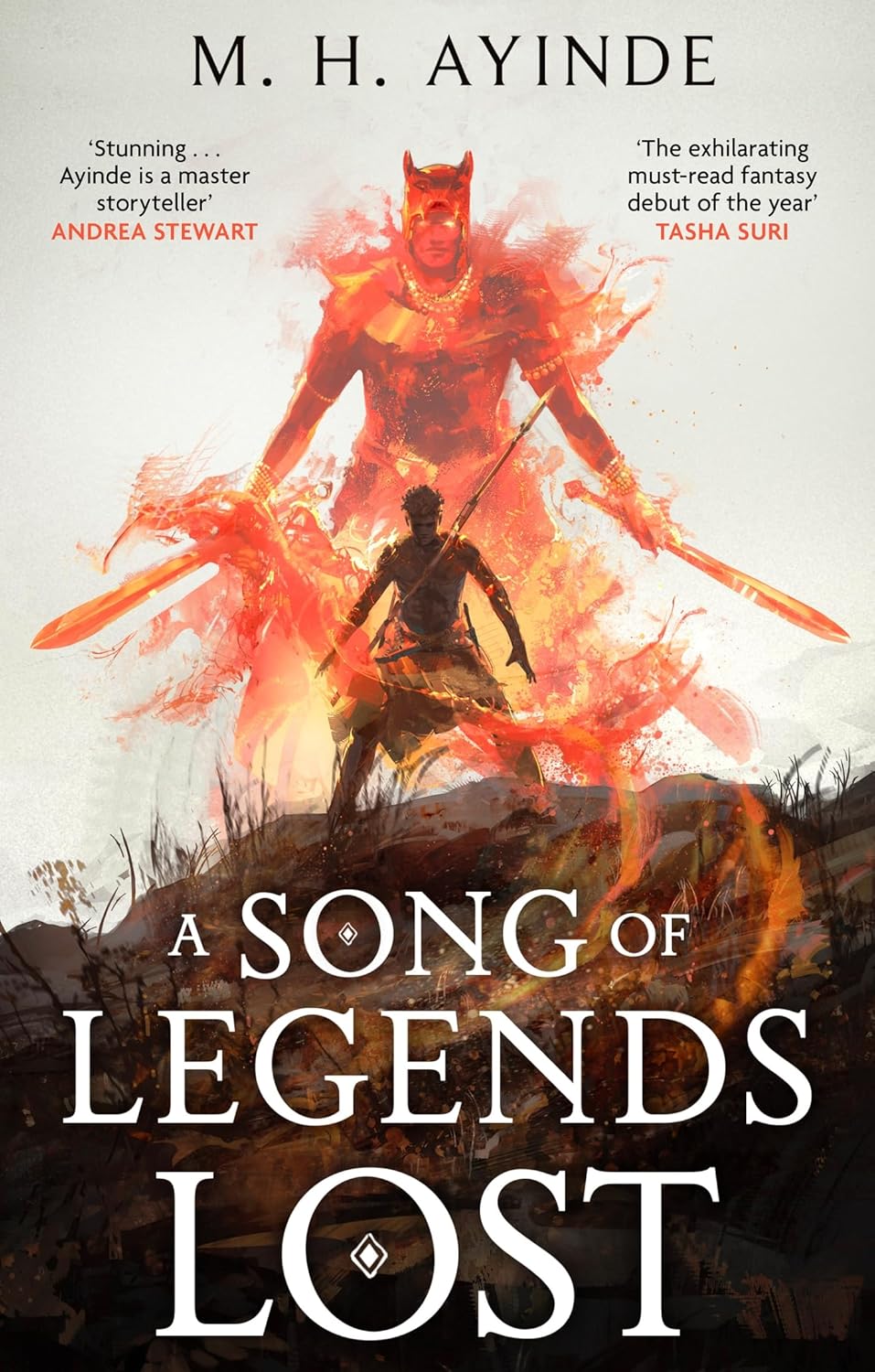
Waiting on Wednesday – A Song of Legends Lost by M. H. Ayinde

Welcome to my weekly segment, Waiting on Wednesday, where I look at upcoming books that I am planning to order and review in the next few months and which I think I will really enjoy.  Stay tuned to see reviews of these books when I get a copy of them.  For my latest Waiting on Wednesday post, I highlight an intriguing 2025 fantasy debut with A Song of Legends Lost by M. H. Ayinde.

Amazon

The new year is shaping up to quite impressive fiction wise, as there are a ton of awesome new novels coming out in 2025.  While I love seeing some of my favourite series continuing, I am also always keeping my eye out for something new, especially if that means debuts from promising new authors.  I have already identified a couple of cool Australian crime fiction debuts coming out in early 2025, and now I’m turning to fantasy fiction debuts, there is a compelling fantasy novel from a first-time author is coming out in April.

This fantasy debut is A Song of Legends Lost by new author M. H. Ayinde, and not only does it have an amazing cover, but it also sounds really impressive.  Set to be a gripping and powerful revenge tale, A Song of Legends Lost has an interesting magic system revolving around the summoning of ancient ancestor spirits for combat purposes.  However, when a commoner summons the wrong spirit by accident, it leads to all manner of trouble, both in the spirit realm, and on the physical plane.  I really love the sound of A Song of Legends Lost and I think that this novel could have some real potential for next year, and I cannot wait to check it out.

Plot Synopsis:

A relentlessly gripping tale of revenge and rebellion from a major new voice in epic fantasy


In the kingdom of Nine Lands, incursions by an ancient enemy are dealt with by the Invoker clans – warriors of noble blood who can summon their ancestors to fight with them in battle. But when Temi, a commoner from the slums, accidentally invokes a powerful spirit, she finds it could hold the key to ending this centuries-long war.

But as secrets long buried come to light, Temi will learn that not everything that can be invoked is an ancestor, and some of the spirits that can be drawn from the ancestral realm are more dangerous than anyone can imagine.

Buried Deep and Other Stories by Naomi Novik

Publisher: Del Rey (Trade Paperback – 17 September 2024)

Series: Standalone/Short Story Collection

Length: 433 pages

My Rating: 4.5 out of 5 stars

Amazon

A must-read for all fans of fantasy author Naomi Novik is the excellent and highly enjoyable short story collection, Buried Deep and Other Stories.  Featuring an intriguing combination of stories from across Novik’s imagination and established fantasy universes, Buried Deep and Other Stories was a particularly awesome read that I had a lot of fun getting through.

Naomi Novik is a well-established and impressive fantasy author who has produced some amazing works over the years.  Best known for her iconic Temeraire series, which envisioned the Napoleonic Wars with dragons, Novik has produced some great books and stories over the years, including some interesting standalone works.  I best know Novik from her excellent Scholomance books, which showcased a dark and impressive take on the magic school genre.  The Scholomance books, made up of A Deadly Education (one of my favourite books of 2020), The Last Graduate (one of my favourite books of 2021) and The Golden Enclaves (one of my favourite books of 2022), were all extremely awesome, and this remains one of my all-time favourite book trilogies.  As such, I was very interested in reading more from Novik and Buried Deep and Other Stories offered an amazing opportunity to explore her varied writings.

Buried Deep and Other Stories contains an auspicious 13 short stories, which run the gambit from entertaining to moving and bring together both previously published short stories and new tales fresh from the author’s imagination.  While some of the reads are standalone stories, there were also entries from Novik’s more familiar universes, all of which comes together to make quite an awesome overall volume.  I was initially drawn to this book by the promise of a continuation of series I’ve previously read, but I ended up staying for the whole inventive array, especially as you are gifted a vision into Novik’s future works.

Novik starts the book off strong with the fast-paced story, Araminta, or, The Wreck of the Amphidrake, a Regency-style adventure with fantasy elements that follows a young, adventurous woman who wants more than a planned marriage.  A chance pirate attack and a gender-morphing amulet provide the opportunity she is looking for while also leading to various amorous adventures.  This was a very fun, and slightly randy, swashbuckling adventure that successfully highlights the author’s flair for combining historical periods with her own fantasy ideas.  This proved to be a great first entry to Buried Deep and Other Stories, and I appreciated that Novik started things off fun.

Novik kept the book going strong with the amazing Afterhours, which serves as a follow-up to her awesome Scholomance trilogy.  I must admit that of all the stories in this book, Afterhours was the one that I was most excited for, primarily because I had such a great time with the Scholomance novels, and I really wanted to see how the universe continued.  Novik did not disappoint with a captivating story set a couple of years after The Golden Enclaves, with a look at a new class studying at the Scholomance magical school.  Despite the Scholomance evolving and becoming less exclusive, some things remain the same, with the unusual witch Beata, finding her school life made difficult by the rich and powerful enclave students, including her roommate.  Desperate to survive, Beata and her friends break curfew to obtain rare supplies, only to encounter some of the remaining monsters roaming the school.

This proved to be an entertaining and wonderful return to the Scholomance series, and I for one was glad to get a look at the school and its unusual setup following the chaotic events of the original trilogy.  Novik does an excellent job expanding on her existing universe, and fans of the series will love this continuation, as well as a major cameo at the end.  However, this story is open to reader’s unfamiliar with the Scholomance books, especially as Novik focuses the plot on a protagonist unaware of the full details of the previous books, allowing for an excellent outsider’s perspective as you explore the setting’s unique features.  It was great to return to this iconic setting, and Afterhours was a fun read that both stood on its own, while also providing some awesome moments to the author’s existing readers.

The third story in this book, Vici, is a quick but highly fun entry that ties into the dragon taming world of Novik’s Temeraire universe.  Indeed, Vici shows the origin of the universe’s entire dragon riding premise with a Roman historical tale that sees a young Mark Antony hatch a dragon egg.  Novik produces a particularly entertaining and hilarious story, as her irresponsible Mark Antony (inspired by James Purefoy from the Rome television series), finds himself in all manner of trouble, made worse by his impressionable talking dragon.  I loved this simple but highly effective story, which not only expertly works dragons into Roman history, but which also keeps the reader extremely amused with some great humour and over-the-top moments.  One of the funniest stories in Buried Deep and Other Stories, and a wonderful mood lightener between other heavier entries.

This leads us to the book’s titular short story, Buried Deep, which serves as a powerful retelling of the Minotaur myth.  Told from the perspective of King Minos’s daughter, Ariadne, Buried Deep follows her journey to becoming a priestess of the shrine that holds her brother, Minotaur, as he stalks the labyrinth under the island.  Novik seeks to cast both Ariadne and Minotaur in a more sympathetic light, showing them as victims of their father’s schemes, with Ariadne seeking to undermine Minos by using the labyrinth to enhance her reputation.  Thanks to its deep emotional edge and near gothic style, Buried Deep proved to be a particularly unique and memorable take on the Minotaur myth, and I loved seeing Ariadne’s perspective of events.  You really appreciate her bond with Minotaur and the pain that his imprisonment has on her, and this was one of the more moving entries in Buried Deep and Other Stories.  This story effectively showcased Novik’s ability to transform well-established stories and myths, and I’m glad Buried Deep was featured here.

The next story is the fantastic entry, Spinning Silver.  A clever take on the classic Rumpelstiltskin fairytale, this story follows Miryem, the daughter of a village moneylender, who takes over her weak father’s business and becomes a successful businesswoman.  A boast about her ability to make money brings her to the attention of a malicious faerie who demands that she prove her ill-timed words three times by turning his silver coins into gold.  What follows is a fantastic and clever series of events as Miryem uses her business sense and quick thinking to technically fulfill the terms of the magical contract while also trying to get out of the unfavourable marriage promised as a reward.

I really loved Spinning Silver for a multitude of reasons, especially as it has a compelling narrative that brilliantly retells a famous fairytale in a darker and more modern manner, while also featuring a great historical Russian setting.  This proved to be a particularly enthralling tale of fortitude and tough decisions that also subtly examines the historical hardship of the Jewish population of Eastern Europe.  Spinning Silver is also an interesting inclusion as it bears the same name as one of the author’s novels.  This short story, which was published a few years before the Spinning Silver novel, was the inspiration for Novik’s later book, with the author reusing elements from it.  While readers who have already enjoyed the Spinning Silver novel will see some similarities between it and this short story, the entry in Buried Deep and Other Stories is very much worth checking out as Novik takes this short story in a different direction to give it quicker and more definitive conclusion.  I think that the Spinning Silver short story works a little better than the overall novel, mainly because the concept was more focused and reached its key points sooner, but both prove to be excellent reads.  This honestly proved to be one of the strongest entries in Buried Deep and Other Stories, and I see why Novik chose to expand it into a novel.

The fun continues with the fantastic story Commonplaces, which serves as the author’s unique entry in the Sherlock Holmes mythos.  Set after the events of the classic Sherlock Holmes short story, The Final Problem, Commonplaces focuses on the character of Irene Adler after she hears about the events at Reichenbach Falls.  This was a short but sweet story that provides an interesting modern look at the impact Holmes has on the characters he encounters.  Novik’s take on Adler, which only utilises details from A Scandal in Bohemia, is particularly authentic, and doesn’t fall into the exaggeration that many of her current popular culture portrayals are known for.  Shown solely from Adler’s perspective, you get some great interpretations into her personality, as well as her observations of the enigmatic Holmes.  I felt the story went in some very interesting and memorable directions, and I liked how it both cleverly referenced A Scandal in Bohemia but also covered a potential romance between Holmes and Adler in its own way.  Novik adds in a few subtle implications about Holmes’ romantic interests and inclinations, which I thought was a nice touch, and the resulting story effectively ties up the entire storyline between these two iconic figures.  An overall fantastic story, Commonplaces is a fun and quick short that will appeal to a lot of readers.

Novik continues to delight with the seventh entry, ironically named Seven, which was one of my favourite stories in Buried Deep and Other Stories.  Set in a unique fantasy city called Seven, the story is set around the city’s famous ceramics trade, which constantly ensures that the city is surrounded by seven giant singing statues.  Whenever one of the statues breaks, a replacement is made from a beautiful yet deadly special clay by the city’s then master clay-shaper.  Seven primarily follows Kath, a clay-shaper’s widow, who takes over her husband’s business with the help of grouchy kiln master and ceramic devotee Grovin, and eventually forms a reputation as a radical artist due to the simplicity of her pots and ceramics.  Chosen to build the next singing statue, Kath is initially reluctant due to the life-shortening nature of the special clay, until the machinations of Grovin forces her hand.

I really loved Seven, and I think it is the story that best showcases how imaginative and skilled Novik is as an author.  I was deeply impressed with how effectively Novik was able to build up a new fantasy city and then set up a complex and character-driven tale that debated art versus practicality in only 25 pages.  You easily get drawn into the struggle of Kath as she becomes a famous artist and creator with all the trouble that entails, while simply trying to provide for her family.  Novik works this initial premise extremely well, and then cleverly twists the entirety of Seven into a tale the examines the dark side of art appreciation.  This darkness is conveyed by the complex and gruff character of Grovin, a man who only loves the beauty of ceramics, and whose desire to see more of Kath’s art forces him to some dark places.  I loved the ironic twist that forces Grovin to live a life less devoted to the arts to get what he wants, and I really appreciated how Novik explored his obsession, and the differing views of what ceramics represent between the two main characters.  If I had one complaint, it would be that the story wasn’t long enough; I would love to have seen a more concrete conclusion than the philosophical end Novik came up with, but this was still an exceptional story that really hooked me in with its creativity and unique focus.

Continuing onwards, Novik throws in two great short stories that break up the book in preparation for the longer stories towards the end, with Blessings and Lord Dunsany’s TeapotLord Dunsany’s Teapot is a tale of magic and imagination in the depths of horrifying war, while Blessings is a fun story about a young baby who gets over-blessed by six drunk and competitive fairy godmothers.  Both these stories have their own unique flavour, and I liked how well they played off each other in short order.  Lord Dunsany’s Teapot was a quick magical story with descriptive dark war elements to it that highlight the need for an escape from horror, while Blessings was an excellent comedic take on the fairy godmother trope from popular fairytales.  I enjoyed both these stories, although Blessings was probably my favourite due to its hilarious, quick-fire content.

Next up we have the tenth entry in Buried Deep and Other Stories, with the book’s only science fiction contribution.  Seven Years From Home is a striking story about futuristic colonialism in which a young diplomat from an ever-increasing galactic federation visits a prospective new member planet where a war is brewing between new, technological reliant colonists and the original settlers of the planet who have genetically modified themselves and are now in tune with nature.  This was an interesting take on the classic story of technologically advanced colonists warring with nature-loving natives with an outsider amid the natives learning their ways.  However, Novik takes her story in some different directions, with the natives proving to be far more adaptable than you would expect, and I loved this brilliant and intriguing tale.  While it features a great story, Novik ensures that Seven Years From Home really stands out thanks to the protagonist, who finds herself caught between her loyalties to her home empire and the new friends she makes on her adventures.  There were some great scenes as the protagonist becomes even more conflicted with her choices, especially as the information she sends home keeps the war going, and her attempts to find the same mindset of her hosts.  This story ends with some touching tragedy and a great twist, and I felt that Novik’s foray into science fiction was a fantastic success.

Continuing, we have the book’s second foray into the Temeraire universe with the fabulous entry Dragons & Decorum.  Set to the backdrop of the Napoleonic War that the main Temeraire books are based on, Dragons & Decorum is a reimagining of Pride and Prejudice with dragons.  The primary story sees Elizabeth Bennett becoming a Longwing captain in the Aerial Corps, flying her dragon as professional soldier, much to the horror of her mother.  However, despite her new role, Elizabeth still finds herself drawing the attention of Mr Darcy, and the two engage in a tumultuous courtship, with even more complexity thanks to Elizabeth’s romance-obsessed dragon and the ongoing war.  Novik clearly had fun working elements of her dragon-focused world into this literary classic, and I loved her fantastic take on the classic book, especially as dragons add new entertaining angles to the romance.  I felt that the author perfectly blended the more outrageous elements of her universe with the Pride and Prejudice plot, while also cleverly imitating Jane Austen’s writing style.  The result is a particularly amusing entry that will appeal to both fantasy fans and Jane Austen fans, and I just love the hilarious impacts any book’s relationship to the Temeraire universe can have.

On the home streak we have the intriguing and dark story, Castle Coeurlieu, which saw the very young bride of a castle lord grow close to her similarly aged stepson and learn the unusual history of the castle in which they live, including several stories about people visiting a mysterious tower within its bounds.  When plague strikes the region and her new friend flees to the tower, the protagonist follows, only to discover unusual occurrences, including three women playing with cards inscribed with the fate of the castle’s inhabitants.  While Castle Coeurlieu wasn’t my favourite entry in Buried Deep and Other Stories, it proved to be a compelling darker story that added in some grimmer elements towards the end of the book.  I enjoyed the different layers of lore surrounding the setting, and the curious young protagonist was well written and provided a great view to the plot.  An overall interesting addition to the volume, that serves as a great buffer between two of its biggest stories.

The final story contained within Buried Deep and Other Stories is the captivating adventure tale, The Long Way Round.  The longest entry in the collection, The Long Way Round was probably the story I was most looking forward to reading outside of After Hours, mainly because it provides readers with the first glimpse at Novik’s next upcoming book, currently titled Folly, following two siblings, canny sailor Tess and brilliant boat-builder Aston, who embark on a journey to cross the seemingly empty seas surrounding their known world and try to discover new lands.  Forcibly accompanied by their High Lord, a young wizard looking to prove himself, Tess, Aston and their crew set out on their adventure, only to make some unexpected discoveries with major implications for their entire world.

Featuring a great combination of likeable characters, well-written nautical elements, and a compelling new world filled with unique elements, The Long Way Round was a particularly addictive entry in Buried Deep and Other Stories.  Novik once again does a remarkable job effectively building up the scenario and the new fantasy realm in a short run time, and readers quickly find themselves getting invested in the protagonist’s journey, especially as the author does an excellent job exploring their motivations and desires.  The set-up and apprehension of the first part of The Long Way Round is well balanced by the subsequent mystery contained in the second half of the story, as the protagonists find what they seek, even if they are uncertain what it is.  Novik provides the reader with a series of stimulating and intriguing visuals and curious elements, and you really get into the spirit of the adventurous narrative elements.  This honestly proved to be an addictive read, and I found the clever, character-driven nautical adventure to be moving and fascinating at the same time.  I also found myself coming away from The Long Way Round extremely curious about Novik’s next book, and I will be interested to see whether it will be a direct sequel to this or something set further in the future.  Either way, the mystery of the titular follies is something I hope to explore in the future, and I am now even more excited for Novik’s next book whenever it comes out.

Overall, Buried Deep and Other Stories turned out to be an awesome short story volume from Naomi Novik that showed me her true range and skill as a fantasy author.  This book provides a fantastic collection of works, that hit you on every part of the emotional spectrum, including fun comedic reads and darker, tragedy charged narratives.  I was also particularly impressed by the inclusion of unique standalone stories whose elaborate fantasy concepts were well established and the expertly utilised to tell compelling stories.  The blend of original stories and windows into the author’s current and upcoming fantasy universes also ensured that readers of Buried Deep and Other Stories are in for a brilliant time.  It proved very easy to jump between these different fantasy worlds, and I felt that all readers can appreciate and follow the stories contained within, even if they were tied into the author’s other series.  As a fan of Novik’s writings, it was great to get some additional stories from her various universes, and the final story, The Long Way Round, has really gotten me excited to check out her next book.  Folly (or whatever its name may change to) is now very high on my to-read list, and I hope we see it soon.  As for Buried Deep and Other Stories, this was an incredible and fantastic short story collection that comes highly recommended for fans of Naomi Novik, as well as general fantasy fans looking for some compelling, shorter reads.

Amazon

How to Become the Dark Lord and Die Trying by Django Wexler

Publisher: Orbit (Trade Paperback – 6 August 2024)

Series: Dark Lord Davi – Book One

Length: 395 pages

My Rating: 4.75 out of 5 stars

Amazon

Hilarious author Django Wexler presents one of the funniest and most memorable fantasy novels of 2024 with the deeply addictive How to Become the Dark Lord and Die Trying.  Serving as the first book in Wexler’s new Dark Lord Davi series, How to Become the Dark Lord and Die Trying was an extremely amusing book that has been on my radar for a while due to its amazing-sounding plot.

It’s a tale as old as time.  An ordinary human becomes trapped in a mythical fantasy realm and is subsequently lauded as the prophesied hero of legend, destined to rule the kingdom and defeat the conquering Dark Lord.  But what happens when the human protagonist gets sick of living and dying as the hero?

That’s the question that falls to Davi, a young woman who has become trapped in a bloody and predictable time loop.  Constantly forced to become the leader of the soon-to-be-destroyed humans of The Kingdom, Davi has tried time and time again to organise an army capable of defeating the oncoming and everchanging Dark Lord, only to fail and die in agony in over 200 inventive ways.  After nearly a thousand years of playing the hero and losing in brutal fashion, Davi has had enough and decides that if you can’t beat them, become them.

Determined to take control of her destiny, Davi sets out to do the direct opposite of every other loop.  If the Dark Lord always wins, then this time Davi will take her place at the top of the winning side and become the new Dark Lord herself.  But first she must pull together a band of followers from the various non-human races of the realm and bring her loyal minions to the Convocation where the new Dark Lord is chosen, far away in lands she’s never even seen.  Standing between Davi and her destiny lie multitudes of deadly landscapes, brutal enemies, and all manner of unique obstacles that a Dark Lord in training needs to overcome.  Armed with her wits, her accumulated knowledge of the world, the ability to use her own death to her advantage, and an insane amount of humorous confidence, Davi may be able to do the impossible and finally win.  But Davi will soon learn that becoming the Dark Lord isn’t everything it’s cracked up to be.

How to Become the Dark Lord and Die Trying was a highly entertaining and insanely captivating read that I honestly could not get enough off.  Featuring a brilliant scenario that Wexler plays to comedic perfection, combined with dark humour and a uniquely insane protagonist, How to Become the Dark Lord and Die Trying is an outstanding novel that I had so much fun reading.

I must admit that I instantly loved the very fun premise of this book which saw the protagonist decide to take on the role of the Dark Lord after hundreds of failed attempts to survive as the hero.  Wexler did an outstanding job setting this idea up in the first couple of chapters of How to Become the Dark Lord and Die Trying, and you are quickly intrigued by the combination of a bloody time loop, a despondent, if hyper, protagonist, and the entire change of plan said protagonist embarks upon.  As such, you are completely onboard as soon as Davi starts to implement her plan, and the resulting carnage proves to be highly entertaining and fun.  After multiple bloody failed attempts to start her new turn to darkness, Davi soon begins to get into her groove as the next Dark Lord, recruiting a small band of minions, and taking the first steps to proving she has what it takes to rule.

Davi’s subsequent quest to become the Dark Lord involves an intense adventure arc, as she leads her army through various fun fantasy locations.  Along the way to her destination, Davi engages in different schemes to recruit new followers, especially when she encounters some chaotic communities whose internal strife she is able to exploit.  The story devolves into an awesome combination of intrigue, humorous encounters, fantasy action and personal character growth, as the protagonist becomes more comfortable with the Dark Lord lifestyle.  After several extended sequences at key locations, the protagonist eventually reaches her goal and begins her trials to become the new Dark Lord.  However, nothing at the trials is what it seems, and Davi is forced to deal with multiple enemies from her various pasts to survive.  There are some great moments in this final part of the book, including tragic betrayals, heart-felt romance, intriguing revelations, and some big fights, all of which leads to an interesting open-ended conclusion that will ensure readers come back for the next book in the series.

I had an exceptional amount of fun with How to Become the Dark Lord and Die Trying, and Wexler had a fantastic style that really appealed to me.  Told exclusively from the slightly crazed first-person perspective of the protagonist, readers are treated to Davi’s highly excitable inner thoughts as she recounts her journey to becoming the Dark Lord.  This proved to be a great medium to explore the more complex elements of the plot, and I appreciated how Wexler was able to succinctly dive into time-loop and Davi’s place in it, while also moving the plot along.  The author also introduces a serviceable and intriguing fantasy world the plot of How to Become the Dark Lord and Die Trying, which proved interesting to explore.  While a little basic in places, Wexler does feature some excellent concepts here, and readers will enjoy watching Davi explore it with her own unique perspective, especially as she forms new ideas about the supposedly evil wilders (non-human creatures) as she works with them.  While some of these concepts are a little complex at times, everything honestly works extremely well for the entertaining plot, and I really appreciated how effectively the author was able to explore and utilise his fantastic ideas.

While all these great concepts help to craft a unique book, what holds everything together and keeps the reader’s attention is the relentless comedy that Wexler injects into nearly every page of How to Become the Dark Lord and Die Trying.  I really connected to Wexler’s humour in this book, and I found myself chuckling away for large chunks of it.  Thanks to the slightly cracked protagonist, the reader is bombarded with a constant array of jokes, hilarious commentary, and over-the-top moments, as Davi combats the horrors both in front and behind her with humour.  A lot of this humour was driven by the protagonist having a modern, nerdish perspective in a crazy fantasy world, and her reactions ranged from sarcastic to goofy.  Wexler also makes great use of an array of continuous footnotes to tell additional jokes outside the flow of the narrative, or to really expand on an interesting or funny point.  I am a big fan of the use of footnotes for comedic purposes (blame my Terry Pratchett upbringing), and Wexler made it work really well here.  The author also relies on quite a lot of highly adult humour throughout the book, which helped to give How to Become the Dark Lord and Die Trying an interesting flair.  While I could see some readers not liking how continuously risqué the book got, or how over-the-top the humour is in general, I personally felt that it worked and allowed for quite an amusing, if slightly randy, experience.

Talking of crazy humour, I must highlight the fantastic central protagonist of How to Become the Dark Lord and Die Trying, Davi.  A modern-day and highly nerdy woman who finds herself trapped in this recurring fantasy adventure without any idea of how she got there, Davi is an interesting figure, and you really connect with her as the plot continues, especially as a lot of hilarity is drawn from her outrageous behaviour and thoughts.  Davi is constantly cracking jokes, making sarcastic inner observations and meta commentary, often driven by her modern experiences, and it’s hard not to be amused by her antics.  She also has some great, often ridiculous interactions with the various fantasy creatures she encounters, and I liked seeing her unusual persona connect with these more serious creatures.

While it is easy to get lost in Davi’s comedic persona, the further you get into the book, the more apparent it is that her cracked behaviour has been brought on by the constant trauma from her hundreds of deaths and the accompanying thousand years of experience that she has lived through as part of her fantasy adventure.  The initial exposure to her early trauma and rage at the start of the book gives you enough of a glimpse of this that you appreciate her turn to the dark side, but you see even more of it as the story continues.  A lot of this is because, even after years of watching everyone die, she still cares about the people around her, and the impacts of her decisions start to wear on her.  While she maintains her zany persona for much of the book, a new romance and a dark change in her circumstances towards the end of the book nearly break her, and I felt that Wexler did an outstanding job of trying to humanise her there, especially as she sometimes gives off uncaring, immortal vibes.  Thanks to these deeper personality traits, as well as her comedic nature, I really grew to appreciate to Davi as main character, especially as she is a lot more capable and competent thanks to her experiences, although she still makes some interesting mistakes (never sleep with your minions, everyone knows that).  As such, I look forward to seeing how her story continues, especially as things are likely to get even more out of control for her.

Overall, How to Become the Dark Lord and Die Trying by Django Wexler was an awesome book that I honestly found to be quite addictive.  The fantastic central scenario is greatly enhanced by the author’s outrageous humour and clever storytelling, and it allows for quite an outstanding read.  Slick, unique and very, very funny, How to Become the Dark Lord and Die Trying was one of the more unique fantasy novels of 2024, and if you are in the mood for a great laugh, then this is the book for you.  I personally am very excited to see how the Dark Lord Davi series continues in the future, and the second novel, Everybody Wants to Rule the World Except Me, is set for release in May 2025.

Amazon

Waiting on Wednesday – Four Ruined Realms by Mai Corland

Welcome to my weekly segment, Waiting on Wednesday, where I look at upcoming books that I am planning to order and review in the next few months and which I think I will really enjoy.  Stay tuned to see reviews of these books when I get a copy of them.  For this week’s Waiting on Wednesday, I check out the awesome upcoming sequel to a great fantasy novel I read in 2024, with Four Ruined Realms by Mai Corland.

Amazon

Earlier this year I had the great pleasure of reading the fantasy debut, Five Broken Blades by Mai Corland.  An exciting, intense and clever character-driven fantasy novel with some strong romantasy elements, Five Broken Blades was a fantastic read that saw several of the biggest liars in a fantasy kingdom team up to take down their immortal king.  Essentially one big heist novel with over-the-top characters, excellent action, tons of intrigue and a whole lot of personal issues, Five Broken Blades was a deeply enjoyable book, and I had a brilliant time getting through it, especially in its audiobook format which featured multiple excellent narrators.

While I didn’t love absolutely everything about Five Broken Blades (I’m not a huge romantasy fan, although Corland kept these elements fairly subtle), I did get really caught up in the narrative and I am very curious to see how it is going to continue.  As such, I am eager to get my hands on the upcoming sequel, Four Ruined Realms, which looks set to send the protagonists on another deadly heist.  Set for release in early January 2025, Four Ruined Realms has a great plot behind it, and I’m looking forward to finding out how Corland builds on the clever twist and cliffhanger at the end of Five Broken Blades.

Plot Synopsis:

The lies are bigger and the plots more treacherous when your favourite backstabbers return in the mind-blowing sequel to instant Sunday Times and New York Times bestseller Mai Corland’s epic adventure fantasy Five Broken Blades.

The King of Yusan may be the greatest liar of them all.

His sister’s ring is in his sights, and he will do anything to get what he wants. Even manipulating the five blades to steal it…

Bonded by deceit, the blades must rely on their skills to pull off King Joon’s pursuit or risk his legendary wrath.

A foreign rule of law stands between them and Quilimar, the Queen of Khitan. Now they have one month to steal the powerful Golden Ring of the Dragon Lord. But that impossible task might be easier than trusting one another, even though their lives, their families, and the realms depend on it.

They can all agree on one thing: the king can’t win. But can they beat him at his own game?

Because for the blades, this time it’s not just personal, it’s revenge. Lies may have torn them apart, but now vengeance will bring them together.

The lies have only just begun…

Four Ruined Realms sounds like a very fun read, and I cannot wait to see how Corland’s protagonists fair during their next heist.  There are so many cool elements from the first book that need to be continued here, including the consequences of their various lies and manipulations, their own unique desires that often run counter to each other, and the fact that they now all want vengeance on King Joon, the man who brought them together in the first place.  I cannot wait to see how the characters interact in Four Ruined Realms, especially now that all their cards are on the table, and I am sure there will be even more backstabbing and betrayals along the way.  As such, I am imagining that Four Ruined Realms will be another intense, clever and captivating read, that continues to explore the excellent protagonists, while also presenting an exciting new target for them.

Due to how much I enjoyed the first book in this series, there is no way that I won’t be grabbing Four Ruined Realms when it comes out early next year.  I am very curious to see how Corland continues this story, and the author has really hooked me with her various cool characters.  This will probably be one of the first books of 2025 I read in the new year, and I am hoping to grab it on audiobook again after the great experiences I had with the format for Five Broken Blades.  No matter how I read it though, I have no doubt that Four Ruined Realms is going to be an outstanding and addictive fantasy read.

Waiting on Wednesday – Whisper in the Wind by Luke Arnold

Welcome to my weekly segment, Waiting on Wednesday, where I look at upcoming books that I am planning to order and review in the next few months and which I think I will really enjoy.  Stay tuned to see reviews of these books when I get a copy of them.  In this latest Waiting on Wednesday, I check out an exciting and intriguing upcoming addition to a unique fantasy series with Whisper in the Wind by Luke Arnold.

Amazon

Back in 2020 I was lucky enough to get my hands on a very interesting fantasy book, The Last Smile in Sunder City.  The debut novel of actor turned author Luke Arnold and the first book in his Fetch Phillips series, The Last Smile in Sunder City was a dark and compelling fantasy book with an excellent hook to it.  The series is set in a fantasy realm where magic has been destroyed, and the various former magical creatures are now disfigured, depowered or dying, and the previously oppressed humans find themselves with an advantage.  Following the titular character of Fetch Phillips a depressed human private investigator and odd-jobs man with a desire to help the formerly magical creatures, The Last Smile in Sunder City saw him attempt to find missing children, while also discovering a potential cure for the lost magic.  This proved to be an outstanding book, especially with its unique setting and its compelling character arc around Fetch, who is shown to be personally responsible for the chaos engulfing the world.  The Last Smile in Sunder City ended up being one of my favourite debuts and top Australian fiction releases in 2020, and I had a wonderful time reading it.

Arnold continued to impress with his Fetch Phillips series as the years continued.  His second book, Dead Man in a Ditch, proved to be a worthy sequel, especially as it introduced a great overarching antagonist for the series, set up a great storyline about technology replacing magic and pushed the protagonist even further down a dark past.  This all cumulated in a brilliant third book One Foot in the Fade, which was probably Arnold’s best book in the series.  After discovering a former genie capable of returning magic to people, Fetch and several companions embark on an intense journey to recover an artefact that could empower her.  This resulted in a particularly gripping read, especially as Fetch’s obsession with undoing his wrong leads him along a particularly dark path.  Arnold ended One Foot in the Fade on an excellent note, as Fetch starts a new era in his journey and tries to find peace a different way.

Due to how much fun I have had with this series in the past, I have been keeping an eye out for another book from Arnold and I was happy to find out that he had a fourth Fetch Phillips book coming out next year.  This fourth book, Whisper in the Wind, is set for release in April 2025, and will set Fetch on another adventure despite his desire to live a simple life.

Plot Synopsis:

The fourth installment of Luke Arnold’s Fetch Phillips series, Whisper in the Wind, takes readers to a very different Sunder City. One where government corruption is rampant and tensions are rising.

Fetch is done being a hero. Once a detective, all he wants now is to run his cafe in peace. Sunder City is still recovering from the sudden and violent end of magic, and if one man can’t solve all its problems, he can at least stop some people going hungry. But when a kid on the run shelters in Fetch’s cafe, and a chain of gruesome murders begins among Sunder’s high and mighty, trouble is brought to Fetch’s door.

There’s a word whispered on the wind, and that word is revolution…

This sounds like another pretty epic entry in the Fetch Phillips series, and I am very interested to see how Arnold is going to continue the series here.  Based on the synopsis above, it seems that Whisper in the Wind is going to be set some point after the third book, with a retired protagonist forced back into his previous problems.  This should be an excellent and natural continuation of the story elements that the author previously set up in the previous books, and I assume we are going to see some of the recurring antagonists and corruption from the previous novels come back to the fore.  As such, I feel that Whisper in the Wind is going to be a very fascinating continuation to this series, and I am very curious to see how Arnold keeps his narrative going.

Due to the impressive quality of the previous novels in this series, I am definitely grabbing Whisper in the Wind when it comes out next year.  Luke Arnold has shown himself to be a particularly skilled fantasy author, and I have become a huge fan of his Fetch Phillips series as a result.  I cannot wait to see how this epic sounding book turns out and I have no doubt that Whisper in the Wind is going to be one of the more interesting fantasy novels of 2025.

The Last Shield by Cameron Johnston

Publisher: Angry Robot (Ebook – 13 August 2024)

Series: Standalone

Length: 376 pages

My Rating: 5 out of 5 stars

Amazon

One of the rising stars of dark fantasy fiction, Cameron Johnston, returns with an intense, gritty and addictive novel of revenge, desperation and brutal murder, with the brilliant novel, The Last Shield.

One of the more intriguing authors of fantasy fiction I have enjoyed reviewing in recent years is the outstanding Cameron Johnston, who has deeply impressed me with his small but excellent collection of works.  Since his debut book in 2018, The Traitor God, I have grown to enjoy Johnston’s novels, especially as his first book was a brilliant story of dark magical revenge.  Following up with the awesome sequel, God of Broken Things, Johnston cemented himself as an author to watch, and I have yet to be disappointed by him since.  His third novel, The Maleficent Seven, was a fantastically bonkers read that saw a small town become the unwilling recipients of a band of monstrous defenders when a massive army comes to destroy them.  I had an amazing time with The Maleficent Seven, and indeed all of Johnston’s books, which is why I was so eager for his latest novel, The Last Shield.  One of my most anticipated books of 2024, The Last Shield had an epic and cool plot behind it, and I was so very eager to check it out.

In a world of warring realms and dark magic, the ancient forest realm of Sunweald survives by serving as a buffer country between two far mightier nations on either side of its borders.  A realm of tradition and druidical magic, the heart of the nation lies in Sunweald Palace, where the Lord Regent, and the young heir to the throne reside, guarded by Sunweald’s elite warriors, the Shields.  Rough and old, Sunweald Palace is an impenetrable fortress designed protect the nation’s royal family, as well as safeguarding a massive vault of unspeakably powerful magical artefacts.

Despite its peaceful status, Sunweald finds itself beset by a group of vicious brigands, the Wildwood Reivers, who have made a living stealing away magical artefacts and trading them across the border.  Led by a mysterious witch, the Wildwood Reivers have grown bold, even launching an attack on the royal family.  When word reaches the palace of the location of the brigand’s base, the Shields depart to destroy them once and for all.  However, their mission is a devious decoy, as through treachery, dark magic and deceit, the Wildwood Reivers and their allies manage to take over Sunweald Palace.

With the Shields away and traitors holding the wall, the brigands plan to loot the palace’s ancient vaults and steal every magical artefact hidden within.  However, the Wildwood Reivers face one substantial obstacle to their success, Briar, feared, if hobbled, commander of the Shields.  Despite being outnumbered, wounded and near retirement, Briar is determined to perform her duty and reclaim the palace.  Using her knowledge of the palace’s secret tunnels and ancient corridors, Briar sets about dismantling the invaders in brutal fashion.  But battered, alone and loosing strength, can even a legendary Shield like Briar face the overwhelming odds and lethal magic set against her?

Gosh this was a very impressive and exciting read.  Cameron Johnston has a real flair for fantastically over-the-top narratives, and The Last Shield is some of his best work yet.  A complex and compelling tale of revenge and redemption, The Last Shield was a non-stop thrill ride, and I loved the deeply intense story that emerged.  This was a truly outstanding book that gets a full five-star rating from me thanks to how much sheer fun I had reading it.

The narrative that Johnston pulls together for The Last Shield is extremely awesome, and it can best be described as a gender bent, dark fantasy Die Hard, with some amazing fantasy elements.  An excellent standalone story, The Last Shield was a constantly moving book, which drew me in with its clever plot concept and the promised resulting violence.  Part of the reason the story works so well is the initial setup, which introduces the new intriguing world, but more importantly effectively gets you across the central characters and the main setting of Sunweald Palace.  There are some great early character moments here, especially when it comes to the main protagonist, Briar.  The veteran leader of the Shields, Briar is badly wounded in the opening scenes of the book, which kicks off a great arc for her as she attempts to find her purpose after the injury potentially robs her of her position.  Some other key character arcs and storylines are also introduced here, including around the young heir to the throne, whose brush with death drives him closer to the disapproving Briar as a mentor.  Johnston also takes the time to explore the full extent of the conspiracy to takeover Sunweald Palace, and you grow to appreciate just how dastardly the plot is.  As such, you are well prepared for the chaos and carnage to come, and the anticipation Johnston expertly builds up in first part of the book, really enhanced the overall impact of The Last Shield.

As such, the reader is very much ready to go when the villains initiate their plan around a third of the way into The Last Shield.  The resulting takeover is as dark and brutal as you’d expect, and the reader is well prepared to despise the antagonists and root for any sort of victory from the protagonist.  You don’t have to wait long as the despondent Briar quickly finds herself in the ideal position to fight back and begins her bloody and justified one-woman assault on the invaders.  Johnston initiates a series of intense, powerful and increasingly desperate battles, as Briar encounters greater and great hurdles and opponents as she attempts to save the Lord Regent and stop the looting of the castle’s vaults.  The author expertly ramps up the intensity every confrontation, and you really find yourself more and more off the edge of your seat as the story proceeds and Briar becomes increasingly injured.  There are some brilliantly brutal confrontations all the way to the end, and the author throws in some great twists and major final threats.  I honestly loved every second of the epic second half of The Last Shield, and Johnston wrote an amazing, blood-soaked story.

I felt that Johnston did an outstanding job bringing his cool story to life in The Last Shield, and readers are in for a great time if they check this book out.  The excellent blend of dark action, intriguing fantasy, and powerful characters really worked for me, and I felt that Johnston perfectly blended storytelling elements throughout the entire book.  The writing of The Last Shield is crisp, fast-paced, and well planned out, and it proves impossible not to be drawn into the fantastic scenario and intriguing storytelling.  Cameron does an excellent job exploring the new fantasy world that The Last Shield is set in, and you really get drawn into the bronze-age Celtic setting, and the focus on a small kingdom with some intriguing gender roles.  I particularly enjoyed how Jonston managed to emulate the feel of a classic action thriller like Die Hard or Under Siege and blend it with the dark fantasy setting.  The resulting scenes, which forced a nearly retired badass female palace guard to crawl through the secret tunnels of the castle to save the male reagent while disrupting a magical heist, were so damn fun, and it was a fantastic take on a classic film trope.  It helped that Johnston brought his typical, over-the-top mindset to the action sequences in The Last Shield, presenting the readers with an increasing bloody series of fights as the protagonist unleashed her inner fury.  These scenes of carnage and brutality paired perfectly with the complex narrative and character arcs that Johnston built up, and the resulting book was so much fun.

I need to highlight The Last Shield’s awesome characters which were a fantastic part of the book.  I have mentioned the main protagonist, Briar, a few times already, and frankly she was the heart of The Last Shield due to her intense personality and well-written storyline.  Johnston very cleverly set up Briar’s story at the start of the novel, first showing the warrior in her prime, before hobbling her and forcing her to consider retirement before the main plot kicked off.  As such, the version of Briar we see for much of the novel is a desperate, tired and absolutely pissed-off figure, especially when she realises the many betrayals that led up to both this current assault and her previous injury.  I loved how well Johnston set up this character’s revenge arc, and it was so much fun to see Briar finally get her hands on all the people responsible for her misery.  The author really dives into Briar’s mindset and emotions as the book continues, and it proves very, very hard not to root for her, especially when she is driven to her absolute limit.

While most of the focus of The Last Shield is on Briar, there are several other great characters featured throughout the book who also enhance the story.  The most prominent of these is probably the heir to the Sunweald, Ves, who has excellent parallel character growth to Briar.  Initially portrayed as a young fop, Ves grows due to the sacrifices he witnesses in his name and the brash mentorship of Briar, and he ends up proving himself in his own way.  Aside from that, I really need to highlight the excellent group of villains who Briar finds herself up against.  Featuring a band of traitors, brigands, an assassin and a dark witch, the antagonists of The Last Shield play off the stoic Briar extremely well, especially as each of them enrage her in a different way.  Johnston does a fantastic job showcasing the antagonist’s perspective throughout the course of the story, and their early scenes really work to ensure the reader dislikes them.  I personally loved seeing their point of view once they realised that Briar was loose in the castle with them, and the outrageous sequences of fear, anger and regret that followed are incredibly fun.  These characters proved to be a great boon to The Last Shield’s plot, and I deeply enjoyed the fantastic and powerful storylines that Johnston built around them.

Cameron Johnston continues to greatly impress with his fourth novel, The Last Shield.  An exceptional, addictive and gloriously over-the-top dark fantasy novel that takes inspiration from some classic action films, The Last Shield was pure entertainment and excitement, that I could not turn away from.  With great characters, an awesome setting, and so much damn action, there is something for every dark fantasy fan in The Last Shield, and I cannot recommend it enough.  One of my favourite fantasy books of 2024.

Amazon

Five Broken Blades by Mai Corland

Publisher: Recorded Books (Audiobook – 7 May 2024)

Series: The Broken Blades – Book One

Length: 15 hours and 1 minute

My Rating: 4.5 out of 5 stars

Amazon

I was in the mood for some awesome fantasy fiction, so I decided to check out something a little different for me, Five Broken Blades by new author Mai Corland.  The debut adult book from Corland, who previously wrote children’s and young adult fiction under the name Meredith Ireland, Five Broken Blades was an addictive and exciting fantasy novel with some tragic romance at its core.

In the kingdom of Yusan, the God King Joon is a tyrannical and despised figure whose rule has seen the lives of the poor and innocent disadvantaged even further.  There are many people who want Joon dead, but to even think about it is high treason, punished by the most painful of deaths.  Worse, killing the king is next to impossible, as he is immortal, granted extended life and invulnerability by his magical crown.  Despite this, a small group of desperate killers are about to try to take him down.

Mysteriously summoned from across the nation, five of the most dangerous killers and rogues in Yusan have been tasked with working together and doing the impossible, stealing Joon’s crown and killing him in public.  Each of the five has their own reason for taking part in this apparent suicide mission, including a hired hitman seeking the money he needs for his redemption, a trapped poison-maiden hoping to gain freedom for herself and her sister, the royal spymaster looking for revenge, a banished prince who wants his life back, and a slippery thief seeking to reconnect with her family.

As the group begin to put their plan into motion, these independent killers will need to learn to work together with the rest of the group if they have any hope of surviving.  However, each of them has their own deeper motivations regarding their planned mission, and none of them truly trusts the other rogues they have been tasked with working with.  As they get closer to their goal, the five experience setbacks, twisted romance and unexpected opportunities.  But can they succeed and kill a God King, especially when they have a traitor in their midst?

Five Broken Blades was an excellent and highly enjoyable novel from Corland, who produced an amazing debut adult fantasy novel.  A clever fantasy novel with some entertaining romance elements, Five Broken Blades has an outstanding story of deceit, betrayal and bloodshed set in a Korean-influenced fantasy realm, which really drew me in with its impressive and fun story.

I had an outstanding time with the elaborate story that Corland came up with for Five Broken Blades, and the author produces an intense and moving, character-driven story.  Despite the name and the discussion about the five killers in the synopsis, there are actually six protagonists in this book, which produces a well-balanced narrative with a variety of intriguing character perspectives, arcs and motivations.  Corland starts the book by initially focusing on three of the protagonists and working the reader into their own unique circumstances and backstory.  The author does a good job of quickly and effectively introducing these figures in the initial chapters of the book, and then pairing them off with an additional protagonist who seeks to bring them into the main assassination plot of the book.  These new characters generally serve as great foils for the initial protagonists, and Corland then works to expand their roles in the book, providing their own backgrounds and motivations for being there.  Once established together, these three pairs of characters, then set off to meet up with the other protagonists as they plan their attempted regicide.

The first half of the book primarily focuses on the three separate pairs as they set up their own storylines both individually and as a couple, which I felt worked to really hammer home the complex character arcs Corland was setting up.  There are some fantastic moments in these early pages, including fights against monstrous birds, pirate warfare, and some intense personal scenes.  While the romantic entanglements that emerge within all three of these initial pairs are very predictable and forced, you generally grow attached to all six protagonists, and it proves interesting to see the various hidden motivations and background, especially as Corland expertly trickles out their respective secrets to the reader.  While I quite enjoyed getting to know the characters separately, I felt that Five Broken Blades’s story really took off once all six characters joined together in one group.  The six protagonists all play off each other nicely, and it was intriguing to see the different opinions they had of the rest of the group.  The mismatched styles and motivations make for some compelling interactions, and Corland also works in a particularly intense fight sequence, that helps to cement the protagonists as a team.

While there is some excellent camaraderie, and more romantic tension, the second half of the narrative is strongly defined by mistrust and secrets.  Corland does an excellent job of showcasing the conflicting motivations and hidden desires of the protagonists to the reader, and it was entertaining seeing the various ways the characters all lied to each other as they progressed.  Everything leads up to an intense final act, where the assassination attempt is made, and everyone’s secrets are brought out into the light.  There are some excellent reveals here, and I loved the big twist that comes out as a result.  While I did feel that the identity of the traitor in the group was slightly predictable, the full extent of their motivations and the reasons why they are there was compelling, and it ties in well with all the other clever reveals.  The last few chapters of Five Broken Blades were so damn good, especially as nearly every big question from the book is answered, and I loved the excellent cliff-hanger that Corland left it on, as it really raises the bar for the sequel’s potential plot.

I really enjoyed how Corland set out Five Broken Blades, and the exciting narrative came across in an excellent way.  The key highlight of this is probably the use of six separate perspective characters to tell the complex story.  While too many narrators can sometimes ruin a story, I felt that Corland had the right balance, as Five Broken Blades’ story never felt too crowded or diluted.  While the author probably could have left out Tiyung’s perspective, for the most part the split and switch between narrators worked extremely well, and I loved how it enhanced the overall story and allowed the author to explore multiple compelling character arcs.  The way in which the specific character-focused chapters started off long at the start of the book, allowing for introductions and initial character development at the front, and then got shorter once all six protagonists were together, was very clever as well, and I appreciated how the sudden shift in perspectives with the shorter chapters helped with some of the books more intense or action-packed scenes.

Corland ensures that there is a great mixture of different story elements featured throughout Five Broken Blades, and I personally appreciated how the focus on the characters was balanced with action and so much intrigue.  All this is well surrounded by an intriguing new fantasy realm, Yusan, with some distinctive Korean influences.  While I did feel that parts of this world were a little basic, for the most part this was an excellent background setting, and I appreciate how well Corland worked her fantasy ideas into the larger narrative.

Another key aspect of Five Broken Blades was the inclusion of multiple romance arcs, due to this book being marketed as a romantasy.  I must admit that I’m not the biggest fan of romantasy fiction, and while a good romance arc can greatly enhance a fantasy story, I don’t go out of my way for books that feature excessive romance added in purely to make it a mixed genre novel.  Still, I gave Five Broken Blades a chance, and I honestly thought that Corland did a great job with the romance elements.  While two of the main three romances are very forced (although Euyn and Mikail’s arc of betrayal and forgiveness was pretty strong), for the most part they were fun or interesting to see unfold.  It helped that they didn’t overwhelm the rest of the story and instead were well balanced against the constant machinations of the characters.  Indeed, the romances added an extra layer of heartbreak to some of the betrayals, which ensured a more intense plot.  As such, Five Broken Blades was a romantasy most fantasy fans can probably enjoy, although people will have issues with the predictable way that all three of the initial pairs of protagonists couple up.

While the excellent and twisty story is a great part of Five Broken Blades, the best part of this book is the well-crafted main characters who the narrative is set around.  Corland came up with six excellent protagonists for this book, all of whom have complex and tragic backstories that come into play throughout the course of the book.  Indeed, the narrative is strongly driven by each of their personal tales and experiences, and you really get drawn into the backgrounds and thoughts of the protagonists, especially as understanding their motivations and interactions with the other protagonists is key to working out the upcoming twists.

Of these characters, I felt that Royo and Sora were probably the best written, and I loved their complex stories filled with tragedy, regret and a loss of freedom.  Royo, the tough street thug with a severe need for redemption proves to be the heart of the story, especially as he has a particularly tragic backstory.  He is well matched by the beautiful Sora, a young woman who was forced into a life of death as a poison-maiden, whose poisonous body brings death to those who try to get close to her.  Required to perform assassinations to keep her sister safe, Sora longs for freedom, and will take any opportunity to get revenge and ensure her sister’s safety.  Royo and Sora and well matched by the entertaining pairing of Euyn and Mikail, whose respective arcs were nearly as complex as theirs.  Euyn, the former crown prince of Yusan, had been forced from his life of luxury due to his murderous predilections, and now seeks to become king after years on the run and a better understanding of the common people.  However, Euyn is constantly bedevilled by his former lover Mikail, the royal spymaster, who blows into his life once again to recruit Euyn for the plot against his brother.  Mikail is probably the most entertaining figure in the book, and I loved his constant manipulation of the others.  Corland did a good job of building up a complex backstory behind Mikail, and you grow to like him even more once you understand the reasons behind his inner rage and the lengths he wishes to go to resolve it.

While these four protagonists are pretty awesome, I did feel that the story was slightly let down by the other two protagonists Aeri and Tiyung.  Tiyung is underused (he’s not one of the titular five broken blades), and his unrequited love with Sora and rebellion against his father had some benefit for the story.  However, I had a hard time liking the character of Aeri.  While she did grow on you a little as Five Broken Blades continued, I honestly felt that Aeri’s bubbly personality really didn’t match the other figures in the book, and it was hard to take her seriously as a protagonist.  Corland makes her way too manic (and horny if we’re being honest), and her chapters are a bit too discordant to the rest of the book.  Still, she had some interesting background elements, and there were some compelling reveals around her that explain her unusual behaviours.  Throw in several great additional characters, including some villainous nobles, and this proved to be an outstanding cast, who really help to turn Five Broken Blades into a distinctive and powerful read.

I ended up grabbing the audiobook version of Five Broken Blades, which I always find to be a great medium to enjoy a fun fantasy book.  This proved particularly true for Five Broken Blades, and I loved how well the audiobook format enhanced its compelling and exciting story in some fun ways.  I particularly enjoyed the inclusion of six separate narrators, Greg Chun, Zion Jang, Roger Yeh, Donald Chang, Jaine Ye and Sophie Oda, each of whom voiced the chapters of a particular point of view character.  I really love audiobooks with multiple narrators, and when done right it can help to produce an epic listen.  I felt that the Five Broken Blades audiobook was a great example of this, as all six narrators did an amazing job voicing their protagonist throughout the novel, and you really saw them dive into the role of their specific character, capturing their essence and personality.  While this mixture of narrators does result in an interesting array of different takes on the main characters when they appear in other protagonist’s chapters (a natural side effect of having multiple narrators), I honestly felt the flow of this audiobook was extremely strong, and narrators came together extremely well to produce an excellent overall performance.

Audiobook highlights include Royo’s narration, which really captured the tortured and tough nature of the figure, as well as his exasperation of Aeri’s antics.  Sora was also perfectly showcased as a reluctant assassin in all her manipulative glory, and you really felt for her tragic story because of the voice work.  I was also a big fan of the audiobook’s main portrayal of Euyn, and I also loved his narrator’s take on Mikail, which I felt was a little better than that character’s own voice actor.  While I wasn’t the biggest fan of Aeri’s chapters, especially towards the beginning, for the most part this was an overall epic production, and I really loved how this elaborate audiobook came together.  With a runtime of 15 hours, this is a lengthy audiobook, but that really gave the six narrators the room they needed for their performance, and I managed to get through this audiobook relatively quickly.  This was an overall fantastic and elaborate audiobook, and I would strongly recommend this format to anyone interested in checking out Five Broken Blades.

I ended up having an outstanding time with Five Broken Blades, especially as Mai Corland came up with an excellent and captivating story of betrayal, intrigue and complex motivations.  An entertaining and addictive read from the very beginning, Five Broken Blades was a great fantasy read that makes excellent use of all its story elements, characters, and romantic inclusion.  An impressive debut adult novel from Corland, Five Broken Blades is really worth the read, and I am really keen for the sequel coming out early next year.

Amazon

A Darkness Returns by Raymond E. Feist.

Publisher: Harper Voyager (ebook – 1 August 2024)

Series: Dragonwar Saga – Book One

Length: 480 pages

My Rating: 4.5 out of 5 Stars

Amazon

Prepare to return to one of the most iconic realms of fantasy as acclaimed author Raymond E. Feist presents the reader with another high fantasy adventure set across multiple worlds with A Darkness Returns.

Raymond E. Feist is one of the most impressive and long-running authors of fantasy fiction in the world today, who has been writing intriguing reads for over 40 years.  Feist is best known for his extensive Riftwar Cycle, a connected series of books that follow a variety of threats and conflicts on several fantasy words created by Feist.  Starting with Magician in 1982, The Riftwar Cycle initially focused on a war between two different fantasy worlds joined together by a magical rift in space, with the realm of Midkemia, which had a more classic European fantasy vibe, being invaded by armies from the Asian inspired world of Kelewan.  Feist would write an interesting array of different storylines as he continued to expand his fantasy series across many years of internal plot, and there ended up being nearly 30 books in the Riftwar Cycle, which ended back in 2013.  I have been a huge fan of this series for years, as it was one of the first fantasy series I ever really got into, thanks to various unique sub-series that moved the history of Midkemia and its associated realms along at an intriguing pace.  Key highlights for me include the associated Empire trilogy, that Feist co-wrote with fellow fantasy author Janny Wurts, and Talon of the Silver Hawk, which was one of the first big fantasy novels I read as a young teenager.

While Feist apparently ended his Riftwar Cycle books some years ago, it turns out that he couldn’t leave his original world alone for too long.  His next trilogy, the Firemane Saga, which started back in 2018 with King of Ashes, initially showed a captivating adventure on the new fantasy world of Garn, following a whole new group of protagonists.  However, as the series continued with Queen of Storms and Master of Furies, it became apparent that the Firemane Saga existed in the same dimension as the Riftwar Cycle, with several characters from Feist’s original novels having cameo appearances.  The final book, Master of Furies, identified a major threat lying dormant beneath Garn, and the novel ends with the protagonists of the Firemane Saga travelling through a rift to Midkemia to learn how to defeat it.  This new novel, A Darkness Returns, is set immediately after the events of Master of Furies and seeks to bring together the worlds of the Riftwar Cycle and the Firemane Saga for one epic adventure, while also introducing Feist’s new The Dragonwar Saga series.  Naturally, as a fan of both prior series and Feist’s writing in general, I was very excited, and A Darkness Returns has been one of my most anticipated books of 2024.

A new darkness is rising, one that could destroy two worlds and everything in them.

After finally defeating the nefarious Pride Lords on their home planet of Garn, Hatushaly, last scion of the Firemane dynasty, has agreed to travel to the world of Midkemia to attempt to learn how to harness his unique magic.  Accompanied by his wife Hava and their trouble-seeking friend Donte, Hatu finds Midkemia to be a strange world, but one filled with boundless opportunity and magic as he begins to study on the peaceful Sorcerer’s Island, under the tutelage of the great magician Magnus, and Magnus’s reincarnated father, Pug.

As the newcomers settle into Midkemia and attempt to find their place in this new world, word quickly reaches them of the trouble they left behind on Garn.  The nefarious Church of One has risen to power and seeks to enslave or destroy everything in front of it.  The only independent nation left is the newly formed kingdom of Marquensas, under the rule of the benevolent King Daylon Dumarch.  There, Hatu’s friend Declan Smith, a master swordsmith and Daylon’s newly discovered brother, has been declared prince and struggles to accept the new responsibilities thrust upon him.

As Declan leads the newly formed Marquensas army against the invading forces of the Church of One, it becomes apparent that there is something far more sinister behind the fanatical soldiers.  A dark presence is guiding them, one the magicians of Midkemia are painfully familiar with: the Dread creatures from the Void.  Having waged several destructive wars to hold back the malign influence of the Void, Magnus and Pug are determined to save Garn as well, and it soon becomes apparent that the only thing that can save it is Hatu’s unique magic.  As Hatu learns to control his powers, he must work with his friends, both new and old, to find a way to hold back the oncoming darkness before both his home, and the other worlds in his dimension, are destroyed for good.

A Darkness Returns sees Feist back in fine form as he combines two of his iconic worlds into one impressive and exciting story.  Following several excellent protagonists across a series of compelling adventures, A Darkness Returns was the classic high fantasy story I had really been craving, and I had such an amazing time with this book.

I deeply enjoyed the story contained with A Darkness Returns, and Feist produced a fantastic read that strongly harkens back to his original stories.  Set shortly after the events of Master of Furies, A Darkness Returns’ plot follows key protagonists from both the more recent Firemane Saga trilogy and Feist’s classic Riftwar Cycle as they complete a series of connected adventures across the worlds of Garn and Midkemia.  Feist focuses on several different character arcs and storylines simultaneously, which presents a rich and complex narrative with a bit of something for everyone.  The main protagonist of the Firemane books, Hatu, finds his story strongly enmeshed with that of key Riftwar Cycle characters Magnus and Pug, who attempt to uncover the secrets of Hatu’s magic as well as the dangers hiding in Garn.  At the same time, we have a more classic fantasy war story back in Garn as Declan and his brothers prepare for battle against the encroaching Church of One, with his arc feature several small-scale battles.  There are also some intriguing storylines around Hava’s attempts to get back to life on the sea, no matter which world she’s on, the ever-unpredictable Nakor, begins to explore certain multi-dimensional areas to quantify the threat coming for both worlds, while Donte goes rogue and starts his own criminal organisation in Midkemia.

I found myself getting really stuck into the various storylines that Feist came up with for A Darkness Returns, and this proved to be a very fun story.  Each character arc went in some interesting directions, and they all proved entertaining in their own way.  I personally found myself getting more drawn towards the parts of the books focusing on Declan and his brothers’ military actions in Garn and Donte’s burgeoning criminal enterprise in Midkemia, which prove to be an excellent contrast to the more magical theory laden storylines of Hatu, Magnus and Pug.  As the book progresses, Feist works to bring the various storylines together, usually done by having the magical characters using rifts to transport between worlds and working with the other relevant protagonists.  I think this helped to create an overall compelling narrative, as the various characters work together to discover the full extent of the threats facing them.

I did feel that A Darkness Return’s narrative did get a little overcomplicated towards the end the book, especially as Feist, through his characters, started diving into all the magical theory and knowledge that the author has been building up for 40 years.  This made parts of the last half of the book a little hard to get through, especially for the more casual reader, as there were a lot of elaborate concepts to digest.  The story also suffers a little from being the first book in a new series, with Feist having to spend a lot of time setting stuff up and revisiting old storylines, and as a result A Darkness Return’s conclusion is a little less epic or memorable than it could have been.  However, those who weather through some of the more problematic aspects of this narrative through it are in for a lot of fun with A Darkness Returns, as Feist produces some outstanding and exciting moments while also setting up a lot of future adventures.  I ended up really enjoying where each of the separate storylines went, and readers are in for a fun mixture of magic, military action, and criminal adventure.  These separated storylines come together extremely well as the book continues, and it proves hard not to get addicted to the overall story.  I think that A Darkness Returns proved to be a strong start to this new series, and I am confident it will only get better from here.

One of the things that might possibly impact a person’s ability to enjoy A Darkness Returns is their prior experiences with reading Feist’s books.  As I mentioned above, A Darkness Returns is heavily related to both the author’s more recent Firemane Saga, and his long-running Riftwar Cycle, which started back in the 1980s.  As a continuation of both series, the plot of A Darkness Returns is heavily enmeshed with the events that occurred in the prior books, and there are constant references back to them.  While Feist does do a pretty good job of recapping these events, especially those featured in the Riftwar Cycle, I could see a reader who is unfamiliar with the past 40 years of Feist fiction getting lost as A Darkness Returns continues.  While dedicated fantasy lovers can probably get away with starting their Feist experience with A Darkness Returns, I would probably recommend reading the Firemane Saga first at a minimum to understand the history around several of the main characters and the world of Garn.  As such, this book might not be for everyone, especially those looking for a new series to start off with.  However, fans who have read a lot of Feist’s work in the past are in for a real treat, as you once again get to visit two of Feist’s epic worlds and see figures from both interact for the first time.  I especially enjoyed the long-awaited return to the world of Midkemia, which was such a vital part of my early fantasy experiences, and it was fascinating to see how it has changed since the previous books.  I appreciated seeing Midkemia through the eyes of the fresh characters from Garn, which ensured some extra recapping that will help returning readers.  It proved quite entertaining to see these newer characters find out all the magical and interdimensional craziness that occurred during the many Riftwar Cycle books, and I deeply enjoyed getting back to Feist’s most iconic setting.

Another great highlight of A Darkness Returns was the large and varied cast of characters that Feist focussed the story around.  Most of these characters were established figures from previous books, and it was great to get a continuation of many of their storylines, especially as Feist left many character arcs open from their last appearances.  It was fun to see many of these characters interact throughout A Darkness Returns, especially as a major feature of this book was figures from separate series coming together for the first time.  This includes the intriguing returning cast of the Firemane Saga, who were a key part of this book.  These younger figures (young in the sense that they are all in their early 20s and because Feist only created them recently), serve in great contrast to the older wizard from the Riftwar Cycle, especially with their more energetic adventures.  My favourite of these characters was either the dependable and brave Declan or the brash wildcard character Donte, both of whom had the best segments in A Darkness Returns.  The primary protagonist of the book, Hatu, while interesting, did have too much of a chosen-one vibe around him, and I think Feist decreases his enjoyability by making him too powerful and all-knowing.  Still, it was great to see all these Firemane Saga characters again, and Feist set up some interesting storylines and interactions around them.

However, the characters that Feist fans are probably most excited to see again where Magnus, Pug and Nakor all of whom are major established figures in the Riftwar Cycle.  All three characters are quite fascinating in their own ways and have long histories in Feists books.  Magnus has long been one of the main wizards of the series, and it was great to see him return here as the elder statesman guiding the various younger characters.  Nakor is an entertaining trickster who is the reincarnation of long-running figure of the same name.  While the details of his reappearance in this series does get a little technical, he was still a lot of fun, and it was great to once again see his more unusual approach to magic.

However, the most interesting figure was the returning Pug.  Pug has been Feist’s main character since the very first Riftwar Cycle book, Magician, with many of the subsequent plots revolving around his magical adventures, and he is probably one of fantasy fiction’s most iconic protagonists.  Pug was killed off in the final Riftwar Cycle novel, although the last scene saw his son, Magnus, finding him resurrected as a young man without any memory of his past life.  However, this reincarnation story element is at an end as with his return in A Darkness Returns, Feist utilises the strange magics of Hatu to bring back Pug’s old personality.  While you could argue that Feist might be better off stepping away from this long-running character, I personally loved seeing Pug again, and it gave me a major nostalgia hit.  Between these great figures and more, I really loved the cast of A Darkness Returns, and it was so much fun to see the figures from both series come together for one massive adventure.  I look forward to seeing how their storylines further advance through the rest of The Dragonwar Saga, and I have no doubt that Feist will provide them with exciting stories and massive tragedy.

I had an amazing time getting through A Darkness Returns, and it was so much fun to have another high fantasy adventure from Raymond E. Feist.  Between the nostalgia, the exciting action, fantastic characters, and the ambitious way in which Feist brought together two of his major series, A Darkness Returns has a lot going for it, and it proves hard not to get caught up in the resulting story.  While there are a few issues that may turn off newer readers, I personally had an outstanding time, and all established Feist fans are guaranteed to love A Darkness Returns.  An overall awesome and impressive read from one of fantasy fiction’s most enduring authors.

Amazon