Publisher: Simon & Schuster Audio (Audiobook – 11 February 2020)
Series: Star Trek: Picard – Book One
Length: 11 hours and 40 minutes
My Rating: 4.5 out of 5 stars
Amazon Book Depository
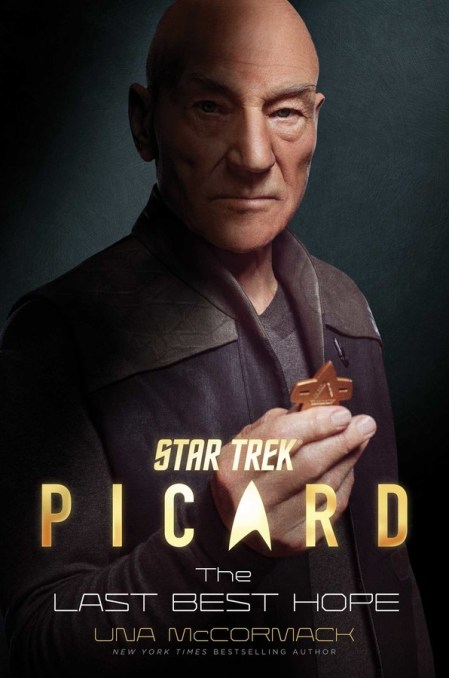
Get ready to dive back into the Star Trek universe with Picard: The Last Best Hope by Una McCormack, the latest Star Trek novel which ties into the events of the Picard television show. The Last Best Hope is an outstanding novel that serves as a bridge between Star Trek: The Next Generation show and the current Picard series.
Nearly 20 years before the events of Picard, both the United Federation of Planets and the Romulan Star Empire faced an unprecedented calamity. Scientists have just discovered that the Romulan sun is in the process of going supernova, turning into a destructive force that will devastate the Romulan home system and have significant negative follow-on effects on the remaining planets within Romulan Space. In order to ensure the evacuation of their people, the Romulans grudgingly request aid from the Federation, who assign Jean-Luc Picard to the mission.
Picard, promoted to the rank of admiral, quickly finds himself in charge of the largest and most difficult operation in Starfleet history. The evacuation mission is a vast undertaking, requiring Starfleet to relocate hundreds of millions of Romulans to distant planets in only a few short years. Lacking resources and manpower, Picard begins the evacuation process as best he can, with the invaluable help of his new first officer, Rafaella “Raffi” Muskier. Meanwhile, back in the Federation, Geordi La Forge attempts to come up with new ways to increase Starfleet ship production on Mars. The best solution is the creation of a new, synthetic workforce, and La Forge calls in an old colleague, the brilliant scientist Bruce Maddox, who reluctantly halts his lifelong work on artificial life to help build these new synthetics.
As the evacuation progresses, Picard takes solace in every small victory his team can achieve, but this mission seems doomed to fail. Debates from ambitious Federation politicians, distrust and fear from the Romulans they are trying to help, and interference from the Tal Shiar, the Romulan secret police, all hinder the mission. However, Picard is not one to give up easily and is determined to save every Romulan he can from the impending disaster. But even the great Jean-Luc Picard is unprepared for how his mission will end. Everything is about to change, and Picard and the galaxy will never be the same again.
Star Trek is one of those popular franchises that always produces a ton of extra content each year in the forms of novels and comics, so it was no surprise that material related to Picard would eventually be released. The Last Best Hope is the very first Picard tie-in novel, although I expect that additional books will come out in the future. Indeed, IDW has already released a Picard tie-in comic, Countdown, which I will probably check out at some point. This first Picard novel was written by veteran tie-in author Una McCormack, who has previously delivered several great Star Trek books, including last year’s Star Trek: Discovery tie-in, The Way to the Stars. McCormack does an amazing job with The Last Best Hope, producing a captivating and incredible read that expertly leads into the new show.
Before I dive too deep into this review, I think that it is necessary to point out that this book was released on the 11th of February, between the third and fourth episodes of Picard. That means that this book contains quite a few mentions of events and reveals that occur in the initial episodes of the show, especially as McCormack clearly had early access to the show’s scripts. While this ensures The Last Best Hope a much more complete and in-depth tie-in novel, it does mean that this book contains some spoilers for the television series. In addition, as I have been religiously watching Picard every week, my review is influenced by the events of the first six episodes and it also contains some spoilers from the show.
The Last Best Hope is a wide-ranging Star Trek canon novel, set across several years of Star Trek history (2381 to 2385) that explores one of the biggest prequel events mentioned within Picard, the explosion of the Romulan sun and the attempts by Picard to evacuate them. This leads into a powerful and clever novel which shows all the trials and tribulations associated with this exercise, as well as several other events that lead into the show. McCormack makes excellent use of a number of different character perspectives to create a full and rich narrative around this plot, which also explores some major Picard characters. While I did think that parts of the story ended rather suddenly, with no real lead-in to the disaster on Mars that changes everything, this book is a first-rate novel which I powered through in extremely short order.
One of the major appeals of this book is the fact that it serves as a prequel to the events of Picard and provides readers with additional background and context to the adventures currently happening in the show. This is done in a number of ways, from providing the reader with greater background about certain characters, showing the origins of a number of the storylines from the show and serving as a bridge between the events of Picard and The Next Generation. The Last Best Hope features an excellent introduction to several of the newer characters in the show, such as Agnes Jurati, Raffi, Elnor and the Qowat Milat nuns, and it was intriguing to see how these characters slotted into the pre-history of the show. At the same time, McCormack also examines what happened to several established characters from The Next Generation after the events of Star Trek: Nemesis, including Picard, Bruce Maddox, Geordi La Forge and even a little bit about Worf (he becomes captain of the Enterprise!). McCormack also provides an explanation about several key occurrences and storylines that are touched on within the show, such as the creation of the synthetic workers that destroyed Mars, Picard’s resignation from Starfleet and the extent of several key relationships. There are also some potential hints at where the show might go in the future, and I will be interested in seeing if those pan out at all. I was pleasantly surprised with how much background that McCormack was able to fit into The Last Best Hope, and the different revelations and expansions on the information provided in the show make this a fantastic read for those currently watching Picard.
The Last Best Hope features some very impressive character work, and I feel that McCormack did an excellent job capturing the personalities and histories of several key characters from the new show. I really appreciated her portrayal of Picard, and this book featured several key aspects of his character, such as his dark moods, his determination and his ability to inspire absolute loyalty in his subordinates. I liked how the reader gets to see how Picard deals with the seemingly impossible task assigned to him, especially as his emotions throughout the book range from hope to absolute despair, as multiple obstacles and problems seem to dog everything he does. One of the major parts of his character explored in this book is the way that Picard’s ideals and beliefs seem a little out of touch with the world he lives in. This is something that is shown throughout the Picard television show, as the old-school captain is now living in a much darker and more desperate world. I am really glad that McCormack tried to capture this in her novel, and it was really compelling to see Picard being completely oblivious about the darker realities of the galaxy. All of this is really compelling to see, and I think that it serves as a good basis for some of the ways Picard acts in the current show.
Aside from Picard, a number of other characters are featured throughout the book, many of whom have some really interesting and compelling stories. I personally found the tale of Raffi, Picard’s new first officer, to be particularly good, as the reader gets to see how she became so messed up and obsessed with proving that the Romulans where behind the destruction of Mars. You also get a better understanding of why she was so mad that Picard quit on her and the mission, especially after she sacrifices everything for him, thanks to the way he inspired her. McCormack also spends significant time exploring the character of Bruce Maddox, and it was especially intriguing to see this character between his appearances in The Next Generation and Picard. You also got to see the origins of his relationship with Agnes Jurati (indeed, based on release dates you learn about this relationship in this book before it is mentioned in the show), and it was great to see how it unfolded and how close the two of them were. Of course, this also has a more sinister and heartbreaking edge to it if you look back at this relationship after the events of the fifth episode of Picard. I also liked the Geordi La Forge storyline; it was interesting to see his struggle to increase Starfleet ship production. However, the best part of this portrayal occurs at the end of the book, and I will be curious to see how they show off his survivor’s guilt if the character ever appears in Picard.
One of the things that I really enjoyed about this book was the way McCormack slowly starts to alter the tone of the novel to represent the change between the lighter The Next Generation and the darker Picard shows. At the start of the book, the story is more in line with the tone of The Next Generation, with Picard embarking on a humanitarian mission with his idealism and belief in the greater good intact. However, as the mission progresses, things start to get darker, as the various obstacles to the Romulan relief mission become more apparent. The dark and callous manipulation of the Romulan leaders and Tal Shiar as well as the xenophobic politics of certain Federation politicians becomes more and more apparent, resulting in a darker tone. McCormack also attempts to replicate the more adult tone of the current show with a greater reliance on swearing (never have I seen so many F-bombs dropped in a Star Trek novel, oh the humanity!) and hints of mass murder, genocide and extinction-level events. All of this makes for a slightly different Star Trek tie-in novel experience, and I personally enjoyed some of the subtle changes McCormack made to the tone.
I personally really enjoyed seeing the entirety of Picard’s attempts to evacuate the Romulans from their soon to be exploding sun. This has been one of the most fascinating events mentioned in the show, with several parts shown or alluded to in Picard. McCormack really dived into this event, showing many of the various aspects of such an operation, including the science, politics and diplomacy associated with it. From the start, this whole mission is painted as a near impossibility, not just because of the scale of calamity and the number of people affected but because of the mindset and suspicion of the Romulans they are trying to save. To put it into context, this operation would be like the United States trying to evacuate a similar sized country that had North Korean levels of state led secrecy and distrust towards the organisation trying to save them. The sheer scale and difficultly of this mission are constantly raised, and yet Picard and his team seem to find a solution to many of the problems presented to them. Of course, anyone who has seen the first episode of the show knows how this is going to end, so seeing the characters getting so invested in their mission is a bit of an emotional blow. That being said, this book contains a lot more context for some of the Federation’s decisions, and in particular the character of Admiral Kirsten Clancy (Starfleet’s CNC in the second episode of Picard), comes across as a whole lot more sympathetic. Overall, I felt that this was an amazing expansion on the events mentioned in the show, and it was really cool to see how the whole operation unfolded.
Another great facet of The Last Best Hope which made it such an intriguing book was its compelling examination of the Romulan people. McCormack really dives into Romulan culture and society in this book, presenting some intriguing details about this race. In particular, she examines the Romulans’ deep-seated need for privacy and secrecy, which is a defining part of their species. McCormack does an excellent job highlighting how this desire for secrecy impacts them as a race and a culture (secret multi-room Romulan music for the win!), and how they barely trust other members of their own species, let alone members of the demonised Federation. Seeing how this obsession with lies, secrecy and the appearance of saving face with the Federation impacted the species’ chance for survival is a compelling and intriguing part of the book. McCormack also dives into other parts of Romulan culture and society, mainly the role of the Tal Shiar, the Romulan secret police, who have long been a shadowy force within Star Trek lore. Seeing the fear and apprehension that this organisation causes amongst ordinary Romulan citizens, as well as the lengths they will go to maintain secrecy and security, is pretty crazy and it certainly enhances an established Star Trek antagonist species. I also enjoyed seeing more of the Qowat Milat, the Romulan warrior nuns who Picard befriends and helps evacuate from Romulan space. The Last Best Hope contains several encounters with the Qowat Milat, and we get to learn a bit more about them, the role they play in Romulan society and how they interact with the Tal Shiar, with whom they have an adversarial relationship. All of this is deeply, deeply fascinating, especially for those readers who love learning about Star Trek lore, and I really enjoyed seeing all the Romulan inclusions featured in this book.
I ended up listening to the audiobook version of The Last Best Hope, which is narrated by Robert Petkoff. This new Star Trek audiobook runs for 11 hours and 40 minutes, which can be listened to fairly quickly, especially once you get stuck into the compelling story. I really enjoyed listening to The Last Best Hope, mostly thanks to the incredible voice work of Robert Petkoff. Petkoff seems to be the go-to narrator for all things Star Trek these days, as he has lent his superb vocal talents to a huge number of other Star Trek audiobook adaptions in recent years. I have previously enjoyed his work on such books as The Antares Maelstrom by Greg Cox, The Captain’s Oath by Christopher L. Bennett and Available Light by Dayton Ward. In each of these previous books, I have been greatly impressed by Petkoff’s ability to recreate the voices of key characters from the Star Trek television shows, including most of the characters in The Original Series and The Next Generation. He continues this amazing voice work in The Last Best Hope, providing near-perfect impressions of characters like Picard and La Forge, which really helps the reader immerse themselves into the story. While his impressions of some of the newer characters from Picard are not as accurate (keep in mind Petkoff would have recorded this book before Picard aired), he does provide clear and distinctive voices for each of the characters utilised in the books. I also love the accents he provides to the various alien races and nationalities in this book, and I especially enjoy hearing him attempt to replicate the speech patterns of certain aliens, like the Vulcans. Thanks to this incredible voice work, I absolutely loved listening to the audiobook for The Last Best Hope, and I would strongly recommend this format to anyone interested in this latest Star Trek novel.
Picard: The Last Best Hope by Una McCormack is an excellent and deeply captivating read which serves as a perfect prequel tie-in novel to the current Picard show. There is so much information and detail about the Star Trek universe prior to the events of the current television series contained within in this novel, and I loved seeing the author expand on the intriguing new universe that has been hinted at in the show. This is a must-read book for all Star Trek fans, especially those who have been loving Picard, and even non-Star Trek fans will enjoy this book’s powerful story and the fantastic plot device of the Romulan rescue mission. The Last Best Hope is probably the best Star Trek novel I have had the pleasure of reading so far, and I am extremely excited to see what other tie-in novels they release around the awesome new Picard series.
Amazon Book Depository


 The Unseen Library