Warhammer 40,000: Cypher: Lord of the Fallen by John French

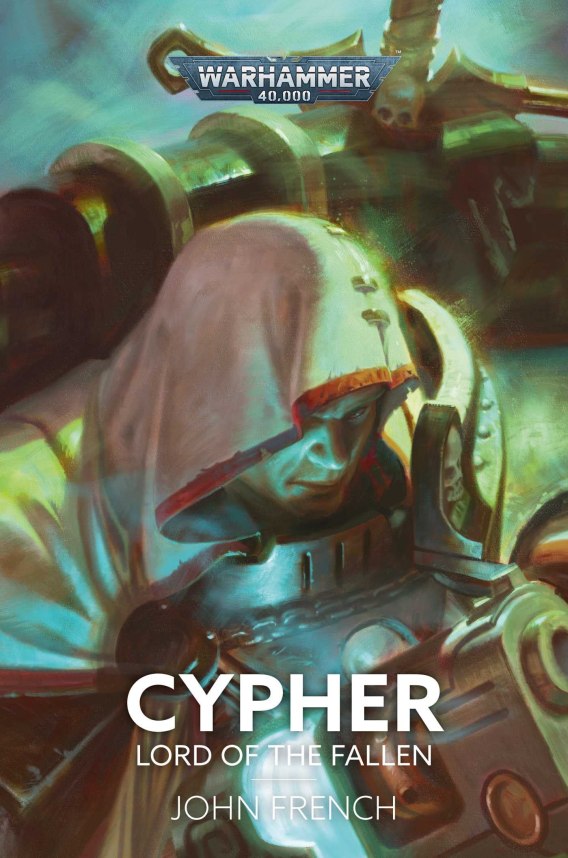
Cypher - Lord of the Fallen Cover

Publisher: Black Library (Audiobook – 18 July 2023)

Series: Warhammer 40,000

Length: 5 hours and 8 minutes

My Rating: 4.75 out of 5 stars

Amazon

One of Warhammer 40,000’s most mysterious and elusive characters finally gets the spotlight in the awesome new book from John French with Cypher: Lord of the Fallen.

Gosh, 2023 is turning out to be a brilliant year for Warhammer 40,000 fiction.  I have already had a ton of fun with such great books as The Lion: Son of the Forest, Warboss, Shadowsun: The Patient Hunter, Leviathan, The King of the Spoil and Longshot, but the best is honestly yet to come.  There are still several great Warhammer 40,000 novels coming out before the end of the year, and one of the most intriguing was Cypher: Lord of the Fallen.  Written by well-established Warhammer fiction author John French, Cypher: Lord of the Fallen follows one of the most iconic and mysterious figures in the Warhammer 40,000 canon and places them in a sinister new adventure.

Thousands of years ago, at the end of the Horus Heresy, the Space Marines of the Dark Angels Legion suffered a devastating schism, as betrayal and deceit tore them apart from within.  The resulting civil war destroyed their home planet, killed their Primarch, and scattered the Dark Angels who rebelled across space and time.  Since then, the remaining loyal Dark Angels and their successor Chapters have hunted these traitors, known as the Fallen, throughout the galaxy, determined to bring them all to justice and hide the truth about their Legion’s fall.

Out of all the Fallen still at large in the galaxy, none is more hated or more dangerous the mysterious warrior known only as Cypher.  A Space Marine with strange motivations and deadly martial ability, Cypher has haunted the Dark Angels for centuries, manipulating them for unknown reasons and threatening everything they hold dear.  His latest mysterious scheme saw him and a small band of Fallen save the reborn Ultramarines Primarch, Roboute Guilliman, from the forces of Chaos and then accompany him to the Imperial Palace on Terra for his own purposes.  But rather than being welcomed as honoured guests, the suspicions around Cypher have seen him and his Fallen comrades locked up in the Dark Cells of the Adeptus Custodes, the most secure prison in all the Imperium, designed to never be breached or release their occupants.

But Cypher is no ordinary prisoner, and as the Great Rift unfolds across the skies of Terra, strange and seemingly unpredictable events will allow him to escape from the Dark Cells into the Imperial Palace proper.  Now loose in the most sacred and heavily guarded location in the entire Imperium of Man, Cypher leads his Fallen brothers from captivity and deeper into the palace complex.

However, their presence has not gone unnoticed, and Cypher and his comrades find themselves contending with the relentless defenders of Terra, including the Emperor’s personal bodyguards, the Adeptus Custodes, lethal Imperial Assassins and powerful predictive seers.  Worse, the Dark Angels are aware of Cypher’s presence on Terra, and a desperate strike force soon arrives, determined to capture or kill Cypher no matter the cost.  But as all these forces start to close around the members of the Fallen, it becomes clear that Cypher has a far greater agenda than anyone realised: to stand before the Emperor on the Golden Throne.  But are Cypher’s intentions noble, or does he intend to destroy the Emperor and sacrifice all of humanity to Chaos gods?

Cypher: Lord of the Fallen was a very fun and tricky Warhammer 40,000 entry that fans of the franchise are going to absolutely love.  French does a wonderful job of bringing the enigmatic and chaotic Cypher to life in all the best ways, pressing him and several other unique figures into a fast-paced and intense series of manipulations and conflicts.  The book is slick, addictive and loaded with clever references and allusions to the wider Warhammer 40,000 canon.  I managed to power through the audiobook version of this book in no time at all and had a wonderful time doing so.

Cypher: Lord of the Fallen has a short but exceedingly sweet story to it that wastes no time dragging the reader in.  This is primarily because of the unique narration that French features in this book, with the entire story told through Cypher’s enigmatic perspective.  Cypher describes all the events that are occurring, even when the chapter’s focus is on other characters far away from him, and his depiction of events is quite unique, as you are never certain how he is seeing events, or whether he is making everything up.  French, through the mechanism of Cypher, quickly dives into the events of Lord of the Fallen, efficiently setting the scene of the Imperial Palace in chaos and the defenders stretched thin.  Thanks to the arrival of the Dark Angels and other machinations, Cypher and his cohort are soon unleashed into the larger palace.

The narrative splits off into several threads, some following Cypher, some following the Dark Angels infiltrators, and some following the Palace defenders trying to restore order.  However, all of these scenes are still shown through Cypher’s mind’s eye, and his confident and possibly unreliable narration gives each sequence a compelling and ethereal edge that I quite enjoyed.  There are some great sequences spread throughout this part of the story as everyone dances to Cypher’s tune one way or another and you quickly grow attached to the great cast and their unique motivations.  Each character meets an intriguing end or conclusion to their tale, which is quite fitting in its own way, as French layers in the action, the compelling world building, and the constant allusions and stories from Cypher.  The overall conclusion of the main story is interesting, if a tad anticlimactic and overly mysterious, but the reader can make some substantial inferences from what happened.  I honestly was hooked the entire way through, and French did such a great job of creating as unique a read as possible that was perfectly fitting for the titular character.

While I usually find most Warhammer 40,000 novels are quite accessible to readers somewhat unfamiliar to the franchise, this is one piece of Warhammer 40,000 fiction that is best enjoyed by those people exceedingly familiar with the franchise’s lore.  French does do a good job of explaining certain aspects of what is going on, however this story quickly dives into some of the more complex pieces of lore surrounding the game, such as the hidden history of the Dark Angels and the mysteries surrounding the character of Cypher.  As someone highly familiar with the background lore, I personally found this to be extremely fascinating, although I could see new readers getting fairly frustrated.  However, even those fans of the game might get a little frustrated here, mainly because they are not going to find as many solid lore revelations here as they might hope for.  The narrator flat out states at the beginning of the book that this tale is not about him, and Cypher’s history remains mostly hidden as a result.  There are certain hints and anecdotes that could lead knowledgeable fans to make guesses, but the narrator fully admits that these could be lies or falsehoods designed to hide the truth even from the reader.  Those Warhammer 40,000 fans familiar with who or what Cypher might potentially be and how he operates will absolutely love this, and I personally enjoyed how French kept us guessing.

For those readers who are hoping for more, French does paint a fantastic and elaborate picture of the Emperor’s Palace on Terra, which is one of the more fascinating settings in Warhammer 40,000 fiction.  The dark and elaborate depiction of the palace, with its excessive bureaucracy, forgotten corners, vast religious underpinnings, and millions of workers, is endlessly fascinating, and I loved all the cool details French provided.  I particularly enjoyed seeing the Custodes in action, and the elaborate depictions of the Dark Cells, a truly unique location, was very damn fun.  This compelling dive into one of this universe’s best locations more than makes up for any disappointments a reader may have regarding the lack of revelations around Cypher, and French does such a great job bringing this entire setting to life.  A fantastic read for those already in love with all things Warhammer!

As I mentioned above, I ended up listening to the audiobook version of Cypher: Lord of the Fallen, which is honestly the best way to enjoy a Warhammer 40,000 novel.  This was once again the case in this tricky and fun book as Cypher: Lord of the Fallen’s impressive story really comes to life when it is read out to you.  All the secrets, twists and fantastic depictions of Terra are so much more epic in this format, and I really had a blast listening to it.  It helped that the audiobook was narrated by the very talented Jon Rand, who has previously impressed me in Ghazhkull Thraka: Prophet of the Waaagh! and Dredge Runners.  Rand has a great voice for dark Warhammer 40,000 fiction, and he puts that to full use in Cypher: Lord of the Fallen, especially when he brings the very cryptic narrator to life.  The near whispering and often gloating tones Rand ascribes to Cypher are pretty perfect, and I felt he captured this mythical and notorious trickster perfectly.  His portrayal adds a lot of depth to Cypher’s appearance in this audiobook, especially as he also covers the evident regret and occasional sad despondency that Cypher experiences as he manipulates events, which makes you grow attached to the figure, even though he could be faking it.  At the same time, the rest of the cool cast, including the proud Custodes, the vengeful Dark Angels and the lost members of the Fallen, are also portrayed extremely well.  Rand gives each of them very fitting voices and you cannot help but feel their relative emotions of duty, resolve and occasional despair that follow.  This was a masterful bit of voice work by Rand, and he really helps to turn this format into the ultimate way to enjoy the exceptional Cypher: Lord of the Fallen.

Overall, Cypher: Lord of the Fallen is an outstanding and epic piece of Warhammer 40,000 fiction that I cannot recommend enough.  John French did a remarkable job bringing together a novel that perfectly portrays and encapsulates one of the most mysterious and beloved figures in the canon, and shows him at his manipulating best.  Featuring a unique and enjoyable writing style, as well as a ton of hints for established Warhammer 40,000 fans, Cypher: Lord of the Fallen was one of my favourite Warhammer books of the year and is really worth checking out, especially in its audiobook format.

Amazon

Fearless by M. W. Craven

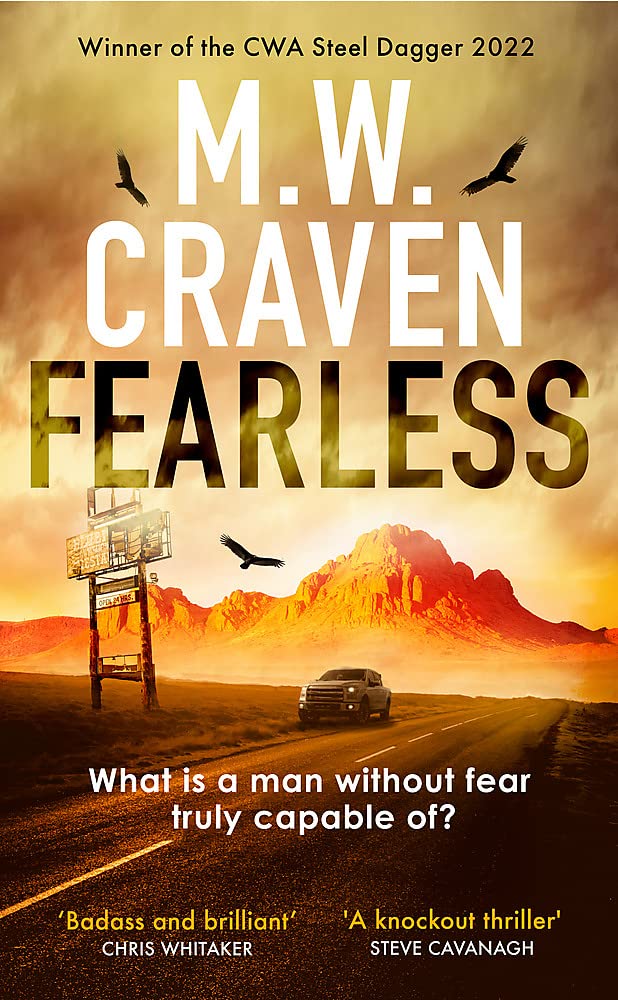
Fearless Cover

Publisher: Constable (Trade Paperback – 27 June 2023)

Series: Standalone/Book One

Length: 435 pages

My Rating: 4.5 out of 5 stars

Amazon

The talented M. W. Craven debuts an awesome thriller protagonist with his epic and intense new novel, Fearless.

Craven is an interesting thriller author who has been establishing himself over the last few years.  Craven already has a fantastic catalogue of novels behind him, including his Washington Poe and Avison Fluke series, although I had not previously had the pleasure of reading any of his books.  As such, I was intrigued when I received a copy of Fearless, which looks to be the first book in an awesome new series.  I really liked how cool Fearless sounded and I was glad I got the opportunity to check out another author who was new to me this year.

Ben Koenig is a man who knows how to disappear.  The former leader of the US Marshals’ elite Special Ops Group, Koenig was the man who brought the very worst fugitives to justice, and his relentless attitude and uncanny abilities made him feared throughout the criminal community.  But after an operation goes bad, Koenig goes into hiding, drifting from small town to small town.

After managing to stay off everyone’s radar for six years, Koenig suddenly finds his face plastered across every television screen in America.  His old boss at the US Marshalls desperately needs Koenig’s help for a personal mission, and he’ll do anything he can to get his attention.  Soon Koenig finds himself back on the job, but this time he has no limits, no backup, and no idea the amount of trouble he is about to find himself in.

His assignment will eventually lead him to the small town of Gauntlet in the middle of the Chihuahuan Desert.  Someone in Gauntlet has a dark secret that they will do anything to protect, and they have the entire town, and more, at their disposal.  However, they have never encountered anyone like Koenig and they soon begin to realise that Koenig has no fear, no mercy and no desire to stop.  But against the dangerous forces in front of him, as well as dangerous assassins from his past, can even the fearless Koenig stay alive and complete his mission?

Fearless was a very fun and over-the-top thriller from Craven, who crafts together a very intense and addictive narrative for this new book.  Starting off with a strong introduction to the character of Ben Koenig, the reader gets quickly swept up in both his unusual life and his new mission as he is drafted in to find a missing girl and revenge on the people that hurt her.  Fearless’ story has a lot of great elements to it, and Craven takes his protagonist on a wild and blood-soaked thrill ride through several great locales and impressive scenarios.  Most of the story takes place in the Texas town of Gauntlet, where Koenig investigates a mysterious solar energy company involved with his case.  Craven does a great job setting up the antagonists of this series, as well as a compelling underlying mystery about who they are and why they are there, and I loved the combination of suspense and intrigue that emerged, as well as the fear and brutality of the villains as they try to take Koenig down.  At the same time, Craven works in several compelling flashback chapters that give greater context to Koenig’s character and flesh out why he was on the run and the implications that has on his current situation.

Craven works a ton of brilliant and action-packed set pieces into the story as he goes, and the reader really sticks around to check out all the violence that emerges as a result.  The author goes pretty over the top multiple times throughout the book as he tries to make the scenarios, and his protagonist, as explosive and unpredictable as possible.  These memorable sequences mesh well with the investigative and character driven aspects of the story, and the reader really gets drawn into the entire compelling plot.  Everything leads up to the big finale, where the author unleashes several massive and exceptionally brutal fights, which really draw the reader in and ensure that they cannot stop turning the pages.  Everything ends on a very interesting note, although a couple of the final twists are clearly only there to set up the future books.  Still, this ended up being a very thrilling and enjoyable story, and I honestly managed to knock off this lengthy book in a couple of fun-filled days.

Craven utilises a pretty effective style for this book that is focused on making the novel as fast-paced and easy to read as possible.  Fearless is dominated by multiple short and impactful chapters which are very easy to power through and which encourage the reader to keep going, especially as you can get through the next exciting chapter with only a few page turns.  I honestly found myself just going and going as I was reading, as I really wanted to see what awesome event was going to pop up next in the story.  The author did a really good job of quickly and effectively setting up the protagonists, the story, and the general vibe of Fearless, and you quickly realise what sort of fun and compelling story the author has planned, which helps to keep you hooked.  The primary focus on protagonist Ben Koenig is nicely balanced with several chapters told from the perspective of the antagonists, and I loved seeing some of the different angles of the story, especially as the villains get more and more desperate, and ruthless, as the book continues.  This ended up being quite an attractive and highly accessible new series to test out, and Fearless will appeal to most thriller readers, especially those who are interested in something with a ton of action and a fun plot.  There are obviously some interesting parallels between Fearless and the Jack Reacher novels, which Craven does cleverly and humorously reference at the start.  I think this book will appeal to anyone who appreciates intense, fast, and unpredictable thrillers, and this really was a great treat.

One of the more interesting and distinctive elements of Fearless is the over-the-top protagonist, Ben Koenig.  Written as an elite former government agent on the run after upsetting the wrong crime family, Koenig is a very capable and effective killer who serves as the book’s main point-of-view character and narrator.  Koenig is a fun central figure for Fearless, and I loved his unique and entertaining viewpoint of the world, which translates through his chapters and gives the book more of a humorous edge.  Most of the novel is designed to introduce readers to the author’s new major protagonist up and I liked the intriguing background that Craven built around him in several fantastic flashback chapters.  There is a certain arrogance and cockiness to Koenig that some people might not like, but I though it fit his story arc well, and he does get called out on it a bit.  There is also a great ruthlessness to him at times, which does make you wonder if he is really a good guy.  These elements are cleverly tied into Koenig’s most defining character feature: due to a medical condition, he lacks the ability to feel any fear.  While this does seem like a bit of a weird character element, Craven does an excellent job working it into the story, and the entertaining interactions that emerge from Koenig failing to react with any fear make for some fantastic reading.  It was surprisingly fun to see Koenig blithely walk through a range of scenarios without any concern at all, such as when he’s digging his own grave, and the resulting reactions from his opponents are so much fun.  The character’s inability to feel fear does has some downsides, as Koenig’s risk assessment capability is shot, so he does end up making some mistakes from a lack of caution, which was a useful narrative handicap.  Still, the inventive ways that he gets out of several unfortunate scenarios makes for some compelling reading, and Craven really manages to stretch his imagination thanks to this protagonist.  I honestly enjoyed seeing the story from his perspective, and I look forward to reading a larger series featuring this character in the future.

Overall, I had an absolute blast reading Fearless by M. W. Craven, and it really was a particularly fun and exciting thriller.  While the story might get a bit to over-the-top crazy in places for some readers, I honestly enjoyed how silly and insane it got, as it made for some entertaining reading that I could quickly power through with a big smile on my face.  As such, I am giving Fearless a pretty good rating, and I would strongly recommend this novel to anyone who wants a huge dealing of action, funny characters, and wonderfully violent thriller storylines.

Amazon

Quick Review – The Last Orphan by Gregg Hurwitz

The Last Orphan Cover 2

Publisher: Michael Joseph (Trade Paperback – 21 February 2023)

Series: Orphan X – Book 8

Length: 342 pages

My Rating: 4.5 out of 5 stars

Amazon

The always impressive Gregg Hurwitz continues his amazing Orphan X series with the awesome and wonderful new addition, The Last Orphan.

One of my favourite spy thriller series at the moment is easily the exciting and cool Orphan X series by rising thriller author Gregg Hurwitz.  This fantastic series follows a former elite government assassin, Evan Smoak, codenamed Orphan X, who is forced to go rogue and hide himself away from his old employers.  Hoping to redeem himself after all the killing he’s done, Evan takes up a new identity, the Nowhere Man, a vigilante who helps the most desperate people in ways no one else can.  I have been a fan of this series for ages, ever since I read Out of the Dark, which pitted the protagonist against a deranged US President.  Since then, I have had an outstanding time reading the latest books in the series, including Into the Fire, Prodigal Son, and Dark Horse.  I always make it a point to pick up the new Orphan X book each year, and the latest entry, The Last Orphan, was another pretty awesome book that I was quickly able to power through.

Plot Synopsis:

As a child, Evan Smoak was plucked out of a group home, raised and trained as an off-the-books assassin for the government as part of the Orphan program. When he broke with the program and went deep underground, he left with a lot of secrets in his head that the government would do anything to make sure never got out.

When he remade himself as The Nowhere Man, dedicated to helping the most desperate in their times of trouble, Evan found himself slowly back on the government’s radar. Having eliminated most of the Orphans in the program, the government will stop at nothing to eliminate the threat they see in Evan. But Orphan X has always been several steps ahead of his pursuers.

Until he makes one little mistake…

Now the President has him in her control and offers Evan a deal – eliminate a rich, powerful man she says is too dangerous to live and, in turn, she’ll let Evan survive. But when Evan left the Program he swore to only use his skills against those who really deserve it. Now he has to decide what’s more important – his principles or his life.


The Last Orphan
was another outstanding entry in this great series and Hurwitz ensures that it features all his trademark features, including strong characters, a powerful emotional heart, and a ton of action and intrigue.

This latest Orphan X book has a very strong start to it as Evan is ambushed right at the beginning of the novel by a massive Secret Service detail, determined to finally bring him in after he went rogue on the President a few too many times.  Captured and trapped, Evan is forced to make a deal: kill mysterious industrialist Luke Devine or lose his own life.  However, Orphan X makes his own decisions about who he assassinates, and after escaping, he begins his own research into his target, hoping to determine if he deserves to die.  Investigating a mysterious death associated with Devine’s estate and the massive parties that go on there, Evan begins to make his own connections about the case and is forced to go up against Devine’s lethal and morally dangerous security detail.  There are some pretty intense scenes in this part of the book as Evan makes some curious discoveries about Devine and his company, while also being forced to protect potential witnesses from his target’s security.  At the same time, Evan begins to wonder if Devine actually deserves to die and must soon choose between his conscious and his peaceful life of anonymity.

This was a pretty good entry in this series, although possibly not the best that I have so far read (in my mind, that’s Into the Fire).  I really liked the awesome start to The Last Orphan, especially as the over-the-top and intense capture by the Secret Service was so damn cool and it was interesting to finally see Evan taken down by the Government.  However, this doesn’t last long, and once he rather easily escapes, the intensity and pace of the story kind of slows down a bit.  Don’t get me wrong; I did really enjoy the subsequent storyline set around the investigation into the mysterious industrialist and his security crew, but it was a bit of a step down after the initial excitement.  Still, this second half of the novel is a ton of fun, and Hurwitz presents his usual blend of fascinating spy thriller moments, particularly intense and brutal action, as well as the focus on Evan’s strained and unique personal life.

The villains of this story, Devine’s security detail, are some pretty over-the-top but genuinely threatening figures, and Hurwitz comes up with some excellent scenes around them, even presenting them as real threats to the protagonist.  At the same time, Hurwitz works in a very compelling morality edge to the story, as Evan tries to work out whether Devine is actually evil or just a political threat to the President.  The author makes this determination pretty hard, especially as Devine comes across as a very manipulative and unusual figure who manages to make even the legendary Orphan X doubt himself.  The big conclusion of this books is very good and features all the typical action and carnage that you would expect.  However, parts of the story go in some very surprising directions and I liked the unique ideas that Hurwitz presented here.

In addition to all the action and intrigue, quite a lot of The Last Orphan revolved around the compelling and moving emotional and personal concerns of the protagonist and his great supporting cast.  Evan has always been a very complex figure due to his unusual upbringing, his lack of personal skills, and his crippling OCD, and a fantastic recurring theme of the books has been him trying to overcome this and finally make some connections.  This continues extremely well in The Last Orphan, as he once again relies on his friends and his surrogate daughter/little sister to pull him out of the fire and keep his sanity.  There are some pretty emotional interactions between Evan and these figures throughout the course of The Last Orphan, especially as it appears that Evan might not be able to come back from his latest adventure, and I felt that this was another powerful and impressive evolution of some already deep character growth.  There are some other pretty big personal moments for Evan in The Last Orphan, including the seeming end of one relationship due to Evan’s fugitive status, and the potential development of another as Evan finally attempts to dive into his own complex past.  It will be fascinating to see how this develops in the future, and I am sure that Hurwitz has some very intense moments planned for all of us.  I honestly felt that the author got the right balance between action and emotion for The Last Orphan, and this ended up being a stronger book as a result.

Overall, The Last Orphan was a pretty awesome new entry in the great Orphan X series, and I really liked how Gregg Hurwitz continued his fantastic ongoing narrative.  Featuring an excellent blend of spy thriller fun and powerful character work, The Last Orphan was an addictive and clever read, and I am glad I got the chance to check it out.  Highly recommended, especially to established fans of the series, The Last Orphan is really worth the read.

Amazon

The Book That Wouldn’t Burn by Mark Lawrence

The Book That Wouldn't Burn Cover

Publisher: Harper Voyager (Ebook – 1 May 2023)

Series: The Library trilogy – Book One

Length: 570 pages

My Rating: 5 out of 5 stars

Amazon

One of the world’s inventive and compelling fantasy authors returns with one of his best novels yet, the highly addictive and ambitious novel, The Book That Wouldn’t Burn, which sets off his new The Library trilogy.

Few authors have had the impact on the fantasy genre than Mark Lawrence has in the last few years, as the author has truly impressed readers throughout the world with his unique and captivating novels that routinely blend fantasy and science fiction elements.  His series include The Broken Empire trilogy, The Red Queen’s War series, and The Book of the Ancestor series.  I myself only started reading Lawrence’s work a couple of years ago with his compelling The Book of the Ice series, which followed several powered teens on a grim frozen planet.  I had an outstanding time with this series, which included The Girl and the Stars and The Girl and the Mountains.  While I still have to read the third book, The Girl and the Moon, I really enjoyed these books, and it was a pretty clever series.  As such, I was very keen to check out Lawrence’s new novel, The Book That Wouldn’t Burn, especially as it had a very intriguing plot synopsis behind it.

Throughout the world, there is nothing more important, more significant, nor more permanent than the library.  Built inside a mountain near the great city of Crath, the library contains an impossible number of books fitted within innumerable rooms that no one person can access.  The sheer amount of knowledge contained within the library represents the greatest power in the world, allowing its keepers and the King of Crath to wield great control in the world.  Into this vast and elaborate repository of knowledge and secrets, two young people are about to meet in unusual circumstances.

Livira is a young girl raised in the Dust, the desolate wasteland that surrounds Crath.  Plucky, curious, and incapable of giving up, Livira is a rarity among her people as she seeks to know more about the world outside her home.  But when the alien sabbers destroy her village and kill her people, Livira finds herself lost in the wilderness.  Rescued and brought to Crath, Livira soon becomes certain that her future lies in the library.  Overcoming prejudice and her own humble background, Livira learns to navigate the library and soon begins to find out some of its deeper secrets.  However, the most mysterious of these might be another strange inhabitant of the library, Evar.

Evar and his small family have known nothing but the library their entire lives.  Released after unknown eons frozen as children inside the library’s mysterious Mechanism, Evar and his siblings have grown up in a vast chamber of the library, learning from the books and becoming masters of specialised subjects.  However, Evar has always desired more and has long tried to find a way to leave their book filled prison.  His discovery of a portal within his home soon leads him to a place outside of time where he meets an exploring Livira.  Together, the two attempt to find the true history of the library and the threats it has withstood over the years.  But dark evils haunt the library, and soon the two explorers must find a way to uncover the truth behind the sabbers, their own history, and other deadly threats waiting for them in the future.  Can these two children of the library survive the revelations in front of them, or will the truth tear them apart in ways they can’t even understand?

Well damn, now this was a seriously impressive and epic book.  Lawrence has honestly outdone himself here with this incredible read, and this might be one of the best books he is ever written, which is saying something.  The Book That Wouldn’t Burn features one of the most elaborate settings and narratives you are likely to see in fantasy fiction, and this results in a powerful and moving read that will keep you guessing time and time again.  I had an exceptional time reading The Book That Wouldn’t Burn, and it would be impossible for me to give it anything less than a five-star rating.

The Book That Wouldn’t Burn is told from two separate perspectives, that of Livira and Evar, and covers their very different lives and experiences within the libraries.  These two character-driven storylines are initially kept separate from each other as Lawrence spends a good chunk of the book introducing the protagonists, setting up their unique stories, and bringing together the elaborate setting that the story is based around.  Both of these storylines are very interesting and fun off the bat, with Livira having her life torn apart, only to find purpose in the library, while Evar details his life lived purely within the library.  While both storylines are really good, I initially got drawn into Livira’s the most, especially as her outsider perspective of the library allows you to really appreciate how alien and strange the massive house of books is.  Livira’s storyline advances at an extended clip, covering years of her life as she learns, grows, and fully develops her adventurous personality as she seeks to fully understand the secrets of the library and everything within it.  Evar’s storyline on the other hand is a little more sedate in its pacing, as it is set only along the course of a few days as he tries to finally understand the structure that has kept him prisoner for so many years.

The first half of the book that showcases these two characters’ initial introduction and growth are pretty damn entertaining, and it does a wonderful job of setting the scene for Lawrence’s elaborate story and background location.  However, the story doesn’t find its true strength until the two protagonists meet and their storylines becomes a lot more intertwined.  Due to the impossible physics and requirements of the library, there is a compelling time element to the meetings between the characters, which Lawrence captures masterfully, and which really alters their perspectives of each other.  Once they are able to properly interact, the two characters grow close and spend an interesting chunk of the novel exploring their respective worlds, as well as the history of the library.  Lawrence really lays the world building on thick during these parts of the book, and it serves to bring the two protagonists together, which just ensures the last act of the book is as tragic, moving and devastating as possible.  The author drops some massive bombshell twists around two-thirds of the way through, which completely throws you and makes you rethink everything you have thought about the preceding narrative.  I honestly was pretty damn shocked at this epic and devastating revelation, and while I had already been pretty damn addicted to the story by this point, this was the moment I realised what a masterpiece The Book That Wouldn’t Burn truly was.

The final third of the novel gets even better as certain background elements of Livira’s storyline finally come to fruition and her entire life begins burning around her.  This causes her and many of the supporting characters from her part of the book to end up interacting with the characters from Evar’s storyline, which is a very interesting change of pace from the previous parts of the book.  There are also some frenetic conflicts and some very dark moments as everything you have previously known about the settings, the characters and the history of the library is thrown around in some excellent and compelling ways.  There are several great new twists in this final section of the book, and Lawrence gets very metaphysical with the reveals, relying on his setting’s unique temporal properties to mess with your mind and bring you surprise after surprise.  I really loved just how cool and complicated this novel got towards the end, and Lawrence leaves an awesome and open conclusion for you to enjoy while drawing you in towards the next book in the series.  I came away from this narrative desperately wanting more, especially after being blown away by all the twists within the book, and I cannot wait to see what happens next.

Those who are familiar with Lawrence will know that he is a very impressive and talented author, and I really liked how he developed his story and displayed all its outstanding elements to the reader.  The Book That Wouldn’t Burn is a particularly complex read, loaded with damaged characters, elaborate storylines and an inventive major setting.  Lawrence approaches his latest novel with his usual flair and imagination, expertly showcasing every clever detail of this world to the reader and keeping them enthralled the entire way through.  Due to the complexity of the story, you really need to dive into every single word that Lawrence writes, and it honestly took me a little longer to get through this lengthy novel than I expected, mainly because of how much focus I needed to fully appreciate everything.  That said, it has a very good pace to it and there is never really a dull moment as you are constantly drawn into what is happening or the elaborate depictions of the library.

I felt that the author’s use of two narrators was particularly effective, especially as they give very different views of what is happening around them and the setting they find themselves in.  The extra expansiveness of the separate narration really helps to expand the scale of the book, and it takes some major temporal shifts for the two protagonist’s storylines to align.  Once they do, the two separate character arcs intertwine extremely well, and I loved seeing their interactions through each other’s eyes, as well as the elaborate adventures they find themselves involved with.

Lawrence also was very skilled at setting up some of the book’s big twists, and while many of them surprised me when I read them, looking back you could see the subtle clues leading up to them, and you really appreciate just how clever the author was in the earlier stages of the book.  The initial big twist is probably the best, and you really have to love how careful Lawrence was with some of the dialogue and character descriptions to pull that off.  Some of the subsequent twists are a little less shocking, mainly because you are on guard at that point, but I did like how well some of the reveals based around the protagonist’s journey through time were utilised and hinted at in earlier scenes.  The fact that there are completely different faces to some of the major early figures of the book was very cool, and it was clear that the author had a very impressive plan while writing the early stages of the book.  These excellent writing elements, and more, served to enhance an already captivating story, and I cannot get past how well Lawrence set everything up.

There is no way I can move forward without talking about the elaborate library setting that was such an epic centrepiece of The Book That Wouldn’t Burn.  I love how the author’s ultimate major setting is a library, which is something that all readers can really appreciate.  While we can all imagine a pretty massive or full library, Lawrence amped that imagination up to an 11 in this book, describing a seemingly impossible structure, made up of innumerable rooms filled with massive climbable bookshelves and a seemingly infinite number of books and tomes.  The sheer scale of this setting when described by Lawrence boggles the mind to a degree, and it really is an outstanding setting for this story as it is the perfect place for exploration, adventure, and even habitation.  The library naturally features Lawrence’s trademark blend of fantasy and science fiction elements, and the structure has a transdimensional or alien feel to it, as the protagonists find different mechanisms within the structure, as well as strange and unique ways to travel through it.  This blend of fantasy and science fiction elements worked particularly well, especially as you get to experience an intriguing contrast between ancient advanced technology and endless shelves of paper books.

The more unique elements of the library, including the portals, the robotic guardians, the locked doors, and more, are worked into the plot extremely well, and it was fascinating to see how they impacted the story, especially while the characters attempted to find out their origins.  The time travel aspects of the library proved to be particularly awesome, and I loved how Lawrence used them, and other cool features, to twist the narrative in some powerful and unexpected directions, completely changing everything you thought you knew.  It was also really effective how Lawrence explored the library through two very different sets of eyes, as Livira and Evar see it in different ways based on their respective history and cultures.  These alternate views added even more depth to the epic setting, and you have to love the continued focus on exploration, especially when it resulted in some of the best scenes in the book.  Honestly, I could go on and on for pages about just how impressive this outstanding setting is, so let me just be blunt and say: read The Book That Wouldn’t Burn, as you really won’t be disappointed when it comes to this elaborate library setting and the dark world it inhabits.

The final thing that I really need to highlight are the great characters contained within The Book That Wouldn’t Burn, which Lawrence did an outstanding job pulling together.  There is a rich and compelling cast of characters featured within this novel, and their unique stories and experiences play a big role in how the story develops.  However, most of the character work is saved for the point of view protagonists, Livira and Evar.  Both characters have intriguing and tragic backgrounds brought about by encounters with sabbers, and they have found sanctuary within the library as a result.  However, this is where their storylines differ as Livira seeks out the treasures of the library and works to get deeper within, while Evar looks to escape and find a whole new world to explore. This leads to some very conflicted character moments, and it was fascinating to see how these characters’ intriguing histories influences their understanding of the world and what they want.  Both protagonists are well established and utilized by the author in The Book that Wouldn’t Burn, and their distinctive character arcs give the book a different flavour chapter to chapter as you explore both their lives.

I personally enjoyed Livira a little more as a protagonist, as her adventurous spirit, drive to be the best and sheer pluck were quite entertaining to see, especially as it allowed her to uncover so many cool secrets about the library.  However, you also have to appreciate the darker background and narrative around Evar, a man trapped all his life in the library, and who has known only limited contact and love in his life.  Evar’s entire life has been nothing but uncertainty, abandonment and a certain amount of inadequacy as he has only known a few other people, each of whom are the absolute experts in their fields.  These two protagonists, when they meet, prove to be a powerful and interesting combination, and Lawrence was quite masterful and subtle when it came to weaving their chapters together.  You really appreciate the pain, loss and sacrifices that both protagonists make throughout the book, and the bond they formed together, soon becomes such a key part of the story.  While they do experience some major, mind-blowing setbacks, you grow really attached to both of them, and seeing them continue and dive even deeper into the unknowable heart of the library, makes for powerful reading.

Aside from Livira and Evar, The Book That Wouldn’t Burn features an extensive and compelling cast of supporting characters, whose interaction with the protagonists adds some intriguing elements to the plot, especially as many of them are filled with some great surprises.  Both Livira and Evar’s storylines had some excellent supporting figures whose appearances are primarily limited to their respective narrator’s timeline.  My favourite supporting character in the Livira chapters had to be Malar, a rough and tough solider who becomes Livira’s protector mostly against his will.  His gruff attitude is a fun contrast to Livira’s bright and curious nature, and they have some entertaining scenes together, especially as he grows to care for her, and Lawrence works in some particularly compelling story elements around him in the later part of the book.

Evar’s chapters also feature a great range of supporting characters, and due to the more constricted nature of his story and setting, you get to know them a lot better than some of the cast associated with Livira.  These characters include Evar’s adopted siblings, Starval, Kerrol and Clovis, who were also trapped in the Mechanism as children and grew up with him in the library.  However, unlike Evar, who emerged relatively normal, each of Evar’s siblings were warped by the knowledge of the Mechanism and are now masters of a particular subject, including assassination and espionage, war and psychology.  Each of these siblings is now fairly damaged as a result of their complex upbringings and childhood traumas, and it was fascinating to see their unique mindsets, especially through the eyes of Evar, who holds a special place in each of their hearts.  These characters were all raised by the animatronic constructs, the Assistant and the Soldier, servants of the library who took charge of them, and I liked the fun interactions that resulted from them, especially once Lawrence worked his twisty magic on them.  All of these characters and more are pretty damn interesting, and I loved how complex and emotionally charged their interactions became.

Frankly I could go on and on about this book, but I still do not think I would really be able to fully encapsulate just how much I enjoyed The Book That Wouldn’t Burn.  This complex and clever fantasy novel is a true masterpiece from Mark Lawrence, who utilised all his impressive writing skills and imagination to create a unique and powerful read.  The Book That Wouldn’t Burn’s elaborate narrative and massive library setting really grabbed my attention and I had such an epic time getting through this outstanding novel.  Easily one of the best fantasy books of 2023, you need to check The Book That Wouldn’t Burn out, especially if you are already a fan of Mark Lawrence’s amazing works.

Amazon

Son of the Poison Rose by Jonathan Maberry

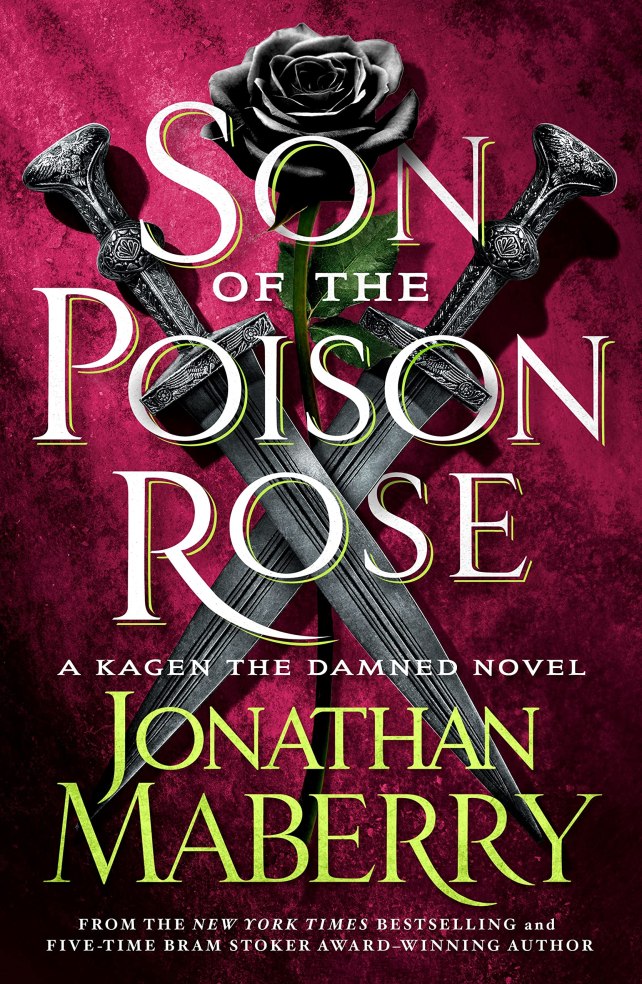
Son of the Poison Rose Cover

Publisher: Macmillan Audio (Audiobook – 10 January 2023)

Series: Kagen the Damned – Book Two

Length: 25 hours and 55 minutes

My Rating: 5 out of 5 stars

Amazon

One of my favourite authors, Jonathan Maberry, returns to his intriguing fantasy world in a big way with the second Kagen the Damned novel, Son of the Poison Rose.

Readers familiar with my blog will know I am a massive Jonathan Maberry fan, and the path to my current obsession with his work is well documented throughout The Unseen Library.  I started off by reading his fantastic 2018 novel, Deep Silence, quite early in my blogging career, and this ended up getting me into the rest of his exceptional Joe Ledger series, including The Dragon Factory, The King of Plagues, Predator One and Dogs of War.  I have also had a great time reading his sequel Rogue Team International series, which featured the epic books Rage (one of my favourite books and audiobooks of 2019) and Relentless (one of my favourite books and audiobooks of 2021), as well as the fun standalone novel Ink (one of my favourite books and audiobooks of 2020).  Needless to say, I have deeply enjoyed his cool books, and this only increased when he made his impact into the fantasy fiction world last year with Kagen the Damned.

Kagen the Damned was an amazing and exceptional dark fantasy novel that took the reader on a wild ride.  Set in a brutal fantasy world of Maberry’s own invention, Kagen the Damned followed the titular character of Kagen Vale, a highly regarded hero and palace guard of the Silver Empire who loses everything in a single night when the armies of the dread nation Hakkia invade with dark magic, led by the powerful and deadly Witch-king.  Forced to watch his parents, his empress, and the royal children he was sworn to protect die terrible deaths, a haunted Kagen flees, only to be further destroyed when he beholds his gods turning their back on him, damming him for his failure.  Now known as The Damned, Kagen travels the world in a daze before finally regaining his senses and launching an attack on the Witch-king at his coronation.  However, this reveals secrets that shock Kagen further and spelling doom for the entire world.  I had an epic time reading Kagen the Damned last year, and it ended up being one of my favourite books and audiobooks of 2022.  Between this and the cool Kagen the Damned novella I Say Your Name in the Dark Nights, I have been eagerly awaiting a second novel and I was very excited when I heard that Son of the Poison Rose was coming out.  Son of the Poison Rose was one of my most anticipated books of 2023 and I finally managed to read it a short while ago and it was everything I hoped it would be and more.

“There is blood on the ground between us!”

Following his failed assassination attempt on the Witch-king of Hakkia, Kagen Vale, better known as Kagen the Damned, is once again the run with his companions, Tuke Brakson and Filia alden-Bok, attempting to find safety and come up with a new strategy of survival and revenge.  While their plan to kill the Witch-king failed, their attack stopped the return of the Hakkian God, Hastur, while also opening up the possibility of war, as the Witch-king’s fellow monarchs see the Hakkians as vulnerable.  However, Kagen also uncovered the terrible secret that the Witch-king is his older brother Herepath, who has turned his back on everything he once believed in to unleash great evil upon the world.

Wandering the wilderness, Kagen, Tuke and Filia attempt to come up with a new way to strike back against the Hakkian forces.  Their journey eventually leads them to the north of the continent, where they attempt to recruit an army of nationless-rogues, mercenaries and fighters to their cause.  But force of arms alone will not be enough to stop the Witch-king, instead Kagen and his allies will need magic.  But with magic long banned within the Silver Empire, only the Hakkians have any real knowledge of the mystic arts.  To that end, Kagen turns to former nun turned spymistress, Mother Frey, who sends Kagen on a deadly mission to a long lost city in a dangerous jungle in the hopes of recovering ancient books of dark magic.

However, the Witch-king is far from idle while Kagen is working against him.  With his army spread thin and the nations of the former Silver Empire all gearing up for war, the future looks grim for the usurper and his advisors.  But with new dark allies arriving every day, called to his side by magic, the Witch-king plans to unleash a magical plague, one that will turn his enemies into a ravenous, unthinking horde.  With such power at the Witch-king’s command, will Kagen’s quest reveal something powerful enough to defeat him?  And even if he does, will Kagen be able to fight his own brother?

Wow, wow, wow, what an epic and exceptional book!  Maberry can really do no wrong when it comes to his writing and this impressive sequel really hammers home what a talented author he is.  Masterfully expanding on the narrative set up in the first book, Son of the Poison Rose contains Maberry’s trademark blend of intensity, awesome action, complex characters, and dark world building that I love so much.  I absolutely powered through this lengthy novel, and it earns Maberry another easy five-star rating from me as I loved every single second I spent with it.

Maberry continues his sprawling and dark narrative in Son of the Poison Rose, as this book takes the reader in some great and captivating new directions.  Taking place in the explosive aftermath of Kagen the Damned, Son of the Poison Rose starts off in a big and action-packed way as Kagen and his allies find themselves being hunted by everything the Witch-king can throw at them.  Maberry quickly establishes his usual practice of featuring a huge number of different perspectives to showcase not only the adventures of the protagonists, but also the actions and schemes of the antagonists and the impacts that their machinations have throughout the world.  The main story of Kagen is pretty epic as it sees the protagonist and his friends struggling through new lands in the search of allies and magic.  While this results in some great scenes for Kagen in the first two thirds of the book, including a great haunted house sequence, his story here feels a little meandering at times without too much progress being made.  However, this is more than made up from the various alternate perspectives and worldbuilding that occurs in the same period.  It is so damn fascinating and entertaining to see the various dark and often horrifying plots of the antagonists come into effect as they plot for war.  These storylines blend spy thriller and dark fantasy elements together really well and you are drawn into these storylines, especially as Maberry takes the opportunity to strengthen the followers of the antagonists in some big ways.  The simultaneous build-up of other complex supporting characters, as well as the many examinations of various corners of Maberry’s new fantasy world adds to the impressive tapestry of the first two thirds of the story, and I was pretty damn hooked during this part of the book.

Maberry ramps up the intensity in the final third of the book as the various intriguing storylines he set up in the start of the novel really come to fruition.  This is headlined by Kagen and his allies travelling into a dangerous jungle nation to find a legendary ancient city where magical texts are hidden.  While I was initially concerned this part of Kagen’s story was going to be rushed, it ended up being very well written and awesome, as they encounter all manner of evils out in the jungle.  This final third of the book was again firmly enhanced by the continued dive back to the antagonists, where you see their evil plot to fill the jungle with zombies and other deadly creatures to kill Kagen and his comrades.  This results in an epic series of battles which keep you on the edge of your seat, as you know Maberry will not hesitate to kill off his characters.  The author chucks in several massive revelations around this part of the book, including finally showing the motivation behind the Witch-king’s actions, and the entire narrative ends on a big note while also expertly setting the stage for even more chaos in the following novel.  This ended up being a particularly epic story and I was firmly hooked the entire way through.

Those who are familiar with Mabbery’s novels will know that the author has a very distinctive style which has worked wonders in his many thriller novels.  Maberry successfully transported this style across to the fantasy genre last year with Kagen the Damned, and I felt it really enhanced his already impressive story.  Naturally he continues it in Son of the Poison Rose and it is still really effective at conveying the vast scope of his tale.  The main basis for his style is the utilisation of a vast number of shorter perspective chapters which showcase events from multiple characters across the narrative.  This results in a vast and complex story that not only allows the reader to see the adventures of the protagonist but also highlight the other players throughout the realm, including the antagonist, his court, the members of the resistance, and even several kings and rulers from unaligned nations who are making plans for war.  Maberry further expands out the plot by including a series of intriguing, often standalone interludes, which showcase smaller, self-contained stories within the wider universe.  These interludes are usually pretty cool, both by themselves and as extensions of the larger story, and I love how inventive and dark Maberry can be at times.  This mass of perspectives really helps to create an extensive and complex plot that has so many different aspects to it.  Seeing the protagonist and antagonist constantly reacting to the actions of each other, as well as other figures in the book, really ups the stakes and intensifies the plot, and I loved how Maberry gave this fantasy novel a strong thriller feel, especially with the continues focuses on politics, espionage and revenge.

Now, one thing about Maberry’s writing style that is not going to appeal to everyone is just how dark and disturbing the author makes the story.  Maberry is a particularly over-the-top writer at times, as he really does not hold back on the gore, violence and depravity, with the characters witnessing or causing all manner of mayhem or gruesome acts.  While this excessive violence and brutality fits the dark fantasy realm that Maberry has created, particularly as it highlights just how evil the antagonist and his legions can be, it is not going to be everyone’s cup of tea.  The torture, abuse and sadism of many scenes can be a bit much at times, and anyone that dislikes that sort of inclusion is probably best served to avoid this series.  However, for those that remain, I will point out that Maberry’s attention to bloody detail does ensure that the action sequences are extremely awesome.  The author has a gift for bringing the brutality and intensity of the battlefield to life in some truly glorious scenes, and you will be enthralled by every swing of the dagger or sword that he writes.  These action scenes are a beautiful, if bloody, highlight of this book, and the overall excessiveness of some of the scenes, especially when focusing on an over-the-top villain really plays into the wider narrative and setting.

I am still in love with the cool new dark fantasy world that Maberry created in Kagen the Damned, especially as the author took his time to populate with evil creatures, Lovecraftian gods and so much damn despair.  His first book served as a brilliant introduction to the various intriguing nations, and I deeply appreciated the intricate depictions of the Hakkian invasion, as well as the subtle and slow reintroduction of magic into this world.  Maberry continues to build up this world in several ways throughout Son of the Poison Rose, which results in some amazing story elements.  The focus on several of the other realms not seen in the first book is pretty interesting, as is the examination of the complex politics of the land as these now independent nations contemplate war with Hakkia after the concluding events of Kagen the Damned.  This builds up several great storylines as these rebelling nations and the Witch-king’s court plot different strategies to win any future wars.  Maberry also has a lot of fun exploring several new lands that were only hinted at in the previous books, and the protagonists soon end up in several unique and deadly landscapes, including cursed snowscapes with mysterious creatures, lethal jungles, and massive ruined cities dedicated to overthrown gods.  All of these locations are expertly introduced and described by Maberry, who uses them to his full advantage to increase tension and ensure that all the inevitable battles have a compelling new edge to them.

Another excellent thing that Maberry continues to do in Son of the Poison Rose is show how magic is slowly returning to the land due to the machinations of the Witch-king.  Thanks to several great chapters and interludes, you get to see the full horror as old magical creatures re-emerge, including the always reliable zombie, which plays very heavily into the plot.  Maberry is no stranger when it comes to zombies, having featured them in several books before (Patient Zero and Code Zero for example) and he uses to them to great effect here, both as political tools for the antagonist, and as rabid obstacles for the protagonists.  Other awesome features include the unstoppable, demonically powered, Razor Knight, which has a great showing at the end of the book, and it will be interesting to see how that, as well as some of the other magic unleashed in Son of the Poison Rose, come into effect in the rest of the series.  I also really appreciated how Maberry kept including a few references to his other series throughout Son of the Poison Rose, which is always a lot of fun for his established fans.  The hints of connection between this world and the settings of other books from Maberry is noticeable and fun without being too mysterious for new readers.  I especially loved the inclusion of a fantastic new villainous character who readers of the Joe Ledger books will be well familiar with under a different name, which I thought was an awesome touch for those who have read his other books.  I deeply enjoyed the impressive world building that Maberry did in Son of the Poison Rose, and I look forward to seeing how else he expands it in the rest of the series.

As always, one of the absolute best parts of Son of the Poison Rose were the exceptional, complex, and well-written characters that Maberry has expertly crafted together.  This includes a great combination of established figures from the first book, as well as a good collection of new characters who add some outstanding original spice to his second book.  Thanks to huge number of perspective chapters, the Kagen the Damned series features a pretty massive cast of damaged or sinister figures that Maberry uses to full effect to tell an elaborate overarching narrative.

Unsurprisingly, most of the focus of the book falls on series titular character, Kagen Vale, better known as Kagen the Damned.  Kagen had an outstanding introduction in the first book, where you see him lose everything, including his gods, in a single night, which drives him to great despair.  While he has managed to mostly recover from this thanks to his friends, he is still haunted by that dark night, especially after learning the truth about who the Witch-king is, as well as the identity of his heirs.  Driven by even further guilt, confusion, and anger towards his brother and his treachery, Kagen continues his impressive and emotionally rich journey in Son of the Poison Rose, and I had an outstanding time along the ride with him.  Maberry writes Kagen in an outstanding way throughout this book, and you really feel his pain and continued anger as he tries to deal with everything that has happened to him.  While he does bear some noticeable similarities to Maberry’s other major protagonist, Joe Ledger, especially when it comes to lethal prowess and severe psychological damage, I think that the author does enough to set Kagen apart, especially as his painful motivating event is a lot more raw and personal, resulting in some emotionally charged sequences.

Aside from Kagen, Maberry sets up a great supporting cast who add a lot to the main storyline while also introducing their own intriguing character moments.  It was great to see the return of Kagen’s main associates, Tuke and Filia, who continue to follow him into hell.  These three characters have great chemistry together and they form an impressive emotional centre to the story, especially as Tuke and Filia serve as Kagen’s conscience and voice of reason.  I also liked the return of Mother Frey, the clever spy mistress who is attempting to control the resistance against the Hakkians.  Her insights into the world and its political players often expands the intrigue of the story and she serves as a compelling figure in the plot.  I did find it interesting that one of the major figures from the first book, Ryssa, barely appeared in this novel after her fantastic storyline in Kagen the Damned.  However, her few appearances seem to hint at some sinister things in the future, and I look forward to seeing what Maberry organises with that.  Some of the more complicated and disturbing scenes of Son of the Poison Rose revolve around the captured Alleyn and Desalyn/Gavran and Foscor, the royal twins who were captured during the invasion, psychologically broken down, and forcibly given new identities.  These two mentally mutilated children spend the entire book trying to retain and regain their memories in some pretty dark scenes and thanks to their affliction, they run the gauntlet from sweet and damaged, to homicidal maniacs.  I felt that Maberry really showcased the twins’ mental state perfectly, and their dark storyline was an excellent addition to the plot.

However, to my mind, some of the best characters in Son of the Poison Rose are the villains, who add an entertaining and impressively sinister edge to the book, while also expanding out the political intrigue aspects of the plot.  These complex antagonists are led by the evil and destructive Witch-king, who was revealed to be Kagen’s long lost brother Herepath.  Empowered by dark magic, vengeance, and a need to keep his true identity hidden, the Witch-king continues his mission to kill Kagen and ensure that and opposition to this power is utterly destroyed.  The Witch-king proves to be a particularly malevolent figure throughout Son of the Poison Rose, even after his motivations are revealed to the reader, and he is the perfect foil to Kagen and his companions.

The Witch-king is backed up by a court of loyal, terrified advisors, each of whom are dedicated to the Witch-king’s plans, while also trying to stay alive and gather their own power.  This includes the fantastic trio of Lord Nespar, Lady Kestral and Jakob Ravensmere, each of whom have their own reasons for serving the Witch-king, and who each suffer for it in different ways, especially Kestral.  Nespar and Ravensmere deeply enhance the political thriller focus of Son of the Poison Rose, as their analysis, plotting and attempts to keep the Hakkians strong on behalf of their master results in some fantastic and powerful moments.  I also must call out the mysterious new evils that join the Witch-king’s side during Son of the Poison Rose, especially as many bring their own form of magic and despair with them.  The highlight of these new characters is the fantastic and devilish Prince of Games, a mysterious figure who comes to the Witch-king’s side to give advice, counsel and chaos.  The Prince of Games really stood out to me, not just because of his portrayal in Son of the Poison Rose but because of the great, universe-spanning implications his appearance has, and I cannot wait to see what havoc he creates throughout this series.  All of the antagonists are pretty great, and they all bring their own horror and darkness to the story, especially as they all do some pretty terrible and gruesome things to stay in power.  Honestly, every character in Son of the Poison Rose is awesome and memorable in their own way, and Maberry once again shows himself to be the master at effectively bringing together a truly complex cast of damaged and misfit figures.

In my opinion, the only way to properly enjoy a Jonathan Maberry novel is to listen to its audiobook, especially if that audiobook is narrated by the legendary Ray Porter.  This has been the case for pretty much every Maberry novel I have had the pleasure of reading, including Son of the Poison Rose, and all these epic audiobooks have been something special.  Not only do Maberry’s elaborate storylines and settings get the gravitas and exposure that they deserve in this format, but Porter’s narration really amps up the dark nature of the narrative and provides perfect depictions of the characters.  Porter, who is easily one of my favourite audiobook narrators, does another exceptional job in Son of the Poison Rose and I absolutely powered through this audiobook thanks to it.  His voice really lends itself to every dark and deadly scenario that Maberry envisions in this novel, and the way that he can convey fear, hatred and pure evil with his voice is just amazing.  His real talent lies in his ability to bring all Maberry’s complex characters to life in a particularly fitting way.  I especially love how he portrays the main protagonist, Kagen Vale, and he really captures every bit of pain, despair and resolve that this battered character contains.  Throw in a series of particularly disturbing voices for all the inhuman and horrifying creatures that the characters encounter, and this is a perfect narration that adds so much to my enjoyment of an already epic book.  With a run time of nearly 26 hours, Son of the Poison Rose is a particularly long audiobook (it would come in at number 14 on my latest Longest Audiobook I Have Ever Listened To list), but it is well worth the time investment especially once you get caught up in the twisted story.  I personally powered through it extremely quickly, as the combination of the amazing writing and impressive narration ensured I was listening to it continuously and loving every damn second of it.  As such, I must once again strongly recommend the audiobook format to anyone wanting to check out Son of the Poison Rose, and you will not be disappointed if you do as this is easily one of the best audiobooks of 2023.

I could go on for ages about Son of the Poison Rose, as Jonathan Maberry has done another exceptional job with this second Kagen the Damned novel.  Featuring an electric and addictive dark fantasy narrative, loaded with carnage, battles, great characters and an elaborate world on the brink of war, Son of the Poison Rose was a joy from start to finish, especially in its audiobook format.  This is easily one of the best fantasy books I have read all year and I cannot wait to see how Maberry continues this epic story in the future.  A masterful second book in one of the best ongoing dark fantasy series!

Amazon

Throwback Thursday – Warhammer 40,000: The Guns of Tanith by Dan Abnett

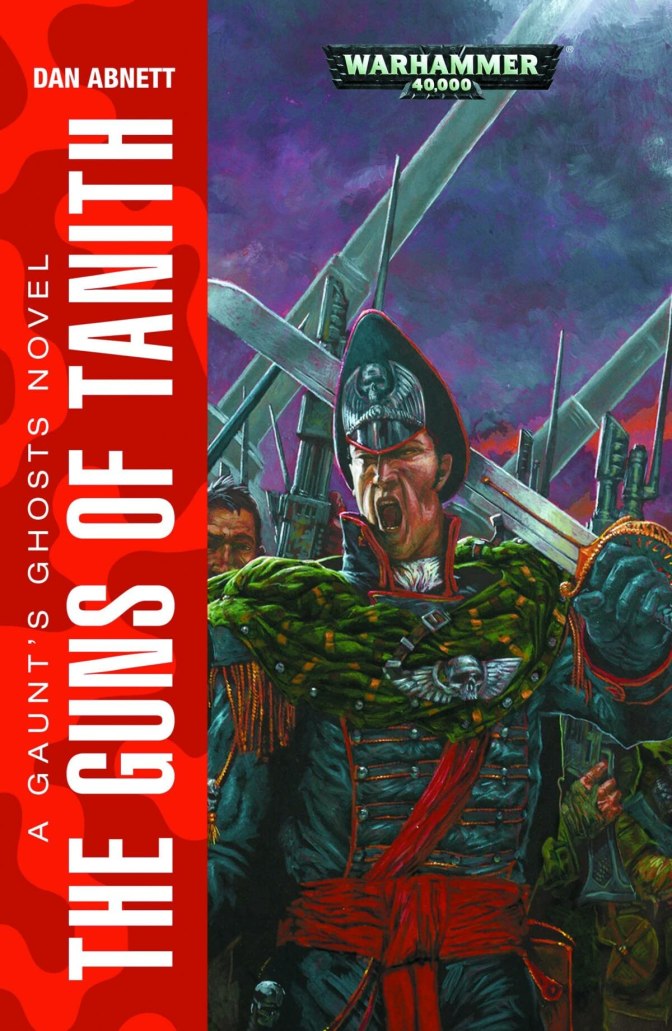
The Guns of Tanith Cover

Publisher: Black Library (Audiobook – 25 April 2002)

Series: Gaunt’s Ghosts – Book Five

Length: 10 hours and 10 minutes

My Rating: 4.5 out of 5 stars

Amazon

Welcome back to my Throwback Thursday series, where I republish old reviews, review books I have read before or review older books I have only just had a chance to read.  After having such a great time reviewing the previous Gaunt’s Ghosts novel, Honour Guard, in my last Throwback Thursday, I immediately read the fifth fantastic entry in the series, The Guns of Tanith, which proved to be just as awesome and exciting.

As I mentioned last week, I have been really getting into the works of Dan Abnett over the last year, and I now consider several of his books to be amongst the best Warhammer 40,000 novels I have had the pleasure of reading.  Not only did I deeply enjoy his epic Eisenhorn trilogy (made up of Xenos, Malleus and Hereticus) but I have also been powering through his Gaunt’s Ghosts books.  The Gaunt’s Ghosts books are some of the more iconic novels in the Warhammer 40,000 franchise and are often considered essential reading by fans of the franchise due to the captivating way they capture the gruelling experiences of ordinary human soldiers in this grim, futuristic setting.  The first four novels in the series, First and Only, Ghostmaker, Necropolis and Honour Guard, as well as the prequel novel The Vincula Insurgency, are all excellent and exciting in their own way, and I have had a ton of fun seeing the impressive war narratives set around the men of the Tanith First-and-Only, informally known as Gaunt’s Ghosts.  As I was still in the mood for some awesome action at the end of last week, I just had to keep going with these books and I quickly picked up the fifth entry, The Guns of Tanith.

As the massive Sabbat Worlds Crusade continues to pit the forces of the Imperium of Man against the foul forces of Chaos, the battlelines extend across multiple planets and systems, drawing in millions of soldiers.  The latest phase of the crusade has severely stretched the supply lines of the Imperial assault and the Chaos foes are quick to take advantage, threatening to cut off and surround the main Imperial force.  To stave off disaster, Warmaster Macaroth, needs the Tanith First-and-Only to recapture the vital promethium producing planet of Phantine so the crusade can be resupplied and continue.

Led by the heroic Colonel-Commissar Ibram Gaunt, the Tanith First-and-Only engage in a deadly airborne assault on several of the planet’s domed cities.  Relying on their unique skills of navigation and infiltration, the Ghosts prove to be vital to the operation and soon take the key city of Cirenholm.  However, holding the city proves to be harder than expected.  While preparing for the next assault, the vile murder of a freed Cirenholm civilian places a Ghost on trial and opens up the festering cultural divides within the regiment.

As Gaunt attempts to get to the bottom of the crime and ensure that the innocent are left alive, the Ghosts are given a vital mission to undertake.  A dangerous Chaos warlord has taken command of the final occupied city, Ouranberg, and his lethal command threatens to devastate an attack by the Imperials.  To ensure a successful invasion of this Chaos stronghold, a specialised team of Ghosts is tasked with infiltrating the city and assassinating the enemy leader in advance of the main assault force.  Featuring some of the best the Ghosts have to offer, the assassination squad will be forced to walk through hell to achieve their objective and not everyone will be coming back.

In this fifth entry in this amazing series, Abnett continues to impress with another powerful and captivating character-driven read that takes the Ghosts through a gruelling round of battles, tragedy and growth that proves near impossible to put down.  The Guns of Tanith was a pretty strong entry in the series, expanding on some of the interesting storylines from the first novel while also introducing a new dark scenario for the characters to deal with.

The Guns of Tanith features a fantastic narrative from Abnett that contains his usual blend of high-intensity action, character growth, and intriguing examinations of the Warhammer 40,000 universe, that make all the Gaunt’s Ghosts novels such a treat to read.  Following on from the events of the previous books in the series The Guns of Tanith is told in Abnett’s typical style, with a ton of unique character perspectives, mostly those of the Ghosts, which presents the reader with a rich and vibrant view of the events, as well as the unique, character-driven storylines that emerge.  While this fifth Gaunt’s Ghosts novel can be read as a standalone book, The Guns of Tanith does see several ongoing, character focused storylines come to a head or get even more complicated. As such, readers should really consider checking out the previous novels first so they can get the full emotional weight of the revelations and twists that emerge.

The main narrative of The Guns of Tanith is bookended by major extended battle sequences that see the Ghosts and their allies engage in elaborate fights across two separate cities.  The first of these battles, in Cirenhom, sees all the Ghosts forced to engage in a particularly bloody battle with limited ammunition against a dangerous and determined foe that has set up some elaborate traps.  This extended sequence is both epic and useful as it provides the reader with a ton of intense action to draw them into the novel while Abnett introduces the characters and storylines that this latest novel is focused on.  You also get a good overview to the new setting of Phantine, a polluted planet with a toxic atmosphere that requires multiple forms of airship to traverse.  This unique location adds some great spice to the overall story, especially as it requires the characters to learn some unique aerial skills, while also allowing Abnett to have fun featuring several impressive dogfights.  There are some great moments during this first extended battle sequence, and it sets the rest of the book up nicely.

The middle of the book is where the reader gets into the real meat of the story, especially as it lowers the intensity levels down from the action-packed introduction and allows the reader to breathe and absorb all the intriguing story elements to come.  At first, I wasn’t too keen on a quieter middle section to this novel, especially as I thought it would make The Guns of Tanith more of a bridging novel in the series, rather than a book that could stand on its own.  However, Abnett soon proved me wrong as this intriguing central storyline contained a lot of major character moments and intriguing plot lines, while also expertly setting up the final third of the book.  The main storyline explored in the centre involves a murder investigation when one of the Ghosts is accused of killing an innocent civilian.  Abnett does a great job with this murder storyline, especially as it brings in compelling mystery and legal thriller elements to it, while also driving the characters in some excellent directions.  However, the real joy of this part of the book is the focus on the camaraderie and factions within the Ghosts, and the fracturing coherence in places leads to some memorable moments later on.

The final section of the book focuses on the assault of the Phantine city, Ouranberg, and the special Ghosts mission to assassinate the Chaos warlord.  Following several supporting members of the cast, this final third of The Guns of Tanith takes these characters on a particularly dark mission through a Chaos stronghold, and Abnett throttles up the tension and brutality to the maximum, ensuring that the readers are strongly hooked on everything unfolding.  Watching the separated teams attempt to navigate through enemy territory leads to some dark and bloody sequences, and everything comes together in a brutal confrontation where all the characters get a moment to shine.  The invasion in the aftermath of this assault brings the entirety of The Guns of Tanith together in an outstanding way, as several major storylines are expertly and impressively resolved, often in ways that leave the characters even more damaged than when they started.  This is also a particularly shocking death of a major character that is guaranteed to move long-term readers of the series.  Abnett does a masterful job of setting this death up, including by showcasing several misleading near-misses, so you really don’t know who is going to live or die right up to the end.  His eventual choice is one designed to wound his readers, and you will have to come back to see how it impacts the rest of this series.  Overall, this was an extremely solid and impressive Gaunt’s Ghosts narrative, and I deeply enjoyed how Abnett continued and finalised some of the great character storylines from the previous books, while also providing the reader with more action and intrigue than they can handle.

As with most of the Gaunt’s Ghosts books, The Guns of Tanith is an open read to all those unfamiliar with the wider Warhammer 40,000 canon.  Abnett goes out of his way to make his books accessible for new readers, and he always provides enough detail and background so that anyone can catch up and enjoy the subsequent story.  However, for those fans more familiar with the Warhammer universe, there are always a ton of great elements or unique world building details that they will find particularly fascinating.  The new locations in The Guns of Tanith are pretty damn spiffing, and I had a lot of fun with the polluted planet, especially as it requires multiple arial sequences.  This is turn leads to the introduction of the Phantine XX Fighter Corps, who Abnett will go on to feature in his spin-off novel, Double Eagle, and it was fun to see how they get their start here.  For me, though, the best part of the universe expansion was Abnett’s in-depth look at the day-to-day life of the common soldier in the Imperial Guard.  While Abnett has always done a masterful job of capturing the footslogger experience in his novels, I felt that The Guns of Tanith was one of his best attempts to dive into the core of his beloved regiment.  Not only is there are lot of story focus on the various members and factions of the regiment, but Abnett also spent some time trying to explore the downtime and personal lives of the characters, and it was pretty intriguing to see the accompanying civilian baggage train of the regiment, which includes their families and other vital services.  I also personally loved the scenes that examined the problems associated with the Imperial bureaucracy as the Ghosts come up against their greatest enemy: bad paperwork.  Certain mistakes ensure that the Ghosts are left with minimal ammunition as the Departmento Munitorum orders the wrong power packs for their lasguns.  The following extended sequence which saw the regiment unable to fight effectively because their ammunition couldn’t fit their guns was an impressive part of the book and it definitely raised the stakes during the book’s introduction.

As usual, one of the major highlights of The Guns of Tanith is the amazing characters that the story focuses on, as Abnett once again fits a huge number of character-driven storylines into the book.  At this point in the series, Abnett has introduced a pretty substantial cast of characters, many of whom have ongoing storylines, and it is intriguing to see them unfold even further in The Guns of Tanith, especially as Abnett does a great job featuring most of them equally and then combining them into the larger narrative.  Many of the more intriguing character arcs in this book carry over from the previous novels and there are some great conclusions and expansions to them here that helps to improve the already great narrative of The Guns of Tanith.  At the same time, several new characters are introduced here or finally given prominence, and it was interesting to see how they fit into the already established character dynamics that Abnett has been building up.  The cohesiveness of the Ghosts as a regiment ends up becoming a huge fixture of this book as the Tanith-Verghastite divide is explored in greater detail by many of the characters.  It was fascinating to see how Abnett handled these character storylines in The Guns of Tanith, and several of them ended up being some of the best parts of the book.

As with most of the novels in the series, quite a lot of character focus goes towards the main protagonist, Colonel-Commissar Ibram Gaunt, whose experiences as the commander of this unique regiment continue to trouble him in various ways.  In The Guns of Tanith, this takes the form of his apparent unconscious bias towards the Tanith elements of his regiment over the Verghastite recruits, which is showcased by his differing reactions during two court cases.  This results in several intense interactions between Gaunt and members of his team, which helped to showcase the protagonist’s idealism and a certain degree of naiveté when it comes to Imperial politics, both of which will cause him trouble in the future.  This is also an intriguing look at the issues caused by Gaunt holding the dual rank of Colonel and Commissar, which make him simultaneously a command officer and a political officer in charge of discipline.  This is the first time the duality of his roles has caused some major problems for him, and it was interesting to see several characters question him about it.  Watching Gaunt try to balance his various hats while also maintaining the respect of his men and his superiors makes this a rather compelling novel for Gaunt and I will be intrigued to see how this affects the character in the future.

While there is always a lot of focus on Gaunt, many of the other characters have big moments here, and it is always interesting to see which characters Abnett will focus on in each particular novel.  Firstly, this is one of the Gaunt’s Ghosts books where the major characters of Colm Corbec and Elim Rawne do not get a lot of focus, as Abnett sets them aside to make room for others.  Corbec is once again wounded early on in the plot to keeps him out of the action, while Rawne, after getting a good needling into Gaunt, is showcased as the senior commander, but that’s about it.  Instead, a lot of the focus goes towards some of the newer members of the cast, such as Gol Kolea, whose attempts to balance his complex family concerns leads only to tragedy and despair for him and the reader.  Cuu continues to be a menace, while surgeon Ana Curth acts as several character’s consciences throughout the book.  The previously overlooked but surprisingly lucky Bonin finally got some prominence in this novel, and I loved finding out how he survived Necropolis.  The newer characters of Commissar Hark and Captain Ban Daur also proved to be essential parts of the plot, and I am really glad that Abnett continued to utilise them, as they helped Gaunt see the errors of several decisions while simultaneously taking on some of Gaunt’s more unorthodox methods.  Members of the original Ghosts, such as Brin Milo, Larkin, Bragg and Mkoll all had good roles in The Guns of Tanith as well, and their balanced scenes showcased different triumphs and tragedies.  Finally, I was glad that Abnett decided to keep featuring the mysterious preacher, Ayatani Zweil, after his fun introduction in Honour Guard.  Zweil is an always entertaining yet serious figure, and it was great to see him knock some sense into several characters when they needed it.  I’m honestly only scratching the surface here, as a ton of other characters were well featured throughout The Guns of Tanith as Abnett continues to build and bring together his final cast of major characters.  Each of these amazing protagonists had some superb impacts on narrative of this novel, and I cannot wait to see how Abnett continues to develop them in the later books of the series.  I am assuming it is only a matter of time until more of the characters start to die, and I am sure that will break my heart just as much as the big death in The Guns of Tanith did.

Due to my love of the format, I of course listened to The Guns of Tanith on audiobook, which is easily the best way to enjoy any Warhammer book.  I have gone on a lot about the fantastic Gaunt’s Ghosts audiobooks in recent reviews, and The Guns of Tanith has all the same advantages, as one of my favourite audiobook narrators, Toby Longworth, brings the reader right into the heart of the action with his great voice work.  Every scene is masterfully showcased by his narration, and all the characters are brought to life thanks to the great voices he utilises for them.  Longworth really stretched himself when it came to accents in this latest novel, and he features a ton of great new voices, as well as the existing tones from the previous audiobooks, to bring this entire audiobook together.  With the standard runtime of just over 10 hours, The Guns of Tanith audiobook is a real snap to power through, and I honestly finished it off in only a few days.

Unsurprisingly, I absolutely loved the fifth entry in Dan Abnett’s exceptional Gaunt’s Ghosts books, The Guns of Tanith, which proved to be another powerful and enjoyable Warhammer 40,000 novel.  Filled with Abnett’s usual impressive battles, The Guns of Tanith also had a brilliant focus on characters-driven storylines that dominated most of the plot and kept the readers hooked the entire time.  An intense, addictive, and deeply personal Gaunt’s Ghosts books, The Guns of Tanith was pretty damn outstanding and I loved every second of it.

Amazon

Judgement Day by Mali Waugh

Judgement Day Cover

Publisher: MacMillan (Trade Paperback – 28 February 2023)

Series: Standalone/Book One

Length: 327 pages

My Rating: 4.5 out of 5 stars

Amazon

Fantastic new author Mali Waugh presents her excellent and memorable debut with the Australian crime fiction read, Judgement Day.

Family law judge Kaye Bailey is a woman on the rise.  An honest and determined member of Melbourne’s Federal Circuit Court, Kaye is set to be the next chief judge, allowing her to make the changes she’s always dreamed about to make a real difference.  However, hours after finding out about her promotion, Kaye is brutally murdered in her chambers.

Detective Jillian Basset has just returned from maternity leave and is having trouble balancing motherhood with her complicated career.  Brought in with an arrogant partner to investigate the killing at the courthouse, Jillian hopes to crack the biggest case of her career.  However, the murder of Judge Bailey is far more complicated than anyone anticipated, as the victim was a fierce and honest woman whose determination caused her to get on the wrong side of many of her colleagues and the people she ruled on.

As the detectives dive deeper into the judge’s life, they soon find themselves surrounded by potential suspects, from jealous judges to dangerous individuals with grudges against the entire family law system.  As they attempt to understand who wanted to kill their victim, Jillian also finds her own life getting even messier, as her return to work raises problems she has been trying to avoid.  Can Jillian crack the case before her own life spirals out of control?

Judgement Day was an amazing and captivating Australian novel that got my attention early on.  Waugh pulls together a powerful and intense narrative that combines a brilliant murder mystery storyline with some fascinating legal thriller elements to produce a particularly impressive debut.

Waugh has come up with an excellent crime fiction narrative for her debut novel, and I liked the fantastic blend themes and story elements that she introduced throughout the book.  Judgement Day starts off with an extended prologue that quickly and effectively sets the scene for the plot, introduces the victim and other key suspects, and showcases the events that led up to her murder.  From there, the book primarily focuses on the main character of Detective Jillian Basset, a recent mother who is going through various personal issues as she tries to get back into her career.  Forced to work with a new, glory-seeking partner, Jillian finds the journey back into the detective groove hard, but she is soon diving into the complex case before her.  Waugh sets up an outstanding police procedural storyline here, as the character being their careful dive into the victim’s life, trying to identify who would have wanted to kill her.

The story moves along at a steady pace and the reader really gets drawn into learning about who the victim is and who might have wanted to kill her.  Waugh loads up the story with a ton of great suspects and potential motives at this point, as the protagonists find out about all the drama that occurs behind the scenes of the court system.  This takes the story in several intriguing directions, and you are soon hooked on the various leads that are presented to you.  At the same time, Waugh paints a very complex and heartbreaking tale about the main character’s personal life, which I found to be just as interesting and moving as the tragic murder of the main plotline.  The rest of the story moves very swiftly, especially as you are pretty invested in solving the case, and I personally managed to knock the second half of the book off in a single night.  Several intriguing plot points from earlier in the book, including an infamous divorce case, jealousy from other judges, a kidnapping, and some intriguing character history, are brought together in a very clever way as the solution to the murder presents itself.  Waugh set everything up extremely well, and I really liked the clever clues and hints that she had scattered through the rest of the book.  The final resolution of the case, as well as the reveal of the murderer’s motivation and methods, was handled well, and I really liked how Waugh brought everything together and left the reader with a very satisfying conclusion.

While the story itself is very strong, I also liked some of the clever and compelling elements that Waugh added in to make it even more complex and emotionally powerful.  The most prominent of these is the inclusion of some fascinating legal thriller elements that enhanced Judgment Day’s police procedural storyline and really helped to book stand out to me.  Waugh uses all her experiences as a lawyer to paint an intriguing picture of the family court system in Melbourne, and the struggles and work of its judges become a key part of the plot.  This leads to several other intriguing elements, such as domestic violence and the issues that professional women face in the workforce, especially when it comes to balancing family and the opinions of their male colleagues with a successful career.  These elements are blended into the narrative in a smart and thoughtful way, and I liked how it forced the protagonists to examine the case from several different angles.  While these intriguing elements are great, the focus on classic police work is still very strong, and I really enjoyed the impressive mystery that Waugh wove together in Judgement Day.  The author’s focus on the character development and personal issues added a great deal to the overall story, and this ended up being quite a powerful read.

The characters that Waugh chose to focus the story on are a particular strength of Judgement Day, and I deeply appreciated some of the emotionally rich personal storylines that developed around them.  In particular, Detective Jillian Basset was a brilliant lead, and you can tell that Waugh really poured her heart into her development.  Not only was she everything you want in a police detective protagonist, smart, determined and empathetic to the victim, but she is also dealing with some deeper issues related to her recent maternity leave.  While this initially shows itself to be her struggling to return to the office and fearing losing her place on the team, Waugh slowly reveals that her issues are much more concerning as she is suffering from postnatal depression.  Feeling unable to connect with her new child, Jillian instead focuses on her work and neglects her family, leading to strain and conflict in her personal life.  Waugh does an excellent job of examining her protagonist’s personal issues throughout Judgement Day, and the frank and powerful look at her mental health concerns was a key part of the book.

I also need to highlight Jillian’s new partner, Sergeant John McClintock, who was brought in as her temporary replacement while she was on leave.  Now working together, McClintock initially comes across as an arrogant and ambitious male figure trying to overshadow the main protagonist, and the two have trouble working together.  However, rather than stick with this cliche, Waugh provides a deeper look into McClintock and you realise that a lot of his attitudes are a façade brought on by his own issues.  Waugh works these into the story really well, and Jillian and McClintock soon grow to understand each other and are able to help each other in their own ways.  This partnership becomes a great part of the book, and I enjoyed these two main characters, as well as the intriguing supporting cast of suspects, witnesses and Jillian’s family, which add a great deal to story as a whole.

Overall, Judgement Day was an impressive Australian crime fiction debut from Mali Waugh and one that I am very glad I got the chance to check out.  The outstanding story with its complex mystery, intriguing elements and fantastic characters ensured that I had an excellent time reading Judgement Day.  I think that Waugh really showcased her writing ability with her first book and I think this is the start of an amazing new talent.

Amazon

City of Last Chances by Adrian Tchaikovsky

City of Last Chances Cover

Publisher: W. F. Howes (Audiobook – 15 December 2022)

Series: Standalone/Book One

Length: 20 hours and 7 minutes

My Rating: 5 out of 5 stars

Amazon

Acclaimed fantasy and science fiction author Adrian Tchaikovsky delivers one of the best fantasy books of 2023 with the intricate and captivating City of Last Chances.

Over the last year I have been really getting into the works of Adrian Tchaikovsky, one of the most inventive and imaginative authors of fantasy and science fiction writing today.  Tchaikovsky is a skilled and prolific author who has been a major figure in genre since 2008.  Best known for his Shadows of the Apt, Children of Time, Echoes of the Fall and The Final Architecture series, as well as a compelling collection of standalone novels and novellas (I personally have my eye on his previous novel, Guns of the Dawn), Tchaikovsky has a great habit of creating elaborate new worlds filled with intriguing characters and scenarios.  I have only read a couple of his books so far, including Tchaikovsky’s first Warhammer 40,000 novel, Day of Ascension, and his outstanding 2022 novella, Ogres, but both were outstanding reads and I loved the epic stories both of them contained.  Because of this, Tchaikovsky’s latest standalone novel, City of Last Chances, has been on my radar for a while.  It was released last year, and I finally managed to get a copy on audiobook a short while ago and dove into it as soon as I could.  However, I was unprepared for just how captivating its story would be.

There has always been a darkness hanging over the ancient city of Ilmar.  Known colloquially as the City of Long Shadows, the City of Bad Decisions, and the City of Last Chances, Ilmar is home to many dangerous magical occurrences, including the mysterious Anchorwood at its centre, which serves as a gateway to other far-off worlds.  However, a far more sinister enemy has arrived at Ilmar, the soldiers of the Palleseen, a powerful empire seeking to bring its ideas of perfection and order to all it conquers, whether they like it or not.

After several years of occupation, Ilmar is at a tipping point.  Its citizens are fed up of the corrupt and brutal soldiers, and everyone in Ilmar, be they rebels, criminals, refugees, idealistic students or factory workers, is looking for an opportunity to strike back and make their lives better.  With these forces straining to be unleashed, all it takes is one spark to set the fire of anarchy.  That spark occurs when a powerful Palleseen official leads an ill-advised expedition into the Anchorwood, searching for additional power.  However, he is unaware that an opportunistic thief has stolen the necessary protective amulet in advance, and the expedition is massacred by the creatures that live within the wood.

As news of this crime spreads throughout the city, chaos begins to rear its head.  Everyone is searching for the valuable amulet that was stolen as it represents the greatest chance of freedom many will see, while the Palleseen soldiers are clamping down on the entire city, determined to find those responsible and make them pay.  In this chaos, a mixture of Ilmar’s citizens, including a desperate priest, a violent murderer, an unlucky thief, a duplicitous lecturer and several of the most lost people in the city, will seek to survive the oncoming storm, only to fan the flames further.  However, none are truly prepared for the full danger about to engulf Ilmar, or the heartbreak that follows with it.

Well damn, now that was a pretty damn epic book.  Tchaikovsky has delivered an exceptionally intriguing and addictive novel in City of Last Chances that got me hooked very early on.  I was honestly blown away with the captivating and unique narrative that City of Last Chances contained, and Tchaikovsky drew me in with every fantastic detail and distinctive character.  This book gets a very easy five-star rating from me as I am still thinking about every detail of this book.

City of Last Chances has an amazing fantasy narrative at its centre, which Tchaikovsky backs up with his impressive and distinctive writing style that results in an extremely entertaining, powerful, and intense read.  City of Last Chances follows a raft of different characters as they attempt to navigate a series of deadly events following a single theft.  Tchaikovsky sets out the story in a very interesting way, and the book initially feels more like a collection of short stories than one cohesive narrative; for most of the first half of the book, each chapter acts as a semi-independent story that introduces the reader to a new character and shows their place in Ilmar.  These new characters are often supporting or named figures from a previous character’s chapter, who have their own unique stories and lives.  These character-driven stories are all quite enjoyable and compelling in their own way, and Tchaikovsky cleverly alters the tone so that some come off as very serious, some are quite dark, and others can be a little more comedic and thought provoking.  Some of my initial favourites include the funny and philosophical first chapter around the priest Yasnic and his relationship with God (which reminded me a lot of Small Gods by Terry Pratchett), Langrice’s scene-setting chapter at the mysterious Anchorage inn, and the chapter that gave a proper and humorous introduction to the grim figure of Blackmane as he finds himself about to be executed by a very cheery hangman.  Not only are these chapters very entertaining in themselves, but they effectively set up a larger narrative within City of Last Chances, while also providing great character moments and more and more glimpses into the many aspects of Ilmar.

As the book continues, the character-driven chapters begin to flow on from the preceding storylines, with the catalytic theft of the Palleseen artefact leading to bigger events down the line.  Each chapter adds its own spin to these events by showing new factions, impacted characters, or horrors within the city, or by introducing a new series of spiralling events that begin to unwind the situation even further.  As the story continues, a main cast begins to develop as more of the chapters focus on certain characters.  This really starts to bring the overarching narrative together, and soon the best parts of each unique character and their arcs begin to mingle with the other fantastic figures.  The story soon develops into a great tale of revolution with some Les Misérables vibes to it, as students, refugees, resistance fighters and factory workers begin to revolt.  The substantial main cast is worked into these events extremely well, and the reader is soon wrapped up in their powerful character arcs as well as the overarching story of Ilmar as everything begins to unfold.  Most of this is captured in a series of great chapters focused on the main cast, although new characters are still introduced right up into the end, with some unique, if brief, storylines skilfully worked into the larger narrative.  The author really pushes everything up a notch as the book comes towards the end, and every danger, unusual occurrence and strange character is unleashed to some degree.  There are some outstanding reveals, big battles, and some deeply personal moments that really help to bring the entire fantastic story together.  I particularly loved how some great story elements that were hinted at earlier in the book are brought to the fore at the end, especially as this includes some outstanding twists (Hellgram’s wife was a fun one for me).  However, the true joy is in the way that every major character gets a resolution to their emotional and complex character arcs, leaving the reader breathless in multiple ways.  I felt that Tchaikovsky wrapped everything up perfectly, and this serves as a brilliant and captivating standalone fantasy narrative.

I cannot compliment the way that Tchaikovsky presented this outstanding story enough, as his distinctive writing style really helped to compliment the epic and complex plot.  I have already mentioned his great use of different character focused chapters above, and I must once again highlight how effectively they were used to tell a cohesive and distinctive narrative with so many entertaining facets.  While it did take me a little while to fully appreciate what Tchaikovsky was trying to achieve with these semi-independent chapters, once you notice how the story is coming together through character-focused sequences, you really grow to appreciate it.  The continued change of character focus ensures that Tchaikovsky keeps the pace of City of Last Chances pretty brisk, and it is easy to quickly move through the story, especially once you get caught up in the tale of Ilmar and its people that the author is developing.  Tchaikovsky also introduces some impactful changes in tone throughout the book, as City of Last Chances runs the gauntlet from being light-hearted to emotionally draining, as the protagonists go through hell and back while also trying to deal with their own personal problems.  The author puts in some pretty intense scenes throughout this powerful story, many of which leave the characters reeling in different ways, and there are also some quite terrifying or shocking sequences as the full horror of this city is revealed in gruesome fashion.  However, these darker scenes are often undercut with some fun and amusing humour that helps to diffuse the tension at some key parts of the plot and which I found to be very refreshing.  This humour is often a little black and cynical in context, which ensures that the reader is left amused, and sometimes laughing, without the story getting too light and drifting away from its harsher content.  I really think that Tchaikovsky found the right balance here, and I rather enjoyed how he mixed everything together.  I had so much fun seeing how Tchaikovsky wove his complex tale into this book and City of Last Chances really emphasises just how talented he is as an author.

One of the key things that made City of Last Chances such a hit for me was the outstanding setting of Ilmar.  Tchaikovsky has always been exceedingly good at effectively building up an inventive and complex new setting for his stories, and this is some of his best work yet.  The author shows Ilmar through the eyes of so many different characters in this book, each of whom adds a new aspect to its history, character, and energy, as the story progresses.  This proves to be quite an effective way to introduce the setting, and the reader soon gets an impressive picture of the entire chaotic glory of this oppressed city.  I love all the aspects of this place, including the magical dimension-hopping wood and the responsibilities surrounding it, the demon powered factories, the oppressed refugee areas, the idealistic student academy and the sinister Reproach, an abandoned part of the city filled with magically cursed wretches dancing to their death.  Each of these complex and compelling elements are explored to their fullest throughout City of Last Chances and I really appreciated how Tchaikovsky built them up and then effectively featured them again later in the story.

The author also explores various parts of the world outside of Ilmar, and it is interesting to see how that impacts on the main story.  I particularly liked the use of the Palleseen as the overarching antagonists of the story and Tchaikovsky paints them as an obsessed group of fanatics trying to bring their ideas of perfection to an unwilling world.  This plays into several of Tchaikovsky usual themes about oppression and revolution, and he sets the Palleseen up as a vindictive group, who are often hamstrung by the practices and bureaucracy they force on their enemy.  The entire focus on the city of Ilmar being unleashed to face the occupiers was an excellent part of the book, and Tchaikovsky built up all the factions and chaotic nature of the city really well.  As such, Ilmar is a brilliant background setting to this great story and I really appreciated how Tchaikovsky set his story into it.

While I loved so many of City of Last Chances elements, for me the most important and powerful part of the book is the characters, as Tchaikovsky introduces the reader to a massive and captivating cast of figures who travel through the story in their own fashion.  Due to the way the story is set out, there are quite a lot of characters in City of Last Chances, with new cast members being added in every chapter, either to support the current point-of-view protagonist or to set them up for their own chapter later.  As such, there is a real focus on quickly and effectively getting to the root of each character in their first chapter, and I think that Tchaikovsky did a great job on this score.  You get to know each of these figures really quickly and you really get drawn into their unique tales and arcs, many of which are perfectly developed over the course of the book.  While the cast is pretty massive, each of these characters is given plenty of time to develop and many prove to be particularly complex and relatable as a result.

While there are so many great characters, several definitely stood out to me, especially as Tchaikovsky kept going back to them.  This includes Yasnic, the last priest of a diminished and petty god who now haunts his one follower.  Yasnic is a fantastic and occasionally comedic character, which reminded me a little of the protagonist of Terry Pratchett’s Small Gods.  While I did think that Yasnic was a bit one-note at the start of the book, he develops as the story continues, and you really appreciate just how complex and damaging his life as a priest has been, thanks to his god’s arbitrary rules, many of which have actual good reasons behind them.  Watching him try to balance his faith and connection to his god against the terrible things being done to him and the city is a key part of the book, and it leads to some emotionally powerful scenes, especially when Yasnic thinks that his god is being taken away from him against his will.

Other great characters include Langrice, the shunned owner of the Anchorage, the inn that borders the Anchorwood, and Blackmane, an Allorwen refugee and former sorcerer, who serves as a criminal pawnbroker.  Both characters are older and wearier figures who are trying to survive the harsh circumstances of their lives the best way they can.  Both are shown to be outcasts to their own people in different ways, and this leads to a compelling relationship between the two, even if they do not actually trust each other.  I also quite liked the character of Maestro Ivarn Ostravar, a lecturer at Ilmar’s Gownhall university, who acts as a great patriot to his students while actually collaborating with the Palleseen.  Ivarn is a particularly arrogant figure who manages to manipulate people’s views of him, and it is really fun to see him thrown into situations outside of his control, especially when his own reputation works against him and forces him to become the figure head of resistance.  His student, Lemya, is also a great part of the book due to her fervent idealism brought on by Ivarn’s teachings.  Off course, her naivety comes back to bite her and the other characters repeatedly, and while her actions are often a little frustrating, it is great to see her slowly realise she is being manipulated and gain some common sense.

However, to my mind the best character in the book is Ruslav, which is frankly a shock as he initially shown as a simple thug with an obsession for women.  However, Tchaikovsky keeps coming back to him as the story develops and each new situation he finds himself in makes him more complex and likeable.  His first chapter shows how his entire perspective on life is changed when he falls in love with a beautiful painting, which starts a great character arc of self-discovery and confusion for him.  Tchaikovsky keeps developing Ruslav’s story as the book continues and he soon faces more and more challenges, including a mortal injury, a hanging, and forced religion.  The latter is the most damaging to him as he is forced to give up violence, the one thing in life he is good at, to stay alive, which results in quite the existential crisis.  Watching him try to fit all the unusual events occurring to him into his insights as a street thug proves to be entertaining and very relatable, as you understand just how much of a struggle each of his new experiences are for him.  His coarse humour fits into this arc very well, and watching him swear at his new, inadvertent god and all the people of different backgrounds he is forced to deal with, makes for some very fun scenes.  However, not all of Ruslav’s storyline is comedic, as Tchaikovsky loads in continued tragedy for him as well, that really shakes him, and the reader, to their core.  The author seems to both love and hate Ruslav, and the resulting damage and development he goes through result in some of the most emotionally rich parts of City of Last Chances.  I honestly am still surprised that Ruslav turned out to be such a great character, but he and the rest of the cast really make City of Last Chances an epic book, and I am really glad I got the opportunity to dive into their unique lives.

As with many of the larger fantasy books I tend to read, I chose to seek out the City of Last Chances audiobook format, which served as an outstanding way to enjoy this fantastic and elaborate book.  This new Tchaikovsky audiobook is pretty long with a run time of just over 20 hours, and it did take me a little while to get through it, although it was very much worth the time.  I always find that listening to an audiobook helps me to absorb more detail for some books, and this was particularly useful for City of Last Chances as Tchaikovsky has once again loaded his unique setting and captivating story with so many intricate elements.  As such, I was really able to full appreciate the full complexity of the dark city of Ilmar and its many, desperate residents.

I was also extremely impressed with the voice work of narrator David Thorpe, who ensured that the listeners could full enjoy every single aspect of City of Last Chances.  Thorpe, whose narration I have not had the pleasure of before, did a spectacular job here in City of Last Chances and I honestly enjoyed every second he spent telling this story.  Not only has he got a great base voice that tells the main story at a clipped and exciting pace but he also provides a ton of impressive tones for all the characters in this book.  Every one of City of Last Chances’ unique characters is given a particularly fitting voice that captures their personalities and really helps to convey to the reader some of their key points, such as Yasnic’s meekness, Ostravar’s arrogance, or Lemya’s unbridled idealism.  Thorpe also comes up with several great accents that he uses to differentiate some of the different races and nationalities contained within the city, and I felt that this really helped to emphasise the cultural elements contained within the story.  Overall, the City of Last Chances audiobooks is pretty damn spectacular, and I loved how the entire thing came together.  I had so much fun listening to Thorpe’s great take on the characters, and this is easily the best way to enjoy this epic read.

City of Last Chances is a brilliant and wonderful novel by Adrian Tchaikovsky that I cannot start raving about.  I quickly became enthralled the outstanding and compelling narrative that he pulled together throughout City of Last Chances, and his fantastic delivery, intriguing setting, and impressive characters all drew me in.  This is easily one of the best books I have read so far in 2023 and it comes very highly recommended by The Unseen Library.  I cannot wait to see what amazing book Tchaikovsky comes up with next, as if it is any where as good as City of Last Chances, I am going to love it.

Amazon

The Voyage of the Forgotten by Nick Martell

The Voyage of the Forgotten Cover

Publisher: Gollancz (Audiobook – 3 November 2022)

Series: The Legacy of the Mercenary King – Book Three

Length: 19 hour and 47 minutes

My Rating: 5 out of 5 stars

Amazon     Book Depository

One of the very last books I read in 2022 might be one of the very best: the latest epic novel from Nick Martell, The Voyage of the Forgotten, which showcases just how much of an impressive, rising talent this outstanding author truly is.

Since 2020, one of my absolute favourite new fantasy authors has been the very, very talented Nick Martell, who burst into the scene in a big way with his elaborate and compelling The Legacy of the Mercenary King trilogy.  This series started with The Kingdom of Liars, an exceptional book that introduced Martell’s intriguing fantasy world and distinctive protagonist Michael Kingman.  The scion of a formerly great family whose patriarch was executed for a murder he didn’t commit, Michael spent most of The Kingdom of Liars trying to prove his father’s innocence while also finding himself dragged into various conspiracies infecting his home city of Hollow.  I had an amazing time reading The Kingdom of Liars, and it ended up being one of my favourite books, audiobooks and debuts of 2020.  Martell expertly followed his first novel up a year later with the equally incredible The Two-Faced Queen, which continued many of the fantastic story threads from the first book.  However, the stakes were raised even further with the protagonist forced to deal with immortals, dragons, assassins, serial killers and more, all while trying to stop the woman he loves from killing him.  This was another exceptional read, and The Two-Faced Queen was easily one of the best books and audiobooks of 2021.  Naturally, there was no way that I would not read the third and final book in the series as soon as I could.  This third book, The Voyage of the Forgotten, was one of my most anticipated reads of 2022, and I eagerly dove into it just before the year came to a close.

After proving his father’s innocence and restoring his family’s place in Hollow society, Michael Kingman should be happy.  However, the closer he comes to victory, the more tragedy and defeat he suffers.  Not only is the love of his life, Serena, the queen of Hollow, engaged to a merchant prince with his own elaborate agenda, but dangerous conspiracies centred on Michael seem to emerge from around every corner.  His sister is enslaved to an immortal Wolven King who seeks war with his soon to be freed brothers, while his mercenary mentor, Dark, is becoming one of the most dangerous creatures in existence, using his stolen dragon magic to wreak havoc and destruction in the name of love.  However, his true enemy remains Angelo Shade, Dark’s father, who seeks to bring back his dead wife and will burn the world, and everything Michael loves, to achieve it.

Thrust once again into this deadly battle of forces outside his league or ability to comprehend, Michael only has his wits, his barely trained magic ability, and a few dedicated friends to fight against the immortal schemers who have spent years bringing their elaborate plans to fruition.  However, Michael is well used to being outclassed and underestimated by everyone he goes up against, and he resolves once again to make everyone pay to keep those he loves safe from harm.

Gathering his allies, Michael embarks on a foolish quest to fully understand all the world’s secrets that have long been hidden from him and ensure that he has the weapons to survive.  But his course of action will put him at odds with the deadly mercenaries of Regal Company, all three of the ancient Wolven Kings, and even his own mercenary company.  Defeating all of them seems impossible, but that has never stopped him from trying before.  Can even the legendary stubborn Michael Kingman succeed and achieve his goals of becoming a Mercenary King when fate itself seems set against him?  And even if he succeeds, is he willing to pay the terrible price that victory demands?

Wow oh wow, what an epic book.  Nick Martell continues to deeply impress me with his captivating story writing ability as he brings this trilogy to a powerful and momentous end that I was instantly addicted to.  The Voyage of the Forgotten was a truly exceptional read, loaded with amazing characters, elaborate fantasy lore and an intense story that refused to drop my attention.  I can find no higher praise for this book than the fact that I named it one of my favourite books of 2022 well before I had even finished it; the first half was that damn good.

Martell has come up with a pretty epic narrative for The Voyage of the Forgotten, and it is one that I will not forget in a hurry.  However, the first thing that I need to say about the story is: if you haven’t read the first two The Legacy of the Mercenary Kings novels, go back and start at the beginning.  Martell has loaded the entire series with a ton of intricate and interesting lore, and he starts rapid firing back to the events of the last two books extremely early on in the story.  While there is a useful Dramatis Personae, as well as a fun summary of previous events from one of the side characters, which helped to refresh my memory, if you haven’t read the previous books you will get lost very quickly when trying to read The Voyage of the Forgotten.  The narrator is constantly making references to previous events, revelations, or characters who only appeared in the prior books, and it can get a little confusing if you don’t know what he is talking about.  As such, I would strongly recommend reading (or re-reading) The Kingdom of Liars and The Two-Faced Queen in advance, which is a very small chore considering how amazing they are.

Now, if you’re up to speed on the prior books, you are in for a real treat when it comes to The Voyage of the Forgotten’s story.  Told mainly from the perspective of protagonist and calamity-magnet Michael Kingman, Martell weaves together an intriguing, action-packed and character-driven conclusion to the elaborate story he set up in the first two books, which also leaves a lot of room for the larger series to grow in the future.  The author once again primarily utilises a chronicle style from Michael’s perspective, which really helps to tell this unique story, especially as it forces Michael’s chaotic and hilarious personality into the story and made every scene seem that little more entertaining and personal.

The narrative itself starts quickly and effectively, with a series of fun battles, big confrontations, and a horde of vengeful dragons, all of which ensures that the reader is quickly reintroduced to the chaotic main character and the multiple tangled webs and conspiracies that he has found himself involved in.  The story quickly advances to the main issue of this book as Serena Hollow loses her memory, and Michael is forced into an epic quest to find a cure.  This of course leads Michael to fight against the entire world, as everyone is opposed to his quest, and this ends up resulting in multiple intriguing or over-the-top encounters.  At the same time, Michael is constantly trying to unravel the mysteries of the world and his many enemies.  There are some epic scenes and sequences in this first half of the book that I really fell in love with, and Martell has some fantastic writing chops behind him that makes his outrageous concepts really work and come to life.  For example, one of the best sequences in the first half of the book sees Michael trapped in his own mind, forced to experience multiple loops of a historical battle from an ancient time.  The constant death and fighting that occurs over innumerable rotations slowly drives the protagonist mad, which Martell captures perfectly in exquisite detail.  Partnered with this intriguing sequence are several scenes showing an external view of Michael’s body, which has been taken over by a malevolent entity.  This ended up being one of the best moments of the entire book, especially as it has a very fun ending.

In addition to the action, Martell continues to unwind or add to the overlying layers of conspiracies, plots and personal or historical secrets that have always been such a fun part of this series.  Several long-running story threads are finally resolved in the first half of the book, and it is so much fun to see Michael finally get quite a few intriguing answers.  Martell really does not hold back with the revelations in The Voyage of the Forgotten, and the entirety of the book is loaded with characters unburdening their secrets (at least some of them) or discussing the unique history of the wider world.  I absolutely loved every sequence where revelations about this universe and its fun inhabitants came to the surface, and it was fascinating to see how they fit into the wonderful tapestry that Martell has woven throughout this trilogy.  This universe building is further enhanced by a series of great interludes with alternate narrators, which show events outside of Michael’s knowledge and experiences.  Not only do these help to showcase some of the fun supporting characters from the first two books but it also deepens the narrative and shows what schemes his friends, and more importantly his enemies, are up to, which provides some fun foreshadowing.

Everything really comes to a head in the second half of the book as Michael and his companions are thrust towards their destinies.  After several major setbacks and further revelations that show off the sheer scope and intricacies of the story, you and the protagonist are dragged back on the road towards the final epic confrontation.  The author sets all of this off perfectly by finally answering some big secrets that have been bedevilling the protagonist since the beginning, and there is a particularly cool twist that makes you rethink every major event of the first two books.  I really loved how Martell briefly changed the narration around when this big twist is revealed and had Michael address the audience directly to reveal why he never mentioned certain details in his previous storytelling.  This helped to really sell the effectiveness of this major reveal, as well as showcase a previously unseen alternate layer to the character’s personality, and I personally thought that this was bit of pure genius from Martell.  All this leads up to the big final confrontation as Michael finally comes face to face with Angelo Shade, the main architect of his family’s pain, as well as some other surprising foes.  This big conclusion is everything you would want it to be, with some epic moments, utter tragedy and multiple character arcs coming full circle in all the right ways.  While parts of this conclusion do get a bit overly complicated and metaphysical, I felt that it came together pretty damn perfectly in ways that really fit the universe and the controversial main character to a T.  Readers will come away from this conclusion both heartbroken and hopeful, and I felt that it was an exceptional and very on-brand ending to one of the more distinctive fantasy trilogies of the last few years.

I honestly think that Martell wrapped this book up extremely well, and my only major disappointment is that there was not more crammed in, as I would have gladly listened to several more hours of it.  The exceptional narrative, backed up with extensive lore, amazing character development and the very distinctive writing style helped to make this final book really pop, and I was honestly impressed every step of the way.  I was also very happy with how Martell handled the sheer range of extensive storylines that he had set up in the previous books.  My main concern before reading the final book was that Martell would be unable to wrap up every storyline or plot point he had set up.  Indeed, there are still quite a lot of potential storylines and questions that were unresolved by the end of the book, but Martell is clearly setting up a sequel trilogy of some design in the same universe.  Some of the best ongoing storylines have been left to continue in the future, and I for one am very excited for that as I hope to spend many more years getting lost in Martell’s world.  I felt that the author was cleverly selective when it came to which storylines ended in The Voyage of the Forgotten, as he chose to close off the ones connected with protagonist Michael Kingman, while leaving others open.  This ensures that any future stories will probably focus on some of the other characters that Martell has set up in this trilogy, and indeed it is pretty clear who that will be.  I personally look forward to seeing a new take on this universe in the future, and it will be very interesting to see how the narrative continues with a major change in perspective.

One of the things that has always impressed me about The Legacy of the Mercenary King trilogy is the elaborate and well-thought-out fantasy world that the story has been set in.  Its dark and grim nature, coupled with the intricate history, compelling magic system, and diverse people, has always added so much to the story, and this remains true in The Voyage of the Forgotten.  Because he did not shut off this universe completely, Martell was given free rein to continue to expand on his elaborate universe, and boy did he.  The reader is treated to a ton of extra information and history about this amazing world, including some of the strongest glimpses about the mysterious Wolven Kings, the world’s various immortals and other unique creatures, and their long-running battles throughout history.  There are several glimpses of the past thanks to magic, and you really learn a lot about what previously befall many of the immortal characters and how this affects their current motivations.  In addition, several new cities, islands, nations, groups and other great elements are featured heavily in the plot as Michael and his companions explore the wider world and engage on some massive sea voyages.  Martell does a great job of incorporating these new elements or character history into his wider narrative, with the protagonists either spending substantial time exploring this information, or else discussing it with the clear intention that it might become a major detail in the future.  I really enjoyed how many of the previous novel’s mysteries were answered thanks to world expansion featured in this novel, and it is very clear that Martell has a lot more planned for this fantasy world in the future.

Of course, I also need to mention the cool magical system that Martell features throughout The Voyage of the Forgotten, especially as it has some major and extremely clever implications on the plot.  Like the first two books, the main form of magic featured is Fabrication, which forces the user to sacrifice their memories to perform magic.  It is actually quite horrifying to see the consequences of Fabrication misuse, as some of the users forget friends, facts or family, and this is often enhanced by the user’s sacrifice or by the fact that they suddenly lose all concept of someone they’d grown close to.  However, this is nothing to becoming a Forgotten, someone who has completely lost their memories or sense of self, and this is strong explored in this book.  I deeply appreciate the amazing way that Martell utilises this memory loss throughout The Voyage of the Forgotten, especially when it relates to the protagonist, as he often does not remember what he is forgetting, and it is always very heartbreaking when you notice that he, or one of the supporting characters, has forgotten something or someone important.  This darker side of magic is well counterbalanced by the various impressive usages that occur throughout The Voyage of the Forgotten, and there are some rather elaborate battles that take place as a result.  Martell also does a very deep dive into the origins of magic in this novel, and you find out some interesting facts about Fabrication, as well as other magical disciplines that exist in this universe, many of which have been cleverly foreshadowed throughout the trilogy.  I really enjoyed seeing some of the over-the-top magic that was utilised by other characters throughout the various battles, and there are some very interesting moments as a result.  It will be very interesting to see what happens to the magic use in the future, especially considering the major changes to Fabrication theory that occurred at the end of The Voyage of the Forgotten, and I look forward to seeing how Martell continues that intriguing plot thread.

While I can go on about the story, setting, magic and writing, for me the true strength of The Legacy of the Mercenary King books has always been the outstanding and extremely complex characters.  This remains the case in The Voyage of the Forgotten as Martell brings many of his best characters back for a particularly emotional adventure.  There are so many major and dramatic character moments throughout this book as Martell used the end of the trilogy to wrap up multiple character storylines and events.  I really appreciated some of the fantastic development and big character moments that occurred throughout this final book in the trilogy, and fans of the first two novels are going to be very moved by what happens to their favourite characters.

The primary focus of the plot is naturally Michael Kingman.  Martell has done some real wonders around Michael Kingman in the last two books, and he has ended up being one of the most complex characters you are ever likely to encounter.  A highly damaged individual who has had his mind warped by magic, has seen his family destroyed, has been forced to live up to an impossible legacy, and has been kept apart from the love of his life, Michael has had a lot of growing to do in the last two books, and Martell has really laid on the character development.  As such, the Michael Kingman in The Voyage of the Forgotten is wiser and more mature than we have previously seen, although he still has some ways to go.  However, Martell ensures that this growth continues in this final book, as he keeps trying to become a better person, especially when faced with the certainty of his death and the loss of people he loves.  There are some major moments when Michael is forced to face damaging revelations or hard truths and each of them change him in some way, often during a pivotal and well-written scene.  Martell also cleverly includes some great secrets about his past and his life that I thought were pretty damn epic, especially as it answers some major questions about his personal history and why he is stuck in the middle of events.

Despite all this, Michael is still the same cocky bastard that he was at the start of the trilogy and his overconfidence, determination and sheer ability to enrage anyone he comes into contact with is so damn entertaining.  Seeing normally calm and collected characters trying to deal with the Michael problem always result in some of the funniest scenes, and I loved the often hilarious edge that the character brings to much of the story due to his amusing narration.  As such, you find it very hard to dislike Michael, no matter how hard you try, and his unique and heartbreaking tale is one that will appeal to many people.  Martell wraps up much of Michael’s great and intense story in this final book and it was very moving to see some of the dark sacrifices the character is forced to make to save his family and fix some of his biggest mistakes.  I guarantee you will not be prepared for everything that Michael goes through in The Voyage of the Forgotten, but you won’t be able to turn away as Martell does some dark, yet wonderful things, to his best creation.

In addition, quite a lot of the book focuses on major secondary character Serena Hollow, Queen and love of Michael’s life, who has had a turbulent relationship with her Kingman.  This relationship gets even more complex in The Voyage of the Forgotten, especially when Serena becomes a Forgotten without any idea of who she is or what her many responsibilities are.  You see a much more free version of the character in this book, and I found the differences between this person and the vengeful queen of the second book to be very intriguing.  The continued focus on the relationship between Michael and Serena hits extra hard as a result of this loss of memory, and it is fascinating and moving to see them attempt to rekindle what they had.  Honestly, their entire story is pretty tragic in this final book, but I was nice to see a powerful conclusion to their doomed love story and Martell features some damn fine character work when it comes to Serena.

Aside from Michael, The Voyage of the Forgotten features a rich and extensive cast of characters, many of whom are returning from the previous two books.  Standout characters include Dark, the mercenary killer who serves as Michael’s mentor and possibly most dangerous foe, as he attempts to find his own way to bring back the dead.  Dark is a brilliant character, and I love how Martell has written such an edge of menace around him, although by the events of The Voyage of the Forgotten Michael is pretty much immune to it, resulting in some very entertaining interactions.  You also have to love the sinister Angelo Shade as the main antagonist of the book.  Michael’s former foster father and the man responsible for his family’s downfall, Angelo has been an outstanding manipulative bugger the entire way through this trilogy, and I loved seeing more of his games in this final book.  Watching his elaborate plans come to fruition is pretty amazing, and Martell does a good job continuing to show his past and motivations, ensuring his obsession with bringing back his dead wife is mirrored by Michael’s attempts to save Serena.  Other great characters like Naomi, Chloe and Alexis have some fantastic moments in this book as the main supporters of Michael and Serena, and it was great to see some of their storylines.  The rest of the cast make some fantastic appearances as well, although it is interesting that several key characters from the first two novels only had minor appearances, and indeed I was a tad disappointed that some figures, such as amusing immortal nobleman, Charles Domet, were barely featured.  However, it is clear that Martell is saving them up for future entries in this larger series, and I look forward to seeing what happens to them next.  Overall, this was a great cast of characters and Martell should be congratulated on the amazing character work he did.

While I received a massive physical copy of The Voyage of the Forgotten, I chose to listen to the audiobook version of this book when it first came out, and boy was I glad that I did.  I have often said that the audiobook format is the perfect way to absorb vast amount of lore and universe elements (at least for me), and, with all the revelations and expansions that Martell featured here, that proved to be a major boon.  The story came across perfectly in this format, and you can easily visualise the powerful scenes, battles of wits, and some of the more outrageous actions of the characters, as they are read out to you.  It helps that this audiobook was once again narrated by one of my favourite audiobook narrators, Joe Jameson, who has impressed me before with the first two audiobooks in the series, and with his work on King of Assassins by R. J. Barker and the fun Warhammer 40,000 novel, Fire Made Flesh.  Jameson always does a remarkable job with his narration of Martell’s books, and his great tones and pacing help to move The Voyage of the Forgotten along at a fast clip.  However, the main advantage of Jameson as a narrator is the cool voices he brings out for the characters.  While I was not the biggest fan of a couple of his female voices, the majority of his narration was pretty much spot on and I felt that he really showcased the cool personalities and emotions of the key figures.  However, the best voice is saved for the main protagonist and narrator Michael Kingman, who Jameson perfectly encapsulates throughout the course of the audiobook.  Jameson really gets into Michael’s head with his narration and expertly portrays his personality, emotions and thought process.  This great portrayal of the central characters adds so much to overall quality of the entire audiobook, and my enjoyment of The Voyage of the Forgotten as a whole, and I loved every damn second of Jameson’s narration as a result.  This honestly was the best way I found to enjoy The Voyage of the Forgotten, and I very strongly recommend it as a result.  With a run time of just under 20 hours, it does take a little bit of effort to get through this audiobook, however, it is more than worth the effort as you will have a fantastic time.

If this extensive write-up didn’t give it away, I clearly deeply loved The Voyage of the Forgotten.  Nick Martell has wrapped up his The Legacy of the Mercenary King trilogy in an exceedingly epic way, and I deeply enjoyed how the elaborate, powerful, and character rich narrative came to an end.  This is some of Martell’s best work yet, and if you haven’t experienced this amazing fantasy author’s work yet, you are really missing out.  I look forward to seeing how Martell will continue this story in the future, and any follow-up trilogy that will jump to the top of my to-read list the moment it is announced.  In the meantime, make sure to check out this exceptional book, as well as the proceeding two novels in the trilogy, as The Voyage of the Forgotten gets one of the easiest five-star ratings I have ever given out.
The Voyage of the Forgotten Cover 2

Amazon     Book Depository

Warhammer 40,000: Bloodlines by Chris Wraight

Warhammer 40,000 - Bloodlines Cover

Publisher: Black Library (Audiobook – 8 August 2020)

Series: Warhammer Crime

Length: 8 hours and 30 minutes

My Rating: 4.75 out of 5 stars

Amazon     Book Depository

After some of my recent awesome experiences with the Warhammer Crime series, I just had to check out the outstanding novel, Bloodlines by Chris Wraight, which has one of the best pure crime fiction stories in this entire epic franchise.

Regular readers may have noticed I have been having an absolutely amazing time getting through a ton of Warhammer 40,000 novels in recent weeks as everything about this extended franchise has been so damn fun.  One of the more intriguing sub-series of Warhammer fiction I have been tearing through has been the Warhammer Crime books which, as the name suggests, blends cool crime fiction narratives with a Warhammer 40,000 settings.  The entire series is set within the massive, corrupt city of Varangantua on the planet of Alecto, and several very talented writers have come up with some exceptional novels that perfectly showcase murder, mystery and death in the midst of this great setting.  I have so far deeply enjoyed the epic entries, Dredge Runners and The Wraithbone Phoenix by Alec Worley, Grim Repast by Marc Collins, and Flesh and Steel by Guy Haley, each of which have contained different, if equally exceptional stories.  However, few have had the excellent central mystery of the very first full-length Warhammer Crime novel, Bloodlines from new-to-me author Chris Wraight, which took a veteran cop on an intensive investigation with fantastic results.

After a lifetime working for the Varangantua Enforcers, Probator Agusto Zidarov is well aware that the only certainties in the continent-spanning city are wealth, corruption and criminality.  Tired of the games played between the warring gangs, trade combines, and nobles as they battle for control of the city’s resources, Zidarov is more concerned about his own life, family and secrets.  However, when a simple missing person investigation gets unexpectantly complicated, Zidarov will find a terrible case that he can’t turn away from.

Called to the estate of wealthy business magnate Udmil Terashova, Zidarov is ordered to find her son and heir, who has gone missing.  Forced to plumb the depths of Varangantua’s underbelly, Zidarov attempts to find any trace of the boy, who has likely just disappeared taking part in the rich’s hedonistic lifestyles.  However, when an uncovered lead places him conflict with one the city’s most ruthless gangs, Zidarov soon begins to believe that there is more to this case than he initially believed.

Discovering that the gang is involved in the notorious crime of cell draining, Zidarov’s attempts to shut them down.  However, his raid ends up being a bust, and the fallout results in a dead sanctioner, a wounded probator and a full-on war between the gang and the enforcers.  Attempting to mitigate the consequences of his actions, Zidarov soon discovers that there is far more going on behind the scenes than he ever imagined as corporate interests work to influence the investigation.  To find the truth about the city’s new crime ring and the missing noble, Zidarov is forced to probe both Varangantua’s lowest gangs and wealthiest citizens.  But can Zidarov survive the encounter with his secrets and life intact?

Bloodlines is an incredible and deeply impressive Warhammer Crime novel that I had an excellent time reading, especially as Wraight perfectly blended his crime fiction story with the cool Warhammer setting.  Featuring one of the more elaborate and intriguing cases in the Warhammer Crime books I have read so far, I absolutely powered through Bloodlines and this was truly an outstanding read.

At the heart of Bloodlines lies a pretty awesome and captivating narrative building on the basic crime fiction premise of a veteran cop attempting to solve a crime no one wants investigated.  Taking its cues from classic noir entries (I was reminded a bit of Chinatown), Bloodlines follows Probator Agusto Zidarov, a family man with a cynical view of his job and his place in the city, as he gets dragged into a missing persons case.  Initially starting off a little slow, the story quickly heats up as Zidarov attempts to find the missing heir to the wealthy Terashova family, a disappearance he assumes is a simple case of young rebellion.  However, his routine investigation into the missing lad leads him to discover a cell draining operation being run by one of the major gangs, and he shifts his investigation in an attempt to shut it down.  But when his plans go wrong and his colleagues end up injured or dead, Ziadarov finds himself on everyone’s firing line.

There are some interesting jumps in the case around halfway through as the protagonist soon realises there is far more going on than he initially believed and he is forced to simultaneously investigate both the gangs and some of the wealthiest families and businesses in the city.  I loved this gradual escalation of the stakes of the crime as the book continues, as the original missing persons case is revealed to be far more complex and intriguing than initially believed when the protagonist discovers that he is being used by everyone.  At the same time, Zidarov is forced to deal with some major personal issues, as his wife begins to resent his choices, his rebellious daughter has gone missing in a city full of predators, and certain dark secrets around Zidarov threaten to come into the light.  The eventual reveal about who is responsible for the various crimes is very clever, and I liked the subtle and effective hints and clues leading up to it as the unique motivations and plots utilised intriguing aspects of the Warhammer 40,000 universe.  Wraight ends Bloodlines on a great note as Zidarov gets justice through drastic means after a very intense and powerful confrontation with one of the book’s more intriguing and complex supporting characters.  As such, you come away from Bloodlines feeling very satisfied, although you instantly want to see more of this great character, especially as the sinister connotations about Zidarov’s dark secret indicate that some tragic events are going to befall this character in the future.

The entirety of Bloodlines was laid out extremely well by Wraight, who uses a great style to tell a complex and captivating story.  Told exclusively from Zidarov’s perspective, you are given a personal and close examination of the events of the book as Zidarov slowly and methodically investigates the various crimes.  You are quickly drawn into the elaborate narrative Wraight lays out as the author does a good job of combining an excellent crime fiction storyline with intriguing character development, all set with Varangantua and the wider Warhammer 40,000 universe.  The noir inspired elements of Varangantua really stand out in this book, especially as Zidarov is forced to simultaneously investigate both the criminal cartels and some of the city’s wealthiest residents.  Bloodlines really recalls some classic noir tales, as it focuses on the experienced and dogged investigator fighting the entire system to get answers and justice, and I loved exploring even more of this enormous city and its many colourful residents.  The whole concept of cell draining, which sees thousands of people literally drained of their essence to make life-extending products, was pretty damn horrifying, and I liked how the examination of this gave Bloodline’s crimes a distinctive feel.  Wraight’s great writing style really lends itself to producing a particularly impactful and compelling crime narrative, and I loved how the entire storyline unfolded, especially with the effective twists and the well thought out foreshadowing.  I ended up coming away from this book quite enthralled and happy and I am really excited to read more books from Wraight in the future.

One of the things that I have so far found with all the Warhammer Crime entries is that readers really need very little familiarity with the wider Warhammer 40,000 universe to appreciate these great books.  Anyone interested in a compelling and intense crime fiction story set in a cool and grim futuristic city can easy dive into one of these novels, and all these books are an awesome introduction to the Warhammer fandom.  Bloodlines is no exception to this, as Wraight writes a very accessible crime fiction thriller that anyone can enjoy while simultaneously enjoying the gothic setting.  That being said, Wraight does make excellent use of several intriguing elements from the Warhammer 40,000 lore to enhance his story and there are hints and discussions about elements outside of Varangantua, such as the Imperial Guard or the wider wars of the Imperium, which fans of the franchise will deeply appreciate.  Wraight does do an amazing job of explaining these elements so that newer readers will fully appreciate them, however, established readers will always get a little bit more out of it.  For example, the full significance of Zidarov’s secret isn’t going to be too apparent to new readers, while in-the-know fans are going to get a blast out of the potential implications.  I felt that Bloodlines has a lot to offer all readers, no matter their experiences with Warhammer, and you might find yourself falling for the franchise with this first book.

Another key aspect of the Warhammer Crime series that Wraight perfectly captured in Bloodlines was the excellent utilisation of a complex and likeable central character.  Wraight’s protagonist and main point of view character, Probator Agusto Zidarov, is a deeply intriguing figure who stands out from the other protagonists in the Warhammer Crime series for being much less of a damaged outsider.  Instead, he is a veteran probator who worked his way up to his position with a very realistic view of the world around him than most other characters, and I liked his no-nonsense approach to his job and his city which has been formed from years on the job staying alive.  Despite this veteran presence and cynicism, Zidarov is still willing to do what is right, even if it endangers him, and his dogged approach to solving the case is extremely addictive, especially as Wraight puts in some deeper motivations behind them.  I really enjoyed some of the scenes where Zidarov continuously ignores his friend’s advice and keeps going forward with the case, simply explaining to them and the reader that he is unable to let it go, and he just keeps moving forward despite the inherent weariness of the character.  This determined and tired cop persona is well balanced by the family man aspect of Zidarov, which is another intriguing element that you don’t see in a lot of Warhammer fiction, as most protagonists don’t have wives or children.  Watching him attempt to balance his family responsibilities with that of his job adds some intriguing drama to the story, and I enjoyed seeing this portrait a ‘normal’ Warhammer 40,000 family.  Wraight perfectly weaves together these dual aspects of Zidarov’s personality with a certain darker, secretive thread that really shows the character in a whole new light when revealed, and which is going to have some intriguing impacts down the line.  All of this, and more, helps to make Zidarov one of the more relatable and enjoyable protagonists I have ever enjoyed in Warhammer fiction, and I really hope that Wraight produces some additional Zidarov stories soon.

Once again, I chose to listen to this cool Warhammer novel in its audiobook format, which, as always, was an excellent and deeply fun experience.  The Bloodlines audiobook did an amazing job of bringing this intense and powerful story to life in some very fun ways.  In particular, the complex central setting of Varangantua is really shown in all its corrupt glory when you hear it being described, and I loved how the fast pacing of the audiobook kept the story rolling by.  This format of Bloodlines was also greatly helped by veteran narrator Charles Armstrong, who has so far only lent his talented voice to a few Warhammer audiobooks.  Armstrong provided an excellent performance in Bloodlines, really diving into the various complex characters and helping to showcase their unique personalities and emotions.  I loved the tired and resigned voice that Armstrong came up with for the main character, which really sells the audience on Zidarov’s veteran status which is the result of an exhaustive and draining career.  Other great voices include that fun Irish accent he gifted to supporting character Brecht, which added to his entertaining nature, as well as some excellent voices the various suspects in the main case had.  All this makes the Bloodlines audiobook the very best way to enjoy this exceptional novel and with a runtime of eight and a half hours, you can power through it in no time at all.

Overall, Bloodlines was a particularly epic entry in the Warhammer Crime series, and it is one that author Chris Wraight should be extremely proud off.  Wraight did a remarkable job of blending together an intense and clever crime fiction story with the dark and grim Warhammer 40,000 setting, and the result is a brilliantly twisted case that I couldn’t turn away from.  Combined with instantly likeable character, Bloodlines proved to be extremely fun and deeply captivating, and I loved how the entire book unfolded.  As such, Bloodlines comes extremely highly recommended and you are guaranteed to love every second of it.  I look forward to seeing how Wraight continues this character in the future, and any future books featuring Zidarov are going to be something truly amazing.

Amazon     Book Depository