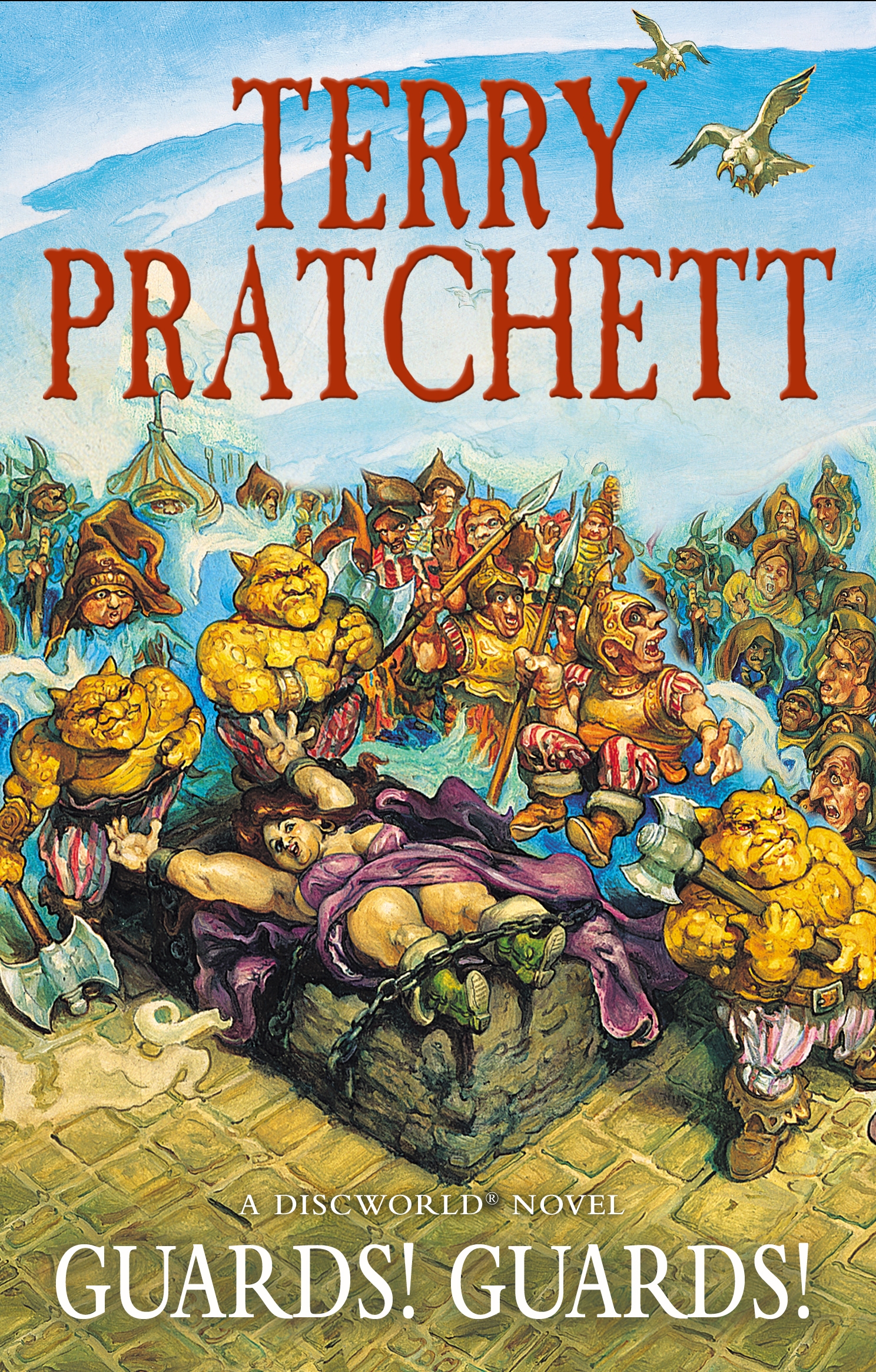
Guards! Guards! by Terry Pratchett

Publisher: Gollancz/Penguin Audio (Audiobook – 1989)

Series: Discworld – Book 8 / City Watch – Book One

Length: 13 hours and 29 minutes

My Rating: 5 out of 5 stars

Amazon

I recently revisited one of my favourite books in Terry Pratchett’s iconic Discworld series, Guards! Guards!, and I just had to review it to showcase how much fun this series can be.

I have never made any secret of the fact that I love all things Terry Pratchett as the Discworld books were one of the formative series of my youth.  A massively popular series set on a flat world carried through space on the back of a giant turtle and four elephants, the Discworld books present a range of unique fantasy adventures, backed with exceptional comedy and satire.  This series is so much fun, and I honestly love every single Discworld book, having read them all multiple times, usually while laughing myself silly.  Indeed, I am such a big fan of this series that I named my blog after a location in the universe.  Despite my overwhelming love for this series, I haven’t reviewed many Discworld books (the exception being Moving Pictures and The Last Continent).  That changes with my review of the outrageously funny Guards! Guards! which I recently enjoyed while on a road trip.

Guards! Guards! is a particularly entertaining addition to the Discworld series that I have a lot of love for.  Serving as the first book in the City Watch sub-series, Guards! Guards! sees Pratchett blend his typical fantasy and comedy elements with a complex murder mystery.  This book follows the ragtag city watch of this world’s main recurring city, Ankh-Morpork, as they try to solve a series of deaths caused by a monstrous murder weapon.  Due to its brilliant and hilarious story, as well as the fact that it perfectly sets up the rest of the awesome City Watch books, I generally consider Guards! Guards! to be one of my absolute favourite Discworld novels, and I have featured it in various Top Ten Tuesday lists over the years.

On the fantastical and impossible Discworld no place is more dangerous, corrupt or morally unhealthy as the legendary and stinking city of Ankh-Morpork.  The Disc’s largest city, Ankh-Morpork has many terrors haunting its urban depths, where life is cheap and death lurks around every corner.  However, not even the hardest criminals, deadliest wizards or most manipulative politicians are prepared for an ancient and malevolent creature that is about to be unleashed upon the city.

A shadowy secret brotherhood has engineered an elaborate plan to seize power in Ankh-Morpork through use of an unlikely weapon, a dragon.  Summoning a fully formed fire-breathing dragon to cause terror, the brotherhood hopes to use the resulting carnage to bring in their own puppet to control the city.  However, the dragon has its own ideas about what sort of terror it wants to bring down on humanity.

With the rest of the city powerless against the dragon, it falls to the ramshackle Ankh-Morpork Night Watch and its depressed captain, Sam Vimes, to try and stop it.  The only problem is the Watch are the biggest joke in the city, incapable of standing up to normal crime, never mind carnage caused by magical dragon.  But with an unnaturally keen new recruit guilting them into action, and a terrifying dragon fanatic with a crush on Vimes keeping them in line, the Watch is going to try and save the day, even if no-one wants them to.

Guards! Guards! still reigns supreme as one of my top Discworld novels from the always impressive Terry Pratchett.  Featuring a unique plot, loaded with an outstanding mix of mystery, humour and fun fantasy elements, Guards! Guards! brilliantly sets up one of Pratchett’s best sub-series while presenting its own epic and powerful story.  An exceptional read from start to finish, this book gets a very easy five-star rating from me, and I love it so damn much.

The plot of Guards! Guards! is so damn clever and is peak Pratchett in its inventiveness and impressive characters.  Presenting an entertaining and humourous noir murder investigation in a fantasy series, Guards! Guards! has a lot of moving parts to it, including some impressive character-driven story arcs, all of which come together beautifully for a particularly intense and insane story.  Starting off very strong with some great introductions to various key characters, including the young and keen Carrot Ironfoundersson, who journeys to the massive and corrupt city of Ankh-Morpork to join the Night Watch, providing fresh blood, irrepressible honesty and uncontrolled enthusiasm to the small squad of rejects and failures currently staffing it.  Carrot’s arrival corresponds with the start of a bold conspiracy, as a secretive mystic brotherhood plots to dethrone the Patrician and take over the city.  The initial scenes of this book are extremely good, and I love how Pratchett expertly sets up the entire narrative with some hilarious moments, including the opening sequence with the Elucidated Brethren of the Ebon Night, whose petty ideology shows you just what sort of criminal minds we are truly dealing with.

Things go in a chaotic direction as the Night Watch, led by the drunk and depressed Captain Vimes, witness a direct murder by dragon and begin their own investigation into the matter.  Pratchett expertly pivots the story around from its comedic fantasy start into a complex police procedural/noir murder investigation, as the protagonists try to find out why the dragon is terrifying the city and who benefits from the apparent crime.  At the same time, several great character arcs emerge, including a truly nice, if unconventional romance, new friendships, and a fun analysis of dragon mythology.  There is a great twist about halfway through the book as the down-and-out Night Watch witness an interesting change to the classic dragon fantasy tale that sees a unique king take over the city.

The final third of the book is some of Pratchett’s strongest writing, as Vimes identifies the true culprit and must work to undo the damage they caused.  There are some great moments in this last part of the book as Pratchett presents his own unique and hilarious take on classic fantasy tropes, including the famed million-to-one shot, the heroic rescue, and the successful defeat of a dragon.  I felt that the identity of the main villain of the story was very clever, and Pratchett sets it up well with subtle clues, although if you know Pratchett’s thoughts on certain government positions it’s not too surprising.  Still, the final confrontation between the protagonists and this villain is great, and being literal has never been so deadly.  Pratchett leaves Guards! Guards! on a hopeful note, and it’s impossible not to come away with a smile on your face.
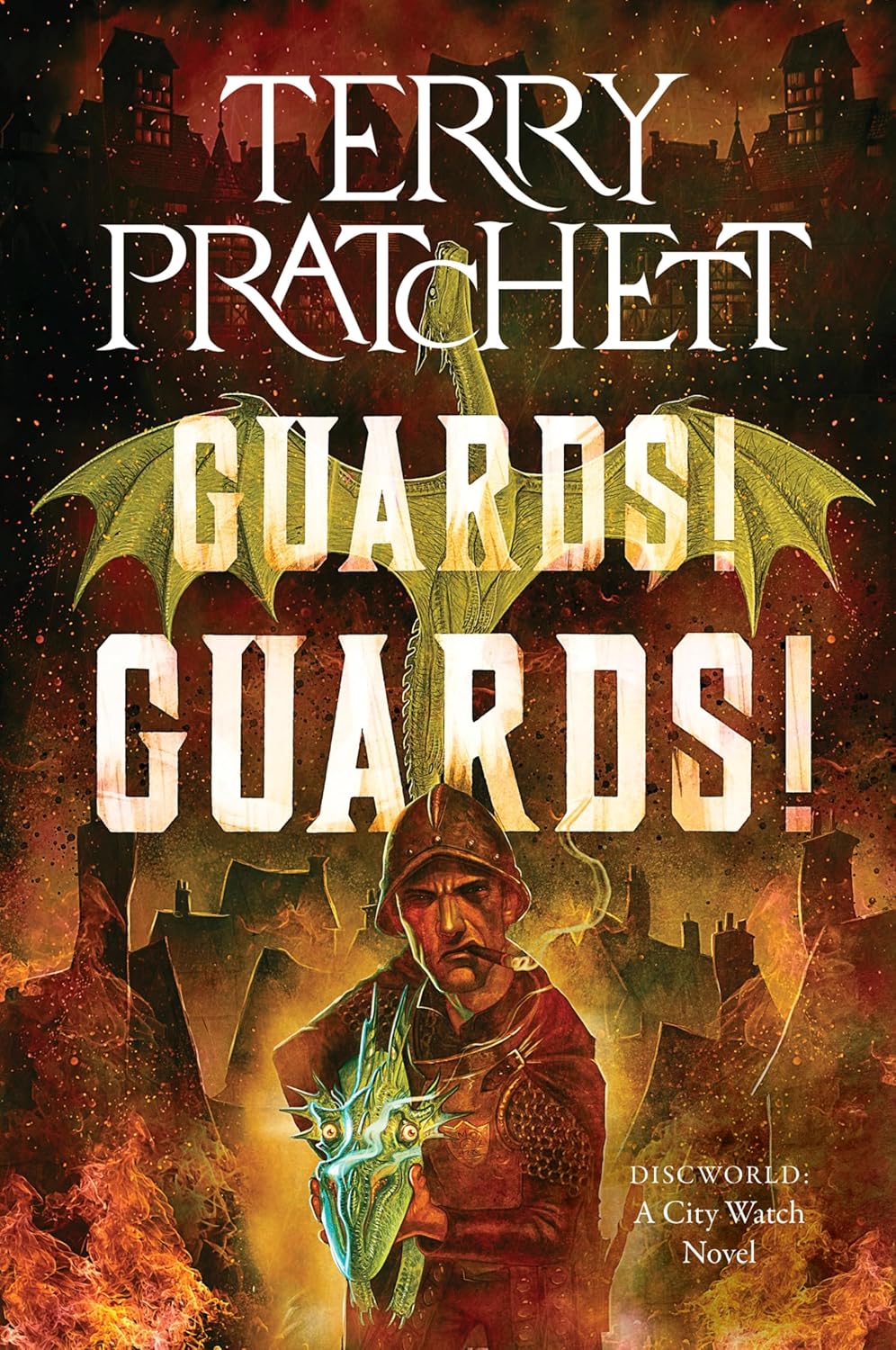
Pratchett was really on-point when it came to writing Guards! Guards! and I loved how perfectly it came together.  As with all books in the Discworld series, Guards! Guards! features an exceptional mixture of fantasy and humour elements, as the unusual and cynical Discworld produces some unusual situations, layered in with a great plot and some fantastically complex characters.  A lot of the humour is derived from classic fantasy scenarios that are taken up to 11 and shown in outrageous manners, accompanied by sarcastic comments from the characters as they witness them.  For example, this book serves as an ode to the guards and watchmen from classic fantasy fiction, and there are some funny scenes when these self-aware guards realise how expendable they are in a fantasy story.  However, Guards! Guards! also features a brilliant third element as Pratchett also features a compelling crime fiction read, accompanied with an addictive murder mystery.

The blend of fantasy and crime fiction elements works incredibly well, and it is highly entertaining to watch a serious investigation consider magic, suddenly appearing dragons, and the unique background setting of Ankh-Morpork.  I also loved how many clever and subtle jokes Pratchett was able to weave in because of these crime fiction inclusions, and he ends up lovingly roasting so many classic tropes from police procedurals and noir detective novels.  Despite having read this book many times, I still laugh like crazy at all the humourous moments in Guards! Guards!, especially as you always discover a new joke or pun you previously missed.  I honestly don’t have time to list all the funny scenes in Guards! Guards!, but favourites include the various meetings of the petty and mostly incompetent Elucidated Brethren, Carrot’s naïve overreactions upon discovering crime in the city, and various musings on how to achieve a perfect, million-to-one chance.  Pratchett once again expertly backs up his humour in Guards! Guards! with a series of entertaining footnotes spread throughout the book, that prove to be nearly as much fun as the main story.  These brilliant footnotes contain additional jokes, sarcastic comments, or interesting expansions of the Discworld universe, and they always bounce off the main story perfectly, providing extra laughs and food for thought where necessary.  I really cannot emphasise just how well this blend of genres worked with Pratchett’s unique and endearing humour, and it proves impossible not to have an exceptional time while reading this book.

As with most Discworld books, Guards! Guards! works exceedingly well as a standalone novel, and I feel that anyone wanting a laugh could easily jump in and follow the story without any issues.  Due to its early position in the shared Discworld universe, you don’t have to know anything about the other entries in the overarching series to jump right in, as Pratchett goes a tad light on some of the more outrageous Discworld elements.  As such, I consider Guards! Guards! to be one of the very best entry novels to new Discworld readers.  It also proves to be a brilliant first book in one of Pratchett’s best sub-series, and so many key details of the subsequent City Watch books are introduced here.  This includes some excellent early looks at the chaotic city of Ankh-Morpork and key recurring characters in the larger universal plot.  Ankh-Morpork is a great background setting for Guards! Guards! and it was the first book completely set within the bounds of the city.  I loved seeing this crazy city in even more detail, and all the fun elements set up here help to make it an epic setting.  As such, this is a great book for any Discworld reader, new or old, and it’s one of my favourites for very good reason.

As with pretty much all of Pratchett’s works, the key things that made Guards! Guards! so impressive were the amazing and unique characters that were featured throughout the plot.  Pratchett had a real knack for producing complex, multi-layered figures who can be both comedic and tragic at the same time, and who you couldn’t help but love.  Guards! Guards! was a particularly good example of this, as Pratchett featured a range of brilliant and entertaining characters who would go on to be become major recurring figures in the Discworld canon.  Indeed, Guards! Guards! is one of the most significant books for new characters, and it is frankly amazing how many exceptional major and iconic figures were introduced here.  Each of these characters were so well written, and you have to love both their specific arcs in this book, as well as how they were expanded on in later works.

The most prominent character in Guards! Guards! is Captain Samuel Vimes.  A cynical and damaged man whose habit of calling out social inequities has seen him assigned to the joke position as head of the Night Watch, which he deals with by drinking vast amounts of alcohol.  A parody of every hard-drinking cop and private eye in classic noir fiction, Vimes starts the book with no prospects and too many dead friends.  Given new purpose when the dragon appears in the city, Vimes turns his innate rebellion to a purpose and tries policing and detecting.  Pratchett does an exceptional job setting up Vimes here in Guards! Guards!, and it is no wonder he goes on to be one of his top protagonists.  Vimes’s depressed investigative method proves quite successful, and it was entertaining to watch Vimes attempt to solve the case while sarcastically calling out his fellow citizens’ base stupidity and selfishness.  Pratchett also sets up an impressive redemption arc around Vimes, which comes about through a combination of trusted colleagues, romance, and a renewed determination to uphold the law.  While he ends the book still irritated with the world, the road forward to Vimes doing bigger and better things is well established, and you really get drawn into his arc as a result.

Another impressive character is naïve and innocent City Watch recruit, Carrot Ironfoundersson.  Due to his complex home situation and a late life revelation that he’s human rather than a dwarf (being six and a half feet tall wasn’t a clue to him), Carrot is sent to Anhk-Morpork with a desire to become a watchman, which he incorrectly believes is a noble calling.  Thanks to his literal personality and highly moral upbringing, Carrot proves to be an anathema to the lawless folks of Anhk-Morpork, as he comes to town bringing justice, enforcing obscure laws, and actually arresting thieves: “change your ways”.  A brilliant parody of ultra-righteous fantasy kings, Carrot serves as an outstanding comic relief for much of the book, especially when it comes to his wholesome interactions with the exceedingly criminal inhabitants of the city.  However, beneath his comedic cover, Carrot is written as a complex figure of change, and his ability to inspire the other characters, either through guilt or determination, leads to some big moments.  Pratchett did an amazing job with Carrot in Guards! Guards!, and it was fascinating to see how he evolves from his initial innocent personality, to a more clever, but still determined, character.

Aside from Vimes and Carrot, the other two watch characters are Sergeant Fred Colon and Corporal Nobby Nobbs, both of whom are excellent and solid comedic characters.  The stereotypical fat sergeant and dodgy corporal, Pratchett has fun setting them up as unassailable fixtures of the Night Watch as they do the jobs nature intended for them, and I love how they play off each other.  While Colon has some hilarious scenes, including his attempt at archery and his various ill-timed run-ins with the dragon, you can tell that Pratchett had a lot more fun writing Nobby.  While not all his over-the-top characteristics from the series are shown in Guards! Guards!, Nobby is still a particularly entertaining figure.  Between his coarse language, petty criminal mindset, and uncharacteristic foppish behaviours, every scene with Nobby is highly amusing, and I love how Pratchett expanded off clever stereotypes about lifetime corporals to create this wayward figure.

Outside the members of the City Watch, there are a fantastic array of figures who help to make Guards! Guards! a particularly enthralling story.  This includes one of the few female characters in the book, Sybil Rankin, a dragon-loving heiress who ends up being Vimes’s unlikely love interest.  Deliberately written as the direct opposite of a noir femme-fatale in both personality and appearance, Sybil is a force of nature, using her accumulated nobility to pull the Night Watch, especially Vimes, into her orbit.  It proves impossible not to like Sybil as you watch her confidently go after Vimes or try to put the dragon to heel, and she ends up being one of the most complicated female characters that Pratchett wrote (which is saying a lot when you think of some of his other great female characters).

The other major character that I want to separately highlight is the Patrician of Ankh-Morpork, Lord Havelock Vetinari.  While he has appeared in previous Discworld novels (notably Sourcery), this is the first book that showcases him as a full character.  Generally depicted as a Machiavellian mastermind and one of the few people capable of controlling the chaotic city, Vetinari has some great early scenes.  However, it’s not until the second half of the book when you realise just how fantastic a character he is.  Deposed by the false king, Vetinari initially appears to be completely powerless in the dungeons, until Vimes is thrown in with him and begins to realise that he is still in control, especially as he’s managed to cultivate a new intelligence network (procured by providing wartime strategy to magical rats), while also getting locked in a dungeon specifically designed to keep him safe.  His subsequent scenes tormenting the book’s real antagonist and talking about the nature of humanity with Vimes really cement him as an impressive figure, and the seeds for his many later inclusions as the Disc’s ultimate political mastermind are well sown here.

While I know I’ve been going on a bit about characters (blame Pratchett for being such a good writer), I just need to highlight a few more figures who have a great role in Guards! Guards!.  This includes the Librarian, one of Pratchett’s most iconic characters, who proves to be just as much fun outside of a wizard focused book, and it was entertaining seeing him interact with a separate group of friends.  You get a great introduction to the character of Cut-My-Own-Throat Dibbler, whose mercantile tendencies are on full display here.  The unusual swamp dragon Errol proves to be an unlikely pet, and his arc about finding love and his true form was particularly heartwarming.  Finally, I must mention the book’s great antagonist, who fully embraces the mad tendencies that his position demands.  While I won’t go into too much detail about who he is, I will say I loved seeing his various internal rants about the world, and the scenes with his incompetent henchmen were so damn funny.  All these characters, plus even more hilarious figures, are instrumental to so much of Guards! Guards! brilliant charm and humour, and after being introduced to them here, it’s impossible not to follow them on their full journey.
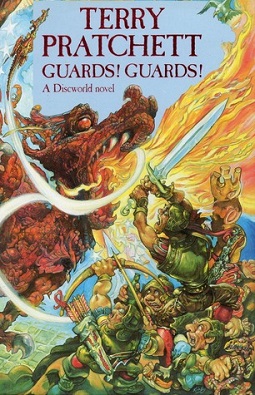
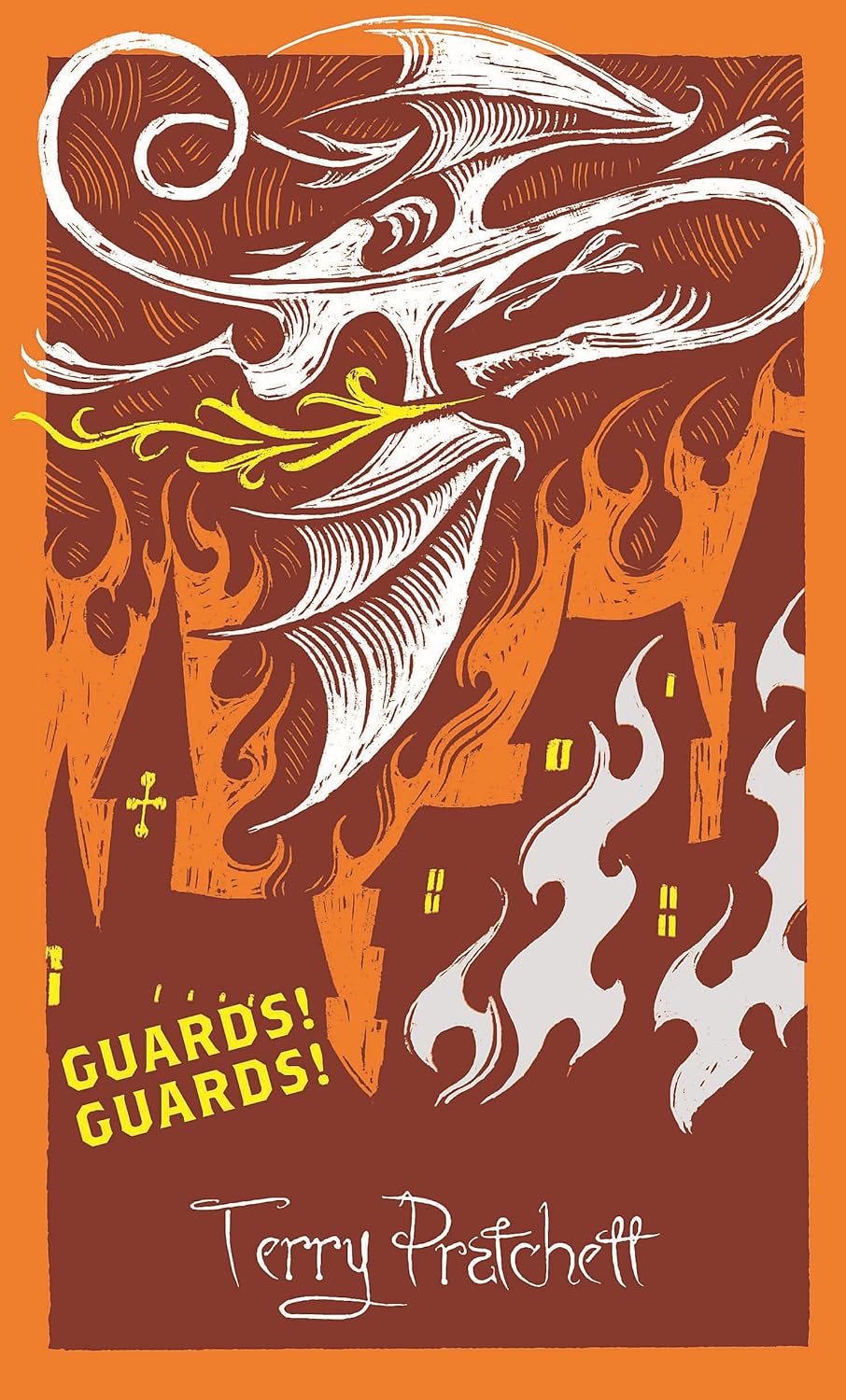
I have had the pleasure of reading Guards! Guards! in a couple of different formats over the years, but to my mind the best way to enjoy this book, and indeed any Discworld novel, is on audiobook.  The Discworld audiobooks are something very special, and I find that the unique stories, excellent humour and elaborate characters really come across when read out by a passionate narrator.  With the recent re-release of various Discworld audiobooks, there are now two different unabridged versions of Guards! Guards! fans can enjoy, and I want to highlight them both here.

The first Guards! Guards! audiobook is the original version with the talented Nigel Planer, who narrated 22 of the original 23 Discworld audiobooks.  Guards! Guards! is one of his best performances, and it set the scene nicely for many of his subsequent Discworld audiobooks, especially as he settled on a lot of key character voices and tones here.  While it has been a little while since I’ve listened to Planer’s version of Guards! Guards!, I have enjoyed it so many times it is permanently engrained in my head (I used to grab the tape cassette version out of my local library all the time).  Planer, who does all the voices himself, really captures the essence of Pratchett’s storytelling and excels at expressing the author’s unique humour through his vocal work.  I also felt that his portrayal of many of the key characters was second to none, and he really brought to life all the City Watch protagonists, as well as some other long-running figures, in some impressive ways.  He would revisit many of these voices in multiple subsequent performances, and it is a testament to his skill that the initial tones he came up with here, worked so well in the later books.  I frankly have so much love for Planer’s original take on Guards! Guards!, which definitely still stands the test of time, and his excellent and heartfelt voice work defines many of the City Watch characters for me.

While Nigel Planers original version is perfect, current Discworld fans may be more familiar with the latest audiobook production of Guards! Guards!, which was part of a recent re-recording of all the Discworld books.  These new audiobooks each feature a different famous British performer voicing the main plot, while acclaimed actors Peter Serafinowicz and Bill Nighy have key roles in every single production.  While these have been out for a little while, I only just listened to my first one .  Coming in at a runtime of 13 and a half hours, which is a tad longer than the roughly 10-hour long Planer version, this Guards! Guards! audiobook was extremely fun, and it served as excellent entertainment on a recent road trip.

The new version of the Guards! Guards! audiobook is primarily voiced by British radio and television personality Jon Culshaw.  Culshaw is amazing in the role, and I was deeply impressed with his take on the Guards! Guards! characters.  Each unique character comes across extremely well in Culshaw’s capable hands, and I enjoyed his take on their unique characteristics and eccentric personalities.  He perfectly showcased protagonist Samuel Vimes’s drunken despair and depression, while various other key members of the watch, such as the extremely keen Carrot and the more cautious Colon, are shown extremely well.  I also felt that Culshaw did an incredible job with several complicated figures from the story, such as the infamous watchman Nobby Nobbs, who Culshaw gifts a gruff and weaselly voice that sounded a lot like David Bradley or Jon Pertwee.  His Lord Vetinari is also amazing, and the deep and threatening tones really capture the character’s dangerous nature.  Finally, I felt that his take on the main female character, Sybil Ramkin, was just perfect, and you really got the full blast of her big personality and excessive aristocratic characteristics.  Many of the other side characters were also perfectly portrayed to my mind, and I must highlight the excellent way in which he disguised the voice of the main antagonist during some key secret society scenes.

Culshaw’s primary narration is well backed up by Peter Serafinowicz and Bill Nighy in their respective roles.  Serafinowicz provides the voice of Death whenever he appears in this audiobook, which works out extremely well even with Death’s relatively minor role in Guards! Guards!.  Serafinowicz has an exceptional Death voice, and hearing it suddenly appear throughout Guards! Guards! is so damn epic, especially during one scene where Death is hiding amongst the soon-to-be deceased.  Nighy, on the other hand, narrates the various footnotes.  Nighy was a perfect choice for this, and his calm, consistent tones, echoing Peter Jones’s similar role in The Hitchhiker’s Guide to the Galaxy radio and TV editions really highlighted the subtle comedy of these footnotes.  I felt that all three of these distinctive actors really vibed together in the Guards! Guards! audiobooks, and the switch between them was seamless, allowing for a particularly awesome listen.  Throw in an interesting short afterword about fantasy elements by acclaimed author Ben Aaronovitch, and this proved to be a remarkable and compelling audiobook I could not get enough of.  While Nigel Planer’s original narration of Guards! Guards! is always going to live in my head rent free, I felt that this new version more than lived up to the hype surrounding it, and I really appreciated the unique and powerful performances these new narrators brought to the table.  Frankly both of the audiobook versions comes highly recommended by me, and it is impossible to be dissatisfied by them at all.

Whew, well in case you could guess from this massive review (it got away from me), I love Guards! Guards! and I have some very strong feelings for it.  One of Terry Pratchett’s best Discworld novels, Guards! Guards! is the perfect blend of fantasy, crime fiction and humour that you could ever want, and I always get wrapped up in its elaborate story.  A wildly entertaining and comedic novel from start to finish, Pratchett added so much heart to this book, and you get drawn into the impressive characters and compelling, crime fiction plot.  A brilliant start to the City Watch subseries, Guards! Guards! is so damn good, and I know I will be reading it many more times in my life.  I can think of no better way to emphasise just how amazing Guards! Guards! is than to mention that I used it to introduce the Discworld to my wife, who is now powering through the series on her own.  So do yourself a favour and check this book out now!
Amazon

Warhammer 40,000: Deathworlder by Victoria Hayward

Warhammer 40,000 - Deathworlder Cover

Publisher: Black Library (Audiobook – 23 April 2024)

Series: Warhammer 40,000

Length: 11 hours and 1 minute

My Rating: 4.75 out of 5 stars

Amazon

Debuting author Victoria Hayward presents one of the year’s most compelling entries to the Warhammer 40,000 canon, with the outstanding and grim novel, Deathworlder.

I have made no bones about how much love I have for Warhammer 40,000 extended fiction, which honestly features some of the very best media tie-in novels currently being written.  One of the things I particularly love about Warhammer fiction is the sheer range of compelling and impressive authors that are adding to the lore and narrative of this universe.  While a good chunk of the novels come from grizzled veteran Warhammer authors, the Black Library has also been cleverly utilising a range of intriguing new writers to offer fresh stories to the franchise, and some of the best books in recent years have been an author’s very first novel.  In 2023 alone there were several outstanding Warhammer 40,000 novels from first time authors, including The King of the Spoil by Jonathan D. Beer, Creed: Ashes of Cadia by Jude Reid, and Longshot by Rob Young, all of which were among my favourite debuts of the year.

2024 also looks set to a be a good year for authors making their debut through Warhammer fiction, especially when it comes to Deathworlder, the very first novel by exciting new author Victoria Hayward.  Featuring a compelling and exciting plot, Deathworlder has been on my radar for a while, and I ended up grabbing Deathworlder on audiobook as soon as I could.

There are many dangerous foes and deadly enemies stalking the galaxy in the far future, but none are as insidious, destructive and terrifying as the alien menace, the tyranids.  Made up of innumerable biological lifeforms, the tyranids traverse the galaxy, devouring entire planets and adding it to their biomass.  Hundreds of former human planets have fallen to the hivefleets of the tyranids, and the next world to be consumed is the planet of Lazulai.

Once a magnificent planet of beauty and rich resources, Lazulai is currently on the brink of destruction.  The armies of humanity were unable to hold back the invading tyranid hordes, and now the planet has begun to change as it is devoured by the alien lifeforms covering its surface.  Only a few small pockets of resistance remain, including the 903rd Catachan Night Shrikes, who garrison one of the last fortresses still standing.  However, hope remains in the most unlikely of places.

Receiving intelligence about a mysterious piece of archeotech that may hold the key for saving the entire system, Major Wulf Khan is given one final mission to retrieve the technology.  Leading a small mixed squad, Major Khan must use all the innate Catachan skills of infiltration and survival in extreme environments to lead her soldiers through the alien jungles that have sprouted up in the wake of the tyranid advance.  However, while the Catachans might be the best jungle fighters humanity has to offer, they are facing off against an unstoppable foe, capable of adapting to the greatest of obstacles.  Can Khan and her Catachans prove they are the deadliest survivors in the galaxy or will the tyranid horde consume them alongside the last remnants of Lazulai?

Deathworlder was a particularly dark and intense Warhammer 40,000 novel that grabbed my attention from the very beginning.  Hayward came up with a wonderful story that expertly highlighted the opposing Warhammer factions while also making full use of some very strong character work to tell an emotionally charged narrative.

I really liked how Deathworlder’s story unfolded as it proved to be a gritty, character-driven tale of survival.  Starting off by expertly showing the end of the planet setting and the despair being felt by the various protagonists, the story quickly moves along into the main quest, with the Catachan protagonist, Major Wulf Khan, leading a small squad of troops out to recover valuable technology before the planet dies.  The story is primarily split between the perspectives of Khan and the Cadian Lieutenant Kaede Anditz, who joins the squad as a guide towards their final objective.  This leads to an intriguing first half of the book, as the eclectic squadron of protagonists begins their trek towards the objective.  There are some dark and grim moments here, especially as large chunks of the protagonist’s comrades get killed in the lead-up to their mission, and the reader is soon engulfed in the horrifying early stages of the destruction of the planet.

The second half of Deathworlder only gets darker, as the protagonists encounter more and more obstacles on their quest.  I really appreciated how Hayward focused on the alien and human monsters that the protagonists are forced to deal with, and the author ensures that emotions are constantly running hot as the characters encounter worse and worse things.  A particularly powerful moment splits the perspectives of the book even further, while also leading to some very dark experiences.  There are some excellent action set pieces, compelling character moments, and dark examinations of humanity on the edge, through this part of the book, and I honestly found it impossible to put Deathworlder down at times as a result.  Everything leads up to the final sequence as the protagonists encounter even darker surprises and revelations as they attempt to survive.  There are several exceedingly tense moments where you are constantly left wondering if any of the protagonists are going to make it, and I loved how desperate things got.  Hayward ends everything on an intriguing note, and readers will come away very moved by how this great narrative came together.

I felt that Hayward had a great dark tone for Deathworlder that really showcases just how deadly and hopeless parts of the Warhammer 40,000 universe can be.  The focus on characters who had already accepted that they were going to die, as well as the terrible changes that a loss in this universe can result in, gave a particularly intense edge to the book, which I felt made helped it really stand out.  Things get quite dark in Deathworlder, as Hayward really wanted to highlight the terrors of the tyranid, and I honestly got a major horror vibe at times, especially when it came to some particularly gruesome deaths (the field of stuck soldiers still makes me shudder).  While there is plenty of action, tragedy and lore dumps, I felt that the author’s decision to really focus on the book’s unique characters and camaraderie was very clever, and I became really invested due to the exceptional character work.  Deathworlder also proved to be a very strong addition to the Warhammer 40,000 franchise, and Hayward ensures that there is plenty of appeal for both established fans and new readers.  Indeed, I felt that Deathworlder would be a very good entry point into the larger fiction surrounding the Warhammer 40,000 franchise, especially as Hayward’s fresh writing shows just how complex a novel set in this grimdark universe can be.

While Deathworlder would be a good entry point for new readers, established Warhammer 40,000 fans will also get quite a lot out of this book, especially as Hayward expertly highlights two exceptional factions, the Catachans and the tyranids.

Essentially an army of Rambos, the Catachans have been a fan favourite regiment for ages and are always a great inclusion to any narrative.  I have read a few books around the Catachans, including Catachan Devil by Justin Woolley.  These novels, while fun, always tend to focus on the more stereotypical aspects of the Catachans: muscles, jungle craft and big knives.  However, Hayward takes a bit more of nuanced look at the Catachans in Deathworlder, showing them to be a complicated group of soldiers who fall back on the hard-talking jungle killer personas when the going gets tough.  While one very fun character does live up to the stereotype, primarily for comedic effect, for the most part the Catachans are shown as practical survivors, who in this book, are at the end of their tethers.  As such, you see a much more compelling side to the Catachans, and it was fascinating to see how complex the members of the regiment are, as well as how damaged they are by the constant fighting and slaughter.  The author’s use of alternative perspectives allows the readers to see the Catachans in various lights, both from within their own minds, and through the eyes of the Cadian Lieutenant Kaede Anditz, who grows to respect their culture and methods as the book continues.  I really appreciated this more realistic and grounded look at the Catachans in Deathworlder, and Hayward really showcased her ability to portray an iconic human regiment.

While the Catachans get a lot of the focus, you also really need to highlight the tyranids in Deathworlder, who serve as an outstanding antagonist.  While I have enjoyed a few great books where the tyranids were terrifying monsters, including Day of Ascension by Adrian Tchaikovsky, Leviathan by Darius Hinks and Duty Calls by Sandy Mitchell, Deathworlder might be one of the best portrayals of the tyranids that I have so far read.  That is primarily because Hayward’s story is set on a world already being devoured by the tyranids.  The resulting scenes of destruction, despair and digestion prove to be quite horrific, and few writers have really captured just how disturbing this scenario would be.  I felt the various scenes where the protagonists, who themselves are being slowly digested by falling spores, encounter the continuous horrors of the dying world, were so damn good.  The human experience with these horrors is a key part of Deathworlders appeal, and the despairing reactions from both the hardened soldier protagonists, as well as civilians they encounter along the way, really sells just how horrifying the situation truly is.  Even the more typical tyranid threat is well represented in Deathworlder.  The author really captures the fear associated with hordes of ravenous, chitinous aliens as they overrun simple soldiers.  While the tyranids are occasionally depowered by the protagonist’s plot armour, for the most part they are outstanding monsters, and the constant threat they could suddenly represent, proves to be a fantastic part of the novel.  As such, fans who love tyranids are in for a real treat with Deathworlder, and seldom are they a better monstrous villain than in this book.

I cannot write my review of Deathworlder without once again mentioning the impressive characters featured within this book.  Hayward excelled at introducing and exploring complex and damaged protagonists, and their very human, very determined actions, prove to be the true heart and soul of the narrative.  You go through a lot with these characters, and their overwhelming humanity in the face of continuous horrors and loss makes for a very powerful read.  There are some great characters here, including main protagonist Major Wulf Khan, a grizzled Catachan fighter who finds her desire to complete the mission constantly challenged by the losses of those around her.  Her trusted orderly, Sergeant Rutger Haruto, proves to be an excellent backup, especially as his constant curiosity and sensible nature helps to keep his commander in check.  Alternate point-of-view character Lieutenant Kaede Anditz is another excellent addition to the cast, and I think that his unique perspective of the Catachans he suddenly finds himself serving with ensured that their compelling portrayal in Deathworlder really came through.  Anditz is also going through a lot of trauma, especially after witnessing the slaughter of every Cadian soldier on Lazulai, and Hayward really ensures that his guilt and horror really shine through in his chapters.

While the characters above are great, my favourite was probably Trooper Falke Adair.  A muscled Catachan with a heavy flamer, Adair is essentially a walking Catachan stereotype, something she really acts up as the book continues.  Crass, disrespectful and always looking for a fight, Adair steals any scene she becomes a part of, and her over-the-top mannerisms and actions are very entertaining.  However, as the book continues, and characters, particularly Anditz, get closer to her, you see that much of her bravado is a front, and she proves to be one of the most complex figures in the entire novel.

I also must highlight the brilliant character of Lamya.  A Genestealer Cult propagandist, Lamya is captured at the start of the novel and dragged along by the squad for her knowledge.  An arrogant and slightly unhinged noble turned tyranid-worshipping stooge, Lamya plays off the other characters perfectly, and her distain for those around her is so much fun.  However, the more they traverse Lazulai, the more Lamya comes face to face with the horrors that her cult helped to bring to her planet.  Caught between her own beliefs and the horrors she witnesses, Lamya goes quite insane as the book continues, while also providing some of the most compelling perspective of events in the entire novel.  Throw in a scheming Tech Priest and a silent Catachan sniper, and this proves to be an outstanding cast of main characters that you really grow attached to as you watch their intense personal and physical journey.

Unsurprisingly, I chose to check out Deathworlder on audiobook, which is just the best way to enjoy a Warhammer novel.  This was very much the case with Deathworlder, and I loved how effectively and vividly the story came across as it was being read out to me.  The exciting action, captivating characters, and horrendous horrors of the narrative really came to life, especially when read out by talented narrator Gabrielle Nellis-Pain, whose work on The King of the Spoil audiobook last year was very fun.  Nellis-Pain did another outstanding job with Deathworlder, and I love how effectively she told Hayward’s elaborate story.  I particularly enjoyed the excellent voices she gifted to the various characters within Deathworlder, and she very effectively captured the cool protagonists in all their martial glory.  This was particularly true for the over-the-top Catachan protagonists, and you could really visualise the muscular characters as she narrated.  Nellis-Pain also ensured that appropriate alternate accents were given to characters from other human factions, such as the Cadians or the Adeptus Mechanicus, and I particularly enjoyed how well the narrator expressed the mechanical nature of the latter.  I honestly believe that this book wouldn’t have been as impactful if I had physically read it, and I strongly recommend the audiobook version as a result.  Coming in with a run time of 11 hours, Deathworlder was so much fun to listen to, and you can power through it in no time at all.

With her very first novel, Deathworlder, debuting author Victoria Hayward shows she is a writing force to be a reckoned with, especially when it comes to Warhammer fiction.  Deathworlder was an outstanding Warhammer 40,000 novel that features a truly dark and intense narrative, loaded with great characters and compelling depictions of Warhammer universe.  An exceptional read from start to finish, I cannot talk this novel up enough, and I am really intrigued to see how Hayward follows up her amazing debut.

Amazon

Saevus Corax Captures the Castle by K. J. Parker

Saevus Corax Captures the Castle Cover

Publisher: Orbit (Trade Paperback – 21 November 2023)

Series: Corax – Book Two

Length: 321 pages

My Rating: 5 out of 5 stars

Amazon

One of the funniest fantasy authors in the game presents a fantastic second entry in his closely released Corax trilogy with the hilarious and brutally brilliant Saevus Corax Captures the Castle.

In 2023, fantasy author K. J. Parker (a pseudonym of author Tom Holt), had an incredible blast of creativity as he managed to release an entire trilogy within the space of a month with the outstanding Corax series.  Set to follow an infamous battlefield salvager, the titular Saevus Corax, as he finds himself getting dragged into all manner of unusual scenarios, this series sounded so damn fun.  I was particularly intrigued, especially as these books were set in the same universe as his epic The Siege series, which featured Sixteen Ways to Defend a Walled City (one of my favourite books of 2019), How to Rule an Empire and Get Away with It (one of my favourite books of 2020) and A Practical Guide to Conquering the World (one of my favourite books of 2022).

While I managed to get all three of Parker’s Corax books last year, I only had the chance to read the first novel, Saevus Corax Deals with the Dead before 2023 ended.  This first entry in the trilogy was pretty damn incredible, and I loved the wonderful and highly entertaining story it contained, especially as it was masterfully layered with Parker’s trademark humour.  Saevus Corax Deals with the Dead got an easy five-star rating from me, and it ended up being one of my favourite books of 2023.  As such, I really want to get through the other two Corax books as soon as possible so I quickly powered through the second one, Saevus Corax Captures the Castle, last weekend.  Saeuvs Corax Captures the Castle was another outstanding read that I had such I wonderful time with.

Several years after his last outrageous adventure when he was crowned a king against his will, Saevus Corax is back to what he knows best, battlefield salvage.  While it is not the most glamorous work, it provides a living for his large crew of outcasts and rogues, as they tour their world’s many scattered battlefields, rescuing and repurposing everything they can recover from the dead.  However, a nemesis with a personal grudge will send Corax on a dangerous path he might have no escape from.

When several of his men are kidnapped, Corax’s only apparent chance to save them is to capture a delipidated castle in the middle of nowhere.  Utilising his unconventional tactics and knowledge of warfare, Corax begins his impromptu siege, only to discover that his old flame, the beautiful con artist Stauracia, is in charge of the castle’s defence, and she has no intention of losing to Corax again.

But why is Corax’s new unwelcomed employer so determined to capture the castle, and what are they hoping to achieve by using Corax’s motley crew?  The truth has the potential to plunge the whole world into war if Corax can’t keep it under wraps.  However, Corax soon finds himself distracted by revelations from his past, as he finds hope being dangled before his eyes.  Can Corax survive this latest misadventure and the dastardly rivals it brings, or has he finally met his match?

The second Corax book proved to be just as funny, addictive, and inventive as the first awesome entry, and I had such an outstanding time with Saevus Corax Captures the Castle.  Placing his wonderfully witty and world-weary protagonist on the course for more unusual conflict, Saevus Corax Captures the Castle had me fully hooked from the very first word and I just had to give it another full five-star rating.

Parker came up with a pretty clever and memorable narrative for Saevus Corax Capture the Castle, which proved to be a lot of fun to read.  Starting with another entertaining look at one of the group’s salvage jobs, the book soon places Corax’s entire group in a bad situation when members of the salvage band are kidnapped, and the only way to get them back is by capturing a castle.  So begins a battle of wits as Corax pits his innate knowledge of war and human nature against the manipulation of his old foe Stauracia, as they both try and work out why they have been charged with looking after an isolated castle.  This impromptu siege between two groups of people who do not actually want to be there proves to be quite entertaining, and it serves as a fun focus for the first half of the book.  This first half also features several flashbacks into Corax’s past, especially the events that have occurred since Saevus Corax Deals with the Dead, which provides some interesting motivations and looks at the connections between Corax and the book’s main antagonist.

Thanks to some deeply personal manipulations, there is an interesting and dramatic plot change in the second half of Saevus Corax Captures the Castle, as Corax finds himself motivated to journey alone to a forbidden nation.  This change from a siege to an independent journey actually works really well in the context of the story, and it builds on a lot of cleverly hidden elements and clues from the earlier plot.  You are really on the edge of your seat during this second part of the book, especially as Corax is in the direst of scenarios, and I loved seeing him use his understanding of people to get out of trouble.  The ending of this misguided quest proves to be very clever and a little heartbreaking, as Corax finds what he is looking for, but it’s not what he wants.  It does allow him a few bits of knowledge that let him destroy his opponents back home and get the payday, although nothing is every that simple for Corax.  I liked the intriguing tone that Parker left this second book on, especially as like the first book, the protagonist soon realises that he’s happiest when back doing what he does best.

Saevus Corax Captures the Castle features the exact same writing style as the first book in the series, which you tend to notice when you read these books in quick succession.  I personally liked this continuation of style, especially as it is what made me a fan of Parker in the first place, and it results in quite an entertaining story.  Told in a chronicle format from the perspective of main character Saevus Corax, the book is his account of events, filled with his commentary, observations and memories, to tell an intriguing tale.  Corax proves to be a very fun narrator, and his ultra-cynical take on the world has an entertaining influence on the story which is hard not to enjoy.  The resulting mixture of betrayals, manipulations and unconventional warfare really comes together into quite a comprehensive and fun story thanks to this great narration, and I was chuckling the entire way through.

The series continues to utilise the unique world that Parker came up with for both the Corax books and The Siege novels, and the fun references to some of the prior events are quite amusing.  As I mentioned in my review for Saevus Corax Deals with the Dead, this series is in some ways more of an alternate history novel rather than a fantasy book, as it does not feature any magic or unnatural elements.  Instead, we get a world of war, politics, and domineering nations, which acts as a satirical mirror of our own history.  I would still prefer some form of map up front to keep track of where the characters are going and where some of the nations being discussed are in relation to each other, but you can get by without one.  While there are a few mentions of the previous novel in the series, Saevus Corax Captures the Castle is for the most part a standalone novel, and anyone interested in a particularly fun tale can dive in here no problem.  However, I would personally suggest going from the start of the trilogy, if for no other reason than some of the jokes in this sequel are a little funnier after Saevus Corax Deals with the Dead, and you get the full understanding of the unique relationship between Corax and Stauracia.  It also solves one of the main mysteries from the first book, and it would not surprise me if a couple of story elements from this novel are featured in the third and final novel in the series.

As you would expect from a first-person perspective novel like this, most of the focus is on the titular Saevus Corax, whose unique adventures we are following.  Corax is a very typical Parker protagonist, in that he is an intelligent and cynical being who would rather live a simple life doing what he does best, but instead finds himself thrust into complex and dangerous events.  This proves to be a fun character dynamic, and I loved seeing the often-exasperated Corax forced to deal with people trying to outsmart and manipulate him while he is just trying to do the right thing.  Luckily his strong ability to understand how people think and then use that to outplay them often keeps him out of trouble, and it is quite entertaining to see him casually stop a clever enemy plan, just because they are doing exactly what he would.  His distrustful, intense, and often very honest outlook on life really impacts how the reader sees the world he lives in, and you really grow to appreciate his take on events, especially as he knows everyone is out to get him.  However, readers do get to see another side of Corax in this second book, especially as you get to see how his one previous attempt at romance worked out, and the impacts its tragic ending has on him cause him to act out in some big ways.  As such, this is a very intriguing book for this great character, and I had a wonderful time seeing him develop even further.

Aside from Corax, the cast of Saevus Corax Captures the Castle is pretty fun, as Parker comes up with an interesting group of self-centred, occasionally loyal, but mostly treacherous figures to partner up with our favourite rogue.  The most prominent of these is Stauracia, who was both a secondary antagonist of the first novel and the protagonist’s love interest.  Stauracia is a con-artist who has run afoul of Corax and his group before, and who finds herself forced to work both with and against them in this novel.  Smart, manipulative, and utterly lovely, Stauracia is the perfect foil for the more subdued Corax, and they have some amazing chemistry in this book.  I loved the unique relationship that bloomed between them that is often driven more by dislike or mistrust than anything else, but both of them come away a bit better from knowing the other.  Other major characters include the group of unlikely companions that make up Corax’s battlefield scavengers.  Their constant bickering makes for a fun background to many scenes, and I like how they are usually annoyed with Corax’s antics, although they keep following because no-one else could do the job better.  Throw in a great villain, whose prior connections to Corax result in some brutal plots against him, and the cast of Saevus Corax Capture the Castle are extremely entertaining, and I loved seeing the unique narrative that formed around them.

Overall, Saevus Corax Captures the Castle was a highly fun and utterly amazing novel from K. J. Parker that I cannot recommend enough.  Featuring all the humour, entertaining cynicism and clever characters that made the first Corax book so incredible, Saevus Corax Captures the Castle serves as an outstanding sequel that continues the series in an awesome way.  An outstanding and epic read, this was such a great book and I cannot wait to read the final Corax novel as soon as I can.

Amazon

Holly by Stephen King

Holly Cover

Publisher: Hodder & Stoughton/Scribner (Audiobook – 5 September 2023)

Series: Holly Gibney

Length: 15 hours and 24 minutes

My Rating: 5 out of 5 stars

Amazon

The master of thrills and chills, Stephen King, returns with his latest exceptional read, the powerful and gruesome thriller Holly, an outstanding and utterly gripping read that brings back an amazing original protagonist.

Fans of this blog will be aware that I have been in a bit of a Stephen King mood recently, especially being quite a latecomer to his books.  I have had a wonderful time reading some of his latest works, including Later, Billy Summers and Fairy Tale, each of which has been great in its own way.  I have also been keeping a firm eye out for any upcoming books from King, and I was highly intrigued when I saw that he was releasing Holly in the second half of 2023.

Holly, which was one of my most anticipated books of the year, serves as a continuation of the adventures of protagonist Holly Gibney.  Holly Gibney, who first appeared in Mr Mercedes, is a unique and damaged figure who ended serving a vital supporting role in all three Bill Hodges books, as well as the horror-filled thriller, The Outsider (both of which have been adapted into awesome television series).  Holly is the first full novel where this quirky figure will be the main protagonist (although there was the novella, If It Bleeds), and I was very intrigued to see how that turned out.  I even went back and read Mr Mercedes for the first time so I would have a better idea of the character and their fascinating story.

It is the height of the 2021 COVID pandemic, and Holly Gibney is reeling from the sudden death of her domineering and stubborn mother.  Initially planning to take some time off, Holly finds herself drawn to a new case when distraught mother Penny Dahl calls the Finders Keepers detective agency hoping to get help in finding her missing daughter, Bonnie.  With her partner, Pete, out of commission with COVID, Holly decides to take on the case by herself, especially when Penny’s desperation breaks through to her.

Diving into the case to distract herself from her deep personal concerns, Holly begins to uncover all the details surrounding Bonnie’s sudden disappearance.  But the further she digs, the more sinister the case becomes, especially when it becomes apparent that more than one person has disappeared in the same residential area.  To uncover the truth, Holly will need to find out more about these other disappearances.

However, Holly is unaware of a deadly threat watching her from the suburban shadows.  Professors Rodney and Emily Harris are octogenarians living an easy life as semi-retired academics.  But this old married couple is keeping a dark and unimaginable secret in their basement, one that will shake Holly to her very core.  Can Holly find out what really happened to Bonnie and the other missing persons before the clever and patient professors make their move?

Wow, just wow!  This was such an exceptional and powerful read, and it is one of the best books I have ever read from Stephen King.  Featuring an exciting, emotionally charged and highly gruesome story that will leave you breathless and horrified, Holly had me hooked from the second I started it and it refused to let me go even after I finished it.  Intense, clever, and oh so beautifully disturbing, Holly gets an easy five-star review from me for so many delicious reasons.

Holly has an epic and addictive narrative that grabs the reader’s attention right off the bat, especially as you are immediately introduced to the horrifying schemes of the antagonists.  This great introduction perfectly leads into the main story, which focuses on the protagonist’s investigation into the disappearance of a missing girl.  This is very much a character driven plot, as the protagonist simultaneously deals with her troubled history and roiling emotions following the death of her mother.  King features a range of intriguing character perspectives throughout the course of Holly, showcasing different angles to the case and introducing several additional personal stories.  Thanks to these intriguing perspectives, especially those surrounding Holly herself, the investigative storyline rolls along at a fast and exciting pace, and Holly quickly begins to realise something nefarious did happen to her client’s daughter, as well as other people in the same area.  King backs up these revelations with great flashback chapters that showcase the actual sinister deeds of the antagonists, while also giving you some fascinating insights into who they are and what drives them to commit these insanities.

The resulting story continues at a fast and compelling clip, as you get further drawn into both Holly’s case and the intriguing history of the Harrises and the people whose lives they impact.  King writes a very tight and captivating investigative storyline around the protagonist, and I liked how Holly methodically finds connections and identifies new victims through a series of fun character interviews.  Thanks to the flashback sequences, the reader already knows what the Harrises have done and what Holly is going to find as her investigation continues, which gave the protagonist’s scenes more of an edge as you wait for her to uncover the full horrors awaiting her.  As this unfolds, you are also gifted to several compelling and emotionally charged scenes around Holly, as well as several other great supporting figures, as they go about their damaged and complex lives.  This includes a large sub-story thread around returning character Barbara Robinson, whose foray into the literary world proves quite powerful and personal, while also revealing several major clues in the case.  These multiple character-driven storylines are pretty fascinating and captivating in their own way, and they pull together perfectly into one cohesive and bloody narrative that you can’t prove away from.

While the first two thirds of Holly are extremely cool and addictive, the third act is where everything comes together, and boy is it glorious.  King came up with an excellent and very impressive conclusion that keeps you irresistibility hooked up to the end.  Several lingering questions, such as the fates of characters, are cleverly and gruesomely answered in the leadup to Holly pulling the clues together.  At the same time, the author also revolves several key character arcs and storylines, which set up these various figures for the big confrontations, for better or for worse.  I love how King maneuverers all the characters around through chance, tragedy and mistakes so that there is the maximum risk for his protagonists, and you are seriously left wondering who is going to survive and how the entire story will unfold.  The climatic scenes are pretty damn memorable, as King brings everything together in a brutal way that only he could envision.  The shock, the emotional damage and the horrors that are revealed are extremely powerful and cool, and you will come away from Holly disturbed and satisfied in equal measure.

While I already had a great deal of respect for King’s writing ability before reading this book, I have to say that I was even more deeply impressed with how he pulled Holly together.  This fantastic book was the perfect blend of mystery, suspense and character-driven narrative, and there was frankly not a single second that I did not enjoy.  The way that the author told his complex narrative is outstanding, and I loved how the perspective switches between the various intriguing characters, as well as featuring flashback chapters that range from heartfelt to highly sinister.  The constant changes in focus helped to create a very compelling and elaborate read, and showcasing all the key characters ensures that the reader gets a much more complete and powerful narrative, especially during the main investigative storyline.  While I liked the protagonist’s narrative, some of the best scenes were those that focused on the antagonists and their sinister secrets in the basement.  The Harrises’ scenes are pure and exquisite horror that had me shuddering and shivering the entire way through, especially when you find out exactly what they are doing and why.  I cannot fully express how gruesome King made this part of the book, and I could not stop reacting at his horrifying descriptions at times; it was that damn dreadful.  Combine that with the highly personal and relatable character arcs, and this ended up being an exceptional read that you will have a hard time putting down.

While Holly is part of a larger series of books and stories that feature the main character of Holly Gibney in some way, King makes sure to cover all the relevant details from these previous works where needed, and this can be read as a standalone novel.  Both I and my wife (who hasn’t read any of the books, but did watch the Mr Mercedes television series), were able to follow every point of this book without any issue, although established King readers will probably have fun seeing the story continue from these previous reads.  As such, Holly is an easy and compelling read to check out, even if you are unfamiliar with King’s work, and you are guaranteed to have fun with it.

I cannot talk about Holly without discussing the outstanding and beautifully written characters that help to turn this amazing novel into such a classic and exceptional read.  King has always excelled at wrapping his elaborate narratives around powerful and distinctive protagonists and villains, and Holly is a brilliant example of this.  The heart of the tale lies in the motivations and actions of Holly’s excellent cast, and the simultaneous examination of their lives and the case is so very addictive.

The most prominent of these characters is titular protagonist Holly Gibney, who returns this time as the main character of her own book.  Holly is such a fascinating and complex figure to focus a story around, and while much of her development occurred in previous novels, King still has a lot to work with here.  Already somewhat emotionally damaged and immature, especially after a lifetime of anxiety and manipulation, Holly has only come out of her shell in recent years thanks to the help of her friends and her new career as a private investigator.  However, the death of her mother brings up a whole new bag of issues, especially as it uncovers additional layers of manipulation that Holly had previously been unaware of.  Most of Holly’s scenes see her try to deal with continual feelings of guilt, betrayal and regret that results from these revelations, while the words of her mother continue to play in her head, influencing her decisions.  While this pain and uncertainty is a big part of Holly’s personality, King expertly balances this with some more positive character aspects, including her expert investigation skills, the emotional strength she draws from her friends, and her unyielding determination to find the truth.  King really did a great job of reintroducing and utilising Holly here, and I felt that she served as an excellent central protagonist of her own novel.  I did think that King really didn’t write Holly as a woman in her mid-50s, as she felt a lot younger than she should have, but a lot of this is due to how emotionally immature the character is due to her hard life.  Honestly, her unique insights, thoughts and relationships are extremely refreshing and so much fun, and I would read so many more novels that have Holly Gibney as the main protagonist.

While Holly is a great protagonist, this book would be nothing without the fantastic figures of Rodney and Emily Harris, who might be some of the best villains that King has ever written (which is saying something).  The Harrises are quickly shown to be anything but the harmless retired academics they present to the world, especially when readers are treated to a view of their basement.  I don’t want to give too much away here, because you really need to read King’s excellent buildup to fully experience the horror around them, but they are gloriously and exceptionally sinister.  Part of this is because their age belies how dangerous and malicious they truly are, with other characters constantly underestimating them, and watching these frail figures commit acts of utter evil is very shocking.  Other elements of their sinister nature are derived from the initial secrecy surrounding their motivations as well as the uncertainty around whether their actions are normal human evil or something more unnatural.  King does such a good job of diving into the mind of these characters throughout the course of Holly, and you really get some powerful and captivating insights into who they are and why they are committing their crimes.  The author works in a complex layer of fear, regret, love and insanity underneath their actions, you can kind of empathise with their desires and understand why they are doing what they are doing.  However, these brief flashes of empathy only ensure that the reader is even more repulsed by their actions, especially when you also get the points of view from their victims.  Honestly, I could go on, but I think I will just leave it here and say that Rodney and Emily Harris are exceptional villains, and you won’t be the same after visiting their basement.

Aside from the complex protagonist and the amazing villains, Holly is also loaded with a great cast of supporting characters, each of whom have their own moments to shine.  Many of these are returning figures from the previous Bill Hodges books, such as Jerome and Barbara Robinson, Holly’s friends and emotional support.  Both Jerome and Barbara have had a lot of growth in the previous novels, and it was great to see their stories continue in Holly.  Barbara in particular has a fascinating and moving character arc in this novel, as her horrifying experiences from the previous books inspire her to write haunting poetry.  This proves to be an intriguing and moving side storyline for part of the book, which, while it does have certain implications for the main investigation, also expands on Barbara’s creativity and highlights the joy that writing and creativity in all forms can bring to a person.  Barbara’s mentor, elderly poet Oliva Kingsbury, also proves to be a wonderful additional to the cast, and her canny insights and elaborate experiences add some great depth to parts of the novel.  I also need to highlight the poor unfortunates who serve as the victims of this story.  While many of them are only briefly featured throughout Holly, King ensures that each of them is effectively and emotionally highlighted.  While each of them is primarily shown at their very worst, you really get a sense of who they are, and the inherent tragedy of their lives and what is being done to them, will stick with you.  All these characters and more are so perfectly written by King, and their unique journeys and powerful emotions, help to drive Holly’s narrative in some outstanding directions.

King also injects an interesting level of social commentary into Holly by strongly featuring some of the key events of the last couple of years into this story.  Holly is King’s first novel set during COVID times, and he really tries to showcase how life was changed during this period.  The characters are constantly talking about masks, vaccines, and the impact of the pandemic on their lives.  While this is somewhat repetitive and traumatic for people trying to put that behind them, I felt that it was a perfect reenactment of how life was a few years ago.  The characters encounter all manner of different mindsets and opinions about the pandemic and other key events during this time, which will be instantly recognisable to readers, and I liked seeing the protagonists react to it, especially when it plays into their own personal experiences.  While King mostly speaks through his protagonists, there is a certain level of social commentary, and you can feel that King has some strong opinions about recent events.  While this commentary might not be for everyone, I really appreciated it and I felt that it gave the story some more realism, especially when the author sticks his narrative right in the middle of recent major events.

While I did get a physical copy of Holly, I decided to check out the audiobook version instead, because I had a road trip that this was the perfect accompaniment for, and also because they got the perfect narrator in Justine Lupe, who plays the character of Holly Gibney in the Mr Mercedes television series.  I love it when audiobooks get fun and appropriate narrators with connections to related media, and Justine Lupe was easily one of the best examples of this.  Not only does she perfectly capture Holly’s spirit, emotions and personality due to her experiences with Mr Mercedes, but she also does an amazing job narrating the rest of the story and bringing the other characters to life.  Lupe really dives into all the members of this brilliant cast in a great way, and I love how each of them is gifted a distinctive and fitting voice, such as how she made the Harrises sound both innocent and sinister at the same time.  I was really impressed with Holly’s perfect choice in casting, and I loved the continuation on from the existing portrayal of the titular protagonist.  Coming in at around 15 and a half hours, the Holly audiobook has a decent length to it, but once you start listening to it, you really can’t stop.  As such, I would strongly recommend this audiobook to anyone interested in checking out Holly in all its gory glory, especially if you also enjoyed the Mr Mercedes television series.

I could go on about Holly, but the point is that this latest Stephen King novel is pretty damn exceptional.  Perfectly blending established characters and an elaborate new narrative with some gruesome and intense elements, Holly had me hooked from the first scene thanks to its brilliant storytelling.  Dark, shocking and deeply personal, there is so much to love about Holly, and it was one of the strongest King stories that I have had the pleasure of reading.  I honestly cannot recommend this book enough, both to new readers and established King fans, and Holly is easily one of the best books of 2023.

Amazon

White Night by Jim Butcher

White Night Cover

Publisher: Penguin Audio (Audiobook – 3 April 2007)

Series: Dresden Files – Book Nine

Length: 14 hours and 12 minutes

My Rating: 5 out of 5 stars

Amazon

Welcome back to my Throwback Thursday series, where I republish old reviews, review books I have read before or review older books I have only just had a chance to read.  In my latest Throwback Thursday post, I continue to explore the epic Dresden Files series by Jim Butcher, with the exceptional White Night.

Readers of this blog will have noticed that my last few Throwback Thursday posts have been all about the amazing Dresden Files by Jim Butcher.  One of the most impressive and recognisable urban fantasy series in the world today, the Dresden Files are brilliant novels that follow Harry Dresden, a wizard and magical protector of humanity, as he faces off against all manner of unique supernatural foes and mysteries in modern day Chicago.  This series features so many incredible books, such as Storm Front, Fool Moon, Grave Peril, Summer Knight, Death Masks, Blood Rites and Battle Ground, as well as the novella The Law, all of which are five-star reads.  I have been reading this series on and off since 2020, and I recently got back into it, managing to finish off two more books, Dead Beat and Proven Guilty in recent weeks.  These outstanding novels were also pretty exceptional, and I was in such a Dresden Files mood I ended up also listening to ninth book in the series, White Night, which turned out to be a pretty awesome decision.

Harry Dresden, wizard, private investigator, and now Warden for the White Council, is Chicago’s only defence against a range of supernatural threats lurking around its exterior.  However, due to his growing power, the extended war between the White Council and the Red Court vampires, and his new position as a Warden, a lethal magical law enforcer, the ordinary magical users of Chicago have grown to fear him and no longer consider him one of their own.  As such, Dresden is shocked to discover that several lesser practitioners in the city have either died in apparent suicides or simply disappeared.

Investigating the crimes, he discovers several mysterious messages that hint at a serial killer stalking female magic users in the city, one who seems to be taunting Dresden directly.  Diving into the city’s hidden magical underbelly, Dresden soon finds a group of minor witches living in fear, all of whom are convinced that Dresden has something to do with their comrade’s deaths.  Attempting to gain their trust, Dresden tries to find the truth, only to discover that all the evidence points towards his secret half-brother, the vampire Thomas Raith.

Unwilling to believe that his brother has become a murdering monster, Dresden dives deeper, only to discover a far more sinister plot lying beneath the surface.  The vampires of the White Court are on the hunt, and their malevolent schemes are expanding to capture all of Chicago, including Dresden and his friends, in their web.  Working with a range of allies, including wizards, gangsters and an old flame, can Dresden untangle the web and stop the White Court before every human magic user on the planet becomes the ultimate prey?

Damn, it really is proving impossible for me to have a bad time with one of the Dresden Files books.  The ninth novel in this series by Butcher, White Night, was another incredible addition and one that I absolutely inhaled in only a few short days.  Featuring a brilliant and well-written story loaded with the series’ great characters, White Night is an amazing and captivating read that gets another easy five-star rating from me.

Butcher has come up with a pretty epic story for White Night, and it was one that had me hooked the entire way through.  The narrative starts off in familiar ground for a Dresden Files novel, with Dresden helping the Chicago police with a suspicious death that might have magical implications.  Butcher draws the reader in at first by presenting them with a juicy and compelling case, that of a serial killer stalking minor magical practitioners in Chicago and leaving taunting messages or Dresden to find.  This story gets even more intriguing when it turns out that many witnesses or the victims’ friends consider Dresden to be the main suspect, not only because of circumstantial evidence, but because his damaged reputation.  Despite this, Dresden keeps trying to investigate, only to come across evidence that suggests his half-brother, Thomas, a White Court vampire, might be behind some of the crimes.  He also encounters his first love, Elaine, who has been hired by a local group of witches for protection, and who Dresden teams up with again to solve the case.

I really appreciated the investigative focus for the first third of the book, and it really reminded me of some of the more classic Dresden Files adventures that started the series off.  This initial investigation soon leads the protagonists into a pretty massive confrontation, and I loved how deadly and destructive things got around halfway through.  Butcher also works in a rather good flashback sequence at this point, which lends itself well to explaining the protagonist’s mental state and providing some excellent context to his recent actions.  As the story continues, Butcher starts to layer out and fully explore the major mystery of White Night in some fantastic ways.  Not only is one of the killers exposed after some fun revelations, but a massive, elaborate conspiracy is also revealed that places Dresden and his allies in a major predicament.  This leads up to an extended confrontation sequence in the last third of the book where Butcher really cuts loose and provides the reader with all the action and intense scenes that they can handle.  Not only is their a beautifully written duel sequence that was pretty cool to see, but Butcher than provides a massive battle sequence that had so much going for it.  There are explosions, betrayals, carnage and sacrifices here, and it is an impressive extended sequences that was near impossible to put down, especially as Butcher loads in epic surprise after epic surprise.  The entire sequence comes together perfectly, and I had so much fun with it, especially as it opens up some cool storylines for the future.  It also serves as a great conclusion to the narrative, and I was really impressed at the ongoing storylines that were either wrapped up or strengthen.  Everything comes together really well and it honestly left me wanting even more Dresden Files.

Butcher once again backs up his amazing story with some outstanding writing that always works to drag the reader write into the middle of the plot.  Featuring a great first-person perspective from Dresden that showcases his unique view of events, as well as his own deep personal concerns, Butcher moves White Night along at a swift pace, ensuring that every scene has something deeply interesting or exciting to keep the reader’s attention.  I really appreciated the great blend of elements within White Night, as Butcher cleverly balances action, adventure, humour, character growth and dark moments, which, along with the investigation elements, ensures that there is a little something for everyone in this book.  I particularly enjoyed some of the elaborate and intense major action sequences in White Night, especially that epic one at the end, and it was cool how massive and deadly some of them got.  Just like most of the previous Dresden Files novels, White Night can be read as a standalone urban fantasy adventure, as Butcher makes sure to recap and reference and relevant prior event, character or storyline so new readers can easily follow along and still have fun.  However, as this is a key novel in the series which concludes or continues several long-running storylines and character arcs, White Night is best enjoyed by those who have checked out the earlier Dresden Files books, especially as the emotional elements of some revelations or actions are greatly enhanced by continuous reading.  I always have so much fun with Butcher’s style in this series, and I felt that White Night was particularly well served by the author’s ability to tell an amazing story.

I have a lot of love for the cool fantasy setting that the Dresden Files utilises as the combination of modern-day Chicago and classic fantasy monsters and magic is always makes for an excellent story.  There are so many excellent elements to this fantasy society that Butcher has dreamed up over the years, and at this point in the series the lore and history of magic and its various factions is very well established.  Despite this, Butcher always finds intriguing new elements to dive into each book, which is something I really appreciate.  In White Night, he takes the time to look at the less powerful magic users in this society, the ones that don’t have enough magic to bother the White Council or interact with Dresden.  These somewhat marginalised magic users have created their own societies and communities as a result, and it was really interesting to see Dresden interact with them, especially as, due to his position as a Warden, they all fear what he represents, which is a fun reversal of how Dresden was persecuted at the start of the series.  I really loved seeing magic through the eyes of the little guy, and Butcher works them into the story in a very intriguing way.

The book also features quite a few White Court vampires, who feed on emotion and mental energy rather than blood.  The White Court are always a rather distinctive inclusion in any Dresden Files novel, and of course there is the requisite extremely beautiful women and focus on lust that are a key part of the White Court vampires.  However, several of the other factions of vampires are finally introduced here, those that induce and feed off fear and despair.  This adds a rather darker angle to parts of the book, especially when these abilities are unleashed at full blast, and it was interesting to see how badly it can be weaponised.  The accompanying vampiric schemes and backstabbing plans are also very fun, and Butcher manages to weave several elaborate ruses and plots into the narrative with some effective results.  These fantasy elements, and more, really help to create a distinctive and captivating read, and I cannot get enough of Butcher’s ability to come up with and utilise the inventive elements.

As always, the characters contained within White Night were pretty damn amazing, and I felt that their complex and powerful character arcs added so much value and intensity to the plot.  The focus is once again on protagonist and point-of-view character, Harry Dresden, who finds himself under all manner of immense pressure in White Night, which blows up around him in some big ways.  Not only is he dealing with the dual responsibilities of having an apprentice and being the magical law in Chicago, but he also has some major family issues and a tone of intense mental trauma that has been building up over the last few books.  A lot of this comes to a head in White Night, and Dresden actually comes across as a lot more angry and frustrated than he has in previous novels, especially after experiencing more losses and seeing some dreadful things.  Butcher writes some compelling and complex storylines around Dresden’s many emotional concerns in White Night, and it proves very intriguing and powerful to see him try to work through them, especially as he is in denial about several of the more prominent concerns.  The author does an amazing job exploring Dresden’s inner psyche here, and you come away feeling closer to him as a result.  White Night is actually a pretty significant book for Dresden’s character growth, especially as several long-running storylines about his mental state finish up here, and this ends up being a pretty satisfying read as a result, especially if you like how he was portrayed in the previous few novels.  Despite, or perhaps because of, his many issues, Dresden still brings his typical humour and complete disregard for decorum or his opponents to the table in White Night, and his fun comments and witty observations are responsible for most of the book’s comedy and entertainment.  As such, Dresden remains a pretty impressive and likeable central character, and I cannot wait to see what future adventures and pain he has coming to him in the future.

White Night also features a great supporting cast of friends and antagonists to liven up the plot in some awesome ways.  While most of the focus of the story is on Dresden, you see a lot of these characters and there are some fantastic and complex storylines written around them.  The most prominent of these characters in White Night is probably Dresden’s half-brother Thomas Raith, who has been a major figure for the last few books.  Due to his banishment from his vampire family, Thomas has been somewhat adrift in recent books, and it was clear that he had been keeping secrets from Dresden for various reasons.  Most of his secrets are finally revealed here in White Night and it was interesting to see what resulted.  Some of them are quite intriguing, some are pretty funny, and it was nice to finally get some answers, especially as it helped to strengthen the relationship between the two brothers.  Other great characters in White Night include Dresden’s former lover, Elaine, who has managed to bounce back since her last appearance and is trying to become more like Dresden by helping people; Dresden’s dog, Mouse, who is such a fun supernatural canine character; and the fallen angel in Dresden’s head Lasciel, who has some of the most emotionally powerful scenes in the book.  However, my favourite supporting character in White Night is probably Chicago gangster John Marcone, a mortal crime lord who dips his toes in supernatural affairs and often serves as an antagonist/uneasy ally of Dresden.  Marcone is always very fun in these books, especially as he and Dresden play off each other perfectly, and he is the perfect foil to the hot-headed protagonist.  His appearance in White Night is particularly good, as you get a deeper look at his true character, and realise he isn’t as evil as he appears.  Despite that, he still proves to be rather ruthless and Butcher writes some amazing and compelling scenes around him.  These characters and more add so much to the power and impact of White Night’s story, and I love how captivating and complex Butcher makes them.

I can’t talk about a Dresden Files novel without once again raving about its audiobook format.  I love, love, love the Dresden Files audiobooks, and there is honestly no substitute to listening to these amazing stories, especially when all the audiobooks feature the incredible vocal talents of actor James Marsters.  Marsters, who is one of my favourite audiobook narrators thanks to this series, is so damn talented, and his take on the Dresden Files books is very special.  This proves to be the case again in White Night, as Marsters utilises all his intensity and passion to bring this epic story to life.  His grip on all the major characters in White Night is pretty damn amazing, and I love how he manages to expertly portray all the characters, ensuring that the reader fully understands their personalities, emotions and inner thoughts when Marsters speaks in their voice.  This is particularly true for protagonist Harry Dresden, a character that Marsters has always done an incredible job voicing, and I deeply appreciated how the narrator was able to capture his full emotional turmoil in this fantastic audiobook.  This brilliant narration, as well as the great story it follows, ensures that White Night was another exceptional listen, and I had an outstanding time getting through this audiobook.  Coming in at just over 14 hours, White Night was slightly shorter than some of the other Dresden Files audiobooks out there, but it still takes a little bit to get through it.  However, it is well worth the time investment, and I cannot recommend White Night on audiobook enough.

Just like every Dresden Files novel I have read, White Night is an exceptional and captivating read that I had an absolute blast getting through.  Jim Butcher’s novels always drag me in with their brilliant storytelling, complex scenarios and fantastic characters, and White Night is one of his more intense and exciting inclusions in the series.  A highly recommended read and an outstanding addition to the series.  I will be reading more Dresden Files novels as soon as I can.

Amazon

Son of the Poison Rose by Jonathan Maberry

Son of the Poison Rose Cover

Publisher: Macmillan Audio (Audiobook – 10 January 2023)

Series: Kagen the Damned – Book Two

Length: 25 hours and 55 minutes

My Rating: 5 out of 5 stars

Amazon

One of my favourite authors, Jonathan Maberry, returns to his intriguing fantasy world in a big way with the second Kagen the Damned novel, Son of the Poison Rose.

Readers familiar with my blog will know I am a massive Jonathan Maberry fan, and the path to my current obsession with his work is well documented throughout The Unseen Library.  I started off by reading his fantastic 2018 novel, Deep Silence, quite early in my blogging career, and this ended up getting me into the rest of his exceptional Joe Ledger series, including The Dragon Factory, The King of Plagues, Predator One and Dogs of War.  I have also had a great time reading his sequel Rogue Team International series, which featured the epic books Rage (one of my favourite books and audiobooks of 2019) and Relentless (one of my favourite books and audiobooks of 2021), as well as the fun standalone novel Ink (one of my favourite books and audiobooks of 2020).  Needless to say, I have deeply enjoyed his cool books, and this only increased when he made his impact into the fantasy fiction world last year with Kagen the Damned.

Kagen the Damned was an amazing and exceptional dark fantasy novel that took the reader on a wild ride.  Set in a brutal fantasy world of Maberry’s own invention, Kagen the Damned followed the titular character of Kagen Vale, a highly regarded hero and palace guard of the Silver Empire who loses everything in a single night when the armies of the dread nation Hakkia invade with dark magic, led by the powerful and deadly Witch-king.  Forced to watch his parents, his empress, and the royal children he was sworn to protect die terrible deaths, a haunted Kagen flees, only to be further destroyed when he beholds his gods turning their back on him, damming him for his failure.  Now known as The Damned, Kagen travels the world in a daze before finally regaining his senses and launching an attack on the Witch-king at his coronation.  However, this reveals secrets that shock Kagen further and spelling doom for the entire world.  I had an epic time reading Kagen the Damned last year, and it ended up being one of my favourite books and audiobooks of 2022.  Between this and the cool Kagen the Damned novella I Say Your Name in the Dark Nights, I have been eagerly awaiting a second novel and I was very excited when I heard that Son of the Poison Rose was coming out.  Son of the Poison Rose was one of my most anticipated books of 2023 and I finally managed to read it a short while ago and it was everything I hoped it would be and more.

“There is blood on the ground between us!”

Following his failed assassination attempt on the Witch-king of Hakkia, Kagen Vale, better known as Kagen the Damned, is once again the run with his companions, Tuke Brakson and Filia alden-Bok, attempting to find safety and come up with a new strategy of survival and revenge.  While their plan to kill the Witch-king failed, their attack stopped the return of the Hakkian God, Hastur, while also opening up the possibility of war, as the Witch-king’s fellow monarchs see the Hakkians as vulnerable.  However, Kagen also uncovered the terrible secret that the Witch-king is his older brother Herepath, who has turned his back on everything he once believed in to unleash great evil upon the world.

Wandering the wilderness, Kagen, Tuke and Filia attempt to come up with a new way to strike back against the Hakkian forces.  Their journey eventually leads them to the north of the continent, where they attempt to recruit an army of nationless-rogues, mercenaries and fighters to their cause.  But force of arms alone will not be enough to stop the Witch-king, instead Kagen and his allies will need magic.  But with magic long banned within the Silver Empire, only the Hakkians have any real knowledge of the mystic arts.  To that end, Kagen turns to former nun turned spymistress, Mother Frey, who sends Kagen on a deadly mission to a long lost city in a dangerous jungle in the hopes of recovering ancient books of dark magic.

However, the Witch-king is far from idle while Kagen is working against him.  With his army spread thin and the nations of the former Silver Empire all gearing up for war, the future looks grim for the usurper and his advisors.  But with new dark allies arriving every day, called to his side by magic, the Witch-king plans to unleash a magical plague, one that will turn his enemies into a ravenous, unthinking horde.  With such power at the Witch-king’s command, will Kagen’s quest reveal something powerful enough to defeat him?  And even if he does, will Kagen be able to fight his own brother?

Wow, wow, wow, what an epic and exceptional book!  Maberry can really do no wrong when it comes to his writing and this impressive sequel really hammers home what a talented author he is.  Masterfully expanding on the narrative set up in the first book, Son of the Poison Rose contains Maberry’s trademark blend of intensity, awesome action, complex characters, and dark world building that I love so much.  I absolutely powered through this lengthy novel, and it earns Maberry another easy five-star rating from me as I loved every single second I spent with it.

Maberry continues his sprawling and dark narrative in Son of the Poison Rose, as this book takes the reader in some great and captivating new directions.  Taking place in the explosive aftermath of Kagen the Damned, Son of the Poison Rose starts off in a big and action-packed way as Kagen and his allies find themselves being hunted by everything the Witch-king can throw at them.  Maberry quickly establishes his usual practice of featuring a huge number of different perspectives to showcase not only the adventures of the protagonists, but also the actions and schemes of the antagonists and the impacts that their machinations have throughout the world.  The main story of Kagen is pretty epic as it sees the protagonist and his friends struggling through new lands in the search of allies and magic.  While this results in some great scenes for Kagen in the first two thirds of the book, including a great haunted house sequence, his story here feels a little meandering at times without too much progress being made.  However, this is more than made up from the various alternate perspectives and worldbuilding that occurs in the same period.  It is so damn fascinating and entertaining to see the various dark and often horrifying plots of the antagonists come into effect as they plot for war.  These storylines blend spy thriller and dark fantasy elements together really well and you are drawn into these storylines, especially as Maberry takes the opportunity to strengthen the followers of the antagonists in some big ways.  The simultaneous build-up of other complex supporting characters, as well as the many examinations of various corners of Maberry’s new fantasy world adds to the impressive tapestry of the first two thirds of the story, and I was pretty damn hooked during this part of the book.

Maberry ramps up the intensity in the final third of the book as the various intriguing storylines he set up in the start of the novel really come to fruition.  This is headlined by Kagen and his allies travelling into a dangerous jungle nation to find a legendary ancient city where magical texts are hidden.  While I was initially concerned this part of Kagen’s story was going to be rushed, it ended up being very well written and awesome, as they encounter all manner of evils out in the jungle.  This final third of the book was again firmly enhanced by the continued dive back to the antagonists, where you see their evil plot to fill the jungle with zombies and other deadly creatures to kill Kagen and his comrades.  This results in an epic series of battles which keep you on the edge of your seat, as you know Maberry will not hesitate to kill off his characters.  The author chucks in several massive revelations around this part of the book, including finally showing the motivation behind the Witch-king’s actions, and the entire narrative ends on a big note while also expertly setting the stage for even more chaos in the following novel.  This ended up being a particularly epic story and I was firmly hooked the entire way through.

Those who are familiar with Mabbery’s novels will know that the author has a very distinctive style which has worked wonders in his many thriller novels.  Maberry successfully transported this style across to the fantasy genre last year with Kagen the Damned, and I felt it really enhanced his already impressive story.  Naturally he continues it in Son of the Poison Rose and it is still really effective at conveying the vast scope of his tale.  The main basis for his style is the utilisation of a vast number of shorter perspective chapters which showcase events from multiple characters across the narrative.  This results in a vast and complex story that not only allows the reader to see the adventures of the protagonist but also highlight the other players throughout the realm, including the antagonist, his court, the members of the resistance, and even several kings and rulers from unaligned nations who are making plans for war.  Maberry further expands out the plot by including a series of intriguing, often standalone interludes, which showcase smaller, self-contained stories within the wider universe.  These interludes are usually pretty cool, both by themselves and as extensions of the larger story, and I love how inventive and dark Maberry can be at times.  This mass of perspectives really helps to create an extensive and complex plot that has so many different aspects to it.  Seeing the protagonist and antagonist constantly reacting to the actions of each other, as well as other figures in the book, really ups the stakes and intensifies the plot, and I loved how Maberry gave this fantasy novel a strong thriller feel, especially with the continues focuses on politics, espionage and revenge.

Now, one thing about Maberry’s writing style that is not going to appeal to everyone is just how dark and disturbing the author makes the story.  Maberry is a particularly over-the-top writer at times, as he really does not hold back on the gore, violence and depravity, with the characters witnessing or causing all manner of mayhem or gruesome acts.  While this excessive violence and brutality fits the dark fantasy realm that Maberry has created, particularly as it highlights just how evil the antagonist and his legions can be, it is not going to be everyone’s cup of tea.  The torture, abuse and sadism of many scenes can be a bit much at times, and anyone that dislikes that sort of inclusion is probably best served to avoid this series.  However, for those that remain, I will point out that Maberry’s attention to bloody detail does ensure that the action sequences are extremely awesome.  The author has a gift for bringing the brutality and intensity of the battlefield to life in some truly glorious scenes, and you will be enthralled by every swing of the dagger or sword that he writes.  These action scenes are a beautiful, if bloody, highlight of this book, and the overall excessiveness of some of the scenes, especially when focusing on an over-the-top villain really plays into the wider narrative and setting.

I am still in love with the cool new dark fantasy world that Maberry created in Kagen the Damned, especially as the author took his time to populate with evil creatures, Lovecraftian gods and so much damn despair.  His first book served as a brilliant introduction to the various intriguing nations, and I deeply appreciated the intricate depictions of the Hakkian invasion, as well as the subtle and slow reintroduction of magic into this world.  Maberry continues to build up this world in several ways throughout Son of the Poison Rose, which results in some amazing story elements.  The focus on several of the other realms not seen in the first book is pretty interesting, as is the examination of the complex politics of the land as these now independent nations contemplate war with Hakkia after the concluding events of Kagen the Damned.  This builds up several great storylines as these rebelling nations and the Witch-king’s court plot different strategies to win any future wars.  Maberry also has a lot of fun exploring several new lands that were only hinted at in the previous books, and the protagonists soon end up in several unique and deadly landscapes, including cursed snowscapes with mysterious creatures, lethal jungles, and massive ruined cities dedicated to overthrown gods.  All of these locations are expertly introduced and described by Maberry, who uses them to his full advantage to increase tension and ensure that all the inevitable battles have a compelling new edge to them.

Another excellent thing that Maberry continues to do in Son of the Poison Rose is show how magic is slowly returning to the land due to the machinations of the Witch-king.  Thanks to several great chapters and interludes, you get to see the full horror as old magical creatures re-emerge, including the always reliable zombie, which plays very heavily into the plot.  Maberry is no stranger when it comes to zombies, having featured them in several books before (Patient Zero and Code Zero for example) and he uses to them to great effect here, both as political tools for the antagonist, and as rabid obstacles for the protagonists.  Other awesome features include the unstoppable, demonically powered, Razor Knight, which has a great showing at the end of the book, and it will be interesting to see how that, as well as some of the other magic unleashed in Son of the Poison Rose, come into effect in the rest of the series.  I also really appreciated how Maberry kept including a few references to his other series throughout Son of the Poison Rose, which is always a lot of fun for his established fans.  The hints of connection between this world and the settings of other books from Maberry is noticeable and fun without being too mysterious for new readers.  I especially loved the inclusion of a fantastic new villainous character who readers of the Joe Ledger books will be well familiar with under a different name, which I thought was an awesome touch for those who have read his other books.  I deeply enjoyed the impressive world building that Maberry did in Son of the Poison Rose, and I look forward to seeing how else he expands it in the rest of the series.

As always, one of the absolute best parts of Son of the Poison Rose were the exceptional, complex, and well-written characters that Maberry has expertly crafted together.  This includes a great combination of established figures from the first book, as well as a good collection of new characters who add some outstanding original spice to his second book.  Thanks to huge number of perspective chapters, the Kagen the Damned series features a pretty massive cast of damaged or sinister figures that Maberry uses to full effect to tell an elaborate overarching narrative.

Unsurprisingly, most of the focus of the book falls on series titular character, Kagen Vale, better known as Kagen the Damned.  Kagen had an outstanding introduction in the first book, where you see him lose everything, including his gods, in a single night, which drives him to great despair.  While he has managed to mostly recover from this thanks to his friends, he is still haunted by that dark night, especially after learning the truth about who the Witch-king is, as well as the identity of his heirs.  Driven by even further guilt, confusion, and anger towards his brother and his treachery, Kagen continues his impressive and emotionally rich journey in Son of the Poison Rose, and I had an outstanding time along the ride with him.  Maberry writes Kagen in an outstanding way throughout this book, and you really feel his pain and continued anger as he tries to deal with everything that has happened to him.  While he does bear some noticeable similarities to Maberry’s other major protagonist, Joe Ledger, especially when it comes to lethal prowess and severe psychological damage, I think that the author does enough to set Kagen apart, especially as his painful motivating event is a lot more raw and personal, resulting in some emotionally charged sequences.

Aside from Kagen, Maberry sets up a great supporting cast who add a lot to the main storyline while also introducing their own intriguing character moments.  It was great to see the return of Kagen’s main associates, Tuke and Filia, who continue to follow him into hell.  These three characters have great chemistry together and they form an impressive emotional centre to the story, especially as Tuke and Filia serve as Kagen’s conscience and voice of reason.  I also liked the return of Mother Frey, the clever spy mistress who is attempting to control the resistance against the Hakkians.  Her insights into the world and its political players often expands the intrigue of the story and she serves as a compelling figure in the plot.  I did find it interesting that one of the major figures from the first book, Ryssa, barely appeared in this novel after her fantastic storyline in Kagen the Damned.  However, her few appearances seem to hint at some sinister things in the future, and I look forward to seeing what Maberry organises with that.  Some of the more complicated and disturbing scenes of Son of the Poison Rose revolve around the captured Alleyn and Desalyn/Gavran and Foscor, the royal twins who were captured during the invasion, psychologically broken down, and forcibly given new identities.  These two mentally mutilated children spend the entire book trying to retain and regain their memories in some pretty dark scenes and thanks to their affliction, they run the gauntlet from sweet and damaged, to homicidal maniacs.  I felt that Maberry really showcased the twins’ mental state perfectly, and their dark storyline was an excellent addition to the plot.

However, to my mind, some of the best characters in Son of the Poison Rose are the villains, who add an entertaining and impressively sinister edge to the book, while also expanding out the political intrigue aspects of the plot.  These complex antagonists are led by the evil and destructive Witch-king, who was revealed to be Kagen’s long lost brother Herepath.  Empowered by dark magic, vengeance, and a need to keep his true identity hidden, the Witch-king continues his mission to kill Kagen and ensure that and opposition to this power is utterly destroyed.  The Witch-king proves to be a particularly malevolent figure throughout Son of the Poison Rose, even after his motivations are revealed to the reader, and he is the perfect foil to Kagen and his companions.

The Witch-king is backed up by a court of loyal, terrified advisors, each of whom are dedicated to the Witch-king’s plans, while also trying to stay alive and gather their own power.  This includes the fantastic trio of Lord Nespar, Lady Kestral and Jakob Ravensmere, each of whom have their own reasons for serving the Witch-king, and who each suffer for it in different ways, especially Kestral.  Nespar and Ravensmere deeply enhance the political thriller focus of Son of the Poison Rose, as their analysis, plotting and attempts to keep the Hakkians strong on behalf of their master results in some fantastic and powerful moments.  I also must call out the mysterious new evils that join the Witch-king’s side during Son of the Poison Rose, especially as many bring their own form of magic and despair with them.  The highlight of these new characters is the fantastic and devilish Prince of Games, a mysterious figure who comes to the Witch-king’s side to give advice, counsel and chaos.  The Prince of Games really stood out to me, not just because of his portrayal in Son of the Poison Rose but because of the great, universe-spanning implications his appearance has, and I cannot wait to see what havoc he creates throughout this series.  All of the antagonists are pretty great, and they all bring their own horror and darkness to the story, especially as they all do some pretty terrible and gruesome things to stay in power.  Honestly, every character in Son of the Poison Rose is awesome and memorable in their own way, and Maberry once again shows himself to be the master at effectively bringing together a truly complex cast of damaged and misfit figures.

In my opinion, the only way to properly enjoy a Jonathan Maberry novel is to listen to its audiobook, especially if that audiobook is narrated by the legendary Ray Porter.  This has been the case for pretty much every Maberry novel I have had the pleasure of reading, including Son of the Poison Rose, and all these epic audiobooks have been something special.  Not only do Maberry’s elaborate storylines and settings get the gravitas and exposure that they deserve in this format, but Porter’s narration really amps up the dark nature of the narrative and provides perfect depictions of the characters.  Porter, who is easily one of my favourite audiobook narrators, does another exceptional job in Son of the Poison Rose and I absolutely powered through this audiobook thanks to it.  His voice really lends itself to every dark and deadly scenario that Maberry envisions in this novel, and the way that he can convey fear, hatred and pure evil with his voice is just amazing.  His real talent lies in his ability to bring all Maberry’s complex characters to life in a particularly fitting way.  I especially love how he portrays the main protagonist, Kagen Vale, and he really captures every bit of pain, despair and resolve that this battered character contains.  Throw in a series of particularly disturbing voices for all the inhuman and horrifying creatures that the characters encounter, and this is a perfect narration that adds so much to my enjoyment of an already epic book.  With a run time of nearly 26 hours, Son of the Poison Rose is a particularly long audiobook (it would come in at number 14 on my latest Longest Audiobook I Have Ever Listened To list), but it is well worth the time investment especially once you get caught up in the twisted story.  I personally powered through it extremely quickly, as the combination of the amazing writing and impressive narration ensured I was listening to it continuously and loving every damn second of it.  As such, I must once again strongly recommend the audiobook format to anyone wanting to check out Son of the Poison Rose, and you will not be disappointed if you do as this is easily one of the best audiobooks of 2023.

I could go on for ages about Son of the Poison Rose, as Jonathan Maberry has done another exceptional job with this second Kagen the Damned novel.  Featuring an electric and addictive dark fantasy narrative, loaded with carnage, battles, great characters and an elaborate world on the brink of war, Son of the Poison Rose was a joy from start to finish, especially in its audiobook format.  This is easily one of the best fantasy books I have read all year and I cannot wait to see how Maberry continues this epic story in the future.  A masterful second book in one of the best ongoing dark fantasy series!

Amazon

In the Shadow of Lightning by Brian McClellan

In the Shadow of Lightning Cover

Publisher: Macmillan Audio (Audiobook – 21 June 2022)

Series: The Glass Immortals – Book One

Length: 24 hours and 53 minutes

My Rating: 5 out of 5 stars

Amazon

One of the most inventive and compelling authors of fantasy fiction, Brian McClellan, kicks off an awesome new series with In the Shadow of Lightning, the first book in The Glass Immortals series.

Few authors over the last 10 years have had more of an explosive impact on the world of fantasy fiction then Brian McClellan.  Debuting in 2013, McClellan quickly set the world ablaze with The Powder Mage trilogy, which saw chaos and destruction unravel in a new fantasy world where gunpowder-powered mages face off against an enraged god.  I had a brilliant time with the first book in the series, Promise of Blood, and McClellan followed this initial trilogy off with the sequel, Gods of Blood and Powder trilogy, set in the same universe.  While I still need to finish the Powder Mage novels off, I was very excited to hear that McClellan was starting a new series with In the Shadow of Lightning, the first book in the author’s The Glass Immortals series.  This is an impressive and outstanding read that introduces readers to a distinctive new fantasy world, this time with a fascinating focus on glass magic.

Demir Grappo was once one of the most respected politicians, tacticians and glassdancers in the Ossan Empire.  A rising star in the assembly, a proven governor, and the only son of a prominent family, Demir’s promising career is suddenly shattered in the immediate aftermath of his greatest military victory when his army sacked and destroyed the entire city of Holikan, apparently on his orders.  Mentally broken by the massacre done in his name, Demir abandons his army and vanishes into the provinces, giving up his life of privilege for one of anonymity.

Now, nine years after the sacking of Holikan, Demir is a very different man, having spent the intervening time as a grifter with no true home.  However, everything changes when news reaches him that his mother was murdered, brutally beaten to death in public in an apparent political attack.  Determined to find her killers, Demir returns to the city of Ossa to reclaim his seat as the head of his family.  But not everyone is happy that he has returned, and Demir soon finds himself in the midst of several deadly conspiracies, while Ossa goes to war against its neighbour, all in the name of avenging his murdered mother.

To get to the centre of these conspiracies, Demir must find allies, including old friends and new acquaintances if he is to gain the power and influence he needs find answers, especially those hidden by the powerful guild families who rule Ossa.  However, as he searches, and soon finds a much more troubling secret: godglass, the source of magic within the world, is running out, and when it goes, chaos will reign.  The key to securing the future may lie in a device that could re-power inert pieces of godglass, and only one girl appears to have the skill to create such a device.  But as Demir fights to secure this new vital ally, he finds himself fighting against a mysterious new enemy, one that seems determined to destroy anyone who gets in their way.

McClellan impresses again with another incredible fantasy novel that had me instantly enthralled.  Presenting the reader with a multifaceted narrative that combines great characters with intriguing fantasy elements, In the Shadow of Lightning proved to be an outstanding start to McClellan’s new series and I had an exceptional time reading it.  Epic in scope, ambition and potential, In the Shadow of Lightning gets a full five-star rating from me and I am still reeling from just how good this was.

In the Shadow of Lightning is a particularly addictive novel, especially as McClellan presents the reader with an outstanding and complex narrative that pulls them in on so many levels.  Starting off with a compelling prelude that perfectly introduces central protagonist Demir Grappo and shows his dramatic and bloody fall from grace and sanity, the novel then undergoes a time skip which takes the reader into the current storyline, right as events are kicking off.  The initial focus is on Demir, who, after finding out his mother has been murdered, returns to Ossa to take over the family business and discover her murderers.  However, he soon finds that his mother was involved in complex dealings that might have led to her death, and that her assassination has been blamed on a neighbouring city Ossa is going to war with.  The story then splits as McClellan introduces three additional point-of-view characters, each other whom has their own distinctive story arc, closely related to Demir and the politics of Ossa.

These new characters include Thessa Foleer, a siliceer (godglass worker) from Ossa’s neighbour Grent, the breacher Idrian Sepulki and Kizzie Vorcien, an enforcer for a powerful guild-family who Demir hires to investigate his mother’s death.  Each of these new characters have their own individual storylines that tie into the plot points introduced in Demir’s initial chapters.  While these character arcs go in their own direction, their storylines are loosely connected together and form a great overarching narrative as they are dragged into war, imprisonment, political battles, conspiracies and criminal investigations.  I loved the cool blend of character-driven storylines, and everything comes together extremely well to show that something very rotten is going on within Ossa.  This is a very fast-paced story, and McClellan keeps multiple compelling plotlines running simultaneously to keep the reader’s attention, with some great reveals and amazing fight scenes scattered throughout the book.  Most of these reveals are set up and foreshadowed extremely well, with a couple of exceptions, and I didn’t see some of the twists coming, which was pretty fun.  Everything comes to a head towards the end of the novel, as all four characters find themselves in their own extremely dangerous and concerning situation.  Not only is there a massive battle for the future of Ossa but there are some shocking revelations about who is involved in the conspiracy and why.  The author leaves everything on an amazing note that not only leaves readers satisfied with the conclusion of some of the storylines but which also leaves a lot of questions unanswered and the reader wanting more.  An excellent and impressive story that dragged me in extremely quickly.

I was very impressed with how In the Shadow of Lightning’s story came together, as McClellan presented an epic and addictive offering that I snapped up extremely quickly.  I especially loved the use of four separate narrators to tell this story, and McClellan did an outstanding job of separating out their narratives.  Each narrator has their own unique story to tell, and what is really good is that they also explore a different aspect of the author’s new fantasy world, which often breaks across the associated genres.  For example, Thessa’s story focuses on the magical science behind godglass, and examines the political and social elements associated with this branch of magic.  Idrian’s tale comes across as a war tale as he is forced to participated in the deadly conflict between Ossa and Grent, where his particularly magical expertise makes him a living weapon.  Kizzie’s chapters come across as an investigation arc, as she attempts to uncover who killed Demir’s mother, and is forced to dive into the intrigues and shifting allegiances amongst the Ossan families, uncovering a deep conspiracy.  Demir serves as a bit of a joining figure; while he also has his own unique adventures, especially around Ossan politics, a lot of his arc involves interactions with the other three point of view characters.  Not only does this ensure that we get another viewpoint on the other character’s actions, as he gets involved in the godglass, espionage and the war elements that they are solely focussed on, but he helps to bring the other protagonist’s disparate storylines together into one solid and compelling narrative.

All four character-driven storylines are pretty exceptional in their own right, and this was one of those rare multi-perspective novels where you honestly can’t choose which character arc is the most intriguing or enjoyable.  I was particularly impressed with how McClellan brought these storylines together into one outstanding novel, and it makes for quite the epic read, especially as the author ensures you get the right blend of intrigue, action, magic and mystery throughout.  Despite its longer length, In the Shadow of Lightning has a pretty fast pace to it, and the readers are constantly treated to fantastic scenes that really keep your interest, either by being directly exciting, or featuring excellent examples of character development or world building.  I also really have to highlight the outstanding and amazing action sequences featured throughout this book.  McClellan has an impressive way of making these fight scenes really come to life in your mind, and it so easy to see all the epic events unfold.  These action scenes are particularly impactful when combined with the new magical features that the author has come up with, and I had so much fun seeing them unfold.  This really was an exceptional and highly entertaining read, and I loved how this entire amazing story was presented to the reader.

One of the things that most impressed me about In the Shadow of Lightning was the way in which McClellan envisioned and introduced the reader to an entirely new fantasy realm, equipped with its own distinctive magical system, all of which was substantially different from the elements featured in his previous Powder Mage novels.  While there are some similarities, namely that the Glass Immortals series also features magic, firearms, and a similar level of technology, there are quite a few differences which really make this new series stand out.  Most of the book is set in the Ossan Empire and its capital city of Ossa, which proves to be an excellent background location for the complex story.  Ossa, as well as some of the other nations mentioned reminded me of an Italian city-state, and I felt that it was an interesting change of pace to the French/English influences of Powder Mage universe.  The city is ruled by rival merchant guild families who are constantly battling for dominance, while the influence of the cities extends out to various provinces in the extended empire.  There is an intricate society set up around Ossa, and I loved the compelling interplay of industries, politics and intrigue that resulted.  McClellan examines various aspects of Ossan society, including sports, leisure, the military, and the various social levels, all of which were pretty intriguing to discover, and which painted Ossa and its people in a compelling light.  I particularly enjoyed their innate love for intrigue, contracts and business above everything else, and the fact that their national sport involves two magically enhanced people beating each other with cudgels tells you a lot about them.  Throw in some compelling snapshots of other relevant nations, as well as some sneaky hints at other mysterious beings, and the reader is given a really impressive and detailed introduction to this new world in this first book in the series, which McClellan did an outstanding job setting up.

However, the most distinctive part of this new universe is the cool magical system that forms the basis for much of the plot.  Just like with the Powder Mage novels, there are actually several different variations of magic and magic users in this series, which are connected to various forms of glass.  The first of these is the magical godglass, empowered glass items that give its users various abilities, such as strength, intelligence and enhanced senses, or which can be used to control a person.  Godglass is the most common form of magic in this series, which anyone can use, and indeed the entirety of human society in this world is based around the use of these items.  Pretty much every action a character does in this book is helped out in some way with godglass, resulting in some excellent sequences, especially during fights, and McClellan spends a lot of time exploring how it fits into his new world.  This includes multiple scenes set inside glassworks, where the godglass is forged, and you get an idea of how it is made and the significance it holds to the people of this world, including the fact that many of the characters have piercings that allow them to attach godglass to them.  Godglass actually becomes a key part of the book’s plot, once it is revealed that the supplies of magical cindersand that is used to create it is running low, resulting in an undercover war to control the remnants or finding a means of regenerating it.

The other magical elements of this new series involve the inbuilt talents of several characters, who have various degrees of sorcery in them.  The most prominent of these are the glassdancers, sorcerers who can control glass (except godglass) to an astonishing degree, and use it as a weapon.  There are multiple glassdancer characters featured throughout In the Shadow of Lightning (including the central protagonist), and you get to see multiple fights involving them, which are pretty badass.  You would never consider just how dangerous someone controlling glass could be until reading this book, and the brutal and quick ways in which they kill their opponents are pretty damn impressive.  The other major form of magical user are glazalier, who have more of a passive ability that allows them to resist the negative impacts of godglass (too much magic starts to eat away at someone) while still being able to use them.  These glazaliers are deployed as breachers, heavily armoured soldiers equipped with a ton of godglass that make them unstoppable tanks in battle, capable of killing units of men by themselves.  Acting as both a hammer and shield to their comrades, they are a lot more brutal than the subtly lethal glassdancers, and I loved the compelling contrast between the two major magical soldiers featured in this book.  McClellan does an outstanding job introducing, explaining and showcasing all these different magical elements in this first book, and I deeply enjoyed seeing the many cool ways these magical abilities and the godglass could be used, especially in the book’s many awesome action sequences.  I look forward to seeing how McClellan expands on them in the future, and I am still so impressed by how much magic the author could work into glass.

Another area where McClellan really excels as a writer is with the complex and multi-layered characters he is able to create.  This was really evident in his new novel, where several great point of view protagonists and fascinating supporting characters are perfectly introduced to the reader and become exciting focal points for the brilliant plot.

The most prominent of these is central protagonist, Demir Grappo, a brilliant strategist and politician, whose entire life is shattered in the opening prologue.  Forced back into public life after the death of his mother, Demir takes control of his family and attempts to rebuild his legacy while also finding answers.  Utilising the swindling, bluff and manipulation skills he built in the decade he was away, Demir proves to be a tough political adversary and quite an interesting figure to follow.  I loved his impressive and unique storyline, and watching him regain his political skills and self-confidence was really enjoyable, especially as he acts as a deadly glass sorcerer, businessman, politician, leader and even a general.  There are great sequences that highlight his skills, and I loved how he was able to manipulate everyone in many different ways, from being an agreeable political ally, to acting like a smarmy lord who is able to bluff his way around by sheer force of personality.  While he does come across as arrogant at times, which is partially due to the fear and respect everyone gives him due to his sorcerous abilities, McClellan ensures that the protagonist is aware of it, and works to fix his character flaws as he goes.  However, the biggest character aspect of Demir involves the trauma he carries after his actions apparently led to the massacre of an entire city.  Still haunted by the scenes from that night, Demir is forced to revisit them throughout the course of the book, especially when he meets a survivor while trying to find out who was actually responsible.  His roiling emotions around these events are his one weak spot, and the author slips in some powerful and understandable scenes where he loses control.  McClellan did a great job setting up Demir in this first book, and I have no doubt his story is going to get even more complex and painful.

McClellan ensures that all his intriguing characters have their own distinctive and compelling motivations, as well as a dark history that is explored throughout the course of In the Shadow of Lightning.  This includes Thessa Foleer, whose heartbreaking narrative and past worked perfectly in concert with Demir’s, which was appropriate as their storylines were the most closely linked.  Thessa’s story is one of constant loss, especially as everyone who seems to get close to her dies or suffers in some way, and the character goes through some major grief and trauma as a result.  The author does a good job balancing the focus on her past and her feelings of loss, with the scenes depicting her work as a siliceer, and I liked how you get some of the best insights about this book’s primary fantasy elements throughout her chapters.  McClellan sets up Thessa as quite a major character in this novel, and it will interesting to see how her story progresses in the future.

The other two point-of-view characters are Idrian Sepulki and Kizzie Vorcien, who add a lot more excitement and fun to the story.  Idrian’s scenes are some of the most action-packed, and it is very cool to see him in battle, especially as he tends to plough through entire units of men like a human tank.  However, Idrian is one of the most caring and likeable figures in the entire novel.  Primarily concerned for the lives of his comrades, Idrian goes into the battle to protect them, and the close friendships he builds with his men help define him.  However, Idrian is also battling some inner demons, and it is clear that McClellan has some tragedy planned for him in the future.  This is a little heartbreaking, as you really cannot help but enjoy Idrian’s straightforward nature and natural integrity, and anything bad that happens to him is going to strike the reader twice as hard as a result.  Kizzie, on the other hand, is a scrappy enforcer, forced to survive the intense politics of the city’s guild families.  The bastard daughter of the Vorcien family head, Kizzie desperately seeks legitimisation and acceptance from her father, if only to protect her from vicious brother.  Dragged into Demir’s hunt for his mother’s killers, Kizzie dives into the world of political intrigue and family espionage, only to find herself conflicted by the answers she seeks.  Forced to choose between friends and family, as well as between her desires and what his right, Kizzie has some great moments in this book, and her inner conflicts add a great amount of drama to the plot.

These central protagonists are well rounded out by an impressive and enjoyable series of supporting characters, each of whom add to the plot in their own unique way.  McClellan does a great job introducing all the key supporting characters featured in the plot, and there are some amazing and distinctive characters featured here, from long-time friends of the characters, to bitter enemies with their own agendas.  My favourite supporting character would probably be Baby Montego, Demir’s adopted brother who returns to help Demir with his exploits and find out who killed their mother.  A massive brute of a man and a former cudgeling world champion, Baby is considered to be the deadliest man on the planet, even though he doesn’t have any magical abilities and can’t use godglass.  He more than lives up to this reputation throughout the book, and he has some of the most exciting and action-packed sequences in the entire novel as he casually deals out violence.  At the same time, he is also a cunning thinker, and his dry humour and complete self-confidence really make him standout.  It was fantastic to see amazing characters like Baby interact with the point-of-view characters, and you get some impressive moments as a result.  Honestly, every character featured in this book was amazing in their own way, and I cannot emphasise enough how well McClellan wrote them.

As I tend to do with most massive fantasy novels, I chose to check out In the Shadow of Lightning in its audiobook format, which proved to be pretty damn awesome.  Coming in with a runtime of just under 25 hours, this is a lengthy audiobook to listen to (it comes in at number 15 on my latest longest audiobooks I have listened to list), and it took me a decent amount of time to get through it.  However, I felt that was time well spent, as I was relentlessly entertained every single second I spent listening to In the Shadow of Lightning, and there were times I wished it was even longer.  This epic novel really came to life in the audiobook format, and I loved how impressive and cool some of the big action sequences and confrontations felt when being listened to.  While I did initially struggle to keep track of the side characters in this format (having the ability to easily go back and figure out who people were would have been helpful), I was soon able to figure out who everyone was, while also absorbing a heck of a lot more detail about the new universe and its unique elements.

I was also deeply impressed with the outstanding narration In the Shadow of Lightning featured, thanks to the work of Damian Lynch.  Lynch is a veteran audiobook narrator with several epic fantasy series under his belt and he swiftly made me a big fan with his great voice work here.  He really dove into the various characters featured in the book, and you got a great sense of their personalities, emotions and actions as he narrated them.  I had fun with several of the voices he provided in this book, and I thought that protagonists like Demir, Idrian and Baby Montego, were really good, especially as you get notes of weariness in the old veteran Idrian, and the barely contained violence that resonates off Baby every time he talks.  I particularly liked the cool European accents that Lynch gave to the various characters, which helped to reinforce the Italian city-state nature of the main location, and people from other nations or cities had subtly different accents, which I thought was a very nice touch.  All this, and more, makes for an outstanding audiobook and this is easily the best way to enjoy In the Shadow of Lightning.  I had a wonderful time with this exceptional audiobook and I will definitely be grabbing the next book in this format when it comes out.

As you can no doubt see from this lengthy review, I deeply enjoyed In the Shadow of Lightning, which was such an epic book.  Brian McClellan did a remarkable job with this new novel, and he really proved his ability to set up another distinctive and exceptional fantasy series.  Loaded with so many amazing story elements, a cool new fantasy world with unique magical elements, and some impressive and complex characters, In the Shadow of Lightning was so very addictive, and I really could not stop listening to it.  A highly recommended read, especially in its audiobook format, In the Shadow of Lightning was one of the best books of 2022 and is a must read for all fantasy fans, especially those who have enjoyed McClellan’s work in the past, and I am exceedingly excited to see how The Glass Immortals series progresses from here.

Amazon

All of Our Demise by Amanda Foody and Christine Lynn Herman

512vserm0oL

Publisher: Gollancz (Trade Paperback – 30 August 2022)

Series: All of Us Villains – Book Two

Length: 470 pages

My Rating: 4.75 out of 5 stars

Amazon     Book Depository

After wowing the world with their first collaboration, 2021’s All of Us Villains, the superstar young adult fiction team of Amanda Foody and Christine Lynn Herman return with the second book in their impressive duology, All of Our Demise, one of the most anticipated young adult fantasy releases of the year.

For generations, seven prominent families of the city of Ilvernath have each sacrificed one of their children to a legendary death tournament, the winner of which would secure the extremely powerful high magick for their family.  However, this latest tournament has not turned out like anyone expected.  Already exposed to the world thanks to a tell-all book, some of the champions, led by the seemingly heroic Briony Thorburn, are determined to break free from the bloody tournament that has long haunted their families.  But as they attempt to break the curse that binds the tournament to them by destroying the enchanted artefacts and locations associated with their families, their actions will have unexpected consequences on all around them.

For the first time in its history, the magical Blood Veil that physically separates the participants from the outside world has been broken and now everyone can witness the tournament unfold.  As reporters and members of the public swarm into the historic battleground as witnesses, the participants can return to Ilvernath and seek help from those in town.  The destruction of the Blood Veil seems proof that Briony’s plan is working, but not everyone wants the curse to end.

After the miraculous resurrection of his murdered brother, Hendry, Alistair Lowe believes that the only way he can keep Hendry alive is by winning the tournament.  After murdering his entire evil family and after being cursed by the girl he fell for, Alistair finds himself isolated with Hendry, unsure how to proceed.  However, he soon finds himself working with a surprising new ally in Gavin Grieve, the boy no-one expected to survive, and who has his own desperate reasons for working with the Lowes.  At the same time, the formerly glamorous Isobel Macaslan finds herself drawn to the mysterious Reid MacTavish, whose manipulation of the champions has brought nothing but trouble.  Determined to help Briony destroy the tournament, Isobel will break all the rules to survive, even if that means drafting Reid in against his will.

As the battle lines are drawn and the two groups of champions attempt to path their respective courses to victory, they find unexpected obstacles blocking their way.  Not only are the champions’ manipulative families attempting to sway events to their favour, but the media is determined to make all of them infamous in their own way.  Forced to battle each other both in the tournament and in the field of public opinion, the champions will face unbelievable tragedy and despair as they all try to survive.  However, the biggest threat to all of them may come from outside the tournament, and no-one is prepared for the evils waiting for them in the wider world.

Foody and Lynn Herman have delivered quite an impressive sequel here with All of Our Demise, which presents the reader with another epic and powerful story.  Building on the elaborate narrative and character arcs of All of Us Villains, All of Our Demise takes the reader on an exceptional emotional rollercoaster as they watch four extremely complex and distinctive point-of-view characters battle in impossible circumstances.  All of Our Demise ends up being just as good, if not a little better, than Foody and Lynn Herman’s first impressive outing, and it provides readers with an outstanding and memorable conclusion to this captivating young adult fantasy duology.

I’m still reeling a little bit about how All of Our Demise’s story turned out.  Foody and Lynn Hermann did a remarkable job with this sequel and the story continues seamlessly on from the events of the first book.  Told from the perspective of the four main characters, the death tournament focus of the story has evolved due to the events of All of Us Villains and the characters are now forced to contend with outside forces as they fight in an extended battleground.  The protagonists are now split down the middle as some fight to destroy the tournament for good, while they others try to keep it alive so they can win, either for their own survival or to save those closest to them.  All four protagonists have some brilliant character driven storylines around them, and each of them is fighting for something important to them, whether it be redemption, family, reputation, or respect.  In addition, the protagonists are still reeling from the events of All of Us Villains, and no-one has been left emotionally or physically untouched from the events of the first book.  This results in an emotionally heavy storyline, especially once everyone gets a taste of betrayal, either from the other champions or from other malign figures outside of the main group.  The story evolves at a great pace, and the authors chuck in some imaginative and clever twists as each group starts to get closer to their goal.  New relationships are built while others are torn down, and there are some very intense moments as scorned friends finally confront each other over past betrayals.  Everything leads up perfectly to the big conclusion, where there are some big sacrifices and some major changes in the lives of every protagonist as they reach their endgame.  I really appreciated how this impressive story came together, and you will be left shocked, moved and very satisfied with how this outstanding duology came to an end.

I think the excellent team of Foody and Lynn Herman did a remarkable job pulling All of Our Demise together, and this was an extremely well-written book.  As I mentioned above, this is a pretty epic sequel, and the authors strike off right after the cool cliff-hanger that All of Us Villains ended on.  All the great story elements from the first book are seamlessly continued here, and I really appreciated being able to jump straight into the narrative again.  While the authors do ensure that there is some exposition so that readers can remember what happened in the first book, I would say that All of Our Demise is a bit of a harder book to enjoy if you haven’t read All of Us Villains first.  There are some story and character gaps featured here that might be a bit hard to follow without having read the first book, so I would definitely recommend checking that out first.  Once you are into this story, there really isn’t a slow moment, as the characters are constantly engaged in some form of action, the enhanced intrigue surrounding the event, or a deep examination of their psyche and relationships, especially as they continue to examine the terrible events they have found themselves in.  While All of Our Demise is a bit of a brick, you honestly are never left feeling bored or stuck, and you frankly can’t help but move forward as you are drawn into this elaborate tale.  I really think that the split between the four protagonists is handled perfectly as well, and it ensures you get a well-balanced narrative and substantial time to dive into their respective and impressive character arcs.  This was one of those young adult novels that has a lot of appeal both for its target teen audience, and much older readers, as everyone will deeply appreciate its clever storylines and deeply relatable characters.  I felt that All of Our Demise came together exceptionally well, and this ended up being quite an outstanding and addictive read.

I must make special note of the cool death tournament that is such a fantastic feature of this amazing duology.  I love a great young adult death tournament scenario (who doesn’t?), and the one featured in All of Us Villains and All of Our Demise is particularly inventive, loaded with a unique history, fun magical features, and all manner of devastating tragedy.  I was really impressed with how the authors set up and featured this elaborate tournament in the previous book, and they continue to utilise it throughout All of Our Demise.  The constant fight to survive the lethal tournament becomes even more complicated throughout this second book, and it was fascinating to see how the characters deal with the pressure and the constant war they find themselves in.  There are some excellent features of the tournament that come into play in this second book, including the new magical artefacts and locations featured within that give them varying advantages.  These are generally short lived as the champions are determined to destroy them all, which not only requires them to learn more of their various family’s dark histories but forces them to engage in deadly challenges built into the tournament to destroy it.  These challenges are pretty epic, and it was great to see the protagonists involved in progressively more lethal encounters.

However, the most distinctive and entertaining change to the tournament that occurred in All of Our Demise was the sudden lack invasion of the public that occurred due to the breaking of the Blood Veil barrier.  The tournament has always historically been a private affair between the champions, but now the entire battle is a worldwide sensation being constantly reported on by the media.  It was quite fascinating and a little maddening to see the supposed sombre death tournament devolve further into a gaudy spectacle, equipped with baying fans, manipulative outsiders and a ton of paparazzi, all of whom have a very different view of the events occurring.  I particularly enjoyed seeing the ridiculous media coverage that occurred throughout this second part of the tournament, especially as various over-the-top and often blatantly false headlines and discussions of current tournament events appeared at the start of every chapter, replacing the quotes from the tell-all book that were featured in All of Us Villains.  This media coverage nearly always painted the complex characters in such a terrible light for the rest of world, which was a little hard to see, especially after you have become quite attached to the various protagonists.  However, I personally felt that it drew me into the narrative a little more, and it was a very entertaining and fun element that I had an amazing amount of fun with.  This media coverage had an interesting impact on the events of the narrative, as the characters are forced to conduct interviews and discussions with reporters to further their goals.  This entire change in the publicity of the tournament was a brilliant addition to this second book, and it altered the tone of the book in an impressive and amazing way, that really added to my enjoyment of the book.

However, the best thing about All of Our Demise was the exceptional character work featured within.  Foody and Lynn Herman did such a brilliant job setting up the four complex protagonists in All of Us Villains, and these impressive character arcs are continued seamlessly in the sequel, with each of the protagonists forced to deal with some of the further traumas that were inflicted on them in the first book.  All of Our Demise maintains the same four point-of-view characters as before, and I found myself instantly connected to them again as I remembered their compelling history and the devastating events that occurred to them in the first book.  The authors continued to perfectly build these characters throughout All of Our Demise, subjecting them to further trauma, emotional concerns and hardships, and watching them try to deal with these as they fight for their survival is a key and impressive part of this epic young adult book.

Probably the most compelling character in the entire duology is Alistair Lowe, who simultaneously plays the role of the best antagonist and an intriguing and likeable protagonist.  Alistair is the oldest son of the Lowe family, who are generally considered to be the major villains of the tournament.  Despite being raised from birth to be a monster, Alistair was hesitant about his role in the tournament and was initially a reluctant participant, even though he knew it was his destiny.  Thanks to his romantic interactions with fellow champion Isobel and the murder of his brother Hendry by his family to boost his chances, Alistair had a brief brush as being a hero and destroying the tournament with the others.  However, the apparent resurrection of Hendry by the tournament at the end of All of Us Villains caused Alistair to abandon his allies and attempt to kill Isobel as he believes their plan would result in his brother dying again.  Now fatally cursed and having taken brutal revenge on his family, Alistair is forced to re-envision himself as the villain once again to convince himself to kill the other champions, all to save the most important person in his life.

It is very hard not to appreciate Alistair as character as the authors have done an incredible job creating him and turning him into the most complex figure in the novel.  The authors really did a number on Alistair in the last book, and watching him try and work through all these issues here is extremely powerful, especially as he keeps experiencing more setbacks and traumas as he proceeds.  There is so much tragedy and emotional turmoil surrounding Alistair in this book, and the authors write an excellent arc around him for this sequel.  Watching him try to balance his desires and true nature with everyone’s perspective of him as a monster is just so damn fascinating and moving, and you can’t help but feel sorry for this fictional character.  I am glad that Foody and Lynn Herman did work in a redemption arc for Alistair in All of Our Demise, and there are some surprising, but very heartfelt relationships surrounding him in this novel that help to keep him going.  I really think that the authors handled Alistair perfectly, and he is definitely the character that everyone will remember once they finish this book.

Another character who you fall in love with Isobel Macaslan, another person who has gone through absolute hell through the course of the books.  Forced into the tournament against her will, Isobel tried to use her sudden infamy to her benefit and projected an air of confidence before the tournament, despite being terrified and used by her family.  Since then, she had an unfortunate romantic entanglement with Alistair Lowe which resulted in him murdering her.  Resurrected by a dark curse that makes her more corpse than woman, Isobel is in a very bad place during this book.  Still controlled by doubt and despair, Isobel is uncertain about whether she believes in the plan her friends are proposing and spends most of the book coming to terms with her fears and her growing attachment to another dangerous character.  Throw in some major family issues, as she continues to struggle with her selfish family, and a hostile press who produce some typical paparazzi junk about her, and you some excellent and compelling moments around Isobel that are fascinating to see.  Isobel continues to experience quite a lot of tragedy in this novel and watching her power through them and try to fix all her damaged relationships is a great part of the plot.

The third point-of-view character is Briony Thorburn, who serves quite a key role in the plot.  Briony has seen herself as the hero her entire life and was the only person excited for the tournament.  However, after her younger sister was chosen in her place thanks to the machinations of the government, Briony illegally entered the tournament by incapacitating her sister and cutting her finger off.  Now determined to destroy the tournament, Briony leads the charge to destroy the artefacts and landmarks.  However, there are some major concerns about her actual motivations, as many assume this part of her manipulative hero complex.  Briony spends most of the book trying to redeem herself after the mistakes of the first novel, a task that is complicated by her own family, who have their own sinister plans for her and the other champions.  Mentally isolated and hated by the media, Briony has a terrible time in All of Our Demise, and the authors weave some powerful moments around her.  I honestly think that Briony had one of the best and most complete narratives in the entire series, and All of Our Demise brought her character arc together extremely well.  Like the rest of the cast, it is very hard not to grow attached to Briony as you witness her complicated physical and mental battles unfold, and I really appreciated the outstanding way it ended.

The final main character is Gavin Grieve, who proved to be one of the most surprising and captivating characters from the first book.  The chosen sacrifice of the one family who has never won the tournament, Gavin always knew he was destined to die.  Full of rage and resentment, Gavin chose to make a deal with the devil and accessed a dangerous form of magick that drained his own life to gain substantial power.  Made into a lethal contender but slowly dying, Gavin is convinced by outside forces that they can save him, but they require him to work with Alistair Lowe.  Forced to overcome his own prejudices, most of which revolve from the perceived disrespect of the other champions, Gavin grows close to Alistair, and they form an interesting team.  I was really surprised by the direction of Gavin’s storylines in this book, especially as there are some fantastic reveals and changes in personality.  The authors did a great job of explaining his changes in personality, and I felt that it was quite a natural transition, especially when you consider everything he’s gone through.  Gavin rounded out the central cast of damaged, complex protagonists, extremely well, and I thought that this was a brilliant combination of characters.  Their combined complex storylines and arcs are just superb, and while you might get a little more drawn in to one or two of the characters more than the rest, there is no perspective that you are actively wanting to avoid.  I cannot highlight just how impressive these four characters were, and Foody and Lynn Herman should be commended for the exceptional character work they did here.

The wonderful and insanely talented team of Amanda Foody and Christine Lynn Herman have come up with something truly special with All of Our Demise.  Perfectly finishing the brilliant story started in All of Us Villains, All of Our Demise lived up to all the hype surrounding it and ended up being one of the best young adult fantasy books of the year.  Featuring all the great characters from the first book, Foody and Lynn Herman weave an addictive and deeply personal narrative around them that takes the reader back into the midst of a constantly evolving and deeply traumatising magical death tournament.  Intense, captivating and very complex, All of Our Demise is a highly recommended read, and I cannot have envisioned a better end for the exceptional young adult duology.

All of Our Demise Cover

Amazon     Book Depository

Recursion by Blake Crouch Review

Recursion Cover

Publisher: Random House Audio (Audiobook – 11 June 2019)

Series: Standalone

Length: 10 hours and 47 minutes

My Rating: 5 out of 5 stars

Amazon

Get ready for one of the most impressive and compelling science fiction books of the last few years with Blake Crouch’s outstanding 2019 release, Recursion.

Crouch is one of the more intriguing and highly regarded science fiction and thriller authors out there now, having produced a fantastic catalogue of intense and addictive novels over his career.  Best known for his Wayward Pines trilogy (adapted into a television series of the same name), Crouch’s books for the last few years have been a collection of fantastic standalone science fiction thrillers, such as the bestselling Dark Matter.  These novels often combine intense thriller storylines with high-concept science fiction elements to produce some epic and captivating reads.  So far, I have only read one of Crouch’s books, his 2019 release, Recursion, which was an exceptional and amazing read.  Unfortunately, I didn’t review it back then, even though it was one of my top books and audiobooks of 2019.  As I have just started reading Crouch’s latest book, Upgrade, I thought this would be a good opportunity to quickly give Recursion the love it deserves, as this honestly was one of the better books of 2019.

Synopsis:

Memory makes reality.

That’s what New York City cop Barry Sutton is learning as he investigates the devastating phenomenon the media has dubbed False Memory Syndrome—a mysterious affliction that drives its victims mad with memories of a life they never lived.

That’s what neuroscientist Helena Smith believes. It’s why she’s dedicated her life to creating a technology that will let us preserve our most precious memories. If she succeeds, anyone will be able to re-experience a first kiss, the birth of a child, the final moment with a dying parent.

As Barry searches for the truth, he comes face-to-face with an opponent more terrifying than any disease—a force that attacks not just our minds but the very fabric of the past. And as its effects begin to unmake the world as we know it, only he and Helena, working together, will stand a chance at defeating it.

But how can they make a stand when reality itself is shifting and crumbling all around them?


Recursion
was a powerful and deeply complex novel that perfectly brought together an impressive and thrilling narrative about choices, survival, and fixing mistakes, with some outstanding and clever science fiction concepts.  Based around the concept of memory, Recursion eventually devolves into a deeply compelling time travel narrative as its amazing two protagonists are dragged into a terrifying struggle to save the world.

The narrative of Recursion is split between grizzled cop Barry Sutton and brilliant scientist Helena Smith, both of whom have tragic pasts and memories that they would kill to get a do-over for.  Their storylines are initially kept separate, as Barry attempts to investigate a mysterious illness that is causing people to suddenly awaken with a second set of memories about a life that didn’t happen, driving them insane.  At the same time, Helena works with a mysterious corporate benefactor to develop a machine that will allow people to relive their most important memories, but her boss soon takes control of the project and morphs it into something very different with impossible knowledge.

It is soon revealed that Helena’s boss is using her memory machine to travel back to the time that the important memories were created in order to alter the timeline for his and his friend’s advantage.  The false memory syndrome is a side effect of this process, as people eventually start to remember all the changes that have been made due to the time travelling villains.  Both Barry and Helena are dragged into this conspiracy, as Barry is bribed to stop investigating by reliving and altering the memory of his daughter’s death, while Helena fights to stop it before it’s too late.  Eventually teaming up once the world starts going crazy with multiple memories, Barry and Helena are too late, with the various nations launching nukes against America to stop them ruling the world through time travel.  Helena is barely able to escape by diving back in time to a point in her personal years before the events of the book.

From there the novel turns into an intense time travel thriller as Helena works through her past and attempts to perfect her machine and stop time travel from ever existing.  Continuously recruiting a younger Barry, Helena is unable to find a solution before the world regains its lost memories and is forced to travel back again and again to avoid the inevitable arrests and nuclear strikes and ends up living multiple lifetimes.  This leads to a desperate series of attempts to save the world, which results in a fantastic and clever conclusion that fits the unique science fiction elements and characters of this book extremely well.

Recursion’s entire narrative comes together extremely well and serves as a powerful standalone read.  I loved how the story developed throughout the course of the book, and I found the second half of the novel, with the multiple examples of time travel to be some of the best parts of Recursion, especially as the stakes are raised higher than ever before.  This is a very well-written and fast-paced thriller, and Crouch brings in some fascinating concepts that work extremely well in the context of the clever narrative he pulled together.  The blend of intense action, compelling characters and complex science fiction elements is pretty damn perfect, and readers really get drawn into this narrative as a result.  I was personally addicted to Recursion very early in the game, and I had an outstanding time seeing how everything came together.

Crouch explores a lot of unique and compelling scientific elements which become an excellent part of the overall book.  The author presents a very complex and intriguing series of concepts around human memory, time travel, and everything in between, and makes some very interesting and well-researched points about them.  While most of these concepts are high-level science, Crouch takes the time to explain them carefully, and I found myself following along with the ideas fairly well.  While I did think the leap from memory experiments to time travel were a little over-the-top, it did become an incredible part of the narrative, and I really loved how well time travel was used in the story.  I love a good time travel story, and Recursion was one of the better ones that I have read, especially as it covers it in a unique way, while also highlighting the many dangers of unchecked changes to the time stream.  I loved how well the author was able to weave a compelling and powerful story around these concepts, and you will come away from this book really thinking about all the implications of this potential technology, as well as the importance of memory to the human psyche.

I also deeply enjoyed the outstanding pair of protagonists, Barry Sutton and Helena Smith, whom the story is set around.  Not only does Crouch do a wonderful job splitting the narrative between them, often in some very clever ways, but he also builds both characters up extremely well, showcasing their deep inner pain.  Both have experienced a lot of tragedy in their lives, and thanks to the technology being explored here, they are given the chance to relive it and change it.  Watching them go through these deep emotional moments, as well as witnessing the various mistakes they make as they try to fix the world, is pretty damn heartbreaking, and you really grow to appreciate their struggles, especially if you can relate to their tragic memories.  As such, you grow attached to them rather quickly, and I liked how Crouch made sure to build in a compelling, if unique, relationship between them.  While both grow close during their first meeting, their romantic relationship takes on a whole new edge once time travel is brought into it and it turns into powerful romantic bond that literally last lifetimes.  I really grew close to both Barry and Helena while reading Recursion, and they are an outstanding pair of protagonists to follow.

I must admit that I was a little wary about listening to the Recursion audiobook, as a colleague of mine who read the novel before me indicated that it might prove a little challenging to keep track of the various time periods without a physical copy to flip through.  However, I really did not have any trouble keeping track of what was going on in the story while listening to the audiobook, and indeed I found that the format helped me understand the concepts more.  I also enjoyed the combined narration of Jon Lindstrom and Abby Craden, with Lindstrom reading the chapters told from Barry’s perspective and Craden doing the same for Helena’s chapters.  This split in narration worked really well, and I liked how it changed each time the character perspective did.  With a run time of just under 11 hours, this was a fairly easy audiobook to get through, and I powered through it very quickly.  An overall excellent way to enjoy this fantastic book.

Recursion by Blake Crouch is an epic and exceptional read that really showcases the author’s impressive writing skill and ability to come up with some truly unique concepts.  This science fiction masterpiece is so damn awesome, and there is a very good reason that it was one of my favourite books of 2019.  A five-star read and highly recommended in every way possible, I loved Recursion, and I can’t wait to finish off and review Upgrade next.

Amazon

The Coward by Stephen Aryan

The Coward Cover

Publisher: Angry Robot (Audiobook – 28 April 2021)

Series: Quest for Heroes – Book One

Length: 14 hours and 50 minutes

My Rating: 4.5 out of 5 stars

Amazon     Book Depository

Prepare for a legendary quest with a complex and damaged hero as bestselling author Stephen Aryan presents the first book in his new fantasy duology, The Coward.

Aryan is an awesome fantasy author who has been writing some great books over the last few years.  Aryan debuted back in 2015 with Battlemage, the first book in The Age of Darkness trilogy, which focused on a brutal magical war.  After finishing this initial trilogy, Aryan released a sequel trilogy, the Age of Dread trilogy, which was set 10 years after the events of the first trilogy, which focused on the consequences of the first trilogy, especially the fear and prejudice its magical war brought on every mage in this fantasy world.  I ended up reading the second book in this trilogy, Magefall, and quite enjoyed its interesting story.  Unfortunately, I never got a chance to finish the trilogy off or go back and check out some of the earlier books, which I kind of regret.  But I did get the chance last year to read the first book in his new series, The Coward, the first instalment of the Quest for Heroes duology.

Everyone in the Five Kingdoms knows the legend of Kell Kressia, the most renowned hero in all the lands.  At the young age of 17, Kell volunteered to join a band of legendary warriors and heroes on their greatest quest ever: travelling to the far north and killing the Ice Lich to save the world.  Twelve men ventured to the north, and only Kell returned, having slain the Ice Lich, leaving the land’s greatest heroes behind in death.  Kell’s fame as a hero spread throughout the land thanks to song and story.  However, not everything you hear in stories is true.

Ten years later, Kell is living the simple life on his family’s farm, content with the peace and quiet and avoiding people where possible.  However, fate has a funny way of catching up with heroes, and when word reaches the kingdoms of further trouble in the north, Kell is called for once again.  A terrible evil is said to have taken root in the fortress of the Ice Lich, and their power threatens the entire world.

Taking up his famous sword and ready to revisit the dangers up north, Kell sets out.  However, Kell is carrying a dark and desperate secret: he is no true hero; instead he is just a lucky man broken by his experiences and with no intention of returning to hell.  However, caught up in his own legend, and with a new band of heroes forming around him, Kell has no choice but to once again venture forth, even if it means his death.  Everyone is convinced that Kell will once again save the world, but can the hero win when he doesn’t even believe in himself?

This was a fantastic and clever fantasy novel from Aryan that I had an excellent time reading.  Aryan came up with an outstanding story for The Coward, based on a complex protagonist forced to relive his worst experiences.  I deeply enjoyed this cool novel and I managed to power through its entertaining and compelling narrative in no time at all.

The Coward has an awesome and captivating plot that quickly draws the reader in and ensures that they are held captive by the compelling quest.  I was honestly a fan of this book the moment I read the first line: “Kell Kressia, slayer of the Ice Lich and saviour of the Five Kingdoms, tripped on a rake and fell into a pile of horse shit.”  This perfectly set the scene for the entire novel, and showcased Aryan’s fun and compelling take on classic fantasy quest heroes.  The story initially develops primarily around Kell and showcases his severe emotional damage, as well as the fact that the legendary events of the past are mostly false, no matter what the bards and histories say.  Quickly dragged back into the fray by an ambitious king, Kell is tasked with travelling back to the scene of his last adventure and killing whatever evil he discovers there.  Naturally Kell, having learnt his lesson the first time, graciously accepts the request, and then tries to run away the first chance he gets.  However, thanks to a starstruck young man following in his footsteps, Kell is trapped into the mission and decides the best way to survive is to recruit a new bunch of heroes, and soon pulls together a small, eclectic group of rogues and warriors to take up the quest.

Most of these events take place in the first half of the book, and you really get to grips with the central characters while also fully understanding Kell and his pain.  Interspersed with flashbacks to the true story of the original quest, Aryan does a wonderful job of painting the risks of the upcoming journey to the reader, and you know that some brutal events are in store for the protagonists in the future.  At the same time, there is an excellent subplot that shows political intrigue throughout the Five Kingdoms, as a nefarious church attempts to take control of the lands, while the kings use Kell and his quest as pawns in a great political game.  This results in some dangerous moments for the protagonists on their way to their destination, and I liked the compelling and thrilling change of pace the dive into court politics presented.

Everything leads up to the big trek up North that dominates the second half of the book.  What follows is a bleak and captivating series of events that ensures that Kell and his companions hit every single monster and deadly creature that the author could think off, including wraiths, cunning ice sharks and an aggressive herd of lethal arctic beasts.  These scenes are all written extremely well, and Aryan does an excellent job of showcasing the deadly stakes of the mission, and there is even a memorable, and frankly surprising, tragedy just before the final major sequence.  This sequence, which sees the heroes re-enter the Ice Lich’s fortress, is paced extremely well, and leads to a brutal and intense final confrontation with their enemy.  While I did think that Aryan was a little too mysterious when it came to who or what this antagonist was, they certainly left their mark on the story, and it was fascinating to see their impacts.  Aryan fits in a couple of concluding chapters to set up the characters for the next book, while also containing some interesting surprises that will come into play in the future.  The reader comes away from The Coward extremely satisfied, and I felt that this was a very well-crafted narrative that not only stands on its own, but which leaves the reader curious to find out what happens next.

I deeply enjoyed the way that Aryan set this entire narrative up, and I felt that all the distinctive narrative threads fell into place extremely well.  Running at a swift and enjoyable pace, The Coward’s fantastic and elaborate story quickly drags you in, especially with its focus on a damaged protagonist and his new quest.  The author was extremely good at balancing deep and damaging character insights with a fast-paced action narrative, and you really had to feel for the protagonist as he revisited his trauma, while also selfishly encouraging him to keep going with the quest.  There is an excellent layer of dark humour over the entire story, and I liked how the action and adventure of the main storyline was well balanced by the alternate scenes of political intrigue that also set up the main villain of the second book.  I also deeply appreciated the captivating and clever dive into the dark side of an epic fantasy quest, and the traumatic memories of the events really shape the protagonist and the narrative in some excellent ways, while also proving to be an interesting and fun alternate perspective of classic fantasy novels.  Aryan features several fun allusions and homages to other iconic fantasy works in this book, and I appreciated his distinctive take on how a classic fantasy story adventure would really go.

I also quite enjoyed the fantastic and impressive new fantasy landscape that Aryan introduced in The Coward.  This first book is set in the Five Kingdoms, a collection of lands who are currently experiencing hardship, especially with a poor harvest and the increasing cold.  Despite the efforts of the authoritarian Church of the Shepherd to quash them, rumours abound that the Five Kingdoms are facing a threat from the north again, just like they did years before.  Aryan does a great job setting up the Five Kingdoms, and you swiftly get an idea of the many problems and conflicts befalling them, especially as their church is slowly increasing its influence and power, attempting to undermine its kings.  This proves rich ground for the early part of the narrative, and it was amazing to get introduced to this land.  I particularly loved the exploration of the myth of the protagonist throughout the lands, and the impact it had on the people, both in terms of morale and celebration, as well as politically.  Having multiple characters recite a famous in-universe retelling of the original quest was particularly fun, especially as the inconsistencies and blatant lies attached to them soon become extremely apparent.  The best setting in the entire book, however, was easily the North, were much of the second half of the book takes place.  Although it is similar to other famous fantasy winter landscapes, Aryan works to make his fairly distinctive, especially with the unique creatures and threats that lurk within.  The author really makes the landscape seem as brutal, barren and isolated as possible, and it is very intense to see the characters travel through it, particularly when Kell encounters remnants of the original quest, and is forced to relive his previous horrors again.  I had a lot of fun exploring Aryan’s intriguing world in this book and I look forward to seeing how it is expanded out in the sequel.

While I deeply enjoyed the narrative and had a great time exploring the new fantasy realm, easily the best thing about this book is the character work.  Aryan has done a real masterclass with some of the characters in The Coward, and you swiftly get attached to the main band of heroes, especially the protagonist Kell Kressia, all of whom are damaged or hiding something.  Watching them endure through terrible hardship and come together as a group is just wonderful, and I loved how attached I ended up feeling them as the novel progressed.

Most of the focus of the plot is directed to Kell Kressia, the titular coward.  Kell is a fantastic and memorable figure who draws you in with his unique story of woe.  The lone survivor of a legendary quest he undertook as a naïve teenager, Kell suffered a lot during the previous journey, and despite the renown and love lauded upon him, Kell ended up with nothing to show for his quest and has lived a simple life ever since.  In the current story, Kell has grown up significantly and is now content to be alone.  However, when he is sent on another quest, he attempts to flee, only to be dragged in against his will.  I really appreciated the development that Aryan put into Kell, especially as I figured that the twist would be that he’s a fraud.  However, despite the title, you realise that Kell isn’t really a coward; instead he is a deeply traumatised man who is now wise enough not to repeat the mistakes of his youth.  Rather than seeking battle, he tries to avoid it, but when he is forced to complete the quest, he reveals himself to be quite competent and able to lead his companions, even if he doesn’t want to.  I had an amazing time with Kell in this book, and you really sympathise with him once you find out the whole truth behind him.  I loved seeing how much he matured since the original quest, and the canny and realistic new hero is a very understandable figure as a result.  Aryan builds in a bit of closure for Kell in The Coward, especially as he comes to terms with the dark events from his past and finally starts to move on, but he does have to suffer some more tragedy along the way.  I also liked seeing him manipulate and utilise his status as a legendary hero throughout the book, even if he doesn’t believe it, and it was fun to see people who knew in the past underestimate him, not realising how much he’s grown up.  Kell is an excellent and impressive protagonist, and I can’t wait to see what Aryan puts him through next.

Another major character I need to highlight is Gerren, a young and idealistic teenager.  Following Kell’s example from the stories, Gerren finds Kell on his quest and stubbornly follows along, attempting to become a hero in his own right, despite Kell’s many attempts to get rid of him.  Realising that Kell doesn’t want to be there and means to run away, Gerren becomes quite angry and uses Kell’s own legend to trap him in the quest.  However, the further he travels with Kell and the heroes, the more he realises that Kell was right, and he soon regrets his decision.  I loved how Aryan used Gerren in The Coward, as the character essentially ends up being a younger version of Kell, making all the mistakes that his hero did, and becoming a dark mirror to him.  Watching Gerren mimic Kell’s life is pretty moving for all involved, and I loved seeing Kell’s reaction, especially as he tries to save Gerren from all the pain he suffered, which results in some amazing scenes.  Aside from being an emotional anchor on Kell, Gerren also goes through quite a lot of development in his storyline, as he grows from naïve kid to serious adventurer.  Watching his resentment to Kell grow and then fade when he realises what Kell was trying to protect him from is amazing, and you really wish that he would turn back at some point, not just for his sake but for Kell’s.  You also grow really attached to Gerren as the book goes on, and he served as an intriguing companion to the protagonist and really helped amp up the dramatic heft of Kell’s trauma.

Aside from Kell and Gerren, I really must highlight the rest of the fantastic band of heroes that travel with him, as Aryan brings together an eclectic and complex group, each of whom are there for very different reasons.  This includes the mysterious but entertaining bard Vahli, the hilarious pairing of Bronwyn and Malormir, two outrageous heroes with many a tale behind their deeds, and the monstrous but heroic non-human character of Willow.  Willow is probably the most intriguing out of these, as her entire species is something of a mystery, with a strange connection to the events of the plot.  Willow grows to be quite a significant figure as the book continues, and I am looking forward to seeing how the author expands on her in the future.  All these characters and more (the villainous Revenant Mother Britak was a fantastic secondary antagonist), were very impressive, and their unique and powerful adventure, as well as the many deep secrets in their past, help to turn The Coward into an exceptional character driven novel.

Like many great epic fantasy books, I would strongly recommend The Coward’s audiobook format.  Narrated by actor Matt Wycliffe, The Coward flows along at an excellent pace as an audiobook, and you really get caught up in the adventure and epic fight scenes out on the snow.  Wycliffe does some amazing and fitting voices for the various characters, and you really get caught up in their personalities and emotional depths through this narration.  With a run time of just under 15 hours, this is a slightly lengthy audiobook to get through, but I found myself powering through a very short amount of time thanks to the compelling story and characters.  A wonderful way to enjoy this amazing and clever novel.

Overall, The Coward by Stephen Aryan was one of the more captivating and intriguing fantasy novels of 2021 and it is one that is well worth checking out.  I loved elaborate narrative and impressive character work in this outstanding read, and readers will find themselves getting dragged into its compelling adventure tale.  I had an exceptional time with The Coward last year, and I really regret not reviewing it sooner.  I will hopefully read the next book in this duology, The Warrior, in the coming weeks, and I have no doubt it will be just as awesome as The Coward.

Amazon     Book Depository