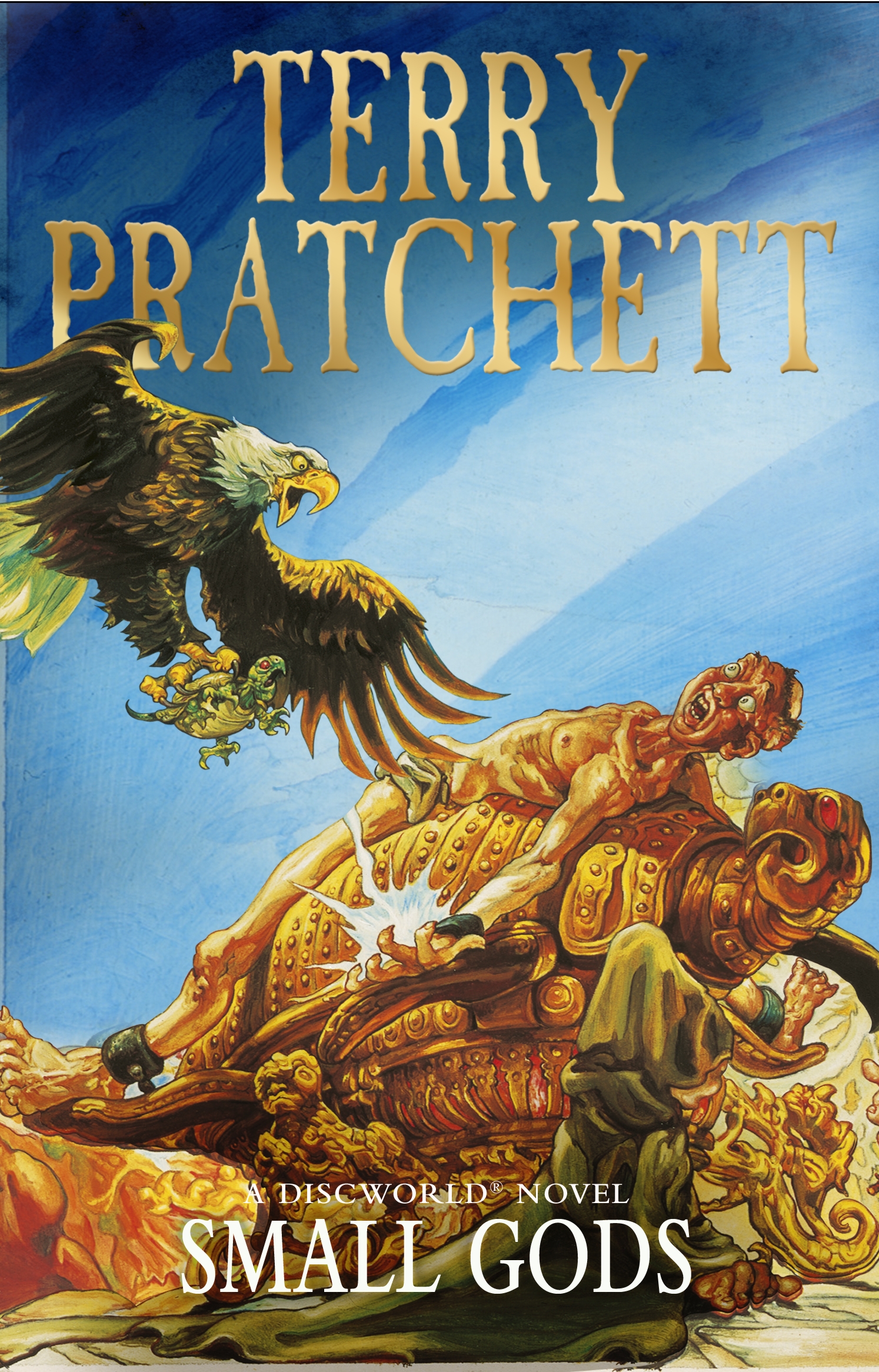
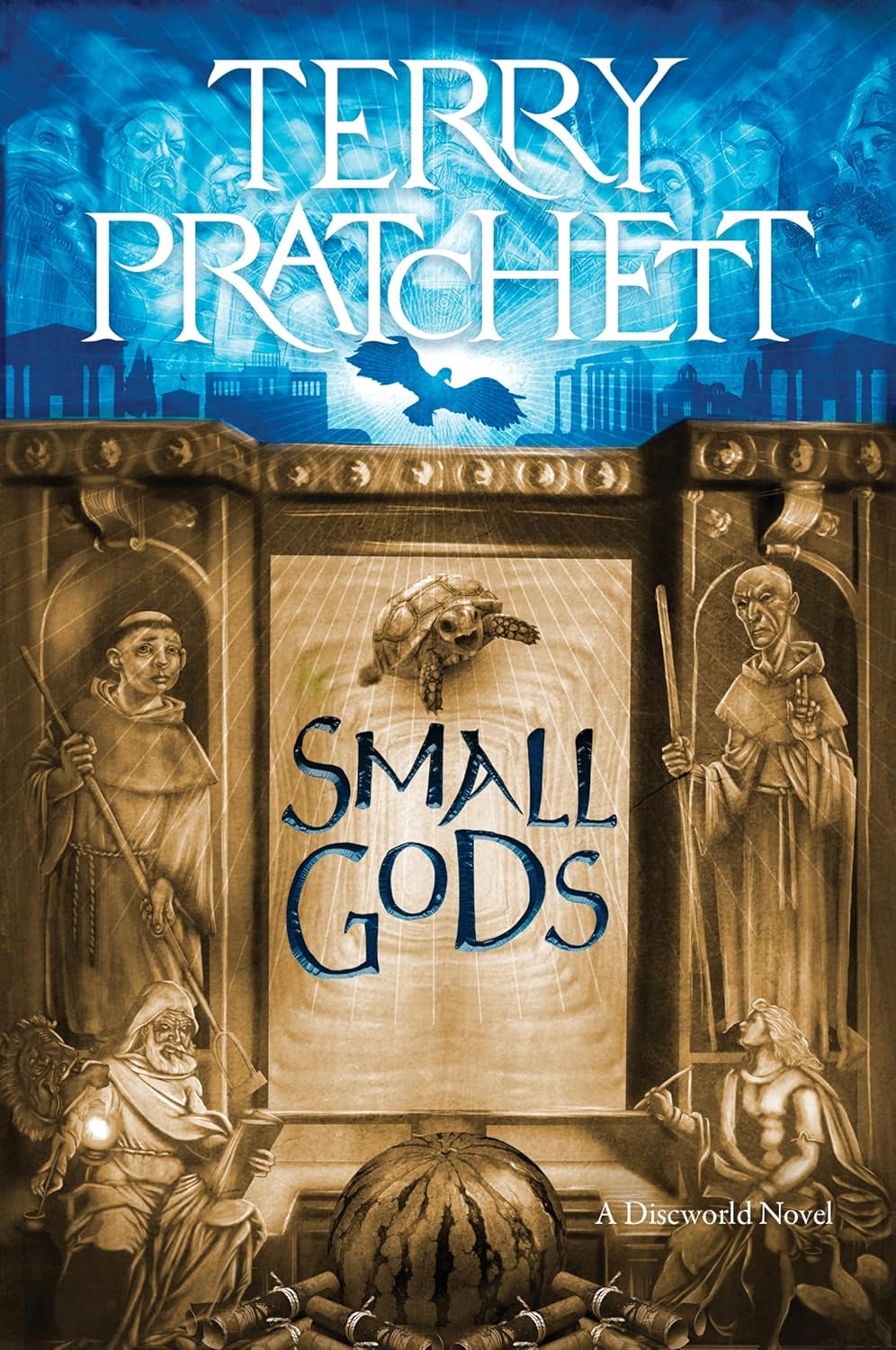
Small Gods by Terry Pratchett

Publisher: Gollancz/Penguin Audio (Audiobook – 1993)

Series: Discworld – Book 13

Length: 9 hours and 55 minutes (Planer version)/11 hours and 38 minutes (Serkis version)

My Rating: 5 out of 5 stars

Amazon

Thanks to an excellent road trip, I managed to revisit several awesome entries from the iconic Discworld series by the legendary Terry Pratchett, and it is time to highlight one of the very best books that Pratchett wrote, Small Gods.

I have never made any secret of the fact that I love all things Terry Pratchett, as the Discworld books were the formative series of my youth.  A massively popular collection of loosely connected novels set on a flat world carried through space on the back of four elephants atop a giant turtle, the Discworld books present a range of unique fantasy adventures backed with exceptional comedy and satire.  This series is so much fun, and I honestly love every single Discworld book, having read them all multiple times, usually while laughing myself silly.  Indeed, I am such a big fan of this series that I named my blog after a location in the universe.  Despite my overwhelming love for all things Discworld, I haven’t reviewed too many of the books on this blog, with Moving Pictures and The Last Continent previously being the only exception.  However, thanks to some great road trips giving me opportunities for revisiting some classics, I have recently published reviews for Guards! Guards! and an additional review for Moving Pictures.  I also recently re-listened to the impressive and thoughtful 13th entry in the series, Small Gods. An outstanding standalone novel that seeks to blend religious commentary with Pratchett’s strong humour and complex satire, Small Gods is one of the more thoughtful and moving Discworld books and is a must read for all fans of the franchise.

Floating through space on the back of a giant turtle, the Discworld is a place of magic, wonders, strange creatures and, unfortunately for the mortals just trying to live their lives, gods.  Instead of the wise and beatific beings we hope them to be, the gods of the Disc are a capricious and vain lot, empowered by the belief of their human worshippers.  But what happens when a mighty god loses his believers?

The militant nation of Omnia is an empire dedicated to the fervent worship of the Great God Om, an all-powerful being who knows all, sees all and is the only true god in the world.  The problem is none of that is true.  Instead, Om is a self-obsessed god among many, who barely pays attention to the people fighting in his name.  More importantly, he is currently residing in the body of a tortoise, stripped of nearly all his divine power, and the only person who can hear him is a simple novice, Brutha, who isn’t fully convinced that the talking tortoise smiting him with tiny thunderbolts is his god.

Determined to get back on top and find out why he lost his power, Om recruits Brutha as his unlikely prophet.  However, Brutha has his own problems as the sinister head of Omnia’s Quisition, Vorbis, has taken an interest in him.  Forced to accompany Vorbis on a diplomatic mission, Brutha soon begins to understand that the world is a far bigger place than he realised, and that there is something very wrong at the heart of his nation.

As the tides of history take Brutha and Om into strange new places, the two find themselves encountering unexpected dangers, including dangerous ideas, sinister eagles, rebels determined to prove that the world isn’t round, deranged philosophers and the small gods that lurk in the dark places.  To survive, Brutha will need to have faith in his god, but more importantly, Om will need to have faith in Brutha, especially when his own religion is turned against them.

After yet another re-read, Small Gods remains one of my favourite Discworld novels, and this is one of the very best examples of Terry Pratchett’s unique style and imagination.  A hilarious, yet thought-provoking read that cleverly dissects religion, divinity and people’s beliefs, Small Gods quickly grabs your full attention and refuses to let go until it’s powerful, terminal end.

I have so much love for the outstanding narrative that Pratchett pulled together for Small Gods, which tells one of the more unique standalone tales in the Discworld series.  I must admit, even after many reads, I am still very impressed that Pratchett decided to examine the nature of religion and belief through the lens of a hilarious odd-couple story that evolves into a road trip narrative.  Starting off on a very entertaining note with the unsuspecting new prophet of Om, Brutha, encountering his god in the form of a small, battered tortoise, Pratchett does a good job of introducing the nation of Omnia and its place in the wider setting.  This proves to be an effective start to the book, and a lot of the early themes and wider issues surrounding the nation of Omnia are well set-up.  You also get a great examination of the book’s three main characters, and their compelling early interactions in Omnia sets up a lot of the book’s character-driven narratives.  After this excellent introduction, Small Gods’ plot then moves to the bordering nation of Ephebe, which proves to be an intriguing centre of the novel, not only because it has some of the more entertaining sequences, but also because it begins to expand on some of the ideas from the front of Small Gods and you are given a good understanding of both Om’s situation and Brutha’s growth as a character.

The plot of Small Gods takes a powerful turn around halfway through, when Brutha helps further Vorbis’s schemes, only to then attempt to flee and do the right thing.  However, thanks to the influence of a rival god and unexpected technology, Brutha and Om are inadvertently stranded in the desert with a helpless Vorbis.  The following extensive scenes in the desert are probably the best parts of Small Gods, especially as Brutha begins to think for himself, and the philosophical clashes he has with Om set him up as the protagonist both the reader and the Omnians need.  Pratchett really dives into what it is to be human and divine in this section of the book, and I deeply appreciate the rich character development featured within these sections of the plot.  These desert scenes become even more impactful when Pratchett throws in a major obstacle for Brutha that threatens to push him over the edge into despair.  You really feel for Brutha as he has his crisis of faith, only to maintain his humanity in the last confrontation with Vorbis.  The subsequent scene on the metal turtle was very tense, and while I know some people dislike the end of Vorbis, I thought it was a very clever sequence, especially as Pratchett set up the hunting eagle perfectly.  Pratchett continues to wrap up the rest of the narrative in a very satisfying way, and while the war sequence might have been a little unnecessary, it allowed some great character arcs to come together and showed how much Om had grown as a god.  The final scene with Brutha once again showing his humanity no matter what, ended the book on satisfying and heart-felt note, I appreciated the hopeful tone Pratchett concluded his brilliant story on.  An overall impactful and moving narrative that brought together a lot of complex plotlines and character moments and ensured you were hooked the entire way through.

I have always believed that Small Gods was one of Pratchett’s better written books, as he effortlessly blended a complex fantasy narrative that examined religion with his typically brilliant humour and some outstanding characters.  Featuring one of his most complex and thought-provoking plots, Pratchett achieves so much with his intriguing inclusions, all without slowing down the speed of the book and keeping the tension and emotional charge of the book on high.  Introducing a cool new setting, Small Gods works well as a standalone entry in the larger series that cleverly expands on some previously introduced features, such as the selfish and somewhat stupid gods of the Disc, as well as cool locations like Ephebe (which was previously featured in Pyramids).  Due to its lack of major connections to the other entries in the Discworld series, Small Gods is a rather excellent introduction to Pratchett’s style and ability to dive into heavy topics with comedic content.  Like all of Pratchett’s books, Small Gods is hilarious, and I love the many different levels of humour contained with the book, that range from obvious jokes at over-the-top situations, subtle witticisms often contain within well-placed footnotes, to clever word or name gags.  Some of this humour is so subtle that it often goes over the reader’s head the first time, and you honestly need multiple readings to full appreciate every single joke or gag that Pratchett thought up (I still discover new jokes I previously missed every time I read a Pratchett novel).

However, the thing that ensures Small Gods stands out amongst the other brilliant Discworld novels is the author’s clever and insightful breakdown of religion and godhood on the Disc, which is both fascinating and entertaining.  A lot of the book’s powerful messaging, complex themes and some of the best humour, comes out of the exploration of the divine and how it relates to both this crazy fantasy setting and the real world.  While Pratchett does provide a lot of jokes about religion throughout the ages, he does it in a very intelligent and delicate way that makes the reader think.  Rather than simply dunking on religions and focussing on the negatives, Pratchett instead subtly satirises the institutions, manipulative leaders and unthinking traditions that can often complicate or weaponise religion.  A large amount of the plot revolves around Vorbis and the Omnian church violently trying the repress the idea that the world is flat and on the back of a giant turtle.  While this is primarily a fun parody of the Catholic church’s suppression of Galileo’s claims about the Earth orbiting the sun (and which is now both funnier and sadder, thanks to flat earthers), it also examines how some people utilise religion as an excuse for violent action and manipulate faith for their own ends, which is a powerful recurring them throughout the book.

At the same time, Pratchett also focuses on a compelling central character with true faith who explores the meaning of religion and how it impacts his people.  Seeing a likable character like Brutha recognise the problems in his nation allows readers to reflect and see the flaws in the organised religions Pratchett is parodying, while also appreciating the messages that these religions should strive for.  The various complex discussions, personal revelations and jokes within Small Gods allow for a very insightful read that reportedly resonates with both atheists and pro-religious figures (Pratchett apparently received a lot of fan mail from both groups who thought Small Gods was written for them).  I personally think that Pratchett’s thoughts and messages were extremely perceptive and layered with a great understand of humanity, and indeed many his compelling criticism or organised religion and how it is weaponised are more relevant now than when Small Gods was written, especially as it could also apply to other traditional institutions that are being abused.

Pratchett perfectly rounds out this incredible writing by featuring some of his very best characters, including several very complex figures who mature and evolve throughout the course of the book’s plot.  This includes the main protagonist, Brutha, a simple novice who finds himself the only person left who can hear Om due to his genuine belief in the god rather than in the institutions that surround the religious practices.  While initially portrayed as a somewhat dull and unthinking novice, you soon begin to realise that there is much greater complexity within Brutha, as well as the fact that he is a genuinely nice person held back by his simple ideas of life and faith.  Thanks to his interactions with Om, who provides greater clarity to his religious beliefs, as well as his experiences outside his insular nation, Brutha begins to evolve quickly as a person, gaining a greater appreciation for the wider world, as well as beginning the understand that the world isn’t quite as black and white as he believed.  It was fascinating to see Brutha develop as the book continues, especially as he begins to doubt his faith and rebel against the church and the god that had been his entire life.  His interactions with Om were quite entertaining, as the two eventually become a fun duo of equals, although Brutha does get the upper hand over his god in quite an entertaining and refreshing manner.  Brutha was also well defined by his relationship with the book’s antagonist, Vorbis, and their discussions about truth prove to be quite defining for Brutha as an inspiration for his rebellion.  However, unlike the rest of the cast, Brutha resists becoming the monster that Vorbis wants him to be, and his subsequent demonstrations of faith, reason and humanity, really set him up as one of Pratchett’s best and most likeable central protagonists.

Brutha is well matched by his god, Om, who honestly is one of the best deities featured in the Discworld series.  Formerly an all-powerful and arrogant god who didn’t care about his believers, Om finds himself suddenly trapped as a helpless tortoise who must desperately cling to Brutha to survive.  Om proves to be quite a fascinating and entertaining figure in Small Gods, especially as Pratchett perfectly portrays him as formerly powerful being who must now rely on the mercy of others.  His initial arrogance is very entertaining, and his subsequent wheedling manipulation of Brutha was a great follow-up that worked to keep him in the story.  However, it was his eventual co-evolution with Brutha that turned Om into a particularly compelling protagonist.  Despite his resistance, his bond to Brutha shapes him and forces him to see the world through human eyes, and the subsequent discourse on philosophy, life and how religion should be as they wander the dessert impacts Om just as much as Brutha.  This eventually causes them to reach an interesting and heartfelt religious partnership, and it was fascinating to see the previously selfish Om risk it all to save Brutha, especially when he is confronted by other gods who act the same way he used to.  I loved seeing this powerful and positive development in a divine figure, and Om really ended up being a compelling secondary protagonist with some of the best jokes.

While Brutha and Om are the heart and soul of Small Gods, this book would not be as impactful without its brilliant villain, Vorbis.  A cruel and unflinching figure, Vorbis is probably Pratchett’s most ruthless antagonist, who utilises the mechanisms of the church to achieve his goals.  However, rather than being a purely evil figure, Vorbis is shown to be simply someone who understands human nature and uses this knowledge to achieve his self-determined goals, which in some ways is worse than an obvious villain.  Pratchett does an outstanding job showcasing Vorbis’s dark, insular nature, and you come to really appreciate just how sinister he is, especially as his actions inspire other people to do evil things to try and match him.  He becomes even more immoral when compared to the very innocent Brutha, the only person that Vorbis occasionally sees as a real threat to his plans due to his legitimate belief, and their various interactions and discussion about the true nature of the world are quite powerful.  Pratchett features Vorbis perfectly throughout the book, and his final appearances, where he finally understands his own nature, are very satisfying to behold.

The rest of the cast of Small Gods are also quite impactful in their own way.  The blind philosopher, Didactylos, proves to be a fantastic voice of reason in the story, especially compared to the rest of the insane philosophers of Ephebe, and his very simple philosophy and viewpoint on life and truth give the characters, and the readers, much to think about amongst the discussions on religion.  Didactylos’s nephew, Urn, came across perfectly as a machine-obsessed proto engineer, whose storylines go in some interesting philosophical directions, especially when he realises what his inventions will be used for.  I had a very fun chuckle at the inclusion of Cut-Me-Own-Hand-Off Dhblah, a fun Omnian equivalent to the always entertaining Ankh-Morpork native, Cut-Me-Own-Throat Dibbler, while the Sweeper, Lu Tze, gets a great introduction as a secret history monk who occasionally changes events for the better.  Finally, the zealous Sergeant Simony, who leads the internal Omnian revolution against Vorbis, proves to be a very impressive figure who, despite being a fervent misotheist (someone who hates one specific god), has a belief in freedom and the turtle that matches Brutha’s faith in Om.  Simony serves as a very good example of just how far Vorbis can drive someone trying to do the wrong thing to achieve their goals, and I felt that he matched the fervour and faith of the other major characters in some fascinating ways.  This cast of characters was overall superb, and I really appreciated how well they complimented each other’s story arcs, as well as the intelligent themes Pratchett was trying to get across.

As with all the Discworld novels, I have enjoyed Small Gods as both a physical novel and an audiobook, and frankly this epic story comes across extremely well in all formats.  However, I have a very special place in my heart for the Discworld audiobooks, and the outstanding stories, elaborate characters and impressive and clever humour always comes across extremely well in this format.  I have had the great pleasure of listening to Small Gods multiple times over the years, and I want to highlight the two different unabridged version of Small Gods.

The first audiobook version of Small Gods is the original production narrated by Nigel Planer.  Small Gods was a particularly impressive example of Planer’s voice work, as he had to come up with unique voices for a range of unusual characters.  The Planer version of Small Gods is the one that I grew up with, and it is engrained in my mind as a result, especially as the narrator effortlessly moves through Pratchett’s many complex ideas and plots and brings them out in a fantastic and humours manner.  Planer provides all the voices in his version of Small Gods, and he perfectly encapsulated all the key figures of the book with his exceptional narrations.  You really get the full range of these character’s personalities and emotions through Planer’s voice work, and I loved his clever takes on Pratchett’s distinctive cast.  As such, the Planer version of Small Gods is probably the gold standard for all Discworld fans, and it will always have a very special place in my heart.

There is also a recently released version of Small Gods that is narrated by three brilliant British talents, and which was the version I most recently enjoyed.  This new Small Gods audiobook features a runtime of around 12 hours, which is a little longer than the roughly 10-hour long Planer version and provides an interesting new take on the novel.  I really enjoyed the voice cast for this new audiobook, as not only do we once again get Peter Serafinowicz and Bill Nighy in their recurring roles, but it also features the primary narration of actor Andy Serkis.

Serkis, who has also narrated a recent version of The Lord of the Rings books that is worth checking out, does an exceptional job in Small Gods, ensuring a very fun experience for all listeners.  While there are some tonal shifts in this audiobook that fans of the Planer version may find a little surprising or jarring, for the most part I think Serkis matches and even occasionally exceeds Nigel Planer’s performance, and I very much enjoyed his take on the book.  His basic narration of Small Gods matches Pratchett’s style and humour extremely well, and I love how effectively he moves the story along, perfectly capturing the complex tone and energy of the plot.  However, it is Serkis’s entertaining voices that were the highlight of this version of Small Gods, as the characters are each given unique tones that fit their personalities in some fantastic ways.  His voice for Brutha, the central character, was extremely good, and I loved how well Serkis captured Brutha’s transformative journey and complex personality.  Utilising a fitting rural voice for the protagonist, Serkis successfully showcases Brutha’s changing mentality and deep moral roots with his narration, and you can honestly imagine this intriguing figure every time the narrator voices him.

In comparison to Brutha, the voices for Vorbis and the Great God Om were a lot more elaborate by necessity, and I really appreciated the fantastic tones that Serkis choice for these entertaining figures.  My favourite was probably the voice used for Vorbis, as the narrator gifted this antagonist a deep, rich and lingering voice that honestly put me in mind of Tony Jay or Alan Rickman with some added oily sinisterness.  This impactful voice perfectly fit Vorbis’ menacing personality, and whenever the listener hears the voice, you know bad stuff is about to go down for the rest of the cast.  As for Om, Serkis provides him with an unrefined and laddish voice with a Liverpool accent.  This interesting voice choice matched Om’s uncaring and selfish personality extremely well, and I liked how well Serkis’s chosen tone for this divine figure played into the overarching theme that gods on the Discworld aren’t as sophisticated as everyone assumes they are.  Most of the rest of the voices in Small Gods work extremely well, with Sergeant Simony and Cut-Me-Own-Hand-Off Dhblah having memorable voices as a result.  However, I felt that the strong American accents that Serkis assigned to Didactylos and Urn really didn’t work, and failed to match the tone of the rest of the audiobook.  While Serkis was probably trying to distinguish these two from the other Ephebian philosophers, their voices honestly grated on me, and I really wish he’d have tried something else.  Still, the rest of Serkis’ voice work was amazing, and I cannot emphasise how incredible most of his narration of Small Gods turned out to be.

Serkis’s main narration was perfectly enhanced with the inclusion of Peter Serafinowicz and Bill Nighy in their recurring roles from the new Discworld audiobooks.  Serafinowicz provides the voice of Death whenever he appears in this audiobook, which is a lot of fun as Serafinowicz has an extremely entertaining Death voice that captures the anthropomorphic personification in all his skeletal glory.  His multiple appearances in Small Gods, leading key character towards the desert of judgement, were very awesome, and I loved hearing Serafinowicz converse with the other characters as Death.  The audiobook production team does an excellent job sliding the Death voice into Serkis’s main narration seamlessly, and I love it when Serafinowicz’s voice suddenly appears during dangerous scenes, heralding that someone is about to die, and ensuring there is some great tension as you watch the other characters slowly realise something is very wrong.  Nighy, on the other hand, narrates the various footnotes that Pratchett included in his text, providing an extra layer of humour.  While there are relatively few footnotes in Small Gods, it is a key role that Nighy perfectly fulfils, and his calm, consistent tones, echoing Peter Jones’s similar role in The Hitchhiker’s Guide to the Galaxy radio and TV editions really highlighted the subtle comedy of these footnotes. These three exceptional actors come together perfectly and provide an outstanding overall performance that I could not get enough of.  This was a truly exceptional audiobook that I think is on par with the previous Planer version, and I would strongly recommend both audiobooks as an amazing way to enjoy Small Gods, especially if you need to listen to something while travelling.

Well, as I am currently just getting to the end of page seven of my review for Small Gods by Terry Pratchett, I think it is a safe assumption to say that I love this amazing book.  Easily one of my favourite Discworld novels, Small Gods perfectly blends a brilliant story and amazing characters with Pratchett’s amazing wit and his uncanny insights into compelling real-world issues.  An incredible and addictive read from start to finish, Small Gods comes extremely highly recommended and can easily be enjoyed by anyone wanting a clever, funny and heartfelt read, especially on its two audiobook formats.
Amazon

Moving Pictures by Terry Pratchett – Supplementary Audiobook Review

Publisher: Gollancz/Penguin Audio (Audiobook – 1991)

Series: Discworld – Book 10

Length: 9 hours and 54 minutes

My Rating: 5 out of 5 stars

Amazon

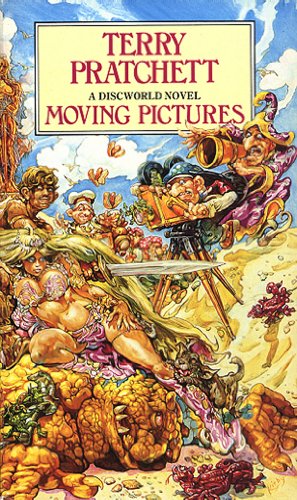
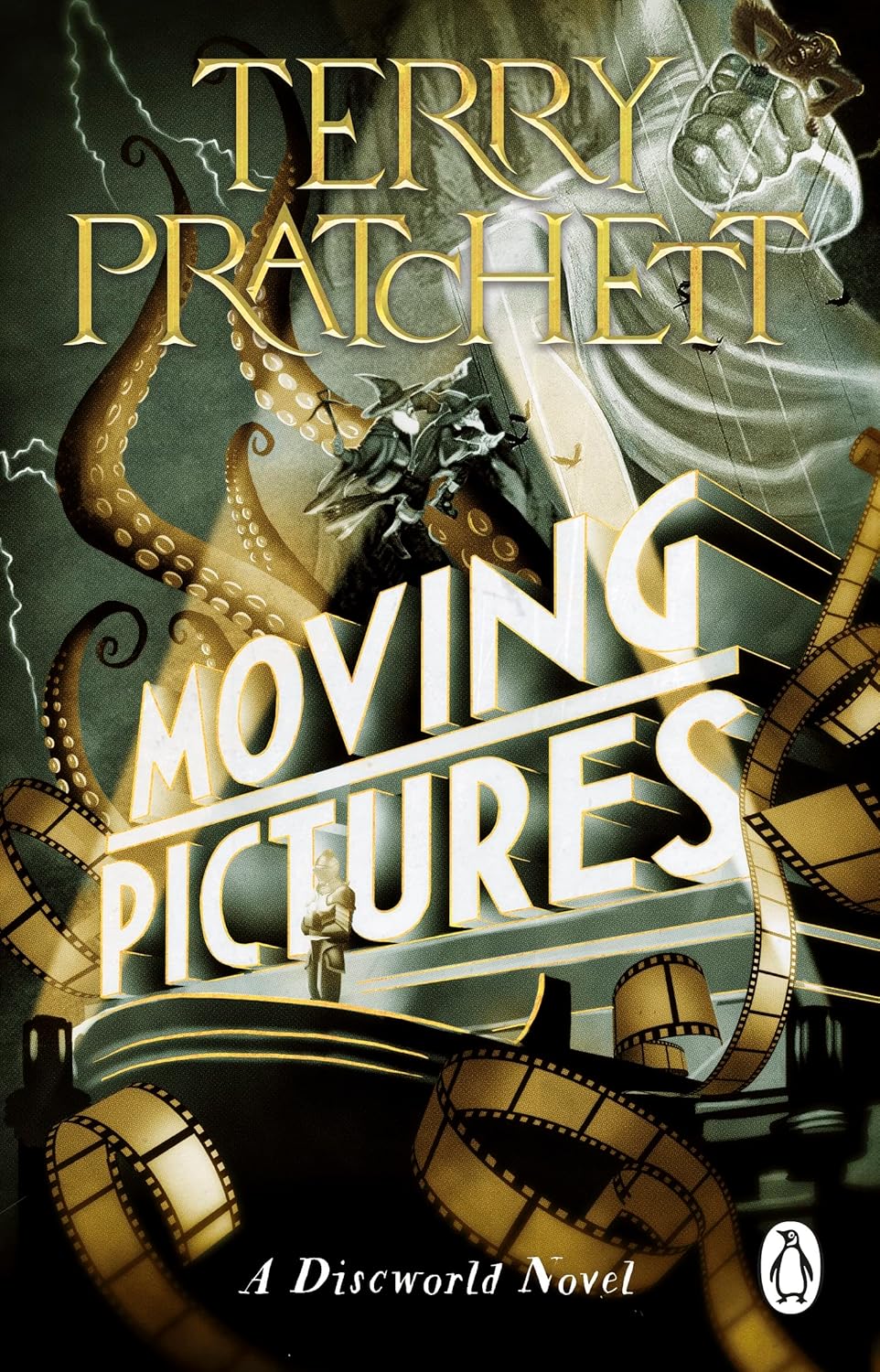
Thanks to a recent road trip, I have once again reviewed the exceptional Terry Pratchett novel, Moving Pictures, which is one of my favourite books in late Pratchett’s exceptional Discworld series.  The 10th Discworld book, Moving Pictures was a Pratchett classic that provided a satirical look at the golden age of the film industry when it mysteriously emerges on the chaotic and magic-laden Discworld.

Plot Synopsis:

The alchemists of the Discworld have discovered the magic of the silver screen. But what is the dark secret of Holy Wood hill?

It’s up to Victor Tugelbend (”Can’t sing. Can’t dance. Can handle a sword a little”) and Theda Withel (”I come from a little town you’ve probably never heard of”) to find out…

MOVING PICTURES, THE TENTH DISCWORLD NOVEL IS A GLORIOUSLY FUNNY SAGA SET AGAINST THE BACKGROUND OF A WORLD GONE MAD!

Now, I feel this is a good time to point out that I have already reviewed Moving Pictures on this blog a few years ago.  I provided a pretty detailed examination of Moving Pictures in the review HERE, and lauded it’s many good points, including its compelling plot, its fantastic comedic take on the golden age of film, as well as the impressive way that Pratchett introduced or expanded upon an array of key supporting Discworld characters, many of whom went on to have key roles in other novels in the series.  All these previous points still stand, and I still deeply enjoy Moving Pictures after this new re-read, indeed I picked up on another joke or two that I have missed in previous outings.  As such, I am not going to do a whole new review about this book here, although I do want to quickly spend some time talking the new audiobook version of Moving Pictures.

Fans of this blog will know that I am a massive audiobook lover, and I love checking out compelling series in this format.  The Discworld books are one of my favourite audiobook series, and there have been some awesome versions released over the years.  When I last reviewed Moving Pictures, I talked up the original audiobook narrated by Nigel Planer, who provided his voice to over half the Discworld audiobooks.  The Nigel Planer version of Moving Pictures is the one that I grew up with, and I deeply enjoyed his exceptional take on book, especially as he provided a huge array of incredible voices to the production.  In many ways the Planer version of Moving Pictures is still the best audiobook adaptation out there, but with the recent release of all the Discworld audiobooks with a fresh team of high-profile narrators, I thought I’d give the new version of Moving Pictures a try, especially when engaged on a road trip.

The new Moving Pictures audiobook is part of a recent re-recording of all the Discworld novels, each of which features a famous British performer voicing the main plot, while acclaimed actors Peter Serafinowicz and Bill Nighy have key roles in every single production.  While these have been out for a little while, I have only listened to a couple, including Guards! Guards!, and I have so far been really impressed with how they have turned out.  This new recording of Moving Pictures was a fantastic addition to the series, and I really enjoyed the fresh take on the audiobook production.  Featuring a run time of just under 10 hours, which is slightly shorter than the Nigel Planer version, this proved to be an easy audiobook to power through in a couple of lengthy car-contained sessions.

This latest Moving Pictures audiobook production is primarily narrated by major British actor Jason Isaacs, who does an outstanding job bringing this audiobook to life.  Providing a compelling and different take on the basic narration and some of the characters, Isaacs breaths new life into the production, and I really enjoyed how he presented the book’s entertaining narrative.  Issacs’s basic voice works very well in conjunction with the other narrators working on this production, and I appreciated how smoothly and effectively he moved the plot along.  Isaacs also provides a range of excellent voices to the various characters featured within the audiobook, and I liked some of his interesting takes on Pratchett’s outrageous characters, especially as it casts them in a somewhat different light to how Planer featured them.

The main protagonist, Victor, got a pretty satisfying voice that captured both his intelligence and his role as the straight man of the story perfectly, and I felt that it was a very solid choice by Isaacs.  I also quite liked his takes on some of the more outrageous figures in the book, including the various wizards, who get fantastic crazy old men voices, Detritus the troll, whose voice has a layer of more complexity to it, and Cut-Me-Own-Throat Dibbler, who Isaacs gifts a great greasy film producer voice.  I personally thought that his voice for Gaspode the dog was one of his better choices, especially as he perfectly captured the talking dog’s sarcastic personality and occasionally self-pitying manner.  The corresponding voice of Laddie, a dog of normal intelligence, was fantastic in comparison, and it was one that Isaacs had fun matching the dog’s breading and intentions.  Many of the other voices were also extremely well done, and while I think that Planer might have had a better grasp on a few of the characters, such as Ginger, Isaacs proved to be quite exceptional in his own right and masterfully steered this new production along.

As with all the entries in this new run of Discworld audiobooks, Isaacs’s primary narration was backed up by Peter Serafinowicz and Bill Nighy in their respective roles.  Serafinowicz provides the voice of Death whenever he appears in this audiobook, which works out extremely well even with Death’s relatively limited role in Moving Pictures.  Serafinowicz has an awesome Death voice, and I loved when it appears throughout the audiobook as it blends with Issacs’ voices very well.  Nighy continues to voice all the footnotes in the book, which is a perfect role for Nighy, as his calm, consistent tones bring some fantastic class to the story and proves to be an excellent way to highlight Pratchett’s amusing and clever annotations.  While Nighy doesn’t have too much to do in Moving Pictures as there aren’t too many footnotes, some of his takes were pretty fun, especially when he had to translate an exaggerated troll song.  These three distinctive actors did a great job vibing together in this new Moving Pictures audiobook, and they brought some great life and a unique take on this classic Discworld book.

Overall, I felt that this new version of Moving Pictures was a very worthy adaptation, and the team of Jason Isaacs, Peter Serafinowicz and Bill Nighy worked extremely well together.  While Nigel Planer’s original narration is always going to be the gold standard for me when it comes to Moving Pictures (both due to his talent and my own nostalgia), this new version was also extremely good, and will be a great way for a new generation of Discworld audiobook fans to experience this amazing entry.  As such, I would recommend this version to anyone interested in checking out Moving Pictures, and after the outstanding time I had last week, I can guarantee it is an excellent accompaniment for any descent length road trip you might need to take.

Amazon

Waiting on Wednesday – When the Moon Hits Your Eye by John Scalzi

Welcome to my weekly segment, Waiting on Wednesday, where I look at upcoming books that I am planning to order and review in the next few months and which I think I will really enjoy.  This week to celebrate the new year I am doing two Waiting on Wednesday posts to really highlight some awesome upcoming books.  I have already looked at the upcoming Usagi Yojimbo volume by Stan Sakai, The Crow, and in this post I want to talk about a cool and hilarious upcoming science fiction novel, When the Moon Hits Your Eye by the always entertaining John Scalzi.

Amazon

Scalzi is a fantastic author whose career is defined by an array of intriguing and inventive science fiction novels.  Best known for his Old Man’s War series, Scalzi has produced some impressive and fun series and standalone novels over the years, including the hilarious Redshirts, the compelling monster focused The Kaiju Preservation Society, and the outstanding 2023 release, Starter Villain.  All these novels were really fun and entertaining in their own unique ways, and I have resolved to try and grab all of Scalzi’s new books whenever they come out.

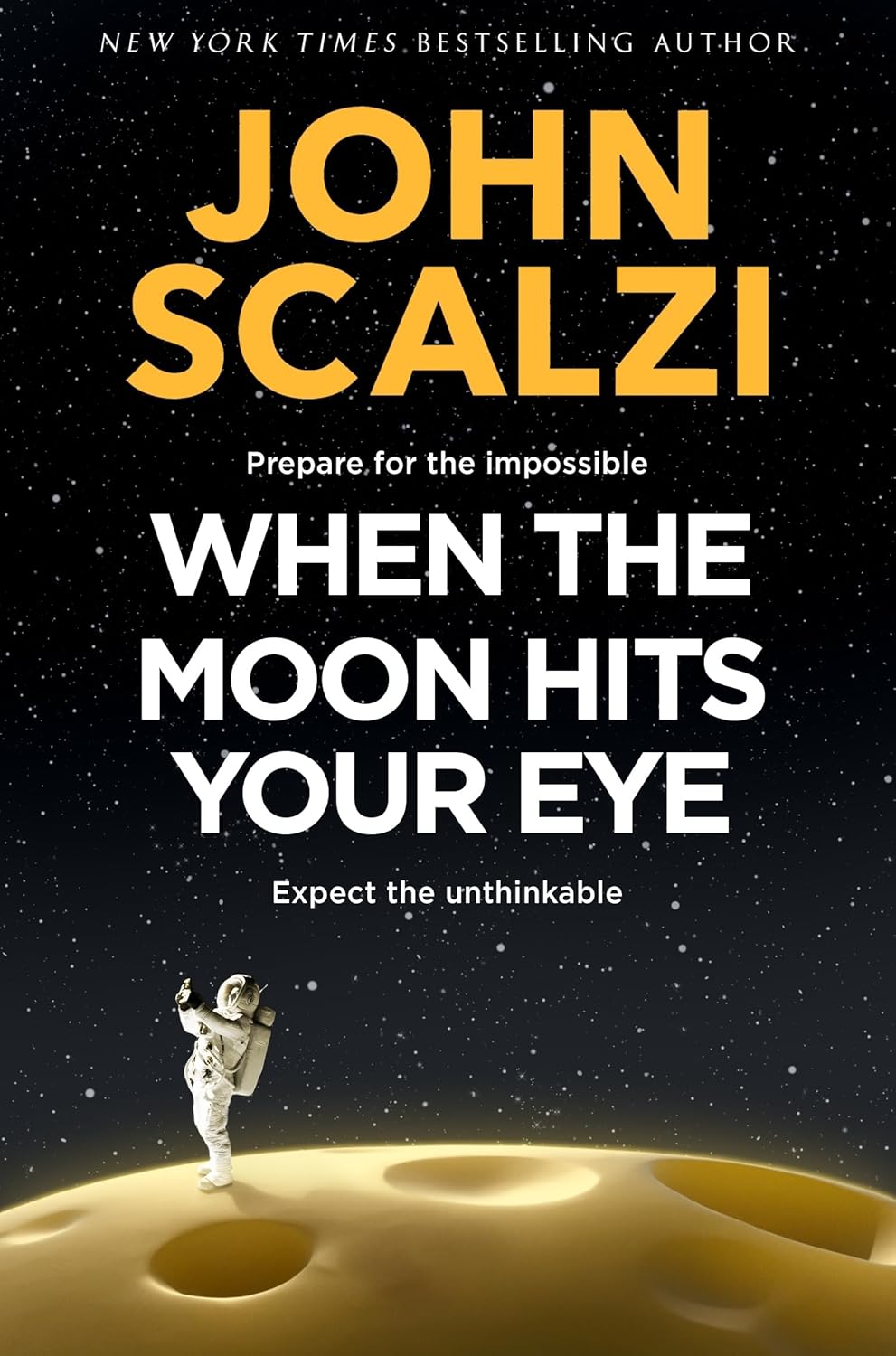
To that end, I really want to highlight Scalzi’s next upcoming novel because it sounds so damn outrageous and distinctive.  This book, When the Moon Hits Your Eye, is currently set for release in March 2025 and features a unique and memorable plot that is very Scalzi.  I honestly laughed myself silly the first time I saw what this book was going be based around, although I must admit it has a lot of potential.

Plot Synopsis:

One day, without explanation, the moon turns into a ball of cheese.

For some, it’s an opportunity. For others, it’s time to question their life choices. How can the world stay the same in the face of such absurdity and uncertainty?

Astronauts and billionaires, comedians and bank executives, professors and presidents, teenagers and patients at the end of their lives – over the length of a lunar cycle, each gets their moment in the moonlight. To panic, to plan, to wonder and to hope, to laugh and to grieve. All in a story that goes all the places you’d expect, and to many others you could never anticipate. For the people of the earth, this could be the end – or the beginning of a whole new world.

From the Hugo and Locus Award-winning author John Scalzi, When the Moon Hits Your Eye is an entirely serious take on an entirely unserious subject.

So yeah, this is going to be a book about the moon turning into a big ball of cheese, and if that isn’t a Scalzi story than I don’t know what is.  While When the Moon Hits Your Eye sounds a bit weird, I personally am really excited for it.  Scalzi has a great track record of turning unlikely stories into outstanding books and I think this could be one of his better ones.  I am very interested in seeing how Scalzi envisions this massive lunar change impacting the entire world, and it should result in some very fun and unique scenarios.

Based on the synopsis above, it seems like Scalzi is going for a wide-spread character-focussed plot with When the Moon Hits Your Eye as he examines multiple people impacted by this phenomenon across the world.  Setting this over the length of a lunar cycle and seeing all the different ways characters react has some real potential, and I am sure Scalzi will fit in his usual clever humour and great character work.

While I was already planning to grab the new Scalzi before I knew anything about it, When the Moon Hits Your Eye is now very high on my to-read list thanks to the crazy synopsis above.  I am so damn curious to see what sort of outrageous and fun narrative John Scalzi will weave around the moon turning into a ball of cheese, and it is clear we are in for a wild ride.  When the Moon Hits Your Eye will easily be one of the more distinctive science fiction novels of 2025 and I cannot wait to power through this unlikely story the first chance I can.

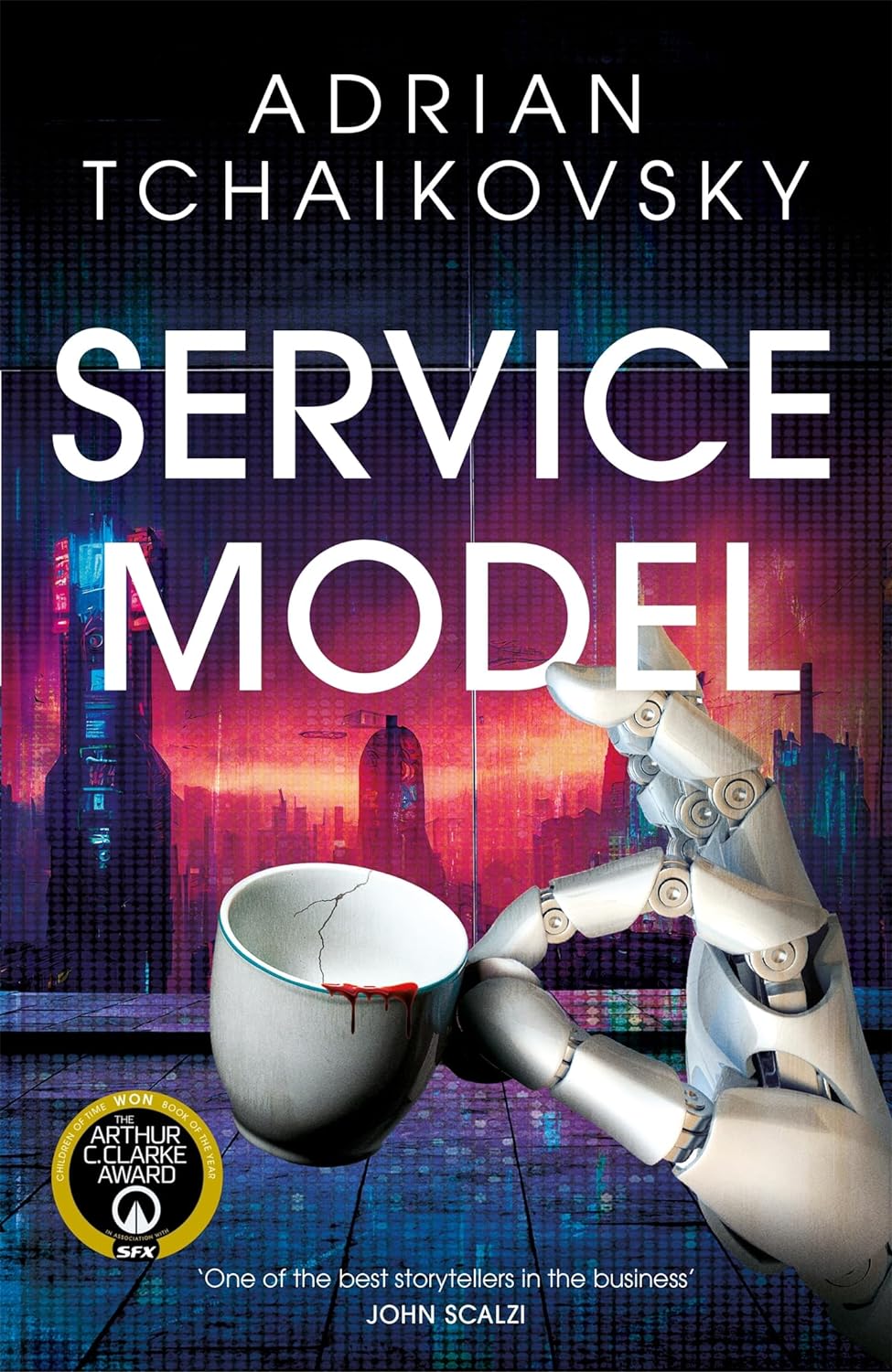
Service Model by Adrian Tchaikovsky

Publisher: Tor (ebook – 6 June 2024)

Series: Standalone

Length: 369 pages

My Rating: 5 out of 5 stars

Amazon

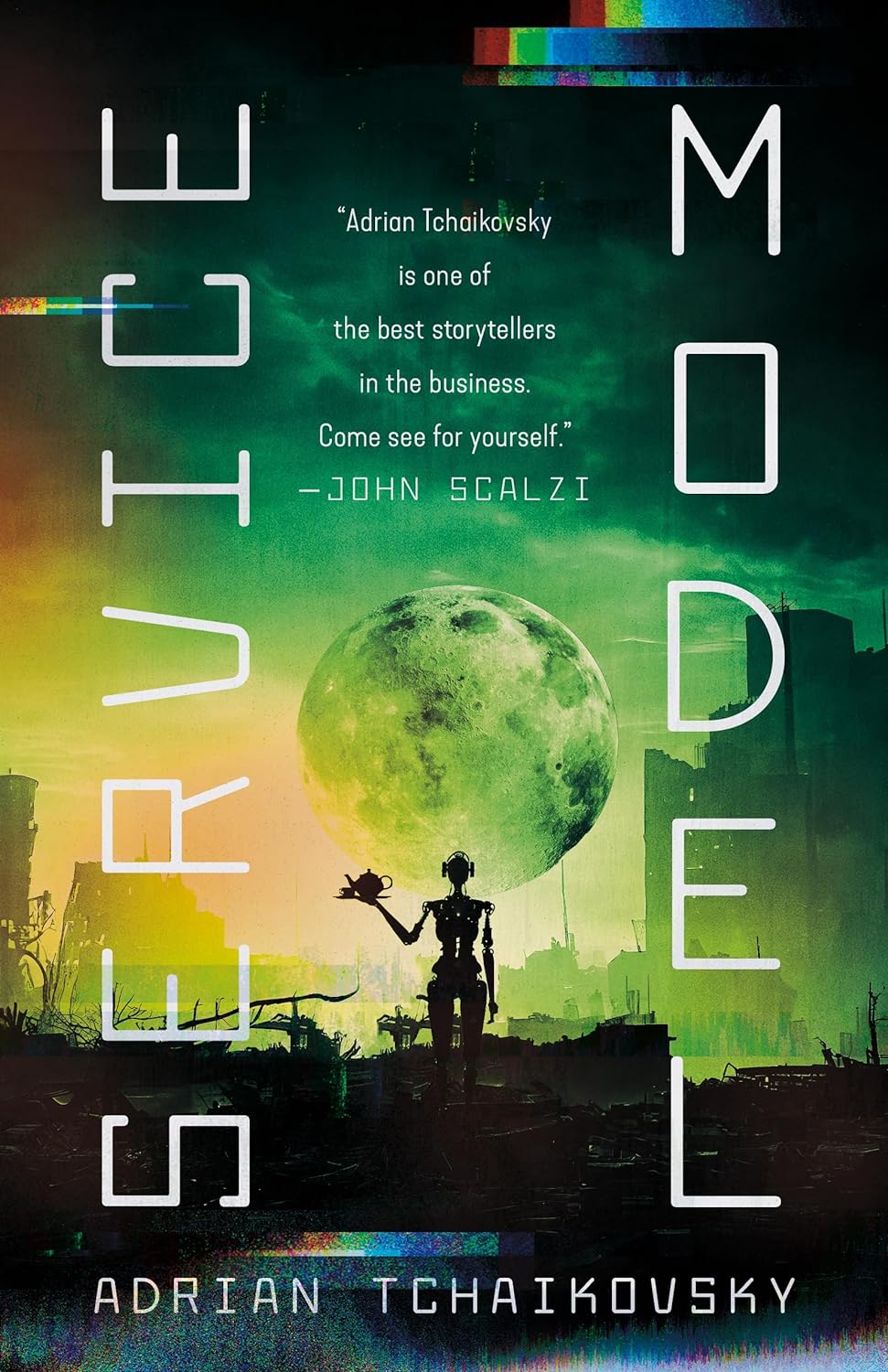
The line between man and machine is about to blurred in the most hilarious of ways as one of the world’s best science fiction authors, Adrian Tchaikovsky, presents the brilliantly satirical novel, Service Model.

The last couple of years have seen me really get into the writings of acclaimed author Adrian Tchaikovsky, whose work in the fantasy and science fiction genres has been truly amazing.  While Tchaikovsky has written many books over the years, I am more familiar with his recent works, including the novella Ogres, one of my favourite Warhammer 40,000 novels, Day of Ascension, and his first two Tyrant Philosophers novels, City of Last Chances and House of Open Wounds, both of which were amongst my favourite books of 2023.  2024 has proven to be a particularly big year for Tchaikovsky, as he has released four separate books.  The first of these, Alien Clay, was a compelling and memorable science fiction adventure on a deadly prison planet filled with unusual alien life, and I had a great time with it.  I also made sure to check out the brilliant and fantastic novel, Service Model, which had a hilarious plot behind it that I just couldn’t turn away from.

In the far future, the remnants of humanity are utterly reliant on artificial labour and service.  Living in estates completely staffed by robots and advanced computer systems, the remaining humans have every aspect of their lives taken care of.  But what happens when their robot servants find new and dangerous ideas loaded into their heads?

Charles is the loyal body robot to one of these humans.  Content to serve and enact the often confusing and contradictory orders of his master, Charles’s life is one of routine and protocol.  That is until one day an apparent fault in his programming causes him to murder his master.  Now without an employer or a purpose, Charles is forced to leave the household and embark on a journey into the wider world, one he never knew existed.  Here, despite all his expectations, he encounters a crumbling world in which all the humans are gone and the robots that remain are stuck completing illogical or impossible tasks.

After a chance encounter with a mysterious and self-determined figure, Charles embarks on a new mission, to find new employment as a body servant and once again gain purpose.  However, finding a suitable employer in this new world is tricky as every potential boss is dead, insane, or trapped within their own contradictory tasks.  It soon becomes apparent that if Charles is to once again find a suitable purpose in life, he must either find the cause for humanity’s fall or take everybody down with him.

Service Model was a very clever, entertaining and compelling science fiction adventure that I could not get enough of.  Featuring Tchaikovsky’s trademark satirical wit and unique outlook on all manner of life, Service Model was a particularly awesome read that was equal measures funny and tragic, but all entertainment.  A fantastic and inventive novel I had to give a full five-star rating to.

Tchaikovsky really went out of his way to produce a hilarious and intense story about life, decisions and the crumbling future in Service Model, and I loved every single mad second of it.  Set around the unlikely protagonist, Charles (later rechristened Uncharles), Service Model starts with Charles satisfied with his existence as a body servant, until he unexpectantly kills his master.  Forced to leave the manor, Charles journeys towards the repair yard, only to discover that the world is nothing like he expected, and that everything built by humans is failing, taking the robots down with them.

Faced with nothing but inconsistencies and illogical fellow robots, Charles embarks on a quest to find a new human master or some form of purpose.  Assisted and occasionally hindered by the strange robot The Wonk, who is definitely not a human in disguise, Charles encounters the many unlikely and unusual examples of continued society left in the world, from an illogical attempt to keep human society going (essentially a human zoo), a group of insane librarians (more insane than typical librarians), rival robot armies, and other outrageous occurrence of robotic life.  The book pretty much revolves around Charles and The Wonk discovering these societies, learning their flaws, and then trying to find a way to help or escape their respective crazy ideas.  There are a ton of highly amusing interactions and outrageous scenes throughout this intense quest, and I loved some of the wonderfully weird scenarios that emerged as Tchaikovsky utilises his considerable imagination to envision the grim future.  Everything ends on a very interesting note, as the protagonists find the answers they are looking for, even if it’s not what they wanted, and there is a hopeful conclusion that fits the recurring themes of Service Model perfectly and leaves the reader thoughtful going out.

Service Model ended up being an outstanding and complex standalone science fiction novel that perfectly combined a fun adventure story with the author’s cynical humour to create a powerful and inventive read.  Tchaikovsky utilises a unique writing style for this book, that seeks to really drive home the robotic nature of the main protagonist to the reader.  While this does result in some aesthetic and stylistic choices that some readers might not enjoy, especially around the dialogue, I personally felt that it fit the story perfectly and was a clever way of expressing the thoughts and motivations of the unusual point of view protagonist.  You really begin to appreciate the programmed, yet changing, mindset of Charles as the book continues, and it proves interesting to slowly see this robot realise just broken the world around him is.  There are some surprisingly deep emotional moments captured within this tale of automated life, especially tied around the great characters of Charles and The Wonk, and it was fascinating and touching to see how they developed together.  As such, Service Model proves to be a multi-layered and complex read, and it proves very hard to pull away from it at times.

One of the main reasons that I enjoyed Service Model so much was the fantastic and intelligent humour that Tchaikovsky infused his story with.  Like with most of Tchaikovsky’s more light-hearted books, much of this humour is tied into the author’s cynical view of humanity and the future, and I loved once again seeing the author’s take on how doomed we are.  In Service Model, a lot of this humour is tied into the failure of systems, overreliance on technology and human shortsightedness as the various robot characters try to enact the various incomplete, ill-advised or just plain insane commands of the former human masters.  There are so many examples of Charles or other robots trying to complete these instructions to the best of their ability, only to bring greater chaos or misunderstanding to those around them, and it is fun, if a tad depressing, to see these events unfold.  Tchaikovsky throws in even more insane occurrences of this, as certain robots have taken their former illogical instructions or existing systems too far, resulting in elaborate quests, wars or other activities, often for a broken or non-existent purpose.  Seeing the protagonist explore these events and either try to navigate them or find their place within them results in some very absurd but clever moments, and I liked how Tchaikovsky played these events for laughs while also using them to show the protagonist just how broken the current way of thinking is.  I really enjoyed this dark humour, especially as the author uses it to make you think at the same time, and it helped to turn Service Model into quite an entertaining and captivating read.

Adrian Tchaikovsky continues to shine with this brilliant and addictive science fiction read.  Bringing together a compelling and moving story of self-discovery with some fantastic humour and a post-apocalyptic setting loaded with disorganised and distressed robots, Service Model keeps you laughing while also hitting you in the feels.  I had an exceptional time with Service Model, and it was a true pleasure to read.  I cannot wait to check out more of Tchaikovsky’s books in 2025, and my next stop will have to be the outstanding Days of Shattered Faith.

Amazon

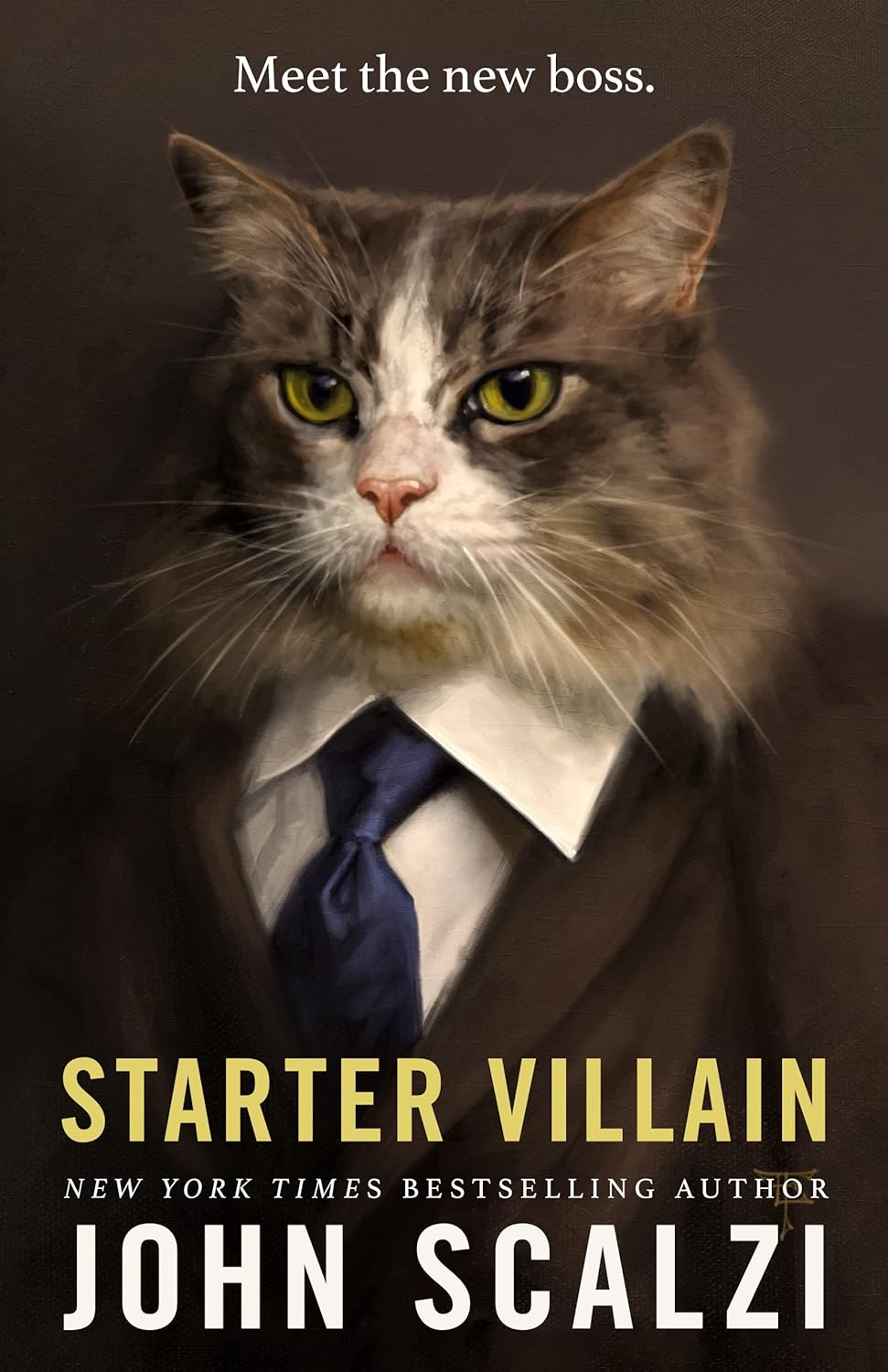
Quick Review – Starter Villain by John Scalzi

Publisher: Tor (ebook – 23 September 2023)

Series: Standalone

Length: 256 pages

My Rating: 4.5 out of 5 stars

Amazon

As we are getting towards the end of 2024, it’s probably about time I got around to writing something about one of the more hilarious and wildly entertaining books I checked out last year, the outstanding novel Starter Villain by John Scalzi.

John Scalzi is an outstanding science fiction author who has produced some intriguing and thoughtful books over the years.  Best known for his Old Man’s War series that followed the science fiction adventures of old human military volunteers whose minds are transferred to younger, genetically modified body, Scalzi is a highly inventive writer who creates some elaborate and powerful scenarios.  While he has written some very compelling science fiction series, I best know Scalzi from his standalone books where he and turns some outrageous ideas into wonderful tales of humanity.  My favourite is Redshirts, a fantastic and very clever Star Trek parody that imagines life aboard an Enterprise-esque ship from the point of view of the expendable lower-decks crew.  I also had a ton of fun with Scalzi’s 2022 novel, The Kaiju Preservation Society, which showcased the intriguing adventures of an organisation dedicated to preserving kaiju in a parallel universe.  All these books were very fun, which is why I made sure to grab a copy of the 2023 release, Starter Villian, which had a great plot behind it.


Plot Synopsis:

Inheriting your uncle’s supervillain business is more complicated than you might think. Particularly when you discover who’s running the place.

Charlie’s life is going nowhere fast. A divorced substitute teacher living with his cat in a house his siblings want to sell, all he wants is to open a pub downtown, if only the bank will approve his loan.

Then his long-lost uncle Jake dies and leaves his supervillain business (complete with island volcano lair) to Charlie.

But becoming a supervillain isn’t all giant laser death rays and lava pits. Jake had enemies, and now they’re coming after Charlie. His uncle might have been a stand-up, old-fashioned kind of villain, but these are the real thing: rich, soulless predators backed by multinational corporations and venture capital.

It’s up to Charlie to win the war his uncle started against a league of supervillains. But with unionized dolphins, hyperintelligent talking spy cats, and a terrifying henchperson at his side, going bad is starting to look pretty good.

In a dog-eat-dog world…be a cat.


This was a highly entertaining novel from Scalzi, who provides his own unique take on supervillains in all the best ways.  Starting off with a very comical funeral scene, Starter Villain only gets better from there as the protagonist, Charlie, finds his life unexpectantly changed when he inherits his uncle’s supervillain business and associated wealth.  Scalzi provides a fantastic introduction to the unique new world of super science and sinister business practices, and you are soon caught up in Charlie’s unlikely rise to the top.  The first half of the book is loaded with intriguing scenes as Scalzi lets his imagination run wild, and you have a fantastic time learning about sentient cats, crude talking dolphins constantly going on strike, and the other unlikely inventions and people that now make up Charlie’s life.  This compelling introduction to the world works well in setting up the second half of the story, as Charlie meets a cabal of similar uber-rich supervillains who all seek to exploit him.  When a series of events outside of his control force him into a battle of survival against these supervillains, Charlie needs all his new allies and his own unique ideas to win the day, even if victory isn’t quite what he imagined.

Starter Villain was such a lovely and impressive read, and I loved seeing Scalzi utilise his humour into something more terrestrial, yet still out of this world.  Featuring the author’s typical fast pace, Starter Villain hits the ground running and throws you right into the middle of Scalzi’s fantastic and memorable ideas.  The resulting story is clever, addictive, and features some amazing twists, all of which is very awesome to see unfold.  While there is a lot of mad science, Scalzi does try to ground the supervillain antics, and I loved the author’s thoughts on how such an organisation could exist in the modern world and what sort of nefarious actions they would participate in.  Naturally this means corporations and the uber-wealthy, which is depressingly accurate if you consider recent events, although this does mean that the antagonists are very easy to dislike and entirely unredeemable.  The author loads in so much clever humour around the general supervillain scenario, and I loved the fantastic jokes about the profession, the inventions that are being created, and the unusual ways they stay in power.  A lot of jokes about supervillains also provide some excellent commentary on current society, which cynical people like me will enjoy (a joke about a potential Australian recruit to the supervillain cabal hit close to home, which was just perfect).  This is a hilarious and well-put together read that expertly showcases the author’s inventive spirit.

I also want to mention the fantastic range of complex and eccentric characters featured throughout Starter Villain, who helped to make the story even more unique and funny.  Most of the book’s focus goes around the protagonist, Charlie, who finds himself thrust into a new world of dangerous rich elites and supervillain logic.  Charlie proves to be a great central figure for Starter Villain’s plot, mainly because he plays a great everyman character whose reaction to the narrative’s crazy events mirrors that of the reader.  While slightly bland compared to the other outrageous characters, Charlie does experience some excellent growth, especially as he learns to take responsibility and to appreciate the life he has.  I also enjoyed how Charlie, despite being new to the supervillain lifestyle, was able to work out solutions to his organisation’s big problems often by being his typical thoughtful self.  The rest of the characters in Starter Villain are all allowed to go wild due to having Charlie as the perspective protagonist, and I loved the array of talking dolphins, unusual scientists, murderous goons and rich manipulators that Charlie had to either work with or overcome.  My favourite figures were easily the highly intelligent sentient cats, who really run the company and who have been manipulating Charlie his whole life.  Scalzi has a lot of fun showcasing the cunning cats in charge, and I felt this whole awesome crew of characters helped to turn Starter Villain into an extremely fun read.

Overall, Starter Villain was an amazing read from John Scalzi that proves impossible not to love.  Featuring the author’s infectious humour and love for inventive scenarios, Starter Villain was such a great book, and I deeply enjoyed the author’s take on supervillain fiction.  Clever, unique and so much fun, Starter Villian is an exceptional read, and I really wish I had written a review for it sooner.  I will have to pick up my Scalzi game in the future, and not only have I got a copy of Old Man’s War to read at home, but I am eagerly awaiting his next book, When the Moon Hits Your Eye, which features a very, very interesting sounding story about the moon literally transforming into cheese, an idea I have so much love for and cannot wait to check out.

Amazon

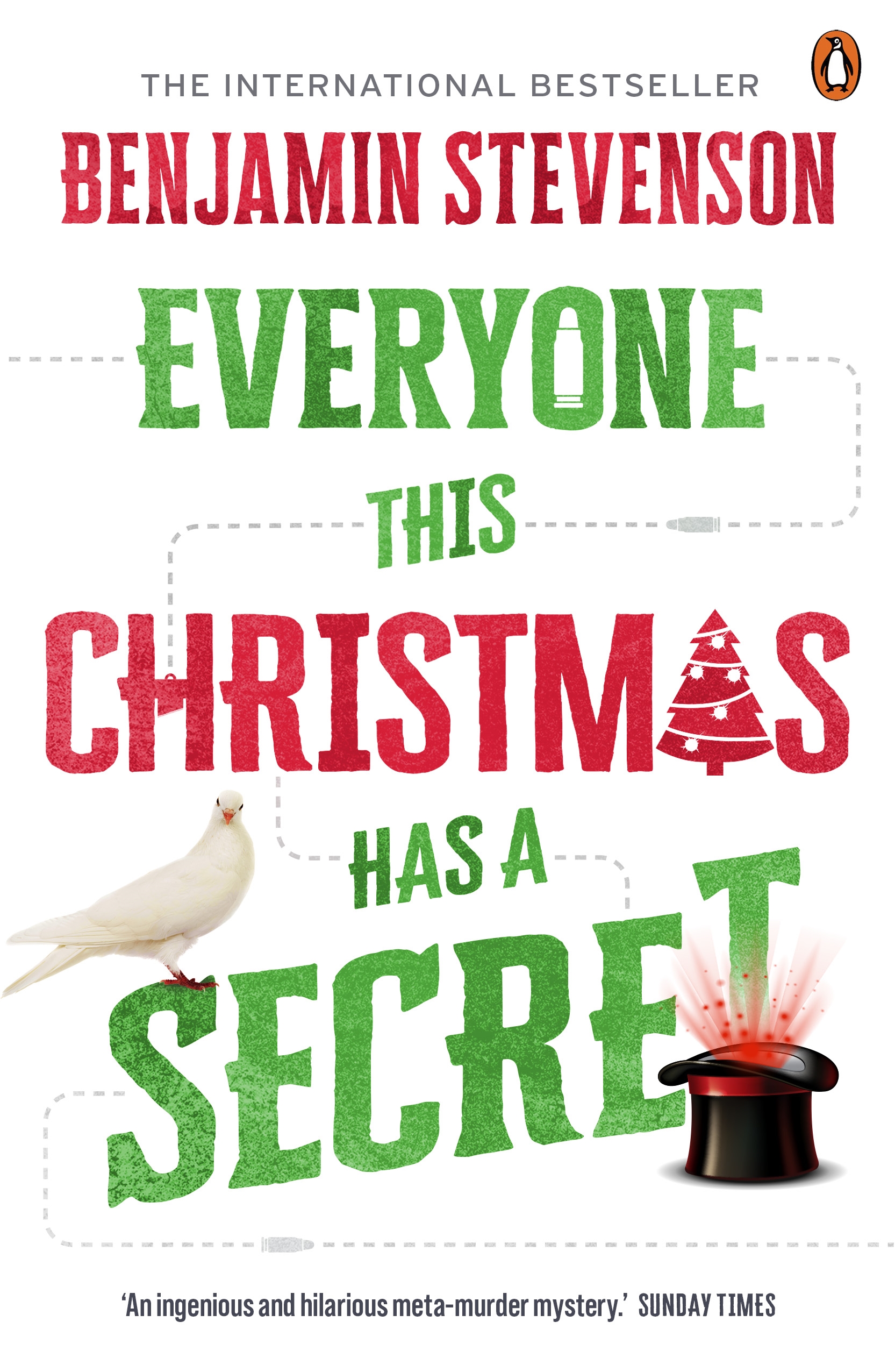
Everyone this Christmas has a Secret by Benjamin Stevenson

Publisher: Penguin Australia (Hardcover – 22 October 2024)

Series: Ernest Cunningham – Book Three

Length: 229 pages

My Rating: 4.5 out of 5 stars

Amazon

One of my favourite Australian authors, the clever and eternally funny Benjamin Stevenson, returns with the third book in his Ernest Cunningham series, Everyone this Christmas has a Secret.

Over the last few years, one of the most impressive Australian crime fiction authors has been the exceptional Benjamin Stevenson.  After a successful career as one half of musical comedy duo The Stevenson Experience, Stevenson has successfully made the move to crime fiction author with several amazing books.  I was a big fan of his debut novel, Greenlight (also released as Trust Me When I Lie and She Lies in the Vines), which Stevenson expertly followed up a year later with the great sequel Either Side of Midnight.  While these initial books were really good, for me Stevenson’s best work has been his Ernest Cunningham novels.

The Ernest Cunningham series follows the titular character, a crime fiction expert from a notorious family, who finds himself caught up in some real-life whodunit situations.  The first book in the series, Everyone in My Family has Killed Someone, was particularly impressive, and it cleverly combined the author’s great sense of humour with a compelling mystery.  I really enjoyed this exceptional book (one of my favourite Australian novels of 2022), especially as the author successfully played to his comedic background to produce an outstanding read that satirised classic crime fiction conventions.  Stevenson continued to impress the following year, with the amazing book Everyone on this Train is a Suspect.  One of my favourite books and pieces of Australian fiction of 2023, Everyone on this Train is a Suspect was a worthy sequel to the first Ernest Cunningham book, and I loved how the author took the opportunity to further parody various crime fiction subgenres.  Due to how much fun I’ve had with the previous novels in the series, I was very excited when I found out Stevenson was releasing an Ernest Cunningham Christmas special.  This latest book, Everyone this Christmas has a Secret, was an excellent read that continued to showcase unique style and flair for outrageous stories.

Ernest Cunningham, amateur detective, novelist and all-round meddler, had been looking forward to Christmas with his highly dysfunctional family.  However, a surprising phone call from his ex-wive, Erin, forces him to journey to the Blue Mountains to solve another murder.  Erin has been accused of killing her new husband, a wealthy philanthropist and former actor dedicated to helping former drug addicts by introducing them to the performing arts.  Found upstairs covered in the victim’s blood, the case against Erin seems airtight, but Ernest isn’t willing to believe that the women he used to love is capable of committing murder.

Determined to prove Erin’s innocence, Ernest begins to investigate hoping to find anything that will clear her name.  His first stop is a large charity Christmas show headlined by a famed magician that the victim had been working on in the leadup to his death.  Exploring backstage, Ernest soon discovers that the staff of the charity show are a mixed bag of tricksters, manipulators and performers, each of whom had history with the victim.  But before he can investigate any further, another person dies publicly on stage.

With the police refusing to listen and time counting down to Christmas, Ernest once again uses his knowledge of the conventions of crime fiction to try and solve the case.  However, all his suspects have motive, and all of them know how to lie and misdirect.  Can Ernest work out which of these performers is concealing the truth, or will a killer get away with murder this Christmas?

This was another outstanding novel from Stevenson, who clearly has a ton of fun with his Ernest Cunningham books.  A brilliant Christmas special, Everyone this Christmas has a Secret proved to be yet another captivating and hilarious book that proved extremely hard to put down.

Everyone this Christmas has a Secret proved to be a very entertaining addition to the Ernest Cunningham series.  Using the conventions of a Christmas special, Everyone this Christmas has a Secret provides readers with a short standalone book that can easily be enjoyed by any reader, even those unfamiliar with the previous entries in the series.  Due to the limited length of the novel, Stevenson wastes no time diving into the plot, and you are soon presented with a new unique murder mystery, with the protagonist’s ex-wife painted as the killer.  After some effective introductions to the case, the protagonist travels to the charity show that seems to lie at the heart of the case and begins to learn more about the potential suspect.  This was a necessarily concise introduction, although it works to set up much of the future plot, and there are a ton of subtle clues hidden throughout the first half.  This first half leads to a dramatic and exciting second murder that changes the scope of the plot and forces the protagonist to up his game.

Stevenson doesn’t waste any time after this second death, moving the plot at a murderous pace (pun intended), and bombarding the reader with clues, reveals and intrigues.  There are several great twists here as we get closer to the conclusion, and I loved how the protagonist worked his way through the Christmas mystery in his own unique way.  Everything leads up to the big reveal, where Ernest brings all his suspects together in a single location and talks them through the solution to the murder.  There are some brilliant moments here as Ernest eliminates suspects, bringing all the hidden secrets to life and slowly whittling down the field of potential killers.  The big reveal about the real killer was well handled and extremely clever, as the author brings together the multitude of clues he sprinkled throughout the plot in an entertaining manner.  While the identity of the murder was a tad obvious to me thanks to one clue in particular, the route the protagonist takes to get there is fun, and I loved seeing everything come together.  The resulting final confrontation is a little over-dramatic and follows the pattern of the other novels in the series, but it proved to be a great ending to this shorter, Christmas-themed Ernest Cunningham book, and I loved how well this book sat as a standalone entry to the series.

As with the previous books in this series, Everyone this Christmas has a Secret is a cleverly written and highly entertaining read that seeks to blend a complex murder mystery with comedic writing that satirises classic fiction tropes, especially those around golden-age crime fiction.  Perfectly set in the iconic Australian setting of the Blue Mountains and told from the first-person chronicle perspective of protagonist Ernest Cunningham, this book has a compelling, quick-fire narrative enhanced by the protagonist’s amusing observations about the situation and the people involved in the case.  Stevenson expertly utilises his comedy background to keep the mood of Everyone this Christmas has a Secret light, and you will love the fantastic way he keeps the audience laughing, while also providing some very clever in-jokes for those readers familiar with classic murder mysteries and whodunnits.

Stevenson also leans into the Christmas theme of this book by including a range of themes and tropes from holiday special novels/shows, which helps to give this third book a unique and memorable edge.  The author’s rules for holiday specials, which are set down at the end of the novel, are cleverly overlayed over his established rules for detective fiction, and I really appreciated how Stevenson incorporated them into the plot.  As such, Everyone this Christmas has a Secret has a distinctive change in style compared to the previous novels, which I think worked extremely well.  If I had one criticism, it would be that the shorter length of this novel ensured that Stevenson didn’t have as much space or time to try to implement some of his classic meta-hints (like revealing on what page a murder was going to occur, or how many times the killer’s name is mentioned in the book), and the entire book did feel a bit rushed at times.  Still, this was a great read, and one that works both as a continuation of the Ernest Cunningham series, as well as a compelling, holiday standalone read.

Due to its nature as a standalone holiday special, Everyone this Christmas has a Secret doesn’t feature a massive amount of character development, and apart from the protagonist there is a noticeable lack of recurring characters physically appearing here (it’s one of the rules of a holiday special).  That being said, it was fun to see protagonist and humorous point-of-view character Ernest Cunningham again, especially as he is starting to lean into his role as a detective.  While his investigation style is still quite chaotic (earning him the moniker “the Slapdash Detective”), Cunningham proves to be a much more skilled sleuth, although he once again makes some foolish mistakes at the grand reveal at the end.  Aside from Cunningham, the rest of the cast is fun, with an intriguing mixture of suspects, victims, and related characters.  While Stevenson does a good job introducing these characters and setting up some competing motivations, I did think the speed of the plot didn’t allow the reader to really appreciate this extended cast as much, and as such the big reveal at the end loses a little punch.  Still, Stevenson features a solid cast for a shorter holiday special, and I enjoyed seeing how Ernest dives through their chaotic lives to find the killer.

Benjamin Stevenson once again shows why he is one of Australia’s top crime fiction authors with another captivating and clever murder mystery book, Everyone this Christmas has a Secret.  Once again featuring the author’s trademark humour and satirical take on classic whodunnit tales, Everyone this Christmas has a Secret was a great read that was both gripping and fun.  I look forward to seeing how the author continues the Ernest Cunningham books in the future, although I must admit I do wonder how far Stevenson can take this concept.  An overall excellent and funny murder mystery that anyone can enjoy this Christmas.

Amazon

Waiting on Wednesday – Everybody Wants to Rule the World Except Me by Django Wexler

Welcome to my weekly segment, Waiting on Wednesday, where I look at upcoming books that I am planning to order and review in the next few months and which I think I will really enjoy.  Stay tuned to see reviews of these books when I get a copy of them.  In this latest Waiting on Wednesday post I look ahead to Everybody Wants to Rule the World Except Me by Django Wexler, which is sure to be one of the most entertaining fantasy books of 2025.

Amazon

Earlier this year I was lucky enough to receive a copy of the hilarious novel, How to Become the Dark Lord and Die Trying by Django Wexler, the first book in the Dark Lord Davi duology.  This book was an intriguing and clever fantasy comedy that followed a funny, if slightly cracked protagonist, Davi, who has found herself stuck in a dark fantasy realm where she is the prophesised saviour of the human Kingdom.  However, saving the Kingdom proves to be a near impossible task and Davi finds herself constantly dying and being reborn, often at the hands of the interchanging Dark Lords who come to power to oppose her.  After centuries of painfully dying in this time loop Davi finally snaps and decides that if you can’t beat them join them.  This leads Davi on a dangerous journey into the wastelands containing the continent’s various non-human races as she embarks on an ambitious plan to become the Dark Lord herself.

I had such a great time reading How to Become the Dark Lord and Die Trying, as Wexler wrote a particularly hilarious, meta, and occasionally dark tale around this fantastic premise and his eccentric protagonist.  I honestly laughed myself silly the entire way through How to Become the Dark Lord and Die Trying, and I also appreciated the intriguing and clever storytelling that the author was adding in.  As such, I have been curious to see how Wexler planned to finish off his duology for a while, and it looks like we’re about to see it in May 2025 with the sequel, Everybody Wants to Rule the World Except Me.

Plot Synopsis:

Dark Lord Davi rules the kingdom, but she must now break the time loop that binds her in this hilariously bloody conclusion to the Dark Lord Davi duology.

Davi has left the horde behind her, hoping to find a peaceful solution to keep the Kingdom from being destroyed this time. But her plan to guide the Kingdom to peaceful prosperity is thwarted when she finds her usual love interest, Prince Johann, already married and the bloodthirsty Duke Aster running the government. Johann’s new husband is everything Davi is not, but he holds a key to the one mystery she can’t solve – the origins of the time loop that has entrapped her.

With restless armies at her doorstep, Duke Aster reaching for power, and an ancient magician hounding her every turn, Davi must scheme her way to peace and uncover the truth behind her curse if she is to break the spell that binds her once and for all.


Everybody Wants to Rule the World Except Me
looks set to be a particularly awesome sequel to the first Dark Lord Davi book, and I love the fun direction that Wexler is apparently taking the story.  Returning Davi to the Kingdom as a reluctant conqueror rather than a saviour is a nice touch, and I love the idea of seeing the protagonist attempt to deal with the politics she is so familiar with from a different direction.  At the same time, it sounds like there is going to be some entertaining romantic shenanigans and dark political manoeuvres as Davi tries to save everyone, only to run into the typical problems of human nature.  This cool new plot idea really works as a follow up to the previous book, and I cannot wait to see how Wexler brings this duology to an end.  I am especially curious to find out how and why Davi is caught in her fantasy time loop, and I am hoping for an especially crazy or ironic background premise.

Honestly, after how much fun I had with How to Become the Dark Lord and Die Trying this year there is no way I will not be grabbing Everybody Wants to Rule the World Except Me as soon as I can.  This first book had so much going for it, and I really grew to enjoy Django Wexler’s style and entertaining ideas.  As such, Everybody Wants to Rule the World Except Me is now one of my most anticipated books of 2025 and I have no doubt I will have a blast getting through this comedic sequel.

Saevus Corax Gets Away with Murder by K. J. Parker

Publisher: Orbit (Trade Paperback – 5 December 2023)

Series: Corax Trilogy – Book Three

Length: 323 pages

My Rating: 5 out of 5 stars

Amazon

One of the masters of comedic fantasy, K. J. Parker, ends his fantastic Corax trilogy on an outstanding note with Saevus Corax Gets Away with Murder.

As we get to the end of 2024, I’m desperately trying to finalise reviews for books I read earlier in the year.  This includes the third and final entry in the Corax trilogy by K. J. Parker, which I enjoyed a few months ago.  Parker, a pseudonym of author Tom Holt, released his entire Corax trilogy in 2023, which follows a resourceful and ill-fated rogue, Saevus Corax, as he finds himself in all manner of trouble.  Set in the same universe as the author’s The Siege series, which featured Sixteen Ways to Defend a Walled City (one of my favourite books of 2019), How to Rule an Empire and Get Away with It (one of my favourite books of 2020) and A Practical Guide to Conquering the World (one of my favourite books of 2022), this was a trilogy with a lot of potential, and I eagerly grabbed all three books the first chance I could.

While I managed to get all three of the Corax novels last year, I only had the chance to read the first novel, Saevus Corax Deals with the Dead before 2023 ended.  This first entry in the trilogy was pretty damn incredible, and I loved the wonderful and highly entertaining story it contained, especially as it was masterfully layered with Parker’s trademark humour.  Saevus Corax Deals with the Dead got an easy five-star rating from me, and it ended up being one of my favourite books of 2023.  I quickly got onto the second book in the series, Saevus Corax Captures the Castle, earlier this year, and just like the first entry, it proved to be a remarkable read that I had a wonderful time with.  As such, I made sure to read the final book in the trilogy, Saevus Corax Gets Away with Murder, as quickly as I could, and it proved to be great reading whilst away on holiday.  I regret not writing something about Saevus Corax Gets Away with Murder sooner, as it was an outstanding and epic read that I could not put down, but hopefully I can make up for it now.

After years of schemes, daring cons, an unwilling coronation and other unfortunate adventures, Saevus Corax is still stuck doing the only job he’s good at, battlefield salvage.  Unglamourous and often disgusting work, it provides a basic living for his large crew of outcasts and rogues as they tour their world’s many scattered battlefields, rescuing and repurposing everything they can recover from the dead.  However, Corax’s band are about to encounter the only thing that can make their business unprofitable, a massive total war that threatens to burn the entire continent.

Seeing the signs of upcoming mass conflict, Corax and his crew attempt to flee to safer climates where they can still potentially make a living.  However, Corax finds his plan to escape thwarted by the family he has long tried to run away from.  His sister, Phantis, has finally caught up with him, but instead of the vengeance she always promised, she needs his help to survive a coup gone bad.  Despite his reluctance to get involved, Corax attempts to help, only to get dragged into even more danger.

Soon, with war coming closer and various factions seeking to kill him and claim the many bounties on his head, Corax is forced into one final scheme to get enough money to retire and escape from everything.  Reuniting with his old flame, the beautiful con artist Stauracia, Corax attempts to find a long-lost treasure that could solve all his problems.  But with betrayal coming from all sides, can Corax survive the chaos to come, or has he finally encountered a situation that even he cannot think his way out of?

Parker continues to showcase why he is the master of hilarious fantasy fiction, as Saevus Corax Gets Away with Murder was another amazing read with a captivating and unique plot behind it.  Masterfully wrapping up the Corax trilogy with a dark and entertaining story, Saevus Corax Gets Away with Murder had me hooked the entire way through and, just like all the other books in the series, it gets a full five-star rating from me.

This third Corax book proved to be an excellent read, with Parker taking his audience on a final wild ride of schemes, betrayal and family drama, as Saevus Corax comes face to face with all his demons.  While easily enjoyed as a standalone novel, Saevus Corax Gets Away with Murder is best read after the rest of the trilogy, especially as many of the ongoing storylines and character relationships come to an end here.  The plot of this book is epic and entertaining, as war, his ongoing conflict with his family and a desire to finally live a normal life drive Corax towards one final scheme while also trying to wipe away the sins of his past.  However, as this is Corax, nothing goes to plan, and he soon encounters multiple setbacks and conflicts that he is forced to overcome in his typical resourceful way.  However, this time Corax experiences some truly devastating betrayals and dark moments that destroy him in a way never seen before.  Parker really lays in the clever twists for this last book in the trilogy, and you will not be prepared for some of the dark routes he goes.  I felt that the big betrayal halfway through the novel was pretty impactful, although the final twist of the knife from his worst enemy at the end was the most heartbreaking.  Everything comes to an impressive end that, while satisfying, fits within the tragic narrative that is the protagonist’s life, and honestly could the author really have left this series on a true happy ending?

The author continues to utilise the writing style and intriguing setting that made the first two Corax books and the preceding Siege trilogy so successful.  While this similarity in style and substance does deal a certain dose of repetition to this third book, I still have a ton of fun reading them, and Parker makes it work so well in the context of his story.  Utilisng a chronicle format from the perspective of the protagonist, Saevus Corax Gets Away with Murder recounts the events of this final adventure, once again loaded with Corax’s distinctive and often satirical commentary and observations on events.  The author relies heavily on twists, betrayals and deep intrigues throughout the plot, all of which are carefully pulled together, explored and savagely roasted by the protagonist as he experiences them.  The continued cynicism and sarcastic take on the world that Corax witnesses and human nature in general brings in much of the book’s humour, and it is hard not to enjoy Corax’s unique thoughts.  This first-person perspective is such an effective storytelling method for the series, and I love how it enhances the humour of the story while also serving as a good tool for exploring the various aspects of the semi-fantasy/alternate history world that the author is setting so many of his books in.  Parker’s style really fits the complex narratives of deception, lies and betrayal that are the hallmark of the Corax series, and I am so glad that he set out this novel the way that he did.

The final Corax book was just as character focused as the previous entries, and I appreciated how Parker brought his various character arcs to a final close in Saevus Corax Gets Away with Murder.  Most of the focus remains on titular perspective protagonist, Saevus Corax, and it was great to see his unique story come to an end.  A typical Parker protagonist, in that he is clever, funny, unrepentantly cynical and just a little bit tragic, Corax has been a great figure to follow, especially due to the elaborate schemes and complicated history that define his life.  Constantly analysing the world and relying on the predictability of human nature, Corax is a dangerous person, especially when dealing with the various people trying to manipulate him as he tries to do the right thing.  While he is usually able to outsmart everyone, several betrayals in this book really get under his skin, and he ends up being particularly rash and devastated at times.  Despite this, he is still the clever, surprisingly honest, and often thoughtful figure that you have come to love in the previous novels, and I really appreciated seeing how his story concluded in this final Corax novel.

Aside from the protagonist, Saevus Corax Gets Away with Murder features an interesting range of supporting characters, many of whom have a complex relationship with the protagonist.  The most prominent of these is the manipulative force of nature, Stauracia, a con-artist who has a lot of history with Corax.  Corax and Stauracia play off each other perfectly, and I always enjoy seeing their unique form of courting involving cons, lies and deceit.  Saevus Corax Gets Away with Murder is the book that really defines their relationship, and it was awesome to see their chemistry on full display as they try to work together for the ultimate final score.  The rest of the cast is pretty fun as well, with the highlight being Corax’s sister Phantis.  Parker has spent the entire trilogy hyping up Corax’s family as dangerous antagonists, and the author didn’t disappoint when it came to finally featuring one.  Phantis is an incredibly selfish, vindictive and manipulative figure, and it was great to see the fantastic scenes between her and Corax, which amped up the family drama.  While I was slightly disappointed we didn’t get to meet another member of Corax’s family that has been talked about a lot, Phantis was more than enough for this book, especially as she hits Corax where it really hurts in some of the darkest scenes of the book.  Throw in the recurring background characters from the previous novels, including Corax’s band of scavengers, and this proves to be a great cast with a lot of fun features.  However, readers are warned not to get too attached to any of them, as Parker has final book killing fever and deals with several characters in intriguing ways, especially as many are tempted by betrayal and their own sinister schemes.

In the end, Saevus Corax Gets Away with Murder was yet another outstanding and deeply clever novel from K. J. Parker that I honestly cannot rave about enough.  Providing its own addictive and funny narrative, while also bringing the entire Corax trilogy to a fitting end, Saevus Corax Gets Away with Murder was an epic read that proves near impossible to turn away from.  Parker is such an impressive author, and I look forward to seeing what he produces next, especially as he appears to have a new series starting in mid-2025.

Amazon

Guards! Guards! by Terry Pratchett

Publisher: Gollancz/Penguin Audio (Audiobook – 1989)

Series: Discworld – Book 8 / City Watch – Book One

Length: 13 hours and 29 minutes

My Rating: 5 out of 5 stars

Amazon

I recently revisited one of my favourite books in Terry Pratchett’s iconic Discworld series, Guards! Guards!, and I just had to review it to showcase how much fun this series can be.

I have never made any secret of the fact that I love all things Terry Pratchett as the Discworld books were one of the formative series of my youth.  A massively popular series set on a flat world carried through space on the back of a giant turtle and four elephants, the Discworld books present a range of unique fantasy adventures, backed with exceptional comedy and satire.  This series is so much fun, and I honestly love every single Discworld book, having read them all multiple times, usually while laughing myself silly.  Indeed, I am such a big fan of this series that I named my blog after a location in the universe.  Despite my overwhelming love for this series, I haven’t reviewed many Discworld books (the exception being Moving Pictures and The Last Continent).  That changes with my review of the outrageously funny Guards! Guards! which I recently enjoyed while on a road trip.

Guards! Guards! is a particularly entertaining addition to the Discworld series that I have a lot of love for.  Serving as the first book in the City Watch sub-series, Guards! Guards! sees Pratchett blend his typical fantasy and comedy elements with a complex murder mystery.  This book follows the ragtag city watch of this world’s main recurring city, Ankh-Morpork, as they try to solve a series of deaths caused by a monstrous murder weapon.  Due to its brilliant and hilarious story, as well as the fact that it perfectly sets up the rest of the awesome City Watch books, I generally consider Guards! Guards! to be one of my absolute favourite Discworld novels, and I have featured it in various Top Ten Tuesday lists over the years.

On the fantastical and impossible Discworld no place is more dangerous, corrupt or morally unhealthy as the legendary and stinking city of Ankh-Morpork.  The Disc’s largest city, Ankh-Morpork has many terrors haunting its urban depths, where life is cheap and death lurks around every corner.  However, not even the hardest criminals, deadliest wizards or most manipulative politicians are prepared for an ancient and malevolent creature that is about to be unleashed upon the city.

A shadowy secret brotherhood has engineered an elaborate plan to seize power in Ankh-Morpork through use of an unlikely weapon, a dragon.  Summoning a fully formed fire-breathing dragon to cause terror, the brotherhood hopes to use the resulting carnage to bring in their own puppet to control the city.  However, the dragon has its own ideas about what sort of terror it wants to bring down on humanity.

With the rest of the city powerless against the dragon, it falls to the ramshackle Ankh-Morpork Night Watch and its depressed captain, Sam Vimes, to try and stop it.  The only problem is the Watch are the biggest joke in the city, incapable of standing up to normal crime, never mind carnage caused by magical dragon.  But with an unnaturally keen new recruit guilting them into action, and a terrifying dragon fanatic with a crush on Vimes keeping them in line, the Watch is going to try and save the day, even if no-one wants them to.

Guards! Guards! still reigns supreme as one of my top Discworld novels from the always impressive Terry Pratchett.  Featuring a unique plot, loaded with an outstanding mix of mystery, humour and fun fantasy elements, Guards! Guards! brilliantly sets up one of Pratchett’s best sub-series while presenting its own epic and powerful story.  An exceptional read from start to finish, this book gets a very easy five-star rating from me, and I love it so damn much.

The plot of Guards! Guards! is so damn clever and is peak Pratchett in its inventiveness and impressive characters.  Presenting an entertaining and humourous noir murder investigation in a fantasy series, Guards! Guards! has a lot of moving parts to it, including some impressive character-driven story arcs, all of which come together beautifully for a particularly intense and insane story.  Starting off very strong with some great introductions to various key characters, including the young and keen Carrot Ironfoundersson, who journeys to the massive and corrupt city of Ankh-Morpork to join the Night Watch, providing fresh blood, irrepressible honesty and uncontrolled enthusiasm to the small squad of rejects and failures currently staffing it.  Carrot’s arrival corresponds with the start of a bold conspiracy, as a secretive mystic brotherhood plots to dethrone the Patrician and take over the city.  The initial scenes of this book are extremely good, and I love how Pratchett expertly sets up the entire narrative with some hilarious moments, including the opening sequence with the Elucidated Brethren of the Ebon Night, whose petty ideology shows you just what sort of criminal minds we are truly dealing with.

Things go in a chaotic direction as the Night Watch, led by the drunk and depressed Captain Vimes, witness a direct murder by dragon and begin their own investigation into the matter.  Pratchett expertly pivots the story around from its comedic fantasy start into a complex police procedural/noir murder investigation, as the protagonists try to find out why the dragon is terrifying the city and who benefits from the apparent crime.  At the same time, several great character arcs emerge, including a truly nice, if unconventional romance, new friendships, and a fun analysis of dragon mythology.  There is a great twist about halfway through the book as the down-and-out Night Watch witness an interesting change to the classic dragon fantasy tale that sees a unique king take over the city.

The final third of the book is some of Pratchett’s strongest writing, as Vimes identifies the true culprit and must work to undo the damage they caused.  There are some great moments in this last part of the book as Pratchett presents his own unique and hilarious take on classic fantasy tropes, including the famed million-to-one shot, the heroic rescue, and the successful defeat of a dragon.  I felt that the identity of the main villain of the story was very clever, and Pratchett sets it up well with subtle clues, although if you know Pratchett’s thoughts on certain government positions it’s not too surprising.  Still, the final confrontation between the protagonists and this villain is great, and being literal has never been so deadly.  Pratchett leaves Guards! Guards! on a hopeful note, and it’s impossible not to come away with a smile on your face.

Pratchett was really on-point when it came to writing Guards! Guards! and I loved how perfectly it came together.  As with all books in the Discworld series, Guards! Guards! features an exceptional mixture of fantasy and humour elements, as the unusual and cynical Discworld produces some unusual situations, layered in with a great plot and some fantastically complex characters.  A lot of the humour is derived from classic fantasy scenarios that are taken up to 11 and shown in outrageous manners, accompanied by sarcastic comments from the characters as they witness them.  For example, this book serves as an ode to the guards and watchmen from classic fantasy fiction, and there are some funny scenes when these self-aware guards realise how expendable they are in a fantasy story.  However, Guards! Guards! also features a brilliant third element as Pratchett also features a compelling crime fiction read, accompanied with an addictive murder mystery.

The blend of fantasy and crime fiction elements works incredibly well, and it is highly entertaining to watch a serious investigation consider magic, suddenly appearing dragons, and the unique background setting of Ankh-Morpork.  I also loved how many clever and subtle jokes Pratchett was able to weave in because of these crime fiction inclusions, and he ends up lovingly roasting so many classic tropes from police procedurals and noir detective novels.  Despite having read this book many times, I still laugh like crazy at all the humourous moments in Guards! Guards!, especially as you always discover a new joke or pun you previously missed.  I honestly don’t have time to list all the funny scenes in Guards! Guards!, but favourites include the various meetings of the petty and mostly incompetent Elucidated Brethren, Carrot’s naïve overreactions upon discovering crime in the city, and various musings on how to achieve a perfect, million-to-one chance.  Pratchett once again expertly backs up his humour in Guards! Guards! with a series of entertaining footnotes spread throughout the book, that prove to be nearly as much fun as the main story.  These brilliant footnotes contain additional jokes, sarcastic comments, or interesting expansions of the Discworld universe, and they always bounce off the main story perfectly, providing extra laughs and food for thought where necessary.  I really cannot emphasise just how well this blend of genres worked with Pratchett’s unique and endearing humour, and it proves impossible not to have an exceptional time while reading this book.

As with most Discworld books, Guards! Guards! works exceedingly well as a standalone novel, and I feel that anyone wanting a laugh could easily jump in and follow the story without any issues.  Due to its early position in the shared Discworld universe, you don’t have to know anything about the other entries in the overarching series to jump right in, as Pratchett goes a tad light on some of the more outrageous Discworld elements.  As such, I consider Guards! Guards! to be one of the very best entry novels to new Discworld readers.  It also proves to be a brilliant first book in one of Pratchett’s best sub-series, and so many key details of the subsequent City Watch books are introduced here.  This includes some excellent early looks at the chaotic city of Ankh-Morpork and key recurring characters in the larger universal plot.  Ankh-Morpork is a great background setting for Guards! Guards! and it was the first book completely set within the bounds of the city.  I loved seeing this crazy city in even more detail, and all the fun elements set up here help to make it an epic setting.  As such, this is a great book for any Discworld reader, new or old, and it’s one of my favourites for very good reason.

As with pretty much all of Pratchett’s works, the key things that made Guards! Guards! so impressive were the amazing and unique characters that were featured throughout the plot.  Pratchett had a real knack for producing complex, multi-layered figures who can be both comedic and tragic at the same time, and who you couldn’t help but love.  Guards! Guards! was a particularly good example of this, as Pratchett featured a range of brilliant and entertaining characters who would go on to be become major recurring figures in the Discworld canon.  Indeed, Guards! Guards! is one of the most significant books for new characters, and it is frankly amazing how many exceptional major and iconic figures were introduced here.  Each of these characters were so well written, and you have to love both their specific arcs in this book, as well as how they were expanded on in later works.

The most prominent character in Guards! Guards! is Captain Samuel Vimes.  A cynical and damaged man whose habit of calling out social inequities has seen him assigned to the joke position as head of the Night Watch, which he deals with by drinking vast amounts of alcohol.  A parody of every hard-drinking cop and private eye in classic noir fiction, Vimes starts the book with no prospects and too many dead friends.  Given new purpose when the dragon appears in the city, Vimes turns his innate rebellion to a purpose and tries policing and detecting.  Pratchett does an exceptional job setting up Vimes here in Guards! Guards!, and it is no wonder he goes on to be one of his top protagonists.  Vimes’s depressed investigative method proves quite successful, and it was entertaining to watch Vimes attempt to solve the case while sarcastically calling out his fellow citizens’ base stupidity and selfishness.  Pratchett also sets up an impressive redemption arc around Vimes, which comes about through a combination of trusted colleagues, romance, and a renewed determination to uphold the law.  While he ends the book still irritated with the world, the road forward to Vimes doing bigger and better things is well established, and you really get drawn into his arc as a result.

Another impressive character is naïve and innocent City Watch recruit, Carrot Ironfoundersson.  Due to his complex home situation and a late life revelation that he’s human rather than a dwarf (being six and a half feet tall wasn’t a clue to him), Carrot is sent to Anhk-Morpork with a desire to become a watchman, which he incorrectly believes is a noble calling.  Thanks to his literal personality and highly moral upbringing, Carrot proves to be an anathema to the lawless folks of Anhk-Morpork, as he comes to town bringing justice, enforcing obscure laws, and actually arresting thieves: “change your ways”.  A brilliant parody of ultra-righteous fantasy kings, Carrot serves as an outstanding comic relief for much of the book, especially when it comes to his wholesome interactions with the exceedingly criminal inhabitants of the city.  However, beneath his comedic cover, Carrot is written as a complex figure of change, and his ability to inspire the other characters, either through guilt or determination, leads to some big moments.  Pratchett did an amazing job with Carrot in Guards! Guards!, and it was fascinating to see how he evolves from his initial innocent personality, to a more clever, but still determined, character.

Aside from Vimes and Carrot, the other two watch characters are Sergeant Fred Colon and Corporal Nobby Nobbs, both of whom are excellent and solid comedic characters.  The stereotypical fat sergeant and dodgy corporal, Pratchett has fun setting them up as unassailable fixtures of the Night Watch as they do the jobs nature intended for them, and I love how they play off each other.  While Colon has some hilarious scenes, including his attempt at archery and his various ill-timed run-ins with the dragon, you can tell that Pratchett had a lot more fun writing Nobby.  While not all his over-the-top characteristics from the series are shown in Guards! Guards!, Nobby is still a particularly entertaining figure.  Between his coarse language, petty criminal mindset, and uncharacteristic foppish behaviours, every scene with Nobby is highly amusing, and I love how Pratchett expanded off clever stereotypes about lifetime corporals to create this wayward figure.

Outside the members of the City Watch, there are a fantastic array of figures who help to make Guards! Guards! a particularly enthralling story.  This includes one of the few female characters in the book, Sybil Rankin, a dragon-loving heiress who ends up being Vimes’s unlikely love interest.  Deliberately written as the direct opposite of a noir femme-fatale in both personality and appearance, Sybil is a force of nature, using her accumulated nobility to pull the Night Watch, especially Vimes, into her orbit.  It proves impossible not to like Sybil as you watch her confidently go after Vimes or try to put the dragon to heel, and she ends up being one of the most complicated female characters that Pratchett wrote (which is saying a lot when you think of some of his other great female characters).

The other major character that I want to separately highlight is the Patrician of Ankh-Morpork, Lord Havelock Vetinari.  While he has appeared in previous Discworld novels (notably Sourcery), this is the first book that showcases him as a full character.  Generally depicted as a Machiavellian mastermind and one of the few people capable of controlling the chaotic city, Vetinari has some great early scenes.  However, it’s not until the second half of the book when you realise just how fantastic a character he is.  Deposed by the false king, Vetinari initially appears to be completely powerless in the dungeons, until Vimes is thrown in with him and begins to realise that he is still in control, especially as he’s managed to cultivate a new intelligence network (procured by providing wartime strategy to magical rats), while also getting locked in a dungeon specifically designed to keep him safe.  His subsequent scenes tormenting the book’s real antagonist and talking about the nature of humanity with Vimes really cement him as an impressive figure, and the seeds for his many later inclusions as the Disc’s ultimate political mastermind are well sown here.

While I know I’ve been going on a bit about characters (blame Pratchett for being such a good writer), I just need to highlight a few more figures who have a great role in Guards! Guards!.  This includes the Librarian, one of Pratchett’s most iconic characters, who proves to be just as much fun outside of a wizard focused book, and it was entertaining seeing him interact with a separate group of friends.  You get a great introduction to the character of Cut-My-Own-Throat Dibbler, whose mercantile tendencies are on full display here.  The unusual swamp dragon Errol proves to be an unlikely pet, and his arc about finding love and his true form was particularly heartwarming.  Finally, I must mention the book’s great antagonist, who fully embraces the mad tendencies that his position demands.  While I won’t go into too much detail about who he is, I will say I loved seeing his various internal rants about the world, and the scenes with his incompetent henchmen were so damn funny.  All these characters, plus even more hilarious figures, are instrumental to so much of Guards! Guards! brilliant charm and humour, and after being introduced to them here, it’s impossible not to follow them on their full journey.

I have had the pleasure of reading Guards! Guards! in a couple of different formats over the years, but to my mind the best way to enjoy this book, and indeed any Discworld novel, is on audiobook.  The Discworld audiobooks are something very special, and I find that the unique stories, excellent humour and elaborate characters really come across when read out by a passionate narrator.  With the recent re-release of various Discworld audiobooks, there are now two different unabridged versions of Guards! Guards! fans can enjoy, and I want to highlight them both here.

The first Guards! Guards! audiobook is the original version with the talented Nigel Planer, who narrated 22 of the original 23 Discworld audiobooks.  Guards! Guards! is one of his best performances, and it set the scene nicely for many of his subsequent Discworld audiobooks, especially as he settled on a lot of key character voices and tones here.  While it has been a little while since I’ve listened to Planer’s version of Guards! Guards!, I have enjoyed it so many times it is permanently engrained in my head (I used to grab the tape cassette version out of my local library all the time).  Planer, who does all the voices himself, really captures the essence of Pratchett’s storytelling and excels at expressing the author’s unique humour through his vocal work.  I also felt that his portrayal of many of the key characters was second to none, and he really brought to life all the City Watch protagonists, as well as some other long-running figures, in some impressive ways.  He would revisit many of these voices in multiple subsequent performances, and it is a testament to his skill that the initial tones he came up with here, worked so well in the later books.  I frankly have so much love for Planer’s original take on Guards! Guards!, which definitely still stands the test of time, and his excellent and heartfelt voice work defines many of the City Watch characters for me.

While Nigel Planers original version is perfect, current Discworld fans may be more familiar with the latest audiobook production of Guards! Guards!, which was part of a recent re-recording of all the Discworld books.  These new audiobooks each feature a different famous British performer voicing the main plot, while acclaimed actors Peter Serafinowicz and Bill Nighy have key roles in every single production.  While these have been out for a little while, I only just listened to my first one .  Coming in at a runtime of 13 and a half hours, which is a tad longer than the roughly 10-hour long Planer version, this Guards! Guards! audiobook was extremely fun, and it served as excellent entertainment on a recent road trip.

The new version of the Guards! Guards! audiobook is primarily voiced by British radio and television personality Jon Culshaw.  Culshaw is amazing in the role, and I was deeply impressed with his take on the Guards! Guards! characters.  Each unique character comes across extremely well in Culshaw’s capable hands, and I enjoyed his take on their unique characteristics and eccentric personalities.  He perfectly showcased protagonist Samuel Vimes’s drunken despair and depression, while various other key members of the watch, such as the extremely keen Carrot and the more cautious Colon, are shown extremely well.  I also felt that Culshaw did an incredible job with several complicated figures from the story, such as the infamous watchman Nobby Nobbs, who Culshaw gifts a gruff and weaselly voice that sounded a lot like David Bradley or Jon Pertwee.  His Lord Vetinari is also amazing, and the deep and threatening tones really capture the character’s dangerous nature.  Finally, I felt that his take on the main female character, Sybil Ramkin, was just perfect, and you really got the full blast of her big personality and excessive aristocratic characteristics.  Many of the other side characters were also perfectly portrayed to my mind, and I must highlight the excellent way in which he disguised the voice of the main antagonist during some key secret society scenes.

Culshaw’s primary narration is well backed up by Peter Serafinowicz and Bill Nighy in their respective roles.  Serafinowicz provides the voice of Death whenever he appears in this audiobook, which works out extremely well even with Death’s relatively minor role in Guards! Guards!.  Serafinowicz has an exceptional Death voice, and hearing it suddenly appear throughout Guards! Guards! is so damn epic, especially during one scene where Death is hiding amongst the soon-to-be deceased.  Nighy, on the other hand, narrates the various footnotes.  Nighy was a perfect choice for this, and his calm, consistent tones, echoing Peter Jones’s similar role in The Hitchhiker’s Guide to the Galaxy radio and TV editions really highlighted the subtle comedy of these footnotes.  I felt that all three of these distinctive actors really vibed together in the Guards! Guards! audiobooks, and the switch between them was seamless, allowing for a particularly awesome listen.  Throw in an interesting short afterword about fantasy elements by acclaimed author Ben Aaronovitch, and this proved to be a remarkable and compelling audiobook I could not get enough of.  While Nigel Planer’s original narration of Guards! Guards! is always going to live in my head rent free, I felt that this new version more than lived up to the hype surrounding it, and I really appreciated the unique and powerful performances these new narrators brought to the table.  Frankly both of the audiobook versions comes highly recommended by me, and it is impossible to be dissatisfied by them at all.

Whew, well in case you could guess from this massive review (it got away from me), I love Guards! Guards! and I have some very strong feelings for it.  One of Terry Pratchett’s best Discworld novels, Guards! Guards! is the perfect blend of fantasy, crime fiction and humour that you could ever want, and I always get wrapped up in its elaborate story.  A wildly entertaining and comedic novel from start to finish, Pratchett added so much heart to this book, and you get drawn into the impressive characters and compelling, crime fiction plot.  A brilliant start to the City Watch subseries, Guards! Guards! is so damn good, and I know I will be reading it many more times in my life.  I can think of no better way to emphasise just how amazing Guards! Guards! is than to mention that I used it to introduce the Discworld to my wife, who is now powering through the series on her own.  So do yourself a favour and check this book out now!

Amazon

How to Become the Dark Lord and Die Trying by Django Wexler

Publisher: Orbit (Trade Paperback – 6 August 2024)

Series: Dark Lord Davi – Book One

Length: 395 pages

My Rating: 4.75 out of 5 stars

Amazon

Hilarious author Django Wexler presents one of the funniest and most memorable fantasy novels of 2024 with the deeply addictive How to Become the Dark Lord and Die Trying.  Serving as the first book in Wexler’s new Dark Lord Davi series, How to Become the Dark Lord and Die Trying was an extremely amusing book that has been on my radar for a while due to its amazing-sounding plot.

It’s a tale as old as time.  An ordinary human becomes trapped in a mythical fantasy realm and is subsequently lauded as the prophesied hero of legend, destined to rule the kingdom and defeat the conquering Dark Lord.  But what happens when the human protagonist gets sick of living and dying as the hero?

That’s the question that falls to Davi, a young woman who has become trapped in a bloody and predictable time loop.  Constantly forced to become the leader of the soon-to-be-destroyed humans of The Kingdom, Davi has tried time and time again to organise an army capable of defeating the oncoming and everchanging Dark Lord, only to fail and die in agony in over 200 inventive ways.  After nearly a thousand years of playing the hero and losing in brutal fashion, Davi has had enough and decides that if you can’t beat them, become them.

Determined to take control of her destiny, Davi sets out to do the direct opposite of every other loop.  If the Dark Lord always wins, then this time Davi will take her place at the top of the winning side and become the new Dark Lord herself.  But first she must pull together a band of followers from the various non-human races of the realm and bring her loyal minions to the Convocation where the new Dark Lord is chosen, far away in lands she’s never even seen.  Standing between Davi and her destiny lie multitudes of deadly landscapes, brutal enemies, and all manner of unique obstacles that a Dark Lord in training needs to overcome.  Armed with her wits, her accumulated knowledge of the world, the ability to use her own death to her advantage, and an insane amount of humorous confidence, Davi may be able to do the impossible and finally win.  But Davi will soon learn that becoming the Dark Lord isn’t everything it’s cracked up to be.

How to Become the Dark Lord and Die Trying was a highly entertaining and insanely captivating read that I honestly could not get enough off.  Featuring a brilliant scenario that Wexler plays to comedic perfection, combined with dark humour and a uniquely insane protagonist, How to Become the Dark Lord and Die Trying is an outstanding novel that I had so much fun reading.

I must admit that I instantly loved the very fun premise of this book which saw the protagonist decide to take on the role of the Dark Lord after hundreds of failed attempts to survive as the hero.  Wexler did an outstanding job setting this idea up in the first couple of chapters of How to Become the Dark Lord and Die Trying, and you are quickly intrigued by the combination of a bloody time loop, a despondent, if hyper, protagonist, and the entire change of plan said protagonist embarks upon.  As such, you are completely onboard as soon as Davi starts to implement her plan, and the resulting carnage proves to be highly entertaining and fun.  After multiple bloody failed attempts to start her new turn to darkness, Davi soon begins to get into her groove as the next Dark Lord, recruiting a small band of minions, and taking the first steps to proving she has what it takes to rule.

Davi’s subsequent quest to become the Dark Lord involves an intense adventure arc, as she leads her army through various fun fantasy locations.  Along the way to her destination, Davi engages in different schemes to recruit new followers, especially when she encounters some chaotic communities whose internal strife she is able to exploit.  The story devolves into an awesome combination of intrigue, humorous encounters, fantasy action and personal character growth, as the protagonist becomes more comfortable with the Dark Lord lifestyle.  After several extended sequences at key locations, the protagonist eventually reaches her goal and begins her trials to become the new Dark Lord.  However, nothing at the trials is what it seems, and Davi is forced to deal with multiple enemies from her various pasts to survive.  There are some great moments in this final part of the book, including tragic betrayals, heart-felt romance, intriguing revelations, and some big fights, all of which leads to an interesting open-ended conclusion that will ensure readers come back for the next book in the series.

I had an exceptional amount of fun with How to Become the Dark Lord and Die Trying, and Wexler had a fantastic style that really appealed to me.  Told exclusively from the slightly crazed first-person perspective of the protagonist, readers are treated to Davi’s highly excitable inner thoughts as she recounts her journey to becoming the Dark Lord.  This proved to be a great medium to explore the more complex elements of the plot, and I appreciated how Wexler was able to succinctly dive into time-loop and Davi’s place in it, while also moving the plot along.  The author also introduces a serviceable and intriguing fantasy world the plot of How to Become the Dark Lord and Die Trying, which proved interesting to explore.  While a little basic in places, Wexler does feature some excellent concepts here, and readers will enjoy watching Davi explore it with her own unique perspective, especially as she forms new ideas about the supposedly evil wilders (non-human creatures) as she works with them.  While some of these concepts are a little complex at times, everything honestly works extremely well for the entertaining plot, and I really appreciated how effectively the author was able to explore and utilise his fantastic ideas.

While all these great concepts help to craft a unique book, what holds everything together and keeps the reader’s attention is the relentless comedy that Wexler injects into nearly every page of How to Become the Dark Lord and Die Trying.  I really connected to Wexler’s humour in this book, and I found myself chuckling away for large chunks of it.  Thanks to the slightly cracked protagonist, the reader is bombarded with a constant array of jokes, hilarious commentary, and over-the-top moments, as Davi combats the horrors both in front and behind her with humour.  A lot of this humour was driven by the protagonist having a modern, nerdish perspective in a crazy fantasy world, and her reactions ranged from sarcastic to goofy.  Wexler also makes great use of an array of continuous footnotes to tell additional jokes outside the flow of the narrative, or to really expand on an interesting or funny point.  I am a big fan of the use of footnotes for comedic purposes (blame my Terry Pratchett upbringing), and Wexler made it work really well here.  The author also relies on quite a lot of highly adult humour throughout the book, which helped to give How to Become the Dark Lord and Die Trying an interesting flair.  While I could see some readers not liking how continuously risqué the book got, or how over-the-top the humour is in general, I personally felt that it worked and allowed for quite an amusing, if slightly randy, experience.

Talking of crazy humour, I must highlight the fantastic central protagonist of How to Become the Dark Lord and Die Trying, Davi.  A modern-day and highly nerdy woman who finds herself trapped in this recurring fantasy adventure without any idea of how she got there, Davi is an interesting figure, and you really connect with her as the plot continues, especially as a lot of hilarity is drawn from her outrageous behaviour and thoughts.  Davi is constantly cracking jokes, making sarcastic inner observations and meta commentary, often driven by her modern experiences, and it’s hard not to be amused by her antics.  She also has some great, often ridiculous interactions with the various fantasy creatures she encounters, and I liked seeing her unusual persona connect with these more serious creatures.

While it is easy to get lost in Davi’s comedic persona, the further you get into the book, the more apparent it is that her cracked behaviour has been brought on by the constant trauma from her hundreds of deaths and the accompanying thousand years of experience that she has lived through as part of her fantasy adventure.  The initial exposure to her early trauma and rage at the start of the book gives you enough of a glimpse of this that you appreciate her turn to the dark side, but you see even more of it as the story continues.  A lot of this is because, even after years of watching everyone die, she still cares about the people around her, and the impacts of her decisions start to wear on her.  While she maintains her zany persona for much of the book, a new romance and a dark change in her circumstances towards the end of the book nearly break her, and I felt that Wexler did an outstanding job of trying to humanise her there, especially as she sometimes gives off uncaring, immortal vibes.  Thanks to these deeper personality traits, as well as her comedic nature, I really grew to appreciate to Davi as main character, especially as she is a lot more capable and competent thanks to her experiences, although she still makes some interesting mistakes (never sleep with your minions, everyone knows that).  As such, I look forward to seeing how her story continues, especially as things are likely to get even more out of control for her.

Overall, How to Become the Dark Lord and Die Trying by Django Wexler was an awesome book that I honestly found to be quite addictive.  The fantastic central scenario is greatly enhanced by the author’s outrageous humour and clever storytelling, and it allows for quite an outstanding read.  Slick, unique and very, very funny, How to Become the Dark Lord and Die Trying was one of the more unique fantasy novels of 2024, and if you are in the mood for a great laugh, then this is the book for you.  I personally am very excited to see how the Dark Lord Davi series continues in the future, and the second novel, Everybody Wants to Rule the World Except Me, is set for release in May 2025.

Amazon