Everyone this Christmas has a Secret by Benjamin Stevenson

Publisher: Penguin Australia (Hardcover – 22 October 2024)

Series: Ernest Cunningham – Book Three

Length: 229 pages

My Rating: 4.5 out of 5 stars

Amazon

One of my favourite Australian authors, the clever and eternally funny Benjamin Stevenson, returns with the third book in his Ernest Cunningham series, Everyone this Christmas has a Secret.

Over the last few years, one of the most impressive Australian crime fiction authors has been the exceptional Benjamin Stevenson.  After a successful career as one half of musical comedy duo The Stevenson Experience, Stevenson has successfully made the move to crime fiction author with several amazing books.  I was a big fan of his debut novel, Greenlight (also released as Trust Me When I Lie and She Lies in the Vines), which Stevenson expertly followed up a year later with the great sequel Either Side of Midnight.  While these initial books were really good, for me Stevenson’s best work has been his Ernest Cunningham novels.

The Ernest Cunningham series follows the titular character, a crime fiction expert from a notorious family, who finds himself caught up in some real-life whodunit situations.  The first book in the series, Everyone in My Family has Killed Someone, was particularly impressive, and it cleverly combined the author’s great sense of humour with a compelling mystery.  I really enjoyed this exceptional book (one of my favourite Australian novels of 2022), especially as the author successfully played to his comedic background to produce an outstanding read that satirised classic crime fiction conventions.  Stevenson continued to impress the following year, with the amazing book Everyone on this Train is a Suspect.  One of my favourite books and pieces of Australian fiction of 2023, Everyone on this Train is a Suspect was a worthy sequel to the first Ernest Cunningham book, and I loved how the author took the opportunity to further parody various crime fiction subgenres.  Due to how much fun I’ve had with the previous novels in the series, I was very excited when I found out Stevenson was releasing an Ernest Cunningham Christmas special.  This latest book, Everyone this Christmas has a Secret, was an excellent read that continued to showcase unique style and flair for outrageous stories.

Ernest Cunningham, amateur detective, novelist and all-round meddler, had been looking forward to Christmas with his highly dysfunctional family.  However, a surprising phone call from his ex-wive, Erin, forces him to journey to the Blue Mountains to solve another murder.  Erin has been accused of killing her new husband, a wealthy philanthropist and former actor dedicated to helping former drug addicts by introducing them to the performing arts.  Found upstairs covered in the victim’s blood, the case against Erin seems airtight, but Ernest isn’t willing to believe that the women he used to love is capable of committing murder.

Determined to prove Erin’s innocence, Ernest begins to investigate hoping to find anything that will clear her name.  His first stop is a large charity Christmas show headlined by a famed magician that the victim had been working on in the leadup to his death.  Exploring backstage, Ernest soon discovers that the staff of the charity show are a mixed bag of tricksters, manipulators and performers, each of whom had history with the victim.  But before he can investigate any further, another person dies publicly on stage.

With the police refusing to listen and time counting down to Christmas, Ernest once again uses his knowledge of the conventions of crime fiction to try and solve the case.  However, all his suspects have motive, and all of them know how to lie and misdirect.  Can Ernest work out which of these performers is concealing the truth, or will a killer get away with murder this Christmas?

This was another outstanding novel from Stevenson, who clearly has a ton of fun with his Ernest Cunningham books.  A brilliant Christmas special, Everyone this Christmas has a Secret proved to be yet another captivating and hilarious book that proved extremely hard to put down.

Everyone this Christmas has a Secret proved to be a very entertaining addition to the Ernest Cunningham series.  Using the conventions of a Christmas special, Everyone this Christmas has a Secret provides readers with a short standalone book that can easily be enjoyed by any reader, even those unfamiliar with the previous entries in the series.  Due to the limited length of the novel, Stevenson wastes no time diving into the plot, and you are soon presented with a new unique murder mystery, with the protagonist’s ex-wife painted as the killer.  After some effective introductions to the case, the protagonist travels to the charity show that seems to lie at the heart of the case and begins to learn more about the potential suspect.  This was a necessarily concise introduction, although it works to set up much of the future plot, and there are a ton of subtle clues hidden throughout the first half.  This first half leads to a dramatic and exciting second murder that changes the scope of the plot and forces the protagonist to up his game.

Stevenson doesn’t waste any time after this second death, moving the plot at a murderous pace (pun intended), and bombarding the reader with clues, reveals and intrigues.  There are several great twists here as we get closer to the conclusion, and I loved how the protagonist worked his way through the Christmas mystery in his own unique way.  Everything leads up to the big reveal, where Ernest brings all his suspects together in a single location and talks them through the solution to the murder.  There are some brilliant moments here as Ernest eliminates suspects, bringing all the hidden secrets to life and slowly whittling down the field of potential killers.  The big reveal about the real killer was well handled and extremely clever, as the author brings together the multitude of clues he sprinkled throughout the plot in an entertaining manner.  While the identity of the murder was a tad obvious to me thanks to one clue in particular, the route the protagonist takes to get there is fun, and I loved seeing everything come together.  The resulting final confrontation is a little over-dramatic and follows the pattern of the other novels in the series, but it proved to be a great ending to this shorter, Christmas-themed Ernest Cunningham book, and I loved how well this book sat as a standalone entry to the series.

As with the previous books in this series, Everyone this Christmas has a Secret is a cleverly written and highly entertaining read that seeks to blend a complex murder mystery with comedic writing that satirises classic fiction tropes, especially those around golden-age crime fiction.  Perfectly set in the iconic Australian setting of the Blue Mountains and told from the first-person chronicle perspective of protagonist Ernest Cunningham, this book has a compelling, quick-fire narrative enhanced by the protagonist’s amusing observations about the situation and the people involved in the case.  Stevenson expertly utilises his comedy background to keep the mood of Everyone this Christmas has a Secret light, and you will love the fantastic way he keeps the audience laughing, while also providing some very clever in-jokes for those readers familiar with classic murder mysteries and whodunnits.

Stevenson also leans into the Christmas theme of this book by including a range of themes and tropes from holiday special novels/shows, which helps to give this third book a unique and memorable edge.  The author’s rules for holiday specials, which are set down at the end of the novel, are cleverly overlayed over his established rules for detective fiction, and I really appreciated how Stevenson incorporated them into the plot.  As such, Everyone this Christmas has a Secret has a distinctive change in style compared to the previous novels, which I think worked extremely well.  If I had one criticism, it would be that the shorter length of this novel ensured that Stevenson didn’t have as much space or time to try to implement some of his classic meta-hints (like revealing on what page a murder was going to occur, or how many times the killer’s name is mentioned in the book), and the entire book did feel a bit rushed at times.  Still, this was a great read, and one that works both as a continuation of the Ernest Cunningham series, as well as a compelling, holiday standalone read.

Due to its nature as a standalone holiday special, Everyone this Christmas has a Secret doesn’t feature a massive amount of character development, and apart from the protagonist there is a noticeable lack of recurring characters physically appearing here (it’s one of the rules of a holiday special).  That being said, it was fun to see protagonist and humorous point-of-view character Ernest Cunningham again, especially as he is starting to lean into his role as a detective.  While his investigation style is still quite chaotic (earning him the moniker “the Slapdash Detective”), Cunningham proves to be a much more skilled sleuth, although he once again makes some foolish mistakes at the grand reveal at the end.  Aside from Cunningham, the rest of the cast is fun, with an intriguing mixture of suspects, victims, and related characters.  While Stevenson does a good job introducing these characters and setting up some competing motivations, I did think the speed of the plot didn’t allow the reader to really appreciate this extended cast as much, and as such the big reveal at the end loses a little punch.  Still, Stevenson features a solid cast for a shorter holiday special, and I enjoyed seeing how Ernest dives through their chaotic lives to find the killer.

Benjamin Stevenson once again shows why he is one of Australia’s top crime fiction authors with another captivating and clever murder mystery book, Everyone this Christmas has a Secret.  Once again featuring the author’s trademark humour and satirical take on classic whodunnit tales, Everyone this Christmas has a Secret was a great read that was both gripping and fun.  I look forward to seeing how the author continues the Ernest Cunningham books in the future, although I must admit I do wonder how far Stevenson can take this concept.  An overall excellent and funny murder mystery that anyone can enjoy this Christmas.

Amazon

Saevus Corax Gets Away with Murder by K. J. Parker

Publisher: Orbit (Trade Paperback – 5 December 2023)

Series: Corax Trilogy – Book Three

Length: 323 pages

My Rating: 5 out of 5 stars

Amazon

One of the masters of comedic fantasy, K. J. Parker, ends his fantastic Corax trilogy on an outstanding note with Saevus Corax Gets Away with Murder.

As we get to the end of 2024, I’m desperately trying to finalise reviews for books I read earlier in the year.  This includes the third and final entry in the Corax trilogy by K. J. Parker, which I enjoyed a few months ago.  Parker, a pseudonym of author Tom Holt, released his entire Corax trilogy in 2023, which follows a resourceful and ill-fated rogue, Saevus Corax, as he finds himself in all manner of trouble.  Set in the same universe as the author’s The Siege series, which featured Sixteen Ways to Defend a Walled City (one of my favourite books of 2019), How to Rule an Empire and Get Away with It (one of my favourite books of 2020) and A Practical Guide to Conquering the World (one of my favourite books of 2022), this was a trilogy with a lot of potential, and I eagerly grabbed all three books the first chance I could.

While I managed to get all three of the Corax novels last year, I only had the chance to read the first novel, Saevus Corax Deals with the Dead before 2023 ended.  This first entry in the trilogy was pretty damn incredible, and I loved the wonderful and highly entertaining story it contained, especially as it was masterfully layered with Parker’s trademark humour.  Saevus Corax Deals with the Dead got an easy five-star rating from me, and it ended up being one of my favourite books of 2023.  I quickly got onto the second book in the series, Saevus Corax Captures the Castle, earlier this year, and just like the first entry, it proved to be a remarkable read that I had a wonderful time with.  As such, I made sure to read the final book in the trilogy, Saevus Corax Gets Away with Murder, as quickly as I could, and it proved to be great reading whilst away on holiday.  I regret not writing something about Saevus Corax Gets Away with Murder sooner, as it was an outstanding and epic read that I could not put down, but hopefully I can make up for it now.

After years of schemes, daring cons, an unwilling coronation and other unfortunate adventures, Saevus Corax is still stuck doing the only job he’s good at, battlefield salvage.  Unglamourous and often disgusting work, it provides a basic living for his large crew of outcasts and rogues as they tour their world’s many scattered battlefields, rescuing and repurposing everything they can recover from the dead.  However, Corax’s band are about to encounter the only thing that can make their business unprofitable, a massive total war that threatens to burn the entire continent.

Seeing the signs of upcoming mass conflict, Corax and his crew attempt to flee to safer climates where they can still potentially make a living.  However, Corax finds his plan to escape thwarted by the family he has long tried to run away from.  His sister, Phantis, has finally caught up with him, but instead of the vengeance she always promised, she needs his help to survive a coup gone bad.  Despite his reluctance to get involved, Corax attempts to help, only to get dragged into even more danger.

Soon, with war coming closer and various factions seeking to kill him and claim the many bounties on his head, Corax is forced into one final scheme to get enough money to retire and escape from everything.  Reuniting with his old flame, the beautiful con artist Stauracia, Corax attempts to find a long-lost treasure that could solve all his problems.  But with betrayal coming from all sides, can Corax survive the chaos to come, or has he finally encountered a situation that even he cannot think his way out of?

Parker continues to showcase why he is the master of hilarious fantasy fiction, as Saevus Corax Gets Away with Murder was another amazing read with a captivating and unique plot behind it.  Masterfully wrapping up the Corax trilogy with a dark and entertaining story, Saevus Corax Gets Away with Murder had me hooked the entire way through and, just like all the other books in the series, it gets a full five-star rating from me.

This third Corax book proved to be an excellent read, with Parker taking his audience on a final wild ride of schemes, betrayal and family drama, as Saevus Corax comes face to face with all his demons.  While easily enjoyed as a standalone novel, Saevus Corax Gets Away with Murder is best read after the rest of the trilogy, especially as many of the ongoing storylines and character relationships come to an end here.  The plot of this book is epic and entertaining, as war, his ongoing conflict with his family and a desire to finally live a normal life drive Corax towards one final scheme while also trying to wipe away the sins of his past.  However, as this is Corax, nothing goes to plan, and he soon encounters multiple setbacks and conflicts that he is forced to overcome in his typical resourceful way.  However, this time Corax experiences some truly devastating betrayals and dark moments that destroy him in a way never seen before.  Parker really lays in the clever twists for this last book in the trilogy, and you will not be prepared for some of the dark routes he goes.  I felt that the big betrayal halfway through the novel was pretty impactful, although the final twist of the knife from his worst enemy at the end was the most heartbreaking.  Everything comes to an impressive end that, while satisfying, fits within the tragic narrative that is the protagonist’s life, and honestly could the author really have left this series on a true happy ending?

The author continues to utilise the writing style and intriguing setting that made the first two Corax books and the preceding Siege trilogy so successful.  While this similarity in style and substance does deal a certain dose of repetition to this third book, I still have a ton of fun reading them, and Parker makes it work so well in the context of his story.  Utilisng a chronicle format from the perspective of the protagonist, Saevus Corax Gets Away with Murder recounts the events of this final adventure, once again loaded with Corax’s distinctive and often satirical commentary and observations on events.  The author relies heavily on twists, betrayals and deep intrigues throughout the plot, all of which are carefully pulled together, explored and savagely roasted by the protagonist as he experiences them.  The continued cynicism and sarcastic take on the world that Corax witnesses and human nature in general brings in much of the book’s humour, and it is hard not to enjoy Corax’s unique thoughts.  This first-person perspective is such an effective storytelling method for the series, and I love how it enhances the humour of the story while also serving as a good tool for exploring the various aspects of the semi-fantasy/alternate history world that the author is setting so many of his books in.  Parker’s style really fits the complex narratives of deception, lies and betrayal that are the hallmark of the Corax series, and I am so glad that he set out this novel the way that he did.

The final Corax book was just as character focused as the previous entries, and I appreciated how Parker brought his various character arcs to a final close in Saevus Corax Gets Away with Murder.  Most of the focus remains on titular perspective protagonist, Saevus Corax, and it was great to see his unique story come to an end.  A typical Parker protagonist, in that he is clever, funny, unrepentantly cynical and just a little bit tragic, Corax has been a great figure to follow, especially due to the elaborate schemes and complicated history that define his life.  Constantly analysing the world and relying on the predictability of human nature, Corax is a dangerous person, especially when dealing with the various people trying to manipulate him as he tries to do the right thing.  While he is usually able to outsmart everyone, several betrayals in this book really get under his skin, and he ends up being particularly rash and devastated at times.  Despite this, he is still the clever, surprisingly honest, and often thoughtful figure that you have come to love in the previous novels, and I really appreciated seeing how his story concluded in this final Corax novel.

Aside from the protagonist, Saevus Corax Gets Away with Murder features an interesting range of supporting characters, many of whom have a complex relationship with the protagonist.  The most prominent of these is the manipulative force of nature, Stauracia, a con-artist who has a lot of history with Corax.  Corax and Stauracia play off each other perfectly, and I always enjoy seeing their unique form of courting involving cons, lies and deceit.  Saevus Corax Gets Away with Murder is the book that really defines their relationship, and it was awesome to see their chemistry on full display as they try to work together for the ultimate final score.  The rest of the cast is pretty fun as well, with the highlight being Corax’s sister Phantis.  Parker has spent the entire trilogy hyping up Corax’s family as dangerous antagonists, and the author didn’t disappoint when it came to finally featuring one.  Phantis is an incredibly selfish, vindictive and manipulative figure, and it was great to see the fantastic scenes between her and Corax, which amped up the family drama.  While I was slightly disappointed we didn’t get to meet another member of Corax’s family that has been talked about a lot, Phantis was more than enough for this book, especially as she hits Corax where it really hurts in some of the darkest scenes of the book.  Throw in the recurring background characters from the previous novels, including Corax’s band of scavengers, and this proves to be a great cast with a lot of fun features.  However, readers are warned not to get too attached to any of them, as Parker has final book killing fever and deals with several characters in intriguing ways, especially as many are tempted by betrayal and their own sinister schemes.

In the end, Saevus Corax Gets Away with Murder was yet another outstanding and deeply clever novel from K. J. Parker that I honestly cannot rave about enough.  Providing its own addictive and funny narrative, while also bringing the entire Corax trilogy to a fitting end, Saevus Corax Gets Away with Murder was an epic read that proves near impossible to turn away from.  Parker is such an impressive author, and I look forward to seeing what he produces next, especially as he appears to have a new series starting in mid-2025.

Amazon

Saevus Corax Captures the Castle by K. J. Parker

Saevus Corax Captures the Castle Cover

Publisher: Orbit (Trade Paperback – 21 November 2023)

Series: Corax – Book Two

Length: 321 pages

My Rating: 5 out of 5 stars

Amazon

One of the funniest fantasy authors in the game presents a fantastic second entry in his closely released Corax trilogy with the hilarious and brutally brilliant Saevus Corax Captures the Castle.

In 2023, fantasy author K. J. Parker (a pseudonym of author Tom Holt), had an incredible blast of creativity as he managed to release an entire trilogy within the space of a month with the outstanding Corax series.  Set to follow an infamous battlefield salvager, the titular Saevus Corax, as he finds himself getting dragged into all manner of unusual scenarios, this series sounded so damn fun.  I was particularly intrigued, especially as these books were set in the same universe as his epic The Siege series, which featured Sixteen Ways to Defend a Walled City (one of my favourite books of 2019), How to Rule an Empire and Get Away with It (one of my favourite books of 2020) and A Practical Guide to Conquering the World (one of my favourite books of 2022).

While I managed to get all three of Parker’s Corax books last year, I only had the chance to read the first novel, Saevus Corax Deals with the Dead before 2023 ended.  This first entry in the trilogy was pretty damn incredible, and I loved the wonderful and highly entertaining story it contained, especially as it was masterfully layered with Parker’s trademark humour.  Saevus Corax Deals with the Dead got an easy five-star rating from me, and it ended up being one of my favourite books of 2023.  As such, I really want to get through the other two Corax books as soon as possible so I quickly powered through the second one, Saevus Corax Captures the Castle, last weekend.  Saeuvs Corax Captures the Castle was another outstanding read that I had such I wonderful time with.

Several years after his last outrageous adventure when he was crowned a king against his will, Saevus Corax is back to what he knows best, battlefield salvage.  While it is not the most glamorous work, it provides a living for his large crew of outcasts and rogues, as they tour their world’s many scattered battlefields, rescuing and repurposing everything they can recover from the dead.  However, a nemesis with a personal grudge will send Corax on a dangerous path he might have no escape from.

When several of his men are kidnapped, Corax’s only apparent chance to save them is to capture a delipidated castle in the middle of nowhere.  Utilising his unconventional tactics and knowledge of warfare, Corax begins his impromptu siege, only to discover that his old flame, the beautiful con artist Stauracia, is in charge of the castle’s defence, and she has no intention of losing to Corax again.

But why is Corax’s new unwelcomed employer so determined to capture the castle, and what are they hoping to achieve by using Corax’s motley crew?  The truth has the potential to plunge the whole world into war if Corax can’t keep it under wraps.  However, Corax soon finds himself distracted by revelations from his past, as he finds hope being dangled before his eyes.  Can Corax survive this latest misadventure and the dastardly rivals it brings, or has he finally met his match?

The second Corax book proved to be just as funny, addictive, and inventive as the first awesome entry, and I had such an outstanding time with Saevus Corax Captures the Castle.  Placing his wonderfully witty and world-weary protagonist on the course for more unusual conflict, Saevus Corax Captures the Castle had me fully hooked from the very first word and I just had to give it another full five-star rating.

Parker came up with a pretty clever and memorable narrative for Saevus Corax Capture the Castle, which proved to be a lot of fun to read.  Starting with another entertaining look at one of the group’s salvage jobs, the book soon places Corax’s entire group in a bad situation when members of the salvage band are kidnapped, and the only way to get them back is by capturing a castle.  So begins a battle of wits as Corax pits his innate knowledge of war and human nature against the manipulation of his old foe Stauracia, as they both try and work out why they have been charged with looking after an isolated castle.  This impromptu siege between two groups of people who do not actually want to be there proves to be quite entertaining, and it serves as a fun focus for the first half of the book.  This first half also features several flashbacks into Corax’s past, especially the events that have occurred since Saevus Corax Deals with the Dead, which provides some interesting motivations and looks at the connections between Corax and the book’s main antagonist.

Thanks to some deeply personal manipulations, there is an interesting and dramatic plot change in the second half of Saevus Corax Captures the Castle, as Corax finds himself motivated to journey alone to a forbidden nation.  This change from a siege to an independent journey actually works really well in the context of the story, and it builds on a lot of cleverly hidden elements and clues from the earlier plot.  You are really on the edge of your seat during this second part of the book, especially as Corax is in the direst of scenarios, and I loved seeing him use his understanding of people to get out of trouble.  The ending of this misguided quest proves to be very clever and a little heartbreaking, as Corax finds what he is looking for, but it’s not what he wants.  It does allow him a few bits of knowledge that let him destroy his opponents back home and get the payday, although nothing is every that simple for Corax.  I liked the intriguing tone that Parker left this second book on, especially as like the first book, the protagonist soon realises that he’s happiest when back doing what he does best.

Saevus Corax Captures the Castle features the exact same writing style as the first book in the series, which you tend to notice when you read these books in quick succession.  I personally liked this continuation of style, especially as it is what made me a fan of Parker in the first place, and it results in quite an entertaining story.  Told in a chronicle format from the perspective of main character Saevus Corax, the book is his account of events, filled with his commentary, observations and memories, to tell an intriguing tale.  Corax proves to be a very fun narrator, and his ultra-cynical take on the world has an entertaining influence on the story which is hard not to enjoy.  The resulting mixture of betrayals, manipulations and unconventional warfare really comes together into quite a comprehensive and fun story thanks to this great narration, and I was chuckling the entire way through.

The series continues to utilise the unique world that Parker came up with for both the Corax books and The Siege novels, and the fun references to some of the prior events are quite amusing.  As I mentioned in my review for Saevus Corax Deals with the Dead, this series is in some ways more of an alternate history novel rather than a fantasy book, as it does not feature any magic or unnatural elements.  Instead, we get a world of war, politics, and domineering nations, which acts as a satirical mirror of our own history.  I would still prefer some form of map up front to keep track of where the characters are going and where some of the nations being discussed are in relation to each other, but you can get by without one.  While there are a few mentions of the previous novel in the series, Saevus Corax Captures the Castle is for the most part a standalone novel, and anyone interested in a particularly fun tale can dive in here no problem.  However, I would personally suggest going from the start of the trilogy, if for no other reason than some of the jokes in this sequel are a little funnier after Saevus Corax Deals with the Dead, and you get the full understanding of the unique relationship between Corax and Stauracia.  It also solves one of the main mysteries from the first book, and it would not surprise me if a couple of story elements from this novel are featured in the third and final novel in the series.

As you would expect from a first-person perspective novel like this, most of the focus is on the titular Saevus Corax, whose unique adventures we are following.  Corax is a very typical Parker protagonist, in that he is an intelligent and cynical being who would rather live a simple life doing what he does best, but instead finds himself thrust into complex and dangerous events.  This proves to be a fun character dynamic, and I loved seeing the often-exasperated Corax forced to deal with people trying to outsmart and manipulate him while he is just trying to do the right thing.  Luckily his strong ability to understand how people think and then use that to outplay them often keeps him out of trouble, and it is quite entertaining to see him casually stop a clever enemy plan, just because they are doing exactly what he would.  His distrustful, intense, and often very honest outlook on life really impacts how the reader sees the world he lives in, and you really grow to appreciate his take on events, especially as he knows everyone is out to get him.  However, readers do get to see another side of Corax in this second book, especially as you get to see how his one previous attempt at romance worked out, and the impacts its tragic ending has on him cause him to act out in some big ways.  As such, this is a very intriguing book for this great character, and I had a wonderful time seeing him develop even further.

Aside from Corax, the cast of Saevus Corax Captures the Castle is pretty fun, as Parker comes up with an interesting group of self-centred, occasionally loyal, but mostly treacherous figures to partner up with our favourite rogue.  The most prominent of these is Stauracia, who was both a secondary antagonist of the first novel and the protagonist’s love interest.  Stauracia is a con-artist who has run afoul of Corax and his group before, and who finds herself forced to work both with and against them in this novel.  Smart, manipulative, and utterly lovely, Stauracia is the perfect foil for the more subdued Corax, and they have some amazing chemistry in this book.  I loved the unique relationship that bloomed between them that is often driven more by dislike or mistrust than anything else, but both of them come away a bit better from knowing the other.  Other major characters include the group of unlikely companions that make up Corax’s battlefield scavengers.  Their constant bickering makes for a fun background to many scenes, and I like how they are usually annoyed with Corax’s antics, although they keep following because no-one else could do the job better.  Throw in a great villain, whose prior connections to Corax result in some brutal plots against him, and the cast of Saevus Corax Capture the Castle are extremely entertaining, and I loved seeing the unique narrative that formed around them.

Overall, Saevus Corax Captures the Castle was a highly fun and utterly amazing novel from K. J. Parker that I cannot recommend enough.  Featuring all the humour, entertaining cynicism and clever characters that made the first Corax book so incredible, Saevus Corax Captures the Castle serves as an outstanding sequel that continues the series in an awesome way.  An outstanding and epic read, this was such a great book and I cannot wait to read the final Corax novel as soon as I can.

Amazon

The Traitor by Anthony Ryan

The Traitor Cover

Publisher: Orbit (Audiobook – 11 July 2023)

Series: Covenant of Steel – Book Three

Length: 19 hours and 15 minutes

My Rating: 5 out of 5 stars

Amazon

Acclaimed fantasy author Anthony Ryan brings his epic and exceptional Covenant of Steel trilogy to an end in a massive way with the impressive third and final book, The Traitor.

Over the last three years I have had an outstanding time getting my first taste of the works of leading fantasy author Anthony Ryan.  A veteran author who has been enthralling fantasy audiences for over a decade, Ryan has several highly regarded series under his belt, including his Raven’s Shadow books, the Slab City Blues series, the Seven Swords series and The Draconis Memoria trilogy.  However, I have so far only had the opportunity to read his latest body of works, The Covenant of Steel trilogy, which has been more than enough to make me a major fan of this author.

The Covenant of Steel books are an outstanding series that follows an intriguing and well-developed protagonist, the notorious Alwyn Scribe.  Told in a chronicle format written by Alwyn, the Covenant of Steel books follow the protagonist as he embarks upon a powerful and exciting character journey that sees him overcome his bandit past to take on several new roles, including that of a scribe, soldier and knight, all while serving the mysterious religious figure, Lady Evadine Courlain.  I have had an epic time with this series over the last few years, and the first two books, The Pariah (one of my favourite books and audiobooks of 2021) and The Martyr (one of my favourite books and audiobooks of 2022) have been exceptional five-star reads that proved near impossible to put down.  Loaded with action, intrigue, a fantastic new world, and some complex characters, this series is so damn good, and I have been eagerly awaiting the third and final book for a while.  This third book, The Traitor, was one of my most anticipated reads for 2023, and I was so excited when I finally got the chance to listen to it.

Alwyn Scribe is a man in real trouble.  Now a renowned knight, general, spymaster, and trusted advisor, the former outlaw has relentlessly championed the cause of his lady, the Risen Martyr Evadine Courlain, and ensured she is now the most beloved and influential religious figure in all of Albermaine.  But what if he made a terrible mistake?

Cryptic visions from the past have warned Alwyn that, despite her claims to be a servant of the divine Seraphile, Evadine actually serves the Malecite, the source of all evil in the land, who will use her to bring about a cataclysmic future.  Blinded by love, Alwyn is convinced that these visions are false, and he is determined to keep Evadine alive and ensure that her vision of a united Albermaine are brought to life, even if that means starting another destructive war.

However, the closer Evadine gets to achieving her goal, the more Alwyn begins to realise that she is no longer the same woman that he swore his life to.  Her messages of peace and tolerance have been replaced by the fires of puritanical fury, and Evadine soon launches a brutal crusade to rid the country of her enemies and place herself on the throne as an Ascendant Queen.  But is she truly corrupted by the Malecite or is her brutal work a necessity to keep Albermaine safe from a greater evil?  As a devastating civil war is unleashed upon the kingdom, Alwyn will be forced to choose whose side he is truly on and what he is willing to sacrifice to keep the world from burning.

Well damn, Ryan really didn’t disappoint with this fantastic and powerful conclusion to the fantastic Covenant of Steel trilogy.  Weaving together all the elaborate elements from his first two books and then lighting everything you love on fire, The Traitor was a complex and deeply enjoyable read that I honestly couldn’t stop listening to.  Powerful, thrilling, and oh so beautifully dark, The Traitor was a perfect ending to the Covenant of Steel trilogy that got an easy five-star rating from me.

The Traitor has a heck of a powerful narrative to it that takes the protagonist and the reader to the emotional limit.  After an effective and entertaining recap of the previous two books, The Traitor starts in the immediate aftermath of the previous novel, The Martyr, with Alwyn leading Evadine’s army to war against the dangerous Ascendant Arnabus and his forces, resulting in a major, religious war.  This initial conflict is the focus for a good part of the early story, and it serves as a great warm-up for the rest of the plot, allowing for some much-needed character reintroductions and development, while also providing some intriguing new context for the main story.  This initial fight only serves as a taste for the wars to come, as Evadine seeks to overthrow the current order and rule herself.  This incoming conflict ensures that the first half of The Traitor has a range of great story elements to it, with a mixture of intrigue, political manoeuvrings, espionage, and battles, ensuring that every second of The Traitor at this point is highly entertaining.  This also serves as an excellent prelim for the anticipated change in the middle of the book, where the protagonist is finally forced to confront the fact that Evadine is no longer the woman he fell in love with.

Due to the reveal at the end of The Martyr, you had to know that Evadine was going to have some sort of fall from grace in this final novel, and when it comes, boy does it come hard.  The betrayals, shocks and losses at this point are exceedingly impactful, and you soon realise that Ryan intends to go full scorched earth with his storytelling, forcing the reader to deal with some major tragedies.  I liked the dark turns that occurred at this point in The Traitor, especially as Ryan had been hinting at them since book one, and it was awesome to get some payoff for the previous dark predictions.  This forces Alwyn to make some tough choices, and there is a major and compelling change in the protagonist’s objectives and loyalties for the second half of the book.  Thanks to the great setup at the start, as well as the major events in the middle, the reader will be very strongly caught in the narrative at this point, and even though the final half of The Traitor slows down in places, you really cannot put it down.  Ryan really dives into the lore of his land in this second half, which provides some very unique scenes and moments, even if some of these story elements got a little away from the author.  Still, this part of the book has some pretty impactful moments, and you will not be prepared for some of the key touching events.

Everything leads up to a final confrontation, which releases three books worth of pent-up emotion and revelations in some spectacular scenes.  While part of this confrontation is a bit more metaphysical than it needed to be, you honestly will be blown away with how it all comes to an end, especially as there is layer upon layer of tragedy involved, and I deeply enjoyed the compelling and satisfying resolutions that followed.  This entire story was a fantastic read from start to finish, and I really loved how Ryan wrapped up so many of his ongoing storylines and arcs here.  While most plot points are finalised here, a couple do remain unresolved, and it wouldn’t surprise me if we get a sequel series at some point.  I personally would be very keen for that, as I had such an exceptional time seeing this elaborate trilogy and ongoing narrative come together in some excellent ways.

I have always really enjoyed how Ryan set out the previous Covenant of Steel books, and he did a fantastic job of continuing his awesome writing style in this third and final book.  The author sets out The Traitor using a chronicle style told from the protagonist’s perspective, which is such an effective writing tool.  This deeply personal vision of events, combined with the author’s regretful insights of the future, really helps to drag the reader into the story, and Ryan really makes the most of this story format the entire way through.  Like with the rest of the trilogy, Ryan keeps up a pretty steady pace in The Traitor, and there aren’t a lot of quiet moments in the book.  The author really hit the right blend of powerful character focus, fantasy world building, and storytelling loaded with intrigue and action, and there is generally something for everyone here.

I loved the darker, more tragic feel that The Traitor had, especially compared to the earlier books, and it was easy to tell that this is the final book in the series.  While the detailed plot recap and cast list at the front of the book is very helpful at reminding readers of prior events, readers unfamiliar with The Pariah and The Martyr probably won’t be able to jump into this final novel too easily as there are so many details from the first two books that reader’s need to be aware of to fully appreciate the impacts of this story. As such, people new to the series should really head back to the start, and I guarantee you will have a great time doing so.  I really enjoyed how this awesome book came together, and Ryan’s ability to weave together an intense read with so many layers to it is very impressive.

One of the great highlights of the Covenant of Steel series has been the exceptional and detailed fantasy realm that the book has been set in, shown through the eyes of the narrator as he explores it.  The reader has been given a very detailed look at these settings throughout the last two novels, and it has served as a great background to the plot.  Primarily a medieval landscape dominated by a quasi-Christian religion, this background setting initially didn’t have a lot of fantasy elements to it except for a couple of wandering beings with strange powers.  But Ryan slowly built up the fantasy elements throughout the book, with cumulation of magic occurring about halfway through The Martyr, which I think was an excellent choice, as it allowed him to instead focus on character growth, other world building elements, and the general politics and wars of the realm, in excellent detail.  A lot of these political and religious elements are strongly explored throughout The Traitor, especially in the first half, and Ryan had a lot of fun showcasing the land’s dark turn towards religious conflict as his character’s embark on a bitter holy war.  The dark and destructive changes to this well utilised setting are very notable, disturbing and compelling, and it was fascinating to see how much everything changed throughout the course of the series.

The Traitor does get a lot more fantasy heavy in the second half of the book, as the protagonist returns to a hidden realm and fully experiences the mysterious magic and powers that reside there to counter the dark visions of Evadine.  I do think that there might have been a few too many magical inclusions here, as the plot did get a tad convoluted in places.  Still, Ryan definitely had some fantastic and unique ideas here, and many of these fantasy elements have been utilised in the past to great effect.  One particular ability that emerges actually brings part of the story around full circle, and it allowed for some very compelling interactions with characters from the past that I quite enjoyed.  The fantasy revelations that emerge during the big concluding confrontation are very over the top, which some readers might have issues with.  However, I quite enjoyed it, and it lead to a particularly dark final meeting between protagonist and antagonist that had me hooked the entire time.  This really was an awesome fantasy series, loaded with cool settings and unique features, and I hope that we might get to revisit them in the future, especially as the events of this book will leave Albermaine a much darker and traumatised setting.

Easily my favourite element of The Traitor, and indeed the entire Covenant of Steel trilogy, has been the complex, damaged and memorable characters that the story has focussed on.  Ryan has come up with an exceptional group of protagonists and villains over the course of the trilogy, and there are some deeply elaborate character arcs ongoing throughout the last two books.  Many of these continue and conclude here in The Traitor, and Ryan really went out of his way to finalise the development of his characters in some powerful ways that will really strike the reader in the feels.

The main character of The Traitor is once again Alwyn Scribe, who serves as the primary narrator of the trilogy as he recounts his historical adventures.  Alwyn has been a particularly compelling character throughout the series, mainly because you get to see him grow from a common outlaw to key advisor of the Risen Martyr as she begins her campaign across the country.  Ryan has done such a great job telling Alwyn’s unique tale in the previous books, and the reader should already be highly invested in his story before The Traitor even starts.  Of course, this ensures that the reader is hit even harder by some of the big moments of the book, as Alwyn goes through a lot here.  Not only is he still involved in a series of deadly wars and political battles, but now he finds himself being torn between love and his sense of right and wrong, as Evadine becomes more and more unstable.  Watching Alwyn continue to justify Evadine’s actions, even though deep down he knows she’s in the wrong, is both frustrating and understandable, as you realise just how much he is devoted to her.  This sense of frustration is only enhanced by the constant recriminations Alwyn throws towards his past self as he narrates his own story, and you can feel the regret pouring of the pages there.  While I won’t give too much away here, Alwyn ends up going through quite a lot in The Traitor, and the emotional toil that inflicts is pretty terrible, especially as he has to make some bitter and ruthless choices.  It was very touching and intense to see Alwyn’s story come full circle in some ways, especially as there are some intriguing callbacks to his past, and all the major impactful moments that affect Alwyn are expertly portrayed by the author.  Despite everything he goes through, Alwyn still maintains much of his humour, wit, ingenuity, and disrespectful attitude that were such a great part of the Covenant of Steel trilogy.  It was so much fun to once again get his unique take on events, and he ended up being a pretty perfect narrator for this fantastic series.

The other major character that I have to talk about is Evadine Courlain, the Risen Martyr and Alwyn’s love interest, who has been such a significant figure in the last two books.  A religious leader who inspired people with her visions, Evadine has always been a fascinating character, especially as you are never quite sure if she is actually divinely chosen, a delusional madwoman, or something even worse.  After the reveal at the end of The Martyr that Evadine might be an avatar of evil, you come into The Traitor naturally highly suspicious of her, and Ryan caters to these expectations by ensuring that she quickly starts to descend into further darkness.  Despite Alwyn’s continual attempts to restrain her, and justify her actions to the reader, Evadine becomes more of a darker figure as she pursues her various wars, although initially never going quite far enough to alienate her friends.  Of course, that changes about halfway through the book, and when she goes dark, she goes dark in a big way, turning into quite a fantastic and sinister antagonistic figure.  I really loved how Ryan turned Evadine here, and it is such an outstanding cumulation of so many key story arcs from the first two books.  Despite everything she does, there is still a powerful bond between Alwyn and Evadine that deeply impacts both of them, and it was fascinating to see these great characters walk the thin line between love and hate again and again.  The complex interactions between these two characters at various different points of The Traitor are beautifully written, and you have to appreciate just how damaged and dangerous their bond got at times.  Evadine honestly was the perfect counterpoint to Alwyn in The Traitor, and I cannot emphasise how impressive her entire story arc ended up being.

In addition to Alwyn and Evadine, Ryan has loaded The Traitor with an exceptional cast of supporting characters who add a great deal to the impact of the story.  This supporting cast is mostly made up of figures from the first two books, as Ryan brings back many of the old favourites and seeks to wrap up many of the intriguing storylines that have been such a fantastic part of the series.  Highlights include Alwyn’s returning comrades, such as the unstable but very likeable Ayin, disgraced knight Wilhum, former outlaw Tiler, outlaw queen turned legitimate Duchess Lorine, and Juhlina, also known as the Widow.  These characters, and more end up having some interesting roles throughout The Traitor, and it was fascinating to see the various sides that many of them chose, especially as the plot continued.  I liked some of the surprising directions Ryan took a few of these returning characters, and there are some interesting choices, romances and entertaining fates that were wonderful to see.  Ryan also features several great new characters who got a good introduction and utilisation in The Traitor, even if it was only for a single book.  Quite a few of these characters were cast in antagonistic roles, which I think worked really well, and it was amazing how quickly Ryan was able to turn some of these characters into quite hateable figures.

While I did really enjoy the return of so many great characters featured within The Traitor, readers should be warned that Ryan does go on a bit of a murder spree here.  While I won’t give too much away here, several great characters meet an untimely end in The Traitor, and this honestly gets pretty heartbreaking.  While I usually don’t love it when authors kill off most of their characters in a finale, I think it worked quite well in The Traitor, especially as each death served an important narrative purpose.  It also helped that for many of these characters, Ryan worked to resolve their storylines in advance, so readers got some closure with them, even as they were taken away.  As such, The Traitor turns into quite a bloody and impactful read at times, and you will not be prepared for just how grim and tragic it gets when it comes to your favourite Covenant of Steel characters.  I really cannot emphasise just how good Ryan’s character work is though, and I hope we see some of the surviving figures again in the future.

I ended up grabbing a copy of the audiobook version of The Traitor, mainly because it has been the format that I have enjoyed the rest of the Covenant of Steel books in.  Coming in at a bit over 19 hours, this is a decently long audiobook, but I absolutely flew through it once I got caught up in the exceptional story.  This format really lent itself to Ryan’s writing style and epic storytelling, and I deeply appreciated how listening to The Traitor allowed me to absorb all the key character moments, action and world building a lot better.  My enjoyment of this book was enhanced even further by the return of narrator Steven Brand, who has given his voice to most of Ryan’s audiobooks.  Brand is a very talented narrator with a great voice that fits this darker fantasy novel extremely well, especially as he perfectly encapsulates the protagonist, Alwyn Scribe.  Brand really brings Ryan’s chronicle style to life in Alwyn’s voice, and I really loved his take on the protagonist and all the other characters.  The sheer despair, weariness and self-loathing that Brand envisions in Alwyn’s voice at times is really moving, and I deeply appreciated how expertly he dove into the role of the main character.  The rest of characters in The Traitor also receive some great, fitting voices, and the entire cast really came to life, if but briefly.  I honestly had such a great time listening to The Traitor on audiobook and this is easily my preferred way to enjoy this fantastic book.  As such, this format comes highly recommended, and it will probably end up being one of my top audiobooks of 2023.

Honestly, after how much fun I had with the first two books in this series, as well as my lengthy write-up above, it should come as no surprise that I deeply enjoyed The Traitor.  Anthony Ryan brought his epic Covenant of Steel trilogy to a near perfect end, and I cannot emphasise enough how great and impactful this exceptional novel was.  Featuring some excellent dark moments, powerful character development, and an outstanding war-focused narrative, The Traitor delivered everything I wanted and more.  Easily one of the best fantasy books of 2023 so far, The Traitor was a joy to read from start to finish, and I am so glad I got the experience this awesome and amazing fantasy trilogy.

Amazon

Throwback Thursday – Warhammer 40,000: Caves of Ice by Sandy Mitchell

Caves of Ice Cover

Publisher: Black Library (Audiobook – 1 February 2004)

Series: Ciaphas Cain – Book Two

Length: 6 hours and 46 minutes

My Rating: 4.5 out of 5 stars

Amazon

Welcome back to my Throwback Thursday series, where I republish old reviews, review books I have read before or review older books I have only just had a chance to read.  For this latest Throwback Thursday I look at another highly entertaining entry in the hilarious Ciaphas Cain Warhammer 40,000 series with the second book, Caves of Ice.

Even after my many recent reviews of Warhammer 40,000 fiction, my obsession with this franchise is far from over, so when I had a spare second, I quickly listened to Caves of IceCaves of Ice is the second novel in Sandy Mitchell’s (a pseudonym for author Alex Stewart) iconic Ciaphas Cain series, which follows the outrageous life of Commissar Ciaphas Cain, legendary hero of the Imperium of Man, who in reality is a pragmatic survivor whose heroic reputation is the result of chance and coincidence.  I had a wonderful time reading the first book earlier in the year, For the Emperor, and not only was it an extremely funny book but it also ended up being one of the absolute best Warhammer 40,000 novels I have had the pleasure of reading.  As such, I have been looking for an opportunity to continue this series and I worked hard to slip it into my reading cycle.  This was well worth the effort as Caves of Ice is another fun and awesome read that takes the protagonist to a whole new dangerous battlefield in deadly circumstances.

After unravelling a diabolical conspiracy on Gravalax, the legendary Commissar Ciaphas Cain and the troops of the Valhallan 597th have been redeployed to a new battlefront, the ice planet of Simia Orichalcae.  Empty except for a vital promethium refinery, Simia Orichalcae has recently received a group of unwelcome guests, a warband of orks who crash landed on the planet and are making their destructive way towards the refinery with ill intent.

Happy to be facing a more conventional enemy on their preferred icy terrain, the Valhallan men and women eagerly prepare for battle.  However, Cain, in his usual pragmatic approach to life and war, is less enthusiastic about the violent battle to come and searches for any way to avoid the fighting.  Several mysterious disappearances in the tunnels beneath the refinery offer a potential escape for Cain as he leads a small squad underground to map the tunnels and discover the reasons behind the missing miners.

Cain, with his typical bad luck, finds far more than he bargained for beneath the ice.  Not only are several ferocious monsters lurking in the vast underground labyrinth, but a far more sinister foe lies there undisturbed, one that Cain has good reason to fear.  When the war and Cain’s explorations awaken this enemy, the entire planet is put at risk as this new, unrelenting danger attempts to destroy both the orks and the humans.  It once again falls to the reluctant Cain to face impossible odds and try to find a way to save his men.  But can even this legendary hero of the Imperium stop the flood of evil that is to come?

Sandy Mitchell continues his fantastic Ciaphas Cain series in a very fun way with Caves of Ice, which features another excellent story that strongly focuses on Mitchell’s reluctant hero.  Caves of Ice was a wild ride from start to finish, with a fantastic and captivating mixture of action, adventure, humour and intriguing character moments.  Taking place after the events of For the Emperor, Caves of Ice is another self-contained novel that any new reader can easily jump into.  This was a much shorter novel than the previous Ciaphas Cain book, and Mitchell provides a more direct narrative as a result.  Initially focusing on the ork invasion of Simia Orichalcae, the story is soon primarily set in the labyrinth of mines and tunnels laying underneath the refinery, where several miners have gone missing.  Attempting to avoid the fighting on the surface, Cain leads his aide Jurgen and squads of soldiers on several missions into he depths to explore the tunnels and find whatever is behind the disappearances.  What follows is an Aliens-esque series of adventures, as Cain discovers a variety of different and steadily more terrifying dangers down in the tunnels.  Each discovery forces Cain to go even deeper into danger, thanks to his heroic reputation and hidden skills, and the resultant action is pretty epic, especially when combined with Cain’s cynical and self-serving narration of events.  Everything leads up to a very explosive conclusion as the protagonist and his comrades are faced with the absolute worst their enemy has to offer them, and the resulting mess really brings everything together.  This ended up being a pretty strong sequel to For the Emperor, and I had an incredible time seeing Cain dragged into another deadly adventure.

I love the way that Mitchell portrays the various adventures of Cain in these novels, especially as it allows him to express a great range of different writing styles.  Just like with For the Emperor, Caves of Ice is primarily told from Cain’s perspective as entries from his personal memoirs.  However, this chronicle is cut through with notes and inclusions from his unintended editor, Inquisitor Vail, who provides some added context to the story through her own introductions, footnotes, inclusions of in-universe texts, and quotes from other notable characters.  These inclusions from Vail not only allow for a much wider story than the one Cain is telling (especially when it comes to the battle on the surface), but it also increases the humour of the novel by implying Cain is an unreliable narrator.  This, combined with the cynical and less-than-heroic observations and actions of the protagonist, gives the entire Ciaphas Cain series a much more comedic edge than many other Warhammer 40,000 books out there, and indeed there were several times I was cracking up laughing throughout this book.  However, Mitchell perfectly balances this lighter tone with some dark and bloody moments as the protagonist encounters all manner of deadly foes.  The action and lethal battles are recorded in exquisite detail, and you can feel the terror and fear that the protagonist feels as he constantly fights for his life.  This great blend of styles and tones really helps to make Caves of Ice stick in the mind, and I find the entire setup extremely compelling and very easy to fall in love with.

In addition to being a great Ciaphas Cain novel, I felt that Caves of Ice was a great entry in the wider Warhammer 40,000 canon.  The clever, humorous writing, and the fact the book could easily stand on its own, makes Caves of Ice an ideal place for someone to start their Warhammer 40,000 adventure, even if they are very new to the franchise.  The book provides some interesting insights into life in the Warhammer 40,000 universe, both through Cain’s insights and through the humorous or satirical texts that Inquisitor Vail adds to the book.  I really enjoy the solider-focused observations of the primary narrator and some of the supporting characters, and it is always quite compelling to see the common soldier’s reactions to the aliens and monsters they encounter.  Cain’s observations are always very sharp and funny, and his own range of experiences adds some amazing colour to the events unfolding in Caves of Ice.  Mitchell also takes the time to explore several iconic Warhammer 40,000 factions and races throughout the book and its quite interesting to see Cain’s opinions and insights into them, especially as he has a much more realistic views towards them than some of his cohorts.  Combine that with some fun insights into the day-to-day lives of soldiers in the Imperial Guard and their Commissar, and Caves of Ices proves to be quite an interesting Warhammer 40,000 novel.  I love seeing the range of different experiences that the protagonist has in this universe, and it will be fascinating to see what deadly danger he encounters in the next book.

Without a doubt, the major highlight of this series and Caves of Ice is the fantastic and compelling characters, particularly Commissar Ciaphas Cain.  Cain is one of the more entertaining figures in Warhammer 40,000 lore as he is a somewhat cowardly man who, in his mind, has accidently gained a reputation as a great hero and legendary fighter.  Just like in his previous adventure, Cain is still obsessed with staying alive and avoiding battle, often manipulating events to ensure he’s far away from the action.  Nearly all his thoughts revolve around how he can stay alive or in control, and it is often very entertaining to see his very selfish thought process in action.  At the same time, he is conscious of his image as a hero, which he also tries to maintain as dearly as his life, and this forces him into so many situations and fights he would honestly rather avoid.  His honest observations and hilarious internal reactions when events don’t go his way (which happens often), are some of the main drivers behind the book’s outrageous humour, and it is hard not to fall in love with this cheeky rogue.  While a lot of this book does focus on Cain’s attempts at survival and avoiding combat, Mitchell does take the time to focus on Cain’s good qualities.  Despite his own narration constantly trying to talk down his own abilities out of modesty (or self-loathing), Cain is shown to be a very competent fighter, explorer and commander, effectively leading his troops into battle and facing down a series of outrageous threats.  His keen insights, vast history fighting the enemies of the Imperium, and his own uncanny survival skills, actually make him an ideal champion who often succeeds against all the odds.  Indeed, with each adventure it is becoming more and more apparent that Cain is in denial about his own abilities and is suffering some form of imposter syndrome.  Whatever the case is, Cain remains a particularly entertaining and surprisingly likeable figure, and I cannot wait to see what crazy adventures he has in his next book.

Aside from Cain, Caves of Ice contains an intriguing range of characters who add to the story in several different and unique ways.  This second novel contains a fascinating range of supporting figures, including several who previously appeared in For the Emperor, as well as a few new characters as well.  The always entertaining Inquisitor Vail, despite not appearing in person, continues to have a major impact on Caves of Ice as she is the one presenting Cain’s manuscripts to the reader, often editing it to make it more reliable and cohesive.  Her insights into Cain’s adventures, mindset and unreliable narrations are very amusing, while also simultaneously impacting the reader’s perception of the protagonist and his various actions.  As such, she is a vital part of Caves of Ice, and I am glad Mitchell continues to utilise her as a narrator.  Another major character in the book is Jurgen, Cain’s aide and bodyguard who accompanies him on most of his adventures.  Portrayed as a slightly dim, relentlessly straightforward, and somewhat smelly, Jurgen is essentially the Baldrick to Cain’s Blackadder, and at times he serves as a good additional comic relief, especially in some of the more serious scenes where Cain is scared.  Despite his portrayal as a simple man, Jurgen is a very effective fighter and companion to Cain, and his love of the meltagun heavy weapon gets them out a jam plenty of times.  I liked how Mitchell also strongly hints that Jurgen is a lot smarter than anyone realises, especially when it comes to Cain’s nature, and it will be interesting to see how their friendship develops in the future.  Other great characters include Lieutenant Sulla, an exceedingly keen and annoying solider who offers some entertaining insights into the wider events of the story.  This is primarily due to the fact that Vail quotes Sulla’s memoirs throughout the book, although Mitchell writes them as pompously and badly as possible to really highlight Sulla’s character deficits.  Throw in some additional soldiers, arrogant bureaucrats, and a fanatical Adeptus Mechanicus priest who brings nothing but trouble for Cain, and you have an outstanding cast that I had a great time following.

Unsurprisingly, I chose to listen to the Caves of Ice audiobook rather than grab a physical copy, and I once again had an epic time with the fantastic audio format.  Coming in at just under seven hours, this was a relatively short Warhammer audiobook entry, and I was able to power through extremely quickly.  The audiobook format really made Caves of Ice a joy to listen to, and the entire story was beautifully portrayed throughout, especially the action scenes in the tunnels.  I was particularly happy that this production once again featured the three narrators who were utilised in For the Emperor, with the excellent team of Stephen Perring, Penelope Rawlins and Emma Gregory once again making a major impact.  All three give excellent performances in Caves of Ice, and I had a good chuckle listening to their fun and clever takes on the characters.

Perring is once again the central narrator as he voices everything in Caves of Ice shown from Cain’s perspective.  Perring has an outstanding voice, and he really brings all the characters to life in a colourful way, especially when it comes to showcasing the slippery and jaded Cain.  I also love his take on most of the supporting characters, especially Cain’s aid Jurgen, who Perring gives a very Baldrick-esque voice to.  In addition to Perring, Penelope Rawlins serves a very vital role as Inquisitor Vail in the outside narration, who is compiling Cain’s memoirs for the reader.  Rawlins voices all the extra notes that Vail adds to the proceedings, including the footnotes, several chapter introductions, and the descriptions of several in-universe texts, all of which Vail adds to give extra context to the story.  Rawlins gives Vail an awesome voice steeped in knowledge, command and a light sense of humour, and it is always very fun to see her add some honesty and truth to Cain’s version of events, especially when the footnote appears in the immediate aftermath of Cain’s false information or ignorance.  The final voice actor, Emma Gregory, is primarily used to narrate one of the major in-universe texts that is quoted throughout, the chronicles of supporting character Lieutenant Sulla (Like a Phoenix From the Flames), written many years after the events of Cave of Ice.  Gregory voices all the excerpts of Like a Phoenix From the Flames in a particularly pompous manner to match the tone of these poorly written memoirs, and you really get a sense of the self-importance Sulla must feel in the future.  This brilliant combination of narrators ensures that Caves of Ice, and indeed all the Ciaphas Cain audiobooks, really stands out, while also effectively increasing the humour of the entire production.  For that, and more, audiobooks are easily the best way to enjoy the Ciaphas Cain series and I cannot recommend it enough.

The second entry in the outstanding Ciaphas Cain series, Caves of Ice, was another exceptional novel from Sandy Mitchell that I had an awesome time reading.  Featuring an outstanding and hilarious protagonist, Caves of Ice is a great addition to one of the funniest series in the Warhammer 40,000 franchise.  I cannot recommend this book enough, and any fans of fun adventure are going to have a great time with Caves of Ice.

Amazon

The Voyage of the Forgotten by Nick Martell

The Voyage of the Forgotten Cover

Publisher: Gollancz (Audiobook – 3 November 2022)

Series: The Legacy of the Mercenary King – Book Three

Length: 19 hour and 47 minutes

My Rating: 5 out of 5 stars

Amazon     Book Depository

One of the very last books I read in 2022 might be one of the very best: the latest epic novel from Nick Martell, The Voyage of the Forgotten, which showcases just how much of an impressive, rising talent this outstanding author truly is.

Since 2020, one of my absolute favourite new fantasy authors has been the very, very talented Nick Martell, who burst into the scene in a big way with his elaborate and compelling The Legacy of the Mercenary King trilogy.  This series started with The Kingdom of Liars, an exceptional book that introduced Martell’s intriguing fantasy world and distinctive protagonist Michael Kingman.  The scion of a formerly great family whose patriarch was executed for a murder he didn’t commit, Michael spent most of The Kingdom of Liars trying to prove his father’s innocence while also finding himself dragged into various conspiracies infecting his home city of Hollow.  I had an amazing time reading The Kingdom of Liars, and it ended up being one of my favourite books, audiobooks and debuts of 2020.  Martell expertly followed his first novel up a year later with the equally incredible The Two-Faced Queen, which continued many of the fantastic story threads from the first book.  However, the stakes were raised even further with the protagonist forced to deal with immortals, dragons, assassins, serial killers and more, all while trying to stop the woman he loves from killing him.  This was another exceptional read, and The Two-Faced Queen was easily one of the best books and audiobooks of 2021.  Naturally, there was no way that I would not read the third and final book in the series as soon as I could.  This third book, The Voyage of the Forgotten, was one of my most anticipated reads of 2022, and I eagerly dove into it just before the year came to a close.

After proving his father’s innocence and restoring his family’s place in Hollow society, Michael Kingman should be happy.  However, the closer he comes to victory, the more tragedy and defeat he suffers.  Not only is the love of his life, Serena, the queen of Hollow, engaged to a merchant prince with his own elaborate agenda, but dangerous conspiracies centred on Michael seem to emerge from around every corner.  His sister is enslaved to an immortal Wolven King who seeks war with his soon to be freed brothers, while his mercenary mentor, Dark, is becoming one of the most dangerous creatures in existence, using his stolen dragon magic to wreak havoc and destruction in the name of love.  However, his true enemy remains Angelo Shade, Dark’s father, who seeks to bring back his dead wife and will burn the world, and everything Michael loves, to achieve it.

Thrust once again into this deadly battle of forces outside his league or ability to comprehend, Michael only has his wits, his barely trained magic ability, and a few dedicated friends to fight against the immortal schemers who have spent years bringing their elaborate plans to fruition.  However, Michael is well used to being outclassed and underestimated by everyone he goes up against, and he resolves once again to make everyone pay to keep those he loves safe from harm.

Gathering his allies, Michael embarks on a foolish quest to fully understand all the world’s secrets that have long been hidden from him and ensure that he has the weapons to survive.  But his course of action will put him at odds with the deadly mercenaries of Regal Company, all three of the ancient Wolven Kings, and even his own mercenary company.  Defeating all of them seems impossible, but that has never stopped him from trying before.  Can even the legendary stubborn Michael Kingman succeed and achieve his goals of becoming a Mercenary King when fate itself seems set against him?  And even if he succeeds, is he willing to pay the terrible price that victory demands?

Wow oh wow, what an epic book.  Nick Martell continues to deeply impress me with his captivating story writing ability as he brings this trilogy to a powerful and momentous end that I was instantly addicted to.  The Voyage of the Forgotten was a truly exceptional read, loaded with amazing characters, elaborate fantasy lore and an intense story that refused to drop my attention.  I can find no higher praise for this book than the fact that I named it one of my favourite books of 2022 well before I had even finished it; the first half was that damn good.

Martell has come up with a pretty epic narrative for The Voyage of the Forgotten, and it is one that I will not forget in a hurry.  However, the first thing that I need to say about the story is: if you haven’t read the first two The Legacy of the Mercenary Kings novels, go back and start at the beginning.  Martell has loaded the entire series with a ton of intricate and interesting lore, and he starts rapid firing back to the events of the last two books extremely early on in the story.  While there is a useful Dramatis Personae, as well as a fun summary of previous events from one of the side characters, which helped to refresh my memory, if you haven’t read the previous books you will get lost very quickly when trying to read The Voyage of the Forgotten.  The narrator is constantly making references to previous events, revelations, or characters who only appeared in the prior books, and it can get a little confusing if you don’t know what he is talking about.  As such, I would strongly recommend reading (or re-reading) The Kingdom of Liars and The Two-Faced Queen in advance, which is a very small chore considering how amazing they are.

Now, if you’re up to speed on the prior books, you are in for a real treat when it comes to The Voyage of the Forgotten’s story.  Told mainly from the perspective of protagonist and calamity-magnet Michael Kingman, Martell weaves together an intriguing, action-packed and character-driven conclusion to the elaborate story he set up in the first two books, which also leaves a lot of room for the larger series to grow in the future.  The author once again primarily utilises a chronicle style from Michael’s perspective, which really helps to tell this unique story, especially as it forces Michael’s chaotic and hilarious personality into the story and made every scene seem that little more entertaining and personal.

The narrative itself starts quickly and effectively, with a series of fun battles, big confrontations, and a horde of vengeful dragons, all of which ensures that the reader is quickly reintroduced to the chaotic main character and the multiple tangled webs and conspiracies that he has found himself involved in.  The story quickly advances to the main issue of this book as Serena Hollow loses her memory, and Michael is forced into an epic quest to find a cure.  This of course leads Michael to fight against the entire world, as everyone is opposed to his quest, and this ends up resulting in multiple intriguing or over-the-top encounters.  At the same time, Michael is constantly trying to unravel the mysteries of the world and his many enemies.  There are some epic scenes and sequences in this first half of the book that I really fell in love with, and Martell has some fantastic writing chops behind him that makes his outrageous concepts really work and come to life.  For example, one of the best sequences in the first half of the book sees Michael trapped in his own mind, forced to experience multiple loops of a historical battle from an ancient time.  The constant death and fighting that occurs over innumerable rotations slowly drives the protagonist mad, which Martell captures perfectly in exquisite detail.  Partnered with this intriguing sequence are several scenes showing an external view of Michael’s body, which has been taken over by a malevolent entity.  This ended up being one of the best moments of the entire book, especially as it has a very fun ending.

In addition to the action, Martell continues to unwind or add to the overlying layers of conspiracies, plots and personal or historical secrets that have always been such a fun part of this series.  Several long-running story threads are finally resolved in the first half of the book, and it is so much fun to see Michael finally get quite a few intriguing answers.  Martell really does not hold back with the revelations in The Voyage of the Forgotten, and the entirety of the book is loaded with characters unburdening their secrets (at least some of them) or discussing the unique history of the wider world.  I absolutely loved every sequence where revelations about this universe and its fun inhabitants came to the surface, and it was fascinating to see how they fit into the wonderful tapestry that Martell has woven throughout this trilogy.  This universe building is further enhanced by a series of great interludes with alternate narrators, which show events outside of Michael’s knowledge and experiences.  Not only do these help to showcase some of the fun supporting characters from the first two books but it also deepens the narrative and shows what schemes his friends, and more importantly his enemies, are up to, which provides some fun foreshadowing.

Everything really comes to a head in the second half of the book as Michael and his companions are thrust towards their destinies.  After several major setbacks and further revelations that show off the sheer scope and intricacies of the story, you and the protagonist are dragged back on the road towards the final epic confrontation.  The author sets all of this off perfectly by finally answering some big secrets that have been bedevilling the protagonist since the beginning, and there is a particularly cool twist that makes you rethink every major event of the first two books.  I really loved how Martell briefly changed the narration around when this big twist is revealed and had Michael address the audience directly to reveal why he never mentioned certain details in his previous storytelling.  This helped to really sell the effectiveness of this major reveal, as well as showcase a previously unseen alternate layer to the character’s personality, and I personally thought that this was bit of pure genius from Martell.  All this leads up to the big final confrontation as Michael finally comes face to face with Angelo Shade, the main architect of his family’s pain, as well as some other surprising foes.  This big conclusion is everything you would want it to be, with some epic moments, utter tragedy and multiple character arcs coming full circle in all the right ways.  While parts of this conclusion do get a bit overly complicated and metaphysical, I felt that it came together pretty damn perfectly in ways that really fit the universe and the controversial main character to a T.  Readers will come away from this conclusion both heartbroken and hopeful, and I felt that it was an exceptional and very on-brand ending to one of the more distinctive fantasy trilogies of the last few years.

I honestly think that Martell wrapped this book up extremely well, and my only major disappointment is that there was not more crammed in, as I would have gladly listened to several more hours of it.  The exceptional narrative, backed up with extensive lore, amazing character development and the very distinctive writing style helped to make this final book really pop, and I was honestly impressed every step of the way.  I was also very happy with how Martell handled the sheer range of extensive storylines that he had set up in the previous books.  My main concern before reading the final book was that Martell would be unable to wrap up every storyline or plot point he had set up.  Indeed, there are still quite a lot of potential storylines and questions that were unresolved by the end of the book, but Martell is clearly setting up a sequel trilogy of some design in the same universe.  Some of the best ongoing storylines have been left to continue in the future, and I for one am very excited for that as I hope to spend many more years getting lost in Martell’s world.  I felt that the author was cleverly selective when it came to which storylines ended in The Voyage of the Forgotten, as he chose to close off the ones connected with protagonist Michael Kingman, while leaving others open.  This ensures that any future stories will probably focus on some of the other characters that Martell has set up in this trilogy, and indeed it is pretty clear who that will be.  I personally look forward to seeing a new take on this universe in the future, and it will be very interesting to see how the narrative continues with a major change in perspective.

One of the things that has always impressed me about The Legacy of the Mercenary King trilogy is the elaborate and well-thought-out fantasy world that the story has been set in.  Its dark and grim nature, coupled with the intricate history, compelling magic system, and diverse people, has always added so much to the story, and this remains true in The Voyage of the Forgotten.  Because he did not shut off this universe completely, Martell was given free rein to continue to expand on his elaborate universe, and boy did he.  The reader is treated to a ton of extra information and history about this amazing world, including some of the strongest glimpses about the mysterious Wolven Kings, the world’s various immortals and other unique creatures, and their long-running battles throughout history.  There are several glimpses of the past thanks to magic, and you really learn a lot about what previously befall many of the immortal characters and how this affects their current motivations.  In addition, several new cities, islands, nations, groups and other great elements are featured heavily in the plot as Michael and his companions explore the wider world and engage on some massive sea voyages.  Martell does a great job of incorporating these new elements or character history into his wider narrative, with the protagonists either spending substantial time exploring this information, or else discussing it with the clear intention that it might become a major detail in the future.  I really enjoyed how many of the previous novel’s mysteries were answered thanks to world expansion featured in this novel, and it is very clear that Martell has a lot more planned for this fantasy world in the future.

Of course, I also need to mention the cool magical system that Martell features throughout The Voyage of the Forgotten, especially as it has some major and extremely clever implications on the plot.  Like the first two books, the main form of magic featured is Fabrication, which forces the user to sacrifice their memories to perform magic.  It is actually quite horrifying to see the consequences of Fabrication misuse, as some of the users forget friends, facts or family, and this is often enhanced by the user’s sacrifice or by the fact that they suddenly lose all concept of someone they’d grown close to.  However, this is nothing to becoming a Forgotten, someone who has completely lost their memories or sense of self, and this is strong explored in this book.  I deeply appreciate the amazing way that Martell utilises this memory loss throughout The Voyage of the Forgotten, especially when it relates to the protagonist, as he often does not remember what he is forgetting, and it is always very heartbreaking when you notice that he, or one of the supporting characters, has forgotten something or someone important.  This darker side of magic is well counterbalanced by the various impressive usages that occur throughout The Voyage of the Forgotten, and there are some rather elaborate battles that take place as a result.  Martell also does a very deep dive into the origins of magic in this novel, and you find out some interesting facts about Fabrication, as well as other magical disciplines that exist in this universe, many of which have been cleverly foreshadowed throughout the trilogy.  I really enjoyed seeing some of the over-the-top magic that was utilised by other characters throughout the various battles, and there are some very interesting moments as a result.  It will be very interesting to see what happens to the magic use in the future, especially considering the major changes to Fabrication theory that occurred at the end of The Voyage of the Forgotten, and I look forward to seeing how Martell continues that intriguing plot thread.

While I can go on about the story, setting, magic and writing, for me the true strength of The Legacy of the Mercenary King books has always been the outstanding and extremely complex characters.  This remains the case in The Voyage of the Forgotten as Martell brings many of his best characters back for a particularly emotional adventure.  There are so many major and dramatic character moments throughout this book as Martell used the end of the trilogy to wrap up multiple character storylines and events.  I really appreciated some of the fantastic development and big character moments that occurred throughout this final book in the trilogy, and fans of the first two novels are going to be very moved by what happens to their favourite characters.

The primary focus of the plot is naturally Michael Kingman.  Martell has done some real wonders around Michael Kingman in the last two books, and he has ended up being one of the most complex characters you are ever likely to encounter.  A highly damaged individual who has had his mind warped by magic, has seen his family destroyed, has been forced to live up to an impossible legacy, and has been kept apart from the love of his life, Michael has had a lot of growing to do in the last two books, and Martell has really laid on the character development.  As such, the Michael Kingman in The Voyage of the Forgotten is wiser and more mature than we have previously seen, although he still has some ways to go.  However, Martell ensures that this growth continues in this final book, as he keeps trying to become a better person, especially when faced with the certainty of his death and the loss of people he loves.  There are some major moments when Michael is forced to face damaging revelations or hard truths and each of them change him in some way, often during a pivotal and well-written scene.  Martell also cleverly includes some great secrets about his past and his life that I thought were pretty damn epic, especially as it answers some major questions about his personal history and why he is stuck in the middle of events.

Despite all this, Michael is still the same cocky bastard that he was at the start of the trilogy and his overconfidence, determination and sheer ability to enrage anyone he comes into contact with is so damn entertaining.  Seeing normally calm and collected characters trying to deal with the Michael problem always result in some of the funniest scenes, and I loved the often hilarious edge that the character brings to much of the story due to his amusing narration.  As such, you find it very hard to dislike Michael, no matter how hard you try, and his unique and heartbreaking tale is one that will appeal to many people.  Martell wraps up much of Michael’s great and intense story in this final book and it was very moving to see some of the dark sacrifices the character is forced to make to save his family and fix some of his biggest mistakes.  I guarantee you will not be prepared for everything that Michael goes through in The Voyage of the Forgotten, but you won’t be able to turn away as Martell does some dark, yet wonderful things, to his best creation.

In addition, quite a lot of the book focuses on major secondary character Serena Hollow, Queen and love of Michael’s life, who has had a turbulent relationship with her Kingman.  This relationship gets even more complex in The Voyage of the Forgotten, especially when Serena becomes a Forgotten without any idea of who she is or what her many responsibilities are.  You see a much more free version of the character in this book, and I found the differences between this person and the vengeful queen of the second book to be very intriguing.  The continued focus on the relationship between Michael and Serena hits extra hard as a result of this loss of memory, and it is fascinating and moving to see them attempt to rekindle what they had.  Honestly, their entire story is pretty tragic in this final book, but I was nice to see a powerful conclusion to their doomed love story and Martell features some damn fine character work when it comes to Serena.

Aside from Michael, The Voyage of the Forgotten features a rich and extensive cast of characters, many of whom are returning from the previous two books.  Standout characters include Dark, the mercenary killer who serves as Michael’s mentor and possibly most dangerous foe, as he attempts to find his own way to bring back the dead.  Dark is a brilliant character, and I love how Martell has written such an edge of menace around him, although by the events of The Voyage of the Forgotten Michael is pretty much immune to it, resulting in some very entertaining interactions.  You also have to love the sinister Angelo Shade as the main antagonist of the book.  Michael’s former foster father and the man responsible for his family’s downfall, Angelo has been an outstanding manipulative bugger the entire way through this trilogy, and I loved seeing more of his games in this final book.  Watching his elaborate plans come to fruition is pretty amazing, and Martell does a good job continuing to show his past and motivations, ensuring his obsession with bringing back his dead wife is mirrored by Michael’s attempts to save Serena.  Other great characters like Naomi, Chloe and Alexis have some fantastic moments in this book as the main supporters of Michael and Serena, and it was great to see some of their storylines.  The rest of the cast make some fantastic appearances as well, although it is interesting that several key characters from the first two novels only had minor appearances, and indeed I was a tad disappointed that some figures, such as amusing immortal nobleman, Charles Domet, were barely featured.  However, it is clear that Martell is saving them up for future entries in this larger series, and I look forward to seeing what happens to them next.  Overall, this was a great cast of characters and Martell should be congratulated on the amazing character work he did.

While I received a massive physical copy of The Voyage of the Forgotten, I chose to listen to the audiobook version of this book when it first came out, and boy was I glad that I did.  I have often said that the audiobook format is the perfect way to absorb vast amount of lore and universe elements (at least for me), and, with all the revelations and expansions that Martell featured here, that proved to be a major boon.  The story came across perfectly in this format, and you can easily visualise the powerful scenes, battles of wits, and some of the more outrageous actions of the characters, as they are read out to you.  It helps that this audiobook was once again narrated by one of my favourite audiobook narrators, Joe Jameson, who has impressed me before with the first two audiobooks in the series, and with his work on King of Assassins by R. J. Barker and the fun Warhammer 40,000 novel, Fire Made Flesh.  Jameson always does a remarkable job with his narration of Martell’s books, and his great tones and pacing help to move The Voyage of the Forgotten along at a fast clip.  However, the main advantage of Jameson as a narrator is the cool voices he brings out for the characters.  While I was not the biggest fan of a couple of his female voices, the majority of his narration was pretty much spot on and I felt that he really showcased the cool personalities and emotions of the key figures.  However, the best voice is saved for the main protagonist and narrator Michael Kingman, who Jameson perfectly encapsulates throughout the course of the audiobook.  Jameson really gets into Michael’s head with his narration and expertly portrays his personality, emotions and thought process.  This great portrayal of the central characters adds so much to overall quality of the entire audiobook, and my enjoyment of The Voyage of the Forgotten as a whole, and I loved every damn second of Jameson’s narration as a result.  This honestly was the best way I found to enjoy The Voyage of the Forgotten, and I very strongly recommend it as a result.  With a run time of just under 20 hours, it does take a little bit of effort to get through this audiobook, however, it is more than worth the effort as you will have a fantastic time.

If this extensive write-up didn’t give it away, I clearly deeply loved The Voyage of the Forgotten.  Nick Martell has wrapped up his The Legacy of the Mercenary King trilogy in an exceedingly epic way, and I deeply enjoyed how the elaborate, powerful, and character rich narrative came to an end.  This is some of Martell’s best work yet, and if you haven’t experienced this amazing fantasy author’s work yet, you are really missing out.  I look forward to seeing how Martell will continue this story in the future, and any follow-up trilogy that will jump to the top of my to-read list the moment it is announced.  In the meantime, make sure to check out this exceptional book, as well as the proceeding two novels in the trilogy, as The Voyage of the Forgotten gets one of the easiest five-star ratings I have ever given out.
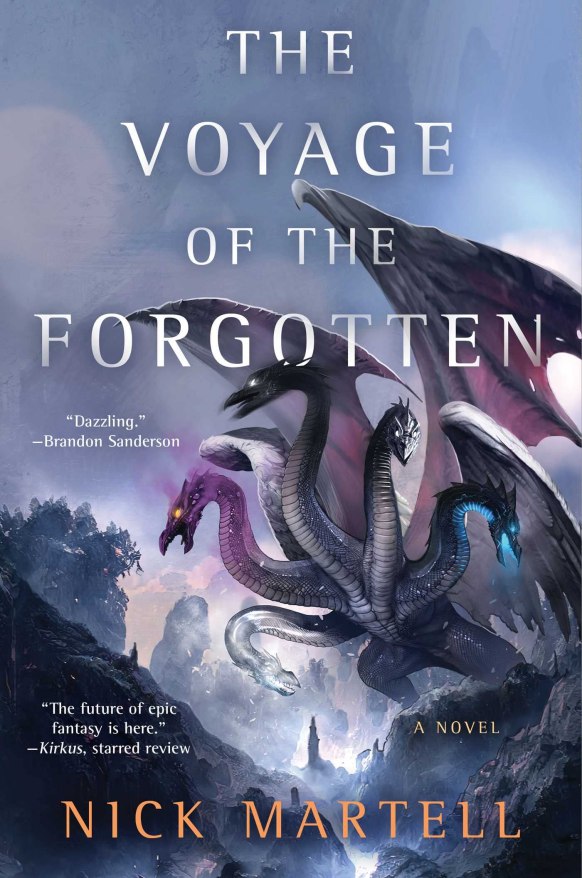
The Voyage of the Forgotten Cover 2

Amazon     Book Depository

Throwback Thursday – For the Emperor by Sandy Mitchell

Warhammer 40,000 - For the Emperor Cover

Publisher: Black Library (Audiobook – 23 December 2003)

Series: Ciaphas Cain – Book One

Length: 8 hours and 57 minutes

My Rating: 4.75

Amazon

I’ve already put up one Throwback Thursday post today, for the cool Warhammer 40,000 novel, Kingsblade by Andy Clark, but the fun doesn’t end there as I am also going back to 2003 and reviewing the hilarious and deviously clever novel, For the Emperor by Sandy Mitchell, which is easily one of the funniest Warhammer books I have ever read.

Anyone who has paid the slightest bit of attention to my recent review habits would probably have noticed that I am quickly and doggedly powering through a ton of the top books in the Warhammer 40,000 range of fiction.  Not only did I recently finish off the epic Eisenhorn trilogy by Dan Abnett (featuring Xenos, Malleus and Hereticus), but I have also checked out several cool standalone novels, including Grim Repast by Marc Collins, Deus Encarmine by James Swallow and Sepulturum by Nick Kyme.  All these books are exceedingly impressive examples of Warhammer 40,000 fiction that featured their own unique elements, such as galaxy spanning conspiracies, intense horror elements, or a futurist homage to classic, gritty cop stories.  However, the one thing that they all tended to lack was a substantial and notable sense of comedy.  That is where my next entry comes in as I have finally had a chance to explore the first book in the iconic Ciaphas Cain series by Sandy Mitchell (a pseudonym for author Alex Stewart), For the Emperor, which had me laughing like crazy.

In the millennia when the forces of humanity fought to maintain the Imperium of Man, many heroes have risen from amongst the ranks of the Imperial Guard, gloriously leading mankind’s armies against the traitors, the heretics and the xenos.  Of these, few are spoken of with as much reverence and respect as the famed Commissar Ciaphas Cain, a living legend of duty, honour and courage.  Known throughout the Imperium for his daring exploits that have seen him survive the harshest of battlefields and continually lead his forces to victory, Commissar Cain is considered by many to be one of the greatest heroes of the age.

However, everything everyone knows about Cain is a lie.  In reality, he is a conniving coward who only seeks to avoid the horrors of the battlefield by any means necessary, in order to survive and make it to retirement.  Blessed with remarkable survival instincts, Cain has managed to stay alive against impossible odds many times, which has led many to believe he is a true hero capable of anything.  However, Cain’s ill-earned fame and reputation is a double-edged sword, as he is constantly chosen to journey to the worst battlefields in the Imperium, where his bad luck ensures he is in the thick of the fighting.

His latest mission sees him assigned to a newly formed Imperial Guard regiment suffering from horrific infighting and a lack of discipline.  Determined to install unity and respect amongst his new regiment, primarily so they don’t shoot him in the back, Cain is confident that he has found a relatively safe assignment.  However, his bad luck once again sees him in the thick of it, as his regiment is transferred to the backwater planet Gravalax, where a delicate situation is unfolding.  The inhabitants of Gravalax are attempting to defect to the alien Tau, who come with a message of peace and the Greater Good.  Not wishing to face the Tau and their superior technology, Cain works hard to avoid an upcoming war and ensure diplomacy will prevail.

However, after the Tau ambassador is assassinated and tensions are enflamed across the planet, Cain begins to suspect that there is more in play than he previously expected.  A shadowy conspiracy is hoping to start a war between the Tau and Imperium on Gravalax, and Cain is right in the middle of their plot.  To survive and avoid yet another war, Cain needs to work with a beautiful inquisitor to find out who is behind the attempted carnage before it is too late.  But his investigation reveals a far more dangerous enemy than expected, one that is determined to destroy all before it, starting with the terrified Cain.

Wow, oh wow, now that was a pretty damn fun book.  I had heard many times before how awesome and entertaining the Ciaphas Cain books were, and For the Emperor really did not disappoint.  Featuring a compelling story loaded with clever, dark humour, For the Emperor is a very easy book to fall in love with, and I ended up coming away really impressed with Sandy Mitchell’s amazing writing and comedic ability.

For the Emperor’s narrative itself is pretty interesting as it follows Cain through one of his most notable adventures.  Told in a chronicle perspective from Cain’s own memoirs (which may or may not be the most reliable source of information), you get to see the true Commissar Cain as he finds himself thrust into another adventure.  After a quick and very intriguing introduction, with notes from Cain’s associate, Inquisitor Amberly Vail, the story initially details Cain’s attempt to unify and control the Valhallan 296th-301st composite Imperial Guard regiment (eventually the Valhallan 597th).  These initial chapters showcase many aspects of the compelling protagonist, his deep cunning and determination to avoid damage, while also taking the time to introduce several of the major supporting characters.  The story changes after a few chapters as Cain and his new regiment arrive on Gravalax, where Cain must contend with the Tau, who are influencing parts of the local population.  Unlike most Warhammer 40,000 novels, the story doesn’t revolve around a war between the Imperial Guard and the Tau; indeed the focus on the plot is avoiding the conflict as two rival races attempt to find a diplomatic solution.  Unfortunately, some hidden force is attempting to start a war between the Tau and the humans, and Cain soon finds himself trying to maintain the peace, primarily for his own benefit.  After several intriguing and entertaining side missions, the plot eventually sees Cain and the new Inquisitor Vail lead a small, expendable force into the lair of their true enemy.  While I won’t go into detail about who they face, it results in a series of gruesome and deadly battles, where Cain’s survival skills are really put to the test.  Mitchell features a ton of action, intrigue, and odd-couple team-ups for this final major sequence, and you are really drawn into the intense storytelling, with even Cain’s sense of humour failing to cut through the brutal nature of the conflict.  Everything ends on a compelling, if slightly dark note, and you come away from the story pretty damn satisfied and ready for another intriguing adventure from this hilarious protagonist.

I really liked the fun way Mitchell wrote For the Emperor, as everything is set out to enhance the inherent comedy of the book.  While there is a ton of impressive action, adventure and intrigue, at their core all the Ciaphas Cain books are very light-hearted and add a more humorous spin to the grim Warhammer universe.  Indeed, I was getting some major Blackadder vibes from For the Emperor, as much of the plot sees the supposedly noble protagonist attempting to weasel his way out of actually getting into a fight.  Pretty much every interaction or thought in this book had me chuckling in some way, and I appreciated some of the clever jokes or references that Mitchell scattered throughout.  I also deeply enjoyed the cool chronicle format of the story, as Cain’s antics are made even funnier when you see it from his eyes.  At the same time, Mitchell includes a ton of extra notes and excerpts from other in-universe texts that not only provide intriguing context, but also add to the humour, especially as the intentionally over-the-top opinions and bad writing highlights just how crazy other members of the Warhammer 40,000 universe are.  There are also a series of notes, footnotes and quotes from supporting character Inquisitor Vail sprinkled throughout the plot to provide some additional insights, often in a humorous way.  I always deeply enjoy the use of a good footnote in fiction, especially due to my love of Terry Pratchett’s novels, and I felt that Mitchell utilised them perfectly throughout For the Emperor.  Not only do they provide additional information, but Vail’s footnotes often directly contradict Cain’s opinions and descriptions of events, and ensure a much more complex and complete overall story.

While the focus is often on the humour, Mitchell also does write a pretty compelling military thriller as the main story, which ties well into the wider Warhammer universe.  The focus on the intense conspiracy and the outbreaks of rebellion and war fit into the more humorous feel of the book extremely well, and you get quite an impressive story as a result.  There are also some rather dark moments scattered throughout the novel as well, and they provide a rather interesting contrast to the more comedic elements.  Having the character deal with some heavy moments, like being forced to kill an innocent man, provides some great balance to the story, and despite the lighter tone, you are always reminded just how grim the overlying universe truly is.

I deeply enjoyed Mitchell’s unique take on the Warhammer universe that was featured in For the Emperor, especially thanks to who is telling the story.  Most of the Warhammer 40,000 books you experience either follow a bold warrior or a common soldier, many of whom see the universe through lens of duty or ignorance.  However, the Ciaphas Cain books provide a much more down-to-earth view as the cynical Cain sees events as they truly are and he knows deep down just how deadly the universe and his own comrades are.  I really liked this alternate view of the franchise from a protagonist and it, and the inherent humour of the story, help to make this book really stand out from some other novels.  At the same time, Mitchell adds in some compelling and fascinating insights to the Tau, and other factions to the story, which really help to expand out the universe and ensure that there is plenty there for all Warhammer readers.  The examination of a more diplomatic route from the usually xenophobic Imperium of Man was also pretty damn fascinating, and it really helps to showcase how pragmatic some of Mitchell’s characters are.  This lighter tone, as well as the fun references to some other classic Warhammer 40,000 novels, ensures that all fans of the franchise are going to have an amazing time with this book, and I personally found it to be a welcome change of pace between a few heavier Warhammer novels I have recently read.  For the Emperor would also serve as a pretty good entry point into the Warhammer 40,000 universe, especially as you get a good idea of how crazy everything is, while also getting to have a laugh at it.  As such, this is an extremely good Warhammer novel, and I now fully understand why the Ciaphas Cain books are so beloved by the fandom.

I can’t mention For the Emperor without discussing the awesome and extremely entertaining collection of characters that Mitchell successfully introduces here.  For the Emperor features a substantial and compelling cast, each of whom brings something special to the story and helps to either enhance the humour or the more serious aspects of the book in their own special way.

The most important of these characters is of course Commissar Ciaphas Cain, through whose memoirs we see most of the plot unfold.  A legendary hero of the Imperium, Cain is one of the more unique figures in Warhammer 40,000 fiction, mainly because he doesn’t deserve his inflated reputation.  While he acts the great hero and everyone is in awe of his reputation, in reality he is a craven figure who is actively trying to avoid the universe’s various wars and stay alive.  Thanks to his narration throughout the book, you see him constantly manipulating the situation to his advantage.  Literally every single action he takes is done to benefit him and him alone, with an appropriate explanation or excuse to keep people from getting suspicious.  Even his more heroic actions in the book (stopping a riot, defending the Tau ambassadors, visiting the enemy stronghold) are only done because they serve him in some way or when he can’t get out of doing it without dying or losing his ill-gained fame.  I absolutely loved this unique character feature, as not only is it hilarious to see how he manages to weasel out or manipulate situations but it ensures that he is the complete opposite of the usual gruff and ultra-serious Commissar characters that are such a big part of franchise (Gaunt and Yarrick, for example).

While it would be easy to dislike such a selfish character, you really grow to enjoy Cain and his hilarious and cynical viewpoint of the universe, which is the source of much of the book’s comedy.  It also helps that nearly every one of his actions backfires on him in some way, as his attempts to stay out of the fighting usually see him put into an even worse situation.  His intriguing narration through his journals (which have been seized and classified for political reasons), adds to the comedic and emotional impact of the story, especially as you get to see him weigh his actions with the benefit of hindsight (although he is usually unrepentant).  Of course, Cain is also the textbook definition of an unreliable narrator, and you have to wonder at the truth of his words sometimes.  I did like how Mitchell tried to show that despite his desire to avoid combat, Cain is actually a pretty capable warrior and commander, and that he wouldn’t be as effective a leader if he weren’t trying to keep up his lies.  There are also some flashes of humanity and deeper emotions scattered throughout the book, and you can see that there is a good person in there somewhere, even if it is buried far beneath his instincts for self-preservation.  Honestly, Cain might be my most favourite Warhammer character since Kal Jerico, and I had such a fun time seeing his antics in For the Emperor.

Aside from Cain, I really need to highlight Inquisitor Amberly Vail, who finds herself investigating the same conspiracy Cain gets wrapped up in.  Vail is a very fun character in this book as she not only presents the fictional version of For the Emperor to the reader, but she has a big role in the actual plot.  Vail serves as Cain’s love interest, but she also is the only person in the book who sees right through Cain and knows what he truly is.  Watching her manipulate the seasoned conman is quite cathartic, and the two make an effective and interesting team throughout the book.  However, I felt that Vail’s best contribution to the novel comes in the form of her notes and footnotes throughout the account, especially as they constantly call out Cain for his actions and keep his narration mostly honest by filling in some crucial gaps.  It as also very fun to see the various different versions of Vail that appear throughout the book, as you see both how she presents herself to the reader, and the slightly altered version of her that Cain sees.  This really makes her stand out as a central character in this series and her funny notes and corrections deeply enhanced the already entertaining plot.

Another major character I need to mention is Cain’s aide-de-camp, Jurgen, the Baldrick to Cain’s Blackadder.  A stooped, smelly and scruffy being, Mitchell has made Jurgen as Baldrick-like as possible (including a scene in which he comes up with a cunning plan), and I loved every damn second of it.  Firmly believing that Cain truly is the hero he claims to be, Jurgen faithfully serves Cain, and it is a lot of fun to see the two play off each other, especially as Jurgen is honestly the most honest and likeable character in the entire book.  The rest of the cast, which include schemers, professional soldiers, and various Tau, also have their moments, and I really liked how they were portrayed in the book.  However, they all share one particularly defining feature: they all believe Cain is a hero and are led around by his manipulations.  Watching these generally smart people fall for Cain’s lies is a great part of the book’s plot, and I had so much fun seeing them act the fool in this one specific way.  Overall, though, For the Emperor has some outstanding characters to it, and it will be fun to see how they are utilised in the other Ciaphas Cain books.

Like most Warhammer novels I have the pleasure of enjoying, I chose to listen to For the Emperor’s audiobook format, which I maintain is one of the best ways to enjoy Warhammer 40,000 fiction.  All the best narrative and stylistic elements of For the Emperor comes through at an even higher quality when you listen to them, and you really find yourself getting drawn into the complex story while also laughing at the fun characters.  I felt that the production value behind For the Emperor was particularly impressive, as the audiobook features three separate narrators in experienced voice actors Stephen Perring, Penelope Rawlins and Emma Gregory.  Perring, who I enjoyed last year in the audiobook for Engines of Empire by R. S. Ford, serves as the primary narrator for most of the book as he voices all the characters and action in the chapters of For the Emperor told from Cain’s perspective.  Perring is an extremely awesome narrator and the range of epic voices he creates for the main cast are very impressive and really capture their personalities and unique physical characteristics.  I loved the cynical, tired and falsely noble voice that Perring utilises for the main character of Cain, and you have to mention the slimy and fun voicework for the character of Jurgen as it makes him sound even more like Baldrick.  Perring also narrates a couple of the in-text extracts (those written by a male author), and he ensures that they sound even more pompous and filled with misinformation, than you would get from a simple reading.

While Perring is the main narrator, the other two featured actors have amazing performances in For the Emperor’s audiobook which really add to the overall production.  Penelope Rawlins voices the character of Inquisitor Vail during the parts of the novel she writes, mainly her notes on the events going on and the various footnotes featured throughout the plot.  Rawlins’s take on Vail is slightly different to that of Perring, and you get a stronger sense of her intelligence and power through Rawlins voice, which I felt helps to emphasise that Cain’s perspective might not be the most reliable.  The change in narrator also ensures that the various notes from Vail really pop out in comparison to the main story so you always know when Vail is speaking to correct Cain’s memory of events.  The way that the footnotes are read out exactly where they fall in the text also works extremely well, and it ensures that Cain’s misinformation never gets a chance to sit properly.  The final voice actor, Emma Gregory, also provides a few interesting sections to the audiobook, particularly as she narrates one of the recurring in-universe texts that is quoted, written by an older version of one of the supporting characters (Guardswoman Sulla, who gets promoted to a general in the future). Gregory captures the pride and arrogance of Sulla, as well as her devotion to Cain, perfectly, and I felt that this additional performance was a great part of the production.  All this incredible voice work, as well as the amazing story that it brings to life, ensures that For the Emperor’s audiobook is particularly awesome and really worth listening to.  With a runtime of just under 9 hours, this is a really easy audiobook to get through, and I powered through it in only a couple of days, mainly because of how much fun I was having, and I cannot recommend this format enough.

Look, I think it is clear to see that I loved For the Emperor and had a fantastic time reading this awesome book.  Sandy Mitchell did something pretty special with this first entry in the epic Ciaphas Cain series, and I am now a massive fan of this series and the titular character.  Loaded with so much clever humour, fantastic Warhammer elements, and a strong and surprisingly intense narrative, For the Emperor is pretty much perfect, and there is so much for people to enjoy.  As a result, this book is particularly highly recommended, and I fully intend to get more Ciaphas Cain fun and manipulations in the future.

Amazon

Throwback Thursday – Warhammer 40,000: Xenos by Dan Abnett

Warhammer 40,000 - Xenos Cover

Publisher: Black Library (Audiobook – 1 May 2001)

Series: Eisenhorn – Book One

Length: 9 hours and 55 minutes

My Rating: 5 out of 5 stars

Amazon

Welcome back to my Throwback Thursday series, where I republish old reviews, review books I have read before or review older books I have only just had a chance to read.  In my latest Throwback Thursday I continue to review the awesome Warhammer 40,000 works of Dan Abnett with his impressive and dark space thriller, Xenos.

For my Throwback Thursday last week, I talked about legendary Warhammer fiction author Dan Abnett and his Gaunt’s Ghosts series, which is one of the pillars of Warhammer 40,000 fiction.  I have already had a lot of fun reading several of the Gaunt’s Ghosts novels (including First and Only, Ghostmaker and The Vincula Insurgency), so I thought I would take the opportunity to check out one of Abnett’s other major Warhammer entries, the Eisenhorn series, which I have heard some extremely good things about.  Set in a different area of the Warhammer 40,000 universe than the Gaunt’s Ghosts books, the Eisenhorn books are a darker and more intense series that follows a troubled Imperial Inquisitor hunting down a deadly conspiracy at the heart of humanity.

In the dark future, the Imperium of Man is under constant attack from aliens, monsters and daemons who seek to destroy or corrupt all within.  However, the greatest threat to the Imperium comes from within as diabolical heretics, witches and cultists work from the shadows to weaken the Imperium, worship the forces of Chaos, and bring humanity crashing down around them.  The only protection humanity has against these nefarious and hidden threats are the members of the Inquisition, deadly agents who wield great power and authority to pursue their investigations by any means necessary.

Gregor Eisenhorn is a talented and experienced Inquisitor who has long fought against the shadows constantly threatening stability and order.  When he finally corners and kills an old adversary amid a dark ritual, Eisenhorn hopes that his actions have permanently ended an ongoing source of Chaos and despair in the Imperium.  However, evidence he recovers from the crime scene hints at a greater conspiracy that threatens several local systems.

Travelling to a prosperous system hub, Eisenhorn restarts his investigation, determined to get to the bottom of this new danger.  However, he is unprepared for the full scope of the hidden forces of Chaos that wait for him, as a massive and hidden cabal rises in opposition against him.  As multiple planets within the system burn due to the action of the Chaos cultists, Eisenhorn works with a series of unique allies to bring this cult to heel before they cause irreparable damage to the Imperium.  However, the more sinister danger may come from the prize that his enemies are seeking, an ancient and dark tome of knowledge, known as the Necroteuch, which has the potential to burn the universe and turn the entire Inquisition against Eisenhorn.

Xenos was another exceptional novel from Abnett, and one that really showcases his ability to tell a varied and complex tale.  This is a dark, powerful, and impressive character-driven read, and I loved the switch to dark intrigue and heretical investigations, which made for such an incredible story.  I was an instant fan of Xenos’s clever and highly addictive plot, and I must give it a full five-star rating for how awesome it was.

I was deeply impressed with the outstanding and compelling story that Abnett featured in Xenos, especially as it was very different in style and substance to his previous works I have enjoyed.  While the Gaunt’s Ghosts novels are gritty war stories that focus on the common soldier, Xenos was a powerful and twisty space thriller that saw a determined Inquisitor attempt to root out the manipulations of Chaos far away from the battlefields.  The story itself is extremely clever and well-paced, and it swiftly draws you in with its dark events, especially its intense and action-packed introduction.  Despite killing his nemesis early in the story, Eisenhorn is forced to keep digging even further as he uncovers more conspiracies and plots.  Utilising undercover methods, interrogations, obscure evidence and a series of bloody fights, Eisenhorn and his unique comrades follow the trail across the sub-sector, attempting to discover the true plot of their enemies.  This leads to several large and memorable set pieces, and I loved the constant change of locations, especially as it allowed you to get a whole new idea of the scope of their foes plans and the desperate battles being fought to stop them.  I also enjoyed the quieter scenes that were laid out between them as they not only added some great intrigue, but also highlighted the personal nature of the protagonist’s quests and the bonds he forged along the way.  The plot is eventually resolved after several major battles, including some very trippy sequences, and I came away from this book very satisfied and wanting more, especially as Abnett laid some intriguing hints about deeper conspiracies towards the end.  I was absolutely hooked the entire way through this narrative and I had such an amazing time reading this exciting and compelling story.

Xenos was an extremely well written Warhammer novel, and I really appreciated how Abnett was able to seamlessly change writing style and tone for this darker read.  The author makes excellent use of a first-person perspective for Xenos, as the story is in a chronicle format being written by the central character of Inquisitor Eisenhorn.  This allows for a much more personal and protagonist-centric narrative which really draws you into the hunt as you see the protagonist’s obsession with capturing the heretics and ending the threat to the Imperium.  Abnett keeps the pace pretty fast and intense throughout the entirety of Xenos, even during the sequences between the main action-packed scenes, and you are constantly engaged with the hunt or the intriguing relationships between the characters.  I was personally very impressed with how Abnett was able to blend a lot of distinctive story elements together throughout Xenos to produce an excellent story.  The way that the author combines Warhammer, thriller, mystery, science fiction and even horror (the Chaos creatures can get pretty bad at times) elements together is just amazing, and it opens up the appeal of the book to a wide range of readers.  I loved the continued and powerful hunt throughout the Imperium, especially as all the protagonist’s actions and attempts to end the threat result in major consequences for those around him.  This was a deeply captivating and intense read, and I cannot empathise how addictive and fun I found it.

One of the main reasons I chose to check out Xenos and the Eisenhorn series, aside from generally loving Abnett’s writing, is it is generally considered to be one of the best series to start a dive into Warhammer fiction.  After powering through Xenos, I can confirm this as Abnett uses the lore and the darker side of the Warhammer universe to its full advantage throughout this fantastic thriller tale.  While some slight knowledge of the large Warhammer 40,000 universe might be helpful to understand parts of Xenos, new readers unfamiliar with the franchise can easily dive into this book and follow the story with no problem, and any science fiction fan can have an amazing time reading it.  Abnett patiently and competently explores key details of the Warhammer universe as the story continues, although never in a way that interferes with the captivating flow of the book.  As such, you get a good view of the overall state of humanity and the Imperium during this novel, with a particular focus on the Inquisitors and their mission.  The Inquisitors have always been a fascinating and complex part of Warhammer 40,000 lore, and this series really highlights just how dangerous their tasks are, as well as the fine line they walk in their hunt for justice and purity.  Naturally, this dive into the Inquisition will also make this book very appealing to experienced Warhammer readers as well, and Abnett is considered to be one of the best franchise authors for a reason.  I have a deep appreciation for all the cool lore elements that were featured here, and I particularly enjoyed how Xenos offers a very different story to many of the other Warhammer 40,000 books out there, and really highlights just how complex the universe can be.

I was also very impressed by the exceptional character work that Abnett featured with Xenos, as this compelling read features some great characters.  The primary figure of this book is naturally Inquisitor Gregor Eisenhorn, who serves as the main protagonist and narrator of the story.  I felt that Xenos served as a particularly good introduction to this iconic Warhammer figure, and I found myself getting quite attached to his journey.  A no-nonsense and extremely practical Inquisitor, Eisenhorn is seen by many as a cold and calculating man, although deep down he is a caring individual who feels great attachment to his friends and comrades.  Abnett portrays Eisenhorn as a pretty reasonable figure, preferring subtle investigations, which makes him appear a bit radical to some of his fellow Inquisitors whose preferred methods are to kill anyone with any potential for evil.  It was very interesting to see him as a pretty strait-laced guy in Xenos, especially as I have heard of how radical he gets in the future, and I think it was very smart of Abnett to showcase him in this way first to enhance the impact of his future actions.  However, Eisenhorn does go through a lot in Xenos, including mental, psychical and spiritual tortures, and you can really see the damage done to him and how his desire for vengeance and getting the job done by any means grows.  I cannot wait to see how his story advances in the next few books, as I know that Abnett has damaging days in store for him.

In addition to Eisenhorn, Abnett loads Xenos with a ton of interesting supporting characters, all of whom are seen through Eisenhorn’s eyes.  This includes Eisenhorn’s eccentric entourage of follows and agents, including a data-obsessed scholar, a skilled pilot, a grim justice operative and his newest associate, Bequin, a psychic blank who is drafted into the war against Chaos against her will.  This unusual team prove to be great backup to the dour Eisenhorn, and I liked the genuine connection that Eisenhorn forms with them, especially as it shows that he really isn’t the monster many people think he is.  Other characters of note include the varied and distinctive fellow inquisitors that either assist or oppose Eisenhorn, and the various deadly enemies he goes up against.  Rather than have one specific antagonist in Xenos, Abnett featured a cabal of Chaos worshipping foes, each of whom despises Eisenhorn for what he represents.  While there isn’t a massive focus on any specific villain, each of the major players in the cabal are pretty distinctive, and I liked the overall effect that Eisenhorn is fighting a multi-faced beast in Chaos, rather than a specific evil.  These outstanding characters really enhanced this epic and captivating narrative and I look forward to seeing what other insane figures show up in this series as it progresses.

Unsurprisingly, I chose to enjoy Xenos in its audiobook format, which is frankly the best way to experience any Warhammer novel.  With a run time of just under 10 hours, I absolutely powered through this audiobook and I found that it perfectly conveyed all of Abnett’s elaborate and compelling story elements.  This was partially due to the brilliant narration of veteran voice actor Toby Longworth, who has lent his fantastic vocal talents to most of Abnett’s Warhammer books.  Longworth did another remarkable job here with Xenos, and I loved his take on this slighter darker narrative.  I deeply appreciated all the voices he provided to the characters in Xenos, especially as he is not just recycling the voices he uses in the Gaunt’s Ghosts books.  Each of the voices here are pretty fitting to their respective character and there is some fantastic variation based on plot details such as the speaker’s planet of origin, species, inclination, and personality.  This excellent voice work really enhanced my enjoyment of this captivating read and I would strongly recommend this format to anyone interested in reading Xenos.

The first entry in Dan Abnett’s Eisenhorn series, Xenos, lives up to all the hype surrounding it as it proved to be an exceptional and highly addictive read.  Perfectly combining an elaborate thriller story with the dark Warhammer 40,000 universe, Xenos was a joy to read from start to finish.  I cannot recommend this novel enough and my plan is to listen to yet another book from Abnett in the next couple of days.

Amazon

The Martyr by Anthony Ryan

The Martyr Cover

Publisher: Orbit/Hachette Audio (Audiobook – 28 June 2022)

Series: The Covenant of Steel – Book Two

Length: 19 hours and 42 minutes

My Rating: 5 out of 5 stars

Amazon

The always impressive Anthony Ryan continues his outstanding Covenant of Steel series with The Martyr, which was hands down one of the best fantasy novels of 2022.

Anthony Ryan is an extremely talented author who has been one of the leading authors of fantasy fiction for the last decade, producing several intriguing and major series.  Best known for his Raven’s Shadow trilogy (which was followed on by the Raven’s Blade duology), Slab City Blues, The Draconis Memoria and Seven Swords series, Ryan has a substantial catalogue of fantasy works to his name, most of which sound pretty damn epic.  However, I have so far only read the books from his latest series, The Covenant of Steel series, which has proven to be exceptional.  The first book in The Covenant of Steel was last year’s deeply compelling release, The Pariah, an excellent novel that set up a deeply intriguing and highly addictive character-driven tale of adventure, conspiracy and war.

The Pariah told the adventure of Alwyn Scribe, a young outlaw who was raised by brutal bandit chief.  However, his time as a member of a notorious band of villains came to a bloody end when his entire gang is brutally killed by the crown and his mentor is executed.  Imprisoned in a mine, Alwyn finds a new mentor in an imprisoned religious figure, who teaches him to be a talented scribe, and he is eventually able to escape.  Chance and self-preservation lead him to join the Covenant Company of Lady Evadine Courlain, a pious woman whose religious visions, sermons and sheer faith allow her to bring together a band of dedicated soldiers.  Swiftly growing loyal to her, Alwyn becomes one of her key followers, and saves her from certain death several times as they fight across the Kingdom of Albermaine.  I deeply enjoyed the elaborate and extremely addictive narrative contained within The Pariah, and this ended up being one of my absolute favourite books and audiobooks of 2021 (as well as being one of my favourite new-to-me authors of the year as well).  As such, I was extremely happy to receive a copy of The Martyr a little while ago, although I held out reading it until I could get a copy of the audiobook version as well.

The Martyr takes places shortly after the bloody conclusion to The Pariah and sees Alwyn Scribe now firmly in the service of Lady Evadine Courlain, whose apparent resurrection has led to her being proclaimed a living martyr of the Covenant church.  However, this and the fanatical devotion of the faithful of Albermaine have placed her in the crosshairs of both the Crown and the Covenant, both of whom see her as a dangerous pretender to their power.  Unable to kill her without starting a religious rebellion, the king decides to use Evadine for his own purposes.

Sent south to the Duchy of Alundia to put down a rebellion and stop a series of religious attacks upon the Covenant faithful, Alwyn, Evadine and the Covenant Company take up residence in a small, dilapidated castle, which soon draws the attention of the Alundian nobility.  Besieged by a massive army, Alwyn and his companions must survive the onslaught if they are to pass on Evadine’s message for the future.  However, not everything is as it seems.  Dark forces are in play and Alwyn soon finds himself in the middle of treacheries, both new and old, as he desperately stands beside his mistress.  Forced to dive into the secret past of the land, Alwyn soon discovers that many of the things that Evadine preaches are true, including the legend of the Scourge that destroyed the world and threatens to re-emerge.  But is Alwyn fully prepared for all the heartache, betrayal and bloodshed his quest is about to unleash?

Anthony Ryan is on fire once again with his second book in The Covenant of Steel series.  The Martyr is an epic and deeply addictive read that perfectly follows on from Ryan’s previous book and in some ways surpasses it with its impressive storytelling and amazing characters.  Thanks to its incredible story and cool expansion of Ryan’s fantasy universe, I had an outstanding time getting through The Martyr, and it receives an easy five-star rating from me.

I had such an outstanding time with the epic story that Ryan pulled together for The Martyr, especially as it cleverly expands on the narrative from the first book, while also taking the characters in some awesome new directions.  The book has a very strong start to it, which follows on from a useful, and slightly humorous, summary of the events of The Pariah.  From there, we quickly see the fallout from the last book, with the protagonist Alwyn and his comrades forced to engage in the politics of the realm to ensure that living martyr Evadine is allowed to continue her work.  The narrative is still told from Alwyn’s perspective as he recounts the events in chronicle form, so I was quickly hooked, and I liked the immediate dive into fantastic political intrigue and compelling universe building.  However, the story only gets even more awesome from there, as the protagonist and his company are deployed to a war setting, which turns out to be particularly epic as they are soon caught up in some outstanding siege scenarios.

Now, I frankly had no idea how Ryan was going to improve on the outstanding story from The Pariah, but having a siege storyline was a pretty good way to go about it.  I love sieges, and Ryan featured an incredible example here, as a large amount part of the book revolves around two amazing battles between attackers and castle defenders.  The first of these sees the protagonists trapped inside a dilapidated fortress facing off against a larger army, which proved to be a lot of fun.  The author really captures the chaos and drama of an impromptu siege with this earlier one, and the carnage comes quick and fast as the characters are forced to bring the attackers to battle before repelling them, using their wits and limited resources.  The action here is pretty intense and shown in excellent detail, as Ryan does not hold back on the brutality and the complexities of a siege.  I had such a great time with this first siege, and words cannot describe how ecstatic I was that he followed it up with a second siege, with the protagonists now acting as besiegers, in a more traditional siege, with artillery, sapping and even a deadly storm of the breach with the point-of-view character in the front.  These two sieges were pretty damn exceptional and have some of the best and most bloody action scenes in the entire book.  I particularly liked how well the author contrasted the differing experiences that the protagonist experienced as both a defender and an attacker, and it was fascinating and very fun to see him on both sides of the wall, especially as he learns from his experiences to become a better invader.  However, it is not all about the action, as you have some compelling political considerations going on here, as well as some great character development and the protagonist gets closer to some of the other characters during the heat of combat.

Following the sieges, the story goes in some interesting and unique directions, as Ryan continues the epic of Alwyn Scribe by expanding the universe around him.  This includes a visit to a dangerous foreign land, where he learns some harsh and surprising truths about the universe he lives in and his place within it.  This results in some trippy but deeply fascinating scenes, especially as there are some interesting reveals and some great hints for the future.  Ryan also once again dives into the political intrigue, as the protagonists are involved in some great fights for the future of the realm.  Watching the protagonists fight both on and off the battlefield is pretty cool, and the sheer threats growing around them in the last quarter of the book bode well for the future of the series.  There are some interesting reveals towards the end of The Martyr, and Ryan also works to tie up a few loose ends from the previous book, which I was very happy to have closure on.  Everything ends on a very intriguing note, as Ryan leaves behind a great little cliff-hanger reveal that will be very thought-provoking in the lead-up to the next book.  I had such a great time with this story, and it really drew me in with its fantastic moments and complex, overarching storylines.

I am a pretty big fan of how The Martyr’s story came together, and Ryan has a great writing style that really enhanced the whole experience.  I absolutely loved the chronicle style that he uses to detail the plot.  Told completely from the protagonist’s perspective as he writes down all he experiences, you get a unique view of the events occurring, especially as the protagonist writes in funny or insightful comments that show his opinions of the events in hindsight.  At the same time, they allow the protagonist to air his many regrets, and you get a certain sense of foreboding for some of the events that are to come, either in this book or in the rest of the series.  I was pretty consistently entertained by this style of writing, and I think that it also added in some extra humour to a somewhat darker fantasy story, especially as the protagonist is quite a funny and unconventional figure.  The Martyr’s story has an amazing blend of different elements, and while I lavished my love above on the great action, especially during the siege sequences, most of the book is about the development of the protagonist and his attempts to keep Evadine alive.  This results in a brilliant combination of politics, intrigue, great interactions between figures, and some awesome character development, which works to produce quite an addictive read.  Watching Alwyn trying to come to grips with the many dangers threating his friends, while also unpicking the multitude of mysteries and secrets surrounding him is just great, and Ryan keeps adding in new secrets and supporting storylines to keep the reader interested.  While there is a lot going on within The Martyr, the pace is pretty fast and consistently exciting, and at no point was I not immensely entertained, either by the powerful action or fascinating world building.  Due to the amount of lore and history featured in the first book, I would strongly suggest that interested readers get through The Pariah before trying out The Martyr, and fans of the first book will really enjoy where this second book goes and how Ryan effectively tells the story.

I was very impressed with all the cool ways that Ryan expanded the series’ setting in The Martyr, as he adds in some great additional history, expands on some of the mysterious religious and mystical aspects of the first, while also showing off some fascinating new lands.  This additional context around parts of the nation of Albermaine proves to be pretty damn intriguing, and you learn a lot more about it, while also seeing a lot more about its internal politics and rule, especially as the characters are forced to deal with the royalty and the church.  The inclusion of the Duchy of Alundia, where much of the plot takes place, was also pretty excellent, especially as Ryan portrays it as a more rugged and dangerous locale, whose unique take on the Covenant religion leads to a veritable holy war when Evadine and her company arrive.  However, the most captivating new part of the book has to involve the protagonist’s journey to the Caerith Wastes.  Alwyn has been haunted by members of the mysterious Caerith race since the start of The Pariah, and their strange ways and powerful magics have been both a boon and a curse to him.  As such, a journey to their homeland was always inevitable, and Ryan ensures that there are many surprises, mysteries and some interesting reveals for the protagonist when he finally arrives.  Ryan did a really good job introducing this new race of people in the story, and there are some great scenes where Alwyn attempts to learn more of them, while using his own personal history to stay alive with them.  The subsequent reveals about some of their powers and how it has been impacting Alwyn are pretty amazing.  One reveal, which illuminates the origins of Alwyn’s historical chronicle that the entire series is based on, was particularly compelling, and it sheds a whole new light on everything you have been reading.  Overall, Ryan did a fantastic job expanding his fantasy realm in The Martyr, and I look forward to seeing what cool inclusions he features in the next book.

Easily one of the best things about The Martyr was the outstanding and complex characters that were such a key part of the book.  Ryan expands on many of the great characters from the first book and takes their unique narratives in some amazing new directions.  The compelling and dramatic interactions that occur between these figures results in some powerful moments and I deeply enjoyed seeing the outstanding ways their tales and lives evolved in this second book.

The character who naturally gets the most focus is central protagonist and sole point-of-view character, Alwyn Scribe.  A former bandit who, thanks to a series of influential leaders and friends, became first a talented scribe and then a soldier, Alwyn is a man with a past and a fast mind who now finds himself in the centre of his nation’s crisis.  Dedicated to the Lady Evadine, Alwyn spends much of this book advancing her cause, while also evolving further as a character.  While he still primarily considers himself to be a scribe, Alwyn ends up taking on more and more different roles as he finds himself thrust into Evadine’s adventures, including being a knight, a military commander, a politician and a spymaster.  As such, you see him go through some major leaps and developments as he tries to reconcile what he is with what he needs to be to keep those around him alive.  This proves to be quite fascinating, and I loved the various unique situations he finds himself in, especially as he begins to realise some of the mystical mysteries the world contains and his place in them.  Alwyn continues to be an excellent main character for this series, and I loved his depictions of how the events of the book unfold, especially as his later insights from when he chronicles his adventures add both weight and humour to the current story.  His unique background as a criminal and a scribe continues to serve him well in The Martyr, and he has some very inventive ways of solving problems that often rely on his criminal or academic past.  I also deeply enjoyed seeing him take on a role as a teacher and mentor to several younger characters in this book, and it was a nice to see Alwyn come full circle after all the mentorship he received in the first book.  I had a great time seeing how he grew into the new roles in this book, and it will be fascinating to see what different positions he takes on in the future, especially as he becomes more and more devoted to Evadine, not matter how crazy their adventures become.

That leads nicely to the other major character I wanted to highlight, Lady Evadine Courlain.  Evadine is a fascinating figure in this series, a pious and devote noblewoman who has been receiving prophetic visions all her life.  Believing these visions to be from the Seraphile (the divine focus of the Covenant religion), Evadine created her own military company in the hopes of averting the Second Scourge (an apocalyptic calamity).  After miraculously recovering from a fatal wound, Evadine has now been declared a Risen Martyr, and believes herself to have been raised up by the Seraphile, despite it actually being caused by a magical bargain struck by Alwyn.  Now a major religious figure, Evadine has become a threat to both the church and the crown and must deal with their attempts to destroy her while she attempts to achieve her mysterious goals.  I deeply enjoy Evadine as a character, particularly as there is such an inherent mystery behind her, as you have no idea whether she is actually divinely blessed or just crazy.  Ryan portrays her as both at times, and while it is easy to assume the latter, she keeps coming up with knowledge and insights that should be impossible to achieve.  Watching her continue to evolve as a religious figure in The Martyr is both fascinating, and a little concerning, as you really have no idea where her story is going to go, or what insanity or divine revelation may come from her next.  Evadine serves as a quite a good foil to the more cynical character of Alwyn, and they become quite an intriguing team in The Martyr, with Alwyn providing the means to many of her successes, while strongly disbelieving her divine status.  There is also a certain growing instability in Evadine that underlies much of the book and adds to the general tension between her an Alwyn.  This, as well as a few intriguing reveals, makes Evadine one of the most compelling and unique figures in the series and it is clear that Ryan has some very, very interesting plans for her future.

Aside from Alwyn and Evadine, The Martyr is loaded with a ton of great supporting characters who add a substantial amount to the overall narrative.  Many of these characters carry over from the first book, and there are some intriguing and dramatic developments that occur in The Martyr that prove to be quite shocking and fun in places.  Great examples of this include the disgraced knight Wilhum Dornmahl, who is a major figure in the Covenant Company’s ranks, Ayin a murderous young girl Alwyn takes under his wing and teaches, and the mysterious Sack Witch, who haunts the character, despite barely appearing in the book.  In addition, Ryan introduces many new great characters in the second book, or else finally introduces and expands on characters mentioned in The Pariah.  Two minor characters from the first book who really stood out to me in the sequel were Princess Leannor, the king’s sister, who serves as a canny and complex political adversary to Alwyn; and Ehkbert Bauldry, a legendary knight who Alwyn bears a grudge against, but who also proves to be an interesting ally.  Both have some intriguing interactions with Alwyn, especially as they know he has some substantial dirt on them that makes him quite a threat.  I also must highlight outstanding new characters like Juhlina, better known as a The Widow, a deadly Covenant Company soldier with a tragic backstory and unstoppable rage, and Lilat, another new mentee for Alywn.  These characters were all extremely fun and compelling, and I loved how Ryan fit them into the story and made them shine.

As I mentioned above, I did receive a psychical copy of The Martyr a little while ago, however, I held off reading it until the audiobook version came out.  While I did regret not diving into the story as soon as I got it, I think it was more than worth it as the audiobook format of The Martyr was pretty damn exceptional.  Coming in with a run time of just under 20 hours, The Martyr has a decent length to it, although I found myself getting through it in just a week, mainly because I was just so addicted to Ryan’s outstanding story.  The audiobook format really helped with my enjoyment of this book, and I really found myself getting drawn into the elaborate narrative through the narration.  I definitely absorb more narrative detail when I listen to a book, and this was particularly noticeable with The Martyr audiobook, as I found all the cool story elements, details about the setting, intriguing characters and epic action popped more into my head through this format.  I also really need to highlight the exceptional voice work of actor Steven Brand (who I best know as the villain from The Scorpion King) who has lent his voice to the audiobook versions of all of Ryan’s works.  Brand is an extremely talented audiobook narrator who deftly captures the many characters contained with The Martyr and gives them distinctive and compelling voices that really fit the character and showcase their emotions.  I particularly liked the way in which he portrays protagonist and narrator Alwyn Scribe, and you really get a sense of the character’s emotional state, as well as the sense of weariness the chronicle format conveys through Brand’s voice.  This ended up being a pretty awesome audiobook and it was definitely my preferred way to enjoy The Martyr.  As such, this format is highly recommended, and when I get around to reading the rest of Ryan’s books, I will be grabbing their audiobook versions.

After all the gushing above, I think it is fair to say that I deeply enjoyed Anthony Ryan’s latest book.  The Martyr was an exceptional and deeply addictive read that I felt perfectly continued the amazing groundwork he established in The Pariah.  This second entry in The Covenant of Steel series was something special, and I had such an epic time seeing what unique and captivating adventures and battles the great protagonists found themselves in.  The Martyr was such an outstanding fantasy read, and I can’t wait to see how Ryan continues this awesome series in the future.  A truly incredible read!

Amazon

Warhammer 40,000: Outgunned by Denny Flowers

Warhammer 40,000 - Outgunned Cover

Publisher: Black Library (Audiobook – 20 August 2022)

Series: Warhammer 40,000

Length: 10 hours

My Rating: 4.75 out of 5 stars

Amazon

One of the fastest rising stars of Warhammer fiction, Denny Flowers, returns with his second novel in the Warhammer 40,000 canon, Outgunned, a deeply compelling and epic novel with a twisty and powerful story.

Last year I was lucky enough to read an interesting and memorable Warhammer 40,000 novel, Fire Made Flesh.  The debut novel of Denny Flowers, who had previously written some interesting Warhammer 40,000 short stories, Fire Made Flesh was part of the Necromunda subseries and told a fantastic story about warring factions in a spooky underworld town.  I had a lot of fun reading Fire Made Flesh, and it ended up being one of the better debuts I read in 2021.  As such, I have been eager to see how Flowers was going to follow up this debut, and I was deeply excited when I saw that he had a new novel coming out, the intriguing Outgunned.

In the far future, the soldiers of the Imperium of Man fight monsters and aliens on many battlefields and there is always a need for fresh bodies to fill the gaps in the ranks.  That is where Kile Simlex comes in.  A talented propagandist, Simlex excels at creating moving cinematic picts to inspire the people and increase recruitment to the Astra Militarum.  However, Simlex desires greater realism and seeks to travel to a battlefield to gain real footage for his greatest pict yet.

Travelling to the fetid swamp planet of Bacchus, Propagandist Simlex plans to chronicle the adventures of the Aeronautica Imperialis, the brave flying aces who traverse the skies, fighting in deadly aerial combat against the rampaging ork hordes.  In particular, he hopes to make a pict about legendary fighter ace, Lucille von Shard, considered to be the greatest pilot in the Imperium, to turn her into a renowned hero.  However, not everything is as it seems on Bacchus, and Simlex’s attempts to get footage may cost him everything.

Soon after arriving, Simlex begins to realise that the war on Bacchus is not going to plan.  The undermanned Aeronautica forces are being overwhelmed by the supposedly crude orks who have created an elaborate fleet of fighters and are slowly destroying Imperial forces from a hidden base.  At the same time, a mysterious sickness is destroying the planet itself, while its governor is determined to downplay the war no matter the cost.

However, his biggest threat may come from his chosen subject, as Lucille von Shard is an arrogant and disobedient pilot who has only avoided execution due to her peerless flying abilities.  Determined to make the situation work, Simlex attempts to chronicle the reluctant Shard’s skills, while also investigating the strange occurrences on Bacchus.  But is even the legendary Lucille von Shard capable of defeating the mysterious enemy waiting for them within the clouds?  The Green Storm hungers for combat, and the entire Imperium may shake as it approaches.

This was a superb and deeply impressive Warhammer 40,000 read that really highlights Flower’s growing skill as a science fiction writer.  Containing a unique and highly addictive narrative, Outgunned was an outstanding read that blended an exceptional story with some impressive glances at the wider Warhammer 40,000 universe.  I had an amazing time getting through this book and it was one of the more exciting and compelling Warhammer novels of 2022 so far.

I must admit that while I deeply enjoyed Outgunned’s brilliant narrative, it honestly wasn’t what I was expecting when I first started reading it.  Rather than a completely combat/military focused story about battles in the sky, Outgunned is a powerful and intense story that spends just as much time examining the darker aspects of the Imperium of Man as it does facing off against the ork threat.  This becomes clear very early on, especially as the opening introduction from Simlex hints at the deceit, cover-up and lies that are to come.  However, I was still unprepared for the full extent of the fantastic narrative that Flowers came up with, as he blends a lot of complex themes and components with some exceptional character work and clever universe expansions to create something truly special.

Outgunned’s narrative starts off hard and fast, quickly introducing Simlex and his propagandist ways, as well as his intentions on Bacchus, before throwing him briefly into the fray and introducing his fellow protagonist, Shard.  From there, Simlex attempts to film the flying aces in action, but he soon begins to realise that the supposedly stupid orks have developed a giant fleet of sophisticated airships and are slowly winning the battle against the Aeronautica Imperialis.  As he attempts to learn more about this, he finds himself drawn into a major conspiracy as Bacchus’s governor is determined to minimalize the impacts of the ork invasion and is actively working against it.  This forces Simlex to engage in multiple efforts, including diving into the past of his desired subject, the prickly and secretive Shard and flying on several missions against the orks, only to discover just how organised and deadly they are.  At the same time, he also attempts to understand what is truly going on with Bacchus and its people, as he finds many strange elements to them, including a spreading disease and a corrupt leader.  These well set up storylines are not only quite compelling and intriguing in their own right but they come together to tell a complex and impressive story that I was deeply addicted to.  I loved the mysteries and intrigues featured within this story, and they blended extremely well with the more combat orientated aspects of the plot and the unique character interactions that Flowers included.  Everything comes together extremely well at the end, and I loved some of the brilliant revelations and secrets that come out as the story concludes.  The entire narrative leads up to an excellent final fiery confrontation with the orks, which ties in nicely to many of the story elements featured throughout the book.  This is an overall excellent and powerful narrative that will really draw you in, especially with its unique look at the Warhammer 40,000 universe.

I deeply enjoyed the way that Flowers set out Outgunned’s narrative as there are so many great elements to it.  Told in a chronicle format from Propagandist Simlex’s perspective as he recalls the events in a more realistic and negative light.  This works to tell quite an intriguing tale, especially as you get some hints of the events of the future, and the negative tint that Simlex gives to the book’s narrative was a fantastic overall tone.  Despite this interesting narration choice, this novel has a brilliant, fast pace to it and the reader is never left in a dull spot, as there is always some cool action, fascinating intrigue or powerful dive into a character occurring throughout.  I loved the balance of story elements, and I must highlight the fantastic moments where Simlex works on his propaganda picts and dives through his recordings of the events around him.  I also had a lot of fun with the outstanding ariel combat scenes that are featured through the plot.  While they aren’t as heavily featured as you would expect from a book about the Aeronautica Imperialis, there are still some great sequences that were very fun to see.  Flowers really captures the magic and brutality of combat in in the air, and I loved some of the crazy scenes that resulted, especially against the ork stronghold.  There is also a particularly good fight sequence in the middle of a swamp that was pretty awesome, especially as it showed one character’s particular ingenuity and fighting spirit.

Outgunned served as an impressive standalone entry in the Warhammer 40,000 universe, and I deeply enjoyed how self-contained the narrative turned out to be.  Flowers also did a great job explaining most of the relevant Warhammer 40,000 elements featured within Outgunned, and I felt that this book can be easily enjoyed by most science fiction fans, although established Warhammer fans will probably get the most out of it.  I loved some of the very unique Warhammer 40,000 aspects that Flowers featured in Outgunned, as the author came up with some fantastic new elements that added so much more to the story.  I personally thought that Flowers did a really good job examining the Imperium through his character’s eyes, and you really get to see a fun new edge to it.  Not only do you get to see the Aeronautica Imperialis in action, which will appeal to many Imperial Guard fans, but you also get a cool viewpoint of the Imperium’s propaganda department.  Watching the protagonist dive into the techniques and motivations of the Imperial propagandists is quite fascinating, and it gives another great edge to the already dark and gothic Imperium that make you understand that deep down, they really aren’t the good guys they try to make out.  Throw in a fun blast of Imperial politics, as a corrupt planetary governor can manipulate the Astra Militarum for their own selfish ends, as well as some dark viewpoints of the brainwashing of young soldiers that occurred to certain characters, and you have a great, cynical view of the Imperium that I deeply enjoyed.

I was also quite impressed with the intriguing and cool viewpoint of the orks contained in Outgunned.  2022 has been a pretty good year for fascinating ork novels, such as Ghazghkull Thraka: Prophet of the Waagh! and Catachan Devil, and Outgunned offered another great look, even though you rarely get to see the creatures in person.  Instead, Flowers offers an interesting look at them through the human characters’ eyes as they try to work out just how these supposedly crude creatures are winning the war for the skies over the planet.  Watching the characters slowly realise just how ingenious and clever the orks really are is pretty fun, especially as the propagandist main character has spent most of his career showing them as stupid beasts.  As such, the book shows many fantastic examples of the complex ork culture through the eyes of characters who really don’t understand it, which I think worked to make it appear a lot more interesting and mysterious.  Established fans of the ork faction (and what Warhammer fiction reader doesn’t love the orks?), will have a blast watching the characters, especially the sheltered Simlex, try and understand their motivations and tactics, and I felt that it was a great way of showcasing the orks without having a major ork character present.  I deeply enjoyed all the awesome Warhammer 40,000 elements contained with Outgunned, and it really proved to be an amazing entry into the wider canon.

I also must quickly mention the outstanding setting of the planet Bacchus, where the entire narrative took place.  A swamp world with little agricultural value, Bacchus proves to be an unlikely battleground for the forces of the Imperium; however, with an influential governor and a corrupt ruling class enjoying the wine that it produces, it soon becomes a major warzone.  While I quite enjoyed this further example of how corrupt the Imperium is, its main benefit as a setting is the way that Flowers makes Bacchus appear as unpleasant and deadly as possible, and it provides a very distinctive and memorable background for many of the book’s fantastic scenes.  The sickly swamp setting comes across in vivid detail, and you can feel the terrible sucking feel of it, as well as the many dangers in contains.  If that wasn’t bad enough, Flowers also inserts in a mysterious rotting disease that is making Bacchus even more deadly and hostile.  This disease is worked into the larger story beautifully, and it helps to give Bacchus even more of a rotting, decaying feel that makes you wonder why anyone is still fighting the orks for it.  I deeply appreciated this unique and fantastic Warhammer 40,000 setting, and Flower’s masterful portrayal of it deeply enhanced Outgunned’s excellent story.

I also must talk about the outstanding characters contained within Outgunned as Flowers worked to create some impressive and complex central protagonists.  While there are some great supporting figures throughout Outgunned, I am going to limit myself to the main two characters who most of the story revolves around.  The first of these is Propagandist Kile Simlex, a renowned pict maker and artist who has dedicated his life to making inspirational films that inspire mankind and get them to fight the Imperium’s enemies.  Not only is this a very cool position in the Warhammer 40,000 canon, but Flowers writes Simlex in a very compelling way.  I loved how the character’s narration allows you to see the cynical hindsight of Simlex after he survived the events of the book and recounts his adventures, and it was fascinating to see the character slowly lose his faith in the Imperium and the system he has always served when confronted with the events of this book.  The constant danger, political selfishness, betrayal, misinformation and disdain of the soldiers he is trying to help really get to him as the novel progresses, and you really see him start to doubt himself.  Flowers writes some beautiful scenes around this, and the realisations that he has about the Imperium and his role in its continuing exploitation are great, even if they come back to bite him.

I also deeply enjoyed how Flowers paired Simlex with three servo-skulls who are linked to him mentally.  These skulls (literal skulls that have been turned into drones) are specifically altered to act as Simlex’s cameras, and he uses them to record the combat footage and gather information as he attempts to unravel the conspiracies of Bacchus.  The powerful link he has to these skulls ensures that his mind is often split between different perspectives, and he often views the world through these robotic eyes.  This unique method of viewing the world becomes a key part of Simlex’s character, and it was fascinating to see how connected he was to his floating skulls, who almost become characters in their own right.  Simlex proved to be an impressive centre for this entire narrative, and his dark and compelling view of the world really helped to shape this awesome book.

The other major character is Flight Commander Lucille von Shard, the greatest fighter ace in the Imperium, who Simlex is hoping to base his pict on.  Shard is the scion of a legendary Imperial family whose members are serving the Imperium in distinguished roles.  However, rather than being a dutiful solider, Shard is a brash, arrogant and rude figure who knows she’s the best, even when drunk, and is happy to tell everyone she knows.  Always depicted with a sneer on her face, Shard appears not to care about her position, and only truly loves flying, drinking and fighting.  Initially disrespectful of Simlex and everything he represents, the two eventually begin working as an antagonistic team against the orks, and Simlex soon sees Shard in a new light, especially once he discovers that much of her persona is an act.  Flowers does a truly fascinating dive into Shard throughout Outgunned, and she is easily the most interesting and complex characters in the entire novel.  There is so much hidden pain, unreasonable expectations and personality issues surrounding this character, and the hints about what drives her and the realities of her family and her past are just brilliant.  Shard honestly had a perfect character arc and Flowers did something special with this protagonist.  I honestly don’t think that Outgunned would have been as good as it was without Shard, and I had such an outstanding time getting to know her and seeing the complex backstory the author wove around her.

Like most of the Warhammer novels I enjoy, I chose to check out Outgunned in its audiobook format, which was pretty damn epic.  I loved how well the Outgunned audiobook turned out, and the format really enhanced the impressive, action-packed narrative.  The audiobook moves the already great story along at a brisk and fun pace, while also highlighting the excellent characters.  With a run time of 10 hours, this is a pretty quick audiobook to get through, and I managed to power through it in a few days.  I was particularly impressed with the voice work of narrator Phillip Sacramento, who does a wonderful job reading out this compelling book.  Sacramento has a brilliant voice for the dark gothic narrative of Outgunned, and I felt that this Irish accent gave the overall narration a little more gravitas.  I deeply enjoyed the great voices he attributed to the various characters of Outgunned, and every cast member was given a fitting voice that really worked for them.  I felt that Sacramento really captured each of these characters extremely well, and you get a real feel of their rough emotions as they attempt to navigate the terrible situations of the book.  I particularly liked the voice that was used for Lucille von Shard, as the sheer arrogance of the character practically drips into your ear, only to occasionally be replaced by a different emotion as her barriers break.  This outstanding narration added so much to my enjoyment of Outgunned, and this ended up being an exceptional way to enjoy this brilliant book.  As such, this format comes very highly recommended, and it is easily the best format to enjoy Outgunned.

With his second novel, Outgunned, Denny Flowers really showed the world what he is capable of as a Warhammer 40,000 author.  With its outstanding and captivating narrative, Outgunned rose above the author’s previous novel and was one of the better Warhammer 40,000 novels of 2022 so far.  The author wove some brilliant layers into this impressive read, and I loved the incredible characters, memorable setting and fascinating Warhammer elements that enhanced the clever story.  A must-read for all Warhammer 40,000 fans, Outgunned was an absolute pleasure to read and I can’t wait to find out what Flowers has planned next.

Amazon