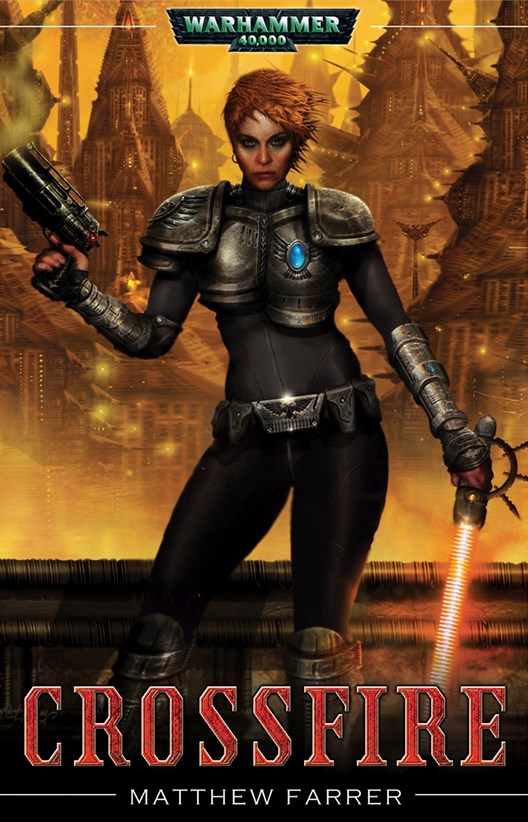
Warhammer 40,000: Crossfire by Matthew Farrer

Publisher: Black Library (Paperback – 1 January 2003)

Series: Warhammer 40,000: Shira Calpurnia – Book One

Length: 320 pages

My Rating: 4.25 out of 5 stars

Amazon

I finally got around to reading the awesome Warhammer 40,000 novel, Crossfire.  A classic entry in the Warhammer 40,000 canon with a cool crime fiction twist, Crossfire was a great novel that serves as an excellent first entry in Farrer’s Shira Calpurnia trilogy.

In the grim future of the 41st millennium, order and control of the massive Imperium of Man is maintained through the strictest interpretation of Imperial law, with no room for variation or leniency.  The ultimate arbitrators of this law are the dedicated members of the Adeptus Arbites, elite law bringers, trained to weed out corruption, dissent and disloyalty wherever they are deployed.

Shira Calpurnia Lucina, recently promoted arbitor senioris of the Adeptus Arbites, has been assigned to the bustling dockyards of the Hydraphur system.  A glistening gem of Imperial rule dedicated to providing material to the navy, Hydraphur is a seemingly unlikely place for dissention.  But this elite planet harbours dark secrets which come to the surface after a deadly assassination attempt is made in public against Calpurnia amid the distraction and celebration of a major religious festival.

Attempting to uncover who would want her killed after only just arriving on world, Calpurnia begins her relentless investigation.  However, this is no simple case, and soon Calpurnia finds herself forced to navigate the many plots and schemes of the Hydraphur elite.  With more attacks striking close to her and the fate of the whole planet seemingly in the balance, Calpurnia must uncover all Hydraphur’s secrets before the assassins stalking her finally succeed.

Crossfire was an excellent and compelling Warhammer 40,000 novel from Farrer that proved very fun to get through.  Featuring a fantastic plot that is one of the earlier examples of a crime fiction narrative melding with the iconic Warhammer 40,000 universe, Crossfire was a great read and one that is worth checking out.

I liked the captivating story that Farrer came up with for Crossfire, which quickly gets the reader’s attention with a powerful introduction to the protagonist, as she quickly finds herself under fire from a lethal assassin.  Serving as a good start to the main investigation arc, the plot follows the protagonist as she attempts to uncover the identity of the assassin, while also learning more about the planet of Hydraphur.  While a very lore-heavy story, Farrer keeps the plot going quickly and effectively, especially as there are soon more apparent attacks against the protagonist, each of which give her more clues to follow to try and find the mastermind of the plot against her.  At the same time the protagonist gets bogged down in dealing with various other interested parties on Hydraphur, including the planet’s local elites, agents of the Imperial church, the Adeptus Mechanicus and the Inquisition, each of whom have their own interests in finding out who is trying to kill Calpurnia.

While Farrer keeps up a good pace for Crossfire as the plot continues, I do think that he might have overloaded the narrative with details about Hydraphur’s society, as well as the various plots that infest it.  While these serve as good red herring motives for the protagonist to follow, it did overcomplicate the plot at times, which slowed things down even amid some great action sequences.  Despite this, the overall narrative for Crossfire was quite strong, and you get hooked into the continued investigation, especially as the author kept raising the stakes of the case.  After some exciting scenes, everything leads up to the big final confrontation, as the protagonist fully unwinds all the conflicting conspiracies they’ve been forced to encounter.  The conclusion was a sufficiently intense and over-the-top fight, which you need in Warhammer 40,000 fiction, and I liked the clever way the protagonist was able to turn the tables on the antagonist, even if the set-up for it was a little heavy handed.  An overall excellent Warhammer 40,000 plot that nicely tells its own story, while also introducing the character for the larger trilogy.

I’ve previously had a lot of fun with previous Warhammer 40,000 novels that utilise strong crime fiction elements in their story telling, such as Bloodlines by Chris Wraight and Grim Repast by Marc Collins, as there are some outstanding crime narratives in this grimdark universe. Crossfire is an interesting early example of this utilisation of crime fiction in Warhammer 40,000 fiction, and I felt that Farrer did a pretty good job of building a compelling investigation around this fantastic setting.  The resulting story is a layered and intense read that sees the protagonist slowly unwind the case amid various battle sequences and other dark distractions.  The relevant clues, hints and misleading details are well scattered throughout the plot, and I felt there was a good amount of foreshadowing to some of the key plot reveals.  While some story elements and conspiracies came a little out of nowhere, for the most part this was a concise and ordered novel, well told through the perspective of the protagonist.  Farrer excelled at fitting a ton of interesting and heavy lore elements in the plot, and I particularly appreciated how well he utilised his setting throughout the story.  The various plots and schemes of planet’s noble families and prominent organisations, as well as the elaborate religious festival the novel is set around (ceremonial details of which are cleverly included at the start of each chapter), are expertly worked into the larger plot, and it was fascinating to see how they impacted the story and drove the investigation.

One of the more entertaining elements of Crossfire I enjoyed was the narrative’s compelling characters.  The focus is primarily around series protagonist Shira Calpurnia Lucina, the arbitor senioris through whose eyes we see the story unfold.  Calpurnia serves as an interesting central figure, especially as she provides an outsider perspective to the complex setting.  While Farrer writes Calpurnia as a somewhat bullish and highly determined figure that is initially hard to appreciate, I felt that this was an intentional choice by the author, which reflects the typical attitudes of the Arbites in the general Warhammer 40,000 setting.  Forcing her to deal with the more subtle techniques needed for the politically delicate Hydraphur brought in some interesting conflict for Calpurnia, as well as producing some interesting character growth.  Despite this, the outsider status of Calpurnia continues to be a compelling plot feature throughout Crossfire, which Farrer utilised extremely well with his writing.  The rest of the cast, while less prominent, adds some complexity to the plot, and I enjoyed the compelling array of fellow Arbites members, the gentry of Hydraphur, and other prominent figures in the planet’s hierarchy.  I particularly enjoyed the motivations of the book’s eventual antagonist, which had a great hint of madness behind it, and this was an overall excellent group of characters.

While I really enjoyed Crossfire’s compelling story, I must admit that this wasn’t the easiest Warhammer 40,000 novel to read.  The plot details of Crossfire are very dense, and it takes a lot of effort to absorb and follow the story.  I felt this was especially noticeable in the small-print paperback version I had, and you really had to focus to take everything in.  As a result, this one probably wouldn’t be a recommended starting point for a new Warhammer reader.  Farrer utilises a lot of intricate details about the Warhammer 40,000 universe that even people casually familiar with the franchise are going to struggle to follow at times.  While most new readers can probably follow along well enough through context, I would suggest it’s best enjoyed by veteran fans who will probably have a lot more fun with it.

Overall, Crossfire by Matthew Farrer was an awesome Warhammer 40,000 novel, and one that I was glad I finally got the opportunity to read.  A compelling crime fiction novel that makes great use of Farrer’s complex setting, Crossfire proved to be an exciting and interesting read.  While not the easiest novel to get through at times, Crossfire proved to be an excellent piece of Warhammer fiction and I’m hoping to get through the rest of the Shira Calpurnia trilogy soon.

Amazon

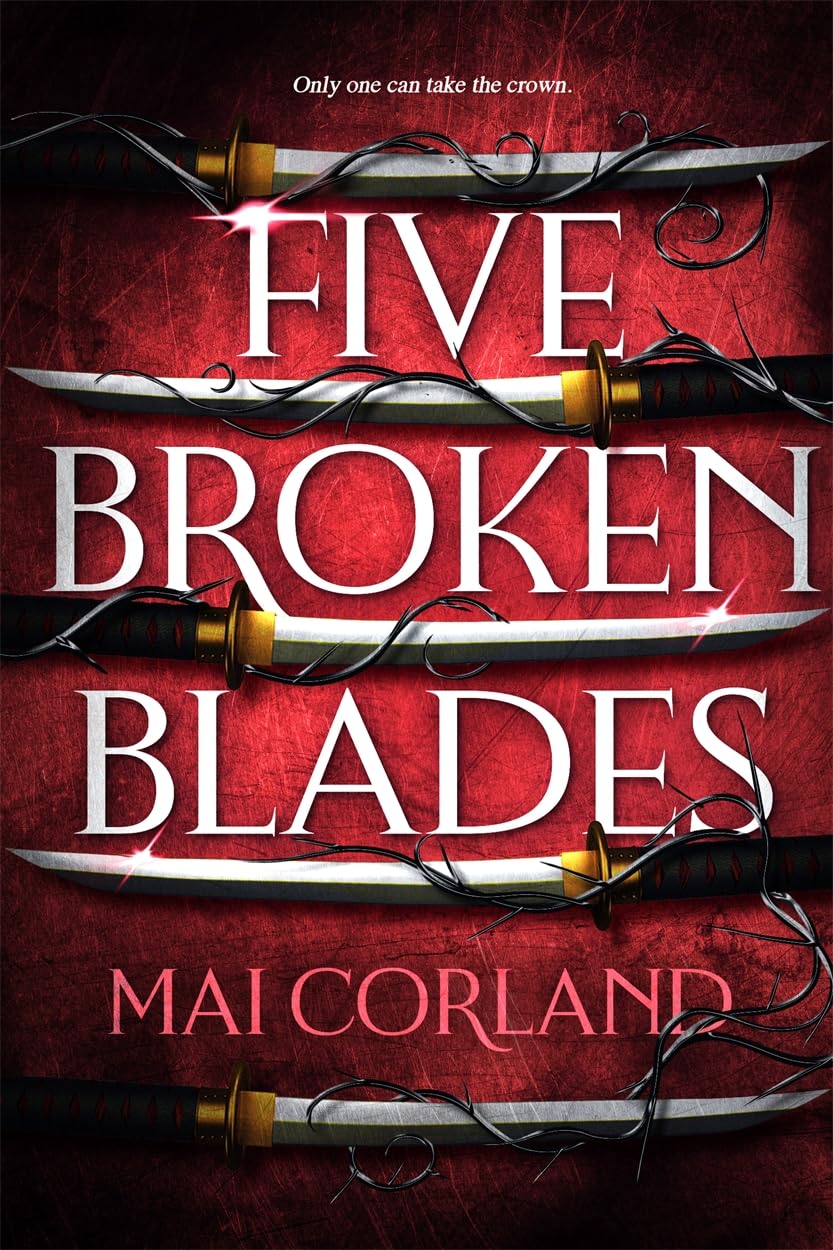
Five Broken Blades by Mai Corland

Publisher: Recorded Books (Audiobook – 7 May 2024)

Series: The Broken Blades – Book One

Length: 15 hours and 1 minute

My Rating: 4.5 out of 5 stars

Amazon

I was in the mood for some awesome fantasy fiction, so I decided to check out something a little different for me, Five Broken Blades by new author Mai Corland.  The debut adult book from Corland, who previously wrote children’s and young adult fiction under the name Meredith Ireland, Five Broken Blades was an addictive and exciting fantasy novel with some tragic romance at its core.

In the kingdom of Yusan, the God King Joon is a tyrannical and despised figure whose rule has seen the lives of the poor and innocent disadvantaged even further.  There are many people who want Joon dead, but to even think about it is high treason, punished by the most painful of deaths.  Worse, killing the king is next to impossible, as he is immortal, granted extended life and invulnerability by his magical crown.  Despite this, a small group of desperate killers are about to try to take him down.

Mysteriously summoned from across the nation, five of the most dangerous killers and rogues in Yusan have been tasked with working together and doing the impossible, stealing Joon’s crown and killing him in public.  Each of the five has their own reason for taking part in this apparent suicide mission, including a hired hitman seeking the money he needs for his redemption, a trapped poison-maiden hoping to gain freedom for herself and her sister, the royal spymaster looking for revenge, a banished prince who wants his life back, and a slippery thief seeking to reconnect with her family.

As the group begin to put their plan into motion, these independent killers will need to learn to work together with the rest of the group if they have any hope of surviving.  However, each of them has their own deeper motivations regarding their planned mission, and none of them truly trusts the other rogues they have been tasked with working with.  As they get closer to their goal, the five experience setbacks, twisted romance and unexpected opportunities.  But can they succeed and kill a God King, especially when they have a traitor in their midst?

Five Broken Blades was an excellent and highly enjoyable novel from Corland, who produced an amazing debut adult fantasy novel.  A clever fantasy novel with some entertaining romance elements, Five Broken Blades has an outstanding story of deceit, betrayal and bloodshed set in a Korean-influenced fantasy realm, which really drew me in with its impressive and fun story.

I had an outstanding time with the elaborate story that Corland came up with for Five Broken Blades, and the author produces an intense and moving, character-driven story.  Despite the name and the discussion about the five killers in the synopsis, there are actually six protagonists in this book, which produces a well-balanced narrative with a variety of intriguing character perspectives, arcs and motivations.  Corland starts the book by initially focusing on three of the protagonists and working the reader into their own unique circumstances and backstory.  The author does a good job of quickly and effectively introducing these figures in the initial chapters of the book, and then pairing them off with an additional protagonist who seeks to bring them into the main assassination plot of the book.  These new characters generally serve as great foils for the initial protagonists, and Corland then works to expand their roles in the book, providing their own backgrounds and motivations for being there.  Once established together, these three pairs of characters, then set off to meet up with the other protagonists as they plan their attempted regicide.

The first half of the book primarily focuses on the three separate pairs as they set up their own storylines both individually and as a couple, which I felt worked to really hammer home the complex character arcs Corland was setting up.  There are some fantastic moments in these early pages, including fights against monstrous birds, pirate warfare, and some intense personal scenes.  While the romantic entanglements that emerge within all three of these initial pairs are very predictable and forced, you generally grow attached to all six protagonists, and it proves interesting to see the various hidden motivations and background, especially as Corland expertly trickles out their respective secrets to the reader.  While I quite enjoyed getting to know the characters separately, I felt that Five Broken Blades’s story really took off once all six characters joined together in one group.  The six protagonists all play off each other nicely, and it was intriguing to see the different opinions they had of the rest of the group.  The mismatched styles and motivations make for some compelling interactions, and Corland also works in a particularly intense fight sequence, that helps to cement the protagonists as a team.

While there is some excellent camaraderie, and more romantic tension, the second half of the narrative is strongly defined by mistrust and secrets.  Corland does an excellent job of showcasing the conflicting motivations and hidden desires of the protagonists to the reader, and it was entertaining seeing the various ways the characters all lied to each other as they progressed.  Everything leads up to an intense final act, where the assassination attempt is made, and everyone’s secrets are brought out into the light.  There are some excellent reveals here, and I loved the big twist that comes out as a result.  While I did feel that the identity of the traitor in the group was slightly predictable, the full extent of their motivations and the reasons why they are there was compelling, and it ties in well with all the other clever reveals.  The last few chapters of Five Broken Blades were so damn good, especially as nearly every big question from the book is answered, and I loved the excellent cliff-hanger that Corland left it on, as it really raises the bar for the sequel’s potential plot.

I really enjoyed how Corland set out Five Broken Blades, and the exciting narrative came across in an excellent way.  The key highlight of this is probably the use of six separate perspective characters to tell the complex story.  While too many narrators can sometimes ruin a story, I felt that Corland had the right balance, as Five Broken Blades’ story never felt too crowded or diluted.  While the author probably could have left out Tiyung’s perspective, for the most part the split and switch between narrators worked extremely well, and I loved how it enhanced the overall story and allowed the author to explore multiple compelling character arcs.  The way in which the specific character-focused chapters started off long at the start of the book, allowing for introductions and initial character development at the front, and then got shorter once all six protagonists were together, was very clever as well, and I appreciated how the sudden shift in perspectives with the shorter chapters helped with some of the books more intense or action-packed scenes.

Corland ensures that there is a great mixture of different story elements featured throughout Five Broken Blades, and I personally appreciated how the focus on the characters was balanced with action and so much intrigue.  All this is well surrounded by an intriguing new fantasy realm, Yusan, with some distinctive Korean influences.  While I did feel that parts of this world were a little basic, for the most part this was an excellent background setting, and I appreciate how well Corland worked her fantasy ideas into the larger narrative.

Another key aspect of Five Broken Blades was the inclusion of multiple romance arcs, due to this book being marketed as a romantasy.  I must admit that I’m not the biggest fan of romantasy fiction, and while a good romance arc can greatly enhance a fantasy story, I don’t go out of my way for books that feature excessive romance added in purely to make it a mixed genre novel.  Still, I gave Five Broken Blades a chance, and I honestly thought that Corland did a great job with the romance elements.  While two of the main three romances are very forced (although Euyn and Mikail’s arc of betrayal and forgiveness was pretty strong), for the most part they were fun or interesting to see unfold.  It helped that they didn’t overwhelm the rest of the story and instead were well balanced against the constant machinations of the characters.  Indeed, the romances added an extra layer of heartbreak to some of the betrayals, which ensured a more intense plot.  As such, Five Broken Blades was a romantasy most fantasy fans can probably enjoy, although people will have issues with the predictable way that all three of the initial pairs of protagonists couple up.

While the excellent and twisty story is a great part of Five Broken Blades, the best part of this book is the well-crafted main characters who the narrative is set around.  Corland came up with six excellent protagonists for this book, all of whom have complex and tragic backstories that come into play throughout the course of the book.  Indeed, the narrative is strongly driven by each of their personal tales and experiences, and you really get drawn into the backgrounds and thoughts of the protagonists, especially as understanding their motivations and interactions with the other protagonists is key to working out the upcoming twists.

Of these characters, I felt that Royo and Sora were probably the best written, and I loved their complex stories filled with tragedy, regret and a loss of freedom.  Royo, the tough street thug with a severe need for redemption proves to be the heart of the story, especially as he has a particularly tragic backstory.  He is well matched by the beautiful Sora, a young woman who was forced into a life of death as a poison-maiden, whose poisonous body brings death to those who try to get close to her.  Required to perform assassinations to keep her sister safe, Sora longs for freedom, and will take any opportunity to get revenge and ensure her sister’s safety.  Royo and Sora and well matched by the entertaining pairing of Euyn and Mikail, whose respective arcs were nearly as complex as theirs.  Euyn, the former crown prince of Yusan, had been forced from his life of luxury due to his murderous predilections, and now seeks to become king after years on the run and a better understanding of the common people.  However, Euyn is constantly bedevilled by his former lover Mikail, the royal spymaster, who blows into his life once again to recruit Euyn for the plot against his brother.  Mikail is probably the most entertaining figure in the book, and I loved his constant manipulation of the others.  Corland did a good job of building up a complex backstory behind Mikail, and you grow to like him even more once you understand the reasons behind his inner rage and the lengths he wishes to go to resolve it.

While these four protagonists are pretty awesome, I did feel that the story was slightly let down by the other two protagonists Aeri and Tiyung.  Tiyung is underused (he’s not one of the titular five broken blades), and his unrequited love with Sora and rebellion against his father had some benefit for the story.  However, I had a hard time liking the character of Aeri.  While she did grow on you a little as Five Broken Blades continued, I honestly felt that Aeri’s bubbly personality really didn’t match the other figures in the book, and it was hard to take her seriously as a protagonist.  Corland makes her way too manic (and horny if we’re being honest), and her chapters are a bit too discordant to the rest of the book.  Still, she had some interesting background elements, and there were some compelling reveals around her that explain her unusual behaviours.  Throw in several great additional characters, including some villainous nobles, and this proved to be an outstanding cast, who really help to turn Five Broken Blades into a distinctive and powerful read.

I ended up grabbing the audiobook version of Five Broken Blades, which I always find to be a great medium to enjoy a fun fantasy book.  This proved particularly true for Five Broken Blades, and I loved how well the audiobook format enhanced its compelling and exciting story in some fun ways.  I particularly enjoyed the inclusion of six separate narrators, Greg Chun, Zion Jang, Roger Yeh, Donald Chang, Jaine Ye and Sophie Oda, each of whom voiced the chapters of a particular point of view character.  I really love audiobooks with multiple narrators, and when done right it can help to produce an epic listen.  I felt that the Five Broken Blades audiobook was a great example of this, as all six narrators did an amazing job voicing their protagonist throughout the novel, and you really saw them dive into the role of their specific character, capturing their essence and personality.  While this mixture of narrators does result in an interesting array of different takes on the main characters when they appear in other protagonist’s chapters (a natural side effect of having multiple narrators), I honestly felt the flow of this audiobook was extremely strong, and narrators came together extremely well to produce an excellent overall performance.

Audiobook highlights include Royo’s narration, which really captured the tortured and tough nature of the figure, as well as his exasperation of Aeri’s antics.  Sora was also perfectly showcased as a reluctant assassin in all her manipulative glory, and you really felt for her tragic story because of the voice work.  I was also a big fan of the audiobook’s main portrayal of Euyn, and I also loved his narrator’s take on Mikail, which I felt was a little better than that character’s own voice actor.  While I wasn’t the biggest fan of Aeri’s chapters, especially towards the beginning, for the most part this was an overall epic production, and I really loved how this elaborate audiobook came together.  With a runtime of 15 hours, this is a lengthy audiobook, but that really gave the six narrators the room they needed for their performance, and I managed to get through this audiobook relatively quickly.  This was an overall fantastic and elaborate audiobook, and I would strongly recommend this format to anyone interested in checking out Five Broken Blades.

I ended up having an outstanding time with Five Broken Blades, especially as Mai Corland came up with an excellent and captivating story of betrayal, intrigue and complex motivations.  An entertaining and addictive read from the very beginning, Five Broken Blades was a great fantasy read that makes excellent use of all its story elements, characters, and romantic inclusion.  An impressive debut adult novel from Corland, Five Broken Blades is really worth the read, and I am really keen for the sequel coming out early next year.

Amazon

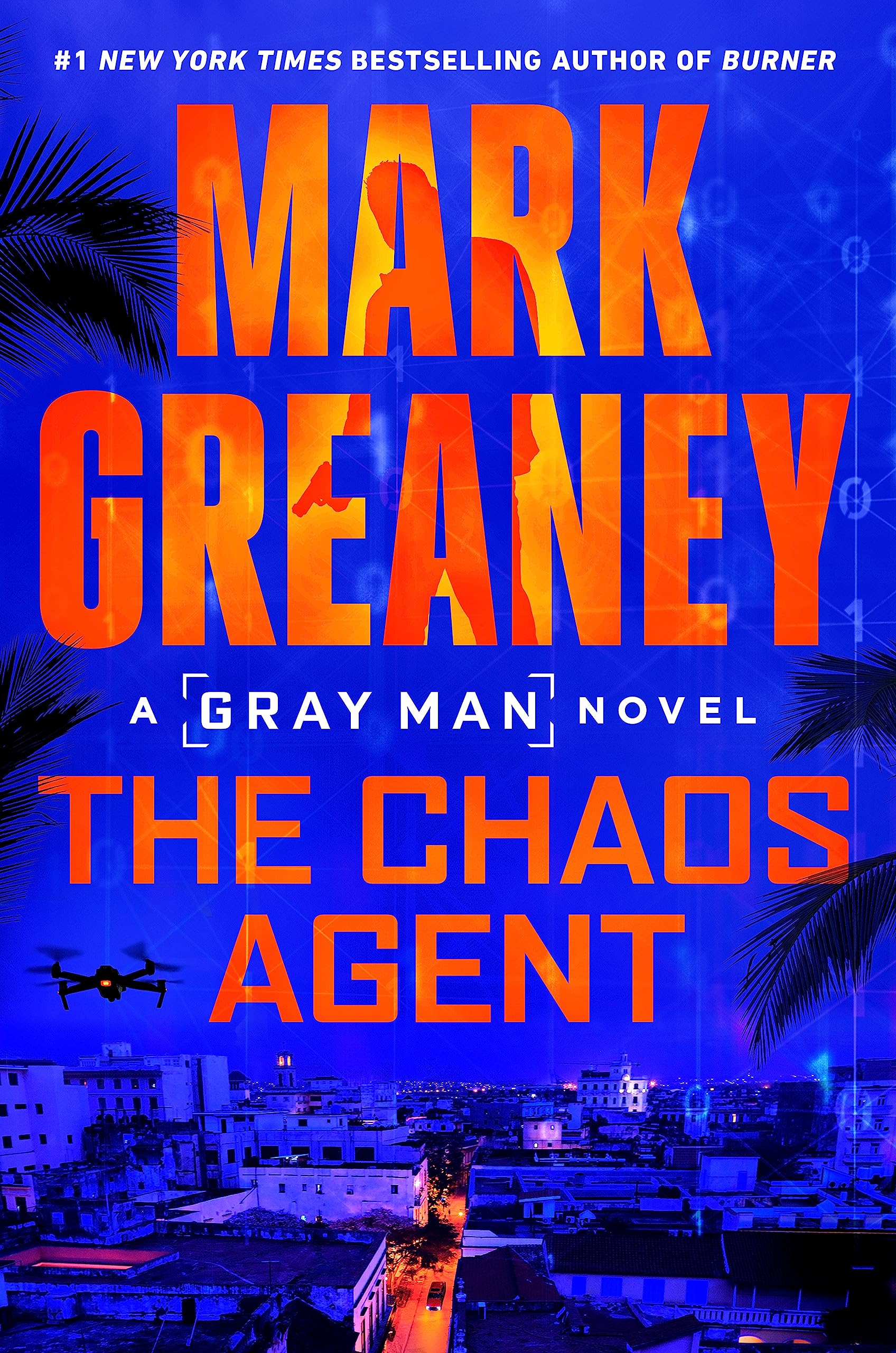
The Chaos Agent by Mark Greaney

The Chaos Agent Cover

Publisher: Sphere/Audible (Audiobook – 20 February 2024)

Series: Gray Man – Book 13

Length: 17 hours and 34 minutes

My Rating: 5 out of 5 stars

Amazon

One of the leading authors of the spy thriller genre, Mark Greaney, returns with another epic entry in his iconic Gray Man series, The Chaos Agent.

Readers of this blog will know that I am a massive fan of thriller author Mark Greaney, who has been wowing the world with his elaborate and exciting stories for years.  Ever since I started reading thrillers, Greaney has been a major figure in my yearly reading schedule, with books like Armored and Red Metal (cowritten with Hunter Ripley Rawlings IV), ensuring that he became a must-read author for me.  However, his most iconic body of work is his Gray Man series, which follows legendary former CIA agent and assassin Court Gentry, known as the Gray Man, as he engages in carnage across the world.  This series, which people may be familiar with thanks to the Netflix adaptation, is so damn good, and I really love the elaborate and intense stories that emerge.  This includes the impressive first novel The Gray Man, as well as later books like Mission CriticalOne Minute Out (one of my favourite books and audiobooks of 2020), Relentless (one of my favourite books and audiobooks of 2021) and Sierra Six (one of my favourite books and audiobooks of 2022) and Burner (one of my favourite books and audiobooks of 2023).  Naturally, I grabbed Greaney’s latest novel, The Chaos Agent, the first chance I could, and it proved to be another amazing read.

Across the world, elite scientists are being murdered in a series of elaborate and well-coordinated assassinations.  The killers are well equipped, well prepared, and seem capable of striking across multiple countries.  The only connection between the killings is the area of expertise the victims are known for, as someone is targeting the world’s leading experts in artificial intelligence and robotics.

As the killings continue, it appears that only two major assassins aren’t involved in the plot, the Gray Man, Court Gentry, and his lover Zoya Zakharova.  Hiding out in Central America after their last mission once again forced them to become fugitives, Court and Zoya are seeking the quiet life together after all their years apart.  But an assassin’s work is never done, and soon an old family friend of Zoya’s seeks them out, hoping that they can help identify the individuals behind the attack.  Initially reluctant to get involved, Court and Zoya soon find themselves targeted by association, and must flee an army of dangerous killers and mysterious advanced combat drones.

Forced to find out who is hunting them, Court and Zoya soon discover that the killings are linked to a deadly proposed artificial intelligence weapon that could change everything about modern warfare.  To discover what’s truly going on, the two former agents and their allies need to investigate the one survivor of the ongoing assassinations.  But with their target now protected by an old friend of theirs, Zack Hightower, in an isolated fortress, Court and Zoya will need to use all their connections and luck to find the truth before it’s too late?

The Chaos Agent was another excellent novel from Greaney, who continues to highlight why he is one of the world’s leading spy thriller writers.  This latest Gray Man novel ended up being a lot of fun, especially as Greaney goes a little overboard with the plot, and I deeply enjoyed the resulting adventure.

Greaney came out of the bag with something very exciting in The Chaos Agent, which is mainly down to how over-the-top and crazy the main narrative ended up being.  This story starts off relatively low-key, with a couple of random killings, and an update on the lives of the protagonist, Court Gentry, and his partner Zoya Zakharova.  Naturally, it doesn’t take long for Gentry and Zakharova to get dragged into the action, and this starts an intense fugitive arc for them, as they find themselves being hunted by various killers across central America.  At the same time, the other supporting characters of the book are investigating the worldwide plot around the assassination of various AI experts.  This results in a compelling investigation angle that continues for a large portion of The Chaos Agent, and it was fun to not completely know the identity of the book’s antagonist until towards the end.  This first half of The Chaos Agent definitely got my attention, and the compelling action, intense mystery, and intriguing characters help to draw the reader in.

The second half of The Chaos Agent is where things start to get particularly interesting, as Greaney amps up the story and throws it into overdrive.  In particular, the antagonists get even more crazy, which is well shown in an intense action sequence involving Gentry and Zakharova in contact’s house in Central America.  These additional opponents give The Chaos Agent a real science fiction edge to them, and it was a gloriously over-the-top inclusion that I really loved.  The various character storylines soon come together after that, as all the characters end up in Cuba investigating who is truly behind everything and why.  There are some cool sequences here, including complex and intricate multi-perspective operations as various players manoeuvre around each other to achieve their goals.  This all leads up nicely to the big extended finale, where all hell breaks loose as Greaney sets up a massive firefight with various sides thrown into the mix.  The action here is intense, with the carnage flying thick and fast, and with so many perils coming for the protagonists.  It all ends on a pretty big cliffhanger that will play nicely into the next book in the series, especially as two major supporting characters find their situation drastically changed due to their decisions.

I deeply enjoyed how this cool novel unfolded, and Greaney utilises his trademark writing style to great effect with this excellent story.  The high-intensity action, fast-paced plot, and intriguing overarching storyline came together wonderfully, and it proves very hard not to get drawn into The Chaos Agent as a result.  I particularly love how Greaney so effortlessly jumps between different character perspectives throughout the course of the book, which allows for a more complex and enhanced story.  These quickfire changes in perspective also work extremely well in some of the book’s more intense sequences, especially as seeing the various participants continuously react to other character’s actions, allows for some outstanding scenes.  Good examples of this include a sequence in the Cuban docks where Gentry and a rival assassin move around each other trying to simultaneously protect or kill their target.  These scenes, and more, are true highlights of this book, and I love how well they were able to incorporate the particularly eccentric inclusions that Greaney featured within The Chaos Agent.

As with most of the books in the Gray Man series, The Chaos Agent can easily be read as a standalone novel.  Greaney does a good job of recapping any the relevant key events from the prior novels where needed so new readers can enjoy this book without knowing anything about the rest of the series.  That being said, established Gray Man readers will probably get a little more out of The Chaos Agent, especially when it comes to seeing how the various character relationships unfold.  It also helps that this proved to be a particularly memorable entry in the series.  Not only does Greaney go all out with his very inventive and exciting story, but there is a great combination of story elements there that everyone can enjoy.  The intense action pairs well with a deep dive into modern technology elements, and Greaney pulls together an intriguing mystery about who is behind everything, rather than showing the antagonist from the get-go.  While some of the twists around the true antagonist are a little predictable, Greaney played them out well, and they worked into the massive status quo changes at the end of the book.  I will admit that I did find some of Greaney’s writing, including the dialogue, to be a little robotic at times in The Chaos Agent, which is kind of ironic when you consider the story focus.  The way some parts of the writing or dialogue came together just didn’t feel right to me at times, and that slightly decreased my enjoyment of the book.  Still, the awesome story more than made up for it, and I felt this was an awesome addition to the overall series, especially as the epic ending has got me extremely excited for the next book.

One of the things that I really enjoyed about The Chaos Agent was Greaney’s intriguing look at the future of AI and how it could be utilised in the military and intelligence fields.  Greaney clearly did some research on the subject, and several characters spend significant time lecturing about the potential advantages and dangers of AI weaponry.  I found this to be utterly fascinating, and this ends up being quite a key part of the book, especially once the protagonists find themselves beset by advanced drones and other distinctive weaponry.  As I mentioned above, Greaney uses this AI concept to make The Chaos Agent a little more science fiction than his previous novels.  While I won’t go into too much detail here, as frankly it is best experienced in the context of the story, some of these elements were very outrageous, and it made the story quite fun with some unique action.  While it was very over-the-top, Greaney did paint everything with a film of realism, and I came away from The Chaos Agent with a healthy respect and fear for the potential future of AI in the military, especially as Greaney is probably right and someone will use it to kill the rest of us.

Aside from the complex writing and cool AI elements, The Chaos Agent’s story is also enhanced by a great cast of characters who are cleverly showcased throughout the plot.  This includes protagonist Court Gentry and his partner Zoya Zakharova, who were reunited in the last book.  Gentry and Zakharova form an effective team as the main protagonists of The Chaos Agent, and it was fun to see them in action again.  However, Greaney also adds in an element of dissention, especially as neither really has the ability to trust other people, and they are both concerned about their potential future.  Their combined storyline goes in some interesting directions, and the final twist of the book ensures that their relationship will be a big part of the next entry in the series.  Greaney also brings back fun recurring character Zack Hightower, who worked with Gentry and Zakharova in the past.  Hightower is always great value for money, and he had an interesting run in The Chaos Agent as he’s hired as security for a tech billionaire being targeted.  Hightower ends up being an integral part of the book, and it was great to see him working with Gentry and Zakharova again, especially as his new job leads to some dark moments for him.  Throw in an excellent supporting cast, which includes some recurring faces and some new intriguing antagonists, and this ended up being an excellent book that makes fantastic use of its characters.

I have always found that the best way to enjoy one of the Gray Man novels is to listen to it in its audiobook format, which really enhances the story.  This is once again true for The Chaos Agent, which turned out to be such an epic listen.  The audiobook format, which has a substantial runtime of 17 and a half hours, proved to be a lot of fun, and I deeply appreciated how well it enhanced Greaney’s already fun story and writing style.  The constant movement between perspective characters, especially in the action sequences, comes across really well, and the intense fights feel so much more real and impactful when they are read out.  It helps that The Chaos Agent was once again narrated by Jay Snyder, who has voiced all the other Gray Man novels.  Snyder has a great vocal range that really lends itself to a spy thriller novel like The Chaos Agent, and all the over-the-top tough characters are captured extremely well in this audiobook, with Snyder expertly bringing back recurring voices from the previous Gray Man audiobooks.  The rest of the extended cast also get appropriate and fitting tones, and you can see Snyder is really trying to get the voices to match the characters.  This includes accents, as Snyder tries to capture many of the ethnicities captured within The Chaos Agent’s story, including a pretty good attempt at the New Zealand accent.  As such, I really found myself getting drawn into The Chaos Agent’s story while listening to it, and while Snyder can also be a tad robotic at times, this audiobook format was a pretty exceptional way to enjoy this amazing book.

Overall, The Chaos Agent was another excellent addition to one of the very best spy thriller series currently running.  Mark Greaney always goes all out with his amazing Gray Man novels, and The Chaos Agent is one of his most intense and gripping reads yet.  Clever, compelling, and featuring some particularly fun story features, The Chaos Agent is an excellent read that gets another five-star rating from me.

Amazon

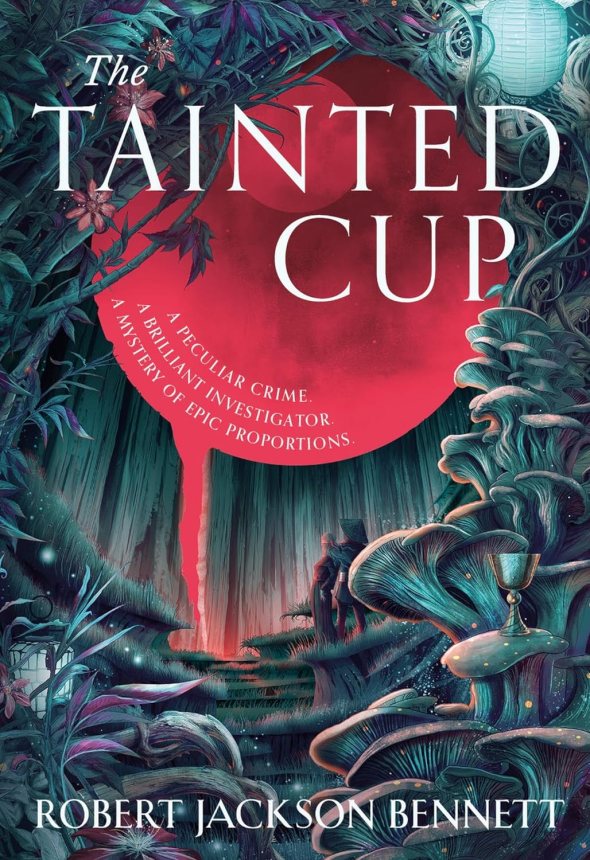
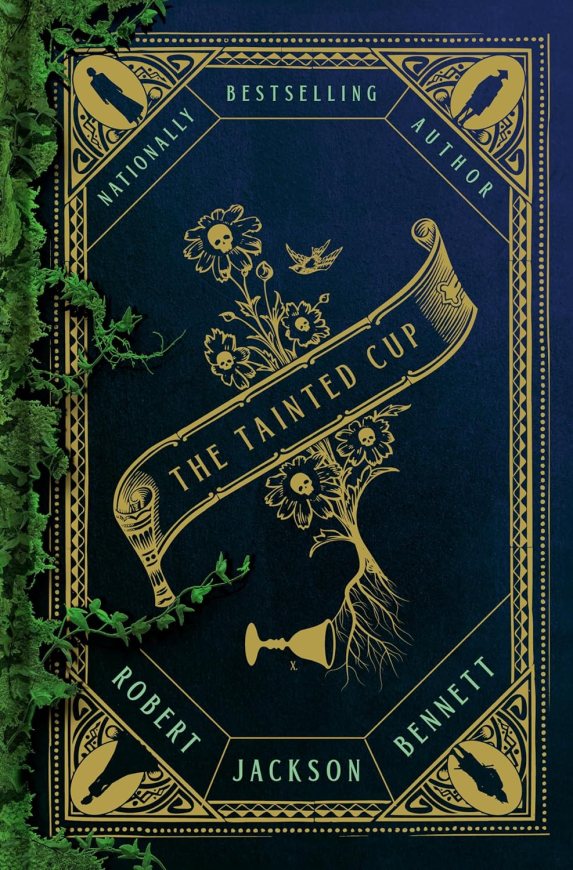
The Tainted Cup by Robert Jackon Bennett

The Tainted Cup Cover

Publisher: Hodderscape (Trade Paperback – 13 February 2024)

Series: Shadow of the Leviathan – Book One

Length: 420 pages

My Rating: 5 out of 5 stars

Amazon

Acclaimed fantasy author Robert Jackson Bennett kicks off a brilliant new series with the captivating and impressive novel, The Tainted Cup, which sees two unique investigators dive into an enthralling magical murder.

Robert Jackon Bennett is an outstanding author who has been writing since 2010 with his debut novel, Mr. Shivers.  Best known for his iconic The Divine Cities trilogy, as well as the intricate The Founders trilogy (of which I read Foundryside), Bennett has been on a real roll of late, and I have been meaning to read more of his works.  I finally got the chance when I recently received a copy of his latest novel, The Tainted Cup, an intriguing combination of the crime fiction and fantasy genres.  I instantly fell in love with The Tainted Cup’s awesome sounding plot and The Tainted Cup ended up being one of my most anticipated reads of 2024 for very good reason.

In an opulent mansion in the backwater province of Daretana, an unusual case emerges when an important Imperial officer is apparently killed when a tree spontaneously erupted from his body.  Even in the unpredictable Empire of Khanum, which is constantly besieged by Leviathans, giant beings from the ocean whose blood and bodies can mutate the land and create unique contagions, this is a shocking death.

The job of discovering what caused this unusual death falls to Ana Dolabra, an Imperial investigator known both for her staggering intellect and her many oddities.  Able to make connections no-one else can, Ana begins her unique investigation, using her new assistant, Dinios Kol, as her proxy.  Din, an engraver magically altered to possess a perfect memory, acts as his boss’s eyes on the case, and begins to gather all the raw information Ana needs to uncover the full mystery.  The conclusion she makes about the case: murder!

Determining the case to be an unusual and deadly form of magical poisoning, Ana and Din manage to find one of the culprit’s accomplices.  But it quickly becomes apparent that this is only the beginning of their investigation when several engineers responsible for maintaining the great outer walls of the Empire against the Leviathan threat are killed in a similar manner in the next canton.  Determined to discover who is responsible for both the murders and the resulting Leviathan attacks, Ana and Din journey to the wall to find out more.  What they discover is an elaborate conspiracy, one that threatens the entire Empire and could result in the death of everyone to the Leviathans.

The Tainted Cup ended up being an incredible read from Bennett who masterfully blended a complex mystery with unique fantasy elements and amazing characters to tell a gripping and powerful story.  I had such a great time with this book and honestly couldn’t put it down until I worked out every secret and twist that Bennett loaded into this outstanding five-star read.

Bennett comes up with an excellent premise for The Tainted Cup that is essentially a twisty Sherlock Holmes tale of intrigue and conspiracy, set in a cool new fantasy realm besieged by giant monsters.  Told from the perspective of main character Dinios Kol, who works as the eyes of his peculiar master, Ana Dolabra, the eccentric criminal investigator, Bennett quickly and effectively introduces the mystery of a man killed when a tree explodes out of him.  I’ve read a lot of amazing mystery novels over the years, and frankly this must be one of the more unique murder tools I’ve seen, and Bennett uses it to full effect to tell such a great story.  The initial investigation proves to be quite impressive, as Ana manages to quickly solve the murder using the observations provided by Dinios, finding the catspaw responsible for this first crime in a fantastic scene that really highlights to the author what a great investigator this protagonist truly is.

However, this is only the start of the case, as several similar deaths occur in the next town over, killing multiple engineers and damaging the massive walls that protect the Empire.  The resulting chaos results in Dinios and Ana travelling to the nearby garrison town where the engineers were billeted to try and work out who is responsible and why.  The situation swiftly degenerates as the protagonists uncover additional murders, corruption, secrets and lies, as everyone tries to hide who is responsible for the killings.  What results is an elaborate and addictive investigation as Ana sends Dinios on a series of investigative missions to get closer to the truth and uncover the conspiracies infecting the Empire, while the threat of an approaching Leviathan literally looms on the horizon.  I was on the edge of my seat the entire way through the second half of the book, as I desperately waited to see who was responsible and why.  While I saw a couple of the big twists coming, the full picture that emerged was extremely impressive, and I honestly loved every clever reveal and surprise that Bennett loaded into the story.  Not only are the main mystery and the underlying conspiracies behind it solved perfectly, but Bennett sets up the entire trilogy to be something truly special.  I cannot wait to see how this series continues in the future, and I already know it is going to be amazing.

I really loved how Bennett set out The Tainted Cup, especially as his great blend of storytelling elements and genres helped to turn it into a particularly fun and captivating read.  The elaborate and intriguing mystery blended well with the other unique elements of the book, and Bennett did an outstanding job of keeping the pace of The Tainted Cup fast and exciting, layering the story with reveals and hints to keep the reader firmly attached.  There were so many times that I needed to stop reading but just couldn’t as I wanted to see what was going to happen next.  While this book is mostly a little dark and emotionally charged, Bennett also layers the plot with a good amount of humour, mostly tied into the main investigator, which I think really turned The Tainted Cup into something special.  This humour tied in nicely with both the more serious mystery and fantasy elements and helped to cut down the tension in an effective and targeted way.  Throw in some fantastically elaborate action sequences, unique fantasy battles, and vivid descriptions of the world through the eyes of a complex protagonist, and you will come away with a great appreciation for Bennett’s fantastic writing style.

One of the more memorable features of The Tainted Cup was the awesome new fantasy realm that Bennet imagined for the plot, as well as the intriguing and unique magic that infested it.  The plot of the book is completely set within the Empire of Khanum, a walled-off nation completely dedicated to protecting itself from the Leviathan, gigantic, mutated creatures from the seas that are constantly trying to make landfall and destroy everything within.  I also loved how the magical elements of The Tainted Cup revolve around the manipulation of strange plants and biological grafts that enhance the physical and mental abilities of the humans.  A lot of these plant elements are tied into the Leviathan, and it was fascinating to see the impacts it has both on the land and on the people within it.  This is a pretty awesome background for this already fantastic plot, and it reminded me pretty strongly of Attack on Titan or Pacific Rim.  Bennett does an outstanding job working the plot of The Tainted Cup around this cool background, and it was fascinating to try and work out how the protection of the wall and the threats of the Leviathan and other magical concerns plays into the main plot.  There are some unique conspiracies produced as a result, as well as a some very distinctive killers and suspects, and I was really impressed with how Bennett came up with all these new elements and ensured that become so intrinsic to the plot.  The author also makes sure to hint at some future secrets throughout The Tainted Cup, such as the true nature of the Leviathan, which I have no doubt will be revealed in future novels in a big way.

Another awesome element I really need to highlight about The Tainted Cup was the two main protagonists, Dinios Kol and Ana Dolabra.  These two honestly make this entire book, with Dinios serving as the harried subordinate while Ana is the brilliant, if slightly unhinged and blunt, investigative savant.  Bennett expertly captures the classic detective/sidekick dynamic that was made so famous with Sherlock Holmes and Watson, with Dinios serving the Watson role as point of view character and the sounding board for Ana’s observations and solutions to the various murders encountered.  Not only is this very cool in the fantasy context, but Bennett works to make Ana even more outrageous than some of the more recent Sherlock Holmes adaptations, as she is an agoraphobic, disgraced, drug-addicted figure, who mostly goes around wearing a blindfold and terrifying everyone she encounters.  I loved Ana so much, and so much of the humour of the book comes from her unusual behaviour.  Despite these eccentricities, Ana is still shown to be a brilliant investigator, and I think that Bennett masterfully found the balance between genius and madwoman for this protagonist.

I really appreciated how Dinios proves to be the perfect foil for his unusual master, and it was great to see the story unfold through his eyes, especially as he proves to be a keen student and an interesting figure in his own right.  Initially shown to be a little desperate and naive, with secrets of his own, Dinios slowly becomes more confident as the book continues, and I enjoyed seeing him come into his own the more involved with the case he became.  His student/friend relationship with Ana was heartwarming at times, and he also serves as the more responsible member of the team, using rules and commonsense to stop Ana from going too far.  Dinios gets a well-written glow-up as the book continues, thanks to a revelation about his abilities, and while that potentially makes him a little overpowered as a character, I assume that Bennett has some interesting long-term storytelling involved with them that I cannot wait to see.

Thanks to the masterful combination of mystery, unique fantasy elements and amazing characters, The Tainted Cup was an outstanding read that really showcased Robert Jackson Bennett’s ability as an author.  Inventive, entertaining, and emotionally charged, The Tainted Cup is perfect for both fans of fantasy fiction and unique mysteries, and there is so much to fall in love with here.  Easily one of the best books of 2024 so far, The Tainted Cup comes highly recommended, and I cannot wait to see how Bennett follows this amazing read off in the future.

The Tainted Cup Cover

Amazon

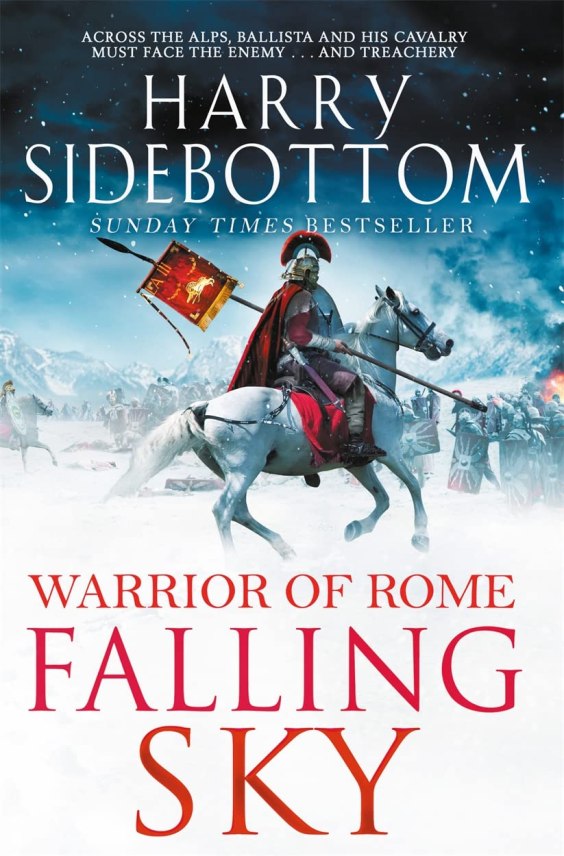
Falling Sky by Harry Sidebottom

Falling Sky Cover

Publisher: Zaffre (Trade Paperback – 17 January 2023)

Series: Warrior of Rome – Book Nine

Length: 375 pages

My Rating: 4.5 out of 5 stars

Amazon

One of the best and most compelling authors of Roman historical fiction, Harry Sidebottom, returns with another outstanding entry in his Warrior of Rome series, Falling Sky.

There are many outstanding authors who specialise in historical fiction set in ancient Rome, however, one of my absolute favourites is the always impressive Harry Sidebottom, who has been dominating the genre for most of my reviewing career.  Sidebottom has written some amazing novels over the years, including his Throne of the Caesars trilogy and some excellent standalone novels, like The Lost Ten and The Return.  However, my favourite series is his Warrior of Rome novels, which follow the Roman general Ballista, a former barbarian hostage turned Roman nobleman.  This series is pretty damn epic and was amongst some of the earlies novels I ever reviewed.  His debut novel, Fire in the East, remains one of the best siege novels I have ever had the pleasure of reading, and the rest of the series is also very impressive and inventive.  I have really loved some of his more recent Warrior of Rome books, such as The Last Hour and The Burning Road, and I was very happy to see that Sidebottom was continuing this series with Falling Sky.

AD 265, Gaul.  The usurper Postumus has been declared Emperor by his soldiers and has taken control of key territories west of Rome, including Gaul, Germania, Hispania and Britannia.  Setting up his capital within Gaul, Postumus hopes to maintain control of his new empire and peacefully coexist with Emperor Gallienus.  However, Gallienus wants vengeance for the death of his son at Postumus’s hands and has assembled a massive army to cross the Alps, take back Gaul, and kill his rival.

Amongst the Roman troops gathered to attack Gaul is Ballista, one of Gallienus’s most loyal supporters.  Determined to fight one more battle and then retire to Sicily with his family, Ballista finds himself at the forefront of the fight as one of Gallienus’s most able commanders.  However, Ballista has a far more troubling problem to deal with than battle.  His recent actions in Rome exposed a massive conspiracy to kill Gallienus and install a new Emperor.  While he was able to foil the assassination, the leader of the conspiracy remains at large, and Ballista is convinced that it was the Praetorian Prefect Volusianus, the man charged with keeping Gallienus safe.

With no evidence to support his suspicions, all Ballista can do is watch Volusianus and wait for him to slip up.  However, Volusianus is aware of Ballista’s suspicions and is determined to kill him before his machinations can be revealed.  When Ballista is sent on a dangerous mission deep into enemy territory with a column of cavalry, it represents the perfect opportunity for Volusianus to strike using spies and traitors.  However, the greatest threat to Ballista may come from the turning tides of war, as he and his men soon find themselves trapped far behind enemy lines.  Pursued by the enemy and surrounded by traitors, can even the legendary Ballista survive both the war and his friends in Rome?

This was another brilliant and captivating historical read from Sidebottom that perfectly continues the Warrior or Rome series with another exciting adventure.  Falling Sky is a very thrilling read, and it was one that I was able to finish off quite quickly, especially once I got caught up in its fantastic and fun narrative.

Falling Sky has a very fast-paced narrative that sees the forces of the Emperor Gallienus, including Ballista, return to Gaul (France) to end Postumus’s rebellion and restore the Empire.  The initial chapters set the scene brilliantly, as you get reacquainted with Ballista and his recent adventures, as well as some insights into his suspicions around Volusianus’s role in the recent assassination of the emperor.  Featuring some great early battle sequences in the Alps, you soon get a great idea of the war to come, especially when you also see some events through the eyes of Postumus and his forces.  The centre of the book is dominated by a pivotal major battle sequence with both armies clashing in a brutal series of chapters that really leaves an impression.  It also sets the rest of the story up extremely well, as the still suspicious Ballista is sent out on a dangerous mission he isn’t supposed to come back from.  This cavalry focused plot dominates the second half of the book and features a great blend of action, historical logistics, and espionage as Ballista tries to keep his troops alive, while a traitor in his ranks works to bring him down by any means necessary.  This leads to an excellent final third of the book, when Ballista and his troops are forced to retreat through half of Gaul, while traitors and problems from the protagonist’s past wait for him.  This turns into a fantastic chase sequence between enemy regiments, and I really loved how epic and intense it got in places.  The entire story wraps up really well, and I had a wonderful time getting through this awesome read.

Falling Sky turned out to be a pretty awesome book, and I loved how Sidebottom set his latest novel out.  There was an interesting change of style in Falling Sky from some of his previous novels, as Sidebottom had recently been experimenting with blending different thriller genres with historical settings.  Falling Sky, however, represents a more classic historical fiction war novel, with a focus on battles, major recorded events, and the continued growth in Ballista’s character as he becomes more and more disenchanted with Rome.  While I had a ton of fun with Sidebottom’s previous unique formats, I also enjoyed him returning to the style from the previous Warrior of Rome novels, with a compelling focus on historical war.  The author still does maintain some interesting thriller elements, including the fun espionage moments as Volusianus and the hidden traitors work to take out Ballista.  In addition, the thrilling and extensive flight of Ballista and his forces really ratchets up the tension for the end of the novel and I enjoyed how complex and powerful it became, easily resulting in it some of the best parts of the book.

The author’s use of perspective was also pretty effective, especially in the first half of the novel, which sees different chapters told from the point of view of several different key characters, including Ballista, Volusianus, Postumus and Volusianus’s spy in Ballista’s regiment.  Alternating point-of-view characters really helped to produce a more extensive and compelling plot, and I loved seeing the countermoves of Ballista and Volusianus, while also getting insights into Postumus’s rebellion.  This use of perspective changes towards the end of the novel as there is a much greater focus on Ballista as the primary narrator as he leads his troops in their escape.  I appreciated Sidebottom’s decision to mix things up this late in the novel, and it really helped to emphasise just how desperate and compelling this final section of plot truly was.  While Falling Sky is part of the larger Warrior of Rome series, it can be read as a standalone novel, especially for any fans of fun historical adventure and military fiction.  Sidebottom does an excellent job of quickly recapping necessary information and events from the previous novels throughout Falling Sky, and readers can grasp key connections and details to follow along with the plot.  The events of Falling Sky actually fall between the two previous books in the series, The Last Hour and The Burning Road, which was apparently caused by a change in the publishing schedule.  That does mean that if you have read The Burning Road in advance of this novel, the stakes of Falling Sky’s plot are slightly reduced.  However, I still had a ton of fun with this outstanding novel, and I really enjoyed how Sidebottom wrote the story.

I was also deeply impressed by the historical aspects of Falling Sky, which was one of the book’s strongest features.  Sidebottom has always excelled at exploring fantastic aspects of Roman culture and history, and Falling Sky is a pretty good example of this, especially has he closely examined Emperor Gallienus’s second invasion of Gaul in the second half of the 3rd century.  This period of Roman history doesn’t get a lot of love from other historical fiction authors, and as a result, Sidebottom’s books always feel quite unique, and I always have a great time learning more about this point of Roman history.  Sidebottom really does a good job exploring the origins of the war with Postumus’s Gallic Empire, and it was fascinating to see how this part of the Roman Empire splintered off and managed to hold out against the main Roman army for so long.  This results in some deeply intriguing scenes where politics, loyalties and personal ambitions are heavily featured, and a Roman civil war novel always contains some brilliant battles as the two armies utilise similar strategies.  Falling Sky also has some outstanding depictions of Gaul and the Alps during this period, especially as the protagonist ends up spending much of the book traversing the landscape at high speed.  Not only was it really cool to see historical depictions of so many different parts of modern-day France (the map up front was very useful), but many of these locations served as fantastic backdrops for the vicious battles that emerged.

In addition to cleverly examining the historical backdrop to the narrative, Sidebottom also ensures that his representations of the Roman soldiers and battles were as detailed as possible.  You can clearly tell that Sidebottom has done a ton of research when it comes to the depictions of the various soldiers, and you can practically see how they would have marched or engaged in battle.  The author’s epic battle scenes are particularly cool to read, and the clashes between the two opposing Roman armies are perfectly showcased, allowing you to fully experience the brutality and carnage.  However, the best historical highlight of Falling Sky revolves around the Roman cavalry, which Ballista commanded for much of the book.  Sidebottom spends much of book diving into and detailing as many aspects and experiences of the classic Roman cavalry as he can, including their practices, strategies, and general experiences.  This comes across extremely well in many scenes of Falling Sky, and it was fascinating to see Ballista get to grips with his new cavalry command and turn them into an effective force.  The sheer detail that accompanies the cavalry into every major fight of Falling Sky is very cool and I loved seeing the author’s depictions of how they would have fought and what strategies a commander like Ballista would have utilised in several different scenarios.  I had such an amazing time seeing these historical details and more get translated across into a thrilling action novel, and Sidebottom clearly has so much love for all things Roman.

Harry Sidebottom remains one of my absolute favourite authors of Roman historical fiction, especially when it comes to his Warrior of Rome novels.  Falling Sky is an outstanding new addition to the series, and I loved its clever war focused plot that saw one of Sidebottom’s best characters leading in compelling circumstances.  Loaded with action, espionage, and impressive historical detail, Falling Sky is an amazing book that I had an incredible time reading.  Highly recommended to all fans of the historical fiction genre.

Amazon

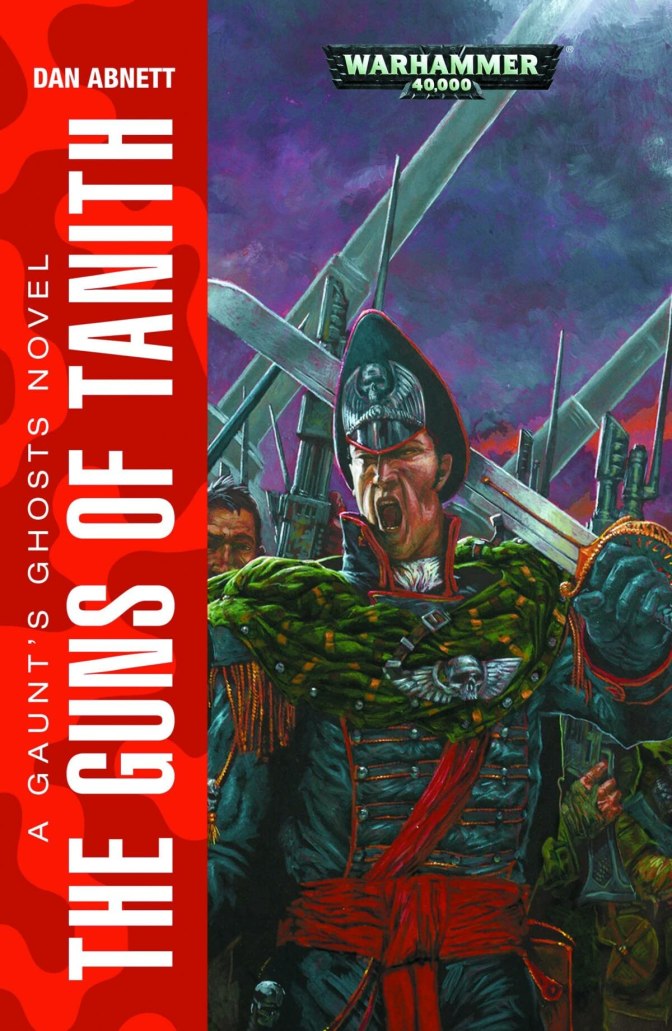
Throwback Thursday – Warhammer 40,000: The Guns of Tanith by Dan Abnett

The Guns of Tanith Cover

Publisher: Black Library (Audiobook – 25 April 2002)

Series: Gaunt’s Ghosts – Book Five

Length: 10 hours and 10 minutes

My Rating: 4.5 out of 5 stars

Amazon

Welcome back to my Throwback Thursday series, where I republish old reviews, review books I have read before or review older books I have only just had a chance to read.  After having such a great time reviewing the previous Gaunt’s Ghosts novel, Honour Guard, in my last Throwback Thursday, I immediately read the fifth fantastic entry in the series, The Guns of Tanith, which proved to be just as awesome and exciting.

As I mentioned last week, I have been really getting into the works of Dan Abnett over the last year, and I now consider several of his books to be amongst the best Warhammer 40,000 novels I have had the pleasure of reading.  Not only did I deeply enjoy his epic Eisenhorn trilogy (made up of Xenos, Malleus and Hereticus) but I have also been powering through his Gaunt’s Ghosts books.  The Gaunt’s Ghosts books are some of the more iconic novels in the Warhammer 40,000 franchise and are often considered essential reading by fans of the franchise due to the captivating way they capture the gruelling experiences of ordinary human soldiers in this grim, futuristic setting.  The first four novels in the series, First and Only, Ghostmaker, Necropolis and Honour Guard, as well as the prequel novel The Vincula Insurgency, are all excellent and exciting in their own way, and I have had a ton of fun seeing the impressive war narratives set around the men of the Tanith First-and-Only, informally known as Gaunt’s Ghosts.  As I was still in the mood for some awesome action at the end of last week, I just had to keep going with these books and I quickly picked up the fifth entry, The Guns of Tanith.

As the massive Sabbat Worlds Crusade continues to pit the forces of the Imperium of Man against the foul forces of Chaos, the battlelines extend across multiple planets and systems, drawing in millions of soldiers.  The latest phase of the crusade has severely stretched the supply lines of the Imperial assault and the Chaos foes are quick to take advantage, threatening to cut off and surround the main Imperial force.  To stave off disaster, Warmaster Macaroth, needs the Tanith First-and-Only to recapture the vital promethium producing planet of Phantine so the crusade can be resupplied and continue.

Led by the heroic Colonel-Commissar Ibram Gaunt, the Tanith First-and-Only engage in a deadly airborne assault on several of the planet’s domed cities.  Relying on their unique skills of navigation and infiltration, the Ghosts prove to be vital to the operation and soon take the key city of Cirenholm.  However, holding the city proves to be harder than expected.  While preparing for the next assault, the vile murder of a freed Cirenholm civilian places a Ghost on trial and opens up the festering cultural divides within the regiment.

As Gaunt attempts to get to the bottom of the crime and ensure that the innocent are left alive, the Ghosts are given a vital mission to undertake.  A dangerous Chaos warlord has taken command of the final occupied city, Ouranberg, and his lethal command threatens to devastate an attack by the Imperials.  To ensure a successful invasion of this Chaos stronghold, a specialised team of Ghosts is tasked with infiltrating the city and assassinating the enemy leader in advance of the main assault force.  Featuring some of the best the Ghosts have to offer, the assassination squad will be forced to walk through hell to achieve their objective and not everyone will be coming back.

In this fifth entry in this amazing series, Abnett continues to impress with another powerful and captivating character-driven read that takes the Ghosts through a gruelling round of battles, tragedy and growth that proves near impossible to put down.  The Guns of Tanith was a pretty strong entry in the series, expanding on some of the interesting storylines from the first novel while also introducing a new dark scenario for the characters to deal with.

The Guns of Tanith features a fantastic narrative from Abnett that contains his usual blend of high-intensity action, character growth, and intriguing examinations of the Warhammer 40,000 universe, that make all the Gaunt’s Ghosts novels such a treat to read.  Following on from the events of the previous books in the series The Guns of Tanith is told in Abnett’s typical style, with a ton of unique character perspectives, mostly those of the Ghosts, which presents the reader with a rich and vibrant view of the events, as well as the unique, character-driven storylines that emerge.  While this fifth Gaunt’s Ghosts novel can be read as a standalone book, The Guns of Tanith does see several ongoing, character focused storylines come to a head or get even more complicated. As such, readers should really consider checking out the previous novels first so they can get the full emotional weight of the revelations and twists that emerge.

The main narrative of The Guns of Tanith is bookended by major extended battle sequences that see the Ghosts and their allies engage in elaborate fights across two separate cities.  The first of these battles, in Cirenhom, sees all the Ghosts forced to engage in a particularly bloody battle with limited ammunition against a dangerous and determined foe that has set up some elaborate traps.  This extended sequence is both epic and useful as it provides the reader with a ton of intense action to draw them into the novel while Abnett introduces the characters and storylines that this latest novel is focused on.  You also get a good overview to the new setting of Phantine, a polluted planet with a toxic atmosphere that requires multiple forms of airship to traverse.  This unique location adds some great spice to the overall story, especially as it requires the characters to learn some unique aerial skills, while also allowing Abnett to have fun featuring several impressive dogfights.  There are some great moments during this first extended battle sequence, and it sets the rest of the book up nicely.

The middle of the book is where the reader gets into the real meat of the story, especially as it lowers the intensity levels down from the action-packed introduction and allows the reader to breathe and absorb all the intriguing story elements to come.  At first, I wasn’t too keen on a quieter middle section to this novel, especially as I thought it would make The Guns of Tanith more of a bridging novel in the series, rather than a book that could stand on its own.  However, Abnett soon proved me wrong as this intriguing central storyline contained a lot of major character moments and intriguing plot lines, while also expertly setting up the final third of the book.  The main storyline explored in the centre involves a murder investigation when one of the Ghosts is accused of killing an innocent civilian.  Abnett does a great job with this murder storyline, especially as it brings in compelling mystery and legal thriller elements to it, while also driving the characters in some excellent directions.  However, the real joy of this part of the book is the focus on the camaraderie and factions within the Ghosts, and the fracturing coherence in places leads to some memorable moments later on.

The final section of the book focuses on the assault of the Phantine city, Ouranberg, and the special Ghosts mission to assassinate the Chaos warlord.  Following several supporting members of the cast, this final third of The Guns of Tanith takes these characters on a particularly dark mission through a Chaos stronghold, and Abnett throttles up the tension and brutality to the maximum, ensuring that the readers are strongly hooked on everything unfolding.  Watching the separated teams attempt to navigate through enemy territory leads to some dark and bloody sequences, and everything comes together in a brutal confrontation where all the characters get a moment to shine.  The invasion in the aftermath of this assault brings the entirety of The Guns of Tanith together in an outstanding way, as several major storylines are expertly and impressively resolved, often in ways that leave the characters even more damaged than when they started.  This is also a particularly shocking death of a major character that is guaranteed to move long-term readers of the series.  Abnett does a masterful job of setting this death up, including by showcasing several misleading near-misses, so you really don’t know who is going to live or die right up to the end.  His eventual choice is one designed to wound his readers, and you will have to come back to see how it impacts the rest of this series.  Overall, this was an extremely solid and impressive Gaunt’s Ghosts narrative, and I deeply enjoyed how Abnett continued and finalised some of the great character storylines from the previous books, while also providing the reader with more action and intrigue than they can handle.

As with most of the Gaunt’s Ghosts books, The Guns of Tanith is an open read to all those unfamiliar with the wider Warhammer 40,000 canon.  Abnett goes out of his way to make his books accessible for new readers, and he always provides enough detail and background so that anyone can catch up and enjoy the subsequent story.  However, for those fans more familiar with the Warhammer universe, there are always a ton of great elements or unique world building details that they will find particularly fascinating.  The new locations in The Guns of Tanith are pretty damn spiffing, and I had a lot of fun with the polluted planet, especially as it requires multiple arial sequences.  This is turn leads to the introduction of the Phantine XX Fighter Corps, who Abnett will go on to feature in his spin-off novel, Double Eagle, and it was fun to see how they get their start here.  For me, though, the best part of the universe expansion was Abnett’s in-depth look at the day-to-day life of the common soldier in the Imperial Guard.  While Abnett has always done a masterful job of capturing the footslogger experience in his novels, I felt that The Guns of Tanith was one of his best attempts to dive into the core of his beloved regiment.  Not only is there are lot of story focus on the various members and factions of the regiment, but Abnett also spent some time trying to explore the downtime and personal lives of the characters, and it was pretty intriguing to see the accompanying civilian baggage train of the regiment, which includes their families and other vital services.  I also personally loved the scenes that examined the problems associated with the Imperial bureaucracy as the Ghosts come up against their greatest enemy: bad paperwork.  Certain mistakes ensure that the Ghosts are left with minimal ammunition as the Departmento Munitorum orders the wrong power packs for their lasguns.  The following extended sequence which saw the regiment unable to fight effectively because their ammunition couldn’t fit their guns was an impressive part of the book and it definitely raised the stakes during the book’s introduction.

As usual, one of the major highlights of The Guns of Tanith is the amazing characters that the story focuses on, as Abnett once again fits a huge number of character-driven storylines into the book.  At this point in the series, Abnett has introduced a pretty substantial cast of characters, many of whom have ongoing storylines, and it is intriguing to see them unfold even further in The Guns of Tanith, especially as Abnett does a great job featuring most of them equally and then combining them into the larger narrative.  Many of the more intriguing character arcs in this book carry over from the previous novels and there are some great conclusions and expansions to them here that helps to improve the already great narrative of The Guns of Tanith.  At the same time, several new characters are introduced here or finally given prominence, and it was interesting to see how they fit into the already established character dynamics that Abnett has been building up.  The cohesiveness of the Ghosts as a regiment ends up becoming a huge fixture of this book as the Tanith-Verghastite divide is explored in greater detail by many of the characters.  It was fascinating to see how Abnett handled these character storylines in The Guns of Tanith, and several of them ended up being some of the best parts of the book.

As with most of the novels in the series, quite a lot of character focus goes towards the main protagonist, Colonel-Commissar Ibram Gaunt, whose experiences as the commander of this unique regiment continue to trouble him in various ways.  In The Guns of Tanith, this takes the form of his apparent unconscious bias towards the Tanith elements of his regiment over the Verghastite recruits, which is showcased by his differing reactions during two court cases.  This results in several intense interactions between Gaunt and members of his team, which helped to showcase the protagonist’s idealism and a certain degree of naiveté when it comes to Imperial politics, both of which will cause him trouble in the future.  This is also an intriguing look at the issues caused by Gaunt holding the dual rank of Colonel and Commissar, which make him simultaneously a command officer and a political officer in charge of discipline.  This is the first time the duality of his roles has caused some major problems for him, and it was interesting to see several characters question him about it.  Watching Gaunt try to balance his various hats while also maintaining the respect of his men and his superiors makes this a rather compelling novel for Gaunt and I will be intrigued to see how this affects the character in the future.

While there is always a lot of focus on Gaunt, many of the other characters have big moments here, and it is always interesting to see which characters Abnett will focus on in each particular novel.  Firstly, this is one of the Gaunt’s Ghosts books where the major characters of Colm Corbec and Elim Rawne do not get a lot of focus, as Abnett sets them aside to make room for others.  Corbec is once again wounded early on in the plot to keeps him out of the action, while Rawne, after getting a good needling into Gaunt, is showcased as the senior commander, but that’s about it.  Instead, a lot of the focus goes towards some of the newer members of the cast, such as Gol Kolea, whose attempts to balance his complex family concerns leads only to tragedy and despair for him and the reader.  Cuu continues to be a menace, while surgeon Ana Curth acts as several character’s consciences throughout the book.  The previously overlooked but surprisingly lucky Bonin finally got some prominence in this novel, and I loved finding out how he survived Necropolis.  The newer characters of Commissar Hark and Captain Ban Daur also proved to be essential parts of the plot, and I am really glad that Abnett continued to utilise them, as they helped Gaunt see the errors of several decisions while simultaneously taking on some of Gaunt’s more unorthodox methods.  Members of the original Ghosts, such as Brin Milo, Larkin, Bragg and Mkoll all had good roles in The Guns of Tanith as well, and their balanced scenes showcased different triumphs and tragedies.  Finally, I was glad that Abnett decided to keep featuring the mysterious preacher, Ayatani Zweil, after his fun introduction in Honour Guard.  Zweil is an always entertaining yet serious figure, and it was great to see him knock some sense into several characters when they needed it.  I’m honestly only scratching the surface here, as a ton of other characters were well featured throughout The Guns of Tanith as Abnett continues to build and bring together his final cast of major characters.  Each of these amazing protagonists had some superb impacts on narrative of this novel, and I cannot wait to see how Abnett continues to develop them in the later books of the series.  I am assuming it is only a matter of time until more of the characters start to die, and I am sure that will break my heart just as much as the big death in The Guns of Tanith did.

Due to my love of the format, I of course listened to The Guns of Tanith on audiobook, which is easily the best way to enjoy any Warhammer book.  I have gone on a lot about the fantastic Gaunt’s Ghosts audiobooks in recent reviews, and The Guns of Tanith has all the same advantages, as one of my favourite audiobook narrators, Toby Longworth, brings the reader right into the heart of the action with his great voice work.  Every scene is masterfully showcased by his narration, and all the characters are brought to life thanks to the great voices he utilises for them.  Longworth really stretched himself when it came to accents in this latest novel, and he features a ton of great new voices, as well as the existing tones from the previous audiobooks, to bring this entire audiobook together.  With the standard runtime of just over 10 hours, The Guns of Tanith audiobook is a real snap to power through, and I honestly finished it off in only a few days.

Unsurprisingly, I absolutely loved the fifth entry in Dan Abnett’s exceptional Gaunt’s Ghosts books, The Guns of Tanith, which proved to be another powerful and enjoyable Warhammer 40,000 novel.  Filled with Abnett’s usual impressive battles, The Guns of Tanith also had a brilliant focus on characters-driven storylines that dominated most of the plot and kept the readers hooked the entire time.  An intense, addictive, and deeply personal Gaunt’s Ghosts books, The Guns of Tanith was pretty damn outstanding and I loved every second of it.

Amazon

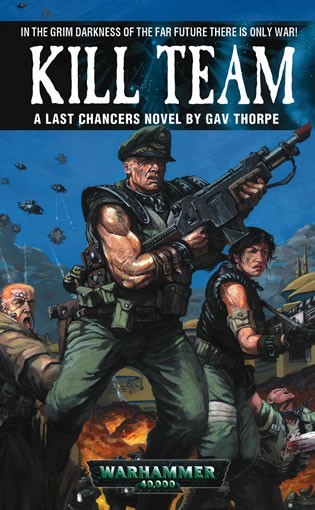
Throwback Thursday – Warhammer 40,000: Kill Team by Gav Thorpe

Kill Team Cover

Publisher: Black Library (Paperback – 1 November 2001)

Series: Last Chancers – Book Two

Length: 277 pages

My Rating: 4.5 out of 5 stars

Amazon

Welcome back to my Throwback Thursday series, where I republish old reviews, review books I have read before or review older books I have only just had a chance to read.  In my latest Throwback Thursday, I review the second epic entry in Gav Thorpe’s ultra-fun Last Chancers series with Kill Team.

I have been going through a real Warhammer phase in the last few months, especially as I have been lucky enough to find some awesome older paperbacks in second hand shops.  I was particularly happy to find a copy of was the first two books in Gav Thorpe’s Last Chancers series.  Following a rotating team of convict Imperial Guardsmen as they engage in suicide missions for their freedom, the Last Chancers books are essentially The Dirty Dozen in space, and I love the awesome and brutal stories that emerge.  The first book, 13th Legion, was one of the very best Warhammer 40,000 novels I have had the pleasure of reading, and I have been trying to fit the sequel, Kill Team, into my reading schedule for a while.  I finally got a chance last weekend, and boy was it worth making the time for as the second Last Chancers novel had another outstanding and action-packed story to it.

In the far future, the armies of the Imperium contain multitudes of scum and villains, all of whom are considered useful in the service of the Emperor.  However, after blowing his last chance at redemption after completing an impossible suicide mission, Lieutenant Kage has been cast aside, locked inside an Imperial detention centre away from the one thing he is good at, fighting the Emperor’s enemies.  When his former commander, the mysterious and ruthless Colonel Schaeffer, returns with another deadly assignment, Kage is swift to accept and become useful again, even if he no longer has a chance at freedom.

The Colonel has been tasked with leading a small, disposable team to assassinate a prominent Tau commander and he needs a new version of the 13th Penal Legion, the infamous Last Chancers, to pull the mission off.  Placed in command, Kage must recruit a ragtag group of the worst killers, deserters, and malcontents that the Imperial Guard have cast out.  Forcing them into a harsh training regime to bring them together into an effective squad, Kage soon finds himself leading a new squad of Last Chancers, many of whom are as desperate for freedom and the fight as he is.

However, their mission is another lethal suicide mission.  Working with an immoral Imperial Inquisitor, the team is covertly inserted into Tau space and must infiltrate the political and military circles surrounding their target.  But not everything is as it seems and soon the squad must content with treachery, personal enmity, and the superior technology of the Tau.  Can these new Last Chancers succeed when so many before them have perished, or will the only redemption they find be in death?

Thorpe continues to give me all the Warhammer 40,000 fun I can ever need with this amazing and intense read.  Serving as an outstanding sequel to 13th Legion, Kill Team proved to be a fun and compelling novel, loaded with action, adventure and some intriguing characters.

Readers are in for another intense and brutal story with Kill Team, as Thorpe once again utilises The Dirty Dozen format to successfully set the scene.  However, rather than having a massive regiment get whittled down until the toughest survivors are left, this time the protagonist and main narrator, Lieutenant Kage, is forced to choose his own team of criminals to lead on the Colonel’s new suicide mission.  I really enjoyed the starting scenes of Kill Team, especially as you see Kage go from cell to cell choosing the best individuals for his team, before engaging in an extended and deadly training montage, which mirrored the hell he went through in the first book.  As Kage is dealing with that, and his own substantial personal issues, the main mission of the book is set up as the Last Chancers are sent into Tau space to assassinate an ambitious, warmongering commander.  Initially infiltrating in as diplomats and mercenaries, the team travel to several Tau planets before beginning their attack.  The final third of the book is primarily focused on this deadly mission as the team find themselves in the middle of a bloody battle against the very worst the Tau can throw at them.  The subsequent fight is pretty intense and brutal, and the readers are treated to some great scenes of warfare in various unique scenarios.  The ending is well set up, with betrayals, fun reveals and some brilliant character focused moments as the team finally come together to succeed.  I do think that Thorpe might have gone one twist too many at the end, but the overall story was extremely satisfying, and I deeply enjoyed how the entire thing came together.

I had a lot of fun with this second Last Chancer’s novel, and I am really glad that The Dirty Dozen plot basis didn’t wear thin in the second entry.  Thorpe did a great job of following on from the story elements he introduced in 13th Legion, especially when it comes to the two main characters, who have a fantastic new dynamic in Kill Team.  Like the first book, Kill Team is very fast-paced, and I had a ton of fun at the start when the new characters are recruited, as well as all the awesomeness of the extended battle sequence at the end.  However, unlike the episodic storytelling Thorpe utilised in 13th Legion, Kill Team has a more straightforward plot line, which worked well to set it apart from the previous entry.  You really get dragged into the struggles of the new Last Chancers, as well as the eternally battered Kage, who serves as the book’s primary narrator.  While there are a lot of references to the first book, Kill Team can easily be read as a standalone read and it isn’t necessary to get through 13th Legion first.  However, I deeply enjoyed seeing the continued development of the protagonist and fans of the first book will probably get a lot more out of Kill Team as a result.  Unsurprisingly, a lot of the book’s focus is on the action and combat, and Thorpe really doesn’t disappoint when it comes to that.  The author does a wonderful job capturing every single firefight, brawl, and pitched battle that occurs within Kill Team, and you can see and feel every single shot, punch and stab that is thrown as a result.  The presence of a few too many characters guaranteed to survive did occasionally lessen the impact of some dramatic fight scenes, however, you still get caught up in the violence and I deeply enjoyed how well Thorpe supported his narrative with his great writing.

Kill Team also serves as an intriguing entry in the wider Warhammer 40,000 canon, especially as it is one of the stories that follows a common soldier as he experiences the alien perils of the wider galaxy.  Just like with 13th Legion, readers don’t need a lot of background knowledge of the wider Warhammer 40,000 universe to enjoy Kill Team, and the Last Chancers books are actually a pretty good introductory series for those unfamiliar with the franchise.  I loved some of the fun references and factions contained within Kill Team, not only because you get to see more of the dark side of the Imperial Guard, but you also get quite an in-depth look at the Tau.  The Tau are one of the more interesting factions in the Warhammer canon, and frankly there aren’t enough books focusing on them.  I had a lot of fun seeing them in Kill Team, mainly because you got to see the inexperienced human characters encountering them for the first time.  Their reactions at the Tau culture, politics, and weaponry, makes for a great part of the book’s middle plot, and it was really fun to see them comparing their own lives in the Imperium to what the Tau have (that scene when they’re exploring the Tau ship’s bathroom was just great).  While Thorpe did nerf the Tau when it comes to their battle prowess, as the Last Chancers mow down waves of Fire Warriors, you get a great idea of their military capability throughout Kill Team and I loved seeing the Battlesuits in action.  There are a lot of great elements that Warhammer fans will get a kick out of in Kill Team and I really enjoyed some of the stuff Thorpe added in.

For me, the real highlight of Kill Team was the exceptional character work, especially when it came to Lieutenant Kage.  Kage is a natural survivor who has gone through a lot in his life, especially since joining the Last Chancers.  The Kage we met in 13th Legion was a gritty survivor, just looking for his freedom at any cost.  However, after the success and trauma of his mission and his subsequent failure to stay out of trouble, Kage has come back a little broken and a little bit more unhinged, especially as he is now racked with guilt over the fate of his original Last Chancers.  After a lengthy, violent prison sentence, Kage is once again under the heel of Colonel Schaeffer in Kill Team.  Kage actually ends up becoming more like Schaeffer in this book, especially when he chooses, trains and controls his own team of rogues, and the realisation that he will be responsible for their deaths weighs very heavily on him.  This guilt, and his own mental trauma, plays a big part in how Kage interacts with many people in Kill Team, and there is something very wrong with Kage throughout this book.  Despite this, he is still the ruthless survivor that he was in 13th Legion, and, if anything, Thorpe possibly made him a little too unkillable and deadly for this sequel (he’s not really a common soldier anymore).  The best scenes involving Kage are still the ones when he faces off against Schaeffer, and the have some great interactions throughout the book, especially as Kage blames Schaeffer for everything that happened to him.  Kage honestly hates and fears the Colonel more than anyone else, and yet he still follows him, even though his own chance of freedom has already been spent.  This results in some brilliant encounters between the unhinged Kage and the taciturn Schaeffer, and I cannot wait to see how their relationship evolves in the other Last Chancers books.

Aside from Kage and Schaeffer, there is a good collection of supporting characters featured throughout Kill Team.  Most of the prominent ones are the new members of the Last Chancers who Kage recruits for the mission.  Thorpe features a great introduction for all these new characters at the start of Kill Team and you soon get drawn into their unique storylines.  Each brings something new to the book, even if it is only briefly, as you know well in advance that most, if not all, of these character are going to die.  I liked the more specialist focused characters featured in Kill Team, as it was an intriguing departure from the more generalised grunts in 13th Legion, although this did slightly pigeonhole these characters in certain ways.  Still, all the new Last Chancers characters formed an excellent base for the story, and it was fascinating to see how they interacted with Kage, who see him in the same way that Kage viewed Schaeffer in the first book.  Other awesome characters featured within Kill Team includes a wily Inquisitor, some alien diplomats and a mysterious passenger waiting in the wings.  All these, and more, add so much to the plot, and I had a great job seeing how they, and their seemingly inevitable deaths, played into this awesome book.

Overall, Kill Team was exactly the sort of fun read that I thought it would be, as Gav Thorpe did a wonderful job in this second Last Chancers book.  Loaded with action and highly damaged characters, Kill Team was another fantastic and electrifying romp through the chaotic and deadly Warhammer 40,000 universe with a crew of convicted soldiers.  Sharp, brutal, and highly addictive, I powered through Kill Team very quickly and had an awesome time doing so.  Hopefully I will be able to lay my hands on the next Last Chancers novels at some point in the future and I cannot wait to see what carnage they get up to next.

Amazon

The Perfect Assassin by James Patterson and Brian Sitts

The Perfect Assassin Cover

Publisher: Century (Trade Paperback – 15 November 2022)

Series: Standalone/Book One

Length: 317 pages

My Rating: 4.25 out of 5 stars

Amazon     Book Depository

The team of James Patterson and Brian Sitts present one of the most unique thrillers of 2022 with The Perfect Assassin, a sharp, exciting read that pays homage to a classic pulp hero.

Readers of this this blog will remember that I only started reading the works of the iconic and exceedingly productive James Patterson a couple of years ago and I have so far enjoyed several of his more interesting books.  This includes Lost (co-written with James O. Born), 2 Sisters Detective Agency (co-written with Candice Fox), Blowback (co-written with Brendan DuBois) and one of my favourite books of 2022, Death of the Black Widow (co-written with J. D. Barker).  I have had a great time with each of these cool reads, and when I heard the plot of one of Patterson’s latest books, The Perfect Assassin, I knew I had to read it.  The Perfect Assassin is fifth collaboration between Patterson and fellow thriller author Brian Sitts and presents the reader with a really fun and intense story that had an intriguing connection to a classic adventure series from the past.

Dr Brandt Savage is an anthropology professor at the University of Chicago, leading a less-than ordinary life and often ignored by his colleagues and students.  His only real plan in life is to disappear to some exotic locale on an upcoming research sabbatical.  However, the sabbatical is going to become far more extreme than anything he imagined when he is kidnapped from the university campus and imprisoned inside an isolated and hidden warehouse.

Savage’s kidnapper is a beautiful and deadly killer, known only as Meed, who informs Savage that his life needs to change.  Forcing him to undertake an intense and extended physical and mental training regimen, Meed begins to mould him into a completely new person, one who is stronger, smarter, and more dangerous than anything Savage could ever imagine.  But even after six months of the most brutal training imaginable, Savage is far from ready for what is to come.

Meed is running from her own past and the dangerous people who turned her into a lethal killer.  To survive, she needs Savage’s help, especially if she can use her training and conditioning to bring out the genetics of his legendary ancestor, the original Doc Savage.  Savage is soon dragged into a new and terrifying world of killers, assassins and secret organisations, all of which are connected to his family’s terrible legacy.  Forced to work with Meed, who has her own link to his family, Savage begins a new adventure worthy of his ancestor.  But is he enough of a Savage to survive the experience?

This was a very fun and exciting novel from the team of Patterson and Sitts, and I am really glad I decided to read it.  The two authors have come up with an awesome story for The Perfect Assassin, which blends a thrilling modern tales with some interesting connections to the classic Doc Savage pulp novels.

The Perfect Assassin’s story starts in a very cool and intense way when Brandt Savage is kidnapped by the mysterious Meed and finds himself being brutally trained to bring out his best self.  The first half of the book sets up the entire novel very well, as it is split between chapters told from Savage’s perspective as he undergoes his training, and chapters from Meed’s perspective that either explore her childhood being raised in deadly assassin school or show her current missions against some of her former classmates.  This results in quite the compelling narrative, especially as you begin to appreciate the contrasts between Meed’s past and her current actions with Savage.  The authors introduce some big revelations about both primary characters and their ancestors that results in a complete change to the narrative format for the second half of the book, especially as there is a big focus on the protagonist’s connection to Doc Savage.  There the narrative is firmly set in the present with the characters working together on a sped up and action-packed chase around the world that ended up with several big confrontations.  Everything ends with a ton of action, and while the plot was wrapped up way too quick, you have so much fun getting there that you do not mind too much.

I felt that Patterson and Sitts’s writing style for The Perfect Assassin helped to enhance this awesome narrative, especially as everything was set up to compliment the fast-paced story.  The author’s use of short, sharp chapters really moves the story along.  At the same time, the blend of multiple perspectives, especially those shown from Meed’s childhood in the first half of the book, allows for them to efficiently tell a more complex tale, especially as it provides greater detail about Meed and her motivations in short and exciting order.  Throw in a ton of action, some quick, but well received character development, and a good selection of sudden twists and revelations and you will be flying through this book in no time at all.  I really appreciated the way that Patterson and Sitts set this book up and their style of writing, as well as the memorable narrative, made it very hard to put down, especially when you could keep seeing the end of the next chapter just around the corner every time you turned the page.

Easily one of the most interesting parts of this book is the fantastic connection that it bears to the classic pulp character of Doc Savage and associated media.  Patterson and Sitts’s unique narrative serves as a multi-generational successor to the original novels, with the plot focussing on multiple aspects of the Doc Savage lore and characters.  Not only are the main characters related to iconic Doc Savage figures, but the entire plot revolves around the consequences of Doc Savages origins, with aspects of it coming into play with the new Savage and his training, but also with the assassin school that Meed was raised in (which was such a cool setting btw).  Now, I have to admit that I am not particularly familiar with the Doc Savage media (it is well before my time), but it was very clear that the authors loaded The Perfect Assassin with a ton of homages to the original books, with references to characters, settings, plot lines and other Doc Savage elements.  At the same time, the authors seek to modernise the story to a degree, giving parts of the characters’ origins a darker and more morally ambiguous edge.  These Doc Savage elements were made pretty accessible to new readers, and even those people who aren’t that familiar with the old-school character should be able to follow what is happening (a quick online search probably wouldn’t hurt though).  Naturally, fans of the original pulp novels are going to have the most fun with this book, especially as they will be able to recognise all the references I missed.  I did think that they might have slightly overdone some of the Doc Savage elements towards the end of the book, with a Doc Savage inspired speech and certain super-human abilities making the story way sillier than it needed to be.  However, I ended up having a ton of fun with all these fantastic Doc Savage references in The Perfect Assassin, and I think quite a few readers will appreciate how Patterson and Sitts endeavoured to bring the one of the first superhuman characters into a whole new age.

Overall, The Perfect Assassin was one of the more unique and awesome thrillers of 2022 and I had an outstanding time getting through it.  The great team of James Patterson and Brian Sitts produced a fantastic and compelling story that quickly draws you in and keeps you interested with its action, amazing developments, and distinctive relationship to a historic piece of action/adventure media.  It will be great if Patterson and Sitts present some sequel to The Perfect Assassin in the future.  If they do, I will be sure to grab a copy, especially if I am in the mood for some easy-to-read excitement.

Amazon     Book Depository

In the Shadow of Lightning by Brian McClellan

In the Shadow of Lightning Cover

Publisher: Macmillan Audio (Audiobook – 21 June 2022)

Series: The Glass Immortals – Book One

Length: 24 hours and 53 minutes

My Rating: 5 out of 5 stars

Amazon

One of the most inventive and compelling authors of fantasy fiction, Brian McClellan, kicks off an awesome new series with In the Shadow of Lightning, the first book in The Glass Immortals series.

Few authors over the last 10 years have had more of an explosive impact on the world of fantasy fiction then Brian McClellan.  Debuting in 2013, McClellan quickly set the world ablaze with The Powder Mage trilogy, which saw chaos and destruction unravel in a new fantasy world where gunpowder-powered mages face off against an enraged god.  I had a brilliant time with the first book in the series, Promise of Blood, and McClellan followed this initial trilogy off with the sequel, Gods of Blood and Powder trilogy, set in the same universe.  While I still need to finish the Powder Mage novels off, I was very excited to hear that McClellan was starting a new series with In the Shadow of Lightning, the first book in the author’s The Glass Immortals series.  This is an impressive and outstanding read that introduces readers to a distinctive new fantasy world, this time with a fascinating focus on glass magic.

Demir Grappo was once one of the most respected politicians, tacticians and glassdancers in the Ossan Empire.  A rising star in the assembly, a proven governor, and the only son of a prominent family, Demir’s promising career is suddenly shattered in the immediate aftermath of his greatest military victory when his army sacked and destroyed the entire city of Holikan, apparently on his orders.  Mentally broken by the massacre done in his name, Demir abandons his army and vanishes into the provinces, giving up his life of privilege for one of anonymity.

Now, nine years after the sacking of Holikan, Demir is a very different man, having spent the intervening time as a grifter with no true home.  However, everything changes when news reaches him that his mother was murdered, brutally beaten to death in public in an apparent political attack.  Determined to find her killers, Demir returns to the city of Ossa to reclaim his seat as the head of his family.  But not everyone is happy that he has returned, and Demir soon finds himself in the midst of several deadly conspiracies, while Ossa goes to war against its neighbour, all in the name of avenging his murdered mother.

To get to the centre of these conspiracies, Demir must find allies, including old friends and new acquaintances if he is to gain the power and influence he needs find answers, especially those hidden by the powerful guild families who rule Ossa.  However, as he searches, and soon finds a much more troubling secret: godglass, the source of magic within the world, is running out, and when it goes, chaos will reign.  The key to securing the future may lie in a device that could re-power inert pieces of godglass, and only one girl appears to have the skill to create such a device.  But as Demir fights to secure this new vital ally, he finds himself fighting against a mysterious new enemy, one that seems determined to destroy anyone who gets in their way.

McClellan impresses again with another incredible fantasy novel that had me instantly enthralled.  Presenting the reader with a multifaceted narrative that combines great characters with intriguing fantasy elements, In the Shadow of Lightning proved to be an outstanding start to McClellan’s new series and I had an exceptional time reading it.  Epic in scope, ambition and potential, In the Shadow of Lightning gets a full five-star rating from me and I am still reeling from just how good this was.

In the Shadow of Lightning is a particularly addictive novel, especially as McClellan presents the reader with an outstanding and complex narrative that pulls them in on so many levels.  Starting off with a compelling prelude that perfectly introduces central protagonist Demir Grappo and shows his dramatic and bloody fall from grace and sanity, the novel then undergoes a time skip which takes the reader into the current storyline, right as events are kicking off.  The initial focus is on Demir, who, after finding out his mother has been murdered, returns to Ossa to take over the family business and discover her murderers.  However, he soon finds that his mother was involved in complex dealings that might have led to her death, and that her assassination has been blamed on a neighbouring city Ossa is going to war with.  The story then splits as McClellan introduces three additional point-of-view characters, each other whom has their own distinctive story arc, closely related to Demir and the politics of Ossa.

These new characters include Thessa Foleer, a siliceer (godglass worker) from Ossa’s neighbour Grent, the breacher Idrian Sepulki and Kizzie Vorcien, an enforcer for a powerful guild-family who Demir hires to investigate his mother’s death.  Each of these new characters have their own individual storylines that tie into the plot points introduced in Demir’s initial chapters.  While these character arcs go in their own direction, their storylines are loosely connected together and form a great overarching narrative as they are dragged into war, imprisonment, political battles, conspiracies and criminal investigations.  I loved the cool blend of character-driven storylines, and everything comes together extremely well to show that something very rotten is going on within Ossa.  This is a very fast-paced story, and McClellan keeps multiple compelling plotlines running simultaneously to keep the reader’s attention, with some great reveals and amazing fight scenes scattered throughout the book.  Most of these reveals are set up and foreshadowed extremely well, with a couple of exceptions, and I didn’t see some of the twists coming, which was pretty fun.  Everything comes to a head towards the end of the novel, as all four characters find themselves in their own extremely dangerous and concerning situation.  Not only is there a massive battle for the future of Ossa but there are some shocking revelations about who is involved in the conspiracy and why.  The author leaves everything on an amazing note that not only leaves readers satisfied with the conclusion of some of the storylines but which also leaves a lot of questions unanswered and the reader wanting more.  An excellent and impressive story that dragged me in extremely quickly.

I was very impressed with how In the Shadow of Lightning’s story came together, as McClellan presented an epic and addictive offering that I snapped up extremely quickly.  I especially loved the use of four separate narrators to tell this story, and McClellan did an outstanding job of separating out their narratives.  Each narrator has their own unique story to tell, and what is really good is that they also explore a different aspect of the author’s new fantasy world, which often breaks across the associated genres.  For example, Thessa’s story focuses on the magical science behind godglass, and examines the political and social elements associated with this branch of magic.  Idrian’s tale comes across as a war tale as he is forced to participated in the deadly conflict between Ossa and Grent, where his particularly magical expertise makes him a living weapon.  Kizzie’s chapters come across as an investigation arc, as she attempts to uncover who killed Demir’s mother, and is forced to dive into the intrigues and shifting allegiances amongst the Ossan families, uncovering a deep conspiracy.  Demir serves as a bit of a joining figure; while he also has his own unique adventures, especially around Ossan politics, a lot of his arc involves interactions with the other three point of view characters.  Not only does this ensure that we get another viewpoint on the other character’s actions, as he gets involved in the godglass, espionage and the war elements that they are solely focussed on, but he helps to bring the other protagonist’s disparate storylines together into one solid and compelling narrative.

All four character-driven storylines are pretty exceptional in their own right, and this was one of those rare multi-perspective novels where you honestly can’t choose which character arc is the most intriguing or enjoyable.  I was particularly impressed with how McClellan brought these storylines together into one outstanding novel, and it makes for quite the epic read, especially as the author ensures you get the right blend of intrigue, action, magic and mystery throughout.  Despite its longer length, In the Shadow of Lightning has a pretty fast pace to it, and the readers are constantly treated to fantastic scenes that really keep your interest, either by being directly exciting, or featuring excellent examples of character development or world building.  I also really have to highlight the outstanding and amazing action sequences featured throughout this book.  McClellan has an impressive way of making these fight scenes really come to life in your mind, and it so easy to see all the epic events unfold.  These action scenes are particularly impactful when combined with the new magical features that the author has come up with, and I had so much fun seeing them unfold.  This really was an exceptional and highly entertaining read, and I loved how this entire amazing story was presented to the reader.

One of the things that most impressed me about In the Shadow of Lightning was the way in which McClellan envisioned and introduced the reader to an entirely new fantasy realm, equipped with its own distinctive magical system, all of which was substantially different from the elements featured in his previous Powder Mage novels.  While there are some similarities, namely that the Glass Immortals series also features magic, firearms, and a similar level of technology, there are quite a few differences which really make this new series stand out.  Most of the book is set in the Ossan Empire and its capital city of Ossa, which proves to be an excellent background location for the complex story.  Ossa, as well as some of the other nations mentioned reminded me of an Italian city-state, and I felt that it was an interesting change of pace to the French/English influences of Powder Mage universe.  The city is ruled by rival merchant guild families who are constantly battling for dominance, while the influence of the cities extends out to various provinces in the extended empire.  There is an intricate society set up around Ossa, and I loved the compelling interplay of industries, politics and intrigue that resulted.  McClellan examines various aspects of Ossan society, including sports, leisure, the military, and the various social levels, all of which were pretty intriguing to discover, and which painted Ossa and its people in a compelling light.  I particularly enjoyed their innate love for intrigue, contracts and business above everything else, and the fact that their national sport involves two magically enhanced people beating each other with cudgels tells you a lot about them.  Throw in some compelling snapshots of other relevant nations, as well as some sneaky hints at other mysterious beings, and the reader is given a really impressive and detailed introduction to this new world in this first book in the series, which McClellan did an outstanding job setting up.

However, the most distinctive part of this new universe is the cool magical system that forms the basis for much of the plot.  Just like with the Powder Mage novels, there are actually several different variations of magic and magic users in this series, which are connected to various forms of glass.  The first of these is the magical godglass, empowered glass items that give its users various abilities, such as strength, intelligence and enhanced senses, or which can be used to control a person.  Godglass is the most common form of magic in this series, which anyone can use, and indeed the entirety of human society in this world is based around the use of these items.  Pretty much every action a character does in this book is helped out in some way with godglass, resulting in some excellent sequences, especially during fights, and McClellan spends a lot of time exploring how it fits into his new world.  This includes multiple scenes set inside glassworks, where the godglass is forged, and you get an idea of how it is made and the significance it holds to the people of this world, including the fact that many of the characters have piercings that allow them to attach godglass to them.  Godglass actually becomes a key part of the book’s plot, once it is revealed that the supplies of magical cindersand that is used to create it is running low, resulting in an undercover war to control the remnants or finding a means of regenerating it.

The other magical elements of this new series involve the inbuilt talents of several characters, who have various degrees of sorcery in them.  The most prominent of these are the glassdancers, sorcerers who can control glass (except godglass) to an astonishing degree, and use it as a weapon.  There are multiple glassdancer characters featured throughout In the Shadow of Lightning (including the central protagonist), and you get to see multiple fights involving them, which are pretty badass.  You would never consider just how dangerous someone controlling glass could be until reading this book, and the brutal and quick ways in which they kill their opponents are pretty damn impressive.  The other major form of magical user are glazalier, who have more of a passive ability that allows them to resist the negative impacts of godglass (too much magic starts to eat away at someone) while still being able to use them.  These glazaliers are deployed as breachers, heavily armoured soldiers equipped with a ton of godglass that make them unstoppable tanks in battle, capable of killing units of men by themselves.  Acting as both a hammer and shield to their comrades, they are a lot more brutal than the subtly lethal glassdancers, and I loved the compelling contrast between the two major magical soldiers featured in this book.  McClellan does an outstanding job introducing, explaining and showcasing all these different magical elements in this first book, and I deeply enjoyed seeing the many cool ways these magical abilities and the godglass could be used, especially in the book’s many awesome action sequences.  I look forward to seeing how McClellan expands on them in the future, and I am still so impressed by how much magic the author could work into glass.

Another area where McClellan really excels as a writer is with the complex and multi-layered characters he is able to create.  This was really evident in his new novel, where several great point of view protagonists and fascinating supporting characters are perfectly introduced to the reader and become exciting focal points for the brilliant plot.

The most prominent of these is central protagonist, Demir Grappo, a brilliant strategist and politician, whose entire life is shattered in the opening prologue.  Forced back into public life after the death of his mother, Demir takes control of his family and attempts to rebuild his legacy while also finding answers.  Utilising the swindling, bluff and manipulation skills he built in the decade he was away, Demir proves to be a tough political adversary and quite an interesting figure to follow.  I loved his impressive and unique storyline, and watching him regain his political skills and self-confidence was really enjoyable, especially as he acts as a deadly glass sorcerer, businessman, politician, leader and even a general.  There are great sequences that highlight his skills, and I loved how he was able to manipulate everyone in many different ways, from being an agreeable political ally, to acting like a smarmy lord who is able to bluff his way around by sheer force of personality.  While he does come across as arrogant at times, which is partially due to the fear and respect everyone gives him due to his sorcerous abilities, McClellan ensures that the protagonist is aware of it, and works to fix his character flaws as he goes.  However, the biggest character aspect of Demir involves the trauma he carries after his actions apparently led to the massacre of an entire city.  Still haunted by the scenes from that night, Demir is forced to revisit them throughout the course of the book, especially when he meets a survivor while trying to find out who was actually responsible.  His roiling emotions around these events are his one weak spot, and the author slips in some powerful and understandable scenes where he loses control.  McClellan did a great job setting up Demir in this first book, and I have no doubt his story is going to get even more complex and painful.

McClellan ensures that all his intriguing characters have their own distinctive and compelling motivations, as well as a dark history that is explored throughout the course of In the Shadow of Lightning.  This includes Thessa Foleer, whose heartbreaking narrative and past worked perfectly in concert with Demir’s, which was appropriate as their storylines were the most closely linked.  Thessa’s story is one of constant loss, especially as everyone who seems to get close to her dies or suffers in some way, and the character goes through some major grief and trauma as a result.  The author does a good job balancing the focus on her past and her feelings of loss, with the scenes depicting her work as a siliceer, and I liked how you get some of the best insights about this book’s primary fantasy elements throughout her chapters.  McClellan sets up Thessa as quite a major character in this novel, and it will interesting to see how her story progresses in the future.

The other two point-of-view characters are Idrian Sepulki and Kizzie Vorcien, who add a lot more excitement and fun to the story.  Idrian’s scenes are some of the most action-packed, and it is very cool to see him in battle, especially as he tends to plough through entire units of men like a human tank.  However, Idrian is one of the most caring and likeable figures in the entire novel.  Primarily concerned for the lives of his comrades, Idrian goes into the battle to protect them, and the close friendships he builds with his men help define him.  However, Idrian is also battling some inner demons, and it is clear that McClellan has some tragedy planned for him in the future.  This is a little heartbreaking, as you really cannot help but enjoy Idrian’s straightforward nature and natural integrity, and anything bad that happens to him is going to strike the reader twice as hard as a result.  Kizzie, on the other hand, is a scrappy enforcer, forced to survive the intense politics of the city’s guild families.  The bastard daughter of the Vorcien family head, Kizzie desperately seeks legitimisation and acceptance from her father, if only to protect her from vicious brother.  Dragged into Demir’s hunt for his mother’s killers, Kizzie dives into the world of political intrigue and family espionage, only to find herself conflicted by the answers she seeks.  Forced to choose between friends and family, as well as between her desires and what his right, Kizzie has some great moments in this book, and her inner conflicts add a great amount of drama to the plot.

These central protagonists are well rounded out by an impressive and enjoyable series of supporting characters, each of whom add to the plot in their own unique way.  McClellan does a great job introducing all the key supporting characters featured in the plot, and there are some amazing and distinctive characters featured here, from long-time friends of the characters, to bitter enemies with their own agendas.  My favourite supporting character would probably be Baby Montego, Demir’s adopted brother who returns to help Demir with his exploits and find out who killed their mother.  A massive brute of a man and a former cudgeling world champion, Baby is considered to be the deadliest man on the planet, even though he doesn’t have any magical abilities and can’t use godglass.  He more than lives up to this reputation throughout the book, and he has some of the most exciting and action-packed sequences in the entire novel as he casually deals out violence.  At the same time, he is also a cunning thinker, and his dry humour and complete self-confidence really make him standout.  It was fantastic to see amazing characters like Baby interact with the point-of-view characters, and you get some impressive moments as a result.  Honestly, every character featured in this book was amazing in their own way, and I cannot emphasise enough how well McClellan wrote them.

As I tend to do with most massive fantasy novels, I chose to check out In the Shadow of Lightning in its audiobook format, which proved to be pretty damn awesome.  Coming in with a runtime of just under 25 hours, this is a lengthy audiobook to listen to (it comes in at number 15 on my latest longest audiobooks I have listened to list), and it took me a decent amount of time to get through it.  However, I felt that was time well spent, as I was relentlessly entertained every single second I spent listening to In the Shadow of Lightning, and there were times I wished it was even longer.  This epic novel really came to life in the audiobook format, and I loved how impressive and cool some of the big action sequences and confrontations felt when being listened to.  While I did initially struggle to keep track of the side characters in this format (having the ability to easily go back and figure out who people were would have been helpful), I was soon able to figure out who everyone was, while also absorbing a heck of a lot more detail about the new universe and its unique elements.

I was also deeply impressed with the outstanding narration In the Shadow of Lightning featured, thanks to the work of Damian Lynch.  Lynch is a veteran audiobook narrator with several epic fantasy series under his belt and he swiftly made me a big fan with his great voice work here.  He really dove into the various characters featured in the book, and you got a great sense of their personalities, emotions and actions as he narrated them.  I had fun with several of the voices he provided in this book, and I thought that protagonists like Demir, Idrian and Baby Montego, were really good, especially as you get notes of weariness in the old veteran Idrian, and the barely contained violence that resonates off Baby every time he talks.  I particularly liked the cool European accents that Lynch gave to the various characters, which helped to reinforce the Italian city-state nature of the main location, and people from other nations or cities had subtly different accents, which I thought was a very nice touch.  All this, and more, makes for an outstanding audiobook and this is easily the best way to enjoy In the Shadow of Lightning.  I had a wonderful time with this exceptional audiobook and I will definitely be grabbing the next book in this format when it comes out.

As you can no doubt see from this lengthy review, I deeply enjoyed In the Shadow of Lightning, which was such an epic book.  Brian McClellan did a remarkable job with this new novel, and he really proved his ability to set up another distinctive and exceptional fantasy series.  Loaded with so many amazing story elements, a cool new fantasy world with unique magical elements, and some impressive and complex characters, In the Shadow of Lightning was so very addictive, and I really could not stop listening to it.  A highly recommended read, especially in its audiobook format, In the Shadow of Lightning was one of the best books of 2022 and is a must read for all fantasy fans, especially those who have enjoyed McClellan’s work in the past, and I am exceedingly excited to see how The Glass Immortals series progresses from here.

Amazon

Oath of Loyalty by Kyle Mills (Based on the series by Vince Flynn)

Oath of Loyalty Cover

Publisher: Simon & Schuster Audio (Audiobook – 13 September 2022)

Series: Mitch Rapp – Book 21

Length: 9 hours and 23 minutes

My Rating: 4.5 out of 5 stars

Amazon     Book Depository

Fantastic spy fiction author Kyle Mills continues his excellent stewardship of the late, great Vince Flynn’s Mitch Rapp series, with the new action-packed thriller, Oath of Loyalty.

I have had a lot of fun with some cool spy thriller series over the last few years, but one series that keeps on pulling me back in is the ultra-compelling Mitch Rapp series.  Originally written by Vince Flynn, the Mitch Rapp series follows rugged American spy Mitch Rapp as he wages a brutal war against America’s enemies.  While sometimes a little too nationalistic for my tastes, the Mitch Rapp series nonetheless has some outstanding and inventive scenarios in its arsenal, with the protagonists forced to take on some dangerous enemies and crazy situations.  Since Flynn’s death, the series has been taken over by Kyle Mills, who has continued the tradition of compelling high-concept spy action.  I have had a great time reading Mills’s recent contributions to this series, with awesome reads like Red War, Lethal Agent, Total Power and Enemy at the Gate, all of which were extremely fascinating stories that proved very hard to put down.  As such, I am always very keen to check out the new Mitch Rapp adventure, and I was really drawn into the fascinating plot of the 21st Mitch Rapp novel, Oath of Loyalty.

After a lifetime of protecting the country he loves from terrorists, enemy nations and foreign spies, the shoe is on the other foot as Mitch Rapp finds himself as America’s most wanted man.  The corrupt and paranoid President Anthony Cook is determined to shape America into a personal kingdom that he and his calculating wife can rule for years.  However, after Mitch Rapp foils Cook’s plan to destroy his greatest rival, Rapp is now in the firing line.

Convinced that Rapp will attempt to assassinate him, especially as his actions have resulted in the death of one of Rapp’s oldest friends, Cook attempts to eliminate him, only to have Rapp slip through his fingers.  With neither side wishing to be at war with the other, the President and Rapp manage to negotiate a truce through former-CIA director Irene Kennedy, by which Rapp will remain untouched if he agrees to leave America and stay in plain sight for as long as the Cooks control the White House.  However, the ambitious new head of the CIA is determined to win the President’s influence and manages to convince Cook that Rapp still plans to kill him.  To stop Rapp from coming after them, the new administration decides to attack those closest to him by leaking the identity and location of Rapp’s partner, Claudia Gould, to her many enemies.

Soon, everyone Claudia and her dead assassin husband ever crossed is out to get her.  Despite Rapp’s violent reprisals against her attackers, the threat increases dramatically when one of Claudia’s old enemies hires the infamous Legion.  Legion is a completely anonymous team of assassins who rely on secrecy and never meet their client in person.  No one knows who they are; all they know is that once Legion accepts a contract they don’t stop until their target is dead, no matter how long that may take.  With their country turned against them, can Rapp and his allies save Claudia from this new threat before it is too late, or will he lose another woman he loves?

Kyle Mills continues to showcase just how awesome a Mitch Rapp novel can be with this fantastic new entry.  Perfectly utilising all the typical action, intrigue and political insight that the latest Mitch Rapp books have all been known for, Oath of Loyalty features a fantastic narrative that I really got stuck into.  This was another impressive and fun spy thriller read, and I ended up powering through this book in no time at all.

Oath of Loyalty had another excellent Mills narrative that took the protagonist on a wild adventure of survival, revenge, and political upheaval.  The start of the book contains a detailed prologue that replays the closing scene of the prior novel, Enemy at the Gate, which was a good recap to start off with.  The rest of Oath of Loyalty seamlessly follows on, showing Mitch Rapp in the crosshairs of the new President and his corrupt administration.  After a great escape sequence, Rapp flees to South Africa and arranges a truce, and begins to watch the decline of America from afar.  However, the President is far from done with him, and his fearmongering advisor convinces him to keep Rapp occupied while they prepare for his potential retaliation.  Rapp is forced to defend Claudia and her daughter from several dangerous assassins, which includes one particularly impressive action sequence as Rapp fends off an entire hit squad by himself.  This results in some A-grade vengeance as Rapp goes after Claudia’s enemies in retaliation, which naturally includes some very over-the-top results.

However, the characters find themselves in dire straights when one enemy hires the unstoppable Legion assassin team, who specialise in elaborate kills.  Mills sets up Legion extremely well, and the reader is soon engrossed in watching the cat-and-mouse game that emerges between them and Rapp.  At the same time, Rapp and his allies are forced to contend with a selfish and power hungry president who is determined to destroy them all.  The second half of the book has some great sequences, and I loved seeing Legion’s actions and their attempts to get past Rapp, and the protagonist finds himself in a tough situation, especially as his limited help sometimes proves to be even more dangerous than his opponents are.  Everything leads up to a fantastic and very entertaining conclusion, which I think worked very well.  While I did think that part of the solution was a little silly when it came to just how threatening the protagonist could be, this was a pretty amazing story and I had a wonderful time getting through it.

I felt that Mills did a great job setting out Oath of Loyalty’s narrative, and there are many great elements to it that make it so much fun to read.  The author makes excellent use of multiple character perspectives to showcase the fun narrative, and it was awesome to see the various sides of the story.  I especially liked the parts of the book shown from several antagonists’ standpoints, and it was great to see the simultaneous moves and counter-moves that Rapp and his opponents put into play.  Like the rest of the Mitch Rapp books, Oath of Loyalty has several great action scenes that come together extremely well.  The brutal combat is crisp and flows off the page perfectly, ensuring that every action junkie can imagine just how the protagonist is kicking ass.  This works in concert with the book’s outstanding espionage elements, which Mills features so very well here.  I love the author’s take on spy craft in Oath of Loyalty, and there is a gritty realism to how Rapp and his allies go up against their foes, especially as this time they are going up against the American intelligence apparatus.  Oath of Loyalty is also well paced out and readers are left with barely a second to breathe between the various exciting or compelling sequences of espionage, or political malfeasance.  All this, and more, definitely helped me stayed glued to Oath of Loyalty and I really got stuck into the cool narrative and couldn’t wait to see how it all came together.

While characters are never the strongest part of a Mitch Rapp novel (I always felt that the protagonist was a tad one-dimensional), I did like how some of the recurring figures turned out in Oath of Loyalty.  There was some interesting work on Mitch Rapp himself in this book.  While he is still the same highly feared and insanely talented assassin and general sadist, you can see that the years are really starting to get to him in this book as he starts to think about winding down.  The cynical weariness that infects him in this book as his country turns against him is pretty compelling, and it was interesting to see him as America’s enemy for once.  Throw in some growing family concerns and touching relationship moments, and this was an interesting book for Rapp, and I quite enjoyed seeing his deeper thoughts on several matters here.

Several other characters had some fantastic moments in Oath of Loyalty.  Irene Kennedy and several of Rapp’s allies find themselves on the wrong side of politics here, and it was compelling to see the loyal American soldiers realise they have been betrayed by their country.  Claudia gets quite a lot of focus, especially as her past mistakes are brought into focus, and Mills does a good job of examining how she fits into Rapp’s life and how their relationship has grown.  I liked the fantastic backstory around Legion, and Rapp manages to make them appear dangerous and interesting in a very short amount of time, which I really appreciated.  Without ruining too much, I also was highly entertained by Rapp’s allies in the second half of the book, especially as they result in a really mental minefield for the protagonist, who finds himself stuck with two damaged people he has no idea how to deal with.  Finally, President Cook and his inner circle prove to be entertaining antagonists, and I loved seeing them abuse their power all in an attempt to kill one man.  Their ambition, ruthless political savvy and complete disregard for the people they serve makes them quite unlikeable, and it was fun to see them thrown for a loop by a single man as they live in fear of what Rapp may do to them.  The growing instability of the president as he gets consumed by his paranoia is particularly fun, and Mills comes up with a great crony character who feeds on that for unique reasons, all of which is very amusing to see.  I had an excellent time with all these fantastic characters, and Mills certainly wrapped an awesome story around them.

One of the things I have appreciated with Mills’s last few Mitch Rapp novels is his insights into the current state of American politics and the country’s current divides.  All his major American protagonists, who are old hats at politics and espionage, are disillusioned by the direction the country has taken, and this becomes apparent in their discussions and inner thoughts, as many of them begin to wonder what they were fighting to preserve all these years.  At the same time, several of the villainous political figures in this book are shown to be quite aware of the divides occurring in America, and are very willing to manipulate it to their own ends.  Indeed, many of their discussions about strategy show them actively doing this, and there are several scenes with them attending the sort of rallies and conventions that people familiar with contemporary politics will know and loath.  I really appreciated this frank and intriguing look into American politics and the state of the country in Oath of Loyalty, and I honestly felt that the author and the characters were even more critical than in recent books (although some of that was tied into the plot).  It is honestly a little refreshing to see this sort of introspection from a series that has always been very pro-American, and it is definitely a sign of the times.  However, these political insights aren’t just there for the sake of making the novel stand out, and they play quite a vital role in the plot.  The characters have many discussions about the future of America, and their decisions are very tied into how they want it to proceed.  It proved to be quite a key part of Oath of Loyalty’s narrative, and I think that Mills did a pretty good job of utilising this modern-day elements in his latest book.  It will be quite interesting to see how this is presented going forward, and I really appreciated how Mills is trying to keep the series relevant.

As I have with the last few Mitch Rapp novels, I chose to check out Oath of Loyalty’s audiobook format, which was a great way to enjoy this book.  With a run time of just under nine and a half hours, this a relatively short audiobook and I managed to get through it quite quickly once I got stuck into the story.  I had an excellent time getting through the Oath of Loyalty audiobook, and I felt that it did a great job enhancing the narrative, especially by picking up the pace of the awesome action sequences.  I am however, once again on the fence when it comes to narrator George Guidall, who has lent his voice to most of the Mitch Rapp audiobooks.  I always find that Guidall’s voice sounds a little tired when he reads these audiobooks and there really is not that much variation between the various characters, although I never had any issue working out who was talking.  While this would ordinarily put me off, I have actually gotten quite used to Guidall as narrator for this series, and I honestly could not imagine anyone else voicing these cool books.  I also feel that Guidall’s older, wearier voice perfectly fits the character of Mitch Rapp in these latest books, especially as he is getting sick and tired of all the political games and general BS surrounding him.  I was quite happy to listen to Guidall once again in Oath of Loyalty, and I look forward to hearing him again with the next Mitch Rapp audiobook.

Overall, I was very happy with this great book and Oath of Loyalty proved to be an excellent addition to this brilliant long-running series.  Kyle Mills continues his impressive run of elaborate and clever Mitch Rapp stories here, and Oath of Loyalty served as an outstanding sequel to the author’s previous book while perfectly continuing some amazing storylines.  Exciting, intense and loaded with so much action, Oath of Loyalty is a very easy book to fall in love with, and I had a brilliant time getting through it.

Amazon     Book Depository