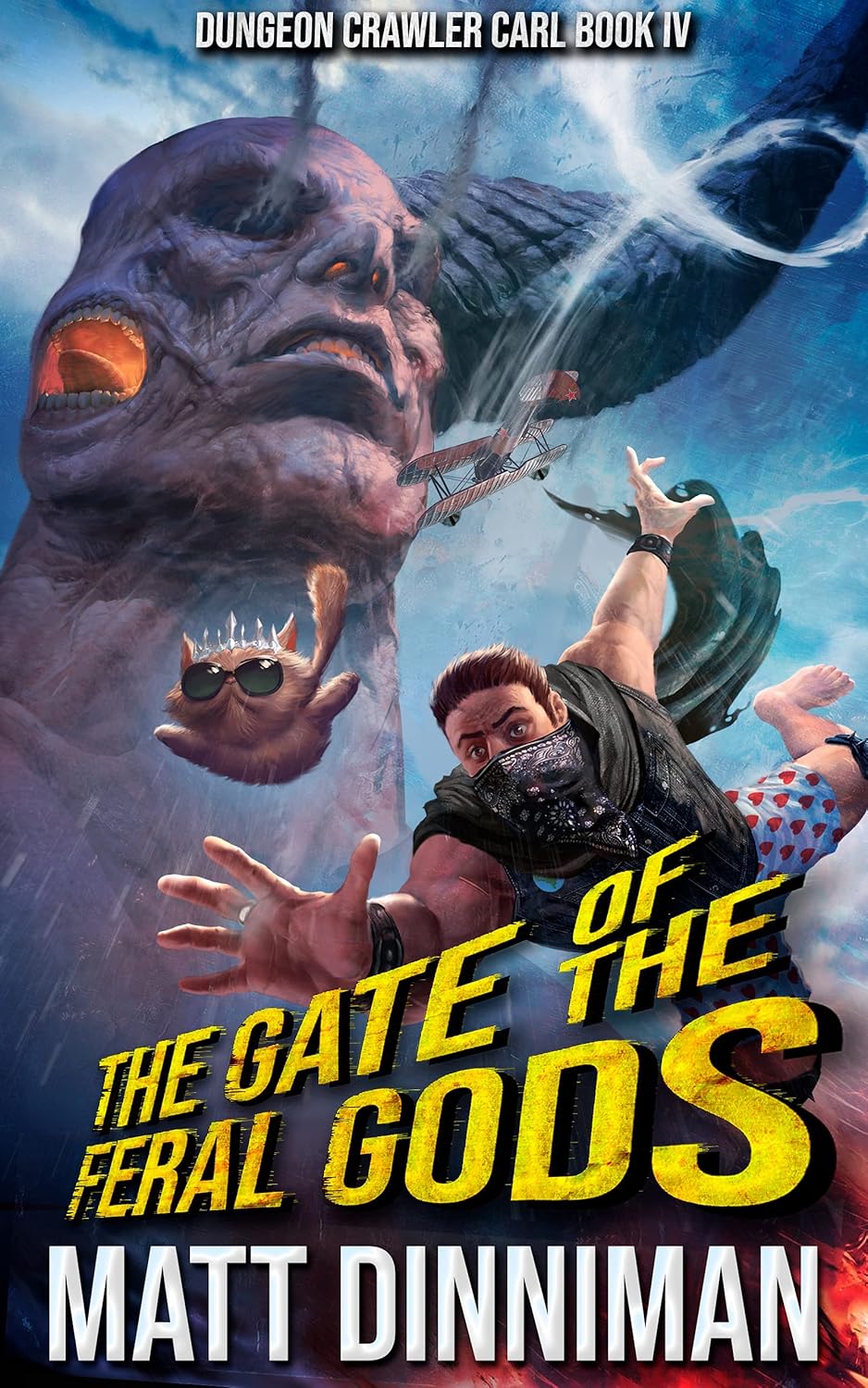
The Gate of the Feral Gods by Matt Dinniman

Publisher: Soundbooth Theater (Audiobook – 1 July 2021)

Series: Dungeon Crawler Carl – Book Four

Length: 18 hours and 3 minutes

My Rating: 5 out of 5 stars

Amazon

The chaotic fun of Matt Dinniman’s Dungeon Crawler Carl series reaches another impressive level in the awesome fourth book, The Gate of the Feral Gods, an exceptional read that I could not put down until its gripping and epic end.

I can officially say that I am incredibly obsessed with the Dungeon Crawler Carl books.  Taking place after all buildings on Earth are instantly destroyed and turned into an elaborate fantasy dungeon, all in the name of an alien reality show, the Dungeon Crawler Carl books are an incredible series that perfectly utilises its unique concept and LitRPG basis to create a particularly addictive story loaded with crazy action, over-the-top humour and an array of incredible characters.  I only started it a few weeks ago and I have so far powered through several books in the series, including Dungeon Crawler Carl, Carl’s Doomsday Scenario and The Dungeon Anarchist’s Cookbook, all of which were five-star reads.  Indeed, I have had such a great time with this series, that the moment I finished off The Dungeon Anarchist’s Cookbook I instantly started listening to the fourth book in the series, The Gate of the Feral Gods, which continued the series in some outstanding ways.

After surviving the carnage of the Iron Tangle, Carl, Princess Donut and Katia have emerged on the fifth floor of Dungeon Crawler World Earth and must now contend with a new dastardly set-up.  Placed into a multitude of small, bubble-contained worlds, each remaining human party needs to assault castles contained within each of the bubble’s four zones.  If they succeed in capturing each zone’s castle, the dungeon stairwell will open and they’ll be able to advance to the sixth floor.

While the setup for the fifth floor seems simple, in reality it is a logistical nightmare, as the popular team of Carl, Princess Donut and Katia must navigate and master four very different environments within a rushed timeline, including a desert landscape infested with flying gnomes, a gigantic haunted crypt filled with traps, a besieged sand castle that is home to a powerful mage with relationship issues, and a derelict underwater submarine surrounded by gigantic sharks, all while trying to untangle a unique puzzle hidden in an elaborate quest storyline.  Worse, thanks to their high levels, the team are forced to rely on ineffective, low-level fellow crawlers to clear out the bubble’s zones, including those people who have barely survived the previous floors.

However, the elaborate new floor is only the tip of the problems facing Carl.  Old enemies from outside the dungeon are desperate to strike him down for the chaos he has caused, while the AI controlling the dungeon continues it erratic obsession with him.  As events heat up, Carl is given the unique chance to obtain a legendary artefact loaded with unimaginable power and terrible risk, The Gate of the Feral Gods.  If Carl can master the gate, he has the chance to keep his friends and loved ones safe on this floor.  But what happens when Carl decides to use the gate to strike back against those who have destroyed his planet?  You will not break him, but he will break everything in the galaxy to get his revenge!

Dinniman does it yet again as The Gate of the Feral Gods was another exceptional and epic novel that I could not stop reading.  Perfectly continuing the impressive story from the previous Dungeon Crawler Carl novels, The Gate of the Feral Gods was an ultra-exciting and complex novel, that brings laughter, excitement and powerful emotional moments in equal measure.  Another book in this series that gets a very easy five-star rating from me, The Gate of the Feral Gods was so damn good, and I had so much fun getting through this insane, but clever, adventure.

I really enjoyed the impressive story that Dinniman came up with for The Gate of the Feral Gods, especially as the author uses the opportunity to feature a more traditional fantasy narrative, while also building on the unique character relationships that have been an impressive part of the previous novels.  In a new dungeon floor with some unique quirks, you are once again drawn into the battle for Carl, Donut and Katia’s survival, as they attempt to understand their new scenario as the population of the entire galaxy watches their progress.  There are also some great new characters introduced in this early part of the book, who add some excellent human elements to the wider story.  Determined to clear their part of the floor, Carl’s team embark on some explosive initial actions, and I liked how Dinniman treated this early part of the story in a more traditional LitRPG manner, as the protagonists follow the quest elements laid out as part of the story.  However, it doesn’t take long for Dinniman to throw things completely off the rails, as there are some great scenes halfway through, including the return of an old friend with real inner anger, and a unique boss battle in a flying house that will have you cackling with surprise.  However, one of the more impressive events set around the middle of the novel sees Carl start to embrace his anarchist persona, striking back against his oppressors in his usual destructive manner.

The big events of the first half of the book have an impressive impact on the second half of The Gate of the Feral Gods, as the protagonists find themselves in a time crunch.  This forces them to go on some risky missions, including invading a giant sandcastle with some unique elements, as well as journeying beneath the waves, much to the horror of everyone’s favourite sentient cat.  The various intense challenges faced by the protagonists are usually overcome in some impressively inventive ways, I loved how well Dinniman hints at the protagonist’s eventual plans.  While this is unfolding, you get some interesting looks at the wider crawl thanks to flashes of other character’s battles, and Dinniman also provides some intriguing looks at the issues surrounding the outer galaxy.

While all the above elements are impressive and result in some epic moments, it pales in comparison to the final third of the book.  Thanks to the titular Gate of the Feral Gods, all hell breaks out (literally and figuratively), as the protagonists find themselves involved in the biggest escort mission ever.  Thanks to that, they get into some brutal confrontations, which help to define how desperate things are getting for the characters.  The final sequences of The Gate of the Feral Gods helps to cement this novel as a truly impressive part of the series, as Carl and Donut finally face down one of their oldest enemies, while also fooling everyone with a particularly chaotic scheme.  The set-up for the protagonist’s bold strike against their foes is very clever, and while there are a lot of hints about what is to come, Dinniman cleverly obscures the entirety of the plan, allowing for some awesome surprises that really show off how audacious the protagonists are coming.  This was honestly an incredible end to such a chaotic and compelling read, and it sets up the next book in the series perfectly, allowing for some impressive moments going forward.

I really enjoyed how The Gate of the Feral Gods turned out, especially as Dinniman turned what could have been a filler novel between two major parts of the Dungeon Crawler Carl series, into a particularly powerful and intense novel with long-running implications for the rest of the series.  Due to its position as the fourth book in the series, The Gate of the Feral Gods is best read by those who have enjoyed the previous entries in the series, even with the protagonist’s useful internal recaps, especially as this book continues to feature and build on a lot of complex ongoing storylines and character arcs.  Once again written in the first-person style, Dinniman perfectly showcases his unique scenario, and gifts the reader with so much awesome action, fun humour, compelling characters, and surprisingly enjoyable LitRPG elements.  With a bit more of a slower pacing at the start of the novel, Dinniman gives this book time to breath after the crazy conclusion of The Dungeon Anarchist’s Cookbook, and allows the characters, and the readers, time to get familiar with the new floor of the dungeon.  This complex new setting within the dungeon was extremely well crafted, and its unique features ensured that The Gate of the Feral Gods had a very distinctive feel amongst the rest of the series.  The focus on quests and the internal storylines of the level helped to amp up the fantasy vibe of the story, while Dinniman also set up a multitude of additional long-running storylines that have a big impact later in the series.  At the same time, Dinniman cleverly continued to showcase the wider universe outside of the dungeon and the way that these exterior events impact the protagonist’s battles, and vice versa, allowing for a particularly compelling narrative.

While I felt that The Gate of the Feral Gods had a slightly slower start, that doesn’t last long, as Dinniman adds in some amazingly exciting and over-the-top sequences that really stick in the mind.  The author proves extremely capable of completely going even further beyond the craziness of his previous novels, and I loved how fantastically outrageous things get at times, with giant boss battles, unbelievably dangerous traps, multiple crazy gods, and some deeply human fights, all making this story particularly epic at times.  The many, many action scenes within the book are so well written, and I loved how impactful, insane, and usually hilarious these sequences are, and Dinniman makes excellent use of the LitRPG part of the series, with so many cool elements from RPG games coming into play in entertaining ways.  Dinniman also does an excellent job expanding on a ton of complex elements of the dungeon in this novel by including various extracts from Carl’s Dungeon Anarchist’s Cookbook, a secret compendium of knowledge from previous crawlers.  These extracts are each cleverly written in their own style, and I love how they highlight technical elements of the dungeon, as well as the emotional damage each of these previous crawlers experienced.  These LitRPG elements are further made better by the author’s unique sense of humour, which inhabits every aspect of the book and ensures that the reader is constantly laughing at all the insane moments, clever jokes, and over-the-top characters.  While this humour might not be for everyone, I felt it was perfect, especially as it blended with all Dinniman’s complex storytelling and the deeper emotional pain of the book, allowing for a very impressive overarching novel.

The thing that made The Gate of the Feral Gods really stand out was the author’s focus on character introductions, growth and powerful human moments, as the protagonists, their allies, and the various beings involved in the running on the dungeon, continue their chaotic journey together.  As with all the books in the series, the plot of The Gate of the Feral Gods revolves around protagonist and perspective character Carl, through whose eyes we see the plot unfold.  The perpetually exasperated and intense heroic figure who is desperately trying to save everyone he comes across, Carl continues to struggle in his role of leader and must keep coming up with dangerous plans to save his friends and beat the latest challenges of the dungeon.  While mostly serious, there is some fantastic humour and deeply sympathetic moments behind Carl, and it proves fascinating to see him struggle to maintain his anger and place as the reasonable one in the group, especially when it comes to his habit of blowing everything up.  The author also really dials up the rebellious anarchist aspects of Carl in this novel, as he starts fighting back against everyone he holds responsible for Earth’s destruction in some very cathartic ways.  Throw in the continued hints at the character’s traumatic past and his growing connection to all his friends, and Carl proves to be an excellent central character for this incredible book.

While Carl is a great main protagonist, this series would be nothing with his sentient cat companion, Princess Donut, who continues to be the highlight of most of the scenes she is in.  An overly dramatic, imperious and fun figure who maintains many stereotypical cat elements, Donut is the heart and soul of the book, and you have to laugh at all her funny jokes, entertaining reactions and the unlikely friendships and interactions she has.  Dinniman has fun building up the cat aspect of the character in The Gate of the Feral Gods, especially in the sequence where Donut finds herself underwater, and it was so damn entertaining to see her freak the hell out at times.  Much of the book’s humour also revolves around her unlikely partnership with Carl, and the way the two play off each other is just amazing.  While most of her personality and appearance is humorous in nature, it hides a deeper heart to it, as Donut’s child-like nature ensures that she is very reliant on Carl, and it was deeply moving to see them bond even further in this novel, and you can clearly see how close they are, even during the moments when Donut is deliberately annoying her human.  Probably one of the best cat characters in modern fiction, Princess Donut is so much fun, and I deeply enjoy every scene she is in.

While most of the book’s focus is on the central pair of Carl and Princess Donut, Dinniman continues to expand the incredible supporting cast of the series in The Gate of the Feral Gods, and I loved the brilliant storylines and development that occurs around these secondary figures.  This includes the third member of the protagonist’s party, Katia, who serves as the more reasonable and responsible member of the team.  It was fascinating to see how much Katia comes into her own in this novel, especially during a period where Carl and Donut are out of the game for an extended time, and she really steps up as a compelling alternative leader to the supporting cast.  Donut’s manager, Mordecai, a former crawler with issues, was a wonderful mentor figure for much of the story, and I quite enjoyed the interactions he has with the rest of the characters, especially Carl, while his attempts to keep his charges from doing anything too crazy are often ignored.  I also continue to be deeply entertained by the AI running the dungeon, whose over-the-top commentary, descriptions and jokes, add so much awesome and often concerning humour to the story.  There were some hilarious moments in The Gate of the Feral Gods where the AI continued to act a little crazy as its personality evolves to match the dungeon’s participants, including his continued messing with Carl, his weird foot fetish, and its own rebellion against the showrunners and people outside the game who are trying to restrict its fun.  Dinniman clearly had a ton of fun when it came to writing the AI’s actions, and it is so entertaining to see how crazy things get around it.

While all these returning major characters are great, one of the best things about The Gate of the Feral Gods was the way in which Dinniman brought in outstanding new characters, as well as reintroducing figures we haven’t see for a few books.  Some of the best new characters include Louis and Firas, two out-of-their-depth crawlers whom the protagonists must rely on.  Thanks to the encouragement of Carl and the others, they start to become much more effective as the book continues, and I loved their compelling growth in The Gate of the Feral Gods, as well as their impacts in their later books of the series.  I also must mention fun new character Samantha, renamed that by Donut from Psamathe.  A minor deity of unrequited love (or crazy ex-girlfriends), Samantha is a banished god trapped in the decapitated head of a magical sex doll.  Loud, rude, crude and constantly threatening every character’s mother, Samantha is probably the most over-the-top character in the series (which is saying something), but boy is she entertaining.  Perfectly introduced amongst the chaos of this book’s story, Samantha perfectly fits in amongst the main characters and becomes a major comic relief for much of the series.  Other great characters include some other fractious crawlers, the return of Chris from the first novel, who has gone through some major personality changes, a variety of insane gods including some unfortunately named demons, and various NPCs, whose existential plight becomes a major ongoing arc in the series.  All these characters, and more, allow for quite an entertaining and at times moving novel, and I really appreciate how well Dinniman utilises them in The Gate of the Feral Gods.

As with the previous Dungeon Crawler Carl novels, I ended up listening to The Gate of the Feral Gods on audiobook, which is such an incredible experience.  These Dungeon Crawler Carl audiobook are so damn good, and it’s one of the key reasons I have been able to so effortlessly binge this entire series.  The narration, done by the very talented Jeff Hays, perfectly captures the insane and over-the-top nature of the series, and so many elements of The Gate of the Feral Gods, including its humour, the intense action, and the impressive LitRPG inclusions, are deeply enhanced by having the story read out.  Hays complements this narration with unique and very fitting voices for all the characters, and I love all the elaborate and often hilarious tones that come out as a result.  It’s impressive how many new voices Hays comes up with each audiobook, and I loved the excellent consistency between audiobooks for the recurring characters.  The long-running voices for Carl and Donut are just perfect, especially as Hays perfectly captures the various emotions hidden within both figures.  I really love how much extra humour you get from hearing Carl’s exasperated voice at times, while the entirety of Donut’s excessive personality, including her hilarious overreactions and continuous outrage, are just amazing.  The rest of the cast are also voiced extremely well, and Dinniman pulls out some fun voices and accents in this book, including an acceptable Australian accent from a crocodile-themed crawler.  However, one of my favourite voices is still the one he uses for the Dungeon AI, and it is so much fun to hear Hays’s voice the various excited, mocking and occasionally deranged announcements and descriptions from this figure.  Throw in some subtle sound effects and vocal enhancements, that add even more umph to the narration, and The Gate of the Feral Gods is an exceptional listen.  I absolutely powered through the 18-hour runtime, and I cannot recommend this format enough, as you guaranteed to have an absolute blast listening to it.

With even more incredible carnage, character development and the author’s incredible humour, The Gate of the Feral Gods was another outstanding novel from Matt Dinniman.  Perfectly continuing the extended Dungeon Crawler Carl narrative and adding in some excellent, long-term characters and elements, The Gate of the Feral Gods is an amazing entry in this epic series, and I honestly couldn’t stop enjoy this novel.  I loved The Gate of the Feral Gods so much that I instantly dove into the next book in the series, The Butcher’s Masquerade, the very second I finished it, and I am so very glad I did. 
Amazon

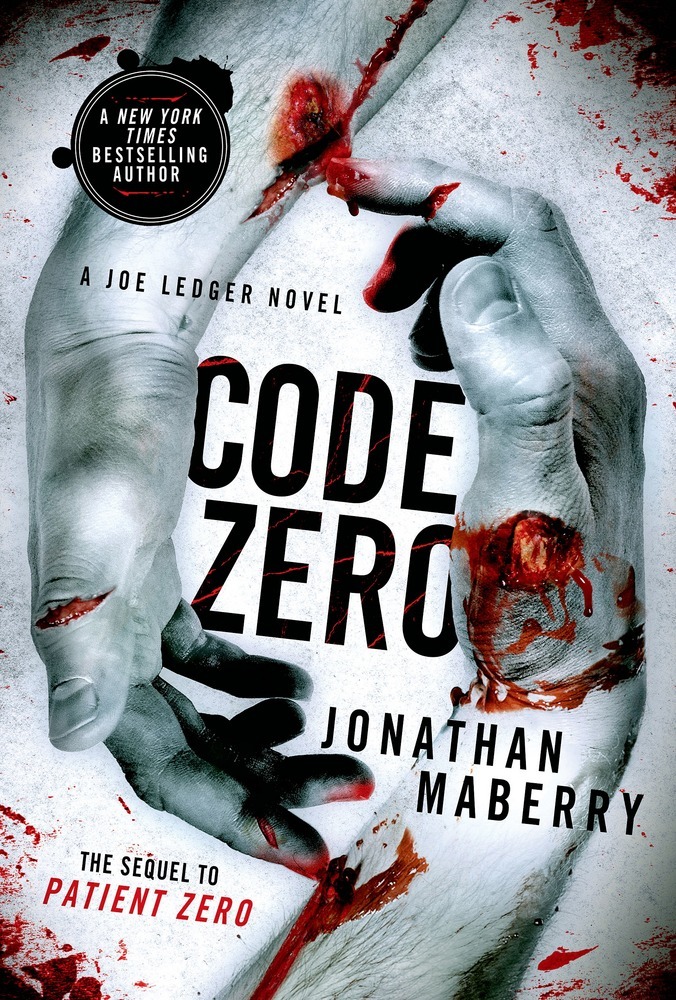
Throwback Thursday – Code Zero by Jonathan Maberry

Code Zero Cover.jpg

Publisher: Macmillan Audio (Audiobook – 25 March 2014)

Series: Joe Ledger series – Book Six

Length: 16 hours and 6 minutes

My Rating: 5 out of 5 stars

Amazon     Book Depository

Reviewed as part of my Throwback Thursday series, where I republish old reviews, review books I have read before or review older books I have only just had a chance to read.

The ghosts of the past come back to haunt Joe Ledger and the DMS big time in this sixth book in Jonathan Maberry’s high-octane science fiction/military thriller Joe Ledger series.

For years, the Department of Military Sciences (DMS) has saved the world from some of the most deadly and insane weapons that science can create: race-specific bioweapons, genetically enhanced super soldiers, powerful plagues capable of killing people in the most horrendous way and even a pathogen that is capable of bringing its victims back to life as zombies. Each of these has been stopped by DMS agents and the legendary Joe Ledger, but these horrors are about to resurface in the most devastating of ways.

The mysterious hacker and terrorist Mother Night has been causing the DMS trouble for months, but when she broadcasts a call for anarchy, no-one is prepared for what happens next. Across America, Mother Night’s followers unleash hundreds of random acts of violence, causing horrendous amounts of terror and destruction. As Joe Ledger and the DMS attempt to counter them, a subway car full of people in New York is infected with something disturbingly familiar, the Seif-al-Din zombie pathogen that bought Ledger to the DMS in the first place.

As Ledger and Echo Team are once again forced to contend with the zombie victims of the pathogen, they find themselves targeted from several devastating angles. As the threats become more and more personal, it soon becomes apparent that they are facing someone who knows the DMS intimately and who is willing to use the most lethal tools at their disposal to win. Can Ledger and the DMS survive, or will the world burn at the hands of Mother Night?

Jonathan Maberry’s Joe Ledger books are one of my favourite series at the moment, and I love each book’s excellent blend of compelling storytelling, complex characters, over-the-top villains, electrifying action and insane plot points, which come together into fantastic, first-rate narratives. Ever since I read and got hooked on the tenth book in this series, Deep Silence, about this time last year, I have been periodically reading and reviewing the earlier novels in sequence. So far, I have read the first six novels, Patient Zero, The Dragon Factory, The King of Plagues, Assassin’s Code, The Extinction Machine and this novel, Code Zero. I am actually reviewing this book a little out of order, as I recently powered through both The Extinction Machine and Code Zero while I was away on holidays. As Code Zero is fresher in my mind, I decided to review it first, and I will hopefully get a review for The Extinction Machine up soon as well (the plan is to get it done before the next Joe Ledger book, Rage, comes out in November, but we’ll see how we go).

Considering how much I absolutely loved the rest of the books in the series, it is going to come as no surprise to anyone that I also really enjoyed Code Zero. This sixth book was pretty spectacular, and it is easily one of my favourite books in the entire series, only just being beaten out by The Dragon Factory. In Code Zero, Maberry has made sure to utilise several of the excellent features from the previous Joe Ledger books that l really love and have commented on previously, such as a first-rate story filled with intense action, a smartassed and damaged protagonist, a great group of side characters (including one of the best dogs in all of fiction) and a clever utilisation of flashbacks and multiple perspectives. This book also features some other great story and character elements that really make it stand out from the rest of the series, and which help make it such an outstanding and epic read.

I have mentioned before that one of the best things about the Joe Ledger books is the awesome antagonists that Maberry creates for each of the novels. These have so far included genetically modified Nazis, world-event manipulating masterminds and even a group of vampires. However, the villain of Code Zero, Mother Night, is perhaps one of the most interesting and complex antagonists that Maberry has come up with. Mother Night is an outstanding character who not only has a close connection with the DMS, but whose elaborate master plan does a great deal of damage. I really liked how Maberry used a series of flashback filled interludes to explore the background of this character. These flashbacks show how Mother Night is connected to all the DMS characters and examine how her exposure to various characters and threats from the previous books slowly corrupted her, and why she was compelled to become a terrorist. Despite this being the first book that Mother Night has appeared in, Maberry did a sensational job tying the character into many of the key events from the first three novels, and showing how she was actually involved with some of the previous threats. All of these cool connections really help up the personal stakes for all of the protagonists, and it allows Mother Night to actually hit Joe Ledger and his team harder than anyone else has before, resulting in an extra dramatic and compelling story.

Maberry also uses Mother Night’s plot to examine some rather interesting elements of the modern world. For example, the anarchist movement is explored in some detail, as Mother Night uses anarchist elements in her call to arms, gathering up members of America’s disenfranchised youth to form an army. There is also a rather intriguing look at the role video games can play in violence or espionage. This is not done in an attempt to demonise video games; instead Maberry, through several of the videogame savvy characters, explores how important problem-solving is for gamers, and how the skills obtained there can have real-world applications in both the espionage and defence worlds. The subsequent study of game theory and the desire to win that some gamers feel is particularly fascinating, and it adds very some interesting layers to the story and Mother Night’s overall character.

In addition to this incredible antagonist, the other thing that I absolutely loved about Code Zero is the fact that Maberry decided to bring back some of the iconic threats and story elements from the previous books in the series. Not only did the author do an outstanding job of working these pre-existing story elements into Code Zero’s plot, but their reappearance was also an excellent homage to the earlier books and a real treat for fans of the series. I really enjoyed seeing Ledger have to go up against threats like the walkers and the berserkers again, especially as each of these threats have pretty strong emotional triggers for him due to devastating previous missions. It was also really interesting to see the new and various ways that the antagonist utilised these existing elements in her own plans, and there were some really fun combinations of the insane scientific elements, such as a couple of berserkers who have been infected with Generation 12 of the Seif-al-Din Pathogen, and it’s as awesome as you’d expect.

As this is a Joe Ledger book, Code Zero is of course filled to the brim with all the action and fire fights that you could ever need. Due to the presence of so many varied threats, including some of the monsters from the previous books, Code Zero probably has some of the most intriguing fight scenes in the entire series. This book is filled with a number of elaborate battle sequences in which the protagonists face off against a variety of different opponents at the same time. These opponents can include walkers, berserkers and gunmen disguised as zombies hiding amidst the walking dead, which is just so many layers of awesome. Maberry has an exceptional talent for writing fight sequences, and all this amazing action really helps to get the adrenaline pumping. I also have to commend all of the first-rate zombie scenes in the book, as the author crafts some truly horrifying scenes that showcase how terrifying and emotional damaging it would be to face off against these undead monsters.

As with all the previous books in the Joe Ledger series, I chose to listen to the audiobook format of Code Zero which was narrated by Ray Porter. Clocking in at just over 16 hours, I managed to get through this audiobook fairly quickly, mainly because I started listening to it while on an international flight. I think it is pretty clear at this point that I really enjoy listening to the audiobook versions of the Joe Ledger books, mainly due to the narration of the outstanding Ray Porter. I have sung Porter’s praises in all of my previous reviews, and I really cannot express what a good job he does bring the series titular protagonist to live with his voice work. Code Zero was no exception, and I would strongly recommend the audiobook format to anyone even vaguely interested in this book.

Code Zero by Jonathan Maberry is another spectacular book in the Joe Ledger series, and one that I absolutely loved. Maberry continues to utilise some of the amazing story elements that made his previous six books so darn enjoyable, and he ups the ante with another exceptional antagonist and the clever reuse of memorable story elements from previous books in the series. All of this results in another science fiction/thriller masterpiece that gets an easy five out five stars from me, and it is possibly one of the most enjoyable books I have read so far this year.

Amazon     Book Depository

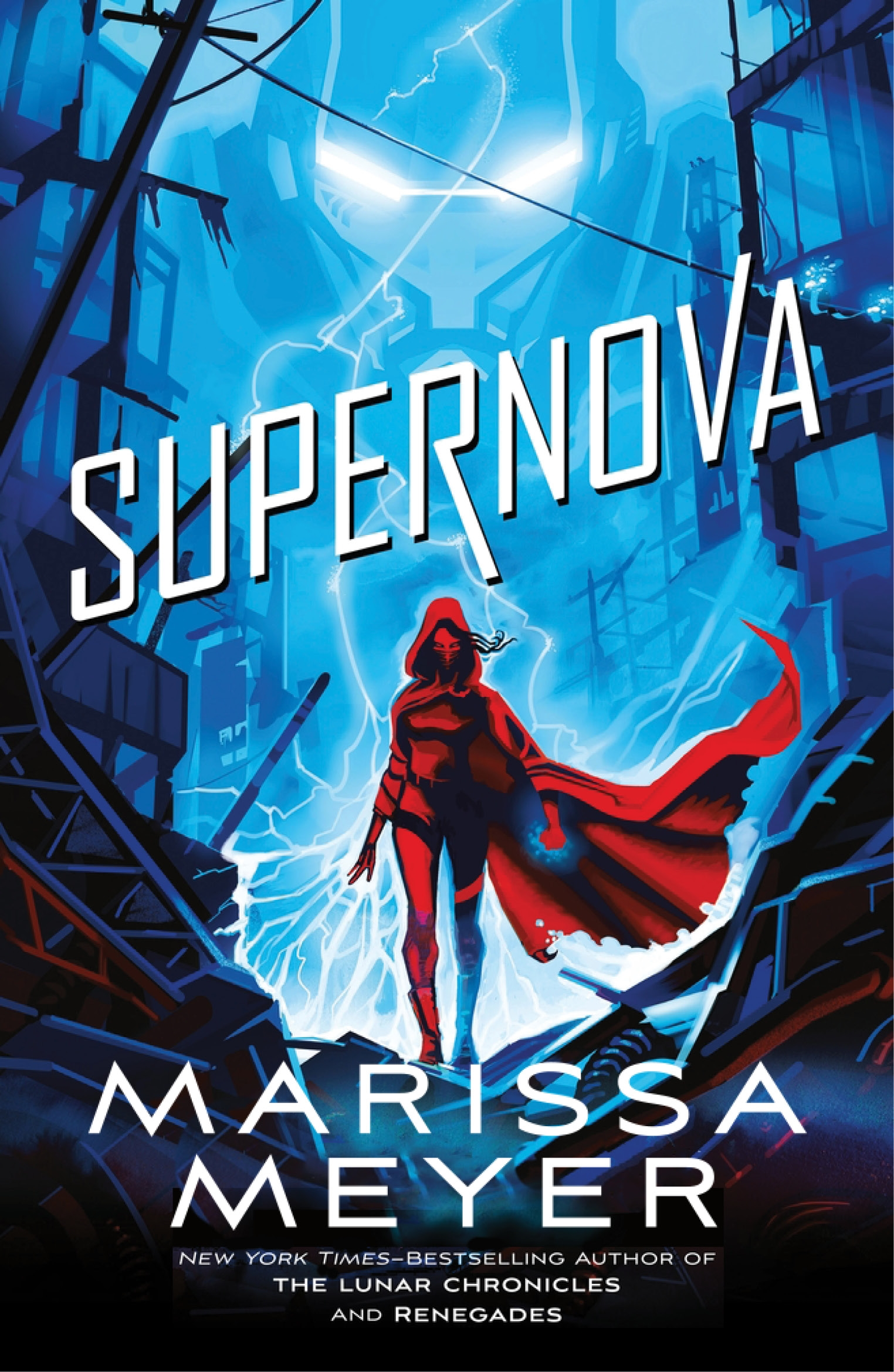
Supernova by Marissa Meyer

Supernova Cover

Publisher: Feiwel and Friends (Trade Paperback – 29 October 2019)

Series: Renegades – Book 3

Length: 552 pages

My Rating: 5 out of 5 stars

Amazon     Book Depository

Lies, betrayal, anarchy! Acclaimed author Marissa Meyer brings her epic young adult series, the Renegades trilogy to an end with Supernova, an electrifying and outstanding book that I had an absolute blast reading.

Supernova is the third and final book in Meyer’s Renegades trilogy, which started in 2017 with Renegade and continued last year with the incredible Archenemies. Archenemies had to be one of my favourite young adult books of last year, so I was pretty eager to check out the final book in the series. For those of you unfamiliar with the series, the Renegades books follow the adventures of two teenagers, Nova and Adrian, in an alternate version of Earth where a number of people, known as prodigies, have superpowers. After a period of superpowered destruction and terror known as the Age of Anarchy, the world has entered a time of peace, thanks to the superhero collective known as the Renegades.

Nova is a member of the supervillain group known as Anarchists, the remnants of the followers of the world’s greatest supervillain, Ace Anarchy, who has been living in hiding since the end of the Age of Anarchy, close to death. Nova, or as she is known to the world, Nightmare, is Ace’s niece, and hates the Renegades with a passion, due to the role they played in the death of her parents, and because of the way her friends have been persecuted by the supposed heroes. In order to recover Ace’s helmet, the one item that can restore him to full power, Nova has taken on the persona of Insomnia in order to infiltrate the Renegades as a hero. However, her dedication to the Anarchists and her mission has been shaken thanks to the leader of her patrol team, Adrian.

Since joining the team, Nova has slowly fallen in love with Adrian, a romance complicated by the fact that Adrian is the son of the world’s greatest superhero, Captain Chromium, Ace Anarchy’s arch enemy and the man who Nova hates the most in the world. Adrian also has secrets of his own; while he spends his days as the Renegade Sketch, at night he is secretly the outlaw vigilante superhero known as the Sentinel, who acts outside the rules and codes of the Renegades. He is also pursuing a solo investigation into the murder of his mother, and his primary suspect is Nightmare.

Despite her steadily growing feelings for Adrian, Nova is still determined to take down the Renegades, especially after the announcement of their new secret weapon, the chemical Agent N, which can permanently depower a prodigy. Breaking into Renegade headquarters at the end of Archenemies, Nova was able to successfully recover Ace Anarchy’s helmet; however, her absence allowed Adrian and the rest of their patrol team to accidently find and capture Ace. Now with her uncle captured and awaiting execution and all her lies and deceptions coming apart, Nova must find a way to rescue Ace and bring the Renegades down. However, with new players on the board and old fears resurfacing, can Nova and Adrian survive when anarchy returns to Gatlon City, or will their combined secrets finally overwhelm the two young prodigies?

This was a pretty amazing way to end a trilogy, as Supernova is an excellent and highly addictive read that I powered through in around two days, despite its hefty 552-page length. This final book tells an exciting and compelling story in its own right, and Meyer has done an outstanding job of finishing off her series, producing an epic conclusion that ties together a number of the intriguing storylines that have been running since the first book. Those readers interested in Supernova who have not read the previous books in the series should be able to follow the plot without any issues, but in order to experience the full emotional impact of the various story elements that are concluding, it might be best to at least read Archenemies first. That being said, those readers who choose to read Supernova alone will still be in store for an incredible young adult superhero read that does a wonderful job blending together action, tragic backstory, likeable characters and a very complex and rewarding romance storyline.

One of the most enjoyable things about this series was the cool and unique world of superheros that Meyer has created. The whole background of a world that is slowly rebuilding after an extended period of anarchy is pretty darn fascinating, and it was really interesting seeing the ways that superheros are trying to maintain order in this world. Meyer has done an amazing job filling her world with a variety of memorable prodigy characters, and the sheer number of unique power sets that the author has come up with is truly impressive. All these cool and imaginative powers make for some pretty epic battle scenes when the prodigies end up fighting each other, and Meyer has come up with some thrilling large-scale battle sequences throughout her story. Overall, I found that this superhero filled world to be an excellent and creative setting for this great story, and it is one that I hope Meyer returns to in some of her future works.

Perhaps my favourite aspect of this cool superhero world is the significant amount of time spent examining the morality and motivations of the various superpowered characters. Rather than the classic superhero story where all the heroes are pure and good and all the villains are evil, the morality of the characters in the Renegades series is a lot more complex. For example, the Renegades, despite being the heroes, are willing to do anything to preserve the status quo and ensure that the Age of Anarchy never happens again, including some punishments that seem pretty extreme. They are also so strictly bound to the idea that their organisations and their codes of conduct that a vigilante like Adrian’s Sentinel persona is automatically seen as a villain, despite all the good he does, while the faults of certain Renegades who abuse the system for their own aims are overlooked. The Anarchists and other non-Renegade prodigy groups, on the other hand, despite being villains, can in many ways be seen as victims of the current system, especially as they believe that they are mostly fighting for their own personal freedoms.

This is a rather interesting dichotomy that has been fun to unwind throughout the course of the books, especially through the eyes of the series two point of view characters, Nova and Adrian. Nova, who is both an Anarchist and a Renegade, begins the series believing that the Anarchists are in the right, while the Renegades are corrupt and hypocritical. But throughout the course of the books, as she spends time with the Renegades, she begins to see that many of the heroes, especially the members of her patrol team, are good people who are mostly trying to help, and she finds herself drawn between family loyalties and her new friends. However, the heavy-handed actions of the Renegade Council, especially in this book, ensure that Nova’s loyalty to the Anarchists and her uncle remains intact. Adrian, on the other hand, was born into the Renegades and is a major supporter of them. However, when he begins to adventure as the Sentinel, he begins to see how restrictive and rigid the rules of the Renegades are and he begins to question a number of the Council’s decisions, especially when it comes to Nova. All of this leads the reader to have some very serious doubts about which characters are truly in the right, and this entire moral debate is a really fascinating overarching aspect of the book and the series as a whole.

Like the rest of the books in this series, Supernova is being marketed as a young adult novel. While this is a good book for younger readers, this novel is also easily enjoyed by older readers who will really like this clever and inventive take on the superhero genre. Due to the fact that the book contains a large amount of violence, which includes several deaths and even torture scene, Supernova is probably best left to a teenage audience, and might not be completely appropriate for younger readers.

Marissa Meyer’s Supernova offers the reader an amazing and addictive young adult novel that also serves as an exceedingly satisfying conclusion to the author’s fantastic tale of superheroes and villains. In this third and final book in the outstanding Renegades trilogy, Meyer not only does a sensational job wrapping up her series, but she also produces another exceptional story filled with superpowered action, forbidden love, an inventive alternate Earth and some intriguing discussions about morality. A first-rate read, if you have not experienced Meyer’s Renegades series before you are in for a real treat. I really hope that the author returns to this universe at some point in the future, and I will be keeping a close eye out for Meyer’s next release.

Amazon     Book Depository

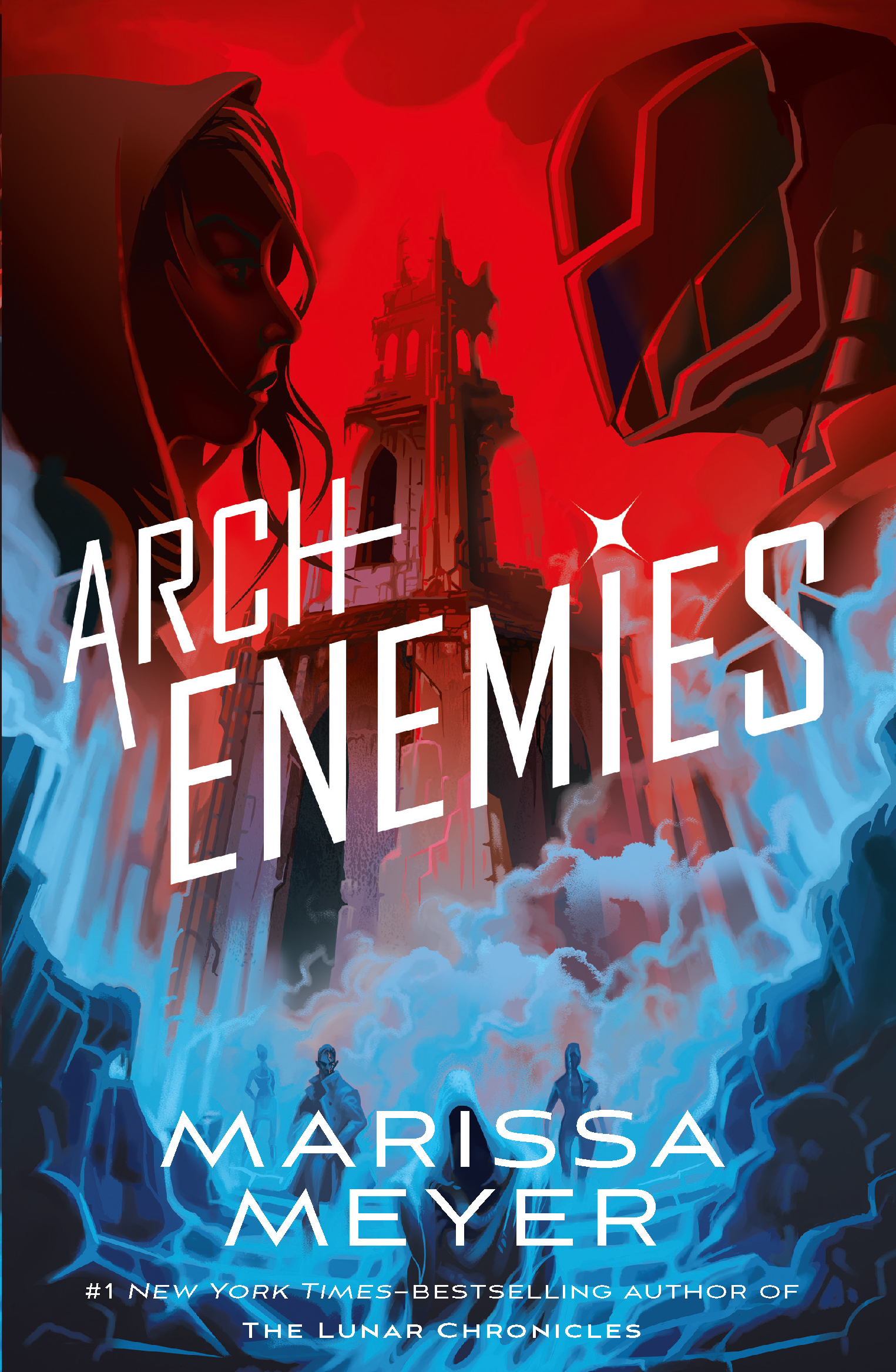
Archenemies by Marissa Meyer

Archenemies Cover

Publisher: Pan

Publication Date – 6 November 2018

Amazon     Book Depository

Following on from her immensely popular 2017 release, Renegades, Meyer continues her exciting tale of superpowered duplicity and intrigue with Archenemies, the second book in the Renegades trilogy.

In an alternate version of Earth, superpowers exist and those that have them are known as prodigies.  For most of this world’s history, prodigies were tormented and persecuted and many were forced to live in hiding.  That was until the Age of Anarchy, when the world’s villainous prodigies rose up and established their own world order of chaos and destruction, led by the notorious Ace Anarchy.  It was not until the rise of the superhero syndicate, the Renegades, that order was restored and prodigies were accepted as a part of society.  While most people see the Renegades as symbols of hope and virtue, there are some who have good reason to hate them.

Nova is one of these people, and her hatred has led her to live a dangerous double life.  Most of the world knows her as Insomnia, a recent recruit to the Renegades, who serves as a member of a patrol team in Gatlon City, the location of the Renegade’s headquarters.  However, Nova is also secretly Nightmare, the niece of Ace Anarchy and a member of the Anarchists, a group of villains dedicated to destroying the Renegades.  Hating the Renegades for the role she believes they played in the death of her parents, Nova has infiltrated the superhero team in the hope of discovering all their secrets in order to destroy them from within.

While she has so far maintained her cover, Nova’s mission has become complicated due to her relationship with Adrian, and the son of the people she holds most responsible for her family’s tragedy.  But Adrian has secrets of his own.  While he leads Nova’s patrol team as Sketch, Adrian is also living a double life as the Sentinel, a vigilante superhero acting outside of the codes and restrictions of the Renegades.  Although Adrian was only attempting to help, his actions as the Sentinel have placed a target on his back, and the Renegades are determined to stop rogue prodigies.

While Nova is determined to complete her primary mission and retrieve a powerful artefact from within the Renegades’ headquarters, both hers and Adrian’s lives are about to get even more complicated.  The Renegades have revealed a game-changing new weapon which forces the two young prodigies to question everything they know about what justice is.  Can they keep their respective secrets from each other, or are their worlds about to come crashing down around them?

Archenemies is the latest book from bestselling young adult author Marissa Meyer, and the second book in her Renegades trilogy.  The first book in the trilogy, Renegades was one of last year’s most successful young adult hits.  Readers may also be familiar with some of Meyer’s other young adult works include The Lunar Chronicles, a series that focuses on a dystopian science fiction reimagining of classic fairy tales; Heartless, a prequel novel to Alice in Wonderland; and the young adult graphic novel series Wires and Nerve.

This second book in the trilogy continues Meyer’s incredible story of superhero intrigue and adventure.  The central story is a captivating tale told from the point of view of both Nova and Adrian and follows them as they attempt to live their double lives in this exciting world.  The storyline that follows Nova attempting to hide her affiliations with the Anarchists as she infiltrates the Renegades is a thrilling and exhilarating narrative.  Nova is constantly on edge as she must allay the suspicions and investigations into her background and her motivations for performing certain tasks around the Renegades’ headquarters.  The character must also deal with the emotional turmoil that she experiences as she struggles to stay on her original mission of betraying the Renegades, despite some conflicting feelings she develops.  The sections of the book that focus on Adrian are also very compelling, especially as his is the direct opposite to Nova’s story, as he begins to disobey the rules of the Renegades to engage in some illegal vigilante work.  His struggles about whether to keep up his activities become a major part of his storyline, especially as he experiences some severe consequences for going into the field without backup.  He is also determined to keep his identity as the Sentinel hidden from Nova, as she particularly dislikes the Sentinel, although Adrian gets the reason for the dislike completely wrong.

These two separate storylines combine together really well into one central narrative, and Meyer does an incredible job showing how the secret actions of one of the point-of-view characters impacts on the other character.  For example, part of Adrian’s storyline focuses of his investigation into the death of his mother, a famous superhero, and his search leads him to believe that Nightmare holds the answers he is looking for.  This becomes a big problem for Nova, as she has managed to fool most of the world into believing that Nightmare is dead, and Adrian’s investigation could blow her cover.  There are also several fantastic scenes where one of the protagonists comes across a clue that the reader knows could reveal the other character’s dual lifestyle.  The suspense that Meyer creates during these sequences is subtle but effective, as the reader is left holding their breath, waiting to see if this will be the event that will lead to the inevitable part of the trilogy when the two characters find out about each other.  This second book also contains some interesting hints towards some major reveals that are likely to occur in the final book of this trilogy, as well as some urgent plot points that can only lead to some intense and action-packed scenes in Meyer’s next release.

Meyer also continues the intriguing romance angle between the two main characters that began in the first book of the trilogy.  Rather than being ultra-intense, this romantic subplot comes across as more of a slow burn, as Nova and Adrian both like each other but are reluctant to act on their feelings due to the dual lives they are secretly leading.  Nova does spend most of the book attempting to heat this relationship up, but this is more in an attempt to seduce Adrian in order to help her further her goals for the Anarchists.  However, she truly has feelings for him, which continue to develop throughout the course of Archenemies.  There are several nice scenes throughout the book as the two point-of-view characters attempt to initiate the relationship, and despite the deceitful backdrop of the story, their relationship starts to feel like a genuine, heartfelt romance.  The eventual reveals about both characters’ secret identities will no doubt result in some significant drama within the next book, and readers will be interested to see the final result of this relationship.  For those interested in a less complicated romantic story, there is also a lighter romance angle between Renegades side characters Smokescreen and Red Assassin.  Their sweet and awkward flirting and courtship will be instantly recognisable and relatable to most readers, and you can’t help but hope that the two characters will realise how much they like each other.

I quite enjoyed the fantastic world that Meyer has created for the Renegades trilogy.  A world filled with superpowered beings is an excellent place to set an intrigue-studded young adult series such as this.  The creative and thrilling story of infiltration and morality is amplified by the rich number of superhero elements throughout the book.  There are a huge number of diverse superpowers, as well as mysterious and dangerous artefacts and weapons.  Meyer has created a number of interesting and unique superpowers, including a woman who makes practical weapons out of her own blood and a man whose power is to make people see the wonder in everything.  The sheer amount of different powers and technology available thanks to the author’s imagination allows for a number of cool fight scenes and action sequences throughout the book, which plays wonderfully with the other elements of the story.  A superb and creative background location.

While Archenemies’s dramatic story and fun superhero-based location forms a fantastic base for this novel, one of my favourite parts of the book was the moral and ethical issues raised by various characters throughout the story.  Both point-of-view characters have different opinions about whether the Renegades or the Anarchists are in the right and what constitutes justice.  While Nova’s opinions about the Renegades could potentially be explained away as brainwashing from her uncle and the other Anarchists, several of the actions and attitudes she encounters while undercover seem to justify her beliefs.  Her belief that the Anarchists might be in the right is supported by the fact that most of the remaining members of the team of villains seem to be really nice people who are supportive and helpful to Nova.  Several members also have somewhat tragic backgrounds which highlight why they choose to live their lives apart from the rest of society.  Adrian, on the other hand, has been raised to believe in the Renegades’ methods and code, but he has started to find them too restrictive and begins fighting crime outside them in his guise as the Sentinel.  However, he finds himself targeted by the Renegades for doing heroics outside of their code, and begins to wonder if they are making the right decisions, a feeling that becomes amplified thanks to his interactions with Nova.  Meyer further complicates matters by diving into the history of the prodigy persecution and discussing how it only ended when the villains rose up and took control, and this current golden age of super heroes only exists because they did.

This moral debate about what a group of superheroes should be able to do is further amplified by the introduction of the Renegades’ new weapon, Agent N, a formula that can permanently remove the powers of any prodigy.  Nova, in her guise as Insomnia, argues strongly against the Renegades’ policy of wilfully administrating Agent N against any rogue prodigy they encounter, believing that they don’t have the right to decide who gets to have powers and who doesn’t.  While her debates are mostly ignored by her team members, her concerns are validated thanks to the actions of a rogue team of Renegades who abuse Agent N in the field.  There is a great scene when Adrian as the Sentinel attempts to stop them committing a terrible crime, and these rogue Renegades actually believe they are still morally superior to Sentinel because they are members of a super team, and he’s not.  Despite her misgivings, Nova still utilises Agent N to achieve her own goals, and justifies it as being for the greater good.  Thanks to a series of escalating situations within the story, by the end of the book, the reader is left wondering which side, if either, is completely in the right, which personally has got me very excited for the final book in the trilogy.

Archenemies, the second book in the Renegades trilogy, is a captivating and excellent read from Meyer which presents a superb story about dual identities in a morally grey superhero universe.  While aimed at a young adult audience, this series will prove to be incredibly intriguing to older readers and is easily suitable for a younger teen audience.  Probably best read after enjoying the first book in the trilogy, Archenemies is still quite easy to follow for those who chose to enter the Renegades series at the second book, due to its detailed descriptions of major plot points that occurred earlier in the series.  I had a lot of fun with Archenemies and will definitely be checking out the final book in the trilogy when it comes out next year.  An incredible adventure from Meyer, this book comes highly recommended.

My Rating:

Four and a half stars

Amazon     Book Depository

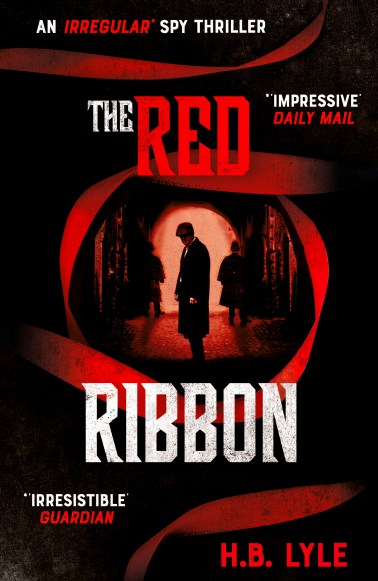
The Red Ribbon by H. B. Lyle

The Red Ribbon Cover.jpg

Publisher: Hodder & Stoughton

Publication Date – 23 August 2018

Amazon     Book Depository

Return to pre-World War I London for another compelling spy adventure in H. B. Lyle’s second book, The Red Ribbon, which is set in the same universe as Sherlock Holmes and features three exciting characters with an intriguing look at early 20th century British history and espionage.

In London, in 1910, Captain Vernon Kell is still attempting create a secret intelligence service capable of protecting England from foreign spies and infiltrators.  Despite the early success of the Secret Service Bureau, Kell’s organisation is constantly under pressure from the country’s politicians and is in danger of being absorbed into Special Branch of London’s police.

Unfortunately, Kell’s only agent, Wiggins, is distracted with his own cases and unwilling to play the political games needed to help the service survive.  Wiggins is the former leader of Sherlock Holmes’s street urchin surveillance organisation, the Baker Street Irregulars, and has picked up a few of his old master’s deductive tricks while retaining his lower-class charm and street smarts.  Wiggins is obsessed with finding the infamous anarchist, Peter the Painter, the man responsible for the death of one of Wiggins’s oldest friends, and is scouring the streets for him.

Looking for a missing girl on behalf of one of his contacts, Wiggins begins to investigate a mysterious embassy located in the affluent neighbourhood of Belgravia.  The embassy is actually a high-class brothel frequented by the rich and powerful of London.  When another girl associated with the embassy is found murdered, Wiggins attempts to find justice; however, the embassy is under the protection of someone Wiggins knows well: Tommy, a fellow former member of the Irregulars.

However, Wiggins’s personal investigations intersect with his work for Kell, as the two of them hunt for the source of a series of leaks at the highest level of government.  With the help of Kell’s wife, the suffragist Constance, Wiggins and Kell must find the connection between the events occurring around London in order to keep the country safe from sinister foreign influences.

The Red Ribbon is the follow-up to Lyle’s debut novel, The Irregular: A Different Class of Spy, and is the second book in the Irregular Spy Thriller series.  This is a great series that will appeal to a huge range of readers, as Lyle combines compelling historical fiction elements with a thrilling espionage story that has fictional links with one of the most iconic book series of all time, Sherlock Holmes.

The story within The Red Ribbon is split between the book’s three main protagonists and takes a look at each character’s different and exciting adventures.  Wiggins and Kell continue their missions from the first book, and while their investigations are ostensibly separate from each other, they eventually intersect in several clever ways.  The relationship between Wiggins and Kell is an important part of these two storylines, as Kell despairs of Wiggins’s personal investigations and wants Wiggins to solely work missions for the service.  The third focal character is Kell’s wife, Constance, who was a supporting character in the first book.  Constance becomes a much more significant character in The Red Ribbon, as the book focuses on her involvement with the suffragist and suffragette movements.  Both Wiggins and Kell become involved with Constance’s storyline in different capacities, while Constance provides significant assistance with her husband’s espionage work.  With three semi-connected stories, it does at times feel like there is too much going on for one cohesive narrative.  However, each of the stories comes together quite well in the end and provides the reader with an extremely captivating overarching narrative.

Having three separate storylines allows Lyle to highlight the differences in social classes during this historical period and highlights how different groups of people were treated.  Kell, as the influential gentleman, is forced to constantly deal with the upper-class politics and attitudes during his attempts to keep the service going.  Wiggins, who was raised on the street, deals more with the average Londoner and experiences the poverty and desperation many of them encounter.  He must also deal with the distain of the upper classes in the course of his espionage work.  While he is clearly the most competent agent in the entire British service, he is constantly looked down upon and ignored by his government superiors.  There are also several instances where Wiggins is assigned to infiltrate labour movements, something he is very reluctant to do due to his world views and background.  This divide often serves to create some significant tension with Kell, who, despite fully understanding Wiggins’s value, skills and point of view, is often exasperated by him.  The beefed-up storyline around Constance allows the reader a significant look at the suffragist movement and the early battles these women fought for equality.  In The Red Ribbon, Constance joins the much more militant suffragettes, and is constantly infuriated by the reactions of the male politicians and their oppressive policies.  The oppression of women also becomes a major point of conflict between Kell and Constance which results in a decline in their relationship, although the final payoff of this storyline is quite sweet.  I really enjoyed the way that Constance and Wiggins developed a fun comradery in this book, as their poor treatment by the upper-class men allow them to bond, with Wiggins even teaching Constance some anti-surveillance techniques.

Lyle cleverly incorporates several important historical events into this book, such as the funeral of Edward VII, the Black Friday suffragettes and suffragists protest outside Parliament and the Siege of Sidney Street.  These events are quite significant in their own right, and Lyle spends substantial time filling in their background and ensuring the reader is aware of why they are happening and why they are important.  However, they also serve as very compelling background events for the plot of The Red Ribbon and work well to enhance this already fascinating story.  In addition to these intriguing and important historical events, Lyle has also packed a number of historical figures into this story.  Quite a few prominent politicians and British civil servants have significant roles in the plot, including a young Winston Churchill, which makes the story feel a lot more authentic.  The author’s continued use of the enigmatic Peter the Painter as one of the book’s principal antagonists is another brilliant stroke, and the reader is provided with some intriguing theories about who he actually was and what his eventual fate was.  Lyle does slightly go overboard by adding in some other famous historical figures in small cameo roles, and the shoehorning in of people such as Charlie Chaplin and members of the 1910 British Antarctic Expedition seems a bit unnecessary.  That being said, it was amusing to watch Chaplin use his drunken tramp routine to help Wiggins escape a conflict in a theatre.

One of my favourite components of this book was the author’s detailed and unique look at British espionage and counter espionage in the early 20th century.  One of the book’s protagonists, Captain Kell, is an actual historical figure who is credited for creating Britain’s domestic spy service, which morphed into the modern MI5.  This fictionalised account of the early days of this organisation are quite fascinating, especially when the author looks at some of its early challenges, the political battles Kell might have had to face, and the sort of work this organisation was originally looking at.  In addition to the domestic espionage work, the protagonists of The Red Ribbon find themselves drawn into one of the most infamous espionage incidents of the era: the capture of British agents Captain Trench and Lieutenant Brandon in Germany in 1910.  This is a highly fictionalised account of the incident, as Lyle has inserted Kell and Mansfield Cummings, one of the founders of MI6, as being there.  It plays marvellously in Kell’s overall storyline, while also featuring some great scenes as the three protagonists’ attempt to evade arrest by the Germans.  Trench and Brandon are not portrayed in the best light, as Lyle has used them to further the class prejudices in Britain, portraying the two soldiers as quite incompetent spies who are captured as a result of wilfully ignoring Wiggins’s advice due to him not being a gentleman.

Another fun part of The Red Ribbon is the connection the book shares with the Sherlock Holmes novels.  The Irregular Spy Thriller series is set in the same universe as the Sherlock Holmes books.  Wiggins was mentioned several times in Arthur Conan Doyle’s original works as the leader of the Baker Street Irregulars.  As a result, Wiggins comes across as a rougher Sherlock Holmes, who uses the classic deductive method while also fighting, drinking and speaking in a lower-class manner.  As in the first book of this series, the great detective himself makes a brief appearance, providing Wiggins with a case-breaking suggestion, while casually enjoying his retirement.  The use of the Sherlock Holmes elements is definitely a defining element of the book, and while it is mostly used to draw interested readers into this historical spy thriller, Lyle successfully uses it to create a unique and enjoyable main protagonist.

B. Lyle has followed up his superb 2017 debut with another fun and exhilarating read. Continuing to use his Sherlock Holmes inspired character to great effect, Lyle weaves a full and captivating narrative that presents several unique stories chock full of adventure, mystery and interesting historical content. The Red Ribbon is an amazing second outing from Lyle which also sets up an exciting concept for a third book in the series.

My Rating:

Four and a half stars

Amazon     Book Depository