Lone Wolf by Gregg Hurwitz

Lone Wolf Cover 2

Publisher: Michael Joseph (Trade Paperback – 20 February 2024)

Series: Orphan X – Book 9

Length: 420 pages

My Rating: 4.5 out of 5 stars

Amazon

Leading thriller author Gregg Hurwitz continues his high-octane Orphan X series in a big way with the epic and compelling novel, Lone Wolf.

The Orphan X books by Gregg Hurwitz is an epic series that follows a former elite government assassin, Evan Smoak, known to the intelligence community as Orphan X.  Upon leaving the program, Smoak decided to make up for his prior misdeeds by becoming an elite vigilante, The Nowhere Man, who helps those with nowhere else to turn.  This series started back in 2016 with Orphan X, although I personally started reading it with the fourth book, Out of the DarkOut of the Dark had a great plot behind it that really drew me in, as Evan went to war with a corrupt US President.  This resulted in an amazing and highly entertaining read that made me a fan of Hurwitz’s writing and ensured I would grab the next book in the series, Into the FireInto the Fire was a particularly epic read, and the Orphan X books quickly entered my yearly must-read books list as a result.  I have since had an outstanding time reading the following releases, with Prodigal Son, Dark Horse and The Last Orphan being awesome in their own way.  As such, when 2024 came around, I had very little choice but to read the latest Orphan X book, Lone Wolf, which took the protagonist in another interesting direction with a deadly adventure.

Evan Smoak, better known as either as Orphan X or the Nowhere Man, is suffering a personal crisis.  Having reached out to his long-lost father, Evan is in a dangerous emotional spiral, and is no longer the calm and confident secret agent he once was.  Looking for an easy mission to get back into his stride, Evan finds himself with an unusual job, helping a young girl find her lost dog.  Initially reluctant, Evan agrees to help, but this unlikely job will lead the infamous vigilant into all manner of trouble.

An elite female hitwoman is in Los Angeles, taking out a range of seemingly unconnected people.  Known only as the Wolf, she excels in targeted strikes and apparent accidental deaths, leaving no trace behind.  However, her final kill leaves behind two witnesses when Evan arrives on the scene looking for the lost dog.  Forced to intervene to save the daughter of the Wolf’s last victim, Evan finds himself a target of an assassin just as deadly as himself.

With the girl he just saved still in danger from a vengeful Wolf, Evan decides to save her and stop this killer terrorising his city.  But first, he needs to work out who hired her and what secrets lie behind their deaths.  His investigation leads him to two rival tech billionaires, both of whom had a motive for hiring the assassin and organising the killings.  To save the day, Evan needs to find out which of them is responsible and destroy them and the psychotic killer they hired.  But is the emotionally compromised Nowhere Man up to the task?

Lone Wolf was another outstanding addition to the Orphan X series that really showcased Hurwitz’s distinctive writing style.  Blending an intense, action-packed story, with some outstanding character development, this was an amazing book that I deeply enjoyed reading.

Hurwitz comes up with a pretty excellent story for Lone Wolf that dragged me in very quickly.  Starting off with some intense and personal character work around Evan Smoak that follows through from the last few books, Hurwitz does a good job setting the scene for much of the story off the bat, especially when it comes to the protagonist’s distracted headspace and his reliance on his unconventional family.  The author also spends this time introducing one of the book’s main villains, the Wolf, who serves as an effective mirror for Orphan X.  This initial setup works very well, as you quickly get drawn into the plot by the Wolf callous nature, while also getting invested in the protagonist’s emotional well-being.  These story aspects quickly collide, as Evan, who finds himself helping his recently discovered niece, accidently intrudes upon one of the Wolf’s kills.  The resulting extended action sequence is glorious, as Evan is forced to contend with the assassin and an army of cops, while trying to keep the daughter of the Wolf’s last victim alive.  This entire action scene is a major highlight of the first half of the book, and Hurwitz wrote a brilliant continuous and frenetic chase sequence that pushes Evan to the limit.

Following this chase sequence, the pace of the book slows down a little, although Evan still finds himself in trouble as he enters a game of cat-and-mouse with the Wolf over the fate of the bystander he just saved.  Forced to determine who hired the Wolf, Evan begins a compelling investigation angle where he probes two rival billionaires with twisted and unique morals.  At the same time, Evan also finds himself in several intriguing personal situations, including trouble with his half-brother, mentoring his adopted daughter, and even a rather entertaining side-story about a battle for control of his building’s HOA.  These work to keep the unique feel of the Orphan X series intact, and I loved how emotionally rich the book got at times.

The final third of Lone Wolf is mostly awesome, starting off with a great sequence that sees Evan interrogate a gang of thugs who have details he needs about the Wolf.  The very entertaining and over-the-top way he goes about getting said information is so damn good, and it was another major highlight off the book.  Unfortunately, the rest of the novel seems a little rushed, and frankly Hurwitz could have benefited from including another 100 pages or so to really wrap everything up perfectly.  While it is still a fun and exciting read, the reveal about who is truly behind everything isn’t too surprising, despite some attempts at misdirection.  In addition, the final confrontation against the main antagonists is somewhat weak, and could have been a little more epic, especially as one character went down way too easily.  Still, the deep character development aspects of the story end up being extremely strong, and I liked the intriguing final twist that is going to cause additional drama in the next book.  As such, I felt this was a really good story and I got so wrapped up in it.

I really enjoyed how Lone Wolf came together, especially as Hurwitz brought his usual blend of intensity and compelling human moments to this latest book.  There is a great balance here between character development and thriller action, which I deeply appreciated.  Indeed, I felt this was one of the better-balanced novels that Hurwitz has written recently.  While the action sequences are always the highlight of this book, I have really appreciated how Hurwitz seeks to offset them with more typical moments, and the focus on character relationships and ordinary occurrences, such as a funny HOA election, adds a certain level of fun to the book.  I really do think this was a great entry in the Orphan X series, and like most of the books in this series, Lone Wolf can mostly be read as a standalone, as Hurwitz is good at revisiting the key plot points from the previous books.  However, those readers going in with a greater understanding of some of the characters, especially the protagonist and his complex relationships, will get a bit more out of this book, and it was fantastic to see the further development.

As I have alluded to a few times above, a lot of Lone Wolf’s strength lies in the excellent character work that Hurwitz layers into the story.  Much of this is done to attempt to humanise the usually deadly protagonists featured within, especially as many of them are trying to adjust to a more civilian focused life after years being government assassins.  The most prominent of these is Evan Smoak, the infamous Orphan X who his trying to redeem himself as the Nowhere Man.  While Evan is usually a calm figure, minus his OECD, in this book he finds himself completely outside of his headspace as a bad encounter with his biological father at the start throws him completely out of whack.  This was a very interesting situation, and it was really moving to see this implacable figure so out of sorts and relying on his family, both adopted and newly discovered, to find himself.  Watching Evan grapple with the many personal battles surrounding him is an amazing part of the book, and you really get drawn into his emotional concerns.  At the same time, Evan continues to struggle with the more mundane elements of a normal existence, and the various awkward encounters he has with certain family members and the residence of his building, show you just how lost and damaged he truly is.  All this results in a great portrait of a complex figure, and Evan Smoak is honestly one of the best and most unique thriller protagonists out there.

While Evan is the focus of the book, he would be nothing without the unique array of side characters that have been drawn to him over the years and who supporting him in various ways.  The most prominent of these is Joey Morales, Evan’s surrogate daughter and former trainee spy who serves as his tech support.  Flippant, immature and only slightly more normal than her mentor, Joey serves as the major humanising force in Evan’s life and is a key ally, despite being a teenager.  Joey is always a fun highlight, especially as she can push the protagonist’s buttons while bringing out his protective side.  However, I liked how Hurwitz showed in Lone Wolf that despite her advanced knowledge of the world of espionage, she is still a teenager girl, and the scenes where Evan talks her through a social crisis, is surprisingly heartwarming and really captures their close relationship.  The other major character is Tommy Stojack, Evan’s armourer and one of the few constant figures in his life.  While cantankerous and unusual, Tommy serves as Evan’s rock for much of the series, and it was great to see him in this role again.  While Tommy isn’t too controversial in Lone Wolf, there were some interesting developments with him that are going to be cool to follow in the next book.

Of course, no thriller would be complete without its villains, and Hurwitz did a great job of this with both the Wolf and the nefarious billionaire who may be behind her.  Both are threatening in their own way, although I think I preferred the Wolf, as her deadly skills, ruthlessness, and enjoyment of the kill, made her an interesting opponent for Evan.  The billionaire figure was also great, and his various monologues about the state of society and how his control of personal information allows him to control people in so many ways, was nearly as menacing as the killing.  Throw in some intriguing new family elements for the protagonist, as well as the eccentric residence of his apartment complex (minus his long-term love interest who has been seemingly cut from the books), and this was an excellent group of characters whose interactions deeply enhanced the narrative.

Gregg Hurwitz continues to impress with his latest addition to the very cool Orphan X series with Lone Wolf.  An emotionally charged thriller with powerful character work, Lone Wolf is an outstanding read that comes highly recommended.  I cannot wait to see how Hurwitz follows up Lone Wolf in the future and I remain a massive fan of this amazing series.

Lone Wolf Cover

Amazon

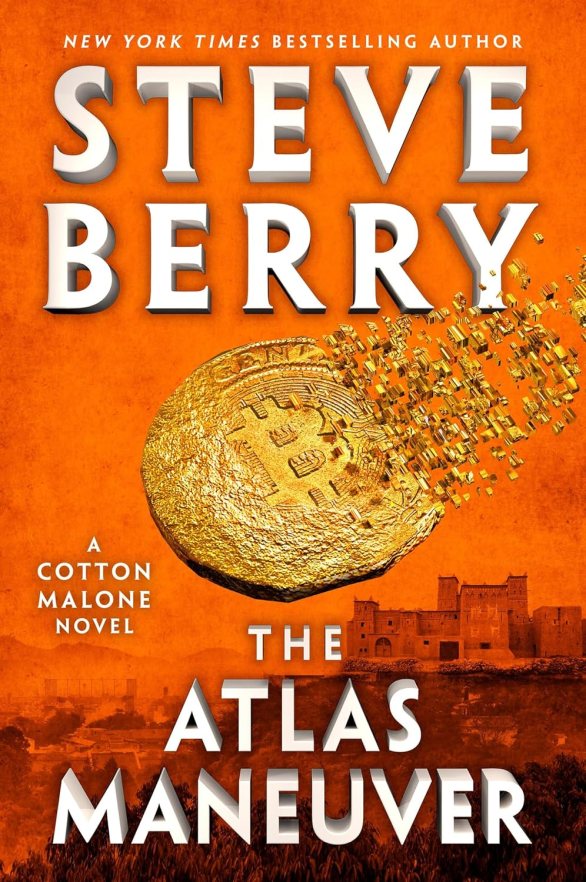
The Atlas Maneuver by Steve Berry

The Atlas Maneuver Cover

Publisher: Hachette Audio (Audiobook – 20 February 2024)

Series: Cotton Malone – Book 18

Length: 13 hours and 21 minutes

My Rating: 4.5 out of 5 stars

Amazon

The always exciting Steve Berry continues his long-running Cotton Malone series with the intriguing and addictive novel, The Atlas Maneuver, which once again blends modern plots with historical riddles.

Over the last few years, I have been having a wonderful time getting to know the works of acclaimed thriller author Steve Berry.  Known for his intricate and complex works that dive into the past, Berry is an amazing author whose style and story focus really appeals to me.  I have had a wonderful time getting through the last several books in his main series, the Cotton Malone books, as well as his standalone novel, The Omega FactorCotton Malone is a particularly fun series following the titular Cotton Malone as he attempts to stop sinister modern-day plots that have their roots in ancient conspiracies and secrets.  All the Cotton Malone books I have read have been extremely epic in their own way, including The Malta Exchange, The Warsaw Protocol, The Kaiser’s Web, and The Last Kingdom (one of my favourite books of 2023), and I cannot recommend them enough.

As World War II entered its final phase, the retreating Japanese hid vast quantities of looted gold and other stolen valuables throughout the Philippines.  Stored in hidden underground bunkers, the gold was supposed to be used to rebuild Japan after the war and expand its interests.  But with the location of the vaults lost, most of the gold remained hidden, except for a small fraction recovered by the United States government and the nascent CIA, who kept it for themselves in secret.

In the present day, retired Justice Department agent Cotton Malone, is in Switzerland, working for an old CIA friend to keep a potential asset safe.  However, when someone tries to take his target out, Cotton soon finds himself thrust into the middle of a dangerous battle between a shadowy branch of CIA and the Bank of St. George, one of the world’s oldest financial institutions, with whom the recovered gold was entrusted.

Forced to act, Cotton begins to unravel a dangerous conspiracy and discovers that the directors of the Bank of St. George are seeking to initiate a radical plot involving bitcoin, the elusive online currency, which could destabilise the entire financial world and leave them in control.  Working with a skilled Japanese agent, his lover, and a ghost from his past, Cotton seeks to stop the plot before it is too late.  But with a deadly team of CIA assassins also closing in, no-one is safe and everyone is a target.

This was a pretty interesting novel from Berry that I had an excellent time with.  Thanks to its unique thriller story combining historical secrets with contemporary mysteries and plots, The Atlas Maneuver proved to be an amazing and intricate novel that I found to be quite impressive.

I really enjoyed the compelling story that Berry came up with for his latest novel, especially as he once again successfully blends an elaborate historical conspiracy with an exciting modern thriller story.  This story came together extremely well and overall proved to be quite an exciting read as Berry comes up with several compelling story arcs that you become absorbed in.  Starting off with a glimpse at the origins of the hidden Japanese war loot, The Atlas Maneuver soon jumps to Cotton Malone as he finds himself drawn into a plot to disrupt the world economy by a powerful bank through bitcoin.  Working with an old flame whose financial brilliance is behind much of the bank’s plans, Cotton desperately tries to keep her safe, while also contending with a relentless Japanese agent.  At the same time, Cotton’s partner Cassiopeia Vitt and old CIA associate Derrick Koger attempt to discover the location of the lost wartime gold that was supposed to be in the bank’s possession.  Their inquiries lead them into conflict with the bank, as well as a shadowy arm of the CIA that attempts to take out everyone associated with the case.

The alternating thrusts of the hunt for lost gold and the attempts to stop the elaborate financial attack make for great reading, and Berry continuously raised the stakes while also dragging the story back to the past with the fun historical inclusions.  While the story did drag in places, especially around the middle, I honestly couldn’t turn away from this book at times, especially when the action got particularly intense and there were multiple fun figures to follow.  Berry perfectly sets up the big conclusion of The Atlas Maneuver, which has surprisingly more devastation than expected.  I loved the dark and ironic ending to some of the storylines that emerged, and I felt this strong finish enhanced the entire book as a result.  Berry also leaves the story on an excellent emotional cliffhanger, that I feel is really going to pay off later in the series, and I will ensure I come back for the next Cotton Malone book.

I really liked how Berry set out his methodical and intense story as he once again relied on his classic style that prioritised historical inclusions, while also ensuring that the new book is accessible to all readers.  Thanks to the author’s excellent use of multiple perspectives, you get a great wide-angle perspective story, which allows you to understand the motivations, desires and actions of most of the opposing parties.  I always love books that show the story from the antagonist’s perspective, and this was a great example of that as you got to see the leader of the evil bank manipulate one of the other main characters, while also trying to implement her wider plan.  Berry utilises these multiple perspectives to tell an excellent overarching story, and while the parts focusing on Cassiopeia Vitt and Derrick Koger felt a little too detached from Cotton Malone’s storyline, for the most part this was a very cohesive tale.  The writing is also very tight and fluid in The Atlas Maneuver as Berry does a great job moving the story along, while also including his trademark historical lectures and flashbacks.  The mixture of modern-day action, elaborate schemes and examinations of the past was pretty on-point for this latest Cotton Malone book, and you really get drawn into the story as a result.  There were also some fantastic character interactions, especially as the protagonist is forced to interact with a love interest from his past who looks set to change the status quo of the series.  I had such a good time reading this book, and it proved to be an excellent addition to Cotton Malone series.

I always love the elaborate and compelling dives into various parts of history that Berry takes the reader on in the Cotton Malone series.  Berry, who clearly does his research on all things history, once again set his new novel around a unique piece of history, which has intriguing implications for the modern day thriller storyline.  In this case, much of the story revolves around Yamashita’s gold, the infamous treasure hoard supposedly located in the Philippines.  The author does a deep dive into the subject highlighting all the history surrounding it, as well as mentioning many of the intriguing details that followed it as people attempted to find it.  Much of the plot of The Atlas Maneuver revolves around the fate of this gold, and Berry really does a great job of highlighting its importance and the cultural implications surrounding it.  While certain elements of Yamashita’s gold featured in The Atlas Maneuver were exaggerated or changed for narrative purposes, you really get a good grounding in history surrounding it.  I found this focus on the lost treasure to be highly fascinating, especially as it wasn’t something I was too familiar about before.  However, this only proved to be the tip of the historical iceberg, as other intriguing historical events were also cleverly featured throughout the book.  compelling examinations about the early days of the CIA, banking history, the financial affairs of Switzerland and Luxembourg, and post-war recovery of Japan are also covered in interesting detail, much of which helps to give context to the current story and which are cleverly inserted into the modern-day plot.  These historical elements are truly fascinating, and I love the unique conspiracies and hidden secrets that Berry creates utilising them.

In addition to this 20th century history, Berry also chooses to dive into something a little more modern with a detailed look at bitcoin, which also has a significant impact to the plot of The Atlas Maneuver.  Berry dives into the history surrounding bitcoin, how it came into being and how it eventually expanded out in a major currency.  While some of this history is altered for the book, there is still a lot of detail about its origins and how it become prevalent throughout the world, which I honestly didn’t know a lot about, and was quite fascinating.  Berry also tries to capture other aspects of bitcoin, such as its function, how it is mined, and how it is currently viewed throughout the world.  There is a focus on bitcoin’s potential, and how it can be used to change economies and grant financial freedoms to people.  I liked how Berry took a neutral, if hopeful, stance around bitcoin, as while certain characters are critical of the cryptocurrency, many see its potential and hope to make the world a better place through its usage.  I honestly found the entire inclusion of bitcoin to be highly interesting, and the focus on its manipulation, creation and exploitation drove the plot to some cool places.

Another aspect of all Berry’s books that I really enjoy is his highly detailed examinations of various intriguing places that his protagonists end up in.  These background settings are always a key part of the book, and I like how well Berry incorporates them into the story, especially as the history or unique locations are invariably explored or utilised in the plot.  While The Atlas Maneuver lacks some of the grandiose sites that I enjoyed in the previous books, there is still a range of cool locations featured here that are well done.  This includes deep looks at several cities and locations with Switzerland and Luxembourg, as well as a lengthy excursion to Morocco.  Berry loving describes all the historical cities, lakes and other key locations in high detail, and it is always very clear when he is working from memory, especially as some of his characters’ reactions clearly mirror his own.  These detailed depictions always allow the reader to effectively envision the locations quite clearly, and it is a lot of fun imagining the daring exploits taking place in these picturesque locales.  I always love Berry’s descriptions of these locations, not only because I find the history fascinating, but because there are so many places featured in these books that I want to visit.  As such, this is a great part of The Atlas Maneuver, and I cannot wait to see what cool locations Berry features in his next book.

As has been my custom with most of the Cotton Malone series, I ended up listening to The Atlas Maneuver on audiobook, which ended up being a pretty great way to enjoy this book.  Coming in a nearly 13 and a half hours, this is a moderately long audiobook, so it took me a little while to get through it.  However, I felt that the way it helped to portray the intense action and thrilling storyline was very impressive, especially as having the story read out to me engrained the elaborate historical details a little better.  The Atlas Maneuver once again featured the fantastic voice work of veteran audiobook narrator Scott Brick, who has lent his voice to all the previous Cotton Malone books.  Brick has a very serviceable voice that works well for the thriller books he usually narrates, especially as it helps to highlight the great action sequences and elaborate conspiracies.  Thanks to his good voice work, the plot of The Atlas Maneuver moves along at a brisk pace, and I really got swept up in the elaborate story.  As such, I feel that the audiobook version is a great way to enjoy The Atlas Maneuver, and I had an excellent time getting through it.

Overall, The Atlas Maneuver by Steve Berry was an amazing book that I had an outstanding time getting through.  Once again successfully combining intriguing and elaborate historical conspiracies with an exciting thriller storyline, The Atlas Maneuver was a blast from start to finish and will be deeply appreciated by both fans of the long-running Cotton Malone series and new readers experiencing Berry’s writing for the first time.  A compelling read that comes highly recommended.

Amazon

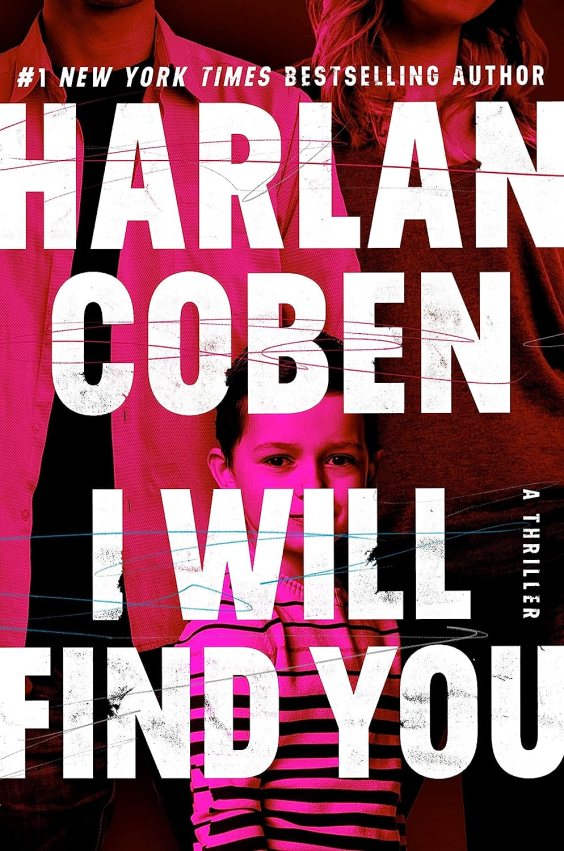
Quick Review – I Will Find You by Harlan Coben

I Will Find You Cover

Publisher: Century (Trade Paperback – 16 March 2023)

Series: Standalone

Length: 407 pages

My Rating: 4.5 out of 5 stars

Amazon

Last year I was lucky enough to read and review the new Harlan Coben novel, I Will Find You.  This was the first book I had read from Coben, a man renowned for his twisty and tricky thriller books, and it proved to be a pretty cool read.  While I really enjoyed I Will Find You, I never actually got around to reviewing it, which was a pretty major regret I had about my writing last year.  However, as I just received a copy of Coben’s new book, Think Twice, I figured this would be a good time to finally review this amazing book.

Plot Synopsis:

David and Cheryl Burroughs are living the dream – married, a beautiful house in the suburbs, a three year old son named Matthew – when tragedy strikes one night in the worst possible way.

David awakes to find himself covered in blood, but not his own – his son’s. And while he knows he did not murder his son, the overwhelming evidence against him puts him behind bars indefinitely.

Five years into his imprisonment, Cheryl’s sister arrives – and drops a bombshell.

She’s come with a photograph that a friend took on vacation at a theme park. The boy in the background seems familiar – and even though David realizes it can’t be, he knows it is. It’s Matthew, and he’s still alive.

David plans a harrowing escape from prison, determined to do what seems impossible – save his son, clear his own name, and discover the real story of what happened that devastating night.

The first thing I need to point out about I Will Find You is that Coben came up with a pretty awesome standalone concept that really draws your attention from the get-go.  An innocent man trapped in prison for a crime he didn’t commit is always a great start to the story, but combine that with proof that his murdered child is still alive and with someone else, and you have yourself a real winning plot that I really fell in love with.  Coben easily has the writing chops to back this story idea up, and the resulting book turns into an impressive read.

I really enjoyed so many great elements of I Will Find You, especially as Coben throws in his trademark twists, elaborate action-set pieces, and fantastically complex character motivations.  The book starts with an awesome, if slightly coincidental, prison break (thank God for family connections) and develops into a good fugitive storyline with an investigative bent to it.  The resulting chase between the protagonist and his pursuers, both official and unofficial keeps the pulse racing, and I loved the combination of two fast-talking cops leading the main pursuit, and a shadowy, influential family invested in his capture/death.  The investigation angle works out very well, and the combination of Matthew’s straightforward methods, and the subtler results from Rachel, the sister-in-law, allow for some intriguing progress towards the plots conclusion.

The various resulting twists that lead up to the end of the book are well handled, and I loved how compelling Coben was able to make the plot of I Will Find You.  I particularly loved the elaborate, sinister, and slightly oddball motivations behind the actual crime, as well the lengths the antagonist was willing to go to secure what they wanted.  The unique relationships that also emerge make for some fun reading, and the compelling and over-the-top main story is well balanced with the inherent tragedy of the protagonists and the sorrow they feel for their loss.  The entire book comes to quite a fantastic conclusion which, while it could have used a little more explaining, proved to be very satisfying.

While I did enjoy the story that Coben came up with for I Will Find You, and he presented it extremely well, I did myself disliking certain elements of the plot, namely that the author relied way too much on coincidence and story elements that come out of nowhere.  A good example of this is the machinations of a certain mob-boss, which helped lead to the protagonist’s situation.  While the eventual confrontation between David and this mobster is really well written, I honestly think their involvement in the whole affair could have been set up better, as their actions, while interesting to the plot, was a bit of a sudden inclusion.  This, and other confidences and unanswered questions, conspired to throw me off the groove of the story at key points of the book, so I didn’t have as much fun as I possibly could of.  Still, this is a mostly minor issue for me, and I had an overall exceptional time with this book.

I Will Find You was a pretty novel book, and it proved to be a fantastic introduction to Harlan Coben for me.  The elaborate and intense story writing really grabbed me, and I loved the author’s ability to pull together a great character-driven twist.  As such, I Will Find You is well worth checking out, especially to those who are already fans of the author.

I Will Find You Cover 2

Amazon

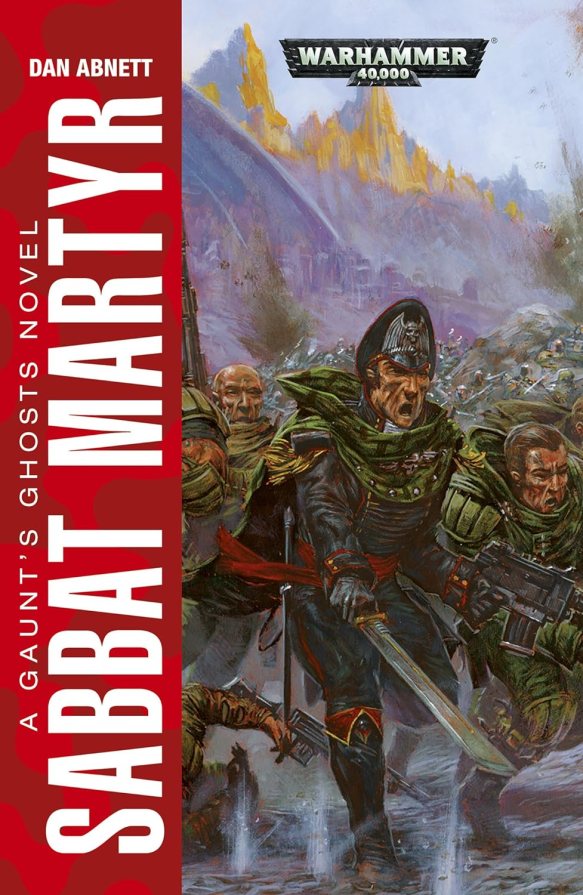
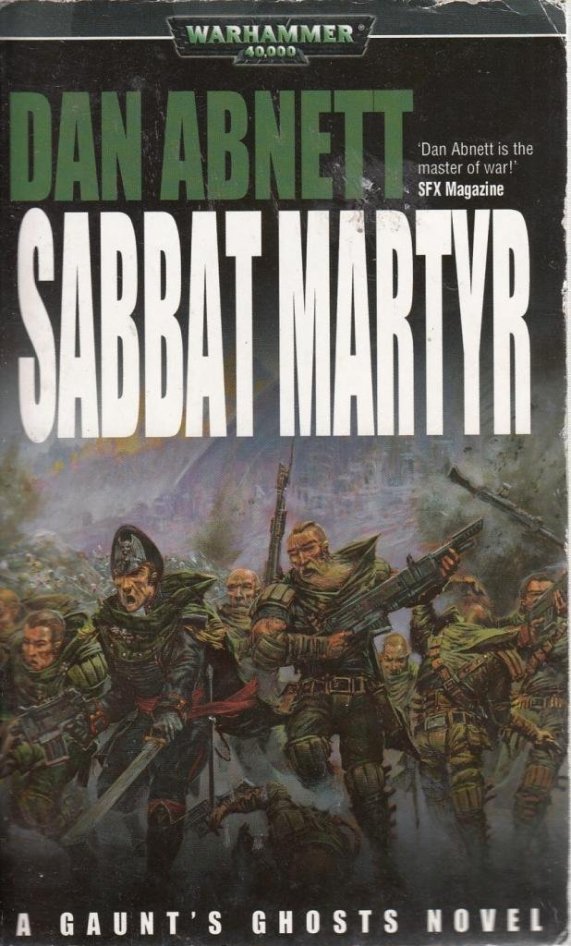
Warhammer 40,000: Sabbat Martyr by Dan Abnett

Sabbat Martyr Cover

Publisher: Black Library (Audiobook – 1 December 2002)

Series: Gaunt’s Ghosts – Book Seven

Length: 10 hours and 35 minutes

My Rating: 4.75 out of 5 stars

Amazon

In addition to my review for Straight Silver, I also present a review for the impressive and epic seventh novel in Dan Abnett’s Gaunt’s Ghosts series, Sabbat Martyr.  This was an outstanding and fantastic addition that perfectly followed on from some of the previous books in the series, including Necropolis, Honour Guard and The Guns of Tanith, while also throwing the beloved protagonists into all manner of trouble.

It is a time of miracles in the Imperium of Man.  As Warmaster Macaroth continues his extensive and exhaustive Sabbat World Crusade, the forces of the Imperium are stretched like never before.  However, word has reached the ears of all the faithful in the Sabbat Worlds that the legendary Saint Sabbat has reincarnated on the isolated and pious world of Herodor.  There, in Civitas Beati, a holy city dedicated to her, the reborn Saint awaits the faithful, the pilgrims, and the mighty warriors of the Imperium.

Amongst those summoned to Herodor are the battle tested and weary soldiers of the Tanith First-and-Only, better known as Gaunt’s Ghosts.  Thanks to their previous victories, as well as their involvement in miracles associated with the Saint, the Ghosts and their leader, Colonel-Commissar Gaunt, have been personally chosen by Sabbat to be her honour guard.  However, nothing on Herodor is as it seems, and Gaunt finds himself drawn into deceptive military politics and the manipulated beliefs of the city.  Worse, the forces of the Emperor of Mankind aren’t the only ones who have heard the call of the new Saint.

As Gaunt attempts to establish order in the city, an unstoppable danger appears on the horizon in the form of the infamous followers of Chaos, the Blood Pact.  Lead by the terrible Chaos warlord, Enok Innokenti, the invading forces of Chaos have one mission: find and kill the reborn Saint, and, by doing so, rob the Imperium of hope.  Desperately outnumbered and faced with impossible odds, Gaunt and his ghosts will need to do all they can to save the Saint and the city.  However, the dread Innokenti will have the Saint’s head by any means necessary and has sent nine deadly and corrupt killers to ensure this happens.  Can Gaunt and the Tanith First-and-Only pull off a miracle in the name of their blessed saint, or is this their final battle?

Abnett pumps up the feels and brings together some amazing storylines in this seventh excellent Gaunt’s Ghosts book.  An action-packed and highly intense read, Sabbat Martyr was another exceptional read, and one that I absolutely powered through thanks to its addictive and powerful story.

Sabbat Martyr has a pretty impressive story behind it, especially as Abnett wraps up the Saint sub-series within the larger Gaunt’s Ghosts books, in a big way.  Starting off fairly typically, with the Ghosts arriving on a new world to take care of some riffraff, Abnett quickly sets the scenes and revisits several of the key existing storylines and character arcs.  However, Sabbat Martyr goes in some intriguing new directions as Gaunt and his soldiers encounter what appears to be a reborn Imperial Saint, who has inspired a new bout of religious fervour and devotion in the region.  This proves to be an interesting new angle which ties this book into the larger concerns of the Warhammer 40,000 universe, rather than focusing on the fight of the common footslogger.  I liked this change of focus, especially as it fits with the hints raised in the preceding novels, and the initial intrigues of the novel added a level of uncertainty that worked quite nicely.  A fantastic, extended battle scene ended the first third of the book nicely, especially as it leads to some big revelations and sets the scene for the second half of the book.

The second half of Sabbat Martyr is where things get really interesting.  Abnett cleverly uses the start of this half to quickly extend several great character arcs, which sets some figures up for some dark times, while others are restored in interesting ways.  However, you don’t have a chance to fully appreciate that, as Abnett then launches the reader right into a new phase of war, as deadly enemies literally rain down around the protagonists.  Essentially the entire second half of the book is pure warfare, as the forces of Chaos arrive and harry the Imperial forces on every front, including with an extended space combat sequence.  From there, the enemy arrives on Herodor in force, including the nine promised deadly killers, and all the protagonists are thrust into a deadly battle for survival.

I loved this last part of the book, especially as Abnett knows how to write an exceptional war sequence.  Expertly splitting the story between numerous point-of-view characters, the resulting carnage is epic, with the protagonists forced into intense street fighting to survive.  All these battles are well crafted, and show the protagonists at their most desperate, as they are slowly pushed back with seemingly no hope to win.  I really loved these battles, as well as the simultaneous character arcs that tied into them, and you really get drawn in towards the big climax.  I did think that Abnett slightly rushed this last half, mainly because he was trying to fit in too much at once.  While the nine killers get a good introduction, they weren’t utilised as effectively as they could have been, and their appearances are a little briefer than you would have liked.  Indeed, there is so much potential material in this second half that Abnett could have honestly fit his story across two books and really expanded everything out.  Still all the big battles are very epic, and the big climatic fight sequence proves to be everything you could have wanted.  Abnett wraps everything up with some major tragedy, as multiple character arcs come full circle in a big and emotionally charged way.  As such, readers, especially established fans of the series, come away from Sabbat Martyr shaken while Abnett clearly and decisively ends a major chapter in the Gaunt’s Ghosts series.

Abnett does a really good job bringing this epic story to life, and I deeply appreciated just how dark and intense Sabbat Martyr got in places.  Expertly utilising multiple character perspectives to tell an elaborate story, you really get sucked into the massive carnage that emerges, and I really must commend Abnett for the impressive battle scenes.  Abnett has his methodology set for the Gaunt’s Ghosts books by this point in the series, and I love how smoothly his story unwinds.  The blend of character focussed storytelling and intense action makes for an exciting read, and I really got invested in this outstanding seventh entry in the series.  I did appreciate how Abnett took his protagonists into the much wider realm of faith, saints and holy power that is well established in other Warhammer 40,000 fiction, but not something we’ve typically seen in this series.  It honestly made for a unique change of pace, and Abnett does a great job wrapping ongoing storylines around it.  I also appreciated how several loose ends and antagonists from previous novels got revisited here, including one of the big issues I had with Honour Guard which got nicely resolved here.  This does mean that unlike the other Gaunt’s Ghosts books, Sabbat Martyr is less accessible for new readers, although Abnett does a good job of summarising old storylines where needed.  As such, this proved to be an epic entry in the wider series, and I really enjoyed how this chapter of the Gaunt’s Ghosts books came to an end.

As with all the Gaunt’s Ghosts books, the heart of Sabbat Martyr lays in the extended cast of protagonists from whom the elaborate story emerges.  Abnett has a very well-established cast of characters for Sabbat Martyr, and it was frankly moving to see how this story unfolded for them.  The author does a good job splitting the story amongst the cast, and I appreciated how this book, unlike the previous novel, didn’t overdo the number of primary cast members.  The resulting character arcs and personal stories proved to be very moving and intense to different degrees, and Abnett really got dark in places, especially when it came to bringing certain character storylines full circle.

Now, I won’t go into too much detail about the characters here, because I don’t want to ruin some major parts of the book.  However, I will say that Gaunt is once again a great central figure, and it was intriguing to see him impacted by his fate, as well as the many friendships he’s made throughout the series.  In addition, Gol Kolea gets a nice addition to his story, which I really appreciated, while one of the original Ghosts, Brin Milo, finds himself going on some bold new adventures that tie in nicely to his long-hinted destiny.  The feud between Lijah Cuu and Hlaine Larkin that was such a dark and memorable part of Straight Silver, comes to a great conclusion here, and Cuu really proves to be the ultimate villain of this series.  Agun Soric’s battle with his unusual messages is another highlight, especially as Abnett works in some powerful personal struggles, as well as a very dark ending that will leave you hurting.  All these character arcs, and more, are handled perfectly and all readers, especially those who have enjoyed the rest of the series, will really appreciate how Abnett continues or concludes them here.  However, I may never forgive Abnett for the big tragedy that occurs at the end that ensures the Tanith First-and-Only will never be the same again.

It goes without saying that I ended up listening to Sabbat Martyr on audiobook, especially after how impressed I have been with the previous Gaunt’s Ghosts audiobooks.  Coming in with a run time of 10 and half hours, Sabbat Martyr was another descent length Warhammer 40,000 audiobook that I just flew through.  This format works so well to tell epic Warhammer 40,000 stories, and I loved how effectively the fight sequences came through in Sabbat Martyr, as you can so easily envision Abnett’s massive action set pieces.  A lot of how effective Sabbat Martyr’s audiobook is comes down to excellent narrator Toby Longworth, who is one of my favourite audiobook narrators.  Longworth, the established narrator for all things Gaunt’s Ghosts (as well as Abnett’s other audiobooks like, Xenos, Malleus and Hereticus), has long perfected the voices he uses within these audiobooks, and it was great to hear his established tones and voices again.  The narrator really has all the key characters down and love the fitting and effective voice each of them has.  This impressive voice work deeply enhances an already awesome story, and you really get to feel the emotions and actions of each of the characters.  I honestly had such a great time listening to the Sabbat Martyr audiobook, especially in some of the more intense action scenes which swept my imagination away, and this is easily the best format by which to enjoy this amazing book .

With fire, blood and faith, Abnett wraps up a major part of his iconic Gaunt’s Ghosts series in a big way with the epic Sabbat Martyr.  Loaded with war, personal conflict, powerful developments, and some memorable tragedy, Sabbat Martyr was a worthy and intense addition to the series, and one that I couldn’t stop listening to.  I had such an exceptional time with this book, and Sabbat Martyr, and indeed the entire Gaunt’s Ghosts series, is required reading for all Warhammer 40,000 fans.

Sabbat Martyr Cover 2

Amazon

Warhammer 40,000: Straight Silver by Dan Abnett

Straight Silver Cover

Publisher: Black Library (Audiobook – 1 December 2002)

Series: Gaunt’s Ghosts – Book Six

Length: 9 hours and 52 minutes

My Rating: 5 out of 5 stars

Amazon

After having a blast reading and reviewing The Traitor’s Hand, my desire for more things Warhammer 40,000 needed to be sated, so I dove into the exceptional and gritty Gaunt’s Ghost book by Dan Abnett, Straight Silver.

While there are some truly impressive Warhammer 40,000 authors out there, few can match Dan Abnett in terms of quality and impact.  One of the most significant authors of Warhammer fiction, Abnett has produced a great number of books in the franchise over the years, which includes several must-read series for all Warhammer fans.  These include his substantial contributions to the massive Horus Heresy series, as well as the iconic Inquisitor extended series.  The Inquisitor books include his impressive and highly compelling Eisenhorn trilogy, made up of Xenos, Malleus and Hereticus, and which are amongst my favourite literary trilogies.  While I am a huge fan of these novels, probably his most grounded and well-known contribution to the Warhammer 40,000 canon are the Gaunt’s Ghosts novels.

The Gaunt’s Ghosts books are an extended series that follows the members of the Tanith First-and-Only, a weary and battle-hardened regiment of Imperial Guard soldiers.  Led by Colonel-Commissar Ibram Gaunt and known for their stealth abilities and the destruction of their home planet, the Tanith First-and-Only have taken up the name Gaunt’s Ghosts and are fighting in the massive Sabbat World Crusades hoping to find a new planet to call home.  This series emphasises the common human soldier and the gruelling realities of war in the grim Warhammer 40,000 future, and it is one of the most compelling series out there.  I have had an outstanding time with this series and all the books I have read, including First and Only, Ghostmaker, Necropolis, Honour Guard, The Guns of Tanith, and the prequel novel The Vincula Insurgency, have been extremely epic and complex, perfectly blending great characters with intense action.  Despite still having several books to go, the Gaunt’s Ghosts novels are one of my favourite Warhammer 40,000 series for a very good reason and I had no hesitation diving into the next book of the series, Straight Silver, when I needed something fun to read.

As the massive Sabbat World Crusades gain traction against humanity’s enemies, the Imperial forces finally have the capacity to send aid to the long-isolated planet of Aexe Cardinal.  There the loyalist nations of the Aexe Alliances have been locked in a gruelling 40-year war against the Chaos corrupted Shadik Republic.  Amongst the Imperial reinforcements sent to Aexe Cardinal are the veteran Ghosts of the Tanith First-and-Only, who are ready to make a dent in a new foe.

However, upon arriving on Aexe Cardinal, the Ghosts are surprised to find themselves under the command of the Aexe Alliance rather than their own generals.  Forced to serve the whims of their new allies for political reasons, the Ghosts are soon thrust into the archaic way of fighting that have led the war to linger for decades.  Worse, their new commanders refuse to use the Ghosts to their full potential, and the lightly armoured scouts find themselves fighting in bloody trench warfare.

Forced to endure confined conflict in ill-maintained trenches, the Ghosts find death constantly on the horizon as raids, bombardments, gas weaponry, and their own shattered morale begin to take their toll.  To keep his regiment alive and sane, Gaunt volunteers his troops for the most dangerous missions where the Ghost’s scouting skills can be best utilised.  However, the resulting campaigns will test Gaunt and his troops to the utter limit as the relentless forces of Chaos come crashing down upon them.

Straight Silver proved to be an exceptional entry to this amazing Warhammer 40,000 series.  Featuring some powerful and gritty action that took its protagonists to dark places, this sixth entry in the Gaunt’s Ghosts series was so damn good that I managed to power through it in no time at all.

Abnett did a brilliant job coming up with a particularly intense and dark story that plants the protagonists and the reader into the middle of a gritty warzone.  The main story is initially a little basic, with the Ghosts arriving on a new planet and finding themselves caught up in another long-standing war.  However, the book takes an outstanding turn when the Ghosts, who work best as a scout force, are forced into an elaborate trench warfare scenario.  Thanks to the excellent World War I inspired setting, the Ghosts are figuratively thrust back into the past and are forced to fight an old-fashioned type of war with their lasguns going up against firearms, chemical shells, and fixed lines of trenches.  The constant grim trench battles, raids and fights across no man’s land that dominate the first half of this book are very intense, gory, and pointless, and the reader is swiftly drawn into the unusual and dangerous scenario the Ghosts find themselves in.  Abnett masterfully captures so many aspects of this grim scenario, and you have to appreciate how brutal he makes the battles and the terrible conditions the characters find themselves in.

All these initial battles are expertly shown through the eyes of the many recurring characters of the Gaunt’s Ghosts series, and you swiftly begin to feel their despair and the rising tensions within them.  This works well with many of the existing character arcs, as several figures deal with grudges, uncertainty about duty, and growing relationships.  This excellent use of character arcs and perspectives humanises the fight, and you can’t help but get dragged even more into their hopeless situations.  I particularly enjoyed how Abnett deliberately made the antagonists a purely human force, with no named enemy characters serving as the villain.  This helps to reinforce that the true antagonist of the plot is human nature and their ability to wage unforgiving war, as the two opposing armies destroy everything around them.

While Abnett could have kept the characters in the trenches for a while and still had a good book, he chooses to accelerate the plot about halfway through Straight Silver, as the Ghosts are given a chance to prove themselves by going on two deadly missions.  This splits the story, as Gaunt leads half the characters on a series of deadly raids behind enemy lines, while another small group of key characters find themselves away from the fighting as they scout a critical location in the woods.  Naturally both storylines result in deadly chaos for the relevant protagonists, but I loved how they played out.  The storyline with Gaunt was brutal infiltration across no man’s land at its finest, and there are so many shudder-inducing moments as they continuously encounter the horrors of war.  The other storyline is much more a slow burn, as the characters find themselves isolated in the woods and only have themselves to fight with, as the grudges and resentments introduced at the start of the book are refreshed.  While the characters come together when an enemy presents itself, they are still caught up in their raw emotions, and this results in some dark moments.  Both storylines are resolve in an impressive and compelling manner, and the reader will come away enthralled, excited, and a little angry, as one excellent villain gets away with everything again.  You are honestly left wanting more, especially as Abnett throws in some tantalising hints for the future, and the bloody battles and horrors of Straight Silver will stay with you long after you’ve finished.

As with most books in the Gaunt’s Ghosts series, Straight Silver can be read as a mostly standalone read, as many of the key characters and story arcs are expertly reintroduced throughout the course of the book.  While readers will always get more out of Straight Silver if they read the other Gaunt’s Ghosts books first, especially as that will allow them to become more attached to the characters, a new reader can easily pick up Straight Silver and have an outstanding time getting through it.  Straight Silver and the Gaunt’s Ghosts books can also be readily enjoyed by those people with minimal pre-knowledge of the Warhammer 40,000 universe.  The Gaunt’s Ghosts books exist in their own little pocket of the universe, with the story completely focused on their own struggle as soldiers.  As such, this makes these books perfect entry level reads for those wishing to learn more about Warhammer 40,000 fiction, and anyone with a love for science fiction or military fiction is going to love Straight Silver.

I’m always impressed with the amazing range of characters that Abnett fits into each of his Gaunt’s Ghost novels, as the author tries to constantly capture the entire experience of the regiment in a Band of Brothers sort of way.  Unlike his Eisenhorn books, which had one perspective character, the Gaunt’s Ghosts follow many different protagonists, which allows you to see a massive picture of events unfolding.  This works really well, and I loved the huge range of unique perspectives and personalities that emerged, as well as the different views of the fights and internal conflicts.  I did think that Straight Silver might have featured a few too many different perspectives, as Abnett tried to bring some new characters to the fore.  This meant that several of the established cast from the previous book didn’t have a chance to shine here and were often sidelined, while the newer characters didn’t impress as much in their first big appearance.

There were still a ton of great character arcs going on, and even with less time in the spotlight, many of these characters made the most of it.  Main protagonist Colonel-Commissar Ibram Gaunt gets a good showing, especially as he is forced into conflict with his friend, the highly moral Chief Medic Tolin Dorden, and he is forced to balance his responsibilities as a Commissar with the love he holds for his soldiers.  Newly promoted Sergeant Tona Criid proves to be an absolute badass character, and it was great to see her take command and kick butt.  Sergeant Agun Soric has some great scenes as he slowly comes to realise his latent psychic abilities, while the formerly charismatic Gol Kolea is a hard figure to read about, after suffering a head wound in the previous book and losing his intelligence.  However, the best storyline in Straight Silver involves the mad sniper Hlaine Larkin and the nefarious trooper Lijah Cuu (sure as sure).  Thanks to their interactions in the previous book, the slippery murderer Cuu has a major grudge against Larkin and is determined to kill him, just like he did Bragg.  This results in a deadly game of cat and mouse between the two, as Larkin tries to survive both the enemy and Cuu.  Cuu comes away as such a good villain for this book (even more than the enemy), and you can’t help but hate the guy, especially as there is something slick and scary in his every appearance.  These characters, and many more, helped to turn Straight Silver into an exceptional read, and you really get wrapped up in their unique experiences of war.

I doubt anyone who has every read one of my Warhammer reviews will be surprised that I ended up listening to Straight Silver on audiobook.  All Warhammer books are so much better in this format, and the Gaunt’s Ghosts audiobooks are a great example of this, especially with narrator Toby Longworth.  Longworth, who is one of my favourite audiobook narrators, has lent his voice to most of Abnett’s Warhammer audiobooks, and he always does a remarkable job moving the story along and describing the book’s epic battle sequences.  This is extremely evident in Straight Silver, and I very quickly powered through this audiobook because of how good it is.

I especially loved the awesome voices that Longworth came up with for the various characters featured throughout the book, and he goes out of his way to ensure that every figure has their own distinctive and fitting voice.  Many of these voices are carried over from the previous audiobooks, and it was great to get the continuity for each of the recurring characters, so much so that by this point listeners of the other Gaunt’s Ghosts books can figure out who is talking just by hearing their particular tone.  One thing I particularly appreciate is the range of accents that Longworth distributes across the audiobook.  Each group of soldiers, such as the original Tanith troopers, the new Verghastite recruits, and the soldiers of Aexe Cardinal, are given their own distinctive accents, and this cool attention to detail is what makes Longworth such a good narrator.  This was such an epic audiobook; with a runtime of nearly ten hours, most people can power through it, especially when they get caught up in the epic story.

Straight Silver is a particularly epic and impressive addition to the Gaunt’s Ghosts series as Dan Abnett takes his fame regiment down into battle hell.  Loaded with intense moments, a powerful background setting, and multiple engaging character arcs, Straight Silver is an exceptional read, and it is honestly one of the strongest Gaunt’s Ghosts books I have so far read.  An utterly addictive Warhammer 40,000 novel, I can give it no higher honour as a reviewer than to say the moment I finished it, I instantly grabbed the next book in the series, read it, and will be putting up a review for it now.

Amazon

Warhammer 40,000: The Traitor’s Hand by Sandy Mitchell

The Traitor's Hand Cover

Publisher: Black Library (Audiobook – 1 January 2005)

Series: Ciaphas Cain – Book Three

Length: 9 hours and 6 minutes

My Rating: 4.75 out of 5 stars

Amazon

After updating my list about my favourite Warhammer 40,000 novels last week, I was keen for more action from this awesome franchise, so I decided to quickly listen to the entertaining and fun novel, The Traitor’s Hand by Sandy Mitchell.

One of the things that I like most about the Warhammer 40,000 franchise is the sheer range of different stories and genres that can be found within it.  For example, one of the most popular series is a particularly funny and amusing series that focuses on a Blackadder-esque Imperial Commissar as he finds himself involved in all manner of over-the-top heroics.  This series is the Ciaphas Cain books, which follows the titular protagonist who has accidently become regarded as a great hero of the Imperium of Man, despite most of his actions being more for self-preservation.  The first two books in this series, For the Emperor and Caves of Ice, were extremely fun reads, and I have been meaning to check out the next book in the series for a while.  As such, when I had my recent Warhammer 40,000 craving, the third Ciaphas Cain book, The Traitor’s Hand, was an easy choice.

Commissar Ciaphas Cain, hero of the Imperium or unrepentant coward?  Constantly forced into the direst of circumstances despite doing everything in his power to avoid them, Cain has built up a reputation he considers entirely undeserved, especially as being known as a hero always seems to get him into trouble.  His latest assignment will test him like none other, especially when he is forced to go up against the great archenemy of the Imperium, the forces of Chaos.

With a Chaos fleet approaching the tidally locked planet of Adumbria, Cain and the soldiers of the Valhallan 597th are rapidly redeployed towards the planet to aid in its defence.  Despite wishing to stay off the frontlines, Cain’s experience and uncanny ability to find trouble forces him to join in the hunt for a Chaos cult hidden throughout the planet that has awakened in advance of the coming fleet.  However, the more he digs, the more he discovers that there is something far more sinister going on within the planet than anyone realises.

As the invading enemy arrives on the planet, it soon becomes apparent that two rival bands of Chaos worshippers are attacking Adumbria with very different goals in mind.  Leading the fight against the enemy, Cain needs to work out just what their objectives are before the world is destroyed in the Chaos crossfire.  However, with deadly enemy forces all around and a rival commissar determined to undermine him, can even the terminally lucky Cain stop them, especially when an old nightmare returns seeking revenge against him.

The Traitor’s Hand was an extremely awesome book from Mitchell that I had so much fun getting through.  Containing the outstanding blend of action, humour and intriguing characters that the Ciaphas Cain series is known for, The Traitor’s Hand was pretty damn epic, and I managed to power through it in about a day of intense listening.

This third Ciaphas Cain novel had a great story behind it that I had a wonderful time listening to.  While it does follow some similar story conventions to the previous books in the series, in that Cain and the Valhallan 597th arrive on a planet to face one foe, only for Cain to inadvertently discover another threat hidden under the surface, I think Mitchell did a good job distinguishing this book from the previous entries.  The introduction of a rival Commissar and alternating bands of Chaos worshippers makes for a great central storyline, and you get really involved in the battle for the planet and the attempts to discover a hidden Slaaneshi cult who are performing dark rituals.  The entire story evolves in a familiar manner, with Cain’s attempts to avoid a fight leading him into darker situations each time, while his keen insights allow him to determine where the true threat to the planet is located.  The big final sequence for The Traitor’s Hand was pretty damn awesome, as Cain leads a small force into a massive battle royale between warring Chaos warbands while also facing a dangerous foe from his past.  While the big bad’s identity was overly foreshadowed, their inclusion was very intense and lead to a gripping conclusion.  I do wonder if this repetitive story structure is going to be sustainable for the series in the future, but I really got stuck into this entertaining and exciting narrative and powered through it so damn quickly.

I absolutely loved the fun style of the Ciaphas Cain books which Mitchell once again uses to tell a fantastic story.  Primarily told from the first-person chronicle perspective as Cain recounts his many adventures, you get to see his insights into events that occur.  While on the surface this appears to be a typical Imperial Guard focused Warhammer 40,000 story, it is a much lighter read, as the book revolves around Cain’s continued attempts to get out of danger only to encounter worst problems.  It is really entertaining to see his excuses and manipulations, especially as nearly every action he does is calculated to avoid danger, which he shamelessly admits to.  The continued increase of stakes, desperate response from Cain and the inevitable lucky escape makes for some fun reading, and Mitchell does an excellent job of layering a strong amount of comedy into a usually dark universe.  This humour is expertly enhanced by the overarching narration of the book, provided by Inquisitor Vail’s editorial notes as she collates Cain’s memoirs.  Vail’s various notes, quotes and included histories of the story provides some much-needed context to the plot, while the entertaining and often sarcastic way they are delivered works extremely well.  I think that Mitchell got the right blend of humour, action, and dark moments throughout the course of The Traitor’s Hand, and I really got engrossed in the hilarious and action-packed story that emerged.  I did feel at times that Mitchell did get a bit repetitive with some of his phrases and lines, which you really notice with an extended read, but this is honestly a pretty minor complaint, and The Traitor’s Hand proved to be an amazing read.

I liked how well Mitchell featured the Warhammer 40,000 universe in The Traitor’s Hand, especially as he once again seeks to showcase the horrors of the franchise from the eyes of a human solider, even one as lucky as Ciaphas Cain.  The various Chaos factions prove to be great villains in this story, and I loved the cool comparisons between the Slaaneshi cult and the Khorne-worshipping warband.  You also get a great insight into the life of the common soldier or civilian, and it was fun to see the various responses many of them have to the reveals about Chaos and their dark designs.

Like most of the Ciaphas Cain novels The Traitor’s Hand can easily be read as a standalone book, and no real pre-knowledge of the Warhammer 40,000 universe is really needed.  Indeed, I really appreciated how efficiently Mitchell is able to ease new readers into the wider Warhammer 40,000 universe.  In addition, readers don’t really need to have checked out the prior Ciaphas Cain novels either, as Mitchell does a good job of summarising the necessary key points from these books when needed.  There were some strong references to the Ciaphas Cain short story, The Beguiling, which if you had read would have increased the impact of The Traitor’ Hand to a degree, however, it is also not necessary to have read it first, as Mitchell recaps it very well.  Overall, I felt this was a great piece of Warhammer 40,000 fiction that many people can get into.

A key highlight of any Ciaphas Cain novel is the excellent character work that Mitchell installs into the story.  This is certainly the case in The Traitor’s Hand, with most of the character work revolving around the protagonist and main point-of-view character, Commissar Ciaphas Cain.  While Mitchell has done a great job setting up this figure in the previous two books, it is always so much fun to see a story through Cain’s eyes, especially as the protagonist bears the duality of being a hero and a coward at the same time.  Fitted with a well-honed sense of survival, Cain is constantly trying to find ways to get out of danger and has proven quite adept at manipulating people to get what he wants.  However, due to bad luck or because he finds himself trapped by his own legend, Cain is constantly dragged into the most dangerous situations possible.  While it would be easy to dislike a character like this, readers quickly become aware that Cain isn’t as big a coward as he believes, and instead he is quite a skilled, brave and caring leader whose “cowardly” actions are often borne by shrewd assessment and tactical awareness.  Throw in his excellent sense of humour, his entertaining insights into the universe, and his vast experiences with the many different things trying to kill humans in the Warhammer universe, and Cain is such a great protagonist to follow.

Aside from Cain, The Traitor’s Hand features a raft of other great characters, each of whom bring a lot to the story.  For example, Inquisitor Vail, despite not appearing in person, serves a big role in the book, editing Cain’s unreliable manuscripts.  I loved her witty over-arching narration and notes throughout the book, and it was fun to have someone constantly calling out Cain for his wilder statements.  I also loved the continued inclusion of Cain’s aid, Jurgen, the man capable of killing anything in the galaxy with his trusted meltagun.  I love how Mitchell sets Jurgen up as the Baldrick to Cain’s Blackadder in this series, especially with his attitude, hygiene and loyalty, although he proves to be a vital ally.  It was also interesting to see Mitchell continue to explore just how vital Jurgen is to Cain’s success, especially due to his status as a Blank, and I love the entertaining team the two characters combine into.  New character Commissar Tomas Beije, an old school rival of Cain’s, serves as a great secondary antagonist for much of the story, and it was entertaining to finally see a character suspicious of Cain’s status as hero, especially as he looks deranged spouting out accusations we know to actually be true.  Finally, the various members of the Valhallan 597th, many of whom were introduced to us at the same time as Cain, continue to grow as characters and serve great supporting roles in the story, and it was touching to see how their relationship to the protagonist has grown over the years.

I have often said throughout my many reviews on the subject that the best way to enjoy a Warhammer 40,000 novel is its audiobook format.  Nowhere is that truer than the Ciaphas Cain audiobooks, which really capture the zany feel of the series through its excellent narration and style.  Most of this is due to the excellent use of multiple narrators, whose mixture of voices creates a particularly epic read (indeed this one of my favourite audiobook series with multiple narrators).  The Traitor’s Hand features four separate narrators, each of whom add so much to my enjoyment of this audiobook.  Each of these narrators has a distinctive role, with the amazing Stephen Perring providing the bulk of the narration in this series, as he narrates the chapters told from the protagonist’s perspective.  Perring serves as an epic centre for this audiobook, especially as he does such a good job capturing the larger-than-life Ciaphas Cain with his acting.  Perring’s take on Cain’s cocky dialogue, as well as his more honest chronicling of events, is impressive, and I love how he captured the various aspects of Cain’s character.  There are some other great voices featured throughout these chapters as well, as Perring assigns fitting and entertaining voices to each of the major characters.  My favourite of these is probably Jurgen, especially as Perring really tries to make him sound as much like Tony Robinson as possible.

While Perring does most of the narration in The Traitor’s Hand, the additional voice actors also add a lot to the story, especially Penelope Rawlins.  Rawlins voices the character of Inquisitor Vail, the Imperial Inquisitor and acquaintance of Cain who is compiling the memoirs for publication.  As such, Rawlins voices the prelude, chapter introductions and footnotes contained in this book to showcase the editorial notes that this character is adding in to make Cain’s ramblings easier to read.  Rawlins serves as a good contrast to Perring, especially as her character’s more serious tones are the direct opposite of Perring’s flippant take on Cain.  I love how seamlessly the production works Rawlins’ voice into the various points of the audiobook where her character cuts into the main story, and you really get into the groove of her explaining key details about the universe and the characters.  Throw in the additional voice work of Emma Gregory and new narrator Andrew Spooner, who give their voices to various in-universe texts that provide additional information for the reader, and you have a strong team who masterfully enhance Mitchell’s brilliant story.  These great actors really help to make this entire audiobook production so much fun to listen to, and with a runtime of just over nine hours, you can very easily sit back and listen to The Traitor’s Hand in one fantastic sitting.

With The Traitor’s Hand, Sandy Mitchell continues to showcase why he is one of the strongest, and funniest, authors of Warhammer 40,000 fiction.  Filled with the series’ trademark humour, intriguing characters and intense action, The Traitor’s Hand was an entertaining audiobook from start to finish that I could not turn off.  An outstanding and highly recommend novel, The Traitor’s Hand was so damn good, and I cannot wait to see how Mitchell continues this amazing series.

Amazon

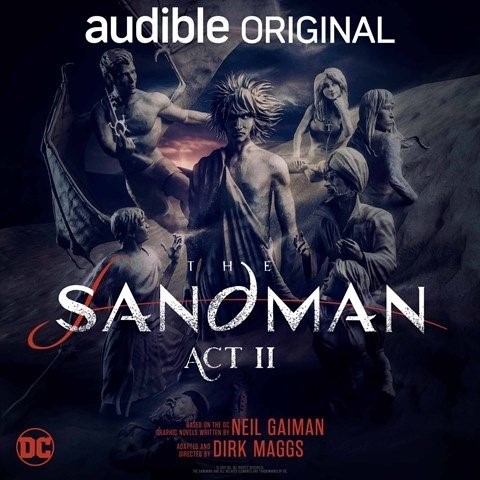
The Sandman – Act II (Audiobook) by Neil Gaiman and performed by a full cast

The Sandman - Act II Cover

Publisher: Audible Original (Audio Drama – 22 September 2021)

Series: The Sandman – Volume 2

Script: Neil Gaiman and Dirk Maggs (script adapter)

Director: Dirk Maggs

Length: 13 hours and 47 minutes

My Rating: 5 out of 5 stars

Amazon

The gloomy and complex fantasy adventures of Neil Gaiman’s The Sandman continues in this epic second audiobook volume that once again brings Gaiman’s unique imagination and characters to life with an outstanding cast of actors.

Back in 2022 I had an outstanding time listening to the first volume of the audiobook adaptation of The Sandman comic.  The original series, which started in 1989, is one of the most iconic comics of all time and features a unique adventure that only someone as twisted and imaginative as Neil Gaiman can come up with.  Following Dream, the anthropomorphic personification of dreams and human imagination, The Sandman is a truly interesting comic that blends horror, fantasy and superhero storylines together.  Some people might be more familiar with the recent Netflix series that adapted the first couple of comics and which has a second season on the way.

While I loved the show, I personally had a much better time with the audiobook version of the comics that was released a couple of years ago.  Featuring a truly exceptional cast of celebrity and established audiobook narrators, the first volume of this series was so damn good, and I loved how well it established the characters and universe of The Sandman while also adapting Gaiman’s unique vibes and dark themes.  This first volume was extremely addictive, and I made sure to listen to the second volume shortly after.  The second volume, or Act II as it will be called in this review, continues the comic storyline and features some amazing stories, fun characters and new cast members.

In a universe of strange and deadly creatures, many beings are considered immortal, but only seven siblings can truly claim to be endless.  The Endless, each a personification of a certain universal or human concept, are powerful and mesmerizing in their own way, but the most enchanting and mysterious is Dream.  Known by many names, including Morpheus, this being governs the Dreaming, a vast realm of creation’s collected dreams and stories, protecting the imagination that makes life worth living.  But circumstances outside of his control have set him on a dark path that not even he can escape from.

Still dealing with the consequences of his forced absence from his realm, Morpheus is working to recover everything he lost while avoiding the enemies he made along the way.  The most powerful of these is Lucifer, the fallen angel and lord of Hell, whom Morpheus insulted when he stormed Hell to take back his stolen helm.  Despite not wishing to cross Lucifer again, Morpheus is convinced to set right the biggest wrong of his life and free his former lover from Hell.  However, he is unprepared for the reception that awaits him as Lucifer chooses to damn him in a far more sinister way: by gifting him control of his dark domain.

Finding himself in possession of the key to Hell’s gates, Lucifer must determine who will become the new ruler of Hell.  Setting up a gala in the Dreaming, Morpheus receives visits from an array of gods, demons, angels, and other immortal beings, each of whom seek to control Hell for their own reason.  Soon, Morpheus finds himself in the middle of a host of scheming beings, many of whom will turn on their host to get what they want.  At the same time, weird things are happening in the Dreaming, as an ancient and unstable realm begins to drag in inhabitants from the real world and influence the waking world.  Can Morpheus ensure his realm stays whole whilst dealing with the most dangerous beings in creation?

This was another outstanding adaptation of The Sandman comics that was so damn epic to listen to.  Adapted by director Dirk Maggs and featuring all Gaiman’s impressive storytelling and dark characterisation, The Sandman – Act II was extremely impressive, and you really get drawn into the unique world of the original comics.  Adapting issues #21-40 and #50 of the original comics, The Sandman – Act II brings together the stories of Season of Mists and A Game of You, and several entries from Fables & Reflections.  All these adaptations are so damn good, and I love the elaborate and epic cast that helps to bring the tale to life.

Due to how the audiobook is set out, there are three distinctive parts to The Sandman – Act II, which provided their own unique stories and characters.  The first of these is titled Season of Mists, and features Morpheus finding himself wrapped up in the fate of Hell.  Starting with an entertaining and dysfunctional family dinner, where Morpheus reunites with all his siblings (bar one), the story then turns to Morpheus’s biggest regret, his relationship with the ancient African queen Nada (whose story was told in the last audiobook), which trapped her soul in Hell.  Travelling to Hell to free her, Morpheus finds that Lucifer has banished all the demons and damned souls from his realm and is abdicating as ruler, leaving the key to Hell’s gates with Morpheus.  Morpheus is soon tasked with deciding the fate of the dimension, which results in a flurry of immortal beings arriving at his home to request the key.  The resulting conference proves to be highly entertaining as Morpheus is forced to deal with all manner of bargains, schemes and betrayals as everyone seeks his favour.  I loved how the entire dramatic conference unfolds, and the interactions between the various over-the-top figures and the implacable Morpheus results in some great drama and hilarious sequences.  The conclusion of this storyline is amazing, as a new irony overtakes the denizens of Hell, Morpheus finds himself meeting various beings who will change him in the future, and the seeds are set for a new story around Lucifer (as seen in his own comic and television series).

Honestly, this is probably the best part of The Sandman – Act II, as not only is Season of Mists particularly gripping, but it makes full use of both the existing voice cast and several new figures to really enhance the content.  The battle of wits between several larger-than-life characters is extremely compelling and clever, and Gaiman does a remarkable job expanding the canon of The Sandman.  There are so many subtle and delightful character interactions scattered throughout this storyline, and listeners will love the impressively devious stakes that are being discussed.  This includes some fantastic and deep soul searching for the protagonist, who is forced to revisit one of his darkest deeds.  Thanks to his own experiences of being locked away, Morpheus understands his harsh past actions a lot better, especially when prompted by members of his family.  I always appreciated how Gaiman shows that Morpheus isn’t really a hero but a force of nature who arrogantly follows his own whims.  However, in this case he is a somewhat better person, even if he is still selfish in his actions, and it takes some real prompting for him to do the right thing.

Gaiman also makes sure to feature some additional amazing character arcs, the most intriguing being Lucifer’s when he decides to perform the ultimate rebellion against his father by abandoning Hell.  Lucifer’s portrayal by a returning Michael Sheen is exceptional, especially during his interactions with Morpheus, and his take on the events that led him to rule Hell are very powerful.  In addition to Sheen, Season of Mists also features the inclusion of several amazing new actors, each of whom are used to their full potential.  Jeffery Wright and Kristen Schaal are perfect additions to the Endless, voicing the taciturn Destiny and the bubbly Delirium respectfully.  However, it is the one-two punch of Bill Nighy as Odin and David Tennant as Loki that really sold this chapter to me.  Bill Nighy and David Tennant are two of my absolute favourite actors, and their takes on these two Norse gods are just amazing.  While Nighy brings gravitas and cruelty to Odin, Tennant’s wheedling, manipulative Loki was so damn fun, and both were the highlight of every scene there were in.  The rest of the cast in this chapter were epic as well, and this entire section was such a highlight of The Sandman – Act II, with its placement at the top of the book successfully drawing listeners in and ensuring they don’t go anywhere.

The other main storyline in The Sandman – Act II was titled A Game of You, and is an adaptation of one of the less popular comic arcs.  This story is an intriguing female-led additional to the series, which primarily follows Barbie, a minor figure from the previous The Doll’s House arc, who has uprooted her life and moved to New York to live with an eclectic mixture of residents in an apartment building.  When figures from Barbie’s long-lost dreams arrive in the waking world, Barbie is dragged back into a fantasy adventure, while her friends in New York deal with minions of the mysterious Cuckoo, a dream parasite preying on Barbie’s mind.  The resulting attempts to help Barbie result in chaos and tragedy as they trespass into the Dreaming and come face to face with Morpheus as a he fulfills an old bargain.

Now I must admit that A Game of You was a little weaker than I was hoping, especially when compared to the preceding Season of Mists.  The decision to focus on Barbie, who honestly didn’t stand out too much in her previous appearance, was an interesting choice by Gaiman, and this arc doesn’t have the most engrossing story.  However, I did still have a great time listening to this part of the audiobook, especially as it focuses on showcasing both the magic and danger of dreams, as well as the impacts that interactions with Morpheus can have on mortals.  The more distinctive fantasy focus of this story makes for a nice change of pace, and I liked how well Gaiman simultaneously showed events occurring inside and outside of the protagonist’s dreams.

One side effect of listening to A Game of You immediately after Season of Mists is that the less substantial cast is a lot more noticeable.  That’s not to say that A Game of You doesn’t have great characters.  There are some amazing figures featured here, including several unique protagonists who have compelling connections to previous story arcs from the series.  There are also some nicely progressive LGBT+ elements for a comic released in 1991-92, especially when it comes to the trans woman character, Wanda, who is handled with tact and who has a particularly impactful story arc.  There are also fewer celebrity voice appearances in this arc, although I did rather enjoy the inclusion of actress Emma Corrin of The Crown fame as the ancient witch Thessaly, as her intense and distinctive voice added a lot to this fantastic character.  While it is easy to nitpick A Game of You, especially after some of the previous arcs, this is s till a particularly impressive storyline, which is masterfully brought to life with this production, producing something that is very fun to listen to.

These two main storylines are impressively augmented by a series of short stories scattered throughout the course of the audiobook.  Most of these short stories fall between Season of Mists and A Game of You, with several more wrapping events up.  There is also a short story in the middle of Season of Mists that showcases the impacts the closure of Hell has, which leads to the Dead Boy Detectives series.  Gaiman comes up with some truly interesting and unique shorter stories to add to the main plot of the book.  Most of these stories involve various mortals or other supernatural creatures encountering either the Endless or some of Morpheus’s creations, and they usually serve as some form of cautionary tale.  I loved the intriguing underlying themes that Gaiman loaded into each story, including about the impermanence of power and examinations of the human condition, and the author also has fun in launching his distinctive characters into various historical periods.

While all the shorter stories contained in The Sandman – Act II are awesome in their own way, a couple do stand out due to their excellent stories and fantastic performances.  For example, the complex story Three Septembers and a January, retells the tale of Joshua Abraham Norton, self-declared Emperor of the United States, with Dream and his siblings shown to be responsible for his strange actions.  This story is both fascinating and dark, as you witness a man torn apart by the whims of the ethereal siblings.  Listeners grow particularly attached to this tale due to the performance of John Lithgow as Joshua Norton, who adds some excellent humour and no small amount of tragedy with his moving voice work.  Other great stories include Thermido, which sees the return of Lady Johanna Constantine from the first audiobook.  Voiced by the absolutely fabulous Joanna Lumley, this story follows Constantine as she steals into France during the height of the revolution to steal something from Robespierre.  This story was fast-paced, clever, and substantially dark, all of which helped it to stand out, especially with the compelling twists and ironic historical fates.  It was also amazing to get a whole story told by Joanna Lumley, who was somewhat underutilised in the first audiobook.  Finally, the tale August, which follows Augustus Caesar as he disguises himself as a beggar and tells his life story to a dwarf, proves to be quite impressive, especially with Brian Cox playing the titular character.  Each of these shorter stories are masterfully presented, and I loved how complex and powerful their stories were, even with the shorter length the author had to work with.

Overall, I really appreciated the entire story of this volume.  The blending of two fantastic main storylines, as well as the scattering of intriguing and unique short stories, makes for quite an epic continuous listen.  The short stories were well utilised as the director spread them out amongst the audiobook providing a good break between the two extended plotlines, as well as some fun listens in the epilogue.  Not only were all the entries in The Sandman – Act II fantastic and compelling, but each of them had such a distinctive feel that really highlights the author’s style and ability to blend various genres together into one powerful story.  The interesting array of over-the-top characters makes for quite a fantastic listen, especially as Gaiman attempts to capture the many burdens of having cosmic responsibility, while other stories look at how characters are affected by dreams and imagination.  The mixture of fantastic tales and dark moments is always cleverly undercut with moral lessons or complex observations about the human experience.  You honestly come away from The Sandman in deep thought while still being traumatised or wildly entertained by how events unfolded.  There is honestly nothing else quite like The Sandman in fiction, and I always have great admiration for the elaborate and multifaceted tales that Gaiman comes up with.

Just with the first volume of this epic audiobook collection, the production really captures the epic nature of the comic, which makes it a real joy to listen to.  Even with its runtime of nearly 14 hours, this is such an easy and addictive audiobook to listen to, and it proves hard to ever stop listening to the elaborate story that emerges.  A lot of this is down to the impressive nature of the production surrounding this audiobook, as the director goes out of his way to enhance the audio experience for the listener.  Everything about this audiobook, from the emotionally charged music, the elaborate sound effects, and the brilliant cast of actors and narrators, is designed to remind you what an imaginative and unique story you are listening to.  Heck, even the way that the various chapter titles are announced is epic, and I always get a kick out of the impressive way they are read out.  Honestly, the entire audiobook production is just perfect, and anyone who listens to it is in for an exceptional time they will not forget.

As part of my hyping up of the audiobook production, I have to highlight the sheer range of talent lending their voices to this audiobook production, without whom The Sandman – Act II would be nowhere near as exceptional as it was.  I have mentioned several of the newer voice actors in the review already, but The Sandman – Act II also featured the exceptional returning cast from the first audiobook, each of whom provided fantastic new performances that really stuck in the mind.  For example, Andy Serkis is so much fun as Matthew the Raven, while Justin Vivian Bond and Miriam Margolyes serve as fantastic and fitting versions of Desire and Despair respectively.  Kat Dennings proves to be an outstandingly effective incarnation of Death, especially as her positive portrayal captures the more compassionate and likeable version of Death that Gaiman envisioned for his comic.  Even Neil Gaiman has a key vocal role in the production, serving as the narrator who highlights events and details not captured by the dialogue.  Gaiman proves to be an impressive narrator for this story, and his distinctive and wise voice matches the feel of The Sandman perfectly.  However, most of these are overshadowed by James McAvoy, who plays the titular Sandman, Morpheus, in this production.  McAvoy is honestly perfect in this role, and the gravitas, sense of unknowing, and great sadness of this character is so perfectly portrayed by the actor’s voice.  McAvoy does such a good job portraying the imperialistic and arrogant tone and personality of Morpheus and the reader can really envision his actions and thoughts.  McAvoy honestly does the best presentation of this character it is possible to do (television series included), and you will fall in love with his take on this sinister and mysterious figure.

The Sandman – Act II is an outstanding and incredible audiobook production that does such a remarkable job of bringing more of Neil Gaiman’s iconic comic to life.  Perfectly adapting the distinctive and dark comics into a new format, listeners get the benefit of both an excellent narrative and some amazing audiobook production with a remarkable cast.  An absolute joy to listen to from start to finish, The Sandman – Act II was a brilliant follow-up to the first production, and I cannot recommend it enough.

Amazon

The Maleficent Seven by Cameron Johnston

The Maleficent Seven Cover 2

Publisher: Angry Robot (Trade Paperback – 10 August 2021)

Series: Standalone

Length: 416 pages

My Rating: 5 out of 5 stars

Amazon

One of the fastest rising authors of dark fantasy fiction, Cameron Johnston, returns with his most entertaining book yet, the outstanding and epic novel, The Maleficent Seven.

Cameron Johnston is a great author who I was lucky to come across a few years ago with his debut novel, The Traitor God.  Bought on a whim because it sounded cool, The Traitor God ended up being one of my favourite fantasy books of the year thanks to its excellent revenge storyline.  The Traitor God was such an epic read and I ended up grabbing the intriguing sequel the following year, God of Broken ThingsGod of Broken Things (one of my favourite books of 2019) proved to be an outstanding sequel, and it ensured that I would be keeping an eye out for more of Johnston’s work.  This included his 2021 novel, The Maleficent Seven, which had an awesome plot behind it.  I honestly have been meaning to read The Maleficent Seven for ages but could never fit it into my schedule.  That was until last year, when I managed to power through the entire book in a single plane ride.  The Maleficent Seven ended up being a pretty darn exceptional novel that I wish I read a hell of a lot sooner.

It is a dangerous time in the lands of Essoran, as the Lucent Empire, a nation of apparent holiness and light, continuously expands, sweeping away all opposition and either burning or converting the survivors to their faith.  Despite their apparent benevolence, the Lucent Empire has a dark side dedicated to destroying all magic, heretics, and anything it deems evil through fire, blood and death.  The final stage of their invasion is set, but to proceed they first need to cross through the mountain road, which exits at the small town of Tarnbrooke.  All looks lost for the inhabitants of Tarnbrooke, who are likely to burn in the Lucent Empire’s light, until an unlikely figure appears to lead them.

Forty years ago, the dread demonologist Black Herron led a black horde of bloodthirsty soldiers, dark creatures and monsters on a deadly campaign that rocked all Essoran.  Total conquest of the realm looked certain, until she suddenly disappeared the eve of the final battle.  Without the will of their leader to hold them together, the army fell to infighting allowing their enemies to prevail.  No one knew what happened to Black Herron, until she reappears in Tarnbrooke, having lived there in disguises for decades.

Determined to stop the Lucent Empire and their fanatical leader no matter what, Black Herron takes over the town and prepares it for siege.  But even a being as powerful as Black Herron is unable to stop an entire divinely infused army by herself.  Instead, Herron seeks to bring together the six deadly captains of her army, whose skills and ferocity helped her to nearly conquer the world.  Together, this assortment of dangerous beings, including a vampire, a necromancer, an orc chieftain, a war god, a pirate queen and a deranged alchemist, might stand a chance against the coming storm.  But first they need to learn to work together once more, especially as each of them have a very different reasons to fight with Black Herron again.

The Maleficent Seven is a powerful, captivating and fantastically over-the-top novel that showcases Cameron Johnston’s impressive writing skill and ability to bring together great characters with dark fantasy settings.

Now, as you can probably guess from the name, The Maleficent Seven is a dark fantasy take on classic films like The Magnificent Seven and its predecessor, Seven Samurai.  Johnston sets the scenario perfectly, first introducing protagonist Black Herron and her previous evil horde, which disbands in the starting chapter.  From there, we get a time skip and are introduced to the book’s antagonists in the form of the Lucent Empire, their divinely empowered inquisitors and their leader, the Falcon Prince.  Their initial actions are enough to paint them as dangerous religious zealots who use their divine light and apparent holiness as a shield for their dark ambitions.  Their quest leads them on the road to Tarnbrooke, where the elderly Black Herron waits for them, having decided to make a stand and bring together her six former captains.

The first half of the book is dedicated to recruiting the six captains, who have scattered across the world.  All evil or deadly figures, none of them particularly wants to fight another war, but each are drawn back for different reasons, including family, pride, revenge and more.  Johnston does a good job of breaking up the recruitment process throughout the early chapters, and each of the revealed captains turn out to be crazier than the last, enhancing your anticipation for how they are going to act in the coming battles.  At the same time, you get to know the Lucent Empire, as they send agents against the captains, trying to eliminate the danger they pose.  Johnston lays down some very solid groundwork in this first half of the book, and you quickly get drawn to each of the seven main characters for various reasons.  There are a great range of character arcs spread out amongst these unlikely protagonists, and while a couple of them are purposely irredeemable, the rest prove to be surprisingly likeable and complex.  Johnston also takes the time to build up the antagonist, showcasing just how sinister they truly are, while also providing some slightly predictable revelations about their leader.

The second half of the book is dedicated to the battle for Tarnbrooke, which after seeing how crazy the first half of The Maleficent Seven is, you know is going to be good.  There is some good additional setup once the captains arrive in town, with the building of siegeworks, the training of the townsfolk, and other unusual preparations, all of which is reminiscent of the films the book is an homage to.  Johnston also builds up some additional character interactions that I really enjoyed, as certain townsfolk become connected to different saviours and there is some good follow-up regarding the protagonist’s prior adventures.  The resulting siege is everything you could hope for and more.  I am a huge fan of sieges in fiction (check out my previous list on the subject) and The Maleficent Seven is a particularly good example of an epic siege, especially as Johnston goes very over-the-top when it comes to the different weapons and methods the defenders employ.  Everything from vampiric conversion, exploding pigs and drugged townspeople are used to hold the line against the enemy in several brilliant and brutal fight sequences, while a major sea battle simultaneously occurs, featuring, amongst other combatants, a giant kraken.  All the fighting is fierce, desperate, and pretty damn bleak, while the characters each go through their own intriguing and powerful journeys.  I honestly was enthralled once the main fighting started, and Johnston really did not let up until the end.

The final sequence of the main fight turns into an impressive and extremely horrific brawl for survival as the protagonists fight against increasingly desperate odds.  There are also several betrayals as certain telegraphed plots from the evil protagonists come to fruition, and everyone fights to survive and come out on top.  You will be a bit unprepared for who lives and who dies during the final few chapters as Johnston loads up some fantastic twists and cool revelations that constantly leave you guessing.  Even when you’re sure you know who is going to survive, Johnston swiftly changes everything around with a few hilariously ironic reveals, as well as some more tragic deaths.  I liked how Johnston imbued the story with a certain level of hope towards the end, even if that was somewhat overshadowed by the carnage surrounding it.  There were also some darker moments in the conclusion, as certain characters realise just how damned they truly are.  Throw in a final great twist that really tied together a hidden motivation from the very start, and Johnston ends The Maleficent Seven on the perfect note for the reader.

Johnston did a remarkable job with this awesome book, and I loved how dark, powerful, and compelling The Maleficent Seven turned out to be.  Thanks to the unique array of characters, insane fight sequences and entertaining twists, The Maleficent Seven will prove really appealing to a wide array of readers, especially as Johnston got the right balance of action, tragedy, and humour throughout the entire read.  I especially loved how well the author flipped the established concept of heroes defending a town from villains on its head with the inclusion of seven fantasy supervillains leading the charge against a holy army.  The clever reveal that the apparently good warriors are far more sinister than the literal monsters is so well handled, and it was impressive to see a classic idea so well refreshed.  Throw in some excellent world building, an interesting collection of fantasy creatures and the sheer overwhelming chaos of a desperate siege, and there is something in The Maleficent Seven for all fantasy fans.

Something I really loved about The Maleficent Seven was the cool collection of characters who made up the key cast.  All the titular seven are very well represented throughout the book, and it proves very hard not to fall in love with each crazy member of the team; thanks to the narrative split, you get some intriguing insights into their motivations, actions, and history.

Of these characters, my favourite was probably Tiarnach, the fading war god who has fallen on hard times.  Thanks to the death of all his followers and his inability to fight against the Lucent Empire, Tiarnach starts the book off as a broken, drunken figure with barely any power left.  Joining Black Herron’s cause to get revenge and some form of redemption, Tiarnach becomes the defenders’ nominal drill instructor, trying to whip the townsfolk into a fighting force.  The connection Tiarnach forms with the townsfolk, his journey towards redemption, and the fact that he is one of the few characters without ulterior motivations, ensures that readers are drawn towards him.  He easily has one of the best, most tragic character arcs in the entire book, and I really enjoyed how Johnston utilised him.  The same can also be said for the legendary orc warrior, Amogg.  Amogg leaves her responsibilities behind to sate her desire for battle and alleviate her restlessness.  Thanks to her blunt and entertaining personality, Amogg was another character the reader connects to.  However, Johnston ensured that she became a true favourite when she begins to turn the women of Tarnsdale into an effective fighting force against their will.  Watching her empower and lead a band of fighting women into battle was very impressive, and her storyline was heartwarming and bleak in equal measures.

The other five characters each have their moment to shine.  The vampire, Lorimer Felle, was a suave and brutal figure whose inability to die, connection to his one loyal servant, and desire for destruction left a major impression.  Verena, the pirate queen, was also really good, although she kind of gets overshadowed by the other characters.  Jerak the alchemist was the most unhinged, and I loved how he ended up becoming more of a danger to his friends than his enemies thanks to his gruesome experiments.  Maeven, the necromancer, has one of the more complex story arcs in the book as she blurs the line between ambition, revenge and a desire for family.  While she fights alongside the others, her own need for vengeance and power leads her down a dark path, especially with her connections to the Lucent Empire’s leader.  Maeven’s entire story goes in some very dark directions, and I appreciated the dark note Johnston left it on.  Finally, the leader of the group, Black Herron, has a very interesting storyline that runs the gambit from dark queen to unlikely hero.  Johnston does a great job showcasing her rise and fall throughout the story, and the question of why she chose to abandon her conquest and her army is a fantastic part of the book.  All these protagonists are outstanding in their own way, and I loved how Johnston was able to weave together some compelling, entertaining, and occasionally sad storylines around such wonderfully outrageous figures.

Look, with a story this awesome there was no way I wasn’t going to love The Maleficent Seven, and I think my lengthy review above proves this point extremely well.  Cameron Johnston was on fire when he wrote his third full-length novel, and The Maleficent Seven proved to be a particularly intense, clever and impressive read.  Bringing together entertaining characters with insane violence amid a classic story scenario, The Maleficent Seven proved near impossible to put down and I loved every second I spent reading it.  A highly recommended read for all fans of dark fantasy, I cannot wait to see how Johnston’s next book (coming out later this year) turns out.

Amazon

Peace Talks by Jim Butcher

Peace Talks Cover

Publisher: Penguin Audio (Audiobook – 14 July 2020)

Series: Dresden Files – Book 16

Length: 12 hours and 52 minutes

My Rating: 5 out 5 stars

Amazon

After nearly four fantastic years, I have officially come full circle with the epic Dresden Files series as I check out the final book I needed to read with the entertaining and compelling entry, Peace Talks.

Back in 2020, I had the very great pleasure of discovering Jim Butcher’s iconic Dresden Files urban fantasy series.  A powerful, action-packed, and intense read, Battle Ground was one of my favourite books and audiobooks of 2020, even though I started with the 17th entry in the series.  I had so much fun with Battle Ground that I instantly went back and listened to the first Dresden Files novel, Storm Front, which cemented my love for the series.  Since then, I have been slowly working my way through the entire Dresden Files audiobook collection, loving every second of it.  There are so many exceptional entries in this amazing series, with some of my favourites including Fool Moon, Dead Beat, Small Favour, Changes, Ghost Story, and Skin Game, just to name a few.  There was frankly not a single book in this series I didn’t love, and I had such a wonderful time with each of them.  I have been on the final stretch of this series for the last couple of months, which ended when I got through the intriguing Peace Talks.

Harry Dresden, professional wizard, White Knight, and supernatural defender of Chicago is adjusting to many of the changes in his life, including a new romance and his duties as a father.  However, things always have a way of becoming even more complicated for Dresden as the sins of his past and his twisted loyalties come back to haunt him, especially when an important gathering of supernatural entities is set to take place in his city.

Ever since Dresden destroyed the Red Court of vampires, the Fomor, an ancient and long hidden kingdom, have been making a play for power.  Their dark exploits have led them into conflict with many supernatural nations, and after years of skirmishes, the Fomor are finally ready to talk peace with the larger supernatural world in Chicago.  Assigned to summit as security for the White Council of wizards, as well as a liaison between the wizards and the Winter Court of Queen Mab, Dresden has his hands full, especially as he expects all hell to break loose.

As the various delegations descend upon Chicago, Dresden is proved right when his vampire half-brother, Thomas Raith, instigates a diplomatic incident that could lead to his death.  Forced to work with Thomas’ sister, Lara Raith, Dresden works to free his brother without starting a war.  But his actions soon draw the ire of several people close to him, especially as his loyalty to the White Council are in doubt.  Worse, an ancient evil has arrived in Chicago, one determined to destroy all chances of peace and bring about untold disaster.  Can Dresden save his brother while preparing for a force capable of destroying everything he has sworn to protect?

Peace Talks is a compelling addition to the long-running Dresden Files series that takes readers on an interesting ride in the lead up to the next big adventure.  Filled with great character moments, intriguing revelations, and some cool world-building, this was a solid addition to the series that I absolutely powered through.

Butcher comes up with a good story for Peace Talks that not only sets up some interesting plot points for later, but also tells its own unique narrative that is hard to put down.  To fully enjoy Peace Talks, you must appreciate that it is primarily a prelude for Butcher’s other 2020 release, Battle Ground, and as such a lot of story elements from it don’t get any real payoff until the second book.  As I’d already read Battle Ground before getting to Peace Talks, I could see where a lot of the hints, character arcs and storylines were going, so I think that gave me a bit more appreciation for what Butcher was doing here.

The story itself is an excellent character-driven narrative that contains a lot of great elements I really appreciated.  Starting off by showcasing the new normal for Dresden as a parent and partner, the story quickly moves along to the introduction of the summit, which brings several recurring characters back into the mix.  As various troubles begin to build on the horizon, the story introduces its major hurdle as Thomas apparently attempts to assassinate the leader of a supernatural nation.  Convinced of his innocence, Dresden reluctantly works with Thomas’ sister Lara to try to free him, resulting in a prison break sequence during a busy event.  Dresden’s determination to save his secret brother even at the risk of war begins to alienate several of his allies, including his grandfather, eventually resulting in an epic confrontation that was the highpoint of the book.  At the same time, the peace conference proves to be an intriguing addition to the plot, as you get to see some compelling interactions from multiple supporting characters, including many who haven’t been in the same book before.  The conclusion of the summit comes rather fast and shockingly, with the major antagonist for the next book arriving and making their intentions clear, and you come away greatly anticipating the chaos to come in Battle Ground.

I loved how Peace Talks came together as Butcher brings his usual charm, sharp writing and entertaining wit to the table in a big way.  Peace Talks features the trademark blend of mystery, adventure, character development, fantasy elements and snarky humour that I deeply enjoy about all the Dresden Files books, and it’s hard not to get caught up in the story.  There is a great focus on intrigue, politics and personal perception in this book, and I liked how a lot of the threats were more subtle and in the realm of future consequences rather than direct action.  Butcher also focused on setting up for the next book, and much of Peace Talks is geared towards providing context and character introductions for the coming war in Battle Ground.  While in some ways this reliance on setting things up for the next book made the events of Peace Talks seem a little less important, it was an overall strong book, and a great entry to the wider Dresden Files series.  While I do think that people should be really starting the series earlier than the 16th entry, new readers could slot themselves into the Dresden Files series here as Butcher continues his accessible style, minus a few references to some short stories.  Peace Talks also features some clever and subtle clues to major twists and big events in Battle Ground which you don’t fully appreciate until you read the following book.  I honestly came away from Peace Talks with an even greater appreciate for Butcher’s long-term writing skills, as well as his ability to expertly telegraph some major events.

I did feel that certain elements of Peace Talks did feel a bit rushed, especially when it came to the big bad who was revealed at the end of the peace summit.  Having already read Battle Ground, I was expecting more buildup for the villain Ethniu in Peace Talks, especially as she hasn’t been mentioned at all in any of the preceding 15 books.  However, she kind of just shows up, kicks ass for a few seconds, and then leaves, making her threats for the next book.  You don’t even get any history for her aside from the fact that she’s a long-dormant Titan who is annoyed at the world.  In hindsight, this is a little weak, and some explanation about who she is, how she took over the Fomor, or her history with the other magical leaders would have been good.  Butcher also failed to really set up any connection between her and Dresden before their fights in Battle Ground, which I think you needed.  This and other rushed bits of character interaction towards the end of Peace Talks weakened the overall story of both books, and it was clear that Butcher was keen to finish Peace Talks off and get into the major war sequences of the sequel.

As with most Dresden Files entries, Peace Talks excelled in the character department, which was a major highlight of the book.  Peace Talks features a huge cast of characters, most of whom are being reintroduced from previous novels so Butcher can feature them in Battle Ground.  As such, Peace Talks is loaded with some compelling interactions and character moments, especially as the protagonist must deal with a range of friends, family and foes who he hasn’t seen in years.

Naturally, most of the character work revolves around protagonist and point of view character Harry Dresden.  Dresden is such a fun character to follow, mainly because of his immaturity, sense of humour, and the lack of fear and respect he holds for powerful beings.  However, while deep down Dresden is still the same loveable rogue we’ve been following for years, he has been experiencing some major changes in his life that have had some intriguing impacts on his personality.  Peace Talks sees him dealing with a lot of these major life events in various ways, and it was interesting to see how much Dresden and his situation has changed since the start of the series.  Much of the book revolves around his changing relationships with certain people, including his new romance with Karrin Murphey, which finally came official in the previous book Skin Game.  This romance is one of the nicest parts of the whole book, and the two characters are just perfect for each other, which twists certain future emotional knives a little deeper.  It was also sweet to see Dresden as a father, even with their complicated relationship and the trauma surrounding them.

However, I think the most dramatic character relationship that was featured in Peace Talks involved Dresden and his mentor/recently revealed grandfather Ebenezar McCoy.  The two of them have been rocky for years, but their emotions finally spilled over in Peace Talks, especially when it came to Dresden’s relationship with Thomas and his plans to raise his daughter.  The anger between the two bubbles over throughout the course of Peace Talks, mainly because Dresden is forced to hide the true reasons for helping Thomas due to McCoy’s hatred of vampires.  The eventual and inevitable confrontation is very brutal as the two are unable to come to common ground and both think they are in the right.  The big fight between them is one of the best scenes in the book, and it simultaneously showed how powerful McCoy truly is while also highlighting how much more skilled Dresden has gotten over the years.  The eventual result is very heartbreaking, showcasing the fact that no one can hurt you more than family, while also containing a fun bit of sneakiness from Dresden.  It will be interesting to see where this relationship goes in the future, but it’s clear this family has some major issue to work out.

In addition, it was also particularly interesting to see Lara Wraith, leader of the White Court and Thomas’s half-sister become such a prominent character again in Peace Talks.  Butcher spent a good chunk of Peace Talks reintroducing Lara as a major character who is going to be a big part of the series going forward.  While this does result in the usual overly sexualised shenanigans that have accompanied Lara since her introduction in the infamous adult-film focused Blood Rites, Lara mostly proves to be a compelling and complex character.  Indeed, there were some moving examinations of her relationship with Thomas that showed just how much she cared for him.  While the differing goals and expectations for Thomas result in some conflict between Dresden and Lara, they prove to be an effective team, with a bit of hostility buried beneath them.  Considering these two are going to be forced to spend a lot of time together in the future, I liked how Butcher built up their relationship here, and it will be interesting to see how it develops in the future.  Overall, I felt the characters featured in Peace Talks were handled really well, and I loved the unique and powerful interactions that emerged.

As with the entire Dresden Files series, I ended up listening to Peace Talks on audiobook, and frankly there is no better way to enjoy one of these epic novels.  Coming in with a runtime just shy of 13 hours, this was slightly shorter Dresden Files book, especially when compared to the other later books in the series.  This shorter runtime allowed me to power through Peace Talks in no time at all, especially as I was once again wrapped up in the silky tones of narrator James Marsters.  Marsters, who is one of my favourite audiobook narrators, primarily due to his work in this series, is so damn good, and I love how effective he is at telling Butcher’s story.  Marsters honestly gets the tone of each scene perfectly and the way he inhabits each of the featured characters is just amazing.  I once again must highlight how well he portrays protagonist Harry Dresden in this book, and you can really sense the character’s conflicted emotions.  Due to the large cast associated with Peace Talks, Butcher needs fill in quite a few roles, including a ton of recurring figures from previous novels.  I felt that he did a great job voicing all of them, and it was fun to see him dust off a few voices that we haven’t seen in a few books.  Everything came together perfectly with Masters narration in Peace Talks, and this was another epic Dresden Files audiobook that I just loved listening to.

Jim Butcher provides another powerful and intriguing addition to the Dresden Files series here in Peace Talks.  Simultaneously setting up the events for the sequel Battle Ground while also telling a powerful, character-driven tale of betrayal and family trouble, Peace Talks was a great read that proves hard to put down, especially for established fans of the series.  A highly recommended book that leads to bigger things.

Amazon

Warhammer 40,000: Da Big Dakka by Mike Brooks

Da Big Dakka Cover

Publisher: Black Library (Audiobook – 24 February 2024)

Series: Warhammer 40,000: Ufthak Blackhawk – Book Two

Length: 9 hours and 25 minutes

My Rating: 4.75 out of 5 stars

Amazon

I have been really punching out the Warhammer reviews this week, and the final one I want to bring up is the exceedingly fun novel Da Big Dakka by Mike Brooks.

Mike Brooks is an outstanding author, who has been killing it with his amazing novels in the Warhammer 40,000 universe with elaborate tales featuring some unique figures.  I really enjoyed his dark novel, Huron Blackheart: Master of the Maelstrom, and The Lion: Son of the Forest was one of my favourite books and audiobooks of 2023.  However, out of all of Brooks’s books, the most entertaining, exciting and outright funny are his novels that focus on the ork faction.  Orks are always a fantastic group in Warhammer fiction, but Brooks has some amazing insights into these rowdy creatures.  His previous ork novels, Brutal Kunnin and Warboss, have both been awesome, but I honestly think his latest book, Da Big Dakka, is his best yet.

Ufthak Blackhawk, big boss of Da Tekwaaagh! is in trouble.  Sent far away into the stars by his Warboss, Da Meklord, to find loot and a good scrap, Ufthak has found barely anything to steal or fight, and now Da Meklord wants his tribute.  Determined to find one big score, Ufthak is awarded a unique opportunity when his new grot servant reveals the webway, mysterious ancient portals which can lead to all sorts of unusual places.  However, he has no way of entering the webway, that is until someone opens it for him.

Dhaemira Thraex is a powerful and ambitious drukhari archon, who seeks to empower her cabal and become leader of her section of the dark city of Commorragh.  To that end, Dhaemira brings Ufthak and his horde into Commorragh, hoping to use the threat they present to unite her rivals behind her.  Confident of a swift victory against the unorganised orks, it quickly becomes apparent that Dhaemira has underestimated the danger she has unleashed.

After years of fighting and getting stronger, Ufthak is no longer the simple ork he once was.  Instead, he is now a monstrous foe who excels at killing, and who has a plan to get everything he wants.  But can even the new and improved Ufthak stand against the worst that the twisted and malevolent drukhari have to throw at him, especially when treachery sprouts within his own ranks in the most unlikely of places?

Mike Brooks presents one of his funniest and most exciting novels yet as Da Big Dakka hits all the right notes for me.  Utterly hilarious, loaded with over-the-top characters, and featuring two extremely awesome factions from the Warhammer 40,000 universe, Da Big Dakka had me hooked from the moment I started listening to it and refused to let go until the very last laugh.

Da Big Dakka had a great story behind it, and I liked how Brooks set it up as a direct sequel to Brutal Kunnin (which I read recently in preparation for the release of this book), while also featuring elements from WarbossDa Big Dakka is more of a dark comedy than a serious Warhammer 40,000 novel, which is to be expected when you have a book focused on the orks.  The premise behind Da Big Dakka is simple: the orks under the command of the evolving Ufthak Blackhawk have found themselves inside the drukhari city of Commorragh and must pit their savage battle skills and crude intellect against the subtle tactics of their drukhari hosts.

The drukhari, whose scenes are primarily told from the perspective of Dhaemira Thraex, initially see the orks as a minor threat, and they are more concerned with their intrigues to take them seriously.  However, underestimating the orks never works out for anyone, and soon Ufthak has launched a series of insane and unpredictable counterattacks that force the drukhari to work together.  As this happens, Ufthak finds himself being secretly undermined by one of his grots, Snaggi Littletoof (who previously appeared in Warboss), who his determined to lead a grot uprising and finds himself in all manner of trouble as a result.  All three of these storylines come together in a big way towards the end of the book, as all the schemes, outrageous plans and badly organised rebellions, are decided in one big brawl.  The final results of Da Big Dakka are pretty damn awesome, as there are some deliciously ironic comeuppances, interesting character development, and entertaining hints about what Brooks plans to do in the future.

While there are notable similarities between Da Big Dakka and the previous novel, Brutal Kunnin, as the book follows a similar thread of orks rampaging across a new world facing off against arrogant enemies, it’s hard not to fall in love with this book.  You can clearly see that Brooks has evolved his style since Brutal Kunnin, and this sequel was a much stronger novel.  A lot of this was down to the inclusion of one of the best characters from Warboss, who added in an extra comedic angle to the plot that vibed wonderfully with the other storylines.  Brooks also amped up the petty political intrigue and plotting with the non-ork parts of the book, with the drukhari serving as an excellent antithesis to the orks.  There was also a great deal more character development when it came to the protagonist, which helped to strengthen a lot of the plot.  This split between these three main point of view characters was pretty damn perfect, and their alternating views of events helped to produce a very strong story.

In addition, there was excellent added complexity to Da Big Dakka’s humour, which I had a brilliant time with.  While most of the comedy is based around the over-the-top antics of the orks, there is also some darker, more subtle comedic elements spread throughout the plot which plays off the other jokes extremely well.  A lot of this based around ironic events, in-universe jokes, and hilarious betrayals, which really added up as the book progressed.  I found myself laughing out loud multiple times while listening to Da Big Dakka, and this was one of the funnier books of 2024.  Throw in a ton of over-the-top fight scenes, most of which serves to enhance the already epic story, and you have an outstanding and captivating book with pure fun at its heart.

One of the things that I always enjoy about Warhammer 40,000 fiction is the shear range of different stories and styles that can be told.  Da Big Dakka for example is a much more light-hearted book that focuses on two alien races that don’t always get a lot of focus in the extended fiction.  As such, this book has a great deal of appeal for those unfamiliar with Warhammer, as Brooks is required to dive into these factions without weighing the reader down with too much heavy plot.  New readers can easily enjoy this book without any real pre-knowledge or conceptions about the Warhammer 40,000 universe and still have an outstanding time with the unique story and characters.  It can also be readily enjoyed by those who haven’t read the preceding two novels, Brutal Kunnin and Warboss, as Brooks makes the story very accessible.  Naturally, established fans and those who have read Brooks’ prior novels will get a lot more out of Da Big Dakka, mainly because there is some interesting progression of character arcs, and because Brooks provides outstanding look at the orks and the drukhari.

As with his previous two novels, I was deeply impressed with how Brooks portrayed the orks in Da Big Dakka.  The orks are always a very entertaining bunch, and their hooligan-esque actions, desire to fight, and unique outlook on life makes for some fun reading.  Pretty much every book that features an ork character is bound to be more on the comedic side, and Brooks delivers this in spades, loading up the story with a ton of funny observations, in-jokes and outrageous behaviours that proved to be exceedingly entertaining.  Brooks really amps up the unpredictable nature of the orks in Da Big Dakka, and there was a good recurring theme about being underestimated.  While Brooks went a little light on describing ork technology and the different clans, mainly because he’s covered that before, there was an interesting look at ork psychology and biology which showcased why they fight and how it benefits them.  The author also featured a great look at the ork sub-race known as the grots, who have an expanded role in this book.  Smaller, weaker and extremely bullied members of the ork race, the grots serve as a snivelling slave caste, and offer some fun comedic relief.  A good part of the plot revolves around the grots and their cowardly nature, and it was really entertaining to see Brooks’s take on their mindset and place in ork society, especially when one of their number tries something different.  Honestly every scene featuring a major ork character was entertaining or interesting in some way or another, and I really love how well Brooks portrays this awesome faction.

While Da Big Dakka is mostly dedicated to the orks, Brooks also spends a ton of time focusing on one of the more intriguing factions in the canon, the drukhari.  Previously known as the dark eldar, the drukhari are one of the more underutilised groups in Warhammer 40,000 fiction, and it was great to see them here.  Essentially evil space elves, the drukhari live in an extra-dimensional city and require the pain of others to survive (think the Cenobites from Hellraiser).  As Da Big Dakka is primarily set in a section of their city and features a drukhari as a main character, Brooks showcases a lot of the drukhari lore in this book, which was really cool.  This book features an in-depth look at the drukhari, with their unique units, weaponry and vehicles strongly featured.  However, Brooks goes even deeper than that, focusing on the politics of the drukhari characters, the various alliances that bind them, and entire basis of their existence.  I loved the fascinating examination of why they require pain to survive, as well as their thoughts on mortality, and this became a key part of the book’s plot.  You get a real clash of styles between the two factions, and the orks are constantly frustrated by the hit-and-run tactics of the drukhari (or the spikiez, as the orks know them).  I also loved how cool the city of Commorragh proved as a background to the plot, and Brooks features several unique drukhari structures and locations that made for some great battlefields.  The entire final sequence takes place in one of their arenas, and it was very fun to see the protagonist face off against some of the drukhari captives.  I honestly really loved that Brooks featured the drukhari here, and I hope we see more Warhammer authors use them in the future as they are so underutilised.

I also must highlight the excellent character work featured within Da Big Dakka, as Brooks featured some amazing figures whose unique insights added so much to the impact of this book.  The primary character is the ork big boss, Ufthak Blackhawk, who previously served as the protagonist of Brutal Kunnin.  Since we last saw him, Ufthak has literally grown into his role as a boss, as his victories have transformed Ufthak into a massive monster.  This physical growth has also resulted in him becoming smarter, and a lot of his storyline revolves around him utilising this new intellect for the first time.  It also makes him more ambitious and insightful, and it was fascinating to see him interact with the other characters in the book, especially the main drukhari figure.  Indeed, the one scene where they have a frank conversation was probably one of my favourites in the entire book, with Ufthak proving to be her intellectual match.  Despite this newfound and somewhat unwanted ability to think, Ufthak is still an ork at heart and he acts accordingly, with lots of destruction and carnage coming from him alone.  Ufthak is also a major source of comedy as his cynical, hilarious, and often surprisingly accurate insights into the drukhari, his fellow orks, and the other races of the galaxy, are so funny.  It will be interesting to see what adventures Brooks has planned for Ufthak in the future, as he is clearly positioning him to be a major recurring figure in his books.

Aside from Ufthak, the other two major characters of the book are the drukhari archon, Dhaemira Thraex and the grot Snaggi Littletoof, both of whom add some great alternate elements to the story.  Dhaemira is a ruthless drukhari strategist, who revels in schemes, plots and ambitious powerplays.  The person ultimately responsible for much of the carnage in Da Big Dakka, Dhaemira proves to be a fantastic figure to follow, especially as the reader gets most of their view of the drukhari from her.  Dhaemira proves to be an excellent alternative protagonist to Ufthak, mainly because the two are so different, and it was fascinating to see their clash of styles and personality, even though they have more common ground then you would expect.  I really loved Dhaemira’s narrative, which goes in some interesting directions, including an unlikely romance, and it really played off the ork perspective chapters so well.

The final key ingredient to this mix was Snaggi Littletoof, the self-proclaimed Grotboss and prophet of Gork and Mork.  Snaggi, who previously appeared in Warboss, is determined to lead a grot rebellion to overthrow the orks and place him in charge.  Unfortunately, Snaggi is held back due to the stupidity of his minions, as well as his own inaccurate sense of self-importance.  His entire storyline of attempted rebellion was a welcome addition to the plot as it served an interesting middle ground between Ufthak’s direct actions and Dhaemira’s more subtle plots.  It also added some excellent additional humour, as Snaggi’s various schemes to take over the ork band, go in some interesting directions that often balance unlikely success with massive failure.  This fantastic combination of characters was so much fun, and I really loved how well Brooks introduced them and balanced them out throughout Da Big Dakka.

I checked out this Warhammer novel in its audiobook format, which is the best way to enjoy the over-the-top action and big personalities of this franchise.  Da Big Dakka is a great example of this, and I love how all the amazing scenes and fun fights really come to life when they are read out to you.  In Da Big Dakka’s case, a lot of this is due to narrator Harry Myers, who is quickly becoming one of my favourite Warhammer audiobook voice actors.  Not only has he really impressed me in Brooks’s previous ork audiobook, Warboss, but Myers was also brilliant narrating two of my all-time favourite Warhammer 40,000 novels, Day of Ascension by Adrian Tchaikovsky and The Wraithbone Phoenix by Alec Worley.  Myers has such an amazing and booming voice and a great British accent that really fits the hooligan-aesthetics of the orks.  He effectively works through a series of voices in Da Big Dakka, that includes the commanding voice of main character Ufthak Blackhawk, and the high-pitched whiny voices of the various grots.  While his voice wasn’t always the most effective for conveying the subtle mannerisms of the ethereal drukhari, Myer still did an excellent job portraying them throughout this book, and I loved how efficiently and entertainingly he moved the plot along.  I honestly don’t think I would have had as much fun with Da Big Dakka without Myers’s narration, and with a run time just short of nine and a half hours, this is a very easy audiobook to get through and enjoy.

Mike Brooks continues to impress me with his outstanding and epic contributions to the Warhammer 40,000 franchise, especially as he so clearly grows as an author with each book he writes.  His latest novel, Da Big Dakka, is a captivating and deeply hilarious piece of Warhammer fiction that tells an awesome story, while also expertly using the franchise’s most unique factions.  Wildly entertaining, incredibly funny, and subtly clever, Da Big Dakka was particularly fun to read and comes highly recommended.  I cannot wait to see what wonderous piece of Warhammer fiction Mike Brooks will write next, as I know I am going to love it.

Amazon