From All The Tears in China by Sulari Gentill – Back Cover and Inner Page

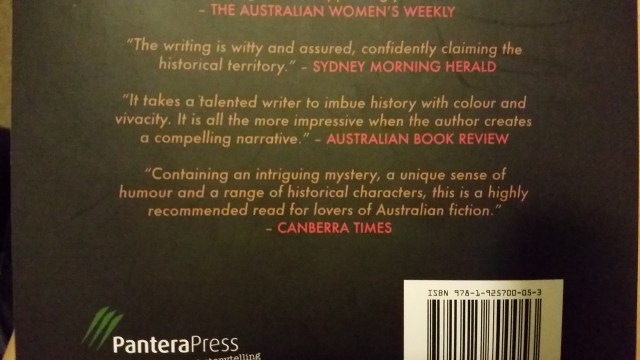
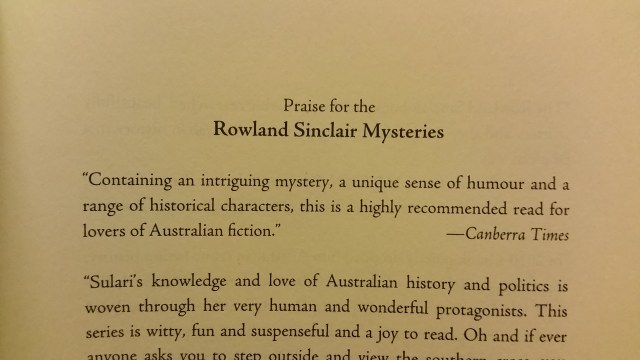
I just started reading the new Sulari Gentill book, All the Tears in China and found that both the back cover and inner page quoted one of my old reviews:

rowland sinclair previous review 2

rowland sinclair previous review

This was my review for the seventh book in the Rowland Sinclair series, Give The Devil His Due, which I reviewed back in 2015.

Pretty chuffed that my review was the top one in the inner page.

Review of All The Tears in China to appear here and in the Canberra Weekly in the next couple of weeks.

Waiting on Wednesday – A Capitol Death and Shadows of Athens

Welcome to my weekly segment, Waiting on Wednesday, where I look at upcoming books that I am planning to order and review in the next few months and which I think I will really enjoy.  Stay tuned to see reviews of these books when I get a copy of them.

Historical fiction and murder mysteries have long been blended together in order to produce some incredible and unique works of fiction over the years.  I am a huge fan of this popular genre mashup, and have personally reviewed several of these books over the last year.  Examples include one of my top books of the year, Tombland by C. J. Sansom; the incredible murder investigation set during Cromwell’s England in Destroying Angel by S. G. MacLean; and even some more contemporary historical mysteries such as Murder Mile by Lynda La Plante.  Each of these books is a lot of fun, and I find that the combination of history and mystery elements usually work together extremely well to create some incredible stories.

Some of the most intriguing examples of historical murder mysteries are set in much more ancient civilisations, such as Greece or Rome, which allow for some much more unique stories.  Examples include Steven Saylor’s Roma Sub Rosa series or Australian author Gary Corby’s The Athenian Mysteries, which are a particular favourite of mine.  With some extremely interesting releases just around the corner, this week I will be looking at two upcoming murder mystery books set in ancient times that I am extremely eager to get copies of.

A Capitol Death Cover.jpg

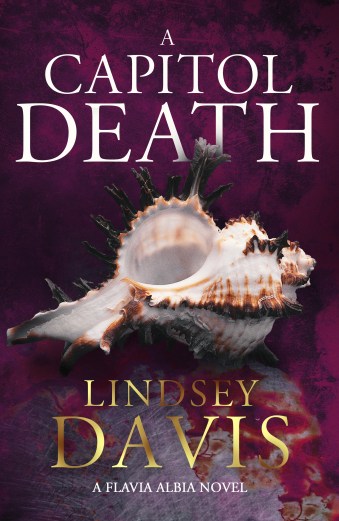
The first of these books is A Capitol Death by Lindsey Davis.  Davis has long been the gold standard of ancient historical murder mysteries, with books such as her long-running Marcus Didius Falco series and its follow-up, the Flavia Albia series, both of which contain amazing mysteries set in the heart of ancient Rome.  I have been a huge fan of the Flavia Albia series for years, and have read all six previous books in the series.  I also reviewed the sixth book in the series, Pandora’s Boy, early last year, awarding it five stars.  As a result, I have huge hopes for A Capitol Death, which will be the seventh book in the series, and based on Davis’s previous work I already know I am going to love it.

In Rome, ruled by the erratic Emperor Domitian, Flavia Albia is dragged into the worst sort of investigation—a politically charged murder—in Lindsey Davis’s next historical mystery, A Capitol Death.

A man falls to his death from the Tarpeian Rock, which overlooks the Forum in the Capitoline Hill in Ancient Rome. While it looks like a suicide, one witness swears that she saw it happen and that he was pushed. Normally, this would attract very little official notice but this man happened to be in charge of organizing the Imperial Triumphs demanded by the emperor.

The Emperor Domitian, autocratic and erratic, has decided that he deserves two Triumphs for his so-called military victories. The Triumphs are both controversial and difficult to stage because of the not-so-victorious circumstances that left them without treasure or captives to be paraded through the streets. Normally, the investigation would be under the auspices of her new(ish) husband but, worried about his stamina following a long recovery, private informer Flavia Albia, daughter of Marcus Didius Falco, steps in.

What a mistake that turns out to be. The deceased proves to have been none-too-popular, with far too many others with much to gain from his death. With the date of the Triumphs fast approaching, Flavia Albia must unravel a truly complex case of murder before danger shows up on her own doorstep.

The synopsis for the new book sounds pretty incredible, as the series’ titular investigator, Flavia Albia, steps up to investigate an intriguing new mystery.  It sounds like this investigation will dive into some political intrigue surrounding the unpopular Emperor Domitian.  Davis has combined mysteries with ancient Roman politics before, such as in the series’ fifth book, The Third Nero, and the end result was pretty spectacular.  I am hoping that Davis will continue to provide the reader with her trademark blend of powerful mysteries, amazing historical elements and outrageous humorous moments, and I am looking forward to any big comedy set pieces, such as the incredible climax to The Third Nero or the big brawl sequence in Pandora’s Boy.  The story in the previous book also hinted at the return of an old antagonist from the original Falco series, and I am looking forward to seeing if that comes into play within A Capitol Death.

Shadows of Athens Cover.jpg

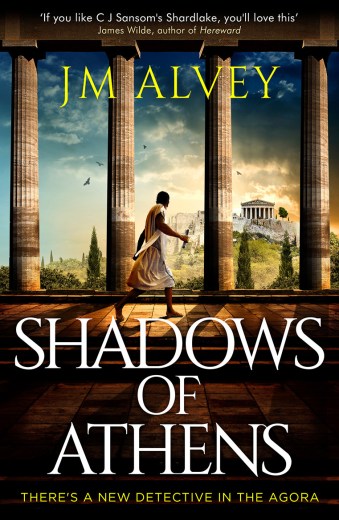
The second book that I am interested in checking out is a new mystery from debuting author J. M. Alvey.  This new book, Shadow of Athens, is set to be released in March and will take place in Athens in 443 BC.

443 BC, and, after decades of war with Persia, peace has finally come to Athens. The city is being rebuilt, and commerce and culture are flourishing.

Aspiring playwright Philocles has come home to find a man with his throat cut slumped against his front gate. Is it just a robbery gone wrong? But, if so, why didn’t the thieves take the dead man’s valuables? With the play that could make his name just days away, he must find out who this man is, why he has been murdered – and why the corpse was left in his doorway.

But Philocles soon realises he has been caught up in something far bigger, and there are those who don’t want him looking any further . . .

This sounds like it could be a really cool book read.  A murder mystery set in ancient Greece has a lot of potential, and I will be interested to see if Alvey’s book will fully explore the historical complexities of this ancient city while also producing a compelling mystery.  I liked that the protagonist of Alvey’s book will be an actual real-life Greek historical figure, in this case, the famous tragic playwright Philocles.  Placing real-life historical figures in the middle of fictional murders is always a compelling story choice, and I am really hoping that Alvey will explore this protagonist’s work as a playwright.  It also sounds like the investigation within Shadow of Athens might play into Athenian politics and will probably have something to do with the war with Persia, both of which are incredibly appealing to me and will hopefully lead to some great story developments.

In addition to the awesome-sounding premise, I have to say that I really enjoyed the striking cover art that this new book had, and I found that its eye-catching imagery really grabbed my imagination.  Shadow of Athens already has some very positive pre-reviews from some notable authors, including one of my favourite historical fiction authors at the moment, Andrew Taylor.  As a result of these endorsements, combined with the intriguing plot synopsis, Shadow of Athens is probably the historical fiction debut I am most looking forward to at the moment and I am excited to see how impressive this new author is.

As a result, I think that both of these books have a lot of potential, and could prove to be some of my favourite reads of early 2019.

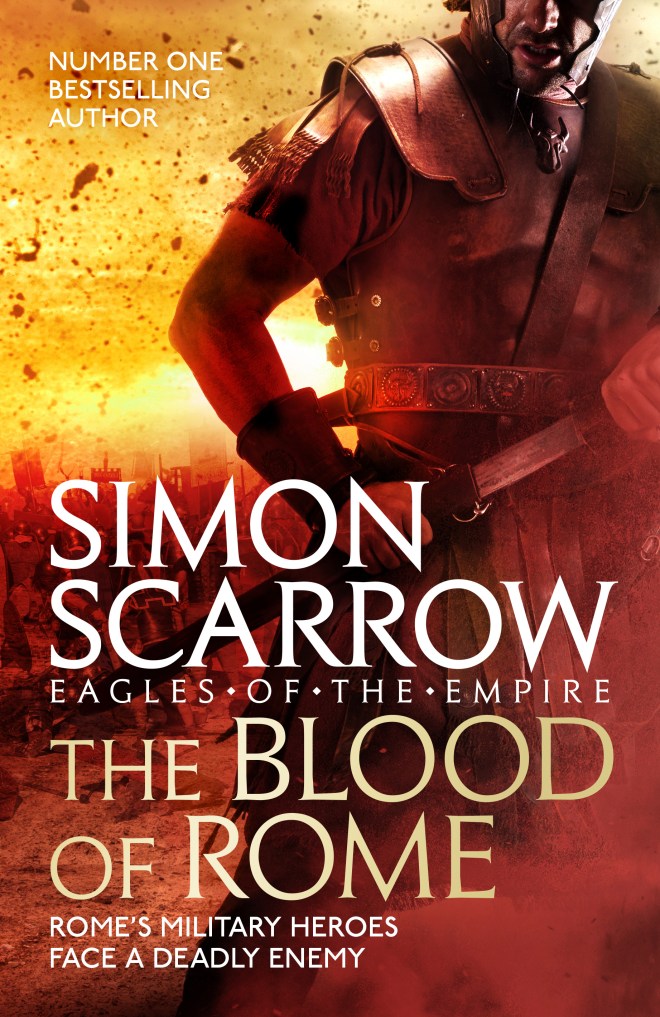
The Blood of Rome by Simon Scarrow

the blood of rome cover

Publisher: Headline

Publication Date – 13 November 2018

Amazon

One of the best and most prolific writers of Roman historical fiction, Simon Scarrow, returns with another outstanding adventure of his two Roman protagonists, Cato and Marco.

In AD 55, Nero has recently ascended to the throne, and the Roman Empire prepares itself for war with its great rival, the Parthian Empire, which sits to the east of Rome’s territories.  This recent conflict is centred on the neutral border kingdom of Armenia, which sits between the two great empires.  Years earlier, the brash Iberian prince Rhadamistus conquered Armenia and declared himself king, ruling as a terrible tyrant.  In response, a recent Parthian backed invasion routed Rhadamistus from Armenia and placed a Parthian prince on the throne.  Unwilling to let this strategic territory fall into Parthian hands, Rome sends its greatest general, Corbulo, to the east to reclaim Armenia for Rhadamistus and meet any subsequent hostilities from the Parthians.

The recently promoted Tribune Cato and his long-time companion, Centurion Marco, desperate to escape the deadly politics of Rome, lead the escort for General Corbulo.  When an early opportunity to take Armenia with minimal interference from the Parthians presents itself, the only forces that Corbulo can rely on are Cato and Marco’s elite cohort of Praetorian Guards.  Placed in command of an advance force, Cato must lead a mixed column of Romans and King Rhadamistus’s troops through unknown and hostile terrain towards Armenia’s capital.  Forced to balance his orders against the desires of the unstable Rhadamistus, Cato struggles to maintain the strength of himself and his men.  With traitors and enemies all around them, can Cato and Marco succeed, or will they find themselves killed in a strange land?

Scarrow is one of the leading authors of the historical fiction genre, whose work over the last 18 years is comparable to such established authors of the genre as Bernard Cornwell, Ben Kane or Conn Iggulden.  The Eagles of the Empire series, which started in 2000 with Scarrow’s debut, Under the Eagle, is the author’s most distinctive work, and features some superb description of Roman military action.  In addition to his main series, Scarrow has also written several other great pieces of historical fiction.  He co-wrote the Roman Arena and Invader novella series with T. J. Andrews, which are set in the same universe as the Eagles of the Empire series.  He also wrote the epic Wellington and Napoleon Quartet, also known as the Revolution Quartet, which provided an impressive examination of the opposing lives of Napoleon Bonaparte and the Duke of Wellington.  In addition to his series work, Scarrow has also written two standalone novels, The Sword and the Scimitar, which covers the siege of Malta, and Hearts of Stone, a dramatic novel set in Greece during World War II.  All of Scarrow’s novels are amazing pieces of historical fiction, and are really worth checking out if you are a fan of the genre.

The Blood of Rome is the 17th book in The Eagles of the Empire series, and follows the two protagonists’ return to Rome’s Eastern provinces for the first time since the eighth book in the series, Centurion.  I have always been a massive fan of this series and consider it to be one of the best pieces of Roman military fiction series on the market today.  After reading all of the previous books in The Eagles of the Empire series, I was particularly keen to get a copy of The Blood of Rome and eager to see where the protagonist’s latest adventure would take them.  After powering through it in a day, the result was pretty much what I expected: I loved Scarrow’s latest literary offering.  This latest book contains another fantastic historical fiction story, as the protagonists embark on an exciting campaign into an interesting new historical setting and it was great to see how the characters continue to evolve and progress in their lives.

Scarrow’s The Eagles of the Empire series has always boasted some incredible depictions of ancient Roman military combat, with most books containing several battles of varying size used to highlight the strengths and weaknesses of the Roman tactics and techniques.  This is continued in the Blood of Rome, with several battles featured throughout the book.  While most of these battles are small and quick skirmishes that differ from the traditional Roman battle sequences, the Roman soldier’s tactics and training and the effectiveness of their equipment are on full display, creating some amazing scenes.  In addition to the classic Roman legionnaires, which make up the bulk of Cato and Marco’s forces, Scarrow also focuses on the more unusual forces that the Roman’s used in combat, in the form of a cohort of auxiliary slingers, as well as a detachment of Roman siege equipment.  Both of these distinctive units get a good showing throughout the book, and both are fascinating to see in action.  The author also contains an interesting portrayal of Roman soldiers fighting side-by-side with allied troops, and it is intriguing to see the issues and advantages involved with such allies.  Overall, The Blood of Rome is another excellent example of Scarrow’s skill at portraying Roman military action sequences, and is one of the best parts of this book.

This book is also set in an extremely fascinating historical period and focuses on the rivalry between Rome and Parthia.  The continuous conflict between Rome and Parthia has always been a great literary background for many pieces of Roman historical fiction, and Scarrow has already examined it in some of his earlier books.  The conflict within The Blood of Rome continues to explore this legendary rivalry, and is an opening book in what appears to be a sequence of novels that will focus on an expanded war between the two rival nations.  This first book in this sequence looks at a rather minor opening conflict, played out as a proxy war within Armenia, but it contains a great examination of the politics at the time and the differences in battle style and tactics of the two nation’s militaries.  I really enjoyed the examination of the role of border kingdoms and provinces, such as Armenia, stuck in the middle of these two proud and ambitious empires.  The main story of The Blood of Rome, the invasion of Armenia and Rhadamistus’s attempts to claim the throne, are real pieces of history, and it was really interesting to see them utilised in this story.  All of the historical background for this book is incredibly fascinating and I had a great time reading about an amazing period of history.

The character of Rhadamistus was another intriguing addition to the book that added a whole new element to story.  Rhadamistus is a well-known historical tyrant and brutal man of ambition, and Scarrow did a good job showcasing the character’s casual cruelty and arrogance.  He was a pretty despicable character as a result, and watching the protagonists attempt to placate and counter his more ruthless actions added some dramatic twists to the story.  Scarrow examines certain parts of Rhadamistus’s life, and it was very fascinating to see his eventual fate and the role his reign as king had on the rival empires of Rome and Parthia.

I really liked Scarrow’s depiction of one of his main characters, Cato, throughout this novel.  Cato has never had an easy life, having been forced into the army at an early age, but the events of the last few books have been particularly hard on him.  As a result, certain incidents within The Blood of Rome finally push him over the edge, and it was a refreshing change of pace to see one of these usually indomitable characters show some real vulnerability.  This was a very realistic inclusion, and I thought it added some much-needed character growth to Cato.  It also served an essential story element, as his condition resulted in Cato being open to Rhadamistus’s manipulation.  This was a great part of The Blood of Rome that represents some intriguing adaptation within this long-running series.

Simon Scarrow once again produces an epic piece of historical fiction as he continues his outstanding The Eagles of the Empire series.  His long-running protagonists, Cato and Marco, are once again thrust into a fantastic historical military fiction adventure, and there are a ton of great elements for the readers to enjoy.  Another amazing outing from Scarrow, this is a highly recommended read for all fans of the historical fiction genre, as the author continues to produce some of the best Roman military fiction in the business.

My Rating:

Four and a half stars

Amazon

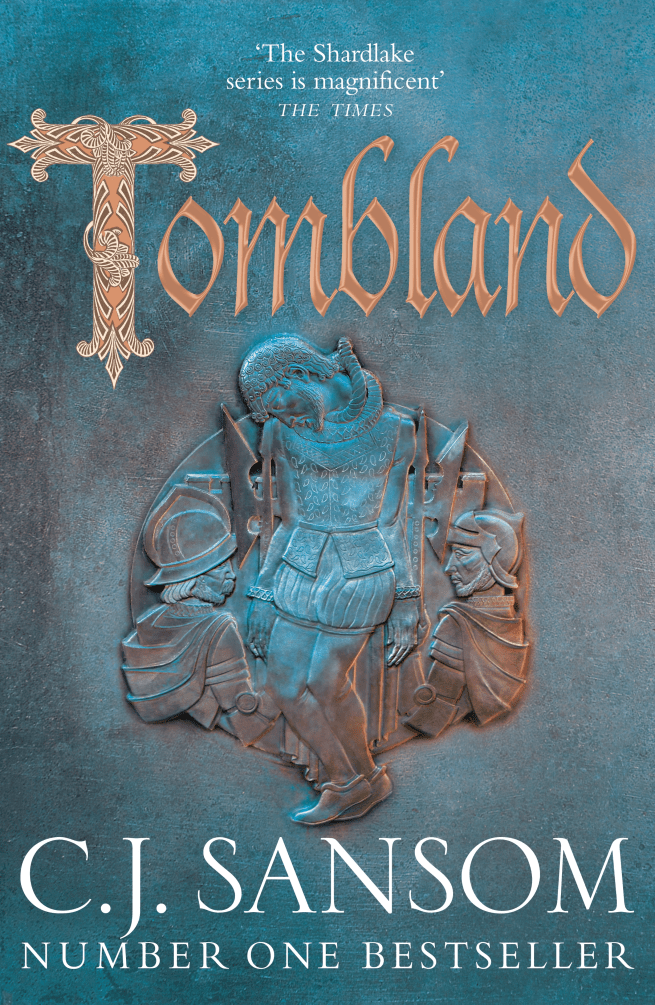
Tombland by C. J. Sansom

Tombland Cover

Publisher: Mantle

Publication Date – 18 October 2018

Amazon

One of the best historical fiction authors in the world today creates another exceptional piece of literature with Tombland, the epic historical crime fictional book set during the fictionally unexplored events of Kett’s Rebellion.

It is the summer of 1549, and King Henry VIII has been dead for two years.  The young Edward VI is on the throne, while his uncle, Edward Seymour, the Duke of Somerset, rules the country as Lord Protector.  However, the country is slowly descending into chaos as a long, unsuccessful war with Scotland, religious conflict, poverty and the corrupt actions of the rich landowners are raising discontent among England’s peasant population.

In the midst of this, Matthew Shardlake is working as a lawyer for the King’s sister, the young Lady Elizabeth.  When a distant relative of Lady Elizabeth’s mother, Anne Boleyn, is found murdered near Norwich and her husband, John Boleyn, is accused of the crime, the case could have political implications for Elizabeth.  Matthew is sent to organise a legal defence of John and to investigate whether or not he committed the crime.  Travelling with his assistant Nicholas, Matthew travels to Norwich and begins to examine the details of the case.  Meeting up with their old friend Jack Barak, the three friends are convinced of John’s innocence, but malevolent forces intervene to disrupt their defence.  As several deaths occur around Norwich, Matthew’s investigation is disrupted by events outside of his control.

A well-organised peasant rebellion erupts around the city, throwing everything into chaos.  Led by the charismatic Robert Kett, the rebels march on Norwich and set up a large camp outside the city, filled with thousands of disenfranchised peasants.  Captured by the rebels, Matthew and his companions find themselves in the midst of a dangerous and divisive situation.  Nicholas’s established views about the superiority of gentlemen sees him imprisoned, while Barak finds much in common with the peasants and their cause.  Matthew is forced to make a decision about where his loyalties lie, as Kett wishes him to assist in organising trials for the landowners they have captured.  As the rebellion drags on, Matthew finds evidence about the Boleyn murder case in the camp.  Following these leads, Matthew soon uncovers a terrible conspiracy that will not only endanger John Boleyn and his lawyers but could affect the fates of every peasant in Kett’s Rebellion.

C. J. Sansom is one of historical fiction’s most highly regarded authors, having written a series of amazing novels in the genre. His most significant body of work is the Matthew Shardlake series, which follows the titular lawyer as he finds himself forced to solve a series of elaborate mysteries during the Tudor period. All the books in this series are extremely impressive, as they all feature clever mysteries and an excellent use of the book’s historical setting.  In addition to this series, he has also written a standalone historical thriller, Winter in Madrid, as well as an alternate history novel, DominionTombland is the seventh book in the Matthew Shardlake series and Sansom’s first book since 2014, but considering the sheer amount of detail and the length of the text, this is hardly surprising.

Tombland is another epic novel from Sansom and one that I really enjoyed reading and ranked as one of my top 10 reads for 2018.  This book contains an outstanding combination of an intense and complex murder mystery and some amazing historical settings and storylines.  All of these elements are extremely amazing by themselves, but together they create one of the best reads of the year.  While I really loved this book, potential readers really need to set aside a lot of time to get through Tombland.  It has over 800 pages of story, with an additional 50 plus pages of the author’s historical notes and discussions about what events he included.  In addition, each page has such a rich amount of detail and plot that I found myself getting through this book at a lot slower pace than I usually would.  While it does take a while to get through Tombland, I personally believe it is well worth the effort, as the incredible story within had me hooked from the very first page.

This book has an intricate and powerful investigation angle, as Matthew and his associates attempt to solve a terrible murder that they believe their client has been wrongfully accused of.  The mystery part of this book is very well done and features an elaborate and intriguing solution that is slowly revealed throughout the course of the book.  Sansom introduces a significant number of potential suspects, all of whom have substantial motives to kill the victim, designed to throw the reader off the scent of the real solution.  I liked how the case continued to expand out as the book went on, as the protagonists not only attempt to solve the original murder but must also investigate several murders committed to cover up the initial acts, as well as several attempts to eliminate John Boleyn.  There are several major and surprising twists throughout the investigation, as a number of small clues and characters that at first appear minor turn out to have major implications for the overarching mystery.  The solutions to the mysteries at the end of the book reveal a dark and powerful motive that has severe consequences for several of the characters involved.  Overall, Tombland contained an outstanding central mystery, which is guaranteed to keep the reader deeply curious and engaged with this fantastic text.

One of the most interesting features of Tombland is the fact that Sansom has set it during Kett’s Rebellion of 1549.  This is a somewhat obscure piece of history that many readers might not be familiar with, but it is an incredibly fascinating event of English history.  Sansom does a masterful job of portraying the entirety of the rebellion throughout the novel and use it as a fantastic secondary storyline as the protagonists witness the beginning and end of the mystery.

Sansom does an outstanding job covering the events of this rebellion, including the events that led up it and caused the peasants to rise up against the rich landowners.  As a result, he expertly examines all the events and conditions that were making the peasants and poor of Norwich, and the rest of England, discontented with the way the country was being run.  In order to do this, a number of relevant elements are effortlessly inserted into the story and become key parts of the plot.  These elements include discussions about the poorly run war in Scotland contributing to armed deserters on the rebels’ side, talks about the political structure of the country and thoughts about the religious disagreements and schisms that were rife in the country during that period.  One of the most fascinating and significant elements that apparently led to the rebellion was the rich landowners’ focus on sheep farming and the creation of large sheep enclosures rather than the growth of traditional crops.  Before reading Tombland I would never have thought that sheep farming would have the potential to be a cause of rebellion; however, Sansom is able to explain in some significant detail how sheep farming and enclosures were negatively impacting many poorer individuals in England, and how it became a key part of Kett’s Rebellion.

In addition to covering the causes of the rebellion, Sansom’s narrative grows to cover the entire length of this intriguing event.  All sorts of elements of it are explored, and readers get an excellent idea of how the peasants were organised, what their motivations were, what sort of actions they were undertaking, how the government reacted to it and what the overall attitude of the participants was.  This was all boundlessly fascinating, and as the reader gets deeper and deeper into the book it becomes harder to put the book down as they become extremely curious about what the overall fate of this group of people was, especially after the reader gets an idea of how big the rebellion was and what sort of victories they were able to obtain.  The final results of this rebellion and the long-term impacts it had on the country are really interesting to hear about, and I had an amazing time seeing all the significant events that occurred during this underexamined historical rebellion.

As always, I was immensely impressed with the sheer amount of research that Sansom did and the historical detail that resulted from it.  Tombland includes over 50 pages of the author’s notes about the event and the conclusions he drew from his extensive research.  While these 50 pages are extremely interesting to read, the revelations about how many of the events the protagonist witnesses actually occurred were astounding, and it sounds like Sansom was able to recreate nearly every significant event of Kett’s Rebellion throughout the course of Tombland, with some necessary dramatic flourishes to create the overall story.  It was amazing how many of these events actually occurred, and how many of the secondary characters were actually real-life people who had significant impacts on the outcome of the rebellion.  Readers will also be amazed by the historical details that Sansom has included on every page of this book and will have a hard time forgetting the events of 1549 and Kett’s Rebellion.

There are several other elements I enjoyed in this book, including the seamless ways that the investigative storyline combines with the historical background of Kett’s Rebellion.  So many characters that are potential witnesses or suspects in the murders that the protagonists are investigating become key figures in the historical events that occurred around Norwich.  Suspects and witnesses are also found in the rebel camp, and I liked how the key to crime and the downfall of the rebels were both in the same place.  I also enjoyed the examination of 16th century English legal procedures and the depictions of murder trials, and found the scenes featuring them very fascinating.  The book’s focus on the divide between the rich and the poor is also a great addition to the story and gets a significant look in throughout the entire book, and it is a discussion that is still relevant to this day.

C. J. Sansom once again hits his literary ball out of the park with Tombland, another five-star historical mystery that has the perfect combination of compelling mystery and intriguing historical elements. With an incredibly addictive overall narrative and a focus on a fascinating historical event that is rarely used in other pieces of historical fiction. One of my favourite reads of 2018, I highly recommend this book, especially for people who love a great mystery.

My Rating:

Five Stars

Amazon

Dracul by Dacre Stoker and J. D. Barker

Dracul Cover

Publisher: Bantam Press

Publication Date – 2 October 2018

Amazon     Book Depository

You think you know the story of Dracula?  Prepare to have your understanding of one of history’s greatest horror novels completely turned on its head as Bram Stoker’s great-grandnephew presents a captivating new story of horror based off Bram Stoker’s notes and his original version of the iconic book.

The year is 1868, and a young Bram Stoker has barricaded himself in the top room of an abandoned abbey.  This room has crosses carved on every wall, mirrors hanging from every angle and garlic smeared around the door frame, while Bram himself is armed with roses, holy water and a rifle.  Outside the room lurks an ancient evil, its greatest desire to enter the room and claim the man waiting within.  As Bram waits for the sun to rise, he writes in his journal, desperate to describe the events that lead to this moment.

The tale he tells is an intriguing tale of horror and mystery set in the midst of 19th century Ireland.  Bram was born a sickly youth whose constant illness stopped him from leaving his bed for most of his early life.  One of the few points of comfort in his life was his nanny, Ellen Crone, who nursed him through the worst of his maladies.  Bram seemed destined for a short life, until one day a miracle occurs and Bram’s sickness is cured by the mysterious intervention of Nanny Crone.  But as Bram and his sister Matilda investigate the suspicious behaviour and abilities of Nanny Crone, she disappears, leaving behind questions about who, or what, she really was.

Years later, it appears that Ellen Crone has returned, as strange and bloody events haunt the lives of Bram, Matilda and their older brother Thornley.  As they investigate further they find that the mysterious Ellen Crone has not aged a day, is accompanied by those who died years earlier and has a strange hypnotic hold over Bram.  But even as the siblings attempt to find answers, they soon realise a far more powerful and malevolent creature is hunting in Ireland, one who will forever change the life of the Stoker family.

This is one of the most intriguing books of 2018, as it is a reimagining of the origin of one of the world’s most iconic horror novels, Dracula, which was originally published in 1897 by author Bram Stoker.  The authors of this new book are the team of established horror writer J. D. Barker, and Bram Stoker’s great-grandnephew Dacre Stoker.  This is not the first Dracula book that Dacre Stoker has had his hand in, as he also wrote the 2009 book, Dracula the Un-dead with Ian Holt, which serves as the official sequel to the original Dracula.

Dracul is a clever and compelling read that takes a deeper look at the story behind the classic horror novel.  The plot of this novel is apparently based upon Bram Stoker’s notes, journals and around 100 pages that were culled from the original draft of Dracula by his editors.  As a result, the authors of Dracul strongly hint that Bram Stoker and his family actually encountered a vampire, and that his experiences led him to publish Dracula as a warning to people about the dangers that were hidden around them and the apparent weaknesses of these creatures.  There is a great quote at the very start of this novel that the authors attribute to Bram Stoker and indicate was part of Dracula’s original preface: “I am quite convinced that there is no doubt whatever that the events here described really took place, however unbelievable and incomprehensible they might appear at first sight.”

This new novel by Stoker and Barker is an outstanding piece of fiction.  Not only is it a powerful piece of horror fiction in its own right but it has a number of clever and intriguing connections to Dracula.  The horror elements of this book are fantastic, and the authors do a great job of highlighting the dread that surrounds the protagonists as they investigate the horrors that surround them and their family.  There are a number of great scenes throughout this book where the characters encounter supernatural elements that slowly seek to drive them mad with fear or horror, and the attacks come from a variety of sources.  I have to mention the fact that the monster who inspires Dracula is particularly fearsome in Dracul and the authors really paint him as a powerful and soulless being far beyond the comprehension of the human protagonists.  I really loved the overall story of Bram and the other Stokers as they find themselves bound to this adventure at an early age and slowly encounter all the horrors around them.  There are some very clever turns throughout this book, and there are some surprising twists.  This is a great chronicle of Bram’s life and the writers even try to answer some interesting unanswered questions, like why Bram Stoker left instructions to have his body immediately cremated upon his death, an unusual custom for the time.

I really loved the way that this story is told, especially as Stoker and Barker have set large portions of this story out in a similar manner to the original Dracula novel.  Like Dracula, a large part of Dracul’s story is told in an epistolary format, featuring a series of diary entries from Bram and Thornley Stoker, as well as several letters from Matilda Stoker.  This serves to provide the reader with a large amount of backstory to the Stoker lives and show how they initially met their first vampire and the crazy events that followed them uncovering her secret.  This epistolary format is used for around the first two thirds of Dracul, and these journal entries are interlaced with short chapters set in the story’s present, with Bram stuck at the top of a tower and an evil force trying to get into him.  These scenes are particularly awesome, as they show strange forces trying to get through the door in front of Bram, while the protagonists utilise a number of techniques to force it back.  As the book continues, the reader is given a view into why Bram is up in the tower, what he is facing and the truth to everything that is happening to him, revealing a completely different story than you were expecting.  All of this is a fantastic and unique way to tell this story, and I felt it added a lot to the book, especially as the lack of knowledge about what Bram was facing in the tower at the start of the book really increased the book’s early horror elements.  These notes are also an item within the story, as the characters combine their journals together and the letters to Nanny Crone appear in a number of places that the protagonists are exploring.  At one point, the characters even arrange some of the older journals together to form a more coherent story, indicating that these journals and letters formed the basis of Bram Stoker’s original novel, and play into the idea that the events of Dracul could have actually happened.

While this book is a fantastic horror novel in its own right, fans of Dracula will appreciate how this book calls back to the original novel in a number of captivating ways.  For example, the major character of Nanny Crone has her backstory explored at one point and her real name is revealed to be Countess Dolingen of Gratz.  Fans of Stoker’s work may recognise her as a vampiric character featured in Bram Stoker’s 1914 short story, Dracula’s Guest.  While very little about this character was revealed in Dracula’s Guest, Stoker and Barker flesh her out in this book, creating a fascinating backstory for her and an interesting connection to Dracula, perhaps even explaining why she featured in Dracula’s Guest.  There are a number of other interesting features of Dracul that call back to the original novel.  For example, a large part of Dracul is set in Whitby, England, a major setting in Dracula.  I also really enjoyed the inclusion of real life historical figure Ármin Vámbéry as a major character in this book.  Vámbéry, a noted scholar and a close friend of Bram Stoker, is considered by some to be the inspiration for Professor Van Helsing in Dracula, and in Dracul he plays a similar role, understanding the threat that is before them and providing the Stokers with the tools to fight against the Vampires.  I also really appreciated the vampiric lore that Stoker and Barker put into Dracul, as the vampire characters only have the vampiric traits found around the time that Dracula was published, and not the ideas that have been included in more recent versions of the vampire legend.  As a result, Dracul comes across as an intricate and clever tribute to Dracula, which fans of the original novel will greatly appreciate.

Dacre Stoker and J. D. Barker have produced an incredibly exciting and deeply fascinating novel that breathes new life into the familiar story of Dracula.  Setting the plot around the life of a pre-Dracula Bram Stoker and his family is an amazing idea that works incredibly well to create a dark and captivating horror story.  One of the more unique books of 2018, Dracul is definitely worth checking out, especially if you have an appreciation for one of fiction’s greatest and most iconic monsters.

My Rating:

Four and a half stars

Amazon     Book Depository

Heads You Win by Jeffrey Archer

Heads You Win Cover.png

Publisher: Macmillan

Publication Date – 30 October 2018

Amazon

From the mind of one of modern fiction’s most controversial authors comes a two-in-one fantastic and elaborate piece of historical fiction that utilises an intriguing narrative device to create one of 2018’s most unique stories.

Young student Alexander Karpenko is the bright, talented and ambitious child of two hardworking citizens of the Soviet Union.  Living in Leningrad in 1968, Alexander’s dream is to become the first democratically elected president of his country.  However, when he is betrayed and his father is killed by the KGB, Alexander and his mother realise that their only hope is to flee Russia and make a new life for themselves in another country.

Arriving at the docks, Alexander and his mother are given a choice between two different ships: one heading to London or one heading to New York.  The decision is made by the flip of a coin, and Alexander’s life splits into two separate paths: one where he heads to Britain and one where he heads to America.  Alexander arrives in these countries with great ambition and a desire to succeed no matter what.

Over the next 30 years, in both these lives, Alexander finds success in a two separate ways.  He fights his way up from the bottom as a lowly immigrant to an influential person, overcoming obstacles and antagonists along the way.  Both Alexanders’ journeys are inspirational, but no matter what these two Alexanders accomplish, the fate of their home country is always on their minds, and the shadow of the Soviet Union constantly surrounds them.

Jeffrey Archer is a rather interesting individual, with a very eventful and controversial background.  A former British MP, Archer is probably better known for the various accusations of fraud he has attracted throughout his life, and he has even spent some time in jail as a result.  However, rather than let that ruin his public profile, Archer has used his experience and imagination to create a number of fascinating novels, many of which utilise aspects of his political, academic or professional life or expertise to some degree.  As a result, Archer is now one of the most high-profile authors in the world and has written over 20 adult novels, including the three books in his Kane and Abel series and the seven books in his bestselling Clifton Chronicles.  On top of that, Archer has also written a number of short stories, a couple of plays, several children’s books and his Prison Diaries, three non-fiction novels that chronicle his life in prison.

Heads You Win is an extremely fascinating novel from Archer, which takes his protagonist on two separate adventures through over 30 years of American and British history and life.  Archer utilises a very clever divergent timelines narrative device (think Sliding Doors), which creates two separate timelines around the different outcomes of one event, in this case, the outcome of a coin toss.  As a result, in one timeline, the protagonists and his mother get on a ship to London, while in another timeline they board a ship bound for New York.  This is a very interesting concept to utilise in this story, and one that works to create two separate narrative threads to follow.  Both of these storylines focus on the protagonist attempting to find his place in the country that he eventually ends up in, and then moves onto the protagonist becoming a powerful and influential individual in his own way, all the while dealing with the terrible people that seem to inhabit Archer’s world.

I rather enjoyed both of the separate storylines in this book, and had a lot of fun seeing the different or similar ways that the protagonist attempted to make his fortune in each lifetime.  The differences between these two storylines happen right away, as in the London timeline, Alexander and his mother find themselves on a nice ship with a friendly crew who mostly want to help, while the New York timeline finds them in a poorly maintained vessel with a self-serving crew who seek to exploit the two main characters.  I found it rather fascinating to see the way that their treatment and the environments they find themselves in change the way in which they act.  For example, Alexander’s experience in the English setting encourage him to seek the full Cambridge academic lifestyle, while his American counterpart was less focused on his formal education and learned more on the street.

Both of these divergent timelines feature an intriguing look at the cities and countries that the protagonists end up in, and both serve as a good historical backdrop to each of the main storylines, featuring several real historical events and some historical characters.  For example, the Alexander who ends up in the American timeline is forced to fight in the Vietnam War, while the British Alexander rubs elbows with a number of the country’s prominent politicians.  I liked how the divergent ways that the two separate protagonists gained their power and prestige matched the country that there were in.  The American Alexander became rich through his business acumen and financial brilliance, while the British Alexander went the academic route and eventually become deeply involved with the British political system, something close to the author’s heart.  Not only does this help match the locations and people that the protagonist deals with, but it allows the two separate stories to diverge out slightly, with the British storyline containing political intrigue, while the American storyline reads a little bit more like a financial thriller.  While the focus on the protagonist’s two adopted homelands is a great part of this novel, the protagonist’s history in the Soviet Union is a major part of this story.  The initial chapters capture the uncertainty and despair that inhabitants of the Soviet Union would have felt in the 1960s, while the character’s subsequent visits helped highlight the obvious differences between the Soviet Union and the countries that Alexander escaped to.  There is also a rather exciting reveal about one of the Russian characters towards the end of the book that will prove to be the most memorable part of Heads You Win, and is definitely something to look out for.

While I enjoyed the divergent timelines narrative device that Archer employed throughout Heads You Win I did feel that he could have done more with it.  I would have loved to see a bit more crossover between the two separate timelines, and, for example, see how key characters from one storyline would have fared without their Alexander in their lives.  Instead there is minimal crossover between these two separate storylines, which feels like a bit of a missed opportunity.  I am also not the biggest fan of what these quick crossovers revealed, as it strongly hinted that both storylines actually exist together at the same time, and as a result, there are two Alexanders existing in the world at the same time.  This is a bit of a weird twist, and while it does not negatively impact the vast majority of either storyline, it does result in a conclusion that some may find slightly confusing.  As a result, while this did slightly mark down my rating of Heads You Win, the split storyline concept is a fantastic and unforgettable part of this book and makes it quite a distinctive read.

This latest novel from one of the world’s most colourful professional authors is a fun, historical thrill ride that features a very unique and memorable narrative device.  With a great look at two different countries during the same historical time period and featuring two separate by similar stories of life, adversity and success, this is an extremely enjoyable novel that will appeal to a varied range of readers.  Heads You Win is definitely worth checking out, and I am planning to keep an eye out for the next read from Archer.

My Rating:

Four stars

Amazon

Waiting on Wednesday – Emperor of Rome by Robert Fabbri

Welcome to my new weekly segment, Waiting on Wednesday, where I look at upcoming books that I am planning to order and review in the next few months and which I think that I will really enjoy.  Stay tuned to see reviews of these books when I get a copy of them.

Emperor of Rome Cover.jpg

In this week’s Waiting on Wednesday review I will be looking at the ninth and final book in Robert Fabbri’s dark and wildly entertaining Vespasian series, Emperor of Rome. Emperor of Rome is currently set to be released in Australia in February 2019 and it will be one of the main historical fiction books I’ll be trying to get in the next few months. I have been a huge fan of this series for a few years now, and have been particularly impressed at how Fabbri has managed to write the nine excellent books in the series in just eight years in addition to the connected standalone novel Arminius: The Limits of Empire.

The Vespasian series follows the early life of the future Emperor, Vespasian, as he attempts to survive and prosper in a Rome ruled by a series of increasingly unstable and power-hungry Emperors.  What distinguishes the Vespasian series from all the other Roman historical fiction series is the focus on the darker and more salacious stories of ancient Rome, with some intriguing mystical elements also thrown in. These absolutely insane but in many cases very real historical stories works incredibly well with the political backstabbing and detailed Roman battle sequences to create a series of highly enjoyable and very entertaining novels.

Emperor of Rome will finally see Vespasian make his claim to the throne after years of existing in the shadow of crazy and incompetent Emperors and has a lot of potential as the final book in this series.  There are some great historical moments and events that Fabbri can mine in this final book, including the fall of Nero, the chaos of the Year of the Four Emperors and Vespasian’s final bid for power.  I am really looking forward to seeing how Fabbri uses all these events in his final book and I have high hopes that the author’s signature style will once again make this book stand out from all the other Roman historical fiction novels being released in 2019.

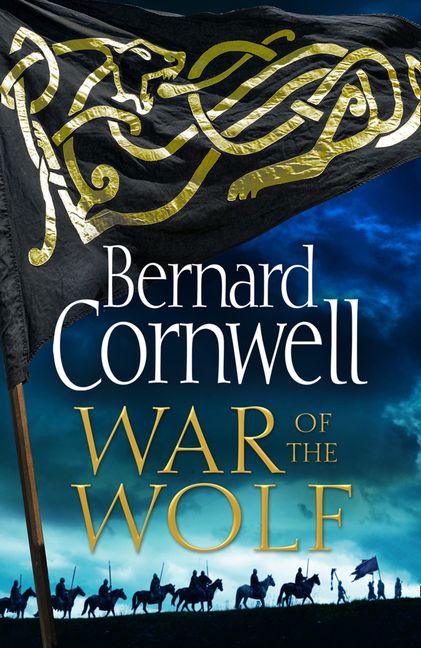
War of the Wolf by Bernard Cornwell

War of the Wolf Cover.jpg

Publisher: Harper Collins

Publication Date – 24 September 2018

Amazon

Uhtred of Bebbanburg returns in another rich historical adventure set in the heart of post-Roman Britain in this incredible and first-rate story from historical fiction legend Bernard Cornwell.

In the early 10th century, after many years of trials and tribulations, Uhtred has at last achieved his lifelong goal of reclaiming his ancestral fortress of Bebbanburg.  Finally able to claim his independence from Wessex and the Saxon Christians who have always treated him with scorn and hostility for his pagan beliefs, Uhtred seeks to move away from the politics, battles and backstabbing that has been his life for so long.  However, his new peaceful life is about to be interrupted by the interventions of enemies new and old.

In the outside world, King Edward of Wessex has made his move on the kingdom of Mercia, and has finally achieved his father’s dream of uniting the Christian kingdoms of Britain into one nation.  The only remaining country outside of his control is the Kingdom of Northumbria, ruled by Uhtred’s son in law, Sigtryggr.  These events have led to dangerous changes and new alliances for the remaining factions living outside of Edward’s control.

When a mysterious priest sends Uhtred on a mission to save Edward’s maligned firstborn son and Uhtred’s former ward, Æthelstan, from a Mercian siege, he finds himself outmanoeuvred by a new army of Danes who have come to claim Northumbria for themselves.  Faced with great loss, Uhtred finds himself in a brutal fight against an opponent who seems to have mystical powers at his command.  At the same time, the politics of the Wessex court threaten to start a war on another front, as the various contenders for the fading Edward’s throne seek to gain position, and many of the potential heirs want Uhtred dead.  With enemies all around and not enough men at his back, the odds look grim for Uhtred.  But, despite years of brutal battles and the ravages of age, Uhtred is still the most feared warrior in all of Britain, and he’s about to show everyone why he is always a force to be reckoned with.

War of the Wolf is the 11th book in The Last Kingdom series of historical fiction books from Bernard Cornwell.  To my mind, Bernard Cornwell has to be considered one of the greatest authors of historical fiction in the world today, both in the quantity of books he has written and the quality of their content.  Cornwell has been writing since 1981 and has produced more than 55 novels in his career, the vast majority of which are either set in England or focus on English characters out in the world.  The sheer scope of Cornwell’s work is incredible, as he has covered vast tracts of world history, including several more obscure eras not regularly covered by other historical fiction authors.  He is possibly best known for his long-running Richard Sharpe series, which followed the adventures of a British soldier and commander during and around the time of the Napoleonic Wars.  The Richard Sharpe series featured 24 books and was adapted into the British television series, Sharpe, featuring Sean Bean as the titular character.  Other series that Cornwell has published include the American Civil War series The Starbuck Chronicles, the Arthurian legends series The Warlord Chronicles and the Grail Quest novels, which are set during the early years of the Hundred Years’ War.  Cornwell has also produced a number of standalone novels, including several sailing based modern thrillers and a number of intriguing individual historical novels.  These standalone novels cover a huge range of different topics, from the prehistoric English story in Stonehenge, to the war novel Azincourt, the excellent examination of one of the more interesting battles of the American Revolutionary War in The Fort and the thriller set among Shakespeare’s theatre company in Fools and Mortals, which I have previously reviewed here.

The Last Kingdom series, alternatively known as the Saxon Stories, the Saxon Tales, the Warrior Chronicles or the Saxon Chronicles, started in 2004 and is Cornwell’s second–longest-running series, with 11 books currently written, and more set for the future.  The Last Kingdom series is the second of Cornwell’s series to be adapted for television, with a third season of The Last Kingdom television just starting yesterday.  I have always been a massive fan of this series, especially as one of the books in the series, Sword Song, was one of the first pieces of historical fiction I ever read and which helped get me into the genre.  This is a fantastic series, as each of the books contains an electrifying adventure set during a period of history often overlooked or underutilised by other historical fiction authors.  I have routinely reviewed several books in this series over the years, many of which will appear in future additions of my Throwback Thursday series of reviews.

War of the Wolf is another incredible outing from Cornwell that once again focuses on the life of his grizzled and battle-tested protagonist, Uhtred of Bebbanburg.  Uhtred is a superb series protagonist who has witnessed the changing political and religious landscape of this period of post-Roman Britain.  Originally a Christian Saxon, he is captured by pagan Danes as a child after the death of his father and the theft of his Uhtred’s ancestral fortress of Bebbanburg (modern day Bamburgh Castle in Northeast England) by his uncle.  Raised by the Danes, Uhtred gains an appreciation for their culture and even starts practicing their religion.  Uhtred is eventually forced into the service of the last remaining Christian kingdom of Wessex and its pious King Alfred (Alfred the Great).  Even with several falling outs between the two, Uhtred serves Alfred and his family for many years as his most ferocious warrior and war leader, participating in several of the defining battles of the era.  Throughout the series, Uhtred is constantly torn between the Christian Saxons and the invading pagan Danes.  Despite being born as a Christian in a formerly Christian kingdom, Uhtred finds more in common with the Danes after being raised by one of their noble families and taking on their religion.  While he’d rather fight alongside the Danes, circumstances force Uhtred to swear oaths of loyalty to various Saxon kings, especially Alfred, despite the hatred and disdain they show towards him for retaining his pagan faith.  These dual loyalties are a key part of the character, and often result in much internal and external conflict for Uhtred and form the basis of a number of excellent storylines.  Cornwell uses the character of Uhtred extremely well to highlight the differences between the Danes and the Saxons, as well as the importance of religion to these warring groups, especially when it comes to the somewhat insidious spread of Christianity to the Danes.

These storylines continue in War of the Wolf, as one of Uhtred’s oaths sends him into battle once again.  This sets up the main story of the new book perfectly, as Uhtred is forced to deal with the politics and betrayals of the Saxons, while also fighting against a dangerous pagan opponent.  I liked how Cornwell has continued to focus on Uhtred’s ties to the warring factions of Britain, and his attempts to reconcile his loyalties with his sense of honour and right and wrong.  I also really enjoyed the way that Cornwell has aged up his protagonists throughout the series.  Many authors will try to fit a number of adventures in to a short period of time in order to keep their protagonists in the same age range.  Cornwell, who has based many of the key occurrences of his books on real-life historical events, has instead chosen to age up his protagonist as he outlives several historical figures.  As a result, in War of the Wolf, Uhtred is no longer the young warrior he was at the start of the series, but is now an old sword in his 60s.  This is an intriguing narrative element from Cornwell, who has been slowly building up to this over the last few books in the series.  Not only has Cornwell been slowly ageing him but he’s been making him a more canny and crafty individual, able to rely on his brains and experiences more than his sword arm, although he still finds himself in the middle of every battle.  In the latest book, this leads Uhtred to think more about the future of the people he cares about than his own future, as he realises he is getting closer to death.  This is another fantastic outing featuring one of Cornwell’s best protagonists, and I am excited to see that he has left the series open for several additional stories in the future.

One of the more interesting parts of The Last Kingdom series is Cornwell’s outstanding research and his focus on historical details and events that are often not part of the public consciousness.  I can think of no better way to highlight this then to mention that while I was doing a post-Roman Britain archaeology course at university, my lecturer actually included several books from The Last Kingdom series on his suggested reading list among the usual textbooks and scholarly articles.  The previous books have all featured major battles or political events that helped decide the future of England, and his fictional point-of-view character often finds himself discussing the events with significant historical figures.  Smaller details, such as the traditional names and spellings of historical people and places, give all of these books an incredibly authentic feel and really make the reader think they are back in this time period.  As a result, these books are extremely intriguing for those fans of history and I cannot speak highly enough of the level of historical detail or insight Cornwell shows in his work.  Cornwell continues his trend of interesting historical features in War of the Wolf, as he examines several key events during this period.  This includes the annexation of the Kingdom of Mercia by King Edward of Wessex following the death of his sister Æthelflæd, the Queen of Mercia, and the subsequent rebellion by the Mercians.  There is also focus on the submission of King Sigtryggr of Northumbria to King Edward, and focuses on the events that led up to it.  Uhtred also finds himself embroiled in the politics around who would rule Sussex following the future death of Edward.  All of this is incredibly fascinating and form an amazing background for the rest of the book’s story.

Intense action sequences have always been a major part of this series, with the large-scale fight scenes between the various warring factions battling around the British countryside.  Cornwell does an excellent job replicating the battle tactics and techniques of the Saxons and the Danes, especially the standard technique of the shield wall, where the two opposing sides line up their shields and advance at each other.  The battles are always incredibly detailed and pull no punches when it comes to the gruesome realities of war and combat.  War of the Wolf in particular has quite a few great battle sequences, including one extended siege sequence towards the end of the book at an old Roman fort.  I also loved the inclusion of the úlfhéðnar, the fabled wolf berserkers, who become a major part of the story, as Uhtred and his soldiers must find a way to overcome these dangerous opponents.  It was quite interesting to see how these sorts of legendary historical fighters would actually fare in battle, and the author presents both the advantages and disadvantages of using them.  Special mention should also be given to the dual between the two opposing ‘sorcerers’ during the climactic battle that was extremely entertaining and one of the more amusing parts of the entire book.

Cornwell has once again delivered a five-star classic piece of historical fiction with the latest book in his bestselling The Last Kingdom series.  Filled with fantastic action, amazing historical context and focusing on a well-established and amazingly fleshed and complex protagonist, War of the Wolf is an incredible read that comes highly recommended.  Even after 11 books, this is still one of my favourite series and I’m very excited to get the next edition.

My Rating:

Five Stars

Amazon

The Pearl Thief by Fiona McIntosh

The Pearl Thief Cover.jpg

Publisher: Michael Joseph

Publication Date – 29 October 2018

Amazon     Book Depository

From acclaimed Australian author Fiona McIntosh comes a deep and powerful tale of loss, revenge and the traumatic shadows of World War II.

Severine Kassel is one of the Louvre’s top curators of antique jewellery and specialises in identifying pieces plundered by the Nazis during World War II.  Seconded to the British Museum in 1963, Severine maintains a careful image of mystery, distance, French elegance and control.  However, that image is shattered completely the moment Severine sets eyes on the Byzantine pearls, an incredible artefact of mysterious providence on loan to the museum.  Severine knows exactly what the pearls are and may be the only person in the world who knows their full history.  She also remembers the last time she saw them: in 1941 in the hands of the man who murdered her family, the brutal Nazi Ruda Mayek.

As she recovers from the shock of seeing the pearls again, Severine reveals to the world that she is actually Katerina Kassowicz, and her story is one of sorrow and torture.  Katerina was the daughter of a prominent Jewish family in Prague during the war.  Her family attempted to flee the Nazi purge but was betrayed by a man they considered a friend, Mayek, and only Katerina survived, although her life was never the same.

With the discovery of the pearls, it becomes apparent that Mayek may still be alive.  Desperate to hunt down the man who took everything from her, Katerina begins a desperate investigation to find him and get her revenge.  Assisted by the mysterious Daniel, a Mossad agent, Katerina’s only clue is the lawyer handling the transaction of the pearls.  As Katerina’s search intensifies, old wounds are opened and life-changing secrets are revealed.  But as she gets closer to the truth, she begins to wonder who is actually hunting who.

Australian Fiona McIntosh is a fantastic author with a diverse and intriguing bibliography to her name.  She has been writing since 2001 and initially focused on the fantasy genre with her debut book Betrayal, which formed the first book in the Trinity series.  She wrote several fantasy books over the next nine years, including The Quickening trilogy, the Percheron series and the Valisar trilogy.  During this time she also wrote several pieces of children’s fiction, including the Shapeshifter series, as well as the adult crime Jack Hawksworth series under the pen-name Lauren Crow.  In 2010, McIntosh switched to historical dramas and has written a number of these books, mostly featuring female protagonists.  Examples include the 2012 release The Lavender Keeper and last year’s epic The Tea Gardens.

 The Pearl Thief is the latest piece of historical drama from McIntosh.  It plunges the reader right into the heart of occupied Czechoslovakia and explores the horrific impacts that World War II had on the book’s main character while also providing the reader with an intense thriller in the 1960s.  Told from the point of view of several characters, the book follows an interesting format.  This first part of the book mostly follows Katerina and Daniel in Paris, and is set around Katerina telling her life story to Daniel and recounting what happened to her and her family during the war.  These flashbacks are different in style, being told from the first person perspective to highlight that Katerina is telling the story, rather than the third person perspective utilised during the rest of the book.  These flashback chapters are also visually distinctive due to the use of italicised font.  The second half of the book follows the protagonist’s hunt for Mayek, and features a different style to the first half of the book.  This different style includes the uses several more point-of-view characters, in particular the lawyer Edward, and the focus on more individualised storylines fitting into one overarching narrative.

The way that McIntosh chooses to tell this story is not only distinctive, but it is a great way to tell this dark and complex narrative.  By presenting the main character’s World War II storyline first, the author sets up just how evil the book’s antagonist is, which ups the stakes for the second half of the book as the reader is desperate to see Mayek receive the justice he deserves.  This dislike for the antagonist helps the reader stay focused on the story and makes them more eager to quickly get to the conclusion of the book to see if the protagonists succeed in catching him.  This early storyline also highlights just how damaged Katerina, and in some regards side character Daniel, really are and what impacts the war had on them.  As a result, the reader is a lot more attached to them and is keen to see how they reconcile their hatred and grief while also attempting to move past these events nearly 20 years after the end of the war.  Both parts of this book are very captivating and do a fantastic job of drawing the reader in to this deep and dramatic story.

This is a fairly grim tale and McIntosh does not pull any punches, especially when it comes to showcasing the horrors the Jewish community experienced during World War II in countries such as Czechoslovakia.  There are some very disturbing sequences throughout these flashbacks, especially when Katerina describes the final fate of her family, and the reader cannot help but feel sorrow and anger at the horror these characters and their real life historical equivalents suffered.  McIntosh focuses on the physical impacts and the persecution that these people suffered and the mental stresses and long-term emotional damage that these actions inflict both during the war and well into the 1963 storyline for the survivors.  These emotional scenes start right from the front of the book, with the first chapter showing the Kindertransport, mercy trains that got Jewish children out of Czechoslovakia and forced a permanent separation between parents and their children.  This opening scene is very emotional, and the readers are left wondering what they may have done in a similar situation.  There are also some quite dark scenes in the second half of the book, as the main characters are forced to relive the horrors they experienced and deal with the emotional fallout and the darkness they feel when it comes to Mayek.  McIntosh’s frank and grim depictions of these events turn this book into an incredible drama, and readers will be left with a memorable and emotional vision of these events.

The Pearl Thief is a deep and captivating historical drama from exceptional Australian author Fiona McIntosh.  Featuring some highly detailed and realistically dark flashback story to World War II as well as a thrilling hunt for a despicable war criminal in the 60s, this is a highly emotional and dramatic piece of literature that is well worth checking out.

My Rating:

Four stars

Amazon     Book Depository