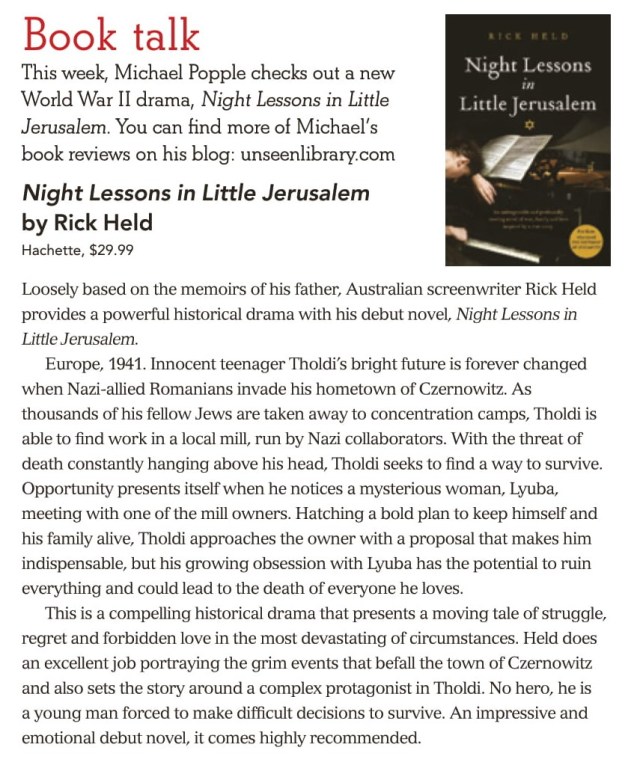
Originally published in the Canberra Weekly on 14 May 2020
The review can also be viewed on the Canberra Weekly website.
Expert reviews of the latest and the best in Fantasy, Historical Fiction, Science Fiction and Crime Fiction from an Australian reviewer.

Originally published in the Canberra Weekly on 14 May 2020
The review can also be viewed on the Canberra Weekly website.
Welcome to my weekly segment, Waiting on Wednesday, where I look at upcoming books that I am planning to order and review in the next few months and which I think I will really enjoy. I run this segment in conjunction with the Can’t-Wait Wednesday meme that is currently running at Wishful Endings. Stay tuned to see reviews of these books when I get a copy of them. For my latest Waiting on Wednesday article, I am going to take a look at two excellent sounding historical murder mysteries that are coming out later this year.
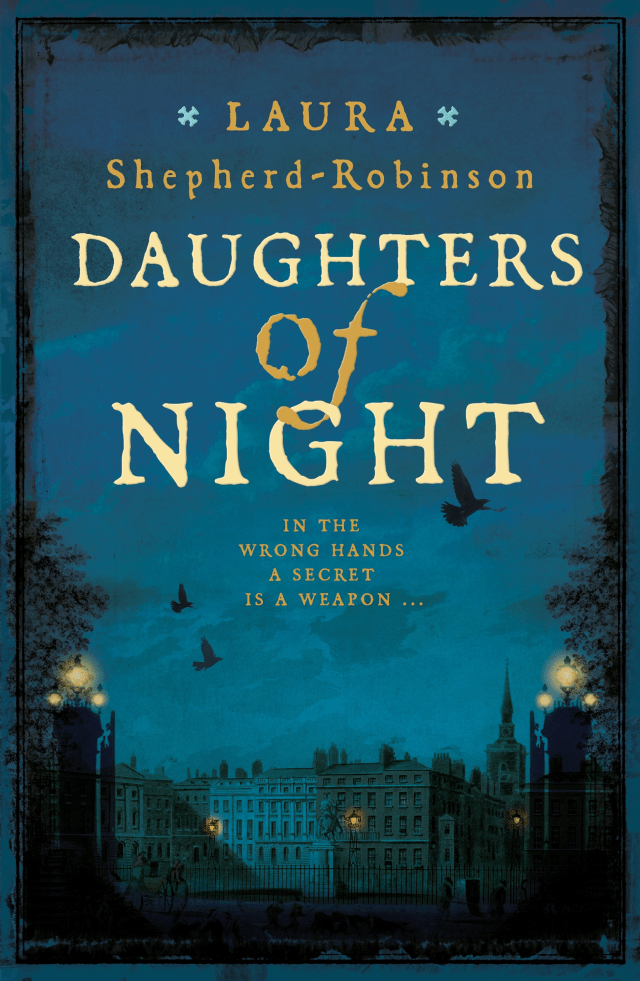
The first of these books is Daughters of Night by Laura Shepherd-Robinson, the intriguing follow-up to one of my favourite novels from last year, Blood & Sugar. Blood & Sugar was Shepherd-Robinson’s captivating and fascinating debut novel which featured a clever mystery revolving around the slave trade in late 18th century London. I really loved this fantastic book; it received a full five stars from me and it made several of my best-of lists from last year, including my favourite novels of 2019 list, my favourite debut novels of 2019 list and my favourite books from the first half of 2019 list. As a result, I am very excited to see how Shepherd-Robinson’s second book turns out and I cannot wait to see where the series goes next.
This book, Daughters of Night, will be set in the same universe as Blood & Sugar, and it is actually going to follow the wife of Blood & Sugar’s protagonist, who was a minor character in the first novel, as she attempts to solve a whole new murder.
Goodreads Synopsis:
From the brothels and gin-shops of Covent Garden to the elegant townhouses of Mayfair, Laura Shepherd-Robinson’s Daughters of Night follows Caroline Corsham, as she seeks justice for a murdered woman whom London society would rather forget . . .
Lucia’s fingers found her own. She gazed at Caro as if from a distance. Her lips parted, her words a whisper: ‘He knows.’
London, 1782. Desperate for her politician husband to return home from France, Caroline ‘Caro’ Corsham is already in a state of anxiety when she finds a well-dressed woman mortally wounded in the bowers of the Vauxhall Pleasure Gardens. The Bow Street constables are swift to act, until they discover that the deceased woman was a highly-paid prostitute, at which point they cease to care entirely. But Caro has motives of her own for wanting to see justice done, and so sets out to solve the crime herself. Enlisting the help of thieftaker, Peregrine Child, their inquiry delves into the hidden corners of Georgian society, a world of artifice, deception and secret lives.
But with many gentlemen refusing to speak about their dealings with the dead woman, and Caro’s own reputation under threat, finding the killer will be harder, and more treacherous than she can know . . .
It sounds like this upcoming book is going to contain another intriguing historical murder mystery, and I am very curious to see how this next mystery plays out. I am also looking forward to seeing how the author portrays the complex city of London and its society in this book, as I really loved the historical elements that were contained in Blood & Sugar. I have very high hopes for this novel, and I recently featured it in an article about upcoming books that I think could be five-star reads. Daughters of Night is currently set for release on 25 June 2020, and I am quite keen to get a copy of this book.
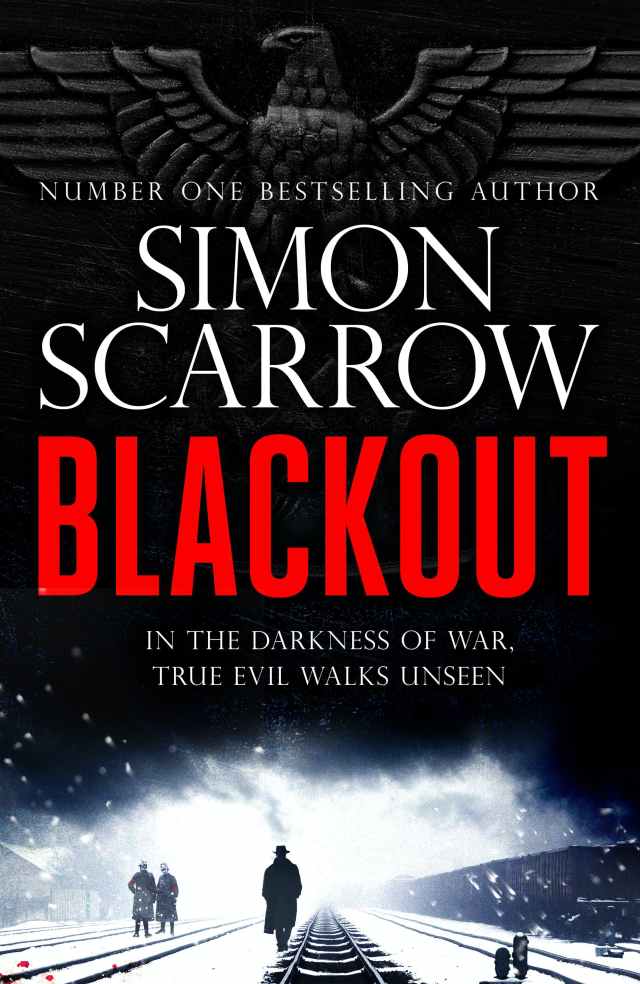
The second book that I am going look at in this article is Blackout by Simon Scarrow. I have long been a fan of Simon Scarrow, mainly because of how much I love his epic Eagles of the Empire Roman historical fiction series (make sure to check out my reviews for the 17th and 18th entries in the series). Scarrow has also produced a few other fantastic books throughout his career, including his Revolution series, several novella series and some standalone novels such as The Sword and the Scimitar and Hearts of Stone. While he also has 19th entry in his Eagles of the Empire series coming out later this year, I luckily don’t have to wait until November to get my Scarrow fix, as he has an awesome-sounding historical murder mystery coming out in August with Blackout.
Goodreads Synopsis:
Berlin, December 1939
As Germany goes to war, the Nazis tighten their terrifying grip. Paranoia in the capital is intensified by a rigidly enforced blackout that plunges the city into oppressive darkness every night, as the bleak winter sun sets.
When a young woman is found brutally murdered, Criminal Inspector Horst Schenke is under immense pressure to solve the case, swiftly. Treated with suspicion by his superiors for his failure to joining the Nazi Party, Schenke walks a perilous line – for disloyalty is a death sentence.
The discovery of a second victim confirms Schenke’s worst fears. He must uncover the truth before evil strikes again.
As the investigation takes him closer to the sinister heart of the regime, Schenke realises there is danger everywhere – and the warring factions of the Reich can be as deadly as a killer stalking the streets . . .
This also looks like it is going to be quite an excellent read, and I am really looking forward to it. I will honestly grab any Scarrow book that I can get my hands on, but this one sounds particularly intriguing. I have previously read some rather good murder mystery novels set in Nazi Germany, and I am really curious to see what sort of mystery novel Scarrow can produce with this compelling setting. Blackout sounds like it is going to be an exciting and entertaining read, and I cannot wait to check it out.
Both of these upcoming novels sound like they are going to be really impressive, and I think that they both have a lot of potential. I have had some extremely positive experiences with both these authors in the past, and I look forward to being wowed by them once again.

Publisher: Zaffre (Trade Paperback – 3 March 2020)
Series: Tom Wilde – Book Four
Length: 420 pages
My Rating: 4.5 out of 5 stars
From the mind of bestselling author Rory Clements comes another captivating historical spy thriller in Hitler’s Secret, the fourth book in Clements’s excellent Tom Wilde series.
In 1941, Hitler’s Germany is at the height of its power, with England under constant bombardment, Europe under German control and the powerful Nazi army smashing aside all resistance in Soviet Russia. At this point in history, Hitler seems unbeatable, and desperate measures are needed if the Allies are to succeed.
In Cambridge, American expat and history professor Tom Wilde attempts to do his bit for the war effort and becomes an intelligence officer. While America is still officially staying out of the war, an upcoming fight with Germany is inevitable. Wilde finds himself enlisted into a top-secret mission that could change the entire course of the war.
Smuggled into Germany under a false identity, Wilde is tasked with recovering a package and delivering it safely back to England. This package is the key to undermining Hitler’s image and influence, as it reveals a terrible secret about the Führer, one that even Hitler himself was unaware of. Trapped deep behind enemy lines, Wilde must use every trick at his disposal to complete his objective and escape the deadly forces closing in on him. However, the more he learns about his mission, the more he is convinced that this is a secret that needs to stay buried, no matter the cost, and he soon must contend not only with the Nazis but with members of his own intelligence agency.
Wow, now that was a really good historical spy thriller. Clements is a fantastic author, and I have been a fan of his for a while now. Clements started writing back in 2009 with Martyr, the first book in his John Shakespeare series of Elizabethan thrillers. I read a couple of the books in this series, and quite enjoyed the fun stories that they contained, but I really started getting into Clements’s work with the Tom Wilde series. I was lucky enough to get a copy of the first book in this series, Corpus, back in 2017, and I absolutely loved the fantastic story that it contained. I ended up sticking with the story in the following years and I managed to read and review the next two books, Nucleus and Nemesis, both of which were rather good reads. I was very happy when I received my copy of Hitler’s Secret, as I thought that the plot sounded pretty cool. It did not disappoint, as Clements has come up with a fantastic and thrilling new read that might be my favourite Tom Wilde book since Corpus.
At the heart of this book lies a truly great thriller storyline, which sees the protagonist journey into Nazi Germany in order to retrieve a special package while also contending with the interests and machinations of several different groups and nations. This turned out to be a fantastic central story element, and I loved all the action, intrigue and danger that results from this mission. Wilde and his allies end up getting hunted throughout the breadth of German occupied territory by some vile and unrepentant villains, including an insane English expat who is having a fun time living in Nazi Germany (which pretty much tells you just how evil he is). Even when Wilde reaches relative safety, he must contend with being hunted by Nazi agents while also trying to avoid supposedly friendly operatives with whom he has a moral disagreement. I loved the constant hunting and running that resulted from this awesome story concept, and the characters engage in a pretty impressive game of cat and mouse. Clements makes good use of multiple character perspectives to show the various sides of this battle of spies, and it was great to see the hunters and the hunted attempt to outwit each other. It was also interesting to see the perspective of the various antagonists, especially as Clements used these scenes to show how evil they are, ensuring that the reader is determined that they fall. All of this led to an impressive and compelling thriller story that made this book extremely hard to put down.
I have to say that I liked Clements’s choice of MacGuffin for this book, which in this case was the titular secret of Hitler. I won’t go into too much detail about what this is, although the secret is revealed rather early in the story, but I did think that it proved to be a fantastic story element. Not only does Clement use this MacGuffin as an excellent centre to his story, but it was also rather interesting to see what secret the author envisions that could have potentially taken down Hitler. Clements made a unique choice regarding that, coming up with something that could have impacted Hitler’s most fanatical base of support. I thought it was quite a clever story element, and I liked how it allowed the author to come up with a couple of exciting conspiracies with multiple sides involved. I also appreciated the moral implications that the MacGuffin inspired, and it made for some great scenes where Wilde was left to choose between the war effort and what he thought was right.
I also really enjoyed Clements’s choice of setting for this book, as most of the story takes place within Nazi Germany in 1941. Clements has come up with some excellent historical settings for the Tom Wilde series in the past, and I have always liked his central setting of Cambridge in the pre-war period, as it serves as an amazing location for the series’s espionage elements. However, I think that Clements outdid himself by setting Hitler’s Secret in Nazi Germany. This proved to be an incredible and thrilling backdrop to the story, especially as Wilde is forced to navigate vast swathes of the country to get to freedom, contending with patrols, enemy agents who are actively hunting him and even a troop of Hitler Youths. Clements does an amazing job exploring what life would have been like in Germany during this period, showing off the fear and resentment of some of the citizens, the control and surveillance that the Nazis and the Gestapo had over everyone, the brainwashing of German children at school, how the country was locked down and the growing cracks as the invasion of the Soviet Union started to stall and America began entering the war. I also really liked that Clements dived into the complex relationships and rivalries amongst the Nazi high command, especially as part of that rivalry played into the overall story. I particularly appreciated the extensive look at the role of Martin Bormann, Hitler’s secretary, who achieved great power in the Nazi regime. Bormann is a little underutilised in historical fiction, so it was fascinating to see him used in this book, and he proved to be a despicable overarching villain for the story. Clements use of Nazi Germany as a setting for Hitler’s Secret was a brilliant move, and I felt that it helped take this story to the next level.
Hitler’s Secret by Rory Clements was an outstanding fourth entry in the author’s thrilling Tom Wilde series. I loved the complex and captivating story that Clements came up with for this book, and he managed to produce an impressive historical thriller. Hitler’s Secret is a highly recommended book, and I had a wonderful and electrifying time reading it.
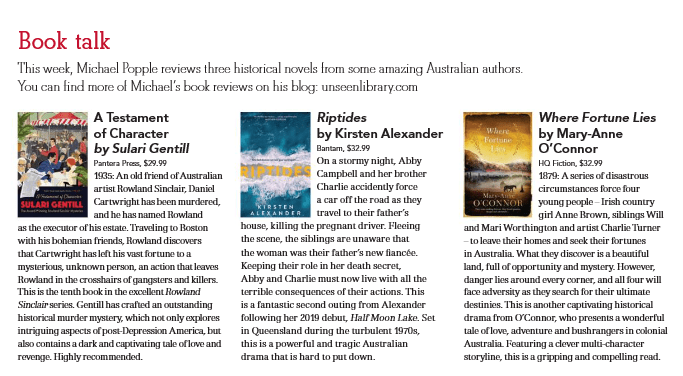
Originally published in the Canberra Weekly on 26 March 2020.
Check out the reviews on the Canberra Weekly Website.
Make sure to also read my extended reviews for A Testament of Character and Where Fortune Lies.
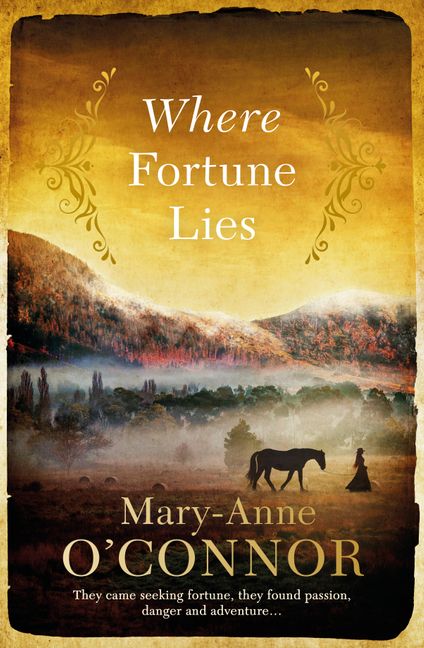
Publisher: HQ Fiction (Trade Paperback – 23 March 2020)
Series: Standalone
Length: 394 pages
My Rating: 4.25 out of 5 stars
From bestselling Australian author Mary-Anne O’Connor comes another fun and intriguing Australian historical drama, Where Fortune Lies, which tells a multi-layered story of people seeking their fortunes in colonial Australia.
1879, Ireland. Anne Brown is a beaten-down young lady, hoping to escape the harsh life of poverty and misery she sees the rest of the women in her family experience. After a particularly cruel night which sees the one good thing in her life taken away from her, Anne flees her hometown, hoping to make a new life for herself in far-flung Australia.
Several months later in London, young gentleman Will Worthington and his sister Mari are shocked to discover that their recently deceased father has changed his will. Instead of the modest inheritance they were expecting, they find that all his money has been left to a mysterious pregnant painted lady who intends to resettle in Australia. With their social standing in London destroyed, Will and Mari, along with Will’s loyal best friend, artist Charlie Turner, follow their father’s mistress to Australia to seek their fortunes.
Upon their arrival in Melbourne, Will Mari and Charlie quickly befriend local businessman Tom McIntosh and his beautiful daughter, Alice, who Will falls in love with. While Will and Mari enjoy the opportunities afforded to them in Melbourne, Charlie spends time in the Victorian Alps with Alice’s brothers, Harry and Richie, and their wild group of friends, who show him how to live the rough colonial life. While there, Charlie finds his artistic inspiration through his work with the McIntosh boys and their wild horses, as well as his love for a mysterious exotic dancer. However, danger lies on the horizon, as Harry and Richie have been covertly engaging in the deadly trade of bushranging. Soon the fates of all these young people will hang in the balance, as tough choices, dangerous loyalties and harsh heartbreaks will impact them all.
Where Fortune Lies is another fantastic read from O’Connor, who has written some exceptional historical dramas in her five-year career. I read my first Mary-Anne O’Connor book last year, In a Great Southern Land, which told an excellent story about a group of people coming to Australia in the 1850’s to participate in the gold rush and subsequent uprising at the Eureka Stockade. I quite enjoyed In a Great Southern Land and I was rather pleased that my review of it was quoted on the back of the copy of Where Fortune Lies that I received. This latest novel follows a similar concept to O’Connor’s last book, with a diverse group of characters journeying to opportunity-rich Australia in order to seek a better life, and O’Connor is once again able to weave together a rich and compelling story of love, family drama and action in the Australian wilds, and I quite enjoyed the fun blend of story elements that the author was able to come up with.
Where Fortune Lies contains a strong character-based story that follows the lives and adventures of several characters who are drawn together by fate, love and family. O’Connor does a wonderful job of introducing these key point-of-view characters, whose story the reader finds themselves getting quite attached to. I really enjoyed the way that the author spaced out the various character threads, taking the time to explore the lives of each of the separate characters. While some of the character arcs do cross over quite a bit (for example, Charlie Turner directly interacts with all the other major characters and serves as a major bridging character), other characters are kept relatively separate from each other, with only a few scenes together. However, these characters arcs still have some subtle interactions, with their actions indirectly impacting other characters’ lives, or the two characters meet or discuss each other without realising who the other person really is. I liked the method of storytelling, as it allowed the reader to get to know each character individually and see the various struggles and difficulties that they are facing, as well as how they overcome them and evolve as people. I really enjoyed each of the character arcs that O’Connor explored, and I think that all of them came to a satisfying conclusion, especially as the various threads combine together at the end of the book with all the main characters finding their final fates. Each of these character-driven storylines had a good blend of adventure, adversity, romance and drama, which I think came together extremely well as an overall narrative.
I really liked the way that O’Connor once again dived back into Australia’s past, this time looking at the turbulent 1870s, and presenting the reader with another view of the country’s iconic colonial history. Where Fortune Lies contains some fantastic examination of various parts of old-school Victoria, including the busting metropolis of Melbourne, and it was interesting to see O’Connor’s depiction of the crossing to Australia and the things that immigrants back in this period would have experienced. Most of the story, however, takes place in the rugged wilds of outback Australia, particularly in the wilderness and small towns of the Victorian Alps. O’Connor presents a fascinating exploration of these communities, and I really enjoyed her depictions of people capturing the wild horses a la The Man from Snowy River. However, the highlight of this jaunt back into history has to be the author’s focus on the bushrangers, the dangerous highwaymen who stalked the Australian outback. A good part of the book’s plot revolves around some of the characters getting involved in bushranging out of desperation or greed, and it was rather intriguing to see how society perceived these criminals. There are a number of references to real-life bushrangers, such as the Kelly Gang and Captain Thunderbolt, and I really enjoyed the parts of the book that focused on this exciting part of Australia’s history. All of this serves as an incredible background to this fun story, and I look forward to seeing what amazing part of Australia’s past O’Connor will explore in her next book.
Where Fortune Lies is another terrific Australian historical drama from O’Connor, who once again combines a captivating, character-driven narrative with an excellent depiction of Australia’s rich and vibrant history. This turned out to be an elegant and enjoyable read that features amazing romantic and dramatic plots, as well as an intriguing dive into the infamous bushrangers of Victoria. A fantastic new novel that once again sees O’Connor continues to shine as one of the most talented authors of Australian historical dramas.
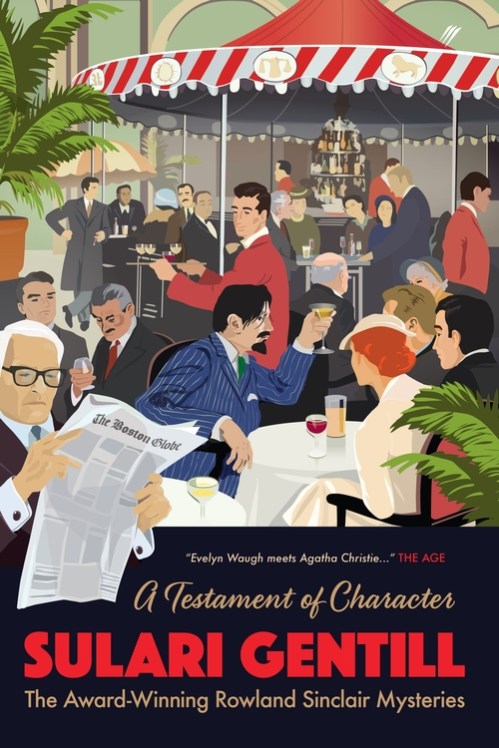
Publisher: Pantera Press (Trade Paperback – 3 March 2020)
Series: Rowland Sinclair – Book 10
Length: 337 pages
My Rating: 4.5 out of 5 stars
Acclaimed Australian author Sulari Gentill returns with the 10th book in her bestselling Rowland Sinclair series, A Testament of Character, an intense and compelling new entry which was a lot of fun to read.
Gentill is an excellent Australian author who has written several amazing books since her 2010 debut. While her main body of work is the Rowland Sinclair series, Gentill has also written The Hero trilogy, a young adult fantasy trilogy based on classic Greek stories, and the standalone novel Crossing the Lines. I am mostly familiar with her Rowland Sinclair books, however, as I have read the last several books in this series, all of which have been extremely enjoyable due to their fantastic blend of history and mystery. The Rowland Sinclair books follow the adventures of the titular Rowland Sinclair, a wealthy left-wing Australian gentleman artist, and his three artistic friends in the 1930s, as they find themselves in the middle of several murder investigations. Each Rowland Sinclair book is a fun and entertaining part of my yearly reading calendar, and I have been looking forward to checking out A Testament of Character for a while now.
In 1935, after the horrors they experienced in Shanghai, Rowland and his bohemian friends Edna, Clyde and Milton are enjoying a leisurely holiday in Singapore before heading back to Australia. However, their travel plans are dramatically changed when Rowland receives tragic news. An old friend of Rowland from his Oxford days, Daniel Cartwright, has died suddenly, and he has appointed Rowland as the executor of his vast estate.
Detouring from Australia to Cartwright’s home city of Boston, Rowland and his companions arrive for the funeral and find themselves in the midst of controversy and familiar conflict. Not only was Cartwright estranged from the rest of his family, especially his brothers, who disapproved of his lifestyle choice, but it turns out he was murdered, and the police have yet to find any suspects. Even more mysteriously, Cartwright had only just written every member of his family out of the will, leaving all his money to an unknown man everyone claims does not exist.
Determined to carry out the last wishes of his dear friend, Rowland attempts to find the man who apparently meant so much to him. However, his investigation quickly turns sour, as he runs into numerous people who do not want Cartwright’s will to come to pass. Forced to scour Boston, New York and other parts of post-Depression America for leads, the four friends encounter all manner of dangerous and eccentric characters as they pursue their quest. However, none of them are prepared for the terrible truth they encounter, especially now that Cartwright’s killer has them in their sights.
A Testament of Character is an exciting and compelling novel that proves to be a fantastic new addition to the Rowland Sinclair series. Gentill has done an amazing job coming up with another captivating story that not only features an exciting and gripping mystery but which takes an intriguing look at America in the 1930s. This story contains the series’s usual blend of fun, intrigue and action, as the four exceedingly liberal protagonists get into all manner of trouble across conservative America. There are some rather impressive and at times dark scenes throughout this book, and Gentill has also included some major character developments that will appeal to long-term readers of this series. The end result is an exceedingly enjoyable and thrilling story of love, adventure and revenge which proved extremely hard to put down.
At the heart of this book lies a clever mystery storyline that revolves around the murder of the protagonist’s friend and the identity of the mysterious beneficiary of the will. Gentill crafts an excellent multi-layered mystery, with a number of surprising twists, turns and false leads on the way to the exciting conclusion. While I was able to guess a little bit in advance who the main perpetrator turned out to be, all the revelations that came out in the final confrontation were really impressive and helped wrap up the entire mystery storyline extremely well. I also thought that Gentill came up with a very compelling and memorable motivation for the various crimes featured within the book. Some of these reveals were a bit dark and shocking, but they did make for some very dramatic and captivating sequences throughout the book. Overall, I thought that this was one of the strongest mysteries to have so far been featured within one of the Rowland Sinclair books, and it served as an amazing centre to this entire fantastic book.
One of the most distinctive features of this whole series is the way that Gentill dives into the history and culture of the period in which the books are set. She has previously done a wonderful job of exploring parts of 1930s Australia, Europe and occupied Shanghai, and in A Testament of Character Gentill’s characters explore post-Depression America. This proves to be an excellent backdrop to the book’s superb story, and I loved the examination of the key cities of Boston and New York, as well as some rural areas of the country. Gentrill provides the reader with a fantastic and at times in-depth look at various parts of the 1930s American culture and society. This is done in two distinct ways, the first of which involves the protagonists exploring America as Australians, providing an outsider’s perspective of the events or places they visit (while constantly getting complemented for speaking such good English!). The second way is through Gentill’s inclusion of historical newspaper clippings at the front of every chapter. The use of these newspaper clippings is another recurring trait of the Rowland Sinclair series, and I have always enjoyed the way in which the articles relate to some cultural or historical aspect of the chapter the clipping fronts. Through the use of these methods, the author paints an intriguing picture about America during this period, which I think worked extremely well as a background to the main mystery plot. This is especially true as some of the motives and elements of the mystery revolve around the social attitudes and cultural expectations of the time, which the reader will need to have a bit of an understanding about. I have to say that I was glad that as part of this examination of historical America, Gentill also had a look at public opinion around the Nazis and fascists in the lead up to World War II, as this has been one of the more interesting story threads to follow throughout the series.
Another distinctive aspect of the Rowland Sinclair series is the way that Gentill writes a number of historical figures into the story, either as cameos or in major roles. The best previous example of this is easily the author’s inclusion of Eric Campbell and The New Guard (an ultra-right-wing Australian organisation in the 1930s) as recurring antagonists in some of the books, as these real-life historical figures are great foils to the progressive protagonists. Gentill continues to do this in A Testament of Characters, making great use of several iconic American historical figures to flesh out the story and create several memorable inclusions. Several of these historical figures have pretty major roles in the plot, including Joseph Kennedy, F. Scott Fitzgerald and his wife and fellow author, Zelda Fitzgerald. There are also some fun cameos from several other notable people, including Errol Flynn, a young JFK, Marion Davies, Randolph Hearst and Orson Welles, as well as several other characters who were in Boston or New York during the 1930s. There are also a ton of references to other unique figures in America during this time, including the Parker Brothers Company (Monopoly was released in 1935, and the protagonists of course end up playing a game), as well as a unique goat competition that was held in Central Park, of which Gentill of course names the winner. This is an extremely fun and amusing part of A Testament of Character, and I always enjoy seeing Gentill’s protagonists run into these real-life historical figures, especially as the author does a fantastic job examining and showcasing their personalities and motivations. I love how Gentill effortlessly works these people into the plot, and the reader is always left wondering who is going to appear next.
A Testament of Character is a superb and exciting new addition to the outstanding Rowland Sinclair series that is really worth checking out. Sulari Gentill has once again produced a fantastic mystery storyline that strongly benefits from the author’s clever dive back into 1930’s history. This results in a powerful and exhilarating novel which makes amazing use of its fun, distinctive inclusions and intriguing characters. I cannot wait to see what misadventures Rowland Sinclair and his friends get up to in their next book, and this is a truly wonderful Australian series with a real unique flair to it.
Welcome to my weekly segment, Waiting on Wednesday, where I look at upcoming books that I am planning to order and review in the next few months and which I think I will really enjoy. I run this segment in conjunction with the Can’t-Wait Wednesday meme that is currently running at Wishful Endings. Stay tuned to see reviews of these books when I get a copy of them. In this week’s Waiting on Wednesday post, I check out three historical fiction novels coming out in the next couple of months that I think have an amazing amount of potential.
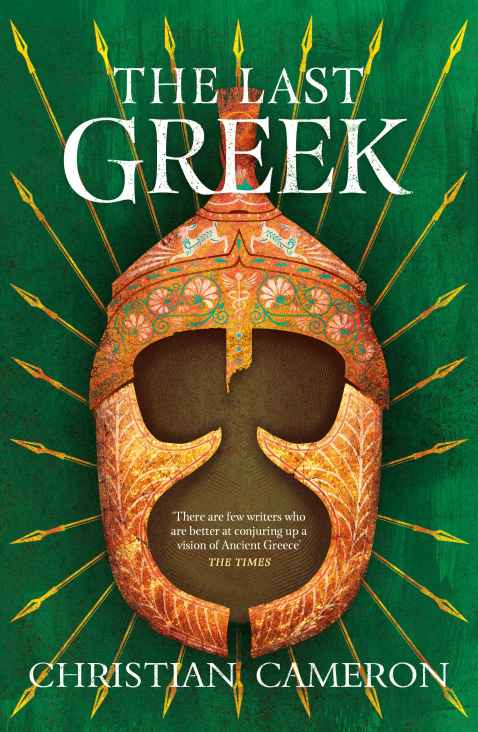
The first of these books is The Last Greek by Christian Cameron. The Last Greek will be the second book in The Commander series and it is the sequel to the 2019 release, The New Achilles. This series follows the life of an incredible and somewhat overlooked historical figure, the Greek hero Philopoemen, and the first book has already examined some of the key early events of his life. It looks like this upcoming second book will explore some of the central years of his life and should make for quite an interesting read.
Goodreads Synopsis:
211BCE. The Roman invasion from the western seas is imminent, and from the south the Spartans are burning and pillaging their way north.
Battle-hardened Philopoemen believes the Achean League is facing annihilation if it does not arm. But without a formal army or cavalry, they don’t stand a chance. Convincing his friend and healer Alexanor that the threat is real, together they begin to build a massive cavalry guard from the ground up – one that will fight on all fronts.
It is the last roll of the dice for the Achean League. But Alexanor knows Philopoemen is one of the greatest warriors Greece has ever known – the New Achilles. The Last Greek.
This is a very intriguing synopsis, and I cannot wait to see where the story goes. The historical period that this novel is set in was quite a chaotic time, with all manner of battles and wars for the control of Greece. The previous book in the series did a great job of setting up the various sides in the conflict. Cameron is quite a detail-orientated author, so The Last Greek is guaranteed to contain a well-researched and methodical novel that will accurately depict many of the key events surrounding Philopoemen’s life and present a fascinating and enjoyable historical story. This book is set for release here in Australia on 16 April, and I have already put in a request for it.

The next book I am going to look at is Execution by S. J. Parris, which is the sixth book in the Giordano Bruno series. The Giordano Bruno series by Parris (a pseudonym of writer Stephanie Merritt), is an amazing historical murder mystery/thriller series set during the reign of Queen Elizabeth. It follows its titular character, Giordano Bruno, a radical monk exiled to England, as he solves murders and helps uncover Catholic conspiracies against the Queen. I have been a fan of this series for a while, and have read several of Parris’s previous books, each of which has been extremely intriguing and captivating. As a result, I am really looking forward to getting the next book in the series, especially as it sounds like Parris has come up with a great plot for this latest novel.
Goodreads Synopsis:
England, 1586.
A TREASONOUS CONSPIRACY
Giordano Bruno returns to England to bring shocking new intelligence to Sir Francis Walsingham. A band of Catholic Englishmen are plotting to kill Queen Elizabeth and spring Mary Queen of Scots from prison to take the English throne in her place.
A DEADLY TRAP
Bruno is surprised to find that Walsingham is aware of the plot, led by the young, wealthy noble Anthony Babington, and is allowing it to progress. His hope is that Mary will put her support in writing and condemn herself to a traitor’s death.
A QUEEN IN MORTAL DANGER
Bruno is tasked with going undercover to join the conspirators. Can he stop them before he is exposed? Either way a queen will die; Bruno must make sure it is the right one.
This latest book sounds particularly compelling, and I am excited for another excellent historical thriller that explores all the intrigue and deception surrounding Mary Queen of Scots. Based on the author’s incredible work in the past, I already know that I am going to love this novel, and I am even more intrigued after reading the above synopsis. Set for release in late April 2020, Execution has the potential to be one of the best historical mysteries of the year and I am extremely keen to get a copy.

The final book in this article is Lionheart by Ben Kane. Kane is one of the top authors of historical fiction in the world today, having written several amazing Roman historical series, including The Forgotten Legion trilogy, the Hannibal series, the Spartacus series, the Eagles of Rome series and the Clash of Empires series. I have read a bit of an eclectic mix of his books in the past, including his debut novel, The Forgotten Legion, the first two books in his Eagles of Rome series and the second book in his Hannibal series, Fields of Blood. All of these have been fantastic reads, and I really enjoyed each of them.
The upcoming book, Lionheart, which is due to be released in mid-May, is Kane’s first novel not set in the Roman period. This new book is set in 12th century and will follow the early life of King Richard the Lionheart as he battles his family in order to come to power. There have been some really cool books about Richard over the years, and I am looking forward to seeing Kane’s take on the character.
Goodreads Synopsis:
1179, Henry II’s Norman conquerors have swept through England, Wales – and now Ireland.
Irish nobleman Ferdia has been imprisoned in Wales to ensure the good behaviour of his rebellious father.
But during a skirmish on a neighbouring castle, Ferdia saves the life of the man who would become one of the most legendary warriors to have ever lived: Richard Plantagenet. The Lionheart.
Taken as Richard’s squire, Ferdia crosses the Narrow Sea to resist the rebellious nobles in Aquitaine, besieging castles and fighting bloody battles with brutal frequency.
But treachery and betrayal lurk around every corner. Infuriated by his younger brother Richard’s growing reputation, Henry rebels. And Ferdia learns that the biggest threat to Richard’s life may not be a foreign army – but Richard’s own family . . .
As you can see from the above, the historical fiction genre is set to have a strong couple of months. Each of these novels sound like they can be a lot of fun, and each of them has been written by an outstandingly talented author whose works I have enjoyed in the past. As a result, I have extremely high hopes for each of these historical fiction novels, and I am incredibly excited to read all three of them.
Welcome to my weekly segment, Waiting on Wednesday, where I look at upcoming books that I am planning to order and review in the next few months and which I think I will really enjoy. I run this segment in conjunction with the Can’t-Wait Wednesday meme that is currently running at Wishful Endings. Stay tuned to see reviews of these books when I get a copy of them. For my latest Waiting on Wednesday article I take a look at two upcoming historical murder mysteries which I believe are going to be really incredible. Both of these historical mysteries have amazing-sounding plots set in the ancient Roman Empire, and they have been written by two of my current favourite historical fiction authors, Lindsey Davis and Harry Sidebottom.
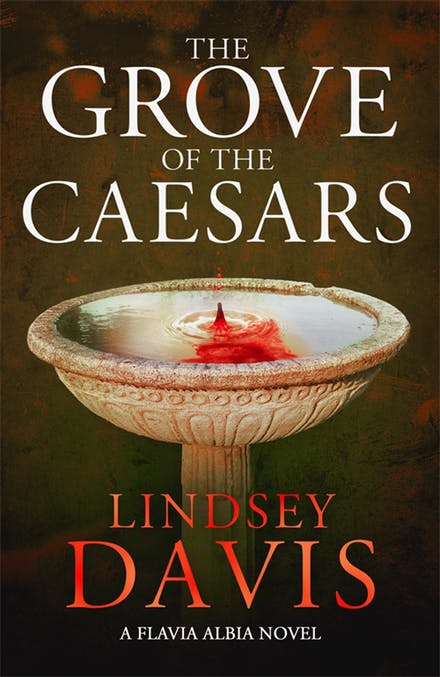
The first of the books I will be looking at is The Grove of the Caesars by legendary Roman historical fiction author Lindsey Davis. The Grove of the Caesars is set for release in early April 2020 and will be the eighth book in Davis’s Flavia Albia series, which is itself a sequel to Davis’s long-running Marcus Didius Falco series. The Flavia Albia series follows its titular protagonist as she investigates a series of murders and other crimes in ancient Rome, and is distinctive thanks to its intriguing mysteries, fantastic depictions of the city and its often humorous tone. I have long been a fan of the Flavia Albia series, having been lucky enough to receive a copy of the first entry, The Ides of April, back when it was first released. I have since gone on and read the rest of the books in this series, and I currently have reviews for the last three books in the series, The Third Nero, Pandora’s Boy and A Capitol Death, on my blog. For this upcoming book in the series, Davis has come up with another amazing sounding plot premise, which is sure to result in an excellent and enjoyable read.
Goodreads Synopsis:
Too many people tell Flavia Albia, ‘Don’t go to the Grove’. Such warnings will only lure her to the place she is warned away from, Julius Caesar’s Gardens, where she finds more than one intriguing mystery.
Someone has buried tattered scrolls here, by unreadable ancient philosophers. Hardly has she taken an interest in what looks like book collecting fraud, when far worse happens. A present evil stirs in the undergrowth. A man holds a birthday party that goes terribly wrong, exposing a long series of neglected crimes.
Albia learns that a serial killer has haunted the gardens and grove for years targeting women. It isn’t her place to investigate; that’s the job of a dubious vigiles cohort, beefed up by the sinister imperial agent, Julius Karus who she thinks is vile. But sympathy for the dead women and their grieving relatives resonates with Albia. Even if she has to work with Karus, nothing will stop her until the serial killer in the sacred grove is at last caught and brought to justice.
I really like the sound of this great book and cannot wait to get my hands on it. Not only has Davis apparently come up with an intriguing story which sets its fun protagonist against a deadly serial killer, but it looks like she will weaving some interesting historical details about Ancient Rome throughout the book. Davis has featured a number of fascinating and unique aspects about parts of ancient Rome into her books before, and I look forward to learning more about Caesar’s gardens, as well as how ancient book collecting fraud would apparently look.
Based on my previous experiences with Davis’s work, the moment I heard that there was going to be another Flavia Albia novel coming out I knew that I was going to enjoy it. This series is extremely entertaining, and I always have a great time unravelling the clever mysteries that Davis comes up with, especially as they often result in large-scale farcical fights. This new story sounds particularly fascinating, and cannot wait to see how it unfolds.
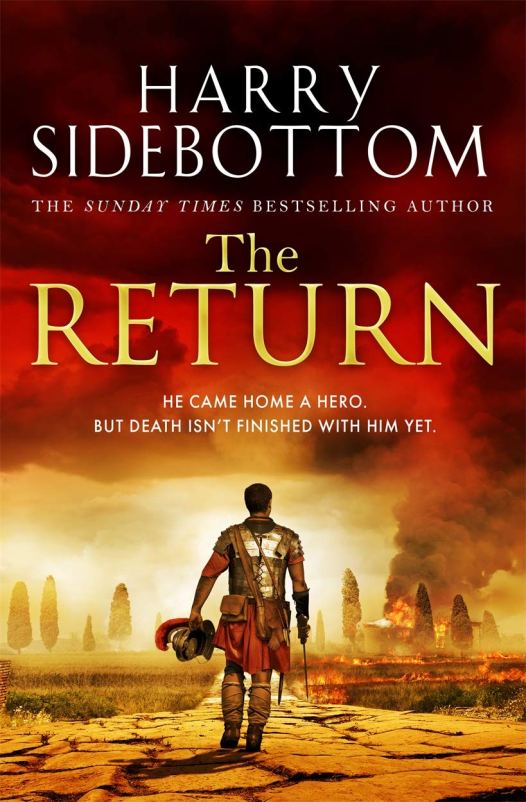
The second book is The Return, the latest novel from the innovative author Harry Sidebottom, who has been doing some cool things with the Roman historical fiction genre in the last couple of years. Sidebottom is an excellent historical fiction author who has primarily written Roman historical fiction since his debut in 2008. While I am a big fan of his original Warrior of Rome series, his most recent work has been particularly interesting to me, as he has been mixing in distinctive thriller elements to his books. This started with his 2018 release, The Last Hour, which was essentially 24 in ancient Rome as his main protagonist races against the clock to stop the assassination of his Emperor. He followed this up last year with The Lost Ten, which utilised military thriller elements to create quite a compelling story about a group of Roman soldiers infiltrating an impregnable Persian fortress. Both of these books were amazing pieces of fiction and I really enjoyed reading them. His upcoming book, The Return, sounds like it is going to be an intense and compelling read, as Sidebottom is apparently attempting to work elements usually associated with Scandi-noir fiction into this historical fiction tale.
Goodreads Synopsis:
145BC – CALABRIA, ANCIENT ROME. Gaius Furius Paullus has returned home after years of spilling blood for Rome. One of the lucky few to survive a lifetime of brutal battle, he intends to spend his remaining days working quietly on the family farm.
But it seems death has stalked Paullus from the battlefield. Just days after his arrival, bodies start appearing – murdered and mutilated. And as the deaths stack up, and panic spreads, the war hero becomes the prime suspect. After all, Paullus has killed countless enemies on the battlefield – could he have brought his habit home with him?
With the psychological effects of combat clouding every thought, Paullus must use all his soldier’s instincts to hunt the real killer. Because if they are not brought to justice soon, he may become the next victim.
The Return is set to be another amazing and intriguing read from Sidebottom, and I am looking forward to seeing how he combines historical fiction with a dark murder mystery. The whole idea of a troubled and traumatised Roman solider returning home and being forced to try and investigate a crime is pretty darn cool, especially as the after-effects of war start to have an impact on his psyche. I have to say that I am very curious about this one, and I am expecting The Return to be one of the most unique novels of 2020. The Return is due to be released in early June 2020, and I will have to make sure I get it as soon as I can.
Both of these amazing sounding upcoming books should prove to be real highlights of my early 2020 reading year. The Grove of the Caesars and The Return have some extremely awesome plot concepts behind them, and I am really excited to read the latest books from two of top historical fiction authors in the world today.
Publisher: Corvus (Hardcover – 3 December 2019)
Series: Crossroads Brotherhood – Collected Edition
Length: 369 pages
My Rating: 4.5 stars out of 5 stars
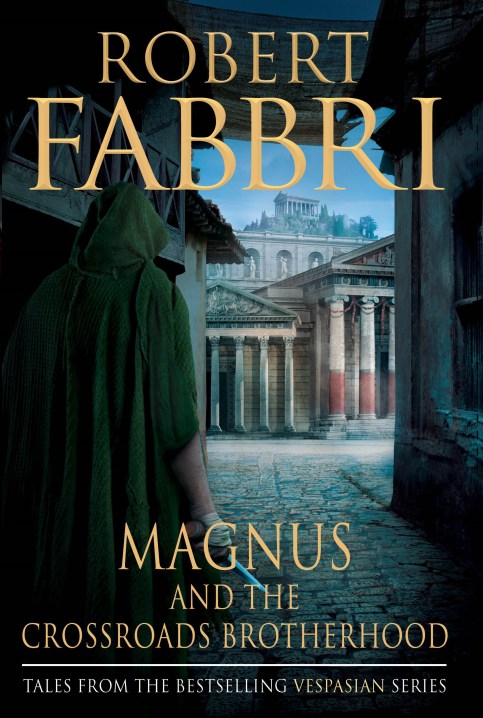
From the mind of one of the most entertaining authors of historical fiction, Robert Fabbri, comes Magnus and the Crossroads Brotherhood, a superb collection of fun and exciting short stories set in the same universe as Fabbri’s bestselling Vespasian series.
Over the last couple of years, Fabbri’s Vespasian series has been one of my absolute favourite historical fiction series out there, so much so that Fabbri is now one of those authors whose works I will automatically buy, no questions asked. The Vespasian books, which ran between 2011 and 2019, examined the life story of the titular character, Vespasian, and showed the events that eventually led to him becoming emperor of Rome. Fabbri utilised a mixture of historical facts and a number of fictionalised potential adventures to tell an entertaining story which also mixed in some of the wildest and most over-the-top recorded tales of ancient Rome and its Emperors. This series featured a huge cast of figures from Roman history and it also made use of several fictional characters of Fabbri’s own design to move the story along. While the books featured several great fictional characters, the most significant of these was Magnus.
Marcus Salvius Magnus, mostly referred to as Magnus in the series, was Vespasian’s best friend, confidant and fixer throughout the series and was at his side for most of the wild adventures Vespasian found himself on. Magnus was the leader of the South Quirinal Crossroads Brotherhood, one of the major criminal gangs in ancient Rome, but he also worked for his patron, Vespasian’s uncle, Gaius Vespasius Pollo, and helped him and his nephews rise politically. Magnus appeared in all nine Vespasian books and was a major part of the series. Fabbri evidently enjoyed featuring him in his stories as he was also used as the protagonist of the Crossroads Brotherhood series of novellas, which featured six separate novellas released between 2011 and 2018.
Magnus and the Crossroads Brotherhood is the first full collection of the six Crossroads Brotherhood novellas, which follow the adventures of Magnus and his brethren as they navigate the dangerous criminal underbelly of ancient Rome. Set out in chronological order across several points in the Vespasian series (which was set over the course of 40-plus years), these various short stories each feature a different criminal enterprise, including fixing a chariot race, manipulating an arms dealer, and property speculation, all whilst trying to stay on top of the city’s rival criminal organisations and surviving the crazy whims of Rome’s rulers.
This was a fun and exciting book that I really enjoyed, and I am exceptionally glad that I was able to read all these great novellas inside a single book. Fabbri has produced some truly entertaining tales which not only tie in with and close up some gaps in the Vespasian series but also provide a much more in-depth look at one of the series’ more amusing characters and the criminal undertakings he was getting up to in ancient Rome.
The featured novellas were a lot of fun to read, and I really liked the clever and fast-paced stories contained within them. Fabbri did an exceptional job of using the short story format to introduce and conclude a compelling tale as this book features some absolute rippers, each of which is around 60 pages long. The author has come up with some very intriguing scenarios for each of these short stories, all of which follow Magnus as he embarks on a new scheme or implements elaborate and at times brutal plans to gain power and wealth and address some form of threat to his criminal organisation. The sheer variety of criminal enterprises that Fabbri came up with is very impressive, and I enjoyed seeing how the author imagined Roman politics and crime would have intersected. I also liked how some of the crimes that the protagonists engaged in had a more modern flair to them, such as engaging in the lucrative opium trade. Out of all of these short stories, I think my favourite was the second one featured in this book, The Racing Factions. The Racing Factions followed Magnus as he attempted to fix a chariot race, to not only make himself and his associates a lot of money but also get revenge on a crooked bookie who foolishly tried to cheat Magnus out of his winnings. This story was filled with all manner of double-crosses, plotting, manipulations and intrigue, as Magnus put all the pieces into place for his revenge, resulting in a chaotic and entertaining story that can be quickly read in a short period of time. While The Racing Factions was my favourite short story, there were honestly no weak links in this book, and I loved every novella that was included, especially as I was able to easily read their entire stories in a single session each.
While each of the novellas can easily be enjoyed as standalone stories, there are some real benefits to reading all of them within this collected edition. The main advantage is that the reader gets to see each of the stories progress in chronological order over the course of many years. This allows us to see how Magnus slowly evolves over the years, becoming more devious as he ages, and it is interesting to see what happens to the various side characters in the novellas. While some of Magnus’s companions age with their leader and seem ready to retire with him, you also get to see the rise of Magnus’s successor, Tigran. Tigran is introduced in the first novel as a street urchin, and he rises up the ranks each story, eventually becoming a viable contender for Magnus’s throne. The slowly building tension between Magnus and the ambitious Tigran is quite intriguing, and it makes for a really fun confrontation in the final book. I also liked how having all the novellas in one place allowed Fabbri to showcase the continued street war between the South Quirinal Crossroads Brotherhood and their rivals the West Viminal Brethren. The West Viminal Brethren make several plays for Magnus’s interests throughout the course of the books, and many of the criminal plans featured where Magnus’s destructive retaliation, which caused some real trouble for the West Viminal Brethren and their leader.
While the character of Vespasian only briefly appears in a couple of stories within Magnus and the Crossroads Brotherhood, this book has some major connections to the Vespasian series. While each of these novellas has their own self-contained adventures, one of the main reasons they were written was to help fill in the gaps between the various Vespasian books. As a result, some of the novellas provide background on how Vespasian or his brother came to be in some key position of power or unique place at the start of certain books within the series. There were also some examinations of how Magnus was able to readily come up with key ideas that were later used in the main books, such as how he came up with a certain inventive murder technique that was necessary to eventually eliminate one of Vespasian’s opponents. These novellas also helped explain the reasons why Magnus was often away from Rome in the company of Vespasian rather than staying in the city running his criminal brotherhood. Through short introductions that appear in front of each novella featured in this book, Fabbri explains the context of each of these and details what gaps he was trying to fill. This of course means that Magnus and the Crossroads Brotherhood is going to hold a lot more appeal to those readers who are already familiar with the Vespasian series, especially as they will have a much better appreciation for each of these novella’s backgrounds. That being said, no knowledge of any of the Vespasian books is really required to enjoy the fun stories contained within this collected edition, and Magnus and the Crossroads Brotherhood would actually be a fantastic introduction to Fabbri’s excellent historical fiction series.
I quite enjoyed the intriguing snapshots of ancient Rome that Fabbri included in each of the novellas. There are some truly fascinating aspects of Roman life explored in this book, from the popularity of the chariot races for all levels of society, the various forms of law enforcement patrolling the streets, the role criminal organisations may have played and many other cool historical elements. I personally really liked how most of the stories were centred on some form of ancient Roman festival or celebration. There are some obscure and weird festivals occurring here, from one celebration that sees organised mobs from the various neighbourhoods fight over the head of a sacrificed horse, to another festival where the Rome’s dogs are brutally punished for failing to stop an ancient invasion of the city. These prove to be distinctive and interesting backdrops for several of the stories, especially as the protagonist uses several elements of these celebrations in his schemes, in often entertaining ways. As a result, this is a great read for fans of ancient Roman fiction, and I guarantee you will find some intriguing and entertaining portrays of Roman culture and society in this book.
Magnus and the Crossroads Brotherhood is a fantastic new addition from the amazing Robert Fabbri, which proved to be an exceedingly entertaining book. I really loved being able to read all of these excellent novellas in one place and I deeply enjoyed every one of their exciting and captivating stories. This is a perfect companion piece to Fabbri’s outstanding Vespasian series, and there is quite a lot to love about this collection of fun novellas. Compelling pieces of fiction like this is one of the main reasons why Fabbri is one of my favourite historical fiction authors at the moment, and I cannot wait to get my hands on his upcoming book, To the Strongest.
Publisher: Headline (Trade Paperback – 12 November 2019)
Series: Eagles of the Empire – Book 18
Length: 447 pages
My Rating: 4.5 out of 5 stars
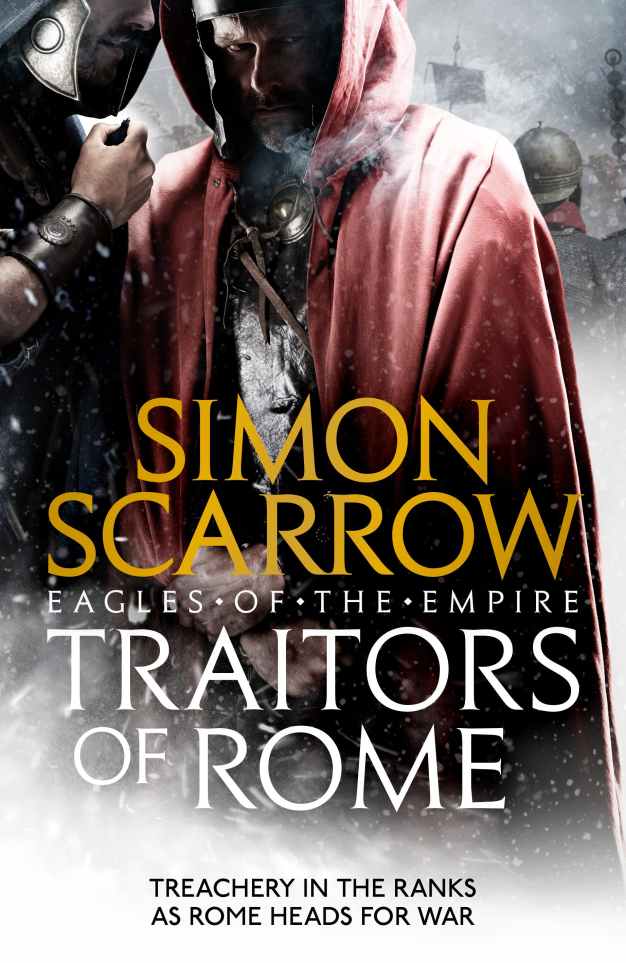
From one of my favourite historical fiction authors, Simon Scarrow, comes the 18th book in his long-running Eagles of the Empire series, Traitors of Rome, which once again sends his protagonists, Cato and Marco, into another dangerous scenario against Rome’s enemies. This is another of Scarrow’s books I have really been looking forward to, especially after enjoying the previous entry in the series, The Blood of Rome.
In AD 56, Rome and its great eastern rival, Parthia, are on the brink of war. Both the Roman Emperor Nero and Parthia’s king, Vologases, are in need of a great victory to fully secure their rule, and Rome’s territory has already begun to experience raids from a Parthian noble. Into this chaos Tribune Cato and Centurion Marco have been sent. Leading a cohort of Praetorian Guards, Cato and Marco have been assigned to serve under General Corbulo, who has gathered a force of over 20,000 Roman soldiers to fight against the Parthians. Unfortunately, most of the men under his command are badly trained and ill-prepared for battle, and Corbulo is desperate for more time to get them into shape.
To that end, he orders Cato to lead an embassy into Parthia to negotiate a peace treaty with Vologase. This embassy’s purpose is to delay the Parthian offensive long enough for Corbulo to finalise his preparations. Leading a small group of soldiers and accompanied by one of the general’s agents, Cato makes his way into Parthia, beset by raiders and pirates, with an uncertain reception from Vologase and his nobles awaiting him.
At the same time, the small kingdom of Thapsis on the border near Parthia has risen in revolt against Roman rule. Determined to swiftly end the revolt Corbulo leads a force to retake the kingdom with Marco at his side. However, what was initially believed to be an easy victory quickly turns into an arduous campaign as the Romans encounter heavy resistance. Worse, the harsh conditions and the even harsher discipline of Corbulo soon begin to wear on the soldier’s morale and loyalty. As Cato and Marco attempt to succeed in their missions, both officers are beset by unexpected setbacks and suspicious activities. It soon becomes apparent that a Parthian spy has infiltrated the Romans and is sabotaging their efforts and stoking a mutiny amongst the Roman ranks. Can Cato and Marco catch them before it is too late, or will this be their final mission?
This latest book from Scarrow is a fantastic and enjoyable read which features a cool new story with some unique and intriguing elements to it. I really like where Scarrow took the plot in Traitors of Rome, as he utilises two separate but equally enjoyable storylines by splitting up the two protagonists and sending them on separate missions. Both of the storylines are fairly different from each other, with Marco’s storyline being the more classic Roman military operation, while Cato’s storyline features a clandestine operation behind enemy lines with major political and espionage ramifications to it. This makes for a more complex narrative, but I found that the two different storylines worked very well together, and I really enjoyed seeing both of these plots progress. Scarrow does a good job of splitting the book between these two thrilling adventures and both of these storylines are a lot of fun.
I like some of the different elements that Scarrow featured in this fantastic, action-packed story. For example, the Cato plot had a really good team-up between Cato and the mysterious “clerk” Apollonius of Perga, a shrewd and ruthless agent of the general who lives to be mysterious and who Cato does not know if he can trust. Their relationship eventually evolves into grudging mutual respect, especially after they are forced to escape from Parthia in a great part of the book which sees them pursued by the army and other opportunists across the land. The Marco plot is also really intriguing, as it focuses on the difficult campaign to conquer Thapsis and the resultant hardships faced by the Romans when their supply lines are broken. This devolves into a messy situation where the men are fast losing their morale and General Corbulo’s harsh and unjust punishments to maintain military order and discipline start to push them in the direction of a mutiny. How this whole situation breaks down over the course of the campaign is rather fascinating, and of course Marco is caught in the middle of it. These two separate storylines come together in a great way towards the end of the book, and it looks like the series will be going in a new direction for the next book.
As always, Scarrow is a master of writing excellent historical action sequences, and after 18 books his depictions of Roman military combat have gotten pretty darn good. There are a few large-scale battle scenes throughout this book which show off Roman close-combat fighting, and the reader gets to see several other Roman battle strategies put into play. There are also several smaller-scale fights, especially in the Cato storyline, where Cato and his men face off against a more disparate array of opponents, from Parthian patrols to pirates. All of these action sequences are really well written and provide the reader with all their required excitement and thrills.
Overall, Traitors of Rome was another fantastic addition to Scarrow’s outstanding Eagles of the Empire series. Scarrow has produced another intense and exciting adventure story which goes in some cool new directions and once again puts his likeable protagonists in the middle of some major conflicts with their lives on the line. This is still one of my favourite historical fiction series of all time and is probably the best long-running Roman military sagas out there. It does feel like this series is starting to wrap up, especially as Marco gets married in this book and starts talking about retirement; however, this might be some sort of prelude to a great tragedy that keeps him in the army. Still, I am very much looking forward to the next book in the series, and I cannot wait to see where the story goes next.
 The Unseen Library