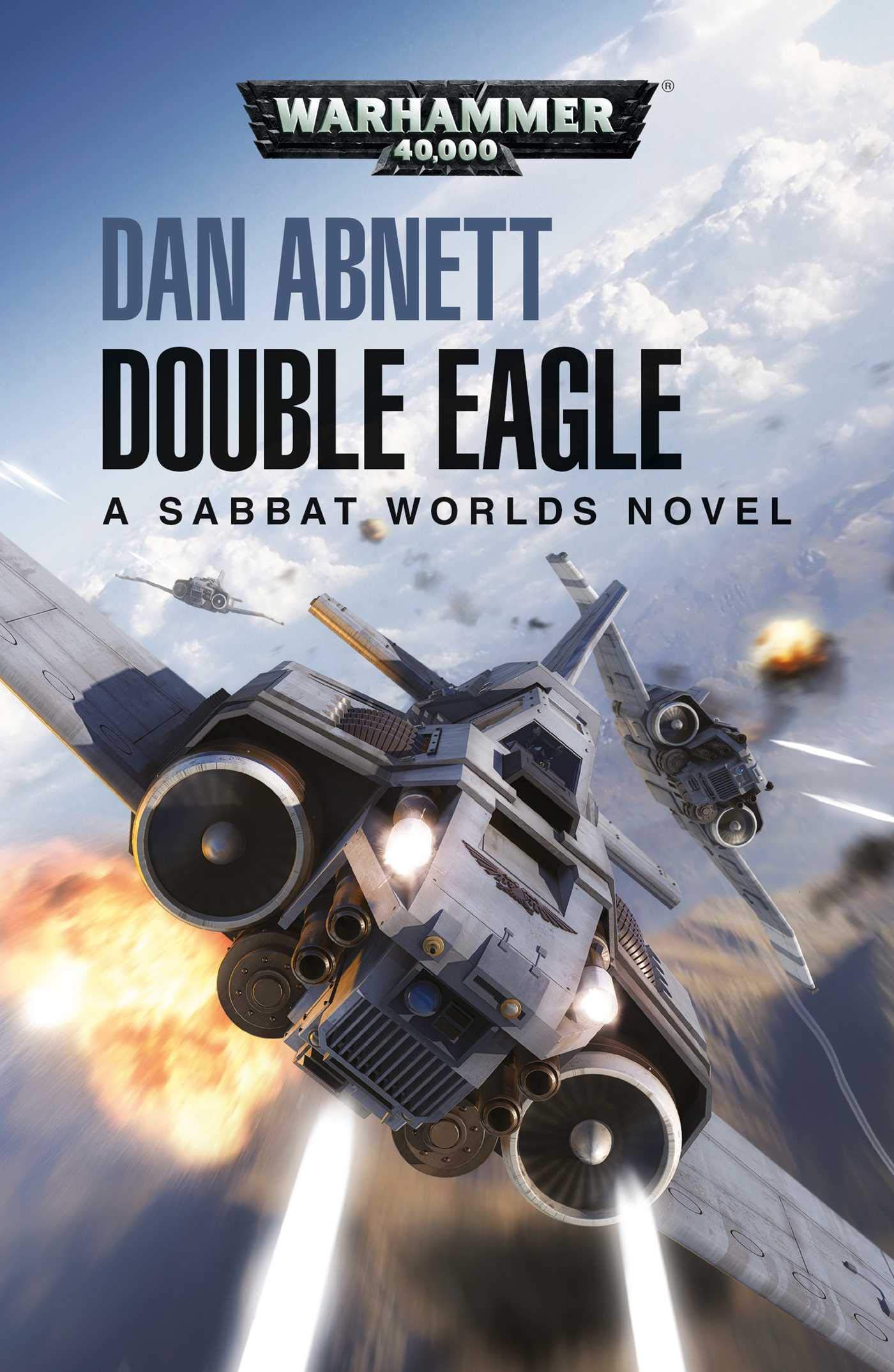
Warhammer 40,000: Double Eagle by Dan Abnett

Publisher: Black Library (Audiobook – 1 January 2004)

Series: Warhammer 40,000/Sabbat Worlds

Length: 10 hours and 16 minutes

My Rating: 5 out of 5 stars

Amazon

The master of Warhammer fiction, Dan Abnett, takes to the skies with the deeply addictive and ultra epic fighter pilot novel Double Eagle.

Readers familiar with this blog will know that I have been extremely damn obsessed with Warhammer fiction the last couple of years, having spent a substantial amount of time reading and reviewing numerous books from the franchise.  Of the many Warhammer fiction authors I have read during this period, one of the most impressive is the legendary Dan Abnett, who has written so many exceptional and powerful books around the franchise, including several series considered to be the seminal texts of the extended universe.  I have had a ton of fun with many of his books, including his brilliant Eisenhorn trilogy (Xenos, Malleus and Hereticus), and he has multiple entries in my current favourite Warhammer 40,000 books list.  However, his best-known series is the iconic Gaunt’s Ghosts books, which I am currently in the middle of reading.

The Gaunt’s Ghosts books are a beloved and key series of Warhammer 40,000 fiction that seeks to give readers a moving look at the lives of the frontline human soldier in this grimdark universe.  Set in an extended, multi-planet campaign, known as the Sabbat Worlds Crusade, the Gaunt’s Ghosts books follow a ragged regiment of soldiers as they attempt to survive the dark servants of Chaos coming for them.  I am having an exceptional time reading the Gaunt’s Ghosts series, and in 2024 alone I have read two particularly epic entries, Straight Silver and Sabbat Martyr.  However, before I dive any further into the series, I decided to read the spin-off novel, Double Eagle, which I have had on my to-read list for a while now.  Double Eagle was an interesting and unique novel that follows members of an airmen wing who were introduced in the fifth Gaunt’s Ghosts book, The Guns of Tanith.  Set after their mission with the Ghosts, Double Eagle follows these pilots, including a few characters from The Guns of Tanith, in a brutal new campaign.

War has engulfed the Sabbat World system as the forces of the Imperium of Man attempt to reclaim multiple worlds invaded by the forces of Chaos.  After years of fighting, the Imperium’s crusade has reached a tipping point, with victory or defeat for the entire campaign hanging on the results of a few key battles.  While the fighting is fierce throughout the system, nowhere is it more desperate than the beleaguered world of Enothis.

After failing to conquer the Chaos footholds on Enothis, the infantry and armoured forces of the Imperium are in full retreat, attempting to traverse miles of hostile terrain to return to safe territory, all while being harassed by relentless enemy aircraft.  With the fate of the planet in the balance, the commanders of the crusade deploy multiple squadrons of Imperial fighters and bombers to Enothis to turn the entire conflict into an air war.  If the Imperial pilots can hold back the advancing tides of Chaos and allow the ground forces to regroup the war for Enothis may be won.  But if the airmen fail, then Enothis and the entire Sabbat Worlds campaign is doomed.

Amongst the pilots sent to Enothis are the elite flyers of the Phantine Air Corps.  Veterans from the recent war to liberate their home planet of Phantine, the pilots of the Phantine Air Corps are determined to do their bit in this new conflict.  But the battle for Enothis will be unlike anything seen before, as thousands of Chaos aircraft descend on the planet, hoping to obliterate the defenders.  Severely outnumbered, can even the dogged Phantine pilots hold back the approaching tide of dark air machines before the planet is conquered, especially with an unnaturally skilled Chaos ace stalking the skies, determined to bring every opposing pilot down in flames?

Just when I think that Dan Abnett couldn’t impress me even more, I go and read Double Eagle.  A brilliant, intense, and exceptionally well-written novel that focuses on a particularly cool aspect of the Warhammer universe, Double Eagle blew me away with its great characters and elaborate air combat sequences.  I had an incredible time with Double Eagle, and it gets an easy five-star rating from me.

I deeply, deeply enjoyed Double Eagle, as Abnett took the brief of a Battle of Britain-inspired Warhammer 40,000 story and applied his usual impressively detailed style and powerful character-driven storytelling to produce an outstanding and addictive read.  Perfectly spinning off from the previous Gaunt’s Ghosts books and bringing the reader to another adventure in the expansive Sabbat World Crusades, Double Eagle has a brilliant narrative loaded with action that goes hard and fast for your feels and refuses to let go once it has you firmly in your grasp.

Double Eagle starts off quickly, getting the reader across the brutal new campaign and the importance of the aerial war that emerges, you are soon introduced to multiple characters and shown some initial awesome sequences with some explosive dogfights.  From there the story moves at a fast but smart pace, as you follow several distinctive and often overlapping character arcs throughout the length of the brutal campaign on Enothis.  You really get dragged into each major protagonist’s story as they attempt to survive the flying war.  There are some excellent battle scenes in this first half of the book and Abnett really shows how epic he can make a fighter pilot dogfight very early on.  The characters each experience some highs and lows in the first half of the book, and it doesn’t take you long to get attached the protagonists and their complex personal tales within the confines of the main story.

However, it is the second half of the book where everything comes together perfectly.  Each of the protagonists experience some version of personal loss or difficulty, and the impact of the war slowly drains them, taking them to some dark places.  Abnett sets up a brilliant underdog narrative around the protagonists, as the massive fleet of Chaos airships seek to crush them.  You can really see the parallels between this narrative and the Battle for Britain at this point, especially as the tired and severely outnumbered Phantine fighters and their local allies attempt to hold back the overwhelming and often Germanic-inspired forces coming for them.  Everything leads up to a massive final confrontation, as the protagonists engage in a series of brutal and drawn-out dogfights and aerial confrontations as we lead up to the finale.  While a couple of the character arcs leading up to this are a tad unsurprising, the way that Abnett writes them makes you love every second it.  The author brings everything to an epic close with continued and captivating action that honestly is impossible not to react to at times.  There are some very powerful moments at the closes, especially when some characters get everything they want, and you come away from Double Eagle wishing Abnett had made this book even longer.

Abnett once again masterfully crafts his compelling narrative together in such an effective way that I honestly just couldn’t stop listening to this book.  Making excellent use of multiple complex perspectives, you are swiftly drawn into the lives of several ordinary soldiers drafted into the deadly aerial war against a massive opposing fleet.  Featuring a range of complex characters arcs, Abnett expertly balances the character-driven plot between the various perspectives, while also featuring an epic war story that hits in all the right places.  Abnett’s use of quick-fire perspective changes works to create an excellent and fast-paced narrative, and it works especially well in some of the novel’s more intense sequences.  Speaking of action, you can’t talk about Double Eagle without discussing the amazing and epic aerial fight scenes and dogfights that make the book so damn distinctive.  Abnett did a remarkable job of harnessing the energy and feel of classic World War II fighter combat and bringing it into the Warhammer 40,000 universe.  Featuring many, many awesome sequences of aerial combat, Double Eagle really feels like you’re in a futuristic Battle for Britain as you witness fights between small groups of fighters fending off mass raids from Chaos forces, as well as sequences from the perspective of Imperial bombers.  The resulting dogfights between advanced fighter craft works so damn well in the context of the story, and you are treated to some truly epic sequences.  I was constantly enthralled by the brilliant aerial combat and flight sequences, and Abnett did an exceptional job expressing the intensities of flight, the ultra-fast pace nature of the combat, and the craziness of a massed aerial battle.  I could have honestly spent many, many more hours listening to Abnett’s descriptions of aerial combat, and there are so many excellent writing elements to this book that drag you in.

Double Eagle also proved to be an interesting and particularly strong Warhammer 40,000 novel that is really going to appeal to a wide range of readers.  Spinning off from the Gaunt’s Ghosts books, Double Eagle is tailor made for fans of the original series, although familiarity with the Gaunt’s Ghosts books isn’t necessary to enjoy this epic book.  While there are a few references, returning characters, and discussions about the overarching Sabbat Worlds Crusade, for the most part any reader can easily dive into Double Eagle and follow the story with no issues at all.  As with most tie-in books in the franchise, Double Eagle is best enjoyed by existing Warhammer fans, who will once again enjoy Abnett’s compelling insights into the canon.  I know that I really loved the exploration of Warhammer 40,000 air combat, and I loved how Abnett explored the physics, as well as the reasons why aerial fighters are still utilised in a universe where space travel exists.  However, I also felt that Double Eagle would serve as a pretty good entry point to any new readers interested in finding out why the Warhammer 40,000 universe is so damn cool.  Indeed, readers who are a fan of aerial focused military fiction or World War II fighter combat fiction can very easily jump into the new world here, as Abnett really presents a tale they would enjoy.  I need to read more Warhammer books from Abnett (I have several currently in my queue), and I currently very excited to read the recently announced sequel to Double Eagle, Interceptor City, which is set to be released later this year.

I found that the writing element that really brought Double Eagle together where the excellent characters at the heart and soul of the plot.  Focusing on several intriguing pilot characters, Abnett dove into the mindset of these flyers and did an amazing job capturing their love of the air and their desire to be the best.  However, as the book continues, you see a darker side to many of these characters, as the toil of war drags them down into their own mental hells.  While it did take me a little while to get across every protagonist, I eventually got drawn into the excellent character-focused storylines that Abnett set up in Double Eagle, and it was great to see the return of several characters introduced in The Guns of Tanith.  This includes the Phantine flight commander, Bree Jagdea, and the bombardier Oskar Viltry.  Jagdea proves to be a great centre for much of the plot, and her steady determination to keep her flight together and survive the various rigors of war, really strike a chord with the reader.  Viltry’s narrative is a little more complex, as the veteran pilot is suffering from trauma after being shot down and captured in The Guns of Tanith.  Certain about his own impending death, Viltry spends much of the book as a morose and depressed figure, until he finds someone worth living for.  Viltry’s storyline proves to be particularly heartfelt, especially as he has a relatively nice romance angle, and I felt that Abnett really captured his trauma and desire for a better life.

Aside from Jagdea and Viltry, Double Eagle also features several other impressive perspective characters who really bring the narrative together.  This includes young Phantine pilot, Vander Marquall, who serves as a major protagonist.  A rookie pilot fighting in his first campaign, Marquall has a massive desire to prove himself.  His obsession with becoming an ace and being respected becomes an overwhelming part of his character, and you find yourself occasionally disliking him, while also simultaneously cheering him on.  Thanks to his interactions with the other characters, Marquall gets some much-needed perspective at times (that scene with his mechanic at the end was brilliant), and I felt he had one of the most complex, dark and relatable storylines in the entire book.  Abnett rounds out the characters with local pilots August Kaminsky, a wounded veteran no longer allowed to fly, and Enric Darrow, a rookie without a plane after getting shot down in the opening scenes by the novel’s big bad.  While parts of Kaminsky and Darrow’s storylines are a little predictable, you really get invested in their various battles, especially as Abnett produces some interesting character moments and interactions for them.  I especially loved the hilarious exchanges between Kaminsky and Jagdea during one fun sequence, and Darrow proves to be a very likeable and determined young character to get behind.  These main characters, plus an excellent supporting cast, were great to follow in Double Eagle, and it will be awesome to continue at least one survivor’s story in the upcoming sequel.

It should come as no surprise to anyone that I ended up listening to Double Eagle on audiobook, as there is frankly no better way to enjoy an epic Warhammer 40,000 novel.  While I always gush about how much I enjoy a Warhammer audiobook, I frankly really need to emphasise just how impressive and exceptional Double Eagle was in this format.  The many, many aerial combat sequences come across so damn well when they are read out to you, and I loved how easily it was to visualise the fast-paced and exceptional flight scenes.  You really get lost in the battles when you listen to them, and I was frankly buzzing the entire time I was listening to Double Eagle.  Part of the reason this audiobook was so damn good was the inclusion of one of my favourite audiobook narrators Toby Longworth.  Longworth has lent his voice to most of Abnett’s Warhammer 40,000 novels in recent years, and frankly the two are a match made in heaven.  The story comes across so effectively in Longworth’s voice, and he really makes every scene, especially the exciting action sequences, that little more epic.  I also really love the fantastic and compelling voices he uses for the various characters.  While a couple of character voices sounded the same as those Longworth used in the Gaunt’s Ghosts audiobooks, I felt that they perfectly fit every figure they were assigned to, and you really get drawn into the matching character arcs as a result.  Frankly this audiobook was perfect, and I had so much fun listening to it.  With a run time of just over 10 hours, the Double Eagle audiobook is very easy to power through, and that is exactly what I did.

With an elaborate, powerful and addictive story about glorious battles in the sky, Double Eagle was a particularly epic Warhammer 40,000 novel that proves impossible not to fall in love with.  Another exceptional novel from Dan Abnett, who once again shows why he is one of the best authors of Warhammer fiction, Double Eagle had me hooked from the very first chapter, and I honestly couldn’t stop reading it until the very end.  This book comes very highly recommended, and I cannot wait to read the sequel later this year.

Amazon

The Last Shield by Cameron Johnston

Publisher: Angry Robot (Ebook – 13 August 2024)

Series: Standalone

Length: 376 pages

My Rating: 5 out of 5 stars

Amazon

One of the rising stars of dark fantasy fiction, Cameron Johnston, returns with an intense, gritty and addictive novel of revenge, desperation and brutal murder, with the brilliant novel, The Last Shield.

One of the more intriguing authors of fantasy fiction I have enjoyed reviewing in recent years is the outstanding Cameron Johnston, who has deeply impressed me with his small but excellent collection of works.  Since his debut book in 2018, The Traitor God, I have grown to enjoy Johnston’s novels, especially as his first book was a brilliant story of dark magical revenge.  Following up with the awesome sequel, God of Broken Things, Johnston cemented himself as an author to watch, and I have yet to be disappointed by him since.  His third novel, The Maleficent Seven, was a fantastically bonkers read that saw a small town become the unwilling recipients of a band of monstrous defenders when a massive army comes to destroy them.  I had an amazing time with The Maleficent Seven, and indeed all of Johnston’s books, which is why I was so eager for his latest novel, The Last Shield.  One of my most anticipated books of 2024, The Last Shield had an epic and cool plot behind it, and I was so very eager to check it out.

In a world of warring realms and dark magic, the ancient forest realm of Sunweald survives by serving as a buffer country between two far mightier nations on either side of its borders.  A realm of tradition and druidical magic, the heart of the nation lies in Sunweald Palace, where the Lord Regent, and the young heir to the throne reside, guarded by Sunweald’s elite warriors, the Shields.  Rough and old, Sunweald Palace is an impenetrable fortress designed protect the nation’s royal family, as well as safeguarding a massive vault of unspeakably powerful magical artefacts.

Despite its peaceful status, Sunweald finds itself beset by a group of vicious brigands, the Wildwood Reivers, who have made a living stealing away magical artefacts and trading them across the border.  Led by a mysterious witch, the Wildwood Reivers have grown bold, even launching an attack on the royal family.  When word reaches the palace of the location of the brigand’s base, the Shields depart to destroy them once and for all.  However, their mission is a devious decoy, as through treachery, dark magic and deceit, the Wildwood Reivers and their allies manage to take over Sunweald Palace.

With the Shields away and traitors holding the wall, the brigands plan to loot the palace’s ancient vaults and steal every magical artefact hidden within.  However, the Wildwood Reivers face one substantial obstacle to their success, Briar, feared, if hobbled, commander of the Shields.  Despite being outnumbered, wounded and near retirement, Briar is determined to perform her duty and reclaim the palace.  Using her knowledge of the palace’s secret tunnels and ancient corridors, Briar sets about dismantling the invaders in brutal fashion.  But battered, alone and loosing strength, can even a legendary Shield like Briar face the overwhelming odds and lethal magic set against her?

Gosh this was a very impressive and exciting read.  Cameron Johnston has a real flair for fantastically over-the-top narratives, and The Last Shield is some of his best work yet.  A complex and compelling tale of revenge and redemption, The Last Shield was a non-stop thrill ride, and I loved the deeply intense story that emerged.  This was a truly outstanding book that gets a full five-star rating from me thanks to how much sheer fun I had reading it.

The narrative that Johnston pulls together for The Last Shield is extremely awesome, and it can best be described as a gender bent, dark fantasy Die Hard, with some amazing fantasy elements.  An excellent standalone story, The Last Shield was a constantly moving book, which drew me in with its clever plot concept and the promised resulting violence.  Part of the reason the story works so well is the initial setup, which introduces the new intriguing world, but more importantly effectively gets you across the central characters and the main setting of Sunweald Palace.  There are some great early character moments here, especially when it comes to the main protagonist, Briar.  The veteran leader of the Shields, Briar is badly wounded in the opening scenes of the book, which kicks off a great arc for her as she attempts to find her purpose after the injury potentially robs her of her position.  Some other key character arcs and storylines are also introduced here, including around the young heir to the throne, whose brush with death drives him closer to the disapproving Briar as a mentor.  Johnston also takes the time to explore the full extent of the conspiracy to takeover Sunweald Palace, and you grow to appreciate just how dastardly the plot is.  As such, you are well prepared for the chaos and carnage to come, and the anticipation Johnston expertly builds up in first part of the book, really enhanced the overall impact of The Last Shield.

As such, the reader is very much ready to go when the villains initiate their plan around a third of the way into The Last Shield.  The resulting takeover is as dark and brutal as you’d expect, and the reader is well prepared to despise the antagonists and root for any sort of victory from the protagonist.  You don’t have to wait long as the despondent Briar quickly finds herself in the ideal position to fight back and begins her bloody and justified one-woman assault on the invaders.  Johnston initiates a series of intense, powerful and increasingly desperate battles, as Briar encounters greater and great hurdles and opponents as she attempts to save the Lord Regent and stop the looting of the castle’s vaults.  The author expertly ramps up the intensity every confrontation, and you really find yourself more and more off the edge of your seat as the story proceeds and Briar becomes increasingly injured.  There are some brilliantly brutal confrontations all the way to the end, and the author throws in some great twists and major final threats.  I honestly loved every second of the epic second half of The Last Shield, and Johnston wrote an amazing, blood-soaked story.

I felt that Johnston did an outstanding job bringing his cool story to life in The Last Shield, and readers are in for a great time if they check this book out.  The excellent blend of dark action, intriguing fantasy, and powerful characters really worked for me, and I felt that Johnston perfectly blended storytelling elements throughout the entire book.  The writing of The Last Shield is crisp, fast-paced, and well planned out, and it proves impossible not to be drawn into the fantastic scenario and intriguing storytelling.  Cameron does an excellent job exploring the new fantasy world that The Last Shield is set in, and you really get drawn into the bronze-age Celtic setting, and the focus on a small kingdom with some intriguing gender roles.  I particularly enjoyed how Jonston managed to emulate the feel of a classic action thriller like Die Hard or Under Siege and blend it with the dark fantasy setting.  The resulting scenes, which forced a nearly retired badass female palace guard to crawl through the secret tunnels of the castle to save the male reagent while disrupting a magical heist, were so damn fun, and it was a fantastic take on a classic film trope.  It helped that Johnston brought his typical, over-the-top mindset to the action sequences in The Last Shield, presenting the readers with an increasing bloody series of fights as the protagonist unleashed her inner fury.  These scenes of carnage and brutality paired perfectly with the complex narrative and character arcs that Johnston built up, and the resulting book was so much fun.

I need to highlight The Last Shield’s awesome characters which were a fantastic part of the book.  I have mentioned the main protagonist, Briar, a few times already, and frankly she was the heart of The Last Shield due to her intense personality and well-written storyline.  Johnston very cleverly set up Briar’s story at the start of the novel, first showing the warrior in her prime, before hobbling her and forcing her to consider retirement before the main plot kicked off.  As such, the version of Briar we see for much of the novel is a desperate, tired and absolutely pissed-off figure, especially when she realises the many betrayals that led up to both this current assault and her previous injury.  I loved how well Johnston set up this character’s revenge arc, and it was so much fun to see Briar finally get her hands on all the people responsible for her misery.  The author really dives into Briar’s mindset and emotions as the book continues, and it proves very, very hard not to root for her, especially when she is driven to her absolute limit.

While most of the focus of The Last Shield is on Briar, there are several other great characters featured throughout the book who also enhance the story.  The most prominent of these is probably the heir to the Sunweald, Ves, who has excellent parallel character growth to Briar.  Initially portrayed as a young fop, Ves grows due to the sacrifices he witnesses in his name and the brash mentorship of Briar, and he ends up proving himself in his own way.  Aside from that, I really need to highlight the excellent group of villains who Briar finds herself up against.  Featuring a band of traitors, brigands, an assassin and a dark witch, the antagonists of The Last Shield play off the stoic Briar extremely well, especially as each of them enrage her in a different way.  Johnston does a fantastic job showcasing the antagonist’s perspective throughout the course of the story, and their early scenes really work to ensure the reader dislikes them.  I personally loved seeing their point of view once they realised that Briar was loose in the castle with them, and the outrageous sequences of fear, anger and regret that followed are incredibly fun.  These characters proved to be a great boon to The Last Shield’s plot, and I deeply enjoyed the fantastic and powerful storylines that Johnston built around them.

Cameron Johnston continues to greatly impress with his fourth novel, The Last Shield.  An exceptional, addictive and gloriously over-the-top dark fantasy novel that takes inspiration from some classic action films, The Last Shield was pure entertainment and excitement, that I could not turn away from.  With great characters, an awesome setting, and so much damn action, there is something for every dark fantasy fan in The Last Shield, and I cannot recommend it enough.  One of my favourite fantasy books of 2024.

Amazon

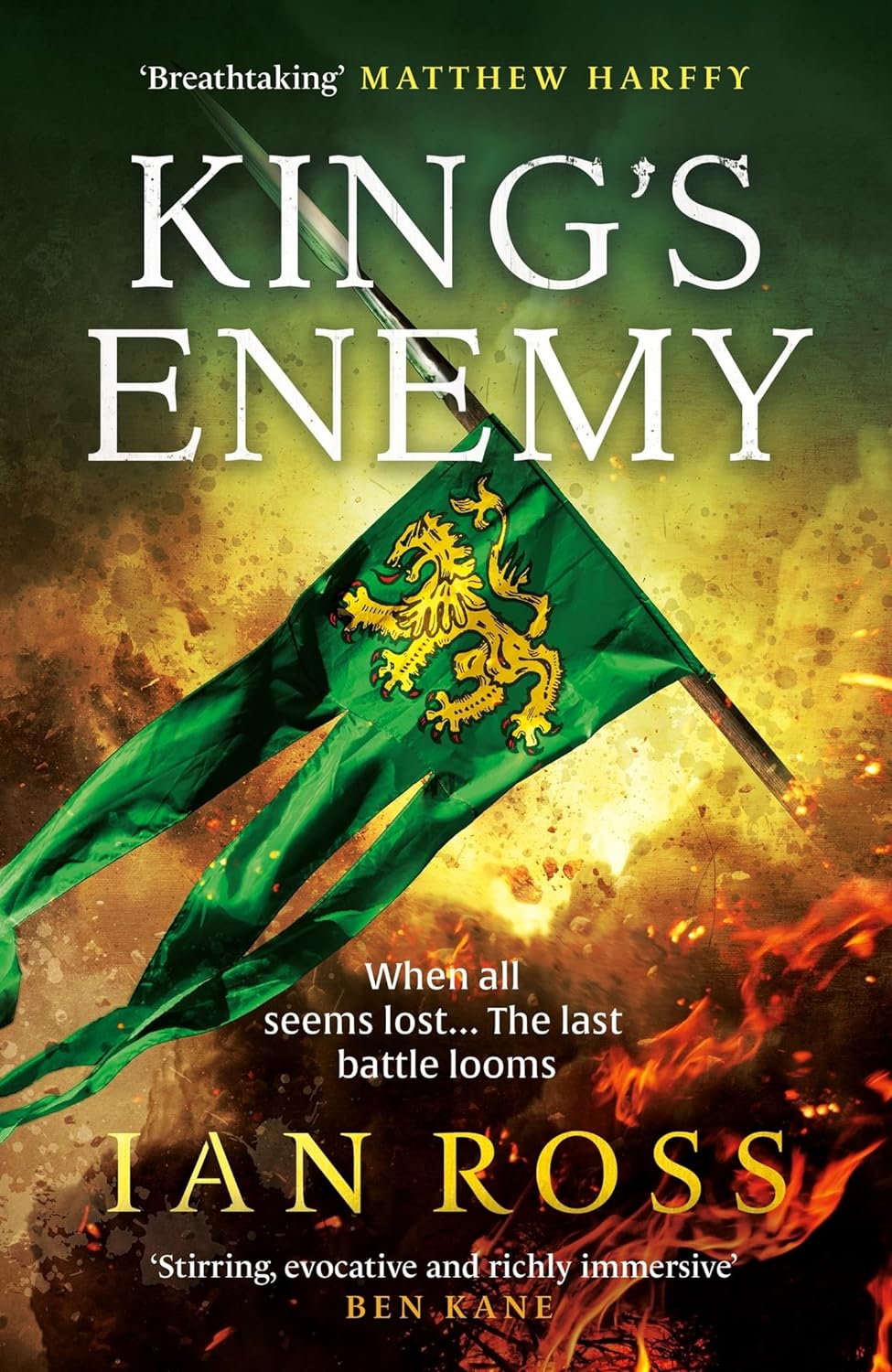
King’s Enemy by Ian Ross

Publisher: Hodder & Stoughton (Trade Paperback – 10 September 2024)

Series: De Norton Trilogy – Book Three

Length: 419 pages

My Rating: 5 out of 5 stars

Amazon

Ian Ross brings his exceptional De Norton historical fiction trilogy to an extremely strong end with the excellent and powerful third and final entry, King’s Enemy.

For the last year or so, I have been utterly enthralled with acclaimed historical fiction author Ian Ross’s latest series, the De Norton books.  Following young squire and eventual knight, Adam de Norton, as he finds himself drawn into the 13th century rebellion of Simon de Montford against the crown, the De Norton books are extremely compelling, and I love the blend of action, cool characters, and compelling historical setting.  The first book in the series, Battle Song, was an outstanding read that expertly introduced the protagonist, as well as his unpredictable mentor, and showed how he became involved in the war on de Montford’s side.  Battle Song ended up being one of my favourite books of 2023, and I eagerly dived into the sequel, War Cry, earlier this year.  Set shortly after the events of Battle Song, War Cry worked to show the aftermath of de Montford’s major victory, and the subsequent royalist counter-rebellion, by following the newly knighted de Norton as he finds himself once again called to battle.  War Cry was a very worthy sequel, and I loved how dark and grim it got in places, especially at the end.  War Cry left the reader on a major cliffhanger, and as such I have been eagerly waiting to get my hands on the third and final book, King’s Enemy.  One of my most anticipated books from the second half of 2024, King’s Enemy had an outstanding plot behind it that really got me excited.

England, 1265.  It is two months after the infamous battle of Evesham, where knight Adam de Norton lost everything.  The rebellious Simon de Montford lies dead on the field alongside de Norton’s mentor, Robert de Dunstanville. and the rest of their army, massacred by Prince Edward and his victorious army.  Spared by the prince alongside a few other noble survivors, de Norton remains a prisoner of the crown in the grim castle of Beeston, with all his lands, wealth and honour stripped from him.

However, despite the crushing victory at Evesham, England is far from peaceful, as new rebellions begin against the king.  Determined to take his fate into his own hands, de Norton makes good an escape from Beeston and becomes a fugitive from the crown.  Branded a king’s enemy, a man who can be slain with impunity by those pursuing him, de Norton flees across England, alongside the recently widowed noblewoman Joane de Bohun, contending with royal troops and dangerous outlaws, desperate to find a cause to fight for.  But when the promised new rebel army is swiftly beaten, de Norton and Joane are once again left without options.

Adam and Joane soon find their fates tied to that of the mightiest fortress in England, Kenilworth Castle, when they seek sanctuary there.  The last castle holding out against the crown, Kenilworth is garrisoned by a motley band of rebels and knights, each with their own reasons for being there.  Joining the defenders, Adam finds old friends and enemies within and without the castle walls, as he prepares to endure a lengthy siege.  But as the months pass and the battle becomes more desperate, Adam must decide what is more important, the lives of those he loves or his knightly honour.

King’s Enemy was another outstanding novel from Ross, who brings his de Norton trilogy to brilliant end with this third book.  Once again expertly focusing on a particularly intriguing part of English medieval history, Ross crafts together a powerful and intense narrative that will have you hooked the entire way through.  King’s Enemy is an epic read that gets a full five-star rating from me.

Ross has come up with a fantastic story that I honestly could not turn away from.  Starting shortly after the memorable cliffhanger of the second book in the trilogy, War Cry, King’s Enemy starts off with Adam de Norton in captivity, having lost everything.  Ross does a great job capturing the initial despair of his protagonist before setting him off on a new adventure as he makes his escape from captivity.  This results in a pretty good fugitive arc as Adam and his ill-fated main love interest, the recently widowed Joane de Bohun, attempt to find a new cause so that they may both recover their positions.  This first half of the book is very fun and makes sure to set the scene for the rest of King’s Enemy.  There is plenty of adventure, excitement, and even a surprising nod to classic Robin Hoods mythology, as the two protagonists head towards promised safety and a new army to fight with.  However, as readers of the De Norton books will be aware, things rarely go well from the main character, and Ross adds in a major road-bump for him halfway through the plot that forces him towards his inevitable destiny at Kenilworth Castle.

The rest of King’s Enemy is essentially one big siege sequence, as Adam, Joane, and several surviving supporting characters, take refuge int the castle and attempt to hold off a massive besieging force belonging to the crown.  This proved to be an exciting second half which really pushes the protagonists to the limit.  I’m a huge fan of sieges in fiction, and I thought that this depiction of this infamous British siege was extremely good.  Ross captures so many cool aspects of this siege with his writing, including the desperate defenders, the intense fighting, and the grinding impacts of time as the besiegers attempt to starve out the inhabitants of the castle.  Things get really tense as the book continues, as Adam finds himself caught amid various big personalities, including an unstable fellow knight and other defenders seeking to gain advantage from their plight.  There are some dark and deadly moments here, and Ross keeps the reader on the edge of their seat as Adam tries to determine the best course forward.  Everything ends on an interesting note, as all the existing storylines are wrapped up, many figures, both fictional and historical, meet their fates, and the final chapter in the protagonist’s adventure and complex romantic life is revealed.  I personally felt that Ross ended everything on a very strong note, and those readers who have become quite attached to the series will come away very satisfied.

I felt that Ross once again did a really good job of enhancing his captivating narrative with his great writing, and readers really get stuck into King’s Enemy as a result.  The quick-paced flow of the story and the intense action really help to drag you in and go hand in hand with the great characters and intriguing historical setting.  Ross does an outstanding job of showcasing the hard-hitting combat associated with historical knights, and all the intense action sequences are a joy to read.  I also must once again highlight the cool siege that made up the second half of the book, and fans of fictional fighting will love some of the chaotic sequences that emerge there.  There is also a strong emotional edge to the plot, as many of the main characters are desperate figures struggling in the aftermath of a devastating defeat and trying to find a path forward that balances their survival with their sense of honour.  While King’s Enemy can be read as a standalone novel due to the excellent way Ross summarises some key prior events, readers really should check out the first two entries in the series first.  The continuing character arcs, recurring themes, and excellent conclusion to long-running story elements, help to make King’s Enemy a lot more enjoyable for returning readers rather than interested newbies, and I was very invested in seeing how this story ended due to how much I had connected to the protagonist.  I felt that Ross wrapped up this trilogy extremely well, and if you loved Battle Song and War Cry you will not be disappointed here.

As with the previous De Norton novels, one of the things that most impressed me about King’s Enemy was the intriguing historical events that Ross chose to set his story around.  The 13th century rebellion of Simon de Montford is one of England’s lesser-known civil wars, and I have been deeply enjoying seeing the events of this war unfold through the eyes of the protagonist.  The first book did a wonderful job exploring the events leading up to the rebellion, as well as de Montford’s major victory that turned the whole country on its head, while the second book captured the chaotic instability that followed and the eventual end of the main rebellion.  King’s Enemy continues in this vein by examining what occurred after de Montford’s death and defeat, with the country still unstable despite the crown’s victory.  Ross does an excellent job of ensuring his protagonist is present for many of the key moments of this post-rebellion period, and you really get some good insights into these tumultuous events from the protagonist’s perspective.  There is a great focus on the politics and society at the time, especially as major parts of the plot revolve around how the defeated knights and lords were treated.  Ross also excelled at capturing the many key parts of the siege of Kenilworth Castle in the second part of King’s Enemy.  The longest siege in English history, the battle for Kenilworth is a fascinating inclusion to the story, and I loved how Ross showcased it as the last stand for the desperate rebels.  You really get a sense of the events leading up to, and surrounding the siege, and I loved how well Ross examined the motivations of the various defenders and why they kept fighting.  All this proves to be an excellent background setting to Ross’s main story, and it was fascinating to find out how this entire civil war came to its end.

I also need to once again highlight the great characters that Ross has featured in this series, with some intriguing and moving character-based storylines sitting at the core of the plot.  King’s Enemy is another great example of this as, while many key characters died at the end of the previous novel, it still features a strong cast of complex protagonists and supporting characters, including a mixture of original characters and historical figures.  The most prominent of these is series protagonist and primary point of view character Adam de Norton, a former lowly squire who gained lands and a knighthood for his role in Simon de Montford’s rebellion.  After gaining so much in the previous books, Adam starts King’s Enemy at his lowest, with most of his friends dead and everything he fought for lost.  This places the protagonist in desperate circumstances, and he spends this entire book fighting with his back against the wall, literally and figuratively.  Ross writes some moving storylines around Adam’s conflicted mind, as he is forced to balance his honour and loyalty with getting what he wants.  I loved seeing the continued epic of Adam de Norton in King’s Enemy, as it proved impossible not to become attached to the scrappy and exceedingly honourable figure in the previous books.  This proved to be a great final entry in Adam’s story, and Ross ensures that there is still plenty of suffering and conflict for his protagonist.

Other major characters I need to highlight include Adam’s main love interest, Joane de Bohun.  Joane, a strong-willed survivor determined to survive and regain her lands, proves to be an interesting companion to Adam.  The two share an intense and often contentious relationship, as Joane attempts to balance romantic feelings with her ambitions.  Due to the desperate events of the book, Adam and Joane are finally able to express themselves to each other at times, although their differing goals often lead them into conflict.  There is a real tragic romance angle going on between Adam and Joane in King’s Enemy that worked extremely well, especially with the other story elements, and it added a compelling extra layer to already impressive story.

The final character I really want to highlight was bold younger knight, Henry de Hastings, with whom Adam has many interesting encounters in King’s Enemy.  A captured rebel like Adam, de Hastings seems to follow the protagonist around to all the major encounters of the book, and they become both comrades and rivals as a result.  I really enjoyed how Ross portrayed de Hastings in this book, and you have to love the combination of arrogance, contempt and friendship that he gives towards the protagonist, which ensures that the reader finds him both insufferable and entertaining.  De Hastings’s appearance in the book’s main siege also produces some memorable character changes as the knight becomes obsessed with winning and holding out against the enemy, so much so that he becomes a dangerous threat to the protagonist.  There is a wonderfully written slide into darkness for this side character that I deeply enjoyed, and he ended up being a standout figure in King’s Enemy as a result.  All these characters, and more, helped to turn King’s Enemy into something special, and it was amazing to see where many of these recuring figures ended up.

Overall, I found King’s Enemy to be an exceptional book that served as a brilliant and impressive conclusion to Ian Ross’s De Norton trilogy.  Loaded with intense characters, fascinating history, and outstanding action, King’s Enemy had me hooked the entire way through and provides readers with a powerful end to a great historical series.  A highly recommended read, you won’t be disappointed with this latest offering from Ross.

Amazon

Warhammer 40,000: Renegades: Lord of Excess by Rich McCormick

Publisher: Black Library (Audiobook – 6 April 2024)

Series: Warhammer 40,000: Renegades – Book Two

Length: 14 hours and 17 minutes

My Rating: 5 out of 5 stars

Amazon

Prepare to break the bounds of sensation, desire and treachery in the amazing Warhammer 40,000 novel, Lord of Excess by Rich McCormick, the second book in the fantastic Renegades series.

I have been having a great time with the huge variety of unique and elaborate Warhammer 40,000 books coming out in recent years, and it is always fun to see the impressive reads the franchise is producing.  One of the things I particularly enjoy about the Warhammer 40,000 fiction machine is the way in which it gives new authors the chance to shine, with several talented authors writing their very first book as part of the Warhammer canon.  I have already talked about one particularly good Warhammer 40,000 debut this year with Deathworlder by Victoria Hayward, but another incredible first novel I had the great pleasure of reading was Lord of Excess by new author Rich McCormick.

Lord of Excess was an exceptional book that was released as part of the loosely connected Renegades series that looks at a different band of traitor Space Marines as they make their dark way through the universe.  For example, the first Renegades book, Harrowmaster by Mike Brooks, looked at the nefarious Alpha Legion, and I am sure that future entries will dive into the other traitor legions with some fun stories.  Lord of Excess is the second Renegades book, and it provides the reader with an outstanding and unique story focussed on the ultimate beings of excess, the Emperor’s Children.

At the dawn of the Imperium, the Emperor’s Children were the master of mankind’s most loyal and revered Space Marine Legions, dedicated to the fight for humanity while seeking perfection in all things.  However, during the tumultuous events of the Horus Heresy, the Emperor’s Children followed their Primarch into treachery, and turned against their Emperor, falling into the service of the ruinous powers of Chaos.

Now, millennia later, the Emperor’s Children are a twisted remnant of their former glory.  Scattered into smaller warbands, the Emperor’s Children now only seek pleasure and sensation in hedonistic service to the Chaos God Slaanesh, the lord of obsession and excess.  One such band is the feared and infamous group known as the Adored.  Lead by the tainted Space Marine Xantine, the Adored has ravaged the galaxy for centuries, taking slaves and bringing untold torment, but Xantine has never found what he truly desires, until now.

Suddenly dropped out of the Warp, the Adored find themselves in orbit about the isolated planet of Serrine.  A wealthy and corrupt planet of the Imperium, Serrine has been long cut off from the rest of humanity due to corrupted currents of the Warp.  Sensing the opportunity to carve out a place for himself, Xantine decides to take control of Serrine, and turn it into the perfect society, dedicated to loving him.  However, making true perfection is an impossible task, and Xantine soon finds his rule challenged by both the population of Serrine and those closest to him.  Worse, there are darker forces at work within the bowels of Serrine, and soon the world will be engulfed in perfect destruction.

Lord of Excess was an exceptional and impressive Warhammer 40,000 novel that achieved so very much for the reader.  Featuring a complex and compelling tale of betrayal, deceit and corruption, loaded with fun characters and larger-than-life personalities, Lord of Excess was an entertaining and elaborate read from the very start, and I could not get enough of it.

I really loved the story contained with Lord of Excess, and I find it hard to believe that this was McCormick’s very first novel.  The plot of Lord of Excess is an elaborate and continuous tale of woe and failed ambition as it charts main character, Xantine of the Emperor’s Children, as he attempts to bring perfection to the world of Serrine.  Starting off by introducing Xantine and his renegade Space Marines, you are soon shown the world of Serrine, an isolated and mismanaged Hiveworld with plenty of its own problems, including an uprising from a genestealer cult.  Taking advantage of these chaotic events, an obsessive Xantine leads his mostly apathetic Emperor’s Children to the planet’s surface, telling the locals they are there to save them.  This proves to be an intriguing start, as the reader is shown a battle between two very different group of villains, which is essentially the equivalent of the cenobites from Hellraiser facing off against xenomorphs from Alien (with both sides using a lot of purple).  This fight against the genestealers is a fun first part of the book, and I honestly thought that McCormick was going to stretch that conflict out for the entirety of Lord of Excess.  However, the author instead chooses to cleverly end this conflict about a third of the way through the book, and the rest of the novel goes in some very interesting directions.

Following this introduction, Lord of Excess than goes through a series of time skips, as you follow the unlucky course of Serrine under the “benevolent” rule of the Emperor’s Children.  Each new version of Serrine you see is somehow worse the previous version, and it proves extremely entertaining to watch the inherent downsides of the protagonist’s twisted version of perfection.  The plot cleverly rotates between the machinations of Xantine and his Adored as they fight over the course of their warband, and several intriguing human inhabitants of Serrine, whose reaction to the fate of their planet varies across the emotional spectrum.  The plot goes in some very interesting and entertaining directions, as Xantine finds himself continuously beset by betrayal, mostly of his own making, while many others are driven to extreme lengths by Xantine’s actions, and other malign foes hiding beneath Serrine’s surface.  Things continuously get darker and darker as the plot continues, leading up to a brutal and amusing conclusion.  I loved the various elaborate twists and captivating revelations that McCormick cleverly worked into the plot, and his accompanying character work really helps to sell it.  The book ends on a fantastic note, with devilish and deserved endings for many members of the cast, and the ultimate fates of everyone really reminds you that Lord of Excess is a grimdark book focussing on deranged villains.

McCormick really showcased his effective and powerful writing style in Lord of Excess, and I loved the elaborate and multifaceted book that he ended up creating.  The fantastic story has so many deep elements to it, and it transcends the typical action-focused Warhammer fiction by providing nuanced portrayals of society, human nature, and the impossible search for perfection.  That’s not to say that there isn’t action in Lord of Excess, as McCormick loads the book with multiple over-the-top and entertaining fight sequences that prove hard not to love.  However, he also balances these battles with intriguing character work, long-running elaborate story elements, and complex depictions of intriguing Warhammer features.  The way in which the author cleverly shifts the narrative around several fantastic characters works to create a fun and layered story with many moving parts to it.  I also love how descriptive and visual McCormick got at times.  The author clearly had fun describing the many excesses and mutations of the Adored, and you really got a clear and vivid sense of the twisted nature of the beings involved.  This ended up being such an outstanding read, and McCormick did such a great job bringing his elaborate story to life in the absolute best way.

I felt that Lord of Excess was a pretty awesome Warhammer 40,000 novel, that will really appeal to a varied audience.  Established Warhammer fans will love the fantastic depictions of the Emperor’s Children featured within this book, and I love how well McCormick captured the complexities of these renegade Space Marines and the depths to which they have sunk.  While he doesn’t do a full deep dive into the history of the Emperor’s Children, McCormick provides some detailed flashbacks into their past, that Warhammer readers will appreciate, which also providing some good context for new readers.  While this book did spend a lot of time examining the Emperor’s Children, it also featured its own unique and clever narrative, which really utilised the grimdark nature of the wider Warhammer setting to its advantage.  Readers are gifted by a truly complex and intense read, and I felt that Lord of Excess is an amazing example of just how good a Warhammer 40,000 novel can be.  This would be a pretty good entry point for new readers keen to check out the elaborate Warhammer 40,000 fictional universe, especially as you can get an amazing sense of the overall cruel, deadly and often ironic nature of this fantastic overarching setting.

Easily the key strengths of Lord of Excess were the elaborate, distinctive and damaged characters that McCormick centred his story around.  There are some brilliant characters featured in this book, from ancient traitor Space Marines lost in their own obsessions, to the normal inhabitants of Serrine, whose lives are irrevocably turned upside down by the arrival of the Adored.  These elaborate character arcs are very intriguing, and McCormick expertly features them throughout his story, ensuring that the reader becomes intrigued by the fates of these various figures.  The most prominent character is the Adored leader, Xantine.  An ambitious and twisted being, Xantine finds himself drawn to the world of Serrine and sees it as an opportunity to create a perfect world, much like the previous planets the Emperor’s Children called home.  Xantine proves to be an intriguing central figure for the book, especially as you get drawn into his obsession and the disdain of his followers for his vision.  Thanks to the machinations of the daemon S’janth, who shares Xantine’s body, you get some fascinating insights into this character’s mind, and you soon appreciate the depths of his determination to be perfect, which stems from his daddy issues and dark personal history.  I loved seeing how the events of the book were driven with this figures love of perfection, and Xantine proved to be an excellent dark heart to this entire story.

In addition to Xantine, Lord of Excess features several other great characters, all of whom are damaged in fantastic and intriguing ways.  This includes the various members of the Adored, each of whom has their own unique obsessions and focuses.  McCormick really had fun when it came to these corrupted figures, and there are some delightfully over-the-top characters as a result.  These other members of the Adored often come into conflict with Xantine, primarily due to their incompatible obsessions, and I loved the barbed interactions that followed, especially as Xantine both loves and hates his fellow renegades.  While several of these characters stood out, the best one was probably Vavisk.  Vavisk, a Noise Marine, is obsessed with finding the perfect sound, and often finds himself lost in his horrifying music.  However, Vavisk is also Xantine’s closest friend, and the unique bond of brotherhood between these two figures, proves to be a key part of the book, especially as the potential for it to break is always there.

Other major characters include several inhabitants of Serrine who attempt to survive the actions of Xantine.  Due to a creation myth, many people on Serrine initially see Xantine as a destined saviour, and the eventual revelation of his true nature leads to much heartache for them.  These characters provide an outstanding alternative perspective to that of Xantine and the other Adored, and I loved seeing the various reactions to the evil that came to their planet.  Key figures include the young man Arqat, whose rage at the injustices performed against him drives him to some dark places.  The mysterious Cecily founds salvation and escape thanks to the patronage of Xantine, although her loyalty costs her deeply.  While the foppish noble Pierod, seeks to take advantage of the arrival of the Adored, which has blistering ups and downs for him.  I really enjoyed these three human characters, and their unique storylines, some of which were nearly as extensive as Xantine’s, helped to turn Lord of Excess into a particularly brilliant read as you get drawn into their various tales of woe and opportunity.  While Pierod’s story was probably the most entertaining, due to his naked ambition and greed, you honestly connect to all three of them, and it proves fascinating to see where their encounters with the Adored takes them.  McCormick writes some grim and fitting fates for all three of them, and the other humans of Serrine, and seeing the journey they take to get there, is so damn entertaining.

As with most Warhammer 40,000 novels I enjoy, I ended up grabbing Lord of Excess on audiobook, which is just the best way to appreciate a piece of Warhammer fiction.  Coming in with a runtime of over 14 hours, the Lord of Excess audiobook is a decent length, but one you can get through quickly once you become caught up in the outstanding plot.  I love how well this format highlighted the epic narrative featured with Lord of Excess, and you get a real sense of the plot’s chaotic delights, unnatural horrors, and devilish figures when they are read out to you.  It helped that the Lord of Excess audiobook was helmed by one of the very best Warhammer 40,000 narrators, Richard Reed.  Reed has been killing it in recent years with his work in Warhammer 40,000 fiction, including The Infinite and the Divine by Robert Rath, Ruin and Reign by Nate Crowley and Grim Repast by Marc Collins, all of which were greatly enhanced by his impressive voice work.  His work in Lord of Excess is particularly awesome, as he once again produces an impressive range of unique voices to fit the big personalities of the plot.  This includes multiple mutated and utterly corrupted Space Marines, and Reed provides very fitting voices for them, as well as the unlucky humans caught up in their machinations.  The over-the-top story comes out so much better because of Reed’s compelling narration, and I love how effectively he captured the various insane figures.  This amazing voice work turned the Lord of Excess audiobook into something very special, and I had an exceptional time getting through it.

Lord of Excess by Rich McCormick is an absolutely brilliant and amazing piece of Warhammer 40,000 fiction that I could not get enough of.  Expertly combining elaborate elements of the Warhammer 40,000 canon with a complex narrative and darkly damaged characters, Lord of Excess was so much fun to read, and it proves impossible not to get caught up in this epic debut.  This might be one of the smartest and most compelling pieces of Warhammer 40,000 fiction release so far in 2024.  A truly outstanding Warhammer 40,000 book from a particularly amazing new author, Lord of Excess comes very highly recommended, and Rich McCormick is an author with big things in his future.

Amazon

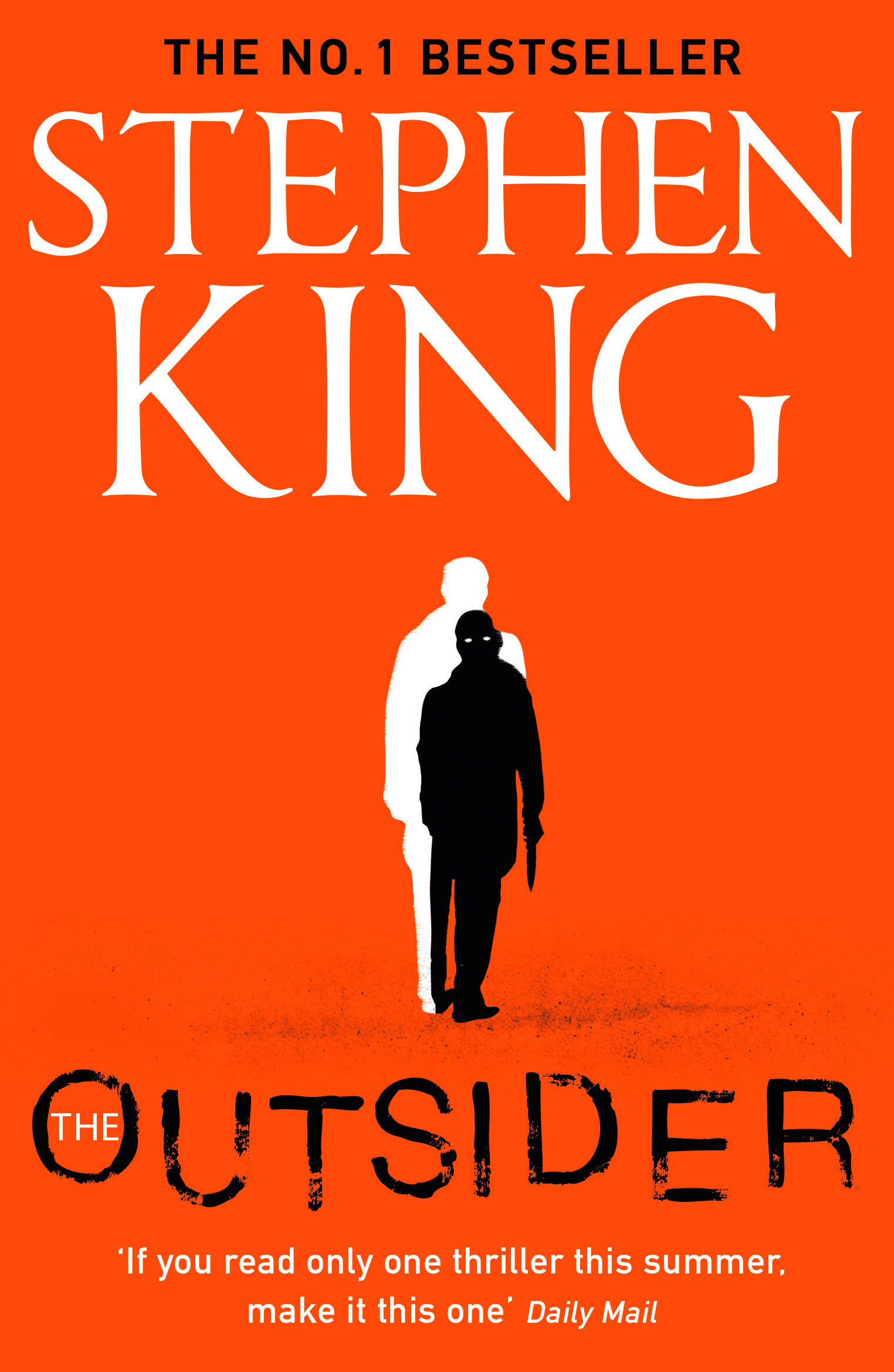
The Outsider by Stephen King

Publisher: Hodder & Stoughton/Simon and Schuster Audio (Audiobook – 22 May 2018)

Series: Standalone/Holly Gibney series

Length: 18 hours and 41 minutes

My Rating: 5 out of 5 stars

Amazon

After years of having it on my to-read list, I finally got around to checking out The Outsider by Stephen King, and boy was it a particularly epic book.

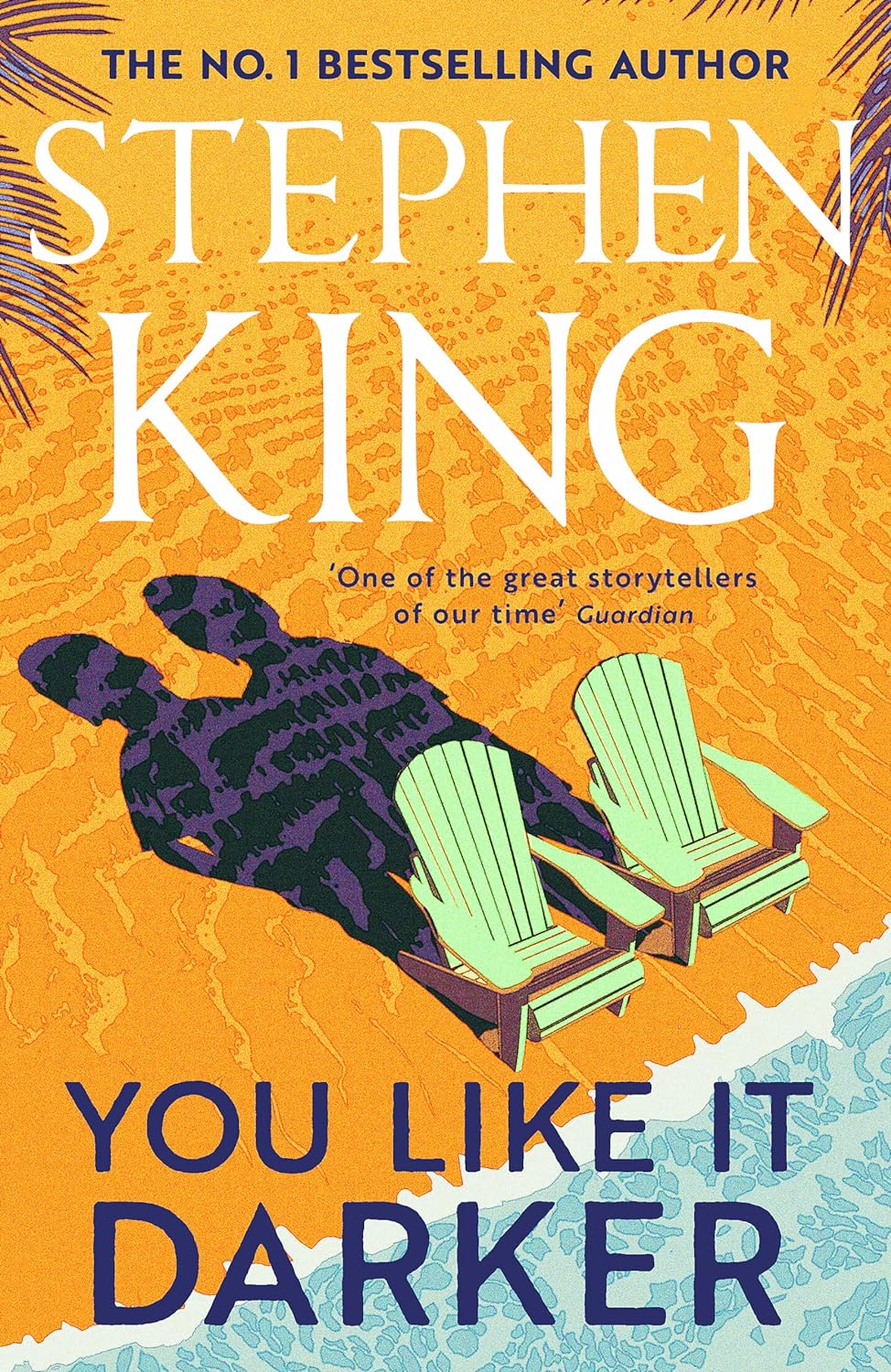
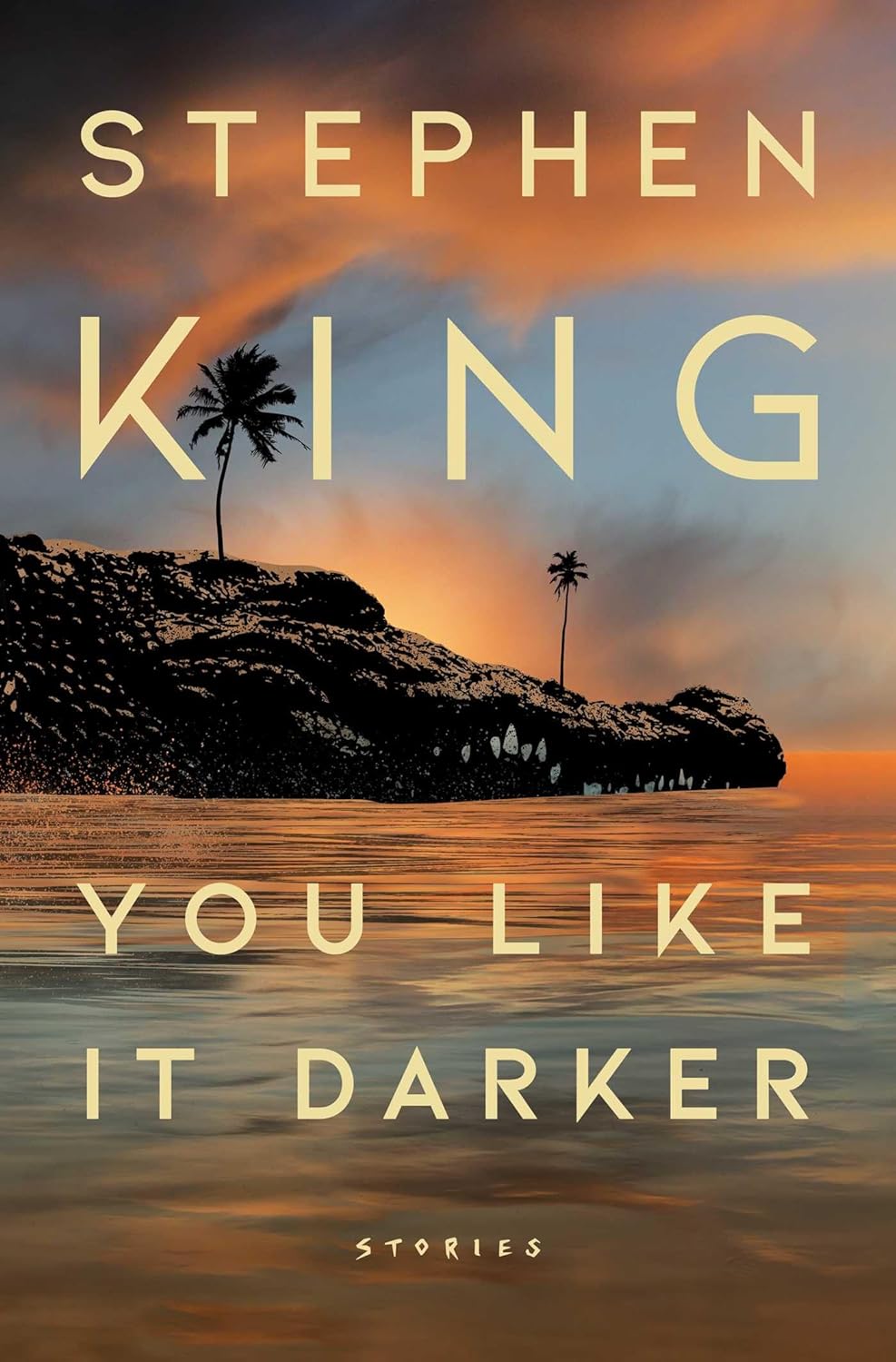
Fans of this blog will know that I have been getting more and more into Stephen King lately, especially as I have been lucky enough to receive copies of his more recent books.  I have so far deeply enjoyed Mr Mercedes, Later, Billy Summers (one of my favourite books of 2021), Fairy Tale, Holly (one of my favourite books and audiobooks of 2023), and You Like it Darker (one of my favourite books from the first half of 2024).  These have all been amazing reads in their own way and I really enjoyed the elaborate stories, dark plots, and complex characters that King comes up with.  However, one of my new favourite King novels with a captivating scenario was the fantastic read The Outsider.

Released back in 2018, The Outsider was an intriguing novel that really caught my attention with its unique concept.  I immediately identified it as a book I wanted to read, but I was unable to fit it into my reading schedule back then, which I deeply regret now.  Despite not reading it when came out, The Outsider remained firmly in mind, especially as it had connections to the Bill Hodges trilogy, which I had also heard good things about.  This need to check out The Outsider was dramatically increased after I read Holly last year and was blown away by the elaborate and exceedingly dark story.  As such, I have been looking for an opportunity to enjoy The Outsider for a while, and a recent road trip gave me all the excuse I needed, and boy was I glad that I did.

It is the worst crime to ever occur in the history of Flint City.  A young boy, Frankie Peterson, has been brutally killed, raped and mutilated, his violated body left on display out in the local park.  The Flint City police, led by detective Ralph Anderson, are determined to find the monster responsible for Frankie Peterson’s death, and they soon zero in on a prime suspect, local sports coach and one of Flint City’s most respected citizens, Terrence Maitland.

With unassailable evidence and numerous witnesses placing him at the scene, the police have a watertight case against Maitland, and Anderson orders the public arrest of the coach in front of his family, friends, and the entire town.  However, despite the DNA, fingerprints, and numerous reliable witnesses indicating that Maitland killed Frankie, Maitland insists that he is innocent and has an airtight alibi for the time of the murder, having been in a major public conference in another city, surrounded by unimpeachable witnesses.

Determined to prove that Maitland committed the murder, Anderson and his colleagues attempt to destroy his alibi.  But the further they dig, the more apparent it becomes that Maitland was nowhere near the scene of the crime, and Anderson begins to believe Maitland’s pleas of innocence.  With lives being destroyed all around him and the citizens of Flint City baying for Maitland’s blood, Anderson is forced to figure out how a man can be in two places at once.  But when the situation takes a dark turn, both Anderson and Maitland’s supporters call in unusual investigator Holly Gibney, whose own experience with impossible cases will take them in the darkest of directions.

Well damn, that was particularly awesome.  I knew I was going to love The Outsider well before I read it, but even I was unprepared for how impressive and captivating this novel proved to be.  Featuring King’s typical elaborate storytelling, powerful characters, and unique insights into the human mind, The Outsider was a complex and sinister read that will have you hooked from the very beginning and which gets a very easy five-star rating from me.

King presents the reader with an incredibly, dark, complex and thoughtful narrative that burrows into your head and refuses to leave.  Starting off strong and proceeding into darker and more horror-lined territory, this complex narrative sucked me in almost instantly thanks to the very impressive initial story concept.  Introducing a particularly gruesome murder, The Outsider starts off in crime fiction/legal thriller territory, as King showcases the details of the initial arrest of Terrence Maitland, while also bringing in a few key characters.  These early chapters are cleverly offset by a series of short inclusions that showcase police interviews and forensic evidence for the main investigation, all of which firmly paints Maitland as the killer.  However, events take an outstanding turn shortly into the book, when Maitland reveals an impossibly airtight alibi that flies in the face of the substantial evidence of the police.  The full extent of this alibi is particularly compelling, especially with King name-dropping one of his peers, and it really turns the entire plot on its head.  The subsequent scenes are extremely intriguing, as the reader sees both sides of the case, and find themselves wondering if Maitland committed the crime, is completely innocent, or whether something far more sinister is going on.  I honestly love every second of this first half of The Outsider, and I cannot emphasise just how exceptional and thought-provoking this complex scenario proved to be.

At around the halfway point, The Outsider features a substantial moment that changes the entire tone and focus of the plot.  While I was initially a little disappointed with this, mainly because I was already loving the direction the story had been going up to that point, it helps turn The Outsider into a more typical King novel, loaded with complex horror elements that reflect dark human nature.  The author also deeply enhances the story’s emotional drama, placing several characters in terrible situations, and amping up the desperate tragedy of the plot.  Thanks to the introduction of recurring King protagonist Holly Gibney, the protagonists start to consider a more unnatural solution to the crime and begin to investigate accordingly.  I quite enjoyed the dive into the darker, supernatural side of the story, and the resulting investigation is quite unique, requiring the grounded protagonists to believe in the unknown.  King ensures that the supernatural investigation elements of the book come across in a compelling and sensible manner, and it was intriguing to see how the character’s reached their conclusions.  The case eventually leads the protagonists on an extended trip to Texas, which ends with a series of showdowns.  King keeps the intensity of the plot going all the way to the very end, and readers will be left guessing about who’s going to survive and how the story will unfold.  The chase for the culprit and the big showdown were a very solid conclusion to the entire narrative, and you will come away extremely satisfied with how The Outsider ended.

I really enjoyed how this book came together, and I personally think that this was one of the stronger King novels I have so far had the pleasure of reading.  A lot of this comes down to the initial clever scenario, which King does an extremely good job of setting up.  The whole idea of someone accused of a crime they are innocent of and have a perfect alibi for really makes you think, and King utilises it to perfection, diving into the thoughts of the police, the alleged perpetrator, and the various family members associated with it.  It helped that King once again returned to his favourite setting of a small American town, and he was able to capture the resulting chaos as rumour and fear spread throughout Flint City.  You can really feel the emotional turmoil of all the people in the town, especially the main characters, and it helped to deeply enhance the impact of every scene, especially when you have no idea whether Maitland committed the crime or not.  The way in which the author starts off as a more traditional crime fiction story also works extremely well and helps to drag the readers into the plot with its mystery.  However, the transition over to horror is particularly effective, and the way in which the darkness infecting the plot goes from that created by ordinary humans to something more supernatural, is an effective and powerful part of the book.  This proved to be a particularly haunting and moving read that will keep you up late at night thinking about how you would react in the exact same scenario.

While most of King’s books prove to be standalone reads, The Outsider is connected to the author’s previous Bill Hodges series due to the inclusion of a major supporting character.  I had heard in advance that readers needed to be familiar with the Bill Hodges books to fully appreciate this book, however, I felt that The Outsider stood on its own merits as a standalone novel.  New readers can easily dive into The Outsider’s excellent story without any issues and will become enthralled in King’s complex mystery and his excellent depictions of human nature.  Established fans of the Bill Hodges books will probably get the most out of The Outsider, especially as it is a continuation of King’s unique look at the crime fiction genre, and the return of a key character offers a lot of opportunities for those who loved his previous trilogy.  However, I would say that this is a book that pretty much all mystery, thriller or horror fans can really enjoy, as there is something for everyone here, although some readers should be warned about how dark and graphic this story can get.

I really need to highlight the outstanding character work that King featured within The Outsider.  This fantastic book featured a rich cast of complex small-town characters who find themselves caught up the twisted darkness of a small child’s murder and the subsequent revelations about who was behind it.  King does such an exceptional job of diving into the various mindscapes of the impacted characters, from the obsessed investigating detective who is taking the case personally, to the distressed wife of the apparent killer, and even the confused accused himself.  The complicated mindscapes of all these characters, and more, are shown in exquisite detail throughout The Outsider, and you really grow attached to their powerful personal tales.

While I don’t want to go into too much specific detail about the book’s primary cast here for spoiler reasons, I will say that the way the various characters deal with events and the many dark twists makes for quite a personal and emotionally charged read, and it was fascinating to watch so many characters try to let go of their conventional thinking and try to see the world in a different light.  I also must highlight the intriguing way in which King enhances his cast in the second half of The Outsider by bringing in investigator Holly Gibney from the Bill Hodges trilogy.  Holly, the slightly unusual but brilliant private eye, proved to be a compelling addition to the plot, and it proved very interesting to see her interact with the established cast, especially as Holly has a much more open mind due to her previous experiences.  Fans of the Bill Hodges books will really love seeing Holly return, and her compelling character development since her original appearance in Mr Mercedes proves to be a great part of the book.  I really cannot emphasise just how impressive the various characters, as well as their complex development, is in The Outsider, and you will have to check it out.  Be warned though, no one comes out of this book unscathed, including the reader when they become attached to these great figures.

As I mentioned above, I managed to enjoy The Outsider while out on a road trip, which meant that I listened to the audiobook version of it.  I have had some great success with Stephen King audiobooks in the past, and The Outsider was another impressive example of how this format can enhance the powerful story within.  Coming in with a substantial runtime of nearly 19 hours, listeners do require a bit of a time investment for The Outsider audiobook, but it is well worth it.  I felt that I got a fantastic sense of the story while listening to it, and I love the intense depictions of the characters, the small-town setting, and the dark deeds being done within.

In addition to the great way it brings to the story to life for the reader, one of the big highlights of The Outsider audiobook was the inclusion of veteran actor Will Patton as the narrator.  Patton, who has lent his voice to several of King’s previous audiobooks, does an outstanding job narrating The Outsider.  His softly spoken and measured voice really fits the dark and sinister story contained within The Outsider, and you get an excellent sense of the personal horror and complex emotions that the events of this book unleash.  Patton also does an outstanding job voicing the eclectic and damaged characters featured within The Outsider.  Patton infected many of these characters with his southern accent, which fit the small-town vibe of The Outsider extremely well, and you can really imagine King’s characters a lot better with Patton’s voice behind them.  Highlights for me include his take on the antagonist of The Outsider’s real voice, as well as an entertaining old lady found down in Texas, who steals all the scenes she’s in, especially with Patton’s exaggerated tones.  However, I did feel that Patton overplayed the awkward nature of Holly Gibney when she entered the plot.  Patton made all of Holly’s dialogue, as well as the description of events in the chapters told from her perspective, very subdued and halting, which messed with the flow of the audiobook.  While I know that he was trying to capture Holly’s ethereal and damaged nature with this narration, it was honestly a bit distracting.  Despite this slight annoyance, this ended up being an awesome way to enjoy The Outsider and I can personally guarantee that it is an incredible accompaniment to a long road-trip.

Overall, The Outsider proved to an outstanding and exceptional book from the always impressive Stephen King that I could not get enough off.  Featuring both an incredible mystery and some brilliant dark horror moments, The Outsider is a particularly gripping and intense read that will live rent free in the dark corners of your brain.  Highly recommended and one of my new favourite Stephen King books.

Amazon

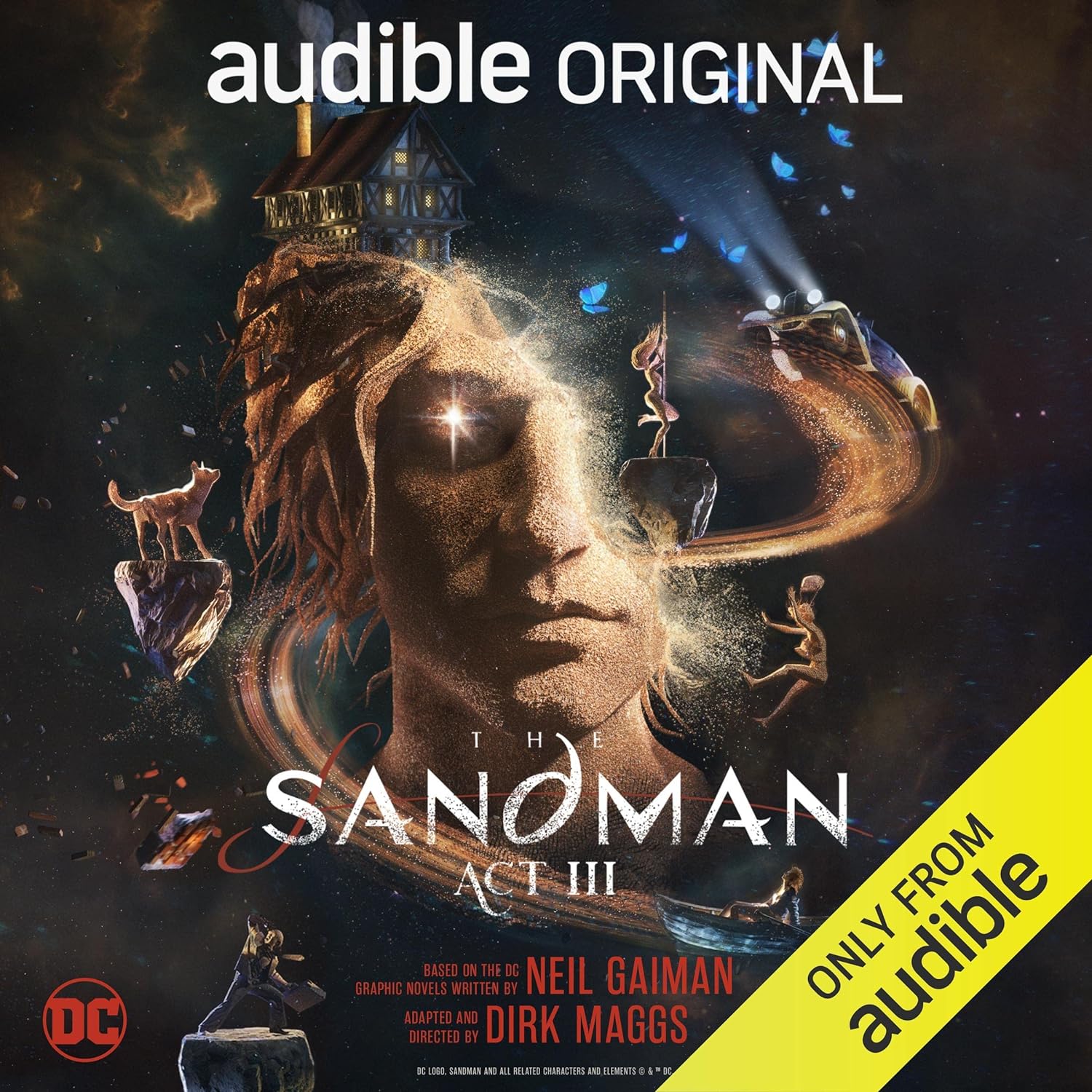
The Sandman – Act III (Audiobook), written by Neil Gaiman and performed by a full cast

Publisher: Audible Original (Audiobook – 28 September 2022)

Series: The Sandman – Volume 3

Script: Neil Gaiman and Dirk Maggs (script adapter)

Director: Dirk Maggs

Length: 11 hours and 31 minutes

My Rating: 5 out of 5 stars

Amazon

After falling in the love with the epic The Sandman comics thanks to their exceptional audiobook adaptations, I finally got to the third audiobook act in this exceptional series by Neil Gaiman, which was another amazing listen.

I have had an outstanding time listening to the first and second volumes of the audiobook adaptations of The Sandman comic.  Set partially in the DC universe, the original series, which started in 1989, is one of the most iconic comics of all time and features a unique adventure that only Neil Gaiman can come up with.  Following Dream, the anthropomorphic personification of dreams and human imagination, The Sandman is a truly amazing comic that blends horror, fantasy and superhero elements together.  Some people might be more familiar with the recent Netflix series that adapted the first couple of comics, and which has a second season on the way.

This series has proven to be extremely exceptional, with Act I perfectly introducing the characters and setting up the initial storyline, while Act II continues some of the key story points and places Dream against various foes, including Lucifer and other dangerous mythical figures.  Not only do these audiobooks feature an incredible story and powerful characters but they are brought to life by a truly awesome cast of celebrity actors and audiobook narrators who really lend their all to this performance.  As such, when going on a couple of fun road trips this year, Act III was a very easy choice to listen to, and I was extremely curious to see how this series would continue.

In a universe of strange and deadly creatures, many beings are considered immortal, but only seven siblings can truly claim to be endless.  The Endless, each a personification of a universal concept, are powerful and mesmerizing in their own way, but the most enchanting and mysterious is Dream.  Known by many names, including Morpheus, this being governs the Dreaming, a vast realm of creation’s collected dreams and stories, protecting the imagination that makes life worth living.  But circumstances outside of his control have set him on a dark path that not even he can escape from.

After being freed from captivity and deciding the future of Hell, Morpheus finds himself troubled by another failed romance, his own complex past, his previous monstrous decisions, and his often contentious relationship with his family.  Visited by his troubled youngest sibling Delirium, Dream embarks on an unusual quest alongside her to find their missing brother, the one member of the Endless to ever give up their role and responsibility, Destruction.  But their prodigal sibling does not wish to be found, and many obstacles lie between an Endless reunification.  To succeed in their quest, Morpheus will need to revisit the most painful chapter from his past.  However, no-one, not even a member of the Endless, comes away from a meeting with Destruction unscathed!

Unsurprisingly, Act III proved to be an exceptional listen, and I once again got wrapped up in the elaborate and compelling web of stories and characters that The Sandman is well known for.  Adapted once again by director Dirk Maggs and featuring all of Gaiman’s impressive storytelling and dark characterisations, The Sandman – Act III, was an outstanding listen, and one that I could not get away from.  Adapting the Brief Lives and Worlds’ End arcs of The Sandman comic, as well as several additional short stories, Act III was an exceptional addition to this series, especially with the truly exceptional voice cast.

Act III continues the same format and style of the previous The Sandman audiobook adaptations, with the comic broken into several distinctive parts to best tell the elaborate story from the comics.  The previously drawn adventures are brought to life here through a combination of excellent narration by Neil Gaiman, who covers many of the characters’ actions and movements, sound effects to represent other unseen elements, and the dialogue of the various characters, with their respective actors often describing the moments going on around them.  This results in an intriguing but complex listening experience, and with a runtime of 11 hours and 31 minutes, it is one that you can get through very quickly if you have the time.

This latest audiobook adaptation starts off in an interesting place with the short story The Song of Orpheus, which originally appeared in the Fables & Reflections collection of stories.  The Song of Orpheus is a fantastic retelling of the classic Greek myth of Orpheus, with the character reimagined as the son of Morphius and the muse Calliope, the latter of whom was featured in the story Calliope in the Dream Country collection (featured in the Act I adaptation).  Gaiman does an excellent job of bringing together the classic Greek mythology of the Orpheus legend with his own characters and the result is a seamless and complex tale.  Orpheus’ ill-fated marriage and journey to save his love is aided and hindered by the various members of the Endless, with Morpheus serving as a complex distant father figure.  The resulting story may seem familiar to those with knowledge of Greek mythology, but there are some added intriguing twists, and the inclusion of Gaiman’s characters ensure that there is even greater tragedy than the original Greek myth envisioned.

When I started this audiobook, I thought that The Song of Orpheus was interesting start to this act, and in hindsight it was quite a clever decision, as it sets up some of the other arcs extremely well.  The story ensures that listeners are well warned about the tragedy and elaborate storylines contained in Act III, while also drawing you in with its inventiveness and complexity.  It is also a brilliant production thanks to the combination of cast and background music effects.  Regé-Jean Page (of Bridgerton fame), proves to be an outstanding Orpheus, who stands as an interesting contrast to the other established voice actors of this story.  There are also some epic musical accompaniment and sound effects that prove vital in showcasing the full impact of this story, and which you honestly need when telling a story about the mythical musician Orpheus.  I felt that the musical elements of this chapter deeply helped to enhance the story, especially as there was some great sadness in the sound effects that mirrored the story.  This was honestly a very strong start to Act III, and I loved how well it led into the first main story, Brief Lives.

Brief Lives is a particularly epic main story arc for this audiobook which serves as both the plot and emotional heart of Act III.  Initially focusing on the incredibly fun character of Delirium, who we only briefly saw in Act II, Brief Lives sees Dream accompany his sister on a road trip to find their lost brother, Destruction.  This results in several intriguing mini story arcs as the mismatched and chaotic siblings travel through the mortal world, encountering their family, friends, and former associates of Destruction.  At the same time, sinister events begin to impact people associated with their search, and Dream must navigate the increased collateral damage his quest is incurring.

I really loved this arc, and I think that Brief Lives might be one of the stronger The Sandman storylines.  The road trip storyline with Dream and Delirium worked to tell this story in a fantastic manner, and I enjoyed how the author took the opportunity to quickly and effectively introduce new intriguing characters whose worlds become impacted by their interactions with the Endless.  The long-anticipated reveal about the missing Endless was great, and Gaiman loads in some intriguing examinations about family, destiny and duty.  Brief Lives is loaded with a great combination of dark mystery, the author’s gothic vibe, a fantastic layer of humour, and an intense amount of tragedy, all wrapped up with the most unique familial interactions you are likely to see in fiction.  The author takes the storylines in some interesting directions, and the resulting emotional richness proves very hard to ignore.  The ending of Brief Lives is particularly moving, with a resolution of family drama followed by additional tragedy millennia in the making.  This also proves to be quite a key story in the wider The Sandman story, with the consequences radiating out from the events of this road trip have chaotic impacts in the future.

I have to say that I was really impressed with how Brief Lives came together.  Not only does the elaborate story come across clearly and interestingly with the chapter split, but you really get drawn into every single supporting character that shows up.  I particularly enjoyed seeing Delirium getting a whole arc to shine in, and actress Kristen Schaal is perfect as the embodiment of personal chaos, bringing an immense childlike glee to the madcap antics of her character.  Schaal perfectly plays off the more serious characters in this story arc, and you can really feel the dancing chaos beneath the surface of her mind as well as how scattered and unconnected she is.  The reveal of Destruction as a character was also quite interesting, and I like the author’s take of him being a warm, thoughtful and entertaining destroyer, whose duty has deeply damaged him.  David Harewood brings some real compassion and charm to the role of Destruction, and I enjoyed how he played off the sarcastic talking dog Barnabas, voiced by veteran voice actor Harry Myers.  The portrayal of Brief Lives also makes excellent use of some musical accompaniment to enhance the emotional impact of the plot, including in some of the story’s heaviest scenes, and this ended up being the most compelling part of Act III to listen to.

The other major storyline in The Sandman – Act III, is the intriguing anthology storyline, Worlds’ End.  Like some of the previous arcs in The Sandman, Worlds’ End is more of an indirect addition to the plot, loaded with short stories that show snippets of Dream, the Endless, and other supporting characters, interacting with new and unique figures.  However, Worlds’ End is also quite distinctive, especially as Neil Gaiman surrenders his narrator duties in this arc, and instead features multiple guest narrators telling their own tales in a similar manner to The Canterbury Tales.  The plot of this arc starts with character Brant Tucker (voiced by Wil Wheaton) and his colleague crashing their car in a freak storm and then finding refuge in the mysterious Worlds’ End inn.  Within the inn, they discover multiple unusual travellers from across time and the realms, who have been scattered due to a reality storm and are seeking shelter.  To pass the time, the various guests tell stories based on their lives, which paint a complex tapestry of their experiences and the long-reaching influence of the Endless.

I have a lot of love for the various short stories that Gaiman fills The Sandman comics with, but I felt that the collection featured with Worlds’ End were some of his strongest.  There are five central stories featured within, and they each provide a complex and wildly different tale of life, loss and adventure, all set in the contexts of different worlds and experiences.  Gaiman manages to tell some complex tales in the short time he has with each entry, and the reader comes away with intriguing visions of these unique worlds and characters.  There are a few times where the narrative devolves into a story within a story, as narrators begin to recount tales that were told to them (and in a couple of cases you have a story within a story within another story).  However, even these prove to be very captivating, and it is a testament to how good a storytelling Gaiman is that readers can moved into multiple interlocking tales and still be intrigued by what is going on.  There is also a great mixture of tales here, from a Lovecraftian inspired dream tale, to a hilarious fantasy adventure told by a rambunctious Faerie, and even a classic nautical adventure tale of a handsome sailor boy, which features the return of fan favourite character Hob Gadling.  However, my favourite story was The Golden Boy, an intriguing retelling of the story of Prez Rickard, the teenage president protagonist of the classic, if short-lived, Prez comics, which proves to be quite entertaining and haunting, while also showing an idealised vision of America.

I felt that these five stories came across in a very organic way with the differing narrators, and it proved to be a lot of fun to experience the talents of several new or underutilised vocal talents in a strong way here.  Wil Wheaton was a great main narrator for the overarching story, and I felt he portrayed a good everyman character experiencing the unnatural for the first time.  Billy Boyd and Colin McFarlane both shine as narrators and central characters for their respective stories, and I quite enjoyed the performances of KJ Apa and Jon Culshaw in The Golden Boy, while Simon Jones was an impactful addition to the funeral-focused story Cerements.  These actors, and many others, helped to turn Worlds’ End into a compelling and distinctive arc, and I liked how effectively it contrasted with the other The Sandman arcs we have enjoyed.  This entire storyline ends on an ominous and prophetic note, as the listener is given a glimpse of major events to come, and Worlds’ End proved to be a great way to conclude Act III.

Overall, these main stories, as well as an additional couple of short stories, proved to be very impressive to read, and I love the complex plots and themes that the author tried to impart.  The continuation of a larger storyline, combined with multiple short stories that expands The Sandman universe, works to create an elaborate experience for the listener, and I deeply appreciate the immense imagination that Gaiman puts into his work.  The flow from larger, cohesive storylines to a series of shorter tales also works extremely well, and I love how the obvious palate cleaner short stories take on a compelling life of their own.  No matter how short, each of the stories in Act III were very well written, and the distinctive blend of dark storytelling, gothic imagination and complex characters makes for some addictive listening.  I especially love the recurring trend of normal humans, as well as other more supernatural beings, encountering the various Endless by chance, only to find their lives altered by the experience, often for the worst.  The often capricious nature of Dream, as well as some of his siblings, really comes through with Gaiman’s writing and the subsequent acting, and you cannot appreciate just how well-written these figures, and indeed the entire character cast of The Sandman, are, until you experience it for yourself.

Before we get to the end of this review, I must once again strongly compliment just how awesome these The Sandman audiobooks are.  Gaiman, Maggs and others do such an incredible job of converting the original comics into this new format, and all the original ideas, actions and compelling figures come across perfectly in the audiobook.  The combination of clever narration and on-point dialogue allows listeners to really appreciate the unfolding actions taking place, and effective sound effects add that extra layer of understanding.  Throw in some outstanding musical moments, which prove to be particularly impactful in Act III, and this entire audiobook hits the reader hard and ensures that are constantly caught up in the elaborate ideas of the original author.  All the storylines come across perfectly, with some slight alterations in the order they appear, and you really come away with an outstanding appreciation for The Sandman, even if you’ve never read the comics.

It goes without saying that Act III once again featured an incredible cast of actors and voice specialists, all of whom perfectly portray the characters they are assigned to.  I love how all the key stars from Act I and Act II, once again returned here, and their outstanding voices, combined with some awesome new figures, ensured that every word of this audiobook delighted its audience.  I have already mentioned a few key actors above, but I really want to once again highlight the outstanding recurring key cast, who do such a great job here.  Series lead James McAvoy is just perfect as Morpheus, and his resonate and powerful voice consistently captures the ethereal, arrogant, and thoughtful qualities of the titular protagonist every time.  It is such a pleasure to listen to McAvoy perform once again in Act III, and his excellent voice plays off every other actor in this audiobook so damn well.

Other key returning stars include Kat Dennings, who perfectly portrays Gaiman’s warmer, caring, female Death, who is frankly one of the best characters in the entire series.  Andy Serkis has a lot of fun as the raven Matthew, and his scenes with Dream and Delirium are hilarious.  Jeffrey Wright, Justin Vivian Bond and Miriam Margolyes each do an amazing job of bringing Destiny, Desire and Despair to life, and you can really feel their ancient power and alternating views of humanity.  Justin Vivian Bond’s portrayal of the feckless and fickle Desire is particularly noteworthy, and I love how well this unique character came across.  Multiple other actors and established audiobook narrators provide a range of compelling and memorable voices throughout Act III, including several of my favourite audiobook narrators like Ray Porter and Toby Longworth, and I loved every one of their voices.  Finally,  Neil Gaiman himself serves as an outstanding central narrator for much of the Act III.  Gaiman’s distinctive voice perfectly fits the gothic and mysterious vibe of The Sandman comics, and there is no-one else who could narrate these complex ideas and experiences, better than the author who originally came up with them.  You will frankly struggle to find a better cast of voice actors in any other audiobook out there, and this outstanding vocal team makes Act III, and indeed all The Sandman audiobooks, something extremely special to enjoy.

Act III of The Sandman audiobook was another exceptional listen and one that proves pretty impossible to stop listening to.  The combination of captivating storylines, outrageous characters, and a huge array of vocal and acting talents make this an easy five-star listen, and I can personally guarantee that The Sandman – Act III makes for an excellent accompaniment to a long road trip.  While I’m sure that recent controversies might impact this, I hope we get the fourth act in this epic series soon, and I cannot wait to see how Morpheus’s tragic and complex tale ends.

Amazon

The Mercy Chair by M. W. Craven

Publisher: Constable (ebook – 6 June 2024)

Series: Washington Poe – Book Six

Length: 420 pages

My Rating: 5 out of 5 stars

Amazon

Acclaimed author M. W. Craven introduces one of the darkest novels of 2024 with the complex and highly addictive thriller, The Mercy Chair.

M. W. Craven is an interesting author who I am becoming a bigger and bigger fan of the more I read. I started getting into his work last year with the awesome Fearless, which saw a lawman turned drifter go up against a deadly drug cartel. I had an amazing time with Fearless, and I am looking forward to the sequel, Nobody’s Hero, in a few short months.  However, before we get to Nobody’s Hero, I need to rave about Craven’s other 2024 novel, The Mercy ChairThe Mercy Chair was a captivating and unique novel from Craven that served as a part of his Washington Poe series.  The Mercy Chair is the sixth entry in this great English crime fiction series, and frankly I have still not recovered from how epic and shocking its narrative turned out to be.

Detective Sergeant Washington Poe of the National Crime Agency has seen many unsettling things during his career as a police officer, especially since he started teaming up with unusual civilian analysist Tilly Bradshaw to investigate the worst murders England has to offer.  However, his latest case has impacted him in ways few others have, and months after the events in question, Poe sits down with a psychologist to tell a tale of woe and despair unlike any other.

The case is an investigation into the brutal death of controversial religious figure Cornelius Green in Cumbria.  The victim, the leader of an extreme conservative church, has been found tied to a tree and stoned to death by someone who wanted him to suffer.  Brought in due to the brutality surrounding the killing and the religious significance of the victim, Poe and Tilly set about trying to discover which of Green’s many enemies or supporters might have wanted him dead.

Digging into their victim’s past, Poe and Tilly begin to believe that Green’s death might be connected to another infamous slaying of a religious family that occurred in the area many years ago.  Believing that the original killer, a troubled young member of Green’s church, has returned, the detectives attempt to uncover what caused her to snap and kill her parents and brother.  However, their investigation soon uncovers a series of terrible events from the past that still haunt many to this day.  What is the mercy chair, and how did a twisted religious figure bring so much despair to so many?

Gosh this was a damn impressive read!  The Mercy Chair was a particularly epic book that I have not been able to stop thinking about.  Exceedingly dark and hauntingly addictive, The Mercy Chair is guaranteed to steal your breath away with its many twists and turns.  An easy five-star read; The Mercy Chair ended up being one of my favourite books from the first half of 2024 for some very good reasons.

I cannot emphasise just how good the narrative of The Mercy Chair turned out to be, as Craven really dug deep to produce the most twisted and haunting narrative he could.  Starting off in an interesting way, with the traumatised protagonist, Washington Poe, recounting the events of his previous case to a psychologist, which instantly ensures that the reader knows something bad is about to happen.  The resulting set-up for the case proves to be very effective, and you are soon presented with an intriguing scenario of a religious leader stoned to death.  Craven also presents some compelling complications to the case in the form of an unwanted assistant for Poe and Tilly, the interest of the local bishop, and strange connections to a previous mass killing.  This first half of the book is very strong, and I honestly got hooked on the book very early due to Craven’s strong writing and ability to set up a good murder case.  The author does a great job of layering a lot of clues and hints about the events to come in this first half, not that it does you a lot of good, as there are so many sinister surprises to come.

While I really enjoyed the first half of The Mercy Chair, the second half is what really makes this book a first-rate thriller, as Craven brings all the darkness and thrusts the reader into a world of emotional pain.  I honestly cannot go into too much detail about what happens in the second half of the book, as too many hints could ruin The Mercy Chair for potential readers.  However, I will say that Craven is a dark genius, and I still cannot get over how crazy and harrowing things got.  The case goes in some very disturbing and inventive directions, and the author unleashes a multitude of twists, most of which are very well-set up in advance.  While I saw a few surprises coming or was able to guess the significance of certain subtle inclusions, I honestly could not predict everything that Craven’s diabolical mind came up with.  Trust me when I say that The Mercy Chair’s story gets darker and darker the more you progress through it, and no matter how many times you think it can’t get any worse, it does.  The author ends the narrative in a very interesting place right after a final massive twist comes out, and you really will not be prepared for every surprise that comes your way here.

I really appreciated the great way that Craven told his latest novel, especially when it comes to The Mercy Chair’s unique narrative set up where the protagonist discussed the case with a psychologist sometime after the actual case.  The transition between Poe’s perspective of the case as it unfolds and his discussions with the psychologist after the fact really enhances the impact of the story in so many interesting ways.  In particular, you get some fascinating discussions around the psychology and people involved in the events, and I loved the multiple dark hints that the protagonist gave the audience about how more bad things were still to come.  This, combined with the multitude of elaborate and clever clues and hints featured throughout the entire story, really heightened anticipation for the later parts of the book, although even with all these hints, I wasn’t prepared for just how dark things got.  I felt that Craven really hit the right balance of mystery, intriguing character development for the protagonists, and utter suspense at the events occurring, and frankly once you get stuck into the main murder, its near impossible to get away from this book.  While The Mercy Chair is the sixth book in the Washington Poe series, it can easily be read as a standalone novel, even by those readers unfamiliar with the series.  Craven does an excellent job setting up the story and reintroducing the protagonists, so new readers can easily drop in here without any issue at all.  While long-term fans of the author/series will probably get a little more out of The Mercy Chair in terms of character growth, anybody can have an epic time with this book, especially if they love gritty and shocking mysteries with some brilliant twists.

It’s hard to talk about The Mercy Chair without mentioning the outstanding characters featured within, although I honestly risk spoiling certain story elements if I discuss the new figures in the book.  However, I do need to highlight the great way that Craven continues the outstanding partnership between main character Detective Sergeant Washington Poe and civilian analysist Tilly Bradshaw, which has been such a fantastic part of the previous Washington Poe books.  Poe, a gruff and fractious veteran cop, plays off the brilliant and socially awkward Tilly perfectly, and they form a rather unusual pairing that works extremely well throughout the course of the mystery.  There is a certain level of humour to their interactions, especially as both can be outrageous in their own way, and I liked the sibling vibes that Craven set up between them throughout the book.  While the author does reiterate a lot of his protagonist’s character traits from the previous books, there is also some excellent emotional development amongst the two.  Poe, who has grown from an angry loner into somebody capable of holding down a romantic relationship, ends up going through some major emotional and psychological issues thanks to the grim impacts of this case.  Watching Poe lose his grip on his calm is very powerful, especially as his deteriorating mental state corresponds with growing intensity of the investigation and the terrible revelations he uncovers.  I honestly grew so attached to Poe because of his frank narration of events throughout the book, and his partnership with Tilly honestly made this book for me.  Craven leaves Poe and Tilly’s story in an interesting place at the end of The Mercy Chair, and I look forward to seeing how they overcome their latest obstacles in the next book.  Throw in a great cast of supporting characters, including some complex victims and perpetrators and a bunch of fun recurring figures, and The Mercy Chair’s characters really help to make this story something very special.

With The Mercy Chair, M. W. Craven has officially become one of my favourite thriller authors and I cannot emphasise just how incredible this novel is.  Craven produces an outstanding and powerful story that features a particularly clever and shocking mystery that I could not get enough of.  Loaded with elaborate twists, complex characters, and so many dark revelations, The Mercy Chair is guaranteed to make you an instant fan of Craven, no matter how hard you try to forget his narrative’s intense tragedy.  I loved this book so much, and I honestly wonder what would have happened if Craven had gotten his way and made it even darker.

Amazon

Point Nemo by Jeremy Robinson

Point Nemo Cover

Publisher: Podium Audio (Audiobook – 5 April 2024)

Series: Standalone/Book One

Length: 9 hours and 31 minutes

My Rating: 5 out of 5 stars

Amazon

The always entertaining and intense Jeremy Robinson returns with a compelling and dark science fiction adventure that takes the reader on one hell of a mushroom trip with Point Nemo.

Jeremy Robinson is an intriguing author who has been contributing some exiting and wild books to various genres for nearly 20 years.  Best known for his over-the-top science fiction and horror thrillers, Robinson has written a ton of fantastic books over the years, including his Chess Team, Nemesis Saga and Antarktos Saga series, as well as an awesome collection of standalone novels.  I am mostly familiar with the books in Robinson’s more recent Infinite Timeline connected universe, which feature a huge collection of compelling standalone novels that gradually came together as the series continued.  I had a wonderful time with several entries from this universe, including Tribe, The Dark and Mind Bullet, the latter two of which were amongst my favourite books and audiobooks of 2021.  I have been meaning to read a lot more of Robinson’s books, and I finally got the chance when I grabbed a copy of his latest audiobook, Point Nemo.  Originally a screenplay by Robinson, the author morphed Point Nemo into a complex novel that I really got stuck into.

Alien life has been discovered, and it’s far closer to Earth than we ever realised.  Mission Specialist Julie Rohr, an astrobiologist, has been sent to the International Space Station to study a strange, migratory space dust called xylem that has unusual properties that could benefit all of humanity.  However, despite appearing benign, the xylem is both alive and extremely insidious, causing the International Space Station to fail and crash towards Earth, dragging Julie with it.  The destination of the crash landing is Point Nemo.

Lying in the heart of the South Pacific, Point Nemo is the most remote and desolate place on the entire planet.  Thanks to its strong and isolating currents, Point Nemo is essentially a dead zone, devoid of life or any form of land, which makes it the perfect place for the world governments to crash their satellites.  However, that is no longer the case, as a mysterious island has begun growing in the middle of Point Nemo without anyone knowing.  Worse, the island appears to be made up of xylem, and it has begun moving towards inhabited waters.

Determined to investigate this mysterious occurrence and rescue Julie and her research, the US government sends in a small team to find her.  Among the team is Julie’s estranged father, renowned mycologist Dr Finn Maddern, who journeys from his isolation in the Amazon rainforest to save his daughter.  However, that might prove to be harder than expected as the xylem-forged island is swiftly evolving, becoming ever more dangerous and giving birth to an array of strange and terrifying creatures.  As the team begins to suffer tragic loses, it quickly becomes apparent that the island has hostile intentions for all of humanity, and if it escapes Point Nemo, it could destroy all life on the planet.  Can Julie and her father find the secrets of the alien island before its too late, or will they end up food for the malicious life forms coming for all of humanity?

Jeremy Robinson produces another high intensity, clever, and exciting read that had me hooked the entire way through.  Point Nemo was a very impressive science fiction thriller that make excellent use of the author’s intriguing story concept to create an intriguing and haunting story.

Point Nemo had an outstanding and epic narrative behind it that is heavy on the action, intriguing science fiction elements, and just a bit of body horror, which allows for an intense and fast-paced read.  Starting off with a few explosive space station crashes, and never slowing down from there, Point Nemo grabbed my attention very early on, and I liked the unique scenarios that Robinson kept introducing to the plot.  There is a fast but comprehensive introduction to the various key players to the story, including primary protagonist and point of view character, Dr Finn Maddern, a literal jungle-man scientist who joins to the team to save his daughter.  The protagonists are soon dropped onto the mysterious island, where they quickly begin to understand the unique makeup of the island, and the unusual biological processes going on.  I felt the first half of this book was very strong, and while it loses a little of its storytelling punch due to the need to introduce the scenario, it was still extremely gripping.

The second half of Point Nemo is where things really pick up, as Robinson begins to unleash the full horror of the island the protagonists find themselves trapped on.  There are some gruesome deaths, insane action sequences, and some very dark moments, as the protagonists begin to understand the full horror of the quickly evolving alien island, and desperately try to find a way to either escape or stop the island from destroying the world.  This leads up to a very desperate and compelling conclusion, as the protagonists risk everything to save the day, only to encounter tragedy and more and more deadly alien creatures.  The various action sequences littering the second half of the Point Nemo were exceptional and I really liked the sheer tension that Robinson was able inject into the book at times, especially in the final, extended struggle.  I cannot emphasise how captivating and exciting this second half of Point Nemo was, and I powered through it so damn quickly.  Robinson ends everything on an interesting note that potentially hints at a sequel to come, and I look forward to seeing how he might expand on this fantastic narrative in the future.

Robinson has a very fun and distinctive style for his novels which he reuses again for Point Nemo.  Told pretty much exclusively from the first-person perspective of his excellent and compelling protagonists Finn Maddern, the reader is quickly thrust into the action while also being treated to some very relatable insights from his protagonist.  As is typical with a Robinson book, Point Nemo moves very fast and is very explosive at time, with the protagonists quickly falling in line with the adventure into the unusual scenario.  This book did feel a little overly cinematic at times, probably because that this novel was originally a screenplay, but Robinson has done an outstanding job of fleshing out his original concept into a complete and complex book.  Readers unfamiliar with Robinson’s style might not fully appreciate the more casual dialogue and character traits that he utilises, but I think it works extremely well, especially as there is a lot of fun humour and realistic reactions spread out here.

All the protagonists are very relatable and human in their portrayal, and I found myself getting attached to those that survived.  Even those who die due to their own mistakes are quite easy to understand (to a degree, one character’s death was very frustrating), as they have very human traits of stubbornness and pride.  Protagonist Finn Maddern was easily the standout of the book, and while his brilliance and humour are typical Robinson protagonist traits, you have to love his jungle scientist background, especially as it sets him up very nicely as a protagonist for this book without turning him into an impossible action hero.  Finn’s central perspective for the vast majority of the story is very easy to follow, and Robinson builds him up as quite a complex figure with a powerful past thanks to his first-person narration.  The author does switch up the perspective of Point Nemo at times, especially towards the end, and this proves to be quite an effective writing move at times, as it really shows how serious and game-changing events are getting.  Point Nemo ended up being a very good standalone book from Robinson, which can be easily enjoyed by any reader looking for a highly thrilling read, although established fans of the author will no doubt appreciate the fun joke references to some of his other works.

I think one of the strongest elements of Point Nemo was the unique science fiction elements that Robinson came up with as the basis for his story.  A mysterious alien spore that crashes satellites, enhances biology, creates a massive, connected living island in the ocean and evolves various crazy alien creatures is an outstanding concept that the author uses to full effect in their narrative.  The author does an excellent job of breaking down the science behind these elements and presenting it to the reader in a compelling way.  There are also some fun dives into mycology, especially as Earth fungi and mushrooms bear some interesting similarities to the alien spores and play a big role in the overall story.  The unique island and its fantastic creatures prove to be an amazing part of the book, and I loved how crazy and over-the-top Robinson made them.  The various dangers and creatures encountered by the protagonists are legitimately scary at times, and Robinson allows them to make his story particularly gruesome at times.  This includes some dark body horror moments that will stick in my mind, and which allows for a particularly shocking narrative that will keep readers very engrossed.  I honestly cannot talk up Robison’s science fiction elements enough, especially as this very inventive story basis allowed for a particularly exciting and captivating narrative.

There are several series and authors out there whose works I would always recommend that potential readers should check out on audiobook.  Jeremy Robinson is one of these, as all the novels of his that I have enjoyed have been in their audiobook format, which were really damn awesome.  This is once again true for Point Nemo, which proved to be an incredible listen.  Coming in with a run time of nine and a half hours, the Point Nemo audiobook was a lot of fun, especially as it enhanced Robinson’s exciting adventure, while also showcasing the intense action in all its gory glory.  It also helped that Point Nemo was narrated by the legendary R. C. Bray, who is one of my favourite audiobook narrators.  Robinson and Bray have a great partnership going, with Bray narrating most of the author’s recent books.  Bray has an incredible voice that works extremely well for thrillers and high excitement tales, and any audiobook read by him becomes instantly better.  His tones work wonders in the first-person chapters of Point Nemo, and I loved the deep and likeable tones he assigns to the various characters.  His narration for the main character, Finn Maddern, was particularly good, and Bray really captured the multiple elements of this complex character.  I love how Bray was able to simultaneously bring out Finn’s humour, passion and intensity with his voice work, and you really get drawn into his personal journey as a result.  Due to this voice work, as well as how the story was enhanced by being read out, I would strongly recommend the audiobook format as the best way to enjoy Point Nemo.

Jeremy Robinson continues to show why he is one of the best and most insanely inventive authors of the science fiction thriller.  Point Nemo is an exciting, addictive, and slightly insane read that had me hooked all the way through, especially as Robinson brought out some amazing and impressive science fiction elements to really enhance his action-packed story.  I had such a great time with Point Nemo, especially with its audiobook format with narrator R. C. Bray, who helped to turn this into a five-star read.  I cannot recommend Point Nemo enough, and I look forward to more books from Robison in the future, especially if the audiobooks are as epic as this one was.

Amazon

You Like It Darker by Stephen King

You Like It Darker Cover

Publisher: Hodder & Stoughton (Trade Paperback – 21 May 2024)

Series: Standalone/Collection

Length: 484

My Rating: 5 out of 5 stars

Amazon

The master of shocks, thrills and chills, Stephen King, returns with a highly addictive collection of short stories that showcase his awesome writing ability in the epic book, You Like It Darker.

Stephen King is an author who needs very little introduction from me considering he’s been one of the world’s top authors for over 40 years.  Readers of this blog will know that I have come to the Stephen King fandom rather late in life, having only read his more recent releases.  However, the King books I have read were extremely epic, and I absolutely loved the awesome and inventive stories they contained.  This includes the epic thriller Mr Mercedes, the deeply personal tale Later, the fascinating Fairy Tale and the utterly addictive Billy Summers (one of my favourite books of 2021).  My favourite King book was his 2023 novel, Holly, which told a deep and chilling tale that is still stuck in my mind.  Not only was Holly one of the absolute best books and audiobooks of 2023, but it is also one of my very favourite horror books.  Due to this, I have been keeping a very close eye out for more content from this legendary author, including his latest book, You Like It DarkerYou Like It Darker was a short story omnibus book, which feature 12 unique stories from King, each of which have a dark shine to them.

I must admit that when I first heard about You Like It Darker, I wasn’t too sure I was going to read it.  This was primarily because I am not the biggest fan of short stories or novellas, as I prefer reading stories with more meat to them.  However, because it is Stephen King, and there is a certain guaranteed awesomeness associated with any of his works, I decided to give You Like It Darker a try, and boy was that a good decision.  The various stories contained within You Like It Darker was exceptional, and I ended up getting really stuck into everything contained in this impressive book.

The first story featured in this volume is the entertaining Two Talented Bastids.  A somewhat light-hearted start to a book dedicated to dark narratives, Two Talented Bastids tells the story of a famous and skilled author and his best friend, a highly regarded painter, both of whom grew up in a small town (near King’s iconic setting of Castle Rock) and managed to make it big.  Told through the writings of the author’s son, this story recounts the compelling small-town life of these fun figures, before eventually diving into the events that suddenly awakened their talents.

Two Talented Bastids was a very interesting and compelling start to You Like It Darker, which really played to the author’s strengths.  King is known for his ability to craft together tales of small-town life and intricate character backstories, which he does here in excellent detail.  The focus on these two friends who eventually make it big was moving and personal, and I liked the great way this story unfolds from the perspective of the loving, if overshadowed, son.  Because this is King, the story goes in some unusual directions, with an unnatural reason behind the protagonist’s renowned talents.  This twist away from conventional life was fun and surprisingly wholesome, and it was nice to see a good deed get rewarded in a King book.  As such, this was a surprisingly light start for You Like It Darker, but one loaded with humour, fantastic characters, and some great examples of human nature.  I felt that Two Talented Bastids was an excellent appetiser that showcased King’s writing style in advance of the crazier stories to come, and it got me in the mood for more tales about unusual people.

The next two short stories are the intriguing The Fifth Step and Willie the Weirdo.  Both stories are amongst the shortest entries contained within this book, and they prove to be an intriguing follow up to Two Talented Bastids, especially as they bring King’s promised darkness.  The first of these, The Fifth Step, is a short but impactful story that sees an older gentleman encounter a stranger at the local park who wishes to tell his personal confession as part of an addiction program.  This short story concludes with a sharp and memorable ending, and you have to appreciate the way that King effectively sets the scene in just 10 pages before bringing it to a sudden end.  Willie the Weirdo is also very dark, as it shows a strange young boy, the titular Willie, becoming close to his dying grandfather in his final days, hoping to see him die.  This is a bit of a weird story (unsurprisingly), but it’s one that I felt was very strong, as King showcases the strange nature of the two protagonists through a series of ghoulish conversations.  The final moments of Willie the Weirdo really bring the whole story together in a fantastic way, and readers are left to rethink all the previous aspects of the story thanks to a few subtle inclusions.  Both entries are great in their own way, and I liked how they substantially darkened the mood after the lighter starting story.

The fourth story in this book is probably my favourite, the excellent Danny Coughlin’s Bad Dream.  The longest entry in Some Like It Darker, Danny Coughlin’s Bad Dream is a brilliant tale that sees the titular Danny Coughlin, a small-town high school janitor, begin to have vivid dreams about a body at a location he’s never been to.  Hoping to alleviate the dread brought on by his visions, Danny finds and travels to the location from his dreams, only to discover that there really is a body buried there.  His attempts to subtly alert the police only lead to him being becoming the lead suspect and the detectives investigating the murder, especially the zealous Inspector Franklin Jalbert, begins an aggressive campaign against him.

While I enjoyed the preceding stories in this book, Danny Coughlin’s Bad Dream is the entry that made me fall in love with You Like It Darker.  The author works in an intriguing but simple concept of a normal man having a true psychic dream and turned it into a compelling and utterly intense tale of obsession and inner darkness as the protagonist loses everything due to events outside of his control.  The horror of this story is brought about by an excellent combination of circumstances and dark human nature as the protagonist, Danny Coughlin, is completely innocent of the killings and is instead a particularly likeable figure trying to do the right thing in the light of unexplainable events.  However, the stubborn and obsessive Inspector Jalbert, incapable of believing the protagonist’s supernatural explanation, relentlessly hounds Danny, trying to get him to confess to the murder.  His inability to do so, as well as the lack of evidence supporting Danny’s guilt, drive Jalbert, a homage to Inspector Javert from Les Misérables, to worse acts against his suspect, and it was fascinating to see Jalbert’s blind adherence to justice and his own personal issues turn him into a bigger villain than the man he is hunting.

King does such an amazing job with both his main characters in Danny Coughlin’s Bad Dream, and they play off each other perfectly, with the innocent and honourable Danny, trying to fend off the growing instability of Jalbert.  King takes this story in some excellent directions, and I found myself constantly on the edge of my seat waiting to see how everything would unfold.  The resulting conclusion is dark, moving, and sadly inevitable, and you can’t help but feel for both the main characters, even when they do the wrong thing.  Throw in an intriguing look at various forms of faith, as the characters are forced to confront their own feelings about visions and the supernatural, and Danny Coughlin’s Bad Dream proves to be an outstanding read that I could not get enough of.  I really cannot emphasise what a brilliant story this was, and I maintain it was the most impactful and captivating entry in You Like It Darker.

The next story is the interesting Finn, which I must admit was my least favourite, although that might just be because I was unfairly measuring it against the preceding Danny Coughlin’s Bad DreamFinn was a curious tale about a terminally unlucky teenager who finds himself kidnapped in a case of mistaken identity by an unusual team of crooks.  This was a rather fun and fast-paced story that saw an unwitting Finn attempting to survive this latest example of his unusually terrible luck.  I did enjoy this story to a degree, although I honestly am not sure if I was missing a connection to some other work of King, as there were quite a few unanswered questions at the end.  Still, the story unfolds in an interesting way, and King does a great job of introducing his unique take on the protagonist’s life story and the formulative events of his childhood.

Following Finn, King brings the book back on the dark track with the short, but intense, road trip story On Slide Inn Road.  This story sees a dysfunctional family attempt to take a shortcut up the titular road, only to encounter obstacles, both from the landscape, and from other travellers.  I liked the progression from casual family story whose drama was primarily drawn from the actions of the easily aggravated father to a much more serious story including a pair of hijackers.  King’s intriguing take on how three separate generations of one family in the car deal with this sudden threat was quite impactful, and I loved how the family dynamics quickly change as a result.  Another short but effective story that I ended up really enjoying.

King continues with another two quick stories that feature intriguing concepts.  The first, Red Screen, sees a married cop interrogate a murderer who has a wild theory about an alien invasion.  This was a quick story, and a little predictable, but great to read, primarily because the reader could see how it was going to end, and the resulting anticipation increased their enjoyment.  This is followed by the thoughtful story, The Turbulence Expert, which follows a passenger on a bumpy airplane flight.  As the flight progresses, you discover that the nervous, frequent-flying protagonist has a specific reason for being on this plane.  The Turbulence Expert was another cool entry in this book, and I think I enjoyed it more than Red Screen, primarily because King gives it a little more room to breathe.  The interactions between the main passengers of the plane feel quite realistic, and there is a fun balance between the mundane experiences of some passengers, and the more unnatural feelings of the protagonist.  The Turbulence Expert had one of the more compelling scenarios behind it, and I wouldn’t have minded a longer inclusion as a great story could have developed if given more room.

The ninth story in You Like It Darker is the sweet Laurie.  Another relatively short entry, Laurie follows an older widower who finds comfort in a small puppy, the titular Laurie, foisted upon him by a concerned sister.  This was a very moving tale that will appeal to all dog fans, especially as it is very easy to relate to the companionship that the initially reluctant protagonist feels as he becomes more and more attached to his new furry friend.  King does a great job of capturing the many ups and downs of dog ownership in a very short amount of time, and you really feel yourself getting drawn to the initially troubled and lonely protagonist, and his dog.  Of course, because this is a King story, things do have to get dark, and the author honestly does not hold back here with a shocking threat.  This sudden moment of danger really drags the reader in, especially as the previous pages with the protagonist and Laurie made you really care for both, and you worry that King is about to bring some utter tragedy to the two.  As such, Laurie has the distinction of being both the most heartfelt and most stress-inducing story in You Like It Darker, and I really appreciate how many feels King fit into this one short story.

The next story is probably the entry existing fans of King are going to be most interested in, Rattlesnakes.  One of the longer and most intense stories in this book, Rattlesnakes has the interesting distinction of being a sequel to one of King’s more iconic works, Cujo.  Set in 2020, decades after the events of Cujo, Rattlesnakes follows Vic Trenton, the husband/father from the book, who was forced to move on after the death of his son and the resulting trauma of his wife.  Now retired, Vic has moved into a luxury house in Florida owned by his friend and former business partner to wait out COVID.  However, the house sits in a usual area, haunted by the tragic deaths of two young twins years earlier at the hands (or fangs) of the area’s now destroyed rattlesnake population.  Encountering the twin’s still grieving mother, Vic once again begins to feel the pull of the supernatural as the ghosts of the area’s past begin to focus on him.

Rattlesnakes ended up being one of the most intense and powerful entries in the entirety of You Like It Darker, and readers quickly become engrossed in this tale of long-lasting grief and the impacts it has on sanity.  Making good use of COVID times as a background, Rattlesnakes ends up being a twisty and complex tale that combines King’s aptitude for writing haunting horror tales with character-focused internal drama.  Thanks to the unique history he bestows upon the Florida location that the protagonist finds himself trapped in, there is some excellent background to build the narrative around, and I really became engrossed in the resulting haunting tale.  You really grow to understand the various character’s psyches as the story continues, and it proves interesting to determine whether the protagonist is being haunted or is experiencing his own form of grief and trauma.  This proves to be a very gripping horror read, and you come away feeling very thoughtful about the protagonist’s experiences and the potential dark future awaiting him.

In addition to its excellent self-contained narrative, one of the major appeals of Rattlesnakes is that it is a sequel to Cujo.  King provides a very intriguing follow-up to what happened to the parents in Cujo after the death of their child, and it was fascinating to see what followed the dark events more than 40 years after the original book came out.  The author paints a tragic picture of the grief and anger that followed, as well as how both characters moved on in their own separate ways.  I felt this ended up being a rather interesting sequel that will appeal to both hardcore fans of King, as well as those with a more general knowledge of this  iconic book.  The story in Rattlesnakes is not predicated in having read Cujo, and King makes sure to concisely recount the events of the previous book where necessary.  While I am sure those who have enjoyed Cujo previously will get a little more out of this story than those who haven’t, anybody can come into Rattlesnake and appreciate it’s complex and intense story.

The penultimate story of You Like It Darker is the intriguing The Dreamers.  Another relatively short entry in the book, The Dreamers is set in the 1970s and follows a Vietnam veteran turned professional stenographer who accepts a job with a professor performing unusual experiments out in the countryside surrounding Castle Rock.  This narrative quickly forces the protagonist into examining the dark side of dreams as the professor awakens unusual occurrences with his subjects.  This proved to be a pretty intense and complex story that was heavy on the horror, and I was getting some major Lovecraftian vibes from it.  The story gets into some dark places as the unnatural experiments continue, and it was fascinating to see inside the mind of the protagonist as he finds himself still involved despite his best judgement.  The story ends on a sharp and thoughtful note, and I came away quite curious about what was going on.  I do think this is one of the stories that could have benefited from a bit more expansion by King, but it still proved to be a captivating tale that added some essential darkness towards the end of this book.

The final story in this volume was the moving and hopeful story, The Answer Man.  Much like the first story in You Like It Darker, The Answer Man showcases King’s ability to effectively tell a compelling character-driven life story as it focuses on Phil Parker, a young lawyer who is agonising about his dream to move to a small town which he believes will become a major hub in the future.  However, Phil’s life is changed by three encounters with the mysterious Answer Man, a stranger who, in exchange for a small fee, provides Phil with answers to his various questions, while revealing uncomfortable secrets about the future.  These answers deeply impact the protagonist in various ways, both good and bad, and will have ongoing consequences for him and those around him, for decades to come.

I deeply enjoyed The Answer Man, which was a particularly strong entry to end You Like It Darker on.  King once again falls back on his innate ability to tell a compelling life story (which I highlighted in Two Talented Bastids), with the chronicle of Phil’s life proving to be an intriguing, if tragic, story that I really connected with.  The tale of a big city lawyer who moves to small town against the advice/wishes of his family and in-laws, only to face further issues, contentious cases and family tragedy, is interesting on its own, especially in King’s capable hands, but the inclusion of the Answer Man character really enhances everything.  Coming in with great patter, a fun attitude, and some otherworldly abilities, the Answer Man provides true answers to the protagonist’s questions, even if Phil would be better off not knowing them.  I loved seeing the ways that the protagonist’s already remarkable life is further influenced by his interactions with the Answer Man, and it led to some truly powerful and intense scenes.  This honestly was a very clever and thoughtful story, and the whole concept of the mysterious Answer Man was one that really appealed to me.  I think that King could easily do a whole novel around encounters with the Answer Man, and I hope that they might appear again in the future.  Due to the impact of this unlikely figure, The Answer Man story goes in some fantastic directions, with the protagonist experiencing triumph and tragedy in equal measures, but which ends on a hopeful note and the protagonist finding peace.  While not as dark as some of the other entries in this book, I felt that The Answer Man was a perfect end to an outstanding collection of short stories, and one that will leave you very thoughtful.

Overall, I was really impressed with how King brought this entire selection of short stories together in You Like It Darker.  Each of the stories, no matter how short, grabbed my attention, and I really fell in love with the amazing stories contained within.  Most of these entries were truly exceptional, with Danny Coughlin’s Bad Dream, Rattlesnake, Laurie and The Answer Man, being some of my favourites.  These amazing stories raised the quality of the entire volume for me, while the other entries also provided dark moments and compelling ideas that will appeal to all manner of readers.  King did a good job of setting out the stories in You Like It Darker, and each of the entries flowed effortlessly into the next.  Many of these stories complimented each other, and I enjoyed the contrast of having a lighter tale follow a particularly dark entry, and vice versa.  I also felt that You Like It Darker was very open to readers with various levels of experience when it comes to Stephen King.  While established fans will love seeing more unique stories from the author, including an intriguing sequel to Cujo, new readers can also have an amazing time here, especially with the range of narratives and the changing levels of horror, dread, and inner darkness.  I personally had an incredible time with all the distinctive and addictive novellas and short stories contained in this book, and together they ensured that You Like It Darker was one of the best things I read in the first half of 2024.

You Like It Darker Cover 2

Amazon

The Chaos Agent by Mark Greaney

The Chaos Agent Cover

Publisher: Sphere/Audible (Audiobook – 20 February 2024)

Series: Gray Man – Book 13

Length: 17 hours and 34 minutes

My Rating: 5 out of 5 stars

Amazon

One of the leading authors of the spy thriller genre, Mark Greaney, returns with another epic entry in his iconic Gray Man series, The Chaos Agent.

Readers of this blog will know that I am a massive fan of thriller author Mark Greaney, who has been wowing the world with his elaborate and exciting stories for years.  Ever since I started reading thrillers, Greaney has been a major figure in my yearly reading schedule, with books like Armored and Red Metal (cowritten with Hunter Ripley Rawlings IV), ensuring that he became a must-read author for me.  However, his most iconic body of work is his Gray Man series, which follows legendary former CIA agent and assassin Court Gentry, known as the Gray Man, as he engages in carnage across the world.  This series, which people may be familiar with thanks to the Netflix adaptation, is so damn good, and I really love the elaborate and intense stories that emerge.  This includes the impressive first novel The Gray Man, as well as later books like Mission CriticalOne Minute Out (one of my favourite books and audiobooks of 2020), Relentless (one of my favourite books and audiobooks of 2021) and Sierra Six (one of my favourite books and audiobooks of 2022) and Burner (one of my favourite books and audiobooks of 2023).  Naturally, I grabbed Greaney’s latest novel, The Chaos Agent, the first chance I could, and it proved to be another amazing read.

Across the world, elite scientists are being murdered in a series of elaborate and well-coordinated assassinations.  The killers are well equipped, well prepared, and seem capable of striking across multiple countries.  The only connection between the killings is the area of expertise the victims are known for, as someone is targeting the world’s leading experts in artificial intelligence and robotics.

As the killings continue, it appears that only two major assassins aren’t involved in the plot, the Gray Man, Court Gentry, and his lover Zoya Zakharova.  Hiding out in Central America after their last mission once again forced them to become fugitives, Court and Zoya are seeking the quiet life together after all their years apart.  But an assassin’s work is never done, and soon an old family friend of Zoya’s seeks them out, hoping that they can help identify the individuals behind the attack.  Initially reluctant to get involved, Court and Zoya soon find themselves targeted by association, and must flee an army of dangerous killers and mysterious advanced combat drones.

Forced to find out who is hunting them, Court and Zoya soon discover that the killings are linked to a deadly proposed artificial intelligence weapon that could change everything about modern warfare.  To discover what’s truly going on, the two former agents and their allies need to investigate the one survivor of the ongoing assassinations.  But with their target now protected by an old friend of theirs, Zack Hightower, in an isolated fortress, Court and Zoya will need to use all their connections and luck to find the truth before it’s too late?

The Chaos Agent was another excellent novel from Greaney, who continues to highlight why he is one of the world’s leading spy thriller writers.  This latest Gray Man novel ended up being a lot of fun, especially as Greaney goes a little overboard with the plot, and I deeply enjoyed the resulting adventure.

Greaney came out of the bag with something very exciting in The Chaos Agent, which is mainly down to how over-the-top and crazy the main narrative ended up being.  This story starts off relatively low-key, with a couple of random killings, and an update on the lives of the protagonist, Court Gentry, and his partner Zoya Zakharova.  Naturally, it doesn’t take long for Gentry and Zakharova to get dragged into the action, and this starts an intense fugitive arc for them, as they find themselves being hunted by various killers across central America.  At the same time, the other supporting characters of the book are investigating the worldwide plot around the assassination of various AI experts.  This results in a compelling investigation angle that continues for a large portion of The Chaos Agent, and it was fun to not completely know the identity of the book’s antagonist until towards the end.  This first half of The Chaos Agent definitely got my attention, and the compelling action, intense mystery, and intriguing characters help to draw the reader in.

The second half of The Chaos Agent is where things start to get particularly interesting, as Greaney amps up the story and throws it into overdrive.  In particular, the antagonists get even more crazy, which is well shown in an intense action sequence involving Gentry and Zakharova in contact’s house in Central America.  These additional opponents give The Chaos Agent a real science fiction edge to them, and it was a gloriously over-the-top inclusion that I really loved.  The various character storylines soon come together after that, as all the characters end up in Cuba investigating who is truly behind everything and why.  There are some cool sequences here, including complex and intricate multi-perspective operations as various players manoeuvre around each other to achieve their goals.  This all leads up nicely to the big extended finale, where all hell breaks loose as Greaney sets up a massive firefight with various sides thrown into the mix.  The action here is intense, with the carnage flying thick and fast, and with so many perils coming for the protagonists.  It all ends on a pretty big cliffhanger that will play nicely into the next book in the series, especially as two major supporting characters find their situation drastically changed due to their decisions.

I deeply enjoyed how this cool novel unfolded, and Greaney utilises his trademark writing style to great effect with this excellent story.  The high-intensity action, fast-paced plot, and intriguing overarching storyline came together wonderfully, and it proves very hard not to get drawn into The Chaos Agent as a result.  I particularly love how Greaney so effortlessly jumps between different character perspectives throughout the course of the book, which allows for a more complex and enhanced story.  These quickfire changes in perspective also work extremely well in some of the book’s more intense sequences, especially as seeing the various participants continuously react to other character’s actions, allows for some outstanding scenes.  Good examples of this include a sequence in the Cuban docks where Gentry and a rival assassin move around each other trying to simultaneously protect or kill their target.  These scenes, and more, are true highlights of this book, and I love how well they were able to incorporate the particularly eccentric inclusions that Greaney featured within The Chaos Agent.

As with most of the books in the Gray Man series, The Chaos Agent can easily be read as a standalone novel.  Greaney does a good job of recapping any the relevant key events from the prior novels where needed so new readers can enjoy this book without knowing anything about the rest of the series.  That being said, established Gray Man readers will probably get a little more out of The Chaos Agent, especially when it comes to seeing how the various character relationships unfold.  It also helps that this proved to be a particularly memorable entry in the series.  Not only does Greaney go all out with his very inventive and exciting story, but there is a great combination of story elements there that everyone can enjoy.  The intense action pairs well with a deep dive into modern technology elements, and Greaney pulls together an intriguing mystery about who is behind everything, rather than showing the antagonist from the get-go.  While some of the twists around the true antagonist are a little predictable, Greaney played them out well, and they worked into the massive status quo changes at the end of the book.  I will admit that I did find some of Greaney’s writing, including the dialogue, to be a little robotic at times in The Chaos Agent, which is kind of ironic when you consider the story focus.  The way some parts of the writing or dialogue came together just didn’t feel right to me at times, and that slightly decreased my enjoyment of the book.  Still, the awesome story more than made up for it, and I felt this was an awesome addition to the overall series, especially as the epic ending has got me extremely excited for the next book.

One of the things that I really enjoyed about The Chaos Agent was Greaney’s intriguing look at the future of AI and how it could be utilised in the military and intelligence fields.  Greaney clearly did some research on the subject, and several characters spend significant time lecturing about the potential advantages and dangers of AI weaponry.  I found this to be utterly fascinating, and this ends up being quite a key part of the book, especially once the protagonists find themselves beset by advanced drones and other distinctive weaponry.  As I mentioned above, Greaney uses this AI concept to make The Chaos Agent a little more science fiction than his previous novels.  While I won’t go into too much detail here, as frankly it is best experienced in the context of the story, some of these elements were very outrageous, and it made the story quite fun with some unique action.  While it was very over-the-top, Greaney did paint everything with a film of realism, and I came away from The Chaos Agent with a healthy respect and fear for the potential future of AI in the military, especially as Greaney is probably right and someone will use it to kill the rest of us.

Aside from the complex writing and cool AI elements, The Chaos Agent’s story is also enhanced by a great cast of characters who are cleverly showcased throughout the plot.  This includes protagonist Court Gentry and his partner Zoya Zakharova, who were reunited in the last book.  Gentry and Zakharova form an effective team as the main protagonists of The Chaos Agent, and it was fun to see them in action again.  However, Greaney also adds in an element of dissention, especially as neither really has the ability to trust other people, and they are both concerned about their potential future.  Their combined storyline goes in some interesting directions, and the final twist of the book ensures that their relationship will be a big part of the next entry in the series.  Greaney also brings back fun recurring character Zack Hightower, who worked with Gentry and Zakharova in the past.  Hightower is always great value for money, and he had an interesting run in The Chaos Agent as he’s hired as security for a tech billionaire being targeted.  Hightower ends up being an integral part of the book, and it was great to see him working with Gentry and Zakharova again, especially as his new job leads to some dark moments for him.  Throw in an excellent supporting cast, which includes some recurring faces and some new intriguing antagonists, and this ended up being an excellent book that makes fantastic use of its characters.

I have always found that the best way to enjoy one of the Gray Man novels is to listen to it in its audiobook format, which really enhances the story.  This is once again true for The Chaos Agent, which turned out to be such an epic listen.  The audiobook format, which has a substantial runtime of 17 and a half hours, proved to be a lot of fun, and I deeply appreciated how well it enhanced Greaney’s already fun story and writing style.  The constant movement between perspective characters, especially in the action sequences, comes across really well, and the intense fights feel so much more real and impactful when they are read out.  It helps that The Chaos Agent was once again narrated by Jay Snyder, who has voiced all the other Gray Man novels.  Snyder has a great vocal range that really lends itself to a spy thriller novel like The Chaos Agent, and all the over-the-top tough characters are captured extremely well in this audiobook, with Snyder expertly bringing back recurring voices from the previous Gray Man audiobooks.  The rest of the extended cast also get appropriate and fitting tones, and you can see Snyder is really trying to get the voices to match the characters.  This includes accents, as Snyder tries to capture many of the ethnicities captured within The Chaos Agent’s story, including a pretty good attempt at the New Zealand accent.  As such, I really found myself getting drawn into The Chaos Agent’s story while listening to it, and while Snyder can also be a tad robotic at times, this audiobook format was a pretty exceptional way to enjoy this amazing book.

Overall, The Chaos Agent was another excellent addition to one of the very best spy thriller series currently running.  Mark Greaney always goes all out with his amazing Gray Man novels, and The Chaos Agent is one of his most intense and gripping reads yet.  Clever, compelling, and featuring some particularly fun story features, The Chaos Agent is an excellent read that gets another five-star rating from me.

Amazon