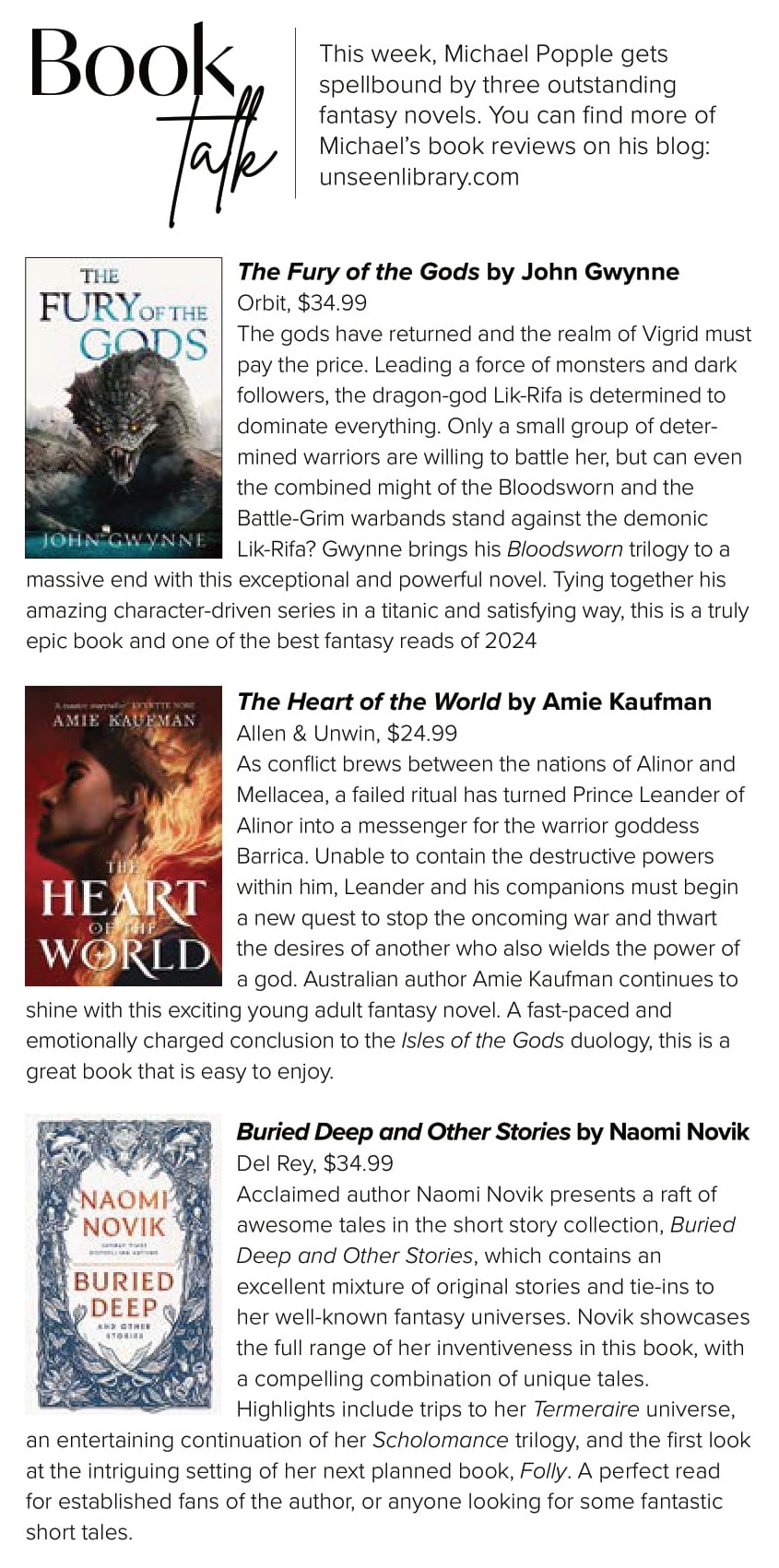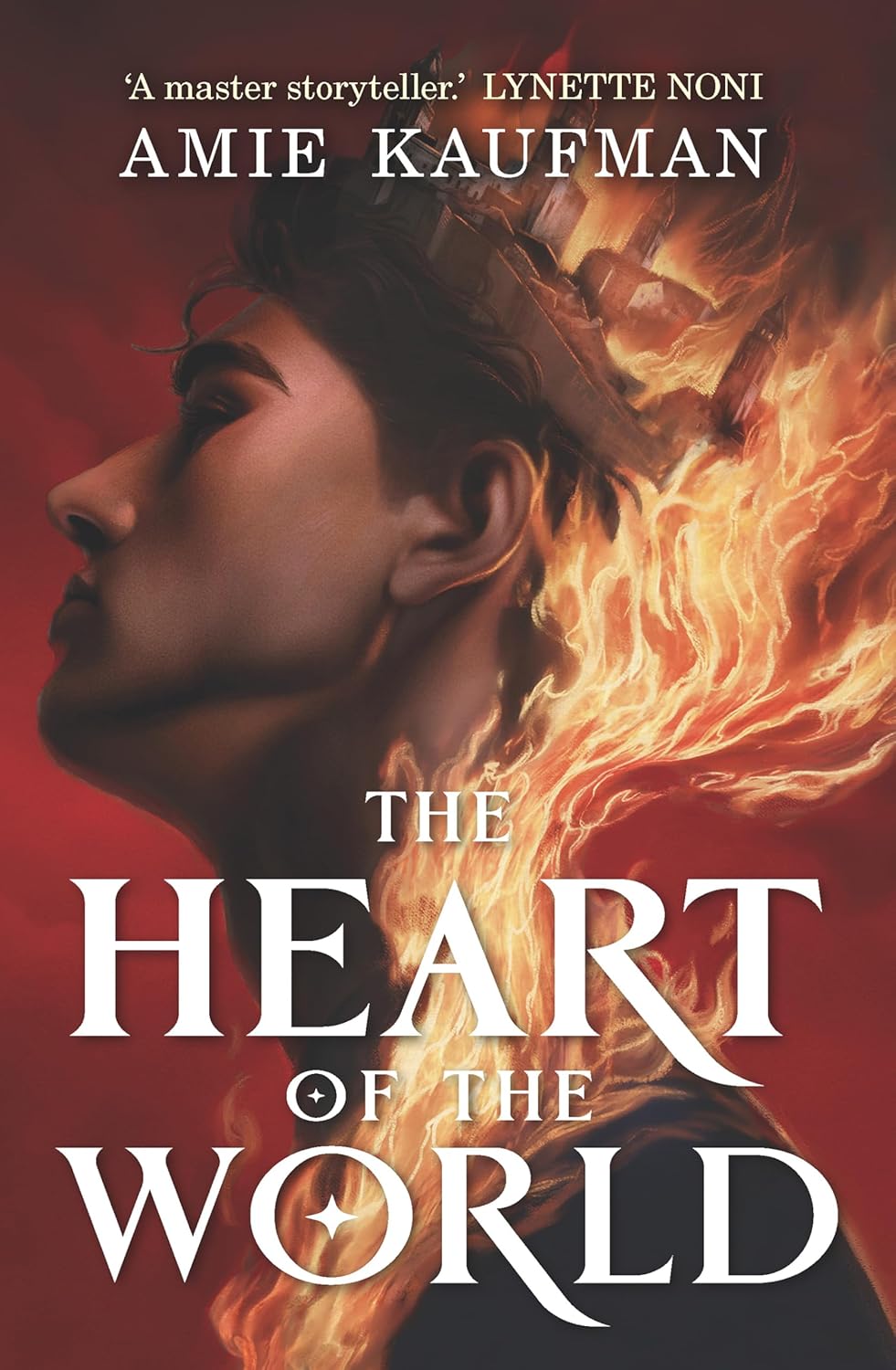
Buried Deep and Other Stories by Naomi Novik

Publisher: Del Rey (Trade Paperback – 17 September 2024)

Series: Standalone/Short Story Collection

Length: 433 pages

My Rating: 4.5 out of 5 stars

Amazon

A must-read for all fans of fantasy author Naomi Novik is the excellent and highly enjoyable short story collection, Buried Deep and Other Stories.  Featuring an intriguing combination of stories from across Novik’s imagination and established fantasy universes, Buried Deep and Other Stories was a particularly awesome read that I had a lot of fun getting through.

Naomi Novik is a well-established and impressive fantasy author who has produced some amazing works over the years.  Best known for her iconic Temeraire series, which envisioned the Napoleonic Wars with dragons, Novik has produced some great books and stories over the years, including some interesting standalone works.  I best know Novik from her excellent Scholomance books, which showcased a dark and impressive take on the magic school genre.  The Scholomance books, made up of A Deadly Education (one of my favourite books of 2020), The Last Graduate (one of my favourite books of 2021) and The Golden Enclaves (one of my favourite books of 2022), were all extremely awesome, and this remains one of my all-time favourite book trilogies.  As such, I was very interested in reading more from Novik and Buried Deep and Other Stories offered an amazing opportunity to explore her varied writings.

Buried Deep and Other Stories contains an auspicious 13 short stories, which run the gambit from entertaining to moving and bring together both previously published short stories and new tales fresh from the author’s imagination.  While some of the reads are standalone stories, there were also entries from Novik’s more familiar universes, all of which comes together to make quite an awesome overall volume.  I was initially drawn to this book by the promise of a continuation of series I’ve previously read, but I ended up staying for the whole inventive array, especially as you are gifted a vision into Novik’s future works.

Novik starts the book off strong with the fast-paced story, Araminta, or, The Wreck of the Amphidrake, a Regency-style adventure with fantasy elements that follows a young, adventurous woman who wants more than a planned marriage.  A chance pirate attack and a gender-morphing amulet provide the opportunity she is looking for while also leading to various amorous adventures.  This was a very fun, and slightly randy, swashbuckling adventure that successfully highlights the author’s flair for combining historical periods with her own fantasy ideas.  This proved to be a great first entry to Buried Deep and Other Stories, and I appreciated that Novik started things off fun.

Novik kept the book going strong with the amazing Afterhours, which serves as a follow-up to her awesome Scholomance trilogy.  I must admit that of all the stories in this book, Afterhours was the one that I was most excited for, primarily because I had such a great time with the Scholomance novels, and I really wanted to see how the universe continued.  Novik did not disappoint with a captivating story set a couple of years after The Golden Enclaves, with a look at a new class studying at the Scholomance magical school.  Despite the Scholomance evolving and becoming less exclusive, some things remain the same, with the unusual witch Beata, finding her school life made difficult by the rich and powerful enclave students, including her roommate.  Desperate to survive, Beata and her friends break curfew to obtain rare supplies, only to encounter some of the remaining monsters roaming the school.

This proved to be an entertaining and wonderful return to the Scholomance series, and I for one was glad to get a look at the school and its unusual setup following the chaotic events of the original trilogy.  Novik does an excellent job expanding on her existing universe, and fans of the series will love this continuation, as well as a major cameo at the end.  However, this story is open to reader’s unfamiliar with the Scholomance books, especially as Novik focuses the plot on a protagonist unaware of the full details of the previous books, allowing for an excellent outsider’s perspective as you explore the setting’s unique features.  It was great to return to this iconic setting, and Afterhours was a fun read that both stood on its own, while also providing some awesome moments to the author’s existing readers.

The third story in this book, Vici, is a quick but highly fun entry that ties into the dragon taming world of Novik’s Temeraire universe.  Indeed, Vici shows the origin of the universe’s entire dragon riding premise with a Roman historical tale that sees a young Mark Antony hatch a dragon egg.  Novik produces a particularly entertaining and hilarious story, as her irresponsible Mark Antony (inspired by James Purefoy from the Rome television series), finds himself in all manner of trouble, made worse by his impressionable talking dragon.  I loved this simple but highly effective story, which not only expertly works dragons into Roman history, but which also keeps the reader extremely amused with some great humour and over-the-top moments.  One of the funniest stories in Buried Deep and Other Stories, and a wonderful mood lightener between other heavier entries.

This leads us to the book’s titular short story, Buried Deep, which serves as a powerful retelling of the Minotaur myth.  Told from the perspective of King Minos’s daughter, Ariadne, Buried Deep follows her journey to becoming a priestess of the shrine that holds her brother, Minotaur, as he stalks the labyrinth under the island.  Novik seeks to cast both Ariadne and Minotaur in a more sympathetic light, showing them as victims of their father’s schemes, with Ariadne seeking to undermine Minos by using the labyrinth to enhance her reputation.  Thanks to its deep emotional edge and near gothic style, Buried Deep proved to be a particularly unique and memorable take on the Minotaur myth, and I loved seeing Ariadne’s perspective of events.  You really appreciate her bond with Minotaur and the pain that his imprisonment has on her, and this was one of the more moving entries in Buried Deep and Other Stories.  This story effectively showcased Novik’s ability to transform well-established stories and myths, and I’m glad Buried Deep was featured here.

The next story is the fantastic entry, Spinning Silver.  A clever take on the classic Rumpelstiltskin fairytale, this story follows Miryem, the daughter of a village moneylender, who takes over her weak father’s business and becomes a successful businesswoman.  A boast about her ability to make money brings her to the attention of a malicious faerie who demands that she prove her ill-timed words three times by turning his silver coins into gold.  What follows is a fantastic and clever series of events as Miryem uses her business sense and quick thinking to technically fulfill the terms of the magical contract while also trying to get out of the unfavourable marriage promised as a reward.

I really loved Spinning Silver for a multitude of reasons, especially as it has a compelling narrative that brilliantly retells a famous fairytale in a darker and more modern manner, while also featuring a great historical Russian setting.  This proved to be a particularly enthralling tale of fortitude and tough decisions that also subtly examines the historical hardship of the Jewish population of Eastern Europe.  Spinning Silver is also an interesting inclusion as it bears the same name as one of the author’s novels.  This short story, which was published a few years before the Spinning Silver novel, was the inspiration for Novik’s later book, with the author reusing elements from it.  While readers who have already enjoyed the Spinning Silver novel will see some similarities between it and this short story, the entry in Buried Deep and Other Stories is very much worth checking out as Novik takes this short story in a different direction to give it quicker and more definitive conclusion.  I think that the Spinning Silver short story works a little better than the overall novel, mainly because the concept was more focused and reached its key points sooner, but both prove to be excellent reads.  This honestly proved to be one of the strongest entries in Buried Deep and Other Stories, and I see why Novik chose to expand it into a novel.

The fun continues with the fantastic story Commonplaces, which serves as the author’s unique entry in the Sherlock Holmes mythos.  Set after the events of the classic Sherlock Holmes short story, The Final Problem, Commonplaces focuses on the character of Irene Adler after she hears about the events at Reichenbach Falls.  This was a short but sweet story that provides an interesting modern look at the impact Holmes has on the characters he encounters.  Novik’s take on Adler, which only utilises details from A Scandal in Bohemia, is particularly authentic, and doesn’t fall into the exaggeration that many of her current popular culture portrayals are known for.  Shown solely from Adler’s perspective, you get some great interpretations into her personality, as well as her observations of the enigmatic Holmes.  I felt the story went in some very interesting and memorable directions, and I liked how it both cleverly referenced A Scandal in Bohemia but also covered a potential romance between Holmes and Adler in its own way.  Novik adds in a few subtle implications about Holmes’ romantic interests and inclinations, which I thought was a nice touch, and the resulting story effectively ties up the entire storyline between these two iconic figures.  An overall fantastic story, Commonplaces is a fun and quick short that will appeal to a lot of readers.

Novik continues to delight with the seventh entry, ironically named Seven, which was one of my favourite stories in Buried Deep and Other Stories.  Set in a unique fantasy city called Seven, the story is set around the city’s famous ceramics trade, which constantly ensures that the city is surrounded by seven giant singing statues.  Whenever one of the statues breaks, a replacement is made from a beautiful yet deadly special clay by the city’s then master clay-shaper.  Seven primarily follows Kath, a clay-shaper’s widow, who takes over her husband’s business with the help of grouchy kiln master and ceramic devotee Grovin, and eventually forms a reputation as a radical artist due to the simplicity of her pots and ceramics.  Chosen to build the next singing statue, Kath is initially reluctant due to the life-shortening nature of the special clay, until the machinations of Grovin forces her hand.

I really loved Seven, and I think it is the story that best showcases how imaginative and skilled Novik is as an author.  I was deeply impressed with how effectively Novik was able to build up a new fantasy city and then set up a complex and character-driven tale that debated art versus practicality in only 25 pages.  You easily get drawn into the struggle of Kath as she becomes a famous artist and creator with all the trouble that entails, while simply trying to provide for her family.  Novik works this initial premise extremely well, and then cleverly twists the entirety of Seven into a tale the examines the dark side of art appreciation.  This darkness is conveyed by the complex and gruff character of Grovin, a man who only loves the beauty of ceramics, and whose desire to see more of Kath’s art forces him to some dark places.  I loved the ironic twist that forces Grovin to live a life less devoted to the arts to get what he wants, and I really appreciated how Novik explored his obsession, and the differing views of what ceramics represent between the two main characters.  If I had one complaint, it would be that the story wasn’t long enough; I would love to have seen a more concrete conclusion than the philosophical end Novik came up with, but this was still an exceptional story that really hooked me in with its creativity and unique focus.

Continuing onwards, Novik throws in two great short stories that break up the book in preparation for the longer stories towards the end, with Blessings and Lord Dunsany’s TeapotLord Dunsany’s Teapot is a tale of magic and imagination in the depths of horrifying war, while Blessings is a fun story about a young baby who gets over-blessed by six drunk and competitive fairy godmothers.  Both these stories have their own unique flavour, and I liked how well they played off each other in short order.  Lord Dunsany’s Teapot was a quick magical story with descriptive dark war elements to it that highlight the need for an escape from horror, while Blessings was an excellent comedic take on the fairy godmother trope from popular fairytales.  I enjoyed both these stories, although Blessings was probably my favourite due to its hilarious, quick-fire content.

Next up we have the tenth entry in Buried Deep and Other Stories, with the book’s only science fiction contribution.  Seven Years From Home is a striking story about futuristic colonialism in which a young diplomat from an ever-increasing galactic federation visits a prospective new member planet where a war is brewing between new, technological reliant colonists and the original settlers of the planet who have genetically modified themselves and are now in tune with nature.  This was an interesting take on the classic story of technologically advanced colonists warring with nature-loving natives with an outsider amid the natives learning their ways.  However, Novik takes her story in some different directions, with the natives proving to be far more adaptable than you would expect, and I loved this brilliant and intriguing tale.  While it features a great story, Novik ensures that Seven Years From Home really stands out thanks to the protagonist, who finds herself caught between her loyalties to her home empire and the new friends she makes on her adventures.  There were some great scenes as the protagonist becomes even more conflicted with her choices, especially as the information she sends home keeps the war going, and her attempts to find the same mindset of her hosts.  This story ends with some touching tragedy and a great twist, and I felt that Novik’s foray into science fiction was a fantastic success.

Continuing, we have the book’s second foray into the Temeraire universe with the fabulous entry Dragons & Decorum.  Set to the backdrop of the Napoleonic War that the main Temeraire books are based on, Dragons & Decorum is a reimagining of Pride and Prejudice with dragons.  The primary story sees Elizabeth Bennett becoming a Longwing captain in the Aerial Corps, flying her dragon as professional soldier, much to the horror of her mother.  However, despite her new role, Elizabeth still finds herself drawing the attention of Mr Darcy, and the two engage in a tumultuous courtship, with even more complexity thanks to Elizabeth’s romance-obsessed dragon and the ongoing war.  Novik clearly had fun working elements of her dragon-focused world into this literary classic, and I loved her fantastic take on the classic book, especially as dragons add new entertaining angles to the romance.  I felt that the author perfectly blended the more outrageous elements of her universe with the Pride and Prejudice plot, while also cleverly imitating Jane Austen’s writing style.  The result is a particularly amusing entry that will appeal to both fantasy fans and Jane Austen fans, and I just love the hilarious impacts any book’s relationship to the Temeraire universe can have.

On the home streak we have the intriguing and dark story, Castle Coeurlieu, which saw the very young bride of a castle lord grow close to her similarly aged stepson and learn the unusual history of the castle in which they live, including several stories about people visiting a mysterious tower within its bounds.  When plague strikes the region and her new friend flees to the tower, the protagonist follows, only to discover unusual occurrences, including three women playing with cards inscribed with the fate of the castle’s inhabitants.  While Castle Coeurlieu wasn’t my favourite entry in Buried Deep and Other Stories, it proved to be a compelling darker story that added in some grimmer elements towards the end of the book.  I enjoyed the different layers of lore surrounding the setting, and the curious young protagonist was well written and provided a great view to the plot.  An overall interesting addition to the volume, that serves as a great buffer between two of its biggest stories.

The final story contained within Buried Deep and Other Stories is the captivating adventure tale, The Long Way Round.  The longest entry in the collection, The Long Way Round was probably the story I was most looking forward to reading outside of After Hours, mainly because it provides readers with the first glimpse at Novik’s next upcoming book, currently titled Folly, following two siblings, canny sailor Tess and brilliant boat-builder Aston, who embark on a journey to cross the seemingly empty seas surrounding their known world and try to discover new lands.  Forcibly accompanied by their High Lord, a young wizard looking to prove himself, Tess, Aston and their crew set out on their adventure, only to make some unexpected discoveries with major implications for their entire world.

Featuring a great combination of likeable characters, well-written nautical elements, and a compelling new world filled with unique elements, The Long Way Round was a particularly addictive entry in Buried Deep and Other Stories.  Novik once again does a remarkable job effectively building up the scenario and the new fantasy realm in a short run time, and readers quickly find themselves getting invested in the protagonist’s journey, especially as the author does an excellent job exploring their motivations and desires.  The set-up and apprehension of the first part of The Long Way Round is well balanced by the subsequent mystery contained in the second half of the story, as the protagonists find what they seek, even if they are uncertain what it is.  Novik provides the reader with a series of stimulating and intriguing visuals and curious elements, and you really get into the spirit of the adventurous narrative elements.  This honestly proved to be an addictive read, and I found the clever, character-driven nautical adventure to be moving and fascinating at the same time.  I also found myself coming away from The Long Way Round extremely curious about Novik’s next book, and I will be interested to see whether it will be a direct sequel to this or something set further in the future.  Either way, the mystery of the titular follies is something I hope to explore in the future, and I am now even more excited for Novik’s next book whenever it comes out.

Overall, Buried Deep and Other Stories turned out to be an awesome short story volume from Naomi Novik that showed me her true range and skill as a fantasy author.  This book provides a fantastic collection of works, that hit you on every part of the emotional spectrum, including fun comedic reads and darker, tragedy charged narratives.  I was also particularly impressed by the inclusion of unique standalone stories whose elaborate fantasy concepts were well established and the expertly utilised to tell compelling stories.  The blend of original stories and windows into the author’s current and upcoming fantasy universes also ensured that readers of Buried Deep and Other Stories are in for a brilliant time.  It proved very easy to jump between these different fantasy worlds, and I felt that all readers can appreciate and follow the stories contained within, even if they were tied into the author’s other series.  As a fan of Novik’s writings, it was great to get some additional stories from her various universes, and the final story, The Long Way Round, has really gotten me excited to check out her next book.  Folly (or whatever its name may change to) is now very high on my to-read list, and I hope we see it soon.  As for Buried Deep and Other Stories, this was an incredible and fantastic short story collection that comes highly recommended for fans of Naomi Novik, as well as general fantasy fans looking for some compelling, shorter reads.

Amazon

How to Become the Dark Lord and Die Trying by Django Wexler

Publisher: Orbit (Trade Paperback – 6 August 2024)

Series: Dark Lord Davi – Book One

Length: 395 pages

My Rating: 4.75 out of 5 stars

Amazon

Hilarious author Django Wexler presents one of the funniest and most memorable fantasy novels of 2024 with the deeply addictive How to Become the Dark Lord and Die Trying.  Serving as the first book in Wexler’s new Dark Lord Davi series, How to Become the Dark Lord and Die Trying was an extremely amusing book that has been on my radar for a while due to its amazing-sounding plot.

It’s a tale as old as time.  An ordinary human becomes trapped in a mythical fantasy realm and is subsequently lauded as the prophesied hero of legend, destined to rule the kingdom and defeat the conquering Dark Lord.  But what happens when the human protagonist gets sick of living and dying as the hero?

That’s the question that falls to Davi, a young woman who has become trapped in a bloody and predictable time loop.  Constantly forced to become the leader of the soon-to-be-destroyed humans of The Kingdom, Davi has tried time and time again to organise an army capable of defeating the oncoming and everchanging Dark Lord, only to fail and die in agony in over 200 inventive ways.  After nearly a thousand years of playing the hero and losing in brutal fashion, Davi has had enough and decides that if you can’t beat them, become them.

Determined to take control of her destiny, Davi sets out to do the direct opposite of every other loop.  If the Dark Lord always wins, then this time Davi will take her place at the top of the winning side and become the new Dark Lord herself.  But first she must pull together a band of followers from the various non-human races of the realm and bring her loyal minions to the Convocation where the new Dark Lord is chosen, far away in lands she’s never even seen.  Standing between Davi and her destiny lie multitudes of deadly landscapes, brutal enemies, and all manner of unique obstacles that a Dark Lord in training needs to overcome.  Armed with her wits, her accumulated knowledge of the world, the ability to use her own death to her advantage, and an insane amount of humorous confidence, Davi may be able to do the impossible and finally win.  But Davi will soon learn that becoming the Dark Lord isn’t everything it’s cracked up to be.

How to Become the Dark Lord and Die Trying was a highly entertaining and insanely captivating read that I honestly could not get enough off.  Featuring a brilliant scenario that Wexler plays to comedic perfection, combined with dark humour and a uniquely insane protagonist, How to Become the Dark Lord and Die Trying is an outstanding novel that I had so much fun reading.

I must admit that I instantly loved the very fun premise of this book which saw the protagonist decide to take on the role of the Dark Lord after hundreds of failed attempts to survive as the hero.  Wexler did an outstanding job setting this idea up in the first couple of chapters of How to Become the Dark Lord and Die Trying, and you are quickly intrigued by the combination of a bloody time loop, a despondent, if hyper, protagonist, and the entire change of plan said protagonist embarks upon.  As such, you are completely onboard as soon as Davi starts to implement her plan, and the resulting carnage proves to be highly entertaining and fun.  After multiple bloody failed attempts to start her new turn to darkness, Davi soon begins to get into her groove as the next Dark Lord, recruiting a small band of minions, and taking the first steps to proving she has what it takes to rule.

Davi’s subsequent quest to become the Dark Lord involves an intense adventure arc, as she leads her army through various fun fantasy locations.  Along the way to her destination, Davi engages in different schemes to recruit new followers, especially when she encounters some chaotic communities whose internal strife she is able to exploit.  The story devolves into an awesome combination of intrigue, humorous encounters, fantasy action and personal character growth, as the protagonist becomes more comfortable with the Dark Lord lifestyle.  After several extended sequences at key locations, the protagonist eventually reaches her goal and begins her trials to become the new Dark Lord.  However, nothing at the trials is what it seems, and Davi is forced to deal with multiple enemies from her various pasts to survive.  There are some great moments in this final part of the book, including tragic betrayals, heart-felt romance, intriguing revelations, and some big fights, all of which leads to an interesting open-ended conclusion that will ensure readers come back for the next book in the series.

I had an exceptional amount of fun with How to Become the Dark Lord and Die Trying, and Wexler had a fantastic style that really appealed to me.  Told exclusively from the slightly crazed first-person perspective of the protagonist, readers are treated to Davi’s highly excitable inner thoughts as she recounts her journey to becoming the Dark Lord.  This proved to be a great medium to explore the more complex elements of the plot, and I appreciated how Wexler was able to succinctly dive into time-loop and Davi’s place in it, while also moving the plot along.  The author also introduces a serviceable and intriguing fantasy world the plot of How to Become the Dark Lord and Die Trying, which proved interesting to explore.  While a little basic in places, Wexler does feature some excellent concepts here, and readers will enjoy watching Davi explore it with her own unique perspective, especially as she forms new ideas about the supposedly evil wilders (non-human creatures) as she works with them.  While some of these concepts are a little complex at times, everything honestly works extremely well for the entertaining plot, and I really appreciated how effectively the author was able to explore and utilise his fantastic ideas.

While all these great concepts help to craft a unique book, what holds everything together and keeps the reader’s attention is the relentless comedy that Wexler injects into nearly every page of How to Become the Dark Lord and Die Trying.  I really connected to Wexler’s humour in this book, and I found myself chuckling away for large chunks of it.  Thanks to the slightly cracked protagonist, the reader is bombarded with a constant array of jokes, hilarious commentary, and over-the-top moments, as Davi combats the horrors both in front and behind her with humour.  A lot of this humour was driven by the protagonist having a modern, nerdish perspective in a crazy fantasy world, and her reactions ranged from sarcastic to goofy.  Wexler also makes great use of an array of continuous footnotes to tell additional jokes outside the flow of the narrative, or to really expand on an interesting or funny point.  I am a big fan of the use of footnotes for comedic purposes (blame my Terry Pratchett upbringing), and Wexler made it work really well here.  The author also relies on quite a lot of highly adult humour throughout the book, which helped to give How to Become the Dark Lord and Die Trying an interesting flair.  While I could see some readers not liking how continuously risqué the book got, or how over-the-top the humour is in general, I personally felt that it worked and allowed for quite an amusing, if slightly randy, experience.

Talking of crazy humour, I must highlight the fantastic central protagonist of How to Become the Dark Lord and Die Trying, Davi.  A modern-day and highly nerdy woman who finds herself trapped in this recurring fantasy adventure without any idea of how she got there, Davi is an interesting figure, and you really connect with her as the plot continues, especially as a lot of hilarity is drawn from her outrageous behaviour and thoughts.  Davi is constantly cracking jokes, making sarcastic inner observations and meta commentary, often driven by her modern experiences, and it’s hard not to be amused by her antics.  She also has some great, often ridiculous interactions with the various fantasy creatures she encounters, and I liked seeing her unusual persona connect with these more serious creatures.

While it is easy to get lost in Davi’s comedic persona, the further you get into the book, the more apparent it is that her cracked behaviour has been brought on by the constant trauma from her hundreds of deaths and the accompanying thousand years of experience that she has lived through as part of her fantasy adventure.  The initial exposure to her early trauma and rage at the start of the book gives you enough of a glimpse of this that you appreciate her turn to the dark side, but you see even more of it as the story continues.  A lot of this is because, even after years of watching everyone die, she still cares about the people around her, and the impacts of her decisions start to wear on her.  While she maintains her zany persona for much of the book, a new romance and a dark change in her circumstances towards the end of the book nearly break her, and I felt that Wexler did an outstanding job of trying to humanise her there, especially as she sometimes gives off uncaring, immortal vibes.  Thanks to these deeper personality traits, as well as her comedic nature, I really grew to appreciate to Davi as main character, especially as she is a lot more capable and competent thanks to her experiences, although she still makes some interesting mistakes (never sleep with your minions, everyone knows that).  As such, I look forward to seeing how her story continues, especially as things are likely to get even more out of control for her.

Overall, How to Become the Dark Lord and Die Trying by Django Wexler was an awesome book that I honestly found to be quite addictive.  The fantastic central scenario is greatly enhanced by the author’s outrageous humour and clever storytelling, and it allows for quite an outstanding read.  Slick, unique and very, very funny, How to Become the Dark Lord and Die Trying was one of the more unique fantasy novels of 2024, and if you are in the mood for a great laugh, then this is the book for you.  I personally am very excited to see how the Dark Lord Davi series continues in the future, and the second novel, Everybody Wants to Rule the World Except Me, is set for release in May 2025.

Amazon

Waiting on Wednesday – Four Ruined Realms by Mai Corland

Welcome to my weekly segment, Waiting on Wednesday, where I look at upcoming books that I am planning to order and review in the next few months and which I think I will really enjoy.  Stay tuned to see reviews of these books when I get a copy of them.  For this week’s Waiting on Wednesday, I check out the awesome upcoming sequel to a great fantasy novel I read in 2024, with Four Ruined Realms by Mai Corland.

Amazon

Earlier this year I had the great pleasure of reading the fantasy debut, Five Broken Blades by Mai Corland.  An exciting, intense and clever character-driven fantasy novel with some strong romantasy elements, Five Broken Blades was a fantastic read that saw several of the biggest liars in a fantasy kingdom team up to take down their immortal king.  Essentially one big heist novel with over-the-top characters, excellent action, tons of intrigue and a whole lot of personal issues, Five Broken Blades was a deeply enjoyable book, and I had a brilliant time getting through it, especially in its audiobook format which featured multiple excellent narrators.

While I didn’t love absolutely everything about Five Broken Blades (I’m not a huge romantasy fan, although Corland kept these elements fairly subtle), I did get really caught up in the narrative and I am very curious to see how it is going to continue.  As such, I am eager to get my hands on the upcoming sequel, Four Ruined Realms, which looks set to send the protagonists on another deadly heist.  Set for release in early January 2025, Four Ruined Realms has a great plot behind it, and I’m looking forward to finding out how Corland builds on the clever twist and cliffhanger at the end of Five Broken Blades.

Plot Synopsis:

The lies are bigger and the plots more treacherous when your favourite backstabbers return in the mind-blowing sequel to instant Sunday Times and New York Times bestseller Mai Corland’s epic adventure fantasy Five Broken Blades.

The King of Yusan may be the greatest liar of them all.

His sister’s ring is in his sights, and he will do anything to get what he wants. Even manipulating the five blades to steal it…

Bonded by deceit, the blades must rely on their skills to pull off King Joon’s pursuit or risk his legendary wrath.

A foreign rule of law stands between them and Quilimar, the Queen of Khitan. Now they have one month to steal the powerful Golden Ring of the Dragon Lord. But that impossible task might be easier than trusting one another, even though their lives, their families, and the realms depend on it.

They can all agree on one thing: the king can’t win. But can they beat him at his own game?

Because for the blades, this time it’s not just personal, it’s revenge. Lies may have torn them apart, but now vengeance will bring them together.

The lies have only just begun…

Four Ruined Realms sounds like a very fun read, and I cannot wait to see how Corland’s protagonists fair during their next heist.  There are so many cool elements from the first book that need to be continued here, including the consequences of their various lies and manipulations, their own unique desires that often run counter to each other, and the fact that they now all want vengeance on King Joon, the man who brought them together in the first place.  I cannot wait to see how the characters interact in Four Ruined Realms, especially now that all their cards are on the table, and I am sure there will be even more backstabbing and betrayals along the way.  As such, I am imagining that Four Ruined Realms will be another intense, clever and captivating read, that continues to explore the excellent protagonists, while also presenting an exciting new target for them.

Due to how much I enjoyed the first book in this series, there is no way that I won’t be grabbing Four Ruined Realms when it comes out early next year.  I am very curious to see how Corland continues this story, and the author has really hooked me with her various cool characters.  This will probably be one of the first books of 2025 I read in the new year, and I am hoping to grab it on audiobook again after the great experiences I had with the format for Five Broken Blades.  No matter how I read it though, I have no doubt that Four Ruined Realms is going to be an outstanding and addictive fantasy read.

Waiting on Wednesday – Whisper in the Wind by Luke Arnold

Welcome to my weekly segment, Waiting on Wednesday, where I look at upcoming books that I am planning to order and review in the next few months and which I think I will really enjoy.  Stay tuned to see reviews of these books when I get a copy of them.  In this latest Waiting on Wednesday, I check out an exciting and intriguing upcoming addition to a unique fantasy series with Whisper in the Wind by Luke Arnold.

Amazon

Back in 2020 I was lucky enough to get my hands on a very interesting fantasy book, The Last Smile in Sunder City.  The debut novel of actor turned author Luke Arnold and the first book in his Fetch Phillips series, The Last Smile in Sunder City was a dark and compelling fantasy book with an excellent hook to it.  The series is set in a fantasy realm where magic has been destroyed, and the various former magical creatures are now disfigured, depowered or dying, and the previously oppressed humans find themselves with an advantage.  Following the titular character of Fetch Phillips a depressed human private investigator and odd-jobs man with a desire to help the formerly magical creatures, The Last Smile in Sunder City saw him attempt to find missing children, while also discovering a potential cure for the lost magic.  This proved to be an outstanding book, especially with its unique setting and its compelling character arc around Fetch, who is shown to be personally responsible for the chaos engulfing the world.  The Last Smile in Sunder City ended up being one of my favourite debuts and top Australian fiction releases in 2020, and I had a wonderful time reading it.

Arnold continued to impress with his Fetch Phillips series as the years continued.  His second book, Dead Man in a Ditch, proved to be a worthy sequel, especially as it introduced a great overarching antagonist for the series, set up a great storyline about technology replacing magic and pushed the protagonist even further down a dark past.  This all cumulated in a brilliant third book One Foot in the Fade, which was probably Arnold’s best book in the series.  After discovering a former genie capable of returning magic to people, Fetch and several companions embark on an intense journey to recover an artefact that could empower her.  This resulted in a particularly gripping read, especially as Fetch’s obsession with undoing his wrong leads him along a particularly dark path.  Arnold ended One Foot in the Fade on an excellent note, as Fetch starts a new era in his journey and tries to find peace a different way.

Due to how much fun I have had with this series in the past, I have been keeping an eye out for another book from Arnold and I was happy to find out that he had a fourth Fetch Phillips book coming out next year.  This fourth book, Whisper in the Wind, is set for release in April 2025, and will set Fetch on another adventure despite his desire to live a simple life.

Plot Synopsis:

The fourth installment of Luke Arnold’s Fetch Phillips series, Whisper in the Wind, takes readers to a very different Sunder City. One where government corruption is rampant and tensions are rising.

Fetch is done being a hero. Once a detective, all he wants now is to run his cafe in peace. Sunder City is still recovering from the sudden and violent end of magic, and if one man can’t solve all its problems, he can at least stop some people going hungry. But when a kid on the run shelters in Fetch’s cafe, and a chain of gruesome murders begins among Sunder’s high and mighty, trouble is brought to Fetch’s door.

There’s a word whispered on the wind, and that word is revolution…

This sounds like another pretty epic entry in the Fetch Phillips series, and I am very interested to see how Arnold is going to continue the series here.  Based on the synopsis above, it seems that Whisper in the Wind is going to be set some point after the third book, with a retired protagonist forced back into his previous problems.  This should be an excellent and natural continuation of the story elements that the author previously set up in the previous books, and I assume we are going to see some of the recurring antagonists and corruption from the previous novels come back to the fore.  As such, I feel that Whisper in the Wind is going to be a very fascinating continuation to this series, and I am very curious to see how Arnold keeps his narrative going.

Due to the impressive quality of the previous novels in this series, I am definitely grabbing Whisper in the Wind when it comes out next year.  Luke Arnold has shown himself to be a particularly skilled fantasy author, and I have become a huge fan of his Fetch Phillips series as a result.  I cannot wait to see how this epic sounding book turns out and I have no doubt that Whisper in the Wind is going to be one of the more interesting fantasy novels of 2025.

The Last Shield by Cameron Johnston

Publisher: Angry Robot (Ebook – 13 August 2024)

Series: Standalone

Length: 376 pages

My Rating: 5 out of 5 stars

Amazon

One of the rising stars of dark fantasy fiction, Cameron Johnston, returns with an intense, gritty and addictive novel of revenge, desperation and brutal murder, with the brilliant novel, The Last Shield.

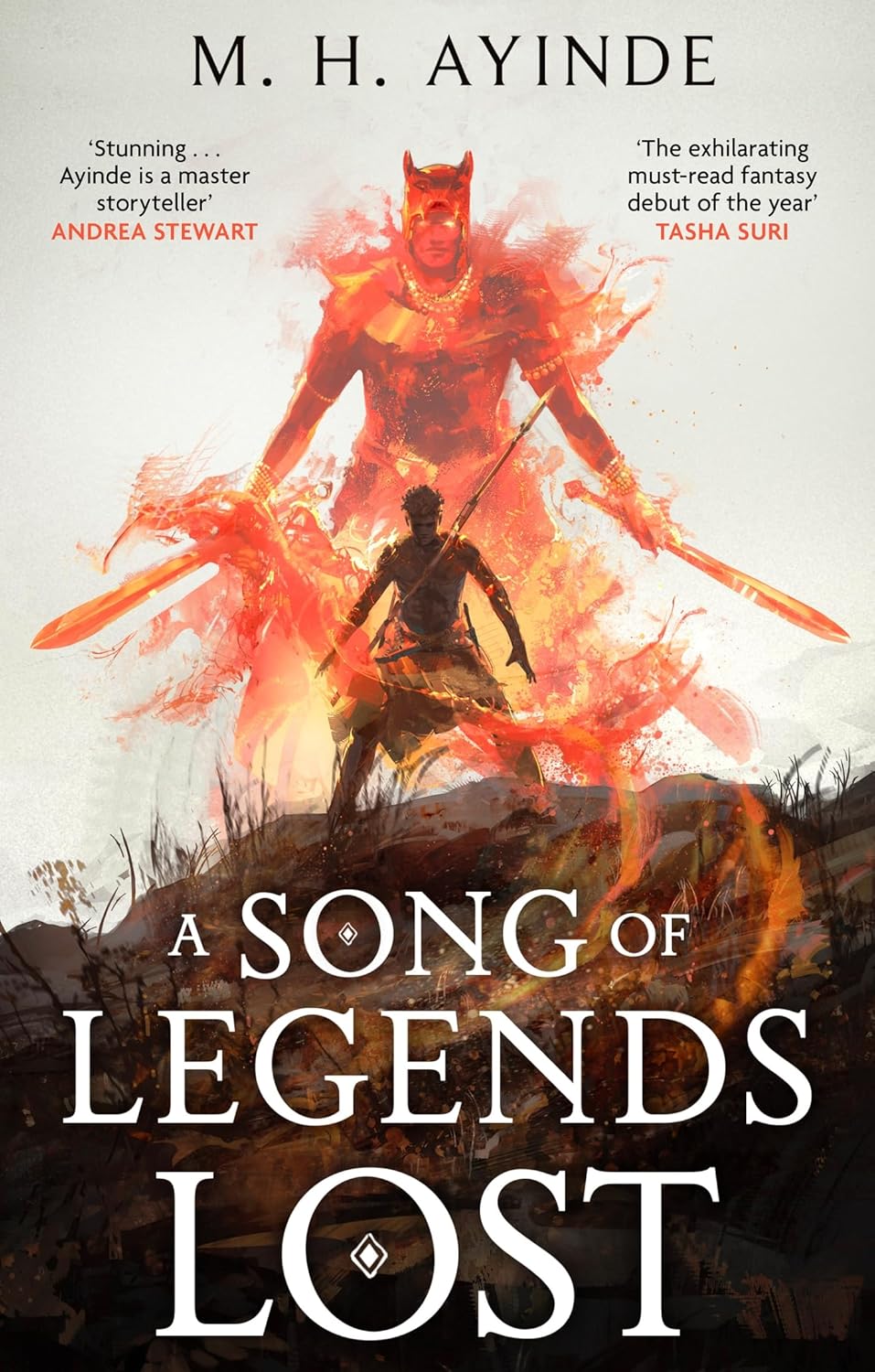
One of the more intriguing authors of fantasy fiction I have enjoyed reviewing in recent years is the outstanding Cameron Johnston, who has deeply impressed me with his small but excellent collection of works.  Since his debut book in 2018, The Traitor God, I have grown to enjoy Johnston’s novels, especially as his first book was a brilliant story of dark magical revenge.  Following up with the awesome sequel, God of Broken Things, Johnston cemented himself as an author to watch, and I have yet to be disappointed by him since.  His third novel, The Maleficent Seven, was a fantastically bonkers read that saw a small town become the unwilling recipients of a band of monstrous defenders when a massive army comes to destroy them.  I had an amazing time with The Maleficent Seven, and indeed all of Johnston’s books, which is why I was so eager for his latest novel, The Last Shield.  One of my most anticipated books of 2024, The Last Shield had an epic and cool plot behind it, and I was so very eager to check it out.

In a world of warring realms and dark magic, the ancient forest realm of Sunweald survives by serving as a buffer country between two far mightier nations on either side of its borders.  A realm of tradition and druidical magic, the heart of the nation lies in Sunweald Palace, where the Lord Regent, and the young heir to the throne reside, guarded by Sunweald’s elite warriors, the Shields.  Rough and old, Sunweald Palace is an impenetrable fortress designed protect the nation’s royal family, as well as safeguarding a massive vault of unspeakably powerful magical artefacts.

Despite its peaceful status, Sunweald finds itself beset by a group of vicious brigands, the Wildwood Reivers, who have made a living stealing away magical artefacts and trading them across the border.  Led by a mysterious witch, the Wildwood Reivers have grown bold, even launching an attack on the royal family.  When word reaches the palace of the location of the brigand’s base, the Shields depart to destroy them once and for all.  However, their mission is a devious decoy, as through treachery, dark magic and deceit, the Wildwood Reivers and their allies manage to take over Sunweald Palace.

With the Shields away and traitors holding the wall, the brigands plan to loot the palace’s ancient vaults and steal every magical artefact hidden within.  However, the Wildwood Reivers face one substantial obstacle to their success, Briar, feared, if hobbled, commander of the Shields.  Despite being outnumbered, wounded and near retirement, Briar is determined to perform her duty and reclaim the palace.  Using her knowledge of the palace’s secret tunnels and ancient corridors, Briar sets about dismantling the invaders in brutal fashion.  But battered, alone and loosing strength, can even a legendary Shield like Briar face the overwhelming odds and lethal magic set against her?

Gosh this was a very impressive and exciting read.  Cameron Johnston has a real flair for fantastically over-the-top narratives, and The Last Shield is some of his best work yet.  A complex and compelling tale of revenge and redemption, The Last Shield was a non-stop thrill ride, and I loved the deeply intense story that emerged.  This was a truly outstanding book that gets a full five-star rating from me thanks to how much sheer fun I had reading it.

The narrative that Johnston pulls together for The Last Shield is extremely awesome, and it can best be described as a gender bent, dark fantasy Die Hard, with some amazing fantasy elements.  An excellent standalone story, The Last Shield was a constantly moving book, which drew me in with its clever plot concept and the promised resulting violence.  Part of the reason the story works so well is the initial setup, which introduces the new intriguing world, but more importantly effectively gets you across the central characters and the main setting of Sunweald Palace.  There are some great early character moments here, especially when it comes to the main protagonist, Briar.  The veteran leader of the Shields, Briar is badly wounded in the opening scenes of the book, which kicks off a great arc for her as she attempts to find her purpose after the injury potentially robs her of her position.  Some other key character arcs and storylines are also introduced here, including around the young heir to the throne, whose brush with death drives him closer to the disapproving Briar as a mentor.  Johnston also takes the time to explore the full extent of the conspiracy to takeover Sunweald Palace, and you grow to appreciate just how dastardly the plot is.  As such, you are well prepared for the chaos and carnage to come, and the anticipation Johnston expertly builds up in first part of the book, really enhanced the overall impact of The Last Shield.

As such, the reader is very much ready to go when the villains initiate their plan around a third of the way into The Last Shield.  The resulting takeover is as dark and brutal as you’d expect, and the reader is well prepared to despise the antagonists and root for any sort of victory from the protagonist.  You don’t have to wait long as the despondent Briar quickly finds herself in the ideal position to fight back and begins her bloody and justified one-woman assault on the invaders.  Johnston initiates a series of intense, powerful and increasingly desperate battles, as Briar encounters greater and great hurdles and opponents as she attempts to save the Lord Regent and stop the looting of the castle’s vaults.  The author expertly ramps up the intensity every confrontation, and you really find yourself more and more off the edge of your seat as the story proceeds and Briar becomes increasingly injured.  There are some brilliantly brutal confrontations all the way to the end, and the author throws in some great twists and major final threats.  I honestly loved every second of the epic second half of The Last Shield, and Johnston wrote an amazing, blood-soaked story.

I felt that Johnston did an outstanding job bringing his cool story to life in The Last Shield, and readers are in for a great time if they check this book out.  The excellent blend of dark action, intriguing fantasy, and powerful characters really worked for me, and I felt that Johnston perfectly blended storytelling elements throughout the entire book.  The writing of The Last Shield is crisp, fast-paced, and well planned out, and it proves impossible not to be drawn into the fantastic scenario and intriguing storytelling.  Cameron does an excellent job exploring the new fantasy world that The Last Shield is set in, and you really get drawn into the bronze-age Celtic setting, and the focus on a small kingdom with some intriguing gender roles.  I particularly enjoyed how Jonston managed to emulate the feel of a classic action thriller like Die Hard or Under Siege and blend it with the dark fantasy setting.  The resulting scenes, which forced a nearly retired badass female palace guard to crawl through the secret tunnels of the castle to save the male reagent while disrupting a magical heist, were so damn fun, and it was a fantastic take on a classic film trope.  It helped that Johnston brought his typical, over-the-top mindset to the action sequences in The Last Shield, presenting the readers with an increasing bloody series of fights as the protagonist unleashed her inner fury.  These scenes of carnage and brutality paired perfectly with the complex narrative and character arcs that Johnston built up, and the resulting book was so much fun.

I need to highlight The Last Shield’s awesome characters which were a fantastic part of the book.  I have mentioned the main protagonist, Briar, a few times already, and frankly she was the heart of The Last Shield due to her intense personality and well-written storyline.  Johnston very cleverly set up Briar’s story at the start of the novel, first showing the warrior in her prime, before hobbling her and forcing her to consider retirement before the main plot kicked off.  As such, the version of Briar we see for much of the novel is a desperate, tired and absolutely pissed-off figure, especially when she realises the many betrayals that led up to both this current assault and her previous injury.  I loved how well Johnston set up this character’s revenge arc, and it was so much fun to see Briar finally get her hands on all the people responsible for her misery.  The author really dives into Briar’s mindset and emotions as the book continues, and it proves very, very hard not to root for her, especially when she is driven to her absolute limit.

While most of the focus of The Last Shield is on Briar, there are several other great characters featured throughout the book who also enhance the story.  The most prominent of these is probably the heir to the Sunweald, Ves, who has excellent parallel character growth to Briar.  Initially portrayed as a young fop, Ves grows due to the sacrifices he witnesses in his name and the brash mentorship of Briar, and he ends up proving himself in his own way.  Aside from that, I really need to highlight the excellent group of villains who Briar finds herself up against.  Featuring a band of traitors, brigands, an assassin and a dark witch, the antagonists of The Last Shield play off the stoic Briar extremely well, especially as each of them enrage her in a different way.  Johnston does a fantastic job showcasing the antagonist’s perspective throughout the course of the story, and their early scenes really work to ensure the reader dislikes them.  I personally loved seeing their point of view once they realised that Briar was loose in the castle with them, and the outrageous sequences of fear, anger and regret that followed are incredibly fun.  These characters proved to be a great boon to The Last Shield’s plot, and I deeply enjoyed the fantastic and powerful storylines that Johnston built around them.

Cameron Johnston continues to greatly impress with his fourth novel, The Last Shield.  An exceptional, addictive and gloriously over-the-top dark fantasy novel that takes inspiration from some classic action films, The Last Shield was pure entertainment and excitement, that I could not turn away from.  With great characters, an awesome setting, and so much damn action, there is something for every dark fantasy fan in The Last Shield, and I cannot recommend it enough.  One of my favourite fantasy books of 2024.

Amazon

Five Broken Blades by Mai Corland

Publisher: Recorded Books (Audiobook – 7 May 2024)

Series: The Broken Blades – Book One

Length: 15 hours and 1 minute

My Rating: 4.5 out of 5 stars

Amazon

I was in the mood for some awesome fantasy fiction, so I decided to check out something a little different for me, Five Broken Blades by new author Mai Corland.  The debut adult book from Corland, who previously wrote children’s and young adult fiction under the name Meredith Ireland, Five Broken Blades was an addictive and exciting fantasy novel with some tragic romance at its core.

In the kingdom of Yusan, the God King Joon is a tyrannical and despised figure whose rule has seen the lives of the poor and innocent disadvantaged even further.  There are many people who want Joon dead, but to even think about it is high treason, punished by the most painful of deaths.  Worse, killing the king is next to impossible, as he is immortal, granted extended life and invulnerability by his magical crown.  Despite this, a small group of desperate killers are about to try to take him down.

Mysteriously summoned from across the nation, five of the most dangerous killers and rogues in Yusan have been tasked with working together and doing the impossible, stealing Joon’s crown and killing him in public.  Each of the five has their own reason for taking part in this apparent suicide mission, including a hired hitman seeking the money he needs for his redemption, a trapped poison-maiden hoping to gain freedom for herself and her sister, the royal spymaster looking for revenge, a banished prince who wants his life back, and a slippery thief seeking to reconnect with her family.

As the group begin to put their plan into motion, these independent killers will need to learn to work together with the rest of the group if they have any hope of surviving.  However, each of them has their own deeper motivations regarding their planned mission, and none of them truly trusts the other rogues they have been tasked with working with.  As they get closer to their goal, the five experience setbacks, twisted romance and unexpected opportunities.  But can they succeed and kill a God King, especially when they have a traitor in their midst?

Five Broken Blades was an excellent and highly enjoyable novel from Corland, who produced an amazing debut adult fantasy novel.  A clever fantasy novel with some entertaining romance elements, Five Broken Blades has an outstanding story of deceit, betrayal and bloodshed set in a Korean-influenced fantasy realm, which really drew me in with its impressive and fun story.

I had an outstanding time with the elaborate story that Corland came up with for Five Broken Blades, and the author produces an intense and moving, character-driven story.  Despite the name and the discussion about the five killers in the synopsis, there are actually six protagonists in this book, which produces a well-balanced narrative with a variety of intriguing character perspectives, arcs and motivations.  Corland starts the book by initially focusing on three of the protagonists and working the reader into their own unique circumstances and backstory.  The author does a good job of quickly and effectively introducing these figures in the initial chapters of the book, and then pairing them off with an additional protagonist who seeks to bring them into the main assassination plot of the book.  These new characters generally serve as great foils for the initial protagonists, and Corland then works to expand their roles in the book, providing their own backgrounds and motivations for being there.  Once established together, these three pairs of characters, then set off to meet up with the other protagonists as they plan their attempted regicide.

The first half of the book primarily focuses on the three separate pairs as they set up their own storylines both individually and as a couple, which I felt worked to really hammer home the complex character arcs Corland was setting up.  There are some fantastic moments in these early pages, including fights against monstrous birds, pirate warfare, and some intense personal scenes.  While the romantic entanglements that emerge within all three of these initial pairs are very predictable and forced, you generally grow attached to all six protagonists, and it proves interesting to see the various hidden motivations and background, especially as Corland expertly trickles out their respective secrets to the reader.  While I quite enjoyed getting to know the characters separately, I felt that Five Broken Blades’s story really took off once all six characters joined together in one group.  The six protagonists all play off each other nicely, and it was intriguing to see the different opinions they had of the rest of the group.  The mismatched styles and motivations make for some compelling interactions, and Corland also works in a particularly intense fight sequence, that helps to cement the protagonists as a team.

While there is some excellent camaraderie, and more romantic tension, the second half of the narrative is strongly defined by mistrust and secrets.  Corland does an excellent job of showcasing the conflicting motivations and hidden desires of the protagonists to the reader, and it was entertaining seeing the various ways the characters all lied to each other as they progressed.  Everything leads up to an intense final act, where the assassination attempt is made, and everyone’s secrets are brought out into the light.  There are some excellent reveals here, and I loved the big twist that comes out as a result.  While I did feel that the identity of the traitor in the group was slightly predictable, the full extent of their motivations and the reasons why they are there was compelling, and it ties in well with all the other clever reveals.  The last few chapters of Five Broken Blades were so damn good, especially as nearly every big question from the book is answered, and I loved the excellent cliff-hanger that Corland left it on, as it really raises the bar for the sequel’s potential plot.

I really enjoyed how Corland set out Five Broken Blades, and the exciting narrative came across in an excellent way.  The key highlight of this is probably the use of six separate perspective characters to tell the complex story.  While too many narrators can sometimes ruin a story, I felt that Corland had the right balance, as Five Broken Blades’ story never felt too crowded or diluted.  While the author probably could have left out Tiyung’s perspective, for the most part the split and switch between narrators worked extremely well, and I loved how it enhanced the overall story and allowed the author to explore multiple compelling character arcs.  The way in which the specific character-focused chapters started off long at the start of the book, allowing for introductions and initial character development at the front, and then got shorter once all six protagonists were together, was very clever as well, and I appreciated how the sudden shift in perspectives with the shorter chapters helped with some of the books more intense or action-packed scenes.

Corland ensures that there is a great mixture of different story elements featured throughout Five Broken Blades, and I personally appreciated how the focus on the characters was balanced with action and so much intrigue.  All this is well surrounded by an intriguing new fantasy realm, Yusan, with some distinctive Korean influences.  While I did feel that parts of this world were a little basic, for the most part this was an excellent background setting, and I appreciate how well Corland worked her fantasy ideas into the larger narrative.

Another key aspect of Five Broken Blades was the inclusion of multiple romance arcs, due to this book being marketed as a romantasy.  I must admit that I’m not the biggest fan of romantasy fiction, and while a good romance arc can greatly enhance a fantasy story, I don’t go out of my way for books that feature excessive romance added in purely to make it a mixed genre novel.  Still, I gave Five Broken Blades a chance, and I honestly thought that Corland did a great job with the romance elements.  While two of the main three romances are very forced (although Euyn and Mikail’s arc of betrayal and forgiveness was pretty strong), for the most part they were fun or interesting to see unfold.  It helped that they didn’t overwhelm the rest of the story and instead were well balanced against the constant machinations of the characters.  Indeed, the romances added an extra layer of heartbreak to some of the betrayals, which ensured a more intense plot.  As such, Five Broken Blades was a romantasy most fantasy fans can probably enjoy, although people will have issues with the predictable way that all three of the initial pairs of protagonists couple up.

While the excellent and twisty story is a great part of Five Broken Blades, the best part of this book is the well-crafted main characters who the narrative is set around.  Corland came up with six excellent protagonists for this book, all of whom have complex and tragic backstories that come into play throughout the course of the book.  Indeed, the narrative is strongly driven by each of their personal tales and experiences, and you really get drawn into the backgrounds and thoughts of the protagonists, especially as understanding their motivations and interactions with the other protagonists is key to working out the upcoming twists.

Of these characters, I felt that Royo and Sora were probably the best written, and I loved their complex stories filled with tragedy, regret and a loss of freedom.  Royo, the tough street thug with a severe need for redemption proves to be the heart of the story, especially as he has a particularly tragic backstory.  He is well matched by the beautiful Sora, a young woman who was forced into a life of death as a poison-maiden, whose poisonous body brings death to those who try to get close to her.  Required to perform assassinations to keep her sister safe, Sora longs for freedom, and will take any opportunity to get revenge and ensure her sister’s safety.  Royo and Sora and well matched by the entertaining pairing of Euyn and Mikail, whose respective arcs were nearly as complex as theirs.  Euyn, the former crown prince of Yusan, had been forced from his life of luxury due to his murderous predilections, and now seeks to become king after years on the run and a better understanding of the common people.  However, Euyn is constantly bedevilled by his former lover Mikail, the royal spymaster, who blows into his life once again to recruit Euyn for the plot against his brother.  Mikail is probably the most entertaining figure in the book, and I loved his constant manipulation of the others.  Corland did a good job of building up a complex backstory behind Mikail, and you grow to like him even more once you understand the reasons behind his inner rage and the lengths he wishes to go to resolve it.

While these four protagonists are pretty awesome, I did feel that the story was slightly let down by the other two protagonists Aeri and Tiyung.  Tiyung is underused (he’s not one of the titular five broken blades), and his unrequited love with Sora and rebellion against his father had some benefit for the story.  However, I had a hard time liking the character of Aeri.  While she did grow on you a little as Five Broken Blades continued, I honestly felt that Aeri’s bubbly personality really didn’t match the other figures in the book, and it was hard to take her seriously as a protagonist.  Corland makes her way too manic (and horny if we’re being honest), and her chapters are a bit too discordant to the rest of the book.  Still, she had some interesting background elements, and there were some compelling reveals around her that explain her unusual behaviours.  Throw in several great additional characters, including some villainous nobles, and this proved to be an outstanding cast, who really help to turn Five Broken Blades into a distinctive and powerful read.

I ended up grabbing the audiobook version of Five Broken Blades, which I always find to be a great medium to enjoy a fun fantasy book.  This proved particularly true for Five Broken Blades, and I loved how well the audiobook format enhanced its compelling and exciting story in some fun ways.  I particularly enjoyed the inclusion of six separate narrators, Greg Chun, Zion Jang, Roger Yeh, Donald Chang, Jaine Ye and Sophie Oda, each of whom voiced the chapters of a particular point of view character.  I really love audiobooks with multiple narrators, and when done right it can help to produce an epic listen.  I felt that the Five Broken Blades audiobook was a great example of this, as all six narrators did an amazing job voicing their protagonist throughout the novel, and you really saw them dive into the role of their specific character, capturing their essence and personality.  While this mixture of narrators does result in an interesting array of different takes on the main characters when they appear in other protagonist’s chapters (a natural side effect of having multiple narrators), I honestly felt the flow of this audiobook was extremely strong, and narrators came together extremely well to produce an excellent overall performance.

Audiobook highlights include Royo’s narration, which really captured the tortured and tough nature of the figure, as well as his exasperation of Aeri’s antics.  Sora was also perfectly showcased as a reluctant assassin in all her manipulative glory, and you really felt for her tragic story because of the voice work.  I was also a big fan of the audiobook’s main portrayal of Euyn, and I also loved his narrator’s take on Mikail, which I felt was a little better than that character’s own voice actor.  While I wasn’t the biggest fan of Aeri’s chapters, especially towards the beginning, for the most part this was an overall epic production, and I really loved how this elaborate audiobook came together.  With a runtime of 15 hours, this is a lengthy audiobook, but that really gave the six narrators the room they needed for their performance, and I managed to get through this audiobook relatively quickly.  This was an overall fantastic and elaborate audiobook, and I would strongly recommend this format to anyone interested in checking out Five Broken Blades.

I ended up having an outstanding time with Five Broken Blades, especially as Mai Corland came up with an excellent and captivating story of betrayal, intrigue and complex motivations.  An entertaining and addictive read from the very beginning, Five Broken Blades was a great fantasy read that makes excellent use of all its story elements, characters, and romantic inclusion.  An impressive debut adult novel from Corland, Five Broken Blades is really worth the read, and I am really keen for the sequel coming out early next year.

Amazon

A Darkness Returns by Raymond E. Feist.

Publisher: Harper Voyager (ebook – 1 August 2024)

Series: Dragonwar Saga – Book One

Length: 480 pages

My Rating: 4.5 out of 5 Stars

Amazon

Prepare to return to one of the most iconic realms of fantasy as acclaimed author Raymond E. Feist presents the reader with another high fantasy adventure set across multiple worlds with A Darkness Returns.

Raymond E. Feist is one of the most impressive and long-running authors of fantasy fiction in the world today, who has been writing intriguing reads for over 40 years.  Feist is best known for his extensive Riftwar Cycle, a connected series of books that follow a variety of threats and conflicts on several fantasy words created by Feist.  Starting with Magician in 1982, The Riftwar Cycle initially focused on a war between two different fantasy worlds joined together by a magical rift in space, with the realm of Midkemia, which had a more classic European fantasy vibe, being invaded by armies from the Asian inspired world of Kelewan.  Feist would write an interesting array of different storylines as he continued to expand his fantasy series across many years of internal plot, and there ended up being nearly 30 books in the Riftwar Cycle, which ended back in 2013.  I have been a huge fan of this series for years, as it was one of the first fantasy series I ever really got into, thanks to various unique sub-series that moved the history of Midkemia and its associated realms along at an intriguing pace.  Key highlights for me include the associated Empire trilogy, that Feist co-wrote with fellow fantasy author Janny Wurts, and Talon of the Silver Hawk, which was one of the first big fantasy novels I read as a young teenager.

While Feist apparently ended his Riftwar Cycle books some years ago, it turns out that he couldn’t leave his original world alone for too long.  His next trilogy, the Firemane Saga, which started back in 2018 with King of Ashes, initially showed a captivating adventure on the new fantasy world of Garn, following a whole new group of protagonists.  However, as the series continued with Queen of Storms and Master of Furies, it became apparent that the Firemane Saga existed in the same dimension as the Riftwar Cycle, with several characters from Feist’s original novels having cameo appearances.  The final book, Master of Furies, identified a major threat lying dormant beneath Garn, and the novel ends with the protagonists of the Firemane Saga travelling through a rift to Midkemia to learn how to defeat it.  This new novel, A Darkness Returns, is set immediately after the events of Master of Furies and seeks to bring together the worlds of the Riftwar Cycle and the Firemane Saga for one epic adventure, while also introducing Feist’s new The Dragonwar Saga series.  Naturally, as a fan of both prior series and Feist’s writing in general, I was very excited, and A Darkness Returns has been one of my most anticipated books of 2024.

A new darkness is rising, one that could destroy two worlds and everything in them.

After finally defeating the nefarious Pride Lords on their home planet of Garn, Hatushaly, last scion of the Firemane dynasty, has agreed to travel to the world of Midkemia to attempt to learn how to harness his unique magic.  Accompanied by his wife Hava and their trouble-seeking friend Donte, Hatu finds Midkemia to be a strange world, but one filled with boundless opportunity and magic as he begins to study on the peaceful Sorcerer’s Island, under the tutelage of the great magician Magnus, and Magnus’s reincarnated father, Pug.

As the newcomers settle into Midkemia and attempt to find their place in this new world, word quickly reaches them of the trouble they left behind on Garn.  The nefarious Church of One has risen to power and seeks to enslave or destroy everything in front of it.  The only independent nation left is the newly formed kingdom of Marquensas, under the rule of the benevolent King Daylon Dumarch.  There, Hatu’s friend Declan Smith, a master swordsmith and Daylon’s newly discovered brother, has been declared prince and struggles to accept the new responsibilities thrust upon him.

As Declan leads the newly formed Marquensas army against the invading forces of the Church of One, it becomes apparent that there is something far more sinister behind the fanatical soldiers.  A dark presence is guiding them, one the magicians of Midkemia are painfully familiar with: the Dread creatures from the Void.  Having waged several destructive wars to hold back the malign influence of the Void, Magnus and Pug are determined to save Garn as well, and it soon becomes apparent that the only thing that can save it is Hatu’s unique magic.  As Hatu learns to control his powers, he must work with his friends, both new and old, to find a way to hold back the oncoming darkness before both his home, and the other worlds in his dimension, are destroyed for good.

A Darkness Returns sees Feist back in fine form as he combines two of his iconic worlds into one impressive and exciting story.  Following several excellent protagonists across a series of compelling adventures, A Darkness Returns was the classic high fantasy story I had really been craving, and I had such an amazing time with this book.

I deeply enjoyed the story contained with A Darkness Returns, and Feist produced a fantastic read that strongly harkens back to his original stories.  Set shortly after the events of Master of Furies, A Darkness Returns’ plot follows key protagonists from both the more recent Firemane Saga trilogy and Feist’s classic Riftwar Cycle as they complete a series of connected adventures across the worlds of Garn and Midkemia.  Feist focuses on several different character arcs and storylines simultaneously, which presents a rich and complex narrative with a bit of something for everyone.  The main protagonist of the Firemane books, Hatu, finds his story strongly enmeshed with that of key Riftwar Cycle characters Magnus and Pug, who attempt to uncover the secrets of Hatu’s magic as well as the dangers hiding in Garn.  At the same time, we have a more classic fantasy war story back in Garn as Declan and his brothers prepare for battle against the encroaching Church of One, with his arc feature several small-scale battles.  There are also some intriguing storylines around Hava’s attempts to get back to life on the sea, no matter which world she’s on, the ever-unpredictable Nakor, begins to explore certain multi-dimensional areas to quantify the threat coming for both worlds, while Donte goes rogue and starts his own criminal organisation in Midkemia.

I found myself getting really stuck into the various storylines that Feist came up with for A Darkness Returns, and this proved to be a very fun story.  Each character arc went in some interesting directions, and they all proved entertaining in their own way.  I personally found myself getting more drawn towards the parts of the books focusing on Declan and his brothers’ military actions in Garn and Donte’s burgeoning criminal enterprise in Midkemia, which prove to be an excellent contrast to the more magical theory laden storylines of Hatu, Magnus and Pug.  As the book progresses, Feist works to bring the various storylines together, usually done by having the magical characters using rifts to transport between worlds and working with the other relevant protagonists.  I think this helped to create an overall compelling narrative, as the various characters work together to discover the full extent of the threats facing them.

I did feel that A Darkness Return’s narrative did get a little overcomplicated towards the end the book, especially as Feist, through his characters, started diving into all the magical theory and knowledge that the author has been building up for 40 years.  This made parts of the last half of the book a little hard to get through, especially for the more casual reader, as there were a lot of elaborate concepts to digest.  The story also suffers a little from being the first book in a new series, with Feist having to spend a lot of time setting stuff up and revisiting old storylines, and as a result A Darkness Return’s conclusion is a little less epic or memorable than it could have been.  However, those who weather through some of the more problematic aspects of this narrative through it are in for a lot of fun with A Darkness Returns, as Feist produces some outstanding and exciting moments while also setting up a lot of future adventures.  I ended up really enjoying where each of the separate storylines went, and readers are in for a fun mixture of magic, military action, and criminal adventure.  These separated storylines come together extremely well as the book continues, and it proves hard not to get addicted to the overall story.  I think that A Darkness Returns proved to be a strong start to this new series, and I am confident it will only get better from here.

One of the things that might possibly impact a person’s ability to enjoy A Darkness Returns is their prior experiences with reading Feist’s books.  As I mentioned above, A Darkness Returns is heavily related to both the author’s more recent Firemane Saga, and his long-running Riftwar Cycle, which started back in the 1980s.  As a continuation of both series, the plot of A Darkness Returns is heavily enmeshed with the events that occurred in the prior books, and there are constant references back to them.  While Feist does do a pretty good job of recapping these events, especially those featured in the Riftwar Cycle, I could see a reader who is unfamiliar with the past 40 years of Feist fiction getting lost as A Darkness Returns continues.  While dedicated fantasy lovers can probably get away with starting their Feist experience with A Darkness Returns, I would probably recommend reading the Firemane Saga first at a minimum to understand the history around several of the main characters and the world of Garn.  As such, this book might not be for everyone, especially those looking for a new series to start off with.  However, fans who have read a lot of Feist’s work in the past are in for a real treat, as you once again get to visit two of Feist’s epic worlds and see figures from both interact for the first time.  I especially enjoyed the long-awaited return to the world of Midkemia, which was such a vital part of my early fantasy experiences, and it was fascinating to see how it has changed since the previous books.  I appreciated seeing Midkemia through the eyes of the fresh characters from Garn, which ensured some extra recapping that will help returning readers.  It proved quite entertaining to see these newer characters find out all the magical and interdimensional craziness that occurred during the many Riftwar Cycle books, and I deeply enjoyed getting back to Feist’s most iconic setting.

Another great highlight of A Darkness Returns was the large and varied cast of characters that Feist focussed the story around.  Most of these characters were established figures from previous books, and it was great to get a continuation of many of their storylines, especially as Feist left many character arcs open from their last appearances.  It was fun to see many of these characters interact throughout A Darkness Returns, especially as a major feature of this book was figures from separate series coming together for the first time.  This includes the intriguing returning cast of the Firemane Saga, who were a key part of this book.  These younger figures (young in the sense that they are all in their early 20s and because Feist only created them recently), serve in great contrast to the older wizard from the Riftwar Cycle, especially with their more energetic adventures.  My favourite of these characters was either the dependable and brave Declan or the brash wildcard character Donte, both of whom had the best segments in A Darkness Returns.  The primary protagonist of the book, Hatu, while interesting, did have too much of a chosen-one vibe around him, and I think Feist decreases his enjoyability by making him too powerful and all-knowing.  Still, it was great to see all these Firemane Saga characters again, and Feist set up some interesting storylines and interactions around them.

However, the characters that Feist fans are probably most excited to see again where Magnus, Pug and Nakor all of whom are major established figures in the Riftwar Cycle.  All three characters are quite fascinating in their own ways and have long histories in Feists books.  Magnus has long been one of the main wizards of the series, and it was great to see him return here as the elder statesman guiding the various younger characters.  Nakor is an entertaining trickster who is the reincarnation of long-running figure of the same name.  While the details of his reappearance in this series does get a little technical, he was still a lot of fun, and it was great to once again see his more unusual approach to magic.

However, the most interesting figure was the returning Pug.  Pug has been Feist’s main character since the very first Riftwar Cycle book, Magician, with many of the subsequent plots revolving around his magical adventures, and he is probably one of fantasy fiction’s most iconic protagonists.  Pug was killed off in the final Riftwar Cycle novel, although the last scene saw his son, Magnus, finding him resurrected as a young man without any memory of his past life.  However, this reincarnation story element is at an end as with his return in A Darkness Returns, Feist utilises the strange magics of Hatu to bring back Pug’s old personality.  While you could argue that Feist might be better off stepping away from this long-running character, I personally loved seeing Pug again, and it gave me a major nostalgia hit.  Between these great figures and more, I really loved the cast of A Darkness Returns, and it was so much fun to see the figures from both series come together for one massive adventure.  I look forward to seeing how their storylines further advance through the rest of The Dragonwar Saga, and I have no doubt that Feist will provide them with exciting stories and massive tragedy.

I had an amazing time getting through A Darkness Returns, and it was so much fun to have another high fantasy adventure from Raymond E. Feist.  Between the nostalgia, the exciting action, fantastic characters, and the ambitious way in which Feist brought together two of his major series, A Darkness Returns has a lot going for it, and it proves hard not to get caught up in the resulting story.  While there are a few issues that may turn off newer readers, I personally had an outstanding time, and all established Feist fans are guaranteed to love A Darkness Returns.  An overall awesome and impressive read from one of fantasy fiction’s most enduring authors.

Amazon

Waiting on Wednesday – A Drop of Corruption by Robert Jackson Bennett

Welcome to my weekly segment, Waiting on Wednesday, where I look at upcoming books that I am planning to order and review in the next few months and which I think I will really enjoy. In my latest Waiting on Wednesday, I highlight a particularly awesome upcoming fantasy novel with the gripping second entry in the Shadow of the Leviathan series, A Drop of Corruption by Robert Jackson Bennett.

Amazon

Earlier this year I was lucky enough to receive a copy of the captivating novel, The Tainted Cup, by veteran fantasy author Robert Jackson Bennett.  An intriguing fantasy murder mystery set in a realm beset by giant monsters, The Tainted Cup was an outstanding read that saw two unlikely investigators, including an eccentric genius and her grounded assistant, attempt to discover the truth behind a brutal death caused by a tree spontaneously growing from someone’s chest.  Expertly combining a clever crime fiction story with unique fantasy elements and a hilarious set of main protagonists, The Tainted Cup was an outstanding read that got a full five-star rating from me.  Indeed, The Tainted Cup topped the list of my favourite books from the first half of the year and will likely go down as one of the very best fantasy novels of 2024.

Due to how impressive I found The Tainted Cup to be, you can probably appreciate that I am very keen to see how the series continues.  Luckily it looks like I won’t have to wait too long to see what happens next, as the sequel, A Drop of Corruption, is coming out in February 2025.  Set to once again to pit Bennett’s protagonists against an elaborate magical mystery, A Drop of Corruption sounds extremely epic, and I love the cool new story concept being promised for it.

Plot Synopsis:

The brilliant detective Ana Dolabra may have finally met her match in the gripping sequel to The Tainted Cup—from the bestselling author of The Founders Trilogy.

In the canton of Yarrowdale, at the very edge of the Empire’s reach, an impossible crime has occurred. A Treasury officer has disappeared into thin air—abducted from his quarters while the door and windows remained locked from the inside, in a building whose entrances and exits are all under constant guard.

To solve the case, the Empire calls on its most brilliant and mercurial investigator, the great Ana Dolabra. At her side, as always, is her bemused assistant Dinios Kol.

Before long, Ana’s discovered that they’re not investigating a disappearance, but a murder—and that the killing was just the first chess move by an adversary who seems to be able to pass through warded doors like a ghost, and who can predict every one of Ana’s moves as though they can see the future.

Worse still, the killer seems to be targeting the high-security compound known as the Shroud. Here, the Empire’s greatest minds dissect fallen Titans to harness the volatile magic found in their blood. Should it fall, the destruction would be terrible indeed—and the Empire itself will grind to a halt, robbed of the magic that allows its wheels of power to turn.

Din has seen Ana solve impossible cases before. But this time, with the stakes higher than ever and Ana seemingly a step behind their adversary at every turn, he fears that his superior has finally met an enemy she can’t defeat.

This sounds like another particularly outstanding story from Bennett, and I know I am going to have a ton of fun with it.  The mystery premise for A Drop of Corruption is particularly striking, as Bennett produces a high-stakes locked room mystery, where the solution to the crime is likely to be some elaborate form of magic or mutation.  In addition, we have the return of the first book’s excellent, mismatched protagonists, whose unusual partnership will likely result in some fantastic humour, while also presenting the reader with a brilliant investigative method.  I have no doubt that Bennett will turn these elements into another extremely special story, and I look forward to seeing how he resolves the main investigation, and how it ties into the greater mysteries infecting his fantasy setting.

Based on how impressive the first book in the series turned out to be, I am already extremely excited for A Drop of Corruption.  However, the epic plot synopsis above also sounds very cool, and I cannot wait to see what madness and mystery Robert Jackson Bennett unleashes next.  A Drop of Corruption will probably be one of the very best fantasy novels of 2025, and I am so very keen to get my hands on this incredible upcoming book.

The Sandman – Act III (Audiobook), written by Neil Gaiman and performed by a full cast

Publisher: Audible Original (Audiobook – 28 September 2022)

Series: The Sandman – Volume 3

Script: Neil Gaiman and Dirk Maggs (script adapter)

Director: Dirk Maggs

Length: 11 hours and 31 minutes

My Rating: 5 out of 5 stars

Amazon

After falling in the love with the epic The Sandman comics thanks to their exceptional audiobook adaptations, I finally got to the third audiobook act in this exceptional series by Neil Gaiman, which was another amazing listen.

I have had an outstanding time listening to the first and second volumes of the audiobook adaptations of The Sandman comic.  Set partially in the DC universe, the original series, which started in 1989, is one of the most iconic comics of all time and features a unique adventure that only Neil Gaiman can come up with.  Following Dream, the anthropomorphic personification of dreams and human imagination, The Sandman is a truly amazing comic that blends horror, fantasy and superhero elements together.  Some people might be more familiar with the recent Netflix series that adapted the first couple of comics, and which has a second season on the way.

This series has proven to be extremely exceptional, with Act I perfectly introducing the characters and setting up the initial storyline, while Act II continues some of the key story points and places Dream against various foes, including Lucifer and other dangerous mythical figures.  Not only do these audiobooks feature an incredible story and powerful characters but they are brought to life by a truly awesome cast of celebrity actors and audiobook narrators who really lend their all to this performance.  As such, when going on a couple of fun road trips this year, Act III was a very easy choice to listen to, and I was extremely curious to see how this series would continue.

In a universe of strange and deadly creatures, many beings are considered immortal, but only seven siblings can truly claim to be endless.  The Endless, each a personification of a universal concept, are powerful and mesmerizing in their own way, but the most enchanting and mysterious is Dream.  Known by many names, including Morpheus, this being governs the Dreaming, a vast realm of creation’s collected dreams and stories, protecting the imagination that makes life worth living.  But circumstances outside of his control have set him on a dark path that not even he can escape from.

After being freed from captivity and deciding the future of Hell, Morpheus finds himself troubled by another failed romance, his own complex past, his previous monstrous decisions, and his often contentious relationship with his family.  Visited by his troubled youngest sibling Delirium, Dream embarks on an unusual quest alongside her to find their missing brother, the one member of the Endless to ever give up their role and responsibility, Destruction.  But their prodigal sibling does not wish to be found, and many obstacles lie between an Endless reunification.  To succeed in their quest, Morpheus will need to revisit the most painful chapter from his past.  However, no-one, not even a member of the Endless, comes away from a meeting with Destruction unscathed!

Unsurprisingly, Act III proved to be an exceptional listen, and I once again got wrapped up in the elaborate and compelling web of stories and characters that The Sandman is well known for.  Adapted once again by director Dirk Maggs and featuring all of Gaiman’s impressive storytelling and dark characterisations, The Sandman – Act III, was an outstanding listen, and one that I could not get away from.  Adapting the Brief Lives and Worlds’ End arcs of The Sandman comic, as well as several additional short stories, Act III was an exceptional addition to this series, especially with the truly exceptional voice cast.

Act III continues the same format and style of the previous The Sandman audiobook adaptations, with the comic broken into several distinctive parts to best tell the elaborate story from the comics.  The previously drawn adventures are brought to life here through a combination of excellent narration by Neil Gaiman, who covers many of the characters’ actions and movements, sound effects to represent other unseen elements, and the dialogue of the various characters, with their respective actors often describing the moments going on around them.  This results in an intriguing but complex listening experience, and with a runtime of 11 hours and 31 minutes, it is one that you can get through very quickly if you have the time.

This latest audiobook adaptation starts off in an interesting place with the short story The Song of Orpheus, which originally appeared in the Fables & Reflections collection of stories.  The Song of Orpheus is a fantastic retelling of the classic Greek myth of Orpheus, with the character reimagined as the son of Morphius and the muse Calliope, the latter of whom was featured in the story Calliope in the Dream Country collection (featured in the Act I adaptation).  Gaiman does an excellent job of bringing together the classic Greek mythology of the Orpheus legend with his own characters and the result is a seamless and complex tale.  Orpheus’ ill-fated marriage and journey to save his love is aided and hindered by the various members of the Endless, with Morpheus serving as a complex distant father figure.  The resulting story may seem familiar to those with knowledge of Greek mythology, but there are some added intriguing twists, and the inclusion of Gaiman’s characters ensure that there is even greater tragedy than the original Greek myth envisioned.

When I started this audiobook, I thought that The Song of Orpheus was interesting start to this act, and in hindsight it was quite a clever decision, as it sets up some of the other arcs extremely well.  The story ensures that listeners are well warned about the tragedy and elaborate storylines contained in Act III, while also drawing you in with its inventiveness and complexity.  It is also a brilliant production thanks to the combination of cast and background music effects.  Regé-Jean Page (of Bridgerton fame), proves to be an outstanding Orpheus, who stands as an interesting contrast to the other established voice actors of this story.  There are also some epic musical accompaniment and sound effects that prove vital in showcasing the full impact of this story, and which you honestly need when telling a story about the mythical musician Orpheus.  I felt that the musical elements of this chapter deeply helped to enhance the story, especially as there was some great sadness in the sound effects that mirrored the story.  This was honestly a very strong start to Act III, and I loved how well it led into the first main story, Brief Lives.

Brief Lives is a particularly epic main story arc for this audiobook which serves as both the plot and emotional heart of Act III.  Initially focusing on the incredibly fun character of Delirium, who we only briefly saw in Act II, Brief Lives sees Dream accompany his sister on a road trip to find their lost brother, Destruction.  This results in several intriguing mini story arcs as the mismatched and chaotic siblings travel through the mortal world, encountering their family, friends, and former associates of Destruction.  At the same time, sinister events begin to impact people associated with their search, and Dream must navigate the increased collateral damage his quest is incurring.

I really loved this arc, and I think that Brief Lives might be one of the stronger The Sandman storylines.  The road trip storyline with Dream and Delirium worked to tell this story in a fantastic manner, and I enjoyed how the author took the opportunity to quickly and effectively introduce new intriguing characters whose worlds become impacted by their interactions with the Endless.  The long-anticipated reveal about the missing Endless was great, and Gaiman loads in some intriguing examinations about family, destiny and duty.  Brief Lives is loaded with a great combination of dark mystery, the author’s gothic vibe, a fantastic layer of humour, and an intense amount of tragedy, all wrapped up with the most unique familial interactions you are likely to see in fiction.  The author takes the storylines in some interesting directions, and the resulting emotional richness proves very hard to ignore.  The ending of Brief Lives is particularly moving, with a resolution of family drama followed by additional tragedy millennia in the making.  This also proves to be quite a key story in the wider The Sandman story, with the consequences radiating out from the events of this road trip have chaotic impacts in the future.

I have to say that I was really impressed with how Brief Lives came together.  Not only does the elaborate story come across clearly and interestingly with the chapter split, but you really get drawn into every single supporting character that shows up.  I particularly enjoyed seeing Delirium getting a whole arc to shine in, and actress Kristen Schaal is perfect as the embodiment of personal chaos, bringing an immense childlike glee to the madcap antics of her character.  Schaal perfectly plays off the more serious characters in this story arc, and you can really feel the dancing chaos beneath the surface of her mind as well as how scattered and unconnected she is.  The reveal of Destruction as a character was also quite interesting, and I like the author’s take of him being a warm, thoughtful and entertaining destroyer, whose duty has deeply damaged him.  David Harewood brings some real compassion and charm to the role of Destruction, and I enjoyed how he played off the sarcastic talking dog Barnabas, voiced by veteran voice actor Harry Myers.  The portrayal of Brief Lives also makes excellent use of some musical accompaniment to enhance the emotional impact of the plot, including in some of the story’s heaviest scenes, and this ended up being the most compelling part of Act III to listen to.

The other major storyline in The Sandman – Act III, is the intriguing anthology storyline, Worlds’ End.  Like some of the previous arcs in The Sandman, Worlds’ End is more of an indirect addition to the plot, loaded with short stories that show snippets of Dream, the Endless, and other supporting characters, interacting with new and unique figures.  However, Worlds’ End is also quite distinctive, especially as Neil Gaiman surrenders his narrator duties in this arc, and instead features multiple guest narrators telling their own tales in a similar manner to The Canterbury Tales.  The plot of this arc starts with character Brant Tucker (voiced by Wil Wheaton) and his colleague crashing their car in a freak storm and then finding refuge in the mysterious Worlds’ End inn.  Within the inn, they discover multiple unusual travellers from across time and the realms, who have been scattered due to a reality storm and are seeking shelter.  To pass the time, the various guests tell stories based on their lives, which paint a complex tapestry of their experiences and the long-reaching influence of the Endless.

I have a lot of love for the various short stories that Gaiman fills The Sandman comics with, but I felt that the collection featured with Worlds’ End were some of his strongest.  There are five central stories featured within, and they each provide a complex and wildly different tale of life, loss and adventure, all set in the contexts of different worlds and experiences.  Gaiman manages to tell some complex tales in the short time he has with each entry, and the reader comes away with intriguing visions of these unique worlds and characters.  There are a few times where the narrative devolves into a story within a story, as narrators begin to recount tales that were told to them (and in a couple of cases you have a story within a story within another story).  However, even these prove to be very captivating, and it is a testament to how good a storytelling Gaiman is that readers can moved into multiple interlocking tales and still be intrigued by what is going on.  There is also a great mixture of tales here, from a Lovecraftian inspired dream tale, to a hilarious fantasy adventure told by a rambunctious Faerie, and even a classic nautical adventure tale of a handsome sailor boy, which features the return of fan favourite character Hob Gadling.  However, my favourite story was The Golden Boy, an intriguing retelling of the story of Prez Rickard, the teenage president protagonist of the classic, if short-lived, Prez comics, which proves to be quite entertaining and haunting, while also showing an idealised vision of America.

I felt that these five stories came across in a very organic way with the differing narrators, and it proved to be a lot of fun to experience the talents of several new or underutilised vocal talents in a strong way here.  Wil Wheaton was a great main narrator for the overarching story, and I felt he portrayed a good everyman character experiencing the unnatural for the first time.  Billy Boyd and Colin McFarlane both shine as narrators and central characters for their respective stories, and I quite enjoyed the performances of KJ Apa and Jon Culshaw in The Golden Boy, while Simon Jones was an impactful addition to the funeral-focused story Cerements.  These actors, and many others, helped to turn Worlds’ End into a compelling and distinctive arc, and I liked how effectively it contrasted with the other The Sandman arcs we have enjoyed.  This entire storyline ends on an ominous and prophetic note, as the listener is given a glimpse of major events to come, and Worlds’ End proved to be a great way to conclude Act III.

Overall, these main stories, as well as an additional couple of short stories, proved to be very impressive to read, and I love the complex plots and themes that the author tried to impart.  The continuation of a larger storyline, combined with multiple short stories that expands The Sandman universe, works to create an elaborate experience for the listener, and I deeply appreciate the immense imagination that Gaiman puts into his work.  The flow from larger, cohesive storylines to a series of shorter tales also works extremely well, and I love how the obvious palate cleaner short stories take on a compelling life of their own.  No matter how short, each of the stories in Act III were very well written, and the distinctive blend of dark storytelling, gothic imagination and complex characters makes for some addictive listening.  I especially love the recurring trend of normal humans, as well as other more supernatural beings, encountering the various Endless by chance, only to find their lives altered by the experience, often for the worst.  The often capricious nature of Dream, as well as some of his siblings, really comes through with Gaiman’s writing and the subsequent acting, and you cannot appreciate just how well-written these figures, and indeed the entire character cast of The Sandman, are, until you experience it for yourself.

Before we get to the end of this review, I must once again strongly compliment just how awesome these The Sandman audiobooks are.  Gaiman, Maggs and others do such an incredible job of converting the original comics into this new format, and all the original ideas, actions and compelling figures come across perfectly in the audiobook.  The combination of clever narration and on-point dialogue allows listeners to really appreciate the unfolding actions taking place, and effective sound effects add that extra layer of understanding.  Throw in some outstanding musical moments, which prove to be particularly impactful in Act III, and this entire audiobook hits the reader hard and ensures that are constantly caught up in the elaborate ideas of the original author.  All the storylines come across perfectly, with some slight alterations in the order they appear, and you really come away with an outstanding appreciation for The Sandman, even if you’ve never read the comics.

It goes without saying that Act III once again featured an incredible cast of actors and voice specialists, all of whom perfectly portray the characters they are assigned to.  I love how all the key stars from Act I and Act II, once again returned here, and their outstanding voices, combined with some awesome new figures, ensured that every word of this audiobook delighted its audience.  I have already mentioned a few key actors above, but I really want to once again highlight the outstanding recurring key cast, who do such a great job here.  Series lead James McAvoy is just perfect as Morpheus, and his resonate and powerful voice consistently captures the ethereal, arrogant, and thoughtful qualities of the titular protagonist every time.  It is such a pleasure to listen to McAvoy perform once again in Act III, and his excellent voice plays off every other actor in this audiobook so damn well.

Other key returning stars include Kat Dennings, who perfectly portrays Gaiman’s warmer, caring, female Death, who is frankly one of the best characters in the entire series.  Andy Serkis has a lot of fun as the raven Matthew, and his scenes with Dream and Delirium are hilarious.  Jeffrey Wright, Justin Vivian Bond and Miriam Margolyes each do an amazing job of bringing Destiny, Desire and Despair to life, and you can really feel their ancient power and alternating views of humanity.  Justin Vivian Bond’s portrayal of the feckless and fickle Desire is particularly noteworthy, and I love how well this unique character came across.  Multiple other actors and established audiobook narrators provide a range of compelling and memorable voices throughout Act III, including several of my favourite audiobook narrators like Ray Porter and Toby Longworth, and I loved every one of their voices.  Finally,  Neil Gaiman himself serves as an outstanding central narrator for much of the Act III.  Gaiman’s distinctive voice perfectly fits the gothic and mysterious vibe of The Sandman comics, and there is no-one else who could narrate these complex ideas and experiences, better than the author who originally came up with them.  You will frankly struggle to find a better cast of voice actors in any other audiobook out there, and this outstanding vocal team makes Act III, and indeed all The Sandman audiobooks, something extremely special to enjoy.

Act III of The Sandman audiobook was another exceptional listen and one that proves pretty impossible to stop listening to.  The combination of captivating storylines, outrageous characters, and a huge array of vocal and acting talents make this an easy five-star listen, and I can personally guarantee that The Sandman – Act III makes for an excellent accompaniment to a long road trip.  While I’m sure that recent controversies might impact this, I hope we get the fourth act in this epic series soon, and I cannot wait to see how Morpheus’s tragic and complex tale ends.

Amazon

Waiting on Wednesday – The Blackfire Blade by James Logan

Welcome to my weekly segment, Waiting on Wednesday, where I look at upcoming books that I am planning to order and review in the next few months and which I think I will really enjoy.  I run this segment in conjunction with the Can’t-Wait Wednesday meme that is currently running at Wishful Endings.  Stay tuned to see reviews of these books when I get a copy of them.  In my latest Waiting on Wednesday, I highlight an excellent upcoming fantasy sequel with the awesome sounding book, The Blackfire Blade by James Logan.

Earlier this year I was very lucky to receive a copy of the debut novel of new fantasy author James Logan, The Silverblood Promise, the first book in his The Last Legacy series.  An exciting, compelling and very fun novel, The Silverblood Promise was a great fantasy novel that set a desperate son on an adventure to a foreign city following clues that may reveal who killed his father.  However, to find the answers he needs, he first needed to perform a series of heists, face off against dangerous criminal elements, contend with ancient and mysterious mystical forces, and stop an elaborate conspiracy, all while dealing with the eccentric population of this new city.

This proved to be a very entertaining and impressive debut from Logan, and The Silverblood Promise ended up being one of my favourite books from the first half of 2024.  As such, I have been keeping a keen eye out for any details about a potential sequel, especially as I was curious about how the author planned to continue the fantastic story, and I was very excited when I finally got some much-needed details about Logan’s next book, The Blackfire Blade.

I was very lucky that details about The Blackfire Blade were recently released on the Novel Notations blog, which also featured a cover and synopsis reveal.  It looks like this upcoming second book in The Last Legacy series is currently set for release in early 2025, and it will take the protagonists from the first book to a whole new city of intrigue, mystery and hidden danger.

Plot Synopsis:

Winter has come early to Korslakov, City of Spires, and Lukan Gardova has arrived with it. Most visitors to this famous city of artifice seek technological marvels, or alchemical ingenuity. Lukan only desires the unknown legacy his father has left for him, in the vaults of the Blackfire Bank.

But when Lukan’s past catches up with him, his key to the vault ends up in the hands of a mysterious thief known only as the Rook. As Lukan and his companions race to recover the key, they soon find themselves trapped in a web of murder and deceit. In desperation, Lukan requests the help of Lady Marni Volkova, scion to Korslakov’s most powerful family.

Yet Lady Marni has secrets of her own. Worse, she has plans for Lukan and his friends. Plans that involve a journey into Korslakov’s dark past, in search of a long-lost alchemical formula that could prove to be the city’s greatest discovery . . . or its destruction. 

This sounds like another awesome book from Logan and I cannot wait to get my hands on it.  I love that the author is committing to the repeating story concept of having his protagonist visit a different fantasy city each book as part of his larger quest to find his father’s killers.  This allows Logan to expand out his fantasy world in some interesting ways each book, while also having his protagonists get drawn into local intrigues and conspiracies that may have some connection to a larger plot.  I think it’s going to create an excellent series, and if the compelling story this produced for The Silverblood Promise is any indication, The Blackfire Blade is going to have another exciting narrative behind it.

Based on the synopsis above, it looks like readers are for an amazing treat with The Blackfire Blade.  A spire-filled city of crazy technology and alchemy is going to be an interesting change of pace from the background setting of The Silverblood Promise, and I’m intrigued to see how Logan changes the story as a result.  I also love the various crime and intrigue elements that the protagonists are going to run into, especially with new thieves, ambitious nobles, and a mysterious alchemical compound.  It looks like the protagonists will really have to dive into the history of the city and understand it’s soul to get what they want, which should result in quite a compelling and entertaining narrative.

Based on how good The Silverblood Promise was, there is no way I am not grabbing a copy of The Blackfire Blade the second it comes out next year.  James Logan’s first Last Legacy book was a very impressive debut, and I really got caught up in the fantastic story and complex characters.  I look forward to seeing how the story continues in this upcoming sequel, and I cannot wait to see what cool narrative results from the book’s new background setting.  I have no doubt that The Blackfire Blade is going to be a particularly awesome sequel, and it is already one of my most anticipated releases for 2025.