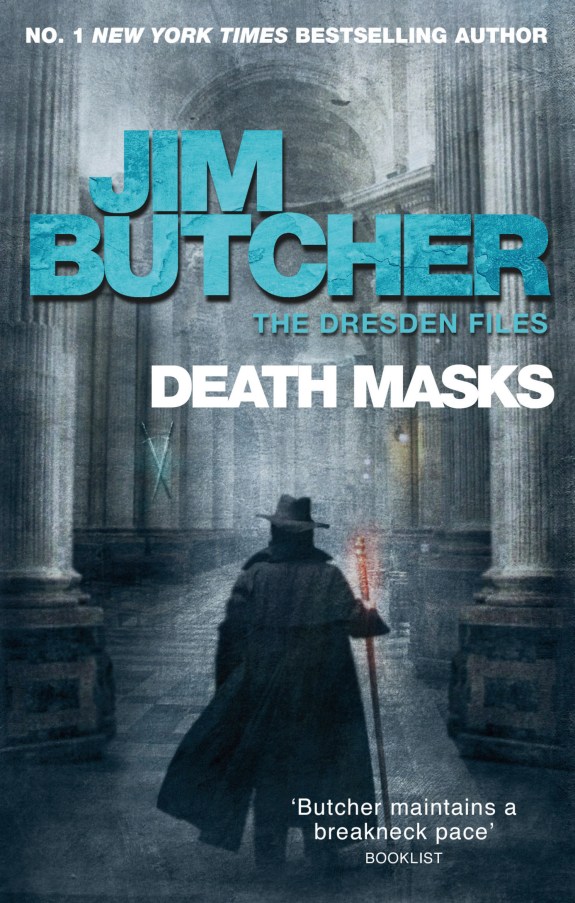
Throwback Thursday – Death Masks by Jim Butcher

Death Masks Cover

Publication: Penguin Audio (Audiobook – 1 August 2003)

Series: Dresden Files – Book Five

Length: 11 hours and 17 minutes

My Rating: 5 out of 5 stars

Amazon

Welcome back to my Throwback Thursday series, where I republish old reviews, review books I have read before or review older books I have only just had a chance to read.  For my latest Throwback Thursday, I highlight another excellent entry in Jim Butcher’s iconic Dresden Files series, with Death Masks.

Fans of this blog will know that I have been having a magical time (pun intended) discovering and getting into the long-running Dresden Files series by acclaimed fantasy author Jim Butcher.  Set in Chicago, the Dresden Files novels follow the adventures of Harry Dresden, wizard for hire and protector of the city against any supernatural threat that comes its way.  This has been Butcher’s major series for years, but I only got into it back in 2020 when I checked out the 17th entry, Battle Ground.  Due to its exceptional plot and the all-out magical war for Chicago that it depicted, this was a pretty epic novel that was not only one of the best books and audiobooks of 2020 but also an excellent recruiting tool for new Dresden Files fans.  It didn’t take me long after reading Battle Ground to check out some of the earlier entries in the series, such as Storm Front, Fool Moon, Grave Peril and Summer Knight, as well as the novella, The Law.  I have had such an epic time with this series that when I felt like a guaranteed five-star book, I immediately decided to check out the next book in the series, with the fifth Dresden Files entry, Death Masks.

Harry Dresden, Chicago’s resident professional wizard, is once again thrust into the middle of far more trouble than he ever dreamed of when a television panel show introduces him to an array of people who want something from him.  Not only does he find himself forced into a duel against a powerful Red Court vampire noble but he is also hired by a Vatican priest to recover a revered stolen holy relic, the Shroud of Turin.

Determined to make the most of these new events, Dresden takes the case and begins to search for the shroud while also preparing for his upcoming fight to the death.  However, many people are interested in obtaining the shroud for their own use, and Dresden finds himself under attack by hitman, gangsters, criminals, and far, far worse.  The Denarians, an ancient and despicable group of fallen angels, have designs on the shroud, and not even Dresden’s most powerful and holy allies, the Knights of the Cross, may be enough to save him.

As Dresden attempts to recover the shroud, he finds that the Denarians and their deadly leader, Nicodemus, have a nefarious plot for the shroud that could destroy everything that Dresden holds dear.  Working with allies old and new, Dresden must overcome the Denarian threat before it is too late, while also managing to defeat the Red Court vampire gunning for him.  With everything on the line, has Dresden finally bitten off more than he can chew?  And what happens when the lost love of his life returns to town, battling her own demons?

Wow, Butcher just cannot strike out!  This is yet another book from him that I have no choice but to award a full five-star rating to.  Death Masks has a deeply addictive narrative that grabs your attention from the very first page and refuses to let go, and some complex and entertaining characters to match.

Death Masks has a pretty awesome story to it that got really addictive very quickly.  Starting off a few months after the events of Summer Knight, Death Masks contains several, great layered storylines, all of which are pretty exciting and intense in their own way and which cross over well to create a complete and powerful narrative.  The first of these immediately places Dresden in the path of several dangerous enemies and opponents as he is dragged into a new case, recovering the stolen Shroud of Turin.  Despite being warned off by his allies, the Knights of the Cross, Dresden naturally pursues, which sets him against established foes, like Chicago’s gangster king, and a powerful new cadre of enemies, who represent one of the biggest threats that Dresden has gone up against at this point in the series.  At the same time, the protagonist is forced to accept a formal duel to the death against a powerful vampire lord, as part of the ongoing storyline about his war with the Red Court, and he also helps the police investigate a disfigured corpse that seems to have been simultaneously infected by every disease known to man.  These events are further complicated by the re-emergence of Susan Rodriguez, his former love interest whose romance was crushed when she was partially turned into a vampire, and who he still holds a massive torch for.

Each of these storylines is quite interesting on its own, and Butcher writes some interesting scenes around all of them, with the primary focus being on the search for the shroud and the fight against the Denarians.  These storylines start pulling together about hallway through the book, and Butcher really raises the stakes for the protagonist, especially when he experiences some major and heartbreaking setbacks.  I really loved the unique blend of character development, fantasy and urban crime that is utilised throughout most of this story, and it is always so much fun to see the protagonist attempting to understand the complex plots arranged against him as he tries to save his friends and city.  Everything leads up to an extremely exciting final third where Dresden and his allies are thrust into a series of battles with massive stakes involved that leave them broken and nearly beaten.  I honestly could not stop listening to the final few hours of this book, and I pretty much powered through the entire second half in less than a day.  There are some epic and very moving moments featured in the big conclusion, and Butcher did a brilliant job of bringing everything together and ensuring that the reader will come back for future instalments of his work.  I particularly loved the final little twist that saw the book’s major villain get one over the protagonist, and I am extremely keen to see what happens with that storyline going forward.

I have so much love for Butcher’s writing style when it comes to the Dresden Files novels, and Death Masks was a particularly good example of this.  Like the rest of the series, Death Masks is told exclusively from the perspective of its central character, Harry Dresden, and this places you right into the midst of all the action and investigations, and you see all the steps as Harry tries to outwit his various foes.  This use of Dresden as the central figure also ensures that the reader gets quite a lot of humour in the story, and the continuous jokes and funny insights really help to make the story that much more fun to enjoy.  There is a great focus on character development and introductions in this novel that I deeply enjoyed, and this works really well with the mystery elements and established fantasy setting to create an excellent narrative.  Butcher keeps the pace of the book sharp and fast here, and all the big events quickly and effectively fall into place where needed.  I liked how the protagonist dealt with multiple problems and cases simultaneously, and Butcher did a good job of balancing and combining these initially separated storylines and threats where necessary.  I did think that Butcher did go over the top in places when it came to the romance sequences, and some of the scenes were a little questionable at times.  Still, this didn’t impact my overall enjoyment of the Death Masks, and I had a blast seeing everything unfold.

Death Masks proved to be a particularly significant entry in the Dresden Files series, and it is a must-read for all fans as a result.  Butcher perfectly sets up several ongoing storylines here while also successfully continuing some established character arcs and introducing a whole new batch of great and interesting characters.  There are so many key events and interactions going on in Death Masks, many of which will be vital for the rest of the series, and I know it helped to give some additional context for some of the events in the later books I have read.  However, like most Dresden Files novels, Death Masks is extremely accessible to new readers, and Butcher always makes a point to expand on the existing storylines and characters in a way that new readers can understand and follow without boring the existing fans.  As such, this is a book with a lot of appeal to many readers, and all fantasy fans can dive in extremely easily.

Death Masks is also a major book for character work, and readers who love the impressive and exciting Dresden Files cast are in for a great time here.  I felt that Butcher presented a great balance of established and new characters in this novel, and there is an excellent focus on development and the emotional issues impacting the protagonist.  Many of the new characters will become major recurring figures in the series from now on and deeply enjoyed seeing how their story started.  Most of the character work hinged on protagonist Harry Dresden, who is the true heart and soul of the book.  I always enjoy quirky and rebellious protagonists in novels with a first-person perspective, and the Dresden Files are a great example of this.  Dresden was his usual funny and disrespectful self for the entirety of Death Masks, and it was so much fun seeing him sass every person he encountered, especially when it enrages the villains.  There is also a great emotional component to Dresden in Death Masks that I enjoyed, as he is still going through a lot of issues.  His already complicated feelings about his past failed romance come full circle here when the girl that got away (well, got turned into a vampire) returns and he is forced to finally confront his repressed feelings for her.  There are also some major moments where Dresden is forced to confront the consequences of his mistakes, especially when they cost other characters, and I loved some of the interactions that occurred as a result.

One of the big returns for Death Masks is the character of Susan Rodriguez, Dresden’s love interest who has been missing for a couple of books.  Susan was partially turned into a vampire during her last appearance and left Dresden as a result.  This book sees her return, and there is a complete change of character because of her transformation, being a lot more confident as well as some more notable abilities.  I liked most of the Susan storyline in this book, not only because fans finally get some closure for the romance between her and Harry but also because she now has some mysterious connections and is working as a covert anti-vampire agent.  There are some great moments with Susan in the book, although I did find one scene to be pretty ridiculous, even though it was supposed to be the sequence that served as the climax of the Dresden/Susan romance arc.  Who knew that all you needed to cure vampiric thirst was a bondage session (I’m barely joking here, that happened).  I mostly ignored this awkward scene (try listening to it whilst on your lunch break at work) from my overall grading of Death Masks, just because it was so much of an outlier, but it was a little weird.  Still, I’m glad we got a return from Susan, and it was interesting to see how much she had changed since the last book.

I also enjoyed the use of the Knights of the Cross in Death Masks, and they served as excellent comrade characters for Dresden.  The Knights of the Cross are three modern day crusaders who wield legendary holy swords and serve as God’s fist on Earth.  We had previously met one of them in Grave Peril, Michael Carpenter, and I loved seeing him again, especially as he is essentially a badass Ned Flanders with a sword and a mission from God.  His mentorship of Harry is a key part of his character arc in the series, and it is really interesting to see him serve as a conscience to the rebellious and faithless Harry.  The two other knights introduced in this book also add a lot to the plot.  The rookie knight, Sanya, was really fun, and I liked his more refreshing take on the role and responsibilities he wields.  However, the best of them was Shiro, the elder knight who acts as the group’s guiding light and who has stood against evil for decades.  I love the depiction of this Japanese badass who literally has fallen angels quaking in their boots, and he was a wise and brilliant character that did a lot in a few short appearances.  Shiro was probably my favourite of the three in this book, and his fantastic dialogue with Harry, especially that description of how he became a Christian, was some of Butcher’s best writing.

Finally, I must talk about the villains, who added a great deal to the story.  Readers are spoiled for choice in Death Masks when it comes to villains, as there are several different groups and individuals who turned up looking to kill Dresden throughout the book.  The first of these is Don Paolo Ortega, a Red Court vampire who seeks to end the war between his people and the wizards of the White Council by killing Dresden in a duel.  Ortega appears to be a mostly reasonable and honourable figure despite his desire to kill Dresden, and I liked the fun banter he had with the protagonist.  I was also glad to see more of Chicago gangster Johnny Marcone, who is one of the best recurring figures in the series.  Marcone always serves as such an excellent foil to Dresden, and their constant sparring and back and forth is a lot of fun to see.  It was particularly interesting to see Marcone become even more involved in the mystical world in this novel, mainly due to the respect he has for Dresden’s abilities, and this serves as a major step towards his current incarnation later in the series.

However, the best villains in the story are probably the group known as the Denarians, a collection of fallen angels possessing desperate or evil humans.  The Denarians are some of the most dangerous beings in the entire Dresden Files, and Butcher gives them an impressive introduction in this novel, showing them as agents of chaos determined to cause as much grief as possible.  Their leader, Nicodemus, is probably one of the most intriguing and sinister figures I’ve yet see Butcher write, and he pretty much always had Dresden on the ropes.  I particularly loved his first major interaction with the protagonist, especially as he was able to completely rattle Dresden, who could barely do anything in response.  The characters were barely able to survive his machinations throughout the book, and he truly showcased how much of a threat he could and would be.  A masterful villain, I cannot wait to see more of him in some of the future books.  All these characters, and more (future superstar Butters has an interesting introduction this book), really add to the captivating story, and I loved how well Butcher developed and featured them in Death Masks.

Unsurprisingly, I chose to enjoy Death Masks on audiobook, which was another excellent and impressive experience.  I really love the Dresden Files audiobooks and Death Masks was another good example of why.  Not only does the format really capture the essence of the story and help the listener become immersed in the urban fantasy world, but it also features some of the best voice work you are likely to find in an audiobook.  That is because Death Masks is narrated by actor James Marsters, who always does a spectacular job brining this series to life.  After providing narration for the first four books in the series, Marsters really knows what he is doing when he gets to Death Masks, and he swiftly dives in and gives the epic narrative everything it needs.  All the characters are voiced perfectly, with some extremely fitting and powerful voices given to them that expertly portray their personalities, ethnicities and mentalities.  Due to the great range of characters in Death Masks, Marsters is required to play a range of figures, from an evil fallen angel, three ultra-good holy knights, a gangster, multiple vampires and more, all of which come out really well.  However, the best work is saved for protagonist and point-of-view character Harry Dresden.  Marsters perfectly inhabits the role of Dresden, and you get the full breadth of his complexities, inner pain, and weird sense of humour, as Marsters narrates the book through his eyes.  You really get the best understanding of Dresden through Marsters’s voice work, and that really adds to the quality of the entire read.  As such, this format comes extremely highly recommended, and you need to try Death Masks’ audiobook as soon as you can.

Another Dresden Files book down, another five-star rating from me.  Death Masks was another epic and exceptional entry in this amazing series, and I continue to be impressed by how well Jim Butcher writes these great books.  Thanks to its excellent and utterly addictive narrative and brilliant character work, Death Masks is probably one of the best Dresden Files novels I have read so far, and I had such a great time with it.  I can think of no higher compliment than to say it made me so happy, I instantly started listening to the next book in the series, Blood Rites, the moment I finished Death Masks.  Make sure to come back next week to check that Throwback Thursday out.

Amazon

Waiting on Wednesday – Son of the Poison Rose by Jonathan Maberry

Welcome to my weekly segment, Waiting on Wednesday, where I look at upcoming books that I am planning to order and review in the next few months and which I think I will really enjoy.  I run this segment in conjunction with the Can’t-Wait Wednesday meme that is currently running at Wishful Endings.  Stay tuned to see reviews of these books when I get a copy of them.  For my latest Waiting on Wednesday, I look at the dark fantasy book I most excited for in the early days of 2023 with the second Kagen the Damned novel from Jonathan Maberry, Son of the Poison Rose.

Son of the Poison Rose Cover

Amazon     Book Depository

Earlier this year I was very excited to read and review the first fantasy book from one of my favourite authors, Jonathan Maberry.  Maberry is a very talented and impressive author who most people would recognise from his excellent science fiction, thriller, and horror novels.  I have had a brilliant time over the last few years getting through some of Maberry’s exciting, clever, and often exceedingly brutal novels, with pretty much all of them getting five-star ratings from me.  This includes the novels in his incredible Joe Ledger series, such as Patient Zero, The Dragon Factory, Code Zero, Dogs of War and Deep Silence, the fantastic Rogue Team International sequel series, which has so far featured Rage (one of my favourite books and audiobooks of 2019) and Relentless (one of my favourite books and audiobooks of 2021), as well as some standalone reads like Ink (one of my favourite books and audiobooks of 2020).  However, even after enjoying all that I was unprepared for the awesomeness that was Kagen the Damned.

Kagen the Damned was Maberry’s first full foray in the fantasy genre, which turned out to be an exceptional and high octane read.  Set in an elaborate new fantasy realm, the book follows former hero Kagen Vale, who loses everything in a single night when the forces of the Witch-king of Hakkia invade his empire, kill the Empress and butcher the children he was sworn to protect.  Forsaken by his gods and broken inside, Kagen wanders the countryside in a haze, now calling himself Kagen the Damned, before eventually regaining his senses and launching an assault on the Witch-king and the dark powers he commands.  However, while the final battle is partially successful, it reveals several dark secrets that push Kagen even further as he tries to understand the full implications.

I had a remarkable time with Kagen the Damned and it is easily one of the better books I have had the pleasure to read in 2022.  The exceptional blend of powerful narrative, intense action, complex characters, and outstanding world-building was extremely impressive, and I loved every second I spent listening to it.  As such, I am now a pretty major fan of the Kagen the Damned series, and I was very excited to discover that I really don’t have that much longer to wait till I get my next fix of it.

The second entry in the Kagen the Damned series will by Son of the Poison Rose, which is currently set for release in January 2023.  Son of the Poison Rose will continue many of the storylines from the first novel and set the protagonists on a dangerous adventure to try and understand the enemy they are facing.

Plot Synopsis:

Son of the Poison Rose marks the second installment of New York Times bestselling author Jonathan Maberry’s epic, swashbuckling Kagen the Damned series.

The Silver Empire is in ruins. War is in the wind. Kagen and his allies are on the run from the Witch-king. Wild magic is running rampant everywhere. Spies and secret cabals plot from the shadows of golden thrones.

Kagen Vale is the most wanted man in the world, with a death sentence on his head and a reward for him—dead or alive—that would tempt a saint.

The Witch-king has new allies who bring a terrible weapon—a cursed disease that drives people into a murderous rage. If the disease is allowed to spread, the whole of the West will tear itself apart.

In order to build an army of resistance fighters and unearth magical weapons of his own, Kagen and his friends have to survive attacks and storms at sea, brave the haunted wastelands of the snowy north, fight their way across the deadly Cathedral Mountains, and rediscover a lost city filled with cannibal warriors, old ghosts, and monsters from other worlds. Along with his reckless adventurer brothers, Kagen races against time to save more than the old empire… if he fails the world will be drenched in a tsunami of bloodshed and horror.

Son of the Poison Rose weaves politics and espionage, sorcery and swordplay, treachery and heroism as the damned outcast Kagen fights against the forces of ultimate darkness.

Well damn, now this sounds like it is going to be incredibly awesome.  I already knew that I was going to really love Son of the Poison Rose, but some of the details revealed above have made me even more excited, which I didn’t think was possible.  The mentions about a rage disease are pretty interesting, especially as that is something that Maberry has utilised in several of his previous novels, and its frankly terrifying to see every single time.  In addition, you have politics, espionage, battles on the sea, cannibals and so much more, which I am extremely keen in seeing unfold.  The idea of sea battles is particularly intriguing to me, and I am going to love seeing how a Maberry-written sea-battle turns out.

I am also very excited to see what sort of character development or emotional damage occurs amongst the various protagonists in this second book.  Maberry unleashed some deep personal bombs at the end of Kagen the Damned, and these are going to really hit Kagen hard, especially the reveal about who the Witch-king is and the two prisoners he is holding.  Both revelations are going to rattle the already unstable Kagen, and I know that Maberry is going to spend a lot of time breaking Kagen down again.  I am also quite interested in seeing some scenes from the Witch-kings perspective, and I am extremely curious to see what events led him to take up this dark mantle and stage an attack on the Silver Empire.

So, I doubt anyone is too surprised that I am really, really excited for Son of the Poison Rose by Jonathan Maberry.  This book was already one of my most anticipated reads for 2023 even before I started reading Kagen the Damned, just because I love Maberry’s writing that much.  However, the extra plot details revealed about have raised my anticipation levels even higher, and this will probably be one of the first things I read next year.  I have no doubt in my mind whatsoever that Son of the Poison Rose will be one of the best books of 2023 and I cannot wait to see how the epic Kagen the Damned series continues.

Amazon     Book Depository

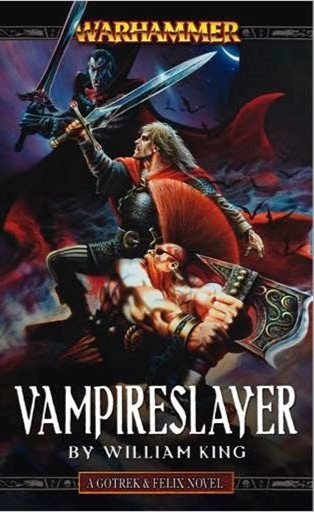
Throwback Thursday: Warhammer: Vampireslayer by William King

Vampireslayer Cover 2

Publisher: Black Library (Audiobook – August 2021)

Series: Gotrek and Felix – Book Six

Length: 11 hours and 13 minutes

My Rating: 4.75 out of 5 stars

Amazon     Book Depository

Welcome back to my Throwback Thursday series, where I republish old reviews, review books I have read before or review older books I have only just had a chance to read.  For my latest Throwback Thursday I continue my recent obsession with Warhammer Fantasy fiction by checking out another entry in the iconic Gotrek and Felix series by William King, Vampireslayer.

I have been on a real roll with looking at the cool fiction associated with the now defunct Warhammer Fantasy tabletop game over the last few weeks, including the fantastic novels Runefang and Van Horstman.  However, few Warhammer Fantasy books have grabbed my attention or interest more than the Gotrek and Felix series, which serves as one of the central pillars of Warhammer fiction.  The Gotrek and Felix books, which were originally written by William King, follow the titular characters, dwarf slayer Gotrek Gurnisson and his sworn human companion Felix Jaeger, as they journey around the Warhammer Fantasy realm, finding monsters to fight and kill, all in the hope of finding a worthy death for Gotrek.  This is an awesome and unbelievably exciting fantasy series that take the reader to some of the darkest parts of the Warhammer Fantasy world and sees them face off against all manner of crazy foes.

I have had an absolute blast getting through the Gotrek and Felix books over the last year, as there have been some cracking reads in there.  The previous books, Trollslayer, Skavenslayer, Daemonslayer, Dragonslayer and Beastslayer, have all had their own unique charm, and all of them have been well written and compelling reads.  Vampireslayer is the sixth book in the series, and as the name suggests, it pits Gotrek, Felix and their allies against one of the most dangerous creatures in the Warhammer canon, an ancient and deadly vampire count.

Following their victory at the siege of Praag, Gotrek, Felix and their surviving allies, have finally been able to relax after a never-ending series of battles. However, the ever-restless Gotrek is still determined to find a worthy death to fulfil his suicidal oath, and Felix knows it is only a matter of time before they journey out to face the rising hordes of Chaos that are building around the realms of man.  But before Gotrek and Felix can head out, a new evil rears its head; one that is far more cunning and ancient than anything they have faced before.

After accepting a job from a wealthy Praag nobleman, Gotrek and Felix find themselves investigating a mysterious man who is attempting to steal one of their client’s treasured artifacts.  But the closer they look, the more apparent it becomes that their target is no ordinary man, but a powerful ancient vampire named Adolophus Krieger, who has been stalking the streets of Praag, feasting on the innocent.  Determined to slay this beast, Gotrek and Felix’s confrontation goes poorly, when the vampire outsmarts them, steals the artifact and takes their companion, Ulrika Magdova, hostage.

Determined to save Ulrika and get their revenge on their foe, Gotrek and Felix, as well as their allies, Snorri Nosebiter, Max Schreiber and Ulrika’s father, Ivan Straghov, pursue the vampire lord.  To kill Krieger, they will have to travel to one of the most dangerous places in the Old World, the haunted lands of Sylvania.  Controlled by the Vampire Counts for generations, Sylvania is a wicked place where the dead never rest, and dark creatures lurk around every corner.  Worse, their foe is powered by an ancient artefact forged by Nagash and has designs on becoming the supreme vampire ruler, leading them in a new war against the living.  With the odds stacked against them, Gotrek, Felix and their companions must dig deep if they are to kill Krieger, rescue Ulrika and save the world.  But after spending time trapped with the vampire, can Ulrika truly be saved?

King once again shows why his Gotrek and Felix books were the defining Warhammer Fantasy series with this epic and fast-paced read.  Vampireslayer is easily one of the stronger entries in the series and takes its distinctive protagonists on an intense and captivating adventure that I deeply enjoyed.

Vampireslayer had an amazing fantasy narrative, and I think this was one of King’s more impressive and enjoyable stories.  Taking off right after Beastslayer, the initial story sees Gotrek, Felix and their allies still at the city of Praag, planning out their next adventures.  They quickly find themselves dragged into another adventure when a distant relative of Ulrika reaches out to them for help with a mysterious threat.  This initial part of the book was rather interesting, and not only does it have some great follow-ups from the previous entry in the series but it also sets up the narrative and the current characters really well.  There is a fantastic cat-and-mouse game going on in the early stages of the novel, as the protagonists attempt to discern the new evil they are going up against, while their vampiric assailant, Adolophus Krieger, puts his plans into motion.  Following the first encounter between the heroes and the vampire, which is set up and executed to drive up anticipation for later interactions, Krieger escapes and the protagonists are forced into a deadly chase across the world.

The rest of the novel is primarily set in the dread realm of Sylvania, and sees the protagonists chase after the vampire and his kidnapped victim.  This second part of the book is filled with some fun and exciting classic horror elements as the protagonists go up against a variety of foes from the vampire count’s army.  There is a lot of great action, fantastic chases, and some substantial character development occurring during this part of the novel, as the author brings together many of the threads from earlier in Vampireslayer, while also introducing some intriguing new supporting characters.  King makes particularly good use of multiple character perspectives throughout this part of the book, and I loved seeing the conflicted thoughts of the main protagonists (minus Gotrek as usual), as well as the many plots of the villain and his new minion.  This all leads up to the big confrontation between the protagonists and their foe at the legendary Drakenhof Castle, as the heroes face off against an army of the undead and the vampire himself.  The action flows thick and fast here, and King pulls no punches, showing the brutal and dark nature of the Warhammer Fantasy universe.  I did think that the final confrontation was a bit rushed, with the anticipated battle against Krieger lasting only a short while, but it was pretty fun to see.  There are a couple of good tragic moments in this conclusion, as well as some interesting developments for some long-running supporting characters, and King brings everything to a good close as a result.

I think that one of the things that made this story particularly enjoyable was that it was a lot more focused than some of the other books in the series.  This was mainly because it was the first book since Skavenslayer not to feature a sub-story that focused on recurring villain, Grey Seer Thanquol.  While Thanquol’s perspective was good for Skavenslayer, its use in the following novels, while usually very fun and entertaining, seemed a bit unnecessary and often affected the pacing or stole the impact away from the book’s actually antagonists.  This became more and more apparent in Dragonslayer and Beastslayer, especially when Thanquol’s actions rarely had any impact on the main plot.  As such, not having a Thanquol focused side story in Vampireslayer was a bit of a blessing, and it really increased the impact of the remaining storylines.  It also ensured that the parts of the book told from Krieger’s perspective really pop, as he was the only villain you could focus on.  I had a brilliant time with this impressive story and it ended up being an excellent adventure to follow.

Vampireslayer proved to be a pretty awesome entry to the wider Warhammer Fantasy universe, and I loved the cool details and references that King added in.  Like most of the books in the Gotrek and Felix saga, Vampireslayer can be read as a standalone novel (probably more so than the last three books in the series), and very little pre-knowledge about the Warhammer Fantasy or the previous books in the series is required to enjoy this excellent book.  King does a great job of once again introducing the key elements, recurring characters, and wider evils of this universe, ensuring that new readers get the information they need without making it too repetitive or boring for established fans.

One of the things that makes Vampireslayer standout a little more from some of the recent entries in the series is the move away from Chaos focused opponents and instead brings in a new faction from the universe in the form of a vampire and his undead hordes.  This is a fantastic change of pace, and I rather enjoyed seeing one of the more compelling factions from the game, even though I have bad memories of facing my brother’s Vampire Counts army.  King does a brilliant job diving into the lore and history of vampires and the general undead in the Warhammer universe, and the protagonists get a good crash course on them, which new readers will deeply appreciate.  I loved seeing a vampire antagonist in this novel, especially as it is one of the classic Vampire Counts types (a Von Carstein vampire).  This vampire has a lot of the classic European elements associated with Dracula, and it was fun to see the protagonist deal with this sort of creature, especially as Krieger takes the time to taunt them in a way they’ve never dealt with before.  King also adds in several of cool units from the Vampire Counts book, and it was pretty fun to see them in action in some brilliant fight scenes.  I also deeply enjoyed the dark setting of Sylvania, where much of the story takes place.  Sylvania, a Warhammer realm based deeply on Transylvania and ruled over by vampires, has always captured my imagination and it was fun to see it used in Vampireslayer.  You really get the sense of fear and despair surrounding the countryside, and all the locals, many of whom are just a step away from becoming some form of creature, are a depressing and scared group.  Watching the characters attempt to traverse this land was really entertaining, and I think all these awesome Warhammer Fantasy elements helped to make this great story even more impressive.

I also found some of the character work in Vampireslayer to be pretty intriguing, as King examines several great characters in this book.  The central two characters are naturally Gotrex and Felix, although not a great deal of character development went towards them in this book.  Gotrex is his usual gruff, murderous and unreadable self, who is essentially shown as an unkillable beast at this point, and you really don’t get much more from him, especially as Gotrex’s perspective is deliberately not shown.  Felix also doesn’t get much growth in this book, although he does serve as a primary narrator, recording and observing the events of the book.  Despite this lack of growth, Felix is a great everyman character to follow and it is really entertaining to see his quite reasonable reaction to facing off against the evils that gravitate towards Gotrek.

A large amount of focus went to the supporting characters of Max Schreiber and Ulrika Magdova, who have been major parts of the series since Daemonslayer.  The attention on both has been growing substantially through the last couple of books, especially in Beastslayer, and they had a massive presence in Vampireslayer.  Max, the team’s wizard, is pushed to the brink in this book after investigating a dangerous magical artefact and having his companion Ulrika kidnapped.  Max, who has always had a crush on Ulrika (it was pretty creepy at first, but better now), becomes obsessed with saving her before its too late, and this drives him to some extremes in this book.  Ulrika, on the other hand, must survive the evil attentions of the book’s villain, especially once the vampire takes an unhealthy obsession with her.  I must admit that I have always found Ulrika to be a fairly annoying character (which isn’t great when she’s usually the only female figure in the books), however, this was one of her best appearances as she goes through a physical, mental and magical wringer.  Her attempts to resist the vampire are extremely powerful and her eventual fall to darkness is one of the more compelling and best written parts of the book.  This was an excellent outing for both these supporting characters, and it actually serves as a wonderful final hurrah, as I know they don’t appear in many books in the future.

The final character from Vampireslayer that I need to talk about is the book’s primary antagonist, the titular vampire Adolophus Krieger.  Krieger, a centuries-old creature with connections to Vlad von Carstein, serves as a brilliant villain for this adventure novel, especially as King takes a substantial amount of time to dive into his history, personality and motivations.  Rebelling against his sire and attempting to become the next vampiric master of the Old World, Krieger is shown as a complex and intense being with some major issues.  Not only does he have to temper his intense ambition, but he also finds himself mentally deteriorating towards savagery and must constantly fight for control as his afterlife’s goals comes to fruition.  King does a great job capturing this compelling figure throughout the book, and I particularly enjoyed his introductory chapters where his temper and inability to suffer fools is shown with gruesome results.  Krieger has a brilliant presence throughout the novel, and he was a great villain opposite Gotrek and Felix with his gentlemanly airs (he has a great comeback to a line from Snorri Nosebiter).  I deeply enjoyed all the outstanding characters in Vampireslayer, and King did some superb work with them throughout this novel.

After reading paperback versions of Dragonslayer and Beastslayer, I’ve finally gotten back onto the Gotrek and Felix audiobooks with Vampireslayer, which was a lot of fun to listen to.  The audiobook format did an amazing job of capturing the dark tone and fast-paced action of this intense novel, and I felt that listening to Vampireslayer on audiobook really helped me appreciate a lot of the book’s more interesting details.  With a runtime of just over 11 hours, this is an easy audiobook to power through, and I personally managed to get through it in a few days.  This great audiobook was further enhanced by the excellent narration of Jonathan Keeble, who has narrated most of the other Gotrek and Felix audiobooks.  Keeble has an amazing voice for this sort of novel, and I loved the fantastic way he was able to move the story along at a brilliant pace while also enhancing the book’s horror and action elements.  I particularly loved the range of excellent voices he attributes to the various characters, many of which are carried over from his previous audiobook experiences.  All the characters get some distinctive and very fitting tones here, which I think worked extremely well.  Examples of some of the best voices include Felix, whose calm voice of reason, serves as the narrator’s base tone for most of the story; Gotrek, who is given a gruff and menacing voice that contains all the character’s barely restrained anger and regret; and even the new vampire character, Adolophus Krieger, who is gifted a French/European accent to match the classic vampire vibe that goes with the Vampire Counts characters in Warhammer, and the character’s likely origins as a Bretonnian Knight.  This expert voice work was extremely good and I had a brilliant time listening to this version of Vampireslayer.  As such, this format comes highly recommended and it is usually one of the best ways to enjoy a cool Warhammer novel.

Vampireslayer was another epic entry in the fantastic and ultra-fun Gotrek and Felix series by William King.  Bringing in a great new opponent who pushes the protagonists to new lows, this was an excellent adventure novel that shows some of the best parts of the Warhammer Fantasy world.  With a captivating and fast-paced narrative, this was one of the better entries in the series and I had an outstanding time getting through Vampireslayer.  An awesome read for all Warhammer and general fantasy fans, especially on audiobook.  I love this series so much!

Vampireslayer Cover

Amazon     Book Depository

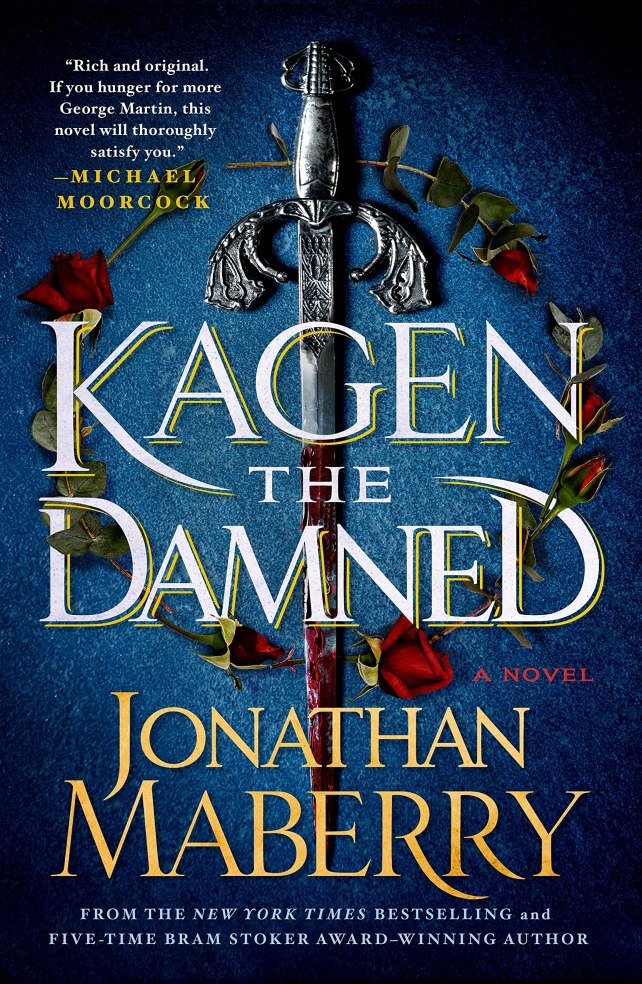
Kagen the Damned by Jonathan Maberry

Kagen the Damned Cover

Publisher: Macmillan Audio (Audiobook – 10 May 2022)

Series: Kagen the Damned – Book One

Length: 20 hours and 53 minutes

My Rating: 5 out of 5 stars

Amazon     Book Depository

One of my favourite unusual thriller writers, the legendary Jonathan Maberry, enters the world of fantasy in a big way with Kagen the Damned, a dark fantasy masterpiece with a brutal heart to it.

I have made no secret of the fact that I am a huge Jonathan Maberry fan.  I got into Maberry’s writings when I chanced upon a copy of his 10th Joe Ledger novel, Deep Silence, a few years ago, which introduced me to both Maberry’s unique writing and his iconic protagonist, the titular Joe Ledger, a badass action hero who saves the world from crazy and dark science creations.  I deeply enjoyed Deep Silence (it was one of my favourite books of 2018) and quickly moved onto his other Joe Ledger books, diving back to the start of the series with Patient Zero, and then working my way through the rest of the awesome entries, such as The Dragon Factory, Code Zero, Predator One and Dogs of War.  I also kept up with his latest releases, including the two entries in the follow-up Rogue Team International series, Rage (one of my favourite books and audiobooks of 2019) and Relentless (one of my favourite books and audiobooks of 2021), and his standalone novel Ink (one of my favourite books and audiobooks of 2020).  I have been very eager to see what awesome novel Maberry releases in 2022, and, luckily for me, that materialised in the form of Kagen the Damned.

Kagen the Damned is an interesting and unique read from Maberry, as it is his debut foray into the fantasy genre.  While many of his other books have had fantasy elements to them (albeit with a horror edge), this is his first pure fantasy fiction novel, as well as the start of his Kagen the Damned series.  Naturally I was rather curious about how Maberry would transition to a new genre, and while I was a tad disappointed that the Rogue Team International series isn’t getting a new entry any time soon, Kagen the Damned ended up pretty high on my most anticipated reads for 2022 list.  After a few weeks of other books getting in the way, I finally got the chance to listen to Kagen the Damned, and it turned out to be quite an impressive novel.

Kagen Vale was once one of the most trusted and revered fighters in the entire Silver Empire.  A scion of the legendary Vale family, who have served the Silver Empire for generations, Kagen was a beloved member of the royal court and so highly regarded that he was entrusted as the guardian of the Seedlings, the Empresses’ children.  That was until the fateful night when, out drinking and whoring, he was drugged and left for dead.  Awakening in a daze, Kagen found himself in the midst of hell as the capital of Silver Empire, Argentium, was besieged by a foe long thought dead, the dread nation of Hakkia, whose dark magic has once again emerged to blot out the world.

Arriving to the palace too late to save anyone, including the Seedlings, Kagen falls into despair at failing his sacred duty and can only watch in horror as the Gods of the Garden, the deities of the Silver Empire, turn their back on him and damning him for all time.  Now with everything and everyone he has ever known lost forever, Kagen the Damned wanders the ruined countryside a broken drunk, dreaming of revenge on the one man responsible for all his ills, the mysterious and feared Witch-king of Hakkia.

However, not everything is as lost as it seems, as shadowy figures across the world being to formulate their plans to repel the Witch-king’s evil.  As two young women embark on a deadly quest to awaken a sleeping, ancient god from beneath the waves, a covenant of resistance attempts to find their own magic to oppose the Witch-king with.  Determining that Kagen may bear the best chance of recovering the tools needed to succeed, they manipulate events to set him on his path to revenge.  However, what price will a doomed man truly pay to get the revenge he so desperately seeks, and will Kagen be ready for the terrible secrets he uncovers along the way?  Only the gods and the damned know for sure!

Well, it is now more apparent than ever that there is no Jonathan Maberry book I will not enjoy to the extreme.  Kagen the Damned is an incredible and very memorable novel from Maberry, who puts the ‘dark’ in dark fantasy, with this barbaric and action-packed journey into hell.  Making use of his trademark style, flair for horror and exceptional character work, Maberry pulls together a deeply addictive and extremely exciting story that I fell in love with very, very quickly.  This was another easy five star read for me, and I loved every single second I spent reading it.

Maberry once again blew me away with an outstanding and high-action narrative, and I quickly got very attached to Kagen the Damned.  This book has an extremely memorable start to it, showing the bloody fall of Argentium from the perspective of Kagen, who awakens from a drunken haze to find a vast army in his supposedly impenetrable city, destroying and killing everything they see.  This was a very compelling and brutal start the novel, and its one that I quite enjoyed, especially as you see just how dangerous the enemies are and the chaos they have unleashed.  Maberry does a great job of setting up multiple key storylines, settings and characters in this early section, and while the focus is primarily on Kagen, you get some interesting insights into other figures that will impact the rest of the book.  The entire first part of the book is very distinctive and really showcases how dark this novel is going to get, especially when it comes to the character of Kagen and the fate of the royal children.  This whole first section ends on a brilliant note, with Kagen left broken and damned, while the once great Silver Empire, which you only saw glimpses of, is destroyed and replaced with a new world order.

Following this epic start, the narrative slows down a little, as Maberry works to set up some alternate storylines and characters, while as taking the time to do some compelling and extended word building.  Set in the direct aftermath of the opening sequence, the story primarily splits into three different streams at this point, with the main one following a despondent Kagen as he traverses the former Silver Empire, lost in grief and drink.  At the same time, two separate storylines tell some great connected narratives, with one following two young women as they journey off into the unknown, while the rest focuses on the Hakkian takeover back in Argentium.  This focus on the Hakkians and their plans, as told by the Witch-king’s advisors, as well as a resistance group, is very awesome, and it was fascinating to see some impressive political intrigue going on behind the scenes as the antagonists work to consolidate power through various methods.  While the rest of the narrative continues in a straight line, the story around Kagen slowly adapts as he meets some new friends and begins his mission of revenge as planned, with some detours.

This leads up to the excellent final part of the book, which I powered through extremely quickly to see how everything ended.  All three major storylines are reaching there climax here, and they start to blend a lot more closely, especially the ones focusing on Kagen and the Hakkians.  Everything leads up to a highly anticipated confrontation that sees Kagen finally face his enemies, and it is just as epic as I was hoping.  There is a ton of action, tragedy, twists and revelations here, as many of the plot elements and storylines come full circle.  I loved the various reveals that happen here, and most have been set up really well throughout the extended course of the narrative.  I really should have seen the identity of the Witch-king coming, but it was the right choice by Maberry, which leaves some big questions open for the future.  Everyone will come away from Kagen the Damned extremely satisfied, as Maberry leaves everyone on a brilliant note, that ensures that readers will definitely come back for more.  This is an outstanding and deeply addictive narrative that is guaranteed to grab your attention early one and refuse to let go.

I really enjoyed how well Kagen the Damned was written, as Maberry brought his unique style to bear to help create an outstanding story.  In many ways, this novel proved to be essentially one of Maberry’s thrillers set in a fantasy universe.  Indeed, there were a lot of similarities in the style, the structure of the chapter, the pacing and even the use of familiar horror elements that I have previously seen and loved in the Joe Ledger books and I think this cool style worked well to tell an intense fantasy narrative.  As such, Kagen the Damned is a swift and well-structured book that pushes the story along at a swift pace, while also taking the time to build up the universe and the multitude of characters.  Maberry utilises a great range of story elements throughout this novel, and the readers are treated with a fantastic blend of action, intrigue, dark, over-the-top moments, horror, despair and humour, as the characters experience all manner of devastating trials and oppositions.

I also have a lot of love for the way that the author sets up the story and showcases the elaborate events that are occurring.  Maberry makes excellent use of a huge number of shorter, focused chapters told from a variety of viewpoints.  These briefer chapters really increase the pace and intensity of the book, and I deeply appreciated how the narrative quickly jumped across the various characters.  The interplay between the three central storylines, which are primarily anchored around Kagen, is extremely good, and I loved seeing the characters react to some of the same events or actions of their fellow cast members.  These storylines are also joined by a series of interludes that show the various impacts that the Hakkian invasion has on the wider world, especially those attuned to magic.  These interludes are usually very fascinating, and they are often used to introduce some minor supporting characters in a fun and unique way.  I loved the complexity that these interludes usually have, and the often self-contained stories are well structured and always feature a distinctive or chilling conclusion.  Maberry uses these interludes cleverly, often inserting them between major or extremely powerful chapters to help relieve tension, or to remind the reader of the wider stakes or events occurring around the main story.  I definitely enjoyed this larger look at the world that Maberry provided through them, and it was an outstanding part of Kagen the Damned’s story.

One of the major highlights of the writing in Kagen the Damned is the intricately described and fast-paced action, which is a major hallmark of Maberry’s writing style.  Maberry has always excelled at writing brutal fight scenes in a way that paints a vivid mental picture for the reader, and this was once again the case for Kagen the Damned.  The many, many action and fight sequences are brought to life in exquisite and bloody detail, and the reader is easily able to imagine every strike and slice as they happen.  This makes the action sequences really pop, and they were a particularly awesome highlight of this great book.  This focus on action and combat was really effective in this fantasy novel, and it was very cool to see Maberry bring his knowledge of combat and the accompanying writing skill to bear on large scale battles between armed and armoured fighters, while magic and gods blow stuff away around them.  There are some really great fight scenes loaded throughout this book, and I loved every skirmish, battle and duel that was featured within it.

While I did really love the action and brutal combat sequences within Kagen the Damned, I probably should add a warning about how dark and gruesome it can get in places.  Maberry’s writing style has always relied on over-the-top violence, cruelty and brutality to a degree, and this was once again the case in Kagen the Damned, which not only featured a ton of killing but also gruesome scenes of torture, corpse desecration and depictions of sexual violence.  While I think that these ultra-violent moments do work to showcase just how dark and savage the new world order is, they are often a bit hard to witness.  I will note that Maberry did take the time to discuss the emotional and social impacts of the various acts of sexual violence in the book, rather than just including them for gratuitous effect.  There are also some great scenes where the protagonist calls out and belittles several characters willing to commit such acts, before delivering his own violent justice, and I think that the author did his best to show have damaging it can be in his own way.  However, readers should probably be aware that these scenes exist, as people might find them to be a bit shocking.

I was also a major fan of the cool new fantasy universe that Maberry cooked up with Kagen the Damned, mainly because it is such a distinctive creation of the author.  Set on a giant continent made up of various nations, this is an impressive and compelling world, filled with a unique history, gods, people and settings.  The author does a great job of swiftly introducing this world and some of the key parts of its history in the early parts of the book, mainly so that readers can be a little more shocked at the early events and full appreciate the destruction and change that the Hakkian nation brings with it.  Maberry is clearly emulating some classic fantasy novels and settings throughout Kagen the Damned, and I loved seeing this bold new world that he has created.  There are some unique and cool elements featured within, and I liked how there are certain shades of grey shown when it comes to the morality and righteousness of the various factions.  Maberry also takes the time to highlight the changes that are coming to the world, thanks to the return of the Hakkian Witch-king, and the slow and steady resurgence of magic and the death of a certain pantheon of gods, are highlighted really well, both in the main story and the interlude chapters.

Perhaps one of the most distinctive features of this new world is the horror elements that Maberry worked into the plot.  I really should not have been surprised at the strong Lovecraftian elements that featured, as the author has used them strongly in some of his previous books.  However, it is even more explicit here in Kagen the Damned, with several notable Elder Gods playing key roles in the plot and even appearing in some epic scenes.  While I am not personally a fan of Lovecraft, I did quite like how Maberry utilised these elements throughout this book, and they gave parts of the book a darker and more eldritch quality that I quite enjoyed.  This, and certain discussions about other worlds and alternate realities, potentially links this series to some of Maberry’s existing works, and it wouldn’t surprise me if there were some form of crossover in the future, although it would have to be handled well.  I had a great time exploring this new fantasy world in Kagen the Damned, and I look forward to seeing what other surprises and dark gods appear in future entries of this series.

I also must highlight the incredible character work featured with Kagen the Damned, as Maberry went all out to create an excellent and unique cast of characters, whom the excellent narrative revolves around.  There are some amazing characters featured within this novel, and the author works hard to feature all of them in some impressive roles.  I had a lot of fun with the huge cast of Kagen the Damned, and there are deep and emotional figures featured here.

The most prominent and intriguing character is the titular Kagen, who takes on the moniker of Kagen the Damned.  Maberry really does a number on his central protagonist early on, as Kagen awakens from a drunken haze to find that everything he cared about and held dear had been lost while he slept.  Despite his best efforts to redeem himself in the battle that follows, he still fails miserably, and manages to escape the conquered capital in a fractured haze.  Broken, dazed and emotionally destroyed, Kagen becomes even more despondent when he sees his gods in the sky turn their back on him due to his failure to maintain his sacred oaths, which convinces him that he is damned.  Naturally, these events leave him severely emotionally damaged, and he spends most of the book trying to come to terms with his failure while also trying to find some way to get revenge on the Witch-king for all he has done.  A large amount of the book is dedicated to Kagen falling into despair, and Maberry presents a realistic depiction of a man who has lost everything and who is barely able to survive, relying heavily on drink and violence to get through his days.  While Kagen is eventually able to throw off much of this despair, it is still lurking within him, and he is often shown living in regret at his failure, even though no one else blames him as much as he does.  Kagen working through these complex feelings of failure results in much of the novels emotional strength, and Kagen serves as a moving and powerful heart for the entire novel.

While I did deeply enjoy this intriguing central character and his rough and emotional journey through this book, it is hard not to notice some similarities between Kagen and another one of Maberry’s protagonists from another series.  Kagen is in many ways a fantasy version of Joe Ledger, with similarities including a propensity for violence, extreme skill with knives (technically short-swords in Kagen’s case), and even a similar sense of humour during some of the lighter moments of the books.  There is also the same high level of mental damage brought on by extreme trauma, with both characters often seeking revenge against the people who wronged them and those they loved.  Despite these similarities, I still really appreciated Kagen as a protagonist, and I felt that some of his additional elements, such as his complex familiar bonds and strong sense of failure, did set him apart in some key ways.  No matter what, Kagen is a pretty awesome character to follow, and I loved seeing him continue to go through all his dark moments to keep going.

Aside from Kagen, there are several other amazing characters featured in this novel, all of whom have some outstanding storylines around them.  Two of the most prominent are Ryssa and Miri, who were in Argentium when the Hakkians invade.  Both junior members of the Silver Empire’s clergy, the two women initially appear to be primarily concerned with surviving the invasion.  However, it soon becomes apparent that Miri, whose knowledge of the gods and creatures of this world are far greater than they should be, has a different agenda.  Taking Ryssa with her on a big journey to a remote island nation, Miri soon engages in a plot to save the world her way.  Ryssa and Miri make up a fun combination that Maberry weaves some interesting storylines around.  While these characters aren’t explored as deeply as Kagen, you still get a great sense of who they are, particularly Ryssa, who is the primary point-of-view character between them.  Their entire storyline is covered in mystery and uncertainty as Ryssa is left in the dark about what is coming her way.  I liked the religious world-building that went into this character storyline, and there are some excellent moments in it loaded with tragedy and despair.  Even with their storyline being mostly separated from the rest of the characters, and it was a little predictable that Maberry would turn them into a lesbian couple, they had a compelling relationship and I felt that they added a lot to the narrative.

I also had a great deal of fun with the primary Hakkian characters featured in Kagen the Damned.  While they are ostensibly the antagonists of the book, Maberry takes the time to really establish the main four characters and presents them as a lot more complex and even sympathetic in places.  The main Hakkian character is their leader, the Witch-king, a character shrouded in mystery for most of the book.  A previously unknown figure, the Witch-king uses his magic to defeat the entire Silver Empire in a night and then spends the rest of the book trying to set himself up as the legitimate ruler of the land while also advancing the position of his brutal god.  I loved the way that Maberry kept the details about the Witch-king’s past and identity hidden for most of the narrative, although there is some great foreshadowing of his identity scattered throughout the novel.  The Witch-king cuts a fantastic and menacing figure for most of the book, and it was intriguing to see him present himself as a fair and loving ruler, while simultaneously exuding an aura of menace and dark magic.  It was pretty hilarious to see him terrify his key advisors for much of the book, and I loved all the hints about his true objectives.  An overall excellent central antagonist, I look forward to getting more details about him and his history in the rest of the series, especially after the revelations at the end of this book.

The other three key Hakkian characters are the Witch-king’s advisors, the chamberlain Lord Nespar, necromancer Lady Kestral, and newcomer Jakob.  Nespar and Kestral are fantastic characters who spend most of the book administrating the Witch-king’s will, running his empire, hunting for Kagen, and setting up the upcoming coronation of the Witch-king to become emperor.  While they are initially shown to be quite dangerous and evil, mainly due to their role in destroying the Silver Empire and Kestral’s disturbing magic, you eventually see that there is a lot more to them.  In particular, you see that they are actually extremely terrified of the Witch-king and are desperately obeying his will in order to survive.  You actually end up feeling a bit sympathetic for the pair of them, even after you see Kestral tear a corpse apart for a ritual, and I enjoyed the intrigue and politics they got involved with to rule the new empire.  The other character is Jakob, a Silver Empire historian who is drafted into the Witch-king service as his minister for propaganda.  Rechristened as Jakob Ravensmere, he becomes fully compliant in the Hakkian takeover and proves to be a very competent advisor and political mind while also working to rewrite history to increase the legitimacy of the Witch-king.  It was extremely fascinating to see Jakob discussing the control given by those who control history and propaganda, and I really enjoyed his role in the new empire.  It was also fun to see his rather quick slide towards the dark side as he fully embraces the Hakkian lifestyle and even starts to develop a taste for a power.  I always love seeing Maberry’s narrative unfold from the antagonist’s point of view, and this worked out extremely well again in Kagen the Damned.

The final characters I need to highlight are some of the excellent supporting cast surrounding Kagen.  Kagen has two excellent companions who work with him throughout the book, Tuke and Filia.  Tuke is a giant professional thief who recruits Kagen for a job that will help an anti-Hakkian resistance movement.  Tuke serves as the comic relief for much of the book, and I loved the outstanding chemistry he had with Kagen.  The two play off each other extremely well, and their excellent camaraderie and humour were pretty fun to see.  Not only does Tuke have some of the best lines (and the funniest curses) in the book, but he also serves as an emotional sounding board to Kagen, helping him get better after all the tragedy he experienced.  Filia is a strong-willed warrior and former associate of Kagen who finds herself dragged into the chaos around the war and Kagen’s wild adventures.  Filia’s no-nonsense attitude and sarcasm are a great counterpart to the other characters in Kagen the Damned, and I especially liked it when it combined with the humour of Kagen and Tuke.  These characters, and more, really enhanced the overall quality of this impressive narrative, and I loved seeing their powerful storylines unfold in some excellent and enjoyable ways.

There was no way that I was going to check out the new Jonathan Maberry novel in any format other than audiobook.  I have had some outstanding experiences with Maberry’s audiobooks over the years, and all of them have been deeply impressive and extremely enjoyable.  This again proved to be the case with Kagen the Damned, as I had an outstanding time having this dark epic read out to me, especially as it really helped me to absorb all the details of the characters and the impressive new universe.  With a runtime of just under 21 hours, this is a pretty lengthy audiobook to get through, but it is well worth the time investment, especially as it delivers the story in such an awesome way.

Easily the best thing about this audiobook is the outstanding narration from the very, very awesome Ray Porter.  Porter, who is one of my favourite audiobook narrators, who has previously narrated Maberry’s books, as well as contributing his voice to other works like The Apollo Murders and The Sandman audio adaptation.  As such, the moment I heard that Porter was also going to narrate Kagen the Damned, I knew that I had to get this audiobook.  Porter has an amazing ability to move the story along, and his voice is perfect for all the intense action, world-building and intrigue Maberry features in his novels.  I love the way that Porter dives into the various characters featured in the books, with every single person getting their own distinctive voice, while Porter also effortlessly emotes all their emotion to the listener.  This includes a very sinister voice that Porter saves for when the villains are talking or some incredibly dark moments are happening, and having him use variations of this voice to highlight just how brutal a moment is being, is always a great experience.  It also works well when the characters start speaking in the languages associated with the Elder Gods, and the resultant ceremonies and spells are quite spooky to hear in Porter’s voice.

Porter also did a particularly good job at inhabiting the voice of Maberry’s central protagonist, Kagen, and you get a real sense of who he is and the intense pain he is feeling throughout the book.  While the voice Porter uses from Kagen is a little like that of Joe Ledger from Maberry’s other audiobooks (a side effect of Porter ensuring that the main protagonist’s voice matches the tone he uses for basic narration), Porter does add a little more of a growl to it here, which helped to a degree.  This was another incredible performance from Porter, and I am so very glad that they got him back to narrate Maberry’s new series.  I cannot emphasise how outstanding the Kagen the Damned audiobook turned out to be (although I did feature it in my recent best audiobooks from the first half of 2022 list before I’d even finished it), and this is the absolute best way to enjoy Kagen the Damned.

Well, after rabbiting on for nearly seven pages, I think it is exceedingly obvious that I loved Kagen the Damned.  Jonathan Maberry’s latest novel was extremely compelling and deeply exciting, and I was really impressive with the author’s jump to the fantasy genre.  Featuring a clever, complex, and action-packed narrative loaded with destruction, thrilling revenge and some great, damaged characters, Kagen the Damned was an outstanding read and its one that I absolutely flew through.  Kagen the Damned is easily one of the top books of 2022 and this is a favourite new series for me.  I am extremely excited to see where the Kagen the Damned series will go in the future, and the next book, Son of the Poison Rose, is out in a few months’ time, and I cannot wait to get my hands on it.

Amazon     Book Depository

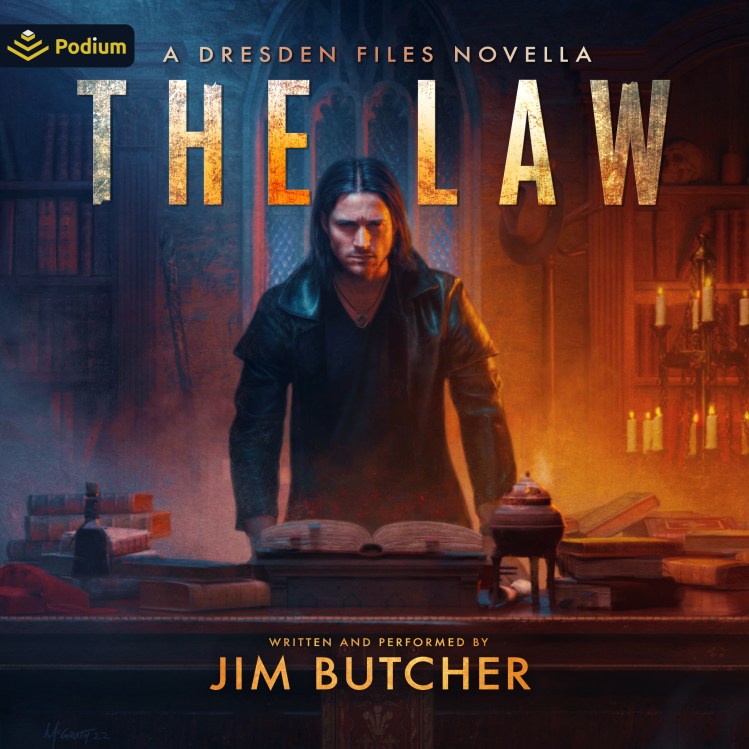
The Law by Jim Butcher

The Law Cover

Publisher: Podium Audio (Audiobook – 5 July 2022)

Series: The Dresden Files – Book 17.5

Length: 3 hours and 22 minutes

My Rating: 5 out of 5 stars

Amazon

Prepare to dive back into the wild world of Jim Butcher’s iconic Dresden Files series with the latest impressive novella, The Law.

Readers of this blog might have noticed that I usually don’t go out of my way to read too many novellas or short stories and instead usually focus on full-length novels and comics.  This isn’t so much a deliberate choice as I just prefer whole books I can really sink my teeth into.  However, I had to make an exception for the latest Dresden Files novella that Jim Butcher just dropped, as I have been deeply enjoying this epic series.

The Dresden Files are a long running series of urban fantasy novels that follow protagonist Harry Dresden, a wizard who protects the people of Chicago from the magic beings and creatures they don’t even know exist.  People may remember that I first got into the Dresden Files back in 2020 when I checked out the 17th entry in the series, Battle Ground.  While I did enter this series late in the game, I still had an outstanding time with Battle Ground and it ended up being one of my top books and audiobooks of 2020.  In fact, I enjoyed it so much that I went back and started reading the series from the beginning.  So far, I have been able to read the first four Dresden Files novels, Storm Front, Fool Moon, Grave Peril and Summer Knight, all of which have been pretty impressive and captivating reads.  This dive into the older novels, plus my lingering enjoyment of Battle Ground, ensured that I was ready and eager for any new Dresden Files content that came my way, and Butcher just delivered with his latest novella, The Law.

Set a month after the events of Battle Ground, The Law sees Harry Dresden and the city of Chicago still recovering from the invasion of the Titan Ethniu and her forces, which resulted in significant destruction.  However, Dresden is primarily mourning the tragic death of his love, Karrin Murphy, and even his new responsibilities as lord of a castle and protector of Chicago isn’t enough to keep his mind off his loss.  Determined to snap Dresden out of his funk, his friends decide to get him back to basics and introduce him to someone in need of a good investigator.

Enter Maya, a former prostitute turned tutor whose grassroots education company helps to supplement the education of Chicago’s working-class children.  Working hard, Maya has managed to turn her tutoring business into a viable, if low-profit, franchise that prioritises helping as many children as possible.  However, Maya’s past life is about to come back to haunt her in the form of her former pimp, Tripp Gregory, who initiates a bogus lawsuit against Maya’s company for a ridiculous sum.  Unable to afford a lawyer and desperate for help, Maya has no choice but to turn to Chicago’s resident miracle worker, Harry Dresden.

Deciding to the take on the case and hoping to quietly warn Tripp away from Maya, Dresden soon discovers that sometimes the most dangerous opponent is a greedy idiot concerned only for themselves.  Worse, Tripp and the case have unexpected connections to the magical world, with dangerous players taking an interest in its outcome.  Forced to deal with old and new foes of considerable power, Dresden will need all his wit and will if he is to save Maya’s business and ensure that justice is found.

Well, that has gone a long way to convincing me to check out more novellas in the future.  The Law was an epic read that took Butcher’s always outstanding Dresden File’s protagonist on a short, but extremely sweet, adventure.  Bringing Butcher’s usual flair and style, while also expanding on events from the last book, The Law was a great read that gets a full five-star rating from me.

Butcher pretty much teaches a master class on how to do a short, concise and captivating story here in The Law as, despite its length, this novella had an impressive and fun narrative that I found to be utterly addictive.  Not only does it serve as a great follow up to Battle Ground but it showcases some amazing character work while presenting the protagonist with an intriguing new adventure.  The story is so much fun, and I loved how it started as seemingly non-magical job and then morphed into something more dangerous and problematic as Dresden finds that it has connections with the magical world that forces him to deal with some of Chicago’s key players, including some old enemies.  Bringing a small but enjoyable amount of legal thriller aspect to the series’ usual urban fantasy crime fiction style, The Law goes in some fantastic directions, as Dresden attempts to placate all the players while also serving his client.  There is a great bit of action, a ton of humour, some intriguing revelations, and even some pretty dark moments, which combine extremely well to create quite the impressive narrative.  I loved how Butcher wrapped the entire novella up, especially with that one conference scene near the end, and the reader comes away very satisfied and entertained with the entire affair.  I cannot emphasise how great this story was, and I was so damn enthralled by it that I nearly finished it in an entire sitting.

One of the things that I particularly liked about The Law is the way that it serves as a bridging novella between Battle Ground and any future entries in the series.  Butcher spends a lot of time in this story looking at the aftermath of the previous novel, especially as Battle Ground featured that epic battle that saw Chicago nearly levelled.  As such, Butcher packs The Law with a ton of callbacks to the events of the last book, and there is a huge focus on how the various characters are dealing with the aftermath, especially Dresden.  There is also a very fascinating look at the rebuilding that is occurring during this time, as well as the current state of the citizenry, many of whom are traumatised or damaged because of a battle most of them couldn’t even fully comprehend.  I really appreciated seeing the various figures featured in The Law remembering or trying to understand the events of Battle Ground, whether they are a magical person who lost someone, a normal person who went through hell, or even one of Dresden’s Knights of the Bean, who now bear a dark connection with the protagonist.  Some of the details that came out as a result are deeply fascinating, and there are even a few hints about where some potential future storylines might go, such as increased Government awareness of magic (you see evidence of them covering up the events of Battle Ground here), or the increased fear that might lead to humans attacking magic kind in the future.  All of these are featured heavily in The Law, and I liked how it was well utilised for the current story, while also showing fans of the series how different the landscape of Chicago will be in the future.  I would say that this focus on the aftermath of Battle Ground did make The Law a little less accessible to those readers who haven’t read the latest Dresden Files novel, however, I think that if you are interested in reading this, then you should definitely read Battle Ground first.

I also must talk about the great character work featured in The Law.  Despite its shorter length, Butcher manages to fit a decent number of characters in The Law, and there are some impressive character arcs and development that occurs as a result.  Naturally, most of this is focused on series protagonist and central point-of-view character, Harry Dresden, who puts on his usual brave face for most of this novella, bringing his usual insights and wicked humour to the new case.  However, it soon becomes very apparent that Dresden is still heavily traumatised by the events of Battle Ground, where he lost so much because of the war.  Despite his best efforts to hide it, Dresden is a wreck for much of the story, and it was quite confronting and moving to see him experience blackouts and emotional strains due to the tragedies he has experienced.  I think that Butcher covered his protagonist’s trauma and grief in a pretty realistic way, and I liked how he tried to use an old-fashioned investigatory case as a coping method for Dresden.  It was great to see Dresden going back to his roots as a private investigator after the chaotic and world-altering events of the last few books, and it was interesting to see how much the character’s powers, methods, insights and choices have changed as a result of everything he’s seen.  The Law ended up being quite an intense and fantastic look in the recovering Dresden and readers will like seeing his emotional damage, his recovery, and even some of his darker moments that are contained within this excellent novella.

Aside from Dresden, The Law features an excellent array of supporting characters, who bring a lot to the narrative.  Butcher made sure to include a combination of new faces and existing characters to fill out the cast, and I had a blast with how they were utilised throughout.  Several of the funniest and most interesting recurring figures from the series had substantial roles here, including Bob, Gentleman John Marcone, and even Mab, and each of their appearances and interactions with Dresden were entertaining and fitting with their previous appearances.  I enjoyed many of the great new characters that Butcher introduced here.  Some of them, including a devilish lawyer with a shrouded identity, may come back in the future, and it will be interesting to see how they are utilised.  I also enjoyed main antagonist, Tripp Gregory, mainly because he was so different that Dresden’s usual antagonists.  Rather than being a magical creature or a major threat, Tripp is a normal and rather idiotic criminal, who has a surprising power: he’s too stupid to believe in magic and too self-centred to avoid all the trouble Dresden is bringing his way.  Dresden’s reactions to having to deal with such a selfish and unusual opponent makes Tripp’s inclusion totally worth it, and I had fun seeing his arc unfold.  These characters, and more, were awesome inclusions to The Law, and their unique inputs added a lot the quality and entertainment value of the entire novella.

Finally, a quick note on the audiobook format, which was how I enjoyed The LawThe Law audiobook has a very short run time of just over three hours and is a relatively easy audiobook to get through.  I always find myself really getting into Butcher’s excellent stories in this audio format, and this continued here with The Law, and it really helped me enjoy all the novella’s fun and entertaining details.  Probably the biggest thing about The Law audiobook was the choice of narrator.  I was deeply, deeply shocked when I discovered that long-time Dresden Files voice actor, the legendary James Marsters, wasn’t narrating The Law, and instead Butcher himself took over and voiced the entire thing.  Surprisingly, this ended up working out rather well and Butcher turned out to be a pretty competent and enjoyable audiobook narrator.  Don’t get me wrong, he’s no James Marsters (a point Butcher makes up-front, after promising Marsters would come back for future novels), but he does a really good job considering his lack of experience.  All the characters are given good, distinctive voices that fit their personalities and showcase their emotions and reactions perfectly.  His voice for Dresden was particularly good, and Butcher captured his creation’s cocky nature and damaged inner self perfectly.  While some of the accents he did were a little iffy, this was an overall fantastic performance from Butcher, and it was fun to see him contribute to his work in this way.  The Law audiobook ended up being an excellent and impressive way to enjoy this fantastic story, and it is easy the format I would most strongly recommend.

Jim Butcher continues to expand his epic Dresden Files series in some fantastic ways with the new novella, The Law.  Containing a compact, but highly impressive story loaded with some of Butcher’s best characters, The Law proved to be extremely entertaining and a lot of fun to get through.  Serving as a perfect follow-up to the major events of the last novel, The Law was an excellent and powerful entry in this long-running series that is a must read for all Dresden Files fans.

Amazon

Throwback Thursday – Warhammer: Van Horstmann by Ben Counter

Van Horstmann Cover

Publisher: Black Library (Paperback – 1 February 2013)

Series: Warhammer Fantasy

Length: 415 pages

My Rating: 4.75 out of 5 stars

Amazon

Welcome back to my Throwback Thursday series, where I republish old reviews, review books I have read before or review older books I have only just had a chance to read.  For my latest Throwback Thursday I review another awesome Warhammer Fantasy novel, the compelling and unique Van Horstmann by Ben Counter.

Another week, another Warhammer tie-in novel that I must review.  I have been really diving into this franchise over the last year; to be fair, there are some incredible books there, including the two 2022 Warhammer 40,000 releases that got a full five-star rating from me, Ghazghkull Thraka: Prophet of the Waaagh! by Nate Crowley and Assassinorum: Kingmaker by Robert Rath.  Some of the best of these books are tie-ins to the now destroyed Warhammer Fantasy universe, including the novel from last week’s Throwback Thursday, Runefang by C. L. Werner.  Well, my current obsession with all things Warhammer continued again as I recently read the awesome Van Horstmann by Ben Counter.  Counter is a well-established author of Warhammer fiction, having made a ton of impressive contributions to the franchise, including his Grey Knights and Soul Drinkers series, as well as his entries in the massive Horus Heresy series.  I was really drawn to Van Horstmann when I picked it up, not only because it has a great cover (love a cover with a dragon on it), but because of its intriguing plot, which sounded extremely awesome.

In the human realm known as the Empire, magic has been feared and mistrusted through most of its history, with practitioners hunted down and burned at the stake.  However, following the Great War against Chaos, the elven mage Teclis was allowed to train various talented humans in the use of magic, establishing the eight Colleges of Magic that train scholars and battle mages to help the armies of the Empire.  Out of all the colleges that were formed, the most revered are the College of Light, whose powerful light magic can be used to push back the darkness of Chaos.

Years after its formation, a young wizard manages to find the College of Light, hidden behind a magical barrier in the Imperial capital, Altdorf.  This wandering wizard, Egrimm van Horstmann, is a talented young mage whose desire for knowledge and skill at manipulating the Wind of Hysh immediately impress his new teachers, and many believe that he will rise high in the order.  However, van Horstmann has a dark secret that burns deep within him, and knowledge, power and ambition aren’t the only reasons for his joining the Light Order.

As van Horstmann rises in the ranks of his order, it soon becomes apparent that he has a diabolical plan.  Working with dangerous forces, including daemons, cursed items and even the Chaos god Tzeentch, van Horstmann begins to manipulate his order, the other colleges, and even the emperor to get what he wants.  But the closer he gets to achieving the goal, the more enemies he makes, and soon factions within the Light Order and the greater Empire begin to move against him.  Can van Horstmann succeed in his mission before his dark purpose is discovered, or will his dastardly designs unleash the great and uncontrollable power hidden at the very heart of the College of Light?

This was an impressive and deeply captivating Warhammer Fantasy novel, and I absolutely loved the elaborate and clever narrative that Counter came up with.  Focusing on an intriguing villainous figure and crafting an addictive story around him that also explores key aspects of the franchise’s lore, Van Horstmann was an outstanding novel, and it was probably the best Warhammer fantasy novel I have read so far.

Counter has come up with an excellent and impressive narrative for Van Horstmann, which, as the name suggests, is completely focused on the character of Egrimm van Horstmann.  For those who don’t know, van Horstmann was a minor special character for the Chaos army in some of the earlier editions of the games, but he didn’t have that much background or lore surrounding him.  I personally knew him due to his name being associated with one of my favourite magical items available to Empire armies in the later editions, Van Horstmann’s Speculum, which is a very fun surprise for an unwary foe (I have fond memories of using Van Horstmann’s Speculum in a game to switch stats between my Master Engineer and my brother’s Manfred von Carstein in a duel.  The look on his face as his ultimate general was suddenly weaker than my minor hero was just hilarious).  However, Counter manages to take the short background summary of the character and uses it as the basis for this novel, expanding on the tale of van Horstmann and showing how and why he infiltrated the Light Order and ended up betraying them, which results in an epic story.

Van Horstmann has a bit of a slow start to it, as Counter takes the time to set up key parts of the story, including an intriguing prelude that examines the first wizards of the Empire and their darkest secret.  From there, the story introduces the main character, van Horstmann, and shows his entry into the Light Order and his start as a student.  The story gets quite interesting after this, especially as you see van Horstmann involved in a demonic exorcism, which quickly highlights just how ruthless and cunning he can be.  The story picks up pace from there as you begin to witness van Horstmann’s inevitable rise to power as the full scope of his desire and despicable nature become fully apparent.  Most of the middle of the book showcases the characters careful and evil manipulations, as he manages to fool everyone and become more and more powerful through deals with daemons and the Chaos gods.  There are some brilliant scenes here as you witness the full scope of his plans, from a great battle scene against the skaven, to organising several duels between the various magical factions, all in the name of gaining power.  Counter really does a good job of showcasing this viewpoint through multiple perspectives, and while much of the focus is on the gloating van Horstmann, you also see how his actions impact several supporting characters, many of whom start to get suspicious.  The entire narrative has a great dark fantasy edge to it, that occasionally borders on horror (especially when the character interacts with some of the daemons and their dark gods), and I found myself really getting drawn into this story once everything had been set up.

This leads up to the epic conclusion that sees van Horstmann’s master plan enter its final phase while his enemies begin to realise his evil nature.  This ended up being an extremely impressive conclusion, and it really becomes apparent just how much stuff Counter had set up in the first two-thirds of the book.  Everything comes together here, as compelling story elements such as van Horstmann’s long-term plans, his troubled past, all his terrible actions while part of the order, the revelations about the foundation of the Light Order, several great secondary character arcs, and the attempted investigation by van Horstmann’s enemies, all pay off.  I really appreciated the brilliant and dark way that these storylines worked out, and there are some great revelations, especially around van Horstmann’s motivations and the full scope of his careful actions.  I loved the deep and very personal reasons behind the events, especially as van Horstmann has some extremely fantastic revenge planned, which was pretty epic to behold.  The entire novel ends on a brilliant note that sets up the character for his future appearances as a special character in the tabletop game, while also stabbing home that van Horstmann isn’t the absolute master manipulator that he thought it was.  This clever conclusion was the perfect ending to this gripping plot about a conniving and dangerously intelligent villain, and it was so much fun to see how everything ended.  These final pages and the outstanding conclusion they contained, definitely increased the overall awesomeness of the entire narrative, and seeing just how well every great twist and turn was set up is incredibly awesome.

This ended up being an excellent addition to the overall Warhammer Fantasy canon, and Counter did a wonderful job of working this elaborate and impressive story into the wider universe.  As I mentioned above, Van Horstmann adapted basic character notes from an older game book, and I felt that Counter expanded on all these details extremely well, working them into the wider history of the Empire.  There are some great explorations of several key factions throughout this novel, particularly the Empire and some of the forces of Chaos, and the reader really gets an impressive view of the iconic setting of Altdorf, where much of the narrative takes place.  However, the most detailed and fascinating part of Counter’s dive into the Warhammer Fantasy world revolves around the exploration of the Colleges of Magic in the Empire.  Without a doubt, Van Horstmann contains some of the best explanations of how human wizards perceive magic that you are every likely to see in a Warhammer novel and Counter spends a ton of time examining this.  While some of the explorations surrounding magic do get a bit overly metaphysical for their own good, they are always pretty compelling to see, and I loved how there is a fun focus on the various different orders of magic, especially Light and Gold magic, as there are some awesome fights between these groups.  However, it is the Light Order that gets the most attention in this novel, as the main character is nominally a member of this group.  There is so much detail put into showcasing the Light Order’s elaborate, hidden headquarters, as well as how their particular brand of magic works, and you come away with a pretty intense understanding of this, which I deeply enjoyed.

Now, due to the sheer level of intriguing detail and Warhammer Fantasy lore contained within this novel, Van Horstmann is a book best enjoyed by those already a fan of the franchise.  Counter dives into some fantastic and occasionally obscure parts of the lore, and established Warhammer fans will really appreciate the clever touches and revelations featured within.  That being said, Counter also spends time ensuring that new readers will be able to follow the narrative rather easily, and a lot of the book’s exposition is spent establishing the history, magical elements, and some of the key factions for new readers.  As such, pretty much anyone who loves a good dark fantasy story can easily enjoy Van Horstmann as a novel, and I am sure that most people will have an excellent time with its very clever and intense narrative.  However, Warhammer fans are going to get the most out of it, and this probably isn’t the best first book for those readers interested in exploring the Warhammer Fantasy universe (the Gotrek and Felix novels, such as Trollslayer, would be my recommendation).  Nevertheless, this is an exceptional Warhammer Fantasy read that will appeal to a wide cadre of readers.

There is some great character work featured in Van Horstmann, which naturally focuses primarily on the titular character.  Counter really gets into the mind of van Horstmann in this book, and while most of the time you only see the supremely confident wizard who delights in manipulating men, wizards and daemons, there is a lot more under the surface.  This includes a tragic backstory that serves as the motivation that drives him to do all the terrible things he wants to do here.  While it would be rather easy to hate this character, especially with his inherent arrogance, I found myself getting drawn into his multiple plots and machinations, and you end up rooting for him just to see how all his plans unfold.  Despite that, it is also quite fun to see misfortune strike him, especially the fun twist at the very end of the book where his overconfidence comes back to bite him in a big way.  I had an outstanding time following van Horstmann in this fantastic novel and he proved to be a very fun central figure in this book.

Due to the massive focus on van Horstmann, Counter doesn’t spend a lot of time building up a lot of the side characters.  Despite that, there are a few interesting supporting characters and storylines that add a fair bit to the narrative and which have some compelling connections to the main plot.  Various members of the Light Order are featured throughout, and I liked the way that Counter portrayed them as mostly being quite full of themselves and unable to consider treachery from within their order.  Watching them get taken down a massive peg by van Horstmann is a little satisfying at times, especially when their fates are well deserved, although there are a few tragedies thrown in at the same time.  Other great characters include the manipulative Skull of Katam, a sentient magical skull who guides van Horstmann for its own reasons, and who served as an untrustworthy accomplice for a good part of the book.  Finally, there is also the interesting character of Witch Hunter Argenos, a rabid religious zealot who hunts agents of dark magic and the Chaos gods.  Argenos serves as a good counterpoint to many of the more magical characters, and his deep drive and desire for religious justice, helps to turn him into an excellent threat to van Horstmann.  These side characters, and more, have some interesting moments in the book, and I liked their excellent contributions that combined with Van Horstmann’s main tale in some fantastic ways.

Containing an addictive, powerful and brilliant story, Van Horstmann by Ben Counter is an incredible and awesome Warhammer Fantasy novel that follows a fantastic villain as he dives deep into the world of magic.  I loved the elaborate and captivating tale of revenge and dark power that Counter came up with here, and readers will swiftly get drawn into this amazing novel.  An excellent in the Warhammer Fantasy canon, Van Horstmann is an exceptional read that comes very highly recommended.

Amazon

Throwback Thursday – Warhammer: Runefang by C. L. Werner

Runefang Cover

Publisher: Black Library (Paperback – 24 June 2008)

Series: Warhammer Fantasy

Length: 413 pages

My Rating: 4.5 out of 5 stars

Amazon

Welcome back to my Throwback Thursday series, where I republish old reviews, review books I have read before or review older books I have only just had a chance to read.  For this week’s Throwback Thursday I have a look at a classic Warhammer Fantasy adventure novel with the entertaining fantasy thrill ride, Runefang.

I have been reading an awful lot of Warhammer 40,000 novels lately, but deep down my heart will always belong to the Warhammer Fantasy franchise, as that was the game that I played back in the day.  Even though the Warhammer Fantasy game has ended (replaced by The Age of Sigmar), while it was going the Black Library invested a lot of time into creating some excellent novels in this setting, which I have also been enjoy recently.  This includes the awesome Broken Honour and some of the earlier entries in the iconic Gotrek and Felix series (including Trollslayer, Skavenslayer, Daemonslayer, Dragonslayer and Beastslayer).  Even after reading these, I am still in the mood for more fun Warhammer Fantasy adventures and so I just read Runefang by established Warhammer fiction author C. L. Werner.  Werner, whose other writing credits include the Witch Hunter, Thanquol & Boneripper and The Black Plague series, came up with a compelling idea for this novel which I had a lot of fun getting through.

As civil war, discord and political instability rock the human realms of the Empire, a far greater threat marches upon it from the south.  A massive horde of undead creatures has been raised from the grave and is  cutting its way through the heavily populated province of Wissenland.  As the forces of Wissenland gather to fight, they are disheartened to find that these are not the typical shambling herd of undead horrors, but a well-organised, highly disciplined force of relentless fighters with dangerous magic backing them up.  Worse, the leader of this force is a true monster, the wight lord Zahaak, an ancient general of the legendary dark necromancer, Nagash, who has risen from his last defeat to finally achieve the victory he promised centuries before.

After several devastating slaughters, it becomes apparent that the undead force before them is unstoppable and the only way to defeat it is to kill the unkillable undead general.  In desperate need of anything that will save his realm, the Count of Wissenland and his advisors come up with an unlikely plan: recovering the Solland Runefang.  Lost years before when an orc raid destroyed the former province of Solland, the stolen Runefang, one of the legendary 12 swords signifying rulership of the Empire’s provinces, is rumoured to be the only weapon capable of killing Zahaak.

The task of finding the Runefang falls to Baron von Rabwald, who pulls together a small expedition of soldiers, knights and adventurers and leads them to the Runefang’s purported hiding place in the Worlds Edge Mountains.  However, this is no easy quest, and the chances of success are low, especially as the Worlds Edge Mountains are a notorious haunt for monsters, orcs and innumerable other dangers.  Worse, they are not the only group seeking the lost Runefang, and the fell magic of Zahaak is never far behind.  Can the expedition recover the Runefang before it is too late, or will Wissenland fall at the hands of its greatest foe from the past?

This was an outstanding and extremely exciting Warhammer Fantasy novel that I had a wonderful time reading.  C. L. Werner did an excellent job providing readers with an amazing fantasy adventure, and Runefang has a lot of great elements that will appeal to a wide range of readers.

At the heart of Runefang lies a captivating and highly enjoyable fantasy narrative that quickly drags the reader in with its impressive action, enjoyable characters, intriguing examination of the Warhammer world, and exciting adventure narrative.   Starting off with a fantastic introduction that sees the Wissenland army’s first disastrous attack against the undead horde, you are swiftly brought into the middle of the conflict as you witness the aftermath of the defeat, which also introduces several of the main characters.  Following some compelling exposition about the enemy they are facing, the story splits into two parts, with Baron von Rabwald leading most of the supporting cast off to find the lost Runefang, while the rest of the story focuses on the Count of Wissenland’s attempts to delay the undead army to give the adventurers time.  This split works really well, and seeing the disasters unfolding in Wissenland heightens the stakes of the expedition’s adventures and ensures that the reader is even more invested in its outcome.  The expedition storyline encounters multiple obstacles throughout their adventure, including monsters, traps, and orcs and goblins.  They are also forced to deal with a rival force of humans who are also hoping to claim the Runefang, untrustworthy mercenaries, as well as a traitor within their ranks who is helping the enemy.

This all translates into a very good and action-packed adventure, and I loved seeing all the epic events unfold through the eyes of the varied characters.  The story chugs along at a quick and exciting pace, with a good combination of action, dark moments and some fun, if grim, humour that I quite enjoyed.  Werner also ensures readers are in for a wild ride by not being sentimental when it comes to character survivability.  This became really apparent around halfway through Runefang when several key characters, many of whom had been built up in a big way for most of the narrative, were very suddenly killed off, and one of the supporting cast took the reigns as lead protagonist.  While this was a little surprising, I think it worked rather well, and it added to the suspense and drama of the tale, as the new protagonist is forced to make some big choices and deals to keep the quest alive.  Following this, the story keeps advancing at a great pace, with new foes and dangers appearing the closer the protagonists got to their goal.  This leads up to the epic final sequences of the expedition narrative, and it was fantastic to see the surviving protagonists go up against all the villains that had been chasing them in a big, extended confrontation, and Werner kept continuously hitting the reader with twists, surprises and dangers.  The reveal about the traitor in the ranks was pretty good, especially as Werner threw in an excellent red herring character (although by the time it is revealed, there were limited potential characters who it could be).  Everything comes together extremely well, with all the storylines and character arcs reaching their natural end, and I felt that it was an excellent, if rather bittersweet, conclusion.

I have to say that this was a particularly good and accessible entry in the wider Warhammer Fantasy canon, which is very well suited to this sort of immense and powerful story.  While Werner could have just phoned in Runefang with a generic adventure story set in the universe, he does a great dive into the lore.  This novel is set well before the events of most Warhammer Fantasy novels and takes place during the Age of the Three Emperors, where the Empire was split by a raging civil war.  As such, the province of Wissenland is on its own throughout the novel and must also deal with the substantial machinations of its neighbours as it fights to survive, which gives it a great additional edge of intrigue.  The author also spends a great deal of time focusing on the ruined province of Solland and the importance of its lost Runefang.  It was fascinating to see the ruins of Solland in Runefang, as it was still badly scarred by the orc invasion that destroyed it, and the impact of Wissenland’s absorption of it was quite interesting.  I also really appreciated the fantastic portrayal of the notorious Worlds Edge Mountains, the former realm of the dwarfs that is now controlled by orcs, bandits, and monsters.  The author did a really good job showing this to be a desolate and dangerous place, and he really did not disappoint when it came to featuring the variety of cool creatures and threats it contains, forcing the protagonists up against dangerous odds again and again.

Finally, I must highlight the author’s excellent use of the undead army in this book.  Rather than using the armies of the Vampire Counts or the Tomb Kings (which were the two undead factions at the time of Runefang’s release), Werner features a historic army of undead creatures who have risen after their defeat during the early days of the Empire to have their vengeance.  As such, they are a unique force of undead creatures, and I loved seeing them in action, particularly as you get some awesome reactions of terror from the human characters observing them.  Overall, I really loved the cool use of Warhammer Fantasy elements, history and settings in Runefang, and I felt that this was the sort of Warhammer novel that any fantasy fan could pick up and enjoy.

I also need to highlight all the impressive action featured throughout Runefang, and Werner has a clear talent for making fight scenes come to life in a big way.  There are so many battles throughout this book, and each of them is showcased to the reader in exquisite detail.  Whether it be a small skirmish, a one-on-one fight, a brawl against a giant monster, or a large pitched battle between armies, the author ensures that the reader gets the full sense of everything that his happening.  It was extremely cool to see all these fights unfold, and I was able to mentally see every sword swing, desperate charge and epic moment.  I liked how some of these fights emulated the battles from the table-top Warhammer Fantasy game, and you could really envision how they would have looked being played out on the board.  These action scenes combined well with the awesome and exciting story, and I think that they strongly enhanced my enjoyment of Runefang.

The final thing I want to talk about is characters, as Runefang features an excellent and massive cast of distinctive protagonists and villains.  Now, I am not going to go into too much detail about character arcs or development here, as to do so might ruin which key characters are killed off early.  However, I have to say that I was really impressed with the awesome way that Werner introduced each of the major figures in the book.  As such, you quickly grow to like many of the figures in Runefang, especially as Werner goes out of his way to feature a unique and often damaged group of protagonists to fit the story around.  I will say that I deeply enjoyed the Baron’s notorious and scarred champion, Kessler, who has some great moments; the dwarf Skanir, who serves as cantankerous guide; and the fantastic duo of the halfling Theodo Hobshollow and his ogre sidekick, Ghrum, who were an excellent and entertaining comic relief team.  There are also some really good villains in this novel, including the bandits who are also after the Runefang (featuring a brilliantly despicable leader and an entertaining pair of cowards), and an extremely dangerous orc warlord, Uhrghul Skullcracker.  Uhrghul was a particularly fun character, and I liked both his philosophical insights about being an orc leader as well as his effective way of questioning human prisoners (eating my legs in front of me probably would get me to talk).  I did think that the main villain of Runefang Zahaak was a tad underdeveloped, even if he was shown to be an epic badass with major historical cred to his name.  However, this might have been a deliberate choice by Werner to highlight the uncomplicated nature and motivations of the undead compared to the more insidious, evil, or animalistic plots of the humans and orc villains.  I had an amazing time following these characters, just try not to get too attached to any of them.

Filled with fantastic action, a compelling adventure storyline, fun characters and great use of the Warhammer Fantasy setting, Runefang was an outstanding novel from C. L. Werner that I had an amazing time reading.  Werner really went out of his way to create the most impressive and exhilarating fantasy adventure he could, and the result is really worth checking out.  A highly recommended Warhammer fantasy novel that you are guaranteed to have fun with.

Amazon

Waiting on Wednesday – Notorious Sorcerer by Davinia Evans

Welcome to my weekly segment, Waiting on Wednesday, where I look at upcoming books that I am planning to order and review in the next few months and which I think I will really enjoy.  I run this segment in conjunction with the Can’t-Wait Wednesday meme that is currently running at Wishful Endings.  Stay tuned to see reviews of these books when I get a copy of them.  For this week’s Waiting on Wednesday I take a look at an exciting and fun upcoming debut, with Notorious Sorcerer by Davinia Evans.

Notorious Sorcerer Cover

Amazon

Here at The Unseen Library, we are always on the lookout for awesome new authors to feature in our posts and it looks like a great Australian author is about to make their debut in a few months time.  This author is Davinia Evans, whose first fantasy novel, Notorious Sorcerer, is set for release in September 2022.  Notorious Sorcerer is a fantastic upcoming book, with a cool and intriguing plot.  Set in a formerly magical city that was devastated by a magical catastrophe, this book will follow a young protagonist who is inadvertently dragged into a new fight to save the city after displaying an impressive and illegal act of magic.  I love Notorious Sorcerer’s amazing plot synopsis below and I have very high hopes for this wonderful upcoming book.

Synopsis:

Since the city of Bezim was shaken half into the sea by a magical earthquake, the Inquisitors have policed alchemy with brutal efficiency. Nothing too powerful, too complicated, too much like real magic is allowed–and the careful science that’s left is kept too expensive for any but the rich and indolent to tinker with. Siyon Velo, a glorified errand boy scraping together lesson money from a little inter-planar fetch and carry, doesn’t qualify.

But when Siyon accidentally commits a public act of impossible magic, he’s catapulted into the limelight. Except the limelight is a bad place to be when the planes themselves start lurching out of alignment, threatening to send the rest of the city into the sea.

Now Siyon, a dockside brat who clawed his way up and proved himself on rooftops with saber in hand, might be Bezim’s only hope. Because if they don’t fix the cascading failures of magic in their plane, the Powers and their armies in the other three will do it for them.

Amazon     Book Depository

Against All Gods by Miles Cameron

Against all Gods Cover

Publisher: Gollancz (E-book – 23 June 2022)

Series: The Age of Bronze – Book One

Length: 465 pages

My Rating: 5 out of 5 stars

Amazon     Book Depository

The always impressive and inventive Miles Cameron returns with another awesome novel, Against All Gods, a compelling epic with a truly divine story.

There are few authors with more of a diverse catalogue of books than the talented Miles Cameron.  The pseudonym of historical fiction author Christian Cameron (who has also released novels with his father, Kenneth Cameron, under the joint pseudonym Gordon Kent), Cameron has been on a real roll with his fantasy and science fiction novels lately.  Not only did he have great success with his incredible Master and Mages series, which included Cold Iron and Dark Forge (one of my favourite novels and audiobooks of 2019), but he also successful released his first foray into science fiction last year with Artifact Space (one of my favourite books of 2021).  As such, I have been keenly anticipating Cameron’s latest read and I was extremely excited to receive an early copy of his latest fantasy novel, Against All GodsAgainst All Gods is the awesome first entry in his new The Age of Bronze series, which follows a group of desperate mortals as they attempt to overthrow an entire deadly pantheon of gods.

In a damaged world filled with death, despair and injustice, the gods rule with an iron fist.  Secure in their power and glory after destroying or banishing the previous pantheon, the current gods make games of the lives of mortals, controlling them for their own gain and punishing them on a whim.  However, the gods are not as secure as they would hope, and all it will take is one spark to ignite a deadly rebellion against them.

When the daughter of powerful magos and aristocrat, Gamash of Weshwesh, is killed by a malicious god, it sets off a chain of events that will change everything.  Determined to get revenge, Gamash finds himself a willing tool of an older god who exists to stir up chaos and challenge her new masters.  Following the signs laid out before him, Gamash receives weapons that can hurt the corrupt divine beings and embarks on a quest to challenge the gods once and for all.

As Gamash’s quest continues, he is soon joined by an eclectic mixture of mortals, all of whom have their own issues with the current deities and who have been manipulated to fight against them.  Faced with dangers at every turn and soon caught up amid multiple divine conspiracies, these reluctant rebels soon begin to understand the full extent of the danger they find themselves in.  Determined not to be mere pawns in a cosmic game of immortal gods, the rebels will decide to do the impossible: go up against all the gods and win!

Wow, Cameron continues to impress me with his unique and incredible story writing.  Against All Gods is a distinctive and powerful read that takes multiple fantastic characters on an epic adventure through a great new fantasy landscape.  I loved the powerful narrative that Against All Gods contained, and it really did not take me long to become incredible addicted to its twisty and compelling tale.  Complex, utterly enthralling and very fun, Against All Gods was an excellent read and I honestly have no choice but to give it a full five-star rating.

Against All Gods has an outstanding story that I had a wonderfully entertaining time reading.  Essentially a Bronze Age inspired fantasy that sees multiple mortal characters caught up in the multiple machinations of the gods, this is a particularly fun and over-the-top narrative that you cannot help but fall in love with.  Against All Gods’ narrative has an excellent flow to it that individually introduces the substantial main cast and showcases their various pasts and issues they have with the ruling pantheon.  These initially separate storylines come together towards the centre of the book, once all the protagonists are thrust together by their unseen benefactor, and it swiftly evolves into a powerful plot, with the same events beautifully showcased from multiple different narrators.  At the same time, much of the story follows the machinations of the gods as they plot and backstab against each other, while also attempting to counter the actions of the mortal characters.  These scenes set in Heaven are often the most entertaining parts of the book, especially as Cameron produces a ton of twists and facilitates the multiple scheming deities, each of whom has their own plans.  These multiple storylines combine for a massive and awesome conclusion, as the protagonists come face-to-face against the gods in their opening salvo.  There are some truly epic scenes in this final part of the novel, and Cameron ends the book with some fun surprises and reveals that indicate how awesome the rest of The Age of Bronze series is going to be.

I really liked the style of Against All Gods, which is a slight departure from some of Cameron’s previous novels.  Despite the Bronze Age setting, the characters, attitudes and personalities are a bit more modern than some of Cameron’s existing fantasy books, and I think this really fit Against All Gods’ over-the-top narrative extremely well.  This is easily one of Cameron’s more elaborate narratives, and I loved how he started utilising a large range of character perspectives, rather than focusing on a single central protagonist.  Again, this works extremely well for this novel’s plot, and it helps to introduce the various outrageous characters and highlight the completely insane pantheon of gods who are fighting behind the scenes of the main story.  Cameron’s proven ability to craft a complex and highly detailed story is once again on display here, and every scene comes across in a powerful and expansive way, painting a powerful picture.  This works particularly well during the many impressive action sequences, and the reader is really drawn into the intense battles and fights that occur.  The narrative itself has an excellent blend of world building, character development and classic adventure, all of which is bound together by a healthy and entertaining dose of intrigue and deceit.  I was very quickly drawn into the unique story that Cameron was telling here, and I found it very hard to put this book down in places, as I really wanted to see what happened next.

You can’t discuss Against All Gods without mentioning the impressive and highly complex new world that Cameron has come up with.  Cameron has clearly combined two of his literary loves here, producing an intense and dangerous Bronze Age fantasy world clearly inspired by ancient Greece, especially its mythology.  As such, you get some glorious scenes of bronze covered soldiers facing off against each other, elaborate Mediterranean inspired cities, and a ton of awesome depictions of ancient seafaring ships.  However, there are some noticeable differences as this version of the world is ruled over by a corrupt and dangerous pantheon of new gods.  Centuries ago, this pantheon arrived in this world, mostly destroying the previous pantheon, and completely taking over the lands.  Their rule has become an insanely despotic one, where only they and their minions profit, while the people are now forced to worship them and ignore their old gods while powering the petty choices of their new masters.  The subsequent world is a dark and brutal place which serves as an excellent background to the powerful and exciting narrative Cameron has come up with for Against All Gods.  The idea of a Bronze Age society totally dominated by an evil pantheon of invading gods is exceedingly inventive, and Cameron really makes it work, showcasing all the ways that the gods screw over humanity and control them.  There are so many fun details here, with the new hierarchy, the multiple magical eyes that turn the lands into a divine surveillance state, and even the enforced reliance on bronze, as the gods have removed all iron from the world.  Throw in several awesome cultures, some unique creatures (the Dry Ones are pretty awesome), and even a marauding army of murderous savages, and you have a brilliant backdrop to this story that I found to be extremely cool.  I look forward to seeing how this setting evolves in the future and I am sure that Cameron has some more bonkers ideas for it.

One of the other great things about Against All Gods was the impressive and compelling collection of characters that Cameron focuses the story on.  There is a great group of point-of-view figures throughout this novel, and the author generally breaks these up into mortal and divine characters.  Most of the novel focuses on a small band of mortals who are framed as the protagonists of the series, each of whom has their own grudges and reasons to dislike the gods.  I felt that Cameron did an awesome job of presenting all these main characters at the start of Against All Gods, and their extended introductory chapters really allow the reader to get to know them and understand their unique stories and histories.  These characters include Gamash, a powerful magos seeking revenge against the gods after they kill his daughter, and who serves as a tragic figurehead for most of the plot.  He is joined by other impressive characters, like Era, a singer and dancer, whose extreme confidence, impressive sarcasm and tough exterior are at great odds with her warm interior.  Era, who is also an excellently represented lesbian character, serves as a great foil to the rest of the cast.  She really plays off Zos, a Godborn warrior, whose martial prowess and cynical worldview brings him into conflict with the gods, especially after he incurs their wrath.  The major protagonists are well rounded out by Pollon, a former highborn scribe and intellectual, whose cushy life is crushed in a matter of days, which convinces him to go up against the gods.

These four protagonists are backed up by an intriguing and eclectic mixture of supporting characters, each of whom bring something special and fun to the mix.  This includes the crew of the Hakran ship, Untroubled Swan, led by Aanat, another substantial point-of-view figure.  The Hakran are a curious group of characters, serving as one big polygamist family, which makes for some very interesting dynamics in the book.  They are also major pacifists who are manipulated into helping the heroes and who constantly find their wishes and way of life threatened by the actions of their new comrades.  I also had a lot of fun with Daos, a mysterious child adopted by Era, who bears an odd gift that allows him to see the world in different ways, and who helps to guide the protagonists to some interesting directions.  These characters and more (there is a fantastic stuffed bear and donkey combination that works surprisingly well) are a lot of fun to watch, and the constant interactions and intriguing developments help to enhance the plot.  While the plot was a bit bogged down in places with too many characters at once, this was an overall good collection of supporting figures who had some fun storylines between them.

I also really must highlight the fantastic god characters in Against All Gods.  Cameron has gone out of his way to create a truly vicious, conceited and manipulative troop of deities, each of whom is in it for their own benefit or power.  This pantheon is led by the bull-headed thunder god, Enkul-Anu (essentially Zeus), a powerful and stubborn being who conquered the previous gods and installed his kin as the new rulers of this world.  Forced to control a group of idiotic, rebellious or half-insane gods, as well as the always troublesome mortals, Enkul-Anu is an angry and exasperated figure in this novel, constantly at his wits ends with the stupidity and self-serving nature of the other gods.  Even though he’s the brutal main villain, you can’t help but feel a little for Enkul-Anu at times as he must deal with all the issues his followers have created.  He is well matched by an excellent group of other gods, including a fantastically depraved and eternally underestimated god of drunkenness and orgies, Druku; his beauty-obsessed consort, Sypa; his ambitious son and herald, Nisroch; and two troublesome sisters, the Huntress and the Blue Goddess, who constantly seek to destroy him.  All these excellent characters, plus several insane greater gods and their ultra-keen offspring, serve as a brilliant pantheon of villains, and I had so much fun with their manipulative and selfish actions.  The intriguing interactions between these characters are extremely entertaining, and you won’t believe who comes out on top at times.  I can’t wait to see how these gods continue their battles in the future, especially after the results of this book’s crazy conclusion.

With Against All Gods, the first book in his brilliant new fantasy series, Miles Cameron continues to shine as one of the most inventive authors out there.  Featuring an extremely compelling narrative that pits likeable mortal characters against selfish, all-powerful gods in a Bronze Age setting, Against All Gods is a layered and deeply entertaining book that comes highly recommended.  This was a truly awesome read and I look forward to seeing how Cameron continues The Age of Bronze series in the future.  The next book in this series, currently titled Storming Heaven, is set for release in a year’s time, and I personally can’t wait to get my hands on it.

Amazon     Book Depository