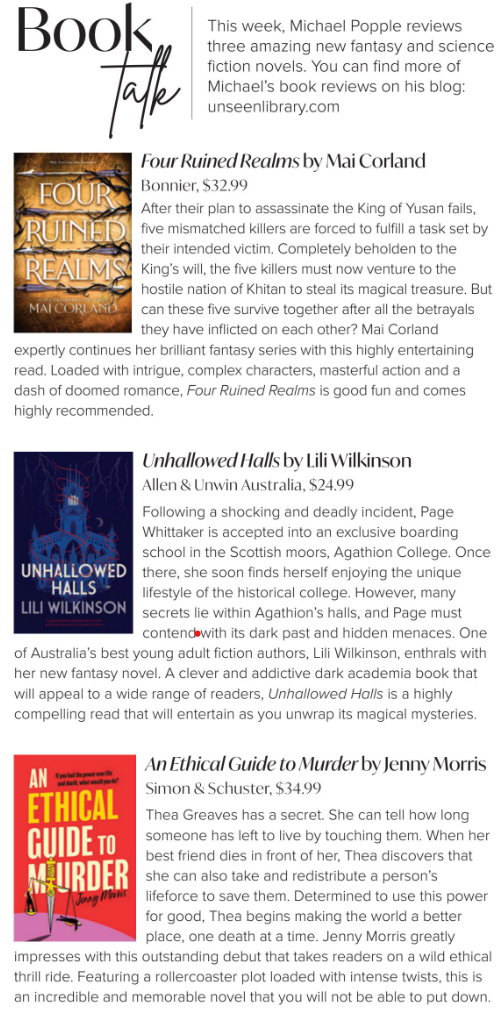
Quick Review – An Ethical Guide to Murder by Jenny Morris

Publisher: Simon & Schuster (ebook – 16 January 2025)

Series: Standalone/Book One

Length: 400 pages

My Rating: 4.5 out of 5 stars

Amazon

In the mood for a curious crime fiction read with a clever philosophical edge?  Then make sure to read the outstanding 2025 debut, An Ethical Guide to Murder by new author Jenny Morris.

Plot Synopsis:

How to Kill Your Family meets The Power in this entertaining and thought-provoking read, that asks:

If you had the power between life and death, what would you do?

Thea has a secret.

She can tell how long someone has left to live just by touching them.

Not only that, but she can transfer life from one person to another – something she finds out the hard way when her best friend Ruth suffers a fatal head injury on a night out.

Desperate to save her, Thea touches the arm of the man responsible when he comes to check if Ruth is all right. As Ruth comes to, the man quietly slumps to the ground, dead.

Thea realises that she has a godlike power: but despite deciding to use her ability for good, she can’t help but sometimes use it for her own benefit.

Boss annoying her at work? She can take some life from them and give it as a tip to her masseuse for a great job.

Creating an ‘Ethical Guide to Murder’ helps Thea to focus her new-found skills.

But as she embarks on her mission to punish the wicked and give the deserving more time, she finds that it isn’t as simple as she first thought.

How can she really know who deserves to die, and can she figure out her own rules before Ruth’s borrowed time runs out?

Early last year I had the very great pleasure of reading Jenny Morris’s very first novel, An Ethical Guide to Murder.  This excellent book featured a compelling plot focused on a protagonist Thea, with the ability to transfer life between one person to another.  After accidentally fatally utilising this power to save her friend, Thea soon finds herself tempted to tip scales between life and death to make a better world.  Working with an ambitious love interest, Thea soon sets up her own Ethical Guide to Murder and begins to target those she believes to be truly wicked.  However, not everything is as it seems, especially when Thea comes face to face with the consequences of her actions, and the dark side of choosing who gets to life and who gets to die.  The resulting personal conflicts with those closest to her, followed by shocking revelations about those she has placed her faith in, will push her over the edge especially when she comes face to face with the person responsible for ruining her life.

I really enjoyed the unique story that Morris came up with for An Ethical Guide to Murder, which proves very easy to get addicted to.  Morris does a good job setting the scene for Thea’s unique abilities in the first part of the book, as well as her stressful life and the people around her.  The transition towards a secret, life-taking vigilante is well written, especially with the inclusion of a seemingly noble love interest with his own plans for her abilities, and the reader is poised to support Thea with her plans.

The last half of the book continues this story in a fantastic manner, while also adding in some strong philosophical and ethical elements, as Thea finds herself torn about whether she was ever doing the right thing.  The resulting battle of morals, especially as Thea also finds herself under investigation and forced to try and contend with true evil closer to home, allows for some deep and heartfelt moments in the book, until you honestly don’t know what the right course of action is for Thea anymore.  Everything wraps up on a heartfelt note, as the protagonist comes to terms with their powers in their own way, while also addressing all their personal problems.  I think Morris’s strong choice of ending for An Ethical Guide to Murder fit the rest of the narrative extremely well, and you come away from this book very thoughtful and appreciative of Morris’s dive into her protagonist’s psyche, and the fantastic discussion about the value of life and the impact of those who misuse it.

Overall, An Ethical Guide to Murder was a very strong debut that I was glad I got the chance to read last year.  Clever, thought-provoking, and filled with some strong characters, An Ethical Guide to Murder was an outstanding read that is worth checking out.

Amazon

The Blackfire Blade by James Logan

Publisher: Arcardia (Trade Paperback – 11 November 2025)

Series: The Last Legacy – Book Two

Length: 583 pages

My Rating: 4.75 out of 5 stars

Amazon

Prepare for adventure, intrigue and some fantastic character dynamics in the outstanding 2025 fantasy novel, The Blackfire Blade by James Logan.

Back in 2024 I had the pleasure of reading the outstanding The Silverblood Promise, which was the debut of author James Logan.  A cool fantasy novel and the first book in the author’s The Last Legacy series, The Silverblood Promise followed the banished scion of a noble house, Lukan Gardova, who finds out that his estranged father had been murdered.  Determined to find out who killed him, Lukan follows the one clue his father left him and winds up in an enticing Mediterranean-inspired fantasy city teaming with its own secret problems.  Needing to uncover a conspiracy deep within this setting before he can achieve his goals, Lukan finds himself teaming up with a brave street urchin and a talented master thief to save the day.  I really loved this awesome first novel from Logan, and The Silverblood Promise ended up being one of my favourite debuts of 2024.  As such, I have been looking forward to Logan’s second novel for a while, and I was very happy to get my hands on The Silverblood Promise’s sequel a few weeks ago.  This sequel, The Blackfire Blade, was another amazing read with an outstanding and highly entertaining plot behind it.

Plot Synopsis:

Winter has come early to Korslakov, City of Spires, and Lukan Gardova has arrived with it. Most visitors to this famous city of artifice seek technological marvels, or alchemical ingenuity. Lukan only desires the unknown legacy his father has left for him, in the vaults of the Blackfire Bank.

But when Lukan’s past catches up with him, his key to the vault ends up in the hands of a mysterious thief known only as the Rook. As Lukan and his companions race to recover the key, they soon find themselves trapped in a web of murder and deceit. In desperation, Lukan requests the help of Lady Marni Volkova, scion to Korslakov’s most powerful family.

Yet Lady Marni has secrets of her own. Worse, she has plans for Lukan and his friends. Plans that involve a journey into Korslakov’s dark past, in search of a long-lost alchemical formula that could prove to be the city’s greatest discovery . . . or its destruction.

The Blackfire Blade was another extremely awesome fantasy adventure novel from James Logan, who showcases his growth as a writer with this excellent sequel.  Following three loveable, if chaotic, protagonists as they explore a new intricate urban fantasy setting, The Blackfire Blade was an exciting blast from start to finish, and I cannot get enough of this amazing series.

James Logan produced another particularly entertaining adventure narrative for The Blackfire Blade, which quickly drags you in with its fun excitement.  Effectively reintroducing you to the three main protagonists, Lukan, the former street urchin Flea and thief Ashra Seramis, better known as Lady Midnight, as they finally reach their destination of Korslakov.  Hoping to uncover the clue to Lukan’s father’s murder that is hidden within Korslakov’s Blackfire Bank, the group finds their mission imperilled when a drunken Lukan immediately has the vault key stolen by a mysterious thief, known as the Rook.  With no other way of accessing the vault, Lukan and his companions desperately search for the Rook with the help of some unlikely friends within the city.  However, they soon run afoul of some of Korslakov’s elites and become indebted to Lady Marni Volkova, a minor character from The Silverblood Promise.

This first part of the book nicely sets the scene for the rest of The Blackfire Blade’s plot, and I found myself really drawn into the various political intrigues and complex feuds that make up high society in Kroslakov.  Logan also does a great job setting up some interesting dynamics amongst the protagonists, which allowed the characters to come together as a more cohesive family going forward.  The second half of The Blackfire Blade was all excellent action and adventure, as the protagonists find themselves continuously forced to take on even more dangerous escapades to pay off their debts and recover the key.  This includes a particularly deadly job navigating the most dangerous parts of the city, to find an alchemical formula.  This part of the story was so damn fun, and features a great mix of scary monsters, fast-paced action, and some very interesting details about the city.

The final third of The Blackfire Blade features a range of fantastic sequences that really showcase the author’s imagination when it comes to unique obstacles and threats.  Highlights include an excellent heist sequence, manipulations of the city’s warring elite, and encounters with a secret society determined to keep the formula out of anyone’s hands.  Logan throws in a lot of great twists and turns here, and you are constantly on the edge of your seat as you wait to see what chaos will be unleashed next.  Everything leads up to the entertaining and destructive finale, where all the lies and secrets come to light, and the protagonists are forced to come together against a truly overwhelming opponent.  Logan clearly has fun detailing the resulting insanity that emerges, and it led to an impressive and deeply entertaining continuous action sequence.  The Blackfire Blade wraps up with Lukan finally getting some details about the larger series narrative, which looks set to lead to some awesome additional adventures, and readers are guaranteed to come away from this book extremely satisfied.

I really enjoyed how The Blackfire Blade came together as a novel, and it is very clear that Logan has developed his skills when it comes to writing action-focused, fast-paced fantasy adventure narratives.  Working extremely well as both a standalone novel and a great sequel to The Silverblood Promise (thanks to a great summary of the first book included at the start), The Blackfire Blade continues in a similar vein to the first Last Legacy novel, with the protagonists forced to explore and understand a new city before they can continue their main quest.  While some readers might not appreciate the requirement for each book in this series to devolve into side quests before the main storyline can be explored, I really liked how it turned out in The Blackfire Blade, as the resulting intrigue, exploration of the city, and following deadly adventures, made for some outstanding reading.  It helps that Logan excels at writing awesome and intense action sequences, and there are a lot of extremely fun moments scattered throughout this novel.  Throw in some very moment sequences where Logan continues to develop his protagonists and their unique relationships, and The Blackfire Blade was a very worthy sequel to the author’s first book, and I felt it was actually a stronger overall novel.

One of the things that most impressed me about The Blackfire Blade was the way that Logan built and introduced a whole new unique fantasy city that the protagonists were forced to explore and understand.  Serving as a fantastic contrast to the sunny and crime-infested Saphrona, the setting of The Silverblood Promise, Korslakov is a grim and snow-shrouded city of power, invention and alchemical might.  The gloomy, purple fire covered spires of Korslakov, perfectly matches the mood of the book’s main characters as they attempt to find their feet in this new local, and the subsequent exploration and understanding of this new urban setting, are some of the best parts of the book.  It’s impressive how effortlessly Logan moves his characters through the various elements of Korslakov, from the decadent battles of the high society to the terrifying abandoned section of the city, infested with flesh-eating monstrosities.  All these detailed and well-written elements of Korslakov play a compelling role in The Blackfire Blade’s narrative, and the city feels like a major character in the book, with the protagonists and the reader, needing to fully understand and appreciate its place in the narrative.  It will be very interesting to see what awesome new city Logan comes up with in his third Last Legacy book, but it’s going to be hard to top the setting he utilised here.

The final element of The Blackfire Blade that I want to highlight here are the complex and likeable central protagonists that Logan bases his story around.  The three main characters, Lukan, Ashra and the very entertaining Flea, are excellent figures, each of whom are dealing with their own issues, such as Lukan’s drunken depression, Flea’s fear of abandonment and Ashra’s constant worry about vengeful enemies coming after her.  Logan ensures that all three of these characters are well utilised in The Blackfire Blade, with a mostly equal balance of perspective chapters where they can work out their separate issues.  While in some ways these protagonists, mainly Lukan, have lost a little of the development from the first book, Logan works through that again, which ensures they come out of this latest adventure stronger.  However, the real magic of these protagonists is the way that Logan has morphed them into unconventional and dysfunctional family unit, that never ceases to entertain.  While they may bicker, argue and misunderstand each other throughout the book, the reader is never in doubt that they care for each other, and this allows them to be an extremely likeable bunch who you constantly root for (especially Flea).

Aside from the three main protagonists, The Blackfire Blade is loaded with a highly entertaining and often outrageous collection of supporting characters, all of whom add a lot to the book’s impact.  Primarily focused on the elites of Korslakov, who the protagonists need to deal with to achieve their goals, you are introduced to an interesting array of backstabbing nobles and self-important lords, whose intrigues and squabbles are a key part of the plot.  My favourites include grizzled general Leopold Razin, who proves to be a particularly entertaining, if tragic, ally to the protagonists.  There was also the imposing Lady Wretzky, the Iron Dame, who more than lives up to her title during her interactions with the main cast.  I also need to highlight the deadly Lady Marni Volkova, an ultra-wealthy heiress who Lucan finds himself indebted to and whose appearances are always quite entertaining as she pulls the main character’s strings.  There was also the briefly featured Clank, a great character whose inclusion reveals one of Korslakov’s biggest secrets, while also having some amazing interactions with Flea.  I’m honestly only barely scratching the surface of all the very entertaining and compelling characters featured in The Blackfire Blade, and I was really impressed with Logan’s ability to create and then utilise this amazing cast in his second book.

James Logan continues to shine as one of fantasy fiction’s newest rising authors.  His second novel, The Blackfire Blade, was a wonderful and highly entertaining read, that serves as an outstanding sequel to his amazing first novel.  Exciting, powerful and extremely addictive, The Blackfire Blade really showcased Logan’s amazing ability as an author, and I honestly could not get enough of this incredible fantasy read.  This second book from Logan was so damn good, and I cannot wait to see what adventures, revelations and heartfelt moments await us in his next entry in The Last Legacy series.

Amazon

Waiting on Wednesday – Pretenders to the Throne of God and Green City Wars by Adrian Tchaikovsky

Welcome to my weekly segment, Waiting on Wednesday, where I look at upcoming books that I am planning to order and review in the next few months and which I think I will really enjoy.  Stay tuned to see reviews of these books when I get a copy of them.  For this latest Waiting on Wednesday post, I highlight the two upcoming books from impressive author Adrian Tchaikovsky that I’m most looking forward to in 2026.

Adrian Tchaikovsky is an extremely talented science fiction and fantasy author who has been wowing audiences with his incredible imagination since 2008, producing an insane number of books during that period.  Known for his Shadows of the Apt, Children of Time, Echoes of the Fall and Final Architecture series, as well as several awesome standalone novels, Tchaikovsky has a truly outstanding catalogue of works to his name, and there are some true classics captured there.  I personally have had the pleasure of reading several of his latest great books, with entries like Service Model (one of my favourite books of 2024), Alien Clay, the novella Orges and the Warhammer 40,000 novel, Day of Ascension (one of my favourite Warhammer 40,000 novels), proving to be quite amazing.

Amazon

Some of my favourite books from Tchaikovsky have been the awesome novels of his Tyrant Philosophers series.  A gripping, brilliant and highly amusing series, the Tyrant Philosophers novels are set in a cool fantasy world filled with magic, gods and demons, all with a fun Tchaikovsky twist to them.  Featuring some excellent overlapping characters and events, all set around the dark impact of the Palleseen, an empire of perfection seeking fanatics, who have been conquering the world through elaborate military and diplomatic action. All three current books in the series have been quite exceptional, including City of Last Chances and House of Open Wounds both of which were amongst my favourite books of 2023 (with City of Last Chances being one of the best audiobooks of 2023), as well as the third book in the series Days of Shattered Faith (one of my favourite books and audiobooks from the first half of 2025).  I really love these elaborate and highly entertaining novels, and we’re luckily only a short way away from the next book in the series, Pretenders to the Throne of God.

Set for release in February 2026, Pretenders to the Throne of God will once again focus on the Palleseen expansion as they engage in a deadly siege to expand their power and influence.  Featuring an outstanding plot, Pretenders to the Throne of God has the potential to be another outstanding novel, especially as we’ll get to see the next chapter of a certain character’s troubled journey.

Plot Synopsis:

Arthur C. Clarke winner and Sunday Times bestseller returns to a world steeped in magic – and the Tyrant Philosophers’ campaign to bring reason, logic and ‘perfection’ to it.

As the Palleseen’s campaign to bring Perfection and Correctness to an imperfect world rages on, Eres Ffenegh – ‘the City on the Back of a Crab’ – is the next state slated for conquest. But its citizens won’t give up sovereignty easily.

The siege has dragged into winter and the defenders – both locals and Pal renegades – hold an uneasy alliance against the enemy at the gates, while the Pal army is looking over its shoulder for the next self-destructive dictate of their government back home.

Within the city, Devil Jack, a good man apprenticed to the notorious conjurer known as the Widow, is driven to bargaining with hell to get back what he’s lost. Meanwhile Kiffel ea Leachan is the city’s champion, a child of privilege who’s just lost everything to the invaders. Both must try to survive the siege and make their own destinies in a world that’s cut them loose.

Outside the city, Pal reinforcements have arrived to take the city, but it’s the sort of help that might just damn them all…

This sounds like a very interesting continuation to the Tyrant Philosopher’s series, and it’s one that I’m particularly keen on.  Readers of this blog will know that I love a good siege novel, and I’m going to be very keen to see Tchaikovsky’s take on siege craft in Pretenders to the Throne of God.  No doubt this new book is going to feature a lot of interesting perspectives of the siege from both sides of the wall, and I cannot wait to see what over-the-top array of magical battles, as well as complex political intrigues will engulf both sides of the battle.

While the overarching story of Pretenders to the Throne of God sounds very promising, I personally I am very keen to see how Tchaikovsky continues the tale of one of his best characters, known in this novel as Devil Jack.  The man known as Jack has served as a primary character of all three previous Tyrant Philosopher’s novels, with fate throwing him into different roles and facing dangerous hardships.  However, after losing the demon he loved in Days of Shattered Faith, it looks like the formerly happy Jack is going to go through a rather dark place in this sequel.  I’m almost a little afraid to see how Tchaikovsky will torture Jack in this upcoming novel, but I have no doubt that his character arc is going to be one of the most emotionally charged of the entire novel.  Add in the rest of the complex characters I known Tchaikovsky has dreamt up for this new book, and Pretenders to the Throne of Gods is going to have some outstanding depth based around its protagonists, and probably it’s villains.

Based on how very impressive the previous Tyrant Philosophers books have been, I have very high hopes for Pretenders to the Throne of God in the new year, and it’s going to be something truly special.  One of my most anticipated releases for the first half of 2026, Pretenders to the Throne of God is going to be incredible.

Amazon

In addition to the next epic Tyrant Philosopher’s novel, there is another outstanding sounding Tchaikovsky novel that I am very excited to read in the new year, the very fun sounding Green City Wars.  Set for release in June 2026, Green City Wars will see Tchaikovsky present an intriguing and thriller with a unique twist, the protagonist is a talking racoon living in a world of genetically engineered animal helpers.

Plot Synopsis:

In a city of sunshine and secrets, the shadows belong to the animals. One genetically-engineered raccoon races to expose a deadly conspiracy – before it tears his whole world apart.

In a solar-powered future, humans live in luxury, served by unseen Little Helpers – artificially enhanced animals who maintain their perfect green cities. The animals’ golden rule: ‘Do Not Bother the Humans.’ Yet beneath this tranquil facade, a complex underworld of animal politics, crime and conflict thrives.

Enter Skotch, a freelance raccoon investigator. His biggest problem was a lack of work. Now his work may get him killed. And his latest case? Finding a fugitive mouse scientist. But powerful forces are also after the mouse, and they’re willing to kill for his secrets. Can Skotch navigate this treacherous web, outsmart rat gangsters, beat a deadly weasel assassin and keep his pelt intact? More importantly, can he find his quarry before the elusive rodent breaks Rule One in the most apocalyptic way – and shatters their fragile world.

I love the sound of this upcoming novel, especially as I’m keen to see Tchaikovsky take on the noir genre in his own entertaining way in Green City Wars.  The idea of sentient animal protagonists alongside humans in serious fiction is always very interesting, and the above synopsis has seriously put me in mind of the Welkin Weasels series by Gary Kilworth (a favourite of my childhood).  However, Tchaikovsky has put a fun dark twist on it, with the animals being genetically engineered slaves to humanity.  I’m assuming that the whole story will be a compelling crime fiction novel with some great science fiction twists, overlayed with some amusing critiques of humanity, which sounds so very fun.

While featuring one of Tchaikovsky’s more unusual plot ideas, I think that Green City Wars has a ton of potential and I’m very excited for it.  I have no doubt that this awesome standalone novel is going to be particularly funny, and I cannot wait to see how it turns out.

Overall, it is quite clear that Adrian Tchaikovsky has some outstanding novels coming out in the new year, and these are just the main ones I’m currently excited for.  The author also has plans for some other exciting releases in 2026, and I’m going to make a real effort to read as many as possible.  Stay tuned to see how they all turn out.

The Strength of the Few by James Islington

Publisher: Text Publishing/Audible Studios (Audiobook – 11 November 2025)

Series: Hierarchy – Book Two

Length: 31 hours 8 minutes

My Rating: 5 out of 5 stars

Amazon

Australian author James Islington continues his Hierarchy series in epic form with the incredible and complex novel, The Strength of the Few, an outstanding and highly addictive fantasy novel that I had an incredible time getting through.

Back in 2023, I had the pleasure of reading the outstanding novel, The Will of the Many from James Islington, which I very quickly fell in love with.  Following a fugitive prince who finds himself enrolled in an academy for the children of the elite members of the nation that conquered his homeland, The Will of the Many had an intricate plot that forced the protagonist to deal with elaborate ancient puzzles, the unique magic of his world, unlikely friendships, deadly rebels, and all his hidden secrets potentially becoming uncovered.  I had such an amazing time reading The Will of the Many that it got a very easy five-star rating from me, and it ended up topping several of my end-of-year lists for 2023, including my favourite book, audiobook, new-to-me author and Australian fiction lists.  Unsurprisingly, I have been keen to see how the series would continue ever since I finished the final page of The Will of the Many, and the long-awaited sequel, The Strength of the Few, was one of my most anticipated novels of 2025.  I started reading The Strength of the Few the second I could, and it turned out to be another captivating read, with a plot that goes in some captivating and intense directions.

After infiltrating the Academy and running the mysterious Labyrinth, the man known to the Catenan Republic as Vis Telimus thought that he would finally understand some of the secrets of the nation that destroyed his people.  However, his encounters within the Labyrinth have instead resulted in the impossible and placed him in the firing line of an ancient evil determined to destroy his world.

While the original Vis continues to live in the Catenan Republic, attempting to avenge the massacre of his Academy classmates and friends at the Iudicium, he is unaware that the ancient devices within the Labyrinth replicated him across three separate words.  Mirrors of each other influenced and altered by different history, the worlds of Obiteum, Luceum and the world Vis already knows as Res, are divergent places, each with their own troubles, rulers and chaos.

Now one of the few beings existing across all three concurrent realities, Vis stands as the only person who can stop the upcoming Cataclysm that will burn away all he loves.  But first he needs to face the different challenges each world has for him, especially as he truly belongs in none of them.  Forced to fight, to learn how to control the unique powers his situation has granted him, and to understand the different worlds they find themselves in, all three versions of Vis will be pushed to their limits as they try to prove themselves and understand the secrets behind their unlikely journey.  If any version of Vis fails, then all their chance to stop the Cataclysm are finished.  But can Vis really survive in three separate realities, each of which is filled with beings who desperately want him dead?

Well damn, now that’s how you do a sequel.  The Strength of the Few was an incredible novel as James Islington expertly continued the elaborate and ambitious narrative of his epic Hierarchy books.  Featuring a layered story loaded with complex world-building, intricate story details and compelling characters, The Strength of the Few was an exceptional novel that gets a very easy five-star rating from me.

Islington came up with an especially complex and powerful story for The Strength of the Few, which served as a very worthy follow-up to the compelling events of the previous Hierarchy book.  Right out the gate readers are treated to an intricate plot, with the protagonist from The Will of the Many split into three different versions of himself in three separate mirror worlds.  Each version has its own very distinct narrative that revolves around that specific Vis trying to overcome the challenges of that specific world.  For example, the version of Vis on Res, the world that The Will of the Many was completely set in, continues to endure the politics of the Hierarchy, while also attempting to uncover those responsible for the massacre of his classmates at the end of the previous book.  The storyline set on Obiteum is a bit of a post-apocalyptic narrative, as Vis is forced to survive a broken world ruled by the enemy responsible for several previous Cataclysms, and must try to find a way into a forbidden city, half staffed by the living dead.  The final storyline set in Luceum offers a much more adventurous narrative, as a version of Vis that is completely unaware that he is in an alternate world, is forced to explore a new culture and attempt to survive amongst people who have no idea of his past or his destiny.

These three separate and very distinctive storylines each go in some interesting directions as the book continues, and the result is a very impressive and compelling overall narrative, especially as Islington expertly sets up necessary details in the early stages of the book and cleverly builds from there.  For most part, each of these storylines stay isolated, although some key details from each bleed into the wider narrative, and you can appreciate the significance of certain events or revelations in one storyline better thanks to the events in one of the other worlds.  Each plot line goes in some very interesting directions, with the dark politics of Res forcing Vis to engage in some complex schemes and deceptions, the struggles of Obiteum slowly getting to an isolated version of the protagonist, while positive character interactions in Luceum turn that Vis into a completely different person.  Islington starts to enhance the tension of all three storylines in the second part of the book, and there are some very amazing scenes that completely change the tone of each of the main storylines.  I felt the political instability of Res allowed for some particularly powerful moments, especially after a shocking scene about two-thirds of the way through book.  A growing war in Luceum also provides some compelling drama for that storyline, as Vis must decide what he wants in life, while the continued threat of discovery in Obiteum proves to be particularly draining.

The final third of the book contains some of the best scenes of The Strength of the Few, as Islington builds on all the novel’s great storytelling and complex worldbuilding to bring forth an epic conclusion.  Thrusting all three versions of Vis into mortal danger, the tension is particularly thick, as the protagonist and much of the supporting cast are in constant risk.  This includes a final desperate attempt to achieve his goal of killing a god in Obiteum, which hits a range of snags amongst the ancient city Vis has spent most of the book infiltrating.  At the same time, the Vis in Leceum finds himself in the middle of a deadly war, where his unique abilities and the unlikely rewards of a deadly ceremony weigh him down.  However, the most intense is the narrative set on Res, where Vis finds himself attempting to save who he can from the chaotic events brought on by those manipulating him.  Islington probably throws the book’s most shocking moments into the Res storyline, which nicely builds on a lot of the drama and intrigue from the first novel, and forces the protagonist to make some dark decisions, out of both vengeance and necessity.  One scene where the title of the book is quoted by an antagonist really sticks in the mind, and I’m not sure I’ll be able to forgive Islington with the dark bait-and-switch there.  All three of these storylines end on an interesting note that hint of destructive events for the future, and it is going to be fascinating to see how Islington continues the Hierarchy series going forward.

Thanks to the elaborate ideas that Islington had for this epic sequel, The Strength of the Few turned out to be an exceptionally written read, which provides an intense and compelling fantasy narrative, filled with some great emotional depth.  The inventive way that the author splits the book to follow three separate versions of the same protagonist worked surprisingly well, and it allowed for quite a unique character-driven story, which really showcases Islington’s writing ability.  I felt that the split between the three distinctive storylines was very well done, and these separate narrative threads each stood on their own merits, provide a distinctive experience in each.  I loved how there was something special in each of the storylines, and you got some interesting interactions, world building and different focuses with each of them.  All three were very well written, and there were honestly no weak links with any of the storylines, which is always a risk when you split the narrative like this.  I will say that the intrigue-laden narrative on Res was a particular favourite of mine, but both other storylines were also quite exceptional, and they balanced each other nicely with their alternating themes and varied character growth.  Throw in some creative expansion of the universe the narrative is set in, with its cool Will-based magic system, and three worlds each inspired by different ancient cultures (Roman, Egyptian and Celtic), and this was a very well written book, and I really appreciate how effectively Islington builds up his different worlds and showcases them to the reader.

The Strength of the Few proved to be an impressive continuation of the Hierarchy series, and I felt that Islington did an outstanding job building on the impressive fantasy elements and storylines of the first book.  However, the complex narrative split and the way that Islington dives immediately into the story does mean that The Strength of the Few is probably best enjoyed by those readers who have already gotten through The Will of the Many.  While Islington does re-examine key elements of the plot from the first book as The Strength of the Few continues, it is a very gradual process, and new readers trying to read the sequel first are likely to get confused if they don’t know some necessary details from the first book.  The Strength of the Few might have benefited from a good summary or recap at the front of the book to remind readers of some key details, especially if they haven’t had a chance to read re-read The Will of the Many since its 2023 release.  Still, for the most part, all readers should be able to follow and appreciate The Strength of the Few, especially once you get drawn into the three compelling storylines, and people who love extremely elaborate fantasy narratives with a lot of intricate detail are going to have an outstanding time.

I was once again impressed with Islington’s great characters in The Strength of the Few, as this book has a massive cast, made up of an interesting combination of figures from The Will of the Many, and new characters from the three separate worlds of the setting.  However, most of this book naturally follows the young protagonist from the first book, who is primarily known as Vis Telimus.  A studious and damaged figure who had already gone through a lot before the events of this novel, Vis has rather a unique experience in this sequel, as unbeknown to him, there are now three separate versions of him concurrently existing in the mirror worlds of this setting.

Islington perfectly sets up and utilises this three-way split of his protagonist, and readers are soon treated to three distinct variations of the protagonist, each of whom are altered by their experiences and losses, especially the two versions of Vis who lose their left arm.  It was fascinating to see how each of the Vises are influenced and changed by their respective traumas, and how their adventures are altered by the different information or people that they meet.  For example, the Vis in Res, who is essentially the same protagonist from The Will of the Many, finds himself longing for vengeance after the events of the Iudicium, and spends much of the book angry and forced to endure politics and lies.  The version of Vis on Luceum, while feeling lessened by the loss of his arm, soon finds peace in his new setting, and his eventual motivations for fighting and living are very different from his other incarnations, especially as he finds friends he can trust completely.  Finally, the Vis on Obiteum is one of the more confident incarnations of the protagonist, having full knowledge of the upcoming Cataclysm and his place in the three worlds explain early in the book.  As such, he soon becomes the most competent at utilising his Will talents and appears the most undamaged of the three due to not losing his arm.  However, in many ways the Obiteum Vis is the worst off out of all versions of the protagonist due to his isolation, the desolate surroundings, and the early expectations of murder and potential death that are thrust upon him.  I really cannot emphasise just how clever the split between these different variations of the protagonist is, especially with the subtle differences and alternate reactions to similar events or situations. It really makes for quite a distinctive and moving read, especially as all three versions of Vis experiences even greater trauma and damage as this sequel continues.

While Vis is the obvious focus of The Strength of the Few, there is a huge supporting cast utilised throughout this book, including various characters only found on each distinctive world.  Indeed, each version of Vis picks up its own supporting cast, which allows for some very different interactions in each of the major storylines.  Highlights include many of the recurring characters from the first book who serve as Vis’ friends and mentors in Res.  There is a particular focus on Eidhin and Aequa, who have an expanded role as Vis’s main confidants in this novel, and I liked some of the powerful storylines that formed around them.  Other major supporting characters from the first novel are showcased to a lesser extent in this sequel, primarily due to the book being split into three separate parts, although many of these characters still got a notable role in this sequel.

The cast supporting Vis on the desolate world of Obiteum is a lot more limited, mainly to emphasise the protagonist’s loneliness, although he does find a compelling mentor in Caeror, his adoptive uncle, who the protagonist was hunting for in the first book.  A couple of other native characters from Obiteum gain prominence later in this storyline as Vis attempts to complete his mission, and it is fascinating to see how their experiences living on a dead-world, impact their interactions with the protagonist.  Finally, the cast of the Luceum plotline represent a compelling counterpart to the supporting characters of the rest of the book.  While Vis has enemies in Luceum, he also finds several true friends who he can trust with all his secrets.  It was interesting to finally see Vis truly open up to other people, and it allowed for some very different interactions to the secrets and lies that define the protagonist in the other two storylines.  Throw in a compelling array of antagonists, as well as an entertaining manipulator who keeps chucking Vis into the deep end on Res, and this was an impressive cast for this great sequel.  It honestly was an extremely intriguing experience to have three separate casts of characters set around different versions of the protagonist.  While this narrative split did result in some restrictions when it came to character depth or a full exploration of relationships, I think the overall extended length of the book overcame this and allowed the reader to grow close to the supporting characters.  I will warn readers not to get too attached to the extended cast though, as Islington does get a little murderous as the book continues, however, all these characters are impressive while they last.

While I was lucky enough to receive a physical copy of The Strength of the Few, I ended up holding out for a little bit to listen to the audiobook version of this book instead.  I’m a big fan of audiobooks when it comes to ultra-elaborate fantasy narratives, as I tend to absorb and retain more of the details that way, and this worked out well with The Strength of the Few.  I felt that Islington’s complex story came across very effectively when read out, and all the elements, including the elaborate worldbuilding and the great character work, were well translated to the reader.  I also appreciated how the switches between the three different versions of the perspective protagonist, was easily discernible, and this was a very easy story to follow on audiobook.  The Strength of the Few audiobook saw the return of Euan Morton for narrator, who previously read out The Will of the Many, and who I quite enjoyed as a narrator of the Star Wars audiobook, Tarkin.  Morton has a very interesting cadence to his voice as a narrator, which provided a very unique edge to this audiobook.  While Morton’s narration style might not appeal to everyone, I felt that he did a good job voicing this compelling story, especially through the eyes of the complex protagonist, and his unique narration on this elaborate story worked extremely well.  I also felt that Morton excelled at pronouncing all the different names and titles that Islington featured in his plot, no matter their Roman, Celtic or Egyptian inspiration, and the characters of all three different worlds had a subtly different cadence and accent that helped to distinguish the separate storylines from each other.  As such, I really got stuck into this audiobook, powering through it quickly, even with its 31-hour runtime.  This was probably one of the more intense and moving fantasy audiobooks I had the pleasure of listening to in 2025, and I cannot recommend this format enough.

James Islington does it again with his incredible second Hierarchy novel, The Strength of the Few.  Brilliantly continuing his elaborate narrative from the first novel in a unique manner, The Strength of the Few was an ultra-addictive read, that really showcased Islington’s writing ability and imagination.  Clever, powerful and easy to get addicted to, The Strength of the Few was one of my favourite books of the year, and I cannot wait to see how Islington continues the series going forward.

Amazon

Katabasis by R. F. Kuang

Publisher: Harper Voyager (Trade Paperback – 26 August 2025)

Series: Standalone/Book One

Length: 549 pages

My Rating: 4.5 out of 5 stars

Amazon

Acclaimed author R. F. Kuang produces one of the more distinctive and intelligent fantasy novels of 2025 with her elaborate and compelling Katabasis.

Rebecca Kuang, who mostly goes by R. F. Kuang, is a very interesting author who has been making a big impact on the fantasy scene in recent years.  Known for her elaborate and dark fantasy novels that often feature strong Chinese inspiration, Kuang has written some intriguing novels over the years, including her bestselling Poppy War trilogy, as well as the standalone novels Babel (also released as Babel, or the Necessity of Violence), and her contemporary satirical novel Yellowface.  I have been meaning to read something from Kuang for a while, especially after seeing a lot of love for her works online, so I made sure to seek out a copy of her 2025 release, Katabasis.  An intricate read with some excellent academic twists, Katabasis was a compelling novel with a very unique plot.

Plot Synopsis:

Dante’s Inferno meets Susanna Clarke’s Piranesi in this all-new dark academia fantasy from R. F. Kuang, the #1 New York Times bestselling author of Babel and Yellowface, in which two graduate students must put aside their rivalry and journey to Hell to save their professor’s soul—perhaps at the cost of their own.

Katabasis, noun, Ancient Greek:

The story of a hero’s descent to the underworld

Alice Law has only ever had one goal: to become one of the brightest minds in the field of Magick. She has sacrificed everything to make that a reality: her pride, her health, her love life, and most definitely her sanity. All to work with Professor Jacob Grimes at Cambridge, the greatest magician in the world.

That is, until he dies in a magical accident that could possibly be her fault.

Grimes is now in Hell, and she’s going in after him. Because his recommendation could hold her very future in his now incorporeal hands and even death is not going to stop the pursuit of her dreams….

Nor will the fact that her rival, Peter Murdoch, has come to the very same conclusion.

With nothing but the tales of Orpheus and Dante to guide them, enough chalk to draw the Pentagrams necessary for their spells, and the burning desire to make all the academic trauma mean anything, they set off across Hell to save a man they don’t even like.

But Hell is not like the storybooks say, Magick isn’t always the answer, and there’s something in Alice and Peter’s past that could forge them into the perfect allies…or lead to their doom.

Katabasis was an outstanding novel from Kuang, who presents a highly academic and moving journey into the underworld.  Featuring a very distinctive style, Katabasis was a thoughtful and intricate fantasy read with some outstanding character moments, which really draw you in with its drama and complexity.

Kuang envisions a compelling standalone narrative for Katabasis, which combines an intelligent adventure into the afterlife with some great character-driven story elements.  Following protagonists Alice and Peter as they journey together into Hell to recover the soul of their recently deceased professor, Katabasis has a bit of a slow start to it, primarily due to the highly theoretical nature of this world’s magic system and the various ideas of Hell.  Kuang is forced to explore a lot of this in the early part of the book, but it serves as an excellent basis for the rest of the novel, especially when combined with hints at the troubled relationship between Alice and Peter, as well as their own dark histories.  Once the story gets going in earnest, it proves to be a lot more exciting, especially when exploring the different planes of Hell, and Kuang soon adds in some other dark threats that further imperil the protagonists.

The second half of Katabasis is particularly good, as the protagonists continue their journey down the various levels of Hell, now being hunted by murderous constructs and their sinister masters.  Kuang really amps up the risk factor for this part of the book, and there are some great scenes here, including one that completely changes the trajectory of the narrative.  At the same time, the author fully reveals the traumatic pasts of both protagonists, which really alters the way you see them and their motivations for undertaking this adventure.  Following some dark tragedy and excellent searches for self-discovery amongst the other trapped souls in Hell, the big threat of the story is eventually resolved, and the goal of the protagonists is reached.  Kuang does an excellent job wrapping the book up, with the final decision of the main protagonist serving as a great full-circle moment for the entire proceeding plot.  I quite liked the hopeful note that the author left her fantastic novel on, which I felt was quite fitting and allowed the reader to come away very satisfied and moved.

I felt that Kuang utilised a very distinctive, and personal style for Katabasis, that really helped her to make the classic journey into Hell story her own.  A powerful, character-driven book, Kuang brings together a great adventure narrative that is constantly enhanced by a range of academic elements and the author’s own complex magick system.  There is a substantial dive into both the concept of Hell, and the study of the novel’s archaic magick, and Kuang cleverly dives into the deep detail of both as the book continues.  Fans of Dante’s Inferno and other classic texts about Hell will love the constant references and comparisons that occur throughout the course of the story, and it was fun to see the differences between what the protagonists expect and what they experience.  I felt that this mixture of homages and the author’s own imagination was very impressive, and the author went above and beyond to set up this setting and her magick system, including with several great maps of Hell that appear in the version of the book I got.  I also felt that the author’s compelling dive into the torture that is advanced academia and the various pressures, lies and rivalries that formed was particularly gripping.  Kuang clearly adds a lot of her own experiences with academia, especially in the elite British universities, into the protagonist’s past, and it gave a gritty bit of academic realism to the plot.  It does need to be said that Kuang made her novel a little too complex at times, and there are a few sections which drag as the protagonist’s dive into obscure lore, elaborate equations, or complicated logic.  Still, for the most part Katabasis was a well-written and addictive standalone read, that will really appeal to established fans of the author.

I think that another major highlight of Katabasis was the excellent character work that Kuang featured throughout the plot.  Focused primarily on the main characters of Alice Law and Peter Mudoch, both protagonists are initially portrayed as brilliant and highly ambitious academics whose journey into Hell only seems to enhance their own rivalry.  However, as the book continues, Kuang does a masterful job of diving deeper into their backstories and showcasing more of their pasts to give their current adventure and motivations more meaning.  It turns out that both characters are a lot more damaged than you’d initially realised, due to their own experiences in academia, their interactions with their supervisor, and the crippling rivalry that has formed between them.  The slow reveal of the full extent of their damage, which also includes both characters reevaluating previous information and conclusions they’ve made, is very impressive, and each revelation adds some greater emotional heft to the plot.  Combine that with the gradual evolution and repair of the relationship between Alice and Peter as the book continues, and this was quite a powerful journey for the two protagonists, especially as they experience even more tragedy, betrayal and uncertainty in Hell.

While most of the book is focused on Alice and Peter, I do have to also highlight how well Kuang set up supporting character Professor Jacob Grimes in the Katabasis.  Despite being dead and appearing mostly in flashbacks and the memories of the protagonists, Professor Grimes serves as an influential figure in the plot, primarily for the impact he had on his various students.  Initially shown as a brilliant and supportive academic, the flashbacks shown throughout the course of Katabasis soon reveal a more malicious side to Grimes, which really changes your view of the protagonists’ journey to save him.  Kuang’s slow burn reveal of all of Grimes’s flaws and manipulation was just perfect, and I loved how your perception of this shadowy figure the plot is chasing changes the more honest and open the protagonists become.  The full extent of Grimes’s actions, and his students’ complicated feelings for him, is such a compelling part of the Katabasis’s plot, and I liked how well it’s tied into the larger problems with academia.  I really do appreciate how well Kuang set up Professor Grimes as a dark supporting figure in this book, whose influence has major implications to the story, even if he only actually appears in the present adventure once.  Throw in some other intriguing denizens of Hell, including a twisted family doing their own dark experiments on the dead in brutal fashion, and Kuang really showcased her ability to write complex and damaged characters in Katabasis.

Overall, Katabasis was a highly compelling and deeply intricate fantasy novel that was a distinctive highlight of the 2025 reading year.  I certainly got the full experience of Kuang’s intriguing imagination with this elaborate book, and the resulting story was an interesting take on dark academic fantasy.  Clever, moving and full of some unique features, Katabasis was an outstanding read that is really worth checking out.

Amazon

Waiting on Wednesday – Sisters of the Lizard by Jackson Ford

Welcome to my weekly segment, Waiting on Wednesday, where I look at upcoming books that I am planning to order and review in the next few months and which I think I will really enjoy.  Stay tuned to see reviews of these books when I get a copy of them.  In this latest Waiting on Wednesday, I highlight a very fun upcoming fantasy sequel with the awesome sounding Sisters of the Lizard by Jackson Ford

Amazon

Earlier this year I had the great pleasure of reading the very entertaining fantasy novel, The Bone Raiders by Jackson Ford.  The first book in Ford’s Rakada series, The Bone Raiders followed a small band of grassland raiders and outcasts who came up with the bold plan to train giant, fire-breathing lizards and ride them into battle against the encroaching armies of the Great Khan.  The resulting carnage, which include battles, betrayals, unlikely romance, and some entertaining lizard riding antics, was extremely fun, and I had an absolute blast getting through this fantastic read.

Upon finishing The Bone Raiders, I was very curious to see where Ford was going to take the series next, especially after some interesting reveals towards the end of the story.  Well, it looks like fans of this novel are going to get answers soon, as Ford has a sequel coming out in May 2026.

This sequel, which has the amusing title of Sisters of the Lizard, will once again follow the raiders from the first book, the titular Rakada, as they continue their chaotic life on the grasslands, now with several giant lizards for protection.  However, things look set to become complicated once again, with war, invading armies, a vengeful khan and sick lizards all coming for the protagonist.

Plot Synopsis:

Following The Bone Raiders comes the next thrilling new novel set in the world of the Rakada: an edge-of-your-seat, action-packed epic fantasy series, where a wild band of raiders harness the power of gigantic, fire-breathing lizards to defend their homeland.

All Sayana wanted was to enjoy her life in the rolling grasslands of the Tapestry. After she and her fellow Rakada managed to ride humongous fire-breathing lizards to face down the Great Khan’s army, they should have been able to kick back a little for once. Not too much to ask, right?

Instead, the Tapestry is in turmoil – invading armies threaten, the other raider clans are at war, and inside his fortress city of Karkorum, the Khan broods and plots. What’s more, the Rakada’s giant lizards are getting sick, and they have no idea how to cure them. If they die, there’s no telling what might happen to the Tapestry.

But then the Rakada receive a vision – apparently from the gods. A deep emerald pool surrounded by bone-white sands – one that may be able to heal their lizards. With no other option, the raiders set out on an epic quest across the mountains and into the desert.

But the danger that awaits them will be one greater than they’ve ever faced before. These guys really can’t catch a break.

I really love the sound of this upcoming sequel, especially as Ford is expanding on a lot of the interesting open story elements from the first book in Sisters of the Lizard.  Focussing on the consequences of the protagonist’s actions from The Bone Raiders should make for quite an intense read, especially with all the betrayals, wars and revenge that is likely coming their way.  The excellent cover of the book seems to indicate that a certain former Rakada member is going to make a return in this novel as an antagonist, and I’m sure that will lead to some particularly dramatic scenes. I also am curious to see how the author will expand on some of the lore around the giant lizards in this sequel, and it should be fun to see how much the protagonists and their unlikely mounts have evolved since the events of the first book.

Overall, I am quite excited to read Sisters of the Lizard in the new year, and I think it has a lot of potential.  Ford really impressed me with his entertaining and compelling 2025 novel, and this intriguing sequel will likely be just as good.  An awesome and no-doubt deeply compelling upcoming novel I’m really looking forward to.

Days of Shattered Faith by Adrian Tchaikovsky

Publisher: Head of Zeus (Audiobook – 5 December 2024)

Series: The Tyrant Philosophers – Book Three

Length: 21 hours and 39 minutes

My Rating: 5 out 5 stars

Amazon

One of the current top authors of all things fantasy and science fiction, the improbably imaginative Adrian Tchaikovsky, continues to greatly impress with his outstanding and epic early 2025 novel, Days of Shattered Faith.

I think it is fair to say that few fantasy and science fiction authors are as consistently prolific and entertaining as the relentless Adrian Tchaikovsky, who has been continuously putting out clever books over the last few years.  While he has written many intriguing series and standalone novels throughout his career, I am more familiar with some of his more recent works, including the novella Ogres, the gripping interstellar novel Alien Clay, one of my favourite Warhammer 40,000 novels, Day of Ascension, and the hilarious and insightful robot apocalypse novel, Service Model (one of my favourite books of 2024).

While the above books are all quite exceptional, my favourite body of Tchaikovsky’s work has so far been The Tyrant Philosophers series.  A gripping, brilliant and highly amusing series, the Tyrant Philosophers novels are set in a cool fantasy world filled with magic, gods and demons, all with a fun Tchaikovsky twist to them.  With the first two books, City of Last Chances and House of Open Wounds, both of which were amongst my favourite books of 2023 (with City of Last Chances being one of the best audiobooks of 2023) the series has really grabbed my attention over the last couple of years.  Much of it is down to the author’s clever narratives that work to expand this intriguing fantasy world through some interesting overlapping characters and events.  In particular, the series examines the dark impact of the Palleseen, a conquering army of fanatics who violently supress superstition and belief in the gods in the name of expanding their own worldview of perfection and correctness.  Both the previous books in this series were quite impressive, and I was very eager to read Days of Shattered Faith when it first came out.  While I have been delayed in writing a review for this book, it proved to be an outstanding read, especially with its rich and powerful narrative.

Plot Synopsis:

Welcome to Alkhalend, Jewel of the Waters, capital of Usmai, greatest of the Successor States, inheritor to the necromantic dominion that was the Moeribandi Empire and tomorrow’s frontline in the Palleseen’s relentless march to bring Perfection and Correctness to an imperfect world.

Loret is fresh off the boat, and just in time.

As Cohort-Invigilator of Correct Appreciation, Outreach department, she’s here as aide to the Palleseen Resident, Sage-Invigilator Angilly. And Sage-Invigilator Angilly – Gil to her friends – needs a second in the spectacularly illegal, culturally offensive and diplomatically inadvisable duel she must fight at midnight.

Outreach, that part of the Pal machine that has to work within the imperfection of the rest of the world, has a lot of room for the illegal, the unconventional, the unorthodox. But just how much unorthodoxy can Gil and Loret get away with?

As a succession crisis looms, as a long-forgotten feat of necromantic engineering nears fruition, as pirate kings, lizard armies and demons gather, as old gods wane and new gods wax, sooner or later Gil and Loret will have to settle their ledger.

Just as well they are both very, very good with a blade…

Wow, what an incredible read.  Adrian Tchaikovsky continues to deeply impress with his elaborate and intense narratives, especially as he expertly continues his Tyrant Philosophers series in his distinctive and creative way.  Featuring a complex plot that follows various damaged and self-serving characters as they navigate the attempts to influence and control a mighty city, Days of Shattered Faith was an addictive read from start to finish, and I loved how the entire novel came together.  A very easy five-star read, Days of Shattered Faith was one of my favourite books and audiobooks from the first half of 2025, and I had such an exceptional time getting through it.

I really loved how Days of Shattered Faith’s story turned out, especially as Tchaikovsky managed to turn this into both a powerful standalone novel as well as a moving entry in the larger Tyrant Philosophers series.  This book has quite a complex and layered narrative to it, as it follows multiple intriguing characters through chaotic events that are about to overtake the city of Alkhalend.  Initially focusing on the two Palleseen characters, Sage-Invigilator Angilly and Cohort-Invigilator Loret, Days of Shattered Faith sees them as unlikely ambassadors in a city that mostly hates and fears the Palleseen and their attempts to subvert and control the world.  When the sudden death of Alkhalend’s ruler results in a brutal civil war, Angilly and Loret attempt to help the Palleseen supporting heir to retain the throne following a coup from his brother.  At the same time, various other figures in the city, including a familiar former priest and several unconventional doctors, attempt to survive the chaos engulfing their home.

Tchaikovsky does an excellent job building up a lot of complex storylines, details of the main setting, and character arcs in the first half of Days of Shattered Faith, all of which came into play in fantastic ways as the novel continued.  Following a large collection of complex character-driven storylines throughout the novel, Tchaikovsky moulds these together into a compelling overarching narrative, with these protagonists impacted by various major events.  This includes the brutal civil war at the centre of the novel, which completely changes the course of the narrative and sets several major characters down some compelling and dark spirals.  Due to the appearance of more Palleseen influence in the second half of the book, things in Alkhalend naturally go to hell in a variety of ways, especially when all the unconventional and imperfect methods of Angilly and her unusual Palleseen colleagues in Outreach are questioned and changed by her more by-the-book superiors, who also drop the subtle tactics when it comes to controlling the city.  This results in a darker, more intense second half of the novel, where every protagonist makes mistakes or experiences greater tragedy.  The author perfectly builds up the tension and suspense before leading up to the big revolution sequence where all the separate character arcs converge for the last time, which was as devastating and crazy as you would expect from Tchaikovsky.  Everything ends on a satisfying, heartbreaking note, especially as several characters find themselves in worse positions then when they started.  It will be very interesting to see where the wider narrative of the series goes from here, especially for the series’ recurring protagonist, but it’s clear that the events of Tchaikovsky’s universe can only get sadder from here.

Tchaikovsky has a very distinctive and compelling writing style for the Tyrant Philosophers novels that coveys his elaborate and entertaining narrative in some unique ways.  Once again relying heavily on multiple perspective changes to tell his layered story, Tchaikovsky embarks on providing a deep and personal story, set around a large collection of compelling supporting characters.  The author excels at creating elaborate and complex backgrounds for the various characters, which are worked into the larger plot extremely well, especially as each character has their own unique motivations and damage.  All these varied story elements are well woven together into one complex story, and it was fascinating to see all the different figures react to the continually changing events.  As with the previous books, Days of Shattered Faith has a range of tones within it, as Tchaikovsky works hard to produce the right balance of intrigue, action, world building and dramatic and moving character moments, all of which are done perfectly and work to create an impressive novel.  The elaborate battle sequences pair well with the subtle and often forced betrayals of the various characters, while deeper personal troubles and dark histories lurk just beneath the surface.  All these sequences are well laced with the excellent and often cynical humour of the author, which really ties the entire thing together quite nicely.  I loved how so many complex scenes were made better by the sarcastic and realistic commentary of either the characters or the narrator, which worked to highlight the dark, and often absurd nature, of so many of the fantasy elements of the story.

As with the last two books in the series, Days of Shattered Faith works well as both its own distinctive, standalone narrative and as a continuation of elements and character-focused storylines from the previous books.  Due to how it initially focuses on an original group of central characters navigating an unfamiliar setting in the series’ wider world, new readers can easily come into this series without any real pre-knowledge of the other books.  However, as the story eventually grows to focus on several major characters from the first two novels, I think those readers who know the full story of these figures and the complex events they’ve had to navigate will end up appreciating the plot of Days of Shattered Faith a little more, especially as Tchaikovsky continues to torture a certain former priest with even more tragedy and hardship.  The author also features references to events from the previous books throughout Days of Shattered Faith, and readers will find it fascinating to see how certain decisions or plots from the recurring characters, such as some vengeful religious conversion in House of Open Wounds, had larger, devastating impacts on the wider world.

Tchaikovsky once again pulls together an elaborate setting for his compelling narrative, as while Days of Shattered Faith is set in the same fantasy world as the other Tyrant Philosophers novels, much of the action occurs around the newly introduced complex city of Alkhalend.  Loaded up with cut-throat politics, various conflicting religions, distinctive magic, and various otherworldly beings who have migrated from other realities, Alkhalend is an exceptional focus for much of the plot.  Tchaikovsky excelled at introducing the various unique elements of Alkhalend and its surrounding nations in the early part of the book, and it was fascinating to see how they impacted the plot going forward.  Alkhalend honestly had so many fun and quirky unique fantasy features, and this had to be one of the more memorable settings I have had the pleasure to see in fantasy figure.

Of course, as this book is set within the Tyrant Philosophers universe, Tchaikovsky had to once again include the Palleseen, who serve as the main antagonistic group in the series.  Ideological zealots often bound by their own rules and processes as they slowly and greedily try to take over the world, all the books in this series are dedicated to examining their methods and serves as a humorous critique of militarisation and empire building.  While the previous books have either looked at the Palleseen as an occupying force or at their weaponisation of magical medical practices, Days of Shattered Faith focuses on their diplomats and how they influence conflicts in lands outside their empire.  This ends up showcasing a new side to the Palleseen machine, especially as the empire’s diplomatic department, Outreach, is made up of more fluid personnel, willing to go outside of standard practices to achieve their goals.  It was quite entertaining to see the differing methods of this empire conflict with each other, especially when it brings some conflict between the various Palleseen characters, and it added some great drama to the second half of the book.  I loved once again seeing the dangerous bureaucracy and insatiable desire for more magical material turn the Palleseen from reasonable allies to controlling occupiers as the plot continued, especially as it perfectly influenced various characters to take a new course of action.

As I have mentioned a few times above, Tchaikovsky loaded this novel up with an outstanding array of complex or damaged characters who are the true highlight of the plot thanks to their collective dark histories and layered motivations.  The sheer range of different characters in Days of Shattered Faith is very impressive, featuring a great mixture of locals of Alkhalend, Palleseen visitors, and other memorable figures seeking refuge in the sandy city.  Much of the plot was focused around the two members of Palleseen Outreach in the city, Sage-Invigilator Angilly and Cohort-Invigilator Loret, whose unique take on diplomacy often causes more chaos.  Angilly was a great lead for much of the plot as a pragmatic Palleseen operative, who finds her loyalty compromised by her romantic connection to the city’s crown prince.  This doomed romance leads to all manner of trouble for both characters, and the various betrayals and eventual end resulted in some of the author’s more tragic writing.  Loret, on the other hand, was a great fish out of water in this novel as she attempts to learn the rules of diplomacy and understand the many facets of Alkhalend, all while keeping her troubled past a secret.  I felt that Tchaikovsky used Loret well as a good stand in for the audience to showcase his new city setting in more detail, while her eventual development and tragic past connected to the events of the previous book proved to be a particularly compelling, if bloody, part of the plot.

The rest of the cast are also impressive, including a couple of opportunistic Palleseen operatives who have less issues with exploiting the people of Alkhalend for their own means.  I also personally enjoyed the return of several familiar figures from the previous Tyrant Philosopher novels, including the unusual batch of former military doctors who made their escape in the previous novel.  While given less focus in this novel, Tchaikovsky still makes excellent use of these fugitive doctors, and it was interesting to see how the most junior member of the troupe got upgraded to a major character now he’s a little older.  Accompanying the doctors is character now known as Happy Jack, who readers of the series may recognise as the priest of small gods from the first two novels, Yasnic.  Now bereft of his original petty deity, Jack has now found happiness and contentment in Alkhalend, especially thanks to an unlikely doomed romance.  Of course, that happiness can’t last too long, and Tchaikovsky soon returns to torturing one of his best characters, ensuring he’ll be even more compelling in the next book of the series.  Throw in the many other unusual denizens of Alkhalend, which includes pirates, necromantic priests, scheming nobles, and even a giant frog god, and the cast of Days of Shattered Faith is impressive, especially as the author carefully balances the many alternating character storylines to create an overall outstanding narrative.  I cannot wait to see what awesome characters Tchaikovsky comes up with in the rest of the series, but I’m expecting some truly fascinating figures going forward.

While I did end up buying a physical copy of Days of Shattered Faith, I ended up listening to its audiobook format instead, mainly because I had such a good time with the City of Last Chances audiobook.  Days of Shattered Faith also proved to be an incredible listen, with the audiobook format deeply enhancing the complex plot and showcasing all the excellent fantasy elements in even more detail.  Coming in with a notable runtime of nearly 22 hours, I was able to get through Days of Shattered Faith quickly, especially with the outstanding David Thorpe narrating the story.  A veteran narrator who has lent his voice to many of Tchaikovsky’s audiobooks, Thorpe did an excellent job bringing Days of Shattered Faith to life, especially as his tones and voices matched the style of the author’s writing.  Thorpe really dives into the various unique characters loaded into Days of Shattered Faith, coming up with a range of fun and fitting voices.  I felt that these voices, as well as his excellent narration of the complex fantasy plot details of this novel, turned Days of Shattered Faith into a very enjoyable audiobook, and it was such a good format to enjoy this unique story.  Easily one of the top audiobooks I have so far enjoyed in 2025, Days of Shattered Faith comes highly recommended in this format, and you are guaranteed to have an amazing time listening to it.

With even more crazy characters, distinctive fantasy elements, and a twisty and captivating plot, Days of Shattered Faith was another exceptional novel from Adrian Tchaikovsky.  A perfect continuation of the incredible Tyrant Philosophers series, Days of Shattered Faith had so many awesome elements to it, and I loved its complex story and compelling protagonists.  An outstanding read I loved so much, Days of Shattered Faith is one of the best fantasy novels of 2025, and I cannot wait to see how the rest of the series unfolds.  Indeed, the fourth book in the series, Pretenders to the Throne of God, is out in a few months’ time, and it is already shaping up to be another epic read.

Amazon

Waiting on Wednesday – Sister Svangerd and the Not Quite Dead by K. J. Parker

Welcome to my weekly segment, Waiting on Wednesday, where I look at upcoming books that I am planning to order and review in the next few months and which I think I will really enjoy.  Stay tuned to see reviews of these books when I get a copy of them.  For this latest Waiting on Wednesday, I highlight what is sure to be one of the more hilarious novels of early 2026 with Sister Svangerd and the Not Quite Dead by K. J. Parker.

Amazon

Fans of this blog will know that I love a fantasy novel that utilises humour and comedy to enhance its story, and to my mind few authors do that better than K. J. Parker.  A pseudonym of author Tom Holt, Paker has been delighting readers for decades with his intriguing reads that blend his unique sense of humour with elaborate and well-thought-out fantasy or historical fiction-inspired scenarios.

I fell in love with Parker a few years ago when I was lucky enough to receive copies of his captivating and brilliant The Siege trilogy, which includes some of the funniest books that I have ever read. Set around a lengthy siege of a powerful city, all three books told unique stories of the besiegement from a different, unreliable narrator, in a great, loosely connected trilogy which perfectly showcased Parker’s outrageous humour and impressive inventiveness.

The first book in the series was the very impressive Sixteen Ways to Defend a Walled City (one of my favourite books of 2019), which saw an amoral engineer take command of the city’s defences and use a mixture of mechanisms and bluffing to keep out the enemy. This outstanding read was followed up by the extremely funny How to Rule an Empire and Get Away with It (one of my favourite books of 2020). Set years after the events of the first book, this sequel followed an actor in the still besieged city tasked with impersonating a dead war hero, and who then uses his position to take over everything. Parker masterfully finished the trilogy off with A Practical Guide to Conquering the World (one of my favourite books of 2022).  This outstanding finale saw a scribe and scholar from the city out on embassy duty manage to use his unique array of obscure knowledge, as well as a strong understanding of basic human nature, to overthrow a nation and then the entire world in a brilliant sequence of manipulation and cleverness.

After The Siege trilogy, Parker was fully on my radar as an author to grab as much as possible for, and I made sure to follow through with that in the following years.  While I haven’t always been able to get his intriguing novellas, I did make sure to get his next three novels, all of which were part of the hilarious and gripping Corax trilogy.  Set in the same universe as The Siege trilogy after a substantial time skip, the Corax series follows the titular Saevus Corax, a professional battlefield scavenger, whose secret past makes him one of the most dangerous and wanted figures on the continent.

All three of the Corax books were extremely impressive, with the first novel, Saevus Corax Deals with the Dead, introducing the titular protagonist and saw him engage in a series of brazen plots to stay alive after he is kidnapped and forced to become the ultimate pawn in a sprawling game of kings, religions and money.  I had so much fun with this epic book, and Saevus Corax Deals with the Dead ended up being one of my favourite books of 2023.  Naturally I had to keep going with this cool trilogy, especially as the next two novels, Saveus Corax Captures the Castle and Saevus Corax Gets Away With Murder, were released in quick succession in late 2023 (although I didn’t get a chance to read them until 2024).  Both these impressive novels, which took Corax on even more deadly adventures, were simply incredible, and I loved the intense humour, elaborate schemes, constant betrayals, as well as the clever world building, as each of Corax’s adventures results in additional conflicts and wars down the road.  All these books were instant five-star classics, and I have been eager to see what elaborate, comedic novels Parker will write next.

Well, it looks like I won’t have that much longer to wait, as Parker has an awesome new novel coming out in January 2026.  This book, Sister Svangerd and the Not Quite Dead, will serve as the first book in the author’s Loyal Opposition trilogy, and will follow an unlikely religious figure, as they engage in murder, intrigue and deadly theology, in what sounds like a brilliantly insane and hilarious read.

Plot Synopsis:

Not even the Church of the Invincible Sun is invincible – and somebody has to do its dirty work. Enter Sister Svangerd and her accompanying priest, both accomplished practitioners. Their mission is simple: to make a meddlesome princess disappear (permanently).

To get to her, they must attend the legendary Ecumenical Council, the once-in-a-century convening of the greatest spiritual minds the world has to offer. But when they arrive, they find instead a den of villainy that would make the most hardened criminal blush.

To complicate matters further, it appears that some people long considered dead might not be after all. What began as a simple murder is about to escalate into a theological debate of terrifying complexity.

From World Fantasy Award-winning author K. J. Parker comes a devilishly clever tale of murder, intrigue, and existential crisis.

Now this is another awesome and hilarious sounding book from Parker.  Following a murderous nun who serves as a church’s troubleshooter and assassin is a very fun idea, especially as her next mission is in the middle of a cutthroat and corrupt religious conference to kill a meddlesome princess.  I’m expecting that Sister Svangerd and the Not Quite Dead is going to feature Parker’s trademark blend of clever storytelling, self-aware characters, and a massive array of betrayals and schemes.  I’m honestly expecting so many secrets, lies and double-crosses to come out, and I cannot wait to see the protagonist navigate her way through the religious fanatics and corrupt clergy to achieve her goal.  I’m also curious to see what world-building Parker does with this new novel and whether the Loyal Opposition novels sit within the same world as some of his previous series.  Even if there is a different setting, I’m expecting a lot of the same energy as The Siege and Corax trilogies, which can only mean that Sister Svangerd and the Not Quite Dead is going to be exceptional.

Look, there is honestly no chance I won’t be reading Sister Svangerd and the Not Quite Dead in the new year, especially as K. J. Parker’s last two trilogies were just too damn good.  I am so extremely excited to read another twisty and hilarious novel from Parker, especially one filled with killer intrigue and over-the-top religion.  Sure to be one the funniest and most intelligent fantasy novels of 2026, Sister Svangerd and the Not Quite Dead is so very high up on my reading list, and I will be devouring this the second I get it.  Special mention also needs to go to the second book in the upcoming Loyal Opposition trilogy, Sister Svangerd and the Devil You Know, which is currently coming out in March 2026 and will likely be a top sequel of the new year.

Waiting on Wednesday – Mortedant’s Peril by R. J. Barker

Welcome to my weekly segment, Waiting on Wednesday, where I look at upcoming books that I am planning to order and review in the next few months and which I think I will really enjoy.  Stay tuned to see reviews of these books when I get a copy of them.  For this latest Waiting on Wednesday, I highlight one of the more intriguing and potential laden fantasy novels of 2026 with the awesome upcoming book, Mortedant’s Peril by the always impressive R. J. Barker.

Amazon

Ever since I started getting back into fantasy fiction a few years ago, I have had the pleasure of reading some truly amazing works from a range of very talented authors.  However, few authors have engaged me with their creativity, cleverness and ability to bring complex characters to life than the phenomenal and continually improving author, R. J. Barker.

Barker debuted back in 2017 with his debut novel, Age of Assassins that kicked off The Wounded Kingdom trilogy. Following an apprentice assassin and his master as they attempt to unravel a political conspiracy in a dark castle, Age of Assassins was an awesome book that served as a great introduction to Barker’s writing style.  However, Age of Assassins was only the start, as he soon followed up this first book with two epic sequels, Blood of Assassins and King of Assassins, both of which saw the aging protagonist become involved in several elaborate plots and battles as he tries to keep his king/best friend alive. Both these novels were extremely incredible, and Barker seemed to markedly improve as a writer with each book, with King of Assassins being an exceptional, five-star read, especially with its many dark twists.

As such, by the end of The Wounded Kingdom trilogy, I was very impressed with Barker, however, he was just getting started.  In 2019, only two years after his debut, Barker unleashed a second trilogy with The Tide Child series.  Set in a whole new fantasy world, The Tide Child trilogy was an intriguing nautical-based dark fantasy that followed a crew of a condemned ship, made of dragon bone, as they attempt to survive the dark machinations of a corrupt government while attempting to bring back the ancient sea dragons previously hunted to extinction.  This incredible trilogy stated with The Bone Ships (one of my favourite books and audiobooks of 2019), an excellent and powerful read that perfectly introduced the trilogy’s main characters and showcased just how far Barker had come as an author as he seamlessly dived into a whole new sub-genre of fantasy fiction by pulling together an epic and grim tale on the high seas. The following two novels, Call of the Bone Ships and The Bone Ship’s Wake (one of my favourite books and audiobooks of 2021), were incredible sequels the expertly continued the great story while providing some powerful development to the main characters. Everything was given a dramatic and fitting ending in the final novel and The Tide Child series ended up being one of the very best trilogies I have ever read.

Naturally, after how exceptional Barker’s first two trilogies were, I was quite eager to see what this talented author would do next.  Unfortunately, I quite spectacularly failed to read his 2022 release, Gods of the Wyrdwood, as well as the following novels in the Forsaken trilogy.  This honestly wasn’t a conscious decision on my part, as I was really looking forward to Gods of the Wyrdwood, but for some inexplicable reason it just never happened.  As such, it’s been a little while since I’ve had the pleasure of reading a Barker novel, and that is something I plan to rectify in 2026.

My opportunity for redemption when it comes to being a Barker fan will come in the form of his next upcoming novel, Mortedant’s Peril, which is set for release in May 2026.  An intriguing sounding book, Mortedant’s Peril will see a protagonist who can speak to the dead become a fugitive in his own city after being framed for murder.

Plot Synopsis:

In a city of ancient automata, strange spirits, and sleeping gods, a cleric of death finds his own life on the line in this vividly imagined fantasy murder mystery from the acclaimed author of The Bone Ships and Age of Assassins.

He can speak to the dead. But the living want him silenced . . .

Irody Hasp’s unique gift is his curse: he reads the final thoughts of the dead. But a routine reading of a lowly records keeper implicates him in a vast, high-level conspiracy. Then the unthinkable happens: his own apprentice is brutally murdered and Irody is framed for the crime. As he stumbles deeper into a web of magic and betrayal, he draws the attention of the City of Elbay’s most powerful and ruthless figures.

With the city’s corrupt elite closing in, Irody has just one chance to clear his name and expose the truth. No Mortedant is popular, but the uncompromising Irody is even less popular than most. So he’s forced to rely on unlikely allies: Mirial, a cunning street urchin, and Whisper, one of the enigmatic sea people. As this unlikely trio unearths Elbay’s darkest secrets, they discover a city where lives are expendable and every faction, from guilds to nobles to thieves, battles for control. Three insignificant outsiders must fight not just for their lives, but for everything their people hold dear – and the fate of their magical city.

I really like the sound of Mortendant’s Peril’s plot, especially as Barker is diving into another cool sub-set of fantasy fiction, this time with an urban fantasy thriller.  Set in a cool new fantasy city, loaded with guilds, thieves, factions and magic, Mortedant’s Peril will throw the author’s no-doubt complex protagonist into a massive conspiracy that he’ll need to uncover with the help of his ability to speak to the dead and a band of unlikely comrades.  This sort of scenario has produced some outstanding fantasy narratives in the past, and I cannot wait to see Barker’s take on it.  Based on my prior experiences with the author’s work, I am expecting a dark and engaging tale, loaded with compelling protagonists and impressive character development.

Pretty much the moment that I heard R. J. Barker had a new fantasy novel coming out in 2026, I knew I was going to grab it.  Barker is such an impressive author, and his previous works that I have had the pleasure of reading have all been so damn good.  Combine that with the awesome plot synopsis above and Mortedant’s Peril is now one of fantasy books I most looking forward to in 2026.  I have no doubt at all that Barker is going to once again wow me with his outstanding writing, and I just know Mortedant’s Peril is going to be something special.