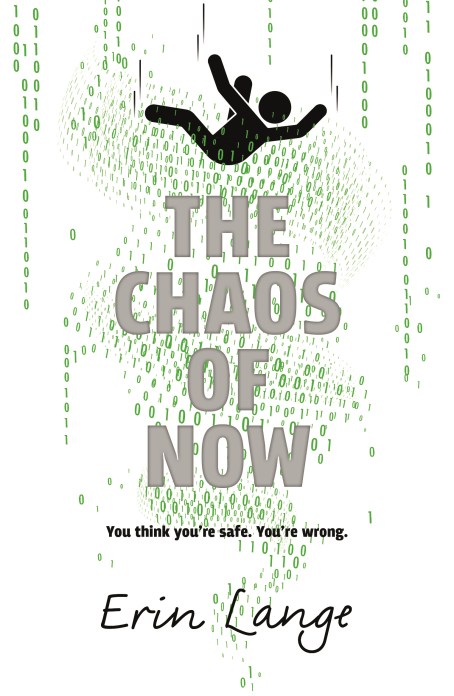
The Chaos of Now by Erin Lange

The Chaos of Now Cover.jpg

Publisher: Faber & Faber

Publication Date – 2 October 2018

Amazon     Book Depository

From one of the most intriguing authors of modern young adult fiction comes this powerful story about bullying in the modern cyber world and the potential impacts our choices can have on those around us.

One year ago, a student at Haver High, Jordan Bishop, walked into the school cafeteria and committed suicide by setting himself on fire, a reaction to the relentless online bullying he was experiencing.  Since that event, life at Haver High has not been the same.  Not only do the scars of Jordan’s actions remain but radical legislation brought in to combat cyberbullying ensure that students’ online lives are openly monitored by federal cybersnoops.

Eli Bennett is a young hacker who is desperate to graduate and leave town in order escape his father and his father’s new girlfriend, Misty.  Eli is happy enough at school with his only friend, Zach, although he wouldn’t mind getting to know the beautiful Isabel.  But when he is approached by fellow hackers Seth and Mouse, he finds himself drawn into an entirely new challenge.  Seth and Mouse were Jordan’s friends, but have had to keep their relationship with him a secret to avoid backlash from the other students.  Desperate to get some sort of justice for their fallen comrade, they are seeking a way to get back at those students who drove Jordan to kill himself.  Their idea is to create a website where Jordan’s bullies can be publicly shamed, and they need Eli to make it untraceable to the authorities.  Despite being haunted by a previous hacking mistake, Eli agrees to help, interested in the potential of this sort of website.

Calling the website ‘Friends of Bishop’, the site provides the students of Haver High with an anonymous forum to post videos about bad behaviour in the school.  With the help of a few bombshell videos, the site becomes a hit, and Eli and his friends believe they are making some real changes.  With the cybersnoops desperately try to shut down the site, the hidden Friends of Bishop revel in their notoriety and the praise of many of their classmates.  But when their quest for justice takes a nasty turn, Eli finds himself facing the real-world consequences of his actions and must try and work out what the right thing to do is.

The Chaos of Now is the fourth book from the talented and at times controversial young adult author, Erin Lange.  Lange is probably best known for her 2012 debut novel, Butter, which focused on a bullied obese boy’s plan to eat himself to death on a live internet broadcast.  Her next two books, Dead Ends and Rebel, Bully, Geek, Pariah also looked at the lives of socially isolated high school students, as well as the consequences of bullying behaviour.  The Chaos of Now takes a deeper focus on extreme cyberbullying and the potential impacts it can have.  I absolutely enjoyed The Chaos of Now and powered through it in less than a day as I became absorbed in its fantastic narrative, its emotional and moral heart and its very intriguing elements and warnings.

This book contains a poignant and well-thought-out story that takes its protagonist on a captivating adventure as he is faced with a series of moral dilemmas and explores the resultant consequences of his decisions on himself and those around him.  There are some incredible emotional scenes as the main characters examine their anger, grief, guilt and internal moral compasses when they look back at what they did or what they failed to do.  There is also a heartrending plot twist towards the end of the book which paints the entire narrative in a completely new light while also upping the stakes for the protagonist and his friends.

At the centre of this incredible book lies a powerful message about the modern epidemic of cyberbullying and the dangers of our modern computer based world.  Within the context of the story, the protagonist is drawn into a quest for justice after a young man who is bullied online commits suicide.  The architects of this revenge are the victim’s friends, who feel guilty for not standing up for their friend and not coming forward after his death.  As part of their quest, they create an anonymous website where embarrassing and incriminating videos can be posted about the people who drove Jordan to commit suicide, as well as videos about any other bullies or people the protagonists believe need to be taken down a peg.  Lange does an incredible job exploring all the aspect of this cyberbullying, from an examination of the events that led up to Jacob’s suicide to the impacts of the posted videos on the people they are shaming.  Lange does not try to shape this as a black and white issue; instead, everything that occurs has the potential for negative consequences.  For example, throughout the course of the book, the protagonists post several videos, each of which appears to have different levels of embarrassing or incriminating footage.  While the potential impacts of some of these videos appear to be minor, some are later revealed to have major consequences for the people involved.  At the same time, the more explicit videos have huge, life-altering consequences for the people involved.  Through the course of her narrative, Lange shows the full effect of these videos, whether they are extreme or seemingly innocuous, and shows how the people’s lives are affected and how other people treat them because of what is revealed.  Often these outcomes are quite devastating, and the protagonists, having become cyberbullies themselves, are left examining whether their victims actually deserved to have their lives ruined in this way, and if their actions can truly be considered justice.  The final message of this book, that cyberbullying or any form of negative online actions can have severe and often unforeseen consequences, is quite powerful, and I thought that Lange did an incredible job highlighting this throughout her novel.

Another intriguing part of this book is the extreme way the government attempts to deal with the problem of cyberbullying.  In this book, following the extreme suicide of Jordan, the government introduces harsh and controlling rules about internet privacy for students and gives government officers known as cybersnoops the ability to monitor everything young people do on the internet.  This is a thought-provoking reaction, and one that could potentially be used in the real world to address the problem of cyberbullying.  Readers will be interested to see Lange’s thoughts on such a program being introduced and how the youth impacted by it may react.  The resultant story comes across as a cautionary tale.  While more needs to be done to combat the issues of cyberbullying, Lange’s stories suggests that certain approaches could be just as problematic, as many of the protagonist’s actions are as a result of the restrictions imposed upon them.

I really enjoyed the coding aspects of this book, and it was fascinating to see the various computer and coding terms included throughout the story.  Lange’s ensures that these technical aspects are explained to the reader in a clear and concise manner so that even technical luddites like this reviewer are able to have a good understanding of what is going on in the story.  Readers of The Chaos of Now should also take note of the various ways in which the internet or someone’s personal electronic devices can be used against them, and is definitely an informative inclusion.

Lange’s focus on her protagonist’s personal relationships is another great part of this book, and provides an invaluable social heart to this novel.  At the start of the book, Eli only has one friend, Zach, a fellow coder who serves as Eli’s social and hacking conscience.  When Eli makes friends with Seth and Mouse, he is happy to have new friends and works with them on their website.  But, as the book progresses, Eli’s relationship with Zach suffers as he constantly hides his dodgy actions with the Friends of Bishop website.  It is interesting to see how Eli is forced to assume the more moral and cautious role with Seth and Mouse, who are much more obsessed with revenge than Eli is.  Having assumed this role, Eli feels a lot more guilt for the group’s actions, as he knows he should do more to curtail their more reckless actions.  This is further compounded when Eli gets angry and momentarily abandons his moral position, and the resultant actions cause significant harm.  The later part of the relationship with Seth and Mouse is very intense and contains one hell of a climactic scene.  The Chaos of Now also contains the heart-warming story of the growing relationship between Eli and his father’s girlfriend, Misty, who becomes one of the most likable characters in the entire book.  I also enjoyed the relationship between Eli and the bully Malcolm who Eli has several negative encounters with at the start of the book.  While Eli at first wants to destroy him like the other bullies at Haver High, his discovery of Malcolm’s deeper problems and the future awaiting him makes Eli rethink his position.  This focus on the protagonist’s relationships is an extraordinary part of the book, which weaves into the story very well and plays a big part in the protagonist’s decisions and actions.

The Chaos of Now is a great piece of young adult fiction that provides an amazing insight into one of the key issues affecting the youth of today.  With some mature themes, this book is definitely intended for the slightly older teen audience and is probably most appropriate for high school students who are a similar age to the characters of this book.  As this book provides an intriguing and powerful insight into the modern day issue of cyberbullying and presents a look at the extreme consequences that could result from these actions, I would strongly recommend it to these students, as they would be most interested in the message and story that it contains.  While not intended for older readers, the content of this book is instantly relatable for anyone who has ever been to high school and is aware of the current issues surrounding cyberbullying and problems with the internet.

Lange has created a terrific book which I felt covered some of the issues around cyberbullying perfectly.  Featuring a heartfelt and at times crushing story that tries to understand the different sides of this complex problem, this is another superb and memorable release from an incredible young adult fiction author.

My Rating:

Four and a half stars

Amazon     Book Depository

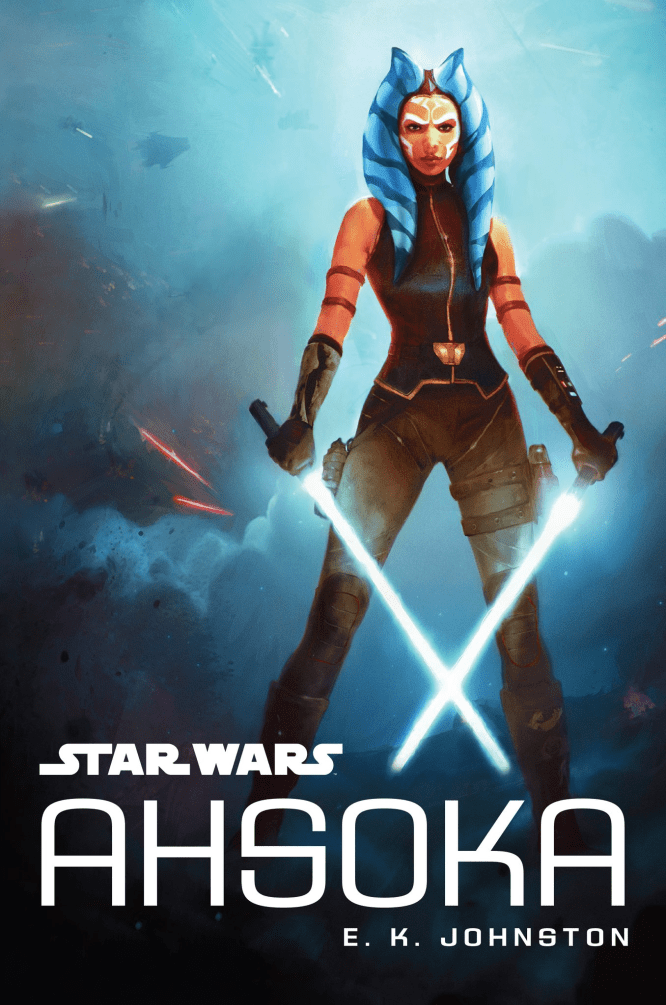
Throwback Thursday: Star Wars: Ahsoka by E. K. Johnston

Ahsoka_novel_cover

Publishers: Disney Lucasfilm Press

                        Penguin Random House Audio

Release Date – 11 October 2016

Amazon

Reviewed as part of my Throwback Thursday series, where I republish old reviews, review books I have read before or review older books I have only just had a chance to read.

The apprentice lives.  One of the best Star Wars characters that originated outside of the live-action movies returns in this action-packed, character-driven novel, which follows Ahsoka Tano’s adventures after the destruction of the Jedi Order.

Those people familiar with my previous reviews may have noticed that I am a bit of a Star Wars fan, having reviewed several pieces from the current Disney Star Wars extended universe in the last few months.  Therefore, it should not come as a surprise to anyone that I have watched and enjoyed the Star Wars: The Clone Wars and Star Wars Rebels animated television shows.  Both of these shows are very well done, can be appreciated by a varied audience and contain a large amount of the classic Star Wars heart and respect for the franchise’s lore and history that was missing in some of the more recent movies.  While many memorable characters were introduced in these shows, perhaps the most significant to the lore is the titular character of this book, Ahsoka Tano, Anakin Skywalker’s apprentice.

For those of you failing to remember Anakin having an apprentice in the live-action movies, you are not going crazy; Ahsoka has yet to appear in any live action movie.  She was instead introduced in The Clone Wars animated movie and served as one of the main characters of The Clone Wars television series, all of which take place in the years between Attack of the Clones and Revenge of the Sith.  Despite being one of the most popular characters on the show, Ahsoka would leave the Jedi Order at the end of the fifth season of The Clone Wars and only appear in the sixth season as part of a short vision sequence.  As a result, fans of the both the show and the character were frustrated and confused about what Ahsoka’s fate was and whether she had survived the events of the third prequel movie.  Fans didn’t get their answer until a couple of years later, at the end of the first season of Star Wars Rebels, where it was revealed that Ahsoka had survived the Jedi purge, becoming a member of the early Rebel Alliance.  Ahsoka, now wielding a pair of white lightsabers, became a key character in the second season of Star Wars Rebels, in which she was still an incredibly cool and powerful warrior.  She was utilised to perfection in this new show and had what is easily the best scene in the entire run of Star Wars Rebels: her long-awaited confrontation with Darth Vader.  The sheer emotion and intensity as Ahsoka finally came face-to-face with her old master and discovered that he was responsible for the fall of the Jedi was just amazing and is one of my favourite moments from all of television.

Following her appearance in Star Wars Rebels, Disney commissioned a young adult Ahsoka book, which was announced on 31 March 2016, one day after the Star Wars Rebels season 2 finale.  This book was released in late 2016 and was written by young adult author and Star Wars fan E. K. Johnston.  Ahsoka was Johnston’s first foray into Star Wars fiction, although she is currently working on Queen’s Shadow, a young adult novel focused on a post The Phantom Menace Padme Amidala, set to be released next year.  I have no doubt that a review for Queen’s Shadow will appear on this website in due time.  Now, with the recent announcement of a seventh season of The Clone Wars and the reveal that Ahsoka will be appearing in this new season, I decided to check out this book to see if it did the character any justice.  I chose to enjoy this as an audiobook, rather than read a physical copy.

During the Clone War, Ahsoka Tano was a fierce warrior and a commander of the Republic’s clone troopers.  However, after the devastation of Emperor Palpatine’s Order 66, which saw the clones turn on the Jedi, everything changed.  Fighting on Mandalore, far away from her master, Anakin Skywalker, Ahsoka is unaware of his fall to the dark side of the Force, and only just manages to escape the purge of the Jedi Order.

Now, one year after the fall of the Republic and the rise of the new Galactic Empire, the former Padawan is in hiding on the outskirts of the galaxy, trying to avoid any Imperial attention.  Living under an assumed name and with her trusty dual lightsabres gone, Ahsoka scrapes a living as a mechanic, intentionally distancing herself from the Force in order to hide her Jedi abilities.

Ahsoka journeys to a remote farming settlement on the Outer Rim moon of Raada.  Settling into her new life and making connections with its inhabitants, Ahsoka believes that she has finally found her sanctuary.  But her hopes of a peaceful life in her new home are quickly dashed when the Empire arrives, imposing their totalitarian rule on the people of Raada.  The agricultural potential of the moon is vital to the future of the Empire, and the workers are being forced to farm a new and mysterious plant.  Determined to help her new friends and wanting to make a difference, Ahsoka uses her wartime experience to help form a resistance in order to undermine Imperial control.

But when she is forced to reveal her full powers in order to save her friends, she once again finds herself on the run.  However, this time her actions have not gone unnoticed.  Her old ally, Senator Bail Organa wants her to join his fledgling rebellion, while the sinister Inquisitor, the Sixth Brother, arrives on Raada with plans to capture her, using Ahsoka’s friends as bait.

Because I am a fan of the titular character, I did go into Ahsoka with some rather high expectations.  Luckily I quite enjoyed Ahsoka, powering through this book quickly while appreciating how Ahsoka’s new adventure fit into the existing Star Wars chronology.  This story is very good, with an excellent blend of character development, Star Wars lore and some scintillating action and adventure.  The book contains a well-paced narrative that not only features Ahsoka’s personal story, but also examines the viewpoint of several side characters, in order to move the plot along, while also showing the impacts of Ahsoka’s actions from a different viewpoint.

This book is mainly focused on the adventures of Ahsoka, and fans of the animated show will appreciate seeing how she not only managed to survived the purge of the Jedi, but how she became the hardened rebel agent we encountered in Star Wars Rebels.  I feel that anyone who reads this book will appreciate the considerable amount of character development and insight that occurs with the titular character.  At the start of the book, Ahsoka is afraid, hiding who and what she is from the world while also denying herself access to the Force.  She is filled with regrets, concerns for her missing Jedi family and guilt not just about surviving but also about leaving the Jedi Order before its fall.  Throughout the book, her adventures, the new friendships she develops, the people she helps and the role she plays on Raada all help her to find a new purpose, as well as re-establishing her connection with the Force.

There are a number of great scenes featuring or concerning Ahsoka in this book.  These include her battle with the Sixth Brother, the forging of her new white lightsabres and the epic scene where she unleashes her Force abilities for the first time in a year.  It was also intriguing to see her advising the farmers in guerrilla tactics and helping them sabotage the Imperial occupation.  Fans of Ahsoka will appreciate the similarities this has to one of the character’s most significant arcs from The Clone Wars that featured her training a guerrilla army to combat a Separatist invasion, including a young Saw Gerrera (Forest Whitaker’s character in Rogue One).  I also enjoyed Johnston’s focus on the connection between Ahsoka and the female character Kaedan Larte.  It was great seeing this character help get Ahsoka out of her shell, and the subtle romantic feelings between the two of them was an interesting character direction for Ahsoka.  Overall, I thought Ahsoka contained an incredible take on its titular character, as Johnston not only provides the reader with a much clearer picture of Ahsoka’s fate following The Clone Wars, but also provides a powerful look at her thoughts and feelings following the destruction of the Jedi.

In addition to exploring the fates of one of their favourite characters, fans of the franchise are also treated to another intriguing look at events in the Star Wars universe not covered in the movies or television shows.  Ahsoka is set one year after the events of Revenge of the Sith, and shows the early days of Imperial control in the galaxy.  There is a palpable and well-utilised feeling of dread throughout the book as the various point-of-view characters encounter the steady increases in Imperial control as their military expands its influence.  It is fascinating to see the early Imperial military machine in action, especially when it comes to controlling and pacifying smaller planets and moons.  One of the most interesting aspects of this is the type of troops being utilised.  By this point in the Star Wars’ chronology, the Empire has started to phase out their clone troopers, replacing them with the human stormtroopers that appear in the original trilogy.  During her encounters with them, Ahsoka notes that these stormtroopers are still quite green and are nowhere near the clones’ level of competency when it comes to battle, controlling territory or dealing with Jedi.  This changeover in troop type for the Empire has not really been covered in too much detail before and is quite fascinating to see.

The exploration of the Empire’s methods of hunting down the remaining Jedi is also intriguing, as one of Vader’s Inquisitors serves as the book’s main antagonist.  The Sixth Brother is shown not only hunting fully trained Jedi like Ahsoka but also tracking down Force-sensitive children for his masters.  The extent of the Inquisitor’s power and influence is explored in some detail here, and I enjoyed seeing Ahsoka’s impression of these Inquisitors’ skills and actions, especially as the Inquisitors were also trained by Darth Vader.  Readers will also note the obligatory hints at the creation of the Death Star throughout the plot of the book, which is an important part of the overall Star Wars chronology.

These early days of the Imperial military is not the only thing covered in the book, as Johnston also explores the opening actions that would lead to the formation of the Rebel Alliance.  Johnston uses minor Star Wars character Bail Organa to great effect here, showing the work he beings immediately after his heroics in Revenge of the Sith to oppose the Emperor.  Ahsoka also features several cameos from other characters in the Star Wars cannon, and readers can look forward to seeing fan favourite characters Darth Maul, Obi-Wan Kenobi, R2D2, a young Princess Leia and the Grand Inquisitor.  This is a compelling and insightful addition to the Star Wars extended universe, and readers will be amazed by this new viewpoint into one of the franchise’s most volatile periods.

As I mentioned above, I chose to listen to the audiobook version of Ahsoka rather than track down a physical copy to read.  This was mainly because the creators of the Ahsoka audiobook managed to score Ashley Eckstein as the narrator.  Eckstein is the actor who voices Ahsoka in both The Clone Wars and Star Wars Rebels, and I loved the idea of having the definitive voice of the character narrate this crucial Ahsoka story to me.  As Ahsoka is the most prominent point-of-view character, this works out incredibly well, and the reader can enjoy hearing Ahsoka tell the story of what is around her.  Eckstein also provides excellent voice work for all the other speaking characters that feature in the book, as each of these characters were given a distinctive voice that does not feel out of place.

While I really enjoyed hearing Eckstein narrate the story, another benefit of listening to Ahsoka on audiobook is the use of the iconic Star Wars music, as well as the book’s cool use of sound effects.  The creators of the Ahsoka audiobook have inserted John Williams’s iconic score from the movies into a variety of the book’s scenes.  While this is slightly distracting in one or two places where the music did not quite fit properly, it works incredibly well for most of the book.  Several of the story’s big scenes, such as the pivotal battle sequence where Ahsoka reveals her Jedi powers for the first time since she went into hiding, are underscored by this music.  With this grand and powerful music playing in the background, these scenes are given a real epic quality that you just do not get from reading a psychical copy of the book.  It also serves to make Ahsoka feel a lot more connected to the movies, as the listeners are provided with a score that is instantly recognisable as belonging to this franchise.  In addition to the spectacular musical inclusions, the audiobook also features a range of relevant sound effects that really add to the book’s atmosphere and authenticity.  These sound effects range from droid noises and the sounds of ships starting up, to background music when the characters hang out in the cantina.  None of these sound effects distracts from the story and for some of the battle scenes, the lightsabers and blasters sounds really add to the reader’s excitement and involvement in the action.  Another thing I found fun while listening to Ahsoka on audiobook was the producer’s use of some sort of voice modulator for when Eckstein narrates the voices of stormtroopers or other characters wearing helmets.  This is a nice touch and really speaks to the producer’s attention to detail.  I am unsure how effective this would have been if Darth Vader had appeared in the book, but I’m sure I would found the end result amusing one way or another.

Clocking in at just over seven hours long, this is an easy book to get through and the inclusion of the classic Star Wars music, fun sounds effects and the definitive voice of the titular character make it an excellent way to experience this fantastic story.

Ahsoka has been written with a young adult audience in mind, and is definitely an enjoyable book for younger readers who are curious about the Star Wars universe, are fans of the animated shows, or are just looking for an exciting adventure in space.  That being said, the book does not pull any punches, and features an extended torture scene and quite a few deaths, including one particularly gruesome kill by the Sixth Brother.  While some of this can be a tad heavy, I personally feel that anyone mature enough to be familiar with the Star Wars franchise is probably going to be mature enough to not be affected by this violence.  Despite being intended for a young adult audience, Ahsoka, like many of the Star Wars young adult range, is definitely a series that can be appreciated by an older audience, especially those familiar with the franchise and the titular character.

Overall, I was very happy that I checked out Ahsoka, as it not only provided greater insight into the history of one of my favourite Star War’s characters but also painted a detailed and intriguing picture about the early days of the Empire.  Featuring a surprisingly deep and emotional story, this is a fantastic addition to the Star Wars extended universe that will appeal to fans of the amazing animated show, while also offering character based adventure to the more casual reader.  Definitely best to check out in the audiobook format, readers will love how this morphs this impressive Star Wars story into a memorable experience that becomes very difficult to turn off.

My Rating:

Four stars

Amazon

If you enjoy Star Wars fiction, check out some of my previous reviews:

https://unseenlibrary.com/2018/08/12/star-wars-thrawn-alliances-by-timothy-zahn/

https://unseenlibrary.com/2018/05/30/star-wars-last-shot-by-daniel-jose-older/

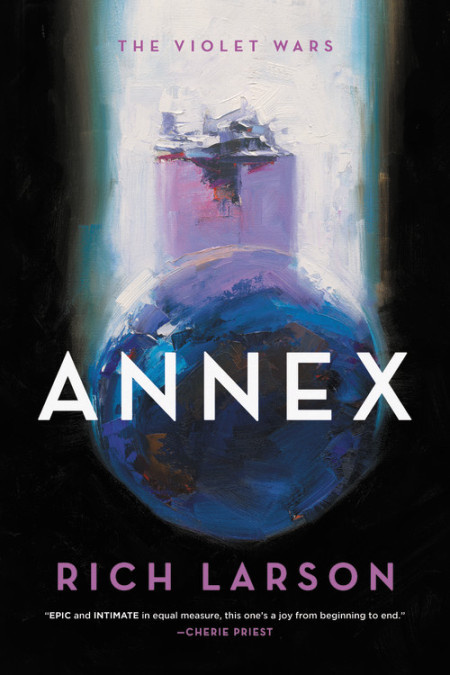
Annex by Rich Larson

Annex Cover.jpg

Publication Date: Orbit

Australian Publication Date – 25 September 2018

World Publication Date – 24 July 2018

Amazon     Book Depository

From exciting new author Rich Larson comes an absorbing young adult science fiction debut that makes use of creepy alien elements, excellent characters and fantastic LGBT inclusions to create a powerful and creative read.

When a gigantic alien ship arrives above Earth and isolates an entire city, all the children that are trapped with the aliens are kidnapped and infested with parasitic life forms, while the adults are clamped and inserted with mechanical devices that turn them into mindless drones.

For the small group of children that escape captivity, the disappearance of all the adults offers them a life of fun and adventure.  Falling under the leadership of the charismatic Wyatt, this group of survivors, the Lost Boys, are living the high life, with their newly attached parasites giving them the ability to vanish objects for brief periods of time.  While life is fun, they must continue to avoid the mechanical whirlybirds, the pod-like spaceships and the terrifying Othermothers hunting them in the streets.

For Violet, this new world allows her the opportunity to live the life she’s always wanted and to be the person she’s always wanted to be.  But Violet’s new life on of the city streets changes dramatically when she finds a new escapee, Bo, and takes him under her wing.  Bo has the most powerful parasite the group has ever seen and is capable of permanently vanishing larger objects.  It also appears the alien invaders want him back and are deploying hordes of their creatures to capture him.

Sensing an opportunity, the Lost Boys use Bo to fight back against the aliens while trying to uncover what plans they have for the rest of the planet.  Breaking into the massive hovering mother ship, Violet and Bo team up with the mysterious Mr Gloom to end this alien threat once and for all.  But these two young people will quickly find that the biggest threat to them may be far closer to home than they realise.

Annex is the first novel from Rich Larson and is the first book in The Violet Wars series, with the second book of this intriguing series, Cypher, already on its way.  This is a wonderful debut from Larson, which contains a surprisingly intense and at times dark story that will prove to be enjoyable to a wide range of readers.

There are a number of great features of Annex that readers will enjoy; however, one of the most noticeable features is the creepy and well-written descriptions of the aliens and events that the book’s main characters encounter.  There are a lot of inventive and twisted creatures, technology and even body modifications that can be found throughout this book, and Larson’s skilled writing helps brings them to life in the reader’s imagination.  I was particularly impressed, and a little freaked out, by Larson’s unique creation the Othermothers.  The Othermothers are unsettling clones of the escaped children’s mothers, perched upon long skeletal metal legs, who chirp out random phrases in the mothers’ voices in an attempt to lure the escaped children to them and then capture them.  Because of Larson’s descriptive writing, these creatures are horrifying and really stood out for me among the other alien antagonists the heroes encountered.  Special mention should also be made of the shadowy Mr Gloom, a strange adult they encounter whose appearance is not quite human and who has a range of powerful abilities.  I am not going to reveal too much about Mr Gloom because he appears about two-thirds into the book and I do not want to spoil too much about him.  I did find him to be quite a fun character.  Larson’s descriptions of Mr Gloom are fantastic, especially when it comes to exploring his shadow based abilities, which are a treat to read about.

In addition to the alien creatures and characters that are encountered through the book, readers should also keep an eye on the leader of the Lost Boys, Wyatt.  Wyatt is at first presented as a talented leader who has managed to bring the Lost Boys together and keep them alive.  However, there is much more to this character than he initially presents, and his real personality begins to be revealed to the heroes and the readers as the book progresses.  This is some incredible character work from Larson, and the revelation of Wyatt’s true motivations and persona is done perfectly, resulting in some excellent dramatic scenes and some really dark twists.  The author’s use of two separate point-of-view characters, Violet and Bo, works really well when it comes to viewing Wyatt, as the reader is able to observe his different manipulations, his moods and the cracks that appear in his outer façade.  This is a very intriguing character that dramatically changes the narrative of Annex in a number of ways, and the scenes exploring Wyatt are some of the best written in the entire book.

One of the key aspects of Annex that will prove to be an interesting addition for the reader is one of the main protagonists, Violet.  Violet is a tough–as-nails kicker of alien ass who is also a young transgender girl who has used the lack of adults following the invasion to finally live her life the way she always wanted to.  This is an amazing portrayal of a transgender character, as the author creates a stimulating backstory for Violet that examines her past and explores how she became her current self while also exploring the fears and people that stopped her from fully expressing her identity.  The book also explores how intrinsic this identity can be and how devastating attacks about identity can be, even during an alien apocalypse.  Violet is a well-rounded character, and Larson skilfully displays her other fears, her independence, her new friendship with Bo and her relationships with the other Lost Boys.  Violet helps to elevate this book to the next level and make it into a terrific piece of young adult fiction.

This book is an interesting addition to the young adult genre that definitely highlights the empowerment of young people.  The human characters of this book are all quite youthful and yet manage to thrive in a hostile alien landscape that has incapacitated all of the adults.  Watching these young people come together as a tight-knit group is an intriguing part of this book, and it is interesting to see the subtle techniques Wyatt uses to turn them into his own little army, such as with initiation rites, slogans and other forms of manipulation.  Overall, watching this group overcome without adult help the obstacles of being among the aliens oppressing them is a great part of the book.  This makes it an interesting read for the young adult audience, especially for those who love to see transgender characters in fiction.

Annex by Rich Larson is an excellent debut and is recommended for those younger readers looking for a science fiction adventure that they can relate to.  With some creepy aliens, intriguing characters and a deep look at transgender issues among today’s youth, this is an exhilarating read from a promising new author.

My Rating:
Four stars

Amazon     Book Depository

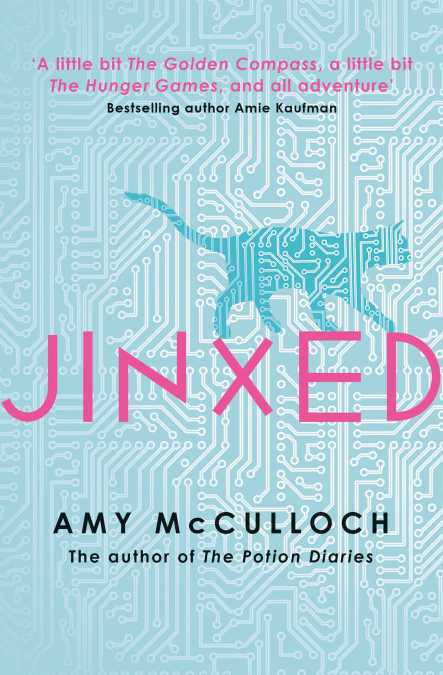
Jinxed by Amy McCulloch

Jinxed Cover.jpg

Publisher: Simon & Schuster

Publication Date – 9 August 2018

Amazon     Book Depository

Creative young adult fiction author Amy McCulloch returns with a fun and compelling techno-thriller that takes an incredible and entertaining look at the potential future of your favourite devices and combines them with a unique idea of how to make them even more user-friendly.

In the near future, the must-have technological device is the baku, your brand new best friend.  Bakus combine all the features of your smart devices and internet connection with a constant companion in the form of a robotic animal that is customisable to your needs and price range.  Low range bakus take the form of small creations like insects, while the most advanced baku are created to look like birds of prey or large land animals.  Not only are bakus the most popular form of communication device, but in this day and age, even basic bakus are needed to fully experience day-to-day life.

Lacey Chu has big dreams of working for Moncha Corp, the company which designs and creates the baku, as well as working for her idol, Moncha’s founder, Monica Chan.  However, the only way to achieve that dream is to get accepted into the exclusive Profectus Academy, the elite tech school whose graduates become the designers, coders and creators of the next generation of baku.  When Lacey is rejected from the academy and can no longer afford her dream baku, she is crushed.  That is until she finds Jinx, a ruined cat baku that appears to have been abandoned at the bottom of a canyon.  Bringing it home to fix, Lacey’s fortunes appear to immediately turn around when her application for the Profectus Academy is suddenly accepted and Jinx is listed as the advanced baku she is required to have for classes.

Arriving in the academy, she finds it a very different place than she imagined.  The students and faculty are obsessed with Baku Battles, the academy-sponsored fights between bakus that help determine a student’s rank and prestige in the academy.  Finding herself drafted onto a Baku Battle team, Lacey starts to learn all about the inner workings of the baku.  The more she learns, the more she begins to realise that something is very different about Jinx.  Jinx is not the usual mindless machine; Jinx can think for himself, has his own personality and is even starting to communicate with Lacey.  As Jinx begins to mess with parts of Lacey’s life, she begins to fully comprehend the implications of Jinx’s existence.  What shadowy secret lies at the heart of Moncha, and will Lacey and her friends be able to save Jinx from them?

Amy McCulloch is a well-established young adult fiction author who has written a number of books since her 2013 debut.  McCulloch also writes under the name Amy Alward and mostly focuses on young adult fantasy novels as part of her Potion and The Knots Sequence series.  Jinxed is her first foray into the science fiction genre and represents an exciting techno-thriller that explores an intriguing piece of future technology and the exciting adventure that happens around it.

The overall story of Jinxed is an excellent mixture of science fiction, thriller and teen drama elements, all set within a captivating academy background.  As a result, throughout the book, there is a ton for the reader to enjoy as they are introduced to the technology around the baku and see the narrator investigate a conspiracy centred around the creation of Jinx, all while dealing with the highs and lows of school life.  It is a fun combination of different story elements that works towards a great overall narrative.  I was able to work out what one of the twists was going to be quite early in the book, but it didn’t really impact my enjoyment of the story.  There are some great moments throughout, as well as a surprising ending that makes me very curious to read any sequels that McCulloch brings out.

The baku are an essential part of this story and are a really interesting element that McCulloch has chosen to use.  Many science fiction and technology based authors are currently attempting to predict what the next big piece of technology will be in the world, with many of them focusing on what the next ground-breaking piece of communications technology will be.  While many of these suggestions seem quite plausible and seem to support the current trends in technology, this is the first book I’ve seen that suggests combining a person’s smart device with a robotic pet.  The narrator suggests that the fiction justification for the creation of the baku was to give people a companion that is both helpful and which also limits their dependencies and addictions to mobile phones and smart devices.  It’s a rather fun concept and it is cool to see how McCulloch imagines how these creations would work.

The baku are broken down into various levels of sophistication, from the basic models which look like insects and can only do the most basic of tasks, to the ultra-sophisticated versions which come in the form of some very powerful creatures.  It is also intriguing to see how many of the book’s various characters start to care for their bakus like they are real animals, and the bond that they form as a result, even if their bakus aren’t sentient.  The bond that forms between Lacey and Jinx is fairly unique, however, as Jinx is an early form of artificial intelligence, and it is nice to see it develop through the course of the book as Lacey risks her life to help Jinx.  There are a few great scenes which show Jinx trying to come to grips with his existence, whether he is helping other bakus, questioning how baku are made, or by attempting to exist among a group of real life cats.  A truly intriguing postulation about future technologies, McCulloch has created a unique and fascinating idea that works well within this narrative.

Most of the action of this book is contained within fights between the bakus rather than between any of the human characters.  This is mostly done in the Baku Battles tournament at the school, where several bakus fight each other in a free-for-all brawl.  I love a good fictional tournament, and each of the bakus has various techniques.  As a result, the fights within the book can become quite fun and energetic as eagle, boar, tiger, cat and frog bakus all fight in various ways.  I also enjoyed the scoring concept that McCulloch came up with for this tournament, as the surviving team receives all the points, but their opponents can steal them if they can repair their team’s bakus sufficiently by the next day.  This is an intriguing stipulation for a tournament which allows McCulloch to show off several scenes of the narrator doing advanced repair work.  These tournament battles do a good job of moving the plot along and work into the books various elements very well, whether by giving the narrator access to certain locations to investigate secrets, or by bringing her closer to or further apart from other characters in the books, to allowing a closer examination of the workings and mindsets of the book’s technological elements.

Amy McCulloch’s latest book, Jinxed is a high-octane technological thriller that makes use of amazing science fiction elements to create an enthralling adventure.  Aimed for a young adult audience, the lack of any substantial violence, except between the book’s distinctive robotic animals, makes this a perfect read for a wide range of younger readers.  At the same time, the intriguing concept of future technology and its wide range of applications, including for high-stakes gladiatorial battles, makes it intriguing for an older readers.  This is an absolutely fantastic book from McCulloch.  I really enjoyed it and I’m looking forward to seeing where it goes next.

My Rating:

Four and a half stars

Amazon     Book Depository

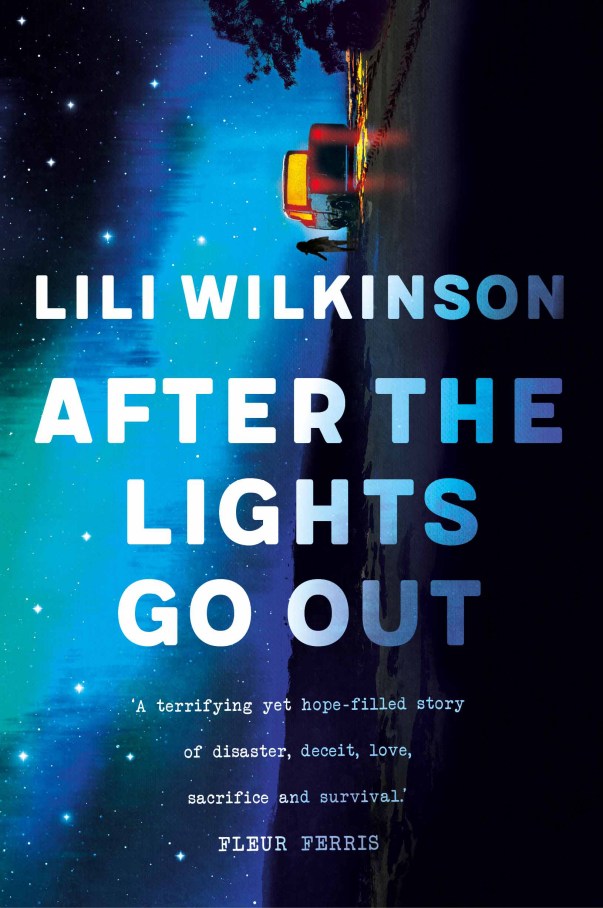
After the Lights Go Out by Lili Wilkinson

After the Lights Go Out

Publisher: Allen & Unwin

Publication Date – 1 August 2018

Amazon     Book Depository

From bestselling Australian author Lili Wilkinson comes After the Lights Go Out, an incredible and powerful young adult adventure set in the heart of the bush that asks the impossible question: should a person choose family or community in an emergency?

Seventeen-year-old Prudence Palmer is a young woman living outside the small Australian outback town of Jubilee with her father, Rick, and her younger twin sisters, Grace and Blyth.  To the other inhabitants of the town, they are just another mining family, living close to Rick’s workplace.  However, they are actually hiding a much deeper secret: they are doomsday preppers.  Convinced that the world will soon suffer some form of imminent catastrophe, Rick has moved his daughters off the grid to Jubilee and has constructed a hidden bunker out the back of his property.  Filled with a substantial amount of food, medicine, equipment, weapons and entertainment, the bunker has everything they need to survive the end of the world.  The girls have also been trained to survive and are ready to react against a variety of scenarios.

While Rick is sure a world-changing disaster is just around the corner, Pru is less certain, and is happy to keep her family’s activities a secret.  So it is a great shock to her when something actually happens and every electrical device, modern car and generator in Jubilee suddenly fails.  With Rick gone, Pru and her sisters must suddenly implement their survival plan without their father’s guidance and make the hard decision to hide their bunker and supplies from their friends in the town.  With food, water and medicine becoming scarce, and with no transportation, communications or other vital necessities, the town starts to fall apart.  As the situation gets even worse, Pru and her sisters must decide between helping their friends or doing as they have been trained and survive alone.

Lili Wilkinson is an exciting Australian author who has produced 10 intense and dramatic young adult novels since her 2006 debut, Joan of Arc: The Story of Jehanne Darc.  Her eleventh novel, After the Lights Go Out is an outstanding standalone book that could potentially replace Tomorrow, When the War Began as the go-to disaster story for Australian young adult audiences.  This book contains a dramatic and moving main story that plunges the world into chaos and places the potential survival of a small town in the hands of one young woman.

At the heart of this book lies a tough moral dilemma for the narrator Pru when she must decide between helping her local community and guaranteeing her family’s survival.  Pru’s father, Rick, a hardcore survivalist, has stocked the family bunker with enough supplies to keep Pru and her sisters alive for several years.  He has also taught his daughters to never help anyone but themselves, and to keep all their supplies for the family.  When a disaster strikes and Rick goes missing, it is up to Pru and her sisters to make the decision, and at first they choose to keep the bunker and supplies hidden from their friends in Jubilee.  As the situation in the town gets worse, Pru’s guilt conflicts with her father’s training and instructions.  This internal debate is intensified when she falls in love with newcomer Mateo and watches him and his mother doing everything they can to save the townsfolk, despite the fact they are not locals and have no significant connection to people living there.  Watching Pru’s internal struggle and the external debate with her sisters is intense, and the reader is left wondering what they would do in a similar situation.  How Pru’s eventual decision affects her family and her relationships with the people of Jubilee is very memorable, and hits all the right emotional notes in this excellent story.

After the Lights Go Out contains an intriguing examination of the doomsday prepper phenomenon that is currently occurring around the world.  The main character’s father believes every single conspiracy theory that exists and is determined to prepare his daughters for anything.  It is clear that Wilkinson has done some significant research into survivalists and their various techniques, and as a result her characters are prepared for every doomsday scenario and have a ton of supplies and a high-tech bunker at their disposal.  There is a lot of discussion and exposition about the various survivalist conspiracies, plans to live in an altered world, the necessary techniques and the ideal supplies that every prepper should have.  Despite most doomsday preppers being American, many of the techniques in this book have an Australian flavour to them, as the girls know the local fauna, flora and means of survival out in the harsh bush conditions.  While every preparation the Palmer family has undertaken is fascinating to read about, I found the examination of the improvised medical techniques the characters use to be particularly outstanding.  This includes including one memorable and somewhat graphic sequence where the narrator needs to perform some rudimentary dentistry.  Overall, the use of the doomsday preppers’ planning and theories is an incredibly intriguing part of this story that provides the reader with some cool facts and the results of the author’s in-depth research.

Wilkinson has also populated the book with some excellent characters who really bring the story together.  While the Palmer sisters are good central characters and Pru is a great narrator who has to make a huge range of tough decisions, the best character has to be the Palmer father, Rick.  Rick is a crazed survivalist who is convinced that the world is about to end and whose paranoia has driven him to outback Australia.  When one of his disaster scenarios actually comes true, he becomes even more erratic, and watching his fears overcome his love for his daughters is very tragic to behold.  There is also Mateo, the young American tourist and liberal city-slicker who is essentially the opposite of Pru when it comes to life experiences.  The relationship between him and Pru is nice.  It evolves at a natural pace and offers the reader some different insights into the situation and the motivations of the Palmer sisters.  Another effective character is Keller Reid, the older boy with an unhealthy obsession with Pru’s younger sisters.  Keller is a particularly despicable character who serves as a very annoying minor antagonist who moves the plot around.  Watching him through the narrator’s eyes, you cannot help but hate him and hope he gets some eventual comeuppance.  The other townsfolk of Jubilee are a good mixture of characters, and it’s nice seeing them come together as a community rather than break down and kill each other as Rick believed they would.

Another part of this book that stood out to me was Wilkinson’s use of the powerful Australian landscape and the examination of small country towns.  The author provides some vivid images of the distinctive Australian bush, and looks at the various features that make it an intriguing backdrop for a story about survivalists.  The author also produces some exceptional portrayals of the close communities that exists in small town Australia and how they their isolation might be both a benefit and a detriment to their survival in a doomsday scenario.  It is definitely a unique setting for a catastrophe novel such as After the Lights Go Out, and one which I felt really added to the beauty and intensity of the story.

I really enjoyed this book and thought it was an incredible piece of literature from Wilkinson.  Because of its excellent story and the phenomenal look it takes at survivalists and their viewpoint of the world, I think this book is perfect for its intended young adult audience, which could prove to be very empowering and enjoyable read for them.  Parents should aware that there are some adult moments and a couple of graphic scenes, but this excellent and informative story is worth the risk.  After the Lights Go Out is a deep and powerful five-star book that provides its readers with an excellent examination of doomsday preppers.  This is definitely one of the best young adult books I have read this year and I cannot recommend this outstanding Australian book enough.

My Rating:

Five Stars

Amazon     Book Depository

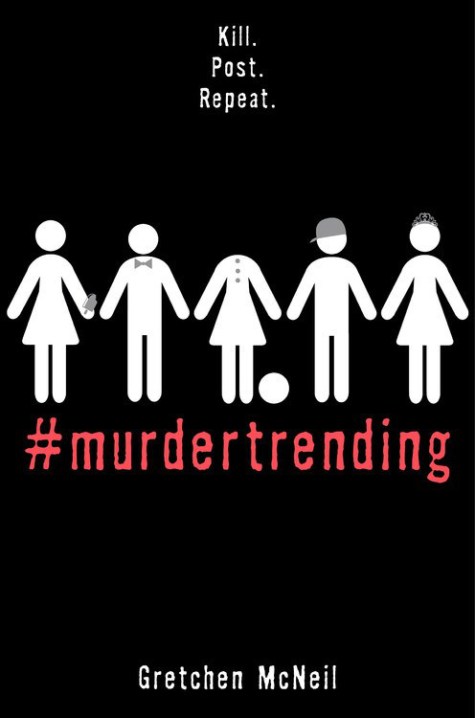
#MurderTrending by Gretchen McNeil

#MurderTrending Cover.jpg

Publisher: Freeform Books

Australian Publication Date – 25 September 2018

World Publication Date – 7 August 2018

Amazon     Book Depository

From one of young adult fiction’s most thrilling authors comes a dark and captivating story of death and madness that is really going to trend online.

When seventeen-year-old Dee Guerrera awakens in a strange room dressed in a princess outfit, she knows she is about to be executed on live TV.  Falsely convicted of the murder of her stepsister, Dee has been sentenced to die on Alcatraz 2.0, America’s most popular reality television show.  Created by a mysterious television producer known only as The Postman, Alcatraz 2.0 is an island prison where America’s most notorious inmates are hunted down by a series of flamboyant and beloved executioners.

So when Dee comes face to face with one of these killers, she’s supposed to run into his murder room and suffer a terrible death for the entertainment of the masses.  However, Dee has other plans, and goes off script in a major way.  Her actions will make her the most notorious girl in the world and move her to the top of every executioner’s kill list.  Teaming up with a posse of other teenage inmates, Dee needs to quickly learn the rules of this island and figure out a way to avoid being picked off by the psychopaths stalking her.  Can Dee and her new friends, the Death Row Breakfast Club, stay alive long enough to prove Dee’s innocence?  A ghost from her past is haunting her, and Dee doesn’t have much time before her execution goes viral.

Gretchen McNeil is an experienced young adult fiction writer, whose previous work includes several books aimed at the older teen audience.  These include the horror suspense book Ten, the supernatural thriller Possess and teen murder mystery series Don’t Get Mad.  #MurderTrending is the seventh book from McNeil, and it follows in a similar vein to her previous books, with teenage protagonists fighting against a dark, murderous force.  #MurderTrending is an extremely fast-paced and crazy read that proves to be very entertaining, and is the first part of McNeil’s MurderTrending series.  A second book in this series has already been announced and #MurderFunding will be released next August, with an interesting-sounding connection to the first book.

The concept of a group of people being hunted or pitted against each other in an isolated area with the whole world watching is an idea that has been utilised many times before.  Movies and shows such as The Condemned, Death Race, Battle Royale, Dead Man Wonderland and The Hunger Games have all used this concept in one way or another.  I personally think that the plot of #MurderTrending is very similar to The Running Man, with eccentrically dressed hunters chasing after criminals, although it is easy to build a connection between this book and The Hunger Games due to the focus on teenagers.  I think that the author is very aware of these previous movies, as not only does the main character mention The Hunger Games within the book, but one of the other protagonists continually quotes old action movies, including several Arnold Schwarzenegger classics.  While this plot device has been used before, McNeil introduces some new elements, while also doubling down on the concept by making his killers and their executions as crazy and over the top as possible.  The killers in particular are extremely eccentric and include among others, an explosive orientated hipster, two murderous twins, a fashionista with some deadly accessories and a Prince Charming stand-in who hunts girls dressed as princesses through a trap-filled maze while brandishing an oversized cake knife.  As a result, this version of the prison reality television show is particularly amusing, and the over-the-top kills sometimes come across as more humorous than sinister.

While the overarching plot premise of an island prison has been used before, McNeil cleverly enhances this story with some great imitation of the current social media and internet communities.  The entire adventure is being livestreamed to the outside world, and is considered to be the most popular form of entertainment in America.  As a result, the world is constantly talking about the murders on social media, and the author has included sections of a number of fictional forums at the end of several chapters, where various online personalities talk about the events in a number of ways.  This includes praise for the inventive kills, requests, opinions on the various inmates, conspiracy theories and competitions to make the most viral #.  These are particularly intriguing and compelling inclusions that also add a bit of realism to the story, as the reader can easily imagine that social media activity like this would totally happen in a dystopian world where executions are streamed as a form of entertainment.  In addition to all the discussion and use of social media in the story, the protagonist also talks about the various internet fandoms, fan clubs, gambling, merchandise, shipping, fan theories, fan fiction and message boards that have formed up around Alcatraz 2.0.  This is again a fascinating inclusion, with a smack of predictive realism to it, and I utterly loved McNeil’s inventive and modern inclusions around the classic murder prison/reality show concept.  It also sounds like this concept will become a major part of the next book in the series, and I am very keen to see how that turns out.

I thought that the overall story for this book was very well done and created an intriguing and entertaining narrative that was really easy to enjoy.  In addition to her ingenious use of the overarching plot device and setting, McNeil has also created a compelling and thrilling story that is filled with a number of great twists and intense scenes where the book’s fun characters are put into real peril.  While the reveal of the final boss is strongly tied into the character’s past, and isn’t too shocking, how that character gets there is fairly clever, and the twist about the mastermind of the island was pretty surprising.  While the ease with which the protagonist was able to defeat some of the infamous murderers who served as secondary antagonists at the end of the book is a bit unbelievable, I did find myself really hooked on this great story, and I powered through the book to find out how it was going to end.

#MurderTrending is marketed towards a young adult audience, and it’s the sort of amusing and crazy book I would have enjoyed when I was younger.  Due to the large amount of violence and pretty graphic killings, I would suggest that this book is probably more appropriate for an older teenage audience, but based on today’s standards it’s really not too bad.  Out of all the potential readers, the older teenage audience will probably enjoy McNeil’s use of social media and internet cultures the most, as they will be able to relate to the characters and fandom subculture of the people posting on social media within the book.  This is one of those young adult books that would really appeal to older readers, and I would really recommend this to anyone who is looking for an enjoyable and over-the-top read.

Gretchen McNeil is once again at top form as she presents a bloody and action-packed young adult adventure.  Featuring a fun and unrestrained take on a classic fictional plot device and some very ingenious use of current social media and internet trends, this extremely entertaining story is a fantastic read for both teenagers and older readers alike.  #MurderTrending is one of the craziest reads of 2018, and I cannot wait to see what insanity McNeil brings to her next adventure.

My Rating:

Four stars

Amazon     Book Depository

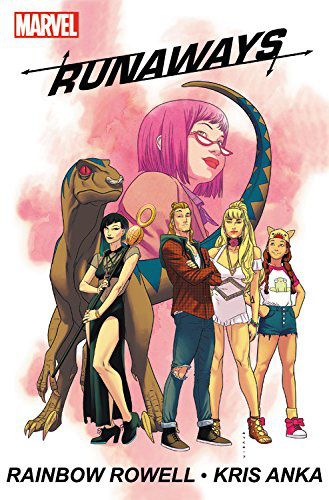
Runaways Volume 1: Find Your Way Home by Rainbow Rowell and Kris Anka

Runaways Volume 1 Cover.jpg

Publisher: Marvel Comics

Publication Date – 8 May 2018

Amazon

From bestselling young adult fiction author Rainbow Rowell and exciting Marvel artist Kris Anka comes the revival we have all been waiting for, with the return of Runaways.

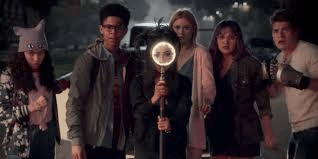
Years ago, six young friends found out a terrible truth: their parents were members of a supervillain group known as The Pride and were working towards the destruction of the planet.  Uncovering their hidden powers and strengths, these friends, genius Alex Wilder, the sorceress Nico Minoru (Sister Grimm), alien Karolina Dean (Lucy in the Sky), mutant Molly Hayes (Princess Powerful/Bruiser), mad scientist offspring Chase Stein (Talkback) and proud dinosaur owner and daughter of two time travellers Gertrude Yorkes (Arsenic with her deinonychus, Old Lace), became the Runaways to escape their parents’ evil plans.

Runaways 2.png

After the death of Alex and all of their parents, the surviving Runaways become family and even brought in new members, including the cyborg Victor, the Skrull Xavin and the time displaced mutant Klara.  While the team’s plans to live in peace were often disrupted by their forced heroics, for a time they were happy.  But even the best families have a hard time staying together in the Marvel Universe, and following the death of Gert, Xavin’s forced departure for the stars, the events of Murderworld and the elevation of several members to the Avengers, the Runaways have gone their separate ways.

However, one former Runaway has had a hard time letting go of the past.  Stealing a time machine, the team’s wildcard member, Chase, has gone back in time to fix his biggest regret: the death of his girlfriend, Gertrude.  But being brought back to life several years in the future is tough, and all Gertrude wants to do is reunite with her friends, even if they are now older than her.  Chase is his old goofy self, but Nico and Carolina have moved on with their lives, , Victor is now just a head and Molly has moved in with her grandmother.  Will the Runaways get together again, or have their subsequent adventures affected their relationships too much? And who is the evil scientist stalking them from afar?

Runaways_Vol_5_2.jpg

Runaways was a ground breaking series originally released in 2003 that focused on a fresh new group of heroes with no previous connections to other characters in the Marvel Universe.  Created by Brian K Vaughan of Y: The Last Man and Saga fame and artist Adrian Alphona, Runaways represents some of their most significant work with Marvel.  Runaways was an exciting tale of teenage rebellion which was amplified by the superhero elements.  Featuring some incredibly iconic characters, the initial series of Runaways featured a fantastic enclosed story about crime and heroics in Los Angeles with only minimal inclusions from the outside Marvel Universe.  Featuring characters who acted in a contrary way to the other superheroes by actively avoiding fights, making fun of costumes and team names (they never actually referred to themselves as the Runaways) and only using superhero monikers ironically, this was a fun series with some clever new ideas.

Following this initial run, the story became a more traditional superhero series, focusing on the adventures of the titular heroes as they fought crime and other threats in LA.  There were a series of great adventures during this period, which included memorable events such as the tragic loss of Gert, Xavin’s sacrifice, several team-ups with the Young Avengers and involvements in the Civil War and Secret Invasion crossover events.  The series would abruptly end in 2009, and readers would have to wait years to see a significant follow-up.  The characters have appeared in several other series, including Daken: Dark Wolverine and Avengers Academy.  However, the characters would not significantly return until Avengers Arena, where Nico and Chase found themselves trapped in Murderworld, and Avengers Arena’s follow up series, Avengers Undercover, which saw the return of Alex Wilder.  At the same time, Victor would join the cast of Avengers A.I.  An alternate version of the Runaways got their own series as part of the 2015 Secret Wars crossover even, and Nico would eventually become a member of the female Avengers team in A-Force.
Runaways 1.png

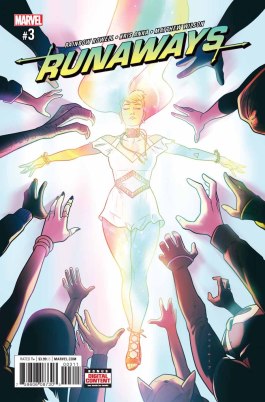
With the release of 2017s Runaways television show, a new comic series of Runaways was announced by Marvel which saw the first run of the original characters in nearly nine years.  This new series is helmed by acclaimed young adult fiction author Rainbow Rowell and dedicated Marvel artist Kris Anka.  Volume 1 of their run of Runways, Find Your Way Home, contains issues #1-6 of the series, with a second volume to be released in October 2018.

Runaways has long been one of my favourite series, and is probably one of the best comic examinations of young teenage characters that Marvel has ever produced.  As a result, I was very excited to get my copy of Find Your Way Home, and headed into this new series with high expectations.  I was not at all disappointed by the result and really enjoyed this new series.  This first volume expertly captures the heart and soul of the original series, reunites several fan favourite characters, and skilfully addresses all the tragic events that have impacted this team over the last few years.

Runaways_Vol_5_3.jpg

The first thing that can be seen in this series is the extreme emotional damage that most of the characters have experienced over the last few years and the strain this has placed on the team.  Because of all the pressures in their lives, the Runaways have disbanded and each have gone their separate ways.  This appears to have affected team members Nico and Chase the most because of their traumatic experiences in the Avengers Arena series.  Nico comes across as very emotionally compromised from the very first scene, while Chase is still obsessed with his greatest tragedy, the sacrifice Gertrude made to save his life.  The other Runaways are just as damaged in their own separate ways.  Karolina is apparently trying to live a normal life, but while she seems unhappy, she is the most reluctant to re-join the team, and her eventual return results in emotional upheaval between her and Nico.  After dying, Gert finds herself alive again in the future with older versions of her friends, as well as an adult boyfriend.  She spends most of the volume trying to deal with these significant changes, the fact that her only real family fractured after her death, and the emotional trauma she experienced dying.  After his death in Vision, Victor spends the entire series as a disembodied head, and keeps his status hidden for most of the volume as he tries to work out if he wants to remain online and re-join the team.  Of all the characters, Molly seems to be the most together, as she is being looked after by her grandmother and is her usually bubbly and high-energy self.  However, her behaviour disguises the fact she knows about some of the deep problems happening around her, and her emotional breakdown at the end of the volume is quiet heartbreaking to behold.  Overall, the creative team handle these deep emotional issues well, and I really appreciated the fact that they did not deny or shy away from the trauma that these characters experienced in other Marvel series.

Runaways_Vol_5_4.jpg

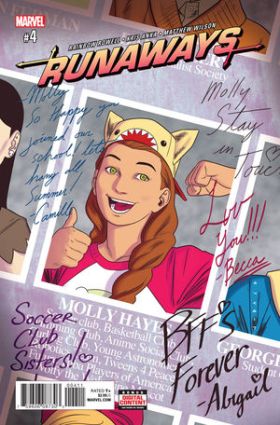
Despite the high level of emotional trauma, there are quite a few very nice moments within the book that fans of the original Runaways series will really appreciate.  The team coming together at the end of the volume to save Molly and Gert is an amazing moment.  After viewing all of the above trauma, it was also great to see the team decide to get back together to become each other’s emotional support.  I also challenge anyone not to get emotional during the scene where Gertrude is reunited with Old Lace, as the two mentally connected friends are finally reunited for the first time in years.  Once again, the youngest Runaway, Molly, is the heart and soul of the team, and it is great to see that despite her age, she is still one of the most emotionally mature, giving sage advice and actually being the only person to notice the threats around them or the fact that Victor’s head is rolling his eyes at the events around him.  I also love that she still has the same Marvel fangirl attitude that she had in the original series, as she spends time wearing Captain Marvel inspired leggings.  Here’s hoping she gets to have some fun interactions with the rest of the Marvel Universe as she did before (the issue she spent running around with Wolverine is one of the funniest bits in Runaways’ previous run).

Runaways_Vol_5_5.jpg

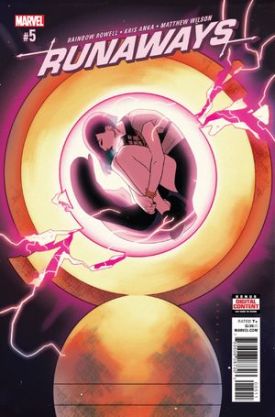
One of the more interesting parts of this volume is that it focuses more on the character interactions than on action or adventure.  There really is not too much violence until the end of the book, and even then their biggest fight is against a group of psychic cats whom they do not actually want to hurt or kill.  I think that this is a good choice for the first volume, as this allows them to really focus on the characters, while also showing off the difference this series has to a classic comic book story.  Despite the lack of action, the series starts with one of the best scenes in the entire volume, when Chase appears in the middle of Nico’s apartment with a mortally wounded Gert.  Nico, despite her shock and the implications of what Chase has done, tries to use her magic to try to save Gert.  While Nico is a powerful magic user, all her magic is tied up in The Staff of One, her parent’s magical staff that has bonded to Nico’s body.  The Staff of One can bend reality to what Nico requests, however, it will only do the specific spell once.  This far along in their adventures, Nico has used a lot of spells already, including ‘heal’, and must use a range of more obscure or very specific statements to try and achieve her goals.   The first sequence where she uses a huge range of different spells really shows off the unique and in some ways limited nature of Nico’s powers and really shows emotional depth right off the bat as the characters get more and more desperate in their attempts to save Gert, and there is palpable relief when they manage to save her.

Runaways_Vol_5_6.jpg

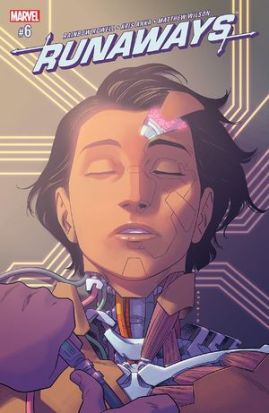
This series of Runaways has a new artist at its helm, Kris Anka, and as a result the art style of Find Your Way Home is slightly different from the previous series.  It still works well to show off the story, and the depictions of the characters’ superpowers being used are pretty cool.  The new character designs are interesting, as Nico, Chase and Karolina are each given a different design to reflect how they’ve aged up since the last series.  Nico looks particularly worn and sad at the start of the comic, and is definitely showing off the strain of her adventure.  Anka has created an interesting look for Chase, and he now looks like a cross between a beach bum and a mad scientist.  The other characters, Molly, Victor, Gert and Old Lace retain similar styles to those they had in the previous series.  These similarities make a lot of sense, as Gert has time-travelled from the previous series, Victor is a cyborg head and Old Lace is a dinosaur.  The artist has also chosen not to change Molly’s age too much, and thankfully she retains her distinctive looks and hats.  One of the highlights of Anka’s work is the dinosaur Old Lace, and quite a lot of the book’s humour can be seen in her funny reactions and antics.  Overall, I really enjoyed the new art style of the book and found that the new character designs suited the book’s necessary changes.

Runaways return in top form with this fantastic first volume, which sticks true to the core of the beloved original series while also going off in some interesting new directions.  Rowell has created an intense narrative that expertly plucks at the heartstrings and examines all the problems and horrors that this group of young heroes have experienced since their initial run.  This is a superb new start to an excellent series.  I’m so happy to have my Runaways back, and I can’t wait to see how they resolve some storylines from the original series.  This is definitely a must-read for fans of the original series, but this is also the perfect chance for new readers to find out about this awesome superhero family.

My Rating:

Five Stars

Amazon

Phantom by Leo Hunt

Phantom Cover.jpg

Publisher: Orchard

Publication Date – 9 August 2018

Amazon     Book Depository

From bestselling author Leo Hunt comes an electrifying and fast-paced young adult science fiction adventure that takes an intriguing look at the future of technology, as well as the crime and consequences these advances could lead to.

In the far future, humanity has built towers and skyscrapers up in a major way, leaving the ground far below.  The rich and powerful live in the City, the highest level of construction, far above the poisoned ground.  Up in the City, luxuries such as sunlight, clean water, jobs and corpbloc homes are available to its hardworking corporate-owned population.  Those who do not have money live in the undercity slums, where the sun never shines and poisoned water is flooding up from the ground.

One of the inhabitants of the undercity is orphaned teenager Nova, who earns a living going up into the City and stealing from the corporate workers.  In a world where everyone has technology implanted in their heads, a skilled hacker like Nova can obtain everything from money to information.  Nova’s most important tool is Phantom, a powerful program created by the shadowy anticorporation hacker, the Moth, which hides the identity of hackers while they commit their crimes.

While Nova is only just scraping by, her skills have caught the attention of the Moth, who has a dangerous job for her.  The Moth needs Nova to infiltrate the powerful Bliss Inc and uncover their most treasured corporate secret.  Posing as a prospective assistant for the CEO of Bliss Inc, Nova goes deep undercover, changing her identity and her appearance to sneak in.  However, her mission is about to get far more complicated then she could have ever imagined.  Caught between the dark secrets of Bliss Inc and the mysterious ambitions of the Moth, Nova is going to be lucky to get out of this heist alive.

Phantom is the latest book from young adult author Leo Hunt and represents his first foray into the science fiction genre.  Hunt’s previous works have mainly focused on the fantasy and horror genres, with his 13 Days of Midnight trilogy featuring a young man who develops necromantic powers.  Phantom is an interesting new direction for Hunt, who has created a fantastic piece of young adult science fiction with strong techno-thriller elements.

This book is contains an intriguing science fiction story that takes the reader through a unique futuristic city and presents them with a thrilling and technology driven adventure.  Phantom’s story contains a superb combination of story elements which come together to form an entertaining and fast-paced plot with compelling pieces of betrayal, technologically assisted espionage and corporate intrigue.  There are a few good twists throughout the book, but I did find that one of the big reveals towards the end of the book was a little easy to predict as a result of the author only utilising on a small number of characters throughout most of the narrative.  This was more than made up for by the shocking and deeply intriguing reveals that followed the protagonist uncovering the hidden secret motivations of the book’s various antagonists.  All of these hidden surprises result in some great story elements and have a strong relation with the book’s focus on technology.

Phantom is intended for a young adult audience, and it works well as an absorbing and exciting introduction into science fiction and technology-based thrillers.  Younger readers will love the interesting examination of the potential future technology and will find the exciting adventure storyline quite fun.  The violence contained within the book is not too graphic whilst also allowing for some strong action-packed scenes.  There are some minor mentions of mind-alerting technology and substances, but nothing too inappropriate for the younger audience.  There are also some subtle but important LGTB elements that come into play later in the story, and Hunt handles these quite well.  Overall, I would recommend this book to all teenagers, and even some younger readers, who will find a lot to enjoy in this wonderful book.

The best and most compelling features of Phantom are the amazing technological elements that form a significant part of the plot and which take a particularly intriguing look into humanity’s reliance on technology and how we are likely to advance in the future.  In this potential future, everyone has neural implants inserted in them at birth that act as a mobile connection to the internet as well as a phone, music player, bank card and personal identification all in one.  This is an interesting thing to examine, especially as humans are constantly getting closer and closer to incorporating our personal technology into our own bodies.  Hunt does a great job presenting some of the potential benefits and problems that humans could experience with this sort of technology, and takes a stimulating look at that the ways that it could impact on our lives.  Quite a few things are explored throughout Phantom, from examinations of how this technology will influence human identity to how it could be abused for criminal reasons, such as stealing money, hacking someone to take control of their body or producing technology that mimics recreational drugs.  Other technological questions come into play later in the book and result in some deep emotional scenes as well as some interesting questions about ethics and the nature of humanity.  These fictional technological elements represent some truly fascinating ideas from Hunt that readers will find very captivating.

In addition to Hunt’s intriguing postulations about future technology, another compelling story element is the inventive and imaginative setting for the story.  The entirety of Phantom is set within a fictional metropolis that is constantly being built up and is split between the soaring spires of the rich and the sprawling slum-like undercity where the poor live.  Throughout the story, the protagonist journeys from areas of the city flooded with poisoned water and inhabited with humans and animals that have never seen sunlight, to the very top of the city, above the clouds.  There is a detailed exploration the city’s disparate economic zones, and significant time is spent interacting with the populace in both these areas, resulting in some fascinating comparisons.  This is an amazing setting for this science fiction and technology focused story and represents another intriguing look into the future by Hunt.

Leo Hunt’s latest book, Phantom, is an absorbing and thrilling tale of adventure and crime in a futuristic city.  Containing some extremely enthralling technological elements and a fantastic city setting where the differences between the rich and poor have never been more obvious, this is another outstanding release from Hunt that will be perfect for those younger readers looking to break into the science fiction or techno-thriller genres.

My Rating:

Four stars

Amazon     Book Depository

City of Bastards by Andrew Shvarts

City of Bastards Cover

Publisher: Hyperion

Australian Publication Date – 31 July 2018

World Publication Date – 5 June 2018

Amazon     Book Depository

Young adult fantasy author Andrew Shvarts has a dramatic return with City of Bastards, an explosive and incredible follow-up to his electrifying 2017 debut.

After her father’s declaration of rebellion against the crown, Tilla, bastard daughter of Lord Kent, turned against him by rescuing the king’s daughter, Princess Lyriana, from his clutches.  Fleeing her father’s lands in the west of the Kingdom of Noveris, Tilla, Lyriana, and Tilla’s boyfriend, Zell, make the journey to the capital city of Lightspire, the opulent and magical city where Lyriana’s father reigns.

Attempting to put aside the horrors she experienced while fleeing from the west, Tilla settles down in a life of luxury as a student in the city’s prestigious university.  However, not everything is as shiny and golden as Tilla had hoped it would be.  She faces ostracism from the most of the city’s population as her father continues to wage war against the kingdom.  On top of that, Zell appears unsatisfied with city life and is growing distant from her.  Tilla and Lyriana are still mourning the death of Tilla’s brother, Jax, and not even their hard partying lifestyle is making them feel any better.

Their new lives are only destined to last for so long before disaster strikes.  When Tilla finds her roommate dead, she knows that a mysterious mage she encountered is behind the death.  But no-one seems willing to believe her, and the death is quickly ruled a suicide and pushed under the rug.  When she is then attacked by the rogue mage, something considered impossible, Tilla begins to realise that there is something very rotten in the heart of the Lightspire.  With her father apparently keeping the king’s invincible army of mages at bay, and shadowy cultists sowing chaos in the city, Tilla uncovers a terrible plot that could shake the entire foundation of the kingdom.  With the king’s inquisitor hunting her as a traitor and the whole word turned against her, can Tilla and her friends stop the evil unfolding in front of them before it’s too late?

City of Bastards is Shvarts’s second book, and is the sequel to last year’s release, Royal Bastards.  This is a fantastic new series of young adult fantasy books, with a third entry already planned for 2019.  These books are marketed towards a young adult audience, but this is a series that will also prove to be massively appealing to older readers as well.  Fair warning to parents: this is probably not the best series for younger readers, as the huge amounts of drugs, drinking, sex and teen angst make this books more appropriate for an mid to older teenage audience.

This novel contains a truly captivating story of intrigue and murder in the heart of a magnificent and magical city.  Shvarts combines some excellent thriller and fantasy elements together to create a superb overall narrative, which includes a large-scale conspiracy that proves to be particularly impressive.  There is a well-written and absorbing investigation angle getting towards the conclusion of this plot, and the full scope of this conspiracy is very elaborate and uses some intriguing magical elements.  There are a number of surprising twists, betrayals and dramatic reveals that will hook the readers, while the conclusion of the story is epic in its size and consequences.  Overall, this is an extremely compelling fantasy thriller story that has not been simplified for a younger audience.

Shvarts has also created an intricate and intriguing cityscape that serves as an excellent setting for the story.  There are some memorable locations visited throughout the course of the narrative, and the author does a fantastic job showing the differences between the richer areas of the Lightspire and the districts where the everyday citizens live.  Exploration through the city by the protagonist highlights this class difference and the corruption of the rich, all of which forms a significant story element later in the book.  The author also introduces some fascinating fantasy elements, such as large-scale magical messages, unique methods of transportation, rebellious anti-magic fanatics, the kingdom’s hidden magical heart and substantial catacombs under the city that hold dark and powerful secrets.  All of these elements play a significant role in City of Bastards’ story, and meld in perfectly with the protagonist’s investigation and the vast underlying conspiracy.

The entirety of City of Bastards is narrated by the book’s protagonist, Tilla.  Shvarts does an amazing job of capturing the essence of a modern teenager in the book’s narration, and the reader really feels that they are accompanying a rebellious young woman on her quest throughout the city.  As a result, the book is filled with sarcasm, funny jokes, humorous observations and a certain amount of complaining about the situation.  The story is also infected with a bit of teen angst, which is amusing to see amongst storylines dealing with the future of a civilisation and will no doubt prove to be relatable to many readers.  In addition to the humour, this narration also allows the reader to see the protagonist’s many vulnerabilities throughout the course of the story.  Overall, the protagonist’s narration adds a lot to this book, and is definitely one of its more appealing features.

A highlight of the book has to be the realistic focus on trauma and the powerful consequences of the first book.  Some of the very best young adult books are those which do not shy away from heavy topics, featuring gritty and realistic portrayals of trauma and PTSD as they try to highlight the often unseen or unconsidered costs of their character’s attempted heroism or battles for survival.  In City of Bastards, Tilla, Lyriana and Zell spend a significant amount of time dealing with the terrible things the encountered in the first book, including the death of Jax, Tilla’s brother and Lyriana’s love interest.  Lyriana’s transformation is the most dramatic, as is she suffering not only from Jax’s loss but also from the guilt and trauma following her decision to break her oath of pacifism and kill someone with her magic.  As a result, she turns from the sensible and respectful character she was in Royal Bastards to a hard-drinking wreck who acts out in a number of different ways and has a hard time dealing with her feelings.  Tilla is also traumatised by the death of Jax, and while at times she seems to be processing it better, her depression is compounded by the dramatic changes in her life and the outright disdain that many characters show her.  Overall, this realistic portrayal of trauma and vulnerability in the characters is very well written and adds a real emotional edge to the story.

City of Bastards is an amazing piece of young adult fantasy that makes substantial use of its new setting to create an epic, conspiracy-laden storyline that proves to be exceedingly captivating.  This is a powerful sequel to Andrew Shvarts’s first book, and fans of Royal Bastards will be entranced by the author’s focus on the first book’s devastating consequences.  This is one of the best pieces of young adult fiction of 2018.  I had a real hard time putting this book down, and it comes highly recommend.

My Rating:

Four and a half stars

Amazon     Book Depository

Throwback Thursday: The Inheritance Cycle by Christopher Paolini

Inheritance Cycle.png

Publishers: Paolini LLC, Knopf Books, Random House AudioBooks

Publication dates:

Eragon – 2002                    Amazon     Book Depository

Eldest – 2005                     Amazon     Book Depository

Brisingr – 2008                  Amazon     Book Depository

Inheritance – 2011            Amazon     Book Depository

Reviewed as part of my Throwback Thursday series, where I republish old reviews, review books I have read before or review older books I have only just had a chance to read.

For my first edition of Unseen Library’s Throwback Thursday series, I have decided to review an important series from my youth, the Inheritance Cycle.  Loved by many, strongly criticised by others, the Inheritance Cycle is a highly inventive young adult fantasy series with an epic narrative of good versus evil

Released between 2002 and 2011, the Inheritance Cycle is the first series from author Christopher Paolini and contains four books.  Since its initial release, the first book in the series, Eragon, has been adapted into a movie starring Jeremy Irons, John Malkovich, Robert Carlyle, Djimon Hounsou and Rachel Weisz.  Despite its strong cast, the movie was a poor adaption of the source material and flopped both critically and financially.  As is often the case, however, the books are stronger than the film.

Eragon Cover.png

I received a copy of Eragon as a birthday gift a short time after its initial release in 2002 and powered through it in short order, as I was instantly hooked by the ambitious plot, massive amounts of lore, and the inventive fantasy elements.  Following Eragon I made sure to grab every other book in the Inheritance Cycle as soon as they came out and I considered it one of my favourite series.  Having re-listened to the entire Inheritance Cycle a few times on audiobook I still massively enjoy the series, although I have noticed a few flaws with the franchise.

The books are all set in the world of Alagaësia, a land filled with classic fantasy elements such as dragons, elves, dwarfs and magic, in addition to a few unique creatures and powers.  Many years before the start of the series, an order known as the Dragon Riders were formed to keep peace and harmony in Alagaësia.  The elven and human Riders were bound to their sentient dragons and formed a lifelong partnership with them, gaining powerful magical abilities as a result.  Following years of peace, the Dragon Riders were wiped out by a crazed former member of the order, Galbatorix, and his followers.  After destroying the Riders and driving the dragons to near extinction, Galbatorix conquered the human kingdoms of Alagaësia and forced the elves and dwarfs into hiding.

Eldest Cover.png

The first book in the series, Eragon, starts with the titular character, the young human Eragon, receiving one of the last surviving dragon eggs, which hatches forth the dragon Saphira.  Following an attack by Galbatorix’s servants, Eragon, Saphira and their mentor, Brom, are forced to flee their village of Carvahall and travel throughout Alagaësia before finally joining up with the rebel organisation, the Varden.  Along the way, Eragon and Saphira lose Brom, encounter the mysterious Murtagh, and rescue the elf Arya from Galbatorix’s captivity.

The following books in the series follow Eragon and Saphira as they lead the fight against Galbatorix while also learning about their powers and the history of the riders.  They encounter new mentors, find out terrible secrets about Eragon’s past, and eventually confront Galbatorix in a final battle.  At the same time, Eragon’s cousin Roran becomes a fugitive from the crown and must lead the entire village of Carvahall in an epic journey to the Varden.  There is also a focus on young political rebel Nasuada, who becomes leader of the Varden in the second book, and examines the trials and tribulations of leading a war against an all-powerful magic tyrant.

Brisingr Cover.png

The last two times that I enjoyed the books in the Inheritance Cycle, I chose to listen to them by audiobook, which are narrated by the outstanding Gerard Doyle.  Eragon is the shortest audiobook at 16 hours 27 minutes, while Inheritance, the finale, clocks in at 31 hours 28 minutes.  I am a huge fan of listening to books with large amounts of internal lore, history and background as it means I am less likely to miss an interesting fact or accidently skip over something with tired eyes.  As Paolini has created a massive amount of background lore and detail to accompany his story, I would heartily recommend listening to the Inheritance Cycle, as I felt that I absorbed so much more from the series as a result.  Doyle is an excellent narrator for this series, and at no point did I find his voice work either distracting or annoying.  His character voices are done very well, and he was able to produce excellent voices for both the male and female characters, as well as the various fantasy species.  I particularly enjoyed the Scottish accent that Doyle attributed to the character of Murtagh, as I felt it fit the character perfectly and made him very distinctive throughout the series.  Other features of the audiobook editions of this series that might appeal to potential listeners are the exclusive interviews with the author that were included at the end of two of the books.

Without a doubt, the best feature of this entire series is the sheer amount of imagination and lore that Paolini has invested in his book’s settings and history.  Each of the books in the Inheritance Cycle contains an incredible amount of background information, elaborate settings and a huge range of fantasy creatures, each with their own skills and history.  Paolini’s immense creativity is particularly evident in the series’ complex rules of magic that are a major feature of all the books.  The detailed explanation provided in Eragon is massively expanded upon in the later books in the series, and represents a significant part of the narrative.  It is also incredible to consider that Paolini created a completely new language for this magic.  With huge amounts of effort expended in creating complex lore, magic and history for all the races and peoples of Alagaësia, it is worth reading this entire series just to see all of these wonderful inclusions.

Inheritance Cover.png

There are some amazing story elements contained within the Inheritance Cycle books.  Paolini has created an epic fantasy adventure that draws the reader in and makes them care about the battle for Alagaësia.  This series has everything from impressive duels to large-scale battles that range from small groups of soldiers fighting to massive pitched battles and sieges.  There is also a significant amount of magic, politics, intrigue, romance, family and everything else that makes up a great fantasy story.  The main character, Eragon, is a classic hero coming into his great power storyline that fantasy fans will appreciate and enjoy.  However, I personally thought that the storylines that focused on Eragon’s cousin Roran were the best parts of the entire series, and business really picked up when he was made a point of view character in Eldest.  Roran is a much more grounded and likable character than Eragon, especially as he has to rely on his skill, cunning and luck to survive in a world where massive monsters and powerful magicians run rampart.

The first book, Eragon, is the only edition in the Inheritance Cycle that is told completely from the viewpoint of its titular character.  This book is a superb introduction to the series and spends significant time laying down the groundwork for the next three books.  Some great characters are introduced within this first novel, and there are a range of terrific battle scenes, the establishment of some fantastic relationships and some deep emotional moments.

The second book, Eldest, is another amazing part of this series.  Eragon spends a significant part of the book physically crippled following the final battle in Eragon, and Paolini’s descriptions of his despair and hopelessness are particularly vivid.  I am a real sucker for fantasy teaching sequences, so the scenes where Eragon learns magic, history and other subjects in the elven kingdom were really enjoyable for me.  However, the standout parts of this book focus on Eragon’s cousin Roran and the inhabitants of Carvahall.  Eragon’s actions in the first book results in Carvahall being targeted by Galbatorix and his forces, and Roran and the villages must first defend their home and then attempt to flee to the Varden.  Their exodus has some great scenes, including an extended voyage at sea, and is it fascinating to see how Eragon’s adventures impact the people he left behind.  Special mention should also be made of the scenes told from the viewpoint of Nasuada as she takes control of the Varden and leads its invasion of Galbatorix’s kingdom.  The final battle sequence of the book is another huge highlight, as the reader gets to see Eragon unleash his new powers in a massive battle scene.  The combination of the book’s three storylines into one conclusion is particularly enjoyable and epic, and there are some amazing battles and several important character revelations for the protagonist.

The third book, Brisingr, represents another fun addition to the series.  Eragon sets out on a journey of discovery during his arc.  Of particular note is the extremely intriguing look at dwarf politics and emotional reveals about Eragon’s heritage and family.  Roran’s arc is action-packed and exciting as it focuses on his role as a new member of Varden as he works his way up to becoming a high-ranking commander in the army.  The devastating conclusion to this book provides an emotional punch to the reader as one of the most likable characters meets their end.

Inheritance, the final book in the Inheritance Cycle, draws this story to its epic conclusion.  Readers who have enjoyed the first three entries in this series will have no choice but to see how this adventure ends.  Once again Roran’s arc shines through as the most enjoyable part of the entire book.  Not only does this arc focus on his own fantastic siege storyline, but it is through Roran’s eyes that we watch the massive battle for Galbatorix’s capital.  While Eragon and most of the other supporting characters are fighting Galbatorix, Roran is the only point of view character observing the fierce street-to-street combat happening in the city below.  Roran’s epic battles in this sequence more than make up for certain deficits with the main fight between the remaining Dragon Riders above.  That being said, Eragon, Arya and Angela’s earlier confrontation with a group of fanatical priests in tunnels below an ancient temple has a certain sinister edge to it that will appeal to some readers.  Offering a satisfying conclusion with a number of intriguing storylines left open for future books, this is a superb final chapter for the entire Inheritance Cycle.

While this series has a lot of great features and positive points in its favour, there are a few negative issues that need to be addressed.  When it was released, one of the main criticisms the Inheritance Cycle received was about its similarities to other works, and it’s honestly not hard to see some striking resemblances to the original Star Wars movies.  The Dragon Riders are extremely similar to Jedi, down to the unbreakable, colour-coded swords.  Obi-Wan Kenobi’s monologue from A New Hope about the destruction of the Jedi can pretty much be substituted for Brom’s description of the fall of the Riders.  The main character, Eragon, is essentially Luke Skywalker.  When we first encounter him he is living with a gruff uncle and suddenly receives a MacGuffin (in this case a dragon egg rather than a droid) that dramatically changes his life.  The arrival of the MacGuffin results in the death of his guardian and he flees the only home he knows with a mentor character.  The mentor character, Brom, the former Rider, has way too many similarities with Obi-Wan as he gives the protagonist his early, uncompleted training, provides him with his first weapon, and then dies about two-thirds through the first volume.  In the course of the first book Eragon also meets up with a rogue-like character, rescues a trapped female who he first sees from a distance (through magical scrying rather than a hologram) who later turns out to be a princess, and then flees to a rebel stronghold for an epic confrontation.  In later books Eragon meets a Yoda-like character in Oromis and finds he is related to the Darth Vader equivalent, Murtagh (after Murtagh obtains a red sword).  He eventually faces the Emperor-like villain, Galbatorix, at the very end of the series, and is forced to have a final duel with Murtagh in front of him.  Upon Galbatorix’s death and the utter destruction of his ultimate base, the heroes liberate the whole world from the control of the evil empire and Eragon sets out to teach a new generation of Riders.

These are only some of the more obvious similarities to Star Wars, and they are pretty glaring; however, this has never ruined the series for me.  Other criticisms about similarities to fantasy works such as Lord of the Rings, due to the inclusions of dwarfs and elves are a bit harder to credit, as these are hardly unique fantasy races anymore and Paolini does a fantastic job creating distinctive histories and traits for these races.

One thing that I really disliked about the series, however, is the terrible romantic arc between Eragon and the elf Arya.  Eragon pretty much falls in love with her the second he sees her, but Arya is strongly opposed to his romantic advances for various reasons.  Eragon’s unrelenting pursuit of her, especially in the second book, is very uncomfortable, and his depression and self-pitying attitude following her rejections are some of the worst parts of the series.  While their relationship in the third and fourth books becomes more natural and builds up as a result of mutual respect, I’m personally glad that Paolini doesn’t pull the trigger on their relationship at the end of the series.

I was also not a big fan of the extreme amount of self-doubt that Paolini injected into his protagonist, possibly to counterbalance the overpowered nature of Eragon.  Eragon spends way too long feeling sorry for himself, and the scenes where he deals with these feelings of inadequacy and doubt are some of the hardest to get through.  These character flaws, along with the Arya romance subplot, make it hard for the reader to like Eragon at times, and are part of the reason that I feel Roran is the better hero in the series.

While they did have some amazing parts, the third and fourth books in the series did seem to drag at times.  While I enjoyed Brisingr, when you view the whole series, I feel that Paolini could have probably gotten away with turning the series into a trilogy and simply incorporating some of the key story points into Inheritance instead.  The final conclusion of Inheritance is also a bit clichéd, especially when, out of nowhere, Eragon is able to use magic to make Galbatorix understand all the pain his actions have caused.  It’s a pretty weak way to end this epic confrontation, but luckily the reader isn’t too disappointed, especially with the epic Roran storyline down in the city ramping up the action in this part of the book.

Despite the above criticisms, I still rate all of the books in the Inheritance Cycle four stars out of five.  While this rating may be slightly bolstered by nostalgia, I do believe that this is an excellent series that will appeal to many fantasy fans, especially those younger readers who are only just starting to read the genre.  With an absolutely incredible amount of fantasy details, world history and established lore, I am still amazed by Paolini’s sheer imagination every time I go back to this series.  There are some electrifying storylines within all four of these books, as well as enough action, be it physical, mental or magical, to make any action junkie’s pulse run wild.  Readers looking for the next epic fantasy series to enjoy will find an incredible adventure awaits within the Inheritance Cycle.

My Rating (Series and Each Book):

Four stars