
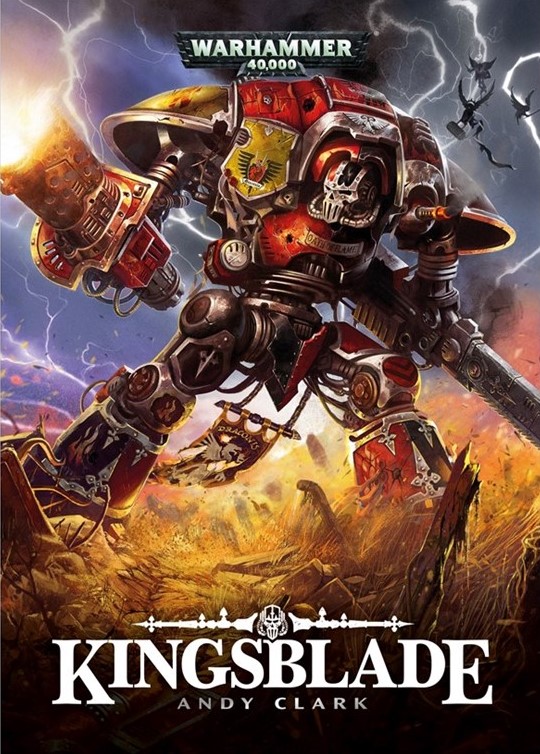
Throwback Thursday – Warhammer 40,000: Kingsblade by Andy Clark

Kingsblade Cover

Publisher: Black Library (Paperback – 1 February 2017)

Series: Imperial Knights – Book One

Length: 365 pages

My Rating: 4.5 out of 5 stars

Amazon

Welcome back to my Throwback Thursday series, where I republish old reviews, review books I have read before or review older books I have only just had a chance to read.  In my latest Throwback Thursday post I look at an exciting novel about mecha fights in the Warhammer 40,000 universe with Kingsblade by Andy Clark.

I have been having so much fun with the Warhammer 40,000 books recently, especially in my Throwback Thursday columns, as I recently published reviews for Ghostmaker, Xenos, Malleus and Hereticus by Dan Abnett, and Deus Encarmine by James Swallow.  However, the fun is not over yet as I recently read the cool 2017 novel, Kingsblade by Andy Clark, who previously impressed me with his 2022 book, Steel TreadKingsblade, a lucky find I managed to pick up in a secondhand bookshop, was an outstanding read which frankly has one of the best Warhammer covers out there, as well as a great story to match it.

War is a certainty in the far future, and the Imperium of Man is constantly under threat, especially from the fell influence of Chaos.  When a planet falls, the Imperium have many forces that can be deployed to fight the invasion, but few armies are as feared or revered as the legendary Imperial Knights, giant, ancient suits of mechanised armour that support brave pilots of regal, knightly backgrounds.

When the Imperial world of Donatos falls to heresy thanks to the disruptive influence of the Word Bearers Chaos Space Marines, the Knights of the nearby planet of Adrastapol heed the call.  Leading five noble houses of Imperial Knights, as well as substantial forces from the Astra Militarum, High King Tolwyn Draconis hopes to swiftly end the insurrection and save Donatos’s soul.  However, when a great betrayal rips the very heart out of the king’s host and the flower of Adrastapol’s Knights falls, all hope looks lost.

As the battered remnants of the Imperial Knights attempt to recover, it soon becomes clear that the fate of both Donatos and Adrastapol will lie with two unblooded Knights Errant, Danial Tan Draconis and Luk Tan Chimaeros, both of whom are reeling from the actions of their parents.  On the run, outnumbered and unsure who to trust, Danial, Luk and their comrades need to find a way to strike back against the enemy especially as the World Bearers begin a massive unholy ritual, one that threatens everything.  But can these two young Knights defeat the enemy and redeem their world, or do the betrayals of their family and former comrades run too deep?

Kingsblade was an epic and incredible Warhammer 40,000 read by Clark that I had a ton of fun with.  Featuring a mecha-laden novel that contained awesome action sequence after awesome action sequence, this was a great addition to the wider Warhammer 40,000 canon and a must read for all fans of the franchise.

I had an amazing time getting through Kingsblade’s great story, especially as Clark clearly has a lot of fun fitting in as much action and mayhem as possible.  Starting with the classic Warhammer 40,000 war story, with the brave Imperial defenders arriving to save the world of Donatos, the narrative primarily focuses on several of the Imperial Knights who arrive, especially the young bloods Danial and Luk, who are thrust into the fires of war.  The first half of the book features the typical early battles and set-up you would expect, and Clark lays down some clever hints of what is to come.  Things of course take a turn for the worse after a massive betrayal, and the protagonists soon find themselves on the run, unsure of who to trust.  The major battle that follows this betrayal is pretty damn epic, especially as there is a real sense of desperation and confusion surrounding the characters, and the chaotic fallout of this pushes the protagonists in some intriguing new directions.  The second half of the novel sees the traumatised characters attempting to fight back whilst on the run, while also dealing with the many personal issues that have arisen.  Clark does a good job of blending the enjoyable action sequences with some intense character moments during this second half, and the powerful tale of camaraderie and honour that follows is one any Warhammer fan can get behind.  Everything leads up to the big, brutal and extended final battle sequence, as the characters find themselves wrapped up in a multi-sided fight to the death.  The action flies thick and fast during this last major confrontation, and the reader finds themselves on the edge of their seat the entire time, especially as there are some lethal fights and major risks to everyone involved.  The entire story comes together in a fantastic and enjoyable way, which also remains open for the sequel, and I absolutely powered through Kingsblade, especially in that epic second half.

I think that Clark presented this exciting and powerful story in a great way, and I honestly found myself pretty hooked the entire way through.  The faster pace of the story and the constant fun action sequences are very enticing, and I felt that Clark was able to balance this well with some universe building and clever character work to create an exceptional read.  The compelling range of different character perspectives is extremely effective, and I liked seeing the variety of insights and motivations that the various characters had, especially as that gives you some very deep and compelling insights into the mindset of the Imperial Knight characters.  I also liked the additional perspectives from some of the main antagonists, especially as it allowed Clark to highlight the various plots and subterfuges that the protagonists are about to walk into and attempt to disrupt.  However, the true highlight of Kingsblade is the battle sequences, especially when it comes to the Imperial Knights.  I already knew that Clark had some great ability when it came to showcasing vehicle on vehicle combat, but Kingsblade dials that up even further by showing the Imperial Knight mecha suits in action.  The action is always fast and ferocious, and you really appreciate just how crazy and brutal the fights involving the Knights are, especially as they face a range of deadly opponents.  The complex duels between rival Knight suits are particularly impressive, and you get the full sense of their intense fights thanks to Clark’s writing style, and every thrust, blast and explosion is recorded in epic detail.  I deeply appreciated how Clark wrote this epic story, and you are guaranteed to have an exciting and fun time as you get through this amazing book.

Kingsblade also proved to be a very fun addition to the wider Warhammer canon, as Clark dove into one of the more intriguing human sub-factions, the Imperial Knights.  I have always loved the Imperial Knights in Warhammer fiction, and I read a particularly good book about them last year (Assassinorum: Kingmaker by Robert Rath), that showed one of their feudal planets.  As such, I was very excited to see more of them in another book and Kingsblade delivered that in spades.  Not only does Clark perfectly showcase the over-the-top power of the Imperial Knights in combat (so much epic mecha combat), but there is an intriguing dive into the history and society surrounding this faction.  The blend of advanced technology and historical knightly values is particularly fun, and you really get a sense of what the knights believe and how they fight as the book continues.  This intriguing and compelling focus on Imperial Knight lore is expertly featured throughout the plot and I loved seeing the ritual, pomp and knightly codes helping to drive the protagonists forward.  I also thought Clark did a good job of introducing some of the general concepts and elements of the wider Warhammer 40,000 universe into this book, and you get a good sense of what is happening and the history surrounding the franchise.  Due to this, and the fact that the history of the Imperial Knights is explored strongly throughout the plot, I felt that Kingsblade would make a pretty good introductory novel to the Warhammer 40,000 universe, especially as it showcases just how fun and over-the-top the franchise can be.  I look forward to seeing how Clark expands upon this Imperial Knight lore in future books, especially if he balances it with some more awesome mecha-on-mecha combat.

The most moving and compelling parts of Kingsblade were the excellent characters that Clark introduced and featured throughout the narrative.  While there are a ton of brilliant figures utilised in the plot, most of the focus was on the younger characters of Danial Tan Draconis and Luk Tan Chimaeros, two rookie knights and best friends in their first war.  Clark does a wonderful job of setting both these characters up early in the plot, and the two friends have very different personalities, with Danial being a cautious and seemingly unready knight, while Luk is impatient and headstrong.  However, both characters are pushed to their absolute limit after the pivotal early events of Kingsblade’s narrative which result in Danial becoming king, while Luk is considered to be a heretical traitor.  This results in some outstanding character-driven plot, as Danial attempts to find his inner courage and sense of duty, while Luk is forced to redeem himself and his name after those he trusted the most turned on him.  Clark ensures both character arcs are pretty damn powerful, and they are woven into the large plot extremely well, ensuring that victory is only obtained after these figures finally get their acts together.  I really liked the wonderful and moving narrative that was wrapped around Danial and Luk, and it will be interesting to see how that alters further in the series.  The rest of the characters in Kingsblade are also really cool, and I particularly enjoyed seeing events through several of the Chaos character’s perspective, especially once separate factions emerge and go to war.  An overall epic group of characters that are seamlessly fitted into the wider tale.

Andy Clark continues to impress me with his outstanding Warhammer fiction work as his 2017 release, Kingsblade, proved to be another smash hit.  Perfectly blending intense action with cool universe elements and complex characters, Kingsblade was pure fun from start to finish and a real pleasure to read.  I had an epic time getting through this book and I cannot recommend it enough for all fans of the Warhammer 40,000 universe.  I will have to try and get a copy of the intriguing sequel, Knightsblade, and I cannot wait to see how Clark continues this compelling and powerful narrative.
Amazon

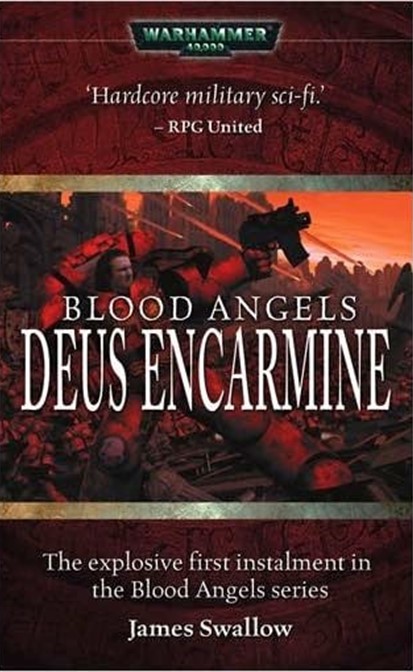
Throwback Thursday – Warhammer 40,000: Blood Angels: Deus Encarmine by James Swallow

Deus Encarmine

Publisher: Black Library (Paperback – 1 December 2004)

Series: Blood Angels – Book One

Length: 252 pages

My Rating: 4.5 out of 5 stars

Amazon

Welcome back to my Throwback Thursday series, where I republish old reviews, review books I have read before or review older books I have only just had a chance to read.  This is actually my second Throwback Thursday post today as I also put up a review for the Warhammer 40,000 novel Xenos by Dan Abnett.  However, I have been in an extreme Warhammer mood lately so I figured I would do a double feature and review the other Warhammer 40,000 book I finished this week, the first entry in James Swallow’s Blood Angels series, Deus Encarmine.

One of the main things that really draws me into the Warhammer extended universe is that it contains works from a ton of awesome authors who have experience across the writing spectrum.  For example, James Swallow is a highly regarded thriller author who also contributed his talents to several extended universes, including the elaborate Warhammer universe.  While many readers may be familiar with his entries in the Horus Heresy sub-series, Swallow’s other major contribution to the Warhammer canon is the Blood Angels books, which provide dark adventures for one of the most iconic Space Marines chapters, the Blood Angels.  I managed to grab the first two books in this series from a second hand shop a few months ago and I just finished off the first entry, Deus Encarmine, this week.  It proved to be a fantastic and dark read that showcases the Blood Angels in a whole new light.

Out of all the Space Marines chapters who faithfully defend the Imperium of Man, few are as revered, respected or feared as the legendary Blood Angels.  The genetic descendants of the angelic primarch Sanguinius, the Blood Angels are proud warriors whose martial prowess and resolve are known across the galaxy.  However, their strength comes at a great cost, as the traumatic death of Sanguinius millennia before during the Horus Heresy still lingers in their shared genes and has the potential to drive even the best of them mad.

As the Imperium once again finds itself invaded by the forces of Chaos, one of the Blood Angels’ greatest tests is about to begin on the planet of Cybele.  A grave world dedicated to the memory of fallen Imperial warriors, Cybele is brutally invaded by Chaos Space Marines of the traitor Word Bearers legion, who overwhelm the Blood Angels honour guard stationed there and a relief force from the Blood Angels battle barge Bellus.  Only an ambitious plan by a young Battle-Brother, Arkio, turns the tide against the forces of Chaos, a victory that is considered by many to be a miracle.

As the Blood Angels follow the Word Bearers back to their base of operations, the conquered planet of Shenlong, more miracles seem to surround Arkio, leading his fellow Space Marines to believe that he is the blessed reincarnation of Sanguinius himself.  The only Blood Angel who doubts is Arkio’s older brother, Rafen, who notices strange changes in his sibling that his fellows are too blinded to see.  Only Rafen can discover whether Arkio’s gifts are a Chaos plot or the divine will of Sannguinius, but will he find out the truth before humanity’s greatest protectors are torn apart from within?

This was an excellent and captivating Warhammer novel from Swallow that tells a bleak and compelling story of faith, betrayal and family.  Making full use of the grim Warhammer 40,000 universe and the focus on the iconic Blood Angels, Deus Encarmine set up this first part of this series perfectly and you come away from this book extremely satisfied.

I really enjoyed the complex and dark story that Swallow featured in Deus Encarmine, especially as there are multiple layers to the narrative that drag you in with clever twists and turns.  Starting quickly and effectively with an extended and bloody war sequence, you really get a sense of the Blood Angels’ determination and resolve, as well as some of the deeper elements that impact them.  However, the real story doesn’t begin until after the massive battle at the start, as the characters are drawn into a deadly plot based around the Blood Angels’ history and beliefs.  Thanks to the efforts of a manipulative Inquisitor, as well as their own arrogance and faith, the Blood Angels are led to believe that the young Battle-Brother Arkio is the reincarnation of their founder, and they decide to follow him on a doomed quest to a Chaos controlled planet.  The build up to the invasion is amazing, especially as you get to see the various enemy moves to confuse the Blood Angels, as well as the failed attempts by the protagonists to discover what exactly is going on with Arkio.  Everything comes to a head when they reach their target, and the massive and brutal battle that follows reveals some dark truths about the despicable plans to destroy the Blood Angels.

I really got drawn into this awesome and compelling narrative and I loved the many impressive layers that Swallow added to it.  While many readers will be drawn in by the detailed and bloody war sequences, the real joy is in the intense manipulations and deceits that the villains unleash as the protagonists find themselves confronted by their own beliefs in dark times.  Swallow makes perfect use of the grim setting and the interesting history of the Blood Angels to turn this into an intense read, and you really get drawn in as you attempt to discover the truth behind Arkio and the enemy plan.  The author features various character perspectives to really showcase the differing views of the Blood Angels, as wells as the moves of the antagonists, and I loved how everything unfolded.  Readers come away from Deus Encarmine very satisfied, although the bleak cliff-hanger ending makes you instantly want to get out and grab the sequel.  I also felt that this was a pretty good entry novel for those readers looking to get into Warhammer fiction, as Swallow expertly introduces key elements of the wider universe and showcasing just home grim and deadly the war between Chaos and humanity can be.

Unsurprisingly, this first book in the Blood Angels series spends quite a bit of time focused on the titular chapter of Space Marines, the Blood Angels, who proved to be as awesome as always.  The Blood Angels are one of the most iconic and beloved factions in the entire Warhammer universe.  While all Space Marines are compelling and contain great potential for exciting stories (see my reviews for Deathwatch: Shadowbreaker by Steven Parker and Space Wolf by William King), the Blood Angels are particularly complex and striking figures.  Deadly and honourable warriors, the Blood Angels have a religious obsession with blood which borders on the vampiric, as well as major psychic daddy issues from their dead progenitor that can potentially drive them mad.  All this has tugged at the imagination of generations of Warhammer fans and Swallow uses that to full effect in Deus Encarmine.  Not only do you see these deadly warriors in multiple battle sequences, but Swallow dives into the history, culture and spirit of the chapter, including all the factors that helped turn them into such efficient and unstoppable killers.  All the key aspects of the Blood Angels experience are artfully captured and utilised throughout Deus Encarmine and fans of this chapter will be particularly excited, especially as Swallow adds in a ton of references and homages to various parts of the lore and previous fictional releases (I spotted a couple from Bloodquest).  I particularly loved that Swallow featured a Death Company in one of the battles, which was so damn cool as you got to see Blood Angels inflicted with the Black Rage tear apart their enemies one last time.  I also really appreciated how Swallow utilised the past and trauma of the Chapter as a key story point, and their faith and dedication to their primarch is used against them by their enemy.  All these elements, and more, make Deus Encarmine a must-read for all Space Marines fans, especially those who love to field/read about the Blood Angels, and Swallow had a wonderful time showcasing this faction.

I had a great time with the characters featured in Deus Encarmine and Swallow perfectly set them up and then inserted them into the complex tale.  Nearly all the major characters are members of the Blood Angels, and they share a joint history of suffering and bloodshed that binds them together.  While their training and history ensures some similarities, Swallow ensures that the central cast had some key differences and personalities.  The main character of Rafen was particularly compelling, and Swallow puts an interesting history around him.  His constant battle between the needs of his chapter and his loyalty to his brother is a major part of the book’s drama, and it is hard not to feel for him when he is the only one able to see that something is going terribly wrong.  The character of Arkio was also a fantastic addition to the cast, and I loved his gradual change throughout Deus Encarmine from a humble warrior to a dangerous religious figure.  Other characters, including the arrogant Sanguinary Priest Sachiel, the grizzled and suspicious veteran Koris, and even the entertaining Word Bearers characters who acted in counterpart to the protagonists, were all well written and I loved the elaborate narrative threads that Swallow wove around them.  However, my favourite character in Deus Encarmine was probably Inquisitor Stele.  Initially shown as an effective, if arrogant, ally, it is slowly revealed that Stele is a manipulative and callous being who is leading the Blood Angels towards a darker objective.  Watching him carefully and effectively divide and control the various Blood Angels characters was really awesome and I loved watching his dark scheme unfold.  I deeply enjoyed how Swallow utilised his characters in Deus Encarmine, and it will be intriguing to see who survives the deadly events of the next book.

Overall, I felt that Deus Encarmine was a pretty epic read and a powerful addition to the Warhammer canon.  James Swallow has written an excellent and captivating read here that perfectly blended intrigue, betrayal and an intense war story with the complex history and culture of the iconic Blood Angels Space Marines chapter.  An intense and addictive read, I absolutely loved this first Blood Angels and I plan to check out the sequel, Deus Sanguinius next, especially as I want to see how Swallow ends this fantastic duology.

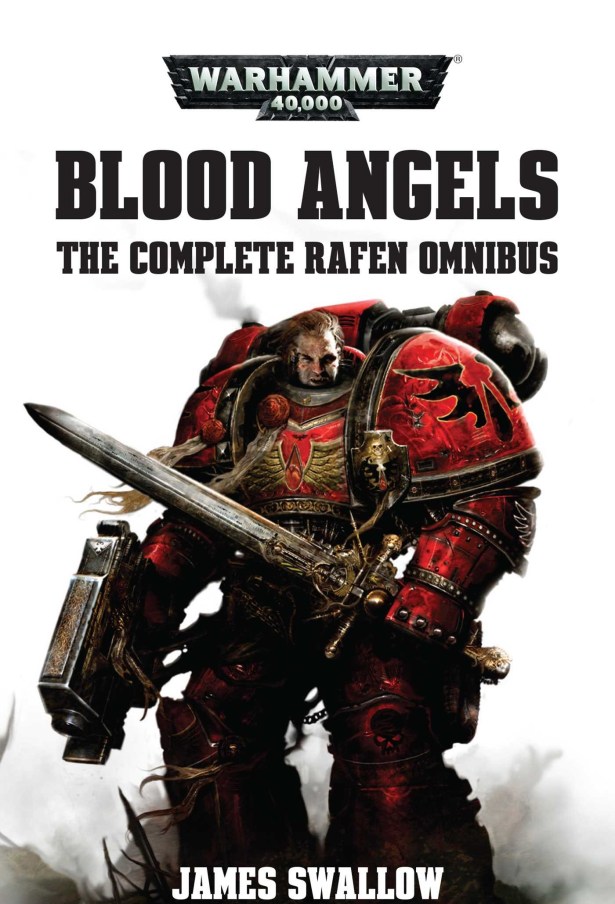
Blood Angels Cover

Amazon