
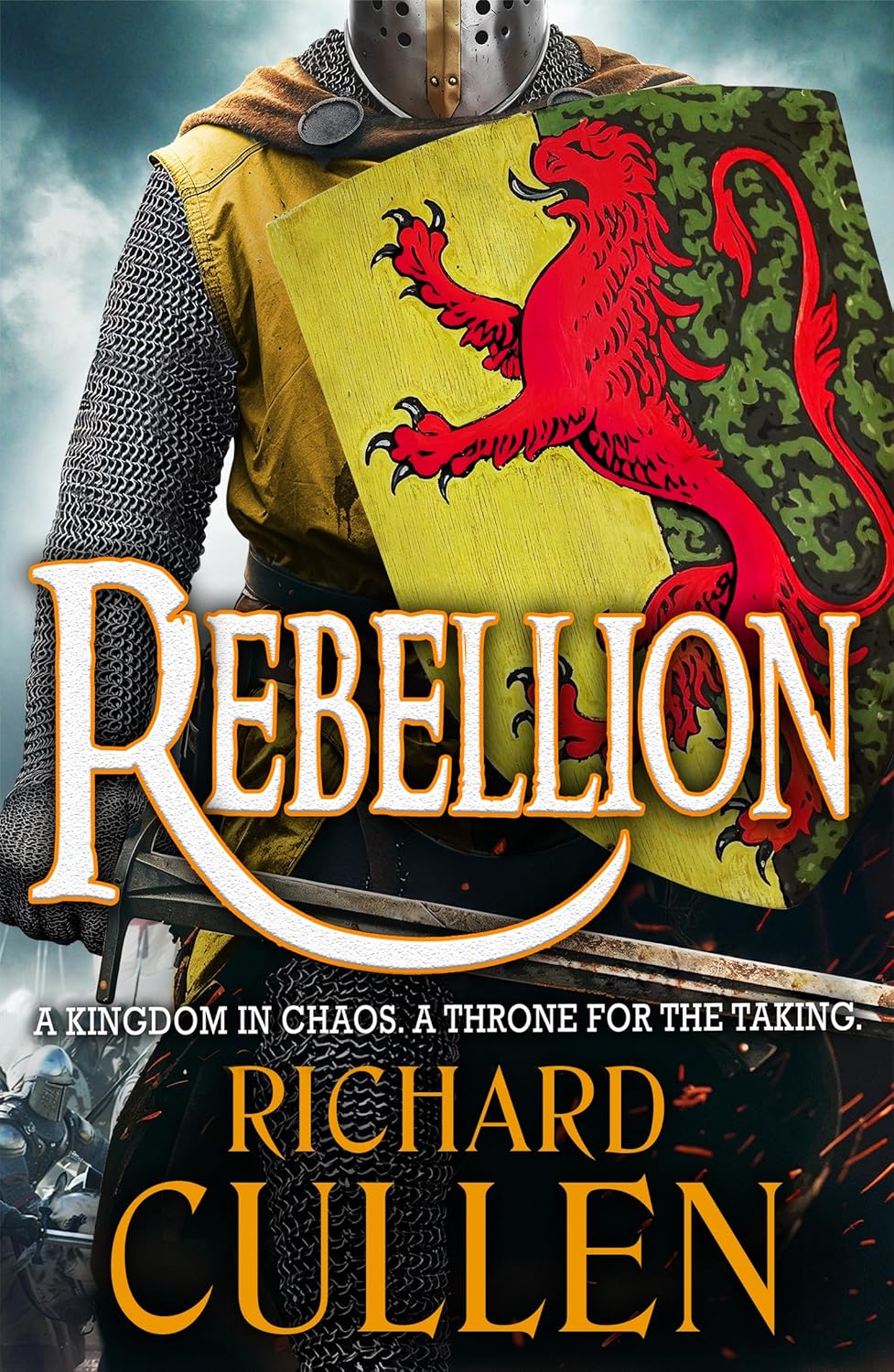
Quick Review – Rebellion by Richard Cullen

Publisher: Boldwood Books (ebook – 26 October 2024)

Series: Chronicles of the Black Lion – Book One

Length: 290 pages

My Rating: 4.5 out of 5 stars

Amazon

Prepare for an exciting and compelling historical adventure from excellent author Richard Cullen with the amazing read Rebellion.

Back in 2024 I was lucky to receive a copy of the awesome historical fiction novel Rebellion by Richard Cullen.  Cullen, who entered the historical fiction genre a couple of years ago with his Wolf of Kings series, may be better known to some readers as fantasy author Richard S. Ford, who has written several compelling series over the year, including The Age of Uprising series (check out my review for the first book in that series, Engines of Empire).  His latest release, Rebellion, is the first book in his Chronicles of the Black Lion series, that takes readers back to the early 13th century and deadly rebellions against the crown.

Plot Synopsis:

1213AD.

King Richard the Lionheart is dead, and his brother, John Lackland, sits uneasily upon the throne of England.

Across the sea, Prince Louis, heir to the powerful King Philip Augustus of France, looks to King John’s crown with a covetous eye.

But King John must be wary of rebellion, as well as invasion, for even his own barons would see their king unseated, and the French pretender put in his place.

Thrust amid this tumult is young Estienne Wace, orphan squire to Earl William Marshal – the greatest knight to ever serve the kings of England, and one of the few men who still holds faith in King John’s rule.

Raised by Marshal as his ward, Estienne must prove himself worthy of his adopted father’s name, but acceptance may be the least of his troubles. War is looming, as usurpers emerge from every quarter, determined to steal England’s crown from its most wretched king.

Rebellion was an outstanding novel that successfully wrapped around a character-driven tale of adventure and honour with a compelling historical background to form a fantastic and exciting read.  Told primarily from the perspective of Estienne Wace, new squire to legendary knight, lord, and royal regent Wiliam Marshal, you see the chaotic events that defined the last few years of King John’s reign, including the First Barons’ War, in compelling detail.  For the most part Cullen tells a classic historical coming of age/adventure tale around Estienne, as the young man first learns the ropes of being a squire, and then the reader follows him through several major battles and historical events, either as a fighting participant or a curious observer.  This allows for quite a bit of action and excitement, and the young protagonist soon learns the true horrors of war as he grows closer to the Marshal family.

This proves to be a fascinating and very intense historical narrative, and the author enthrals the reader with a great combination of fascinating historical detail, a ton of cool action, and some compelling character work as he features an intriguing mixture of new characters and many established historical figures.  I found this combination to work extremely well, and it proved interesting to follow the protagonist as he witnessed the turbulent history of the period and the dark conflicts it birthed.  The action flies thick and fast as the story continues, and I loved the awesome array of detailed sequences that emerged, including a lengthy and desperate siege.  The author also makes excellent use of some great alternate points of view as the story continues, including a jealous rival to the protagonist, and you are gifted with a compelling and highly intense look at the battles and politics unfolding.  While for the most part the main storyline around Estienne is typical historical fiction fare, Cullen throws in some interesting, if not entirely unsurprising, reveals at the end which should lead to some interesting developments in the future.  All this helped to produce a very cool story, and its one that I had a hard time putting down at times.

While I love all the above inclusions, my favourite part of Rebellion was the excellent historical details that Cullen worked his cool narrative around, especially as the author has clearly done his research on the subject.  It helped that Cullen chose to set his story around a truly fascinating period of English history that hasn’t been too over-utilised in other pieces of historical fiction.  As such, readers are gifted with deeply compelling look at the later years of King John’s reign as he lost land and refused to abide by the Magna Carter, and the resulting war that emerged as his various lords rebelled and tried to crown Prince Louise of France as King.  Cullen expertly places Estienne in the middle of many of the key events of this period, and through his eyes you get the full picture of the events that led up the war, as well as how it unfolded.  I honestly found this to be extremely fascinating, mainly because this war is often overshadowed by other events in English history, and you don’t see it utilised too often in modern fiction.  It was pretty damn interesting to see just how close England came to being ruled by a French king, and I honestly didn’t know that the French landed an army in England during this period, nor that Dover was besieged, and it was extremely cool to see it all unfold throughout the plot of Rebellion.

I personally also enjoyed how much Cullen focused on the awesome historical figure of William Marshal in this book, including examining the role that he played in stopping the war and saving England.  Marshal, a legendary knight who served several kings, is shown as an older man torn between duty and family, as he tries to save the cruel King John while his son chooses to support the rebelling barons.  I have always loved the history surrounding William Marshal and Cullen does a beautiful job bringing this aging example of knightly duty and honour to life and showcasing the complex roles he tried to balance for the sake of England.  This portrayal of Willaim Marshal, and indeed all the historical detail in the book, helps to make Rebellion a particularly captivating historical read, and I really appreciated how Cullen worked it all into the story.

Overall Rebellion was an awesome, fascinating and deeply addictive historical fiction novel that I could not get enough of.  Richard Cullen did a brilliant job of bringing this historical adventure together, and I had a wonderful time with the cool action and compelling history contained within it.  This is a very fun and exciting read that this very easy to get hooked on, and I ended up having an outstanding time with Rebellion.  Indeed, I enjoyed it so much that I have already grabbed an early copy of the sequel, Crusade, and I am hoping to read it soon.

Amazon

Lionheart by Ben Kane

Lionheart Cover

Publisher: Orion (Trade Paperback – 14 May 2020)

Series: Lionheart – Book One

Length: 381 pages

My Rating: 4.5 out of 5 stars

Amazon

Honour, glory, loyalty and war! Bestselling historical fiction author Ben Kane takes the reader on a medieval adventure alongside a young King Richard the Lionheart, with his latest epic novel, Lionheart.

I have been on a real roll with some great historical fiction novels in the last couple of weeks, having absolutely loved The Grove of the Caesars by Lindsey Davis and The Viennese Girl by Jenny Lecoat, so when I got a copy of Lionheart by Ben Kane I jumped at the chance to read it. Ben Kane is one of the top historical fiction authors at the moment, having produced a number of fantastic books set in ancient Rome, including The Forgotten Legion trilogy, the Hannibal series and the Eagles of Rome series. I have read several of Kane’s previous novels, and I have always found them to be exciting and compelling books with loads of historical detail. This latest release, Lionheart, is Kane’s first novel that does not involve Rome in any way whatsoever, and it acts as the start of a brand new series that will follow the life of one of England’s most iconic kings.

England, 1179. Henry II rules a vast empire, made up of England, Wales, Ireland, Normandy, Brittany and Aquitaine, controlling all with an iron fist, with his only blind spot being his four rebellious sons. Ferdia is minor Irish nobleman, taken as a hostage by the English to ensure his rebellious family’s cooperation and loyalty. Given the name Rufus by his captors, he spends years languishing in an English castle, before a chance encounter with Henry’s second oldest son, Richard, will change everything.

Managing to save Richard’s life, Rufus is taken in as his squire. Drawn to the prince’s natural charisma, bravery and dedication to his men, Rufus gladly swears his loyalty to Richard, and boldly follows him to war as he attempts to subdue the rebellious lords of Aquitaine. The battles and sieges that follow will make Richard’s reputation as a warrior and leader, and Rufus is able to prove his worth beside him, despite the actions of his bitter rival Robert FitzAldelm.

However, while Richard seeks honour and glory in Aquitaine, his ambitious brothers grow jealous of his success and begin to plot against him. Lending their support to the rebels, their actions lead to a crisis that could split the kingdom in two and deliver it to the King of France. As Richard finds himself surrounded by traitors and plotters, he makes his own bid for the throne. It is time for the Lionheart to rise?

Lionheart turned out to be an amazing and exhilarating book that combines intriguing moments from history with a compelling and action-packed tale of honour, loyalty and desire for power. Kane crafts together an impressive and exciting narrative that follows the early life of King Richard the Lionheart as he fights in some of his earliest battles and deals with the various members of his family. The story is primarily told from the point of view of the fictional character Rufus, as he follows Richard through his various adventures. Not only does this allow the reader to see some of the key events of Richard’s life, but it also provides an intriguing central narrative around Rufus, as he attempts to find his place in the world after being taken from his family, while also battling his ruthless opponent, Robert FitzAldelm, another fictional character, who serves as a wonderful foil to the protagonist. Lionheart’s story contained an excellent blend of action, intrigue, compelling historical elements and fantastic interactions between the various characters, which makes it extremely easy to get lost in this book.

The absolute highlight of this novel has to be the enjoyable historical backdrop of Richard’s life that the entire story is set to. Lionheart takes place between 1179 and 1189, which is a really intriguing period of history. The book does not examine Richard and his brothers’ joint rebellion against their father (although it is mentioned several times), but it does focus on the turbulent familiar battles between Richard and his family. During this period, Richard had to put down an extended rebellion in Aquitaine, fighting first against the plots of his brothers and later against the whims of his reluctant father as he attempts to win the throne. Kane does an outstanding job exploring all these chaotic historical events in great detail, and it was extremely fascinating to learn about all the battles and politics that occurred. It also ensures that the book’s plot, which was set all around these events, proved to be rather exciting, as the protagonist watches Richard weave through all the battles and political intrigue. I also have to say that I was impressed with the shear amount of historical detail that Kane installed into every aspect of the plot. Not only has the author made use of a vast cast of historical figures throughout the story (helpfully recorded in a character list at the front of the book), but every line of this book is filled with details about period culture, dress, day-to-day life, battle and the life of a squire and knight. Kane has clearly done an incredible amount of research for this book, and I really loved the authenticity that this added to the story, making for a story that is both captivating and enlightening, just like all great historical fiction novels should be.

Another great aspect of the story is the way that Kane also spent time exploring the life of William Marshal. Marshal, a real-life historical figure of some significance, serves as the book’s secondary point-of-view character, and a number of chapters are told from his perspective (in the third person, rather than the first-person perspective used for all of Rufus’s chapters). This proves to be a clever move on Kane’s part for a number of reasons; primarily because William Marshal is such an absolutely fascinating person. Marshal was a successful and well-known knight, famous for his loyalty, honour and martial prowess, and he was widely considered the pinnacle of knightly virtue in Europe at the time. Kane spends a lot of time exploring the character of Marshal and portrays him in a more ruthless and opportunistic light, which worked rather well for this realistic and compelling story. Marshal is also an incredible useful point-of-view character, as for the entirety of this book he was either in the service of one of Richard’s brothers or his father the king. This provided the reader with a viewpoint into the camp of Richard’s political opponents, which added to the tension of the story, as the reader became privy to information that the protagonists did not know. In addition, it also allowed for an intriguing contrast between Richard and the other members of his family, as Marshal considered the deficits of his lords against those of Richard, who he held a great respect for. Marshal also finds his loyalty tested several times, as his master’s plots threaten to weaken the kingdom, and he must decide whether it is more dishonourable to disobey his liege or to allow them to act unopposed in their own worst interests. I am extremely glad that Kane decided to use Marshal as a secondary protagonist, and I look forward to seeing more of him in the future books.

I also have to mention all the awesome action sequences that Kane fits in throughout Lionheart. Due to the historical circumstances in which this book is set, there are a large number of battles, fights and sieges, which our protagonist often finds himself in the middle of. I really enjoyed seeing all the cool fight sequences that occurred throughout the plot and Kane has a real flair for historical action scenes, bringing them to live in exciting detail. Definitely a great book for those lovers of medieval battles and fights, this book is guaranteed to slake anyone’s desire for action and adventure.

Lionheart is an excellent new novel from Ben Kane, who thrives in a non-Roman history setting by bring together an impressive story about a young Richard the Lionheart. I had an amazing time reading this book, and I loved the exciting narrative and the fascinating historical elements. Lionheart serves as an awesome first book in a new series from Kane, and the second novel, tentatively titled Lionheart: Crusade, should prove to be a brilliant read for next year. Until then, Lionheart comes highly recommended, and is really worth checking out.

Amazon