Waiting on Wednesday – War of the Bastards by Andrew Shvarts

Welcome to my weekly segment, Waiting on Wednesday, where I look at upcoming books that I am planning to order and review in the next few months and which I think I will really enjoy.  Stay tuned to see reviews of these books when I get a copy of them.

This week, I look at War of the Bastards by Andrew Shvarts, the third book in the incredibly entertaining and addictive Royal Bastards young adult fantasy series.

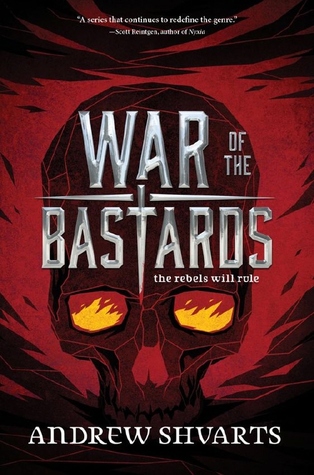
War of the Bastards Cover.jpg

Before I start talking about the series and why I want to read this book, can I just say how much I love this cover.  It is an incredibly eye-catching piece of artwork, and I think it matches the dark tone of this series extremely well.

The Royal Bastards is Shvarts’s debut series, and it follows the adventures of a group of rebellious teenagers as they attempt to save the fantasy nation of Noveris.  The series is told from the perspective of Tilla, the bastard daughter of a powerful western lord, whose life changes when she forms an unexpected friendship with the princess of Noveris, Lyriana.  In the first book in the series, Tilla finds out that her father, Lord Elric Kent, is plotting a rebellion against Lyriana’s father, and acts quickly to save Lyriana’s life.  In the second book, after escaping from the west, Tilla, Lyriana and Tilla’s love interest, Zell, arrive at the Lightspire, the capital of Noveris, and attempt to start new lives in the city.  However, the western forces, led by fellow royal bastard Miles Hampstedt, manage to enact a brutal takeover of the city utilising a powerful new form of magic.

To be honest, I have been really looking forward to this book for months, ever since I finished City of Bastards, the second book in the series.  City of Bastards had one hell of an ending, with the sudden and bloody death of the entire royal family and court, from which the protagonists were only just able to escape.  I also really enjoyed Shvarts’s writing style in the second book, and I hope that War of the Bastards is written in a similar manner, but potentially with a darker tone.  I am deeply intrigued to see where the story goes from here and I am already excited about the book’s awesome plot summary.

Goodreads Synopsis:

A year has passed since the fall of Lightspire. The Inquisitor Miles Hampstedt has usurped the throne and rules Noveris with a blood-soaked iron fist. Tilla and her friends have become hardened rebels in the Unbroken, a band of guerilla fighters hiding out in the fringes of the Kingdom. Tilla is plagued with doubt and regret; Lyriana struggles with the burdens of being a fugitive Queen; Zell atones for his guilt by killing for the cause. And even as they all fight, they know their cause is doomed, that with very passing day Miles’ power grows, his army of Bloodmages spreading to cover the continent.

Then a raid on an outpost produces two unexpected prisoners: Lord Elric Kent himself, now a prisoner obsessed with revenge, and Syan See, a strange girl from the Red Wastes. Tilla struggles with the emotional weight of confronting her father, but it’s Syan that offers the true revelation. She demonstrates a new incredible kind of magic, and speaks of a secret civilization hidden in isolation in the mysterious Wastes. With Miles’ forces closing in, Tilla and her friends (alongside a hostage Lord Kent) set out to make contact with Syan’s people, to make an pact that could turn the war. The journey will test their character, forge unlikely alliances, reveal the horrifying true nature of magic, and set in motion a battle that will determine the fate of Noveris itself.

There are quite a few amazing-sounding plot elements contained within this synopsis.  The year-long gap since the last book in the series is going to be extremely interesting, and I am looking forward to seeing the main characters evolve once again into hardened resistance fighters after all the betrayals of the second book.  A hopeless fight against impossible odds followed by a dangerous quest for lost magic is always a winning story combination in my book, and I will look forward to seeing how Shvarts portrays this in War of the Bastards.  I believe that this will be the final book in this series, so I am expecting some massive twists and possibly one or two major character deaths to round out the story.

One of the best things about City of Bastards was Shvarts’s examination of the emotional trauma and damage experienced by the protagonists following their adventures in the first book.  The synopsis seems to support that this interesting inclusion will be a major feature of War of the Bastards, and after the events of the second book, you have to imagine that the trauma and guilt that each character will be experiencing is going to be amplified even further.  Tilla will no doubt feel guilty about the terrible things her father has made possible, and the impacts it has had on her friends.  Zell, whose actions in the second book partially led to the bloody coup, is also going to have massive regrets.  I also expect that Lyriana is going to be suffering quite a lot in this book.  She already experienced severe survivor’s guilt in the second book following the death of her love interest, Tilla’s half-brother Jax, and now with most of her family killed, this is likely to be amplified by a significant degree.  I am also curious to see what will happen to side-character Ellarion in this book.  Ellarion is Lyriana’s cousin and he inherited the role of Royal Archmagus following the murder of the previous Royal Archmagus in the first book.  As he avoided most of the trauma in the first book, he was one of the more buoyant characters in City of Bastards.  However, at the end of the book, his attempted to shield his friends from a massive magical explosion and lost his hands as a result.  I am very curious to see how Ellarion is portrayed in this final book, as not only has he lost most of his family like Lyriana but the loss of hands will also be extremely devastating to him, not just because of their physical use but because it will have a negative impact on his magical ability.

I have a feeling that Tilla’s character relationships will be a key part of War of the Bastards, and I am looking forward to seeing what happens when she is forced to team up with her father.  The two characters have always had a complex relationship due to Tilla’s status as a bastard, but following all the revelations of the first two books, I think that their relationship in this book will be incredibly dramatic.  I am also curious to see how Tilla’s love angle with Zell goes.  Despite coming together in the first book, their time in Lightspire really affected their relationship, as the two lied to each other.  I imagine that they will get back together in this final book, but we will have to see what happens (especially as Zell is the main character most likely to die in my opinion).  I am also expecting an appearance from antagonist Miles Hampstedt in this book.  Miles was once a friend of Tilla, but his extreme jealousy after she chose Zell over him resulted in him betraying the group.  Since then he has taken control of the west and the entirety of Noveris with complete dominance over the blood mages.  No doubt, he will appear at some point, portray himself as the victim because Tilla did not choose him and be an extra despicable villain as a result.

I have a strong feeling that War of the Bastards will be an amazing and thrilling piece of fantasy fiction, and I am really looking forward to getting my hands on this book.  Shvarts is an exceptional new fantasy author, and I have high hopes that he will do an outstanding job with this final book in the Royal Bastards series.

The Raven Tower by Ann Leckie

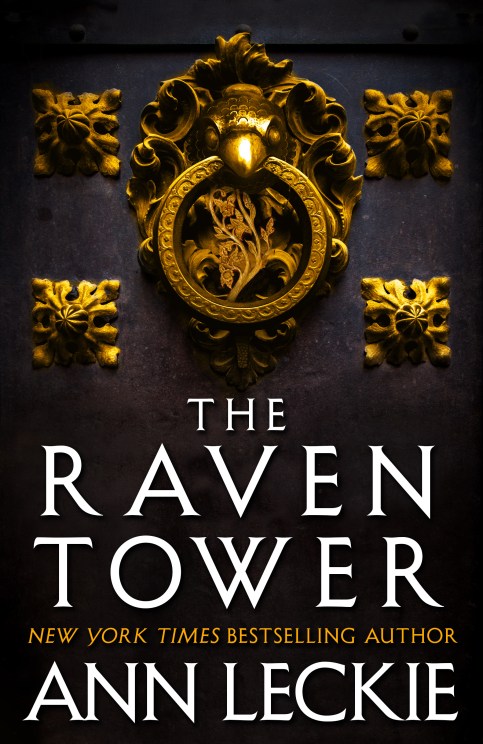
The Raven Tower Cover

Publishers: Orbit and Hachette Audio (Audiobook Format – 26 February 2019)

Series: Standalone/Book 1

Length: 12 hours and 1 Minute

My Rating: 4.25 out of 5 Stars

Amazon     Book Depository

The bestselling author of the Imperial Radch series, Ann Leckie, presents her first foray into fantasy fiction with The Raven Tower, an intriguing fantasy read that I have been looking forward to for a while, and which attempts something new and different in its presentation.

The Raven Tower is set in a world filled with gods whose power and abilities can be gifted to humans in exchange for worship and offerings.  For centuries, a powerful god known as the Raven has ruled over the rich kingdom of Iraden, offering protection and prosperity from atop a tower in the city of Vastai.  The human ruler of all of Iraden is known as the Raven’s Lease and has been chosen by the Raven to bear his power and enact the god’s will.  However, this power comes at a price, as each Lease must sacrifice himself to the Raven in order to keep the god strong and Iraden safe.

When Eolo and his lord, Mawat, heir to the Raven’s Lease, return to Vastai, they find the city in chaos.  Mawat’s father, the former Lease, went missing just before he was required to pay the Raven’s price.  In his place, Mawat’s uncle, Hibal, has taken the throne and has been named the new Raven’s Lease.  Determined to find out what happened to the former Lease and reclaim the throne for his master, Eolo attempts to uncover the many secrets of Vastai.  But as Eolo investigates he discovers that something ancient and mysterious is concealed within the Raven’s Tower: a secret from Iraden’s past that the Raven has kept hidden for centuries.  It is clear there will be a reckoning, but is Eolo ready to pay the price?

To be honest, I found that The Raven Tower was a very challenging book to critically examine and assign an overall rating for.  Before I had even started reading it, I saw that a number of other reviewers had noted that had great difficulty with this book, mainly due to the author’s unique way of narrating the story.  As a result, I chose to listen to the audiobook version of The Raven Tower, narrated by Adjoa Andoh, in the hopes that this would make it easier for me to follow along.  The audiobook version of the book is around 12 hours long, and I managed to get through it in around a week.  While I did also experience some issues with the way the book was set out, I actually began to appreciate this unique format the more that I stuck with the story, and this turned out to be a really enjoyable piece of fantasy fiction.

For this book, Leckie chose to utilise a noticeably different second person limited narration format to tell her story.  The story is told by a god known as the Strength and Patience of the Hill, who not only tells the main story in Vastai, specifically focusing on the character Eolo, but who also describes all the events of its own life that led up to this period of time.  This god has a very unique way of speaking that impacts how the Vastai story is told.  In particular, the god constantly describes what Eolo is doing, but, at the same time, it has no idea of what is going on inside Eolo’s head.  As a result, it makes very generic statements and guesses about Eolo’s memories, state of mind or thought process.  Take for example the following line, said as Eolo explores the docks near the tower: “I don’t think you grew up near the sea, and so you likely knew very little about boats or tides.”  Having this being make guesses about the protagonist’s thoughts or feelings is a little unusual, and I was very confused about why the author had written her book this way, and for a large portion of the book I really thought that it would have made more sense to have a more traditional narrator system.  However, as I read deeper into the story, it became a whole lot clearer why Leckie had set her story out in this way, and I was able to really appreciate it use.

As the book progresses, the two halves of the story start to come together.  Taken separately, both parts of the story are fairly interesting.  The storyline focusing on Eolo and the mystery surrounding the Raven’s Lease is fairly intriguing mystery filled with politics, murder, mystery and the fate of an entire nation.  The second storyline, which looks at the backstory of the Strength and Patience of the Hill, helps build up Leckie’s new world while also explaining much about the book’s primary fantasy element, the gods, as well as the Raven’s rise to power.  While both these storylines are quite fascinating in their own right, when they start coming together in the later part of the book, it creates a much more complete and intense story.  The author’s use of the Strength and Patience of the Hill as the book’s primary narrator becomes a lot clearer, and I actually really liked how this unconventional narration was utilised.  I also really enjoyed the fantastic twists that occurred at the end of the book, and the author’s excellent lead-up to these events was really quite clever and subtle.  Overall, this turned into quite an amazing story, and I was very glad that I stuck with it and got all the way through.

One of the main things that I enjoyed about The Raven Tower was the interesting fantasy elements that Leckie utilised throughout her story, mostly shown in the form of the gods that inhabit this world.  The gods in this book are quite an interesting creation from Leckie, who has come up with a number of rules surrounding them, all of which is explored by the narrator.  In this world, the gods have a finite amount of power, which they gain from worship and which they lose by altering the world, either for their own benefit or in order to answer prayers.  The gods’ power is tied to their speech; anything they say as a fact, their power will act to make it so.  For example, if they say that an object will turn, then their powers will act to make it turn.  However, if the action they want to accomplish takes more power than they have access to, then they will die or become extremely weak.  As a result, the gods are forced to speak extremely carefully, lest they inadvertently make a command that will take way too much energy.  The gods, therefore, try to avoid absolutes in their conversations and have to use words such as “I think” or “I heard” to get around this.  Leckie consequently has to have her narrator, the Strength and Patience of the Hill, utilise this language throughout the entire book, as to the god addresses the main character Eolo (even if Eolo does not hear them).  That is why there are so many unusual language choices throughout the book, such as the recurring “Here is a story that I have heard”.  While these language choices did throw me at first, once I understood why it was happening, I got used it and I thought it was extremely creative and commendable that the author stuck with this throughout the entire story.

In addition to this use of language, Leckie spends considerable time exploring the limitations and abilities of the gods throughout her book.  Leckie uses all sorts of different narrative devices to showcase this, from the Strength and Patience of the Hill’s personal memories and experiments, conversations they have with other gods, as well as telling stories about other gods and how they utilise their powers (there is one particularly amusing story about a god-powered spear I liked).  It is clear that the author put a lot of thought into her universe’s gods and the abilities that they have, and the exploration of these ideas were some of my favourite parts of the book.  I was also extremely impressed with how Leckie was able to utilise these fantasy ideas so effectively in her story, and I liked the bearing that they had on both the plot and the way the book was written.

Another interesting aspect of The Raven Tower is the characters that the author has used within the story.  The main protagonist is Eolo, whose attempts to get to the bottom of the mysterious events in Vastai are a large focus in the book.  Eolo is a pretty boss protagonist, able to disguise his intelligence and cunning behind an ignorant peasant facade, while quickly unravelling what has occurred in the city and then playing the politics to get the best result for her master.  Eolo is actually a transgender character, and I was really impressed with how well-written this part of the character’s identity was, and with how it was explored within the book.  In addition to Eolo, there are also several other intriguing characters used throughout the book.  Once you get the hang of its speech pattern, the Strength and Patience of the Hill is a pretty good narrator, and I found the god’s backstory and way of seeing the world to be incredibly intriguing.  I quite liked the character of Tikaz, who serves as one of the main female characters in the book, as well as Eolo’s potential love interest.  Tikaz is fleshed out incredibly well, and I loved the various interactions that she has with Eolo.  The book’s main villain, Hibal, is suitably evil and conniving, and he even has a pair of creepy twins serving as his henchmen.

I need to point out the fantastic job Leckie did coming up with one of the main characters in the book, Mawat.  Mawat is the heir to the Raven’s Lease, who finds his position usurped by his uncle.  However, rather than write him as a noble character we are supposed to feel sympathy for, Mawat immediately has a temper tantrum and spends the rest of the book acting as an unreasonable child, completely ignoring Eolo’s advice and even attacking his loyal servant whenever he hears something he does not like.  While a large amount of this is necessary for the story, I liked the reversal of the noble disenfranchised heir trope that is often utilised in fantasy, and instead we are left with a more complex character.

I quite liked the audiobook format of The Raven Tower and found it to be a really great way to enjoy this book.  I definitely think it helped me follow the plot and navigate the different narrative devices of this book, and I absorbed more information about Leckie’s fantasy elements.  I quite enjoyed Adjoa Andoh’s narration throughout the book and thought their voice was perfect for the mysterious and wise Strength and Patience of the Hill, who narrated most of the text.  I especially liked how Andoh was able convey the Strength and Patience of the Hill’s anger at certain key points of the book and to make the god’s voice quite menacing.  Apart from the Strength and Patience of the Hill, the other character voices throughout The Raven Tower were fairly distinctive and matched the personalities of the characters quite well.  I was especially fond of the fitting accents she assigned to some of the human characters, such as Tikaz or the god known as the Myriad.  Overall, I would strongly recommend that readers check out the audiobook format of The Raven Tower, as it may prove to be an easier way to enjoy this intricate story.

As I mentioned above, I had a hard time giving this book an overall rating.  When I first started reading it and I encountered the strange narration style for the first section of the book, I thought I might have to give it a low score.  However, once I started to get more into the story and the lore behind the gods of this world was explained in some detail, I ended up changing my score to something closer to 4 out of 5 stars.  This reflected my appreciation of Leckie’s inventiveness, but also had a few demerits due to the slow start and issues I had getting into the story.  However, I ended up changing this to a 4.25 out of 5 stars in the end, once I appreciated how the two separate storylines came together and that superb ending.  As a result, I would highly recommend The Raven Tower to fantasy readers, and I encourage people to see past the issues at the start of the book.  Leckie is an outstanding author, and her first foray into fantasy featured some unique elements that turned The Raven Tower into one of the most distinctive and clever reads of 2019.  The Raven Tower works incredibly well as a stand-alone book, but if the author decides to return to this world in the future I would be extremely curious to see where she takes the story next.

Amazon     Book Depository

Reckoning of Fallen Gods by R. A. Salvatore

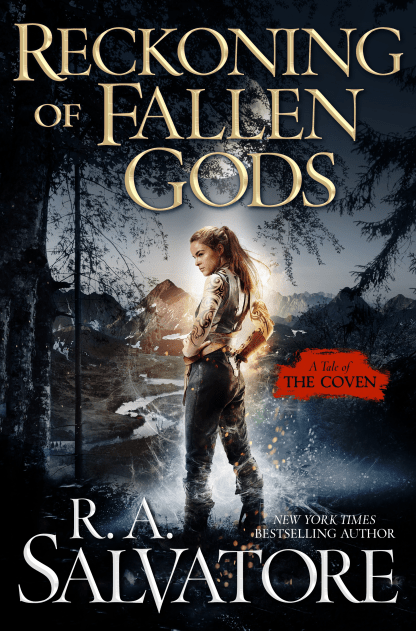
Reckoning of Fallen Gods Cover.png

Publishers: Tor Books and Audible Studios (Audiobook Format – 29 January 2019)

Series: The Coven – Book 2

Length: 14 hours 37 minutes

My Rating: 4.5 out of 5 stars

Amazon     Book Depository

Prepare to return to Corona, the world of The DemonWars Saga, for Reckoning of Fallen Gods, the latest book from master fantasy author R. A. Salvatore and the second book in his outstanding new The Coven series.

In the world of Corona, no lands are as harsh or unforgiving as those surrounding the massive Loch Beag.  All manner of dangerous creatures live in and around the loch, including one massive and unseen lake monster that lurks right below the surface.  But for those who live in the fishing villages that eke out a living around the shore of Loch Beag, the biggest danger is more human in origin.  Living at the top of the massive mountain, Fireach Speur, is a barbaric tribe, the Uscar, who constantly raid the fishing villages below.  Enhanced in battle by the crystal magic of their witches, the Uscar are ferocious warriors who consider themselves vastly superior to the inhabitants of the villages they raid.

This cycle of violence and death existed for hundreds of years until a powerful young Uscar witch, Aoelyn, attempted to change her tribe’s ways by destroying the fossa, a demonic creature that haunted the mountain at night.  However, her decision will have terrible consequences, as ambitious members of her tribe turn against her.  As Aoelyn endures the wrath of her tribe, her friend, the slave Bahdlahn, attempts to escape from the Uscar with help from an unexpected ally.  Down at the shore of Loch Beag, the trader Talmadge, who Aoelyn saved from her tribe’s brutality the night she ended the fossa, attempts to find some sort of peace among the fishing villages who have accepted him as a friend.  However, the appearance of a mysterious stranger will bring significant changes to his life.

But while those living around Loch Beag fight among themselves, they are unaware of a much bigger threat growing in the East.  A lost empire of goblinoids, the Xoconai, are on the march, driven by the return of their fallen god.  The Xoconai are determined to conquer all the lands of man, and the first obstacle they must overcome is the people of Fireach Speur and Loch Beag.

R. A. Salvatore is one of the best and most prolific authors of fantasy fiction in the world today, having a written over 60 fantasy books in his career. He is perhaps best known for his work in the established Forgotten Realms universe and the incredibly popular character of Drizzt Do’Urden. However, Salvatore has also written a series of novel set within his own unique fantasy world of Corona.

Salvatore introduced audiences to this new fantasy world in his 1997 release, The Demon Awakens, the first book in his epic The DemonWars Saga, which spanned seven books between 1997 and 2003.  This universe was expanded out in 2004 with The Highwayman, the first book in his Saga of the First King series.  After the Saga of the First King series ended in 2010, Salvatore left the world of Corona untouched for eight years while primarily focusing on his Forgotten Realms series.  However, he returned to Corona in 2018 with Child of a Mad God, the first book in his new The Coven series.  The Coven series is primarily set in a previously unexplored area of Corona, in the lands around the massive Loch Beag, with the first book focusing on a whole new group of characters.

I am a massive fan of Salvatore’s work, having read nearly all the books featuring Drizzt Do’Urden and his companions (click here for my review of the latest Drizzt Do’Urden book Timeless).  However, before last year’s Child of a Mad God, I had not really gotten into his work set in Corona, having only really read The Highwayman back when it was first released in 2004.  While Child of a Mad God was not my favourite of Salvatore’s books, it did a great job introducing this new area of Corona, while also creating an excellent starting point for the series’ overall plotline.

I found that I enjoyed Reckoning of Fallen Gods a lot more than the first book in the series, possibly because the author was able to dive right in and continue several of the more intriguing plot threads from the first book.  I quite enjoyed how the story progressed; all of the storylines contained within were very well paced and entertaining, coming together extremely well towards the book’s conclusion.  I really liked the over-the-top way that the story ended, as it sets up the next book in the series with some massive stakes and makes full use of the intriguing new fantasy elements that were included within this book.  A bit of a warning about this series: is it substantially darker than some of Salvatore’s other works.  This was particularly true of the first book of The Coven series, Child of a Mad God, which contained a fair amount of torture and sexual violence.  While there is a little less sexual violence in this book, several character development elements are based around these original events and are discussed in some detail.  There is also some fairly dark and gruesome action and torture, which might not be enjoyable for some readers.  Overall, though, this is a great follow-up to Child of a Mad God that once again highlights Salvatore’s skill as a master fantasy storyteller.

Some readers may be wary about checking this book out because it is the second book in The Coven series and the 13th overall book set in the world of Corona.  However, I found that this book to be easily accessible to new readers, with the author ensuring that relevant details from the previous book and series were easy to understand and follow nearly right away.  In addition, there are also a lot of elements for established fans of this universe to enjoy, especially as Salvatore includes a substantial character from one of his previous Corona based series in this book.  The inclusion of this character is an excellent way to tie this new series with the author’s existing works in this fantasy universe, which also highlights the importance of this story to the rest of the world of Corona.  The ending of Reckoning of Fallen Gods also hints that characters and locations from the previous series may come into play in the next book in The Coven series.

I loved all the fantasy elements in this book.  The world of Corona is a fantastic setting for the great story that is taking shape within The Coven series.  The main location for most of this book’s plot, the lands around Loch Beag and Fireach Speur, is a substantially dark and rugged area with a large number of natural and unnatural threats.  In Reckoning of Fallen Gods, there are a number of significant developments around several of these locations and creatures, some of which are pretty insane.  Just like in the first book in this series, Child of a Mad God, Salvatore continues to expand on the intriguing gem-based magic that is a feature of the books set in Corona.  The gem magic that was featured in Child of Mad God was somewhat different from the already established gem magic used in some of previous Corona books, such as The DemonWar Saga, and is based around the magic found atop Fireach Speur.  This expansion of the gem magic continues in Reckoning of Fallen Gods with the main character, Aoelyn, developing additional magical abilities.  Many of these abilities are quite spectacular, and Salvatore’s enthralling writing highlights how impressive these abilities are when Aoelyn utilises them in fights or other magical engagements.  At the same time, another character utilises some of the more traditional gemstone powers they had in one of the previous series, and it is interesting to see the differences and similarities this has with the Uscar magic.

One of the more unique and enjoyable fantasy inclusions within Reckoning of a Fallen God is the new antagonist race, the Xocanai.  The Xocanai are a new race of goblinoid creatures that exist in a realm on the other side of the mountains surrounding Fireach Speur.  The Xocanai are somewhat Aztecan in culture and their empire has been rather cut off from the rest of the world for some time.  However, recent actions have allowed them to come together to invade the human lands, and some of the events of Child of a Mad God may be to blame.  I felt that Salvatore did an excellent job of introducing them in the current book, and he was able to build them up as a substantial antagonist in quite short order.  I liked how the reader is able to get a good view of this new race’s culture and religion in only a few short chapters, while in-universe texts present at the start of each section of the book help to establish a historical past for these creatures.  In the end, they are a fantastic new inclusion to the series and the universe and serve as excellent new antagonists.

Salvatore has created some great new characters for this series, and many of the key characters who were introduced in the first book go through some significant and compelling character development throughout Reckoning of Fallen Gods.  The main character development occurs with Aoelyn, who, after the fallout of the events in the first book, develops a stronger sense of independence and rejects the established male hierarchy imposed upon her and all the female members of her tribe.  Her friend Bahdlahn gains the courage to finally flee the Uscar and is finally able to come to terms with his feelings for Aoelyn.  At the same time, the trader Talmadge comes to terms with the tragedies in his life and is finally able to find some semblance of peace with the people living around Loch Beag.  Even the established character from the previous series (who I am still not mentioning for spoiler reasons) has developed somewhat in this book, as he ruminates on the mistakes from his past that were covered in the previous series.

I have to give credit to Salvatore for creating some truly villainous antagonists for this series, especially among the Uscar characters.  The main antagonists are quite despicable, especially in the way that they deal with Aoelyn and Bahdlahn, and the reader is hoping for all sorts of comeuppance for these characters.  Even the Uscar characters that come across as more compassionate members of the tribe can still be quite dislikeable.  For example, there is one character who appears to change his ways in Reckoning of Fallen Gods.  However, he has a sudden and quite unjustified change of heart back to the Uscar ways towards the end of the book, and his complaining about the event that drove him to betray his friends really does not endear him to the reader.  These great antagonists serve as spectacular foils to the protagonists and really add a lot to the overall story.

I chose to listen to the audiobook version of Reckoning of Fallen Gods, narrated by Tim Gerard Reynolds.  This was an interesting change of pace for me, as I had read the physical copy of the first book in The Coven series, so it was cool to hear these characters come to life in the audiobook format.  At 14 hours and 37 minutes, this was not the longest audiobook I have listened to recently, but it still required a little bit of time to get through.  Reynolds is a spectacular narrator, and I really enjoyed listening to him tell this story.  His base narration voice for this book was really good, and I found I was able to absorb a lot of the story through his great narration.  The character voices he came up with were also excellent, and I loved how the distinctive cultural/species groups within Reckoning of Fallen Gods got their own accents.  For example, he ensured that the Uscar characters had a form of Scottish accent, while the other groups that feature in the book, such as the Xocani have a noticeably different way of speaking.  Because of this excellent voice work, I had a lot of fun listening to this book, and I will make sure to get the audiobook versions of this series in the future.

Fantasy icon R. A. Salvatore is in high form once again with Reckoning of Fallen Gods, the second book in his new The Coven series.  Salvatore does an outstanding job continuing the intriguing story he started in the first book of the series, Child of a Mad God, and effortlessly inserts a number of original and familiar elements to create an exciting and epic read.  With some great characters and some inventive new ideas, this is a spectacular new addition to this darker fantasy adventure series.

Amazon     Book Depository

Waiting on Wednesday – The Kremlin Strike and Red Metal

Welcome to my weekly segment, Waiting on Wednesday, where I look at upcoming books that I am planning to order and review in the next few months and which I think I will really enjoy.  Stay tuned to see reviews of these books when I get a copy of them.

In this week’s instalment of Waiting on Wednesday, get ready to fight the Ruskies in the Third World War with two upcoming novels that sound like they will be action-packed thrill rides which I am very much looking forward to.  Now, usually military thrillers are not within my usual wheel house, unless there is some historical, fantasy or science fiction element to them.  However, in the last year, I have gone out of my way to read a few of these books, such as Red War by Kyle Mills (based on the series by Vince Flynn) and The Moscow Offensive by Dale Brown, both of which had outrageous plots that deeply appealed to me.  These books turned out to be really awesome, and I had a real blast reading and reviewing them.  I loved the extreme action, the intriguing considerations these authors had put into planning out conflict between modern day countries as well as the interesting use of Russia as America’s main antagonist once again.  While they are somewhat over the top, these books were awfully fun, and I am now very keen to check out some more military thrillers as I know I will really enjoy them.

As luck would have it, two extremely entertaining-sounding military thrillers are coming out in the next couple of months, and I am really looking forward to both of them.  The first of these books is The Kremlin Strike by Dale Brown.  It will be the 23rd book in the author’s Patrick McLanahan series and is set to be released in May 2019 (although it will probably have a later release date in Australia).

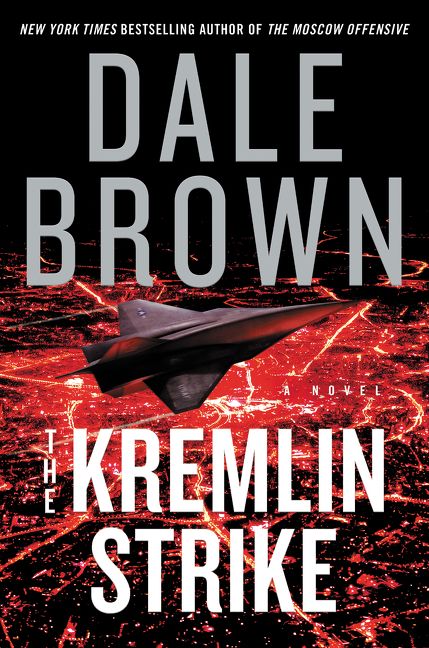
The Kremlin Strike Cover.jpg

In this exciting, visionary, and all-too-plausible next chapter in the legendary Dale Brown’s New York Times bestselling techno-warfare series, Brad McLanahan and the Iron Wolf Squadron must fight the Russians on a dangerous, untested battlefield: outer space.

The previous administration’s ineffective response to the growing Russian threat has left America vulnerable. Setting a bold course for America’s defense, the decisive and strong new president, John Dalton Farrell, intends to challenge Russian aggression head on. Brad and Patrick McLanahan and the formidable Iron Wolf Squadron—including the recently injured Nadia Roz, rested and back to fighting form thanks to a pair of state-of-the-art prosthetic legs—are ready and eager to join the battle.

But even with their combined forces, the Russian menace may prove too great for the Americans to overcome. Done with provocative skirmishes and playing for small stakes, the Russian president has set his sights on the ultimate prize: controlling the entire world. Expanding beyond earth’s bounds, the Russians have built a new high-tech space station and armed it with weaponry capable of destroying US satellites as well as powerful missiles pointed at strategic targets across earth.

Devising a cunning plan of attack, Brad, Nadia, and the Iron Wolf warriors will take to the skies in their advanced space planes to destroy the space station, check the Russians’ plan for dominance, and save the world. But is it already too late?

As I mentioned above, I had a lot of fun reading the previous book in the Patrick McLanahan series, especially as it featured America and Russia going to war with advanced piloted robots.  Honestly, I found The Moscow Offensive to be one of the most entertaining books of 2018 and I have high hopes for this next book.  I am especially excited as it sounds like The Kremlin Strike will be just as fun, as the author once again takes the battle into space.  A war in space has a lot of entertainment potential and I am curious to see how Brown will utilise this unique environment in his story.

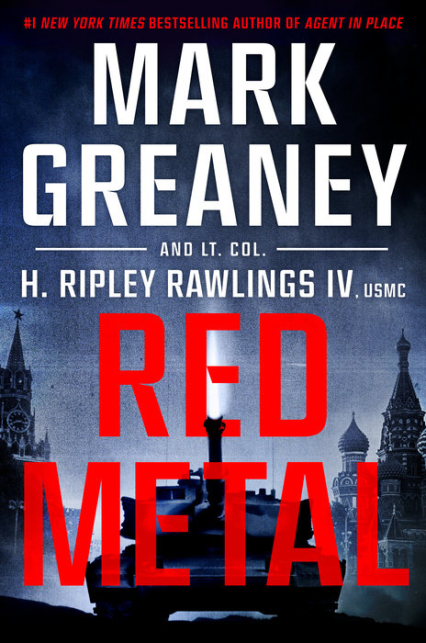
The second book that I am looking forward to in this article is Red Metal by Mark Greaney and Lt. Col Hunter Ripley Rawlings (USMC), set to be released in July 2019.

Red Metal Cover.png

A desperate Kremlin takes advantage of a military crisis in Asia to simultaneously strike into Western Europe and invade east Africa in a bid to occupy three Rare Earth mineral mines that will give Russia unprecedented control for generations over the world’s hi-tech sector.

Pitted against the Russians are a Marine lieutenant colonel pulled out of a cushy job at the Pentagon and thrown into the fray in Africa, a French Special Forces captain and his intelligence operative father, a young Polish female partisan fighter, an A-10 Warthog pilot, and the captain of an American tank platoon who, along with a German sergeant, fight from behind enemy lines in Germany all the way into Russia.

From a daring MiG attack on American satellites, through land and air battles in all theatres, naval battles in the Arabian sea, and small unit fighting down to the hand-to-hand level in the jungle, Russia’s forces battle to either take the mines or detonate a nuclear device to prevent the West from exploiting them.

I only came across Greaney’s thriller work quite recently, when I read and reviewed the latest book in his Gray Man series, Mission Critical.  I quite enjoyed his spy thriller work and I am extremely intrigued to see how he will go with this different thriller subgenre, although his experience writing Tom Clancy novels will no doubt prove invaluable.  I am also very curious to see how Greaney will go writing with his new co-author, especially as Rawlings brings some significant real-life military knowledge and experience to the table.

From the details above, Red Metal appears to be a standalone novel (although I imagine sequels will follow if this one is successful) that will follow the events of a future World War III in a large-scale story that goes for just over 600 pages.  I am really looking forward to reading a novel that completely chronicles a total war occurring around the globe, and I am very eager to see how it will turn out, especially because I am sure all sorts of cool technology or massive battles will come into play.  I am very excited about the range of characters described in the plot summary, as it looks like the authors will split the story between the various theatres of war that occur throughout the book.  I also like that many of the characters are European in origin; it will be very interesting to see how all these different nations come together and fight this war.  The example battles that are listed at the end of the plot synopsis also sound particularly thrilling, and the sheer range of different action sequences that could result out of these have so much potential.

Both of these upcoming military thrillers sound like they will be extremely exciting, and I am already very confident that I will have one hell of a good time reading them.  Onwards to war!

Cold Iron by Miles Cameron

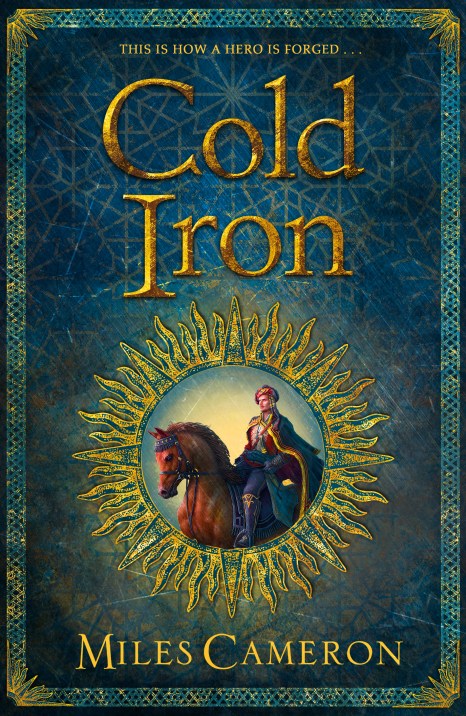
Cold Iron Cover 1.jpg

Publisher: Hachette Audio (Audiobook Format – 30 August 2018

Series: Masters & Mages – Book 1

Length: 19 hours, 29 minutes

My Rating: 5 out of 5 stars

Amazon     Book Depository

I recently managed to read one of the books that was featured in my Top Ten Books I Wish I Had Read In 2018 list.  I have to say I was quite impressed with this book, Cold Iron by Miles Cameron, as it is one of last year’s most intriguing fantasy reads.

Miles Cameron is the pseudonym historical fiction author Christian Cameron uses when he writes fantasy novels.  Cameron debuted in 1999 with Rules of Engagement, the first book in the seven-book long Alan Craik thriller series, which he wrote with his father, Kenneth Cameron, under the joint pseudonym of Gordon Kent.  In addition to this joint series, Cameron started writing his own novels in 2003 when he wrote his first historical fiction novel, Washington and Caesar.  Since then, Cameron has written over 15 historical fiction novels, including the multiple books in his Tyrant, Long War and Chivalry series.  In 2013, Cameron branched off again into a new genre, fantasy, with his five-book long Traitor Son Cycle, which he wrote as Miles Cameron.  Cold Iron is the first book in his brand-new fantasy series, called the Masters & Mages series.

I am mostly familiar with Cameron through his historical fiction works, having read and reviewed a couple of books in his Tyrant and Long War series early in my career.  I particularly enjoyed the first book in his Long War series, Killer of Men, which set a young protagonist from Plataea on an adventure across ancient Greece and Persia.  Unfortunately, I failed to get any of Cameron’s books in the intervening years and was completely unaware that he had written any fantasy books.  So when I came across Cold Iron and recognised the author, I was deeply intrigued and thought it would be an interesting book to check out, especially as it had been receiving some great reviews.  After mentioning it in one of my Top Ten lists, I decided to check out the audiobook version of this book a few weeks ago.  I was especially keen to check it out as the second book in the Masters & Mages series, Dark Forge, has recently been released, although it looks like this second book will be released in a number of different formats throughout the year.

Cold Iron follows Aranthur Timos, a young student at The Academy, a prestigious institute of magic, science and other scholarly pursuits that lies at the heart of a mighty empire.  Aranthur, a poor farmer’s son, is not the best student at The Academy, and aside from some slight skill with the sword, nothing sets him apart from any of the other students.  But fate has something special in store for Aranthur.  Travelling back to his family farm for the holidays, Aranthur stops at a small inn.  When bandits attack the owners of the inn, Aranthur steps in to try and help, and in doing so sets a momentous series of events into play.  His actions that night inadvertently place him in the middle of a vast and terrible conspiracy, as he comes to the attention of the inn’s other guests, including a powerful priest, a master swordsman, a young gentleman spy and an enigmatic and dangerous beauty.

After returning to The Academy, the results of Aranthur’s actions at the inn indirectly introduce him to a number of new friends that help him excel at his studies.  But a series of chaotic events are occurring across the lands.  The city surrounding The Academy is in turmoil, as factions and noble houses fight against each other.  Worse, refugees are flooding in from lands to the east, driven out of their homes by a group known as the Disciples, followers of a shadowy figure known as the Master, who seek to return the world to an ancient status quo where only the nobles have access to magic.  Despite being a simple student, Aranthur keeps finding himself in the centre of the momentous events sweeping the city.  Can Aranthur survive all the mysterious events occurring around him, and, if he does, what sort of person will he become?

I absolutely loved this book; it gets a well-deserved five stars from me.  Cold Iron is an extremely clever coming-of-age fantasy story set within an immensely detailed and inventive new world.  I have found with some of Cameron’s previous works, such as the books in his Chivalry series, that the author has a very particular writing style, such as his propensity to include large amounts of detail in his paragraphs and the utilisation of a somewhat more formal dialogue.  This style has always worked well with the author’s historical fiction work, and I felt that this writing style translated across well to this fantasy book.  It was reminiscent of some of the older classical fantasy stories, although with some more modern language.  This results in the book having a much more unique feel to it, which I found to be quite curious and actually helped draw me into the story.

The overall story of Cold Iron is quite an intriguing fantasy read that places its protagonists and point-of-view character in the centre of a worldwide conspiracy.  There are so many elements to this story to enjoy, including an excellent coming-of-age focus.  Throughout the course of the book, the protagonist, Aranthur, grows from a poor and insignificant student to a central figure in the fight for kingdoms and the freedom of magic.  The story is quite clever as it focuses on a character who, rather than being the dreaded “chosen one” fantasy trope, is instead thrust into events by accidentally being in a certain place at a certain time.  I really enjoyed how everything that happens to Aranthur throughout the book is the direct result of the one tavern fight at the start of the book, and he is drawn into the subsequent events or introduced to key characters through sheer coincidence.  The resultant conspiracy is deeply intriguing and ties in really well with Cameron’s excellent fantasy elements.  I am also a sucker for a storyline involving magical schooling or training, so I loved how this story was set within a magical university and focused quite a bit on the protagonist’s training.  All of these elements work together to produce an incredible overall narrative that I really enjoyed listening to.

For this new series, Cameron has come up with a fun and detailed fantasy world.  The Masters & Mages series is set in a sprawling world that features a number of diverse human nations.  Only a small part of this world is explored within this first book, although there are quite a number of references to nations outside of the central settings, and events occurring in these locations impact on the main story.  This world appears to be in a post-medieval point of its history, with early firearms starting to be utilised, although older technologies such as crossbows are still in use.  The setting comes across a bit like Italy or France during a similar time period, but with a magical edge to it that works quite well.  The main setting is a gigantic and rich city of canals and elaborate architecture that hosts The Academy, and this serves as a perfect location for the intriguing, conspiracy-laden fantasy story.  The city is filled with a huge number of factions, refugees and competing noble houses, creating quite a significant amount of internal political strife which plays into the story quite well.  There are also some examinations of some more rural areas within the world, and Cameron does a spectacular job of presenting the more down-to-earth folk that live in these locations.  The locations featured within this book were very well done and I look forward to seeing what new lands are explored in future books.

One of the most interesting things about the setting of the book was how several of the issues and plot points have some interesting parallels with modern issues.  For a bit of context, the world that the Masters & Mages series is set within a world where a historical revolution installed a series of reforms that granted magic and education to the lower classes.  Now even quite poor families have access to basic magic that cleanses water, helps create fires and heal people, resulting in a better class of life for the common people.  At the same time, women are able to attend classes at The Academy and learn magic and other skills.  The book’s antagonists are determined to reverse these reforms and return magic to the rich and the nobles and ensure women have no more power.  This has resulted in a number of invasions and wars that have resulted in a huge number of refugees entering the city and other locations, much to dismay of the city’s rich and powerful.  I found the motivations of the antagonists to be very interesting, and it is easy to see some real-life parallels.  Intolerance towards refugees is a major issue at the moment, and it is deeply fascinating to see this reflected in a work of fantasy fiction.  In addition, the book featured quite a lot of intolerance towards people of certain nationalities, including the protagonist’s nationality.

Highlights of Cold Iron the spectacular action sequences that occur throughout the book.  There are a substantial number of fight scenes throughout the book, featuring magic, firearms, crossbows and swordplay.  All of these action elements are pretty impressive, and I especially love some of the larger sequences, where all the above methods of combat are being utilised by both sides.  For the most part, only some basic magical techniques are used within fights, which while intriguing, do not result in any eye-popping scenes.  However, there is one sequence where two powerful magic users fight in front of the protagonist, and he sees the destructive potential of their respective magic abilities.  Without a doubt, the most amazing action element is the swordplay.  There is quite a focus on swords throughout the book as the protagonist spends a large amount of time learning and training with them before using them in a number of duals and fights.  Cameron’s insane attention to detail and incredible knowledge of sword fighting makes these scenes absolutely incredible and produce some amazing fight sequences that feel extremely realistic.  These sword fight scenes are some of the best parts of this book and I really enjoyed having them narrated to me.

I had a lot of fun with several of the characters in this book.  The main character, Aranthur, is a pretty good protagonist who goes through some substantial character development in this book.  Not only does he grow to appreciate different points of view and increase his abilities as a warrior and scholar but he actually learns from his mistakes, although in some cases, such as when it comes to learning about women, it takes a little too long.  The other characters featured within Cold Iron are an interesting group.  My favourites include Ansu, a noble from another land who brings some amusing cultural differences; Tiy Draco, a gentleman spy with unclear allegiances; and Dahlia, the feisty warrior student who highlights the abilities and determination of the female students in The Academy.  My favourite character, however, had to be Sasan, the sarcastic and fatalistic refugee and drug addict who Aranthur attempts to help.  Sasan has some of the best lines in the entire book, and his exclamations and actions when under the effect of an enhancement spell were really funny.  Each of these characters is a lot of fun, and I will be intrigued to see what future development awaits them.

I listened to Cold Iron’s audiobook format, narrated by Mark Meadows, and I had a good time listening to this book.  Clocking in at around 19 and a half hours, this is a fairly long audiobook; however, I found myself really drawn into the story, so I was able to get through it fairly quickly.  I personally thought that the audiobook format was the best way to enjoy this book due to the huge amount of detail and worldbuilding that went into this story.  I was able to focus on all the details a hell of a lot more by listening to them, and I think this helped me follow the plot with a lot less confusion.  Cold Iron’s action sequences are particularly good when narrated, and I found that the intense and elaborate sword sequences were really enhanced by this format.  Mark Meadows does a fantastic job of narrating Cold Iron and I really appreciated his work in bringing the story to life.  I felt that the voice Meadows used for the narration of Cold Iron was very appropriate, and I liked listening to all the descriptions and actions that Cameron had inserted into his story.  Meadows also came up with a range of unique voices for his various characters, each of which did a great job of conveying the character’s emotions and personality.  Part of the reason why I liked the character of Sasan so much was because of the voice that Meadows created for him and used to exclaim some of his best lines.  Overall, I would strongly recommend that readers interested in checking out Cold Iron should try its audiobook format, and I was quite glad that I did.

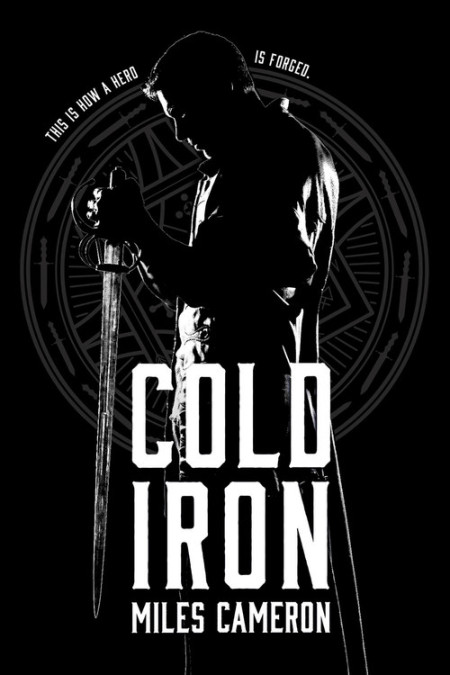
Before I wrap up, I just wanted to make a quick comment on Cold Iron’s cover art.  Cold Iron has two separate covers: the one I have included at the top of this review, and the one I have placed below.  I loved both of these covers individually, and I felt that they contrasted with each other quite nicely.  The first cover is very classy and really exudes an old-school fantasy vibe, which I think represents Cameron’s storytelling style quite well.  However, I did enjoy the more modern look of the second cover, and I really enjoyed the artist’s use of the simple, but effective black and white colour scheme.  Both are very impressive, and I have to say that the artists did a fantastic job with both of them.

I was very impressed by my first foray into Cameron’s fantasy writings.  Cold Iron is an exceptional piece of fantasy fiction and an easy five stars from me.  This book’s story was incredibly well written and contained a very compelling plot filled with wide-reaching conspiracies, magic and excellent characters.  Set in a brilliant new fantasy world, Cold Iron is an excellent start to the Masters & Mages series and sets it up as a fantasy series to watch out for.  Some paperback versions of the second book in the series, Dark Forge, came out a short while ago, and I am tempted to order a copy in.  However, I may wait until September, when the audiobook version is released, as I found this was a great way to enjoy the first book.  Cold Iron is an outstanding read, and I am really glad I went back and checked out this excellent 2018 release.

Cold Iron Cover 2.jpg

Amazon     Book Depository

Firefly: Big Damn Hero by James Lovegrove and Nancy Holder

Firefly Big Damn Hero Cover.png

Publisher: Titan Books (Hardcover edition – 20 November 2018)

Series: Firefly

Length: 334 pages

My Rating: 4.25 out of 5 stars

Amazon     Book Depository

Ready for something shiny? Serenity flies again in this fantastic new Firefly tie-in novel that takes the reader back to the original television series and reunites the crew of your favourite spaceship for another amazing adventure.

Firefly, for those people unfamiliar with it, was a science fiction television show that ran for one season back in 2002-03.  Created by Joss Whedon of Buffy the Vampire Slayer, Angel and The Avengers movie fame, Firefly is widely regarded as one of the best science fiction television shows of all time.  Featuring a fun group of main characters all played by amazing actors, this western-themed epic in space had some extremely clever and well-written storylines and an outstanding core concept.  Unfortunately, the show was cancelled after only one season (clearly the evillest thing that anyone at Fox has ever done), although it gained cult status after it was released on DVD.  Its post-airing popularity allowed Whedon to create the movie, Serenity, which closed one of the show’s major storylines, while also taking out a couple of major characters (I am still upset about one of those, he was a leaf on the wind, god damn it).  Following the movie, the Firefly universe has mostly continued in the form of several different comic books, usually created with Whedon’s direct input as either a writer or producer.  Do not be surprised if I review several of these Firefly/Serenity comics in the future, either as part of my Throwback Thursday series or when I review the collected edition of the current ongoing Firefly series.

If my notations above did not give it away, I am a huge fan of the Firefly franchise (and generally anything written/created by Joss Whedon), so I was always going to love this novel.  However, all prior biases aside, I found that Big Damn Hero was an excellent tie-in novel, and I powered through this book in extremely short order.

Big Damn Hero is written by James Lovegrove with bestselling author Nancy Holder (author of nearly 20 Buffy the Vampire Slayer tie-in books) credited as coming up with the original story concept.  Joss Whedon is also acknowledged as the original creator of the Firefly universe and is credited as a consulting editor.  Lovegrove is a veteran writer who has published a number of books since his 1990 debut, The Hope.  Readers may be familiar with his long-running Pantheon series, his recent work on the 2011 Sherlock Holmes series or the three books he has currently written for his The Cthulhu Casebooks series, which also features Sherlock Holmes.  Big Damn Hero is the first novel in a new Firefly tie-in trilogy from Titan Books which brings fans a completely new set of Firefly adventures.  Two additional books are set to be released later this year, with The Magnificent Nine coming out in March and Generations being published in October.

The Firefly franchise is set approximately in the year 2517, where humanity has expanded out into a new star system and terraformed a number of planets and moons.  The central planets were fully terraformed and heavily populated, while the outer planets and moons are more rugged, desert-like and with smaller populations.  The television series is set six years after the end of a brutal war between the Union of Allied Planets (the Alliance) and the Independents (also known as the Browncoats, a name also given to the fans of the franchise), which saw the Alliance gain complete control of the star system.

The show and associated media follow the adventures of the crew of the Firefly-class spaceship Serenity as they travel across the system participating in a variety of illegal or barely legal jobs.  The ship is captained by Malcom “Mal” Reynolds, a former sergeant in the Independent army who named the Serenity after the bloodiest battle in the entire war.  Joining him are former Independent army corporal and second in command of the ship Zoe; Zoe’s husband and Serenity’s pilot Wash; mercenary Jayne; ship’s mechanic Kayle; companion Inara; Shepherd Book; and the fugitive siblings Simon and River Tam.  Most of the crew’s adventures in the show followed their various jobs, personal stories and a particular focus on the events surrounding the Tam siblings becoming fugitives.

Big Damn Hero is set a few weeks after the events of the television show’s 12th episode, The Message, and starts the same way most Firefly adventures start, with the crew taking on a new job.  Initially contracted to transport volatile explosives off Persephone for their regular booker, crime lord Badger, the crew decide to take on some additional cargo from a mysterious new contact.  However, the meet turns out to be a trap and Mal is kidnapped and taken off-world.

With the explosives nearing a point of instability, the rest of Serenity’s crew is forced to leave Persephone to continue their original contract.  With only limited leads and the Alliance on their tail, the crew split up in order to locate their captain and maintain the safety of the ship.  Meanwhile, Mal awakens to find that he has been kidnapped by a squad of former Browncoats who are fanatically hunting down former members of the Independent army who they deem responsible for the Independents’ defeat in the war.  Mal has been named a traitor and a coward by old friend from before the war and must now defend himself in an impromptu trial.  As secrets from Mal’s past are brought to the surface, he finds himself at the mercy of a frenzied mob of former friends and comrades demanding his blood.  Can the crew of the Serenity save him, or will Mal pay for his past sins?

Perhaps the best praise I could heap on this book is that I very easily saw this story as a new episode of the show.  Like several of Firefly’s episodes, Big Damn Hero contains a compelling story that is split between the current adventures while also examining the past of one of its characters, in this case Mal.  This exploration into the past then comes into play for the main adventure, as it not only shows the reader events that were formative in Mal’s current character but also explains the actions of the book’s antagonists.  I felt that the plot of Big Damn Hero was a bit of an homage to the show’s fifth episode, Safe, as there were a number of similarities.  Safe was also interspersed with character flashbacks and the main plot of that episode features members of Serenity’s crew being kidnapped and subsequently imperilled while the rest of the crew are forced to take Serenity away from the area for an urgent plot reason.  Safe also featured the crew of Serenity arriving to save the day at the last minute in order to be the “big damn heroes”, a term the crew coined in Safe.  I also felt that the author tapped into elements of the lasting impacts of the war that were featured in episodes such as The Message or in the movie Serenity.  Throughout this book, various characters are shown to be negatively impacted by the war, whether this has made them cold and determined or raging bags of revenge.  Overall, I felt that the author captured the heart of these episodes quite well and helped turn them into a fantastic new addition to the Firefly franchise.

While this is mainly a book about Mal and his past coming back to haunt him, Lovegrove does spend a bit of time focusing on the other members of Serenity’s crew.  As a result, nearly all of the other crew members have at least one chapter told from their point of view.  This allows the reader, especially those who are unfamiliar with the television series, to get a good idea of who the characters are and what their general personality or motivation is.  Aside from Mal, Zoe gets the most focus out of all the other characters, as she not only attempts to find her missing captain but must also take command of Serenity to ensure its safety from other threats encroaching on it.  Zoe is pretty awesome in these chapters, and I felt that the author captured her determination, badassery and extreme loyalty to Mal after serving with him during the war.  Shepherd Book also gets a few entertaining chapters throughout the book, as he leads the investigation into Serenity’s missing captain.  Lovegrove continues to expand on Book’s mysterious past, as the supposedly humble shepherd has high-level military contacts, investigative skills and tactical abilities (those curious to find out Book’s past should check out the comic book Serenity: The Shepherd’s Tale).  Most of the rest of the characters also get their moments to shine: Jayne is his usual over-the-top violent self, Inara uses her position and companion training to manipulate several opponents, and River does River things, such as making fun of Badger’s accent or taking out armed goons surprisingly easily.  This focus on the whole crew of Serenity was very reminiscent of the show, and it is obvious that Lovegrove has a great appreciation for franchise’s characters.

In addition to looking at the main characters, Lovegrove also features a number of characters or references from the television show and movie that are likely to be extremely attractive to the franchises fans.  Lovegrove has included a huge range of stuff, from fan favourite side character Badger to Jayne’s fabulous knitted hat and a number of other call-backs to previous episodes and antagonists.  It is possible the author might have gone a bit overboard in places with these inclusions.  When the Hands of Blue are mentioned and it is implied that they could be nearby, that really got my hopes up and I was disappointed when they did not show up in any way.  However, I personally loved all the call-backs and references and it really played to my well-defined sense of nostalgia.

One of the inclusions I really enjoyed in Big Damn Hero was the new insight into main character Malcolm Reynolds’s backstory.  While the show and movie did provide some insights into his actions during the war against the Alliance, not a lot else about his past was ever shown.  Big Damn Hero, however, provides the reader with several chapters that delve into his past and show Mal as a rambunctious teenager on his home world of Shadow.  It is quite amusing to see several of Mal’s personality traits imposed on a younger version of the character, and fans will have fun getting this insight into the early days of this character.  I quite liked these flashback scenes, especially as they show some of Mal’s early tragedies and the events that led up to him joining the Independent army.  This is a fantastic addition to the plot, and I really appreciated this deeper look into one of my favourite characters.

Big Damn Hero is a superb new addition to the Firefly franchise that sees the crew of Serenity go on another dangerous adventure.  Not only does the author dive into the past of one of one of the show’s main characters but he presents a compelling and moving story of the harsh life at the edge of the verse while expertly utilising each of the show’s major characters.  The result is a fantastic tie-in novel that does a great job of capturing the Firefly universe and continuing one of my favourite science fiction series.  I had a lot of fun reading Big Damn Hero, although I am aware that a lot of that is due to my love of the show and movie.  People who are unfamiliar with the Firefly franchise will probably have a harder time following this novel, although I felt that Lovegrove did a good job setting this up as a book any science fiction fan could enjoy.  I am giving this book a rating of 4.25, although some of this rating is due to my nostalgia and love of the series as a whole.  I am very much looking forward to the next two Firefly tie-in novels that Titan Books are releasing later this year, and 2019 is going to be a great year for fans of the Firefly franchise.

Amazon     Book Depository

Lady Smoke by Laura Sebastian

Lady Smoke Cover

Publisher: Pan Macmillan Australia (Trade Paperback Edition – 12 February 2019)

Series: Ash Princess Trilogy

Length: 496 pages

My Rating: 4.5 out of 5 stars

Amazon     Book Depository

Bestselling young adult fantasy author Laura Sebastian presents an outstanding follow-up to her 2018 debut with this superb novel which builds on the author’s original book and uses it to create a fantastic story.

For many years, Theodosia was a prisoner in her own palace.  The brutal warrior race, the Kalovaxians conquered Theo’s country of Astrea, enslaving her people and killing her mother, the Fire Queen.  Forced to live as a trophy prisoner and ridiculed as the Ash Princess, Theo eventually rebelled, escaping from the Kalovaxian ruler, the Kaiser.  However, her escape had complications, as she was forced to kidnap the Kaiser’s son, Prinz Soren, and poison her only Kalovaxian friend, Crescentia.

Now freed and claiming her birthright as Queen of Astrea, Theodosia is determined to take her country back.  With no troops of her own and only a handful of followers, Theo is forced to rely on her aunt, the pirate known as Dragonsbane, for support.  However, her aunt believes that the only way to liberate Astrea is for Theo to marry a foreign ruler and use their army to fight the Kalovaxians.  No Astrean Queen has ever married before, but with the desperate situation that Theo finds herself in, she has no choice but to allow Dragonsbane to organise a meeting with a number of potential suitors from the lands not controlled by the Kalovaxian armies.

Descending on the wealthy nation of Sta’Crivero, Theo is thrust into a dangerous hive of foreign royals and nobles, all of whom seek to use the newly released Astrean Queen to their own advantage.  Forced to decide between her heart and the needs of her people, Theo has to play along in order to find a way to defeat the Kalovaxians.  But sinister forces are at work within the Sta’Crivero palace: politicians are playing with her people’s lives, a sinister poisoner is targeting those closest to Theo, and the Kaiser has placed a price on her head.  Theo must rely on those closest to her, but even those she cares about the most could bring her down.

Lady Smoke is Laura Sebastian’s second novel, which follows on from her debut book, Ash PrincessAsh Princess was a fantastic fantasy debut which I enjoyed thanks to its interesting blend of political intrigue and clever fantasy elements.  However, I felt that Lady Smoke was an even better book, as Sebastian creates a much more compelling story while also expanding her fantasy universe and looking at the relationships between her characters.

Sebastian continues to focus on the growth of her protagonist and point-of-view character, Theo, as she rises to become the queen her people need.  In this book, Theo is recovering, both physically and emotionally from her years of captivity in the Kalovaxian court.  She is haunted by her decisions, including her ruthless manipulation and poisoning of Cress, one of the few people who considered Theo to be a friend.  In order to obtain the power she needs to free her kingdom, she must try use a strategic marriage to arrange an alliance with one of the countries outside of Kalovaxian’s influence.  The storyline focusing on her adventures within Sta’Crivero takes up a large portion of the book, and is an interesting piece of political intrigue.  Theo and her companions must attempt to find a political suitable match while also avoiding being manipulated by the rich and powerful rulers who all want to control or exploit her or her country.  There are a variety of layers to this story, as many of the rulers she encounters have their own agendas, and she must try and unravel them while also bringing some other nations to her cause.  Add to that, a mysterious poisoner is at large within the palace, attempting to kill Theo’s favoured suitors and allies while also framing one of her advisers.  Each of these parts of the story is deeply compelling, and I was very curious to see how this part of the story turned out.  These sequences also had some great emotional depth, as Theo is forced to balance her personal desires and opinions about arranged marriages, with the requirements of an army to free her enslaved people.

I thought that the main political intrigue and arranged marriage storyline of Lady Smoke was done amazingly and was one of the most enjoyable parts of the book.  The eventual conclusion of this storyline was handled pretty well, and readers will love the solution that the protagonist came up with.  I really liked the reveal about who the poisoner was, although I kind of saw the twist coming far in advance.  Even though I knew it was coming, I felt that the reveal was done extremely well, and the sinister motivations behind them made for some extremely compelling reading.  The final twists of the book were also very shocking, and I definitely did not see one particular event coming.  Overall, I had an absolute blast with this story, and thought it was substantially better than the awesome first book in the series.

Aside from the great story, one of the things I really enjoyed about Lady Smoke was the author’s superb universe expansion.  While a number of other nations that make up Sebastian’s fantasy world were mentioned within Ash Princess, the entirety of the plot took place within the conquered country of Astrea.  The plot for Lady Smoke, however, takes place in an entirely new setting, the kingdom of Sta’Crivero, which is an extremely wealthy and elitist realm.  While the people of Sta’Crivero initially appear supportive of Theo and the Astreans, it is revealed that they look down on the refugees and treat them as slave labour.  Sebastian does an amazing job of making the Sta’Crivero nobles sound exceedingly arrogant, and her descriptions of the rich and elaborate palace are stunningly decadent.  Once Sta’Crivero has been introduced as an excellent new setting for the story, the author brings in the rulers from all the nations that have not been conquered by the Kalovaxians.  Each of these new rulers is given an introduction, and their countries’ strengths and weaknesses are explored in various degrees of detail.  As Theo interacts with each of these rulers, the reader gets a better idea of the world outside of Astra and Sta’Crivero, resulting in a richer world tapestry for the audience to enjoy.  By the end of the book, Theo has made a number of allies and enemies from amongst these various nations, and it will be extremely fascinating to see how this comes into play within any future books in the series.

I quite enjoyed the unique and somewhat subtle magical elements that were shown throughout Ash Princess.  In this second book, the author continues to expand on her interesting magical inclusions by showing her magical characters utilising their powers to a greater and more obvious degree and using their powers in different situations.  I rather liked the exploration of ‘mine madness’, the process by which some Astrean magic users become overloaded with magic, especially those who have spent significant time in their magical mines as slave labour under the Kalovaxians.  Alternate explanations for this condition are given throughout Lady Smoke, and the author also examines the destructive nature of the condition, through several impressive scenes.  Other magical maladies are also featured within this book, and I liked how several unexpected characters were affected by these changes.

Sebastian does an amazing job of exploring the main character’s relationship with her friends and companions, and this forms an intriguing part of the plot.  There is a bit of a focus on her friendships with her companions, Artemisia and Heron.  Due to story reasons (Theo spent most of the first book on the other side of a wall), Theo was unable to build much of a relationship with either of these characters, so I liked how she started to bond with both of them.  This deepening relationship results in some character development of these two interesting side characters, and some interesting explorations of their life are explored, such as Artemisia’s relationship with her mother, the Dragonsbane, and Heron’s homosexuality.

The most compelling character interactions occur between Theo and her two love interests, Blaise and Soren.  Blaise is her oldest friend, her most loyal companion and the man who broke her out of the Astrean palace.  Soren, on the other hand, is the son of the Kaiser, her most hated enemy, and the man who Theo spent the majority of Ash Princess seducing and manipulating for her own ends.  Throughout the course of Lady Smoke, Theo finds herself attracted to both of these men, and must find a way to balance her feelings for them while also having to reconcile the possibility of choosing neither of them in order to secure her country’s freedom.  Adding to this drama, both Blaise and Soren have their own storylines and character development that they must undergo.  Blaise is suffering from mine madness, which has amplified his earth-based magic to a dangerous degree.  As a result, Theo has to spend a significant part of the book as his emotional tether, trying to rein in his temper and creating chaos.  Soren, on the other hand, must reconcile the evils that his countrymen and himself have undertaken while also trying to escape his father’s cruel legacy.  In order to make amends and to get revenge on his father, he finds himself on Theo’s side, but his relationship proves to be more of a liability to Astrea in a number of ways.  All of these issues make for an utterly captivating love triangle that really adds some interesting elements to the story.

In the follow-up to her debut novel, Ash Princess, Laura Sebastian continues her incredible fantasy series.  Lady Smoke is an amazing sequel that really highlights Sebastian’s growth as an author.  Not only does Sebastian successfully expand her fantasy universe, but she further develops her characters and provides the reader with an outstanding story.  I am very much looking forward to the sequel to this book, Ember Queen, which is coming out in 2020, and I am extremely curious to see how several story developments at the end of Lady Smoke take form.  Exceptional fantasy fiction from a creative and talented new author, Lady Smoke comes highly recommended.

Amazon     Book Depository

Throwback Thursday – The Dragon Factory by Jonathan Maberry

The Dragon Factory Cover.jpg

Publishers: St. Martin Griffins

                        Blackstone Audio

Publication Date – 2 March 2010

Amazon     Book Depository

Reviewed as part of my Throwback Thursday series, where I republish old reviews, review books I have read before or review older books I have only just had a chance to read.

My quest to get through all of the books in Jonathan Maberry’s Joe Ledger series continues.  In this week’s Throwback Thursday I look at the second epic entry in what is fast becoming one of my favourite series of all time, The Dragon Factory.

It has been only a few months since former police officer Joe Ledger joined the elite and top-secret American intelligence agency, the Department of Military Sciences (DMS).  Working with the DMS and its mysterious leader, Mr Church, Ledger has helped save the country and the world from a variety of unique scientific threats.  Therefore, Ledger is extremely surprised when one morning a team from the NSA ambushes him and attempts to place him under arrest.

Without any warning, Ledger and the DMS find themselves caught in the crossfire between two rival organisations of rogue geneticists who have already drawn first blood against the DMS.  One of these organisations works on perfecting the world’s deadliest diseases, while the other seeks to create an army of genetically enhanced soldiers and terrifying animal hybrids.  Both of these factions are well funded, have remained hidden from the world’s intelligence agencies and have access to game-changing technology.  However, one has a terrifying vision for the future that they will go to any lengths to achieve.

As Ledger leads his team in an all-out war against these rival groups, they begin to uncover the full extent of these villains and the connection they have with Church and the DMS’s secret past.  The Extinction Clock has started to count down, and the entire world will be changed when it hits zero.  Forced to battle impossible odds, will Ledger be able to save the world again or will death and tragedy rain down around him?

Those who have been following my reviews in the last few months will remember that I first experienced Jonathan Maberry’s amazing Joe Ledger series when I read last year’s epic release, Deep Silence, which was among my top 10 reads of 2018Deep Silence was the 10th book in the series, and its clever writing, over-the-top elements and outstanding audiobook adaption made me immediately go back and check out the first book in the series, Patient Zero.  I found Patient Zero, with its focus on weaponised zombies, to be just as entertaining as Deep Silence, while also serving as an amazing start to the series.  Because of how much I enjoyed Deep Silence and Patient Zero, I decided to check out the other books in the Joe Ledger series as soon as possible.  The Dragon Factory is the second book in this series, and it continues the epic adventure started in Patient Zero.  Featuring excellent antagonists, fun new elements and a killer storyline, The Dragon Factory is an amazing book which I experienced in its audiobook format.

Having read the first book and the latest book in this series before reading this second instalment gave me an interesting insight when it came to reading The Dragon Factory.  While Patient Zero was a great book, I felt that The Dragon Factory is the book in the series where Maberry really hit his stride.  I found that this second book contained a much better combination of character focus, humour, intense action and the books fantastic science fiction elements.  The overall story of The Dragon Factory was absolutely incredible and extremely compelling, allowing me to rush through this book in no time at all.  I loved several of the twists that Maberry inserted into this book, although I did see the book’s big plot development coming from some distance away.  However, knowing it was coming did not lessen the impact for me, and it represents some amazing writing from the author.  There was a lot less horror elements in The Dragon Factory than the other Joe Ledger books I have read, but it still contains a healthy dose of mad-science elements, and I loved all the scientific discussions included throughout the book.

One of the best things about the Joe Ledger series is the wide range of viewpoints that the author employs to show the protagonist’s actions and to highlight the plots, schemes and planning of the various antagonists.  This allows the reader to get a much more widespread view of the various actions being taken by the book’s various characters, and the reader gets to see events that happened weeks before the book’s main storyline at various points throughout the narrative.  Maberry uses this to particular effect in The Dragon Factory, and it enhances many of the books various story elements.  I also loved how each of the main story chapters had a timer at the top counting down how many hours were left on the Extinction Clock.  I thought this was an extremely clever literary device that served at least two purposes in the book.  Not only did it add a real sense of dread to the story as the countdown leads closer and closer to a devastating event but it was also useful in highlighting the chronological order in which some of the chapters occurred, which was extremely useful during some of the later action sequences.

One of the most entertaining parts of The Dragon Factory was the amazing new villains that Maberry focused on.  In this book the protagonists find themselves up against two sets of geneticists, each with their own specialities and goals.  As the story progresses, the reader gets a deep understanding of both groups’ motives, plans, creations and the various moves and counter-moves they make against each other and the DMS.  Watching the two different groups attempt to attack or manipulate their rivals is an intriguing part of the plot, and it was fascinating to see the impacts the protagonist’s actions had on their villains schemes and overall plans.  Having geneticists as the villains not only allowed Maberry to create a series of memorable and destructive creatures for the protagonists to fight but it also added some very fun edges to the conflicts between the rival villain establishments.  While the motivations of one group are quite a basic, the motivations of the other group are very over the top, and the full list of their fictional crimes is quite insane.  I honestly laughed out loud when certain details about this group were revealed towards the end of the book, but it was an extremely out-there twist that I loved so much.  Maberry does a really good job of fleshing out all the main antagonists, which I think helps create a much richer and more enjoyable story.

Maberry is a bit of an action fanatic, so those readers who are looking for some fictional fights have come to the right book.  There is a huge range of different action sequences throughout this book as the DMS and the two rival groups of evil scientists unleash their forces against each other.  I am always amazed at the level of detail Maberry is able to convey in his action sequences, as he paints a vivid picture of the combat while also discussing the various tactics and techniques behind them.  For example, when the main protagonist engages a skilled opponent in an epic knife fight, not only does the reader get a great description of the battle that’s taking place but they also get an understanding of the various moves being utilised and the advantages and disadvantages of the different knives.  I really enjoy the way that the author goes into the psychology of the fight, and it really shows how much research and thought has gone into these sequences.  The genetically enhanced super soldiers and weird animal hybrids are pure fun, and provide the reader with some extreme and wildly entertaining pieces of violence.  An easy choice for any action junkie, you will not be disappointed with this read.

Joe Ledger continues to serve as a fantastic protagonist for this series, and I love his uber-sarcastic personality.  Ledger is the only point-of-view character whose chapters are told from the first person perspective.  This is an interesting differentiation which highlights Ledger’s importance to the plot and helps showcase his fighting ability.  Ledger, like Maberry, is a martial arts enthusiast, and the author uses his character’s first person perspective to really show off his fight scenes and show the devastating fight moves that he can perform.  The first-person perspective also allows Maberry to explore the unique psyche of his protagonist, as Ledger’s mind is broken up into three separate personalities following a traumatic event in his childhood.  This has always been an interesting character trait for Maberry’s protagonist, but it was especially intriguing to see how Ledger and his mind react to certain traumatic events that occurred in this other book.  Mr Church continues to shine as the best secondary character in this series, and his calm persona, mysterious past and the sheer badassery that comes off him are absolutely amazing.

Without question, the best way to check out The Dragon Factory is in its audiobook format, which goes for a very enjoyable 16 hours.  The main reason for this has to be the incredible narration from Ray Porter, who has narrated all the books in the Joe Ledger series.  The narration a great way to absorb all the action, plots and science, and Porter does an amazing job of vocalising all of the characters, especially Ledger and Mr Church.  I loved the way that Porter was able to capture Ledger’s sarcasm and humorous edge for most of the book, and then turning on a dime to capture the harder and more vicious parts of the character when he gets enraged or upset.  The voice work on Mr Church is once again exceptional; every time he voices the character I can almost see the calm and mysterious figure, and I love how Porter makes him sound like a cross between Tom Hanks and JFK.  This is some first-rate voice work, and I find it adds an incredible amount to this excellent story.

After absolutely loving Patient Zero and Deep Silence I never once doubted that I would enjoy The Dragon Factory.  I was amazed by how much fun I had with this book, which I found to be insanely addictive and near impossible to stop listening to.  Featuring all of the elements of this series that I already loved, as well as some outstanding new features, this was an insane read that I cannot recommend enough.  Without a doubt this needs to be experienced in its audiobook format, and Porter has to be one of my favourite audiobook narrators at the moment.  I am already planning to dive into the third book of this series, so keep an eye out for my review of it in the next month.

My Rating:

Five Stars

Amazon     Book Depository

Throwback Thursday – Promise of Blood by Brian McClellan

Promise of Blood Cover.jpg

Publishers: Orbit

                        Hachette Audio

Publication Date – 16 April 2013

Amazon

Reviewed as part of my Throwback Thursday series, where I republish old reviews, review books I have read before or review older books I have only just had a chance to read.

One of the saddest realities of being a bibliophile is that no matter how hard you try or how much spare time you have, no one can read every great book that comes out every year.  I am no exception to this rule, as for years I was mainly focused on the historical fiction genre.  While this is a fantastic genre to focus on, it did mean that I missed out on many of the biggest science fiction and fantasy releases for the last several years.  Ever since I expanded my attention to a range of other genres, I have been seeking out and reading a number of different fantasy or science fiction books and series, many of which I have or will review on my blog and on Goodreads.  One of the series that I have heard constantly praised by friends, fantasy fans and other book reviewers is The Powder Mage trilogy by Brian McClellan.  Nearly every fantasy reviewer and their dog has read and said good things about these books and, as a result, The Powder Mage trilogy has long been at the top of my to-read list.  So when I was recently able to fit the first book in the trilogy, Promise of Blood, into my reading schedule, I thought I would try it out and see if it lived up to everyone’s hype.

The Powder Mage trilogy are the debut novels of fantasy author Brian McClellan, and are a flintlock fantasy series, which is a modern fantasy sub-genre that features pre-industrialisation civilisations who utilise flintlock firearms with fantasy elements.  The Powder Mage trilogy started in 2013 with Promise of Blood, which the author followed up with a new book in 2014 and 2015.  Following the success of his initial trilogy, McClellan introduced a second trilogy, the Gods of Blood and Powder trilogy, which is set 10 years after the events of The Powder Mage trilogy.  This second trilogy is still ongoing, with the third and final book set to be released in November of this year.  In addition to these two main trilogies, McClellan has also written a number of novellas and short stories set in the same universe as his main books, which expand on his fantasy world.

McClellan has created a new and captivating fantasy world in order to contain the stories in his two main trilogies.  The Powder Mage trilogy is primarily set in the nation of Adro, one of nine nations that were founded thousands of years ago by the god Kresimir, which are together known as The Nine.  By the start of the first novel, Promise of Blood, the nations of The Nine have reached a level of technology equivalent to Europe’s pre-industrial revolution period, with flintlock firearms in heavy use.  Magic is also common in this world, with the nations of The Nine containing three separate levels of magical ability.  These include the privileged, extremely powerful sorcerers who can wield a range of devastating elemental abilities; the marked, lesser mages with more specific gifts; and the knacked, who have one specific magical talent, like a perfect memory or not needing to sleep.  The privileged of The Nine are generally organised into sorcery cabals, with the most powerful organised into a Royal Cabal loyal to the King of their nation.

Promise of Blood starts with Field Marshal Tamas, the highest-ranked military officer of Adro, leading a bloody coup against his country’s corrupt king and nobility.  During the coup, Tamas and his powder mages, marked whose abilities are powered by gunpowder, assassinate every member of Adro’s Royal Cabal.  However, every member of the Royal Cabal said one thing before they died, “You can’t break Kresimir’s Promise”.  In order to find out the meaning of these mysterious words, Tamas hires former police inspector Adamat to investigate.  While Adamat sets out to uncover meaning behind these mysterious final words, Tamas begins the difficult process bringing order to his country.  However, it soon becomes apparent that staging the coup was the easiest part of his endeavour.

Tamas’s coup provokes a war with the Kez, one of Adro’s rival nations in The Nine, whose previous attempts to control Adro’s king, led to Tamas overthrowing him.  As Tamas deals with assassins, Royalists, deposed nobles and Kez magicians, it soon becomes apparent that someone on Tama’s council has betrayed him.  Brought in by Tamas to investigate who betrayed him, Adamat finds his loyalties tested when mysterious figures target him and his family.  At the same time, Tama’s estranged son, Taniel Two-Shot, embarks on a hunt for a surprisingly powerful member of the Royal Cabal who escaped Tamas’s powder mages.

Both Adamat and Taniel’s missions reveal dark secrets about the formation of their country.  With dark omens in the sky and ancient legends come to life, can Tamas and his forces stop the destruction of Adro, or will the mysterious forces arrayed against them succeed in their mission to summon forth an ancient power?

To be honest, even before I heard about this trilogy from other book lovers and reviewers, I thought the synopsis was pretty cool and the idea of gunpowder-wielding mages was an interesting concept.  I listened to the audiobook format of Promise of Blood, narrated by Christian Rodska, which goes for a lengthy 19 hours.  Now the question is; did this book live up to the hype?  The answer is yes.  I loved this book, I thought it was massively creative, filled with incredible action, had some complex, if mostly male, characters and made use of some excellent fantasy elements.

I really enjoyed the story within this book and I thought it was an amazing combination of intrigue, action and fantasy storytelling.  I liked the idea of starting the book just as a successful coup had taken place and the focus on the immediate aftermath of such a significant event.  The story is essentially broken into three main parts.  About a third of the book is told from Adamat’s point of view and really focuses on the intrigue elements of the story.  Adamat at first investigates “Kresimir’s Promise”, which is a fairly interesting part of the book, as it dives into the history of the country, and quickly reveals that shadowy forces are at play behind the scenes.  This initial investigation only lasts for a short part of the book, before Adamat is drawn into the larger investigation about the traitor in Tamas’s council.  This is a very well done investigation part of the book as the reader is presented with five suspects, each of whom is hiding several secrets and many of which have suspicious employees.  In addition, Adamat has to deal with a mysterious figure who is blackmailing him, and who keeps the identity of his employer secret.  These multiple layers of intrigue and lies ensures that the reader is looking in several different directions and have a much harder time guessing who these antagonists are.

Another third of the book is told from Taniel’s point of view, and follows him as he first hunts down a powerful privileged, and then finds himself stuck in the middle of a large battle for the survival of Adro.  While there are quite a lot of reveals about some of the book’s underlying fantasy elements in this part of the book, the main focus is on the action, as Taniel and his allies fight a number of opponents, and Taniel reveals while he is known as Two-Shot.  There is some interesting character work in this section as Taniel works through his feelings for his father, finds himself having to choose between obeying orders and the life of his best friend, and him coming to terms with his weird relationship with the powerful female character, Ka-poel.

The final main part of the book is told from the point-of-view of Tamas himself, and deals with the fallout from his coup and the multitude of issues he has to deal with in the aftermath.  The parts of the book focusing on Tamas are the most important chapters within Promise of Blood, as they bridge the other two sections of the book due to Taniel and Adamat not really interacting too much during the book.  The Tamas chapters have the best balance of Promise of Bloods’ excellent combination of fantasy elements, intrigue and action.  Throughout these chapters, Tamas is constantly forced to deal with the political infighting and betrayals occurring all around him, while also being targeted by assassination or capture by his various enemies.  Tamas also encounters a number of hints about the true nature of the fantasy events impacting Adro, including from a bizarre chef, and I loved the layers of intrigue that surrounded something most of the characters believed was a myth.  I really liked Tamas as a character, and I found him to be an intriguing combination of a calm, tactical genius and an absolute rage monster.  Despite alienating most of the people around him, especially Taniel, deep down Tamas is a good man who has been forced to make the hard decisions no-one else will.  However, when enraged he is an absolute terror to behold, especially to someone who has crossed his friends or family, and during these scenes of anger he gives several of the best lines, such as the one that appears on the cover:  “The age of kings is dead, and I have killed it”.  He is an absolutely great character and a fantastic focus for this trilogy.

In addition to these three main characters, a small portion of the book is narrated by female character Nila.  Nila’s character really is not explored too much in Promise of Blood, although she is given a good introduction, and I understand she will become a much bigger character in the next books in the trilogy.  On top of the main characters, there are several excellent side characters who really make this book extra awesome.  This includes Tamas’s bodyguard, Olem, a sarcastic and funny man who acts as Tamas’s moral compass for much of the book, and who also has certain ideas about people shooting his dog.  There is also Sousmith, Adamat’s bodyguard, a former boxer who acts as a fun foil to Adamat’s detective character.  While several characters at the Mountain Watch are also enjoyable, you have to love Ka-poel, the mute, witch who serves as Taniel’s spotter.  She has some crazy magic to her, and I have a vague feeling (without knowing anything about the plot of the future books) that she is some sort of young god or something.  I liked the way that Ka-poel was able to express everything, despite being a completely non-verbal character, although the implied romance between her and Taniel was a tad weird, especially as it started the moment he realised she was older than she looked.

The world building in this book is extremely impressive and it serves as an outstanding introduction to the key elements of the series’s universe.  While the other magical and fantasy elements of this book are pretty awesome, I especially loved the powder mages, and their magic is easily the best part of the book.  The powder mages have a unique blend of abilities, all of which are powered by eating or snorting gunpowder.  Consuming the powder gives them focus, enhanced perception, great strength and stamina.  In addition, they have control over gunpowder, igniting at will, and using their abilities to manipulate bullets in flight.  Each of the characters have different abilities on top of that.  Tamas can ricochet bullets around a room; Taniel can fire bullets further than anyone else, as well as firing two bullets at once; while another powder mage, Vlora, can ignite powder from a distance.  These characters in battle are absolutely fantastic, and I love it when these characters, especially Tamas, fully unleash their abilities.  The fight scenes between the powder mages and the privileged were exceptionally amazing, and I loved the contrast between the more traditional fantasy magic of the privileged and McClellan’s more unique powder magic.  That being said, when the privileged unleash their abilities they can be much more destructive, and some of their fights are pretty impressive.

I had a wonderful time listening to the audiobook format of Promise of Blood, and I thought that it was a spectacular way to enjoy this amazing story.  The action sequences, especially when the magic and bullets are flying, really come to life when narrated, and audiobooks always help me absorb complex new fantasy worlds such as the one in this series.  Rodska’s narration is really well done, and I found that he really captured the essence of the characters.  I especially thought he got the gruff and powerful voice of Tamas down perfectly, and it was an extremely realistic personification of the character’s voice.  I really hope that Rodska does the narration for the other books in McClellan’s series, and I would easily recommend the audiobook format of Promise of Blood to anyone interested in this series.

Overall, I really loved Promise of Blood and I found that it lived up to its substantial hype.  It’s easily a five-star novel in my eyes.  I loved this book so much that I am planning to listen to the remaining books in The Powder Mage trilogy as soon as I can, and I will probably also try and listen to the first two books in the Gods of Blood and Powder before the final book comes out in November.  McClellan is a fantasy genius, and anybody who loves action and explosions should invest the time to read this book.

My Rating:

Five Stars

Amazon

The Moscow Offensive by Dale Brown

the moscow offensive cover

Publisher: Corsair

Australian Publication Date – 11 December 2018

World Publication Date – 5 June 2018

Amazon

An intense and exhilarating military thriller filled with advanced military robots duking it out across America, now that sounds like my sort of novel!  Prepare for an explosive technological thriller as Dale Brown, the bestselling author of the Patrick McLanahan series, returns with his latest novel, The Moscow Offensive.

For years, Russia’s ambition to conquer the entire world and defeat the United States has been growing, with its leaders unleashing a series of advanced weapons against the West.  Russia’s dominance was only held in check thanks to the actions of United States pilot Patrick McLanahan, who utilised America’s most innovative technology to counter the Russian attacks.  However, with McLanahan now believed dead, the brilliant and manipulative Russian president, Gennadiy Gryzlov, sets forth a new attack.  Secretly buying a large airfreight company, Gryzlov uses this proxy business to ferry weapons and military personnel into the United States undetected.  Identifying a string of high-value targets, Gryzlov attempts to cripple the United States from within, and strike its citizens with terror.

The only force that might be able to stand up to Gryzlov’s machinations is the legendary Iron Wolf Squadron and their parent private military company, Scion Aviation International.  Formed by McLanahan and former United States President Kevin Martindale, the Iron Wolf Squadron utilises their advanced Cybernetic Infantry Devices (CIDs), twelve-foot-tall piloted combat robots, whose technology and weapons are capable of overpowering conventional military forces.  Currently employed by Poland and its Alliance of Free Nations, the Iron Wolf Squadron is responsible for knocking back several of Russia’s attempted invasions and more ambitious bids for power.  However, their success in Poland has alienated America’s selfish and paranoid president, Stacy Anne Barbeau, who is determined to bring Martindale and Scion down.

Taking advantage of President Barbeau’s incompetence, Gryzlov is able to launch a series of attacks, placing the blame on the Iron Wolf Squadron.  Now targeted by both the Americans and the Russians, a small detachment of Iron Wolf Squadron CIDs, led by Patrick McLanahan’s son Brad, deploy to the United States to counter the Russians and reveal their involvement.  However, the Russians have succeed in reverse-engineering combat robots of their own, and are now fully capable of going toe-to-toe with the Iron Wolf Squadron.

Dale Brown is one of the world’s leading authors of the technological and military thriller genre, having written a huge number of high-octane, electrifying reads since the 1980s.  The Patrick McLanahan series is his main body of work and started in 1987 with his debut novel, Flight of the Old Dog.  This series has mostly focused on the adventures of its titular character, Patrick McLanahan, across a variety of different military situations, inside and outside of the United States armed forces.  These novels have generally been set around the same time as their publication date, meaning that the characters have aged and matured with the series.  As a result, in later years, Patrick McLanahan has taken a back seat from the action, with the role of main series protagonist taken up by his son, Brad McLanahan.  The Moscow Offensive is the 22nd book in the series, and continues with some of the storylines from the previous books in the series.  A 23rd book is already in the works, and The Kremlin Strike is set to come out in early May 2019.

I had not previously read any books in the Patrick McLanahan series before, and while I thought the synopsis sounded pretty awesome, I was not too sure what to expect from it.  After reading it I found The Moscow Offensive to be an incredible novel with some fantastic thriller elements and outstanding action sequences.  The overall story of this book is extremely compelling, and I had a very hard time putting this book down as I really loved this wide-ranging thriller storyline.  I was a little worried about coming into a series 22 books in, but I found that the author did a fantastic job in The Moscow Offensive of introducing the reader to his thriller universe.  Throughout this book, Brown provides the reader with ample descriptions and discussions about the book’s characters, technology specs and the relevant history of the various military organisations, countries and fictional military actions.  As a result, it is really easy for readers unfamiliar with Dale Brown’s work to come into the Patrick McLanahan series with The Moscow Offensive, and at no point while reading it was I lost or confused about any of the book’s plot elements.

The international thriller elements of this book and the utilisation of current world politics were some of my favourite inclusions in The Moscow Offensive.  I liked how the author inserted bits and pieces of real world political and social issues into his writing to create an intriguing and familiar background for the story.  On top of this, he also includes the more outrageous elements from his previous novels, including the Iron Wolf Squadron, whose pilots command high tech robots to stop Russia from invading Poland and other Eastern European countries.  This is a fun mesh of realistic and out-there settings which I found to be an incredible basis for this novel.

The intelligence battle between the United States and Russia has been a firm and dependable element for innumerable thrillers over the years, and Brown constructs a fantastic story around this battle.  The battle is more one sided in The Moscow Offensive, as Brown makes great use of an incompetent United States President character, the use of which has become a much more common element in fiction in recent years (hard to imagine why).  It is utterly fascinating to see the various ways that Brown comes up with to attack America and damage the country’s military infrastructure.  These attacks have a range of different purposes, from outright attacking the US military, to setting the President against the Iron Wolf Squadron.  All of these international and militarist thriller elements are an awesome part of this book, as not only do they help create a great story, but the reader is able to consider the realism of a such a story.

In addition to the cool international thriller elements of this book, I liked the deep look at military technology both real and fictional.  Brown, a former US Air Force aviator, has an excellent understanding of modern military hardware and the people that use them, creating an outstanding militaristic narrative as a result.  The descriptions and analyses of Russian and American weapons, planes and other vehicles are very intriguing and give the book another deep sense of realism.  Of course the most epic inclusions in this book are the CIDs, the large, manned combat robots that the Iron Wolf Squadron have utilised in several of Brown’s previous books to frustrate the Russians in battle.  These machines really amp up this series to new heights, and in The Moscow Offensive, Brown ups the ante by having the Russians develop their own combat robots in response to their defeats against the Iron Wolf Squadron.  This adds a whole new element to the book, as the United States is attacked by these machines and finally has to deal with the devastation they can cause.  Both sides having these machines is incredibly intriguing, as it really allows the author to examine the advantages of these potential machines in a military setting and showcase what sort of damage they could potentially do, even to their creators.  These advanced military elements are a terrific part of The Moscow Offensive, and I was really impressed with how Brown was able to combine it with the book’s other thriller elements to create a captivating read.

The Moscow Offensive contains a faction of Americans fighting a covert war with the Russians, with both sides utilising advanced combat robots.  As a result, this book is packed full of action and there are a number of fantastic high-tech battle sequences.  Without a doubt, the CIDs and their Russian counterparts really are the stars of the book.  These two sets of machines go up against a range of conventional military opponents in some massively destructive and very one-sided scenes.  Brown cleverly saves the combat between the two opposing groups of combat machine until the end of the book, and does a fantastic job at pumping up the hype for their eventual confrontation.  This final climatic battle does not disappoint, as the two sides engage in a brutal and devastating fight that is well worth the wait.

Dale Brown has once again provided the reader with an extremely fun piece of fiction, as he continues his ambitious, clever and entertaining Patrick McLanahan series.  As someone coming into Brown’s fictional universe for the first time, I was blown away by the intense action and outstanding thriller elements contained within this book and it is easily one of my favourite new series.  As a result, I highly recommend The Moscow Offensive to new readers and those existing fans of the series.  This is an excellent choice for anyone looking for some insane action or a truly unique story.

My Rating:

Four and a half stars

Amazon