
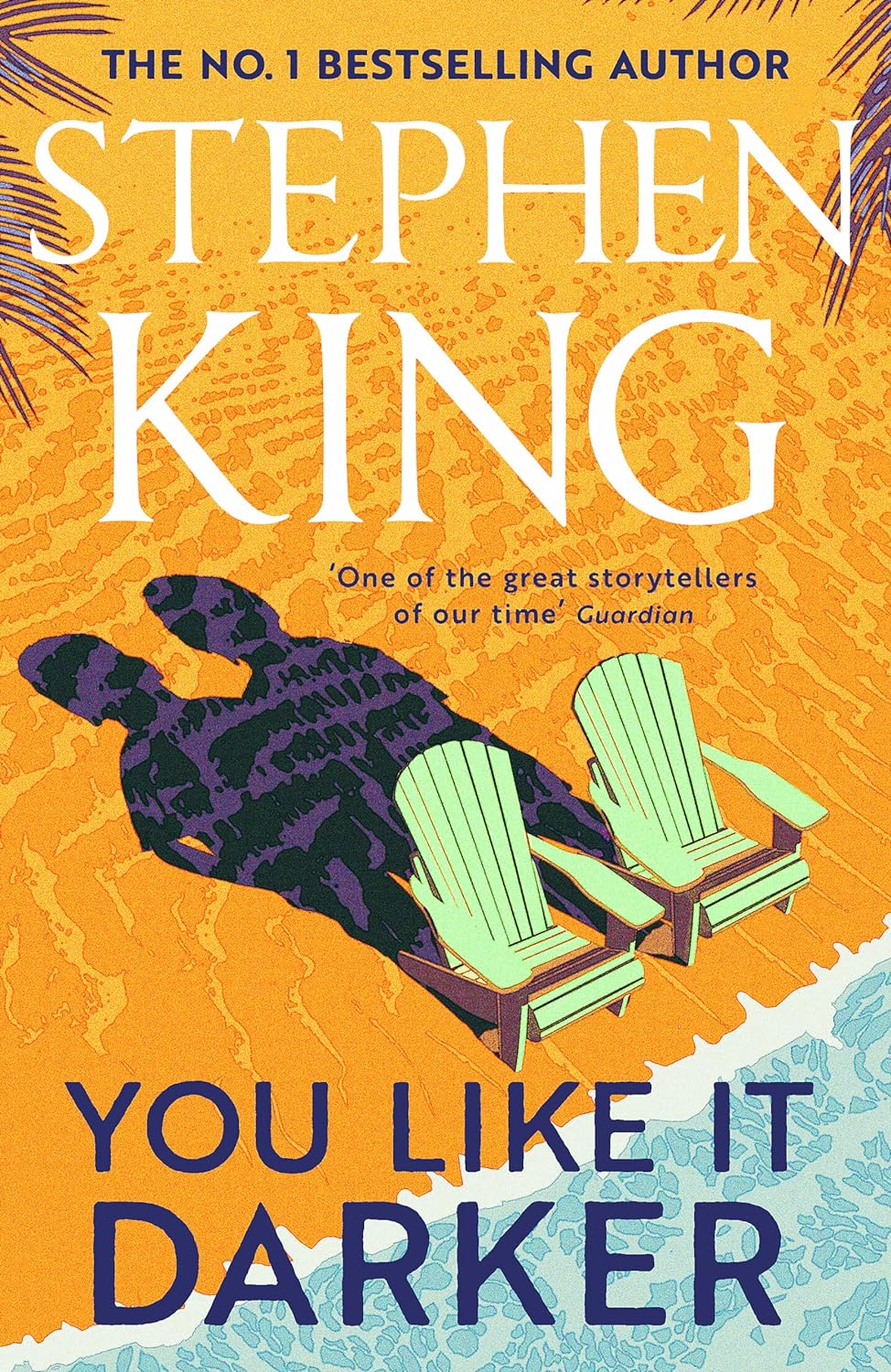
Publisher: Hodder & Stoughton (Trade Paperback – 21 May 2024)
Series: Standalone/Collection
Length: 484
My Rating: 5 out of 5 stars
The master of shocks, thrills and chills, Stephen King, returns with a highly addictive collection of short stories that showcase his awesome writing ability in the epic book, You Like It Darker.
Stephen King is an author who needs very little introduction from me considering he’s been one of the world’s top authors for over 40 years. Readers of this blog will know that I have come to the Stephen King fandom rather late in life, having only read his more recent releases. However, the King books I have read were extremely epic, and I absolutely loved the awesome and inventive stories they contained. This includes the epic thriller Mr Mercedes, the deeply personal tale Later, the fascinating Fairy Tale and the utterly addictive Billy Summers (one of my favourite books of 2021). My favourite King book was his 2023 novel, Holly, which told a deep and chilling tale that is still stuck in my mind. Not only was Holly one of the absolute best books and audiobooks of 2023, but it is also one of my very favourite horror books. Due to this, I have been keeping a very close eye out for more content from this legendary author, including his latest book, You Like It Darker. You Like It Darker was a short story omnibus book, which feature 12 unique stories from King, each of which have a dark shine to them.
I must admit that when I first heard about You Like It Darker, I wasn’t too sure I was going to read it. This was primarily because I am not the biggest fan of short stories or novellas, as I prefer reading stories with more meat to them. However, because it is Stephen King, and there is a certain guaranteed awesomeness associated with any of his works, I decided to give You Like It Darker a try, and boy was that a good decision. The various stories contained within You Like It Darker was exceptional, and I ended up getting really stuck into everything contained in this impressive book.
The first story featured in this volume is the entertaining Two Talented Bastids. A somewhat light-hearted start to a book dedicated to dark narratives, Two Talented Bastids tells the story of a famous and skilled author and his best friend, a highly regarded painter, both of whom grew up in a small town (near King’s iconic setting of Castle Rock) and managed to make it big. Told through the writings of the author’s son, this story recounts the compelling small-town life of these fun figures, before eventually diving into the events that suddenly awakened their talents.
Two Talented Bastids was a very interesting and compelling start to You Like It Darker, which really played to the author’s strengths. King is known for his ability to craft together tales of small-town life and intricate character backstories, which he does here in excellent detail. The focus on these two friends who eventually make it big was moving and personal, and I liked the great way this story unfolds from the perspective of the loving, if overshadowed, son. Because this is King, the story goes in some unusual directions, with an unnatural reason behind the protagonist’s renowned talents. This twist away from conventional life was fun and surprisingly wholesome, and it was nice to see a good deed get rewarded in a King book. As such, this was a surprisingly light start for You Like It Darker, but one loaded with humour, fantastic characters, and some great examples of human nature. I felt that Two Talented Bastids was an excellent appetiser that showcased King’s writing style in advance of the crazier stories to come, and it got me in the mood for more tales about unusual people.
The next two short stories are the intriguing The Fifth Step and Willie the Weirdo. Both stories are amongst the shortest entries contained within this book, and they prove to be an intriguing follow up to Two Talented Bastids, especially as they bring King’s promised darkness. The first of these, The Fifth Step, is a short but impactful story that sees an older gentleman encounter a stranger at the local park who wishes to tell his personal confession as part of an addiction program. This short story concludes with a sharp and memorable ending, and you have to appreciate the way that King effectively sets the scene in just 10 pages before bringing it to a sudden end. Willie the Weirdo is also very dark, as it shows a strange young boy, the titular Willie, becoming close to his dying grandfather in his final days, hoping to see him die. This is a bit of a weird story (unsurprisingly), but it’s one that I felt was very strong, as King showcases the strange nature of the two protagonists through a series of ghoulish conversations. The final moments of Willie the Weirdo really bring the whole story together in a fantastic way, and readers are left to rethink all the previous aspects of the story thanks to a few subtle inclusions. Both entries are great in their own way, and I liked how they substantially darkened the mood after the lighter starting story.
The fourth story in this book is probably my favourite, the excellent Danny Coughlin’s Bad Dream. The longest entry in Some Like It Darker, Danny Coughlin’s Bad Dream is a brilliant tale that sees the titular Danny Coughlin, a small-town high school janitor, begin to have vivid dreams about a body at a location he’s never been to. Hoping to alleviate the dread brought on by his visions, Danny finds and travels to the location from his dreams, only to discover that there really is a body buried there. His attempts to subtly alert the police only lead to him being becoming the lead suspect and the detectives investigating the murder, especially the zealous Inspector Franklin Jalbert, begins an aggressive campaign against him.
While I enjoyed the preceding stories in this book, Danny Coughlin’s Bad Dream is the entry that made me fall in love with You Like It Darker. The author works in an intriguing but simple concept of a normal man having a true psychic dream and turned it into a compelling and utterly intense tale of obsession and inner darkness as the protagonist loses everything due to events outside of his control. The horror of this story is brought about by an excellent combination of circumstances and dark human nature as the protagonist, Danny Coughlin, is completely innocent of the killings and is instead a particularly likeable figure trying to do the right thing in the light of unexplainable events. However, the stubborn and obsessive Inspector Jalbert, incapable of believing the protagonist’s supernatural explanation, relentlessly hounds Danny, trying to get him to confess to the murder. His inability to do so, as well as the lack of evidence supporting Danny’s guilt, drive Jalbert, a homage to Inspector Javert from Les Misérables, to worse acts against his suspect, and it was fascinating to see Jalbert’s blind adherence to justice and his own personal issues turn him into a bigger villain than the man he is hunting.
King does such an amazing job with both his main characters in Danny Coughlin’s Bad Dream, and they play off each other perfectly, with the innocent and honourable Danny, trying to fend off the growing instability of Jalbert. King takes this story in some excellent directions, and I found myself constantly on the edge of my seat waiting to see how everything would unfold. The resulting conclusion is dark, moving, and sadly inevitable, and you can’t help but feel for both the main characters, even when they do the wrong thing. Throw in an intriguing look at various forms of faith, as the characters are forced to confront their own feelings about visions and the supernatural, and Danny Coughlin’s Bad Dream proves to be an outstanding read that I could not get enough of. I really cannot emphasise what a brilliant story this was, and I maintain it was the most impactful and captivating entry in You Like It Darker.
The next story is the interesting Finn, which I must admit was my least favourite, although that might just be because I was unfairly measuring it against the preceding Danny Coughlin’s Bad Dream. Finn was a curious tale about a terminally unlucky teenager who finds himself kidnapped in a case of mistaken identity by an unusual team of crooks. This was a rather fun and fast-paced story that saw an unwitting Finn attempting to survive this latest example of his unusually terrible luck. I did enjoy this story to a degree, although I honestly am not sure if I was missing a connection to some other work of King, as there were quite a few unanswered questions at the end. Still, the story unfolds in an interesting way, and King does a great job of introducing his unique take on the protagonist’s life story and the formulative events of his childhood.
Following Finn, King brings the book back on the dark track with the short, but intense, road trip story On Slide Inn Road. This story sees a dysfunctional family attempt to take a shortcut up the titular road, only to encounter obstacles, both from the landscape, and from other travellers. I liked the progression from casual family story whose drama was primarily drawn from the actions of the easily aggravated father to a much more serious story including a pair of hijackers. King’s intriguing take on how three separate generations of one family in the car deal with this sudden threat was quite impactful, and I loved how the family dynamics quickly change as a result. Another short but effective story that I ended up really enjoying.
King continues with another two quick stories that feature intriguing concepts. The first, Red Screen, sees a married cop interrogate a murderer who has a wild theory about an alien invasion. This was a quick story, and a little predictable, but great to read, primarily because the reader could see how it was going to end, and the resulting anticipation increased their enjoyment. This is followed by the thoughtful story, The Turbulence Expert, which follows a passenger on a bumpy airplane flight. As the flight progresses, you discover that the nervous, frequent-flying protagonist has a specific reason for being on this plane. The Turbulence Expert was another cool entry in this book, and I think I enjoyed it more than Red Screen, primarily because King gives it a little more room to breathe. The interactions between the main passengers of the plane feel quite realistic, and there is a fun balance between the mundane experiences of some passengers, and the more unnatural feelings of the protagonist. The Turbulence Expert had one of the more compelling scenarios behind it, and I wouldn’t have minded a longer inclusion as a great story could have developed if given more room.
The ninth story in You Like It Darker is the sweet Laurie. Another relatively short entry, Laurie follows an older widower who finds comfort in a small puppy, the titular Laurie, foisted upon him by a concerned sister. This was a very moving tale that will appeal to all dog fans, especially as it is very easy to relate to the companionship that the initially reluctant protagonist feels as he becomes more and more attached to his new furry friend. King does a great job of capturing the many ups and downs of dog ownership in a very short amount of time, and you really feel yourself getting drawn to the initially troubled and lonely protagonist, and his dog. Of course, because this is a King story, things do have to get dark, and the author honestly does not hold back here with a shocking threat. This sudden moment of danger really drags the reader in, especially as the previous pages with the protagonist and Laurie made you really care for both, and you worry that King is about to bring some utter tragedy to the two. As such, Laurie has the distinction of being both the most heartfelt and most stress-inducing story in You Like It Darker, and I really appreciate how many feels King fit into this one short story.
The next story is probably the entry existing fans of King are going to be most interested in, Rattlesnakes. One of the longer and most intense stories in this book, Rattlesnakes has the interesting distinction of being a sequel to one of King’s more iconic works, Cujo. Set in 2020, decades after the events of Cujo, Rattlesnakes follows Vic Trenton, the husband/father from the book, who was forced to move on after the death of his son and the resulting trauma of his wife. Now retired, Vic has moved into a luxury house in Florida owned by his friend and former business partner to wait out COVID. However, the house sits in a usual area, haunted by the tragic deaths of two young twins years earlier at the hands (or fangs) of the area’s now destroyed rattlesnake population. Encountering the twin’s still grieving mother, Vic once again begins to feel the pull of the supernatural as the ghosts of the area’s past begin to focus on him.
Rattlesnakes ended up being one of the most intense and powerful entries in the entirety of You Like It Darker, and readers quickly become engrossed in this tale of long-lasting grief and the impacts it has on sanity. Making good use of COVID times as a background, Rattlesnakes ends up being a twisty and complex tale that combines King’s aptitude for writing haunting horror tales with character-focused internal drama. Thanks to the unique history he bestows upon the Florida location that the protagonist finds himself trapped in, there is some excellent background to build the narrative around, and I really became engrossed in the resulting haunting tale. You really grow to understand the various character’s psyches as the story continues, and it proves interesting to determine whether the protagonist is being haunted or is experiencing his own form of grief and trauma. This proves to be a very gripping horror read, and you come away feeling very thoughtful about the protagonist’s experiences and the potential dark future awaiting him.
In addition to its excellent self-contained narrative, one of the major appeals of Rattlesnakes is that it is a sequel to Cujo. King provides a very intriguing follow-up to what happened to the parents in Cujo after the death of their child, and it was fascinating to see what followed the dark events more than 40 years after the original book came out. The author paints a tragic picture of the grief and anger that followed, as well as how both characters moved on in their own separate ways. I felt this ended up being a rather interesting sequel that will appeal to both hardcore fans of King, as well as those with a more general knowledge of this iconic book. The story in Rattlesnakes is not predicated in having read Cujo, and King makes sure to concisely recount the events of the previous book where necessary. While I am sure those who have enjoyed Cujo previously will get a little more out of this story than those who haven’t, anybody can come into Rattlesnake and appreciate it’s complex and intense story.
The penultimate story of You Like It Darker is the intriguing The Dreamers. Another relatively short entry in the book, The Dreamers is set in the 1970s and follows a Vietnam veteran turned professional stenographer who accepts a job with a professor performing unusual experiments out in the countryside surrounding Castle Rock. This narrative quickly forces the protagonist into examining the dark side of dreams as the professor awakens unusual occurrences with his subjects. This proved to be a pretty intense and complex story that was heavy on the horror, and I was getting some major Lovecraftian vibes from it. The story gets into some dark places as the unnatural experiments continue, and it was fascinating to see inside the mind of the protagonist as he finds himself still involved despite his best judgement. The story ends on a sharp and thoughtful note, and I came away quite curious about what was going on. I do think this is one of the stories that could have benefited from a bit more expansion by King, but it still proved to be a captivating tale that added some essential darkness towards the end of this book.
The final story in this volume was the moving and hopeful story, The Answer Man. Much like the first story in You Like It Darker, The Answer Man showcases King’s ability to effectively tell a compelling character-driven life story as it focuses on Phil Parker, a young lawyer who is agonising about his dream to move to a small town which he believes will become a major hub in the future. However, Phil’s life is changed by three encounters with the mysterious Answer Man, a stranger who, in exchange for a small fee, provides Phil with answers to his various questions, while revealing uncomfortable secrets about the future. These answers deeply impact the protagonist in various ways, both good and bad, and will have ongoing consequences for him and those around him, for decades to come.
I deeply enjoyed The Answer Man, which was a particularly strong entry to end You Like It Darker on. King once again falls back on his innate ability to tell a compelling life story (which I highlighted in Two Talented Bastids), with the chronicle of Phil’s life proving to be an intriguing, if tragic, story that I really connected with. The tale of a big city lawyer who moves to small town against the advice/wishes of his family and in-laws, only to face further issues, contentious cases and family tragedy, is interesting on its own, especially in King’s capable hands, but the inclusion of the Answer Man character really enhances everything. Coming in with great patter, a fun attitude, and some otherworldly abilities, the Answer Man provides true answers to the protagonist’s questions, even if Phil would be better off not knowing them. I loved seeing the ways that the protagonist’s already remarkable life is further influenced by his interactions with the Answer Man, and it led to some truly powerful and intense scenes. This honestly was a very clever and thoughtful story, and the whole concept of the mysterious Answer Man was one that really appealed to me. I think that King could easily do a whole novel around encounters with the Answer Man, and I hope that they might appear again in the future. Due to the impact of this unlikely figure, The Answer Man story goes in some fantastic directions, with the protagonist experiencing triumph and tragedy in equal measures, but which ends on a hopeful note and the protagonist finding peace. While not as dark as some of the other entries in this book, I felt that The Answer Man was a perfect end to an outstanding collection of short stories, and one that will leave you very thoughtful.
Overall, I was really impressed with how King brought this entire selection of short stories together in You Like It Darker. Each of the stories, no matter how short, grabbed my attention, and I really fell in love with the amazing stories contained within. Most of these entries were truly exceptional, with Danny Coughlin’s Bad Dream, Rattlesnake, Laurie and The Answer Man, being some of my favourites. These amazing stories raised the quality of the entire volume for me, while the other entries also provided dark moments and compelling ideas that will appeal to all manner of readers. King did a good job of setting out the stories in You Like It Darker, and each of the entries flowed effortlessly into the next. Many of these stories complimented each other, and I enjoyed the contrast of having a lighter tale follow a particularly dark entry, and vice versa. I also felt that You Like It Darker was very open to readers with various levels of experience when it comes to Stephen King. While established fans will love seeing more unique stories from the author, including an intriguing sequel to Cujo, new readers can also have an amazing time here, especially with the range of narratives and the changing levels of horror, dread, and inner darkness. I personally had an incredible time with all the distinctive and addictive novellas and short stories contained in this book, and together they ensured that You Like It Darker was one of the best things I read in the first half of 2024.

 The Unseen Library