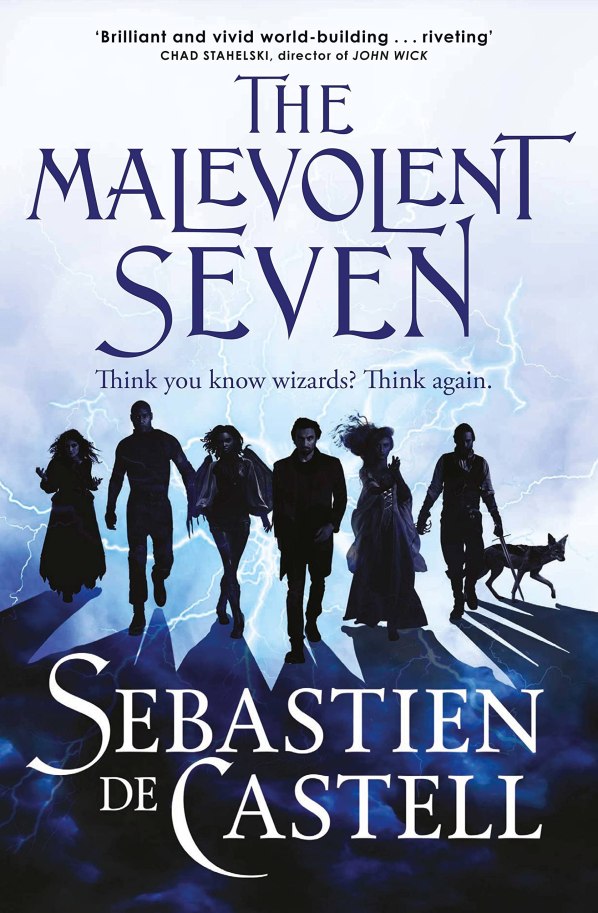
The Malevolent Seven by Sebastien de Castell

The Malevolent Seven Cover

Publisher: Jo Fletcher Books (Trade Paperback – 9 May 2023)

Series: Standalone/Book One

Length: 373 pages

My Rating: 4.5 out of 5 stars

Amazon

Rising fantasy star Sebastien de Castell returns with a bold and highly entertaining new fantasy novel, The Malevolent Seven, that takes several dangerous and dastardly characters on a magical journey of death, deceit and despair which is so much fun to behold.

Magic is power and only the strong can hope to wield it, especially if they can make a profit out of it.  Cade Ombra is a powerful wonderist, a magic user who makes his living as a war mage, selling his services to highest bidder to fight in their wars and kill their enemies, even if his employers are monsters.  Cade has long struggled with the ethics of his job, and when his latest employment ends badly, with Cade framed for murder resulting in a relentless band of holy enforcers hunting him, he knows he needs to find a way out.

Luckily, a lucrative new job is looking for wonderists, and the payment is something he’s always desired, an artefact capable of changing everything about his life.  However, to get paid he needs to do one last very bad thing: kill seven heroic mages attempting to take down a corrupt noble and survive everything that wants to kill him along the way.  Determined to win no matter the cost, Cade and his violent colleague Corrigan set off to claim the reward before any of their rivals can.  But to succeed, they’ll need to recruit five more mages capable of taking down their powerful enemies and who have no moral qualms about killing heroes for money.

So begins a deadly recruitment mission as Cade and Corrigan seek out five mages just as crazy as they are.  But even with a mentally unstable blood mage, a fallen angel, a moral demon knight, a charismatic rat mage and a mysterious jackal, can even this mismatched bad of rogues hope to survive against the seven most deadly magic users on this plane of existence?  However, nothing about this job is as it seems, and Cade and the Malevolent Seven find themselves caught up in a deadly game between gods, demons and monsters, with the fate of the world lying in the balance.

Wow, now this was a very, very fun and addictive novel.  Sebastien de Castell wasn’t an author I was too familiar with before this point, although I had heard good things about The Greatcoats series.  However, I am now going to have to go out of my way to read more of his stuff, especially after reading the epic and entertaining The Malevolent Seven.

The Malevolent Seven was such a great read as de Castell pulls together a dark fantasy reimagining of heroic stories like Seven Samurai and The Magnificent Seven.  The book starts of strong with a great introduction to the main character, Cade Ombra, the rules of magic in this realm, and the author’s very entertaining and outrageous sense of humour.  Expertly and hilariously told from the first-person perspective of Cade, whose observations about the insane events going on around him adds so much value to the story, you soon get a great sense of what to expect from this book and de Castell does not disappoint.  The story initially focuses on Cade and his friend Corrigan’s efforts in a brutal war for a mad ruler, but things go south when their employer is killed, Cade is betrayed by his fellow wonderists, and a band of ruthless religious warriors, the Glorian Justiciars, arrive determined to hunt down Cade for his use of demonic magic.  Forced to take a new job with Corrigan to save his skin and quickly get out of dodge, the two take up the mysterious contract to kill seven heroic mages in exchange for a powerful artefact, and begin a recruitment drive for five additional mages.

I love a good recruitment montage in heist or action fiction, and this one is pretty damn fun as de Castell writes in a particularly eclectic and insane group of mages for the protagonists to recruit.  Naturally nothing goes as plan, as the two are forced to take along a half-insane junior blood mage who Cade feels responsible for.  Their subsequent recruitment attempts land them in all manner of trouble as they rescue a highly chivalrous rat mage, save a mysterious fallen angel from a pleasure ship, journey to hell to recruit a demon knight, and end up in the middle of a wasteland, chased by everyone.  This recruitment period took up more of the plot than I thought it would, but it works really well to tell a great overall narrative.  Each scene introduces the reader to more of the world and it allows a compelling dynamic to grow between the various protagonists, especially as they grow to understand each other crazy tendencies.  De Castell also builds up several intriguing long-running storylines of manipulation and betrayal as it becomes clear that someone is influencing their mission and has set gods and demons against them.  This middle section of the book is a lot of fun, and I loved how de Castell keeps up the same blend of humour, intriguing character development, and insane over-the-top moments, that really draws you in at the start of the novel.

Everything perfectly leads up to the final third of the book, when the protagonists arrive at their destination.  Of course, as can be expected by the theme of this story so far, nothing is what they thought it would be, and instead they find themselves facing off against a mysterious foe with very different motivations to what they expected.  I loved how de Castell turned the plot a little on its head at this point, as the characters find themselves in the unexpected position of being the good guys.  This leads to some amazing scenes in the final third, loaded with magic, chaotic confrontations and more, all of which is a ton of fun to see.  There is some great character growth as several storylines come full circle, as well as a ton of twists and turns.  I loved some of the epic reveals that came across, and while I saw a few coming, de Castell managed to surprise me in places, which I really enjoyed.  The final twists about why the characters were on the job and who really wins were pretty damn epic and it sets the story up nicely for a sequel, which I am definitely going to grab a copy of.  I loved how de Castell really enhanced the drama in this final third of the book, especially as several character relationships or conflicts come to the boil in some explosive and captivating ways.  This combines really well with the continued craziness of the story and the inherent humour of the plot, and you really get drawn into all the fantastic elements of this book.  The Malevolent Seven ended up being an incredible read, and I managed to power through this entire story in a couple of days and had a ton of fun doing so.

I loved the dark and despairing world that served as the cool new setting for The Malevolent Seven and de Castell has a ton of fun showcasing this new fantasy landscape throughout the book.  Loaded with petty tyrants, warring nobles, and wandering wonderists who dish out death to the highest bidder, this land is the perfect backdrop for the crazy and self-serving narrative, and I loved seeing de Castell’s great characters traverse it causing trouble.  While there are some outstanding locations, including a magically blasted wasteland and several deadly battlegrounds, the highlight of this setting is the complex magical system that the author came up with.  This magical system is primarily predicated on wonderists breaching dimensional barriers and utilising magic that they have an infinity for.  This results in several unique rules and abilities that de Castell did an outstanding job of effectively introducing, and I loved how weird some of the abilities were, especially those that played into the novel’s humour.  Some of the more interesting realms require the magical users to interact with the associated denizens, including this world’s equivalent of angels and demons, all of whom have a stake in the mortal realms.  Several of the best scenes in the book require the protagonist to make dark and forbidden deals with his demonic contact, and the manipulation of the various mystical entities from both heaven and hell becomes a key part of the book.  The author makes sure to utilise all these fantastic and lethal abilities to their full extent throughout The Malevolent Seven and the epic, ultra-destructive battles that emerged, as well as the clever combination of talents, resulted in some amazingly, electrifying sequences.  It will be interesting to see what crazy abilities de Castell brings to the table for the sequel, but it’s going to be good.

The final thing I want to highlight about The Malevolent Seven are the excellent and compelling damaged characters featured throughout the plot.  De Castell really went out of his way to make his main seven protagonists as random, broken and insane as possible, and this really works in the context of this brilliant story.  The main protagonist is point-of-view character Cade Ombra, a wonderist with a secret past whose current magical ability comes from deals with a literal demon (nice guy actually).  Because of this and many other mistakes in his life, Cade is pretty alone and damaged when the story starts, and he is constantly trying to balance his survival instincts and desire for power, with his conscience, something that keeps getting him in trouble.  De Castell builds up Cade extremely well throughout The Malevolent Seven and I liked his constant growth as he tries to do the right thing, even though it usually makes life even harder for him.  The author sets Cade up as a reluctant leader and hero, and it was intriguing to see the dynamics that form between him and the rest of the team fate brings together around him.  The rest of the titular Malevolent Seven are all pretty entertaining and uniquely crazy in their own way, and the range of diverse and entertaining personalities makes for a great overall dynamic to the story. My favourite character in the group was the excessively violent Corrigan Blight, whose thunder magic matches his outrageous personality.  Corrigan served as the straight speaking, highly reactive and trigger-happy organiser of the group, who plays off the more reserved Cade perfectly, especially as they form a unique and fragile friendship.  Other highlights include the highly charismatic and surprisingly noble Aradeus, whose rat magic proves to be highly effective if a little weird, and the novice blood mage Galass, whose spunky personality is only matched by her deadly abilities that are slowly driving her insane.  I loved this impressive and very entertaining cast and I cannot wait to see what happens to them next.

I think it is very clear that I loved The Malevolent Seven as Sebastien de Castell’s outrageous and inventive dark fantasy tale was a real joy to behold.  The great blend of fantastic humour, twisty storytelling, brutal magic and over-the-top characters, works exceedingly well and I loved the witty and extremely fun story that emerged.  The Malevolent Seven is a great read and if you are in the mood for a cool and highly compelling fantasy adventure than this is the book for you.

Amazon

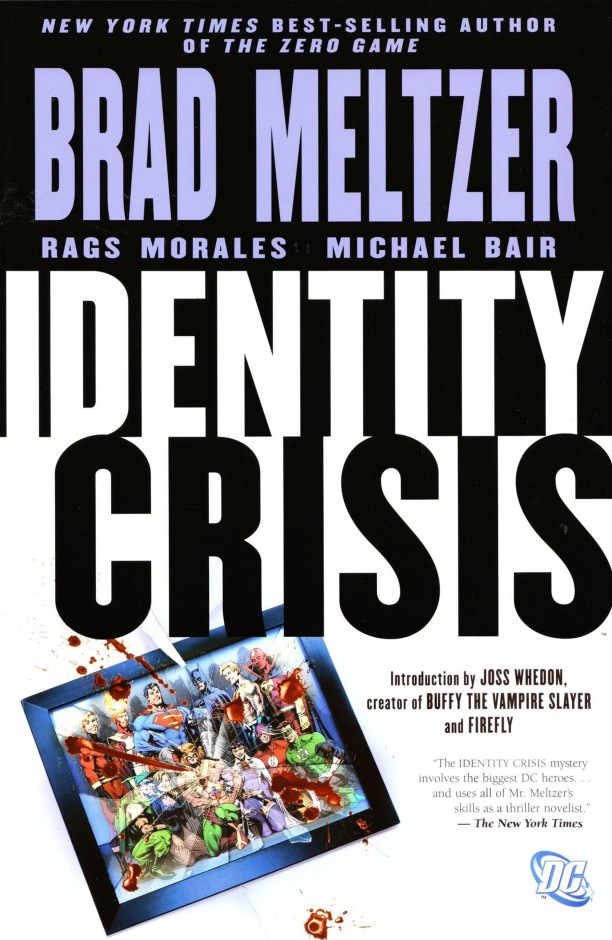
Throwback Thursday – Identity Crisis by Brad Meltzer, Rags Morales and Michael Bair.

Identity Crisis Cover

Publisher: DC Comics (Paperback – 1 October 2005)

Series: Identity Crisis Limited Series

Writer: Brad Meltzer

Penciller: Rags Morales

Inker: Michael Bair

Letterer: Ken Lopez

Colorist: Alex Sinclair

Length: 288 pages

My Rating: 5 out 5 stars

Amazon     Book Depository

Welcome back to my Throwback Thursday series, where I republish old reviews, review books I have read before or review older books I have only just had a chance to read.  For this week’s Throwback Thursday I take a look at one of my absolute favourite comic book limited series, the epic 2004 DC Comics event, Identity Crisis.  (Quick warning, there are spoilers ahead).
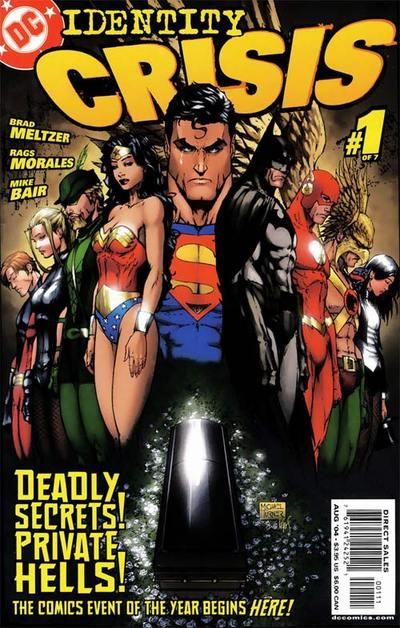
Identity Crisis #1

It is fair to say that the early to mid-2000s was one of my favourite periods of comic books, with some truly cool and epic ongoing and limited series being released.  This was particularly true for DC Comics, who produced some of their best work during this time, many of which rank amongst my all-time favourite comic series.  This easily includes the exceptional and brilliant crossover event, Identity Crisis, which to my mind is one of the best limited series ever written.

Made of seven issues, Identity Crisis combines the unique writing talent of thriller author Brad Meltzer with the artistic stylings of veteran DC Comics collaborators Rags Morales and Michael Bair.  This ended up being a near perfect combination of talents and skill, and I have a lot of love for the exceptional story, which absolutely hooks me every time, and its outstanding associated artwork.  I particularly impressed with the addition of Meltzer, who, despite his more literary background has written some of the absolute best and most human comics I have ever had the pleasure of reading, including Green Arrow: The Archer’s Quest and the two Justice League of America storylines, The Tornado’s Path and The Lightning Saga.  However, his story in Identity Crisis is particularly powerful and thought-provoking, and it ends up being a comic that completely changes everything you knew about your favourite heroes.

For years the members of the Justice League of America have protected the world from all manner of evil and destruction, always prevailing no matter the odds.  But who can protect them when someone goes after those closest to them?  And what if they actually deserve the punishment being visited upon them?

On an unremarkable night, a mysterious attacker breaks into the home of long-serving Justice League associate, Ralph Dibny, the Elongated Man, and commits a terrible crime, the murder of Ralph’s beloved wife, Sue Dibny.  With no evidence about who the killer is and no idea how they breached the Dibnys’ impressive security, the superhero community rallies behind their bereaved friend and seeks to find the killer by any means necessary.

As the rest of the heroes seek answers at any potential suspect within the supervillain community, the Elongated Man and a small group his closest friends hunt for a minor villain, Dr Light, whose secret connection to the League’s darkest moment may hold the answers they seek.  However, when a second attack occurs on another publicly known relative of a superhero, Jean Loring, the former wife of the Atom, it soon becomes clear that someone else is targeting the heroes and their loved ones.
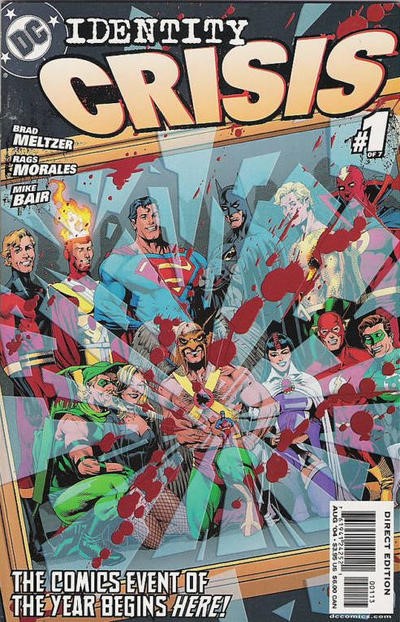
Identity Crisis #1b

As Batman, Superman, Green Arrow and others attempt to get to the bottom of the case, cryptic threats to one hero’s relative reveal that whoever is targeting them knows all of the League’s secrets, including their hidden identities.  As even more tragedies befall the superhero community, dark secrets from the League’s past are brought into the light and no-one will be prepared for the terrible truth behind these brutal murders.  Can the League weather this latest attack, or is this the beginning of the end for the world’s greatest heroes?

Damn, no matter how many times I read this comic, the tragic and powerful events of Identity Crisis still really get to me.  This exceptional comic contains one of the most impressive narratives I have ever seen in a limited series, taking the reader on a captivating and emotional dive into the world of your favourite heroes.  Perfectly combing a dark, mysterious narrative with incredible character work and some truly amazing artistic inclusions, this comic gets an extremely easy five-star rating from me.

For Identity Crisis, Brad Meltzer really went to the well, producing an insanely compelling and moving story that relentless drags you in and introduces you to a completely new side of your favourite heroes.  Utilising his experience as a crime thriller writer, he produces a powerful, character driven superhero narrative with detailed crime fiction elements to create an exceptional and unique story.  Identity Crisis has an amazing start to it, which not only carefully introduces several key figures but also installs some dark tragedy, as the wife of a superhero is killed off.  The subsequent investigation into her murder by the enraged superhero community is extremely compelling and intense, as the emotional heroes turn over every rock and stone, much to the horror of the villains.  However, it is soon revealed that several members of the Justice League are harbouring a devastating secret, one that could reveal the identity of the killer.  This secret becomes one of the most important parts of the first half of the series, and it leads to an epic, action-packed fight sequence against a particularly dangerous foe.
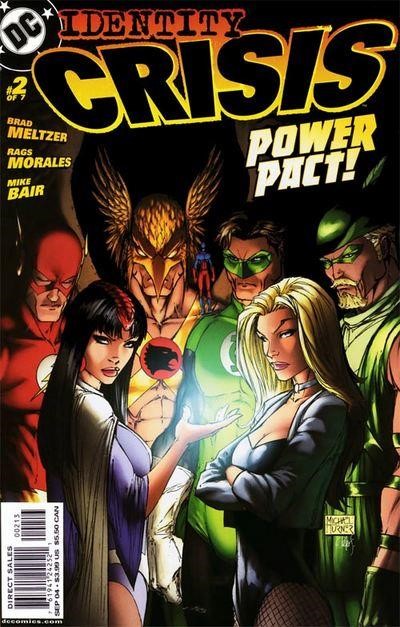
Identity Crisis #2

The story starts to go in a bit of a different direction at this point, with the above secret not really panning out regarding the investigation.  However, other superhero relatives, both public and secret, are targeted, resulting in pandemonium around the characters.  I loved the narrative’s move to a more classic investigation at this point, as the heroes start following every lead they can, while more character development and big moments are explored.  This all leads up to the defining moment when another superhero loses a loved one and the identity of the killer is seemingly revealed.  However, this turns out to be a bluff, as the real killer is still hidden.  The reveal of who did it and why are revealed pretty suddenly towards the end, with some curious and clever motivations exposed.  This leads to a tragic and heartbreaking conclusion, as more secrets are revealed, dangerous lies are uncovered, and several characters leave the story more broken and destroyed than ever before.  You will be thrown through the emotional wringer as you check this comic out.

I deeply enjoyed the way that Meltzer told Identity Crisis’s excellent story, especially as it quickly and effectively engrosses the reader and ensures their undivided attention.  The author utilises a mass-character narrative that follows a substantial collection of heroes and villains, many of whom have distinctive or semi-separate storylines.  This works to tell an intriguing, rich narrative that not only has some clever dramatic components but also allows for some intriguing and compelling retcons and expansions to the already elaborate DC universe.  It is very cool how the story developed into more of a murder mystery/thriller story as the comic progressed, and this really played to Meltzer’s strengths.  The investigation is handled very well, and I liked how the superhero elements altered and enhanced it in some clever ways.  The mystery itself is complex and clever, with Meltzer adding in some great twists, false leads and compelling surprises to keep the reader guessing.  The twist about the actual killer is pretty good, and Meltzer did a great job layering in hints and clues throughout the rest of the story while also introducing a few good alternative suspects.  While the motivations and complexities surrounding the killer’s actions are great, I did think that how the protagonists worked it out was a little abrupt, and it might have been a little better if they worked it out from some earlier clues.  The use of female characters wasn’t the best either, especially as most of them are there simply to be victims in one shape or another.  Having a long-established character getting both raped and murdered in a comic as a plot device is pretty unfortunate, and some stronger female figures might have helped balance this out.  Still, this ended up being an awesome read and I deeply enjoyed how it turned out.

One of the things that I really enjoy about Identity Crisis is the interesting examinations that were included as part of the plot.  Meltzer and the artistic team obviously had a lot of fun exploring or introducing some cool aspects of the DC Universe in this series, especially when it comes to the secret or hidden lives of superheroes and supervillains.  I particularly loved the in-depth examination about how both groups are officially or unofficially organised, and there are some very intriguing views of them socialising or working together.  The inclusion of a highly organised superhero death investigation squad, made up of a range of random heroes (the Ray, the Atom, Animal Man, Mister Miracle and two of the Metal Men) is particularly clever, as is the way the various heroes organise into a vengeful posse to question potential suspects.  The deep dive into the importance of a superhero secret identity also becomes an important part of the story, especially as the loss of the secret brings pandemonium thanks to the killer stalking them.  I also loved the counterbalance look at organised villainy, and there are some excellent scenes that see the villains gathering to socialise or talk shop.  Having an organising force like the Calculator, as well as a secret space station hangout, is pretty elaborate, and the deeper look at the villains of this universe, definitely gave Identity Crisis a compelling and intricate edge.
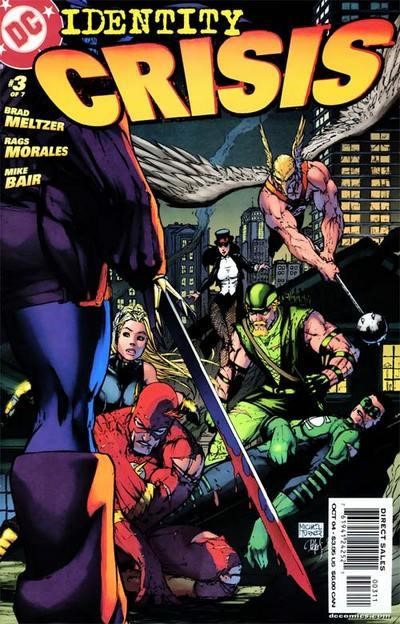
Identity Crisis #3

However, easily the most groundbreaking and compelling new inclusion to the universe is the reveal about the unofficial league within the Justice League who have some dark secrets.  Made up of heroes Green Arrow, Black Canary, Hawkman, Zatanna and Atom, as well as the Silver Age Green Lantern and Flash, this group of heroes apparently operated separately of the main Justice League during their classic Silver Age adventures, acting as their clean-up crew.  This retcon by Meltzer provides an interesting explanation for why villains never remember the secret identities of the heroes they switch minds with or whose dreams they invade, namely they have their mind erased by Zatanna’s magic after being captured by this inner-League.  While this is already a dark move by these established heroes, it gets even worse when they are forced to reveal that they intentionally destroyed Dr Light’s brain to make him less of a threat.  This and other revelations, acts to make many of your favourite heroes appear much more morally grey and fallible, and it was a particularly impressive and monumental inclusion, that will have grave consequences down the line for the entire universe.

Unsurprisingly for something written by Meltzer, Identity Crisis contains some insanely complex and impressive characters who form the heart of the tale.  Due to the way the story is told, Identity Crisis follows a massive cast of comic characters, including several obscure or underappreciated figures.  Meltzer does a brilliant job of utilising all these established characters throughout his story, with nearly every major cast member getting a moment to shine in some way or another, and multiple figures who were underutilised or unappreciated before this comic were given brilliant and defining second chances here.  While the use of multiple focus characters had the potential for a scattered narrative, Meltzer was able to direct the flow of the story around all these various protagonists and antagonists perfectly, and you still get a tight and concise story, which also takes the time to dive into each of these figures and showcase them to their greatest degree.  As I mentioned before, there is a real focus on highlighting the darker side of the superhero characters throughout Identity Crisis, and you end up really seeing these fantastic figures in a whole new scary light.

Let’s start with Ralph and Sue Dibny.  I must admit that the very first time I ever read Identity Crisis, many years ago, I honestly had no idea who Elongated Man and his wife were, as they were a little obscure.  However, Meltzer really goes out of his way to feature them in this story (even adding in a few retcons) and you are given a great introduction to them at the start.  In just a few panels, you understand who these characters are and what they mean to each other and the other superheroes, as well as some unique characteristics and relationship quirks.  This excellent introduction makes you start to care about them just as Meltzer brings the hammer down and kills Sue.  The subsequent grief, rage and despair from Elongated Man is just heartbreaking, and you go through the rest of the comic seeing him attempt to recover from these terrible events.  This amazing use of characters at the start of the comic has a great flow-on effect to the rest of the story, and you become exceedingly invested in finding the killer as a result.
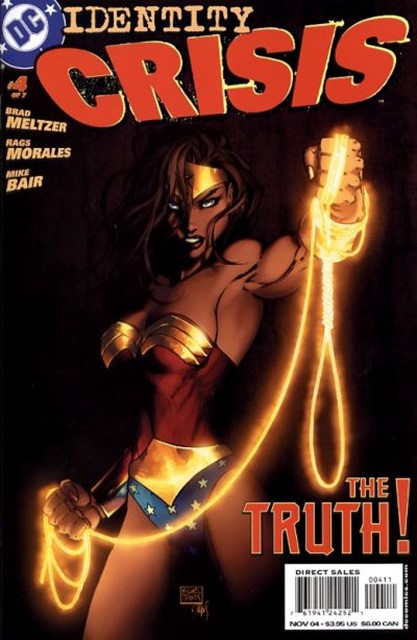
Identity Crisis #4

From there, a lot of the superhero focus goes to the surviving members of the Justice League who formed the league within the League I mentioned above.  There is some exceptional character work around some of these team members, especially as they come to terms with the decisions they made in the past and how they are impacting them now.  I loved seeing them attempt to justify their actions to the other heroes, even their darkest decisions, especially as you can understand why they did what they did, while also feeling disappointed in them.  You really get a sense of determination and shame from them as the story continues, and you see all of them go through a lot in both the past in the present story.  Despite multiple differences, this team are still friends and comrades, and watching them come together to brawl with some of the most dangerous characters is pretty heartwarming, even if darker elements lie just beneath the surface.

While there is a focus on these inner-Leaguers, some of them are utilised a lot more frequently than others, particularly the original Green Arrow, Oliver Queen.  Green Arrow is an excellent figure in this comic and is probably the closest thing to a heroic narrator/central protagonist the story has.  His unique perspective on the events acts as a good foil to many of the other characters, such as Batman and Superman, and he proves to be a calm, if potentially vengeful figure for much of the story, organising many of the League actions and forensic investigations.  He also proves to be the voice of reason for the inner League, calmly justifying many of their actions and serving as a bridge between this existing group and the newer Flash and Green Lantern.  Despite his belief that they are doing the right thing, you can see some real emotion and regret in his face, especially when the further revelations about Dr Light and Batman come out.  I also appreciated the deeper look into his antagonistic relationship with Hawkman, which partially originated in the past events mentioned here, and it is interesting to see how the events of this comic impact future Green Arrow storylines.

Aside from Green Arrow, other members of this secret League who get an intriguing focus include the Atom, Ray Palmer, and his ex-wife, Jean Loring.  Due to his status as another public hero, Atom and Jean are also targeted throughout the story, and you end up getting a rather intense and fascinating look at both.  Watching their failed relationship rekindle is a nicer part of most of the comic, although eventual reveals and tragedies naturally ruin it and smash everything around.  Still, their complicated emotions and issues surrounding their fractured relationship make for some of the best parts of the comic.  I liked the interesting look at Zatanna throughout the comic, especially as she is largely responsible for some of the worst moments of this group of heroes, as she clearly feels guilty about her magic messing with the villain’s minds.  I also need to highlight the younger Flash, Wally West, who finds out about the actions of the other characters during the current events of the comic.  It is absolutely heartbreaking to see Wally learn that his mentor and predecessor, Barry Allen, was not as perfect as he imagined, and actually participated in some of the team’s worst events.  The distress he exhibits with every subsequent reveal is showcased through the comic’s art extremely well, and his subsequent guilt as he is forced to keep it secret from other Leaguers like Batman is quite noticeable.
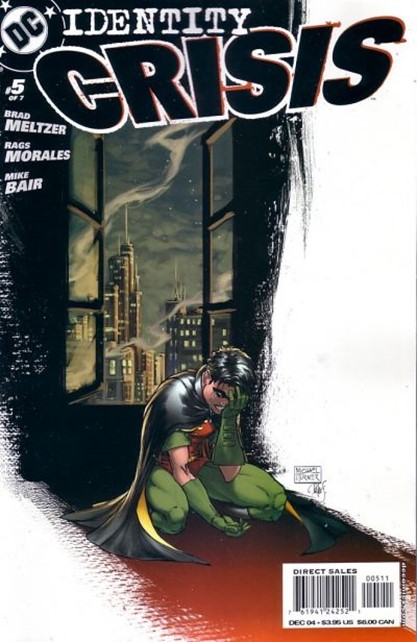
Identity Crisis #5

As you can expect from any major DC Comics crossover event, members of DC’s Big Three are strongly featured throughout Identity Crisis.  While Wonder Woman only has a few intriguing scenes, in which you get to see both her ferocity and her kindness, there is much more of a focus on Superman and Batman.  Superman gets some great sequences throughout Identity Crisis, especially as the creative team sinisterly focus on his family and friends, all of whom are potential targets.  Watching Superman slowly get frustrated with the investigation, especially when Lois is threatened, helps to enhance the seriousness of the story, and he has some powerful moments here.  I did appreciate the way in which Meltzer attempted to paint the big blue Boy Scout in a darker light, as it is revealed that even the supposedly righteous Superman is not as innocent as you’d believe.  It is subtly implied that Superman always knew what the inner League was up to (yay for super hearing), and chose to ignore it for convenience.  This brilliant and dark suggestion that even Superman isn’t infallible is a pretty weighty one that  helps to enhance the weight and power of Identity Crisis’s narrative.

Batman is a lot more involved in the story and leads his own investigation into who is behind the killing.  Even though he does not actually appear until halfway through the comic, he is a heavy presence throughout Identity Crisis, both because of his brusque, loner ways of trying to solve the crime, but because of the dark shadows of the past.  There are multiple moments that revisit his childhood and the death of his parents, which parallels some of the other losses in Identity Crisis, and you get to see the human side of grief impacting this usually stoic character.  Batman’s storyline gets even more intense when it is revealed that part of his memory was erased by his fellow Leaguers to cover up their actions surrounding Dr Light, which is a very haunting inclusion.  Meltzer makes this even more intriguing by having Green Arrow suggest, mostly out of guilt, that Batman likely has done something similar in the past, while also acknowledging that he has likely already deduced that his memories were erased.  This really makes you consider Batman’s relationship with the rest of his heroes, and it certainly has a big impact on future Batman storylines.

The Batman impact on this story is also felt through the great focus on the current Robin, Tim Drake, who plays a surprisingly big role in the events of Identity Crisis.  At the start of the comic, Tim is one of the few members of the Bat-family who still has a father, which puts him at odds with Batman and the Robin predecessors.  As his father has only just discovered his dual identity as Robin, he becomes one of the more interesting protagonists, as the comic explores the stress of the superhero lifestyle on family.  Tim’s storyline ends up being extremely tragic when his father is murdered.  Watching Robin talk to his father over the phone as he’s about to die is just damn horrific, and your heart can’t help but break during that epically drawn-out scene where he and Batman arrive too late.  The subsequent parallel between him, Bruce Wayne and previous Robin Dick Grayson during this moment is particularly poignant, and it results in a whole new chapter of this amazing incarnation of Robin.
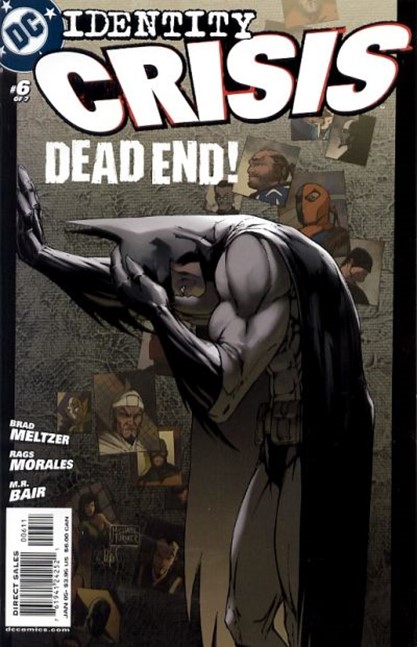
Identity Crisis #6

While there are a few other interestingly featured heroes in Identity Crisis, I’m going to start talking about the villains, as many of them have a brilliant role in this comic.  Thanks to Meltzer’s fantastic writing, Identity Crisis proves to be just as much about the villains as the heroes, as many of them are deeply impacted by the events disclosed here.  While I won’t reveal the identity of the killer here (I’m keeping some spoilers locked up), I will say that their motivations are pretty fascinating and provide a compelling insight into the super lifestyle.  The rest of the villains in Identity Crisis are fair game for discussion, though, and I deeply loved the creative team’s excellent examination of them.

Easily the villain I need to talk about the most is Dr Light, an old school Justice League villain who had not been really utilised in recent years.  Mostly known before this comic as the Teen Titans’ punching bag, Meltzer completely revitalised the character in Identity Crisis and, with a stroke, turned him onto one of the most deranged and dangerous figures in the entire universe.  It is revealed throughout the comic that Dr Light used to be an extremely powerful villain, but after invading an empty Watch Tower and raping Sue Dibny, the League brutally took him down, erased his memory of the event and then magically lobotomised him.  This resulted in him becoming the moronic and weakened villain who was routinely taken down by the teenage heroes and other embarrassing foes.  This entire reveal is pretty damn epic and horrifying at the same time.  Not only does Dr Light seem excessively evil and deranged in the flashback scenes, but the shocking revelations of his actions immediately make you hate him.  Meltzer’s explanation for why he turned into such as pathetic creature (aside from the real reason of capricious authors) really hits home hard, and even though Dr Light is a terrible person, you can’t believe that members of the Justice League went so far.  The subsequent scenes where Dr Light regains his memories and his powers feature some of the best artwork in the comic, and while he doesn’t do much here, the scenes with him brooding and plotting hit at his returned and future malevolence.  I deeply appreciated how much Meltzer was able to morph this villain, and while the reliance on rape for antagonist purposes is a bit low, he succeeded in making him a very hateful and despicable figure.

Aside from the killer and Dr Light, several other villains hold interesting and significant roles in Identity Crisis, and I deeply enjoyed how they were portrayed.  This includes Green Arrow villain Meryln, who serves as an interesting shadow to Oliver Queen throughout the comic (more so than usual).  While Green Arrow provides the superhero community’s viewpoint on events, Merlyn’s narration examines the supervillain community and their various reactions.  I loved his fun insights into his fellow villains, and he ends up being an interesting inclusion to the cast.  The same can be said for the Calculator, a formerly silly figure who has turned himself into a non-costumed villain who acts as an anti-Oracle, providing the villain community with tech support and intelligence by charging them $1,000 per question.  I loved this interesting revamp of this minor character, especially as this suave, behind-the-scenes information broker became his default look for years.  Calculator’s conversations and business dealings offer some compelling insights into the superhero community, and I loved the occasional jokes about his old costume.  Meltzer also makes exceptional use of one of my favourite villains, Deathstroke, who once again shows why he is the DC universe’s ultimate badass.  Hired by Dr Light to protect himself from the League, Deathstroke takes on an entire team of heroes single handily and essentially spanks them.  I love how the creative team not only showcase his insane physical abilities, but also his tactical knowhow, as he expertly takes down major heroes in brilliant ways (he takes down the Atom and Hawkman with a laser pointer, true story).  His scene in the centre of the comic is the best action sequence in Identity Crisis, and it perfectly showcased this awesome villain (seriously, give this man a movie), while also hinting at some future grudges.
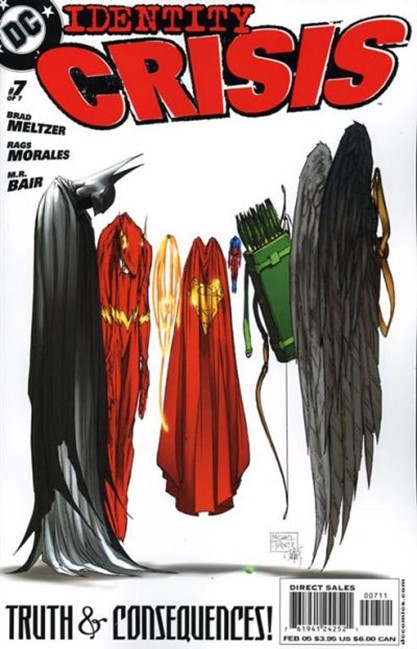
Identity Crisis #7

The final character I want to talk about is the lecherous and always entertaining Captain Boomerang, who has a major role in the plot.  I absolutely loved the exceptional story that Meltzer wrote around this infamous villain, and it is easily one of his most defining depictions.  Captain Boomerang has always been shown as a bit of a joke, but this comic shows him as a fat, washed up has-been, who leaches off his fellow villains and is generally looked down upon by them.  However, he gets a very intense and emotional story in this comic, as he meets his long-lost son and starts to develop a relationship with him.  The father/son moments add a rather interesting and nice edge to the main story and seem slightly disconnected from the rest of the plot.  That is until the final killing, when it is revealed that Captain Boomerang has arrived to kill Robin’s father.  The implied suggestion that Captain Boomerang of all people might be behind the killings is pretty iconic, and I loved the split panels that contrast his phone call to his son with the phone conversation between Robin and his father.  The subsequent results of the attack, as well as the reveals in the aftermath are pretty awesome, and I really appreciated the fun second chance that Meltzer and the artistic team gave to this iconic, old-school villain.

While I have gone a lot about story elements and characters, I also really need to highlight the incredible artwork featured in Identity Crisis.  The artistic team of Rags Morales and Michael Bair did an outstanding job in this limited series, producing some of the absolute best artwork from this era of DC Comics which perfectly enhances Meltzer’s epic storytelling.  There are so many impressive and memorable artistic moments and sequences throughout Identity Crisis, and I loved the various ways in which the artists convey movement, action, and emotion in their detailed and captivating panels.  There are so many brilliant action sequences in this comic, with my favourite being the Deathstroke vs Justice League fight I mentioned above, although a few others are also very cool to see.  I also loved the character designs featured throughout Identity Crisis, especially as the creative team took the opportunity to seriously reinvent several heroes and villains.  The streamlined look of the Calculator is particularly fun, and I also loved the balding and fat version of Captain Boomerang.  While I didn’t love how a couple of characters looked (what was with the hair on Connor Hawke?), most of it was pretty exceptional, and I love how it was later reutilised by other artists.

There are multiple truly brilliant and eye-catching artistic highlights of Identity Crisis that I must highlight, including the massive and powerful funeral sequence that takes place in the early part of the series.  There is an incredibly elaborate double-page public funeral spread that shows every single emotional superhero in attendance, with the various heroes organised by team or connection to the grieving family.  The use of the multiple heroes and associates is pretty awesome, especially as there are a range of character-appropriate reactions, and I loved seeing the whole costume crowd surrounded by members of the press and public as they mourn.  You also get also some excellent and heartfelt sequences in the subsequent scenes which show the eulogies, especially when Elongated Man starts to literally deteriorate due to his grief, which is just so powerful.  Other great examples of the artist’s work include the fun flashback scenes that allowed them to draw events in various classic comic styles, that offer a little bit of simplicity compared to the darker modern spread.

I particularly loved some of the brilliant sequences that are set around Dr Light, as not only do you see him at his most dangerous in the past but you also have some outstanding scenes when he regains his memories and powers.  The excellent parallels between the Justice League’s takedown of Dr Light and their attack on Deathstroke are incredible, and the subsequent massive panel of blinding light around Dr Light’s face is perfection.  However, the absolute best-drawn sequence in Identity Crisis must be the panels leading up to the death of Robin’s father.  Watching the insane amount of emotion on Batman and Robin as they realise that Robin’s father is about to die is so damn moving, especially the anguish on Robin.  The most moving of these panels is the one that focuses on Batman’s face after Robin begs his mentor to save his father.  The look of pure dread, fear and despair on Batman’s face takes my breath away every single time I look at it, and it perfectly conveys all of Batman’s repressed feelings as he realises that history is once again going to repeat itself.  While there are some other great scenes, the above are easily the cream of the artistic crop and definitely make this comic stand out.  I have so much love for the artistic work of Morales and Bair here, and it markedly enhances the already exceptional story, turning Identity Crisis into a true epic classic.

Well, that’s pretty much everything I have to say about Identity Crisis here.  As you can no doubt guess from the excessive way I have waffled on, I have a lot of love for this exceptional comic and I’m not afraid to show it.  The brilliant creative team behind Identity Crisis did an incredible job with this comic and they really turned out something special.  Perfectly bringing together a deep and clever story with impressive artwork, amazing characters, and so much damn emotion, this comic has something for everyone and is so very highly recommended.  I deeply enjoy everything about Identity Crisis, especially how it leads to some other epic comic books (the continuation of the mindwipe stuff in Justice League of America, Green Arrow, Teen Titans and more is particularly good).  One of the most distinctive and amazing comics ever and a must read for all DC Comics fans.

Amazon     Book Depository

All of Us Villains by Amanda Foody and Christine Lynn Herman

All of us Villains Cover

Publisher: Gollancz (Trade Paperback – 9 November 2021)

Series: All of Us Villains – Book One

Length: 388 pages

My Rating: 4.5 out of 5 stars

Amazon     Book Depository

The writing team of Amanda Foody and Christine Lynn Herman presents their first awesome joint novel, with the impressive and dark young adult fantasy book, All of Us Villains.

Foody and Herman are both established authors, having previously released cool-sounding novels and series, such as Foody’s bestselling The Shadow Game series and Herman’s The Devouring Gray novels.  While I have not had the opportunity to check out either of these authors’ previous books, I was very interested by All of Us Villains when I first heard about it a few months ago.  I loved the unique and compelling plot synopsis, and I was also intrigued by all the buzz from other reviewers.  I instantly jumped on it once I received my own copy and I was very impressed with its clever and compelling story.

In a world still powered by spells and curses, nothing is more precious than high magick, which can super-charge any spell and provide its wielder with insane amounts of power.  The only reliable source of high magick left in the world can be found in the remote city of Ilvernath, a dour and depressing settlement whose prosperity and fame can be traced to seven ancient families.  The ability to see and manipulate this high magick can only belong to one family at a time, and control ensures their prosperity for an entire generation.  However, to gain this right, each family must make an unbelievable sacrifice.

Every generation, when the Blood Moon starts to rise, a magical tournament is enacted that pits the very best of the families against each other.  However, this is no gentle tournament of magick; it is a brutal, curse-created fight to the death, with each family forced to nominate a young champion to represent them.  Only one champion can survive the tournament, and no-one ever emerges unscathed.

Twenty years after the last competition, a new Blood Moon starts to rise, and the families make ready for the latest battle for supremacy.  However, this tournament will be very different than any before.  Someone from the seven families has published a tell-all book, detailing every aspect of the tournament and informing the world of the hidden atrocities that have been committed in the name of power.  With the world now obsessed with every aspect of the tournament, all attention is now focussed on Ilvernath and the seven champions.

Thrust into the public spotlight, all seven champions must now deal with the intense infamy the tournament produces as they prepare to fight.  Forced to balance their own feelings on death and survival with the intense pressure placed upon them by their families and tradition, none are truly ready for the horrors they will be forced to endure.  However, this tournament also offers its competitors a chance to survive and end the curse that has blighted their families for centuries.  But not all the competitors are willing to give up the chance of ultimate power and are prepared to pay any price to win.  Let the games begin!

Damn, now this was a really great novel.  The brilliant new writing team of Foody and Herman produced an outstanding book in All of Us Villains, and I really got stuck into its story incredibly quickly.  The authors did a wonderful job of utilising a new version of the always popular teenage death tournament to fit into a brilliant and moving narrative.  Filled with complex characters and intense personal moments, All of Us Villains is an awesome and powerful book that I deeply enjoyed.

All of Us Villains has an excellent narrative that is a lot of fun to get into.  Focused on four of the seven participants of the latest death tournament, this is an amazing character driven story that really dives into the protagonists’ psyches as they prepare for the ultimate challenge.  The authors do an awesome job setting the scene for this fantastic story, and the readers are quickly hooked by the four complex main characters and the interesting scenario.  Roughly the first half of the book is dedicated to the setup before the tournament begins, which I think ensured the perfect balance between development and bloodshed.  You come away from the first half appreciating each of the characters and deeply caring about the outcome of the upcoming battle.  I was particularly impressed with one great early twist that surrounded one main character’s family preparations, and it added some major impact to his storyline.  Once the tournament begins, readers are in for a whirlwind of emotions and excitement as all the characters enact their strategy to win while all bearing a heavy emotional weight or magical handicap.  There are some intense and captivating sequences here and the readers are constantly on the edge of their seat, especially with some unique interactions, alliances and motivations, including one character who attempts to destroy the entire tournament from the inside.  This all leads up to a devastating and powerful conclusion, filled with death, despair, betrayal and complete emotional devastation, as all the characters make their choices and everything crumbles around them.

I really loved this cool narrative and I found myself getting really caught up in the constant heartbreak and bloodshed.  I am a massive fan of the teenage death tournament premise, and the authors do a great job of working this established story elements into their setting extremely well.  While there isn’t as much intense violence in the actual tournament as some readers would probably hope, I think that the authors’ choice to focus on the characters and their intense emotions about being forced into this fight by their families turned All of Us Villains into a better book. The authors’ use of multiple character perspectives works extremely well here, especially as it forces you to choose between your favourite characters as you try and work out who you want to survive, while also ensuring a really in-depth look at the setting and the tournament.  While I did find the final twist of this novel slightly predictable, the rest of the reveals and unpredictable actions were really cool, and I was shocked and surprised multiple times while reading.  This was also a great first entry, with the story ending on a compelling final note that will ensure that I will be coming back for the next book.  This was a deeply accessible and enjoyable read that has a lot of appeal to a vast array of varied readers, especially its intended young adult audience who will really love the complex story, clever setting and fantastic characters.

I had a lot of fun with the captivating and inventive setting and scenario that the authors have come up with for All of Us Villains.  While the world itself is a bit of a familiar alternate world with magic, the town of Ilvernath and the tournament it hosts more than makes up for it.  The authors spend a substantial amount of time establishing the setting, showcasing how the participants live, the vile history surrounding their families, as well as the tournament which plays a major role in their existence.  The people of Ilvernath, especially the seven families, are explored in detail, and it was fascinating to see the various opinions and expectations surrounding them.  This becomes even more apparent as a clever media saturation element is worked into the narrative as the tournament has been exposed to the public and has gained substantial attention, changing the entire nature of the tournament.  Excerpts from the tell-all-book that caused this attention are featured at the start of each chapter, which I deeply enjoyed.  Not only is it fascinating to see an inside perspective on the events, the families, and the tournament history, but it helps to expand the lore of this world in a fun way.  I also quite enjoyed the cool magical system of this novel, which is channelled through spell-laden rings powered.  The authors spend a lot of time exploring this magical system, especially as they show off various aspects of it, including spell/curse crafting and the subsequent casting.  You get a real sense of how this system works in a very short amount of time, and there are some unique and intense spells that get chucked into the mix, resulting in some big story moments.

The highlight of All of Us Villains is the death tournament, which gets a lot of attention and development.  The authors perfectly explain the lore, rules, and quirks of the tournament, and it is fascinating to see it unfold once the characters are thrown into it.  Cut off from the rest of the world by a magical barrier, the participants need to kill each other within a set period or else everyone left alive will die.  There are some fantastic rules and inclusions set into this tournament, including seven artefacts with their own unique benefits and seven strongholds that the champions can hold up in.  These items and strongholds have their own significance and connections to the seven families, and it was interesting to see their impact on the events of the tournament.  The authors’ clever use of excerpts from the tell-all book works extremely well to highlight elements of the tournament, and I loved all this crucial part of the book.  There are also some new elements introduced for this specific tournament, as parts of the curse start to break apart due to the unpredictable actions of the participants.  This opens new opportunities and possibilities that were quite fascinating to see.  I look forward to seeing what happens around this tournament in rest of this series, especially as more bloodshed and destruction is inevitable.

As I mentioned multiple times above, the best thing about this cool book is the fantastically complex and compelling central characters.  The focus of All of Us Villains is on the seven participants of the tournament, with a particular emphasis on the four main characters.  The authors really dive into these four characters, highlighting their personalities, emotions, and their thoughts on the tournament they are about to embark on.  Each character is very well established, and there are some extremely complex and powerful storylines and character arcs set up around them.  It is a testament to the authors’ writing that I tended to enjoy each separate perspective about equally, and there were none that I disliked more than any of the others, which is a real peril in novels with a lot of narrators.  I will say that this intense focus on only four of the main characters does detract a lot of attention and interest away from the rest of the supporting cast, especially the three other family champions, but I think it is worth it for the impressive development put into the central protagonists.

The first of these characters is Alistair Lowe, the powerful scion of the Lowe family.  The Lowes win most of the tournaments and are generally considered the villains of Ilvernath and its history due to their monstrous personalities.  Alistair has been raised his entire life to win the tournament by any means necessary and has fully accepted his role as the monster of the story, even if he isn’t as evil as everyone assumes or wants him to be.  However, an interesting and unexpected romance soon starts to change his mind and he is convinced that changing his ways and saving the others might be a good idea.  However, a particularly vicious twist towards the end of the novel completely alters the entire trajectory of his character arc and will leave you reeling in shock while it loads up the epic feels.  I felt that out of all the characters, Alistair had the most moving and complex storyline as well as the most substantial development, and he swiftly becomes the character you bond with the most.  I am deeply intrigued to see what happens to him in the next book and I have a feeling that there is both great tragedy and great evil in his future.

The next central champion is Isobel Macaslan, a bright and powerful magick user from a highly resented family.  I loved the great work that the authors put into developing her.  At first Isobel appears to be one of the most confident and enthusiastic figures in this book, especially as she is the one leaning into the publicity surrounding the tournament the most.  However, it soon becomes apparent that she was forced to be champion thanks to the machinations of her uncaring family and her former best friend, who threw her to the press.  Isobel has a lot of issues going into the tournament, with the mass attention and the unfair expectations placed upon her forcing her to take some big risks which severely disadvantage her as she enters the tournament.  Isobel ends up developing some unique connections throughout All of Us Villains, and the friendships and relationships she develops form the emotional heart of much of the narrative.  The reader sees Isobel go to some dark places in this book and it is hard to see all the heartbreak and despair she experiences.

I was also a major fan of the underdog Gavin Grieve, who has an amazingly complex and relatable story arc.  Gavin is the champion from the Grieve family, who have never won the tournament and are generally looked down upon by everyone in town.  Gavin is a sad and angry character since everyone underestimates him and his chances, while also showering him with scorn as it was apparently a Grieve who wrote the tell-all expose about the tournament.  This anger leads to him making a dangerous deal that provides him with impressive power at a great price.  This was an amazing story inclusion, especially as it turns Gavin into a bit of a beast due to finally having power and an advantage over the other families.  This leads him to do some reckless and cruel things, and it was fascinating to see the events of the tournament and its bloody legacy slowly corrupt this character before your eyes.

The final point-of-view character was Briony Thorburn, the confident wildcard.  Unlike all the other major characters, Briony wants to compete in the tournament and has spent her entire life getting ready for it, going as far as to dump her boyfriend, one of the other competitors, so she would feel less guilty about killing him.  However, events outside of her control impact her participation and she is forced to take some drastic actions.  This leads to her significantly reconsidering her position and gives her a fantastic arc about trying to save all her fellow participants and try to break the tournament once and for all.  Watching her attempt to make up for all her past mistakes while also convincing the other champions to change hundreds of years of tradition is pretty brilliant, and I found it to be a compelling arc that fleshed out the story perfectly.

In their first collaboration, the brilliant team of Amanda Foody and Christine Lynn Herman have produced one of the best young adult fantasy novels of 2021 with All of Us Villains.  This amazing novel contains an excellent story set around an intense magical teenage death tournament that takes the reader into some incredible directions.  Filled with tragedy, impressive character development, and a ton of impressive twists, All of Us Villains is an exceptional read that comes highly recommended novel.

All of us Villains Cover 2

Amazon     Book Depository

Film Review – Batman: Soul of the Dragon

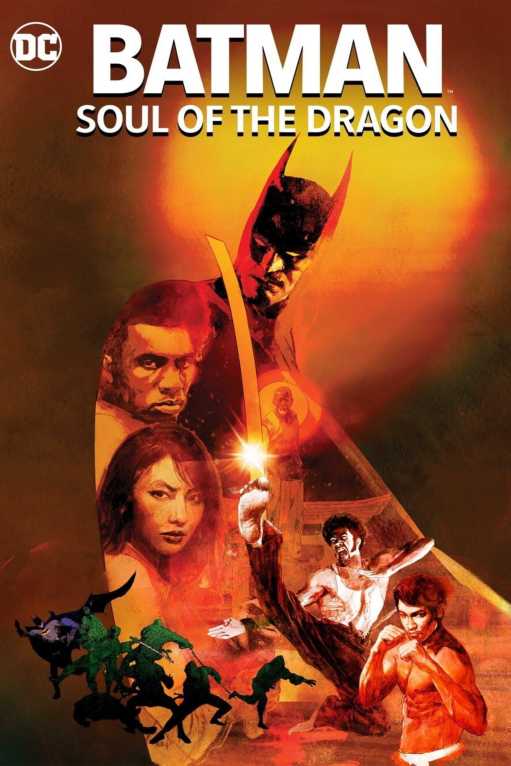
Batman - Soul of the Dragon

Studio: Warner Bros. Animation and DC Entertainment

Series: DC Universe Animated Original Movies – Film 40

Director: Sam Liu

Producer: Bruce Timm

Writer: Jeremy Adams

Length: 82 minutes

My Rating: 5 out of 5 stars

Prepare to dive into an intense and addictive DC Comics martial arts adventure with the latest entry in the DC Universe Animated Original Movies range, Batman: Soul of the Dragon, an outstanding and deeply enjoyable film that explores several amazing DC characters in a very unique way.

While The Unseen Library is primarily dedicated to providing book and comic reviews, I have in the last year been experimenting with reviews and articles about another great passion of mine, animated superhero films.  I have always had a lot of fondness for this genre and I started focusing on it more last year when I reviewed Justice League Dark: Apokolips War, and even further when I did an extended Top Ten Tuesday article listing my favourite superhero animated films, which primarily featured DC Universe Animated Original Movies.  DC continues their domination of the animation market with the very awesome Soul of the Dragon film, which serves as the 40th entry in the DC Universe Animated Original Movies range.  I had an outstanding time watching this latest animated offering and it is definitely a new favourite film of mine.

Bruce Wayne, Richard Dragon, Shiva and Ben Turner are four of the best martial artists on the planet, utilising their skills and training to become truly elite fighters.  While each of these renowned warriors are now on their own different paths, they shared a similar start on their journey as students at the secret monastery of Nanda Parbat.  Training under the legendary O-Sensei, these four, along with other notable students, not only learned the martial techniques that allowed them to become the fighters they are today but also became a close-knit family, until one terrible night changed everything for them.

Now their paths are about to cross again when Richard Dragon discovers that a fanatical organisation, the Cult of the Kobra, have stolen an ancient and dangerous artefact that Dragon and his fellow former students are intimately and tragically familiar with.  Travelling to Gotham City, Dragon recruits Bruce Wayne, who now fights criminals as the vigilante Batman, to help him stop Kobra and save the entire world.  Attempting to recover another artefact guarded by Shiva, now a feared Gotham crime boss, they soon discover just how long and deadly Kobra’s reach is.

With Shiva and Ben in tow, the four former disciples of O-Sensei prepare for the battle of their lives as they attempt to infiltrate Kobra’s island base.  However, nothing will prepare them for the dangers they will encounter, nor the horrors unleashed from their past.  Can these four dangerous fighters work together to save the world or will an ancient and deadly force be unleashed?

Batman: Soul of the Dragon is an excellent and amazing animated comic book film that proved to be an absolute treat to watch.  This is a standalone film which is directed by Sam Liu, written by Jeremy Adams and featuring Bruce Timm as an executive producer, and together these talented people have produced a fantastic and powerful feature.  Liu and Timm are the genius behind some of the best animated comic films that are out there, including Justice League vs. Teen Titans, Suicide Squad: Hell to Pay and the incredible The Death of Superman, and they have once again done an outstanding job with Soul of the Dragon, creating a unique and entertaining comic book tale.  Making excellent use of an exceptional narrative, a great group of characters and a very distinctive vibe, Soul of the Dragon is an outstanding and wonderful film that is really worth watching.

Soul of the Dragon has a particularly awesome and captivating narrative that follows its four iconic central protagonists on an epic quest to right the wrongs of their collective past.  This movie contains an original tale set in the 1970s that draws heavily from classic DC martial arts comics to create a fantastic film that not only dives into the origins of some amazing DC characters but which also presents an exciting character-driven adventure.  This movie starts off with a captivating bang with Richard Dragon discovering a sinister plot with ties to his time as a student.  The story then quickly starts to reunite the four major characters, with several impressive action set-pieces dominating the early part of this movie, all of which were a real treat to watch.  The story than takes the protagonists to an island fortress where they must face their enemy before he can unleash a terrible force of destruction.

Interspersed with the main story are a series of compelling flashbacks that follow the protagonists’ training under O-Sensei, which provide some excellent context to the main story.  I thought that the flashbacks were a particularly impressive part of the movie and I liked they expertly tied together main narrative with the past, creating a richer overall story.  I also felt that the narrative did an excellent job of introducing each of the characters while also highlighting the differences between their modern appearances and their former lives as students.  I did think that the main story was a little rushed and could have potentially used a little more plot in between the protagonists’ reunion and their arrival at the antagonists’ island.  Still, this did not impact my enjoyment of the movie too much, and the last third of the film is so damn epic and emotionally charged that you forget about this slight misstep of pacing.  All of this wraps up with a memorable and interesting ultimate conclusion, which will leave you wondering about what, if anything, is going to happen next.

Thanks to the standalone nature of this movie, potential viewers do not need to have watched any prior DC animated features to enjoy Soul of the Dragon, and indeed minimal knowledge of the various characters and comic elements is needed to follow along, as the narrative provides a fantastic and detailed introduction to all the relevant parts of the plot.  All of this makes for an epic and just plain awesome story that honours some classic DC characters and comics while also introducing them to a new generation of DC fans with this fantastic adventure.

In addition to the first-rate story, I was also impressed with how well this cool movie was put together.  It contains some outstanding animation, especially when it comes to the impressively exciting action scenes, with a particularly well-put-together car chase halfway through the film being an amazing example.  This proves to be a very action-heavy film, with a huge number of fluid combat sequences that perfectly captures the skill of the combatants and which successfully translates the style of the original martial arts comic.  Parents should be warned that this is not an animated feature for younger children, thanks to some of its over-the-top content, but everyone else is going to love seeing all the exciting fast-paced scenes unfold.  I particularly liked how this animated movie had such a distinctive and entertaining style to it, which really enhanced my enjoyment of the film.  As the story is set in to the 1970s, the creators attempted to replicate the feel and tone of the era in a number of different ways, such as the technology, locations and the animated appearances of the characters.  The creative team also made sure to include a ton of appropriate slang (you haven’t seen anything till you’ve seen Batman say: “Let’s get it on”) and an excellent instrumental musical score that is not only very 70s in its sound but which perfectly fits the movie’s distinctive narrative and tone.  Soul of the Dragon draws a lot of inspiration from classic kung fu films, especially those featuring Bruce Lee, and you can really feel the creators’ love of the genre with all the little details they chuck in.  There are also a number of fantastic allusions to classic James Bond films, including several very familiar musical themes, some entertaining lines from certain characters and even a dangerous car chase with a gadget-laden car that ends with a vehicle getting whisked away on an electromagnet attached to a helicopter (a very fun call-back to You Only Live Twice).  I absolutely loved how well this film came together, and all the exceptional animation and clever tonal shifts combine perfectly with the great story to produce an enthralling and memorable viewing experience.

In addition to have an amazing and entertaining narrative, Soul of the Dragon is backed up by a fantastic roster of characters from across the DC Comics canon, voiced by an exceptional and talented collection of actors.  While this movie contains several great supporting characters, the story is mostly set around Bruce Wayne, Richard Dragon, Shiva and Ben Turner, each of whom are heavily featured in both the main narrative and the flashbacks.  While all four of these main characters are great in their own right, a lot of their appeal lies in fantastic connection they have with each other and with their master, O-Sensei.  These great protagonists have an excellent rapport, and it proved to be really great to see them interact with each other throughout the film.

The lead of the film is probably Batman, who is voiced by David Giuntoli of Grimm fame, who provides a fantastic take on the character with his voice work.  I liked how there were two versions of Batman: the vigilante who featured in the main story and the younger student in Nanda Parbat.  This proved to be an interesting portrayal of this iconic character, as the writers attempt to explore Bruce’s determination, even as a young man, to do the impossible and fight evil no matter the cost.  It was also great to see him evolve from the student in the flashbacks to the vigilante in the main story, and there are some fun scenes that showcase him becoming a more focused and terrifying fighter when he puts on the mask.

While Soul of the Dragon is nominally a Batman movie, Bruce is somewhat overshadowed by some of the other main protagonists.  This is no fault of the character’s portrayal or characterisation; it is just because the other protagonists are just a little more exciting and enjoyable.  Part of the reason why this is the case is that Batman is the least skilled martial artist in what is essentially a kung fu movie, as it is established that his fellow students are better fighters than him (this is true in both the film and in the comics).  While this does mean that some of the other characters’ action sequences are a little more visually impressive, you instead get to see Batman fight in different ways.  There is a great focus on how Batman utilises trickery and fear to supplement his weaker fighting abilities, and there are some excellent scenes around this, including a key one towards the end of the film where he uses a combination of his gadgets, cunning, and even his own cape to defeat a superior foe.  I did think that the version of the character was a bit blasé about keeping his identity secret with his friends, and he didn’t seemed as opposed to people using lethal force as you would expect, but this was an outstanding take on Batman and I really enjoyed his appearance in this film.

One major character who was a true highlight of this movie was Richard Dragon, an iconic character who is widely regarded as one of the best fighters in the DC canon.  Despite his popularity in DC’s martial arts comics, this is the character’s first appearance outside of the comics (the Richard Dragon featured in Arrow is a different character altogether) and he voiced by The Chairman himself, Mark Dacascos.  Depicted as Asian in the film (the comic character is traditionally a red-haired Caucasian), this character looks a lot like Bruce Lee in Enter the Dragon and is portrayed as an international super spy.  Despite this being a Batman film, in many ways Richard is just as much the main character of this movie, with much of the story revolving around him.  Richard grabs focus right from the start, where he engages in some amusing spy antics, which include outwitting a James Bond-esque character in a fancy casino, effortlessly and stylishly fighting off some goons, and parachuting onto a boat filled with beautiful women (a scene very reminiscent of The Living Daylights, Bond music included), before identifying himself as “Dragon, Richard Dragon”.  Each of Dragon’s subsequent scenes are really fantastic, from the fluid and exceptional action sequences to the fun interactions he has with other characters, including an entertaining scene with a pompous bouncer.  Dacascos does an exceptional job voicing this character and he provides Richard with a confident, intelligent and generally calm air that proves to be extremely easy to enjoy, while also including some vulnerability in several amazing scenes.  All of this helps to produce an exceptional character and I am extremely glad that the introduction of Richard Dragon to a wider media went so well.

The next major character in the movie is the dangerous and delightful Shiva, who was voiced by the talented Kelly Hu.  Lady Shiva, as she is better known, is one of the deadliest assassins and martial artists in the DC canon.  I felt the creative team did an outstanding job showcasing Shiva in Soul of the Dragon, as she is portrayed as a merciless killing machine and living weapon able to destroy her opponents with minimal effort and nothing but her bare hands.  The character has some of the most brutal combat sequences, which were not only beautifully animated but which proved to be extremely entertaining to watch.  I felt that Shiva went through some fantastic character development throughout the film as she transforms from a dedicated student to a ruthless crime lord who even Batman is afraid to deal with: “I’m working up to it…”  I also really loved the choice of voice actor for this character as Kelly Hu does a sensational job bringing Shiva to life.  Hu, who is known for her comic book roles in both animation (as Cheshire in Young Justice and Karai in Teenage Mutant Ninja Turtles) and live action (as Lady Deathstrike in X-Men 2 and China White in Arrow), has previously voiced Lady Shiva in the Batman: Arkham Origins video game, and it was great to see her return to this fantastic character.  She gives this version of Shiva a particularly deadly air; you can tell with every sentence just how confident she is in her own ability and lethal potential.  Not only does Shiva have some of the best fight scenes in the movie but she also has some of the best lines, such as when she chooses her opponent in one of the big boss fights: “I’ll take the girl, her look offends me!”  I also absolutely loved one scene which saw the voice of Karai from Teenage Mutant Ninja Turtles face off against three green-clad ninjas respectfully wielding sai, nunchaku and a bo staff.  The character’s casual comment of “You know how to use those?” followed by her effortlessly taking all three out was just perfect and it has me laughing pretty heavily.  I think that Shiva was probably my favourite character in the entire movie and I am really impressed with how she was written and portrayed.

The final member of the main four characters is Ben Turner, the angry and dangerous African-American fighter better known as Bronze Tiger.  Bronze Tiger is a major martial artist in the DC canon who is probably best known for his run in the Suicide Squad comics.  Bronze Tiger is voiced by Michael Jai White, who recently portrayed the live-action version of the character in Arrow.  I really liked Bronze Tiger throughout Soul of the Dragon, as the film captures a lot of his essence from his original comic appearances and subsequently turn him into a fantastic character in this movie.  Part of the reason why is that he goes through the most development out of all the main characters, especially as several flashbacks bridge the gap between his student days and his current character, showing several pivotal events in his life.  I absolutely loved his look in this movie, as they made the decision to model him on African-American actor and martial artist, Jim Kelly, with some elements of other 70s African-American characters like Shaft and Luke Cage thrown in.  There is a particularly fun joke around this character when Richard misremembers the character’s codename as Black Samurai, a reference to the Jim Kelly movie of the same name, and the subsequent approval of the team at his actual codename of Bronze Tiger was very entertaining.  White does some excellent voice work for Bronze Tiger in this film and he successfully showcases the character’s intense anger at the start of the story before evolving it into a more zen-like persona towards the end.  I would say that Bronze Tiger was a little overshadowed by the three other protagonists, but he was still a great addition to the movie and is a fun character to follow.

Aside from the main four characters, there is a particular focus on the mentor character of O-Sensei, who is voiced in this film by the legendary James Hong.  O-Sensei is a fantastic character with an intriguing history in DC Comics, being a major figure in the lives of Richard Dragon, Shiva and Bronze Tiger.  This is actually O-Sensei’s first named appearance outside of the comics, and he proves to be a fantastic and fun addition to the movie’s narrative.  Hong portrays the character as a wise but humorous kung fu master, offering deep insights and amusing jokes in equal measure to the younger characters, while also forming them into a close family.  O-Sensei proves to be an extremely likeable character, with some deep and powerful moments that ensure that the viewer appreciates and enjoys him.  I particularly loved Hong’s voice work throughout the movie and I felt that he really dived into the character and made him stand out, especially in some later scenes in the movie where there are some intriguing twists around him.  An overall outstanding and exceptional part of the cast, I am extremely glad they got Hong for this movie.

No comic book movie will be complete without some villains, and to my mind this is where Soul of the Dragon falls a little flat.  The antagonists of this film are the members of the Cult of the Kobra (essentially DC’s version of Hydra, both of which were created by Jack Kirby).  Kobra are led by their prophet, Jeffrey Burr (voiced by Josh Keaton), backed up by his henchmen Schlangenfaust (Robin Atkin Downes), Lady Eve (Grey Griffin) and King Snake (Patrick Seitz).  While all of these characters are voiced perfectly and have some cool moments throughout the movie, such as Burr’s creepy introduction, his belief in his prophesised destiny and Schlangenfaust’s hidden abilities, I honestly found each of these villains to be a little underwhelming.  None of them (with the possible exception of Schlangenfaust) really stood out to me and they were all very generic sort of villains to the story.  That being said, Soul of the Dragon did feature two hidden antagonists at different points of film who add some major twists to the tale.  Both of these villains were rather good and moved the story along in some intriguing and entertaining directions.  I particularly loved the appearance of one antagonistic character towards the end of the movie, and while his appearance was slightly predictable, it proved to be a major highlight of the film, resulting in some outstanding scenes.  As a result, it was rather easy for me to forgive some of the downsides of the Kobra villains as the overall antagonists of this film turned out to be extremely good.

Overall, I think that Batman: Soul of the Dragon was an exceptional animated film that was a heck of a lot of fun to watch.  Thanks to its combination of an epic story, captivating and well-written characters and a tone that is a fun nod to classic and campy kung fu movies, this movie gets a full five stars from me.  This is definitely a movie I will watch multiple times in the future, and it comes highly recommended.  I very much looking forward to seeing the next entries in the DC Universe Animated Original Movies range (there is a Justice Society movie and an adaption of Batman: The Long Halloween coming out later this year), and I will have to have a go at reviewing them when they come out.

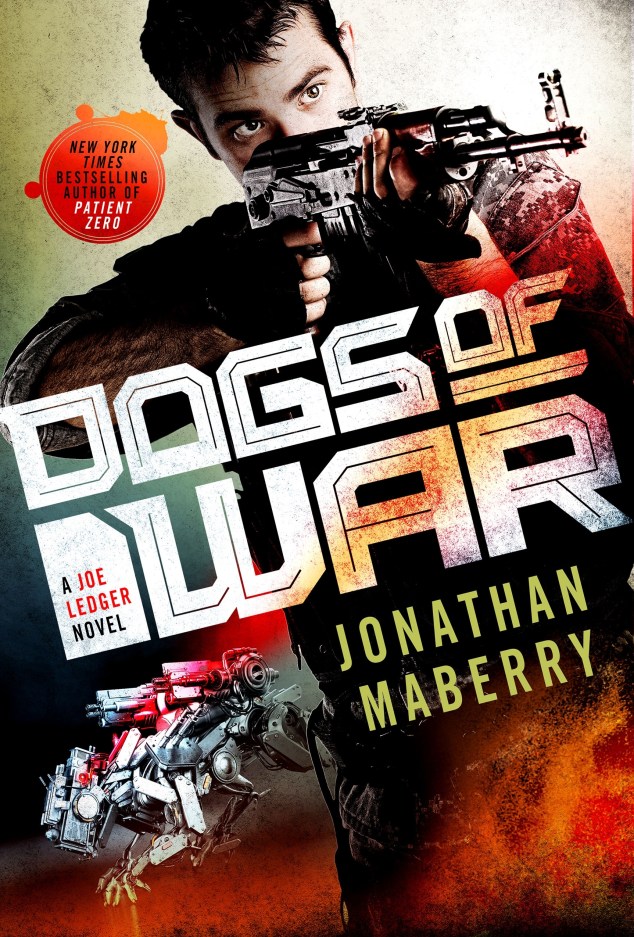
Throwback Thursday: Dogs of War by Jonathan Maberry

Dogs of War Cover

Publisher: Macmillan Audio (Audiobook – 25 April 2017)

Series: Joe Ledger – Book Nine

Length: 17 hours and 45 minutes

My Rating: 5 out of 5 stars

Amazon     Book Depository

For this week’s Throwback Thursday, I check out Dogs of War by Jonathan Maberry, the 9th novel in the action-packed, over-the-top Joe Ledger series.

People familiar with my blog will be aware that over the last year or so I have been making my way through Maberry’s Joe Ledger science fiction thriller novels.  I have been a little obsessed with these books ever since I first checked out the 10th novel in the series, Deep Silence, and then went all the way back to book one, Patient Zero, to see how the series started.  Ever since then I have worked my way through the rest of the Joe Ledger novels, each of which has proven to be a pretty top notch read.  I absolutely love the clever writing style, unique stories and distinctive characters that Maberry features in these novels, and I usually power through them in extremely short order.  Dogs of War is no exception, as I was able to get through this in less than a week and it did not take long for me to get addicted to its intriguing and exciting plot.

Following the disastrous events of Kill Switch, the Department of Military Sciences (DMS), a secret American counterterrorist unit that focuses on dangerous and unusual technology and science, is damaged and discredited.  However, they are still determined to do good throughout the world, and their main field agent, the legendary Joe Ledger, is always keen for a new case.  So when his brother calls him out of the blue with an unusual mystery, Ledger does not hesitate to head back to Baltimore in order to investigate.

Arriving in his former hometown, Ledger discovers a curious set of circumstances.  A young street worker went on a rampage, killing several people before dying herself.  The cause of her madness appears to be a new strain of rabies, which was apparently triggered by nanobots in her brain.  Attempting to investigate more into the case, Ledger finds himself and his family targeted by ruthless killers with advanced technology, determined to ward him off the case.  It soon becomes apparent that the death of the young girl in Baltimore is just the tip of the iceberg, as other mysterious events and attacks occur across America, many of them targeting members of the DMS.  A new enemy has risen from the ashes of the DMS’s old foes, and she is determined to bring about a new world order.  Worse, the DMS’s most dangerous enemy has returned, ready to rain chaos and destruction down on the entire world.  Can Ledger and his team defeat this ruthless team of villains before it is too late, or will Ledger face the greatest tragedy of his life?

So, after reading all 10 Joe Ledger novels (as well as the spinoff novel, Rage), I have come to the conclusion that is actually impossible for Maberry to write a bad Joe Ledger novel.  I was once again blown away while reading this ninth book as Dogs of War contained an epic and addictive story that I could not stop listening to.  Maberry continues to utilise his distinctive writing style in this book, setting up a captivating and clever story that is loaded with intense action, likeable characters, memorable antagonists and a devious plot to end the world.  This results in a very captivating read and Dogs of War gets an easy five stars from me.  This is actually one of my favourite novels in the series and is probably the best one I have read this year (by a very small margin; Predator One and Kill Switch are both really good).  Also he briefly mentions my Alma mater, ANU, so yay for that!

Dogs of War contains an absolutely fantastic story that sees the fun and complicated protagonist, Joe Ledger, face off against another world ending threat.  Just like in the rest of the series, Dogs of War’s narrative is cleverly constructed with about half the novel is told from the point of view of Ledger, as he encounters the antagonist’s plot in real time.  However, the rest of the novel features a large array of alternate perspectives and preceding time periods that expands the range of the story and helps to create a complex and captivating narrative which really grabs the reader’s attention and interest.  Maberry backs up this great storytelling with a thrilling and action-packed narrative that is fast-paced and delightfully over-the-top.  I really love the unique science fiction thriller storylines that Maberry features within Dogs of War and I appreciated all the cool connections that it has to previous novels in the series.  This cool story will appeal to a wide range of different readers and it is extremely accessible to people who are unfamiliar with the Joe Ledger series as Maberry goes to great lengths to explain all the various story elements and characters featured within the book.  That being said, I really need to emphasise just how truly over-the-top this story could be, as there are a number of scenes that some readers may find uncomfortable or hard to read.  This includes some very graphic fight sequences and some rather disturbing sexual content, some of which, if I am being honest, is way too excessive (one flashback scene features the underage antagonist getting deflowered by a literal demon right after her mother’s funeral, which happened to coincide with 9/11).  Still I have a lot of love for the way in which Maberry constructs a Joe Ledger story, and Dogs of War is a truly fun and thrilling story as a result.

Just like with the previous novels in this series, Maberry has anchored his amazing story on a fantastic collection of characters who really help to enhance the narrative and turn this into a first-class read.  The main character is the series’ titular protagonist, Joe Ledger.  Ledger is an extremely complex character due to his fractured personalities and intense emotional range, and it is always incredible to see the story through his eyes, whether he is feeling each and every emotional blow that comes as way as a result of the case, or he is dishing out severe and brutal vengeance to those who have wronged him.  Ledger is also the cause of most of the book’s enjoyable humour, as he has an extremely flippant outer personality, including a hilarious and sarcastic inner monologue, which becomes especially funny when he encounters the various strange and over-the-top elements that this series is known for.

In addition to Ledger, Maberry also does an amazing job reintroducing and utilising the various recurring characters who have been featured in the previous entries in the series.  All of the side characters have their own distinctive and enjoyable personalities, and fans of the series will really appreciate seeing many of these characters return and continue their various individual storylines.  This includes the two surviving members of Ledger’s personal strike team, Top and Bunny, who serve as a great backup throughout the novel and get into some dangerous scrapes of their own.  I particularly appreciated the way in which the author examined and showcased the emotional damage that these two characters have been dealing with since the traumatic events of Kill Switch, and it added an amazing sense of realism to the story.  I also absolutely loved seeing more of Ledger’s attack dog, Ghost, the best and most lovable canine killing machine in all of fiction.  It is an absolute testament to Maberry’s writing ability that he is able to install such a fun and memorable personality into a fictional dog, and you can’t help but love it when Ghost is on the page doing his thing.  That being said, one of the best characters in the novel has to be the mysterious head of the DMS, Mr Church.  Church is a calm and measured figure throughout the novel, grounding the various main characters and providing stable leadership to them.  However, the main appeal of Church lies around his enigmatic nature and past.  Maberry has built up such an amazing amount of mystique around this character that anytime a little hint or mention of his past is presented the reader absolutely laps it up as they try to figure out who or what he is (is he an alien, an angel, some form of immortal hero from history? You just don’t know).  Dogs of War features several more tantalising hints and clues about this, and you get some very interesting glances into his past, although there is still so much mystery.  I really loved seeing all these great characters again, and it was fantastic to see how the story unwinds around them.

No Joe Ledger novel would be complete with a sensationally evil villain with a complicated past and an elaborate master plan, and Dogs of War features both in spades.  The main antagonist of this novel, Zephyr Bane, is a rather intriguing character with a unique view on the world and a range of connection to some of the villains previously featured in the series.  Maberry does an outstanding job building up this antagonist throughout the course of Dogs of War, including through a series of interludes that show key moments in Zephyr’s life, such as how she came up with her plans and how she was tutored in the art of villainy.  While Zephyr is a great antagonist, Maberry doubles down on the villainy in the novel by introducing another sinister opponent for the DMS to face.  This second antagonist is someone who has appeared in several of the past Joe Ledger novels, although his identity is hidden for a good part of the book (although fans of the series will work out who they are rather quickly).  This character is another particularly mysterious being, who spends most of the book manipulating events from the shadows, giving the reader hints at who they are and what they are capable of.  A major highlight of this novel is this villain’s long-awaited showdown with a major Joe Ledger character, and this fated interaction does not disappoint, even if it leaves the readers with more questions than answers.  Overall, these are some fantastic antagonists, and I absolutely love seeing the outrageously evil opponents that Maberry comes up with for these books.

I also have to highlight the extremely complex and intricate evil plot that these antagonists came up with for Dogs of War.  This was a great, high-stakes plan that contained a lot of different elements that are slowly revealed to the reader throughout the course of the book.  Not only does Maberry make great use of flashbacks and interludes to show how this plan came to pass and the various planning stages but he also spends time examining how the antagonists attempt to counter the inevitable interference from the DMS.  Both of the main antagonists have had interactions with the DMS before, and they know that any plan they implement will gain the attention of the DMS at some point.  As a result, they come up with a number of counters and tactics designed to directly target key elements of the DMS in order to take them off the board.  This was a really clever part of the story, as not only does it add an extra level of drama to the narrative, especially when Ledger is emotionally targeted, but it also represents a clever bit of continuity with the rest of the series.  A lot of the weaknesses that the antagonists attempt to exploit were previously introduced or discussed in some of the previous Joe Ledger novels.  The antagonists subsequently try to learn from the mistakes of their predecessors when they utilise these weaknesses, resulting in a lot of tension as some of the characters you are invested in are personally targeted.  I think this was one of the more inventive master plots that Maberry has come up with for the Joe Ledger series.

One of the most fascinating parts of Dogs of War was the author’s examination of certain real-world technologies.  Throughout the course of the book, the author examines all manner of technological marvels in great detail, including nanobots, advanced robots, drones, computer technology and artificial intelligence.  This results in a number of intriguing discussions as the various characters consider all the applications and impacts that such technology has on the world, these technologies are then cleverly worked into the plot of the book as the antagonists utilise them for their evil plans.  Not only is this immensely interesting and highlights the research that the author has obviously done, but all this technology adds a certain amount of real-world menace to the book.  As Maberry takes pains to explain at the very front of the book, all of the technologies that he features within Dogs of War is either in development, currently being tested or already exist in the real world.  As a result, the reader gets a little bit of dread at the thought that a lot of the terrible things that Maberry features within Dogs of War could happen in real life.  This of course helps to ratchet up the tension and suspense within the novel, and I really appreciated how the author used this to make the story even better.  Also, you get to see the protagonist go up against a bunch of robotic dogs, which is just awesome on so many levels.

In order to enjoy Dogs of War I checked out the audiobook format of the novel, which has a decent run time just short of 18 hours.  I absolutely love the Joe Ledger audiobooks and they are by far my preferred way to enjoy these fantastic novels.  The main reason for this is the awesome narrator, Ray Porter, who has lent his talent to every novel in the Joe Ledger series, including Dogs of War, and whose voice really enhances these books.  Porter, who is probably my favourite audiobook narrator at the moment, does an amazing job bringing the characters and the story to life, thanks to his memorable voices and the impressive way that he loads each word with so much emotion and personality.  You always get an incredible sense of the character’s emotions, as the anger, rage, fear or grief that they go through always comes through so clearly.  I particularly love the way that Porter brings the series’ main character, Joe Ledger, to life, as he perfectly captures Ledger’s diverse emotive range, including his boundless anger and his outrageous and sarcastic humour.  I also love the incredible voices he utilises for some other characters, such as the mysterious Mr Church, and his depiction of him contains all the necessary gravitas and power to match the character described in the text.  I also liked the way in which Porter loads one of the antagonist’s voices up with such pure menace and hatred, turning them into a very threatening figure in this format.  All of this made listening to Dogs of War an absolute treat, and I cannot recommend the Joe Ledger audiobooks enough.

Dogs of War was another excellent and addictive entry in Jonathan Maberry’s Joe Ledger series, and I had an amazing time listening to it.  Featuring an outstanding story, awesome characters and so many other fantastic elements, this was an incredible read and I am extremely glad that I checked it out.  I have to admit that I am actually a little sad to have finished off Dogs of War, as that was the last Joe Ledger novel that I had to read.  I have really enjoyed going back and checking out all of the wonderful novels in this superb series, and I will have to get my science fiction thriller fix somewhere else in the future.  Luckily, Maberry actually references several other great series in Dogs of War that could be worth checking out, including the Sigma Force, Seal Team 666 and Chess Team thriller novels, all of which apparently exist in a shared universe with the Joe Ledger books.  I will have to have a think about look at some of these in the future, especially as I wait for Maberry to write another entry in his spin-off Rogue Team International series.  In the meantime, Dogs of War is really worth reading and it comes very highly recommended from me.

Amazon     Book Depository

Throwback Thursday: Final Crisis: Rogues’ Revenge by Geoff Johns and Scott Kolins

Rogues' Revenge Cover.jpg

Publisher: DC Comics

Publication Date – 28 July 2009

Amazon

Reviewed as part of my Throwback Thursday series, where I republish old reviews, review books I have read before or review older books I have only just had a chance to read.

In the midst of the 2008 DC Comic crossover event Final Crisis lies this often overlooked and foolishly underappreciated miniseries, Final Crisis: Rogues’ Revenge, which focuses on the Flash’s most enduring villains, the Rogues.

Final Crisis was the big DC comic event of 2008, and is memorable for a number of key events, such as the apparent death of Batman, the death of the Martian Manhunter and the return of the original Flash, Barry Allen.  In addition to this main series, DC also released a number of miniseries and one-shots that served as tie-ins to the main Final Crisis storyline and which are often forgotten in light of Final Crisis big events.  I have to admit that I have never been a particularly big fan of the Final Crisis series, mainly because of the over-the-top and unnecessarily complicated storyline (you know, typical Grant Morrison writing).  However, I did really enjoy the tie-in miniseries, including the dark comic Revelations, which focuses on the Spectre and contains the horrifying image of Dr Light being turned into a candle, and the massive Legion of 3 Worlds miniseries, which saw the return of two great characters.  However, my favourite of all these miniseries has to be the subject of this review, Rogues’ Revenge, by iconic The Flash contributors Geoff Johns and Scott Kolins.
Final_Crisis_Rogues_Revenge_1B.jpg

The Rogues are a group of iconic dangerous criminals in the twin cities of Central City and Keystone City who have banded together in opposition to the Flash.  Different from the usual supervillains that inhabit the DC Universe, the Rogues have a sense of honour and mostly commit thefts rather than seeking world domination or pointless destruction.  Usually led by Captain Cold, the Rogues have featured most of the Flash’s villains at one point or another, including Heatwave, Mirror Master, Captain Boomerang, the Trickster, Weather Wizard and even Gorilla Grodd.  These characters have been recurring villains of the Flash for over 60 years and continue to be regular features of the various The Flash comics.  The Rogues are also very well represented in other media, appearing in several animated shows and movies.  One member, Captain Boomerang, appeared in the 2016 movie Suicide Squad, while the rest of the characters, especially Captain Cold and Heatwave, are major fixtures of the Arrowverse television series.

In Rogues’ Revenge, the core remaining Rogues, Captain Cold, Heatwave, Weather Wizard and the second Mirror Master, have been having one hell of a year after breaking their number one rule: never kill a speedster.  Tricked by the young psychopathic speedster Inertia, the Rogues attacked the Flash when he lost his powers and actually managed to kill him, which they never wanted to do.  Worst, the Flash that they killed was only a kid, Bart Allen, the former Impulse and Kid Flash, who had been aged up by his time in the Speed Force.  As the most wanted criminals in the world, the Rogues have spent the year being hunted by as fugitives by the collected superheroes.  Briefly imprisoned on an alien planet with the rest of the world’s supervillains, the Rogues escaped and have returned to Keystone City, once again fugitives.

Final_Crisis_-_Rogues_Revenge_2A.jpg

The Rogues are planning to permanently retire after their terrible mistake.  However, when Inertia escapes from his imprisonment, the Rogues decide to go on one last mission and seek revenge for Inertia’s trickery.  Joining forces with the new young and immature Trickster, the Rogues set out to break their number one rule just one more time.

However, their revenge is going to get far more complicated than they anticipated.  The supervillain prophet, Libra, is uniting the other villains for the Final Crisis and wants the Rogues by his side in his new Secret Society.  Their emphatic refusal does not go down well, and Libra sets about recruiting them by any means necessary, even if that means killing every member of the Rogues’ family to get their attention.  The former Rogue, Pied Piper, is also hunting down his former cohorts, determined to repent for the role he played in Bart Allen’s death, while powerful anti-speedster Zoom has taken Inertia under his protection and tutelage.  Against all these forces, this misfit group of killers and thieves seem incredibly outmatched, but never count the Rogues out of the fight.  Can the Rogues get their revenge, and how will they react to the return of their greatest foe, the original Flash, Barry Allen?

This fantastic miniseries is the brainchild of legendary DC writer Geoff Johns and artist Scott Kolins, who previously did a joint run in The Flash Vol 2Rogues’ Revenge is collected in a single volume and consists of the miniseries’ three issues, as well as two issues from Johns and Kolins’s run on The Flash Vol 2 issues #182 and #197, which focus on the origins of Captain Cold and Zoom respectfully.  Rogues’ Revenge is an excellent series that puts the focus onto an incredibly intriguing and very different group of villains.  Containing a superb story, some amazing artwork and some subtle, but interesting tie-ins to Final Crisis and other parts of the DC Universe, this is a really fun miniseries that is worth checking out.

Final_Crisis_Rogues_Revenge_3.jpg

One of the things that I like the most about this miniseries is the way that Johns and Kolins really dive into their complex main characters and show what set them apart from all the other supervillains.  The reader is given a look into the psyche of each of the Rogues, and shows the deep and dark troubles that hide within their minds.  Alone, they are incredibly damaged individuals with advanced weapons, but together they are a functioning unit able to hang with the most powerful godlike beings in the universe.  Each of the Rogues is a complex and intriguing character, and the creative team do a great job highlighting this succinctly in the miniseries.  Heatwave is a pyromaniac whose life has been consumed by fire, Weather Wizard is still haunted by the fact that he murdered his brother, Mirror Master is fighting his baser instincts and his drug habit, while Trickster is a young punk who is desperately trying to join up with the other Rogues he idolises.

Captain Cold is the most complex of them all, and his life is shown in both the miniseries and in one of the issues of The Flash Vol 2, which I have to give the producers of this volume props for including.  Captain Cold is the team’s leader and the definer of their moral code.  Because of him, the Rogues try to avoid killing where possible, do not touch drugs and have a high standard when it comes to its members, which is why they have yet to fully accept Trickster into their ranks.  Throughout Rogues’ Revenge, Captain Cold is able to control and anticipate the moods and needs of his team.  At the same time, he is able to lean on his team when it comes to his intense personal matters and the history with his family.  Issue #182 of The Flash Vol 2 does an amazing job of humanizing this character further, especially after you see him in action in the three issues of the Rogues’ Revenge miniseries.  Overall, the creative team are able showcase the close relationship the Rogues have with each other, as well as how strong they are together.

Flash_v.2_182.jpg

I also enjoyed how Johnson explores the complex relationship that the Rogues have with the Flash.  Despite him being the main superhero who has been opposing them for years, the Rogues make it quite clear that they never actually wanted to kill him, mainly because they knew how much trouble they would be in if they ever succeeded in finishing him off.  The anger at how they were duped into attacking the Flash without his powers is pretty clear early in the miniseries, and there is a certain sense of regret as they describe how their attacks usually would not have killed a speedster.  They also show some remorse that the Flash that they killed was so young, as they did not realise they were really attacking Kid Flash.  While this initial examination of their relationship with the Flash is fascinating, the discussion that occurs at the end of the third Rogues’ Revenge issue is particularly interesting, as they talk about their relationship with the original Flash, Barry Allen, and how he was different from all the other Flashes.  It is a great tie-in to the other comics focusing on this character’s return, and it also brings the Rogues’ story full circle as they decide to postpone their retirement in light of the relentless pursuit that they know is coming from their original Flash.  You have also got to love the present they send to the returning Flash in order to appease his wrath for their role in Bart Allen’s death.

 Rogues’ Revenge has an impressive and well-written story that is not only a lot of fun to read but ties in nicely with the major Final Crisis crossover event that was occurring at the same time.  The central story of the tired and weary Rogues as they plan to engage in one last mission before their retirement is amazing as it allows for a deeper look at their methods, equipment and skills at defeating speedsters.  The tie-ins with Final Crisis aren’t too over-the-top and mostly relate to the return of Barry Allen and Libra’s attempts at creating a new society of supervillains.  Libra’s scheme to bring the Rogues on board is particularly fun, as he sends the team of knock-off Rogues to face them, utilising stolen copies of their weaponry.  This is a great battle scene which helps show off how the Rogues are so much more than the weapons that they wield, as they utilise their skills and experience to eliminate their opponents in short order.  The devastating and inventive uses of their weapons are very impressive, from Captain Cold’s wide beam cold field, to Weather Wizard growing a tornado inside of one of his opponents.  The Rogues’ extreme violence in this scene is explained as the characters protecting their reputation, as there have been many copycats before, which fits these old veterans perfectly.  I also really liked the reasons the Rogues give to refuse Libra’s request for them to join the Secret Society, having been burned by joining them before, and it was fun to see them predict exactly how the new Secret Society was going to come crashing down.
Flash_v.2_197.jpg

The artwork within this miniseries is very impressive, and it was great to see Kolins back in The Flash saddle.  I was really impressed by the character designs Kolins used during this miniseries, as the four veteran Rogues all have their iconic costumes, but there is a beat-up and ragged look to them.  This perfectly encapsulates the terrible year the characters have been happening, and each of these characters have a tired and weary look to them after so many years of fighting.  I also cannot speak highly enough of the impressive fight sequences throughout the miniseries.  The full and at times gruesome effects of the Rogues’ weapons are in full display throughout Rogues’ Revenge, as the titular characters unleash fire, ice, weather, tricks and mirror insanity on their opponents.  The duelling walls of fire that occur between Heatwave and newcomer Burn are just gorgeous, and Weather Wizard’s various creations, such as lighting and fog, are drawn amazingly well.  I also cannot get past how impressively well Captain Cold’s ice devastation is drawn, especially when it comes to the effect the freeze ray has the human body.  This is an amazing bit of work from Kolins and the rest of the miniseries’ artistic team, and the art really helps to turn Rogues’ Revenge into a first-rate graphic novel.

Overall, Rogues’ Revenge is an outstanding tie-in miniseries that does so much to stand out from its overarching crossover event.  The focus on the Rogues, who make up one of DC’s most complex group of supervillains, is a compelling choice from the creative team, who do an incredible job showcasing these amazing characters.  Featuring an intriguing storyline and some first-rate artwork, this is a fantastic miniseries to check out, and one of my favourite underappreciated gems in the DC Universe.

My Rating:

Five Stars

Amazon