The Dragon in Winter by Jonathan Maberry

Publisher: Macmillan Audio (Audiobook – 20 August 2024)

Series: Kagen the Damned – Book Three

Length: 20 hours and 57 minutes

My Rating: 5 out of 5 stars

Amazon

The damned rush to their final battle in the epic dark fantasy novel, The Dragon in Winter, which brings an exceptional conclusion to author Jonathan Maberry’s Kagen the Damned series.

As I mentioned in my recent review for the author’s other 2024 release, NecroTek, I am a huge fan of Jonathan Maberry, having really gotten into his elaborate and deliciously gritty thrillers and other pieces of fiction since I started this blog.  While I am most familiar with the author’s long-running Joe Ledger series, one of his more intriguing recent bodies of work has been the Kagen the Damned series.  A dark fantasy fiction series that follows a highly damaged figure who seeks bloody revenge after the dastardly Witch-king uses magic to destroy his kingdom and kill the royal children in his care, the Kagen the Damned books were an incredible pivot into the fantasy fiction genre for Maberry that I deeply enjoyed.  Both of the previous books in the series, Kagen the Damned (one of my favourite books and audiobooks of 2022) and  Son of the Poison Rose (one of my favourite books and audiobooks of 2023) were five-star reads, and I have so much love for this series (which also includes the novella I Say Your Name in the Dark Nights) due to its elaborate storytelling, damaged characters, and intriguing take on the fantasy genre.  Because of how impressive the first two entries in this series are, I have been eagerly awaiting the third and seemingly final book, The Dragon in Winter, for a long time, and it was one of my most anticipated books of 2024.

Nearly a year after the bloody massacre that saw the dread Witch-king of Hakkia conquer the former Silver Empire in a single night, the war to reclaim the throne is finally here.  As the Witch-king continues to plot, planning to ascend to godhood, his enemies have rallied around the unlikely figure of Captain Kagen Vale, better known as Kagen the Damned.

Once the loyal guardian of the Silver Empire’s heirs, Kagen has survived despair, damaging revelations and damnation from his gods to stand against the Witch-king and gain the bloody vengeance he so desperately needs.  Having proven his valour in combat and his ability to face off against the darkest of magic, Kagen has managed to gather a massive army of rebels, outlaws and the soldiers of various allied nations determined to stop the Witch-king for good.  But this army of flesh and blood men will not be enough to stand against the destructive power of the Witch-king alone.

As magic continues to return to the land, Kagen and his allies soon find themselves beset by the Witch-king’s sinister powers and dread allies, as vampires, demons, magic users and other fell creatures emerge, determined to keep the Witch-king on his bloody throne.  To survive, Kagen will need to find magic of his own that will allow him to withstand the Witch-king’s power.  But the more he looks, the darker secrets he unravels, and soon everything he thought he knew about the world will come tumbling down around him.  Worse, an even more dangerous threat is rising in the frozen north, as a tortured dragon calls out in despair and is answered by a being of unimaginable power.  Can Kagen stop the Witch-king before his dark plans come to pass, or will the dread flames of vengeance consume the entire world?

What an outstanding end to one of my favourite new fantasy trilogies!  The Dragon in Winter was another exceptional novel from Jonathan Maberry that serves as a fitting and powerful end to the Kagen the Damned dark fantasy series.  Loaded with insane action, brilliantly damaged characters, and some fantastic storytelling, The Dragon in Winter was an incredible book that perfectly utilises Maberry’s distinctive style.  I had an amazing time listening to this impressive book, and it gets an easy five-star rating from me, especially on audiobook.

Maberry had to achieve a lot with this third Kagen the Damned novel, as not only did readers require a satisfying end to the trilogy, but this book needed a distinctive story much like the previous entries.  I feel that Maberry achieved both these goals, as The Dragon in Winter was a compelling and dark read that provided a great mixture of adventure, war, intrigue and character growth, all while continuing and concluding the storylines from the previous books.  This third novel starts shortly after Son of the Poison Rose and sees Kagen taking on the role of general by leading a small army against the Witch-King’s forces, while the previously established story threads about the various nations building their armies to join the war come to fruition.  Maberry does a great job of resetting the scene in these early chapters, and not only do you get to see the situation from Kagen’s perspective but multiple scenes are shown from the antagonists’ side as they make their preparations to foil the protagonist and his allies.

Much of the middle of the story follows Kagen and his unlikely allies as they prepare for the inevitable final confrontation, attempting to gain additional ways to fight against the Witch-king.  While some of Kagen’s sequences aren’t entirely necessary for the full advancement of the plot (the goblin cave sequence, for example), they are all generally intense and character building, and they all tie in nicely amongst the other storylines about war preparations and the Witch-king unleashing his dark minions upon the world.  A secondary major storyline focuses on the characters of Jheklan and Faulker, Kagen’s brothers, who journey up to the frozen Winterwilds in search of the last dragon.  This storyline proves to be quite an interesting addition to the story, as while the characters are disconnected from the rest of the plot due to distance, their actions have big impacts on the overarching narrative.  This middle part of the story ends with a major confrontation between a memorable supporting character and a dark set of antagonists, which was not only very awesome but helped to set the scene for the rest of the book.

The final third of The Dragon in Winter is all action and excitement as the final battle of the war is unleashed on multiple fronts.  Maberry expertly brings all the various ongoing storylines to the boil, as the protagonists find themselves in mortal peril.  There is a little bit of everything here, including massive war sequences, smaller battles with huge sacrifice and big revelations finally coming to the surface.  The author keeps the tension extremely high during this third act, and you are constantly on the edge of your seat, especially as your favourite characters face doom and destruction at every turn.  I loved the way many of these storylines came together, and while a couple of big moments were easy to see coming (although for me that just increased the anticipation), there were also some reveals I couldn’t have predicted.  This includes the book’s massive twist that turns around much of what you thought you knew for the last two entries in the series.  I felt that this twist was very clever, especially when you consider the subtle hints leading up to it, and I appreciated how it changed the emotional impact of some previous scenes.  Everything leads up to the big final confrontation, which was as bloody and hard-hitting as you would expect.  This confrontation was chaos, carnage and catastrophe, and I felt that it was a fitting end to a dark trilogy that revelled in bloodshed.  While I do feel that the final boss takedown was a tad anticlimactic due to who got the kill, and Maberry reigned in the tragedy far more than I expected, this conclusion was extremely awesome, and I hung on every word right to the very end.  Everything was very nicely wrapped up, although there is potential for Maberry to revisit this series in the future, which could result in some more gripping adventures.

I always love the way that Maberry manages to apply his distinctive writing style to all his novels, no matter the genre, and it always works to create a powerful and exciting read, especially in The Dragon in Winter.  The large number of short chapters allows for a quick pace, and you are constantly jumping from sequence to sequence, eager to see what will happen next.  Maberry also excels at featuring a huge range of alternating perspectives as the book continues, with the point of view jumping around various interesting characters chapter to chapter.  While much of this focuses on the main protagonist, you are often following many of the fascinating and fun supporting characters as they go about their own adventures.  There are also multiple chapters shown from the perspective of the villain or his minions, and I love how the reader are constantly let into the antagonist’s plans, which helps to raise tension as you worry that they are one step ahead.  Throw in several additional perspective chapters from one-off characters, which often help to highlight some of the darker events going on in the wider setting, and this great jump in perspectives allows for a particularly complex and layered narrative that is so fun to navigate.  Of course, the real highlight of any Maberry book is the exceptional action sequences that pump some massive excitement into the plot.  Maberry is extremely talented at envisioning fight scenes of any size or shape, and I found myself constantly enthralled by the many, many battles that were contained in The Dragon in Winter.  This includes deep personal battles, running skirmishing or even a truly massive full-on war sequence with unique participants, all of which come across extremely well thanks to the author’s powerful and descriptive writing that captures every sword thrust or slice of the protagonist’s blades.

The Dragon in Winter continues to exhibit many of the dark fantasy elements that made the first two Kagen the Damned books so awesome to read.  Maberry really dove into the genre with a vengeance in this series, and I love how he pulled together a rich and powerful fantasy world loaded with both unique features and classic fantasy creatures and monsters.  Thanks to the author’s detailed writing and tendency to effectively recap key elements of the series, readers can easily absorb all the key elements of this universe, and it proves to be fascinating to take in, especially as Maberry loads it with secrets, deep history, and hints of other lands yet to be visited.  Of course, as this is Maberry, there is also a strong Lovecraftian vibe to this universe, as many of the elder gods and other associated beings have a place in this realm.  The author does a great job of exploring these classic Lovecraftian creatures throughout the course of the series, and the way they are worked into the main plot of The Dragon in Winter is extremely clever, especially if you have seen examples of them in some of Maberry’s other series.  For readers expecting a typical fantasy read, I should warn that The Dragon in Winter, like the rest of the Kagen the Damned series, gets very dark and brutal at times, and there are a lot of strong references to violence, torture, sexual assault and other troubling features that probably won’t appeal to every reader.  I feel that while Maberry occasionally goes a bit overboard with these darker inclusions, for the most part it helps to create a powerfully grim overarching tone that raises the stakes and ensure you are constantly rooting for the protagonist to succeed and bring a bit of justice to the world.  It also works very well alongside the awesome action sequences, and for those fans of some very bloody fights, including those featuring pure evil fantasy and horror creatures, you are in for an amazing time here.

While the action, setting and clever storytelling is an exceptional part of The Dragon in Winter, I also need to highlight the various impressive characters featured throughout this book.  Due to The Dragon in Winter being the last entry in this trilogy, Maberry spends much of this book finalising key character storylines, allowing for a much more personal entry in the series that will really appeal to those readers who have grow attached the protagonists in the first two books.  As such, this final Kagen the Damned novel features an array of great characters who are so well written and who often feature their own powerful and personal character arcs. 

Like with the rest of the series, much of the book’s character work is focussed on the main protagonist, Kagen Vale, who thanks to the dark deeds he has witnessed has been given the title Kagen the Damned.  A moody and deadly figure, Kagen has gone through so much despair and darkness in this series, and it has been a powerful journey following him this far.  Maberry did an outstanding job continuing Kagen’s story in The Dragon in Winter, and it was great to see how far Kagen has come, especially as he now uses his inner darkness, past trauma, and even the damnation of his gods, to fuel his desire to fight.  While he has overcome many of his past traumas, Kagen does experience new ones in The Dragon in Winter, as he finally understands the full scope of the evils unleashed upon the world, including by his own people.  This allows for some more dramatic sequences from the protagonist, and part of the emotional strength of the story is watching Kagen overcome even these revelations, especially with the help of his friends.  I have really appreciated how well Maberry has written Kagen’s pain and deeper heart throughout the series, and it was fantastic to see some of this pain finally come to an end in this final novel.

Aside from Kagen, the rest of the supporting cast proves to be quite exceptional, and there are many fascinating characters you become attached to as a result.  I personally loved seeing more of Kagen’s two friends and comrades, Tuke and Fillia, who form a hilarious put powerful trio as they fight together against the odds.  Essentially Kagen’s conscience and voice of reason, Tuke and Filia are the perfect supporting characters to the protagonist, and I love how they constantly anticipate Kagen’s behaviour and manipulate events to ensure he does what they want.  However, they also have their own compelling adventures outside of Kagen, especially when they lead the final battle, and you care nearly as much for them (if not more) than you do Kagen by the end of things.  Maberry also invests a lot of time in The Dragon in Winter to the amusing characters of Jheklan and Faulker Vale, Kagen’s brothers and mischievous adventurers.  While they have had minor appearances in the previous novels, Maberry only featured them as major, fleshed out characters in this final book, as they lead their own expedition to the frozen Winterwilds.  While they are relatively new figures, the reader quickly becomes intrigued by their storylines, especially as it is loaded with adventure and a certain comedic charm thanks to the brother’s juvenile nature.  However, while they are often unserious, when the chips are down Jheklan and Faulker get serious quick, and Maberry ensured that they encounter some real tragedy that shows the true heart of these figures.

While there are other great supporting characters I could talk about, including a vengeful widow and a scarily powerful vampire elf, I want to finish by mentioning the various villains, who are some of the best characters in The Dragon in Winter.  This includes the sinister Witch-king and his court, who are constantly plotting to destroy the world and kill Kagen.  The Witch-king is particularly malevolent in this book, and Maberry continues to build on the revelations surrounding him in this final book, providing even more fun context and twists.  I also love the continued focus on the Witch-king’s terrified advisors, Lord Nespar and Jakob Ravensmere, who find themselves way over their heads as they try to serve their lord and their own agendas.  However, the devilishly fun character known as the Prince of Games easily steals every scene he is in, and I loved his constant manipulations and chaotic nature, especially as it brings great fun to the Witch-king’s dark court.  The Prince of Games, who has some interesting links to some of Maberry’s other series, perfectly rounded out this cast of villains, and I really appreciate how much depth and complexity these antagonists, and indeed every character in the Kagen the Damned series, brought to the overall story.

As with all Maberry’s previous books, I chose to check out The Dragon in Winter on audiobook, which is the best format to enjoy the author’s captivating narratives in.  Maberry’s short chapters, elaborate world building, intense action and over-the-top characters really come to life when they are read out loud, especially when it is done by the legendary Ray Porter.  Porter has long perfected the tones to get the most out of Maberry’s writings and his infectious and compelling voice expertly captures the inherent dark nature of Maberry’s writing and helps to send the crazy scenes of carnage straight into the listener’s head.  The narrator knows exactly how to portray Maberry’s great, larger-than-life protagonists and villains, and you can easily imagine each of the figures and their actions as Porter reads them out.  I particularly enjoy how well Porter captures the various emotional states of these characters, and you always hear the despair, anger or fear of each of these figures when they speak.  This especially true for the primary protagonist, Kagen, and I always appreciate how well the narrator showcases his many dark emotions as he goes through the wringer time and time again.  Throw in some truly chilling voices for the various villains and evil monsters that the protagonists encounter, and Porter’s performance was once again exceptional, allowing for quite an awesome audiobook.  With a runtime just short of 21 hours, this is a long audiobook to check out, although you really don’t mind as it becomes hard to stop listening to The Dragon in Winter, especially during the various climatic or intense sequences.  I had such a great time listening to The Dragon in Winter, and this such an amazing format to enjoy this latest Maberry novel on.  Indeed, I loved it so much I listed it as one of my favourite audiobooks of 2024, even before I finished it, so do yourself a favour and check out this novel on audiobook right away.

Thanks to its powerful story, intense action and damaged characters, The Dragon in Winter was another incredible read from Jonathan Maberry that I could not get enough of.  One of the best books of 2024, The Dragon in Winter was an outstanding final entry in the Kagen the Damned series, and I loved every single second I spent reading it.  Highly recommended on all formats, especially those read out by Ray Porter, The Dragon in Winter is so damn good, and it will be interesting to see if Maberry decides to return to the fantasy genre again the future.  In the meantime, we’re only a few months off from Maberry’s next book, Burn to Shine, which will probably be one of the best things I read in 2025.

Amazon

The Gathering by C. J. Tudor

The Gathering Cover

Publisher: Michael Joseph (ebook – 16 April 2024)

Series: Standalone/Book One

Length: 412 pages

My Rating: 5 out of 5 stars

Amazon

Acclaimed author C. J. Tudor continues her excellent run of clever and dark thrillers with the intense, inventive, and gripping horror murder mystery, The Gathering.

C. J. Tudor is a talented and highly inventive author who has been producing some intriguing reads over the last couple of years. Starting with her 2018 debut, The Chalk Man, Tudor has consistently produced some compelling books with clever horror or psychological thriller elements. Her other books include The Hiding Place (also titled The Taking of Annie Thorne), The Other People, The Burning Girls and The Drift.  While Tudor’s intriguing novels have often stood out to me, generally because their unique plots, I unfortunately haven’t had the opportunity to read any of her prior works, which is something I really regret.  However, this has recently changed as I was lucky enough to receive a copy of Tudor’s latest book, The Gathering, an intriguing murder mystery thriller with some distinctive element behind it.

Welcome to the small town of Deadhart, Alaska, home to a small population of living humans and a colony of vampyrs.  Maligned and hunted beings throughout the world, vampyrs in America now have legal protection from unsanctioned killings, as long as they don’t harm any humans.  While members of the Colony attempt to stay away from humans, old hatreds, prejudices and grudges rear their ugly head when a young teenager is found murdered with his throat ripped out and his body drained of blood.

Detective Barbara Atkins, a specialist in vampyr killings and physiology, is sent to Deadhart to determine if a vampyr committed the murder and authorise a cull if the Colony is unwilling to hand over the perpetrator.  Arriving in the small town, Barbara finds the local inhabitants afraid and angry, looking for vengeance for the death of the boy and determined to wipe out the vampyrs for good, especially as this case bears a striking similarity to a previous killing blamed on the Colony 25 years ago.

Beginning her investigation, Barbara soon discovers that there is far more to the case then initially appears.  Much of the evidence has been staged, and no one is willing to tell her the truth about what has really going on in town.  When more deaths occurring throughout Deadhart and the town in uproar, Barbara deputises former Deadhart sheriff Jenson Tucker, whose investigation into the previous killings nearly left him for dead.

As Barbara and Jenson attempt to discover the culprit, it soon becomes clear that someone is attempting to stir up a conflict between the people of Deadhart and their vampyr neighbours.  With both settlements on the warpath, Barbara and Jenson need to dive into Deadhart’s dark history to truly understand the crime before them.  But is the killer a bloodthirsty vampyr, a psychotic human with a taste for chaos, or something far worse?

Tudor absolutely blew me away with this exceptional and highly clever read.  The Gathering was a brilliant book that expertly combined an inventive and well-established concept with a complex murder mystery.  Loaded with intriguing and damaged characters and a dark story of death, revenge and oppression, The Gathering was an extremely awesome book that I could not turn away from.

Thanks to its vampyr focused murder mystery, I knew I was going to really enjoy the plot behind The Gathering well in advance of reading it, and boy was I proven right.  Tudor does a wonderful job quickly and effectively setting the scene, and you are soon introduced to the town of Deadhart, the concept of vampyrs and the particulars of the murder.  What follows is a complex case as protagonist Barbara Atkins is forced to investigate as an outsider, as most of the town is filled with anti-vampyr sentiment.  Further complications are added when Atkins finds a range of dark secrets hidden throughout Deadhart, both in the present and in the past, which have bearing on the modern case.  At the same time, the various residents of Deadhart and the Colony react in different ways to the murder, using it to restart old grudges or bring long-festering hurts to the surface.

The Gathering’s narrative progresses at a fast and compelling pace, and you are soon treated to revelation after revelation, as well as several additional killings.  I loved the combination of a modern-day investigation and dives back into various periods of Deadhart’s history that emerged, especially as clues in the past have huge bearings on the modern story.  Tudor cleverly builds up several simultaneous mysteries and ongoing storylines, and soon the protagonist is not only trying to discover who the killer is but prevent a war between Deadhart and the Colony.  Everything leads up nicely to a pretty epic conclusion, which was well foreshadowed, with some pretty awesome revelations coming to the fore.  I loved how well several compelling character arcs came full circle during this confrontation, and the main antagonist of the plot proved to be quite sinister and well established.  Several other tertiary mysteries are also solved near the end, and Tudor ensures that many storylines are tied off in a satisfying and clever way.  There are some awesome twists at the end, including one surrounding one of the book’s most compelling characters, and this last twist in particular is likely to lead to additional books in the series.  I honestly was the hooked the entire way through this amazing story, and I really appreciate how Tudor brought it together.

I’m a huge sucker for classic for thrillers with distinctive twists to them, and The Gathering was a great example of this.  Tudor managed to pull together a complex murder mystery that not only features an isolated Alaskan town with a dark history and multiple complex and haunted characters, but also contains an elaborate vampiric society and history.  All these elements are used extremely well throughout The Gathering, and I was extremely impressed with how Tudor was able to tie everything so effectively together.  Tudor makes sure to tell multiple character-focused storylines at the same time, which allows for a more multifaceted plot that goes in some very interesting direction.  The split focus on several captivating and distinctive figures works wonders to enhance this, and Tudor uses this to showcase the rising tension in the town, and the various perspectives surrounding it.  There are some great plot lines here, and the way that they interacted and came together was very impressive.  I was particularly impressed by the chapters that kept coming back to an unnamed figure being held prisoner by a mysterious captor.  This storyline was weaved throughout the novel, and I was constantly left guessing about who the figures were and how it would work into the main story.  The reveal surrounding it was not what I was expecting, but I loved how well it set up a major twist at the end.  Other character-focused storylines also proved to be just as compelling, and the way everything came together was very impressive.  I honestly knocked out this book in just over a day, it was that damn good, and I cannot emphasise how cleverly Tudor brought everything together.

One aspect of this book that I really must highlight is just how great a setting Deadhart proved to be as it enhances the plot of The Gathering in so many excellent ways.  The well-written depictions of the frigid Alaskan wilderness and secluding storms allows Tudor to bring together a classic thriller background of an isolated, snowed-in town, where the protagonist is unable to get backup and is forced to rely on unlikely help from the local outsider.  While this always makes for a great story background, Tudor enhances it by building up a dark history around Deadhart and the Colony, that plays so well into the modern storyline.  This unique history of the town was expertly explored by Tudor, and it worked to produce a much more complicated mystery, one dotted with historical grudges and family feuds.  I particularly loved how effectively Tudor explored the growing terror infesting Deadhart as the killings continue, as both the humans and the isolated vampyrs begin to fear what is to come.  This undercurrent of fear and the resulting rage it leads to is almost palpable at times, and you can fully understand how and why the various characters act the way they do.

Another element of The Gathering that really impressed me was how well Tudor set up an alternate world where vampyrs exist.  The whole concept of the vampyrs as biological offshoots with several classic vampiric traits, including blood drinking and an aversion to sunlight, is quickly and effectively established by Tudor, who does a wonderful job of immediately bringing readers into this world.  As the book continues, the reader gets a more in-depth look at the vampyrs, their biology, their psychology, and their history, especially when it comes to their interactions with humans.  This examination of the interaction with humans is particularly key, as Tudor explores the prejudices that emerged, as humans learned to hate the entire species.  Featuring some fantastic parallels between other social rights issues, the relationship between the two species is explored in detail, and then applied to isolated Deadhart.  Watching the prejudices of the town come to light again was a great part of the book, especially as it is well contrasted by looks at the vampyr community.  As the story continues, you soon realise that there are monsters on both sides of the biological line, and figuring out who is crossing this line is a major part of the plot.  Defining vampyrs in both a scientific and social way proved to be very interesting, and I liked the attempts at humanising the figures and making them less of a horror monster.  That being said, there are some dark and scary scenes in The Gathering, especially when the vampyrs get angry.  Overall, the use of vampyrs is in The Gathering was very cleverly, and Tudor really highlighted her writing ability by setting this up so effectively.

The final element of the book I want to highlight is the amazing group of complex and damaged characters featured throughout The Gathering.  Tudor clearly has an aptitude for bringing together a compelling cast, as the reader is treated to a range of different figures, each of whom have their own compelling histories and dark pasts mottled by the troubled relationships between humans and vampyrs.  The most prominent of these is the visiting detective, Barbara Atkins, who is forced to battle mystery, local hatred, and her own unique feelings about vampyrs as she determines whether a cull is required.  Showcased as the calm and reasonable inclusion to the investigation, Barbara finds herself severely tested by the town’s prejudices and mistrust, while trying to find the truth no matter what.  Much of Barbara’s actions are guided by rationality, although there is an intriguing look back into her past, as her own experiences with small towns with vampyr colonies plays a big role in her motivations.  As such, she is an excellent central protagonist, and I loved how well she played the outsider figure coming into town.

In addition to Barbara, The Gathering also features a complex group of locals, each of whom have their own connection to Deadhart’s dark history and the hostile relationship between the town and the Colony.  Standouts include former sheriff Jenson Tucker, whose previous investigation of a vampyr death left him as the town pariah.  Tucker goes through a powerful redemption arc in The Gathering, and he proved to be an able secondary protagonist as he comes to terms with his many secrets.  Other great characters include an ancient vampyr, trapped in the form of a child, whose connection to the dark side of Deadhart becomes a driving force for their revenge.  There is also a mysterious local preacher determined to bring violence to the vampyrs, and who proves to be an intriguing counterpoint to the main protagonist Barbara.  Finally, the various members of an original Deadhart family with a long simmering hatred for all thing vampyr, adds a great amount of drama to the plot, not only because of their connections to the previous killing in town but because their well-established fear of vampyrs leads to much of The Gathering’s conflict.  These characters, and more, are very well written, and their dark attitudes, fearful actions and unique viewpoints add a great deal to this already impressive and emotionally charged novel.

C. J. Tudor deeply impressed me as The Gathering turned out to be one hell of a read. Expertly utilising her inventive and clever alternate world in conjunction with a captivating mystery, Tudor wrote a particularly epic tale in The Gathering, and I had such a lot of fun getting through it. An intense and powerful read, The Gathering is one of the best books I have read so far in 2024 and I cannot recommend it enough.

The Gathering Cover 2

Amazon

Throwback Thursday – Changes by Jim Butcher

Changes Cover

Publisher: Penguin Audio (Audiobook – 15 April 2010)

Series: Dresden Files – Book 12

Length: 15 hours and 26 minutes

My Rating: 5 out of 5 stars

Amazon

As promised in the previous posts for Small Favour and Turn Coat, this Throwback Thursday is a four-way special as I look at another epic entry in the exciting and fun Dresden Files series by Jim Butcher.  This review looks at the 12th entry in the series, Changes, which is one of the most intense and compelling books that Butcher has so far produced.

It is Harry Dresden’s darkest hour.  For years, Dresden has been Chicago’s only defence against the various mystical and monstrous threats that seek to destroy it.  His crusade to keep Chicago safe resulted in a deadly war between the White Council of wizards and the vampires of the Red Court, with Dresden firmly in the centre of the battle.  After years of fighting, the Red Court look set to launch their final killing blow, aimed directly at a weak spot Dresden was unaware he even had: his daughter.

Kept from him by his former lover, Susan Rodriguez, Dresden is shocked to discover that he has a child and that she has been kidnapped by a vengeful vampire noble.  Determined to get his daughter back no matter the cost, a reckless Dresden begins a new battle against the Red Court.  However, with the White Council unwilling to back him, Dresden has few options available to him as he is relentlessly hunted by agents of the Red King.

Injured, tired and desperate, Dresden will need all his most powerful allies to survive, but even the full might of Dresden’s most loyal friends isn’t enough to overwhelm the forces in front of them.  To succeed, Dresden may be forced to compromise everything he has ever believed in, especially if it brings him the tools and power he needs to save his daughter.  But the price demanded may be far more terrible than anything he could imagine.

Well damn, now this must be one of the most intense and powerful entries in this already outstanding series.  Butcher outdid himself with Changes as he wraps up several brilliant storylines while also taking his protagonist to the very edge in the worst ways possible.

Butcher provides a very powerful start to Changes, which places Harry in a dark position as he finds out that he has a daughter and that she has been kidnapped by Red Court vampires.  This expertly follows on from several long-running storylines around Dresden’s war with the Red Court (including those started Grave Peril and Death Masks), and it was really interesting to see an emotionally untethered Dresden trying to come to terms with having a child and the evils being done to them.  The first half of Changes is highly compelling, especially as Dresden faces attacks and obstacles he hasn’t seen before, with his office building getting blown up and increased interest from law enforcement in the city.  There are several great set pieces here, and Butcher quickly builds up the many threats surrounding Dresden as well as unprecedented stakes.

However, Butcher really saves the best for the second half of the book, as Dresden finds himself going down some dark roads to save his child.  After a particularly heartbreaking moment in the centre of the book, the weakened Dresden is forced to make a Faustian deal in one of Changes most powerful scenes.  However, this proves to be only the beginning as Dresden leads all his allies to the big final battle, which was something particularly impressive.  There are several outstanding fight sequences, including a magical pitched battle with everyone involved, and the ending sequence of the entire event is pretty dark.  There are losses, tragedies and massive changes featured here, and you really are left blown away by just how epic and brutal Butcher made everything.  However, that is only the beginning as, after a series of revelations and sacrifices, Butcher chooses to end Changes on a massive cliffhanger, one that is guaranteed to shock every Dresden Files fan and force them to dive right into the next book.

Changes is definitely one of the most impressive and expansive entries in the entire Dresden Files series, and it had me hooked the entire way through.  Thanks to the massive battles, intense and extremely epic action scenes, and the game-changing and emotionally charged moments where the protagonist is forced to make all the hard decisions, it honestly proves very hard to put Changes down and I loved how well Butcher wrapped up several long-running storylines while setting up key elements for some of the later novels.  This is one of the darker books in the Dresden Files series, although Butcher still manages to maintain a good amount of inherent humour and investigative focus.  I felt that the typical Dresden humour blended well with the more desperate and brutal parts of the book, especially as it helps to underline just how grim Changes becomes in places.  Unlike some of the previous books in the series, I would not recommend Changes as a place to start reading the Dresden Files books.  While Butcher provides his usual excellent recap of prior events throughout the book, there are way too many ongoing storylines and complex character moments featured here that you won’t get the full effect of unless you understand the full history of the protagonist and all he’s overcome.  This was honestly one of the better books in the entire series, especially with how much Butcher raised the stakes, and I love just how well the entire story came together.

Out of all the Dresden Files novels Changes has some of the best character moments in the entire series, mainly because of just how big events turned out to be.  Dresden, despite his attempts to keep his usual defiant humour intact, is emotionally wrecked time and time again in this book following the revelation that he has a daughter he didn’t know about.  Enraged, desperate and determined to not leave her alone like he was as a child, Dresden is forced into some very dark places to save her, and the resulting scenes where he sells his soul are very heartbreaking and emotionally charged.  A lot of these compromises come after he has been physically chopped away at throughout the book, and you can really understand why he is forced to make these decisions and just how much they cost him spiritually and morally to do so.  As such, Dresden spends a good chunk of this book unsure of whether he is making the right decisions, but he remains determined to do so all the same and would even go further if needed.  Despite this, Dresden still has the support of his friends, and it was great to see how they kept him grounded and certain that he was on the right path.  I particularly enjoyed the fun Lord of the Rings analogy that was revealed to him by his friends to show how they see him (he’s more of a Sam than a Gandalf), and Dresden’s concern that he might instead be a different, less heroic character from the series hits you right in the feels.  I may never forgive Butcher for how brutally and effectively he tugged at my heartstrings in Changes when it came to Dresden and this is probably one of the most substantial novels in the entire series when it comes to his character development.

Aside from Dresden, Changes features a great range of supporting characters, many of whom return to help the protagonist in his hour of need.  A lot of focus went into Susan Rodriguez, Dresden’s former lover and the secret mother of his child, who has struggled with her vampiric corruption since the third book.  While there is a certain amount of resentment towards her for her actions, you can completely understand why Susan might try to keep her daughter away from both herself and Dresden, which is honestly heartbreaking.  Butcher does a great job of featuring Susan again here after a lengthy absence, and I felt that he wrapped up her storyline and the relationship she had with Dresden really well.  Several other characters get a great showing in Changes, with Murphy becoming a literal Holy Knight for one particularly glorious sequence and Dresden’s apprentice Molly really showcasing her skills and her emotional vulnerability.  I also must mention one of my favourite characters, Dresden’s dog, Mouse, who continues to be one of the best figures in the series, especially here where he reveals more of his supernatural potential and his actual intelligence.  The scene where you can hear him talking is just hilarious, especially as Mouse has a very different view about his relationship with his human.  These characters and more really help to turn Changes into one of the most emotionally charged books in the entire Dresden Files series, and I loved seeing each and every one of them.

As has been the recurring theme with the Dresden Files, I checked out Changes on audiobook, which was another epic listen.  Narrator James Marsters can do no wrong with this audiobook, and with a runtime of 15.5 hours, you will find yourself quite engrossed with this elaborate tale.  Thanks to Marsters’s exceptional narration, I absolutely powered through this audiobook, and I loved the sheer emotion and power he brought to the production.  The epic set pieces were particularly cool in this audiobook, and I loved how well the climatic battles came across in this format.  As a result, Changes is definitely best enjoyed as an audiobook and I cannot recommend this format enough.

Unsurprisingly, Changes also gets a five-star rating from me and it was honestly one of the most impressive Dresden Files novels that Butcher has written.  The powerful character work and brutal story had me hooked the entire way through, and it honestly has some of the most significant moments in the entire series.  In fact it was so good that it instantly made me start listening to yet another Dresden Files novel, Ghost Story (that cliffhanger at the end left me no choice), which I am also reviewing today.  This is an exceptional read that once again shows why Butcher is such an incredible author.

Amazon

Throwback Thursday – Turn Coat by Jim Butcher

Turn Coat Cover

Publisher: Penguin Audio (Audiobook – 7 April 2009)

Series: Dresden Files – Book 11

Length: 14 hours and 36 minutes

My Rating: 5 out of 5 stars

Amazon

It’s a Dresden Files multi-feature today! In addition to reviewing Small Favour, I also check out the 11th book in the series, Turn Coat.

As I mentioned in my other post tonight, I have been in a real Dresden Files mood recently.  Thanks to how much fun I had with Small Favour, I immediately started listening to the 11th entry in the series, Turn Coat, which was another excellent novel.  I managed to finish off Turn Coat in a couple of days, and it proved to be another amazing entry in the series, tying up several long-running storylines while diving into some of the unique relationships surrounding the protagonist.

Throughout his entire magical career, professional wizard Harry Dresden has been feared and despised by the White Council of Wizard after killing his crazed mentor with magic.  Despite his crime being in self-defence, Dresden was watched and harassed for most of his life by a Warden of the White Council tasked with slicing his head off if he showed any dark magical inclinations.  The man who so relentlessly watched him was the implacable Warden Morgan, who still suspects Dresden of dark magic to this day.  So when Morgan shows up wounded at Dresden’s apartment asking for help, Dresden is reluctant to provide it.

Morgan has been accused of betraying the White Council and murdering one of its most senior members.  Despite the long history of hatred, Dresden agrees to help him, fully aware that Morgan is incapable of committing the acts he is accused of.  But by sheltering Morgan, Dresden has made himself a target of the White Council, and the only way to survive is to identify the real murderer before Morgan is discovered.

Digging into the case, Dresden soon uncovers an insidious conspiracy that threatens the fragile stability of the White Council and the world of magic it governs.  Forced to face off against friends, mercenaries, rogue vampires and one of the most dangerous mystical creatures in existence, a skinwalker, Dresden finds himself walking a razor’s edge.  If he succeeds, he could start a civil war within the White Council, but if he fails, he will be executed alongside Morgan.  With danger all around, can Dresden survive both his enemies and his own complicated feelings for Morgan?

This was a very interesting and compelling entry in the Dresden Files series, and I had quite a bit of fun with it.  Unlike the preceding novel, Small Favour, Turn Coat has a bit of a slower pace to it, and there is more of a focus on conspiracy, mystery and character growth rather than full on action.  The story has a very strong start, especially as Butcher brings back one of the more complex supporting characters: Morgan.  A lot of the story revolves around the contentious history between Dresden and Morgan, and the powerful tension between them makes for some excellent moments in the story.  I liked the central premise of Dresden attempting to uncover a conspiracy at the heart of the White Council and it follows up several key storylines from the rest of the series.  The shadowy plot that emerges is very intriguing, and the mixture of players, as well as a particularly terrifying antagonist, really ensures that the story is highly compelling the entire way through.  Everything leads up to the big fight sequence at the end of the book quite nicely and it was fun to see the unusual array of Dresden’s allies face off against a dangerous and deadly force.  The following big reveal of who the real antagonist of the story is was also very well set up and quite clever, although I was able to figure out the culprit some time in advance.  Still, this really didn’t detract from the impact of the reveal and the subsequent tragic events really hit the reader hard.  Butcher ends Turn Coat on a troubled and tragic note, with more questions than answers, and I quite enjoyed the darker, less hopeful tone that emerged as a result.

Butcher applied his typical writing style to Turn Coat, which I greatly appreciated, especially as it makes jumping from book to book in the series easy when I’m in the mood for something familiar to escape into.  Thanks to Butcher’s great continued use of the first-person perspective, you get a complex and intense story in Turn Coat, especially as much of the narrative focussed on Dresden’s hunt for the traitor and his other personal issues.  The protagonist’s usual glib outlook on life helped to provide much of the book’s humour, which melded well with the compelling fantasy and investigation elements of the book.  Butcher made Turn Coat particularly dark in places, and the haunting depictions of certain creatures and the inherent tragedy of much of the plot helped Turn Coat really stand out.  I personally enjoyed how well Butcher expanded the lore surrounding the White Council and the subsequent magical politics and backstabbing that emerged was a fascinating inclusion.  As with most of the Dresden Files books, Turn Coat can be read as a standalone novel or a starting point to the larger series, although much of the enjoyment of this 11th book relies on the continuation of key storylines and character arcs from the previous novels.  However, Butcher does an outstanding job of rehashing key events and characters were needed, so it is very easy to follow along if you start here.

I once again need to highlight some of the amazing characters featured in Turn Coat, each of whom expertly enhance the overall story.  Obviously, Dresden gets most of focus in Turn Coat and he proves to be as entertaining and enraging as usual.  Dresden has quite a lot of emotional baggage to unpack here, especially when it comes to his past with Morgan, and their hostility and inability to agree on the White Council and the laws of magic makes for some excellent scenes.  That being said, it is clear that Dresden has grown a lot as a person and a mentor by this point in the series, and his ability to plan ahead and outthink his opponents is quite impressive.  Thanks to how the story unfolds, the intriguing and harsh character Morgan got quite a lot of focus and I was really glad to see more of him here in Turn Coat.  Morgan has only had a few appearances in the series and is usually treated as a secondary antagonist thanks to his hostile attitude towards Dresden.  Butcher spends much of Turn Coat unpacking Morgan’s personality, and you finally get to understand why he’s so strict and concerned about dark wizardry.  The scenes featuring both Dresden and Morgan are some of the best in the book, and I deeply appreciated how Butcher was able to both expand upon and wrap up their turbulent relationship here.

Aside from Dresden and Morgan, Turn Coat also features an outstanding and compelling supporting cast, each of whom adds a lot to the overall story.  Recurring characters Molly Carpenter and Thomas Raith each get a great focus in Turn Coat for different reasons, with Molly trying to deal with the inherent prejudice of the White Council against her and Dresden, while Thomas is tortured for a good part of the book and reverts to his baser instincts.  Dresden’s current love interest, Anastasia Luccio, also has a great outing in Turn Coat, and certain elements of her emotional state prove quite vital to the story in some clever and quite tragic ways.  Dresden’s giant dog, Mouse, who is always a scene stealer, has some fantastic moments in Turn Coat, especially when he proves to be the only intelligent adult in the room when it comes to Molly, Morgan and Luccio.  There are also some great scenes featuring small pixie Toot-Toot and wizard elder Listens-to-Wind, who are very entertaining and fun in their own ways.  Finally, I really need to highlight one of the more sinister figures of the book, the skinwalker (also known as a Naagloshii), a Native American spirit who bursts into the scene by driving Dresden insane with fear.  Butcher did an amazing job building them up as a mega shapeshifting threat quite early in the story, and their powerful abilities and dark nature really comes across throughout the entire story.  These characters and more each added so much to the story and I had an amazing time seeing all of them get even further developed by this talented author.

As with Small Favour and the other Dresden Files books I have enjoyed over the years, I chose to grab the audiobook version of Turn Coat, which is just the best way to enjoy this amazing novel.  Thanks to the narration of the always talented James Marsters, Turn Coat was a real joy to listen to, and I love how well Marsters dives into the various characters.  His fun takes on many of the figures, especially protagonist Harry Dresden, are just perfect, and you must appreciate how well he knows all of the cast at this point.  Marsters does a lot of fantastic voices in Turn Coat, although I particularly enjoyed the voice he used for new character Binder, who sounds an awful lot like a certain blonde vampire from Buffy the Vampire Slayer.  I absolutely powered through this outstanding audiobook, and despite its 14 and a half hour run time, I managed to listen to it in an enjoyable two days.  Easily to best way to enjoy a Dresden Files novel, you will not be disappointed by the Turn Coat audiobook.

As you can no doubt tell from the gushy review about, I had a lot of fun with Turn Coat, and it was an outstanding addition to one of the very best fantasy series out there.  Slick, emotionally rich and building on some amazing long-running storylines, Turn Coat had so much going for it that I honestly could not put it down.  Heck, thanks to how awesome both Turn Coat and Small Favour was, I listened to yet another Dresden Files book, Changes, which I am also featuring today.  This is such an epic series, and Turn Coat is another five-star read that I cannot recommend enough.

Amazon

White Night by Jim Butcher

White Night Cover

Publisher: Penguin Audio (Audiobook – 3 April 2007)

Series: Dresden Files – Book Nine

Length: 14 hours and 12 minutes

My Rating: 5 out of 5 stars

Amazon

Welcome back to my Throwback Thursday series, where I republish old reviews, review books I have read before or review older books I have only just had a chance to read.  In my latest Throwback Thursday post, I continue to explore the epic Dresden Files series by Jim Butcher, with the exceptional White Night.

Readers of this blog will have noticed that my last few Throwback Thursday posts have been all about the amazing Dresden Files by Jim Butcher.  One of the most impressive and recognisable urban fantasy series in the world today, the Dresden Files are brilliant novels that follow Harry Dresden, a wizard and magical protector of humanity, as he faces off against all manner of unique supernatural foes and mysteries in modern day Chicago.  This series features so many incredible books, such as Storm Front, Fool Moon, Grave Peril, Summer Knight, Death Masks, Blood Rites and Battle Ground, as well as the novella The Law, all of which are five-star reads.  I have been reading this series on and off since 2020, and I recently got back into it, managing to finish off two more books, Dead Beat and Proven Guilty in recent weeks.  These outstanding novels were also pretty exceptional, and I was in such a Dresden Files mood I ended up also listening to ninth book in the series, White Night, which turned out to be a pretty awesome decision.

Harry Dresden, wizard, private investigator, and now Warden for the White Council, is Chicago’s only defence against a range of supernatural threats lurking around its exterior.  However, due to his growing power, the extended war between the White Council and the Red Court vampires, and his new position as a Warden, a lethal magical law enforcer, the ordinary magical users of Chicago have grown to fear him and no longer consider him one of their own.  As such, Dresden is shocked to discover that several lesser practitioners in the city have either died in apparent suicides or simply disappeared.

Investigating the crimes, he discovers several mysterious messages that hint at a serial killer stalking female magic users in the city, one who seems to be taunting Dresden directly.  Diving into the city’s hidden magical underbelly, Dresden soon finds a group of minor witches living in fear, all of whom are convinced that Dresden has something to do with their comrade’s deaths.  Attempting to gain their trust, Dresden tries to find the truth, only to discover that all the evidence points towards his secret half-brother, the vampire Thomas Raith.

Unwilling to believe that his brother has become a murdering monster, Dresden dives deeper, only to discover a far more sinister plot lying beneath the surface.  The vampires of the White Court are on the hunt, and their malevolent schemes are expanding to capture all of Chicago, including Dresden and his friends, in their web.  Working with a range of allies, including wizards, gangsters and an old flame, can Dresden untangle the web and stop the White Court before every human magic user on the planet becomes the ultimate prey?

Damn, it really is proving impossible for me to have a bad time with one of the Dresden Files books.  The ninth novel in this series by Butcher, White Night, was another incredible addition and one that I absolutely inhaled in only a few short days.  Featuring a brilliant and well-written story loaded with the series’ great characters, White Night is an amazing and captivating read that gets another easy five-star rating from me.

Butcher has come up with a pretty epic story for White Night, and it was one that had me hooked the entire way through.  The narrative starts off in familiar ground for a Dresden Files novel, with Dresden helping the Chicago police with a suspicious death that might have magical implications.  Butcher draws the reader in at first by presenting them with a juicy and compelling case, that of a serial killer stalking minor magical practitioners in Chicago and leaving taunting messages or Dresden to find.  This story gets even more intriguing when it turns out that many witnesses or the victims’ friends consider Dresden to be the main suspect, not only because of circumstantial evidence, but because his damaged reputation.  Despite this, Dresden keeps trying to investigate, only to come across evidence that suggests his half-brother, Thomas, a White Court vampire, might be behind some of the crimes.  He also encounters his first love, Elaine, who has been hired by a local group of witches for protection, and who Dresden teams up with again to solve the case.

I really appreciated the investigative focus for the first third of the book, and it really reminded me of some of the more classic Dresden Files adventures that started the series off.  This initial investigation soon leads the protagonists into a pretty massive confrontation, and I loved how deadly and destructive things got around halfway through.  Butcher also works in a rather good flashback sequence at this point, which lends itself well to explaining the protagonist’s mental state and providing some excellent context to his recent actions.  As the story continues, Butcher starts to layer out and fully explore the major mystery of White Night in some fantastic ways.  Not only is one of the killers exposed after some fun revelations, but a massive, elaborate conspiracy is also revealed that places Dresden and his allies in a major predicament.  This leads up to an extended confrontation sequence in the last third of the book where Butcher really cuts loose and provides the reader with all the action and intense scenes that they can handle.  Not only is their a beautifully written duel sequence that was pretty cool to see, but Butcher than provides a massive battle sequence that had so much going for it.  There are explosions, betrayals, carnage and sacrifices here, and it is an impressive extended sequences that was near impossible to put down, especially as Butcher loads in epic surprise after epic surprise.  The entire sequence comes together perfectly, and I had so much fun with it, especially as it opens up some cool storylines for the future.  It also serves as a great conclusion to the narrative, and I was really impressed at the ongoing storylines that were either wrapped up or strengthen.  Everything comes together really well and it honestly left me wanting even more Dresden Files.

Butcher once again backs up his amazing story with some outstanding writing that always works to drag the reader write into the middle of the plot.  Featuring a great first-person perspective from Dresden that showcases his unique view of events, as well as his own deep personal concerns, Butcher moves White Night along at a swift pace, ensuring that every scene has something deeply interesting or exciting to keep the reader’s attention.  I really appreciated the great blend of elements within White Night, as Butcher cleverly balances action, adventure, humour, character growth and dark moments, which, along with the investigation elements, ensures that there is a little something for everyone in this book.  I particularly enjoyed some of the elaborate and intense major action sequences in White Night, especially that epic one at the end, and it was cool how massive and deadly some of them got.  Just like most of the previous Dresden Files novels, White Night can be read as a standalone urban fantasy adventure, as Butcher makes sure to recap and reference and relevant prior event, character or storyline so new readers can easily follow along and still have fun.  However, as this is a key novel in the series which concludes or continues several long-running storylines and character arcs, White Night is best enjoyed by those who have checked out the earlier Dresden Files books, especially as the emotional elements of some revelations or actions are greatly enhanced by continuous reading.  I always have so much fun with Butcher’s style in this series, and I felt that White Night was particularly well served by the author’s ability to tell an amazing story.

I have a lot of love for the cool fantasy setting that the Dresden Files utilises as the combination of modern-day Chicago and classic fantasy monsters and magic is always makes for an excellent story.  There are so many excellent elements to this fantasy society that Butcher has dreamed up over the years, and at this point in the series the lore and history of magic and its various factions is very well established.  Despite this, Butcher always finds intriguing new elements to dive into each book, which is something I really appreciate.  In White Night, he takes the time to look at the less powerful magic users in this society, the ones that don’t have enough magic to bother the White Council or interact with Dresden.  These somewhat marginalised magic users have created their own societies and communities as a result, and it was really interesting to see Dresden interact with them, especially as, due to his position as a Warden, they all fear what he represents, which is a fun reversal of how Dresden was persecuted at the start of the series.  I really loved seeing magic through the eyes of the little guy, and Butcher works them into the story in a very intriguing way.

The book also features quite a few White Court vampires, who feed on emotion and mental energy rather than blood.  The White Court are always a rather distinctive inclusion in any Dresden Files novel, and of course there is the requisite extremely beautiful women and focus on lust that are a key part of the White Court vampires.  However, several of the other factions of vampires are finally introduced here, those that induce and feed off fear and despair.  This adds a rather darker angle to parts of the book, especially when these abilities are unleashed at full blast, and it was interesting to see how badly it can be weaponised.  The accompanying vampiric schemes and backstabbing plans are also very fun, and Butcher manages to weave several elaborate ruses and plots into the narrative with some effective results.  These fantasy elements, and more, really help to create a distinctive and captivating read, and I cannot get enough of Butcher’s ability to come up with and utilise the inventive elements.

As always, the characters contained within White Night were pretty damn amazing, and I felt that their complex and powerful character arcs added so much value and intensity to the plot.  The focus is once again on protagonist and point-of-view character, Harry Dresden, who finds himself under all manner of immense pressure in White Night, which blows up around him in some big ways.  Not only is he dealing with the dual responsibilities of having an apprentice and being the magical law in Chicago, but he also has some major family issues and a tone of intense mental trauma that has been building up over the last few books.  A lot of this comes to a head in White Night, and Dresden actually comes across as a lot more angry and frustrated than he has in previous novels, especially after experiencing more losses and seeing some dreadful things.  Butcher writes some compelling and complex storylines around Dresden’s many emotional concerns in White Night, and it proves very intriguing and powerful to see him try to work through them, especially as he is in denial about several of the more prominent concerns.  The author does an amazing job exploring Dresden’s inner psyche here, and you come away feeling closer to him as a result.  White Night is actually a pretty significant book for Dresden’s character growth, especially as several long-running storylines about his mental state finish up here, and this ends up being a pretty satisfying read as a result, especially if you like how he was portrayed in the previous few novels.  Despite, or perhaps because of, his many issues, Dresden still brings his typical humour and complete disregard for decorum or his opponents to the table in White Night, and his fun comments and witty observations are responsible for most of the book’s comedy and entertainment.  As such, Dresden remains a pretty impressive and likeable central character, and I cannot wait to see what future adventures and pain he has coming to him in the future.

White Night also features a great supporting cast of friends and antagonists to liven up the plot in some awesome ways.  While most of the focus of the story is on Dresden, you see a lot of these characters and there are some fantastic and complex storylines written around them.  The most prominent of these characters in White Night is probably Dresden’s half-brother Thomas Raith, who has been a major figure for the last few books.  Due to his banishment from his vampire family, Thomas has been somewhat adrift in recent books, and it was clear that he had been keeping secrets from Dresden for various reasons.  Most of his secrets are finally revealed here in White Night and it was interesting to see what resulted.  Some of them are quite intriguing, some are pretty funny, and it was nice to finally get some answers, especially as it helped to strengthen the relationship between the two brothers.  Other great characters in White Night include Dresden’s former lover, Elaine, who has managed to bounce back since her last appearance and is trying to become more like Dresden by helping people; Dresden’s dog, Mouse, who is such a fun supernatural canine character; and the fallen angel in Dresden’s head Lasciel, who has some of the most emotionally powerful scenes in the book.  However, my favourite supporting character in White Night is probably Chicago gangster John Marcone, a mortal crime lord who dips his toes in supernatural affairs and often serves as an antagonist/uneasy ally of Dresden.  Marcone is always very fun in these books, especially as he and Dresden play off each other perfectly, and he is the perfect foil to the hot-headed protagonist.  His appearance in White Night is particularly good, as you get a deeper look at his true character, and realise he isn’t as evil as he appears.  Despite that, he still proves to be rather ruthless and Butcher writes some amazing and compelling scenes around him.  These characters and more add so much to the power and impact of White Night’s story, and I love how captivating and complex Butcher makes them.

I can’t talk about a Dresden Files novel without once again raving about its audiobook format.  I love, love, love the Dresden Files audiobooks, and there is honestly no substitute to listening to these amazing stories, especially when all the audiobooks feature the incredible vocal talents of actor James Marsters.  Marsters, who is one of my favourite audiobook narrators thanks to this series, is so damn talented, and his take on the Dresden Files books is very special.  This proves to be the case again in White Night, as Marsters utilises all his intensity and passion to bring this epic story to life.  His grip on all the major characters in White Night is pretty damn amazing, and I love how he manages to expertly portray all the characters, ensuring that the reader fully understands their personalities, emotions and inner thoughts when Marsters speaks in their voice.  This is particularly true for protagonist Harry Dresden, a character that Marsters has always done an incredible job voicing, and I deeply appreciated how the narrator was able to capture his full emotional turmoil in this fantastic audiobook.  This brilliant narration, as well as the great story it follows, ensures that White Night was another exceptional listen, and I had an outstanding time getting through this audiobook.  Coming in at just over 14 hours, White Night was slightly shorter than some of the other Dresden Files audiobooks out there, but it still takes a little bit to get through it.  However, it is well worth the time investment, and I cannot recommend White Night on audiobook enough.

Just like every Dresden Files novel I have read, White Night is an exceptional and captivating read that I had an absolute blast getting through.  Jim Butcher’s novels always drag me in with their brilliant storytelling, complex scenarios and fantastic characters, and White Night is one of his more intense and exciting inclusions in the series.  A highly recommended read and an outstanding addition to the series.  I will be reading more Dresden Files novels as soon as I can.

Amazon

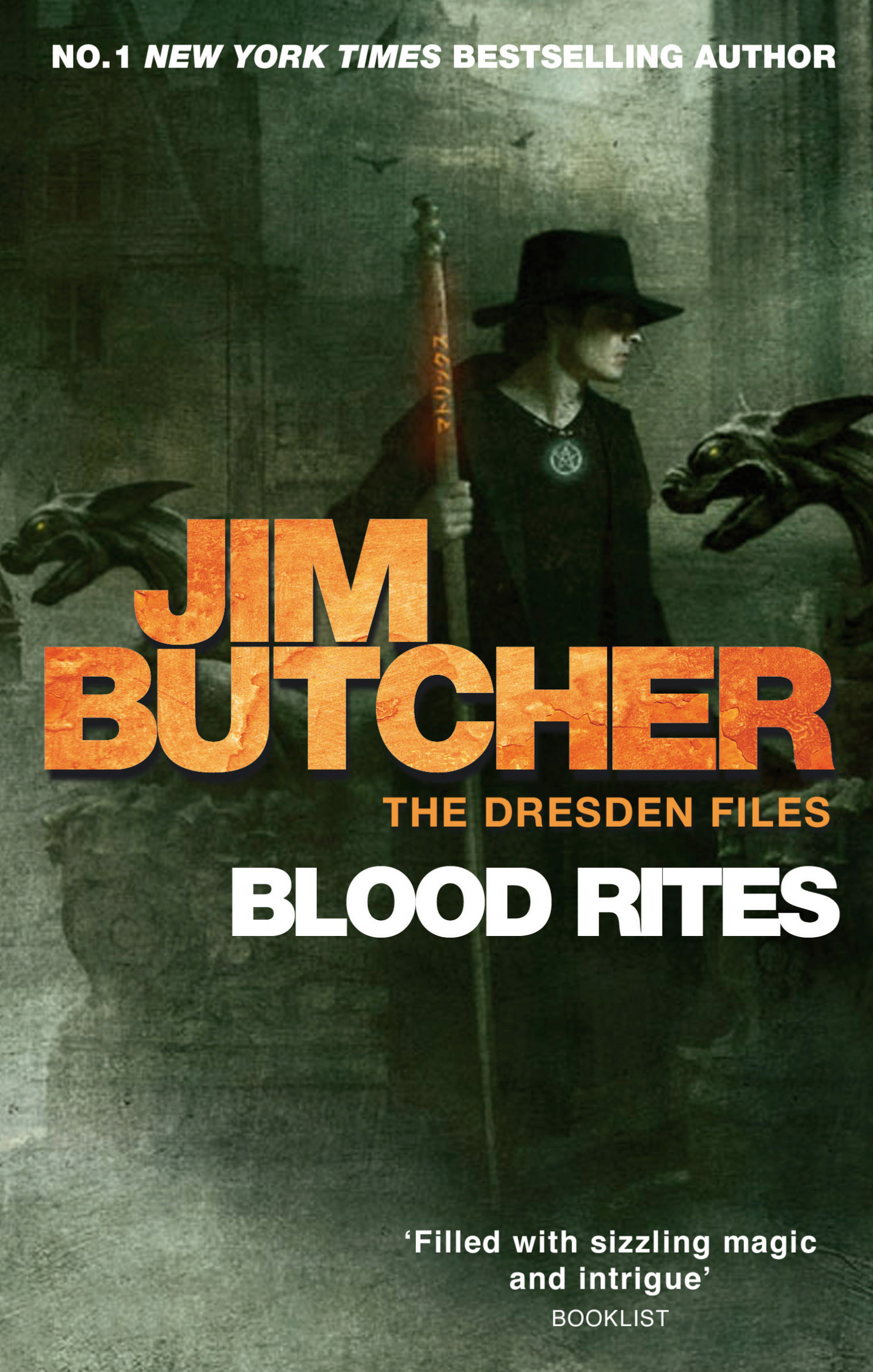
Throwback Thursday: Blood Rites by Jim Butcher

Blood Rite Cover

Publisher: Penguin Audio (Audiobook – 3 August 2004)

Series: Dresden Files – Book Six

Length: 13 hours and 5 minutes

My Rating: 5 out of 5 stars

Amazon

Welcome back to my Throwback Thursday series, where I republish old reviews, review books I have read before or review older books I have only just had a chance to read.  For my latest Throwback Thursday I keep diving into the epic Dresden Files urban fantasy series with the impressive sixth book, Blood Rites.

Last week, in my review for the outstanding fifth book in the Dresden Files series, Death Masks, I mentioned how I had also started listening to the next book in the series, Blood Rites.  I honestly had so much fun reading Death Masks last week (as I did with the rest of the Dresden Files series, such as Storm Front, Fool Moon, Grave Peril, Summer Knight, Battle Ground and The Law), that I had to immediately dive into the next book as soon as I could.  The sixth novel in the series, Blood Rites, was another epic novel which had an impressive and captivating plot to it.

Harry Dresden, Chicago’s resident wizard and protector from the paranormal, continues to eke out a deadly living through his chaotic career of odd mystical jobs while also defending the city against the worst monsters lurking in the shadows.  However, his latest job may place him in the most uncomfortable spot yet, on the set of an adult movie, which finds itself under attack from a deadly and relentless curse.

Taking the case as a favour to his vampire friend and suspicious ally Thomas Raith, Dresden goes undercover on set and attempts to discover who is responsible for cursing the movie’s cast and crew, and why.  However, Dresden’s heroics on set make him a target, and he soon finds the curse striking at him, attempting to end his investigation before he can find the magical murderer.  Worse, enemies old and new are bursting out of the shadows, as two separate courts of vampires attempt to strike Dresden down.

As Dresden continues to search for the murderer wielding the curse, he is forced to fend off attacks from the lethal Black Court.  Led by a powerful elder vampire with a serious grudge against Dresden, the Black Court will stop at nothing to destroy him and any of his friends that gets in their way.  However, the greatest threat may reside in the White Court, to which Thomas belongs.  The White Court vampires are manipulative and subtle killers, using their alluring presence to suck the life out of everyone they touch.  Caught between warring members of the White Court family, Dresden must use all his wits to escape their wrath and uncover hidden truths if he is to survive.  But what secret from the past connects Dresden to the White Court and their machinations, and is Dresden really ready for the dark knowledge waiting for him?

Whelp, it seems that it is pretty impossible for Butcher to write a dud novel.  Blood Rites is an exceptional addition to the wider Dresden Files series, and it was another one that I have no choice but to give a full five-star review to.  Featuring an intense and deeply captivating narrative, Blood Rites was an incredible read and I quickly got sucked into its unique story, compelling mysteries and dark, damaged characters.

I just loved the elaborate, dark and powerful narrative that Butcher featured in Blood Rites, as the author comes up with a complex tale that expertly brings together a dark urban fantasy with a thrilling murder mystery storyline.  Like the rest of the Dresden Files books, Blood Rites exclusively follows protagonist and point-of-view character Harry Dresden as he finds himself forced to face off against a series of dangers and threats at the same time.  The most prominent of these includes an investigation into a deadly curse aimed at the female employees of an adult entertainment studio, which sees Dresden go undercover on set to try and save the remaining cast and determine who the killer is.  This also leads him into a confrontation with the White Court of the vampires, especially when his vampire friend, Thomas Raith, requests his help.  At the same time, vampires from the Black Court are after Dresden for his actions in Grave Peril, which forces him to call in some major backup to take them on.  Unfortunately, this also leads him into conflict with his supposed allies, as well as his former mentor, when secrets from the past are revealed.  Dresden is also hit with a whole bundle of personal drama, especially when he discovers unfortunate truths about his long-dead mother, and there is an interesting growth in the relationship between him and several supporting characters.

As a result, there are many plot elements scattered around Blood Rites, which makes for quite an elaborate overall story.  Luckily, Butcher does an excellent job of introducing all these separate narrative threads to the reader, and you swiftly get drawn into all of them.  After a good and necessary bit of setup, the story roars off at a quick and captivating pace, and the reader has a great time jumping from storyline to storyline.  Everything starts to come together near the middle of the book, where you get some excellent action scenes, including a particularly funny death sequence involving a vampire and a frozen turkey, and the fallout of these scenes leads to some great dramatic moments with big personal revelations.  Following this, the story zooms along, and you soon find a partial and problematic solution to the murder case, while the protagonist is also forced to deal with an all-out assault on the Black Court, while also dealing with dark secrets from his allies.  The attack on the Black Court was one of the best sequences in the book, and the surrounding drama results in some major revelations that fans of the series will lap up.  The remaining storylines then come together perfectly for the finale, as Dresden solves the murder and faces off against its overall architect in a brilliant and extended dark sequence.  I loved how this entire narrative unfolded, and some of the concluding notes will leave you wanting to dive into the rest of the series to see what happens next.

To bring Blood Rites’ great story to life, Butcher utilises his typical style and techniques, which I always immensely enjoy.  The entire narrative is paced perfectly, and you quickly get drawn into the various plotlines, especially with their great combination of characters, intriguing plots, fantasy elements, and dramatic moments.  All of this is overlayed with Butcher’s distinctive humour, most of which is expelled through his cocky point-of-view protagonist, and it helps to enhance the overall powerful and entertainment of the book, especially when the protagonist tries to deflect from his many issues with comedy.  The narrative pretty much goes non-stop, and you get bounced through multiple excellent and powerful scenes, all of which are very fun to see.  I loved how the author balanced out action, character growth, universe building and more in each of the sequences, and there is something quite entertaining and fun for all manner of readers.  I wasn’t as keen on Butcher’s continued attempts to spice up the story with more adult themes, such as the adult film set or the lust-inducing White Court vampires, although it was pretty tame compared to some of the scenes in the last book (that bondage scene, yikes!), and Butcher wove some very compelling narratives around all of them that I deeply enjoyed.  I did enjoy how inclusive Butcher made this novel to new readers, and anyone could easily jump into Blood Rites and enjoy it, even if they haven’t read a Dresden Files book before.  However, there is also a lot to appeal to established fans of the series, especially as there are multiple major reveals and secrets featured here, many of which will lead to big story moments down the track.  As such, I deeply appreciated how this story came together, and pretty much everyone will have a great time getting through it.

I really enjoyed some of the cool fantasy elements featured throughout Blood Rites as Butcher seeks to expand on the lore and magic of his unique universe.  There are some great and intriguing fantasy inclusions here, with the obvious focus being on the various Vampire Courts.  The three main factions of Vampires have all been featured in previous books, although most of the focus has been on the Red Court, whom Dresden is at war with.  Blood Rites, however, has a far bigger spotlight on the two of the other courts who have major differences in powers and appearances.  Most of the focus is on the White Court, who are essentially this universe’s version of succubi, extremely beautiful and seductive creatures who feed off the life energy of those who desire them.  The White Court go on to become a major faction in the Dresden Files series, but this is one of the first books that fully explores them in substantial detail.  As such, you quickly get across their unique abilities, strengths, weaknesses and powers throughout this book, and they come across as quite a distinctive group as a result.  You really get to understand their entire society and worldview, as well as seeing some very different members of the factions, and Butcher writes some compelling storylines around them, while also putting in some very vivid depictions of their powers in action.  I loved how sinister and villainous members of the White Court appear at times, and there is something quite insidious about their abilities that creeps out the protagonists and reader.  A truly complex and excellent group that I had a lot of fun exploring.

Almost in direct comparison to the White Court is the Black Court.  The Black Court are a completely different group of living dead, portrayed more like the classic vampires from Bram Stoker’s novel (indeed, the Dracula novel was an elaborate propaganda attack by their enemies).  Shown as ugly, decaying, blood-hungry creatures that are more monsters than their original human forms, the Black Court are a much more obvious threat with much clearer motives.  There are some brutal and powerful scenes featuring the Black Court in this book, and it was really interesting to see Dresden and his allies go up against them with some classic vampire-hunting weapons, albeit with some fun modern twists to them.  I also deeply appreciated the fantastic parallels between the Black Court and the White Court vampires featured in the Blood Rites; whilst they are both extremely dangerous, their diverse methods and powers troubled Dresden in different ways.  These cool vampires, plus some other great new supernatural threats, added a lot to the complexity of the narrative and I loved the excellent detail and lore that Butcher imbued them with.

As usual, one of the highlights of this Dresden Files book is the compelling and impressive characters the story revolves around.  Butcher features an intriguing and fantastic group of characters in this book, with a compelling blend of established supporting characters and several new figures, many of whom will go on to have substantial roles in the rest of the series.  I had a brilliant time with all these characters, especially as Butcher endeavours to write some outstanding and distinctive storylines around them.

As usual, the most prominent character is Harry Dresden, the wizard protagonist and point-of-view character of the series.  Like most of the recent books, Blood Rites is an emotionally damaging book for Dresden.  Not only is he forced to deal with another harrowing case that racks his sanity, but he also finds out some long-buried secrets that prove quite damaging to behold.  In particular, there is a deep dive into his past and his missing family, both of which are hard subjects for him, and he finds himself with some unexpected connections that he has long been missing.  It was truly fascinating to see this long buried and painful part of Dresden’s past explored, and Butcher ensures that the reader gets struck in the feels with some of the powerful scenes that are explored.  Other interactions and reveals see Dresden re-evaluate some of his relationships in this novel, and there were some intriguing and harsh discussions between him and other characters as a result.  I did think that Butcher is over-playing the whole chivalrous-to-a-fault aspect of Dresden, as he continues to be a tad sexist and constantly underestimates woman, usually to his own detriment.  It’s honestly getting a little old, and I hope it gets phased out a bit in future books.  Still, I deeply enjoyed the fantastic development around Dresden in Blood Rites, and it greatly enhanced the narrative.

This book also featured a great appearance from previous supporting characters Karrin Murphy and Thomas Raith, who both play a major role in Blood Rites.  This proved to be quite a pivotal novel for both characters, and I really appreciated the way that Butcher built on their previous appearances and used them to write some impressive and powerful storylines around them.  This proves to be one of the more intriguing looks at Murphy so far in the series, especially as it dives into her complicated family life, and I liked the early hints here about the future relationship between her and Dresden.  Murphy gets dragged far further into Dresden’s magical activities than ever before here, and she is forced to balance her responsibilities as a cop with the necessity of killing monsters, something she has great difficulty with.  An overall badass character, Murphy has some brilliant and action-packed scenes in Blood Rites, and I love how well she serves as a foil to the more ridiculous Dresden.

Thomas, on the other hand, gets quite an intense and deeply personal storyline here as you get the most in-depth look at this elusive and compelling vampire character.  Not only do you get a great look at the rest of his family as the book explores the White Court, but you finally find the reasons why he is always helping Dresden, which leads to some emotional and compelling scenes.  A lot of time is also spent exploring the battle between Thomas’s humanity and the monster within, especially when it comes to feeding on those around him.  This comes to a head when his need to feed and survive hurts someone close to him and he has trouble coming to terms with what he’s done, especially when Dresden harshly confronts him.  Throw in his complicated family and intense daddy issues, and Thomas goes through the emotional wringer in this book, which proves to be very illuminating.  Butcher sets Thomas up as quite a substantial supporting character in this book, and I look forward to seeing more of him in the future.

Aside from these main characters, there is also a great collection of supporting characters who add a lot to the story, and there are some awesome appearances here.  I really enjoyed seeing more of mysterious mercenary Kincaid in this book, especially after his fun appearance in Death Masks.  Kincaid is a badass killer who is hired by Dresden to kill the Black Court, only to end up being a bigger threat to Dresden when the wizard lacks to money to pay him.  Kincaid has some excellent and action-packed scenes, and I was intrigued by his backstory, especially the hints at his dark, dark past.  I also loved the use of Dresden’s mentor, Ebenezar McCoy, an older wizard who raised him and taught him magic.  Butcher writes some amazing scenes around McCoy, especially once Dresden finds out just how many secrets the old man has been keeping from him.  Throw in a batch of great vampire characters (including the sinister Lord Raith and the compelling Lara Raith), some entertaining members of the adult film industry (including the fantastic diva Trixie Vixen), and the first appearance of Mouse, Dresden’s puppy, and you have an amazing cast of characters here that Butcher gleefully and impressively wraps the story around.  Each of these characters is very fun and intriguing in their own way, and I loved the elaborate and moving scenes that they star in.

Naturally I chose to check out Blood Rites on audiobook, which I maintain is the absolute best way to enjoy the Dresden Files books.  The captivating story and excellent characters really fit into this format extremely well, and I find myself absorbing the narrative and the author’s fantastic style a lot better this way.  With a runtime of just over 13 hours, Blood Rites is the noticeably longer than the previous books in the series (they get progressively longer and longer as the series goes, with some later books like Cold Days reaching nearly 19 hours in length).  Despite the increased run time, I still found myself knocking this audiobook off in no time at all, especially once I got stuck into the excellent and powerful story.  I must also highlight the incredible voice work of the always awesome James Marsters, who did another spectacular job narrating this fantastic novel.  At this point in the series, Marsters has really hit his stride when it comes to narrating, and he voices each audiobook with some impressive passion, effortlessly bringing the dark events and complex characters to life and ensuring that everything sticks in the listener’s mind.  All the characters are voiced extremely well, with the highlight again being protagonist Harry Dresden, who Marsters inhabits effortlessly.  He really understands the character’s anguish, pain, and dark humour, and this comes across in his narration perfectly.  Thanks to his epic performance in Blood Rites, and the other Dresden Files audiobooks, Marsters remains one of my favourite audiobook narrators, and I cannot recommend the Blood Rites audiobook enough as a result.

My dive into the early Dresden Files novels continues to be incredibly epic, as I once again fell in love with one of Jim Butcher’s unique reads, Blood Rites.  This fantastic novel has so much going for it, and I had a brilliant time exploring the powerful urban fantasy/crime fiction based narrative.  Featuring a deeply compelling mystery, a ton of intriguing parallel storylines, and some impressive and emotionally charged character development, Blood Rites is another exceptional book that is so much fun to get through.  Honestly, if I didn’t have such a backlog of awesome recent audiobook releases, I would probably be diving into the seventh Dresden Files novel right now, but hopefully I will get a chance later this year.  If you haven’t checked out the Dresden Files books after my previous glowing reviews, then you really need to get your butt into gear and start reading them now!

Amazon

Throwback Thursday – Death Masks by Jim Butcher

Death Masks Cover

Publication: Penguin Audio (Audiobook – 1 August 2003)

Series: Dresden Files – Book Five

Length: 11 hours and 17 minutes

My Rating: 5 out of 5 stars

Amazon

Welcome back to my Throwback Thursday series, where I republish old reviews, review books I have read before or review older books I have only just had a chance to read.  For my latest Throwback Thursday, I highlight another excellent entry in Jim Butcher’s iconic Dresden Files series, with Death Masks.

Fans of this blog will know that I have been having a magical time (pun intended) discovering and getting into the long-running Dresden Files series by acclaimed fantasy author Jim Butcher.  Set in Chicago, the Dresden Files novels follow the adventures of Harry Dresden, wizard for hire and protector of the city against any supernatural threat that comes its way.  This has been Butcher’s major series for years, but I only got into it back in 2020 when I checked out the 17th entry, Battle Ground.  Due to its exceptional plot and the all-out magical war for Chicago that it depicted, this was a pretty epic novel that was not only one of the best books and audiobooks of 2020 but also an excellent recruiting tool for new Dresden Files fans.  It didn’t take me long after reading Battle Ground to check out some of the earlier entries in the series, such as Storm Front, Fool Moon, Grave Peril and Summer Knight, as well as the novella, The Law.  I have had such an epic time with this series that when I felt like a guaranteed five-star book, I immediately decided to check out the next book in the series, with the fifth Dresden Files entry, Death Masks.

Harry Dresden, Chicago’s resident professional wizard, is once again thrust into the middle of far more trouble than he ever dreamed of when a television panel show introduces him to an array of people who want something from him.  Not only does he find himself forced into a duel against a powerful Red Court vampire noble but he is also hired by a Vatican priest to recover a revered stolen holy relic, the Shroud of Turin.

Determined to make the most of these new events, Dresden takes the case and begins to search for the shroud while also preparing for his upcoming fight to the death.  However, many people are interested in obtaining the shroud for their own use, and Dresden finds himself under attack by hitman, gangsters, criminals, and far, far worse.  The Denarians, an ancient and despicable group of fallen angels, have designs on the shroud, and not even Dresden’s most powerful and holy allies, the Knights of the Cross, may be enough to save him.

As Dresden attempts to recover the shroud, he finds that the Denarians and their deadly leader, Nicodemus, have a nefarious plot for the shroud that could destroy everything that Dresden holds dear.  Working with allies old and new, Dresden must overcome the Denarian threat before it is too late, while also managing to defeat the Red Court vampire gunning for him.  With everything on the line, has Dresden finally bitten off more than he can chew?  And what happens when the lost love of his life returns to town, battling her own demons?

Wow, Butcher just cannot strike out!  This is yet another book from him that I have no choice but to award a full five-star rating to.  Death Masks has a deeply addictive narrative that grabs your attention from the very first page and refuses to let go, and some complex and entertaining characters to match.

Death Masks has a pretty awesome story to it that got really addictive very quickly.  Starting off a few months after the events of Summer Knight, Death Masks contains several, great layered storylines, all of which are pretty exciting and intense in their own way and which cross over well to create a complete and powerful narrative.  The first of these immediately places Dresden in the path of several dangerous enemies and opponents as he is dragged into a new case, recovering the stolen Shroud of Turin.  Despite being warned off by his allies, the Knights of the Cross, Dresden naturally pursues, which sets him against established foes, like Chicago’s gangster king, and a powerful new cadre of enemies, who represent one of the biggest threats that Dresden has gone up against at this point in the series.  At the same time, the protagonist is forced to accept a formal duel to the death against a powerful vampire lord, as part of the ongoing storyline about his war with the Red Court, and he also helps the police investigate a disfigured corpse that seems to have been simultaneously infected by every disease known to man.  These events are further complicated by the re-emergence of Susan Rodriguez, his former love interest whose romance was crushed when she was partially turned into a vampire, and who he still holds a massive torch for.

Each of these storylines is quite interesting on its own, and Butcher writes some interesting scenes around all of them, with the primary focus being on the search for the shroud and the fight against the Denarians.  These storylines start pulling together about hallway through the book, and Butcher really raises the stakes for the protagonist, especially when he experiences some major and heartbreaking setbacks.  I really loved the unique blend of character development, fantasy and urban crime that is utilised throughout most of this story, and it is always so much fun to see the protagonist attempting to understand the complex plots arranged against him as he tries to save his friends and city.  Everything leads up to an extremely exciting final third where Dresden and his allies are thrust into a series of battles with massive stakes involved that leave them broken and nearly beaten.  I honestly could not stop listening to the final few hours of this book, and I pretty much powered through the entire second half in less than a day.  There are some epic and very moving moments featured in the big conclusion, and Butcher did a brilliant job of bringing everything together and ensuring that the reader will come back for future instalments of his work.  I particularly loved the final little twist that saw the book’s major villain get one over the protagonist, and I am extremely keen to see what happens with that storyline going forward.

I have so much love for Butcher’s writing style when it comes to the Dresden Files novels, and Death Masks was a particularly good example of this.  Like the rest of the series, Death Masks is told exclusively from the perspective of its central character, Harry Dresden, and this places you right into the midst of all the action and investigations, and you see all the steps as Harry tries to outwit his various foes.  This use of Dresden as the central figure also ensures that the reader gets quite a lot of humour in the story, and the continuous jokes and funny insights really help to make the story that much more fun to enjoy.  There is a great focus on character development and introductions in this novel that I deeply enjoyed, and this works really well with the mystery elements and established fantasy setting to create an excellent narrative.  Butcher keeps the pace of the book sharp and fast here, and all the big events quickly and effectively fall into place where needed.  I liked how the protagonist dealt with multiple problems and cases simultaneously, and Butcher did a good job of balancing and combining these initially separated storylines and threats where necessary.  I did think that Butcher did go over the top in places when it came to the romance sequences, and some of the scenes were a little questionable at times.  Still, this didn’t impact my overall enjoyment of the Death Masks, and I had a blast seeing everything unfold.

Death Masks proved to be a particularly significant entry in the Dresden Files series, and it is a must-read for all fans as a result.  Butcher perfectly sets up several ongoing storylines here while also successfully continuing some established character arcs and introducing a whole new batch of great and interesting characters.  There are so many key events and interactions going on in Death Masks, many of which will be vital for the rest of the series, and I know it helped to give some additional context for some of the events in the later books I have read.  However, like most Dresden Files novels, Death Masks is extremely accessible to new readers, and Butcher always makes a point to expand on the existing storylines and characters in a way that new readers can understand and follow without boring the existing fans.  As such, this is a book with a lot of appeal to many readers, and all fantasy fans can dive in extremely easily.

Death Masks is also a major book for character work, and readers who love the impressive and exciting Dresden Files cast are in for a great time here.  I felt that Butcher presented a great balance of established and new characters in this novel, and there is an excellent focus on development and the emotional issues impacting the protagonist.  Many of the new characters will become major recurring figures in the series from now on and deeply enjoyed seeing how their story started.  Most of the character work hinged on protagonist Harry Dresden, who is the true heart and soul of the book.  I always enjoy quirky and rebellious protagonists in novels with a first-person perspective, and the Dresden Files are a great example of this.  Dresden was his usual funny and disrespectful self for the entirety of Death Masks, and it was so much fun seeing him sass every person he encountered, especially when it enrages the villains.  There is also a great emotional component to Dresden in Death Masks that I enjoyed, as he is still going through a lot of issues.  His already complicated feelings about his past failed romance come full circle here when the girl that got away (well, got turned into a vampire) returns and he is forced to finally confront his repressed feelings for her.  There are also some major moments where Dresden is forced to confront the consequences of his mistakes, especially when they cost other characters, and I loved some of the interactions that occurred as a result.

One of the big returns for Death Masks is the character of Susan Rodriguez, Dresden’s love interest who has been missing for a couple of books.  Susan was partially turned into a vampire during her last appearance and left Dresden as a result.  This book sees her return, and there is a complete change of character because of her transformation, being a lot more confident as well as some more notable abilities.  I liked most of the Susan storyline in this book, not only because fans finally get some closure for the romance between her and Harry but also because she now has some mysterious connections and is working as a covert anti-vampire agent.  There are some great moments with Susan in the book, although I did find one scene to be pretty ridiculous, even though it was supposed to be the sequence that served as the climax of the Dresden/Susan romance arc.  Who knew that all you needed to cure vampiric thirst was a bondage session (I’m barely joking here, that happened).  I mostly ignored this awkward scene (try listening to it whilst on your lunch break at work) from my overall grading of Death Masks, just because it was so much of an outlier, but it was a little weird.  Still, I’m glad we got a return from Susan, and it was interesting to see how much she had changed since the last book.

I also enjoyed the use of the Knights of the Cross in Death Masks, and they served as excellent comrade characters for Dresden.  The Knights of the Cross are three modern day crusaders who wield legendary holy swords and serve as God’s fist on Earth.  We had previously met one of them in Grave Peril, Michael Carpenter, and I loved seeing him again, especially as he is essentially a badass Ned Flanders with a sword and a mission from God.  His mentorship of Harry is a key part of his character arc in the series, and it is really interesting to see him serve as a conscience to the rebellious and faithless Harry.  The two other knights introduced in this book also add a lot to the plot.  The rookie knight, Sanya, was really fun, and I liked his more refreshing take on the role and responsibilities he wields.  However, the best of them was Shiro, the elder knight who acts as the group’s guiding light and who has stood against evil for decades.  I love the depiction of this Japanese badass who literally has fallen angels quaking in their boots, and he was a wise and brilliant character that did a lot in a few short appearances.  Shiro was probably my favourite of the three in this book, and his fantastic dialogue with Harry, especially that description of how he became a Christian, was some of Butcher’s best writing.

Finally, I must talk about the villains, who added a great deal to the story.  Readers are spoiled for choice in Death Masks when it comes to villains, as there are several different groups and individuals who turned up looking to kill Dresden throughout the book.  The first of these is Don Paolo Ortega, a Red Court vampire who seeks to end the war between his people and the wizards of the White Council by killing Dresden in a duel.  Ortega appears to be a mostly reasonable and honourable figure despite his desire to kill Dresden, and I liked the fun banter he had with the protagonist.  I was also glad to see more of Chicago gangster Johnny Marcone, who is one of the best recurring figures in the series.  Marcone always serves as such an excellent foil to Dresden, and their constant sparring and back and forth is a lot of fun to see.  It was particularly interesting to see Marcone become even more involved in the mystical world in this novel, mainly due to the respect he has for Dresden’s abilities, and this serves as a major step towards his current incarnation later in the series.

However, the best villains in the story are probably the group known as the Denarians, a collection of fallen angels possessing desperate or evil humans.  The Denarians are some of the most dangerous beings in the entire Dresden Files, and Butcher gives them an impressive introduction in this novel, showing them as agents of chaos determined to cause as much grief as possible.  Their leader, Nicodemus, is probably one of the most intriguing and sinister figures I’ve yet see Butcher write, and he pretty much always had Dresden on the ropes.  I particularly loved his first major interaction with the protagonist, especially as he was able to completely rattle Dresden, who could barely do anything in response.  The characters were barely able to survive his machinations throughout the book, and he truly showcased how much of a threat he could and would be.  A masterful villain, I cannot wait to see more of him in some of the future books.  All these characters, and more (future superstar Butters has an interesting introduction this book), really add to the captivating story, and I loved how well Butcher developed and featured them in Death Masks.

Unsurprisingly, I chose to enjoy Death Masks on audiobook, which was another excellent and impressive experience.  I really love the Dresden Files audiobooks and Death Masks was another good example of why.  Not only does the format really capture the essence of the story and help the listener become immersed in the urban fantasy world, but it also features some of the best voice work you are likely to find in an audiobook.  That is because Death Masks is narrated by actor James Marsters, who always does a spectacular job brining this series to life.  After providing narration for the first four books in the series, Marsters really knows what he is doing when he gets to Death Masks, and he swiftly dives in and gives the epic narrative everything it needs.  All the characters are voiced perfectly, with some extremely fitting and powerful voices given to them that expertly portray their personalities, ethnicities and mentalities.  Due to the great range of characters in Death Masks, Marsters is required to play a range of figures, from an evil fallen angel, three ultra-good holy knights, a gangster, multiple vampires and more, all of which come out really well.  However, the best work is saved for protagonist and point-of-view character Harry Dresden.  Marsters perfectly inhabits the role of Dresden, and you get the full breadth of his complexities, inner pain, and weird sense of humour, as Marsters narrates the book through his eyes.  You really get the best understanding of Dresden through Marsters’s voice work, and that really adds to the quality of the entire read.  As such, this format comes extremely highly recommended, and you need to try Death Masks’ audiobook as soon as you can.

Another Dresden Files book down, another five-star rating from me.  Death Masks was another epic and exceptional entry in this amazing series, and I continue to be impressed by how well Jim Butcher writes these great books.  Thanks to its excellent and utterly addictive narrative and brilliant character work, Death Masks is probably one of the best Dresden Files novels I have read so far, and I had such a great time with it.  I can think of no higher compliment than to say it made me so happy, I instantly started listening to the next book in the series, Blood Rites, the moment I finished Death Masks.  Make sure to come back next week to check that Throwback Thursday out.

Amazon

Throwback Thursday – Summer Knight by Jim Butcher

Summer Knight Cover

Publisher: Buzzy Multimedia (Audiobook – 3 September 2002)

Series: The Dresden Files – Book Four

Length: 11 hours and 13 minutes

My Rating: 5 out of 5 stars

Amazon

Welcome back to my Throwback Thursday series, where I republish old reviews, review books I have read before or review older books I have only just had a chance to read.  In this week’s Throwback Thursday I continue to explore the incredibly fun Dresden Files series by Jim Butcher with the fourth book, Summer Knight.

Readers of this blog will be familiar with my recent exploration of the epic Dresden Files series by the outstanding Jim Butcher, widely considered one of the best urban fantasy series out there.  After having an absolute blast last year with the latest book in the series, Battle Ground (one of the best books and audiobooks of 2020), I have spent a bit of time this year checking out the earlier entries in the series.  I have so far had the pleasure of listening to the first three Dresden Files novels, Storm Front, Fool Moon and Grave Peril, each of which got a five-star rating from me, and when I wanted a good audiobook to check out, the next entry in the series made the most sense.  The fourth Dresden Files novel is the impressive and compelling Summer Knight, which sets the protagonist against the fairest and most vicious opponents yet.

Following the events of Grave Peril, the White Council of wizards is at war with the Red Court of the vampires, and it is all Harry Dresden’s fault.  With vampire attacks increasing and his life consumed with finding a cure for the vampirism affecting his ex-girlfriend, Dresden is once again dragged into the conflict when the White Council arrives in Chicago.  Considered by many wizards to be a dangerous maverick, Dresden will need to find a powerful bargaining chip if he is to continue receiving the protection of the council.  Unfortunately for Dresden, the perfect opportunity has been given to him; he just wishes it were anything else.

Harry has been contacted by Winter Queen Mab, the powerful leader of the Winter Court of the Faeries, who offers him a dangerous bargain: in exchange for forgiving a previous debt, and for allowing certain concessions to the warring White Council, Harry must work a case for her.  The Winter Queen desperately needs Harry to find out who murdered a seemingly normal human, and with his life entirely in the White Council’s hands, he has no choice but to comply.  However, when it is revealed that the victim was the Summer Knight, the rival Faerie Summer Court’s mortal champion, Harry begins to realise that this will be no easy case, especially as a great deal of the Summer Court’s power was stolen after the murder.

With the Summer Court and the Winter Court gearing up for war in response to the Summer Knight’s death, Harry must quickly race to find the killer before Earth’s climate is destroyed by these powerful magical forces.  However, this is no simple case, and to solve the murder Dresden is forced to confront some of the most dangerous and malicious magical beings in existence.  Worse, the Summer Court have hired their own investigator, Dresden’s first love, Elaine, the woman who broke his heart and tried to kill him.  Can Dresden solve this murder before it is too late or will the entire world tremble at the destruction of an all-out war?

Summer Knight was another impressive and wildly entertaining release from Butcher, which did a wonderful job expanding his universe in some amazing ways.  Perfectly flowing on from the events of the previous novel, Summer Knight has an incredible story, some great characters, as well as some clever new fantasy inclusions that set up multiple future novels extremely well.  I had an absolute blast listening to Summer Knight’s audiobook format, and unsurprisingly it gets another five stars from me.

Summer Knight Cover 3

This latest entry from Butcher has a pretty amazing story that is extremely easy to enjoy.  Like the rest of the Dresden Files novels, Summer Knight can be easily read as a standalone read, although there are some compelling story threads that are continued from the prior books.  The novel starts with a damaged Harry Dresden dealing with hit squads, angry vampires and his own irritated wizard brethren.  After a fun and action-packed opening scene, Dresden soon gets drawn into another dangerous case as Mab, the Winter Queen, buys Dresden’s debt to his fairy godmother and uses it and the wizards war against the Red Court to trap him into investigating a case.  The subsequent magical murder investigation proves to be pretty fantastic, as Dresden is forced to dive into the murky magical underworld of the warring Fae courts.  After some deadly attacks, fascinating internal wizard politics, and an interesting side story about neutral half-Fae teenagers, Dresden soon uncovers the reason for the victim’s death.  I liked the twist surrounding who was responsible for murder as well as the revelation of their master plan.  Butcher did a really good job of disguising the people behind it and their methods, especially as most of the clues were often cleverly in plain sight.  This all leads up to a massive and epic conclusion, where Dresden and his allies find themselves fighting through two armies of rival Fae to try and stop the end of the world.  There are some awesome moments during this part of the novel, and Butcher throws together some epic clashes, interesting revelations, and a tragic death.  I had a particularly good chuckle at the surprising way in which the big bad was taken down, and it proved to be a great way to end this novel.  I felt that Butcher once again hit the right balance of action, drama, comedy, and character development throughout Summer Knight’s narrative, and this was another exciting and addictive read.

I really enjoyed the way in which Butcher expanded out the Dresden Files’ universe in Summer Knight, with several impressive inclusions turning this fourth book into a significant entry in the series.  Not only are events and inclusions from the previous three novels fit into this book seamlessly, but it also successfully introduces some elements that were a prominent feature of the 17th book in the series.  The most significant inclusions are those surrounding the rival Winter and Summer Courts of the Fae.  Butcher utilises a mixture of Faerie lore and his own pre-existing explanations of magical creatures to create a compelling group of characters, locked in a constant and balanced war between the Summer and Winter Courts.  The author does a good job introducing the various creatures, rules, and roles of these two competing groups of Faeries, which serves as a great basis for much of the narrative.  I also loved the fascinating examination of the differences between the two rival courts, with the Summer Court shown as caring and artistic sorts, while the Winter Court are colder and darker.  Of course, with Faeries, not everything is as it seems, and it was really intriguing the way the various plot reveals around them unfolded.  There was also a great focus on the White Council, the governing body of wizards that Dresden is a member of.  While the White Council has been mentioned in the previous novels, this was the first time that we get a deep look at their inner politics, especially as the more maverick Dresden has dragged them into a war with the Red Court of the vampires (so many Courts, so little time).  There was a particularly great council meeting towards the start of the book where Dresden and his mentor are forced to navigate the politics of the White Council to keep Dresden alive, and it was an interesting part of the book.  I really appreciated the detail that Butcher put into these expansions, and I look forward to seeing how else he expands on them between the fourth and 17th book.

As always, one of the best parts of this Dresden Files novel was the outstanding and well-developed characters, all of whom continue to develop and evolve as the novel continues.  This is particularly true with central protagonist and point-of-view character Harry Dresden.  When Summer Knight starts, Dresden is still reeling from the events of the previous three novels, particularly Grave Peril, where his lover partially turned into a vampire and then left him.  This has left Dresden an emotional mess, especially as he has spent the intervening time ignoring some of the other dangers coming at him while he fruitlessly searches for a cure to vampirism.  Dragged into this case against his will, Dresden soon starts to regain his old personality as he slowly overcomes his grief thanks to his friends and the intervention of some magical beings.  It was great to see Dresden start to heal as the book progresses, and I really appreciated the way in which Butcher explored the trauma surrounding his protagonist.  Even though he is a bit emotionally compromised, Dresden continues to be the main source of the novel’s comedy due to his sense of humour.  It is always fun to see Dresden’s witty take on the insane events occurring around him and I found myself cracking up several times throughout Summer Knight.

In addition to Dresden, Summer Knight contains an excellent group of side and supporting characters, including a combination of existing characters and newer inclusions that were introduced in this novel.  I liked the return of the werewolf gang, the Alphas, who were previously featured in the second novel, Fool Moon.  The Alphas, particularly their leader, Billy, serve as backup to Dresden for most of the novel, and it was really fun to see how much they have grown since their introduction, turning into mystical vigilantes, while also remaining a pack of nerds.  It was also great to see more of police lieutenant Karrin Murphy, who serves as a compelling female opposite to Dresden for most of the novel.  Murphy, who has also gone through a lot in the last few books, is showing a fair bit of trauma in this novel, and she ends up having some deep discussions with Dresden about it.  Despite her lack of magical abilities, Murphy serves as some impressive backup for Dresden, managing to take down several foes, including an ogre with a chainsaw.  There were also more signs of the growing romance between her and Dresden which becomes a big part of the series later, and I like the way in which Butcher is slowly building it up.  I also must highlight the inclusion of Dresden’s first love, Elaine Mallory, who suddenly reappears in his life, working for the Summer Court.  Elaine has been mentioned several times in the previous books and is a cause for a lot of Dresden’s mistrust and romantic failures.  It was great to finally meet her and see the full extent of her complex relationship with Dresden.  Elaine naturally brings out a lot of emotional issues with Dresden throughout the book, and she serves as an interesting supporting character, especially as you have no idea about her true loyalties.  These supporting characters, and more, really add a lot to the overall story and I had a great spending time with them.

Like I have with the rest of the Dresden Files novels, I made sure to grab the audiobook version of Summer Knight, a choice I am extremely thankful for.  The Dresden Files audiobooks are pretty damn awesome, mainly because of their excellent choice of narrator, actor James Marsters.  Marsters has an amazing voice, and he perfectly dives into the various characters featured within the novels, making these audiobooks an absolute treat to listen to.  I especially love the way he gets into the emotional head of the main protagonist, as well as the sheer enthusiasm he exhibits while yelling out spell conjurations.  I also enjoyed the fun voices that he assigns to some of the smaller pixies that appeared in this novel, as well as the very fitting voices that the rest of the cast received.  This voice work is pretty amazing and it ensures that readers can fly through the audiobook in no time at all.  Summer Knight’s run time was just over 11 hours, but it only took me a few days to get through due to how engrossed I got in the story, as well as the audiobook adaption.  As with all Dresden Files entries, Summer Knight comes highly recommended in its audiobook format, and I fully intend to check out the rest of the series in this same way.

Summer Knight by Jim Butcher was another exceptional entry in the awesome Dresden Files series and I had an incredible time listening to it.  With a captivating story, some complex characters and some awesome new fantasy inclusions, I deeply enjoyed this novel, and it is really worth checking out, especially in its audiobook format.  Butcher continues to shine as one of the best authors of urban fantasy and look forward to working my way through the Dresden Files in the next few years.

Summer Knight Cover 2

Amazon

Throwback Thursday – Grave Peril by Jim Butcher

Grave Peril Cover

Publisher: Buzzy Multimedia (Audiobook – 1 September 2001)

Series: Dresden Files – Book Three

Length: 11 hours and 55 minutes

My Rating: 5 out of 5 stars

Amazon

Welcome back to my Throwback Thursday series, where I republish old reviews, review books I have read before or review older books I have only just had a chance to read.  In my latest Throwback Thursday article, I continue my dive into the bestselling Dresden Files urban fantasy series by Jim Butcher by looking at the third chilling novel, Grave Peril.

I am really getting into the awesome Dresden Files novels, a major long-running urban fantasy series that follows Harry Dresden, a wizard living in modern-day Chicago, as he investigates supernatural crimes.  Generally considered one of the best urban fantasy series of all time, I started enjoying this series last year when I read the latest novel, Battle Ground.  I absolutely loved Battle Ground (easily one of the best novels and audiobooks of 2020) and I have since decided to go back and check out the earlier entries in the series.  I already enjoyed the very first novel, Storm Front, a couple of months ago, and Fool Moon, which I finished and reviewed last week, was so much fun that I had to immediately go and read another Dresden Files book.  I have just finished off the third entry, Grave Peril, and decided to feature it in this Throwback Thursday article.

Something is stirring in the dark of Chicago and it is bringing all manner of ghosts and spooks with it.  Harry Dresden, professional wizard, is used to facing the supernatural dangers infecting his city, but he has never experienced quite so much chaos as the spirit world has gone crazy.  Powerful ghosts and tortured spirits are popping up all around Chicago, causing the walls between our world and the Nevernever (the spirit world), to weaken and fray.  As Dresden attempts to find out who or what is behind the current upsurge in spiritual activity, he finds himself under attack from a powerful and unseen force that can strike through his nightmares.  Scared, weakened and full of self-doubt, Dresden is near powerless to stop this creature as it begins to target his friends and loved ones.

With a righteous Knight of the Cross at his back and his reporter girlfriend hounding him for a scoop, Dresden looks for the true source of the entity coming after him.  But in order to find the truth, Dresden must place himself in the very heart of Chicago’s supernatural underworld.  With old enemies, bloodthirsty vampires, howling spirits, deadly demons and his twisted fairy godmother coming after him, can Dresden survive this latest attack unscathed, or will his enemies finally succeed in destroying him, mind, body and soul?

Is it even possible for Butcher to write a bad Dresden Files book?  I have yet to see any evidence to suggest this as Grave Peril, the fourth Dresden Files novel I have read and the third book in the series, turned out to be another epic and powerful fantasy read.  Butcher has come up with a fantastic novel in Grave Peril, and I loved the dark and compelling story that sees Dresden face various demons from his past.  Utilising some great new characters and serving as a major entry in the overall series, this was an outstanding read which gets yet another five-star rating from me.

I deeply enjoyed the cool and complex narrative that Butcher came up with for Grave Peril, especially as it takes Dresden and his friends into some sinister and dangerous places.  This book starts quick, with a great extended sequence that sees Dresden and Michael face off against a powerful ghost in the Nevernever.  This amazing opening to the novel is then followed by an intriguing central story which forces Dresden to investigate a new and unusual antagonist, the Nightmare, who is feasting on his dreams and using the power it steals to go after Dresden’s loved ones.  This central story is very intense and compelling, playing to the series’ detective novel inspirations as Butcher sets up a fantastic mystery while also showing a desperate Dresden coming under attack in some unusual ways.  There are some fantastic moments in this part of the book, and I really appreciated the author’s inclusion of multiple supernatural suspects as you try to figure out who is involved and how they are pulling off their plans.  All this leads to the book’s most memorable sequence, a vampire masquerade, which sees Dresden and his closest allies trapped at a ball, surrounded by a dangerous array of enemies and, trying to work out motivations and plans on the fly.  The story is eventually all wrapped up with a dramatic and clever conclusion that is exciting, emotionally rich and a little traumatising to the reader.  I deeply enjoyed Grave Peril’s cool narrative and it honestly did not take me long to get fully engrossed in what was happening.  While this novel is not as action orientated as the previous book, Fool Moon, it has a much darker edge to it with a particular focus on manipulation, emotions and intrigue.  Readers should be warned that some of the scenes can be a bit over-the-top at times (I am pretty sure the protagonist gets raped by a vampire at one point) and are a little hard to read.  However, this is an overall exceptional narrative.

Like most books in the Dresden Files series, Grave Peril can be read as a standalone novel without any knowledge of the previous entries.  Butcher always makes his novels very accessible to new readers, and while there are some references to the character’s previous adventures, most of the relevant details and re-examined and explained throughout this book.  Grave Peril is a fairly major entry in the overall series as Butcher starts to introduce some important storylines, key supporting characters and lasting world-building elements which become quite significant in future novels.  In particular, Butcher introduces lore surrounding vampires, spirits, and fairies, with the protagonist coming into conflict with all three.  Each of these fantasy elements are set up extremely well and have a dark edge that fits into the series’ distinctive tone.  I loved the author’s depiction of the fairy creatures as monstrous and shadowy manipulators, and it was quite cool to see all the lore around vampires.  Grave Peril introduces three major vampire courts, with each court made up a different sub-species of vampire with their own specific powers and weaknesses, from the Dracula-esque Black Court, to the sexually and emotionally powered vampires of the White Court.  Each of these different types of vampires are strongly featured in Grave Peril and are a fantastic part of the story.  The highlight for me was probably the various battles between Dresden and the members of the Red Court, who can be pretty freaky and repulsive, and Butcher sets up an intriguing, long-running storyline with the Red Court here.

It is near impossible to discuss a Dresden Files novel without mentioning the incredible and well-written characters that appear in each book.  Butcher has a real talent for introducing and developing memorable protagonists and antagonists, and Grave Peril is a particularly good example of this.  Not only do several amazing recurring characters reappear in a big way but Butcher also introduces some intriguing new figures who make a big splash.

The key character as always is series protagonist and point of view character, Harry Blackstone Copperfield Dresden, the sarcastic and amusing maverick wizard who is constantly finding himself in trouble.  I always deeply enjoy following Dresden throughout these novels, mainly because he has a wicked sense of humour, an entertaining attitude and an uncanny ability to annoying and enrage everyone he comes across.  Most of Grave Peril’s humour comes from Dresden’s outrageous actions and observations, including his insane decision to arrive at a vampire’s ball dressed in a cheesy Dracula costume (that raised some eyebrows and lengthened some fangs).  Despite this fun and amusing exterior, Dresden is quite a damaged individual, and you really get to see that on full display in Grave Peril.  Dresden goes through some major traumatic events in this novel, several of which nearly break him as he is forced to encounter or do some very dark deeds.  Butcher really takes his protagonist to the edge in this novel, and there are some very intense scenes, including a glimpse of Dresden’s nightmares and deepest fears.  The author also continues to drip-feed hints of his protagonist’s dark past throughout this novel, especially when Dresden comes into conflict with an old enemy/mentor.  All this hurt and trauma is really touching and compelling, and the entire novel features a heartbreaking ending for Dresden, which really hits home, especially after you find yourself connecting with the character.

Aside from Dresden, there is a great collection of supporting and side characters I had a lot of fun seeing in this novel.  The most prominent of them is newly introduced protagonist, Michael Carpenter, Knight of the Cross.  Michael is a modern-day holy crusader, wielding a powerful blessed sword and his own unflappable faith to strike down evil.  Michael is a very intriguing character, and I deeply enjoyed the friendship he forms with Dresden.  Michael is a man of intense faith and goodness, who manages to balance family with his responsibilities as a knight, and this serves as a fantastic counterpart to the more flaky and irresponsible Dresden.  Like Dresden, Michael goes through some major traumas in this novel, several of which shake even his faith and resolve.  However, no matter how dark the situation, Michael manages to pull through and he and Dresden work together well as an enjoyable team with Michael serving as a mentor figure and conscience to Dresden.  I felt that Butcher did a great job introducing Michael in this novel, and I am excited to see how this noble knight develops in future Dresden Files’ entries.

Other great side characters in this novel include Dresden’s girlfriend, feisty reporter Susan Rodriguez.  Susan has not been my favourite character in the past, but she has a great story arc in this novel.  Not only does she attempt to do her own research into the case but she also serves as a major figure of emotional turmoil for Dresden as he struggles to prioritise her over his supernatural work.  While I did get a little annoyed at some of Susan’s decisions in this novel, I enjoyed the compelling story arc Butcher weaves around her, especially as it alters her in a big way.  My favourite haunted skull, Bob, returns once again and has several great scenes throughout Grave Peril.  I love Bob’s funny, if slightly pervy, personality, and all his appearances are very amusing.  There are some great new characters featured in this book as well, including Lea (The Leanansidhe), Michael’s fairy godmother.  Lea, who previously made a dark bargain with a desperate teenage Dresden, spends much of this book manipulating and hunting Dresden, attempting to claim him and his power.  I loved the use of this evil, manipulative and sexy fairy godmother through the novel, and she ended up being a pretty impressive secondary antagonist.  Grave Peril also sees the introduction of Thomas Raith, a White Court vampire who finds himself helping Dresden.  Thomas is a cool addition to the plot, and it was intriguing to see his introduction to the Dresden Files, especially as I know some spoilers about him.  All of these characters were pretty awesome and I had an outstanding time seeing their latest dark adventure unfold.

As I have with the previous entries in this series, I ended up listening to Grave Peril’s awesome audiobook format.  The Dresden Files audiobooks are a thing of beauty and I love how fun and exciting listening to these great books turns out to be.  The Grave Peril audiobook has a decent runtime of just under 12 hours, which is longer than the previous two Dresden Files novels, but readers will be too caught up in the amazing narrative to care.  I managed to power through it in only a few short days, mainly because of the outstanding narration from actor James Marsters.  Marsters, best known for his roles in shows like Buffy the Vampire Slayer, Angel, Smallville and Torchwood, narrates all the Dresden Files books and does an exceptional job bringing each of these novels to life.  I absolutely loved the incredible gravitas and energy he infused in the Grave Peril audiobook.  Marsters really gets into the heart and mind of Dresden, and you get an amazing sense of what the protagonist is thinking and feeling through the narrator’s voice and tone.  I also enjoyed the enthusiasm that Marsters exhibited in several key scenes, as he attempted to highlight certain weird and dangerous story elements.  For example, he does a fantastic enraged and shrieking ghost wail towards the start of the novel that gave me a start, and I loved the dark and dangerous voices he pulls together for some of the more monstrous creatures.  It was also very cool to hear Marsters yell out some of Dresden’s spells in the heat of battle, and it really enhances the excitement of the scene.  All of this and more makes the Grave Peril audiobook the perfect way to enjoy this novel, and I plan to check out the entire Dresden Files in this format.

Grave Peril by Jim Butcher is an exceptional and incredible fantasy novel that serves as an amazing third entry in the bestselling Dresden Files.  Butcher crafted together a dark and compelling character driven narrative for Grave Peril which proved to be extremely addictive and powerful.  I had an outstanding time getting through this novel, and I loved all the clever introductions and memorable sequences the author loaded into the plot.  A highly recommended read, especially as an audiobook, I cannot wait to see what other madness occurs in the rest of this fantastic series.

Amazon

The Last Smile in Sunder City by Luke Arnold

The Last Smile in Sunder City

Publisher: Orbit (Trade Paperback – 6 February 2020)

Series: Fletch Phillips Archives – Book One

Length: 318 pages

My Rating: 4.75 out of 5 stars

Amazon

From debuting Australian author Luke Arnold comes The Last Smile in Sunder City, an absolutely superb piece of fantasy fiction that presents a unique and powerful story of loss, redemption and despair in fantastic new universe.

The Last Smile in Sunder City is the debut novel of Australian actor Luke Arnold. Arnold, who has appeared in a number of Australian television shows and movies, is probably best known internationally for playing Long John Silver in the pirate adventure series Black Sails. Arnold has now made the rather interesting career change to writing fantasy fiction with this first book, which is the start of a new series known as the Fetch Phillips Archives. I have actually been looking forward to The Last Smile in Sunder City for a little while now, as I liked the intriguing-sounding plot synopsis and I thought that this book had some real potential.

The continent of Archetellos has always had magic, with nearly every race or being having some access to the power that ran through the lands, extending their lives and giving them rare and amazing abilities. With these powers, the magical races ruled Archetellos, until the humans, the only race not gifted with magic, attempted to steal it for themselves. This resulted in the event known as the Coda, which saw all magic erased from the world. Overnight, the multitudes of beings who relied on magic for their very existence either died or were stricken down. The few survivors of these former magical races are now deformed, crippled and slowly dying in pain.

Fetch Phillips has been many things in his life (a guard, a peacekeeper, a soldier and a criminal) but now he is barely eking out a living as a man for hire in the former magical industrial hub known as Sunder City, which has been suffering ever since its magical fires went out. For a small fee Fetch will help you with whatever problem you have, although his sobriety will cost you extra. He only has only one condition: he won’t work for humans; his only clients are those former magical beings who need his help, because it’s Fetch’s fault that their magic is gone and never coming back.

Fetch’s latest case sees him hired by a school that specialises in teaching the children of former magical creatures. One of their professors, an ancient vampire who is slowly turning to dust, has gone missing, and the school is desperate to find him. Diving into the shady underbelly of the city, Fetch attempts to find some trace of the vampire or anyone who wanted to hurt him. But when one of the vampire’s students, a young siren, also disappears, Fetch needs to step up his game to find them. However, even without magic there are still monsters in Sunder City, and Fetch may not be able to survive his encounter with them.

This was a really impressive piece of fantasy fiction. With The Last Smile in Sunder City, Arnold has absolutely nailed his debut, presenting a clever and captivating fantasy mystery which makes full use of its inventive setting and excellent central protagonist to create an impressive and memorable book. This is a truly enjoyable story that contains a fascinating central mystery that blends extremely well with the book’s fantasy elements. I had a great time unravelling the full extent of this intriguing story, and Arnold takes the plot in some very interesting directions, producing some excellent twists and clever false leads. This is less of an action-based novel and more of an exploratory story which sets out the world and features a man of the city running through his contacts to investigate a curious disappearance. I think this worked out extremely well for this book, as it fitted into the book’s classic PI vibe while serving as a great introduction to the city which is no doubt going to be the main setting for any future books in this series. Arnold has also created a couple of fantastic subplots which not only help to explore the world but also help to expand on the compelling darker tone that has been injected into this book.

Without a doubt, the major highlight of this book is the deeply inventive and fascinating new world that Arnold has produced. When I first read The Last Smile in Sunder City’s plot synopsis about a world where magic no longer existed, I was intrigued and thought that it sounded like an interesting idea. However, I was not prepared for just how impressive and creative this turned out to be. In order to tell his story, the author first created a detailed fantasy world that was filled with a huge variety of classic magical creatures of all shapes and sizes, where magic was the ultimate power and in which humans, who have no access to magic, are second-class citizens. While this would have been an interesting place to set a fantasy mystery, the author immediately flips this setting on its head by showing how humans attempted to steal the magic from its source (via an animation intended for children that was cut across by the protagonist’s memories, which was a fantastic way to introduce this plot point), and how their intrusion resulted in the complete destruction of magic.

This of course leads to a very interesting world, as now all the creatures and beings who previously survived on magic have had their lives irreversibly altered. Arnold spends a good part of the book exploring the impact of this loss of magic, examining the impacts on the previously immortal elves who all suddenly died from old age, the werewolves and other shapeshifters who found themselves deformed and stuck at the halfway point between human and animal, the vampires who all lost their fangs and are slowly crumbling to dust, sirens whose human husbands all simultaneously left them, and so much more. There are also some cool examinations of the change in status quo, with humans now becoming the dominant species on the continent thanks to their superior numbers (humans were not affected by the Coda) and their ability to use technology as a substitute for the magic that used to run everything. Of course, humans being humans, there are a couple of examples of humanity taking revenge against the magical creatures that previously dominated the continent, which the author does a good job of working into the plot. All of this proves to be an extremely fascinating and enjoyable overarching backdrop to the story of The Last Smile in Sunder City, and I really have to congratulate Arnold on his amazing imagination. Every detail about this creative world was really cool, and I loved seeing how his vision of a fantasy realm bereft of magic come to life.

The main location of this book is the titular Sunder City. Sunder City is a former magical metropolis which has suffered in the post-Coda period. Once a place of marvels and magically-powered industry, the city is now a shell of its former self, with most magical beings now living in slums and struggling to get by without their abilities. There is a bit of a Depression-era vibe to Sunder City, especially as Arnold does an excellent job of imbuing much of the city with a sense of despair, resentment and hopelessness. This really turned out to be a fantastic city to serve as the book’s primary setting, and I really enjoyed the protagonist’s exploration of it as he attempts to find the missing people. There are some really intriguing elements to this city which are worked into the overarching mystery plot extremely well, such as a hostile police force, businesses catering to former magical creatures and gangs of humans trying to cause trouble. All of this is pretty amazing, and I look forward to seeing more adventures and mysteries take place in Sunder City, especially if the author spends time looking at new types of former magical creatures that weren’t featured in this first book.

In addition to the compelling story and outstanding settings, Arnolds rounds out this awesome book with an intriguing central protagonist, Fetch Phillips. Fetch, who also serves as the book’s narrator, is a drunk, depressed and broken man, who is essentially a classic noir PI in a fantasy world. While Fetch can at times be funny or entertaining, mostly due to his sarcastic and confrontational style, his defining characteristics are his overwhelming guilt and despair. This is due to the fact that he is largely responsible for the humans destroying magic, which resulted in so much death and suffering. The full story behind Fletch’s involvement in this atrocity is chronicled in the book through a series of flashbacks which show his origin, the friendships he formed and the events and emotions that led up to his darkest moment. Due to his role in the causing the Coda, and the fact that he betrayed the trust of several friends, Fletch is filled with all manner of self-loathing and must now deal with his complicated emotions towards other humans, who he detests, and the former magical creatures he is compelled to help, most of whom now hate him. Despite all this darkness, there is a little bit of light within Fletch as he struggles against his demons and his past to find redemption and live up to a promise he made. I thought that this portrayal of Fletch was a great part of the book, and I loved the complexity that Arnold has imparted on his protagonist. I also really enjoyed the way that the author showed off the character’s past, centring the flashbacks on the four tattoos he has on his arm, and exploring the meaning behind them. This mixture of the mystery in the present and the look at the events in the character’s past worked really well together, and they help show off an amazing central protagonist who is going to be a fantastic centrepiece for this series going forward.

The Last Smile in Sunder City by Luke Arnold is a superb and highly addictive fantasy mystery that presents the reader with a fantastic and thrilling story. While the book is mostly a clever and enjoyable mystery, its true strengths are the unique and captivating settings and the complicated, well-written protagonist, both of which help to transform this amazing novel into a first-rate read. Thanks to this excellent debut, Arnold has proven that he is a talent to be reckoned with in the fantasy genre, and I am looking forward to seeing what he produces next. The Last Smile in Sunder City comes highly recommended, and I think many people are going to enjoy this exciting new Australian author.

Amazon